Return
to the Contents Page
Proceed
to the next page
Return to the previous page
PART TWO - INTO THE DARK
Once the party has been fully outfitted and equipped, the Council will meet one last time to officially charge them with their task. Speeches concerning the graveness of their situation will be made, along with pleas that the party seek to escape trouble rather than fighting its way through it. A prayer to the Slumbering Gods will be given, and then the party will be taken out of the clan halls by a secret exit. They will have in their possession a map showing the way to an entryway into the drow tunnels. The party will also have a "no questions asked" pass given to them by the dwarf King.
The entryway is approximately 50 miles east of the clan halls. This territory is still under the control of the Free Folk, and so there will be little danger of attack here. At the site shown on the map, the party will find a small hut of iron, approximately 20' in diameter and 10' tall. Atop this strange structure is a small stone guardhouse, which bears a company of stout Bleton soldiery. These are guards set upon this rather minor drow egress; so minor in fact that no drow armies or Deceiver armies actually used the tunnel, it was merely a way for scouts to come and go before the actual start of war.
The party will be questioned as they approach, and once they show their pass from the dwarf King, a ladder will be lowered and the party will be shown into the stone building.
Within is a simple affair, similar to any guardhouse in the lands. However, a strong iron door is in the floor of the building, barred by a strong bar, padlocks, and runes. A priest of Aghorrit will emerge, check the pass, and then incant a small prayer which causes the runes on the trap door to glow briefly. The guards will then unlock and unbar the door and open it, revealing a thick iron ladder that descends into the interior of the metal hut. At the bottom of the hut is a hole in the ground, this slanting steeply but navigably to the north…the entrance into the underworld.
The priest will tell the party that once through they will not be allowed back. It will be up to the party to arrange to transport any mules or other bulky items or creatures down the ladder. A block and tackle and rope can be rigged if necessary to lower mules and such.
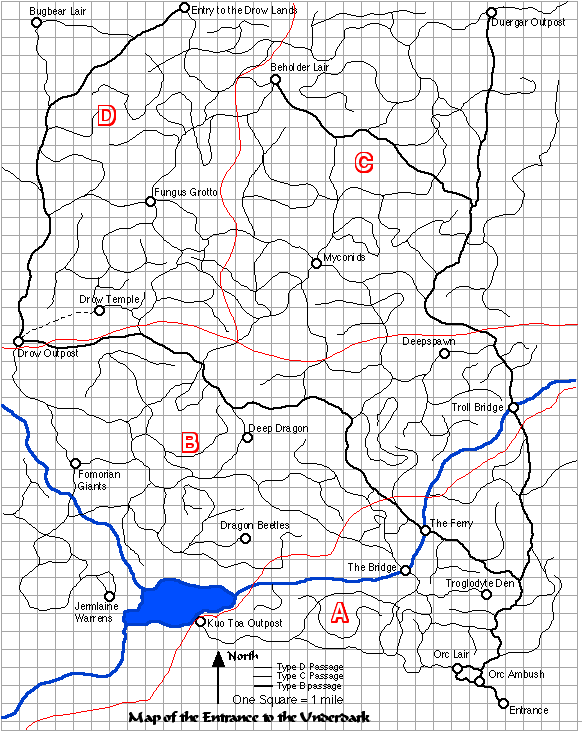
Refer to the "Entrance to the Underdark" map for this section. Basically, this section acclimates the party to the underdark, introducing them to some encounters and the drow and allowing them to get their "sea legs" so to speak.
Each encounter area designated on that map is detailed herein, often with supporting detailed maps. In addition, an extensive wandering encounter chart is included that the DM can use to pre-fabricate encounters or to produce them on the fly.
It is often difficult to distinguish between type C and type D passages on the map displayed above. In this case, the DM should simply assume that any thin passage lines braching from a type B passage is a type C passage and any passages branching off of a type C passage is a type D passage.
Notes about the underworld:
Races:
The underworld of Therra is not anywhere nearly as well known to surface dwellers as is the underworld of most campaign worlds. Most surface dwellers never even heard the word "drow" before the war began, and even scholars of the underworld merely accumulated rumours and innuendoes from around the world. Similarly, the drow have never really dealt with surface worlders before the war. Trade between the underworld and the surface has been sparse or non-existent heretofore, mostly consisting of some slave puchases from the Lost Kingdoms and perhaps some trade with evil humanoids and giants of the surface.
Many of the denizens of the underworld are similar to their counterparts in other campaign worlds. The drow of Therra are certainly recognizable as drow to veterans of other campaign worlds. However, it is recommended that before this portion of the adventure is run, that the DM stress to the players that while much of the Therran underworld will be familiar to them, it should not be familiar to their players. In addition, the DM can add a little incentive to roleplaying ignorance by pointing out that at least two major underworld races of Therra are distinctly different in outlook and attitude from their usual counterparts in other campaign worlds, and it would be a grave mistake for the party to treat these two races and any other creatures encountered as if they were carbon copy cut-outs from other worlds.
Passages and Conventions:
Passages in the underworld are basically divided into four categories:
Type A passages are large main thoroughfares, usually of the drow or duergar in this setting. These are generally flat and navigable with sturdy carts. They include few obstacles or natural dangers and are often even paved with stones or adorned with arches or carvings at various points. These are the highways of the drow and duergar. They are well travelled and well patrolled and usually follow the most direct route between major sites. Type A passages are typically 50'-75' wide and between 30'-45' tall.
Type B passages are secondary thoroughfares. They are clearly worked, though they may be expanded from natural lava tubes and faults. They are almost never paved but often bear arches and carvings and glyphs, especially near habitations. These passages often present detours and/or flanking routes for the type A passages. For races other than the drow or duergar, type B passages do serve as the main thoroughfares. Type B passages are less well travelled or patrolled than type A, but are still commonly used by the local civilized denizens. Type B passages are typically 30'-45' wide and 20'-30' tall. These passages are generally devoid of fatal or lethal obstacles, but can be more than a match for even a sturdy handcart.
Type C passages are tertiary passageways. They are most often not made by civilized races but are natural fissures that have been expanded often by denizens such as xorn and umber hulks. In a sense, they are akin to animal trails on the surface world. Such passages may often have formidable or lethal obstacles, and are not well travelled by civilized races. Drow or duergar would only be found in such passageways for specific purposes (such as raiding, hunting, or searching for the party). These passages are haunted by the less civilized and more vicious underworld denizens, but are also the most likely to avoid drow or duergar patrols. Type C passages are typically 15'-25' wide and between 15'-20' tall. They are often choked with stalactites and stalagmites.
Type D passages are not really even passages. They are pretty much natural fissures or lava tubes or old riverbeds. Decidedly natural, these passages usually don't lead anywhere and are apt to simply end after miles of twisting, obstacle laden travel. Sometimes they may simply submerge into a subterranean lake or river, perhaps not to emerge for miles or ever. These passages are almost never traversed by drow, duergar or other civilized races, and are not even inhabited much by solitary intelligent creatures of the underworld. They are, however, home to some of the rarer and more bizarre of the Underdark denizens.
Of note, many of the passages of all types have fungus growing here and there, on the floors, ceilings, and walls. In the type A and B passages, these are usually out of the centre of the thoroughfare. In the smaller passages they might be blocking the way entirely. Most of these fungi are harmless unless eaten. Swallowed fungi might prove edible or make one ill, hallucinate, or might be a deadly poison. Such matters are up to the DM to adjudicate.
Unless otherwise indicated, teleport spells do not work well in the underworld. This is for a variety of reasons, including the radiation of the drow, the power of the earth concentrated in such quantities, and the communal and mystical desire of the underworlders to remain hidden from the surface. Teleportation and other such magicks will function, but not past a distance of 300 yards or so, and that only on a relatively level plane. Teleportation vertically is thwarted by the strange emanations such that it is limited to approximately a 100-yard shift in the vertical.
Sections:
This area of the underdark is divided into 4 rough zones, noted as A, B, C, and D in red lettering on the Entrance to the Underdark map. These zones are demarcated by red borderlines.
Zone A = The demesne of the orcs, troglodytes, and kuo-toa
Zone B = The haunt of the deep dragon and a variety of creatures
Zone C = The outer areas of the duergar
Zone D = The outer areas of the drow
Each zone has its own wandering encounter table to better reflect the diversity of denizens and travellers within each zone. That said, the DM should keep in mind that there are usually no hard and fast borders between the areas, and the DM can certainly feel free to have one race overlap into another's zone.
Travel in the Underdark:
Travel in the underdark is nothing like traveling on the surface. It tends to be much slower for a variety of reasons. First, it is always nighttime underground. This means that even with good light sources like Continual Light spells, visibility is only 60' out. This forces parties to go slower in order to avoid monsters and dead ends and chasms and other hazards that might be lurking outside of the range of vision.
In addition, this is hostile country…very hostile, and the party will want to proceed more cautiously in order to avoid pitfalls and sinkholes, search niches they bypass to make sure nothing is ambushing them, examine the ceilings, pause to perhaps probe a strange growth of mold or fungus, stop to listen to a distant sound, be aware of collapsing ceilings, and to notice side passages.
As such, travel is at a rate of 12 miles per day on type A passages, 8 miles per day in type B passages, 6 miles per day in type C passages, and 4 miles per day in type D passages. This assumes, for type C and D passages, occasional jaunts down minor passageways that result in dead-ends and turn-arounds as well as occasionally rappelling down slopes and walls and across cracks. Ill-equipped parties without use of grapples and ropes and spikes and hammers will be subject to a -1 to -2 mile per day penalty in type C and D passageways.
The party can travel faster, approximately double the above rate, but they will be subject to random mishaps and will be more prone to surprise as well. It is up to the DM to suitably penalize parties that choose to proceed incautiously such that they will wish to refrain from doing so except under the most extraordinary of circumstances. Certainly parties travelling at double speed should at least suffer a substantial penalty to their surprise rolls.
Supplies:
Supplies in the underdark are key, and it is recommended that even DMs who usually do not track food and water and encumbrance and material components do so now. A good part of the difficulty of this adventure lies in the fact that the party is in a very extended stay in a very hostile situation. There is little chance to resupply, refuel, or replenish. This will help to put a limit on parties that are very powerful and used to blasting their way through everything. Even silly things like gum arabic will become precious after an errant fireball toasts the mage's entire supply of it and he is now without the use of his Invisbility spell.
Mules will prove to be very useful, and the Bleton dwarves can provide as many as the party likes, sturdy beasts used to underground travel and trained to stand open flame, orcs and goblins, and even battle. That does not mean these mules will stand up to a giant or dragon, but they are trained to deal with the common dangers dwarves might expect to find when traveling underground.
Humans consume 1 man-day of rations per day. This equates to 1 pound of normal rations or 1/2 pound of iron rations per day per man.
Mules consume 4 times that weight in fodder and there is no such thing as iron mule rations.
Humans consume 1/4 gallon of water per day in the underground environment. The underground is both damp and cold, which helps to conserve water. Mules consume 4 times the amount of water that humans do. A gallon of water weighs 4 pounds.
Material components are difficult to find in the Underdark for the most part. Obviously, things like cobwebs or bat guano are no problem, but try to find a 50gp agate or some cuttlefish shell. Because of this, the party should specify exactly what they are taking as material components. Full awareness of this may temper the party's tendencies to fireball or blast with spells whatever they come across.
Material components can be found in the Underdark, but this can involve trading with Underdark denizens or poking around into places the party might not normally go into. This is a good thing and can be used as an adventure hook.
Underdark spellcasters generally use the same material components that surface ones do, but sometimes there are modifications. For example, the Grease spell requires pig fat. There are no pigs in the Underdark, so the drow spellcasters have modified their spells to use rothe fat instead. Can a surface mage take some rothe fat and cast his own Grease spell? No. The drow spell formulae have been specifically modified to use rothe fat and could not, in fact, use pork fat! If the party wizards want to use rothe fat they will have to capture a drow spellbook with Grease in it and relearn the spell. They could also memorize both versions at the cost of 2 spell memorization slots.
That said, enemy spellcasters who have been vanquished will often have useful spell components around assuming they can be reasonably procured in the Underdark (if not then assume they use a substitute as mentioned above). Spell component stores are not generally mentioned in the text of encounters. The DM is safe to assume each spellcaster has on his person enough spell components to cast his memorized spells. In addition, each will have at least 12 castings of each in his lair.
Unless otherwise indicated, all creatures wearing armour are assumed to be wearing a helm of a similar armour class (or the closest equivalent).
ZONE A:
WANDERING MONSTERS:
Consult the following tables. There is a table for each passage type present in the zone (usually types B, C, and D). The table should be checked for once per square of travel on the Entrance to the Underdark map or once per 3 hours if encamped. Encounters will occur on a 1 on a D6. If a 1 is rolled, the DM should immediately roll again, and if another 1 is indicated, it means a second encounter occurs within that square or time period. The DM should keep rolling and accruing encounters until a 1 is not rolled. Multiple encounters may either be combined into a larger more intricate encounter, or may be spaced apart at any interval the DM wishes. Otherwise, a simple percentile die roll can determine how far into the square or hour the next encounter(s) occur.
|
|
|
|
|
Bat, Common |
|
|
Bat, Large |
|
|
Bat, Huge |
|
|
Beetle, Giant, Fire |
|
|
Centipede, Giant |
|
|
Centipede, Huge |
|
|
Fungus, Violet |
|
|
Fungus, Shrieker |
|
|
Hook Horror |
|
|
Insect, Cave Cricket |
|
|
Kuo-Toa |
|
|
Lizard, Subterranean |
|
|
Ogre |
|
|
Ogre, Half-, Ogrillon |
|
|
Ooze, Gray Ooze |
|
|
Ooze, Gelatinous Cube |
|
|
Orc |
|
|
Orc, Orog |
|
|
Otyugh |
|
|
Troll |
|
|
Roll on the Table for Type C passages |
|
|
Roll on the Table for Type D passages |
|
|
Roll on the Table for Zone B |
|
|
Roll on the Table for Zone C |
|
|
Roll on the Table for Zone D |
|
|
|
|
|
Bat, Common |
|
|
Bat, Large |
|
|
Bat, Huge |
|
|
Beetle, Giant, Fire |
|
|
Centipede, Megalo- |
|
|
Centipede, Tunnel |
|
|
Fungus, Violet |
|
|
Fungus, Shrieker |
|
|
Gremlin, Mite |
|
|
Gremlin, Snyad |
|
|
Hook Horror |
|
|
Lurker |
|
|
Lurker, Trapper |
|
|
Ooze, Slithering Tracker |
|
|
Piercer |
|
|
Rat, Osquip |
|
|
Scorpion, Large |
|
|
Scorpion, Huge |
|
|
Scorpion, Giant |
|
|
Tick, Heart |
|
|
Roll on the Table for Type B passages |
|
|
Roll on the Table for Type D passages |
|
|
Roll on the Table for Zone B |
|
|
Roll on the Table for Zone C |
|
|
Roll on the Table for Zone D |
|
|
|
|
|
Bat, Common |
|
|
Bat, Large |
|
|
Bat, Huge |
|
|
Bat, Night Hunter |
|
|
Beetle, Giant, Fire |
|
|
Carapace |
|
|
Carrion Crawler |
|
|
Flareater |
|
|
Geonid |
|
|
Lurker, Shadow |
|
|
Mold, Yellow |
|
|
Ooze, Green Slime |
|
|
Piercer |
|
|
Pudding, Deadly, Black |
|
|
Rat, Osquip |
|
|
Rothe, Deep |
|
|
Rust Monster |
|
|
Snake, Stone |
|
|
Stirge |
|
|
Whipsting |
|
|
Roll on the Table for Type C passages |
|
|
Roll on the Table for Type B passages |
|
|
Roll on the Table for Zone B |
|
|
Roll on the Table for Zone C |
|
|
Roll on the Table for Zone D |
Bat, Common (1-100) - These rodents will generally be roused by light, including even torchlight, and will likely swarm. Such a swarm puts out torches 1% per bat per round and inhibits weapon wielding (-2 to hit) and confusing spell casting (WIS roll required to cast). This is likely not dangerous unless the rout occurs coincidentally with another encounter. Otherwise, the bats will simply perch on the ceiling and the party will have to trudge through the guano on the floor.
Common Bat (AC 8 [AC 4 under ideal flying conditions], MV 1 fl24[B], HD 1/4, hp 2 ea, THAC0 20, #ATT 1, D 1, SA swarm (see above), AL N, XP 15 ea, Source: Monstrous Manual)
Bat, Large (3-18) - These large creatures are genuinely dangerous, though they will tend to go after mules and beasts of burden over humanoids. Nevertheless, a lone humanoid in distress or heavily outnumbered might be in big trouble from these beasts.
Large Bat (AC 8, MV 3 fl18[C], HD 1, hp 5 ea, THAC0 19, #ATT 1, D 1-4, SA rabies (1% chance of contraction per point of damage done), SD AC bonus of 3 when an opponent of DEX 13 or less fires a missile weapon at it, AL N, XP 35 ea, Source: Monstrous Manual)
Rabies: 1% chance of contracting the disease per point of damage done by the large bat. The disease incubates for D4+6 days. 10 days after incubation, the victim dies. During the 10 days, the victim may not eat or drink and is very irritable. If the victim is irritated (i.e. a loud noise at night) he must save vs WIS or attack those around him until killed or knocked unconscious.
Bat, Huge (1-8) - These evil mammals are certainly dangerous and will delight in attacking the party, though they can be driven off with determined resistance.
Huge Bat (AC 7, MV 3 fl15[C], HD 5, hp 24 ea, THAC0 15, #ATT 1, D 2-8, SA surprise (-3 to opponent surprise rolls), screech in 20' radius (causes pain which forces a save vs paralyzation or victim must cover his ears rather than fight), SD AC of 2 when in ideal flying conditions, AC 7 in crowded flying conditions, and AC 10 when not flying, AL NE, XP 650 ea, Source: Monstrous Manual)
Bat, Nighthunter (1-12 or 1-30) - These sinister bat creatures are wont to attack even drow when hungry enough. They will not likely surprise the part as they commonly emit echoing screams as they fly to the attack.
If encountered in or near their lair (allow a 25% chance), which will be a double-ended cave, there will be 1-30 of the beasts. Otherwise, 1-12 will be found in a hunting pack. When charging they tend to slash with their razor sharp tails (1-6) but once engaged stab (3-12).
Night Hunter (AC 6, MV 2 fl18[A], HD 2+2, hp 17 ea, THAC0 19, #Att 4, D 1-4/1-2/1-2/1-6 or 3-12, AL NE, XP 175 ea, Source: Monstrous Manual)
Beetle, Giant, Fire (3-12) - These will generally be found on the walls or floor, often chewing on rotted material. Their glowing lights mean it will be almost impossible for the party not to notice them from a distance.
Giant Fire Beetle (AC 4, MV 12, HD 1+2, hp 7 ea, THAC0 19, #ATT 1, D 2-8, AL N, XP 35 ea, Source: Monstrous Manual)
Carapace (1) - This creature might be a curse or a boon for the party, or perhaps both. These symbiotic creatures will hang on ceilings or wrapped around stalactites and will extend a tendril to attack a potential host. Usually, the PCs will consider the carapace one of a bewildering variety of molds or fungi or oozes in the Underdark, but if they have observed perhaps another creature benefiting from the effects, or should they consult fungus lore or perhaps the alhoon's Brainmate (from the MYCONID GROTTO area) they may be able to determine the carapace's good aspects and might even decide to voluntarily join with it.
Carapace (AC 10, MV 1, HD 2+2, hp 15 ea, THAC0 19, #ATT 1, D 1-2, SA transform (see below), SD transform (see below), AL N, XP 175 ea, Source: Monstrous Compendium 4)
Transformation: When the fungus contacts flesh (or vice versa) it creates a gluey bond between the two. Unless the fungus is dispatched in the next round it begins to spread over the host's skin and attacks that damage the fungus damage the host equally. At this time a Cure Disease will kill it.
After a certain amount of time, the carapace finishes covering the victim and hardens (1 day for size T, 2 days for S, 4 days for M, 9 days for L, 2 weeks for H, and a month for G) giving the host an AC improvement of 2 at the cost of 1 CON. At this point Cure Disease is ineffective. The host can regenerate at 1 hit point per round for up to a day at the cost of 1 CON. The carapace will always activate this to keep its host at half original hit points. If the total points regenerated in a day is less than or equal to the host's CON, no CON is lost if the number of regenerate hit points or less is rolled on 3D6).
The carapace absorbs poisons and mental attacks, making the host immune to poisons, mind-affecting spells, and psionics. If the host is psionic, the carapace absorbs its PSPs as well. The carapace is also immune to fire, protecting the host as well.
Carrion Crawler (1-6) - These beasts will often lurk hidden at the top of a long stalactite or column and then, as prey approaches, rush down to be within grabbing range as the victim passes by. They are relentless scavengers, and the ones wandering the passageways usually have no lairs.
Carrion Crawler (AC 3/7, MV 12, HD 3+1, hp 17 ea, THAC0 17, #ATT 1 or 8, D 1-2 or special, SA paralysis (save or be paralyzed for 2-12 turns), AL N, XP 420 ea, Source: Monstrous Manual)
Centipede, Giant (2-24) - These scavengers are more of a nuisance than a real threat, and they are unlikely to attack en masse unless a wounded character or beast is trailing blood, which will attract them. They are also a threat should they filter into a campsite or should the party go exploring into niches and cracks in the walls.
Giant Centipede (AC 9, MV 15, HD 1/4, hp 2 ea, THAC0 20, #ATT 1, D nil, SA poison (save at +4 or be paralyzed for 2D6 hours), SD -1 penalty to saves due to small size, AL N, XP 35 ea, Source: Monstrous Manual)
Centipede, Huge (5-30) - These scavengers are more of a nuisance than a real threat, and they are unlikely to attack en masse unless a wounded character or beast is trailing blood, which will attract them. They are also a threat should they filter into a campsite or should the party go exploring into niches and cracks in the walls.
Huge Centipede (AC 9, MV 21, HD 1/8, hp 1 ea, THAC0 20, #ATT 1, D nil, SA poison (save at +4 or be paralyzed for 1D6 hours, SD -2 penalty to saves due to small size, AL N, XP 35 ea, Source: Monstrous Manual)
Centipede, Megalo- (1-4) - These beasts are not just simply a nuisance, but they are a threat. These creatures possess an animal cunning and will often hide in ambush.
Megalo-Centipede (AC 5, MV 18, HD 3, hp 16 ea, THAC0 17, #ATT 1, D 1-3, SA poison (save or die, successful save results in 2-4 acid damage), AL N, XP 175 ea, Source: Monstrous Manual)
Centipede, Tunnel (1-6) - These dangerous creatures are always found in their lair, which is a den burrowed into the walls of the passageway by the digestive juices and mandibles of the tunnel worm. Each member of a swarm of tunnel worms has its own burrow, but they are usually spaced close to each other (within 30 yards of each other).
Each lair consists of a rounded den about 20' in diameter which is connected to the passageway by a tube approximately 2'-3' in diameter. This is narrow enough that the worm cannot turn while in the tube. The tube is usually about 30' long (just longer than the length of the worm) and is set at or near ground level.
The entrance to this tunnel is hidden by a mixture of coagulated saliva and bits of rocks and detritus the worm gathers from near its lair. These form a weak covering for the tube, enough to count as a concealed door for purposes of searching.
The tunnel worm usually attacks when a person comes within range of the opening. These creatures can sense vibrations from fairly far away, and are not fooled by invisibility. The worm will attack and attempt to drag the victim into its lair if such is possible (due to size constraints).
If the worm takes more than 15 points of fire damage of loses 60% of its original hit points, it will drop any victims and retreat to its lair, where it will fight to the death.
Note that these creatures will leave their lair to attack nearby foes.
Tunnel Worm (AC 4, MV 6, HD 9+3, hp 59 ea, THAC0 11, #ATT 1, D 2-8, SA lunging (gains a +2 to hit), chewing (no damage inflicted by the bite until the worm chews through armour, leather takes 1 round, chain takes 2, and better than chain takes 3 rounds, after armour is pierced and destroyed, victim takes chewing damage every round), grab (creature may pull a victim into its lair if it takes a WITHDRAW or other retreat option and makes an opposed STR roll (assume its STR is 20), AL N, XP 1400 ea, Source: Monstrous Manual)
Lairs can have treasure. Each lair will have, amidst bones and scraps of chewed through armour and the like (weapons will have been dropped in the passageway and are long gone), D8gp, D6ep, D6pp, and D4 gems of D100gp value. The coins are of orcish, drow, and duergar mint.
Flareater (1-4) - These extremely deadly denizens of the dark will aggressively hunt the party. They are intelligent and will often stalk a group of targets waiting for an appropriate moment to strike. They can flow quickly over walls and ceilings. They will drop on light sources first and foremost, hoping to grow and reproduce. After that, they will target beings, seeking to dissolve their flesh and then their possessions.
Flareater (AC 0, MV 15, HD 6 [but may increase to 12], hp 5 per HD ea, THAC0 15 [7-8HD = 13, 9-10HD =11, 11-12HD = 9], #ATT 1, D 3-12, SA dissolve (flesh [dead] in 2-8 rounds, 1" of metal in 4 rounds, 1" of wood in 6 rounds, 1" of leather in 8 rounds [with each magical +1 adding 1 round]), SD smother light sources [non-magical sources grow it 1HD], growth from light (moving into area of effect of magical light devours the light and grows is 1HD from spells like Dancing Lights, Glitterdust, Faerie Fire, and Moonbeam, grows 2HD from Light, Continual Light, and Sunray), immune to light, heat and fire based spells, cold based spells paralyze for 2-8 rounds, split (when it reaches 12HD the flareater will split into 2 specimens of 6 HD, but this takes 4 rounds, AL N, XP 1400 ea, Source: Monstrous Compendium 2)
Fungus, Violet (1-4) - These will be 75% encountered with 1-4 shriekers (see below). These will attack any warm-blooded creatures that enter within range of their tentacles.
Violet Fungi (AC 7, MV 1, HD 3, hp 15 ea, THAC0 17, #ATT 1-4, D nil, SA rot (each branch will range from 1'-4' equal to the height of the fungus minus 3', hit requires a save vs poison or the flesh rots in 1 round), AL N, XP 175 ea, Source: Monstrous Manual)
Fungus, Shrieker (2-8) - These fungi will shriek loudly when activated, causing a 50% chance of another wandering encounter which will arrive within D10 rounds.
Shrieker (AC 7, MV 1, HD 3, hp 15 ea, THAC0 17, #ATT 0, D nil, SD noise, AL N, XP 120 ea, Source: Monstrous Manual)
Geonid (2-12 or 1D6x10+20) - These reclusive creatures are generally (95%) encountered in hunting parties of 2-12. There is a 5% chance however that the party has stumbled onto or near a lair with 30-80 individuals.
Hunting parties will generally leave the party alone, though they are fond of horse and mule flesh (though they rarely if ever encounter such beasts) and will possibly (25%) attack the creature or threaten the party unless they turn over a mule or horse. Roughly 10% of the geonids can speak common, and at least 1 in every group can do so. Should the geonids not wish to interact with the party and should they surprise them, they will simply retreat into their shells and will likely appear as nothing but a group of boulders at the side of the passageway.
Geonid lairs are well-hidden caves near to the passageway. The lairs can appear deserted at a moment's notice by having all the geonids go under their shells. In this case the lair will appear to be a boulder-strewn cavern which has a strange central boulder that has several chipped boulders and oddly shaped stones set atop it as if some sort of crude shrine. Offerings of coins and gems and ingots lie around the shrine (assume 3D6 each of cp, sp, ep, gp and pp of underdark mintings as well as 1D100 coins worth of ingots and nuggets of copper, silver, and gold, also allow a 50% chance of D6 gems worth D6x100gp each).
The geonids in the lair will likely remain hidden unless they believe they are about to be discovered. If the party seems strong, they will even allow their treasure to be taken.
A lair will have small children equal to about half the number of adults. These are shell-less and ride around in their mother's shell, so they will normally never be seen by the party. Every lair will have a priest, which has no spells but is a tougher being that leads the group. The priest will always speak Common.
Geonid (AC -2, MV 6, HD 2, hp 11 ea, THAC0 19, #ATT 1, D 1-8, SA surprise (-4 to opponent surprise roll), AL CN, XP 65 ea, Source: Mystara Monstrous Compendium)
Geonid Priest (AC -2, MV 6, HD 4, hp 22 ea, THAC0 17, #ATT 1, D 2-12, SA surprise (-4 to opponent surprise roll), AL CN, XP 175 ea, Source: Mystara Monstrous Compendium)
Gremlin, Mite (6-24) - These little pests wander throughout the underdark causing trouble. If less than 12 are encountered, they will be a band of wanderers far from their lair and up to no good. These will likely not attack or even harass an entire party, but woe betides the lone straggler, especially if wounded.
If more than 12 are encountered, their lair will be nearby. It will be well hidden and accessed by small concealed tunnels (treat as secret doors) only 2' in diameter. In the centre of the lair, in a large chamber with a low ceiling, will be the local mite king with 4-24 females and 4-24 children, dressed in oversized clothes made for his victims.
Man-sized creatures suffer -4 to hit and an AC penalty of 4 due to the small tunnel size.
The king's chamber will also contain the group's treasure, consisting of 3D6sp, 2D4gp and D4 gems worth 1-50gp each.
A standard mite attack is, when they scout a lone traveller, to string a trip wire across the passageway and then climb up high with their net. When the person falls over the trip wire the net is released and, if the victim is caught, he is then pummeled and robbed or dragged to the lair if it is not far.
Mite (AC 8, MV 3, HD 1-1, hp 4 ea, THAC0 20, #ATT 1, D 1-3, SA pummel (2% chance cumulative per club of stunning a victim is worse than AC 3 on the head), net (takes 6 mites to wield and they must be higher in elevation than the victim, save vs paralysis or be caught), trip wires (DEX check or fall prone), AL LE, XP 35 ea, Source: Monstrous manual)
Mite King (AC 8, MV 3, HD 1+1, hp 9, THAC0 19, #ATT 1, D 1-4, SA pummel (2% chance cumulative per club of stunning a victim is worse than AC 3 on the head), net (takes 6 mites to wield and they must be higher in elevation than the victim, save vs paralysis or be caught), trip wires (DEX check or fall prone), AL LE, XP 35 ea, Source: Monstrous manual)
Mite Female (AC 8, MV 3, HD 1-2, hp 3 ea, THAC0 20, #ATT 1, D 1-3, AL LE, XP 35 ea, Source: Monstrous manual)
Gremlin, Snyad (1-8) - These annoying critters will always be found near their lair, which consists of small concealed tunnels (usually concealed by a curtain of rothe fur with rocks glued on it - findable on a 1 in 3 for elves and a 1 in 4 for others) that lead to a single small den where the snyad family lives. There will be at least 2 other escape routes from this den, so it will be very difficult to corner the gremlins. The tunnels to a Snyad den are only 2' in diameter and so man-sized creatures suffer a -4 to hit and an AC penalty of 4 while maneuvering them.
Snyads do not fight. They instead like to run past a victim making a grab for an item. They can snatch an item out of a surprised victim's hand unless he makes a WIS roll. The Snyad can perform this maneuver while on the run (it is considered a CHARGE maneuver) so they will usually sprint out, grab, and in the same round run around a corner and zip into one of the tunnels leading to their lair.
If a Snyad is captured, it will kick and scream and squirm but will not bite. If all else fails the snyads would be willing to give back a stolen item in exchange for one of their own. As they have no language, this would be done via gestures.
Snyad (AC -4, MV 21, HD 1-1, hp 4 ea, THAC0 20, #ATT nil, D nil, SA surprise opponents 90% of the time, snatch (if victim is surprised, Snyad may CHARGE and grab an item from the hand unless the victim makes a WIS check), capture (anyone with a STR 11 may capture a Snyad with a successful attack roll), SD +3 to save vs non-area effect spells due to dexterity (includes non-physical spells since it is difficult for the caster to get a good sighting on the snyad)
Snyads will have some treasure in their lair. This consists of 3D8cp, 1D6ep, 1D6pp, D4 gems worth D100gp each, and D3 weapons (usually orcish daggers or bugbear maces but with a 25% chance of a drow shortsword +1).
Hook Horror (2-12) - These strange but fierce beings will likely ambush the party, as their acute hearing means they will often be aware of the party before the party is aware of them. They will use their hooks to climb up the walls and hide amidst the niches and stalactites, leaping down upon the centre of the party as they pass by.
The hook horrors will almost always have a lair within a few miles. These are vertical sheer shafts piercing the passageway or a side cavern. Within the shaft are 4-6 caves which are lairs of the horrors. Also here will be an elder female who rules the group and the clan eggs in a hidden niche behind stones.
Hook Horror (AC 3, MV 9, HD 5, hp 30 ea, THAC0 15, #ATT 3, D 1-8/1-8/2-12, SA if both hooks hit the beak hits automatically each round until one hook is dislodged, SD surprised on a 1 in 10, unaffected by blindness or darkness, AL N, XP 175 ea, Source: Monstrous Manual)
Insect, Cave Cricket (1-8) - These creatures are not very aggressive and not much of a threat unless cornered, but their chirping does drown out all speech and vocal casting within 20'. Many experienced cave dwellers are trained to detect when the chirping of cave crickets changes tone subtly indicating a threatening creature approaching within 20' and can use this phenomenon as an early warning system.
Cave Cricket (AC 4, MV 6 hop3, HD 1+3, hp 10 ea, THAC0 20, #ATT nil, D nil, SA chirping, AL N, XP 15 ea, Source: Monstrous Manual)
Kuo-Toa (2-24) - Such groups encountered will be warbands from the KUO-TOA OUTPOST or from the kuo-toa city below it who have come hunting by way of the outpost. They are in search usually of slaves or on a mission of trade or of vengeance.
For every 4 encountered, there will be an additional fighter of 3-4th level. For every 8 encountered there will be an additional fighter of 5-6th level. For every 12 encountered there will be a cleric/thief of 4th level. If more than 20 are encountered, the group is a war party and will have 1 captain of 10th level, 2 lieutenants of 8th level, 4 fighter/thief whips of 3rd level, 1 monitor, and 1 slave per four kuo-toa.
Kuo-toan Warriors (AC 4, MV 9 sw18, HD 2, hp 12 ea, THAC0 19, #ATT 1 or 2, D by weapon type (+1 for strength) and bite for 2-5, Weapons stone dagger (Fa 1D4+1/1D4+1 kdD4), Harpoon (Av 1/r 6/12/18 2D6/2D6 kdD8 victim must roll 13+ on D20 to avoid being snagged, snagged man-sized or smaller are jerked off their feet and stunned for D4 rounds), Armour shield (attack from the front has a 25% chance of sticking the weapon requiring an open door roll to remove), SA +1 to hit due to strength, SD skin secretion (25% chance to web, tie, or grapple), spot hidden movement, surprised 1 in 10, immune to poison and paralysis, immune to humanoid only spells, half or no damage from electricity, immune to illusions, magic missiles cause 1 damage, -1 to hit in bright light, save at -2 vs fire, AL NE, XP 175 ea, Source: Monstrous Manual)
3rd Level Kuo-toan Fighter (AC 4, MV 9 sw18, CL Wa, LV 3, hp 27 ea, THAC0 18, #ATT 1 or 2, D by weapon type (+1 for strength) and bite for 2-5, Weapons stone dagger (Fa 1D4+1/1D4+1 kdD4), Harpoon (Av 1/r 6/12/18 2D6/2D6 kdD8 victim must roll 13+ on D20 to avoid being snagged, snagged man-sized or smaller are jerked off their feet and stunned for D4 rounds), Armour shield (attack from the front has a 25% chance of sticking the weapon requiring an open door roll to remove), SA +1 to hit due to strength, SD skin secretion (25% chance to web, tie, or grapple), spot hidden movement, surprised 1 in 10, immune to poison and paralysis, immune to humanoid only spells, half or no damage from electricity, immune to illusions, magic missiles cause 1 damage, -1 to hit in bright light, save at -2 vs fire, AL NE, XP 270 ea, Source: Monstrous Manual)
4th Level Kuo-toan Fighter (AC 4, MV 9 sw18, CL Wa, LV 4, hp 33 ea, THAC0 17, #ATT 1 or 2, D by weapon type (+1 for strength) and bite for 2-5, Weapons stone dagger (Fa 1D4+1/1D4+1 kdD4), Harpoon (Av 1/r 6/12/18 2D6/2D6 kdD8 victim must roll 13+ on D20 to avoid being snagged, snagged man-sized or smaller are jerked off their feet and stunned for D4 rounds), Armour shield (attack from the front has a 25% chance of sticking the weapon requiring an open door roll to remove), SA +1 to hit due to strength, SD skin secretion (25% chance to web, tie, or grapple), spot hidden movement, surprised 1 in 10, immune to poison and paralysis, immune to humanoid only spells, half or no damage from electricity, immune to illusions, magic missiles cause 1 damage, -1 to hit in bright light, save at -2 vs fire, AL NE, XP 270 ea, Source: Monstrous Manual)
5th Level Kuo-toan Fighter (AC 4, MV 9 sw18, CL Wa, LV 5, hp 42 ea, THAC0 16, #ATT 1 or 2, D by weapon type (+1 for strength) and bite for 2-5, Weapons stone dagger (Fa 1D4+1/1D4+1 kdD4), Harpoon (Av 1/r 6/12/18 2D6/2D6 kdD8 victim must roll 13+ on D20 to avoid being snagged, snagged man-sized or smaller are jerked off their feet and stunned for D4 rounds), Armour shield (attack from the front has a 25% chance of sticking the weapon requiring an open door roll to remove), SA +1 to hit due to strength, SD skin secretion (25% chance to web, tie, or grapple), spot hidden movement, surprised 1 in 10, immune to poison and paralysis, immune to humanoid only spells, half or no damage from electricity, immune to illusions, magic missiles cause 1 damage, -1 to hit in bright light, save at -2 vs fire, AL NE, XP 420 ea, Source: Monstrous Manual)
6th Level Kuo-toan Fighter (AC 4, MV 9 sw18, CL Wa, LV 6, hp 52 ea, THAC0 15, #ATT 1 or 2, D by weapon type (+1 for strength) and bite for 2-5, Weapons stone dagger (Fa 1D4+1/1D4+1 kdD4), Harpoon (Av 1/r 6/12/18 2D6/2D6 kdD8 victim must roll 13+ on D20 to avoid being snagged, snagged man-sized or smaller are jerked off their feet and stunned for D4 rounds), Armour shield (attack from the front has a 25% chance of sticking the weapon requiring an open door roll to remove), SA +1 to hit due to strength, SD skin secretion (25% chance to web, tie, or grapple), spot hidden movement, surprised 1 in 10, immune to poison and paralysis, immune to humanoid only spells, half or no damage from electricity, immune to illusions, magic missiles cause 1 damage, -1 to hit in bright light, save at -2 vs fire, AL NE, XP 420 ea, Source: Monstrous Manual)
4th level Kuo-toan Cleric/Thief (AC 4, MV 9 sw18, CL Pr/Ro, LV 4/4, hp 25, THAC0 18, #ATT 2, D by weapon type (+1 for strength) and bite for 2-5, Weapons stone dagger (Fa 1D4+1/1D4+1 kdD4), Armour shield (attack from the front has a 25% chance of sticking the weapon requiring an open door roll to remove), SA +1 to hit due to strength, backstab for x2 damage, lightning bolt (2 or more priests joined hands, 2' wide affects one target in sight, causes 6 pts per priest, half with save vs spell, occurs 10% cumulative per caster per round), backstab for x2 damage, SD skin secretion (25% chance to web, tie, or grapple), spot hidden movement, surprised 1 in 10, immune to poison and paralysis, immune to humanoid only spells, half or no damage from electricity, immune to illusions, magic missiles cause 1 damage, -1 to hit in bright light, save at -2 vs fire, Spell Points: 25, AL NE, XP 420, Source: Monstrous Manual)
Thief Abilities:
PP05 OL10 FRT25 MS65 HS60 DN35 CW70 RL00
Spells Memorized:
Curse (4), Cure Light Wounds (4), Magical Stone (4), Watery Fist (6), Hold Person (6), 1 Free Orison (1)
Kuo-toan Captain (AC 4, MV 9 sw18, CL Wa, LV 8, hp 79, THAC0 11, #ATT 3/2 or 5/2, D by weapon type (+1 for strength) and bite for 2-5, Weapons stone dagger (Fa 1D4+1/1D4+1 kdD4), Harpoon (Av 1/r 6/12/18 2D6/2D6 kdD8 victim must roll 13+ on D20 to avoid being snagged, snagged man-sized or smaller are jerked off their feet and stunned for D4 rounds), Armour shield (attack from the front has a 25% chance of sticking the weapon requiring an open door roll to remove), SA +1 to hit due to strength, SD skin secretion (25% chance to web, tie, or grapple), spot hidden movement, surprised 1 in 10, immune to poison and paralysis, immune to humanoid only spells, half or no damage from electricity, immune to illusions, magic missiles cause 1 damage, -1 to hit in bright light, save at -2 vs fire, AL NE, XP 3000, Source: Monstrous Manual)
Kuo-toan Lieutenant (AC 4, MV 9 sw18, CL Wa, LV 8, hp 64, THAC0 13, #ATT 3/2 or 5/2, D by weapon type (+1 for strength) and bite for 2-5, Weapons stone dagger (Fa 1D4+1/1D4+1 kdD4), Harpoon (Av 1/r 6/12/18 2D6/2D6 kdD8 victim must roll 13+ on D20 to avoid being snagged, snagged man-sized or smaller are jerked off their feet and stunned for D4 rounds), Armour shield (attack from the front has a 25% chance of sticking the weapon requiring an open door roll to remove), SA +1 to hit due to strength, SD skin secretion (25% chance to web, tie, or grapple), spot hidden movement, surprised 1 in 10, immune to poison and paralysis, immune to humanoid only spells, half or no damage from electricity, immune to illusions, magic missiles cause 1 damage, -1 to hit in bright light, save at -2 vs fire, AL NE, XP 1400, Source: Monstrous Manual)
Kuo-toan Whip (AC 4, MV 9 sw18, CL Wa/Ro, LV 3/3, hp 23 ea, THAC0 18, #ATT 1 or 2, D by weapon type (+1 for strength) and bite for 2-5, Weapons stone dagger (Fa 1D4+1/1D4+1 kdD4), Harpoon (Av 1/r 6/12/18 2D6/2D6 kdD8 victim must roll 13+ on D20 to avoid being snagged, snagged man-sized or smaller are jerked off their feet and stunned for D4 rounds), Armour shield (attack from the front has a 25% chance of sticking the weapon requiring an open door roll to remove), SA +1 to hit due to strength, backstab for x2 damage, SD skin secretion (25% chance to web, tie, or grapple), spot hidden movement, surprised 1 in 10, immune to poison and paralysis, immune to humanoid only spells, half or no damage from electricity, immune to illusions, magic missiles cause 1 damage, -1 to hit in bright light, save at -2 vs fire, AL NE, XP 420 ea, Source: Monstrous Manual)
Thief Abilities:
PP05 OL10 FRT05 MS60 HS55 DN35 CW70 RL00
Kuo-toan Monitor (AC 1, MV 18 sw36, CL Wa, LV 7, hp 56, THAC0 14, #ATT 4, D 2D4 x2 and D4+1 x2, SA +1 to hit due to strength, attacks one claw and bite at initiative and the other at round end, may subdue (half real damage, at zero hp victim is unconscious for 3D4 rounds), claws do 4D4 damage for subdual attacks, SD skin secretion (25% chance to web, tie, or grapple), spot hidden movement, surprised 1 in 10, immune to poison and paralysis, immune to humanoid only spells, half or no damage from electricity, immune to illusions, magic missiles cause 1 damage, -1 to hit in bright light, save at -2 vs fire, AL NE, XP 975, Source: Monstrous Manual)
Slaves will generally be orcs, troglodytes, bugbears, etc.
Lizard, Subterranean (1-6) - These creatures are aggressive hunters, though they are smart enough instinctually to leave alone creatures that have previously given them a hard time. This is unlikely to include the party. Able to run along walls and ceilings with ease, these beasts will often drop from columns and stalactites to attack.
Subterranean Lizard (AC 5, MV 12, HD 6, hp 31 ea, THAC0 15, #ATT 1, D 2-12, SA clamp (natural 20 attack roll means both jaws have clamped for 4-24 damage and the victim suffers 2-12 every round thereafter, AL N, XP 650 ea, Source: Monstrous Manual)
Lurker (1) - These solitary hunters are always dangerous as they lurk along the ceilings of the passageways ready to drop on passersby. As they are unintelligent, they will tend to attack anyone who appears (or senses) as tasty. Allow a 10% chance that a given lurker is a female with a glutinous clutch of eggs stuck to the ceiling somewhere nearby. These eggs are valuable to the right parties.
Lurker (AC 6, MV 1 fl9[B], HD 10, hp 55 ea, THAC0 11, #ATT 1, D 1-6, SA surprise (-4 penalty to surprise rolls if undetected), 90% undetectable unless the ceiling is prodded, constrict (1-6 damage per round and suffocation occurs in D4+1 rounds regardless, prey inside can only fight with S sized slashing or piercing weapons already in hand), AL N, XP 2000 ea, Source: Monstrous Manual)
Lurker, Shadow (1) - These strange creatures are much more effective hunters in the absence of light, for they are difficult to detect by infravision and their slow movement makes it difficult for them to actively pursue prey. To a group maneuvering by infravision or to an unfortunate group with no light sources, this menace can be deadly.
The creature appears as a shadowy manta-like shape, and this would normally be fairly unobtrusive in the underdark even with torchlight, except that the shadow lurker draws shadows to it, and the party is likely to notice the shadows from its own torches being drawn up the walls towards the lurker.
The most effective way a lurker is likely to attack is if it can come behind a party and trap it in a dead end passageway, but this would be a matter of luck (or unluck) rather than any grand plan by the dimwitted lurker.
All of the above into account, the shadow lurker will certainly try to attack the party. It is 20' square and will try to envelop as many party members as possible. These beings hate undead shadows and will attack them to the exclusion of all else. These beings cannot be turned by clerics.
Shadow Lurker (AC 4, MV 3 fl9[B], HD 5+3, hp 34 ea, THAC0 15, #ATT 1, D 2-8, SA envelop (envelop 1-3 M sized opponents, appears initially as a dark mist which coats the victims in black inkiness, victims take 2-8 per round and lose 1-2 STR per round, a victim who is killed by hp or STR loss is absorbed flesh and bones into the essence of the lurker and is gone [even a wish will turn the raised person into a shadow with evil alignment], enveloped victims can attack with a weapon in hand if they make a bend bars roll, any attacks against the lurker do full damage to a victim 75% of the time, area effect do half damage [or quarter with a save] to victims, SD +1 or better weapon to hit, when reduced to 30% or fewer hit points, will retreat into a nearby crack in the stone [its body can fit through tiny crevices], divide (after absorbing 50 STR they split into two creatures which then depart for solitary existence), immune to cold, sleep, charm, and hold, Continual Light paralyzes for rounds equal to the caster level, Colour Spray causes 2-12 damage to the lurker, AL CE, XP 1400 ea, Source: Monstrous Compendium 2)
Lurker, Trapper (1) - Unlike a normal lurker, trappers are highly intelligent, and are wont to form a protrusion near their centre to attract prey. Such a protrusion might appear to be a stone chest, a strange twisted stalagmite, a pedestal, or even an altar. When the centre is reached, the trapper will fold up and attempt to kill and devour those inside. A given trapper will cover be between 20' square and 25' square.
Allow a 5% chance that a given trapper is a female. In this case, a clutch of pebble-like eggs might be hidden on the ground nearby. These eggs are valuable to the right parties.
Trapper (AC 3, MV 3, HD 12, hp 44 ea, #ATT 1, D 4+AC, SA 95% undetectable, constriction (damage taken each round and victim smothers in 6 rounds regardless), SD immune to heat or cold based attacks.
Some (25%) of trappers have remained stationary enough to accumulate a little treasure. The treasure is not much because a trapper cannot really remain in a given area for too long before the element of surprise wears off.
Treasure:
D4x10cp, D3x10sp, D10gp, D6pp all of underdark mintings.
Mold, Yellow (1) - Yellow Mold is fairly common in damp passages and can grow rather large. In addition to its usual deadly properties, allow a 5% chance that a given colony is over 300 square feet. If so, allow a 1 in 6 chance that the colony is sentient. Should the colony be sentient, allow a further 1 in 6 chance that it has psionic powers.
Yellow Mold (normal patch) (AC 9, MV 0, HD n/a, THAC0 n/a, #ATT 1, D n/a, SA poison spores (if touched roughly will emit spores in a 10' radius 50% of the time causing a save vs poison or death), SD vulnerable to fire, Continual Light renders it dormant for 2D6 turns, MR 20%, AL N, XP 65 ea, Source: Monstrous Manual)
Sentient patches sense creatures within 60' and may shoot spores that far, they may cast Suggestion 2/day and if cast, the victim must roll INT or less or lose 1 INT permanently, devoured by the mold.
Psionically sentient patches are immune to psionic attacks unless the creature or a comrade can communicate with plants. The mold is a 1st level Psionicist with the devotions/sciences of Mindwipe and Id Insinuation in the Telepathy Discipline and the devotion/science Psionic Sense (D100+20' range at no cost) in the Metapsionics Discipline. Its Power Score is 15 and it has D10x5 PSP.
Ogre (1-10) - These brutes are loosely attached to the Deceiver's armies and the orc tribe. While the ogres mentioned in the ORC LAIR section are officially attached to the tribe and loyal to it, these wandering ogres scavenge around the Underdark and then bring their findings to the orc tribe to trade for supplies. They lair in small side caves or simply shack up in the passageways.
Ogre (AC 5, MV 9, HD 4+1, hp 25 ea, THAC0 17, #ATT 1, D by weapon type (+6 for strength), SA +2 to hit due to strength, Weapons great club (Sl 2D4/1D6+1 kdD12), AL CE, XP 270 ea, Source: Monstrous Manual)
Treasure:
D20gp, D100sp, 15% chance of D6 gems worth D100gp each.
Ogre, Half-, Ogrillon (1-4) - These bands are from the orc tribe and are usually on a special mission, often to gather slaves, to try and punish jermlaine or mites, or to scout the other underdark races. As such, they will likely try to avoid a powerful-seeming party.
Ogrillon (AC 6, MV 12, HD 2+4, hp 10 ea, THAC0 17, #ATT 2, D 2-7/2-7, AL CE, XP 175 ea, Source: Monstrous Manual)
Treasure:
D20sp, D6gp
Ooze, Gray Ooze (1-3) - These scavengers will be found on the floor, as they cannot climb walls or ceilings. They will, however, usually be off to the side, perhaps lurking behind mineral formations. Any gray ooze with over 20 hp has a 15% chance of possessing psionic abilities (see below).
Gray Ooze (AC 8, MV 1, HD 3+3, hp 22 ea, THAC0 17, #ATT 1, D 2-16, SA corrode metal (chain in 1 round, plate in 2, magical armour in 1 round extra per plus), SD immune to spells, fire, and cold, lightning and weapons do full damage but metal weapons may corrode and break (allow a 5% per point of base damage the weapon does that it must save vs acid or corrode), AL N, XP 270 ea, Source: Monstrous Manual)
Psionically sentient gray oozes are 1st level Psionicists with the devotions/sciences of Psychic Crush and Mind Blank in the Telepathy Discipline and the devotion/science Psionic Sense (60' range at no cost) in the Metapsionics Discipline. Its Power Score is 13 and it has D100+20 PSP.
Ooze, Gelatinous Cube (1) - These strange scavengers prowl the well-travelled passageways looking for carrion to consume. Most travellers leave them alone, for they perform a valuable function and it is generally not worth the trouble to attack them when they can be avoided. Nevertheless, they are so transparent that it is possible in a non-infravision party the cube will be stumbled right into.
Gelatinous Cube (AC 8, MV 6, HD 4, hp 22 ea, #ATT 1, D 2-8, SA paralyzation (save vs paralyzation or be paralyzed for 5-30 rounds), transparent (opponents get -3 to surprise rolls), SD immune to electricity, fear, hold, paralyzation, polymorph, and sleep, cold attacks only affect if the save is failed and then only do 1-4 damage and slows the cube 50%, AL N, XP 650 ea, Source: Monstrous Manual)
Ooze, Green Slime (1-6) - Green Slime typically grows from stalactites or other low overhanging structures and drop on vibrations below them.
Green Slime (AC 9, MV 0, HD 2, hp 9 ea, THAC0 19, #ATT 0, D nil, SA slime (turns victim into green slime 1-4 rounds after the round of attachment, eats through wood (1 inch per hour), eats through metal (plate in 3 rounds), SD may be frozen, burned, or killed with a Cure Disease, immune to all other spells and weapons, AL N, XP 65 ea, Source: Monstrous Manual)
Ooze, Slithering Tracker (1) - These dangerous denizens are extremely patient killers. It will not attack a party straight out, as its attack form is subtle and takes time. Instead, a tracker will track the party, silently trailing some 30' behind it and waiting for a chance to strike. Such a chance usually involves a lone character, or a sleeping character. Should the party strike a camp, the tracker will be almost certain to attack, infiltrating past guards in an attempt to paralyze and then feed silently on a single victim before departing.
Slithering Tracker (AC 5, MV 12, HD 5, hp 23 ea, THAC0 15, #ATT 0, D nil, SA paralyzation (save vs paralyzation or become immobile [including unable to speak or grunt] for 12 hours), drain (drain the fluids from a man-sized creature in 1 hour), SD transparent (5% chance of noticing a tracker), silent movement, AL N, XP 975 ea, Source: Monstrous Manual)
Orc (3-30) - These are orcs from the ORC LAIR area. They are usually either hunting or scouting or on a mission to treat with the drow (though the drow usually come to the orcs). These orcs tend to be professional soldiery and will react coolly under crises, though they are not above running or even scattering if necessary. The DM may assume that the first 30 orcs encountered represent the normal hunting parties always away from the tribe. Any orcs beyond this should be subtracted from the tribe.
For every 10 orcs encountered, there will also be a leader and 3 assistants.
Orcish Soldier (AC 4, MV 12 [proficient in chainmail], HD 1, hp 6 ea, THAC0 19, #ATT 1, D by weapon, Weapons battle axe (Av 1D8/1D8 kdD10), short bow (Av 2/r 10/20/30 1D6/1D6 kdD6), Armour chainmail, medium shield, AL LE, XP 15 ea, Source: Monstrous Manual)
Treasure:
D10gp, D20sp
Orcish Squad Leader and Assistant (AC 2, MV 9 [proficient in platemail], HD 1, hp 8 each, THAC0 19, #ATT 3/2, D by weapon (+1 for strength), Weapons battle axe (Av 1D8/1D8 kdD10), short bow (Av 2/r 10/20/30 1D6/1D6 kdD6), Armour platemail, medium shield, SA strength (+1 damage), Weapon specialized with battle axe (+1 to hit, +2 damage), AL LE, XP 35 each, Source: Monstrous Manual)
Treasure:
D20gp, D100sp, Semi-precious jewel worth 100gp.
Orc, Orog (2-8) - These orcish kin are from the ORC LAIR and are most commonly used as emissaries and scouts because of their high intelligence. As such, some of the orogs of the tribe do not actually dwell in the tribal caves but are off on missions here and there. These will be such encountered, and they will likely seek to avoid the party, instead attempting to carry out their assignment.
Orog (AC 3, MV 6, HD 3, hp 18 ea, THAC0 17, #ATT 1, D by weapon (+3 due to strength), Weapons maul (Sl 2D4/1D10 kdD12), Armour platemail, SA maul gains +1 to hit vs plate and mail, AL LE, XP 65 ea, Source: Monstrous Manual)
Treasure:
D12gp, D20sp
Otyugh (1) - These scavengers are not overly aggressive, being quite content to find a pile of bat guano to roll around in. Nevertheless, they can be dangerous if surprised, but for the most part they are content to travel the main passages scooping up the dung left from rothe or lizards.
Otyugh (AC 3, MV 6, HD 7, hp 36 ea, THAC0 13, #ATT 3, D 1-8/1-8/2-5, SA grapple (for 2-4 damage and grappling effects with one or both tentacles, bite gains +2 to hit vs grappled foes, use grappled victim as a shield improving AC by 1 [and causing damage to the shield if the attack roll misses by 1], STR 18 victims may break free by struggling for 1 round, all others below 18 STR must make an open door roll), disease (bite is 90% likely to inflict a debilitating [80%] or fatal [20%] disease, SD immune to disease, never surprised, AL N, XP 975 ea, Source: Monstrous Manual)
Piercer (3-18) - These dangerous gastropods will almost certainly drop down on the party. In any group the size of the piercers will be evenly divided amongst the categories, starting with the smallest for remainders.
1HD Piercer (AC 3, MV 1, HD 1, hp 6 ea, THAC0 19, #ATT 1, D 1-6, SA surprise (opponents are at -7 to their surprise rolls), SD soft underbelly covers in acid when exposed to air (1 pt of damage per round), AL N, XP 35 ea, Source: Monstrous Manual)
2HD Piercer (AC 3, MV 1, HD 2, hp 12 ea, THAC0 19, #ATT 1, D 2-12, SA surprise (opponents are at -7 to their surprise rolls), SD soft underbelly covers in acid when exposed to air (1 pt of damage per round), AL N, XP 65 ea, Source: Monstrous Manual)
3HD Piercer (AC 3, MV 1, HD 3, hp 18 ea, THAC0 17, #ATT 1, D 3-18, SA surprise (opponents are at -7 to their surprise rolls), SD soft underbelly covers in acid when exposed to air (1 pt of damage per round), AL N, XP 120 ea, Source: Monstrous Manual)
4HD Piercer (AC 3, MV 1, HD 4, hp 24 ea, THAC0 17, #ATT 1, D 4-24, SA surprise (opponents are at -7 to their surprise rolls), SD soft underbelly covers in acid when exposed to air (1 pt of damage per round), AL N, XP 420 ea, Source: Monstrous Manual)
Pudding, Deadly, Black (1) - Black puddings are loners and will often be found lurking high on the ceilings where they can detect the presence of the party 90' below. They will then drop on the party as they pass beneath.
Black Pudding (AC 6, MV 6, HD 10, hp 52 ea, THAC0 11, #ATT 1, D 3-24, SA dissolve (2 inches of wood per round, chain in 1 round, plate in 2 rounds, add 1 round for each magical plus), SD immune to acid, cold, and poison, lightning and blows divide them into smaller puddings, fire and magic missiles cause normal damage, AL N, XP 2000 ea, Source: Monstrous Manual)
Rat, Osquip (2-24) - These large vermin are actually quite dangerous en masse and they tend to be very hungry. That said, they are also opportunists and will flee if they meet determined resistance. They are, of particular, not afraid of fire.
Osquip (AC 7, MV 12 br1/2, HD 3+1, hp 15 ea, THAC0 16, #ATT 1, D 2-12, SA surprise (emerge from tunnels giving opponents a -5 to surprise rolls), SD poor swimmer (50% drown, 50% paddle at MV 1), AL N, XP 120 ea, Source: Monstrous Manual)
Rothe, Deep (2-20) - These underground herd beasts form an important part of the eco-system here and will be encountered in herds along with D10-1 young. They can usually be spotted by way of their Dancing Lights ability, which flicker eerily through the underdark.
Deep Rothe (AC 7, MV 9, HD 2, hp 10 ea, THAC0 19, #ATT 3+special, D 1-3/1-3/1-8, SA charge (straight and level or descending path for 60', counts as an extra attack at THAC0 13 doing 2-8 damage per HD of the rothe, rothe also gets its 3 normal attacks at +1 to hit), trample (prone opponents take 2-8 damage and may save vs paralyzation for half damage, SD dancing lights (2/day at 140 yard range), delay the effects of charm, sleep, and hold spells for D4+1 rounds, AL N, XP 65 ea, Source: Drow of the Underdark)
Young Rothe (AC 7, MV 10, HD 1, hp 5 ea, THAC0 19, #ATT 3, D 1/1/1-4, SD delay the effects of charm, sleep, and hold spells for D4+1 rounds, AL N, XP 65 ea, Source: Drow of the Underdark)
Rust Monster (1-2) - These menaces can smell ferrous metals from a distance and will come a-callin', much to the party's chagrin. While they can be driven off with determined resistance, this will be very difficult as long as a lot of metal lies before them. Smart party members can throw iron spikes or other items to distract the rust monsters and then run away.
Allow a 5% chance that if 2 rust monsters are encountered they have a kit with them. This will be a half strength rust monster with a full strength appetite.
Rust Monster (AC 2, MV 18, HD 5, hp 26 ea, THAC0 15, #ATT 2, D nil, SA rust (magic items have a 10% chance per plus of avoiding the effect [or 20% if a non-plus item]), AL N, XP 270 ea, Source: Monstrous Manual)
Rust Monster Kit (AC 2, MV 9, HD 2+2, hp 13 ea, THAC0 17, #ATT 2, D nil, SA rust (magic items have a 10% chance per plus of avoiding the effect [or 20% if a non-plus item]), AL N, XP 120 ea, Source: Monstrous Manual)
Scorpion, Large (1-6) - These scavengers, though not particularly large, are still quite dangerous and they are extremely aggressive. Allow a 15% chance that the scorpion den is nearby, usually a niche or crack or small side cave. The lair has a 20% chance of containing 5-20 scorpion eggs. In addition, such a lair is likely to have bones of victims, crushed and thrashed clothing and armour, and perhaps a few oddments of coinage (D10 each of cp, sp, gp, and pp).
Large Scorpion (AC 5, MV 9, HD 2+2, hp 16 ea, THAC0 19, #ATT 3, D 1-4 / 1-4 / 1, SA sting (type A poison, save at +2 or take 15 damage in 10-30 minutes, save means no damage), AL N, XP 175 ea, Source: Monstrous Manual)
Scorpion, Huge (1-4) - These creatures will attack aggressively, for food and for territory. Allow a 15% chance that the scorpion den is nearby, usually a niche or crack or small side cave. The lair has a 20% chance of containing 5-20 scorpion eggs. In addition, such a lair is likely to have bones of victims, crushed and thrashed clothing and armour, and perhaps a few oddments of coinage (D100 each of cp, sp, gp, and pp).
Huge Scorpion (AC 4, MV 12, HD 4+4, hp 27 ea, THAC0 15, #ATT 3, D 1-8/1-8/1-3, SA sting (type F save or die immediately), pin (a pincer that hits can squeeze causing pincer damage each round thereafter, victim may fight back and attempt to break out once per combat on a bend bars roll, sting attack always hits a pinned victim), AL N, XP 420 ea, Source: Monstrous Manual)
Scorpion, Giant (1-4) - These large menaces are truly deadly, and most of the denizens of the underdark give these guys a very wide berth. The PCs however, may not be so lucky. Allow a 15% chance that the scorpion den is nearby, usually a niche or crack or small side cave. The lair has a 20% chance of containing 5-20 scorpion eggs. In addition, such a lair is likely to have bones of victims, crushed and thrashed clothing and armour, and perhaps a few oddments of coinage (D100 each of cp, sp, gp, and pp).
Giant Scorpion (AC 3, MV 15, HD 5+5, hp 36 ea, THAC0 15, #ATT 1-10/1-10/1-4, SA sting (type F, save or die), pin (if a pincer hits is will squeeze for pincer damage every round, victim can either fight back or try to escape in a given round, escape can be tried once per combat and requires a bend bars roll, victims being pinned can be stung automatically), frenzy (if reduced to 1 or 2 hp, the scorpion will sting twice per round and will forego its pincers), AL N, XP 650 ea, Source: Monstrous Manual)
Snake, Stone (1-2) - Allow a 10% chance that instead of 1-2 snakes, a lair is encountered. Such a lair will have an adult female and either 1D6 eggs (50%) or (1D4 young). If young are encountered, allow a 50% chance the young are yearlings, which can attack. Non-yearlings are too small to attack and are white in colour and will tend to hide from danger.
Stone snakes will always defend their lairs, and even if outside their lairs, will usually attack seeking to petrify a victim and then carry it back to a den to consume it.
A snake den will have some undigested gems in amid the stony droppings. These will include 5-20 gems mixed of diamonds (worth 5000gp each), garnets (worth D6x100gp each), and zircons (worth 50gp each).
Stone Snake (AC -2, MV 9, HD 8, hp 42 ea, THAC0 13, #ATT 1, D 2-20 snout or 1-8 bite, SA venom (bite causes a save vs petrifaction at -6 or turn to stone over 5 rounds), SD edges and piercing weapons do 1/4 damage, AL N, XP 2000 ea, Source: Monstrous Compendium 1)
Stone Snake Yearling (as adult but save vs petrifaction is only at -2).
Stirge (3-30) - These voracious bloodsuckers will swam and attack warm-blooded creatures they encounter.
Stirge (AC 8, MV 3 fl18[C], HD 1+1, hp 7 ea, THAC0 17, #ATT 1, D 1-3, SA blood drain (drain 1-4 points each round after bite hits until 12 points are drained), attack as 4HD creatures, SD if an attack vs an attached stirge misses, a roll must be made against the victim's AC to see if the attack hits them instead, AL N, XP 175 ea, Source: Monstrous Manual)
Tick, Heart (1-4) - These horrid parasites will lurk amid the stalactites and protrusions of the ceilings of passageways and caves, waiting to drop down on hosts. They can sense the approach of a creature within 50' and can hear the heartbeat of warm-blooded creatures from such a distance. In fact, they can discern whether the heartbeat is muffled by metallic armour or not…they will not attack someone in metal armour.
Heart Tick (AC 5, MV 6 leap 21, HD 1, hp 6 ea, THAC0 20, #ATT 4 or 1, D 1-2 x4 or 1 per round, SA leap (imposes a -3 penalty to opponent surprise roll, leap is +2 to hit with all 4 legs increasing to +4 if the victim is surprised, if a leap misses with all 4 attacks it takes 2 rounds for the tick to regain leaping position), blood sucking once all 4 legs are attached, the mouth automatically sucks 1 point of blood per round until it is sated [drained blood equal to its starting hit points]), SD sticks to victim (removal of a live feeding tick requires a bend bars roll at -1% per leg attached, each leg removed [even after the tick is killed it requires a STR roll] does another 1-2 damage coming out), attached to host (non-area attacks cause half damage to the tick and half to the target unless a called shot is made), AL N, XP 65 ea, Source: Monstrous Compendium 1)
Troll (1-12) - These brutes are 50% likely to be spawns of the deepspawn, though they are not of the group living in the DEEPSPAWN LAIR. Otherwise, they are remnants of the original trolls that were kicked out of the lair by the deepspawn.
Whatever their origin, the trolls will react the same, attacking the party mercilessly in order to consume them. They will gladly grab nearby stones and sheets of slate to throw as missiles.
Troll (AC 4, MV 12, HD 6+6, hp 36 ea, THAC0 13, #ATT 3, D 5-8/5-8/5-12, SA climb walls 80%, severed limbs can fight, throw stones (20 yards, D8 damage), SD regenerate 3hp per round, limb severed on an opponent roll of 20, AL CE, XP 1400 ea, Source: Monstrous Manual)
Whipsting (1-6) - These strange looking creatures will leap at the party, seeking to envenom and devour them. They will not attack larger than man-sized creatures usually. Allow a 10% chance that the whipstings are actually stingwings, which are the same but have fragile wings which let them glide down from ledges. These wings are destroyed by area of effect fire spells but regenerate in D3 days.
Whipsting (AC 7, MV 9 fl9[D], HD 1+4, hp 10 ea, THAC0 19, #ATT 3, D 1-2/1 x2, SA leap (30' for +4 to hit with one stinger), sting (each tentacle has a stinger which if it hits forces a save vs poison at -2 or suffer nausea [prey shudders on the next round and this ruins all attacks and spells and causes dropping of all carried objects and victim suffers an AC penalty of 1, on subsequent rounds attack and damage rolls are at -3, then -2, then -1, then normal), AL N, XP 175 ea, Source: Monstrous Compendium 1)
ORC AMBUSH:
This ambush is detailed entirely in the Sidetreks adventure called "Swing Shot!" in Dungeon Magazine issue #66. For consistency, the DM should replace the longbows in that scenario with shortbows. The orcs should also be given poison for their arrows (onset time is 1D3 rounds, damage is 1D6 per round until dead, save to take only 1D3 per round for 1D6 rounds). Each orc has 20 poisoned arrows. The shaman has a key around his neck which opens his chest in the ORC LAIR in room 6.
As a summary for those without access to that adventure, it involves a cavern whose bottom is a pool of water. A single rope bridge crosses the 110' length of the cavern from one ledge to another. The ledge across the bridge leads to a tunnel that continues into the darkness. A side ledge in the cavern overlooks the bridge at a distance of about 30' from the bridge horizontally and about 10' above the bridge vertically.
10 orc archers, an orog leader, and an orc shaman are on the ledge. 4 orc spearmen have ropes tied to their waists which attach to the ceiling directly above the bridge.
The spearmen swing onto the bridge while the rest of the orcs harass the party with arrows and spells. Specifically, the orc leader has a Ring of the Ram with 21 charges to knock the party off of the bridge, and the shaman has a Wand of Negation with 11 charges to possibly disrupt fly and levitate effects.
The shaman and orcs are very aware of spellcasters and will target them rapidly.
The kicker is that a giant snapping turtle lairs in the cavern water. It is big and mean and hungry. Anyone falling into the water gets attacked by it.
The above summary should provide a DM without access to the Sidetrek adventure enough to fabricate an interesting ambush.
ORC LAIR:
This is the lair of the orc tribe set to watch the passages leading to the surface world. The orcs have been placed here by the Deceiver's forces and are not particularly fearsome in battle. In fact, they have been placed on this duty precisely because they are not adept on the battlefield.
That said, these orcs are not pleased about missing the battles and looting and rapine that the current war has to offer, and this makes them angrier, meaner, and more eager to impress their masters than orcs normally are. They are also fairly clever orcs, as the ambush above has proven.
This tribe of orcs is known as the Severed Vein tribe, and the group here is not the entirety of the tribe. Many of its members have been lost in previous battles before they were placed on guard duty, and others remain in their homeland, maintaining their territory for after the war. The tribal motif is of a venous heart dripping blood.
These orcs are designed not so much to challenge a high level party as to frustrate them and to show that even lowly orcs can give the party a run for their money. The party will be in danger if they underestimate these orcs and treat the encounter lightly. Within are deadly poisons, traps, strange unholy magics, and spiritual entities.
DMs should pay close attention to the layout of the lair. The orcs will use this to their advantage, as well as any other advantages they perceive…such as darkness and infravision.
Refer to the Orc Lair map for details.

Reaction to the Party:
These orcs serve the Deceiver and will almost certainly consider the party to be a raiding or scouting party from the Free Lands. The party will be met with hostility and only the non-soldier orcs and females are likely to flee if things go badly (as well as the chief as mentioned in the description).
Unless otherwise stated, all walls are of natural stone, hewn from the rock by orcish hands. Hallways are approximately as high as they are wide. Chambers are 20'-30' high unless otherwise noted. No light sources are present in the lair unless noted. The orcs tend to live in darkness rather comfortably.
Please read the description to room 1 before the party approaches the lair, as it contains some information on what can happen within 200 yards of the chamber.
Orcish Statistics (use these for all orcs encountered in the lair unless otherwise specified):
Orcish Soldiers (AC 4, MV 12 [proficient in chainmail], HD 1, hp 6 ea, THAC0 19, #ATT 1, D by weapon, Weapons battle axe (Av 1D8/1D8 kdD10), short bow (Av 2/r 10/20/30 1D6/1D6 kdD6), Armour chainmail, medium shield, AL LE, XP 15 ea, Source: Monstrous Manual)
Note: Many of the soldiers have poison for their arrows. See the room description for details.
Treasure:
D10gp, D20sp
Orcish Squad Leaders (AC 2, MV 9 [proficient in platemail], HD 1, hp 8 ea, THAC0 19, #ATT 3/2, D by weapon (+1 for strength), Weapons battle axe (Av 1D8/1D8 kdD10), short bow (Av 2/r 10/20/30 1D6/1D6 kdD6), Armour platemail, medium shield, SA strength (+1 damage), Weapon specialized with battle axe (+1 to hit, +2 damage), AL LE, XP 35 ea, Source: Monstrous Manual)
Treasure:
D20gp, D100sp, Semi-precious jewel worth 100gp.
Orcish Males (AC 6, MV 9, HD 1, hp 5 ea, THAC0 19, #ATT 1, D by weapon, Weapons spear (Av 1/r 2/4/6 1D6/1D8 kdD6), footman's flail (Av 1D6+1/2D4 kdD12), Armour leather and medium shield, AL LE, XP 15 ea, Source: Monstrous Manual)
Treasure:
D10sp
Orcish Females (AC 10, MV 12, HD 1, hp 5 ea, THAC0 19, #ATT 1, D 1-4, AL LE, XP 15 ea, Source: Monstrous Manual)
Treasure:
None
Orcish Young (AC 10, MV 6, HD 1/2, hp 2 ea, THAC0 20, #ATT 1, D 1, AL LE, XP 5 ea, Source: Monstrous Manual)
Treasure:
None
Remember, all orcs have 60' infravision and can spot new and unusual construction 35% of the time and sloping passages 25% of the time. They fight at -1 to hit and morale when in direct sunlight. All orcs of adult age have the mining NWP.
1. Entryway
The tunnel proceeding from the AMBUSH area eventually lead to the ORC LAIR. Approximately 200 yards previous to this chamber is a small niche where 2 orcish guards pull guard duty. Approximately 50' further out from this niche has been strung a thin cord of rothe sinew whose sides are attached to piles of rocks stacked against the passageway walls. Anyone caught unawares has a 75% chance to trip the cord when passing, dislodging the stacks of rocks. This causes a clatter but does no damage. It will warn the guards in the niche however.
Upon hearing this, one orc guard will immediately head 100 yards down the hallway towards the ORC LAIR. His companion will grab a bone horn and press it to his lips while observing the passageway with infravision. Should intruders be sighted, the orc will blow the horn loudly enough to be heard in the ORC LAIR. Meanwhile, the other orc will run to warn the lair directly.
The orc in the niche has two types of horn blasts. One loud to warn of intruders, the other soft to sound an all clear to the other orc. Should the other orc not hear the all clear within 1 minute (5 rounds) he will run to the lair to warn of trouble.
This entryway is a non-descript cavern, with several desiccated heads stuck on the sharp ends of stalagmites. The heads are generally of goblins and humans, including female and child humans.
Orcish runes are scrawled on the walls near the south passageway out of this chamber. These are runes of protection against enemy spirits, elves, and angry ancestors (should any party member be able to discern them).
The western passageway from this room is warded by a cunningly crafted secret door. This counts as both a secret door and moveable stone, and so may be detected with bonuses by both elves and dwarves. The door can be opened from Room 1 by pulling the tongue of a female human head nearby. It may be opened from the other side by twisting a very obvious stone protrusion. Very small spy holes have been cut into the stone near the secret door. These allow the orcs in room 4 to hear and spy on the happenings in Room 1.
To the north are four sets of arrow slits, two at the terminus of each of two passageways from Room 7. These are normally shut and concealed (treat as secret doors) but can be removed to allow orcs to fire arrows into Room 1.
Close examination of the passageway to the south, especially by a dwarf, can reveal that two natural looking stone columns that frame the passageway like a lintel support a large block of stone cut to set flush with the ceiling and to appear to be a part of the passageway ceiling. The stone columns are well balanced and can be dislodged with a sharp hammer blow on each (or with the back end of a heavy axe). This brings down the block of stone.
2. Passageway of Entrapment
This winding hallway was designed by the orcs to entrap intruders.
While intruders negotiate the winding passageway, orcs will emerge from Room 4 into Room 1 and smash the stone columns framing the entrance to this hallway. This will bring a huge block of stone crashing down, blocking the way back into Room 1.
When the crash of the stone block in Room 1 is heard, the orcs in Room 3 will do the same with a similar set up in their room where it enters this passageway.
This will effectively seal off the passageway.
The ends of this passageway near Rooms 1 and 3 are littered with stone chips. These are where previous stone blocks have fallen and then been chipped and cleared away by the orcs.
The orcs will generally collapse the passageway on as many intruders as possible. They will usually not do it on a single scout, unless it looks as if the scout is coming all the way to Room 3 by himself. For this reason, some 30' down the passageway from Room 3, the orcs have set up a trip cord similar in all ways to the one mentioned in Room 1. If this is tripped, the orcs in Room 3 will immediately collapse their rock, and this will cause the orcs in Room 1 to attempt to do the same (assuming intruders still in room 1 don't stop them).
The stone blocks are not airtight. There are gaps in the rock especially at the top of perhaps an inch to an inch and a half. The stone blocks are huge, and orcs will be set to watch them, even long term.
At the point in the hallway where the number 2 is on the map are the skeletons and skulls and valueless remains of previous victims of this hallway. They appear to be humans for the most part, and some scraps bear the insignia of Imtorr and Bleton.
What the orcs do after the stones drop depends on actions the party might take:
A. The orcs prefer to simply let the trapped die. This means waiting a week or more for water supplies to run out and then letting the victims starve to death.
B. Should the party not expire (due to Create Food and Water spells or what have you), the orcs will create a continual racket such that no sleep or rest may be obtained, in the effort to prevent spellcasters from renewing spells.
C. Should B fail, the orcs will then simply seek to keep a strong watch on the passageway, content to let obviously powerful intruders sit and stew. They will also send a runner to the drow to get help. The DM should look at the maps and estimate how long it might take. The drow will come in force and deal with the party harshly. In all likelihood, the party will be captured by the drow at that time.
D. The orcs might also summon the spectre from room 6 and have it pass into the hallway non-corporeal and attack the party.
E. Should the party evidence some way to emerge from the trap (i.e. moving the stone or chipping away at it), the orcs will have to mass their best response at the area of emergence. They will harry the emergers with bows and flaming oil if at all possible.
How does the Party Escape?
Should the party be trapped here they could be in some trouble. The blocks would take immense strength to move (at least stone giant strength or several hill giants). A Reduce spell could be attempted, but this affects 10 cubic feet per level of the caster. The blocks are 10' wide and 10' tall and perhaps 8' deep. This means it would take an 80th level spellcaster to reduce it. Spells like Stone Shape and Transmute Rock to Mud are obviously useful.
The party could also emerge by using Reduce spells on their members, or Potions of Diminution or Gaseous Form, or Wraithform. The party could also try to fool the orcs into believing that they have perished from thirst, causing the orcs to then mine their way through the blocks.
The party could theoretically attempt to mine their way through the rocks. These are solid granite, and require proper tools. No jerry-rigged tools are going to last long enough to mine through. Swords and spears and battle axes and hammers are pretty much useless, as are iron spikes, which will blunt before making too much progress. These could be used to widen the spaces at the top of the stones a bit, but that's about all.
Even with proper equipment, it takes the orcs a good day to two days to mine through. Unskilled party members with proper equipment would take twice that long.
3. Guard Chamber
This smallish cave serves as a guard chamber for the orc lair. The orcs here are capable of hearing the trip wire near this chamber located in Room 2 if it is sprung, and will be able to collapse the rock between this room and Room 2 as described in Room 2.
Along each side of this chamber are shelves of rock, some 10' high, each extending about 15' from the west and east walls. Atop these shelves are the pallets and personal effects of the orcs that lair herein. Each shelf is accessible by an unevenly cut set of steps that lead up from the floor of the chamber.
Close examination of the passageway to the south, especially by a dwarf, can reveal that two natural looking stone columns that frame the passageway like a lintel support a large block of stone cut to set flush with the ceiling and to appear to be a part of the passageway ceiling. The stone columns are well balanced and can be dislodged with a sharp hammer blow on each (or with the back end of a heavy axe). This brings down the block of stone.
Within the chamber lair some 16 orcish soldiers and a sergeant. Seven of the soldiers are found atop each shelf, while the sergeant is on the western shelf. The remaining 2 orcs stand guard on the floor itself, one to the north and one to the south. These are guards and soldiers and are generally alert and exhibit fairly good discipline and intelligent action.
If intruders should make their way into this chamber, the orcs will grab up shortbows and use loose rocks piled up against the edge of the shelves to gain cover. This will afford the orcs 25% cover while shooting and will give them a height advantage.
These orcs have arrows in special quivers, the bottom of which is steeped in insinuative poison (onset time is 1D3 rounds, damage is 1D6 per round until dead, save to take only 1D3 per round for 1D6 rounds). Each orc has 20 poisoned arrows.
The orcs also have, on each shelf, an ivory hunting horn with which to sound an alarm.
Finally, at least one orc on each shelf will be positioned at the top of the steps leading to his shelf with a supply of 3 large, rounded boulders. This orc will, should anyone make their way towards his steps, drop his shortbow and tumble a large rock down the steps.
Anyone on the steps when a rock is tumbled may leap off of the steps or attempt to dodge the rock while remaining on.
To leap off of the steps a simple dexterity roll is required. If the dexterity roll is half needed the jumper retains his footing on the ground below, otherwise he falls. A failed roll indicates a hit from the rock.
An attempt to stay on the steps requires a roll equal to or under half dexterity (round up).
Tumbling skill may substitute for dexterity at full value even if staying on the steps. Jumping skill may be used as well.
If a rock hits a victim it does 2-16 damage and has a knockdown rating of 1D20.
Orc Sergeant (AC 4, MV 12 [proficient in chainmail], CL Wa, LV 4, hp 43, THAC0 17, #ATT 3/2, D by weapon (+1 for strength), Weapons battle axe (Av 1D8/1D8 kdD10), short bow (Av 2/r 10/20/30 1D6/1D6 kdD6), Armour chainmail, medium shield, SA specialized in battle axe (+1 to hit, +2 damage), AL LE, XP 175, Source: Monstrous Manual)
NWP: Alertness (12), Intimidation (16/13), Bowyer/ fletcher (11)
Magic:
Potion of Healing
Snake Rope (coil of rope when thrown and commanded turns into a giant poisonous snake [AC5, MV 15, HD 4+2, hp 34, THAC0 17, #ATT 1, D 1-3 or 1-6, SA poison [save or die in 1 round], constrict [for 1-6 per round, victim may escape with an open doors roll at -2, anyone attacking the snake has a 20% chance of hitting the victim], AL N, XP 420, Source: Monstrous Manual]. Snake may attack in the same round it is thrown. May be used as often as desired. If the snake is killed it becomes a rope and may not be activated for another week. Will revert to a rope with another command word. Both commands are in Orcish ["Slither" activates the snake and "Bind" deactivates it]. If the rope is destroyed [treat as a normal rope], then the magic is lost forever.)
A clay ball with Dust of Dispelling inside (ball may be thrown or slung, when impact is made, it bursts in a cloud of scintillating greenish dust in a 10' radius. All within are subject to the effects of a Dispel Magic as if cast by a 12th level priest).
Treasure:
A tarnished gold holy symbol to Gruumsh worth 30gp, a silver nose ring etched with scenes of elves being hacked apart by orcs worth 125gp, a copper hoop earring worth 10gp, 120sp, 34gp.
4. Secret Spy Chamber
This chamber serves as a spy chamber into Room 1. Eight orcish soldiers are always on duty here, and a hunting horn of ivory hangs on a peg near the secret door to Room 1. The secret door is openable by an obvious stone protrusion near the door.
Small slits have been cut into the stone near the door, allowing sound to pass to here from Room 1. These also allow the orcs here to spy upon Room 1.
If any noise or light is brought into Room 1, the guards here will be alerted. If the alarm has not already been raised, one of these orcs will quietly go to warn those in Room 3 and Rooms 10 and 11. Another will run to Room 7. This will take 2 rounds for each room and half that time to return.
The orcs here will only use their horn if the party discovers the secret door and opens it.
Otherwise, the orcs here will wait for the party to enter the passageway at Room 2 and then sneak in to collapse the stones there.
The orcs here have quivers of 20 arrows which are coated with poison (onset time is 1D3 rounds, damage is 1D6 per round until dead, save to take only 1D3 per round for 1D6 rounds).
5. Slave Pens
The entryway into this cavern is blocked by an archway of large stones piled up and secured with mortar. In the centre is a 3' wide stout door made of logs. Built into the top of the log door is a metal grating allowing sounds (and smells) to waft out of Room 5. It also allows one to observe into Room 5. The grating is positioned at orc eye level. A small iron door at the bottom of the log door allows food and water to be slipped in.
Within the dank cavern, which is clear of stalactites and stalagmites, is the slave quarters. The air is dank and fetid and reeks of sweat, urine, dung, fear, and misery.
Within are bones, a few corpses of slaves, waste, and at several points along the walls iron brackets to hold manacles.
Currently, 22 slaves dwell here. These are used primarily to provide sport for the orcs, to perform menial tasks, and as religious sacrifices. Some even end up on the dinner table. At any time only half of the slaves will be here, the rest are about in the complex, usually in Rooms 10, 11, or 7. It is up to the DM to actually place the slaves. They can even be encountered wandering the hallways on business for their masters, in which case an interesting encounter can occur.
The slaves vary as to their reactions to the party and their willingness to help. These are detailed below.
The slaves include:
· 1 orcish male, manacled to the wall in iron chains. He is a prisoner for attempting to steal from the sergeant in Room 3. His left hand has been hacked off and the wound cauterized in open flame. The orc is currently delirious and is imagining himself in battle against elves. He will be found speaking in Orcish and muttering battle cries and exhorting his fellows to rally against the elves. This orc is damaged for 2 hit points and is insane. If cured, he will flee or fall into a gibbering state if elves are present. Otherwise, he might be convinced to serve the party, though he will attempt to steal from them and flee at the first good opportunity.
· 4 goblins who have been camp slaves since the orcs marched south. They are loyal and will rat out the party to the orcs at first opportunity. Though abused and beaten regularly, and though they hate the orcs, these goblins are thoroughly broken and will not betray their masters.
Goblins (4) (AC 10, MV 6, HD 1-1, hp 4 ea, THAC0 20, #ATT 1, D 1-4, AL LE, XP 15 ea, Source: Monstrous Manual)
· 6 kobolds which were won by the tribe in a pit fight with another tribe's champion. These kobolds will side with whomever appears to have the upper hand, and are used to being owned, and so would serve a victorious party if requested to do so.
Kobolds (6) (AC 10, MV 6, HD 1/2, hp 3 ea, THAC0 20, #ATT 1, D 1-3, AL LE, XP 7 ea, Source: Monstrous Manual)
· 8 humans captured by the drow during the initial invasions and given to these orcs as a gift to secure their loyalty. The humans, 6 adult males and 2 adult females, are in lousy shape emotionally. The women have been particularly abused by the orcs, and one is starting to show a pregnancy. She is manacled to the wall for her own protection. These humans were non-warriors from Bleton (merchants, goodwives, farmers, even a scribe) before the war, but will certainly side with and aid any humans or demi-humans who rescue them. However, the pregnant woman might try to kill herself once rescued in order to avoid carrying her fetus to term. All of these humans attack at -2 due to non-proficiency with weapons.
Humans (8) (AC 10, MV 12, HD 1, hp 4 ea, THAC0 19, #ATT 1, D 1-4, AL LN, XP 15 ea, Source: Monstrous Manual)
· A gnoll who got drunk during a looting frenzy in a town to the north and was set upon by the opportunistic orcs. The plan was to ransom him back to his tribe, but the gnoll's fellows just laughed and invited the orcs to kill him ("more loot for us" they claimed!). Since then the orcs have been trying to figure out how to best use him and how to break him. He has been trouble, and has wounded one orc (which got him a serious beating). The gnoll will eagerly side with rescuers and will take an insane delight in torturing any orcs he gets his hands on. Eventually, he will flee the party when he finds out they are not as bloodthirsty as he had first hoped.
Gnoll (1) (AC 10, MV 12, HD 2, hp 10, THAC0 19, #ATT 1, D 1-6, AL CE, XP 35, Source: Monstrous Manual)
· 2 mites which the orcs caught in a raid to steal things from the orc tribe. Although normally adventurous and mischievous, these mites are downtrodden and broken, and they have been kicked into the air by orcs too often to retain their inherent nature. These guys will run away and hide if rescued.
Mites (2) (AC 8, MV 3, HD 1-1, hp 3 ea, THAC0 20, #ATT 1, D 1-3, AL LE, XP 35 ea, Source: Monstrous Manual)
Obviously, those slaves that are manacled will not be found outside this room.
6. Unholy Chamber
DMs are encouraged to read this entire room before running it. Many of the items described here have unholy properties described later in the room text.
This room is the dwelling place of the tribal shamans/witch doctor and the worship place of the orcs. The entire chamber is pierced with stalactites and stalagmites, most joining to form columns from floor to ceiling, except for an aisle-way down the centre of the cavern, about 15' wide running west to east.
The columns are covered with orcish unholy runes exhorting orcish heroes, ancestors, and the Maug Gruumsh. Crude carvings portray orcs victorious over humans, elves, and dwarves. Dried blood is spattered over many of the columns.
Towards the east of the chamber, at the end of the aisle-way, is an altar, made of bones pounded into stone. Clearly some sort of magic was involved with this process, as it is otherwise impossible to pound bone into stone. The altar is 3' high and 5' long by 2' deep. Atop it is a jagged, rusty, blood covered knife with an obsidian handle shaped like a snake with a single eye in its head for its pommel (worth 650gp). Also here is a stone bowl studded with sard and onyx stones. The inside is covered with dried blood, dried hair, and bits of what might be bone and skin.
A passageway behind the altar ascends into the darkness, eventually ending in a dead-end. Set into the dead-end is the tribal totem, a stone pillar 5' high decorated with semi-precious gems, crystals, bones, and hung with desiccated heads of dwarves, humans, and elves. Set in a circle around the totem is a mixture of coins of various mintings, including orcish mint, totalling 475cp, 234sp, 16ep, 400gp, and 11pp.
Amongst the columns to each side of the aisle-way are the living areas of the shamans. The tribe has 3 shamans, one of which is encountered in the ORCISH AMBUSH section of this adventure, and 1 witch doctor. Each shaman/witch doctor has a rough pallet, a chest (with keys on the respective shaman/witch doctor), and a variety of strange gew-gaws of a shamanic nature (i.e. finger bones, eyeballs, shocks of hair, small candles, powders, herbs, etc.) set on the floor or on small stone shelves hacked into the walls. None of it is particularly opulent.
The 2 shamans and the witch doctor that did not partake of the ORC AMBUSH can usually be found here if an alarm has not been raised. They are intimately familiar with the various special unholy properties of this room and will use them to their best advantage.
Shaman #1 (AC 7, MV 12, CL Pr [Humanoid Shaman Kit], LV 6, hp 31, THAC0 18, #ATT 1, D by weapon, Weapons battle axe (Av 1D8/1D8 kdD10), short bow (Av 2/r 10/20/30 1D6/1D6 kdD6), Armour hides, SD +1 save vs mental attacks due to WIS, Spell Points: 70 (15 WIS), AL LE, XP 650, Source: Monstrous Manual)
Spells Memorized [All (Major), Healing (Major), Combat (Major), Charm (Major)]:
Protection from Good (4), Sanctuary (4), Command (4), Bless (4), Chant (6), Resist Fire (6), Aid (6), Resist Cold (6), Protection from Good 10' radius (10), Dispel Magic (10), Prayer (10)
NWP:
Healing, Herbalism, Intimidation, Religion (Gruumsh, Ancestor Worship), Spirit Lore, Local History, Spellcraft, Fire-Building
Magic:
A bone rattle (when shaken, causes enfeeblement [per the wizard spell] of all non-orcs within 60' who can hear it. Victims may save vs spells to avoid the effect. Spell is cast at 11th level of effect. The rattle may be used once per day. Any non-orc who shakes the rattle will cause it to shatter after gaining the enfeeblement benefits once. Note that a non-orc who shakes the rattle can be affected by it)
Potion of Extra Healing
Potion of Healing
Potion of Flying
A torque of wrist and hand bones joined together in a bony grasp which provides its wearer a +2 to saves vs. spells.
Treasure:
A tourmaline bracer shaped like a chain of rimless eyes worth 600gp, a delicately carved scrimshaw tusk on a leather thong worn around the neck which depicts a female orc giving birth (120gp), 120sp, 24gp, 13pp.
Shaman #2 (AC 7, MV 12, CL Pr [Humanoid Shaman Kit], LV 4, hp 24, THAC0 18, #ATT 1, D by weapon, Weapons battle axe (Av 1D8/1D8 kdD10), short bow (Av 2/r 10/20/30 1D6/1D6 kdD6), Armour hides, SA strength (+1 to hit and damage), Spell Points: 25, AL LE, XP 270, Source: Monstrous Manual)
Spells Memorized [All (Major), Healing (Major), Combat (Major), Charm (Major)]:
Command (4), Bless (4), Cure Light Wounds (4), Cure Moderate Wounds (6), Slow Poison (6)
NWP:
Healing, Herbalism, Intimidation, Religion (Gruumsh, Ancestor Worship), Spirit Lore, Local History,
Magic:
Potion of Healing
Potion of Gaseous Form
A Darkrock (a rune engraved piece of obsidian which, when thrown, bursts a globe of darkness in a 60' radius which lasts for 6 turns. The rock may be thrown thrice the normal throwing range. The rock may be used once per day. If the person who threw the rock is within 1 mile of it when it is active and says "Darkrock" in Orcish, the rock will deactivate and instantly appear in the hand of the owner, even from within the grasp or pouch of another)
Treasure:
A finger ring of gold and emerald somehow worn through the earlobe as an earring worth 275gp, a pouch with 6 small sardonyx worth 50gp each, 34sp, 12ep of drow mint, and 2pp of drow mint.
Witch Doctor #1 (AC 8, MV 12, CL Pr [Humanoid Witch Doctor Kit], LV 6, hp 31, THAC0 18, #ATT 1, D by weapon, Weapons battle axe (Av 1D8/1D8 kdD10), short bow (Av 2/r 10/20/30 D6/D6 kdD6), Armour none, SD +1 save vs mental attacks due to WIS, Carapace [+2 to AC, -1 to CON, Immune to poison, mind-affecting attacks, fire and psionics), Spell Points: 70 Priest (15 WIS)/15 Wizard, AL LE, XP 1400, Source: Monstrous Manual)
Priest Spells Memorized [All (Major), Healing (Major), Combat (Major), Charm (Major)]:
Cause Fear (4), Remove Fear (4), Curse (4), Cure Light Wounds (4), Hold Person (6), Withdraw (6), Cure Moderate Wounds (6), Aid (6), Dispel Magic (10), Dictate (10), Remove Curse (10)
Wizard Spells Memorized [Access to Universal and Alteration, cast as 3rd level wizard]:
Color Spray (4), Spider Climb (4), Levitation (6), Cantrip (1)
Magic:
Wand of Orbs (given by a drow mage as a token of alliance, casts a Chromatic Orb as the spell at 6th level for one charge. The wand currently has 10 charges left).
Potion of Extra Healing
Potion of Magic Resistance (a gift from the drow, it has 3 doses left. Each dose adds 1D6x10% plus 1D8% of magic resistance for 2D4 rounds. Once drunk another draught cannot be taken with effect by the same person for 2D4 turns)
Amulet of Gruumsh (a jade amulet of a rimless eye, when worn it protects the wearer from all forms of scrying, detection, or location. However, the wearer also comes under the aura of Gruumsh, allowing him to always know where the wearer is and their general nature [i.e. alignment and race]. A non-evil wearer will feel uneasy wearing the amulet, as if an evil presence is watching him, and after a day will suffer the effects of a Curse spell [as the first level Priest spell])
A Darkrock (a rune engraved piece of obsidian which, when thrown, bursts a globe of darkness in a 60' radius which lasts for 6 turns. The rock may be thrown thrice the normal throwing range. The rock may be used once per day. If the person who threw the rock is within 1 mile of it when it is active and says "Darkrock" in Orcish, the rock will deactivate and instantly appear in the hand of the owner, even from within the grasp or pouch of another)
Treasure:
An earring of gold and copper shaped like a leering skull (100gp), a hairpin of platinum and jade stuck through the nose (950gp), an ivory icon of a spider with a female head worth 1200gp due to its drow artistic style and the strangeness of its ivory source (it is ivory from a rothe horn).
The chests of the shamans/witch doctor contain clothes and personal effects and the following:
Shaman #1:
A variety of looted items from the war, including candleholders of precious metals, goblets, etc. worth a total of 1000gp but weighing quite a bit.
Shaman #2:
10 vials of the poison used by these orcs with their arrows (onset time is 1D3 rounds, damage is 1D6 per round until dead, save to take only 1D3 per round for 1D6 rounds).
A pouch of mottled brown mushrooms usable to make more of the poison. The mushrooms are extremely potent and are diluted heavily to make the poison. Anyone eating a mushroom directly must save vs poison at -5 or die within D3 rounds. Those who save take double the effect of the diluted poison's save result. There are enough mushrooms to make enough poison to coat 200 arrows or 20 sword blades.
Shaman #3 (the one in the ORC AMBUSH):
A caged young fire beetle (AC 4, MV 12, HD 1+1, hp 7, THAC0 19, #ATT 1, D 2-7, AL N, XP 35, Source: Monstrous Manual) Note: This beetle has lesser stats than a full-grown beetle. However, its glands work the same.
The beetle will bite at any fingers placed between the bars of the metal cage.
Witch Doctor #1:
This chest has a poisoned needle trap coated with the orcish poison prevalent here (onset time is 1D3 rounds, damage is 1D6 per round until dead, save to take only 1D3 per round for 1D6 rounds).
Within is a golden plate studded with various jewels worth 5000gp and clearly looted from a palace. It bears the inscription:
To my lady Berethil, mother of the pearls of the land
Anyone with a heraldry NWP who makes a check will know that this came from the palace of a Steward of Imtorr who dwelt in the northwest of the Duchy. The plate would fetch twice its value to the Steward's household should any heirs be found and the household re-established.
Also within is a scroll made of vellum which bears in mauve writing in Drow Elvish the following:
The Orcish bearer of this scroll is an ally of the House Vrielsevri and is to be regarded as a favoured slave of the house.
Note that none of the orcs here can read Drow Elvish (in fact only the witch doctor can read even Orcish).
Finally, the witch doctor's spell scrolls serve as his spellbook. There are seven scrolls and they contain the following spells (please note these are not normal magical spell scrolls, they are merely the witch doctor's spellbook in scroll form!):
1. Detect Magic, Read Magic
2. Color Spray, Enlarge/Reduce, Dancing Lights
3. Burning Hands, Jump
4. Spider Climb, Light
5. Levitate, Strength
6. Shatter, Alter Self
7. Irritation, Fool's Gold
Several of the items in this room are imbued with unholy presences. This is due to various rituals and sacrifices made by the shamans and witch doctor.
The altar is infested with the spirit of a particularly vicious ancient hero of the tribe. This manifests as a spectre of orcish appearance in platemail and wielding a ghostly blue ancus bladed axe. The hero manifests when a sentient being is sacrificed on the altar in a ritual taking D3 turns. He will emerge and serve the wishes of an orc priest for 10 turns before withdrawing back into the altar. He may only be summoned once per month at most.
In addition, should anyone not an orcish priest touch the altar, the spectre will attack the defiler of the altar once per round though the spectre itself will not emerge from the altar and cannot be attacked or turned (it essentially attaks through the altar). Sacrifices are not so attacked.
Finally, any of the priests can summon the altar to strike a bolt of negative energy at anyone not an orcish priest within 60' of the altar. Such a bolt may be summoned as a 1 segment spell once per day. The victim must save vs magic or suffer the effects of a spectre touch.
Orcish Hero Spectre (AC 2, MV 15 fl30 [B], HD 7+3. hp 59, #ATT 1, D 1-8, SA Energy Drain, SD +1 or better weapon to hit, Undead Immunities, AL LE, XP 3000, Source: Monstrous Manual)
The tribal totem at the end of the passageway houses the tribe's founding ancestor. The ancestor is a slightly weaker version of a normal tribal hero spirit. This weakness is caused by the small size of this tribe and manifests as the spirit being affected by +2 weapons.
Orcish Hero Spirit (AC 0, MV 12, HD 10, hp 72, #ATT 2, D by weapon, Weapons battle axe (Av 1D8/1D8 kdD10), SA Cause Fear (all opponents level 3 or less), SD +2 or better weapon to hit, Dramatic Defense (once per round instead of attacking, the spirit may make a dramatic gesture and ward off an attack, this causes a morale check in beings 5th level or HD and lower), AL LE, XP 5000, Source: Shaman)
The spirit may be summoned forth by any orc priest who touches the totem. Normally, it requires a sacrifice of 100gp in items to summon the spirit. However, in times of distress (such as if the party were invading), the priest may simply touch the totem and the spirit will emerge. In any case, the spirit will not appreciate being called too often.
Should the spirit be slain, it will not be able to be summoned from the totem for a year. Should the totem be defiled or destroyed, the spirit will have to flee to the spirit world until another suitable receptacle is prepared (a task requiring a year or more to accomplish).
Finally, spirits inhabit the columns of the chamber itself. There are two types of spirits here:
First, some 20 ancestors dwell here. These are prominent orcs from the past.
Ancestor Spirits (AC 10, MV 10, HD 1, hp 6 ea, THAC0 20, #ATT 1, D by weapon, Weapons battle axe (Av 1D8/1D8 kdD10), SD +1 or better weapon to hit, AL LE, XP 60 ea, Source: Shaman)
These ancestors can be summoned in a ritual taking 1 turn by an orc priest and not only can they attack, but they can place the entire tribe under the effects of a Bless spell and give them all +1 to hit by guiding their weapons.
Second, there are 4 fetish spirits here. These are the spirits of dead shamans and witch doctors. They appear as orcish shamans.
Fetish Spirits (AC 5, MV 10, HD 3, hp 20 ea, THAC0 18, #ATT 1, D 1-6, SA special power, SD +1 or better weapon to hit, AL LE, XP 50 ea, Source: Shaman)
Special Fetish Powers (usable 1/day):
Fetish #1 = Cause Blindness
Fetish #2 = Cause Disease
Fetish #3 = Cause Deafness
Fetish #4 = Cause Light Wounds
The fetishes will emerge on their own at the behest of the orc priests. They will also emerge on their own if orcish enemies enter this chamber.
If these spirits (the fetishes and the ancestors) are killed they are disrupted and cannot return. New spirits would have to be enticed into the area.
7. Soldiers' Barracks
This huge cavern is some 45' high and sports stalactites and stalagmites across the northern portion of its length.
This is the main body of the orcish soldiery. Some 125 orc soldiers dwell here, along with their squad leaders and sergeants, in a mish-mash of ratty fur pallets, fire rings, and crude wooden tables and chairs. Many fur lean-tos demark some of the more fortunate soldiers.
Along the southwest wall is a crude forge with bellows, an anvil, and other forging equipment. Hot coals glow there.
The stench of sweat and orc is strong here, and the ceiling is continually wreathed in a hazy smoke from the various pipes, campfires, and the smithy.
At various points in the chamber slaves pull on ropes that work fur fans stretch over wooden frames. These move the air and smoke out of this room and towards Room 11.
The soldiers here will, if the alarm has not been sounded, be found in various states and postures. Many will be sleeping, waiting for their guard shift to begin. Others will be wrestling, eating, and gaming. A few play crude instruments such as the nose flute or skin drums. Others smoke tobacco or strange blends of mushrooms. Still others copulate with orcish females in their fur pallets. Each orc generally wears his armour unless asleep, and always keeps his weapons nearby.
Assume fully 3/4ths of the soldiery is awake and in armour. The remainder will take 4-5 rounds to armour up, but are not averse to grabbing bows and simply firing in support of their armoured fellows.
Should the alarm be raised, these orcs will form up into squads. There are 12 squads of 10 orcs each. Each squad is led by a squad leader, and every 3 squads led by a sergeant. The sergeants serve under a war leader, who reports to the chief in Room 8. The remaining 5 orcs not attached to squads will remain in the room to guard it.
Alerted orcs will head to Room 4 in part, with others fanning out to Room 11 and 10 and at least 2 squads going to Room 8 to serve as the chief's bodyguard.
Should the orcs not sound the alarm, but should they know of the party and be alerted by the orcs in Room 4, then 4 orcs will enter the passages to the east and man the arrow slits overlooking Room 1. At that point are set 2 quivers of 20 arrows each, coated with poison (onset time is 1D3 rounds, damage is 1D6 per round until dead, save to take only 1D3 per round for 1D6 rounds). The orcs will fire upon the party should the situation warrant it.
There is plenty of cover amid this cavern to provide 25% cover while firing arrows should the orcs be able to set up defensive positions.
Each squad has a standard on a pole that it bears into battle. All orcs within 60' of a standard fight at +1 to hit. All of the standards are variations of the tribal motif of a venous bleeding heart.
Other than the orcs' personal treasure, there is nothing of extraordinary value here. Plenty of orcish gear and gew gaws and a cache of orcish weaponry and armour near the forge.
Orcish Sergeants (4) (AC 2, MV 9 [proficient in platemail], CL Wa, LV 4, hp 40 ea, THAC0 17, #ATT 3/2, D by weapon (+1 for strength), Weapons battle axe (Av 1D8/1D8 kdD10), short bow (Av 2/r 10/20/30 1D6/1D6 kdD6), Armour platemail, medium shield, SA specialized in battle axe (+1 to hit, +2 damage), AL LE, XP 175 ea, Source: Monstrous Manual)
NWP: Alertness (12), Intimidation (16/13), Bowyer/ fletcher (11)
Magic:
Potion of Healing
Potion of Heroism
Treasure:
A tarnished gold holy symbol to Gruumsh worth 30gp, D100gp, 2D100sp
Orcish War Leader (AC -1 (17 DEX), MV 15, CL Wa [Humanoid Tribal Defender kit], LV 8, hp 83 (18 CON), THAC0 13, #ATT 2/1, D by weapon type (+3 to hit, +6 damage), Weapons 2 handed sword (+2 to hit vs plate or mail armour, Sl 1D10/3D6 kdD12), Armour platemail, SA mastery in 2 handed sword (+3 to hit, +3 damage), specialized in 2 handed weapon style (speed increases to Av), All proficiency rolls at +2 when in tribal territory, AL LE, XP 3000, Source: Monstrous Manual)
NWP:
Blacksmithing, Endurance (18), Intimidation (18/15), Local History (15), Engineering (10), Dirty Fighting (13)
Magic:
Two Handed Sword +1 of Wounding (this is a black and pitted blade that seems to actually drink in blood that touches the blade, so that it always remains uncovered by blood even in the thick of battle)
Platemail +1 (sized to fit orcs and elves)
Amulet of Iron Will (shaped into an iron closed fist, this amulet allows the wearer a +4 save vs charm and mind-affecting spells. If such a spell does not allow a save, the wearer gets on anyways, though at no bonus)
2 Potions of Extra Healing
Potion of Invulnerability
Potion of Speed
Treasure:
A necklace of gold and copper entwined chains, each coil enwrapping a finger bone worth 500gp, a silver armband shaped like licking tongues worth 250gp, a pouch with 10 large emeralds worth 500gp each, 60pp of drow mint, 140gp, 100sp.
8. The Chief's Lair
This largish cavern is accessed by descending several wide stone steps. The room itself is some 40' high and studded with stalactites. Those to the northwest are generally grown down to the floor into columns, thrusting much of that area into shadow.
Torches set into sconces here light the place in a dimly flickering aura, enough to make the place as if in twilight. Along the northeast wall is a single stone step 2' high upon which has been carved a stone throne. Set into the throne are various precious and semi-precious stones and the throne itself has been carved into eye motifs and decorations of vipers and glaives and decapitated limbs. Skulls and other bones decorate the foot of the throne and the head of it, and many of these are yellowed with age and covered with minerals, encrusted over time into the throne. Others are fairly new.
Along the north wall is a large fur bed, made of worked rothe fur. It is a large circular affair, and although unadorned, bespeaks craftsmanship with wood beyond what orcs can do (it is actually of drow construction). A weapon rack stands near the bed as does a plain table and chairs. Set upon the table are a mish-mash of fairly valuable goblets and ewers and plates, all likely plundered from the war.
4 large chests, all padlocked, sit behind the table against the wall. The key to each chest is on a leather thong around the neck of the chief.
They contain:
1. Various precious and semi-precious items of some bulk looted from the war (such things as candelabras, small mirrors, picture frames, combs, bowls, etc) worth a total of 1500gp and weighing 30 pounds.
2. Clothing of various sorts obviously looted, a few with arrow holes or bloodstains, some of high quality and some not, all designed for males. In a false bottom in this chest is a stash of ingestive poisons in sealed crystal vials (type J, 1-4 minute onset, save or die, save results in 20 damage). There are 12 such vials. There are also 4 vials of type J antidote, and 2 vials of type F injected poison (save immediately or die, otherwise no damage). These were given by the drow and are to be used by the chief to eliminate rivals (the antidote allows the chief to share food with someone and survive while his rival dies).
3. The tribal treasure horde of 1000cp, 1000sp, 500gp, 200pp (many of these coins are of drow mint, others of Deceiver mint, and others still of orcish mint; a few are of mints of the Free Lands).
4. A scroll sealed with mauve wax in the shape of a drow merchant motif (a spider with coins at the end of each leg). Within written in Drow Elvish is the following:
This leader of slaves is accorded all of the courtesies of a favoured slave of the House of Vrielsevri should this ink be coloured purple. He is to be killed immediately if these letters are inked in red.
The ink on the scroll detects as magic and is programmed to turn red should the writer becomes displeased with the orc chieftain.
Also in the chest is a crude map of the local underworld (show the players the Orc Map handout) enscribed on rothe vellum.
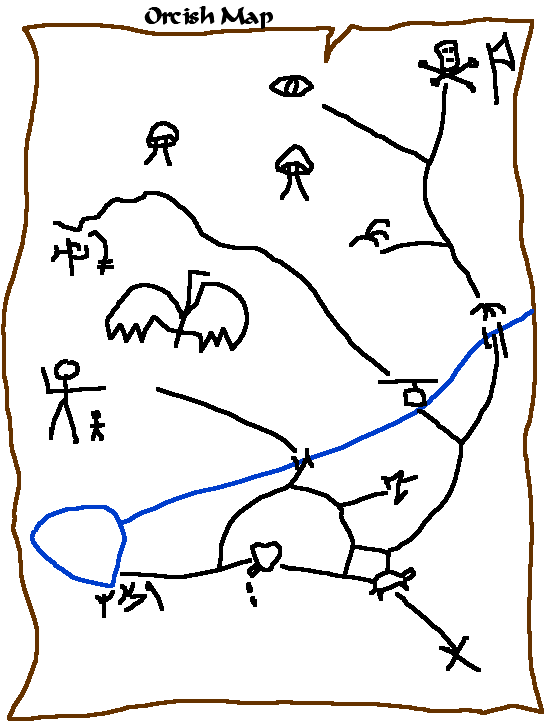
Finally, the chest contains a Wand of Corridors with 100 charges (the chieftain has never been able to find out what this wand does and it seems to have no effect when pointed at various things). The wand is shaped like a twisted tube of stone and functions only on the Plane of Earth and the Plane of Minerals. See the Tome of Magic for details.
Surrounding the bed are 12 fur pallets, each with a locked chest nearby. These are the beds of the chief's bodyguards, all blood relatives and all intensely loyal to the chief…at least for the moment.
Each bodyguard has a key to his chest on his person. Each chest contains some looted items worth 500gp and weighing 15 pounds. They also contain personal effects.
The orc chieftain can usually be found here, often with 4-5 orcish females lounging around at his feet on the throne or in his bed. His bed is a coveted position, and most of the females of the tribe vie for his sexual favours. The females found here likely have a few trinkets of value given to them by the chief.
If trouble occurs, the chief will
be found here, for he does not like to press into the thick of
battle himself, as that is a very dangerous position for an orcish
chief to place himself…an errant dagger or arrow is likely
to provide the tribe with the prospect of a new chief. Like most
orcish chiefs, he prefers to lead from the rear. The chief is
no craven or soft however...such a leader could not survive long
in orcish society. But he leaves the actual battle to his war
leader. The chief will remain here unless he can tell things are
going badly, in which case he will gather his treasures and flee
down the escape tunnel in Room 11. He will certainly, if followed
down that tunnel, order his bodyguards to peel off 2 at a time
to melee and delay pursuers.
Orc Chief (AC -1 (16 DEX, specialized in medium shield), MV 11,
CL Wa, LV 6, hp 63 (16 CON), THAC0 15, #ATT 3/2, D by weapon type
(+1 to hit, +2 damage), Weapons scimitar +1 (Av 1D8/1D8 kdD8),
Armour chainmail, medium shield, SA specialization in scimitar
(+1 to hit, +2 damage), specialized in shield and weapon style
(may make 1 shield attack per round while retaining shield AC
benefit, however, offhand penalties apply [-2/-4]), SD specialized
in medium shield (+3 AC instead of +1 and useful against 3 enemies),
AL LE, XP 1000, Source: Monstrous Manual)
NWP:
Intimidation (18/17), Leadership (16), Alertness (13), Quickness (16), Trouble Sense (12)
Magic:
Scimitar +1
3 Potion of Extra Healing
Medium Shield of Teeth - Acts as a shield +1. The motif on the boss of the shield is of an orcish toothy maw dripping with slobber. When wielded in combat, the design becomes real and animated, biting. The bite cannot harm metal or wood, but if a shield bash is successful, the teeth bite, causing an additional D6 of damage.
Amulet of Protection from Charm, a glowing green gem on a leather thong which provides a +2 save vs charm and enchant spells when worn on the neck. It also glows when within 60' of an illusion.
Scroll of Protection from Magic in a black pumice scroll tube whose seal bears a drow merchant seal (a spider with a coin at the end of each leg).
Treasure:
A pair of brass bracers that are carved with runes of magic and possibly once bore a magic dweomers, but are now merely ornamental (the chief is convinced they are magical, despite protestations by his shamans and witch doctor) worth 35gp, a woman's tiara of silver and diamonds worth 1600gp which looks ridiculously feminine on the heavy set brow of an orc chieftain, a gold and ruby dagger shaped ear stud whose blade pierces the ear (575gp), a pouch with 10 gems worth 60gp each, 200sp, 150gp, and 13pp (the latter of drow mint).
Orc Bodyguards (12) (AC 4 (15 DEX), MV 13, CL Wa, LV 4, hp 46 ea (15 CON), THAC0 17, #ATT 3/2, D by weapon type (+1 to hit, +1 damage), Weapons great scimitar (Sl 2D6/4D4 kdD10), longbow w/ sheaf arrows (Av 2/r 10/20/34 1D8/1D8 kdD6), Armour chainmail, SA specialized in great scimitar (+1 to hit, +2 damage), specialized in 2 handed weapon style (speed increases to Av), AL LE, XP 650 ea, Source: Monstrous Manual)
NWP:
Intimidation (17/13), Dirty Fighting (11), Endurance (15), Alertness (12), Trouble Sense (11)
Magic:
2 Potions of healing
Potion of Protection (+1 to AC and saves for 5D4 rounds)
Treasure:
Armband of pewter in the shape of veins entwined (these are insignia of the chief's bodyguards), pouch with 50gp, 200sp, 100cp.
Note: The bodyguards are not allowed to wield poison arrows. This is by custom, for the chief does not like the idea of poison so near to his person.
9. Orog Quarters
This largish cavern is the home to the orc tribe's shock troops. These are a band of orogs with 2 ogres and 6 orgillons as muscle.
Orogs (15) (AC 3, MV 6, HD 3, hp 18 ea, THAC0 17, #ATT 1, D by weapon (+3 due to strength), Weapons maul (Sl 2D4/1D10 kdD12), Armour platemail, SA maul gains +1 to hit vs plate and mail, AL LE, XP 65 ea, Source: Monstrous Manual)
Treasure:
D12gp, D20sp
Orog Leader (AC 3, MV 6, HD 4, hp 24, THAC0 17, #ATT 1, D by weapon (+3 due to strength), Weapons maul (Sl 2D4/1D10 kdD12 +1 vs plate and mail), Armour platemail, AL LE, XP 120, Source: Monstrous Manual)
Treasure:
D20gp, D100sp
Ogres (2) (AC 5, MV 9, HD 4+1, hp 24, 22, THAC0 17, #ATT 1, D by weapon (+6 damage), Weapons great club (Sl 2D4/1D6+1 kdD12), SA +2 to hit due to strength, -4 to hit dwarves and gnomes, AL CE, XP 270 ea, Source: Monstrous Manual)
Treasure:
D20gp, D100sp
Ogrillons (6) (AC 6, MV 12, HD 2+4, hp 10 ea, THAC0 17, #ATT 2, D 2-7/2-7, AL CE, XP 175 ea, Source: Monstrous Manual)
Treasure:
D6gp
These beings are the shock troops of the tribe, generally only called upon to wage war. The ogrillons will gladly wade into battle pounding with their fists. The orogs and ogres operate a bit more intelligently, following the orc war leader's directions and generally targeting the toughest fighters of the enemy forces.
The cave is a generally verminous mess of ratty pallets, bones, bits of food, waste, etc. along with mostly beat up crude furniture and personal effects. Nothing of value exists in this cavern.
10. Male Quarters
This huge cavern is the dwelling place of the majority of the males of the tribe. These are not professional orcish soldiery, instead serving as hunters, craftsmen, blacksmiths, merchants, miners, brewers and the like. There are some 100 orcish males living here, many in small personal caves pock-marking the walls of this place, many accessible by wooden ladders or carved stone steps. Others dwell in crude round huts of stone, wood, and other debris. These have no windows and a hide or fur door. These dwellings serve as homes, taverns, shops, etc. and has all the amenities of a small village, sans luxuries and the niceties of civilized dwellings. In non-alert times, many of the soldiers from Room 7 can be found here, enjoying themselves, bullying the weaker orcish males, wrestling, gambling, etc. The soldiers run things here, but these male orcs take all of their off duty time to engage in raucous behaviour.
Despite their non-warrior status, these are still orcs…brutish and mean and tough as nails and willing to take up arms against hated foes. They form the militia of the tribe and will be eager to prove themselves in battle, perhaps to gain entry into the soldiery.
Other than their meager treasure and the goods they produce, there is nothing of value in this area.
11. Female Cavern
This huge cavern is some 60' high in its centre. It is the dwelling place of the females of the tribe, along with their children. Although the sexes are segregated, males are not forbidden here and can often be found here strutting to impress the females, or even enjoying a roll in the rothe fur with one or more.
The females and children dwell in private caves set into the walls of the cavern and accessible by stone steps or wooden ladders. There are also a fair number of smallish round huts of stone and wood where the women dwell. There are many shops and craftswomen here, for orcish females are expected to weave and tan leather and butcher rothe and grow fungus (which pockmarks the cavern in tended gardens). All of this activity can be found here, along with orc witches who brew drinks and potions (through the Herbalism proficiency, not via magic skills).
There are some 150 females here, along with that many young. The females and young do not normally fight, though if threatened they will.
To the northwest of the cavern is a tunnel that leads into the underworld proper. The chief and the females and young can use this as an escape route.
The passageway ends about 1 mile west at a secret door that alights onto a passage of the underworld little used by the drow. 6 orcish soldiers guard the entrance into Room 11 at the start of this passageway, and they bear ivory horns to sound an alarm. They are not as vigilant as the orcs in Room 1 because the likelihood of intrusion from this quarter is rare.
To the south is a pool of clear, cold, deep water. The water is mineral heavy but healthy and the orcs are careful not to sully their only close source of drinking water. The pool is 50' deep and fed from cracks in the ceiling from which water runs down the wall and into the pool. The pool then drains in a small creek south into a rift.
The rift is fairly large, very steep, and unknowably deep. The orcs are superstitious of the rift, and they have set stone pedestals carved with orcish runes of protection and warding around the rift at 10' intervals.
The rift is so deep that light or objects dropped down cannot be heard to hit bottom, even by elves.
It is in fact over 2000' deep. At times the orcs toss slaves down the pit in elaborate rituals designed to appease what they believe must be demons of the void that dwell down there. To date, nothing has ever emerged from the rift nor shown any sign of acknowledging the sacrifices.
The rift might provide the party an escape route, for the orcs will not follow the party down that chasm. The rift descends along with the water falling from the creek 2000' before emerging in a very cramped natural cavern from which the water drains into even further depths via cracks in the floor. This cavern is on the same level as the mind flayer depths (see later in the scenario), and technically, those depths can be accessed by characters able to shrink or go gaseous so as to squeeze through the small cracks and passages that eventually lead to the mind flayers' lair.
TROGLODYTE DEN:
The troglodytes here do not often war with the orcs nearby, for the orcs have quickly proven their superiority over the less organized troglodytes. In fact, several short sharp conflicts were fought when the orcs first moved into the area. The troglodytes, while avoiding the orcs, are certainly not friendly to them, and it is not uncommon for a lone orc straggler to go missing at the hands of the troglodytes.
Instead, the troglodytes basically haunt the area between THE BRIDGE and the ORC LAIR.
Refer to the Troglodyte Den map.
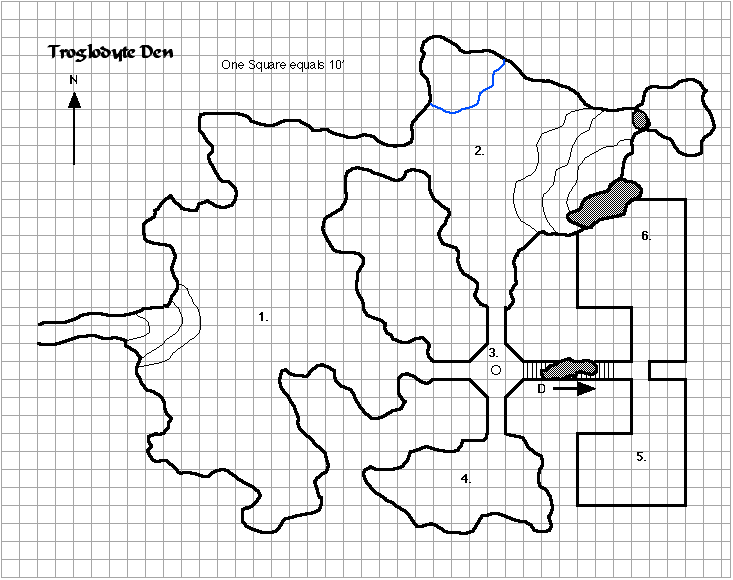
The troglodytes are nowhere near as organized as the orcs. But they do have a bit of a secret, one not yet discovered by the orcs. Their den is actually part of an ancient dwarven complex…one that was destroyed ages ago by means unknown (if magic is used to try and divine what occurred, it was a battle with the duergar).
Reaction to the Party:
The troglodytes do not serve the Deceiver. Nevertheless, they will react with uniform hostility to the party. This because of their inherent nature, their taste for human flesh, and their desire to slay those whom they can. It is possible for the troglodytes to surrender to the party, but this would require the slaying of the chieftain and his guards and most of the leaders as well as the party somehow being able to speak troglodyte and convincing the clan that their young will not be slain out of hand.
Following are the statistics for the various troglodytes found herein:
Male Troglodytes (AC 5, MV 12, HD 2, hp 11 ea, THAC0 19, #ATT 3 or 1, D 1-2/1-2/2-5 or 2D4, Weapons javelin (Fa 1/r 4/8/12 2D4/2D4 kdD6), SA chameleon ability (-4 penalty to opponent surprise rolls), +3 to hit with javelins, SD stench (humans and demi-humans save vs poison or lose 1D6 STR for 10 rounds), AL CE, XP 120 ea, Source: Monstrous Manual)
Female Troglodytes (AC 5, MV 12, HD 1+1, hp 6 ea, THAC0 19, #ATT 3, D 1-2/1-2/2-5, SA chameleon ability (-4 penalty to opponent surprise rolls), SD stench (humans and demi-humans save vs poison or lose 1D6 STR for 10 rounds), AL CE, XP 120 ea, Source: Monstrous Manual)
Leaders (AC 5, MV 12, HD 3, hp 17 ea, THAC0 17, #ATT 3 or 1, D 1-2/1-2/2-5 or 2D4, Weapons javelin (Fa 1/r 4/8/12 2D4/2D4 kdD6), SA chameleon ability (-4 penalty to opponent surprise rolls), +3 to hit with javelins, SD stench (humans and demi-humans save vs poison or lose 1D6 STR for 10 rounds), AL CE, XP 175 ea, Source: Monstrous Manual)
Subchieftains (AC 5, MV 12, HD 4, hp 23 ea, THAC0 17, #ATT 3 or 1, D 1-2/1-2/2-5 or 2D4, Weapons javelin (Fa 1/r 4/8/12 2D4/2D4 kdD6), SA chameleon ability (-4 penalty to opponent surprise rolls), +3 to hit with javelins, SD stench (humans and demi-humans save vs poison or lose 1D6 STR for 10 rounds), AL CE, XP 270 ea, Source: Monstrous Manual)
Guards (AC 5, MV 12, HD 3, hp 17 ea, THAC0 17, #ATT 3 or 1, D 1-2/1-2/2-5 or 2D4, Weapons javelin (Fa 1/r 4/8/12 2D4/2D4 kdD6), SA chameleon ability (-4 penalty to opponent surprise rolls), +3 to hit with javelins, SD stench (humans and demi-humans save vs poison or lose 1D6 STR for 10 rounds), AL CE, XP 175 ea, Source: Monstrous Manual)
Chieftain (AC 5, MV 12, HD 6, hp 41, THAC0 15, #ATT 3 or 1, D 1-2/1-2/2-5 or 2D4, Weapons javelin (Fa 1/r 4/8/12 2D4/2D4 kdD6), SA chameleon ability (-4 penalty to opponent surprise rolls), +3 to hit with javelins, SD stench (humans and demi-humans save vs poison or lose 1D6 STR for 10 rounds), AL CE, XP 650, Source: Monstrous Manual)
1. The Main Cavern
This is the main living quarters of the male troglodytes. Wide stone shelves of a height of 1.5' to 2' lead down to the main cavern floor. The cavern is pocked with stalactites and stalagmites, many grown together into columns, along the northern and southern wings of the cavern. The cavern ceiling towers some 60' high at its centre, descending to some 40' high at its edges.
Some 97 male troglodytes dwell here, each in a small crèche either gouged into the sides of the cavern walls, gouged into large stalagmites, or simply gouged into the ground in an area where the stalagmites form a little niche to dwell in. The furnishings in each crèche are almost non-existent, for the troglodytes really do not recognize property rights, and so tend to carry their meager possessions on them (usually a fungus-strand harness and woven pouch together with crude ornaments of rock crystals and bits and scraps of steel).
Anything of value these troglodytes once might have had have been traded to the drow or the orcs for steel javelin heads with which these troglodytes have fashioned their infamous javelin/darts. Fully 25 of these males have 3 such javelins. Possession of such seems to coincide with the better crèches, obviously a sign of status and dominance amongst the males.
There is nothing of value to be found here otherwise, just scraps of food, some rothe carcasses hung up to dry, bugs and small vermin that feed on the scraps of the troglodytes, etc.
The troglodytes are not very organized, and do not really keep any sort of watch. Given their natural weapons and armour, they are not at too much of a disadvantage if caught even fully asleep.
In combat, the troglodytes will raise enough of a clamour to summon the chieftain and his bodyguards from Room 4 while the females in Room 2 hide their young as indicated therein.
The males here will basically rush the attackers. However, the troglodytes have dealt with the orcs and the drow enough to realize that spellcasters are very dangerous and must be stopped. They are not bright enough to recognize a spellcaster before he has cast a spell, but once they see a spell (assuming it has somatic components) they will then begin to lob javelins at him in order to disrupt the spellcasting.
The exact roster here includes:
60 male troglodytes with natural
weaponry
25 male troglodytes with 3 javelins apiece
8 leaders with 3 javelins apiece
4 subchieftains with 3 javelins apiece
2. Females and Hatchlings Cavern
This largish cave is the home to the females and hatchlings of the clan. The ceiling is only 45' high here, and a freshwater pool sits in the north of this room, fed by a submerged inlet and drained by an outlet that exists right at the surface level of the pool at its western edge. This outlet ensures that the pool is always full to a certain level but never runs over its high mark. Blind fish of small size swim in the water, and these provide a change of diet for the troglodytes. The pool is a full 200' deep, evidence that the source that feeds it must be a fairly mighty force to be able to overcome the pressure some 35' down from the top of the pool.
The cave itself is devoid of stalactites and stalagmites of any appreciable size, and skilled observation can show it was worked at one time. To the southwest natural stone shelves of 2' height ascend to what is obviously a collapse or cave-in, for a jumble of rocks and boulders both large and small form a solid wall blocking egress to whatever lies beyond. The troglodyte females have gouged or chalked fertility runes on the larger pieces of collapsed rubble, for they use the stone shelves as their hatchery. There are some 25 eggs on the shelves, approximately 8 per shelf, and these are moved downward as they become more and more ready to hatch.
It is up to the DM to determine exactly what would be needed to clear away the rubble. There are small cracks such that a gaseous form or Wraithform could pass through. Otherwise, it would take quite a bit of mining and engineering to clear it without a collapse or prodigious strength (on a stone giant level).
On the floor of the cavern are the females and hatchlings of the clan. The females are generally engaged in scraping and cutting and drying fungus fibres with which the troglodytes make their rudimentary accoutrements. They also butcher fish and rothe and even skin an orc soldier with sharp flint knives. The females, being less combative and territorial than their male counterparts, tend to live closer together, and so 78 females and 32 hatchlings roam this cavern.
In times of trouble, the females will roll aside a large round boulder to the far east of the cavern and will herd the hatchlings, the eggs, and at least 18 females into the smallish cave beyond. They will then roll the boulder back into place and cover it with mud and other camouflage in an effort to save their young. This entire process will take at least 12 rounds, though by the 6th round the young will be inside and the boulder in place, just not very camouflaged.
The troglodytes are not too bright however, and this ruse is unlikely to work because:
· Their camouflage job
is not exceptional…treat as a concealed door
· There is no food or water within the small cave, so the
young cannot hold out for too long
· The females remaining in the cavern proper will fight
fanatically, as if protecting their young, which should be a sign
to attackers that the young are somewhere near
· The females will tend to bunch up around the boulder
subconsciously, as if protecting it (which they are in fact doing).
3. Worked Crosschamber
Three short worked passages lead into this chamber. Each is only
5' high. It should be absolutely clear after observing the squalor
that the troglodytes live in that they could not have possibly
fashioned this area. In fact, the workmanship of the stonework
is fine dwarven craftsmanship, as any dwarf accompanying the party
(aside from the Dead) can attest to.
Standing on a short (1' tall) stone pedestal in the centre of the room is an 8' tall statue of pure ruby. The statue appears to be a dwarf warrior, complete with beard, open helm, platemail, and a battle axe, all of ruby.
It faces to the east and upon the pedestal, in Dwarven runes that are somewhat faded by time, it reads:
Seek ye not to defile this holy place
To the east, where the statue gazes, steps lead down to a collapse of rubble.
The statue is a ruby gemstone golem, set here by the ancient dwarves that dwelt in this place to guard a temple to Neengrum. When the duergar attacked, the dwarves retreated here. Unfortunately, the commands given to the golem (to let dwarves pass freely) seemed to apply to the duergar, and so the last defenders instead collapsed the rock around them. The duergar, needed elsewhere, simply set guards on the collapse and let the dwarves starve and thirst to death, which they did.
The golem will animate and attack any non-dwarves who set foot on the stair (or enter the stairway area, even if levitating or flying). The stairway, like the other passages into this room, is 5' high.
Ruby Gemstone Golem (AC 0, MV 6, HD 10, hp 50, THAC0 11, #ATT 1, D 3-30, SD +1 or better weapon to hit, immune to electrical and heat-based spells, MR 25% to priest spells of animal, elemental, plant, sun, and weather spheres as well as all spells cast by druids, AL N, XP 5000, Source: Monstrous Compendium 4)
When slain, the golem will collapse into piles of rough-cut rubies. A total of 10d10 rubies will be gained, each valued at from 100-500gp each when cut and polished, half that if not.
The rubble collapse on the stairs is similar to that in Room 2, though not as wide, but deeper.
The troglodytes, from painful experience, know not to anger the ruby statue by setting foot on the stairs.
4. Chieftain's Cave
This cave is strewn with columns and stalactites and stalagmites, such that range for missiles is precarious beyond 20'. Within is the lair of the chief and his guards. There is a single chieftain and 12 guards.
Other than having his own private cave and some bits of steel and other non-precious metal thrown about the place, there is nothing to make this area any more luxurious than the main cavern in Room 1. The chieftain and his guards dwell in crèches that are unadorned for the most part. Scraps of past meals dot the area.
The chief and his guards are no cowards, for in fact the only way to rule troglodytes is through raw power and intimidation. At the first sign of trouble, these brutes will burst out charging to the attack, throwing their javelins first of course.
Note for Rooms 5 and 6 - please see the Guardians section after Room 6 for details on the guardians of these rooms
5. Dead Temple
Faded frescoes of dwarves mining huge gems from the ground can be found along the walls of this chamber, whose air is stale and musty from centuries of disuse. An altar along the far south wall is made of stone studded with diamonds and rubies and sapphires and shows a dwarf female (with beard) with braided hair holding a sack protectively in her arms.
The gems on the altar can be pried loose and would bring a princely sum (5,000gp of each of the three gem types), but doing so brings a curse on the one(s) who remove(s) the gems. The person becomes claustrophobic when below ground, even in the most open of caverns. He receives a -1 to hit and a 5% chance of spell failure for each month thereafter, with no limit to the cumulative effect of the mania. Only returning the gems (or similar ones) to the altar and then casting a Remove Curse will lift the malady. A Wish will also counter the curse without requiring the gems to be returned.
Indentations in the floor before the altar show where countless ancient dwarves knelt in prayer to their goddess.
Empty iron candelabras flank the walls, and in the centre of the room a censer and a tarnished bronze cylinder hang from a tarnished silver chain. The cylinder makes a pleasing ringing chime sound when struck.
The chime is actually a Church Chime (see Encyclopedia Magica V2 pg 815). The censer is non-magical, though at one time it did burn Incense of Meditation.
Slumped over the altar is the moldered skeleton of a dwarf priest. He is so old that his bones are essentially dust, and any disturbing of the body, even to turn it over, will result in the bones sliding down into dust. The priest wears dwarven chainmail, carries an iron warhammer tucked into a metal girdle, and carries a chain mesh pouch.
The chainmail is Chainmail +1.
The warhammer is a Warhammer +2 with the ability to cast a Heal spell once per day on anyone who calls upon Neengrum for aid. Obviously, Neengrum may deny such a request at her will.
The girdle is a Girdle of Priestly Might (see Encyclopedia Magica V2 pg 535)
The pouch holds a Gem of Atonement (see Encyclopedia Magica V2 pg 517), a Gem of Brightness with 25 charges, a Gem of Curing (see Encyclopedia Magics V2 pg 519), and a single huge flawless diamond worth 15,000gp.
The priest was one of the most powerful priests of Neengrum of antiquity, and in the time of attack he gathered the temple's best magic items to himself to defend them. This is why he carries such a trove of magic on his person.
6. Last Defense
This was the site of the last defense of the temple. 16 dwarven remains lay here, bones mostly turned to dust over the ages. The armour, mostly dwarf-sized platemail, is aged and worthless now, and the wooden hafts of hammers and axes have disappeared, leaving axe and hammer heads on the floor. What this room once was is lost to time. There is no magic here, but the dwarves did have pouches with coins in them, the pouches now long since rotted away, the coins scattered on the floor. A total of 250gp, 570sp, and 120pp may be found, all of ancient dwarven mint and with Neengrum's image on one side.
The Guardians:
The temple rooms (Room 5 and 6) are guarded by undead dwarves, souls of those who died here and who now seek to make sure no one defiles this place of dwarven honour and tragedy.
These dwarves will only allow a priest of Neengrum to take the magic items in Room 5 or even to enter the area.
The only other possible way the party can gain the items without fighting the dwarves is to have their magic axe (the Azuredge axe) speak with and parley with the dwarves. Azuredge is not aware enough to initiate this on her own, and the undead dwarves are not coherent enough to offer it, but should the bearer of Azuredge ask the axe to plead the party's need and quest with the dwarves, then she will be willing. The party must then plead with the dwarves to take the axe and speak with it. This can only be accomplished by leaving Rooms 5 and 6 and standing on the stairway to Room 3. The party must then call out in Dwarvish and convince the dwarves to emerge from the stone walls and listen to the party. Should the party prove persuasive (and the dwarves are very embittered by their history), they can hand the axe to one of the undead dwarves who will engage in speaking to the axe. The undead will then give up their treasure.
Otherwise, the undead dwarves will emerge from the stones themselves when the party enters Room 5 or 6. They will use their Phase Door ability to move quickly around the area, but will not leave Rooms 5 and 6. They know of the treasure in Room 5 and will seek to protect that room above Room 6.
Undead Dwarves (8) (AC 6, MV 9,
HD 3+12, hp 26, 26, 23, 24, 29, 26, 24, 29, THAC0 17, #ATT 1,
D 3-12, SA hit knocks back 5' and has a kd rating of D20, Phase
Door at will, SD +2 or better weapon to hit, immune to mind control
spells, cannot be slain (reforms 1D4 rounds later at full hit
points), MR 25%, AL N, XP 1400 ea, Source: Monstrous Compendium
1)
Return to the Contents Page
Proceed
to the next page
Return to the previous page