Introduction
Yaotzin (Yow-SZIN) is the preferred sport among the Azotchla, a game that combines dexterity, strength and stamina, and that can be configured for almost any number of players. It is played using a solid rubber ball about a foot in diameter, weighing about five pounds, and takes place on a specially designed field.
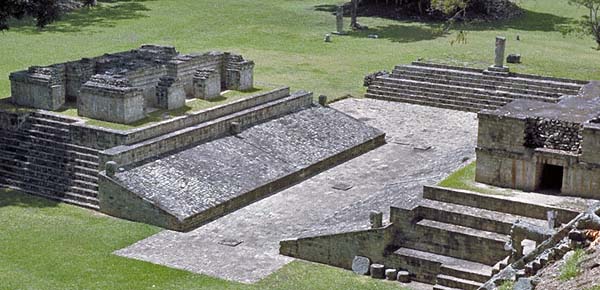
These fields vary in size, which determines the number of players it can accommodate, but always have the same dimensions. The area around the ball court is raised up, so that the field appears to be sunken. If seen from a nearby hill, the court resembles a giant I, with the two crossbars at the ends being the goals. Points are gained by successfully kicking the ball past the opponent's goal line, with the first to reach nine being the winner. Additionally there is a stone circle perched in the middle of each side near the top of the field - should a player be lucky enough to shoot the ball through this hoop, the game is ended immediately.
The field itself is not flat. Seen on a crosscut, it resembles this: \__/ though the sidewalls are at 45 degrees and therefore not nearly as steep. Each slant takes up 25% of the field, with the long smooth stretch in the middle accounting for half the width.
Yaotzin is a team game, generally played by one pair against another, but any number of people can play if the field is large enough. It is generally agreed that the ideal size of the team is one player for every 20 ft of width of the field. Most cities have at least one major court that is 120 feet wide and 480 feet long and is played by teams of six. It should be noted that this isn't the NFL and the size of the field of play varies from city to city, so this isn't a hard and fast rule. But in general the ratio of width to length runs from 2.5 to 1 to 4 to 1, with 3 to 1 being the average Of course, the end zones are not counted in the length measurements, as they are not used directly in play.
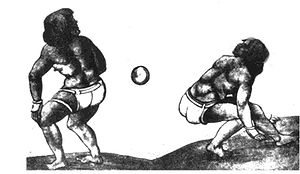
Players use their feet, knees and hips to propel the ball - anything under the waist is fine.The ball may be "caught" or stopped in progress using anything but the arms or hands. Since the ball is hard, heavy and moves fast, catching it without the use of a thick leather belt (known as a yoke) can be hazardous. A player risks heavy damage if he is unable to use the yoke to stop the ball, with deep bruises and broken bones not uncommon.
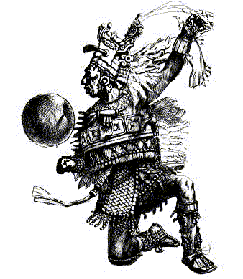
As can be imagined, the combination of speed, skill and strategy coupled to the ever-present danger of injury makes Yaotzin an exciting sport to watch. Even the most casual of practice games will draw some spectators. But when the game is played to honor the Sacred Twins the stakes become much higher indeed. For then the captain of each team wagers his life - the loser to journey to the Plains of Dust, leaving his head behind to grace the skull rack.
The stakes of the game make it
an honourable and accepted way to resolve disputes that might
otherwise be found in open battle. Cities and noble houses will
often use the game as a form of proxy war, a sort of trial-by-combat.
The advantages to the society are great - rather than indulging
in a war killing countless warriors, each side risks only one
captain. The ritual is witnessed by thousands, sometimes even
tens of thousands, and thus is considered both fair and binding.
Even though the Azotchtla have the formal warfare of the Flowery
Battles to lessen the impact of warfare upon their society, Yaotzin
offers an even less destructive way to settle differences and
prove courage and ability.
Should there be an absence of dispute, slaves or foreigners are
sometimes forced to play the game against one of the local teams
with predictable results.
Yaotzin in D&D terms
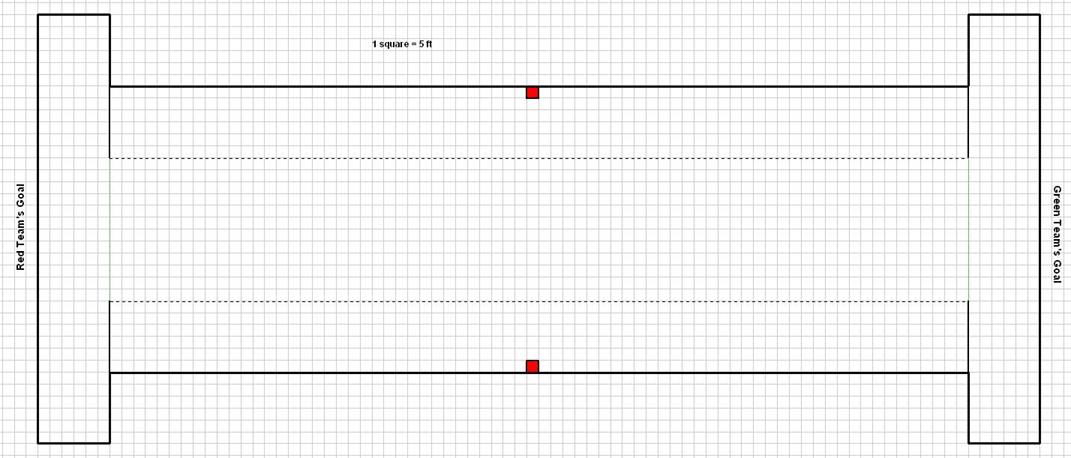
Presented below is a map of a typical ball court. This field is 120 ft wide and 360 ft long and is suitable for teams of 6 players each. A green dashed line at each end demarks the goal line, and the black dashed line denotes the beginning of the 45 degree slope up towards the vertical walls, which are marked as thick black lines. The slope rises 30 ft before ending at the vertical wall, which itself rises another 20 ft before reaching seating areas for spectators. The red squares represent the stone hoops that win the game. Each is set 10 ft above the highest level of the slope (i.e. 40 ft above the base floor of the playing field).
Please note that the rules below assume humanoid Medium sized players. DMs may need to adjust certain aspects (such as attacks of opportunity) if players are larger or have appendages with reach.
1.0 Winning the Game
A point is scored when a team puts the ball into the opponent's scoring area, which is defined as that team's horizontal end of the "I" shape. On the map above the goal lines are marked in green. The first team to score nine goals wins. A team that manages to shoot the ball through one of the side hoops immediately gains nine points and therefore wins the game. In addition, after a period of 100 rounds (10 minutes) the game ends and whichever side has the most points wins.
2.0 Method of Play
The game will be conducted using the rules normally ascribed to combat. This means that there are distinct melee rounds, an order of initiative is used, and many of the descriptions and rules of combat will be employed. Of course, this is not actually a combat. With a few limited exceptions, players on the field will not be actively fighting against their opponents. But we shall use the rules, modifiers and methods to give the game a "D&D feel".
Description of Play in English:
A point is scored when a team puts the ball past the goal line on their opponent's side. The first team to score nine goals wins. A team that manages to shoot the ball through the side hoop gains nine points and immediately wins the game. After 10 minutes, whichever team has the most points wins. Ties are allowed.
The ball may be struck only with the legs, defined as anything below the navel.
The ball may be interrupted in flight using any part of the body except the hands.
It is illegal to hold, trip or check any other player unless they have the ball. It is legal to push or tackle another player if you are both within arm's reach of the ball, but you cannot leave your feet to do so. You must release your opponent if the ball is not in your immediate area.
With the exception of shoes and a loin cloth, the only clothing that can be worn is a thick leather belt of 6" width or less, worn about the waist (about the size of a weight belt). It is illegal to wear anything made of metal, even ornamentation.
Use of magic items or spells is forbidden during the match, as are any strange or unusual abilities, including healing of any sort, fast healing, etc. In general, any spell-like or supernatural abilities are forbidden, while extraordinary abilities are left to the DM's discretion.
3.0 Scale and Terrain
Each square is considered to be the standard 5 ft square and normal movement rates apply. Thus a normal human could move 30 ft (six squares) and perform a standard action, such as kicking the ball, or even move six more squares.
The two sides of the field are stone walls that are at a 45 degree angle to the grassy (or sometimes stone) floor, and are in play. These are treated as steep slopes (refer to the Dungeon Master's Guide).
4.0 Rounds
Just as in combat, all actions are performed in rounds determined by initiative, with interruptions for delayed actions, readied actions, attacks of opportunity, etc. The one exception to this is the ball, which has six actions equally spaced throughout the round. The ball's actions are always the same: to move forward in a direction and speed determined by the last person to kick it. Note that this means that the speed and direction will often be zero.
Much of the game's strategy involves the effective combination of normal actions, delayed actions and readied actions.
5.0 Attacks of Opportunity
Attacks of opportunity occur normally as per the D&D combat rules, except that all characters are always presumed to threaten squares within reach, despite being unarmed and even if they are not monks or do not possess the Unarmed Combat feat. However, attacks of opportunity may only be taken against other players under certain conditions as described below. Furthermore, players may make an attack of opportunity on the ball itself under certain conditions. These are also noted below. Attacks of opportunity are subject to the normal limits and may be augmented by feats such as Combat Reflexes. Unlike in normal D&D combat, attacks of opportunity may not be made when prone.
6.0 Moving the Ball
There are two ways to move the ball forward. One can either propel it forward with a series of small kicks to oneself (dribbling) or give it one big boot (kicking it). Due to the weight of the ball, it is assumed that all forward kicks are generally at a height no greater than a man's head. As such, there is no allowance for high kicks and these rules do not account for three dimensions of play. The only time a kick may go above one's head is when attempting to put the ball through the winning hoop.
Dribbling:
When dribbling the player moves himself and the ball together. Unlike normal movement, dribbling requires control and concentration on the part of the dribbler. Also, the ball is quite heavy. As such, the player must start his turn in the same square as the ball in order to dribble the ball and must use a move action to do so. He may also use his standard action to continue dribbling the ball if he wishes (and doesn't use it for some other action), but a standard action used to dribble a ball only moves the ball 5 ft. Unlike normal movement, a dribbler cannot use his standard action as another move action to move the ball a full move. Furthermore, this requirement that a player start his turn in the same square as the ball means that should a player ready an action (even a move action), the most he can dribble the ball that turn is 5 ft. Of course, if he delays his action then he is delying his entire turn and may dribble normally.
Should a player not start his turn in the same square as the ball, he can move up to the ball using his move action and then dribble the ball 5 ft as his standard action. Thus, it is far more advantageous to dribble when one begins one's turn in possession of the ball. This requirement represents the need for a player to control the ball before dribbling it.
As the ball is very heavy, dribbling is at half the dribbler's normal speed. This means in a given action, it is not possible to dribble the ball faster than half your normal speed plus an additional 5 ft for a standard action. For example, if a normal human starts his turn with the ball he can move with the ball 15 ft (three squares) and then take a standard action to move it another 5 ft, or perform some other standard action like kicking it. Dribbling a ball 5 ft is not considered a 5 ft step for purposes of combat movement and attacks of opportunity.
Kicking:
Wind up your foot and give that 5 pound ball a boot! Ouch. Kicking a heavy ball like that firmly and accurately takes a lot of skill and practice. Kicking the ball is a standard action that does not provoke an attack of opportunity.
Once a player decides he is going to kick the ball, the first thing he decides is where. Kicking is a ranged attack. The maximum distance is 30 ft modified by the Strength bonus in squares and the range increment is 5 ft.
Kicking accurately on the run is harder to do than when the player is standing still. If a player has performed no other action in the round save a 5 foot step they gain free range increments based on their Strength bonus. Example: Ixpoetchitl has a 14 STR, a +2 bonus. He can kick the ball an extra two squares without a range increment modifier if he took no other action in his round. Please note that this bonus is not added to the maximum range that may be kicked. A player with a 14 STR can still only kick the ball a maximum of 40 ft whether he makes a standing kick or a running kick.
Characters with the Power Attack Feat may use it while kicking. Every point placed into Power Attack is subtracted from the ranged attack roll described below; kicking the ball very far is difficult to do with accuracy. However, every bonus point of damage translates into a +1 bonus to one's Strength score.
The player now picks the square he is aiming at, and makes a ranged attack roll, employing the standard modifiers for BAB and Dexterity. All players, unless they have taken the Exotic Weapon (pelota) feat suffer a -4 penalty to their attack roll due to non-proficiency.
The AC of the hex in question is 5. If the player fails the attack roll, use the standard rules for thrown splash weapons, but instead of the miss being off target by a number of squares equal to the range increments, the miss will be off one square plus another square for every 4 full points by which the attack roll misses..
Once this is determined, draw a line between the kicker and the ending location of the ball. When doing so, begin the line at the corner of the kicker's square closest to the square the ball ended up in and use the corner of the ball's square closest to the kicker. If there are two such corners, determine randomly. This line represents the movement of the ball in flight. If the ball passes through any portion of a square that a player occupies, that player may make an attack of opportunity against it to stop the ball (assuming he has an attack of opportunity left this round). If the ball was not stopped, leave the line on the map and note the number of hexes it moved.
Example: Ixpoetchitl furiously kicks the ball using every bit of his 14 STR (and he has performed no other actions in the round). He nominates a square 8 squares directly forward as his target square, and makes a ranged attack roll against an AC of 5 with a range modifier of -10. He is a second level fighter with a BAB of +2 and a DEX of 17and does not have proficiency with the pelota, so his modified attack bonus is -9. (BAB +2, Dex +3, range -10, non-proficiency -4). He rolls an 9, missing by 5, which gives a total of 2 squares variation on the kick. A D8 scatter die is rolled to determine direction, and a 1 is rolled. Ixpoetchitl grunts in satisfaction as the ball flies two squares longer than his aiming point.
Kicking the ball up the steep angles of the side is more difficult. Double the cost of each uphill square. The ball moves more easily downhill - halve the cost of each downhill square.
7.0 Ball Movement
A ball can be in four different states in this game: dribbling, rolling, in flight, and stationary.
A ball is dribbling when it is being dribbled by a player, as described above.
A ball is rolling if it is in motion on its own, but is not in flight (see below).
A ball is in flight if and only if it has been kicked. The ball is in flight only during the player turn it has been kicked, and only for the length of that kick.
A ball is stationary if it is not moving.
The distinction between a ball in flight and a ball rolling is important to rule 8.0 below.
The ball has six actions during the round, acting at initiative 25, 20, 15, 10, 5 and 1. This represents the continued movement of a rolling ball - after all, the ball doesn't stop moving once it's been kicked! Most of the time the ball will be stationary or under the control of a player and will have no movement speed. If a rolling ball is in the same square as a player, it stops moving (i.e. its speed decreases to zero), whether the ball entered the player's square or vice versa.
When the rules of this game mention the speed of a ball, it means the amount of squares it moves in its turn.
Please note that in the game, a rolling ball always stops moving when it is in the same square as a player, even if the player does not want to stop it. This to simplify the game mechanics and to stop players from effectively "warding" the ball by walking along with it as it rolls along. Players who want to be with the ball as it moves should have to dribble the ball. If a player wants to hover near a ball he can run alongside it in adjacent squares.
If a rolling ball is not in the same square as a player, it will move if it still has momentum. If a ball has not been intercepted, it will move in the same direction it was kicked, at the speed at which it was kicked -1 square. Each ball turn thereafter, a ball will always lose -1 square of momentum until it comes to rest, unless it is interacted with in a manner to regain speed (i.e. kicked or dribbled). Any uphill or downhill modifiers are applied. Make a note of its new velocity. If it is on a slope and its velocity equals zero, it will begin to move down the slope at the same general angle it moved up it. Use common sense to adjudicate this movement.
When determining the direction
a ball moves, the DM is encouraged to use a counter to represent
the ball with an arrow pointing in the direction of movement.
Furthermore, in order to simplify matters, the ball should be
limited to 8 possible directions of movement (along the square
rows and along the diagonals). If a ball was kicked in between
the diagonals and the rows of the square grid, then the DM should
adjust the direction to its nearest row or diagonal. This way
the DM does not need to keep track of the precise trajectory of
a moving ball over several rounds.
8.0 Intercepting the Ball
It would be easy to win the game if you were able to get around your opponent and kick the ball as hard as you can. After all, accuracy doesn't mean that much when aiming at a target 60 ft wide, and the ball will continue to roll even after your round is over.
Unfortunately your canny opponents will try to stop this from happening. They can stop the ball from progressing in a number of ways. Where these methods involve an attack of opportunity, a player can exercise such an action even if an ally is the one who kicked the ball.
The easiest way to stop the ball is to enter the same square as a rolling ball - the ball is now under the player's control, and no longer moves. Alternatively, the ball can roll into the player's square - again the ball is under the player's control, and no longer moves.
Another way is to intercept the ball as it rolls past (i.e. into an adjacent square). In this case, when the ball is moving gently, a player can stop it with his feet. Players can use an attack of opportunity to stop a ball from moving past their square and such an attempt involves a Reflex save. The DC of the Reflex save is 4 plus 1 for every 10 ft of speed the ball is moving. Thus the DC to stop a ball rolling past at a speed of 30 ft is a DC 4 Reflex save. If the save is successful, the rolling ball stops in the adjacent square.
It is also possible - though not without danger - to intercept the ball in flight. A ball is considered in flight if it is moving as a part of a kick in the same turn as the kick occured. Thereafter the ball is not in flight, but merely rolling until it is kicked again. Players can use an attack of opportunity to attempt to stop a ball in flight from moving through their square. They cannot stop a ball in flight from moving through an adjacent square. When the ball is rolling by, a player can stop it with his feet, as mentioned above. But when it's moving fast, a player tries to use the yoke, the leather belt around his waist. Of course, he doesn't don't have to - any part of the body, except the hands and arms, are allowed.
In order to intercept a ball in flight, the intercepter must make a Reflex save with a DC of 10 +1 for every 10 ft that the kick would have been to its destination square. If he makes the save by 5 or more points, then it is assumed he has properly intercepted the ball with his yoke, and the ball stops in his square and nothing further happens. Since he is now in the same square as the ball, the player has advantages when his turn comes as explained elsewhere in the rules.
If the player makes the save by less than 5 points, then it is assumed the player intercepted the ball, but not with his yoke. The ball stops in his square, but the player suffers 1D3 nonlethal damage for every 2 full squares distance the ball was stopped from traveling to its destination square. This means balls do more damage if they are stopped at the start of a kick as compared to the end of a kick.
If the Reflex save is missed by 5 or more, then the ball is missed entirely and continues on its trajectory towards the destination square.
If the Reflex save is missed, but not by 5 or more, the ball is deflected. The player suffers nonlethal damage and the ball will be knocked off course. The player suffers 1D3 nonlethal damage for every 2 full squares distance the ball was stopped from traveling to its destination square. To deterine where the ball ends up, use the standard rules for thrown splash weapons, but instead of the miss being off target by a number of squares equal to the range increments, the miss will be off one square plus another square for every 2 full points by which the Reflex save missed.
Example: Earlier we saw Ixpoetchitl kick the ball ten squares forward. Now let's assume that Yolteotl is standing three squares away and wants to intercept the ball in flight. His Reflex save DC check is 15 (10 + 5 for the 50 ft distance) he has a Reflex save bonus of +4 due to his class and Dexterity. Yolteotl rolls a 4 for a modified Reflex save of 8. Since this is 5 or more lower than the DC, the ball sails past his outstretched leg or hip. If Yolteotl instead rolled a 9, his Reflex save would have been a 13 and he would have failed by 2. In this case, although he failed to intercept the ball, he deflects it off of his chest. As the ball would have traveled ten squares and has already traveled three, the remainder of the kick from Yolteotl to the destination square is 7. Yolteotl therefore suffers 3D3 nonlethal damage. The ball caroms off two squares in a random direction.
While this may seem extreme, remember that intercepting the ball is always voluntary. Moreover, when the ball is kicked relatively softly or intercepted near the end of its flight the consequences of failing the roll are some minor bruises. But when a five pound ball is launched point blank at high speed it is usually a good idea to get out of the way!
9.0 Intercepting Your Opponent
As per the normal D&D rules, a player cannot enter the square of an opponent, except in the case of grappling, a bull rush attempt or an overrun attempt.
As stated previously, one's opponents can move the ball by dribbling it forward. A player can halt an opponent's dribbling progress by standing within one square of him - in which case his opponent will provoke an attack of opportunity if he attempts to dribble the ball out of an adjacent square. Such an attack of opportunity is a grapple check. Unlike a normal grapple check, making this one does not, itself, provoke an attack of opportunity from the target of the grapple.
If the grapple succeeds (i.e. the touch attack is successful and the grapple check succeeds), the opponent has been grabbed. The ball remains in its square with no further momentum and the dribbler who was grappled is now placed in a square that must be adjacent to the grappler and adjacent to or in the same square as the ball (grappler's choice). The dribbler's turn now ends. Once so placed, the two opponents are considered to be grappling (and may share the same square in a later round). The ball may be kicked or dribbled by any other player in his phase unless the dribbler was grappled and placed in the same square as the ball. Since the rules of the game allow grappling only when struggling for the ball, your options are somewhat limited. You are not allowed to deal damage, and you must relinquish your hold once the ball is no longer adjacent to your square.
10.0 Other Actions
Remember that opponents cannot directly interact with each other unless the target is in the same square as the ball or adjacent to it. In addition to intercepting an opponent as detailed above, a player can, on his turn (or readied action) grapple, bull rush, trip, or overrun an opponent as per the normal rules, as long as the ball is adjacent or in the same square as the opponent. In no case can even nonlethal damage be dealt. In the case of a grappling (not as an interception during an attack of opportunity, but as a normal action), bull rush, trip, or overrun attempt, the target is entitled to an attack of opportunity (unless, of course, the opponent has a feat denying such an attack of opportunity). This attack of opportunity can be an unarmed attack or a grapple or trip attempt.
In the case of an unarmed attack, damage is calculated if an attack is successful, but only for the purposes of seeing if the grapple attempt was foiled. Neither lethal nor nonlethal damage is actually done (i.e. the unarmed striker is merely using his arms to ward off the oncoming grappler). The opportunist (i.e. the one making the attack of opportunity) may continue his turn as normal (assuming he is not stopped by the opponent's action) including continuing to dribble the ball.
In the case of thee opportunist making his own grapple or trip attack as his attack of opportunity, these action require enough distraction and body movement that the opportunist will not be able to continue to dribble the ball. He must stop after making such an attack but may remain in control of the ball.
Also, a dribbler can conduct an overrun on an opponent who is in his way. This is a standard action during the move action (as per the normal D&D rules) and success allows the dribbler to continue to move with the ball.
Finally, the disarm action may be used to take the ball away from a dribbler or from someone who controls the ball. The disarmer must move adjacent to the ball controller (or vice versa) and conduct a disarm attack as per the normal rules. Although the disarmer would normally be at a -4 penalty using unarmed combat to disarm, the dribbler is assumed to also be at a -4 penalty since he is not actually grasping the ball like he would a weapon but is maintaining intermittant conact with the ball while dribbling. As such, these penalties cancel each other out and are discarded. Also, since disarming in this case is a function of finesse and ball handling rather than brute strength, Dex is used to calculate attack rolls for both the disarmer and the dribbler. As well, size plays no part in this disarm attempt and there are no modifiers for size. If the disarm attempt is successful, the disarmer now has control of the ball, which is moved into his square and, if his actions allow, he may now dribble the ball.
Disarming may also be conducted as an attack of opportunity. In this case, of course, if the person who is disarmed still has a standard action left he can immediately try his own disarm attempt to get the ball back. This is similar to some of the scrums for the ball one sees in soccer games.
11.0 The Hoop
Winning the game by putting the ball through the stone hoop is an extremely rare and eventful circumstance. Almost every game ends after 10 minutes or with a score of 9 being reached by 1 side. Putting the ball through the hoop is so rare that any player who has done it more than once (once sometimes being ascribed to dumb luck) is regarded as something of a phenomenon in the game.
Basically, putting the ball through the hoop requires a critical hit. The hoop's hole is not very wide (about 2 ft in diameter) and the hoop is set so that the hole in its center is vertical as compared to the ground. Furthermore, the holes of the hoop face directly along the edge of the playing field. Because of this, the hole is only accessible with a precise "line-drive" kick directly in front of the hoop. Due to its height, being too close to the hoop also makes it impossible to kick the ball through. When in the row of squares directly east or west of the hoop (as oriented on the map presented above), the base AC of the hoop is 20. This means you need to make a kick that reaches the hoop and hits an AC of 20, modified by distance. Success means that you hit the stone hoop, but a critical is required to send the ball through the hoop's hole. In most cases, this means a 20 must be rolled on the attack roll, the modified attack roll must hit an AC of 20, and a confirmation attack roll must be made. If those things all happen, then the ball is put through the hoop and the game is won.
A natural 20 is not an automatic hit when trying for the hoop, since more than blind luck is needed to even get the ball in the vicinity of the hoop. This is an exception to the standard D&D rule that a natural 20 is always a success on an attack roll.
The hoop can be accessed from the row of squares adjacent to the row of squares directly east and west of the stone hoop, but at that angle the AC of the hoop increases to 25.
Furthermore, the ideal range to kick to the hoop is 30 ft or more. Any closer and the angle is steep enough that the kicker suffers a -2 penalty for each 5 ft closer than 30 ft. No hoop kick is possible at a distance closer than 10 ft.
The hoop kick is the only kick in the game that is considered to be higher than Medium size, and even then only in the last 10 ft. No hoop kick may be intercepted when the ball is within 10 ft of the hoop.
12.0 Some Skills and Feats
There are a variety of skills and feats that have exceptional uses in the game. The DM is encouraged to allow creativity and to add to the list below.
Bluff - The Bluff skill can be used to feint, as per the normal rules. If the feint succeeds, not only does the victim lose his Dexterity bonus to AC, but he is moved 1 square in a direction of the feinter's choice. This represents the feinter jinking and tricking the opponent so that he is off balance and moves in a direction that allows the dribbler to move past.
Point Blank Shot - The Point Blank Shot feat adds +1 to the kicking attack roll when aiming at a point within 30 ft.
Precise Shot - The Precise Shot feat subtracts 1 from the scatter distance when a kick is off target (minimum of 1 square).