
Return to the Therran Scenario Page
Summary:
The PCs have left a tribe of goliaths and are journeying to Thella-lu in the hopes of making contact with humans. Along the way they encounter denizens of the mountains and come into the middle of a conflict between firenewts and an exiled goliath.
Assumptions:
The PCs have befriended the Kathaal tribe of goliaths and have taken part in the events of Strangers in a Stranger Land and From Dusk to Dawn and now desire to head to Thella-lu.
Location:
Eastern terminus of Mallar's Peaks, Sazhansiir
Historical Date:
N.S. 32 or 33, late year winter or early year winter respectively (depending upon events from Strangers in a Stranger Land).
DM's Introduction:
The PCs, having befriended the Kathaal tribe of goliaths and having saved some of them from the depredations of a band of dusk giants, now seek to journey to the permanent goliath camp of Thella-lu, far to the west across the mountains. The Kathaal agrees to provide a guide and the PCs head off into the mountains.
Kavaki Ramlord Manethak was a skywatcher from the Kathaal tribe who was exiled by the previous chieftain some 20 years ago for a dallying with a favoured female of the chieftain. This is not itself grounds for exile, but the chieftain concocted spurious allegations that eventually forced Kavaki to leave the tribe after receiving a mark of the outcast spell from the current skywatcher. He settled about two weeks to the west of the Kathaal wandering grounds, in a cave near a stream, and set about a solitary existance.
Unfortunately, a band of firenewts has recently moved into the area, these being on the losing end of internecine strife with their chieftain to the south. Having fled, they now make their home high atop a peak in a set of caves that are warmed by geothermal hotsprings and vents.
For more than a year these two entities dwelt in peace. However, the two groups are now at odds, for the skywatcher's animal companion, a dire weasel, has recently raided the nesting area of a group of ostensibly wild giant striders whom the firenewts have brought with them. When the newts found out about this incident, they set up a trap and captured the animal companion. In response, the skywatcher has snuck into the firenewt caves and stolen the egg of their most prized captive giant strider.
The firenewts are now apoplectic and ready to form up an army and march on the skywatcher's cave and, more ominously, then take out their anger on the Kathaal Tribe, whom they know is relatively nearby.
Into this situation the PCs will stumble, and it will be up to them how to resolve this issue and with whom to side.
Part One - Leaving the Kathaal:
The PCs have been staying with a the Kathaal tribe of goliaths at their winter camp in the lowlands of the eastern slopes of Mallar's Peaks. They have earned the friendship of the tribe by their deeds and actions, including competing in the goliath competitions, helping the goliaths at their daily chores, and rescuing goliath hunters from the clutches of the horrific dusk giants.
|
|
The camp is located in a small valley that is filled with a lake in its center, which the goliaths call "Mirror Lake". The tribe is called the Kathaal and the camp is set up as indicated on page 75 of Races of Stone.
The camp is not very high into the mountains, only about 4,000 ft in elevation.
 |
The tribe consists of some 55 adults, with 15 youth (aged 10 and under).
DMs are encouraged to read up on goliath customs and outlook in Races of Stone and The Sazhansiir Gazetteer, as these will not be reprinted here. DMs are also encouraged to read the previous two scenarios (Strangers in a Stranger Land and From Dusk to Dawn) to get further details on the Kathaal tribe.
It is also possible that the PCs have stayed with the goliaths through the summer, in which case they will be in a higher camp, above the 5,000 ft level a little to the southwest of the winter camp marked on the map above. Even if the PCs have remained with the goliaths for longer than a year, they will generally be in the area near the camp marked on the map, for that is the general wandering area of the Kathaal tribe.
At some point, it is likely the PCs will want to move on. Certainly, they will have had tantalizing hints of a much larger land out there and will likely have a desire to meet up with the human natives of the continent, the Azotchtla. Should the PCs question the Kathaal, they will find out that the only Azotchtla the goliaths have ever seen or heard of were trading at Thella-lu. Thella-lu is the only permanent goliath settlement anywhere. The rest of the tribes are mountain nomads. But Thella-lu serves as a gathering place for the tribes in times of crisis and a place to trade with other tribes and with outsiders.
But, the goliaths will warn the PCs, the Kathaal only go to Thella-lu when need requires. Perhaps one visit is made every four or five years, and human traders are seen there perhaps one in every four or five such visits. But even so, it is known that Theall-lu is the closest place in the goliath wandering area to the Azotchtlan Lands, as as such is as good a place as any to begin an effort to meet the Azotchtla.
Assuming the PCs are on friendly terms with the goliaths, then they will offer a guide to help the PCs make their way through the mountains and find Thella-lu. If he survived the scenario From Dusk to Dawn, then Guvagliant Steadyrunner will volunteer (if not, then a goliath with the same statistics will do so). He will have been learning the PCs' Common tongue (as mentioned at the end of From Dusk to Dawn) and will at least know enough words and phrases to get by, having it as a new language if the PCs spent more than a couple of months with the goliaths.
The goliaths will warn ther PCs not to attempt the journey in the winter, as the way is very dangerous and the climate severe.
DMs should note that Guvagliak is a level higher here than in From Dusk to Dawn. It is assumed he gained a level during that adventure!
|
GUVAGLIAK STEADYRUNNER MATHUKELEO
CR 6 Mountain Movement (Ex) Because goliaths practically live on the ledges and cliffs of the most forbidding mountains, they are particularly adept at negotiating mountain hazards. Goliaths can make standing long jumps and high jumps as if they were running long jumps and high jumps. A goliath can engage in accelerated climbing (climbing half his speed as a move action) without taking the -5 penalty on the Climb check. Powerful Build (Ex) The physical stature of a goliath lets him function in many ways as if he were one size category larger. Whenever a goliath is subject to a size modifier or special size modifier for an opposed check (such as during grapple checks, bull rush attempts, and trip attempts), the goliath is treated as one size larger if doing so is advantageous to him. A goliath is also considered to be one size larger when determining whether a creature's special attacks based on size (such as improved grab or swallow whole) can affect him. A goliath can use weapons designed for a creature one size larger without penalty. However, his space and reach remain those of a creature of his actual size. The benefits of this racial trait stack with the effects of powers, abilities, and spells that change the subject's size category.circumstance bonus on Hide checks. |
The tribe will gather to wish the PCs well and a safe journey, and they will bestow upon the PCs each a waterskin, a fur bedroll, and 30 days of rations.
Part Two - Into the Peaks:
Details of the Journey:
The journey from the camp to Thella-lu is 400 miles as the crow flies. On the ground that translates to about 500 miles, all through trackless mountain terrain.
On that basis, the journey will take the following amount of time (not counting side treks, weather, getting lost, et al):
Speed 20 ft = 50 days
Speed 30 ft = 33 days
Speed 40 ft = 25 days
Weather will be quite dependent upon the time of year the PCs set out. The goliaths will warn the PCs not to make the journey in the wintertime, as the altitude and weather will make such a journey much longer and much more dangerous.
The rest of this scenario assumes the PCs are journeying outside of winter. If the PCs do journey in the winter, the DM should take great main to make them suffer the consequences of their actions. This includes all of the dangers of cold from Frostburn.
Guvagliant (or whichever goliath is guiding the PCs, this scenario will hereafter assume it is Guvagliant) will be a fairly capable guide. He knows the location of Thella-lu by oral tradition, recognition of certain landmarks, hoped-for goliath markers along the way, and because he visited the place several times in his youth.
He can answer some basic questions about Thella-lu, and DMs are directed to refer to the section below detailing Thella-lu.
Most of the journey will be spent at an altitude above 5,000 ft. However, at no point will the journey be at an altitude higher than 14,000 ft, so the PCs will never be subjected to the effects of high peak altitude.
DMs should refer to the Dungeon Master's Guide for information on altitude and its effects on the PCs. However, it should be noted that spending more than a month in a given altitude level acclimates the PCs to that altitude. Therefore, if the PCs spent more than a month in the summer camp of the goliaths, then they will be unaffected by altitude. Similarly, once the PCs have spent 28 days in the low peak or high pass altitude zone, they will be acclimated.
Since the effect of altitude is that a PC must make a DC 15 Fort save every hour or become fatigued, and there is a cumulative +1 to the DC per previous check made, it can be assumed that by the end of the first day all PCs will be fatigued until acclimated. Being fatigued has no effect on rate of travel (except as it relates to carrying capacity due to the -2 penalty to Str).
Getting Lost:
Guvagliant knows the general route, but he can easily become lost. A check should be made every hour of travel, and there are 8 hours of travel during the day (12 hours of journey including 4 hours of resting). The Survival check necessary to avoid getting lost is normally a DC 12 check without a map and 8 with a map. As Guvagliant is well-versed in the lore of his people, his DC is 10. For the PCs, the DC is 12. Guvagliant's Survival check is +6. A single PC can aid him (keeping an eye out for landmarks mentioned by Guvagliant, etc.) and if successful raises his check to a +8. That means he fails only on a 1 or 2.
Keep in mind that in this case, getting lost doesn't necessarily mean not knowing whch way is west. Rather, it means getting of course and wandering into dead end gorges or passes that peter out into untraversable cliffs or ridges, wasting a lot of travel time.
Provisions:
Certainly, a group of PCs of the level for this scenario should not have a difficult time providing food for themselves. Water is not a concern, as many streams and lakes are to be found in this portion of the mountains. Create food and water is a fairly common spell as long as the PCs have a cleric in the group. If not, then the goliaths have given everyone 30 days of food. If more is needed (and it will be unless the PCs travel quickly and never get lost or need to rest for a time) then the PCs will have to hunt. This will slow the PCs down to half speed and provide food as outlined in the Player's Handbook under the Survival skill.
Weather:
It is up to the DM how much he wants weather to be a factor. If the PCs travel in the winter, then as mentioned above it should be an overriding and almost overwhelming factor. On the other hand, if the PCs travel in the summer, it should be almost a non-factor. Spring and autumn travel can be up to the DM. Both spring and autumn are subject to rainstorms, as most weather comes in from the north and hits both sides of the mountains. If it matter and the DM wants a quick way to tell if it is raining during an encounter, assume a 5% chance of rain during the summer and a 20% chance during spring or autumn. Similarly, temperatures, even at night, won't be an issue in summer. In spring or autumn nighttime temperatures would be an issue if the PCs do not have shelter and/or a fire. In that case, unless magical precautions are taken (i.e. an endure elements spell), then the PCs could be subject to cold effects (per Frostburn).
Encounters:
There are no random encounter tables for this journey. Instead, some planned encounters are set forth below. The DM can have the PCs encounter some, none, or all of these in any order and frenquency he chooses.
The general nature of the creatures encountered will be known by Guvagliant (unless indicated otherwise in the encounter text), meaning he can tell if they are dangerous, hostile, or intelligent. He can also tell of their major abilities. For example, we can warn the PCs that the horned beasts can breathe fire.
Encounter #1 - Strange Beasts (EL 9):
This encounter will take place at night, as the creatures are dazzled by bright sunlight. The exact period of the night that it happens is up to the DM or can be randomly determined.
A small pack of horned beasts is on the hunt, and will have espied or stumbled upon the PCs' campsight or have heard the PCs making noise. In either case, the PCs will first hear a strange howl that is far too guttural and somehow pained to be a wolf's howl. Guvagliant will not know for certain what made the sound, but he will advise the PCs to prepare themselves for possible trouble.
If the PCs are somehow completely hidden and concealed from spotting or listening, then the PCs will still hear the howl, but the howl will be random howling of the horned beasts and it will be up to the PCs whether they want to go and investigate.
Assuming the horned beasts are aware of the PCs, however, then they will begin to creep towards the PC campsite, trying to get within charge range and sight range (60 ft) before attacking. The DM can assume that a normal campsite has a Listen DC of 0 (i.e. the PCs are speaking occasionally to each other in normal voices, sleeping people are snoring, a fire is crackling, etc. Similarly, the glow of a campire will also likely be seen from some distance, even if shielded from long distance view. Given the horned beasts' Listen of +7, it is safe to rule that the average encounter distance will begin at 160 ft from the campsite. Therefore, it will take the beasts 3 rounds to creep into charge range after the howl is heard.
The beasts will also spread out a bit so as not to block each othe's charge routes. If they make it to their charge points they will then charge en masse.
|
HORNED BEASTS (6) CR 4 Light Sensitivity (Ex) A horned beast is dazzled while in bright sunlight or within the radius of a daylight spell. Poison (Ex) The horned beast's snake head delivers posion with its bite attack. Injury, Fort DC 15, initial and secondary damage 1D8 Dex. The save DC is Con-based. Superior Natural Weapon Fighting (Ex) A horned beast bites opponents with both its goat head and its snake tail. Because each of its two heads controls a bite attack, both bites are considered primary natural attacks, and neither is subject to a penalty on attack or damage rolls as a secondary attack. * Because of its two heads, a horned beast gains a +2 racial bonus on Listen, Search, and Spot checks (already included in the above statistics). |
Tactics: After their charge, the horned beasts will pull back and breath fire. They are not overly intelligent and are not fully coordinated in their pack tactics, such that they will not concentrate their breaths on a single foe but rather spread their breaths over their nearest foes.
Thge beasts will then prefer to pull back and charge between breaths, only settling into static melee if forced to by circumstances (i.e. surrounded).
If the horned beasts look as though they have the upper hand, they will start to play with their victims, as a cat does a rat or a bird.
Developments: Although imbued with a malevolence in their inherent natures, these creatures have a measure of self-preservation, and if the fight turns against them they will flee, though usually as a group so as to defend themselves should they be attacked while retreating.
Encounter #2 - The Rebellious Ones (EL 9):
As the PCs travel through the mountains, they are accosted by a group of chrystones (known to the goliaths as "kristones" or "children of stone").
The chrystones bar the PCs' way through a mountain pass, and turning back will cost the PCs a good day or two in travel time. One of the chrystones will step forward and speak in Gol-Kaa:
We greet you, one of our former creators, and you who appear to be men of Okoth. Know that you tread on the land of our people, and we require that you pay your way in a toll of gems. We require nothing else but gems, and we will not allow you to pass through our lands without paying this toll.
The chrystones will demand 300gp worth of gems. Pearls are not included in this case, as they are not sufficient for chrystone reproduction. This toll cannot be negotiated, as the chrystones are not beintgs of much emotion and therefore not familiar with or prone to bargaining. If the PCs refuse, then the chrystones will advance to attack, stating that they will then take the gems from their bodies. If the PCs turn to go around the pass, the chrystones will tell them they cannot do so and must give them the gems.
If anytime during the battle the PCs indicate they will turn over the gems, then the chrystones will halt their attack. This could give the PCs a chance to regroup, as the chrystones are not very bright and cannot see through most deceptions.
If the PCs do provide the chyrstones with 300 gp worth of gems, then they may pass peacefully. If the PCs worry about meeting more chrystones and having to pay another toll, these chrystones will simply remark that they can only speak for themselves and that they will let the PCs pass.
Creatures: 5 chrystones make up this band of toll-takers. They seek to bud another of their kind and need gems to do so.
|
CHRYSTONES (5) CR 4 Death Throes (Ex) When a chrystone is destroyed, it shatters, spraying razor-sharp fragments from its form. Creatures within 5 ft of the chrystone take 2D6 points of damage. A DC 12 ref save halves the damage. A chrystone can prevent itself from shattering by making a DC 12 Will save as it is destroyed. Immunity to Magic (Ex) A chrystone is immune to any spell or spell-like ability that allows spell resistance. In addition, certain spells and effects function differently against the creature, as noted below. A transmute rock to mud spell slows a chrystone (as the slow spell) for 2D6 rounds, with no saving throw, while transmute mud to rock heals all of its lost hit points. A stone to flesh spell does not actually change the chrystone's structure but negates its DR and immunity to magic for 1 full round. Shatter Weapons (Ex) Whenever a character strikes a chrystone with a weapon (magical or nonmagical), the weapon must succeed on a DC 12 Fort save or shatter into pieces. A magic weapon uses its own save bonus or that of the wielder, whcihever is higher. If the weapon breaks, the chrystone takes no damage from the attack. The save is Con-based. |
Tactics: The chrystones will simply advance on the PCs. They move slowly, and so it is likely the PCs can simply retreat and go around them, taking a day or tow to do so. Nevertheless, the chrystones will use their breath weapons to try to capture at least one PC and then demand the gems as a ransom. If the PCs claim they have no gems, the chrystones will ask them to go find some in exchange for their hostage.
The chrystones will fight until two of their number are slain. Then they will consider the effort not worth the risk and will retreat, defending themselves if pressed.
Encounter #3 - Sound Lies (EL 8):
Note: Guvagliant does not know anything about these creatures, as they are more commonly found to the south a few hundred miles.
This encounter will begin with the PCs hearing a goliath female sound off in a booming voice in Gol-Kaa:
Your leg is broken, do not move and I will set it.
To which a male goliath voice replies in Gol-Kaa:
I am in too much pain to walk.
These sounds are made by a pair of chelicera who have migrated north from the Serpent's Tail Mountains. They are using their voice mimicry ability to mimic the conversation of two goliaths they came upon and killed here a week ago. One of the goliaths had, indeed, broken his leg and the female was setting it when the chelicera attacked, but not before the creatures were able to note some of their conversation.
The voices sound near...just around a bend over a massive moss-covered boulder.
If the PCs wait about a minute, they will hear the same conversation again...in reverse. The cheliceras have no intellect and do not know what the words they mimic mean, and so this time the male voice will speak its words first. The fact that the same exact words are spoken again might be a clue to the PCs that something is strange here.
If the PCs peer around the boulder, they will see a space that is actually just a 10 ft wide by 5 ft deep niche between three large boulders and in this niche is the body of a goliath male lying on the ground and a female goliath sitting on the ground hunched over the male's leg.
Both goliaths are dead, desiccated husks which have had the blood drained out of them.
If the goliaths are observed for a time it may be noted obviously that neither moves. If watched from hiding, the voices will repeat the conversation and it will be apparent that the goliaths are not speaking and the voices seem to be coming from higher up on the boulders.
Futhermore, a DC 25 Spot check while observing the goliaths will show tiny maggots wriggling on the body and a few flies buzzing around.
Creatures: A hunting pair of cheliceras is here, hidden in between the boulders some 20 ft up. The DM can assume they have made a Hide check of 22.
|
CHELICERAS (2) CR 6 Improved Grab (Ex) To use this ability, a chelicera must hit with a claw attack. It can then attempt to start a grapple as a free action without provoking an attack of opportunity. If it wins the grapple check, it establishes a hold and can try to pin the creature on a subsequent round. A chelicera has a +4 racial bonus on grapple checks and uses its Dex modifier instead of its Str modifier when grappling. Mimicry (Ex) a chelicera can repeat any noise it hears as a free action. This ability works much like the ghost sound (Will DC 17 disbelief), except that the sound is always centered on the chelicera itself. The creature's favourtie tactic is to reproduce grabled or faint speech, causing the potential prey to move closer for a better listen. The save is Cha-based. |
Tactics: The chelicera will wait until prey moves next to the goliaths (or as close as possible until they are found out) and then they will leap out of their crevices, climbing down to attack prey. They will attack while clinging to the rock, granting them a +1 attack bonus for height advantage, and will attack from surprise unless they have been spotted beforehand. The creatures will attack until they have each drained the blood from a single victim (meaning they have killed him and brought his Con to 0) or until they have 7 or fewer hp, in which case they will retreat.
Each chelicera will retreat as an individual. They are not pack hunters per se in that they do not coordinate their attacks in combat and do not retreat as a group.
Treasure: The studded leather on the female is of superior quality and craftsmanship and is masterwork.
Development: There is almost no chance to help the slain goliaths. A DC 15 Heal check will determine they have been dead for a week or so. Nevertheless, the PCs can take the bodies with them to Thella-lu for proper lamentation and burial, though the former will be difficult since the goliaths will not be known to the lamentation singers there.
Encounter #4 - The Eye Has It:
Note: Guvagliant knows the nothics very well, as they are endemic to this region. They are regarded as pests and carrion feeders, but to find them hunting in a pack is rare. The goliath knows nothing of the outpost or its history and is unaware that it existed.
This encounter is more of a side trek, involving an ancient ruins that was once an outpost of the Sapphire Hierarchs, a group of divine meldshapers who dwell in a monastery to the west in these same mountains. This outpost was abandoned centuries ago and its location lost. However, a recent landslide uncovered the ruins and now a large nothic has taken refuge there to spawn her offspring. These are now haunting the area, soon to move into their own hunting grounds, as nothics are usually solitary creatures.
Part 1 - The Spawn Attack (EL 8):
The encounter will begin with an attack by a group of nothic spawn, who will basically swarm the PCs en masse.
|
NOTHICS (5) CR 3 See Invisibility (Su) A nothic can see invisible and ethereal creatures as though constantly under the effect of a see invisibility spell. |
Tactics: The nothics will open with their gaze attacks, but will then close, being too young and inexperienced to utilize any sort of battle tactics.
Developments: Being young, these nothics are also quite easy to rout, and if two of their number are disabled the remainder will turn and flee to the outpost (likely area 3), which is around a ridge a mere 200 ft away. In addition, should the PCs track the nothics, they can fairly easily locate the outpost (Track DC 13 for firm ground and 5 Medium creatures).
Part 2 - The Outpost of the Eye:
Unless otherwise stated, all floors within the outpost are uneven flagstone (DC 10 Balance check to run or charge) and walls are masonry 1 ft thick (hardness 8, 90 hp, Climb DC 20, break DC 35). The interior is dark with no natural lighting beyond shadowy daylight admitted into area 2. Ceilings are 20 ft tall.
Note that the mother nothic in area 7 is capable of emerging to investigate unusual sounds in the outpost and will do so readily. However, she is used to the nothic spawn shuffling around the place, so unless she hears talking, fighting, or other sounds that could not possibly be the result of her spawn, she will not investigate noises.
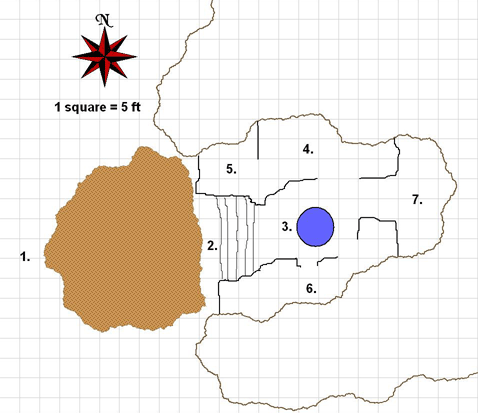 |
1. Rockfall
| Beyond the ridge is a sloping rock wall some 80 ft high. It appears that a portion of the lower half of the wall has collapsed in a rockslide, revealing the mortared face of some sort of structure that is still buried in the rock wall. Before the exposed structure is a large field of boulders and rocks that apparently came from the rockslide. |
2. Entrance
|
Battered and chipped stone steps lead up to the interior of the structure, and this area is covered by the uncollapsed portion of the rockwall some 40 ft overhead. The steps lead up to an entrance way into the structure that is 15 ft wide and 20 ft tall. The stone walls flanking the stairs are of a bluish stone and are carved with crude worn pictoglyphs that look like humans with reptilian spikes on their backs bowing to a turtle-like figure that stands on two legs and holds up a massive gem of some sort. |
3. Sapphire Hall
|
This crumbling hall's walls are decorated with the battered remains of what may have once been fantastic frescoes. Most of the flat, polished stones have been stripped away from the walls, which are pockmarked with cracks and dents. A small portion of the stones remain, and most of these are chipped, and there are not enough intact in one place to make out any details. Dominating the center of the chamber is a circular pedestal in the shape of a trapezoid made from black metal. Given the deterioration of the rest of the place, the fact that this pedestal is intact and untarnished stands out. Atop the pedestal is a massive blue gem with the deep azure hue of a sapphire. The gem is in the shape of an icosahedron and is a full 3 ft in diameter, its bottom resting on the 3 ft high pedestal. |
A DC 15 Listen check will reveal the sound of buzzing coming from area 4.
Developments: Any nothics surviving the initial encounter outside will have fled here. Sounds of fighting here will certainly bring forth the mother nothic from area 7.
4. Spawning Chamber (EL 4)
| This chamber is partially exposed, the remainder being buried under the massive rocks of the rock wall. A few bright yellow centipedes of Tiny size scurry around the place, amongst the rotting bodies of at least a half dozen creatures of vaguely humanoid shape with a single massive red eye above a fanged mouth. Flies buzz around the carcasses, which are strewn with maggots. |
Anyone actively searching this place or poking through the bodies with anything but a reach weapon or the like will be subject to exposure to filth fever (DC 12 Fort, 1D3 days, 1D3 Dex and 1D3 Con).
Creatures: The Tiny centipedes will attack anyone entering the chamber proper. This means the relative center of the chamber or passing along the wall towards area 5. In addition, the sound of combat will provoke a Large monstrous centipede to emerge from the cracks in the rock wall to the north a round later, possibly attack by surprise.
| TINY MONSTROUS
CENTIPEDES (16) CR 1/8 N Tiny vermin Init +2; Senses darkvision 60 ft; Listen +0, Spot +4 AC 14, touch 14, flat-footed 12 hp 1 (1/8 HD) Fort +2, Ref +2, Will +0 Spd 20 ft (4 squares), climb 20 ft (4 squares) Melee bite +4 (1D3-5 plus poison) Space 2.5 ft; Reach 0 ft Base Atk +0; Grp -13 Abilities Str 1, Dex 15, Con 10, Int -, Wis 10, Cha 2 SQ vermin traits Feats Weapon Finesse Skills Climb +10, Hide +18, Spot +4 Poison (Ex) A monstrous centipede has a poisonous bite. DC 10 Fort, 1 Dex/1 Dex. The save DCs are Constitution-based. |
| ADVANCED LARGE
MONSTROUS CENTIPEDE CR 2 N Large vermin Init +2; Senses darkvision 60 ft; Listen +0, Spot +4 AC 14, touch 11, flat-footed 12 hp 22 (5 HD) Fort +4, Ref +3, Will +1 Spd 40 ft (8 squares), climb 40 ft (8 squares) Melee bite +5 (1D8+2 plus poison) Space 10 ft; Reach 5 ft Base Atk +3; Grp +9 Abilities Str 14, Dex 15, Con 10, Int -, Wis 10, Cha 2 SQ vermin traits Feats Weapon Finesse Skills Climb +11, Hide +6, Spot +4 Poison (Ex) A monstrous centipede has a poisonous bite. DC 12 Fort, 1D4 Dex/1D4 Dex. The save DCs are Constitution-based. |
5. Shattered Library
| This chamber is partially exposed, the remainder being buried under the massive rocks of the rock wall. The walls are covered with stone shelves, many of them smashed and battered away, and the space between the shelves are decorated in faded carvings. Many pieces of stone lie on the floor, being from the stone shelves, the rock wall, and what appear to be pieces of stone tablets, judging from the strange runes upon them. A few pieces of stone tablets remain on their shelves, but nothing looks completely intact here. |
Examining the carvings between the shelves will show that they are squarish pictographs resembling humans, serpents, and turtles for the most part. The pictographs are somewhat similar to those veiwed by the PCs during their tumble through the mystic tunnel in the scenario Stake a Lizard by the Throat when they paused for a few seconds in the strange circular chamber with the two metallic-looking eggs. However, the carvings are too battered and faded to get any further details.
The fragments of stone tablets bear wedge-shaped markings that appear much like real-world cuneiform. If magic is employed to read the writing (or if somehow any of the PCs speaks Low Azotchtlan), the fragments can be seen to deal with a variety of topics, including inventories of supplies and fragments of what must be tales or fables. Some of the more interesting snippets are presented below:
| ...we bless thee and beseech thy return oh great Klashkaln. Please return to thy children who even now guard the sacred eidolon and fight against your evil kin. We know you dwell amongst the stars and your purposes are your... |
| ...admit the azurins, for though they are not true Children of the Mishtai, still they dwell in the house of incarnum and their souls merge with the souls of the universe... |
| ...soulmelds taught to us by the travellers, but also the divine blessings of the great gods... |
Treasure: Buried amidst the rubble is an essentia helm (Magic Item Compendium page 97). A DC 20 Search check will find the helm under several fallen pieces of stone shelving.
6. Long Room
| This chamber is partially exposed, the remainder being buried under the massive rocks of the rock wall and it is impossible to tell if this was once a single large chamber or the remnant of several chambers. The place is filled with rubble, most of it from the rock wall to the south, but clearly others likely from pieces of stone furnishings. |
Treasure: A thorough search of the chamber will turn up the following items (each requiring a DC 21 Search check to locate):
2 foci for the augury spell
A set of prayer beads (worth 500 gp) suitable for an atonement
spell
A Spellcraft or Knowledge (religion) check equal to 15 + spell level will allow a PC to determine for what spell the foci are useful.
7. Mother's Chamber (EL 8)
| This chamber is partially exposed, the remainder being buried under the massive rocks of the rock wall. Worn grooves forming part of a large circle can be seen on the floor, describing an arc before disappearing into the rock wall. |
Creatures: The mother nothic dwells here, resting after the trying ordeal of spawning so many offspring.
|
ADVANCED NOTHIC CR 7 See Invisibility (Su) A nothic can see invisible and ethereal creatures as though constantly under the effect of a see invisibility spell. |
Tactics: The mother nothic will almost certainly open her attack with her rotting gaze, only turning to melee when her foes approach her (and even then she will use her Large and in Charge feat to try to keep them at range). The mother nothic cares little for her young, and will flee the place if a fight goes against her and she is reduced to fewer than 25 hp. If cornered, she will fight to the death.
Treasure: Hidden at the base of the rock wall to the east is a ring of mystic healing (Magic Item Compendium page 126). It requires a DC 22 Search check to find the ring.
Encounter #5 - Snakes! (EL 8):
The PCs will be attacked by a trio of huge vipers that emerge from between several rocks where they have been hiding from the sun (assuming it is daylight). If it is winter, then this encounter will not occur (as the snakes will not emerge from their dens into the cold).
| ADVANCED HUGE
VIPER SNAKES (3) CR 5 N Huge animal Init +7; Senses scent; Listen +8, Spot +8 AC 17, touch 11, flat-footed 14 hp 78 (12 HD) Fort +10, Ref +11, Will +5 Spd 20 ft (4 squares), climb 20 ft (4 squares), swim 20 ft (4 squares) Melee bite +11 (1D8+4 plus poison) Space 15 ft; Reach 10 ft Base Atk +9; Grp +20 Abilities Str 16, Dex 16, Con 14, Int 1, Wis 12, Cha 2 Feats Improved Initiative, Improved Natural Armour, Improved Natural Attack (bite), Run, Weapon Focus (bite) Skills Balance +12, Climb +12, Hide +5, Listen +8, Spot +8, Swim +12 Poison (Ex) A viper snake has a poisonous bite that deals initial and secondary damage of 1d6 Con. DC 18 Fort, 1D6 Con/1D6 Con. The save DCs are Constitution-based. |
Tactics: The snakes will suddenly emerge from cracks beneath large boulders surrounding the area the PCs are in and attack from three different directions. Assume each snake initially appears 3D4x10 ft from the PCs. The snakes will fight until dead, as they are quite hungry, though if each can be given a large meal then each will slink back into its den under the boulders to consume the meal.
Encounter #6 - Liquid Barrier (EL 9)
The PCs will stumble upon an ancient cave wherein 3 horrendous fire-based undead were trapped by an act of sacrifice by an ancient goliath warrior and a diverted river.
Part One - What Happened:
In ancient times three cinderspawn roamed this land. How they came to be is not known, but they caused untold terror and destruction to a nearby goliath tribe until finally a council was held at Thella-lu and would-be goliath heroes competed for the honour to be one of six selected to try to destroy or at least contain the creatures.
The six goliaths were armed with what meagre magic the stonetellers could provide them, including a +1 sundering goliath greathammer. The goliaths hunted down the cinderspawn and after meeting them twice in battle and having almost been defeated by their charisma draining abilities, they realized they had little chance to defeat their foes, who were too mobile and fast with their Spring Attack capabilities. Instead, they needed to trap their foes and, hopefully, that would be enough.
The goliaths found a cave that was under a river and decided that this would be a perfect way to trap the undead. All of the goliaths competed to be the one who would lure the cinderspawn and trap them, even at the cost of his own life.
The goliaths prepared a dam to block the river and divert it into a hole to be prepared from below by a goliath knocking out a last support column that would allow the river to flow into the cave entrance and down a passageway, thereby trapping inside the cave the cinderspawn, who cannot cross nonflammable liquids.
So the five goliaths waited above, ready to quickly block off the original flow of the river. The chosen goliath with the magic hammer found the cinderspawn nearby and lured them to the cave. He ran deep inside the cave, the cinderspawn hungrily following, and then when they were fully within he doubled back and ran to the entrance. The cinderspawn were hard on his heels, and as they began to drain his charisma, he struck two mighty blows with his hammer upon the stone column. The column collapsed, and as the goliath hero did the same, the collapsing column opened up a hole in the river bed. The goliaths above quickly finished their dam, and the entire torrent of the river went into the hole blocking off the cave entrance. The cinderspawn were trapped, along with the remains of the goliath hero and his magical hammer.
Part Two - Bridge Over Troubled Water:
The PCs will be travelling through the mountains, crossing a natural stone bridge above a fast flowing small river (more of a large stream). Suddenly, when the PCs are pretty much all or mostly on the bridge, it collapses and the PCs on the bridge are tumbled into the river. A DC 20 Ref check will allow a PC to grab the ends of the bridge or cling to the side of the stream or what have you and avoid tumbling into the stream.
The stream is not that deep, perhaps 5 ft deep, but it fast flowing as it tumbles down a slope towards the hole. The stream is about 20 ft wide but narrows into a 10 ft diameter hole where the walls of the stream rise up slightly to accomodate the whirlpool caused by the draining action of the hole. The hole is 80 ft down the slope, and the stream travels at 40 ft per round, so anyone dumped in the stream will travel 40 ft on the round they fall in and then another 40 ft on the next round and into the hole.
A DC 15 Swim check is sufficient to allow the PC to swim towards the side and grab onto the bank. Once grabbed, a DC 10 Climb check is needed to scramble up the 5 ft bank or a DC 10 Str check is needed to cling to the side against the current of the stream. Should the Climb check fail by 5 or more the PC will be dropped into the stream and begin flowing downstream once again.
The stream is shallow enough that there is no chance of drowning unless the PCs are size Tiny or smaller.
Once at the hole, the PCs will be dropped 15 ft down the waterfall flowing into the hole. This water then flows to the west down a relatively straight 10 ft square passageway that emerges into the daylight at the side of a cliff, from which the water then falls in a 70 ft cascade into a pool below.
At the bottom of the 15 ft fall is a large amount of rubble (from the collapse of ancient times) and a PC is allowed a DC 15 Ref save to grab onto the rubble and arrest the flow. Otherwise, he will be carried down the passageway at 40 ft per round and eventually plummet 70 ft into the pool below (taking 4D6 damage from the fall and having to then swim out of the deep but smooth waters of the pool (DC 10 Swim check).
Above, it will be readily apparent to the PCs that the channel in which the stream flows turned to the right at this hole and continued on about another 200 ft before flowing over the cliff edge there. But someone has dammed the flow of the stream very completely, with large boulders, stones, and some sort of hardened mortar such that the stream was diverted to flow down the hole instead of continuing its course. Inspection will show that the dam is well made and the stones are well worn, as if having been exposed to water for many years, but the dam could be taken apart with some effort.
The torrent of water is so great that the waterfall down the hole is entirely opaque, so by sight alone there will be no indication that there is a cavern behind the falls.
Anyone looking down the hole or actually in the passageway with the waterfall may make a DC 10 Listen check to notice that the waterfall echoes strangely in this chamber, and that there may be a rather large space behind the falls.
The waterfall itself pounds down with a very strong force, and as such simply passing through it is not an option. Anyone sticking his hand or an implement in the flow will feel it smashed downward and, the implement will be torn out of the person's hand unless gripped tightly. Clearly, anyone just trying to walk through is likely to be smashed to the ground, suffering damage and either then flowing west with the stream or being pinned to the ground and possibly drowning.
Passing through the water wall requires a DC 25 Str check. Anything short of that will result in the victim being slammed to the ground in the midst of the torrent, requiring a DC 25 Str check to move forward or a DC 20 Str check to move backward (the check is easier moving backward since the flow of the river is helping).
Each round passing through or pinned by the flow a victim suffers 1D6 damage. Furthermore, a person is considered under water and grappled and pinned by the torrent, with all of the potential hazards and restrictions therefrom. Other PCs can aid the victim by various means, including simply pulling on his legs.
The easiest way to enter the cavern is to stem the flow from above. The hole can be blocked off with rocks and stones or even with lumber or tree trunks, but only if the damn is dismantled and the original stream flow allowed to run its course. Additionally, the PCs could devise a dam of their own to divert the flow back to its original course or to a new one. The DM should allow a Knowledge (architecture and engineering) check to have the PCs confirm the feasibility of these ideas and to allow them to proceed without mishap.
Part Three - Within the Dark:
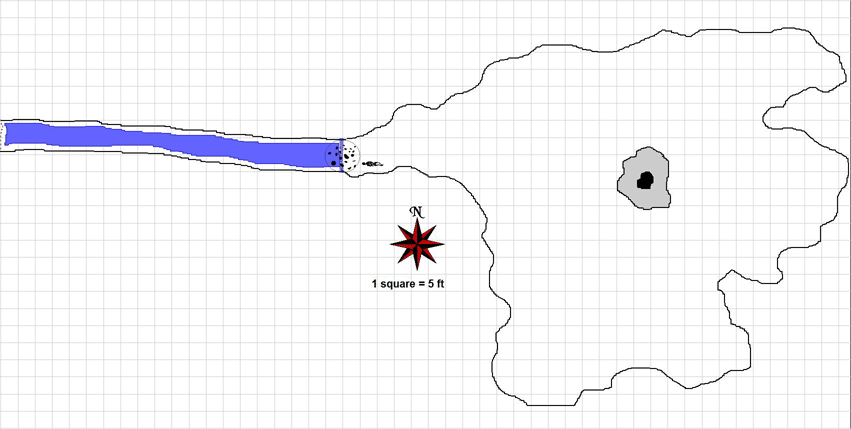 |
|
The cavern behind the waterfall is large and natural seeming, with stalactites hanging from the 15 ft high ceiling. At the entrance is rubble that may be from the hole in the ceiling, and just within the cavern at the edge of the rubble is a mouldering humanoid skeleton that clutches a large battle hammer in its bony grasp. In the center of the place is a sinkhole, some 15 ft in diameter. |
The cave within is natural, with unworked walls (hardness 8, 900 hp, Climb DC 15) and natural stone floors (it takes 2 squares of movement to enter a square with a natural stone floor, and the DC of Balance and Tumble checks increases by 5; running and charging are impossible). The ceiling is dotted with stalactites. The pssageway to the west is smooth.
The rubble at the entrance is
treated as light rubble (+2 to the DC of Balance and Tumble checks).
The skeleton is obviously quite old and of a goliath. Clutched
in its mouldering fingers is a goliath greathammer with a stone
head carved with intricate shapes and patterns and a wooden haft
that, presumably, should be rotted away given the condition of
the skeleton and the moisture here, but is instead entirely intact.
The sinkhole is 10 ft deep and allows egress to a 10 ft diameter passageway that proceeds east for 15 ft before opening into a 30 ft diameter chamber that is 10 ft tall and completely barren.
Creatures: 3 cinderspawns lurk in this cavern, trapped by the waterfall at the entrance. They dwell in the chamber behind the sinkhole in the center of the cave and are extremely angry at their imprisonment and are also quite hungry, having not fed on charisma for many many years. When they hear sounds within the chamber or if the waterfall stops flowing, they will emerge and attack.
|
CINDERSPAWNS (3) CR 6 Elemental Turning Vulnerability (Ex) A character who can turn undead and also turn fire creatures gains a +2 bonus on turning checks to turn a cinderspawn. A character who can rebuke udnead and also rebuke fire creatires gains a +2 bonus on turning checks to rebuke a cinderspawn. Frostfire Shield (Su) Any creature striking a conderspawn with a natural attack or a melee weapon (except for reach weapons) takes 1D6 points of cold damage as the cinderspawn drains its body heat. Inescapable Craving (Ex) A cinderspawn has an inescapable craving for Charisma, which it satisfies by using its Charisma drain ability. |
Tactics: The cinderspawns will emerge from their sinkhole quickly after they are alerted, especially if the waterfall is shut off, as they will be eager to gain their freedom. However, while it might be prudent for them to simply leave the chamber and escape soo as not to be imprisoned again, the cinderspawns are wracked with craving for Charisma and are almost insane with hunger. As such, as long as a "meal" presents itself, they will attempt to drain Charisma from any many victims as possible before fleeing their prison. Of course, if they see that the prison is being closed again they will attempt to flee, but normally their plan would be to slay all those within the cavern and then flee.
Treasure: The hammer is a +1 sundering goliath greathammer.
Developments: The PCs do not have to necessarily slay the cinderspawn. In theory they could entrap them once again by simply allowing the waterfall to resume.
If the hammer is brought back to Thella-lu and the PCs describe the circumstances of their finding it, the dawncallers there will have heard the tale of the goliath hero and there will be much adulation of the PCs, who will be able to sell the hammer for a like value of appropriate items (see details regarding Thella-lu in Part Four for availability of items).
Part Three - Taking it in Stride:
This part of the scenario is the heart of the adventure, and it should take place sometime during the mountain journey, preferrably before the middle of the trek, about two weeks out from the Kathaal Tribe.
Chapter One - Meeting the Striders (EL 5)
The PCs will be making their way through the mountains just after having broken camp in the morning when they are attacked by a flock of giant striders. Unless the PCs have some means of detecting them beforehand, the first indication of combat will be when the PCs, travelling down a gorge, turn around a bend and spy the flock of creatures some 80 ft away, in a group by the riverside. The creatures will likely notice the PCs and will immediately squawk and attack, running forward 40 ft and then launching their fireballs.
|
GIANT STRIDERS (6) CR 1 Healing from Fire (Ex) Not only do giant striders take no damage from fire, they are healed by it. Once during each 3 rounds that a strider is exposed to intense heat or flame, the creature gains the benefit of a cure light wounds spell (1D8+1 hp healed). A fireball spell or other intense, fiery attack fully heals the creature instantly. Resistant to Magic (Ex) Giant striders gain a +2 bonus on all saves against magical effects. |
Tactics: After their initial launch of fireballs, the flock will launch another at the PCs and then charge them on foot. If two of their number are dropped and two more have less than half of their original hp, then the flock will retreat, heading back to its home vale which is a half mile or so to the southwest. If the PCs follow most of the way back they will possibly run into the encounter for Chapter Two.
Developments: A DC 10 Spot check will reveal what appears to be a common mark gouged into the left flank of each giant strider. The mark looks like a vertical wavy line flanked by a set of three dots arranged in a triangle on each side.
 |
The striders are not normally aggressive hunters, but this flock is riled up due to the destruction of its clutch of eggs by the new animal companion of the exiled skywatcher. As such, they are out for blood.
Chapter Two - Bar None (possibly EL 9)
Shortly after the PCs have encountered the giant striders in Chapter One or perhaps while chasing them back to their home vale, the PCs will encounter a group of firenewts mounted upon giant striders. The firenewts will initially be approaching the flank of the PCs from a distance of about 100 ft. These firenewts have been sent out specifically to check on the flock the PCs have encountered. They are now following the flock's trail, which will invariably lead them to the PCs. This group has not yet gone to the vale to see that the nests have been disrupted.
The initial reaction of the firenewts will depend upon whether the PCs have slain any striders in Chapter One and if the firenewts have had a chance to go to the battle site and see evidence that striders have been slain. If so, the firenewts will be hostile to the PCs. Otherwise, they will be unfriendly.
If the firenewts are unfriendly, they will assume the goliath travelling with the PCs is in league with the exiled skywatcher, but they will not be in haste to do battle.
If hostile, the firenewts will assume that not only is the goliath travelling with the PCs in league with the exiled skywatcher, but that he was involved in the slaying of the firenewts and they will attack.
Creatures: The gang consists of 6 firenewt warriors mounted on giant war striders accoutered in leather barding. The firenewts and the striders have the same symbol on their gear and barding and the striders on their left flanks as the striders did in Chapter One.
|
FIRENEWT WARRIORS (6) CR 2 Strider Handling (Ex) Firenewts treat striders as animals for the purposes of the Handle Animal skill. |
|
ADVANCED GIANT WAR STRIDERS
(6) CR 2 Healing from Fire (Ex) Not only do giant striders take no damage from fire, they are healed by it. Once during each 3 rounds that a strider is exposed to intense heat or flame, the creature gains the benefit of a cure light wounds spell (1D8+1 hp healed). A fireball spell or other intense, fiery attack fully heals the creature instantly. Resistant to Magic (Ex) Giant striders gain a +2 bonus on all saves against magical effects. |
Tactics: If hostile, the firenewts will charge the PCs, relying on their striders to blast away with fireballs as they close. The firenewts will then ready lances and charge the final distance, timing it so the striders have launched both of their fireballs before the charge. Thereafter, they will attack in melee, though the firenewts are not very bright and will not use any clever tactics or coordinated attacks beyond flanking.
Striders are trained to attack enemies even after their riders fall, and they will protect their master's body until a battle is finished unless the master is obviously dead, in which case they will actively join the combat.
Should half their number be be defeated, the firenewts will fall back and attempt to parley as outlined below.
Should the PCs flee, then the firenewts will give chase only for a short while and then go to get their cleric and track the PCs to begin a parley.
Should PCs be defeated, they will be taken prisoner and then taken to the firenewt lair where a similar parley will take place.
Developments: If the firenewts are unfriendly, they will approach the PCs warily to parley, but will not take hostile actions unless the PCs attempt to flee or take any hostile actions themselves. Casting defensive spells or summoning monster but keeping them at bay will not be regarded as hostile.
If combat does ensue (from the PC actions or if the firenewts are hostile), then the PCs will have to either use magic or a Diplomacy check to change the firenewt attitude to unfriendly (they will not change better than unfriendly as a result of normal Diplomacy checks in this Chapter) or defeat them in combat so that they will enter a parley.
If the firenewts attempt to speak with the PCs and none of them can understand Draconic, then the firenewts will invite the PCs to remain here with them while one of their number goes to the firenewt lair to get a cleric who can cast tongues.
If the PCs refuse to stick around for a parley, then the firenewts will eventually track them down anyways with the cleric in tow and a parley will take place.
Chapter 3 - Parley
As seen above, there are a variety of ways a parley can take place. Most likely the PCs will defeat the firenewts on the field of battle or have them at unfriendly. The firenewt warriors are not the spokespeople of the tribe. If the PCs can understand Draconic, they will say they wish to discuss matters of importance with the PCs and ask them to wait here to speak to their priest. If the PCs are suspicious, they will say that they can take all but one of them as hostages and one can go back to get the priest. If that still does not convince the wary PCs, then the firenewts will shrug and attempt to leave, fetching their cleric and tracking down the PCs anyways!
Even if the firenewts are completely slaughtered on the field of battle, eventually the cleric and his party will emerge, track down the missing firenewts by way of divination, and then find the PCs.
True parley will begin with the arrival of the firenewt priest and his entourage, which will take a few hours at most. Statistics for this group are not presented here, but can be found in the later Chapter dealing with the firenewt lair. The priest is the high priest of the tribe and his entourage of half a dozen firenewt warriors are as set forth above. All are mounted on giant striders. The priest is dressed in ornate metal chainmail studded with pieces of dried lava and volcanic rock, and a diadem of lava rests on his head, with a large opal set within (worth 1200 gp).
The cleric will cast tongues if none of the PCs speaks Draconic.
The cleric will then step forward and say (this dialogue assumes the PCs are mostly human or close to human and wearing some metal armour of bearing metal weapons):
|
We do not know what humans are doing in these mountains wearing the gear of the snake ones, but we do see a goliath amongst them. We have dwelt in peace with the goliaths since our coming from the south but now the goliaths perpetrate acts of desecration upon our tribe and we can no longer suffer these. My people urge vengeance and it is our way to strike at the clutches of our foes. Know you this, that I speak of the one of the goliaths who dwells to the north of here. He has caused his minions to creep into our strider nesting grounds and steal our eggs. And now he has stolen the egg of the strider Besikk'apon, scion of the great striders of eld and a sacred bloodline of their kind. Such scion is the prized possession of our overlord and he is wroth over its loss. Know you this as well. We will make war upon the goliaths who are called the Kathaal unless the prized egg is returned to us and this goliath is brought to heel. His crimes are crimes of the entire tribe, and the clutches of the tribe will pay for his crimes. This is the way of things with us...it is our way. If you wish to avoid this war, then you will go to him and get the egg from him and return it to us. If you do, and either bring us his head or bring us his promise to stop taking or destroying our eggs, then we will desist. Otherwise, we will march! |
At this time a single firenewt warrior will stride in on his mount and approach the priest, bowing slightly. He will then whisper into the priest's ear. At this, the priest will turn an even deeper orange colour and his eyes will narrow into slits of rage.
| It appears that the entire clutch of a nearby flock of striders was just destroyed. We know this was done by the goliath! Here is the fur to show it! This is the last ash! If we do not have the egg back and his head presented to us within 24 hours, we will march upon the Kathaal! |
Of course, the clutch of eggs destroyed was the one belonging to the striders that the PCs encountered in Chapter One.
The PCs can attempt to appease or protest to the priest, but he will not listen to anything except questions concerning how to accomplish what he wants. He will certainly tell the PCs the general area they believe the goliath's lair is located. If the nature of the goliath's minions is queried, the priest will say that it is a large, long, furry creature and if pressed further it will be apparent that it is a dire weasel.
The priest will also inform the PCs how to find the firenewt lair
With that, the parley will end and the firenewts will head back to their lair.
Guvagliant will insist that a war with the Kathaal and the firenewts must be avoided at all costs, as the losses against the dusk giants (see From Dusk to Dawn) and the yuan-ti (see Strangers in a Stranger Land) have depleted the tribe.
Chapter Four - Exile
If the PCs questions Guvagliak about this goliath, he will say that it is the goliath way to exile from the tribe anyone too old or lame to contribute to the tribe. In addition, he will say that in some cases if a wrong is committed by a tribe member they can be exiled. If the PCs inquire as to anyone he can recall being exiled for wrongdoing, he will say it is very rare, though there are many oral stories of it happening in times past, but he will say that there was a recent one involving a goliath whose name now cannot be spoken due to his exile in shame. But he can say that this goliath was a skywatcher of the Kathaal tribe and he was banished for improprieties during a competition between two tribes.
Guvagliant will also say that such a person does not exist for other Kathaal members and the tribe does not exist to him. Because of this, the PCs will have to deal with him. Guvagliant cannot speak or interact with him in any fashion.
If it is suggested that someone return to the Kathaal to warn them of impending war, Guvagliant will offer to do so, promising to return to find the PCs thereafter. In any event, Guvagliak will say that it would be better for him to remain outside of the canyon and not come into contact with the exile. Only a very persuasive argument will convince him to come with the PCs into the canyon.
The directions given by the firenewt priest point to a narrow canyon about 2 miles away (a journey of a couple of hours). A stream emerges from the entrance to this canyon and joins with a larger river that flows through the mountains in this region.
 |
Unless otherwise stated, the cliffs of this canyon are between 60 ft and 70 ft tall and require a DC 15 Climb check.
The stream flows from east to west and is between 5 ft and 10 ft wide and inversely half as deep (i.e. when it is 2.5 ft deep it is 10 ft wide and 5 ft deep when it is 5 ft wide) with shallow banks. If the width of the stream is needed at a given point, roll a 1D6+4 to determine the current width and then assume it either shrinks or increases as desired or makes sense. The DM can also assume that in any given stretch of stream 100 ft long there is at least one spot that is 5 ft wide and another that is 10 ft wide. The bottom of the stream is filled with mossy pebbles, and a DC 14 Balance check is required to keep one's footing.
Crossing the stream is relatively easy at the widest spots. If a Balance check is failed by 5 or more the crosser falls and must make a DC 10 Swim check or be carried down stream. At the narrowest spot, the current is faster and the stream deeper, requiring a DC 15 Swim check to navigate. But such narrow portions can likely be crossed by simply jumping. Overall, assume the stream flows at 20 ft per round.
The water is pure and potable and quite cold.
The floor of the canyon is relatively smooth, being mostly packed earth with occasional stretches of flat granite, though there are enough protrusions, rocks, and small boulders to treat it as light rubble (+2 to the DC of Balance and Tumble checks, the Balance modifier is already included in the Balance check for crossing the stream mentioned above).
The canyon is generally well lit all throughout the day, as it runs east to west with the sun. Nevertheless, the DM can assume that twilight comes an our early and dawn an hour late to the canyon due to its walls. Furthermore, as the sun is in the north, the north wall of the canyon is perpetually in shadow (not enough to affect combat, but enough for effects and magic that depend on shadow and enough to shelter a creature with daylight sensitivity from the effects of bright light). Assume the 25 ft square running along the north wall of the canyon is in shadows.
The PCs will be approaching the canyon from the south.
A. Canyon Entrance
|
You come to the place the firenewts directed you, having followed a fairly wide gorge with a river running through it north to this side canyon. The side canyon is about 50 ft wide, and a small stream gushes out of it and merges with the river. The cliffs of the canyon entrance are granite and are about 60 ft to 70 ft high. The cliff walls are very steep, though not quite sheer, and tufts of moss and small grasses grow out of tiny ledges and cracks in them. |
Creatures: A single normal bird is perched on the southern cliff top watching the entrance to the canyon (in actuality, several such birds take turns). It has been spoken to by the skywatcher with many speak with animals spells and is quite friendly to the skywatcher, who has requested that it immediately fly to his lair at area G and warn him if any creatures on two legs enter the canyon.
To this end, the bird will take off, flying atop the cliff face and then decending into the canyon at area G and into the cave there to warn the skywatcher. It would take some fairly heroic measures on the part of the PCs to notice this bird and then intercept it before it warns the skywatcher.
Only a PC specifically stating he is looking along the cliffs for animal scouts or spies or the skywatcher in animal form has a chance of noticing the bird. Even then, just due to its size and colouration the bird has a Hide of +20 for an assumed take 10 check of 30, so it would take a Spot check of DC 30 plus distance modifiers to notice the bird watching the PCs approach.
When the bird alights, the DC will drop to a DC 10 Spot check, but again the PCs must be specifically on the lookout for this type of activity. Otherwise, there are so many instances of normal animal life in the area that there is no way to casually notice this bird instead of any other bird or tiny animal in the area.
The bird flies at a speed of 50 ft with average maneuverability. Essentially, treat it as a slightly faster raven from the Monster Manual.
The bird is not afraid of the raptors in area B, as the skywatcher has convinced them not to hunt the bird sentinel.
B. High Aerie (EL 7)
| On the north side of the stream, the canyon wall gives way to a wide ravine in the walls of the cliff that ascend to the top. Two steep stone ledges give access to the top, each being 25 ft high. At the very apex of the ravine, just 10 ft below the top of the cliff, is a stone ledge upon which sits some sort of plant, bush, or perhaps wooden debris. |
The stuff atop the ledge is actually a nest for the mated pair of dire hawks that dwells here. There is nothing within the nest at this time.
Creatures: Two massive dire hawks dwell here, having lived here before the skywatcher came to this canyon and now being loyal friends of the goliath exile, due to his wild empathy and ability to cast the speak with animals spell. The hawks will certainly defend their territory against intruders, including the PCs, and for purposes of the PC's wild empathy checks, they are considered hostile.
|
ADVANCED DIRE HAWKS (2) CR
5 * A dire hawk receives a +8 racial bonus on Spot checks in daylight. |
Tactics: The dire hawks will alight from their nest on the stone ledge at the top of the ravine and attack intruders, seeking to drive them out of the canyon. They will not pursue prey outside of the canyon except for size Small victims, which they may seek to grab and take back to their aerie to consume.
The dire hawks are loyal to the skywatcher but will not fight to the death, and each can be driven off if its hit points fall below 25%.
Developments: The hawks will also attack PCs entering or passing through area C.
C. West Stretch (EL 1)
| This wide section of the canyon stretches from the entrance to the west to a narrowing to the east that appears wide enough just to admit the stream and perhaps 10 ft of space on each side before meeting the steep canyon walls. |
There are 24 such pits in total in the areas marked on the map, but the precise location has not been set. Instead, assume for each 25 ft square entered by each column of PCs (assuming their marching order) there is a 75% chance that a pit will be encountered. If the PCs are marching in multiple columns, determine randomly which one hits the pit first.
Similarly, if the PCs move around a lot within a 25 ft square, allow a 20% chance per round that they stumble into such a pit. To be more precise, assume there are approximately 4 pits in every 25 ft square on the map.
Presumably, after they encounter the first pit, the PCs will take precautions, including marching single-file and probing ahead for pits. As such, once the PCs take such precautions, the DM should inform them that they encounter several more pits but pass through the rest of the area safely.
Of course, if the PCs have to run through this area in retreat or in a fight with the dire hawks from area B, more pits could come into play.
| Pit Trap CR 1; mechanical; location trigger; repair reset; DC 15 Reflex save avoids; 20 ft deep (2d6, fall); Search DC 22; Disable Device DC 23. |
The skywatcher knows the location of all of these pits and can easily maneuver through the area without danger of falling into one.
Developments: The dire hawks in area B will almost certainly see intruders crossing this portion of the canyon and will alight from their aerie to attack. The hawks could combine with the pit traps to cause havoc amongst the PCs.
D. Defile (EL 5)
| The canyon narrows into a defile at this point, with the walls closing in on the stream until they are no more than 10 ft from the edge of the water. The cliff walls seem to almost close in on the place as they tower some 60 ft to 70 ft above. |
Creatures: A monstrous crayfish dwells in the water of the defile here. Throughout the defile the stream is 10 ft wide and 5 ft deep, but at the bottom in the center of the defile the stream is a full 15 ft deep where the crayfish has dug a den.
The crayfish is quite aggressive, as this is the only portion of the stream large enough for it (though it sometimes migrates to the pool in area F) and so it must be wary of opportunities to catch prey. The skywatcher bypasses this creature by either flying above the stream in avian form or by carrying a heap of fish which he tosses into the stream to distract the crayfish.
|
ADVANCED MONSTROUS CRAYFISH
CR 5 Improved Grab (Ex) To use this ability, a monstrous crayfish must hit with a claw attack. It can then attempt to start a grapple as a free action without provoking an attack of opportunity. If it wins the grapple check, it establishes a hold and can constrict. Water Dependency (Ex) A monstrous crayfish can survive out of the water for 1 hour per 2 points of Con. After that, refer to the drowning rules in the Dungeon Master's Guide). |
Tactics: The crayfish will hover just under the water, where it has total cover from observation on land. When a living creature passes within 10 ft of it, it will strike out of the water and attack a victim, seeking to grab it and then pull it back down into its lair underwater where it will constrict and drown its prey before pulling it apart and eating it.
If the crayfish is on the surface and brought to under 20% of its hit points it will retreat down into its lair.
E. East Stretch (EL 2)
| The defile to the west opens into this wider section of the canyon, which is punctuated by a few trees, some of which are actually tall bushes of thorny briars and others of which are actual trees. There seems to be more plant life to the east. |
A DC 20 Knowledge (nature) check, if a PC chooses to consider the issue, will reveal that it is not entirely natural for trees and bushes to have chosen the north side of the canyon, which is perpetually in shade, rather than the south side which gets more sun. Having such plants flourish in the shady side speaks of either something unnatural or some very talented care and nurturing of the plants.
Anyone moving into a square containing a thorn bush is subject to the rules below (under Traps) covering movement through the thorny areas.
Traps: This area has been peppered with snare spells set by the skywatcher. In every square adjacent to a tree or bush in this area, a snare spell has been cast. Each snare is 20 ft in diamater, and so fills most of the 25 ft square. The snare spell is attached to the tree or bush in the adjacent square. If more than one such tree or bush is adjacent, assume it is attached to a bush in priority to a tree and to a tree on the opposite side of the stream as opposed to the same side.
Assume a 90% chance that someone will step within the snare effect in a square. This should be checked for each person who passes through a square or each round someone is moving around in the square. Of course, the skywatcher knows exactly where not to step and so can maneuver through this area at ease. Once a square is tripped by someone it is clear of further snare spells until the skywatcher recasts them.
DMs should remember that snare spells activate only when the limb of a creature is placed within its loop. Thus, prodding ahead with spears or poles will accomplish nothing.
As an added effect, the snare spells attached to the bushes will whip the victim into the midst of the thorny briars, causing an extra 1D6 damage and entangling them within the briars. Those entangled suffer 1D4 damage if they take any action that requires any movement (including casting spells with somatic components, drawing or sheathing weapons, retrieving items, etc). If the victim takes a full round action he can make a DC 15 Str check or Escape Artist check to emerge from the briars after getting out of the snare. For each full round action attempted (whether successful or not) to emerge from the briars, the victim takes 1D6 damage. Anyone in medium armour suffers 1 less point of damage (minimum zero) from the briars, and anyone in heavy armour suffers 2 less points of damage (minimum zero) from the briars. A natural armour bonus or magical armour bonus of +3 to +5 counts as medium armour and one of +6 or more counts as heavy armour. Any number of people can aid the Strength check to get out of the snare and the briars, but each subjects the PCs aiding to 1D4 damage (less armour adjustments).
| Snare Trap CR 2; spell; location trigger; no reset; spell effect (snare, 7th level druid, 1D6 damage, entangle, lift off of ground or into thorn bush [see above]); Search DC 23; Disable Device DC 28. |
Developments: If the skywatcher is on alert, he will wait for intruders to stumble into the snare spells and then begin to use summon nature's ally spells to summon flying creatures such as air elementals to attack the entrapped victim.
F. Canyon Terminus (EL 7)
|
The canyon ends in this area, with cliff walls to the north, south, and east. Trees and thorny bushes are everywhere here, though most thickly along the northern canyon wall and not enough to present an obstacle to movement. Plummeting down the eastern canyon wall is a waterfall, which cascades in a 10 ft wide sheet into a pool of clear water that drains into the stream that flows through the canyon. |
Anyone moving through one of the thorn bush squares is subject to the effects described under Traps in area E with regard to moving through such an area.
The water in the pool is clear and potable and quite frigid. The skywatcher uses this pool not only for water and bathing, but also as his divine focus when casting a scrying spell.
Creatures: Two giant dire frogs are present here, almost pets of the skywatcher. They feed off of fish that breed in the pool and that fall down the waterfall, as well as on rodents and even small birds. The creatures are quite aggressive and protective of their territory, which is all of area F and will attack any intruders not escorted by the skywatcher.
|
ADVANCED GIANT DIRE FROGS
(2) CR 5 A frog's tongue can be attacked. Damage dealt to the tongue is not dealt to the frog itself. If successful, the frog does not attempt a grapple against that opponent for the remainder of the combat. A giant dire frog tongue has an AC of 15. Leap (Ex) All types of giant frogs can leap and make a single attack in the same round (treat this as a charge attack). Rake (Ex) Frogs that leap on an opponent can make two rake attacks (at +9 attack bonus). Swallow Whole (Ex) A frog can try to swallow a grabbed opponent of a smaller size than itself by making a successful grapple check. Once inside, the opponent takes 1D4 points of crushing damage plus 2 points of acid damage per round from the frog’s stomach. A swallowed creature can cut its way out by using a light slashing or piercing weapon to deal 10 points of damage to the stomach (AC 13). Once the creature exits, muscular action closes the hole; another swallowed opponent must cut its own way out. A dire frog’s interior can
hold 2 Small, 8 Tiny, or 32 Diminutive or smaller opponents. |
Tactics: The frogs will simply leap out to attack, using their tongues to try to draw Medium or smaller prey to them for swallowing and consumptions. It is not so much the frogs are guardians, but rather they are hungry opportunists who have decided not to eat the skywatcher (and vice versa). If wounded severely (10% or less hit points remaining), they will leap into the pool to hide from their foes.
G. Talus and Incline
|
This deep spur of the canyon proceeds to the southeast. Most of this spur is taken up by a massive talus of boulders, rocks, and gravel that seem to have been the result of a landslide, as the rock walls surrounding the far end of the talus are gouged and cracked and quite jagged. The pile begins as a mere scattering of rocks and then mounts in a steep incline until it reaches almost 40 ft up the rock face at the end of the spur. A narrow stone incline that is relatively flat and smooth runs along the edge of the talus and up to a cave opening near the top of the far end of the spur. The cave opening is roughly 10 ft in diameter. |
In addition, the talus portion is considered to be dense rubble, which increases the movement cost to 4 squares, increases the DC of Balance and Tumble checks by 5 (for a total of +7 to the DC of Tumble checks), and increases the DC of Move Silently checks by 2.
Tactics: There are no traps here, but the difficulty of climbing up the talus tends to channel intruders along the smooth incline and limit the numbers that can press an attack.
Developments: The cave leads to the lair of the skywatcher, which is detailed below.
The Skywatcher's Cave (EL 7):
 |
Unless otherwise stated, the skywatcher's cave is comprised of unworked stone walls (Climb DC 15, hardness 8, 900 hp, break DC 65) and natural stone floors (2 squares of movement to enter a square with a natural stone floor, and the DC of Balance and Tumble checks increases by 5; running and charging are impossible).
Passages and caverns are 15 ft tall, and dark unless stated otherwise.
Natural stone shelves (denoted by dotted lines) are 2 ft tall. The dashed line between area 1 and area 2 denotes where the cave ceiling begins.
1. Entrance
| The entrance to the cave is roughly 10 ft in diameter and sits at the end of the spur in the canyon. The smooth inclined ledge that leads up to the cave is adjacent to a massive talus of fallen stones. |
2. Passageway
| This passageway is unremarkable, except that 15 ft in from the entrance a large curtain of fur hides has been slung across the way. |
The inside face of the curtain (facing area 3) is sewn with strips of leather that dangle from the curtain and bits of metal, bone, quartz, and stone have been tied to these thongs, so that anyone pushing aside the curtain without using extreme care will create a noise that will alert the skywatcher and his animal companion that intruders are present.
The hide curtain is far too thick to be moved by a casual zephyr, and so for the PCs to successfully bypass alerting the skywatcher, they would have to move aside the curtain very slowly. This would take at least 3 full rounds before anyone could pass, and another 3 full rounds to let the curtain back down quietly. A DC 10 Dex check is also required each round the curtain is being moved and a DC 7 check for each round it is being held open to avoid making noise.
Once past the curtain, the light of torches from area 3 will be seen.
Developments: Any noise from the curtain will attract the attention of the skywatcher and his animal companion, who will approach cautiously to investigate.
3. Main Cavern
|
This cavern is lit by torches hanging in crude stone sconces along the walls of the cavern. The ceiling is devoid of stalactities and is splotched with soot. Two natural stone shelves lead down from the west into the place, while a set of stone shelves rises to the northeast and disappear down a passageway. A third set of stone shelves in the east lead up a stone platform upon which is a wooden table and chair and an open wooden box. To the south are a variety of crude wooden objects, including another table, a water trough filled with water, several buckets, and a variety of crudely fashioned tools of wood, flint and stone including a hatchet and tools for crafting wood. Coils of hemp rope sit under the tables. |
To the south, there are the equivalent of 10 coils of hemp rope, each being 50 ft long. The tools and implements, though crude, are well-made and can serve as an artisan's workbench and tools for the Craft (woodworking) skill or any other Craft skill that pertains primarily to wood. Also amongst the tools are sinew and thread and various bone and flint needles suitable for repairing cloth or leather.
4. Skywatcher's Chamber
| This chamber contains a fur pallet set on a crude wooden frame and wooden bowl filled with water set on a stone nearby. The walls are painted with crude pictures of animals, including birds, rodents, weasels, wolves, and deer. One section shows what look to be fire breathing two-legged beasts and these paintings have big X's slashed through them in red. A variety of bones, skulls, and other items decorate the room in a sort of haphazard fashion, most of these being animal bones. |
In one area of the cave are a collection of rare oils and unguents in small bladders and wax stoppered gourds. These are material components for the reincarnate spell and there are enough here for 4 such castings.
Treasure: Hidden in a natural hole in the floor and covered by rocks is the precious egg of the strider Besikk'apon, cushioned in its niche by grass and leaves. A DC 20 Search check is required to find the hidden egg, which is about 6 inches long and 4 inches wide.
5. Companion's Chamber
| This cavern contains stone shelves to the north and south, the topmost shelf of the northern group contains a pile of leaves, sticks, and tufts of fur that hint at a nest of some sort. Atop the southern shelf are a variety of gnawed bones. |
Skywatcher and Companion:
The skywatcher and his companion are apt to be found anywhere in their little cave complex, depending upon circumstance and the time of day. As such, it is up to the DM to place them initially, though there are plenty of alarms and other means to alert them into a defensive positions as mentioned in previous parts of the text, including Kavaki emerging to summon air elementals or a dire hawk to harrass PCs captured by one of his snare spells in the canyon.
The skywatcher bears his mark of the outcast as strange mottled blotches on his face. These are obviously exile marks to any goliath who sees them, and to others they simply look strange, even to those not yet used to the markings of goliaths in general.
Kavaki is a very crafty person, having had to live on his wits alone for twenty years now in a fairly rugged and hostile environment. He is kind to his few friends, mostly animals, wary of strangers, and exceptionally ruthless towards his enemies. His current spells prepared reflect his ongoing animousity with the firenewts.
He is also quite stubborn, proud, and willing to fight to the death, as he considers his true life to have ended when he was exiled from the tribe. This lends a sort of fatalistic ferocity to the goliath druid.
|
SKYWATCHER KAVAKI RAMLORD
MANETHAK CR 7* Mountain Movement (Ex) Because goliaths practically live on the ledges and cliffs of the most forbidding mountains, they are particularly adept at negotiating mountain hazards. Goliaths can make standing long jumps and high jumps as if they were running long jumps and high jumps. A goliath can engage in accelerated climbing (climbing half his speed as a move action) without taking the -5 penalty on the Climb check. Powerful Build (Ex) The physical stature of a goliath lets him function in many ways as if he were one size category larger. Whenever a goliath is subject to a size modifier or special size modifier for an opposed check (such as during grapple checks, bull rush attempts, and trip attempts), the goliath is treated as one size larger if doing so is advantageous to him. A goliath is also considered to be one size larger when determining whether a creature's special attacks based on size (such as improved grab or swallow whole) can affect him. A goliath can use weapons designed for a creature one size larger without penalty. However, his space and reach remain those of a creature of his actual size. The benefits of this racial trait stack with the effects of powers, abilities, and spells that change the subject's size category.circumstance bonus on Hide checks. * Kavaki's CR is one lower than normal due to the mark of the outcast spell that has been placed upon him by the Kathaal tribe. The effects of this spell (cast at CL 3) are included in the above statistics. |
|
SKYWATCHER'S ANIMAL COMPANION
CR - Blood Drain (Ex) A dire weasel drains blood for 1D4 points of Constitution damage each round it remains attached. |
Kavaki is apt to choose two favoured forms for his wild shape ability, that of a fleshraker dinosaur and that of a dire hawk. His statistics when in these forms are presented below.
|
SKYWATCHER KAVAKI RAMLORD
MANETHAK IN FLESHRAKER WILDSHAPE
CR 7* Leaping Pounce (Ex) When a fleshraker charges, it leaps high into the air above its prey, attempting to knock it to the ground. This ability functions much like the pounce special attack. However, a fleshraker's incredible jumping ability makes its leaping pounce particularly deadly. When a fleshraker charges a foe, it can make a full attack, including one rake attack. If a fleshraker successfully hits and damages a target of its size or smaller that it pounces on during a charge, it can make a free trip attack without provoking an attack of opportunity. If the fleshraker wins the opposed trip check, it can make an immediate grapple check. If it succeeds, the opponent is considered grappled and pinned on the ground beneath the fleshraker. On each subsequent round, the fleshraker can deal automatic claw and rake damage with a successful grapple check against a pinned opponent. If a fleshraker failes the opposed trip check, it cannot be tripped in return. If it successfully trips its opponent but fails the subsequent grapple check, the opponent is still prone in the fleshraker's square, but it is not grappled or pinned. Mountain Movement (Ex) Because goliaths practically live on the ledges and cliffs of the most forbidding mountains, they are particularly adept at negotiating mountain hazards. Goliaths can make standing long jumps and high jumps as if they were running long jumps and high jumps. A goliath can engage in accelerated climbing (climbing half his speed as a move action) without taking the -5 penalty on the Climb check. Poison (Ex) Injury, Fort DC 15, 1D6 Dex initial and secondary damage. The save DC is Con-based. Rake (Ex) Attack bonus +4 melee, damage 1D6+2. * Kavaki's CR is one lower than normal due to the mark of the outcast spell that has been placed upon him by the Kathaal tribe. The effects of this spell (cast at CL 3) are included in the above statistics. |
|
SKYWATCHER KAVAKI RAMLORD
MANETHAK IN DIREHAWK WILDSHAPE
CR 7* Mountain Movement (Ex) Because goliaths practically live on the ledges and cliffs of the most forbidding mountains, they are particularly adept at negotiating mountain hazards. Goliaths can make standing long jumps and high jumps as if they were running long jumps and high jumps. A goliath can engage in accelerated climbing (climbing half his speed as a move action) without taking the -5 penalty on the Climb check. * Kavaki's CR is one lower than normal due to the mark of the outcast spell that has been placed upon him by the Kathaal tribe. The effects of this spell (cast at CL 3) are included in the above statistics. |
Dealing with the Skywatcher:
It is very likely that the PCs will be approaching the skywatcher with little or no intent to fight him. Nevertheless, they must first gain access to him, and the skywatcher is not really expecting any friends to show up on his doorstep. After all, he knows no Kathaal members will even speak to him or acknowledge his existence, and vice versa. The firenewts are his enemies currently. And other goliaths, though not bound to ignore him, are still likely to regard him with contempt due to his mark of the outcast. As such, the skywatcher will be under the initial assumption that anyone trying to reach him means him no good.
The PCs will certainly have to make their way past the dire hawks, monstrous crayfish, and the pit traps in the canyon. Quite likely, the skywatcher will be notified of their intrusion by means of the bird watching the entrance to the canyon. As the PCs labour in the snare traps, the skywatcher will certainly begin his assault as described there. This is probably the best time for the PCs to attempt a parley. If they can speak quickly and eloquently enough to convince the skywatcher that they wish to talk, he might hear what they have to say.
On the other hand, the PCs can simply agree to do as the firenewts ask and attack the skywatcher with the intent of killing him and returning the egg. That is a perfectly reasonable approach and, in that case, there may be no parley and simply a fight to the death.
If the PCs wish to parley, they will have to do it while under attack from the skywatcher. Unless they can think of some clever way to communicate with him unobtrusively or from a distance, any meeting between the PCs and the skywatcher will likely involve initial hostilities. The PCs will have to make a rushed Diplomacy check.
The skywatcher starts as unfriendly. He will have to be made indifferent to convince him to stop attacking and at least listen to what the PCs have to say. Of course, to do this the PCs must be able to speak Gol-Kaa or have someone translate for them or use magic to communicate with the skywatcher. It should be noted that Sazhansiir druids do not have their own Druidic tongue or alphabet. Getting Guvagliak to translate will be nigh impossible, even in the face of an impending war between Kathaal and the firenewts, as he will not acknowledge Kavaki's existence.
The following circumstance bonuses and penalties apply:
Guvagliak or another Kathaal goliath
is present = -2
A non-Kathaal goliath is present (not cumulative with the above)
= -1
For each animal or vermin slain in the canyon = -1
For each animal or vermin bypassed in the canyon without causing
any damage = +1
If a druid or spirit shaman or a PC of a character class or prestige
class intimately tied to nature is speaking (including a cleric
of a nature deity) = +1
For each animal companion present loyal to the PCs = +1 (+2 if
the companion is a dire weasel)
The DM can allow PCs to make rushed Diplomacy checks every round to try to convince him as a full-round action, with a cumulative +1 bonus to offset the -10 penalty each consecutive round until, on the 10th round, a final normal Diplomacy check is made. Of course, his attitude can change from unfriendly to hostile, and if it does the PCs can still attempt Diplomacy checks, but the skywatcher will move to attack with full force and fury.
As long as he remains unfriendly, his goal is not to slay the PCs but to drive them out of his demesne (i.e. the canyon). He will ask them who sent them and why (and if he is told that the firenewts sent him to steal the egg and/or slay him then the PCs had better quickly explain that they do not intend to do the wishes of the firenewts) and tell them that his business is his own, that he cares nothing for the Kathaal tribe that banished him, etc.
If the skywatcher defeats the PCs in combat, his actions will depend on his attitude. If hostile, he will simply leave defeated PCs for his animals to consume and then take their possessions for himself. If unfriendly, he will take defeated PCs to his cave and bind them with ropes and then question them at his leisure. This, of course, is a why to end up parleying with him. If still unfriendly, he will eventually let the PCs go, but warn them that the next time they set foot in his canyon they or he will be dead (and he means it!).
If the skywatcher is made indifferent or better, he will invite the PCs into his cave into area 3 and speak with them. He will apologize for his brusque treatment of them, but will state that he is in a veritable war himself with the firenewts and he has no tribe to support him. He will pointedly ignore Guvagliak (if he is present), offering the PCs food and water but not him. Guvagliak will, of course, return the favour.
At first he will question the PCs, wondering who they are and likely why they dress and talk and act strangely and carry the weapons and armour (and possibly wield the arcane magic) of the scaled ones.
Once he is satisfied with the answers, he will ask the PCs why they have come to him.
Assuming the PCs explain the situation, Kavaki will grunt and certain points and smirk at others. He will then say that firenewts' version of truth is as flickering as the flames of their fires. He will admit that he has stolen their precious strider egg, and that it is with him and safe. But he did it only because the striders had kidnapped his animal companion, a dire weasel. And while he has since summoned another companion, he misses his first one and wants him back safe from harm. Kavaki will say that he took the egg to ensure that his companion would not be harmed and would be returned to him.
If pressed further, he will explain things in more details. Some likely questions and answers are below:
Q. Why did they take your dire weasel in the first place?
A. When the firenewts moved into this area about two springs ago, they brought with them many strider flocks. And while they keep their warbeasts stabled in their lair, they allow many of the breeding flocks to roam wild in the region. Why I do not know. But the things are aggressive and a menace and they disupt the animal life hereabouts. Nevertheless, I lifted no hand against them. But if their striders wish to roam this land wild and unrestrained, then they must accept their place and hunter and prey as is the natural order of things. My weasel was hungry to eat their eggs. That is the way of weasels, dire and otherwise. It is one thing if my weasel had entered their lair and stolen their clutches. But in this case, my weasel was simply following his natural instincts and preying on the clutches of striders they let run loose in the wild. Apparently they caught my companion during one of these raids and they have him now.
Q. So you took their egg?
A. I feared they would slay my companion. I tried to infiltrate their lair to rescue him but he was too well guarded. However, they apparently did not count on me seizing their egg. So I took it back here as a bargaining point.
Q. Then now that you have the egg why don't you exchange it for your companion and be done with this conflict?
A. Because I do not trust these firenewts. The firenewts are a brutal and treacherous race, as is well known by anyone who has had dealings with them. Even in Tehhla-lu they are watched closely. And so I have demanded the return of my companion first, and then I will give up the egg. But they have refused my offer, calling me a thief and a clutch stealer, and have pointed to my own exiled status as proof that even my own people did not accept me.
Q. Why don't they simply come here and take the egg?
A. Until now I thought because they know I will destroy it before they can do so, and they will not risk it. But now you are here. Why they sent you in their stead I do not know. Perhaps they thought you could catch me off guard? The ways of the firenewts are not exactly understandable. Perhaps they do not wish to expend warriors on this issue when they can expend you instead. Or perhaps they are simply using this as an excuse to make war on my old tribe and do not really care about the egg. To the firenewts, there is much glory in destroying the clutch of your enemies, so it makes sense they would wish to strike at the tribe and not me directly. In some real sense I am more dangerous than the tribe itself. I am willing to guess that even the new skywatcher would not set her powers against mine.
Q. Did you destroy another recent clutch of eggs?
A. I have never destroyed any cluitches of strider eggs. Ever! But my companions are animals and they need to act as their nature dictates. It is quite possible my new companion has raided a clutch of the wild strider flocks that are still in the area.
Q. What can we do to resolve this?
A. I care for nothing but my companion in the clutched of the firenewts. Apparently, you care about my old tribe. So it is in your hands to deal with this impending war. I will not give up the egg until my companion is safe. If you wish to return to the firenewts and convince them to restore my companion to me, then I will hand over the egg. If not, then the egg will eventually perish, for I am not an expert on caring for strider eggs and I imagine their fiery nature requires some specific care. If the firenewts march, then I am sure they will slay my companion first. So be it. Then I will feed the egg to my dire weasel and the fate of the firenewts and goliaths will rest in the hands of the spirits of war. That is not my concern. But you return here with my companion, and I will give you the egg to deliver to them.
Q. Would you promise not to raid their flock clutches any more?
A. No. I will not punish animals or curb their instincts to satisfy the whims of the firenewts. If they care so much about their flocks, tell them to stop letting them run wild and unrestrained. Take them into their lair or fence them into a corral. But if they continue to let those flocks run wild, then my animals must be free to hunt them as nature dictates. That is the way of things.
With that, it will be up to the PCs how to proceed. One option would be to attack Kavaki and take the egg back to the firenewts. Another would be to return to the firenewts, which is dealt with below.
Kavaki will not leave his canyon, wishing to guard the egg and possibly suspecting firenewt treachery. If questioned as to the general layout of the lair and how mahy firenewts are there, he can answer generally, including where he believes his companion is held. As far as numbers, he will estimate there are some four or five score adults and an unknown number of young.
Chapter Five - Flame and Fury
The PCs know the way to the firenewt lair because of the directions supplied to them by the firenewt cleric from Chapter Three. It is three miles to the lair, even though the lair is two miles from the place where the PCs parleyed with the firenewts and the parley place is two miles from the skywatcher's canyon. Therefore, a DC 15 Survival check would be sufficient to allow the PCs to cut across the route and save a mile by going directly from the canyon to the lair. If not, they will have to travel 2 miles to the parley spot and then 2 miles to the lair. This will really only matter because of the 24 hour time limit before the firenewts go to war.
The firenewt lair is located inside of a complex of caves towards the top of one of the lower peaks. A path used by the firenewts is easily discernible, and if it is taken, it is a mere hour journey winding up the path to the lair. Of course, this also puts the PCs in plain view of the firenewts as they climb.
If the PCs wish to approach unobserved, they will have to climb up from the side or rear, where there is no path. This journey will take 2 hours and require two Climb checks of DC 1D10+10. Falling equates to a drop of 1D6x10 ft.
Note: In Therra, firenewts have an extra ability called Strider Handling that allows them to treat striders as animals for the purpose of their Handle Animal skill.
 |
The map above shows the cave complexes that make up the firenewt lair. In general, the passages slope upward to follow the flow of the river back to its source, meaning that passages rise to the north and west and descend to the south and east. For simplicity purposes, such elevation changes are not shown on the map.
All passages are fairly smooth, likely ancient lava tubes. They are treated as hewn stone floors (DC 10 Balance check to run or charge across such a floor). Walls are treated as hewn stone walls (hardness 8, 540 hp, break DC 50, Climb DC 25).
Passage widths are shown on the map, with black thin lines representing tight 5 ft passages, medium grey lines representing 10 ft wide passages, and thick brown lines representing 20 ft wide passages. All passages are roughly circular and smooth, though the floors are somewhat flat, so that footing is sure.
Unless otherwise stated, all passages are unlit. The firenewts and giant striders have darkvision.
The blue line represents a river that runs through the cave complex. The river begins to the north and flows south through areas 10 and 11 before turning east and flowing into area 5. It then runs northeast to area 4 and finally emerges as a waterfall at area 3. This river is 20 ft wide in most spots and where the river is not running through a numbered area, the tunnel is entirely submerged, leaving no space for breathing. The river is 20 ft deep, and the river tunnel is smooth and circular similar to the dry passageways. Of note, the water in the river is warm (about 90 degrees) due to the action of geothermal heat that warms the river on its journey to the northern edge of this map and then again passing through area 11.
The river is quite fast, and moving at a rate of 50 ft per round (DC 15 Swim check). The water is potable.
Three types of firenewts make up the bulk of the population of the lair. These are normal firenewts, craftnewts and warriors. Firenewts have a very martial society, and even the normal firenewts and craftnewts are technically warriors, but the warriors are the elites who serve as patrolers, guards, and enforcers all of the time. The normal firenewts often have other jobs or tasks and take up arms when necessary. The warriors only bear their lances when mounted on their striders.
|
NORMAL FIRENEWTS CR 1 Strider Handling (Ex) Firenewts treat striders as animals for the purposes of the Handle Animal skill. |
|
CRAFT FIRENEWTS CR 1 Strider Handling (Ex) Firenewts treat striders as animals for the purposes of the Handle Animal skill. |
|
FIRENEWT WARRIORS CR 2 Strider Handling (Ex) Firenewts treat striders as animals for the purposes of the Handle Animal skill. |
1. Entrance
 |
A. Pathway
This dirt and gravel pathway winds up the mountainside until it runs between two stone stelae (area B ) and into a gaping cavern mouth that is 10 ft in diameter. The waterfall (area 3 on the main map) can be seen emerging from the rock face about 300 ft to the north and plummeting down the cliff face into a lake below.
PC travelling up the pathway will be quite visible to the watchers atop the stelae even at halfway up the path (about a half hour's climb down from the entrance), unless the PCs take measures to conceal themselves.
B. Stelae (EL 4)
| Two stone pillars flank the gravel pathway here just before the cave mouth. The pillars are 5 ft in diameter and 20 ft tall and their faces are carved with many runes and pictographs with images of flaming serpents and fire-breathing dragons interspersed amongst them. |
Spyholes are set into the upper portion of the stelae, allowing a single firenewt guard in each to effectively watch the approach to the cave. Normally, the guards actually keep watch by peeking over the top of the stelae walls until they sight something, then crouching down to peer through the spyholes in order to observe unseen.
Creatures: Two warriors are on duty in the stelae (one in each) at all times.
|
FIRENEWT WARRIORS (2) CR 2 Strider Handling (Ex) Firenewts treat striders as animals for the purposes of the Handle Animal skill. |
Tactics: The guards will sound their iron horns when they note strangers approaching within 500 ft of the cave entrance. They will sound one blast for strangers approaching, two blasts for attackers approaching, and three blasts for all clear.
Developments: The guards will not leave their posts, even if intruders enter the caves. They are expected to attack intruders retreating out of the cave or to watch for more incursions and to alert patrols returning from duty. Each guard serves an 8 hour shift.
C. Side Pen (EL 6)
| This 10 ft high side passage is blocked by an iron portcullis. Beyond the bars is a stone water trough and bits of meat and charred bones. |
Four lances stand against the wall before the portcullis. unless they have been taken up by the firenewts from area D.
Creatures: Within are four giant striders, the mounts of the warriors in area D.
|
ADVANCED GIANT WAR STRIDERS
(4) CR 2 Healing from Fire (Ex) Not only do giant striders take no damage from fire, they are healed by it. Once during each 3 rounds that a strider is exposed to intense heat or flame, the creature gains the benefit of a cure light wounds spell (1D8+1 hp healed). A fireball spell or other intense, fiery attack fully heals the creature instantly. Resistant to Magic (Ex) Giant striders gain a +2 bonus on all saves against magical effects. |
Tactics: These striders are trained well enough that if they see their riders engaged in combat, then even from behind their bars they will emit their fireballs in support of their masters.
Developments: If circumstances permit, the firenewts in area D will come here, open the gate, and mount up on their striders, gathering their lances as well. This is especially true if the guards in area B have sounded an alert.
D. Guard Chambers (EL 6)
| These two side chambers taper down to a height of 7 ft at their ends. Within are some boulders with flat tops used as chairs and a larger one that seems to serve as a table. An iron bin sits on the floor before the table. |
Creatures: Each chamber contains 2 firenewt warriors.
|
FIRENEWT WARRIORS (4) CR 2 Strider Handling (Ex) Firenewts treat striders as animals for the purposes of the Handle Animal skill. |
Tactics: These guards will sound their iron horns if they observe strangers or intruders (see area B). They will also sound their horns if they hear the guards in area B sound their horns, and in the same fashion.
They will try to mount their striders in area C if possible. They will also attempt to make use of the alchemist's fire in the iron bins.
2. Barracks
 |
A. Main Chamber (EL 9)
|
This large chamber is 15 ft high. A great many stone niches have been carved into the walls, made to fit a Medium sized creature. These niches have a matting of fur in them and appear to be some sort of bedding. There are over a score of these in the walls all around the chamber at about waist level. In the center of the chamber are several stone tables and stools, and several iron barrels hold water. Iron utensils, tools, coloured stones, and cups are set upon the tables. Several iron weapon racks also dot the area, punctuated by what appear to be stands for hanging armour. Half a dozen iron braziers glow in the place, keeping it quite warm and forming a vague haze in the air. |
There are a total of 24 sleeping creches here, and each has an iron disk under its fur with an iron handle that juts out. These are bed warmers. The firenewts heat them red hot in the braziers and then put them under their beds at night to counteract the draftiness of the caverns.
Creatures: There are a dozen firenewts here at all times, generally off duty. Of these, half will be asleep and the other half fully armoured and lounging around eating, drinking, playing table games (there are marks carved into some table and obsidian stones whereby the firenewts play a game similar to mankala in real life), or engaging in martial practice (sparring, wrestling, etc). The other twelve firenewts are out on patrol or standing guard at area 6 and 8 on the main map and the extra creches are for new warriors or for warriors recently slain.
|
FIRENEWT WARRIORS (12) CR
2 Strider Handling (Ex) Firenewts treat striders as animals for the purposes of the Handle Animal skill. |
Tactics: If they have time, the sleeping firenewts will don armour, with others assisting them to speed up the process. This will be true if, for example, the barracks are alerted by horn blasts from the entrance (area 1 on the main map). In combat, these firenewts will not usually think of proceeding to area 4 on the main map and mounting their striders, but will generally rush to a trouble spot on foot. However, their commander might order some of them to proceed to area 4 on the main map and mount up.
Developments: If a one-blast alert is sounded from area 1 on the main map, these warriors will awaken and suit up, grabbing weapons. However, they will await a two-blast alert before rushing to the defense of their caves, unless commanded by their commander (area B) or by the high priest (area 7 on the main map) or the overlord (area 6 of the main map) to some specific action.
B. Commander's Cave (EL 4)
|
This cavern is 10 ft tall and contains a large flat boulder covered in furs near the western wall. An iron weapon rack and an iron armour stand are nearby, and a large stone chair and table sit in the center of the place. On the table is a superbly crafted dragon made of iron, perhaps 2 ft tall, and its eyes are sparkling red gems. To the south, an iron pole is trust up from the floor, with a chain attached to its end. Near this pole is an iron water trough and a stone bowl full of gnawed bones and chunks of charred meat. Two glowing braziers are in the place. |
Creatures: The commander is usually here along with a couple of non-combatant concubines. His war strider is also here, usually tethered to the pole with a chain that can be released by merely twisting the end of the iron pole, which splits open the eye at its end and allows the chain to slip off.
The commander usually keeps his lance in the weapon rack but will take it up upon mounting his strider.
|
FIRENEWT COMMANDER CR 4 Strider Handling (Ex) Firenewts treat striders as animals for the purposes of the Handle Animal skill. |
|
ADVANCED GIANT WAR STRIDER
CR 2 Healing from Fire (Ex) Not only do giant striders take no damage from fire, they are healed by it. Once during each 3 rounds that a strider is exposed to intense heat or flame, the creature gains the benefit of a cure light wounds spell (1D8+1 hp healed). A fireball spell or other intense, fiery attack fully heals the creature instantly. Resistant to Magic (Ex) Giant striders gain a +2 bonus on all saves against magical effects. |
Tactics: The commander will be eager to prove his martial prowess in front of his troops, hoping one day to eventually challenge the overlord and take his place. But he is also pragmatic and if faced with a clearly superior foe he will try to seek an inferior foe or flee. He will mount his strider in all situations.
Developments: In case of trouble or alert, the commander will rally his troops in area A and then respond as apporpriate. If he believes there will be trouble but there is also time enough he will send half of his command to area 4 on the main map to mount on striders.
Treasure: The iron dragon is worth 250 gp for its craftsmanship alone. The eyes are rubies worth 500gp each.
3. Waterfall
The underground river emerges from the cliff face here, some 300 ft to the north of the cavern entrance (area 1 on the main map), through a crack that is 10 ft tall and almost 20 ft long. The river comes spurting out with some force and then plummets almost 80 ft into a lake below. The lake is itself about 20 ft deep and then flows into a stream that winds down the mountainside and also into cracks that run through the mountain. The lake is entirely surrounded by stone walls between 20 ft and 30 ft high, except for the channel that the river runs through, which is just wider than the flow and covered with slippery pebbles. Trying to navigate this course should require several Balance checks and Climb checks at DCs left up to the DM.
The river and waterfall can provide a means of quick exit for the PCs should they be able to breathe underwater or hold their breath. A prepared PC can simply, if things get bad, jump into the river and let it carry him at a rate of 50 ft per round to the crack, and then plummet over the edge and into the lake below, suffering 4D6 damage from the fall, but presumably surviving the impact. He could then either climb out of the lake area or scramble down the river channel or even ride the river in a rapid and damage-filled journey down the mountainside and into a main river that this river tributes.
4. Stables (EL 11)
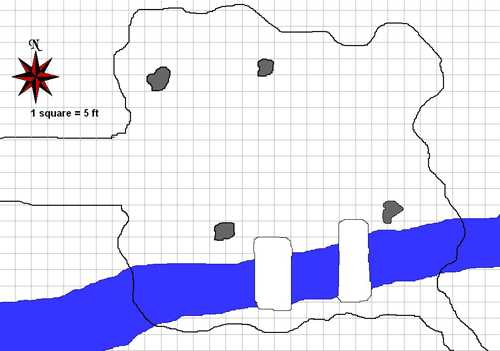 |
|
This large cavern is some 25 ft tall. To the south, a river emerges from the wall to the west and travels swiftly across the cave before exiting into the eastern wall. Two slabs of arched stone cross the river. North of the river, four stone columns support the ceiling overhead. A wide passage leads out to the west and a smaller passage to the southeast. Set along the walls of the place, along the entire length of the cavern north of the river, are iron stalls 10 ft tall, 10 ft long, and 5 ft wide. |
There are a total of 42 stalls here. The stalls each have a stone water trough and a stone bowl and a length of iron chain attached to an iron collar. Set on the wall is a stone shelf holding an exotic military saddle, bit and bridle, and a lance.
Creatures: A full 25 giant striders are here, with an additional 12 being out on patrol and a few stalls vacant at the moment. The striders are usually not chained to their stables, and roam the chamber, many in their stables sleeping or feeding, but others noisily squawking around the place.
|
ADVANCED GIANT WAR STRIDERS
(25) CR 2 Healing from Fire (Ex) Not only do giant striders take no damage from fire, they are healed by it. Once during each 3 rounds that a strider is exposed to intense heat or flame, the creature gains the benefit of a cure light wounds spell (1D8+1 hp healed). A fireball spell or other intense, fiery attack fully heals the creature instantly. Resistant to Magic (Ex) Giant striders gain a +2 bonus on all saves against magical effects. |
At all times a stablemaster is present, caring for the striders and keeping watch over them. This stablemaster takes turns with two others that dwell in area 5 on the main map.
|
FIRENEWT STABLEMASTER CR 2 Strider Handling (Ex) Firenewts treat striders as animals for the purposes of the Handle Animal skill. |
Tactics: The stablemaster cares for his charges, but does not have a mount himself, and he will not ride another firenewt's strider (a serious crime in firenewt society). Instead, he will shout and motion and urge the striders to attack any intruders that enter the chamber. The striders are trained to respond the the pointed command of the stablemaster to launch their fireballs wherever he points, and certainly the prospect of 25 fireballs going off at once in one location can be devestating. However, the striders are not quite so coordinated as that. Whenever the stablemaster points, he must take a move action and make a Handle Animal check and for every point the check exceeds DC 15 an additional nearby strider will launch its fireball at the area pointed.
In order to better coordinate with the striders, the stablemaster will delay his initiative to occur right before the striders.
The striders will certainly attack intruders, especially after being riled up by the stablemaster. It is still possible for the PCs to enter the stables and somehow take care of the stablemaster before he rouses the striders, then they could possibly stroll amongst the striders unmolested, but this would require making a wild empathy roll (with the proper penalties for magical beasts) and changing their attitude from unfriendly to friendly. Otherwise, for every round that the PCs are in sight of the striders, roll a D20 and on a 5 or less the striders become agitated and attack en masse.
Developments: It takes a full minute to fully suit up a strider with its bit and bridle and saddle.
5. Living Cave (EL 10)
 |
|
This massive cavern is some 40 ft high at its center, the sides being 30 ft tall, and the cave is smooth and free of stalagmites and stalactites. Several large stone columns stretch from floor to ceiling, most being over 8 ft in diameter and one long one forming a 30 ft wide partition to the north. This longer stone column has runes and carvings of figures etched into its surface. The entire cave is lit by red glowing lamps that seem to be made up of red hot stones set in some sort of bowl attached to the walls. A large, swiftly flowing stream dominates the southern portion of the cavern entering from the west and flowing to the east, in both cases out of holes in the walls as wide as the stream and only a few inches above its surface. Halfway along the stream on both sides is a series of iron chains and pulleys reaching all the way up to the ceiling. Iron bins of large size (5 ft square) are attached to the chains and the apparatus' chains seem to stretch across the stream. There are two such contraptions sitting side by side. A couple of natural stone shelves rise up from the cavern floor, these being to the southeast and the the north. The southern set rises 15 ft into the air and it is full of iron workbenches, tools, and other materials that set it as a crafting or work area. The northern set rises into two smaller shelves atop which are set an iron statue of a dragon (size large) and a life-sized one of a firenewt mounted ona strider with its lance levelled as if in mid charge. In the center of the northern portion of the chamber is a depression descending 15 ft into the cavern floor. The depression resembles a crude amphitheatre. Pockmarking the walls of the chamber, many accessed by steps carved into the stone walls, are 5 ft diameter holes. These run from floor level up the sides of the wall to halfway to the ceiling (15 ft up). |
The lamps used to light the place also keep it warm. They consist of iron bowls filled with oils and a red hot coal dropped into it. The oils are soaked into the coal and feed the embers within allowing the coals to burn red hot for quite some time. The oil is a secret recipe of the firenewts, and it should be noted that the small side caves do not have these, as the firenewts get along just fine in the dark.
The two contraptions halfway along the river are used to ferry firenewts and other items across the river. Basically, a person can step into the iron bin and pull on the proper chain, which slowly moves the person to the other side. There are two devices so as to allow two firenewts to cross simultaneously.
The amphitheatre-like depressed is just that, used to gather the community while the speakers stand on the bottom of the depression and speak.
The stone shelf to the southeast is the crafting area, and contains tools and workbenches for a variety of crafts. Assume the following crafts have artisan tools available in the area: Craft (leatherworking), Craft (ironworking), and Craft (masonry). In addition, there are stores of supplies here including spare armour, ingots of iron, scraps of hide, as well as mining and excavation equipment (enough for at least two dozen people to practice the Profession [mining] skill).
The stone shelves to the north are essentially akin to small shrines, depicting a red dragon representing the firenewt's draconic origins (Knowledge [arcana] DC 15 to recognize the dragon as a red dragon) and an ancient hero of the firenewts mounted on his legendary strider. The long stone column to the south of these two shelves bears runes in Draconic briefly describing the glory of the red dragon known as the "Giver of the Heart of Flame and the Fire of Thought" who apparently birthed the firenewts. It also extolls the virtues and deeds of "The Ancient Hero of Eld" who was the ancestor of this tribe. The figures carved on the same wall show the dragon and hero in various battles against vague foes resembling other dragons and demonic-looking creatures.
Scattered around the main cavern area are a myriad of tools, utensils, and pieces of crude stone and iron furniture, including tables and chairs designed for their long thick tails. Iron bins hold various foodstuffs, including salted meats, and fungi of various sorts.
Creatures: A total of 56 firenewt adults dwell here, though at any time 6 of these are out of the complex hunting for food or gathering foodstuffs and other useful items. Another 12 are in other parts of the cavern complex (as enumerated in this text). In addition to the adults, there are a total of 76 younglings here (the younglings are size Small non-combatants). At any time, fully one third of the adults are sleeping. The rest are split evenly between activity in the cavern proper (crafting, practicing fighting, listening to tales, etc.) and awake in their holes (eating, breeding, etc.).
Sleeping firenewts are not wearing their chainmail armour.
Furthermore, half of the adults in this cavern are practiced craftnewts.
|
NORMAL FIRENEWTS (19) CR 1 Strider Handling (Ex) Firenewts treat striders as animals for the purposes of the Handle Animal skill. |
|
CRAFT FIRENEWTS (19) CR 1 Strider Handling (Ex) Firenewts treat striders as animals for the purposes of the Handle Animal skill. |
Tactics: Any assault in here is likely to raise the firenewts attacking en masse. However, if an opponent seems too strong for them, they will flee to key locations in small groups to alert the other firenewts in the complex, while a few rally a holding action and the rest move to defend the egg chamber (area 9 on the main map) or flee out the back exits (areas 12 on the main map) in equal numbers. Those fleeing will take as many younglings with them.
Developments: If an alarm is raised, a dozen normal firenewts from this area who are already awake and in armour will immediately head to area 9 on the main map to help guard the egg clutches. The sleeping firenewts will attempt to take the time to don their chainmail, while the remainder of the awake ones will take up positions in this cave to protect the younglings.
6. Overlord's Sanctum
This is the audience chamber and living quarters for the overlord of the firenewt tribe. The entire area is 10 ft tall with the exception of the passageways.
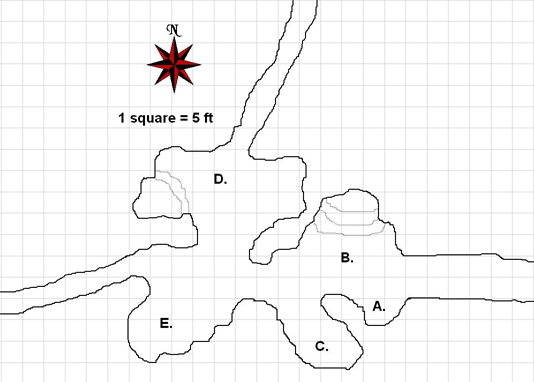 |
A.Guard Niche (EL 4)
| This small niche contains an iron box with its lid closed. |
The iron box contains 24 flasks of alchemist's fire.
Creatures: 2 firenewt warriors are posted here at all times, always on alert and at the beck and call of the overlord.
|
FIRENEWT WARRIORS (2) CR 2 Strider Handling (Ex) Firenewts treat striders as animals for the purposes of the Handle Animal skill. |
Tactics: These warriors will utilize the alchemist's fire against intruders, relying on their invulnerability to fire to protect them. The fire will be used both to injure intruders and to hinder their advance long enough to allow the overlord to escape.
B. Audience Chamber
|
This chamber is dominated by stone steps each 1 ft high leading up to a dais upon which rests a large throne of iron studded with various gems and inlaid with gold and silver. The back of the throne depicts a great draconic head rising out of the top of a volcano, flames erupting from its jaws. The scales of the draconic head glisten with shining red rubies. The throne is flanked by two large iron braziers that emit a ruddy glow and heat from red hot coals and oil within. The walls behind the throne are decorated with carvings of dragons and erupting volcanos and also depicts a humanoid skeleton bathed in fire emerging from one volcano and many tiny firenewts worshipping this figure. |
The carving of the skeletal figure on the wall behind the throne depicts a lavawight (see the Epic Handbook page 200) native to the region from which this tribe came.
Traps: The throne bears a glyph of warding that will activate if anyone other than the high priest (see area 7 on the main map) or the overlord touches it.
| Glyph of Warding (Blast) Trap CR 4; spell; spell trigger; no reset; spell effect (glyph of warding [blast], 4th level cleric, 2D8 cold damage, DC 15 Ref save half damage); multiple targets (all targets within 5 ft); Search DC 27; Disable Device DC 27. |
Treasure: The throne is very valuable as a whole, but also amazingly heavy, easily weighing half a ton (1000 lbs). On the whole it could probably be sold for 20,000 gp, but if the precious items are pried away, the gold and silver are worth 250 gp and 250 sp respectively, the inlaid gems worth 1,500 gp (assume 100 gems worth 150 gp each on average), and the small rubies number 20 each worth approximately 500 gp.
C. Stable (EL 3)
| This area is strewn with small bits of charcoal and scorched rubble. At the end of the place is a stone water trough and a stone bowl and a length of iron chain attached to an iron collar. Set on the wall is a stone shelf holding an exotic military saddle, bit and bridle, and a lance. |
Creatures: The overlord's strider dwells here, usually not chained to the collar. The strider is exceptionally well-trained and loyal to the overlord and will often act independently to protect its master.
|
ADVANCED GIANT WAR STRIDER
CR 3 Healing from Fire (Ex) Not only do giant striders take no damage from fire, they are healed by it. Once during each 3 rounds that a strider is exposed to intense heat or flame, the creature gains the benefit of a cure light wounds spell (1D8+1 hp healed). A fireball spell or other intense, fiery attack fully heals the creature instantly. Resistant to Magic (Ex) Giant striders gain a +2 bonus on all saves against magical effects. |
D. Overlord's Quarters (EL
6)
|
This cavern contains a large iron table and several stone stools set around it. To the southwest stone shelves lead up a couple of feet to a square frame of iron into which is set plush furs, forming a sort of nest-like bed. Flanking the bed are two glowing braziers. Along the east wall are hung various trophies, including large pelts, giant carapaces, strange looking skulls, and in many cases what appears to be the skulls or skins of tiny animals and creatures. Set upon the table are strangely-designed fluted crystal goblets and crude iron utensils. |
The skulls and trophies along the wall are of various species native to the region as well as some from the south. Some of the trophies can be identified with a DC 15 Knowledge (nature) check, though only for species with which the PC might be familiar. These include parts of monstrous scorptions, giant snake skins, dire rats, firenewts, even a goliath skull. A DC 20 Knowledge (nature) check will reveal the tiny trophies to be those of babies and in some cases embryonic specimens, reflecting the firenewt predilection for attacking the clutches and young of their enemies.
Creatures: The overlord dwells here, and so his statistics are presented herein. Nevertheless, he spends much of his time in his audience chamber (area A) or even roaming the other areas of the complex.
|
FIRENEWT OVERLORD CR 6 Strider Handling (Ex) Firenewts treat striders as animals for the purposes of the Handle Animal skill. |
Tactics: The overlord is a mighty presence amongst the firenewts, more than capable of defeating any other single firenewt. He is confident in his position currently and seeks to aggressievey expand his power and then, one day, move against his rivals to the south. In battle, the overlord will shirk from no foe, seeking to prove his mettle in front of his subjects. For him, the only defeat is death.
In most cases, if possible, the overlord will attempt to mount his strider (area C).
Developments: In the case of an alarm being raised, the overlord will rush to the forefront of battle, leaving his guards to ward the area. Nevertheless, should invaders actually assault this area and catch the overlord by surprise, then the guards in area A will attempt to delay them and the overlord will flee down a side passage in order to rally his troops before then leading the counterattack.
Treasure: Hidden beneath the overlord's bedding, under a false stone (Search DC 25), is a cache of gems, the tribe's collective wealth, hidden in a large lead box (which is immune to detect spells and most divination spells). These include an assortment of 125 gems worth a total of 15,000 gp.
E. Concubine Quarters
| This area has four small fur pallets accompanied by a single brazier aglow with heat. |
Creatures: The 4 concubines that are always here (unless one or more are breeding with the overlord in area D) are non-combatants.
7. Firenewt Chapel
This area houses the worship room of the firenewts and the quarters for the high priest and his acolytes.
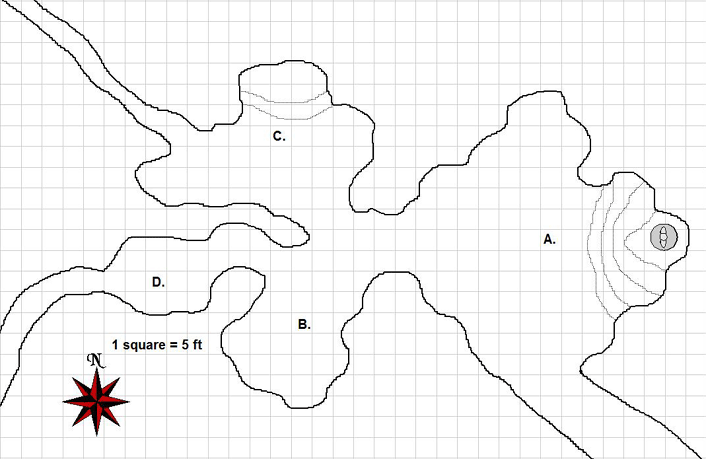 |
A. Chapel (EL 7)
|
This large cavern is some 25 ft high, dominated by a set of 1 ft tall stone steps that lead up to a 15 ft tall statue formed from lava rock in the shape of a column of flame with the head of a firenewt. A strange orange glow seems to emanate from somewhere within the column and casts the statue's head in an orange nimbus. Flanking the statue, on the stone shelves leading up to it, are smaller, life-sized statues of firenewts made from a dark grey stone. The walls of the place are decorated with bas reliefs and charcoal drawings depicting volcanoes, gouts of flame, draconic creatures, and firenewts in battle. A niche to the north contains a stone water trough and a stone bowl and a length of iron chain attached to an iron collar. Set on the wall is a stone shelf holding an exotic military saddle, and bit and bridle. |
There is a gap in the statue where the column of flames meets the firenewt head. In this gap several glowing coals float in a pool of oil, alight and forming the glow that illuminates the statue's head and also providing heat to the chamber.
Creatures: The high priest's strider is in the niche to the north, usually not collared.
|
ADVANCED GIANT WAR STRIDER
CR 2 Healing from Fire (Ex) Not only do giant striders take no damage from fire, they are healed by it. Once during each 3 rounds that a strider is exposed to intense heat or flame, the creature gains the benefit of a cure light wounds spell (1D8+1 hp healed). A fireball spell or other intense, fiery attack fully heals the creature instantly. Resistant to Magic (Ex) Giant striders gain a +2 bonus on all saves against magical effects. |
Furthermore, the 8 firenewt statues are actually zombies covered in a thin veneer of dried lava mud. The zombies are programmed to obey the commands of whomever is the current firenewt high priest, as well as attack anyone touching the statue or standing on the topmost stone shelf who is not a firenewt cleric.
| FIRENEWT ZOMBIES
(8) CR 1 NE Medium undead (fire) Init +0; Senses darkvision 60 ft; Listen +0, Spot +0 Languages Draconic AC 18, touch 11, flat-footed 17 hp 17 (4 HD);DR 5/slashing Fort +1, Ref +1, Will +4 Spd 20 ft (4 squares) Melee 2H longsword +3 (1D8+1) Melee slam +3 (1D6+1) Space 5 ft; Reach 5 ft Base Atk +2; Grp +3 Combat Gear longsword Abilities Str 12, Dex 11, Con -, Int -, Wis 10, Cha 1 SQ single actions only, undead traits Feats Toughness Possessions combat gear plus chainmail Single Actions Only (Ex) Zombies have poor reflexes and can perform only a single move action or attack action each round. A zombie can move up to its speed and attack in the same round, but only if it attempts a charge. |
B. Acolytes' Quarters (EL 6)
|
This small cave is 10 ft tall and within are four fur pallets and an iron table and four stone stools. Iron shelves attached to the walls contain a variety of iron plaques that seem to have writing on them. Four iron armour stands and an iron weapon rack are also present. Three iron braziers glow with light and heat. |
Creatures: Four firenewt acolytes dwell here, servants of the high priest and all very competitive with each other to become the favoured of the high priest and eventually named his successor (or killing him and taking his place).
|
FIRENEWT ACOLYTES (4) CR 2 Strider Handling (Ex) Firenewts treat striders as animals for the purposes of the Handle Animal skill. |
Tactics: The acolytes will tend to look to the high priest for direction in times of trouble. Beyond that, they are trained to support firenewt warriors in battle, and they will tend to avoid direct combat themselves. In most cases they will mount their striders (area D) before engaging in combat.
Treasure: Amongst the iron plaques on the shelves are a few divine scrolls. The acolytes know where they are, but otherwise it will take searching the plaques one-by-one (an hour-long process at the least) or use of a detect magic spell to find them. Present are:
Divine scroll of divination
(CL 7)
Divine scroll of restoration (CL 7)
Divine scroll of remove curse (CL 5)
Divine scroll of remove disease (CL 5)
Divine scroll of remove blindness/deafness (CL 5)
C. High Priest's Quarters (EL
6)
|
This cave is 15 ft high and is dominated by a large iron chair set upon a stone shelf to the north. The chair is carved with runes and stylized images of flames and dragons, but is otherwise unadorned. The center of the place contains an iron table and several stone stools, while to the west is a large, plush fur pallet. The table has some iron utensils upon it as well as some fluted crystal goblets. Nearby is an iron armour stand and a weapon rack. Along the east wall are iron shelves attached to the walls that bear a myriad of iron plaques with writing engraved upon them. |
The iron plaques are mostly holy tracts and lore written in Draconic. They have no real inherent use or value, but the DM can rule that they can form a part of a research library dealing with fire magic or draconic magic. A few of them are magical (see below). There are over 100 plaques, each weighing 2 lbs.
Creatures: The high priest is usually found here when not leading worship ceremonies.
|
FIRENEWT HIGH PRIEST CR 6 Strider Handling (Ex) Firenewts treat striders as animals for the purposes of the Handle Animal skill. |
Tactics: The high priest is the second most powerful firenewt in the complex, and possibly even stronger than the overlord. However, the high priest is happy with his role in the tribe and has no designs to usurp the overlord's position, instead preferring to be the "real power" behind the throne. As such, he will tend to let the soldiers do any fighting, while supporting with his magical abilities from the rear. He will certainly not hesistate to use his bag of boulders (Magic Item Compendium page 150) to decimate particularly powerful opponents, including spellcasters.
Treasure: Amongst the iron plaques on the shelves are a few divine scrolls. The high priest knows where they are, but otherwise it will take searching the plaques one-by-one (a half hour-long process at the least) or use of a detect magic spell to find them. Present are:
Divine scroll of divination
(CL 7)
Divine scroll of restoration (CL 7)
Divine scroll of raise dead (CL 9)
D. Acolyte Stable (EL 6)
| This small cave is 10 ft tall and within are two stone water troughs and four stone bowls and four lengths of iron chain attached to an iron collar. Set on the wall is a stone shelf holding four exotic military saddles, and four sets of bit and bridle. |
Creatures: Four striders are here, usually not chained to their collars.
|
ADVANCED GIANT WAR STRIDERS
(4) CR 2 Healing from Fire (Ex) Not only do giant striders take no damage from fire, they are healed by it. Once during each 3 rounds that a strider is exposed to intense heat or flame, the creature gains the benefit of a cure light wounds spell (1D8+1 hp healed). A fireball spell or other intense, fiery attack fully heals the creature instantly. Resistant to Magic (Ex) Giant striders gain a +2 bonus on all saves against magical effects. |
8. Prison
This is where the firenewts keep their prisoners and where, currently, they are holding the skywatcher's animal companion. The doors in this area are all iron (hardness 10, 60 hp, break DC 28) and are set into iron walls (hardness 10, 90 hp, break DC 30). All are locked from the inside of area A (Open Lock DC 30).
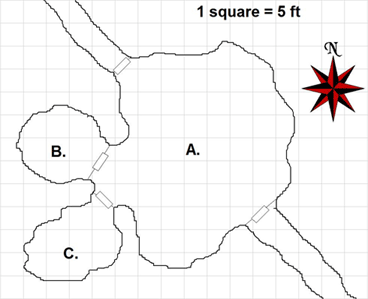 |
A. Donjon (EL 6)
| This small cave is 10 ft tall and within is an iron table and four stone stools along with several iron barrels. Several implements of torture are present as well, including an iron rack-like device and several tables with clamps and spikes set into them. A couple of iron braziers are glowing here, and one of them has several iron rods set into it. Iron shackles hang from the walls at various points, and along the east wall on an iron hook is a large key ring set with four iron keys. |
The iron barrels hold water, each with a small cup tied to the rim.
The keys each open one of the doors in the chamber, and there is nothing to specifically identify which key opens which door, though the keys are unique enough that once identified they can be easily memorized.
Creatures: Four warriors are assigned here in 8
hour shifts, dwelling in area 2 on the main map. These firenewts
are charged with guarding not only the prisoner in area C, but
also area 9 on the main map, and they take their duty very seriously.
These firenewts are only allowed to open the door to the overlord,
the high priest, his acolytes, or the commander, and they are
familiar with the voices of each.
|
FIRENEWT WARRIORS (4) CR 2 Strider Handling (Ex) Firenewts treat striders as animals for the purposes of the Handle Animal skill. |
Tactics: These warriors, should their door be breached, will fight to the death. They have no instructions to harm the animal companion in area C, and will obey orders in that regard.
B. Cell
| This small cave is 6 ft tall and the floor is covered with dried rushes. There are several sets of shackles mounted to the wall and set with short lengths of chain. |
C. Cell (EL 2)
| This small cave is 6 ft tall and the floor is covered with dried rushes. There are several sets of shackles mounted to the wall and set with short lengths of chain. One of the shackles has been jerry rigged into a collar. Piles of dung litter the floor, along with an iron bowl of water and some partially chewed slabs of meat. |
|
DIRE WEASEL CR 2 Blood Drain (Ex) A dire weasel drains blood for 1D4 points of Constitution damage each round it remains attached. |
Developments: The dire weasel is very agitated at its imprisonment and at being separated from its master. As such, it will be hostile to anyone. However, if any PC has been in contact with the skywatcher within the last 48 hours (including simply talking with him in his lair for a while), then the weasel will scent its master's scent on the person and the attitude will change to indifferent. In this case it should be possible, using food or spells or special abilities, for the PCs to lure the weasel to follow them. Lacking that, the PCs can simply incapacitate it and take it with them.
9. Hatchery (EL 8)
When the PCs approach to within 80 ft of this area they will notice a diffuse ruddy glow ahead and begin to feel the air warm up. At the point when the PCs step onto the landing they will be suffering 1D3 points of fire damage per round.
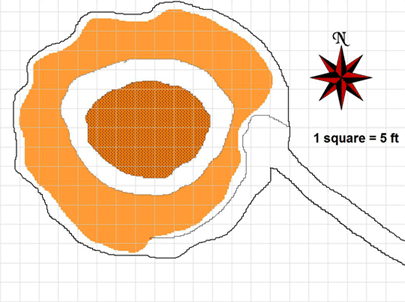 |
|
This cavern is 15 ft high. The passageway to the southeast emerges onto a small landing that stands over a hellish scene. To the south a stone ramp descends from the landing 15 ft down into a pool of lava. This pool of lava covers the entire floor of the room, save for a few inches along the verges of the chamber where the wall slopes up and a roughly 5 ft wide ring about 35 ft in diameter in the center of the chamber. This ring is of solid stone and seems like a rounded bump or rise that thrusts above the lava by about 2 ft or so. In the lava pool that is outside of the stone ring are a great many ashen coloured ovals that could be stones or could be eggs. These objects are about 3 inches in diameter and, if symmetrical, half in the lava. |
The outer portion is only a foot deep with lava, and there are a total of 95 eggs that are set on small iron tripods that can be adjusted to raise or lower from a minimum of a few inches to 3 ft high. They are currently set so that the eggs are half in and half out of the lava of the outer pool. The eggs are immune to fire and heat damage.
In addition, there are sone 20 strider eggs here that are fully submerged, resting in small concave indentations in the stone floor. These are twice as large as the firenewt eggs but are not mounted on tripods.
If the PCs descend the ramp to at or near floor level, the heat will be so intense that they will suffer 1D6 points of fire damage per round.
The lava deals 2D6 points of fire damage per round of exposure (this is not cumulative with the heat damage mentioned previously) and continues for 1D3 rounds after exposure (at half damage). Immersion causes 20D6 damage and will occur if a PC stumbles into the center lava area or if he falls or is tripped while standing in the outer lava area.
Creatures: Four magmacore golems guard the hatchery, having been created for the tribe centuries ago when they dwelt in the south. They have been programmed to allow only the high priest, acolytes, commander, or overlord to enter unmolested. Against any others, they attack, though they will not leave the chamber.
|
MAGMACORE GOLEMS (4) CR 4 Molten Step (Su) As a swift action, once every 3 rounds, a magmacore golem can infuse its essence into any two adjacent squares. These squares explode into molten flame for 2 minutes. Molten squares cost 2 squares of movement to enter, and creatures can't run or charge across them. Any creature passing through a molten square takes 1D6 points of fire damage. If 10 or more points of cold damage are directed at a molten square, it returns to normal. Affected squares cool immediately when the effect ends, but they retain a blasted and burned appearance. Shattered Armour (Ex) When a magmacore golem is reduced to half of its full normal hit points or fewer, its outer armoured layer shatters to expose the creature's molten core. The magmacore golem's statistics change as follows: The creature's natural armour bonus to AC is reduced to +1, decreasing its AC by 7. It gains concealment as if under a permanent blur effect. It loses its damage reduction 5/adamantine. Any creature that touches or makes a melee attack against the golem takes 1D4 points of fire damage. Volcanic Death Throes (Su) When destroyed, a magmacore golem releases one last blast of molten energy. The square occupied by the magmacore golem and all adjacent squares become molten as if affected by the molten step ability. |
Developments: The tribe values its clutches immensely, even despite the fact that new eggs can be laid later. It is matter of intense pride to keep ones clutch safe, and failure to do so is the ultimate humiliation. Firenewt eggs are not really desirable on the open market, and should the PCs abscond with one or more eggs the firenewts of this tribe would spend the rest of their days trying to recover the eggs or extract revenge. Theft and destruction of strider eggs is less egregious to the firenewts, but is still a grave offense.
10. Grotto (EL 5)
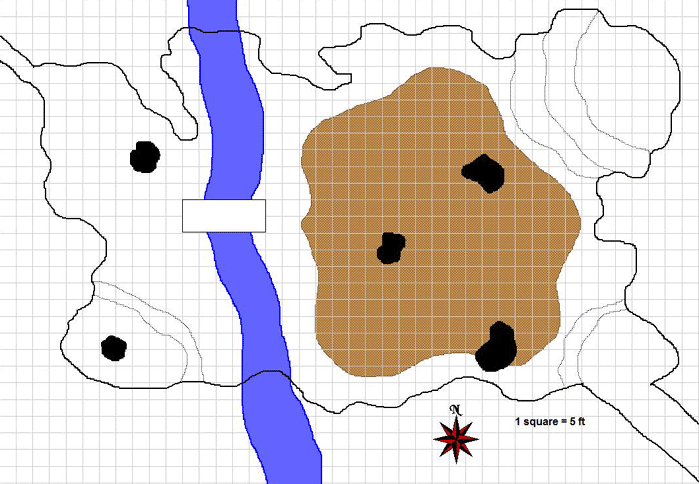 |
|
This massive cavern is over 30 ft high in its center, lowering to about 20 ft at its edges. The place is punctuated by large, stout natural columns of stone reaching from floor to ceiling. Cutting through the middle of the cave, to the west, is a river, that emerges from the northern wall and flows swiftly south before exiting in the southern wall. Halfway along the river, an arched stone bridge some 10 ft wide which sides are carved with reliefs of hatching eggs, spans the flow. Several natural stone shelves rise up about 1 ft each in the northeastern and southwesten portion of the cave, and similar stone steps descend from the wide passageway in the southeast into the cave proper. Almost the entire eastern two-thirds of the cavern is taken up by what can only be described as a pit of some indeterminate depth that is filled to the rim with what seems to be a mixture of guano, mud, loam, and ground lava stones. Growing in this mixture is a bewildering variety of large fungi, lichens, and strange pale ferns bearing various pale fruits. Many small, normal-sized insects can be seen wriggling amongst the growths. Three of the stone columns that rise out of the loam pit are covered with clinging vines, ivies, and lichen, and many of these bear berries and small fruits. The stone shelves to the northeast contain a massive mesh of low crawling vines that extend tendrils down the steps and into the loam. These vines bear large, pale, pumpkin-like plants and rough grey tubers that simply lie on the stone floor of the shelf. The stone shelf to the southwest bears a single column that extends to the ceiling. This column is fluted and pockmarked with small holes approximately 2-3 inches in diameter. Various wriggling things seem to be crawling up and down the column, squirming in and out of the holes. A large opening about a foot in diameter at the bottom of the east face of the column opens into a channel cut into the stone shelf that leads to a large iron cauldron. A slimy, mucus-like white liquid seems to be running out of the opening, along the channel, and into the cauldron. |
The loam pit is actually only 6 inches deep. The guano portion is gathered from other bat-dwelling caves nearby and brought here. The fungi and other foodstuffs are all edible for most humanoids, and none have any hallucinogenic or medicinal properties. That said, the firenewt palette is undoutbedly different from other humanoids, and many of the items here might be edible, but probably don't taste very good to other species.
The vines on the shelves to the northeast are simply cave versions of squashes and turnips that require no light to prosper.
The strange column to the southwest contains a large colony of a grub-like insect that is not only good to eat (if you are a firenewt) but produce a "milk" that the firenewts collect and feed to their young. This milk is what is flowing out of the base of the column.
Creatures: Six firenewts are usually here at all times, on shifts from area 5 on the main map. They will be working the loam pit or tending the vines or the grub column, armed with tools appropriate to their duties or baskets for gathering some of the food.
|
NORMAL FIRENEWTS (6) CR 1 Strider Handling (Ex) Firenewts treat striders as animals for the purposes of the Handle Animal skill. |
11. Hot Springs
 |
A. Water Spa (EL 3)
|
This 10 ft high cavern is filled with mist that seems to be emanating from three small pools that lie across a swiftly flowing stream that emerges from the north wall and exits from the southeast wall. This bridge is spanned by an unadorned arched stone slab. The mist seems to be coming primarily from the three pools and not the stream. Set on stone shelves near the pools are various sorts of crystal bottles, metal scoops, dippers, and buckets, slabs of what could be soap, chunks of pumice shaped in various configurations, and an assortment of metal brushes and other small implements. |
This is a spa for the firenewts, who come here to relax. The stream, flowing quickly through the chamber, is not warmed up much by the geothermal activity herein. However, the firenewts have dug three pools into the chamber, each about 6 ft deep, and with ledges for a Medium creature to sit on comfortably, and they keep these pools filled with water from the stream. The pools are quite warm from their proximity to the lava area (area B) and in fact are warm enough to cause extreme discomfort to any creature not immune or resistant to fire. Immersion in the pools will cause 1D3 points of fire damage per minute of immersion.
The items on the shelves are bathing products for the firenewts, and include unguents, soaps, scrubbers, picks and scrapers for their scales, etc.
Anyone who moves more than a few feet past the pools to the southwest will begin to feel growing heat emanating from area B.
Creatures: There are 3 firenewts here, taking their leisure. Their equipment will be piled up near their pool, and there is a single firenewt in each pool.
|
NORMAL FIRENEWTS (3) CR 1 Strider Handling (Ex) Firenewts treat striders as animals for the purposes of the Handle Animal skill. |
B. Lava Spa (EL 3)
| This 10 ft high cavern is dominated by a single massive pool of lava that bubbles and froths. Crossing the pool is a narrow, natural stone bridge that is about 6 inches thick and supported by a stone column at its midpoint that descends into the magma. The bridge runs about 3 ft over the level of the lava and ends at a small stone landing to the southwest before a passage that exits the chamber. |
If the PCs enter the chamber, the heat will be so intense that they will suffer 1D6 points of fire damage per round. If they walk along the bridge they will suffer an additional 1D3 points of fire damage per round, as they are right above the lava.
The lava deals 2D6 points of fire damage per round of exposure (this is not cumulative with the heat damage mentioned previously) and continues for 1D3 rounds after exposure (at half damage). Immersion causes 20D6 damage and will occur if a PC stumbles into the center lava area or if he falls or is tripped while standing in the outer lava area.
The pool itself is some 8 ft deep, fed through small cracks in the floor that allow lava to continually feed up until pressed down by its own weight. As such, the level of the pool is relatively stable, though once in a while the arrangement becomes instable and the place can erupt in lava or the lava can bubble up and out into area A before spilling into the stream. Neither of these events is more than a minor annoyance to the firenewts.
Like a human swimming pool, the lava pool is shallower at its edges, rising to 3 ft there, with stone steps carved into the edges for easy egress and as a place to sit down and relax.
Creatures: 3 firenewts are here, swimming and/or relaxing at the edge of the pool. All have their equipment off and piled near the pool.
|
NORMAL FIRENEWTS (3) CR 1 Strider Handling (Ex) Firenewts treat striders as animals for the purposes of the Handle Animal skill. |
Traps: This chamber leads to a passageway to the southwest that serves as an emergency escape way for the firenewts. As such, the bridge crossing the lava pool is rigged so that even a single firenewt, with 2 full rounds of effort, can dislodge the supports at the base of the stone column that keeps the bridge standing. Doing so means that any weight more than 10 lbs put on the midpoint of the bridge will cause the stone column to topple and the entire bridge to collapse. Anyone standing on the bridge will be hurtled into the lava, except that anyone within 10 ft of the edge may make a DC 15 Ref save to grab the edge of either stone landing and suffer only 2D6 damage from the lava instead of immersion. If the Ref save is made by more than 5 (i.e. a DC 20 Ref save is made instead) then the victim will have landed entirely on the nearby stone landing and suffer no damage.
12. Escape Routes
These two passages end in a small chamber only 20 ft in diameter and 8 ft tall. At the western end of each chamber is a stone door (hardness 8, 60 hp, break DC 28) that is locked from the inside.
Each door is cunningly concealed from the outside (Search DC 30) and is locked from within (there is no access from without, so no way to apply an Open Lock skill).
General Defense:
The firenewts are well motivated and are a martial society, and as such will respond prudently to any intrusions once a general alarm is raised. Warriors will engage in flanking maneuvers, using the various passages in the complex, and normal firenewts will follow the orders of their superiors, forming into small groups or mobs when warriors are not present.
While the firenewts care about their dire weasel hostage in area 8, their main concern is their clutches in area 9. However, since area 8 is on the route to area 9, it just happens that their defense will emphasize the security of both.
If intruders penetrate the lair and then retreat, the firenewts will organize a squadron of mounted warriors to pursue, while keeping at least half of their forces in the lair to guard against a strike there. If assaults become protracted and a threat to the entire tribe, it is not inconceivable that they will simply pull up camp and leave to find some other lair.
The firenewts will not fight to the last newt. They care about the survival of their tribe. If the PCs manage to prove that they are capable of slaying the entire tribe and have already slain many or most of the leaders, then the tribe will surrender and submit to reasonable terms, incluing vacating the complex or agreeing to free the companion and not bother the skywatcher or his animals any more. How long this submission lasts is up to the DM.
It should be noted and emphasized that the firenewts are expecting a powerful druid to try to assault or infiltrate their complex, and they will be very suspicious of anything that is out of place and especially of any animals in their complex acting strangely. They are on orders to slay on sight any animals in the complex.
Scenario Resolutions
There is intentionally no clear-cut solution to this scenario. You have two disputing parties, each of which has legitimate grudges and claims against the other. While the firenewts are, by alignment, evil, they are evil because of their martial outlook and not because they actively go around slaying innocents and causing trouble. Similarly, the skywatcher is an outcast and is not good-aligned. He cares only about himself and his animal friends.
This scenario presents the PCs with a situation that is not insoluble, but is not tidy and clear cut either. The PCs will have to make choices as to which faction they wish to favour and whether they will attempt a compromise or simply act fully in the interest of one side or the other.
Fighting Grab:
One way the PCs can resolve this scenario is to simply assault the firenewts and take the animal companion from area 8. A well-planned assault, possibly supplemented by divinations and good scouting can allow the PCs to fight their way to area 8, grab the companion, and make a run for it. Should this be the case, the firenewts will send at least half of their forces mounted upon striders after the PCs.
If the PCs get to the skywatcher first and return his companion to him, the skywatcher will turn over the strider egg to the PCs. The PCs can then attempt to return the egg to the firenewts. The firenewt's reaction to this will almost certainly be to stop their attack and at least negotiate. If the PCs caused little or no damage during their raid into the firenewt lair, then the firenewts are likely to be in a good mood and willing to negotiate. If the PCs caused tremendous damage and slew many firenewts or slew one of their leaders, then the firenewts are likely to be intimidated by the PCs and willing to negotiate. Only in the case where the PCs did not slay many firenewts, but entered area 9 and vandalized firenewt eggs will the firenewts be completely unwilling to negotiate. In fact, in this case they will accept the loss of the precious strider egg in order to wreak vengeance upon the PCs.
If the firenewts enter negotiations, refer to Negotiations below.
Major Assault:
Should the PCs attack the tribe and cause major damage, slaying firenewt leaders and/or a goodly portion of the entire tribe, then they may have simply intimidated the entire tribe into submission. The tension between the firenewts and the skywatcher will remain, temporarily abated but rising perhaps several years later as the firenewts recover, but after such an assault the PCs could essentially dictate terms to the firenewts. Should the PCs then return the strider egg anyways, the remaining firenewts will be mollified somewhat, though still angry at the PCs for dealing them such a severe blow.
Sneaking In:
Another way for the PCs to resolve the scenario is to sneak into the firenewt lair (by way of the escape passages (area 12) or the waterfall (area 3) and simply free the companion and sneak out. Of course, unless the PCs then return the egg, the firenewts will still march on the Kathaal Tribe.
Returning the Egg:
The PCs could steal or otherwise gain the strider egg from the skywatcher while the skywatcher yet remains alive. In this case they can return the egg to the firenewts, who will welcome them for their deed while still complaining that the skywatcher lives. The PCs can then enter into negotiations with the firenewts.
If the firenewts enter negotiations, refer to Negotiations below.
Slaying the Skywatcher:
If the PCs side entirely with the firenewts and slay the skywatcher and return the egg, then they will be welcomed with open arms by the firenewts, who will reward them with gems totalling 500 gp in value and pledging their friendship to the PCs, who will be welcome to visit the tribe at any and all times. The tribe will also be willing to trade with the PCs and craft any suitable item for them and normal prices.
Dealing with the Skywatcher:
The skywatcher only wants his companion back. If the PCs bring the companion back, he will gladly turn over the strider egg to them. It is then up to the PCs to enter into negotiations with the firenewts. The skywatcher is very stubborn and will NOT agree to a variety of things:
1. He will not agree to rein in his companion or the other animals of the area to stop attacking strider clutches. The skywatcher will once again emphasize that it is nature's way for dire weasels to feed on eggs and that the striders present a danger to the area and are not native here.
2. He will never agree to release the egg without his companion returned to him. Not even if the PCs agree to hold the companion in escrow.
3. He will not agree to "play dead" or move so that the PCs can claim his death to the firenewts.
If the firenewts enter negotiations, refer to Negotiations below.
Negotiations:
There are many chances in this scenario for the PCs to return the egg to the firenewts without having slain the skywatcher. In this case, the firenewts will only be partially mollified. After all, there is still the lingering problem of the dire weasels stealing their strider clutches. The PCs can make the same arguments made by the skywatcher, that the dire weasels need to eat and eggs are their natural food, but the firenewts will counter that they have the right to capture or destroy any vermin that is attacking their strider eggs.
Negotiations with the skywatcher will take place in his lair inside the canyon, unless he has reason to be suspcious of the PCs, in which case it will be outside of the canyon entrance.
Negotiations with the firenewts will take place in the audience chamber of the overlord, with the high priest using his tongues potion to translate for the overlord if none of the PCs can speak Draconic.
It will be incumbant upon the PCs to think up a settlement. There is no magic solution to this dilemma, but the DM should entertain any well-devised compromise that seems to try to address both parties. Assuming the PCs devise a reasonable compromise, the DM can then have them make a Diplomacy check. Assume the firenewts are unfriendly (to the idea, not the PCs). If they can be made friendly, then they will agree to the proposal. If not, then they will demand the head of the skywatcher or they will still march on the Kathaal Tribe.
The skywatcher will also have to be convinced of the settlement as well. He will also be unfriendly to the idea and the PCs will need to find a reasonable compromise for him as well to make him friendly.
Compromises might include, but are not limited to:
1. Designating certain numbers of eggs per month allowed to be hunted by the weasels
2. Having the firenewts provide a certain number of unfertilized eggs as "tribute" for the weasels
3. Designating certain areas as off limits for the weasels but the rest of the area is a free hunting zone
DMs can grant up to a +2 circumstance bonus for good ideas and should simply allow bad ideas no chance to succeed.
In any event, if the PCs cannot convince both parties, then they will simply have to either walk away from the whole situation or use guile or force to impose their will.
If the PCs attempt to negotiate a settlement before the egg and companion are returned, it will be all but impossible. Both sides will be hostile to the idea and must be made friendly.
War!:
If the PCs do not resolve the situation in time (24 hours), then the firenewts will march to war. The war party will include the commander, all of the warriors, and half of the non-warriors. The guards at the front and the 6 warriors out on patrol will be recalled to the lair to guard it. The high priest and 2 acolytes will also march to war.
The outcome of this war is left to the DM. The PCs might return to the Kathaal and help them fight against the firenewts. If not, the DM can decide who wins the battle or perhaps even game it out with the players playing the Kathaal and the DM the firenewts; whatever works best for the campaign. Of course, the PCs are free to attempt to hinder or thwart the warparty en route. The skywatcher will not help at all, but Guvagliak would be very eager to help his tribe and, in fact, if war starts then he will insist on running back to warn his tribe, even without the PCs if necessary.
Afterwards:
If the PCs have settled the dispute amicably, the reactions of the parties will depend upon the outcome. If during negotiations one party was made helpful, then that party will be quite friendly to the PCs, having been very happy with the eventual outcome of the negotiations. That party will thereafter welcome the PC and agree to aid the PC by providing advice and shelter and whatever aid the DM deems appropriate.
If the parties are merely friendly, then they will be grudgingly happy with the compromise and while thanking the PCs for resolving the dispute, will pretty much be merely cordial with the PCs.
Should the PCs rid the skywatcher of the firenewt problem by simply rescuing the companion and intimidating the firenewts into submission or destroying them, then the skywatcher will be friendly to the PCs as mentioned above. He will also provide the PCs with their choice of four of his potions or scrolls.
Should the PCs return the firenewts' egg and bring the skywatcher's head, then the firenewts will be friendly to the PCs as mentioned above and provide them with the items mentioned in "Slaying the Skywatcher" above.
Part Four - Arriving at Thella-lu:
Chapter One - Meet and Greet
The DM should refer to the description of Thella-lu from Races of Stone pages 80-82. The general layout and description of the place is as written in that tome, though the actual levels of the NPCs is not.
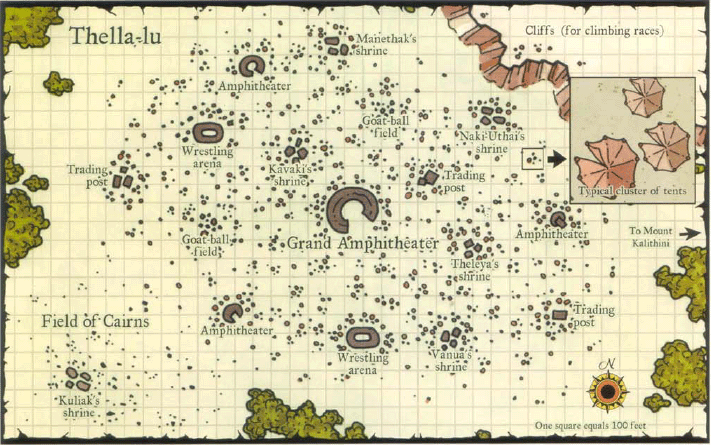 |
The PCs, in the company, presumably, of Guvagliak, will enter the encampment likely to a lot of wonder as goliaths turn their heads to see the strange people entering the encampment. If any of the PCs is wearing metal armour or carrying metal weapons, then there will be murmurings in Gol-Kaa that the PCs are scaled ones or servants of the same.
Guvagliak will present the PCs, with much obeisance, to the stonespeakers, who will question the PCs and eventually welcome them to Thella-lu and remind them that this is a place of trading and social intercourse and peace, and all who are here as guests of the goliaths are expected to maintain the peace. With that, the PCs are free to roam. Guvagliak will say his goodbyes to the PCs, telling them that after making some trades and gathering some news and passing on the same he will return to his tribe.
The PCs are free to now wander Thella-lu. The goliath marketplace engages mostly in barter, but unlike elsewhere in goliath society, the fact that Thella-lu has dealings with the Azotchtla and Fezen means that gold and precious metals, as well as gems, are valued here, and the PCs can finally spend any gold or other coins they have with them.
Items available in Thella-lu are primarily of goliath make, and should reflect goliath crafts and handiwork accordingly.
Stone weapons of various sorts are available here, in both Large amd Medium sizes; masterwork varieties are also available. Some goliath greathammers are available, including masterwork versions. Armour ranges mostly from hide to studded leather and leather and these, too, can be found in masterwork varieties. A few rare suits of snowcloak leather (treat as mammoth leather from Races of Stone) are here as well, and one suit of masterwork snowcloak leather is available. One suit of stone plate is available for sale, crafted by a well-known now deceased goliath crafter.
There is not a lot of magic available here, as the goliaths tend to make only what they can use. There are a few potions available, mostly of a clerical or druidic nature such as potions of barkskin, potions of cure light wounds, potions of cure moderate wounds, and potions of shield of faith.
One exceptional magic item is also for sale here, a vest of defense (Magic Item Compendium page 146) that is clearly fashioned from black giant snakeskin. It is being offered by a hoary old goliath matron who, if asked, will explain that she is an exile from a tribe to the south, a former skywatcher who left when she got too old to contribute to the clan. The vest was hers, given to her by her teacher, and she took it with her when she migrated to Thella-lu. Now she is very old and does not need it any more, instead desiring more portable and dividable wealth to give her comfort during her few remaining years.
As far as information, the goliaths of Thella-lu know little of other lands, as they are an insular people and rarely leave their mountain ranges. However, if the PCs entered the nothic ruins described in Encounter #4 and they describe the carvings, the blue gem, or the tablet fragments found therein or even if they show some of the essentia-based magic items found there, then the stonespeakers can tell the PCs that these are relics of the Children of Mishtai, who practice the art of incarnum. They have a temple far to the west of here in Mallar's Peaks. None here know the precise location, but it is certainly well past the Yithtanitl River.
Chapter Two - The Human Condition
Theneer-riz is an important emissary from Fezen-tir who is in Thella-lu to gather information and conduct some trading and other business. When the PCs arrive, Theneer takes a keen interest in the PCs, and eventually approaches them to speak (in Gol-Kaa).
Theneer-riz appears as a typical Azotchtlan human male in his early fifties. He wears a cloak of feathers that are multicoloured, the whole forming a rainbow pattern. He will approach the PCs shortly after they have finished speaking with the stonespeakers and introduce himself as an emissary from Fezen-tir. He will question the PCs briefly, trying to determine if they indeed have come from some far off and unknown land. Assuming he is intrigued enough to continue, he will assume that the PCs long to meet with humans instead of associating with strange creatures and he will warn them not to go to the Azotchtla, as they are an evil race that practice human sacrifice upon captives and strangers. Instead, he will invite the PCs to accompany him to Fezen-tir to meet with his king, whom he is sure will be intrigued by strangers from a faraway land and will wish to meet them and speak with them.
Theneer will tell the PCs that he intends to leave Thella-lu for Fezen-tir on the morrow and that the PCs are welcome to travel with him and his men in safety, as the way is long and somewhat wild. In addition, Theneer will invite the PCs to dine with him this evening to become better acquainted.
If the PCs agree to meet with Theneer for dinner, he will point out his tent in the foreign section of the encampment and then make his adieu. If the PCs refuse to meet with Theneer for dinner, then he will politely accept their refusal and re-invite them to accompany him to Fezen-tir.
Note: During this portion of the scenario and until the ambush in Chapter 5 below, Theneer will not have his entropic warding active.
Chapter Three - A Bird in the Hand
After the PCs speak with Theneer-riz, no matter what the outcome, the PCs will note a strange human-sized figure covered in a linen cloak whose hood is pulled forward to that its face cannot be seen. The figure will beckon to the PCs, and seems to be glancing around furtively. Should the PCs follow, the figure will lead them to an isolated portion of the encampment, between the cliffs and Naki-Uthai's shrine where the shadows are lengthy. As they follow the figure, it will appear as if the figure is a hunch back, as a strange bulge deforms its back underneath its cloak.
At the hidden place, the PCs will observe several other cloaked figures. The one they have been following will turn around and lower his hood, revealing a relatively human face with sharp, angular features and instead of hair a head and crest of white feathers. The figure will then pull back its cloak, revealing feathery wings on its back. This is Kimentil Suntalker, and he will introduce himself in a high-pitched squawky Gol-Kaa. He will say that he and his companions are raptoran traders to Thella-lu who dwell in the far south mountains. Kimentil will tell the PCs that he noticed them speaking with the man from Fezen-tir and will warn the PCs to have nothing to do with the man. If asked why, Kimentil will say that the Fezen-tir are a people estranged from the Azotchtla because they have taken to practicing strange arts that are tainted with evil and have gained powers from fell entities. The Fezen, he will say, are an evil, corrupted folk and if the PCs accompany him they are likely to meet a foul end. Furthermore, Theneer-riz is a most powerful and evil man of his kind, and it is said he has the powers of infernal hellfire at his command.
As Kimentil is perhaps about to say more or the PCs begin to question him, he will suddenly look past the PCs and go wide-eyed and fidgety. The raptoran will suddenly bid the PCs farewell and he and his companions will quickly leave.
Looking behind the PCs, to where Kimentil will gazing will reveal Theneer and several of his men passing by this somewhat out-of-the-way location and gazing directly at the PCs and raptorans. Theneer will now and smile politely and then move on. The raptorans, clearly spooked, will not return, but will proceed to their tent in the foreign section of the encampment and begin to pack, leaving within the hour. They will not speak with the PCs any further and will demand the PCs stay away from them.
Chapter Four - Breaking Bread
If, even despite the warning from Kimentil, the PCs attend dinner with Theneer, he will bid them welcome in his richly appointed tent. Sitting on small wooden stools at a low wooden table, Fezen drinks and food will be brought for the PCs, all of it strange to the PCs but quite tasty. The fare is rather spicy and heavily seasoned, which might lead the more suspicious-minded of the PCs to think such spices mask poison, but the food is safe.
During the dinner, Theneer will be a gracious host, asking many questions of the PCs about their homeland, but not pressing them on any single point and all of his questions seem typical for someone genuinely interested in speaking with strangers from a strange land.
The PCs may, of course, question Theneer, and the DM will have to acquaint himself with the land of Fezen-tir from the Sazhansiir Gazetteer. However, Theneer will not portray his land as evil, instead protraying the Azotchtla as evil sun worshippers who sacrifice captive humans to their sun god to keep the sun whole and moving across the sky. The Fezen, he will say, rebelled against the Azotchtla and their horrific practices and although their ancient wars with the Azotchtla have long ago ended, there is still emnity between the two lands.
If the PCs mention what the raptorans said, Theneer will laugh it off, saying that the raptorans are consummate liars and cowards. He will even invite the PCs to ask the goliaths what they think of the raptorans (the goliaths will say they are cowardly, but not that they are liars). The raptorans, he will say, fear anything and anyone they do not fully understand, and as they dwell in their high aeries far to the south, they fear the Fezen and consider us dangerous.
Dinner will end fairly early, as Theneer wishes to be off just after dawn. He will again invite the PCs to accompany him to meet his king, and if his invitation is accepted he will be delighted, and if not he will wish them well and hope to see them sometime in the future.
Chapter 5 - Hellfire (EL 12)
Theneer intends to capture the PCs and bring them back to his king in chains. That is his only goal. Of course, if he can get the PCs to willingly follow him into Fezen-tir and into the palace and allow themselves to be captured by the palace guard...so much the better, and if the PCs let him, that is exactly what will happen, and such happenings are beyond the scope of this scenario.
Nevertheless, given the raptoran's warning about Theneer, it is far more likely that the PCs, especially after casting a detect evil spell or some other divination spell, will suspect Theneer and not wish to fall into his trap. It is very likely they will refuse dinner and even if they accept a repast with him, the PCs will likely decline travelling with him back to Fezen. If so, Theneer will be very polite and gracious, expressing disappointment but welcoming the PCs to come to Fezen at any time in the future and to mention his name and that the PCs have his favour.
Once Theneer knows that the PCs will not be accompanying him to Fezen, he will order his camp struck during the night and will sneak out of Thella-lu. If the PCs wait until dawn to announce they will not be coming, then Theneer will simply pack up and leave, heading west and descending down the mountains and into the lowland plains skirting the Erinquiril Jungle.
If he left that night, he will set up an ambush about four hours outside of Thella-lu. This ambush is on the only major trail leading out of the mountains towards Azotchtla and Valast. If Theneer leaves at dawn, he will travel for about eight hours and then double back to set up his ambush.
Theneer considers the PCs an extremely valuable prize. After all, here is knowledge of an exotic, far-off land with potentially new powers and magicks and possibly ripe for eventual conquest or plunder. As such, he is willing to invest a great deal of effort to get the PCs. This means that he will be willing, if necessary, to camp out for months waiting for the PCs to leave Thella-lu. Given his ability to charm at will, there is no shortage of friendly wandering goliaths who will enter Thella-lu, look for the PCs, and report back to him, so that he is aware of their whereabouts at all times without rousing suspicion. Should the PCs leave Thella-lu secretly or pass another way than the one Theneer is watching, then he will attempt to learn where they went by means of charmed goliaths. Failing that, he will charm a goliath ranger and have it track the PCs. Should that fail, he will hire a goliath cleric to cast divination. In short, Theneer will never give up the hunt for the PCs and the DM should eventually have him track down and confront the PCs.
As the ambush commences, Theneer-riz will gloat, informing the PCs that they should have come with him...at least they would have arrived in Fezen as freemen before being enslaved by the king. Now they will come in rags and chains and with the marks of lashes upon their backs!
|
THENEER-RIZ CR 10 * These invocations last for 24 hours and are usually continually in effect and are reflected in the above statistics |
|
FEZEN GUARDS (6) CR 4 * -1 penalty due to wearing the buckler |
Tactics: The exact terrain of the ambush is up to the DM. It should generally be rocky terrain with plenty of cover. Five of the Fezen guards will advance to attack the PCs, firing slings and then riushing forward to flank opponents or use their Improved Disarm and Improved Feint if necessary. One guard will stay with Theneer, who will use his hellfire blast and then use his lesser restoration wand to restore his Con after he has taken 4 points of Con damage.
Theneer is not interested in slaying the PCs. They are far more valuable to him and his king alive. As such, he will only attack PCs until they fall, and he will even lower the power of his eldritch blast so as not to slay PCs if at all possible.
Developments: This portion of the fight will only last for a few rounds before the next chapter begins. The exact timing is up to the DM and the dramatic flow of the fight, but it should be after the PCs realize they are up against a very powerful foe.
Chapter Six - Two in the Bush
Kimentil and his raptoran companions are, like most of their kind, prone to debate and consider a course of action rather than act rashly. As such, though they wish to aid the PCs, they do not wish to fight Theneer and his men alone, and they cannot bring themselves to decide whether to intervene at all until, from their hidden vantage, they note the combat and fly to observe it. Seeing the PCs in trouble, they finally decide to act, and come swooping into the combat from above with their warcry of seniil limna!
Even if Theneer has had to wait weeks or months at his ambush site, the raptorans will wait as well, for they are a cautious and patient species until goaded into action. They have already sent one of their number in great haste back to their homeland to try to raise some reinforcements, but the journey back home is immense and the chance of speedy action by the raptorans is remote at best. Nevertheless, if there is a long wait until the ambush occurs, Kimentil will welcome the chance that more of his kind will arrive to aid him. Of course, such aid will never end up coming in time.
|
KIMENTIL SUNTALKER CR 6 Raptorans can safely fly for a number of rounds equal to their Con bonus (minimum 1). They can exert themselves to fly for up to tiwce as long, but then they're fatigued at the end of the flight. Raptorans are likewise fatigued after spending a total of more than 10 minutes per day flying. Because raptorans can glide before, after, and between rounds of actual flight, they can remain aloft for extended periods (even if they can only use flight for 1 round at a time without becoming fatigued). A raptoran with flight can make a dive attack. A dive attack works like a charge, but the raptoran must move a minimum of 30 ft and descend at least 10 ft. A raptoran can make a dive attack only when wielding a piercing weapon; if the attack hits, it deals double damage. A raptoran with flight can use the run action while flying, provided he flies in a straight line. Gliding (Ex) A raptoran can use his wings to glide, negating damage from a fall of any height and allowing 20 ft of forward travel for every 5 ft of descent. Raptorans glide at a speed of 40 ft (average maneuverability). Even if a raptoran's maneuverability improves, he can't hover while gliding. A raptoran can't glide while carrying a medium or heavy load. If a raptoran becomes unconscious or helpless while in midair, his wings naturally unfurl and powerful ligaments stiffen the wings. The raptoran descends in a tight corkscrew and takes only 1D6 points of falling damage, no matter what the actual distance of the fall. |
|
RAPTORAN WARRIORS (5) CR 6 Raptorans can safely fly for a number of rounds equal to their Con bonus (minimum 1). They can exert themselves to fly for up to tiwce as long, but then they're fatigued at the end of the flight. Raptorans are likewise fatigued after spending a total of more than 10 minutes per day flying. Because raptorans can glide before, after, and between rounds of actual flight, they can remain aloft for extended periods (even if they can only use flight for 1 round at a time without becoming fatigued). A raptoran with flight can make a dive attack. A dive attack works like a charge, but the raptoran must move a minimum of 30 ft and descend at least 10 ft. A raptoran can make a dive attack only when wielding a piercing weapon; if the attack hits, it deals double damage. A raptoran with flight can use the run action while flying, provided he flies in a straight line. Gliding (Ex) A raptoran can use his wings to glide, negating damage from a fall of any height and allowing 20 ft of forward travel for every 5 ft of descent. Raptorans glide at a speed of 40 ft (average maneuverability). Even if a raptoran's maneuverability improves, he can't hover while gliding. A raptoran can't glide while carrying a medium or heavy load. If a raptoran becomes unconscious or helpless while in midair, his wings naturally unfurl and powerful ligaments stiffen the wings. The raptoran descends in a tight corkscrew and takes only 1D6 points of falling damage, no matter what the actual distance of the fall. |
|
OWL ANIMAL COMPANIONS (5)
CR n/a * Owls have a +8 racial bonus on Spot checks in areas of shadowy illumination. |
Tactics: The raptorans will enter into battle fully prepared. Mass aid and blessed aim will be cast, and Kimentil will have his personal defensive spells cast as well as call lightning. The raptorans will begin with a Rapid Shot volley of arrows augmented with hunter's mercy spells and then make dive attacks with their spears. Kemintil will stand back and cast spiritual weapon (in the form of a spear) and then use his call lightning and various light spells to damage foes from afar.
Developments: Theneer is a haughty opponent and will fight to the death. If somehow captured, he will only agree to terms to spare his life if they do not in any way cause him to lose prestige at home. Otherwise, he would rather die than suffer humiliation.
If the PCs and raptorans prevail, the raptorans will accept any thanks from the PCs and then invite them to come visit their aeries in the northern reaches of the Serpent's Tongue mountains. With that they will fly off, leaving the PCs to claim any and all treasure from the Fezens.
If the Fezens prevail, the PCs will be disarmed, bound in chains, and head back towards Fezen. It will then be up to the DM to decide what happens thereafter.
Part Five - Thereafter:
Once the PCs have dealt with the Fezen, the scenario is effectively over. The PCs must now decide their next course of action. Some of these are suggested by events in this scenario:
1. The PCs can head towards the Azotchtlan lands.
2. The PCs can travel to the Temple of the Sapphie Eidolon to the west
3. The PCs can travel with the raptorans back to their homeland far to the south
In any event, the PCs now have insight into several of the cultures of Sazhansiir, including the goliaths, the firenewts, the raptorans, and the Fezen-tir.
Experience Points:
In addition to normal experience (which in Therra is half of that recommended in the DMG), each party member should be rewarded as follows: