
Return to the Therran Scenario Page
Summary:
The PCs seek to locate a missing Fortunan hired to exploit a lode of gems on a jungle island. They find that the Fortunan has stumbled onto a just-born evil that, if left unchecked, will grow to possibly menace the region. The PCs must determine where the Fortunan has gone, negotiate with local tribesmen to gain access to the island interior, and then deal with the menace itself.
Assumptions:
The PCs are in the town of Leaf Port in the land of Relum on the Isle of Onlor.
Location:
Leaf Port, Onlor
Historical Date:
N.S. 30, Month of Sun (summer)
DM's Introduction:
Ravis Tharnholle is a human entrepreneur from the Kingdom of Algol who had tried his hand at a great many things. Far from being a grifter or con-man, Ravis has had good ideas that always seem to turn sour through no fault of his own. His latest venture involved a supposedly ancient lode of raw gems to be mined from the earth. This ancient lode is located on the tropical Indar Island, and Ravis gleaned its existence from a bit of text he noted in a book he pursued in the Temple of Cotrunal in Algol City. Eager to tap this source of wealth, Ravis negotiated with the Chieftain of the Chindari tribe on Indar Island and gained permission to search the interior of the island for the gem lode. Ravis then, deciding he needed a boost to avoid his usual bad fortune, contacted and hired a Fortunan to lead the expedition into the interior and to locate the lode and begin to mine it.
After some time, Ravis hired a seemingly reputable Fortunan named Haskimlip who very much wished to leave his fishing and see more of the world. Ravis contracted with Haskimlip to travel to Indar Island and, with miners and guards provided by the Chieftain, search for the site, mine it, and after giving the Chieftain his share, returning with the rest to his representatives waiting in the town of Chindar. Ravis hoped that this process, under the protection of the mighty Chindari Chieftain, could yield great wealth for many years before the gems ran out.
And so it went. Haskimlip said with Ravis to Chindar, entered into a contract with an Indolle priest presiding, and then led the Chieftain's warriors and miners and pack bearers into the interior. Ravis, knowing that such an operation was likely to take some time before yielding any returns, embarked for Onlor to look after his other mercantile concerns. When six months passed by with no word from the expedition, Ravis grew worried, and began to send word to Haskimlip. Still no word was received. Ravis then contacted the Chieftain himself, who responded that he was also growing impatient with the delay and wondered why gems were not flowing into his coffers. Ravis and the Chieftain agreed to send out another expedition to check on Haskimlip. Ravis contracted with an Indolle priest and again, accompanied by the Chieftain's warriors they went into the interior...never to be heard from again.
It has now been almost a year since Haskimlip entered Indar Island, and Ravis is worried...fearful that perhaps the Fortunan has cheated him of his wealth, or possibly that despite the inherent luck of the Fortunans, he met some horrible fate on the island. The Indari Chieftain has refused to send more of his warriors to search for Haskimlip, proclaiming that it is obvious that whatever area was entered was obviously cursed by the spirits and warded by ancestors and should not be disturbed. So now Ravis is desperate to find a group of persons capable of tracking down Haskimlip and determining what has happened to the Fortunan and the gem lode.
Unbeknownst to Ravis, Haskimlip has not betrayed him. Rather, Ravis has managed to fall prey to a badly interpreted passage describing the gem lode. This passage does not actually refer to a mine of gems, but rather the ancient horde of a massive red dragon, the wyrm Enflaggirustivux. Enflaggirustivux ruled Indar Island for centuries, oppressing the people of the island and demanding tribute and sacrifice. Fortunately, the red dragon is long gone, slain by inhabitants of the Isle millennia ago (perhaps even by the mysterious builders of the town of Hekar). Unfortunately, the red dragon left behind a single egg that he fertilized with a younger female. He let the female keep all of the eggs in her clutch but one. That egg he kept to himself in his lair, waiting for it to hatch.
The egg never hatched, for the inhabitants of the island whom Enflaggirustivux had terrorized and enslaved for so many centuries finally rebelled and a great hero amongst the Indari did battle with the red wyrm and managed to slay him. But before the battle was joined, when it appeared that he would have to face the Indari in personal battle, Enflaggirustivux hid his one egg deep in the bowels of his lair. There, hidden behind a secret door, he cast temporal stasis on the egg. He also, in case he should perish, set a dispel magic trap to activate on the egg 2 months after the battle commenced. In this way, even should he perish, the temporal stasis would be dispelled (automatically, since he cast the spell in the first place) and presumably the Indari would have taken his horde and returned to their homes by then. His progeny, now freed from stasis, would read its father's words left behind in the egg chamber and would wreak revenge upon the Indari at some later date.
That's not what happened, however. The battle between Enflaggirustivux and the Indari hero raged for hours and took both combatants down from the entry caverns and into the bowels of Enflaggirustivux' lair. At some point during the battle, Enflaggirustivux was thrown against or smashed into the cave wall adjacent to the egg chamber with such force that the dispel magic trap was damaged as the gem that powered the trap was knocked loose from its setting. Enflaggirustivux was slain and after his horde was taken, his cave was sealed up and abandoned for millennia. The egg, protected by the temporal stasis spell, endured for these many years, with little or no prospect of hatching.
Until Haskimlip arrived. His Fortunan luck served him well initially, as he and his Indari followers found the location of the buried dragon lair and slowly re-excavated the opening to the place. Upon breaking through, Haskimlip was convinced he had located the ancient mines of the Indari and indeed was at the gem lode. The Fortunan did not notice the massive scale of most of the caverns...far too large to be a result of a mining operation. Nor did he connect the ominous signs of ancient scorch marks and charred pieces of metal as anything more than a result of mining equipment discarded. To be sure, the Indari became spooked at the site, and urged the Fortunan to leave the place and never return, but Haskimlip convinced them to stay while he and a few of the braver warriors went to fully explore the place.
While exploring, Haskimlip's luck must have kicked in again, for he stumbled upon the secret door to the egg chamber. Entering the place, seeking the horde of gems he just knew would be glittering in the very walls of the place, he found but a single large green gem and a piece of rock in an ovoid shape set within a pool of lava. The Fortunan picked up the gem and noticed a carving on the wall that seemed to fit the gem. Placing the gem back into its setting, he activated the dispel magic trap, which then targeted a dispel magic on the egg. All Haskimlip saw was a flash of light that seemed to have errantly struck the rock in the lava. He could see no other effects and so, thinking he had found a magic gem, he kept it and moved on in his explorations. Eventually the Fortunan returned to his camp and reporting no dangers within, then miners started to mine in the caves, still seeking the gem lode.
Within a few weeks, miners started to go missing, for the red dragon egg had hatched and the wyrmling was now seeking food. A red dragon wyrmling is no helpless creature. It is man-sized and already possesses a keen intellect, fearsome bite, and a deadly fiery breath. The wyrmling, named Westrymlex, learned to hunt by stalking and slaying individual miners. He then ambushed the mining camp and slew all therein, including Haskimlip, whose luck had run out. With the interlopers removed and now having been well-fed, the wyrmling found and opened his father's Chamber of Knowledge near his egg chamber. There he found the runes and crystals that formed a variety of instructions and messages from father to son. When the next group of Indari came to the cave, along with the Indolle priest sent by Ravis, Westrymlex was ready for them and slew them all. Now the dragonling continues to absorb his father's teachings and seeks one day to craft revenge upon the descendants of the slayers of his father.
Part One - Missing Fortune
The PCs will be approached by Ravis Tharnholle, either directly or indirectly through a known PC acquaintance who will request that the PCs meet with Ravis in a local tavern or other suitable meeting place.
Ravis (NG, Expert 4) is a middle-aged human, with frosty brown hair and a short beard. He is dressed in normal garb, with a few items of jewelry to mark him as a man of modest means. his cloak is trimmed with silver thread in the shape of Indolle runic symbols (Knowledge [religion] DC 10). He will introduce himself to the PCs and invite them to sit down and share drinks and food with him. After a bit of small talk, during which Ravis likely relates some of the tales he has heard of past PC exploits, he will get to the point.
|
I have a proposition for you. You see, I am in need of a group of brave, capable, and clever persons to help me in my predicament. I assure you my plight is entirely above board and will involve no illicit activity. I am a merchant, as you can no doubt tell, but more than that, I am an entrepreneur. I seek the thrill of opening new markets, building new business, and trying new ventures, as opposed to standing in some musty shop hawking wares or taking endless tallies in some trading coster somewhere. Fah! Leave that to the great Merchant Houses of the Empire says I. Some two years ago I was doing research in the Cotrunal Temple in Algol City (you would be surprised what sort of tidbits you can run across in those libraries) when I came across a translation of a very ancient carving of primitive tribesmen. These carvings told of a massive motherlode of gems that were discovered in a very small section of mountain area...specifically in a single vale. The carvings seemed to indicate that this area was never fully exploited and that the gems might remain to this day...raw stones of immense size and value to be mined and then sold to jewelers for a handsome profit. Well, this vale was located on Indar Island, just off of the coast of Relum. Here, I will show you on a map. |
He will then pull out a map of Onlor and show the PCs where Indar Island is located. DMs can use a portion of the map of Onlor provided on the Therran website.
|
I did extensive research to see if any later accounts told of anyone finding and exploiting that lode of gems, but all evidence seems to indicate that it had been lost to time. So, I traveled to Indar Island and met with the chieftain of the Chindari tribe, the most powerful and civilized tribe on the island and the one that claims the land where the lode was said to be located. Their chieftain, Fandalku Little Foot, was loathe to let foreigners travel into their ancestral lands, but eventually, after some hard bargaining and a promise to give him a much-too- decent sized share of the takings, he agreed, as long as all of the guards and miners were of his tribe. I was allowed to put a single man on the team, though my man would be the leader of the expedition. That done, I needed to find such a leader. While I enjoy the excitement of new business ventures and their planning and implementation, I certainly am not the type to go traipsing through jungles and camping on a mountainside while getting eaten alive by mosquitoes and sweating in the humid summer sun. As you no doubt know, Onlora's mild climate does not extend to the Heynosht islands. In any event, I needed an honest and capable man to be sure, but more importantly I needed a man of fortune. That's right. You see, I have had a string of bad luck with my business ventures in recent years. Intricate planning and care to detail has meant nothing in the face of various disasters and misfortunes that simply cannot be controlled or accounted for. So, in seeking that extra little bit of favour on this venture, I chose a Fortunan as team leader. |
He will then point to Fortun Island on the map.
|
Fortun Island is a strange little crap of land. Isn't much there to be sure. It's a flat, grassy place, home to a few hundred fishers and herders. But what's known is that the Fortunans have amazing luck. No one knows the source of this luck. And I suspect even the Fortunans don't know it or have forgotten how it arose. But it's there to be sure. Some say this luck is a trick played on their ancestor Qualip, who angered Flupnir. How good luck is punishment doesn't make sense to me, but then neither does most of the Trickster's way. In any event, hoping to tap into that good luck, I hired a Fortunan named Haskimlip. He wasn't a professional adventurer or miner by any means, but he had some good references and seemed a good sort and wanted to see a little bit of the wide world, so I contracted him through the Indolle Temple to lead the expedition. He was tasked to travel to Indar Island and, with miners provided by the Chindari chieftain, search for the lode site, mine it, and after giving the Chieftain his share, returning with the rest to my factor waiting in Chindar town. So, Haskimlip and I and my factor went to Chindar and the Fortunan and the chieftain's warriors and miners and pack bearers suited up and left for the interior. Knowing it would likely take a while before any returns were coming, I returned to Onlor to look after my other interests. Six months went by and I and my factor had gotten no word from Haskimlip, so I began to send word for him to respond. He never did. I then contacted the Chieftain and asked if he had had any word from the expedition. The Chieftain told me that he, too, was growing impatient with the delay and was wondering why his chests were not overflowing with gems. Well, I and the Chieftain formed another expedition, with my Indolle Priest factor accompanied by several of the Chieftains capable warriors. Nothing was ever heard from them again. Now I am at my wit's end! The Chieftain will not send any further of his men to look for the expeditions. He says that it is obvious that the area is cursed by spirits or warded by ancestors and should not be disturbed. But I have a lot of money sunk into this operation, and what's more I am worried about Haskimlip and my factor. This is why I have come to you. I want you to see if you can find out what happened to the expedition and if possible make things right so that the gems can be mined. Of course, I will make it worth your while. If you will do this, I will pay for all of your food and lodgings and travel expenses. If you determine what happened, I will pay each of you 250 gp. If you can fix the problem and get the gems flowing I will double that. I have come to you because you are said to be honourable men, and that you would not seek to take my claim. Of course, I remind you it is also the Chieftain's claim and he would be quite angry if you were to cross us. But I don't mean to bandy about threats. In fact, I am not so naive to think that perhaps there isn't some treachery afoot here. Could Haskimlip have simply double-crossed me and taken the gems for himself? It is a possibility, though he would have to be in league with the Chieftain or have somehow taken care of all of those tribesmen accompanying him. Could the Chieftain have double-crossed me and taken the gems for himself...perhaps even imprisoning or killing Haskimlip? I am told the Chieftain is an honourable man, but anything is possible. The point is, I just don't know what has happened, and I need you to find out. Will you do this for me? I know I have offered you gold, but I also appeal to your good natures. If Haskimlip has betrayed me, then he is a thief and should be brought to justice. If the Chieftain has betrayed me, then Haskimlip and the Indolle Priest could be in danger. At the very least, the Chieftain must be then held accountable, as he relies on Onlor for much of his trade. If something has happened at or near the site to endanger the expedition, then they might need rescuing or revenging, and whatever has harmed the expedition needs to be taken care of before more innocent lives are put at stake. All of these reasons point to a need for action. |
Ravis will do his best to answer the PCs' questions. He has pretty much divulged all that he knows.
He can clear up the timeline involved if the PCs have any questions about that.
As far as where to go first, that is up to the PCs. He is fine with them wishing to head to Fortun Island to see if word has been received of Haskimlip or to check on his background, though he will warn the PCs that non-natives who stay on the island more than a week or so become violently ill.
Of course, he thinks the PCs will have to make their way to Indar Island and explore the site. To that end, he will warn the PCs that they should try to get permission from the Chieftain to explore the interior. Otherwise, the Chindari are fiercely protective of the interior of their island and if they find the PCs there without permission the PCs will likely be attacked. Furthermore, Ravis is worried that if the Chindari are angered, then they may not honour their bargain with him should this mess be sorted out.
Ravis will provide the PCs with a small wooden chest (with a DC 25 lock and a single key) that contains gifts for the Chieftain. The gifts include some jewelry for his wives and daughters, a masterwork dagger for his son, and other toys and baubles for the rest of his extended family, as well as a small painting of the Chieftain himself set into a silver frame. These gifts are valued at about 500 gp in total, and Ravis will implore the PCs to present these gifts in Ravis' name as a means of gaining an audience with the Chieftain and to help them convince him to allow them to explore the island.
Ravis will provide the PCs with the translation of the primitive carvings he found in the Cotrunal library (see below). He does not know the precise location of the lode, but believes the PCs should be able to get some idea in Chindar town.
The passage Ravis gleaned from the Knowledge Temple reads as follows:
|
...we have cleared the vines and creepers from the monolith, and have now had a chance to examine the carvings thereupon. The first section on the right side facing east contains pictographs that are worn from time and make little sense. They seem to involve primitive representations of gods or divine beings in conflict...perhaps a representation of the Gods War. The next section below the cartouche contained writing in the ancient mode of Indagi, which uses the Aquan frame of lettergraphs and pictograms believed to have been favoured by ancient triton and merfolk enclaves of the region. These words read: HEDULO FOUND THE PLACE OF MANY GEMS SET INTO THE EARTH FORGED OF FIRE FROM THE BREATH OF THE GODS INTO THE SIDE OF THE MOUNTAIN OF INDAR FACING THE DYING SUN A HERO'S CAST BELOW THE SHRINE OF MAGULO AND HE WAS PRAISED FOR HIS FEAT IN MASTERING THE GEMS OF THE EARTH AND PRYING THEM FROM THEIR SECRET HOLES FOR THEY WERE WITHOUT MEASURE AND NUMBERLESS AS THE STARS AND GLITTERED IN THE RED EARTH'S FIRE WHICH HEDULO ENDURED AND EXTINGUISHED BY THE WATERS OF LIFE AND HADULO LEFT THE GLITTERING PIECES WHERE HE HAD FOUND THEM TO RETURN TO HIS BRIDE IN WONDER AND DESTINY |
Solely for the DM's reference, the author of the text Ravis found in the Cotrunal Temple mistranslated the ancient and transitory Aquan mode of writing used to carve the Indagi phrases on the monolith. The correctly translated text would more closely read:
HEDULO FOUND THE TREASURE CAVE
FORGED BY FIERY BREATH OF THE GREAT DRAGON
INTO THE WESTERN SIDE OF THE INDAR MOUNTAINS
SOME FOUR LONG SPEAR CASTS BELOW THE SHRINE OF MAGULO [i.e. 600 ft down the slope]
AND HE WAS ACCLAIMED FOR DEFEATING THE DRAGON
AND RECOVERING ITS TREASURE FROM ITS CAVE
WHICH WAS OF IMMENSE SIZE AND VALUE
AND GLITTERED IN THE FIRES OF THE DRAGON
WHICH HEDULO ENDURED AND EXTINGUISHED BY HIS SWEAT AND BLOOD
AND HEDULO LEFT THE GLITTERING SCALES AND BONES OF THE DRAGON WITHIN THE CAVE
TO RETURN TO HIS BRIDE AND SECURE HIS FAME AMONGST THE PEOPLE
Ravis will not be eager to advance much money to the PCs, as he is already well out of pocket as it is. However, it is possible he could be convinced to pay, in addition to food and board and ship's passage, for some mundane supplies like a mule or torches or what have you. Certainly, this will not be more than 200 gp.
Hedulo's Legacy:
Hedulo's name has been entirely forgotten by the Indari tribesmen, and mentioning his name to any of them will bring a complete lack of recognition. Many Indari know the story of the great fire serpent that enslaved the island many many years ago, but they do not know the names of the dragon or the hero who slew him. Such is the way in a culture that relies heavily on oral tradition and where few can actually read or write.
Part Two - Finding the Lost
Assuming the PCs have agreed to undertake the task for Ravis, he will urge them to proceed as soon as possible, fearing for the lives of Haskimlip and his factor (whose name is Equerry). The PCs basically have two possible destinations:
To proceed to Indar Island and speak with the Chieftain
Or to stop at Fortun Island and try to find out information about Haskimlip.
Below is a map of the region, including Leaf Port, Fortun Island, and the western half of Indar Island.
|
|
Fortun Island
|
Fortun Island is about 25 miles southeast of Leaf Port. It is a flat, grassy island approximately 50 miles long but fairly narrow, being never more than 20 miles wide and at most points less than 10 miles wide. The island is home to about 350 humans, mostly fishing folk and herders. What is interesting about this island is that the folk from here have the most amazing luck, and in fact most Fortunans are barred from gambling establishments in Relum or Wenestria, although there are no physical features to tell them apart from other Onloran humans. Even more interesting is the fact that non-Fortunans who stay on the island more than a week or so generally become violently ill and a few are known to have died because they remained on the island. No one knows what causes these effects, although Fortunans say it is a trick played upon their ancestor Qualip, who angered Flupnir, the Trickster God. Because non-natives cannot remain on the island, the island has never been officially made a part of any Onloran kingdom, although the island's climate is temperate. |
Few vessels travel between Leaf port and Fortun Island, though some trade does occur. The PCs can certainly take passage on a small coastal runner within 1D6 days for 5 gp per person (round trip with a 1 day layover). If they want to leave right away they will have to convince a ship's captain to leave for a special trip, likely costing triple the normal rate. In no case will a captain layover for more than a day or two, due to the curse.
PCs remaining on the island must make a DC 1 Fort save (+1 DC per 24 hours on the island) every night or suffer a 1 point of Con damage. In addition, once the first Con damage is taken, the victim is sickened until all of the Con lost on the island is healed.
The Fortunans are friendly with "mainlanders" and the PCs won't encounter any hostility unless they behave badly.
Most vessels sailing to Fortun Island dock at a place known as Culomb's Landing, on the northwest tip of the island. There is a small port, an inn and tavern, and a few buildings serving as merchant warehouses and residences. A small keep guards the place on a slight ridge overlooking the bay. Culomb's Landing is about as close to a town as Fortun Island gets, and even it has barely a population of 75 souls including the garrison of 24 men at the keep. The rest of the inhabitants dwell in scattered huts or homes throughout the island.
The PCs can stay at the inn, named appropriately enough The Wretching Retch as its sign shows a man doubled over and holding his stomach, usually a rather unfortunate choice of symbolism for a place that serves food and drink. The inn has rooms available, and is rather uncrowded, with a few merchants from the mainland and a few Fortunans. The single cobweb covered dice and card table in the corner is simply a running joke.
A DC 5 Gather Information check is all that is necessary to find someone who knows Haskimlip. His character references are all quite good. Folks will mention is wanderlust and desire to see more of the outside world. Haskimlip was a fisherman, a young man of about 25 years of age and a bachelor. No one has seen or heard of him or from him since he left to go to Indar as contract work for some Onloran merchant.
A DC 10 Gather Information check will turn up someone willing to tell where Haskimlip's house is should the PCs desire to see it. His house is located about 15 miles east of Columb's Landing. It is quite easy to find, as one simply follows the main dirt path out of the Landing and at a certain point one turns along another path south to the house. His home is a small wooden house located within sight of the shore, and on the beach nearby is a wooden fishing boat and wooden racks holding nets. It is a small matter to break into his house, which shows no sign of recent use. Within is the type of furnishings one would expect from a relatively poor bachelor fisherman.
A full search of the place will turn up, on a DC 20 Search check, a drawer holding a leather scroll tube. This tube bears a wax seal that itself bears the sigil of the Temple of Indolle (Knowledge [religion] DC 5). Within is a roll of vellum that is an Indolle-ratified business contract between Ravis Tharnholle and Haskimlip. The contract basically specifies the arrangement between the two parties, and all appears to be as Ravis has represented it. Haskimlip has signed the document with his name, showing that he is literate. He also certifies to being a native Fortunan, born and bred on the island and, as far as he can tell, blessed by the "strange fortune endemic to Fortunans". In case the PCs are interested, Haskimlip's fee was 500 gp and 1% of Ravis' profits from the mine for the next 5 years. This is a safekeeping copy of the contract. Haskimlip took his other copy with him to Indar Island.
Other than this, there is nothing interesting for the PCs to learn about Haskimlip in his house or on the island as a whole.
Indar Island
|
This large island is home to the Indari, and group of semi-Morakki natives who dwelt here in the Heynosht long before humans ever came to Onlor. Due to its size, importance on trade routes, and its proximity to Relum, the natives of this large island have become civilized, and even built a large town. Now, the Indari are the mightiest of the tribes of the Heynosht and often serve as a bridge between the primitives and the civilized. A small range of mountains dominates the island, with the lowlands being covered with jungle and only the coastlands being clear and fertile. Because the island is not under the protection of Onlora, the climate is decidedly subtropical. There are rumours of gold and diamonds in the mountains and jungles of Indar, but the Indari are fiercely protective of their sacred places and will not let prospectors mine their lands. It should be noted, however, that the Indari themselves often show up with gold and diamonds. In addition, the mysterious town of Hekar occupies the topmost peak of the hilly range in the island's centre. |
The PCs should wish to head to Chindar to speak with Findalku Little Foot in order to gain permission to travel into the interior of the island and to glean any additional information about the missing miners and where they were headed. It is possible for the PCs to simply travel to the island and land wherever they desire, but if so, then all Indari natives encountered will be hostile and the PCs will be in big trouble if they show up in Chindar after it having been learned they are in the interior without permission (see the description of Chindar below...especially the part about throwing criminals into the moat filled with poisonous snakes!).
As such, the remainder of this adventure assumes that the PCs first intend to head to Chindar Town to speak with Chieftain Little Foot. DMs should adjust future encounters accordingly if the PCs bypass this step.
Chindar Town
|
Chindar is the stronghold of the mighty Chindari Tribe, the strongest single tribe in all of the Heynosht. While the tribe is scattered in small clan settlements all along the western end of Indar Island, this is their spiritual and military centre. The great Chieftain of the Chindari, currently Findalku Little Foot, rules here with absolute authority, as the Chindari believe he is the spiritual vessel containing the mana of all of the dead ancestors of the tribe. The Chindari worship no gods, but practice ritual adept magic and shamanism. The town itself is ringed by wooden palisades and surrounded by a moat filled with stakes and seeded with poison snakes. Criminals are often thrown into the moat as their punishment. The permanent population of the town is about 5,000 tribesfolk. Although the Chindari often go to war with their Indari brethren in order to maintain their dominance of the island and to receive tribute, the Chindari are historically very friendly with Onlorans, for they receive most of their trade from that great Isle and this trade, in large part, is what has made the Chindari militarily and culturally dominant on the island. The Chindari make no secret of their immense wealth, and this has caused speculations about diamond and gold mines in the centre of the island. This has also caused pirates and fortune seekers to attempt to attack the town, but in every case such endeavours have failed, often under mysterious circumstances, which have led to rumours of some sort of supernatural guardian. Prospectors are forbidden to travel the interior of the island, as the Chindari consider such lands tribal holy lands and the places where their ancestors dwell. |
As the only place where non-Indari may be without the rare permission of the Chieftain, this port is somewhat bustling with ships from Onlor and even a few from Jerranq and Morakki lands. The portion of the town nearest the docks contain buildings in the Onlor style of construction, and are meant to house travelers and merchants from Onlor. Included here is the dockmaster, who is employed by the Chindari Tribe to inventory goods coming and going and to collect a tax thereupon, and who conducts his affairs from a large building that serves as office and residence.
Also here is a large, sprawling inn made of different materials and styles that evidences the fact that it has been continuously expanded over the years. This inn is known as The Gleaming Eye Inn and its wooden sign shows a large eye with a crystal set into it that sometimes catches the sun and lives up to the inn's name.
Near the inn is a small temple to Indolle, made of stone and next to that is a small shrine to Hotor. Surrounding these three main buildings are several large wooden warehouses and a cluster of residences.
Beyond the dock area, the remainder of the town is taken up by Chindari, who dwell in round huts raised off of the ground on wooden poles. These huts are large, meant to hold extended families, and have a hole in the top of their dome where smoke can leave. These holes can be closed with a fur or leather tarp to keep out the rains. Chindari huts usually have no doors, only a leather or fur piece hanging over to provide privacy and keep out the weather. The average hut is approximately 25 ft in diameter and about 15 ft tall and has a second story comprised of a wooden platform that runs in a ring around the hut at a height of about 10 ft. This platform is usually about 5 ft wide and is where the family sleeps.
The town is relatively flat, and sits astride the main river on Indar Island, called Sembebwe River. Aside from a veritable sea of Chindari huts, the three main features of the Chindari portion of the town are the Chieftain's House, the Temple of the Ancestors, and the Sea Spirit Shrine.
Law and order in Chindar Town is on the whim of the Chieftain. He does not really care what non-natives do to each other as long as it stays in the area near the docks. Non-natives outside of the dock area will need to be on their best behaviour or will be subject to capture by the Chieftain's wingspears (Fighter 4).
Natives generally do not speak any Common. Instead they speak Indagi.
Place Descriptions
The Gleaming Eye Inn:
As mentioned previously, this sprawling structure of wood and thatch evidences a variety of styles and design that show its periodic expansion over the years. The inn is built on the site of a previous inn that was burnt down by pirates attacking the town. In fact, this inn is the latest of a string of inns built on this site for centuries. The site was given by the Chindari Tribe as it is regarded as cursed and abandoned by the spirits in ancient times due to events that have now receded into Chindari mythology.
The current owner is a half orc named Broose the Mangled (NE, Fighter 4), as evidenced by his face, which bears deep scars and a smashed cheekbone from an errant mace blow. Broose fought for the Deceiver in the War of the Gem, and managed to escape the final battles, a deserter from his army. His escape cost him his face, but ultimately he headed south away from the war and made his way to Onlor after the New Slumber. Not able to find work on Onlor, due to prejudice against half orcs right after the War, he made his way to Indar Island and stole and cheated his way into possession of the inn after the previous owner disappeared under less than obvious circumstances. Still, 6 years later, Broose actually enjoys running the inn and any thoughts of committing further evil acts have disappeared as he has grown comfortable and his belly has bulged on good food and good drink. Nevertheless, he is an imposing figure, and not above dealing harshly with anyone who crosses him.
The inn is a rowdy affair, though Broose will not let anything get out of hand enough to hurt business. He doesn't mind a good fight in his place, even with weapons, as long as innocent customers are not harmed and the inn is not damaged.
Many merchants stay at the inn, along with a few ne'er-do-wells hiding out from Onlor or Jerranqi justice, and even a few pirates sneak ashore for leave or to conduct business.
Services available at the inn include a common room, private rooms, food, drink, harlots, and gambling of all sorts. A pit in the center of one room is used for animal fights, usually cock fights or snake fights. All costs here are double normal, as Broose has a monopoly on the services he provides.
Information is central here, and the inn is the place to come as it is a clearinghouse, less for goings-on on Indar (as most of the non-natives have no idea what happens in the interior or care about Indari politics) than happenings in the seas and islands nearby and in eastern Onlor.
Nevertheless, information pertaining to Haskimlip can be found here.
A DC 10 Gather Information check (accompanied by an expenditure of 1D6 gp) will certainly turn up the fact that Haskimlip came here about a year ago in the company of a known merchant named Ravis.
A DC 15 Gather Information check (accompanied by an expenditure of 1D6 gp) will additionally turn up the fact that Haskimlip and Ravis met with the Chieftain and that Haskimlip and Ravis inquired around the inn about anyone with any sort of knowledge of the Chieftain and how to approach him and sway him.
A DC 20 Gather Information check (accompanied by an expenditure of 1D6 gp) will additionally turn up adequate checks and assurances on most parts of Ravis' story. Of course, Ravis never informed the inn residents about his specific gem-mining venture, so that is not public knowledge, but everything else will check out. Namely, that Ravis is well-known and is whom he says he is, that Haskimlip was a Fortunan hired by Ravis for some job or another, that Haskimlip and Ravis got an audience with the Chieftain, that Haskimlip wasn't seen from again a few days after his meeting with the Chieftain, that Ravis' factor was an Indolle priest named Equerry, and that Equerry has not been seen for about 3 months or so.
A DC 25 Gather Information check (accompanied by an expenditure of 1D6 gp) will turn up the person who advised Ravis how to approach the Chieftain. This non-native woman (who was a paramour of the Chieftain in his youth, though she will never admit to it) is named Aweystri, and she will confirm that she advised Ravis as to the proper gifts and etiquettes to use to sway the Chieftain. If asked she can examine the chest of gifts given to the PCs by Ravis. She will heartily approve of the gifts. She will then tell the PCs that the Chieftain is a smart and capable man, and that they should not underestimate him simply because his people are termed "primitives". She also warns the PCs to be very respectful and contrite with the Chieftain and to return his prostration only with a slight bow, for in Chindari custom to return such a bow with one of equal or greater prostration is a sign of refusing the greeting and sending it back to the greeter as if returning a gift. If asked how to approach the Chieftain in the first place, she will mention that the head of the wingspears is named Chalaku and that he has an affinity for halfling chocolates. Aweystri will offer to sell the PCs some chocolates for 5 gp.
Indolle Temple:
The Indolle Temple is one of the few stone buildings in the town. It is shaped like an octagon with a domed roof, and four small wings flare off of the main building.
The clergy herein consists of the high priest, named Farstul (N, Cleric 6) and a junior acolyte priestess named Shancy (NG, Cleric 2). Equerry, Ravis' factor, also dwelt here, though he has been gone for 3 months now.
The temple's interior consists of the main octagonal chapel, with a domed ceiling painted with a exquisite rendition of a large trading ship sailing before a tropical island with a smoking volcano rising in the background. An altar to Indolle, made of stone, sits atop a dais in the middle, with a large silver scale studded with semi-precious stones set upon it. Wooden pews radiate away from the central dais.
The four wings contain three living quarters for the priests in residence and a storeroom, small dining room, kitchen, and tiny guest quarters.
Indolle priests may stay in the guest quarters for free for a reasonable period of time.
Inquiring at the temple about Ravis, Haskimlip, or Equerry will possibly turn up some moderate information.
The clergy here are concerned about Equerry's absence, and are fully aware of Ravis' gem mining venture, as they assisted Equerry in ratifying the contracts and the agreements. As such, they are very wary of strangers who might simply be interested in finding the gem lode for themselves. Ravis possibly should have given the PCs some proof that he has hired them, but this did not occur to him (if the PCs have insisted on it, then the DM can have Ravis provide a signed letter or some other token).
Under normal circumstances, the clergy will be indifferent to the PCs. If the PCs include a member of the Indolle church or a paladin (or a provable letter of recommendation or token from Ravis), then they will be friendly to the PCs.
The clergy must be made friendly to offer information to the PCs. Such information will include confirmation of Ravis' bona fides, that there was, indeed, a contract ratified between the Chieftain and Ravis, though they cannot divulge details, and that Equerry was Ravis' factor, and that the priest led an expedition into the interior to find out what happened to Ravis' first hired hand named Haskimlip. If asked about Equerry's skill level and power, they can say that Equerry was the middle ranked priest, and could say prayers to bolster strength and stamina but could not cure diseases or remove curses. The priests have no idea where the site is, other than in the interior and likely on the western half of the island. They can also, having dealt extensively with the Chieftain, provide the same information as Aweystri from the Gleaming Eye Inn, though they do not have any chocolates, but can arrange for the PCs to purchase some from Aweystri.
If made helpful, they can even provide the PCs with a divine scroll of delay poison (CL 3), a divine scroll of lesser restoration (CL 3), and a divine scroll of cure moderate wounds (CL 3). These are gifts in the hope that the PCs can rescue Equerry or at least find out what happened to him.
Shrine to Hotor:
This small shrine sits next to the Indolle Temple. In fact, the rear wall of the shrine is the end wall of one of the wings of the Indolle Temple. The shrine consist of a stone block carved with wave-like undulations on its face. Atop the block are pieces of coral and shiny seashells, all stuck to the altar by some means. In the middle of the top face is a coral bowl that holds a few coins and other trinkets and gew gaws given by sailors wishing for good luck during sea travel. The back wall of the shrine is painted blue and has a polished stone mosaic of a crude merman with a trident shaking hands with a man in a rowboat.
There is no priest attached to this shrine.
Temple of the Ancestors:
This imposing structure rests in the center of the town, set on an obviously man-made mound of earth approximately 50 ft in diameter and sloping up to 15 ft high. A massive wooden totem stands atop the mound, a log easily 10 ft in diameter and well over 70 ft tall. The pole is carved with a variety of figures, including leering faces, animal forms and faces, and geometric shapes and patterns. Wooden protrusions dot the length of the pole, and hanging from many of these are skulls, both new white ones and ancient ones yellow with age. Some of the skulls are partially broken or have pieces missing, but those mostly intact appear to be human skulls.
Surrounding the pole are stone menhirs in a circle. These menhirs are only 5 ft tall and form a 30 ft diameter ring around the pole. At the foot of the pole is a hole that descends into the mound. This is the living quarters of the Chindari spirit shaman Guwalku (CN, Spirit Shaman 10).
No non-native is allowed to enter the ring of menhirs. Several wingspears stand watch over the mound and they will warn away any potential intruders. To actually touch the totem means instant death at the hand of the spirit shaman.
Sea Spirit Shrine:
This shrine is the Chindari version of a temple to Hotor. It is a large Chindari hut with a huge wooden basin built into its floor. This basin is always filled with sea water, brought from the ocean by Chindari every day. The water in the basin, strangely, evidences small waves and tidal motion, though no discernible cause is evident. The shrine is tended by a Chindari priest named Evarshto (N, Cleric 4), and non-natives who attempt to enter the place will be warned off by Evarshto, in halting Common, to use the stranger's shrine to the sea near the docks.
A medium water elemental dwells within the basin, a permanent servant of the shrine, and it will obey the priest's commands unfailingly.
Chieftain's House:
This massive hut bears many poles upthrust from its domed roof. These poles bear coloured furs and pelts that appear to serve the same purposes and pennons and banners on a castle. Other poles bear skulls and heads, enemies of the tribe or beasts slain by brave tribal warriors. The hut is well over 100 ft in diameter, and 30 ft tall at its apex from the floor, which is itself some 15 ft off of the ground. A set of wide wooden steps leads to the main entrance, a 15 ft wide opening blocked by leather strips braided with coral and shell pieces. Other smaller openings in the hut are accessed by wooden ladders and are blocked by normal leather coverings.
Four wingspears guard the hut, two at the main stairs and the other two patrolling the rest of the circumference. A raised wooden platform 10 ft wide runs along the outside of the hut at its floor level (i.e. 15 ft above ground level). There are ancillary holes in the roof, in addition to the main central hole, that allow streams of smoke to emerge.
Anyone coming near to the hut will be challenged by the wingspears (Fighter 4) who wear no armour but wield heavy wooden shields and spears. PCs caught sneaking into the hut will be attacked, and if captured, brought before the Chieftain in a very foul mood.
PCs desiring to gain audience with the Chieftain under more advantageous circumstances may attempt to do so. Refer to the "Audience with the Chieftain" section below.
Audience with the Chieftain
Gaining the Audience:
Simply walking up to the entrance of the Chieftain's House and asking to speak to the Chieftain is unlikely to produce any results. First, the wingspear guards do not speak Common...only Indagi. Second, they are not there to talk to strangers, only to ward them from entering the house unbidden. If the PCs, however, are persistent in trying to communicate with the wingspears but do so in a non-threatening manner, their leader Chalaku (N, Fighter 8) will be summoned. In addition, should the PCs somehow show or display their intention to provide gifts for the Chieftain, then Chalaku will be summoned.
Chalaku speaks Common, and he will start out as indifferent. If made friendly, he can be persuaded to speak with the Chieftain. Persuasion can be aided by offering Chalaku halfling chocolates (purchased from Aweystri at the Gleaming Eye Inn), which provides a +5 circumstance bonus. Additionally, a gift of 50 gp or so can add a circumstance bonus of +5. These two bonuses are cumulative.
It is also possible to try to gain the Chieftain's attention when he leaves his house. On a weekly basis the Chieftain performs ceremonies with the shaman at the Temple of the Ancestors. Non-natives are discouraged from even witnessing these nighttime ceremonies, but the Chieftain could be approached carefully as he travels from his house to the temple. Additionally, there is a 25% chance per day that the Chieftain emerges from his house on some sort of errand or business. In such cases, the Chieftain is carried on a wooden platform borne by four strong men. He sits on a wooden chair decorated with skulls and trinkets and feathers. Six wingspears escort him, led by Chalaku. At least two of his wives also follow behind his chair.
When the Chieftain approaches, the all within sight are expected to bow fully to the ground, with foreheads touching the dirt. Anyone failing to do so will be hit with a spear butt by a wingspear in order to induce them to bow properly. Further refusal can result in arrest, which is a way to get an audience with the Chieftain, but not a favourably inclined meeting. Instead, properly prostrate PCs can call out their request and show their intended gift to the Chieftain. This will initially cause the Chieftain to order his procession to halt, and the Chieftain will then question the PCs briefly in Common, asking why they seek an audience. Should the PCs be indiscrete and begin to overtly mention the gem lode or entering the interior, he will silence them and tell them to watch their tongues. He will then order the PCs to meet him the next morning. If the PCs mention the gifts and Ravis' name, the Chieftain will agree to meet them the next morning. If the PCs are vague and do not mention Ravis or in any other way show the Chieftain that they are here about the gem lode, then they will need to make a DC 10 Diplomacy check to convince the Chieftain to give them an audience.
If the normal means fail, the PCs will have to be more creative. This means possibly getting themselves arrested in order to gain an audience. They can also try to persuade the Indolle Temple to request an audience. The Temple will agree to do so for a suitable donation (200 gp will be their starting request, but this can be haggled down to 100 gp). If the temple requests an audience, it will take 1D6 days but will always succeed.
The Audience:
The audience with the Chieftain will be in his house, in the grand central meeting chamber. This is the chamber in the center of the house, and is a circular chamber with an upper floor that runs in a circle like a gallery around the chamber. The Chieftain will be found on a wooden dais sitting on his wooden throne, a high backed chair of teak studded with ivory, mother-of-pearl, and gems. Four wingspears will be guarding the Chieftain, who will have two wives sitting at his feet. Chalaku will be present in the chamber as well.
The Chieftain is called Findalku Little Foot (N, Fighter 10), and he is a fairly tall and imposing man of middle age, with rippling muscles showing on his bare chest and abdomen. He wears a headdress of brightly coloured feathers, leather, and precious gems mixed with ivory and bone trinkets. In his hand he carries a spear that is carved with Indari runes and glows with wisps of power as if small spirits orbit around the weapon. Similarly, the Chieftain radiates an aura of power around him as if he were enveloped by some sort of presence.
As the PCs are brought before the Chieftain, he will step off of his chair and prostrate himself before the PCs. He will then sit back down and first speak to them in Indagi. If they do not understand the Chieftain, then he will speak in Common, but otherwise he will be content to speak in his native Indagi. Findalku will ask the PCs what they want. Assuming they tell him the real reason, he will at first balk, saying that he has lost too many of his warriors to commit more to such an endeavour. If the PCs ask to be permitted to search the interior alone, he will balk at that, claiming that there are many sacred grounds and spirit places in the interior and the PCs might anger the spirits and ancestors, even unwittingly, and not know the proper rituals to appease them.
It will take some convincing to persuade the Chieftain. The Chieftain is initially unfriendly to the idea of allowing the PCs into the interior. If given the gifts offered by Ravis, his attitude will instantly change to indifferent. In order for the Chieftain to allow the PCs to explore the interior, his attitude must be made friendly. This means a DC 25 Diplomacy check without the gifts and a DC 15 check with the gifts. One additional PC may assist with the Diplomacy check.
The PCs return the Chieftain's bow with anything more than a slight bow in return = -2
The PCs speak to the Chieftain in Indagi and he is able to converse back in his native tongue = +2
If the PCs fail the check but the Chieftain is not hostile, then the Chieftain will insist that they submit to the judgment of the spirits (see below). If hostile, he will arrest the PCs (see below). If the Chieftain is made helpful (by means of a high Diplomacy check), then he will not only allow the PCs to explore the interior, but he will agree to provide 2 potions of cure light wounds (CL 1) and a potion of shield of faith +2 (CL 1).
Assuming the Chieftain agrees to let the PCs into the interior, he will present each PC with a token consisting of a wooden stick with a tiny skull on it. Protruding from the skull are two small feathers of purple and white stripes. Two blue-green gems are set into the tiny skull. This token, the PCs will be told, will show the Chieftain's favour and his permission to be in the interior of the island.
Arrest:
If the PCs are arrested and brought before the Chieftain, he will initially be hostile to them. However, he will question the PCs as to why they are on his island, and if the PCs tell him, he can then be presented the gifts from Ravis in order to be brought to unfriendly. From there, they try to persuade the Chieftain to let them into the interior by converting him to friendly, or they can submit to the judgment of the spirits (see below).
If the PCs are arrested and cannot convince the Chieftain to change from hostile, then they will be thrown to the snakes in the moat if they have committed some crime (like having been caught wandering the interior without permission). If their transgression was not a real crime, then they will simply be banished from the island.
Judgment of the Spirits:
If the PCs cannot convince the Chieftain to let them into the interior by their words, they can do so by their deeds, by submitting to the judgment of the spirits. This will be suggested by the Chieftain himself, and he will warn that those found wanting can be harmed, including maimed and even killed. If the PCs refuse to submit to the judgment, then they cannot gain permission to enter the interior and will either have to give up the adventure or sneak into the interior.
If the PCs agree to submit to the judgment of the spirits, the Chieftain will tell them to come to the Temple of the Ancestors at midnight 3 days hence.
At midnight 3 days later, the Chieftain and his retinue, along with the high shaman will be atop the mound at the temple. At least a hundred onlookers (almost all native) will be surrounding the mound. The PCs will be ushered onto the mount and into the space between the menhirs by the shaman's assistant. There, the shaman will order the PCs to strip naked. Any PC refusing will not be able to partake of the judgment and will not be allowed into the interior. Once nude, the shaman's assistant will apply paint in patterns and whorls and runes all over the bodies of the PCs, as the high shaman chants and dances around them. The preparations for the ritual will take a couple of hours. All of a sudden, the chanting will cease and the crowd will go quiet. The Chieftain will come forth and ask the PCs (in Indagi or Common):
Do you strangers submit to the judgment of the spirits of the land and the ancestors of the Chindari Tribe?
If the PCs answer yes, he will continue:
Then know that you will go to the spirit place, where the spirits will test you, to see if you are strong of body and mind and spirit and to see if you are true and worthy to tread the sacred places.
With that the high shaman will gesture to the center of the mound, next to the totem, and a blazing bonfire will suddenly appear. The PCs will be ordered to walk directly into the bonfire. Should they do so, they will not be harmed by the flames.
The bonfire is a gate to the Spirit Realm. The Spirit Realm is a coexistent plane that overlays specific locations of Therra. In general, it overlays those lands that worship spirits, for their rituals and worship essentially draw the Spirit Realm to the plane and affix it to the area so that it becomes coexistent.
The Spirit Realm looks and operates
exactly like the Material Plane, except that things appear slightly
heightened. That means, for example, greens are a little greener,
tall trees are a little taller, water is bluer, clouds are whiter,
mountains are taller and steeper, etc. Magic functions normally
here as well. However, the PCs are on this plane in spirit form
only. Their bodies remain unharmed in the flames of the bonfire,
standing.
| You find yourselves standing in a jungle, and visibility is fairly limited, though it is daylight from the sunlight diffusing through the canopy. Jungle flowers are in bloom everywhere, and a strange miasma seems to cloy its way through the humid air. The cries of various jungle fauna can be heard, both near and distant, though they sound as if there is some sort of underlying pattern or message being conveyed that the you just cannot quite discern. |
The PCs are naked when they arrive. They are actually capable of creating any of their normal equipment by merely thinking about it and concentrating for a full round. Each round will create a single item or group of small items (e.g. 20 arrows). However, there is nothing here to suggest this ability, and the PCs can therefore make clubs and staves and cudgels out of the surrounding trees. They will also have any spells or spell slots available that they had when they entered the bonfire.
The Test of Spirit:
No matter what direction the PCs travel, after a few hours of arduous trekking through jungle, the PCs will come across an open glade where a strong zephyr seems to cavort, blowing the wildflowers and grasses within the glade. As the PCs watch, the breeze grows suddenly strong for a moment, plucking a great many flower petals from the wildflowers and blowing the mass of brightly coloured petals around the glade. The petals waft around playfully before coalescing into the vague figure of a woman. The petal woman, still wafting on the wind, gestures to the PCs to follow her. Should the PCs resist, she will continue to gesture for 10 rounds before dispersing to the ground as inert wildflowers.
Should the PCs not follow the petal lady, then they will return to the bonfire (see Failure below).
If the PCs approach the petal lady, she will seem to smile and wink and then waft into the jungle, beckoning the PCs to follow her. The zephyrs will continue to keep her aloft and bobbing and weaving through the jungle. Eventually the petal lady will stop and turn to face the PCs before a large banyan tree. She will sit in a chair formed by the exposed roots of the tree and look over the PCs, smiling. As she glances at them, her form will split in two, one from her right half and one from her left half. Still facing the PCs, the left half will begin to waft off to the left while the right half will waft away to the right. Both halves will beckon to the PCs to follow.
The PCs are free to follow either half. However, if a PC sits in the chair formed by the roots of the tree, he will feel his very soul being tugged in two different directions, as if a game of tug-of-war were being played by both halves of the petal lady. The pulling seems somehow spiritually painful, and indeed the PC can concentrate in order to resist the pulling. A DC 10 Will save is required to resist having one's spirit pulled in twain. This DC increases by 1 each round. During any round when the PC fails to make this save, he suffers 1D6 Cha damage. If a PC is dropped to 0 Cha, he collapses and suffers 1 point of Cha drain. If a PC surrenders to the pulling and allows his spirit to be pulled asunder by the two sides, then the left half of the pulling petal lady will win the tug-of-war and the PC will feel himself desiring to follow the lefthand path.
If the PCs decide to follow the lefthand path (which is the path that the left half of the petal lady took, the lefthand side of a person sitting in the banyan seat), then they will shortly see the left half of the petal lady beckoning them deeper into the jungle.
If the PCs decide to follow the righthand path, they will shortly see the right half of the petal lady beckoning them deeper into the jungle. After a short trek, the PCs will be ambushed by tree spirits. As the petal lady arrives at the ambush site, she will turn and beckon the PCs towards her, smiling. When the PCs reach her, she will silently laugh and break apart, and the tree spirits will attack.
The tree spirits are essentially the equivalent of smaller treants. The tree spirits will step out of jungle trees (using their tree stride ability) in a circle around the PCs and attack. Given their ability to tree stride and pass through difficult terrain, there is little chance the PCs will be able to outrun them. Treat the terrain for this battle as heavy undergrowth (4 squares of movement to move into a square, concealment with 30% miss chance, +5 to DC of Tumble and Move Silently checks, +5 to Hide checks, no running or charging) with typical and massive trees common.
| TREE SPIRITS
(4) CR 3 N Large plant Init -1; Senses low-light vision; Listen +5, Spot +5 Languages Indagi AC 16, touch 8, flat-footed 16 hp 22 (3 HD) Fort +5, Ref +0, Will +4 Spd 30 ft (6 squares); woodland stride Melee 2 slams +7 (1D8+5) Space 10 ft; Reach 10 ft Base Atk +2; Grp +11 Spell-Like Abilities (CL 3): At will - tree stride 1/day - entangle (DC 13) Abilities Str 21, Dex 8, Con 15, Int 10, Wis 12, Cha 14 SQ plant traits Feats Alertness, Iron Will Skills Hide -3, Intimidate +4, Knowledge (nature) +2, Listen +5, Spot +5, Survival +3 Woodland Stride (Ex) A tree spirit may move through any sort of undergrowth (such as natural thorns, briars, overgrown areas, and similar terrain) at its normal speed and without taking damage or suffering any other impairment. However, thorns, briars, and overgrown areas that have been magically manipulated to impede motion still affect it. |
The spirits will attack until they or the PCs are dead. Once the spirits are defeated, then the PCs can head back to the banyan and proceed along the lefthand path, where the left half of the petal lady is waiting. Their path through the jungle back to the banyan seat will not be difficult due to the evidence of their passing (hacked vines, trampled flowers, etc.). A DC 10 Search check should suffice and PCs can take 10.
Should the PCs instead try to trek on into the jungle, the way will become more and more difficult until the jungle becomes virtually impassable. If the PCs have some means of traveling even through that, the DM will have to fashion encounters or adventures in the Spirit Realm.
Should the PCs attempt to split up and try to follow both petal lady halves simultaneously, the two halves will both shake their heads and wave away the PCs, trying to indicate that they will have to make a choice as a whole.
The Test of Respect:
The left half of the petal lady
will lead the PCs to jungle ruins after a trek of about a half
an hour. Once there, the petal lady will disperse into petals
which float to the ground.
|
The jungle has given way to a set of ruins. These ruins appear ancient, as evidenced by the white marble exteriors that are mostly now grey and yellow with age. While once possibly polished to a shine, the marble is now dented and cracked and dulled. And while the jungle canopy has given way above these ruins, exposing the sky above, the jungle has still covered much of these ruins in creepers, vines, and ivy, as if slowly reclaiming what was once pristine jungle. The ruins, like other features in this place, are a bit too jagged and a bit too tall, though exactly how and where is hard to place. But they simply "feel" almost hyper-real. |
The old man is dead. He has died of old age and no amount of healing or magic will save him. If the body is examined, a DC 10 Search check will determine that he clutches something in his left hand. If the hand is pried open, a large carnelian gem will be seen within, tied to a leather thong.
The PCs now have several choices. They can leave the man and his gem altogether. They can leave the man and take the gem. Or they can finish the man's grave and bury him but take his gem. Finally, they can finish the grave and bury the man with his gem.
If the PCs finish the grave, they will come upon a cache of ancient weaponry buried there. This weaponry includes the following, all Medium sized:
A +1 spear
A +1 obsidian dagger
A +1 heavy wooden shield
A suit of +1 studded leather armour (studded with coral
and shells)
A clutch of 4 +1 javelins
If they leave the man and his gem altogether, then the man's spirit will neither help nor hinder the PCs.
If they leave the man but take his gem, then when the PCs bring his gem into the altar area (see below), his spirit will rise up and attack the PCs. The man's spirit is treated as an advanced wight, his extra prowess fueled by his anger. The spirit will rage and attack the holder of the gem (which it can sense at any range up to 1 mile) and, once it has the gem, the rest of the PCs. The wight will be instantly recognizable as the old man.
|
ANGRY INDARI SPIRIT CR 5 Energy Drain (Su) Living creatures hit by a wight’s slam attack gain one negative level. The DC is 17 for the Fortitude save to remove a negative level. The save DC is Charisma-based. For each such negative level bestowed, the wight gains 5 temporary hit points. |
If they finish the man's grave and bury him but take his gem, then when the PCs bring his gem into the altar area (see below), his spirit will rise up and attack the PCs. However, as the spirit has been partially placated by having been buried, it will simply be treated as a normal wight and it will gesture for its gem and continually demand it in Indagi. If given the gem, the wight will return with it to its grave and remain quiescent unless its gem is taken again, at which time it will rise up as an advanced wight barbarian as above. The wight will be instantly recognizable as the old man.
|
INDARI SPIRIT CR 3 Energy Drain (Su) Living creatures hit by a wight’s slam attack gain one negative level. The DC is 14 for the Fortitude save to remove a negative level. The save DC is Charisma-based. For each such negative level bestowed, the wight gains 5 temporary hit points. |
If the PCs bury the man with his gem, then he will manifest as a ghost when the PCs enter the plaza (see below) and assist the PCs in the manner indicated in that section and when they enter the underground.
Exploring the rest of the ruins
will turn up an ancient plaza, complete with bits of once massive
flat stones upon the ground.
|
This wide area is a plaza of some sort, as evidenced by the few massive flat stones on the ground, the open topped pillars surrounding the area, and the lack of walls in this square area. The plaza is approximately 100 ft square, and the broken walls surrounding it are covered in jungle growth. What may have been a fountain rests in the center of the area, though it is far too ruined to be certain it once held water. Against a wall on the opposite side of the plaza a set of marble steps in relatively good condition leads up to a stone altar. Surmounting the altar is a somewhat crude statue of a human male wrapped in ivy and vines standing akimbo, its legs spread to form an inverted V 5 ft wide and 5 ft tall above the altar. The statues hands are held in clenched fists above its head, as if it once held a spear or staff. A large carnelian gem sits in one eye socket of the statue, but the other socket is bare, a blank hole that looks as if it could hold a similar gem. Between the legs of the statue is a scene of nighttime where a crowd of tribesmen gather around a bonfire. Within the bonfire, the shadowy shapes of several humanoids can be seen standing motionless. To the right side of the plaza, a set of stairs descends into the darkness underground. |
Guarding the altar is a massive
assassin vine, which grows around the statue. This vine will attack
anyone who comes within range (unless they bear the rod from the
underground - see below).
|
ADVANCED ASSASSIN VINE CR
5 Camouflage (Ex) Since an assassin vine looks like a normal plant when at rest, it takes a DC 20 Spot check to notice it before it attacks. Anyone with ranks in Survival or Knowledge (nature) can use one of those skills instead of Spot to notice the plant. Construct (Ex) An assassin vine deals 1D8+13 points of damage with a successful grapple check. Entangle (Su) An assassin vine can animate plants within 30 ft of itself as a free action (Ref DC 17 partial). The effect lasts until the vine dies or decides to end it (also a free action). The save DC is Wisdom-based. The ability is otherwise similar to entangle (caster level 12). Improved Grab (Ex) To use this ability, an assassin vine must hit with its slam attack. It can then attempt to start a grapple as a free action without provoking an attack of opportunity. If it wins the grapple check, it establishes a hold and can constrict. |
If the PCs have both buried the old man and left his gem with the body, then the man's ghost will appear above the stairway into the underground. The ghost will hover above the stairway and will, with gestures and in Indagi, try to warn the PCs away from the altar and to the stairs.
The stairway leads down 25 ft to a 5 ft wide and 8 ft tall hallway that heads towards the center of the plaza. The hallway extends for 40 ft before opening into a 30 ft square chamber that is 15 ft high. If the old man's ghost is aiding the PCs, then it will follow them down the stairs and scoot ahead of the PCs, stopping at a spot halfway down the hallway. There it will point to the wall. In the wall is a secret door (Search DC 25). The DM should grant the PCs a +5 circumstance bonus to the check due to the ghost's assistance.
In the center of the chamber at the end of the hallway is a pedestal made of driftwood. The pedestal is empty.
Once a PC approaches to within 5 ft of the pedestal, the walls themselves will animate, and stone figures of Indari warriors with stone clubs will emerge from the walls and attack the PCs.
| ANIMATED STONE
WARRIORS (4) CR 2 Medium Animated Object N Medium construct Init +0; Senses darkvision 60 ft, low-light vision; Listen -5, Spot -5 AC 14, touch 10, flat-footed 14 hp 31 (2 HD); hardness 8 Fort +0, Ref +0, Will -5 Spd 40 ft (8 squares) Melee slam +2 (1D6+1) Space 5 ft; Reach 5 ft Base Atk +1; Grp +2 Abilities Str 12, Dex 10, Con -, Int -, Wis 1, Cha 1 SQ construct traits, hardness 8 |
A secret door in the chamber (Search DC 25) leads to a narrow passageway that winds and turns for 25 ft before entering a small chamber that holds a driftwood pedestal atop which is a large carnelian gem. Another narrow passageway leads out of the chamber from the opposite wall. This other passageway leads to the secret door in the hallway.
The secret door in the hallway also leads to a narrow passageway. This passageway winds and turns for 50 ft before entering the same small chamber as above.
The old man's ghost will invite the PCs to pick up the gem. It will also point to the base of the pedestal. Should this be searched (Search DC 20), then the PCs will also find hidden amongst the twisted driftwood base is a rod of twisted wood topped by an orange gem. The ghost will invite the PCs to pick up the rod. The rod's gem will glow when wielded. It radiates strong abjuration magic.
The rod's only function is to drive away the assassin vine in the plaza above. If wielded, the vine will thrash and try to break the rod's barrier, but will be unable to do so. The rod extends its protection in a 15 ft radius, and this protection is manifest as a yellowish globe around the PCs when the assassin vine is within range of the rod's effect.
Once the gem is put into the eye socket, the gate can be accessed and the PCs can pass through and return to the Material Plane.
Failure:
The PCs will not be able to conceal their failure. The high shaman will know of it from speaking with the spirits and viewing various omens. Furthermore, unless they are immune to fire, the PCs will show their failure when they react to being burnt by the bonfire (see below).
If the PCs fail, they will return to the Material Plane in the bonfire. They will immediately have to make a DC 15 Ref save or suffer 3D6 fire damage (save for half damage) before stumbling out of the flames. Any wounds they have received in the Spirit Realm will be gone, and any equipment they gained in the Spirit Realm will be gone. Spells cast will be used up, and any ability damage or drain to Int, Wis, or Cha will be present.
If a PC dies in the Spirit Realm, he will return to the bonfire as above, having failed the test. He will suffer 1D3 points of Str drain.
If the PCs fail the test by not following the petal lady, they will return to the bonfire as above, having failed the test. Each PC will suffer 1D3 points of Dex drain.
If the PCs do not complete both tests within 24 hours of entering the Spirit Realm, they will be rejected and will return to the bonfire as above, having failed the test. Each PC will suffer 1D3 points of Con drain.
No matter how they failed, the PCs will not be allowed to try the test again. They will now have to sneak into the interior.
If some of the PCs fail (by dying) but others succeed, then the PCs that succeeded can vouch for those that failed and all may enter the interior.
Success:
Should the PCs succeed the tests, then they will reappear in the bonfire (with their spells used, ability scores damaged, equipment gone, and wounds healed as mentioned above) but will have 6 rounds of immunity to fire, allowing them to step out of the bonfire. A great cheer will go up amongst the gathered Indari as the high shaman proclaims that the strangers have passed the test. The Chieftain, his retinue, and the high shaman will then return with the PCs to the Chieftain's House. The gathered Indari will trail along, wondering why the test was administered, but will then return home.
The Chieftain will reconvene in the audience chamber and congratulate the PCs. He will say that the spirits approve of the PCs and will allow them to tread upon their sacred lands. However, the Chieftain will require one final condition. He will insist that the leader of the PCs allow an ancestral spirit of the Chindari to possess him. This possession, the Chieftain will assure, will be passive. The spirit will merely ride along with the PCs and observe. The spirit can also give advice to the PCs, telling them how to avoid burial grounds and other sacred places and how to placate any spirits who are angered.
If the PCs refuse this last condition, then they will not be given permission. If they accept, then the high shaman will begin an hour long ritual involving more ritual paints and powders sprinkled upon the PC. After the ritual ends, a translucent spirit of a male Chindari warrior will swirl into view and whirl around the PC before suddenly plunging into his chest. After a moment of disorientation, the PC will suddenly speak Indagi, informing the Chieftain that he is now with the stranger.
The spirit will then read the mind of the PC. This process can be resisted by the PC (DC 17 Will save), but doing so will anger the spirit, who will complain to the Chieftain. The PC will also get to read the mind of the spirit, learning of his past as an ancient Chieftain of the Chindari tribe and an ancestor of Findalku Little Foot. The spirit's name is Inghaku Strong Arm and he lived some 500 years ago. Once this process is finished (it takes only a few rounds), the PC will again speak in Indagi, announcing that the PCs is not corrupt and his motives are not impure. With that, the spirit will retreat into passive possession.
The spirit can attempt to take over the body of the PC at any time. This possession works similar to fiendish possession (see Fiendish Codex I - Hordes of the Abyss page 21), except that this spirit can only be a Rider or a Controller. Assume the spirit of Inghaku has 9 HD and an Int of 10, a Wis of 12, and a Cha of 16. Fortunately for the PCs, the spirit will only attempt control if the PCs attempt to do something wholly anathema to the spirit (such as desecrate a burial ground). Otherwise, the PC and spirit can communicate telepathically, and the spirit can advise the PC on various issues (as set forth in the text below).
Obviously, spells like protection from evil can prevent the spirit from taking control, but an exorcism, dispel possession, or some similar ritual is required to expel the spirit.
Once the possession is complete, the PCs are free to head into the interior.
Part Three - Into the Interior
The Chieftain, if asked, will say that he does not know where the gem lode was. He does know that the first expedition was searching along the western end of the island. But beyond that he cannot say.
The spirit of Inghaku can say that Magulo was an ancient tribal fisherman who is part of a tragic tale of unrequited love. Magulo, the tale goes, threw himself off of a cliff rather than spurn his lover or dishonour his family. It was said that Magulo gazed longingly at the sea he loved from the cliff face before he threw himself over the side. Thus, while the precise location of the shrine is no longer known (even by Inghaku), the search can now be narrowed to below a western facing cliff within sight of the sea.
Inghaku will also strongly recommend that the PCs have some sort of magic weaponry (or the magic weapon spell) available to face the evil spirits sometimes found in the wilds, especially at night.
If the PCs wish to inquire about what they might meet in the interior, the DM can have the PC with the highest Gather Information check speak with the Chieftain and the various other personages in town to determine the following information. For each DC level reached, the DM should roll for one rumour randomly. Each gather Information check will require 1D6 gp in gifts as well as the standard amount of time. Any Gather Information check will fail unless the PCs can speak Indagi (and if they have Inghaku, this should not be a problem). Not all of the rumours are true!
DC 5:
1. There is a large Chindari village about 30 miles east of Chindar Town (or there is a large town called Chindar Town 30 miles west of the village).
2. There are large crayfish in the river. You should give a tribute to Erinhoru before going near the river.
3. The jungles are dangerous and only brave warriors or hunters should ever enter them.
4. Spirits are everywhere. Some are good, some are evil, and some do not care.
5. Wearing armour in the summer sun is a bad idea.
6. Many animals can be found in the region, including giant scorpions and centipedes, jaguars, lions, apes, giant toads, poisonous frogs, snakes and bats of all types. Many creatures of the jungle have venom.
DC 10:
1. Beware the air devils in the hills to the southeast across the river. Give those hills a wide berth.
2. Beware the forest reavers in the jungles. They eat people and are cunning, attacking from ambush and using poison. They could be all around you and you would never know it until it is too late.
3. Many spirits haunt the lands, especially at night. Unless your weapon has the blessings of the gods, you can do nothing but run away from them. Some of these spirits eat your soul. Others drive you mad. But some spirits are good and wish only to speak to mortals. It is difficult to tell the difference between good and bad spirits until it is too late.
4. Evil frog spirits dwell along the river deep in the interior. They will drag away victims in order to eat them.
5. There are trickster spirits that sometimes haunt the lands. They are not too dangerous but can be very annoying. They like to steal things, and so some people carry gaudy and flashy but worthless baubles in plain sight to tempt the tricksters and let them take these things to keep the real hidden valuables safe. It is bad luck to kill one of these trickster spirits.
6. Beware the zombies of the dead raised by bad juju magic. They are fast and very hungry for brains.
DC 15:
1. The crabmen come out of the sea, sometimes to trade with us and sometimes to take our animals. But the crabmen with one large claw are very bad and are filled with a murderous spirit.
2. Large insects dwell underground in the flatlands and they attack livestock and sometimes Chindari. These insects spit acid sometimes and their bite also has acid that can melt a man's arm.
3. In the hills are spirits of the sacred pools that are uncaring of humans as long as their pools are not defiled or harmed. Sometimes they will fall in love with a beautiful woman and lie with her. The children of these spirits sometimes leave as adults to hear the call of their fathers and are not seen from again.
4. A hunter told me that he saw a two-headed demon in the hills across the river! The thing did not see him, and it snapped the back of a spotted lion in half with its bare hands!
5. In the jungles north of the river is a strange tower haunted by a powerful spirit of a forest reaver. The reaver spirit only appears at night.
6. A vicious pack of ape spirits haunts the jungle north of the river. Wise hunters do not go too far north of the river.
DC 20:
1. There is a strange hermit who lives on the verge of the jungle just south of the river. He is almost two centuries old and his brains have been addled by the sun, disease, and the voices of too many spirits.
2. Evil frog spirits have a village alongside the river just where it enters the jungle. There the spirits worship their strange frog god amidst the marshes.
3. A coven of air devils dwells in the hills southeast of Chindar Town. They dwell in a tall spire there, and by the time you see the spire, they will have seen you unless you are sneaking. Stay well away from the northern edge of the hills.
4. There are small flying cat spirits that are helpful to people. They are shy and hard to find, but if you see one, do not harm it and treat it well.
DC 25:
1. A powerful plant dragon spirit of the land roams the jungle, demanding tribute from humans. This spirit is very powerful and cannot be defeated, only placated by gifts of gems and other valuables.
2. High in the hills to the west is a hole in the ground where something fell from the sky. A strange mist comes from the hole and horrible man-eating zombies form out of the mist and consume the living.
3. There is a group of ape spirits that haunt the jungle north of the river. The apes were slaughtered by a Chindari hunter who was infamous for not appeasing the spirits of the animals he slaughtered, and in fact turned to causing them as much pain as possible. The hunter, whose name is no longer spoken or remembered, is rumoured to have been possessed by a demon. In his last act, as the Chindari people themselves hunted him through the jungle to kill him, was to come upon a tribe of apes and mutilate them and their babies in as horrific a fashion as possible. Too late the Chindari tribesmen arrived and slew the evil hunter, but not before the twisted spirits of the adult apes returned to wreak vengeance upon living humans.
4. It is known that a foreigner and a group of Chindari passed the settlement to the east of Chindar Town about a year ago. They were heading up the river and were warned to stay away from the marshes at the jungle verge. This group asked many questions about what dangers were to be found between here and the hills to the east.
Below is a hex map of the region of western Indar between Chindari Town and the central mountains. Also provided is a blank map to give to the PCs to allow players to track where the PCs have explored and to make notes.
 |
 |
Each hex is 2 miles, and the top of the map is north. The green represents jungle, and each elevation represents a rise of 250 ft. The lowlands are generally scrub and grassland, and are dotted with small Chindari settlements. Travel is at the following rates:
|
|
|
|
|
|
|
|
|
|
|
|
|
|
|
|
Searching through a hex effectively halves travel speed (or doubles travel time).
In summer (which is when this scenario takes place) this region is extremely hot and humid during the day, even in the shade of the jungle canopy. Assume a 25% chance per day that there are very hot conditions (refer to the Dungeon master's Guide for more details).
Important areas on the map are shown as red letters. These are fixed encounters and the DM should refer to the text relating to them (below) whenever the PCs enter a hex adjacent to the lettered hex. This is because some of these encounters have a "range" or interact with the hexes adjacent to the lettered hexes.
Additionally, there is a chance for random encounters. Random encounters should be checked every 4 hours. There is a 10% chance of an encounter. If a check is indicated, the same check should be rerolled to see if there is another encounter in the same time period. This check should be rechecked as long as consecutive encounters are indicated. Once a check fails, then there will be no more encounters in that 4 hour period. For example, if a 01-10 is rolled, an encounter occurs. Another check is made and if a 01-10 is rolled then there are two encounters in that period. Another check is made, and if a 01-10 is rolled then a third encounter occurs during that period. And so forth until a 01-10 is not rolled. Multiple encounters during a period can be spaced randomly or as the DM desires, including combining two or more encounters into a combined encounter or situation.
Each terrain type has a day encounter table and a night encounter table. Where jungle exists with hills, the jungle terrain type is used.
|
|
Day |
Night |
Day |
Night |
Day |
Night |
| 2 |
|
|
|
|
|
|
| 3 |
|
|
|
|
|
|
| 4 |
|
|
|
|
|
|
| 5 |
|
|
|
|
|
|
| 6 |
|
|
|
|
|
|
| 7 |
|
|
|
|
|
|
| 8 |
|
|
|
|
|
|
| 9 |
|
|
|
|
|
|
| 10 |
|
|
|
|
|
|
| 11 |
|
|
|
|
|
|
| 12 |
|
|
|
|
|
|
Animal:
Encounters will be with any number of indigenous animals (not covered under other entries). DMs should keep in mind that not all animals normally associated with tropical environments are found in the Heynosht Archipelago. Likely animals encountered include:
Antelope
Deer
Water Buffalo
Wild Pig
Ankheg (1D3):
These dangerous nuisances prowl the lowlands, searching for prey. They will usually burst from below the ground to begin their attack.
|
ANKHEG CR 3 Spit Acid (Ex) 30 ft. line, once every 6 hours; damage 4D4 acid, Ref DC 14 half. One such attack depletes the ankheg’s acid supply for 6 hours. It cannot spit acid or deal acid damage during this time. The save DC is Constitution-based. An ankheg does not use this ability unless it is desperate or frustrated. It most often spits acid when reduced to fewer than half its full normal hit points or when it has not successfully grabbed an opponent. |
Ape/Monkey:
|
|
Day |
Day |
Day |
| Ape |
|
|
|
| Dire Ape |
|
|
|
| Monkey |
|
|
|
Ape (1D4):
These creatures tend to be shy, though a little curious. They will likely watch PCs, and possibly make a show or display of superiority against them (i.e. charging at the PCs and then turning away, or howling at them, or beating their chests). But they are unlikely to attack unless provoked.
| APE CR 2 N Large animal Init +2; Senses low-light vision, scent; Listen +6, Spot +6 AC 14, touch 11, flat-footed 12 hp 29 (4 HD) Fort +6, Ref +6, Will +2 Spd 30 ft (6 squares), climb 30 ft (6 squares) Melee 2 claws +7 (1D6+5) and bite +2 (1D6+2) Space 10 ft; Reach 10 ft Base Atk +3; Grp +12 Abilities Str 21, Dex 15, Con 14, Int 2, Wis 12, Cha 7 Feats Alertness, Toughness Skills Climb +14, Listen +6, Spot +6 |
Dire Ape (1D3):
These large beasts are aggressive, and will almost certainly attack any beings smaller than they whom they encounter. Only if met with determined resistance will the beasts flee.
| DIRE APE CR
3 N Large animal Init +2; Senses low-light vision, scent; Listen +5, Spot +6 AC 15, touch 11, flat-footed 13 hp 35 (5 HD) Fort +6, Ref +6, Will +5 Spd 30 ft (6 squares), climb 15 ft (3 squares) Melee 2 claws +8 (1D6+6) and bite +3 (1D8+3) Space 10 ft; Reach 10 ft Base Atk +3; Grp +13 Atk Options rend 2D6+9 Abilities Str 22, Dex 15, Con 14, Int 2, Wis 12, Cha 7 Feats Alertness, Toughness Skills Climb +14, Listen +5, Move Silently +4, Spot +6 Rend (Ex) A dire ape that hits with both claw attacks latches onto the opponent’s body and tears the flesh. This attack automatically deals an extra 2D6+9 points of damage. |
Monkey (10D4):
These small animals will tend to make a racket if their territory is intruded upon. They can also be aggressive in the sense of tossing fruit, branches, and even feces at intruders below their trees. Beyond that, they will flee if approached.
| MONKEY CR 1/6 N Tiny animal Init +2; Senses low-light vision; Listen +3, Spot +3 AC 14, touch 14, flat-footed 12 hp 4 (1 HD) Fort +2, Ref +4, Will +1 Spd 30 ft (6 squares), climb 30 ft (6 squares) Melee bite +4 (1D3-4) Space 2.5 ft; Reach 0 ft Base Atk +0; Grp -12 Abilities Str 3, Dex 15, Con 10, Int 2, Wis 12, Cha 5 Feats Agile, Weapon Finesse Skills Balance +12, Climb +10, Escape Artist +4, Hide +10, Listen +3, Spot +3 |
Assassin Vine (1D3):
These deadly plants haunt the jungles of Indar Island, waiting to grab prey.
|
ASSASSIN VINE CR 3 Camouflage (Ex) Since an assassin vine looks like a normal plant when at rest, it takes a DC 20 Spot check to notice it before it attacks. Anyone with ranks in Survival or Knowledge (nature) can use one of those skills instead of Spot to notice the plant. Construct (Ex) An assassin vine deals 1D6+7 points of damage with a successful grapple check. Entangle (Su) An assassin vine can animate plants within 30 ft of itself as a free action (Ref DC 13 partial). The effect lasts until the vine dies or decides to end it (also a free action). The save DC is Wisdom-based. The ability is otherwise similar to entangle (caster level 4). Improved Grab (Ex) To use this ability, an assassin vine must hit with its slam attack. It can then attempt to start a grapple as a free action without provoking an attack of opportunity. If it wins the grapple check, it establishes a hold and can constrict. |
Bat:
|
|
Night |
Night |
Night |
| Bat |
|
|
|
| Bat Swarm |
|
|
|
| Dire Bat |
|
|
|
|
|
|
|
|
Bat (10D4):
These bats are shy and harmless, going after fruit or insects.
|
BAT CR 1/10 *A bat has a +4 racial bonus on Spot and Listen checks. These bonuses are lost if its blindsense is negated. |
Bat Swarm (1D4):
These are swarms of vampire bats, and they tend to be aggressive.
|
BAT SWARM CR 2 Wounding (Ex) Any living creature damaged by a bat swarm continues to bleed, losing 1 hit point per round thereafter. Multiple wounds do not result in cumulative bleeding loss. The bleeding can be stopped by a DC 10 Heal check or the application of a cure spell or some other healing magic. Blindsense (Ex) A bat swarm notices and locates creatures within 20 ft. Opponents still have total concealment against the bat swarm (but swarm attacks ignore concealment). * A bat swarm has a +4 racial bonus on Listen and Spot checks. These bonuses are lost if its blindsense is negated. |
Dire Bat (1D3):
These aggressive hunters will swoop down on prey and fly with incapacitated prey back to its cave.
|
DIRE BAT CR 2 * Dire bats have a +4 racial bonus on Spot and Listen checks. These bonuses are lost if its blindsense is negated. |
Night Hunter (1D8):
These are aggressive hunters, with a malign intellect that allows them to discern the strengths and weaknesses of their prey and plan accordingly.
| NIGHT HUNTER
CR 1 Monster of Faerun page 18 NE Medium magical beast Init +3; Senses darkvision 60 ft, low-light vision; Listen +2, Spot +2 Aura frightful presence AC 14, touch 13, flat-footed 11 hp 13 (2 HD) Fort +4, Ref +6, Will +0 Spd 10 ft (2 squares), fly 50 ft (10 squares) (perfect) Melee tail stab +2 (1D6) and bite +0 (1D6) and 2 claws +0 (1D4) Space 5 ft; Reach 5 ft Base Atk +2; Grp +2 Abilities Str 10, Dex 16, Con 13, Int 11, Wis 11, Cha 10 Feats Multiattack Skills Hide +6, Listen +2, Move Silently +6, Spot +2 Frightful Presence (Ex) Night hunters emit eerie screams in combat that unnerve weak opponents. Creatures with less than 2 HD who are within 30 ft of a screaming night hunter must make a DC 11 Will save or be shaken for 5D6 rounds. The save DC is Constitution-based. |
Boggle (1D3):
Boggles are known to haunt this region, said by the locals to be malicious spirits, though they are actually just malicious monstrous humanoids. Though malicious, they are not evil and not interested in getting into a fight or killing people. Instead, they will tend to try to steal items and make snatch and grab raids on encampments or on items left unattended. They will often grease an area and then watch from hiding. When a victim falls, the boggle(s) will rush out of hiding, attempt a Sleight of Hand check to steal something, and then dimension door away. Inghaku knows of them and can tell the PCs something about these creatures. He will say it is regarded as bad luck to kill them, for it will anger Flupnir.
|
BOGGLE CR 3 Improved Grab (Ex) If a boggle hits an opponent with a claw attack, it deals normal damage and attempts to start a grapple as a free action without provoking an attack of opportunity. If it hits with both claws, it can also rend in the same round. Each successful grapple check in successive rounds automatically deals claw damage. Rend (Ex) If a boggle hits a single target with both claws, it latches onto the opponent's body and tears the flesh. This attack deals 2D4 points of damage. * Because of its perpetually oily skin, a boggle gains a +10 racial bonus on Escape Artist checks. |
Bullywug (1D8):
These dangerous amphibians dwell in the river valley that cuts the lowlands in half, dwelling in stagnant ponds and mud flats that flank the river. They range throughout the lowlands in hunting parties, looking for prey...including tribesmen. The Indari refer to these as "evil frog spirits". A lone bullywug will not attack a larger group of PCs. Instead, groups of fewer than 4 bullywugs will not attack groups of PCs larger than 4. Instead, such bullywugs will hop back to their lair to gather a full complement of 8 bullywugs and then return to attack the PCs.
|
BULLYWUG CR 1 * Bullywugs have a +6 racial bonus on Hide checks when in marshes because of their skill at camouflage. |
Feline:
|
|
Day |
Night |
Day |
Night |
Day |
Night |
| Dire Jaguar |
|
|
|
|
|
|
|
|
|
|
|
|
|
|
|
|
|
|
|
|
|
|
| Lion |
|
|
|
|
|
|
| Tressym |
|
|
|
|
|
|
Dire Jaguar (1):
These hunters have no fear of water and will usually leap from a tree to pounce on prey (treat as a charge).
|
DIRE JAGUAR CR 5 Pounce (Ex) If a dire lion charges, it can make a full attack, including two rake attacks. Rake (Ex) Attack bonus +12 melee, damage 1d6+3. * In areas of tall grass or heavy undergrowth, the Hide bonus improves to +8. |
Dire Lion (1):
This is a spotted dire cougar. They are highly aggressive and will hunt anything its size and smaller without hesitation.
|
DIRE LION CR 5 Pounce (Ex) If a dire lion charges, it can make a full attack, including two rake attacks. Rake (Ex) Attack bonus +12 melee, damage 1d6+3. * In areas of tall grass or heavy undergrowth, the Hide bonus improves to +8. |
Jaguar (1D2):
These hunters operate singly or in pairs. They will generally not attack humanoids unless they equal or outnumber their prey, though woe to a humanoid in a group who strays too far forward or to the rear of the group. These creatures are more likely to attack pack animals and mounts left unattended or resting at night.
|
JAGUAR CR 2 Pounce (Ex) If a jaguar charges, it can make a full attack, including two rake attacks. Rake (Ex) Attack bonus +6 melee, damage 1d3+1. * In areas of tall grass or heavy undergrowth, the Hide bonus improves to +8. |
Lion (1D2):
These are large spotted cougars native to this island. They are somewhat aggressive, and DMs should allow a 25% chance the lion(s) encountered are hungry and on the hunt. Otherwise, they will only be aggressive if approached.
|
LION CR 3 Pounce (Ex) If a lion charges, it can make a full attack, including two rake attacks. Rake (Ex) Attack bonus +7 melee, damage 1d4+2. * In areas of tall grass or heavy undergrowth, the Hide bonus improves to +12. |
Tressym (1):
These strange winged cats are intelligent, though somewhat shy. They will, however, sometimes aid good-seeming or innocent folk, usually in the form of a warning of impending danger. Also, if approached properly, at the DM's discretion, a tressym could befriend a good-aligned PC wizard and eventually become his familiar (by means of the Improved Familiar Feat). Perhaps a DC 20 Cha check or a Diplomacy check that turns a friendly tressym to helpful (DC 20 Diplomacy check) will cause the tressym to befriend the PCs. The natives love and cherish these small creatures, and believe they are the spirits of children who died at birth and are given a second chance at life on Therra.
|
TRESSYM CR 1/4 * In areas of tall grass or trees in leaf, the Hide bonus improves to +20. |
Fossergrim (1):
Known locally as "fall spirits" or "spirits of the sacred pools". These fossergrim reflect their surroundings, in that they do no wear chain shirts and they appear as natives with regard to facial features and skin tone. They will always be found within 500 ft of a waterfall and pool. If a beautiful female is among the PCs, then the fey might attempt to seduce her (using no magic, only his innate Charisma) and attempt to get her to mate with him, in the desire to beget progeny. Beyond that, as long as the PCs do not pollute or harm the pool, falls, or river belonging to that fossergrim, then the fey is likely to either remain hidden and observe the PCs, or possibly provide them with some information. Assume splashing water is the waterfall and downstream within 60 ft.
|
FOSSERGRIM CR 5 True Strike (Sp) As long as both a fossergrim and its opponent are standing in the fossergrim's river, the fossergrim gains a +20 insight bonus on attack rolls as if affected by the spell true strike. The distance between the fossergrim and target does not matter, although range increments still apply. Waterfall Dependency (Ex) Each fossergrim is mystically bound to a large waterfall and must never stray more than 1,000 ft from it. Any who do become ill and die within 4D6 hours. A fossergrim's waterfall does not radiate magic. |
Gargoyle (1):
These creatures lair in the hills to the southeast of Chindar Town, and are known to range over the lowlands singly to hunt. The natives call them "air devils" and consider them to be evil spirits sent to punish those who do wrong.
|
GARGOYLE CR 4 * The Hide bonus increases by +8 when a gargoyle is concealed against a background of stone. |
Hawk:
|
|
Day |
| Dire Hawk |
|
| Hawk |
|
Dire Hawk (1D2):
These majestic avians pose almost no threat to humanoids with the exception perhaps of a lone small humanoid. However, they are a grave threat to animals of size Medium or smaller, including wolves, dogs, riding dogs, and familiars.
|
DIRE HAWK CR 2 * A dire hawk receives a +8 bonus on Spot checks in daylight. |
Hawk (1D2):
These raptors are no danger except to very small animals such as familiars.
| HAWK CR 1/3 N Tiny animal Init +3; Senses low-light vision; Listen +4, Spot +16 AC 17, touch 15, flat-footed 14 hp 4 (1 HD) Fort +2, Ref +5, Will +2 Spd 10 ft (2 squares), fly 60 ft (12 squares) (average) Melee talons +5 (1D4-2) Space 2.5 ft; Reach 0 ft Base Atk +0; Grp -10 Abilities Str 6, Dex 17, Con 10, Int 2, Wis 14, Cha 6 Feats Alertness, Weapon Finesse Skills Listen +4, Spot +16 |
Juju Zombie (1D12):
These horrid undead are created by evil magicians and priests in terrifying rituals known to the Heynosht islanders. They roam the land at night, taking shelter during the day in shallow covered graves or dark caves or even under the roots of large trees. At night, they gather together in packs and roam the countryside, looking for brains to eat. It is assumed the juju zombies encountered are created from level 1 tribal warriors, though the DM should feel free to describe some as females and even children.
| JUJU ZOMBIE
CR 1/2 NE Medium undead Init +6; Senses darkvision 60 ft; Listen +0, Spot +0 AC 15, touch 12, flat-footed 13; Dodge hp 10 (1 HD); DR 5/magic and slashing Immune cold, electricity, magic missile Resist fire 10 Fort +0, Ref +2, Will +2 Spd 30 ft (6 squares) Melee slam +3 (1D6+4) Space 5 ft; Reach 5 ft Base Atk +0; Grp +3 Abilities Str 16, Dex 15, Con -, Int 4, Wis 10, Cha 10 SQ turn resistance +4, undead traits Feats Dodge, Improved Initiative, Toughness Skills Climb +11, Jump +7, Survival +2, Swim +7 |
Snake:
|
|
Day |
Night |
| Constrictor Snake |
|
|
| Constrictor Snake, Giant |
|
|
| Dire Snake |
|
|
|
|
|
|
|
|
|
|
|
|
|
|
|
|
|
|
|
|
|
|
Constrictor Snake (1):
These creatures are dangerous to Small or smaller creatures, but they will almost never attack a creature larger than that.
|
CONSTRICTOR SNAKE CR 2 Improved Grab (Ex) To use this ability, a constrictor snake must hit with its bite attack. It can then attempt to start a grapple as a free action without provoking an attack of opportunity. If it wins the grapple check, it establishes a hold and can constrict. |
Giant Constrictor Snake (1):
Unlike their smaller cousins, these creatures are more aggressive, and will attack Medium humanoids. They often lie in wait in large trees and then drop down on victims.
|
GIANT CONSTRICTOR SNAKE CR
5 Improved Grab (Ex) To use this ability, a constrictor snake must hit with its bite attack. It can then attempt to start a grapple as a free action without provoking an attack of opportunity. If it wins the grapple check, it establishes a hold and can constrict. |
Dire Snake (1):
Combining the worst of both types of snakes, dire snakes are greatly feared and respected by the natives. They are highly aggressive and often lie in wait in large trees and then drop down on victims.
|
DIRE SNAKE CR 5 Improved Grab (Ex) To use this ability, a dire snake must hit with its bite attack. It can then attempt to start a grapple as a free action without provoking an attack of opportunity. If it wins the grapple check, it establishes a hold and can constrict and deal bite damage in the same round. Poison (Ex) Bite, Fort DC 16, 1D6 Con/1D6 Con. |
Tiny Viper Snake (1):
These tiny vipers are apt to get into boots and clothing and sleeping bags and packs overnight looking for someplace warm to stay and then bite a PC when they put on their accouterments the next morning. Beyond that, they are only a threat to beings as small or smaller than themselves.
| TINY VIPER SNAKE
CR 1/3 N Tiny animal Init +7; Senses scent; Listen +6, Spot +6 AC 17, touch 15, flat-footed 14 hp 1 (1/4 HD) Fort +2, Ref +5, Will +1 Spd 15 ft (3 squares), climb 15 ft (3 squares), swim 15 ft (3 squares) Melee bite +5 (1 plus poison) Space 2.5 ft; Reach 0 ft Base Atk +0; Grp -11 Abilities Str 4, Dex 17, Con 11, Int 1, Wis 12, Cha 2 Feats Improved Initiative, Weapon Finesse Skills Balance +11, Climb +11, Hide +15, Listen +6, Spot +6, Swim +5 Poison (Ex) Bite, Fort DC 10, 1D6 Con/1D6 Con. |
Small Viper Snake (1):
These small vipers are apt to get into clothing and sleeping bags and packs overnight looking for someplace warm to stay and then bite a PC when they put on their accouterments the next morning. Beyond that, they are only a threat to beings as small or smaller than themselves, and even then only to their natural prey if size Small.
| SMALL VIPER
SNAKE CR 1/2 N Small animal Init +7; Senses scent; Listen +7, Spot +7 AC 17, touch 14, flat-footed 14 hp 4 (1 HD) Fort +2, Ref +5, Will +1 Spd 20 ft (4 squares), climb 20 ft (4 squares), swim 20 ft (4 squares) Melee bite +4 (1D2-2 plus poison) Space 5 ft; Reach 5 ft Base Atk +0; Grp -6 Abilities Str 6, Dex 17, Con 11, Int 1, Wis 12, Cha 2 Feats Improved Initiative, Weapon Finesse Skills Balance +11, Climb +11, Hide +11, Listen +7, Spot +7, Swim +6 Poison (Ex) Bite, Fort DC 10, 1D6 Con/1D6 Con. |
Medium Viper Snake (1):
These medium vipers are not likely to take on a humanoid or other creature unless it is Tiny or smaller. They do represent a threat to animals and other natural creatures size Small or smaller. They are also dangerous if threatened or surprised.
| MEDIUM VIPER
SNAKE CR 1 N Medium animal Init +3; Senses scent; Listen +5, Spot +5 AC 16, touch 13, flat-footed 13 hp 9 (2 HD) Fort +3, Ref +6, Will +1 Spd 20 ft (4 squares), climb 20 ft (4 squares), swim 20 ft (4 squares) Melee bite +4 (1D4-1 plus poison) Space 5 ft; Reach 5 ft Base Atk +1; Grp +0 Abilities Str 8, Dex 17, Con 11, Int 1, Wis 12, Cha 2 Feats Weapon Finesse Skills Balance +11, Climb +11, Hide +12, Listen +5, Spot +5, Swim +7 Poison (Ex) Bite, Fort DC 11, 1D6 Con/1D6 Con. |
Large Viper Snake (1):
These large vipers are not likely to take on a humanoid or other creature unless it is Small or smaller. They do represent a threat to animals and other natural creatures size Medium or smaller. They are also dangerous if threatened or surprised.
| LARGE VIPER
SNAKE CR 2 N Large animal Init +7; Senses scent; Listen +5, Spot +6 AC 15, touch 12, flat-footed 12 hp 13 (3 HD) Fort +3, Ref +6, Will +2 Spd 20 ft (4 squares), climb 20 ft (4 squares), swim 20 ft (4 squares) Melee bite +4 (1D4 plus poison) Space 10 ft; Reach 5 ft Base Atk +2; Grp +6 Abilities Str 10, Dex 17, Con 11, Int 1, Wis 12, Cha 2 Feats Improved Initiative, Weapon Finesse Skills Balance +11, Climb +11, Hide +8, Listen +5, Spot +6, Swim +8 Poison (Ex) Bite, Fort DC 11, 1D6 Con/1D6 Con. |
Huge Viper Snake (1):
These huge vipers are a general menace and thankfully rare. Less reclusive and less likely to bite and retreat as their smaller cousins, these creatures regard anything smaller than they as potential food and act accordingly.
| HUGE VIPER SNAKE
CR 3 N Huge animal Init +6; Senses scent; Listen +7, Spot +7 AC 15, touch 10, flat-footed 15 hp 33 (6 HD) Fort +6, Ref +7, Will +3 Spd 20 ft (4 squares), climb 20 ft (4 squares), swim 20 ft (4 squares) Melee bite +6 (1D6+4 plus poison) Space 15 ft; Reach 10 ft Base Atk +4; Grp +15 Abilities Str 16, Dex 15, Con 13, Int 1, Wis 12, Cha 2 Feats Improved Initiative, Run, Weapon Focus (bite) Skills Balance +10, Climb +11, Hide +3, Listen +7, Spot +7, Swim +11 Poison (Ex) Bite, Fort DC 14, 1D6 Con/1D6 Con. |
Stirge (1D12):
Found in the hills southeast of Chindar Town, these nasty beasts range through the hills seeking blood. While they do occasionally range into the lowlands seeking livestock to attack, for the most part the stirges that enter the lowlands have been hunted and destroyed by the tribesmen, so that these creatures now remain to the hills. Usually hungry, they will aggressively attack living creatures.
|
STIRGE CR 1/2 An attached stirge can be struck with a weapon or grappled itself. To remove an attached stirge through grappling, the opponent must achieve a pin against the stirge. Blood Drain (Ex) A stirge drains blood, dealing 1D4 points of Constitution damage in any round when it begins its turn attached to a victim. Once it has dealt 4 points of Constitution damage, it detaches and flies off to digest the meal. If its victim dies before the stirge’s appetite has been sated, the stirge detaches and seeks a new target. |
Toad/Frog:
|
|
Day |
Night |
Day |
Night |
| Dire Toad |
|
|
|
|
| Monstrous Poisonous Frog |
|
|
|
|
Dire Toad (1):
These creatures are not aggressive when faced with creatures Medium or larger. However, they will attack creatures size Small or smaller.
|
DIRE TOAD CR 3 Poison (Ex) Bite, Fort DC 14, 1D6 Con/1D6 Con. Swallow Whole (Ex) A dire toad can swallow a grabbed opponent at least one size category smaller than itself by making a successful grapple check. Once inside the toad, the opponent takes 1D6 points of bludgeoning damage plus 1D4 points of acid damage per round from the dire toad's stomach. A swallowed creature can try to cut its way out with a light piercing or slashing weapon. Dealing at least 10 points of damage to the gizzard (AC 13) in this way creates an opening large enough to permit escape. Once a single swallowed creature exits, muscular action closes the hole. A dire toad's stomach can hold 1 Small or 8 Tiny or smaller opponents. |
Monstrous Poisonous Frog (1D8):
These creatures are not dangerous to anything but insects unless they are accidentally touched, eaten, or harassed. With regard to PCs, their only danger would be if the PCs ignorantly try to capture one. The frogs found on this island travel in small packs and will attack together as a group.
| MONSTROUS POISONOUS
FROG CR 1 Tome of Horrors page 206 N Diminutive animal Init +1; Senses low-light vision; Listen +3, Spot +4 AC 15, touch 15, flat-footed 14 hp 4 (1 HD) Fort +2, Ref +3, Will +1 Spd 5 ft (1 square) Melee bite +2 (1D2-3 plus poison) Space 1 ft; Reach 0 ft Base Atk +0; Grp -15 Abilities Str 4, Dex 12, Con 11, Int 2, Wis 12, Cha 4 Feats Alertness Skills Hide +20, Jump +5, Listen +3, Spot +4 Poison (Ex) Bite or touch, Fort DC 10, 1D6 Str/1D6 Str. |
Tribesman:
Tribesmen will be very suspicious of strangers. In fact, they will be hostile unless the PCs show them proof that they have the permission and blessing of the Chieftain. Hostility will manifest as flight by non-combatants and ambush and attack by the rest. Should the PCs show proof of permission, then tribesmen will initially be indifferent and wary. No tribesmen speak Common, all speak Indagi instead. If made friendly, they can give a bit of advice and possibly warn the PCs of nearby dangers (for example, lettered encounters on the regional map). If made helpful, they might even offer to travel with the PCs for a time, or to share food or provide healing (if available). If Inghaku is with the PCs then he can aid a Diplomacy check made by the person whom he is possessing.
|
|
Day |
Night |
Day |
Night |
Day |
Night |
| Hunter |
|
|
|
|
|
|
|
|
|
|
|
|
|
|
|
|
|
|
|
|
|
|
| Warrior |
|
|
|
|
|
|
Hunter (1D8):
These are males out hunting for food or skins or trophies. A hunting party will always consist of a single leader, with the remainder being followers.
| CHINDARI HUNT
LEADER CR 2 Male human Ranger 2 N Medium humanoid (human) Init +2; Senses Track; Listen +7, Spot +7 Languages Indagi AC 12, touch 12, flat-footed 10 hp 11 (2 HD) Fort +4, Ref +5, Will +1 Spd 30 ft (6 squares) Melee spear +3 (1D6+1) Ranged shortbow +5 (1D6) Space 5 ft; Reach 5 ft Base Atk +2; Grp +3 Special Actions Rapid Shot Combat Gear spear, shortbow, arrows (20), small centipede poison (6) (injury, DC 11, 1D2 Dex/1D2 Dex) Abilities Str 12, Dex 14, Con 12, Int 10, Wis 14, Cha 12 SQ combat style (archery), favoured enemy (animal +2), wild empathy +3 Feats Alertness, Weapon Focus (shortbow), Rapid Shot, Track Skills Climb +5, Heal +4, Hide +5, Jump +4, Knowledge (nature) +6, Listen +7, Move Silently +5, Spot +7, Survival +7, Swim +5 Possessions combat gear plus tooth necklace, ivory earring (10 gp) |
| CHINDARI HUNTER
CR 1 Male human Ranger 1 N Medium humanoid (human) Init +2; Senses Track; Listen +6, Spot +6 Languages Indagi AC 12, touch 12, flat-footed 10 hp 6 (1 HD) Fort +3, Ref +4, Will +1 Spd 30 ft (6 squares) Melee spear +2 (1D6+1) Ranged shortbow +4 (1D6) Space 5 ft; Reach 5 ft Base Atk +1; Grp +2 Combat Gear spear, shortbow, arrows (20) Abilities Str 12, Dex 14, Con 12, Int 10, Wis 14, Cha 10 SQ favoured enemy (animal +2), wild empathy +1 Feats Alertness, Weapon Focus (shortbow), Rapid Shot, Track Skills Climb +4, Heal +4, Hide +5, Jump +4, Knowledge (nature) +4, Listen +6, Move Silently +5, Spot +6, Survival +6, Swim +4 Possessions combat gear |
Non-Combatant (3D6):
This will be a group of normal tribesmen, including women and even children. Such groups will only be found in the lowlands near settlements, and they will tend to flee instead of fight. These groups will be gathering berries and nuts, plucking fruits, procuring herbs, and other such activities. Assume half of the group is male adults, and the rest are split between female adults and children. The latter are considered non-combatants. The adult males are generally the elderly and the infirm, and should be treated as Commoners.
| CHINDARI GATHERER
CR 1/2 Male human Commoner 1 N Medium humanoid (human) Init +0; Senses Listen +2, Spot +2 Languages Indagi AC 10, touch 10, flat-footed 10 hp 3 (1 HD) Fort +0, Ref +0, Will +0 Spd 30 ft (6 squares) Melee spear +0 (1D6) Space 5 ft; Reach 5 ft Base Atk +0; Grp +0 Combat Gear spear Abilities Str 10, Dex 11, Con 11, Int 10, Wis 10, Cha 10 Feats Alertness, Skill Focus (profession [varies]) Skills Climb +2, Craft (varies) +1, Listen +2, Profession (varies) +7, Spot +2, Swim +2 Possessions combat gear |
Shaman (1D8):
This is a single shaman out on a mission to a sacred spot or to commune with the spirits or to gather material components. Any additional tribesmen encountered are the shaman's retinue of warriors.
| CHINDARI SPIRIT
SHAMAN CR 3 Complete Divine page 14 Male human Spirit Shaman 3 N Medium humanoid (human) Init +1; Senses Listen +5, Spot +5 Languages Indagi AC 11, touch 11, flat-footed 10 hp 17 (3 HD) Fort +4, Ref +2, Will +6 Spd 30 ft (6 squares) Melee spear +2 (1D6) Ranged sling +3 (1D4) Space 5 ft; Reach 5 ft Base Atk +2; Grp +2 Special Actions chastise spirits 5/day (3D6 damage), Sudden Extend Combat Gear spear, sling, bullets (10), potion of cure light wounds (CL 1) Spell-Like Abilities (CL 3): At will - detect spirits (as detect undead) Spirit Shaman Spells Retrieved (CL 3, melee touch +2, ranged touch +3): 2nd (3/day) - summon nature's ally II 1st (5/day) - entangle (DC 14), produce flame 0 (5/day) - daze animal (DC 13), light, resistance Abilities Str 10, Dex 13, Con 12, Int 10, Wis 17, Cha 14 SQ spirit guide (varies), wild empathy +5 Feats Alertness, Augment Summoning, Spell Focus (conjuration), Sudden Extend Skills Concentration +7, Heal +7, Knowledge (nature) +5, Listen +9, Spellcraft +5, Spot +9, Survival +5 (+7 in aboveground natural environments) Possessions combat gear plus extended goodberries (5), agate and turquoise studded leather bracer (150 gp), ancestral holy symbol, spell component pouch |
| CHINDARI WARRIOR
CR 1 Male human Warrior 2 N Medium humanoid (human) Init +1; Senses Listen +3, Spot +3 Languages Indagi AC 13, touch 11, flat-footed 12 hp 9 (2 HD) Fort +5, Ref +1, Will +1 Spd 30 ft (6 squares) Melee spear +5 (1D6+2) Ranged javelin +3 (1D6+2) Space 5 ft; Reach 5 ft Base Atk +2; Grp +4 Combat Gear spear, javelins (3) Abilities Str 15, Dex 13, Con 14, Int 10, Wis 12, Cha 8 Feats Alertness, Weapon Focus (spear) Skills Climb +5, Intimidate +3, Listen +3, Spot +3, Swim +4 Possessions combat gear plus heavy wooden shield |
Warrior (1D8+4):
This is a war party out to patrol the sacred lands or to hunt a monster or rival clan. They will be decorated in war paint and wearing various tokens and trophies of bravery. The party is led by a lead warrior.
| CHINDARI WAR
LEADER CR 2 Male human Warrior 3 N Medium humanoid (human) Init +1; Senses Listen +3, Spot +3 Languages Indagi AC 13, touch 11, flat-footed 12; Dodge hp 20 (3 HD) Fort +5, Ref +2, Will +2 Spd 30 ft (6 squares) Melee spear +6 (1D6+2) Ranged javelin +4 (1D6+2) Space 5 ft; Reach 5 ft Base Atk +3; Grp +5 Combat Gear spear, javelins (3) Abilities Str 15, Dex 13, Con 14, Int 10, Wis 12, Cha 8 Feats Alertness, Dodge, Weapon Focus (spear) Skills Climb +6, Intimidate +4, Listen +3, Spot +3, Swim +5 Possessions combat gear plus heavy wooden shield |
| CHINDARI WARRIOR
CR 1/2 Male human Warrior 1 N Medium humanoid (human) Init +1; Senses Listen +3, Spot +3 Languages Indagi AC 13, touch 11, flat-footed 12 hp 7 (1 HD) Fort +4, Ref +1, Will +1 Spd 30 ft (6 squares) Melee spear +4 (1D6+2) Ranged javelin +2 (1D6+2) Space 5 ft; Reach 5 ft Base Atk +1; Grp +3 Combat Gear spear, javelins (3) Abilities Str 15, Dex 13, Con 14, Int 10, Wis 12, Cha 8 Feats Alertness, Weapon Focus (spear) Skills Climb +4, Intimidate +2, Listen +3, Spot +3, Swim +3 Possessions combat gear plus heavy wooden shield |
Troll:
Trolls encountered in the hills will be two-headed trolls. Trolls encountered in the jungle will be forest trolls.
Forest Troll (1D2):
These menaces have adapted to jungle living, and no one is quite sure when or how they arrived on Indari Island. Whenever they came, it was ages ago, and they are now known as "the forest reavers" by the native Chindari. They are found either singly or in a mated pair, and will generally attempt to attack even a group of humanoids that outnumber them. In such a case, they will use their cleverness and intelligence to plan an ambush.
| FOREST TROLL
CR 4 Monster Manual III page 179 CE Medium giant Init +7; Senses darkvision 90 ft, low-light vision, scent, Track; Listen +5, Spot +5 Languages Giant AC 18, touch 13, flat-footed 15 hp 47 (5 HD); fast healing 5 Fort +9, Ref +4, Will +1 Spd 30 ft (6 squares), climb 20 ft (4 squares) Melee 2 claws +6 (1D4+3 plus poison) and bite +1 (1D4+1) Ranged javelin +6 (1D6+3 plus poison) Space 5 ft; Reach 5 ft Base Atk +3; Grp +6 Combat Gear javelins (3) Abilities Str 17, Dex 16, Con 21, Int 11, Wis 11, Cha 6 Feats Improved Initiative, Track Skills Climb +11, Hide +6 (+8 in jungle or forest settings), Listen +5, Spot +5, Survival +5 Possessions combat gear Poison (Ex) Injury, Fort DC 17, 1D6 Con/1D6 Con. Forest trolls create their own special poison made form their saliva to coat their javelins and claws. |
Two-Headed Troll (1):
Somehow a group of three two-headed trolls has taken up residence in the hills southeast of Chindar Town. When or how they arrived is not known, but they have been around for at least 25 years, and may be the second or third generation of the beasts. No one knows where the family lairs, and the trolls are greatly feared by the Chindari tribesmen. Should the PCs slay such a troll and bring its heads back to Chindar Town, they will be acclaimed as brave warriors.
No more than three of these trolls can be encountered. However, unless the PCs defeat or capture a given two-headed troll, multiple encounters could be with the same troll multiple times.
| TWO-HEADED TROLL
CR 6 Tome of Horrors page 353 CE Large giant Init +0; Senses darkvision 90 ft, low-light vision, scent; Listen +8, Spot +8 Languages Giant AC 16, touch 9, flat-footed 16 hp 85 (10 HD); fast healing 1 Fort +11, Ref +3, Will +5 Spd 30 ft (6 squares) Melee 2 claws +12 (1D6+6) and bite +7 (1D6+3) Space 10 ft; Reach 10 ft Base Atk +7; Grp +17 Atk Options rend 2D6+9 Abilities Str 22, Dex 11, Con 19, Int 9, Wis 10, Cha 6 SQ superior two-weapon fighting Feats Alertness, Cleave, Iron Will, Power Attack Skills Listen +8, Search +6, Spot +8 Rend (Ex) If a two-headed troll hits with both of its claw attacks, it latches onto the opponent's body and tears the flesh. This attack automatically deals an additional 2D6+9 points of damage. |
Twilight Guardian (1):
A single twilight guardian roams the jungle in this region during daylight hours. It is a manifestation of the malign territoriality of Enflaggirustivux, the red dragon whose cave the PCs are inadvertently seeking. The guardian has no memory of its previous existence, but does retain the dragon's hatred of all intruders, which means any creatures not native to the jungle (this includes all humanoids). When the guardian encounters the PCs, it will menace them but not initially attack. After 5 rounds, if the PCs have not made obeisance and given treasure, the guardian will attack.
If the spirit of Inghaku is possessing a PC, it can tell them that the "plant dragon spirit" requires a gift to pass through his jungle. Any gift of 50 gp or more value will suffice to prevent the twilight guardian from attacking the PCs until the next dawn. Interestingly, this behaviour is a manifestation of the dragon's past will and the guardian does not collect treasure. Inghaku doesn't know this, but the dragon lingers over the treasure for a few hours and then leaves it right where it was.
| TWILIGHT GUARDIAN
CR 7 Dragon Magic page 121 N Large plant (dragonblood) Init +2; Senses low-light vision; Listen +2, Spot +2 AC 19, touch 11, flat-footed 17 hp 76 (8 HD); DR 10/magic Immune plant immunities SR 16 Fort +11, Ref +4, Will +1 Spd 50 ft (10 squares) Melee 2 claws +12 (1D6+7) and tail +7 (2D6+3) Space 10 ft; Reach 5 ft Base Atk +6; Grp +17 Atk Options Combat Reflexes Spell-Like Abilities (CL 8): At will - transport via plants Abilities Str 25, Dex 14, Con 20, Int 1, Wis 8, Cha 6 SQ plant traits Feats Combat Reflexes, Improved Natural Attack (tail), Run Skills Climb +9, Listen +2, Search -1, Spot +2 Poison (Ex) Tail, Fort DC 19, 1D4 Con/1D4 Con. |
Undead:
Undead are regarded as spirits of the land, mostly malign spirits. They manifest as a result of improper burials, botched rituals, and evil spellcasters.
|
|
Night |
Night |
Day |
Night |
| Allip |
|
|
|
|
| Cursed Spirit |
|
|
|
|
|
|
|
|
|
|
|
|
|
|
|
|
|
|
|
|
|
|
|
|
|
|
|
|
|
|
|
|
|
|
|
|
|
|
|
|
Allip (1):
These malign spirits are greatly feared. Inghaku, if present, can warn the PCs of its powers, especially to flee from within hearing of the spirit. These spirits are spirits of madness and insanity, and Inghaku knows of no easy way to thwart them or defeat them.
|
ALLIP CR 3 Creatures that successfully save cannot be affected by the same allip’s babble for 24 hours. The save DC is Charisma-based. Madness (Su) Anyone targeting an allip with a thought detection, mind control, or telepathic ability makes direct contact with its tortured mind and takes 1D4 points of Wisdom damage. Wisdom Drain (Su) An allip causes 1D4 points of Wisdom drain each time it hits with its incorporeal touch attack. On each such successful attack, it gains 5 temporary hit points. |
Cursed Spirit (1D3):
These are the prototypical spirits risen from the grave. They generally only manifest at or near a gravesite or sacred place, and so Inghaku can often warn the PCs away from such an area by looking at signs and markers surrounding such places. Assume a 50% chance Inghaku can warn the PCs in such a fashion.
|
CURSED SPIRIT CR 3 Curse Aura (Su) The taint of loss surrounds a cursed spirit. Adjacent enemy creatures take a -2 penalty on all saving throws. |
Desiccator (1D4):
These strange undead are thought by the Chindari to be the remains of angry water spirits whose lakes and streams have dried out or been dammed or polluted. They often are found in small groups and hunger for the fluids of living creatures. The fossergrim despise these creatures and the two often fight. When encountered by the PCs, they will simply attack ravenously and fight to the death. Inghaku will evince sympathy for the small angry spirits, but knows of no way to placate them, as anger as taken over their souls.
|
DESICCATOR CR 2 Elemental Turning Vulnerability (Ex) A character who can turn undead and also turn water creatures gains a +2 bonus on turning checks to turn a desiccator. A character who can rebuke undead and also rebuke water creatures gains a +2 bonus on turning checks to rebuke a desiccator. Fatiguing Touch (Su) The slam of a desiccator, in addition to dealing 1D6 points of damage, makes living creatures fatigued. A DC 13 Fort save negates the fatigue but not the damage (creatures with the water subtype take a -4 penalty on this save). If the victim fails the save, the desiccator also gains 5 temporary hp, which last for up to 1 hour. A creature already fatigued cannot become exhausted as a result of this touch. The save DC is Charisma-based. Inescapable Craving (Ex) A desiccator has an inescapable craving for water, which is absorbs by using its fatiguing touch ability. |
Ghost (1D3):
These are the typical ancestor spirits of the Chindari, and as such they can range from kindly and helpful to bitter and malevolent. Because of this, it is difficult to cover all of the possible ghostly manifestations. However, it is suggested that the DM roll on the below chart to determine the alignments of the ghost(s) encountered, with all of those encountered likely to be of the same alignment. Once the alignment is determined, the DM can choose or randomly select the type of ghost and then, using these factors as a guide, decide how the encounter will play out. Neutral ghosts might wish to be placated or convinced not to attack, while good ghosts may simply wish to speak with mortals and might even offer assistance.
The ghosts will have ghostly clothing and equipment as appropriate.
Note that all ghost statistics reflect their presence on the Material Plane. Their statistics on the Ethereal Plane are not presented. If the PCs have the means to enter the Ethereal Plane to interact with these ghosts, then the DM should adjust their statistics as appropriate.
It is also possible for this encounter to involve animals with the ghost brute template (Libris Mortis page 101). Ghost animals would be typical of those described in this encounter section, though DMs are advised to remember that ghost brutes have their CR increased by 2. Such encounters would represent animal spirits tied to the land. As these are rare to be wandering around with issues unresolved, there are not statistics presented for such creatures. However, the template is easily applied.
To determine alignment, first roll for ethos, and then for morality:
ETHOS:
01-25 = Lawful
26-75 = Neutral
76-00 = Chaotic
MORALITY:
01-20 = Good
21-80 = Neutral
81-00 = Evil
TYPE:
01-50 = Warrior Ancestor
51-90 = Common Ancestor
91-00 = Shaman Ancestor (but never more than 1 in a single group)
Chindari Warrior Ancestor - This is a long dead warrior.
|
CHINDARI WARRIOR GHOST CR
2 Frightful Moan (Su) A ghost can emit a frightful moan as a standard action. All living creatures within a 30 ft spread must succeed on a Will save or become panicked for 2D4 rounds. This is a sonic necromantic mind-affecting fear effect. A creature that successfully saves against the moan cannot be affected by the same ghost’s moan for 24 hours. Manifestation (Su) Every ghost has this ability. A ghost dwells on the Ethereal Plane and, as an ethereal creature, it cannot affect or be affected by anything in the material world. When a ghost manifests, it partly enters the Material Plane and becomes visible but incorporeal on the Material Plane. A manifested ghost can be harmed only by other incorporeal creatures, magic weapons, or spells, with a 50% chance to ignore any damage from a corporeal source. A manifested ghost can pass through solid objects at will, and its own attacks pass through armor. A manifested ghost always moves silently. A manifested ghost can strike with its touch attack or with a ghost touch weapon. A manifested ghost remains partially on the Ethereal Plane, where is it not incorporeal. A manifested ghost can be attacked by opponents on either the Material Plane or the Ethereal Plane. The ghost’s incorporeality helps protect it from foes on the Material Plane, but not from foes on the Ethereal Plane. When a spellcasting ghost is not manifested and is on the Ethereal Plane, its spells cannot affect targets on the Material Plane, but they work normally against ethereal targets. When a spellcasting ghost manifests, its spells continue to affect ethereal targets and can affect targets on the Material Plane normally unless the spells rely on touch. A manifested ghost’s touch spells don’t work on nonethereal targets. A ghost has two home planes,
the Material Plane and the Ethereal Plane. It is not considered
extraplanar when on either of these planes. |
Chindari Common Ancestor - This is a long dead commoner, either man, woman or child.
|
CHINDARI COMMONER GHOST CR
2 Manifestation (Su) Every ghost has this ability. A ghost dwells on the Ethereal Plane and, as an ethereal creature, it cannot affect or be affected by anything in the material world. When a ghost manifests, it partly enters the Material Plane and becomes visible but incorporeal on the Material Plane. A manifested ghost can be harmed only by other incorporeal creatures, magic weapons, or spells, with a 50% chance to ignore any damage from a corporeal source. A manifested ghost can pass through solid objects at will, and its own attacks pass through armor. A manifested ghost always moves silently. A manifested ghost can strike with its touch attack or with a ghost touch weapon. A manifested ghost remains partially on the Ethereal Plane, where is it not incorporeal. A manifested ghost can be attacked by opponents on either the Material Plane or the Ethereal Plane. The ghost’s incorporeality helps protect it from foes on the Material Plane, but not from foes on the Ethereal Plane. When a spellcasting ghost is not manifested and is on the Ethereal Plane, its spells cannot affect targets on the Material Plane, but they work normally against ethereal targets. When a spellcasting ghost manifests, its spells continue to affect ethereal targets and can affect targets on the Material Plane normally unless the spells rely on touch. A manifested ghost’s touch spells don’t work on nonethereal targets. A ghost has two home planes,
the Material Plane and the Ethereal Plane. It is not considered
extraplanar when on either of these planes. |
Chindari Shaman Ancestor - This is a deceased shaman. It can be assumed the spirit has a spell component pouch on the Ethereal Plane.
|
CHINDARI SPIRIT SHAMAN CR
5 Malevolence (Su) Once per round, an ethereal ghost can merge its body with a creature on the Material Plane. This ability is similar to a magic jar spell (caster level 10), except that it does not require a receptacle. To use this ability, the ghost must be manifested and it must try move into the target’s space; moving into the target’s space to use the malevolence ability does not provoke attacks of opportunity. The target can resist the attack with a successful Will save (DC 19). A creature that successfully saves is immune to that same ghost’s malevolence for 24 hours, and the ghost cannot enter the target’s space. If the save fails, the ghost vanishes into the target’s body. Manifestation (Su) Every ghost has this ability. A ghost dwells on the Ethereal Plane and, as an ethereal creature, it cannot affect or be affected by anything in the material world. When a ghost manifests, it partly enters the Material Plane and becomes visible but incorporeal on the Material Plane. A manifested ghost can be harmed only by other incorporeal creatures, magic weapons, or spells, with a 50% chance to ignore any damage from a corporeal source. A manifested ghost can pass through solid objects at will, and its own attacks pass through armor. A manifested ghost always moves silently. A manifested ghost can strike with its touch attack or with a ghost touch weapon. A manifested ghost remains partially on the Ethereal Plane, where is it not incorporeal. A manifested ghost can be attacked by opponents on either the Material Plane or the Ethereal Plane. The ghost’s incorporeality helps protect it from foes on the Material Plane, but not from foes on the Ethereal Plane. When a spellcasting ghost is not manifested and is on the Ethereal Plane, its spells cannot affect targets on the Material Plane, but they work normally against ethereal targets. When a spellcasting ghost manifests, its spells continue to affect ethereal targets and can affect targets on the Material Plane normally unless the spells rely on touch. A manifested ghost’s touch spells don’t work on nonethereal targets. A ghost has two home planes,
the Material Plane and the Ethereal Plane. It is not considered
extraplanar when on either of these planes. Telekinesis (Su) A ghost can use telekinesis as a standard action (caster level 12). When a ghost uses this power, it must wait 1D4 rounds before using it again. The save DC is 15 and is Charisma-based. |
Murk (1D3):
These are strange malevolent spirits tied to the land and seeking to drain the life force of the living. They are said to be the result of an ancient curse by the gods upon a certain clan of Chindari, and this is evidenced by the fact that they only roam the lowlands. Inghaku knows little of their specific powers and knows of no way to appease these hungry spirits.
|
MURK CR 3 A murk that bestows a negative level on a 1 HD creature kills the creature, which becomes a murk under the control of its killer within 1D4 rounds. Inescapable Craving (Ex) A murk has an inescapable craving for Wisdom and life force, which it satisfies by using its Wisdom damage and confer negative level abilities. Wisdom Damage (Su) The touch of a murk deals 1D6 points of Wisdom damage to a living foe. |
Quell (1D2):
These are the malign spirits of shamans and priests that angered the gods and turned away from them. They now hate the living, and especially clerics. A quell will approach a group of humanoids and try to determine, via speech or provoking spells, whether a cleric is amongst them. If so, it will fly into a rage and attack, while bitterly condemning the gods and their servants. If there is no cleric evident, then the quell will start out unfriendly but might be bargained with, at least to leave the PCs alone. Inghaku knows about the quell and will warn the PCs that they despise the gods and those who directly serve them and tell the PCs to deny any loyalty to the gods and to keep any clerics from proclaiming their profession to the quell. A Bluff check against the quell's Sense Motive skill may aid in this.
|
QUELL CR 3 Daylight Powerlessness (Ex) Quells are utterly powerless in natural sunlight (not merely a daylight spell) and flee from it. Intercession (Su) A quell can cut divine spellcasters off from their source of power. To do so, the quell makes a turning check as if it were a cleric of a level equal to the quell's HD (level 5). The result indicates the highest-level divine spellcasters the quell can cut off from their deity. The turning damage result indicates the maximum total HD of divine spellcasters within 60 ft the ability can affect. The quell's intercession affects the closest divine spellcasters it can affect first. Normally, affected divine spellcasters cannot turn undead or cast divine spells for 1 minute; however, if the quell has twice as many HD as the spellcaster has divine levels, the divine spellcaster loses the ability to cast divine spells for 24 hours. If the quell attacks an affected divine spellcaster in any way, or the affected spellcaster receives an atonement spell, the intercession ends. The quell's allies and other creatures can attack the divine spellcaster without breaking the intercession. A quell can use this ability a number of times per day equal to 3 + its Cha modifier. |
Shadow (1D6):
These are malign shadow spirits, thought to be the malignant proclivities of otherwise good ancestors who have passed on, leaving their darker sides behind to plague the living. Usually such dark selves, believe the Chindari, are consumed by the departing spirit. But sometimes the spirit forgets to eat its dark half, being too eager to join the great spirit dance of the ancestors. In such cases, shadows remain.
The first shadow in any group will be the leader, a normal shadow by D&D terms. Any additional shadows encountered will be lesser shadows. Lesser shadows represent partially consumed dark halves, and these tend to be drawn to and flock around their larger brethren.
Inghaku can explain the origins of these creatures, but aside from very bright lights, he knows of no way to drive them off.
|
SHADOW CR 3 Strength Damage (Su) The touch of a shadow deals 1D6 points of Strength damage to a living foe. A creature reduced to Strength 0 by a shadow dies. This is a negative energy effect. * A shadow gains a +4 racial bonus on Hide checks in areas of shadowy illumination. In brightly lit areas, it takes a -4 penalty on Hide checks. |
|
LESSER SHADOW CR 1/2 Strength Damage (Su) The touch of a lesser shadow deals 1 point of Strength damage to a living foe. A creature reduced to Strength 0 by a lesser shadow dies. This is a negative energy effect. |
Vasuthant (1):
These are thought by the Chindari to be the souls of angry children slain by black magic. Such children now hunger for the light denied to them and seek to grow into what for them is adulthood. Inghaku can explain the origin of these creatures and the nature of their abilities, including the fact that the children's anger is manifest so that these spirits can be touched and interact with material objects.
A given vasuthant encountered will be size Small (01-75) or size Medium (76-00). Obviously, the Medium sized vasuthants present much more of a threat to Medium sized PCs.
|
SMALL VASUTHANT CR 2 Every point of Str damage dealt by a vasuthant heals the creature of 1 point of damage, or gives it 1 temporary hp if the creature is at full normal hit points. These temporary hp last for 10 minutes. A vasuthant can grapple with one creature of its size, or can simultaneously grapple one or two creature one size smaller or up to four creatures two or more sizes smaller. Creatures that become pinned are suspended inside the vasuthant while their life energy is crushed out of their bodies. The use of its enervating crush ability does not prevent a vasuthant from making slam attacks or using its spell-like abilities. Immunity to Light (Ex) Unlike many other undead creatures, a vasuthant is immune to any harmful effects of light, either normal or magical. All cleric spells of the Sun domain as well as other spells with the light descriptor (such as daylight) produce no adverse effects on a vasuthant. Improved Grab (Ex) To use this ability, a vasuthant must first hit with its slam attack. It can then attempt to start a grapple as a free action without provoking an attack of opportunity. If it wins the grapple check, a vasuthant immediately employs its enervating crush attack. Reality Distortion (Ex) A vasuthant has limited influence over the forces of time and reality. Three times per day (but only once per round), a vasuthant can take an free action to reroll any unfavourable die roll or force its opponent to reroll a favourable die roll. The vasuthant must accept the result of the reroll. Trap Light (Ex) A vasuthant effectively absorbs nearby magical and nonmagical light, creating a 60 ft emanation of shadow. All creatures within this area, including the vasuthant, gain concealment. Creatures with low-light vision or darkvision can see normally within the area of the emanation. Light sources within the area are suppressed, not dispelled. If a vasuthant moves out of range before the light source's duration expires, the light source illuminated again (though its illumination still cannot extend within the area of the vasuthant's trap light effect). Unholy Toughness (Ex) A vasuthant gains a bonus to its hp equal to its Cha modifier x its HD. * A vasuthant gains a +4 racial bonus on Hide checks in areas of shadowy illumination. In areas of bright illumination, it takes a-4 penalty on Hide checks. |
|
MEDIUM VASUTHANT CR 3 Every point of Str damage dealt by a vasuthant heals the creature of 1 point of damage, or gives it 1 temporary hp if the creature is at full normal hit points. These temporary hp last for 10 minutes. A vasuthant can grapple with one creature of its size, or can simultaneously grapple one or two creature one size smaller or up to four creatures two or more sizes smaller. Creatures that become pinned are suspended inside the vasuthant while their life energy is crushed out of their bodies. The use of its enervating crush ability does not prevent a vasuthant from making slam attacks or using its spell-like abilities. Immunity to Light (Ex) Unlike many other undead creatures, a vasuthant is immune to any harmful effects of light, either normal or magical. All cleric spells of the Sun domain as well as other spells with the light descriptor (such as daylight) produce no adverse effects on a vasuthant. Improved Grab (Ex) To use this ability, a vasuthant must first hit with its slam attack. It can then attempt to start a grapple as a free action without provoking an attack of opportunity. If it wins the grapple check, a vasuthant immediately employs its enervating crush attack. Reality Distortion (Ex) A vasuthant has limited influence over the forces of time and reality. Three times per day (but only once per round), a vasuthant can take an free action to reroll any unfavourable die roll or force its opponent to reroll a favourable die roll. The vasuthant must accept the result of the reroll. Trap Light (Ex) A vasuthant effectively absorbs nearby magical and nonmagical light, creating a 60 ft emanation of shadow. All creatures within this area, including the vasuthant, gain concealment. Creatures with low-light vision or darkvision can see normally within the area of the emanation. Light sources within the area are suppressed, not dispelled. If a vasuthant moves out of range before the light source's duration expires, the light source illuminated again (though its illumination still cannot extend within the area of the vasuthant's trap light effect). Unholy Toughness (Ex) A vasuthant gains a bonus to its hp equal to its Cha modifier x its HD. * A vasuthant gains a +4 racial bonus on Hide checks in areas of shadowy illumination. In areas of bright illumination, it takes a-4 penalty on Hide checks. |
Vermin:
|
|
Day |
Night |
Day |
Night |
Day |
Night |
| Dire Maggot |
|
|
|
|
|
|
|
|
|
|
|
|
|
|
|
|
|
|
|
|
|
|
| Giant Ant |
|
|
|
|
|
|
| Giant Bee |
|
|
|
|
|
|
|
|
|
|
|
|
|
|
|
|
|
|
|
|
|
|
|
|
|
|
|
|
|
|
|
|
|
|
|
|
|
|
|
|
|
|
|
|
|
|
|
|
|
|
|
|
|
|
|
|
|
|
|
|
|
|
|
|
|
|
|
|
|
|
|
|
|
|
|
|
|
|
|
|
|
|
|
|
|
|
Dire Maggot (1D4):
These are the larvae of large flying vermin such as giant flies that have never progressed to their adult form. Instead, they simply continue to eat and grow until they attain a massive size. They are voracious eaters and will attack anything that moves.
| DIRE MAGGOT
CR 2 Libris Mortis page 95 N Huge vermin Init +2; Senses darkvision 60 ft; Listen +0, Spot +4 AC 16, touch 10, flat-footed 14 hp 33 (6 HD) Fort +6, Ref +4, Will +2 Spd 40 ft (8 squares), climb 40 ft (8 squares) Melee bite +3 (1D8+2 plus paralytic saliva) Space 15 ft; Reach 10 ft Base Atk +4; Grp +15 Abilities Str 13, Dex 15, Con 12, Int -, Wis 10, Cha 2 SQ vermin traits Skills Climb +11, Hide +2, Spot +4 Paralytic Saliva (Ex) A creature bitten by a dire maggot must make a DC 14 Fort save or be paralyzed for 1 round. The save is Con-based. |
False Spider, Pedipalp (1D6):
These vermin are very aggressive hunters. There is a 5% chance that the rare poisonous pedipalp is encountered. In this case, it is always encountered singly.
|
PEDIPALP CR 1 Improved Grab (Ex) To use this ability, a false spider must hit with a claw attack. It can then attempt to start a grapple as a free action without provoking an attack of opportunity. If it wins the grapple check, it establishes a hold and can constrict. A false spider can use either its Str modifier or its Dex modifier for grapple checks, whichever is better. |
|
POISONOUS PEDIPALP CR 2 Improved Grab (Ex) To use this ability, a false spider must hit with a claw attack. It can then attempt to start a grapple as a free action without provoking an attack of opportunity. If it wins the grapple check, it establishes a hold and can constrict. A false spider can use either its Str modifier or its Dex modifier for grapple checks, whichever is better. Poison Cloud (Ex) When threatened, a poisonous pedipalp releases a cloud of noxious fumes in a 20 ft radius around its body. Living creatures within the cloud must succeed on a DC 12 Fort save or be nauseated for 1D6 rounds. The poisonous pedipalp can use this could 3/day. The save DC is Con-based. A delay poison or neutralize poison spell removes the effect from the nauseated creature. Creatures with immunity to poison are unaffected, and creatures resistant to poison receive their normal bonus on their saving throws. |
False Spider, Solfugid (1D3):
These vermin are very aggressive hunters.
|
SOLFUGID CR 3 Improved Grab (Ex) To use this ability, a false spider must hit with a claw attack. It can then attempt to start a grapple as a free action without provoking an attack of opportunity. If it wins the grapple check, it establishes a hold and can constrict. A false spider can use either its Str modifier or its Dex modifier for grapple checks, whichever is better. |
Giant Ant (varies):
These insects will be encountered either in a work gang (01-50) or soldiers (51-00). A work gang will be gathering food, cutting leaves, etc. and will consist of 1D10+1 worker ants. If 5 or more workers are indicated, then a single soldier will also be present keeping guard. A soldier group will consist of 1D4 soldier ants patrolling their territory or out hunting.
Worker ants will generally be unaggressive unless molested or threatened, even then tending to flee unless cornered. Soldier ants will be aggressive if on their own and if guarding workers will be aggressive if the worker ants are approached.
|
GIANT WORKER ANT CR 1 *Giant ants have a +4 racial bonus on Survival checks when tracking by scent |
|
GIANT SOLDIER ANT CR 2 Improved Grab (Ex) To use this ability, a giant ant must hit with its bite attack. It can then attempt to start a grapple as a free action without provoking an attack of opportunity. A giant soldier ant that wins the ensuing grapple check establishes a hold and can sting. *Giant ants have a +4 racial bonus on Survival checks when tracking by scent |
Giant Bee (1D6):
Giant bees away from their hive will generally not be aggressive unless molested or threatened.
|
GIANT BEE CR 1 * Giant bees have a +4 racial bonus on Survival checks to orient themselves. |
Giant Bombardier Beetle (1D4+1):
These beetles eat carrion and offal and are not aggressive unless threatened.
| GIANT BOMBARDIER
BEETLE CR 2 N Medium vermin Init +0; Senses darkvision 60 ft; Listen +0, Spot +0 AC 16, touch 10, flat-footed 16 hp 13 (2 HD) Fort +5, Ref +0, Will +0 Spd 30 ft (6 squares) Melee bite +2 (1D4+1) Space 5 ft; Reach 5 ft Base Atk +1; Grp +2 Special Actions acid spray Abilities Str 13, Dex 10, Con 14, Int -, Wis 10, Cha 9 SQ vermin traits Acid Spray (Ex) When attacked or disturbed, the creature can release a 10 ft cone of acidic vapor once per round. Those within the cone must succeed on a DC 13 Fortitude save or take 1D4+2 points of acid damage. The save DC is Constitution-based. |
Giant Fire Beetle (2D6):
These beetles are not aggressive unless bothered.
| GIANT FIRE BEETLE
CR 1/3 N Small vermin Init +0; Senses darkvision 60 ft; Listen +0, Spot +0 AC 16, touch 11, flat-footed 16 hp 4 (1 HD) Fort +2, Ref +0, Will +0 Spd 30 ft (6 squares) Melee bite +1 (2D4) Space 5 ft; Reach 5 ft Base Atk +0; Grp -4 Abilities Str 10, Dex 11, Con 11, Int -, Wis 10, Cha 7 SQ vermin traits |
Giant Fly (1D6):
Giant flies are rather unpredictable, and are aggressive about 25% of the time. Otherwise, they are content to buzz around and will attack only if bothered.
| GIANT FLY CR
2 Tome of Horrors page 202 N Medium vermin Init +2; Senses darkvision 60 ft, scent; Listen +0, Spot +4 AC 14, touch 12, flat-footed 12 hp 16 (3 HD) Fort +2, Ref +0, Will +0 Spd 30 ft (6 squares), fly 60 ft (12 squares) (average) Melee bite +4 (1D6+3) Space 5 ft; Reach 5 ft Base Atk +2; Grp +4 Abilities Str 14, Dex 15, Con 12, Int -, Wis 10, Cha 9 SQ vermin traits Skills Spot +4 |
Giant Termite (varies):
As giant termites do not generally leave their nests, encounters will always be with a giant termite mound. 50% of the time this will be abandoned (perhaps with a new resident if a second encounter is scheduled for the same period of time), but otherwise as long as the PCs do not venture into or try to destroy the mound which can be anywhere from 20 ft to 50 ft tall, then no termites will bother them.
If PCs harm a mound, a crew will emerge to investigate and repair. This will include 5D4 workers and 2 soldiers. If resistance is encountered, then a squad of 1D8 soldiers will emerge every 1D4 rounds. An average hive has 10D10 workers and 4D10 soldiers and 1 queen. Statistics are not presented for the termites, as it is unlikely that the PCs will fight any. But details can be found in Sandstorm page 197.
Monstrous Centipede (varies):
Encounters will be with:
01-25 = tiny monstrous centipede
(4D4)
26-50 = small monstrous centipede (1D12)
51-65 = medium monstrous centipede (1D6)
66-75 = large monstrous centipede (1D6)
76-80 = huge monstrous centipede (1D4)
81-00 = centipede swarm (1)
All centipedes can be aggressive, and size has no bearing on this. Swarms are almost certainly aggressive, sweeping across the landscape and eating everything in sight. Non-swarming centipedes are aggressive about 50% of the time.
| TINY MONSTROUS
CENTIPEDE CR 1/8 N Tiny vermin Init +2; Senses darkvision 60 ft; Listen +0, Spot +4 AC 14, touch 14, flat-footed 12 hp 1 (1/4 HD) Fort +2, Ref +2, Will +0 Spd 20 ft (4 squares), climb 20 ft (4 squares) Melee bite +4 (1D3-5 plus poison) Space 2.5 ft; Reach 0 ft Base Atk +0; Grp -13 Abilities Str 1, Dex 15, Con 10, Int -, Wis 10, Cha 2 SQ vermin traits Feat Weapon Finesse Skills Climb +10, Hide +18, Spot +4 Poison (Ex) Bite, Fort DC 10, 1 Dex/1 Dex. |
| SMALL MONSTROUS
CENTIPEDE CR 1/4 N Small vermin Init +2; Senses darkvision 60 ft; Listen +0, Spot +4 AC 14, touch 13, flat-footed 12 hp 2 (1/2 HD) Fort +2, Ref +2, Will +0 Spd 30 ft (6 squares), climb 30 ft (6 squares) Melee bite +3 (1D4-3 plus poison) Space 5 ft; Reach 5 ft Base Atk +0; Grp -7 Abilities Str 5, Dex 15, Con 10, Int -, Wis 10, Cha 2 SQ vermin traits Feat Weapon Finesse Skills Climb +10, Hide +14, Spot +4 Poison (Ex) Bite, Fort DC 10, 1D2 Dex/1D2 Dex. |
| MEDIUM MONSTROUS
CENTIPEDE CR 1/2 N Medium vermin Init +2; Senses darkvision 60 ft; Listen +0, Spot +4 AC 14, touch 12, flat-footed 12 hp 4 (1 HD) Fort +2, Ref +2, Will +0 Spd 40 ft (8 squares), climb 40 ft (8 squares) Melee bite +2 (1D6-1 plus poison) Space 5 ft; Reach 5 ft Base Atk +0; Grp -1 Abilities Str 9, Dex 15, Con 10, Int -, Wis 10, Cha 2 SQ vermin traits Feat Weapon Finesse Skills Climb +10, Hide +10, Spot +4 Poison (Ex) Bite, Fort DC 10, 1D3 Dex/1D3 Dex. |
| LARGE MONSTROUS
CENTIPEDE CR 1 N Large vermin Init +2; Senses darkvision 60 ft; Listen +0, Spot +4 AC 14, touch 11, flat-footed 12 hp 13 (3 HD) Fort +3, Ref +3, Will +1 Spd 40 ft (8 squares), climb 40 ft (8 squares) Melee bite +3 (1D8+1 plus poison) Space 10 ft; Reach 5 ft Base Atk +2; Grp +7 Abilities Str 13, Dex 15, Con 10, Int -, Wis 10, Cha 2 SQ vermin traits Feat Weapon Finesse Skills Climb +10, Hide +6, Spot +4 Poison (Ex) Bite, Fort DC 11, 1D4 Dex/1D4 Dex. |
| HUGE MONSTROUS
CENTIPEDE CR 2 N Huge vermin Init +2; Senses darkvision 60 ft; Listen +0, Spot +4 AC 16, touch 10, flat-footed 14 hp 33 (6 HD) Fort +6, Ref +4, Will +2 Spd 40 ft (8 squares), climb 40 ft (8 squares) Melee bite +5 (2D6+4 plus poison) Space 15 ft; Reach 10 ft Base Atk +4; Grp +15 Abilities Str 17, Dex 15, Con 12, Int -, Wis 10, Cha 2 SQ vermin traits Skills Climb +10, Hide +2, Spot +4 Poison (Ex) Bite, Fort DC 14, 1D6 Dex/1D6Dex. |
|
CENTIPEDE SWARM CR 4 Poison (Ex) Swarm, Fort DC 13, 1D4 Dex/1D4 Dex. |
Monstrous Maggot (1D12):
While dire maggots are larvae gone amok, monstrous maggots are simply the larvae of giant flies and other monstrous insects that have not yet progressed to the adult stage. Usually found in the body of some dead and decaying creature, these vermin are only dangerous if disturbed.
Note: This creature is called a giant maggot in the Underdark tome. The name has been changed to conform with nomenclature for vermin.
| MONSTROUS MAGGOT
CR 1/2 Underdark page 88 N Small vermin Init +1; Senses darkvision 60 ft; Listen +0, Spot +0 AC 13, touch 12, flat-footed 12 hp 11 (2 HD) Fort +1, Ref +4, Will +0 Spd 20 ft (4 squares) Melee bite +3 (1D6-2) Space 5 ft; Reach 5 ft Base Atk +1; Grp -5 Abilities Str 7, Dex 13, Con 13, Int -, Wis 10, Cha 2 SQ vermin traits Feat Weapon Finesse |
Monstrous Scorpion (varies):
Encounters will be with:
01-35 = tiny monstrous scorpion
(4D4)
36-70 = small monstrous scorpion (2D6)
71-90 = medium monstrous scorpion (1D6)
91-00 = large monstrous scorpion (1D4)
Monstrous scorpions are very aggressive, and will likely charge into combat against any foe.
|
MONSTROUS TINY SCORPION CR
1/4 Improved Grab (Ex) To use this ability, a monstrous scorpion must hit with a claw attack. A monstrous scorpion can use either its Strength modifier or Dexterity modifier for grapple checks, whichever is better. Poison (Ex) Sting, Fort DC 12, 1 Con/1 Con. |
|
MONSTROUS SMALL SCORPION CR
1/2 Improved Grab (Ex) To use this ability, a monstrous scorpion must hit with a claw attack. A monstrous scorpion can use either its Strength modifier or Dexterity modifier for grapple checks, whichever is better. Poison (Ex) Sting, Fort DC 12, 1D2 Con/1D2 Con. |
|
MONSTROUS MEDIUM SCORPION
CR 1 Improved Grab (Ex) To use this ability, a monstrous scorpion must hit with a claw attack. A monstrous scorpion can use either its Strength modifier or Dexterity modifier for grapple checks, whichever is better. Poison (Ex) Sting, Fort DC 13, 1D3 Con/1D3 Con. |
|
MONSTROUS LARGE SCORPION CR
3 Improved Grab (Ex) To use this ability, a monstrous scorpion must hit with a claw attack. A monstrous scorpion can use either its Strength modifier or Dexterity modifier for grapple checks, whichever is better. Poison (Ex) Sting, Fort DC 14, 1D4 Con/1D4 Con. |
Monstrous Tick (1D4+2):
These creatures wait in trees for living victims to pass beneath them, whereupon they drop onto their prey.
Note: This creature is called a giant tick in the Tome of Horrors tome. The name has been changed to conform with nomenclature for vermin.
|
MONSTROUS TICK CR 1 An attached tick can be struck with a weapon or grappled itself. To remove an attached monstrous tick through grappling, the opponent must achieve a pin against the tick. Blood Drain (Ex) A monstrous tick drains blood, dealing 1D4 Con damage in any round when it begins its turn attached to a victim. Once it has dealt 8 points of Con damage, it detaches and crawls off to digest its meal. If the victim dies before the monstrous tick's appetite has been sated, the monstrous tick detaches and seeks a new target. |
Spider Swarm (1D8):
Swarms of spiders haunt the jungle, and en masse they tend to be very aggressive.
|
SPIDER SWARM CR 1 Poison (Ex) Swarm, Fort DC 11, 1D3 Str/1D3 Str. |
Hairy Spider (2D6):
These pests are not so dangerous but do tend to attack en masse if their lair is disturbed in any way, which could simply be the PCs hacking through the jungle undergrowth or leaning against a tree.
| HAIRY SPIDER
CR 1/2 Monsters of Faerun page 79 N Fine vermin Init +2; Senses darkvision 60 ft; Listen +0, Spot +12 AC 20, touch 20, flat-footed 18 hp 1 (1/8 HD) Immune poison Fort +2, Ref +2, Will +0 Spd 20 ft (4 squares), climb 10 ft (2 squares) Melee bite +3 (1D2-5 plus poison) Space 0.5 ft; Reach 0 ft Base Atk +0; Grp -21 Abilities Str 1, Dex 14, Con 10, Int -, Wis 10, Cha 2 SQ vermin traits Skills Climb +3, Hide +22, Jump +1, Spot +12 Poison (Ex) Bite, Fort DC 11, 1 Dex/1 Dex. |
Yurian (1D8):
These crustacean-like creatures are known as "crabmen" by the natives. There is both peaceful trade and occasional hostility between the two species. The crabmen sometimes raid the lowlands for food, including livestock and even humans, and this angers the tribesmen. Allow a 50% chance that a group of yurians is uninterested in dealing with the PCs at all.
Lacking that, assume a 50% chance the yurians wish to actively trade with the PCs. They will accept barter, but are not interested in coins. They generally have sea-oriented jewelry (i.e. polished coral, pearls) and have 1D4-2 pearls worth 100 gp suitable for an identify spell. The total value of their trade goods would be 50 gp per yurian plus any pearls.
If not uninterested and not trading, then the yurians are on a raid and will attack the PCs, seeking to drag one of them back to their coastal cave lair (even if it is a journey of several days).
Additionally, there is a certain tribe of yurians that have one enlarged claw that does 1D8+2 damage. This large claw tribe is Neutral Evil and profoundly hostile and will always attack.
| YURIAN CR 1 Fiend Folio page 198 N Medium monstrous humanoid (aquatic) Init +0; Senses darkvision 60 ft; Listen +5, Spot +5 Languages Aquan AC 16, touch 10, flat-footed 16 hp 19 (3 HD); limited regeneration Fort +5, Ref +3, Will +1 Spd 30 ft (6 squares), swim 20 ft (4 squares) Melee 2 claws +5 (1D6+2) Space 5 ft; Reach 5 ft Base Atk +3; Grp +5 Atk Options Power Attack Abilities Str 14, Dex 11, Con 14, Int 9, Wis 11, Cha 8 SQ amphibious Feats Alertness, Power Attack Skills Hide +6, Listen +5, Spot +5, Swim +10 Limited Regeneration (Ex) Yurians can regrow lost body parts as part of their natural healing ability. If a yurian loses a limb or eyestalk, the lost part regrows as soon as the damage is healed by any means. |
FIXED ENCOUNTERS
These encounters pertain to letters on the regional map and are detailed below. DMs should read ahead and note that some of these encounters will activate if the PCs enter a hex adjacent to the lettered hex. In general, unless otherwise stated, entering a hex will activate that encounter. Some hexes, however, require the PCs to search to find the encounter. These are noted by the word "Search" followed by 2 percentages. The first percentage shows the chance that the PCs will stumble upon or near enough to the encounter to find it, while the second shows the chance of finding the encounter if actively searching the hex. Additionally, if a fixed encounter interacts with adjacent hexes, then the word "Adjacent" will appear.
A. Magulo's Shrine (Search 20%/100%):
This location is set upon a cliff ledge that looks out over the jungled slopes below and over the lowlands and out to sea on a clear day. The ledge is approximately 50 ft wide and 25 ft outthrust from the cliff wall. The place is set 30 ft below the top of a cliff and plunges 100 ft into the jungle that grows on a steep slope below. A set of worn, moss-covered steps cut into the cliff face lead from the top to the ledge, but these require a DC 5 Climb check to navigate safely.
Upon the ledge is a stone plinth some 8 ft tall and 1 ft in diameter. It is overgrown with creepers and bears faded carvings on its face that a are so weathered so as to be unrecognizable. However, someone who speaks Indagi and makes a DC 25 Search check can locate a carving on the plinth that is barely recognizable as the name "Magulo".
Inghaku, if present, will say that he believes this is Magulo's shrine, even if the name carved on the plinth is not found.
Peering some 600 ft down the slope from here shows only a jungle canopy. It requires a DC 35 Spot check to see a hint of a clearing or some sort of space beneath the top of the canopy below. This hint shows the location of encounter B (the dragon's cave).
B. The Dragon's Cave (Search 10%/100%):
This location is detailed in Part Four.
However, if the PCs do a search of any of the adjacent hexes downslope of the cave, allow them a DC 20 Search check to stumble upon signs of the mining party (e.g. a strip of clothing, a cast off shoe sole, a broken pickaxe, etc.).
C. Chindar Town:
This is Chindar Town, more fully detailed in Part Two.
D. Jungle Priest's Lair (Search 5%/100%):
A somewhat crazed jungle hermit dwells here, in a small cave. He is known in Chindar Town (location C) and in the Chindari Settlement (fixed encounter L) and a DC 15 Gather Information check can find out some details about him (which the DM can extract from the description below).
The hermit's name is not known. He was kicked out of Chindar Town over 150 years ago for criticizing the rites and rituals practiced by the then Chieftain and High Shaman. Obviously, at 170 years old (he was said to be a young adult at the time he was banished), either the hermit has found the means to be long-lived, or, as some speculate, he has taken on a young apprentice, who succeeded him and took on a young apprentice, and so forth. This has caused the Chindari to sometimes believe (or hope) that missing boys have been taken by the hermit to be trained as the new hermit (as opposed to, say, having been eaten by monsters).
The hermit rarely leaves his cave. However, if the PCs are searching the hex, then there is only a 10% chance they will find his cave. Instead, as they near the cave, it is 90% likely that the hermit will have become aware of the PCs and will confront them.
The hermit is by no means evil. He is a bit daft and eccentric. Importantly, while he does not know of the cave that the PCs seek, he does know two important things:
1. That over a year ago a white skinned man (Haskimlip) and several tribesmen came to him and asked for directions and information about Magulo's shrine. The hermit gave them those directions.
2. The precise location of Magulo's shrine.
Of course, the PCs will first have to at least inform the hermit that they are seeking the whereabouts of Haskimlip or Equerry and/or are looking for Magulo's shrine.
Getting this information from the hermit will not be easy. The hermit speaks only Indagi, and even then in strange cryptic sputterings impregnated with rambling curses and portents. The hermit is initially indifferent to the PCs. If the PCs can speak Indagi (and they can if Inghaku is present) and increase his attitude to friendly, then the hermit will instruct them to bring him a yellow flower from a cave. Inghaku can attempt to aid the Diplomacy check if the person making the check is the one possessed by him.
He will tell the PCs that if they return with the flower, which he needs for reasons he will not explain, then he will tell them where they must go. Should the PCs agree, then he will give them directions to the yellow musk creeper cave (location G), with the following warning:
Where the yellow flower grows,
does pain as well find its fertile soil
For into the mind creeps the seeds of destruction, and unswerving
loyalty
To that which takes what it can from those who serve it.
Should the PCs return with the flower, then the hermit will be elated. He will take the flower and his attitude will change to helpful. He will not only tell the precise directions to Magulo's shrine (basically in a straight line from this location), but he will warn the PCs about locations I and J, telling them their exact locations and then giving a cryptic warning (see below) and will agree to heal any PCs turned into yellow musk zombies by casting a heal spell on them the next morning.
The hermit's warning about location I will be:
Beware the ancient place of
the stone sky people, who came from Hekar
The stink of their magic lingers there and twists the spirit like
a vine in a hurricane
One of the reavers of the forest was ensnared and dwells there
still!
The hermit's warning about location J will be:
In the swamps the frog spirits
make their camp.
They will leap from the water and take you down into the frog
hell
Where none return and your flesh and bones are eaten!
The hermit will not elaborate further on either of these two locations.
The hermit appears as a middle-aged Chindari tribesman, dressed in animal furs sewn with feathers and bits of leaves and tree bark. Paint and ritual markings cover his face, chest, and arms and he carries a staff that is carved in the shape of some sort of vague animal head and set with various polished stones.
|
THE HERMIT CR 12 * All skill checks have a +1 luck bonus due to the stone of good luck. |
The hermit dwells in a cave that
is set near a small stream.
| The jungle opens up ahead, forming a small clearing no more than 15 ft in diameter, that is open to the sky. At the north end of the clearing, a mound of rock and dirt rises up, and in its south face is a cave opening some 8 ft in diameter. Jungle trees and bushes top the mound of rock. Near the clearing, a small stream burbles past. |
|
The passageway opens into a low, wide cavern some 10 ft tall and 30 ft in diameter. Roots of trees and bushes poke through the ceiling at various points. A fur pallet sits along one wall, along with a crude wooden table and sitting stool. Along the back of the cavern, illuminated by two flickering reed torches, is a stone altar or shrine of some sort. Scrawled on the cave wall behind, above, and near this altar are various crude drawings of animals, including snakes, deer, birds, lizards, spotted lions, and large spotted tigers. Runes are dispersed on the walls amongst these drawings, in rust red ink which may be blood. Littering the floor of the cave is what can best be described as a mess. Amongst this detritus are bones of various sizes, feathers, some of which are tied into bundles, pieces of fur and pelts, sprigs of various leaves and herbs, clay bowls, some of which hold powders and liquids, and several human skulls set on wooden poles jammed into cracks in the uneven cave floor. |
The altar is consecrated to Yimik. The runes on the wall are of dried blood and are in Indagi. A DC 15 Knowledge (religion) check will lead the viewer to believe that this is an altar dedicated to the worship of animals. A DC 10 Knowledge (religion) check by someone who can read the Indagi runes will absolutely confirm that Yimik is being venerated here.
E. Gargoyle Lair (Search 25%/100%, Adjacent):
A wing of gargoyles haunts the hills in this region. They are not native to Indar Island, having migrated from Northern Jerranq for reasons of their own. They lair in a series of caves that pierce a particular spire of stone that juts up over 70 ft above the surrounding hilly landscape. The Chindari locals know of this place as the "devilspire", and they stay well away from the landmark. The spire is clearly visible on a clear day from an adjacent non-hill hex and is visible on a clear day from 2 non-hill hexes away with a DC 15 Spot check.
Any PCs passing within a hex of this location and not sufficiently hidden will be spotted by these beasts 35% of the time (check for each adjacent hex entered or for each 6 hour period spent in such a hex). At night, the PCs will not be seen unless they have an exposed light source.
Usually a single gargoyle will come to investigate, hoping to get the PCs and their treasure for themselves. Only if their lair is assaulted will they attack en masse. This is not the only place that gargoyles dwell in these hills, but this is the main lair. A total of 25 gargoyles dwell in the hills in this region, and DMs are welcome to keep a tally of any gargoyles met here and as wandering encounters just in case the PCs defeat all 25 (at which time no further gargoyles will be encountered).
Below is the map of the spire. A side view is presented, surrounded by top down vies of the key locations. Each square on the map is 5 ft.
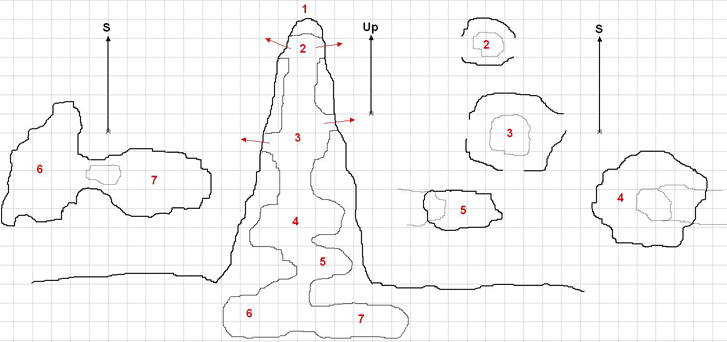 |
The spire is not easily entered by non-flying creatures. There are a total of five entrances, each an opening in the rock roughly 5 ft in diameter. Three of the openings are at area 3 and are between 40 ft and 45 ft above ground level. The last two openings are 65 ft up the spire at area 2.
This wing of gargoyles is led by a four-armed gargoyle who rules through intimidation and from awe given to him by the other gargoyles because of his mutation.
The spire is made of limestone, and its exterior sides are fairly smooth and sheer, requiring a DC 20 Climb check to negotiate. Floors inside are relatively smooth, and are treated as hewn stone floors (DC 10 Balance check to run or charge). Interior walls are hewn stone walls, requiring a DC 25 Climb check to negotiate, unless indicated otherwise (for example, the shafts are generally DC 20 to climb). Unless stated otherwise, there are no light sources in the spire. During daylight hours, ambient natural light illuminates areas 2 and 3 and most of the shaft between areas 3 and 4 will be in shadowy light.
As the PCs approach the spire, they are likely to be attacked by one or more of the gargoyles in areas 1 and 3. The gargoyle in are 1 will only be present if it has not already attacked the PCs in an adjacent hex and enough time has not gone by to have a new gargoyle take up the post.
1. Spire Top (EL 4)
This is the top of the spire. The top is somewhat rounded and flat enough for a single Medium sized creature to stand or sit comfortably. See below for more details.
Creatures: At all times a single gargoyle will be perched here, motionless and with its wings folded over itself so that it appears to be a part of the top of the spire. Treat this as an application of the gargoyle's Hide skill and assume it has taken 10 on its Hide check (for a total bonus of +25). Unless it is noticed, the gargoyle will simply appear as a sharp, pointy tip to the spire, rather than the actual rounded end.
|
GARGOYLE CR 4 * The Hide bonus increases by +8 when a gargoyle is concealed against a background of stone. |
Developments: Unless the PCs are hidden, this is the gargoyle that will swoop down into an adjacent hex to attack the PCs. If it is killed or defeated, another (from area 6 or 4) will take its place 1D4 hours later. The missing gargoyle will cause no concern, as these chaotic creatures simply assume that the errant gargoyle has gone hunting or run afoul of some local beast.
2. Top Chamber
| Two 5 ft diameter openings to the east and west lead into this small chamber. Other than a narrow lip of stone around a roughly 8 ft diameter stone shaft that descends straight down, the chamber appears to be featureless. |
3. Middle Chamber (EL 4)
| Three 5 ft diameter openings to the north, east, and west lead into this chamber. The eastern opening is some 8 ft above the floor of the chamber, accessible by a steep set of rough steps carved into the wall of the chamber. A 5 ft wide lip of stone surrounds a roughly 10 ft diameter stone shaft that descends straight down, while a roughly 8 ft diameter shaft ascends from the ceiling above. A few bones litter the floor of the lip of stone. |
Negotiating either shaft (in the floor or ceiling) requires a DC 20 Climb check.
Creatures: A single gargoyle is here, casually glancing out of the openings and otherwise standing fairly motionless for hours at a time. If attacked, it will screech loudly, alerting the spire in Terran. If it sees anyone approaching the spire, it is likely to leap to the attack.
|
GARGOYLE CR 4 * The Hide bonus increases by +8 when a gargoyle is concealed against a background of stone. |
4. Brood Chamber (EL 4)
|
The ceiling of this chamber contains a 10 ft diameter shaft that ascends into the stone above. In the center of the place, an 8 ft diameter hole in the floor descends into the stone below. The walls, floor, and ceiling of the place are decorated in rust-coloured stains that are, in some cases, merely smeared in random shapes, but in others resemble crude figures and objects such as clouds, hills, humanoids, animals, and flying humanoids. Three small stone statues are located along the east wall. These are small and seem to be very crude representations of the top halves of tiny gargoyles that were carved from some stone protrusions rising from the floor. The rest of the chamber contains bones and various scraps of fur and broken bits of wood. |
The hole in the center of the chamber slants at a 45 degree angle to the west, to emerge into the ceiling of area 5.
Creatures: A single female gargoyle is here watching over a brood of 3 baby gargoyles. The latter are the three stone statues, as gargoyle babies are birthed into the stone itself and gestate there and slowly grow into adult gargoyles, bursting from the stone at the proper time. As such, the "statues" are actually living creatures, albeit unable to move or attack in any way. They are young, and the upper half that has formed from the stone is about a foot tall.
The female gargoyle is here to guard the younglings, and she will attack any intruders, but will not leave her brood.
|
GARGOYLE CR 4 * The Hide bonus increases by +8 when a gargoyle is concealed against a background of stone. |
5. Skull Ledge
| This 10 ft wide ledge is formed from a passageway descending from above that turns here and then descends below. This area is little more than an extended "elbow" in the turning passageway, but it has been decorated with well over a hundred skulls set in an orderly manner on the somewhat sloped floor of the ledge. The skulls clearly include human skulls, some of which are small enough to be the skulls of children and babies. Other skulls include animals of various types, as well a a few strangely shaped skulls that have an almost frog-like shape to them. |
6. Lower Chamber (EL 6)
| This chamber is accessed from a hole in the ceiling at the western end, where a hole also leads straight west as well. The chamber is relatively featureless, with a few bones and bits of detritus scattered amongst the small stones and loose gravel. The walls contain a few small ledges at various heights. |
Creatures: Fortunately for the PCs, only 2 gargoyles are present at this time. Another 4 gargoyles dwell here, but they are out hunting or otherwise terrorizing the area outside. These two will be motionless on two of the ledges and will attack any intruders who enter their lair.
|
GARGOYLES (2) CR 4 * The Hide bonus increases by +8 when a gargoyle is concealed against a background of stone. |
Developments: If an alarm is sounded, these gargoyles will ascend to attack intruders. In addition, the DM should assume that every 1D4 hours there is a 25% chance a gargoyle will return from outside to rest here and a 25% chance a gargoyle will leave here to go outside. However, there will never be fewer than 2 gargoyles here unless the PCs reduce the number present.
7. Four-Armed Chamber (EL
5)
|
This chamber is accessed by a hole in the eastern end. Within are various strange constructions erected from bones. The constructions are simplistic, being simply bones stacked together into small towers or leaned against each other to form pyramids, but there are many of these scattered on the floor throughout the place. At the far western end of the chamber is a stone shelf, upon which rest a variety of implements and items. |
Creatures: The leader is here, standing on the stone shelf in the west contemplating his next artistic masterpiece. It will attack any intruders, conjecturing in Terran as it does how its foe's bones will fit into its next construction.
|
FOUR-ARMED GARGOYLE CR 5 * The Hide bonus increases by +8 when a gargoyle is concealed against a background of stone. |
Developments: The four-armed gargoyle will respond to any alarms raised in the spire and will attack to the death. The leader is not very bright, and can only be bargained with from a position of great strength and by offering very obvious rewards.
Treasure: The leader keeps all of the treasure of the tribe on his stone shelf. These are items he has taken from Chindari tribesmen over the years. Included are 4 spears, 1 masterwork spear, a harpoon, a wooden heavy shield, a small ivory figurine of a nude man on a leather string (worth 25 gp), a pouch with 2 pearls (worth 100 gp each), a thin piece of bark that is a divine scroll of greater magic weapon (CL 7), and a strange piece of amber on a leather thong that seems to have a dancing flame within it (this is a talisman, an item from Oriental Adventures that operates like a potion in all ways when it is crushed) that is a talisman of resist energy (fire) (CL 3).
F. Ghost Brute Pack (Search 25%/25%, Adjacent)
A pack of ghost brutes haunts this area, including the surrounding hexes. Anytime the PCs enter any of the 7 indicated hexes or spend 6 hours within one hex, there is a 25% chance they will encounter the pack.
Encounters will be with 1D3 ghost brute apes. These apes were slaughtered by a Chindari hunter who was infamous for not appeasing the spirits of the animals he slaughtered, and in fact turned to causing them as much pain as possible. The hunter, whose name is no longer spoken or remembered, is rumoured to have been possessed by a demon. In his last act, as the Chindari people themselves hunted him through the jungle to kill him, was to come upon a tribe of apes and mutilate them and their babies in as horrific a fashion as possible. Too late the Chindari tribesmen arrived and slew the evil hunter, but not before the twisted spirits of the adult apes returned to wreak vengeance upon living humans.
Now, the ghost tribe of apes seeks to kill all humanoids, regardless of their status as Chindari. There are a total of a dozen brutes in the tribe, and if the PCs encounter and defeat all 12, no further ones will be encountered.
Note: Ethereal statistics are not presented here. If the PCs can confront the ghost brute apes on the Ethereal Plane, then the DM should adjust these statistics accordingly.
| GHOST BRUTE
APE CR 4 Libris Mortis page 101 N Large undead (augmented animal, incorporeal) Init +2; Senses low-light vision, scent; Listen +14, Spot +14 AC 14, touch 14, flat-footed 12 hp 26 (4 HD) Fort +1, Ref +6, Will +2 Spd fly 30 ft (6 squares) (perfect) Melee 2 melee touch claws +5 (1D4) and melee touch bite +0 (1D4) Space 10 ft; Reach 10 ft Base Atk +3; Grp - Abilities Str -, Dex 15, Con -, Int 2, Wis 12, Cha 15 SQ incorporeal traits, manifestation, rejuvenation, turn resistance +2, undead traits Feats Alertness, Toughness Skills Climb +14, Hide +10, Listen +14, Search +4, Spot +14 Manifestation (Su) As ethereal creatures, ghost brutes cannot affect or be affected by anything in the material world. When they manifest, ghost brutes become visible, but remain incorporeal. However, a manifested ghost brute can strike with a touch attack, if it has one, or a ghost touch weapon (if it can wield a weapon). a manifested ghost brute remains on the Ethereal Plane but can be attacked by opponents on both the Material and Ethereal planes. Rejuvenation (Su) In most cases, it’s difficult to destroy a ghost brute through simple combat: The "destroyed" spirit will often restore itself in 2D4 days. A ghost brute that would otherwise be destroyed returns to its old haunts with a successful level check (1D20 + ghost brute’s HD) against DC 16. As a rule, the only way to get rid of a ghost brute is to determine the reason for its existence and set right whatever prevents it from resting in peace. The exact means varies with each spirit and may require a good deal of research. |
These brutes will silently manifest in the trees and swing from branch to branch (though they are really flying), leaping down to attack humanoids. They will not pursue humanoids outside of their encounter radius.
In the very center of location F is a clearing that is the center of the ghost brutes' pain, for it is the clearing where the evil hunter did his heinous deed. In this clearing, which can only be found by divination or other such magic, will be found the twisted bones of the apes, and the bones of the hunter. If the ape bones are gathered together and a proper rite said over them (DC 25 Knowledge [religion] check with a +5 circumstance bonus if a Firlott or Yimik priest, druid, or spirit shaman is present) then the ghost brutes will disappear, gone to their eternal rest.
G. Yellow Musk Creeper Cave (Search 15%/100%)
Up the jungled hills is a cave, within which grows a yellow musk creeper. The creeper is only a few years old, having spawned from a zombie that wandered here from the interior of the island further to the east.
Refer to the Creeper Cave map below. One square is 5 ft.
 |
The cave is not easy to locate, though eventually if the PCs search they will find it. The cave is up a gradual slope under the jungle canopy. Its entrance is screened by several jungle bushes (treat as heavy undergrowth).
1. Entry Area (EL 5)
|
Beyond the screening bushes and tangles is a large cleft in the face of the hillside. The cleft is open to the sky and its walls are between 15 ft and 20 ft tall. A 10 ft wide by 8 ft tall cave in the eastern end of the cleft leads into the hillside proper. This cleft area has a relatively smooth earthen floor, which is damp from recent rains. Two dead or dying trees flank the place, and between them is a jacaranda tree, no more than 20 ft tall. |
The sound of running water from within the cave is clearly discerned from here, though it sounds as if it were a small trickle of water.
Creatures: Coiled in the jacaranda tree is a yellow musk zombie giant constrictor snake. It is wrapped throughout the jacaranda tree and takes up pretty much the entire canopy of the tree. When a victim comes within range, the snake will attempt to grab it and drag it towards area 3.
|
YELLOW MUSK ZOMBIE GIANT CONSTRICTOR
SNAKE CR 5 Creeper Loyalty (Ex) Yellow musk zombies always act to protect and nurture the yellow musk creeper that created them. They can range no farther than 100 ft from their progenitor for the first two months of their existence. Thereafter, they wander freely for 1D4 days before dropping dead. Unless cured (heal or regenerate cast before seed germinates), a yellow mush zombie automatically dies two days after the death of its patron creeper. Deadened Mind (Ex) A yellow musk zombie recalls nothing of its previous life, and it exists only to serve its parent plant. It cannot make use of class abilities, skills or feats it previously knew. It also cannot use magic devices, though it can still wield weapons and use armour. Improved Grab (Ex) To use this ability, a constrictor snake must hit with its bite attack. It can then attempt to start a grapple as a free action without provoking an attack of opportunity. If it wins the grapple check, it establishes a hold and can constrict. Seeded (Ex) If a yellow musk zombie dies, the growing seed inside its head takes root and grows into a yellow musk creeper within 1 hour. |
2. Central Cavern (EL 4)
|
This large cavern has a ceiling that is between 15 ft and 20 ft in height. The ceiling is rough, marked with hanging stalagmites and rocky protrusions. The walls and floor are similarly rough and uneven. Several natural stone shelves rise from the floor, and two large stone columns span floor to ceiling, again natural-appearing. A small trickle of a stream runs from an entrance to the east and then curves south. |
The stream is really nothing more than a steady trickle of water, perhaps 1 ft wide and and inch or two deep.
A sweet odor seems to waft around the cave, and any being with the scent ability can tell it comes from the eastern entrance.
The eastern entrance leads to natural stone steps ascending towards area 3. Each step is 2.5 ft high. The passageway between areas 2 and 3 is 10 ft tall and consists of a natural stone floor and unworked stone walls.
Creatures: Atop the shelves at 2a and 2b are yellow musk zombie jaguars. At 2c is a yellow musk zombie Chindari warrior. The jaguars will leap to attack while the warrior will use his shortbow until he runs out of arrows or is pressed into melee. At all times the primary motivation of these zombies is to protect the creeper in area 3 and to send it new victims.
|
YELLOW MUSK ZOMBIE JAGUARS
(2) CR 2 Deadened Mind (Ex) A yellow musk zombie recalls nothing of its previous life, and it exists only to serve its parent plant. It cannot make use of class abilities, skills or feats it previously knew. It also cannot use magic devices, though it can still wield weapons and use armour. Improved Grab (Ex) To use this ability, a jaguar must hit with its bite attack. It can then attempt to start a grapple as a free action without provoking an attack of opportunity. If it wins the grapple check, it establishes a hold and can rake. Pounce (Ex) If a jaguar charges, it can make a full attack, including two rake attacks. Rake (Ex) Attack bonus +4 melee, damage 1d3+1. Seeded (Ex) If a yellow musk zombie dies, the growing seed inside its head takes root and grows into a yellow musk creeper within 1 hour. * In areas of tall grass or heavy undergrowth, the Hide bonus improves to +8. |
|
YELLOW MUSK ZOMBIE CHINDARI
WARRIOR CR 1/2 Deadened Mind (Ex) A yellow musk zombie recalls nothing of its previous life, and it exists only to serve its parent plant. It cannot make use of class abilities, skills or feats it previously knew. It also cannot use magic devices, though it can still wield weapons and use armour. Seeded (Ex) If a yellow musk zombie dies, the growing seed inside its head takes root and grows into a yellow musk creeper within 1 hour. |
3. Creeper Cave (EL 4)
|
This large cavern has a ceiling that is approximately 15 ft in height. The ceiling is rough, marked with hanging stalagmites and rocky protrusions. The walls are similarly rough and uneven, though the floor is strewn with dirt and mud, and as such is fairly even. Several natural stone columns span floor to ceiling. A small trickle of water rains down from a crack in the ceiling in the center of the place and runs along the floor and then out the entrance to the southwest. Directly beneath the rain of water is a massive plant with long green tendrils and large, vibrant leaves. Beautiful yellow and purple orchid-like flowers dot the plant. Some of the tendrils have grown up around the nearby stone columns. |
A sweet odor permeates this cave, emitted from the creeper.
The dirt and silt on the floor is approximately 2 inches deep, though under the creeper the stone floor gives way to a pile of dirt over 2 ft deep.
Creatures: A yellow musk creeper has taken up residence here. (as indicated on the map by a yellow square). It has been here only a couple of years, and unlike as presented in the Fiend Folio, yellow musk creepers are not the prolific reproducers as suggested by the rules. When a seeded yellow musk zombie dies, there is only a small chance that a yellow musk creeper will germinate in an hour. Furthermore, even should such germination occur, the creeper begins life as a tiny sapling and must grow and feed for years before becoming a huge creeper.
This creeper will attack any intruders that enter its cavern, first seeking to entice intruders into range of its intelligence-consuming tendrils, but otherwise simply whipping at them with its vines. In general the creeper will choose one victim to entice and fend the rest off with the vines.
|
YELLOW MUSK CREEPER CR 4 Consume Intelligence (Ex) As a free action, a yellow musk creeper can extend dozens of probing, sharp-edged tendrils into the head of any helpless or unresisting creature that also occupies its space. These tendrils begin to devour the victim's brain, dealing 1D4 points of Int damage each round. If the damage reduces a victim's In to 0, the victim must make a DC 18 Fort save. Those who fail die, and their bodies grant sustenance to the hungry plant. Those who succeed are implanted with a seed and become yellow musk zombies. The only way to stop a yellow musk creeper from consuming a victim's Int is to kill either the victim or the creeper. Musk Puff (Ex) Yellow musk creepers attack by puffing a spray of potent-smelling dust upon a nearby target. The musk has a range of 30 ft and can target one creature per round. Creatures struck by a yellow musk creeper's musk puff must make a DC 18 Fort save or fall under a mind-affecting compulsion to get closer to the entrancing source of the musk. The duration of the effect is 2D8 rounds, although creatures within the plant remain under the compulsion until removed from the creeper. Creatures under the yellow musk creeper's compulsion can take no actions other than moving to enter the plant's space. The creeper does not oppose these attempts. Affected creatures do anything they can to comply with the compulsion and even attack companions who seek to retrain them. Once within the plant, the affected creature drops anything in hand and stands motionless. The creature is dazed and does not resist the creeper's attacks as long as it remains within the plant. Regeneration (Ex) Fire and acid deal normal damage to a yellow musk creeper. |
Developments: If the PCs came here at the behest of the hermit (location D), then when and if the creeper is incapacitated, a yellow flower can be plucked off as a full-round action (provoking an attack of opportunity). There will be no chance to pluck a flower as long as the creeper is active.
H. Two-Headed Troll Cave (Search 25%/100%)
Somehow a group of three two-headed trolls has taken up residence in the hills southeast of Chindar Town. When or how they arrived is not known, but they have been around for at least 25 years, and may be the second or third generation of the beasts. No one knows where the family lairs, and the trolls are greatly feared by the Chindari tribesmen. Should the PCs slay such a troll and bring its heads back to Chindar Town, they will be acclaimed as brave warriors.
There is no map provided for this
encounter.
|
Before you is a wide bowl of stone, some 60 ft in diameter and 20 ft deep at its center. The bowl seems naturally-formed, and the walls are not too steep. At the bottom of the bowl, mud and dirt and water have collected into a brown muck. The jungle canopy overgrows the entirety of the bowl. The bowl itself is strewn with bones, dung, and other debris. Three large nests of fur, skins, and bones are scattered around the place. |
Creatures: No more than three of these trolls can be encountered here. If the PCs have defeated any of these trolls during random encounters (see above), then they will no longer be present here. Furthermore, there is a 50% chance that one troll is out hunting and will return in 1D4 hours. There will always, however, be at least 1 troll encountered here. These trolls are not very wary in their lair, as they are at the top of the food chain and have so far been safe in their lair.
| TWO-HEADED TROLL
CR 6 Tome of Horrors page 353 CE Large giant Init +0; Senses darkvision 90 ft, low-light vision, scent; Listen +8, Spot +8 Languages Giant AC 16, touch 9, flat-footed 16 hp 85 (10 HD); fast healing 1 Fort +11, Ref +3, Will +5 Spd 30 ft (6 squares) Melee 2 claws +12 (1D6+6) and bite +7 (1D6+3) Space 10 ft; Reach 10 ft Base Atk +7; Grp +17 Atk Options rend 2D6+9 Abilities Str 22, Dex 11, Con 19, Int 9, Wis 10, Cha 6 SQ superior two-weapon fighting Feats Alertness, Cleave, Iron Will, Power Attack Skills Listen +8, Search +6, Spot +8 Rend (Ex) If a two-headed troll hits with both of its claw attacks, it latches onto the opponent's body and tears the flesh. This attack automatically deals an additional 2D6+9 points of damage. |
Treasure: The trolls brought some bit of treasure with them from their homeland. It is buried in the muck at the bottom of the bowl and each of the three items requires a DC 20 Search check to find. The treasure consists of 2 large sacks tied with leather cord and a wooden chest that is unlocked.
The bags each contain 450 cp, 200 sp, 120 gp, and 5 pp all of various Jerranqi mint. Furthermore, one of the bags contains a ring of brief blessing.
The chest contains 600 sp, 400 gp, and four sealed metal scroll tubes each containing a divine scroll of shield of faith (CL 1).
I. Tower of the Spectral Forest Troll (Search 25%/100%)
This tower is a relic of the same mysterious builders of the town of Hekar (refer to the Onlor Gazetteer for more information). Some lingering magic or a curse laid upon the place has caused a forest troll that took refuge here to become a horrible undead spirit. This spirit now haunts the tower, bound to it by the fell magic that created it in the first place, and hungers to slay the living.
Refer to the Tower Map below. Each square is 5 ft and the top of the map is north. The trees are all standard trees, and the squares marked with green bushes are considered to be heavy undergrowth. All other squares (including within the tower) are considered to be light undergrowth.
 |
| Out of the midst of the jungle foliage rises the ruins of a stone tower. The tower is made of white marble that, despite the obvious toll that time has taken on the structure, is still pristine in colour. The structure is seamless, and appears at a glance to have been made out of a single massive piece of stone. The ruins rise some 50 ft up into the jungle canopy, and is surrounded by trees and bushes and other undergrowth. |
Hidden under the debris, in the center of the ground floor of the tower is a stone trap door. It would take a DC 25 Search check after about 1 man hour of clearing rubble to locate the trap door. The door has no apparent handle or rung to pull, and is very heavy, requiring a lever and a Str check of 28 to lift.
Beyond the door is a set of marble stone steps that descends 10 ft to a 10 ft square chamber. In the center of the chamber is a stone pedestal, a thin spire of marble that rises out of the floor itself. Set into the top of the pedestal is a black gem that throbs and pulsates. The gem radiates both magic (strong necromancy) and evil (faint). This is the device that has created the spectral troll. If it is destroyed, the spectral troll will not rejuvenate. The device has no other effect or power and will not in any way twist or mar any PCs that die here. If the device is broken or dismantled, the gem is a large onyx worth 500 gp.
Creatures: The spectral troll haunts this tower at night. During the day it is conspicuously absent due to its vanish ability. The troll does not know what has caused its transformation, and cannot help the PCs in any way remove its curse. In fact, part of the troll's curse is that it cannot enter the underground chamber and any recollection of it is immediately erased from its mind.
At night, the troll will use the terrain to its best advantage to attack any PCs who come within 20 ft of the tower. The troll can actually proceed some 200 ft from the tower, but generally prefers to be in the tower itself, as the curse makes it uneasy the farther away from the tower it flies.
Note: Ethereal statistics are not presented here. If the PCs can confront the spectral forest troll on the Ethereal Plane, then the DM should adjust these statistics accordingly.
|
SPECTRAL FOREST TROLL CR 6 Manifestation (Su) A spectral troll dwells on the Ethereal Plane and, as an ethereal creature, it cannot affect or be affected by anything in the material world. When a spectral troll manifests, it partly enters the Material Plane and becomes visible but incorporeal on the Material Plane. A manifested spectral troll can be harmed only by other incorporeal creatures, magic weapons, or spells, with a 50% chance to ignore any damage from a corporeal source. A manifested spectral troll can pass through solid objects at will, and its own attacks pass through armour. A manifested spectral troll always moves silently. A manifested spectral troll can strike with its incorporeal attacks or with a ghost touch weapon. A manifested spectral troll remains partially on the Ethereal Plane, where it is not incorporeal. A manifested spectral troll can be attacked by opponents on either the material Plane or the Ethereal Plane. The spectral troll's incorporeality helps protect it from foes on the Material Plane, but not from foes on the Ethereal Plane. A spectral troll has two home planes, the Material Plane and the Ethereal Plane. It is not considered extraplanar when on either of these planes. Rejuvenation (Su) In most cases, it's difficult to destroy a spectral troll through simple combat. The "destroyed" spirit will often restore itself in 2D4 days. Even the most powerful spells are usually only temporary solutions. A spectral troll that would otherwise be destroyed returns to its old haunts with a successful level check (1D20 + 5) against DC 16. As a rule, the only way to get rid of a spectral troll for sure is to determine the reason for its existence and set right whatever prevents it from resting in peace. The exact means varies with each spirit and may require a good deal of research. Vanish (Su) Spectral trolls vanish in direct sunlight. They are not harmed by it, nor does it cause them any discomfort; they simply do not appear in sunlight. Spectral trolls that are held, restrained, confined, or imprisoned (including magical means such as temporal stasis) vanish in direct sunlight. Once night has fallen, a spectral troll reappears. If the spectral troll was magically held or restrained, the magic does not resume when it reappears. |
J. Bullywug Camp (Search 50%/100%, Adjacent)
This is a small village of bullywugs that dwells in a marshy area where the river emerges from the jungle.
There is a 30% chance for each adjacent hex entered or for every 6 hours spent in an adjacent hex that a patrol of bullywugs will encounter the PCs. Treat a patrol as a random encounter result of Bullywug in the random encounter section above.
Allow the PCs a DC 25 Survival check when entering an adjacent hex that the ground is becoming a bit marshy. Allow a DC 15 Survival check for the PCs to note when entering the hex of location J proper that the ground is getting marshy. Failure to make this last check will mean by the time the PCs notice they are in a marsh...they are in the marsh.
The marsh proper occupies the central 75% of the location J hex, surrounding the river on both sides. The marsh is generally a moor, consisting of shallow bog and light undergrowth for the most part. Deep bog, heavy undergrowth, and quicksand are rare.
Allow a 50% chance for every hour spent in the location J hex proper that a bullywug patrol (see above) encounters the PCs.
There is really almost no reason for the PCs to approach or interact with the bullywug village. The bullywugs are not a friendly race, and there are quite a few of them in this village. Given that the PCs will be able to see the village from quite a distance, there is little chance they will accidentally stumble into it. Nevertheless, it is presented here in case the PCs somehow want to trade or deal with the bullywugs or in case one or more PCs are captured by a patrol and the PCs now need to effect a rescue.
Refer to the Bullywug Village map below. The top of the map is north, and each square is 10 ft.
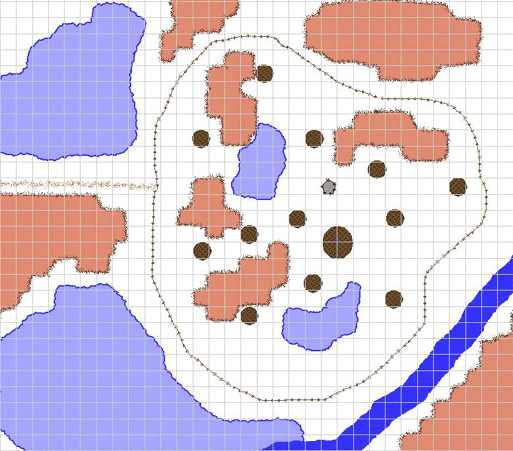 |
The village is warded by a wooden palisade some 8 ft tall that is set on an earthen berm another 4 ft tall. A single dirt path runs from about 300 yards away to a crude wooden gate in the palisade. This path is not so much an actual designed roadway as much as the simple trampling of so many bullywugs over time. At any one time, 8 bullywugs are perched on the palisade watching the surrounding land for intruders or victims.
On the map, the river to the southeast is a tributary that flows southwest into the main river. This tributary is a fast river, moving at 20 ft per round and requiring a DC 15 Swim check to navigate. The ponds, pools, and small lakes shown on the map are standing water, with plant-choked marshy bottoms and silty water that restricts visibility (treat as an obscuring mist spell). Such bodies are 15-20 ft deep at their centers.
The orange patches denote light bog.
The round brown circles are mud huts used by the bullywugs as residences. Such huts are of packed mud over a frame of bundled reeds. These huts are 5 ft high and 10 in diameter and are accessed by a single hole dug into the ground to pass under the hut. Within is a damp, musty burrow that contains crude stone and reed furnishings and tools. Some 2D3 bullywugs lair in a given hut, all adults, as "tadpoles" run free around the compound and are non-combatants.
The large hut in the center is twice and tall and wide as the normal huts and houses the leader and the clerics. North of this large hut is a crude stone idol to some frog-like entity. It is so crudely carved that it would be impossible to tell the thing was frog-like except that it is smack in the middle of a bullywug village.
Creatures: For ease, assume there are 48 normal bullywugs in the village at any given time. The rest (approximately 24) are out hunting.
|
BULLYWUG CR 1 * Bullywugs have a +6 racial bonus on Hide checks when in marshes because of their skill at camouflage. |
|
BULLYWUG LEADER CR 2 * Bullywugs have a +6 racial bonus on Hide checks when in marshes because of their skill at camouflage. |
|
BULLYWUG CLERICS (3) CR 2 * Bullywugs have a +6 racial bonus on Hide checks when in marshes because of their skill at camouflage. |
Treasure: Buried under the stone idol is a bullywug skull. Within the skull are 4 agates and several amethysts worth a total of 750 gp.
Developments: The bullywugs are not very organized. The leader rules simply by dint of his strength and bravery. He has killed all of his rivals. The clerics occasionally sacrifice animals and captured beings to their idol, and any PCs captured will be tied by reed ropes (treat as hemp) and held in the main hut.
If the PCs insist on making multiple raids against the bullywugs, they will eventually begin to send out parties to locate the raiders. Nevertheless, their alignment and intelligence means they will never mount a coordinated or clever assault or ruse and will prevail or falter based on sheer numbers alone.
K. Tyrantfog Hole (Search 35%/100%)
When the PCs first enter this hex, a DC 15 Knowledge (nature) check will reveal that there is a lack of animal sounds in the area. Not a complete lack, but clearly a lessening. By the time the PCs reach the center half of the hex, allow a DC 5 Knowledge (nature) check to note that all animal sounds have disappeared.
Allow a 10% chance per hour spent in the hex that an encounter will occur with 1D3 tyrantfog zombies (see below).
If the PCs reach the crater itself,
read the below.
|
On the hillside amidst the jungle foliage is a crater. The crater is some 30 ft in diameter and is set into the gentle slope of the hillside, as if whatever may have made the crater struck the hillside at an angle. Clearly the crater is not new, as jungle foliage has overgrown its edges. A strange dark fog wisps its way out of the crater. The fog seems to move and curl and swirl out of tune with the breezes in the area, and instead of rising straight up, seem to snake their way amongst the undergrowth and nearby trees before finally rising into the air. |
The crater is 20 ft deep, and at the end/bottom are many bones.
Creatures: An evil Chindari priest in the region investigated the crater and believed that the crater was a sign from the gods. He sacrificed tribesmen to the gods and tossed their bodies into the crater. Out of the crater later emerged tyrantfog zombies. The zombies were not under the control of the priest, but he rebuked them and took them under his control. He later created more such zombies, and when he died, other occasional evil priests learned his lore and continued the practice. Not all bodies dumped into the crater emerge as tyrantfog zombies, and those that do often take days, months, or even years to do so. As a result, a population of uncontrolled tyrantfog zombies has developed around the crater, and the evil priests long ago stopped coming to the area.
There are a total of 24 tyrantfog zombies in the region. They are attracted to the fog from the crater and will not leave the hex, often returning to the crater to bask in the vapours. If all 24 are destroyed, then until someone dumps a body into the crater, no more will appear.
At the crater, there will always be 1D3 tyrantfog zombies. If these are destroyed, another 1D3 will arrive in 1D20 hours.
|
TYRANTFOG ZOMBIE CR 3 Sickening Cloud (Su) The fog that lingers around tyrantfog zombies saps the endurance of creatures within it. A character who comes within 5 ft of a tyrantfog zombie must make a DC 13 Fort save or take 1 point of Con damage. A single character only needs to make one save per encounter with these creatures. |
L. Chindari Settlement (Search 50%/100%, Adjacent)
This is one of the larger local settlements that are a satellite to Chindar Town.
There is a 25% chance of an encounter with tribesmen for each adjacent hex entered or for each 6 hours spent in an adjacent hex. Such an encounter should be treated like the random encounter with Chindari tribesmen in the random encounters section above.
The village itself is not detailed. It is a standard Chindari settlement, comprised of a wooden palisade set upon a small hill. Within are the round wooden Chindari huts set on raised platforms. At the crest of the hill and in the center of the village is a wooden totem similar to but on a lesser scale than the ancestor totem in Chindar Town.
A total of 500 adults dwell in this village, half being males and half females. Of the males, about 30% are warriors, 45% hunters, and the rest gatherers. The females are all gatherers. There are another 150 children who are non-combatants.
Leaders include a chief (N, Warrior 6), a high shaman (N, Spirit Shaman 5), a hunt leader (N, Ranger 3) and 4 shamanic adepts (N, Spirit Shaman 2).
Unlike the tribesmen of Chindar Town, these folk are not used to strangers. They will instantly attack and seek to slay or to capture for return to Chindar Town any foreigners who do not have tokens of permission from Chieftain Little Foot. If the PCs do have the proper tokens, then the tribesmen will be indifferent, but suspicious. None of the folk here speak Common; all speak only Indagi.
If made friendly, they will possibly give some advice or knowledge of the surrounding area based on a subsequent Gather Information check. If made helpful, they will allow the PCs to use their village as a resting place and possibly to barter. The shamans can have a few potions with them, and can also cast spells. The information obtainable here is the same as in Chindar Town. Inghaku can attempt to aid the Diplomacy check if the person he possesses is the one making the check.
Part Four - The Dragon's Cave
Finding the Cave
The cave can be found in several ways. First, the PCs can simply search the region and find it. Using the clues in the transcript provided by Ravis, they should have determined that the cave is on the west slope of the hills and within sight of the sea. That should at least narrow the search down and, with the players given the blank map of the region, they could simply search every hex on the hillsides until they stumble upon the cave.
In addition, the PCs can determine the location of Magulo's shrine from the hermit at location D by defeating the yellow musk creeper in location G.
Given that there is no real time pressure in this scenario, and given that the players have a limited number of hexes to search using the blank regional map, there is nothing to prohibit them from eventually finding the cave. If, however, by some circumstance they cannot locate the cave, the DM is free, at some point, to have the PCs meet a Chindari tribesman or group of tribesmen who will say that they saw a foreigner and some Chindari head towards location B last year. That will point the PCs in the right direction.
Outside the Cave
The area outside the cave consists of a sloped vale that leads up to a steep cliff. The cliff is over 50 ft high and leads to another slope that continues its march up to the central mountain range. The entire area is overgrown with jungle, though spots of sunlight pierce sparse areas of the canopy here and there.
Set into the cliff base is the cave opening. The steep slope leading up to the cave entrance bears a stream that burbles out of the jungle to the south of the cliff and proceeds down the slope and into the jungle below. The stream is fast moving, and about 5 ft wide and several feet deep.
The cave is not visible until
the PCs are within 100 ft of it. There, on the slope below the
entrance, the jungle clears somewhat and the cave can be viewed
above in daylight. The clearing leading up to the cave is not
really quite a clearing, but the trees are sparser and the area
is mostly open to the sky. However, this has encouraged the undergrowth
to grow wildly and the area is covered in creepers, ivy, and grass
amidst moss-covered stones and boulders.
|
Up the slope ahead the jungle clears somewhat, and a steep cliff can be seen. The cliff is fairly sheer, and about 50 ft tall, and in its base is a wide opening some 30 ft wide and 20 ft tall. To the right, where the cliff descends to meet the slope of the hill, a stream gushes down through the clearing and down the slope past your position. Littering the ground near the cave opening are hundreds of boulders, rocks, and pieces of rubble. Most of these are green with moss and lichen and the entire area is overgrown with ivy and grass. |
A DC 15 Search check in the area of the camp will turn up the remains of a fire pit in the center of the camp area, including charred wood and the charred bones of fish and other small animals. A DC 20 Search check will also turn up broken weapons, including spears, shortbows, and a twisted piece of blackened metal that looks as if it was once a shortsword. One of the spears also appears to be charred. Both the spear and shortsword are within 20 ft of the firepit. A DC 20 Search check will also turn up several skeletons, some of which appear to be charred. A DC 25 Search check in general or a DC 20 Search check of the bones in particular will turn up a large green gem that, with a DC 20 Appraise check or Profession (gemcutter or jeweler) check, will be revealed as a piece of crystal rather than a gem of value. This gem is the one that Haskimlip removed from the dispel magic trap in the dragon's egg chamber. It has no particular value and radiates no magic, but it does fit precisely into the trap in the egg chamber.
The rubble near the opening is rather voluminous, and a DC 20 Knowledge (architecture and engineering) or Profession (miner) will alert PCs to the fact that the rubble appears to be pieces of natural stone such as boulders or large rocks, many of which have been chipped or split with tools such as mining picks.
Inside the Cave
The caves are a complex of lava tubes connecting caverns of various sizes and runs deep into the hillside, well beyond the cliff itself.
Refer to the Dragon Cave map below.
 |
Passages:
On the map, passages are shown as lines. Unless otherwise noted, passageways are 20 ft wide and 20 ft tall and appear to be somehow hewn out of the solid rock. A DC 20 Knowledge (architecture and engineering) or Knowledge (dungeoneering) check can determine on examination that the passages were likely formed out of lava at some point in the ancient past and may have been further worked by intelligent hands.
All walls are treated as hewn stone (DC 25 Climb check). Floors are treated as hewn stone floors (DC 10 Balance check to run or charge).
Unless otherwise stated, there is no light in the passageways.
Passages are colour coded to show relative elevation within the cave complex. Black passages are "ground level", meaning with 25 ft above or below the level of the entrance to the caves (location A). This doesn't mean that there are not significant slopes up and down along these passages, but overall they remain within 25 ft of the entrance level.
Red passages are "lower passages", meaning they range between 26 ft and 50 ft below the entrance level.
Purple passages are "upper passages", meaning they range between 51 ft and 75 ft above the entrance level.
Where a passageway changes from one elevation to another and no location is present at the juncture between the two, then the DM should assume that for at least 1 square in either direction is a fairly noticeable slope (treat as a gradual slope).
Travel along passages is standard, but at the scale of the above map, some of the twists and turns are not apparent. For that reason, the DM should add another 20% to the distance to account for this. Thus, on average a group of PCs moving at speed 30 ft will take 2 rounds to travel 1 square (if moving at normal speed and not being particularly careful). A group of PCs moving at speed 20 ft will take 3 rounds to travel 1 square. The red dragon will take 1.5 rounds if crawling. If flying, the dragon can traverse 2.5 squares in a single round.
Even using the Therran flying rules, whereby a winged creature must have additional clearance equal to half of its space (rounded up) to fly, the wyrmling can easily negotiate the passages, as it needs only 10 ft of space to fly.
Passage Encounters:
The DM can check to passage encounters every square traversed. As most of these are static encounters, once a passageway has been traversed, the same encounter (and only the same encounter) will be there. These are meant to provide atmosphere and some clues as to what awaits the PCs. At some point, should it become tedious to continue checking, the DM should simply make sure that the most important encounters are met by the PCs and then simply inform them that as they continue, they encounter more of the same.
For each square traversed along a given passageway, roll on the following table:
|
|
|
| 01-50 | Nothing |
| 51-60 | Scorch mark |
| 61-65 | Centipedes |
| 66-75 | Pool of water |
| 76-80 | Bone |
| 81-85 | Twisted metal |
| 86-95 | Tracks |
| 96-99 | Scrape mark |
| 99-00 | Trinket |
Bone: A yellow bone or two (including, perhaps, a skull) left over from the ancient warriors who battled Enflaggirustivux millennia ago. The bones are brittle and will crumble to dust if not handled somewhat carefully. They will be humanoid remains (DC 10 Knowledge [nature] or Heal check) and obviously quite old. Some will be broken.
Centipedes: A small swarm of 2D8 tiny monstrous centipedes is here, usually swarming out of a crack in the wall. They will tend to attack anything living that passes by, often dropping from above.
| TINY MONSTROUS
CENTIPEDE CR 1/8 N Tiny vermin Init +2; Senses darkvision 60 ft; Listen +0, Spot +4 AC 14, touch 14, flat-footed 12 hp 1 (1/4 HD) Fort +2, Ref +2, Will +0 Spd 20 ft (4 squares), climb 20 ft (4 squares) Melee bite +4 (1D3-5 plus poison) Space 2.5 ft; Reach 0 ft Base Atk +0; Grp -13 Abilities Str 1, Dex 15, Con 10, Int -, Wis 10, Cha 2 SQ vermin traits Feat Weapon Finesse Skills Climb +10, Hide +18, Spot +4 Poison (Ex) Bite, Fort DC 10, 1 Dex/1 Dex. |
Pool of Water: Whether from a trickle coming down the wall or a drip from the ceiling, a small pool of water can be found here. Such pools are usually no more than 1D6 ft in diameter and 1D20 inches deep. Tiny brine shrimp can often be seen in 50% of these. The ones without such shrimp are potable.
Scorch Mark: A strange black mark covers a portion of the wall, floor, and/or ceiling here. The mark is large (1D4 x 10 ft in diameter) and roughly shaped. Examination of the mark will reveal soot that leaves a black mark on the fingers or whatever was used to touch the mark.
Scrape Mark: The normally smooth wall of the passageway is gouged, sometimes with multiple furrows (from the great claws of the wyrm) and sometimes as if a chunk of the passageway were smashed or battered (from the body of the beast). In the latter case, rubble can be found on the floor below the mark.
Tracks: These are not footprints per se, as the stony floor is too hard to leave such markings, but rather other disturbances that a skilled tracker can read somewhat. The base DC is 20 (due to the surface being hard ground). In addition, the DM should roll 1D6-1 to determine how many days have passed since the wyrmling came this way. For each day passed, add +1 to the DC.
If the PCs are tracking as they go (moving at half speed or at -5 at full speed), then the DM can make a secret check against the above DC. Otherwise, the DM can also make on behalf of the PCs a Survival check or a Search check at the same DCs even if not tracking. If tracks are discovered, what will be gleaned is that some creature passed this way recently (within a week or less). The nature of the creature cannot be determined, though if the check is made by 5 or more then it can be determined that the creature was likely smaller than size Huge and larger than size Tiny. If the Track feat is being used, then the trail can be followed, though there are trails to be found down every passageway, technically, so the DM can really just randomly lead the trackers down any and all passages.
Trinket: Some trinket is found by the PCs. This is some durable item dropped by one of the ancient Indari warriors. It might be a flint arrowhead or spearhead, a piece of carved ivory from a necklace, a few glass beads, a polished stone, etc. Nothing can really be gleaned from this item, other than the fact that people were here. Even determining that the item is ancient is difficult without magic.
Twisted Metal: This is a piece of metal twisted by the bulk of the wyrm Enflaggirustivux or melted by his breath (assume a 50% chance of either). As the ancient Indari did not use a lot of metal, these items will be small, and include arrowheads and spearheads for the most part.
Locations:
Locations are shown as circles, and represent caverns, ranging from fairly modest in size to large affairs, sometimes including multiple caverns clustered together. Each location has its own map detailing its configuration. The colour of the circle on the map shows its main elevation (as per passages above).
Unless otherwise stated, all locations are unlit and treated as natural stone floors (2 squares of movement to enter a square, +5 to DC of Balance and Tumble checks, running and charging impossible) and unworked stone walls (DC 15 Climb check). Ceiling height is 25 ft unless stated otherwise.
All elevation lines (represented by dashed lines) are 2 ft and generally sheer drops.
DMs should note that many of these locations are quite large and unlit. As such, the boxed text describing these locations will have to be adjudicated by the DM as he reads it in order to properly reflect the limit of sight of the PCs.
Unless otherwise stated, all spells cast by Enflaggirustivux are at caster level 17.
A. Entrance Cave (EL 3)
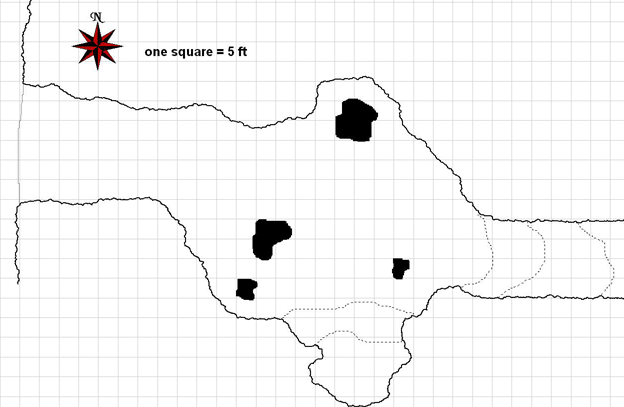 |
Sunlight, during daylight hours, will cause most of the 40 ft passage leading into the cave proper to be cast in gloomy shadow (the dotted line shows where the cave begins). Beyond that is murky darkness. The first half of the passageway leading to the cave is absolutely littered with stones and rubble similar to that found outside the cave entrance and is treated as dense rubble (2 squares of movement to enter a square, +5 to DC of Balance and Tumble checks and +2 to DC of Move Silently checks). A DC 20 Knowledge (architecture and engineering) or Profession (miner) will alert PCs to the fact that the rubble appears to be pieces of natural stone such as boulders or large rocks, many of which have been chipped or split with tools such as mining picks.
Along with the rubble outside
the entrance, there is easily enough here to have once completely
blocked off or buried the entrance. However, the DM should only
alert the PCs to this fact if a player inquires about it.
|
The passageway opens into a large cavern, some 30 ft high and dotted with stalactites, many of which seem to be worn down to stumps or nubs. Several large natural stone columns stretch from floor to ceiling, providing support for the cavern ceiling. Rocks and other detritus litter the floor. To the south, the floor descends several feet. |
A DC 15 Search check anywhere in the cave will turn up dire rate droppings, which would require a DC 20 Knowledge (nature) check to identify as large rodent feces.
Creatures: A colony of dire rats dwells here, having arrived fairly recently. They have not yet encountered the wyrmling and do not go deeper into the cave system. They will tend to swarm en masse on anything that is Medium size or smaller.
| DIRE RATS (9)
CR 1/3 N Small animal Init +3; Senses low-light vision, scent; Listen +4, Spot +4 AC 15, touch 14, flat-footed 12 hp 5 (1 HD) Fort +3, Ref +5, Will +3 Spd 40 ft (8 squares), climb 20 ft Melee bite +4 (1D4 plus disease) Space 5 ft; Reach 5 ft Base Atk +0; Grp -4 Abilities Str 10, Dex 17, Con 12, Int 1, Wis 12, Cha 4 Feats Alertness, Weapon Finesse Skills Climb +11, Hide +8, Listen +4, Move Silently +4, Spot +4, Swim +11 Disease (Ex) Filth fever - bite, Fortitude DC 11, incubation period 1D3 days, damage 1D3 Dex and 1D3 Con. The save DC is Constitution-based. |
Treasure: The rats have their nests at the end of the southern alcove, where bits of twigs, leaves, fur, and even bones have been set. A search through this mess (DC 20) will turn up a brass belt buckle with the letter "H" inscribed on it (for Haskimlip), a leather pouch with some coins, and a bit of vellum used as part of one of the nests. Much of the vellum is smeared and unreadable, but the following is clearly visible:
..ified contract of the Church of blessed Indol...
This is a bit of Haskimlip's contract with Ravis.
The coins total 25 cp, 16 sp, and 4 gp all of recent Onloran mint.
Developments: All of the items found in the cave and in the rats' nest should be enough to convince the PCs that Haskimlip was here.
B. Battered Cave
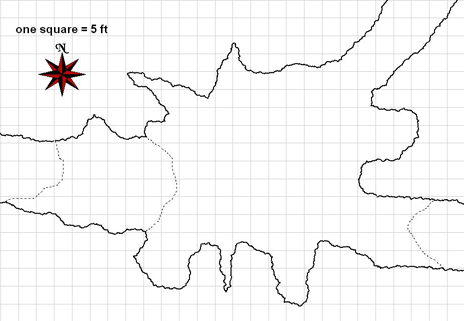 |
The floor of this cave is treated
as dense rubble throughout (the only difference between this and
natural stone floors is a +2 to the DC of Move Silently checks).
| This cavern is strewn with rubble. Stalactites hang from the 25 ft tall ceiling, most of them sheared off like jagged teeth. The walls are replete with large cracks and alcoves where chunks of rock have been bashed from the walls and onto the floor. |
There is nothing of interest in this chamber, except that a DC 20 Search check will turn up some bones, trinkets, and twisted metal (as per the passageway encounter).
C. Audience Chamber
 |
The steps in the passageway leading
up to the cavern are each 2.5 ft tall, requiring Medium sized
creatures to pause to scramble up each step (a DC 10 Jump check
to hop up or a move action to scramble over automatically). Small
or smaller sized creatures will have to jump or climb each step
and Large or larger creatures can simply move up them as if they
were steep steps.
| This cavern is wide and tall, its ceiling vaulting from 25 ft at the edges to over 40 ft in the center. To the east, a 10 ft tall stone shelf leads to a large section of the cavern that has a set of stalactites hanging down above the lip of the shelf, making the eastern portion of the cavern appear like an earthy maw. |
The stone steps leading up to the chamber were designed to humble smaller creatures and increase their anxiety as they neared their audience with the wyrm.
In the ceiling of the eastern area is a massive hole in the ceiling that leads up and to the northeast at a 45 degree angle for 25 ft before leveling off and turning to the east and then to location H as a 20 ft wide passageway. The hole is shown on the above map as a purple dotted line, and is wide enough to have allowed Enflaggirustivux to fly up it or down it at need.
D. Horde Cavern (EL 5)
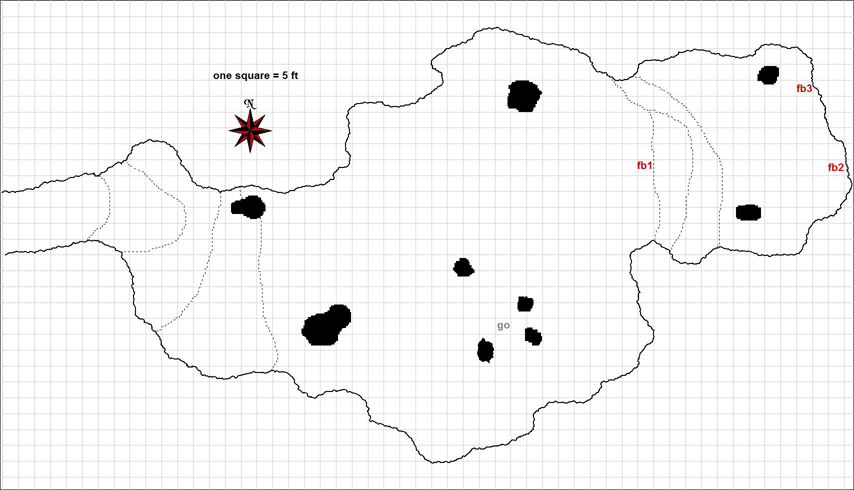 |
|
This massive cavern is 60 ft tall at its highest point, where the ceiling is supported by stout natural stone columns. Even at the edges of the place the ceiling towers 40 ft overhead, and is rife with stalactites. Wide natural stone steps lead down into the cavern. Peering out of the deep darkness to the east are a pair of wide set red eyes staring at you with a malefic squint. |
This cavern is massive and was the horde chamber of Enflaggirustivux. The entire horde was carried away by Hedulo and his minions. This is the place where Enflaggirustivux was finally slain, atop his massive treasure, and the wyrm's body was taken away and dissolved in acid so that the creature could not be brought back to life.
The stone steps shown on the map are rises of 2.5 ft and require Medium sized creatures to pause to scramble up each step (a DC 10 Jump check to hop up or a move action to scramble over automatically). Small or smaller sized creatures will have to jump or climb each step and Large or larger creatures can simply move up them as if they were steep steps.
The cavern is empty of treasure, but a casual look at the main floor of the cavern shows literally thousands of small scrape marks on the floor, which is also rippled and indented by thousands of small pockmarks. These strange marks are those made by the coins and gems and other sturdy valuables of the wyrm's horde as they scraped and pressed into the solid ground under centuries of the dragon's immense bulk.
Creatures: The pair of eyes leering at the PCs is a giant fire beetle. Three of them dwell in this cave. One is on to the east, just on the edge of the descending steps, and this is the one that the PCs can see from the entrance into this cavern. The other two are lurking to the far east down the steps and near the eastern wall. Because of the sunken floor in that area, the glow of these last two beetles is not visible until the top edge of the steps is approached. The fire beetles are designated as "fb" on the map.
| GIANT FIRE BEETLES
(3) CR 1/3 N Small vermin Init +0; Senses darkvision 60 ft; Listen +0, Spot +0 AC 16, touch 11, flat-footed 16 hp 4 (1 HD) Fort +2, Ref +0, Will +0 Spd 30 ft (6 squares) Melee bite +1 (2D4) Space 5 ft; Reach 5 ft Base Atk +0; Grp -4 Abilities Str 10, Dex 11, Con 11, Int -, Wis 10, Cha 7 SQ vermin traits |
However, the fire beetles are not the primary threat in the cave, as a gray ooze has just recently taken up residence here, having fed upon several of the fire beetles already. The gray ooze is actually in the process of stalking the fire beetle that the PCs can see, and will pounce on it in 10 rounds unless the PCs come into sensory range of the ooze, in which case it will switch targets. The ooze will begin on the map in the square marked "go" and will move slowly (at 10 ft per round) so as to preserve its transparency ability and to effectively move silently.
|
GRAY OOZE CR 4 The ooze’s acidic touch deals 16 points of damage per round to wooden or metal objects, but the ooze must remain in contact with the object for 1 full round to deal this damage. Constrict (Ex) A gray ooze deals automatic slam and acid damage with a successful grapple check. The opponent’s clothing and armor take a -4 penalty on Reflex saves against the acid. Improved Grab (Ex) To use this ability, a gray ooze must hit with its slam attack. It can then attempt to start a grapple as a free action without provoking an attack of opportunity. If it wins the grapple check, it establishes a hold and can constrict. Transparent (Ex) A gray ooze is hard to identify, even under ideal conditions, and it takes a DC 15 Spot check to notice one. Creatures who fail to notice a gray ooze and walk into it are automatically hit with a melee attack for slam and acid damage. |
The dragon has not yet encountered the gray ooze, which has heretofore hunted the fire beetles and then gone off to rest after consuming some of the vermin.
The fire beetles are not aggressive unless molested.
E. Egg Chamber
 |
1. Entry Chamber
|
A large cavern thrusts out from the curving passageway. The place is 20 ft high, as tall as the passageway itself, and the northeastern wall of the place shows massive cracks as if something large had been hurled against it. Rubble collected on the floor below these cracks further evidences this fact. A ruddy orange glow flickers from the east wall of the cave, where a massive door made to look like the wall of the cave itself is slightly ajar. |
The scale is quite large, and a DC 20 Knowledge (arcana) check will definitively identify it as a red dragon scale of at least adult size. If a DC 25 Knowledge (arcana) check is made, it can be determined that the scale is a small one (likely from the tail) of a wyrm red dragon.
The secret door is of exquisite craftsmanship, as evidenced by the fact that despite its being 20 ft wide and several inches thick, it is well balanced and opens relatively easily (DC 16 Str check to open).
2. Egg Chamber
|
This cavern is bathed in a ruddy glow emanating from a pool of magma in the center of the northern half of the place. The magma pool bubbles and froths slightly, evidencing its continuing activity. In the center of the pool an obsidian pedestal rises out of the lava and curves into grasping finger-like projections that curve slightly inward, as if to hold something round and about 2 ft in diameter. To the south of the pool, six large stone columns proceed from floor to ceiling, forming an aisle from pool to the south wall. Each column is made of granite and has been somehow warped and rippled into strange wavy forms. The forms seem to vaguely resemble serpentine creatures or perhaps dragons winding their way up the columns just beneath the surface of the columns. Along the south wall, flanked by the aisle of columns, is a fearsome bas relief of a massive dragon head with its mouth open as if to breathe flames up the aisle and towards the magma pool. |
A close examination of the bas relief of the dragon mouth will show bits of green dust scattered within the mouth opening on a DC 10 Search check. This dust, on a DC 15 Appraise check, will be determined to be jade dust. A DC 16 Spellcraft check will determine that the most common spell utilizing jade dust as a material component is the magic mouth spell. Indeed, Enflaggirustivux cast such a spell upon the bas relief, keyed to be triggered when a red dragon of size Medium approached within 10 ft. The spell instructed the wyrmling, in Draconic, how to find and open the door to the Chamber of Knowledge (area F below).
Hidden from view of the doorway, around the corner to the north, is a carving of a a curled dragon consuming its own tail. In the center of the ring formed by the dragon's body is a large faceted indentation that looks as if it might have held a gem or some similar object. Runes run in a ring along the body of the orobouros figure.
The runes, if a DC 25 Knowledge (arcana) check is made, indicate that this is or was a magic trap. A DC 25 Disable Device check will determine that the trap is inoperative and likely needs the missing piece to function. The missing piece is the crystal found outside the entrance to the caves. Haskimlip removed the gem after it had activated. Returning the crystal to the trap will prove it fits perfectly, but the trap was a one-use device and no longer functions even with the gem in place. A DC 28 Disable Device or Knowledge (arcana) check can determine that the trap was a dispel magic trap of some sort.
F. Chamber of Knowledge
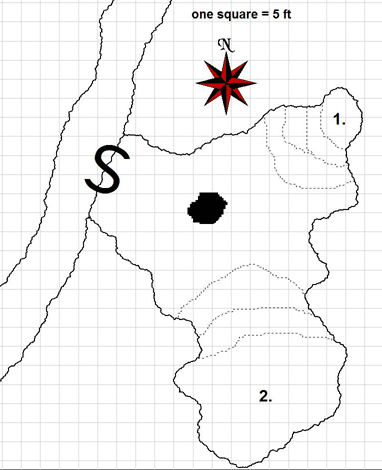 |
The secret door to this chamber
is ajar. It is carved to look like the wall of the passageway
when closed. The secret door is of exquisite craftsmanship, as
evidenced by the fact that despite its being 20 ft wide and several
inches thick, it is well balanced and opens relatively easily
(DC 16 Str check to open).
|
This cavern's ceiling is 25 ft high. A single massive natural stone column dominates the center of the place. To the north, a series of natural stone steps some 2 ft high each leads to a single massive crystal that seems to emerge from the stone of the floor and thrusts up 6 ft into the air. The crystal is about 2 ft in diameter and glows with a slight mauve glow. Carved on the wall behind and above the crystal are runes in a foreign language. To the south, further stone steps lead up to a wide stone shelf. Upon the shelf are what looks to be over a hundred black crystal spikes embedded into stone blocks set all over the shelf. Carved on the walls here are runes in a foreign language. Lying on the floor before the blocks is a small leather tome, looking somewhat battered and worse for wear, a staff, a charred robe, and a silver necklace. The walls of the place are decorated with carvings and frescoes of red dragons breathing fire on tribal villages, devouring tribesmen and women, and flying high over jungle settings. |
1. Augmenting Crystal
This crystal radiates faint conjuration magic. It is technically a magic trap, though instead of harming its target it casts a cure light wounds spell and a mage armour spell upon any evil target that touches it. The trap resets every round.
| Mage Armour Trap CR 3; magic device; touch trigger (detect evil); automatic reset; spell effects (cure light wounds, 5th level caster, cures 1D8+5 hit points and mage armour, 1st level caster); Search DC 26; Disable Device DC 26. |
The crystal "trap" has a hardness of 10 and 100 hp.
The runes on the walls are Draconic and read:
May this crystal aid you on your journey of vengeance and power my child!
2. Learning Crystals
These stone blocks serve as holders for the myriad of black crystals set within. The crystals are not actually attached to the blocks and can be pulled out of the blocks easily. Inscribed into the top face of the blocks, next to each crystal, is a set of tiny symbols in Draconic.
These crystals are learning crystals. Each has multiple magic mouth spells cast upon them, up to several hundred such spells for each crystal. These magic mouth spells activate when a certain sized red dragon touches them. The spells on a given crystal activate sequentially, in that the first spell activates when touched by a certain sized red dragon. Then the remainder of the spells on that crystal activate in sequential order, triggered by the last phrase on the previous spell. In this way, an entire lecture from Enflaggirustivux can be passed to his progeny. Some of the crystals activate when touched by a Medium red dragon. Others activate for larger red dragons, representing more advanced lessons and concepts for later in life.
Each crystal's set of spells ends with notification of the symbol set for the next crystal. This allows the wyrmling to learn the lessons themselves sequentially.
A good many of the holes are already empty, the wyrmling having learned various lessons from the crystals, which are smashed into shards behind the stone blocks. About 10% of the holes are empty of crystals, including the hole with the symbols for New and Flame (see below).
Of course, all of the lessons on the crystals are in Draconic. The crystals radiate faint illusion magic at all points on their surfaces.
As the crystals can only be used by red dragons, they are worth almost nothing. Should the PCs somehow activate the crystals, they contain many hours of draconic wisdom, including some rather unpleasant topics and bits of advice. The total sum of knowledge is left to the DM to designate.
The crystals are easily broken, as fragile as solid glass.
The runes on the walls are Draconic and read:
My child. Welcome to your destiny. If you are reading this, I am dead, slain by the niggling humans who dwell in this land. And you have survived, hidden. I am Enflaggirustivux the Mighty, scourge of the island of Indar and tyrant lesser beings.
When I saw that I must face my former thralls in battle, I hid you in the egg chamber safe in the heat of the blood of the earth. There I put you in temporal stasis and set a device to dispel the stasis after several months. In this way, I expect that though I have passed on to the glory of Tiamat, you shall be born long after the humans have gone away with my horde.
In addition to my might, my immense frame, my puissant magic, and my fiery breath, I leave to you my store of knowledge, that your legacy may burn in the glare of my own. Do not fail me my child! Pull forth the crystal bearing the runes of New Flame and your journey shall begin!
If Inghaku is with the PCs, he will comment, if the runes are read, that Enflaggirustivux the Mighty must be the great serpent of fire that enslaved Indar Island and his ancestors millenia ago. Even when Inghaku was alive 500 years ago, the tales of the serpent of fire were quite ancient.
Clearly, after reading the runes and hearing what Inghaku has to say the PCs can determine that something went wrong with Enflaggirustivux' plan, for instead of several months, millennia have passed!
The tome lying before the stone blocks is a small leather text whose cover bears some charring, a red stain that could be blood, and tears and folds. Within the paper is also a bit charred at the edges.
|
The text, after reading, is clearly Haskimlip's journal, written in Common. It details his meeting with Ravis (in the past tense...clearly Haskimlip started keeping this journal after he was hired by Ravis), his journey to Indar, his meeting with Findalku Little Foot, his trek into the wilderness (including his meeting with the jungle hermit and then their travel to Magulo's shrine). The text then tells how they found the collapsed cave below Magulo's shrine and excavated the rubble from the entrance. The journal then somewhat naively describes the massive passages in this cave complex and some consternation that no gems have yet been found. Eventually an entry tells excitedly of his stumbling onto a secret door and the strange chamber beyond which description matches that of the Egg Chamber (area E) except that he does not describe the obsidian holder in the center of the magma pool (this because the magma level was higher then and the holder and bottom part of the egg were under the magma surface). The entry describes his finding the green gem and placing it into the carving and the beam of light that seemed to lash out into the middle of the chamber and do nothing but errantly strike a round stone protruding from the magma pool. The text also describes areas A, B, C, D, G, and I. No mention is made of areas F, H, and J. The dire rats in area A, the gray ooze in area D, and the creatures in area G are also not mentioned. The presence of fire beetles in area D is mentioned, though it notes that they are not aggressive. Subsequent entries for the next few weeks tell of efforts to mine some of the caves in the area and evidence more frustration at not finding any gems. The final entries tell of several Chindari tribesmen having gone missing and of Haskimlip's fears that the superstitious natives are scared and angry at the lack of gems and are deserting his expedition. The last entries date about a month after Haskimlip left Chindar Town for the interior. |
The staff is a masterwork quarterstaff that bears the scale symbol of Indolle at its top. The charred robes also evidence runes to Indolle. The silver necklace is a silver holy symbol to Indolle. All three of these items belonged to Equerry, the Indolle priest and factor of Ravis sent to find Haskimlip.
G. Magma Pit (EL 5)
As the PCs approach within 100 ft of this location, they will notice the air getting hotter. When they approach within 50 ft they will note a red glow flickering from around the next bend in the passageway.
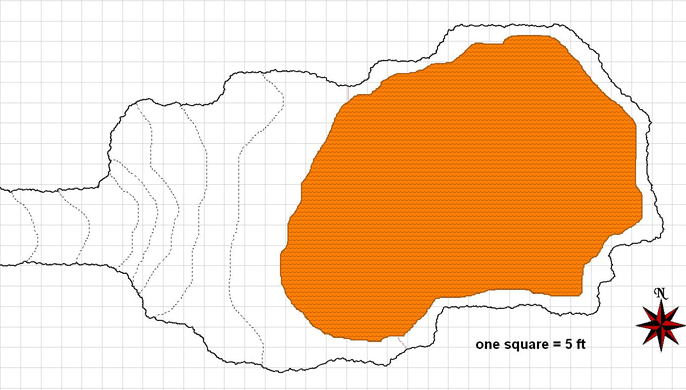 |
After the last bend, the passageway
will descend in a series of natural stone steps each about 1 ft
tall until it reaches the cavern proper.
| This cavern is bathed in a hellish glow emanating from a massive pit of magma roiling in the eastern part of the chamber. The ceiling is relatively smooth and 25 ft in height. Natural stone steps, each about 1 ft tall, descend towards the magma pit. A thin ledge of stone surrounds the magma, allowing a circuit of the pit to potentially be made. |
Examination of the floor of the chamber shows charring that indicates that perhaps at time the magma pool rises a bit.
The thin ledge surrounding the pool is fragile, being rather thin and its support having been eroded by the magma over time. As such, at any place east of the dotted red lines indicated on the map, any Large or larger creature putting its weight on the stone here will collapse the ledge into the magma pit. Any Medium creature has a 25% chance per round of the same (double this chance if fighting or running or jumping on the ledge or if wearing heavy armour). Any creature Small or smaller can negotiate the ledge without collapsing it even if conducting strenuous activity. Of course, the DM should adjudicate extraordinary circumstance like, for example, a Small creature that is very dense and weighs a lot such as a magmin (which weighs about 400 lbs.). If the ledge collapses, the DM should be generous and allow the PC to quickly step back. Therefter, if the PCs are determined to uncautiously continue to negotiate the ledge, allow a DC 10 Ref save to avoind falling into the magma pool.
Creatures: A flame brother salamander and its two magmin servants have recently come through a gate in the Elemental Plane of Fire to this magma pit. Enflaggirustivux had opened a full fledged permanent gate to that plane during his lifetime, but over the centuries the gate has eroded away until it now only works occasionally. The flame brother and magmin did not know this, and now are stuck here. They are fearful to leave the caves, as they do not like the environment outside, which seems cold to them and is prone to rain storms. They know that they are in the lair of the red dragon, having explored a bit and seen the various caverns and they have even espied the wyrmling from a distance, though they have no desire to tangle with the creature. The wyrmling does not yet know of their existence, as they hide within the magma and the wyrmling has yet to swim in the pool.
Currently, these creatures keep an eye out into the cavern, with at least one magmin always at the surface of the pool, mostly submerged. If creatures other than the wyrmling enter the chamber, they will gather and wait, hidden in the pool, until they feel the intruders are as close to the pool as they will get. Then the creatures will emerge to attack. Assume the creatures have all taken 10 on their Hide checks. The flame brother generally is in the pool towards the rear initially, floating on the surface but mostly submerged, with just his head and upper body above so that he can breathe.
The creatures have only one real goal...to open the gate to return to their home plane. The flame brother will howl in Ignan that it will let the PCs live if they open the planar gate within the magma pool. Given the likelihood of the PCs even understanding Ignan, let alone having some way to open the gate, the creatures are likely to press their attack, for they also have come to believe that maybe the sacrifice of a sentient being will reopen the gate (the flame brother knowing that many efreeti gates work in this fashion). Therefore, they will attempt to drag a helpless or unconscious foe into the magma pool while he is still alive, and the flame brother will certainly attempt to grapple a PC and drag him into the lava.
Keep in mind that the magmin do not need to breathe while in the magma pool, but the flame brother does. Also, moving through the magma pool is like swimming, and neither the flame brother nor the magmins have ranks in the Swim skill or a swim speed, though the pool is treated as calm water.
|
FLAME BROTHER SALAMANDER CR
3 Heat (Ex) A salamander generates so much heat that its mere touch deals additional fire damage. Salamanders’ metallic weapons also conduct this heat. Improved Grab (Ex) To use this ability, a salamander must hit a creature of up to one size larger than itself with its tail slap attack. It can then attempt to start a grapple as a free action without provoking an attack of opportunity. If it wins the grapple check, it establishes a hold and can constrict. |
|
MAGMIN (2) CR 3 Fiery Aura (Ex) Anyone within 20 feet of a magmin must succeed on a DC 12 Fortitude save or take 1D6 points of heat damage per round from the intense heat. The save DC is Constitution-based. Melt Weapons (Ex) Any metal weapon that strikes a magmin must succeed on a DC 12 Fortitude save or melt away into slag. The save DC is Constitution-based. |
Developments: Once the creatures have a PC or other victim in the lava, they will dive down to the bottom where the gate is and spend several rounds jury-rigging some sort of ritual. Needless to say, that will fail utterly. They will then be convinced that sacrificing sentient beings does not reopen the gate, and will be more willing to parley with the PCs (who may not be in the mood to talk at that point!) or simply stay in the pool until the PCs leave.
If the PCs can understand Ignan, they could try to use the Bluff skill to halt the assault upon them. By convincing the flame brother that they have a way to reopen the gate, the PCs could maneuver themselves into a more favourable combat position or even convince the flame brother to let some or all of the PCs leave the chamber. The DM should adjudicate such negotiations taking into account the alignment of the flame brother and their desperate desire to return home.
H. Slave Pens
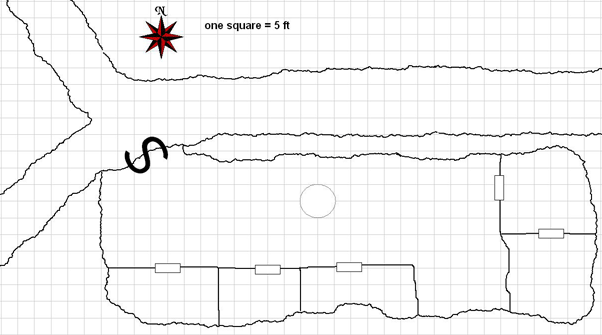 |
The secret door to this chamber
is ajar. It is carved to look like the wall of the passageway
when closed. The secret door is of exquisite craftsmanship, as
evidenced by the fact that despite its being 20 ft wide and several
inches thick, it is well balanced and opens relatively easily
(DC 16 Str check to open).
|
This long cave is 25 ft tall and the floor and ceilings are smooth. In the middle of the chamber, a 10 ft diameter pit descends out of sight. Rusted stubs of chains hang at various places from the ceiling, most no longer than a few feet and clearly were once part of longer lengths of chain. To the south are large stone doors, 10 ft square, with large, rusted iron pull rings set in them. To the east is a single large stone door, 10 ft square, with a large, rusted iron pull ring set into it. |
These were the slave pens of Enflaggirustivux, who often used charm and dominate spells to gather slaves. The rooms to the south and east were designed to hold slaves and prisoners, and the doors are fairly well balanced and require a DC 16 Str check to open. Each door can be locked from the outside by pulling out and then twisting on the pull ring (which a DC 25 Open Locks check or a DC 20 Disable Device check can determine on close examination). The rooms within contain a few ancient mouldering bones, rusted chains, and manacles.
The nubs of chains hanging from the ceiling once supported manacles and the like that the wyrm would use to string up victims and then play with them.
The pit in the center of the chamber is a well, 30 ft deep and now quite dry.
Creatures: The wyrmling lairs in this chamber, as he feels it is safer than the Horde Chamber (area D). His small size makes him feel more comfortable in a smaller living chamber. That said, the wyrmling's precise location during this adventure is dealt with below.
Treasure: While the hording instinct is strong in the wyrmling, he is still worried about thieves and so keeps his treasure at the bottom of the well. His entire horde currently consists of treasure taken from Haskimlip, the tribesmen, Equerry, and the warriors who accompanied the Indolle priest. This rather meager horde consists of 135 cp, 140 sp, 160 gp, 52 pp, a silver ring decorated with fate runes (25 gp), a gold and amethyst headband decorated with tiny scenes of caravans (175 gp), and a leather necklace with polished shells and two pearls (250 gp, with each pearl worth 100 gp).
I. Overlook
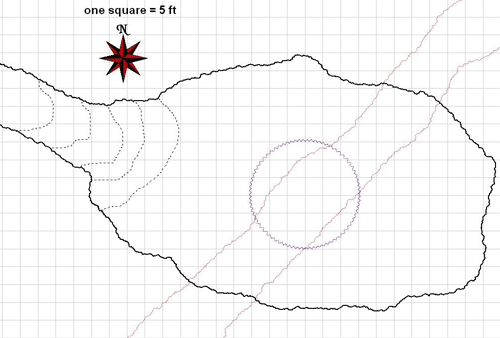 |
| This cavern is at the lower end of a set of natural stone steps that descend into the place. To the north, it appears as if a part of the wall has been excavated somewhat, and rubble on the floor nearby attests to this fact. |
The wyrm Enflaggirustivux used this chamber as a means to ambush intruders who might have come in through the Escape hatch (area J). This cave is set a mere 10 ft above a passageway that runs below it. This passageway runs southwest to northeast, the latter eventually ascending to the Escape Hatch. This lower passageway is shown on the map above in red dotted lines.
Enflaggirustivux rigged a large circular trap door of stone in the floor of this cavern, designed to look like the floor itself. The secret door is closed and requires a DC 30 Search check to locate. Even once located, the door'sopening mechanism is difficult to find, requiring another DC 25 Search check to recognize a nearby stalagmite as the lever opening the door. The lever is not easy to manipulate, requiring a DC 16 Str check to operate. Once it is manipulated, the trap door splits in half and each half rises straight up, exposing a 30 ft diameter hole in the floor that slants inward slightly at its edges to overlook the passageway below.
When closed, there are cunning cracks built into the door that allow sounds to come up from below. The door is sturdy anough, when closed, to support anything of Huge size or smaller. A gargantuan creature would cause the door to begin to groan and strain under the weight and might eventually cause it to buckle. Enflaggirustivux never stood on the door.
In its prime, when maintained, this mechanism opened almost soundlessly in a single standard action. Now, the door opens with a horrendously loud grating and grinding as rusted mechanisms try to function and takes a full round to open. This sound can be heard throughout the cave complex. The wyrmling is aware of the nature of the mechanism at this time. His father's learning crystals told him of it, and he has tried it on a few occasions. As such, the wyrmling will not use the overlook in any sort of stealthy way. That said, he might even use the noise to attract curious PCs.
J. Escape Hatch (EL 4)
This entire location is not mapped. From within the caves, the passageway simply comes to an end rather abruptly (about 100 ft before the location indicated on the map). A massive secret door is set into the end of the passageway and is closed, requiring a DC 30 Search check to locate. The secret door is of exquisite craftsmanship, as evidenced by the fact that despite its being 20 ft wide and several inches thick, it is well balanced and opens relatively easily (DC 16 Str check to open).
Beyond the door, the passageway continues for another 100 ft and ends in a plain cavern about 40 ft in diameter and with a ceiling some 30 ft high.
An illusory wall spell covers a 30 ft wide hole in the ceiling that leads to a shaft ascending up and to the east at a 45 degree angle for over 120 ft until emerging through another illusory wall spell and into the bottom of a 40 ft deep and 30 ft diameter natural-seeming pit in the floor of a 60 ft diameter cave that bears an opening to the east that is 20 ft square and screened by many vines and ivy growths.
This entire set up is designed to allow Enflaggirustivux to swiftly flee or emerge from his caves by this secret route if necessary, while still discouraging pursuit and discouraging random creatures from stumbling into his demesne from this direction.
Native creatures know of and use the upper cave that leads through the curtain of vines and ivy to the hillside, but almost no one bothers to actually descend into the 40 ft deep pit to tactilely search its walls and discover the illusion. Those that do have a harrowing descent down the 45 degree angle shaft before seeing yet another seeming dead end. If they probe that and discover the second illusion, then they will have to leave the lower cave, enter the passageway, and then come to another dead end, this time not succumbing to simple touch. They would then have to find the secret door to actually enter the caves proper.
From the other direction, if Enflaggirustivux were fleeing the caves, he would head down this passage (perhaps leaping down from the Overlook) and then open the secret door, closing it behind him if time permitted. He would them race into the lower cave and fly up through the illusion in the ceiling and up the shaft to the upper cave and the outside.
The wyrmling knows of the existence of the secret door leading to the lower cave, and he has been told by his father's learning crystals of the illusory walls and the lower and upper caves, though he has never visited either. The wyrmling is completely unaware of the inhabitant of the upper cave (see below).
The upper cave is currently inhabited. Because of this, it is mapped below.
 |
The dashed shape to the west represents the pit. The pit is 40 ft deep and seems natural as if it were formed as part of the cavern floor. The pit is fairly easy to scramble down (DC 15 Climb check just as with unworked stone). The illusory wall spell is set at the bottom of the pit in its western face.
The screen of vines and ivy at the mouth of the cave is shown as a dotted line. Almost no sunlight pierces the screen, so even in daylight the cave is treated as shadowy illumination unless the PCs have their own light sources.
From the outside, the cave opening is high on a steep slope and somewhat remote. The curtain of ivy and vines conceals the opening as well, making it very difficult to pick out at a distance from the rest of the jungle growth. A DC 15 Spot check is required to notice the opening from the outside (modified by distance of course).
Creatures: A large monstrous scorpion has taken residence in this cave, and it will be none too happy about anyone emerging into its lair.
|
ADVANCED MONSTROUS LARGE SCORPION
CR 4 Improved Grab (Ex) To use this ability, a monstrous scorpion must hit with a claw attack. A monstrous scorpion can use either its Strength modifier or Dexterity modifier for grapple checks, whichever is better. Poison (Ex) Sting, Fort DC 16, 1D4 Con/1D4 Con. |
The Reveal:
The defining moment in the scenario should be when the PCs realize that they are up against a red dragon. There are already a few ways this can happen presented in the descriptive text of the dragon caves (e.g. finding the dragon scale wedged in the crack in area E, finding the Chamber of Knowledge). However, the DM should consider making the reveal before then. Below is a sample:
| As the PCs traverse one of the passageways on the caves, they spy ahead on the floor the yellowed remains of bones mixed amongst some stone rubble and detritus. The bones are of a Medium humanoid, possibly a human being, and some bear charring. The bones seem to be lying atop a dusty shield of some sort, but when the PCs retrieve the "shield" they see it is actually a massive red dragon scale. |
The reveal should come at the right time. When is the right time? That is up to the DM, but it should be after the PCs have had a chance to explore some of the caves, happen upon some of the passage encounters, and begin to suspect that this is no ordinary mine they have entered. Ideally, the PCs should be allowed to explore areas A, B, C, D, and/or G before the reveal, and the reveal should occur as they head towards areas E, F, H, I, or J.
Immediately after the reveal, the wyrmling should attack, presumably with surprise. The attack should be its breath weapon from around a nearby corner. The sequence would then be:
1. The PCs begin to voice their opinions that they are not in any normal sort of gem mine
2. The PCs find the pile of bones and move to investigate the "shield"
3. The PCs retrieve the "shield" and the DM notes that the shield is covered in dust but there seems to be some texture and colour under the dust. The PC wipes away the dust, revealing the glittering red of a massive reptilian scale.
4. As the PCs gasp, the wyrmling breathes on them.
The idea is to scare to heck out of the players. Having just determined that their 3rd level PCs have entered a massive red dragon lair, they are suddenly breathed upon. For a moment the players should lose all hope of surviving, knowing that even if they save, the breath of a red dragon of even moderate size, let alone with scales the size of shields, will incinerate them. Have them roll saves and when they see that they have not all died, then let the PCs look where the blast came from and meet Westrymlex for the first time.
Of course, the reveal relies on the fact that the wyrmling is aware of the PCs and that the converse is not true. See below for more details.
The Wyrmling:
|
WESTRYMLEX CR 4 Keen Senses (Ex) A red dragon sees four times as well as a human in shadowy illumination and twice as well in normal light. It also has darkvision out to 120 ft. |
Note: The DM should generally assume that once Westrymlex is aware of intruders, he will have touched the augmentation crystal in the Chamber of Knowledge within the past hour, and therefore is under the effect of a mage armour spell that is not reflected in his statistics.
Wetsrymlex is fairly typical of a wyrmling of its race. While arrogance and greed war with cunning in his evil heart, the dragon is smart enough to know that he is not yet grown into his full birthright and that he must bide his time until then. This prudence has been reinforced by the posthumous teachings of his father.
As such, Westrymlex' encounter with the PCs will be a giant game of cat-and-mouse. Wetsrymlex will engage in hit and run strikes against the PCs, relaying on his breath to attack at range and his flying speed to then dash away. As necessary, he will proceed to the Chamber of Knowledge to heal himself at the crystal there.
The reveal (see above) assumes Wetsrymlex is aware of the PCs' intrusion into his lair. This is very likely, as the dragon diligently scouts and patrols his lair when not learning or sleeping. As such, unless the PCs are very stealthy, they are likely to be heard or their light seen well before they see the wyrmling. For dramatic effect, the DM can assume that at some point during the PCs' exploration that dragon hears or sees them and begins to stalk them.
The wyrmling will croodle behind the PCs, if they have light sources then lagging behind enough so that he can just follow the light source. For example, with a torch he can see the illumination from quite a distance. He will tend to stay behind a turn in the passage and watch the light source until it bobs just out of view, and then fly up at half speed (using Move Silently) to where he can land and peer around a corner and see the light source again. If the PCs have doused their lights, then he will have to follow within 120 ft, relying on his superior darkvision range to keep him hidden.
That said, there are numerous ways that the PCs can discover the dragon or can avoid the dragon discovering them. In such a case, the DM must decide where the dragon will be found. The most likely stationary place is area H, the Slave Pens.
Once combat is enjoined, the wyrmling will breath and then fly away until his breath weapon is recharged. He will make ample use of his Flyby Attack feat, to flap to a corner, breath, and then fly away. Even with his poor maneuverability, the dragon can execute a 180 degree turn in the 20 ft wide passages (just barely!). This means that the dragon can fly up 40 ft, breathe, and then fly back 35 ft. This will make it very difficult for the PCs to engage the creature.
That said, though as intelligent as a normal human being and with some advice given to him by his father, the wyrmling is still somewhat naive, and can be fooled or tricked by clever ruses from the PCs. Such ruses will likely be necessary should the PCs have any hope of slaying the dragon. Such ruses might include, for example, having a PC pose as injured and left behind while the other PCs hide in ambush in a dead end cave so that the dragon can be cut off from escape.
Lacking such a clever plan, the PCs will be fighting a losing battle against the red dragon given its mobility, the voluminous nature of the caves, and its free healing in the Chamber of Knowledge. Smashing the crystal in that chamber can help turn the tide of battle.
If the dragon is sorely pressed, it will use the Escape Hatch to flee, presumably flying right past the monstrous scorpion in the upper cave and agitating it enough so that when the PCs enter (if they ever do) it will be ready to attack them. If the wyrmling flees, it will slowly try to reclaim its lair. In any event, should its small horde be stolen and/or its father's memory crystals be destroyed, then the dragon will remember this slight and should it survive to become a fearsome adult red dragon, woe betide the PCs, for it will remember their faces and any names they may have called each other while it stalked them.
Fleeing and Returning:
The wyrmling has and will leave the caves, as it did to attack Haskimlip's mining camp. However, it will not leave out of sight of the cave entrance. As such, the PCs can certainly flee the caves and evade pursuit. As long as they do not camp within sight of the entrance, they can rest unmolested from the dragon (other creatures are another story entirely and the DM should consult the random encounter charts). Presumably, the PCs have an excellent chance to retreat from the first shocking encounter with the wyrmling, rest and memorize spells conducive to fighting a red dragon (resist energy comes immediately to mind), and devise a trap for the creature.
The wyrmling has had little experience with formidable foes. He doesn't know much about the working of magic either, though his father has explained the very basics. As such, given his easy experience in defeating the first two groups of humans he met, he will likely underestimate the PCs if they flee the caves. He will assume the PCs have been routed and won't really consider that they might return (in fact, he should be worried that they will return with reinforcements!). If the PCs do return, and retreat a third time, then the wyrmling will be on his guard and expect the PCs to return a fourth time.
If the PCs return to Chindar Town with news that the scion of Enflaggirustivux lives within the cave, then the Chieftain will demand proof, for he will not be duped into lending more of his men on another expedition into the interior otherwise. If proof is brought to him, the Chieftain will eventually mount an expedition. However, thinking there might be a dragon's horde hidden within the caves, he will forbid the PCs to accompany him and will march off with a small army (perhaps 30-40 warriors) to certain glory. The wyrmling will flee at the sight of the approaching army out the Escape Hatch, and the place will be looted. The PCs will miss out on any XP and treasure, including the chance to use the dragon's hide to produce size Small hide armour from the wyrmling's scales.
Part Five - Returning
The PCs have no chance to fully succeed on their mission. Why? Because there was never a gem lode in the first place, so it is impossible to reopen the gem mines! That said, there is plenty of opportunity for reward here. First, the wyrmling has a small horde in the well in area H. Second, the wyrmling's hide can be made into a suite of small masterwork dragonhide armour. Third, the simple fact that the PCs have managed to slay a red dragon (nevermind it is a hatchling) is a bragging right in and of itself. Fourth, the Chindari will be very impressed if the PCs return to Chindar Town with news of what happened with the gem mine, and the dragon's head in tow. If they can convince the Chieftain that they have slain the progeny of the great ancient fire serpent and prevented him from renewing his father's horrific tyranny (requiring a DC 15 Diplomacy check with a +5 circumstance bonus if Inghaku is present) then the Chieftain will reward the PCs with a +1 dagger of some sort of obsidian-like material said to be made from the tooth of the great fire serpent himself. The PCs will also have the gratitude of the Chieftain. Inghaku, if he is with the PCs, will return to the spirit realm.
Even if the PCs snuck into the interior, if they manage to convince the Chieftain of the existence of the fire serpent's progeny, then he will forgive them their crimes but order them never to return to Indar Island on pain of death.
If the PCs bring proof of Equerry's fate to the Indolle Temple in Chindar Town, the clerics there will be grateful and will offer the PCs the same magic items they would have offered them as aid as listed in that section of the scenario text. They will only offer these items if they were not offered originally. Proof of Equerry's fate will require the masterwork staff, as the holy symbol, headband, and charred robes are not distinctive enough to be proof to the clerics.
Ravis will be grateful to the PCs for returning to Leaf Port with news of what happened. The PCs will likely have to send word to him, and it will take a few weeks for him to arrive. He will be sad at the loss of both Equerry and Haskimlip and just as sad that his latest venture has failed like many of his others in the past. Bemoaning his cursed fate, he will pay the PCs their reward for finding out what happened but, of course, not for reopening the gem lode.
Experience Points:
In addition to normal experience (which in Therra is half of that recommended in the DMG), each party member should be rewarded as follows: