
Return to the Therran Scenario Page
Summary:
The PCs traverse the Coatlizin Jungle and encounter the reclusive killoren, learning that they have been plagued by angry manifestations of nature. The PCs have an opportunity to aid the killoren by slaying their nemesis, and then must make their way across the Land of Aladur to treat with the killoren elders.
Assumptions:
The PCs are travelling to the land of Aladur (for any reason desired)
Location:
Aladur
Historical Date:
701 A.C. Mechinahcatlinatl (summer)
DM's Introduction:
The premiere sentient race of the northeastern tip of the Coatlizin Jungle, as well as the land of Aladur, is the killoren, a group of fey native to the region.
The Aladur region was, before the Creation Blast, a wild and unsettled land, and the Lake of Refuge at its center (known as Lake Ithaminoine in Aquan) was inhabited by a powerful and benign water spirit named Talinwique, who named the Lady of Rivers (known to the Azotchlan as Chalchihuitlicue [chal-CHEE-hweet-lee-CUE-eh]) as her mother.
When Okoth and his volunteer army marched south with the a creation cyst to annihilate the Serpent Empire, he passed through lands that he had seen many times before, but always as a sarrukh and never as one whose eyes had been open to beauty and truth. This time, travelling the beautiful lands of the Lake Tir region and the lake that now bears the name Poison Lake, he saw the wonders of the land with eyes anew and its beauty moved him. He knew that the blast unleashed by the creation cyst was likely to decimate this land, and although he had no way to shield the land from the blast, he felt he should at least attempt to save the spirits of the land and the many lakes, rivers, and streams that were in the area. And so, at great risk, he informed the six most powerful and trustworthy of the spirits of his plan and swore them to great oaths of secrecy and instructed them to go to the "land in the bosom of the mountains".
The spirits left, with heavy hearts and arrived in Aladur and found the Lake of Refuge. After speaking with Talinwique and pleading their case to her, they immersed themselves within. And Talinwique bade them to descend to the deepest portion of the Lake, and there to take shelter in a spiritual refuge accessible by a mystic crossroads of nature magic that was at the bottom of the Lake. For only by so sheltering themselves from the blast could the spirits hope to not perish. The danger to the spirits was not physical, for Aladur itself was shielded and distant enough to avoid the main effects of the blast, but rather psychic, for the spirits were all intimately attached to their lands, and devastation of their lands and waters would corrupt, destroy, or drive them mad just as surely as if they had remained in the blast itself. Only by taking refuge in the mystical realm accessed at the bottom of the Lake could they withstand the psychic shock of the loss of their lands and endure.
The blast did not harm Aladur, but even in their refuge, the devastation of their lands and waters affected the collected spirits and filled them with anger and frustration and a desire to protect what was now their refuge. This desire, mingled with some of the creative essences of the blast that did manage to waft their way over the mountains and into the land, caused the birth of the killoren, who are a people directly descended from the land of Aladur itself and imbued with the spark of sentience by the collective will of the spirits that have taken refuge here. Such a feat was unique, for in general only divine beings of godly stature can create new sentient life whole cloth. But the circumstances of so many spirits collected together in one place, their extreme psychic turmoil, and the collateral effects of the creation blast all combined to allow this to occur.
The killoren have, in the seven centuries since their creation, propagated and prospered so that they can truly be said to be the caretakers and guardians of the land of Aladur and the nearby portion of the Coatlizin Jungle that is cradled between Mallar's Peaks and the Lake of Refuge.
For many long decades, the spirits huddled at the bottom of the Lake of Refuge could not stand to emerge into the world again, for their loss was too traumatic, and even emerging to the bottom of the Lake was too much, as they could sense, taste, and feel the lingering distress and death of their old lands even across such vast distances. And so they remained in hiding. But this, too, was no solution, for such spirits thrive on the land and sun and air and cannot remain forever locked in hiding, removed from the world of which they are an inherent part. And so Talinwique and the killoren developed the ritual of Erytimbre (Marriage of Nature) which in essence married a worthy killoren with one of the hidden spirits.
This ritual marriage serves to divert much of the psychic bond that the spirits still hold with their devastated lands. Instead, much (but not all...for if the bond were fully severed they would die) of the bond is redirected to bond with their killoren spouse, and through that bond, an indirect bond with the land of Aladur or the Lake of Refuge itself. In this way, the orphaned spirits become somewhat tied to the healthy and prospering land of Aladur.
Because killoren are effectively immortal (though having been created 700 years ago there is no empirical evidence to this effect, they simply stop aging at about 100 years of age), these marriages to the spirits are permanent and long-lived (which is perfect for the immortal spirits). The only time a new marriage must be made is when a spouse dies due to unnatural causes (accidents, beasts, what have you). As such, these marriages are important and rare events, and the choice of a spouse is a long and arduous process that includes rigourous tests amongst the killoren candidates. In the history of the killoren, other than the initial marriages that took place over 600 years ago, only 3 marriages have taken place.
Recently, one of the Uryltimbri (Spouses of Nature) died due to an attack by a very large and powerful ahuizotl named by the killoren as Ambacras (Most Dangerous). Devoid of its link to her spouse, the spirit married to the Uryltimbre had to withdraw to the bottom of the lake and cross into the mystic realm to await a new spouse. This spirit, whose name is Hlavanaque was born of one of the most serene and peaceful bodies of water in the region of Poison Lake. As such, her beauty, both physical and mystical, transcends almost into the realm of the divine. When she came into the place of refuge, she was espied by the spirit of the land of Aladur (named Gyrmashil) that dwells within the mystic realm and calls it his own. When this same spirit had witnessed Hlavanaque centuries before, he was struck by her beauty and desired to have her. But as Hlavanaque was in the company of five of her fellow spirits, Gyrmashil did nothing and when the spirits left his realm, he thoght often upon Hlavanaque's beauty and desired her more and more, jealous that she was married to a mere killoren. This time Gymashil gave into his desires and took Hlavanaque, desiring that she marry him. But Hlavanaque does not desire Gymashil, both for his crude way of abducting her and because he is mystically bound to his realm, which is tied to Sazhansiir but not truly a part of it. A marriage to Gymashil would not alleviate her psychic pain to the same extent that a marriage to the killoren would.
As Gymashil grows more and more frustrated, for he knows the killoren will eventually choose a mate for Hlavanaque and begin to miss her, his anger has become manifest in the lands over which he is guardian, such that strange manifestations of nature have begun to appear throughout the land. These manifestation have caused worry to the killoren, but so far they cannot figure out why they are happening. As guardians of the land, they know that these manifestations are, themselves, natural (though not normal) and so do not suspect corruption or some other profanation that is creating these manifestations directly. Nevertheless, something is wrong, and they are becoming more and more agitated.
Into this comes the PCs, who will receive anything but a warm welcome from the killoren or from the land itself.
Part One - The Angry Jungle
The PCs are travelling though the Coatlizin Jungle on their way to Aladur and are attacked by a manifestation of Gymashil's anger. They later meet a group of killoren who are travelling to take their revenge upon Ambacras and, upon helping them defeat the beast, are "invited" to accompany them back to their homes in Aladur.
Coatlizin Jungle:
The Coatlizin Jungle is a thick and wild jungle, somewhat untamed even by the Scaled Ones, especially in the northern section between Aladur and Mallar's Peaks. The jungle is thick and trackless, and in summer the heat and humidity can be oppressive, though less so than in the Erinquiril and Quazilchatl Jungles.
DMs should treat the jungle as dense forest with the mixture of light and heavy undergowth and typical and massive trees as stated in the Dungeon Master's Guide.
The jungle is dense enough that any travel at faster than a speed of 40 ft, while allowed on a tactical level, is dangerous enough that such travel cannot be used on an overland basis or on a pursuit basis unless the traveller has some means of mitigating running into trees, snagging on vines, hitting low hanging branches, etc. Creatures instinctively native to the jungle can bypass this restriction and travel at a speed up to 60 ft.
DMs should keep in mind both the maximum Spot distance of 2d6x10 ft and the fact that Listen checks are reduced by 2 per 10 ft due to the background noises.
As this scenario is taking place during the summer, the DM should assume a 25% chance that on any given day the heat will be equivalent to Hot (see Sandstorm page 12). Although the jungle canopy keeps out much of the sunlight, the humidity serves to make the jungle stifling in very hot summer days. On these Hot days, PCs will suffer the effects listed in Sandstorm unless they take the necessary precautions. As this heat is not a result of direct exposure to the sun, protections like parasols will not work to mitigate this heat. Endure elements spells will mitigate this effect entirely. DMs should also note that wearing armour can exacerbate the heat as mentioned in Sandstorm.
Dehydration is also an issue, as PCs will consume 2 gallons per day (instead of 1 per day) on Hot days. There is plenty of water to be found in the jungle, if the PCs wish to drink from such sources.
Food sources are also present in the jungle, including a large variety of fruit along with tubers, fungi, etc. However, sampling these can be dangerous. if the PCs attempt to get along in the wild, using the Survival skill, any PCs not native to the Coatlizin Jungle will suffer a -5 circumstance penalty to their check. Furthermore, if the check is failed by 5 or more, then the DM can assume that some sort of tainted food was gathered and the PCs partaking could be subject to poison effects, fatigued, sickened, nauseated, or some other more exotic effect (such as confusion or hallucinations).
Wandering Encounters:
The trek through the jungle is about 300 miles, assuming the PCs are cutting across the middle of the finger of jungle that points northeast towards the mountains. Normal travel speed is 4 miles per day (at speed 20 ft), 6 miles per day (at speed 30 ft) or 8 miles per day (at speed 40 ft). This means traversing the jungle will take 75, 50, or 38 days.
If a PC has enough Survival skill to make a DC 15 check, he can trailblaze (see Complete Adventurer page 103) and cut the travel times in half. Keep in mind that there is a -2 penalty to the check for every 3 (or fraction thereof) individuals being guided beyond the trailblazer and 3 companions.
Finally, spells like wind at back can further reduce travel time.
The jungle is full of life, and PCs will encounter plentiful insects, birds, and other normal, harmless flora and fauna. Sounds of the jungle, including hoots, screeches, chirps, and even roars are plentiful day and night.
Actual encounters are checked for each of four periods of the day, morning, afternoon, evening, and night. Assume the PCs travel during the first two periods and are encamped for the last two periods. There is a 15% chance of an encounter each period. If an encounter is indicated for a period, the DM should check again to see if a second encounter is indicated. If so, then a third check should be made and so forth until a check fails for that period. Multiple encounters in a given period can be spaced apart randomly (i.e. roll a d6 for hour in the period) or can be mixed together into a multiple encounter.
Nighttime encounter chances can increase or decrease depending on the type of camp that is set up:
PCs light an unshielded fire = +10%
PCs light a shielded fire = +5%
PCs make no effort to find a secluded or safe campsite or fail a DC 15 Survival check to find such a spot by 5 or more = +5%
PCs make a DC 15 Survival check to find a safe or secluded campsite = -5%
PCs make noise (singing, etc.) = +5%
Of course, PCs of the level appropriate for this scenario likely have magical means to encamp, including the various shelter-spells and the ever-useful rope trick.
The DM should not seek to foil any measures such as rope trick that the PCs have taken to ensure their safety. After all, that means they have forsaken other spells to memorize these magical means of encamping. In general, such means will involve no encounters during the night, but encounters may occur during the evening, as the PCs must still spend time outside washing, eating, cooking, praying, and practicing their skills. Unless PCs ensconced in concealed magical lodgings wish a running account of the various creatures that blunder past them in the night, the DM should simply not even roll for encounters during the night unless there is a chance that a creature encountered could somehow interact with the PCs.
If an encounter(s) is(are) indicated, refer to the table below.
Full statistics and the like are not presented in this scenario in order to save time and space. It is suggested that the DM preroll for wandering encounters and craft interesting situations to accommodate the encounters.
|
|
|
|
|
| 01 | Amphisbaena | 1 |
Serpent Kingdoms pg 62 |
| 02 | Ant, Giant * | var | Monster Manual pg 284 |
| 03-05 | Ape | 1d6 | Monster Manual pg 268 |
| 06-07 | Archer Bush | 1d20 | Tome of Horrors pg 20 |
| 08-12 | Baric | 1d8 | Tome of Horrors pg 28 |
| 13 | Bee, Giant | 1d20 | Monster Manual pg 284 |
| 14-16 | Beetle, Giant * | var | Various |
| 17 | Boalisk | 1 | Tome of Horrors pg 40 |
| 18-20 | Centipede, Monstrous * | var | Monster Manual pg 286 |
| 21-22 | Dinosaur * | var | Various |
| 23-24 | Dire Ape | 1d8 | Monster Manual pg 62 |
| 25-28 | Dire Hawk | 1d2 | Races of the Wild pg 189 |
| 29 | Dire Maggot | 1d6 | Libris Mortis pg 95 |
| 30-34 | Dire Rat | 1d20 | Monster Manual pg 64 |
| 35-36 | Dire Snake | 1 | Monster Manual II pg 74 |
| 37 | Dire Toad | 2d10 | Monster Manual II pg 74 |
| 38-40 | Fly, Giant | 1d12 | Tome of Horrors pg 202 |
| 41 | Forest Sloth | 1 | Monster Manual II pg 106 |
| 42-43 | Frog, Monstrous Poisonous | 2d10 | Tome of Horrors pg 206 |
| 44-45 | Gambol (see note A) | 1d6 | Monster Manual II pg 108 |
| 46-48 | Leopard | 1d2 | Monster Manual pg 274 |
| 49-51 | Lizard, Giant | 1d6 | Sazhansiir Gazetteer |
| 52 | Maggot, Monstrous | 1d12 | Underdark pg 88 |
| 53 | Marble Snake | 1d4 | Tome of Horrors pg 262 |
| 54 | Mudman | 1d12 | Tome of Horrors pg 272 |
| 55-57 | Needlefolk (see note A) | 1d8 | Monster Manual II pg 158 |
| 58 | Red Sundew | 1 | Monster Manual II pg 179 |
| 59-61 | Snake, Constrictor | 1 | Monster Manual pg 279 |
| 62-63 | Snake Constrictor, Giant | 1 | Monster Manual pg 280 |
| 64 | Snake, Dung | 1 | Serpent Kingdoms pg 83 |
| 65 | Snake, Flying | 1d8 | Races of Faerun pg 177 |
| 66-71 | Snake, Viper * | var | Monster Manual pg 280 |
| 72 | Snake, Winged Viper | 1 | Forgotten Realms Campaign Setting pg 309 |
| 73-75 | Spider, Bloodsilk | 1d20 | Monster Manual IV pg 24 |
| 76 | Stegocentipede | 1 | Tome of Horrors pg 330 |
| 77-82 | Swarm, Bat | 1d20 | Monster Manual pg 237 |
| 83-84 | Swarm, Needletooth | 1d4 | Monster Manual III pg 109 |
| 85-86 | Swarm, Plague Ant | 1d8 | Fiend Folio pg 167 |
| 87-89 | Swarm, Spider | 1d12 | Monster Manual pg 240 |
| 90-92 | Tick, Monstrous | 3d4 | Tome of Horrors pg 344 |
| 93 | Tiger | 1 | Monster Manual pg 281 |
| 94-96 | Tri-Flower Frond | 1d10 | Tome of Horrors pg 347 |
| 97 | Vampire Rose | 1d4 | Tome of Horrors pg 360 |
| 98-99 | Vinespawn | 1 | Monster Manual V pg 198 |
| 00 | Witherweed | 1 | Tome of Horrors pg 368 |
Note A = these creatures will not be encountered until after planned encounter #1 below (in order to preserve the surprise of that encounter). If such encounters are indicated before then, reroll.
* = creature encounter divided into subtypes per the tables below
Ant, Giant:
These will be encountered as follows:
01-50 = 1d12 workers (plus 1 soldier
if 6 or more encountered)
51-85 = 1d4 soldiers
86-00 = 1dd+6 workers and 1d4+1 soldiers
Beetle, Giant:
These will be encountered as follows:
01-20 = 1d10 bombardier beetles
(Monster Manual pg 284)
21-70 = 1d10 boring beetles (Tome of Horrors pg 33)
71-85 = 1 deathwatch beetle (Tome of Horrors pg 33)
86-00 = 1d4 slicer beetles (Tome of Horrors pg 35)
Centipede, Monstrous:
These will be encountered as follows:
01-27 = 2d8 tiny centipedes
28-53 = 1d12 small centipedes
54-64 = 1d6 medium centipedes
65-75 = 1d6 large centipedes
76-86 = 1d6 huge centipedes
87-93 = 1 gargantuan centipede
94-00 = 1 colossal centipede
Dinosaur:
These will be encountered as follows:
01-10 = 1d2 allosaurs (Monster
Manual II pg 70)
11-20 = 1d2 ankylosaurs (Monster Manual II pg 70)
21-30 = 1d2 certosaurs (Serpent Kingdoms pg 64)
31-40 = 1d6 deinonychi (Monster Manual pg 60)
41-50 = 1d6 megaraptors (Monster Manual pg 60)
51-62 = 1d4 quetzalcoatli (Monster Manual II pg 72)
63-67 = 1 seismosaurus (Monster Manual II pg 72)
68-72 = 1 spinosaurus (Monster Manual II pg 72)
73-00 = 4d4 swindlespitters (Monster Manual III pg 41)
Snake, Viper:
These will be encountered as follows:
01-30 = 1 tiny viper
31-60 = 1 small viper
61-79 = 1 medium viper
80-97 = 1 large viper
98-00 = 1 huge viper
Part Two - Planned Encounters
The following are planned encounters for the Coatlizin Jungle. The DM can space them out as he sees fit. The first encounter has nothing to do with the scenario plot and is, instead, presented in addition to the wandering monster tables above in order to provide some insight into the ecology of the Coatlizin Jungle.
The final two encounters, however, deal with the scenario plot and should be administered when the PCs are about halfway through the jungle (about 150 miles into the jungle).
Encounter #1 - Needle in an Ape Stack (EL 10)
The PCs will be travelling through the thick jungle when they suddenly emerge into a clearing.
On the map above, the PCs will enter from the west, as indicated by the red arrow. The jungle surrounding this clearing is thick, and the PCs will likely have no idea they are approaching a clearing until they clear away the last bit of undergrowth and are right at the edge where the red arrow ends.
G = gambol
N = needlefolk
The green area represents the jungle, and every square should be treated as heavy undergrowth (4 squares of movement to move into, provides concealment with a 30% miss chance, increases the DC of Tumble and Move Silently checks by 5, easy to hide in, granting a +5 circumstance bonus on Hide checks, running and charging are impossible) with a surfeit of massive trees punctuated by typical trees. The actual treees are not shown on the map, and the DM should feel free to place these liberally should it be required.
The water hole's muddy banks slope sharply down to a depth of 10 ft at the center. It is fed by an underground spring.
Creatures: In the clearing will be seen a large baboon-like primate about 9 ft tall (if it were standing upright). Its purple skin is covered with dense, silky blue hair and it has elongated jaws and a hairless, doglike muzzle.
This is a gambol, and the creature crouches near a water hole and has downed a rather large deer-like creature and it grasps in one hand. The deer is Large sized and clearly the gambol cannot easily just grab its food and leap away.
The gambol will immediately be aware of the PCs unless they have taken some extraordinary action to move through (or over) the jungle quietly. Otherwise, the gambol will have heard the approach of the PCs for a few rounds and, now seeing the intruders come into its midst, will use its surprise round to issue a shrieking howl, which is is its fear aura, attempting to scare the PCs away from its kill. The howl will also serve to alert four other gambols in the area, who will arrive in the treetops in groups of two in 1d3+1 rounds (from random directions).
However, once gambol howls, the clearing will erupt with needles that shoot from the jungle flanking the clearing. A group of needlefolk, implaccable enemies of the gambols, has staked out this watering hole in the hope that a known pack of gambols would make an appearance. The needlefolk were waiting for more than one gambol to show up, so that they could attack the whole pack (or at least more than 1 member), but the appearance of the PCs and the gambol's alerting howl has forced them to launch their attack now. So the needlefolk will use a surprise round of their own to attack the gambol right after it uses its surprise round to howl. The needlefolk, being plants, are immune to the effects of the howl.
Should the PCs somehow make contact with the gambol before it is aware of their presence, they will see the gambol snort happily and begin to tear open the deer carcass and feast. The smell of blood and sound of feeding will eventually bring the other gambols to the clearing in about 2d6 rounds and their noisy approach, shrieking and howling in the treetops, will be heard in half that time.
Eventually all five gambols will enter the clearing and some bickering will begin over the carcass, with some sneering, howling, chest-beating, and general displays of prowess. This will not last for more than a round or two before the needlefolk launch their attack.
|
GAMBOLS (5) CR 5 Fear Aura (Su) When a gambol howls, every creature within a 100-foot radius must succeed at a Will save (DC 13) or become panicked for 1d6+1 rounds. Whether or not the save is successful, the creature is then immune to that gambol's howl for 24 hours. The howl is a sonic, mind-affecting fear effect. Great Leap (Ex) A gambol gains a +25 bonus on Jump checks (included in the above statistics). Maximum distance restrictions do not apply to its jumps. Haste (Su) A gambol can take an extra standard action each round. This ability is always active. Masterful Dodge (Ex) As a free action once per round, a gambol can dodge one ranged weapon attack, one reach melee weapon attack, or one spell that requires an attack roll by making a successful Reflex save (DC 20). An attack using a weapon with an enhancement bonus increases the save DC by the amount of the bonus, and a spell adds its level to the save DC. To use this ability, the gambol must be aware of the attack and not be flat-footed. |
|
NEEDLEFOLK (16) CR 2 * A needlefolk's colouration and needles give it excellent camouflage in the forest. While there, it has a +16 racial bonus on Hide checks when stationary. This bonus drops to +8 if it moves at up to half speed. |
Tactics: The needlefolk will launch their attack and snipe, taking a -20 penalty to their hide check to remain hidden from the gambols. Given the gambol's low Spot check, it is not at all out of the question for many of the needlefolk to remain hidden, in which case they will fire again and again. However, the needlefolk are not very clever, and if more than one gambol is in the clearing, they will divide their fire equally amongst the gambols, assuming all are the same chance to attack. if not, each needlefolk will choose the gambol(s) that are easiest to hit.
The gambols, being the ferocious beasts that they are, will simply howl with rage and make aggressive displays (which will be ineffective and basically waste their first round of combat with the needlefolk) and then charge the needlefolk, with absolutely no coordination whatsoever. Each will head to the nearest needlefolk he sees and attack it. Should a gambol see no needlefolk, it will simply howl and jump around in frustration instead of charging in the direction from which the needles are coming.
As long as the needlefolk are in sight or attacking the gambols, the gambols will ignore the PCs unless the PCs begin to attack the gambols or interfere in the fight.
Needlefolk who are attacked by the gambols will attempt to disengage, for they know they are no match for the apes physically. They will instead attempt to disangage and, as part of their movement, hide if they are out of sight (e.g. behind a massive tree) or otherwise attempt to create a diversion (needlefolk's Bluff -3 against gambol's Sense Motive check of +1). Once in hiding, they will attempt to snipe the best target, preferring to return to the edge of the clearing and attack any gambols who remain there.
Developments: The needlefolk will flee the combat if a third of their number fall in combat. The gambols will chase them for a short time before returning to take their deer kill, squabbling over it once again and eventually devouring it.
Each gambol flee if reduced to 10% of their hit points. While they hate the needlefolk, they have no wish to die for a bit of deer.
The PCs are entitled to react to this situation however they like. If they have had prior contact with dakons, they may be inclined to initially assume that the gambols are intelligent and side with them. However, a close observation of their action may indicate to the PCs that the gambols are not sentient. The gambols will not, of course, be grateful for any aid and will, likely, consider the PCs as potential food and turn on them once their hated needlefolk enemies are gone. In fact, should the PCs enter striking distance of a gambol even if fighting on their side, it is likely the gambol will take a swipe at the PC if no needlefolk are in reach.
The PCs can also side with the needlefolk. The needlefolk do encounter humans on rare occasions usually Valasti or Fezen, and don't really have much to do with them, so they will initially be indifferent to the PCs. If the PCs side with them against the gambols, then the needlefolk will gratefully fight alongside the PCs and will likely, after the fight, be willing to parley with the PCs, assuming the latter can speak with them. Their language, called Sazhan, is basically a language of the land of Sazhansiir itself, much in the same way that Sylvan is the language of the land of Jerranq. In fact, Sazhan is very much akin to Sylvan, the latter of which is an aglomeration of Aquan, Auran, Ignan, and Terran with a tiny bit of Draconic thrown in. Sazhan is also an aglomeration of the four elemental languages (with no elements of Draconic) but in an entirely different mode than Sylvan. A speaker of Sylvan who hears Sazhan will recognize some familiar sounding word roots but will not be able to understand it (and vice versa).
The needlefolk are not very bright, and they don't have anything resembling a civilization or even a real community. They use no tools and wear no clothing. They use nothing, in fact, but their own limbs and needles, and when they sleep they basically plant themselves into the ground and look like small saplings with vague faces at the top. A group of needlefolk do tend to cluster in groves and grove-mates do thend to stick together and occasionally mass for ambushes such as the one presented here. But otherwise needlefolks have no leaders and no real sense of tribe or community. As such, striking an agreement with these needlefolks won't really mean much of anything, and will be nothing to other needlefolks encountered.
Because they have little to no dealings with other races, and not much more with their own kind, the needlefolk are not accustomed to social niceties like gratitude. They will remark upon the prowess of the PCs and comment on their pleasure at seeing the gambols slain or routed, but beyond that they will not be inclined to warmly thank the PCs or to offer them any rewards.
If questioned about the jungle and the land of Aladur beyond, the needlefolk can, in somewhat eccentric terms, describe various native creatures and proclaim that Aladur ("the treeless land around the lake") is claimed by the "folk of the land" who call themselves the killoren. The needlefolk commonly see killoren in the jungle and Aladur, but have almost no dealings with them, as the killoren pose no threat to them and they need nothing from the killoren.
If asked about their hatred of the gambols, the needlefolk will simply say that this has always been since the trees were young.
Encounter #2 - Land's Malice (EL 11)
The PCs will be attacked by a beast of malar (known in Sazhansiir as a beast of malice). This creature is a manifestation of Gyrmashil's growing anger and frustration at the rebuff of Hlavanaque and will attack any sentient beings it meets. Ostensibly, its anger is directed at the killoren, but its rage does not allow it to make distinctions between sentient beings.
Stalking the PCs:
The beast will be in hunting panther form when it picks up the PCs' scent and begins to Track them (unless all of the PCs are airborne, in which case it will simply espy them in flight in bat form and attempt to engage). Although the beast cannot move long-term faster than speed 40 ft through the thick jungle, its speed of 60 ft does allow it to move at 30 ft and get its full Track chance. The base DC to track is 10, as the jungle is considered soft ground due to the disturbance of the undergrowth that the PCs will have to make to pass through the jungle. Assuming there are 3 or mroe PCs on the ground, then the final DC is 9, which means the panther succeeds on a roll of 4 or more. The beast can also Track by scent for a DC 10 check (modified by the number of PCs and with a +2 to the scent DC for each hour the trail is old).
The panther will have a chance to pick up the trail about 2 miles behind the PCs in late morning. If it fails to pick up the trail initially, then the encounter will occur later as described below under "No Stalking". Otherwise, it will begin a chase, travelling at speed 30 ft as long as the trail does not seem to be getting colder. Since the beast knows the jungle instinctively, it is treated as travelling along a road or trail, so its overland movement is at x1/2 instead of x1/4. This means at speed 30 ft it will cover 1.5 miles in an hour, while a normal group of PCs will cover .75 miles during the same time. Catching up to the PCs would therefore require 3 hours (and 3 Track checks).
Should the beast lose the trail once it has picked it up it will continue to try to find the trail again, being willing to spend up to 24 hours doing so. If 24 hours go by without picking up the trail, then the beast will give up and the encounter will occur later as described below under "No Stalking". However, waiting 24 hours to find the trail also means that if the PCs have encamped in some sort of magical shelter, the beast will be inthe area when they emerge unless 24 hours have gone by.
Should the beast have the trail but realize that it is getting colder (by making a DC Track check for scent), then it will pick up its speed, moving at 60 ft per round. This will cause it to have to take a -5 penalty to its Track check, however. If, even at this speed, the beast cannot gain on its quarry, then it will give up and the encounter will occur later as described below under "No Stalking".
Should the beast catch its quarry, it will begin the encounter 70 ft behind the PCs and will begin to Move Silently at a speed of 60 ft, choosing a patch of light undergrowth for its approach (at a -5 penalty for moving at full speed plus a -2 penalty for the light undergrowth) so that it can charge the rearmost PC from a distance of 30 ft and pounce in its surprise round. If the PCs detect its stealthy approach before it can pounce, then there will be no surprise round and initiative will be conducted normally.
No Stalking:
If the beast cannot find the PCs, then they will still encounter the beast, but in a fashion that all but negates any chance that the beast will surprise them. In this way, the encounter will still occur, but the PCs are rewarded for any precautions they have taken to disguise their passage (or if blind luck or travelling very quickly just happens to save them from being stalked).
In this case, the PCs will hear a thin, reedy shriek not too far ahead of them in the jungle, followed by a roar that is, at the same time, fiercely feline but with a tinge of some brutal quality that defies experience. A DC 15 Knowledge (nature) will certainly determine that while the roar has the quality of a large hunting feline, there is something wholly supernatural about the sound, something that evokes brutality, wanton violence, and deep anger.
Should the PCs investigate, they will come upon the beast in panther form, savagely ripping apart the carcas of a needlefolk. The slayer will use its scent ability should the PCs come within distance of it. Roll a d4 to determine the wind direction, and on a 1 the PCs will be upwind (scent range of 60 ft), on a 4 downwind (scent range of 15 ft), or otherwise neither (scent range of 30 ft). Whether by scent, Spot check, or Listen check, should the beast become aware of the PCs, it will leave off its carcass and attack the PCs.
Identification:
A DC 20 Knowledge (nature) check will reveal that these creatures are known as beasts of malice. They are extremely rare, but occur in any part of Therra where the spirits of nature are strong. Such beasts represent a manifestation of great anger or malice by powerful nature spirits, often in response to the depredations of sacred lands by creatures or beings. The beasts are known to be quite vicious, and they represent the dark, destructive side of nature. If the person who made the check is from Jerranq, then that person will know that some evil druids actively court the beasts to serve them against civlization or even against innocent people.
|
BEAST OF MALAR HUNTING PANTHER
FORM CR 11 Pounce (Ex) If a hunting panther charges a foe, it can make a full attack (including its rake attacks) even if it has already taken a move action. Rake (Ex) A panther that gets a hold can make two rake attacks (+11 melee) with its hind legs for 1d4+1 points of damage each. If the panther pounces on an opponent, it can also rake. Regeneration (Ex) A beast of malar regenerates 6 points of damage per round. Divine magic and good-aligned weapons inflict lethal damage on the beast of malar. Shapeshifting (Su) A beast of malar may assume the form of a hunting panther, clawed slayer, or bat. Shapeshifting is a full-round action; the shift completes at the start of its subsequent action. Every time the beast shifts shape, it can heal up to its normal daily resting rate of damage, 9 points. Note that this allows the beast to heal even lethal damage that it cannot normally regenerate. Beasts of malar frequently fail to take full advantage of this fact by fighting to the death instead of running off to recover and then attack again. * Hide bonues increases to +21 in areas of tall grass or heavy undergrowth. |
|
BEAST OF MALAR CLAWED SLAYER
FORM CR 11 Regeneration (Ex) A beast of malar regenerates 6 points of damage per round. Divine magic and good-aligned weapons inflict lethal damage on the beast of malar. Shapeshifting (Su) A beast of malar may assume the form of a hunting panther, clawed slayer, or bat. Shapeshifting is a full-round action; the shift completes at the start of its subsequent action. Every time the beast shifts shape, it can heal up to its normal daily resting rate of damage, 9 points. Note that this allows the beast to heal even lethal damage that it cannot normally regenerate. Beasts of malar frequently fail to take full advantage of this fact by fighting to the death instead of running off to recover and then attack again. |
|
BEAST OF MALAR BAT FORM CR
11 Shapeshifting (Su) A beast of malar may assume the form of a hunting panther, clawed slayer, or bat. Shapeshifting is a full-round action; the shift completes at the start of its subsequent action. Every time the beast shifts shape, it can heal up to its normal daily resting rate of damage, 9 points. Note that this allows the beast to heal even lethal damage that it cannot normally regenerate. Beasts of malar frequently fail to take full advantage of this fact by fighting to the death instead of running off to recover and then attack again. |
Tactics: The beast wants nothing more than to slay sentient beings. It does not even particularly desire to feed, though it must do so eventually to survive. DMs should remember that, unlike most magical beasts, the beast of malar has an Intelligence of 10 and a Wisdom of 15, meaning it is smart and clever. However, it is also ruled by its primal brutality and will not engage in finesse tactics (like fleeing and regenerating its damage or fleeing and shapechanging to heal lethal damage).
The beast will not use its shapechange ability to heal at all. It will only use it as the tactical situation warrants. Its own preservation is of no concern to it, being a manifestation of anger and not a natural creature. The beast will attack its prey until the latter is completely out of reach or until it is slain.
In general, once combat has started, it will take a full round after combat begins to change into its clawed slayer form, reserving its panther and bat forms to chase down fleeing opponents.
Developments: Should the PCs batter the beast into unconsciousness (the maximum amount of non-lethal damage a creature can take is equal to its hit points plus ten times the amount of negative hit points it can sustain before dying...usually -10), the beast will arise in 17 rounds. That could give the PCs enough time get away if they plan it properly.
Lacking that, should the beast regain consciousness and be brought unconscious 2 more times, then it will attempt to flee the PCs, its anger having been redirected into searching for more productive outlets for its rage.
Should the beast be slain, then it will emit a horrific howl of rage and it will rapidly flicker in transformation between its three forms before collapsing in an amorphous heap on the ground and slowly sizzling away into nothingness in about 5 rounds. No piece of the creature will survive its death, and even a piece gathered during the 5 rounds it sizzles away will dissipate.
Encounter #3 - Most Dangerous
Meeting the killoren:
The PCs will come across a group of killoren that are attempting to track the ahuizotl Ambacras to its lair to put an end to her menace once and for all (refer to their statistics below). This group is comprised of a bunch of young "hotheads" who, ignoring the council of their elders, seek to avenge the recent death of the Uryltimbre of Hlavanaque and hopefully put and end to the growing manifestations of anger being manifest by the land of late. The group of killorns is completely outmatched in facing Ambacras and her brood, but visions of glory and a bit of blood lust is in them and so they go.
The killoren know that Ambacras slew the Uryltimbre of Hlavanaque because massive paw prints were found at the sight of her abduction, and these paw prints were those of a size Huge ahuizotl. Furthermore, a killoren druid cast a speak with plants spell at the sight of the abduction and this confirmed that the Uryltimbre was taken. As far as his demise, the spirit Hlavanaque knew when her bond to her spouse was severed, and that happens only through death.
Precisely how the killoren and PCs meet will depend upon the relative stealth of both groups. Ostensibly, the encounter will begin by the DM making Spot and Listen checks for the killoren and having the PCs do the same and then using the highest success to determine who makes first contact and at what distance, keeping in mind the maximum Spot distance for dense forests and the increased Listen penalty for distance in same.
The killoren are all Hiding and Moving Silently while they Track, since all of the above require movement at half speed to perform the skills with no penalty.
If the PCs become aware of the killoren first, then should they investigate and do so without alerting the killoren, they will observe the group proceeding slowly through the jungle, clearly trying to be hidden and stealthy and, with a DC 10 Survival check also clearly trying to Track. As the direction the killoren are travelling is perpendicular to the PCs' path, it should be obvious that the killoren are not tracking the PCs. Should the PCs then make their presence known, the killoren will at first react with alarm, but can be contacted peacefully and a parley can begin.
If the PCs instead simply follow the killoren, then as the circumstances dictate, the DM should allow the killoren to eventually notice the following PCs. If they do not or cannot, then eventually, they will Track Ambacras to its lair and enter the lair, seeking to slay the creature. Refer to "Ambacras' Lair" below.
If the killoren become aware of the PCs first, they will immediately stop and set up an ambush, as the PCs will be approaching their position. When the PCs enter into their midst, the lead killoren will step out of the greenery and begin to parley with the PCs in Sazhan.
If neither group detects the other, then they will almost literally stumble into each other, the killoren rushing to draw weapons and assume a defensive posture. Assuming the PCs do nothing rash, peaceful contact and parley can begin.
Parley:
The leader of this group of killoren will step forward to do the talking, the rest of the group keeping a wary eye on the PCs.
If the PCs cannot communicate with the killoren, the leader will be somewhat at a loss and wave the PCs away and point back to the northwest, clearly indicating that they should return to their own lands. That said, the killoren will resume their tracking, and if the PCs attempt to follow they will attempt to shoo them away, eventually letting persistent PCs follow them all the way to Ambacras' lair, though clearly with reluctance and with a great deal of annoyance.
If the PCs can communicate with the killoren leader, he will wish to know what "Children of the Destroyer" ("Destroyer" refers to Okoth and his "Children" are humans) are doing in these lands, which are far from their own lands. If satisfied with the answer, he will warn the PCs that they approach killoren lands and that they had best tread cautiously, for there is no love between the killoren and the "Children of the Destroyer".
If the PCs state their wish to meet with and parley with the killoren, the leader will simply say that their business is elsewhere and that the PCs must make their own way. If asked about their business, or whom they were tracking, the leader will say that they hunt a great enemy of their people, known as the "Most Dangerous". If the PCs want to know more about this enemy, the leader can describe the general characteristics of an ahuizotl (whom the killoren call andrycle [auizotl is the Azotlan name for the same creature]) and state that Ambacras is the greatest and most fearsome one ever to walk the land, and that she and her brood have plagued the killoren of late, but now she has committed a most grievous deed and slain the husband of the great spirit Hlavanaque.
The PCs can mention the appearance of the beast of malar to the killoren. They will nod sadly and say that, indeed, something seems to be angering the land itself, for other manifestations such as the "beast of malice" have been seen in the jungle and in Aladur itself. Perhaps, they suggest, the land cries out for revenge against Ambacras, and they hope to be able to appease the land with her blood.
If the PCs wish to accompany the killoren to aid them in their fight, they will seem quite puzzled and a bit suspicious. The leader will ask why the PCs would wish to do this, for they have never been to this land before and, from their questions, it is clear have no idea what an ahuizotl is and probably never even heard of one before now. So why would they intervene in a quarrel about which they know nothing?
At this point, a Diplomacy check will be in order. The killoren are initially unfriendly to the PCs (as they are to all humans). The only reason they are not more forceful in their unfriendliness is due to their desire to resume and complete their quest. Their minds are fairly one-track right now.
If the killoren are made hostile they will flee, seeking to throw off pursuit by the PCs and then make their way to Ambacras' lair. Should the PCs follow and the killorence becomes aware, they might even fling some missiles in the direction of the PCs to drive them away.
If the killoren remain unfriendly, they will ignore the PCs and occasionally stop and try to convince them to leave them alone and return to their own lands.
If the killoren are indifferent, they will pretty much ignore the PCs and advise them to stay out of their business and to proceed as they had originally intended.
If the killoren are friendly, they will agree to allow the PCs to accompany them to Ambacras' lair, but will ask them to remain outside the lair, as they feel it is their duty to confront the Most Dangerous.
If the killoren are helpful, then they will welcome the PCs to join them in their hunt of the Most Dangerous.
The killoren will be absolutely fascinated by any elves or half elves amongst the PCs. They will inherently recognize a kinship with them, and will constantly stare at such persons. The leader will ask about such elves and half elves and wonder at the resemblance between the killoren and them.
Additionally, anyone who speaks Sylvan in their presence will also evoke wonderment, for although the killoren cannot understand Sylvan, they will instantly recognize the kinship with their own language of Sazhan.Similarly, any PCs that speak Sylvan will instantly recognize the kinship between that language and Sazhan.
Circumstance modifiers to the Diplomacy check are as follows (all are stackable except the first two bonuses):
At least one elf or fey is amongst
the PCs and is visibly elven = +5
At least one half elf is amongst the PCs and is visibly a half
elf = +2
At least one PC speaks Sylvan in front of the killoren = +4
At least one PC is a druid or spirit shaman and evidences his
affinity to nature by some means (including simply having an animal
companion visible and showing it affection or giving it commands)
= +3
If, for whatever reason, the PCs do not accompany the killoren to Ambacras' Lair, then refer to "Moving On" below.
|
ENNIMBEL CR 5 Manifest Nature's Might (Su) Killoren are forever bound to the raw forces of nature itself, manifesting this bond even in their physical form. A killoren can only manifest one aspect of nature's might at a time. Each morning as the sun rises, a killoren spends 10 minutes in quiet meditation, filling his spirit with the aspect of nature that is most needed for his current tasks. Once a killoren chooses an aspect, he manifests that aspect until the next morning, when he chooses again which aspect to manifest. Many killoren favour one aspect over the others and rarely choose to manifest one of the other two aspects. Aspect of the Ancient: While manifesting the aspect of the ancients, a killoren embodies the deep and ancient secrets of nature istelf. With this bond to nature's secret lore, a killoren gains a racial bonus on Knowledge (nature) checks equal to his Hit Dice and gains an additional +2 bonus on saving throws against enchantment effects. This bonus stacks with the killoren's normal racial bonus on saving throws against enchantment effects. While a killoren manifests the aspect of the ancient, his hair turns white and his eyes turn to the colour of a blue summer sky. Aspect of the Destroyer: Many races revere nature for its power to destroy, but none more so than a killoren manifesting the aspect of the destroyer. Once per hour (up to a maximum number of times per day equal to the killoren's Charisma bonus, minimum 1), a killoren manifesting the aspect of the destroyer can make a special smite attack that deals extra damage to the foes of nature. When making this smite attack, a killoren adds his Charisma bonus to his attack roll and deals an extra 1 point of damage per Hit Die. This smite attack works only against aberrations, constructs, humanoids, oozes, outsiders, and undead. If a killoren accidentally smites a creature that is not one of the creature types listed above, the smite has no effect, but the ability is still used up for that hour and counts against the total uses per day. While a killoren manifests the aspect of the destroyer, his hair and eyes turn a deep, lusterless black; many find the gaze of a killoren destroyer's coal-black eyes to be unnerving. Aspect of the Hunter: The hunt affects nearly every aspect of nature and claims a place of great prominence and importance in the cycle of life. A killoren manifesting the aspect of the hunt is bound to nature's ancient tradition of the hunt, and his senses sharpen to an amazing degree. While manifesting the aspect of the hunt, a killoren gains a +2 racial bonus on Hide, Listen, Move Silently, and Spot checks, and a +2 racial bonus on initiative checks. While a killoren manifests the aspect of the hunt, his hair and eyes turn a deep forest green, and his skin town becomes a deeper brown than when manifesting one of the other aspects. * +1 additional bonus in forest due to Forester feat |
| ENNIMBEL'S ANIMAL
COMPANION CR n/a Female small viper snake N Small animal Init +7; Senses Listen +7, Spot +7 AC 17, touch 14, flat-footed 14 hp 4 (1 HD) Fort +2, Ref +5, Will +1 Spd 20 ft (4 squares), climb 20 ft (4 squares), swim 20 ft (4 squares) Melee bite +4 (1d2-2 plus poison) Space 5 ft; Reach 5 ft Base Atk +0; Grp -6 Abilities Str 6, Dex 17, Con 11, Int 1, Wis 12, Cha 2 SQ animal companion (link, share spells) Feats Improved Initiative, Weapon Finesse Skills Balance +11, Climb +11, Hide +11, Listen +7, Spot +7, Swim +6 Tricks: attack, come, fetch, seek Poison (Ex) A viper snake has a poisonous bite that deals initial and secondary damage of 1d6 Con (DC 10 Fortitude save). The save DCs are Constitution-based. |
|
KILLORAN HUNTERS (6) CR 3 Manifest Nature's Might (Su) Killoren are forever bound to the raw forces of nature itself, manifesting this bond even in their physical form. A killoren can only manifest one aspect of nature's might at a time. Each morning as the sun rises, a killoren spends 10 minutes in quiet meditation, filling his spirit with the aspect of nature that is most needed for his current tasks. Once a killoren chooses an aspect, he manifests that aspect until the next morning, when he chooses again which aspect to manifest. Many killoren favour one aspect over the others and rarely choose to manifest one of the other two aspects. Aspect of the Ancient: While manifesting the aspect of the ancients, a killoren embodies the deep and ancient secrets of nature istelf. With this bond to nature's secret lore, a killoren gains a racial bonus on Knowledge (nature) checks equal to his Hit Dice and gains an additional +2 bonus on saving throws against enchantment effects. This bonus stacks with the killoren's normal racial bonus on saving throws against enchantment effects. While a killoren manifests the aspect of the ancient, his hair turns white and his eyes turn to the colour of a blue summer sky. Aspect of the Destroyer: Many races revere nature for its power to destroy, but none more so than a killoren manifesting the aspect of the destroyer. Once per hour (up to a maximum number of times per day equal to the killoren's Charisma bonus, minimum 1), a killoren manifesting the aspect of the destroyer can make a special smite attack that deals extra damage to the foes of nature. When making this smite attack, a killoren adds his Charisma bonus to his attack roll and deals an extra 1 point of damage per Hit Die. This smite attack works only against aberrations, constructs, humanoids, oozes, outsiders, and undead. If a killoren accidentally smites a creature that is not one of the creature types listed above, the smite has no effect, but the ability is still used up for that hour and counts against the total uses per day. While a killoren manifests the aspect of the destroyer, his hair and eyes turn a deep, lusterless black; many find the gaze of a killoren destroyer's coal-black eyes to be unnerving. Aspect of the Hunter: The hunt affects nearly every aspect of nature and claims a place of great prominence and importance in the cycle of life. A killoren manifesting the aspect of the hunt is bound to nature's ancient tradition of the hunt, and his senses sharpen to an amazing degree. While manifesting the aspect of the hunt, a killoren gains a +2 racial bonus on Hide, Listen, Move Silently, and Spot checks, and a +2 racial bonus on initiative checks. While a killoren manifests the aspect of the hunt, his hair and eyes turn a deep forest green, and his skin town becomes a deeper brown than when manifesting one of the other aspects. * +1 additional bonus in forest due to Forester feat |
|
KILLORAN WARRIORS (4) CR 3 Manifest Nature's Might (Su) Killoren are forever bound to the raw forces of nature itself, manifesting this bond even in their physical form. A killoren can only manifest one aspect of nature's might at a time. Each morning as the sun rises, a killoren spends 10 minutes in quiet meditation, filling his spirit with the aspect of nature that is most needed for his current tasks. Once a killoren chooses an aspect, he manifests that aspect until the next morning, when he chooses again which aspect to manifest. Many killoren favour one aspect over the others and rarely choose to manifest one of the other two aspects. Aspect of the Ancient: While manifesting the aspect of the ancients, a killoren embodies the deep and ancient secrets of nature istelf. With this bond to nature's secret lore, a killoren gains a racial bonus on Knowledge (nature) checks equal to his Hit Dice and gains an additional +2 bonus on saving throws against enchantment effects. This bonus stacks with the killoren's normal racial bonus on saving throws against enchantment effects. While a killoren manifests the aspect of the ancient, his hair turns white and his eyes turn to the colour of a blue summer sky. Aspect of the Destroyer: Many races revere nature for its power to destroy, but none more so than a killoren manifesting the aspect of the destroyer. Once per hour (up to a maximum number of times per day equal to the killoren's Charisma bonus, minimum 1), a killoren manifesting the aspect of the destroyer can make a special smite attack that deals extra damage to the foes of nature. When making this smite attack, a killoren adds his Charisma bonus to his attack roll and deals an extra 1 point of damage per Hit Die. This smite attack works only against aberrations, constructs, humanoids, oozes, outsiders, and undead. If a killoren accidentally smites a creature that is not one of the creature types listed above, the smite has no effect, but the ability is still used up for that hour and counts against the total uses per day. While a killoren manifests the aspect of the destroyer, his hair and eyes turn a deep, lusterless black; many find the gaze of a killoren destroyer's coal-black eyes to be unnerving. Aspect of the Hunter: The hunt affects nearly every aspect of nature and claims a place of great prominence and importance in the cycle of life. A killoren manifesting the aspect of the hunt is bound to nature's ancient tradition of the hunt, and his senses sharpen to an amazing degree. While manifesting the aspect of the hunt, a killoren gains a +2 racial bonus on Hide, Listen, Move Silently, and Spot checks, and a +2 racial bonus on initiative checks. While a killoren manifests the aspect of the hunt, his hair and eyes turn a deep forest green, and his skin town becomes a deeper brown than when manifesting one of the other aspects. |
Ambacras' Lair:
The lair of the Most Dangerous is about 3 miles from the location of the encounter between the PCs and the killoren. The lair is detailed below. The killoren will have no trouble tracking Ambacras to her lair, especially with the living prints spell.
The killoren' plan is to leave one of their number (the youngest) hidden outside of the lair but within view. That one is tasked with, should the attack fail and none make it out alive, returning to the killoren and informing them of what has taken place. Since these killoren snuck out of their homeland in defiance of their elders, should they all perish, then no one will know what happened to them. The rest of the killoren will enter the lair and attempt to slay the Most Dangerous.
It is not necessary for the DM to run the killoren assault on the lair unless the PCs are not only at the lair with the killoren, but they accompany them on the assault. Since this basically requires that the killoren be helfpul to the PCs, this is unlikely to occur. Instead, the killoren will insist that the PCs stay behind with the lone killoren watcher. If the PCs protest that they are more than capable, the DM can have another Diplomacy check made, this time using the current attitude of the killoren as the base for the check. Only if the killoren are now made helpful will they allow the PCs to accompany them. Otherwise, they will insist that the PCs remain behind, for this is a matter of honour for them, and because they will insist that the "Children of the Destroyer" do not fight the way the killoren fight and would compromise the assault or get in the way. Any attempt by the PCs to circumvent this wish will result in the killoren becoming progressively more hostile and eventually attacking the PCs.
Assuming the PCs do not accompany the killoren on the assault, then the group will enter the lair and, after a horrific fight, none will emerge. The lone watcher has instructions to wait for 24 hours and, if no killoren emerge, to head back to Aladur to alert the elders.
If the PCs have not even come to the lair at this point, the DM should proceed to "Moving On" below.
If the PCs have remained with the watcher, then the DM can assume that anytime after more than a few minutes from the beginning of the assault on the lair that all of the killoren who entered are dead. The PCs are free to assault the lair anytime after that, though the watcher will feebly try to convince them to wait the 24 hours first and will then try to convince the PCs not to attempt an assault by themselves, saying that surely they cannot succeed where the killoren have failed.
DMs will note that in the description of the lair, some of the statistics for the ahuizotls and some of the room descriptions reflect the results of the assault. They assume that the PCs are entering the lair sometime before 24 hours have elapsed since the killoren' assault. If more time has elapsed, then the DM should assume the bodies have been eaten and only bones remain, and that any wounds on the ahuizotls have had healing appropriate to the time that has elapsed. Such descriptions will be enclosed in brackets [ ] and printed in red. Of course, if the PCs and killoren assault the lair together, then the DM should remove all wounds from the ahuizotls and all references to bodies of the killoren assault group from the room descriptions.
The Most Dangerous dwells in a side of a hill in the midst of the jungle. Halfway up the steep 150 ft high rise is a vine framed opening about 15 ft in diameter.
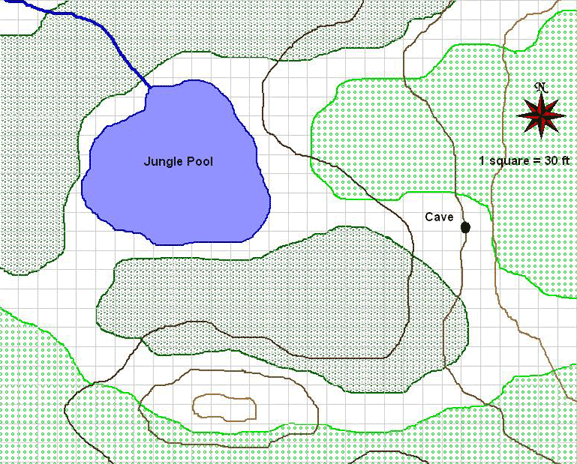 |
Elevation lines on the above Approach Map represent 75 ft in height.
Dark green areas represent areas of heavy undergrowth as well as densely packed trees (of typical and massive size). Light green areas represent light undergrowth and moderately packed trees (mostly of typical size).
The jungle pool is a large freshwater pool fed from rain and from runoff from the pools inside the Most Dangerous lair that feed into the jungle pool via an underground tunnel. The ahuizotls often emerge from their lair via the tunnel to the pool, instead of using the cave entrance. The pool is about 35 ft deep at its center, and the muddy banks rise up gradually to meet the water's edge. The tunnel entrance is about 15 ft in diameter and emerges about halfway up the submerged bank on the eastern side of the pool. A swiftly-flowing stream spills from the northwestern bank of the pool and flows downhill into the jungle.
[On the bank of the northwestern side of the pool, about 45 ft south of the outgoing stream, is the body of a killoren warrior. This warrior was slain and fell into the underground river in area 3 and was swept out into the jungle pool, where his body has washed onto the bank. The warrior has bite marks, heavy bruises as if from a powerful blunt instrument, and both of his eyes have been gouged out of his head.]
[On the bottom of the pool is the body of an ahuizotl. The killorens managed to slay one of the beasts in area 5 and its body made its way here.]
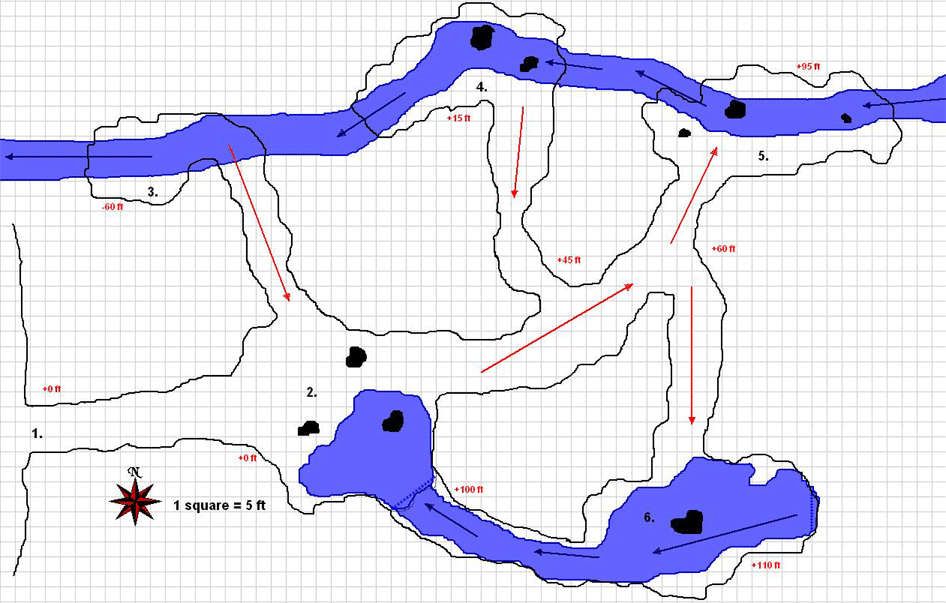 |
The lair is detailed in the map above.
The caves were carved by running water out of the limestone of the hill, and as such the floors, walls, and ceilings are fairly smooth, even despite the stalagmites and stalactites that protrude from above and below. For these purposes, the walls and floor of the caves should be treated as hewn stone (DC 25 Climb check, break DC 50, 8 hardness, 540 hp, DC 10 Balance check required to run or charge across such a floor [failure means the character can still act, but can’t run or charge in this round]).
Unless otherwise stated, passages are roughly the same height as they are wide, and caverns are 15 - 20 ft tall.
There is no light in the caves, excepting the natural light that leaks into the entrance for a few yards and the phosphorescent lichen in area 2.
The air of the place is damp, owing to the water that runs through the caves, and, of course, the sound of falling and rushing water is omnipresent, forcing Listen checks to be made at -5, with an additional -4 for each 10 ft of distance (except in area 6 and the hallway leading to it from the north, which checks are made at -3 with an additional -2 for each 10 ft of distance).
Red arrows show the direction of steep rises in the elevation of the caves. Where a red arrow is indicated, the passage slopes up in the direction of the arrow 5 ft for every 5 ft traversed by the arrow (thus these are 45 degree slopes). These are treated as steep slopes (characters moving upslope [to an adjacent square of higher elevation] must spend 2 squares of movement to enter each square of steep slope; characters running or charging downslope [moving to an adjacent square of lower elevation] must succeed on a DC 10 Balance check upon entering the first steep slope square; mounted characters make a DC 10 Ride check instead; characters who fail this check stumble and must end their movement 1d2×5 feet later; characters who fail by 5 or more fall prone in the square where they end their movement; a steep slope increases the DC of Tumble checks by 2).
Red elevation labels show the elevation of an area relative to the entrance (area 1).
The river flowing through areas 3-5 is a cold, somewhat swiftly-flowing body of water that emerges and exits each of the three areas by means of a hole in the wall and floor of each. The river is between 6-8 ft deep, and when not traversing one of the three marked areas, the river tunnel is entirely submerged. Negotiating the river requires a DC 15 Swim check. The river flows at 20 ft per round, and anyone swept away by the river will suffer 1d3 points of nonlethal damage per round. In addition, the river tunnels between areas 4 and 5 and between areas 3 and 4 include a substantial drop which will cause 1d6 points of lethal damage to anyone carried along these portions of the river (due to smashing against rocks and the cave walls).
After leaving area 3, the river flows underground in a downward slope until it reaches the jungle pool as detailed on the Approach Map. The slope of this section of the tunnel is mild enough that only nonlethal damage will be taken. About halfway to the jungle pool, the tunnel merges with another tunnel from the pool in area 2, and the merged tunnel widens to about 15 ft in diameter.
Blue arrows show the direction of water flow.
1. Entrance
| The cave entrance piercing the hillside is wreathed in jungle vines, although the entrance itself is clear of obstruction. The hole is 15 ft wide and almost as tall and appears to be naturally formed. The cave floor within, as well as the walls and ceiling, also appear to be naturally formed, though rather smooth. |
About 30 ft into the passageway heading east, the PCs will spy bones on the ground. Closer look and a DC 10 Knowledge (nature) check will reveal these to be deer bones, dire hawk bones, and a few other unidentifiable bones that are likely to be the remains of indigenous animals.
2. Cavern of the Fall
|
This cavern is an amazing sight to behold, as it forms a massive roughly-shaped cylinder that rises up nearly 120 ft into the air. Striations of phosphorescent lichen paint the walls, ceiling, and floor of the place, allowing the full dimensions of the chamber to be viewed. Three large columns of stone, also speckled with phosophorescence, reach all the way from floor to ceiling, and the southeastern of the trio rests in a small pool of water. A 20 ft wide waterfall slams down from a large hole in the wall about 100 ft up and cascades into a pool along the southeastern portion of the cavern. In addition to the wide passageway from the west, a 10 ft wide passage slopes sharply downward to the north and a broad 15 ft wide passageway slopes steeply up to the east. The entire chamber is filled with the roar of the waterfall and the air is damp with spray. The walls and floor are also damp. |
The pool is literally a shaft in the cavern floor, its sides dropping at an almost vertical slope for 30 ft. At the bottom of the pool is a 15 ft diameter tunnel in the northwestern wall of the shaft that slopes downward and travels directly northwest, eventually meeting up with the river tunnel heading from area 3 to the jungle pool about halfway between the two areas. The flow of this tunnel is identical to the flow of the river as far as the effects of swimming it or being swept away.
The waterfall emerges from a 20 ft wide by 15 ft tall hole, and the force of the fall is equivalent to a river moving at 100 ft per round, and it would require a DC 20 Str check each round for a creature larger than Tiny to be able to climb up or hold onto the wall behind the fall, as the fall is between 1 ft and 3 ft behind the rock wall and its force will beat down on any Small or larger being attempting to scale here.
A creature can leap from the hole high in the wall down the waterfall and into the pool without taking damage if a DC 10 Swim check is made. If the check is failed by 5 or more the creature suffers half falling damage (5d6 damage). If the check is failed by 4 or less the creature suffers quarter falling damage (2d6). This can be mitigated by a successful Jump or Tumble check to reduce falling damage as well.
There is no room behind the waterfall to stand on solid ground, as the pool runs right up against the back wall behind the waterfall.
[A DC 10 Search of the chamber will turn up various blood spatters on the floor, especially in the center of the place between the two stone columns that emerge from the stone floor. Several broken arrows will also be found at various points around thechamber. This blood is green in colour and appears to be somewhat fresh. This is blood from the killoren who attempted to flee the caves but were caught here and slain.]
3 Sunken Chamber
|
Most of this cave, located at the bottom of a steeply descending passage, is taken up by a 15 ft wide river that bursts out of the wall to the east and exits through the wall to the west. Both the inlet and the outlet for the water leaves no headroom above the surface of the flow. [At the foot of the sloping passageway is a large green bloodstain that leads into the water.] |
4. Den and Litter (EL 8)
| Most of this cave, located at the bottom of a steeply descending passage, is taken up by a 15 ft wide river that bursts out of the wall to the east and exits through the wall to the west. Both the inlet and the outlet for the water leaves no headroom above the surface of the flow. Two large stone columns emerge from the river and support the ceiling, and these columns are covered with lichen and strange calcinated mineral formations. At the bottom of the sloping passageway, on a ledge south of the river, are a variety of gnawed and cracked bones. |
The bones are of indigenous animals eaten by the ahuizotls.
[The partially consumed bodies of 2 killoren hunters are here, hidden behind the stone columns on the same ledge as the mothers and young.Both bodies have fingernails, teeth, and eyes missing.]
Creatures: There are 2 female ahuizotls here, along with four nursing young. The young are size Tiny and not capable of combat. The females and the young dwell in the water here, in the lee of the westernmost stone column, which helps to shield the young from the river current. One female generally has her eyes above the water level watching for danger (treat her as hidden with a Hide check of 16).
|
AHUIZOTLS (2) CR 6 Drowning (Ex) If an ahuizotl pins a grappled victim while in water of any depth, the ahuizotl holds its victim underwater. The victim can hold its breath for a number of rounds equal to twice its Constitution score. When this time limit is reached, it must make a Constitution check (DC 10) each round to continue holding its breath; each round the DC increases by 1. When the victim fails one of these Constitution checks, it begins to drown. In the first round, it falls onconscious (0 hp). In the following round, it drops to -1 hit points and is dying. In the third round it drowns. Improved Grab (Ex) If an ahuizotl hits an opponent that is at least one size category smaller than itself with its tail hand attack, it deals normal damage and attempts to start a grapple as a free action without provoking an attack of opportunity. It can immediately attempt to drown its victim if it is in water. Thereafter, the ahuizotl has the option to conduct the grapple normally, or it can simply use its tail hand to hold the opponent (-20 penalty on grapple check, but the ahuizotl is not considered grappled). In either case, each successful graple check it makes during successive rounds automatically deals tail hand damage. Voice Mimicry (Su) An ahuizotl can mimic spoken voices with unnatural ease. With a successful Bluff check, it can mimic a secific person's voice perfectly. |
Tactics: These mothers are most concerned with protecting their young, and if danger threatens, one of the females will call to the young, who will use their small tail hands to latch onto the mother's hide. That mother will then swim downstream and take refuge in area 3, or even to the jungle pool in extremis. The other female will attack intruders, seeking to delay them so that her companion and the young can make their escape.
Developments: There is no market for young ahuizotls, and they are fairly untrainable, due to their intelligence and their chaotic evil natures, which are fairly instinctual and will manifest even under the most loving and kind care. In theory, the young could be raised by an evil master who guides them with a firm hand, but the young will always seek to escape from or destroy their master, especially as they become adults. If the young are turned over to the killoren, they will be slain immediately.
5. Main Den (EL 11 [9 or 10 if survivors
are fully healed])
|
At the top of a sloping passageway, this cave is bisected by a 15 ft wide river that bursts out of the wall to the east and exits through the wall to the west. Both the inlet and the outlet for the water leaves no headroom above the surface of the flow. A large stone column emerges from the river and supports the ceiling, and this columns is covered with lichen and strange calcinated mineral formations. Two smaller columns appear to be made of quartz formations and striated minerals and descend from the ceiling, one dipping into the water while the other reaches to within a foot of the cave floor. [A tangle of killoren bodies lies strewn about the place, most at the end of the passageway leading into this chamber from the north, but others on the small ledges along the north wall of the cave. Green blood is strewn everywhere, including the walls and floor and broken arrows and pieces of equipment lie here and there.] |
[Examination of the decimated killoren bodies shows that all have had their eyes gouged out and are missing teeth and fingernails.]
Creatures: 5 [4] male ahuizotls dwell here. They will be in the river, and at least two will be on guard, with their eyes sticking out of the river to watch for intruders (treat them as hidden with a Hide check of 16). The DM should allow them a Listen check as the PCs arrive at the fork in the passageway between area 5 and area 6, unless louder noises were made earlier. Of course, if the PCs are bearing light sources, then the ahuizotls will be aware of their approach for certain.
|
AHUIZOTLS (5 [4])
CR 6 Drowning (Ex) If an ahuizotl pins a grappled victim while in water of any depth, the ahuizotl holds its victim underwater. The victim can hold its breath for a number of rounds equal to twice its Constitution score. When this time limit is reached, it must make a Constitution check (DC 10) each round to continue holding its breath; each round the DC increases by 1. When the victim fails one of these Constitution checks, it begins to drown. In the first round, it falls onconscious (0 hp). In the following round, it drops to -1 hit points and is dying. In the third round it drowns. Improved Grab (Ex) If an ahuizotl hits an opponent that is at least one size category smaller than itself with its tail hand attack, it deals normal damage and attempts to start a grapple as a free action without provoking an attack of opportunity. It can immediately attempt to drown its victim if it is in water. Thereafter, the ahuizotl has the option to conduct the grapple normally, or it can simply use its tail hand to hold the opponent (-20 penalty on grapple check, but the ahuizotl is not considered grappled). In either case, each successful graple check it makes during successive rounds automatically deals tail hand damage. Voice Mimicry (Su) An ahuizotl can mimic spoken voices with unnatural ease. With a successful Bluff check, it can mimic a secific person's voice perfectly. |
Tactics: The ahuizotls will attempt to drown victims, or at least drag them into the river and, if occupied with other foes, drop them into the current and let them wash up or drown as they may.
[Two of the males will use their voice mimicry to call to intruders in Sazhan, mimicing the voices of the killoren, including the leader Ennimbel. In fact, one of the ahuizotls will pose (vocally) as the ranger, even using his name in his mimicry since he heard the killoren's name called out during the combat. The voices will pose as killoren who have been blinded by the ahuizotls and cannot find their way out of the caves. If necessary, they will claim that they may have slain Ambacras, but as they cannot see they cannot be certain, though they know they slew many ahuizotls and at the least grievously wounded the Most Dangerous.
Once the PCs enter the chamber, the voices will indicate they they believe they are on a ledge on the other side of the river, and that they can feel a large stone column against their cheeks. If any PCs come within 10 ft of the river, the ahuizotls not using voice mimicry will emerge and attack. The other two, having been hidden in the river near the westernmost stone column doing their mimicry, will swim over to join the fray.]
6. Most Dangerous Den (EL 11
[10])
|
This large cavern is pierced by a massive stone columns that supports the ceiling, thrusting out of a pool that is fed by a 15 ft wide waterfall that emerges from a crack in the ceiling at the easternmost edge of the place. The pool forms a 15 ft wide river that exits the cavern along a wide tunnel to the west. Hanging on the stone column, facing the passageway to the north, is the rotting body of a killoren male, its eyes gouged out and its teeth missing. The body is propped on some protrusions on the column and does not appear to be tied or firmly attached in any way that can be seen. [A tangle of killoren bodies lies strewn about the place, most on the close side of the river but others on the far side. Green blood is strewn everywhere, including the walls and floor and broken arrows and pieces of equipment lie here and there.] |
The waterfall emerges from a 20 ft long crack in the ceiling that is about 1 ft wide and is fed by runoff from higher elevations in the jungle that collect in a stream that goes subterreanean and then eventually makes its way here.
The pool is 20 ft deep and the sides are quite steep. There is a current in the pool, but it is gentle enough to be considered standing water.
The river to the west is similar to the one running from area 5 to 3 except that the current is less strong and the flow is only at 15 ft per round and requires only a DC 10 Swim check to navigate. The river is 10 ft deep and eventually forms the waterfall in area 2. Unlike the river to the north, the passageway to the west of this chamber has headroom some 10 ft above the level of the water and a narrow ledge of stone allows passage along the north wall of the river way right up to this side of the waterfall in area 2. The ledge is quite narrow, and slippery, requiring a DC 15 Balance check to navigate. At one spot about 15 ft before the waterfall, the ledge narrows to 6 inches wide, requiring a separate DC 20 Balance check to negotiate.
The body on the column is the carcass of the Uryltimbre of Hlavanaque. If any killoren are with the PCs, they will instantly recognize the body and be quite distressed. Otherwise, if the body is taken down and shown to any killoren (such as the young watcher waiting outside), the identity can be determined.
Creatures: Ambacras dwells here. While she is undoubtedly the largest of her kind, that is essentially her claim to fame. She has not special abilities or supernatural capabilities beyond those standard for an ahuizotl. In short, she is just one big bad mama of her kind. She will usually be underwater, and in general is not very alert unless she hears the sounds of combat or is alerted to the presence of intruders by her clan mates.
|
AMBACRAS CR 11 Drowning (Ex) If an ahuizotl pins a grappled victim while in water of any depth, the ahuizotl holds its victim underwater. The victim can hold its breath for a number of rounds equal to twice its Constitution score. When this time limit is reached, it must make a Constitution check (DC 10) each round to continue holding its breath; each round the DC increases by 1. When the victim fails one of these Constitution checks, it begins to drown. In the first round, it falls unconscious (0 hp). In the following round, it drops to -1 hit points and is dying. In the third round it drowns. Improved Grab (Ex) If an ahuizotl hits an opponent that is at least one size category smaller than itself with its tail hand attack, it deals normal damage and attempts to start a grapple as a free action without provoking an attack of opportunity. It can immediately attempt to drown its victim if it is in water. Thereafter, the ahuizotl has the option to conduct the grapple normally, or it can simply use its tail hand and Greater Multigrab feat to hold the opponent (no penalty on grapple check, but the ahuizotl is not considered grappled). In either case, each successful graple check it makes during successive rounds automatically deals tail hand damage. Voice Mimicry (Su) An ahuizotl can mimic spoken voices with unnatural ease. With a successful Bluff check, it can mimic a secific person's voice perfectly. |
Tactics: Ambacras is a haughty bitch, and is unfraid of any creatures that are as puny as killoren (and presumably the PCs). That said, if reduced to less than 20 hit points, she will finally understand that size is not all that counts and seek to flee or, lacking that, surrender if her life can be spared. She will not, under any circumstances, agree to be turned over to the killoren, as she knows what to expect from their tender mercies.
Developments: If a parley with Ambacras is made, and she is asked why she slew the Uryltimbre of Hlavanaque, she will laugh and say that she knew that one was an important one of the killoren and wished to strike a blow against the killoren, who routinely hunt her kind and slay their young on sight. Of course, the killoren do this only because the ahuizotls cannot be trusted and because these evil creatures love to cause misery and death and to consume the eyes, teeth, and fingernails of their victims.
Treasure: At the bottom of the pool Ambacras has hidden her treasure, which consists mainly of items taken from the Uryltimbre and previous killoren victims. These include:
+1 woodwalk leafweave studded leather
safewing emblem
+1 impaling spear
cloak of quills
wooden vials containing potions of barkskin (4) (CL 3) and cure moderate wounds (3) (CL 5)
Ahuizotl Reactions:
The initial reaction of the ahuizotl to the PCs' intrusion will depend on whether the killoren have previously invaded their caves. If so, then the ahuizotls will be on high alert, expecting more killoren to arrive. After two days, this state of alert will become lax and the clan will resume its normal activities as if nothing has happened, including emerging into the jungle pool to hunt animals.
If combat does occur, then the DM should roll Listen checks for the other ahuizotl to determine if and when they notice combat occuring. Remember that the ahuizotl do not have very good Listen checks and the sound of water in the caves limits this further. In theory the PCs can possibly take out the entire clan one area at a time. However, the ahuizotl will, if alerted, fight together and emerge from their areas to aid their fellows. They know their caves well and will use the interconnected water ways to flank opponents and to retreat from a bad situation. In theory, if willing to swim all the way out to halfway between area 3 and the jungle pool, the ahuizotls can move between areas 2, 3, 4, and 5 underwater. They can also attempt to escape the caves entirely via the jungle pool.
Ambacras, in area 6, can, if she desires, simply swim west from area 6 and fall down the waterfall into the pool in area 2. From there she can emerge to flank foes or swim out of the tunnel at the bottom of the pool and reach area 3 or the jungle pool.
If Ambacras escapes a fight, she and her surviving clan will likely not be able to pursue the PCs, due to their inability to breathe out of water.
Ahuizotl Tactics:
The ahuizotls' combat tactics revolve around water, and they will use it to best advantage. The DM should be merciless in applying this advantage, since without it the creatures are not particularly dangerous to foes as powerful as the PCs. Not only will they attempt to grab and drown victims, but they will also be apt to simply drag victims (especially ones in heavy armour) into the water and drop them in, hoping they will either drown or be dragged away by the current. Furthermore, every ahuizotl prefers to fight underwater, and so they will at all times attempt to provoke their foes to fight them near or in the water.
Fighting Above and Below the Water:
DMs should keep in mind that the ahuizotls are aquatic creatures and cannot breathe out of water. This does not mean they will refrain from emerging from the water. They have claws and are perfectly capable of travelling on land. However, the DM should keep track of the number of rounds they are out of water, as they can only hold their breath for twice their Constitution in rounds. Furthermore, for every round they take a standard action, the amount of time they can hold their breath is reduced by 1 round. This means the average ahuizotl can fight for 14 rounds straight before needing to make Constitution checks. The ahuizotls will be very aware of their breath status when out of water and will generally want to be make sure they can get back to water before they have to start making Constitution checks and even then with a round or two cushion.
The DM should familiarize himself with the various rules for combat underwater and the rules for combat between land and water. These are located in the Dungeon Master's Guide on pages 92 and 93. In short, the ahuizotls fight normally underwater, as their bite attacks are considered piercing and their tail attacks are normal underwater.
Moving On:
Should the PCs, for whatever reason, decide to ignore Ambacras' lair and head towards Aladur, they will eventually stumble upon the lone killoren watcher, who is exhausted, terrified, and dehydrated, for he has been hustling and travelling at breakneck speed to try to reach Aladur and the elders. Unless the PCs are proceeding at remarkable speed through the jungle, the DM can plausibly have the young killoren catch up to the PCs. It is logical that he would meet the PCs, as both are heading to the same part of Aladur. The killoren's willingness to take nonlethal damage, become fatigued, and his knowledge of secret paths and tracks through the jungle will generally allow him to catch most groups of PCs, albeit stumbling into them in bad shape (the DM can decide how much nonlethal damage he has taken from hustling).
The young one will speak or pantomime to the PCs that none of the killoren emerged from the lair. He will be overwrought with grief, and will babble that they should not have defied the elders and snuck away from their homes to undertake this mission. He will also say that he must hurry to inform the elders, for the ahuizotl are known sometimes to "play" with their captives before killing them and he hopes beyond hope that he can reach the elders in time to mount a rescue attempt.
Of course, it should be apparent to the PCs that the time to travel to Aladur and back to Ambacras' lair will allow no chance for any of the killoren to remain alive. This is the chance for the PCs to volunteer to undertake a rescue mission. The young watcher will not suggest it, but if it is proposed he will readily agree and accompany the PCs back to the lair, although he will refuse to go in and insist on watching yet again, so that someone can bring the tale home to Aladur.
Should the PCs ignore the young one and continue on their journey, he will ask to accompany the PCs into Aladur, so that he can meet inform his people what has happened. He will seem to bear no bitterness towards the PCs for refusing to rescue his companions, for he feels that this is killoren business and does not concern the humans. If the PCs refuse his accompaniment, he will head to Aladur on his own, possibly arriving some time after the PCs depending upon their relative speeds.
Part Three - Leaving the Jungle
If the PCs defeat Ambacras, then any surviving killoren will be quite pleased and will become at least friendly to the PCs. They will agree to escort the PCs through the remainder of the jungle and to introduce them to the killoren elders in Aladur.
The DM should still check to wandering encounters, but the killoren are very knowledgeable about this area of the jungle and unless the PCs want to ignore killoren advice, half of all wandering encounters will be treated as no encounter if a killoren is guiding the PCs.
During this time, the PCs can question the killoren about their society and homeland. DMs are encouraged to either make up these details or to refer to any official writeup of killoren for Sazhansiir.
Aladur:
Once the PCs leave the jungle, they will enter the land of Aladur. Aladur is a wild land, verdant and full of life. Much of the land is comprised of moors punctuated by bogs and forested marshland. The trek across Aladur to the shore of the Lake of Refuge is a journey of about 200 miles. The DM should treat the terrain of Aladur as 50% moor and 50% swamp for the purposes of overland travel. If the PCs are guided by a killoren, then the terrain should be treated as road or trail, otherwise trackless.
Normal travel speed is 10 miles per day (at speed 20 ft), 15 miles per day (at speed 30 ft) or 20 miles per day (at speed 40 ft). This means traversing Aladur will take 20, 13, or 10 days.
If a PC has enough Survival skill to make a DC 15 check, he can trailblaze (see Complete Adventurer page 103) and cut the travel times by 40%. Keep in mind that there is a -2 penalty to the check for every 3 (or fraction thereof) individuals being guided beyond the trailblazer and 3 companions.
Finally, spells like wind at back can further reduce travel time.
If the killoren are guiding the PCs, then the travel times are equivalent to trailblazing, and further trailblazing will reduce the travel time by another 12.5%.
In any event, keep in mind that trailblazing cannot increase the travel multiple above x1.
The PCs will be expoosed to the same heat dangers as in the jungle, as the swamps are just as humid as the jungle, and the PCs are now exposed directly to the sun. The DM should assume a 25% chance that on any given day the heat will be equivalent to Hot (see Sandstorm page 12). On these Hot days, PCs will suffer the effects listed in Sandstorm unless they take the necessary precautions. As this heat is not a result of direct exposure to the sun, protections like parasols will not work to mitigate this heat. Endure elements spells will mitigate this effect entirely. DMs should also note that wearing armour can exacerbate the heat as mentioned in Sandstorm.
Dehydration is also an issue, as PCs will consume 2 gallons per day (instead of 1 per day) on Hot days. There is plenty of water to be found in the marshes, if the PCs wish to drink from such sources, but unlike in the jungle, there is more of a chance that the water source is befouled. A DC 15 Survival check will allow the PCs to avoid tainted water. Otherwise, assume a 15% chance per day that a tainted water source is utilized. The PCs who drank from the water must make a DC 15 Fortitude save or suffer poison half the time or disease the other half.
Poison will be in the form of mild or virulent (50% chance of either). Poison will affect Strength or Constitution (50% chance of either). Mild poisoning will result in 1d6 points of damage. Virulent Poison will result in 1d3x1d6 points of damage.
Disease will incubate for 1d3 days and then the victim will suffer 1d6 points of damage to a characteristic. The precise characteristic affected is determined randomly, but once a given disease affects a given characteristic, it will do so for the entire course of that disease.
Food sources are also present in the jungle, including a large variety of fruit along with tubers, fungi, etc. However, sampling these can be dangerous. if the PCs attempt to get along in the wild, using the Survival skill, any PCs not native to the Coatlizin Jungle will suffer a -5 circumstance penalty to their check. Furthermore, if the check is failed by 5 or more, then the DM can assume that some sort of tainted food was gathered and the PCs partaking could be subject to poison effects, fatigued, sickened, nauseated, or some other more exotic effect (such as confusion or hallucinations).
The land is full of life, and PCs will encounter plentiful insects, birds, and other normal, harmless flora and fauna. Sounds of the swamps and moors, including hoots, screeches, chirps, and even roars are plentiful day and night. In comparison to the jungle, the level of such sounds is less and there is no Listen penalty in Aladur.
In addition, the swamps of Aladur are known to have quicksand, and the DM should allow a chance for quicksand equal to the number of miles travelled during a day. If quicksand is indicated, the DM should roll 1d3 to determine how many potential quicksand patches the PCs are exposed to, and then allow a DC 15 Survival check to avoid natural hazards, informing the PCs that they have identified and maneuvered around patches of the dangerous ground. If the PCs do not avoid such a patch, then the DM should refer to the Dungeon Master's Guide for potential consequences. If the PCs are guided by a killoren, then there will be no chance of encountering quicksand, though the PCs can notice such patches being avoided by the killoren on a DC 15 Survival check.
There are no wandering monster charts for Aladur in this scenario. Instead, some planned encounters are presented, and the DM can space them as he deems fit. Planned encounters marked with an asterisk (*) are those that will not be encountered if the PCs are escorted by a killoren. Planned encounters marked with a (@) symbol are those that will only take place while the PCs are encamped, and only then if they are not magically encamped so that such encounters would be impossible (i.e. inside a rope trick). In theory, except for the final encounter, these can be administered in any order desired. The two encampment encounters should be interspersed amongst the others.
The final planned encounter should take place when the PCs are about halfway across Aladur or have travelled for about 10 days in the land.
While the battlefield for encounter #1 is detailed, the rest of the encounters do not have battlefields mapped out. The encounter description will state whether the terrain is moor or swamp and the DM should draw terrain accordingly.
Encounter #1 - A Shocking Experience (EL 9)
The PCs will be travelling through a particularly swampy patch of ground when they are attacked by a gang of spark lashers. This gang knows of the paths and trails used by the killoren and is waiting for a group of them, or animals that also use the trail, to pass by.
 |
On the map above, dark purple patches represent deep bog. Light purple represents shallow bog. Dark green is heavy undergrowth and anywhere on the map not marked with other terrain is considered light undergrowth. All trees are typical trees. Solid blue represents swampy pools of water, approximately 10 ft deep in the center and 5 ft near the edges. Refer to the Dungeon Master's Guide for details on the effects of these various terrain features.
The red arrow represents the path of the PCs through this particular stretch of ground.
DMs should allow the PCs the normal Spot checks to see one of the lashers, allowing each PC a single roll and comparing it to all of the lasher's Hide checks (modified by distance).
If the PCs see one or more lashers, they will simply notice that an odd looking plant or group of plants seemed to quiver slightly or rustle in a manner not consistent with the local breezes. If a killoren is with the PCs and sees a lasher or has one pointed out to him, then the killoren will be able to instantly recognize the nature of the lashers and warn the PCs.
Creatures: The spark lashers are hidden as indicated on the map, with the larger specimen hiding in the heavy undergrowth just to the west of the PCs' path. Remember that heavy undergrowth allows a +5 bonus on Hide checks. For purposes of the spark lasher's bonus to Hide, the entire battlefield is considered a marsh.
DMs can assume the lashers have taken 10 on their Hide checks, giving the Medium sized lashers a Hide check of 30 and the Large lasher a hide check of 34 (counting the bonus for heavy undergrowth).
The lashers will wait until they are spotted or until the PCs reach the end of the red arrow indicated on the map. They will then emerge and attack. DMs should remember that the lashers can use their swim speed to move through deep bogs.
|
ADVANCED SPARK LASHERS (6)
CR 3 * Spark lashers have a +8 bonus on Hide checks when in a marsh. |
|
ADVANCED LARGE SPARK LASHER
CR 5 * Spark lashers have a +8 bonus on Hide checks when in a marsh. |
Tactics: The lashers will not say anything to the PCs. They attack because they are malevolent and because they want food and to make sacrifice to the strange demonic spirits that they worship. The lashers will communicate in combat with one another, gurgling at each other in Aquan.
In all instances unless their foes are immune to electricity, the lashers will use their tentacles to attack. They will break off combat if the Large spark lasher is defeated and two of the Medium lashers have fallen as well.
Encounter #2 - This Sucks! (EL 4)*
As the PCs traverse a section of deep bogs, up to their waists in water, they are attacked by leeches. For purposes of this encounter, the DM should assume that the entire battlefield is deep bog. The PCs will blunder into the leeches, which dwell in the murky water of the deep bog, and the DM should allow the PCs no chance to Spot them unless a PC is swimming under the surface of the bog water (because the water is so murky that the leeches have total cover from the surface). The swarms will begin to attack any PCs in the bog, possibly unnoticed for some time (see below).
Note that if the PCs are all travelling above the water (e.g. flying or riding 10th level phantom steeds), then this encounter will not occur.
Creatures: There are 4 leech swarms attacking the PCs.
|
LEECH SWARMS (4) CR 1 Blood Drain (Ex) Any living creature damaged by a leech swarm also takes 1 point of Constitution damage as the dwarm drains its blood. This damage repeates every round thereafter unless the creature successfully exits the swarm and spends a full-round action removing leeches from its body. Disease (Ex) A creature damaged by a leech swarm must succeed on a DC 15 Fortitude save or contract red ache (see page 292 of the Dungeon Master's Guide). Distraction (Ex) Any living creature vulnerable to the leech swarm's damage who notices the swarm and begins its turn with a swarm in its square is nauseated for 1 round; a DC 10 Fortitude save negates the effect. Even with a successful save, spellcasting or concntrating on spells within the area of a swarm requires a Concentration check (DC 20 + spell level). Using skills requiring patience and concentration requires a DC 20 Concentration check. The save DC is Constitution-based. |
Developments: The DM should secretly allocated the four swarms to specific squares on the battlefield and then track how long the PCs are in the swarm. The swarms will move with the PCs to the best of their ability. DMs should remember that fire spells can be cast underwater, producing hot steam, but require a Spellcraft check of DC 20+spell level.
Encounter #3 - Quite a Shock! (EL 10)*
As the PCs trek through a moor, they inadvertantly stumble upon a shocker lizard nest.
The mother of the nest will, unless the PCs have taken extraordinary actions to remain concealed, spot the PCs approaching the nest area from a fair distance and will let out a call to her lizard mates. Given the shocker lizard's Hide bonus of +17 and the distance initially involved, it is quite unlikely that the PCs will see the shocker lizard before the shocker lizard sees the PCs.
This call will alert the other 11 shocker lizards in the vicinity, who will also come rushing to the defense of the nest. However, the PCs will not likely recognize the call nor even notice it given the many days they have been travelling through this land and having heard animal call after animal call of all different types. The shocker lizard call will not stand out of the background noise unless, somehow, a PC has prior knowledge of shocker lizards (which are native to marshes all over Sazhansiir) If a PC does have such knowledge, then allow a DC 20 Listen check followed by a DC 15 Knowledge (nature) check to identify the call.
The mother shocker lizard will happen to arrive at the nest site right after the PCs do (in the same round), no matter what speed the PC are maintaining. Every round thereafter, another shocker lizard will arrive at the nest site and their threat potential will grow exponentially unless the PCs flee or manage to kill enough of them before too many others arrive.
If the PCs simply barrel on through and flee, then the DM can assume that there is a 1 in 6 chance that any remaining shocker lizards will be met by the PCs (one at a time) and will get a stunning shock off at the PCs as they pass by.
While the lizards are approaching the PCs, they will be moving at normal speed and so suffer a -5 to their Hide checks. The DM can assume each lizard has a Hide check of 23 while moving at normal speed. If the PCs take active Spot checks to watch for lizards approaching, the DM should allow the PCs to spot them at a distance indicated by the Spot check, up to a maximum of 200 ft.
The nest is hidden quite well, in order to escape the notice of predators when the mother lizard goes out hunting, and as such the PCs have almost no chance to avoid stepping around, over, or through some light undergrowth and bringing their foot down onto a buried nest of the eggs. Shocker lizards lay eggs in the spring, but their magical nature requires such eggs to remain unhatched and buried in the ground until the end of summer or even into the beginning of autumn.
Unless all of the PCs are flying or otherwise not trodding upon the ground (e.g. using phantom steed spells), then a random PC will step into the loose dirt covering the nest and stumble, feeling and hearing a slight cracking sound beneath his feet.
Examination will show that a nest is here, and there are (or were) a total of 8 eggs here. Four of these are now crushed, and four remain unmarred.
Creatures: 12 shocker lizards (an entire colony) dwell in the region and, due to the presence of the nest, stay relatively close together.
|
ADVANCED SHOCKER LIZARDS (12)
CR 3 Lethal Shock (Su) Whenever two or more shocker lizards are within 20 feet of each other, they can work together to create a lethal shock. This effect has a radius of 20 feet, centered on any one contributing lizard. The shock deals 2d8 points of electricity damage for each lizard contributing to it, to a maximum of 12d8. A Reflex save (DC 10 + number of lizards contributing) reduces the damage by half. Stunning Shock (Su) Once per round, a shocker lizard can deliver an electrical shock to a single opponent within 5 feet. This attack deals 2d8 points of nonlethal damage to living opponents (Reflex DC 13 half). The save DC is Constitution-based. |
Tactics: The shocker lizards will attempt first and foremost to save the nest and, secondarily, to drive the PCs out of their territory. Lone shocker lizards will have to resort to their stunning shock, but the shocker lizards instinctually will try to link as many of themselves as possible into a lethal shock chain. Given that, should six lizards link, they can do 12d8 points of damageeach round, it is likely that the PCs will need to kill them before they can gather or flee before they can gather. The lizards will not abandon the nest, even should all of the eggs be destroyed. They will pursue intruders to the edge of their territory (which is about a 600 ft radius around the nest).
Developments: Shocker lizards can be made into familiars (via the Improved Familiar feat) and as such it should be noted that young shocker lizards can be raised and even trained if PCs want to take the time to do so. Training of the lizards is dealt with under the Handle Animal skill. Rearing the eggs requires a DC 24 Handle Animal check. A single person can rear 3 such eggs at a time. A check must be made for each egg during the egg and hatching period, and then another during the creature's infancy. If the first check is failed, the lizard never hatches or otherwise perishes before or during hatching. If the second check fails, the lizard does not become domesticated and eventually escapes or turns on its owner and cannot learn any tricks. Remember, the eggs will not hatch until the end of summer or early fall (as late as the end of Matlalceuitlinatl. In addition, it takes a year to raise a lizard from infancy to maturity. Shocker lizards then live for another 3d3 years unless they are a familiar (in which case their lifespan increases tenfold).
If the PCs wish to sell the lizards, they command a market price of 750 gp as eggs or untrained infants and 1750 gp as a trained adult. PCs will be able to sell them for half these prices.
Encounter #4 - What a Croc! (EL 11)*
As the PCs travel through swampy terrain, they are attacked by a colony of giant crocodiles. The terrain for this encounter is entirely deep bog, and the crocodiles are all lying in the water with only their eyes showing (giving them a +4 racial Hide bonus for being in water and a +10 cover bonus for having only their eyes visible), giving them a total Hide check of 31.
The crocodiles are somewhat clustered near a natural ford between deeper water in the bog, and use the area as an ambush spot for animals (or any other food that wanders by). However, the crocodiles are not grouped adjacent to one another.
The DM can assume that a single crocodile waits right in the middle of the path that the PCs will be taking. If the crocdile becomes aware of the PCs approaching, it will wait until they are within 60 ft and then submerge entirely and attack from the water, bursting out when a victim comes within 10 ft.
The sound of battle will draw the other crocodiles, all of whom will begin to swim towards the fray to search for food of their own. Assume a new crocodile arrives each round until all six have appeared.
Obviously, if the PCs are flying, then the PCs can either Spot the hidden crocodiles and choose to interact with them, or simply fly past and ignore the encounter. Additionally, if the PCs are using phantom steeds then the crocodiles will remain watchful but will not approach the phantom steeds (as per the spell description).
Creatures: 6 advanced giant crocodiles are here, these being particularly single-minded in the hunt for prey (as reflected by their feats).
|
ADVANCED GIANT CROCODILES
(6) CR 6 Improved Grab (Ex) To use this ability, a crocodile must hit with its bite attack. It can then attempt to start a grapple as a free action without provoking an attack of opportunity. If it wins the grapple check, the crocodile establishes a hold on the opponent with its mouth and drags it into deep water, attempting to pin it to the bottom. *A crocodile gains a +4 racial bonus on Hide checks when in the water. Further, a crocodile can lie in the water with only its eyes and nostrils showing, gaining a +10 cover bonus on Hide checks. |
Tactics: The crocodiles are only interested in a meal (and defending themselves). If the PCs have mounts, they will attack the mounts in preference to the PCs. Once a crocodile has a victim grabbed, it will submerge and swim away to consume its victim at the bottom of the bog. A crocodile will not give up its grabbed prey until reduced to 10 or fewer hp.
Encounter #5 - Mucking Things Up (EL 5)
The PCs will come across a strange scene in a muddy bit of moor. A 25 ft diameter mound of mud rises some 10 ft above the level of a deep bog some 100 ft in diameter, which is itself surrounded by a ring of shallow bog about 50 ft wide. The mound of mud is clearly not naturally formed, and has several small openings dug into it and a weird looking construct of sticks, vines, and mud set at its crown.
On the mound is a 10 ft diameter mass of ochre-coloured jelly-like substance that seems to be moving of its own accord and extending tenrdils into the openings in the mound. Surrounding the mound (at a distance of about 20 ft from the mound) is a pack of many Tiny bipedal creatures that look something like upright lizards with tails. The creatures are clearly agitated at the ochre mass and occasionally one of the Tiny creatures will squirt a jet of water with surprising force out of its mouth and at the ochre mass, though the water does not seem to affect the ochre mass in any way.
If the PCs approach to within hearing range, they can hear the Tiny creatures screeching at each other in Draconic.
The normally cautious muckdwellers are quite distracted by their current predicament, and suffer a -5 penalty to Listen and Spot checks viz a viz the approaching PCs. Therefore, it is almost certain that the PCs will hear or see the muckdwellers before the creatures see or hear the PCs.
If any killoren is with the PCs, he will explain the nature of the muckdwellers, stating that they are the cast off and useless experiments of the Scaled Ones and that they are at best nuisances and at worst negligible threats to the killoren. He will advise the PCs to simply ignore the situation and move one...which they are free to do. If asked about the jelly, the killoren can describe their basic nature as well, including their split ability. If the PCs insist on intervening, the killoren will shrug and remain behind to watch until the PCs are ready to continue on.
Creatures: A total of 16 muckdwellers are outside of the mound, surrounding and trying to drive off an ochre jelly that has moved onto the top of the mound and is now starting to make its way into the mound, menacing the four adult muckdwellers and brood of a half dozen hatchlings that have just hatched in late spring.
When the ochre jelly first arrived it stumbled across the exit to the mound that is below the waterline of the deep bog (even though ochre jellies cannot breathe underwater, they can hold their breath for a long time due to their high Constitution score). The ochre jelly squeezed into the tiny opening and began to ooze up the passageway, but was immediately intercepted by a muckdweller sentry. The sentry bit the ochre jelly, which ruptured its membrane and caused the creature to split into two. The first jelly continued up the passageway as the muckdweller now retreated and wounded the alarm, and the second one, beling blocked by the first, crawled up the mound to its current position.
The muckdweller warriors emerged on the mound to meet the threat and try to drive it away. Now knowing they cannot bite them, and seeing that their squirt attacks are useless, they are simply making lots of noise, squirting, and splashing the bog water to confuse and distract the jelly, hoping that it will go away or that the muckdwellers inside can somehow escape.
|
SPLIT OCHRE JELLIES (2) CR
5 (for both) Constrict (Ex) An ochre jelly deals automatic slam and acid damage with a successful grapple check. Improved Grab (Ex) To use this ability, an ochre jelly must hit with its slam attack. It can then attempt to start a grapple as a free action without provoking an attack of opportunity. If it wins the grapple check, it establishes a hold and can constrict. Split (Ex) Slashing and piercing weapons and electricity attacks deal no damage to an ochre jelly. Instead the creature splits into two identical jellies, each with half of the original’s current hit points (round down). A jelly with 10 hit points or less cannot be further split and dies if reduced to 0 it points. |
| ADVANCED MUCKDWELLERS
(16) CR 1 Serpent Kingdoms page 71 LE Tiny monstrous humanoid (amphibian, aquatic) Init +7; Senses darkvision 60 ft; Listen +2, Spot +2 Languages Draconic AC 18, touch 15, flat-footed 15 hp 9 (2 HD) Fort +0, Ref +6, Will +2 Spd 20 ft (4 squares), swim 20 ft (4 squares) Melee bite +7 (1d3-3) Space 1.5 ft; Reach 0 ft Base Atk +2; Grp -9 Special Actions squirt Abilities Str 4, Dex 16, Con 10, Int 10, Wis 9, Cha 8 Feats Improved Initiative, Weapon Finesse Skills Balance +5, Hide +13, Listen +2, Spot +2, Swim +11 Squirt (Ex) A muckdweller can squirt a jet of water into the eyes of a target up to 25 feet away. Anyone hit by this attack must make a DC 14 Reflex save for be blinded for 1 round. The save DC is Dexterity-based. |
| ADVANCED MUCKDWELLER
LEADER CR 1 Serpent Kingdoms page 71 LE Small monstrous humanoid (amphibian, aquatic) Init +6; Senses darkvision 60 ft; Listen +3, Spot +3 Languages Draconic AC 16, touch 13, flat-footed 13; Dodge hp 14 (3 HD) Fort +1, Ref +6, Will +2 Spd 20 ft (4 squares), swim 20 ft (4 squares) Melee bite +7 (1d4-1) Space 1.5 ft; Reach 0 ft Base Atk +3; Grp -2 Special Actions squirt Abilities Str 8, Dex 14, Con 10, Int 10, Wis 9, Cha 8 Feats Dodge, Improved Initiative, Weapon Finesse Skills Balance +5, Hide +13, Listen +3, Spot +3, Swim +13 Squirt (Ex) A muckdweller can squirt a jet of water into the eyes of a target up to 25 feet away. Anyone hit by this attack must make a DC 14 Reflex save for be blinded for 1 round. The save DC is Dexterity-based. |
Tactics: The muckdwellers are extremely distressed, as the ochre jellies are theatening both the mound entrances and the underwater escape hole, but they are powerless to do anything more than they already have.
Once the muckdwellers are aware of the PCs, they will initially view them as a threat, and at least twice as many muckdwellers as PCs will turn to meet them, staying 25 ft away, and making hissing warning displays. If a PC comes within 25 ft of the ring of muckdwellers surrounding the mound, the muckdwellers confronting them will begin to use their squirt ability.
Being lawful evil, the muckdwellers will not abandon their trapped nestmates unless it appears that the PCs are going to be able to annihiliate the whole tribe otherwise. Even then, they will not flee until at least half of their number are fallen.
Developments: The PCs can make peaceful contact with the muckdwellers, especially if they indicate a willingness to help them with their ochre jelly problem. If the PCs can speak Draconic, this should be rather easy. If not, they can still convey their intentions by means of pantomime or by simply attacking the ochre jelly.
DMs should assume that the muckdwellers are initially unfriendly to the PCs. A Diplomacy check would be needed to change their attitude, but even an indifferent attitude will be enough to convince the muckdwellers to allow the PCs to help them with their problem.
If the muckdwellers cannot be made indifferent or better, then they will refuse help, believing that the PCs somehow mean them harm and will hurt them or take their treasure after finishing off the ochre jellies.
If questioned, the muckdwellers can tell the PCs that there are two jellies, one of which entered the mound from below the waterline. They can also say how the jelly came to be split (by a bite from one of their number).
The ochre jelly that is topside can be distracted by the muckdwellers for another 15 rounds after the PCs arrive on the scene (allowing time for a Diplomacy check as above). After that time, the ochre jelly will tire of the muckdweller distractions and enter the mound.
The PCs can attempt to rid the mound of the jellies. Until the topside jelly enters the mound, it is exposed and should be easily dealt with. Any ochre jellies inside the mound are another story. The muckdwellers do not want their mound destroyed are damaged, though it is replaceable and they can be convinced to allow it to happen by way of another Diplomacy check to make them friendly (or if they were alreasdy made friendly). Lacking that, the PCs will either have to somehow shrink down enough to enter the mound, try to crawl through the tunnels, or to wait for the ochre jellies to emerge.
The tunnels in the mound are 2 ft in diameter, more than enough for the Tiny muckdwellers to use (they are about 1.5 feet tall) and even the Small leader can use them fairly well (being 2 feet tall). Small PCs treat the tunnels as narrow and low (refer to Underdark page 111) and move at 1.4 speed and take -4 penalty on attack rolls with light weapons and -8 penalty on attack rolls with one-handed weapons, two-handed weapons cannot be used at all. Medium PCs treat the tunnels as crawl-navigable and move prone at a crawl of 5 ft per round and must remove medium and heavy armour, backpacks, and other bulky equipment; they suffer the penalties of a narrow and low tunnel (see above) and the only ranged weapon that can be used is a crossbow. Large creatures would consider these tunnels a tight squeeze and require a DC 30 Escape Artist check to move 5 ft and fighting would be impossible.
Piercing weapons that thrust rather than slice are treated as one size category smaller for purposes of the above (e.g. a longspear is treated as a one-handed weapon and a short spear is treated as a light weapon).
The ochre jellies will emerge 20 rounds after the topside one would have entered the mound. Each jelly will exit the way it entered and will meander into the swamp unless they detect more food sources with their blindsight.
There is no chance for the PCs to save the four adult and half dozen young muckdwellers in the mound. The ochre jelly half that entered from below has already consumed the hapless muckdwellers even before the PCs have arrived. The acid-scoured bones of the muckdwellers can be found inside a small chamber within the mound.
If the PCs do manage to drive off the ochre jellies or defeat them, the muckdwellers will be grateful, even despite their sadness at the loss of their nestmates and young. The muckdweller leader will present the PCs with some of their treasure, which can also be found within the mound in case the PCs explore the mound from within. In the treasure listing below, the items with the asterisk (*) will be those given to the PCs by the muckdwellers.
Treasure: The muckdwellers have a small treasure within their mound, as they are attracted to shiny or unusual items and tend to scavenge them and hoard them in their lair. The treasure consists of:
An amber amulet of vermin (huge monstrous centipede)*
5 small pieces of amber worth 25 gp each
A piece of amber with a fly trapped inside worth 50 gp*
2 +1 arrows*
A small uncut emerald worth 120 gp
Encounter #6 - It Boggles the Mind (EL 6)@
A lone boggle who dwells in the area will attempt to sneak into the PCs' camp and steal something shiny (like coins, gems, or jewelry).
Creature: A single boggle
|
ADVANCED BOGGLE CR 6 Grease (Su) At will, a boggle can secrete an oily, viscous, nonflammable substance from its skin. This ability functions like the spell grease except that the range is touch, the duration is 1 round per Hit Dice of the boggle, and the Reflex save DC is 16. Typically, a boggle uses this ability to grease a section of floor or wall, though it can use the ability in any of the ways that the spell can be used. This oily fluid makes the boggle tougher to hold onto (as reflected by its bonus to Escape Artist checks). Boggles are immune to the effects of this substance. Improved Grab (Ex) If a boggle hits an opponent of up to one size category larger than itself with a claw attack, it deals normal damage and attempts to start a grapple as a free action without provoking an attack of opportunity. If it hits with both claws, it can also rend in the same round. The boggle has the option to contduct the grapple normally, or simply use its claw to hold the opponent (-20 penalty on grapple check, but the boggle is not considered grappled). In either case, each successful grapple check it makes during successive rounds automatically deals claw damage. Rend (Ex) If a boggle hits a single target with both claws, it latches onto the opponent's body and tears the flesh. This attack deals 2d6 points of damage. * Because of its perpetually oily skin, a boggle gains a +10 racial bonus on Escape Artist checks. |
Tactics: This boggle, like most of its ilk, is not looking for a fight. It wants shiny things. It will attempt to steal into camp and then begin to try to take things until it is caught or until it steals 6 items. If caught, its first reaction will be to dimension door away, multiple times if necessary. Only if somehow stopped from using dimension door will it fight physically, all the while attempting to simply flee.
Developments: If the boggle does get away, it will try to find a vantage where it can spy on the PCs for a while (a couple of hours at most, mainly looking for another opportunity to steal things). During this time, the PCs can attempt to communicate with the boggle (most likely by using tongues and shouting out loud into the night) and try to bribe it to return things it stole in exchange for other things. Remember that the boggle is not bright and has no real sense of the value of treasure. It just likes shiny things and would, for example, be amenable to giving back platinum pieces to the PCs in exchange for 2 nice shiny copper pieces each!
Alternatively, the PCs can trick the boggle, as not only is it not very bright, but it's not particularly clever as well (notes its substandard Wisdom score). Should the PCs act as if they are settling backm down for the night and not take any extra precautions noticeable to the boggle, then the creature is likely to try again, leaving the items it has already stolen under a pile of leaves from its spying position.
The boggle will not attempt to rob the PCs a third time.
Encounter #7 - The Plague (EL 10)@
A large body of plague ants is on the move/hunt at night and the PCs' campsite is right in the path of destruction!
Creatures: 6 plague ant swarms
|
PLAGUE ANT SWARMS (4) CR 5 Distraction (Ex) Any living creature vulnerable to the leech swarm's damage who notices the swarm and begins its turn with a swarm in its square is nauseated for 1 round; a DC 17 Fortitude save negates the effect. Even with a successful save, spellcasting or concntrating on spells within the area of a swarm requires a Concentration check (DC 20 + spell level). Using skills requiring patience and concentration requires a DC 20 Concentration check. The save DC is Constitution-based. Wounding (Ex) a wound resulting from a plague ant swarm attack bleeds for an additional 1 point of damage per round thereafter. Multiple wounds from such attacks result in cumulative bleeding loss (two wounds for 2 points of damage per round, and so on). The bleeding can be stopped only by a successful Heal check (DC 10) or the application of any cure spell or other healing spell (heal or the like). |
Tactics: The six swarms will approach in a column 2 swarms wide by 3 long. Any PCs that cannot see in the dark will likely hear the strange clacking sound that accompanies their march (caused by their feet and mandibles) a few rounds before they arrive (treat it as a DC 10 Listen check). The ants are mainly concerned about marching from their old colony to their new one, and so travel in a relatively straight line, veering only for natural obstacles and fires. The ants can build a living bridge to cross small bodies of water, so camping in deep bogs will not stop this encounter.
Anything in the path of the ant columns will be attacked, and additionally any items that have a hardness of 2 or less and are relatively pliable (e.g. paper, cloth, rope, or leather/hide) will also suffer swarm damage as the ants chew apart such items to take nesting materials with them for their new colony.
Any living creatures that are on the ground within 30 ft of the swarm will provoke a swarm to break off of the main column to attack the creature. This pursuing swarm will chase the creature until it is more than 60 ft away from the main column, at which time the swarm will return to the main column. Up to three such swarms (half of the entire column) will engage in pursuit of creatures.
As long as the PCs stay more than 60 ft away from the main column, they will not be attacked by the swarms.
Developments: The next morning, assuming the ants survived to move past the campsite, their trail will be obvious and the PCs can follow it if they desire. If they do, the trail proceeds for about a mile and a half until it ends in the hollowed out stump of a massive cypress-like tree. The ants now dwell within the cypress tree. Along the trail to the new colony, the picked over carcasses of various small animals will be found, including birds, frogs, and even a young deer.
Encounter #8 - Meet and Greet
At this point in their travels, the PCs are approaching the outskirts of the more settled interior of Aladur. While the killoren are not a populous people and dwell in scattered communities, most of these are located in the half of Aladur that adjoins the Lake of Refuge, and this area is more commonly patrolled by the killoren. This interior section is also less swampy than the exterior and more moorish, with grasslands and occasional woods of jungle plants as well. In addition, the presence of such a large body of water as the Lake of Refuge helps to keep hot temperatures in check, such that no further checks for Hot days will be needed after the day this encounter takes place (assuming the PCs head towards the Lake).
Every day, without fail, as part of their ritual since they were created, each druidic leader of a killoren community who is powerful enough to do so casts a commune with nature spell. This ritual is only skipped when imminent danger is at hand and the druid has need to prepare a different spell in that slot.
The killoren settlement nearest the PC's path of travel has learned about the presence of the PCs by means of their latest commune with nature spell. The druid has then used wildshape to transform into a fast-flying avian and alerted a community of killoren that is best positioned to intercept the PCs.
The killoren now await the arrival of the PCs, with the druid using his animal companion and speak with animals spells and ability to talk to animals in wild shape to monitor the path of the PCs, such that unless the PCs are intentionally taking evasive actions to avoid such an occurance, the killoren will spring their ambush upon the PCs.
The ambush will be in a relatively wooded area, with mostly light or no undergrowth.
The precise nature of the ambush will depend on whether the PCs travel with killoren or not.
If the PCs are travelling with killoren, then it will be apparent to the ambushers that the PCs are friendly with those killoren and the ambushing killoren will be indifferent to the PCs. In this case, the druid will step forward with half of the killoren behind him and raise his hand in greeting to the PCs, while indicating that they should stop and speak with him.
The druid will first question the killoren with the PCs, asking them who the PCs are and why they travel with them and lead them into killoren land. Assuming the PCs have slain Ambacras (they may even wish to display her head if they thought to take it with them), the druid and ambushers will look at each other in wonderment, and the druid will exclaim that this is good news indeed, and welcome in a time when there is little but bad news in the land. If questioned about the bad news, the druid will cluck his tongue and simply say that the land appears to be angry and has manifested its anger in ways that are dangerous to the killoren. If informed about the beasts of malar, the druid will nod and say that such manifestations have been sighted elsewhere in the land.
The druid will then say that the elders of the killoren will wish to meet with and speak to the strangers, and he will offer to escort the PCs to the Most Sacred Elders at the side of the Lake. Should the PCs refuse, the druid will be more insistent, until he finally demands that the PCs accompany him. Should the PCs refuse, then the DM should adjudicate the situation accordingly. At the very least, the druid will wildshape and fly to the elders and warn them of the PCs' coming and of their rudeness and hostility towards him.
If the PCs are without any killoren accompaniment, then the ambush will be a bit more hostile, at least at first. While the killoren do not hate humans, they do distrust them and bear them emnity for their allegience to Okoth and their part in the destruction of so much of Sazhansiir.
In this case, the ambush will begin with arrows being shot into the ground in front of, behind, and around the PCs. The killoren shooters will be sniping, and so hope to remain hidden.
The druid will then call out in Sazhan, questioning the PCs and asking them their business in Aladur. If the PCs cannot understand Sazhan, the druid will speak Auran, Aquan, or Terran as well.
If no communication can be established, the druid will step out of hiding and pantomime the PCs following them. Half of the rest of the killoren will emerge and surround the PCs as an escort and the rest will trail with the group to the flanks. The killoren intend to escort the PCs all the way to the Most Sacred Elders, and will use force to make this happen. Should communication be established later, then the druid will question the PCs.
If communication is established, then assuming the PCs explain their presence in Aladur in a somewhat reasonable manner, the druid will tell them that they must speak with the Most Sacred Elders and that he will guide them to the place. If the PCs refuse, the druid will insist, under threat of force, or command that the PCs return to their own lands and leave Aladur at once.
If the PCs tell about slaying Ambacras, the killoren will be skeptical, but wonder how they heard the name. If the PCs display a trophy of the ahuizotl (like her head), then the killoren will be amazed and their reaction friendlier and they will want the entire story, reacting sadly at the news of the deaths of any killoren.
Since no matter what happens, the killoren will insist that the PCs accompany them to the Most Sacred Elders, the attitude of the killoren to the PCs is not of immediate consequence. Nevertheless, if the PCs wish to use their Diplomacy skills to influence the killoren, they will have ample opportunity during the journey.
Circumstance modifiers to the Diplomacy check are as follows (all are stackable except the first two bonuses):
At least one elf or fey is amongst
the PCs and is visibly elven = +5
At least one half elf is amongst the PCs and is visibly a half
elf = +2
At least one PC speaks Sylvan in front of the killoren = +4
At least one PC is a druid or spirit shaman and evidences his
affinity to nature by some means (including simply having an animal
companion visible and showing it affection or giving it commands)
= +3
The PCs produce a trophy of Ambacras or a killoren accompanying
them voiches for their actions = +5
The killoren seem to assume that any human PCs are Azotchtla. They cannot readily distinguish what they consider to be almost unnoticeable difference between humans, and most killoren have not even seen a human to begin with (though they know what they look like). If the PCs relate that they are not Azotchtla and come from a land far to the north, the killoren will be thoroughly unimpressed. The only land that matters to them is their own.
Should an elf or half elf be amongst the PCs, the killoren will be quite fascinated by him and will ask lots of questions about his people and elves in general. They will remark on some of the resemblances between themselves and the elf or half elf and will say that they can sense a frail but present connection between the elf or half elf and nature itself.
The killoren will also respect any druid amongst the PCs, and if friendly will be willing to "talk shop" with the druid.
The journey to the site of the Most Sacred Elders will take approximately 4 days, as the killoren travel at speed 30 ft and the land is drier than before and the killoren know the trails and paths to follow. There will be no encounters of any consequence during this portion of the journey, as this part of the land is less wild as far as beasts are concerned and the killoren know how to avoid dangerous areas, augmented by the commune with nature cast by the druid every day in the morning.
Creatures: The killoren ambush consists of a ranger leader, 12 hunters, and 12 warriors, along with the druid, whose name is Ingyrimbel.
|
INGYRIMBEL CR 8 Manifest Nature's Might (Su) Killoren are forever bound to the raw forces of nature itself, manifesting this bond even in their physical form. A killoren can only manifest one aspect of nature's might at a time. Each morning as the sun rises, a killoren spends 10 minutes in quiet meditation, filling his spirit with the aspect of nature that is most needed for his current tasks. Once a killoren chooses an aspect, he manifests that aspect until the next morning, when he chooses again which aspect to manifest. Many killoren favour one aspect over the others and rarely choose to manifest one of the other two aspects. Aspect of the Ancient: While manifesting the aspect of the ancients, a killoren embodies the deep and ancient secrets of nature itself. With this bond to nature's secret lore, a killoren gains a racial bonus on Knowledge (nature) checks equal to his Hit Dice and gains an additional +2 bonus on saving throws against enchantment effects. This bonus stacks with the killoren's normal racial bonus on saving throws against enchantment effects. While a killoren manifests the aspect of the ancient, his hair turns white and his eyes turn to the colour of a blue summer sky. Aspect of the Destroyer: Many races revere nature for its power to destroy, but none more so than a killoren manifesting the aspect of the destroyer. Once per hour (up to a maximum number of times per day equal to the killoren's Charisma bonus, minimum 1), a killoren manifesting the aspect of the destroyer can make a special smite attack that deals extra damage to the foes of nature. When making this smite attack, a killoren adds his Charisma bonus to his attack roll and deals an extra 1 point of damage per Hit Die. This smite attack works only against aberrations, constructs, humanoids, oozes, outsiders, and undead. If a killoren accidentally smites a creature that is not one of the creature types listed above, the smite has no effect, but the ability is still used up for that hour and counts against the total uses per day. While a killoren manifests the aspect of the destroyer, his hair and eyes turn a deep, lusterless black; many find the gaze of a killoren destroyer's coal-black eyes to be unnerving. Aspect of the Hunter: The hunt affects nearly every aspect of nature and claims a place of great prominence and importance in the cycle of life. A killoren manifesting the aspect of the hunt is bound to nature's ancient tradition of the hunt, and his senses sharpen to an amazing degree. While manifesting the aspect of the hunt, a killoren gains a +2 racial bonus on Hide, Listen, Move Silently, and Spot checks, and a +2 racial bonus on initiative checks. While a killoren manifests the aspect of the hunt, his hair and eyes turn a deep forest green, and his skin town becomes a deeper brown than when manifesting one of the other aspects. * The druid has an animal companion, but he had to leave it behind at his home when he wildshaped into a bird and flew to intercept the PCs. |
|
RANGER LEADER CR 5 Manifest Nature's Might (Su) Killoren are forever bound to the raw forces of nature itself, manifesting this bond even in their physical form. A killoren can only manifest one aspect of nature's might at a time. Each morning as the sun rises, a killoren spends 10 minutes in quiet meditation, filling his spirit with the aspect of nature that is most needed for his current tasks. Once a killoren chooses an aspect, he manifests that aspect until the next morning, when he chooses again which aspect to manifest. Many killoren favour one aspect over the others and rarely choose to manifest one of the other two aspects. Aspect of the Ancient: While manifesting the aspect of the ancients, a killoren embodies the deep and ancient secrets of nature istelf. With this bond to nature's secret lore, a killoren gains a racial bonus on Knowledge (nature) checks equal to his Hit Dice and gains an additional +2 bonus on saving throws against enchantment effects. This bonus stacks with the killoren's normal racial bonus on saving throws against enchantment effects. While a killoren manifests the aspect of the ancient, his hair turns white and his eyes turn to the colour of a blue summer sky. Aspect of the Destroyer: Many races revere nature for its power to destroy, but none more so than a killoren manifesting the aspect of the destroyer. Once per hour (up to a maximum number of times per day equal to the killoren's Charisma bonus, minimum 1), a killoren manifesting the aspect of the destroyer can make a special smite attack that deals extra damage to the foes of nature. When making this smite attack, a killoren adds his Charisma bonus to his attack roll and deals an extra 1 point of damage per Hit Die. This smite attack works only against aberrations, constructs, humanoids, oozes, outsiders, and undead. If a killoren accidentally smites a creature that is not one of the creature types listed above, the smite has no effect, but the ability is still used up for that hour and counts against the total uses per day. While a killoren manifests the aspect of the destroyer, his hair and eyes turn a deep, lusterless black; many find the gaze of a killoren destroyer's coal-black eyes to be unnerving. Aspect of the Hunter: The hunt affects nearly every aspect of nature and claims a place of great prominence and importance in the cycle of life. A killoren manifesting the aspect of the hunt is bound to nature's ancient tradition of the hunt, and his senses sharpen to an amazing degree. While manifesting the aspect of the hunt, a killoren gains a +2 racial bonus on Hide, Listen, Move Silently, and Spot checks, and a +2 racial bonus on initiative checks. While a killoren manifests the aspect of the hunt, his hair and eyes turn a deep forest green, and his skin town becomes a deeper brown than when manifesting one of the other aspects. * +1 additional bonus in forest due to Forester feat |
| RANGER LEADER'S
ANIMAL COMPANION CR n/a Female small viper snake N Small viper Init +7; Senses Listen +7, Spot +7 AC 17, touch 14, flat-footed 14 hp 4 (1 HD) Fort +2, Ref +5, Will +1 Spd 20 ft (4 squares), climb 20 ft (4 squares), swim 20 ft (4 squares) Melee bite +4 (1d2-2 plus poison) Space 5 ft; Reach 5 ft Base Atk +0; Grp -6 Abilities Str 6, Dex 17, Con 11, Int 1, Wis 12, Cha 2 SQ animal companion (link, share spells) Feats Improved Initiative, Weapon Finesse Skills Balance +11, Climb +11, Hide +11, Listen +7, Spot +7, Swim +6 Tricks: attack, come, fetch, seek Poison (Ex) A viper snake has a poisonous bite that deals initial and secondary damage of 1d6 Con (DC 10 Fortitude save). The save DCs are Constitution-based. |
|
KILLORAN HUNTERS (12) CR 3 Manifest Nature's Might (Su) Killoren are forever bound to the raw forces of nature itself, manifesting this bond even in their physical form. A killoren can only manifest one aspect of nature's might at a time. Each morning as the sun rises, a killoren spends 10 minutes in quiet meditation, filling his spirit with the aspect of nature that is most needed for his current tasks. Once a killoren chooses an aspect, he manifests that aspect until the next morning, when he chooses again which aspect to manifest. Many killoren favour one aspect over the others and rarely choose to manifest one of the other two aspects. Aspect of the Ancient: While manifesting the aspect of the ancients, a killoren embodies the deep and ancient secrets of nature istelf. With this bond to nature's secret lore, a killoren gains a racial bonus on Knowledge (nature) checks equal to his Hit Dice and gains an additional +2 bonus on saving throws against enchantment effects. This bonus stacks with the killoren's normal racial bonus on saving throws against enchantment effects. While a killoren manifests the aspect of the ancient, his hair turns white and his eyes turn to the colour of a blue summer sky. Aspect of the Destroyer: Many races revere nature for its power to destroy, but none more so than a killoren manifesting the aspect of the destroyer. Once per hour (up to a maximum number of times per day equal to the killoren's Charisma bonus, minimum 1), a killoren manifesting the aspect of the destroyer can make a special smite attack that deals extra damage to the foes of nature. When making this smite attack, a killoren adds his Charisma bonus to his attack roll and deals an extra 1 point of damage per Hit Die. This smite attack works only against aberrations, constructs, humanoids, oozes, outsiders, and undead. If a killoren accidentally smites a creature that is not one of the creature types listed above, the smite has no effect, but the ability is still used up for that hour and counts against the total uses per day. While a killoren manifests the aspect of the destroyer, his hair and eyes turn a deep, lusterless black; many find the gaze of a killoren destroyer's coal-black eyes to be unnerving. Aspect of the Hunter: The hunt affects nearly every aspect of nature and claims a place of great prominence and importance in the cycle of life. A killoren manifesting the aspect of the hunt is bound to nature's ancient tradition of the hunt, and his senses sharpen to an amazing degree. While manifesting the aspect of the hunt, a killoren gains a +2 racial bonus on Hide, Listen, Move Silently, and Spot checks, and a +2 racial bonus on initiative checks. While a killoren manifests the aspect of the hunt, his hair and eyes turn a deep forest green, and his skin town becomes a deeper brown than when manifesting one of the other aspects. * +1 additional bonus in forest due to Forester feat |
|
KILLORAN WARRIORS (12) CR
3 Manifest Nature's Might (Su) Killoren are forever bound to the raw forces of nature itself, manifesting this bond even in their physical form. A killoren can only manifest one aspect of nature's might at a time. Each morning as the sun rises, a killoren spends 10 minutes in quiet meditation, filling his spirit with the aspect of nature that is most needed for his current tasks. Once a killoren chooses an aspect, he manifests that aspect until the next morning, when he chooses again which aspect to manifest. Many killoren favour one aspect over the others and rarely choose to manifest one of the other two aspects. Aspect of the Ancient: While manifesting the aspect of the ancients, a killoren embodies the deep and ancient secrets of nature istelf. With this bond to nature's secret lore, a killoren gains a racial bonus on Knowledge (nature) checks equal to his Hit Dice and gains an additional +2 bonus on saving throws against enchantment effects. This bonus stacks with the killoren's normal racial bonus on saving throws against enchantment effects. While a killoren manifests the aspect of the ancient, his hair turns white and his eyes turn to the colour of a blue summer sky. Aspect of the Destroyer: Many races revere nature for its power to destroy, but none more so than a killoren manifesting the aspect of the destroyer. Once per hour (up to a maximum number of times per day equal to the killoren's Charisma bonus, minimum 1), a killoren manifesting the aspect of the destroyer can make a special smite attack that deals extra damage to the foes of nature. When making this smite attack, a killoren adds his Charisma bonus to his attack roll and deals an extra 1 point of damage per Hit Die. This smite attack works only against aberrations, constructs, humanoids, oozes, outsiders, and undead. If a killoren accidentally smites a creature that is not one of the creature types listed above, the smite has no effect, but the ability is still used up for that hour and counts against the total uses per day. While a killoren manifests the aspect of the destroyer, his hair and eyes turn a deep, lusterless black; many find the gaze of a killoren destroyer's coal-black eyes to be unnerving. Aspect of the Hunter: The hunt affects nearly every aspect of nature and claims a place of great prominence and importance in the cycle of life. A killoren manifesting the aspect of the hunt is bound to nature's ancient tradition of the hunt, and his senses sharpen to an amazing degree. While manifesting the aspect of the hunt, a killoren gains a +2 racial bonus on Hide, Listen, Move Silently, and Spot checks, and a +2 racial bonus on initiative checks. While a killoren manifests the aspect of the hunt, his hair and eyes turn a deep forest green, and his skin town becomes a deeper brown than when manifesting one of the other aspects. |
Tactics: It is not likely that the PCs are going to fight with these killoren. Nevertheless, should this occur, the killoren will fight as lethally as possible, though they will take prisoners and will not kill downed foes.
Developments: Any PCs taken prisoner after a fight will be bound and gagged and dragged to the Most Sacred Elders for questioning.
Denoument
Eventually the group will reach
the site of the Most Sacred Elders of the killoren, on the edge
of the Lake of Refuge. The details of this site, and the resolution
of the circumstances surrounding the spirits of the lands are
detailed in the next scenario entitled A Refuge from Reason.
Experience Points:
In addition to normal experience (which in Therra is half of that recommended in the DMG), each party member should be rewarded as follows: