
Return to the Therran Scenario Page
Summary:
The PCs attempt to bring the soul of a great wyrm blue dragon to his final resting place.
Assumptions:
The PCs are in the Wylag Desert of the Morakki Lands.
Location:
The Bakinal Oasis in the Wylag Desert
Historical Date:
N.S. 34, Autumn
A Note to DMs:
This scenario is written to center around the background and ambitions of a PC from the Riverine Campaign, Ali Azed Mudeen. Of course, this scenario can also be used without involving Ali, with only some minor rejiggering of the Introduction and a few other circumstances. Nevertheless, DMs, when reading through the scenario, should keep the above in mind when encountering references to certain situations that pertain specifically to Ali. Furthermore, elements of this scenario and, more significantly, the next scenario in the Great Wyrm series involves the Heroes of the Gem. As such, if the DM is not running this scenario in the context of a Therran campaign, then he will need to replace the Heroes with other similarly famous heroes.
It is also quite possible for the DM to introduce Ali as an NPC who recruits the PCs to help him complete his mission. This would be the easiest and possibly best way for a DM to run this scenario without Ali as a PC, for then the motivations for the plot can be used intact without adjustment.
A great many of the concepts mentioned in this scenario (twilight, dragon graveyards, etc.) stem from the Draconomicon book, and DMs are urged to read or reread this tome before embarking on this scenario and the next in the series.
Finally, this scenario hinges on a single bit of deception. The designer of this scenario has gone to great lengths to take in-game measures to prevent the PCs from discovering this deception and effectively derailing this scenario. Refer to the section in Part Two entiled "The Gem" for details. Nevertheless, it may be that by way of lucky rolls or spell choice that the PCs can reveal the well-hidden deception. In this case, the DM must make a choice. He can either allow the deception to be revealed and let events run their course, or, if he is determined to run this scenario and the next in the series, he can simply rule that the efforts the PCs make to reveal the deception fail. Given that such efforts must involve hidden die rolls by the DM and the PCs should not even be aware that any such rolls are being made, the DM can feel free to simply rule such efforts fail, and the players and PCs will be none-the-wiser. Alternatively, the DM could even pre-roll these rolls and thereby judge what will happen and plan and prepare for it accordingly ahead of time. The designer himself elected to pre-roll for a first identify attempt ahead of time and the result was an 83, meaning that the first identify spell cast on the gem (see below) will result in the object appearing to have all of the powers and capabilities claimed for it by the antagonist of the scenario.
DM's Introduction:
Angaralok the Blue is the most powerful blue dragon in Therra. In fact, he is one of the most powerful chromatic dragons ever to dwell in Jerranq, and his name and deeds are legendary amongst the Morakki of the Far East, especially around the Wylag Desert, East Wastes, and Hamasha. It is Angaralok who, in disguise, duped the Heroes of the Gem into slaying two of his rebellious offspring for him, in exchange for which he guided them to the location of a folding boat that allowed them to eventually journey towards the Lost Isle of Flupnir and their ultimate destiny to save the world.
He is a great wyrm who has lived for about 23 centuries. This is the upper end of the normal lifespan of a blue dragon, and he is now having to stave off the onset of twilight and death. His last paramour and sons having died (or been killed by him for betraying him), Angarlok has no one to whom he particularly cares to leave his legacy. However, as befits a dragon as venerable, storied, and powerful as he, he does not wish to end his life by simply fading away towards death.
No, in fact he wishes to fully embrace a horrific existence beyond the grave as a dreaded dracolich. For many centuries Angaralok knew his time was (relatively speaking) growing short, and he delved into the ancient and forbidden lore necessary to become a dracolich. With the help of powerful mages and evil priests he has prepared both the dracolich draught and the phylactery necessary to revert to his new state. Of course, he then slew all of the mages and priests who had served him, and hunted down their clones and any other means they had to return to life.
However, Angaralok is not content to simply change into his new form. He has far-reaching plans as a dracolich, and to begin these plans, he needs time to work behind the scenes. Unfortunately, as an extremely famous dragon, one of the most famous in existence, simply drinking the dracolich draught and turning into an undead creature will not suffice. Many dragons and other powerful entities constantly seek out and attempt to keep track of Angaralok, and he knows this. In addition, he knows that undead have their own unique sets of vulnerabilities and spells that harm them specifically. He needs time to research his own new state and prepare defenses to defend himself against enemies old and new.
Therefore, Angaralok wishes to die publicly, in battle, so that the world believes he has truly perished and is no more. To do this, he intends to fight none other than the Heroes of the Gem. A battle against the Heroes is plausible and, given their many great deeds, his defeat at their hands even moreso. And if, in the battle, Angaralok can slay one or more of the Heroes, all the better!
In any event, that action will take care of one problem. Angaralok will have in his mouth as he fights a contingent capsule of dracolich draught. This item will be keyed to activate if an undetectable alignment spell is cast on Angaralok. The dragon has then prepared a contingency spell on himself that will instantly, upon receiving an attack or spell or other effect that will render the dragon unconscious or slain (if he has his fortunate fate spell up then if that spell will activate the contingency will not), activate an undetectable alignment on himself. This will activate the contingent capsule and the dracolish draught will instantly slay the dragon, sending his soul into his phylactery. Note that the dragon's contingency must activate BEFORE he is dead, and so the spell will activate when an attack hits or a spell hits or a save is blown but before damage is rolled. In the case of a critical hit, the critical can be confirmed first. If the maximum damage from the spell or the attack has the potential to slay him or render him unconscious and his fortunate fate will not kick in, then the contingency will activate. If the contingency is dispelled, then the dragon will have to decide whether to immediately bite down on the contingent capsule or wait and reserve it for an immediate action. If the latter, the dragon will take no chances and will bite down on the contingent capsule under the same conditions as the contingency would have activated. He will also forego taking any swift or immediate actions so that he always has an immediate action available. If caught in an antimagic effect, the dragon will seek to leave it immediately, as the effect will stop the dracolich draught from working.
Angaralok's dead body will lay at the feet of the Heroes of the Gem, but his soul will be transported instantly into his phylactery. And that is where the rest of the story begins.
When a dragon's soul enters a phylactery, and the phylactery is not near his own body, the soul can possess the remains of a nearby creature of certain types. Of these, true dragons work the best. However, when a dragon's soul inhabits remains that are not his own, he does not immediately become a full-fledged dracolich. Instead, he becomes a proto-dracolich (as per page 149 of Draconomicon). Such a proto-dracolich is very limited in his powers and very vulnerable to attack for 2d4 days. Angaralok knows this and he fears that somehow some powerful entity may see through his ruse with the Heroes of the Gem and come for him in his weakened state. And most likely such an entity would be another dragon, either a rival blue, or a rival chromatic dragon, or a do-gooding metallice dragon. But a being as long-lived and clever as Angaralok leaves nothing to blind chance.
So he has taken measures to ensure that he will spend his proto-dracolich stage in a location that is well hidden, generally unknown to non-dragons, and completely protected from other dragons.
Where is such a place?
In the dragon graveyard known as Inwyrextishli (in-weer-EX-tish-lye), a site holy particularly to the blue dragons of the East. This graveyard was, for many centuries, the honoured final resting place of blue dragons. In fact, it was the goal of all blue dragons to die in such a place, and many blue dragons in ancient times had contingency spells with word of recall so that if struck by a death blow they would activate the spell at the instant of death and their body would end up in the graveyard so that their spirit could go with dignity and nobility into the great beyond.
In ancient days, some 1500 years ago, there was a land along the shore of the Inner Sea at what is now the border between the Wylag Desert and the East Wastes. This land was known as the Land of Palliag, and it was founded by a powerful mystic of Xydlont who, it was said, received dreams and prophecies about a great kingdom that would blossom on the shores of the wasteland. The Lord of Palliag, whose name is lost to the mists of time (even Angaralok does not recall his name) led his followers to the site and there he and his people enacted his exotic magics to turn the desert into a green and pleasant land. For over 50 years the Lord of Palliag and his people expanded their greenery, until the blue dragon named Angaralok, at the time a mere ancient blue dragon, began to resent the encroachment on "his" desert and the eventual threat that Palliag might become to him. And so he struck at the kingdom, he and his minions and those blue dragons who served him, and although the Lord of Palliag and his armies were strong, they were not able to withstand Angaralok and his forces. Eventually, the Lord of Palliag saw that he could not defeat Angaralok and the blue dragons. Indeed, he could not hope to keep his kingdom intact in the face of such opposition. But he determined a way that he could strike back at them. A means that would not harm them directly, then, but would one day, he hoped, after he was long in his grave, cause them no end of misery. And so, the Lord of Palliag, having used his visions and divinations to determine the location of Inwyrextishli, journeyed in secret to the site and, with his most powerful minions, cast a curse upon the graveyard that warded it from entrance by any dragon.
In so doing, the Lord then returned to his land and perished in the final battle with Angaralok. He was soon after interred in a tomb in his land and his people fled. Over the centuries, the desert reclaimed the land of Palliag, until all that remains is the lord's tomb, and even this was raided by the Heroes of the Gem who took Palliag's folding boat (as detailed in Part Two of the 2nd edition D&D scenario entitled The Lost Isle).
And so is Angaralok's plan completed. For he wishes for his phylactery to be taken to Inwyrextishli. There he will find a suitable dragon corpse for his soul to inhabit. And there the Lord of Palliag's curse will keep any and all rivals from him. And there he will be able to abide and leave when he is ready because, as a dracolich, he is no longer a dragon...he is undead.
The only piece of his grand plan that is missing is someone to take his phylactery to Inwyrextishli. His minions he does not trust, for in knowing he intends to die, they may betray him. And the way to Inwyrextishli is not an easy one. So he needs to find someone who wants him dead, and in so wanting, will be more than willing to do everything in his power to see that it happens. For Angaralok does not intend to tell this person that he intends to become a dracolich. Indeed, he will tell this person that he merely wishes to die with dignity in the dragon graveyard of his ancestors, that his spirit might dwell in the afterlife with the status he attained in the material world.
And he has found such a person...in the form of Ali Azed Mudeen.
A Word about Ali:
Ali Azed Mudeen's background is as follows:
Ali was born in 5516 to the nomads of the Wylag desert. As a child he studied the ways of the ultimate warriors and protectors of his people, the Dervishes. A nomadic people, his tribe and his family survived by hauling goods from Xydlont and Hamasha. The tribe controlled two of the key oases along the trade route and therefore held great power in the region. Their leader was a great man and a legendary Dervish, Ali Abzeed. Ali's father, Mudeen Azed Wirstafa, was his closest friend and led the peoples' council.
Ali was honored beyond words when Ali Abzeed took him as his first and only student. He was taken into the leader's home and raised as a son. Ali Abzeed had only his daughter whom he cherished above all else and she was allowed to train with Ali as an equal, something unheard of in most of the other desert tribes. The Wylag Desert is a brutal place and most tribes treat their women as chattel, but Ali Abzeed treated them as equals. Many tribes used this as a reason to hate Ali's tribe but most suspected greed and envy were the true motives. Ali's tribe thrived beyond all his neighbors and they became a unifiying force among all the tribes as they began to adopt the tribe's customs and trade practices. Only the Caliph of all the desert people, one Warish ibn Fazoul, held more power. And the Caliph was very firmly against Abzeed's customs and the treatment of women as equals
On the day of his 15th birthday, Ali's family's life was shattered when Angaralok the Blue (dragon) struck. The terrible beast razed his village at its primary oasis and destroyed a caravan resting there. The tribe drove it off eventually but they were devastated. The very next day, in something that can not be considered a coincidence, the Caliph arrived with his tribal warriors and those of several other lesser tribes.
The Caliph's arrogant son surprised everyone by demanding single combat against Abzeed. It was a laughable contest; the boy was a second rate wu-jen, or so all thought. Abzeed accepted since it would allow him to turn away the Caliph's forces until another day. As they began to discuss the rules of the combat the treacherous wizard threw three daggers. Not at Abzeed, but at his daughter Alia did he hurl them. As Abzeed moved to protect Alia, the wizard read the final word of a fell scroll of great power, instantly summoning some sort of demon which slew Abzeed from behind. With his dying breath Abzeed threw Ali his scimitar and looked to his family and said, "Protect them."
Abuela, Abzeed's wife, was also trained in the way and instantly killed the wizard. The irate Caliph ordered his bowmen to open fire. As Abuela hit the ground the Caliph ordered the bowmen to finish the last of Abzeed's line, Alia, a worthless waste of water as a lone girl. Ali felt he had to act the one way the Caliph would understand. He claimed Alia as his property, his wife. In accordance with the old ways the two were to be wed within two moons. The Caliph however did not subscribe to the old ways. Ali had to take her immediately or she was to be dealt with as any man in the camp saw fit.
Until then, Ali could not imagine such shame as he dragged his best friend and the daughter of his mentor past his horrified family, the bodies of her dead parents and howling desert warriors. He whispered my apologizes to Alia but she only sobbed hysterically beyond all reason. Afterwards the Caliph's priest inspected Alia and confirmed that she was no longer a virgin and then the Caliph ordered Ali's tribe off to their secondary oasis.
Ali was banished from the tribe when he returned home. As leader of the council, it fell to his father to exile him. Neither his parents nor Alia would speak to him. He joined a caravan and served as the bodyguard of a powerful wu-jen for a year in exchange for passage far from the pain he had caused. Eventually Ali crossed the Oto Sea, taking the name Neko, and served with House Riverine.
After Lord Marco became Trade Lord, Ali left Riverine to return to the east, to try to clear his name and to wreak vengeance upon those who had wronged him, up to and including the fearsome great wyrm Angaralok the Blue.
| ALI CR 12 Complete Warrior pages 11 and 25 Male human Ranger 2/Fighter 2/Swashbuckler 3/Dervish 5 CG Medium humanoid (human) Init +5; Senses Track; Listen +15, Spot +6 Languages Vashti, Ancient Morakki, Common, Dwarvish, Morakki AC 24, touch 17, flat-footed 19; AC bonus, Combat Expertise, Dodge, Elusive Target (diverting defense), Mobility hp 99 (12 HD); Elusive Target (negate power attack) Resist fire 10 Fort +10, Ref +12, Will +4; grace Spd 40 ft (8 squares); fast movement Melee Desert Wind +19/+14/+9 (1D6+8 plus 1 fire) Melee +1 flaming scimitar +18/+13/+8 (1D6+7 plus 1D6 fire) Melee +2 spiked chain +14/+9/+4 (2D4+9) Melee +1 shadow striking rapier +17/+12/+7 (1D6+7) Melee +1 flaming scimitar +16/+11/+6 (1D6+7 plus 1D6 fire) and Desert Wind +17/+12 (1D6+6 plus 1 fire) Ranged composite longbow +16/+11/+6 (1D8+2) Space 5 ft; Reach 5 ft Base Atk +12; Grp +15 Atk Options insightful strike, Mage Slayer Special Actions dance of death, dervish dance 3/day (6 rounds), Elusive Target (cause overreach), howling wind 3/day, Spring Attack, Quickdraw (with Desert Wind only) Combat Gear Desert Wind (+2 defending scimitar, +1 fire damage, endure elements, fiery slash 3/day [burning hands, 5D4 fire damage, DC 12], howling wind 2/day [gust of wind DC 13], Quickdraw feat with weapon), +1 flaming scimitar, +1 jade ghost touch dagger, +2 spiked chain, +1 shadow striking rapier, composite longbow (+2 Str bonus), cold iron arrows (20), wand of cure light wounds (CL 1, 31 charges), potion of cure moderate wounds (CL 3), potion of cure light wounds (5) (CL 1), potion of resist energy (fire) (CL 3), potion of protection from evil (CL 1), potion of jump (CL 1), potion of cat's grace (CL 3) Abilities Str 16, Dex 21, Con 14, Int 16, Wis 11, Cha 13 SQ endure elements, movement mastery, slashing blades, Touch of Mergurr 2 Feats Combat Expertise, Dodge, Elusive Target, Improved Two-Weapon Fighting, Least Legacy (Desert Wind), Lesser Legacy (Desert Wind), Mage Slayer, Mobility, Spring Attack, Track, Two-Weapon Fighting, Weapon Finesse, Weapon Focus (scimitar) Skills Balance +8, Bluff +5, Escape Artist +19, Handle Animal +6, Hide +6, Jump +9, Knowledge (dungeoneering) +7, Knowledge (geography) +6, Knowledge (nature) +10, Listen +15, Move Silently +8, Perform (dance) +14, Ride +15, Sense Motive +4, Spellcraft +5 (+0.5 ranks), Spot +6, Survival +6 (+8 in aboveground natural environments), Swim +3, Tumble +19, Use Rope +5 (+7 to bind someone) Possessions combat gear, +2 chain shirt, amulet of natural armour +1, ring of minor energy resistance (fire), slippers of spider climbing, eight diagram coins (minor), brooch of plenty talisman, ring of blurring, masterwork potion belt, animal call (desert cat), diamonds (11) (100 gp), pearls (27) (100 gp) |
|
Ring of Blurring Price (Item Level): 8,400 gp (12th) This silver ring is set with a large stone that seems to swirl with the colours of the prism. Its wearer may activate a blur spell on himself 3/day. Presrequisites: Forge Ring, blur |
Part One - Contact
Ali meets Angaralok in disguise and learns of his proposal. The other PCs are gathered and the mission is begun.
Since returning to the east, Ali has spent some time in disguise, relearning the lay of the land and determining the power of the Caliph and the whereabouts of his family and his beloved Alia. One thing he has seen is that, while normally it is the way of the desert that the Caliph may be challenged to single combat in order to take his position, by a strict interpretation of the tradition it is only the highest leader of the desert people that can be so challenged. And the Caliph, who long ago allied with Angaralok, now openly admits that he serves the blue dragon as his master, and therefore he invites all those who seek to challenge for leadership of the clans to duel Angaralok for that title. Of course, none dare do so, and the Caliph has been able to enjoy his position without fear of challenge. This has frustrated Ali, because he had hoped that with all of the power and experience he had gained during his sojourn in the west, as well as the awakening of his blade Desert Wind, he would have been capable of defeating the Caliph in a duel.
Now, Ali is lingering in an oasis encampment and bazaar planning his next move when he is accosted by a stranger.
The Stranger:
The stranger is a elderly man of obvious desert heritage, as his features are Morakki and his skin leathery and wrinkled by years of exposure to desert winds and darkened into a sienna by exposure to the sun. He appears to be on the older side of middle aged, and sports a medium length silvery brown beard. He is dressed in weathered robes and wears a blue turban. A few jewels are on his person, including a ring, a brooch, and an earring. None of these look particularly valuable.
The stranger introduces himself as Byramized ibn Adrul, a merchant who has just come down from years of trading in Hamasha and Nygoto and who has a proposition for Ali. Of course, he will not use Ali's name, as Ali is in disguise, but will refer to him by whatever moniker he has been using. He will say that his proposal is one that will not only be enriching to Ali's pouches, but likely to interest him on other levels as well. For, he will say, treasures of the heart are often more valuable than treasures of gold and silver. With that, he will hand Ali a gold coin and tell him that if he is interested, to meet him in his large blue tent on the edge of the oasis near the hoodoo (natural stone pillar) on the morrow at noon.
The gold coin is normal in all respects except that it is of exceedingly ancient Xydlonti mint. A DC 20 Appraise check will verify its antiquity, and a DC 30 Knowledge (history) or DC 20 Profession (coin collector) check will reveal that the coin is some 2000 years old. Its value to a collector would be at least 500 gp, but to anyone else it is merely a simply coin.
If the stranger is followed, he merely returns to a large blue tent that is, indeed, set up on the edge of the oasis near a naturally formed spire of stone that reaches some 25 ft into the air. Such spires are commonplace in this area of the desert. The stranger will walk into the tent, close the flap, and disappear.
The stranger is, of course, Angaralok, under the effects of his draconic polymorph spell, which lasts for 17 minutes. He is also, as usual, always under the effect of a mind blank spell. When he enters the tent, he will cast superior invisibility and then greater teleport to teleport away from the camp.
The tent, therefore, will be empty two rounds after the stranger enters it. Otherwise, the tent is quite spacious but completely empty.
The next day, Angaralok will essentially reverse this procedure, arriving 5 minutes before noon under draconic polymorph and mind blank via greater teleport under cover of superior invisibility. He will then use mirage arcana to make the tent full of the items commensurate with that of a well-to-do merchant. Incense will be burning, and rich carpets will be on the floor, with silk hangings decorating the interior.
Byramized ibn Adrul will welcome Ali and invite him to sit. There are no chairs, only carpets, though he rests his back on large pillows stacked behind him. The merchant will apologize for not offering him food or water but his servants are out on errands and this meeting was arranged at short notice. Byramized will make small talk for a few moments with Ali, going along with the latter's adopted persona. asking him his business in the oasis and his profession. If Ali questions him about the ancient coin or the reference to "treasures of the heart", he will wink and say that "every night is followed by a revealing day".
Eventually, Byramized will lean forward and say:
All of us go through our lives pretending to be who we are not...wouldn't you say? The mighty warrior is really a coward in the ways of love. A wise man worries more about what he does not know than what he knows. A sultan fears to make the wrong decisions while all the while pretending to be infallible. Yes, it is the way of things to pretend to be who we are not. Don't you agree Neko? Or should I say, Ali Azed Mudeen?
The merchant will lean back and smile smugly, resting his hands on his stomach. After Ali reacts, he will say:
I know who you are Ali. And I know why you are here. You seek vengeance on those who have wronged you, and you seek to regain the objects of your heart...the respect of your family and the love of a woman.
I can provide you with what you seek. All of these things. The death of those you want to see dead, and the respect and love of those whom you value. Is this not a blessed day then? Are you not interested?
Assuming Ali agrees, then he will lean forward again.
I speak of the death of Angaralok the Blue. Of him I am sure you are familiar eh? Yes. And with him gone, the Caliph can no longer stand behind the dragon. He will have to accept a challenge from you. And then your destiny is in the hands of the desert winds...an appropriate saying in your case don't you think?
And if you defeat the Caliph, then you are master of the tribes. And you can be reinstated in your family's legacy, and you can claim your beloved.
After Ali reacts:
I imagine you are skeptical about the death of the great blue one no? After all, he is the mightiest of all dragons that have ever lived...or at least that still live...in Jerranq. How could you, a desert dervish, defeat the mighty Angarlok?
Hah! You cannot. But you do not need to. For you see, I am Angaralok, and it is my will to die soon.
After Ali reacts:
I have dwelt in this world for well over 2000 years. And although many people believe dragons to be immortal, it is not so. We are long lived yes. Longer lived even than the elves. But in time the weight of years comes even to us, and we begin to fade. This is called by us the Twilight. It is a time when a dragon has, by sheer force of will, surpassed the years allotted to him by the gods. But like a sea wall holding the ocean back, this can only be done for so long before will fails and the toll of years delayed comes crashing down all at once.
It is not a graceful end for so majestic a creature. I assure you. And it is not something I wish to experience. For a dragon's soul is not like the puny souls of mortals. There is power in a dragon's soul, and if this power is not guided at death to its proper place, it can become an object coveted by many who...would seek to abuse it. Many a fiend of the netherworld would give his all for the soul of a dragon, and such a soul as mine, even more.
There is, however, a way to ensure that a dragon's soul reaches the afterlife properly. He must be buried in a dragon graveyard. You perhaps have heard rumours of this?
[A DC 20 Knowledge (arcana) check will reveal vague myths and rumours of such places where dragons go to die.]
The graveyard of my kind is hidden within the mountains of the East Wastes. It is a very secure place, a place where blue dragons, for millenia, came to die and pass into the great beyond. I wish to make my passing, and I wish to do so in the graveyard of my people. Only then can I be assured of my eternity in the afterlife. I will not be the plaything of some demonlord or a sumptuous feast for a larva horde!
And so, this is why I have come to you, Ali. You see, the graveyard of my people is cursed. In my earlier days, though even then I was not a youth, I angered the Lord of Palliag. You may not have heard of Palliag, but suffice to say it was a kingdom set in the desert near to the sea. And I and my kin made war upon Palliag, and the Lord, who was a powerful mystic, realized he could not hope to prevail against the might of me and mine, but he was clever, and he was puissant, and knowing he could not strike at me, he instead struck at me indirectly...a blow that although launched over a millenium ago, would not land until now. For, you see, he cursed my graveyard, so that no dragon can enter it.
I have tried to break the curse from time to time. But even then I knew I had centuries of life left to me and so I always put it off. I had many better things to do, and always something or another intruded upon me and took me away from investigating ways to bypass Palliag's curse.
Indeed though, for the last several years I have made every effort to remove the curse, but to no avail. It remains despite all of my power.
And now time grows short for me. And so, I come to you with this proposal.
I wish you to take me to the graveyard. I will leave my body behind and place my soul into a gem. No longer dragon will I be, and I am certain in this manner I can bypass the curse.
You will take the gem into which my soul is housed and journey to the graveyard. There, at midnight, you will plant the gem in the center of the yard, under a bit of earth, and there I will go to my afterlife.
Why will you do this? Because, first, it will be the end of me. I said my time is short, but a short time for a dragon is different than a short time for a human. Years and years will go by before I am likley to succumb. You may be an old man and unable to bear heirs with your beloved Alia by the time I fade. Indeed, your parents will almost certainly have passed, and you will not be able to be formally accepted back into your family...your heirs to remain bastards of the tribe.
But in facilitating my death, you will have your vengeance upon me. And at my passing, I will leave with you the means for obtaining signs and tokens that will prove my death. You can take these to the Caliph, and he will know I am no longer the leader of the tribes. And then you can challenge him, and he cannot refuse. And if you defeat him, your vengeance will be complete and the way to your heart's desires open.
I know you have many questions, but I will answer some of them before you even ask them.
Why do I choose you? It is simple really. First, because despite the fact that you consider me to be evil and without morals, we, amongst my kind, have a certain code of honour. We are not ravening reds who seek to betray everyone and, in doing so, betray themselves eventually most of all. I have wronged you and it is only fitting that I give you a chance to right those wrongs. Do not think by this that my heart has grown soft in my twilight years. But rather, I think it amusing and fitting to offer you this chance.
In addition, although I allied myself with Caliph Warish ibn Fazoul, it was an alliance of convenience. The man is an arrogant fool and it was with the greatest self-control that I did not long ago char him to a crisp and consume him. I will take pleasure, posthumously, in knowing that I have been the instrument of his downfall at your hands.
Finally, because I can trust you.
The journey will not be an easy one I assure you. In fact, it will be most difficult, for the graveyard is, of design, quite remote and difficult to reach, and I am sure there are dangers along the way.
In addition, I have no idea what guardians or wards the Lord of Palliag might have left behind at the graveyard or along the route.
Finally, as I have said before the souls of dragons are potent things, and the gathering of so many draconic souls in one place, even though they have all now passed beyond, leaves behind a residue. Strange things can occur in such circumstances. We dragons are tied to the elements, and there could be a weakening of the barriers between the Material Therra and the elemental planes. Indeed, such residue is also a thing unto itself, and can from time to time coelesce into the corpse of a dragon and animate it. Or even, if a particularly strong-willed residue remains, a dragon spirit can form.
All of these things combine to make a perilous undertaking. And one who is not motivated sufficiently to see it through might give up or abandon the effort. But you are supremely motivated. You seek my death. You need me to die to challenge the Caliph. And I have heard tales, even from the far west. You have done things that tell me you are capable. That is why I have chosen you.
As well, you have friends who are also quite capable, and who are not from these lands. There is a danger to you should you take on the company of other desert folk in this mission. And I do not think you should attempt it alone. For even though you are no longer the young whelp who was exiled from your tribe, you are not yet powerful enough to brave the journey on your own. Should desert folk accompany you, they will know of my passing and could, in theory, beat you to a challenge of the Caliph or even inform others to challenge the Caliph before you have a chance. And, as you know, no new Caliph can be challenged for the first seven years of his reign. It is a wise law, for it allows there to be some stability amongst the tribes, and allows a Caliph to have time to prove (or disprove) himself.
Now, one such as you, who bears me enmity, might be tempted to consider agreeing to this proposition and then thinking something along the lines of taking the gem with my soul in it and tossing it into the ocean or somehow attempting to deny me my eternal rest.
Do not think it. For I am not a prisoner in the gem. Were it destroyed, or were I to abandon it, I would return to my body, which will be hidden in a very secure location. Yes...I would have to create another gem. And there is a small amount of cost involved, and a couple weeks of time, and even a tiny bit of my power to enchant it, but that small victory would be as nothing compared to my wrath. For I would bring my vengeance upon you, and upon your family, and upon your beloved Alia. I would violate her in ways of which you have no comprehension. And then I would craft a new gem and find a less suitably motivated mortal to bear me to the graveyard.
So, there is my proposal. If you agree to it, I can gather your friends from the west quickly and assemble them and enter the gem and you can be on your way. On completion of the task, you will have the means to prove my passing, and then your fate is in your own hands.
What do you say to this?
It will be likely that Ali has many questions. Some of the more obvious ones are listed below, along with Angaralok's answers.
Q How will I find the graveyard?
A. I will provide you with a map to the graveyard. It was made by me using rare accounts, especially those few fragments left to history by the Lord of Palliag. I have flown over the graveyard before, but I do not know of a better way to reach it on foot nor even how to guide you by air to the site. Additionally, the site is not obvious from the air and if you do not know precisely what you are looking for you will pass it by.
Q Why don't you just fly or teleport us to the site and then enter the gem?
A I must enter the gem via a ritual that must be done in my lair. It is a lengthy process and requires various components and arcane items in my lair. As such, I would not and could not enter the gem out in the wilderness.
Q Fly me to the spot so I can at least see it and then we can arrange for others to scry it and then we can teleport right to the spot.
A Do not think me a fool Ali. Were I to do this you could arrange in advance for any sort of unpleasantness to befall my soul. No, I think I am better served to let you risk the arduous journey and perhaps die in the attempt than I would be to risk my very soul. In addition, I'll not trust myself to you or your companions' imprecise teleportations. Even studied carrefully, the risk is too great that you would arrive off target.
Q What are you worried that I could do to your soul?
A Again, you try my patience by thinking me a fool. Why would I tell you that which I wish not to come to pass?
Q What if I refuse your proposal?
A I was sincerely hoping such a question would not be asked. But you have asked it. I shall answer. Although I can find a less suitable replacement, I would not wish the information I have told you to be disseminated in advance of the task. Therefore, I would need to make sure you did not live to tell of it. And, for defying me, I fear others you hold dear would suffer as well. Horribly. I trust I make myself clear.
Q My companions in the west may not be motivated by my desires. What can you offer them for helping?
A The proof of my demise, which I will give you when you have completed the task, will be accompanied by a tiny portion of my hoard. Consider this a reward for your companions.
Q What about your hoard? It must be prodigious. What happens to that when you die?
A Part of the ritual for departing into the graveyard is that I must consume most of my hoard. Yes, you heard me right...consume it. You see, dragons become tied to their treasures. So much time do we spend with them and so much do we dote upon them, that a metaphysical bond develops between the dragon and his hoard. This is why any dragon can know instantly when a piece, even a single coin, goes missing.
For a dragon to properly depart, he must consume most if not all of his hoard. To fail to do so risks that too much of his bond to his hoard will remain and he will not fully depart to the afterlife. He might be stuck in transit, condemned to dwell as a spirit or a ghost. I wish neither. I am tired. I wish to go to my rest in peace. So I have consumed almost all of my hoard. What remains is the proof you need to show my demise to the Caliph, and a bit of treasure to satisfy your friends and to provide you with a wedding price.
Q When you are dead, how will we know how to get the items you claim will prove you have died?
A The gem itself will tell you the way once you complete the mission. My soul within, ere it departs, will whisper to you the means.
As can be seen from the questions and answers above, Ali really has little choice in taking on this task. The remainder of the scenario assumes he does so.
Angaralok will next advise Ali that he needs to make preparations, and that he will meet him here tomorrow at noon to discuss the retrieval of his friends. He will caution Ali to mention this conversation to no one. He will then dismiss Ali, dismiss his mirage arcana spell and use his superior invisibility to disappear and his greater teleport to leave. The tent will be empty once again.
Gathering of Friends:
The next day at noon Angarlok will be present as before and the tent will appear as before. He will welcome Ali and presume that he has not had any change of heart.
He will then clap his hands and a man will walk into the tent from the outside. Angaralok will introduce him as a servant. The man appears to be dressed in the garb of a desert nomad and has a hard look in his eyes. He seems to be middle-aged and wears a bone holy symbol to Hindarr-quag, the god of storms. This is Masufa Deem (LE Cleric 10), a priest of the god of storms and a minion of Angaralok. He knows of Angarlok's true nature. Musafa has prepared 6 sending spells with which to contact the friends of Ali. Musafa will ask Ali to describe each of his friends in some detail, and then ask what message he wishes to send. He will request that Ali not mention his true nature nor details of this quest to his friends initially, as he does not wish them to inform others and possibly divulge his secret. If the PCs react to a sending from a stranger (Musafa) with suspicion, then Angaralok will ask Ali to prepare another sending for the next day with information or code words or private incidents from their shared histories that would convince a suspicious PC that the sendings are, indeed, at Ali's behest.
Angarlok will inform Ali that tomorrow, at noon he will teleport with Ali to each of his friends and gather them up and then arrive back in this tent. Therefore, his friends need to await him at a location that is well known and easily described. They should describe it somewhat in their response back to the sending spells. Per the greater teleport spell, you need not have seen the destination, but in that case you must have at least a reliable description of the place to which you are teleporting.
Musafa will use his sendings as instructed by Ali. The DM should use this mechanism to essentially allow PCs in the west to be brought into this scenario. No desert folk will be allowed to participate unless Ali can prove that they are extremely loyal to him and will keep his secrets and abide by his orders. Generally, this means Ali can bring along any cohorts or, in a pinch, if another PC is a desert dweller Ali can vouch for him.
The sendings should be used to contact each other PC and tell him to be at a certain place at a certain time. The time should be noon desert time, and the DM will have to backtrack to calculate the time in whatever part of the world the other PCs dwell. Angarlok, who is well-versed in teleport magic can quickly calculate the precise time. As a guideline, for PCs in the Far Coast, it is about 2 hours earlier than in the Wylag Desert.
Once this has been arranged, Angarlok will again dismiss Ali and he and Musafa will depart in the same manner as before.
On the next day at noon Angaralok will arrive as before, but the tent will be empty. He will greet Ali and then suggest they be on their way. Using greater teleport, Angaralok, disguised as Byramized ibn Adrul, will appear to each other PC with Ali accompanying him. After some brief discussion, he will insist upon gathering the next PC. Angaralok has the use of 6 greater teleport spells per day, and given that he needs to use one to return to the tent, that means he can easily pick up 5 other PCs. In a pinch, he can even use his 3 remaining 8th level spell slots to cast more greater teleport spells. If for some reason there are too many PCs or some are Large sized and he runs out of greater teleport spells, then arrangements can be made to pick up the other PCs on the subsequent day.
In any event, at some point all of the PCs will be gathered in the tent in the Wylag Desert.
Angaralok will then answer any questions the other PCs might have before announcing that his ritual should be finished in 3 days, upon which a servant will deliver the gem to the PCs and the map and they should be on their way.
He will advise the PCs to remain in this oasis, but otherwise they can purchase whatever equipment they might need from the bazaar (DMs should assume the bazaare has appropriate normal items for sale, including camels for purchase [there are war camels available as well]). On the third day at around noon his servant, Musafa, will come to the tent to see them on their way.
Finally, he will admonish all of the PCs to remain tight-lipped about all aspects of their mission. If asked why, he will say that he has made many enemies over the course of his centuries of life, and he does not wish them to learn of this expedition. And, he says, given the power of some of them, the PCs would not wish them to learn of the expedition either.
The PCs now have 3 days, more or less, to prepare or simply reunite and catch up on news. If they attempt to leave the oasis, Musafa will appear to that PC (unless they take extreme measures to remain hidden) and inform them that the master will be very angry should they leave. If they insist on leaving, the DM will have to adjudicate matters. If the leaving is of an innocuous nature, then Angaralok will not take action. If it is of some nefarious (to his mind) action, then the DM will have to rule if he finds out about it and, if so, what actions he takes.
Preparing to Leave:
At noon on the third day, Musafa will appear in the tent and hand the PCs a bundle of cloth and a bone scroll tube. He will tell them that within the cloth is the gem containing the soul of Angaralok. Within the scroll tube is a map to the general area of the graveyard, he will say. He will also say that his master has instructed him to scry upon the PCs every day, to make sure of their progress. He will warn the PCs not to attempt to resist or hide from this scrying, or he will alert the master, who will be most angry. In addition, he will advise the PCs not to cast any spells such as dispel magic on the gem, lest Angaralok's soul be ejected from the gem and back into his body.
With that, he will bow and, addressing the gem, say "Good luck to you, my master, it has been an honour serving you and I wish that the desert winds grant you the eternal rest you seek".
With that he will depart. He will not answer any questions of the PCs and will not agree to accompany them, stating that his master has given him other duties to perform in preparation of his departure. But he will assure the PCs that not once during his years of service did his master ever break his word. No matter what you may think of him, his pledge is his bond.
Musafa is not in on Angaralok' scheme. He truly believes everything Angaralok has informed the PCs, so if the PCs attempt to read his thoughts, they will only have confirmation of Angaralok's contentions. Musafa intends to simply take care of minor debts of Angaralok (both monetary and otherwise) that need to be paid.
A Note About Angaralok:
Angaralok will keep tabs on the PCs via the gem. The DM should note that Angaralok is not easily betrayed. He is literally the most powerful chromatic dragon left alive on Therra (a great wyrm red dragon and two wyrm red dragons were slain during the War of the Gem), and his Intelligence and Wisdom scores are extremely high. As such, if the PCs somehow manage to betray him, the DM is within his bounds to have Angaralok come hunting them and likely kill them all. But such matters are left to the DM's discretion.
Part Two - Journey into the Wastes
The PCs, following the map, journey to the East Wastes and the Eastern Vayshan Mountains and make their way to the graveyard.
The overland map below shows the location of the oasis and the graveyard and their relationships to the broad geographic features of the region.
|
|
On the above map, 1 inch = 250 miles. Thus, as the crow flies, the graveyard is about 200 miles from the oasis.
The Map:
The map that Musafa gives to the PCs is shown below.
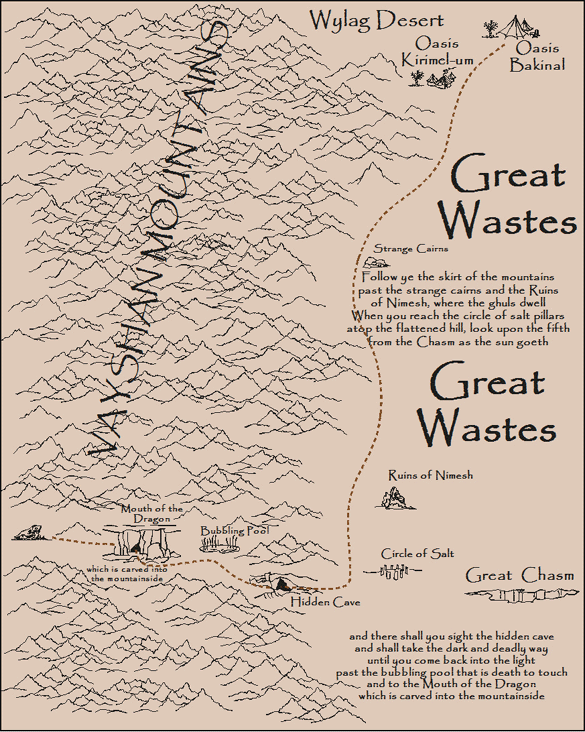 |
The map is written in Vashti, which Ali can read easily. It appears quite old, and there is no indication whether it was made by Angaralok or not (for the DM's knowledge, the map was crafted by the Lord of Palliag himself and was looted from its hiding place by Angaralok many centuries ago). A DC 25 Craft (alchemy) check will show that the vellum map was treated alchemically to preserve it. If, for some reason, no one amongst the PCs can read Vashti, then the DM should print out the map and black out the text. The map gives no indication of a scale, so it is difficult to guage from the map alone how long the journey is likely to be. However, the Great Chasm is a fairly well-known feature of the Wastes (Knowledge [geography] DC 10), and even some modest asking around the oasis (Gather Information DC 10) will allow the PCs to determine how far the Great Chasm is from the oasis (approximately 180 miles).
The Gem:
| Wrapped in the cloth bundle is the gem. It is a multifaceted stone the size and shape of a normal d20. The gem is translucent blue in colour and within the heart of it a small flickering spark resides. |
Angaralok has cast a dragoneye rune on the gem, allowing him to know its distance and direction from him three times per day. He will use this ability to keep tabs on the gem and know if the PCs have taken it off course.
In reality the gem is a dracolich phylactery. However, no amount of analysis by the PCs should reveal this, as dracoliches are so rare that it should require a Knowledge (arcana) check of close to epic proportions to determine its nature. Since the PCs finding out about the true nature of the gem will essentially ruin the storyline, the DM is within his bounds to simply rule that its nature cannot be determined by the PCs using any sort of Knowledge skill or bardic lore check.
More troubling are spells like identify and analyze dweomer. Angaralok has taken two somewhat overlapping measures to defeat these spells. First, he has cast an extended heightened (by 7 levels) magic aura spell on the gem. This aura still radiates necromancy, but it misleads any magical means of identification as to its purpose. To such magic, the gem's purpose is to house the soul of a creature who has performed an associated ritual. In all other respects, the misleading aura of the gem will comport to the story that Angaralok has told the PCs. This magic aura will last for 34 days from the day the gem is given to the PCs, and the Will save for the spell is DC 23 (due to the heightening). The spell will cover not only the inherent aura of the item, but also the other spells placed upon it (i.e. the hardening spell and the dragoneye rune).
However, Angaralok knows that proficient spellcasters such as the PCs may have strong enough wills to overcome his heightened magic aura, and so he has also created a "curse" on the item (using a divine scroll of bestow curse prepared by Musafa, though the priest did not know precisely why he was ordered to create the scroll) that misleads magical analysis into identifying the gem as having the soul housing powers that Angaralok has described. This "curse" is essentially the same process that some insane mages or Flupnir priests use to create cursed magic items (see Dungeon Master's Guide page 273 for creating cursed items). As such, an identify spell only has a 1% chance per caster level of correctly identifying the true properties of the item, otherwise relaying the false properties. An analyze dweomer spell will not be subject to this "curse".
Finally, Angaralok has fortified both of these measures by using two arcane scroll of limited wish. One imparts upon the first Will save made to penetrate the magic aura spell a -7 penalty. This penalty is in line with the suggested penalty imparted by a limited wish spell in the Player's Handbook. The other imparts a similar penalty to the percent chance of an identify recognizing the "cursed" item for what it is.
So, a PC casting an identify on the gem will first have a percent chance of success equal to his caster level minus 7. If that check succeeds, then the PC must make a Will save against DC 23 at a -7 penalty. If that also succeeds, then the PC will correctly identify the gem as a dracolich phylactery.
On the other hand, an analyze dweomer spell will cut right through the "curse" effect and the caster will simply have to make a DC 23 Will save at a -7 penalty.
Remember that the two limited wish spells each only function once. Angaralok's thought is that once an identify spell confirms the powers of the gem to be as he has said, no one would have reason to doubt it and cast a second such spell.
It's a Fake!:
In the unlikely event that the PCs determine the true nature of the gem, the fate of the remainder of this scenario is up to the PCs and the DM. Perceptive PCs might realize that if they reveal that they know of Angaralok's plan, he is likley to come after them and kill them, for he would not wish his plans to be known to the rest of the world.
In this case, PCs might even, begrudgingly, complete the mission, perhaps with a mind to then alert authorities after they get far far away from Angaralok and the desert and return to the west. Since Angaralok will not know they are wise to his scheme, he will have no reason to hunt them down in this case.
On the other hand, good-aligned PCs are likely going to have a real problem helping Angaralok become a dracolich, even at the expense of their own well-beings. They might wish to destroy the gem or take it somewhere other than the graveyard. Perhaps they will wish to take it to someplace like a temple where, in theory, the priests there might be able to do something to stop the process from happening. Almost anything they do is likley to alert Angaralok when he checks on the distance and direction of the gem using his dragoneye rune spell. He checks at dawn, midnight, and noon on each day, and even though he will be spending much of his time in the far off Kingdom of Slumber, he will have a keen sense for the proper distance of the gem. However, he is so far away that even decently large changes in direction will be difficult to detect. To counter this problem, at midnight of each day Angaralok uses his greater teleport to transport himself to a location about 100 miles away from the current location of the gem. In so doing, he will be close enough to the gem to detect even fairly minute variances in the direction of the gem and will be able to tell if the PCs have varied much from the path to the graveyard. If the gem is destroyed, Angaralok will know it because his dragoneye mark will not longer function. Angarlok, having lived and flown over the Wastes for millenia, knows the area well enough for the DM to assume that he can always teleport to some place about 100 miles from the PCs.
In the above case, there is no logical reason why Angaralok wouldn't hunt down the PCs. They can certainly attempt to escape from him, and the DM can even assume that if they make a reasonable effort to get away from the area, Angaralok won't be able to find them so easily. Once he is unable to quickly locate the PCs, he will realize that the jig is up, and that the PCs may have already alerted authorities using teleport spells and other means to travel or communicate quickly. As such, Angaralok will do whatever he can to become a dracolich as quickly as possible.
If the PCs are silly enough to keep the gem, and they do not somehow erase the dragoneye rune (remember spells like obscure object will not thwart the dragoneye rune), then Angaralok will have no trouble tracking them and eventually slaying them all.
If the PCs destroy the gem, Angaralok will head to the last known location of the gem and search for the PCs for at least 24 hours. Thereafter, presuming the gem to be destroyed, he will begin to activate a new phylactery. A dragon can only ever have one active phylactery at a time, and once he dies and actually uses the phylactery, that phylactery is the only one he can ever use for the rest of his existence as it becomes attuned to his undead spirit. Always the consummate planner, Angaralok has a second phylactery almost completed, in case the PCs should lose the one he gave them or it somehow become lost. It will take him a single day to put the final touches on his new phylactery. He will then immediately take his dracolich draught, die, and immediately possess his old body. In this case, of course, his plan to be thought dead and gone from the world will be compromised, and the dracolich Angaralok will bear the PCs great enmity from now on (and likely be the subject of reoccurring attacks by his minions and yes, eventually, himself!).
In any event, unless the PCs decide to complete the mission anyways, the scenario is effectively over, as is the next in this series, for there will be no need for Angaralok to fight and die against the Heroes of the Gem.
Travelling in General:
Thankfully for the PCs it is well into autumn and not summer or late spring. As such, heat is not an issue in the desert or the wastes. Glare is also not an issue, though sunburn is. There are no mirages in the desert or wastes this time of year.
Water is difficult to find, and so the PCs should count on bringing their own supply or using magic such as create water. Even though the temperature is not the blazing furnace it can be in the late spring and summer, the air is still very dry and water consumption is twice the normal (2 gallons per day for Medium sized creatures).
Game is also not very plentiful, and the Survival check to get along in the wild will be a DC 15 check as opposed to the normal DC 10 check.
Although the map indicates a dashed line path to follow, there is no such path or trail actually on the ground. In all cases, unless indicated otherwise, travel is along trackless terrain. As such, the chance of not getting lost is a DC 10 Survival check (DC 10 for wastes, +2 for trackless, -4 for map), checked every hour. Refer to the Dungeon Master's Guide page 86 for more details. This can be adjusted by duststorm (+4 DC) or sandstorm (+6 DC) conditions.
This means that PCs will travel overland at half their normal rate throughout the scenario (desert, wastes, and mountains). At speed 20 ft the PCs will travel 8 miles per day; at speed 30 ft they will travel 12 miles per day, and at speed 40 ft they will travel 16 miles per day. Use of mounts is quite possible, though sufficient food and water will have to be provided for them. Use of magical transport, such as phantom steed spells, are also quite possible and may shorten the journey considerably.
The PCs are not technically bound to follow the map trail. However, there is no real way of knowing where the graveyard is by, for example, simply flying over the mountains in the general direction indicated on the map. The map is not entirely to scale and is not meant to be an accurate way to pinpoint any location. Rather, it was meant to be followed along the path indicated.
The trek through the desert from Oasis Bakinal to Oasis Kiramel-um is about 50 miles through desert terrain. From Oasis Kiramel to the strange cairns is about 60 miles through wastes. From the strange cairns to the Ruins of Nimesh is another 60 miles through the wastes. And from the Ruins of Nimesh to the Circle of Salt is a distance of 15 miles through the wastes. From the Circle of Salt to the Hidden cave is another 15 miles through foothills. Thus, the total journey from Oasis Bakinal to the Hidden Cave, assuming the PCs follow the map, is one of about 200 miles. Under normal circumstances, such a journey would take 25 days at speed 20 ft, just under 17 days at speed 30 ft, and 12.5 days at speed 40 ft.
If a PC has enough Survival skill to make a DC 15 check, he can trailblaze (see Complete Adventurer page 103) and cut the travel times (by 1/3rd if a DC 15 check is made or by 50% if a DC 25 check is made). Keep in mind that there is a -2 penalty to the check for every 3 (or fraction thereof) individuals being guided beyond the trailblazer and 3 companions.
Finally, spells like wind at back can further reduce travel time.
Encounter Terrain Information:
DMs should assume that encounters in the Wylag Desert occur in sandy barren waste terrain. As such, the terrain will generally be comprised of shallow sand (see Sandstorm page 18) and sometimes with sand dunes (see the Dungeon Master's Guide page 91). 1% of all sand dunes has a blowout (see Sandstorm page 18).
Encounters in the East Wastes occur in gravelly barren waste terrain, due to the many small rocks that dot the landscape. Sand is less common in the rocky badlands of the East Wastes, but there is still enough sand to form occasional sand dunes and allow for sandy hazards.
Hazards:
There are natural hazards that can be found during travel in the Wylag Desert and East Wastes. Assume the PCs have a 5% chance per day of encountering one such hazard per day during travel. If a hazard is encountered, then another 5% chance will mean two such hazards are encountered, and so forth until a check is failed.. They can be spaced out randomly or as the DM desires and even combined with wandering encounters to set up an interesting situation. The Survival DC needed to recognize and avoid the hazard is presented below. If the PCs have someone with the Survival skill to automatically bypass a given hazard, then the DM doesn't even need to bother with it unless combining the hazard with an encounter. Instead, he should describe in detail the hazard the first time it is encountered and then just occasionally remind the PCs that they find more such hazards from time to time during their journey.
All of these hazards are described in Sandstorm and the page reference is noted below.
WYLAG DESERT:
01-10 = Mirror sand (no DC) [Sandstorm
page 23]
11-35 = Oleum spring (no DC) [Sandstorm page 102]
36-50 = Phantom voices (no DC) [Sandstorm page 24]
51-55 = Shadowsand (DC 15) [Sandstorm page 25]
56-65 = Slumber sand (DC 20) [Sandstorm page 26]
66-95 = Softsand (DC 10) [Sandstorm page 26]
96-00 = Wailing waste (no DC) [Sandstorm page 26]
EAST WASTES:
01-10 = Flamestorm (DC 15) [Sandstorm
page 21]
11-35 = Oleum spring (no DC) [Sandstorm page 102]
36-45 = Phantom voices (no DC) [Sandstorm page 24]
46-50 = Shadowsand (DC 15) [Sandstorm page 25]
51-55 = Slumber sand (DC 20) [Sandstorm page 26]
56-70 = Softsand (DC 10) [Sandstorm page 26]
71-95 = Volcanic gas (DC 15) [Sandstorm page 24]
96-00 = Wailing waste (no DC) [Sandstorm page 26]
Weather:
Heat is not an issue during this scenario, as it takes place in the autumn, when temperatures are around 80-85 degrees Farenheit during the daytime and lower to the 60-65 degree range at night.
Daily weather for the Wylag Desert and East Wastes can be determined by using the following table modified from the Dungeon Master's Guide page 94. The Vayshan Mountains have a more temperate clime and weather is less of a factor, so no chart is included.
WYLAG DESERT:
01-68 = Warm, calm
69-86 = Warm, windy
87-98 = Duststorm (90%), sandstorm (8%), or flensing sandstorm
(2%)
99-00 = Downpour (90%) or thunderstorm (10%)
EAST WASTES:
01-68 = Warm, calm
69-92 = Warm, windy
92-98 = Duststorm (90%), sandstorm (8%), or flensing sandstorm
(2%)
99-00 = Downpour (90%) or thunderstorm (10%)
Effects of the results are detailed below. Note that some effects are not indicated directly on the above chart but are side effects of those that are. Also, the chart for wind effects is not reproduced here, even though it contains important effects in addition to the descriptions below. Refer to the Dungeon Master's Guide page 95 for the chart.
Brownout: Sandstorms create brownout conditions. Swirling grit obscures the horizon and makes it nearly impossible to get one’s bearings. Any character in brownout conditions caused by a sandstorm takes a –4 penalty on Dexterity-based skill checks, as well as Search checks, Spot checks, and any other checks that rely on vision. Maximum visibility is reduced to 1d10 x 5 ft. These effects end when the character leaves the brownout area or enters a protected shelter.
Calm: Wind speeds are light (1d10 mph).
Duststorm: Duststorms arise in waste areas when
the wind speed rises above 30 miles per hour. A duststorm
blows fine grains of sand that reduce visibility, smother unprotected
flames, and even choke protected flames,
such as a lantern’s light (50% chance). A duststorm leaves
behind a deposit of 1d6 inches of sand. Visibility in a duststorm
is reduced, so all creatures within a duststorm take a –2
penalty on Search and Spot checks. Duststorms are accompanied
by severe winds (see below) and last for 2d4-1 hours. They leave
behind a deposit of 1d6 inches of sand.
Downpour: Treat as rain (see below), but conceals like fog (see below). Can create flash floods (see below). A downpour lasts for 2d4 hours.
Flash Floods: Storms or spring runoff from nearby mountains can send deadly walls of water through ravines or along low desert gullies. A flash flood can suddenly raise the water level of an area, filling a dry gulch to the top of its walls. A flood raises the water level by 1d10+10 feet within a matter of minutes. Water washes through affected squares, traveling at a speed of 60 feet or more, unless impeded by slopes or solid barriers. Treat a flash flood as stormy water (Swim DC 20 to avoid being swept away). An additional DC 20 Swim check is required each round to keep the head above water. Characters who stay below the surface might drown (as described on page 304 of the Dungeon Master’s Guide). See Aquatic Terrain, page 92 of the Dungeon Master’s Guide, for more about the effects of being swept away.
Along with the hazards of fast-flowing water, the flow uproots trees and rolls enormous boulders with deadly impact. Characters struck by a wall of water during a flash flood must make a successful DC 15 Reflex save or take 3d6 points of bludgeoning damage. A flash flood passes through an area in 3d4 hours.
Flensing Sandstorm: Flensing sandstorms arise in waste areas when the wind speed rises above 74 miles per hour and are accompanied by hurricane-force winds (90%, see below) or tornado-strength winds (10%, see below). Flensing sandstorms reduce visibility to severe brownout conditions (see below), smother unprotected flames, and choke protected flames (100% chance). Moreover, flensing sandstorms deal 1d3 points of lethal damage each round to anyone caught out in the open without shelter and pose a suffocation hazard (see below). Flensing sandstorms also create severe brownout conditions (see below). Driving sand creeps in through all but the most secure seals and seams, to chafe skin and contaimate carried gear. Flensing sandstorms last for 2d4-1 hours. A flensing sandstorm leaves 4d6 feet of sand in its wake.
Fog: A side-effect of a downpour (see above), all sight is obscured, including darkvision, beyond 5 ft. Creatures 5 ft away have concealment (attacks by or against them have a 20% miss chance).
Hurricane-Force Wind: All flames are extinguished. Ranged attacks are impossible (except with siege weapons, which have a -8 penalty on attack rolls). Listen checks are impossible. All creatures can hear is the roaring of the wind. Hurricane-force winds often fell trees or structures that are not particularly sturdy.
Light Wind: A gentle or no breeze, having little or no game effect.
Moderate Wind: A steady wind with a 50% chance of extinguishing small, unprotected flames such as candles.
Rain: Reduces visibility ranges by half, resulting in a -4 penalty on Spot and Search checks. It has the same effect on flames, ranged weapon attacks, and Listen checks as severe winds (see below).
Sandstorm: Sandstorms arise in waste areas when the wind speed rises above 50 miles per hour. They are accompanied by windstorm-magnitude winds (see below). Sandstorms reduce visibility to brownout conditions (see below), smother unprotected flames, and choke protected flames, such as a lantern’s light (75% chance). Moreover, sandstorms deal 1d3 points of nonlethal damage each round to anyone caught out in the open without shelter and pose a suffocation hazard (see below). Sandstorms also create brownout conditions (see above). Driving sand creeps in through all but the most secure seals and seams, to chafe skin and contaimate carried gear. Sandstorms last for 2d4-1 hours. A sandstorm leaves 2d3–1 feet of fine sand in its wake.
Severe Brownout: Even more severe brownout conditions apply during a flensing sandstorm than during a regular sandstorm. Swirling grit obscures the horizon and makes it nearly impossible to get one’s bearings. A character in brownout conditions caused by a flensing sandstorm takes a –6 penalty on Dexterity-based skill checks, as well as Search, Spot, and any other checks that rely on vision. Maximum visibility is reduced to 1d6 x 5 ft. These effects end when the character leaves the brownout area or enters a protected shelter.
Severe Wind: In addition to automatically extinguishing any unprotected flames, winds of this magnitude cause protected flames (such as those of lanterns) to dance wildly and have a 50% chance of extinguishing these lights. Ranged weapn attacks and Listen checks are at a -4 penalty. This is the belocity of wind produced by a gust of wind spell.
Strong Wind: Gusts that automatically extinguish unprotected flames (candles, torches, and the like). Such gusts impose a -2 penalty on ranged attack rolls and on Listen checks.
Suffocation: Exposed characters might begin to choke
if their noses and mouths are not covered. A sufficiently large
cloth expertly worn (Survival DC 15) or a filter mask (see Sandstorm
page 100) negates the effects of suffocation from dust and
sand. An inexpertly worn cloth across the nose and mouth protects
a character from the potential of suffocation for a number of
rounds equal to 10 × his Constitution score. An unprotected
character faces potential suffocation after a number rounds equal
to twice his Constitution score. Once the grace period ends, the
character must make a successful Constitution check (DC 10, +1
per previous check)
each round or begin suffocating on the encroaching sand. In the
first round after suffocation begins, the character falls unconscious
(0 hp). In the following round, he drops to –1 hit points
and is dying. In the third round, he suffocates to death.
Thunderstorm: In addition to severe wind (see above) and rain (see above), thunderstorms are accompanied by lightning that can pose a hazard to creatures without proper shelter (especially those flying and/or in metal armour). As a rule of thumb, assume one bolt per minute for a 1 hour period at the center of the storm with a 1% chance per bolt that it is at or near one of the PCs. Each bolt causes electricity damage equal to 1d10 eight-sided dice. One in twenty desert thunderstorms is accompanied by a tornado (see below).
Tornado: All flames are extinguished. All ranged attacks are impossible (even with siege weapons), as are Listen checks. Instead of being blown away, creatures in close proximity to a tornado who fail their Fortitude saves are sucked towards the tornado. Those who come in contact with the actual funnel cloud are picked up and whirled around for 1d10 rounds, taking 6d6 points of damage per round, before being violently expelled (falling damage may apply). While a tornado's rotational speed can be as great as 300 mph, the funnel istelf moves forward at an average speed of 30 mph (roughly 250 ft per round). A tornado uproots trees, destroys buildings, and causes other similar forms of major destruction. Tornadoes are very short-lived (1d6 x 10 minutes), typically forming as part of a thunderstorm (see above).
Windstorm: Powerful enough to bring down branches if not whole trees, windstorms automatically extinguish unprotected flames and have a 75% chance of blowing out protected flames such as those of lanterns. Ranged weapon attacks are impossible, and even siege weapons have a -4 penalty on attack rolls. Listen checks are at -8 penalty due to the howling of the wind. Windstorms last for 1d6 hours.
Windy: Wind speeds are moderate (75%), strong (20%) or severe (5%)
Wandering Encounters:
There are three different encounter tables presented for each of the three terrain locations: Wylag Desert (for the first leg of the journey between the two oases), East Wastes (for the journey from the last oasis to the Hidden Cave), and Vayshan Mountains (for the journey into the mountains).
Actual encounters are checked for each of four periods of the day, morning, afternoon, evening, and night. Assume the PCs travel during the first two periods and are encamped for the last two periods. There is a 10% chance of an encounter each period. If an encounter is indicated for a period, the DM should check again to see if a second encounter is indicated. If so, then a third check should be made and so forth until a check fails for that period. Multiple encounters in a given period can be spaced apart randomly (i.e. roll a d6 for hour in the period) or can be mixed together into a multiple encounter.
Nighttime encounter chances can increase or decrease depending on the type of camp that is set up:
PCs light an unshielded fire = +15%
PCs light a shielded fire = +5%
PCs make no effort to find a secluded or safe campsite or fail a DC 15 Survival check to find such a spot by 5 or more = +5%
PCs make a DC 15 Survival check to find a safe or secluded campsite = -5%
PCs make noise (singing, etc.) = +5%
Of course, PCs of the level appropriate for this scenario likely have magical means to encamp, including the various shelter-spells and the ever-useful rope trick.
The DM should not seek to foil any measures such as rope trick that the PCs have taken to ensure their safety. After all, that means they have forsaken other spells to memorize these magical means of encamping. In general, such means will involve no encounters during the night, but encounters may occur during the evening, as the PCs must still spend time outside washing, eating, cooking, praying, and practicing their skills. Unless PCs ensconced in concealed magical lodgings wish a running account of the various creatures that blunder past them in the night, the DM should simply not even roll for encounters during the night unless there is a chance that a creature encountered could somehow interact with the PCs.
If an encounter(s) is(are) indicated, refer to the table below.
Full statistics and the like are not presented in this scenario in order to save time and space. It is suggested that the DM preroll for wandering encounters and craft interesting situations to accommodate the encounters.
Although the table for the Vayshan Mountains is not used until Part Three of this adventure, it is presented here for ease of use and organizational purposes.
WYLAG DESERT:
|
|
|
|
|
| 01-03 | Ant, Giant* | var |
Monster Manual pg 284 |
| 04-05 | Ant Lion, Giant | 1 | Sandstorm pg 196 |
| 06-09 | Asabi* | var | Monsters of Faerun pg 15 |
| 10-11 | Bee, Giant | 1d20 | Monster Manual pg 284 |
| 12-16 | Centipede, Monstrous* | var | Monster Manual pg 286 |
| 17-18 | Centipede, Spirit* | 1 | Oriental Adventures pg 149 |
| 19-23 | Dire Hawk | 1d2 | Races of the Wild pg 189 |
| 24-29 | Dire Rat | 1d20 | Monster Manual pg 64 |
| 30-31 | Dire Snake | 1 | Monster Manual II pg 74 |
| 32-33 | Dune Hag | 1d4 | Sandstorm pg 158 |
| 34-35 | Dust Digger | 1d20 | Tome of Horrors pg 176 |
| 36 | Dust Twister | 1d12 | Sandstorm pg 162 |
| 37-41 | Fly, Giant | 1d12 | Tome of Horrors pg 202 |
| 42-44 | Genie, Janni | 1d12 | Monster Manual pg 116 |
| 45-46 | Hoard Scarab | 1d6 | Draconomicon pg 167 |
| 47-53 | Human* | var | Varies |
| 54 | Lamia | 1d4 | Monster Manual pg 165 |
| 55 | Lammasu | 1 | Monster Manual pg 165 |
| 56-57 | Nature Spirit* | 1 | Oriental Adventures pg 177 |
| 58-61 | Scorpion, Monstrous* | var | Monster Manual pg 287 |
| 62-63 | Scorpionfolk | 1d6 | Monster Manual II pg 221 |
| 64-66 | Snake, Dung | 1 | Serpent Kingdoms pg 83 |
|
|
Snake, Viper* |
|
Monster Manual pg 280 |
| 71-73 | Sphinx* | var | Varies |
| 74-76 | Spider, Hairy | 2d10 | Monster of Faerun pg 79 |
| 77 | Stinger | 1d8 | Monsters of Faerun pg 80 |
| 78-81 | Swarm, Bat | 1d20 | Monster Manual pg 237 |
| 82 | Swarm, Hoard Scarab | 1d4 | Draconomicon pg 167 |
| 83-86 | Swarm, Rat | 1d12 | Monster Manual pg 239 |
| 87 | Swarm, Scarab Beetle | 1 | Fiend Folio pg 171 |
| 88-90 | Swarm Scorpion | 1d12 | Sandstorm pg 185 |
|
|
Swarm, Viper |
|
Fiend Folio pg 172 |
| 93-94 | Tick, Monstrous | 3d4 | Tome of Horrors pg 344 |
| 95-00 | Vulture | 1d20 | Sandstorm pg 195 |
EAST WASTES:
|
|
|
|
|
| 01 | Ankheg | 1d4 |
Monster Manual pg 14 |
| 02-03 | Ant, Giant* |
|
Monster Manual pg 284 |
| 04 | Bee, Giant | 1d20 | Monster Manual pg 284 |
| 05-06 | Camelopardel |
|
Sandstorm pg 141 |
| 07-10 | Centipede, Monstrous* |
|
Monster Manual pg 286 |
| 11-12 | Centipede, Spirit* |
|
Oriental Adventures pg 149 |
| 13-16 | Deer, Black-Tailed | 1d20 | Tome of Horrors pg 429 |
| 17-19 | Dire Hawk | 1d2 | Races of the Wild pg 189 |
| 20-23 | Dire Jackal | 1d2 | Sandstorm pg 150 |
| 24-25 | Dire Puma | 1d2 | Sandstorm pg 150 |
| 25-30 | Dire Rat | 1d20 | Monster Manual pg 64 |
| 31 | Dire Snake | 1 | Monster Manual II pg 74 |
| 32-33 | Dire Tortoise |
|
Sandstorm pg 151 |
| 34-36 | Donkey | 1 | Monster Manual pg 272 |
| 37 | Dust Twister | 1d12 | Sandstorm pg 162 |
| 38-40 | Fly, Giant | 1d12 | Tome of Horrors pg 202 |
| 41-42 | Genie, Janni | 1d12 | Monster Manual pg 116 |
| 43 | Hoard Scarab | 1d6 | Draconomicon pg 167 |
| 44-46 | Human |
|
Varies |
| 47-51 | Jackal (small dog) |
|
Monster Manual pg 271 |
|
|
Jackalwere |
|
Fiend Folio page 107 |
| 56 | Lamia | 1d4 | Monster Manual pg 165 |
| 57 | Lammasu | 1 | Monster Manual pg 165 |
| 58 | Nature Spirit* |
|
Oriental Adventures pg 177 |
| 59-61 | Rock Reptile |
|
Tome of Horrors pg 306 |
| 62-64 | Scorpion, Monstrous* | var | Monster Manual pg 287 |
| 65-66 | Scorpionfolk |
|
Monster Manual II pg 221 |
| 67-68 | Serval | 1d6 | Sandstorm pg 194 |
| 69-70 | Snake, Dung | 1 | Serpent Kingdoms pg 83 |
| 71-72 | Snake, Viper* |
|
Monster Manual pg 280 |
| 73 | Sphinx | var | Varies |
| 74-76 | Spider, Hairy | 2d10 | Monster of Faerun pg 79 |
| 77 | Stinger | 1d6 | Monsters of Faerun pg 80 |
| 78-81 | Swarm, Bat |
|
Monster Manual pg 237 |
| 82 | Swarm, Hoard Scarab |
|
Draconomicon pg 167 |
| 83-86 | Swarm, Rat |
|
Monster Manual pg 239 |
| 87-88 | Swarm, Scorpion |
|
Sandstorm pg 185 |
| 89 | Swarm, Viper |
|
Fiend Folio pg 172 |
| 90-91 | Termite, Giant* |
|
Sandstorm pg 197 |
| 92-94 | Tick, Monstrous |
|
Tome of Horrors pg 344 |
| 95 | Troll, Wasteland* |
|
Sandstorm pg 190 |
| 96-00 | Vulture |
|
Sandstorm pg 195 |
VAYSHAN MOUNTAINS (eastern portion):
|
|
|
|
|
| 01-02 | Ant, Giant* |
|
Monster Manual pg 284 |
| 03-04 | Bee, Giant | 1d20 | Monster Manual pg 284 |
| 05-08 | Centipede, Monstrous* |
|
Monster Manual pg 286 |
| 09-10 | Centipede, Spirit* |
|
Oriental Adventures pg 149 |
| 11-18 | Deer, Black-Tailed | 1d20 | Tome of Horrors pg 429 |
| 19-22 | Dire Hawk | 1d2 | Races of the Wild pg 189 |
| 23-24 | Dire Puma | 1d2 | Sandstorm pg 150 |
| 25-31 | Dire Rat | 1d20 | Monster Manual pg 64 |
| 32-33 | Dire Snake | 1 | Monster Manual II pg 74 |
| 34-35 | Dire Toad |
|
Monster Manual II pg 74 |
| 36-39 | Eagle | 1d2 | Monster Manual pg 272 |
| 40-43 | Fly, Giant | 1d12 | Tome of Horrors pg 202 |
| 44-47 | Hengeyokai* | var | Oriental Adventures pg 168 |
| 48-51 | Human* |
|
Varies |
| 52-53 | Nature Spirit* |
|
Oriental Adventures pg 177 |
| 54-57 | Scorpion, Monstrous* | var | Monster Manual pg 287 |
| 58-59 | Snake, Dung | 1 | Serpent Kingdoms pg 83 |
| 60-63 | Snake, Viper* |
|
Monster Manual pg 280 |
| 64-67 | Spider, Hairy | 2d10 | Monster of Faerun pg 79 |
| 68-75 | Swarm, Bat |
|
Monster Manual pg 237 |
| 76-82 | Swarm, Rat |
|
Monster Manual pg 239 |
| 83-84 | Swarm, Viper |
|
Fiend Folio pg 172 |
| 85-86 | Termite, Giant* |
|
Sandstorm pg 197 |
| 87-89 | Tick, Monstrous |
|
Tome of Horrors pg 344 |
| 90-92 | Toad, Giant |
|
Oriental Adventures pg 196 |
| 93-00 | Wolf |
|
Monster Manual pg 283 |
* = creature encounter divided into subtypes per the tables below or with notes below
Ant, Giant:
These will be encountered as follows:
01-50 = 1d12 workers (plus 1 soldier
if 6 or more encountered)
51-85 = 1d4 soldiers
86-00 = 1dd+6 workers and 1d4+1 soldiers
Asabi:
These will be encountered as follows:
01-50 = 1d4+1 asabis
51-85 = 1d4+1 stingtails
86-00 = 6d8 asabi plus 2d8 stingtails
Centipede, Monstrous:
These will be encountered as follows:
01-27 = 2d8 tiny centipedes
28-53 = 1d12 small centipedes
54-64 = 1d6 medium centipedes
65-75 = 1d6 large centipedes
76-86 = 1d6 huge centipedes
87-93 = 1 gargantuan centipede
94-00 = 1 colossal centipede
Centipede, Spirit:
These will be encountered as follows:
01-50 = 1 least spirit centipede
51-85 = 1 lesser spirit centipede
86-00 = 1 greater spirit centipede
Hengeyokai:
Hengayokai will be Chaotic Good half the time and Chaotic Evil half the time. Any given band will be conmprised of members with the same alignments and with the ability to all change into the same animal. The exact animal type can be determined as follows:
01-15 = badger
16-30 = dog
31-43 = fox
44-53 = hare
54-64 = racoon
65-76 = rat
77-88 = sparrow
89-00 = weasel
A given group will also all be initially encountered in the same form as follows:
01-50 = animal form
51-85 = hybrid form
86-00 = human form
These will be encountered as follows:
01-40 = hunting party (1d8 Ranger
lvl 1d4)
41-70 = warriors/patrollers/raiders (2d12 Warrior lvl 1d4+1 and
1d3 Wu-Jen lvl 1d4)
71-00 = clan members (2d6 Warrior lvl 1d3 and 1d3-2 Wu-Jen lvl
1d4)
Human:
These will be encountered as follows:
Wylag Desert:
01-25 = merchant caravan (1d8
merchants [N Expert lvl 1d4] with 2d8 camels and 4d8 guards [N
Fighter lvl 1d6])
26-50 = desert raiders (4d10 raiders [NE Fighter/Rogue lvl 1d3/lvl
1d3] led by a leader [NE Fighter/Rogue lvl 1d4+1/1vl 1d4+1])
51-60 = pilgrims/priests (4d10 pilgrims/priests [Any Cleric 1d4]
led by a leader [Any Cleric 2d4])
61-00 = tribesmen (4d10 hunters or patrol [Any Warrior 1d4 led
by a leader [Any Warrior 2d4])
East Wastes:
01-10 = merchant caravan (1d8
merchants [N Expert lvl 1d4] with 2d8 camels and 4d8 guards [N
Fighter lvl 1d6])
11-50 = desert raiders (4d10 raiders [NE Fighter/Rogue lvl 1d3/lvl
1d3] led by a leader [NE Fighter/Rogue lvl 1d4+1/1vl 1d4+1])
51-55 = pilgrims/priests (4d10 pilgrims/priests [Any Cleric 1d4]
led by a leader [Any Cleric 2d4])
56-00 = tribesmen (4d10 hunters or patrol [Any Warrior 1d4 led
by a leader [Any Warrior 2d4])
Vayshan Mountains:
01-02 = merchant caravan (1d8
merchants [N Expert lvl 1d4] with 2d8 donkeys and 4d8 guards [N
Fighter lvl 1d6])
03-25 = mountain raiders (4d10 raiders [NE Fighter/Rogue lvl 1d3/lvl
1d3] led by a leader [NE Fighter/Rogue lvl 1d4+1/1vl 1d4+1])
26-30 = pilgrims/priests (4d10 pilgrims/priests [Any Cleric 1d4]
led by a leader [Any Cleric 2d4])
31-00 = tribesmen (4d10 hunters or patrol [Any Warrior 1d4 led
by a leader [Any Warrior 2d4])
Nature Spirit:
These will be encountered as follows:
01-50 = 1 small nature spirit
51-85 = 1 medium nature spirit
86-00 = 1 large nature spirit
Scorpion, Monstrous:
These will be encountered as follows:
01-30 = 1d8+8 tiny monstrous scorpions
31-60 = 1d12 small monstrous scorpions
61-79 = 1d6 medium monstrous scorpions
80-97 = 1d6 large monstrous scorpions
98-00 = 1d3 huge monstrous scorpions
Snake, Viper:
These will be encountered as follows:
01-30 = 1 tiny viper
31-60 = 1 small viper
61-79 = 1 medium viper
80-97 = 1 large viper
98-00 = 1 huge viper
Sphinx:
These will be encountered as follows:
Wylag Desert:
01-10 = 1 androsphinx (Monster
Manual pg 232)
11-26 = 1d2 canisphinx (Sandstorm pg 186)
27-40 = 1 criosphinx (Monster Manual pg 233)
41-54 = 1d4 gynosphinx (Monster Manual pg 233)
55-71 = 1d6 hieracosphinx (Monster Manual pg 234)
72-78 = 1 loquasphinx (Tome of Magic pg 268)
79-92 = 1d10 saurosphinx (Sandstorm pg 188)
93-00 = 1 threskipshinx (Sandstorm pg 188)
East Wastes:
01-09 = 1 androsphinx (Monster
Manual pg 232)
10-24 = 1d2 canisphinx (Sandstorm pg 186)
25-37 = 1 criosphinx (Monster Manual pg 233)
38-42 = 1 drocosphinx (Sandstorm pg 187)
43-54 = 1d4 gynosphinx (Monster Manual pg 233)
55-71 = 1d6 hieracosphinx (Monster Manual pg 234)
72-78 = 1 loquasphinx (Tome of Magic pg 268)
79-92 = 1d10 saurosphinx (Sandstorm pg 188)
93-00 = 1 threskipshinx (Sandstorm pg 188)
Termite, Giant:
These will be encountered as follows:
01-60 = 3d8 workers plus 2 soldiers
61-95 = 1d8 soldiers
96-00 = hive with 12d10 workers, 6d6 soldiers, and 1 queen
Troll, Wasteland:
These will only br encountered at night. Otherwise, treat as no encounter.
Planned Encounters:
In addition to the wandering encounters outlined above, there will be several planned encounters. The DM can introduce them at any time during the PC's journey, as indicated in the encounter description. Of course, if the PCs are doing something that would negate the planned encounter (e.g. flying high above the desert) then the encounter can be ignored.
Encounter #1 - Between a Roc and a Hard Place (EL 11*)
* The EL of the encounter has been reduced by 1 to reflect the possibility that the two creatures involved will attack each other.
A roc has been tracking for some time the movements of a dunewinder, hoping to get a chance to pluck it up like a bird plucks up a worm, drop it from a great height to kill it and, after it explodes, to gobble up the chunks to bring to its nest where its mate and several young wait hungrily to eat the regurgitated chunks. If the PCs are already flying as they travel across the desert or wastes, then they will not encounter the dunewinder unless they go to ground, but they will still be attacked by the roc.
The Hard Place:
As the PCs travel, they will intrude upon the hunting area of the dunewinder, which will attack the PCs, emerging from its underground burrowing. In so doing, the dunewinder will expose itself to the roc, which will then swoop down, ostensibly to attack the dune winder. But with the PCs in the mix, there is no telling who will attack what!
Creatures: A single dune winder waits under the ground for prey to pass within 60 ft. Unfortunately for the PCs, they are going to do that and place themselves on the menu.
|
DUNEWINDER CR 10 Death Throes (Ex) When killed, a dunewinder explodes in a blast of spiked flesh that deals 12d4 points of piercing damage to everything within 60 feet (Reflex half DC 20). The save DC is Constitution-based. In addition, all creatures injured by this attack must make Fortitude saves or be poisoned (see Poison, below). Improved Grab (Ex) To use this ability, a dunewinder must hit with its bite attack. It can then attempt to start a grapple as a free action without provoking attacks of opportunity. If it wins the grapple check, it can shred its opponent. Immunity to Dessication (Ex) A dunewinder has immunity to any spell
or effect that deals magical dessication damage, as well as to
any damage that results from failed Constitution checks to resist
the effects of Poison (Ex) Injury, Fortitude DC 20, initial and secondary damage 1d8 Con. The save DC is Constitution-based. Shred (Ex) On a successful grapple check, a dunewinder crushes the creature it has grabbed, dealing 3d4+12 points of piercing damage. In addition, the bristles inject poison into the wounds. * In a sandy environment, this bonus increases to +12. |
Tactics: The dunewinder will burst up suddenly from the ground when it sense tremors above it. The worm is 5 ft below ground, and so can use its surprise round to burst up as a 5 ft move and make an attack against any prey within 10 ft of it.
The dunewinder will use its breath weapon liberally, though its favoured tactic is to Snatch size Small or smaller victims with its bite and then charbroil them with its breath weapon (for which they get no save).
Against Medium and Large opponents, the dunewinder will seek to grab a victim and shred it to death. It will generally leave off prey that it believes it has slain in order to attack live prey, in the hope of securing additional tasty tidbits. However, if it has slain or defeated a victim and is sorely pressed, it is not above burrowing underground in an attempt to flee its foes and eat its morsel in peace.
Once the roc is in the fight (generally in round 3 of the combat), the dunewinder will tend to strike at whomever is in reach, or use its breath weapon to attack the roc and the PCs. The dunewinder is smart enough to ready an action to use its breath weapon as the roc flies by and makes a Flyby Attack on either the dunewinder or the PCs.
Developments: The dunewinder will attack for 1 round before the roc, hiding amongst some nearby hills, will emerge and swoop to the attack. Note that the roc is familiar with dunewinders, as it has hunted the wastes before. It knows of its death throes ability and has learned to get outside of 60 ft when one dies. The PCs may observe the roc doing this and get a hint as to what is to come if, for example, the dunewinder is brought to less than 0 hit points and is bleeding to death.
The Roc:
The hills behind which the roc hides are some 220 ft away from the dunewinder, and so the DM should adjust any Spot checks that are made by the PCs for distance.
Creatures: The roc will certainly note the combat between the PCs and the dunewinder, and it will figure that the PCs will make easier pickings than the much larger dune winder. On its initiative in round 2 of the combat it will alight. When it alights, the PCs can make passive Spot checks to notice it. The check should be made at the end of the roc's turn, with a base DC 2 Spot check (using the roc's normal Hide bonus of -3, with an additional -10 penalty for moving out in the open, and a +5 for the PCs being distracted and an assumed 10 on the Hide check). This DC 2 Spot check should be adjusted by distance, and if a PC is actively making a Spot check and not in melee, then the DC drops to -1.
PCs can also make passive Listen checks at the end of the roc's turns, but the DC will be 16 (using the roc's normal Move Silently bonus of +1, with a -10 penalty for moving at full speed, a +10 for the nearby battle masking its sounds, and a +5 for the PCs being distracted and an assumed 10 on the Move Silently check). The DC 16 Listen check should be adjusted by distance, and if a PC is actively making a Listen check and not in melee, then the DC drops to 11.
| ROC CR 9 N Gargantuan animal Init +2 Senses low-light vision; Listen +10, Spot +14 AC 17, touch 8, flat-footed 15 hp 207 (18 HD) Fort +18, Ref +13, Will +9 Spd 20 ft (4 squares), fly 80 ft (16 squares) (average); Wingover Melee 2 talons +21 (2d6+12) and bite +19 (2d8+6) Space 20 ft; Reach 15 ft Base Atk +13; Grp +37 Atk Options Power Attack, Snatch Special Actions Flyby Attack Abilities Str 34, Dex 15, Con 24, Int 2, Wis 13, Cha 11 Feats Alertness, Flyby Attack, Iron Will, Multiattack, Power Attack, Snatch, Wingover Skills Hide -3, Listen +10, Spot +14 |
Tactics: The roc will tend to ignore the dunewinder initially, focusing on the PCs, whom it believes make an easier meal. However, as the dunewinder begins to attack it, the roc might begin to counterattack the dunewinder, or at least divide its attacks between the dunewinder and the PCs.
If things get hairy for the roc, it will simply make a Flyby Attack on a Medium sized PC and Snatch it up and fly back to its nest with the PC.
Developments: When the roc enters the fray, a free-for-all should ensue. It will be difficult for the PCs to simply run away and let the two combatants duke it out. This is because both regard the PCs as an easier meal than one another. About the only real way for this to happen is if the PCs can all Hide or go invisible or flee the area faster than either creature can pursue, in which case the roc will turn to try to catch its worm.
Otherwise, while in no way will the roc and dunewinder coordinate their attacks, and the dunewinder, as mentioned previously, will take every opportunity to include the roc in its breath weapon attack, the two will focus on the PCs, making for a tough time for their prey.
Both creatures are hungry, but neither is willing to die for its meal. As such, if either is reduced to fewer than 25% of its hit points it will attempt to disengage and flee the scene of battle.
The roc dwells in a nest high in the Vayshan Mountain about 15 miles from the site of the encounter. There it has a nest with a mate and several young. Any PCs Snatched and taken to the nest will be fed to the young forthwith. It is, in theory, possible for the young, once the parents are disposed of, to be brought back to civilization and raised as mounts.
Encounter #2 -Day of the Jackal (EL 14*)
* The EL of this encounter has been reduced by 1 to reflect the fact that the dun pudding is confined within the pit.
The PCs will be travelling along the desert or wastes sometime in late afternoon (or at night if travelling by night) when they spy from a distance two large jackals dragging a kicking and screaming tribeswoman along a rocky ridge some 400 ft away. The jackals quickly drag the woman down the other side of the ridge, out of sight, and it is clear the canines were too intent upon their task to notice the PCs.
The PCs can simply ignore the whole situation, in which case they will hear the woman's screams for a few minutes before she goes quiet. Good-aligned PCs who ignore the encounter should have some consideration for having their alignments move away from goodness and towards neutrality.
The woman is being dragged by
the dire jackals to a location on the other side of the ridge
where a jackal lord and its minions conduct ritual sacrifice to
its evil infernal lords. This particular jackal lord enjoys tossing
its victims down a hole where a dun pudding dwells, watching the
vuictims scream as they are slowly consumed. The dun pudding,
fed enough of these victims in infernal rituals, has become corrupted
over time and now has the fiendish template.
|
As you crest the rocky ridge a horrific sight unfolds below. The ridge slopes steeply down 60 ft to the rocky desert floor, the slope becoming shallower as it approaches a large jagged pit. To either side the ridge is much steeper, especially to the south where it becomes a cliff face. The pit itself is irregularly shaped, approximately 35 ft in diameter but its eastern edge buckles inward to form a small stone ledge that looks out over the center of the hole. A large number of creatures are gathered in the vicinity of the pit. At various points on the downslope of the ridge are a total of eight dire jackals. These large jackals seem to have glowing red eyes and strange red streaks on their fur. The jackals seem intent upon watching the goings on at the pit. Interspersed with the jackals on the hillside are four humanoud figures whose flesh is so dessicated that they appear almost skeletal. The air around these four beings wavers with a dry, sucking heat as if each figure brings with it the soul of the waterless desert. The proximity of these figures does not seem to bother the dire jackals in the least. The center of attention of these beasts is an attractive, if sinister-looking, creature that stands on the ledge overlooking the pit. The creature resembles a slender and wiry humanoid with the black head of a jackal. The being wears rich-looking robes and is bedecked in jewerly and other finery and bears a scimitar in a scabbard at its waist. The being has its hands upraised and is chanting over the pit. At the jackal-figure's feet, on the ledge just behind him, is the bound and gagged but struggling form of what appears to be a desert tribesman. Behind him, and standing where the ledge meets the desert floor, is a fierce and beautiful woman, with a statuesque build and flawless skin. She has large, feathery wings and red, glowing eyes. She wields a longsword and a shining red bow is strapped across her back. At her feet is another bound and gagged form of what seems to be a desert tribesman. Still another bound and struggling victim, possible a tribeswoman and likely the one you observed being dragged over the ridge, lies at the base of the ridge at the other edge of the pit. Two of the dire jackals hover on the hillside near her. She is not gagged and his screaming. Observing the ritual at the pit in a close ring around the jackal figure are six Medium humanoids with jackal's heads and jackal's fur. They wear studded leather armour and carry heavy wooden shields on their backs. Scimitars are sheathed at their waists and long composite bows are across their shoulders. They gaze with unbridled glee at the proceedings taking place. Flanking the jackal-men are six creatures resembling big, powerfully built dogs with short, rust-red fur. Their markings, teeth, and tongues are sooty black and they have red, glowing eyes. Of the six, two are of large size and particularly fierce demeanour. Directly behind the central chanting figure and the winged woman are two hunanoid figures with flayed, sand-blasted flesh. In each of their hands is a scimitar red with its own constantly oozing blood. These terrifying figures are swathed in a halo of blowing grit and dust, and are standing back a bit away from the other creatures. Finally, as if this panoply of beings weren't enough, prowling the perimter of the spectacle on the side opposite the ridge are several dire jackal skeletons and zombies. |
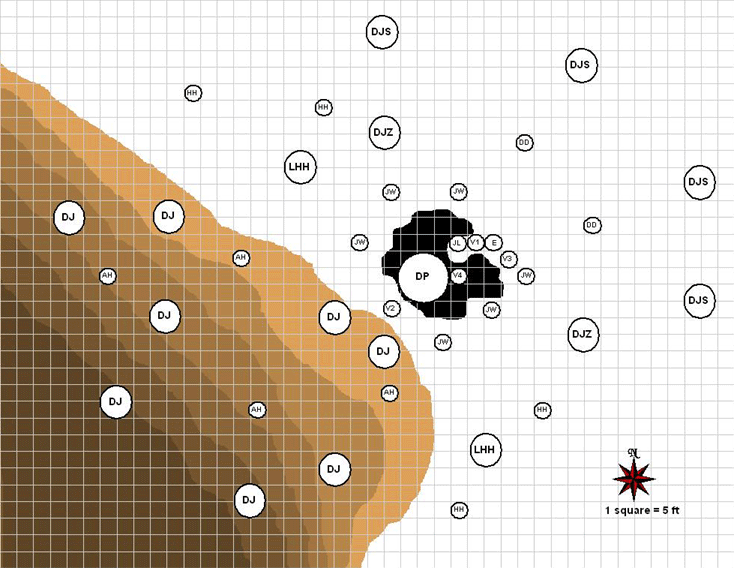 |
Each contour on the map above represents a 10 ft increase in elevation. Thus, the ridge is 60 ft high and its far side is somewhat steep, descending at almost a 45 degree angle until the slope levels off as it nears the pit. The slope of the ridge is considered a steep slope.
Steep Slope: Characters moving uphill (to an adjacent square of higher elevation) must spend 2 squares of movement to enter each square of steep slope. Characters running or charging downhill (moving to an adjacent square of lower elevation) must succeed on a DC 10 Balance check upon entering the first steep slope square. Mounted characters make a DC 10 Ride check instead. Characters who fail this check stumble and must end their movement 1d2×5 feet later. Characters who fail by 5 or more fall prone in the square where they end their movement. A steep slope increases the DC of Tumble checks by 2.
Toward the northern end of the ridge the slope is steep enough that a DC 0 Climb check is needed (in addition to the effects of a steep slope). Toward the southern end of the ridge the drop becomes a cliff face (Climb DC 15).
The pit is 30 ft deep and the walls are sheer and coated with a slippery grease (DC 30 Climb check).
Map Legend:
AH = Ashen Husk
DD = Desert Devil
DJ = Dire Jackal
DJS = Dire Jackal Skeleton
DJZ = Dire Jackal Zombie
DP = Dun Pudding
E = Erinyes
HH = Hell Hound
JL = Jackal Lord
JW = Jackalwere
LHH = Large Hell Hound
V1-4 = Victims (1-4)
Creatures: There are a total of 1 jackal lord, 6 jackalwere warriors, 8 fiendish dire jackals, 1 erinyes, 2 desert devils, 4 dire jackal skeletons, 2 dire jackal zombies, 4 ashen husks, 4 hell hounds, 2 large hell hounds, a fiendish dun pudding, and 4 tribesmen victims.
None of these extraplanar creatures are summoned. All except the fiendish dire jackals and fiendish dun pudding have been called to this plane via rituals and magic enacted by the jackal lord powered by his many sacrifices to Geryon. When slain, they and their equipment return to the netherplanes. The fiendish dire jackals and fiendish dun pudding are extraplanar, though they are present physically in Therra, being normal dire jackals and a dun pudding infused with infernal energies. When they die, their bodies remain.
The skeletons and zombies are creations of the jackal lord using the animate dead spell. The ashen hulks serve him out of a shared desire for evil.
The dun pudding can technically get out of the pit if it tries hard and long enough, but given that it is fed regularly it has enough of a modicum of intelligence from its fiendish nature to know it has a good thing going in the pit, but not enough intelligence to realize that it actually has a slight chance of making it out of the pit (it needs to roll 2 consecutive Climb checks of 19 or 20 on the d20).
|
ADVANCED ASHEN HUSKS (4) CR
4 Create Spawn (Su) Creatures killed by an ashen husk's
dehydrating Unholy Toughness (Ex) An ashen husk gains a bonus to its hit points equal to its Charisma modifier times its Hit Dice (already figured). |
|
DESERT DEVILS (2) CR 6 Regeneration (Ex) Desert devils take normal damage from
silvered A desert devil that loses a piece of its body regrows it in 2d6+10 minutes. Holding the severed member against the stump enables it to reattach instantly. |
|
FIENDISH DIRE JACKALS (8)
CR 3 * Jackals have a +4 racial bonus on Survival checks when tracking by scent. |
| DIRE JACKAL
SKELETONS (4) CR n/a Sandstorm page 150 NE Large undead Init +7 Senses darkvision 60 ft; Listen +0, Spot +0 AC 14, touch 12, flat-footed 11 hp 26 (4 HD); DR 5/bludgeoning Immune cold Fort +1, Ref +4, Will +4 Spd 60 ft (12 squares) Melee bite +6 (1d6+5) Space 10 ft; Reach 5 ft Base Atk +2; Grp +11 Abilities Str 20, Dex 16, Con -, Int -, Wis 10, Cha 1 SQ undead traits Feats Improved Initiative |
| DIRE JACKAL
ZOMBIES (2) CR n/a Sandstorm page 150 NE Large undead Init +1 Senses darkvision 60 ft; Listen +0, Spot +0 AC 14, touch 11, flat-footed 12 hp 55 (8 HD); DR 5/slashing Fort +2, Ref +3, Will +6 Spd 60 ft (12 squares, can't run) Melee bite +9 (1d6+6) Space 10 ft; Reach 5 ft Base Atk +4; Grp +14 Special Actions single actions only Abilities Str 22, Dex 12, Con -, Int -, Wis 10, Cha 1 SQ undead traits Feats Toughness |
|
FIENDISH ADVANCED DUN PUDDING
CR 10* The pudding’s acidic touch deals 19 points of damage per round to wooden or metal objects, but the ooze must remain in contact with the object for 1 full round to deal this damage. Constrict (Ex) A dun pudding deals automatic slam and acid damage with a successful grapple check. The opponent’s clothing and armor take a -4 penalty on Reflex saves against the acid. Improved Grab (Ex) To use this ability, a dun pudding must hit with its slam attack. It can then attempt to start a grapple check as a free action without provoking an attack of opportunity. If it wins the grapple check, it establishes a hold and can constrict. Split (Ex) Slashing and piercing weapons deal no damage to a dun pudding. Instead the creature splits into two identical puddings, each with half of the original’s current hit points (round down). A pudding with 10 hit points or less cannot be further spit and dies if reduced to 0 hit points. * The CR of the pudding should be reduced to 8 because it is confined within the pit. |
|
ERINYES CR 8 Summon Devil (Sp) Once per day an erinyes can attempt to summon 2d10 lemures or 1d4 bearded devils with a 50% chance of success. This ability is the equivalent of a 3rd-level spell. True Seeing (Su) Erinyes continuously use true seeing, as the spell (caster level 14th). |
|
HELL HOUNDS (4) CR 3 Fiery Bite (Su) A hell hound deals an extra 1d6 points of fire damage every time it bites an opponent, as if its bite were a flaming weapon. *Hell hounds receive a +8 racial bonus on Survival checks when tracking by scent, due to their keen sense of smell. |
|
JACKAL LORD CR 8 Curse of the Jackal (Su) Once per day, a jackal lord can make a gaze attack against a single opponent within 30 ft. If the target fails a DC 20 Will save, it is transformed into a jackal (use the small dog statistics on page 271 of the Monster Manual). The effect is as baleful polymorph. A jackal lord can reverse this effect by gazing upon an individual that was cursed by itself or by some other jackal lord, but doing so counts as its use of the ability for that day. Otherwise, only a limited wish, miracle, or wish can restore the victim. Dominate Animal (Su) Jackal lords can use dominate animal (canines only) at will (caster level 16th). Summon Jackals (Sp) Three times per day, a jackal lord can summon up to 8 HD of jackals (use the small dog statistics on page 271 of the Monster Manual). The summoned jackals remain for 1 hour. This is the equivalent of a 3rd level spell. * As this ability is usable at will and lasts for 15 minutes per use, it is assumed to always be active and is reflected in the above statistics. |
|
JACKALWERE WARRIORS HYBRID
FORM [JACKAL FORM] (6) CR 4 Sleep Gaze (Su) Anyone within 30 ft of a jackalwere (in any of its forms) that meets the creature's gaze must succeed on a DC 14 Will save or fall asleep for 5 minutes. Jackalweres are immune to their own gaze attacks and to those of others of their kind. Creatures engaged in combat receive a +4 bonus on their saving throws. This ability is Charisma- based. * In jackal form, a jackalwere is effectively disguised as an animal, gaining a +10 bonus on Disguise checks while in this form. |
|
ADVANCED HELL HOUNDS (2) CR
8 Fiery Bite (Su) A hell hound deals an extra 1d6 points of fire damage every time it bites an opponent, as if its bite were a flaming weapon. *Hell hounds receive a +8 racial bonus on Survival checks when tracking by scent, due to their keen sense of smell. |
Tactics: Once conflict ensues, most of the creatures, being only somewhat intelligent, will attack the interlopers en masse. This includes the dire jackals and hell hounds. However, the jackal lord can communicate with these creatures in Infernal, and so can direct their attacks towards the places they are most needed.
The jackal lord will generally try to stay out of the combat, relying on its animated undead to form a protective cordion around it and using its cleric spells and other ranged abilities at need. The erinyes will also stay near to the jackal lord and out of combat, first plying her charm monster ability generously and, if that fails, using her bow to target spellcasters (possibly by readying an action to disrupt casting). The jackalweres will also remain near to the jackal lord to protect their master, plying the battle with their bows and using their sleep gazes on any who venture too close.
The desert devils are well aware of the potential for their desert halo to damage allies, just as all of the allies with an Intelligence score are aware of the desert halo's effects as well. As such, the desert devils will tend to attempt to flank foes, coming in on the periphery of the combat so as not to damage their allies.
The jackal lord is by no means a tactical genius, but is smart enough to know the danger of spellcasters, and it will order the hellhounds and dire jackals to break off attacks and to run down spellcasters and trip them or otherwise engage them in combat. Each hell hound and dire jackal has its own name, so that the jackal lord can command them on the field of battle individually.
Should the jackal lord be engaged, it will use its curse ability on the foe who looks the most weak-willed, and then seek to have the erinyes and any minions nearby engage its foes while it disangages back to a safe distance. If things really look bleak, the jackal lord will cast darkness (if it is not already evening or nighttime) and then attempt to shadow walk away from the combat, touching a foe if possible to carry him along with it and then abandon it in the Plane of Shadow while it makes its escape. If the darkness spell is not available (and it is not evening or nighttime), then the jackal lord can leap into the pit and use the portions near the walls that are shadowy enough to allow it to shadow walk.
Any foes coming near the edge of the pit are liable to be pushed into the pit and the dun pudding. The pudding is intelligent enough not to attack allies of the jackal lord and to attack enemies of same, though it cannot be communicated with by the jackal lord and so must use its own dim judgment as to who might be a friend and who a foe.
Should the fight go badly, the jackal lord will flee the scene using its shadow walk ability, taking as many jackalweres as possible when it does. The erinyes can flee easily using her greater teleport ability, though she wants to stay with the jackal lord and will attempt to follow the lord if she can. Aside from the erinyes and jackalweres, the jackal lord regards the rest as fodder and will not hesitate to spend them in combat.
Developments: One of the victims, a desert tribesman, is already in the pit, having just been tossed there by the jackal lord. He is unconscious from the fall and bleeding to death, so he is not screaming or making any sort of sound or movement. Nevertheless, the pudding will move to consume the man in a single round.
Should the PCs elect to watch, or not even approach the site right away, the DM should assume that about a minute later, victim 1 is tossed in. A minute after that, victim 3 will be tossed in. A minute after that, victim 2 (the woman who was just adbucted) will be tossed into the pit. Victims tossed in will sustain 3d6 falling damage and be consumed by the pudding in the round following.
The victims are as follows:
Victim 1 = Salim Fedayah (N male human Warrior 3)
Victim 2 = Kadeh Semaniyeh (LN female Commoner 2)
Victim 3 = Sook Bandeh (N male Expert 3)
Victim 4 = Alibreh Maned (N male Fighter 2)
Those rescued will be grateful. All were taken by the jackalweres 1d4 weeks ago and held hostage in a cave. All were blindfolded when taken to and from the cave and so cannot say where it might be other than the fact that it was several days journey from this place. The victims do not know each other and belong to various Wasteland tribes, some of whom are not exactly friendly with the others', though no one will cause trouble here and now. If set free, the four will suggest that they travel together to a known oasis a few days away and there regain their tribes, and to this all will agree and make an oath of blood and sand to stick together during this journey and to not betray the others. The PCs can accompany them, in which case it would be up to the DM to work out the particulars. None of these victims is particularly valuable or important in their tribes, but some sort of ransom or reward could be given.
If any of the PCs has the Leadership feat and any follower slots unfilled, then one or more of the victims could be retained as followers. No matter what, none of the victims will wish to accompany the PCs, having had enough adventure for quite some time.
Map Locations:
This section describes the named locations on the PCs' map.
Bubbling Pool:
This feature is dealt with in Part Three (below).
Circle of Salt (EL 14 [including the lamia lair]):
A lesser known landmark, owing
to its position deep within the East Wastes. Only the most experienced
or knowledgeable tribesman will even have heard of this landmark.
Obscure legends tell of a coven of desert hags that ran afoul
of an Emperor of Xydlont by invading his dreams. The Emperor cursed
the hags from a great distance and turned them into salt even
as they stood in their dream circle enacting yet another invasion
of the Emperor's dream. As the story goes, the Emperor expected
the intrusion and had meditated and prepared himself to dream
a very vivid dream of the hags turning into pillars of salt. As
the hags entered his dreamscape, the Emperor exerted his will
to make his dream become, to the hags, a reality.
| Ahead of you in the wastes a hill rises up from the rock-strewn ground. The hill is quite steep, and probably around 200 ft tall and easily 300 ft in diameter at its crest. The crest seems to be somewhat flat, and you can see set in a circle on the crest a portion of a circle of tall, thin bleached white pillars. stone steps have been carved into the hillside and spiral leisurely up the length of the hillside towards the top. |
| The salt pillars form a circle about 50 ft in diameter. Each pillar is about 15 ft tall and roughly 2 ft thick, though they taper off towards the top. [Standing between the northernmost two salt pillars is a 12 ft tall stone statue of a muscular human wearing studded leather armour and weilding a scimitar in one hand and a strange-looking staff in the other.] In the center of the circle is a 10 ft diameter hole or well that descends into the rock of the hilltop. |
The steps are treated as normal stairs, providing a height advantage in melee for those higher up the steps.
On the map below, the crosshatched circle is the hole that leads down underground. The hole leads to a spiral ramp of stone that corkscrews down a total of 3 turns and 45 ft before ending in the lamia lair.
Refer to the section below entitled "Using the Circle" for details on how to follow the directions on the map the PCs are following.
 |
Creatures: A single sand giant (SG) stands in the circle, usually between the two northernmost posts. He is a thrall of the 2 lamia nobles that dwell inside the hole, his Wisdom having been drained to 2. During the 15 hours beginning at 3 hours before dawn to dusk the sand giant stands watch in statue form (and thus, his daily use of the statue spell-like ability will be gone). During the remaining 9 hours of the day he spends the 2 hours after dusk eating and relaxing and then 7 hours asleep, both in the same place as he keeps watch. At all times his sand blaster begins combat charged with sand.
If parleyed with before he can get into a position to attack (e.g. the PCs spot him not in statue form from a distance while flying and call out to him), he will rely on the reputation of his kind and welcome the PCs to come up to the Circle of Salt and share water and food with him. He will bellow this greeting out cheerfully, but loudly, therby alerting the lamias.
Any desert dweller or native of the wastes can make a DC 10 Knowledge (nature) check to know lore about sand giants. This check will allow them to recognize that the statue (if one is present) seems to be carved in the likeness of a sand giant. In addition, the person will know that such giants are honourable, decent denizens of the wastes and tales are told of them giving aid to the weary or to the lost and dying. A person not native to the Wylag Desert or East Wastes will have the DC of the Knowledge (nature) check increased by 15. If the check is exceeded by 10 or more, then the person will also know of the sand giant's statue ability (e.g. DC 20 check for natives and DC 35 for non-natives).
|
SAND GIANT THRALL CR 10 Sand Blaster A sand blaster is a Large exotic ranged weapon made from long tubes. It creates a 10 ft cone of sand, doing 1d8 points of damage (Reflex DC 22 half). Living creatures that fail their saves are tormented by itching skin and burning eyes, imposing a -4 penalty to AC and a -2 penalty on attack rolls for 3 rounds. The save DC is Contitution-based (it relies on the user's ability to blow a hearty gust of air through the tube). A sand blaster uses 5 pounds of sand as ammunition, and packing a sand blaster with one charge of ammunition is a full-round action. A sand blaster costs 30 gp. * A sand giant gains a +8 racial bonus on Hide checks and survivial checks in deserts. |
Tactics: The giant is tasked with watching for danger. However, unless he sees something on the order of an army approaching the Circle of Salt (in which case he will immiediately alert the lamia nobles underground), he is instructed to hide (either using his statue ability or meld into stone) and emerge to the attack once any victims are in the Circle, bellowing out to the lamia with his warcry in Giant. In combat he has been instructed to generally try to block the approach to the steps, and to avoid getting in the middle of foes, as the lamia nobles have area effect spells to cast. As a thrall, he will fight to the death for the lamias, even if they are slain.
Developments: If somehow his Wisdom score is brought up to 3 or greater, the giant will realize he was enslaved and bear nothing but enmity for the lamia nobles and gratitude for the PCs. He will not, however, accompany the PCs, wishing to return to his family and home, some 75 miles deeper into the wastes (southeast of the Circle). He has been enslaved for well over a year and a half, when he was attacked by the lamias while sleeping in the wastes on a hunt for food for his family.
The Lamia Lair
Within the underground dwell 2 lamia nobles. These creatures have chosen to lair here because of its commanding presence in the region (it is the nearest thing to a fortress for many miles around) and because of the occasional travellers who stop here (to be enslaved or devoured by the lamias). The pair have been here a little over 3 years and using various thralls have managed to carve out these meagre quarters. Their plans are eventually to expand their influence to the waste tribesmen and other indigenous groups in the area and then expand their holdings here into a proper palace befitting their true stature.
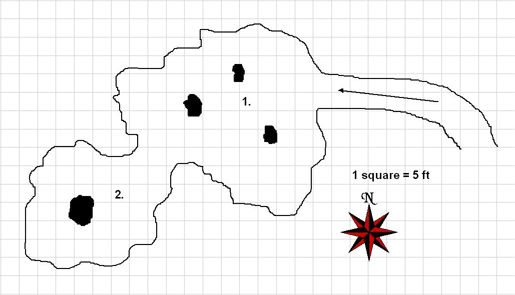 |
Within the lair, walls are hewn stone (per 3 ft, hardness 8, 540 hp, Climb DC 25, break DC 50) as are the floors (DC 10 Balance check is required to run or charge across such a floor; failure means the character can still act, but can’t run or charge in this round).
The lair is dark unless otherwise indicated.
The ramp is a total of 180 ft long and descends at a 22.5 degree slope. The ceiling of the ramp is 10 ft high.
1. Main Chamber
| This chamber is some 15 ft high and its ceiling is quite smooth. Three stone columns support the ceiling, and these appear to have been left behind when the rest of the chamber was hewn. In the center of the place is a large wooden table, upon which are set several stone mugs and pottery vessels and plates. To the northwest are piles of dusty furs, set almost like a nest of some sort, while to the direct north of the chamber, near the entrance from the ramp, is a stone shelf upon which rests a variety of skulls, finger bones, decorative pottery and ceramics, and several scrolls set on stone rollers. |
The pottery and ceramics are relatively worthless, taken by the lamias in raids against tribesmen.
Creatures: A mated pair of lamia nobles dwells here, sleeping, eating, relaxing, or mating in this chamber, and dreaming and scheming of future plans for power and conquest.
|
LAMIA NOBLES (2) CR 11 Constrict (Ex) With a successful grapple check, a lamia noble can crush a grabbed opponent, dealing 4d8+6 points of damage. This constriction can be combined with its Wisdom drain (with a +4 bonus to the save DC to negate while constricted). Wisdom Drain (Su) A lamia noble drains 1 point of Wisdom
from a victim as a touch attack (Will DC 21 negates). Unlike
with other kinds of ability drain attacks, a lamia noble does
not heal any damage when it uses its Wisdom drain, though it
gains 1 point of temporary Charisma for Lamia nobles typically try to
use this power early in an encounter to make foes more susceptible
to charm person and suggestion. When a victim’s Wisdom drops
below 3, he or she willingly does whatever the lamia tells him
to. The lost Wisdom can be returned by an owl’s |
Tactics: Despite their Chaotic Evil natures, this mated pair is truly in love with one another, and each is willing to die for the other, the rest of the world be damned. They tend to refer to each other as "pet" or "my lovely", and if they were not such foul, evil beings their banter would be merely pathetic.
If roused by the sand giant above by a battle cry or a loud greeting to intruders, the lamias will take a round to cast mage armour on themselves. They will then cast fly and begin to travel up the ramp until they are just out of sight of the top of the ramp (this will take 1 round after the fly spell has been cast). The next round they will use their persistent image spells to each make an illusion of a sun giant tromping up the ramp and bellowing a warcry in Vashti (notably different from the real sun giant, which bellows a cry in Giant), in an attempt to get foes to expend spells and other resources on the illusions. The illusory script set by the lamias will simply have the giants reach the top of the well, step just outside of it assuming a free space exists, and then yelling their warcry and looking around menacingly and hefting their scimitars as if preparing to attack the next round. They will continue to do this until the spell ends (as the lamias will not wish to actually spend concentration directing the illusions or making them react).
The next round, the lamias will cast mirror image and emerge, flying up over the circle and casting lightning bolts and magic missiles before descnding to use ghoul touch and start to capture slaves. The lamias have fought and defeated other spellcasters many times before and if they see they are facing such foes at least one will ready an action to attack a caster with magic missile or even use their wands of dispel magic to counterspell.
Developments: The lamias are certainly willing to flee and give up their lair in a pinch. However, neither lamia will flee if the other is still alive or even might be alive. They are too much in love to abandon their partner. If they do flee, they are likely to turn invisibly and fly off into the wastes to hide.
Treasure: The scrolls on the stone shelf are texts dealing with ancient legends of the dao and their influence in the East Wastes.The scrolls are quite old (as evidenced by their being written in Ancient Morakki) and in all there are 5 scrolls each worth 250 gp on the open market to scholars and those interested in the dao.
2. Treasure Chamber
| This cave is set around a large stone column that runs from floor to ceiling. Chained to manacles on the northeastern face of the column, facing the entrance, is a badraggled bearded man who has the features of a desert tribesman. He is dressed only in rags, and crusted blood and scabs cover his head and arms and legs. A rag is bound around his head and mouth and hold a round rock in his opened mouth, gagging him. On the floor to either side of the chained man is a large stone chest with a metal key lock into it. |
The manacles are masterwork manacles and the key to them is on the person of the female lamia noble in area 1.
Behind the stone column are bolts of silk, vases, carpets and other items of value stolen from the tribespeople.
Creatures: The captive man is a desert priest, who was lured and seduced by the female lamia noble and then kidnapped and brought here. The lamias specifically sought out a priest, as they needed a source of food and water for their lair. The man has been drained of Wisdom to the point that he can only just cast a create food and water spell.
The lamias have dictated which spells Hargum should prepare each day, and they have tested him out enough that he dares not defy them by memorizing anything different. None of his spells require material components or a focus beyond his holy symbol. None can be cast while he remains gagged and manacled.
| HARGUM MALIK
ENSEFANI CR 5 Male human Cleric 7 (Grummni-tul) NE Medium humanoid (human) Init +0; Senses Listen +3, Spot +3 Languages Vashti, Terran AC 10, touch 10, flat-footed 10 hp 46 (7 HD) Fort +7, Ref +2, Will +6 Spd 30 ft (6 squares) Melee unarmed +6 (1d3+1 nonlethal) Space 5 ft; Reach 5 ft Base Atk +5; Grp +6 Special Actions Divine Vigour, luck bonus to saves (1/day for 7 rounds, from Mysticism domain), turn air creatures (5/day), turn undead (5/day, +2 synergy bonus) Cleric Spells Prepared (CL 7, melee touch +6, ranged touch +5): 4th - none (due to drained Wisdom) 3rd - create food and water (2) [1 cast], lesser visage of the deity(d) 2nd - lesser restoration, make whole (2), soften earth and stone(d) 1st - divine favour(d), endure elements (3) [all cast], hide from undead (DC 12), obscuring mist 0 - create water, detect magic, detect poison, guidance, purify food and drink (2) [1 cast] Domains: Earth (turn air creatures), Mysticism (+2 luck bonus on saves 1/day for 7 rounds as free action) Abilities Str 13, Dex 10, Con 14, Int 12, Wis 13 (normally 15), Cha 14 SQ spontaneous healing Feats Alertness, Combat Casting, Divine Vigour, Skill Focus (survival) Skills Concentration +12, Diplomacy +6, Heal +7, Knowledge (planes) +2, Knowledge (religion) +8, Spellcraft +5, Survival +8 Possessions stone holy symbol |
Tactics: If freed, Hargum will gladly ally temporarily with the PCs to effect an escape from the lamias. He will not turn on the PCs, though he will be very eager to return to his tribe and will not allow the PCs to follow him home, as it would dishonour him if he had to admit to his people that he was rescued by others. Instead, he intends to make up a wild tale of his escape that will enhance his prestige when he returns to his people. He will request the return of his magical armour and dagger from the chest (see Treasure below).
Developments: Hargum is evil in that he cares little for anyone but himself and his personal power and status amongst the other priests of the tribes of the wastes. In such political situations he can be quite brutal, and has murdered his rivals on occasion. But his current circumstances are far beyond his means to affect and, as such, he will harbour no thoughts of betraying the PCs in any way, except, perhaps, to flee instead of defend the PCs should a fight go very badly.
Hargum has been captive of the lamias for almost 3 years now.
Treasure: The two large stone chests are each locked (Open Lock DC 25) with the key to both on the person of the male lamia noble in area 1.
Chest #1 contains 600 gp, 1400 sp, 5000 cp, a variety of desert jewelry worth a total of 650 gp, and Fate of the Undevoured (+1 undead bane scimitar).
Chest #2 contains 15 pp, 300 sp, 4000 cp, masterwork dagger*, +1 cool leather armour*
The items behind the stone column have value, but are very bulky. In essence they are items grabbed off of camels or stolen from nomad tents. The DM can assume, in total, the items weigh over 300 lbs and have a combined value of 1500 gp.
* These items belong to Hargum.
Using the Circle
The PCs have come to the Circle of Salt to find the Hidden Cave mentioned on the map given to them by Musafa. The phrase on the map reads "When you reach the circle of salt pillars atop the flattened hill, look upon the fifth from the chasm as the sun goeth."
What this phrase means is that the PCs will note that the Great Chasm (see below) is visible in the far distance from atop the hill, a jagged scar on the earth about 20 miles to the southeast. The pillar of salt closest to the Chasm is marked on the map of the Circle with a "c". The PCs should proceed to this pillar and then count 5 pillars clockwise. The phrase "look upon the fifth from the chasm as the sun goeth" is the key here. The sun, in the northern hemisphere of Therra, proceeds along the sky from east to west in the southern portion of the sky. Thus, the PCs should count pillars from east to west along the southern portion of the circle. This will lead them to the pillar marked on the map of the Circle with an "hd". From the pillar marked "c" the PCs site along the path inidcated by the pillar marked "hd" and it leads directly to the location of the Hidden Cave some 15 miles to the west by northwest.
This is a puzzle that the PCs should be able to figure out on their own. However, like any puzzle the players may not understand the riddle ultimately. In this case, the DM can either offer hints or allow the PCs to use spells like commune and divination to get clues or hints.
Note: DMs (and eventually the PCs) will notice that on the map given to them by Musafa, the Hidden Cave is indicated as being west by southwest of the Circle of Salt. In reality, as explained above, the Hidden Cave is actually west by northwest of the Circle of Salt. This discrepancy was intentional, by the mapmaker, who sought to keep the location of the Hidden Cave secret from those who did not understand the riddle.
Great Chasm:
The Great Chasm is a well known feature of the wastes. In actuality, it is one of two massive rents in the earth present in the East Wastes. The other lies far to the south, as the wastes approach the northern Steppes of Xydlont. But the people of the Wylag refer to this as the Great Chasm because, quite frankly, most of them are not even aware that there is another such feature some 500 miles to the south.
There are a great many legends and stories pertaining to the origin of the Great Chasm. Many involve angry gods smiting the land, and a few of them describe a time when the East Wastes were lush and green and that some calamity struck at the exact site of the Chasm and the force of the blow spread out in a wave through the surrounding land and formed the East Wastes.
The real origin may never be known. What is known as that the Chasm is well over 50 miles long and, at places, 5 miles wide. It has a depth of up to 1.5 miles straight down, and near the middle the walls of the chasm are quite sheer.
All sorts of strange creatures are rumoured to dwell in the Great Chasm, and many Wylag tribal tales tell that a tribe of demons or half-demons was imprisoned in the earth in ancient times and somehow the prison was breached in the formation of the Chasm and the demons were released and now live in the rift, emerging to cause droughts and pestilence from time to time.
It is known amongst the wise and learned that dao dwell in some portions of the rift, and this has led to speculation that the Chasm is a link to the Elemental Plane of Earth, perhaps even the Great Dismal Delve itself.
For purposes of this adventure, the Chasm is merely a landmark with which to properly site along the Circle of Salt. As such, there is no reason why the PCs should go out of their way to visit the Great Chasm. If they do, the DM should prepare encounters and/or a scenario.
Hidden Cave:
This feature is dealt with in Part Three (below).
Mouth of the Dragon:
This feature is dealt with in Part Three (below).
Oasis Bakinal:
This is the oasis at which the PCs begin the scenario. It is the location of Angaralok's blue tent. The oasis sports a large bazaar and is well defended, being so near the edge of the wastes.
Oasis Kirimel-um:
This is a smaller oasis than Bakinal, but is important as the southwesternmost oasis of the Wylag tribesmen. The oasis is well fortified by stone walls and a few wooden fortifications, due to its proximity to the wastes, and attacks by scorpionfolk and stingers are a constant danger, which has made the oasis folk surly and suspicious of strangers. Nevertheless, the oasis also serves as a watering hole for those tribesmen who venture into the wastes, and so the PCs can gain some information about the wastes, including general legends and descriptions of places like the Strange Cairns, the Great Chasm, and the Ruins of Nimesh.
Ruins of Nimesh (EL 13 or 15):
These ruins are less well-known that the Strange Cairns, being deeper in the wastes, but nevertheless, the wise and well-travelled amongst the oasis folk at both Bakinal and Kirimel-um have heard horrific tales of these ruins, which are said to be all that remains of the ancient city of Nimesh, which was so wicked that the gods' anger was aroused even in their slumber, and the city was destroyed in a rain of fire and ash and all within were turned to salt.
Legends say that the people of Nimesh had unholy physical relations with the dead, after which they would consume the bodies. The desert tribesmen consider the place accursed and unholy and keep a healthy distance even by day. By night they will not even travel within sight of the place.
Whatever the true history of the ruins, they are now haunted by a large tribe of ghuls. Ghuls are essentially desert ghouls; they are humans with the gravetouched ghoul template. However, unlike the standard gravetouched ghoul template, for the ghuls the template is inherited, as they breed with captured humans who are then devouired when their time as captive breeders is finished (and most do not survive the birthing process more than a few times at best). As such, ghuls gain skills and feats without the bonus for being human. They also gain d12 for their Hit Dice even though they advance in a class that prescribes a different type of Hit Die.
The inhabitants of the ruins are beyond the scope of this adventure. Suffice to say that well over 200 ghuls dwell in the ruins, most of them fighters or barbarians, along with another 100 ghouls and about 20 ghasts. They are ruled by a cadre of 24 great ghuls (CE Fighter 6/Wu-Jen 6) who themselves report to a Ghul Mage (CE Barbarian 4/Wizard 12) and a Ghul Witherer (CE Fighter 3/Cleric 13). If the PCs insist on entering the ruins, the DM should either present them with overwhelming odds and allow them to flee, or prepare the ruins as a separate adventure.
Should the PCs travel within 1 mile of the ruins during daytime, they will be attacked by a ghul raiding party out searching for food. Should they travel within 2 miles of the place at night, or camp within 2 miles (and not be located inside a magically concealed place such as a rope trick spell), then they will be attacked by a larger ghul raiding party and, furthermore, subject to a 25% chance of attack from a similar larger raiding party for each 4 hours they spend within 2 miles of the ruins.
Creatures: During daylight hours, the ghul raiding party is comprised of 10 ghuls and 2 great ghuls. At night these amounts are increased by 50%.
|
GHUL WARRIOR CR 4 An afflicted humanoid who dies of ghoul fever rises as a ghoul at the next midnight. A humanoid who becomes a ghoul in this way retains none of the abilities it possessed in life. It is not under the control of any other ghouls, but it hungers for the flesh of the living and behaves like a normal ghoul in all respects. A humanoid of 4 HD or higher rises as a ghast, rather than a ghoul. Paralysis (Ex) Victims hit by a gravetouched ghoul's bite or claw attack must make a successful DC 12 Fortitude save or be paralyzed for 1d4+1 rounds. Elves have immunity to this paralysis. |
|
GREAT GHUL CR 10 An afflicted humanoid who dies of ghoul fever rises as a ghoul at the next midnight. A humanoid who becomes a ghoul in this way retains none of the abilities it possessed in life. It is not under the control of any other ghouls, but it hungers for the flesh of the living and behaves like a normal ghoul in all respects. A humanoid of 4 HD or higher rises as a ghast, rather than a ghoul. Paralysis (Ex) Victims hit by a gravetouched ghoul's bite or claw attack must make a successful DC 17 Fortitude save or be paralyzed for 1d4+1 rounds. Elves have immunity to this paralysis. Watchful Spirit (Ex) Once per day, a wu jen can reroll an initiative roll he has just made before he knows his place in the initiative order. He takes the better of the two rolls. * The ghul's spellbook will be left in its lair in the ruins. ** If an additional great ghuls are indicated, the DM should provide each with a wand of a 1st level wu jen spell containing 4d10 charges. |
Strange Cairns (EL 15):
This is a well-known landmark
in the northern wastes and can be viewed from quite a distance.
| Ahead of you in the bleak plain of the wastes is a collection of massive stone piles, vaguely resembling a graveyard of giant cairns. Each stone pile is roughly 30 ft long by 15 ft wide by 15 ft tall. Each stone is approximately 2 ft in diameter and roughly circular. There are at least a hundred of these structures covering an area of a quarter of a square mile. Intermixed with these cairns are hundreds of skeletal figures of varying shapes and sizes. None of the sketeal figures seems to be moving. |
| The figures appear to be made of bleached and sand-scoured bones. They are clearly contructed of a variety of different bones of different sizes from different creatures, all cobbled together to form a strange mixture of pieces. The bone figures are each held up by ropes tied to wooden stakes driven into the ground. |
In actuality, the cairns are the "artistic" work of a nearby gang of bone cobblers that has haunted this area for centuries. These cobblers are particularly ancient and powerful, and lend to tales amongst the tribesmen of the wastes of people who approach the cairns never returning.
When the cairns are destroyed or disturbed, the bone cobblers eventually come by and "fix" their creation. No one knows why the bone cobblers do what they do, and they aren't telling.
Any PC native to the region who makes a DC 10 Knowledge (local) or Knowledge (history) check will have heard of the legends of the cairns. A check that is made by 10 or more will allow the PC to know the truth of the site (that bone cobblers maintain it).
Creatures: At most times a group of bone cobblers is in or around the cairns, working on a new bone figure or repairing those knocked down by the wind or creatures of the wastes. As such, PCs who approach close enough to see the detailed description of the place (i.e. the second text box) will be stalked and then attacked by the bone cobblers.
|
ADVANCED BONE COBBLERS (5)
CR 10 Bonestripping (Ex) A bone cobbler can rapidly strip all the flesh from a Medium sized creature in 3 minutes using its claws and hammers. For each size category larger than Medium a corpse is, add 1 minute to the time it takes the bone cobbler to strip the corpse. For each size category smaller than Medium a corpse is, reduce the time by 1 minute (to a minimum of 1 minute). Once stripped, the bone cobbler devours the flesh and collects the victim’s bones to use in its “sculptures”. A creature slain in this manner can only be brought back to life by a miracle, wish, or true resurrection spell. Breath Weapon (Su) A bone cobbler can bellow forth a cloud of vapors every 1d4+1 rounds that covers a 10-foot-radius area. Creatures within the area must succeed on a DC 21 Fortitude save or be slowed (as the slow spell) for 1 minute. The save DC is Constitution-based. * In combination with its natural abilities, a bone cobbler’s Two-Weapon Fighting feat allows it to attack with both of its weapons at no penalty. |
|
1 HD ANIMATED BONE COBBLER
STATUE* CR n/a * Using human as the base creature |
|
4 HD ANIMATED BONE COBBLER
STATUE* CR n/a * Using dire jackal as the base creature |
|
6 HD ANIMATED BONE COBBLER
STATUE* CR n/a * Using dire puma as the base creature |
|
8 HD ANIMATED BONE COBBLER
STATUE* CR n/a * Using wasteland troll as the base creature |
|
9 HD ANIMATED BONE COBBLER
STATUE* CR n/a * Using canisphinx as the base creature |
Tactics: The cobblers will use their animate bones abilities to greatest extent, seeking to use them to surround intruders and to prevent escape. If three of the bone cobblers are defeated, the remainder will attempt to flee, using their animated bones to cover their retreat.
Developments: The cairns, if excavated, are empty. Within 1d4 days the place will be back to its normal appearance as bone cobblers rebuild the cairns and new bone statues.
Part Three - To the Graveyard
The Hidden Cave:
The Hidden Cave lies some 15 miles west by northwest from the Circle of Salt. It is located within a small dell hidden amongst the foothills of the Vayshan Mountains. Finding the Cave requires that the PCs travel in the indicated line from the Circle of Salt without much deviation. This is more difficult than it might seem due to the long distance to be travelled and the ruggedness of the terrain. If travelling only by day, a DC 15 Survival check must be made for the PCs to travel in a straight enough line to come across the dell of the Hidden Cave. It will take 3 such checks (one for each 5 miles travelled) to reach the dell. If any portion of the journey is made by night, then the DC rises to 20 for the 5 miles in question.
If the Survival check is failed, the DM should allow a second check at the same DC for the PCs to realize they are off course. This second check will occur 1d4 miles into the 5 miles portion of that check. If this second check is made, then the PCs will realize they have deviated from their intended course. The only practical way to resume the proper course is to return to the Circle of Salt and try again.
If the second Survival check is failed, then the PCs will simply wander on into the Vayshan Mountains until they realize they must have missed the Hidden Cave, at which time they can return to the Circle of Salt and try again. Just how far they will have veered from their true course is left to the DM to determine, and should be based somewhat on the degree by which they missed their Survival checks.
The Hidden Cave itself is accessed by an entrance that is covered with a cunningly crafted stone door, so that it appears to be a part of the rocky ridge side into which it pierces. Upon this stone door is a chalky white blemish that subtly resembles a dragon. However, the angle of the blemish and its configuration make it impossible to recognize it for a draconic shape at anything except reasonably close to ground level and from a distance of no more than 500 ft away. Thus, searching for the Hidden Cave from the air is a fruitless exercise.
Assuming the PCs are on course,
they will crest a small rocky ridge and behold the dell.
|
Before you is a small dell nestled amongst the rocky ridges of the foothills of the mountains. Scrubby plants and bushes dot the floor. At the western end of the dell is a peculiar chalky-white blemish on the rock wall of the ridge that vaguely resembles the image of a dragon in flight. The blemish is about 10 ft in diameter. Set before this blemish, on the floor of the dell, is a small rocky outcrop covered in dessicated creepers and grass. The outcrop is about 5 ft high and 2 ft in diameter. |
On the western face of the plinth is carved some very worn text in Morakki. The full text is listed below.
I, the Lord of Palliag, conqueror of the demons of Wylag and contender for the Heavenly Throne of Light have cursed the place beyond. Do not dare to venture if you are of the blue demons of the desert, for you shall not pass and shall surely be destroyed. Let this curse be my monument and my retribution upon the demons for their desecration of my land. Let it stand for all eternity.
If need you have to pass, and demon you be not, then a hand at the crown and a hand at the tip shall open the way for thee.
However, the carving is very worn, and so what can be discerned is as follows (each set of three dashes represents an obscured character):
---Lord of Palliag, conqueror of the demons of Wylag and ---- ---- --- Throne of Light have cursed ----beyond. --- not dare to venture if you are --- demons of the desert, for you shall not --- --- --- --- destroyed. --- this curse be my monument and my --- upon the demons for their --- --- my land. Let it --- --- all eternity.
If need you have --- --- --- you be not, then a hand --- crown and a --- --- tip shall --- --- way for ---.
Secret Doors: The dragon-shaped blemish's head and tail are curved down and towards each other so that both are within easy reach from the ground. If a person places his hand on both the head and tail simultaneously, a 10 ft square section of the rock wall (the part that bears the blemish) will slide open, revealing a passageway into the darkness beyond.
The blemish radiates a faint aura of abjuration magic. The door itself is quite thick (almost 4 ft thick) and as such the chance to detect it as a secret door requires a DC 35 Search check.
When the door swings open, it will do so with much grating of stone and with a whoosh of musty air. The door will close of its own accord after 1 minute. From the inside there is a similar blemish as on the outside and the door opens from this side in the same way, by touching the head and tail.
The Way of Darkness:
Beyond the cave opening, the passageway is 10 ft square and runs straight into the side of the mountain. The air is stale and musty and dust covers the floor and walls and there are wisps of cobwebs between the wall and ceiling, so that it is evident that no one has passed this way for years upon years. The initial passageway seems to be made from well-crafted stones cunningly fitted and joined in its thin seams by mortar.
Unless otherwise indicated, the walls of this passageway are of superior masonry (per 1 ft: hardness 8, 90 hp, break DC 35, Climb DC 25) and flagstone floors.
The Way of Darkness is, as befits its name, unlit. Unless otherwise stated, the Way is 10 ft wide and 10 ft tall.
The passageway proceeds a good 1000 ft straight into the mountainside before beginning to descend in a long, slow decline punctuated by a few sets of small steps. It will be difficult for the PCs to estimate just how far they have descended from the level of the hidden doorway, but over the course of about a mile of travel it must be fairly substantial (i.e. at least several hundred feet).
DM's Note: A group of PCs of a level indicated for this scenario will likely have some potent and capable abilities that will enable them to bypass encounters in the Way of Darkness. For example, a few dimension door spells will suffice to bypass either Encounter #1 or Encounter #4 (or both). The DM should allow such to happen unhindered. The PCs, with no foreknowledge of this scenario, have no idea how many encounters there are in the Way of Darkness and are unlikely to simply adopt a strategy of teleporting past any chamber or room they encounter, for fear of using such invaluable escape means up on potentially trivial encounters and not having them available when really needed. Additionally, both Encounters #1 and #4 give no initial indication that there is anything dangerous in them, so unless the PCs are extremely suspicious and willing to act on those suspicions every time, they are likely to at least blunder into one of the two encounters (most likely the first). If the PCs do simply bypass such encounters, they should get no XP from them.
Encounters #2 and #3 are basically red herrings. They are comprised of suspsicious-looking chambers that are absolutely empty and absolutely harmless. Whether they once held guardians now long expired is not indicated. For game purposes, these two encounters are present to lull the PCs into a false sense of security when they reach Encounter #4 and to possibly make them waste spells and other magical resources dealing with threats that do not exist.
Encounter #1 - The Hall of Columns (EL 16):
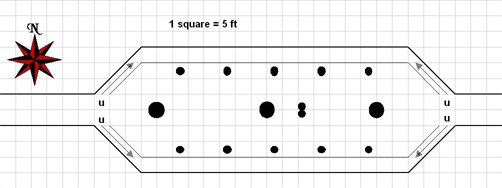 |
|
Before you the way opens up into a chamber some 20 ft tall and 40 ft wide. To either side, stone ramps ascend along the wall 10 ft high to a stone gallery that proceeds westward towards the opposite end of the hall. The hall is supported by three massive columns of polished sandy-coloured marble. These large columns are carved with scenes of desert nomads firing arrows at and piercing the hearts of dragons. Flanking the three massive central columns, ten smaller columns support the ceilings, with five each abutting the galleries. These smaller columns are carved to resemble desert cyclones or whirlwinds of some sort. Set just east of the central massive pillar are two smaller pillars that are carved to resemble a lord and lady whose hands almost clasp where the pillars meet. These carved figures are clearly Morakki desert dwellers by their garb. |
Creatures: All of the pillars in this chamber are actually caryatid columns. These were crafted and set here by the Lord of Palliag to deter intruders and those seeking the dragon graveyard. The columns are programmed to activate when any creature passes the point in the chamber where the two smaller pillars touch each other.
At that point, all of the columns will animate into the form of silk-draped female figures with gleaming, rune-carved scimitars and falchions.
The large columns are large advanced caryatid columns and the small columns are normal caryatid columns.
Note:
The large caryatid columns are extremely dangerous. This
encounter is meant as a trap to be fled rather than monsters to
be defeated en masse. Of course, if the PCs can manage it then
that is to their credit, but the large columns, employing Power
Attack, are likely to cause around 30-40 damage per hit (and double
that with a critical). The PCs are likely to be in deep trouble
if they simply blunder into the chamber and then have no reliable
way to get the hell out of there! However, the advantage to the
PCs are the columns' lack of Intelligence (meaning the small columns
are likely to get int he way of the bigger ones in crowded circumstance
much of the time...the columns will not communicate with each
other or work with each other in any way), and the fact that they
don't move exceptionally fast, so that PCs with any sort of fast
movement ability or flight can likely flee the encounter.
|
ADVANCED CARYATID COLUMNS
(3) CR 11 Nonmagic ranged weapons automatically shatter upon hitting the caryatid column, dealing no damage. Magic ranged weapons receive a Fortitude save (DC 20) to resist this effect. The saving throws are Constitution-based. Column Form (Ex) When at rest (not commanded, or waiting to fulfill a command), a caryatid column takes the form of a column of stone. This column is about 2 ft in diameter, and extends up fo the ceiling of the chamber or to a height of 25 ft, whichever is less. Unless commanded otherwise, a caryatid column remains in this form until attacks, and it even allows creatures to climb it (Climb DC 15). A caryatid column in column form looks like a pillar in most respects. It does not radiate magic, and true seeing does not reveal its humanoid form. Careful examination of the column (Search check DC 25) reveals very faint and distorted lines that make the pillar resemble a woman with a sword. Anyone who successsfully makes a Knowledge (architecture and engineering) check (DC 12) notes that the column serves no structural purpose since it bears none of the ceiling's weight. A close examination of the top of the column (Search check DC 15) or a keen eye (Spot check DC 20) shows that the column is not cemented or joined to the ceiling. Dwarves and other creatures with stonecunning receive a free Search check as though actively looking when they pass within 10 feet of a caryatid column. Changing forms is a free action, and a caryatid column can change once per round. Hardness (Ex) Like an animated object made of stone, a caryatid column has a hardness of 8. Magic Weapon (Ex) A magic weapon is incorporated into the caryatid column at the time of its creation. This weapon functions in all respects like a normal magic weapon of its type, with one exception: Whenever it is out of the caryatid column's hands, it reverts to stone and becomes a nonmagical sculpture. Should the caryatid column then pick up the weapon, it regains its normal form and magical qualities. If a caryatid column needs both hands free, it can stow its weapon by simply pressing it against its side; the weapon then merges with the caryatid column's body and can be retrieved by the caryatid column as any character would draw a weapon. |
|
CARYATID COLUMNS (12) CR 6 Nonmagic ranged weapons automatically shatter upon hitting the caryatid column, dealing no damage. Magic ranged weapons receive a Fortitude save (DC 13) to resist this effect. Column Form (Ex) When at rest (not commanded, or waiting to fulfill a command), a caryatid column takes the form of a column of stone. This column is about 2 ft in diameter, and extends up fo the ceiling of the chamber or to a height of 25 ft, whichever is less. Unless commanded otherwise, a caryatid column remains in this form until attacks, and it even allows creatures to climb it (Climb DC 15). A caryatid column in column form looks like a pillar in most respects. It does not radiate magic, and true seeing does not reveal its humanoid form. Careful examination of the column (Search check DC 25) reveals very faint and distorted lines that make the pillar resemble a woman with a sword. Anyone who successsfully makes a Knowledge (architecture and engineering) check (DC 12) notes that the column serves no structural purpose since it bears none of the ceiling's weight. A close examination of the top of the column (Search check DC 15) or a keen eye (Spot check DC 20) shows that the column is not cemented or joined to the ceiling. Dwarves and other creatures with stonecunning receive a free Search check as though actively looking when they pass within 10 feet of a caryatid column. Changing forms is a free action, and a caryatid column can change once per round. Hardness (Ex) Like an animated object made of stone, a caryatid column has a hardness of 8. Magic Weapon (Ex) A magic weapon is incorporated into the caryatid column at the time of its creation. This weapon functions in all respects like a normal magic weapon of its type, with one exception: Whenever it is out of the caryatid column's hands, it reverts to stone and becomes a nonmagical sculpture. Should the caryatid column then pick up the weapon, it regains its normal form and magical qualities. If a caryatid column needs both hands free, it can stow its weapon by simply pressing it against its side; the weapon then merges with the caryatid column's body and can be retrieved by the caryatid column as any character would draw a weapon. |
Tactics: The columns will attack all foes within the chamber, and will chase foes a good 10 rounds (i.e. 600 ft) before returning to the chamber and, if unmolested and with no sign of intruders, reverting back to their columnar forms. The columns will not attack foes who are unconscious or otherwise incapacitated, though they will not allow such enemies to be rescued or saved either. Each column is an independently programmed entity, and although they have Intelligence, it is a rather dimwitted one. As such, the columns will not be masters at coordinating their actions, and the smaller columns will tend to get in the way of the larger ones in confined spaces.
Developments: If the PCs merely flee the chamber after the columns activate (or do so after a round or two of realizing their predicament), the DM should award half XP for the encounter.
After this chamber, the passage begins to veer to the northwest. The PCs will travel for about a half a mile before reaching Encounter #2 (below).
Encounter #2 - The Chamber of Sorrow
Note: The sound of sorrowful moaning can be heard emanating from this chamber when the PCs come within about 100 ft (more or less depending upon Listen checks).
 |
|
The passageway opens here into a circular room 100 ft in diameter and 35 ft high. In the center of the place is a 30 ft diameter hole in the floor that descends out of sight. Eight pillars are set in the chamber, in a circle between the walls and the hole. Each pillar is 5 ft in diameter and carved to resemble a man or woman in Morakki garb. Each carved figure seems to be in a pose of weeping or grief. The walls of the room are covered, every square inch, in bas reliefs. The reliefs show thousands of faces, ranging from babies to old men and women, all with Morakki features and all weeping, crying, or with mouths open in expressions of wailing and sorrow. |
The hole is a long, straight shaft that is over 250 ft deep. It ends abruptly and at the bottom are only dust and a few very old and crumbly bones. Also at the bottom are various small holes carved into the walls and floor. These are each about 1 inch in diameter and a constant stream of warm air emerges from them and rattles around the shaft bottom.
The moaning sound is caused by air flowing through the small holes. The inside of the holes are designed to produced certain sounds, and the air is gathered from subterranean sources warmed by magma deeper underground.
Developments: There is nothing dangerous or valuable in this chamber. The PCs will travel for about a quarter of a mile before reaching Encounter #3 (below).
Encounter #3 - The Chamber
of Glyphs
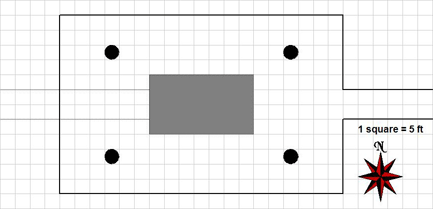 |
|
A chamber opens up out of the passageway. The place is rectangular in shape and the ceiling is 25 ft overhead. Four thick pillars support the place, each carved to resemble a whirlwind. The pillars flank a large slab of stone that takes up most of the center of the room. The slab is 5 ft tall and measures 20 ft wide by 35 ft long. The walls of the place are covered in glyph, runes, and sigils. Likewise, the stone slab's face is also covered with such symbols. |
The entire room radiates strong necromantic magic. This room was a component of the Lord of Palliag's curse of the draconic graveyard. While the place still radiates magic, its use was only in the activiation of the curse, and as such destroying the room and its dweomer will have no effect on the curse.
The symbols are clearly magical to anyone who makes a DC 10 Knowledge (arcana) check, and a read magic spell will allow a person to discern the symbols better. A DC 20 Knowledge (arcana) check by someone under the influence of a read magic spell will determine that the symbols relate to an ancient Morakki curse. A DC 30 Knowledge (arcana) check by someone under the influence of a read magic spell will determine that the curse is as has been stated to the PCs previously...one barring the entrance of dragons into the draconic graveyard. It will also determine that the curse was a result of powerful ritual magic that involved dozens of mages, most likely wu-jen.
Secret Doors: The stone slab serves as a secret door. The slab is extremely heavy, and as such it requires a DC 35 Search check to determine the existence of the secret door. Of course, detect secret doors can locate it. The door is opened by pressing two specific sigils carved along the middle of the southern portion of the slab. These two sigils can be found by someone under the influence of read magic who makes a DC 35 Knowledge (arcana) check who examines the sigils on the slab closely. This person will determine that these two sigils seem somewhat out of place and unrelated to the curse ritual.
A knock spell will also open the slab. When opened, the slab will rise straight up, levitating 10 ft into the air. Beneath can be seen a 10 ft square opening in the floor in the center of the area that the slab had occupied. Steps lead down 20 ft to the west before emerging in a passageway that continues to the west.
The slab will levitate for 1 minute before gently sinking to the ground. It is extremely heavy, and will be difficult to prop up. From the other side, merely touching the bottom of the slab will raise it for a minte.
Developments: There is nothing dangerous or valuable in this chamber. The PCs will travel for about a third of a mile before reaching Encounter #4 (below).
Encounter #4 - Elemental Wrath (EL 15)
Note: The PCs will notice a ruddy glow emanating down the passage from the west when they are about 200 ft from the chamber.
Note: The combat for this chamber is quite involved and the DM is encouraged to review the entire description of this encounter before running it.
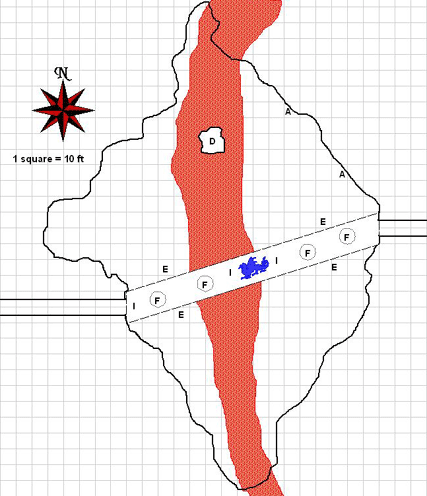 |
|
Before you the passage opens up into a massive cavern. The ceiling towers some 50 ft overhead and is relatively smooth while the floor plummets in sheer cliffs some 150 ft to the floor. Here, a river of molten lava wends its way south past a veritable forest of sharp stalagmites and crystal formations that reach like clawing fingers up to 20 ft into the air. The glow of the lava illuminates the entire cavern in flickering shadows. Spanning the chasm is a stone bridge, 20 ft wide and 10 ft thick and without side rails. The bridge forms an arch that reaches its apex halfway across the cavern before descending to the other side, where a 10 ft wide opening allows egress to the west. Four stout pillars of stone, some 10 ft in diameter, support the bridge structure, reaching all the way to the floor of the cavern and, in one case, into the river of lava. The bridge seems to be unadorned as far as can be seen from the eastern landing. A natural stone pillar rises out of the lava flow about 80 ft to the north of the stone span. This pillar is relatively sheer, though natural appearing and rises to the level of the landings at the ends of the bridge. Its top is flat, forming a sort of platform. Along the northeastern wall of the cavern, at about bridge height, are massive carvings of dragons breathing lightning on hapless human warriors and peasants. In the center, a larger figure of a lord kneels and seems to be weeping in grief even as a particularly large dragon is diving towards him with its mouth agape. |
Anyone falling from the bridge and landing on the cavern floor, but not falling into the lava, has a chance of being impaled upon one of the sharp stalagmites or other crystal formations.
|
|
|
|
|
|
|
|
| Tiny or smaller | 01-05 | - | - | - | - | 1d6 |
| Small | 01-10 | - | - | - | - | 3d6 |
| Medium | 01-25 | - | - | - | - | 4d6 |
| Large | 01-50 | 51-65 | - | - | - | 6d6 |
| Huge | 01-70 | 71-95 | 96-00 | - | - | 9d6 |
| Gargantuan | 01-05 | 06-55 | 56-80 | 81-95 | 96-00 | 12d6 |
| Colossal | - | 01-10 | 11-60 | 61-85 | 86-00 | 15d6 |
Each sharp object attacks with an attack bonus equal to +1 for every 5 ft fallen after the first 10 ft and does damage equal to the amount listed above.
The arch of the bridge takes its apex some 15 ft above the level of the landings, just 35 ft below the level of the ceiling. The slope of the arch is not steep enough to affect movement, but will provide a height advantage in melee combat.
While the bridge seems unadorned when viewed from the level of the two landings at either end, atop the apex of its arch has been carved a spectacular blue dragon, carved into the upper face of the bridge. The carving is quite life-like and studded with polished blue stones that have been painstakingly formed into individual scales. The dragon's eyes are large yellow beryls.
Creatures: The Lord of Palliag has ritually bound a group of elementals and denizens from the elemental planes into his eternal service, using ancient pacts and expensive bargains. These are commanded by a djinni bard (D on the map), who has been provided with equipment by the Lord of Palliag.
Initially, the djinni will be invisible and standing upon the stone platform to the north of the bridge. When intruders appear (presumably at the eastern landing), he will shout in Morakki, his words echoing throughout the cavern.
| Seek not to go any further intruders! The will of Lord of Palliag holds sway here still, lo these many centuries. Do not attempt to thwart his doom, for in doing so shall you cement your own! |
The djinni will gauge the PCs' reaction and actions before acting further. If the PCs flee, then he will take no further actions. If they attempt to advance, he will react as indicated in Tactics below. If the PCs attempt to parley, the djinni will actually welcome conversation with persons brighter than the elementals he has had as companions all of these years (the invisible stalkers are intelligent, but the djinni has tired of them by now). However, the djinni is nobody's fool, and he will be on alert for any guile by the PCs and will not divulge any information that might compromise his charge. DMs should note that the djinni has a decent Spellcraft check and can likely identify spells be prepared or cast by the PCs and if he sees the PCs preparing for battle, he will begin an attack preemptively.
The djinni will not divulge his name ("call me simply a humble guardian") nor his nature. In fact, he will not even tell the PCs where he is or become visible. If the PCs attempt to locate him via see invisibility or detect magic or any similar spells, he will warn them that such actions will be viewed as opening to hostilities and he will then attack.
There is really no way for the PCs to dissuade the djinni to relinquish his charge. However, the PCs can determine that the djinni knew and respected the Lord of Palliag and that the Lord was a good man and a proficient ruler and that Palliag was itself a garden in the desert before the dragons destroyed it all.
Should the PCs attempt to locate the djinni by virtue of listening to his speech, they will find this difficult due to the echoing of the cavern. Normally, it would be a DC 10 Listen check to figure out that the djinni is on the stone platform. The echoing increases this to a DC 15 check plus an additional modifier of +2 per 10 ft from the djinni. This means a DC 31 check is required from the eastern landing. Note that the djinni will always talk in a loud, booming voice so as to purposefully take advantage of the echoing. Should he speak in a normal voice then it would be much easier to locate him by sound (the DM would remove some or all of the +5 DC due to echoing).
The various elementals and invisible stalkers are bound into various items and locations around the cavern. While so bound, they cannot be seen, though the place where they are bound radiates a moderate conjuration magical aura. The bound elementals can hear and see what is going on from their location, and it is a swift action for them to emerge from their bindings, which they will do if the djinni commands them or if they see the djinni being attacked. If somehow the djinni is neutralized in a subtle way, the elementals will still emerge should the PCs attempt to cross the chamber. These bindings should be treated as magic items with regard to dispel magic and other spells. Close examination of the binding locations shows faint, small runes and a DC 30 Knowledge (arcana) check (with a +5 circumstance bonus for a conjurer or anyone with the Spell Focus [conjuration] feat) will reveal that the magic seems to be related to binding elementals.
The elementals can return to their bindings at will by simply touching it as a standard action that does provoke an attack of opportunity. Once rebound, they cannot emerge again for 10 rounds as their corporeal bodies must reassimilate into the bindings. The art and lore of such elemental bindings are lost to the present day and cannot easily be duplicated (though a DM interested in developing such things could allow the PCs to study these bindings [presumably after this scenario is over] and begin to rediscover such lore).
The letters on the map show the location of the elemental bindings.
The air elementals (A on the map) are bound into the carving along the northeastern wall.
The fire elementals (F on the map) are bound into the surface of the bridge at the four points where the pillars support the bridge. When they emerge it will be on the surface of the bridge at the points indicated.
The earth elementals (E on the map) are bound into the side of the bridge at the points indicated. When they emerge, they will emerge inside the bridge itself and will thrust the top half of their bodies out of the side of the bridge and attack PCs on the bridge from that position. This will force the elementals to squeeze (move at half speed, -4 to AC and attacks) and be prone but also give them cover. In this way the earth elementals can attack from the side/below while the fire elementals attack on the bridge proper.
The invisible stalkers (I on the map) are bound into the blue dragon figure on the apex of the bridge arch (2 of them) and at the western end of the bridge (1 of them). They will emerge from their bindings in the locations shown.
|
ADVANCED DJINNI BARD CR 9 Plane Shift (Sp) A genie can enter any of the elemental planes, the Astral Plane, or the Material Plane. This ability transports the genie and up to eight other creatures, provided they all link hands with the genie. It is otherwise similar to the spell of the same name (caster level 13th). Whirlwind (Su) A djinni can transform itself into a whirlwind once every 10 minutes and remain in that form for up to 7 rounds. In this form, it can move through the air or along a surface at its fly speed. The whirlwind is 5 feet wide at the base, up to 30 feet wide at the top and up to 50 feet tall. The djinni controls the exact height, but it must be at least 10 feet. A djinni’s movement while in whirlwind form does not provoke attacks of opportunity, even if the djinni enters the space another creature occupies. Another creature might be caught in the whirlwind if it touches or enters the whirlwind, or if the djinni moves into or through the creature’s space. Creatures one or more size categories smaller than the djinni might take damage when caught in the whirlwind and be lifted into the air. An affected creature must succeed on a DC 20 Reflex save when it comes into contact with the whirlwind or take 3d6 points of damage. It must also succeed on a second DC 20 Reflex save or be picked up bodily and held suspended in the powerful winds, automatically taking 1d8 points of damage each round. A creature with a fly speed is allowed a DC 20 Reflex save each round to escape the whirlwind. The creature still takes damage but can leave if the save is successful. The save DC is Strength-based and includes a +3 racial adjustment. Creatures trapped in the whirlwind cannot move except to go where the djinni carries them or to escape the whirlwind. Creatures caught in the whirlwind can otherwise act normally, but must make a Concentration check (DC 15 + spell level) to cast a spell. Creatures caught in the whirlwind take a -4 penalty to Dexterity and a -2 penalty on attack rolls. The djinni can have only as many trapped inside a whirlwind at one time as will fit inside the whirlwind’s volume. The djinni can eject any carried creatures whenever it wishes, depositing them wherever the whirlwind happens to be. If the whirlwind’s base touches the ground, it creates a swirling cloud of debris. This cloud is centered on the djinni and has a diameter equal to half the whirlwind’s height. The cloud obscures all vision, including darkvision, beyond 5 feet. Creatures 5 feet away have concealment, while those farther away have total concealment. Those caught in the cloud must succeed on a Concentration check (DC 15 + spell level) to cast a spell. A djinni in whirlwind form cannot make melee attacks and does not threaten the area around it. |
|
Bands of Shielding Price (Item Level): 1800 gp (5th) Up to 5 times per day, the wearer of these bracers may cause a shield spell to activate upon mental command. Presrequisites: Craft Wondrous Item, shield |
|
HUGE AIR ELEMENTAL (2) CR
7 Whirlwind (Su) The elemental can transform itself into a whirlwind once every 10 minutes and remain in that form for up to 1 round for every 2 HD it has. In this form, the elemental can move through the air or along a surface at its fly speed. The whirlwind is 5 feet wide at the base, up to 30 feet wide at the top, and up to 50 feet tall, depending on the elemental’s size. The elemental controls the exact height, but it must be at least 10 feet. The elemental’s movement while in whirlwind form does not provoke attacks of opportunity, even if the elemental enters the space another creature occupies. Another creature might be caught in the whirlwind if it touches or enters the whirlwind, or if the elemental moves into or through the creature’s space. Creatures one or more size categories smaller than the elemental might take damage when caught in the whirlwind and may be lifted into the air. An affected creature must succeed on a DC 22 Reflex save when it comes into contact with the whirlwind or take 2d8 points of damage. It must also succeed on a second DC 22 Reflex save or be picked up bodily and held suspended in the powerful winds, automatically taking the indicated damage each round. A creature that can fly is allowed a Reflex save each round to escape the whirlwind. The creature still takes damage but can leave if the save is successful. The save DC is Strength based. Creatures trapped in the whirlwind cannot move except to go where the elemental carries them or to escape the whirlwind. Creatures caught in the whirlwind can otherwise act normally, but must succeed on a Concentration check (DC 15 + spell level) to cast a spell. Creatures caught in the whirlwind take a -4 penalty to Dexterity and a -2 penalty on attack rolls. The elemental can have only as many creatures trapped inside the whirlwind at one time as will fit inside the whirlwind’s volume. The elemental can eject any carried creatures whenever it wishes, depositing them wherever the whirlwind happens to be. A summoned elemental always ejects trapped creatures before returning to its home plane. If the whirlwind’s base touches the ground, it creates a swirling cloud of debris. This cloud is centered on the elemental and has a diameter equal to half the whirlwind’s height. The cloud obscures all vision, including darkvision, beyond 5 feet. Creatures 5 feet away have concealment, while those farther away have total concealment. Those caught in the cloud must succeed on a Concentration check (DC 15 + spell level) to cast a spell. An elemental in whirlwind form cannot make slam attacks and does not threaten the area around it. |
|
INVISIBLE STALKERS (3) CR
7 Natural Invisibility (Su) This ability is constant, allowing a stalker to remain invisible even when attacking. This ability is inherent and not subject to the invisibility purge spell. |
|
HUGE EARTH ELEMENTALS (4)
CR 7 Earth Mastery (Ex) An earth elemental gains a +1 bonus on attack and damage rolls if both it and its foe are touching the ground. If an opponent is airborne or waterborne, the elemental takes a -4 penalty on attack and damage rolls. (These modifiers are not included in the statistics block.) Push (Ex) An earth elemental can start a bull rush maneuver without provoking an attack of opportunity. The combat modifiers given in Earth Mastery, above, also apply to the elemental’s opposed Strength checks. |
|
HUGE FIRE ELEMENTALS (4) CR
7 Creatures hitting a fire elemental with natural weapons or unarmed attacks take fire damage as though hit by the elemental’s attack, and also catch on fire unless they succeed on a DC 22 Reflex save. |
Tactics: The djinni will be the general instigator of tactics, using his telepathy to command any elementals within range. If the PCs show any sign of trying to teleport, dimension door or use such other methods to bypass the area, the djinni will immediately use his wand of dimensional anchor to attempt to thwart such actions. If the djinni has at least a round's warning that the PCs are approaching (i.e. from light sources, etc.) it will defintiely use its bands of shielding to boost its AC.
If combat is about to ensue, the djinni will wait until the PCs are fully committed to the room if at all possible before calling the elementals from their bindings. In general this means all or most of the PCs are on the bridge or flying in the center of the cavern, etc. If a single PC attempts to cross first, the djinni is smart enough to let him cross safely, knowing that he and his elementals can chase down the PC later.
Should combat begin, the djinni will try to use its persistant image ability to make an illusion of the eastern entrance sealing by a block of solid stone dropping to the ground with a crash. The illusion will be very realistic and dust will kick up. Of course, if a being is standing where the "stone" would fall, then he will try to create the illusion back into the hallway far enough to fall behind the PCs. If he needs to he can even fly off of his platform to do so. Of course, casting this spell will NOT void his invisibility. Additionally, using his bardic music to inspire courage will not void his invisibility and his music will be as difficult to locate as will his voice (see Creatures above).
The djinni will attempt to avoid direct combat, resorting to his shortbow if necessary, and otherwise directing the elementals to use tactics and strategems that reflect the djinni's intelligence and wisdom rather than the elementals'.
In combat, the main goal of the elementals will be to drop intruders over the bridge and, ideally, into the lava but, failing that, onto the sharp mineral protrusions on the cavern floor. Secondarily, their goal is to prevent intruders from fleeing to the west. The elementals will not stop intruders from fleeing to the east, but should they return later and combat ensue again, the djinni will order at least some of the elementals to pursue and harry the PCs. At no time will the elementals enter the caryatid column room (Encounter #1).
Should the PCs flee to the east, then the djinni will use his wind walk ability (to carry himself and 6 others), along with air elementals, to pursue the PCs. His task is to prevent them from reaching the dragon graveyard. The invisible stalkers' tracking ability will help them to chase the PCs.
When combat starts, if any PCs are on the bridge, the invisisble stalkers will attempt to position themselves behind the PCs, who will presumably be turning to face the four fire elementals that have suddenly appeared. They will then attack from flanks.
The fire elementals will attempt to grapple the PCs and move them to the portion of the bridge that is over the lava river. They will then leap with the PC into the river. The fall into the lava will cause falling damage to the elementals (and the PCs) equal to 8d6 (half of the normal damage from a 160 ft fall). Of course, the lava will be much deadlier to the PCs unless they are protected from fire damage. The fire elementals will take no damage from the lava itself. Should a PC survive the fall, the fire elementals will attack the hapless PC now swimming in molten lava.
The earth elementals will move inside the bridge using their earth glide ability, with their head outside the side of the bridge. To do so they must squeeze, since the bridge is only 10 ft thick. Once they are positioned so that they are near a combat on the bridge, they will strike at foes from below and to the side. In essence, the earth elementals will be lying on their backs in a prone position, with the top half of their bodies sticking out of the side of the bridge. They will suffer a -4 to attack rolls from squeezing and a further -4 for being prone, while foes will gain +4 to their attacks for squeezing and +4 for their being prone and another +1 for height advantage. However, the earth elementals will get a cover bonus for having their bottom halves inside of the bridge.
If possible, an earth elemental will grapple a foe from the side of the bridge and, in so doing, then toss him over the side and into the lava river or the mineral protrusions below. Grapple attempts suffer from the same penalties as attacks, but only to the initial touch attack roll.
If space clears on top of the bridge, the earth elementals will emerge to fight there, using their Awesome Blow or push abilities to topple PCs over the side of the bridge.
The air elementals will use their whirlwind forms to attempt to pick up foes and take them far away from the bridge and over the lava river or, if the PCs have already evidenced fire resistance, the mineral protrustions, and then eject them.
If spellcasters are hanging back off of the bridge and causing trouble then the djinni will order the air elementals to take out the casters. Should the casters have the means to evade the air elementals, then he will send the invisible stalkers to sneak up on the catsers.
Should the PCs all be flying or otherwise airborne, then the air elementals, djinni, and invisible stalkers will rise to the attack, with the air elementals captuing foes in whirlwind form and ejecting them right in the middle of the fire or earth elementals.
The djinni will direct the elementals to cooperate in novel ways. For example, should a PC be thrown to the cavern floor and survive, then an air elemental or invisible stalker might carry down a fire elemental (which only weighs 8 lbs) to continue the attack, Conversely, a fire elemental that leapt over into the lava river with a foe would be carried up to the combat by an air elemental or invisible stalker.
DMs should remember that air elementals in whirlwind form can kick up a dust cloud if the base of their funnel touches the ground. For purposes of this combat, such a cloud could only be created on the cavern floor.
Note: These elementals are not summoned creatures, though they are extraplanar. They were also bound long before the Deceiver was taken into Slumber, and as such they can be slain on this plane and their equipment and bodies remain behind.
Treasure: The beryls that form the eyes of the dragon carving on the bridge are worth 500 gp each.
The Valley of the Pool:
After Encounter #4 in the Way of Darkness, the path begins
to rise and head in a northwesterly direction for another half
mile or so before emerging into a valley. Assuming it is daylight
or they can see in the dark for long distances, the PCs will be
able to see the following.
| The underground passage exits into the western end of a long, wide, steep valley. The floor and sides of this place are littered with boulders, smaller rocks, rough grasses, and scrub bushes. A small stream flows into the valley from this end, a bit to the south of your position, and proceeds along the floor to the south. |
 |
The map above shows the valley region, which is about a mile and a half long. Each contour marks an elevation of 200 ft, with the lighter colours representing lower elevations.
The stream is only about 10 ft wide and 5 ft deep and the water is pure and flows somewhat slowly.
A. Way of Darkness Exit
This is the exit from the Way of Darkness (see above). The opening is about 15 ft in diameter and sits atop a sloping talus of stones that descends into the valley.
B. Valley Denizen (EL 14)
| To the south, along a wide spur of the valley, sits a stone platform perhaps 80 ft in diameter which is backed by a wide, yawning cave mouth some 30 ft in diameter set into the hillside. The platform is natural-looking, and is about 400 ft up a steep but traversable hillside. |
Creatures: A solitary, ancient, and powerful loquasphinx dwells here, in his aerie. He is a contemplative creature who is both a seeker of knowledge and a ponderer of philosophical questions. The sphinx enjoys his lair here, as the place is remote enough to allow him his solitude and he finds the proximity of the dragon graveyard to be interesting, although he has never dared to visit the place himself.
Most of the time, the sphinx will be lazing on his "front porch" looking out over the valley; not keeping an extremely watchful eye mind you, but pondering new facets of truespeech and enjoying the sun (or night air as the case may be). As the sphinx is huge and not trying to hide, and his long tail is flopping around lazily behind him, he should be easy to spot in daylight from a long distance.
|
ADVANCED LOQUASPHINX CR 14 Truespeech Interrogation (Su) A loquasphinx is a mater of Truespeech, and bombards its prey with a confusing barrage of riddles posed in the purest of languages. Each round as a free action, a loquasphinx can pose a question in Truespeech to a creature within 60 ft. Whether the creature knows the answer to the question is irrelevant. A loquasphinx' words, couched in Truespeech, are filled with power, and if the target does not succeed on a DC 26 Will save, it is confused for 3 rounds. The save DC is Charisma-based. A creature with ranks in Truespeech can attempt to counterspeak to negate the effect of this ability, as described on page 234 of Tome of Magic. In addition, a creature with Truespeak can choose to make an opposed Truespeak check instead of a Will save, attempting to answer the loquasphinx' question instead of simply resisting its potent magic. If the creature's check is higher than that of the loquasphinx, it is completely unaffected by truespeak interrogation. |
Tactics: If attacked, the loquasphinx will use his abilities to their uttmost, as befits his statue, intelligence, and wisdom. He will certainly take advantage of the fact that his truespeech interrogation is a free action, so this can be done every round without impacting his other abilities. Furthermore, since using his quickened utterances costs him nothing if he fails on his truespeak check, he will certainly attempt a quickened utterance every round as a swift action, concentrating mostly on those utterances that are more easily spoken (i.e. agitate metal [which has a DC of 25 vs nonmagical objects] and shockwave [which has a DC of 30]). He will also certainly extend any utterances as applicable.
He is not above flying 60 ft above foes and raining down reversed moderate words of nurturing as a useful tactic.
Of course, the loquasphinx is smart enough to know when he is defeated, and will surrender and even give up his treasure to save his life. As he values his own mind and thoughts above all else, even servitude is preferrable to death, though as a slave he will likely attempt to escape or exact revenge on his captors if the opportunity presents itself and nothing exists to keep him around.
Developments: The sphinx will be initially wary of strangers (treat as indifferent), but will welcome speaking with newcomers who seem to be peaceful, as every conversation brings new potential variations to his truespeech. In fact, he will be quite willing to question the PCs about any and everything possible in an effort to soak in more knowledge, until the PCs indicate they want to more such interrogation.
The sphinx, if indifferent, will simply try to get as much general information from the PCs as possible, and give out as little in return. If pressed, he can direct the PCs to the entrance to the Way of the Dragon (area D) but knows nothing of what lay inside.
If indifferent and asked about other things, he will brush off the questions, saying that knowledge is a coin best traded, and then demand bribes to answer any of the questions set forth below. The actual level of bribe is left to the DM, but loquasphinxes are known to require hefty sums for their knowledge, although they are quite willing to accept offers of obscure knowledge and information in return.
If made friendly, he will confirm, if asked, that the Way of the Dragon leads to a draconic graveyard, though he has never been to such a place himself. If asked, he can explain something of the nature of such a graveyard, but this will merely confirm what Angaralok has already told the PCs (i.e. draconic undead, elemental manifestations, and dragon spirits).
If asked about the Pool of Death, he will say that he does not know its origins, but it is certainly a magical pool, and he has seen many animals who touch it die instantly. He is convinced the pool has a long and important history, as its truename is quite complex, but he has yet to fully master it.
Additionally, if asked about Palliag and its lord, he can confirm the story of its destruction and say that the Lord of Palliag was known to be a fair and just lord and a puissant wu-jen mystic.
If made helpful, the sphinx will offer to use his analyze item utterance on any items the PCs might have. This could, in theory, include the dracolich phylactery, which would put Angarlok's plans at risk. As mentioned previously in this scenario, it is up to the DM whether to allow the PCs to penetrate the dragon's plans or not. Assuming the DM allows it, then unless the limited wish spells cast upon the gem have been used up, the loquasphinx must make a DC 23 Will save (with a -7 penalty) to pierce the magic aura and discern the gem's true nature.
The sphinx will not accompany the PCs, but if helpful will,
if asked, offer to take one or more students and teach them the
rudiments of truespeech in exchange for the person conducting
errands for him during this time. Such errands will involve procuring
animals and plants and minerals from the nearby mountains. After
a time (whatever is convenient for the DM; perhaps a month or
two) the PC will be able to learn Truespeak or to take truename
feats such as Truename Training, or Minor Utterance of the Evolving
Mind.
|
The cave behind the stone platform is about 60 ft deep and 30 ft wide and is the only chamber beyond the opening. Within seems to be a lair or den, which includes a huge pallet of furs, the remains of some recent kills in the form of bones of animals, and a large log of wood set upright against a wall and wedged between two protruding stones. The log is scoured with claw marks. Set on a stone platform in the rear of the cave are a variety of pretty coloured stones, skulls of various animals, and dried plants and flowers. |
Treasure: Hidden behind a loose stone (Search DC 20) at the edge of the stone platform in the rear of the cave is a niche that holds the loquasphinx' treasure. This includes:
1400 cp, 320 sp, 175 gp, and 37 pp
a box of rare spices in small compartments (worth 150 gp)
a figurine of wondrous power - ivory camel
an ashworm pellet
a ring of sandstriding
C. Pool of Death
| This large pool is comprised of water that is a bit darker than it should be in hue and seems slightly too oily in its surface sheen. From time to time soft bubbles ripple to the surface and pop. Surrounding the pool are a myriad of bones. |
The pool is 40 ft deep at its center, with the banks sloping gently to that depth. The whole radiates strong necromantic magic.
The bones are comprised almost entirely of animals and other indigenous creatures. A DC 10 Heal check will reveal that most of the bonesd show marks of charring.
Anyone touching the pool will be affected by the concentrated residue of the curse. Upon contact, veins of jagged lightning will form on the surface of the pool and these strokes will shoot across the surface and into whatever has touched the pool. The lightning will cause 12d6 electricity damage (DC 15 Reflex or Will save for half damage [the victim may choose which save to make, though only one may be made]) and is empowered against any creature with the dragon type. Interestingly, no amount of electrcity immunity or resistance will affect it (this is a side-effect of the curse's direction against Anagarlok, despite the fact that the curse is effective against all dragons). Should a handheld implement be used to touch the pool, the electricity will arc up the implement (causing it damage) and into the holder doing the same. Only an object more than 10 ft long will render the manipulator immune to damage.
Should an object or creature be fully immersed into the pool (or mostly so), then the damage is doubled and the save is a DC 20 Will save. Anything contacting the pool must continue to save or take damage each round thereafter.
Needless to say, there is nothing living in this pool. The water of the pool loses its effectiveness the round after being removed from the pool. It is the location of the pool that carries the residue, not the water.
D. Way of the Dragon
|
At the end of the vale, a massive carving of a dragon's head has been chiselled into the bare rock of the cliff face. The carving is shielded from above by a spur of stone that thrusts out above the figure. The figure itself is a gaping draconic maw with slit-like eyes and a sharp chin. The whole is a good 50 ft tall and 30 ft wide and the mouth is hollow, forming what appears to be a 15 ft diameter entrance into the cliff face. |
Should the PCs proceed into the maw, refer to the Way of the Dragon section below.
The Way of the Dragon:
The passage beyond the maw is 15 ft tall and 15 ft wide and continues more or less straight into the mountainside. Like the Way of Darkness before, dust covers the floor and walls and there are wisps of cobwebs between the wall and ceiling, so that it is evident that no one has passed this way for years upon years. However, due to the opening nearby the air is neither stale nor musty and the passage area near the maw is free of dust and cobwebs.
The walls of the passage are covered with immense bas reliefs showing dragons (DC 15 Knowledge [arcana] to recognize them as blue dragons) in all their glory, defeating foes, consuming and terrorizing humanoids, and sleeping atop massive piles of treasure.
The initial passageway seems to be made from well-crafted stones cunningly fitted and joined in its thin seams by mortar.
Unless otherwise indicated, the walls of this passageway are of superior masonry (per 1 ft: hardness 8, 90 hp, break DC 35, Climb DC 25) and flagstone floors.
The Way of the Dragon is unlit. Unless otherwise stated, the Way is 15 ft wide and 15 ft tall.
The passage continue for a good half a mile before emerging into Encounter #1 below.
Encounter #1 - The Lord of Palliag (EL 17)
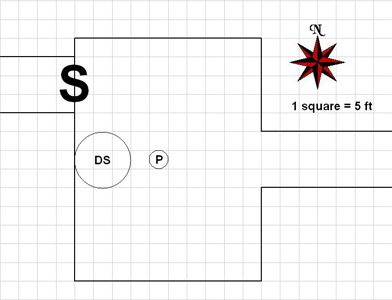 |
P = Lord of Palliag
DS = Dragon Skeleton
|
The passageway opens into a large chamber with a ceiling 30 ft overhead. The chamber is covered in more of the bas reliefs that decorated the hallway, and upon the ceiling is a mosaic of deep blue stones forming a blue dragon with a massive head and whose body spirals inward until disappearing in the center of the ceiling. The floor of the chamber is covered in bones of all shapes and sizes, most yellow and mouldering with age. Skulls lie whole and in pieces, while curved ribs stick up like bony fingers. |
Creatures: The Lord of Palliag's spirit hovers in the Ethereal Plane bounding this chamber. From here he watches over the way into the Draconic graveyard. When the PCs approach this place, their presence (even if concealed) will recall the Lord of Palliag's spirit to the area. The spirit will take 4 rounds to form. During this time, it will be able to cast spells, but unless the PCs can see ethereal creatures, they will not notice its presence.
The Lord of Palliag is an arch lich, which is a very rare manifestation of undead existence that is, for most intents and purposes, a good-aligned lich. Arch liches have the abilities of a normal lich, and have some extra ones as well, as noted in the statistic block below. Such arch liches are almost never created by means of a ritual, like normal liches are, but rather represent powerful spellcasters who had an overwhelming purpose to fulfill by remaining in the material world. In the case of the Lord of Palliag, it is to oversee his curse.
On round 1 the spirit will emerge from the ceiling and hover over the center of the room near the mosaic. If the PCs can see ethereal creatures, they will notice this manifestation as being vaguely humanoid and comprised of shifting mists. During this round the lich will cast detect evil on the PCs. It will not concentrate on this spell past this round, simply determining of any of the PCs is evil.
On round 2, the shape will descend slowly to the floor. Again, this will only be noticed by those that can see ethereal creatures. During this round the lich will cast detect thoughts.
On round 3, the shape will begin to disperse into the nearby bones. Again, this will only be noticed by those that can see ethereal creatures. During this round the lich will continue to concentrate on his detect thoughts and note the Intelligence scores of each of the PCs.
On round 4, the bones will gather together under their own power and form what is essentially a lich comprised of the bones of many mismatched creatures, though still well wrought and with a human skull for a head. Green points of light will burn within the eye sockets of the skull. Obviously, this effect will be visible to mundane sight. In this round the lich will concentrate on his detect thoughts spell and begin to attempt to read surface thoughts. See below for a more complete description of the lich's mind reading attempts.
During the second round of its forming, the arch lich will cast detect thoughts. This means on the round that it forms (i.e. round 4) he will be able to attempt to read the surface thoughts of one of the PCs. He will do so, choosing the PC that appears to be most like a warrior (and therefore presumably with a low Will save). Should this fail, it will then engage the PCs in conversation, but all the while attempt to read the thoughts of another PC each round, until he has succeeded, combat has begun, or it has failed an attempt on each PC. During conversation, this means every 6 seconds another PC can be read. And the PCs will not know that this is happening, as in Therra such divination spells do not give away their presence even when a save is required.
Should the arch lich successfully read the mind of a PC, then he will certainly know their mission, as that is likely to be first and foremost in his surface thoughts at this time. This is especially true given the lich's line of questioning once it begins to speak to the PCs. Once the lich is able to read the thoughts of a PC he will continue to do so as long as it can concentrate. This may alert him as to when the PCs are about to commence combat against him. If he senses combat is about to begin, he will drop his detect thoughts and use his Divine Vigour feat.
The lich will question the PCs as to why they have come. If he has not been able to read thoughts and know that they seek to bury the soul of Angaralok, then he will try to determine the veracity of their answer by means of Sense Motive. If he does know that they seek to inter his arch-nemesis, he will still ask the question, in order to gauge whether the PCs are liars or not.
The lich will attempt to dissuade the PCs from attempting to continue. It is possible for the PCs to convince the lich to let them pass, but in order for this to happen, the PCs will have to come up with a very plausible excuse as to whay they need to come this way. Furthermore, they will have to make a Bluff check that defeats the lich's Sense Motive check. In any event, if the lich detected evil in round 1 of his formation, he will never consent to the let the PCs pass, as he assumes they are evil and may be aligned to Angaralok.
If the lich has read the thoughts of the PCs or has been told of their true mission, he will beg them to desist, pointing out quite eloquently that the curse is the only way that he and his people were able to strike out against Angaralok, and if the curse is thwarted and the dragon allowed to expire in peace, then the memory and sacrifice of thousands of innocent and brave and noble and kind persons will have been in vain. The lich will, instead, implore the PCs to turn back and dispose of the gem, or, better yet, to leave it with him, so that he can guard it and keep it from the servants of the dragon forever.
It should be clear to the PCs, in speaking with the arch lich, that he is eloquent and sincere. The lich will assure the PCs that he has no desire to harm them (especially if he detected no evil), but he cannot allow the curse to be bypassed, and if the PCs do not desist, he will be forced to call upon all of the means at his disposal to stop that from happening.
The lich will certainly parley with the PCs as long as he practically can, as he has no spells running that are in danger or expiring during such a conversation. However, the arch lich is no fool, as shown by his skills and characteristics, and he will not allow the PCs to take advantage of his parley to overtly prepare for battle.
|
THE LORD OF PALLIAG CR 17 torrent of tears - enlarged Watchful Spirit (Ex) Once per day, a wu jen can reroll an initiative roll he has just made before he knows his place in the initiative order. He takes the better of the two rolls. * These
spells are water spells for wu-jen |
Note: The arch lich's transformation has altered the way he casts spells. He no longer needs his spell book to memorise spells, nor does he need material components or foci. However, he also cannot prepare any spells but the ones that were prepared at the time of his death (which are the ones listed above). While wu-jen usually have a spellbook and can prepare any spells in their book, the arch lich can only prepare the spells above, though he can memorize multiple uses of a spell if he desires.
The arch lich has used his animate dead power to animate the skeleton of a very old blue dragon, which now rests amongst the bones of the place in the location indicated on the map. When the arch lich rises up, the dragon will as well.
| VERY OLD SKELETAL
BLUE DRAGON CR 9 Draconomicon page 192 N Huge undead Init +4; Senses blindsense 60 ft, darkvision 120 ft, keen senses; Listen +0, Spot +0 Aura frightful presence (270 ft, 29 HD, DC 29) AC 12, touch 8, flat-footed 12 hp 225 (30 HD); DR 5/bludgeoning Immune cold, electricity Fort +17, Ref +17, Will +17 Spd 40 ft (8 squares), burrow 20 ft (4 squares) Melee bite +41 (2d8+11) and 2 claws +36 (2d6+5) and 2 wings +36 (1d8+5) and tail slap +36 (2d6+16) Space 15 ft; Reach 10 ft Base Atk +30; Grp +49 Abilities Str 33, Dex 10, Con -, Int -, Wis 10, Cha 18 SQ undead traits Feats Improved Initiative Frightful Presence (Ex) A young adult or older dragon can unsettle foes with its mere presence. The ability takes effect automatically whenever the dragon attacks, charges, or flies overhead. Creatures within a radius of 270 feet are subject to the effect if they have fewer HD than the dragon. A potentially affected creature that succeeds on a DC 29 Will save remains immune to that dragon’s frightful presence for 24 hours. On a failure, creatures with 4 or less HD become panicked for 4d6 rounds and those with 5 or more HD become shaken for 4d6 rounds. Dragons ignore the frightful presence of other dragons. The save DC is Charisma-based. |
Tactics: The arch lich will, if he detected no evil amongst the PCs, attempt to spare the lives of as many of the PCs as he can, while still protecting himself, his skeletal dragon, and the graveyard. While he does this he will continue to dissuade them from continuing. However, the arch lich will in no way jeopardize his goals in order to go easy on the PCs. It is simply that if he has a choice to drive them away or slay them he will tend to choose the former.He will also not attack downed PCs if this is the first time he is battling them and if the PCs have not continually healed their downed member to return to the fight.
Should the PCs retreat, he will let them go, but should they ever return, then he will become convinced that he must, unfortunately, finish them off so that they do not return over and over again. To that end, he will also attack downed PCs to kill them in any second or subsequent battle.
The lich is not bound to this room in any way, and will certainly follow and attack the PCs if he deems it necessary, keeping in mind that he will be inclined to let them leave once on the assumption that they will decide not to return.
That said, the lich is extremely smart and wise and will not be easily duped into leaving his room and allowing PCs to pass by in his absence.
As far as actual combat tactics go, the lich, being a canny spellcaster, will use his abilities wisely and in the most thoughtful and efficient manner. Because of this, no actual list of actions is presented in this section.
Development: If the lich is defeated, his body will crumble, while his skull remains intact and with the green lights still active (but see Secret Doors below). The head radiates faint transmutation magic.
Secret Doors: The secret door to the northwest is 15 ft wide (Search DC 30) and has no discernible opening mechanism. If the skull from the dead lich is touched to the door, it will open. Otherwise, a knock spell will be needed or the door can be smashed down or bypassed. If the skull is touched to the door it will crumble. If the door is opened the skull will crumble. If the skull is removed from this chamber before the door is opened, the green lights in its eyes will dim, to return to full intensity when the skull is returned to this chamber.
Once the door is opened, it will open and close again by simply pushing on it.
Part Four - The Dragon Graveyard
The passageway beyond the lich's chamber continues as before
for another quarter of a mile before ending.
| The passageway ends in a roiling wall of grey mist. The mist crackles with small arcs of blue lightning. |
A non-dragon touching the curse will feel a bit of a tingle, but nothing more.
The PCs can walk through the curse, taking the gem with them.
They will emerge inside the dragon graveyard.
|
You have emerged into what is likely the largest chamber you have ever seen. The place can only be described as the inside of an entire mountain hollowed out. The chamber is easily a mile in diameter and well over 4,000 ft high where the conical walls of the place end in more of the roiling mist. If the place were conical, it could be assumed that the apex continues for another 1,000 ft or so beyond the mist. The entire place crackles with lightning, grey mist, and violent vortices of both mist and lightning. Every spot in the chamber seems to be, at one time or another, lit by lightning, allowing you to get a full view of the place. Here and there an area seems to fill with lightning and an entire radius is barraged by great blue forks. In other areas mist congeals and swirls in on itself until it seems to rip the very air of the chamber, forming a hole into somewhere "beyond" before closing and disappearing a few moments later. The floor seems to be made of a soft, loam-like earth and no sign of bones or other large objects are to be seen. |
It is half a mile to the center of the graveyard, where Angarlok has instructed the PCs to bury the gem. A group moving at speed 30 ft will take 10 minutes to make the trek. A group moving at speed 20 ft will take 15 minutes.
During this time, the PCs will risk encounters, which should be checked for every minute of travel:
01 = Elemental Storm (CR 10)
02 = Vortex
03-15 = Skeletal Dragon (1d3)
16-25 = Zomgie Dragon (1d3)
26-30 = Ghostly Blue Dragon
31-00 = nothing
An elemental storm manifests as a fire storm (CL 20, Ref DC 23 half) but the effect will be electricity instead of fire.
A vortex will spit out a horde of storm elementals as if the elemental swarm spell had been cast, although each wave will emerge 1 round after the previous wave (i.e. 2d4 large elementals in round 1, 1d4 huge elementals in round 2, and 1 greater elemental in round 3).
Creatures:
Skeletal dragons will rise up out of the soft earth and attack.
|
VERY OLD SKELETAL BLUE DRAGON
CR 9 Keen Senses (Ex) A dragon sees four times as well as a human in shadowy illumination and twice as well in normal light. It also has darkvision out to 120 feet. |
Zombie dragons will rise up out of the soft earth and attack.
|
VERY OLD ZOMBIE BLUE DRAGON
CR 10 Slow (Ex) Like zombies, zombie dragons have poor reflexes and can perform only a single standard action or move action each round. |
Ghostly dragons will not necessarily attack, although they will assume the PCs are intruders intending to desecrate or rob the graveyard. If the PCs can do some fast talking the ghostly dragon might desist and parley, allowing them to use a Diplomacy (or Bluff is somehow appropriate) check to convince the spirit that they mean no harm (assume the ghost is unfriendly unless the PCs have done something during their time in the graveyard to anger the spirits). If the PCs actually explain their mission, they will receive a +5 circumstance bonus on their check. If they show the gem to the spirit, the spirit will not know that it is a dracolich phylactery, and will simply detect magic on it and remark that it is indeed magical.
If a ghost is made indifferent, it will allow the PCs to continue on. If made friendly or helpful it will agree to accompany the PCs to the center of the graveyard and will keep away all further encounters (i.e. the PCs will no longer be subject to any of the encounters on the above table).
|
ADULT GHOSTLY BLUE DRAGON
CR 16 Create/Destroy Water (Sp) A blue dragon of any age can use this ability three times per day. It works like the create water spell, except that the dragon can decide to destroy water instead of creating it, which automatically spoils unattended liquids containing water. Magic items (such as potions) and items in a creature’s possession must succeed on a Will save (DC 25) or be ruined. This ability is the equivalent of a 1st-level spell. Energy Drain (Su) With a successful touch attack, a ghostly dragon bestows two negative levels on the target. Frightful Presence (Ex) A young adult or older dragon can unsettle foes with its mere presence. The ability takes effect automatically whenever the dragon attacks, charges, or flies overhead. Creatures within a radius of 180 feet are subject to the effect if they have fewer HD than the dragon. A potentially affected creature that succeeds on a DC 29 Will save remains immune to that dragon’s frightful presence for 24 hours. On a failure, creatures with 4 or less HD become panicked for 4d6 rounds and those with 5 or more HD become shaken for 4d6 rounds. Dragons ignore the frightful presence of other dragons. The save DC is Charisma-based. Keen Senses (Ex) A dragon sees four times as well as a human in shadowy illumination and twice as well in normal light. It also has darkvision out to 120 feet. Manifestation (Su) a ghostly dragon dwells on the Ethereal Plane and, as an etheral creature, it cannot affect or be affected by anything in the material world. When a ghostly dragon manifests, it partly enters the Material Plane and becomes visible but incorporeal on the Material Plane. A manifested ghostly dragon can be harmed only by other incorporeal creatures, magic weapons, or spells, with a 50% chance to ignore any damage from a corporeal source. A manifested ghostly dragon can pass through solid objects at will, and its own attacks pass through armour. A manifested ghostly dragon always move silently. A manifested ghostly dragon can strike with its touch attack or with a ghost touch weapon. a manifested ghostly dragon remains partially on the Ethereal Plane, where it is not incorporeal. The creature can be attacked by opponents on either the Material Plane or the Ethereal Plane. The ghostly dragon's incorporeality helps protect it from foes on the Material Plane, but not from foes on the Ethereal Plane. When a spellcasting ghostly dragon is not manifested and is on the Ethereal Plane, its spells cannot affect targets on the Material Plane, but they work normally against ethereal targets. When a spellcasting ghostly dragon manifests, its spells conitnue to affect ethereal targets and can affect targets on the Material Plane normally unless the spell rely on touch. a manifested ghostly dragon's touch spells don't work on nonethereal targets. A ghostly dragon has two home planes, the Material Plane and the Ethereal Plane. It is not considered extraplanar when on either of these planes. Rejuvenation (Su) In most cases, it's difficult to destroy a ghostly dragon through simple melee combat. The "destroyed" spirit will often restore itself in 2d4 days. Even the most powerful spells are usually only temporary solutions. A ghostly dragongraveyard guardian that would otherwise be destroyed returns to its graveyard on 1 day. Withering (Su) A ghostly dragon's touch acts as a rod of withering, dealing 1d4 points of Strength damage and 1d4 points of Constitution damage with a successful touch attack (Fortitude negates). If a ghostly dragon scores a critical hit, the damage is ability drain instead. |
Developments: If the PCs attempt to desecrate the graveyard or dig for treasure, they will automatically come under the ire of a ghostly dragon (as above). Should they persist, then more and more such dragons will arise, until there are effectively enough to slay the PCs or drive them away. There should be absolutely no chance of the PCs looting this place. It is simply too powerful a place for them at this time.
The PCs were instructed to burythe gem in the center of the place. Assuming they are somewhere near the center, they have merely to bury it. This can be as simple as covering the gem with a handful of loam, or the PCs can dig down a bit before depositing the gem and covering it up.
Once the gem is buried, Musafa will be told by Angaralok that his soul is at rest. Musafa will then use a sending to say:
You have done well! My master has expired and your reward awaits. Please return to the oasis and the blue tent where I await you.
Once done, the PCs are free to leave the graveyard (subject to more encounters unless they have befriended a ghost, in which case it will escort them out of the place as well).
The PCs will have to leave the graveyard the same way they came in (unless they wish to teleport or otherwise magically travel from the area). They must then make their way back to Oasis Bakinal.
Part Five - Reward:
Upon returning to Bakinal and entering the blue tent, they will see Musafa awaiting them with food and drinks. Musafa will congratulate the PCs and invite them to rest and dine and even wash away the grime of their travels and exertions. He will explain that Angarlok died the moment the gem was buried.
After a while Musafa will produce a tray with metal vials on them. There is one vial for each PC, plus one extra. Musafa will explain that before the PCs can collect their rewards, they must each drink from a vial. He will explain that the vials contain a magical liquid which will cause the PCs to forget the location of the graveyard. They will remember what they did, but nothing in any way connected with providing a location of the place will be remembered.
If the PCs protest, Musafa will sympathize with them but explain that his ex-master was quite adamant and Musafa will not betray him. To appease the PCs, Musafa will tell them that he, too, must drink from a vial and he will agree to drink from a vial first if requested (a random one or one chosen by the PCs if desired). He will tell the PCs that this is a requirement because his ex-master does not want the PCs to return and desecrate that sacred ground. His ex-master likely kept this requirement a secret so that the PCs could not have advanced notice and figure out some way to thwart this enchantment.
If the PCs refuse, Musafa will explain that he knows that he is not powerful enough to force them to drink, but that the rewards promised are well hidden and will not, then, be forthcoming, including the item needed for Ali to prove to the Caliph that Angaralok is dead.
The PCs might think to compel Musafa to divulge the location of the rewards magically or read his mind, but Angarlok has placed an enchantment on the priest whereby he can only recall the location of the rewards after all of the PCs (and he) have drunk their vial. Since this contingency will only kick in if the PCs actually drink their vials, using Sleight of Hand or other means to deceive Musafa into thinking a vial had been imbibed will not work!
While Musafa will not inform the PCs, should the PCs check their map showing the location of the graveyard, they will find it has dissolved into ashes. This is a result of an enchantment placed on the map. In fact, the enchantment affects not only the map but any and every copy made of it, no matter how rudimentary.
The end result is that if the PCs want their rewards, they must drink the vials and lose the memory of the location of the graveyard. Given the fact that they probably have no desire or ability to return and defeat the fearsome guardians thereof, there should be no real reason why the PCs ultimately refuse to drink. See Part Seven below for some final comments on PCs trying to remember the location of the graveyard.
Once the PCs have drunk, Musafa will announce that he must now fetch the rewards, but that he will return in 24 hours with them. He will make every effort to assure the PCs he will not betray them, but he will not allow the PCs to accompany him (for he does not wish them to see what his share of the remaining hoard is).
24 hours later, he will return with the rewards:
a bag of 1,000 pp for each PC
the Mask of Thelyshki-Nar for Ali
In addition, he will produce a single item (of approximately 25,000 gp value) for each PC. These items will be chosen for each PC by Angaralok, and so should be something each PC might find useful and desirable. In the historic campaign, the following were given:
Vaden = ring of dragonshape
Marco = iron bands of binding
Raygon = singing sword (silver +1 greatsword with additional abilities, see Magic of Faerun)
Argus = runestaff of transmutation
Arios = pale lavender ellipsoid ioun stone
Jacinse = canaith pyi-pya (mandolin)
Ali = rod of splendour
The Mask of Thelyshki-Nar is a dented face mask of some fearsome Morakki warlord. Holes and dents in the mask show were gems were once mounted and, if the thing had any value at one time, it is now materially worthless. However, Musafa will explain that this item is the most prized possession in Angaralok's hoard because it was the first real victory Angarlok had in his career, and as such the Caliph knows the dragon would never ever part with it while he still lived.
After the PCs have received their rewards (and Musafa will tell them what each one does), Musafa will tell Ali that his ex-master wanted to impart a bit of advice to him. Musafa will say that Angaralok urges Ali not to underestimate the Caliph, for though he is politically inept and not one for subtleties, he is still a very formidable and clever warrior.
In addition, Musafa will say that his ex-master knew a formula to brew an extremely concentrated distillation of black lotus extract, such that even a beserk warrior amidst battle rage could be brought low in a matter of seconds and die a quick death. The Caliph has some of this poison and is sure to apply some to his blade. As such, his ex-master has bid Musafa present Ali with a single vial of antidote to that special poison. The antidote will protect completely against the poison for 1 hour. There is no further antidote and the secret of its crafting is now lost with Angarlok's passing. Musafa will say that Angarlok expressed regret that he could not see the Caliph's face as he scratch Ali and yet the warrior did not fall. Musafa says, however, that he would like to have that pleasure personally, and would like to watch the duel between Ali and the Caliph if the PCs will so allow it.
Part Six - The Duel:
The Caliph, it can be determined, is encamped in an oasis a few days travel from Bakinal. He has a palatial tent at the center of this oasis. This is common knowledge in Bakinal. Ali can now do what he likes, and in theory he does not have to immediately duel the Caliph. However, should the player want to delay the duel in order to gain more experience and levels, the DM should warn him that the Caliph is also engaged in activities that could increase his level as much or even more than Ali.
In any event, there should be more than enough impetus for Ali to be quite eager to challenge the Caliph.
Ali will know the rules of such a challenge. A challenge, once made, must be fought publicly with the next 24 hours. The combatants will fight in a square area 40 ft to each side, with the combatants beginning at opposite ends of the field.
No outside magic is allowed. Each combatant may only use his own abilities and magic, including any items he carries into the arena with him. Priests of the Wind officiate over the duel and they conduct a ritual prior to the duel's commencement which will ensure that no cheating happens. The ritual will automatically dispel ANY spells on the participant (including spells made permanent by the permanency spell).
The duel is to the death. The loser will be decapitated and his head and body burned to ashes and the ashes dissolved in lime and a ritual said over the whole such that only a true resurrection, wish, or miracle could return the victim.The victor is named the new Caliph of all of the tribes of Wylag and receives the items that the loser carried into the area (which is why the other PCs may not wish to lend Ali all of their best items for the fight).
No challenger can challenge a given Caliph more than once.
In order to challenge the Caliph, Ali must produce the Mask of Thelyshki-Nar and show it to the Caliph. It should not be too diffuclt to gain an audience with the Caliph and, in fact, if Ali simply publicly challenges the Caliph to a duel he will be brought right to an audience with him. There the Caliph will say that he cannot be challenged to such a duel because it is not he that rules the tribes...it is the Blue Terror that does so.
The Caliph will know instantly what the mask is and what it signifies. He will be quite shocked, but will regain his composure, believing that, with his poison blade, he is still sure to defeat Ali.
The next day the fight will take place, and quite a crowd will have gathered, including Musafa if the PCs have let him. The priests will conduct the consecrating ritual, and then the fight will begin.
| CALIPH INDUL
BINSADEEN CR 12 Complete Scoundrel page 28 Male human Rogue 2/Barbarian 2/Fighter 8 NE Medium humanoid (human) Init +2; Senses trapfinding, Listen +34, Spot +34 Languages Vashti, Draconic AC 22, touch 12, flat-footed 22; Combat Expertise, Dodge, uncanny dodge hp 90 (12 HD) Fort +11, Ref +7, Will +2; evasion Spd 40 ft (8 squares); fast movement Melee +1 disarming scimitar +13/+8/+3 (1d6+6/15-20) Space 5 ft; Reach 5 ft Base Atk +11; Grp +14 Combat Gear +1 disarming scimitar, concentrated black lotus, potion of cure serious wounds (CL 5), potion of haste (CL 5), potion of heroism (CL 5) Atk Options Combat Expertise, Resounding Blow (DC 17), sneak attack +1d6, Telling Blow +1d6 Special Actions Improved Disarm, Intimidating Strike, lion's shield (+11/+6/+1, 2d6 dmg, 3/day), rage 1/day (7 rounds) Abilities Str 16, Dex 15, Con 14, Int 13, Wis 10, Cha 12 Skills Balance +10, Bluff +7, Climb +12, Diplomacy +3, Escape Artist +6, Hide +6, Intimidate +17, Jump +15, Knowledge (local) +5, Listen +6, Move Silently +6, Ride +12, Spot +4, Survival +2, Tumble +14 Feats Combat Expertise, Dodge, Improved Critical (scimitar), Improved Disarm, Intimidating Strike, Master of Poisons, Power Attack, Resounding Blow, Telling Blow, Weapon Focus (scimitar), Weapon Specialization (scimitar) Possessions +2 chain shirt, lion's shield, antidote (2), masterwork potion belt |
Tactics: Initially the Caliph will try to hang back and quaff his potion of haste and, if permitted, his potion of heroism. Thereafter he will advance, seeking to wound Ali and have the poison take effect. Should he do so, he will be absolutely amazed when the poison does not work.
Should Ali be smart enough to fake being hurt by the poison, then Ali's Bluff check against the Caliph's Sense Motive check will allow Ali to catch the Caliph flat-footed as if he had done a successful feint.
In any event, when the poison does not work, it will be clear to all watching that the Caliph is nervous. However, he will not give up! He will then attempt to disarm Ali of his weapons, and use his lion's shield to do damage. Once Ali is disarmed, the Caliph will rely on the various effects of critical hits on Ali when combined with the feats the Caliph knows (i.e. Intimidating Strike, Telling Blow, and Resounding Blow). In theory, a critical hit by the Caliph might cause Ali to cower, allowing the hasted Caliph to then get another 4 attacks whereby another critical hit could cower Ali again and so forth, setting up a situation where Ali does nothing but cower as the Caliph rains blows down upon him.
Developments: The other PCs are not allowed to interfere. If they do, the match is immediately over. Ali cannot be Caliph for ever after and the tribespeople will hate the PCs and be hostile to them forever.
If Ali is slain, the character is possibly dead forever. Of course the historical PCs may wish to call upon the Heroes of the Gem to revive Ali, using the most powerful magic, but even so Ali will never be able to gain the Caliphate and his political ambitions will be lost. All of the items he carried into the duel now belong to the Caliph. The PCs are free to leave.
Should Ali prevail, then the Caliph's items are forefeit and Ali becomes the new Caliph. It is left to the DM to decide what this entails and what adventures await Ali as he tries to consolidate power. He has 7 years from the moment he defeats the Caliph before others can challenge him! Should he seek to reunite with his family and beloved, the DM can decide whether they accept Ali after all these years.
Musafa, in either case, will leave the area bearing a hand cart in which he carries his share of Angarlok's treasure (1,000 pp and an appropriate magic item for him). He will bear the PCs no emnity and wishes to simply begin a new life.
Part Seven - Wrapping Things Up:
The players might, for whatever reason, attempt to relocate the dragon graveyard. The DM should take great pains to thwart this (as it is necessary for the second part of this series) , and given the nebulous nature of the draught they drank, this should not be too difficult. There is a way, however, that the PCs might eventually relearn the location. If they befriended the loquasphinx, they might eventually be able to track him down.
The memory draught erases the memory of the location of all of the landmarks mentioned on the map, unless the PCs knew about such landmark BEFORE having ever seen the map or speaking with Angarlok. Even so, they will no longer remember their significance. Thus, even if a PC is familiar with the circle of salt pillars, they will not remember that this was a clue to the dragon graveyard nor the writing on the map that told how to find the hidden entrance.
The PCs will know that there was a dragon graveyard, and that it is somewhere in Morakki lands and likely somewhere in or around the East Wastes or Vayshan Mountains, but that is about it.
Furthermore, at least initially, the draught erases even the desire to try to locate the graveyard or remember its location or even any details about it. This initial very strong effect wears off in a matter of weeks (DC 25 Will save checked after 1d4+12 days and then every week thereafter, with a cumulative +2 to the save for each week that passes after the initial check). A PC will not be aware that this initial strong effect exists until the player tries to have the PC remember or do something that would help him locate the graveyard. The magic will manifest as something else always distracting him just as he is about to attempt to do something that would evoke the graveyard. Even should the PC be locked in isolation, stray thoughts will distract him.
Once this initial effect thaws, then the PC will be able to manifest the desire to remember, but he still will not be able to conjure up the memory. Not even a wish spell will thwart this, since the draught was quaffed voluntarily.
After the initial effect thaws, the PCs will remember the loquasphinx, but will not realize that it was near the graveyard. In fact, they will not be able to recall precisely where or when they met the sphinx. Nevertheless, they will remember meeting him and, perhaps out of a desire to learn truenaming lore, they may seek out the sphinx, using sending or other magic to contact him and, by conversation, finding out his location. The DM cannot really stop such activity, but he should make it clear that generally the PCs would take a bit of time before desiring to return to the sphinx, and that the players should not use their own knowledge of the location of the sphinx and graveyard to motivate their PCs to try to bypass the effects of the memory draught. The DM should rule that the PCs will take at least a month or more before thinking to contact the sphinx.
Likewise, it is possible that the PCs, on their journey to the graveyard, somehow captured or charmed a creature so that they have access to it but the creature has not drunk a memory draught. Of the creatures encountered during the adventure, the two most likely to fit this criteria are the loquasphinx and the djinni. The latter will be of no help to the PCs, as it has been magically compulsed by the Lord of Palliag never to divulge the location of the graveyard (for reasons different than Angarlok's!). The djinni cannot communicate the location in any way, nor can it even think it as a surface thought. In any event, remember that the PCs will not even be able to muster the will to ask the djinni until the initial effects of the draught thaw.
The loquasphinx (or some other creature that the PCs convinced to accompany them to the graveyard) is another matter entirely. Once the initial effect of the draught thaws, the PCs can ask them where the graveyard is and, having not imbibed the draught themselves, they can answer. Thus, it may be that the PCs can return to the graveyard as soon as 13 days after the gem is buried. Even so, that will be too late to stop Angaralok from becoming a full-fledged dracolich.
Should the PCs return to the graveyard after Angaralok has left and dig where they buried the gem, they will find that the gem is gone. None of the entities of the graveyard will answer the PCs as to what happened, and if somehow a ghost is compelled to do so, it will describe what it saw...how the dracolich Angaralok emerged from the ground and dug up the gem and took it as it flew off down the passageway from which the PCs had come.
If somehow the Lord of Palliag was still "alive", the dracolich will have destroyed him utterly.
When the dracolich emerges into the valley, it will be hidden by spells and the loquasphinx will have detected nothing.
The day after the PCs bury the gem, Angaralok will begin the final phase of his plan. At this point, the next scenario in the series will begin.
Experience Points:
In addition to normal experience (which in Therra is half of that recommended in the DMG), each party member should be rewarded as follows:
There are no special XP bonuses for this scenario.
Statistics for Angarlok the Blue:
The below is provided merely so that that DM can get an idea of Angaralok's true power and abilities. There should be no reason why the PCs actually fight Angaralok in this scenario...that is a task for the Heroes of the Gem!
|
ANGARALOK THE BLUE CR 25 Breath Weapon (Su) 120-ft. line (60-ft. cone if shaped, 30-ft. spread if spreading), 24d8 electricity, Reflex DC 37 half. Using a breath weapon is a standard action. Once a dragon breathes, it can’t breathe again until 1d4-1 (minimum 1) rounds later. The save DC is Constitution-based. Create/Destroy Water (Sp) A blue dragon of any age can use this ability three times per day. It works like the create water spell, except that the dragon can decide to destroy water instead of creating it, which automatically spoils unattended liquids containing water. Magic items (such as potions) and items in a creature’s possession must succeed on a DC 35 Will save or be ruined. This ability is the equivalent of a 1st-level spell. The save DC is Charisma-based. Crush (Ex) This special attack allows a flying or jumping dragon of at least Huge size to land on opponents as a standard action, using its whole body to crush them. Crush attacks are effective only against Medium or smaller opponents (three or more size categories smaller than the dragon), though it can attempt normal overrun or grapple attacks against larger opponents. A crush attack affects as many creatures as can fit under the dragon’s body (20 ft by 20 ft area). Creatures in the affected area must succeed on a DC 37 Reflex save or be pinned, automatically taking bludgeoning damage during the next round unless the dragon moves off them. If the dragon chooses to maintain the pin, treat it as a normal grapple attack. Pinned opponents take damage from the crush each round if they don’t escape.The save DC is Constitution-based. A crush attack deals 4d6+21 points of bludgeoning damage. Frightful Presence (Ex) A young adult or older dragon can unsettle foes with its mere presence. The ability takes effect automatically whenever the dragon attacks, charges, or flies overhead. Creatures within a radius of 360 feet are subject to the effect if they have fewer HD than the dragon. A potentially affected creature that succeeds on a DC 35 Will save remains immune to that dragon’s frightful presence for 24 hours. On a failure, creatures with 4 or less HD become panicked for 4d6 rounds and those with 5 or more HD become shaken for 4d6 rounds. Dragons ignore the frightful presence of other dragons. The save DC is Charisma-based. Keen Senses (Ex) A dragon sees four times as well as a human in shadowy illumination and twice as well in normal light. It also has darkvision out to 120 feet. Sound Imitation (Ex) A juvenile or older blue dragon can mimic any voice or sound it has heard, anytime it likes. Listeners must succeed on a DC 35 Will save to detect the ruse. The save DC is Charisma-based. Tail Sweep (Ex) This special attack allows a dragon of at least Gargantuan size to sweep with its tail as a standard action. The sweep affects a half-circle with a radius of 30 feet, extending from an intersection on the edge of the dragon’s space in any direction. Creatures within the swept area are affected if they are Small or smaller (four or more size categories smaller than the dragon). A tail sweep automatically deals2d6+21 points of bludgeoning damage. Affected creatures can attempt a DC 37 Reflex save to take half damage. * Dragons cast this spell as a swift spell. ** This spell is always active; Angaralok casts it every day at midnight. |
|
CONTINGENT CAPSULE This small metal pellet is the size of a small human finger joint and is carved with delicate runes. A wax stopper plugs one end of the device. A contingent capsules is the magical version of an alchemical capsule (Complete adventurer page 119). Like an alchemical capsule, a contingent capsule is worn on the inside of the mouth, under the tongue. No retainer is needed, as the capsule magically adheres to the gum. Unlike the non-magical version, the contingent capsule can hold one dose of any liquid or elixir that normally fits inside a vial (not a flask). This includes potions, many elixirs, and even poisons. Loading a liquid into the capsule is a full-round action that provokes attacks of opportunity and requires Concentration. A contingent capsule is enchanted to react to the wearer's thoughts, so that activating it is an immediate action (as opposed to a swift action for a normal alchemical capsule) by simply biting down on the capsule, crushing it and releasing the contents. This makes a contingent capsule invaluable for items such as potions of cure spells. Furthermore, a contingent capsule can be set to activate when a certain condition applies. Setting the capsule takes 1 minute of concentration and the item must be worn in the mouth during this time. This condition can be more or less anything applicable to a contingency spell. The condition must be discernible by the wearer, so things that are hidden from the wearer cannot be set as a contingency. In addition, should the wearer be fooled by a condition, the capsule will activate. For example, if the wearer has a capsule filled with a potion of resist energy (fire), and a condition that if he is sees any creature with the fire subtype then the capsule will activate, then the capsule will activate only against a creature that the wearer knows to be of the fire subtype, and will activate even if he sees an illusion of such a creature and believes it to be real. The immediate activation and contingent activation of a contingent capsule can be set very precisely, so that it activates even after an attack or spell is successful against the wearer or a saving throw has been failed. However, once damage has been rolled or the effects adjudicated, then the capsule cannot be activated before such damage or effect is taken. So, if a contingent capsule with a potion of cure serious wounds is activated if the wearer suffers a potential killing blow or attack, then any attack that hits that, were it to do maximum damage would be lethal, would activate the capsule even before damage is rolled and even if the rolled damage is far less than maximum and would not have killed or even incapacitated the wearer. Only one contingent capsule may be worn, no matter what the size of the wearer, and a creature smaller than size Small cannot use one. A contingent capsule cannot be worn at the same time as an alchemical capsule (and vice versa). A contingent capsule can be drunk without wearing it just like a potion or other normal drink (standard action provoking attacks of opportunity). If drunk in this fashion, the capsule may be refilled. Once a capsule activates via crushing or contingency, the capsule is destroyed and cannot be reused. Prerequisites: Craft Wondrous Item, contingency. |