
Return to the Therran Scenario Page
Summary:
The PCs must retrieve the legendary sword Fedifensor in order to remove the Fimbulwinter curse from the Kingdom of Slumber
Assumptions:
The PCs are the Heroes of the Gem and rule the Kingdom of Slumber.
Location:
Eracuss' Canton in the Kingdom of Slumber
Historical Date:
N.S. 35, Summer
A Note to DMs:
Elements of this scenario are taken directly from the scenario entitled "Fedifensor" from Dragon Magazine issue #67. Others are borrowed from issue 100 of Dungeon Magazine.
This scenario assumes the participation of the Heroes of the Gem. Should the DM wish to use other PCs, he should adapt the scenario accordingly.
This scenario is a loose sequel to both The Fimbulwinter and Cold Anger in that the events detailed therein are presumed to have occured and the historical outcomes as well. In this case, the PCs defeated the Fimbul but did not confront the demonlord Kostchtchie. Five years later, the PCs, seeking to reverse the Lothar's cleansing spell the Fimbul had cast in the heart of Korvar's Canton, sought out Kostchtchie on his home demi-plane in an effort to slay him and thereby end the curse. The PCs fought their way to Kostchtchie, but the demonlord escaped and fled in to the depths of the netherplanes. For about 5 years the PCs have sought out the location of Kostchtchie, but it is clear the demonlord knows the PCs are after him and that they are powerful enough to defeat him, and so he has not been located. DMs are encouraged to read both scenarios, at least the introductory texts, to get an idea as to what has happened.
DM's Introduction:
The massive fury of the Fimbul's Lothar's cleansing epic spell still remains raging in the heart of Korvar's Canton. Even though the Fimbul was slain by the Heroes of the Gem in his iceberg temple, and so his plan to cover all of the Kingdom of Slumber in an icy glacier was defeated, his initial strike remains. Korvar knows what is required to dispel the effect, but the ritual cannot be activated as long as the source of the power of the spell remains alive, and that source is none other than the demonlord Kostchtchie, who fled from the Heroes and is now in hiding.
The manifestation of Lothar's cleansing is a 20 mile radius of frigid temperatue and blizzard conditions. While the description of that spell (as detailed in the scenario The Fimbulwinter) states that an epic dispelling magic can dispel the effect, this is not true as long as the spell is still being powered by the demonlord Kostchtchie, for while the cord between the Fimbul and the demonlord was snapped when the Fimbul was slain, a more subtle mystic cord still exists between Kostchtchie and the Fimbulwinter raging in Korvar's Canton.
Slaying Kostchtchie will sever the cord and allow epic magic to dispel the effect. But the demonlord, having determined why the Heroes of the Gem are after him and having no desire to be hunted all of the remaining days of the Heroes, has come upon another means to sever the mystic cord...a means that does not involve his death.
The mystic cord linking Kostchtchie to the effect is akin to the silver cord that links an astral traveller to his material body. And it is well known that the silver swords of the githyanki can sever such connections where little other magic can. So, Kostchtchie suspected, the legendary Fedifensor, the silver sword of the lich queen of the githyanki herself, would be powerful enough to sever the epic cord linking himself and the Fimbulwinter. Subsequent research confirmed this suspicion, and now the demonlord has sent an emissary to the Heroes of the Gem in order to make a proposal...that the Heroes should retreive Fedifensor and he will use it to sever the cord. In this way the Heroes can dispel the Lothar's cleansing that is causing the Fimbulwinter and he gets to live and not be hunted down by the Heroes of the Gem.
What the PCs and Kostchtchie do not know is that the githyanki queen does not have the blade. It was stolen from her by a daring band of githzerai many years ago and taken to Limbo.
Note: This scenario is a plane-hopping adventure. Any subtypes contained in the statistic blocks for this scenario reflect the current plane that the PCs are on. Thus, creatures that normally have the extraplanar subtype on the Material Plane but are native to the Astral Plane will have the native subtype when encountered on the Astral Plane, and creatures that are not native to the plane in question will have the extraplanar subtype, meaning they are subject to spells like dismissal and banishment.
Also, DMs should note that most of this adventure takes place on planes not coexistant with the Ethereal Plane or the Plane of Shadows. Any spells that require travel through such planes will not function throughout most of this adventure (e.g. ethereal jaunt). However, spells that summon or call creatures or items from the Ethereal Plane, such as secret chest, will function.
Part One - Not a Seduction
The Message:
Kostchtchie has sent a succubus to parley with Eracuss. He has chosen Eracuss because, while that worthy hates evil outsiders particularly, he is also most knowledgeable about extraplanar matters and will be best able to understand Kostchtchie's proposal.
The succubus is a normal specimen of her type, and so statistics are not presented here. She has changed shape to appear as an ordinary male labourer of no exceptional appearance. She has then used her charm monster and suggestion abilities while disguised to convince a low-ranking soldier of Eracuss' palace guard to demand a personal audience with Eracuss over a matter of extremely grave importance. Under the influence of the succubus, this soldier absolutely believes that if he does not deliver his message directly to Eracuss (and no one else) something extremely grave will happen to the land (though he is not quite sure what).
As such, this soldier attempts to burst his way into an audience with Eracuss, with about as much success as one might expect...none at all. But the soldier, heretofore an exemplary and sober individual, is so insistent, yelling that he MUST see Lord Eracuss, that finally Marius Avronne, Commander of the Arcanil Guard, decides to bring it to Eracuss' attention.
Marius will politely knock on Eracuss' laboratory door, while the archmage is busy crafting a magic item of some sort. Marius is very loathe to interrupt Eracuss in such circumstances, but he does so nonetheless.
Assuming Eracuss will eventually open the door and speak with Marius, the Commander will explain that he is very sorry for bothering his lord, but there is a soldier of the Arcanil Guard who has been quite literally raving for several hours now that he absolutely must deliver a message to Eracuss personally, lest some great tragedy befall the land, the nature of which he cannot or will not define. If asked, Marius can vouch for the man's behaviour before this incident. The man has not been checked for magic or spells (via a detect magic), but a mage can be found to do so quickly if Eracuss does not desire to do so himself.
The man will, at Eracuss' request, be brought forth. Initially, Marius and a guard will desire to be present, but the man, whose name is Firyntomy, will insist that his message is for Eracuss only. If Eracuss insists that Marius or others remain, the soldier will shrug and then deliver his message:
Lord Eracuss. You are requested to meet with the labourer Hemsil of Glant in the Mystic Fog Tavern here in Arcanil. You will know him by the lavendar feather in his cap. Hemsil assures you that such a meeting will be well worth your time. He awaits you even now.
With that, the suggestion cast on the soldier will have been fulfilled, though the charm monster remains. If the soldier is questioned about Hemsil, he will merely remark that he is a friend whom he knows. The soldier will vouch for Hemsil as a very serious, honest, and stand up fellow, though if questioned further it will become clear that he has only just met the man a day ago. If asked why he thinks something bad would happen had the message not been delivered, he will shrug and say that is what Hemsil said and he believes him.
Should the enchantments cast on the soldier be dispelled, he will be a bit disoriented, not quite sure why he thought his message was so all-fired important and wondering why he was so eager to please Hemsil, a drinking buddy he had only met the day before. He will certainly crave Eracuss' pardon for being so taken and for any affrontery he has committed.
The Meeting:
The succubus, disguised as Hemsil the Labourer and wearing a lavender feather in "his" tan cap, is at the tavern indicated. She will wait there for 24 hours before sending another person (this time possibly not a soldier) to deliver the same message to Eracuss. She will continue to do this for a week before giving up and coming to see Eracuss personally. Should this attempt fail, then the scenario is effectively over.
Assuming Eracuss does come to the tavern, either alone or with an escort, Hemsil will nod to him, order two mugs of ale, and then motion Eracuss into a curtained back room. There, she will sit down at a table and invite him to sit. She will advise Eracuss that they should speak in private, as there are important matters to discuss, but if Eracuss insists on having others around, she will shrug and speak anyways.
It is quite possible that Eracuss or another person present will have some means to see through the succubus' disguise. She doesn't really care, as her disguise is really for the benefit of ordinary folk. Of course, should Eracuss divine her true nature and seek to slay her, she will beg he at least hear what she has to say before doing so. Should Eracuss slay her out of hand anyways, then she will make one last attempt the next day to parley with him. If she cannot, then the DM can have her attempt to contact other Heroes of the Gem in the same fashion or simply give up and the scenario is at an end. Should Eracuss announce that he intends to slay her after they speak, she will shrug and not be too concerned, as her form will be destroyed but her soul will return to her body in the netherworld. Should Eracuss not have the means to divine her true nature, but suspects she is more than a labourer, she will be somewhat coy, but will not vehemently deny her true nature if pressed.
Assuming a parley begins, she will explain herself as follows:
I serve a one whom you know. The one called Kostchtchie. He is in hiding...from you and your fellows. But he has come to make an offer to you. This is an offer that will benefit both parties and will obviate your need to slay my master.
When you first assaulted Kostchtchie, he was quite confused and angry, and he assumed you had somehow gotten wind of his intent to wreak revenge on humankind for the affrontery inflicted on him by the human Fimbul. Kostchtchie is normally an angry being, and he tends to lash out first and think and plan afterwards. But your assault upon him in his own plane, and in his own citadel, slaying his son and forcing him to flee, caused him to engage in a bit of self reflection after the requisite period of anger and depression.
And what he realized was two things. First, you were not responsible for his imprisonment and the siphoning of his very being to power the Fimbul's magic. Indeed, you slew the Fimbul and at least ended the prospect of years and years of such abuse and indignity. And although you certainly did not perform this freeing of my master out of any kindness towards him, nevertheless, free him you did.
Second, he realized that you attacked him because he was still, in some way, powering the winter that blazes in the heart of your Kingdom. In slaying him you could end the Fimbul's curse.
So my master calmed down and actually engaged his intellect, which is quite formidable once he puts his mind to use it, and he has come up with a way to sever the mystic bond that links him with the Fimbulwinter. In so severing this bond, the Fimbulwinter could then be dispelled using magic that I know you Heroes can acquire or must have already if you sought to slay my master in the first place.
Now...the question becomes how can this mystic cord be severed? Well, Kostchtchie figured out a way! You are, I imagine, familiar with the githyanki...the race of mortals that plies the Astral Plane? And these githyanki have swords known coloquially as silver swords, which are known to be able to cut the silver cord that links astral travellers with their material bodies. Cutting the silver cord is not an easy thing to do. Even the most powerful of creatures cannot do so, and even the most powerful of magic cannot either. But the githyanki swords can!
Now, the cord that binds my master to the winter is far stronger than even a silver cord. But it can be cut...by a powerful enough silver sword. And one such exists. It is called Fedifensor. It is the silver sword of the Queen of the Githyanki herself. If you could procure that sword, you could return it here to me. I would then take it to my master and he would sever the connection. In so doing, both parties would benefit. My master is free of a drain on his spirit and hopefully free of being hunted down by you Heroes, and you will be able to dispel the blight that ravages the very heart of your Kingdom. It seems to my master, and to me, that your interests are aligned and, even more delicious than that, there is little chance or need of treachery by either party.
So that is my master's proposal. He has done research and knows that the Queen will be travelling in her floating castle yacht in three day's time. If you agree to deliver Fedifensor to me, I will give you the astral coordinates to the castle. How you obtain the sword is no concern of my master. And he is willing to turn over the sword to you or the githyanki afterwards. He does not wish to keep it. All he wants is to be free and left alone.
Will you do this?
Under no circumstances will the succubus or Kostchtchie agree to allow the PCs to hand the sword directly over to the demonlord, for he still fears the Heroes and is afraid they will slay him. He will insist that the sword be delivered to the succubus.
Should Eracuss agree, then she will inform the PC that he has 3 days to gather what resources and allies he desires. She will say that in 3 days she will return to this chamber (or some other place if Eracuss wishes it) with the coordinates to the castle.With that, she will ethereal jaunt away.
The Send Off:
In three days the succubus will return and deliver to the PCs a metal plate about 1 ft square upon which many sigils and diagrams are stamped. She will explain that this is an astral map that "shows" the location to the castle (or at least the vicinity of where it will be). She will warn the PCs that the castle floats along the astral currents, and so any delay will move it farther and farther from the coordinates on the metal plate and will make it harder and harder to find. It would take her master quite some time to recalculate and divine a new location. To use the plate, one merely meditates on the symbols while on the Astral Plane, and one will progress towards the point mentioned.
With that, the succubus will announce that she can be contacted in the tavern and that she will await their return with the sword.
Part Two - The Bitch Queen
Traversing the Astral Plane:
Characters that are the level of the PCs should have no difficulty at all getting to the Astral Plane. Astral projections, gate, and plane shift are but some of the more common methods.
The Astral Plane of Therra is similar in most wa ys to the Astral Plane of the standard D&D cosmology, at least as far as operating within it is concerned. There are distinct differences as to where the plane leads, and DMs should look over the article entitled "The Heavens Above and the Hells Below" for information specific to the Therran cosmology.
DMs should also look over the description of the Astral Plane in The Manual of the Planes. A brief summary is presented here:
It is most important for the DM to remember the enhanced magic trait of the plane, as this will increase the capability of spellcasters immensely. The choice whether to quicken a spell or spell-like ability is up to the caster.
Travelling through the Astral Plane simply involves thinking, and so movement is conducting as if flying with perfect maneuverability at a speed equal to 10 ft per Intelligence point.
Travel to the yacht is treated as having a description only of the location desired, and will take 1d10x50 hours to reach it. During this time, the DM should check for Astral encounters as per The Manual of the Planes. Githyanki will be hostile towards the PCs if they perceive the PCs as weak, or unfriendly otherwise. If the PCs can change their attitude to helpful, they can be convinced to describe the queen and her yacht, but since none of them know of her route, they cannot quicken the PCs' journey.
The Royal Yacht:
The queen of the githyanki, Vlaakith, normally dwells in her palace in the great floating city/fortress of Tu'narath. However, at this time she is travelling in her royal "yacht", which is actually a fortress of its own that is normally docked to the upper reaches of her palace. It is this "yacht" that the PCs will be intercepting.
|
|
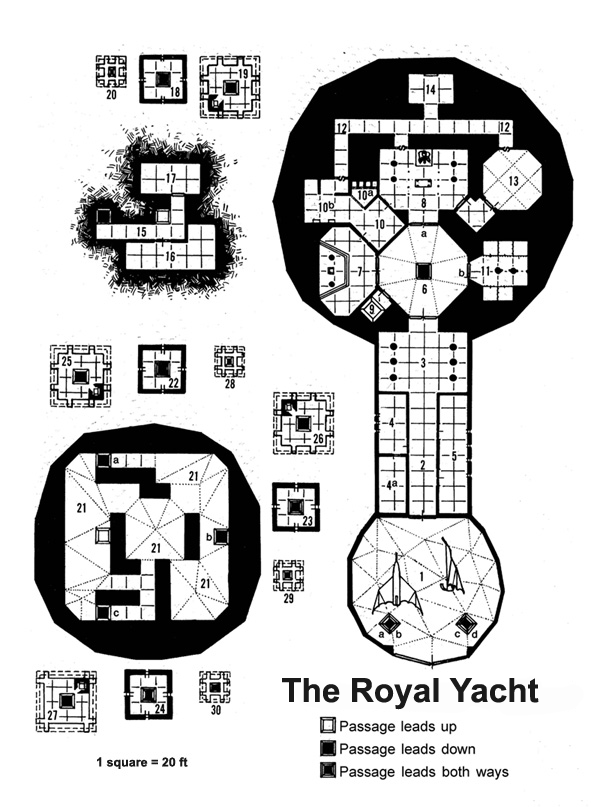 |
| The obsidian structure before you is built in, and projecting out from, a roughly spherical piece of astral debris 200 ft in diameter. Four towers jut out from the central section at roughly symmetrical angles. A fifth projection, longer and thicker than the towers, is topped by a bulbous structure that itself is topped by four smaller towers jutting out near the edges of a large set of double doors - the only obvious route by which to enter the complex. Without the largest of the projections, the outpost would closely resemble a jack, of the sort used in the "ball and jacks" game played by children on the Material Plane. |
Directions like "up" and "down", locations like "floor" and "ceiling", have no universal meaning in this weightless environment. However, terms like these are used in the area descriptions for simplicity and clarity; when interpreting such terms, consider the surface depicted on the map as the "floor", as though you are looking "down" on the outpost from overhead.
In addition, for purposes of guiding the DM's and players' descriptions, "north" is towards the top of the map.
The descriptions of the yacht's interior are briefer than normal place descriptions. This because the details of the place are less important that its denizens, and because it is quite likely that the PCs will elect to parley with the lich-queen rather than fight her, and therefore detailed descriptions would unecessarily lengthen this scenario. Enough detail is given to allow the DM to run a defense of the yacht and to provide the PCs with magical treasure. Monetary treasure should be extrapolated from the descriptions of the chambers.
Tactics are not given for most of the creatures. The DM should be able to develop suitable tactics from the abilities set forth for each denizen. The githyanki are highly intelligent and formidable opponents aware of the capabilities of their own abilities and most of the more common ones possessed by the PCs.
It should be noted that creatures on the Astral Plane do not need to eat or sleep or excrete waste. As such, facilities such as dining halls and barracks are not included on the yacht.
Yacht Features:
Unhallowed Halls - The entire place radiates an effect similar to the unhallow spell that prevents nonevil summoned creatures from entering. Moreover, evil creatures within the yacht gain a +2 deflection bonus to AC and a +2 resistance bonus on saves against attacks made or effects created by good creatures. However, the usual effect of suppressing possession and magical compulsion is not present with this effect.
All turning checks made to turn undead within the yacht take a -4 penalty, and turning checks to rebuke undead gain a +4 profane bonus. Spell resistance does not apply to this effect.
Lastly, the unhallow effect also dispels all invisibility effects, as per the invisibility purge spell.
Walls, Ceilings, and Floors - The obsidian surfaces of the yacht (walls, floors, and ceilings) regenerate 10 points of damage per round, such that any hole made in the structure is soon repaired. Any creature that passes through a wall, floor, or ceiling using passwall or similar spells is exposed to the cries of tormented souls trapped within the yacht and must succeed at a DC 28 Will save or succumb to an insanity spell. This effect cannot be dispelled and must be made each round that the victim remains within the walls.
The walls, ceilings, and floors are considered magical, and are thus allowed a save against magical effects directed at them with a +14 save bonus. The interior walls, ceilings, and floors are 2 ft thick, while exterior versions are 6 ft thick. Each 2 ft of such material has a hardness of 20, 200 hp, break DC 68, Climb DC 20.
Ceilings in the yacht are 50 ft high unless otherwise noted.
Windows - The yacht's opaque, crimson-coloured glass windows measure 4 ft across and 7 ft tall. They are as strong as iron, making them difficult to break. In addition, Vlaakith has inscribed a rzydu'un symbol on each window, set to activate if it is shattered or a creature attempts to pass through it using magic.
Windows are 1 inch thick, have hardness of 10, 30 hp, and a break DC of 28.
|
Rzydu'un Symbol Trap CR 7; magic device; variable trigger (see text); automatic reset; spell effect (rzydu'un symbol, 25th-level wizard, 60 ft radius, 11d6 white-hot astral ectoplasm damage plus shaken for 4d6 rounds [treated as mind-affecting spell], DC 27 Will save half and negates shaken effect); Search DC 31; Disable Device DC 31. |
Doors - The yacht contains five different types of special doors: ectoplasmic doors, grey mist doors, zombified doors, and secret doors. Each type of door is described below and the door type is noted in the area descriptions.
Non-special doors are standard iron doors.
Ectoplasmic Doors (EL 4) - These doors look like a 7 ft wide, 10 ft tall oval portal filled with a translucent mass of rippling ectoplasm reinforced with writhing energy strands. Each ectoplasmic door sheds light in a 5 ft radius and provides shadowy illumination out to 10 ft. An ectoplasmic door has limited psionic awareness such that it can be willed open or closed, as a swift action, by any creature with psionic ability that stands within 5 ft of the door. Creatures vying for control of the door make opposed Intelligence checks to determine who controls the door. An ectoplasmic door cannot be opened wih a knock spell.
Any attack made against the door causes a strand of ectoplasm to lash forth and strike the attacker. The strand has a maximum ranged of 40 ft; treat it as a ranged touch attack that duplicates the efects of a touch of idiocy spell (CL 25). An ectoplasmic door that is destroyed reforms in 1d4 minutes. Ectoplasmic doors are soundproof.
These doors are 2 inches thick, have 90 hp, DR 10/magic, and a break DC of 25.
Grey Mist Doors (EL 6) - These doors look like a 7 ft wide, 10 ft tall oval portal filled with opaque, silvery-grey mist similar in colour to the Astral Plane itself. The mist blocks all sound and cannot be dispersed or dispelled. Any living creature that passes through the door suffers horrible wounds as the fabric of time tears apart its will and exposes the creature to grievous injuries suffered in the past. The creature takes 10d6 points of damage, or half damage with a DC 26 Will save. This is a mind-affecting attack.
Zombified Doors (EL 4) - These doors look like a 7 ft wide, 10 ft tall oval portal filled with stitched flesh. A zombified door is unaffected by a knock spell but peels open when an undead creature comes within 5 ft of it. It can also be forced open or closed with a command undead spell or successful turning check; treate a zombified door as a 16 HD undead creature for turning purposes (modified by the unhallow effect). The door quickly restitches itself when damaged and has fast healing 10. Zombified doors are soundproof.
These doors are 6 inches thick, have 180 hp, DC 5/good, fast healing 10, and a break DC of 28.
Secret Doors - Secret doors are indicated with an "S" on the map. These rectangular slabs of obsidian blend neatly with the surrounding stonework and require magic (such as a detect secret doors spell) or a successful DC 30 Search check to locate. Unless otherwise noted, all secret doors are 20 ft off the floor and 20 ft below the ceiling. The secret doors are soundproof and open into rooms; a secret door that connects two rooms opens into the larger room.
Illumination - Rooms in the yacht are dark unless noted otherwise. Githyanki within the lich-queen's yacht carry light sources with them when they navigate the various halls and chambers.
Scrying and Detection - The interior of the royal yacht is not specifically warded against scrying spells, although the lich-queen always uses screen spells to conceal the contents of her throneroom (area 7). Vlaakith can, however, sense whenever someone uses scrying in her yacht, and she automatically spots scrying sensors in her presence (even if the invisibility purge effect of the unhallow is negated).
As long as she remains in the yacht, Vlaakith can detect the presence of every living creature in the yacht. She can also communciate with and view any creature in the yacht as the clairaudience/clairvoyance spell (as a standard action). She uses this ability to to spy on intruders, coordinate the yacht's defenses, and prepare for the arrival of enemies. If she leaves the yacht for any reason, the lich-queen can no longer sense the presence of living ceatures in the yacht.
1. Astral Carrack Port (EL
16)
|
This chamber is roughly spherical, about 200 ft in diameter. It has a large set of double doors, almost 100 ft wide, on the outside wall. A smaller set of double doors are on the opposite wall. Two strange ships are docked inside the chamber, which could probably fit a third. Four 20 ft wide passages lead away from the sphere, two set into the floor and two into the ceiling. |
The smaller inner doors (which lead to area 2) are both of obsidian and are treated as 1 foot thick (half the hit points of a 2 ft thick wall section). The doors are locked by an arcane lock spell (CL 25) that can be bypassed by Vlaakith and anyone she designates as capable of bypassing it. Currently, all denizens of the yacht are designated to bypass the arcane lock.
The ships are astral carracks (see Manual of the Planes page 52).
The four passages (A, B, C, and D) lead away from the sphere, each of them a 60 ft long corridor capped by a small, transparent pyramidal tower 40 ft square and 40 ft tall that holds three githyanki guards and a watch sarth (sergeant). The transparent portion of these watchtowers is treated as a window (see above for window descriptions). The guards keep watch on approaches to the port opening and set on a 35 ft long iron rod descending from the apex of each pyramid is a fist-sized glowing faceted crystal of deepest red that, if it is touched, allows the toucher to broadcast a telepathic alert throughout the entire yacht to all creatures within with an Intelligence of 3+ who can understand whatever language the toucher chooses to think in.
Creatures: Each watchtower contains 3 githyanki guards and a watch sarth (sergeant).
|
|
|
|
2. Corridor (EL 8)
| This hallway is 40 ft wide. To the west is a set of double doors and to the east are two pairs of double doors. These doors look like a pair of 7 ft wide, 10 ft tall oval portals filled with a translucent mass of rippling ectoplasm reinforced with writhing energy strands |
Traps: Inscribed into the floor 80 ft up from the southern double doors is a G'hel'zor symbol which is set to activate against any nondenizen of the yacht that is not touching a denizen. When the githyanki escort nondenizens into the yacht, the guards will lay their hands upon the nondenizens' shoulder as they walk this hall.
|
G'hel'zor Symbol Trap CR 8; magic device; variable trigger (see text); automatic reset; spell effect (g'hel'zor symbol, 25th-level wizard, 60 ft radius, feeblemind spell on total of 250 total hp affecting closest creatures first and skipping creatures with too many hp to affect [treated as mind-affecting spell], DC 28 Will save negates); Search DC 32; Disable Device DC 32. |
3. Entry Hall (EL 9)
|
This is an open area with an alcove on the north side. Two rows of pillars dominate the side areas, reaching the full 50 ft span from floor to ceiling. The pillars are comprised of several strands of fluid crystals that wind around each other. Each strand is of a different colour, from mauve to deep blue to sickly green. At the far end of the alcove are a pair of iron double doors engraved with a carving of an illithid head being cloven by a blade. |
|
|
4. Mount's Chamber (EL 15)
|
This large chamber contains a large pile of coins in the center. To the east is a set of double doors that look like a pair of 7 ft wide, 10 ft tall oval portals filled with a translucent mass of rippling ectoplasm reinforced with writhing energy strands. To the south is a similar single door. |
The doors are ectoplasmic doors.
Bundled near the north wall are the exotic combat saddle, bit and bridle, and saddlebags sized for the red dragon, along with the kith'rak's magical lance.
Because of the ectoplasmic doorway into this place, the dragon cannot come and go without aid from its kith'rak master.
Creatures: The kith'rak's red dragon mount who serves a tour of duty with the githyanki as part of the pact between dragonkind and the githyanki will be found here. This tour of duty is usually for a decade, and the dragon does not bring any of its own horde with it, the pile here having been provided by the githyanki.
|
FEATS: Enlarge Breath (Drac p70) - length of breath weapon increases by 50%, add +1 to rounds needed to use breath weapon again. Recover Breath (Drac p73) - reduce interval between uses of breath weapon by 1 round (minimum of 1 round). SPELLS: scintillating scales (Drac p80) - r personal, 1 rd/lvl; gain deflection bonus to AC equal to Con bonus x 1/2. shock and awe (SC p189) - swift, r close, 1 creature/lvl no two more than 30 ft apart, 1 rd, SR; cast in surprise round vs flat-footed causes -10 penalty to initiative. targeting ray (SC p219) - r med, 1 rd/lvl; ranged touch attack provides +1 insight bonus per 3 CL on ranged attackes at subjects. |
Treasure: The coins are of a bewildering variety of mints and total 50,000 cp, 25,000 sp, 8,000 gp, and 1,000 pp.
4a. Kith'rak's Chamber (EL
13)
|
This large chamber contains some basic furnishings and a few personal items appropriate for a living area. The furniture and other large items are attached to the flat surfaces of the chamber, while odds and ends are simply left to float in the weightless environment. To the north is a door that look like a 7 ft wide, 10 ft tall oval portal filled with a translucent mass of rippling ectoplasm reinforced with writhing energy strands. |
The door to the north is an ectoplasmic doorway.
Creatures: The kith'rak (captain) is here 50% of the time, otherwise he will be in the cockpit (area 8).
|
Githyanki Dragonrider (MM4 p202) - Gain +2 bonus on Diplomacy checks with red dragons and +2 on Ride checks when riding a red dragon. Rider and red dragon gain +1 bonus on Reflex saves and +1 insight bonus to AC. POWERS: psychokinetic weapon (CP p96) - r close, 1 weapon, 1 rd/lvl, sv Will (obj), PR (obj), PP 7; animate unattended or possessed weapon, flies spd 20 ft (perfect), uses your BAB plus Wis mod plus weapon bonuses, dmg plus Wis mod; Augment: +3 PP gives +1 insight bonus to attack, +1 PP grants +5 ft to spd. MAGIC ITEMS: silver sword (MM p128) - silvered greatswords that suffer no damage penalty and a target hit must make a Fortitude save (DC 16 + effective enhancement bonus) or lose psionic abilities for 1d4 rounds. |
5. Knight's Quarters (EL 17)
|
This room is bare of furnishings except for a large table and twelve chairs bolted to the floor, twelve "living compartments" on the ceiling, and twelve chests along the walls. The two doors along the west wall are 7 ft wide, 10 ft tall oval portals filled with a translucent mass of rippling ectoplasm reinforced with writhing energy strands. |
The doors are ectoplasmic doors.
Creatures: Twelve knights dwell here, elite guards and warriors of the githyanki.
|
Extra Smiting (CW p98) - gain 2 extra smites per day. SPELLS: resurgence (SC p174) - r touch, creature touched, SR; subject can made a second save vs ongoing spell, spell-like ability, or supernatural power. MAGIC ITEMS: silver sword (MM p128) - silvered greatswords that suffer no damage penalty and a target hit must make a Fortitude save (DC 16 + effective enhancement bonus) or lose psionic abilities for 1d4 rounds. |
6. Main Hall
|
This roughly spherical chamber is unfurnished. Doors lead away from it in five directions. To the north and south are a pair of double doors in the form of 7 ft wide, 10 ft tall oval portals filled with a translucent mass of rippling ectoplasm reinforced with writhing energy strands. To the east is a single iron door. To the west are a pair of double doors that appear to be a pair of 7 ft wide, 10 ft tall oval portal filled with stitched flesh. The door to the southwest is a single door in the form of a 7 ft wide, 10 ft tall oval portal filled with a translucent mass of rippling ectoplasm reinforced with writhing energy strands. A 20 ft wide passage leads down from the center of the room. |
The iron portal leading to area 11 is locked (Open Lock DC 35) with the key on the jailer in that area.
The 20 ft wide passage leads down to area 21.
7. Throne Room (EL 24+)
Note: This room has a screen (CL 25) spell cast upon it.
The spell hides the bloody symbol on the chamber floor and all
of the room's undead occupants except for the lich-queen. The
portion of the description below in red
indicates items hidden by the screen spell.
|
An open area surrounds a raised platform that houses an ornate throne, studded with jewels, set between two huge obsidian pillars. The steps leading up to the throne, as well as the seat and arms of the throne, are composed of strangely shaped vaguely humanoid skulls with large oval eye sockets and four vertebrae-like tentacles surrounding the mouth hole. The back of the throne is made of purplish skin stretched over large rib bones. Hellish light emanating from within the throne casts sordid, skull-shaped shadows on the nearby walls and ceiling. Four desiccated corpses hang from each pillar by iron shackles, and carved into each of their foreheads is a small circular symbol. The same symbol, only much larger, is painted in blood on the floor between the pillars. The door to the northeast is a 7 ft wide, 10 ft tall oval portal filled with opaque, silvery-grey mist similar in colour to the Astral Plane itself. Next to it is a glowing symbol carved into the wall at chest height. The double doors to the east are each 7 ft wide, 10 ft tall oval portals filled with stitched flesh. |
The symbol plainted in blood on the floor is a githyanki tir'su that spells the name "Vlaakith" (see Trap below). The suspended corpses are all that remains of slain githzerai spies and assassins, and they have similar symbols carved into their foreheads, but these symbols are nonmagical and purely ornamental.
Vlaakith's Throne of Bones: The throne of bones is horridly illuminated by red continual flame spells (CL 25) made permanent by a permanency spell (CL 25) cast within it. A creature seated on the throne can use the following spell-like abilities, although no ability can be used more than once per day: circle of death (centered on the throne), crushing despair, geast/quest, mass suggestion, mind fog, power word kill, and scare. Caster level 25th; save DC 14 + spell level. The throne has hardness 5 and 600 hit points and can be repaired by negative energy effects just like an undead is healed by the same (although positive energy effects do not damage it and the throne is not undead).
Creatures: Vlaakith, the lich-queen, is likely to be found here, whether parleying with the PCs or simply contemplating her many hatching schemes and strategems. Assume a 50% chance she is here if, somehow, the PCs have come upon her unaware. Otherwise, she will be in area 10 or 10b. Refer to the Vlaakith section following these area descriptions for her statistics and more details.
Additionally, 2 kr'y'izoths and 2 tl'a'ikiths are always present in the this chamber, awaiting their queen's pleasure or acting independently if she is not at hand. They normally are positioned with the 2 tl'a'ikiths flanking the double doors to the east and the kr'y'izoths flanking the front edge of the dais.
Finally, there are 2 skeletal adult red dragons that are programmed to obey the lich-queen or, if she is not present or giving orders, the kr'y'izoths and tl'a'ikiths. These dragons rest in the very western corners of the room, to the far north and far south.
|
|
|
MAGIC ITEMS: silver sword (MM p128) - silvered greatswords that suffer no damage penalty and a target hit must make a Fortitude save (DC 16 + effective enhancement bonus) or lose psionic abilities for 1d4 rounds. |
|
|
Traps: The symbol painted on the floor is a Vlaakith symbol (identical to a symbol of death) that triggers whenever it is touched by any living creature.
|
Vlaakith Symbol Trap CR 9; magic device; variable trigger (see text); automatic reset; spell effect (vlaakith symbol, 25th-level wizard, 60 ft radius, symbol of death, DC 29 Fortitude save negates); Search DC 33; Disable Device DC 33. |
8. Cockpit (EL 16)
|
The main feature of this chamber is an 18 ft tall statue of the githyanki lich-queen, fastened to the midpoint of the wall opposite the double doors to the south. The statue is lavishly decorated with gems and precious metals. In the center of the chamber is a massive block of a strange, silvery-sheened metal. The block is roughly 20 ft across, 8 ft deep, and 12 ft tall and is carved into a mind-blistering blend of runnels, metal tubes, curlicues, protrusions, knobs, and geometric patterns. Various coloured crystals, some of them glowing, some blinking, and other inert, stud the block all along its breadth and height. Flanking the statue and the block are four pillars that seem to be comprised of what can best be described as raw astral energy. The energy that makes up the pillars is coloured the same as the Astral Plane itself, but crackles of argent energy rip through the pillars and the energetic substance itself seems to be coursing up from the floor and into the ceiling at an amazingly fast rate. Two single doors flank the double doors, on walls to the southwest and southeast respectively. All of the doors except the door to the southwest are 7 ft wide, 10 ft tall oval portals filled with a translucent mass of rippling ectoplasm reinforced with writhing energy strands. The door to the southwest is a 7 ft wide, 10 ft tall oval portal filled with opaque, silvery-grey mist similar in colour to the Astral Plane itself. |
The metal block is the control device for the yacht. It is a very powerful and complicated device that cannot easily be intuited. Only the lich-queen and the kith'rak (area 4a) know how to properly pilot the yacht, although it can be set on "auto-pilot" so that the captain only needs to spend about half of his time in here. This device is made of astral driftmetal and other exotic materials and is magically protected with a hardness of 24 and 900 hit points.
The four pillars are essentially charged aster (stuff of the Astral Plane) flowing through the cockpit almost like a ramjet engine would work for a spacecraft. Touching a pillar is painful and can be deadly. Merely touching one is enough to cause 1d6 damage. Prolonged contact (i.e. for most of a turn) will cause 3d6 damage per round. Total immersion will cause 12d6 damage per round. This damage is untyped and not subject to resistance or damage reduction and is not magical.
The double doors to the south are ectoplasmic doors. The door to the southwest is a grey mist door.
Creatures: The kith'rak (area 4a) will be here 50% of the time, otherwise he will be in area 4a. See area 4a for his statistics.
Additionally, the statue of the lich-queen is a greater stone golem. It will respond to the commands of the lich-queen or kith'rak or will attack any living nongithyanki present in the cockpit not escorted by the kith'rak or lich-queen.
|
|
Developments: Allow an untrained person to make a DC 30 Knowledge (arcana) check to confirm what the device is for. A DC 40 Knowledge (arcana) check will allow an untrained person to attempt to move the ship, although it is a psionic device and requires the efforts of someone with the psionic subtype. To navigate somewhere untrained will require a DC 40 Knowledge (planes) check. In theory, if the PCs manage to capture the yacht and spend a long time studying it, they could eventually become "trained" in its usage, although it will always require a psionic creature to pilot it and, if the lich-queen is gone it will also require a very powerful source of power to run it. The exact details as to how long it might take to become trained on the device and what source of power might substitute for the lich-queen's will is left up to the DM.
Secret Doors: There is a secret door along the northern wall of the room, just west of the statue.
9. Upper Level Access
| This small chamber contains a passage leading up. |
10. Queen's Chamber
|
Miscellaneous furnishings are fastened to all six flat surfaces in this chamber. Running from floor to ceiling is a 2 ft diameter stone pillar with an 8 ft diameter cylindrical table protruding from the center of the pillar. Six drawers are cut into the sides of the table. Fastened to the far wall (partially separating area 10 from area 10b) is a 10 ft diameter net of coarse mesh, the sort that looks suitable for trapping creatures. The door to the northeast is a 7 ft wide, 10 ft tall oval portal filled with opaque, silvery-grey mist similar in colour to the Astral Plane itself. |
The net is a net of matter transmission. Not formally a magic item, per se, the net is unique to the yacht. The net is a 10 ft square net of coarse mesh that can be thrown like a normal net (see Player's Handbook page 119), except that it can ensnare up to Large creatures, and any creature ensnared by the net (by a ranged touch attack) will be instantly teleported into one of the empty suspension cells (see area 10a).
The door to the northeast is a grey mist door.
Creatures: The lich-queen will be in area 7 50% of the time if caught unaware of the PCs' intrusion. If she is not in area 7, then she will be here half the time or in area 10b the other half. Refer to the Vlaakith section following these area descriptions for her statistics and more details.
Treasure: In one of the drawers is a set of four scroll cases. These contain the following:
1. Two scrolls are within.
The first is an astral map showing the location and pattern of a colour pool that is noted, in Gith, as leading to the "Shores of Limbo". This map can be used to gain access to the area of Limbo, which is the edge of the Astral Plane where the oceans of chaos lap against its shore. Using the map requires a DC 25 Knowledge (planes) check and it takes 1d10x50 hours to find the colour pool; a failure indicates that after 1d10x20 hours the PCs are lost and must make another check.
The other scroll is a very strange and complicated series of patterns and swirling lines of colour with complicated-looking symbols and notations. There are a few notations in Gith, notable being "Spawning Stone - great danger", "Shra'kt'lor - city of filth and scum", and "Zerth'Ad'lun - where it is held"
2. A single scroll is within. This is a map of the area around and the exterior walls of the monastery of Zerth'Ad'lun, and the name is emblazoned across the top of the map. An arrow points to one area about 250 ft north of the entrance to the monastery building proper and is labelled in Gith: "Treasury under here". This corresponds to area 19 on the Zerth'Ad'lun map.
A notation on the back of the scroll reads in Gith:
"I believe the thieving bastards have my blade here, underneath the monastery, in a warded vault of some sort. I need to find out what guards are in place and then I can best tailor my choice of who or what I shall send to retrieve it."
3. An arcane scroll of greater dispel magic (CL 20).
4. A scroll of deep black paper with thin, silvery diagrams of immensely complicated patterns and traceries with the center being a star-like symbol and the words in Gith in a circle around it: "Sargasso".
A DC 25 Knowledge (planes) check will reveal the scroll to be a map to a location on the Negative Energy Plane. A DC 30 Knowledge (planes) check will reveal that it leads to a planar touchstone called the Sargosso of Entropy (see Manual of the Planes page 185). A DC 35 Knowledge (planes) check will allow the map to be navigated and the touchstone to be located.
10a. Suspension Cells
The barrier between area 10 and this chamber looks like a thick piece of frosted glass, shaped in a hexagon 10 ft in diameter. The glass has a hardness of 20, 450 hit points, and damage reduction of 15/magic and serves as a magical door to the chamber beyond. The glass can also be opened via a knock spell or a dispel magic (successful against a CL of 25).
If a creature stands in front of the frosted portal for 1 round without striking or touching the glass, the center section of the glass (1 ft in diameter) will begin to glow red. If any object is brought into contact with this red area right away, it will be seen that the object can be passed into or through what is now an opening. The rest of the portal will still be impervious to normal passage; however, if the red area is left untouched for another round after it first appears, it will expand to envelop the entire portal, allowing passage through the 10 ft diameter hole into the small chamber beyond. The full-sized opening will close within 1 round after it has been activated. This aperture operates in both directions.
Within the chamber are four more "frosted" portals, each a 5 ft diameter hexagon, which are identical in nature to the larger portal and can be opened in the same way except that these portals only operate from the outside. These smaller portals are seals for 5 ft square cells in which prisoners (taken by the net of suspension or otherwise captured) can be placed.
The cells are enchanted with a permanent dimensional lock effect that is centered on the Astral Plane, such that even those in astral form (e.g. from an astral projection spell) cannot penetrate the effect. The only mode of magical transport that functions is the specially keyed net of suspension from area 10.
Additionally, each cell contains a permanent silence effect, negating the ability to cast spells with verbal components.
Both the dimensional lock and the silence effects still function within the cell even if the glass door is partially or fully opened.
These cells are used by the lich-queen to hold dangerous prisoners that can easily escape from more traditional incarceration.
Creatures: Currently, 2 of the cells are occupied. In the westernmost one is a mind flayer, and the easternmost contains a night hag. If either or both of these cells is partially or fully opened, the resident creature will do everything in its power to escape and overcome those who released it.
Note the mind flayer has no material components on hand, limiting its ability to cast its spells.
|
|
|
|
10b. Queen's Annex
|
This chamber contains several wall decoration of hideous design and many sets of shelving upon which rest various items, both of value and otherwise, that likely reflect the planar travels of the ruler of this place. In an area to the northeast, partially partitioned from the rest of the chamber, is a pedestal with a glittering silver sheath set upright into it. The sheath is sized for a greatsword and bears writing in silver thread down its face. Protruding from the sheath is a bejewelled silver pommel. |
The alcove to the north (just east of the area with the sheath) is a closet with various of the lich-queen's ostentatious and overwhelmingly evil-looking garb floating from hangers attached to wires strung across the place. None of these items of clothing is magical.
The shelves hold, in addition to oddities and curiousities, material components for all of the spells in the lich-queen's spellbook, as well as foci for the same.
Creatures: The lich-queen will be in area 7 50% of the time if caught unaware of the PCs' intrusion. If she is not in area 7, then she will be here half the time or in area 10 the other half. Refer to the Vlaakith section following these area descriptions for her statistics and more details.
Secret Doors: There is a secret door along the northern wall of the room, in the closet alcove.
11. Dungeon (EL 15)
|
This chamber has 10 cages, made of thick metal bars, arranged in two tiers along the walls on either side of the iron door to the west. The center of the chamber has two stone pillars that run from floor to ceiling. Four pairs of chains with manacles attached to the ends are fastened into each pillar at wide intervals. The center of the room is littered with various exotic and heinous intruments of torture. |
The iron cages are 20 ft square and 20 ft high, with the upper tier beginning 5 ft above the top of the lower tier. The floors and ceilings of the cages are solid metal. The cages are magically treated for hardness, and so have a hardness of 20, 180 hit points, and a break DC of 50, as well as a save bonus of +14. The key locks on the cages are very well made (Open Lock DC 40) with the keys on the jailer (see Creatures below).
The manacles attached to the pillar are made of adamantine and are masterwork manacles (hardness 20, 40 hp, break DC 48, Escape Artist check 35). They are sized to be able to fit creatures ranging in size from Small to Large. The keys to the manacles are on the jailer (see Creatures below).
Creatures: The jailer, G'zashur, is a powerful githyanki assassin who has mystical red dragon parentage that makes him a duthka'gith, or fiendish half-dragon githyanki. He is the queen's favourite torturer and often also called upon to undertake assassination or to ferret out the seeds of rebellion. He is also one of the elite cadre the queen uses to track down githyanki who reach 16th level to mark them for eventual conversion by the crown of corruption. However, he is not certain what happens to these high level githyanki, except that they are never seen again, and he has begun to worry that his time may be soon approaching.
The jailor maintains two cover identities that are not relevant to this adventure.
|
FEATS: Deft Strike (Cadv p106) - standard action and Spot check vs target AC to ignore armour and natural armour bonuses on next attack made no later than next turn, must be within 30 ft for ranged weapon. SPELLS: amorphous form (SC p9) - r touch, willing corporeal creature, 1 min/lvl, SR; subject and gear becomes oozlike, may pass through openings 2 inches in diameter, immune to poison, polymorph, stun, flanking, and crits, gain swim spd = land spd, size, Dex, deflection, and force armour bonuses apply to AC, cannot cast spells with verbal or somatic or material or focus, lose all supernatural abilities, cannot use magic except for those providing bonuses to AC as above. blade of blood (PHB2 p103) - swift, r touch, weapon, 1 rd/lvl or discharge; next time weapon strikes living creature +1d6 dmg or +3d6 dmg if caster takes 5 dmg, loses property if dropped or contact lost. bloodletting (CM p97) - swift, r touch, light weapon held, SR; next time light weapon deals dmg to living creature, wound bleeds for 1d6 dmg each round, DC 15 Heal check or 1 pt magical healing stops bleeding, spell lasts 3 rounds and bleeding continues from strike to end of spell, loses property if dropped or contact lost. fell the greatest foe (SC p90) - r touch, creature touched, 1 rd/lvl, SR; +1d6 dmg on melee attack for each size cetagory larger. phantom foe (SC p156) - r touch, creature touched, 1 rd/lvl, sv Will disbelief; subject is flanked, caster gains 50% miss chance if attacked by subject. sniper's eye (SC p193) - r pers, 1 rd/lvl; gain +10 competence bonus to Spot, darkvision 60 ft, ranged sneak extended to 60 ft, cannot move more than 5 ft from the spot cast. wraithstrike (SC p243) - swift, r personal, 1 rd; melee attacks become touch attacks. |
12. Secret Passage
The existence of this passageway is officially known only to the lich-queen and the kith'rak. However, the jailer in area 11 knows of it as well. It connects via secret doors with areas 8, 10b, and 13.
13. Treasury
|
This chamber is a 40 ft radius sphere that descends 40 ft below the level of the doorway to the south and 40 ft above to the ceiling. Within the chamber floats a startling variety of coins of all shapes, sizes, denominations, and mintings. The coins are all floating loose. The door to the southwest is a 7 ft wide, 10 ft tall oval portal filled with opaque, silvery-grey mist similar in colour to the Astral Plane itself. |
The coins effectively grant concealment (20% miss chance) to anyone within the chamber.
The door to the southwest is a grey mist door.
Secret Doors: There is a secret door along the northern wall of the room.
Additionally, there is a circular secret panel at the very bottom of the sphere of this room. The panel is 5 ft in diameter and requires a DC 35 Search check to locate. The panel is arcane locked (CL 25) and the lich-queen always casts an extended sequester spell on the panel that hides the aura of the arcane lock, the magical trap (see Traps below), and its very existence as a secret door to spells like detect secret doors.
Beyond the panel is a small 3 ft square lead-lined alcove
Traps: There is a symbol on the underside of the panel that is triggered if the panel is removed by anyone other than the lich-queen. The symbol is a mirhanac symbol. One or more creatures within 60 ft of the symbol, whose combined total hit points do not exceed 150, are turned to solid crystal; the effect is otherwise similar to the flesh to stone spell (except stone to flesh will not reverse the effect, only spells like break enchantment have a chance to succeed). The symbol affects closest creatures first, skipping creatures with too many hit points to affect. A successful Fortitude save slows the victim for 2d6 rounds instead.
|
Mirhanac Symbol Trap CR 9; magic device; variable trigger (see text); automatic reset; spell effect (mirhanac symbol, 25th-level wizard, 60 ft radius, flesh to stone or slow spell, DC 29 Fortitude save partial); Search DC 33; Disable Device DC 33. |
Treasure: The coins floating around the place total 56,000 cp, 49,000 sp, 26,000 gp, and 12,000 pp.
The niche beneath the panel contains, set into black velvet cushions, six astral diamonds (worth 10,000 gp each, but counting as 100,000 gp each for the purpose of developing epic spells or magic items).
14. Communications Room
| The main features of this chamber are a 10 ft diameter hexagonal mirror on the north wall and a magical circle 15 ft in diameter inscribed on the floor between the entryway and the mirror. |
The mirror is a sort of view-screen that enables the yacht to communicate with the Palace of Whispers in the capital city of Tu'narath. If a being with an Intelligence of 3+ stands within 5 ft of the mirror and remains stationary for 1 round, the image of a powerful githyanki official in the Palace of Whispers will come into view. After one more round, the image seen by the githyanki on the other end of the connection will also become clear to him. If what the official sees is not the lich-queen or the kith'rak, the official will move away immediately to sound an alert. This will bring a pair of astral carracks (see Manual of the Planes page 52), each with a kith'rak (exactly like the one in area 4a), a githyanki magister (Wizard 14), a carrack captain (Fighter 11), a first-officer (Fighter 8), five lieutenants (Fighter 4), and forty crew (Fighter 1). These will arrive in 1d4x6 hours.
15. Corridor
This area is reached by going up through the passage in area 9. It leads to another up passageway that opens into area 18.
The double doors to the south are ectoplasmic doors. The door at the northeast end of the corridor is a normal iron door.
16. Warlocks' Quarters (EL
17)
| This chamber has three pillars set at equal distances along the center of the place (each 40 ft apart). Each of the 2 ft diameter pillars has an 8 ft diameter cylindrical table with 6 drawers set into the sides. Tapestries attached to the south wall show various exotic planar landscapes. Several cloaks, robes, and other garments hang from iron hooks along the northeast wall. |
Most of the table drawers contain mostly ordinary and valueless items, as well as masterwork tools for any Craft skills they possess, along with materials for same, and material components and foci for any spells they have in their spellbooks. However, see Treasure below.
Creatures: At most times the 3 warlocks are present here, meditating or practicing their crafts. One of the warlocks is a wizard, another is a shadow mage, and another is a psion. The psion has an enslaved demon who has a a permanent continual flame cast on a steel spike driven into its forehead, with instructions to always have it within 30 ft of the psion so that he can use his fiery discorporation power to save his life. The demon is enslaved by rituals and eldritch bargains and could be convinced to switch sides if made helpful (assume it is indifferent to powerful evil creatures, unfriendly to powerful neutral creatures, and hostile to powerful good creatures).
|
|
|
Dazzling Energy (CP p49) - if manifest cold energy power that specifies single target(s), foe dazzled for 1 minute unless sightless. Linked Power (CP p62) - expend focus and pay PP for two powers (max PP = ML) and second power automatically activates on target or area specified on the next turn for no extra PP or actions. Privileged Energy (CP p57) - +1 dmg/die for cold energy powers. Psionic Mastery (CP p59) - can take 10 on ML checks. POWERS: crystal body (DrM p76) - r pers, 1rd/lvl (D), PP 13; gain DR 5/adamantine, immune to blind, crits, ability dmg, deaf, disease, drown, electricity, poison, stun, sleep, paralysis, all spells affective physiology or respiration, 1/2 dmg from acid, cold, and sonic, unarmed attack deals shortsword dmg, vulnerable to attacks affecting crystal, cannot drink or play wind instruments, x5 weight. damp power (CP p82) - immed, r pers, PP 3; all variable numeric effects of powers or spells or psi-like or spell-like abilities bfore end of next turn minimized; Augment: 4 PP to minimize all selected targets in area of effect that affects manifester. dragonhearted (RoDR p120) - r pers, 1 min/lvl (D), PP 5; choose red or white to gain immune fire vulnerable cold or vice versa respectively; Augment: 4 PP to manifest as immed action. energy missile (CP p88) - r med, up to 5 creatures or objects no two more than 15 ft apart, sv Ref 1/2, PR, PP 3; choose cold or electricity or fire or sonic, missile deals 3d6 dmg to each target, you cannot target multiple missiles to same target: cold = +1 dmg per die Augment: +1d6 dmg/PP and +1 DC for each +2d6 dmg. stygian bolt (CP p100) - 120 ft line, sv Ref neg, PR, PP 11; 1d4 negative levels, undead gain 2d4x5 temp hp for 1 hr; Augment: +4 PP for +1d4 neg lvls or +2d4x5 undead temp hp. synchronicity (CP p103) - r pers, 1 rd, PP 1; ready action without specifying conditions; Augment: 2 PP to not specify the action being readied. MAGIC ITEMS: psychoactive skin of ectoplasmic armour (CP p110) - +8 AC, +2 max Dex, -6 check penalty, 25% arcane failure. |
|
|
FEATS: Extend Mystery (ToM p136) - 1/day double mystery duration as full-round action. Maximize Mystery (ToM p136) - 1/day maximize mystery as full-round action. Quicken Mystery (ToM p137) - 1/day cast mystery as swift action. Reach Mystery (ToM p137) - 1/day touch mystery becomes ray with range of 30 ft. Shadow Cast (ToM p137) - no AoO when casting spell or spell-like ability if adjacent square is not threatened. MYSTERIES: afraid of the dark (ToM p141) - r med, 1 living creature,
sv W 1/2, SR; shadow image unerringly touches foe causing 1d6+1/4
CL (max +5) Wis damage. bend perspective (ToM p142) - r pers, 1 min/lvl (D); viewpoint to line of effect within 25 ft plus 5 ft/2 CL, shift between eyes and view as swift action, move 10 ft/rd but each move counts as 1 min of duration. black candle (ToM p142) - r touch, object, 1 rd/lvl (D); as light or darkness (choice when used). bolster (ToM p142) - r touch, 10 min/lvl or discharge (D), SR; grant 5 temp hp/HD. caul of shadow (ToM p143) - r pers, 1 min/lvl (D); +1 deflection to AC and +1/6 CL (max +4). dancing shadows (ToM p144) - r touch, 1 creature/5 lvls, 1 rd/lvl (D), SR; subjects gain concealment, if cast on single subject then gains total concealment, see invisibility and piercing sight do not genate but true seeing and truth revealed do. echo spell (ToM p145) - r cl, repeat previously cast spell or mystery, see text, sv see text, SR see text; recast spell or mystery cast by another within range in previous round, use your CL and Cha for save DC, cannot echo higher than you can cast and never more than 4th lvl. flood of shadow (ToM p146) - r cl, 20 ft r, 10 min/lvl (D); DC 15 + spell lvl Spellcraft to cast spells in area, mysteries or spells of shadow subschool originating in area empowered. killing shadows (ToM p146) - 30 ft cone, sv W 1/2, SR; 1d8 dmg/CL (max 10d8). languor (ToM p146) - r cl, 1 creature or 1/lvl no two more than 30 ft apart, 1 rd/2 lvls (D), sv W neg, SR; as slow or hold monster. If latter affects 1 subject. mystic reflections (ToM p147) - r pers, 1 rd/lvl (D); as detect magic but 30 ft range. piercing sight (ToM p147) - r pers, 1 min/lvl (D); as see invisibility and darkvision 60 ft. shadow evocation (ToM p148) - as shadow evocation spell but mimic a spell of 5th level or lower rather than 6th. shadow hood (ToM p148) - r cl, one creature, 1 rd/lvl (D), sv W neg; -1 to attack and Dex checks. shadows fade (ToM p150) - r med, 1 creature or object or 20 ft r; as dispel magic. shadow skin (ToM p148) - immed, r pers, 1 rd or less see text; gain DR (Cl 4- = 5/magic, 5-9 = 10/magic, 10-14 = 10 silver, 15-19 = 15 silver, 20 = 15/-) until beginning of next turn. sharp shadows (ToM p150) - r pers, 1 min/lvl (D); foe striking with nonreach handheld or natural weapon takes 1d6 dmg +1/CL (max +15), SR applies to dmg which is treated as nonmagical for DR purposes and not a weapon for spells that affect weapons. sight eclipsed (ToM p150) - r pers, 1 rd/lvl (D); Hide even if observed. steel shadows (ToM p150) - r pers, 10 min/lvl (D); +3 armour and +3 shield bonus to AC, not a force effect. umbral hand (ToM p152) - r cl, one unattended object up to 5 lbs/lvl, 1 rd/lvl (D), sv W neg; as mage hand but can effect magic items, free action each round to direct effect or ends. warp spell (ToM p153) - immed, r cl, spell or mystery cast by other, sv see text; cast at moment of other casting, beat CL check to counter spell, if countered, gain additional use of apprentice mystery you know for 1 hr (can be cast as part of the immed action of this mystery). MAGIC ITEMS: orb of shadow (ToM p156) - extra use of mystery of appropriate level 1/day. ring of nullification (ToM p157) - standard action to specify type of attack to nullify for 20 dmg or 2 ability points and then dormant for 24 hours. shroud of night (ToM p157) - +2 deflection bonus to AC and dancing shadows and shadow skin on self 1/day. |
Treasure: Two of the drawers in the table closest to the door contain metal scroll cases, one holding an arcane implore spell (CL 17) [refer to obscure spells for details],and the other an arcane circle of death spell (CL 13).
One of the drawers in the table furthest to the east contains an iron flask with a gelugon inside. The command word for the flask is unknown to the githyanki (hence why it is stowed away and not being used) and would have to be divined by the PCs using suitable magic. The ice devil will attack any who release it, though a rushed Diplomacy, Intimidate, or suitable Bluff check could convince it to parley and even help the PCs against the githyanki if made helpful and promised suitable reward.
|
Finally, amongst other less conspicuous garments is a colourful cloak of vermillion, indigo, yellow, and turquoise that is actually a cloak of poisonousness.
17. Guest Quarters
| This room contains several pieces of furniture and other accessories, but nothing valuable or noteworthy. |
18. Upper Tower Chamber (EL
10)
| This chamber is 60 ft square with a 20 ft ceiling. There is a small window (2 ft by 5 ft) in each wall and a 20 ft square passage in the ceiling that leads up. The room is furnished sparsely as a rest quarters, though there is nothing resembling a bed. A few personal items float about the place. |
Creatures: The gish Kadzar has his quarters here.
|
FEATS: Githyanki Battlecaster (MM4 p202) - ignore arcane spell failure in light armour. Practiced Spellcaster (CA p82) - add +4 to CL for one spellcasting class but never more than total HD. SPELLS: dragonskin (SC p73) - r pers, 10 min/lvl; select chromatic dragon, gain +1 natural AC/2 CL (max +5 at CL 10) and energy resistance 10 appropriate to colour (increasing to 20 at CL 10). infernal wound (SC p122) - r touch, weapon, 1 rd/lvl; creature injured by weapon loses 2 hp per round for duration (regardless of how many times struck), bleeing stopped by DC 16 Heal check, cure spell, or heal spell.
|
19. Upper Observation Post
(EL 9)
| This room is in the shape of a pyramid with an 80 ft square base. The tapered ceiling is made entirely of transparent rock, through which a clear view of the surrounding astral space can be seen. In the corner of the room is a 10 ft square passage that leads up, while a 20 ft square passage leads down in the center of the chamber. |
The guards keep watch on approaches to the port opening and set on a 35 ft long iron rod descending from the apex of easch pyramid is a fist-sized glowing faceted crystal of deepest red that, if it is touched, allows the toucher to broadcast a telepathic alert throughout the entire yacht to all creatures within with an Intelligence of 3+ who can understand whatever language the toucher chooses to think in.
Creatures: 2 warriors are on guard duty here.
|
|
20. Pinnacle Post
| The 30 ft tower leading to this place is capped by a small pyramid of transparent stone. From this location, the farthest distance from the main part of the yacht, the best view of the area immediately around the craft can be had. |
21. Commons (EL 16)
| The floor of the place is shaped irregularly, like the underside of an upside down dome set into the floor. |
Three passages lead downward from this area to the other tower chambers: passage A to area 22, passage B to area 23, and passage C to area 24.
Creatures: Stationed here normally are 16 guards and 2 sarths. They switch off with the other guards at various times.
|
|
|
Developments: If the alert is sounded, half of the guards here will take up stations in the pinnacle posts (2 each in areas 20, 28, 29, and 30).
22. Lower Tower Chamber (EL
11)
| This chamber is 60 ft square with a 20 ft ceiling. There is a small window (2 ft by 5 ft) in each wall and a 20 ft square passage in the ceiling that leads up. The room is furnished sparsely as a rest quarters, though there is nothing resembling a bed. A few personal items float about the place. |
Creatures: The gish Zigrack has her quarters here.
|
FEATS: Githyanki Battlecaster (MM4 p202) - ignore arcane spell failure in light armour. Practiced Spellcaster (CA p82) - add +4 to CL for one spellcasting class but never more than total HD. SPELLS: blast of sand (Sand p112) - r 30 ft cone, sv R 1/2; 1d6 dmg/CL (max 10d6), full dmg to objects. caltrops (SC p42) - r cl, see text, 1 rd/lvl; 5 ft square covered in caltrops, +0 att vs entering creature unless moving at 1/2 spd (no shield, deflect or worn armour bonus to AC, shoes give +2 AC), 1 dmg and stop run or charge and Sm or Med or Lg creature land move 50% for 24 hrs or until DC 15 Heal check or 1 pt magical healing, +1 5 ft square and +1 att per 2 CL above 1st (max CL 9). guided shot (SC p108) - swift, r pers, 1 rd; no ranged distance penalty, ignore cover bonus and concealment for less than total cover or total concealment. no light (BoVD p100) - r cl, 20 ft r, 1 min/lvl; creates area of no illumination by light sources, darkvision can see in area. persistent blade (SC p154) - r cl, 1 force dagger, 1 rd/lvl, SR; blade created flies spd 40 ft (perfect), attacks target at your BAB + 1/2 Cha or Int mod for 1d4 dmg (crit threat 19-20), automatically flanks with ally, force effect, standard act to switch target.
|
23. Lower Tower Chamber (EL
11)
| This chamber is 60 ft square with a 20 ft ceiling. There is a small window (2 ft by 5 ft) in each wall and a 20 ft square passage in the ceiling that leads up. The room is furnished sparsely as a rest quarters, though there is nothing resembling a bed. A few personal items float about the place. |
Creatures: The gish Tomorcus has his quarters here.
|
FEATS: Githyanki Battlecaster (MM4 p202) - ignore arcane spell failure in light armour. Practiced Manifester (CP p57) - add +4 ML for one manifesting class but never more than total HD. Practiced Spellcaster (CA p82) - add +4 to CL for one spellcasting class but never more than total HD. SPELLS: elation (BoVD p98) - 80 ft r, 1 rd/lvl, SR; +2 morale bonus to Str and Dex, +5 spd. lesser orb of cold (SC p151) - r cl, one orb of cold; ranged touch does 1d8 cold dmg +1d8/2 CL above 1st (max 5d8). malevolent miasma (SC p137) - r cl, 15 ft r, sv F neg; 1d4 nonlethal dmg per lvl (max 5d4), immunity to poison negates. no light (BoVD p100) - r cl, 20 ft r, 1 min/lvl; creates area of no illumination by light sources, darkvision can see in area. rainbow blast (SC p165) - r 120 ft line, sv R 1/2, SR; 1d6 dmg of each of the 5 energy types, 1d8 per type at CL 7, 1d12 per type at CL 11. steel dance (SC p206) - r med, 2 swords or daggers, 1 rd/lvl; 2 blades hover and attack adjacent foes on your turn att at CL + ability mod, dmg is normal + ability mod, weapons magic for DR purposes, can be sundered or disarmed. sting ray (SC p206) - r cl, ray, 1 rd/lvl, sv W part, SR; ranged touch, save each round, victim gets single move or standard action per round, -2 to AC, and to cast spell must make Concentration check = to spell DC + lvl of spell cast, Will save negates all but AC penalty.
|
24. Lower Tower Chamber
| This chamber is 60 ft square with a 20 ft ceiling. There is a small window (2 ft by 5 ft) in each wall and a 20 ft square passage in the ceiling that leads up. The room is furnished sparsely as a rest quarters, though there is nothing resembling a bed. A few personal items float about the place. |
Creatures: The gish Quazmo has his quarters here.
|
FEATS: Githyanki Battlecaster (MM4 p202) - ignore arcane spell failure in light armour. Practiced Spellcaster (CA p82) - add +4 to CL for one spellcasting class but never more than total HD. SPELLS: death armour (SC p60) - r pers, 1 rd/lvl; creature striking with body or nonreach handheld weapons takes 1d4 +1/2 CL (max +10) dmg. SR applies to dmg. mass curse of impending blades (SC p57) - r med, enemies in 20 ft r, 1 min/lvl, SR; targets suffer -2 to AC, cannot be dispelled but removed with break enchantment, limited wish, miracle, remove curse, or wish. power word pain (RoDR p116) - r cl, 1 living creature 100 hp or less, see text, SR; target takes 1d6 dmg per round, duration is 50 hp or less = 4d4 rds, 51-75 hp = 2d4 rds, 76-100 hp = 1d4 rds but never more than 1 rd/CL. MAGIC ITEMS: gloves of spell disruption (MiC p107) - creature hit while casting a spell adds +5 to Concentration check to avoid losing spell.
|
25. Lower Observation Post
(EL 9)
| This room is in the shape of a pyramid with an 80 ft square base. The tapered ceiling is made entirely of transparent rock, through which a clear view of the surrounding astral space can be seen. In the corner of the room is a 10 ft square passage that leads down, while a 20 ft square passage leads up in the center of the chamber. |
The guards keep watch on approaches to the port opening and set on a 35 ft long iron rod descending from the apex of easch pyramid is a fist-sized glowing faceted crystal of deepest red that, if it is touched, allows the toucher to broadcast a telepathic alert throughout the entire yacht to all creatures within with an Intelligence of 3+ who can understand whatever language the toucher chooses to think in.
Creatures: 2 warriors are on guard duty here.
|
|
26. Lower Observation Post
(EL 9)
| This room is in the shape of a pyramid with an 80 ft square base. The tapered ceiling is made entirely of transparent rock, through which a clear view of the surrounding astral space can be seen. In the corner of the room is a 10 ft square passage that leads down, while a 20 ft square passage leads up in the center of the chamber. |
The guards keep watch on approaches to the port opening and set on a 35 ft long iron rod descending from the apex of easch pyramid is a fist-sized glowing faceted crystal of deepest red that, if it is touched, allows the toucher to broadcast a telepathic alert throughout the entire yacht to all creatures within with an Intelligence of 3+ who can understand whatever language the toucher chooses to think in.
Creatures: 2 warriors are on guard duty here.
|
|
27. Lower Observation Post
(EL 9)
| This room is in the shape of a pyramid with a 30 ft square base. The tapered ceiling is made entirely of transparent rock, through which a clear view of the surrounding astral space can be seen. In the corner of the room is a 10 ft square passage that leads down, while a 20 ft square passage leads up in the center of the chamber. |
The guards keep watch on approaches to the port opening and set on a 35 ft long iron rod descending from the apex of easch pyramid is a fist-sized glowing faceted crystal of deepest red that, if it is touched, allows the toucher to broadcast a telepathic alert throughout the entire yacht to all creatures within with an Intelligence of 3+ who can understand whatever language the toucher chooses to think in.
Creatures: 2 warriors are on guard duty here.
|
|
28. Pinnacle Post
| The 30 ft tower leading to this place is capped by a small pyramid of transparent stone. From this location, the farthest distance from the main part of the yacht, the best view of the area immediately around the craft can be had. |
29. Pinnacle Post
| The 30 ft tower leading to this place is capped by a small pyramid of transparent stone. From this location, the farthest distance from the main part of the yacht, the best view of the area immediately around the craft can be had. |
30. Pinnacle Post
| The 30 ft tower leading to this place is capped by a small pyramid of transparent stone. From this location, the farthest distance from the main part of the yacht, the best view of the area immediately around the craft can be had. |
Vlaakith the Lich-Queen:
Commanding vast armies in citadels across the Astral Plane, the thousands-years old lich-queen is she to whom all githyanki owe fealty (or at least pretend to). She rarely ventures beyond her obsidian Palace of Whispers in the capital city of Tu'narath, but when she does, she packs up her throne onto her royal yacht and travels in style and security with the large entourage present. Even when she is abroad, her eyes, ears, and mind-probing instruments are everywhere.
Vlaakith is the reason why there are no githyanki clerics. A would-be demigoddess herself, Vlaakith cannot abide the notion of a githyanki worshipping anyone else. In githyanki society, offering a prayer to anyone other than Vlaakith is a capital crime.
The lich-queen's phylactery is well-hidden in her palace in the city of Tu'narath. Only she knows the location of it, and she has many fake ones guarded by powerful denizens and deadly traps to throw off pursuers. Therefore, slaying her here on her yacht will only cause her to reform in 1d10 days back at her phylactery. If the PCs are insistent upon finding her phylactery and slaying the lich-queen for good, the DM can use the description of her palace and her phylactery as presented in Dungeon Magazine issue #100.
|
|
|
CROWN OF CORRUPTION (artifact) This slender, black and silver diadem has rested atop Vlaakith's head for more than 900 years, serving as her badge of office and the means of testing any githyanki who would threaten her. Those who have beheld the crown say it twitches of its own volition, and that the 5,000 gp rubies that adorn the crown's spires look something like flickering eyes. The crown has the following command-word activated powers: energy drain (Fortitude save, DC 23 negates) In addition, if the wearer of the crown of corruption touches the corpse of a creature killed by its energy drain attack, the corpse transforms in one of three ways. Each transformation takes 10 minutes. Ritual of the Tl'a'ikith: The corpse rises as a tl'a'ikith under the control of the wearer of the crown. Ritual of the Kr'y'izoth: The corpse rises as a kr'y'izoth under the control of the wearer of the crown. Ritual of Death's Ichor: The corpse liquifies, then congeals into an ectomplasmic substance useful for magic item creation or spellcasting. Each corpse provides enough ectoplasm to count for 100xHD experience points when making an item or paying the experience point cost of a spell. The crown of corruption has 30 hit points. However, only a magic weapon with the holy and disrupting special qualities can damage it. If the crown of corruption is destroyed, all tl'a'ikiths and kr'y'izoths created by the crown are destroyed as well. |
|
SCEPTER OF EPHELOMON (artifact) This ruby-encrusted, dragon-shaped scepter was Ephelomon's gift to the githyanki centuries ago when the pact with the red dragons was forged. Ephelomon gave the scepter to the first Vlaakith (the current Vlaakith's ancestor) saying "go forth and conquer all". The scepter has the following powers: The bearer has total control over red dragons. Any red dragon who approaches within a half-mile of the scepter must succeed at a Will save (DC 35) or be affected as a dominate monster spell cast by a 30th-level caster. The bearer is immune to fire and fear effects. Once per week, the bearer can create a gate through which a very old red dragon flies (see Draconomicon for the very old red dragon's statistics). The dragon must immediately make a Will save (DC 35) or serve the scepter-bearer without reward. Even if the dragon makes its save, it is considered controlled as described in the gate spell and may be ordered to fight the scepter-bearer's foes, or the dragon can bargain with the bearer of the scepter. The scepter of Ephelomon has 60 hit points and can only be damaged by the claws of Bahamut or one of his chosen vassals, a magic weapon with the bane (evil dragons) special ability, or by the cold breath of a good-aligned silver dragon. If the scepter is destroyed, the pact between the githyanki and the red dragons dissolves. The red dragons do not immediately turn against the githyanki, but only the most subservient ones continue to serve or assist the githyanki in any way. Red dragons in Vlaakith's service continue to serve the lich-queen out of fear, but not loyalty. |
Tactics: Once Vlaakith becomes aware of the PCs she will begin using her clairaudience/clairvoyance ability granted by the magic of her yacht to spy on the interlopers. If the PCs are hostile, he will begin to prepare in earnest.
Defensive Tactics:
While her minions keep the PCs busy, Vlaakith prepares for battle. She casts 1-2 empowered time stops so that she may cast the following array of spells on herself before entering battle.
Round 1 - foresight (lasts 250 minutes, can't be surprised or flat-footed, +2 insight bonus to AC and Reflex saves) and quickened displacement (lasts 25 rounds, attacks suffer a 50% miss chance).
Round 2 - stoneskin (lasts 250 minutes or until discharged, DR 10/adamantine, spell can absorb up to 150 points of damage) and quickened protection from spells (lasts 250 minutes, gains +8 resistance bonus on saves against spells and spell-like abilities).
Round 3 - empowered spell turning (lasts 250 minutes or until expended, 1d4+6 x 150% levels of targeted spells are turned back at the caster) and quickened bull's strength (lasts 25 minutes, +4 Str).
Round 4 - true seeing (lasts 25 minutes, sees through darkness and illusions, recognizes true forms) and quickened magic circle against good (lasts 250 minutes, +2 resistance bonus on all saves against good creatures, prevents bodily contact by nonevil summoned or conjured creatures).
Round 5 - extended heroism (lasts 500 minutes, +2 morale bonus on attacks, saves, and skill checks) and quickened mirror image (lasts 25 minutes, creates 8 images).
Round 6 - extended haste (lasts 50 rounds, gains extra attack during full attack action, +1 bonus on attack rolls, +1 dodge bonus to AC and Reflex saves, +30 ft speed) and quickened shield (lasts 25 minutes, +4 shield bonus to AC, immune to magic missile).
Further rounds available will be used to cast offensive spells that are effective if cast ahead of time such as extended spectral hand and mage's sword.
Offensive Tactics:
Vlaakith has a vast array of offensive powers available to her, including her two artifacts.
In a pinch she will open a gate with her scepter to call forth a very old red dragon to aid her in combat.
She will also use her shapechange spell as appropriate in combat, usually to thwart magic that is aimed at her undead status by changing into a creature that is not undead. Forms that allow her to continue to cast spells are favoured, such as a mature adult red dragon or a klurichir demon (Fiend Folio page 48). Even a titan or beholder are possible choices.
She can use her own gate spell to call forth a paeliryon devil named Urrfestro that owes her a favour.
|
|
Meeting Tactics:
If the PCs meet peacefully with Vlaakith, she will prepare for them by casting any and all of the spells listed under Defensive Tactics (above) that have a duration measures in minutes rather than rounds. In this case she will not have cast any of her time stop spells. She will also gate in the very old red dragon using her scepter, so that the creature will be seen lurking behind her throne.
Approaching the Yacht:
If the PCs approach the yacht in a peaceful and open manner, they will be engaged by the Kith'rak on his red dragon mount (areas 4 and 4a) and all twelve knights (area 5). These will emerge from the outer doors in area 1 and meet the PCs at a distance of about 500 ft from the yacht. There the PCs will be warned to halt and asked to state their business.
The Kith'rak is initially unfriendly. If his attitude is made friendly or better then he will agree to take the PCs into area 1 of the yacht to petition the queen for an audience. Otherwise, if indifferent he will order the PCs to remain without while a knight is sent back to the yacht to inform the queen. If unfriendly, he will order the PCs away. If hostile he will order an attack.
If the PCs manage to gain the attention of the queen, she will ask, through her intermediaries, who the PCs are and why they have come. This will likely be the Kith'rak asking these questions to the PCs in area 1 or outside the yacht as appropriate. Assuming the PCs reveal their identities as the Heroes of the Gem, the lich queen will be intrigued enough to grant them an audience. If the PCs do not reveal their identities, then they will have to state their business. In this case it will be up to the DM to decide if the PCs have explained themselves well enough to intrigue the lich queen into an audience.
Dealing with the Queen:
Should the queen agree to meet the PCs, it will be in the throne room (area 7). She will first order her Kith'rak to detain the PCs for about 5 minutes in area 1. During this time, she will use her clairaudience/clairvoyance to observe them and listen in on their conversations. If the PCs are not thoroughly disguised, she will recognize them as the Heroes of the Gem instantly.
Thereafter, she will cast her long-term defensive spells and gate in her red dragon using her scepter. After a total of about 6 minutes she will command the PCs be escorted into the throneroom. There, they will be directed to bow before the lich queen and positioned so that they do not pass over the hidden symbol on the throne room floor. Four knights will remain in the throne room, positioned along the walls flanking the entry door. The Kith'rak and the remaining knights will return to their posts.
The queen will cast a quickened detect thoughts spell, though she doesn't really expect to be able to read the minds of the PCs (especially if they have told her they are the Heroes of the Gem, in which case she will expect them to be under the effects of a mind blank spell at all times). At all times the DM should remember that Vlaakith has a Sense Motive bonus of +29! She will likely see through any attempt to dissemble by the PCs...especially any attempt to lull her into complacency before attacking.
If the PCs are disguised and her clairvoyance/clairaudience attempts did not work, then she will not recognize them as the Heroes of the Gem. Any Disguise attempts will have to get past her formidable Spot check and true seeing spell.
The lich queen will certainly recognize the PCs as potent individuals. If she is still not made aware that the PCs are the Heroes of the Gem, then she will tend to treat the PCs menacingly and will underestimate them. This is dangerous because a random group of mortals requesting to borrow her silver sword will likely put her into a rage and result in a fight.
On the other hand, if the PCs announce themselves as or are recognized as the Heroes of the Gem, then Vlaakith will be more patient in a parley. She has heard of the Heroes of the Gem and, more importantly, that they slew Lolth and drove Kostchtchie from his own citadel on his own home plane. While she does not fear the Heroes of the Gem, she does respect their power and definitely does not want to become another tale in their story.
If the PCs will not bow before her, the reaction of the lich queen depends upon whether she knows they are the Heroes of the Gem. If she does not, then failure to bow will result in a single warning from her and then combat.
If she does know they are the Heroes of the Gem, she will remind them that it is common courtesy even for rulers of other lands to bow before a liege in her own court. Nevertheless, failure to bow, while having Vlaakith steaming at the affrontery (which she will try to hide), will not cause combat against the Heroes of the Gem.
When the PCs ask to borrow the queen's silver sword, a startled hush will fall over the throneroom. With a gasp, one of the githyanki knights in attendance will take a step forward, draw his sword, and rail at the PCs for their affrontery for daring to even suggest such a thing. At this, the queen will wave her hand in an offhanded manner, and cast a quickened finger of death at the knight. For dramatic purposes, the DM should assume that the knight fails his save and dies instantly. The queen will then address her court, announcing that it is for her, and her alone, to decide what offends her and what does not.
The stunned knights will gulp visibly and remain quiet as the queen then turns to the PCs and asks why they would dare request such a thing.
Assuming the PCs give a good response, the queen will then ask why she should agree to their request. She will point out that a githyanki's silver sword is more than a mere tool...it is a badge of honour and a token of station. The PCs can give whatever answer they wish, appealing to her non-existent conscience or promising treasure or favours for the use of the sword.
Whatever the response, the queen will snicker amusedly, and then order her knights out of the chamber. They will scramble out quickly, removing the remains of the slain one as well. The queen will then turn to the red dragon she gated in and in Draconic remind it of its sacred and mystic oaths of fealty. The dragon will acknowledge this.
The queen will then turn to the PCs and inform them of her situation:
It seems fate has conspired to aid us both this day, and that is mete. You see...I have lost my silver sword. Or rather, it has been stolen from me. This is not known amongst my people, for as I mentioned a silver sword is a token of authority and honour, and were it known that mine had been stolen...well it might result in a loss of prestige for me and might embolden certain factions amongst my people to consider moving against me. While I would win such a conflict and might find it amusing the drive these plotters into the open...now is not the right time to do so.
Normally, and I speak openly with you, I would not agree to lend you my sword. I would have laughed in your face and sent you packing like so many astral beggars. But, as you have heard, I have a situation at hand.
Here is my proposal. One that benefits both of us and so there is no need of treachery by either party. I will tell you where my sword is. Yes...I know where it is. You see, a githyanki has a special bond with his silver sword. He knows at all times where it is and who wields it. This is why few people ever dare to steal such blades, for they know that the githyanki will unerringly hunt them down and stop at nothing to recover the blade.
But my situation is...special. I cannot hunt the blade myself nor rally my people to do so for the political reasons I have stated. As well, those who have stolen it are no doubt alert to a githyanki reprisal. But from a group such as you they will be off of their guard.
And so, here you are...come seeking that selfsame blade for your own uses. It seems to me then that we could strike a bargain whereby I tell you where my blade is and you agree to retrieve it. You may then use the blade for your purpose and then return it to me. In this way, we are all satisifed...we bear no outstanding debts or grudges against one another...and there is no need for any further intercourse between us.
Will you agree to this bargain?
If the PCs insist upon knowing who stole the blade before agreeing, the lich queen will balk, telling them that the information she has is her only bargaining chip with the PCs. If the PCs claim that they need to know the nature of the stealers in case the blade was stolen by the forces of good, Vlaakith will tell them that no creature of good has the blade, but will say nothing further on the matter until she has an agreement.
Should the PCs agree, Vlaakith will ask that they swear upon their lives, their souls, and their gods to return the blade once it has been used for the PCs' purpose. If the PCs make Vlaakith swear similarly, she will, though she will point out that it will be the PCs who have her blade, while she will have nothing of theirs. Nevertheless, she will swear that if the PCs return her blade to her, she will grant them safe passage on a one-time basis to leave her yacht and return to their home plane.
If the PCs agree, then Vlaakith will tell them that the blade was stolen by one of her people's most hated enemies, the githzerai. She will state that the githzerai took her blade to one of their monasteries where the craven cowards hide on the edge of reality from the mighty githyanki. The blade currently resides in the monastery of Zerth'Ad'lun on the shores of Limbo. She will give the PCs her map to the colour pool leading to Limbo (see area 10) and will warn them that the githzerai are rigid in their beliefs and absolutely unswayable by emotion or appeals.
Further, she warns the PCs that the githzerai are somewhat relaxed in their posture normally, for unlike the githyanki, they are obedient drones who do not question authority. However, once alerted and roused they are supremely organized and very potent foes. Additionally, the theft of her silver sword Fedifensor is such a prize for the githzerai that there is no way they will ever give it over to the PCs willingly, especially not to return it to the githyanki. Therefore, the lich queen recommends that the PCs strike the githzerai fiercely and without warning, before they can organize and react properly to an assault. Their rigid, inflexible thinking should hinder their initial response. If the PCs can cause enough damage before they can organize, or even better slay the leaders of the monastery, then the githzerai will be unable to mount a defense and the blade should be easy to take. In fact, she says, if the PCs can gain an audience with the leader of the monastery and then strike at him with surprise, then the hive minds of the githzerai are likely to be so befuddled that the PCs can locate the blade and retrieve it with almost no further trouble.
Part Three - The Edge of Reality
Traversing the Plane of Limbo:
The PCs, armed with the planar map from Vlaakith's yacht, should be able to locate the colour pool that leads to Limbo. Even more importantly, this particular colour pool leads to a location somewhat close to the monastery of Zerth'Ad'lun.
The Plane of Limbo of Therra is similar in most ways to the Plane of Limbo of the standard D&D cosmology, at least as far as operating within it is concerned. There are distinct differences, and DMs should look over the article entitled "The Heavens Above and the Hells Below" for information specific to the Therran cosmology.
Briefly, in the Therran cosmology, Limbo is not a plane so much as the border between two "planes". It uses the option Limbo, the Edge of Reality as highlighted on page 95 of The Manual of the Planes.
Limbo is the beach where the seas of pure chaos lap upon the shores of astral reality. In a sense, Limbo is the merging of chaos and reality...a place where reality begins to break down and become unreal. There are two distinct "parts" to Limbo. One part is best conceptualized as the actual beach of the shoreline. This is the area of Limbo that is "real" and solid. The other part is best conceptualized as the shallows of chaos. This area is where the slaadi dwell. It is where raw chaos begins to be affected by reality enough to take some vague substance.
Beyond the "shallows" is the deep ocean of primal chaos known as the Outre Realm or Far Realm...an infinite void of madness and endless potential from which the universe was fashioned by the gods.
The shore of reality is maintained, in part, by the githzerai, whose monasteries serve as bastions of law and bulwarks against the tide of chaos. While the shore of reality existed long before the githzerai came to Limbo, it was, prior to their arrival, a highly fungible border, with chaos often ascending like a high tide and washing across swaths of the astral plane, and other times ebbing back towards the Far Realms.
DMs should also look over the description of the Plane of Limbo in The Manual of the Planes. Limbo, as presented in the book, represents the "shallows" of chaos, and stabilized Limbo represents the "beach". A brief summary of the planar traits is presented here, and more detailed descriptions below:
| d% |
|
|
| 01-19 | Spell rebounds on caster with normal effect. If the spell cannot affect the caster, it simply fails. | |
| 20-23 | A circular pit 15 ft wide opens under the caster's feet; it is 10 ft deep per level of the caster. | |
| 24-27 | The spell fails, but the target or targets of the spell are pelted with a rain of small objects (anything from flowers to rotten fruit), which disappear upon striking. The barrage continues for 1 round. During this time the targets are blinded and must make Concentration checks (DC 15 + spell level) to cast spells. | |
| 28-31 | The spell affects a random target or area. The DM should randomly choose a different target from among those in range of the spell or center the spell at a random place within range of the spell. To generate direction randomly, roll 1d8 and count around the compass, starting with north. To generate range randomly, roll 3d6. Multiply the result by 5 ft for close range spells, 20 ft for medium range spells, or 80 ft for long range spells. | |
| 32-35 | The spell functions normally, but any material components are not consumed. The spell is not expended rorm the caster's mind (a spell slot or prepared spell can be used again). An item does not lose charges, and the effect does not count against an item's or spell-like ability's use limit. | |
|
|
The spell does not function. Instead, everyone (friend or foe) within 30 ft of the caster receives the effect of a heal spell. | |
| 40-43 | The spell does not function. Instead, a deeper darkness and a silence effect covers a 30 ft radius around the caster for 2d4 rounds. | |
| 44-47 | The spell does not function. Instead, a reverse gravity effect covers a 30 ft radius around the caster for 1 round. | |
| 48-51 | The spell functions, but shimmering colours swirl around the caster for 1d4 rounds. Consider this a glitterdust effect with a save DC of 10 + the level of the spell that generated this result. | |
| 52-59 | Nothing happens. The spell does not function. Any material components are used up. The spell or spell close is used up, and charges or uses from an item are used up. | |
| 60-71 | Nothing happens/ The spell does not function. Any material components are not consumed. The spell is not expended from the caster's mind (a spell slot or prepared spell can be used again). An item does not lose charges, and the effect does not count against an item's or spell-like ability's use limit. | |
| 72-98 | The spell functions normally. | |
| 99-00 | The spell functions strongly. saving throws against the spell suffer a -2 penalty. The spell has the maximum possible effect, as if it were cast with the Maximize Spell feat. If the spell is already maximized with the feat, there is no further effect. |
Creatures fall at a rate of 150 ft in the first round and 300 ft in each succeeding round. In order to stop, one has to slow one's movement by changing the designated down direction, again moving 150 ft in the new direction and 300 ft per round thereafter. Momentum is not conserved. However, it takes a DC 16 Wisdom check to set a new direction of gravity as a free action; this check can be made once per round. Any character failing Wisdom checks in successive rounds receives a +6 bonus on any subsequent checks until he or she succeeds. Creatures native to Limbo or with the chaotic subtype always succeed on their check to change their gravity.
Additionally, teleportation is a difficult thing in the ever-shifting "shallows". While some portions of the shallows remain "in place" this is really a misnomer, for in Limbo, "in place" simply means in a constant relation to the only landmark in the shallows by which creatures can navigate, that being the Spawning Stone (see Manual of the Planes page 96). The Spawning Stone itself drifts in Limbo, or, more precisely, the plane of Limbo drifts past the Spawning Stone. Whatever the semantics, the effect is the same. Teleportation and similar spells will only allow movement to the limit of sight or, lacking sight, a maximum of 100 ft per caster level. Even such spells that normally have no distance limit, such as greater teleport will not function beyond this range due to the shifting nature of Limbo. This restriction applies only to the "shallows" of Limbo.
The Shores of Reality:
The established "beach" of reality is stabilized. This means that reality and the githzerai monks have established some rules and planar traits that provide consistency in this area.
Within the area called the "beach", traits are as follows:
You will note that the Wild Magic trait is maintained. The githzerai have not been able to negate this property, as magic is simply too uncontrollable and too filled with raw power to be "tamed" in such close proximity to the seas of chaos. However, the teleportation restriction does not affect teleportation that starts and ends on the "beach".
When the PCs first step through
the colour pool that takes them to the shore, they will end up
on the beach.
|
You appear on a flat expanse of what appears to be cracked and parched dried mud, as if standing on an ancient sea bed that has long since dried up and desiccated under a burning sun. The flat expanse extends far to one direction before fading into the distance under a sky that looks much like astral space. The aster looks as if it forms a wall that reaches into the sky out of sight. It is impossible to tell how distant the astral substance might be, but it appears to be at least scores of miles if not hundreds. In the opposite direction, the parched land ever-so-gradually slopes downward to what appears to be a roiling, frothing wall of utter chaos. Every colour conceivable is shot through the wall, wrapping around other colours in a gut-wrenching dance of hue and texture that can only be described as a maelstrom. This wall of seething riot seems to extend up into the sky as far as can be seen, and is itself at least scores of miles away if not hundreds. Again, distance is difficult to measure on this featureless plane. Staring at the wall of colours is difficult and begins to induce dizziness and nausea. Directly overhead, the sky seems more normal. However, it also seems to somewhat reflect the colour of the two walls to either side, so that the sky overhead nearer the astral wall seems more astral coloured and calmer, while the sky nearer the wall of entropy reflects more the myriad of roiling colours. Between the two walls, the flat expanse extends as far as the eye can see. The colours from the wall of chaos lights the sky above the expanse, so that it is as bright as daylight. Nearer the astral substance, the light is more muted, approaching the conditions of the Astral Plane as one nears the astral wall. |
The correct direction to the monastery is with the sea to their right. Assuming the PCs can successfully use divination magic, this should be easy to determine. Otherwise, they can simply set off in a given direction.
If the PCs set off in the proper direction, then there is nothing necessary for the DM to do with regard to the journey to the monastery. They will arrive after a journey of 260 miles or so. If the DM likes, he can punctuate the journey with random encounters, including, perhaps, an encounter with a slaadi raiding party.
If the PCs travel in the wrong direction, they will come across, after a time (as long as the DM likes) a group of githzerai pilgrims. This group includes six githzerai meditants (LN Monk 3) and a pilgrimage leader (LN Monk 6). This group is clad only in plain robes and they carry no possessions but hard rations and some water. No statistics are provided for this group. They are heading with the sea to their left (away from the monastery) and are peaceful and willing to speak with the PCs. So calm and meditative are these pilgrims that they will not take offense to anything the PCs might say, even if they say they have come to destroy the monastery at the behest of the githyanki lich queen! The pilgrims will simply shrug and say that whatever will be will be.
The monks will defend themselves if attacked, and will fight to the death, which they do not fear in the least. If asked for directions to the monastery, they will direct the PCs, telling them it is back the way they came from and perhaps 260 miles past the point the PCs entered the plane.
If questioned about the monastery, they will merely state that it is run by Master Belthomais and that Zerth's teaching is practiced therein. They will not elaborate and will not have any knowledge of Vlaakith's silver sword Fedifensor.
If allowed to proceed, the pilgrims will head for several more days into the wastes and then perform an unremarkable ritual in a circle for a couple of days before returning to the monastery.
The Monastery of Zerth'Ad'lun:
Encounter - The Coming Storm
As the PCs approach the monastery,
when they are perhaps within 50 miles of it, they will come across
a group of githzerai.
| There are approximately a dozen githzerai here, clad in plain robes and with no other visible weapons or accoutrements. The githzerai are sitting cross-legged on the ground and facing the wall of chaos. They are arranged in a semi-circle and are chanting a strange sonorous humming as they gaze up at the roiling hues that are reflected in their impassive faces and eyes. |
If the PCs ask if the githzerai seem to be staring at a specific point in space, allow a DC 25 Spot check to realize that they are, indeed, looking at a single space. Staring into the wall will subject the PCs to the effects as outlined previously, but those who are able to do so may make a DC 25 Spot check to notice a single small point of blackness high in the sky that does not move or roil with the rest of the colours and is never covered or obscured by them.
If the PCs speak to the githzerai or interrupt them in a nonhostile way, one of their number will stand up and greet the PCs in an impassive but cordial manner. This monk, named Azervimon, will be happy to direct the PCs to the monastery, only 50 miles distant, and can tell them the same information that the pilgrim monks can (see above).
If Azervimon is asked what he and his companions are doing, he will say that they are meditating on a strange phenomenon that has appeared within the seas of chaos. He will then point to the black spot. He and the githzerai do not know what this manifestation is. They have seen nothing like it nor read of any such thing in their codices. Azervimon and his companions are trying to meditate on its nature to try to learn something of it. The manifestation appeared only a short time ago...perhaps a couple of weeks as time is measured on the Material Plane, and it has grown larger, though this growth has only been observable to the keenest of eyes after long periods of meditation.
If Azervimon's group is attacked, treat them all as LN Monk 5 (and refer to similar statistics detailed in the description of area 15 below).
DM's Note: The black spot is a manifestation of the Far Realms, which has been awakened by certain actions that have taken place on Therra. The invasion of Therra by the Far Realms is the subject of an epic level campaign, and this event is merely one foreshadowing of this event. Under no circumstances should the PCs be able, at this time, to divine the significance of the black spot. All divinations, no matter how powerful, will fail to divulge anything, even a general menace will not be discerned.
The Monastery Exterior:
The monastery is visible from
about 25 miles away as a stone structure set against a steep ridge.
When the PCs get close enough to see details, they will note the
following.
|
Ahead you see a slight ridge that ripples across the featurless expanse. The ridge begins about 10 miles ahead of you and begins to rise slightly, so that a little over 20 miles away it is a rise almost 100 ft in height. The ridge continues for some miles more, declining in height until it merges once again with the floor of the plain. Before the ridge a narrow cleft in the ground runs parallel to the ridge. Where the ridge reaches its apex, stands a structure of stone, consisting of a ring of towers some 40 ft tall whose top crackles with blue energy. Stone curtain walls proceed from this ring of towers a short distance before ending at the sheer slope of the ridge face. |
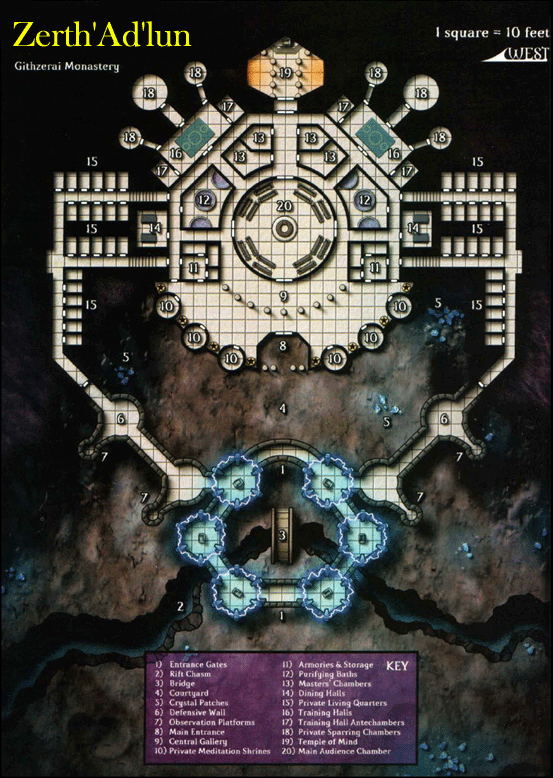 |
Where the doors are shown on the map leading north from areas 6 the wall ends and the passageway continues beneath the rock of the ridge. Thus, the majority of the monastery itself is underground, sprouting from the cliff face of the ridge. Area 9 is also underground where the inner arc of pillars ends.
Curtain walls and exterior structures are 40 ft tall and 2 ft thick and battlemented on top. Interior walls are 1 ft thick. All such walls are made of magically treated superior masonry (per 1 ft thick, hardness 16, 180 hp, break DC 55, Climb DC 25, +10 save bonus). Floors are of smooth stone. Doors are iron (hardness 10, 60 hp, break DC 28).
Interior rooms and passages are lit every 20 ft with oil lamps set into cressets carved into the walls at a height of 4 ft. Even though the githzerai have darkvision, they prefer natural light whenever possible.
Unless otherwise stated, ceilings inside the monastery are 30 ft high.
1. Entrance Gates and Towers
(EL 15)
| A great iron gate engraved with geometric patterns and runic symbols and glyphs bars entry into the monastery. The gate is built into the southern end of a ring of towers 40 ft tall that surmount a curtain wall of the same height. There are six such towers, and they glow with blue energy that whirls in a circle a few feet above the top of each tower. |
Each gate is 4 inches of iron reinforced by magic (hardness 20, 180 hp, break DC 48, +10 save bonus). Both gates are normally barred, each bar being operated by a mechanism set atop the walkway over the gate.
Atop each of the six towers is a plinth of glowing blue crystal set in the center of the tower top. Also towards the outer edge of the rooftop is a 5 ftsquare iron trap door. These trap doors are normally barred shut and lead to the tower interiors.
Each plinth is over 6 ft tall and 3 ft square and carved with glowing golden runes of power. Ringing the tower top are six stone carvings of githzerai faces in cowled hoods staring towards the plinth in the center. Hovering a foot above the heads is a halo of blue energy, spinning in a clockwise circle some 30 ft in diameter. The energy casts a blue glow over the entire top of each tower.
These plinths are weapons used by the githzerai to defend their monastery. Each plinth is crafted from a special crystal that is grown in the courtyard of the monastery (see area 4); this crystal being the embodiment of pure law. To operate the plinths, a being without the chaotic subtype must place his hands upon the plinth and intone the proper ritual. Additionally, a single power point of psionic power must be invested into the plinth. The ritual takes a DC 15 Knowledge (arcana) check to activate properly and takes a full round to enact. When enacted properly, the halo of energy surrounding the plinth whirls up suddenly to a height of 30 ft above the plinth and spirals in on itself until it becomes a ball of blue energy about 10 ft in diameter. It then explodes into a beam of energy that lances down at its target(s).
The beam has a range of 300 ft and strikes a 30 ft cubic area (i.e. a cube 30 ft to each side). It's effects are identical to an empowered order's wrath spell cast at caster level 20.
Once discharged, it takes a full round of inactivity for the energies to resume and the whirling halo to reform. Thus, each plinth can be fired once every 2 rounds. When the halo is active, the glow that bathes the top of the tower provides those within the benefits of a dispel chaos spell. A creature of the chaotic subtype does not gain these benefits and, if within the glow, instead suffers the effect of an order's wrath spell (caster level 20).
Each plinth has an arc of fire. The two plinths to the south can essentially fire anywhere outside the bounds of the monastery. Each of the central plinths can fire anywhere outside the monastery on its side only. The two northern plinths can only fire into the courtyard of the monastery. Additionally, all 6 plinths can fire within the gatehouse courtyard (area 3) and can fire at any target more above the level of the curtain walls and towers.
The towers contain a chamber inside of each. These chambers are accessed via iron doors accessible from the gateyard (area 3) and are seperate from each other (i.e. the tower interiors are not connected to each other). These iron doors can be barred from the inside. Each tower interior consists of a single chamber 30 ft in diameter and 30 ft tall. Within are spartan living quarters for 3 tower guards, including 3 beds, a wooden table and 3 chairs, a store of food and water, personal effects, and a crate of 120 crossbow bolts, 30 silver bolts, and 30 cold iron bolts. An iron ladder along the outer wall of the chamber leads up to an iron trap door that leads to the tower roof top. The trap door can be barred from the inside and normally is so secured.
Creatures: At all times there are 6 githzerai zerths atop the entrance, one at the top of each tower. Additionally, 2 off-duty zerths are inside the towers, sleeping or otherwise resting. Given their lack of reliance on wearing armour, these off-duty zerths can be summoned to combat very quickly.
|
FEATS: Spellwise (PGF p44) - gain +2 to Knowledge (arcana), Spellcraft checks and to saves vs illusions. |
2. Rift Chasm
This chasm begins when the ridge rises out of the floor of the plain and follows the ridge all the way along its length, running parallel to it and always within 50-100 ft of it. The chasm is 20 - 30 ft wide and roughly 50 ft deep and is filled with running water. This water begins at the western end of the chasm and flows eastward past the monastery until it reaches the chasm's eastern end. The walls of the chasm are relatively sheer, requiring a DC 20 Climb check to negotiate.
Examination beneath the water at either end will show that the water does not emerge from a crack or hole in the chasm wall, nor does it drain into anything similar at its terminus. Rather, the water seems to magically begin and end at either end of the chasm. While it flows, the water is considered fast-flowing (DC 15 Swim check, current moves at 60 ft per round) and is 20 ft deep.
Where the chasm flows under the entrance gate complex of the monastery, the stone walls of the towers plunge down the chasm to within a few inches of the surface of the water. There, iron portculli descend to the floor of the chasm, allowing the water to flow but blocking access to the inner gateyard from the chasm. These portculli are magically hardened (hardness 20, 120 hp, break DC 48) and would allow a size Diminutive creature to pass through easily. A Tiny creature that is not exceptionally narrow (e.g. a snake) must make a DC 15 Escape Artist check to pass through. A Small creature would need a DC 30 Escape Artist check to pass through, and anything larger would need epic-levels of Escape Artist to somehow squeeze through the portculli.
Waste from the monastery is dumped into the rift from the easternmost towers of area 1. As such, the water is clear and potable from its origin in the west until it reaches the monastery. On leaving the monastery, while not horribly polluted, the water is less potable.
3. Gateyard and Bridge
|
Between the ring of towers and two massive iron gates to the north and south is a circular gateyard that is bisected by a roughly 20 ft wide chasm. Crossing the chasm from north to south is a bridge made of dull gilden metal that spans the rift in a single arch. The bridge is 15 ft wide and is flanked by 3 ft high walls whose outside is engraved with images of humanoids fighting with their bare hands against hideous humanoid creatures with octopoidal heads. Set at either end of the bridge, on the ground, are metal buckets attached to thin coils of rope, along with metal yokes sized for Medium sized humanoids. |
The bridge is quite sturdy, and has been magically treated so that it is as hard as magically treated iron (hardness 20,540 hp).
The buckets and yokes are used by the githzerai to draw water from the chasm for the use of the monastery.
The engravings on the bridge walls show githzerai monks fighting mind flayers (a DC 10 Knowledge [planes] will reveal the humanoids fighters to be githzerai and a DC 20 Knowledge [dungeoneering] will reveal the octopoidal creatures to be mind flayers).
It should be noted that all six of the surrounding towers can fire their order's wrath blasts into this gateyard, effectively turning it into a killing zone.
4. Courtyard (EL 17)
|
This wide area is surrounded by the gate to the south, the curtain walls to the west and east, and the entrance to the monastery itself to the north. The courtyard is rocky and relatively flat and empty. The monastery to the north consists of a semicircle of light grey stone that emerges from the cliff face of the ridge. The structure is 30 ft high and ends in a 15 ft tall half dome roof that also merges with the ridge face. Set into the edge of the structure are six stone towers or spires, each 20 ft in diameter and sprouting 30 ft above the top of the monastery structure. These spires end in a bizarre spiral of twisted crystal that curls around itself up to a point 15 ft above the top of the spire. |
Creatures: Five creatures can be found in the courtyard.
A massive construct resides in the courtyard, usually resting halfway between the southern gate and the entrance to the monastery (precisely where the number "4" is on the map). This is an anhydrut, an intelligent construct of the inevitables. This specimen was given to the monastery for services rendered centuries ago, and it now serves loyally and willingly. As a construct, the creature had no particular need of quarters or entertainment, and so simply rests in the courtyard until it is needed. The anhydrut is intelligent, and so will react to situations of its own accord. It will also respond to alarms raised and will follow the direct orders of any of the masters of the monastery.
|
FEATS: Large and in Charge (Drac p71) - successful AoO against opponent moving in threatened area forces foe back to the spot before it provoked (and ends all movement) if opposed Str check made (+4 per size advantage and +1 per 5 dmg done by AoO). SPELLS: desert divserion (Sand p113) - r med, ray, 1 min/lvl, SR; ranged touch att, target struck has dimension door, ethereal jaunt, etherealness, gate, greater teleport, plane shift, shadow walk, teleport, teleport object, teleportation circle, and similar spells and spell-like abilities diverted to a chosen wasteland location or a random one, until duration ends subjects cannot use these spells to leave the location (the spell is used and subject appears at the spot he cast the spell), when duration ends subjects returns to point of origin. global warming (Sand p130) - epic, 10 min casting, 100 mile r, permanent; temperature increases to warm or by 1 step, open water and moisture evaporates creating desert conditions. halo of sand (Sand p117) - r pers, 10 min/lvl; +1 deflection bonbus to AC (+1 per 3 CL above 3 to max of +4 at CL 12). |
Additionally, a pack of axiomatic winter wolves roam the courtyard. These creatures are extremely loyal to the masters of the monastery and will attack intruders or anyone they deem a threat.
|
. |
5. Crystal Patches
| Sprouting from the rocky ground of the courtyard is a patch of blue crystals that thrust into the air at all angles like a strange sort of spiky bush. The crystals glow and hum of their own accord, and occasionally a bit of blue energy plays up and down its length. |
These crystals are grown by means of meditation and rituals known to the githzerai. If harvested, the crystals could be used to create lawful-aligned magic items such as axiomatic weapons. Additionally, a bit of crystal can be added as a material component to any lawful spell to add +1 CL to the spell.
Any chaotic subtype creature that approaches to within 20 ft of a patch will begin to feel uncomfortable unless protected by a protection from law effect. Any chaotic subtype creature who touches a crystal will suffer 1d4 points of damage per contact or round of continuous contact.
6. Defensive Curtain Wall
| These massive light grey stone walls are 30 ft tall and 10 ft thick and topped by a 3 ft high battlement. |
7. Observation Posts (EL 7
each)
| These small battlemented platforms are supported by stone that angles out from the curtain wall. |
|
FEATS: Spellwise (PGF p44) - gain +2 to Knowledge (arcana), Spellcraft checks and to saves vs illusions. |
8. Main Entrance (EL 17)
| In the center of the monastery structure that thrusts out into the courtyard is a large, 20 ft high niche, its entrance flanked by 4 large pillars covered in runes and sigils. Beyond are a set of large, ornately crafted double doors of a bright golden metal, each 12 ft tall. The doors bear engravings of robed humanoids fighting large toad-like creatures with their bare hands amidst a swirling tempest. |
A DC 10 Knowledge (planes) check will reveal the humanoids to be githzerai, while a DC 20 Knowledge (planes) check will reveal the toad-like creatures to be slaadi.
Creatures: There are two sets of creatures here.
Two justicators stand sentry, flanking the double doors. They are bound to service by ancient pacts and obey the masters of the monastery. They are willing and able to act on their own as well and will, at all times, seek to protect the monastery and its inhabitants from threats.
|
|
The 4 pillars are actually the quiescent forms of a quartet of psionically-endowed walking walls. These massive creatures slumber in pillar form until roused by one of the masters of the monastery. They can be roused by a mental command issued by one of the masters within 100 ft of the pillars, and are usually roused to provide cover for githzerai troops venturing forth to battle the slaadi. Until then, they will not rouse unless the pillars are attacked. When in their quiescent form, they are assumed to be using their stony defense.
|
9. Central Gallery (EL 19)
|
This large chamber's ceiling rises in a vaulted dome to 45 ft overhead. To the south are a set of large, ornately crafted double doors of a bright golden metal, each 12 ft tall. The doors bear engravings of robed humanoids fighting large toad-like creatures with their bare hands amidst a swirling tempest. A large pull ring is set into each portal. Along the southern walls flanking this door are six circular chambers that extend up along the wall and through the ceiling. An iron door leads to each of these towers. Set between each tower and the double doors is a large statue of a strange looking humanoid in robes in a martial pose with hands extended in a variety of poses. There are 8 such statues, and each is about 6 ft in diameter and over 12 ft tall. North of the double doors, an arc line of pillars reaches across the northern end of the place. Each pillar is composed of crystal and is 3 ft in diameter. Within each pillar swirls the colours of the rainbow. To the north are five doors; two iron doors are to the far west and far east, while a paid of iron double doors is set into a curved wall. These double doors are engraved with geometric patterns and disembodied hands in various poses and configurations. |
The other doors in the place are all usually unlocked, but can be barred from the other side.
The arc of crystal pillars radiates strong abjuration magic. If a master of the monastery gives a mental command within 100 ft of any of the pillars, they will form a prismatic wall (CL 20) that extends across the entire arc of the pyramids, from the southeast corner of the western area 11 to the southwest corner of the eastern area 11. The wall reaches all the way to the ceiling and emanates in such a way that the pillars are set just behind the wall when it is manifested. A master can issue a similar command to deactivate the wall.
If one of the pillars is destroyed, the wall will fail. Each pillar has a hardness of 20, 400 hp, and a +10 save bonus.
The statues of robed humanoids are of githzerai (as a DC 10 Knowledge [planes] check will reveal). They represent famous past grandmasters of the monastery.
Creatures: Each of 8 statues is a stone golem. They are programmed to obey the masters of the monastery, and will also act to defend the monastery if an attack is in progress or is they are attacked. Additionally, any slaadi present and not in direct escort of the master will provoke an attack.
It should be noted that the golems are immune to the prismatic wall between the pillars since that spell allows spell resistance.
|
10. Private Meditiation Shrines
(EL none or varies)
|
This small chamber is circular, some 20 ft in diameter, and contains a plain red mat, a stone bowl of water, and a small table with incense holder, incense, and flint and steel. The chamber rises in a tower to a height of 75 ft, where it ends in a blue crystalline spiral. The lights from the bizarre sky outside seems to be collected and concentrated by the crystalline spiral, which sends a beam of multicoloured light in an intense shaft down the center of the place and onto the floor. |
The beam of light has no effect, beneficial or detrimental, except that it collects and channels some of the colours and essence of the diffused chaos in the skies overhead and is useful to the githzerai to meditate on the nature of chaos and seek to contain its entropic effects. The githzerai meditants would usually sit on the mat positioned so that the beam of light would fall directly upon their head. Some would then lift their gaze and stare directly into the beam for hours on end.
Should a PC touch or sit in the beam, he will feel a slight strange tickling within, but nothing else.
Creatures: There is, at any given time that there is not an alert raised, a 25% chance that a given shrine is being used. In this case, the DM should assign one of the monks from area 15 to the chamber in question.
11. Armory and Storage
There are two storage areas in the monastery, each redundant in the sense that each holds the same equipment. The githzerai created this redundancy in case they were cut off from one side of the monastery, they could still resupply their warriors.
As monks, the need for armour and melee weaponry is greatly diminished amongst the githzerai. Instead, the storage chambers focus more on water, food, ammunition, and general supplies.
Each storage area contains a 20 ft square antechamber accessed by iron doors from the south and from the west or east wall respectively. These outer doors are locked by a key lock (Open Lock DC 35), with the key being in possession of the masters and the quartermasters.
Within the antechamber is the
living and administrative quarters of the quartermasters.
| This chamber includes a spartan pallet, wooden table and pair of chairs, a wooden desk with sheaves of paper, writing equipment, and ledgers stacked upon it. A merchant scale, hourglass, jeweler's loup, and magnifiying glass are also present on the desk. Nearby shelves hold scrolls and ledgers of various sizes, and a large wood and iron chest stands in the southern corner. |
The three doors lead from the antechamber into the small storage chambers are iron, but with a small barred window cut into the upper half that allows viewing the contents within. These doors are not locked, but are merely latched shut from the antechamber side.
Creatures: The quartermaster is found here, keeping records of the monastery and watching over the supplies. The quartermaster is a lifetime position, usually reserved for githzerai monks who are not able to complete more advanced training or who have become too old or have become infirm due to injury.
|
|
Treasure: The chest is locked (Open Lock 30) and contains funds of the monastery given to the quartermaster to purchase supplies from merchants that visit the monastery on occasion. Stored here are 1,200 cp, 1,600 sp, 2,400 gp, and 700 pp, all of varying mint, and small sacks of gems worth a total of 6,500 gp.
Northern Chamber:
The northernmost storage chamber is 20 ft by 10 ft and the walls are covered in runes and sigils (a DC 15 Knowledge [arcana] check will reveal them as transmutation related and a DC 20 check will reveal that they relate to the purify food and drink spell). The room radiates faint trnasmutation magic and is dweomered to provide a continuous purify food and drink effect. Treat this as a magic item that is built into the structure of the chamber.
As befits its enchantment, the place contains food and water. The former consists of all sorts of strange and exotic foods, stored in crates, pottery, and sacks. There is enough food in each chamber for 600 man days of meals (1200 lbs). Water is stored in metal barrels, and there is enough water in each chamber to provide 600 man days of water (600 gallons).
Southern Chamber:
The southermost chamber is 10 ft square and contains weapons and ammunition for the monastery along with special items. The weapons and ammunition consists primarily of the following inventory in each chamber:
Additionally, set upon shelves along the walls, are special items as follows:
Middle Chamber:
The middle chamber is 20 ft by 10 ft and contains numerous mundane items, ranging from githzerai robes to candles or lamp oil to needles and thread, wooden planks, etc. A full list is not given, but the DM can assume that any mundane item that would be of use to the monastery is stored here. Plenty of rope can be found, including 500 ft of earthsilk rope.
Also here is a workbench and masterwork artisan tools and an alchemist's lab, along with raw materials for making crossbows, bolts, and the various alchemical items stored in the southern chamber.
12. Purifying Baths
|
This chamber is dominated by 3 pools of water, each a 2 ft tall stone lip that surrounds a pool that is 4 ft below the floor level. Each pool is filled with clear water that reaches up to the level of the floor. Stone steps descend to the bottom of each pool. The central pool is a full circle 12 ft in diameter. This is flanked by two semi-circular pools set against the walls. The stone lip of the central pool is carved with golden glyphs and runes. Water trickles out of the walls and into the semi-circular pools, while the central pool has no obvious sources of water. Hanging on iron racks against the walls are linens, and shelves nearby hold bottles and vials. |
The flanking pools are normal pools with crystal clear water that is fed from pipes and magical pumps that draw water from the rift chasm (area 2). The middle
The central pool is normal in all respects except that when the githzerai conduct a special hour-long ritual, the runes and sigils on the lip begin to glow and the pool becomes magical. As such, when inactive the central pool radiates dim divination magic. When active it radiates strong divination magic.
The githzerai use these pools for various purification rituals that form a part of their routine. However, on special occasions the ritual of the bath is performed and the pool gains the powers of a planar touchstone as detailed on page 163 of the Planar Handbook. The githzerai do not, themselves, usually partake of the benefits of the pool. But they do allow favoured guests to use it (as detailed in the description of the planar touchstone). Of course, using the pool requires that a PC take the Planar Touchstone feat.
13. Masters' Chambers
There are four masters of the monastery (not counting the grandmaster; despite their name the quartermasters are not considered masters.). They lair in these four chambers, with the lesser masters in the northernmost chambers and the greater masters in the southernmost chambers.
Each chamber is as follows, the
with great masters' chambers having slightly more ornate furnishings
and more lavish hangings.
|
This chamber contains spartan furnishings, including a feather pallet on a plain wooden frame, a meditation mat set on the floor, a brass brazier that is aglow and wafting some sort of incense. A wooden wardrobe stands near the pallet, and on the other side of the bedding is a small table and washbasin. In the center of the chamber is a small wooden table and two chairs. The walls are decorated with hangings depicting robed humanoids fighting octopus-headed creatures with their bare hands in an underground setting, and others depicting similarly robed humanoids battling greatsword wielding humanoids with their bare hands in a strange setting of swirling grey mists. Others show robed humanoids battling toad-like creatures with their bare hands against a multicoloured swirling background. |
The wardrobe contains plain monk robes and more ornate ceremonial vestments.
Creatures: The masters are the day-to-day leaders of the monastery. The lesser masters report to the greater masters, who in turn report to the grandmaster.
|
|
|
|
14. Dining Halls
| This chamber contains two large metal tables accompanied by 8 wooden chairs each. Plain settings and utensils are set in neat order upon the tables. |
15. Private Living Quarters
| This small living cell is quite plain. A simple cloth and straw pallet is here, along with a meditation mat, a low wooden table, and a combination candle holder and incense holder. An open wooden bin holds folded clothing and other mundane personal items. |
The 12 quarters that run along the north-south corridor (6 on each side of the monastery) are reserved as guest quarters. At any given time roughly half of these are empty. The other half contains githzerai monk visitors (LN Monks lvl 1-6).
The remaining 32 quarters (16 on each side of the monastery) contain the monks that are officially a part of the monastery and in training. At any given time half of these are out of the monastery on duties. For this purpose, the Azervimon and his 11 companions who are meditating on the black dot in the sky should be considered as part of those away from the monastery.
Creatures: The 16 monks who are in the monastery spend much of their time meditating in their chambers, performing menial chores, and training in the various practice rooms. Nevertheless, statistics for these are presented here, to be used wherever they might be encountered.
|
|
|
|
|
|
|
|
|
|
16. Training Halls
| This large chamber contains a large practice mat of deep green with various circles inscribed on it that seem to indicate fighting positions and other practice aids. Along the walls are mounted bullseyes with crossbow bolts stuck into them. Wall hangings show robes humanoids engaged in various unarmed combat maneuvers and fighting stances. |
Creatures: There is a 50% chance that 1d4 monks from area 15 are training in each of these chambers. If so, they will be sparring and training for another 1d3 hours before returning to their quarters.
17. Training Hall Antechambers
| This small chamber contains iron spikes driven into the walls at various heights up to the ceiling, as well as iron bars set at various heights. Iron rings hang at various heights from chains depending from the ceiling. |
18. Private Sparring Chambers
| This circular chamber is decorated with carvings of robed humanoids emanating streams of energy from their foreheads. The walls are chipped and scarred in many places. |
These chambers are used for more dangerous practice sessions, usually involving psionic powers (especially ones that affect areas). As such, they are usually reserved for single participants and then only zerth cenobites.
19. Temple of the Mind (EL 18 or 21)
Entry:
This place is accessed via two sets of double doors to the south.
The southernmost set of double
doors are similar in all respects to the golden doors at area
8.
| Here is a set of large, ornately crafted double doors of a bright golden metal, each 12 ft tall. The doors bear engravings of robed humanoids fighting large toad-like creatures with their bare hands amidst a swirling tempest. |
A DC 10 Knowledge (planes) check will reveal the humanoids to be githzerai, while a DC 20 Knowledge (planes) check will reveal the toad-like creatures to be slaadi. A DC 35 Knowledge (planes) check will reveal that one of the githzerai figures on each door near the junction of the two portals is that of Zerthimon, the great prophet leader of the ancient githzerai.
The double doors are magically warded by a powerful warping effect. Anyone who opens the doors or enters the chamber beyond without enacting the proper bypass will find that the doors lead to a 10 ft long and 20 ft wide passageway that ends in still another set of golden double doors. This final set of double doors is, however, actually the double doors at area 8. In other words, opening those doors will be tantamount to opening the double doors at area 8 and it will lead into area 9. In this way, entrance to the Temple of the Mind is denied.
In order to bypass this spatial "loop", the first set of golden double doors must be touched with two hands, one on each door at a precise spot where an engraving shows the likeness of Zerthimon. At the same time, the third teaching of Zerthimon must be uttered:
Endure. In enduring, grow strong.
Careful study of this set of doors as compared to those at area 8 will reveal that the figure of Zerthimon (who bears a distinctive tattoo on his forehead) is replaced by a generic githzerai figure.
The first set of double doors and the entire small room between the two sets of doors radiates strong conjuration magic. The spatial looping effect is technically triggered by entrance into the small chamber between the doors. Therefore, even methods of entry that bypass opening the first set of doors (such as gaseous form) will still trigger the effect. However, the effect can effectively be bypassed by simply teleporting or using other such means to travel past the small chamber and directly into area 19 proper.
If the proper ritual is performed
on the first set of doors, then when they are opened, the 10 ft
by 20 ft chamber is revealed and a different set of double doors
presents itself to the north.
| Beyond a small 10 ft by 20 ft chamber is a pair of glistening silver double doors, 12 ft tall and engraved with extraordinarily complex geometric patterns including a few that almost seem to bend in on themselves in impossible ways. |
The doors are silver covering magically hardened iron (hardness 20, 120 hp, break DC 48). They are warded by a psionic lock (ML 20) that is specially keyed to be passed and opened by a master of the monastery.
The Temple Proper:
Beyond the silver doors is the Temple of the Mind proper. The Temple of the Mind resides in an area that has been pinched off from time. This effect is partly what allows the spatial loop detailed above. It also means that some aspects of time do not pass within the Temple. As in the Astral Plane, no food or drink is needed while within, nor is sleep required. Furthermore, those within do not age. Time does pass with regard to spells and items that have a duration and chronologically, a minute spent inside the Temple means a minute has passed without as well.
Additionally, the Temple cannot be scried, nor can any divination effect cast from without affect anyone or anything within. This includes scrying as well as spells such as locate object or circle dance. Even augury and divination cannot reveal any information about any part of the Temple. Divination spells cast from within the Temple to targets or locations also within the Temple function normally.
Furthermore, teleportation
effects and any other effects that require travel through or from
another plane cannot function across the temproal boundary of
the Temple. This means that a dimension door, for example,
can be cast inside the Temple and transport the caster to another
location inside the Temple. But such a spell cannot transport
a caster outside the Temple to the inside or vice versa. This
prohibition also includes conjuration (summoning), conjuration
(creation), and conjuration (calling) effects. These spells simply
fail and are expended if cast within the Temple since they need
to reach out to other planes to work. A conjured item or creature
manifesting by means of a calling or creation spell can enter
the Temple once present. Summoned creatures, however, simply wink
out of existence if they attempt to enter the place.
|
This chamber is bathed in a golden radiance emanating from crystalline walls to the west and east. Between them, a 20 ft wide aisle between rows of pillars leads to a dais upon which rests a large, plain stone chair. The pillars are each about 2 ft in diameter and there are 4 along each flank with a fifth on each side bending away from the aisle where it approaches the dais. The ceiling is adorned with a mosaic of polished crystals that shows a robed figure with a tattoo on his forehead with his hands upraised and his palms outward with his thumb bent in (as if making the hand sign for the number 4 on each hand). The tip of each of his four fingers bears a complicated rune, a total of 8, in glowing silver. |
The 8 glowing runes on his fingertips represent the 8 teachings of Zerthimon (sort of a Ten Commandments of the githzerai). A DC 40 Knowledge (planes) check is required to identify the teachings (unless the PCs are githzerai or have studied githzerai lore specifically, in which case they will gain a +30 circumstance bonus to the check).
The eight teachings are:
The golden emanation from the crystalline walls bathes the entire room in a psionic true seeing effect (ML 20) and a psionic mind blank (ML 20). As such, any and all creatures in the chamber are affected as if they had manifested a psionic true seeing at ML 20 for as long as they remain in the chamber. Furthermore, all creatures in the chamber are affected as if they had a psionic mind blank cast on them at ML 20 for as long as they remain in the chamber. These emanations, which are also conducive to extremely advanced meditation techniques, are what give this chamber its name. The crystalline walls are, for all intents and purposes, indestructible by anything less than epic magic and the effects of the emanations are treated like magic items (in that they can only be dispelled for 1d4 rounds).
Creatures: At all times there are 2 powerful justicators on guard here. These unwavering sentinels serve a century of duty for the monastery for past bargains, and then are replaced by 2 others who serve for a century. The justicators serve the grandmaster of the monastery directly, but will act on their own to protect the monastery from all threats.
|
FEATS: Psychic Refusal (DoU p51) - +4 SR vs mind-affecting. |
The grandmaster of the monastery, Belthomais, receives visitors in this chamber for private council. It is also where he performs most of his esoteric meditations, as the emanations radiating from the crystalline walls are conducive to this. The grandmaster rarely leaves the Temple, as the anti-aging properties are helpful in providing continuity of leadership for the monastery.
|
|
Secret Doors: The throne covers a passageway that leads underneath the Temple of the Mind. This secret way is very well hidden, requiring a DC 35 Search check.
Even once found, the throne cannot be moved except by expending a psionic power point while touching the top of the chair. Doing so will cause the throne to slide to the front noiselessly, revealing a 5 ft square opening with steps leading down. After 2 rounds the chair will automatically slide back over the passageway.
The Basement:
The steps from above lead down
20 ft to a single room. This area is considered a part of the
Temple of the Mind and all of the temporal effects and restrictions
function here.
|
Oil lamps light this 10 ft high, 40 ft square room. There is a modest fur pallet here, along with a meditation mat, a table and chairs, and a writing desk with writing utensils and sheaves of paper set upon it. The walls to either side of the room are covered in bookshelves and these shelves are stocked with books, scroll, and tomes of all shapes and sizes. There are at least 2,000-3,000 works here. |
Just to the right of the stairway entrance into this chamber is a small switch. This switch opens the stone chair above allowing access to the Temple proper.
The books and scrolls are a rich repository of the teachings of Zerthimon, ancient githzerai martial art techniques including works on the Zerthin technique, the history of the githzerai, and of many things planar, including treatises on the slaadi. Also here is information on the illithids and a few of these express alarm at the recent interaction between humans and the mind flayers and worry that the humans may have unwittingly aroused the illithids from their chtonic ignorance.
The library is quite valuable, being worth at least 50,000 gp if not more to the right buyers. The library can also be used to stock a PCs' library, wherein they will grant a +2 competence bonus on Knowledge (planes) checks if consulted and a total of +5 cometence bonus on checks relating to the githzerai, slaadi, illithids, or Limbo.
Study of these books can be made to find the location of Ssendam the slaad lord. This will take a DC 40 Knowledge (planes) check, with it taking 1d6 hours to make a check and each subsequent check gaining a +1 cumulative bonus to the check (maximum cumulative bonus of +20). The location will include directions for finding him (refer to Navigating the Shallows below).
Also included here is a planar atlas (providing a +2 to Knowledge [planes] checks) and a karushe.
A karushe is a device used for navigating the shallows of Limbo. It appears to be a metal pyramidal frame small enough to fit in the paml of one's hand and shaped like a d4 from which hangs a crystal similar to those found in area 5. It weighs about a pound. This crystal is shaped into a starburst shape with many delicate spikes (almost like a tiny sea urchin) and the crystal is attached to the pyramidal frame by means of very delicate threads that appear as thin as spidersilk. The karushe radiates dim divination magic and faint law. The karushe is able to measure very minute changes in the flow of chaotic miasma in the shallows and by observing the spin and vibration of the crystal within directions can be followed.
Attempting to use the karushe is difficult without instruction. A DC 25 Knowledge (planes) or (arcana) check is needed just to identify it as some sort of planar navigational device. A DC 40 Knowledge (planes) or (arcana) check is needed to figure out its function without any instruction or field trials. If the device is taken into the shallows and observed, then a DC 25 Knowledge (planes) or (arcana) check will be able to identify its function, and with practice (each practice session taking 1 day of shallows maneuvering) subsequent DC 30 Knowledge (planes) checks will provide an additional +1 bonus to one's Survival check to navigate the shallows correctly, until the maximum of +10 is achieved.
Because it radiates only dim magic, an identify or analyze dweomer will not work on the device. The magic that it is radiating is merely the remnant of magic used in its creation.
Secret Doors: A secret door is present on the wall opposite the stairway (DC 35 Search check). It can only be opened by expending a psionic power point while touching it with both hands. Within is the treasury.
Treasury:
This chamber is lined in lead
and is therefore warded from many divination spells.
| This 10 ft tall 20 ft square chamber contains a variety of containers, including half a dozen chests, several metal boxes, and small tables or stands holding various items. |
None of the containers is trapped or locked, the githzerai figuring that any thieves that made it this far would not be thwarted by such measures.
There is a total of 50,000 cp, 40,000 sp, 35,000 gp, and 5,000 pp stored here, all of coins of varied and esoteric mintings.
Additionally, there are gems and jewelry here worth a total of 40,000 gp. There are literally scores of such gems and jewels of all types.
Magic items are much fewer and include:
20. Main Audience Chamber
|
This is a large circular room with a domed ceiling 45 ft overhead. 16 stone benches are set in rows against the curved walls, along with four sets of iron double doors piercing the walls at each cardinal point. These double doors are engraved with geometric patterns and disembodied hands in various poses and configurations. In the center of the chamber is a 3 ft high stone platform upon which sits circular steps that rise another 3 ft to a 5 ft diameter stone platform. The ceiling depicts robed humanoids building a large structure, possibly this very monastery, with the help of earth elementals and other strange construct-like creatures. |
This is the place where the monks are mustered to hear pronouncements and teachings and lectures by the masters. The place can comfortably hold just under 50 people in the audience. The acoustics of the chamber are such that someone standing atop the central speaking platform can be heard throughout the chamber without raising his voice.
All of the doors here can be barred from this side, though they are usually left unlocked.
Dealing with the Githzerai:
The githzerai are wary of strangers, but are not hostile to them by any means and willing to parley with any who show themselves to be reasonable and honourable.
When the PCs approach the monastery, the tower guards at area 1 will hail them, first in Gith and then in other languages. They will ask the PCs their names and business. Assuming the PCs state that they wish to enter the monastery, the guards will ask them to wait while they take the request to one of the masters.
If the PCs state who they are, then when word is brought to the masters, they will inform the grandmaster, who will certainly agree to see them. These githzerai have heard of the Heroes of the Gem, both for their exploits against Lolth and Kostchtchie and because the Heroes of the Gem were responsible for making the first contact between the illithids and the surface worlders and the githzerai now speculate that the illithids, having learned of the surface world from consuming the brain and memories of Khenni the Thief, will now wish to infiltrate and one day conquer this new world full of "human cattle".
If the PCs do not state who they are or lie about it, then what they claim their business is with the monastery will determine the likely reaction. If the PCs are merely trying to bluff their way into the monastery in order to then, perhaps, search for Fedifensor, then the DM can guage how likely the githzerai are to believe them via Bluff checks versus the githzerai Sense Motive skills, or any other appropriate means.
The githzerai are used to petitioners coming the monastery in order to use the planar touchstone in area 12, and so if the PCs come claiming to wish to learn the lore of zerthin, then they will be allowed to meet with one of the lesser masters, who will likely arrange for a sparring or test in a training room to determine their worthiness to gain access to the touchstone (refer to the touchstone description in the Planar Handbook for more details).
If the PCs do not give their true identities, then it will be very difficult for them to come up with a reason to meet with the grandmaster directly. However, should they do so, with a possible addition of Bluff, Diplomacy, or Intimidate checks, then such a meeting could be possible.
If the PCs meet with a lesser master, it will be in area 20. In this case, unless the conversation touches on Fedifensor or some other very important topic or the PCs reveal their identities, the lesser master will simply accommodate the PCs assuming whatever it is they request is reasonable. If the PCs begin to sneak around the place, the DM should have the githzerai react appropriately. There are certainly places that no non-githzerai should be without leave, including areas 11, 12, 13, 18, and especially area 19.
Ultimately, unless the PCs intend to try to take Fedifensor by stealth or force (both of which are doomed to fail since the blade is not here!), they will have to meet with the grandmaster.
Dealing with the Grandmaster:
Assuming the PCs meet with the grandmaster, he will see them in area 19, seated on his stone chair. The two greater masters will be present as well (along with the justicators). If the PCs have revealed themselves to be the Heroes of the Gem, then the lesser masters will be present too, as they wish to hear what the Heroes have to say.
The grandmaster will be cautious but cordial with the PCs. He will explain that the PCs should not attempt to dissemble in his presence, as the githzerai value truth greatly and are adept at detecting falsehoods. If the PCs have not revealed their true identities, he will ask them to do so now. If they have revealed false identities, then after warning them against lying, he will ask them to confirm their true identities. Remember that there is a psionic true seeing effect in area 19, so unless the PCs have fabulous mundane disguises (that would have to fool the Spot checks of the justicators in area 19), they are likely to be recognized in their true forms.
The grandmaster is familiar with the Heroes of the Gem from the texts in his basement library, and so assuming he or the justicators see through their disguises, he will recognize them.
If the PCs are caught in a direct lie to the grandmaster, he will be emotionless, but will admonish the PCs and refuse to cooperate any further with them. The PCs will then have to either use Diplomacy or Intimidate to change the grandmaster's attitude from unfriendly to helpful.
Assuming the PCs get around to identifying themselves and tell the grandmaster what they seek and why, he will appear thoughtful for a long moment before revealing to the PCs that while it is indeed true that his monastery had possession of the githyanki lich-queen's silver sword, he no longer has it. He will, however, be willing to tell the PCs where the sword is, but only under certain conditions.
If the PCs inform the grandmaster that the lich-queen assured them the blade was within the monastery and that due to the bond between a githyanki and his silver sword, she knows precisely where it is, he will chuckle to himself but say nothing about it at this time.
Belthomais will tell the PCs that some 2 years ago, a group of slaadi managed to infiltrate the monastery and they managed to break into the monastery's treasure vault. While the grandmaster believes that the slaadi were interested in a certain other item contained within the vault, they looted the vault entirely of magic items, leaving only coins behind. One item they took was the very blade the PCs seek.
Belthomais will tell the PCs that he knows where the blade is. He will assure the PCs that of a certainty the blade is where he says it is, and that they will not be led on yet another wild chase. However, he assures the PCs that there is no way they will ever be able to find and gain the blade without his aid. In return, Belthomais simply requires that the PCs, once they use the blade for the purpose they have explained, return the blade to him so that it may be returned to the vault.
If the PCs balk at this notion and explain why (i.e. their promise to the lich-queen), Belthomais will look pleased and will nod approvingly to the PCs. He will say that it is very good that the Heroes value their oaths so seriously that they would hesitate to violate their word, even to one as treacherous and apt to deceive as the lich-queen. Nevertheless, Belthomais will point out to the PCs that, indeed, the githyanki do have an unsunderable bond with their silver swords, and that the lich-queen knew precisely that her blade was not in the monastery. The grandmaster will speculate that the lich-queen sent the PCs in order that they should attack the githzerai in an attempt to gain the sword, and thereby injure grievously this monastery. If asked why the lich-queen wouldn't have simply told the PCs where the sword is, Belthomais will answer that the way to the blade is complicated, and while the lich-queen could tell where the blade is, she has no way to guide the PCs to the location. Therefore, she likely concluded that the PCs would not gain the blade, but would strike a blow against the githzerai. Perhaps, as well, he speculates that the lich-queen hoped that there might be some clue or guide in the monastery that would allow the PCs to find the blade. Alas, he assures the PCs, that is not so, for the way lies only in his own mind.
Belthomais will then explain that a bargain that is made under false pretenses is not a bargain at all. There is no honour in such an agreement and, in fact, there is no agreement. Therefore, the PCs will not violate their word by agreeing not to return the blade to the lich-queen.
If the PCs agree to accept Belthomais' terms, then the grandmaster will require that they swear solemn oaths to their gods and the multiverse to abide by the terms. He will warn that failure to honour this oath will earn the emnity of all githzerai and likely bring the wrath of the inevitables upon them as well. Belthomais tell the PCs that the lord of insanity Ssendam has claimed the blade as his own. He will warn the PCs of Ssendam's powers...mainly his energy drain ability, his change shape ability, and most importantly, his word of chaos ability, which will possibly slay the PCs the moment they hear the word. If the PCs ask for advice to defend against this latter ability, the grandmaster will recommend induced deafness as a possible solution, despite the effects it will have on spellcasting. He will also warn the PCs to strike quickly. Ssendam is a lord of chaos and his forces will be initially quite disorganized. But if the PCs rouse him and allow him time to rally his considerable forces, they may find that recovery of the blade is all but impossible.
Succeeding without the Grandmaster:
Unlike the githyanki, where the PCs could proceed to the next step of the scenario without peacefully dealing with the lich-queen (by defeating her and finding her notations and maps in area 10, or by sneaking into area 10 and stealing the documents), there are no direct clues or trails to be found here. The mundane denizens of the monastery know about the break in of the monastery a couple of years ago, and they are also aware that one item was recovered and returned by a githzerai named Zerimon, but they are certain it was not the sword. They do not know where the blade is now.
The masters of the monastery know the full details of the break in, what they stole (including the item recovered by Zerimon, which was a prison key for a trapped white slaad [see the scenario "The Key to Chaos" for more details]), and who is in possession of the blade currently (the slaad lord Ssendam). They do not know, however, how to reach Ssendam. Nevertheless, once the PCs know that Ssendam has Fedifensor, then the PCs could use the library in the basement of area 19 to research his location.
In the event that the PCs have slain the githzerai, then spells like speak with dead could elicit the information needed. Otherwise, the PCs can torture, magically compel, or otherwise extract the information from one of the living masters.
Part Four - Beyond the Pale
The slaad lord Ssendam has Fedifensor. When the slaadi broke into the treasure vault of Zerth'Al'dun, they were seeking the prison key to free the white slaad Issganndemm from his imprisonment in the continent of Sazhansiir on the Material Plane. The slaadi looted the vault, taking other items as well, the most powerful of which was Fedifensor.
This blade they brought to their lord Ssendam as tribute, and the chaos lord, sensing its power, coveted the blade and now keeps it always with him. He regards the blade as a great trophy and token of status, with which to one day usurp Ygorl and claim lordship over all of the slaadi.
Ssendam dwells in his lair deep in the "shallows" of Limbo. Finding his lair by merely wandering the plane randomly is basically an impossibility. Instead, the PCs will have to get directions to his lair either from the grandmaster himself or from research in the grandmaster's library.
Navigating the Shallows:
Directions are somewhat meaningless in Limbo, except that there is always a current in the sea of chaos that relates to the location of the Spawning Stone (see Manual of the Planes page 96). By carefully watching the currents in Limbo and relating their direction and strength to the location of the Spawning Stone one can make one's way carefully across the shallows. If the grandmaster has aided the PCs in locating Fedifensor, then he will have lent them several scrolls of charts and a strange device called a karushe. He will instruct a lesser master to teach the PCs how to read the karushe and use the charts. With the aid of a master, the PCs can learn to use the device at double the rate detailed in area 19, even despite the fact that they are not getting field practice.
Armed with proper directions and the karushe, the PCs can make their way into the shallows. Properly navigating the shallows requires a base DC Survival check of 30. Using the karushe at full expertise grants a +10 bonus to the check. Furthermore, having a planar atlas at hand grants a +2 circumstance bonus to the check.
The distance from the monastery to Ssendam's lair is measured in time rather than miles. This because the nature of raw Limbo means moving at any speed is a function of one's Wisdom and ability to exert control rather than one's speed. Even if the PCs are immune to fire and can fly and breathe under water, large chunks of earth can stand in their way. Basically, there are three elemental components in Limbo that affect movement. Air is not an impediment, because it allows breathing and subjective gravity means anyone can simply will himself to fall through it in the direction desired. For the other three elements, refer below to their effects when dominant:
Earth-dominant: The area is solid earth or massive chunks of rocks. Travelling at high speed is quite dangerous as the traveller risks either being pummeled and cut by shards of rock or slamming into larger rocks as if falling. Precise damage is left to the DM. The means to counter this trait include having the earth glide ability or becoming incorporeal.
Fire-dominant: The area is full of flames, magma, and bursting fireballs. Unprotected wood, paper, cloth, and other flammable materials catch fire almost immediately, and those wearing unprotected flammable clothing catch on fire (see Catching on Fire in Chapter 3 of the Dungeon Master's Guide). In addition, individuals take 3d10 points of fire damage every round they are in a fire-dominant area. Passing through at high speed will still subject individuals to 2d10 points of fire damage if half a round or less is spent in the area. Creatures made of water suffer double damage from the fire in these areas. Having enough fire resistance to ignore even the maximum damage from these areas is sufficient to counter this trait.
Water-dominant: These are usually massive blobs of liquid, sometimes divided into smaller globs and occasionally coming in spurts, gouts, or even cyclones. Hitting these areas at high speeds will result in damage equivalent to jumping into water from a great height. Creatures made of fire suffer 1d10 points of damage each round or fraction of a round they are within this area. Being able to swim (i.e. make a DC 15 Swim check even when rolling a 1 on the d20 or having a swim speed) or being incorporeal will allow one to counter this trait.
The base time to locate Ssendam's lair is 240 hours. For each of the three elemental traits that the PCs can counter, reduce the time by 1/4th. Thus, if the PCs can counter all 3 traits, then the time it will take is reduced to 60 hours.
For each 8 hours spent navigating, a navigation check must be made (DC 30 Survival check, modified as previously indicated). If the check is failed, then that 8 hour time has been spent wandering aimlessly, and a new check must be made to relocate the path (which takes another 8 hours). If the relocation check fails, then another one can be made every 8 hours. Time spent wandering aimlessly and relocating the path does not count towards navigating to the lair. Remember that time passes normally in Limbo, and so 8 hours of travel does not count the time needed to camp, rest, and eat. Thus, unless the PCs can mitigate normal travel needs, they can only travel 8 hours in any 24 hours period.
Wisdom has an effect on controlling raw Limbo, and so the Wisdom of the PC exerting control can speed up the PCs. Use the highest Wisdom score amongst the PCs. Do not count any Wisdom bonuses unless they last for at least 4 hours. Treat such bonuses that last between 4-7 hours as half effective and bonuses that last 8+ hours as fully effective. Then consult the following table:
Wisdom 1-3 = No ability to travel unless all 3 traits are countered.
Wisdom 4-7 = Multiply all travel times by 15 due to the almost complete inability to control raw Limbo and the tiny region controlled when successful.
Wisdom 8-11 = Multiply all travel times by 3 due to the difficulty in controlling raw Limbo and the small region controlled when successful.
Wisdom 12-15 = Multiply all travel times by 1.5 due to the difficulty in regularly controlling raw Limbo and the modest region controlled when successful.
Wisdom 16-19 = Normal travel times due to the normal ability to control raw Limbo and the normal region controlled when successful.
Wisdom 20-23 = Multiply all travel times by 2/3rds due to the greater ability to control raw Limbo and the somewhat larger region controlled when successful as well as the ability to stabilize small areas.
Wisdom 24+ = Multiply all travel times by 1/3rd due to the exceptional ability to control raw Limbo and the much larger region controlled when successful as well as the ability to stabilize areas.
When the PCs bed down for the night, unless they are able to stabilize some of the plane, they will need to have at least one person awake and exerting control for the entire time or will need to have the means to protect themselves such as rope trick.
Creatures native to the "shallows" (pretty much only slaadi and chaos beasts) can automatically control the raw Limbo around them in a tight sheath, and can do so even if asleep or unconscious, allowing them to essentially move unhindered by the environment.
Remember the restriction on teleportation in the shallows. Because of this, the PCs will not be able to simply locate Ssendam's lair, retreat back to Zerth'Ad'lun by means of greater teleport, and then greater teleport back to confront the slaad lord.
Shallows Encounters:
The chance of an encounter is 8% per 6 hour period. If an encounter is indicated, roll again to see if another encounter occurs in the same period, and so on until the 8% chance is not rolled. To determine the nature of the encounter, roll a d10 and consult the following chart:
1-2 = slaadi encounter (refer
below).
3-4 = chaos beasts (refer below)
5-7 = abyssal encounter (refer to page 149 of Manual of the
Planes). Reroll any results of petitioner.
8-10 = beatific encounter (refer to page 152 of Manual of the
Planes). Reroll any results of petitioner.
Note that slaadi can also be encountered on the abyssal table as well. In that case use the numbers and types as indicated on that table.
For slaadi encountered by a roll of 1-2 above, refer to the following table by rolling d100:
01-20 = blue slaad (1d4)
21-35 = death slaad (1)
36-55 = grey slaad (1d2)
56-75 = green slaad (1d4)
76-90 = red slaad (1d4)
91-00 = mixed group, roll twice (and keep doing so as long as
this result is rolled, so it is possible to have 3, 4 or even
5 or more groups encountered together)
For chaos beasts encountered by a roll of 3-4 above, they are always Large and have 1d12+12 Hit Dice and are encountered singly. Four sample chaos beasts are presented below.
|
||||||||
Combat in Limbo:
DMs should refer heavily to the appropriate pages of the Manual of the Planes, as it details the precise effects of controlling raw Limbo, which is useful during combat. Additonally, subjective gravity is dealt with.
Sighting distance is heavily dependent upon the traits present in a given area of raw Limbo. The DM should first determine the nature of the local raw Limbo and then set a suitable encounter distance.
Despite the fact that the PCs may be travelling at extreme rates of speed across Limbo, most creatures can easily match this speed, especially if they can counter some or most of the traits, or if they are native to the plane their amazing control of the traits allows them to move at extremely fast speeds and extremely precisely. Such beings are adept at altering and matching their trajectories with that of their prey.
Planned Encounters:
The following are a series of planned encounters designed to better acquaint the PCs with the unusual environment in which they are travelling and to provide some opportunity to intereact with or combat creatures on the plane. The DM does not have to use any or all of these encounters, as they are not necessary to finish the scenario. The chronological spacing of these encounters is left up to the DM.
Planned Encounter #1 - Orphan Rescue (EL 18)
A chaos dragon female has stabilized a portion of raw limbo in order to create a creche for its eggs. Now the eggs have just hatched and the hatchlings emerged.
Unfortunately for the mother dragon, the mewling of the hatchlings has caught the attention of a ravenous pack of limbo stalkers that are also in the throes of maternity and desperately seek a large corpse in which to lay their eggs.
As the PCs travel through Limbo they will espy a large round boulder some 100 ft in diameter with a 20 ft diameter hole in its face. The boulder slowly tumbles and revolves as it drifts through the Limbo currents and is approximately 2000 ft away.
The PCs will also notice the corpses of two limbo stalkers floating towards them through the chaos. One of these creatures has been horribly melted by acid and the other is coated in frosty rime. The stalkers are floating away from the boulder and towards the PCs.
Suddenly, a massive roar will sound from the boulder. The roar will literally shake the boulder slightly before suddenly becoming cut off.
The PCs have arrived in the vicinity just as the battle with the dragon mother has ended. The roar was the final death rattle of the beast. Now the limbo stalkers are beginning to plant their eggs within the corpse and will soon turn to the eggs and hatchlings of the dragon, eating them one at a time.
This encounter is effectively run on the clock. From the moment the PCs hear the death roar of the dragon mother, the DM should keep precise track of time.
The limbo stalkers within the dragon creche will take 5 minutes or 50 rounds to lay their eggs. Once this is done, they will begin to slay hatchlings at a rate of 1 per 10 rounds (they enjoy teasing and playing with each hatchling before they slay it, rip it apart, and consume it). After the 3 hatchlings are slain, they will turn to the eggs, consuming 1 egg every 5 rounds.
Therefore, after a total 90 rounds, they will have slain all of the draconic progeny. After another 10 rounds of loitering, they will leave the creche, abandoning their eggs to the whimsy of fate.
The hatchlings, if at least one is alive, will be mewling piteously, allowing the PCs a DC -5 Listen check to hear it from within (modified by distance).
Creatures: A total of 10 limbo stalkers are present. The pack originally numbered 12, but two died in their assault on the dragon and any wounds inflicted on the survivors have healed via fast healing. 4 of these are outside the boulder, keeping watch. They are using their limited invisibility to hide amongst the raw Limbo outside the boulder. The remaining limbo stalkers are within the boulder, where they cannot utilize their limited invisbility because the boulder is stabilized and thus cannot be controlled.
|
Tactics: The limbo stalkers hiding outside the boulder will attempt to ambush intruders that try to approach or enter the boulder. Their hoots and yells will alert those inside. Once those outside attack, they will still always attempt, once per round as a free action, to revert back to invisibility, usually after they have attacked.
The stalkers within, once alerted to conflict outside, will emerge and begin to aid their fellows.
If half of their number is defeated, the rest will attempt to flee, hooting and howling, into the raw Limbo.
Developments:
 |
The boulder is shown on the map above. The interior is roughly 20 ft high and should be treated as hewn stone.
|
Hewn Stone Floor A DC 10 Balance check is required to run or charge across such a floor. Failure means the character can still act, but can’t run or charge in this round. |
The mother dragon's body is splayed out in the main chamber just after the entryway. It is clear she has been disemboweled and if the body is examined, well over 40 small eggs about the size of a fist have been implanted within.
A DC 30 Knowledge (arcana) will determine that the eggs inside the dragon are not dragon eggs. A DC 25 Heal check will determine that the eggs are not in the proper place to have been the dragon mother's eggs. Grant a +5 circumstance bonus if the character is of the dragonblood subtype or of a class or prestige class that deals with dragons. Grant a +10 circumstance bonus to the check if the character is of the dragon type.
In the final chamber are the progeny of the mother dragon. These are alive or dead depending upon the amount of time that passed before the PCs were able to draw the limbo stalkers away from the creche. If dead, the mostly consumed corpses will litter the floor, along with broken egg shells in a small stone depression. If alive, 3 egg shells will be split open from the hatching and two others will be intact sitting in a small stone depression. Three mewling hatchling chaos dragons will be groping around searching for their mother and wailing pitifully.
Newly born hatchlings cannot fly, have a -2 to Dexterity, and a -2 to attack rolls. These penalties will disappear after an hour.
|
The PCs have several options once the fighting is done. They can attempt to adopt the hatchlings and/or incubate the eggs. Precise details are left to the DM, though reference should be made to page 11 of the Draconomicon, which gives rules for incubating and hatching eggs and page 13 of the Draconomicon, which gives rules for rearing dragons. The DM should give suitable penalties to rearing these dragons due to their highly chaotic nature.
The eggs will be ready to hatch in 1d100 hours (check for each intact egg).
Alternatively, the PCs can attempt to revive the dragon mother from the dead. This will require the normal checks in Therra for Mergurr's Touch. Assuming the PCs are able to revive the mother dragon, she will be very grateful, especially if her young are still alive. The mother is chaotic good and will be helpful to the PCs if they are also good-aligned and friendly if neutral. Even if evil, she will be indifferent to them and cordial.
While the mother dragon would usually be inclined to accompany the PCs on their mission against Ssendam as thanks, she will not wish to leave her progeny or to take them with her into danger. She will refuse this even if the PCs devise ways to protect the younglings. However, she will give her name to the PCs and will agree to do them a favour in the future once her hatchlings have grown.
The dragon mother has no treasure in this creche. Unlike most dragons, chaos dragons do not keep hoards. They tend to be too flighty and fickle to stay in one place long enough to amass a hoard and quickly lose interest in wealth anyways.
Planned Encounter #2 - Beyond the Beyond (EL 24)
The invasion of the Far Realms into reality has begun in Limbo, as evidenced by the black spot being observed by the githzerai monks of Zerth'Ad'lun. But the invasion's tendrils are reaching into multiple points in the shallows, corrupting those creatures it touches.
Creatures: One such creature is a chaos beast that has been warped by a Far Realm tendril. This has driven an already chaotic creature insane and it now ravens across raw Limbo seeking victims.
The PCs will be travelling through the shallows when the espy a speck of blackness (similar to that see by the monks outside the monastery). The speck is small, but whether that is from size or distance is not discernible. As they watch, the speck will grow, until after a mere moment it is clear that a massive tendril of blackness has stretched an impossible distance at an impossible speed. As it nears the PCs, it will suddenly slow and stop and spit out a horrific looking creature that is a jumble of ever-changing organs, body parts, and tentacles, all shifting preternaturally. This is the pseudonatural chaos beast and it will immediately attack the PCs.
Despite being nonnative to Limbo, the beast has complete control of raw Limbo, just as a normal chaos beast. The creature can be banished or otherwise removed from this plane and back to the Far Realms by normal means (assuming its rather massive spell resistance can be overcome!).
|
FEATS: Improved Toughness (MM4 p203) - gain 1 hp per HD. |
Planned Encounter #3 - The Merchants of Chaos (EL 20)
As the PCs travel through the roiling haze they will espy what looks like a large group of beings travelling together in a line, including some large creatures laden with cargo. Overall, the group has the appearance of a trading caravan.
Creatures: In fact, it is a trading caravan; a group of mercanes has been travelling the shallows of Limbo trading with the slaadi and gathering rare items found only in the chaos of Limbo. As the mercanes are lawful neutral, forming a caravan into Limbo is a rare and very dangerous undertaking, but also one that makes a great profit should the caravan survive. So far, this one has.
The caravan is led by Engthilyrimagilos (eng-thil-ear-im-AWG-ill-ose), a longtime and very respected mercane trader who specializes in very dangerous locales. Accompanying him are 4 mercane lesser wizards (his apprentices) and a caravan entourage consisting of 8 maugrim guards, 12 pack fiends, and 2 nycaloth mercenaries. 4 gaspars serve as beasts of burden, carrying huge loads on their backs.
|
FEATS: Arcane Mastery (CA p73) - you may take 10 for caster level checks. Practiced Spellcaster (CA p82) - add +4 to CL for one spellcasting class but never more than total HD. Sudden Silent (CA p83) - 1/day can apply Silent metamagic to spell with no modification. SPELLS: appraising touch (SC p15) - r pers, 1 hr/lvl; +10 insight to Appraise item you touch for 2 minutes, failure never off by more than 50%. arc of lightning (SC p15) - r cl, line between 2 creatures, sv R 1/2; 1d6 electricity dmg/CL (max 15d6) to all in line. blinding colour surge (PHB2 p104) - r med, you and 1 creature, 1 rd/lvl, sv W neg, SR; target blinded for 1 round and whether target saves or makes SR you are invisible for duration of spell. bright worms (PHB2 p105) - r med, 20 ft r, 1 rd/lvl (D), sv R 1/2; worms burn enemies for 2d6 fire dmg (3d6 for CL 11, 4d6 for CL 15). dimension step (PHB2 p110) - r cl, 1 willing creature/3 lvls no two more than 30 ft apart, SR; targets teleport equal to base land speed. discern bloodline (SC p165) - r cl, one creature/rd, concentrate up to 1 rd/lvl, sv W neg, SR; tell race of individual plus inherited templates. know protections (MoF p104) - r cl, one creature, sv W neg, SR; learn DR, SR, resistances and immunities to energy. orb of force (SC p151) - r med, one orb; ranged touch deals 1d6 force dmg/lvl (max 10d6). perinarch (SC p153) - r cl, 1 rd/lvl see text, sv R neg see text; auto control of Limbo in range, allies can give control at casting, control cannot be wrested away, lasts until more than 100 ft away, can make (Ref sv to escape area): Thick barrier - speed drops to 5 ft or 10 ft for Large or larger. Fiery barrier - field of flame 3d10 fire dmg passing through or per round in it. Complete barrier - stone 1 ft thick. prismatic ray (SC p162) - r med, ray, sv see text, SR; ranged touch attack, 6 HD or less blinded 2d4 rds, roll 1d8: 1 = red 20 fire dmg (sc R 1/2), 2 = orange 40 acid dmg (sv R 1/2), 3 = yellow 80 electricity dmg (sv R 1/2), 4 = green poison kills (sv F 1d6 Con dmg), 5 = blue turn to stone (sv F neg), 6 = indigo insane as insanity (sv W neg), 7 = violet sent to random plane (sv W neg), 8 = roll twice ignoring 8s. rainbow beam (SC p165) - r cl, ray, SR; ranged touch attack dazzles for 1 min and deals 1d12/3 CL (max 5d12), energy type random (if 2 types then divide dmg amongst energy): 1 = red fire, 2 = orange acid, 3 = yello electricity, 4 = green poison, 5 = blue cold, 6 = indigo sonic, 7 = violet force, 8 = roll twice ignoring 8s. rainbow blast (SC p165) - r 120 ft line, sv R 1/2, SR; 1d6 dmg of each of the 5 energy types, 1d8 per type at CL 7, 1d12 per type at CL 11. refusal (SC p171) - r med, invis ward 2x10 ft squares/lvl (S), 1 hr/lvl, sv W neg see text, SR; ward prevents unauthorized spellcasters and creatures with spell-like abilities entering (even with teleportation which shunts them just outside the ward), save or be halted, save DC increases by spell level of highest spell able to cast, can choose a password or special conditions to pass. |
|
FEATS: Cooperative Spell (CA p76) - adjacent caster with same feat can cast spell at same time for +2 DC and +1 CL to penetrate SR, for each additional cooperative caster +1 to DC and CL for SR if adjacent to 2 other cooperative casters. Practiced Spellcaster (CA p82) - add +4 to CL for one spellcasting class but never more than total HD. Sudden Maximize (CA p83) - 1/day can apply Maximize metamagic to spell with no modification. SPELLS: amauneunsis (SC p9) - r cl, objects with writing, 10 min/lvl, SR; copy 250 words per min of nonmagical text. rainbow blast (SC p165) - r 120 ft line, sv R 1/2, SR; 1d6 dmg of each of the 5 energy types, 1d8 per type at CL 7, 1d12 per type at CL 11. ray of stupidity (SC p167) - r cl, ray, SR; ranged touch deals 1d4+1 Int dmg. |
|
|
|
|
Tactics: The caravan will approach strangers (i.e. the PCs) warily. They are inherently cautious when traversing strange planes, but they are also eager to meet new potential customers. The pack fiends are trained to obey the commands of the mercanes, while the maugrim are also loyal retainers and longtime employees and absolutely loyal. The nycaloths are hired muscle, and they will almost certainly not attempt to summon more yugoloths into any battle unless they are sure they will be defeated, for the nycaloths do not wish to share their pay with those they summon! That said, the nycaloths are also likely to flee if things really get rough, as this is only a paying job and not something worthy of putting their immortal souls at risk.
The mercanes will tend to stay back, the apprentices using their Cooperative Spell metamagic to target attack spells on a single foe each round, hoping to overwhelm him. Engthilyrimagilos will also stay back, using his spells, veils, wands, and scrolls to support his troops.
The gaspars are trained as pack beasts and will not flee except at the signal from Engthilyrimagilos. They will only fight if directly threatened or assaulted.
Developments: Assuming peaceful contact is made, Engthilyrimagilos will initially be indifferent to the PCs. With this attitude, he is willing to trade with them. If made friendly, he will also converse with the PCs and if they state their goal he can offer them some advice regarding Ssendam and the slaad lord's demesne and abilities. If made helpful, he will also offer to provide the PCs each with an oil of law.
|
OIL OF LAW This silvery oil is distilled essence of Law. If a weapon is coated with this oil, it will gain the axiomatic quality for 3 minutes. Prerequisites: Craft Wondrous Item, align weapon. Cost to Create: 300 gp, 24 XP, 1 day. |
Additionally, Engthilyrimagilos will be willing to purchase any chaos dragon hatchlings or eggs should the PCs desire to sell them. His base offer will be 15,000 gp per egg and 22,500 gp per hatchling.
The PCs can purchase magic items from the mercane. While he does not have access to tons and tons of items at hand, he does have a secret chest stored on the Ethereal Plane. The DM can use this secret chest as a means to allow the PCs to purchase or trade for a valuable item that the DM feels would be useful to the PCs. The exact items contained in the secret chest are left to the DM. While Engthilyrimagilos has his replica of the chest in order to summon it from the Ethereal Plane, per the spell it only works for him.
With regard to advice that he can give about Ssendam, he will describe rumours of the nature of the slaad lord's lair. The DM can give the PCs some overall information about the structure of his lair. He can also name some of the slaad lord's abilities, including his spell-like abilities and most of his special attacks and special qualities. He can also impart the fact that the entrance way will sever a person's silver cord and how the portals within the sphere work (i.e. you must pass through them quickly or risk being separated). Finally, the mercane can warn the PCs that they should strike Ssendam quickly, for the chaos lord does not have well-organized minions and forces arrayed, but should he be alerted and roused, then he can muster entire armies of slaadi and other even more horrible creatures to his side.
Treasure: The caravan carries an amazing number of exotic items, too much to list individually. The DM can assume that the total value of the caravan goods is around 50,000 gp. At least 10,000 gp of this amount is in the form of coins and gems contained in a force chest spell cast by Engthilyrimagilos about a week ago. This force chest also contains 20 doses of oil of law (see below). Only he knows the password (which is "shiny coins" in Celestial).
Planned Encounter #4 - Rider on the Storm
Sometimes the raw chaos of Limbo becomes agitated by the various turbulences and forces (physical and mystic) that toss it. When the agitation reaches a critical state, it is unleashed as a raging torrent that smashes through the shallows, often breaking on the beach in a massive tsunami of elements.
On occasion, when the turbulence is concentrated enough and the mystic forces are aligned properly, the storm acquires a consciousness. This consciousness is usually at the vanguard of the storm, leading the way for the main body.
A chaos storm is usually 1d6 miles in diameter. Within the storm, the DC to control or stabilize Limbo is increased by 5, and the area of uncontrolled Limbo increases from a 25 ft radius to a 250 ft radius. Furthermore, instead of an area changing its mixture of elemental traits every 1d10 minutes, the area changes every 1d10 rounds. The buffeting forces are also the equivalent of a windstorm (see Dungeon Master's Guide for effects) in air and fire dominant areas, rough seas in water dominant (DC 20 Swim check), and in earth dominant areas those within will be pelted and pummeled by earth for 3d6 damage per turn (DC 20 Reflex save for 1/2 damage).
The storm travels at a rate of 60 miles per hour and so will pass by the PCs in 10 rounds per mile of diameter.
Creatures: The consciousness of the storm is a tempest. This creature embodies the fervent chaos and violence of the storm and will attack all creatures on sight. It will be encountered by the PCs within the storm as it rages around them. When the storm passes by, this creature will follow it. While the tempest cannot technically move as fast as the storm, it is carried along with it, such that it can keep up with the conflagration.
|
FEATS: Fast Healing (Drac p70) - gain fast healing 3. Improved Toughness (MM4 p203) - gain 1 hp per HD. Suppress Weakness (Drac p74) - suffer +25% dmg from vulnerability instead of +50%. |
Tactics: The tempest is not a natural creature with a lifespan. It is the embodiment of the fury of the chaos storm, and so it will fight to the death or until the storm passes by.
Developments: The creature will not leave the chaos storm, and if somehow forced to do so, will suffer 50 points of damage each round until it dies.
The Lair of Madness:
Eventually, the PCs will arrive
at the lair of Ssendam, the Slaad Lord of Madness.
| Ahead of you is a 500 ft diameter sphere of undulating substances that seem to writhe and change as they are viewed. At least some portion of the sphere is made of stone, others of fire, ice, water, mist, bone, and even flesh. Parts of the sphere structure seem to vibrate or even move as if alive. The sphere rotates in place, and as it does a massive round eye, some 100 ft in diameter with a multicoloured pupil and bloodshot veins of undefinable hues comes into view at the sphere's equator. The eye blinks occasionally but the pupil remains fixed as if staring straight ahead as it rotates with the sphere. |
The sphere is the home of Ssendam, and reflecting both the chaotic nature of the plane and the madness of which he is lord, Ssendam's lair defies conventional geometry and layout. Because of this, it is impossible to present a map of the place. Such a thing would, in fact, be entirely nonsensical and irrelevant, as the "layout" of the lair changes constantly.
Instead, the unique rules for navigating the lair are given below, but in general there are a descrete number of "set" chambers to be found in the lair. These chambers are mapped out and set forth in detail below and represent important locations that have been stabilized to some extent by the will of Ssendam.
There are also a theoretically infinite number of "random" chambers that represent nodes or bubbles of reality that have been snatched into the lair by the vageries of chaos. These places are attracted to the power of the lair and its master like moths to the flame, though they appear and disappear randomly. The beings within the random chambers might not even realize they now dwell within Ssendam's lair, and a week later they might not once again!
As befits such a place, the dimensions of the sphere have nothing to do with the dimensions of the interior. If one were to add up the cubic volume of just the "set" chambers, they would take up more area than the sphere itself...not to mention the random chambers and infinite passageways.
Exterior:
The exterior of the lair, the sphere, is not actually the physical containment of the lair. This is why the insides are much larger than the outsides. As such, there is no way to hack through or pass through the outer wall of the sphere and reach the inside. Doing so merely exposes the sphere as a solid mass of ever-changing substances. In addition to the substances described in the descriptive text above, portions of the sphere are made up of swarms of vermin, hair, oozes, and really just about any substance imaginable. The DM is encouraged to have some fun being creative with the sphere's makeup. Since there is no way for the PCs to get inside by destroying or penetrating into the sphere anyways, it makes no difference what the sphere is comprised of.
The sphere cannot be destroyed as long as Ssendam lives. Conversely, if Ssendam is slain, the sphere will melt away back into the raw Limbo from which it was created in 1d10 minutes. The PCs can temporarily affect the sphere, hacking through a fleshy part or casting a fireball to incinerate a swarm of insects portion of the sphere, but within a few rounds any such destruction is replaced by a new substance that congeals or appears to replace whatever was removed or destroyed. Allow the PCs to hack all the way through the sphere if they so desire.
Some substances of the exterior of the sphere can be harmful. Fire is a good example. So are swarms of insects and the like. It is doubtful that any of these will be strong enough to seriously threaten a group of PCs of the level of the Heroes of the Gem, so the DM should feel free to devise his own consequences of the effects of some of these sphere portions. For example, if the PCs try to make their way through a section of the sphere comprised of swarming insects, the DM should decide what type of insects they are, perhaps randomly determine how deep the swarm is, and then use the appropriate stats for the swarm from the game rules. Similarly, a fire portion of the sphere could operate precisely like a fire-dominant portion of the plane.
Creatures: There are always slaadi hovering around the sphere, drawn to its power. These are not in any way loyal to or minions of Ssendam. They are simply instinctually drawn to the sphere. The slaadi will attack most non-slaadi they see approaching the sphere.
At any given time, a variable number and type of slaadi will be present. The easiest way to allocate the slaadi is to divide the sphere into 6 points: 4 points equidistant along the equator (Equator #1-#4), 1 at each pole (Pole #1-#2), For each point, check for slaadi on the table below. Remember that, depending upon how the PCs approach the sphere, some groups of slaad will be on the other side of the sphere and may not see the PCs or notice any combat (depending upon how loud the combat might be).
For the purposes of these allocation points, assume point Equator #1 is at or near the eye.
|
|
|
|
| 01-25 | None |
|
|
|
Mud |
|
| 36-60 | Red |
|
| 61-80 | Blue |
|
| 81-92 | Green |
|
| 93-98 | Grey |
|
| 98-00 | Death |
|
The random generation of exterior slaadi allows the DM to generate new batches should the PCs retreat from the sphere to rest or recuperate. Whenever a point is empty or its group is entirely destroyed, the DM should check for a new group 8 hours later. If the PCs are absent from the exterior for 24 hours or more, then the DM should reallocate all of the points to represent the transient slaadi coming and going from the place. This means, functionally, if the PCs enter the sphere and then seek to leave it in order to recuperate, they may have to fight slaadi on their approach to the sphere and more slaadi on their retreat from the sphere if 8 hours have passed.
The Eye:
The way into the sphere is through
the entrance, which is contained in the pupil of the eye on the
sphere.
|
The pupil is an iris valve some 20 ft in diameter that, on closer inspection, seems to look more like a maw than a pupil. Sharp grey teeth over 3 ft long and dripping with some gelatinous substance line the iris, which seems to widen and smash down closed at random but unsettlingly frequent intervals. When the iris does slam shut, the gelatinous substance sprays off into the surrounding chaos in a cascade of small floating globules that shimmy and writhe more than would be expected, as if moving of their own accord. Looking past the iris, when it is open, a wide and strangely shaped passageway seems to extend into the interior of the sphere. |
The gelatin on the iris teeth continually drips down from the iris' "gums" and so it is clearly a constant effect and not one that is used up. If the gelatin is examined, it will be seen that it exhibits a strange sheen that reminds one vaguely of the Astral Plane, but this sheen is constantly obscured by wavering bursts of chaotic colours. The gelatin is not harmful to the touch or taste, and it radiates strong chaos but does not radiate magic.
A DC 30 Knowledge (planes) or a DC 25 Knowledge (arcana) check will determine that the gelatin could be used to sever a silver cord. While this property could be useful if applied to a weapon, the gelatin is quite slick and so a weapon coated in the stuff would only retain the property for a single round (during which time the weapon could attack the silver cord of a being).
The gelatin is a new addition to the sphere, manifested by Ssendam's will after having studied Fedifensor and determining its ability to sever the silver cord.
The iris can be passed through in several ways. First, a PC can simply try to jump through. This requires a DC 25 Reflex save to time it properly. Beings of the chaotic subtype gain a +10 bonus to the saving throw due to their ability to attune themselves to the purely random closings of the iris. Failure means the iris has slammed down on a victim, causing 4d6 points of bludgeoning damage and the victim is attacked by 2d4 teeth each with a +20 attack bonus and doing 2d6 damage with a critical for x3 damage on a roll of a natural 20. If a being fails the Reflex save, after he takes damage he has a 50% chance of being able to quickly pull himself into the entrance and a 50% chance of only being able to pull himself back outside the sphere before being subject to another Reflex save.
Additionally, a PC can go incorporeal by various means (i.e. gaseous form) and simply float through the clamping teeth.
More importantly, a creature can attempt to exert his will on the eye just as he does on uncontrolled Limbo. The DC to affect the iris is a DC 21 Wisdom check, and an attempt can be made each round to do so. Successfully controlling the iris allows the PCs to have it remain open (or shut) for 1 round. Even if control is established, a new check must be made each round. The iris cannot be stabilized. Creatures with the chaotic subtype gain a +10 bonus to control the eye.
Even worse, however, once a person is inside the sphere, the iris will continue to clamp down. This means that if the person entering has a silver cord formed by an astral projection spell or similar astral travel, the iris will attack it each round until it is severed (with the resultant consequences to the hapless victim). However, only the teeth attacks can harm the silver cord. There is not enough gelatin on the "gums" to affect it.
As normal, a person whose silver cord is threatened will know of this peril and so can react accordingly. Jumping back out of the entrance involves the same procedure as jumping in.
Once the PCs are present, refer to the Entrance Chamber (Chamber 9) below.
The Interior:
The interior of the sphere is made up of corridors and chambers, and the inside is far larger than the area outside would suggest.
All of the planar traits of Limbo are operative within the lair, except that the elemental traits are "fixed" as set forth in the descriptions below. Furthermore, the DC to avoid wild magic is increased by 5 when within the sphere (to 20 + spell level).
Plane shift and gate spells will not function within the sphere, as well as any spell or magic that creates an extradimensional effect (e.g. rope trick). Spells that forcibly transport creatures out of the sphere will also not function (e.g. banishment). Magic items that already contain an extradimensional space that are brought into the sphere will function. Teleportation spells will only function to within line of sight. Scrying and other forms of divination will also only function within line of sight. Summoning spells will function, however, since the magic that brings the creatures to the caster's vicinity does not directly involve transit via another plane (in other words, teleportation, according to the Player's Handbook is travel through the Astral Plane; summoning spells do not mention that the summoned creatures arrive via the Astral Plane...they simply appear).
As befits the lair of the Lord of Chaos, much of the interior is determined randomly. In order to avoid the DM having to spend a lot of time at the gaming table making dice rolls, it is intsead recommended that the DM generate lists of corridors and random chambers from the details below so that he can use them in a timely manner during play.
Corridors -
Corridors are generally 20 ft in diameter and tend to be round, reflecting the subjective gravity on Limbo. They generally proceed in a meandering manner, curving in all directions (in three dimensions) and extend for 1d20 x 100 ft before ending in a portal.
The composition of a given corridor can vary widely, though each corridor tends to have its own inherent nature.
To determine the nature of a corridor, the DM should consult the chart below whenever a corridor is entered:
|
|
|
| 01-20 | Stone |
| 21-35 | Air |
| 36-40 | Bone |
| 41-55 | Fire |
| 56-60 | Flesh |
| 61-65 | Glass |
| 66-75 | Ice |
| 76-80 | Insects |
| 81-85 | Magma |
| 86-90 | Ooze |
| 91-00 | Water |
Most of these are covered in Chapters 1 and 7 of Dungeonscape. However, a few pertinent notes are presented here, especially as they relate to the lair itself.
Unless the nature of a corridor gives it illumination (e.g. fire or magma), these corridors are unlit.
The walls surrounding these corridors are randomly thick. Assume that should a being attempt to enter or force his way through he will progress at least 60 ft into the walls. Thereafter, for each 10 ft there is a cumulative 5% chance that the corridor wall ends and another randomly determined corridor type wall begins. This new wall type will progress at least 60 ft before there is a 5% cumulative chance that the wall will end and a new corridor will be entered. This means, at most there is 520 ft of substance between two corridors.
Stone - These are natural stone walls, though they are rippled and runneled as if formed of solidified liquid. In all ways they should be treated as natural stone walls and floors with the appropriate movement penalties.
Air - These are walls of swirling air that proceed as far as the eye can see, becoming hazier as the distance increases.
These walls can be entered by creatures by making a DC 10 Strength check for 1 ft of wall. For every 2 points by which the check is exceeded another 6 inches of wall can be penetrated on that given move action. If a check fails, then the move action is expended as the creature struggles to enter the wall but fails.
15% of these corridors are filled with gas (as are the walls themselves). Roll below to determine the gas involved:
Save DCs are 16 + spell level
and they operate as if cast at caster level 11th, though these
are supernatural effects and cannot be dispelled.
01-10 = acid fog
11-35 = cloudkill
36-50 = fog cloud
51-65 = mind fog
66-70 = solid fog
71-95 = stinking cloud
96-00 = prismatic mist [PHB2 p121]
Bone - 25% of these walls include animated limbs that grab at explorers (attack +0, grapple -4, subject to turning and rebuke, see Dungeonscape page 21). If animated, roll on the chart below (all at caster level 11th):
01-50 = no additional powers
51-75 = touch of fatigue (DC 16)
76-95 = vampiric touch
96-00 = enervation touch
Fire - 4d6 fire damage if entered, 1d6 if within 5 ft. May be extinguished by water or cold damage (see Dungeonscape page 21).
Flesh - Fast healing 5. 25% of these have eyes in them (which have no effect other than being unsettling). Additionally, 25% of flesh walls have gaping maws that attempt to bite those who dare touch them (attack +5, 1d6 damage).
Glass - Determine composition as follows:
01-40 = clear
41-70 = smoky
71-95 = opaque
96-00 = mirrored
Anyone adjacent to a wall of glass when it shatters takes 2d6 points of slashing damage from the shards (Reflex DC 15 half).
Ice - Fire does +50% damage, acid deals 25% damage, sonic ignores hardness, cold has no effect.
Insects - These walls can be entered by creatures by making a DC 15 Strength check for 1 ft of wall. For every 2 points by which the check is exceeded another 6 inches of wall can be penetrated on that given move action. If a check fails, then the move action is expended as the creature struggles to enter the wall but fails.
While within the wall creatures suffer 1d6 points of damage and must succeed on a DC 15 Fortitude save of become nauseated for the time they are in the wall and 1d4 rounds after they leave it. This save must be made each round the creature is inside the wall. See page 21 of Dungeonscape for more details.
Magma - Simple contact deals 2d6 fire damage.
These walls can be entered by creatures by making a DC 20 Strength check for 3 ft of wall. For every 2 points by which the check is exceeded another 1.5 ft of wall can be penetrated on that given move action. If a check fails, then the move action is expended as the creature struggles to enter the wall but fails. Entering or remaining in magma causes 20d6 points of fire damage per round.
These walls can be affected by cold to turn them into stone walls for a period of time. See page 21 of Dungeonscape for more details.
Ooze - These walls are acidic, dealing 2d6 points of acid damage to any creature or object that comes into contact with it.
These walls can be entered by creatures by making a DC 20 Strength check for 3 ft of wall. For every 2 points by which the check is exceeded another 1.5 ft of wall can be penetrated on that given move action. If a check fails, then the move action is expended as the creature struggles to enter the wall but fails. Passage through a wall of ooze opens a hole in the wall for 1d4 rounds before it closes again. Entering or remaining in an ooze wall causes 1d6 points of acid damage per round.
Water - Requires a DC 10 Swim check to enter and causes 2d6 points of damage each round to creatures of the fire subtype that remain partially or wholly within the wall. 25% of these have swirling water that requires a DC 15 Swim check.
Creatures: Each time a new corridor is entered, there is a chance of encountering a group of slaadi. The chance is 10%, and if slaadi are indicated, the DM can consult the following chart:
|
|
|
|
| 01-20 | Mud |
|
| 21-50 | Red |
|
| 51-75 | Blue |
|
| 76-85 | Green |
|
| 86-95 | Grey |
|
| 96-00 | Death |
|
Slaadi will tend to attack any non-slaadi they encounter, seeking to implant their eggs or to consume victims they defeat.
Once a corridor is cleared, it will remain clear for an hour. Thereafter, there is a 10% chance per hour that a group of slaadi will be encountered. If PCs rest in a corridor, allow a 10% chance per round of encountering a group of slaadi as above.
Portals -
At each end of each corridor is a portal, a weird membrane of pulsating material that glistens with a multicoloured sheen. The portal is 20 ft in diameter and if touched leaps around the person who touched it and sucks them into it. This might alarm those unfamiliar with the portals in this place, as it looks a lot like some sort of ooze or jelly leaping from the door and engulfing a victim. In actuality, however, the person has simply passed through the portal and into the chamber beyond.
These doors are highly unusual. They cannot be breached by any means whatsoever and cannot be opened in the traditional sense. The only way to pass through is to touch the door and be engulfed. Teleport spells and the like will not function due to the line of sight requirement. X-ray vision and other means to see through solid objects cannot see through the portal, and no spells pass through them. In fact, there is no linear relation between the corridor and the chamber beyond. Passing through the portal magically transports the person to a chamber within the sphere, but precisely which chamber is a matter of chance unless the user of the portal can exert the proper influence.
When a portal is activated, it attaches itself to a chamber within the sphere for a period of 1d4x10 rounds. After that time, the chaos inherent in the sphere reasserts itself and the portal detaches from that chamber. This means that if some of the PCs enter a portal and others hesitate for too long, the PCs could become separated.
If the PCs enter a portal that is not attached to a chamber and do not exert influence, roll on the following chart to determine the results:
|
|
|
| 01-50 | Random Chamber |
| 51-55 | Chamber 1 - Reapers |
| 56-60 | Chamber 2 - Place of Dissolution |
| 61-65 | Chamber 3 - Changeber |
| 66-70 | Chamber 4 - Chamber of Implants |
| 71-75 | Chamber 5 - Chamber of Other Planes |
| 76-80 | Chamber 6 - The Vats |
| 81-85 | Chamber 7 - The Chaos Worm |
| 86-90 | Chamber 8 - The Living Room |
| 91-95 | Chamber 9 - Entrance Chamber |
| 96-00 | Chamber 10 - Source of Madness |
It is possible to influence portals so that they open where someone desires. Doing so requires concentration and a DC 21 Wisdom check. The influencer must have some idea where he wishes to head to, and for strangers (like the PCs) this will often be limited to the entrance way leading outside the sphere or to set chambers that they have already visited. Additionally, the influence of Ssendam is so pervasive that the PCs can simply concentrate on trying to reach Ssendam and if the check is made they will arrive at Chamber 10 - The Source of Madness. However, trying to reach a chamber one has never before been to incurs a -2 penalty on the Wisdom check. Furthermore, a creature with the chaotic subtype gains a +10 circumstance bonus on this check, while a creature with the lawful subtype suffers a -2 penalty. The check for influencing a portal should be made in secret, so that the PCs will not know whether they have been successful until they step through a portal.
Random Chambers -
Random chambers are nodes of Limbo that have been drawn into the sphere. Most contain creatures, though not all of them do.
Each random chamber is roughly spherical and 3d6x10 ft in diameter. The walls of the chamber vary in material the same as corridors. Roll on the corridor table above to determine what the walls, ceiling, and floor of the chamber are made of. Like corridors, these walls progress for 60 ft before they have a 5% cumulative chance per additional 10 ft to end in a corridor.
Additionally, each chamber has 1d4 portals in it, including the one from which the PCs emerged. These portals lead to corridors.
Random chambers are lit with a suffused, muted glow that pervades the entire chamber.
Creatures: Random chambers contain slaadi as indicated on the chart below (all from Monstrous Manual except mud slaad which is from Fiend Folio):
|
|
|
|
| 01-25 | None |
|
|
|
Mud |
|
| 36-60 | Red |
|
| 61-80 | Blue |
|
| 81-92 | Green |
|
| 93-98 | Grey |
|
| 98-00 | Death |
|
Should a random chamber be cleared of its occupants (or if vacant when found), the DM should allow a 10% chance per hour that a group of slaadi might reoccupy the chamber. In this case, reroll on the above table, with a result of None meaning no slaadi have arrived. Likewise, if the PCs rest in a chamber, allow a 10% chance per hour that a group of slaadi arrives as above.
Set Chambers -
These are permanent chambers set up by the will of Ssendam. Like the random chambers, they are spherical in shape (unless otherwise noted) and the walls are made up of whatever material is indicated in the description, Likewse, any additional exits from these chambers are noted. Like corridors, these walls progress for 60 ft before they have a 5% cumulative chance per additional 10 ft to end in a corridor.
Set chambers are lit with a suffused, muted glow that pervades the entire chamber.
Chamber 1 - Reapers (EL 20)
|
This spherical chamber is 40 ft in diameter, the walls made of interlaced bones and skulls, the latter of which have flickering flames within their eyes that illuminate the chamber in shadows. One portion of the chamber is flat, forming a floor of sorts, and rising out of this is a large skeletal hand thrust upwards 5 ft. In the hand's grasp is a large black gem that radiates an unsettling shadowy aura. In addition to the portal from which you have emerged, there are 2 others...one across from you and level with the flat "floor" and another on the "ceiling" of the place. |
The gem grasped in the skeletal hand radiates an unhallow effect (CL 15). The magic circle against good effect covers the entire chamber, and a silence spell (DC 17) is attached to the unhallow, putting the entire chamber in unnatural silence. The hand grasps the gem with a Strength of 20 (requiring a DC 20 Strength check to remove) and the skeletal arm has a hardness of 8 and 60 hit points. If the arm is broken or the gem removed the unhallow effect ends immediately and permanently.
Creatures: Four entropic reapers are here, standing on the floor surrounding the gem and basking in its wicked glow. These are the personal emissaries and assassins for Ssendam, and they wait here until sent by the Lord of Madness on missions through the planes to fetch those who are summoned by Ssendam or to slay and discorporate those marked for death. These creatures will attack any non-chaotic subtype creatures that enter their chamber.
|
FEATS: Improved Toughness (MM4 p203) - gain 1 hp per HD. |
Chamber 2 - The Place of Dissolution
(EL 20)
|
This spherical chamber is 60 ft in diameter, the walls made of dripping ooze of mottled oranges, greys, and ochre. A vertical bar of metal, 1 ft in diameter, crosses from one pole of the sphere to its opposite. Another similar bar bisects the first and is perpendicular, while a third bisects both and is perpendicular to both (much like X, Y, and Z axes on geometry). This metal has a weird greenish sheen to it, and flecks of it seem to float off of each bar and drift through the air of the place. Adjacent to the place where each bar meets the sphere is a portal (a total of 6 in all including the one you came through). Hanging at various angles from the bars are hooks and manacles and other chain-like apparatus. Some of these are empty and float away from the bar to which they are attached. Others contains bits and pieces of flesh of various textures and colours, some scaled, some furred, and others smooth. Still others contain what can only be described as pieces of constructs. Many of the latter are simple bits like arms, legs, or heads, but a few seem almost intact. As you take in this scene, you observe a sickly green blob of energy that roils up one of the bars. When it reaches one of the chain-like apparatuses, it flows down it and envelopes whatever still remains attached to a hook. Some of the flesh on the hook quivers and a bit of it melts away. The energy globe then moves back up to the bar and proceeds to travel down the bar towards the next bit of flesh or construct. |
Non-lawful creatures are unaffected by the energy and are not dissolved by this torture, though touching the energy feels very unpleasant.
The precise specifics of the torture are not detailed, but the DM can assign some sort of heinous accumulating damage or ability drain until, after about a day per HD, the creature is entirely dissolved.
Creatures: The torturer of the place is a death slaad named (in Slaad) the Rule of Pain. This sadistic individual takes great delight in dissolving lawful creatures, especially ones brought to him by the entropic reapers in Chamber 1. It is he who attaches the chain-like apparatuses properly to inflict the maximum pain over the longest period of time. Thoroughly chaotic and unwilling to share his pasttime with others, Rule of Pain will chase out even other slaadi who dare to enter his chamber. Only Ssendam and the entropic reavers may enter, and the latter only to drop off a new captive.
Rule of Pain considers himself an artist at what he does. It is by his will that the green energy roils along the apparatus (which he built and is quite proud of) and he modulates its frequency and intensity so that it causes the most discomfort to his victims.
Rule of Pain will not automatically attack intruders, as he is concerned only with his torture. He will not appreciate being disturbed and will order interlopers to leave his presence at once, becoming more aggressive if the intruders do not leave his presence. If he is fully distracted from his task to ponder the nature of any intruders, he is likely to realize the PCs are up to no good and leap to the attack. However, if the PCs engage him in his favourtie topic of conversation (torture of lawful creatures) and flatter him sufficiently, he may deign to speak with them. Assume Rule of Pain is unfriendly to the PCs. If made friendly he will suffer their presence enough to engage them in banter only related to his profession. If made helpful, he could banter enough (while being distracted by his torturing) to reveal a thing or two about Ssendam and the sphere. What might slip is up to the DM, but an example might be Rule of Pain informing the PCs that to reach Ssendam one just has to think upon him at a portal. Of course, the PCs will have to steer the conversation to this topic subtly and if Rule of Pain, who is quite intelligent and wise, believes the PCs are enemies of Ssendam or mean him harm, he will attack.
|
SPELLS: critical strike (CM p100) - swift, r pers, 1 attack; next attack roll made before end of next round ignores concealment and make sneak attack (if applicable) against concealed foe. distract assailant (SC p69) - swift, r cl, 1 creature, 1 rd, sv W neg, SR; target flat-footed until beginning of its next turn. fell the greatest foe (SC p90) - r touch, creature touched, 1 rd/lvl, SR; +1d6 to melee attack per size category larger than caster. |
Tactics: Once in combat, Rule of Pain will first summon up slaad in rapid succession to deal with his opponents, while hitting foes with quickened fireballs. He will then unleash his most powerful spell-like abilities thereafter, only leaping to melee if his spell-like abilities prove fruitless or have been expended for the most part. He will be certain to attempt to flank and sneak attack.
His animate objects ability can be used on the great many chains and hooks that dangle from the apparatus (assume there are at least 30 chains in total available). Assume at least 1 hooked chain can reach anywhere in the place, with more as one goes nearer to the center. Assume each chain is a size Large object with a hardness of 10 (so Rule of Pain can animate 3 each round) and Rule of Pain will, if the chains cannot seem to affect foes, use them to aid his attacks or AC.
If sorely pressed, Rule of Pain will flee the place. He will try to make his way to Ssendam, counting on his mastery of the portals to get him there before the PCs. However, if the PCs are chasing him, he will realize he is leading them to Ssendam and instead attempt to flee to Chamber 1 to enlist the entropic reapers or random chambers in the hopes that random slaadi will be there and slow the PCs so that he can make his getaway. He will then attempt to leave the sphere entirely and, if the PCs are not in hot pursuit, return to Ssendam (after using see invisibility to make sure the PCs are not following him). Once at Ssendam's side, he will alert his lord and then be encountered in Chamber 10.
Developments: None of the torture victims is still alive in the normal sense of the word. While some still technically house souls and spirits and are still being inflicted with pain from dissolution, enough of each has been dissolved such that none can be revived by any means.
Treasure: One metallic-seeming torso, covered in scorched whorls and tattoos, has a sword plunged into its chest. This is a +1 axiomatic chaotic outsider bane bastard sword known as "slaad breaker". Rule of Pain plunged the sword into the heart of the lawful creature that wielded it, and it has been there since.
Chamber 3 - The Changeber
|
This spherical chamber is 50 ft in diameter, the walls made of swirling multicoloured lights playing within jagged crystals. A strange tinkling sound fills the air, as if a thousand distant crystal chalices were breaking or a score of idiot players were ringing glass chimes. Strange globules of liquid float around the chamber. There are hundreds of these globules, each about the size of a cat, and every one of them shimmers with a coloured radiance that is an entirely different hue than any other, and ranging across the entire spectrum of colours. The globes float and move about the place as if by some unseen current, and here and there a few of them suddenly skitter and shoot off in a random direction for the entire length of the chamber before smashing into the crystalline wall and disappearing in a shower of droplets. A single portal is directly across the place from the one you have entered. |
However, what is good for the Lord of Madness is not necessarily good for others. Each globule is concentrated entropy, filtered through Ssendam's essence. The globules radiate strong chaos.
Any creature with the chaotic subtype who touches one of the globules (or vice versa) will feel an intense sensation of pleasure, with no other effects.
Any creature with the lawful subtype will suffer 3d6 points of damage from contact with a globule, with no other effects.
Any creature not of the chaotic or lawful subtype that does not have a nonability (i.e. is lacking an ability score) will suffer an effect from contact with a globule. This effect is to a random ability score each time it occurs and there is a chance that the ability score is increased (01-50) and a chance it is decreased (51-00). The first time a globule is contacted, the amount of change is 1 point. Thereafter, the amount of change increases by 1 until a maximum of 5 is reached. Thereafter, the creature has been saturated by chaos and no further effect is to be had. Nothing can negate or reverse this effect. Restoration will not restore lost points, and nothing can influence the roll to determine what ability is affected or whether it is increased or decreased. Not even the powers of the Luck domain or any sort of fate or luck-affecting ability can affect this. No divination spell will be able to predict what will happen.
The room is constantly weeping more gobules into the chamber, so it cannot be cleared of globules. The liquid is only potent in this chamber, and cannot be transported or removed in any way and retain its properties.
Anyone attempting to navigate the chamber must make a Dexterity check each round, with the DC equal to the speed being moved (i.e. a creature moving at speed 10 ft can take a full round to move a total of 20 ft and make a DC 10 Dexterity check). Failure indicates contact with a globule that round. For each 5 full points of failure, another globule will have been contacted that round. A creature must always move at least 5 ft in order to avoid any of the globules, and the minimum DC is always 10. If a creature is unable or unwilling to move, he will be contacted by 1d6 globules each round.
Being in gaseous form or similar forms will not render one immune to the globules. However, an incorporeal creature is immune (even if, somehow, it has a Strength score while incorporeal).
Additionally, anyone in the chamber has a 15% chance per round of being in the path of one of the globules that is shooting towards the walls. This globule will make a ranged touch attack at a +10 bonus. If it hits a target the globule is destroyed and the target suffers the effect of contact.
It is possible to navigate the chamber by totally enclosing oneself in some material and crossing the chamber. Unfortunately, normal cloth and armour will not help as the liquid is quite insinuative. However, should a PC enclose himself in, say, a barrel and be carried across, as long as the barrel is watertight he will be safe from contact.
Developments: The globules of this chamber are sufficient to be used as part of the process to free the entity in Chamber 8.
Chamber 4 - Chamber of Implants
(EL 25)
| This chamber is filled with a strange blue mist that seems to crackle slightly with blue energy. The mist is thick enough so that vision is completely obscured at 20 ft. The portion of the chamber wall you can see would indicate a sphere of about 120 ft in diameter if the room is, indeed, a sphere. The portion of the walls you can see is made of jagged shards of a strange green material that glistens slightly in the dim light that diffuses the chamber emanating from the mist. |
The mist fills the chamber, and provides concealment at distances greater than adjacent and total concealment at 20 ft or greater.
The walls seem to contain, at various spots, crude carvings of a variety of creatures, including faces, torsos, arms, and bodies. The walls, on examination, seem to be made of a resin of some sort that is quite hard (hardness 5, 35 hp, break DC 25).
Creatures: A dozen massive red slaadi and a dozen massive blue slaadi ply this chamber, entrapping victims brought to them within the resin walls and then infecting them with eggs or slaad fever to breed new slaadlings.
These creatures are supervised by a green slaadi hexblade who is the master of the chamber and in charge of breeding new slaadi for service to Ssendam.
Any non-slaadi entering this chamber will be considered potential breeding material and attacked accordingly.
|
|
|
|
|
SPELLS: hound of doom (CW p117) - r cl, 1 min/lvl (D); creates shadow hound as dire wolf with differences, may command as a move action. magical backlash (DoU p62) - r cl, 1 creature, sv F 1/2, SR; deals 2 dmg per level of spell active on target. MAGIC ITEMS: hexbands (MIC p112) - +1 to save DC of hexblade's curse, 5/day add Cha bonus to damage rolls for 1 rd against creature cursed by your hexblade's curse. ring of magic fang (AEG p125) - grants 1 natural weapon a +1 enhancement bonus on attack and damage rolls. |
|
|
Tactics: The slaadi here want to capture as many victims as possible alive, so as to breed new slaadi from them. They will take special care to capture arcane spellcasters in order to breed new green slaadi. The PCs will hear, during the battle, the Implanter reminding and urging his rather dim minions to try to take the intruders alive, especially the arcane casters.
The slaadi minions will simply attack en masse, entrusting their great size and strength to carry them into battle. They will tend to only use their spell-like abilities should their melee attacks fail them or should they not be able to reach their opponents.
The Implanter will use his spells to best effect, certainly casting hound of doom at the first opportunity to use as a bodyguard. He will then likely cast chaos hammers in support of this minions after using mirror image on himself. If foes summon creatures, he will use protection from evil or protection from good as appropriate, and resist energy only after he sees a proclivity for a certain energy type from his foes, otherwise using magical backlash on a spellcaster that seems to have a lot of defensive magic running. The Implanter will have a dilemma regarding his last 3rd level spell. While he will try to reserve a use of dispel magic for emergencies, he is smart enough to realize that he probably won't be able to dispel the PCs' spells, and so will resort to vampiric touch before wading into melee.
While the minions will fight to the death, the Implanter is no such fanatic and will be willing to bargain for his life.
Developments: Close examination of the walls will reveal that the supposed carvings are actually the remains of creatures entrapped by resin within the walls. The effect is very similar to the victims implanted with eggs in the movie Aliens. Most of the creatures so entrapped show evidence of their torsos burst from within, and the intelligent creatures show signs of pain or horror frozen on their faces. These are victims of implanation by red slaadi.
There are other instances where an indentation roughly conforming to a creature shows in the resin, as if a creature were entrapped within but somehow escaped or dissolved, leaving an impression conforming to its figure. These spaces are where victims of slaad fever were entrapped. When they transformed completely into slaadi, they were released from the resin.
Should one or more PCs be captured there, they will be set into the resin. Manipulating the resin is a talent known by the Implanter, and it is a slow, involved process that takes several minutes of uninterrupted concentration. The resin is folded over the limbs of the victim to trap him within, and then a thin coating covers the rest of the body, excepting small air holes for the mouth and nose. Resin is even placed within the mouth, so that the victim cannot enunciate or cast spells with verbal components. Victims trapped within can attempt to break out, but due to lack of leverage and the skill of the Implanter in manipulating the resin, an entrapped victim suffers a -10 to his Strength check to break out. An entrapped victim does not have freedom of movement enough to cast spells with somatic components.
There are currently 3 creatures trapped within the resin that are alive. Note that while the statistics blocks below show these with their equipment, they are trapped in the resin with only their under clothes.
The first is a size Large worm-like creature about 10 ft long and with four elephant-like feet. This is an inoffensive and unintelligent creature native to Limbo. Its species, like many in Limbo, is unique and unnamed and it is possible there are few or none others like it. No statistics are provided for the creature, which is entirely inoffensive, has no means of attack, and no means of communication. Its type is vermin (chaotic, native) and its alignment is neutral. If necessary, assume it has 65 hp (10 HD) and an AC of 13 (touch 9, flat-footed 13). This creature has eggs implanted into it and these will burst forth from the creature in 3 days. If this creature is released and/or cured, it will simply wander off. It cannot be trained or tamed in any way and if brought out of Limbo will soon perish, as its essence is pure chaos.
The second is a githzerai monk from Zerth'ad'lun who was taken by a slaadi raiding party a few weeks ago. His name is Athzarzdun, and he has been infected with slaad fever (his lowered ability scores are noted below, although all statistics presented are calculated using his normal ability scores), which is evident from his lethargic movements and horrible pock marks and scarring across his face and body. If rescued, Athzarzdun will thank the PCs profusely and request escort to Zerth'ad'lun. If the PCs insist on confronting Ssendam first, Athzarzdun will not wish to accompany them, and will instead attempt to make his way out on his own. If the PCs insist he accompany them, he will and will fight for the PCs. Whether the monk survives on his own to escape the sphere and make his way back to Zerth'ad'lun is up to the DM.
|
|
The third is a Morakki human named Py Wu-shen. He was the victim of a plane shift spell cast upon him by an evil wu-jen he was fighting. The wu-jen intended to trap him in Limbo and then escape, but Py Wu-shen was able to slay him before he could return to the Material Plane. Trapped in Limbo, and with no clue how to escape, he wandered into a band of slaadi who captured him and traded him to the Implanter for some slaadi favours. Py Wu-shen has had eggs implanted in him which will hatch in 36 hours.
Py Wu-shen will be endebted to the PCs for rescuing him, and he will pledge to help them defeat Ssendam. Thereafter, if any of the PCs has the Leadership feat, he can be recruited as a cohort.
|
|
Treasure: At one point there is a largish hump in the resin, about 3 ft tall and 5 ft in diameter. The resin is thin enough that a detect magic will detect the auras of the items within.
Inside of this hump are all of the possessions of Athzarzdun and Py Wu-shen. The Implanter did not wish to use the items until he determined their function. If either of the two victims is present, he will request his equipment back, although neither will be in a position to insist.
Chamber 5 - Chamber of Other
Planes (EL varies)
| This spherical chamber is 80 ft in diameter. The walls are craggy, as if covered with deep red cottage cheese, and green fluid leaks from these bumps all over the chamber. The fluid runs in small rivulets and eventually join into eight green pools on the walls, spaced roughly equidistant from one another. At these pools, the liquid emerges from the wall and proceeds to the center of the chamber in a twisting green ribbon of liquid, before congealing into a 10 ft diameter burbling ball of liquid that floats in the very center of the place. |
To utilize the globule, a being must touch it with at least two appendages (usually hands or psuedopodae). Upon doing so, the green liquid will rush out of the globule (which does not get any smaller, even when addressed by a larger creature) and envelope the addressee entirely. This process takes 1 minute. If the addressee breaks contact at any time within the minute, the liquid retreates back into the globule and the effect ends.Once the globule has finished its usage (see below), the liquid also retreats back into the globule. Only one being can be an addressee at a time, and this effect is a mind-affecting effect, so creatures immune to such effects cannot use the globule.
While enveloped, the addressee cannot breathe and must hold its breath or have other means of respiration aside from the air around him.
Scry - The addressee may utilize greater scrying or scry location (both at caster level 20th) at will. The globule must be addressed each time this function is used.
Contact Other Plane - This function acts as a contact other plane spell (caster level 20th). The globule must be addressed each time this function is used.
Contacting the globule and being enveloped by it is a maddening experience, as all of the raw chaos flung throughout the multiverse comes rushing into the addressee's body. Any addressee of the chaotic subtype is unaffected by this madness. Otherwise, mere contact causes a DC 24 Will save or the toucher will be affected as if by a confusion spell (CL 20). Should the addressee be fully enveloped, a DC 28 Will save must be made or the addressee will be affected as if by the insanity spell. Succumbing to either form of madness ends usage of the globule. Any creature with the lawful subtype that can be affected by the globule makes its saving throws at a -4 penalty.
The globule has an even more insidious power/capability. An enveloped addressee can attempt to either transport himself to a location being scried, or can attempt to draw a being scried through the sensor and into this chamber.
In the former case, the addressee must make a DC 28 Fortitude save. Creatures with the chaotic subtype always make this save. Creatures with the lawful subtype suffer a -4 penalty. Failing the save results in the addressee being discorporated into the fabric of primal chaos, gone forever (not even a wish or miracle spell can reverse this). The addressee attempting to transport in this manner will feel his body being strung out like a noodle and beginning to slip into a thin wormhole and will realize he is in great danger. The addressee can abort the transport at this stage and not suffer the savcing throw. In all other cases, this transport functions like greater teleport but it not limited to the same plane as the scrier. It is susceptible to anticipate teleport, as well as spells that block such trasportation.
In the latter case, a creature viewed by the globule can be drawn into and through the globule and into this chamber. This can only be done once per address and attempting to do so immediately ends that session with the globule. The target will suddenly see the sensor (see below) and must make a DC 24 Will save or be drawn painfully through a wormhole of chaos and into the chamber. The subject, if drawn through, will suffer 3d6 points of magic damage and be dazed for a round as it enters the chamber, covered in slick green slime.
The sensor for the globule is invisible, but if noticed appears as a horrific melting eye that writhes and shimmers hideously. Any creature seeing the sensor must make a DC 16 Will save or be shaken for 2d6 rounds.
The globule is treated as a magic item, except that for purposes of mage's disjunction it functions as an artifact. It cannot be destroyed or damaged in any way aside from mage's disjunction.
Creatures: Roll on the random chamber chart to see if there are any slaadi in the chamber. If so, one of them will be using the globule (see above).
Chamber 6 - The Vats (EL Varies)
|
This spherical chamber is 120 ft in diameter. The walls are comprised of yellowish stone shot through with ochre, mauve, and sicly green veins. Throughout the chamber, along the walls, are circular holes, each 20 ft in diameter. There are a dozen such holes splayed across the chamber's walls, and each is filled with a swirling riot of coloured liquids and mist. There are no exits from the chamber other than the one through which you entered. |
Any portion of any object that touches the substance within a vat will be disintegrated into chaos stuff. Magic items and held items receive a DC 22 Reflex save to avoid this. Creatures that touch the substance are unaffected unless they are not of the chaotic subtype. In this case, the creature must make a DC 22 Fortitude save or suffer 10d6 points of damage from the chaos attempting to rip apart its body. If an item or creature is fully or mostly immersed into the substance, then the save DCs increase to 26 and the damage to creatures is doubled.
The miasma also disrupts all teleportation effects, such that no creature or object can teleport into or out of a vat. The miasma cannot be cleared out of a vat in any way.
Eight of the vats are empty or contain just a size Small lump of congealing chaos stuff that is slowly forming into a being.
The other four vats contain creatures as detailed below. Vat creatures will awaken if a creature without the chaotic subtype approaches within 10 ft of the edge of the vat. Awakened creatures will attack and will even leave the chamber to chase victims.
Creatures: The four creatures in the vats are as follows:
Non-Empty Vat #1 contains a massive chaos beast.
|
|
Non-Empty Vat #2 contains a Chaoctopus, which is an advanced giant octopus with the anarchic and beast of chaos templates (the rage ability of the beast of chaos template has been adjusted slightly). The chaoctopus can use the subjective gravity of the plane to fly through the air (which it can breathe) and use its jet ability in midair :
|
|
Non-Empty Vat #3 contains a mass of protplasm that has acquired sentience. For these purposes, it is treated as a massive multicoloured advanced black pudding with the phrenic template (normally this template cannot be added to a mindless creature, but this ooze breaks the rules!):
|
|
Non-Empty Vat #4 holds a partially converted decaton hierarch modron. The slaadi had captured the modron in the Astral Plane while it was on a mission for a secundus modron and were in the process of warping it in the vats. The modron's warpig had just begun, such that it's only current change is its alteration to Chaotic Neutral alignment and its subtype change to chaotic. However, this change is enough to make the modron highly erratic. If awakened, it will not be able to leave the vat on its own as it is restrained by metal shackles. The PCs, if they wish to rescue it, must find some means to release it from the bottom of the vat.
The modron goes through periods of lucidity, anger, resignation, and insanity in no particular order and of no particular duration. The DM should have fun with this and choose a personality change whenever it seems most convenient (or inconvenient!). The lucid modron will be thankful to the PCs for rescuing it and willing to aid them in their quest. The angry modron will rail at the slaadi for descrating his very existence and will seek to find and defeat them without thought to the PCs' mission or any tactics or strategems. A resigned modron will mope and cry and whine and lament his lost lawfulness and how the other modrons will never accept him and he might as well end his existence. An insane modron might babble or attack the PCs.
The modron has no name (it's serial number is #10-87). Its transformation has not cut off its access to divine spells yet, but it has lost the use of the Law domain.
|
|
Chamber 7 - The Chaos Worm (EL 22)
This chamber is a massive sphere 180 ft in diameter. There are a total of 6 exits from the chamber, including the one through which the PCs have entered.
The entire sphere is filled with what appears to be packed earth, though the dirt is replete with multicoloured sparkles.
The earth is riddled with round passages, each 20 ft in diameter. The passages wend their way throughout the sphere and end at each of the six entrances. In the center of the sphere is a cave dug out of the earth that is some 50 ft in diameter. 3 pssages emerge from this inner central cavern.
Creatures: A massive worm of chaos lairs here, a pet of Ssendam. It appears as a purple worm, but with its skin comprised of swirling riots of colour covered by a clear, slimy sheen. The worm is mystically bound to this chamber and cannot leave its confines. It spends most of its time coiled up in the central cave, but sometimes burrows through the dirt, making new passages and destroying or rerouting old ones.
The chaos worm will attack any creature that is not Ssendam (including other slaadi). Ssendam often feeds slaad that displease him to his pet worm, and so the worm will rouse and attack as food any intruders it detects.
The chaos worm is based upon an advanced purple worm with the anarchic template and additional features.
|
|
Chamber 8 - The Living Room
(EL 16)
| This spherical chamber is 180 ft in diameter. The walls are comprised of a strange craggy resin-like substance shot through with pulsating veins of slow flowing liquid. There is are two entrances to the chamber, one that you just came from and another on the opposite wall. |
When the PCs enter the chamber, they will be assaulted by whispers that appear to come from the entire chamber at once. The whispers can be understood by each PC in his primary language, as if some sort of telepathy is at work, except that even those immune to mind-affecting effects are capable of hearing it.
The content of the whispers depends upon the mental state of the chamber. The chamber's "mood" changes often, and as such, each mood has various effects. Consult the table below to determine the mood of the chamber and its effects:
State #1 = Denial. The whispers reflect the entity's refusal to believe the universe exists. They accuse the PCs of being figments of the imagination. The entity strikes out at the PCs, but anytime it successfully attacks a PC it recoils in confusion for 1 round (treat as dazed, though the whispers evince confusion and consternation that a figment can be touched and harmed).
State #2 = Anger. The whispers lash at the PCs, accusing them of imprisoning the entity in some sort of half existence. The entity will strike out at the PCs while it rages at them.
State #3 = Bargaining. The whispers plead with the PCs to help it free itself from its current state. If the PCs ask what they can do to help, the entity will say it has no idea. A successful DC 40 Knowledge (arcana) check will allow a PC to surmise that channeling a wish spell or a miracle spell through a chunk of concentrated chaos could free the entity from its current form.
State #4 = Depression. The whispers moan and cry and wail at the state of its fruitless existence. The entity will wonder why it was created if it's only purpose is to do nothing but be miserable for all eternity. It will beg for the PCs to end its miserable state by destroying it somehow, though it has no idea how. If questions, the entity can, in this emotional state, reveal that it is the chamber itself.
State #5 = Acceptance. The entity is lucid and the whispers welcome the PCs and ask what they are doing here. The entity is very lonely and curious and will want to engage the PCs in conversation simply for the enjoyment of speaking with others. In this emotional state, the entity can tell the PCs its true nature (i.e. it is the chamber itself) and that it has no idea who created it or how it was created or anything about its surroundings other than to say that sometimes other creatures (usually slaadi - though it does not know what they are called) come here. It can, if pressed, admit that it used to be frustrated with its existence, but now it has come to terms with it and everything is fine. If asked about Ssendam, the entity won't know who that is but will suggest that the PCs should simply concentrate on reaching their goal and it is more likely to happen. That's the power of positive thinking!
The DM should roll a D5 (i.e. a d10 divided by 2, rounded up) to see what state Ssorrelssek is in when they arrive at the chamber. Each round, at the end of the round, there is a 10% chance that the entity changes emotional states. Additionally, a DC 35 check after 1 minute of Diplomacy or Performance can influence the emotional state by one step (i.e. from Denial to Anger or from Acceptance to Depression). Intimidate can also do this, but it can only lower the state, not raise it.
If Ssorrelssek strikes at the PCs, it will do so as a massive pseudopod that forms in a part of the surface of the chamber and lashes out. It can form up to 6 of these at a time and all 6 will strike at foes (usually each at a different foe, but if any pseudopods are left over they can attack the same foes as other pseudopods). Each pseudopod attacks with a +42 attack bonus and causes 2d10+20 points of damage. As the entity does not need sight to target creatures in this chamber, concealment or invisibility do not provide any benefit against these attacks.
The entity cannot be physically affected in any way. It is effectively immune to spells and energy attacks and physical damage. It is possible, however, for the PCs to simply run through the chamber and dash out the opposite doorway, since the entity has no control over the entrances (i.e. they are not a part of its being). As the pseudopods it forms only last for as long as needed to strike a foe, they cannot be used by the entity to block an entrance or to grapple an enemy.
The entity can be freed by casting a wish or miracle spell using concentrated chaos as an amplifier. The only such chaos obtainable is in the Changeber (Chamber 3). A DC 35 Knowledge (arcana) check will allow a PC who has already been to or seen Chamber 3 to recognize the globules' potential therein.
If the entity is freed, there will be a burst of multicoloured light throughout the place and suddenly the walls of the chamber will change to grey stone walls. In the center of the place will be a grey slaad. This is the new manifestation of the entity, and it will be amazed at its new body and them overjoyed, laughing and whooping and testing out its new freedom and mobility. It will also be extremely grateful to the PCs, and agree to serve them for the rest of this adventure (assuming they explain what they are doing here) and if asked for another length of time not to exceed 5 years. After this time, even if it promised longer, the chaotic nature of Ssorrelssek will become manifest and it will attempt to free itself of the PCs.
Use the statistics for a grey slaad from the Monster Manual to reflect Ssorrelssek's statistics.
Chamber 9 - Entrance Chamber
(EL varies)
|
This spherical chamber is 40 ft in diameter. The walls are composed of a rippling gelatin-like substance that occasionally flickers with flame or electricity within it. Along one portion of the wall is the iris through which you entered this chamber. There are two other exits, one opposite the iris and the other on the wall perpendicular between the two. |
Creatures: Roll on the random chamber chart to see if there are any slaadi in the chamber.
Chamber 10 - The Source of
Madness (EL 27+)
|
This spherical chamber is 80 ft in diameter. The walls are composed entirely of shrieking mouths of all sorts, from toothy maws to soft baby mouths, all gibbering and shrieking in a hellish, relentless cacophony. Small, disturbing creatures crawl out of some of the mouths, these being unidentifiable wriggling things that then make their way along the walls, leaving glistening trails, before eventually falling into another mouth and being consumed. Wisps of vapour shoot through the place, sometimes moving lazily and other times swirling like some airy serpent. Occasionally, these vapours coalesce into a vaguely tentacle-like shape and writhe menacingly before dissolving into nothingness. Floating in the very center of the place is a 10 ft cube of what can only be described as sickly mauve gelatin, and set atop each face of this cube is a strange throne made of an assortment of bones of every shape and colour imaginable, encrusted together with some sort of pinkish resin. The only entrance into the chamber is the one you have come through. |
None of the features of the chamber described above is harmful, although the cacophony of gibbering voices does make verbal communication difficult and forces casters of spells with verbal components to make a DC 15 Concentration check, with failure meaning the spell is lost.
The chaos of Limbo is magnified herein, meaning the wild magic trait's DC to properly use spells or spell-like abilities is increased by 10 (to a DC of 25 + spell level).
Ssendam is capable of creating more entrances into the chamber, or deleting entrances, as a free action once per round. He can either create or destroy 1 entrance each round.
Creatures: Ssendam will certainly be here, in amorphous form basking on one of his six thrones. The Lord of Madness will be quite curious as to the arrival of the PCs into the heart of his demesne, and although he is mad, he is not stupid, and will likely be aware of any attempt by the PCs to dissemble or to cast preparatory spells as a prelude to combat. That said, he will speak with the PCs and try to determine why they have come before him. Should they mention Fedifensor, the lord will shriek that the blade is his and that it will be for all time. He will accuse the PCs of having come to steal his blade, which he will say was his in the first place in ancient times before the githyanki stole it and learned the lore of silver swords thereby (this is a blatant lie, as is the wont of Ssendam, but the Lord of Madness is capable of convincing himself of any fact, no matter how blatantly false, and so he now wholeheartedly believes it to be true, such that Sense Motive or any lie-detecting magic will not reveal the falsehood. Magic that instead relies on sources of information outside of Ssendam's own muddled brain could, however, prove the lie).
In any event, the moment that Fedifensor is mentioned, Ssendam will become quite defensive and borderline paranoid. He will rage at the PCs and order them to leave his home at once or suffer the wrath of all of the forces of entropy at his disposal. He will also accuse the PCs of having been sent by the githzerai, and he will vow to raise an army and send them to destroy whatever monastery sent the PCs to him.
|
MAGIC ITEMS: silver sword (MM p128) - silvered greatswords that suffer no damage penalty and a target hit must make a Fortitude save (DC 16 + effective enhancement bonus) or lose psionic abilities for 1d4 rounds.
|
|
FEDIFENSOR - Minor artifact This +5 dancing vorpal silver sword is a minor artifact that is the possession of the githyanki lich-queen Vlaakith. The sword is bonded to her, and is treated as an epic weapon for purposes of damage reduction. The save for losing psionic abilities when struck is a DC 30 Fortitude save. |
Ssendam is always attended by a powerful death slaad and a grey slaad sorcerer.
|
FEATS: Maximize Spell-Like Ability (CA p81) - 3/day maximize a spell-like ability duplicating spell no greater than 1/2 caster level minus 2. MAGIC ITEMS: horned helm (MIC p112) - horns grant secondary gore attack of 1d8 + 1/2 Str bonus and treated as a +1 weapon for DR purposes. magic siphon (MIC p164) - 1/day all adjacent creatures subject to targeted greater dispel magic (CL 20). |
|
FEATS: Practiced Spellcaster (CA p82) - add +4 to CL for one spellcasting class but never more than total HD. SPELLS: assay spell resistance (SC p17) - swift, r pers, 1 rd/lvl; +10 bonus on CL checks to overcome SR of a specific creature you can see when spell is cast. cacophonic burst (SC p41) - r lg, 20 ft r burst, 1d6 sonic dmg (max 15d6). luminous swarm (CM p110) - r cl, 1 creature, 5 rds, sv R part, SR; all target's attacks have 20% miss chance if based on sight, target suffers 1d6 dmg/rd, Ref save to avoid dmg. If subject targeted with fever dream spell there are greater effects. manyjaws (SC p138) - r med, 1 jaw/CL (max 10), conc up to 3 rds, sv see text, SR; jaws can attack seperate or same target, originate at one spot and fly to target(s) with fly spd 40 ft (perfect), redirect as standard action, each jaw deals 1d6 dmg or 1.2 with Ref sv. recipricol gyre (SC p170) - r md, 1 creature or object, sv W 1/2 then F neg see text; 1d12 dmg per spell or spell-like effect on target, if Will sv failed then Fort sv or dazed for 1d6 rds. repair minor damage (SC p173) - r touch; repairs 1 point of dmg to a construct. whirlwind of teeth (BoVD p110) - r med, 5 ft/lvl r cylinder 10 ft/lvl high, 1 rd/lvl, sv R 1/2, SR; 1d8 dmg /2 CL, moves speed 40 ft as free action. |
Additionally, the strange cube in the center of the chamber is actually a creature...a sort of minion/steed of Ssendam named Googol. It is a sentient gelatinous cube. Unlike others of its ilk, the creature is not transparent. The thrones attached to it grant it armour bonuses as if it were wearing full plate armour. Nevertheless, the thrones do not hamper its ability to engulf.
|
FEATS: Contagious Paralysis (LM p25) - creature touching one paralyzed by your attack must save or be paralyzed; if save successful creature cannot be subject to your contagious paralysis for 24 hrs. Extended Reach (SS p34) - nonrigid creature or attack form gains +5 ft reach. Improved Toughness (MM4 p203) - gain 1 hp per HD. Mage Slayer (CA p81) - +1 to Will sv, casters you threaten cannot cast defensively, -4 to CL for your spells and spell-like abilities.
|
Tactics: Ssendam will generally attempt to summon his slaad first, and will do so unless he is immediately put into peril. Once he has minions in the attack, he will first attempt to back away from combat and use his more powerful spell-like abilities before wading into combat. He can wield Fedifensor even in his amorphous form, but if he does so he cannot make slam attacks in the same round. Therefore, once in melee he will use Fedifensor, and then when it begins to dance he will commence with his slam attacks.
Being mad and completely attached to Fedifensor, Ssendam will not surrender or capitulate in any way whatsoever.
Once roused, he will become quite enraged and will seek to slay and all of the PCs. He will chase them even outside of his lair and into Limbo, only giving up the chase should the PCs completely outdistance him or elude him.
Ssendam will make much use of his animate objects ability. He can animate the very matter of his chamber, forming it into a massive amorphous pool of biting teeth. Assume each time he uses this ability he fashions a gargantuan object and a huge object. Although normally animated objects are of Neutral alignment, these objects are Chaotic Neutral and bear the chaotic subtype. Other difference are noted below. Additionally, his death slaad minions as well as, potentially, other slaadi who arrive in this chamber will be able to animate the chamber matter in a similar fashion.
|
|
|
|
Ssendam will use these animated blobs to harry foes and to provide flanking for his summoned slaadi. He knows the animated objects pose little threat to powerful foes, but there is effectively an unlimited supply of these in the chamber (the walls quickly repair themselves each round).
Treasure: Within Googol, and not visible from without, is Ssendam's Black Blade, a +3 longsword that stuns any creature struck, as if by the power word stun spell, for 1d10 minutes if the victim fails a Fortitude save at DC 24.
Developments: If Ssendam is aroused, the very emotions of his battle will radiate out through the sphere and even into the Limbo beyond. As such, every round that Ssendam is fighting the PCs, there is a 15% chance that a random group of slaadi will enter the chamber and fight. They will come through the entrance if that is passable, but if the PCs somehow block it off, then they will simply come through the walls, clawing their way into the chamber, guided by Ssendam's will.
|
|
|
|
|
|
Mud |
|
| 36-60 | Red |
|
| 61-80 | Blue |
|
| 81-92 | Green |
|
| 93-98 | Grey |
|
| 98-00 | Death |
|
Killing Ssendam:
If Ssendam is slain, all of his minions will be amazed and stop fighting. The entire sphere will begin to swirl and dissolve into the chaos from which it was formed. This process will begin the round after Ssendam is slain and the full maelstrom will mnanifest 2 rounds later. During this calmer period as the maelstrom is revving up, the PCs have a chance to loot Ssandam and retrieve Fedifensor. Ssendam's minions will flee.
Once fully running, the maelstrom will continue for 3d4 rounds, after which time the entire sphere will be gone, burst into a shower of multicoloured globules that spray out across Limbo at high speed. Various solid items and possessions of creatures will also jettison off into Limbo.
Any PCs will be swept up in the maelstrom, suffering 2d4 points of chaos damage and 1d4 points of bludgeoning damage per round. Spellcasting is possible with a Concentration check of DC 20 + spell level. On round 1 or 2 of the maelstrom, PCs who began within reach of each other can make a DC 12 Dexterity check to grab onto their fellow. Thereafter, a DC 12 Strength check is needed to maintain contact.
If the PCs somehow fail to retrieve Fedifensor before the maelstrom kicks in, they can attempt to mae a grab for it during the first two rounds of the full maelstrom. Assume 1d3 PCs will have a chance to grab the sword. They can make a DC 15 Dexterity check to grab it. If they fail and the sword is ejected at the end of the maelstrom, then it will be lost and likely eventually recovered by the Lich Queen. In this case, the PCs could try to bargain with her for its use. The chances of this succeeding is up to the DM. Otherwise, the PCs could simply assault the Lich Queen and try to take the sword!
Part Five - Aftermath
Assuming the PCs retrieve Fedfensor, they have a variety of options at their disposal. First, they must decide whether they wish to give the blade to Kostchtchie. if so, they can contact the succubus in Eracuss' Canton and give her the sword. If pressed, the demoness will reiterate that her master simply wants to be done with this whole sorry episode. He has no desire to replace being hunted by the Heroes to being hunted by the Heroes and the Githyani Lich Queen!
If given the blade, she will inform the PCs that she will return in 24 hours with the blade. With that she will return to her home plane and give Kostchtchie Fedifensor. He will use it to sever the mystic link between himself and the Fimbulwinter and then, true to his word, he will have the succubus return it to the PCs with the admonishment that all business between Kostchtchie and the Heroes should be finished.
Once the PCs have Fedifensor in their possession again, they now have a more important quandry. It is likely that they have promised the blade to both the Lich Queen and the Githzerai monks. Which promise to honour? The choice will determine which group ends up hating the PCs and which has their respect or even friendship.
If the PCs return Fedifensor to the githzerai, the Lich Queen will be wroth. However, having now seen the PCs destroy Ssendam, she will not be foolish enough to challenge them directly. That said, she will now be open to plotting against the Heroes, working against their interests, and allying with their enemies.
If the PCs return the blade to the Lich Queen, she will be happy and gracious and thank the PCs. She will give no reward, but will be inclined to stay out of the Heroe's future affairs unless they directly conflict with her aims. The githzerai, on the other hand, will name the Heroes as oathbreakers. They will shun the Heroes and never agree to aid them or parley with them ever again. Inevitables may occasionally appear in the Kingdom of Slumber and seek to cause damage to the Heroes' holdings as retribution. The Heroes' reputation throughout the multiverse will suffer as the githzerai and inevitables make it known far and wide of the oathbreaking tendencies of the Heroes.
Slaad Roster
As a great many random slaadi may be encountered in this scenario, a roster of their statistics has been provided here.
|
|
|
|
|
|
|
|
|
|
|
|
Experience Points:
In addition to normal experience (which in Therra is half of that recommended in the DMG), each party member should be rewarded as follows: