
Return to the Therran Scenario Page
Summary:
The PCs attempt to gain access to honey from a giant bee hive and to find a lonely werebear a mate. However, they become embroiled with a band of rogue fey and eventually a king of the faeries.
Assumptions:
The PCs are in the employ of House Riverine
Location:
The Far Coast
Historical Date:
N.S. 26, Late Summer
DM's Introduction:
Note: Many of the circumstances of this scenario follow on the heels of a previous scenario entitled "A Taste of Honey". DMs are encouraged to read that scenario first, to get a better background on the situation herein.
When the Blanthil Forest was overrun by the forces of the Deceiver in 3460 A.D., most of the elves fled the forest, heading south through the Vale of Tears. Many of these refugees were slaughtered by the armies of the Deceiver coming north to entrap them at the Slaughter of Gallial (aka the Rain of Tears by the elves). Those that escaped the noose eventually settled in the forests and woods of the southern regions of Jerranq.
Far fewer of the fey escaped unscathed. Unlike the elves, the fey maintained a mystic connection to the Blanthil Forest itself, and some, like the dryads, were simply incapable of leaving. Others chose not to, unable to comprehend an existence beyond the borders of their beloved realm. Still others were too ignorant or capricious to escape in time.
Most of the fey caught in the Blanthil were destroyed. But a certain portion of them were taken and used as breeding stock. Others were twisted and corrupted by the minions of Demogorgon, and a few even decided to serve the Maug willingly.
Of the latter, the foremost amongst these were the shadar-kai (see The History of the Shadar-kai below).
For millennia these twisted fey served their fiendish master, helping to corrupt the Blanthil into a mockery of its former wholesome self. But when the Deceiver fell, and Demogorgon was placed in Slumber, Queen Imerika and the elves returned to Blanthil and began to make war on its evil minions, seeking to slowly reclaim their ancient homeland.
One band of evil fey was recently overtaken by the forces of Queen Imerika, which were making a deep penetration into the eastern precincts of the forest, seeking an item of power. The band, led by the shadar-kai named Oss'ineryx, fled the elves, but realized their flight was fruitless, as the elves, mounted and using magic, would catch them and slay them utterly.
Fortune was with the band, however, when they stumbled upon an ancient fey Crossroads. The band had no idea where the Crossroads led, but their situation was dire, and they figured that no destination could be worse than their current predicament. Quickly they plunged through the ivy-covered stone archway, leaving behind a number of their fellows to attack and slay the Crossroads guardian, thereby sealing the way, even though it cost them their lives.
Oss'ineryx and his band found themselves in the Aynayjor Mountains, far to the south of the Blanthil. Here they found a land without elves, where they could settle and perhaps make a new life for themselves. Indeed, exploring the region they found signs that fey had been here long ago, but the land now seemed almost devoid of fey. The band was unaware of the ancient wars between the Thaneeri and fey that drove many of the latter from the Far Coast and adjoining regions.
Eventually, the band moved into the region near the dwarven city of Nirzumbil. Here they found a good spot to make their home, for it was close enough to the dwarves to cause mischief, yet isolated enough to give them some security. Indeed, the recent wars between the dwarves and orcs had depopulated the region sufficiently for them to move in.
Soon enough, the band stumbled upon the werebear Verego and the Red-Stripe beehive. They managed to sneak into the hive and steal some honey, and from that moment on, everything changed for them.
Fey have a sweet tooth. It is in their nature. And the Red-Stripe honey was the most exquisite nectar any of the fey had ever tasted outside of some rare and potent drinks of the elves and some exotic forest brews. These fey had to have that honey. What's more, Oss'ineryx decided that they could sell the excess honey to other fey and make a substantial fortune, perhaps eventually gaining influence and power amongst the fey.
The only problem was Verego. Not only was he formidable in his own right, but he seemed to know a lot about keeping and maintaining the bees of the hive. Should the fey kill him, the bees might die of neglect.
And so, instead, the fey decided to trick Verego into giving them the honey. They accomplished this by noting that Verego's wife died in childbirth and that the lonely werebear, though accompanied by his young son, often wept at his loss and ensuing lack of companionship. Nellix the pixie used her phylactery of change to transform into the semblance of a female human vaguely looking like Verego's long-departed wife (by way of a drawing of her he stole a peek at). The fey then set up a situation whereby Verego's child seemed to be in mortal danger. Just as Verego arrived, too late to save the lad, Nellix appeared, used her illusion powers to seem to transform into a bear, and saved the day.
Verego was obviously grateful, both at having his child saved and at meeting a comely female werebear. It took some time, but eventually Nellix won over Verego and the two became lovers and mates. Nellix now dwells with Verego in his cave and helps to raise the werebear child.
Using her newfound influence and a few staged attempted thefts by what appeared to be dwarves, Nellix has convinced Verego to cut off all outside access to the hive. Dwarves like Adazil Oretouch have been turned away in their requests for the honey, for Nellix wants all of it to go to Oss'ineryx for sale to the fey. Nellix has only told Verego that she has found a buyer who will pay a good price for the honey, and that Verego should let her sell it for him, so that they can use the proceeds to make a better life for themselves and their child (and promised additional children).
What Verego doesn't know is that Oss'ineryx has located a nearby fey Crossroads and is now selling the honey at an exorbitant price to the fey there. Nellix is given a bit of money (about what she could make selling it to the dwarves) to give back to Verego, but the lion's share remains with Oss'ineryx, who intends to use his money and growing power to eventually usurp the ruler of that band of fey and begin to forge his own power base.
It is into this situation that the PCs will arrive.
The History of the Shadar-Kai:
The shadar-kai were among the most powerful and exulted of the Children of Galasiria, the fey. She intended them to be the kings and princes of the fey and to rule the mystic reaches of her realm, just as the elves ruled the mundane reaches.
But when the Deceiver enacted his treachery and invaded the Blanthil during the First War (1023 to 1057 A.D.), he received the aid of the shadar-kai, who had grown jealous of the elves' growing power over the Blanthil and were seduced by the Deceiver to turn against their goddess and their kin.
The elves rewarded their treachery by enacting epic magic (also called high elven magic) and brought down a curse upon the shadar-kai. This curse banished every one of the fey to the Plane of Shadow, presumably to eventually fade away into shadowstuff or be slain by the horrible denizen thereof.
But the shadar-kai did not die. Not all of them at least. Many did. Most in fact. But a hardy few managed to sever their mystic connection to the Forest of Blanthil and instead realign it to the Plane of Shadow itself. In this way, barely, the shadar-kai survived.
When Demogorgon drove the last elves from the Blanthil during the Second War (3457 to 3516 A.D.), he came upon an artifact that had served to bring about the banishment of the shadar-kai. Twisting the power of that artifact to his own purposes, and in the process destroying it utterly, he used the device to sunder the elven curse and call forth the shadar-kai, for Demogorgon rightly felt that in order to more fully corrupt the Blanthil, he needed fey and their mystic connection to the region to aid him. Unbeknownst to the Maug though, the shadar-kai had sundered their connection to the land, and their return, while bolstering the ranks of Demogorgon's armies ever so slightly, did not serve to warp the land as he had hoped. Instead, the fiend turned to other methods.
The shadar-kai now served for over two thousand years as minions of Demogorgon. During that time, their numbers barely grew, for their connection to the Plane of Shadow made their existence on Therra tenuous at best, and shadar-kai were known to simply fade away from time to time back into shadowstuff. Instead, Demogorgon employed them as messengers and scouts and set them as taskmasters over the few fey slaves and minions he possessed.
When the Heroes of the Gem defeated the Deceiver, and Demogorgon was hauled off into Slumber, the shadar-kai fled into the depths of the Blanthil, fearing the return of the elves. Some tried to return to the Plane of Shadow, but the way was blocked by the Cosmic Barrier, now strengthened by the gods. Eventually, they learned the means of crafting Blackstone Runes that could return them to the Plane of Shadow, but after having spent so long back on Therra, they were loathe to return to that dismal place, except when necessary, and then only for as long as necessary. Instead, they bided their time, waiting for the inevitable elven assault.
PC's Situation:
This scenario assumes that the PCs have taken part in the scenario entitled "A Taste of Honey", wherein they first met Verego and performed a favour for him in order to procure some Red-Stripe honey for themselves and for a dwarf named Adazil Oretouch.
In addition, this scenario assumes the PCs have taken part in the scenario entitled "Something Wicker This Way Comes…", wherein they befriend Evarra, a female werebear, and convince her to come with them to meet Verego.
The remainder of this scenario assumes that the PCs have met Verego before. They are on their way north to get more of the Red-Stripe honey to sell, accompanied by a small caravan of wagons of House Riverine. In addition, they hope to assuage Verego's loneliness (and help smooth the way to more honey) by trying to matchmake between him and Evarra.
For her part, Evarra is also lonely, as werebears are not exactly common in any region, let alone this area. She would like to meet Verego and, if they hit it off, settle down to raise a family.
If the PCs have not taken part in one or both of the abovementioned scenarios, then the DM will have to provide an impetus for them to take part in this scenario. They could have heard rumours of the rare and valuable honey or even have tried a bit of Red-Stripe mead while in Dwillingir. Alternatively, Adazil Oretouch could, as he did in "A Taste of Honey", come to the PCs in Nirzumbil with an offer to tell them where the hive is for half the profits.
The scenario could be run without Evarra. After all, if the PCs simply want access to the honey, they are still going to have to defeat the fey. Alternatively, the DM could have the PCs meet Evarra somewhere along the way, perhaps she having heard that a werebear dwells in the nearby mountains and she being lonely for a mate.
The scenario begins with the PCs having just arrived at Nirzumbil.
Evarra:
Evarra is a tall, strong blond haired woman. She is kindly, but despises liars and deceit of any sort. In combat, she is crafty and brave.
|
* Evarra (Human Form): Female werebear Ranger 2; CR 6; Medium humanoid (human, shapechanger); HD 2D8+2 plus 6D8+36; hp 78; Init +2; Spd 30 ft; Space 5 ft; Reach 5 ft; AC 16 (touch 12, flat-footed 14); Atk +9/+4 melee (1D12+3, masterwork greataxe) or +8/+3 ranged (1D8+2, composite longbow); SA favoured enemy (humanoid [goblinoid] +2); SQ alternate form, bear empathy, combat style (archery), low-light vision, scent, wild empathy; AL LG; SV Fort +10, Ref +10, Will +7; Str 14, Dex 15, Con 14, Int 10, Wis 16, Cha 10. Height 5 ft 8 in. Skills and Feats: Climb +6, Handle Animal +5, Heal +8, Hide +6, Jump +5, Knowledge (nature) +7, Listen +8, Move Silently +6, Ride +4, Spot +9, Survival +8 (+10 above ground), Swim +3; Dodge, Endurance, Iron Will, Multiattack, Rapid Shot, Run, Track. Special Qualities: Bear Empathy (Ex): Communicate with bears and dire bears and +4 racial bonus on Cha based checks against bears and dire bears. Possessions: composite longbow (+2 Str bonus), arrows (20), silver arrows (12), explorer's outfit, masterwork greataxe, leather armour, belt pouch, dagger, holy symbol to Galasiria, 20 cp, 34 sp, 15 gp. |
|
* Evarra (Animal Form): Female werebear Ranger 2; CR 6; Large humanoid (human, shapechanger); HD 2D8+2 plus 6D8+36; hp 78; Init +3; Spd 40 ft; Space 10 ft; Reach 5 ft; AC 19 (touch 12, flat-footed 16); Atk +16 melee (1D8+10 [x2], claws) and +14 melee (2D6+5, bite); SA curse of lycanthropy, improved grab; SQ alternate form, bear empathy, DR 10/silver, low-light vision, scent; AL LG; SV Fort +14, Ref +11, Will +7; Str 30, Dex 17, Con 22, Int 10, Wis 16, Cha 10. Height 9 ft. Skills and Feats: Climb +14, Handle Animal +5, Heal +8, Hide +2, Jump +5, Knowledge (nature) +7, Listen +8, Move Silently +6, Ride +4, Spot +9, Survival +8 (+10 above ground), Swim +15; Dodge, Endurance, Iron Will, Multiattack, Rapid Shot, Run, Track. Special Attacks: Curse of Lycanthropy (Su): Any humanoid or giant hit by a werebear's bite attack in animal or hybrid form must succeed on a DC 15 Fort save or contract lycanthropy. Improved Grab (Ex): To use this ability, a werebear must hit with a claw attack. It can then attempt to start a grapple as a free action without provoking an attack of opportunity. Special Qualities: Bear Empathy (Ex): Communicate with bears and dire bears and +4 racial bonus on Cha based checks against bears and dire bears. |
|
* Evarra (Hybrid Form): Female werebear Ranger 2; CR 6; Large humanoid (human, shapechanger); HD 2D8+2 plus 6D8+36; hp 78; Init +3; Spd 30 ft; Space 10 ft; Reach 10 ft; AC 19 (touch 12, flat-footed 16); Atk +16/+11 melee (1D8+15, masterwork greataxe) and +14 melee (2D6+5, bite) or +16 melee (1D8+10 [x2], claws) and +14 melee (2D6+5, bite); SA curse of lycanthropy; SQ alternate form, bear empathy, DR 10/silver, low-light vision, scent; AL LG; SV Fort +14, Ref +11, Will +7; Str 30, Dex 17, Con 22, Int 10, Wis 16, Cha 10. Height 9 ft. Skills and Feats: Climb +14, Handle Animal +5, Heal +8, Hide +2, Jump +5, Knowledge (nature) +7, Listen +8, Move Silently +6, Ride +4, Spot +9, Survival +8 (+10 above ground), Swim +15; Dodge, Endurance, Iron Will, Multiattack, Rapid Shot, Run, Track. Special Attacks: Curse of Lycanthropy (Su): Any humanoid or giant hit by a werebear's bite attack in animal or hybrid form must succeed on a DC 15 Fort save or contract lycanthropy. Special Qualities: Bear Empathy (Ex): Communicate with bears and dire bears and +4 racial bonus on Cha based checks against bears and dire bears. Possessions: masterwork greataxe. |
NPC Advancement:
Astute readers of previous scenarios
may note that some NPCs have advanced in level beyond those presented
before. This is intended, representing levels gained by these
NPCs in the years since.
Part One - Nirzumbil:
The PCs finally arrive at Nirzumbil, after a long and possibly eventful journey from the coastal lowlands to the mountain city. Before them are formidable stone walls that sprout from the side of a sheer mountain face and arch around to meet at the end of the roadway.
The Market:
The area bounded by the stone
walls forms the foreign marketplace of Nirzumbil. It is here that
most non-dwarves are quartered during their stay here and it is
here that trade with Nirzumbil is conducted.
Cut into the mountainside that forms the north face of the market
are two massive iron doors engraved with large figures of dwarven
warriors with dead foes underfoot. These works are limned in precious
metals and studded with gems of all sizes and values. These doors
lead into Nirzumbil proper and include a postern door (actually
double doors) to allow dwarves to pass through. Six dwarves guard
this doorway and will not allow non-dwarves to pass without special
dispensation from their masters.
The market itself has no real permanent structures, but is more of a tent village, with human merchants and their caravans here selling items to dwarven buyers or negotiating deals with dwarven merchants. Similarly, dwarven merchants are here in portable wooden booths selling wares to human buyers.
The market sells almost anything that dwarves might make. This includes:
There seem to be some 150 or so humans here, many caravan guards, mercenaries or house guards from the look of them, and others merchants. There also seem to be about 100 dwarves here, half selling wares and the other half browsing the goods and shopping.
Two patrols each of six armoured dwarven warriors (LN, Fighter 2) walk the crowded grounds keeping order and watching for thieves.
Signs posted around the market read, in Common:
|
BOUNTY FOR THE HEADS OF HUMANS OF THE MENELON CLAN. FIVE gold coins for each brought to Nirzumbil |
Meeting the Dwarves:
As usual, the PCs are hailed at the front gates of the walls surrounding the entrance to the marketplace of the city.
If the PCs have gained some notoriety in Nirzumbil, then the gate guards will welcome them by name with a hearty Dwarven "huzzah!" and let them pass. Otherwise, the dwarves will question them about their business and origins. Nonetheless, unless the PCs give them cause to do otherwise, they will be allowed to enter the market.
The marketplace is bustling, a welcome change after the orc uprisings of a bit ago, when the orcish armies blockaded all trade to and from the dwarven city. Representatives from many Merchant Houses of the Imperium are here, though fewer House Mercur and more House Riverine than might be expected. A few foreign merchants are also here, including one or two Morakki peddlers, trying to procure gems in exchange for Morakki finery.
If the PCs have made a good name for themselves here, they may be greeted by dwarven officials, including Thelikuk the Runecaster (Male, LG, Cleric 5/Runecaster 4), whose beard seems even longer than the last time the PCs met him, and Ralzakark the Commander (Male, LN, Fighter 8). These latter may even invite the PCs into the underground city and offer them supper and fete them, depending on whether the PCs have performed any heroic deeds on behalf of the dwarves.
At some point in time, the PCs should meet Adazil Oretouch. If he knows the PCs, he might even approach them on his own in order to buy them a drink and catch up on news and the like. If the subject of honey comes up, Adazil can impart his information to the PCs.
Otherwise, if the PCs ask around specifically about Red-Stripe honey, the DM should have the PCs make Gather Information checks as appropriate, and refer to the table below.
|
|
|
|
|
Red-Stripe honey is named for the giant bees that produce it, which have a red stripe on their backs. The hive is said to be somewhere in the wilds to the north of Nirzumbil. |
|
|
Red-Stripe honey is used to brew Red-Stripe mead, the best mead ever brewed, favoured by dwarves, humans of the Far Coast, and even elves. |
|
|
Red-Stripe mead has been hard to find of late, even after the orcs have gone back to their holes. Especially in the last six months or so. |
|
|
A dwarf named Adazil Oretouch knows a lot about the Red-Stripe honey. Seems he even made a few coins on brewing mead from the stuff a few years ago. |
|
|
It's said there is a guardian who watches over the hive where Red-Stripe hive resides. This guardian is said to guard the hive and will slay any who attempt to steal the honey. |
|
|
The guardian who claims the hive is a werebear. This werebear was known to grant access to some of the honey to trusted dwarves and others, but recently he has stopped granting access to any honey at all. |
Adazil Oretouch is a dwarven merchant (Male, LN, Expert 5). He is dressed in fine robes with a tunic and breeches underneath, and his knobby fingers are decorated with bejeweled rings. A valuable looking diamond and gold brooch in the shape of a pickaxe is pinned to a cape that flows down his back. His long black beard and long straight hair are well groomed and well-greased and scented with perfumes.
Adazil will be Friendly to the PCs if they helped him out previously. Otherwise he is Indifferent. If his attitude can be changed to Friendly, he will offer his information to the PCs.
Adazil learned the location of the Red-Stripe hive about 5 years ago. Red-stripe giant bees are not unique to the nearby hive, though they are a very rare breed indeed. Adazil happened to hear rumours from dwarven travelers of red-striped bees in the region and he remembers reading about their fabulous honey in a tome of mead making he acquired from a traveling dwarven merchant from distant Bleton.
Intrigued, Adazil watched the bees, and determined the general location where their hive was. However, the location was known to be in a dangerous region, and the bees themselves were formidable as well, and so the dwarf eventually hired some human mercenaries (i.e. the PCs) to find the hive and retrieve some honey.
This they did, and from it, Adazil learned about Verego and the hive.
Since then, Adazil has mounted a few expeditions with trusted friends to meet with Verego and buy some of the honey. In the past, Verego has consented, mainly because Adazil dropped the names of the PCs and described himself as a close personal friend of them. Verego was already quite favourably disposed to the PCs for ridding him of a werewolf menace that was threatening his progeny.
Eventually, even Adazil's secret leaked out, and other dwarves came to Verego seeking access to the honey. The werebear, fearing the greedy dwarves would destroy the hive, now warded it even more closely, and only sold the honey to a few trusted dwarves, Adazil amongst them.
But about six months ago, Adazil and the other dwarves were rebuffed by Verego, saying that the dwarves had taken too much honey and that he had caught several dwarves trying to steal from the hive without his permission. As such, he was now angry with them and refused to allow any more honey to be given to the dwarves.
Even Adazil could not convince Verego to part with any honey. Since then, the supply of Red-Stripe honey and mead has dried up completely or has been hoarded to command steep prices, when being sold at all.
Adazil can impart some of the above information. He certainly will not divulge that he has been leaning on the PCs' good name and claiming a friendship that may be presumptuous at best in trying to get into Verego's good graces. He will, however, complain about the werebear's sudden change of heart.
Adazil will relate that the dwarves have been clamouring for access to Verego's honey for years now, and it has never bothered the werebear before. Adazil even offered to organize a dwarven lottery whereby the dwarves would choose a limited number of traders (plus Adazil of course) each year to come requesting honey. As far as the honey thieves, there have been wags and ne'er-do-wells attempting to steal a bit of honey from the hive ever since word got out as to its location, some 2 years ago. No one has ever promoted such thievery, and has supported Verego's effort to punish those involved. Indeed, Adazil had offered to try to get the dwarven king of Nirzumbil to make it against the law to steal any Red-Stripe honey, but Verego refused, stating that for him to approve of such a law would de facto bring him under the dominion of the dwarves and their king.
All of this would itself be disconcerting, but understandable, except that 2 weeks ago a dwarven hunter, chasing down orcs to the north of the city, swears he saw wagons laden with earthen urns pulling away from the vicinity of Verego's lair and heading west, deeper into the mountains. Even stranger, the wagon had no driver, only two mules pulling the load.
Adazil believes that these urns may have contained Red-Stripe honey. If so, who is Verego letting have access to the hive and why? He would love for the PCs to find out what is going on up there and could be persuaded to pay the PCs a small reward for reopening his access to the honey (exact negotiations are left to the DM, but could involve perhaps 500 gp or a small percentage of any honey profits made by Adazil for a certain amount of time).
Part Two - Visiting Verego
Adazil has a map of the region, including the hive. It is the same map he would have given to the PCs previously. The only real changes are that the groundlings have become scattered and much less active since their evil master was slain 4 years ago. He can provide it to the PCs if they agree to help him. Or he will sell it to the PCs for 100 gp.
|
The following information can be gathered about each area on the map. Those items in parentheses are known only by Adazil. Other information can be had by making a DC 10 Gather Information check for each area.
Birdmen: Little is known of these, though a few dwarves are said to have traded to them. They generally are shy and keep to themselves. They dwell high in aeries in the face of Barazburil. It is said they can weave strange magicks formed out of the air itself. It is known that a dwarven miner named Haggofik Terimzul successfully made a mining claim in the territory claimed by the birdmen about 4 years ago. He negotiated with them, with the help of some humans, to gain access to a rich vein of arandur metal. Haggofik's ore wagons now ply the path between the mines and Nirzumbil with some regularity, and he maintains a mining camp about half way up Mount Barazburil.
Eagles: Giant eagles dwell at the top of high Haranzinil, where their aeries are dusted with now even in high summer. They are a danger to small animals, as large as even small mules.
The Falls: A local landmark (also, not commonly known, the lair of Verego - DMs should not impart this parenthetical information to the PCs on a DC 10 Gather Information check, Adazil knows this however).
Giants: Giants of varying types are known to lair to the north, and they sometimes come down from that area. These certainly include mountain giants, stone giants, and hill giants. The stone giants were active a few years ago when they allied with the dwarves and helped to eradicate the orcish uprising. They now conduct some limited trade with the dwarves and occasionally roust other giants from penetrating the region.
Great Spire: Known to be a sharp up thrust of rock which is said to harbour a great and ancient roc or dragon in a cave at its very top (Adazil knows that the hive cave is in a straight line between The Falls and the Great Spire).
Groundlings: A dangerous race of beings made by a twisted enemy wizard of old as a magical cross between badgers and dwarves. The wizard that bred them was slain by humans (i.e. the PCs) from Dwillingir who reclaimed an ancient axe for the dwarves from the clutches of the wizard. The wizard's tower was used as an orc fortress during the uprising, but the stone giants, at the behest of the dwarves, toppled the tower and buried its dungeons. Now a jumble of grass-covered stone blocks is all that remains. The groundlings, now masterless, were scattered, and are no longer much sighted at all.
High Forest: Less a forest than a four mile wide stand of pines and other coniferous tree growing in the lee of a valley formed between the mighty peaks of Haranzinil to the west and Barazburil to the east. There are known to be some giant spiders in the region, and some goblins are known to encamp in the area.
Hive: (Adazil knows that the hive is a large cave from which endless droning can be heard. The cave is some 40 ft wide and is set atop a small stone shelf that sits atop a talus.)
The Targ: This is an ancient, huge statue of stone in the shape of a stone giant. The thing is over 100 ft tall and seems to be made of a single piece of granite. The thing seems nigh indestructible and radiates faint alteration magic. The statue shows a stone giant with a stone club upraised in his left hand and his right hand pointing to the northwest. It is said sometimes stone giants perform sacred rites at the site, and at other times other giants gather there to profane the site.
Trickledown: A small river or large stream depending on one's point of view, it flows fairly swiftly, though not so fast nor so high by the height of summer. The water is very cold and quite pure, and fords can be found this time of year (assume 15% chance per hour to locate a ford; the DM can impose Balance checks or Swim checks or Ride checks as appropriate). Fallen trees can provide crossing in the High Forest. The Trickledown is no wider than 20 ft and often half that distance wide.
The Journey to Verego:
The journey should be uneventful for the most part. Most of the encounters likely to be had in the region are too weak to challenge the PCs, and therefore, it should be assumed that the PCs handle them very quickly and efficiently or, more to the point, the various denizens have sense enough to avoid the PCs altogether.
That said, a DM wanting encounters can refer to the encounter charts below. Most of these are below the party's optimal CR range, but it is often useful to allow the pCs to flex their muscles and to feel that, in attaining their levels, they are now able to easily dispose of encounters that would otherwise have torubled them some levels previously. In addition, a good DM can pose a challenge with many of these encounters, and they can be the framework for some interesting role playing as well.
Encounters in the Region:
For random encounters in the region depicted by the map above, as well as encounters during travel to the Cave of Shadows and the Crossroads, consult the table below. To use the tables, check once every hour when the party is moving. Roll a D6 and on a 1 there is an encounter. If a 1 is rolled, immediately reroll to check for a second encounter. Keep subsequently rerolling until a 1 is not rolled. If multiple encounters are indicated, the DM can combine them into a single encounter or can separate them by a few minutes or up to 45 minutes or so depending upon how many encounters are indicated.
When the party is stationary, make a check every 4 hours. However, if the party has made a campfire and is making no reasonable attempt to conceal it, check every two hours instead.
There is a separate column for daytime and nighttime. Roll 2D6 to determine the result.
|
|
|
|
|
|
|
|
|
|
|
|
|
|
|
|
|
|
Owlbear | Owlbear | Aarakocra | Displacer Beast | Hill Giant | Senmurv |
|
|
Kobold | Werewolf | Stone Giant | Dwarf | Displacer Beast | Dwarf |
|
|
Snake | Spider | Lion | Orc | Ogre | Death Dog |
|
|
Vermin | Vermin | Eagle | Vermin | Bear | Vermin |
|
|
Weasel | Wolf | Hawk | Wolf | Hawk | Wolf |
|
|
Deer | Bat | Deer | Bat | Deer | Bat |
|
|
Spider | Goblin | Snake | Snake | Badger | Goblin |
|
|
Boar | Owl | Orc | Snake | Orc | Orc |
|
|
Orc | Orc | Dwarf | Stone Giant | Dwarf | Troglodyte |
|
|
Wolverine | Kobold | Krenshar | Krenshar | Hippogriff | Werebear |
|
|
Ettercap | Ettercap | Peryton | Ogre | Owlbear | Owlbear |
Aarakocra:
Note: If the PCs have met and befriended the aarakocra in the scenario "Above and Below", then these will recognize those PCs who took part in that scenario and will react accordingly.
These normally shy humanoids are always worried about their own safety, so they are always monitoring extraordinary travelers in these parts.
A first encounter with these will usually involve a single scout circling the party from high above before flying back to its lair. Thereafter, some hours later, a group of 3-6 led by a cleric will observe the party for a time and finally make contact with them. They will greet the party and ask them why they travel through the wilderland. The aarakocra know nothing about the hive, other than that they occasionally see giant bees with red stripes on their backs pollinating flowers in the area. They will also state that they have seen strange swarms of rats and strange, shiny creatures of late roaming the Trickledown Valley area.
Further encounters with the birdmen will be dependent upon the outcome of the first parley.
The aarakocra have a tribe consisting of 60 birdmen in their aeries atop the peak of Barazburil. Half of these are males, the remainder females. There are an additional 10 young and 6 eggs in the aeries. These are led by 4 fighters (levels 2, 3, 3, and 6) and 3 clerics (levels 2, 3, and 5).
|
* Aarakocra (3-6): CR 1/2; Medium monstrous humanoid; HD 1D8; hp 5; Init +2; Spd 20 ft, fly 90 ft (average); Space 5 ft; Reach 5 ft; AC 13 (touch 12, flat-footed 11); Atk +0 melee (1D4-1 [x2], talons) or +3 ranged (1D6-1, javelin); SA bite, summon Large air elemental; AL NG; SV Fort +0, Ref +4, Will +2; Str 9, Dex 15, Con 10, Int 10, Wis 11, Cha 10. Height 5 ft. Skills and Feats: Craft (woodcarving) +4, Knowledge (nature) +4, Listen +4, Spot +4, Survival +4; Flyby Attack. Special Attacks: Bite (Ex): When grounded, an aarakocra attacks with its beak (+1 melee), dealing 1D3 damage on a successful attack. Summon Large Air Elemental (Su): A group of five aarakocras that includes at least one cleric can cast summon monster VI to summon a Large air elemental. To perform the summoning, the aarakocras must perform an intricate aerial dance for 3 rounds. Possessions: javelin (6). |
|
* Aarakocra Cleric: Male aarakocra Cleric 3; CR 3; Medium monstrous humanoid; HD 3D8; hp 17; Init +2; Spd 20 ft, fly 90 ft (average); AC 13 (touch 12, flat-footed 11); Atk +2 melee (1D4 [x2], talons) or +4 ranged (1D6, javelin); SA bite, summon Large air elemental; SQ turn undead (5/day); AL NG; SV Fort +3, Ref +3, Will +6; Str 10, Dex 15, Con 11, Int 13, Wis 16, Cha 14. Height 5ft. Skills and Feats: Concentration +3, Heal +6, Knowledge (nature) +1, Knowledge (religion) +4, Listen +4, Spellcraft +3, Spot +4, Wilderness Lore +4; Flyby Attack, Dodge, Mobility. Special Attacks: Bite (Ex): When grounded, an aarakocra attacks with its beak (+1 melee), dealing 1D3 damage on a successful attack. Summon Large Air Elemental (Su): A group of five aarakocras that includes at least one cleric can cast summon monster VI to summon a Large air elemental. To perform the summoning, the aarakocras must perform an intricate aerial dance for 3 rounds. Possessions: javelin (3), wooden holy symbol to Queethar-tul. Spells Prepared (4/3/2; Base DC = 13 + spell level): 0 - detect magic, detect poison, light, mending; 1 - command, entropic shield, shield of faith; 2 - silence, sound burst. Deity: Queethar-tul. Domains: Air (turn or destroy earth creatures or command or rebuke earth creatures 5/day), Healing (cast healing spells at +1 caster level). Domain Spells Prepared (1/1): 1 - obscuring mist; 2 - wind wall. |
Bat:
Bats of normal size are generally not a danger to most creatures. However, they could, in theory, menace tiny insectoid familiars as well as small rodent familiars or bird familiars if the bats are hunters.
Dire bats, however, will often attack small children, small sized humanoids, and beasts of burden.
Assume that an encounter will be with normal bats (01-75) or with dire bats (76-00).
|
* Bat (10-40): CR 1/10; Diminutive animal; HD 1/4D8; hp 1; Init +2; Spd 5 ft, fly 40 ft (good); Space 1 ft; Reach 0 ft; AC 16 (touch 16, flat-footed 12); Atk none; SQ blindsense 20 ft, low-light vision; AL N, SV Fort +2, Ref +4, Will +2; Str 1, Dex 15, Con 10, Int 2, Wis 14, Cha 4. Wingspan 2 ft 6 in. Skills and Feats: Hide +14, Listen +8*, Move Silently +6, Spot +8*; Alertness. Special Qualities: Blindsense (Ex): A bat notices and locates creatures within 20 ft. Opponents still have 100% concealment against a creature with blindsense. * includes a +4 racial bonus which is lost if blindsense is negated. |
|
* Dire Bat (5-8): CR 2; Large animal; HD 4D8+12; hp 30; Init +6; Spd 20 ft, fly 40 ft (good); Space 10 ft; Reach 5 ft; AC 20 (touch 15, flat-footed 14); Atk +5 melee (1D8+4, bite); SQ blindsense 40 ft; AL N; SV Fort +7, Ref +10, Will +6; Str 17, Dex 22, Con 17, Int 2, Wis 14, Cha 6. Wingspan 15 ft. Skills and Feats: Hide +4, Listen +12*, Move Silently +11, Spot +8*; alertness, Stealthy. Special Qualities: Blindsense (Ex): A dire bat uses echolocation to pinpoint creatures within 40 ft. Opponents still have total concealment against the bat unless it can actually see them. * includes a +4 racial bonus which is lost if blindsense is negated. |
Badger:
An encounter will be with normal badgers (01-80) or a cete of dire badgers (81-00). These crusty animals are very territorial, though of course, normal sized badgers are not likely to take on party members. On the other hand, the dire badgers are very likely to strike at a party that approaches it too closely or catches it by surprise.
|
* Badger (1-6): CR 1/2; Small animal; HD 1D8+2; hp 6; Init +3; Spd 30 ft, burrow 10 ft; Space 5 ft; Reach 5 ft; AC 15 (touch 14, flat-footed 12); Atk +4 melee (1D2-1 [x2], claws) and -1 melee (1D3-1, bite); SA rage; SQ low-light vision, scent; AL N, SV Fort +4, Ref +5, Will +1; Str 8, Dex 17, Con 15, Int 2, Wis 12, Cha 6. Length 2 ft 6 in. Skills and Feats: Escape Artist +7, Listen +3, Spot +3; Track, Weapon Finesse. Special Attacks: Rage (Ex): a badger that takes damage in combat flies into a berserk rage the following round, clawing and biting madly until it or its opponent is dead or out of sight. It gains +4 Strength, +4 Constitution, and -2 AC. The creature cannot end its rage voluntarily. |
|
* Dire Badger (1-6): CR 2; Medium animal; HD 3D8+15; hp 28; Init +3; Spd 30 ft, burrow 10 ft; ; Space 5 ft; Reach 5 ft; AC 16 (touch 13, flat-footed 13); Atk +4 melee (1D4+2[x2], claws) and -1 melee (1D6+1, bite); SA rage; SQ low-light vision, scent; AL N; SV Fort +7, Ref +6, Will +4; Str 14, Dex 17, Con 19, Int 2, Wis 12, Cha 10. Length 6 ft. Skills and Feats: Listen +6, Spot +6; alertness, Toughness, Track. Special Attacks: Rage (Ex): A dire badger that takes damage in combat flies into a berserk rage the following round, clawing and biting madly until it or its opponent is dead or out of sight. It gains +4 Strength, +4 Constitution, and -2 AC. The creature cannot end its rage voluntarily. |
Bear:
Encounter will be with either black bears (01-75) or brown bears (76-00). These will have 1D4 cubs in tow 25% of the time (cubs are non-combatants). Black bears will only attack if startled, harassed, or their cubs are approached. Brown bears are very aggressive and are 50% likely to attack.
|
* Black Bear (1-2): CR 2; Medium animal; HD 3D8+6; hp 19; Init +1; Spd 40 ft; Space 5 ft; Reach 5 ft; AC 13 (touch 11, flat-footed 12); Atk +6 melee (1D4+4 [x2], claws) and +1 melee (1D6+2, bite); SQ low-light vision, scent; AL N; SV Fort +5, Ref +4, Will +2; Str 19, Dex 13, Con 15, Int 2, Wis 12, Cha 6. Length 5 ft. Skills and Feats: Climb +4, Listen +4, Spot +4, Swim +8; Endurance, Run. |
|
* Brown Bear (1-2): CR 4; Large animal; HD 6D8+24; hp 51; Init +1; Spd 40 ft; Space 10 ft; Reach 5 ft; AC 15 (touch 10, flat-footed 14); Atk +11 melee (1D8+8 [x2], claws) and +6 melee (2D6+4, bite); SA improved grab; SQ low-light vision, scent; AL N; SV Fort +9, Ref +6, Will +3; Str 27, Dex 13, Con 19, Int 2, Wis 12, Cha 6. Length 9 ft. Skills and Feats: Listen +4, Spot +7, Swim +12; Endurance, Run, Track. |
Boar:
Encounters will be with boars (01-85) or dire boars (86-00). If a single normal boar is encountered, here is a 25% chance it is a sow with 1D6 piglets nearby.
Normal boars are bad tempered and will likely charge anyone approaching within 80 feet or so. Dire boars are extremely aggressive and likely to attack anyone within 120 feet.
|
* Boar (1-8): CR 2; Medium animal; HD 3D8+12; hp 25; Init +0; Spd 40 ft; Space 5 ft; Reach 5 ft; AC 16 (touch 10, flat-footed 16); Atk +4 melee (1D8+3, gore); SA ferocity; SQ low-light vision, scent; AL N; SV Fort +6, Ref +3, Will +2; Str 15, Dex 10, Con 17, Int 2, Wis 13, Cha 4. Length 4 ft. Skills and Feats: Listen +7, Spot +5; Alertness, Toughness. Special Attacks: Ferocity (Ex): A boar is such a tenacious combatant that it continues to fight without penalty even when disabled or dying. |
|
* Dire Boar (1-6): CR 4; Large animal; HD 7D8+21; hp 52; Init +0; Spd 40 ft; Space 10 ft; Reach 5 ft; AC 15 (touch 9, flat-footed 15); Atk +12 melee (1D8+12, gore); SA ferocity; SQ low-light vision, scent; AL N; SV Fort +8, Ref +5, Will +8; Str 27, Dex 10, Con 17, Int 2, Wis 13, Cha 8. Length 12 ft. Skills and Feats: Listen +8, Spot +8; Alertness, Endurance, Iron Will. Special Attacks: Ferocity (Ex): A dire boar is such a tenacious combatant that it continues to fight without penalty even when disabled or dying. |
Death Dog:
These evil beasts roam the hills in the area. They will attack with cunning, often preceded by their strange double bark.
|
* Advanced Death Dog (1-12): CR 2; Medium magical beast; HD 3D10+6; hp 23; Init +2; Spd 50 ft; Space 5 ft; Reach 5 ft; AC 15 (touch 12, flat-footed 13); Atk +6 melee (1D6+2 [x2], bite); SA disease, trip; SQ darkvision 60 ft, low-light vision, scent; AL NE; SV Fort +5, Ref +7, Will +2; Str 14, Dex 15, Con 14, Int 4, Wis 13, Cha 7. Length 5 ft. Skills and Feats: Hide +4, Listen +6, Move Silently +4, Spot +4; LIghtning Reflexes, Weapon Focus (bite). Special Attacks: Disease (Ex): Any creature hit by a death dog's bite must succeed on a Fortitude save (DC 13) or contract a disease. The incubation period is 1 day, and the disease deals 1D4 points of Strength damage and 1D3 points of Constitution damage. Trip (Ex): A death dog that hits with a bite attack can attempt to trip its opponent as a free action without making a touch attack or provoking an attack of opportunity. If the attempt fails, the opponent cannot react to trip the death dog. |
Deer:
Normal indigenous mountain deer (01-50) or elk (51-00). These can be hunted for food. They are shy and non-aggressive for the most part.
|
* Deer (1-3): CR 1/4; Medium animal; HD 2D8+2; hp 11;
Init +2; Spd 40 ft; AC 12 (touch 12, flat-footed 11); Atk + 1
melee (1D4+1 [x2], hooves) or +1 melee (1D6+1, gore); SQ low-light
vision, mobility (as feat), scent; AL N; SV Fort +1, Ref +5,
Will +2; Str 12, Dex 15, Con 12, Int 2, Wis 14, Cha 6. Length
4 ft. Skills and Feats: Hide +8*, Listen +5, Move Silently +8, Spot +5, Swim +5; Dodge, Run. * +4 additional racial bonus to Hide checks in forested areas. |
|
* Elk (1-20): CR 1/3; Large animal; HD 3D8+3; hp 17; Init +2; Spd 40 ft; AC 11 (touch 11, flat-footed 10); Atk + 2 melee (1D4+1[x2], hooves) or +1 melee (1D6+1, gore); SQ low-light vision, mobility (as feat), scent; AL N; SV Fort +2, Ref +6, Will +2; Str 12, Dex 15, Con 12, Int 2, Wis 14, Cha 6. Length 5 ft. Skills and Feats: Hide +8*, Listen +5, Move Silently +8, Spot +5, Swim +5; Dodge, Run. * +4 additional racial bonus to Hide checks in forested areas. |
Displacer Beast:
These are some of the most fearsome
hunters of the region, though thankfully rare due to the orcs
and dwarves, who drive them off. Nevertheless, the recent battles
between the orcs and dwarves lured a few of these creatures to
the area, seeking easy pickings. Some of these have remained,
finding the hunting quite good. These are aggressive and fearless
hunters, though they are intelligent enough to come up with clever
tactics and might even parley with a very strong opponent.
|
* Displacer Beast (1-4): CR 4; Large magical beast; HD 6D10+18; hp 51; Init +2; Spd 40 ft; Space 10 ft; Reach 5 ft (10 ft with tentacles); AC 16 (touch 11, flat-footed 14); Atk +9 melee (1D6+4 [x2], tentacles) and +4 melee (1D8+2, bite); SQ darkvision 60 ft, displacement, low-light vision, resistance to ranged attacks; AL LE; SV Fort +8, Ref +7, Will +3; Str 18, Dex 15, Con 16, Int 5, Wis 12, Cha 8. Length 9 ft. Skills and Feats: Hide +10, Listen +5, Move Silently +7, Spot +5; Alertness, Dodge, Stealthy. Special Qualities: Displacement (Su): A light-bending glamer continually surrounds a displacer beats, making it difficult to surmise the creature's true location. Any melee or ranged attack directed at it has a 50% miss chance unless the attacker can locate the beast by some means other than sight. A True Seeing effect allows the user to see the beast's position, but See Invisibility has no effect. Resistance to Ranged Attacks (Su): A displacer beast has a +2 resistance bonus on saves against any ranged magical attack that specifically targets it (except for ranged touch attacks). |
Dwarf:
Dwarves encountered will either be a warparty patrolling the area and hunting for orcs and other evil (01-50), or wanderer/prospector teams out in the wilderness on business (51-00).
Warparties will question the party and ask if they have seen any unusual activity. Teams will likely try to avoid the party and will be wary of them and a bit brusque.
Warparties will involve 11-20 soldiers led by a sergeant. Teams will involve 1-4 dwarves.
|
* Dwarven Soldier (11-20): Male dwarf Fighter 1; CR 1; Medium humanoid (dwarf); HD 1D10+2; hp 12; Init +0; Spd 20 ft; Space 5 ft; Reach 5 ft; AC 18 (touch 10, flat-footed 18); Atk +4 melee (1D10+2, dwarven waraxe) or +1 ranged (1D8, light crossbow); SQ darkvision 60 ft, stonecunning, +2 racial bonus versus spells and spell-like effects, +1 racial attack bonus against orcs and goblinoids, +4 dodge bonus against giants, +2 racial bonus to appraise checks for exotic items, +2 racial bonus on Craft checks related to metal or stone; AL LG; SV Fort +4, Ref +0, Will +0; Str 14, Dex 10, Con 15, Int 11, Wis 10, Cha 10. Height 4 ft 5 in. Skills and Feats: Jump +4, Listen +1, Search +1, Spot +1; Power Attack, Weapon Focus (dwarven waraxe). Special Qualities: Stonecunning: +2 racial bonus to notice unusual stonework when passing within 10 ft, may Search for stone traps as a rogue can, may intuit depth. Possessions: half-plate armour, small steel shield, dwarven waraxe, light crossbow, 20 crossbow bolts. |
|
* Dwarf Sergeant: Male dwarf Fighter 3; CR 3; Medium humanoid (dwarf); HD 3D10+6; hp 26; Init +0; Spd 20 ft; Space 5 ft; Reach 5 ft; AC 18 (touch 10, flat-footed 18); Atk +7 melee (1D10+2, dwarven waraxe) or +3 ranged (1D8, light crossbow); SQ darkvision 60 ft, stonecunning, +2 racial bonus versus spells and spell-like effects, +1 racial attack bonus against orcs and goblinoids, +4 dodge bonus against giants, +2 racial bonus to appraise checks for exotic items, +2 racial bonus on Craft checks related to metal or stone; AL LG; SV Fort +4, Ref +0, Will +0; Str 14, Dex 10, Con 15, Int 11, Wis 10, Cha 10. Height 4 ft 5 in. Skills and Feats: Jump +4, Listen +1, Search +1, Spot +1; Cleave, Power Attack, Rapid Reload, Weapon Focus (dwarven war). Special Qualities: Stonecunning: +2 racial bonus to notice unusual stonework when passing within 10 ft, may Search for stone traps as a rogue can, may intuit depth. Possessions: half-plate armour, small steel shield, masterwork dwarven waraxe, light crossbow, 20 crossbow bolts. |
|
* Dwarf Team Member (1-4): CR 1/2; Medium humanoid (dwarf); HD 1D8+1; hp 6; Init +0; Spd 15 ft; Space 5 ft; Reach 5 ft; AC 14 (touch 10, flat-footed 14); Atk +1 melee (1D8, battleaxe) or +1 ranged (1D8, light crossbow); SQ darkvision 60 ft, stonecunning, +2 racial bonus versus spells and spell-like effects, +1 racial attack bonus against orcs and goblinoids, +4 dodge bonus against giants, +2 racial bonus to appraise checks for exotic items, +2 racial bonus on Craft checks related to metal or stone; AL LG; SV Fort +3, Ref +0, Will +0; Str 11, Dex 10, Con 13, Int 10, Wis 10, Cha 8. Height 4 ft 2 in. Skills and Feats: Appraise +2, Craft (metalworking) +2, Listen +3, Profession (prospecting or other) +2, Spot +4; Alertness. Possessions: battleaxe, scale mail, explorer's outfit, belt pouch, sack, profession tools (pickaxe, miner's pan, skinning set, traps), flint and steel, torches (3). |
Eagle:
These will be normal eagles (01-85) or giant eagles (86-00).
Normal eagles will generally be seen high in the air or swooping to get at rodents or other small prey.
Giant eagles will also often be seen high aloft, especially as one nears the peak of Haranzinil. They might, if they can, take a mule that is untended, but are generally kindly creatures if not threatened and will not likely take a mount from a party directly. They often enjoy harassing orcs, ogres, and goblins and if befriended can report the same information as the aarakocra.
|
* Eagle (1-2): CR 1/2; Small animal; HD 1D8+1; hp 5; Init +2; Spd 10 ft, fly 80 ft (average); Space 5 ft; Reach 5 ft; AC 14 (touch 13, flat-footed 12); Atk +3 melee (1D3 [x2], claws) and -2 melee (1D4, bite); SQ low-light vision; AL N; SV Fort +3, Ref +4, Will +2; Str 10, Dex 15, Con 12, Int 2, Wis 14, Cha 6. Length 3 ft. Skills and Feats: Listen +2, Spot +14; Weapon Finesse. |
|
* Giant Eagle (1-2): CR 3; Large magical beast; HD 4D10+4; hp 26; Init +3; Spd 10 ft, fly 80 ft (average); Space 10 ft; Reach 5 ft; AC 15 (touch 12, flat-footed 12); Atk +7 melee (1D6+4 [x2], claws) and +2 melee (1D8+1, bite); SQ evasion, low-light vision; Fort +5, Ref +7, Will +3; Str 18, Dex 17, Con 12, Int 10, Wis 14, Cha 10. Height 10 ft. Skills and Feats: Knowledge (nature) +2, Listen +6, Sense Motive +4, Spot +15, Survival +3; Alertness, Flyby Attack. |
Ettercap:
These fell creatures haunt some of the forested regions of the area. They are sneaky and aggressive.
There is a 50% chance the ettercaps will be accompanied by 2-4 Medium monstrous spiders.
|
* Ettercap (1-2): CR 4; Medium aberration; HD 5D8+5; hp 32; Init +3; Spd 30 ft, climb 30 ft; Space 5 ft; Reach 5 ft; AC 14 (touch 13, flat-footed 11); Atk +5 melee (1D8+2 plus poison, bite) and +3 melee (1D3+1 [x2], claws); SA web, poison; SQ low-light vision; AL NE; SV Fort +4, Ref +4, Will +6; Str 14, Dex 17, Con 13, Int 6, Wis 15, Cha 8. Height 6 ft. Skills and Feats: Climb +10, Craft (trapmaking) +4, Hide +9, Listen +4, Spot +8; Great Fortitude, Multiattack. Special Attacks: Web (Ex): An ettercap can cast a web 8/day. It has a maximum range of 50 ft, with a range increment of 10 ft, and is effective against targets up to medium-sized. The web anchors the target in place, allowing no movement. The victim is also -2 to attack and a -4 penalty on effective Dexterity. An entangled creature can escape with a successful Escape Artist check (DC 13) or burst the web with a successful Strength check (DC 17), both of which require full-round actions. The web has 6 hit points and takes double damage from fire. Ettercaps can move across their own webbing at their climb speed and can determine the exact location of any creature touching their webs. Poison (Ex): Bite, Fortitude save (DC 15), initial damage 1D6 Dexterity, secondary damage 2D6 Dexterity. |
|
* Medium Monstrous Spider (2-4): CR 1; Medium vermin; HD 2D8+2; hp 11; Init +3; Spd 30 ft, climb 20 ft; Space 5 ft; Reach 5 ft; AC 14 (touch 13, flat-footed 11); Atk +4 melee (1D6 plus poison, bite); SA poison, web; SQ darkvision 60 ft, tremorsense 60 ft, vermin traits; AL N; SV Fort +4, Ref +3, Will +0; Str 11, Dex 17, Con 12, Int -, Wis 10, Cha 2. Diameter 5 ft. Skills and Feats: Climb +11, Hide +7*, Jump +0, Spot +4; Weapon Finesse (bite). Special Attacks: Poison (Ex): Bite, Fortitude save (DC 12), initial and secondary damage 1D4 temporary Strength. Web (Ex): A spider can cast a web 8/day. It has a maximum range of 50 ft, with a range increment of 10 ft, and is effective against targets up to medium-sized. The web anchors the target in place, allowing no movement. The victim is also -2 to attack and a -4 penalty on effective Dexterity. An entangled creature can escape with a successful Escape Artist check (DC 12) or burst the web with a successful Strength check (DC 16), both of which require full-round actions. The web has 6 hit points and takes double damage from fire. Spiders can move across their own webbing at their climb speed and can determine the exact location of any creature touching their webs. Special Qualities: Vermin: No Intelligence score, and therefore immune to all mind-influencing effects. * +8 competency bonus to Hide and Move Silently checks while on webs. |
Goblin:
Goblins lair in these mountains, eternal enemies of the dwarves. They are hardly strong enough to fight the dwarves en masse. Nonetheless, they do still raid, attacking weak-seeming dwarven groups or other such creatures, as well as to hunt and gather supplies. Such raids usually occur at night.
|
* Goblin (1-20): CR 1/3; Small humanoid (goblin); HD 1D8+1; hp 5; Init +1; Spd 30 ft; Space 5 ft; Reach 5 ft; AC 15 (touch 12, flat-footed 14); Atk +2 melee (1D6, small morningstar) or +3 ranged (1D4, small javelin); SQ darkvision 60 ft; AL NE; SV Fort +3, Ref +1, Will -1; Str 11, Dex 13, Con 12, Int 10, Wis 9, Cha 6. Height 4 ft. Skills and Feats: Hide +5, Listen +2, Move Silently +5, Ride +4, Spot +2; Alertness. Possessions: studded leather, small morningstar, small javelins (3). |
Groups of 10 or more will be led by an experienced goblin warrior.
|
* Goblin Warleader: Male goblin Rogue 1/Fighter 1; CR 2; Small humanoid (goblin); HD 1D10+1 plus 1D6+1; hp 15; Init +2; Spd 30 ft; AC 17 (touch 13, flat-footed 15); Atk +1 melee (1D4, shortsword) or +3 ranged (1D4, javelin); SA sneak attack +1D6, SQ darkvision 60 ft; AL NE; SV Fort +2, Ref +4, Will +0; Str 10, Dex 15, Con 12, Int 13, Wis 10, Cha 12. Height 4 ft 2 in. Skills and Feats: Balance +4, Bluff +5, Climb +3, Escape Artist +7, Hide +7, Intimidate +2, Jump +5, Listen +2, Move Silently +8, Pick Pocket +6, Search +2, Spot +4, Swim +2, Tumble +9; Combat Expertise, Dodge. Possessions: studded leather, light wooden shield, small shortsword, small javelins (3), jewel worth 1D100 gp (usually a pendant or earring). |
Hawk:
These will usually (01-80) be a normal raptor of varying sorts, often seen flying high above. They are only a danger to small rodents and familiars. However, a small portion of these will be dire hawks (81-95) or blood hawks (96-00). The former are still fairly non-aggressive, though they pose a threat to larger animals such as cats, dogs, and even ponies. The latter are quite aggressive and will often attack in swarms.
|
* Hawk: CR 1/3; Tiny animal; HD 1D8; hp 4; Init +3; Spd 10 ft, fly 60 ft (average); Space 2.5 ft; Reach 0 ft; AC 17 (touch 15, flat-footed 14); Atk +5 melee (1D4-2, claws); SQ low-light vision; AL N; SV Fort +2, Ref +5, Will +2; Str 6, Dex 17, Con 10, Int 2, Wis 14, Cha 6. Length 1 ft 6 in. Skills and Feats: Listen +2, Spot +14; Weapon Finesse. |
|
* Dire Hawk (1-2): CR 2; Medium animal; 5D8+10; hp 32; Init +6; Spd 10 ft, fly 80 ft (average); Space 5 ft; Reach 5 ft; AC 19 (touch 16, flat-footed 13); Atk +9 melee (1D4+1 [x2], claws) and +4 melee (1D6, bite); SQ low-light vision; AL N; SV Fort +6, Ref +10, Will +3; Str 12, Dex 22, Con 14, Int 2, Wis 14, Cha 10. Length 5 ft. Skills and Feats: Listen +8, Move Silently +8, Spot +16; Weapon Finesse. |
|
* Blood Hawk (3-12): CR 1/2; Small magical beast; 1D10; hp 5; Init +3; Spd 10 ft, fly 80 ft (average); AC 16 (touch 14, flat-footed 13); Atk +5 melee (1D3+1 [x2], claws) and +0 melee (1D4, bite); SA wounding; SQ darkvision 60 ft, low-light vision; AL N; SV Fort +2, Ref +5, Will +1; Str 13, Dex 16, Con 11, Int 2, Wis 12, Cha 7. Length 3 ft. Skills and Feats: Hide +5, Listen +2, Search -3, Spot +10; Weapon Finesse. Special Attacks: Wounding (Ex): A wound from a blood hawk's claw or bite bleeds for an additional 1 point of damage per round thereafter, Multiple wounds from such attacks result in cumulative bleeding loss. The bleeding can be stopped only by a Heal check (DC 15) or the application of any Cure spell or other healing spell. |
Allow a 10% chance that any group of blood hawks is led by a particularly large blood hawk. This will be CR 1, 2D10 HD, 11 hp, attack at +6/+1, Fort +3, Ref +6 and have a Special Quality called Ferocity.
Ferocity (Ex): the blood hawk is such a tenacious combatant that it continues to fight without penalty even while disabled or dying.
Hill Giant:
These brutes are true menaces of the region. The dwarves drove most of them deep into the mountains, but some still raid the lands or come to descrate The Targ. Allow a 20% chance that the giants are accompanied by an equal number of pet dire wolves.
|
* Hill Giant (1-2): CR 7; Large giant; HD 12D8+48; hp 102; Init -1; Spd 30 ft; Space 10 ft; Reach 10 ft; AC 20 (touch 8, flat-footed 20); Atk +16/+11 melee (2D8+10, large greatclub) or +15 melee (1D4+7 [x2], slams) or +8 ranged (2D6+7, rock); SA rock throwing; SQ low-light vision, rock catching; AL CE; SV Fort +12, Ref +3, Will +4; Str 25, Dex 8, Con 19, Int 6, Wis 10, Cha 7. Height 11 ft. Skills and Feats: Climb +7, Jump +7, Listen +3, Spot +6; Cleave, Improved Bull Rush, Improved Sunder, Power Attack, Weapon Focus (greatclub). Special Attacks: Rock Throwing (Ex): Adult giants are accomplished rock throwers and receive a +1 racial bonus on attack rolls when throwing rocks. A giant of at least Large size can hurl rocks weighing 40 to 50 pounds each (Small objects) up to five range increments. The range increment is 120 feet for a hill giant's thrown rocks. Special Qualities: Rock Catching (Ex): A giant of at least
Large size can catch Small, Medium, or Large rocks (or projectiles
of similar shape). Possessions: large greatclub, large sack, rocks (2D4), hide armour, ratty fur clothing, 1D4+4 mundane items, 6D100 cp, 4D100 sp, 2D100 gp. |
|
* Dire Wolf (same): CR 3; Large animal; HD 6D8+18; hp 45; Init +2; Spd 50 ft; Space 10 ft; Reach 5 ft; AC 14 (touch 11, flat-footed 12); Atk +10 melee (1D8+10, bite); SA trip; SQ low-light vision, scent; AL N; SV Fort +8, Ref +7, Will +6; Str 25, Dex 15, Con 17, Int 2, Wis 12, Cha 10. Length 9 ft. Skills and Feats: Hide +0, Listen +7, Move Silently +4, Spot +7, Survival +2*. Special Attack: Trip (Ex): A dire wolf that hits with a bite attack can attempt to trip the opponent as a free action without making a touch attack or provoking an attack of opportunity. If the attempt fails, the opponent cannot react to trip the dire wolf. * +4 racial bonus to Survival checks when tracking by scent. |
Kobold:
Kobolds, even more so than goblins, are fearful raiders, for they are always in danger of being abused by goblins and dwarves. Nevertheless, these consummate thieves and pests still ply the scrub and valleys of the mountains at night seeking weak-seeming prey and scavenging. They will tend to be out at night,generally hiding out of the sun during the daytime.
|
* Kobold (1-20): CR 1/4; Small humanoid (reptilian); HD 1D8; hp 4; Init +1; Spd 30 ft; Space 5 ft; Reach 5 ft; AC 15 (touch 12, flat-footed 14); Atk +1 melee (1D6-1, small spear) or +3 ranged (1D4-1, small shortbow); SQ darkvision 60 ft, light sensitivity; AL LE; SV Fort +2, Ref +1, Will -1; Str 9, Dex 13, Con 10, Int 10, Wis 9, Cha 8. Height 3 ft. Skills and Feats: Craft (trapmaking) +2, Hide +8, Listen +2, Move Silently +4, Search +2, Spot +2; Alertness. Possessions: leather armour, small spear, small shortbow, arrows (20). |
If 10 or more are encountered, they will be led by a sorcerer and a sergeant:
|
* Kobold Mystic: Male kobold Sorcerer 3; CR 3; Small humanoid (reptilian); HD 3D4; hp 8; Init +3; Spd 30 ft; AC 13 (touch 12, flat-footed 12); Atk +0 melee (1D3-1, small dagger) or +2 ranged (1D6, small light crossbow); SQ darkvision 60 ft, light sensitivity, alertness (when familiar within arm's reach), share spells (with familiar), empathic link (with familiar); AL LE; SV For +1, Ref +4, Will +3; Str 9, Dex 13, Con 11, Int 10, Wis 10, Cha 14. Height 3 ft. Skills and Feats: Concentration +2, Diplomacy +3, Intimidate +3, Listen +2, Spellcraft +2, Spot +4; Blooded. Possessions: small light crossbow, small dagger, spell component pouch, ragged robes. Spells Known (cast 6/5; DC = 13 + spell level): 0 - daze, detect magic, disrupt undead, flare, resistance; 1 - mage armour, magic missile, negative energy ray. |
|
* Kobold Sergeant: Male kobold Fighter 3; CR 3; Small humanoid (reptilian); HD 3D10+3; hp 24; Init +2; Spd 40 ft; Space 5 ft; Reach 5 ft; AC 16 (touch 13, flat-footed 14); Atk +4 melee (1D6, small spear) or +6 ranged (1D4, small shortbow); SQ darkvision 60 ft, light sensitivity; AL LE; SV Fort +4, Ref +3, Will +0; Str 10, Dex 14, Con 12, Int 10, Wis 10, Cha 8. Height 3 ft. Skills and Feats: Climb +1, Intimidate +0, Jump +1, Listen +2, Spot +2, Swim +1; Close-Quarters Fighting, Expeditious Dodge, Fleet of Foot. Possessions: leather armour, small spear, small shortbow, arrows (20). |
|
* Weasel Familiar: CR 1/4 (included with master); Tiny animal; HD 1/2D8 (treated as 1 HD for effects related to HD); hp 2; Init +2; Spd 20 ft, climb 20 ft; Space 2.5 ft; Reach 0 ft; AC 15 (touch 14, flat-footed 13); Atk +4 melee (1D3-4, bite); SA attach; SQ improved evasion, low-light vision, scent; AL N; SV Fort +2, Ref +4, Will +3; Str 3, Dex 15, Con 10, Int 6, Wis 12, Cha 5. Length 1 ft. Skills and Feats: Balance +10, Climb +10, Concentration +2, Diplomacy -1, Hide +11, Intimidate -1, Listen +2, Move Silently +8, Spellcraft +0, Spot +3; Weapon Finesse. Special Attacks: Attach (Ex): If a weasel hits with a bite attack, it uses its powerful jaws to latch onto the opponent's body and automatically deals bite damage each round it remains attached. An attached weasel has an AC of 12. |
Additionally if a group of 10 or more are encountered, they will be accompanied by 2-4 dire weasels.
|
* Dire Weasel (2-4): CR 2; Medium animal; HD 3D8; hp 17; Init +4; Spd 40 ft; Space 5 ft; Reach 5 ft; AC 16 (touch 14, flat-footed 12); Atk +6 melee (1D6+3, bite); SA attach, drain blood; SQ low-light vision, scent; AL N; SV Fort +3, Ref +7, Will +4; Str 14, Dex 19, Con 10, Int 2, Wis 12, Cha 11. Length 8 ft. Skills and Feats: Hide +8, Listen +3, Move Silently +8, Spot +5; Alertness, Stealthy, Weapon Finesse. Special Abilities: Attach (Ex): If the bite attack hits, the weasel latches onto its opponent with its jaws. An attached weasel loses its Dex bonus to AC. An attached dire weasel can be struck with a weapon or grappled itself. To remove an attached dire weasel through grappling, the opponent must achieve a pin against the creature. Blood Drain (Ex): A dire weasel drains blood for 1D4 points of temporary Con damage each round it remains attached. |
Krenshar:
These creatures hunt in packs, using their scare ability to scatter opponents and then choosing one to gang up on.
|
* Advanced Krenshar (1-10): CR 2; Medium magical beast; HD 4D10; hp 22; Init +2; Spd 40 ft; Space 5 ft; Reach 5 ft; AC 15 (touch 12, flat-footed 13); Atk +5 melee (1D6+1, bite) and +3 melee (1D4 [x2], claws); SA scare; SQ darkvision 60 ft, low-light vision, scent; AL N; SV Fort +4, Ref +8, Will +2; Str 12, Dex 14, Con 11, Int 6, Wis 12, Cha 13. Length 5 ft. Skills and Feats: Hide +6, Jump +9, Listen +3, Move Silently +6; Lightning Reflexes, Multiattack, Track. Special Attacks: Scare (Ex or Su): As a standard action, a Krenshar can pull the skin back from its head, revealing the musculature and bony structures of its skull. This alone is usually sufficient to scare away foes (treat as a Bluff check with a +3 bonus). Combining this scare ability with a loud screech produces an unsettling effect that works like a scare spell from a 3rd level caster (DC 14). A creature that saves cannot be affected again by the same krenshar for 24 hours. The shriek does not affect other krenshars. It is a supernatural, sonic, mind-affecting fear effect. |
Lion:
Encounters will be with mountain lions (01-85) or dire lions (86-00).
|
* Mountain Lion (1-4): CR 3; Large animal; HD 5D8+10; hp 32; Init +3; Spd 40 ft; Space 10 ft; Reach 5 ft; AC 15 (touch 12, flat-footed 12); Atk +7 melee (1D4+5 [x2], claws) and +2 melee (1D8+2, bite); SA pounce, improved grab, rake 1D4+2; SQ low-light vision, scent; AL N; SV Fort +6, Ref +7, Will +2; Str 21, Dex 17, Con 15, Int 2, Wis 12, Cha 6. Length 5 ft. Skills and Feats: Balance +7, Hide +3*, Listen +5, Move Silently +11, Spot +5; Alertness, Run. Special Attacks: Pounce (Ex): If a lion charges a foe, it can make a full attack, including two rake attacks. Improved Grab (Ex): To use this ability, a lion must hit with its bite attack, it can then start a grapple as a free action without provoking an attack of opportunity. If it wins the grapple check, it establishes a hold and can rake. Rake (Ex): attack bonus +7 melee, damage 1D4+2. * in areas of tall grass or heavy undergrowth, the Hide bonus improves to +12. |
|
* Dire Mountain Lion (1-2): CR 5; Large animal; HD 8D8+24; hp 60; Init +2; Spd 40 ft; Space 10 ft; Reach 5 ft; AC 15 (touch 11, flat-footed 13); Atk +13 melee (1D6+7 [x2], claws) and +7 melee (1D8+3, bite); SA pounce, improved grab, rake 1D6+3; SQ low-light vision, scent; AL N; SV Fort +9, Ref +8, Will +7; Str 25, Dex 15, Con 17, Int 2, Wis 12, Cha 10. Length 15 ft. Skills and Feats: Hide +2*, Listen +7, Move Silently +5, Spot +7; Alertness, Run, Weapon Focus (claw). Special Attacks: Pounce (Ex): If a dire lion charges a foe, it can make a full attack, including two rake attacks. Improved Grab (Ex): To use this ability, a dire lion must hit with its bite attack, it can then start a grapple as a free action without provoking an attack of opportunity. If it wins the grapple check, it establishes a hold and can rake. Rake (Ex): attack bonus +12 melee, damage 1D6+3. * in areas of tall grass or heavy undergrowth, the Hide bonus improves to +8. |
Ogre:
These brutes are native to the region, in search of food and vile sport.
|
* Ogre (1-8): CR 3; Large giant; HD 4D8+11; hp 29; Init -1; Spd 30 ft; Space 19 ft; Reach 10 ft; AC 16 (touch 8, flat-footed 16); Atk +8 melee (2D8+7, large greatclub) or +1 ranged (1D8+5, large javelin); AL CE; SV Fort +6, Ref +0, Will +1; Str 21, Dex 8, Con 15, Int 6, Wis 10, Cha 7. Height 9 ft 6 in. Skills and Feats: Climb +5, Listen +2. Spot +2; Toughness, Weapon Focus (greatclub). Possessions: greatclub, javelins (3), belt pouch, 1D20 gp, 3D8 sp. |
Orc:
Only a few orc tribes are native to the region, even as far as extended hunting ranges go. Orcs are usually active at night, preferring to spend the daytime out of the sun.
During daylight, an encounter will be with a gang (01-25), a squad (26-75) or an encampment (76-00). During night, if stationary, the encounter will always be with a gang (01-50) or a squad (51-00) unless the party is moving, in which case it will be with a gang (01-25), a squad (26-50) or an encampment (51-00).
Orc gangs represent hunters or other small groups out on mundane tasks or out for pleasure. They number between 2-4 orc males.
Orc squads represent organized parties, usually heading to a raid. These number 11-20 orc males and will be led by 2 sergeants and a warleader.
Orc encampments are temporary affairs usually, and involve 30-100 [10x1D8+2] orc males. These will have at least half again as many females, along with one sergeant per 10 male orcs, led by a warleader, and with a 3rd level adept. These encampments will often have treasure from caravan raids. The DM should design them as appropriate, though it is unlikely the party will wish to attack such a large number of orcs.
|
* Orc Male: CR 1/2; Medium humanoid (orc); HD 1D8+1; hp 6; Init +0; Spd 20 ft; Space 5 ft; Reach 5 ft; AC 15 (touch 10, flat-footed 15); Atk +4 melee (1D8+3, battleaxe) or +1 ranged (1D6+1, javelin); SQ darkvision 60 ft, light sensitivity; AL CE; SV Fort +3, Ref +0, Will -2; Str 17, Dex 11, Con 12, Int 8, Wis 7, Cha 6. Height 6 ft. Skills and Feats: Listen +2, Spot +2; Alertness. Possessions: studded leather, heavy wooden shield, battleaxe, javelins (3), belt pouch, 1D10 cp, 1D6 sp, 1D4 gp. |
|
* Orc Female: CR 1/2; Medium humanoid (orc); HD 1D8; hp 4; Init +0; Spd 30 ft; Space 5 ft; Reach 5 ft; AC 10 (touch 10, flat-footed 10); Atk +3 melee (1D4+2, dagger) or +1 ranged (1D4+2, dagger); SQ darkvision 60 ft, light sensitivity; AL CE; SV Fort +2, Ref +0, Will -1; Str 15, Dex 10, Con 11, Int 8, Wis 7, Cha 6. Height 6 ft. Skills and Feats: Listen +2, Spot +2; Alertness. Possessions: dagger. |
|
* Orc Sergeant: Male orc Warrior 3; CR 2; Medium humanoid (orc); HD 3D8+6; hp 22; Init +0; Spd 20 ft; Space 5 ft; Reach 5 ft; AC 16 (touch 12, flat-footed 14); Atk +7 melee (1D8+3, orc double axe) or +5 melee (1D8+3, orc double axe) and +5 melee (1D8+1, orc double axe); SQ darkvision 60 ft, light sensitivity; AL CE; SV Fort +5, Ref +3, Will +1; Str 17, Dex 15, Con 14, Int 10, Wis 10, Cha 10. Height 6 ft 5 in. Skills and Feats: Climb +5, Intimidate +4, Jump +7, Swim +5; Exotic Weapon Proficiency (orc double axe), Two-Weapon Fighting. Possessions: orc double axe, scale mail, belt pouch, 2D10 cp, 2D8 sp, 1D6 gp. |
|
* Orc Warleader: Male orc Warrior 5; CR 4; Medium humanoid (orc); HD 5D8+15; hp 39; Init +0; Spd 20 ft; Space 5 ft; Reach 5 ft; AC 17 (touch 10, flat-footed 17); Atk +6 melee (2D6+3, large battleaxe); SQ darkvision 60 ft, light sensitivity; AL CE; SV Fort +7, Ref +1, Will +1; Str 17, Dex 10, Con 16, Int 12, Wis 10, Cha 10. Height 6 ft 2 in. Skills and Feats: Climb +6, Intimidate +8, Jump +6, Listen +2, Spot +2, Swim +5; Monkey Grip, Weapon Focus (battleaxe). Possessions: large battleaxe, chainmail, heavy wooden shield, jewel worth 45 gp, belt pouch, 2D20 sp, 1D20 gp. |
|
* Orc Adept: Male orc Adept 3; CR 2; Medium humanoid (orc); HD 3D6+6; hp 21; Init +1; Spd 30 ft; Space 5 ft; Reach 5 ft; AC 15 (touch 11, flat-footed 14); Atk +2 melee (1D8+1, heavy mace) or +2 ranged (1D4, sling bullet); SQ darkvision 60 ft, light sensitivity, alertness when familiar within arm's reach; AL CE; SV Fort +3, Ref +2, Will +5; Str 13, Dex 12, Con 13 (15), Int 10, Wis 15, Cha 12. Height 5 ft 1 in. Skills and Feats: Concentration +5, Heal +2, Knowledge (arcana) +3, Spellcraft +2, Survival +4; Armour Proficiency (light). Possessions: chain shirt, heavy mace, sling, 10 bullets, robes, wooden unholy symbol to Gruumsh, spell component pouch, belt pouch, 2D12 sp, 2D6 gp. Spells Prepared (3/3; DC = 12 + spell level): 0 - cure minor wounds (2), detect magic; 1 - bless, cure light wounds, obscuirng mist. |
|
* Toad Familiar: CR 1/10; Diminutive animal; HD 1/4D8 (3HD for effects related to HD); hp 10; Init +1; Spd 5 ft; Space 1 ft; Reach 0 ft; AC 17 (touch 15, flat-footed 16); Atk +2 melee (touch spells); SQ +2 Constitution to master, alertness to master (as feat when within arm's reach), improved evasion, share spells, empathic link, touch; AL N; SV Fort +2, Ref +3, Will +5; Str 1, Dex 12, Con 11, Int 7, Wis 14, Cha 4. Length 4 in. Skills and Feats: Concentration +5, Heal +2, Hide +21, Listen +4, Spellcraft +2, Spot +4, Survival +4. |
Owl:
Encounters with the normal version of this creature will only pose a threat to small animals and familiars. Giant owls are intelligent and often good-aligned. Giant owls might question the party and perhaps even notify them where concentrations of dangerous humanoids might be located. If befriended, they can possibly (25%) tell where the hive is located or that Verego has a new mate. They also know the same information as the giant eagles.
Assume any encounter is either with a normal owl (01-85) or giant owls (86-00).
|
* Owl: CR1/4; Tiny animal; HD 1D8; hp 4; Init +3; Spd 10 ft, fly 40 ft (average); AC 17 (touch 15, flat-footed 14); Atk +5 melee (1D4-3, talons); AL N; SV Fort +2, Ref +5, Will +2; Str 4, Dex 17, Con 10, Int 2, Wis 14, Cha 4. Length 1 ft 6 in. Skills and Feats: Listen +14, Move Silently +17, Spot +6*; Weapon Finesse. * +8 racial bonus to Spot checks in areas of shadowy illumination. |
|
* Giant Owl (1-4): CR 3; Large magical beast; HD 4D10+4; hp 26 each; Init +3; Spd 10 ft, fly 70 ft (average); Space 19 ft; Reach 5 ft; AC 15 (touch 12, flat-footed 12); Atk +7 melee (1D6+4 [x2], claws) and +2 melee (1D8+2, bite); SQ superior low-light vision; AL NG; SV Fort +5, Ref +7, Will +3; Str 18, Dex 17, Con 12, Int 10, Wis 14, Cha 10. Height 9 ft. Skills and Feats: Knowledge (nature) +2, Listen +17, Move Silently +8*, Spot +10; Alertness, Wingover. Special Qualities: Superior Low-Light Vision (Ex): Giant owl can see five times as far as a human in dim light. * +8 racial bonus to Move Silently checks while in flight. |
Owlbear:
These beasts are solitary or a mated pair usually (01-75) but at least two full packs comprised of 3-8 owlbears are known to roam the mountains here (76-00). They tend to be aggressive most of the time.
|
* Owlbear (1-2 or 3-8): CR 4; Large magical beast; HD 5D10+25; hp 52; Init +1; Spd 30 ft; Space 10 ft; Reach 5 ft; AC 15 (touch 10, flat-footed 14); Atk +9 melee (1D6+5 [x2], claws) and +4 melee (1D8+2, bite); SA improved grab; SQ scent; AL N; SV Fort +9, Ref +5, Will +2; Str 21, Dex 12, Con 21, Int 2, Wis 12, Cha 10. Height 8 ft. Skills and Feats: Listen +8, Spot +8; Alertness, Track. Special Attacks: Improved Grab (Ex): To use this ability, an owlbear must hit with a claw attack. It can then attempt to start a grapple as a free action without provoking an attack of opportunity. |
Peryton:
Encounters will be with perytons on the hunt looking for the perfect heart. The shadow cast by any given peryton will be either an orc or a dwarf. They will certainly perform a heart-rip on any helpless foe.
|
* Peryton (1-4): CR 5; Medium magical beast; HD 5D10+5; hp 32; Init +3; Spd 20 ft, fly 60 ft (poor); Space 5 ft; Reach 5 ft; AC 16 (touch 13, flat-footed 13); Atk +8 melee (1D4+3 [x2], claws), +6 melee (1D3+1 [x2], slams) and +6 melee (1D6+1, bite); SA heart-rip; SQ damage reduction 5/magic, scent; AL CE; SV Fort +5, Ref +7, Will +2; Str 17, Dex 16, Con 12, Int 10, Wis 13, Cha 10. Length 7 ft. Skills and Feats: Intimidate +2, Listen +5, Move Silently +5, Spot +9, Survival +9; Flyby Attack, Multiattack. Special Attacks: Heart-rip (Ex): Victims slain by a coup-de-grace attack have their hearts ripped out and consumed and may not be returned to life with a raise dead spell. |
Senmurv:
These strange creatures of good were active in the area when the orc uprising occured, and a few have remained to keep a watch on the area.
The Senmurv will likely observe the party for a time and then close in close enough to cast their detection spells. Assuming the party does not overtly detect as evil, they will possibly stop to parley with the party. They don't know much information, being mostly concerned with the movement and concentrations of orcs and ogres for the most part. However, they have heard rumours of strange swarms of rats in the region as well as weird clouds of sparkling lights.
|
* Senmurv (1-4): CR 3; Large magical beast; HD 3D10+12; hp 28 each; Init +4; Spd 30 ft, fly 60 ft (average); Space 10 ft; Reach 5 ft; AC 15 (touch 13, flat-footed 12); Atk +8 melee (1D8+9, bite) or +8 melee (1D6+6 [x2], claws); SA rend, smite evil, spell-like abilities; SQ darkvision 60 ft, low-light vision, scent; AL LG; SV Fort +7, Ref +6, Will +2; Str 22, Dex 16, Con 19, Int 9, Wis 13, Cha 16. Height 10 ft. Skills and Feats: Hide +0, Listen +2, Move Silently +4, Sense Motive +2, Spot +2; Flyby Attack, Improved Initiative. Special Attacks: Rend (Ex): If a Senmurv hits a single target with both claws, it latches onto the opponent's body and tears the flesh, dealing 2D6+6 damage. Smite Evil (Su): Once per day a Senmurv can make a normal attack to deal additional damage equal to its HD total against an evil foe. Spell-like Abilities: At will - detect good, detect evil. |
Snake:
Snakes are endemic to the region, especially as Nirzumbil becomes more distant. In the forests, snakes encountered will be constrictors (01-25) or vipers (26-00). In other areas, snakes encountered will be exclusively vipers.
Constrictors encountered will be normal sized (01-85) or giant (86-00).
Vipers encountered will be medium (01-60), large (61-90) or huge (91-00).
Normal sized constrictors are generally not aggressive against beings larger than Small size. Giant constrictors are quite aggressive. Vipers tend to only hunt prey smaller than themselves but are also aggressive if threatened or surprised.
All snake encounters are with a single snake.
|
* Constrictor Snake: CR 2; Medium animal; HD 3D8+6; hp 19; Init +3; Spd 20 ft, climb 20 ft, swim 20 ft; Space 5 ft; Reach 5 ft; AC 15 (touch 13, flat-footed 12); Atk +5 melee (1D3+4, bite); SA constrict 1D3+4, improved grab; SQ scent; AL N; SV Fort +4, Ref +6, Will +2, Str 17, Dex 17, Con 13, Int 1, Wis 12, Cha 2. Length 8 ft. Skills and Feats: Balance +11, Climb +14, Hide +10, Listen +7, Spot +7, Swim +11; Alertness, Toughness. Special Attacks: Constrict (Ex): On a successful grapple check, a constrictor snake deals 1D3+4 points of damage. Improved Grab (Ex): To use this ability, a constrictor snake must hit with its bite attack. It can then attempt to start a grapple as a free action without provoking an attack of opportunity. If it wins the grapple check, it establishes a hold and can constrict. |
|
* Giant Constrictor Snake: CR 5; Huge animal; HD 11D8+14; hp 63; Init +3; Spd 20 ft, climb 20 ft, swim 20 ft; Space 15 ft; Reach 10 ft; AC 15 (touch 11, flat-footed 12); Atk +13 melee (1D8+10, bite); SA constrict 1D8+10, improved grab; SQ scent; AL N; SV Fort +8, Ref +10, Will +4, Str 25, Dex 17, Con 13, Int 1, Wis 12, Cha 2. Length 25 ft. Skills and Feats: Balance +11, Climb +17, Hide +10, Listen +9, Spot +9, Swim +16; Alertness, Endurance, Skill Focus (hide), Toughness. Special Attacks: Constrict (Ex): On a successful grapple check, a giant constrictor snake deals 1D8+10 points of damage. Improved Grab (Ex): To use this ability, a giant constrictor snake must hit with its bite attack. It can then attempt to start a grapple as a free action without provoking an attack of opportunity. If it wins the grapple check, it establishes a hold and can constrict. |
|
* Medium Viper Snake: CR 1; Medium animal; HD 2D8; hp 9; Init +3; Spd 20 ft, climb 20 ft, swim 20 ft; Space 5 ft; Reach 5 ft; AC 16 (touch 13, flat-footed 13); Atk +4 melee (1D4-1 plus poison, bite); SA poison; SQ scent; AL N; SV Fort +3, Ref +6, Will +1, Str 8, Dex 17, Con 11, Int 1, Wis 12, Cha 2. Length 5 ft. Skills and Feats: Balance +11, Climb +11, Hide +12, Listen +5, Spot +5, Swim +7; Weapon Finesse. Special Attacks: Poison (Ex): Fortitude save DC 11, 1D6 Con initial and secondary damage. |
|
* Large Viper Snake: CR 2; Large animal; HD 3D8; hp 13; Init +7; Spd 20 ft, climb 20 ft, swim 20 ft; Space 10 ft; Reach 5 ft; AC 15 (touch 12, flat-footed 12); Atk +4 melee (1D4 plus poison, bite); SA poison; SQ scent; AL N; SV Fort +3, Ref +6, Will +2, Str 10, Dex 17, Con 11, Int 1, Wis 12, Cha 2. Length 10 ft. Skills and Feats: Balance +11, Climb +11, Hide +8, Listen +5, Spot +6, Swim +8; Improved Initiative, Weapon Finesse. Special Attacks: Poison (Ex): Fortitude save DC 11, 1D6 Con initial and secondary damage. |
|
* Huge Viper Snake: CR 3; Huge animal; HD 6D8+6; hp 33; Init +6; Spd 20 ft, climb 20 ft, swim 20 ft; Space 15 ft; Reach 10 ft; AC 15 (touch 10, flat-footed 15); Atk +6 melee (1D6+4 plus poison, bite); SA poison; SQ scent; AL N; SV Fort +6, Ref +7, Will +3, Str 16, Dex 15, Con 13, Int 1, Wis 12, Cha 2. Length 20 ft. Skills and Feats: Balance +10, Climb +11, Hide +3, Listen +7, Spot +7, Swim +11; Improved Initiative, Run, Weapon Focus (bite). Special Attacks: Poison (Ex): Fortitude save DC 14, 1D6 Con initial and secondary damage. |
Spider:
These vermin haunt the forests of the region. While spiders can also be encountered under the Vermin entry, they are also represented by this entry. All such spiders encountered are of the web-spinning variety.
Encounters will be with Small spiders (01-50), Medium spiders (51-80), Large spiders (81-95) or Huge spiders (96-00).
|
* Small Monstrous Spider (1-20): CR 1/2; Small vermin; HD 1D8; hp 4; Init +3; Spd 30 ft, climb 20 ft; Space 5 ft; Reach 5 ft; AC 14 (touch 14, flat-footed 11); Atk +4 melee (1D4-2 plus poison, bite); SA poison, web; SQ vermin; AL N; SV Fort +2, Ref +3, Will +0; Str 7, Dex 17, Con 10, Int -, Wis 10, Cha 2. Diameter 3 ft. Skills and Feats: Climb +11, Hide +11*, Jump -2, Move Silently +3*, Spot +4; Weapon Finesse. Special Attacks: Poison (Ex): Bite, Fortitude save (DC 10), initial and secondary damage 1D3 temporary Strength. Web (Ex): A spider can cast a web 8/day. It has a maximum range of 50 ft, with a range increment of 10 ft, and is effective against targets up to medium-sized. The web anchors the target in place, allowing no movement. The victim is also -2 to attack and a -4 penalty on effective Dexterity. An entangled creature can escape with a successful Escape Artist check (DC 12) or burst the web with a successful Strength check (DC 14), both of which require full-round actions. The web has 4 hit points and takes double damage from fire. Spiders can move across their own webbing at their climb speed and can determine the exact location of any creature touching their webs. Special Qualities: Vermin: No Intelligence score, and therefore immune to all mind-influencing effects. * +8 competency bonus to Hide and Move Silently checks while on webs. |
|
* Medium Monstrous Spider (2-12): CR 1; Medium vermin; HD 2D8+2; hp 11; Init +3; Spd 30 ft, climb 20 ft; Space 5 ft; Reach 5 ft; AC 14 (touch 13, flat-footed 11); Atk +4 melee (1D6 plus poison, bite); SA poison, web; SQ darkvision 60 ft, tremorsense 60 ft, vermin traits; AL N; SV Fort +4, Ref +3, Will +0; Str 11, Dex 17, Con 12, Int -, Wis 10, Cha 2. Diameter 5 ft. Skills and Feats: Climb +11, Hide +7*, Jump +0, Spot +4; Weapon Finesse (bite). Special Attacks: Poison (Ex): Bite, Fortitude save (DC 12), initial and secondary damage 1D4 temporary Strength. Web (Ex): A spider can cast a web 8/day. It has a maximum range of 50 ft, with a range increment of 10 ft, and is effective against targets up to medium-sized. The web anchors the target in place, allowing no movement. The victim is also -2 to attack and a -4 penalty on effective Dexterity. An entangled creature can escape with a successful Escape Artist check (DC 12) or burst the web with a successful Strength check (DC 16), both of which require full-round actions. The web has 6 hit points and takes double damage from fire. Spiders can move across their own webbing at their climb speed and can determine the exact location of any creature touching their webs. Special Qualities: Vermin: No Intelligence score, and therefore immune to all mind-influencing effects. * +8 competency bonus to Hide and Move Silently checks while on webs. |
|
* Large Monstrous Spider (2-8): CR 2; Large vermin; HD 4D8+4; hp 22; Init +3; Spd 30 ft, climb 20 ft; Space 10 ft; Reach 5 ft; AC 14 (touch 12, flat-footed 11); Atk +4 melee (1D8+3 plus poison, bite); SA poison, web; SQ darkvision 60 ft, tremorsense 60 ft, vermin traits; AL N; SV Fort +5, Ref +4, Will +1; Str 15, Dex 17, Con 12, Int -, Wis 10, Cha 2. Diameter 10 ft. Skills and Feats: Climb +11, Hide +3*, Jump +2, Spot +4. Special Attacks: Poison (Ex): Bite, Fortitude save (DC 13), initial and secondary damage 1D6 temporary Strength. Web (Ex): A spider can cast a web 8/day. It has a maximum range of 50 ft, with a range increment of 10 ft, and is effective against targets up to medium-sized. The web anchors the target in place, allowing no movement. The victim is also -2 to attack and a -4 penalty on effective Dexterity. An entangled creature can escape with a successful Escape Artist check (DC 13) or burst the web with a successful Strength check (DC 17), both of which require full-round actions. The web has 12 hit points and takes double damage from fire. Spiders can move across their own webbing at their climb speed and can determine the exact location of any creature touching their webs. Special Qualities: Vermin: No Intelligence score, and therefore immune to all mind-influencing effects. * +8 competency bonus to Hide and Move Silently checks while on webs. |
|
* Huge Monstrous Spider (1-3): CR 5; Huge vermin; HD 8D8+16; hp 52; Init +3; Spd 30 ft, climb 20 ft; Space 15 ft; Reach 10 ft; AC 16 (touch 11, flat-footed 13); Atk +9 melee (2D6+6 plus poison, bite); SA poison, web; SQ darkvision 60 ft, tremorsense 60 ft, vermin traits; AL N; SV Fort +8, Ref +5, Will +2; Str 19, Dex 17, Con 14, Int -, Wis 10, Cha 2. Diameter 10 ft. Skills and Feats: Climb +12, Hide -1*, Jump +4, Spot +4. Special Attacks: Poison (Ex): Bite, Fortitude save (DC 16), initial and secondary damage 1D8 temporary Strength. Web (Ex): A spider can cast a web 8/day. It has a maximum range of 50 ft, with a range increment of 10 ft, and is effective against targets up to medium-sized. The web anchors the target in place, allowing no movement. The victim is also -2 to attack and a -4 penalty on effective Dexterity. An entangled creature can escape with a successful Escape Artist check (DC 16) or burst the web with a successful Strength check (DC 20), both of which require full-round actions. The web has 14 hit points and takes double damage from fire. Spiders can move across their own webbing at their climb speed and can determine the exact location of any creature touching their webs. Special Qualities: Vermin: No Intelligence score, and therefore immune to all mind-influencing effects. * +8 competency bonus to Hide and Move Silently checks while on webs. |
Stone Giant:
These giants are peaceful unless bothered. When encountered during the day, they are usually heading to worship at The Targ. They will not give away any secrets or information about the enigma.
When encountered at night, they will often be throwing rocks at one another, and an errant rock might head the party's way.
The stone giants will react warily to strangers, preferring to be left alone. But if threatened of treated badly, they will attack remorselessly. If the PCs accompanied the stone giants when they marched against the orcs or aided the Stonewych (a powerful stone giant oracle who dwells to the north), then they may recognize the PCs (50%) and be Friendly to them. Even so, other than chatting, sharing a campfire, and thanking the PCs for their friendship and aid, the giants will give no direct aid.
|
* Stone Giant (1-3): CR 8; Large giant (earth); HD 14D8+56; hp 119; Init +2; Spd 40 ft; Space 10 ft; Reach 10 ft; AC 25 (touch 11, flat-footed 23); Atk +17/+12 melee (2D8+12, large greatclub) or +11 ranged (2D8+12, rock); SA rock throwing; SQ rock catching; AL N; SV Fort +13, Ref +6, Will +7; Str 27, Dex 15, Con 19, Int 10, Wis 12, Cha 11. Height 12 ft. Skills and Feats: Climb +11, Hide +6*, Jump +11, Spot +12; Combat Reflexes, Iron Will, Point Blank Shot, Power Attack, Precise Shot. Special Attacks: Rock Throwing (Ex): 40 to 50 pound rock up to 5 range increments (180 ft each). Special Qualities: Rock Catching (Ex): Catch small, medium, or large rocks (or other size projectile) once per round. If the giant would normally be hit, may make a Ref save (with a +4 racial bonus) to catch it as a free action. DC is 15 for a small rock, 20 for a medium rock, and 25 for a large rock. Magical bonuses to attack increase the DC by that amount. The giant must be ready and aware of the attack. Possessions: large greatclub, giant's sack, rocks (7), knife, candles (6), sewing needle, boots, tinderbox, steel and flint, dice, hemp rope (200 ft), 4D100 gp, 10D100 sp. * +8 racial bonus to Hide checks in stony terrain. |
Vermin:
This is a catch-all for various giant insects that roam the area.
Roll 2D4 and consult the table below:
2 = Monstrous Centipede, Large
3 = Monstrous Scorpion, Medium
4 = Monstrous Centipede, Medium
5 = Giant Fire Beetle
6 = Monstrous Spider, Small
7 = Monstrous Spider, Medium
8 = Monstrous Scorpion, Large
Centipedes are aggressive hunters and will tend to attack. Scorpions and spiders will attack 50% of the time. All spiders encountered outside of forests are the non-web spinning variety known as hunting spiders and these try to attack from ambush. They bear an almost fur-like shag over their bodies. All spiders encountered in forests are the web-spinning variety. Fire beetles are only aggressive if attacked, though this is often the case as their glowing glands are prized. From a distance, these glands might appear as lanterns or torches or perhaps even feral eyes.
|
* Large Monstrous Centipede (1-6): CR 1; Large vermin; HD 3D8; hp 13; Init +2; Spd 40 ft; Space 10 ft; Reach 5 ft; AC 14 (touch 11, flat-footed 12); Atk +3 melee (1D8+1 plus poison, bite); SA poison; SQ darkvision 60 ft, vermin traits; AL N; SV Fort +3, Ref +3, Will +1; Str 13, Dex 15, Con 10, Int -, Wis 10, Cha 2. Length 15 ft. Skills and Feats: Climb +10, Hide +6, Spot +4; Weapon Finesse. Special Attacks: Poison (Ex): Bite, Fortitude Save (DC 11); initial and secondary damage of 1D4 points of temporary Dexterity damage. Special Qualities: Vermin: No Intelligence score, and therefore immune to all mind-influencing effects. |
|
* Medium Monstrous Scorpion (1-6): CR 1; Medium vermin; HD 2D8+4; hp 13; Init +0; Spd 40 ft; Space 5ft; Reach 5 ft; AC 14 (touch 10, flat-footed 14); Atk +2 melee (1D4+1 [x2], claws) and -3 melee (1D4 plus poison, sting); SA improved grab, constrict, poison; SQ darkvision 60 ft, tremorsense 60 ft, vermin traits; AL N; SV Fort +5, Ref +0, Will +0; Str 13, Dex 10, Con 14, Int -, Wis 10, Cha 2. Length 6 ft. Skills and Feats: Climb +5, Hide +4, Spot +4. Special Attacks: Poison (Ex): Sting, Fortitude Save (DC 13); initial and secondary damage of 1D3 points of temporary Constitution damage. Improved Grab (Ex): Usable if the scorpion hits with a claw attack. May use its Str or Dex modifier for grapple checks, whichever is better. Constrict (Ex): Deals automatic claw damage on a successful grapple check. Special Qualities: Vermin: No Intelligence score, and therefore immune to all mind-influencing effects. |
|
* Medium Monstrous Centipede (1-6): CR 1/2 ; Medium vermin; HD 1D8; hp 5; Init +2; Spd 40 ft; Space 5 ft; Reach 5 ft; AC 14 (touch 12, flat-footed 12); Atk +2 melee (1D6-1 plus poison, bite); SA poison; SQ darkvision 60 ft, vermin traits; AL N; SV Fort +2, Ref +2, Will +0; Str 9, Dex 15, Con 10, Int -, Wis 10, Cha 2. Length 8 ft. Skills and Feats: Climb +10, Hide +10, Spot +4; Weapon Finesse. Special Attacks: Poison (Ex): Bite, Fortitude Save (DC 10); initial and secondary damage of 1D3 points of temporary Dexterity damage. Special Qualities: Vermin: No Intelligence score, and therefore immune to all mind-influencing effects. |
|
* Giant Fire Beetle (1-12): CR 1/3; Small vermin; HD 1D8; hp 5; Init +0; Spd 30 ft; Space 5 ft; Reach 5 ft; AC 16 (touch 11, flat-footed 16); Atk +1 melee (2D4, bite); SQ darkvision 60 ft, vermin traits; AL N; SV Fort +2, Ref +0, Will +0; Str 10, Dex 11, Con 11, Int -, Wis 10, Cha 7. Length 2 ft. Skills and Feats: none. Special Qualities: Vermin: No Intelligence score, and therefore immune to all mind-influencing effects. |
|
* Small Monstrous Hunting Spider (1-12): CR 1/2; Small vermin; HD 1D8; hp 5; Init +3; Spd 40 ft, climb 20 ft; AC 14 (touch 14, flat-footed 11); Atk +4 melee (1D4-2 and poison, bite); SA poison; SQ darkvision 60 ft, tremorsense 60 ft, vermin traits; AL N; SV Fort +2, Ref +3, Will +0; Str 7, Dex 17, Con 10, Int -, Wis 10, Cha 2. Diameter 3 ft. Skills and Feats: Climb +11, Hide +7, Jump +10, Spot +12; Weapon Finesse. Special Attacks: Poison (Ex): Bite, Fortitude Save (DC 10); initial and secondary damage of 1D3 points of temporary Strength damage. Special Qualities: Vermin: No Intelligence score, and therefore immune to all mind-influencing effects. |
|
* Small Monstrous Web Spider (1-12): CR 1/2; Small vermin; HD 1D8; hp 4; Init +3; Spd 30 ft, climb 20 ft; Space 5 ft; Reach 5 ft; AC 14 (touch 14, flat-footed 11); Atk +4 melee (1D4-2 plus poison, bite); SA poison, web; SQ vermin; AL N; SV Fort +2, Ref +3, Will +0; Str 7, Dex 17, Con 10, Int -, Wis 10, Cha 2. Diameter 3 ft. Skills and Feats: Climb +11, Hide +11*, Jump -2, Move Silently +3*, Spot +4; Weapon Finesse. Special Attacks: Poison (Ex): Bite, Fortitude save (DC 10), initial and secondary damage 1D3 temporary Strength. Web (Ex): A spider can cast a web 8/day. It has a maximum range of 50 ft, with a range increment of 10 ft, and is effective against targets up to medium-sized. The web anchors the target in place, allowing no movement. The victim is also -2 to attack and a -4 penalty on effective Dexterity. An entangled creature can escape with a successful Escape Artist check (DC 12) or burst the web with a successful Strength check (DC 14), both of which require full-round actions. The web has 4 hit points and takes double damage from fire. Spiders can move across their own webbing at their climb speed and can determine the exact location of any creature touching their webs. Special Qualities: Vermin: No Intelligence score, and therefore immune to all mind-influencing effects. * +8 competency bonus to Hide and Move Silently checks while on webs. |
|
* Medium Monstrous Hunting Spider (1-12): CR 1; Medium vermin; HD 2D8+2; hp 11 each; Init +3; Spd 40 ft, climb 20 ft; AC 14 (touch 13, flat-footed 11); Atk +4 melee (1D6 plus poison, bite); SA poison; SQ darkvision 60 ft, tremorsense 60 ft, vermin traits; AL N; SV Fort +4, Ref +3, Will +0; Str 11, Dex 17, Con 12, Int -, Wis 10, Cha 2. Diameter 5 ft. Skills and Feats: Climb +11, Hide +7, Jump +10, Spot +12; Weapon Finesse. Special Attacks: Poison (Ex): Bite, Fortitude Save (DC 12); initial and secondary damage of 1D4 points of temporary Strength damage. Special Qualities: Vermin: No Intelligence score, and therefore immune to all mind-influencing effects. |
|
* Medium Monstrous Web Spider (1-8): CR 1; Medium vermin; HD 2D8+2; hp 11; Init +3; Spd 30 ft, climb 20 ft; Space 5 ft; Reach 5 ft; AC 14 (touch 13, flat-footed 11); Atk +4 melee (1D6 plus poison, bite); SA poison, web; SQ darkvision 60 ft, tremorsense 60 ft, vermin traits; AL N; SV Fort +4, Ref +3, Will +0; Str 11, Dex 17, Con 12, Int -, Wis 10, Cha 2. Diameter 5 ft. Skills and Feats: Climb +11, Hide +7*, Jump +0, Spot +4; Weapon Finesse (bite). Special Attacks: Poison (Ex): Bite, Fortitude save (DC 12), initial and secondary damage 1D4 temporary Strength. Web (Ex): A spider can cast a web 8/day. It has a maximum range of 50 ft, with a range increment of 10 ft, and is effective against targets up to medium-sized. The web anchors the target in place, allowing no movement. The victim is also -2 to attack and a -4 penalty on effective Dexterity. An entangled creature can escape with a successful Escape Artist check (DC 12) or burst the web with a successful Strength check (DC 16), both of which require full-round actions. The web has 6 hit points and takes double damage from fire. Spiders can move across their own webbing at their climb speed and can determine the exact location of any creature touching their webs. Special Qualities: Vermin: No Intelligence score, and therefore immune to all mind-influencing effects. * +8 competency bonus to Hide and Move Silently checks while on webs. |
|
* Large Monstrous Scorpion (1-3): CR 2; Large vermin; HD 5D8+10; hp 32; Init +0; Spd 50 ft; Space 10 ft; Reach 5 ft; AC 16 (touch 9, flat-footed 16); Atk +6 melee (1D6+4 [x2], claws) and +1 melee (1D6+2 plus poison, sting); SA improved grab, constrict, poison; SQ darkvision 60 ft, tremorsense 60 ft, vermin traits; AL N; SV Fort +6, Ref +1, Will +1; Str 19, Dex 10, Con 14, Int -, Wis 10, Cha 2. Length 10 ft. Skills and Feats: Climb +8, Hide +0, Spot +4. Special Attacks: Poison (Ex): Sting, Fortitude Save (DC 14); initial and secondary damage of 1D4 points of temporary Constitution damage. Improved Grab (Ex): Usable if the scorpion hits with a claw attack. May use its Str or Dex modifier for grapple checks, whichever is better. Constrict (Ex): Deals automatic claw damage on a successful grapple check. Special Qualities: Vermin: No Intelligence score, and therefore immune to all mind-influencing effects. |
Weasel:
Encounters will be with a weasel (01-80) or dire weasels (81-00). The former will generally only hunt rodents and Tiny familiars. The dire weasels are aggressive and opportunistic hunters.
|
* Weasel: CR 1/4; Tiny animal; HD 1/2D8; hp 2; Init +2; Spd 20 ft, climb 20 ft; Space 2.5 ft; Reach 0 ft; AC 14 (touch 14, flat-footed 12); Atk +4 melee (1D3-4, bite); SA attach; SQ improved evasion, low-light vision, scent; AL N; SV Fort +2, Ref +4, Will +3; Str 3, Dex 15, Con 10, Int 6, Wis 12, Cha 5. Length 1 ft. Skills and Feats: Balance +10, Climb +10, Concentration +2, Diplomacy -1, Hide +11, Intimidate -1, Listen +2, Move Silently +8, Spellcraft +0, Spot +3; Weapon Finesse. Special Attacks: Attach (Ex): If a weasel hits with a bite attack, it uses its powerful jaws to latch onto the opponent's body and automatically deals bite damage each round it remains attached. An attached weasel has an AC of 12. |
|
* Dire Weasel (1-2): CR 2; Medium animal; HD 3D8; hp 16; Init +4; Spd 40 ft; Space 5 ft; Reach 5 ft; AC 16 (touch 14, flat-footed 12); Atk +6 melee (1D6+3, bite); SA attach, drain blood; SQ low-light vision, scent; AL N; SV Fort +3, Ref +7, Will +4; Str 14, Dex 19, Con 10, Int 2, Wis 12, Cha 11. Length 8 ft. Skills and Feats: Hide +8, Listen +3, Move Silently +8, Spot +5; Alertness, Stealthy, Weapon Finesse. Special Abilities: Attach (Ex): If the bite attack hits, the weasel latches onto its opponent with its jaws. An attached weasel loses its Dex bonus to AC. An attached dire weasel can be struck with a weapon or grappled itself. To remove an attached dire weasel through grappling, the opponent must achieve a pin against the creature. Blood Drain (Ex): A dire weasel drains blood for 1D4 points of temporary Con damage each round it remains attached. |
Wolf:
Several types of wolves roam these mountains. Roll a D6 and refer to the table below.
1-3 = Wolf
4-5 = Worg
6 = Dire Wolf
Normal wolves are not likely to be aggressive against normal humanoids unless they come upon a lone individual or a wounded foe. They will be potentially dangerous to animals, familiars, or beasts of burden.
Worgs and dire wolves are very aggressive predators and the former relish attacking sentient beings. Worgs will attack all of the time unless they are obviously outnumbered. Dire wolves will attack half of the time.
|
* Wolf (1-20): CR 1; Medium animal; HD 2D8+4; hp 13; Init +2, Spd 50 ft; Space 5 ft; Reach 5 ft; AC 14 (touch 12, flat-footed 12); Atk +3 melee (1D6+1, bite); SA trip; SQ low-light vision, scent; AL N; SV Fort +5, Ref +5, Will +1; Str 13, Dex 15, Con 15, Int 2, Wis 12, Cha 6. Length 4 ft 6 in. Skills and Feats: Hide +2, Listen +3, Move Silently +3, Spot +3, Survival +1*; Track, Weapon Focus (bite). Special Attacks: Trip (Ex): A wolf that hits with a bite attack can attempt to trip the opponent as a free action without making a touch attack or provoking an attack of opportunity. If the attempt fails, the opponent cannot react to trip the wolf. * +4 racial bonus to Survival checks when tracking by scent. |
|
* Worg (1-12): CR 2; Medium magical beast; HD 4D10+8; hp 30; Init +2; Spd 50 ft; Space 5 ft; Reach 5 ft; AC 14 (touch 12, flat-footed 12); Atk +7 melee (1D6+4, bite); SA trip; SQ darkvision 60 ft, low-light vision, scent; AL NE; SV Fort +6, Ref +6, Will +3; Str 17, Dex 15, Con 15, Int 6, Wis 14, Cha 10. Length 5 ft 3 in. Skills and Feats: Hide +4, Listen +6, Move Silently +6, Spot +6, Survival +2*; Alertness, Track. Special Attack: Trip (Ex): A worg that hits with a bite attack can attempt to trip the opponent as a free action without making a touch attack or provoking an attack of opportunity. If the attempt fails, the opponent cannot react to trip the worg. * +4 racial bonus to Survival checks when tracking by scent. |
|
* Dire Wolf (1-8): CR 3; Large animal; HD 6D8+18; hp 45; Init +2; Spd 50 ft; Space 10 ft; Reach 5 ft; AC 14 (touch 11, flat-footed 12); Atk +10 melee (1D8+10, bite); SA trip; SQ low-light vision, scent; AL N; SV Fort +8, Ref +7, Will +6; Str 25, Dex 15, Con 17, Int 2, Wis 12, Cha 10. Length 9 ft. Skills and Feats: Hide +0, Listen +7, Move Silently +4, Spot +7, Survival +2*. Special Attack: Trip (Ex): A dire wolf that hits with a bite attack can attempt to trip the opponent as a free action without making a touch attack or provoking an attack of opportunity. If the attempt fails, the opponent cannot react to trip the dire wolf. * +4 racial bonus to Survival checks when tracking by scent. |
Wolverine:
These ornery creatures are territorial even in their natural size, tending to attack creatures much large than they. The dire version is even meaner and more ornery.
Encounters will be with normal wolverines (01-85) or dire wolverines (86-00).
|
* Wolverine (1-2): CR 2; Medium-sized animal; HD 3D8+15; hp 28; Init +2; Spd 30 ft, burrow 10 ft, climb 10 ft; Space 5 ft; Reach 5 ft; AC 14 (touch 12, flat-footed 12); Atk +4 melee (1D4+2 [x2], claws) and -1 melee (1D6+1, bite); SA rage; SQ low-light vision, scent; AL N; SV Fort +7, Ref +5, Will +2; Str 14, Dex 15, Con 19, Int 1, Wis 12, Cha 10. Length 4 ft. Skills and Feats: Climb +10, Listen +6, Spot +6; Alertness, Toughness, Track. Special Attacks: Rage (Ex): A wolverine that takes damage in combat flies into a berserk rage the following round, clawing and biting madly until it or its opponent is dead or out of sight. It gains +4 Strength, +4 Constitution, and -2 AC. The creature cannot end its rage voluntarily. |
|
* Dire Wolverine (1-2): CR 4; Large animal; 5D8+23; hp 45; Init +3; Spd 30 ft, climb 10 ft; Space 10 ft; Reach 5 ft; AC 16 (touch 12, flat-footed 13); Atk +8 melee (1D6+6 [x2], claws) and +3 melee (1D8+3, bite); SA rage; SQ low-light vision, scent; AL N; SV Fort +8, Ref +7, Will +5; Str 22, Dex 17, Con 19, Int 2, Wis 12, Cha 10. Length 12 ft. Skills and Feats: Climb +14, Listen +7, Spot +7, Alertness, Toughness, Track. Special Attacks: Rage (Ex): A wolverine that takes damage in combat flies into a berserk rage the following round, clawing and biting madly until it or its opponent is dead or out of sight. It gains +4 Strength, +4 Constitution, and -2 AC. The creature cannot end its rage voluntarily. |
Planned Encounters:
These encounters are both useful and desirable for the scenario. As such, the DM should introduce them during the course of the journey if possible. They are not, however, absolutely required in order to complete the adventure. It is quite possible, at this level of play, the the PCs might have access to teleport or other similar magic that would allow them to travel instantly to Verego's lair, bypassing these encounters. Nevertheless, the DM should try to work them in.
Planned Encounter #1 - The First Swarm
A rogue buckawn, named Rattertoe, attached to Oss'ineryx' band, prowls the valley region from the High Forest to just south of the Targ. Being a buckawn, he is not inclined to associate much even with his own band of renegade fey, and so Oss'ineryx has assigned him to scout and patrol the valley, occasionally returning to report on happenings. In addition, Rattertoe enjoys using his swarm ability to surround himself with rats and then use them to overwhelm any unfortunate passersby. While a normal buckawn would use his swarms to annoy and harrass, Rattertoe is evil through and through, and enjoys watching his "children" pick hapless victims' bones clean as they are eaten alive.
Rattertoe usually goes around disguised as a young dwarf female about 3 ft tall using his disguise self ability (disguise bonus +17).
|
* Rattertoe the Buckawn: Male buckawn Rogue 8; CR 10; Small fey; HD 1D6+1 plus 8D6+8; hp 45; Init +9; Spd 20 ft; Space 5 ft; Reach 5 ft; AC 18 (touch 16, flat-footed 18); Atk +9/+4 melee (1D3+2, +1 dagger) or +12/+7 ranged (1D3+1, dart); SA poison use, sneak attack +4D6, spell-like abilites; SQ evasion, improved uncanny dodge, low-light vision, scent, trapfinding, trap sense +2, SR 12; AL NE; SV Fort +3, Ref +12, Will +5; Str 12, Dex 20, Con 12, Int 14, Wis 13, Cha 16. Height 2 ft. Skills and Feats: Bluff +17, Diplomacy +5, Disguise +9 (+11 acting); Escape Artist +19, Hide +22, Intimidate +5, Jump +8, Listen +16, Move Silently +18, Search +6, Sense Motive +15, Spot +16, Tumble +18; Alertness, Combat Expertise, Hamstring, Improved Feint, Improved Initiative. Special Attacks: Poison Use (Ex): Buckawn never risk accidentally poisoning themselves when applying poison to a blade. Spell-Like Abilities: At Will - dancing lights, disguise self, entangle, invisibility (self only), pass without trace, summon swarm. At 6th level (DC = 13 + spell level). Possessions: +1 dagger, darts (12), tanglefoot bags (2), thunderstones (4), potion of haste at 5th level, potion of spider climb at 3rd level, potion of fly at 5th level, deathblade poison (3), traveller's outfit, gold and beryl ring inset with dwarven runes of love and committment worth 125 gp, belt pouch, 16 cp, 47 sp, 13 gp, 2 pp all of Nirzumbil mint. |
| * Deathblade Poison: Injury, DC 20, 1D6 Con / 2D6 Con. |
Rattertoe's favourite trick is to turn invisible and then summon swarms upon his victims, seemingly out of nowhere. If he is attacked, he will use his invisibility to sneak attack foes, and if unable to manage that, then he will turn to his improved feint ability. If he determines he is in over his head, he will use his potion of fly or spider climb to get away from his foes, then apply deathblade venom to his weapons, imbibe his haste potion, and attack, often using entangle first to slow down or separate his enemies. If attacked by flying enemies, he can summon bat swarms, though he prefers rats.
Rattertoe is not above fleeing a combat, though he is fairly crafty and persistent and so will continue to attempt to harm his foes until they prove to be utterly undefeatable.
Rattertoe knows about the band of fey, Oss'ineryx the shadar-kai, and their current scheme involving the honey. If captured, he will lie profusely, and tell as little of the truth as possible, even if threatened, for he will hope to escape by the time his captors verify his tale. If compelled to reveal what he knows by magic, he will pretty much be able to expose Oss'ineryx' plan, though the PCs will still have to convince Verego and drive the fey out of the area.
|
* Rat Swarm: CR 2; Tiny animal (swarm); HD 4D8; hp 18; Init +2; Spd 15 ft, climb 15 ft; Space 10 ft; Reach 0 ft; AC 14 (touch 14, flat-footed 12); Atk (1D6 plus disease, swarm); SA disease, distraction; SQ half damage from slashing and piercing attacks, low-light vision, scent, swarm traits; AL N; SV Fort +4, Ref +6, Will +2; Str 2, Dex 15, Con 10, Int 2, Wis 12, Cha 2. Length 5 in. Skills and Feats: Balance +10, Climb +10, Hide +16, Listen +6, Move Silently +4, Spot +7, Swim +10; Alertness, Stealthy, Weapon Finesse. Special Attacks: Disease (Ex): Filth fever - swarm attack, Fort DC 12, incubation period 1D3 days, damage 1D3 Dex and 1D3 Con. Distraction (Ex): Any living creature that begins its turn with a swarm in its square must succeed on a DC 12 Fort save or be nauseated for 1 round. |
|
* Bat Swarm: CR 2; Diminutive animal (swarm); HD 3D8; hp 13; Init +2; Spd 5 ft, fly 40 ft (good); Space 10 ft; Reach 0 ft; AC 16 (touch 14, flat-footed 12); Atk (1D6, swarm); SA distraction, wounding; SQ blinssense 20 ft, immune to weapon damage, low-light vision, swarm traits; AL N; SV Fort +3, Ref +7, Will +3; Str 3, Dex 15, Con 10, Int 2, Wis 14, Cha 4. Length 5 in. Skills and Feats: Listen +11, Spot +11; Alertness, Lightning Reflexes. Special Attacks: Distraction (Ex): Any living creature that begins its turn with a swarm in its square must succeed on a DC 11 Fort save or be nauseated for 1 round. Wounding (Ex): Any living creature damaged by a bat swarm continues to bleed, losing 1 hit point per round thereafter. Multiple wounds do not result in cumulative bleeding loss. The bleeding can be stopped by a DC 10 Heal check or the application of a cure spell or some other healing magic. |
Planned Encounter #2 - The Second Swarm:
This encounter will take place north of The Targ, usually in the Thistledown Valley. At first, the encounter will start harmlessly enough, with the PCs noting a single, 4 inch tall elfin figure that glows with a violet glow. It alights from a leaf and uses its dragonfly wings to flit around the PCs, almost as if curious. After a moment, a few others, glowing different colours of the rainbow appear and flit and whiz around the PCs as well. After about 30-40 seconds, a huge mass of these creatures will suddenly appear out of the tall grass some 80 ft away. The cloud of creatures, a shimmerling swarm, will activate its hypnotic power, hoping to keep some of the PCs out of the fight, and then it will launch itself at a victim, trustind to its daze ability to confound counter attacks. The swarm will not retreat, since destroying a swarm is defined as forcing the swarm to retreat or break up.
|
* Shimmerling Swarm: CR 8; Fine fey (swarm); HD 11D6+3; hp 41; Init +6; Spd 5 ft, fly 50 ft (perfect); Space 10 ft; Reach 0 ft; AC 24 (touch 24, flat-footed 18); Atk melee (3D6, swarm); SA dazzling illumination, distraction; SQ hive mind, immune to weapon damage, low-light vision, swarm traits; AL CE; SV Fort +5, Ref +15, Will +11; Str 1, Dex 22, Con 11, Int 7, Wis 15, Cha 18. Height 4 in. Skills and Feats: Diplomacy +6, Hide +36, Listen +16, Move Silently +13, Sense Motive +9, Spot +16; Great Fortitude, Iron Will, Lightning Reflexes, Toughness. Special Attacks: Dazzling Illumination (Su): Each shimmerling in a shimmerling swarm glows in some colour of the rainbow. When the members of a swarm concentrate this glow, the swarm sheds light equivalent to a daylight spell. This illumination dazzles any sighted creature within a 60 ft radius that has its eyes open, whether or not it is looking at the shimmerling swarm. Furthermore, the swarm's display of light and movement is hypnotic. At the mere sight of an illuminated shimmerling swarm, a creature within 300 ft must succeed on a DC 19 Will save or be fascinated for as long as the swarm is in sight. Any potential threat allows another saving throw against the effect, and an obvious threat automatically frees the creature from the effect, as does vigourous shaking. A creature that succeeds on the saving throw is immune to that shimmerling swarm's hypnotic form for 1 minute. This is a mind-affecting ability. A shimmerling swarm can activate or deactivate its dazzling illumination as a standard action. It cannot hide (automatically fails Hide checks) while shedding dazzling illumination. Distraction (Ex): Any living creature vulnerable to a shimmerling swarm's damage that begins its turn with a swarm in its square is nauseated for 1 round; a DC 15 Fort save negates the effect. Even after a successful save, spellcasting or concentrating on spells within the area of a swarm requires a Concentration check (DC 20 + spell level). Using skills requiring patience and concentration requires a DC 20 Concentration check. Special Qualities: Hive Mind (Ex): A shimmerling swarm that has at least 1 hp per HD forms a hive mind, giving it an Int score of 7. When a shimmerling swarm is reduced below this hp threshold, its Int score is reduced to 1. This change reduces its skill modifiers to the following values: Diplomacy +4, Hide +36, Listen +2, Move Silently +6, Sense Motive +2, Spot +2. |
Verego's Lair:
Verego lairs in a cave set behind a waterfall that cascades down from the mountain above into a deep pool. This pool and cave once belonged to a fossergrim in ancient times, but that fey was driven away by Thaneeri warriors.
Verego now lairs with his cub, a young lad of 6 summers, and with Nellix, posing as a female werebear.
Verego is a large, hairy, full-bearded barrel of a man who dresses in a plain cloth tunic and breeches and wields a large greataxe. He usually has a smile across his beefy face and thumbs his axe aimlessly. He is very good at sensing the truth of things, and will not take kindly to any falsehoods (including having Nellix and the fey exposed).
|
* Verego (in human form): Male werebear Ranger 4; CR 8; Medium humanoid (human, shapechanger); HD 4D8+8 plus 6D8+36; hp 94; Init +1; Spd 30 ft; Space 5ft; Reach 5 ft; AC 13 (touch 11, flat-footed 12); Atk +10/+5 melee (1D12+3, greataxe) or +9/+4 ranged (1D6+2, throwing axe); SA combat style (two-weapon combat), favoured enemy humanoid [goblinoid] +2); SQ alternate form, animal companion, bear empathy, link, low-light vision, scent, wild empathy (+2 synergy bonus); AL LG; SV Fort +11, Ref +10, Will +7; Str 14, Dex 12, Con 15, Int 11, Wis 15, Cha 10. Height 5 ft 9 in. Skills and Feats: Climb +6, Craft (woodworking) +5, Handle Animal +5, Heal +7, Jump +7, Knowledge (nature) +7, Listen +9, Profession (beekeeper) +9, Ride +3, Spot +9, Survival +9 (+11 aboveground natural), Swim +10; Cleave, Endurance, Iron Will, Multiattack, Power Attack, Run, Track. Special Qualities: Alternate Form (Su): A werebear can shift into brown bear form as though using the polymorph spell on itself, though its gear is not affected, it does not regain hit points for changing form, and only a brown bear form can be assumed. It does not assume the ability scores of the brown bear, but instead adds the bear’s physical ability score modifiers to its own ability scores. A lycanthrope also can assume a bipedal hybrid form with prehensile hands and brown bear features. Bear Empathy (Ex): In any form, werebears can communicate and empathize with bears and dire bears. This gives them a +4 racial bonus on Cha checks when influencing the animal’s attitude and allows the communication of simple concepts and (if the animal is friendly) commands, such as "friend," "foe," "flee," and "attack". Possessions: greataxe, throwing axes (3), explorer's outfit. |
|
* Verego (in bear form): Male werebear Ranger 4; CR 8; Large humanoid (human, shapechanger); HD 4D8+8 plus 6D8+36; hp 94; Init +2; Spd 40 ft; Space 10 ft; Reach 5 ft; AC 18 (touch 11, flat-footed 16); Atk +17 melee (1D8+10 [x2], claws) and +15 melee (2D6+5, bite); SA curse of lycanthropy, improved grab; SQ alternate form, animal companion, bear empathy, DR 10/silver, link, low-light vision, scent, wild empathy (+2 synergy bonus); AL LG; SV Fort +11, Ref +14, Will +7; Str 30, Dex 14, Con 23, Int 11, Wis 15, Cha 10. Height 5 ft 9 in. Skills and Feats: Climb +14, Craft (woodworking) +5, Handle Animal +5, Heal +7, Jump +15, Knowledge (nature) +7, Listen +9, Profession (beekeeper) +9, Ride +4, Spot +9, Survival +9 (+11 aboveground natural), Swim +18; Cleave, Endurance, Iron Will, Multiattack, Power Attack, Run, Track. Special Attacks: Curse of Lycanthropy (Su): Any humanoid or giant hit by a werebear’s bite attack in animal or hybrid form must succeed on a DC 15 Fortitude save or contract lycanthropy. If the victim’s size is not within one size category of the werebear the victim cannot contract lycanthropy from that werebear. Afflicted werebears cannot pass on the curse of lycanthropy. Improved Grab (Ex): To use this ability, a werebear must be in bear form and must hit with a claw attack. It can then attempt to start a grapple as a free action without provoking an attack of opportunity. Special Qualities: Alternate Form (Su): A werebear can shift into brown bear form as though using the polymorph spell on itself, though its gear is not affected, it does not regain hit points for changing form, and only a brown bear form can be assumed. It does not assume the ability scores of the brown bear, but instead adds the bear’s physical ability score modifiers to its own ability scores. A lycanthrope also can assume a bipedal hybrid form with prehensile hands and brown bear features. Bear Empathy (Ex): In any form, werebears can communicate and empathize with bears and dire bears. This gives them a +4 racial bonus on Cha checks when influencing the animal’s attitude and allows the communication of simple concepts and (if the animal is friendly) commands, such as "friend," "foe," "flee," and "attack". |
|
* Verego (in hyrbid form): Male werebear Ranger 4; CR 8; Large humanoid (human, shapechanger); HD 4D8+8 plus 6D8+36; hp 94; Init +2; Spd 30 ft; Space 10 ft; Reach 10 ft; AC 18 (touch 11, flat-footed 16); Atk +17/+12 melee (1D12+15, greataxe) or +17 melee (1D8+10, claw) and +13 melee (1D12+5, greataxe) and +15 melee (1D8+5, bite) or +17 melee (1D8+10 [x2], claws) and +15 melee (1D8+5, bite); SA curse of lycanthropy; SQ alternate form, animal companion, bear empathy, DR 10/silver, link, low-light vision, scent, wild empathy (+2 synergy bonus); AL LG; SV Fort +11, Ref +14, Will +7; Str 30, Dex 14, Con 23, Int 11, Wis 15, Cha 10. Height 5 ft 9 in. Skills and Feats: Climb +14, Craft (woodworking) +5, Handle Animal +5, Heal +7, Jump +15, Knowledge (nature) +7, Listen +9, Profession (beekeeper) +9, Ride +4, Spot +9, Survival +9 (+11 aboveground natural), Swim +18; Cleave, Endurance, Iron Will, Multiattack, Power Attack, Run, Track. Special Attacks: Curse of Lycanthropy (Su): Any humanoid or giant hit by a werebear’s bite attack in animal or hybrid form must succeed on a DC 15 Fortitude save or contract lycanthropy. If the victim’s size is not within one size category of the werebear the victim cannot contract lycanthropy from that werebear. Afflicted werebears cannot pass on the curse of lycanthropy. Special Qualities: Alternate Form (Su): A werebear can shift into brown bear form as though using the polymorph spell on itself, though its gear is not affected, it does not regain hit points for changing form, and only a brown bear form can be assumed. It does not assume the ability scores of the brown bear, but instead adds the bear’s physical ability score modifiers to its own ability scores. A lycanthrope also can assume a bipedal hybrid form with prehensile hands and brown bear features. Bear Empathy (Ex): In any form, werebears can communicate and empathize with bears and dire bears. This gives them a +4 racial bonus on Cha checks when influencing the animal’s attitude and allows the communication of simple concepts and (if the animal is friendly) commands, such as "friend," "foe," "flee," and "attack". Possessions: greataxe. |
Verego's animal companion is a wolf named Greytail.
|
* Greytail the Wolf: CR 1; Medium animal; HD 2D8+4; hp 13; Init +2; Spd 50 ft; space 5 ft; Reach 5 ft; AC 14 (touch 12, flat-footed 12); Atk +3 melee (1D6+1, bite); SA trip; SQ low-light vision, scent, share spells; AL N; SV Fort +5, Ref +5, Will +1; Str 13, Dex 15, Con 15, Int 2, Wis 12, Cha 6. Length 4 ft. Skills and Feats: Hide +2, Listen +3, Move Silently +3, Spot +3, Survival +1 (+5 when tracking by scent); Track, Weapon Focus (bite). Special Attacks: Trip (Ex): A wolf that hits with a bite attack can attempt to trip the opponent (+1 check modifier) as a free action without making a touch attack or provoking an attack of opportunity. If the attempt fails, the opponent cannot react to trip the wolf. Tricks: Attack, come, defend, fetch, guard, heel, track. |
The lair is set behind a waterfall that plunges into what can best be described as a narrow cleft. The cleft is some 75 ft deep, from where the waterfall begins on the north side of the cleft and plunges to the mountain pool below. The pool then drains as a small river that exits the cleft along a narrow gorge that winds its way down the mountainside.
The pool at the bottom of the cleft is about 50 ft in diameter and surrounded on its north, west, and east sides by a rim of stone and earth between 5-10 ft in width. A few hardy plants and bushes grow along this rim, as well as various ledges and spots up the walls of the cleft.
Two paths are here, difficult to notice as they are cunningly set into the cleft walls so as not to be easily visible from below by the pool or at the top of the cleft. One path leads from the lair down to the pool. The other leads from the lair up to the top of the cleft on its east edge. Each path can be seperately noticed on a DC 20 Spot check (adjusted for distance).
The lair itself is in a cave set behind the falls. A Spot check is required to locate it. The chance of noticing the cave observing through the falls requires a DC 35 Spot check. This falls to a DC 20 Spot check if the PCs can look behind the falls (such as from a very steep angle at the top of the cleft). In the latter case, the cave entrance is simply obscured by water mist and the curve of the cleft wall. Anyone actually standing behind the falls can see the cave entrance automatically.
Within the cave are spare wooden furnishings, including a table and chairs, a wooden bed stuffed with furs, straw, and feathers, and a smaller wooden bed for Verego's child.Oil lamps sit here and there to provide illumination at night.
Hidden behind stones in the far
end of the cavern (Search DC 15) is Verego's treasure, including:
The Pool:
Lairing in the pool at the bottom of the cleft is a kelpie. The pool is some 25 ft deep and its walls are fairly steep. The bottom contains algae and other aquatic plants, and small fish swim in the pool.
The kelpie is part of the band of fey, and serves to watch the approach to Verego's lair and to be ready to assist Nellix. It commonly uses its detect thoughts ability to test whether Verego suspects anything is wrong, tough Nellix also does that with her own powers.
The kelpie is clever, and will remain hidden and unobserved for as long as possible. He will seek to detect thoughts on any creatures that come within range, but will only act if he knows they are aware of Nellix' ruse and intend to do something about it immediately. If, on the other hand, he determines that the PCs know of the ruse but are biding their time, he may try to sneak away and warn Nellix and/or Oss'ineryx. If Nellix is attacked, the kelpie will emerge to aid his brother fey.
|
* Kelpie: CR 10; Large fey (aquatic); HD 10D6+30; hp 65; Init +5; Spd 50 ft, swim 50 ft; Space 10 ft; Reach 5 ft; AC 22 (touch 10, flat-footed 21); Atk +11 melee (1D6+7 [x2], hooves) and +6 melee (1D8+3, bite); SA spell-like abilities, trip; SQ alternate form, DR 10/cold iron, low-light vision, resistance to cold 20 and fire 20, scent; AL CE; SV Fort +6, Ref +10, Will +10; Str 24, Dex 13, Con 17, Int 10, Wis 13, Cha 14. Length 6 ft. Skills and Feats: Bluff +15, Diplomacy +6, Disguise +2 (+4 acting), Hide +5, Intimidate +4, Listen +14, Move Silently +14, Sense Motive +14, Spot +14, Swim +20; Alertness, Improved Initiative, Iron Will, Lightning Reflexes. Special Attacks: Spell-Like Abilities: At will - detect thoughts, 3/day - charm person, crushing despair. 7th level caster; DC 12 + spell level. Trip (Ex): A kelpie that hits with a hoof attack can attempt to trip its opponent as a free acttion without making a touch attack or provoking an attack of opportunity. If the attempt fails, the oppoonent cannot react to trip the kelpie. Special Qualities: Alternate Form (Su): A kelpie can assume the form of a human (either gender) as a standard action. This ability is similar to the polymorph spell, except that it allows only human forms. Switching back to its natural form is also a standard action. |
At the bottom of the pool, buried
amid the swaying plants and loose stones, is the treasure of the
ancient fossergrim. It requires a DC 20 Search check to find,
and includes:
Nellix:
Nellix is a horrible creature, a pixie with a Napolean complex. She was born of a pixie mother who was forcibly bred with a small demonling, and as such she has the fiendish template. Nellix delights in causing misery to larger creatures...the larger the better, though she grudgingly serves Oss'ineryx in the hope that one day she can usurp his position and lead the fey band. In the meantime, she is enjoying her ruse against Verego, and looks forward to the day when the bees of the hive have perished from overstimulation (see Part Three - The Hive below) that she can reveal her true self to the hapless werebear and then slay him just as the realization crosses his face. She also considers the werebear cub a bratty whelp and intends to keep him as a slave and eventual lover in years to come.
She is posing as Jarruyia the werebear, a native of the Imbar Divide who fled the fighting there between Imtorr, Vilgum, and the Wolf Riders.
Nellix' stats are presented in both her natural form and human form. In her human form, her Small weapons are melded into her new form. Her natural form includes glowing red eyes, vestigal horns, and small spikes on the trailing edge of her gossamer wings.
Note that CR has been increased by 1 for the fiendish creature template instead of the standard +2 because the SR of the template is redundant with the pixie's inherent SR.
|
* Nellix (in natural form): Female fiendish pixie Rogue 1/Sorcerer 6; CR 11; Small fey (extraplanar); HD 1D6+1 plus 1D6+1 plus 6D4+6; hp 35; Init +5; Spd 20 ft, fly 60 ft (good); Space 5 ft; Reach 5 ft; AC 17 (touch 16, flat-footed 12); Atk +10 melee (1D3-2, masterwork dagger) or +9 ranged (1D6-2, longbow) or +9 ranged (touch); SA smite good (1/day, +9 damage), sneak attack +1D6, special arrows, spell-like abilities; SQ DR 10/cold iron and 5/magic, darkvision 60 ft, greater invisibility, low-light vision, resistance to cold 10 and fire 10, trapfinding, SR 22; AL NE; SV Fort +3, Ref +11, Will +9; Str 7, Dex 20, Con 12, Int 18, Wis 15, Cha 18. Height 2 ft 6 in. Skills and Feats: Bluff +10, Concentration +12, Disguise +9 (+11 acting), Escape Artist +10, Hide +11, Intimidate +6, Knowledge (arcana) +15, Listen +10, Move Silently +8, Ride +9, Search +10, Sense Motive +8, Sleight of Hand +10, Spellcraft +15, Spot +10, Tumble +8; Alertness, Combat Casting, Combat Expertise, Dodge, Weapon Finesse. Special Attacks: Spell-Like Abilities: 1/day - lesser confusion, dancing lights, detect chaos, detect good, detect evil, detect law, detect thoughts, dispel magic, entangle, permanent image (visual and auditory elements only), polymorph (self only). 8th level caster. DC = 14 + spell level. Special Qualities: Greater Invisibility (Su): A pixie remains invisible even when it attacks. This ability is constant, but the pixie can suppress or resume it as a free action. Possessions: phylactery of change, masterwork dagger, longbow, arrows (10), memory loss arrows (3), sleep arrows (7), wand of nondetection at 5th level with 32 charges, potion of cure moderate wounds at 3rd level, spell component pouch, traveller's outfit, belt pouch. Spells Known (cast 6/7/6/4; DC = 14 + spell level): 0 - cough, daze, detect magic, fiend's tongue, light, read magic, resistance; 1 - mage armour, magic missile, ray of clumsiness, shield; 2 - cloud of bewilderment, scorching ray; 3 - scintillating sphere. |
|
* Nellix (in human form): Female fiendish pixie Rogue 1/Sorcerer 6; CR 11; Medium human (extraplanar); HD 1D6+1 plus 1D6+1 plus 6D4+6; hp 35; Init +5; Spd 30 ft; Space 5 ft; Reach 5 ft; AC 11 (touch 11, flat-footed 10); Atk +3 melee (1D4, dagger) or +4 ranged (1D8, longbow) or +4 ranged (touch); SA smite good (1/day, +9 damage), sneak attack +1D6, spell-like abilities, special arrows; SQ DR 10/cold iron and 5/magic, darkvision 60 ft, greater invisibility, low-light vision, resistance to cold 10 and fire 10, trapfinding, SR 22; AL NE; SV Fort +3, Ref +7, Will +9; Str 11, Dex 12, Con 12, Int 18, Wis 15, Cha 18. Height 2 ft 6 in. Skills and Feats: Bluff +10, Concentration +12, Disguise +9 (+11 acting), Escape Artist +10, Hide +3, Intimidate +6, Knowledge (arcana) +15, Listen +8, Move Silently +4, Ride +5, Search +8, Sense Motive +8, Sleight of Hand +6, Spellcraft +15, Spot +8, Tumble +4; Alertness, Combat Casting, Combat Expertise, Dodge, Weapon Finesse. Special Attacks: Spell-Like Abilities: 1/day - lesser confusion, dancing lights, detect chaos, detect good, detect evil, detect law, detect thoughts, dispel magic, entangle, permanent image (visual and auditory elements only), polymorph (self only). 8th level caster. DC = 14 + spell level. Special Qualities: Greater Invisibility (Su): A pixie remains invisible even when it attacks. This ability is constant, but the pixie can suppress or resume it as a free action. Possessions: phylactery of change, dagger, longbow, wand of nondetection at 5th level with 32 charges, potion of cure moderate wounds at 3rd level, spell component pouch, traveller's outfit, belt pouch. Spells Known (cast 6/7/6/4; DC = 14 + spell level): 0 - cough, daze, detect magic, fiend's tongue, light, read magic, resistance; 1 - mage armour, magic missile, ray of clumsiness, shield; 2 - cloud of bewilderment, scorching ray; 3 - scintillating sphere. |
| * Memory Loss Arrows (Ex): An opponent struck by this arrow must succeed on a DC 15 Will save or lose all memory. The save DC is Charisma-based and includes a +2 racial bonus. The subject retains skills, languages, and class abilities but forgets everything else until he or she receives a heal spell or memory restoration with limited wish, wish, or miracle. |
| * Sleep Arrows (Ex): Any opponent struck by this arrow, regardless of HD, must succeed on a DC 15 Fortitude save or be affected as though by a sleep spell. |
Her Bear Form:
Nellix uses her phylactery of change to maintain her human form. That leaves her only her one per day polymorph and her illusion powers to manifest into bear form, so she is very sparing in doing so.
Interacting with Verego and Nellix:
Verego and Jarruyia will seem to be a happy werebear couple. The child, Ondagon, is Small size and about 6 summers old and has the intelligence and capabilities of a 6 year old human child. The child can also transform into a Medium brown bear cub or hybrid form. If necessary, use a normal black bear's statistics to reflect the child in bear form.
When the PCs arrive at Verego's lair, it is likely that they suspect something in wrong. After all, Adazil's story about his abrupt change of heart and about the driverless wagon full of earthenware urns is pretty certain to have stoked the PCs' suspicions. However, Nellix is very clever, and will try to have an answer for all of the questions the PCs are likely to bring to Verego.
On the other hand, the PCs may also elect to simply observe the lair for a while, to see what happens.
Questioning Verego and/or Nellix:
If the PCs confront the couple or Verego alone and attempt to question him/them, their questions will be answered politely, and in the case of Verego, he actually believes what he is saying, so spells to detect his thoughts, lies, or Sense Motive checks won't reveal any falsehoods. On the other hand, Nellix will lie through her teeth, but she does have a decent Bluff check and will use her wand of nondetection if she knows the PCs are coming.
Likely questions and the answers given are listed below. The DM should use these as guides to have other questions of the PCs answered.
Q: Why have you suddenly stopped allowing the dwarves access to the hive?
A: They are greedy creatures who took their good fortune for granted, threatened to over harvest the hive, tried to steal honey from it, and even made subtle attempts to annex the hive into their kingdom. They cannot be trusted, for their lust for golden honey seems to be as strong as their lust for gold in general. They lied to me....to my face, and I cannot abide lies and deceptions. Not at all!
Q: Are you selling the honey to someone else?
A: Perhaps. What business is it of yours though? It is our honey, and we are free to do with it what we will.
Q: Would you sell some honey to us?
A: No. Even though you may have done service for us in the past, we know you are dwarf friends and will simply pass it onto the dwarves. In any event, we are quite satisfied with our current handling of the honey and have no spare honey left to give to you. Not even if you paid us well.
Q: What's the deal with the driverless wagon that passes through here filled with urns?
A: Riderless wagon? You are inebriated or misinformed.
Q: Does any wagon come by laden with honey?
A: Why do you ask? So you can rob them and take their honey? Your questions may betray you. I suggest you watch where your tongues may lead.
Basically, Verego will do most of the talking if both he and Nellix are present. Nellix and the fey initially staged several thefts of honey using their disguise self and polymorph abilities and these were the lynchpins Nellix used to sour Verego completely on the dwarves. The fey posing as dwarves basically parleyed with Verego, made representations and promises to him, and then completely cheated him, broke their promises, and stole his honey. As such, Verego is quite angry at the dwarves (not enough to enact violence unprovoked, but very angry nonetheless) and Nellix has used her influence to poison him even more, whispering to him that Adazil's attempts to invoke a lottery or the king's protection was simply a means for the dwarves to annex his hive.
If somehow the PCs can speak to little Ondagon alone, he will simply remark that he doesn't much like Jarruyia. He doesn't know why, but he says that she is not like his mommy at all and that he misses his mommy very much. Ondagon can also be persuaded, if alone, to reveal that a pair of halflings drives the wagon filled with honey, but one time he followed them a bit and saw them disappear right in front of his eyes.
If the PCs have approached Verego without mentioning honey at all, then the werebear will greet them in a friendly fashion, ask them what brings them to his lair, and, again assuming honey is not mentioned, will even offer to let them stay overnight with him, though Nellix will be clearly put out at this suggestion. But the moment honey is mentioned, Verego's feathers will be ruffled and he will suspect that the PCs are either in cahoots with the dwarves or are simply after his honey for themselves.
Observing the Lair:
The PCs can attempt to observe the lair, in the hopes of gaining some useful information. It won't be easy, as Nellix is very crafty and rarely lets her guard down.
Verego, Nellix, and Ondagon are, to all observation, a normal werebear family. All go about their routine activities, Verego chopping firewood or hunting, Ondagon playing and romping, chasing after beetles or batting a leather ball around with a stick, and Nellix cleaning the lair, sewing, and mending clothing, and cooking.
Careful observation over the course of several days can reveal information presented below. Bracketed numbers indicate the minimum number of days of observation needed to have a chance to notice the item. Those items followed by parentheses tell whether an Int check or Sense Motive check are needed to discern the information in question. Add a +1 to the check for each consecutive day of observation. In addition, some items have followup codes that refer to further information the PCs can gather by investigating an observation further.
1. Ondagon doesn't seem to interact with Jarruyia in a very loving manner. They never hug or kiss and he tends to avoid her and she him unless their paths or tasks require it. Ondagon also seems to occasionally purposefully ignore or disobey Jarruyia [1 day] (DC 10). Followup A.
2. Jarruyia doesn't seem to be very good at cooking. In fact, although she often looks busy preparing food, she never actually pulls bread from the oven or cleans the fish. Instead, she seems to often wander off for a bit and come back with prepared food in hand. [2 days]. Followup B.
3. When Jarruyia goes down to the pool to fetch water, she sometimes seems to speak to herself while drawing the water [1 day] Followup C.
4. Jarruyia rarely turns into a bear or hybrid form, while Verego and Ondagon often do, sometimes just for pleasure and to wrestle around with each other [3 days] (DC 15).
5. When Jarruyia does turn into a bear, she rarely interacts with her mate and child. Instead she seems somewhat standoffish [same as 4] (DC 20).
6. When Jarruyia is in bear form, she rarely moves much, and usually stays in the same general location while she is in that form [same as 4] (DC 25).
7. The wagon arrives every month, after visiting the hive. Two halflings drive the thing and it stops at the top of the trail leading down to Verego's cave. Verego, Jarruyia and Ondagon come out to meet the wagon, brief pleasantries are exchanged, Verego examines the urns, and the halflings hand the werebear some gems. They then depart for the Cave of Shadows, while the werebear family returns to their lair.
Followup A:
The PCs can question Ondagon alone, if they can come to him while he is playing and are very discreet. Nellix will make every effort not to leave the cub alone if she is aware that the PCs are around. But if she has not yet seen the PCs, then it should be possible. As for what Ondagon has to say, see above.
Follwup B:
Nellix cannot cook. At all. Instead, she pretends to prepare food, and then goes off to a hidden hollow tree nearby where the fey steal food from the dwarves or others and leave it there for Nellix to procure. If the PCs examine the tree after Nellix uses it, they will find loaves of bread and some salted fish. If they stake out the tree they will see, after a day or two, the wagon with the grigs and petals come bearing more food for the tree (see The Haul for more details).
Followup C:
This is Nellix speaking with the kelpie. If the PCs make a base DC 15 Listen check (modified by distance), they can hear her speaking with the kelpie in Sylvan. Of course, it still won't necessarily be clear that she is speaking to anyone, but the fact that she is speaking in Sylvan should arouse suspicion. If the check is beaten by 10 or more, then the actual conversation can be heard. The exact wording is up to the DM, but certainly the Cave of Shadows will be mentioned, as well as reporting to Oss'ineryx and arranging for the next pickup of honey, and possibly concerns about the PCs if she is aware of their arrival.
If the PCs make Spot checks against the kelpie's Hide check, they can see that there is a shadow in the water near her and a shape in the reeds above the shadow, at the side of the pool. The shape seems to be whispering back to her in Sylvan.
Searching the Lair:
It is possible the PCs will search Verego's lair, perhaps hoping to find something incriminating against Nellix or perhaps seeking some answers to Verego's change of heart regarding the dwarves and the honey. Verego himself has nothing of interest, beyond the items already set out above. However, almost everything incriminating that Nellix possesses is transformed into her human form by her phylactery of change. The only item that Nellix has that is incriminating is a map that she has that technically leads to the Crossroads the fey use to reach the Seelie Court. She has this map because she hasn't ever visited the Crossroads, unlike the rest of the fey, due to her assignment to be with Verego. And because the map shows the way to the Crossroads from the Cave of Shadows, it can also serve the PCs as a map to the Cave as well.
There are two maps presented. The first is if the PCs cannot read Sylvan. The second is if the PCs are able to read the Sylvan scrawlings on the map.
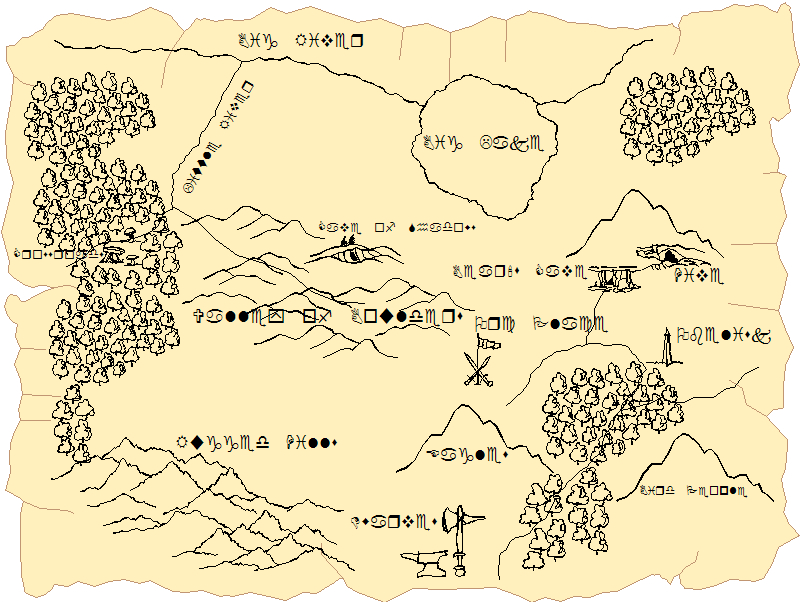 |
 |
Confronting Nellix:
It is quite possible that, at some point, the PCs will confront Nellix with evidence she cannot deny. This won't be easy, since she will deny any accusations by the PCs for as long as she can. If this happens, she will immediately seek to flee to the Cave of Shadows to warn Oss'ineryx. In this case, Verego will be apoplectic at Nellix' deception of him and will vow revenge, eager to help the PCs deal with the fey. However, he will not endanger his son, and so unless the PCs can come up with a fairly failsafe way to bring Ondagon along safely, then Verego will have to remain behind and simply wish the PCs luck.
Meanwhile, Nellix will try, if possible, to alert the kelpie, who will emerge to attack the PCs. Nellix may hang around to support the kelpie, but is not interested, at this time, in confronting the PCs and an angry Verego by herself. Instead, she will try to get to the Cave.
If the PCs do not proceed to the
cave pretty quickly after Nellix flees, then the fey will gather
up a war party (basically all of them) and head to attack the
PCs and Verego, resigning themselves to probably having to slay
the PCs and either use Ondagon as a hostage to force Verego to
teach them how to tend the hive, or keep charming him until he
does so. As a last resort, they could simply kill everyone and
then try to tend the hive themselves, but in general they will
seek to keep Ondagon and Verego alive.
Part Three - The Hive
The hive can be located once the general area is discerned by simply following the low, droning buzz that permeates the area. In addition, the vale before the cave is full of extraordinarily large wildflowers, a sign of nearby giant bee habitation (apparently, the bees possess some chemical that causes the flowers to breed larger and larger over time).
The party will no doubt encounter a giant bee or two on the way to the hive if the journey is undertaken during the daylight. These will be absolutely non-aggressive unless molested, and will tend to fly away even in the faced of trouble. They are busy gathering pollen and nectar and many will have their legs full of the fuzzy stuff. The bees have the distinctive red stripe that lends their name.
The hive is a cave which opening is some 40 ft wide and 20 ft tall. This is set at the rear of a small stone shelf that sits atop a talus of crumbled stones and boulders. It will require a Climb check to scale the detritus (DC 10), and the bees do not consider the talus to be a part of their hive. However, they do regard the stone shelf as their hive, and anyone entering the shelf or beyond will be subject to attacks.
Upon the stone shelf is a menagerie of strange, large wildflowers. If the PCs came here during "A Taste of Honey", they will not recognize these flowers as having been here before. The flowers average about 5 ft in height and have blooms averaging about 3 ft in diameter. They come in a bewildering array of colours, and anyone who makes a Knowledge (nature) check of DC 20 can tell that there is something unusual about these flowers in addition to their large size. If the check of DC 25 is made, then it can be determined, upon close examination, that the nectar and pollen of these flowers is strange. If the same close examination check is made at DC 30+, then the examiner can tell that the flowers may be used to stimulate extra honey production by the nearby bees.
These flowers are special fey flowers, gleaned from the most secret of fey glades and a result of millenia of hybridization by fey flower growers. The fey band used their initial funds to purchase these flowers, and now use them to double the output of the hive. Unfortunately, this also eventually causes irreperable damage to the bees and the hive, and will, in a matter of a few years, kill the entire hive, which will work itself to death. The fey know this, but they don't care, as they intend to have consolidated their power in the Seelie Court by then. If the Knowledge (nature) check examining the flowers was a DC 30+ or if the hive is observed for a while or the amount of honey produced is learned and a Knowledge (nature) DC 25 or Profession (beekeeper) DC 20 is made, then the eventual demise of the hive can be foretold. At this time, however, the hive can be saved if the flowers are disposed of. Each month that passes will, however, begin to cause irreperable damage to the hive.
The hive is not mapped out, as the bees do not use tactics of any sort. The cavern containing the hive is made of three chambers, each deeper into the mountainside. Each is filled with giant honeycombs along the walls, floor, and ceiling. Many of these are capped and contain wriggling larvae (2 hp, AC 10, no attacks). Still more of these are capped and contain honey or are uncapped and are partially filled with the amber liquid. Finally, a portion of these cells are uncapped and empty.
The honeycomb is made of wax. This wax is fairly thick (2 inches thick) and has a hardness of 1 and 10 hit points. The wax is susceptible to fire, which will do double damage and tend to melt all of the wax in the area of effect. Melted wax can, itself, pose a hazard, as it is quite gooey and viscous and can entrap a victim if it hardens. The details of this are left to the DM.
Moving across the cells at normal speed requires a Balance check (DC 10) to avoid falling afoul of an open cell. Moving at half speed requires no check.
The average cell is hexagonal, some 4 ft tall and slightly less than 1 ft wide.
Bees are extremely aggressive defending their hive and will attack en masse, flying in from other chambers as well. Only the queen and her regent will not emerge to fight, instead remaining in the third chamber to defend themselves.
These bees are stronger than those encountered in "A Taste of Honey" due to the fey wildflowers planted outside their lair. Should the flowers be removed, the bees would eventually return to normal strength.
Chamber One:
This is some 40 ft tall by 60 ft wide by 80 ft long. At the rear of the chamber is a passageway some 15 ft above the "floor" level. This opening is some 10 ft in diameter and leads to Chamber Two.
Within this chamber many drones can be found buzzing about forming new cells and repairing damaged ones.
During daylight hours, assume 1D10 bees are present. Additionally, assume every ten rounds 1D3 bees arrive and, if no alarm has been raised, 1D3 leave.
During nighttime, there will be a full 11 bees here, less any slain outside the hive.
Chamber Two:
The floor of this chamber is 5 ft below the entryway from Chamber One and the cavern is 30 ft tall, 30 ft wide, and 50 ft long. There is an opening at the rear of the chamber where it closes to a point. This opening is 10 ft in diameter.
Within this chamber are more drones, here with many brood in capped cells, some eggs and some almost ready to emerge.
During daylight hours, some 1D8 bees are present. During nighttime, there will be a full 9 bees present.
Chamber Three:
This smaller cavern is some 20 ft in diameter, with the entrance from Chamber Two emerging into this cavern it the equator of the roughly spherical chamber.
There are fewer cells here, and they tend to be larger. A few of the cells have large eggs within, and some of the cells contain a deep red jelly (which is, of course, royal jelly).
Within the chamber at all times are the queen and her regent. The queen is a large bee with normal forequarters and a bloated hindquarter. She is basically an egg-laying machine. The regent is the queen's bodyguard and main breeder and is designated by two red stripes instead of the normal single crimson band. His statistics are the same as the normal giant bees.
|
* Advanced Giant Bee: CR 2; Medium vermin; HD 6D8+6; hp 32; Init +2; Spd 20 ft, fly 80 ft (good); Space 5 ft; Reach 5 ft; AC 14 (touch 12, flat-footed 12); Atk +4 melee (1D4 plus poison, sting); SA poison; SQ darkvision 60 ft, vermin traits; AL N; SV Fort +6, Ref +4, Will +3; Str 11, Dex 14, Con 12, Int -, Wis 12, Cha 9. Length 5 ft. Skills and Feats: Spot +6, Survival +3 (+7 to orient themselves). Special Attacks: Poison (Ex): Injury, Fort DC 13, initial and secondary damage 1D4 Con. A giant bee that successfully stings another creature pulls away, leaving its stinger in the creature. The bee then dies. |
|
* Advanced Queen Giant Bee: CR 1; Large vermin; HD 9D8+27; hp 68; Init +0; Spd 15 ft; AC 13 (touch 9, flat-footed 13); Atk nil; SQ darkvision 60 ft, vermin traits; AL N; SV Fort +9, Ref +3, Will +4; Str 19, Dex 10, Con 17, Int -, Wis 12, Cha 12. Length 10 ft. Skills and Feats: Spot +8, Survival +4 (+8 to orient themselves). |
The Pixies:
Five pixies dwell at the hive. They dwell in Chamber Two, using their natural invisibility to remain unmolested by the bees. They have chosen a cluster of 5 adjacent combs in the wall of the chamber, and whenever a larva is emplanted into one of their combs, they eject it out. At the deep end of each comb is a 6 inch diamater hole that allows the pixies to travel from comb to comb.
These pixies essentially guard the hive for the fey. They will come to investigate if the bees are aroused, emerging from their comb invisible and then polymorphing into giant bees to blend into the hive. In this manner, they will observe intruders. If it looks like they can handle the intruders, they will (along with the bees). If not, then they will send two of their number disguised like bees to Oss'ineryx' cave to warn him. The remaining two will stay nearby to help defend the hive, possibly using their spell-like abilities to aid the bees in defending the hive (keep in mind such abilities can be used while in bee form).
One of these pixies has the ability to cast irresistible dance, and that one will always remain behind to defend the hive. They appear as pixies with glowing red eyes, fangs, vestigal horns, and scales and spikes at odd places on their bodies.
|
*Advanced Fiendish Pixies (5): CR 5 (6); Small fey (extraplanar); HD 3D6; hp 13; Init +4; Spd 20 ft, fly 60 ft (good); Space 5 ft; Reach 5 ft; AC 16 (touch 15, flat-footed 12); Atk +6 melee (1D4-2, shortsword) or +6 ranged (1D6-2, longbow); SA smite good (1/day, +3 damage), special arrows, spell-like abilities; SQ DR 10/cold iron, darkvision 60 ft, greater invisibility, low-light vision, resistance to cold 5 and fire 5, SR 17; AL NE; SV Fort +1, Ref +7, Will +5; Str 7, Dex 18, Con 11, Int 16, Wis 15, Cha 16. Height 2 ft 6 in. Skills and Feats: Bluff +10, Concentration +7, Disguise +3 (+5 acting), Escape Artist +10, Hide +10, Listen +12, Move Silently +10, Ride +8, Search +9, Sense Motive +10, Spot +12; Alertness, Combat Casting, Dodge, Weapon Finesse. Special Attacks: Spell-Like Abilities: At will - lesser cofnusion, dancing lights, detect chaos, detect good, detect evil, detect law, detect thoughts, dispel magic, entangle, permanent image (visual and auditory elements only), polymorph (self only). 8th level caster; DC = 13 + spell level. One pixie also can cast irresistible dance 1/day. Special Qualities: Greater Invisibility (Su): A pixie remains invisible even when it attacks. This ability is constant, but the pixie can suppress or resume it as a free action. Possessions: shortsword, longbow, arrows (10), memory loss arrows (2), sleep arrows (6). |
| * Memory Loss Arrows (Ex): An opponent struck by this arrow must succeed on a DC 15 Will save or lose all memory. The save DC is Charisma-based and includes a +2 racial bonus. The subject retains skills, languages, and class abilities but forgets everything else until he or she receives a heal spell or memory restoration with limited wish, wish, or miracle. |
| * Sleep Arrows (Ex): Any opponent struck by this arrow, regardless of Hit Dice, must succeed on a DC 15 Fortitude save or be affected as though by a sleep spell. The save DC is Charisma-based and includes a +2 racial bonus. |
Every four weeks, the fey send a wagon to the hive to collect honey. This wagon is pulled by two mules and carries a dozen earthenware urns with beeswax seals along with small scoops made of wood. Two fiendish grigs drive the wagon, though they are so small that it is doubtful they would be spotted just sitting in the driver's seat. Another two hide amongst the urns. In addition, four of the urns are not filled with honey and their wax seals are not tightly closed. Instead, four fiendish petals sit within, one to each urn, ready to emerge if needed.
Each urn has a capacity of 4 gallons, meaning the eight urns not filled with petals can hold a total of 32 gallons of honey. However, each urn is generally half full on average, meaning each wagon usually carries 16 gallons of honey.
The wagon travels at 16 miles per day (Spd 20 ft).
|
* Advanced Fiendish Grigs (4): CR 2; Tiny fey (extraplanar); HD 3D6+3; hp 16; Init +4; Spd 20 ft, fly 40 ft (poor); Space 2.5 ft; Reach 0 ft; AC 18 (touch 16, flat-footed 16); Atk +7 melee (1D3-3, shortsword) or +7 ranged (1D4-3, longbow); SA fiddle, smite good (1/day, +3 damage), spell-like abilities; SQ DR 5/cold iron, darkvision 60 ft, low-light vision, resistance to cold 5 and fire 5, SR 17; AL NE; SV Fort +2, Ref +7, Will +4; Str 5, Dex 18, Con 13, Int 10, Wis 13, Cha 14. Height 1 ft 6 in. Skills and Feats: Craft (woodworking) +4, Escape Artist +10, Hide +20, Jump +3, Move Silently +11 (+16 in forests), Perform (string instruments) +6, Search +3, Spot +9; Dodge, Earth Sense, Stealthy, Weapon Finesse. Special Attacks: Fiddle (Su): One grig in each band carries a tiny, grig-sized fiddle. When the fiddler plays, any nonsprite within 30 feet of the instrument must succeed on a DC 13 Will save or be affected as though by irresistible dance for as long as the playing continues. Spell-Like Abilities: 3/day - disguise self, entangle, invisibility (self only), pyrotechnics, ventriloquism. 9th level caster, DC = 12 + spell level. Possessions: shortsword, longbow, arrows (20). |
These grigs have strange red markings on their thoraxes and vestigal horns upon their heads.
|
* Advanced Fiendish Petals (4): CR 2; Tiny fey (extraplanar); HD 3D6+6; hp 19; Init +9; Spd 15 ft, fly 60 ft (good); Space 2.5 ft; Reach 0 ft; AC 17 (touch 17, flat-footed 12); Atk +8 melee (1D2-4, dagger) or +8 ranged (1D4-4, longbow); SA sleep songs, smite good (1/day, +3 damage); SQ DR 5/cold iron, darkvision 60 ft, low-light vision, resistance to cold 5 and fire 5; AL NE; SV Fort +3, Ref +8, Will +4; Str 3, Dex 20, Con 15, Int 15, Wis 10, Cha 18. Height 1 ft 6 in. Skills and Feats: Craft (flower arranging) +6, Escape Artist +11, Hide +19, Knowledge (nature) +6, Listen +7, Move Silently +11, Spot +6, Tumble +10; Combat Expertise, Improved Initiative, Weapon Finesse. Special Attacks: Sleep Songs (Su): Petals can sing two kinds of songs that deal no damage but can lill a creature into a state of relaxation or sleep. Lullabye: Any creature within a 20 ft radius that fails a DC 15 Will save is affected as though by a lullabye spell. A creature that successfully saves cannot be affected again by that petal's song for 24 hours. Sleep: This song requires two or more petals separated by no more than 100 ft to be singing in unison. any creature within 100 ft of either singer that hears the song must succeed on a DC 15 Will save or be affected as though by a sleep spell. Additional petals within 100 ft of a target can lend their voices to the song, strengthening it and increasing the save DC by 1 per additional singer. A creature that successfully saves cannot be affected again by those petals' sleep song for 24 hours. |
These petals have fiery red, demonic looking slanted eyes and bear horns upon their heads.
The honey is collected by the pixies stationed in the hive, using their invisibility to pass by the bees unmolested. The grigs drive the wagon first to Verego's lair, where the two drivers turn use their disguise self ability to appear as halflings. Verego and Nellix then bargain with the halflings, who pay them gems for the honey and then head west towards the Cave of Shadows. Once well out of sight of Verego's lair, they resume their natural forms.
If the wagon is molested, the grigs will attack, while the petals also emerge from their urn. They are all smart enough to be wary of area effect spells and will try to spread out as much as possible. They don't mind abandoning their wagon, as there is more honey and wagons and mules to be had, but the fey are small in numbers and unreplaceable.
The wagon, after stopping at Verego's lair, continues west towards the Cave of Shadows. There, the grigs show their harvest to Oss'ineryx and the rest of the fey. Ingerrixx then mounts the wagon and he and the grigs head further west to the Crossroads, where they enter to the Seelie realm to sell their wares. It takes them 3 days to get to the Seelie Court once in the realm. They spend 24 hours in the Court, enjoying themselves and conducting various missions and errands prescribed by Oss'ineryx to spread his influence. They then return to the edge of the realm and emerge, wagon and all, with empty urns (other than the four with the petals) and with Ingerrixx bearing the payment in his belt pouch. This payment is almost always in gems, worth a total of 7,000 gp. The wagon returns to the Cave of Shadows, and Ingerrixx turns the gems over to Oss'ineryx.
Part Four - Cave of Shadows
There are several ways the PCs can find the Cave of Shadows. The most obvious way is to follow the wagon back froom Verego's to the Cave. Even if the wagon is not directly followed, the constant trips back and forth to deliver food and honey have worn ruts into the ground, making it a fairly easy trail to follow. The Track DC is 19, and those who make the check will find signs of a wagon passing along the trail multiple times.
In addition, Nellix' map will show the way to the Cave.
The Cave of Shadows is about 15 miles west of Verego's lair, in a place called Broken Valley because it is strewn with massive boulders, as if some great cataclysm had smashed the sides of the valley, or an army of giants had tossed stones into the valley. This valley overlooks Landezil Lake to the northeast (refer to the map from "Against the Orcs" if a larger map is desired).
 |
On the above map, 1 inch equals about 5 miles. The orc camps are now abandoned, left from the recent orcish uprisings, but evidence of their presence can still be seen in smashed woodwork, orcish bones, and pieces of weapons and armour.
The Cave is about a third of the way across the valley, about halfway up the northern slopes of the valley, hidden amid the many large boulders that abound.
The Fey Band:
Below is the roster for the inhabitants of the Cave of Shadows:
|
* Oss'ineryx: Male shadar-kai Rogue 4/Sorcerer 1/Shadowdancer 5; CR 11; Medium fey (extraplanar); HD 3D6+3 plus 4D6+4 plus 1D4+1 plus 5D8+5; hp 67; Init +3; Spd 30 ft; Space 5 ft; Reach 5 ft (10 ft with spiked chain); AC 21 (touch 14, flat-footed 21); Atk +13/+8 melee (2D4+3, living chain) or +12/+7 ranged (1D6, masterwork shortbow); SA sneak attack +3D6; SQ darkvision 60 ft, defensive roll, evasion, hide in plain sight, improved uncanny dodge, shadow curse, shadow jump (20 ft/day), shadow illusion (silent image 1/day), summon shadow, superior low-light vision, trapfinding, trap sense +1; AL NE; SV Fort +8, Ref +19, Will +11; Str 12, Dex 18, Con 12, Int 13, Wis 10, Cha 12. Height 6 ft 4 in. Skills and Feats: Balance +12, Bluff +6, Concentration +4, Diplomacy +13, Escape Artist +20, Hide +19*, Intimidate +2, Jump +7, Listen +10, Move Silently +12, Perform (dance) +6, Search +7, Spot +9, Survival +6 (+8 following tracks), Tumble +22; Alertness, Combat Reflexes, Dodge, Exotic Weapon Proficiency (spiked chain), Mobility, Weapon Finesse. Special Qualities: Darkvision (Su): A shadowdancer can see in the dark as though he were permanently under the effect of a darkvision spell. Defensive Roll (Ex): 1/day, when a shadowdancer would be reduced to 0 hit points or less by damage in combat (from a weapon or other blow, not a spell or special ability), she can attempt to roll with the damage. She makes a Reflex saving throw (DC = damage dealt) and, if successful, takes only half damage from the blow. She must be aware of the attack and able to react to it in order to execute her defensive roll. If she is in a situation that would deny her any Dexterity bonus to AC, she can’t attempt a defensive roll. Hide in Plain Sight (Ex): A shadowdancer can use the Hide skill even while being observed. As long as she is within 10 feet of some sort of shadow, a shadowdancer can hide herself from view in the open without anything to actually hide behind. She cannot, however, hide in her own shadow. Shadow Curse (Su): The Plane of Shadow exerts a tremendous pull on shadar-kais' soul, which is only tenuously connected to its mortal body. Any time a shadar-kai is stunned, dazed, staggered, or unconscious (other than from natural sleep), the shadow fey must make a Will save (DC 15) or lose a portion of his soul to the Plane of Shadow. The shadar-kai must also attempt a save any time he removes a gal-ralan, if he has one. A shadar-kai with a damaged soul gains one negative level that cannot be removed until he restores his soul completely. If exposed to another event that requires a save against the shadow curse, a shadar-kai may gain additional negative levels. A shadar-kai on the Plane of Shadow can transfix his soul to his body again with a greater restoration spell. A shadar-kai on the Material Plane (or elsewhere) must use a wish or miracle spell to restore his soul. A shadar-kai afflicted with the shadow curse cannot be raised from the dead or resurrected, and cannot gain experience. The touch of the shadow curse galls a shadar-kai, filling his heart with an icy emptiness that eventually drives all but the most determined individuals to capitulate and leave the Material Plane altogether. A shadar-kai who goes to the Plane of Shadow and remains there ameliorates the effects of the shadow curse and suffers no ill effects. However, if he leaves the Plane of Shadow without restoring his soul, he suffers the effects of the shadow curse until he returns to the Plane of Shadow or restores his soul. Shadow Jump (Su): A shadowdancer gains the ability to travel between shadows as if by means of a dimension door spell. The limitation is that the magical transport must begin and end in an area with at least some shadow. A shadowdancer can jump up to a total of 20 feet each day in this way; this may be a single jump of 20 feet or two jumps of 10 feet each. Possessions: living chain (+2 spiked chain, +4 to Str check to trip), +2 shadow leather armour, masterwork shortbow, arrows (12), cold iron arrows (6), silver arrows (6), gal-ralan +3 (+5 against death effects, energy drains, and soul effects), blackstone rune (3 charges), night extract (4), spell component pouch. Spells Known (cast 5/4, DC = 11 + spell level): 0 - acid splash, daze, detect magic, resistance; 1 - mage armour, shield. * +10 to Hide checks in dark or shadowy conditions (anything less than daylight). |
|
* Oss'ineryx' Shadow Companion: CR -; Medium undead (incorporeal), HD 5D12; hp 32; Init +2; Spd fly 40 ft (perfect); Space 5 ft; Reach 5 ft; AC 14 (touch 14, flat-footed 12); Atk +4 melee (1D Str, touch); SA strength damage; SQ darkvision 60 ft, immune to turning and rebuking, incorporeal traits, undead traits; AL NE; SV Fort +1, Ref +3, Will +5; Str -, Dex 14, Con -, Int 6, Wis 12, Cha 14. Height 5 ft. Skills and Feats: Hide +10*, Listen +8, Search +4, Spot +8; Alertness, Dodge. Special Attacks: Strength Damage (Su): The touch of a shadow deals 1d6 points of Strength damage to a living foe. A creature reduced to Strength 0 by a shadow dies. This is a negative energy effect. *A shadow gains a +4 racial bonus on Hide checks in areas of shadowy illumination. In brightly lit areas, it takes a -4 penalty on Hide checks. |
Oss'ineryx appears like a normal shadar-kai in all respects.
|
* Fiendish Thorns (3): Male thorn Ranger 2; CR 8; Small fey (extraplanar); HD 6D6+12 plus 2D8+4; hp 47; Init +7; Spd 20 ft; Space 5 ft; Reach 5 ft; AC 20 (touch 14, flat-footed 17); Atk +10 melee (1D6+3, longsword) or +9 ranged (1D6, longbow); SA combat style (archery), favoured enemy (humanoid [elf] +2), sleep arrows, smite good (1/day, +8 damage), sneak attack +2D6; SQ DR 5/cold iron and magic, darkvision 60 ft, low-light vision, resistance to cold 10 and fire 10, wild empathy, SR 13; AL NE; SV Fort +7, Ref +11, Will +5; Str 16, Dex 16, Con 15, Int 10, Wis 12, Cha 13. Height 3 ft. Skills and Feats: Climb +7, Diplomacy +3, Hide +18, Jump +6, Listen +10, Move Silently +14, Search +9, Sense Motive +10, Spot +10, Survival +6 (+8 tracking); Improved Initiative, Stealthy, Track, Weapon Focus (longsword). Special Attacks: Sleep Arrows (Ex): Thorns carry the sleep arrows commonly used by pixies. Any opponent struck by one of these arrows, regardless of HD, must succeed on a DC 16 Fort save or be affected as though by a sleep spell. Possessions: leaf leather armour, wooden buckler, thorn longsword, longbow, arrows (20), sleep arrows (8). |
These thorns, already rather fearsome looking, possess spiked tails and jutting tusks coming up from their lower jaws.
|
* Ingerrixx: Male satyr Bard 4; CR 8; Medium fey; HD 5D6+5 plus 4D6+4; hp 42; Init +1; Spd 40 ft; Space 5 ft; Reach 5 ft; AC 16 (touch 12, flat-footed 14); Atk +6 melee (1D6+1, head butt) and +0 melee (1D4, dagger) or +7 ranged (1D6, shortbow); SA bardic music (countersong, fascinate, inspire courgae +1, inspire competence), pipes; SQ bardic knowledge +5, DR 5/cold iron, low-light vision; AL CN; SV Fort +3, Ref +10, Will +9; Str 10, Dex 14, Con 12, Int 13, Wis 13, Cha 16. Height 5 ft 6 in. Skills and Feats: Bluff +11, Concentration +13, Diplomacy +5, Disguise +3 (+5 acting), Hide +14, Intimidate +5, Jump +7, Knowledge (nature) +9, Listen +15, Move Silently +14, Perform (wind instruments) +11, Spot +15, Survival +1 (+3 aboveground), Tumble +15; Alertness, Combat Expertise, Dodge, Lingering Song, Mobility. Special Attacks: Pipes (Su): Satyrs can play a variety of magical tunes on their pan pipes. Usually, only one satyr in a group carries pipes. When it plays, all creatures within a 60 ft spread (except satyrs) must succeed on a DC 13 Will save or be affected by charm person, sleep, or fear (caster level 10th; the satyr chooses the tune and its effect). In the hands of other beings, these pipes have no special powers. A creature that successfully saves against any of the pipe’s effects cannot be affected by the same set of pipes for 24 hours. Possessions: pan pipes, shortbow, arrows (20), dagger, ring of magic fang, belt pouch, spell component pouch, 10 gems worth 500 gp. Spells Known (cast 3/3/1; DC = 13 + spell level): 0 - dancing lights, daze, detect magic, light, mage hand, mystical performance; 1 - cure light wounds, grease, hideous laughter; 2 - hold person, invisibility. |
Ingerrixx appears as a normal satyr, wearing a frost blue tabard emblazoned with unidentifable stains that could be a mixture of blood and other things.
|
* Ardumvin: Female feytouched Rogue 2/Druid 1/Thrall of Demogorgon 5; CR 8; Medium fey; HD 1D6+1 plus 2D6+2 plus 1D8+1 plus 5D8+5; hp 52; Init +6; Spd 30 ft; Space 5 ft; Reach 5 ft; AC 16 (touch 12, flat-footed 14); Atk +6/+1 melee (1D6, scimitar) or +8/+3 ranged (1D4, sling); SA charm person, dual actions, hypnosis, reaching touch, sneak attack +1D6, summon minor demon, touch of fear; SQ evasion, immune to mind-affecting effects, link, low-light vision, scaly flesh +2, trapfinding, wild empathy; AL CE; SV Fort +7, Ref +8, Will +7; Str 10, Dex 14, Con 12, Int 10, Wis 14, Cha 14. Height 5 ft 6 in. Skills and Feats: Bluff +6, Escape Artist +8, Handle Animal +3, Hide +8, Intimidate +4, Knowledge (arcana) +2, Knowledge (nature) +2, Knowledge (religion) +2, Move Silently +8, Search -2, Sense Motive +6, Spot +5, Survival +6, Tumble +7; Deformity (Eyes), Improved Initiative, Thrall to Demon (Demogorgon), Willing Deformity. Special Attacks: Charm Person (Sp): 1/day, a feytouched can use charm person as the spell at 9th level, Will DC 11. Dual Actions (Su): 2/day, a thrall of Demogorgon can take two full rounds' worth of actions in the same round. This ability is a free action. Hypnosis (Sp): 1/day, a thrall of Demogorgon can produce an effect identical to that of the hypnotism spell, except that it functions as a gaze attack with a range of 30 ft. The Will save is DC 18. Reaching Touch (Su): 3/day, a thrall of Demogorgon can cause his arms to stretch unnaturally like tentacles, providing him with an extra 5 ft of reach for 1 round. This ability is a free action. Summon Minor Demon (Sp): A thrall of Demogorgon can summon a demon of 5 HD or less 1/day. This functions as a summon monster spell cast by a 15th level caster. Touch of Fear (Sp): 3/day, a thrall of Demogorgon can use an effect identical to that of the cause fear spell. The Will save is DC 18. Possessions: +1 elf bane scimitar, sling, bullets (20), wand of cone of flame at 5th level with 32 charges, leather armour, traveller's outfit, spell component pouch, holly and mistletoe. Spells Prepared (4/3/2; DC = 12 + spell level): 0 - cure minor wounds, detect magic, naturewatch, resistance; 1 - kuo-toa skin, obscuring mist, produce flame; 2 - blinding spittle, wind armour. Cast as 3rd level druid. |
|
* Dire Rat Animal Companion: CR -; Small animal; HD 1D8+1; hp 5; Init +3; Spd 40 ft, climb 20 ft; Space 5 ft; Reach 5 ft; AC 15 (touch 14, flat-footed 12); Atk +4 melee (1D4 plus disease,bite); SA disease; SQ low-light vision, scent, share spells; AL N; SV Fort +3, Ref +5, Will +3; Str 10, Dex 17, Con 12, Int 1, Wis 12, Cha 4. Length 4 ft. Skills and Feats: Climb +11, Hide +8, Listen +4, Move Silently +4, Spot +4, Swim +11; Alertness, Weapon Finesse. Special Attacks: Disease (Ex): Filth fever - bite, Fort DC 11, incubation period 1D3 days, damage 1D3 Dex and 1D3 Con. Tricks: attack, defend, fetch. |
Ardumvin appears as an elf, though with much more angular and pronounced features and cat-like eyes. A third eye has been drilled into her forehead, and a single human eye is set there, unblinking and unmoving.
If the thrall elects to summon a demon, it will usually be a jovoc.
|
* Jovoc: CR 5; Small outsider (chaotic, evil, extraplanar); HD 4D8+18; hp 36; Init +2; Spd 30 ft; Space 5 ft; Reach 5 ft; AC 16 (touch 13, flat-footed 14); Atk +6 melee (1D3+1 [x2], claws) and +1 melee (1D4, bite); SQ aura of retribution, DR 5/cold iron or good, darkvision 60 ft, fast healing 5, immunity to electricity and poison, resistance to acid 10, cold 10, and fire 10, summon demon, SR 13; AL CE; SV Fort +7, Ref +6, Will +4; Str 12, Dex 15, Con 16, Int 7, Wis 10, Cha 7. Height 4 ft. Skills and Feats: Hide +8. Listen +7. Search +3, Sense Motive +3, Spot +7; Toughness (2). Special Qualities: Aura of Retribution (Su): This effect is always active in a 30 ft spread centered on the jovoc. Whenever the creature takes damage from any source, every nondemon within the area immeduately takes an equal amount of damage. A successful Fort save (DC 15) halves the damage. Regardless of the source of the damage to the jovoc, the damage dealth to nondemons by this effect is not subject to negation or reduction because of resistance, immunity, DR, SR, or the like. Summon Demon (Sp): 1/day, a jovoc can attempt to summon another jovoc with a 25% chance of success. |
The Cave:
Refer to the Cave of Shadows Map
below. Unless stated otherwise, ceilings are between 7 ft and
10 ft tall (roll a D4+6 if necessary). North is towards the top
of the map. Each square is 5 ft.
 |
The cave is very roughly formed, obviously natural, and cluttered with debris and detritus, mineral formations, etc. The floor is considered a natural stone floor (DMG page 60), meaning it costs 2 squares of movement to enter a square in these caves and the DC of Balance and Tumble checks increases by 5. Running and charging are impossible. Walls are unworked stone.
Areas are naturally unlit, except for area A, which receives ambient light from the outside, especially later in the afternoon when the sunlight comes in from the west and area I, which receives a shaft of light from above during the daytime. Most of the fey here have darkvision, and Ardumvin carries his own light source with him.
A. Entrance:
The entrance to the cave is fairly well hidden by the boulders that surround it. As such, it requires a DC 10 Spot check to discern. The entrance is some 20 ft wide, but only 5 ft tall, appearing as a horizontal crack in the side of the righeline that forms the northern wall of the valley. It is contained in a portion of the north slope that juts northward, accommodating a small stream that winds down south into the valley proper. The entrance is set into the eastern face of this jutting. The way up to the entrance is not particularly onerous, as the wagon is able to negotiate it, and the path of the small stream provides a decent route to approach the entrance.
Within the entrance, the ceiling quickly rises to its normal height. The fey wagon is parked here when not being used. If it is here, it will be set along the north wall of the area. The wagon cannot pass into area B due to a small stone column set in the middle of the passage between area A and area B.
B. Grand Cave South:
This large cavern is choked with stalagmites, stalactites, stone columns, and other mineral formations, some of them quite beautiful and delicate, lending the place a sort of fairyland look that, no doubt, appeals to the fey that dwell here.
At all times, one of the fiendish thorns is on watch here, hidden amongst the columns to the noertheast. There is no light here, but the thorn has darkvision, and relies on that to spot intruders. If he notices intruders, he will attempt to sneak away to alert the others and then the thorns will set an ambush while the other fey prepare their defenses.
C. Stables:
This cave has grass strewn over the floor. Two mules are stabled here when the wagon (see area A) is present. Otherwise, the cave is uninhabited. The place smells of damp fur, mule sweat, and mule dung, and likely some of the latter is drying amid the grass on the floor. A wooden water trough and a wooden feed trough stand along the east wall, and tack and harness are set in the southern tip of the cave.
D. Wagoners' Lair:
This cave is the home of the grigs and petals that accompany the wagon. If the wagon is present, the four fiendish grigs and the four fiendish petals (see Part Four above) dwell here. The cave has several stone ledges upon which are set beds of grass, leaves, and wilted flowers. A wooden cage on another ledge holds a variety of roaches, beetles, and other bugs in separate compartments, clearly a bug collection, and a small wooden double maze can only be purposed to accommodate bug races. Secreted in a small niche covered by rocks (Search DC 25) is a cache of 20 small gems worth approximately 25 gp each.
E. Grand Cave North:
This large cavern is choked with stalagmites, stalactites, stone columns, and other mineral formations, some of them quite beautiful and delicate, lending the place a sort of fairyland look that, no doubt, appeals to the fey that dwell here.
A shallow pit has been dug into the stone floor here, in the middle of the clear area of the cave. The pit is 5 ft in diameter and 2 ft deep and is filled with strange coal-shaped crystals that glow red and emit warmth. These are fey coals, crystals that absorb heat from a heatsource and emit it slowly over the course of a few days. The fey brought these from the Blanthil, and there are a dozen in total. Each crystal must be charged by having a heat source touched to it. A torch or hearth fire is sufficient, and the charging takes an hour. Thereafter, the coals emit heat equivalent to warm soup or cooked beef for 1D3 days. The coals are not hot enough to cause damage if touched, though if held in bare hands for a long time it could become painful. The coals emit only enough light to see in a 5 ft radius. Each coal could be sold for 150 gp on the open market.
F. Guard Cave:
This cave is home to the fiendish thorns, Oss'ineryx' personal bodyguard. One thorn is always stationed at area B, on watch. The others dwell here, sleeping on pallets made of thorny briars mixed with leaves and grass. The thorns have little in the way of possessions stashed here, though there are several bundles of wicked looking briars and thorny vines they have from which to fashion weapons . A Knowledge (nature) check of DC 20 can determine that these plants are not native to any place near here. If the check is DC 25, then it can be determined that they came from the Blanthil, from the corrupted western portion of the forest.
G. Shadow Cave:
This cave is the lair of Oss'ineryx, the leader of the fey. He dwells in the northern portion of this cave, sleeping on a ledge that is covered with furs. A large stalagmite has been sheered off at the top, forming a table, and on it are set several crystal bottles of fey wine, some stolen dwarven ale bottles, and a plate full of dried fruit and dwarven cheese.
A silver oval mirror hangs on the north wall, and Oss'ineryx uses this to check himself to see if the shadow curse has taken him.
Oss'ineryx' shadow companion usually dwells inside the southernmost stone column in the cave, near its eastern edge, keeping watch on all who seek to approach its master's chamber.
The northwestern stone column has a hidden niche in its westernmost face, near the cave wall. This niche is covered with stones and detritus, requiring a DC 30 Search check to find. Within is the treasure of the fey band, comprised mostly of payment received from the Seelie Court in exchange for the honey. Note that the treasure here is much less than would be expected from selling 16 gallons of honey at triple normal price for 6 months. This is for several reasons:
Nevertheless, they have managed to amass a small fortune.
There are about 100 gems here, worth a total of 7,500 gp. These are gems of all types, including many not found in this region, and some strange ones only known to the fey. Assume that no gem is worth more than 500 gp individually, and assume there are 3 pearls worth 100 gp among the stash. Scattered amongst these are a few coins of dwarven mint, including 200 cp, 150 sp, 54 gp, and 10 pp.
H. Chapel of Madness:
This cavern is the lair and sanctuary of Ardumvin, the thrall of Demogorgon and sometimes lover of Oss'ineryx and/or Ingerrixx. Oil lamps set on various small nooks and natural ledges in the cave give the whole an eerie, sensual, flickering ambience. The cave bears a horrible, if crude, carving of Demogorgon along the northeast wall, and at its feet are offerings of herbs, dead animals, etc. On a larger stone ledge is a pallet of luxurious furs, the thrall's bedchamber.
In one of the two small tunnels to the south of the cave dwells Ardumvin's animal companion, the dire rat.
I. Cistern:
This cave bears a hole in the ceiling that reaches straight up to the outside. The hole is naturally formed, approximately 2 inches in diameter, and allows light to diffuse in during the daytime, becoming a beam of light illuminating the center floor of the chamber during the middle of the day.
A wooden barrel sits below the hole, to catch rainwater, and the barrel is currently about 1/4th full. Piled around the chamber are the stores of the fey band, including fruit, berries, buts, stolen dwarven cheese, even pilfered orc rations.
Ingerrixx:
Ingerrixx, not having any sort of fiendish heritage, does not like to spend time underground. His nature is to dwell outside. Therefore, the satyr is not often found in the cave. Rather, during daylight hours he is often out and about, scouting the valley and exploring, frollicking and playing his pipes. He does, however, remain within sight or earshot of the cave about 35% of the time. If so, he will attempt to come and aid his companions in the case of trouble. Otherwise, he will return to the cave in 1D4 hours, and if anything is amiss, he will investigate, and, assuming none of his companions are left, try to alert Nellix and/or flee to the crossroads.
It is also possible Ingerrixx will spot the PCs as they pass through the valley, either on their way to the Cave of Shadows or afterwards, on their way to the crossroads. Assume a 15% chance for each leg that Ingerrixx will be in a position to see or hear them. If so, he will scout out the PCs and then attempt to report to Oss'ineryx.
Finally, should the PCs decide to camp out somewhere in the valley (perhaps to observe the cave), the DM should allow Ingerrixx a 5% chance per hour of coming upon the camp.
Observing the Cave:
The PCs may decide to observe the cave. If they do, the DM has enough information presented in this scenario to describe the activities of the wagon. In addition, they will note Ingerrixx frequently entering the cave, but usually leaving shortly thereafter, so that it is clear the satyr spends most of his time out of doors. In addition to the wagon, the thorns will make an occasional appearance, as will Ardumvin, usually to relieve themselves or to gather food or to get some water from the nearby stream. These will usually go alone, and other than Ingerrixx, will not leave out of bowshot of the cave. Oss'ineryx almost never leaves the cave, as he is perfectly satisifed dwelling in the gloom.
Part Five - The Seelie Court
The Crossroads:
There are several ways for the PCs to find the crossroads. They can track the wagon, from the Cave of Shadows to the crossroads. The Track DC is 24, and those who make the check will find signs of a wagon passing along the trail multiple times (though less so than between Verego's lair and the Cave of Shadows).
In addition, Nellix's map can show the way here; as can the map found in the Cave of Shadows.
The entrance to the Seelie Court is located at a crossroads some 10 miles to the west of the Cave of Shadows, under the eaves of the Gatyranzum Forest. It is in the form of a fairly well hidden sylvan glade, in the form of two tall stone menhirs surmounted by a massive stone slab of a lintel. The whole is about 13 ft tall and the archway thus formed is 10 ft square. This sits atop a grassy knoll that is about 50 ft in diameter and 15 ft tall.
The mound is an ancient fey mound, a burial ground for the fey of this region in ancient times, before they were mostly driven out. Refer to Magic of Faerun, page 43, for a detailed explanation of fey mounds. There are no defensive fey here, as they have long abandoned the place, but the strange magical effects are still present and will affect any non-fey who approach it.
At 51-100 ft from the mound, a silent image of 3 faun and 2 nymphs will be seen and heard cavorting amongst the trees, even copulating at times.
At 21-50 ft from the mound, hallucinatory terrain covers the boomshroom patch that encircles most of the mound (see below), making it appear exactly like it would were the shrooms not present.
At 11-20 ft froom the mound, a sleep spell is cast each round.
At up to 10 ft from the mound, a lesser geas is cast, instructing the target to leave his valuables where he stands and to flee this place and not return for a week.
All of these power are at 20th level and have a save DC of 14 + spell level.
Around the mound, in a ring circling its base at a distance of 15 ft, is a match of boomshrooms. This match circles the entire mound, and is 15 ft deep, except for a 10 ft wide path that approaches the mound from the northwest. Refer to Magic of Faerun, page 43, for full details. Anyone moving through the patch at a faster rate than a 5 ft step require a Spot check with a DC equal to their speed (i.e. feet moved that round). Failure means that the creature has a 50% chance of triggering a boomshroom during that round.
| * Boomshroom Patch: CR 3; spell; spell trigger; no reset (1 week to regrow); spell effect (fire trap, 1D4+12, DC 15 Ref save half damage); Search DC 27; Disable Device or Survival DC 27. |
The stone structure in the middle of the mound is the crossroads. As is always the case, a guardian wards the way.
|
* Advanced Crossroads Guardian: CR 9; Gargantuan fey (incorporeal); HD 24D6+120; hp 204; Init +2; Spd 20 ft, fly 40 ft (perfect), swim 20 ft; Space 20 ft; Reach 20 ft; AC 10 (touch 10, flat-footed 8); Atk +12 melee (3D6, touch); SA summon satyr; SQ guardian qualities, incorporeal traits, telepathy 100 ft; AL N; SV Fort +11, Ref +16, Will +20; Str -, Dex 14, Con 20, Int 15, Wis 18, Cha 15. Height 20 ft. Skills and Feats: Bluff +14, Decipher Script +5, Diplomacy +4, Escape Artist +17, Intimidate +16, Knowledge (nature) +20, Listen +27, Move Silently +11, Sense Motive +25, Spot +27, Survival +20; Alertness, Combat Expertise, Combat Reflexes, Dodge, Ghostly Grasp, Iron Will, Skill Focus (listen), Skill Focus (sense motive), Skill Focus (spot), Skill Focus (survival). Special Attacks: Summon Satyr (Sp): 1/day, a crossroads guardian can attempt to summon 1D3 satyrs with pipes with a 35% chance of success. This ability has a duration of 1 hour. Special Qualities: Guardian Qualities (Ex): Guardians must stay within 50 ft of the crossroads they protect. |
The guardian's attitude would normally be N2 (Friendly), however, due to the ancient wars with the Thaneeri, it is now Indifferent to non-Thaneeri and Unfriendly to Thaneeri. The guardian can tell if a person has Thaneeri blood, and anyone with more than one-quarter Thaneeri blood will be sensed. Refer to Magic of Faerun page 46 to determine what the guardian's attitude means. Generally, Indifferent or better will allow the person to pass, but a check must be made using some sort of Charisma check even if the person starts as Indifferent (since there is a chance for attitude to decline). Each individual must convince the guardian seperately, each time passage is desired.
If the archway is passed through, the traveller will emerge in the land of the Seelie Court.
The Seelie Realm:
The Seelie Court is one of several powerful fey kingdoms that exist in Therra. While there is no longer any overking of the fey, as there was in ancient times, due to the slumber of Galasiria and the loss of Blanthil in ancient times, remnants of the ancient kingdom splintered off to form various fey courts.
The Seelie Court was formed of fey who, instead of fleeing south to other sylvan locales, decided to actually dwell amid the backroads of the fey. They found a nexus in the backroads and used their power to form a sort of demiplane. However, this demiplane exists on the Material Plane. It is sort of an alternate Material Plane, formed from the folded fabric of space and time that makes up the backroads. The place, called Seelie, is a 100 mile diameter sphere, comprised of what can only be described as an idyllic sylvan setting. Meadows, lakes, river, and woodlands abound, with three greatt mountains capped with snow and surrounded by hills in the center of the plane. The temperatue is always mild, and it never rains, though in the wee hours of the morn a mist fills the air and forms a dew on the ground as dawn comes. No sun is visible, though night and day occur as normal, apparently a reflection of conditions on Therra, though at any given time the realm is entered the time of day should be determined randomly and then tracked from that point on. At night, stars shine in the heavens, but they are configured differently each night. There is no moon here.
The surface of the realm cuts across the sphere of the plane through its midpoint. At the edges of the sphere is a wall of swirling, rainbow colours. Anyone passing through the mist will always appear at the last crossroads he used to enter the realm, even if the guardian was slain.
The Seelie Realm has the following traits:
There are no roads in the Seelie realm. But the wagon can be tracked, though it takes a DC 25 Track check, with a +1 for every day that has passed since the wagon last came (this because grass overgrows the wagon trail rather quickly and thoroughly here).
PCs traveling the realm will certainly encounter various fey. These are seelie fey, and generally include grigs, pixies, and satyrs. Most of them possess the half-celestial trait, as they are ancient fey descended directly from the first fey who sprang from Galasiria's lore. They will be very curious at non-fey travelers, and warn them against causing any mischief. Indeed, they will be told that they cannot, by any means, leave the realm until they have the permission of the Seelie Court. This is true. Any attempts by any non-fey to go back into the mist at the edge of the realm or to leave by any means whatsoever, including plane shift, teleport, or other means, fails utterly. Only a wish or miracle spell can subvert the will of the Court.
Inhabitants can direct the PCs, if they ask, to the Court. It is located on the crest of a tall hill at the foot of one of the three great mountains of the realm. A bejewelled path climbs the hill, upon which is an amazing castle made entirely of crystal. Its spires are slender and elegant and rise a hundred or more feet into the air. The structure sparkles with the colours of the rainbow during the day and like a million fireflies at night. As such, it can be seen clearly from at least 25 miles away.
Hundreds of very powerful fey are here, flying or moving about as they will. Many of the Seelie are sidhe, which are some of the original fey created by Galasiria. These are essentially elves with the half-celestial template added, though they have the fey type and usually have gossamer wings instead of feathered wings.
The PCs can approach the doors of the castle, which are flung open. Fey can be seen leaving and entering, but as non-fey, they will be stopped by two special crossorads guardians that serve as door wardens. These are 32 HD crossroads guardians and are gargantuan in size. They will ask the PCs their business, and assuming reasonable answers are given, they will summon 2D3 satyrs to escort the PCs to the Court.
The Court:
The Court is always in session, though the sessions can vary from a solemn audience to a revelry sodden with drink and debauchery. The audience chamber and throneroom is usually quite crowded with fey of all kinds, and the unsleeping king (sidhe Ranger 16) and queen (sidhe Sorcerer 4/Ranger 1/Druid 12) of the Seelie Court. These two worthies, along with the magister of the Court (sidhe Sorcerer 3/Wizard 13), are the triumverate of power of the Seelie realm.
The PCs will likely be a very great event in the Court. Non-fey are extremely rare here, at least ones not enthralled, charmed, or otherwise abducted to the realm as a slave or lover. Their appearance will cause a hush in the din of the Court, and a low buzz will begin and the gossip starts immediately as to the bravery, audacity, and strangeness of the PCs.
The king and queen sit on thrones of solid sapphire, atop a high crystal dais. Each wears a mithril crown adorned with an amazing assortment of diamonds, pearls, and emeralds. Between them stands the magister, in robes that glitter in a prismatic display of energy and bearing a staff made of a strange metallic blue woodand topped by what can only be described as a tiny piece of a star, as it is impossible to stare directly at it for long, though it sheds only a soft light in a 60 ft radius.
The king and queen have somewhat kindly meins, though with the twinkle of latent mischief in their eyes. Both are beautiful and radiate royalty and wisdom. The magister, on the other hand, though certainly not malign looking, radiates power in his bearing and suspicion and wariness on his face.
As the PCs approach within 25 ft of the dais, they will be affected by a suggestion spell to bow on one knee. This is at 20th level with a save DC of 19. The Court does not require bowing, but will be amused by any weak-minded individuals who do bow and intringued by any brazen enough not to.
The king and queen will initiate conversation, asking the PCs why they have dared to brave entry into the Seelie realm. From there, it will be up to the PCs to direct the parley. The king and queen will ask general questions, displaying no mistrust, but the magister will often chime in with more pointed followup questions, making it clear with a Sense Motive DC 10 check that while he does not hate the PCs, he mistrusts them greatly.
It is assumed that the PCs will eventually turn to the issue of Oss'ineryx and his band of fey and the red-stripe honey. If any of Oss'ineryx' band are here, they will plead their side of the case, emerging from the crowd to confront the PCs. Below are the issues that will probably be addressed:
1. The PCs want to return home - The king and queen will allow them to leave unmolested, even granting them a 1 day head start before allowing any of Oss'ineryx's band to pursue them. If asked, the PCs will be informed that they can leave the realm anyplace along the edge, returning to the crossroads they came from. This knowledge can be used to elude pursuit. However, the PCs will be warned that should they ever be found in the Seelie realm again unbidden, they will likely forefeit a good many of their years in service here.
2. The PCs want to stop Oss'ineryx from continuing to usurp the hive from Verego - The Court will not really look askance on the simple matter of deception engaged by Oss'ineryx and his band, for deception is a way of life for many fey, and a good prank that harms no one is actually respected. If none of Oss'ineryx' band is present, the PCs will be asked to abide until Ingerrixx returns with his wagon. If that won't be happening (perhaps the PCs have slain everyone), then the matter of judgement will continue. If one of Oss'ineryx' band is present, he will point out that Verego was paid a fair sum for the honey. In addition, the Court and those present will express their admiration for the honey and desire to procure more of it.
3. The PCs want to sell honey to the Seelie instead of Oss'ineryx's band - If the PCs express a desire to sell the honey to the Seelie Court themselves, they may be seen as hypocrites, unless they also mention that they would inform Verego and disclose the full price they received from him.
The Court will not, solely, prohibit Oss'ineryx from taking honey from the hive. The Court desires honey, and is not willing to stop Oss'ineryx and cut off their supply. However, if the PCs propose an alternate means of supplying the Court with honey, then they may be willing to do something about that.
If none of Oss'ineryx band can show up to plead their case, then the PCs can simply offer to supply honey to the fey (or have the dwarves or Verego himself to supply it). The fey will then agree to stop any of their own from plundering the hive again. The Court will expect the same amount per month as Oss'ineryx delivered, and if they find out that they were paying triple the non-fey price for the stuff, they will demand to only pay double. If the effects of the flowers are mentioned, specifically that continued use of the wildflowers outside the cave will eventually kill the hive, then the Court will accept half the current supply.
In order to arrange this, first the magister's attitude must be changed from Unfriendly to Indifferent. Then the attitude of the king and queen must be changed from Indifferent to Friendly.
If the PCs make a plea that the delivery of honey be halved so as to allow the dwarves access to some of it, then they will have to change the attitude of the king and queen to Helpful.
If a member of Oss'ineryx' band is present, then he will dispute any attempt to take away the honey deliveries from the band of fey (if multiple members are present, it will be the one with the best Diplomacy bonus. He will point out that Verego was paid the appropriate price, the same he would have received selling it to the non-fey of the region, and that neither he nor his cub were in any way harmed.
In this case, after the above Diplomacy rolls are made, if successful (at least to the extent of potentially gaining access to sell the honey to the Court), an opposed Diplomacy check against the fey band representative must be made.
Results of the Parley:
A. If the PCs are unchallenged by the fey band, but fail to sway the Court, then they may simply leave. Eventually, the fey may return, either Oss'ineryx' or his band or others, desirous of the honey as they are. The PCs could still secure the honey by warding it against the fey and then simply offering to sell it themselves. The disadvantage of this approach is that the fey will constantly attempt to grab, steal, or sell the honey themselves. In any event, the PCs will be invited to leave the realm.
B. If the PCs are unchallened by the fey band but do sway the Court, then they can arrange for delivery of the honey with Verego and/or the dwarves in whatever way satisfies the Court, Verego, and the PCs. The exact arrangement is left to the DM and PCs, but everyone involved should profit. The PCs will then be invited to leave the realm, returning only if they bear a honey delivery.
C. If the PCs are challenged by Oss'ineryx' band and fail, then Oss'ineryx' band will be allowed to continue to supply honey. It is up to the PCs if they wish to attempt to stop them by force of arms, but Oss'ineryx could come back to the Court and request aid, though eventually his evil nature may shine through and the Seelie Court's support will wane. Nevertheless, the PCs could dispatch Oss'ineryx' band and take up deliveries themselves, essentially ending up just as if they had been unchallenged but failed to sway the Court (option A above).
D. If the PCs are challenged by Oss'ineryx' band but succeed, then it will be apparent to all that the Court is about to judge in thefavour of the PCs. But just before this can happen, the representative of the fey band will suddenly leap forward and, in Sylvan, demand to decide the matter in the ancient rites of the Great Contest.
If the PCs are disrespectful to the Court, they will be thrown into a dungeon for a time to teach them some manners. If the PCs attempt to resist or cause trouble, the DM can assume there is enough power here to slay or imprison the PCs, or he can allow them to escape with the fey in pursuit. In general though, the DM should make it clear that these fey are very powerful and not to be trifled with.
The Great Contest:
The Great Contest is a ritual amongst the fey to settle disputes. It is a sacred rite, invoked by fey, and rarely involving non-fey, though there is no prohibition against non-fey taking part. The ritual is designed both to settle disputes safely and decisively and to provide entertainment for those in the audience. Since fey have significant magical powers and a very mischeivous nature, disputes not settled in a ritualize fashion could spiral quickly out of control. Technically, the Court has the right to settle disputes without a Contest. However, it is rare that the Court will deny a Contest or overrule it.
In the case of the PCs, when the Contest is proposed by the representative of the fey band, a rousing cheer will go up amongst those fey present in the chamber. The king and queen will whisper a bit to the magister, who will nod and, with a flick of his wrist, produce a strange flower with a yellow center and petals of black and white. The flower seems to writhe in his hand, even though it is plucked. The magister will intone a mage and spell and the flower will float before the PCs. The crowd will hush as everyone leans forward to see what the PCs will do.
The ritual response to the challenge is to pluck a black petal if the challenge is accepted and a white petal if it is not. If the PCs pluck a white petal, then the crowd will express its displeasure and the PCs will suffer a retroactive -10 penalty to their Diplomacy rolls, likely causing them to fail in their attempts to sway the Court.
If the PCs pluck a black petal, then a cheer will rise up and the queen will announce that the Great Contest will begin the next evening.
If the PCs do nothing, then the magister will ask why they wait and urge them to give their answer to the challenge. If the PCs claim ignorance of fey customs, there will be laughter and snickering in the crowd, but the magister will tell them what plucking each type of petal means. If the PCs ask what the Great Contest involves, the magister will explain that it is comprised of five tests, and the party of agrieved that wins the majority of them will prevail, by the will of Galasiria and the vagaries of luck, fate, and whimsy.
If some of the fey band are alive but outside of the Seelie realm, then the fey band representative will beg the Court to allow time for the rest to be summoned and arrive. The Court will agree to this, and the DM should determine how much time is needed to gather them.
The PCs will be escorted outside the castle, to camp as they deem fit. The next evening (or whenever the Contest is to begin), they will be led back into the audience chamber, where the Contest will begin.
The Contest is fairly simple as far as rules go. Magic is allowed and encouraged in all respects. It is a best of five contest, but all five contests must be engaged. A representative of each party can be chosen for each contest, and each contest is announced and explained before each representative is chosen. If the fey band has more than one representative, then they will choose whichever member they think stands the best chance of winning.
It will, unfortunately, be assumed that the PCs are familiar with the rules of each contest. This is especially true of obscure rules like shalm from the Contest of Arms. It therefore might be a surprise when their opponent suddenly yells "shalm!" and gains a shot at the special target! PCs who ask for details of the contest before each event will have the rules impatiently explained by the magister.
During these contests (except for the contest of beauty) the assembled fey cast many wagers, most involving gold or gems, but others involving humiliaing servitude or embarrassing stunts. The PCs not involved in the event may try to get in on some of these wagers, though the DM should decide what amounts or stakes are suitable.
For those events conducted with the spoken word (such as the Test of Wit), only Sylvan is spoken. It will be up to the PCs to have one of their members who can speak Sylvan or to provide translation magic.
Contest #1 - The Test of Luck:
This test is simply designed to test who has the ear of the fates or luck. Flupnir is invoked by the magister in the ceremony opening this event. A strange rod is brought forth, being from 3 ft tall and comprised of strangely warped wood and topped by a gem that seems to throb and writhe in its wooden grasp. This is a rod of wonder.
The contest is simple. Each representative is taken to a field, in the shape of an oval 50 ft wide and 100 ft long. A glowing purple line surrounds the field. The audience stands around the field to witness the event. The magister stands on a pedestal of crystal inside the purple line halfway along the long edge of the field bearing the rod. Each representative is placed on his own half of the field, which is divided by a glowing purple line running across the field. The magister will point the rod at one contestant and activate the rod. He will then, next round, do the same to the other contestant. The next round, he will turn back to the first contestant and activate the rod again, and so forth, so that each contestant gets another blast of the rod every two rounds. This will continue until one contestant surrenders, leaves the field, is rendered unconscious, or rendered incapacitated. Magic may be used, but the purple lines surrounding the field and dividing it in two generate anti-magic effects that rise up 20 ft and then bend to meet in a ceiling some 25 ft overhead. They also extend to about 3 inches below the grass level of the field, forming a floor. The actual anti-magic boundaries are invisible, but will stop any errant magic from affecting the crowd or the other contestant. It will be explained that the field's boundaries extend 25 ft above the surface of the field and 3 inches below. It can be assumed the magister has enough magical protection to be unaffected by any of the effects of the rod or spells of the PCs.
The effects of the rod are as indicated in the DMG, except as follows. Additionally, if the DM desires, he can use the expanded rod of wonder tables taken from the 2nd edition AD&D Encyclopedia Magica book presented in Appendix One of this scenario.
Finally, allow a 1 in 20 chance that the rod simply casts a dispel magic (equal chance of targetted or area) at the target. If this chance does not happen, then consult the apppropriate tables.
26-30 = The stinking cloud effect is at up to a 50 ft range.
34-36 = The summoned animal will attack the contestant for 10 rounds or until dead. There is a 50% chance that the creature has the half-fey template (see below for statistics). The creature appears within 50 ft of the rod, adjacent to the target. Substitute a rat for the mouse.
47-49 = The butterflies cover the entire 50 ft square area all the way to the 25 ft high ceiling and persist for 1D4+1 rounds.
63-65 = Will affect a single object in the contestant's possession, DM's choice or determine randomly. Will save negates. Etherealness of the object lasts for 1D10 rounds.
88-90 = The gems shoot in a 60 ft long stream.
91-95 = The colours play over a 50 ft square area that is 25 ft high.
|
* Half-Fey Rhino: CR 5; Large fey; HD 8D6+32; hp 60; Init +1; Spd 30 ft, fly 60 ft (good); Space 10 ft; Reach 5 ft; AC 17 (touch 10, flat-footed 16); Atk +13 melee (2D6+12, gore); SA powerful charge, spell-like abilities; SQ immune to enchantment spells and effects, low-light vision; AL CN; SV Fort +10, Ref +7, Will +4; Str 26, Dex 12, Con 19, Int 2, Wis 15, Cha 6. Length 10 ft. Skills and Feats: Listen +15, Spot +15; Alertness, Endurance, Improved Natural Attack (gore). Special Attacks: Powerful Charge (Ex): A rhinoceros deals 4D6+24 points of damage when it makes a charge. Spell-Like Abilities: At will - charm person; 3/day - detect law, protection from law; 1/day - confusion, glitterdust, hideous laughter, hypnotism, sleep. As 8th level caster; DC 12 + spell level. |
|
* Half-Fey Elephant: CR 8; Huge fey; HD 11D6+44; hp 82; Init +1; Spd 40 ft, fly 80 ft (good); Space 15 ft; Reach 10 ft; AC 16 (touch 9, flat-footed 15); Atk +16 melee (2D6+10, slam) and +11 melee (2D6+5 [x2], stamps) or +16 melee (2D8+15, gore); SA spell-like abilities, trample 2D8+15; SQ immune to enchantment spells and effects, low-light vision, scent; AL CN; SV Fort +11, Ref +8, Will +7; Str 30, Dex 12, Con 19, Int 2, Wis 15, Cha 11. Length 12 ft. Skills and Feats: Jump +15, Listen +19, Spot +16; Alertness, Endurance, Iron Will, Skill Focus (listen). Special Attacks: Spell-Like Abilities: At will - charm person; 3/day - detect law, protection from law; 1/day - confusion, eyebite, glitterdust, hideous laughter, hold monster, hypnotism, sleep. As 11th level caster; DC 12 + spell level. Trample (Ex): Ref save for half (DC 25). |
|
* Half-Fey Rat: CR 1+1/8; Tiny fey; HD 1/4D6-1; hp 1; Init +3; Spd 15 ft, climb 15 ft, fly 30 ft (good); swim 15 ft; AC 15 (touch 15, flat-footed 12); Atk +5 melee (1D3-4, bite); SA spell-like abilities; SQ immune to enchantment spells and effects, low-light vision, scent; AL CN; SV Fort +1, Ref +5, Will +2; Str 2, Dex 17, Con 8, Int 2, Wis 14, Cha 6. Length 6 in. Skills and Feats: Balance +10, Climb +12, Hide +18, Move Silently +12, Swim +10; Stealthy, Weapon Finesse. Special Attacks: Spell-Like Abilities: At will - charm person; 1/day - glitterdust, hypnotism. As 1st level caster. DC 12 + spell level. |
Contest #2 - The Test of Wit:
This is a contest of three puzzles or games of intellect. It is often difficult in roleplaying games to administer such things because the Int of the PCs could be quite different from the Int of the players. Nonetheless, it is usually much more enjoyable to actually the the player participate. The rules below attempt to involve the players and still reflect the PC's intelligence. The additions designed to reflect PC intelligence are detailed in brackets.
A single contestant from each side must take part in all three parts of this contest.
Test A - The Numbers Game:
This is a simple game involving each contestant choosing a number between 1 and 3. To this number is added the next contestant's choice, and so on. The contestant who takes the sum to 14 or over loses.
This is a very easy game if you know the proper sequence. Here it is:
First choice must be 1.
Next choice must get to 5.
Third choice must get to 9.
Fourth choice must get to 13.
If the first person chooses 2 or 3, then the second person can win by getting the total to 5 and then following the above.
The game is played with each player being given a handful of 14 gems, red for one player and blue for the other. Each places the number of gems each turn into a copper bowl set on a wooden pedestal. A coin flip determines who will start (which represents drawing of lots).
[To reflect Int, allow the PC to have as many seconds to respond to each stage of the game as his Int score. If he doesn't respond by then, roll a D3 for him. For the opponent, roll an Int check. If the DC is 15 or more, then have the opponent choose the proper next choice. If the check is not made, then roll a D3 and have that be his choice.]
Test B - The Riddle:
The magister will ask a riddle and the first contestant who answers it first correctly wins. An incorrect answer means the other contestant wins.
The riddle is:
I have as many brothers as sisters, but my brothers have twice the number of sisters as brothers. How many children do my parents have?
The answer is:
Seven.
[To reflect Int, allow an additional player to help for every 2 points of Int above 12, if Int is below 12, then add 1 minute per point below to the time taken to solve the problem if the correct answer is given. The opponent will successfully answer the problem when a DC 20 Int check is made. This check is made every minute, starting 60 seconds after the riddle is given, and for each minute an additional +1 is given to the check (so at 120 seconds a +1 bonus is given, at 180 seconds a +2 bonus, and so forth). If a check is ever 5 or less or if a natural 1 is rolled, then an incorrect answer is given.]
Test C - The Quiz:
This test involves the magister asking various questions from a rack of tomes he has it his beck and call. There are three questions in each area, with each area represented by a Knowledge skill. The first person to answer the question correctly scores a point. But if a wrong answer is given then the opponent scores the point. Every 12 seconds, the magister gives another hint to the question, until eventually, after 60 seconds, he starts to spell out the answer. Bardic knowledge may be substituted with a -2 circumstance penalty. An Int check may be used in place of a Knowledge check.
Categories and their corresponding skills include:
Mystic Feycraft = Knowledge (arcana) [-1]
Crystal Formation = Knowledge (architecture and engineering) [-1]
The Underworld = Knowledge (dungeoneering) [-1]
The Mundane World = Knowledge (geography) [-1]
The Record of Years = Knowledge (history) [-2]
The Way = Knowledge (local) [-5]
The Goddess' Garden = Knowledge (nature) [-1]
The Sidhe = Knowledge (nobility and royalty) [-3]
The Goddess' Court = Knowledge (religion) [-2]
The Strange Places = Knowledge (planes) [-1]
All of the questions tend to be fey-oriented, some categories more than others. The bracketed numbers are penalties to the PC's checks due to the fey-orientation of the category. Each question starts as a DC 30 check. Each 2 rounds (12 seconds), another hint lowers the DC by 4. After a minute, the DC lowers by 1 every 1 second that passes until the answer has been spelled out and the DC is zero.
Thus, DCs will digress as follows:
Round 1 = DC 30
Round 3 = DC 26
Round 5 = DC 22
Round 7 = DC 18
Round 9 = DC 14
Round 11 = DC 10
Round 12 = DC 9
Round 13 = DC 8
Round 14 = DC 7
etc.
The DM should announce the skill category and the starting DC of 30. He should then ask if the PC wishes to try to answer. If so, then the check should be made and, if successful, the PC scores a point. If failed, then the opponent scores a point. If the PC does not yet wish to answer, then the DC drops and again the PC is asked if he wants to answer, and so forth.
The opponent will try to answer using a formula with some random elements so that the players cannot determine when, exactly, they will answer. Basically, an opponent will try to answer a question when the roll needed to make the DC drops below 11 (for example, if an opponent has a Knowledge [nature] modifier of +6, then it would answer a question on round 9). This is known as the Base Answer. However, this will be modified by a D20 roll compared to the opponent's Wis score. If the roll is equal to or less than the Wis score, then the opponent rolls a D3. On a 1 the answer is at the Base Answer minus 2 rounds. On a 2 the answer is at the Base Answer exactly. On a 3 the answer is at the Base Answer plus 2 rounds.
If the D20 roll is greater than the opponent's Wis score, then the opponent will give the answer early (50% of the time) or late (50% of the time). An early answer will be given 1 round early for every point the D20 roll exceeded Wis. A late answer will be given 1 round late for every point the D20 roll exceeded Wis.
Example: An opponent with a Knowledge (nature) modifier of +9, and a Wis of 14 is engaging in the quiz. The first question is asked. The DM rolls a D20 and the result is a 7. As that is under his Wis, the DM determines the Base Answer is Round 7. He rolls a D3 and rolls a 3. The opponent will answer on round 9.
Example 2: The same opponent now is posed another question in the same category. The D20 roll is a 17. As that is over his Wis, the DM rolls percentile and rolls a 67, so the answer will be late. As the roll was 3 over his Wis score, the answer will be given in round 10.
There are a total of 30 points. The first contestant to 16 points wins. If there is a tie, a final question in a random category will be asked.
[There is no need to adjust this category for Int, since the actual questions are not being poised, since the Knowledge checks already account for the PC's intelligence and the opponent's intelligence.]
Contest #3 - The Duel of Magic:
This will be a nonlethal spell duel as described on pages 175-176. The magister will explain the rules, though the DM should refer to the sidebar on page 178 regarding pretending to pull punches. Assume the magister has a Sense Motive bonus of +16 (maximum cross-class plus Skill Focus). The duel will take place on the same field as the Test of Luck, but the middle purple line dividing the field into half will be gone.
Contest #4 - The Test of Arms:
Fey consider arms to mean ranged weapons. This is an archery contest, and must be done with bows. The target is of wood mounted on hay, and consists of a wooden flower whose petals are coloured yellow on the outer third, blue in the middle third, and green in the inner third. The center of the flower is a red circle.
The target will be moved 60 ft away. There are 3 rounds of shooting, each round consisting of 3 shots for each contestant. The contestant with the highest final score wins. Each contestant shoots his 3 shots before te next contestant proceeds.
Each shot is adjudged by making an attack roll. Determine the best AC hit to find what colour of the target was hit.
Miss = AC 5
Yellow = AC 10
Blue = AC 15
Green = AC 20
Red = AC 25
Each contestant has 2 rounds (12 seconds) to shoot. This means a round is available to cast a spell. Only personal spells or spells that target only the caster, or spells cast on that contestant's bow or arrows are allowed.
Points are as follows:
Miss = 0
Yellow = 10
Blue = 15
Green = 20
Red = 25
Once per contest (at the end of the round usually), a shooter can claim "shalm" by yelling that word (meaning trade in Sylvan). A tiny target mounted on a pendulum is brought out at a range of 60 ft and set into motion. The archer must hit AC 30 to hit the target. If he does, he may claim any single arrow shot by his opponent as his own and trade it with one of his own. The shalmer now gains the points of the newly claimed arrow and gives the points of his traded arrow to his opponent.
Example: Ingerrixx calls "shalm!", since all three of his arrows hit the yellow and all 3 of the PC's arrows hit the green. He fires and somehow hits the pendulum. He now claims one of the PC's green shots and gives one of his own yellow shots in exchange. For the round, Ingerrixx scores 40 points (2 yellows + 1 green) and the PC scores 50 points (2 greens + 1 yellow).
Remember, a 20 always hits the red circle on the main target and always hits the pendulum during a shalm. Critical hits have no special effect.
Contest #5 - The Test of Beauty:
This is a test of some sort of performance display. It can include illusion spells, dance, singing, instrument playing, or even a display of tumbling. Each contestant has 2 minutes to perform. A Knowledge (nature) check of DC 10 will grant a +2 synergy bonus on any performance below, representing the contestant determining what will best satisfy the fey audience. Fey contestants automatically gain a +3 bonus instead of making the Knowledge (nature) check.
For singing, comedy, dancing, or instruments, simply use a Perform check (oratory is not considered beautiful by the fey).
For Tumbling, apply a -5 penalty to the Tumble check due to the difficulty in adding artistic flair to the tumbling moves.
For illusion (figment) spells, the contestant should make a Spellcraft check followed by a secondary check based on the nature of the illusion in question. Halve the total of these two checks, and apply the following modifiers:
+1 for Spell Focus (illusion) or +2 for Greater Spell Focus (illusion)
-3 for each level of illusion (figment) spell cast below 3rd level
+1 to +3 circumstance bonus depending upon the nature of the illusion and how the audience might react to it.
The secondary check would be in a skill complimentary to the illusion in question. This could be a Craft skill such as Craft (painting) or Craft (sculpting) for a visual emphasis or Perform (sing) for a singing illusion. If no skill applies, then a simple Cha or Int check would suffice.
The magister first intones a ritual which opens the thoughts of the assembled to his scrutiny, as if a detect thoughts spell had been cast. The audience is expected to not resist the effects, and the magic only picks up the thoughts pertaining to the performance in question. In this way, the true opinions of the assembled are recognized.
The test is administered in three rounds, and the winner must best his opponent in two of the three rounds. Each round must utilize a different performance (and a different skill). A single representative must perform all three rounds.
Instruments can be provided if requested. They will be normal in all respects.
Resolution:
If the PCs lose the Great Contest, then that is it. Oss'ineryx will keep his arrangement with the Seelie Court and will attempt to hold his own on the Material Plane. The PCs can still defeat him and his band, seize possession of the hive with Verego, and then try to pressure the Seelie Court to deal with them. As mentioned previously, the problem with this solution is that other fey are free to attempt to wrest the hive back or to steal from it, and they will....constantly!
On the other hand, if the PCs win the Great Contest, then the Seelie Court will agree to purchase honey from the PCs and/or Verego. As another advantage, no fey from the Court will seek to undermine this arrangement or steal from the hive, by decree of the Court. Of course, if any of Oss'ineryx' band has survived, they might still seek revenge on the PCs or Verego. This is up to the DM.
Part Six - A Match Made in Heaven
Matchmaking:
As long as Nellix is exposed, it is quite possible for the PCs to match Evarra with Verego. Initially, assuming Verego is aware of Nellix' treachery, he will be qute angry and depressed, as deception is anathema to him. He will claim that the gods have cursed him to be alone, that he cannot trust anyone ever again, and so forth. Nevertheless, Verego will be grateful to the PCs, and will invite them to abide at his lair as long as they like.
The PCs will have to change his mind or cheer him up if Evarra is to have a chance. There are several ways to do this.
First, while Verego will be Helpful to the PCs, he will be Unfriendly to the idea of accepting another mate. If the PCs can change his attitude to Helpful, he will accept Evarra. Such an attempt takes a matter of a week for an attempt, rather than the usual 1 minute. This week would be spent living with Verego, talking to him, letting him simmer down after the recent events, and allowing him to observe Evarra.
Obviously, the DC required to go from Unfriendly to Helpful is rather steep (DC 40). However, there is hope in the form of Ondagon. If Ondagon can be convinced to accept Evarra and appeal to Verego on her behalf, this will influence Verego greatly. Ondagon is not as mistrusting of Evarra as Verego, for the cub does not have a well-developed sense of truth and honour yet, and so Nellix' deception hurt him less. It takes a week to influence Ondagon, and Evarra must be the person to perform the Diplomacy check, though the other PCs can assist her roll in the form of advising her and helping her play games with Ondagon and even talking her up to the cub, telling of her bravery in past situations, etc.
Should Ondagon be swayed to Friendly or Helpful, then Verego's attitude will automatically shift 1 category towards Helpful. This means, in essence, that if the PCs can manage a DC 25 Diplomacy check on Verego and Evarra a DC 15 check on Ondagon, then the match will be made.
Only one attempt may be made on each of Verego and Ondagon, but other PCs may attempt to aid the checks. In addition, for each extra week spent living with Verego before making the Diplomacy check, add a +2 bonus to the check, up to a maximum of 3 additional weeks (i.e. +6 bonus). After that, Verego will begin to hint that it is time for the PCs to move on and he will start to get annoyed after the 5th week.
If Evarra is rejected, she will be gracious. She will bid her goodbyes to the PCs, Verego, and Ondagon, and head back south to her destiny. It is then up to the DM if the PCs ever encounter her again. She is likely to return to the Feyindir Forest from whence she came and take up her rangering duties there.
If Evarra is accepted, Verego will ask the PCs to spend a few days watching Ondagon, while he and Evarra go off to get acquainted. After a few days, they will return, obviously deeply in love. Verego will announce that he has pledged his troth to Evarra, and will ask if a PC cleric could officiate at their wedding. If so, the wedding will happen the next day, a small ceremony involving only Verego, Evarra, Ondagon, and the PCs. If the PCs want to give the couple gifts, they are more than welcome. If a PC cleric is not available, then they will ask the PCs to go to Nirzumbil and find a dwarven cleric there who would be willing. Verego will give the PCs a bag of gems worth 500 gp to pay for the cleric.
In any event, Evarra will then dwell with Verego at the falls in newly wedded bliss and a new family will form.
The Honey:
It is very likely that a lot of business needs to be concluded regarding the red-stripe honey. A lot of parties seem to be interested in having a supply of it. Certainly, Adazil Oretouch back in Nirzumbil would like access. So would other dwarves, though Oretouch wouldn't mind in the least if only he were granted access. In addition, of course, the Seelie fey are now completely enamoured of the honey and desire access as well. And no doubt the PCs would also like access.
Verego will be willing to offer access to the honey to anyone the PCs recommend. If the PCs are so inclined, they can put themselves as the intermediaries. In other words, they purchase all of Verego's honey and then resell it to the dwarves and the fey. However, this would require them to maintain a presence in the area, something they are unlikely to wish to do. Instead, they can bring in House Riverine, letting them access the honey and then allocate it to the fey and/or the dwarves.
The hive produces 16 gallons per month if the wildflowers are in effect. Of course, the DM will need to then implement the deleterious effects of the flowers over time. Normally, the hive produces 8 gallons per month. If the DM cares to, he can roll 4D10 and adjust the honey output by the amount theresult varies from 22. For each point, increase or decrease the honey output by 2%. While honey output actually varies by season, the bees store enough honey during the winter that the usual amount may be harvested without causing harm to the hive.
Note that the amount harvested (i.e. the 8 gallons per month) is not the total of all honey in the hive. The bees need honey to survive, and the amount harvested is what can be taken safely without hurting the hive.
The fey want, initially, their current supply rate of 16 gallons of honey per month. If they are aware of the wildflower situation and the fact that keeping up that rate will eventually kill the hive, then they will accept half that, or 8 gallons per month.
If the PCs insist that some of the honey be given to the dwarves, then the fey will bargain hard (the magister doing most of the bargaining), but can eventually be made to agree to give up half to the dwarves. Thus, the minimum shipment the fey will accept is 4 gallons per month. Anything less than that will cause them to possibly decide to take the honey for themselves.
Verego will expect to get most of the profits for his family. After all, it is his hive and he tends the bees and owns the land (by right of living here and claiming it). However, he will certainly prefer that the PCs or some other intermediary deal with the tedious business of selling the honey. For this, he will gladly grant the PCs or their representatives a share between 10% and 25% of the income generated (the exact percentage should be negotiated using skill checks).
Selling to the dwarves is easy. The PCs will have to arrange for someone to harvest the honey and take it to the dwarves. Otherwise, Adazil or other dwarves will want a discount for their troubles in retrieving the honey. As for the fey, the PCs will be allowed to return to the Seelie realm to negotiate with the fey there (assuming they can get past the crossroads guardian). Once the negotiations are complete, however, the fey will arrange to thereafter meet the PCs or their representatives once per month at the edge of the forest. The fey will also request that the PCs keep their knowledge of the crossroads secret, as they do not want uninvited visitors to trouble them.
In essence, the PCs have a chance to secure an ongoing source of income. The honey sells as follows (double or triple for the fey as appropriate):
Royal Jelly:
Worth 500 gp per pint. This substance is also useful in magic dealing with size and youth and is integral to brewing of potions of longevity and elixirs of youth. This substance is not readily harvestable, as it involves going deep into the hive and facing the bees. However, the hive does produce 1 pint per month.
Honey:
Worth 150 gp per gallon in the Far Coast and 100 gp per gallon at Nirzumbil.
Red Stripe Mead:
1 gallon of honey will net some 8 gallons of the mead, each gallon fetching some 50 gp in the Far Coast and about half that in Nirzumbil.
Experience Points:
In addition to normal experience
(which in Therra is half of that recommended in the DMG), each
party member should be rewarded as follows:
Appendix One - Expanded Rod of Wonder Tables:
The DM should roll a D6 and consult the appropriate percentile table below. Unless otherwise stated, all effects are as if cast by a 10th level caster. Assume the seelie magister has a ranged attack bonus of +10.
(D6 = 1 or 2) TABLE ONE:
Use the table from the DMG
(D6 = 3) TABLE TWO:
01-10 = The rod fires a web (like ths spell) in a sphere. This web may be freestanding, and if cast into the air, will fall to the ground in a spongy bounce.
11-18 = The rod shocks the target within 60 ft as per a shocking grasp spell. A ranged touch attack is required.
19-25 = Reverse gravity affects the target within 60 ft and all within a 30 ft radius for 1D4+1 rounds.
26-30 = Hideous laughter affects target creature within 60 ft (DC 13).
31-33 = 800 rubber balls (each 1 inch in diameter) rain down for 1D4 rounds within a 30 ft radius of the target within 60 ft, causing all in the area to make a DC 15 Balance check or trip and fall. The balls remain in the area, causing further checks at the start of each round, until they are carried or swept away.
34-36 = Rod summons a large dove (01-25) or large rabbit (26-50) or large iguana (51-00). These run around the area for 10 rounds but do not attack.
37-46 = Chain lightning cast on target (DC 18).
47-49 = Target creature within 60 ft is covered in liquid chocolate.
50-53 = Haste on creature pointed at for 10 rounds
54-58 = Hold monster on target (DC 17).
59-62 = Suds flow from the ground in a 90 ft radius around the target within 60 ftfor 1D4+1 rounds at 3 cubic feet per round. The suds are either soap (01-25) or beer (26-00). The area will be slippery, requiring a DC 15 Balance check if soap and a DC 10 check if beer.
63-65 = Polymorph any object on target into a random creature (01-75) or object (76-00).
66-69 = Target within 60 ft spins clockwise (01-50) or counterclockwise (51-00) for 1D4 rounds and must make a DC 10 Balance check to move or act each round for the next 1D4 rounds thereafter.
70-79 = Target within 60 ft receives a cure light wounds spell.
80-84 = Magic missile spell at target.
85-87 = Target within 60 ft inflates like a balloon for 1D4 rounds and then deflates like a balloon for another 1D4 rounds. Only living material is affected of up to 1,000 lbs and will not float in the air.
88-90 = Rod stretches out and strikes target within 90 ft with an attack bonus of +8 striking for 2D6 points of bludgeoning damage.
91-97 = Blast of flame from rod for 7D6 damage (DC 16).
98-00 = Disintegrate at target (DC 18).
(D6 = 4) TABLE THREE:
01-10 = Scare cast at target within 60 ft (DC 14).
11-18 = Target within 60 ft affected by an irritating rash for 1D4 rounds, reducing Dex to 3.
19-25 = Darkness on target within 60 ft every other round for 1D8+2 rounds.
26-30 = Extended ray of clumsiness at target within 60 ft.
31-33 = Rod begins to gripe about the magister's treatment of it, loudly complaining about the bad working conditions, the lousy pay, the long working hours, etc.
34-36 = Rod summons a buzzard (01-25) or giraffe (26-50) or large kitten (51-00). These run around the area for 10 rounds but do not attack.
37-46 = A delayed blast fireball (11D6, DC 19) is cast in the same space as the target, with a delay time for 1D4 rounds.
47-49 = The two contestants exchange places.
50-53 = Confusion cast at target (DC 16).
54-58 = Mirror image cast on target within 60 ft.
59-62 = Target within 60 ft begins to recite very bad poetry for 2D4 rounds, taking no other action unless attacked, as if requested to do so by a charm spell.
63-65 = A medium air elemental is summoned and attacks the target for 10 rounds.
66-69 = Target within 60 ft jumps as follows on a D6: (1) forward 10 ft, (2) left 10 ft, (3) back 10 ft, (4) right 10 ft, (5-6) target can only jump backwards 10 ft for 1D4 rounds.
70-79 = Barred version of forcecage cast at target within 60 ft.
80-84 = Target within 60 ft affected by bull's strength spell.
85-87 = Target's witin 30 ft has weapon or other important possession turn into a teddy bear (01-25), a leg of mutton (26-50), a ladle (51-75) or a herring (76-00) for 10 hours.
88-90 = Rod spews colourless slime in a 60 ft cone as a grease spell (DC 13).
91-97 = Target affected by fear (01-50) or faerie fire (51-00). DC for fear is 16.
98-00 = Incendiary cloud centered on target (DC 20).
(D6 = 5) TABLE FOUR:
01-10 = An orb of flame/frost/acid/or sound (equal chance of each) is cast at target.
11-18 = Target within 60 ft is unable to speak anything but gibberish for 2D6 rounds. Spells with verbal components may not be cast.
19-25 = Flaming sphere attacks target every round (DC 14).
26-30 = Ray of enfeeblement cast at target within 60 ft.
31-33 = One of the following objects appears over the target's head within 60 ft and drops on the target: a pillow (01-25) or a small table (26-75) or an anvil (76-00). The pillow is harmless; the small table causes 1D6 damage; the anvil causes 3D10 damage and requires a DC 19 Fort save or be knocked unconscious for 2D6 rounds. Each object attacks as a melee attack with a +10 attack bonus.
34-36 = An ugly painting (01-25) or a bellows (26-50) or a gargantuan sized boot (51-00) appears in front of the target.
37-46 = Rod shoots a bolt of force as a ring of the ram expending 3 charges (ranged attack, 3D6 damage, bull rush if within 30 ft as Str 25 Large with a +2 bonus).
47-49 = Rod fires 1D4+2 cream puffs at target within 60 ft, doing no damage.
50-53 = Target within 60 ft gains greater invisibility for 10 rounds.
54-58 = Rod wielder fascinates target within 90 ft as if the wielder were a 10th level bard playing with a +17 Perform check for 10 rounds.
59-62 = Target's nose grows to 10 times normal size for 1D4+2 rounds.
63-65 = Target within 60 ft affected by gaseous form spell for 1D6 rounds.
66-69 = Target denied all ability to fly, levitate, or jump for 10 rounds.
70-79 = Black tentacles cast centered on target.
80-84 = Target affected by stoneskin spell.
85-87 = Summons a leprechaun for 10 rounds. The leprechaun tries to cause as much chaos and mayhem as possible.
88-90 = A randomly chosen item on a target within 60 ft animates and attacks the target's enemies for 10 rounds.
91-97 = Rod acts as a hypnotic pattern on target(s) (DC 14) for 6 rounds.
98-00 = Cone of cold at target (DC 17).
(DC = 6) TABLE FIVE:
01-05 = An ape is summoned, which attacks the target for 10 rounds.
06-10 = An invisible organ plays for 1D6 rounds.
11-15 = Target within 60 ft sprouts wings for 1D4 rounds, gaining a fly speed equal to normal land movement speed with poor maneuverability.
16-20 = Target within 60 ft sings for 1D4 rounds, negating spellcasting with verbal components and requiring a DC 20 Concentration check to perform any stringent mental activity (including casting spells).
21-25 = Target within 60 ft smells like horse dung for 1 day.
26-30 = A 4 ft tall banana appears and dances around for 1D8 rounds.
31-35 = 5D4 roses shoot forth in a 30 ft cone.
36-40 = Target within 60 ft has armour turn to leaves for 10 rounds.
41-45 = Target within 60 ft affected by invisibility spell.
46-50 = Target must shout instead of talk for 1D4 rounds.
51-55 = Target grows a tail (furry, squirrel-like, rat-like, or spiked) permanently.
56-60 = Owlbear appears within 50 ft of wielder and attacks target for 1D4+1 rounds.
61-65 = Mushrooms grow out of target's ears. These can be picked an eaten.
66-70 = Two tentacles grow on the target's shoulders and last for 24 hours. Treat as displacer beast tentacles for damage done. These tentacles cannot wield items, but can attack with all the normal penalties associated with multiple attacks.
71-75 = Target's hair turns into snakes (treat as a medusa's snakes) permanently until cut away (after which normal hair grows back).
76-80 = Rain falls in a 30 ft radius around target within 60 ft for 1D10 rounds.
81-85 = Target withtin 60 ft subject to baleful polymorph into a dog (DC 17).
86-90 = Target's nose grows 2 inches longer, permanently.
91-95 = Meteor swarm detonates on target, with all four spheres overlapping against the target (DC 21).
96-00 = A wraith is summoned and attacks the target for 10 rounds.