
Return to the Therran Scenario Page
Summary:
The PCs attempt to follow the map generated by the stellar rod, and end up investigating strange happenings on a Heynosht Island and finally visiting a wise man who points them onto their destiny.
Assumptions:
The PCs are in the town of Leaf Port in the land of Relum on the Isle of Onlor.
Location:
Leaf Port, Onlor
Historical Date:
N.S. 32, Month of Snow (winter)
DM's Introduction:
Note: Much of the background of this scenario stems from the full background of the entire continent of Sazhansiir. DMs are encouraged to read "The Sazhansiir Gazetteer" and "The History of Sazhansiir" for additional insights and background material. This is the second of several linked scenarios that culminate in the PCs being transported to Sazhansiir and out of the familiar environs of Jerranq and Onlor. These linked scenarios are not necessarily designed to be played consecutively.
Finally, note that the title of this scenario is a play on the lyrics of the King Crimson song "Lizard". The other scenarios entitled "Reason's Hollow Boat" and "Stake a Lizard by the Throat" are also plays on the lyrics of that song. These three scenarios are called the Lizard Trilogy.
In ancient times, the Progenitors of the scaled ones who ruled Sazhansiir in the name of the foul demigod Kyuss sought stock for their experiments in breeding new and improved reptilians to populate their continent. To that end, they used epic and exotic magics to construct a mystic tunnel, a wormhole, that connected Sazhansiir with the lands to the north. Not quite knowing the geography of the north, especially with the moving of the Isle of Onlor to its present location, the scaled ones flung their tunnel out across the sea and like a climber hurling a grappling hook onto an unseen ledge above him, the tunnel landed and anchored in a remote island in the southern Heynosht Archipelago. There, the Progenitors traveled through the tunnel and abducted approximately 500 native inhabitants of the island, before closing the tunnel behind them. These 500 inhabitants eventually were used to breed the yuan-ti, used as slave stock, and were the ancestors of the entirety of humanity in Sazhansiir.
The mystic tunnel was closed, but not dissolved, and it persisted in its quiescent state for many millennia, linking the dungeons of the palace of the scaled ones in the heart of the Serpent Empire to the tiny remote island in the north.
When the creation cyst exploded, decimating the Serpent Empire, the anchored end of the tunnel in Sazhansiir was blown apart from its "moorings", like a banner where one side becomes unattached and flaps in the breeze. This meant that even if the tunnel could be reopened, it could not be used because only one side was anchored...the side that rested on that remote island in the Heynosht.
And so it would have been forgotten, had the scaled ones not discovered a star map buried in the ancient ruins of the Serpent Empire in the Blasted Lands. This star map, after much research and arcane divinations, appeared to show the precise location of the northern end of the mystic tunnel. Such knowledge had been lost along with the Serpent Empire, and now it had been found!
Further research opened up an amazing possibility for the scaled ones, for the humans who continually warred against the scaled ones had two more creation cysts in their possession, guarded in a secret vault that was warded by such powerful magics that not even the most powerful teleportation or planar magics could pierce it. If the scaled ones could steal the cysts, they would remove these powerful weapons from the hands of the humans, allowing them to amass their serpent armies and march on the humans. Even more, perhaps Kyuss himself could leave his self-imposed imprisonment in the heart of the Blasted Lands and lead the scaled ones to a final victory. And if it came to it, the scaled ones could even use one or both of the cysts against the humans!
And here was the mystic tunnel, which was neither teleportation nor planar magic, and very likely an exception to either that would allow it to circumvent the wards that guarded the vault of the creation cysts. If the tunnel could be reset, so that the anchor point that was set adrift by the creation cyst blast was guided into the creation cyst vault, then the scaled ones could raid the vault and capture the cysts. But to have any chance to do this, two rituals would have to be performed. First, a ritual would need to be enacted at the anchor point far to the north in the Heynosht. Secondly, an even more powerful ritual would have to be performed in Sazhansiir, to carefully and secretively guide the tunnel to where the scaled ones believed the cysts were being held.
And so, several expeditions were launched from Sazhansiir, across the great Mezon Ocean, and finally to various points in the southern region of Jerranq, in the Heynosht Archipelago. These expeditions were carried in lizardfolk boneships, and many of them did not make the long and perilous voyage, succumbing to the elements, the currents, or hostile sea creatures. But a few did, and these were tasked with finding the proper location of the mystic tunnel anchor, using replicas of the star map, and then enacting the ritual to reopen the tunnel. Once this happened, then the scaled ones in Sazhansiir could guide their end of the tunnel to the creation cyst vault and enact their plan.
In this case, one such expedition was wracked by a storm and blew off course, arriving instead in Onlor. Knowing nothing of the geography of the region, these lizardfolk were not convinced they could not reach the anchor point from where they had landed (they couldn't, but they didn't know it yet). They headed slowly eastward, as their observations of the stars told them that they were west and north of the sought-after location. The group made its camp to the north of Leaf Port, near Deerman's Pond, trying to stock up on food, scout out the lay of the land, and make divinations to try to determine the best possible course.
When a farmer named Haggis happened upon the group, he was spotted and though he fled back to his stead, the lizardfolk tracked him to the stead and slew him, taking his wife and children back to their camp where they intended to eat them and sacrifice them to their foul god Kyuss. The assault occurred at night, and Haggis and family were completely taken by surprise. Not having any familiarity with horses or oxen, the lizardfolk raiding the barn had no idea these were domesticated animals and slew several of them before realizing they could lead them away back to their camp.
The PCs were tasked with investigating the disappearance of Haggis and his family, as the farmer and his family were frequent attendees of the Mordant Church in Leaf Port. The PCs investigated the farmstead and found Haggis' torn up body. Tracking the raiders, they came upon the lizardfolk at Deerman's Pond and slew them, rescuing Haggis' family. In the process, the PCs encountered and slew the lizard king and gained his stellar rod. Once back a Leaf Port, the PCs determined that the strange rod was not magic, but could not figure its purpose and eventually contacted a Cotrunal scholar named Myaskir who agreed to study the rod and determine its function. More than a year went by and the PCs engaged in other activities, the stellar rod perhaps forgotten. But now the scholar has returned, and he has figured out that the rod is a secret map of some sort that leads perhaps to treasure or some other source of fame or glory.
Note 1: While in most normal D&D campaigns lizardfolk are a fairly traditional creature, in Jerranq and Onlor such creatures are almost unheard of. Folk from Onlor may know of the small colonies of lizardfolk dwelling on the Joneel Islands, but even those are not well known outside of Wenestria. As such, the presence of lizardfolk in Relum should be portrayed as an exceedingly strange thing.
Note 2: Many of the creatures encountered at the end of the scenario are undead with templates added. In the case where undead have been changed to another type (i.e. outsider), these creatures can no longer be turned or rebuked as undead, because they are no longer officially undead. Similarly, despite the fact that some of these creatures retain no Constitution score, they are still subject to critical hits and the like. The DM is advised to carefully review which effects are related to a lack of Con score and which are related to the undead type. Lack of ability to be critically hit is a function of the undead type and not of the lack of a Con score. In the case of the skulking cyst, since the entropic template grants a bonus to Con, I felt it was proper to give that creature an actual Con score equal to the necromancer's base Con plus the bonus for an entropic creature. This decision reflects the quasi-undead state of the skulking cyst.
Prologue 1 - The Rod:
The Stellar Rod:
The stellar rod is not a magic item. It is less a rod than a mace-like device that appears to be a stone handle surmounted by a stone cylinder. The whole thing is approximately 2.5 ft long. Towards the base of the cylinder is a wavy line forming a sort of border around the bottom and punctuating the space right above this wavy line are strange glyphs or runes. The item could theoretically be used as a weapon, but appears to be fairly fragile. However, the handle portion is obviously meant to accommodate a Medium sized hand. A close look at the face of the cylinder reveals that pretty much the entire face of the cylinder above the wavy line and glyphs is perforated with tiny holes.
|
|
Weighing as much as a heavy mace, the stellar rod does not radiate any magic.
The rod is actually the star map used by the lizardfolk to try to find the precise location of this end of the mystic tunnel. The way it works is that if a series of catches (contained in the handle) are depressed then the cylinder head can be turned. Turning the head produces a ratchet-like sound and the entire thing clicks as the head is turned. Each click corresponds to a setting of the cylinder head, and the settings are duly marked on the bottom of the cylinder by the wavy line and the glyphs. These settings are keyed to the time of year, and serve to calibrate the cylinder to the desired day. There is a notch cut into the top face of the top ring on the handle that is used to mark the precise setting. Once set, another series of catches depressed will cause small bits of razor sharp metal to emerge from some of the holes on the cylinder. A piece of vellum is placed on a hard, flat surface and the cylinder is then pressed firmly into the vellum and rolled along it, the razor sharp metal cutting small holes in the vellum much like a very fine cookie-cutter.
This piece of vellum is then held up to the night sky. If the viewer is standing at the precise location marked by the star map and the bottom of the map is facing directly south, with the vellum held directly overhead and level, then the holes in the vellum will all precisely align with prominent stars in the night sky. Some fine tuning will need to be done, but if the viewer is at the proper longitude and latitude and has calibrated the cylinder to the proper day of the year, then the map will calibrate precisely.
In Therra, the planet is at the center of the multiverse, and the celestial dome slowly revolves around the planet once per year. As such, which stars are visible in the night sky depends both on the time of year and the latitude of the viewer. Stars in the southern hemisphere are not visible in the northern hemisphere (just like on earth), and as one travels further north or south from the equator, the visible stars begin to shift down to and past the horizon. Certain stars are always visible from the northern hemisphere, as they are near the northern axis of the celestial dome and thus visible year-round. Other stars only become visible at certain times of year, and this timing varies depending upon the longitude of the observer. For example, the constellation Canis appears in the night skies of Vingariku in eastern Morakki lands in early spring, just on the dying of winter. The same constellation is visible in Mindari Island, int he western end of Jerranq, on late spring at the dawn of summer. Similarly, day and night are caused by the sun orbitting Therra. Therra does not spin on its axis. This means that the nighttime sky of Therra is entirely determined by the day of the year and not by the time of day. The same exact stars are in the sky for the entire day in Therra...you just cannot see these stars during the day because the sun's light obscures them.
Figuring out the sequence of catches needed to work the stellar rod is as obscure as the DM desires. For purposes of the Lizard Trilogy, the idea is to get the PCs to give the stellar rod over to a researcher who will promise (for a fee) to divine the workings of the rod. Even should the PCs somehow figure out how to work the catch and cause the tiny bits of metal to spring forth, the metal is clearly too small to serve as a weapon (it would, at most, abrade the skin of a creature with a +0 natural armour bonus). Enterprising PCs could certainly note the vellum carried by the lizard king and roll the deployed cylinder onto a piece of vellum, thereby earning themselves a piece of vellum perforated with a pattern of dots. They could even theorize that it is a map of stars. But figuring out how to properly align and calibrate the cylinder to the proper time of day would still involve some rather amazing deductive reasoning.
The glyphs on the cylinder are written in Slith, the language of the yuan-ti. A comprehend languages spell will not reveal the meaning of these glyphs, as they are symbols representing various months in the yuan-ti reckoning and not actual words per se. The yuan-ti calendar has 7 period (or months) each of 52 days. Therefore, there are 7 glyphs on the cylinder and the wavy lines between the glyphs have 26 waves, as each high and low point of the wave marks a different day. There is really notice or instruction on the rod as to how to properly use it. For example, nothing on the rod instructs the user to face directly south when deploying the perforated vellum nor to hold the vellum straight up and down about 6 inches out from the eyes. These are facts that the lizard king knows by instruction from his yuan-ti masters.
Prologue 2 - The Sign:
At some point about a month before the scholar arrives (see below), the PCs should be awakened one night to a commotion out in the town streets. Many people are gathered and pointing to the sky, where the Northstar, high overhead, is surrounded by a strange pink nimbus that seems to pulse and writhe. This is not something the PCs have ever seen before, and the phenomenon lasts a good hour or so after the PCs see it before it slowly fades away.
If the PCs inquire (DC 10 Gather Information check), they will find out that the glow seemed to have started about a half hour before the PCs were roused.
This strange phenomenon represents a critical weakening in the barriers between Therra and the Far Realms. This weakening has been fomented by the experiments of Hagistre, the powerful and enigmatic recluse wizard who dwells in a tower in the Far Coast (refer to the scenario entitled Tower of the Mage). Hagistre has constructed a device, with the help of the PC from the Riverine Campaign, that peers into the Far Realms. Unfortunately, the mere act of observing that place of outre madness has drawn attention from that realm to Therra, and the minions of that place are now "chewing" at the barriers of space and time that separate them from Therra.
This event is a set up for the events in the Dead Tower that take place later in this scenario as well as a foreshadowing of the epic portion of the Creation Cyst campaign to take place much later in the campaign.
No amount of investigation, magical or otherwise, will turn up any further information or insight into this event, except to confirm that such an occurrence is not normal.
Part One - The Scholar:
On a gloomy winter day, Myaskir will return to Leaf Port and knock on the door of one the of PC's dwellings. He is heavily cloaked and bears a covered bundle in his hands. Assuming the PCs let him in, he tells them that he believes he has divined the purpose of the strange rod the PCs gave him to study. He requests that all of the PCs gather to hear him explain it.
Myaskir is very excited about explaining the rod to the PCs. He is somewhat egotistical and relishes showing off his obvious brilliance to the PCs and intends to make a production of it.
When all of the PCs are assembled, he will carefully unwrap his bundle, peeling away and leather outer wrapping, an oilcloth middle layer, and a linen inner layer. Within is the stellar rod, and he will hold it so the PCs can observe it. The item is just as they left it in his care and does not look altered or harmed in any way. As he explains the rod's functions, he will demonstrate with the rod. He has even brought some blank vellum sheets to aid in his demonstration.
|
I am honoured to have been given this strange device to examine, and I believe I have divined its purpose...at least as much as is humanly possible. As you know, this device is not suitable to be used as a weapon. This despite the fact that it is constructed somewhat in the shape of a blunt mace and in fact weighs the same as a typical heavy mace. However, it is also clear that the device was made to be wielded by a being roughly human sized and with hands somewhat similar to human hands. Perhaps, I thought, it was a ceremonial mace. Such things are known to be employed in some regions. Or perhaps a sceptre or some other token of state. However, the object is very plain and unadorned, with neither precious metals nor gems of any sort. As such, it makes a rather pitiful object of station. For quite some time I simply weighed it, took precise measurements, tested its center of gravity, and measured its density. I also examined it with various powerful magnifying glasses, observing the myriad tiny perforations in the face of the head of the thing, as well as the glyphs and wavy line at the bottom of the head. Using these glasses, I also noted some interesting but quite subtle gaps in parts of the handle and places where the head and the pommel and the two rings in the grip meet the handle. These gaps intrigued me and suggested to me that parts of this object might move in some fashion. And indeed, with some experimentation they do. Apparently this catch here...and here...unlock the device. Needless to say, when these bits turned and I heard various clicks from within I was excited beyond measure and quite intrigued...satisfied that my keen eye had indeed recognized an object of great significance the moment I spotted it. So I threw myself into further analysis tirelessly. I next turned to the issue of the glyphs. They are of no known language, alive or dead, nor are they magic glyphs of any sort. They are entirely alien and, quite puzzling, they would not decipher even in the face of comprehend languages magic. So I deduced that they may be markers...symbols of some sort that do not themselves spell anything but simply stand for something. In the way that, for example, the letter "N" stands for "north" on a map. A comprehend languages spell would not translate the "N" as "north" because N is not north, but merely a symbol for the same. Now it occurred to me that these strange symbols might be directional, but the fact that there are seven of them argued against this. Directional symbols would tend to be symmetrical...it is illogical to have a system of direction that favoured one direction with more symbols than another. A 7-symbol directional system could work in theory, but seems extremely unlikely. Instead, I noted that the entire head of the item could twist like so...and you can hear the ratcheting sound within as this is done. I precisely counted the number of ratchets in a full 360 degree turn of the cylinder head and do you know what I came to? 364! Can you imagine the chill that ran up the back of my neck as that number was determined? 364...it is too much of a coincidence to be...well...a coincidence. 364 are the days of the year. And a day is an immutable measurement of time for any being that dwells above ground. Any calendar system may have any number of months or weeks. These are arbitrary divisions of time. But a year and day are defined by astrological phenomenon and the seasons and would be the same for any culture. When I counted the waves etched beneath the glyphs I determined that there were 26 waves between each glyph. Twenty six times 7 is 182 which is half of 364. Therefore, each peak and valley of the wave represented a day in a seven month calendar system. Obviously, I was making stellar progress...he he...that's a joke as you will shortly see! In any event, fiddling with more catches brought forth a great surprise when literally scores of tiny sharp needles emerged from the holes int he face of the cylinder. Now, sharp those these needles be, they would still not be enough to make the thing a weapon. Oh, for certain you would not want to be smacked bareface with this thing with the needles extended, but the needles are too fine and short to do much actual damage and would likely snap off and any sort of armour would be proof against them. I also noted that the precise configuration of the needles...that is which holes sprouted needles and which did not, depended upon the setting of the month and day of the cylinder. In fact, I also noted that each day's configuration varied only ever so slightly from the days near it, but over time the variation was considerable. It was then that I recalled you saying that the great demon lizard you had taken this from had a stack of blank vellum sheets on his person. That intrigued me, and so I took a sheet of vellum like so and set the date and worked the catch to release the needles and then rolled the device over the vellum. The needles perforated the vellum of course and what I produced was a sheet of perforated vellum. I held the thing up to the light and studied the pattern of the dots for weeks and weeks, trying various patterns and, I daresay, going through several books-worth of vellum. But I could see no pattern or code and no language or meaning in the random dots. But Cotrunal was with me! He expects his scholars to work hard to find the truth but he is not above providing chance inspiration to guide us, praise his name! I was eating in the Commons when an old friends of mine showed up. He was an astrologer from Algol and we chatted and he asked me what I was doing with myself these days. I absently pointed to a stack of perforated vellum sheets I had with me and he picked one up, glanced at it for a mere moment, and asked me when I had taken up making star charts. Star charts! Out of nowhere came this bolt of insight. No....not out of nowhere...but from Cotrunal himself praised be his name. He looked over all of my sheets and indeed began to point out constellations and the like in the patterns on my sheets. I immediately grabbed him and hauled him back to my study and we began to experiment further. It became clear that this device is some sort of stellar rod designed to show the stars of the sky at various particular times of the year. Consulting with my companion, who was himself intrigued enough to cancel his plans and stay with me to assist me in this matter, it became clear to us that really the only use for such a thing was either as a teaching aid (in which case it didn't make much sense for a demonic lizard man to have it in his possession) or a map! Yes...a map! If one knows the day of the year and presumably faces the proper compass direction and holds the proper perforated sheet of vellum before him and matches the stars of the night sky to the holes in the vellum, one would be able to find a location to within probably a hundred miles or so. In fact, one could guage whether one were east or west of one's destination by simply advancing or receding the date of the device and calculating the distance between the current date and the date that matches the night sky where one is currently located. Now, north and south are more troubling, as one would need to know precisely at what angle to hold the vellum sheet to determine whether one was at the right latitude and, if not, how far off. We deduced that, given that this map is located in the northern hemisphere of Therra, the most likely facing of the sheet would be directly south. This makes sense since relative to any spot in the northern hemisphere, the Celestial Dome changes most rapidly and more distinctly when facing directly south...thus making reading of the map easiest. We also realized that for such a map to work, the sheet could not be angled to aligned with any specific celestial body...otherwise north and south could not be determined. Instead, the sheet had to be oriented to something independent to the sky and personal to the observer. The only two precise orientations that could be determined in the field without precise instruments would be straight vertical or straight horizontal. And given that the Celestial Dome rotates on a north-south axis, holding the sheet horizontally above one's head would tend to read those stars high in the northern sky which tend not to move much during the year and would therefore result in less precision. For such a map to be precise, it would want to measure stars that are relatively low to the horizon. And that means the sheet would need to be held vertically. There would be some concern over the precise distance from the eyes to hold the vellum, but from what you have said these creatures were roughly human sized, and so it would logically be an arm's length. So there you have it. I believe one sets the rod to the current day, presses it to a sheet of vellum, and then faces south holding the vellum at eye level vertically before one and if the stars align to the perforations perfectly then one is within 100 miles of a precise location. Having these speculations, we set about confirming our speculations with divinatory magicks, for these spells are always more precise when confirming something rather than when trying to find something from whole cloth. Indeed, our divinations tended to confirm our speculations, and the only insurmountable problem seemed to be how to determine which setting on the rod corresponded to which day on our calendar. Try as we might, there was no way to deduce this using logic, and we had to resort to magic, But Cotrunal again blessed us, for we were able divine a vision of the setting for the High Holy Day of Cotrunal, and from that it was easy to deduce the settings. My colleague studied the patterns armed with this knowledge, and he believes that this rod makes a map that leads to a point somewhere in the Heynosht Archipelago. To what it leads I cannot say, but given that such a map would not be precise to within more than 100 miles or so, I would guess this is not a treasure map to some buried chest of gold. Rather, given it is in the archipelago, I believe it might lead to an island. And that is it. I believe you have everything there is to glean from this fascinating device. Of course, I would love to take the thing apart and see how it really works, but I might damage it in doing so and there is no guarantee I could put it back together again, even with magic. But if you do finish with it, I would discuss a potential sale of the item to my temple. In the meantime, I am very eager to know where this stellar map leads. It could be something of exotic importance...perhaps a lost archaelogical site. As such, if you would be willing, and if you intend to follow this map, I would love to come with you. I would ask for no share of any treasure. Merely to come along and examine things would be sufficient. I am sure my knowledge could be invaluable. |
With that, Myaskir will go over the various catches and settings with the PCs again, so that they fully understand the operation of the rod.
If the PCs refuse to allow Myaskir to accompany them, he will be disappointed, but will understand and he will request that the PCs at least consider reporting back to him when they return.
If the PCs do not show any interest in following this map, Myaskir will try to convince them. He will point out that the very subtlety and difficulty of this methodology of mapping in and of itself hints at something very valuable, something that the designers of the rod wished to be kept a secret from those who were not instructed in the use of the rod. He will surmise that there could be great treasure, lost knowledge, powerful magic, perhaps even a lost artifact where this map leads.
If the PCs still refuse, then the DM should give the PC that is most in tune with the gods (i.e. a cleric or paladin) the dream below. Alternatively, the DM could administer this dream BEFORE Myaskir arrives (preferrably the night before, so that the PCs don't leave town trying to find the meaning of the dream) and then have the scholar's arrival confirm the cryptic elements of the dream.
If the PCs ignore the dream, then further even more horrific dreams should begin, eventually having the effect of a nightmare spell. This should be sufficient to convince the PCs that they need to investigate the map.
| MYASKIR THE
SCHOLAR CR 4 LN male human Expert 4/Truenamer 1 Init +0; Senses Listen +2, Spot +2 Languages Common, Amorian, Ancient Morakki, Draconic, Elven AC 10, touch 10, flat-footed 10 hp 18 (5 HD) Fort +1, Ref +1, Will +8 Spd 30 ft (6 squares) Melee dagger +3 (1D4) Melee dagger +3 (1D4) Space 5 ft; Reach 5 ft Base Atk +3; Grp +3 Combat Gear dagger Utterances Known (CL 1): Evolving Mind: 1st - inertia surge Abilities Str 10, Dex 10, Con 11, Int 18, Wis 14, Cha 12 SQ know personal truename (DC 27, +4 bonus) Feats Discipline, Master of Knowledge, Skill Focus (truespeak) Skills Concentration +9, Decipher Script +11, Gather Information +8, Knowledge (arcana) +12, Knowledge (geography) +12, Knowledge (history) +12, Knowledge (nature) +12, Knowledge (planes) +12, Knowledge (religion) +12, Search +7, Spellcraft +13, Survival +2 (+4 in aboveground natural environments, +2 bonus to avoid natural hazards or getting lost, +2 bonus on other planes), Truespeak +15 Posessions combat gear plus journal, quills (3), ink (6), parchments (25), leather sack, belt pouch |
Myaskir is a somewhat elderly gentleman, about 6 ft tall and thin, though not absnormally so. His silver-white hair is beginning to show signs of balding, but his beard and mustache are thick and curly. His blue eyes glint with intelligence and a wry sense of humour and curiousity. Myaskir is not a warrior and his first instinct is to flee from combat and hide. Nevertheless, a successful Intimidate or some other means of persuading him to fight could entice him to do so, though rather feebly and not very adeptly. He loves riddles and conundrums, and is eager to show off his knowledge skills whenever possible.
He has just begun to dabble in truenaming, and is not wont to display his powers, though in an absolute pinch he will do so, half surprising himself should he be successful.
The Dream:
Even if the PCs have agreed to follow the stellar rod, the DM should administer this deam, as it provides a good mystical component and a nice bit of foreshadowing for the PCs.
This dream will be experienced by one of the PCs who is closely in touch with the divine.
|
You awaken in bed and stare up at the ceiling illuminated in the dim moonlight coming in through your closed shutters. As you stare, you begin to notice vague bits of light appearing on the ceiling. These bits of light slowly grow more and more distinct, finally appearing as argent pinpoints of light that look like stars. These lights begin to slowly move and arrange themselves into constellations...mimicking the constellations of the night sky, but much forming shapes much more obviously corresponding to their names. You notice a bear, a bow, a dog, an axe, a cat, and a sword. Finally the stars form a serpent. The serpent begins to coil around the ceiling until it starts to devour its own tail. As it does so, the constellation begins to spin faster and faster and the coil contracts tighter and tighter until it seems to form a vortex in your ceiling. From within this vortex you hear the cries and scream of thousands if not millions of people. There are no words to these horrific sounds, but you are sure they are screams of distress and cries for help. As the snake spins into a blur and shrinks to the size of a man's head, the screams and cries reach a shrill crescendo and you feel your eardrums must soon burst. But just as suddenly the snake finishes devouring itself completely, the vortex snaps shut and the cries are cut off abruptly. You are left in cold and dark silence and then wake up, realizing you were dreaming. Your body is bathed in sweat. |
Part Two - Heading Out:
The PCs now know that the map leads into the Heynosht Archipelago. They now need a means to not only travel there, but to have that conveyance available to take them around as they follow the map and fine tune their coordinates. As such, they will probably have to charter a ship.
The pickings in Leaf Port are rather slim for a charter. Specifically, larger ships won't generally take a charter, since they have well established, profitable, and less risky trade routes as well as contracts and commitments to fulfill. As such, the best the PCs can do is find a cog called Flayman's Folly, which captain, one Fudiger Mestorvos has been frequenting the Proud Pony Inn complaining about his lack of any good work to be had. Simple inquiries around town will allow the PCs to hear about Fudiger's griping, and that should be sufficient to compel the PCs to speak with him.
Fudiger is generally in his cups these days, somewhat depressed at his lack of business and money, and as such he will jump at the chance to take a charter from the PCs. He will offer his ship and crew of 4 (himself, one mate, and 2 crew) for a fee of 75 gp per day. The PCs will know or be able to determine that the entirety of the Heynosht Archipelago is between 1000 and 2500 miles distant from Leaf Port. At a speed of 2 mph, the ship will cover about 50 miles per day Fudiger has arrived at his initial demand price by simply taking the standard passage fee of 1 sp per mile (from the Player's Handbook) and multiplying it by the normal full complement of passengers...in this case 16.
Of course, the fee in the Player's Handbook assumes a larger ship, either a caravel or galley, with a larger complement of crew to pay and feed. Conversely though, it also presumes a ship running in normal waters and carrying cargo in its hold to sell to augment its passenger fees.
Nevertheless, as Fudiger is desperate, he can be bargained down to half this price rather easily (A DC 15 Diplomacy check is needed) and to a third of his price by a very skilled haggler (a DC 30 Diplomacy check).
In any event, he will absolutely require at least half of the fee in advance. This cannot be bargained down as he needs to pay his crew for their last voyage and to buy supplies for the voyage.
If the PCs balk at Fudiger's eventual price, then they will have to think of something else, from buying their own boat (technically, even a launch could make the journey if the PCs stick to coastal waters all the way) to stealing a boat to whatever else the players and DM can come up with.
The scholar Myaskir, if he is allowed to accompany the PCs, will agree to pay his own passage, which would be an equal share of the cost. The PCs can bargain him up to twice that amount with a DC 19 Diplomacy check and up to half of the passage with a DC 34 Diplomacy check.
The Vessel and Crew:
The Flayman's Folly is a typical cog, as described on page 98 of Stormwrack and as mapped on page 101. It bears a single ballista on the forecastle. The ship appears to be a bit worn and certainly not new by any means, and anyone who makes a DC 5 Profession (sailor) or Knowledge (architecture and engineering) check can tell that the ship has been patched and repaired in places as evidenced by differing types of wood bearing differing colourations, patches in the sailcloth, etc. Nevertheless, a DC 10 check of the same skills will also prove that the ship is seaworthy and in decent trim.
| Flayman's Folly Cog: Colossal vehicle; Seaworthiness +2; Shiphandling -2; Speed wind x20 ft (poor); Overall Ac -3; Hull sections 16 (sink 4 sections); Section hp 80 (hardness 5); Section AC 3; Rigging Sections 1; Rigging hp 60 (hardness 0), AC 1; Ram 4D6; Mounts 1 light and 1 heavy; Space 40 ft by 20 ft; Height 10 ft (draft 10 ft); Complement 20; Watch 4; Cargo 40 tons (Speed wind x 10ft if 20 tons or more). |
The vessel carries only the typical items one might expect. There are supplies and goods in the hold. None of this is cargo, but rather items like torches, lamps, oil, rope, tools, etc. The PCs should be able to avail themselves of any normal tools found in the Player's Handbook assuming these would normally be found on an oceangoing vessel. The captain sleeps in the quarters under the forecastle, and here are also his maps and charts, navigation equipment, and a locked strong box (Open Lock DC 30) containing the ship's funds (which is basically whatever the PCs advanced to the captain, less a substantial amount for supplies). The vessel also has a small dinghy that can fit 4 people and has 2 oars that is used as a ship's launch.
The crew of the vessel consists of the captain, a first mate (also known as a boatswain) and two deckhands. This crew has travelled together extensively and know each other very well and are loyal to the captain.
| CAPTAIN FUDIGER
MESTORVOS CR 4 N male human Expert 5 Init +0; Senses Listen +2, Spot +8 Languages Common, Aquan AC 12, touch 10, flat-footed 12 hp 28 (5 HD) Fort +3, Ref +1, Will +6 Spd 30 ft (6 squares); Sailor's Balance Melee 2H longsword +5 (1D8+3) Melee dagger +5 (1D4+2) Ranged light crossbow +3 (1D8) Space 5 ft; Reach 5 ft Base Atk +3; Grp +5 Combat Gear longsword, dagger, light crossbow, crossbow bolts (20) Abilities Str 14, Dex 10, Con 15, Int 12, Wis 14, Cha 12 Feats Old Salt, Sailor's Balance, Skill Focus (profession [sailor]) Skills Appraise +5, Balance +5 (+10 on deck or rigging), Bluff +6, Climb +7 (+9 climbing w/ ropes), Diplomacy +3, Escape Artist +0 (+2 to escape from rope bindings), Intimidate +3, Knowledge (geography) +8, Perform (sing) +3, Profession (sailor) +14, Spot +8, Survival +8 (+10 to avoid getting lost), Swim +10, Use Rope +8 Posessions combat gear plus leather armour, wooden holy symbol to Hotor, belt pouch, copper and coral ring (35 gp), pearls (100 gp) (3), 66 cp, 24 sp, 16 gp, key to strongbox, whistle |
| BOATSWAIN MISKEE
FEMTORM CR 2 NG male human Expert 2/Fighter 1 Init +2; Senses Listen +1, Spot +6 Languages Common, Aquan, Elven AC 13, touch 11, flat-footed 12 hp 16 (3 HD) Fort +3, Ref +1, Will +4 Spd 30 ft (6 squares); Sailor's Balance Melee handaxe +3 (1D6+2) Melee dagger +3 (1D4+2) Ranged light crossbow +3 (1D8) Space 5 ft; Reach 5 ft Base Atk +2; Grp +4 Combat Gear handaxe, dagger, light crossbow, crossbow bolts (20) Abilities Str 15, Dex 13, Con 12, Int 14, Wis 12, Cha 11 Feats Sailor's Balance, Sea Legs, Skill Focus (knowledge [geography]) Skills Balance +6 (+8 on ship, +5 bonus on deck or rigging), Climb +5 (+7 climbing w/ ropes), Escape Artist +1 (+3 to escape from rope bindings), Intimidate +5, Knowledge (geography) +11, Knowledge (nature) +5, Profession (sailor) +7, Profession (siege engineer) +5, Spot +6, Survival +4 (+6 to avoid getting lost), Swim +7, Use Rope +6 Posessions combat gear plus leather armour, wooden holy symbol to Hotor, belt pouch, 10 cp, 12 sp, 5 gp |
| DECKHANDS (2)
CR 1 N male human Expert 1/Warrior 1 Init +1; Senses Listen +1, Spot +6 Languages Common AC 13, touch 11, flat-footed 12 hp 13 (2 HD) Fort +3, Ref +1, Will +3 Spd 30 ft (6 squares); Sailor's Balance Melee handaxe +3 (1D6+2) Melee dagger +3 (1D4+2) Ranged light crossbow +2 (1D8) Space 5 ft; Reach 5 ft Base Atk +2; Grp +4 Combat Gear handaxe, dagger, light crossbow, crossbow bolts (20) Abilities Str 14, Dex 13, Con 12, Int 10, Wis 12, Cha 10 Feats Sailor's Balance, Sea Legs Skills Balance +5 (+7 on ship, +5 bonus on deck or rigging), Climb +5 (+7 climbing w/ ropes), Escape Artist +1 (+3 to escape from rope bindings), Knowledge (geography) +3, Profession (sailor) +4, Spot +6, Survival +4, Swim +7, Use Rope +6 Posessions combat gear plus leather armour, wooden holy symbol to Hotor, belt pouch, 10 cp, 16 sp, 3 gp |
The Ocean Voyage:
The scholar has already indicated that the Heynosht Archipelago is the destination of the stellar rod. He can further speculate that from his calculation it is probably somewhere in the southern portion portion of the islands, and more to the west than the east.
There is no real requirement that anything happen during the voyage. Nevertheless, DMs desiring to add a bit of potential excitement during the voyage can choose between two presented encounters as well as potentially checking for inclement weather per Stormwrack pages 22-25. The climate is considered Warm, but as it is also winter (unless the PCs have chosen to wait until the season changes) the DM should check on the Temperate chart on page 22 of Stormwrack. Of course, if the DM intends to run through the voyage in detail, it is best to roll all of the checks for weather beforehand. The captain and his crew are experienced sea men and should be able to handle any but the most severe and unusual weather.
Every night at midnight, if the scholar is aboard, he will use the stellar rod to perforate another sheet of vellum (of which he has brought plenty) and use it to guide the ship's course. If the scholar is not present, then a PCs will have to do this or they can have one of the ship's crew do it for them. Successfully following the map requires a DC 15 Knowledge (geography) or Profession (astronomer or astrologer) to correctly follow the heading. Charting their course should be easy given the scholar's or the captain's Knowledge (geography) check.
While at sea, there is a piloting check required each day. The DC varies during the journey, but should be a DC 15 check on the open ocean in clear weather (which with the captain assisting means it would take two consecutive rolls of 1 to fail). In poor visibility the DC increases to 25 and with the +2 bonus for excellent charts and navigation equipment means a total bonus of +15 for the boatswain if the captain successfully assists. Given that taking 10 would succeed even this check, it is certainly fair of the DM to again assume the crew can pilot even in poor visibility. Nevertheless, the DM can make rolls per pages 86-87 of Stormwrack.
In any event, assuming the course is plotted correctly, the boat will make 50 miles per day in good weather with decent winds. The DM can assume that the instances of exceptional speed (by having moderate or stronger winds in a fair direction) are evened out by instances of calms or bad wind direction. As such, the distance from Leaf Port to the destination is 1500 miles or a journey of 30 days.
DMs should note that the cog's normal speed in terms of combat rounds is 20 ft per round (a vehicle cannot take two movements in a round like a creature can).
Encounter #1 - Ramming Speed (EL 7)
As the ship is sailing in fair winds and clear weather, allow anyone on deck to make a DC 20 Spot check to see the ramfish approaching, The creature is swimming at speed near the surface, and its great horns and dorsal fins break the water. A successful check spots the creature at a distance of 2500 ft and heading towards the ship. The ramfish is running at a speed of 160 ft per round, and will therefore close with the ship in 20 rounds (given the oblique angle of its approach). The captain can turn the ship a bit (without losing the wind) and increase this time by a number of rounds equal to his Profession (sailor) check, though unless this delay would somewhow aid his prospects, he will likely inform the PCs that there is no chance to outrun the beast.
The ramfish are in mating season and this is a male that has misinterpreted the cog as a rival and is now intent on making a display of strength against the ship. His goal is to smash the ship to pieces, and then as an added reward eat any tasty morsels that happen to end up in the water.
| RAMFISH CR 7 Stormwrack page 156 N Large magical beast (aquatic) Init +5; Senses darkvision 60 ft, low-light vision; Listen +7, Spot +7 AC 20, touch 10, flat-footed 19 hp 98 (10 HD) Fort +11, Ref +8, Will +5 Spd swim 40 ft (8 squares) Melee gore +14 (2D6+5) and bite +9 (1D8+2) Space 10 ft; Reach 5 ft Base Atk +10; Grp +19 Special Options Improved Bull Rush, Powerful Charge Abilities Str 21, Dex 13, Con 18, Int 2, Wis 14, Cha 5 Feats Improved Bull Rush, Improved Initiative, Improved Natural Attack (gore), Powerful Charge, Toughness Skills Listen +7, Spot +7, Swim +16 |
Tactics: The ramfish will use its Powerful Charge feat to slam into the ship's hull, and it will then continue to attack that section until it is destroyed before moving onto the next, keeping up with the ship and continuing to make an attack with its gore until the ship sinks or until enemies enter the water. DMs should keep in mind the various rules about aquatic combat. The ramfish will be attacking the lower hull of the ship, and so will be submerged during combat. As such, against any foes from the ship the ramfish has improved cover and against any foes flying above the surface of the water the ramfish is assumed to have normal cover. Also various weapons attack at a -2 penalty and do half damage when attacking foes in the water. A way to induce the ramfish to come at least partially out of the water (allowing those on the ship to attack it with only normal cover) is to have some flying creature hover above it and attack it seriously enough to induce it to try to attack the flying creature. In doing so it will have to come partially out of the water on its turn.
The ramfish will be in a mating frenzy and confused at the ship's lack of proper ramfish response and will attack until slain.
Encounter #2 - Not too Shocking (EL 7)
A massive dire eel attacks the ship, seeking food. Its reach allows it to attack foes on deck. As the eel will have spotted the ship from below and come from the depths, there will be no chance to spot it before it attacks unless the PCs have someone routinely in the water scouting the underwater.
|
ADVANCED DIRE EEL CR 7 An attached eel can be struck with a weapon or grappled itself. To remove an attached eel through grappling, the opponent must achieve a pin against the creature. |
Tactics: The eel will suddenly breach water and attack someone on the deck. Given its attack bonus, it is unlikely to miss, and given its attach ability and tremendous amount of hit points, it is likely to chew through anyone its bites. The eel will not let go of its prey until it is dead, at which time it will retreat with the body into the ocean and spend 5 rounds swallowing its victim. It will then resurface and attack again, repeating this process until it has consumed four Medium creatures (count Small as 1/2 and Large as 2) or has been reduced to less than 25% of its total hit points. In either case it will then retreat to its cave-like den at the bottom of the ocean.
While grappling might seem to be a viable and very deadly tactic for the eel to engage in, given its lack of the Improved Grapple feat and not having the improved grab ability, it is not its natural instinct to grapple, and this is probably for the best given that a single attack of opportunity against its not-so-awesome AC will ruin the grapple attempt.
Part Three - The Island:
Following the stellar rod will eventually lead the ship into an area that the scholar will conclude is the general area indicated by the rod. This will be confirmed at midnight on a given night and with the darkness the scholar and/or the captain will recommend the PCs wait until light to look around. At first light the PCs will espy to the east a large island with a mountain thrusting up from its center. There are no other real landmarks in sight, though the scholar or captain can remind the PCs that the stellar rod is accurate only to within about 100 miles or so.
The island the PCs have spotted is called Fermengarr Isle, a small and rather non-descript island in the Heynosht chain that is inhabited by a small tribe of islanders. The only thing that makes the island remarkable is the fact that the Heroes of the Gem, early in their career, landed on the island and managed to take part in an adventure to exorcise a powerful evil spirit from the body of an islander girl who had been raped by a jealous ex-lover. In the course of their exploration of the island, the PCs came upon a large and imposing keep that turned out to be the residence of a necromancer, but a benign one who was interested only in doing experiments pertaining to life and death and undeath in a clinical fashion and without any malice to the living. In fact, she was trying to find a way to return her lover from his state as a ghast.
The necromancer has since dwelt on the island. Her lover is dead, slain by the Heroes of the Gem, but she has toiled on, continuing her research now for its own sake. She grew a bit in power (reaching level 14 Wizard specializing in necromancy), and recently decided to begin to explore what she considered to be the potential pinnacle in necromantic studies...her impregnanation with a mother cyst (refer to Libris Mortis page 28). A normal mother cyst can be gained by even a fledgling necromancer (as per the feat requirements), but the necromancer was attempting to impregnate herself with a massive and quite powerful mother cyst that would provide her with a permanent internal conduit to the Negative Energy Plane. The ritual was lengthy to research and required an extremely precise alignment of the heavens.
Unfortunately, it all went wrong. At the moment that the necromancer was performing the ritual, the strange phenomenon appeared around the Northstar. This phenomenon, which weakened the barrier between the Far Realms and the Material Plane, caused her ritual to go awry. Instead, elements of the Far Realms infused themselves into the conduit she had opened between the Negative Energy Plane and the Material Plane. As the ritual resolved, she was indeed impregnated by a powerful mother cyst. But the cyst was infused with Far Realms energies and literally tore her apart, until she became the skulking cyst that she is today.
In the meantime, the befouled impregnation ritual also released a wave of Far Realms pseudonatural energy into the Dead Tower and the surrounding region outside as well. All of the undead in the Dead Tower (except the tiny snakes on the Dungeon Level in area C) were transformed into pseudonatural creatures, gaining a modicum of intelligence even if mindless but retaining much of their their undead nature as well. These undead went mad and no longer serve their mistress, who is no longer herself either.
Worse still, the wave of energy transformed some of the surrounding wildlife into pseudonatural creatures as well. These have begun to infiltrate south towards the hunting grounds of the local islanders, causing them all sorts of worry. The necromancer now exists as an eviscerated shell of her former self, in horrible agony (both pysical and emotional) and the cyst that has taken her over continues to act as a weak but growing emanation of Far Realms energy. If the once necromancer is not slain, then eventually the entire island could be overrun by pseudonatural energies.
V'narto Village:
As the PCs' ship approaches the island, jungles and rugged hills will be seen to surround the island, with rocky cliffs and pounding surf making any sort of landing difficult until the ship rounds the south side of the island, whereupon a sheltered bay can be seen with a gentle sandy beach that leads to a village of huts. As the ship approaches, the PCs will note a crowd of islanders of all ages standing on the beach watching the ship. Shortly, two large outrigger canoes will be launched, each bearing half a dozen young men. If asked whether the natives might be hostile, the captain and the scholar can both attest that it varies from island to island. Cannibals and headhunters are not unknown, and the captain will have the ballista manned and loaded.
As the outriggers approach the ship, the lead man in each canoe will stand up and display a bundle of brightly coloured flowers, which the captain can say is a sign of peaceful intentions. The islanders only speak Indagi, and so they will gesture their intentions to meet with the PCs and crew and come aboard the Flayman's Folly. The islanders will welcome the PCs (as best as they can if they cannot speak to each other) and then invite them to come to their village on the outriggers. Assuming the PCs agree, the captain and his crew will prefer to remain on board the ship, and will agree upon a number of days that he will wait before departing if he hears of no sign of the PCs (a week at most).
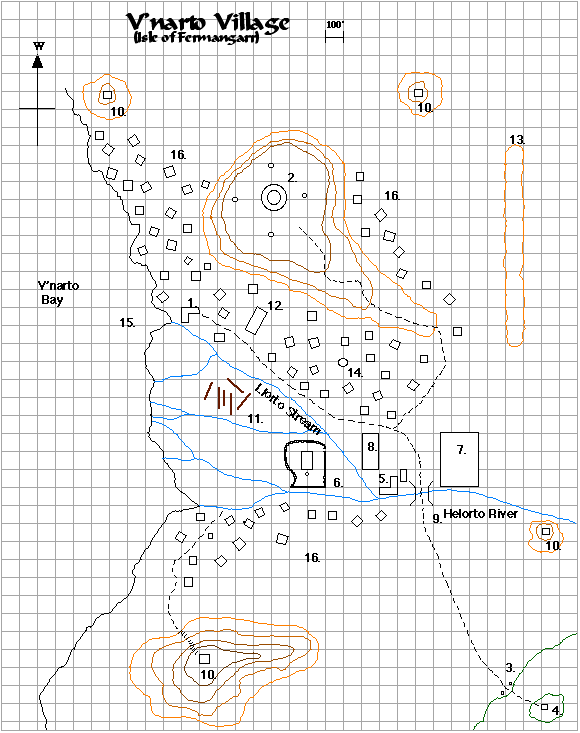 |
As the village is not central to the plot of this adventure, only a brief description is given below.
1. Meeting Hall:
This structure is made of logs with a thatched roof. It is raised 6 ft off of the ground by four logs and accessed via a small log ladder. The outside walls are decorated with various totemic-looking carvings, including various leering faces, each representing a protective ancestor. Normally used for tribal councils, various benches are set around the single, airy chamber. Many brightly painted wooden masks hang from the walls, and a Knowledge (history) check of DC 10 will reveal one of the masks appears to be of Morg the Hero.
2. High Meeting Place:
This is the place where the entire tribe meets for tribal councils, elections, and communal activities such as storytelling and rituals.
The place is located on a small hillock, about 30 ft high, which is relatively flattened on top like a mesa. A small footpath leads up the southeast face of the hill to the meeting place.
Atop the hill are four stone plinths, each about 2 ft in diameter and about 8 ft tall. They are crudely carved into representations of gods or goddesses as follows:
Within the space bounded by the plinths is a smallish depression about 10 ft deep ringed with terraced seating like a small arena. In the bottom centre is a place for a large bonfire.
3. Spirit Plinths:
A footpath leads from the Helorto River into the outskirts of the Jam-Jum Forest. Where it reaches the first eaves of the forest, there are two smallish stone plinths, about 6 inches in diameter and 4 ft tall. Each plinth is carved with various strange runes and symbols, as well as crude figures representing the sun, moon, stars, winged beings, and other less recognizable figures. The footpath continues past these plinths into the forest.
Each plinth radiates magic and contains an ancestral spirit of the tribe. These are low-level guardian spirits which operate on an instinctual level and cannot be bargained or parleyed with. If a non-tribesmember passes between the plinths, or within 30 ft of them, the spirits will emerge, one from each plinth, appearing as translucent, vaguely man-shaped forms which will attempt to touch the party. They attack have a +4 attack bonus and attack using an incorporeal melee touch attack. Any victim struck must make a DC 15 Will save or be struck with fear. Such a terror will cause the affected to run screaming away from the plinths at fullest possible speed for 1 minute, and then to exhibit a compelling reluctance to approach within 300 ft of the plinth for the next D4 days.
The spirits may not be struck by weapons, but may be warded by protective circles or spells like protection from evil/good. They may also be exorcised. The spirits will not pursue beyond 300 ft from the plinths. They will also not attack anyone escorted by the shaman.
4. Shaman's Hut:
A little way beyond the plinths (area 3) the path arrives at a small clearing, in the centre of which stands a hut. The hut is made mostly of rune-carved bones, filled in by mud, leaves, and wicker. The roof is thatched. A strange variety of gourds, skulls, trinkets, and other strange gew-gaws hang from all portions of the hut, which is entered by a small opening covered with a hide.
Within dwells the shaman. The shaman is closely tied to the psychic well-being of his tribe, and most shaman are generally eccentric and half insane even if their tribe is healthy. This shaman is a middle-aged male (CN human Spirit Shaman 3).
Within the hut is an absolute mess. Piles of furs, a rune-painted pallet, a rickety chair, a fire ring, hundreds of gourds, countless animal body parts in various stages of decomposition, clay pots filled with mostly pungent unidentifiable powders and liquids, all in all a shamanic mish-mash. Most everything is covered with runes in black paint and most is also covered in ashes and soot, probably from the fires built in the fire ring and not properly ventilated out of the chimney in the centre of the hut's roof.
5. Chief's Hut:
This is a set of two buildings, done up in traditional V'nartan style, with the floor being raised up a few feet on stilts. The roof is thatched and the walls outside are decorated with palm leaves, sahuagin hides, and the trophies of vanquished foes (spears, pieces of shields, et al). Within are several chambers, cluttered with furniture of wicker. The chief, an elderly man with a wrinkled parchment of a face who remembers as a young man the bad times when the Heroes of the Gem came and saved them, is the only islander who speaks Common. He is an accomplished warrior and former champion of the tribe (LN human warrior 5/Expert 2).
The other smaller building is a quarters for the chief's wives and concubines.
6. Palisade:
It is here that the tribespeople come when trouble besets them. Usually, this is when the sahuagin raid in force, or when pirates land nearby. The structure is a wooden palisade of irregular shape, these being thick logs sharpened to a point at the top, each log being about 8 ft tall and mounted into an earthen embankment 3 ft high. Thus, the top of the palisade is some 11 ft above the outside ground level. A single wooden gate made of logs lashed together sits in the northeast corner. It is closed and barred by a stout log from the inside.
The inner walls have a plank running around them part way up to allow defenders to mount the walls. Within is a hut, built in traditional V'nartan fashion, raised from the ground and made of wood with a thatched roof. Beside the building is a small well from which fresh water may be accessed.
Beneath the raised building is a small round stone, which can be moved exposing a large chamber in the ground which holds foodstuffs (grains, wild rice, nuts, berries, salt, and other provisions) for hard times.
7. Bachelor's Quarters:
This is a large hut, raised off of the ground as usual for V'nartan architecture. A large space is in the thatched roof for a chimney, and within are the signs of an overturned dormitory. This is where the bachelors live, those men who have undergone the ritual of manhood but have not yet been married. They are the warriors of the village, and it can be guessed that this hut could easily accommodate 50 persons spaciously.
8. Champion's House:
This is the house of the bravest warrior of the tribe. When a warrior has performed an extraordinary deed or deeds of valour and battle, he is sometimes made a champion of the tribe and housed here. He gains many wives and all of them live in this spacious hut. The current champion is Karrunga (LN male Warrior 6).
9. Bridge:
This is a small wooden bridge, wide enough for foot traffic but not enough for a cart. The bridge spans the small but pure Helorto River. The river is about 40 ft wide.
10. Watch Towers:
Each of these is a wooden watchtower, basically a platform of wood with a thatched roof, set on stilts some 20 ft above the ground below it. A ladder reaches up to the platform, upon which is also a knotted rope long enough to reach the ground. Each watchtower is set upon a small rise, the largest rise being the southwestern one, which is some 40 ft high. Wooden steps lead up the hill to the tower. The other two towers are merely set on small mounds about 20 ft high.
At all times a single guard (N male human Warrior 2) is in each tower.
11. Racks:
Here, in a muddy delta-like area, are a series of wooden racks, ostensibly used to tan and stretch hides, dry fish, and other such activities.
12. Priests' Place:
This is a rather large hut, decorated with teak and ebony carved into elaborate motifs. Most appear to be angelic creatures, ocean beasts, and native warriors.
The door is a wicker screen. In addition, the windows are covered with wood. Within the hut is a wooden altar to Hotor inlaid with mother-of-pearl (about 25 gp worth). Other parts of the place house living quarters for the priests. A total of four priests dwell here. The head priest is named Ratuyga (CN male human Cleric 4) and he is served by 2 female priestesses (N human Cleric 2) and a male apprentice (N human Cleric 1).
13. Wall of Ancestors:
This is a large earthen wall, rounded like a big speed bump, which, at its centre, is some 20 ft high and about 100 ft wide. Within are buried the ancestors of the tribe. Only the important tribal shamans, priests, champions, and chiefs are buried here, the common folk being sent into the sea. Around each grave, which is a body-sized hole sealed with hard clay, are drawings and paintings showing the deeds of each ancestor.
The ancestors are buried with various trinkets and gew gaws, but no valuables.
14. Bonfire:
This is an area where a constant bonfire was kept by the tribe, used as a signal fire and as protection.
15. V'narto Bay:
V'narto Bay is unique because it is very deep almost up to the beach and is free of reefs, rocks, and other dangers. This means even a cog-sized ship can beach itself right onto the mud of the delta area surrounding the racks at area 11.
While a sizable sahuagin community dwells about 10 miles to the south of the Bay, they generally do not keep a vigil on the island.
16. Huts:
These are the tribal huts. Each is raised off of the ground by about 2 ft and is about 15 ft-20 ft a side. They have thatched roofs and wicker doors. Each is one large room.
All of the huts have worthless personal effects and minor furnishings.
Meeting the Chief:
The chief will welcome the PCs and tell them that he has been expecting them. He will escort the PCs to the Meeting Hall and offer them food (a finger dip much like poi and a strong drink made from fermented bananas and goat milk). After a repast, the chief will say that they do not get many visitors from the big lands to the north, and in fact the last ones who were their guests came many years ago when he was a young man. If asked he will describe these visitors and will tell why they came.
The entire story of that visit is too great to set forth in this adventure in detail, but DMs can refer to the 2nd edition D&D scenario entitled A Tragedy Unfolds. Basically, a girl of the tribe was driven mad and possessed by an evil spirit called a norebo after having been raped and mutilated by a jealous ex-lover who also murdered her fiance. The Heroes of the Gem, early in their career, were fleeing the agents of the Deceiver on Onlor and their ship was damaged by a sea creature and they were forced to put into Fermengarr for repairs. Here they found the remains of the V'narto village, as the norebo had slain and eaten or tortured most of the tribe. A few remnants were hidden in the village and they told the Heroes of their troubles. At first the tribesmen blamed the curse upon them on the mysterious inhabitant of a strange building of stone who had taken up residence on the northern part of the island. The Heroes investigated and discovered that this inhabitant was a powerful female necromancer who was not causing this curse but was merely trying to complete her studies in this remote location free from interference and prejudice from ignorant peasants. The Heroes teamed up with the necromancer and managed to corner and slay the norebo and put the curse to rest.
Now, the chief will say that their peope are again worried. They are plagued by strange creatures that seem to have been warped or corrupted somehow and have been harrying and slaying their hunters who go out into the northern parts of the island. Indeed, sightings of these strange abominations have been progressing south towards the village, and the chief is worried that once again his people will be attacked in their village.
To counter this, the chieftain made a journey to the visit a person known as the Hidden Wise One. He is a mystic who dwells near the island and is believed to have the power to commune with the higher spirits and even the gods themselves. The Hidden Wise One told the chief that this new curse emanates from the Stone Dweller and her strange keep. He also said that strangers would be coming to Fermengarr Isle seeking something hidden from them. He told the chief to meet with the strangers and tell them that if they end the new curse that has visited V'narto village, then the chieftain could reveal to them the Hidden Wise One's location. The Hidden Wise One could then guide them to that which they seek.
And so now the chief will make this offer to the PCs. If they can investigate the Stone Dweller's place and end the new curse, he will tell them how to find the Hidden Wise One, who will tell them how to find that which they seek.
Assuming the PCs agree, then the chief can tell them how to find the Stone Dweller's place (called the Dead Tower on the map below). He knows little of the Stone Dweller, save to say that she is said to be a normal looking woman of pale skin and features of a big lander (i.e. Jerranq or Onlor). However, she must be quite old if she still dwells there after these many decades. The Heroes of the Gem told the V'nartans that the Stone Dweller meant them no harm and that they should live in peace with her and not disturb her. They know nothing else.
Travelling the Isle:
Fermengarr Isle is not a very big island. The most obvious way to travel from the village to the Dead Tower is to travel along the coast east from the village and then north to the Fast One River, fording that and then following the coast right to the Dead Tower. Some PCs might wish to take a boat, canoe, or the cog and just sail around the island. However, the area surrounding the Dead Tower is comprised of high cliffs with no landing. The nearest landing possible without magic as where the Fast One River plunges into the ocean on the eastern side of the island. Here, there is a tiny, rocky beach surrounded by cliffs and a narrow defile in the rocks through which the stream passes. By dint of five DC 10 Climb checks and one DC 15 Climb check the PCs can scramble up the defile (these DCs already factor in modifiers for slippery terrain and the ability on occasion to brace against two opposite walls). Any failure by 5 or more will result in a fall of 1D6 x 10 ft with a DC 15 Reflex save for half damage (meaning the victim grabbed onto a rock or vine before falling all the way down).
 |
Normally, the climate in this tropical location would be an issue. However, it is winter and that cuts down on the heat and humidity enough to allow PCs to wear armour with no ill consequences. If the PCs for some reason delayed journeying until spring or summer, then the DM should assume that there is a 25% chance on a given day that the climate is considered as very hot conditions (refer to the Dungeon Master's Guide for more details).
V'narto Village:
This village is detailed in the Key to V'narto Village presented in this scenario.
Helorto River:
This river is about 40 ft wide at its flat portions, and slow flowing and pure. It is faster flowing when it tumbles down the Leedinark.
Jam-Jum Forest:
This forest is a mixture of palms and other jungle trees and flora mixed with a few subtropical varieties of cypress and jacarandas. The forest is not too thick and provides ample foraging and water from various streams and rivulets coming down from the mountain. The forest is home to much wildlife, including large snakes, spiders, giant frogs, and a few dangerous plants. All in all, though, it is a wholesome wilderness.
Altar:
This is a stone block carved with runes glorifying the sea and the sky. Signs of burnt offerings (charred pieces of wood, soot on the altar) tell of the seasonal rituals normally performed by the V'nartan priests.
Leedinark Mountain:
This mountain is the island's dominant feature, being some 2,800 ft tall and punctuated by many ribbon-like water falls. The mountain itself is rather rocky, and the igneous rock makes it look dark, almost black and a bit foreboding. Giant eagles are known to dwell high up on the peak of the mountain, and the V'nartans believe the mountain is tall enough to hold up the sky, and they worship it thusly.
Cudinarn Jungle:
This is a true jungle. It is choked with vegetation, mostly palms, jacarandas, ferns, and undergrowth. The place is lush with wildlife, except for the portion marked by the 'NC', which is where the norebo once dwelt in a clearing. This clearing is still, after all these years, devoid of plant and animal life and radiates a lingering evil. As with most jungles, there are dangerous places to be avoided. Travel through this jungle is very slow, involving much machete work.
Naytom River:
This is a small faster flowing river winding its way through the Cudinarn Jungle.
Little One River:
This is a swiftly flowing river which tumbles from the Leedinark into an isolated cove.
Fast One River:
This is a dangerously fast river, entirely unnavigable and barely swimmable in some spots. To cross it requires magic or a bridge of some sort. Fortunately, like all rivers on the Isle except for the Helorto, it is rarely more than 20 ft wide.
Dead Tower:
This tower is detailed in the Key to the Dead Tower contained later in this section.
Encounters:
During the journey, encounters can take place. While there are some normal dangers that might be encountered on the journey, in this case the PCs will encounter two abominations, results of the curse from the Dead Tower. The DM can use some of these encounters to show the PCs the nature and danger of the curse.
Encounter #1 - Not So Boaring (EL 8)
At some point during the first part of their journey overland, the PCs will be attacked by a pod of warped boars. These boars appear to be corrupted, and strange, maggot-like tendrils cover their bodies and pus drips from their eyes and noses and a pinkish froth dribbles from their mouths. Their eyes are a flickering bright crimson and dull black. These horrific creatures are aggressive and insane and intent on killing and devouring anything living.
|
PSEUDONATURAL BOARS (8) CR
2 True Strike (Su) Once per day, a pseudonatural creature can gain a +20 insight bonus on a single attack roll. In addition, the creature suffers no miss chance against a target that has concealment or total concealment when making this attack. |
Tactics: These boars are not subtle in their attacks. They will start the encounter in their alternate form and will not waver from it. They will use their true strike ability at the first opportunity and then continue to attack in a frothing fit of rage.
Encounter #2 - Their Sting is Worse than their Bite (EL 9)
A pod of large monstrous scorpions has been warped by the curse from the Dead Tower and are hungry for victims. Each of these scorpions has a writhing mass of tentacles emanating from its mouth, with four large ones being evident. Maggot-like projections cover the rest of their bodies and ooze and pus emanate from various parts of them.
|
HALF-FARSPAWN LARGE MONSTROUS
SCORPIONS (4) CR 5 1. The creature's movement modes
do not change. Constrict (Ex) A monstrous scorpion deals automatic claw damage on a successful grapple check. Improved Grab (Ex) To use this ability, a monstrous scorpion must hit with a claw attack. A monstrous scorpion can use either its Strength modifier or Dexterity modifier for grapple checks, whichever is better. Poison (Ex) A monstrous scorpion has a poisonous sting. DC 14 Fort save, 1D4 Con initial and secondary. The save DCs are Constitution-based. True Strike (Su) Once per day, a half-farspawn can make a normal attack with a +20 insight bonus on a single attack roll. The half-farspawn is not affected by the miss chance that applies to attacks against a concealed target. |
Tactics: The scorpions seek prey to feed upon, and when they attack they will attempt to drag off anyone they grab with their claw. Only if sorely pressed will they release their prey and defend themselves. The scorpions start the encounter in their changed shape and will not waver in their form.
Encounter #3 - Seabird (EL 8)
If the PCs try to travel to the Dead Tower by sea, they will be spotted in the bay leading to the Fast One River by a pair of zombie wyverns that the Stone Dweller used to keep as a guard and servants before her demise. These will launch from their seaside cliff perch and attack the PCs in their ship or vessel.
|
PSEUDONATURAL WYVERN ZOMBIES
(2) CR 6 Single Actions Only (Ex) Zombies have poor reflexes and can perform only a single move action or attack action each round. A zombie can move up to its speed and attack in the same round, but only if it attempts a charge. True Strike (Su) Once per day, a pseudonatural creature can gain a +20 insight bonus on a single attack roll. In addition, the creature suffers no miss chance against a target that has concealment or total concealment when making this attack. |
Tactics: The wyverns will attack all living things they encounter and will fight to the death, a combination of their previous programming and their newfound sentience and madness. These wyverns are in a somewhat unique situation, since they can fly but have clumsy maneuverability and can only take single actions. As such, these wyverns will either have to land on the PCs' vessel (possibly needing to squeeze and suffering the appropriate penalties) or they can attack from the air, but they will then have to engage in single action charges to attack, then flying by and slowly turning around in order to charge again. These will be very ponderous and predictable attacks that may allow the PCs to exploit the situation to their advantage.
The Dead Tower:
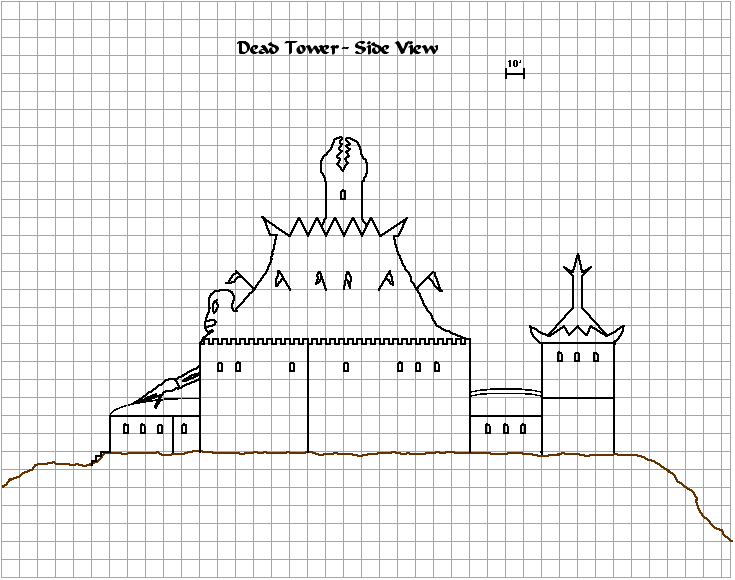
When the party finally arrives at the Dead Tower, which sits atop a high promontory accessible by a tiring climb up a spur of Leedinark Mountain, refer to the Key below.
What has happened here at the Dead Tower is fairly simple. As mentioned above, on the same day that the strange astronomical phenomenon was occuring around the Northstar, the necromancer (i.e. the Stone Dweller) was engaged in a very critical ritual designed to further her studies into the barriers between life and death by implanting her with a mother cyst (see Libris Mortis page 28). This ritual was highly dependent upon the configuration of the stars in the sky and was intended to open a gate between the Material Plane and the Negative Energy Plane, but the strange phenomenon perverted the already dangerous ritual, opening a direct link between the Dead Tower and the Far Realms. A blast of corrupting energy swept through this gate in the brief instant it was open, and it mingled with energies from the Negative Energy Plane to corrupt undead and living alike.
The necromancer was warped into the hideous "thing" she is today. Her undead were also warped, made pseudonatural and imbued with just enough intelligence to impart a sort of madness upon them. The wave swept out into the surrounding countryside as well, though it thankfully didn't reach very far from the Dead Tower. Fortunately the wave was a one-time occurrence. However, the cyst within what was the necromancer remains a corruptive influence and that is slowly germanating within her, growing eventually into who knows what!
The undead that remain in the Dead Tower are now somewhat torn between their original programming and their newfound sentience. They tend, in this confused state, to remain where they were stationed or even to stand around confused until their encounter a living creature, at which time their madness manifests and they attack. All of the pesudonatural creatures here are always in their alternate form, appearing as a mass of small tentacles and maggot-like protrusions.
Unless otherwise stated, the walls of the Dead Tower are treated as magically treated walls of superior masonry (hardness 16, 180 hp, Break DC 55, Climb DC 25). Floors are smooth stone floors. Doors are good wooden doors. All rooms are dark.
 |
 |
Ground Level
All chambers on this level are 20 ft in height. All windows are 15 ft above the level of the floor.
A. Outside
|
The keep is a large structure of imposing visage. It is constructed of dark grey stone and has three major structures that make up the tower. The first is a small gatehouse roughly in the shape of a diamond. This gatehouse abuts the main keep, a larger diamond-shaped structure which eventually tapers into a cone-like shape before ending abruptly in sharp battlements. The top of this "crown" sprouts a slender round tower with a roof shaped like the closed jaws of some horrific creature. Behind the main keep is a secondary smaller tower, square-shaped and connected to the main keep by a ground level corridor and a second story bridge. Windows pierce the walls at various places. These windows are mere slits, and only the slenderest of unarmoured halflings could squeeze through (and then with some difficulty). Leering from the front of the tower is a huge stone skull. The stone that makes up the skull is bone white in colour, providing a sharp contrast to the dull grey stone of the rest of the tower. Below the skull, two bone-white stone skeletal hands emerge from the main keep and rest upon the roof of the gatehouse. Just above the skull, in a ring around the conical tapering of the main tower are poles bearing deep black and purple pennons embroidered with skulls and runes of death. The tower structure atop the conical portion is made of a deep jet black polished stone. Atop the rear small tower is a three-pronged spire made of a sickly greenish stone, almost but not quite jade-like. The entire face of the tower walls are covered with ornate carvings and bas-reliefs. These decorations are horrific in nature, with a common motif of skulls and skeletons, but also with scenes of death and destruction and scenes of funerals and burials. Steps lead up to the double doors that seem to provide entry to the place. The steps rise about 4 ft and are made of a translucent black material like quartz. The double doors are of a deep black metal and have bas-reliefs in the shape of grinning skills with sharp fangs which seem to have black flames leaping from their mouths. There is a large handle on each door. |
The doors are made of enchanted iron (hardness 12, 90 hp, Break DC 40 [including the arcane lock]. They have been arcane locked by a 14th level caster.
Secret Doors: Around the side of the keep, about 20 ft straight north of the corner of area H, is what used to be a secret door disguised to look like a somewhat flat and roundish rock. It is partially open, revealing a circular shaft with iron rungs that descends into the ground. This door can be heaved opn with a bit of muscle. The shaft leads down 30 ft to the floor of area G of the Dungeon Level.
B. Gatehouse (EL 2)
|
This is an impressive chamber, with a domed ceiling ranging from 20 ft to 30 ft above the floor. The floor is of polished grey marble shot through with white and black veins. The veins often congeal on the floor to form a wispy ghost-like or skull-like visage. A rich red carpet leads from the doors to another set of double doors, these made of ivory or bone bound in iron. The carpet is embroidered with scenes of tendrils wrapped around eyeballs. Flanking the outer doors are two stairways leading 10 ft up to a gallery which runs the length of the rest of the room. |
The interior double doors are made of iron and locked from the inside (from area K) by a thick iron bar.
Creatures: Upon the gallery stand 4 pseudonatural zombies armed with crossbows. They will attack any living creatures they encounter, first with ranged weapons and then physically.
|
PSEUDONATURAL HUMAN ZOMBIES
(4) CR 1/2 True Strike (Su) Once per day, a pseudonatural creature can gain a +20 insight bonus on a single attack roll. In addition, the creature suffers no miss chance against a target that has concealment or total concealment when making this attack. |
C. Storage
This smallish chamber contains storage for day to day items of use for the tower. These include rope, chains, barrels (empty), lamp oil, torches, tools, candles, etc. The place is absolutely filled with the stuff in no discernible order and movement around the room is very cramped and difficult.
D. Storage
This is another storage chamber, as much a cluttered mess as the other (area C). This one contains more in the way of foodstuffs and dining utensils, mugs, cups, cooking gear, etc. Foodstuffs include a rack of fine wines, all stoppered with wax and lead, barrels of rum and ale, nuts, dried fruit, etc. Nothing perishable is contained herein.
E. Megaron
|
Within is a musty room, probably little used, although it seems to be free of dust. A fireplace is against the south wall, unused and very clean. Also in here is a dais along the southeast wall, upon which rests an elaborately carved ebony throne decorated with skull and skeleton motifs. The back of the chair looks like a giant rotting hand erupting from the earth. The chair is probably very valuable but also looks extremely heavy. Tapestries adorn the walls...these being black velvet and displaying scenes of vivisection, mummification, skulls, and worms. Empty torch sconces line the walls. |
F. Barracks (EL 2)
| The room is decorated with tapestries made from flayed human skin decorated with art representative of each culture from which the person's skin came. The whole is a rather grotesque patchwork, especially when close examination reveals the nature of the decorations. |
Creatures: Six pseudonatural skeletons are here. They will attack anyone opening the door and will pursue anywhere in the tower.
|
PSEUDONATURAL HUMAN SKELETONS
(6) CR 1/3 True Strike (Su) Once per day, a pseudonatural creature can gain a +20 insight bonus on a single attack roll. In addition, the creature suffers no miss chance against a target that has concealment or total concealment when making this attack. |
G. Barracks (EL 2)
| The room is decorated with tapestries made from hair of different shades decorated with coloured bones woven amid the strands. |
Creatures: Six pseudonatural skeletons are here. They will attack anyone opening the door and will pursue anywhere in the tower.
|
PSEUDONATURAL HUMAN SKELETONS
(6) CR 1/3 True Strike (Su) Once per day, a pseudonatural creature can gain a +20 insight bonus on a single attack roll. In addition, the creature suffers no miss chance against a target that has concealment or total concealment when making this attack. |
H. Stairway
| This triangular room is unadorned, excepting sconces that are unlit. Stone stairs lead up into the ceiling. |
I. Dining Chamber
|
This huge chamber is ornately decorated with tabards displaying death runes. A huge ebony table dominates the place, with a score of chairs assembled around it. A centerpiece is made by two candelabras in the shape of skeletal fingers outstretched. Oil lamps burn fitfully, casting a gloom over the large chamber, and braziers keep the place warm, in a slight haze, and smelling slightly charnel. Various cabinets of fine workmanship line the place. Two large hearths are here, one along the west wall and the other long the south wall. These show signs of use. |
J. Kitchen
| This kitchen is crowded with pots and pans, knives and spits, a large clay oven, and a bin of salt. Cabinets line the walls. |
K. Hallway
|
This impressive hallway is done in flagstone, decorated with ornate sconces in the shape of skulls. The sconces hold torches which light the hallway. Between the sconces are hung grey tabards each showing a nude male standing with a portion of his skin peeled away showing the skeletal structure underneath. At the southeast end of the hallway are grand valves of bronze inlaid with lapis lazuli and other semi-precious stones in order to form a mosaic of a man's life from birth to death represented as a successive string of human images. However, whereas most such murals end with death, this one continues, showing burial, resurrection as a ghoul, and an eternity of unlife. In the middle of the south wall is a set of double doors to this room are made of ebony and decorated like a huge toothy maw about to devour those who enter. |
 |
Level One
All chambers on this level are 40 ft in height. All windows are 30 ft above the level of the floor.
A. Hands of Stone
These are a pair of white stone wooden hands which are normally at rest atop the gatehouse roof. However, via levers and dials in area B of Level Two, they can be made to move as if they were alive. See Room B Level Two for more details.
B. Hallway
| This is a small hallway lined with oil lamps. It is unadorned. |
C. Antechamber
| This chamber is unadorned except for a number of unlit sconces. |
D. Bridge
| This bridge is exposed to the outside. It has a stone side that rises up 3 ft on each side to prevent accidents. The bridge is slightly arched and is decorated with skeletal serpents along its sides. The floor of the bridge is designed to look like a spinal column. |
E. Library
This chamber is accessed via the
bridge (area D Level One) and comprises the top story of the rear
tower.
|
The walls are covered with bookshelves and scroll racks. Also within this place are several unlit braziers, unlit lanterns hanging from the ceiling, and several divans and chairs and a reading desk. |
Within the desk are ink and quill and a supply of good quality paper and vellum.
Behind one scroll rack is a loose brick in the wall (Search DC 25). If the brick is pivoted in place, a stone in the ceiling will slide open, revealing an attic of sorts in the 30 ft high ceiling. A rope ladder, coiled up atop the sliding stone will fall to the ground.
Within this attic space, which is 10 ft by 10 ft by 4 ft tall, are the magical works of the necromancer. These include:
F. Specimen Storage
| Within this room are a great number of barrels, both large and small, and coffin-like wooden crates. Each container bears black writing scrawled onto its face. |
Each container bears black writing (in scrupulous Common) detailing the origin, date of expiration, and nature of the specimen.
G. Laboratory
| This is a typical laboratory, if such a thing can be called typical. Scattered around wooden tables and benches are scales, alembics, weights, beakers, clay urns, lead stoppers, scoops and spoons and tongs, scattered papers and notes and a few open book. Bits and pieces of bone and skin and unidentifiable organs are here and there in various little containers. Various jars are filled with strange multi-coloured powders of indeterminate origin. |
H. Laboratory Storage
| This room contains many shelves and racks holding a bewildering array of experimental ingredients. |
I. Stairway
| This small chamber contains a spiral staircase that winds up into the ceiling. |
J. Bed Chamber
|
This is a bedchamber. Within is a gothic canopied bed all done in black, with bats as a motif for the ebony posts and the canopy itself. Also here are a wardrobe, table and chairs, a nightstand with washbasin, a divan, a fireplace, several braziers and oil lamps, and two ornate mirrors. All of these furnishings are finely wrought, but with ghoulish or macabre motifs worked into the design. In the northwest corner is a curtained off area and another is to the southwest. |
The curtained area contains a toilet. The other curtained area to the southwest contains a bathtub of copper, decorated with skeletons in various sexual poses with other skeletons. Jars of cosmetic powders and personal care substances are nearby, as are several black drying cloths.
K. Living Quarters
| There are several plush divans and comfortable chairs. Also here is a common table and chairs of darkened oak, a large hearth with grinning gargoyle figures looming above it, and an ornate chessboard with figures of ivory shaped like skeletons and figures of ebony shaped like wraiths. |
L. Antechamber (EL 1)
| This chamber is decorated with tapestries depicting a small manor house near a gloomy looking swamp. Within the swamp a far-off will o wisp glows between the trees. |
Creatures: Two pseudonatural skeletons are here, once guards for the necromancer.
|
PSEUDONATURAL HUMAN SKELETONS
(2) CR 1/3 True Strike (Su) Once per day, a pseudonatural creature can gain a +20 insight bonus on a single attack roll. In addition, the creature suffers no miss chance against a target that has concealment or total concealment when making this attack. |
Level Two
All chambers on this level are 20 ft tall.
A. Stone Skull
This area is accessed by several steps ascending up about 5 ft. Within is the interior of the great Stone Skull as described in area A Ground Level. Hanging on a chain in this place is a metal gong and hammer and nearby on the floor is a metal cone which serves as a megaphone.
B. Manipulation Room
| This chamber is pierced with chains, levers, pulleys, and dials. |
The necromancer designed the Stone Skull and Stone Hands as a hobby and in order to scare away anyone who approaches the tower, especially superstitious natives.
C. Vivisection Chamber
|
Several operating benches are here, each capable of being raised or lowered and/or independently tilted by a series of cranks. There are three such tables, and one of them has a human female's corpse with its chest cavity spread wide open. The internal organs are missing. Various vivisection tools are here, as well as a water basin, a refuse bin, several anatomy tomes, and a few jars of powders and liquids. A spiral staircase descends into the floor. |
D. Creation Chamber
|
There are implements and tools to sow back limbs onto zombie bodies, plaster to mend bones, and sets of replacement parts of various sizes and types. Several tables and benches are also here. A spiral staircase ascends into the ceiling. |
This is where the necromancer creates her undead servitors.
The spiral staircase ascends to area A Level Three.
Level Three
A. Sanctorium
|
This chamber is 40 ft tall. There are several types of protective circles etched into the floor and inlaid with lead. Various charts and arcane formulae are hanging from the walls and many pieces of parchment are rolled up into tubes and scattered on the floor with some of the tubes having been crushed. Several books and scrolls are scattered on the floor or on a small table shoved against the wall and some of them appear to have been ripped. A podium stands in the middle of the chamber, with a small chain attached to it that dangles halfway to the ground. Below the chain is what appears to be the remains of a massive tome. It is now torn to shreds and the thick cover ripped and twisted. Along one wall is a large, ornate wooden cabinet, its door standing ajar. Within can be seen small boxes, jars, and bags. Near the cabinet is a wooden bookshelf that holds two large, thin books. A spiral staircase leads down into the floor while an iron ladder ascends up into the ceiling where an open trap door sits. |
This is the pinnacle of the Necromancer's studies. The rolled up parchments are simply more charts and arcane formulae, and many of them and the ones hanging on the walls are star charts dealing with the position and movements of various heavenly bodies. The books and scrolls scattered about the place are arcane in nature, and a thorough search of them will show that many focus on necromancy and astonomy and the relationship between astronomy and the planes. A few seem to deal with a necromantic phenomenon called a necrotic cyst. Further reading will allow the PCs to glean some information regarding necrotic cysts as per the Libris Mortis game supplement.
The podium at one time held the necromancer's massive spellbook. This is now torn to shreds on the floor. The shredding of the pages of the spellbook has been so severe that not a single spell can be gleaned from the fragments, though the DM could allow a Spellcraft check (20 + spell level) to perhaps determine some of the possible spells it once contained (these are left to the DM but should obviously include many necromantic spells and exclude illusion and enchantment spells).
The cabinet holds a variety of non-valuable spell components for all of the spells that were in the necromancer's spellbook. There is no need to precisely delineate these components, but a Spellcraft check equal to 15 + spell level will determine what spell levels the components are for, allowing a PC who makes a sufficiently high check to determine the maximum spell level the necromancer could cast (level 7) and giving some idea as to her power (at least before her misfortune).
The spiral staircase leads down to the Creation Chamber (area D Level Two), while the iron ladder leads up to the Observatory (area A Level Four).
Creatures: The skulking cyst that was once the necromancer, Thaariyshya, is still to be found here, slowly growing in power and corruption. The remnants of the necromancer's consciousness still reside within parts of the creature, and it spends most of its time wagin a war to finally stamp out the last bits of her.
When the PCs first encounter this skulking cyst, they will notice the necromancer's head still attached to the gloopy mass. Around its neck is an amulet and on each of its hands is a ring. A strange unnatural aura that is shadowy and somehow sickening to stare at surrounds this thing, and it reminds the PCs of the sickening tendrils of the previous pseudonatural creatures they have encountered.
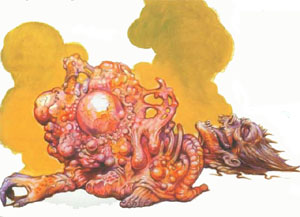 |
As the thing shambles towards the PCs, the head will moan in Common as the PC's presence has awakened the last vestiges of the necromancer's consciousness for the last time:
Something went wrong...something went wrong...not supposed to happen this way...Mergurr forgive me...the pain.
Just before the thing attacks, the head will open its eyes and mutter:
kill me...please kill me...kill me...
|
PSEUDONATURAL ANARCHIC ENTROPIC
SKULKING CYST CR 8 Attach (Ex) If a skulking cyst hits with an intestine, it latches onto the opponent's body. An attached skulkng cyst has an AC of 16. Blood Drain (Ex) A skulking cyst drains blood, dealing 1D4 points of Con damage in each round it remains attached. Once it has drained 7 points of Con, it uses its necrotic cyst spell-like ability. After that, it drops off and attempts to skitter away into a shadowed corner or other hidden location. Inescapable Craving (Ex) A skulling cyst has an inescapable craving for blood, which it satisfies with its blood drain ability. Negative Adaption (Ex) Entropic creatures do not lose hit points or need to make Fort saves due to being in a negative-dominant environment. Negative Energy Aura (Su) Any living creature within 10 ft of an entropic creature loses 1 hp per round due to the aura of negative energy surrounding it. Characters with immunity to negative energy effects as well as other entropic creatures are not affected by this aura. If conscious, an entropic creature can repress this aura as a standard action, but takes 1 point of Str damage for each full minute that the aura is inactive. This aura is always functioning while an entropic creature is unconscious. Negative Energy Ray (Su) An entropic creature can fire a ray of negative energy once every 1D4 rounds with a range of 60 ft. With a successful ranged touch attack, an entropic creature infuses a target with points of negative energy damage equal to 1D4 + its Cha modifier. This attack damages living creatures and heals undead. Smite Law (Su) Once per day, an anarchic creature can make a normal attack to deal extra damage equal to hits HD against a lawful opponent. True Strike (Su) Once per day, a pseudonatural creature can gain a +20 insight bonus on a single attack roll. In addition, the creature suffers no miss chance against a target that has concealment or total concealment when making this attack. |
Tactics: The cyst will begin its attack by using its negative energy ray. It will not use true strike with this ability, reserving that for its initial attack with an intestine. The cyst is hungry, and seeks to feed on a living creature and then plant its necrotic cyst. Unlike normal skulking cysts, this one's necrotic cysts are abnormal (see Developments below). The cyst cannot be reasoned with and fights to the death. Its Int score is more a reflection of a cunning and a psychic raping of the necromancer's memories than of actual erudition.
Developments: There is no way to return the necromancer to life. Even a wish or miracle spell will not accomplish this. The cosmic forces she impregnated herself with are too powerful and have too infused themselves into her essence for there to be anything left of her to restore beyond the last glimpse of consciousness that the PCs witnessed. If it is killed, then the sickening aura will disappear, which should be a sign for the PCs that they have at least stopped the curse from spreading and accomplished their mission. Speak with dead spells will not function, as the necromancer is no longer around to speak with and the cyst has no means of communicating and too alien a mental framework to bother with in any event.
The Cysts:
If a PC is implanted with a necrotic cyst from the creature's necrotic cyst ability, then not only does he suffer the effects of the spell as normal, but every week he must make a Fort save (DC 10 + 1 per week) to avoid gaining the pseudonatural template. Furthermore, once the template is gained, then every month he must make a Will save (DC 10 +1 per month) or suffer 1 point of Int and 1 point of Wis drain as he begins to lose a grip on reality and is slowly taken over by the cyst. Once both Int and Wis are reduced to zero then the victim will himself become a pseudonatural skulking cyst and its cysts will have the same effects as described herein. Essentially, the means for a plague of pesudonatural warping has begun with this necromancer.
The only way to stop the cyst is as presented in the spell description in Libris Mortis. The long term effects can only be surpressed by magic such as protection from evil to the extent such magic covers the time period in question. For example, if somehow the PCs can contrive to keep an afflicted person under the effects of such magic half of the time, then the drain or the gaining of the template will occur at half the rate.
Abilities drained by this effect cannot be restored until the cyst is removed. Thereafter, such abilities can be restored as normal, and are treated as having occurred at the moment the cyst is removed.
Treasure: The two books on the shelf are small travelling spellbooks used by the necromancer in her youth when she used to travel a lot. They were lately kept purely for nostalgic purposes. Both are thin books covered by tough ivory plates and each holds 10 pages and weighs 1 lb.
The first spellbook contains the following spells:
3rd - fly
2nd - fog cloud
1st - jump, magic missile, shield
0 - detect magic
The second spellbook contains the following spells:
3rd - haste
2nd - rope trick
1st - alarm, mage armour, unseen servant
0 - read magic
Level Four
A. Observatory
|
This small chamber is the highest chamber in the tower, and its ceiling is 40 ft tall. The windows here are bigger, wide enough to admit a man-sized creature, but they are also equipped with iron shutters that can be latched shut from the inside. The windows sit 25 ft above the level of the floor. A ladder in the floor here leads down. An open trap door can be closed over the ladder, eliminating any hazard of falling. A large, long telescope made of brass stands on a thick tripod here, pointed up and out of an unshuttered window. Nearby are an unrolled up astronomical chart and a scroll with scribbled notes on it. Next to the scroll is a quill pen, ink bottle, and an open tome. On the floor is inscribed a magic circle of some sort, surrounded by runes. The circle seems to have been formed of some sort of blood-coloured mud which has since crusted dry and parts of it have been obviously scraped away. Remnants of candles lie near the circle, scattered on the floor. A large chain dangles from the centre of the ceiling here. |
The ladder in the floor here leads down to area A Level Three.
A DC 20 Knowledge (arcana) check will reveal that the circle was indeed some sort of conjuration diagram, possibly relating to extra-planar activities and certainly related to necromancy as well.
A thorough study of the scribbled notes and the tome next to it will reveal the ritual the necromancer was undertaking. The tome is a journal of her research into the ritual, and it is clear that she intended to impregnate herself with a mother cyst that would be far more potent than the normal cyst. It was her hope that having the cyst imbued with a passive conduit from the Negative Energy Plane would provide it with growing power, but the cyst itself would protect the necromancer from the harmful effects of the negative energy.
It is also clear that this ritual required immense concentration and impeccable timing and that it was extremely dependent upon the starts being perfectly aligned and the heavens to be in a very specific configuration. At one point she even notes that she has no idea what catastrophic effect might befall her should the heavens not be perfect at the moment the ritual is completed.
The last entry in the tome states that tonight is the night and that she is going to attempt the ritual. This entry is dated the very same day that the strange lights surrounded the Northstar in Prologue 2 above.
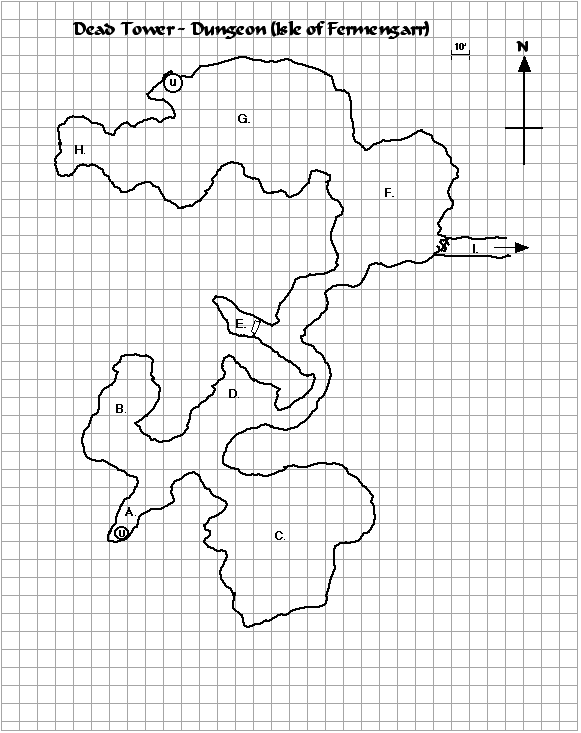 |
Dungeon Level
Unless stated otherwise, all chambers and passages on this level are approximately 10 ft tall. Walls and floors are hewn stone (hardness 8, 540 hp, break DC 50, Climb DC 25, DC 10 Balance check to run or charge).
A. Entry Passage
| This passageway ends at an iron ladder bolted to the cave wall which ascends up to a trap door in the ceiling. |
B. Wine Cellar
| This chamber is filled with wooden racks holding dusty bottles as well as many barrels and casks. |
C. Food Storage
| This large chamber holds bushels of fruit, dried jerky, meat in bins of salt, and sacks of all sorts. |
About a dozen small skeletal snakes slither around the place, looking to keep vermin away from the food. They are instructed only to attack creatures smaller than themselves who enter this chamber. A few rat bodies ripped to shreds by the guardians can be seen here and there.
These snakes are harmless and mindless and escaped being affected by the pesunatural wave due to their status as objects rather than creatures. They are, however, still undead and can be destroyed instantly by any cleric or other PC that can turn undead.
D. Cell (EL 7)
| This chamber is empty except for a pair of iron manacles hanging from a chain stapled into the north wall. |
Creatures: Three of the pseudonatural wights is here. All four wights were being held here for experimentation by the necromancer and for exotic components but they managed to escape eventually when one of the necromancer's zombie minions lifted the bar from the door. If these creatures hear intruders coming from the north, they will attempt to ambush them near area E so that the wight there can flank their foes.
|
PSEUDONATURAL WIGHT CR 4 Create Spawn (Su) Any humanoid slain by a wight becomes a wight in 1D4 rounds. Spawn are under the command of the wight that created them and remain enslaved until its death. They do not possess any of the abilities they had in life. Energy Drain (Su) Living creatures hit by a wight’s slam attack gain one negative level. The DC is 14 for the Fortitude save to remove a negative level. The save DC is Charisma-based. For each such negative level bestowed, the wight gains 5 temporary hit points. True Strike (Su) Once per day, a pseudonatural creature can gain a +20 insight bonus on a single attack roll. In addition, the creature suffers no miss chance against a target that has concealment or total concealment when making this attack. |
Tactics: These wight will simply attempt to energy drain their foes, using their true strike ability right away and then continuing to attack the same foe, if possible, in order to energy drain him completely. Although lawful in alignment, these wights are somewhat mad with pesudonatural energy, and each is eager to have his own spawn under his control. As such, thankfully for the PCs, the wights will take pains not to attack the same target as their fellows.
E. Dangerous Cell (EL 4)
| This passage is blocked off by a brick wall pierced by an ajar iron door that has appears as if it could be barred from the southeast side as evidenct by the metal brackets set into the face of the door on that side. However, there is no bar present. |
Creatures: One of the pseudonatural wights is here. All four wights were being held here for experimentation by the necromancer and for exotic components but they managed to escape eventually when one of the necromancer's zombie minions lifted the bar from the door. This creature is now here resting, but if it hears intruders coming (it recognizes the usual shuffling sound of the zombies) it will lie in wait here for the door to be opened or for its companions in area D to begin combat, at which time it will emerge and try to attack foes from the flank or rear.
|
PSEUDONATURAL WIGHT CR 4 Create Spawn (Su) Any humanoid slain by a wight becomes a wight in 1D4 rounds. Spawn are under the command of the wight that created them and remain enslaved until its death. They do not possess any of the abilities they had in life. Energy Drain (Su) Living creatures hit by a wight’s slam attack gain one negative level. The DC is 14 for the Fortitude save to remove a negative level. The save DC is Charisma-based. For each such negative level bestowed, the wight gains 5 temporary hit points. True Strike (Su) Once per day, a pseudonatural creature can gain a +20 insight bonus on a single attack roll. In addition, the creature suffers no miss chance against a target that has concealment or total concealment when making this attack. |
Tactics: This wight will simply attempt to energy drain its foes, using its true strike ability right away and then continuing to attack the same foe, if possible, in order to energy drain him completely.
F. Graves
|
In this cavern are 8 closed sarcophagi. They are of marble and decorated with complicated patterns and heraldic crests. To the east, earth has been brought in and piled into a mound about 6 ft high and about 10 ft by 20 ft in area. Atop the mound are three headstones. |
The mound marks the graves of the necromancer's siblings. These are listed on the headstones as Farishya, a sister who died 60 years ago at the age of 14, Miskhysha, a sister who died 64 years ago at the age of 16, and a brother Retryuth, who perished 66 years ago at the age of 1 year.
Secret Doors: A secret door has been built into the cavern wall (Search DC 25). If Retrytuh's tombstone is titled backwards, the secret door will open, leading to area I.
G. Zombie Cavern (EL 6)
| This cavern is quite large, and about 20 ft high, and the ground is covered with little gibbets of rotted flesh. |
Creatures: 15 zombies will attack any living creature that enters this cavern. They will pursue such prey out of the cavern (and even up the ladder if necessary). However, they are not mindless and will return to the cavern if their prey appears to be out of reach.
|
PSEUDONATURAL HUMAN ZOMBIES
(15) CR 1/2 True Strike (Su) Once per day, a pseudonatural creature can gain a +20 insight bonus on a single attack roll. In addition, the creature suffers no miss chance against a target that has concealment or total concealment when making this attack. |
Tactics: These zombies will try to perform a single action charge against anyone entering the chamber, activating their true strike as they do in the hope of simply brutalizing and overwhelming their victim under a flurry of truestrike slams.
H. Tool Storage
| This chamber is full of bags and a variety of tools and a supply of weapons and armour. |
I. Secret Passageway:
This passageway is accessed via a door carved to look like the cave wall in area F of the Dungeon Level. The door opens when the proper headstone is moved as described in area F of the Dungeon Level. From the other side, the door is obvious and merely pulls open with a twist of a handle.
Within is a long passageway about 6 ft high which winds a long ways to the north, descending all the while down long stairs, until it arrives at an isolated cove with a small sandy beach. Here is a small twelve-man row boat with a mast. Within the boat are provisions for one person for twenty days, including fresh water, and a map of the surrounding seas and islands in a sealed tube. This is where the necromancer can escape in an emergency and also where supplies ordered from afar are taken into the tower.
Just within the secret doorway, and again just within the cave opening at the cove, is a hooded lantern filled with oil and a small bit of tinder and flint.
Returning to the Village:
The return trip to V'narto village should be fairly uneventful, though at the DM's option another warped creature could make an attack. This is not recommended, however, as it is likely to confuse the PCs into thinking they did not end the curse and return to the Dead Tower.
Upon returning to the village, the chief will question the PCs as to the success of their mission and what they learned. It is probable he will not understand much of it, but after listening politely, he will call his chief Hotor cleric and have that worthy cast an augury, asking if it will be weal or woe if the chief reveals the location of the Hidden Wise One to the PCs. Assuming the PCs have indeed slain the skulking cyst and therefore ended the curse, the augury will reveal weal. Even if a PC is infected by a cyst, then augury will still reveal weal. At this the chief will be overjoyed and will immediately tell the PCs how to find the Hidden Wise One:
Follow the sea-bird in the night's sky, for he is wise and a friend of the Hidden Wise One. For 2 nights as the canoe travels follow his tail and on the morning of the third day you will see the rock that is the home of he.
The directions indicate to follow the tail of the constellation of The Albatross (which at this time of year is directly due southeast of Fermengarr Isle) for 40 miles (a war canoe can travel 2 mph with oars and therefore can travel 20 miles in a day of rowing.
If the PCs seem confused, the scholar or the captain can easily figure out the directions and help them interpret them correctly.
The next step for the PCs is to follow the directions and speak to the Hidden Wise One. That is covered in the final scenario of the Lizard Trilogy called stake a Lizard by the Throat.
The DM should note that the Hidden Wise One has access to spells such as raise dead and restoration, both of which will be available for the PCs in case they need it as a result of this scenario.
Experience Points:
In addition to normal experience (which in Therra is half of that recommended in the DMG), each party member should be rewarded as follows: