Return to the Therran Scenario Page
Summary:
The party seeks determine why two merchant houses are fighting each other. They then must follow the object of this conflict, a map, to its conclusion.
Assumptions:
The party is in the employ and/or service of House Riverine.
Location:
The northern half of the Far Coast.
Historical Date:
Late 25 N.S. (5539), Spring.
DM's Introduction:
House Commus and House Veritas are fighting over an ancient treasure map that purports to show the location of an ancient tomb hidden in the Far Coast that seems to hold a massive gem of immense value. House Riverine becomes aware that something is going on between the two Houses, and the PCs are asked to investigate. They eventually find the map and follow it in order to raid the tomb and obtain the gem. Unfortunately for the PCs, the gem is actually the phylactery of a particularly evil lich that was defeated by the Thaneeri, though never destroyed. Having now awakened the lich, the PCs must risk their very lives to stop the awakening before the evil being arises as a new and dangerous power in the region.
The scenario is divided into two main parts. The first, called Chapter A, deals with the conflict between House Commus and House Veritas and the PCs' attempts to find out what is going on. This portion of the adventure takes place primarily in Dwillingir and is heavily role-playing oriented.
Chapter B deals with the actual raiding of the tomb and the consequent results, and takes place about 50 miles from Dwillingir, just north of the Chulette River in Cilligh Lands.
DM's Background:
Nyzzagir was a powerful wizard who lived during the fifth century of the second millennium A.D. He was one of the first wizards to learn the lore of cheating Mergurr and retaining his wizardly existence as a lich. In fact, many current texts describing the process of transforming into a lich are derived from Nyzzagir's research. Nyzzagir ostensibly sought to attain immortality in order to continue his studies in the ways of magic in the hope that he could find a way to eventually defeat the Deceiver. But the transformation, a perversion of the natural order of things, warped the mage's mind, so that he began to dream not of merely defeating the Deceiver, but eventually ruling in his place. As a lich, Nyzzagir took the title King of All and built around him an army of undead, which he used to attempt to carve a kingdom of his own in the lands abutting the western Aynayjor Mountains in what is now Jaggarth.
Nyzzagir then began to expand his holdings, making war on neighbouring lands. But eventually the surrounding kingdoms raised an army and, with contingents of wizards, fought the lich and managed to destroy his fell army. The lich abandoned his kingdom and fled across the Aynayjors, hiding for decades and waiting for his enemies to retire and lose track of him. In 1564 A.D. the lich descended the mountains on their eastern side and entered into Thaneeri lands. Here, working patiently, he managed to gain dominance over some Thaneeri wise men and used them to build a base of power in central Thaneeri lands. Eventually, the lich was able to consolidate enough power to slay the local Thaneeri chief and openly proclaim himself King of the Thaneeri. Once again he began to expand his influence by intimidation and violence. The Thaneeri clans grew to realize the threat Nyzzagir posed, for he had re-assumed the title King of All and stated his intention to rule over all of Thaneer. But the barbarians banded together and marched against the lich, and fought a terrible battle. Many Thaneeri were slain, but the bravest and strongest amongst them managed to gain Nyzzagir's stead, which had been built by the lich upon the site of the tomb of a Thaneeri prince. The Thaneeri burned Nyzzagir's stead to the ground, and forced the lich to retreat with the remainder of his undead forces into the tomb. There, the Thaneeri sent six powerful priests and a retinue of barbarian warriors into the tomb to slay the lich. The priests entered the tomb and, with their barbarian bodyguards, fought against horrific and fell undead. As their numbers dwindled, the group finally fought its way to Nyzzagir's inner sanctum. There, with the few warriors left fending off the ravening undead to their rear, the final three priests fought Nyzzagir. One priest was a priest of Lothar, another of Aghorrit, and the final a priestess of Vastalla.
The Lothar and Aghorrit priests, named Ghorunt and Fothir respectively, hefted their weapons and moved to engage the lich, which had depleted most of its spells in earlier in the battle.
The Vastallan priestess was named Arwana Vanirsdottir. She was the most powerful priestess of her goddess amongst the Thaneeri, and in preparation for the assault against Nyzzagir, she had, with the help of celestial beings, fashioned a rod of antimagic. It was her intent to use this rod against the lich, so as to rob him of his prodigious magic powers. However, when the lich did not deign to cast spells against the priests (for it had few useful spells left at its disposal), the priestess decided that there was no need to use her rod. Instead, she used her magic to bolster the fighting abilities of the other two priests and to heal them of their wounds.
Long and horrible was the combat, for though Nyzzagir was foremost a mage, his unlife had given him great strength and his many years had given him formidable combat abilities. Furthermore, the two priests were themselves depleted of spells in the prior battles. And so this final combat was one of bone claw and cold steel. Ghorunt fell before the lich's paralyzing touch, leaving only Fothir to finish the battle. And time was running out, for the undead hordes were finishing off the last of the barbarian warriors. Soon, they would all be overwhelmed.
But Fothir called upon his last reserves and the grace of Aghorrit, and just as the last warrior fell and the undead tide came to wash over him and the Vastallan, the Aghorriti sundered Nyzzagir with a final mighty blow, the lich's bones clattering to the ground in pieces. Arwana sought to move forward to unparalyze Ghorunt and to heal Fothir, but the undead leapt upon them both. As Fothir hefted his axe for the last time, he bade Arwana to flee and find the lich's phylactery. Already Arwana could see Nyzzagir's bones starting to slowly knit together, and she realized that in a matter of days he would be whole again and all of those who had sacrificed their lives to defeat the Tyrant would have given themselves in vain.
So Arwana fled. She could not exit the tomb even had she desired, for the undead blocked the way. So she had to flee deeper into the tomb. And in any event, she desired to find the lich's phylactery and destroy it.
As the undead slew Fothir and the helpless Ghorunt, Arwana cast True Seeing on herself and wandered the deep recesses of the tomb. Now the undead began to hunt her, and several times she had to flee from them. After a few minutes she realized that the undead were closing in on her and that she would soon be caught. Desperately, the priestess cast about for some sign of the phylactery, and was rewarded when her True Seeing spell located a secret niche that was hidden behind a door warded by a Sequester spell. Within the niche she found a ruby the size of a human heart. Gazing at the ruby, she saw within a glowing, malign pearl of essence, and she knew she had found the lich's phylactery.
The priestess attempted to smash the thing with her staff, but to no avail. Instead, the noise of her attempts attracted the undead to her. The horrid creatures leapt upon her and savaged her, biting and clawing and sending malign chills through her body and soul. As she broke free and stumbled away from the undead, the only thing keeping her alive was her Bear's Endurance spell. The undead chased the priestess relentlessly, and she knew she could not escape, and that her spell was running out. But as she resigned herself to her fate, a last bit of inspiration came to her. For she realized that although she could not destroy the phylactery, she could at least prevent the lich from rising up again.
Arwana ran into a nearby chamber. Hoping she had enough time, she quickly cast a Forbiddance spell that was Maximized and Empowered by way of her Sudden Maximize and Sudden Empower feats. It was her last spell. She then used her sending stone to contact the Thaneeri warlord waiting above ground to inform him of her plan:
| Tyrant defeated. Soul in heart-sized ruby. Cannot destroy it. But can stop him from rising. Seal tomb. Kindjera passes forbiddance. But do not return! |
Working frantically, for she had no more spells left and only a round or two left on her Bear's Endurance spell, Arwana activated her rod of antimagic, plunging her portion of the chamber in an antimagic field. This neutralized her Bear's Endurance spell and killed her instantly.
The priestess did not wish the remaining Thaneeri to attempt a rescue, for fear that more of her people would be slain in the attempt and because she believed that it would take powerful magic to destroy the gem, and she did not want the Thaneeri to risk themselves in an attempt until they were certain they could succeed. The Thaneeri warlord above heeded the Vastallan's advice, though he noted that she had given him the password needed to get through her Forbiddance. The Thaneeri razed and salted the lich's stead and sealed the tomb.
For some time, the warlord meant to return to finish Arwana's task. But as the years passed the internecine strife that so dominated Thaneeri society began to reassert itself, and as the lich had not arisen, it was assumed he had been permanently laid to rest. No further effort was made to figure out how to destroy the ruby, now known as the King's Heart. Nevertheless, the warlord was determined not to entirely give up on the gem, and so, as he advanced in age, he had the ivory staff carved to serve as a record and memorial of the events of the tomb, and as a means to pass on this lore to his descendants. A magical lock was laid upon the seal of the tomb that was keyed to the staff, and then it was given to the warlord's son and passed from father to son until lost to history.
CHAPTER A - AT EACH OTHER'S THROATS
Introduction:
House Veritas, one of the Merchant Houses of the Empire of Antoria, has long held, in the vaults of one of its manors in the Imperial Heartland, a strange ivory staff, covered with ancient Thaneeri runes, pictographs, and phrases. The piece is not magical, and no one currently in House Veritas can recall when the item came into the House's possession. Nonetheless, the staff was a curiousity, though often locked away in the vaults and never much regarded. Until a merchant named Allispan took an abiding interest in all things Thaneeri. His fascination with the Thaneeri stemmed from the tales of fights between the Imperial Legions and the savage Thaneeri barbarians that he had read and been told, and when the lad attended college, he specialized in the study of Thaneeri culture and lore. After college, Allispan needed a means to earn a living, and he had no desire to be locked away as a scholar inside some dusty tower or library, and so he put his keen mind to the pursuit of trade, and joined House Veritas. Always the young man always dreamed about one day traveling north to the frontier to trade and interact and observe the Thaneeri, but he spent years toiling away at his desk as a clerk in the Heartland. But during his spare time, he would steal away to search the House records for mentions of the Thaneeri, whether trade accounts, merchant journals, or descriptions of treasures taken away from the northlands. In this way, Allispan managed to satiate his desire to leave his desk and interact with the cuinilots.
One day, Allispan came upon the vault record of the staff. He was quite intrigued by the description of the item, for it was unlike anything he had read about in any of the inventories and trade journals before. On a lark, he went to the vault master and asked if the staff was still present, believing it very unlikely that the piece had been kept for so many centuries. But much to his surprise and delight, the vault master returned and informed him that the staff was indeed still present in the House vaults. Overjoyed, Allispan requested access to the staff, for he told the vault keeper that in the course of his studies of Thaneeri art and items, he believed he might be able to come up with a fair appraisal of the thing. The vault keeper agreed, and with the permission of the Trade Lord of the House, Allispan was given temporary possession of the staff, to study it and to come up with a fair value for it and, if possible, to find a buyer for the thing, for the Trade Lord did not wish to keep it in the vaults any longer and desired to sell it.
Allispan spent many nights studying the intricate carvings on the staff. But the symbols and runes were very ancient, dating from possibly the first six generations of Thaneeri descended from Thaneer himself, and many of the sigils were of Wolgir or Lothuk in origin, having not yet fully morphed into proper Thaneeri runes and pictographs. Frustrated, he merchant finally took the staff to a nearby Cotrunal Temple to hire a Knowledge Priest to help to decipher the engravings.
Together, the Knowledge Priest, named Havirimus, and Allispan slowly pieced together the meaning of the staff. And it startled them, for it appeared that the staff was actually a map of some sort, and that it told of the tomb of some ancient king of the Thaneeri and that this king was buried with a ruby the size of a human heart.
Shocked, Allispan hurried back to his House and informed his Trade Lord what he had determined. Unfortunately for House Veritas, Havirimus was secretly allied with House Commus, and he just as quickly informed that House of the nature of the staff. House Veritas became determined to find the tomb and recover the gem, and just as determinedly, House Commus sought to steal the staff and take the gem for its own.
Allispan was sent north with the staff in the company of a caravan and House Warriors to the Far Coast to raid the tomb. House Commus quickly sent Havirimus north along with the House Enforcer to rally Commus assets in the Far Coast and to steal the staff from Allispan and raid the tomb and return the gem to House Commus.
Travelling light and swiftly, both Havirimus and the House Enforcer, Liddio, have arrived in Dwillingir and set their plans. Several weeks later, Allispan's caravan arrived, and Allispan and his guards took up residence in a house owned by House Veritas in Dwillingir.
Some five days ago, House Commus stole the staff from House Veritas. They are now trying to figure out how to sneak the thing out of the town and follow it to the tomb site without being followed or accosted by House Veritas. Meanwhile. House Veritas is now trying to figure out where House Commus has hidden the staff and how to get it back.
The Staff:
The staff is made of ivory, possibly from a mammoth of some sort. It is 6 ft 6 in tall and is somewhat gnarled and slightly curved, and intricate glyphs, sigils, runes, and pictographs cover every inch of the staff, from its rounded top in the shape of a mammoth's head to its iron-shod heel. The staff is not magical, and though it can be used as a quarterstaff, it is quite obviously somewhat fragile, and using it as a weapon is likely to damage the engravings upon it.
The engravings are of most ancient Thaneeri origin, and it is very difficult for current speakers of Thaneeri to decipher much of it. Even those learned in ancient Thaneeri lore will find some of the engraving undecipherable. This is because the Thaneeri language evolved from two predecessor languages, the Lothuk language of the Ice People to the far north, and the Wolgir language of the Wolf Riders to the west. Understanding the entire meaning of the staff would require one to be able to speak Thaneeri, Lothuk, and Wolgir. Quite a task for even sagacious scholars in present day Jerranq!
Of course, there are magic spells available that can aid in deciphering the runes, such as Comprehend Languages, but due to the presence of pictograms that are not formally a language, even then many parts of the staff will be undecipherable to those not learned in the meaning of ancient Wolgir and Lothuk pictoglyphs.
The staff is both a map, a warning, and a key. In addition, it tells other information.
The Staff as a Map:
The staff tells the location of a tomb. This tomb is noted as "The Tomb of the King of All". It tells that its location is in "The Southernmost tip of Hargosht's lands, where the spirit of the Emerald Spring lay with Oanthrepul and was riven."
The latter is a reference to ancient Thaneeri tales of the spring of a small river in southern Cilligh lands, which at the time were the southernmost boundary of a Chief Hargosht (this was when there were fewer Thaneeri clans and they were much larger). The spirit of the spring, as the tale goes, fell in love with Oanthrepul, a crude earth spirit, and so great was their passion that in his lovemaking the blundering earth spirit tore his lover asunder, and her life's blood became the Emerald River. This river and the spring have long since dried up.
Other engravings seem to have more specific directions:
"When you reach the spring, it must be on Highseven Day at the hour of Dagunnian's Teat. Look for the Allgiver to pierce Brocco's finger and the tushes while its eye looks to home, and then follow Monrine's son ten Than. Face east and follow the tush shadows of Highsun ten tens of ten Than. Here is a high rock. Set at its crown, let the Thunderer rejoice at the Browneven Flame Father and then shall the Earthmother's Fire and the Seed of Monrine guide thine eye away from the Deathless Sea."
Only an expert in ancient Thaneeri lore or one who had months or years of research put into it (as Allispan and Havirimus have) could hope to interpret all of the meanings of the cryptic phrases above. The final sentence directs the reader to sight the precise location of the tomb.
For DM's reference:
Highseven Day = The middle day of the 7 day week.
Dagunnian's Teat = The hour between 3 AM and 4 AM when it is said that Dagunnian, the first granddaughter of Thaneer, would always awaken to feed at his mother's breast.
Allgiver = The moon.
Brocco's Finger = The mammoth's tusk at the top of the staff. Brocco was an ancient Thaneeri fool who made the fatal mistake of thinking that a dire mammoth's tusk was a finger beckoning him close.
Monrine's Son = In Thaneeri lore, Yimik gave birth to various sons and daughters that were the progenitors of many animal species. Monrine was the father of bears. There is a carving of a rearing cave bear on the staff.
Than = An ancient Thaneeri means of measurement, said to equal the stride of Thaneer himself. Ten Than are roughly 42 ft.
Highsun = Thaneeri term for the hour between noon and 1 PM.
Thunderer = Common Thaneeri reference to woolly mammoths.
Browneven = Ancient Thaneeri reference to the halfway point of the sun between noon and sunset.
Flame Father = Common Thaneeri reference to the sun.
Earthmother's Fire = an ancient Thaneeri appellation for flowers. The Earthmother is the goddess Dhalis. A carving of flowers lies just below a carving of bear cubs.
Seed of Monrine = Bear cubs. A carving of these lies on the staff just above a carving of wild flowers.
Deathless Sea = Oto Sea.
A re-translation of the directions would read:
"When you reach the spring, it must be on Thunderday between 3 and 4 in the morning. Position the staff so that the moon shows between the mammoth head's trunk and its two tusks, with its one open eye facing north. At this point, the carving of the rearing cave bear will be facing a given direction. Follow that direction 42 ft. Wait until noon. Then face east and follow the tip of the shadow of the mammoth head's tusks 4200 ft to a high rock. At the top of the rock, wait until 3 PM. Then plant the staff on the rock and point the mammoth head towards the sun. Now sight between the carvings of wildflowers and bear cubs in an easterly direction, away from the Oto Sea and you will see the spot of the tomb."
It is in no way expected for the PCs to puzzle out these directions on their own. In a pinch, they could devote the time and research to eventually learn all of the references. Adjudicating this is up to the DM, but it should be a matter of many months if not years. After all, Allispan and Havirimus had a great many resources at their disposal and it took them quite a long time to puzzle it all out. Of course, the PCs could decide to venture into Thaneeri lands to see if they can help with the staff, and in that case the DM could generate many adventures as the PCs try to negotiate the Thaneeri and emerge with the riddle of the staff solved and their lives intact (no mean feat for a bunch of Imperials!).
The Staff as a Warning:
The Staff was not made by the Thaneeri as a treasure map, despite the false assumption that Allispan, Havirimus, and likely the PCs are under. Instead, it is in many ways a warning. And these warnings are not cryptic per se, in that the makers of the staff meant them to be plain. But the ancient idioms of their language have, unfortunately, rendered many of their dire warnings into tantalizing hints of treasure. Others of their warnings are out of context until the PCs are in the tomb, and as such they will (and should not) make much sense to the PCs, even if they are recognized as warnings.
The list below contains the warnings of the staff as Allispan, Havirimus, and likely the PCs will read them. These are presented in italics. Following that, in brackets, is the actual intent of the warning. Even a Comprehend Languages spell will only reveal the italicized version of each warning, for that spell does not impart meaning or intent, only literal translation, and since the runes are a conglomeration of three languages, even a literal translation is cryptic.
The King of All lies within his tomb. Do not dare to disturb his rest. [The Tyrant is entrapped within this tomb. Do not awaken him.]
The tomb is sealed, for the living and the dead should not mix, no good can come of it and a curse if the seal is broken. [The tomb is sealed, for the undead within would slay anyone who entered the tomb.]
Seek not to disturb the King's Heart, for it was the object of deepest desire of the King of All, and he favoured it above all else and would bring ruination on any who dared to take it. [The Tyrant's very soul is within the King's Heart, and he will awaken if it is removed from the tomb.]
The hands of the priestess blessed the King's Heart, that the King of All might lie in gentle repose for all eternity. [The Vastallan priestess used her magic to suppress the gem, so that the lich might not reawaken.]
The King's servants were buried with him, that they might journey into death with him. They remain there still, accompanying the King of All. [The lich had undead allies who remain and guard him.]
The King's Heart shall never be tarnished, for it is a precious thing and blessed by the King of All. Woe to any who try to mar its beauty. [The King's Heart has been magicked by the lich to be nigh impervious to damage.]
Seek not to undo the blessings of the priestess, for she laid the King of All to his gentle repose and to sully the gem is to sully her heart and her memory. [The Vastalla priestess gave her life to keep the lich sundered. Do not undo that by taking the gem.]
The Staff as a Key:
The staff serves as a key to gain entry into the tomb. While the Thaneeri wanted to keep the lich entombed and quiescent and undisturbed, they also hoped that one day a means would be found to destroy the gem, and so the staff also acts as a means to allow access to the tomb. This is explained in Chapter B within the description of the tomb itself.
Other Information:
The staff does impart some other information as well. Actual meaning of the passages are presented in brackets:
The King's Heart is within the tomb. Red gleams its ruby facets, and its size is that of a human's heart.
The King of All ruled the lands until he was lain within the tomb. [The Tyrant ruled the lands until he was entrapped in the tomb.]
The elderly King of All fell from his throne and was buried in his tomb shortly thereafter. [The ancient and undying lich was forced from his throne, was cast down, and was entrapped in the tomb right after.]
The King of All lies with his son, who died before him. [The lich was trapped within the tomb of a long-dead Thaneeri Prince.]
The priestess took comfort in her daughter Kindjera, and the name of her daughter was on her lips as she died. So shall it comfort all who pass. ["Kindjera" is the password through the Forbiddance.]
A Fight Breaks Out:
One or more of the PCs is in a local tavern in Dwillingir, called the Goblin's Breath. At a table, two well-dressed men bearing the insignia of House Veritas and House Commus seem to be engaged in a quiet discussion that is growing more tense and heated as the PCs watch. Behind each man is a table of rough looking men who each bear insignia of the House of the man behind whom they sit. The Veritas man seems to be the angrier of the two, pointing a finger accusingly at the Commus man with his eyebrows furrowed in contempt and anger. Meanwhile, the Commus man seems to be adopting the posture of one protesting his innocence. He often shrugs his shoulders or spreads his hands to his side and shakes his head. This continues for a matter of 30 seconds or so before the Veritas man, in a fit of rage, takes his full tankard and splashes the ale right into the face of the Commus man. At this, a fight breaks out between the two groups of warriors and toughs from each house. About half a dozen of these are on each side, and although the cause of the fight is not apparent, the two sides go at each other with some vehemence, using fists, feet, and pieces of chairs and tables and whole tankards as makeshift clubs. All of the combat is nonlethal, but decidedly rough and brutal as well. Neither side prevails (unless the PCs wish to intervene), but it may be heard (Listen check DC 15) that the Veritas proponents tend to be calling the Commus men "thieves" and "robbers".
The fight will soon be broken up by the town watch, a dozen armed and armoured men who quickly slice a wound in one of each side of the brawl and then begin to demand that the remainder stand down or be met with lethal force.
Once the watch has restored order, it will order members of both sides to return to their domiciles for the night. Both sides will comply.
If the PCs want, they can try to get some information about what happened. They can ask around the tavern, requiring spending 1D4 gp on drinks for each attempt:
Gather Information check result
| DC | Information Gleaned |
| 5 | House Veritas and House Commus have been at each other's throats for several days now. There have been fights in the market place. |
| 10 | House Commus has stolen something from House Veritas, and Veritas wants it back...badly. |
| 15 | The current conflict started when a caravan of Veritas folk arrived from the Heartland five days ago. |
| 20 | The item stolen is a magic item of some great power. Perhaps a magic staff of some sort. |
A given DC check will impart all of the information of lower DC checks as well.
Alternatively, the PCs can go after the departing brawlers. Each is heading to his respective trade outpost in Dwillingir. The Veritas group is led by Allispan, while the Commus group is led by Havirimus. Neither will be in the mood for talking, especially not to Riverine interlopers, and each will vehemently suggest that Riverine and/or the PCs not get involved in the matter. Allispan and his men will simply return to the Veritas trade outpost for the night. Havirimus will go the the Commus trade outpost, abide for an hour or so, and then slip out the back with the Commus wizard Tylleinius under the cover of dual Invisibility spells and head to the Commus Secret Warehouse to meet with Liddio.
The PCs could theoretically get some potential cooperation from Allispan if he is approached properly. If the PCs take pains to disguise their affiliation with Riverine and the better known ones around town disguise their appearance as well, they could approach Allispan as a band of mercenaries interested in a job and offering to recover whatever it is that was stolen from Allispan for the right price. In this case, Allispan might (after a successful Bluff check by the PCs against Allispan's Sense Motive) be convinced to entertain the offer (Diplomacy check DC 15). If Allispan so agrees, he will ask the PCs to meet with him on the morrow at the Rolling Lady Inn. There, he will offer the PCs, if they make another Bluff check against his Sense Motive skill and make a Diplomacy check (DC 20), the sum of 100 gp to locate and 500 gp to recover an ivory staff stolen from him by House Commus. If asked about the staff, Allispan will state that the staff is not magical in any way, but is an heirloom of his family and House Veritas and that Commus has stolen it to humiliate him and his House.
If the PCs fail either Bluff check, then Allispan will become suspicious and either leave immediately or try to ferret out who the PCs are and whom they are working for and why they are involving themselves in this matter. He might even have the PCs followed and determine that they are Riverine members. If the PCs fail either Diplomacy check, then even though Allispan believes they are mercenaries, he does not wish to hire them. Perhaps he does not trust them or does not think they can succeed.
As time goes on, over the next week or so, the conflict will continue to simmer and erupt, eventually resulting in bodies of members of both houses turning up drowned in the river or dead in an alleyway. By then, the conflict will have become common knowledge, and if the PCs have not brought the issue to the Trade Lord Barnabus, he will bring it up with them.
The Riverine Angle:
The Trade Lord of House Riverine in Dwillingir, Lord Barnabus, is quite interested in the brewing situation between Commus and Veritas. Given the recent turmoil in his own House and rumours that he has been the subject of one or more assassination attempts, he is eager to display Riverine's ability to project power and influence and to take the center stage once more. Further, any squabble between two rival Houses is de facto, of great interest to him.
Either the PCs will take the news of the conflict to Barnabus when they first learn about it the night or day after the fight in the Goblin's Breath Tavern, or Barnabus will take the issue to the PCs a week later after the conflict starts to become lethal.
Barnabus' first request will be to learn what can be learned of the situation. If the PCs already know something about the situation, they should impart that knowledge to Barnabus. If the PCs know nothing, Barnabus will ask them to find out. The DM should run various role playing encounters with various sorts of folk the PCs might inquire with, and then use the Gather Information Table above as a guideline for what information will be imparted.
At the very least, the PCs should learn that House Commus recently stole something from House Veritas, and that House Veritas seems extremely angry about the theft and very eager for the item(s) return. if the PCs learn or know about the fact that the item is a staff, then all the better.
Barnabus will next tell the PCs that there is a lot of upheaval going on for a simple instance of theft. He is intrigued; and he wants the PCs to investigate...directly. He wants the PCs to find out where House Commus is keeping the stolen item, to determine what exactly the item is (and why it is so valuable).
Once the PCs believe they have located the item (even if they do not know what it is), they should report back to Barnabus. He will tell the PCs that House Riverine should do House Veritas a favour by "recovering" the item on their behalf. Of course, he will point out, the item will first have to be brought to Riverine to make sure the item does not present any sort of danger to anyone and that it rightfully belongs to House Veritas. He will also caution the PCs that they should conduct such a recovery in such a way that the recovery is not traced to House Riverine, for he does not want House Commus to be at his throat. With a wink and a nod, it should be obvious to the PCs that Barnabus wants them to steal the item for House Riverine, possibly for Riverine to keep, or possibly to ransom back to one of the two Houses. If any PCs are Indolle worshipers and balk at theft, Barnabus (or even another Indolle priest) can point out to them that in this case the PCs are stealing from the thieves, and that puts their operation in the realm of a recovery rather than theft of an innocent.
The amount of force the PCs are entitled to use in recovering the staff is not explicitly stated by Barnabus. However, it should be clear from veterans of the Merchant Houses of the Imperium that loss of life and destruction of property should be kept to an absolute minimum, lest the Imperial authorities become involved in the matter.
Locating the Staff:
House Commus has hidden the staff in its hidden warehouse. This is the very same secret warehouse that was presented in the scenario "Where There's Smoke...". Even if that warehouse was set ablaze, it was designed to withstand a fire structurally, and so the building itself was preserved and the interior rebuilt. It may occur to the PCs, if they took part in that original scenario, that House Commus might still be using that warehouse. It is also possible that the PCs remember the Commus Safehouse (or Hothouse as it was called back then).
The Safehouse was burned to the ground by the ash rats. It was since rebuilt after Commus sold the lot and is now owned by none other than Reridikil, the dwarf whom the PCs befriended in the scenario entitled "A Gem in the Hand". Reridikil is in no way in league with either House Commus or House Veritas. He operates a smithy, and the building has been rebuilt and reconfigured to serve as one, with some small living quarters atop the workyard.
If the PCs know Reridikil, then he will gladly converse with them. He knows the same information on the Gather Information Table as a DC 10 check will reveal. He will allow the PCs to search his smithy, including the basement, but such a search will turn up nothing. He will inquire as to why the PCs suspect his home...and if the PCs recount the events of "Where There's Smoke..." to him, it may spur them to remember the Secret Warehouse.If not, the dwarf himself will suggest it once they finish recounting the entire story.
If the PCs do not know Reridikil, he will be surly and gruff once he finds out the PCs are not customers but merely nosy snoopers. He will protest that he serves House Riverine as an associate member (and a check of Riverine records will verify this). He will not allow the PCs to search his domicile without a very good Diplomacy check (DC 25) after the PCs first reveal they serve House Riverine. Even then, he will ask why they suspect his house to have any relevance to House Commus, and if the PCs tell hi the tale of the ash rats from "Where There's Smoke..." the dwarf will suggest they search the Secret Warehouse.
Of course, if the PCs trailed Havirimus the night of the brawl in the Goblin's Breath Tavern and tracked him to the Warehouse, then they can easily suspect that the staff is being held there.
The PCs can also simply inquire around as to any known House Commus spots. The House has a warehouse at the Dwillingir docks. It also has a small trading outpost in Dwillingir where the current Commus Trade Master, and a few guards and merchants dwell. The place is constantly watched by agents of House Veritas, and this may be noted by astute PCs. Both of these locations are well-known, and therefore unlikely to have the staff. Nonetheless, the PCs can attempt to break into these places and search them. Neither of these is mapped out for the DM.
The docks warehouse is guarded by four guards (Fighter 1) and within are four guard dogs (riding dogs).
The outpost holds a dozen House Guards (six Fighter 1 and six Fighter 2), the Trade Master (Expert 6), and six other merchants and clerks in service of the House (two Expert 1, two Expert 2, and two Expert 3).
A successful Gather Information check (DC 25) will turn up someone who knows of the Secret Warehouse. It is likely that such a person doesn't specifically know it is the House Commus Secret Warehouse, and certainly doesn't know that the staff is there. But this person may have seen people coming and going from this building at night over the last week or so or may have noted someone fitting the description of Havirimus entering or exiting the building.
The PCs can also lean on any of the House Commus members residing at the trade outpost. They all know of the location of the Secret Warehouse (as before the staff arrived it was merely used to smuggle the occasional goods and to store some of the more valuable cargo being shipped to and from Dwillingir), and can be coerced into revealing its location, or potentially bribed, or better still, magically induced to divulge its location, by means of spells like Detect Thoughts or Charm Person.
All-in-all, it should not be too difficult for the PCs to eventually locate the Secret Warehouse.
The Secret Warehouse:
The warehouse is located at the southern end of Erinhoru Lane, the last two buildings on the eastern side of the lane.
Aware of the dangers of having a warehouse burned down, both buildings are of stone, with sloped ceramic tiled roofs (with a layer of wooden planking underneath). As such, they are virtually fireproof from the outside. Windows are all of thin glass (1 inch thick) which has been blacked-out with black paint so that no one can see into the buildings. The buildings are 2 stories tall (plus an attic). Each storey is 10 ft tall and there are (or were) two sub levels, consisting of a cellar and a basement. This latter has been expanded a bit.
The ceiling/floor between the ground level and second storey is of thick wood, reinforced heavily by crossbeams and by wooden beams set vertically from the floor of Room C to the ceiling of same to support the weight of the goods being stored in Room E. The floor is solid enough that people walking on the upper storey do not make creaks that can be heard below.
The ceiling/floor between the second storey and attic is made of stone.
Oil lamps have been built into the walls in sconces throughout the warehouse, and at all times all rooms are well-lit. Most rooms (not hallways) also have braziers with heated coals to provide warmth.
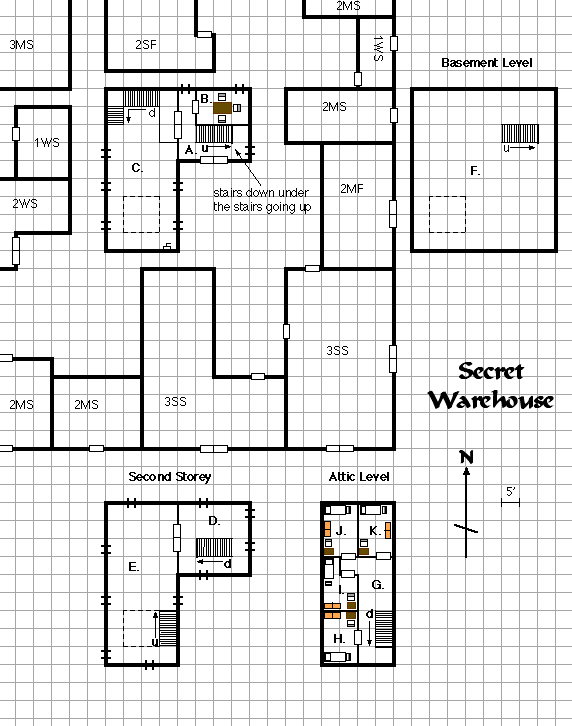
Refer to the Secret Warehouse Map for details.
Other Buildings:
The other buildings on the Secret Warehouse Map that surround the Secret Warehouse are not detailed in this scenario. The DM can either refer to the Guide to Dwillingir or simply make up the purpose and residents of each location. However, a code has been provided for each building using the same codes as presented in the Guide to Dwillingir.
The code has three characters. The first tells the number of above ground stories. Most buildings in Dwillingir that have more than 1 storey also tend to have a basement or cellar of some type. Some of the larger 1 storey buildings also have a small cellar.
The second character tells what the building is made of. S is stone, W is wood, and M is mixed, meaning usually a stone foundation of from 3 ft to the entire first floor with the remainder of the stories being of wood.
The last character tells how the roof is constructed. S means sloped, usually sharply and usually with wooden tiles, while F means flat, usually with wood or even ceramic or glazed stone tiles. Flat roofs will have gutters and drainage to allow water to runoff but they need to be shoveled in the winter and so almost always have access via a trap door from within (these trapdoors pull downward so as not to be blocked by ice or snow).
NOTE: A secret trapdoor has been constructed in the alleyway north of Room C. This trapdoor leads down into a small chamber below the landing in Room C from Room A. Refer to the Room C description for more details.
|
Astute readers will note from the descriptions below that there is no easy way out of the building for its occupants. This is intended, for Liddio does not want his men to be able to flee the building in the face of an attack until he says so. Both ways into the building have been Arcane Locked by Tylleinius, and it requires his presence to pass through these doors. When Havirimus or Liddio need to enter or leave the building, Tylleinius has to give them access. Usually, this means the wizard's familiar is lurking in the alleyway near the secret door (often on the roof of the building north of the warehouse) and will listen for Havirimus or Liddio to whisper for access. The familiar will then alert Tylleinius, who will then open the secret door from within.
However, Liddio is not foolish enough to leave himself potentially imprisoned inside the building should the wizard not be available. He has at his disposal a wand of Knock, which he can use when necessary.
A. Entryhall
The double doors that lead into this room from the outside are strong wooden doors that are usually barred from the inside with a strong wooden bar. In addition, the doors are locked by an Arcane Lock spell cast by Tylleinius. The current occupants of the place don't tend to come and go much, so as not to attract attention, and the wizard and Havirimus use the secret door in Room C to come and go. The occupants in Room B can hear knocking on these doors but cannot observe who is doing the knocking unless they look out the window in Room D. They know that no one should be knocking at the front doors or trying to enter from that direction, and so will assume any activity there is hostile.
The double doors to Room C are good wooden doors and are unlocked. The door to Room B is a good wooden door and is unlocked.
Just opposite the entry double doors, stone steps ascend to the second storey. Meanwhile, to the far east of the hall, a set of stone stairs goes under the stairs that lead up. These descend a ways, then turn back around, and then switchback once again before emerging into Room F.
B. Guard Room
The door from this room to Room A is a good wooden door with no lock.
Within the room are a table and three chairs. In the northeast corner sits a coal brazier providing heat for the occupants. Several oil lamps hang from the wall and are alight at all times due to the blackout on the windows that keep the room dark even during daylight hours. Three guards are always present in the room, on guard duty. They rotate with three others who spend approximately eight hours a day sleeping in the attic and four hours a day off duty relaxing. Food for the guards is provided from the larder down in the basement, which probably will not need to be restocked anytime soon.
C. Main Warehouse
This is the main storage area for goods on this level. In actuality, House Commus has ripped up the wooden floor here and stone steps lead from the good wooden double doors from Room A down to the floor of what was once the cellar of this building. This means this room is actually 20 ft tall from floor to ceiling. The windows shown on the map are all at ground level, which means approximately 14 ft above the floor of the room.
The room is, for the most part, filled with trade goods. While these are not indicated directly on the map, the room actually consists of a small maze of aisle ways between stacked boxes and crates and barrels, most reaching from 2' to 7' below the ceiling. The DM, if running combat in this room, should indicate the great piles of goods on the player's map and provide lots of small paths between them.
To the south of the room, a 10 ft square area is clear of goods. The floor is wooden and thick iron chains run from the platform through the wooden ceiling, to pulleys on the stone ceiling of Room E, and then over to the south wall of the place and down once again to a large iron crank with a ratchetted locking mechanism that sprouts from the southeastern corner of Room C. This crank can be used to lower or raise the wooden platform. The platform can ascend to Room E or descend to Room F and is used to haul goods. It takes a Strength check (DC 5) each round to turn the crank and it takes 5 successful rounds of turning to ascend or descend a full level.
Almost exclusively, the platform is to be found in Room C at floor level.
To the west several large ladders (rising up to 15 ft) have been leaned against the wall.
Under the stone platform leading from Room A to the stone stairs is a secret door (Search DC 25) which leads to a small 5 ft wide by 15 ft long passage that ends in an iron ladder that leads up to a secret trapdoor (Search DC 25) that exits into the alleyway north of the building. This latter secret door had been subject to an Arcane Lock spell cast by Tylleinius and is locked from within by a hidden opening mechanism (Search DC 20 after the door has been found). The trapdoor emerges in the alleyway 5 ft west of the window at the north end of Room A.
D. Antechamber
This chamber is accessed via the stairway that ascends from Room A. The room here is barren except for several sputtering oil lamps set in niches in the walls. Good wooden double doors to the west are unlocked and lead to Room E.
The roof of this room is comprised of a sloped wooden roof covered by ceramic tiles. The slope descends to the east and is some 10' high at its western end and 6' at its eastern end.
E. Upper Storage
This room is accessed either via unlocked good wooden double doors that lead to Room D or via the platform that ascends from Room C.
The room is stuffed full of bags and barrels and crates and trade goods such that the entire room is filled with columns of such items that generally reach near to the ceiling. Small pathways and runways dodge beneath these piles. A couple of ladders (6 ft tall) lean against the northwest wall.
To the southeast, wooden steps lead up to the attic.
F. Basement
This room looks to have been recently constructed (within the last 3-4 years). The northwest portion is of worked stone and was probably of original construction, but the remainder is newly dug or quarried and shored up with wooden beams both vertical and crosspiece.
To the northeast, stone stairs lead up to Room A after making two switchbacks, and the platform from Room C can descend here.
The place is filled with more trade goods, most of which stretching from floor to ceiling, though with plenty of small pathways in between.
To the southeast is an area reserved for the provisions of the guard, including jerked meats, roots, many barrels of fresh water, watered down ale, several large bottles of lamp oil, etc.
To the northwest are two areas that have been cleared of goods. Each area is about 10 ft square and the boxes and crates have been stacked in such a way to form two chambers with crate "walls" that reach close to the ceiling. Within these makeshift chambers dwell Tylleinius and Havirimus. Both have comfortable fur pallets, a crate serving as a nightstand, and some bundles of clothing, backpack, and other personal effects.
G. Attic Way
Wooden steps lead up from Room E to this small hallway. The attic is under the eaves of a sloped roof, and as such comes to a height of 6 ft at its edges, rising to 10 ft at its center. This hallway bears two hooded lanterns placed on the floor to provide light. All of the doors on this level are good wooden doors that can be barred from the inside by a stout wooden bar. These are only barred if occupied.
H. Sleeping Quarters
The door to this room from Room G is a good wooden door, barred from this inside by a stout wooden bar only if occupants are sleeping within.
The room boasts a bunk bed, a cheap wardrobe filled with mundane clothing, and a fairly unused writing desk and chair. A large footlocker near the bunk is unlocked and holds a few personal effects (flint and steel, whetstones, etc.). A couple of coal braziers provide warmth and several oil lamps hanging from chains provide light.
Two of the Commus House Guards dwell here, one on duty in Room B and the other either asleep or off duty.
I. Liddio's Quarters
The door to this room from Room G is a good wooden door, barred from this inside by a stout wooden bar only if occupants are sleeping within. Havirimus has cast a Glyph of Warding from a scroll onto the doorway to this room, the password of which to bypass being "King of All". The glyph, if discharged, is a sonic attack, and as such will make a lot of noise, alerting the entire warehouse. Only Liddio and Havirimus know of the glyph.
| * Glyph of Warding (Blast): CR 4; spell; spell trigger; no reset; spell effect (glyph of warding [blast], 6th level cleric, 3D8 sonic, DC 14 Reflex save half damage); multiple targets (all targets within 5 ft.); Search DC 28; Disable Device DC 28. |
The room boasts a single bed and furnishings that are similar to those in Room H but are of somewhat finer make.
The wardrobe is guarded by a poisoned crossbow trap, the crossbow being set up inside the wardrobe to fire when the doors are opened.
| * Poisoned Crossbow Trap: CR 5; mechanical; location trigger; manual reset; Atk +15 ranged (1D8+4 plus poison, light crossbow); poison (Deathblade, DC 20 Fortitude save resists, 1D6 Con/2D6 Con); Search DC 21; Disable Device DC 22. |
The clothing in the wardrobe is not quite as shabby and the desk shows signs of use and includes a large ledger and quill pen and ink. There is also a masterwork disguise kit here with 8 uses left. Leaning against the inside of the wardrobe is a tall, thick wooden quarterstaff with a cudgel-like rounded head. This is actually the ivory staff. It has been disguised by having a sort of putty spread over it to smooth over the engravings and the mammoth head carving. The putty has been textured to give the staff a wood-like appearance, and then painted to perfect the disguise. Additionally, the putty is mixed with lead, so that once coated, the ivory staff is not subject to a Locate Object spell. The whole is well-wrought, and it would take a Search check of DC 30 to notice this on a general search of the wardrobe. If the staff is specifically searched, carefully, then a Search DC 20 will spot the deception. Of course, if a PC is suspicious about the staff, and decides to fiddle with it or fleck off some of the paint or otherwise specifically examine the staff to see if it is the ivory staff in disguise, then the chance of discovery should be automatic.
J. Sleeping Quarters
The door to this room from Room G is a good wooden door, barred from this inside by a stout wooden bar only if occupants are sleeping within.
The room boasts a bunk bed, a cheap wardrobe filled with mundane clothing, and a fairly unused writing desk and chair. A large footlocker near the bunk is unlocked and holds a few personal effects (flint and steel, whetstones, etc.). A couple of coal braziers provide warmth and several oil lamps hanging from chains provide light.
Two of the Commus House Guards dwell here, one on duty in Room B and the other either asleep or off duty.
K. Sleeping Quarters
The door to this room from Room G is a good wooden door, barred from this inside by a stout wooden bar only if occupants are sleeping within.
The room boasts a bunk bed, a cheap wardrobe filled with mundane clothing, and a fairly unused writing desk and chair. A large footlocker near the bunk is unlocked and holds a few personal effects (flint and steel, whetstones, etc.). A couple of coal braziers provide warmth and several oil lamps hanging from chains provide light.
Two of the Commus House Guards dwell here, one on duty in Room B and the other either asleep or off duty.
Secret Warehouse Roster:
|
* Liddio: Female human Rogue 3/Fighter 2; CR 5; Medium humanoid (human); HD 3D6+3 plus 2D10+2; hp 35; Init +6; Spd 30 ft; Space 5 ft; Reach 5 ft; AC 19 (touch 14, flat-footed 15); Atk +9 melee (1D6, masterwork rapier) or +8 ranged (1D4, dagger); SA sneak attack +2D6; SQ evasion, trapfinding, trap sense +1; AL N; SV Fort +5, Ref +7, Will +3; Str 10, Dex 18, Con 12, Int 15, Wis 14, Cha 15. Height 5 ft 6 in. Skills and Feats: Balance +6, Bluff +7, Climb +5, Craft (trapmaking) +6, Diplomacy +9, Disable Device +6, Disguise +5 (+7 acting), Escape Artist +7, Gather Information +7, Hide +7, Intimidate +4, Jump +7, Listen +6, Move Silently +7, Open Locks +7, Search +7, Sense Motive +7, Spot +8, Tumble +11, Use Magic Device +12; Blooded, Combat Expertise, Dodge, Mobility, Skill Focus (use magic device), Weapon Finesse. Possessions: chain shirt, masterwork buckler, masterwork rapier, daggers (6), bandoleer, thieves' tools, belt pouch, masterwork potion belt, wand of knock at 3rd level with 29 charges, wand of curse of acid at 1st level with 16 charges, potion of cure light wounds at 1st level, acid flask, alchemist's fire, potion of cat's grace at 3rd level, potion of shield of faith at 1st level, Commus medallion of gold and garnet (250 gp), silver moon earrings (25 gp each), silver and jade ring (175 gp), 16 cp, 34 sp, 27 gp, 16 pp. Languages: Common, Morakki, Thaneeri. |
|
* Havirimus: Male human Cleric 4; CR 4; Medium humanoid (human); HD 4D8+4; hp 30; Init +1; Spd 30 ft; Space 5 ft; Reach 5 ft; AC 13 (touch 11, flat-footed 12); Atk +4 melee (1D6, quarterstaff) or +4 ranged (1D8, light crossbow); SA turn undead (4/day, +2 synergy bonus); AL LN; SV Fort +5, Ref +2, Will +7; Str 13, Dex 12, Con 12, Int 17, Wis 17, Cha 13. Height 5 ft 10 in. Skills and Feats: Concentration +8, Decipher Script +5, Knowledge (arcana) +6, Knowledge (geography) +5, Knowledge (history) +5, Knowledge (local - Thaneer) +10, Knowledge (religion) +8, Spellcraft +7; Combat Casting, Combat Expertise, Spell Focus (enchantment). Possessions: quarterstaff, leather armour, light crossbow, crossbow bolts (20), copper holy symbol, spell component pouch, belt pouch, scroll of summon monster III at 5th level, potion of bear's endurance at 3rd level, Commus medallion of silver and garnet (100 gp), 20 cp, 10 sp, 44 gp, 3 pp. Spells Prepared (5/4/3): 0 - detect magic, light, resistance, silver sword, summarize; 1 - bless, command, omen of peril, sanctuary; 2 - divine protection, hold person, silence. Domains: Knowledge (knowledge skills are class skills, divination spells cast at +1 caster level), Mentalism (+2 to next Will save for creature touched 1/day, lasts 1 hour); Domain Spells (1/1): 1 - lesser confusion; 2 - detect thoughts. Base DC = 13 (14 for enchantments) + spell level. Languages: Common, High Imperial, Elvish, Draconic, Thaneeri, Wolgir, Lothuk, Dwarvish |
|
* Tylleinius: Male human Wizard 4; CR 4; Medium humanoid (human); HD 4D4+4; hp 16; Init +2; Spd 30 ft; Space 5 ft; Reach 5 ft; AC 12 (touch 12, flat-footed 10); Atk +2 melee (1D6, quarterstaff) or +2 melee (1D4, dagger) or +4 ranged (1D4, dart); SQ alertness (when familiar nearby), empathic link; AL NE; SV Fort +2, Ref +3, Will +5; Str 11, Dex 14, Con 12, Int 17, Wis 13, Cha 10. Height 6 ft 2 in. Skills and Feats: Concentration +8, Craft (alchemy) +5, Decipher Script +6, Knowledge (arcana) +8, Knowledge (planes) +5, Listen +4, Search +5, Spellcraft +10, Spot +4 (+7 in shadows); Combat Casting, Scribe Scroll, Signature Spell (magic missile), Spell Mastery (charm person, magic missile, mage armour). Possessions: quarterstaff, scroll of charm person at 1st level, scroll of lightning bolt at 5th level, scroll of levitate at 3rd level, scroll of slow at 5th level, potion of cure light wounds at 1st level, wand of ray of frost at 1st level with 14 charges, scroll organizer, spell component pouch, belt pouch, spellbook, Commus medallion of silver and garnet (100 gp), four pearls (100 gp each), 27 cp, 35 sp, 10 gp, 7 pp. Spells Prepared (5/4/3): 0 - detect magic, disrupt undead, flare, light, silent portal; 1 - burning hands, mage armour, phantasmal force, shield; 2 - aura of lightning, invisibility (2). Base DC = 13 + spell level. Spellbook: 0 - all in PHB plus silent portal; 1 - burning hands, charm person, creature lore, curse of acid, lesser foretelling, identify, know protections, mage armour, magic missile, magic weapon, phantasmal force, shield; 2 - aura of lightning, invisibility, levitate, see invisibility, sphere of shrapnel, summon monster II. |
|
* Quantril (Tylleinius' Owl Familiar): CR 1/4 (included in master's CR); Tiny magical beast; HD 1D8 (treated as 4 HD for most purposes); hp 8; Init +3; Spd 10 ft, fly 40 ft (average); AC 19 ( touch 15, flat-footed 16); Atk +5 melee (1D4-3, talons); SQ deliver touch spells, empathic link, improved evasion, low-light vision, share spells; AL N; SV Fort +2, Ref +5, Will +6; Str 4, Dex 17, Con 10, Int 7, Wis 14, Cha 4. Height 2 ft. Skills and Feats: Listen +14, Move Silently +17, Spot +6*, Weapon Finesse. * +8 racial bonus in areas of shadowy illumination. |
|
* Commus House Guard (6): Male human Fighter 1; CR 1; Medium humanoids (human); HD 1D10+2; hp 15; Init +1; Spd 20 ft; Space 5 ft; Reach 5 ft; AC 19 (touch 11, flat-footed 18); Atk +4 melee (1D8+2, longsword) or +3 ranged (1D6, shortbow); AL N; SV Fort +4, Ref +2, Will +1; Str 15, Dex 12, Con 14, Int 10, Wis 10, Cha 11. Height 5 ft 11 in. Skills and Feats: Climb +3, Intimidate +4, Jump +3, Listen +2, Spot +2; Distracting Attack, Toughness, Weapon Focus (longsword). Possessions: longsword, banded mail, heavy steel shield, shortbow, arrows (20), dagger, belt pouch, Commus medallion of copper (15 gp), 16 cp, 14 sp, 6 gp. |
The House Guards do not know what it is they are guarding. They do know that the are supposed to be guarding something important that House Veritas wants to steal from House Commus. Liddio, Havirimus, and Tylleinius know of the staff and where it is hidden (Room I).
The Offer:
Once the PCs have obtained the staff, they will be approached by Allispan. House Veritas will have learned that House Commus has lost the staff by a variety of means (Gather Information, observing the reactions of House Commus, etc.). They will also have learned that House Riverine most likely has the staff, again from a variety of means (likely from querying some of the people the PCs spoke with when using Gather Information). If the PCs were somehow extraordinarily discrete in their inquiries (for example being under disguise or altered forms), then the DM can assume that House Veritas paid for divinatory magic to determine what House now has the staff.
In any event, Allispan will come calling. He will at first attempt to obtain the return of the staff. He does not initially know if the PCs have determined the true value and function of the staff, so he will likely attempt to simply buy back the staff at some percentage of its "appraised value". Here is a likely progression of Allispan's negotiations. The DM is, of course, encouraged to improvise. The list below is predicated on the fact that the party has not divulged to Allispan that it knows the staff is more than a mere House Veritas heirloom.
Once the party makes it clear that they know the staff is a treasure map of some sort, Allispan will sigh resignedly. He will then state that while the assertion is true, the staff's message is very cryptic, and it took him years of study and intensive research to decipher the meaning of the symbols and phrases on the staff. He will point out that merely having the staff is not sufficient to locate the treasure without the added knowledge, and that given that it took him well over a year and a half to perform the research, and then in the midst of the Imperial Heartland with its available libraries (far beyond anything available in the Far Coast), the party will likely have to wait years and years to have a chance to recover the treasure.
Meanwhile, Allispan will assure them, that will give House Veritas enough time to register a claim of rightful ownership with the Indolle Temples and to secure the necessary documentation from his House in the Heartland for irrefutably prove ownership of the staff.
Therefore, Allispan will demand the return of the staff, once again offering to pay the PCs the amount left off in the first part of the negotiations, and possibly increasing to some larger reward thereafter.
If this tact fails, and only after some fairly intense bargaining, Allispan will offer to have Veritas and the PCs jointly follow the staff and jointly raid the tomb for its treasure, and to jointly split the prize. He will point out that while the PCs have the staff, he has the knowledge, and both are definitely needed.
Allispan's offer to share the prize should only come on the heels of some valid threats by the PCs. Namely:
Of course, the PCs should not decide to accept or reject these offers without consulting with Barnabus at House Riverine. The negotiations can take place over several meetings, with the PCs consulting with Barnabus in between.
Commus' Reaction:
House Commus will be quite disturbed at the loss of the staff, and will seek its return. They likely believe that Veritas has stolen it back, but now hold little hope of regaining it as Veritas will be doubly on guard against another theft. If Commus somehow learns that Riverine has the staff, they will likely take some of the same tact as Veritas, though they cannot claim any chance of obtaining a judgment in an Indolle court since they stole the staff and were not its legitimate owners. Commus can be convinced to share the prize with the PCs. If this happens, the DM should simply adjust the remainder of this adventure, switching Liddio, Havirimus, and some Commus House Guards for the Veritas tomb raiders and have the forces listed as the Veritas tomb raiders instead try to trail the PCs to the site.
But given the unlikely event that the PCs' affiliation with Riverine would be known by House Commus (assuming they properly followed Barnabus' advice), the only way Commus would likely be brought into negotiations is if the PCs went to them with an offer. Barnabus will prefer to deal with Veritas, as the staff was indeed theirs in the first place and the Trade Lord does have some sense of propriety. He also is less inclined to deal with House Commus given the events of the scenario "Where There's Smoke...".
Riverine's Reaction:
When the PCs return the staff to Riverine, it will be closely examined by Curinax, Barnabus, and the PCs. Of a certain the engravings will be scrutinized, and a Comprehend Languages spell cast to read what can be read. It will become apparent that the staff is a map to a Thaneeri tomb wherein an important and powerful Thaneeri king was laid to rest, along with his most valuable possession, a ruby the size of a human heart called, appropriately enough, the King's Heart. Barnabus will be visibly amazed at the thought of so large a ruby. He will state that such a gem would be of immense value, enough to raise the stature and fortunes of the entire Imperial-wide network of House Riverine above all of the other Houses.
Riverine will begin to study the staff, and shortly thereafter, Veritas will come with its offer (see above).
In response to the offer, Barnabus will charge the PCs with obtaining this gem. He will give his approval for the PCs to join up with House Veritas to raid the tomb. But then he will become serious and lean forward and look intently into the PC's eyes and reiterate that he wants the gem...for House Riverine. He will tell the PCs that they should do what they have to in order to secure it. It should be obvious that Barnabus does not want to honour the agreement with House Veritas to split the prize. In essence, he wants the PCs to cheat House Veritas by having the party initially agree to share the prize, gain the tomb, recover the gem, and then bring it back to House Riverine without House Veritas in tow.
The PCs may have a moral problem with this. If they raise objections, Barnabus will explain that this is business, and business people sometimes have to stretch the truth. He did not hire the PCs to be a bunch of paladins. Furthermore, he will explain that he is not recommending that the PCs slit the Veritas member's throats in their sleep. But he frankly believes that House Veritas has no intention of honouring its agreement to split the prize, so it is up to Riverine to grab the gem for itself. He will ask the PCs if Veritas offered to draw up a formal contract to share the prize. As they did not, Barnabus will cite that as proof that they also do not wish to share the gem.
If the issue of the Indolle courts is brought up, Barnabus will laugh. The only claim they have is on the staff, and once the gem is in Riverine hands, Veritas can certainly have its staff returned to it...at no charge!
Leaving Dwillingir:
Assuming Veritas and Riverine have agreed to share the tomb raiding, it will be decided that each House will lend an equal number of men to the endeavour. This should be tailored to the number of PCs in the group. If there are 4 PCs and a cohort, then Veritas will bring along 5 members of its own. In all cases, Allispan and the Lieutenant of the House Guards sent with him, Lieutenant Starffus will be present. The remainder of the Veritas side will be comprised of Veritas House Guard members. Veritas will not be mounted, for they warn that the Thaneeri take a dim view of riding beasts. They do bring along four mules, laden with provisions and excavating equipment such as shovels and picks and coils of rope, chalk, lanterns, etc. See the Veritas Roster section for the Veritas member statistics.
The need to leave surreptitiously might be proposed by the PCs, fearing that Commus will try to come after them, but Allispan will impulsively blurt out that it doesn't matter and then flush red with embarrassment. When pressed, he will finally admit that House Commus already knows the general location of the tomb, as Havirimus had assisted him in deciphering the staff engravings. He can then tell his entire story (as presented in the Chapter A Introduction). Therefore, he expects trouble from Commus at some point.
At all times, the PCs would be astute to hold onto the staff and guard it well. Should Veritas get the staff, then they would be free to flee to the site and raid the tomb on their own. The PCs may notice both Allispan and Starffus often stare at the staff or in the direction of where it is kept. A Sense Motive check on either (DC 15) will reveal that Allispan looks at the staff with a wistful mixture of eagerness and regret (at having to share the prize and glory), while Starffus looks at it with a cold, calculating look, as if planning how and when to grab it away from the PCs.
At some point during the journey, House Commus will attack. This is their last chance to get the staff. Although it might have made more sense tactically to wait outside the tomb and attack anyone after they emerge, there is no reason to be certain that anything dangerous even exists at the tomb, and whomever recovered the gem might have a legal claim to it if they had emerged from the tomb with it in hand. Therefore, Commus is determined to try to gain the staff now.
The attack will occur on the road if possible, likely outside of Imperial Lands after the Chulette River is crossed. If the party somehow travels exceptionally stealthy, then Commus will be waiting for them at the site of the Emerald Spring. Given the time it would have taken the PCs to study the staff and negotiate with Veritas, there should be no conceivable way the group could have beaten Commus to the Spring.
At full force the attack will involve all of the roster of the Secret Warehouse, plus two additional House Guards (for a total of 8). If any of the three leaders present in the Secret Warehouse were killed or sufficiently disabled so that they could not be present now, then they should be excluded from this attack. Any House Guards slain or disabled will have been replaced from the trade outpost. All of these will be mounted on light warhorses. The Commus attackers will attack to kill, for they do not want simply to snatch the staff and then have to face the PCs and Veritas later at the Spring.
|
* Light Warhorses: CR 1; Large animal; HD 3D8+9, hp 22; Init +1; Spd 60 ft; AC 14 (touch 10, flat-footed 13); Atk +4 melee (1D4+3 [x2], hooves) and -1 melee (1D3+1, bite); SQ low-light vision, scent; AL N; SV Fort +6, Ref +4, Will +2; Str 16, Dex 13, Con 17, Int 2, Wis 13, Cha 6. Length 6 ft. Skills and Feats: Listen +4, Spot +4; Endurance, Run. Possessions: saddle, bit and bridle, saddlebags. |
The PCs will be tracked by Tylleinius' owl familiar, so that the Commus force can intercept them.
Both Havirimus and Tylleinius will have different spell prepared, to reflect their knowledge of the coming battle.
|
* Tylleinius: Spells Prepared (5/4/3): 0 - daze (2), flare, light, resistance; 1 - burning hands, mage armour, phantasmal force, shield; 2 - aura of lightning, sphere of shrapnel (2). |
|
* Havirimus: Spells Prepared (5/4/3): 0 - detect magic, guidance, light, resistance (2); 1 - bless, command, doom, sanctuary; 2 - divine protection, hold person, silence. Domains: Knowledge (knowledge skills are class skills, divination spells cast at +1 caster level), Mentalism (+2 to next Will save for creature touched 1/day, lasts 1 hour); Domain Spells (1/1): 1 - lesser confusion; 2 - detect thoughts. Base DC = 13 (14 for enchantments) + spell level. |
Tylleinius will enter the battle with Mage Armour and Shield cast. Any potions remaining from the encounter at the Secret Warehouse will be imbibed in advance of the battle as appropriate. The House Guard will have lances to attack with from horseback (at +3 attack bonus). If all of the leaders are slain or disabled, the remainder of the Guards are likely to flee.
In the event that Tylleinius has had his spellbook taken from him during the raid on the Secret Warehouse, remember that he has the Spell Mastery feat and can still replace any spells cast with Charm Person, Magic Missile, and Mage Armour. Also, since he can spontaneously cast Magic Missile (due to his Signature Spell feat), he won't need to memorize any of that spell.
Dealing with Thaneeri:
If the PCs killed some or all of the three Commus leaders during the raid of the Secret Warehouse, then the Commus attack above may not present much of a challenge to the PCs. In this case, the DM can spice up the journey with an encounter with Thaneeri barbarians. Even if the Commus attack was a challenging encounter, the DM can still offer this Thaneeri encounter as an addition. This encounter does not advance the plot in any way, but does remind the PCs that they are in hostile barbarian lands.
The lands being travelled by the group to reach the Emerald Spring site is Cilligh Clan lands. Although the Cilligh Clan is fairly friendly with the Imperium, that doesn't mean they all are. Some of the Cilligh Clan's relationship with the Imperium is simply based on necessity, by proximity and overwhelming might and by the need to protection against other clans.
The group has been spotted by Cilligh warriors. These are young braves out to prove themselves, and they basically consider the group to be slavers or miners trying to steal Cilligh gems and metals from the earth.
The group is not subtle. They are encamped in a vale between a set of small hillocks preparing to continue on their journey back to their satula. One barbarian, out for a morning break to relieve himself, spots the group across a valley at a distance of about 1500 ft. He quickly returns to camp and reports on the PCs and their numbers. For a minute or two the group debates what to do. Some are nervous about attacking Imperials, both because their clan is somewhat friendly to the Empire and because they fear the demon-magic of the Imperials. But the more persuasive members urge action, for they tell how these Imperials are likely salvers come to take their sisters and mothers into slavery and rape them and force them to mate with demons. Further, Imperials are know to be wealthy, and they have mules to make for fine eating! The aggressive members finally prevail, especially when they point out that this will prove their bravery and make them more eligible for marriage and how they will be branded cowards if they do not.
The group quickly breaks camp and moves ahead of the PCs. There they attempt to set up an ambush. There is not a lot of flora available for cover, so the barbarians will be forced to use the hills and ridges themselves. This means they will be positioned along flanks of a valley, with a small group hiding amidst rocks and other debris ahead of the PCs' path. Of each flanking group, all but one will be completely hidden, slightly down the backside of the ridges. Only a single scout will be prone, spying the PCs' progress. The ambush will await the four barbarians emerging from the rocks along the path and will then be sprung.
The barbarians are young and brash, but they also have heard stories of Imperial wizards. They know not to bunch together and to shoot at wizards. They certainly cannot identify spellcasting to any other sort of hand movements, but half of the bowmen will ready their actions to shoot any Imperials that seem to be casting any spells or pointing wands or staves at barbarians.
While the first four come forward, and half of the flankers wait for casters, the remaining half of the flankers will fire once and then charge down the slopes to join the melee. The flankers who hung back will begin to evaluate the situation. If no Imperials cast spells after a round or two, they will assume there are no wizards and begin to fire at will. Once most of the Imperials are engaged or have cover, they will charge down the slopes.
If the Imperials exhibit multiple spellcasters (and these barbarians cannot really distinguish between Imperial arcane casting and Imperial divine casting), then the archers will begin to divide their readied actions amongst the spellcasters, so that each will be subject to an equal portion of readied ranged attacks.
The barbarians will attack until the four 2nd level Thaneeri are out of the fight. Then they will react according to their assessment of the situation.
Most of the barbarians will not rage unless in extremis, as they do not want to be stopped from escaping by being fatigued and unable to run. However, the four 2nd level Thaneeri will rage as they first emerge from the rocks, as they want to lead the younger barbarians by example.
|
* Young Thaneeri Barbarians (12): Male human Barbarian 1; CR 1; Medium humanoid (human); HD 1D12+3; hp 15; Init +2; Spd 40 ft; Space 5 ft; Reach 5 ft; AC 17 (touch 12, flat-footed 15); Atk +4 melee (1D8+3, battleaxe) or +3 ranged (1D6+1, composite shortbow); SA rage (1/day for 8 rounds); SQ fast movement, illiteracy; AL CN; SV Fort +5, Ref +2, Will +0; Str 17, Dex 14, Con 16, Int 10, Wis 10, Cha 9. Height 6 ft 3 in. Skills and Feats: Climb +5, Intimidate +1, Jump +5, Listen +3, Spot +1, Swim +5, Survival +3, Tumble +4; Diehard, Endurance. Possessions: battleaxe, studded leather armour, heavy wooden shield, dagger, composite shortbow (+1 Str bonus), barbarian's outfit, belt pouch, flint and steel. |
|
* Tougher Thaneeri Barbarians (4): Male human Barbarian 2; CR 2; Medium humanoid (human); HD 2D12+6; hp 26; Init +2; Spd 40 ft; Space 5 ft; Reach 5 ft; AC 17 (touch 12, flat-footed 15); Atk +5 melee (1D8+3, battleaxe) or +4 ranged (1D6+2, composite shortbow); SA rage (1/day for 8 rounds); SQ fast movement, illiteracy, uncanny dodge; AL CN; SV Fort +6, Ref +2, Will +0; Str 17, Dex 14, Con 16, Int 10, Wis 10, Cha 9. Height 6 ft 3 in. Skills and Feats: Climb +5, Intimidate +4, Jump +5, Listen +3, Spot +2, Swim +5, Survival +3, Tumble +4; Diehard, Endurance. Possessions: battleaxe, studded leather armour, heavy wooden shield, dagger, composite shortbow (+2 Str bonus), barbarian's outfit, belt pouch, flint and steel. |
Tempus Fugit:
Time constraints do exist in Chapter A, and should the PCs seek to delay their actions, then consequences may arise:
PCs do not steal back the staff within a month:
House Commus will eventually be able to sneak the staff out. As Veritas cannot station watchers for long periods of time at the Spring (due to the fact that the Thaneeri might have something to say about that), Commus will arrive there, excavate the tomb, and it is up to the DM if they reawaken the lich or if they manage to restore the gem and reseal the tomb.
PCs do not come to a deal with Veritas:
Eventually, Veritas will lodge a complaint with the temple of Indolle and proceed to gather its evidence. Within a year or so, a tribunal will be called. Events after this are up to the DM, but such a tribunal is likely to rule in favour of House Veritas.
CHAPTER B - THE TOMB
Introduction:
The tomb is fairly large. It began as the tomb of a Thaneeri prince, and was enlarged by the lich, who first entered there to despoil the corpses and revive them as undead servants. Once done, he found the place to his liking, and due to its aura, a perfect place to continue his dark studies. He then constructed his stead and fortress atop the site, but used the tomb as his sanctum sanctorum.
When the Thaneeri assaulted him, they won the day and tore down the stead. The upper works were burned and the ashes churned into the soil. The land was then salted, and for centuries the place was considered taboo.
Over the centuries, even after the salting, the land reclaimed the area. The tomb site itself became buried and overgrown, and the land shaped itself over the area, so that all trace of the tomb and the stead was lost to observation.
Finding the Tomb:
Finding the tomb is simply a matter of following the precise directions on the staff. The ancient spring can be found with a bit of effort by Allispan, it being a small cluster of rocks at the base of a rise with a hole leading into the ground. Before and below the cluster is an overgrown shallow depression that once held a small pool and evidence of an ancient riverbed emanates from the pool heading east towards the sea.
At the final sighting mentioned on the staff, when the PCs are atop the large boulder and sighting between the bear cubs and the wild flowers, they will note a small, grass covered clustered of rocks that, on longer scrutiny, could be artificially constructed. The effect is quite subtle, and therefore the rocks must be quite ancient and well weathered, but nonetheless, as one looks specifically for it, it becomes apparent that something is here.
However, finding the tomb is not an instant nor automatic procedure. The riddle of the staff is still slightly obscure even with the knowledgeable assistance of Allispan. Allispan can basically inform the PCs of the meanings of the phrases and directions on the staff. For example, he can explain what Monrine is and when Browneven is and so forth. But it still needs to be determined, for example, what precisely the phrase "Set at its crown, let the Thunderer rejoice at the Browneven Flame Father and then shall the Earthmother's Fire and the Seed of Monrine guide thine eye away from the Deathless Sea." means.
Allispan can basically translate this phrase as:
Set at its crown, let the mammoth rejoice at the mid afternoon sun and then shall the wildflowers and the bear cubs guide thine eye away from the Oto Sea.
But even the above still requires a leap of intuition and deduction to figure out exactly what is required.
The cluster of rocks can be approached and carefully examined. A close inspection reveals that the rocks were likely set as some sort of marker or commemorative menhir, and if a DC 20 Search check is made it will be noted that there were once runes carved into them, though they are now too worn and faded to be read.
The soil around the area is still ash encrusted, as if the land has not entirely cleaned the stain of that final battle. Poking through the soil will turn up ash flakes and a more concerted probing will find bones and bits of skulls and ribs and the like, remnants of the number of Thaneeri who fell here.
The rocks are set at the top of a very slight rise. The tomb entrance is located along the north side of the rise, buried under about 6-8 feet of earth. The PCs will have to basically begin to excavate around the rise, searching for the entrance. This will be a matter of trial and error, and the PCs will have to determine how deep the wish to dig in a given area before moving on. The DM should draw a map of the rise and the stone cluster, note in his mind the location of the entrance, and then have the PCs chart where they dig. The rise itself is perhaps 200 feet in diameter and 25 feet tall at its apex.
The entrance to the tomb is a traditional Thaneeri affair, two stone plinths topped by a massive stone crossbeam set against a vertical carve-out of what was the ancient hillside. The tomb entrance is 10 ft wide and 12 ft tall and written in very faded ancient Thaneeri and Wolgir and Lothuk runes (much older than even the engravings on the staff). They require a very close and thorough examination to make out, and read:
| Herein lies Thaskik Hongursson, third scion of the Ghantur Clan and right toe of Thaneer. May the curse of the gods be on any who defile his resting place! |
This is, of course, the name of the prince who was originally buried here. Allispan will not recognize his name, though he does vaguely remember the Ghantur Clan as an ancient Thaneeri tribe and the right toe is said to be one of the grandsons of the fourth son of an important figure. In this case, the carving seems to imply that this was the tomb of one of the grandsons of Thaneer, but by legend Thaneer only had three sons, so this reference is puzzling.
The tomb entrance has been sealed off. While this is not entirely uncommon, what is strange is that the seal is of a very strange stone that is of pure white with silver specks shaped like starbursts dotting it. The stone is perfectly smooth and remarkably intact for having been so old, and this in contrast to the large stones that form the entrance way, all of which are quite weathered and cracked in some places. The seal radiates a faint abjuration magic.
Set into the strange white stone wall is an indentation. Close examination will reveal that the indentation is fairly deep, and curves up into the wall in deep grooves and strange twisting runnels. In actuality, this indentation serves as the key to open the seal. If the mammoth head of the staff is placed into the indentation and then the other end of the staff pivoted down so that the mammoth head rises into the deepest crannies of the indentation, there will be heard a clicking sound and then the seal will begin to slide slowly to the left. It will take 2 rounds for the seal to open fully, and interestingly, there is no place in the left wall of the entrance for the seal to withdraw into. The seal just simply seems to vanish into the wall. If the staff is not pulled out of the indentation as the seal opens, then it will pop out and click to the ground just before it is crush by the opening seal.
Cobwebs cover the opening, and a his of stale air pushes between them, causing them to tear and flap slightly. The dark passage into the tomb awaits.
The Tomb:
The tomb maps are from the WOTC map-a-week website.
The tomb is contained on two levels. All walls, floors, and ceilings are of worked stone, and most of the first level shows the work of ancient Thaneeri tomb builders, in that the stones are worked and interlocked in uneven shaped that mirror the original shape of the stones (in the fashion of Earth's Incas). The second level, on the other hand, seems to be the expansion initiated by the lich, for its construction is of evenly carved stones that have obviously been quarried and fashioned to precise specifications.
There is no light anywhere in the tomb. Normal-sized vermin inhabit the place, including regular spiders, centipedes, and mice.
Unless otherwise stated, all ceilings are 10 ft tall.
Each square on the tomb maps equals 10 ft.
The tomb is haunted by the remaining remnants of the lich's undead minions. Over the course of the millennia, many of the corporeal undead have decayed away or destroyed themselves. Most of the incorporeal undead have fled the tomb, though a few were trapped trying to pierce the rod of antimagic in order to slay Arwana.
All intelligent undead in the tomb speak and understand Akrib and Thaneeri.
Tomb Level One:
 |
1. Entry Hall:
The first 50 ft of this hallway is not represented on the map.
Just after the entryway, which is some 5 ft deep, the hall opens out into a 20 ft wide shaft that descends at a slight angle as it pierces the hillside. Sconces cut into the walls at shoulder height contain small concave metal bowls that were designed to hold oil and wicks. The floor is covered with dust, and cobwebs fill the chamber. It appears that this portion of the hallway has not been traversed in many centuries.
However, after about 50 ft (at the point where the hallway enters the map), the cobwebs clear and there are signs of many recent disturbances in the dust.
2. Chamber of the Slaves:
The hallway from Room 1 into this chamber is frosted with cobwebs, making visibility from Room 1 into this chamber difficult. The dusty chamber is 20 ft tall, and was the burial place of the slaves of the Thaneeri prince. There are niches cut into the walls, each 3 ft deep by 7 ft wide by 2 ft tall, obviously made to hold a corpse. These niches are stacked 4 tall, and there are 32 in total.
Some 12 zombies are present in this chamber. They were created by the lich and are instructed to attack any living creatures who enter or pass this chamber. It has been quite some time since the zombies have activated, and they are currently covered in dust and cobwebs.
|
* Zombies (12): CR 1/2; Medium undead; HD 2D12+3; hp 16; Init -1; Spd 30 ft; Space 5 ft; Reach 5 ft; AC 11 (touch 9, flat-footed 11); Atk +2 melee (1D6+1, slam); SQ DR 5/slashing, darkvision 60 ft, single actions only, undead traits; AL NE; SV Fort +0, Ref -1, Will +3; Str 12, Dex 8, Con -, Int -, Wis 10, Cha 1. Height 6 ft. Skills and Feats: no skills; Toughness. |
3. Chamber of the Rats:
Like Room 2, this chamber contains many niches. Most of these have nothing but dust and cobwebs draped in them. The floor looks relatively undisturbed.
Three bone rat swarms dwell in this area. They lair in the niches and will pour out to attack anyone who enters the chamber, usually when they pass towards the center of the room.
|
* Bone Rat Swarms (3): CR 3; Tiny undead (swarm); HD 4D12; hp 26; Init +3; Spd 15 ft, climb 15 ft; Space 10 ft, Reach 0 ft; AC 15 (touch 15, flat-footed 12); Atk (1D6, swarm); SA distraction; SQ DR 5/bludgeoning, darkvision 60 ft, half damage from slashing and piercing weapons, immunity to cold, swarm traits, undead traits; AL NE; SV Fort +1, Ref +4, Will +4; Str 2, Dex 17, Con -, Int -, Wis 10, Cha 1. Diameter 10 ft. Skills and Feats: none. Special Attacks: Distraction (Ex): Any living creature that begins its turn with a bone rat swarm in its space must succeed on a DC 15 Fort save or be nauseated for 1 round. |
4. Niche of Flames:
The lich had constructed a magical trap in this niche, which is set to activate when any living creature passes it. The trap resets immediately after activating.
| * Burning Hands Trap: CR 3; magic device; proximity trigger (alarm); automatic reset; spell effect (burning hands, 5th level wizard, 5D4 fire, DC 11 Reflex save half damage); Search DC 26; Disable Device DC 26. |
5. Crumbled Alcove:
This alcove apparently once held a statue of some sort. Only the crude granite pedestal and base of the feat remain. Stone detritus and rubble litters the rest of the alcove, showing that the statue was once quite large. Carvings and runes engraved into the walls in ancient Thaneeri, Wolgir, and Lothuk honour Lothar and contain pleas to Mergurr to guide Thaskik Hongursson to his just reward.
6. Battle Chamber:
An ancient battle took place here, as evidenced by the many Thaneeri bones here, many of them showing signs of having been gnawed upon. Bits of corroded Thaneeri weapons are also present, as well as bits of metal associated with Thaneeri armour (i.e. buckles for leather, etc.). The walls show signs of battering and slashes, and in one corner the walls are stained by ancient scorch marks.
Four tomb motes haunt this place. These undead actually arose after the lich was defeated, forming from the psychic energy left by the battle here and all of the debris present.
|
* Tomb Motes (4): CR 2; Tiny undead; HD 3D12; hp 13; Init +7; Spd 20 ft, swim 20 ft; Space 2.5 ft; Reach 0 ft; AC 18 (touch 15, flat-footed 15); Atk +6 melee (1D4-1 plus disease, bite); SA disease, quickness; SQ DR 2/cold iron or magic, darkvision 60 ft, undead traits; AL CE; SV Fort +1, Ref +5, Will +4; Str 8, Dex 17, Con -, Int 10, Wis 12, Cha 14. Height 1 ft. Skills and Feats: Hide +12, Move Silently +4; Improved Initiative, Weapon Finesse. Special Attacks: Disease (Ex): A creature struck by a tomb mote's bite attack must make a DC 13 Fort save or be infected with a disease known as corpse bloat (incubation period 1D3 days, damage 1D6 Str). The skin of a diseased victim turns a hue of green, bloats, and is warm to the touch. Quickness (Su): A tomb mote is supernaturally quick. It can take an extra standard action or move action during its turn each round. |
7. Wights Chamber:
This small chamber contains two piles of bones and skulls stacked to form two throne-like seats. Sitting upon them are two wights, which consider themselves as the rulers of this level of the tomb, and patiently await the return of their master, Nyzzagir. Over the centuries of their internal contemplation, they have become more in touch with their negative natures and have acquired the Evolved Template. This template has also allowed them to mitigate their Wis damage associated with being unable to feed on the living. These wights will attack any living creatures they encounter, for despite their evolved status, they are starved for life energy, but they are also canny foes, and will not throw away their unlife frivolously. Instead, they will attempt to rally those sentient undead on the level that they can and try to mass to overwhelm intruders.
|
* Evolved Wights (2): CR 4; Medium undead; HD 4D12; hp 31; Init +1; Spd 30 ft; Space 5 ft; Reach 5 ft; AC 21 (touch 11, flat-footed 20); Atk +5 melee (2D6+3, +1 necrotic focus greatsword) or +4 melee (1D4+1, slam); SA create spawn, energy drain; SQ darkvision 60 ft, fast healing 3, spell-like ability, undead traits; AL LE; SV Fort +1, Ref +2, Will +5; Str 14, Dex 12, Con -, Int 11, Wis 13, Cha 17. Height 5 ft 6 in. Skills and Feats: Hide +8, Listen +7, Move Silently +16, Spot +7; Alertness, Blind-Fight. Possessions: +1 necrotic focus greatsword, +1 chain shirt. Special Attacks: Create Spawn (Su): Any humanoid slain by a wight becomes a eight in 1D4 rounds. Spawn are under the command of the wight that created them and remain enslaved until its death. They do not possess any of the abilities they had in life. Energy Drain (Su): Living creatures hit by a wight's slam attack gain one negative level. The DC is 15 for the Fort save to remove a negative level. For each such negative level bestowed, the wight gains 5 temporary hit points. Special Qualities: Spell-Like Ability: see invisibility 1/day. |
8. Chamber of Chains:
This chamber is 15 ft high and a myriad of chains descend from the ceiling, many now rotted and corroded or broken, but some still intact. The intact ones end in wicked hooks, and a few of these still have skulls or bones impaled upon them. This chamber was used by the undead to impale victims for later feeding, and in the end the wounded Thaneeri warriors were placed here by the undead to feed upon later.
9. Chamber of the Guardian:
This chamber was originally used by the Thaneeri to house the prince's tomb guardians (Thaneeri warriors who would serve for several days to ward the tomb from desecrators). It now holds animated skeletons that have been placed by the lich under the command of the two wights in Room 7. They will also attack any living beings they encounter unless countermanded by the wights. The gnoll skeletons are armed with battle axes that are fully metal and the minotaur with a greataxe that is fully metal, and therefore these weapons have not rotted away over time.
|
* Gnoll Warrior Skeletons (3): CR 1; Medium undead; HD 2D12; hp 13; Init +5; Spd 30 ft; Space 5 ft; Reach 5 ft; AC 15 (touch 11, flat-footed 14); Atk +3 melee (1D8+2, battleaxe) or +3 melee (1D4+2 [x2], claws); SQ DR 5/bludgeoning, darkvision 60 ft, immunity to cold, undead traits; AL NE; SV Fort +0, Ref +1, Will +3; Str 15, Dex 12, Con -, Int -, Wis 10, Cha 1. Height 7 ft. Skills and Feats: no skills; Improved Initiative. Possessions: heavy steel shield, battleaxe. |
|
* Minotaur Skeleton: CR 3; Large undead; HD 6D12; hp 39; Init +5; Spd 30 ft; Space 10 ft; Reach 10 ft; AC 12 (touch 10, flat-footed 11); Atk +6 melee (3D6+6, greataxe) and +1 melee (1D8+2, gore) or +6 melee (1D6+4 [x2], claws) and +1 melee (1D8+2, gore); SQ DR 5/bludgeoning, darkvision 60 ft, immunity to cold, undead traits; AL NE; SV Fort +2, Ref +3, Will +5; Str 19, Dex 12, Con -, Int -, Wis 10, Cha 1. Height 7 ft. Skills and Feats: no skills; Improved Initiative. Possessions: greataxe. |
10. Prince's Chamber:
This was once the prince's burial chamber. In the center of the room is a crude stone sarcophagus that has been opened and its lid smashed to the floor. The inside is empty except for dust.
Carvings along the wall proclaim in ancient Thaneeri, Wolgir, and Lothuk the deeds of Thaskik Hongursson. Many places have been scratched out or obscured, but all of the deeds seem to involve defeating various other Thaneeri chieftains and monstrous foes. There is no mention of any gem, which should be a hint that the King's Heart does not pertain to the Thaneeri prince.
11. Round Chamber:
The original purpose of this chamber is not clear. It is dome shaped, its apex some 25 ft above the level of the floor, and the ceiling is pocked with indentations that suggest that gems may have been set into the ceiling.
12. Expanded Room:
This room was in the process of being expanded by the lich's minions when the Thaneeri attacked. A tunnel to the south ends in raw stone.
13. The Teleportation Circle:
The lich cast a Permanent Teleportation Circle in this chamber. The circle takes the form of a square dais of a strange, glowing, translucent stone. Anyone stepping on the stone is teleported to Room 1 of Level Two. Those beings teleporting here from Room 1 of Level Two will appear just to the south of the stone dais in this room.
This is the chamber where Nyzzagir fought the three priests and was defeated. The room shows signs of this battle. The approach to the room contains many bones, from the Thaneeri warriors and from the many skeletons that met their end fighting the brave but doomed warriors. A close examination of the area just north of the room will turn up bits of metal and the like that tell that a group of Thaneeri perished here.
The room itself bears evidence of the final battle with Nyzzagir, though less than might be expected because the lich was depleted of most of his spells by the time the battle occurred. Nevertheless, a few scorch marks dot the walls and ceiling, and in one corner the stone is twisted and runnelled as if partially warped or melted by some magic.
The bones of the two fallen priests are here, and they still bear their holy symbols to Lothar and Aghorrit respectively...the former fallen off of its rotted leather cord and lying near the priest's skull, and the latter still secure around the priest's neck on an iron chain. Both symbols are of now tarnished silver.
Arwana fled the chamber by using the Teleportation Circle, heading deeper into the tomb.
Tomb Level Two:
Level Two is some 40 ft below Level One.
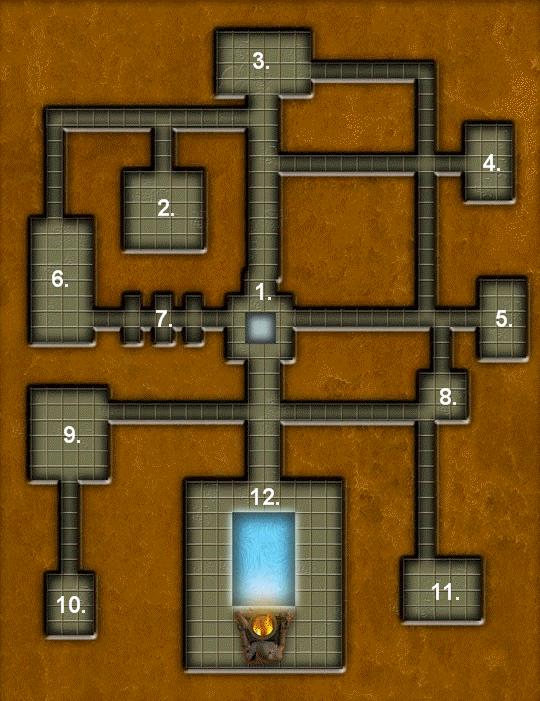 |
1. Teleportation Circle:
The lich cast a Permanent Teleportation Circle in this chamber. The circle takes the form of a square dais of a strange, glowing, translucent stone. Anyone stepping on the stone is teleported to Room 13 of Level One. Those beings teleporting here from Room 13 of Level One will appear just to the south of the stone dais in this room.
The glow of flames from Room 12 can be easily noted from here.
2. Summoning Chamber:
This chamber served as the lich's summoning chamber. There are the battered remnants of a magic summoning circle here, and a successful Spellcraft check (DC 23) will determine that the circle is of arcane magic origin. That should be a large clue that elements in this tomb are not of Thaneeri origin. If it is pointed out to Allispan that the diagram is arcane in nature, he will scoff at the notion, and explain that the PC must be incorrect, for the Thaneeri did not condone the use of arcane magic even in those ancient times.
3. The Lurking Horror:
A truly horrible undead denizen of these tombs dwells within this chamber. The chamber contains a few skeletal remains, ancient victims of the lurker. Stone shelves have been carved into the walls, and a close look shows glass flakes all over the room, indicating its once purpose as an alchemical laboratory for the lich.
In the center of the room is a long stone table, with broken glass shards and twisted metal implements scattered upon it, along with multi-coloured stains and scars from spilled substances.
Behind the table lurks a forsaken shell. In its heyday, it feasted upon the skins of its victims and created a small army of its spawn to perform the will of its lich master. Now, it simply abides, hungering to create more of its kind. The thing will lurk behind the table, using its prodigious hide ability to fold up and appear as a torn cloth or other discarded item amidst the rubble of the chamber. It will try to wait for a lone victim to present itself. If that does not occur, the thing will follow its victims, stalking it, and waiting for the proper time to attack, likely grabbing a foe from behind.
|
* Forsaken Shell: CR 6; Medium undead; HD 14D12+14; hp 105; Init +5; Spd 30 ft; Space 5 ft; Reach 5 ft; AC 17 (touch 11, flat-footed 16); Atk +12 melee (1D6+5, skin slap); SA constrict, create spawn, improved grab; SQ darkvision 60 ft, undead traits; AL CE; SV Fort +4, Ref +7, Will +6; Str 21, Dex 13, Con -, Int 11, Wis 10, Cha 10. Length 5 ft 10 in. Skills and Feats: Climb +13, Hide +22, Listen +11, Move Silently +18, Spot +15, Swim +9; Alertness, Improved Initiative, Improved Toughness, Lightning Reflexes, Power Attack. Special Attacks: Constrict (Ex): A forsaken shell deals 1D6+5 points of damage with a successful grapple check. Constricting uses the entire body of the creature, so it cannot take any move actions while constricting. Create Spawn (Su): Creatures killed by a forsaken shell slough their skins after 1D4 rounds. These sloughed skins are new forsaken shells under the spawner's control. These forsaken shells do not possess any of the abilities they had in life. Improved Grab (Ex): To use this ability, a forsaken shell must successfully hit an opponent with its skin slap attack. It can then attempt to start a grapple as a free action without provoking attacks of opportunity. If it winds the grapple check, it establishes a hold and can constrict. |
4. Littered Chamber:
The walls of this room are carved full of bookshelves, evidencing what must have once been an impressive library. Pieces of scrolls and books that have survived the ravages of time litter the floor and the shelves themselves, including scroll rollers made of stone and steel and ivory, book covers made of metal or bone or even strange scaly hides, metal book clasps, etc.
There are two books entirely intact on the shelves. Both are high up on the topmost shelves and are not located together.
The first is a thick tome with boiled leather covers bearing an image of a warrior waving a sword through foes that look somewhat orcish. The fact that a leather book has survived the ages intact is remarkable seeming. This is a manual of bodily health +1. As the tome increases Con, and as the lich did not have a Con score, the book was useless to him and so he kept it in his library.
The second tome is an inch thick tome covered in iron overlaid with silver. Amazingly, the parchment pages seem to have survived the millennia and not crumbled to dust like the many other tomes in the library. Engraved on the book's front is the image of a leering skull whose eyes are small red rubies (worth 300 gp each). This is a blessed book. The book is locked by a stout metal clasp, and the key may be found by a careful search of the litter around the room (Search DC 28). The book is empty, but the lock is warded by a powerful Fire Trap spell placed there by the lich.
| * Fire Trap: CR 5; spell; spell trigger; no reset; spell effect (fire trap, 20th-level wizard, 1d4+20 fire, DC 21 Reflex save half damage); Search DC 29; Disable Device DC 29. |
5. Empty Chamber:
This chamber is empty, with no clue as to its prior function. The only features of the place are steel eyelets attached to the ceiling. There are over two dozen of them at various intervals around the ceiling.
6. The Menagerie:
Iron cages dot this chamber, some open and some locked, all of varying sizes. Many of the cages that are locked have the bones of various strange creatures within them. A few of the cages have their bars bent, as if something strong escaped. A stone table in the center of the chamber is 4 ft tall and some 10 ft wide and 20 ft long. Close scrutiny of the table reveals iron shackles at various points to bind captives.
Squatting on the table is a vrock zombie. Nyzzagir summoned up the demon in Room 2 using his Planar Binding spell and them promptly slew the thing under the effects of a Dimensional Anchor spell and animated its body as a zombie. The beast was programmed to ward the menagerie, to make certain that none of the entrapped creatures escaped. The zombie is instructed only to obey the commands of the lich, and to attack any living creatures not in a cage. This means that the thing could be easily defeated by simply entering one of the open cages and slaying it with spells or missile weapons.
|
* Vrock Zombie: CR 6; Large undead; HD 20D12+3; hp 133; Init +1; Spd 30 ft, fly 50 ft (clumsy); Space 10 ft; Reach 10 ft; AC 24 (touch 10, flat-footed 23); Atk +16 melee (2D6+7, claw) or +16 melee (1D8+7, slam); SQ DR 5/slashing, darkvision 60 ft, single actions only, undead traits; AL NE; SV Fort +6, Ref +7, Will +12; Str 25, Dex 13, Con -, Int -, Wis 10, Cha 1. Height 8 ft. Skills and Feats: none; Toughness. |
7. Hidden Niches:
These niches were once hidden by means of Sequester spells, and in the southwestern most niche Arwana found the King's Heart ruby. As such, the metal door to this chamber is open. The chamber itself contains a single stone pedestal that holds a lead-lined box. The box is open and there is a tarnished silver block inside with an indentation in the shape of a faceted gem about the size of a human heart. The other niches are empty, as they contained magic items that the lich expended or used during his battle against the Thaneeri in the stead above the tomb. There are opened lead-lined chests in the other niches, as well as a metal weapon rack on the wall of one of the niches and a quartet of iron armour stands in another.
8. The Stone Guardian's Chamber:
Standing in the center of this chamber is a stone golem. It appears as a 9 ft tall statue of an armoured warrior. A Knowledge (history) check of DC 20 will reveal that the armour and helm carved into the statue are of a style that dated back to the 16th century A.D. A DC 25 check will reveal that it comes from the region that eventually became Jaggarth and Imtorr.
Fortunately for the PCs, the stone golem is entirely quiescent. The lich usually commanded the golem directly, and did not give it other instructions except to defend itself. The only way the PCs can run afoul of this golem is if they somehow harm or attack it. In such a case, they can likely outrun the thing, but it will pursue them anywhere within the tomb, eventually returning to this room when its targets have fled the tomb or are dead. In theory, the golem could have been used to enter the antimagic zone in Room 10 and retrieve the lich's phylactery, but as only the lich himself can command the thing, it was never done.
|
* Stone Golem: CR 11; Large construct; HD 14D10+30; hp 107; Init -1; Spd 20 ft; Space 10 ft; Reach 10 ft; AC 26 (touch 8, flat-footed 26); Atk +18 melee (2D10+9 [x2], slams); SA slow; SQ construct traits, DR 10/adamantine, darkvision 60 ft, immunity to magic, low-light vision; AL N; SV Fort +4, Ref +4, Will +4; Str 29, Dex 9, Con -, Int -, Wis 11, Cha 1. Height 9 ft. Skills and Feats: none. Special Attacks: Slow (Su): A stone golem can use a slow effect, as the spell, as a free action every 2 rounds. The effect has a range of 10 ft and a duration of 7 rounds, requiring a DC 17 Will save to negate. |
9. The Waiting Chamber:
This chamber holds a group of undead waiting patiently to retrieve their master's phylactery. The glow from the Forbiddance (see Room 10) forms a barrier at the entrance to the hallway to the south. Examination of the floor just before the Forbiddance shows flecks of bone and other unidentifiable material that is all that remains of the many undead who threw themselves into the Forbiddance in an effort to rescue the phylactery.
The room is relatively barren, though it shows carving in its walls that show a skeletal figure seated on a throne in one scene and the same figure wielding a staff and hurling magic from his fingers atop stone battlements into a sea of dying warriors who are clearly besieging the figure's stronghold. Runes in the cuneiform of ancient Akrib proclaim:
| Lord Nyzzagir Defeated the Forces of King Mazzirin and Queen Qwelzestra and Scatters Them to the Winds. May his Glory and Might Rule All Forever! |
There are six ghouls and three ghasts here. These are the undead that chased Arwana down into the depths of the tomb and mortally wounded her. The wights who led them (Room 7 on Level One) instructed them to remain here to watch for the Forbiddance to fall or the Vastalla priestess to emerge from Room 10. The ghouls have slowly gone mad over the lack of flesh to feed upon (they have taken Wis damage from lack of satiation), and occasionally have to be driven back into this chamber by the wights, to remain at their post. Nonetheless, if these undead detect any living creatures, they will immediately and ravenously attack in a frenzy. The normal ghouls will use no tactics whatsoever, but simply charge blindly. If they down a foe, they will consume him and ignore all others. The ghasts are slightly more intelligent, and though they will be initially ravenous as well, they can summon enough wherewithal to deal with looming threats and use a modicum of ingenuity if it will get them to their goal of feasting on flesh.
These creatures can be mustered by the wights to the defense of the tomb quite easily. The wights just have to tell them that there are living creatures in the tomb, and the ghouls and ghasts will become a ravening horde running through the tomb seeking that flesh.
|
* Ghouls (6): CR 1; Medium undead; HD 2D12; hp 13; Init +2; Spd 30 ft; Space 5 ft; Reach 5 ft; AC 14 (touch 12, flat-footed 12); Atk +2 melee (1D6+1 plus paralysis, bite) and +0 melee (1D3 plus paralysis [x2], claws); SA ghoul fever, paralysis; SQ darkvision, undead traits, +2 turn resistance; AL CE; SV Fort +0, Ref +2, Will +5 (-2); Str 13, Dex 15, Con -, Int 13, Wis 14 (damaged to 0), Cha 12. Height 6 ft. Skills and Feats: Balance +6, Climb +5, Hide +6, Jump +5, Move Silently +6, Spot +7; Multiattack. Special Attacks: Ghoul Fever (Su): Disease - bite, Fort DC 12, incubation period 1 day, damage 1D3 Con and 1D3 Dex. Paralysis (Ex): Those hit by a ghoul's bite or claw attack must succeed on a DC 12 Fort save or be paralyzed for 1D4+1 rounds. Elves have immunity to this paralysis. |
|
* Ghasts (3): CR 3; Medium undead; HD 4D12+3; hp 29; Init +3; Spd 30 ft; Space 5 ft; Reach 5 ft; AC 17 (touch 12, flat-footed 14); Atk +5 melee (1D8+3 plus paralysis, bite) and +3 melee (1D4+1 plus paralysis [x2], claws); SA ghoul fever, paralysis, stench; SQ darkvision, undead traits, +2 turn resistance; AL CE; SV Fort +1, Ref +4, Will +6 (-1); Str 17, Dex 17, Con -, Int 13, Wis 14 (damaged to 0), Cha 16. Height 6 ft. Skills and Feats: Balance +7, Climb +9, Hide +8, Jump +9, Move Silently +8, Spot +8; Multiattack, Toughness. Special Attacks: Ghoul Fever (Su): Disease - bite, Fort DC 15, incubation period 1 day, damage 1D3 Con and 1D3 Dex. Paralysis (Ex): Those hit by a ghoul's bite or claw attack must succeed on a DC 15 Fort save or be paralyzed for 1D4+1 rounds. Elves can be affected by this paralysis. Stench (Ex): The stink of death and corruption surrounding these creatures is overwhelming. Living creatures within 10 ft must succeed on a DC 15 Fort save or be sickened for 1D6+4 minutes. A creature that successfully saves cannot be affected by the same ghast's stench for 24 hours. A delay poison or neutralize poison spell removes the effect from a sickened creature. Creatures with immunity to poison are unaffected, and creatures resistant to poison receive their normal bonus on their saving throws. |
10. Arwana's Demise:
An argent glow wafts from this room and down the hallway towards Room 10. The glow seems to form a silver wall that crosses the entry into the hallway to the north of this room. The glow also pervades the entirety of the room and the hallway to the north. This is Arwana's Forbiddance spell. It is actually a Maximized Empowered Forbiddance, as the priestess used her Sudden Maximize and Sudden Empower feats to affect the casting. The priestess' alignment was Neutral Good. Therefore, the Forbiddance will cause either 54 points of damage or 108 points of damage, with a Will save (DC 20) for half damage. The spell is set to allow passage through it by saying the password "Kindjera", which was the name of the priestess' daughter who died at birth.
Within the room is the rod of antimagic, which has been set into place standing straight up with its bottom hovering 3 ft above the floor of the room next to the east wall of the room about halfway south of the entrance. The rod casts an Antimagic Field in a 10 ft radius around it, and this is apparent because the Forbiddance glow does not intrude upon the antimagic radius.
Prone next to the rod is a skeleton. Clutched in its hands, held next to its breast, is a ruby the size of a human heart. This is the King's Heart, and the skeleton is the remains of Arwana.
The rod cannot be moved. It was crafted to be wielded only by a high level priestess of Vastalla, and once set in place it resists all attempts to move it. Only a cleric of Vastalla of level 12 or higher can move the rod or activate/deactivate it.
There is a single stone of sending at the priestess' hip. It is magical and functioning, but can only send to the companion stone, which is lost to time. Also at her side is an ivory wand of Lesser Restoration at 3rd level with 7 charges remaining.
|
* Rod of Antimagic: This powerful item is extremely difficult to create, since the very nature of antimagic makes it difficult for an item to generate such a field, yet remain capable of retaining the magic required to generate the field in the first place. The rod manages this by utilizing a very specialized form of stasis field to remove itself from the effects of its own magic. The rod appears as a metal shaft of cold iron covered in runes of a strange alloy. At its tip is a ball of cold iron studded with onyx connected by silver threads in complex geometric patterns. The rod is activated by speaking or concentrating upon the command word and holding the rod before the wielder. Once activated, an antimagic field will emanate from the rod in a 10 ft radius. In addition, the rod itself will become stuck wherever it was activated, as its stasis field envelopes it. As such, the rod can be activated in midair, and it will hover there, unmoving. In fact, the rod could, in theory, be used as a handhold similar to an immovable rod, except that no amount of force can move it. The rod may be deactivated by simply touching the rod and once again uttering or concentrating upon the command word. However, the rod may only be activated 1/day and deactivated 1/day. In some cases, such rods are keyed not to a command word but some other criteria. For example, the rod of antimagic in the lich Nyzzagir's tomb is keyed so that any priest of Vastalla of level 12 or higher can activate and deactivate it at will. Strong abjuration; CL 15; Craft Rod, antimagic field, dimensional lock; 84000 gp; 2100 XP. |
If the King's Heart is removed from the Antimagic Field, refer to the section below entitled "Dealing with the King's Heart".
11. Treasury:
The hallway into this chamber is well trapped.
The hallway itself is unremarkable, though it shows signs of having been undisturbed for many centuries, as the undead were forbidden to enter here on the lich's orders. This doesn't mean they wouldn't pursue living intruders here, but barring such a necessity, they have not come this way since the ghouls made a final search for food here several thousands of years ago. The undead do know of the traps here, or at least, they know of the pit trap and they know there are other traps as well.
Pit Trap:
40 ft down the hallway from Room 8 is a pit covered by a Permanent Image spell that mimics the floor. Unfortunately for the lich, the illusion was meant to match a floor that was in use, and as such, the dust that has accumulated here does not show on the 10 ft square illusion, which appears as a 10 ft square of stone floor completely untouched by dust. Normally, this would be a dead giveaway, but the hallway is also choked with cobwebs, for the undead did not ever come this way, as the lich forbade them to do so. The cobwebs are thick enough to block vision and possibly cause a person to tumble down the pit anyways.
If the hallway is first cleared of cobwebs all the way to and past the pit (for example, by fire spells), then the 10 ft square area of undusty floor will be plain and obvious to see. In this case, the PCs would have to be very foolish to succumb to the pit. If the PCs are merely walking their way down the passage, clearing cobwebs as they go, then allow a Spot check at DC 20 to notice the strange space of flooring ahead. Lower the DC to 15 if the PCs are moving carefully (at half speed) and make the chance automatic if they are actively making Search checks on the floor ahead of them. If the PCs are running down the hallway, then the chance of noticing the floor ahead requires a DC 30 Spot check.
The pit is 80 ft deep and bears some claw marks and dust (all that remains of the hunger-struck ghouls that fell down the pit) and some corroded and rusted iron spikes that now present no danger.
| * Pit Trap: CR 5; mechanical, location trigger; automatic reset (immediate); DC 20 Reflex save avoids; 80 ft deep (8d6, fall); multiple targets (all in 10 ft square area); Search DC n/a; Disable Device n/a. |
Lightning Bolt Trap:
What better way to harm intruders marching down a narrow corridor than with a Lightning Bolt spell? Nyzzagir actually has set dual bolts into a single trap, so that both 5 ft widths of the hallway will be affected. The spell activates whenever anyone enters the 10 ft cube that is 60 ft down the hallways from Room 8. The bolts then blaze north, up the hallway, one up the western edge of the hallway and the other up the eastern edge.
| * Dual Lightning Bolt Trap: CR 5; magic device; proximity trigger (alarm); automatic reset (every round); spell effect (two lightning bolts, 5th level wizard, 5D6 electricity, DC 14 Reflex save half damage); Search DC 28; Disable Device DC 28. |
Worst Nightmare Trap:
This is the lich's final trap on the hallway. It activates a Phantasmal Killer spell in the form of the lich himself attacking the victim. The trap covers the entire 10 ft cube at the southern end of the hallway, and will activate upon each person who enters the area. Once a person has been subject to the trap, he cannot be again affected by it for 24 hours (this is due to the fact that the Phantasmal Killer image is not actually the subject's worst nightmare, but a specific image of the lich, though usually placed into a context in the subject's own mind that most terrifies it [for example, if a subject were deathly afraid of rats, then the image would be Nyzzagir covered in rats and directing them to attack the subject]).
| * Phantasmal Killer Trap: CR 5; magic device; proximity trigger (alarm covering the entire room); automatic reset; spell effect (phantasmal killer, 7th level wizard, DC 16 Will save for disbelief and DC 16 Fort save for partial effect); Search DC 29; Disable Device DC 29. |
The Treasury:
This was not the lich's main treasury. That was contained in the stead above the tomb that was sacked. The assaulting Thaneeri took most of that swag away with them. This treasury represents a small hidden cache the lich kept at hand for emergencies and a few items he managed to salvage from the assault.
Within the chamber are three steel chests. At least half a dozen more chests must have been here, but time has rotted them and they have disintegrated away, leaving behind a few metal brackets and locks and their contents spilled onto the ground.
Two stone guardians guard the chamber, instructed to attack anyone other than Nyzzagir who enters the place (including other undead). These are stationed to the flank of the entryway, and stand at attention against the north wall of each flank, so they are unlikely to be noticed until the room is entered.
|
* Stone Guardians (2): CR 4; Medium construct; HD 4D10; hp 22; Init -1; Spd 20 ft (cannot run); Space 5 ft; Reach 5 ft; AC 18 (touch 9, flat-footed 17); Atk +8 melee (2D6+5 [x2], slams); SQ construct traits, see invisible, resistance to cold, electricity, and fire 5, ring link; AL N; SV Fort _1, Ref +0, Will +1; Str 21, Dex 9, Con -, Int -, Wis 11, Cha 1. Height 6 ft. Skills and Feats: none. Special Qualities: Ring Link (Su): The ring that is created at the same time as the stone guardian is created links that guardian to that ring. Any creature possessing that ring, and all creatures within 10 ft of someone wearing that ring, will not be attacked by that stone guardian. This ring offers protection against that particular stone guardian with which it was created and offers no such protection against other stone guardians. This ring confers no control or command over a stone guardian to the wearer. See Invisible (Su): A stone guardian can see invisible as the spell. This ability is always active. If negated, the stone guardian can restart it is a free action on its next turn. |
The following treasure is present here:
The three steel chests each are Arcane Locked at 20th level. They are otherwise not trapped and hold nothing but dust and flecks of leather and many vials and bottles of liquids now evaporated away or dried up. Close scrutiny will reveal that these chests at one time likely held scrolls and books and potions.
12. The Lich's Chamber:
When the lich was sundered, and after the tomb had been sealed, the undead remaining still hoped for Nyzaggir's eventual return. So they gathered up the pieces of his body and laid them here, in the grand chamber that served as Nyzzagir's resting place.
The chamber is some 30 ft tall and dominated by a large stone statue (20 ft tall) of a skeletal figure with a staff in its right hand emitting lightning bolts and his left hand upraised and launching a fireball. Inscribed in gold inlay above the statue, on the wall behind it in ancient Thaneeri/Wolgir/Lothuk runes, Draconic, Elvish, and in Akrib cuneiform is inscribed the following:
| Tremble before the might of Nyzzagir - the King of All. His dominion shall spread over all of Jerranq, and beyond. Even shall the Deceiver quail at his approach! |
The statue has glowing gems for eyes. These are actually semi-precious crystals that have been used as prisons for some fire elementals. The effect is to have the eyes resemble the glowing ember sockets of a lich. If the gems (worth about 50 gp each) are pried away from the statue, the elementals will be released and will attack all creatures for the next 12 rounds before they fade away back to the Elemental Plane of Fire.
|
* Medium Fire Elementals (2): CR 3; Medium elemental (fire, extraplanar); HD 4D8+8; hp 26; Init +7; Spd 50 ft; Space 5 ft; Reach 5 ft; AC 16 (touch 13, flat-footed 13); Atk +6 melee (1D6+1 plus 1D6 fire, slam); SA burn; SQ darkvision 60 ft, elemental traits, immunity to fire, vulnerability to cold; AL N; SV Fort +3, Ref +7, Will +1; Str 12, Dex 17, Con 14, Int 4, Wis 11, Cha 11. Height 8 ft. Skills and Feats: Listen +3, Spot +4; Dodge, Improved Initiative, Mobility, Weapon Finesse. Special Attacks: Burn (Ex): A fire elemental’s slam attack deals bludgeoning damage plus fire damage from the elemental’s flaming body. Those hit by a fire elemental’s slam attack also must succeed on a DC 14 Reflex save or catch on fire. The flame burns for 1d4 rounds. The save DC varies with the elemental’s size. A burning creature can take a move action to put out the flame. Creatures hitting a fire elemental with natural weapons or unarmed attacks take fire damage as though hit by the elemental’s attack, and also catch on fire unless they succeed on a Reflex save. |
The walls of the place are carved with bas reliefs that have stood up relatively well to the ravages of time, given the room's isolation from weather. Most of these reliefs show the history of Nyzzagir. On the farthest wall to the right of the statue (when facing it) are scenes of a young wizard learning the craft and eventually slaying his master in a spell duel. Next the grown wizard begins to delve into lore, poring over cuneiform tablets and scrolls and conducting alchemical experiments. Scenes show him dissecting men, women, and children of various sentient species. As the carvings reach the right side of the entryway into the chamber, they end with him triumphantly holding up a gem the size of a human heart.
The wall on the other side of the entryway begins with a sarcophagus placed atop a platform with lightning striking it. Next, a skeletal figure rises from it and begins to gather undead to him, eventually forming a veritable army. Then there are scenes of battle against human forces, sieges of castles and towers, and gruesome victories for the undead legions. In these, the skeletal figure is riding a nightmare. The next scene abruptly shows the same skeletal figure coming alone to a Thaneeri satula and a hooded figure bowing before a Thaneeri king. The scene just after shows the same satula throne room, but now the hooded figure is on the throne and is revealed to be the skeletal figure, with the Thaneeri king dead at his feet. The last scene, to the left of the statue, shows the skeletal figure and his legions making war against the Thaneeri.
Sitting before the statue is a large stone brazier some 10 ft in diameter. The bowl is alight with dancing flames that leap high into the air, sometimes almost reaching as high as the statue itself. In actuality, these flames are a large fire elemental. The elemental is bound to the bowl and to the lich and serves the latter. As the lich is not truly dead and destroyed, the elemental is not released from its bondage. But, it will not move from its bowl unless attacked, in which case it will lash out from the bowl (though it still will not leave). If the bowl is destroyed, the elemental will be released and will rampage for 12 rounds before fading away to its home plane.
|
* Large Fire Elemental: CR 5; Large elemental (fire, extraplanar); HD 8D8+24; hp 60; Init +9; Spd 50 ft; Space 5 ft; Reach 5 ft; AC 18 (touch 14, flat-footed 13); Atk +10 melee (2D6+2 plus 2D6 fire [x2], slams); SA burn; SQ DR 5/-, darkvision 60 ft, elemental traits, immunity to fire, vulnerability to cold; AL N; SV Fort +5, Ref +11, Will +2; Str 14, Dex 21, Con 16, Int 6, Wis 11, Cha 11. Height 16 ft. Skills and Feats: Listen +5, Spot +6; Dodge, Improved Initiative, Mobility, Spring Attack, Weapon Finesse. Special Attacks: Burn (Ex): A fire elemental’s slam attack deals bludgeoning damage plus fire damage from the elemental’s flaming body. Those hit by a fire elemental’s slam attack also must succeed on a DC 17 Reflex save or catch on fire. The flame burns for 1d4 rounds. The save DC varies with the elemental’s size. A burning creature can take a move action to put out the flame. Creatures hitting a fire elemental with natural weapons or unarmed attacks take fire damage as though hit by the elemental’s attack, and also catch on fire unless they succeed on a Reflex save. |
Set before the brazier is what can best be described as a large pool of unholy water. The water seems to have remained here intact for all of these thousands of years, and this is due to the presence of a massive water elemental that basically forms the pool itself. This water elemental, formed from unholy water, is thoroughly evil, and very dangerous. However, it's only purpose, having been bound here by the lich, is to protect him. At times the lich needed a safe place to repose. While liches don't sleep, they sometimes need to meditate or leave their bodies when travelling the Astral Plane or using Magic Jar to possess a victim. During these times, Nyzzagir would have his body placed into the pool, where it could be guarded by the elemental. On his defeat, the lich's servants brought his remains here and placed them into the pool, so as to guard them until he could reawaken.
Surrounding the pool, running along its rim, are runes in Draconic of a fiery red metal of indeterminant origin. They read:
| Fear that which does eternal lie, and in defeating death, may not die, and undying has defeated one god, and shall defeat another, and in whose eternal existence shall come eternal power and eternal dominion. |
Within the pool lies the remains of the lich. Its skull lies near the south end, with bones and the like scattered around sort of haphazardly, definitely not in any precise placement. In fact, it might take a few moments of scrutiny to determine that only a single humanoid's bones are within the pool. The pool itself is 10 ft deep, and though the water is clear, it occasionally seems to ripple and undulate slightly of its own accord...
The elemental that guards the pool will only attack someone who reaches into the water or who makes an attempt to disturb the water by magical means. It is smart enough to fairly easily recognize what sorts of magical attempts are being made and where they might be coming from. It will never actually leave the pool entirely (in fact, it cannot), but it can place any of its body outside of the pool as long as it occupies a single 5 ft square of the pool. With its reach, it should then be able to strike out fairly far. It will only attack those trying to disturb the pool, and will then stop if the person backs away. If not, it will continue to take full attacks until it is dead or no one is touching the pool.
|
* Elder Water Elemental: CR 11; Huge elemental (water, extraplanar); HD 24D8+120; hp 228; Init +6; Spd 30 ft, swim 120 ft; Space 15 ft; Reach 15 ft; AC 23 (touch 14, flat-footed 17); Atk +25 melee (1D10+9 [x2] crit 19-20, slams); SA drench, vortex, water mastery; SQ DR 10/-, darkvision 60 ft, elemental traits; AL NE; SV Fort +19, Ref +16, Will +10; Str 28, Dex 22, Con 21, Int 10, Wis 11, Cha 11. Height 40 ft. Skills and Feats: Listen +29, Spot +29; Alertness, Cleave, Great Cleave, Improved Critical (slam), Improved Bullrush, Improved Sunder, Iron Will, Lightning Reflexes, Power Attack. Special Attacks: Drench (Ex): The elemental’s touch puts out torches, campfires, exposed lanterns, and other open flames of nonmagical origin if these are of Large size or smaller. The creature can dispel magical fire it touches as dispel magic (caster level equals elemental’s HD). Vortex (Su): The elemental can transform itself into a whirlpool once every 10 minutes, provided it is underwater, and remain in that form for up to 12 rounds. In vortex form, the elemental can move through the water or along the bottom at its swim speed. The vortex is 5 feet wide at the base, up to 30 feet wide at the top, and up to 40 feet or more tall. The elemental controls the exact height, but it must be at least 10 feet. The elemental’s movement while in vortex form does not provoke attacks of opportunity, even if the elemental enters the space another creature occupies. Another creature might be caught in the vortex if it touches or enters the vortex, or if the elemental moves into or through the creature’s space. Creatures one or more size categories smaller than the elemental might take damage when caught in the vortex and may be swept up by it. An affected creature must succeed on a DC 31 Reflex save when it comes into contact with the vortex or take 2D8 damage. It must also succeed on a second DC 31 Reflex save or be picked up bodily and held suspended in the powerful currents, automatically taking 2D8 damage each round. An affected creature is allowed a DC 31 Reflex save each round to escape the vortex. The creature still takes damage, but can leave if the save is successful. Creatures trapped in the vortex cannot move except to go where the elemental carries them or to escape the whirlwind. Creatures caught in the vortex can otherwise act normally, but must make a Concentration check (DC 10 + spell level) to cast a spell. Creatures caught in the whirlwind take a –4 penalty to Dexterity and a –2 penalty on attack rolls. The elemental can have only as many creatures trapped inside the vortex at one time as will fit inside the vortex' volume. The elemental can eject any carried creatures whenever it wishes, depositing them wherever the vortex happens to be. A summoned elemental always ejects trapped creatures before returning to its home plane. If the vortex' base touches the bottom, it creates a swirling cloud of debris. This cloud is centered on the elemental and has a diameter equal to half the vortex' height. The cloud obscures all vision, including darkvision, beyond 5 feet. Creatures 5 feet away have concealment, while those farther away have total concealment. Those caught in the cloud must make a Concentration check (DC 15 + spell level) to cast a spell. An elemental in vortex form cannot make slam attacks and does not threaten the area around it. Water Mastery (Ex): A water elemental gains a +1 bonus on attack and damage rolls if both it and its opponent are touching water. If the opponent or the elemental is touching the ground, the elemental takes a –4 penalty on attack and damage rolls. (These modifiers are not included in the statistics block.) A water elemental can be a serious threat to a ship that crosses its path. An elemental can easily overturn some craft (120 feet of length) and stop larger vessels (240 feet long). Even massive ships (480 feet long) can be slowed to half speed. |
None of the elementals in this chamber are summoned. All have been called via Gate or other powerful spells and then bound to this plane by other magic.
Lurking in this chamber is none other than the animated skeleton of the Thaneeri prince who was originally buried here. Nyzzagir thought it rather fitting to animate and have as a slave the prince. He was brought back by a particularly cruel spell that actually returned the prince's entire soul to his skeleton, making him a bone creature. However, the transformation and subsequent years of cruel influence by Nyzzagir himself twisted fully the prince into a creature of evil and a loyal servant to the lich, and with the further passage of millennia trapped within his own tomb he now despises all life uniformly. The prince is essentially the ruler of this dungeon in the lich's stead, and he has the will and means to command even the evolved wights on Level One, though he must tread a bit cautiously, as they could, jointly, pose a threat to him.
The forsaken shell in Room 3 will obey the prince, and the ghouls and ghasts in Room 10 are supposed to, but they are now maddened by hunger and so might prove a bit unruly. The prince is smart enough, however, to use their hunger to motivate them to attack intruders. Finally, the prince controls the necromental (see below).
|
* Prince Thaskik Hongursson, Bone Creature: Male bone creature Barbarian 7; CR 7; Medium undead; HD 7D12; hp 46; Init +5; Spd 40 ft; Space 5 ft; Reach 5 ft; AC 23 (touch 15, flat-footed 23); Atk +11 melee (1D8+3+1D6 cold, +1 frost axe) or +10 melee (1D4+3 [x2], claws); SA rage (2/day for 3 rounds); SQ DR 1/-, DR 5/bludgeoning, darkvision 60 ft, fast movement, illiteracy, immunity to cold, improved uncanny dodge, uncanny dodge, trap sense +2, undead traits; AL NE; SV Fort +5, Ref +5, Will +3; Str 16, Dex 21, Con -, Int 12, Wis 12, Cha 14. Height 5 ft 10 in. Skills and Feats: Balance +12, Climb +6, Diplomacy +6, Jump +10, Listen +4, Spot +5, Survival +4, Tumble +12; Cleave, Dodge, Power Attack. Possessions: +1 frost battleaxe, chain shirt, heavy steel shield, silver crown studded with opals and jacinths (1200 gp). |
The prince is not smart enough to try to throw or have the necromental throw victims into the pool, in order to have the water elemental attack them. But, if he sees a victim fall into it, he just might get the idea. Certainly, the PCs might be able to figure out that an easy way to defeat the prince is to throw him into the pool, which would cause the elemental to attack him.
In addition to the prince and the bound elementals, a final minion lurks in the chamber. This is a necromental, created by Nyzzagir himself from rituals that corrupted a large earth elemental. The beast currently resides within the statue of Nyzzagir himself, and will come if called by the prince or if the statue is disturbed in any way. The necromental will continue to attack even if the prince is destroyed, and will pursue intruders right out of the tomb and into the open wilderness.
|
* Necromental: CR 6; Large Undead (augmented elemental, earth, extraplanar); HD 8D12; hp 52; Init -1; Spd 20 ft; Space 10 ft, Reach 10 ft; AC 20 (touch 8, flat-footed 20); Atk +12 melee (2D8+7 plus energy drain [x2], slams); SA create spawn, earth mastery, energy drain, push; SQ DR 5/-, darkvision 60 ft, earth glide, elemental traits, fast healing 3, undead traits; AL NE; SV Fort +8, Ref +1, Will +2; Str 25 Dex 8, Con -, Int 1, Wis 10, Cha 1. Height 8 ft. Skills and Feats: Listen +6, Spot +5; Great Cleave, Great Fortitude, Power Attack. Special Attacks: Create Spawn (Su): An elemental slain by a necromental's energy drain attack rises as a necromental 1D4 days after death. Earth Glide (Ex): An earth necromental can glide through stone, dirt, or almost any other sort of earth except metal as easily as a fish swims through water. Its burrowing leaves behind no tunnel or hole, nor does it create any ripple or other signs of its presence. A move earth spell cast on an area containing a burrowing earth necromental flings the creature back 30 ft, stunning it for 1 round unless it makes a DC 15 Fort save. Earth Mastery (Ex): An earth necromental gains a +1 bonus on attack rolls and damage rolls if both it and its foe are touching the ground. If an opponent is airborne or waterborne, the necromental takes a -4 penalty on attack rolls and damage rolls. Energy Drain (Su): Living creatures hit by an earth necromental's natural weapon attack gain one negative level. An earth elemental can use its energy drain ability once per round. The save to remove the negative level 24 hours later has a DC of 14. When an earth necromental bestows a negative level on a victim, it gains 5 temporary hit points. Push (Ex): An earth necromental can start a bull rush maneuver without provoking attacks of opportunity. The combat modifiers given in Earth Mastery also apply to the necromental's opposed Str checks. Special Qualities: Fast Healing (Ex): An earth necromental heals 3 points of damage each round as long as it is within 5 ft of earth, stone, or metal. |
The Tomb Defense:
The tomb is not like an organized fortress. The undead herein are either mindless and programmed (e.g. the vrock zombie in Room 6 of Level Two), insane with hunger (e.g. the ghasts and ghouls in Room 9 of Level Two), or are underlings of the lich who have stewed for over 4,000 years. These underlings, including the evolved wights and the bone creature prince, are not professional soldiers and are not accustomed to leading troops of any kind into battle. Furthermore, millennia of inactivity have made them more than a bit rusty.
That said, the tomb is still a collection of creatures who are on the same side. If the PCs make noise in one Room, inhabitants of others may come to investigate as appropriate. Almost no noise is likely to go unnoticed, as the tomb is a deathly quiet place for the most part and has been for centuries.
The real bit of organization will come if the PCs enter the tomb and then retreat. None of the undead are really bound to the tomb per se, although some have no instructions to leave. But the wights, the bone creature prince, the necromental, and any minions they can round up can certainly attack a retreating and camped party at night as they rest and try to recover their hit points and spells. On the other hand, the undead are here to guard their master, and they certainly don't want to abandon the tomb completely. Even the ghouls and ghasts will be very pliable and willing to serve the lich's interests once they have fed. The wights and/or the prince will try to coordinate a defense, including massing troops at ambush points, and surrounding foes by using side passages (since most of the passages in the tomb tend to loop around and connect to other passages). They will also attempt to use some of the programmed monsters (like the vrock zombie) to their advantage. For example, by drawing the fight to Room 6 of Level Two so that the vrock zombie will activate and attack living intruders.
Dealing with the King's Heart:
The King's Heart is the lich Nyzzagir's phylactery. It contains his soul essence. Normally, when a lich is destroyed, its soul returns to its phylactery and, in 1D10 days, the lich is reborn. This is the case with the King's Heart. However, Nyzzagir spent intense magical effort to strengthen his phylactery, as he knew he would make many enemies during his climb to ultimate power. To this end, he used Wish spells to strengthen the gem, coupled with spells like Hardening. The end result is that the King's Heart is much more durable than a normal lich's phylactery.
The King's Heart has a hardness of 40, and 80 hit points. It has resistance 30 to all energy types. It also has fast healing 5. The latter is a supernatural ability. The gem is not subject to critical hits.
While within the radius of the Antimagic Field, the King's Heart, like any lich's phylactery, cannot work. The lich's soul is trapped within the gem, but the lich cannot reform so long as it remains within the field. In addition, while the gem retains its hardness and hit points and energy resistance while in the field (because these were characteristics that were added to the actual structure of the gem itself via Wish), it cannot utilize its fast healing 5 ability while in the field.
In theory, the gem can be destroyed. But this is quite difficult, and likely beyond the means of most PCs of level 5-7. It is not, of course, impossible. A 7th level fighter with Power Attack, an 18 Str, and a greataxe can do 1D12+20. Not enough to even harm the gem. But with enough bonuses from spells and magic items, he could possibly top 40 points with a good roll. This means, if so, then as long as the gem is left in the Antimagic Field, the gem can eventually be sundered.
If the gem is removed from the Antimagic Field, it will suddenly flare to life. An orangish glow will begin to emanate from the center of the gem, which will pulse and throb in the hand of whomever holds it. Furthermore, there will be a splashing sound coming from the unholy pool in Room 12 of Level Two, as the lich's remains start to whirl around of their own accord. Some of the remains will begin to slowly knit together. Further, a wave of malign power will wash through the tomb complex, with a hint of laughter and evil joy carried on the foul wind with it. Closely looking at the center of the gem will show that the orange glow surrounds the figure of the lich, slowly becoming more distinct in the heart of the gem.
All of these should give a clear indication that the gem is tied to the lich's recovery. Nevertheless, the undead in the tomb won't let the PCs leave with the gem, for the lich wants it close to him, and the PCs might find a way to destroy it.
If the gem is placed back into the Antimagic Field, the disturbances will die down, the malign zephyr wisping away, the laughter stopping, the pool going calm again, and the remains within settling back down to the bottom of the pool.
The lich will reform in 1 day, less 5 minutes for the time Arwana had the gem and less any time the PCs have had the gem out of the Antimagic Field
If the gem is destroyed, many things will happen. The elementals in Room 12 of Level Two will vanish. The lich's remains in the pool will flare into a blue fire and dissolve to nothingness, a thin wailing sound accompanying this as the lich's spirit is destroyed. The gem will shatter into pieces, and then the pieces will bubble into red liquid and quickly sizzle away. The remaining undead of the tomb will not be harmed specifically, and the intelligent ones are likely to try to take over control of the other undead and consolidate power for itself. They will certainly still battle the PCs. The stone golem in Room 8 of Level Two will remain forever a statue, unable to act in any way unless attacked.
Dealing with the Lich:
If the lich reawakens, it is up to the DM to deal with the consequences. Certainly, there will now be a 20th level wizard lich dwelling just on the border of the Far Coast. This is bound to cause problems...especially since this lich is interested in acquiring temporal power. He might seek to once again dominate the nearby Thaneeri. The Cilligh Clan is easily dominated, given that it has the least fanatical tendencies and is most open to arcane magic. From there, the lich will probably continue to dominate the Thaneeri, and then turn towards the Far Coast, likely through intrigue at first, as he has already had the experience of being rousted by angry mortals and doesn't want to get into direct confrontation with the Empire of Antoria.
Of course, Nyzzagir will not simply emerge from his pool blazing spells of destruction. First, he is likely a bit disoriented, it being some 4,000 years after he last can remember. Many things have changed around him. The Deceiver is gone. There is a mighty Empire at his doorstep. The Morakki have become a mighty people. And the Thaneeri are fragmented.
In addition, the lich has no spellbooks, and no magic items at hand (barring the few in Room 11 of Level Two). Without spells, he is somewhat crippled, though his Spell Mastery feat will at least allow him some ability initially.
Putting down the lich could be a new scenario for a different group of high level PCs.
The statistics for Nyzzagir are given below. Note that these assume he has rewritten his spellbooks. If the PCs fight Nyzzagir before he can memorize his spells, then the CR rating for XP purposes should be equal to a wizard who could cast spells of the same level he is currently able to cast, +2 for his lich template.
|
* Nyzzagir: Male lich Fighter 1/Wizard 20; CR 23; Medium undead; HD 21D12; hp 152; Init +2; Spd 30 ft; Space 5 ft; Reach 5 ft; AC 17 (touch 12, flat-footed 15); Atk +13 melee (1D8+5 negative energy [DC 26 Will save for half] plus paralysis, touch); SA fear aura, paralyzing touch, spells; SQ DR 15/bludgeoning and magic, darkvision 60 ft, immunity to cold, electricity, polymorph, and mind-affecting spells and abilities, resistance to fire 10, +4 turn resistance, undead traits; AL NE; SV Fort +8, Ref +6, Will +12; Str 14, Dex 15, Con -, Int 22, Will 18, Cha 20. Height 6 ft. Skills and Feats: Climb +9, Concentration +19, Craft (alchemy) +13, Decipher Script +14, Diplomacy +10, Hide +10, Intimidate +12, Jump +9, Knowledge (arcana) +20, Knowledge (architecture and engineering) +11, Knowledge (dungeoneering) +11, Knowledge (geography) +11, Knowledge (history) +13, Knowledge (nature) +11, Knowledge (nobility and royalty) +11, Knowledge (planes) +12, Knowledge (religion) +18, Listen +15, Move Silently +10, Ride +9, Search +16, Sense Motive +12, Spellcraft +21, Spot +16, Swim +9, ; Combat Expertise, Combat Reflexes, Corpsecrafter, Craft Staff, Craft Wand, Dodge, Empower Spell, Energy Resistance (fire), Eschew Materials, Necromantic Presence, Scribe Scroll, Spell Focus (necromancy), Spell Girding, Spell Mastery (fireball, greater teleport, invisibility, magic missile, wall of force, shapechange), Undead Leadership . Languages: Akrib, Thaneeri, Wolgir, Lothuk, Elvish, Draconic, Chansoba, Dwarvish, Ancient Morakki. Spells Prepared (4/6/6/5/5/5/5/4/4/4): 0 - acid splash, animate animal, detect magic, no light; 1 - charm person, mage armour, magic missile, protection from chaos/evil/good/law, ray of enfeeblement, shield; 2 - blindness/deafness, dark aura, invisibility, see invisibility, summon swarm, wither limb; 3 - dispel magic (2), fireball, fly, vampiric touch; 4 - dimension door, fear, grim revenge, solid fog, wall of deadly chains; 5 - hold monster, lesser globe of negative energy, lightning bolt (empowered), stop heart, teleport; 6 - circle of death, globe of invulnerability, greater dispel magic, rusting fog, summon monster VI; 7 - eye of the beholder, finger of death, globe of negative energy, greater teleport; 8 - horrid wilting, maze, mists of undeath, power word stun; 9 - shapechange, summon monster IX, time stop, wail of the banshee. Base DC = 16 + spell level (17 + spell level for necromantic spells). Spellbook: The lich knows a tremendous number of spells, having had almost a century of life and several centuries of unlife to perfect his craft. Assume he has access to all PHB wizard spells except those with the good descriptor. In addition, assume he has access to all wizard spells from all sources that are necromantic and do not have a good descriptor. Finally, he should have a great many spells available from other sources from other schools of magic that do not have the good descriptor. |
A Question of Betrayal:
There are some interesting decisions that have to be made in this scenario regarding the King's Heart. House Veritas wishes to gain the gem at any cost. They will be extremely loathe to leave it behind in the Antimagic Field or to destroy it. Convincing them to go along with either will require some expert roleplaying and some good Diplomacy or Bluff checks.
Furthermore, although Allispan has every intention of keeping his end of the bargain and sharing the proceeds of the King's Heart with the PCs, Lieutenant Starffus and his men do not. They are under orders to take the gem for House Veritas and not share with the PCs. Of course, their ability to do this will depend on a lot of factors. If the PCs are wounded, out of spells, etc. then they may make a grab for the gem. Allispan will protest against this course, but Starffus will slay him if he has to.
In any event, should the gem leave the tomb, then the Veritas members are going to be very concerned about the PCs trying to make off with the gem. There will be arguments over who carries the thing back to town and so forth. The DM should make the whole thing a big argument from the start, as greed begins to overwhelm all other considerations. Of course, this will only be the case if the gem is actually taken from the tomb.
More likely, the PCs will realize the true nature and danger of the gem and will return it to the Antimagic Field. This will cause the Veritas members to protest. If the PCs cannot convince them that the gem must be left behind, then the Veritas members will fight to take the gem.
Aftermath:
It has already been discussed what happens if the lich is reborn. Suffice to say that one of his first actions after getting a jade circlet made (or taking the one from the treasury in Room 11 on Level Two) and coming after the PCs to regain his phylactery. Even with only his Spell Mastery spells available, he is an awesome foe, with Empowered Fireball spells at the ready!
The Veritas Members:
Following are statistics for the House Veritas members involved in this scenario. Allispan's statistics show him wearing a chain shirt. He will only do this when travelling to the tomb. Otherwise he wears no armour.
Allispan served a year as a soldier in the Imperial Legion, before buying his discharge. He then hired on with House Veritas as a caravan guard, but quickly proved his bona fides as a merchant, and the House reassigned him to mercantile matters, at which he quite excelled. Allispan has had a modicum of wizardly training over the years, having a friendly mage train him in exchange for procuring exotic items for him. The merchant is 43 years old, with a small brown beard and mustache and shoulder-length hair.
|
* Allispan: Male human Fighter 1/Expert 5; CR 5; Medium humanoid (human); HD 1D10+1 plus 5D6+5; hp 38; Init +1; Spd 30 ft; Space 5 ft; Reach 5 ft; AC 16 (touch 12, flat-footed 15); Atk: +6 melee (1D6+1, masterwork quarterstaff) or +5 melee (1D4+1, dagger) or +6 ranged (1D8, masterwork light crossbow); AL LN; SV Fort +6, Ref +3, Will +8; Str 12, Dex 13, Con 12, Int 17, Wis 15, Cha 14. Height 6 ft 1 in. Skills and Feats: Appraise +8, Bluff +7, Decipher Script +8, Diplomacy +9, Intimidate +4, Jump +5, Knowledge (arcana) +5, Knowledge (history) +8, Knowledge (geography) +7, Listen +4, Profession (merchant) +7, Ride +5, Sense Motive +4, Spellcraft +8 (+10 to decipher scrolls), Spot +4, Swim +5, Use Magic Device +11 (+13 with scrolls); Combat Expertise, Dodge, Luck of Heroes, Magical Training, Strong Soul. Languages: Common, Thaneeri, High Imperial, Elvish. Possessions: chain shirt, masterwork quarterstaff, masterwork light crossbow, potion of cure light wounds at 1st level, scroll of expeditious retreat at 1st level, scroll of mage armour at 1st level, scroll of shield at 1st level, scroll of invisibility at 3rd level, scroll of blur at 3rd level, wand of flare at 1st level with 50 charges, crossbow bolts (20), silver crossbow bolts (10), +1 crossbow bolts (6), belt pouch, Veritas medallion of silver and beryl (300 gp), spell component pouch, scroll organizer, traveller's outfit, spellbook. Spell Prepared (3): 0 - detect magic, light, stumble. Spellbook: 0 - arcane mark, cleanliness, daze, detect magic, electric jolt, hear me!, light, mage hand, stumble. Base DC = 13 + spell level. |
Lieutenant Starffus is second in command of the House Guard at Allispan's branch of House Veritas. He is in his late 20's, clean shaven and muscular, but with a perpetual scowl on his pinched face and a somewhat abrasive manner accompanying a gravelly voice. The lieutenant doesn't much like magic or mages, and he refuses to use or carry any enchanted items.
|
* Lieutenant Starffus: Male human Fighter 5; CR 5; Medium humanoid (human); HD 5D10+15; hp 49; Init +4; Spd 20 ft; Space 5 ft; Reach 5 ft (10 ft with longspear); AC 19 (touch 12, flat-footed 17); Atk +9 melee (1D6+3, masterwork shortsword) or +10 melee (1D8+4, masterwork longspear) or +7 ranged (1D6+3, composite shortbow); AL N; SV Fort +7, Ref +3, Will +1; Str 16, Dex 14, Con 17, Int 10, Wis 10, Cha 9. Height 6 ft 2 in. Skills and Feats: Climb +5, Intimidate +5, Jump +5, Listen +3, Ride +5, Spot +8, Swim +5; Alertness, Blooded, Combat Reflexes, Dodge, Hold the Line, Mobility, Power Attack. Possessions: masterwork shortsword, masterwork longspear, composite shortbow (+3 Str bonus), arrows (20), chainmail, heavy steel shield, belt pouch, Veritas medallion of silver and amber (250 gp), backpack, alchemist's fire (3), whetstone, torches (6), flint and steel, explorer's outfit. |
The House Guard members are somewhat elite members of the guard. They are quite loyal to Starffus, and do not respect Allispan much.
|
* Veritas House Guard: Male human Fighter 3; CR 3; Medium humanoids (human); HD 3D10+6; hp 31; Init +1; Spd 20 ft; Space 5 ft; Reach 5 ft (10 ft with longspear); AC 19 (touch 11, flat-footed 18); Atk +6 melee (1D8+2, longsword) or +6 melee (1D8+3, longspear) or +3 ranged (1D6, shortbow); AL N; SV Fort +5, Ref +2, Will +1; Str 15, Dex 13, Con 14, Int 10, Wis 10, Cha 11. Height 5 ft 11 in. Skills and Feats: Climb +3, Intimidate +5, Jump +4, Listen +3, Spot +3; Dodge, Power Attack, Toughness, Weapon Focus (longspear), Weapon Focus (longsword). Possessions: longsword, banded mail, heavy steel shield, shortbow, arrows (20), dagger, belt pouch, Veritas medallion of copper (15 gp). |
Experience Points:
Return to the Therran Scenario Page