
Return to the Therran Scenario Page
Summary:
The PCs must win through the various guards and wards set up by the enigmatic Mage of the Tower, in order to gain information about the identity of a fiend mentioned on a parchment important to the PCs.
Assumptions:
The PCs are in the employ of House Riverine.
Location:
Far Coast, Dwillingir
Historical Date:
N.S. 32, Early Summer
DM's Introduction:
This scenario hearkens back to such classic adventures as "The Ghost Tower of Inverness". It involves the PCs attempting to pierce the wards of the abode of a powerful and enigmatic mage living just outside Dwillingir. The scenario assumes that the events in the scenario "Bank Shot" have taken place. Specifically, it assumes the PCs have managed to obtain the documents of Ragyfir from the scenario, including the strange piece of paper scribed as follows:
|
|
If the PCs have not been involved in the events of "Bank Shot", then the DM can still use this scenario, but he will have to think of a reason why the PCs need to find the fiend named F'harikk'il. The easiest way to do this is to have an apprentice of Nemis contact the PCs and request or pay for their aid in rescuing his master's soul, which has been taken by a demon during a conjuration gone awry. The paper above simply represents the result of a divination conducted by priests friendly to the apprentice. The apprentice believes that the Mage of the Tower might know where the fiend is, but the apprentice needs the PCs to help pierce the tower and then face F'harikk'il and release his master's soul.
DMs are also referred to the "Mercur Papers" document in the DM Only section of the Therra website. That provides essential background data that places information presented in this introduction into greater context. DMs
Note: This scenario is the first in the last sequence of events that is intended to finish the Riverine campaign. As such, DMs should be aware that, as befits the end of a campaign, encounters are more dangerous. In addition, important secrets of the Riverine campaign are revealed herein.
Background:
The Soul of Nemis:
The full details of Nemis and his current plight are related in the scenario "Bank Shot". Nemis was a ranking wizard in the Onlor mage guild called "Blood and Thought". Nemis had been given possession of an artifact, the Crystal of the Ebon Flame, by the great silver dragon loremaster Octonneor de Lurgente. The dragon had been a guardian of the artifact, deigning to keep it from mortal hands to avoid the mischief and misery that could be perpetrated by the crystal. But when he went to war to fight the final battles against the Deceiver, though he hid his lair and protected his hoard, he did not feel comfortable leaving the artifact behind unattended. So he gave the artifact over to Nemis, a mage whose guild the dragon had friendly relations. Nemis was charged with warding the crystal until the dragon should return from war.
Octonneor did return, but gravely wounded and suffering from exhaustion. Needing to rest and rejuvenate and fearing he was too weak to protect the artifact, he bade it remain with Nemis.
Somehow the drow matron N'araktheel learned of the location of the crystal. And wanting its power for her own ambitions, she used the services of various fiends to learn of the wards and protections surrounding the Blood and Thought guildhall, Nemis, and the artifact. The drow matron then made an arrangement with a particularly brutal human mercenary named Ragyfir and his band known as the Splintered Arrows. She had the demon F'harikk'il provide Ragyfir with a gem of great power. This gem, shaped like a small star, could be thrust into the spine of Nemis and, in doing so, trap the mage, body, mind, and soul within the gem. Once done, and with the crystal successfully in the hands of N'araktheel, the demon offered to split the prize of Nemis within the gem into three pieces. One piece, Nemis' intellect, would go to Ragyfir, giving him control over the mage's arcane powers. Such ability would turn Ragyfir from a potent fighter to a potent fighter/wizard. A second piece, containing Nemis' body, would be given to N'araktheel, as a trophy and plaything for her amusement. The third piece, Nemis' soul, would be given to F'harikk'il as payment for his services.
For fiends, souls are currency and food. The consumption of a soul is a thing of immense pleasure for a fiend, and the more powerful the soul, the more delectable the experience. But souls are also valuable as currency, for ownership of a soul implies status and power, like a nobleman flaunting his luxuries. In addition, this particular soul is valuable to the PCs, since Ragyfir cannot access or utilize Nemis' intellect without the bearer of Nemis' soul allowing it to happen. In fact, the PC s seek Nemis' soul gem not only to free Nemis, but to deny Ragyfir access to his wizardly powers.
F'harikk'il eventually turned the soul gem over to a glabezru named Razkurig'il, who was his overlord. This glabezru kept the gem for a time, for he had encountered the PCs years earlier (in the scenario entitled "The Tower of Tharikthiril") and has followed their career since. But eventually the glabezru needed to settle a debt with a nalfeshnee named Exteriryx. This nalfeshnee is the current holder of Nemis' soul, which he retains as a piece of his wealth and status. What Exteriryx does not know is that the PCs are close allies of Curinax, the Riverine House Mage. Curinax' long lost lover, Shannon, was captured by Exteriryx and she dwells in thrall with him still.
The Tower:
The Tower of the Mage has been just outside the walls of Dwilingir for over 175 years. It was built in the year 5371 AD by a young conjurer of some repute named Hagistre. Hagistre had made quite a name for himself in the Brotherhood of the Rose, a conjurer's guild headquartered in the Vosh-Gerr region. Even at the early age of 30, Hagistre was already considered a master conjurer, knowledgeable about the various planes of existence and able to summon and master an amazing variety of fiends and extraplanar entities. Indeed, the wizard was known for his insatiable appetite for knowledge and esoteric lore.
However, Hagistre became bored with study of the planes. In his explorations, he came across tantalizing hints of something that might exist beyond the planes, even beyond the seas of chaos that lap at the outer shores of existence. Obsessed with this knowledge, and thinking it worthy of his intellect, he began to explore what he came to call the Outre Realm or the Far Realm. It is a realm where chaos itself originates, a realm of twisted possibilities and outrageous notions rejected by the cosmos. Study of this strange realm proceeded slowly, and Hagistre was continually bothered by the demands of his guild, civilization in general, and worried that rival mages would try to seize upon his work and take the glory of its initial explorations for themselves.
And so the wizard determined to find a place where he could conduct his work in peace. A place near enough to some semblance of civilization, so that he could dwell in a place of law and order and not subject to the dangers of the wilderness, and also a place where he could procure materials both exotic and mundane when necessary, but still a place removed from the prying eyes of nobles and mages. Eventually, Hagistre determined that Dwillingir was the place that met his needs. The mage came to the Far Coast and by means both fair and not so fair managed to purchase a small hillock of land just outside of the town for his own. His tower was built quickly (some say too quickly) and the mage then began to conduct his exploration of the Far Realm.
At first Hagistre emerged from his tower from time to time, to do shopping, order supplies, or to simply parley with other local wizards. But eventually, his obsession with his task, and his growing, almost paranoid jealousy of his explorations coupled with the suspicions of the townsfolk prompted the wizard to step forth from his tower less and less often, until he finally simply stopped leaving altogether.
Since then, the tower has been the subject of many rumours and innuendos. From time to time strange shapes are seen landing on the top of the tower at night. At other times, strange lights are seen coming from the tower, despite the lack of windows. Even earth tremors and other possibly natural phenomenon are attributed to the owner of the tower. Indeed, the owner himself is subject to rumour. Normal humans do not live for over 200 years. Some townsfolk speculate that the wizard (few remember his name) died long ago. Others agree but believe an apprentice now dwells there, having carried on the will of his master, or perhaps several in a line of apprentices. Others think the wizard is not human. Perhaps a long lived elf or half elf or even an outsider of some sort.
Hagistre is certainly no longer human. He is an alienist of great power, perhaps the most accomplished alienist in all of Therra. Certainly others have tried to tap and explore the mad washings of the Far Realms, but but none of transcended time and his own body in his metaphysical journeys of exploration and discovery. To this time, he has managed to evade the fate destined eventually for such a high level alienist. The powers of the Far Realm have not come for him...yet. And so, he has managed to stay alive and living even after all of these years.
Hagistre does not like intrusion. He is already somewhat paranoid, though not irredeemably so, but certainly does not wish to have his actions or experiments observed. In addition, many of his procedures are very dangerous and very dependent upon circumstances, such as the stars being perfectly aligned. Interruptions can decimate his progress for years at a time, and can endanger both himself and his surroundings. As such, he has set an amazing variety of guardians and wards to keep out intruders. However, Hagistre is not entirely gone from the world yet. He recognizes that there might be those who have a real and urgent need of him. So he has set ways for the strong and clever and persistent to pass his wards and eventually make their way to meet him. Hagistre figures that anyone brave or stupid enough to test themselves against his guardians and succeed is certainly worthy of an audience. Casual intrusions are kept away and only urgent requests are allowed to bother him.
In addition, the time needed for intruders to navigate his wards allows Hagistre to hopefully interrupt his experiments at a non-dangerous time and to allow the wizard time to prepare defenses in case the intruders should prove hostile.
And so, the wizard has set his tower as a test for those who come a-calling. Supplicants must use their prowess and intellect to pass the various extra-dimensional wards placed by the eccentric and possibly mad mage.
The Current Situation:
At long last Curinax has figured out what the strange scrap of parchment taken from Ragyfir's abode might mean. While poring through various tomes in the Cotrunal library in Far Dereth, looking for a way to find his lost love Shannon, he came upon a fiend who was named F'harikk'il. It is clear to Curinax that the name on the parchment is likely this very fiend, and that the colourful description at the bottom of the page is the colour of the colour pool within the Astral Plane that leads to the demi plane wherein dwells the fiend F'harikk'il.
While this information is valuable, it does the PCs no good unless they can figure out where the demon dwells and how to get there. Certainly, the PCs are powerful enough to use a plane shift spell to enter the Astral Plane. But without knowledge of how to locate the colour pool in question, they could wander the Astral Plane for years if not centuries before locating the plane they need to find. As such, Curinax will recommend that the PCs attempt to contact the Mage of the Tower. If the PCs have heard the rumours of the tower, this may surprise them, but Curinax will assure them that the mage is still simply a mage...though the last time he spoke with him was over two decades ago.
|
The mage of the tower has a name...and it is Hagistre. He was a conjurer of no small repute from Vosh-Gerr and a member of the Rose Brotherhood. But he elected to leave the guild and erect a tower here so that he could study some sort of special lore without interference. But despite any new avenues of study, Hagistre still retains an immense knowledge of the planes. He was an expert traveler of the planes, and if anyone can find the location of this demon F'harikk'il, it is he. That is why I recommend you go to see him and see if he can guide you to the plane of this demon. But, be forewarned. Hagistre came here to the Far Coast to avoid being bothered. I also think he is somewhat wary of rival mages stealing his life's work and taking the credit for it. Therefore, he is not an easy man to visit. In fact, he is downright difficult to get a hold of. But I believe that if you are persistent, you can win an audience with him and, hopefully, convince him to aid you. |
Part One - Entering the Tower:
The tower is located atop a small hillock just outside of the town of Dwillingir. Refer to the Outside Map below.
 |
Each contour line represents 10 ft of elevation. The tower is made of a strange black stone, unnaturally smooth and seemingly fashioned from a single piece of this material. It is approximately 50 ft in diameter at its base and just over 200 ft tall. The tower tapers at its crown, to a mere 10 ft in diameter at its top, and just below the top are great stone vanes or fins thrusting out of the tower like the flukes of some great whale. There are four such vanes, set at the compass points.
No windows pierce the tower. However, what looks to be a small gatehouse is set at the foot of the tower. This gatehouse is of normal stone and abuts the tower, with a set of iron double doors some 10 ft tall piercing the eastern face of the gatehouse. The house is 20 ft tall and its roof slopes up to meet the tower another 15 ft above the top of the gatehouse.
A dirt path winds up the eastern face of the hillock, proceeding from two small stone plinths to the great iron valves of the place. The stone plinths are a foot in diameter and a mere 5 ft tall. Each is carved in the shape of tentacles winding up a depiction of an obviously magical rod. A DC 15 Spot check is sufficient to notice that there is writing inscribed on the tentacles.These are in Draconic and read:
| Let not the
petitioner faint of heart be Let foolish supplicant turn and flee Let ambuscade seek merchant soft Let rival mage come not aloft For fire, water, air, and earth The blocks that gave existence birth Shall rise against in thy travail And thou shalt die if not prevail |
Tower Characteristics:
The tower is by no means either mundane or normal. It is made from stone mined from the depths of the netherplanes, and as such is functionally impervious to any attempt to sunder, break, or alter its shape. A Knowledge (architecture and engineering) check of DC 15+ can determine that the material is not of Therra, and a check of 20+ can determine that the stuff is likely impervious to magic and impossibly difficult to break or chip.
This is not true of the gatehouse. The gatehouse is in every way made of normal reinforced masonry stone, though it is magically treated so that it has a hardness of 16, 360 hp, a break DC of 65, and a +12 bonus to saves against spells that could affect it.
The iron doors of the gatehouse are iron, with a hardness of 10 and 60 hp. They are also under the effect of an arcane lock spell cast at 20th level, so the break DC for the doors is 38. They are engraved with a carving of a schematic representation of the cosmos of Therra, and where the world of Therra sits at its centre is an iron knocker set in each door.
The entire tower is warded against magical intrusion. This is a necessity for someone with many enemies amongst extraplanar beings and someone wanting to keep out rival mages. As such, the entire tower is under the effect of a massive and permanent dimensional lock spell. This spell extends to every portion of the tower except for the "safe room" at the very top of the tower.
Knock Knock:
There are many ways to gain access to the gatehouse. A knock spell is probably the easiest. Enterprising PCs can also hack their way through (especially with adamantine weapons) or dimension door or teleport in or attempt to overcome the magically treated walls and use spells like stone shape or passwall. The gatehouse is not meant to keep capable PCs out. It is meant only to keep peasants, casual thieves, wild beasts, and children from entering.
If the door is knocked on (possibly using the iron knockers) the PCs will hear a voice call out from behind the doors. The voice will ask in Common what the PCs want with the master of the tower. Assuming the answer is not one hostile to the master, then the voice will inform the PCs that the master does not like to be bothered by peasants and riff-raff and that if they cannot get themselves into the gatehouse past its meagre defenses, then they have no hope at all of piercing the master's terrifying guards and wards and should flee back to their hovels at once!
If the PCs say they intend Hagistre harm, then the voice will warn them to flee now, as the master is no hedge wizard who has cause to be afraid of the likes of the PCs.
The Gatehouse:
Within the gatehouse is a single chamber 30 ft wide by 15 ft deep and with a sloping ceiling that begins 20 ft above the eastern wall and slants upward to meet the curve of the tower proper some 35 ft above the ground level. The gatehouse interior and roof are supported by stout wooden beams that seem to be clean and in good repair. The place is dusted and fresh smelling.
Piercing the eastern wall of the tower, opposite the iron entry doors, is an archway 10 ft wide and 10 ft tall. The lintel of the archway is comprised of alternating blue and green translucent stone bricks, and carved into each brick is a rune that glows a brilliant orange. The runes are written in the language of magic, and requires a read magic to understand them. They are runes of great potency, specifically warding against unwanted intrusion, and a Knowledge (arcana) check of DC 30 or higher can determine that they likely introduce a dimensional lock effect on the tower.
The archway itself is filled with a strange mauve mist that crackles with silver and blue sparks of energy.
Within the gatehouse dwells Jeves. Jeves is the door servant for Hagistre. His only duty is to answer those who knock on the doors and to speak to anyone who enters the gatehouse. Jeves is a strange construct, appearing like a humanoid tiger, so that he might be mistaken for a rakshasa, unless someone is smart enough to ask about the configuration of his hands (since rakshasa have their hands placed backwards with the palms on the outside). Jeves has intelligence, but very little wisdom or will of his own. He is content to do his job and little more.
|
* Jeves: CR 2; Medium construct; HD 3D10+20; hp 37; Init +0; Spd 30 ft; Space 5 ft; Reach 5 ft; AC 14 (touch 10, flat-footed 14); Atk +5 melee (1D6+4, slam); SQ construct traits, darkvision 60 ft, low-light vision; AL LN; SV Fort +1, Ref +1, Will -1; Str 16, Dex 10, Con -, Int 13, Wis 6, Cha 12; Height 6 ft. Skills and Feats: Diplomacy +7, Knowledge (arcana) +7, Profession (butler) +7; Combat Expertise, Skill Focus (profession [butler]). Possessions: expensive kaftan robe, whisk broom, handkerchief. Languages: Common, High Imperial. |
Jeves will be very polite to intruders, even hostile ones, and he has very little concern for his own safety. He speaks in a very cultured Common and has no idea what he is other than a creation of Hagistre, his master. He knows of rakshasa and admits people have mistaken him for one, but assures the PCs that he is in no way related to those horrid and disgusting beasts. Jeves will politely rebuke any queries about his master, other than to say that he is extremely busy these days working on "who-knows-what" and that he receives no visitors on a regular or even occasional basis. If the PCs express an interest in meeting with Hagistre, Jeves will explain the situation:
|
Well, as I have said, my master is a very busy man, working on very important things. He does not like to be bothered, especially by commoners and peasants begging for a copper piece or asking to have their warts removed and the like. No indeed! In light of this, my master has placed a sort of obstacle course if you will within his tower, so that only those worthy of making an audience with him will be able to do so. This course is, shall we say, trying. Even dangerous perhaps. Yes, quite, in fact. I imagine the bones of more than a few supplicants and callers remain within even to this day. An untidy mess I am sure! In any event, there you have it. I shan't stop you of course. Perhaps your business is important enough and perhaps you are capable enough to run the course and meet my master. But I should advise you to consider your course carefully. Once you enter yon archway you shall be sorely tested, and there is no turning back. You shall either meet my master or perish. If you wish to consider your course of action, by all means take your time. Have a picnic here if you like, I shall clean up after you. Or do the sensible thing and flee back to Dwillingir. But if you are truly set, then by all means pass the archway and meet your fate. |
Within the Tower:
Once the PCs step through the mist-covered archway, they will be irrevocably set upon Hagistre's test. There is no way out of the tower, as each stage of the test is actually contained within a sealed off demi-plane which is itself surrounded by a permanent dimensional lock effect. Teleportation is allowed within each stage, but not from one stage to another or out of the testing altogether. Incidentally, upon entering the tower, Hagistre is alerted that supplicants are attempting to contact him. Incorporeal creatures can enter the outer walls of each demi-plane, but may not pass through them. In essence, the outer walls of each demi-plane (or planar bubble) is infinitely large for purposes of incorporeality.
Each stage is essentially an extradimensional space. Any extradimensional spaces carried by the PCs will cease functioning once the stages are entered. Any contents of those spaces will appear at the owner's feet, having been disgorged from the space. No further extradimensional spaces may be created while inside the stages. Once the stages are exited in their entirety, these extradimensional spaces will begin to function properly.
As the PCs pass through the mist of the archway, they will hear a voice whisper in their heads, in Common:
| Seek you to
pass into my demesne, atop the tower high? Know you then that none shall win unless my course they try. Gather to thee the star of eight, hidden within my run For each trial that you face will you find a piece - just one. Use your brawn, use your might, for strength you shall sustain But that alone will avail you nought, unless you use your brain. If I wish to speak with corpses, then I shall use my spell So shall you be if you fail, and we next converse in hell. But if you win and solve your way through my hoary eight Then indeed I deign to meet with you, it was well worth the wait. |
The Course:
Hagistre's course has eight stages. Within each stage is a piece of an eight-sided star. Each piece is made of a purple metal shard shaped like a long, thin triangle.some 1.5 inches long. One face of the shard is covered in small magical runes of abjuration. Each shard radiates lingering abjuration magic. When all eight pieces are placed together at the course finale, the PCs will gain access to Hagistre himself.
There is no way to go back to a previous stage once a PC enters a new one. Once a PC touches a misty portal to the next stage, he is irrevocably drawn through that portal.
STAGE ONE - DEATH FROM ABOVE:
Refer to the Stage One map below.
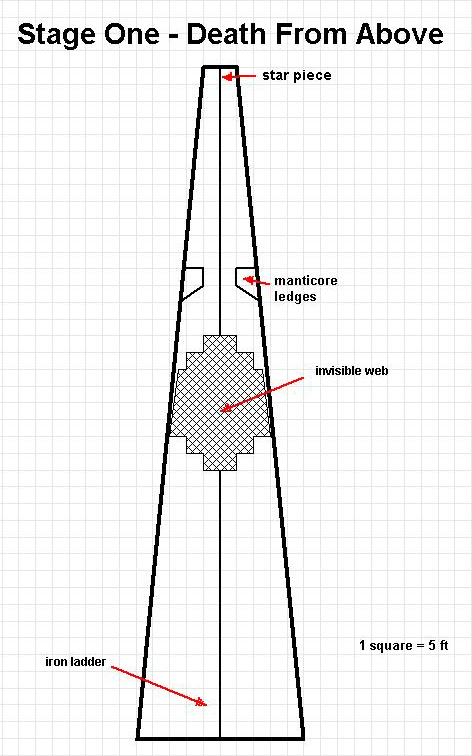 |
After each PC passes through the mist and hears the whispery voice, he will find himself in the interior of what appears to be the tower. The chamber is 50 ft in diameter and 200 ft tall and shaped exactly like the tower, though this will likely not be apparent as the place is dark except for permanent continual flame spells set into six torches in sconces set 8 ft up the wall and spaced around the bottom of the tower. There are no visible means of exit from the place, and even the misty archway behind is not visible to each PC once he passes through. As new PCs pass through the mist, they seem to walk right into the chamber through the wall. The walls seem to be made of the same material as the tower.
The air of the tower is a bit strange. There is a smell reminiscent of almonds tinged with sulphur in the air, and anyone making a Craft (alchemy) check of DC 20 can identify the smell as a possible toxin. A check of DC 35 identifies the toxin as peremin gas, a swamp gas derivative used to kill vermin.
| * Peremin Gas: contact poison, For save DC 15; initial damage nil, secondary damage 1 Con. |
Unlike normal poisons, peremin gas is slow-acting. Initial exposure has no effect, and there is no effect until 1 minute of exposure. Upon a full minute of exposure, and for every full minute of exposure thereafter, a DC 15 Fortitude save must be made or the victim suffers 1 point of Con damage.
An iron ladder sprouts out of the center of the chamber and rises up into the darkness.
The ladder reaches up to the top of the tower, some 200 ft above the floor at its tapered end. There at the top is a piece of the star, resting on a velvet cushion suspended by a thin metal chain a few inches from the ceiling.
About 80 ft up the tower, a permanent web spell has been cast across the tower. The spell has been cast at 20th level and a permanent invisibility spell has been cast on the webs to make them invisible. Anyone moving up the tower (whether by ladder, flying, or levitating) may become caught in the webs. If a subject is moving at a speed of 7.5 ft per turn or less, then he or she will bump into the webs but can pull back in time to avoid getting stuck. If a subject is moving faster than this and contacts the web spell, then it is as if the spell had been cast on the subject (Reflex save DC 17).
High above the web, some 120 ft above the floor of the tower, are four ledges upon which rest four manticores with the effigy template. These were built by Hagistre and are instructed to attack any intruders, beginning once an intruder gets stuck in the web spell, burns the web spell, dispels the web spell, or passes beyond the web spell in any way. They will also attack any intruders if the star piece is disturbed in any way.
The effigy manticores will first attempt to attack victims caught in the web, focusing their spikes on them, but only when they are within 15 ft of the top edge of the web spell so that their victims do not have total cover. Once they run out of spikes, they will take to the attack, seeking to slay all such intruders to the best of their ability. Remember that a DC 20 Spot check is required to determine that these are automatons and not living manticores. Be certain to adjust the DC for distance and lighting conditions.
|
* Effigy Manticores (4): CR 6; Large construct; HD 6D10+30; hp 63; Init +1; Spd 30 ft, fly 50 ft (clumsy); Space 10 ft; Reach 5 ft; AC 19 (touch 11, flat-footed 17); Atk +10 melee (2D4+7 [x2], claws) and +8 melee (1D8+3, bite) or +5 ranged (1D8+3 [x6], spikes); SA spikes; SQ construct traits, darkvision 60 ft, DR 3/adamantine, low-light vision; AL LE; SV Fort +2, Ref +3, Will +2; Str 24, Dex 13, Con -, Int -, Wis 11, Cha 1. Length 10 ft. Skills and Feats: none; Flyby Attack, Multiattack, Weapon Focus (spikes). Special Attacks: Spikes (Ex): With a snap of its tail, a manticore can loose a volley of six spikes as a standard action (make an attack roll for each spike). This attack has a range of 180 ft with no range increment. All targets must be within 30 feet of each other. The creature can launch only twenty-four spikes in any 24-hour period. |
Leaving Stage One:
When the star piece for this stage is brought down to within 20 ft of the tower floor, all of the torches will go out except for one. Carefully examining the area just underneath the torch (Search DC 25) will reveal a thin slot in the wall of the tower. Sticking the star piece into the slot (it only fits halfway) acts as a key that opens another archway filled with mauve mist (exactly like the one used to enter this chamber). Stepping through the archway deposits the PCs in Stage Two.
Remaining in Stage One:
It is possible for the PCs to rest in stage one, though very difficult. The peremin gas makes camping out here potentially fatal, unless the PCs manage to have access to multiple delay poison spells or are immune to poison. The poison is a contact gas, and as such cannot easily be fended away, even by PCs with no need to breathe. Nevertheless, it is conceivably possible for the PCs to somehow ignore or bypass the poison gas and rest here.
STAGE TWO - THE AMAZING MAZE:
Stage two is an extradimensional maze that fiendishly changes shape at random intervals. It is recommended that DMs use dominoes or legos to lay out the maze map and then shift these as appropriate. Otherwise, the DM can use a battlemat and erase and redraw accordingly. DMs are encouraged to become very familiar with this encounter before attempting to run it, as it requires some coordination on the DM's part to properly run the maze.
Refer to the Stage Two map below.
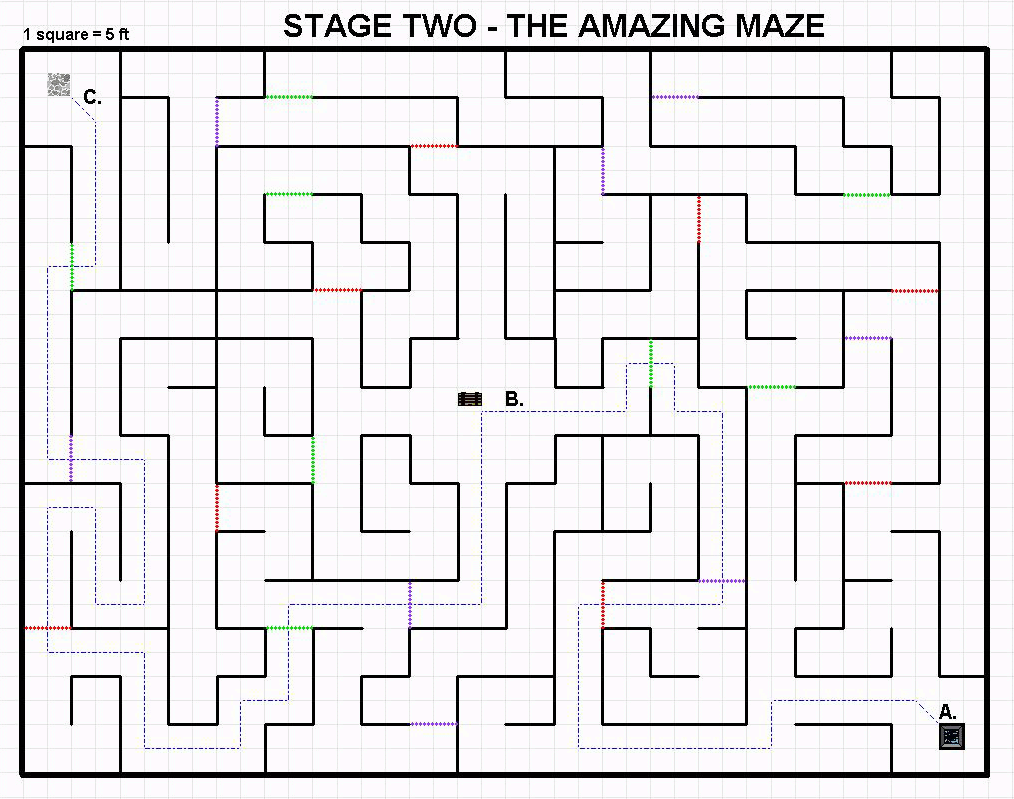 |
The dotted blue line shows the correct (and only) path through the maze.
The red, purple, and green wall sections represent illusory wall spells cast at 20th level. These walls match the walls of the maze exactly and are designed to further confuse subjects of the maze as well as force them to go down a given passage and probe the end rather than simply seeing a dead end down a corridor and immediately backtracking.
The illusory walls are linked, so that when one of the red illusory walls is visible, all of the red illusory walls are visible. Similarly, when one red illusory wall is invisible, all red illusory walls are invisible.
When the PCs first enter the maze in room A, all of the illusory walls are visible. They remain so until a PC leaves room A and enters the maze proper. At such time, the DM should roll a D20 in secret. This is the number of rounds before the DM should check the status of each set of illusory walls. When the time comes, the DM should assume that there is a 50% chance that each coloured set of illusory walls changes its status. Changing its status means turning visible if previously invisible or vice versa. When the status of a set of walls changes, a ghost sound cast at 20th level activates for each and every such wall, sounding like stone is grinding on stone. This should give PCs the illusion that the solid walls of the maze are actually changing and shifting.
The actual walls of the maze are made form the same impenetrable material as the Tower of the Mage. The ceiling is 15 ft overhead and none of the maze is lit except for the glowing sigils in room A.
As such, it is important that the DM keeps track of the passage of time within the maze.
Rooms:
Room A - The Start
This is the room into which PCs who exit stage one will arrive. They will appear through the wall in the far southeast corner of the room and stand before a 5 ft square pool. The pool is about 1 ft deep and filled with a strange murky white water. Emblazoned in glowing sigils on the wall to the north of the pool is the following, in Common:
|
Set before you is my maze,
which you must traverse to proceed. They say with wealth comes power, but I say with it comes death. Yet death can be useful when death is at hand. They say if it bleeds you can kill it, but what if it doesn't bleed? The sanguine makes it so. They say that the light of wisdom is keen, keener than any blade. But remember, all such wisdom is fleeting. They say that envy is a poison to the soul, but I say it is good to want what you cannot have. They say absolute power corrupts absolutely. To this I agree. |
Below the sigils is a stone potion rack holding five crystal vials. The crystal of each vial is coloured, one of silver, one of red, one of yellow, one of green, and one of blue. When one of the vials is take from the rack, the rest shatter. As the vials are magic, they cannot be restored to functionality.
The vial that is chosen must be dipped into the water of the pool. The water within the vial then begins to glow, and now becomes a magic elixir. A bit of the elixir may be taken and sampled in order to determine what it does. Allow a Knowledge (arcana) check of DC 30 to allow some idea as to the effect even if the small sample is not used in the proper fashion (e.g. by rubbing the red elixir on one's fingers, the PC can tell that his fingers feel stronger and smoother and fingernails much sharper). As the liquid is not a potion, Spellcraft will not identify it. Once the vial's elixir is used, that vial also shatters.
The five sentences of the sigils refers to the colour of each vial and its benefits. In order, they are:
Silver = A single weapon coated with this elixir gains the ghost touch ability. A single piece of armour or shield likewise. There is enough elixir for a single piece of armour or a single shield or a single weapon or 10 pieces of ammunition. This effect lasts for 10 minutes.
Red = A single weapon coated with this elixir is treated as an adamantine weapon only for the purposes of overcoming DR. It is not so treated for sundering objects or for being sundered. This elixir only affects weapons, and can affect a single weapon or 10 pieces of ammunition. This effect lasts for 10 minutes.
Yellow = When rubbed over the eyes, this elixir allows the subject to see through one set of illusory walls. The DM should randomly determine which coloured set of walls applies.
Green = This elixir is a strange acid that burns to the touch but causes no damage. However, if used on the lock of the chest in room B, it dissolves the lock and opens the chest. There is enough elixir to
Blue = This elixir grants the imbiber the effects of a bull's strength and bear's endurance spell. However, it also is a poison requiring a DC 18 Fort save with initial and secondary effect of 1D6 Dex damage.
Room B - The Treasure
This room is barren except for a single chest in the center. The chest faces north, and is made of iron (hardness 10, 60 hp). The chest is attached to the floor by means of sovereign glue. A lock is set into the chest. This lock is made of a strange crystalline material and has a hardness of 30 and 120 hp. However, the lock can be dissolved by pouring the green elixir from room A upon it. In addition, the lock can be opened with a DC 30 Open Locks check. A knock spell will also open the chest.
The chest is trapped. Any round that the lock is unsuccessfully picked or the chest attacked without destroying it, the trap activates. Roll a D4 to determine which particular trap activates.
| * Fireball Trap: CR 6; magic device; touch trigger; automatic reset; spell effect (fireball, 8th-level wizard, 8d6 fire, DC 18 Reflex save half damage); Search DC 28; Disable Device DC 28. |
| * Iceball Trap: CR 6; magic device; touch trigger; automatic reset; spell effect (fireball with energy substitution [cold], 8th-level wizard, 8d6 cold, DC 18 Reflex save half damage); Search DC 28; Disable Device DC 28. |
| * Acidball Trap: CR 6; magic device; touch trigger; automatic reset; spell effect (fireball with energy substitution [acid], 8th-level wizard, 8d6 acid, DC 18 Reflex save half damage); Search DC 28; Disable Device DC 28. |
| * Electricball Trap: CR 6; magic device; touch trigger; automatic reset; spell effect (fireball with energy substitution [electricity], 8th-level wizard, 8d6 electricity, DC 18 Reflex save half damage); Search DC 28; Disable Device DC 28. |
This trap should be considered a single trap, so that a single search attempt finds the trap and a single disarm attempt disables the trap. DMs should also only give XP for overcoming this trap as if it were a single trap.
Within the chest is a star piece.
Room C - The End
This chamber is barren, except for a 5 ft square portion of the floor that is made up of purple and white marble. If the star piece for this stage is brought to within 5 ft of the floor, it turns into mist.
Creatures:
The main denizen of this maze is a brass golem. This creature was set by Hagistre to seek out anyone in the maze and to slay them. Fortunately for the PCs, the construct cannot use its maze ability here, since maze creates an extradimensional space and those cannot be created anywhere within the various stages. Because it cannot use its maze ability, the brass golem's CR is reduced by 1 for this encounter. Also note that the iterative attacks for the brass golem listed in Monster Manual II have been removed, as golems do not traditionally gain iterative attacks with their weapons (e.g. iron golems frequently wield short swords). Instead the brass golem has been granted a secondary attack with its butt attack.
The golem begins in room B when the PCs arrive, and 10 rounds after the first PC arrives in this stage, it begins to hunt them down. The golem knows instinctively where all intruders are in this maze, though this only allows it to know the square the intruder is in, but doesn't allow the golem to actually see or target the intruder if it is invisible or otherwise hidden. The golem also knows of and is immune to the illusory walls, and will use these shortcuts through the walls to "catch up" to fleeing PCs or to suddenly reappear around another corner. The golem is instructed not to walk through an illusory wall unless there are no intruders within line of sight of either side of the wall.
|
* Brass Golem: CR 9; Large construct; HD 16D10+30; hp 118; Init +0; Spd 30 ft (cannot run); Space 10 ft; Reach 10 ft; AC 31 (touch 9, flat-footed 31); Atk +19 melee (3D6+10 [19/x3], +3 wounding greataxe) and +11 melee (1D8+7, butt); SA maze; SQ construct traits, DR 10/adamantine, magic immunity, scent; AL N; SV Fort +5, Ref +5, Will +7; Str 20, Dex 11, Con -, Int 3, Wis 14, Cha 7. Height 8 ft. Skills and Feats: Survival +21*; Cleave, Great Cleave, Improved Critical (greataxe), Improved Sunder, Power Attack, Track. Special Attacks: Maze (Sp) Once per day, a brass golem can target a maze effect (caster level 16th) against a single quarry. The golem is immune to the effects of its own maze ability and that of others of its kind, and can freely enter its own maze to track a target. Special Qualities: Magic Immunity (Ex): A brass golem is immune to any spell or spell-like ability that allows SR. In addition, certain spells and effects function differently against the creature as noted in this entry. An electricity effect slows it (as the slow spell) for 3 rounds, with no save. A fire effect breaks any slow effect on the golem and cures 1 point of damage for each 3 points of damage it would otherwise deal. The golem does not get a save against fire effects. * A brass golem is a relentless tracker. It gains a +20 competence bonus on Survival checks for the purpose of tracking a foe designated by its creator or in conjunction with any other goal set by its creator. When tracking a foe through its own maze, the creature gains a +20 insight bonus on Survival checks. |
In addition, Hagistre has bound a large number of spectral minotaurs (with a Spectral Creature template from Savage Species) into the walls of the maze. The DM can assume there are an unlimited number of these creatures for the purposes of this scenario. These creatures are awakened by the presence of nearby life forces, and will emerge from the walls to attack.
The spectral minotaurs are contained only within the outer walls of the maze, and they cannot pass through the outer walls, nor can they pass into those walls once released. Instead, they haunt the maze, searching for living beings to destroy. As the brass golem is not a living creature, the spectral minotaurs are neither awakened by nor attack it.
Assume a 10% chance per minute that a single spectral minotaur is released into the maze (if one is indicated, roll a D10 to determine which round during the minute it arrives). This will occur within 30 ft of a PC, but can be past any number of interior maze walls. The spectral minotaurs can pass through the interior walls of the maze, and will do so readily to get at their prey.
If in a given minute a spectral minotaur is indicated, the DM should immediately check again to see if a second spectral minotaur was released in the same round. The DM should continue to check until a result indicates no spectral minotaur released in that rounds. As there is only a 1 in 100 chance of two being released in the same minute, the odds are against the PCs being instantly overwhelmed.
|
* Spectral Minotaur: CR 7; Large undead (incorporeal); HD 6D12; hp 39; Init +1; Spd fly 80 ft (perfect); Space 10 ft; Reach 10 ft; AC 11 (touch 11, flat-footed 11); Atk +4 melee (2D6, incorporeal touch); SA energy drain; SQ create spawn, darkvision 60 ft, sunlight powerlessness, turn resistance +2, undead traits, unnatural aura; AL LE; SV Fort +2, Ref +3, Will +7; Str 19, Dex 13, Con -, Int 11, Wis 14, Cha 12. Height 7 ft. Skills and Feats: Hide +5, Intimidate +4, Listen +13, Search +10, Spot +13; Great Fortitude, Power Attack, Track. Special Attacks: Energy Drain (Su): Any living creature struck by a spectral minotaur's incorporeal touch attack must succeed on a DC 12 Fort save or gain 2 negative levels. For each negative level it bestows, the spectral minotaur heals 5 points of damage. If the amount of healing is more than the damage the creature has taken, it gains any excess as temporary hit points. If the negative level has not been removed before 24 hours have passed, the afflicted subject must succeed on a DC 12 Fort save to remove it. Failure means the subject's level is reduced by 1. Special Qualities: Create Spawn (Su): Any aberration, animal, dragon, giant, humanoid, magical beast, or monstrous humanoid slain by a spectral minotaur rises as a spectral creature in 1D4 rounds. Such a spawn is under the command of the spectral minotaur that created it and remains enslaved until its master's death. The spawn does not possess any of the abilities it had in life but gains the spectral creature template. A spectral minotaur can control 12 spawn. If it creates a spawn that causes it to exceed this limit, the spawn no longer under its control is released. Sunlight Powerlessness (Ex): Spectral minotaurs are utterly powerless in natural sunlight (not merely a daylight spell) and flee from it. A spectral minotaur caught in sunlight cannot attack and can take only partial actions. Unnatural Aura (Su): Both wild and domesticated animals can sense the unnatural presence of a spectral minotaur at a distance of 30 ft. They do not willingly approach nearer than that and panic if forced to do so; they remain panicked as long as they are within that range. |
Leaving Stage Two:
If the star piece for this stage is brought to within 5 ft of the marble floor in room C, that portion of the floor turns into mist. Stepping through the floor deposits the PCs in Stage Three.
Remaining in Stage Two:
It is possible for the PCs to rest in stage two, though very difficult. The incorporeal minotaurs will continue to arrive every 10 minutes or so.
STAGE THREE - THE FIRE:
Refer to the Stage Three map below.
 |
This stage takes place on a pocket of the Elemental Plane of Fire. While the stage is itself a demiplane, pinched off from the Plane of Fire, it resides within that plane and, what's more, its membrane is permeable to the Elemental Plane from the outside. However, the reverse is not true. As such, denizens from the Elemental Plane of Fire often wander into the bubble to eventually die or me slain by another.
The bubble floats in a sea of lava, and is itself a 300 ft diameter sphere, with half of its volume consisting of lava. The PCs will appear in this stage standing atop a floating brass platform 20 ft square and several inches thick that hovers some 30 ft above the lava level. Behind the platform, the wall or membrane of the planar bubble appears as a yellowish/dun coloured membrane that is hard to the touch. This membrane is translucent, and a roiling lava lake of the Elemental Plane of Fire can be seen outside the bubble, with distant charred shorelines barely visible through the heat haze.
The platform has engraved into its face a 5 ft diameter circle into which has been scribed the image of a flame.
The platform that the PCs arrive upon has a permanent alarm spell cast upon it. The audible alarm will sound when the first PC enters this stage and can be heard by the efreeti in the tower (see below).
Within, three other brass platforms hover at the cardinal points around the edge of the bubble, in all ways similar to that upon which the PCs arrive, except that the platform opposite the one the PCs enter upon and the one to the right of the PCs' platform are featureless. The platform to the left of the PCs' platform bears a 5 ft diameter circle scribed on its face and within the circle is the engraving of three drops of liquid. It would require a DC 20 Spot check to notice the engraving from the PC's current angle, and even then they would have to be native to the plane or of the fire subtype to have a chance to see it. PCs flying above the platform level and within 120 ft can easily make out the droplet carving on the platform.
In the center of the bubble, again hovering 30 ft above the lava, is a large circular brass platform, some 100 ft in diameter. Set atop this circle is a tower of red hot iron. The tower is some 60 ft in diameter and extends just over 140 ft into the air. The walls of this tower are decorated with carvings of salamanders, fire elementals, and efreeti engaged in various activities mostly involving immolating various non-fire elemental creatures.
Set into the base of the tower, at each cardinal point, is a set of bronze double doors, entirely unadorned.
A bridge of crystal, 10 ft wide, arches across the lava from the party's brass platform to the central brass disc. This bridge is actually a permanent image cast by the efreeti in the tower. Any PC attempting to walk across the bridge will fall into the lava.
The Environment:
The planar bubble shares all of the traits of the Elemental Plane of Fire from which it has been pinched.
The Elemental Plane of Fire of Therra has the following traits (modified for the bubble where appropriate):
Normal visibility here is limited to 120 ft due to the smoke and ash in the air, though creatures with the elemental or outsider type and the fire subtype can see double that distance. Darkvision does not function here.
The air here is thin and constantly shifting from waves of heat and hot updrafts. As such, nonnatives have their fly speed halved and maneuverability reduced by one step.
The constant crackling of flames and lava provides a -2 circumstance penalty on Listen checks throughout the area.
The Lava:
The lower half of the bubble's sphere is filled with lava.
Lava or magma deals 2D6 points of damage per round of exposure, except in the case of total immersion (such as when a character falls into the crater of an active volcano), which deals 20D6 points of damage per round.
Damage from magma continues for 1D3 rounds after exposure ceases, but this additional damage is only half of that dealt during actual contact (that is, 1D6 or 10D6 points per round).
An immunity or resistance to fire serves as an immunity to lava or magma. However, a creature immune to fire might still drown if completely immersed in lava.
Within the lava dwells a large number fire bats. These normally glide through the lava, out of sight. Similarly, should the PCs take at least a minute to observe the lava from the platform, they can make a similar Spot check to notice the fire bats beneath the lava. Even then, though, the bats will appear as motes of flame or fire moving beneath the surface of the lava. Their full nature will not be apparent until they attack. Once every minute or so 1D3 fire bats will emerge from the lava, spot the PCs on the platform, and attack the PCs on the platform. DMs should allow a 10% chance per round for this to happen. There are, effectively, an infinite number of fire bats swimming in the lava. The bubble walls allow fire bats to enter (but not leave) the bubble, and the lava lake in which the bubble floats is swarming with thousands of these creatures. In fact, the PCs may see fire bats leaping in the lava lake outside the bubble and be subject to attack by some flying through the membrane from the outside.
Crossing the Lava:
The illusionary crystal bridge is, of course, not the way to cross the lava over to the iron tower. There are essentially two ways to cross. The first is by way of flight or levitation. There is nothing stopping this from happening, and it is, in fact, the best way to cross. Teleportation magic will also work.
For those without such means, the circle and flame scribed into the face of the platform provides a way to cross the lava. If any fire is touched to the circle, the platform will detach from the membrane and begin to float across towards the brass disk in the center. The platform will move at a rate of 5 ft per round per point of fire damage directed to the flame sigil in the center of the circle. Heat damage (such as from the ambient atmosphere here) does not move the platform. It must be application of direct flame or fire. One way to accomplish this is to place a fire bat into the circle. Of course, torches and spells such as burning hands or scorching ray will also serve. Should the platform reach the central disk, it will stop (even if more fire damage was applied). The disc will not move for the rest of the round, and thereafter, it can then be moved back to the membrane from whence it began by more application of flame.
Once the platform has begun to move, its course cannot be reversed until it reaches the central disc or the outer membrane. The platform only moves in a straight line, and cannot be turned nor caused to elevate or descend.
However, once any living creature crosses halfway between the brass platform and the central brass disc, eight fire bats will sense their presence and swarm to the attack of all living creatures they find. If the subject crossing the lava expanse is within 100 ft of the lava, then the bats will have noted them with their blindsense ability and will likely attack with surprise. Otherwise, it will have taken one of them to have come near enough to the surface to see the subject, thereby allowing the PCs a Spot check against a Hide DC of +14 (including a circumstance bonus for only skimming the surface of the lava) to avoid surprise.
|
* Fire Bats: CR 3; Small elemental (fire); HD 6D8-6; hp 21; Init +3; Spd 10 ft, fly 50 ft (good); Space 5 ft; Reach 5 ft; AC 16 (touch 14, flat-footed 13); Atk +8 melee (1D6-1 plus 1D6 fire, bite); SA attach, burn, devour; SQ blindsense 120 ft, immunity to fire, regeneration, vulnerability to cold; AL NE; SV Fort +1, Ref +8, Will +0; Str 8, Dex 17, Con 8, Int 6, Wis 7, Cha 5. Length 2 ft 6 in. Skills and Feats: Hide +10, Listen +5, Spot +5; Dodge, Flyby Attack, Weapon Finesse. Special Attacks: Attach (Ex): If a fire bat hits with its bite attack, it latches onto the opponent's body. An attached fire bat is effectively grappling its prey. The fire bat loses its Dex bonus to AC but holds on with great tenacity, doing 1D6 points of fire damage each round it remains attached. An attached fire bat can be struck with a weapon or grappled itself. To remove an attached fire bat through grappling, the opponent must achieve a pin against the fire bat. Each grapple attempt subjects the opponent to the fire bat's burn attack. Burn (Ex): Any creature that is hit by a fire bat's bite attack (or that hits the fire bat with a natural weapon or unarmed attack) must succeed at a DC 12 Ref save or catch fire. The fire burns for 1D4 rounds. Immersing a fire bat in at least 10 gallons of water extinguishes its flames and prevents it from flying but does not otherwise harm the creature. The fire bat's flames reignite after 10 rounds. Devour (Ex): Once it is attached, a fire bat devours the opponent's flesh, automatically dealing 1D6-1 points of bite damage and 1D6 points of fire damage each round it remains attached. After dealing 6 points of bite damage, the fire bat is sated; on the next round it detaches and flies away to digest the meal. Special Qualities: Regeneration (Ex): Cold deals normal damage to a fire bat. |
Once the swarm of 8 fire bats is defeated, the fire bats will only appear in the groups of 1D3 per minute or so specified above.
The Central Disc:
The central disc is smooth except for two instances. On the edge of the disc facing the platform scribed with the circle and flame is a similar symbol. This symbol works in the same manner as that which moves the platform, except this symbol summons the platform to the disc if it is at the membrane and sends it to the membrane if it is at the disc. If the platform is in transit, the symbol here merely continues it along its transit way.
On the edge of the central disc facing the platform scribed with the circle and droplets is a similar symbol. This symbol summons the circle and liquid platform in the same manner as above, except it moves by application of water or any other non-lava liquid. In this case, a single drop of liquid is sufficient to move the platform all the way from the membrane to the central disc and vice versa. Such a transit takes four rounds.
The Tower:
The tower is red hot to the touch. It is, in fact, under the constant effects of a heat metal spell. Anyone contacting the wall in a bodily manner (i.e. being bullrushed into a wall or standing on the floor) will suffer 2D4 points of fire damage from the searing hot metal. Anyone making incidental contact will take 2 points of fire damage instead. All of the floors, walls, ceilings, and furniture are all red hot. There are no light sources in the tower, but the red glow of heat itself provides everything with a hellish, ruddy cast.
Each floor of the tower is 20 ft tall. An iron spiral staircase winds up the center of the tower, its sides open and exposed. The staircase proceeds from the ground floor all the way to Level Seven.
The tower is the prison/demesne of an efreeti named Hafusthep. Hagistre essentially formed this planar bubble around his tower and informed the efreeti that he would be freed once he slew a certain number of mortals who entered his bubble. Hafusthep hates Hagistre, but also wants to be free of his prison, and so is willing to do what is necessary to win his freedom from the eccentric mage. He dislikes the "coolness" of the bubble as compared with the heat of the Elemental Plane of Fire, and although the climate inside the bubble in no way will harm him, it is about 1/3rd the temperature he prefers.
|
* Hafusthep the Efreeti: CR 8; Large outsider (extraplanar, fire); HD 10D8+20; hp 65; Init +7; Spd 20 ft, fly 40 ft (perfect); Space 10 ft; Reach 10 ft; AC 18 (touch 12, flat-footed 15); Atk +17 melee (1D8+8 plus 1D6 fire [x2], slams); SA change size, heat, spell-like abilities; SQ change shape, darkvision 60 ft, immunity to fire, plane shift, telepathy 100 ft, vulnerability to cold; AL LE; SV Fort +9, Ref +10, Will +9; Str 27, Dex 17, Con 14, Int 12, Wis 15, Cha 15. Height 12 ft. Skills and Feats: Bluff +15, Craft (any one) +14, Concentration +15, Diplomacy +6, Disguise +2 (+4 acting), Intimidate +17, Listen +15, Move Silently +16, Sense Motive +15, Spellcraft +14, Spot +15; Combat Casting, Combat Reflexes, Dodge, Improved Initiative, Quicken Spell-Like Ability (scorching ray). Special Attacks: Change Size (Sp): Twice per day, an efreeti can magically change a creature’s size. This works just like an enlarge person or reduce person spell (the efreeti chooses when using the ability), except that the ability can work on the efreeti. A DC 13 Fort save negates the effect. Heat (Ex): An efreeti’s red-hot body deals 1D6 points of extra fire damage whenever it hits in melee, or in each round it maintains a hold when grappling. Spell-Like Abilities: At will - detect magic, produce flame, pyrotechnics (DC 14), scorching ray (1 ray only); 3/day - invisibility, wall of fire (DC 16); 1/day - grant up to three wishes (to nongenies only), gaseous form, permanent image (DC 18). Caster level 12th. Special Qualities: Change Shape (Su): An efreeti can assume the form of any Small, Medium, or Large humanoid or giant. Plane Shift (Sp): An efreeti can enter any of the elemental planes, the Astral Plane, or the Material Plane. This ability transports the efreeti and up to eight other creatures, provided they all link hands with the genie. It is otherwise similar to the spell of the same name (caster level 13th). Possessions: belt of giant strength +4, golden circlet set with a large sapphire worth 3000 gp, talismans of cure serious wounds (2) at 5th level. Languages: Auran, Common, Morakki, Ignan, Infernal. |
The efreeti can be found almost anywhere within his tower, so his statistics are presented above.
Ground Floor:
This chamber is decorated with various trophies and accouterments designed to display the fame and prowess of its owner. Iron hooks and pegs sprout out of the walls here and set upon them are various creature heads and hides, including the heads of all sorts of elementals from other Elemental Planes. Various metal shields are also hung on the walls, and a Knowledge (local - Wylag Desert) check of DC 15 or a Knowledge (nobility and royalty) check of DC 25 will note that most of the heraldry on the shields are of various Wylag noble tribes. One shield, with the heraldry of a particularly powerful, ruthless, and well known ancient chieftain, is a +2 heavy steel shield of light fortification.
Level Two:
This level of the tower contains a living room, containing a large sized divan of iron and a low table of brass. Upon the table are several brass tomes written in Ignan which contain information regarding the nature of demi-planes and dimensional pockets.
Various iron shelves sprout from the walls at various heights. These contain a variety of decorations and personal effects, including metal sculptures, grotesque statues, scorched skulls, glazed pottery and ceramics, and petrified plants.
Six fire mephits cavort here, servants of the efreeti. They will attack intruders on sight, making enough noise to alert Hafusthep. If met with determined resistance, they will break and scatter, heading into the oven in Level Three to heal themselves and then rallying around the efreeti.
|
* Fire Mephits (6): CR 3; Small outsider (extraplanar, fire); HD 3D8; hp 13; Init +5; Spd 30 ft, fly 50 ft (average); Space 5 ft; Reach 5 ft; AC 16 (touch 12, flat-footed 15); Atk +4 melee (1D3 plus 1D4 fire [x2], claws); SA breath weapon, spell-like abilities, summon mephit; SQ DR 5/magic, darkvision 60 ft, fast healing 2, immunity to fire, vulnerability to cold; AL N; SV Fort +3, Ref +4, Will +3; Str 10, Dex 13, Con 10, Int 6, Wis 11, Cha 15. Height 4 ft. Skills and Feats: Bluff +8, Escape Artist +7, Hide +11, Listen +6, Diplomacy +4, Disguise +2 (+4 acting), Move Silently +7, Spot +6, Use Rope +1 (+3 with bindings); Dodge, Improved Initiative. Special Attacks: Breath Weapon (Su): 15-foot cone, damage 1D8 fire, DC 12 Ref save for half damage. A mephit can use its breath weapon once every 1d4 rounds as a standard action. Spell-Like Abilities: 1/hour - scorching ray (DC 14, caster level 3rd); 1/day - heat metal (DC 14, caster level 6th). Summon Mephit (Sp): Once per day, a mephit can attempt to summon another mephit of the same variety, much as though casting a summon monster spell, but with only a 25% chance of success. Roll d%: On a failure, no creature answers the summons that day. A mephit that has just been summoned cannot use its own summon ability for 1 hour. This ability is the equivalent of a 2nd-level spell. Special Qualities: Fast Healing (Ex): A fire mephit heals only if it is touching a flame at least as large as a torch. Languages: Common, Ignan. |
Level Three:
This level is the dining area and kitchen for the efreeti. Although an efreeti does not need to eat, the efreeti enjoys doing so when the chance presents itself.
The chamber contains a large sized iron dining table and four large iron chairs. Steel and brass place settings are arranged around the table. A large iron flask holds ignan wine, which is actually liquid mercury mixed with rare herbs and a variety of bloods.
Along one wall is a work table containing various cooking utensils, pots, and pans. The table is usable as a stove simply from the general heat of the tower. There is also a large oven set against the wall that contains a captive small fire elemental. The fire elemental is bound to the oven and will not attack in any way, though the oven is hot enough to deal an extra 1D4 fire damage to anyone putting a limb inside or crawling inside. The mephits from Level Two will take refuge here to use their fast healing ability, closing the oven door and hiding amidst the coals and flames. All 6 mephits can fit in the 10 ft square oven.
Level Four:
This level serves as a chamber of relaxation for the efreeti. A large sized copper tub dominates the place, filled with lava from the lake outside. Iron scoops and buckets nearby are clearly used to fill and empty the bath. Various iron flasks and vials hold slow burning oils that serve the efreeti as unguents and perfumes.
A low metal table is also nearby, with indentations that makes it clear that it is a massage table for the efreeti to lie face down upon.
Six magma mephits are here, serving as masseuses and bath attendants for the efreeti. They also often hunt for fire bats in the lava outside when the efreeti wishes to dine. The mephits will attack intruders, diving into the tub to heal as necessary. The tub is 10 ft square and filled with 5 ft of lava.
|
* Magma Mephits (6): CR 3; Small outsider (extraplanar, fire); HD 3D8; hp 13; Init +5; Spd 30 ft, fly 50 ft (average); Space 5 ft; Reach 5 ft; AC 16 (touch 12, flat-footed 15); Atk +4 melee (1D3 plus 1D4 fire [x2], claws); SA breath weapon, spell-like abilities, summon mephit; SQ change shape, DR 5/magic, darkvision 60 ft, fast healing 2, immunity to fire, vulnerability to cold; AL N; SV Fort +3, Ref +4, Will +3; Str 10, Dex 13, Con 10, Int 6, Wis 11, Cha 15. Height 4 ft. Skills and Feats: Bluff +8, Escape Artist +7, Hide +11, Listen +6, Diplomacy +4, Disguise +2 (+4 acting), Move Silently +7, Spot +6, Use Rope +1 (+3 with bindings); Dodge, Improved Initiative. Special Attacks: Breath Weapon (Su): 10-foot cone of magma, damage 1d4 fire, Reflex DC 12 half. Living creatures that fail their saves are tormented by burned skin and seared eyes unless they have immunity to fire or are otherwise protected. This effect imposes a -4 penalty to AC and a -2 penalty on attack rolls for 3 rounds. A mephit can use its breath weapon once every 1d4 rounds as a standard action. Spell-Like Abilities: Once per day a magma mephit can use pyrotechnics (DC 14). It can use itself as the fire source without harm. Caster level 6th. Summon Mephit (Sp): Once per day, a mephit can attempt to summon another mephit of the same variety, much as though casting a summon monster spell, but with only a 25% chance of success. Roll d%: On a failure, no creature answers the summons that day. A mephit that has just been summoned cannot use its own summon ability for 1 hour. This ability is the equivalent of a 2nd-level spell. Special Qualities: Fast Healing (Ex): A magma mephit heals only if it is touching magma, lava, or a flame at least as large as a torch. Change Shape (Su): Once per hour, a magma mephit can assume the form of a pool of lava 3 feet in diameter and 6 inches deep. The mephit’s damage reduction improves to 20/magic when in this form. The mephit can't attack while in lava form but can use other spell-like abilities. It can move at a speed of 10 feet, but it can't run. In this form the mephit can pass through small holes or narrow openings, even mere cracks. The pool’s touch ignites flammable materials such as paper, straw, or dry wood. Languages: Common, Ignan. |
Level Five:
This level of the tower contains a study and library for the efreeti. A large iron chair and reading desk are here, the latter holding a set of red hot metal and diamond styluses used to scorch Ignan script into metal pages. The walls of the place are covered with iron shelves upon which rest many books, all of which are made of metal covers and filled with thin metal pages and script of Ignan scorched into the page. There are also brass tablets with runes and script engraved into them.
Most of the texts deal with issues of the Elemental Planes, though a few are ancient accounts of interaction between the efreeti and various sultans and rules of the early Morakki Empire. A number also detail the City of Brass and various parts and personages of the Elemental Plane of Fire. The books are quite heavy, and it would be a great task to haul the whole library away. That said, the books are valuable and could be sold or used to supplement an exotic library.
Level Six:
This room contains the bedroom of the efreeti. Outsiders do not need to sleep, and originally this room was used for lustful dalliances of the efreeti, but now in his imprisonment, he often does sleep out of sheer boredom.
The room contains an iron bed with "linens" of salamander skin and woven metal threads for veils. Brass sheets set along the curve of the tower walls show engraved scenes of various genies bowing to efreet or being slaughtered by the efreet.
Level Seven:
This level contains three locked iron chests as well as a goodly number of loose coins. The coins total 16000 cp, 4500 sp, and 620 gp of various mintings and including ingots and even partially melted clumps.
The three chests have no locks and no hinges visible. Each contains a single crystal of deep orange set into the seam of the closed lid. This crystal is a mystical lock, and a DC 35 Open Lock check will determine that the crystal responds to a scorching ray spell, which, if cast at a crystal, causes the lid to pop open. If the lid is closed again, it locks again. The chests can also be smashed open (hardness 10, hp 60).
The chests contain various coins and gems hoarded by the efreeti, totaling 1000 sp, 500 gp, and 20 pp per chest. In addition, the second chest has a false compartment in the lid (Search DC 25) that is trapped with a cone of cold trap. If the circlet worn by the efreeti is held or worn by the opener of the compartment, then the trap will not activate.
| * Cone of Cold Trap: CR 6; magic device; touch trigger; repair reset; item bypass; spell effect (cone of cold, 10th-level wizard, 10D6 cold, DC 17 Reflex save half damage); Search DC 30; Disable Device DC 30. |
Within the compartment is a star piece.
Efreeti Tactics:
Hafusthep both wants to free himself by satisfying Hagistre's conditions and wants to kill the mage. He is, however, bored and lonely and will try to engage the PCs in conversation...at least initially. When he hears the alarm spell activate, he will proceed to turn invisible. He will then go to the top of the stairway between the Ground Level and Level Two and will cast a permanent image of a human mage. The image will pose as Hagistre, and congratulate the PCs for passing his tests. He will then ask what they seek and more importantly whether they mean him harm. A Sense Motive check that beats Hafusthep's Bluff check will reveal that the mage seems disappointed if the PCs assure him they mean him no harm. If the PCs actually mention why they wish to speak with Hagistre, he will answer as best he can (precipitating another Sense Motive check) and then invite the PCs to join him in the level above where they can relax and discuss matters further.
If the PCs refuse to ascend the stairs, then the efreeti will retreat up the stairs to Level Six and allow the PCs to fight their way through the mephits before confronting them. When the efreeti does ascend, he will dismiss the permanent image. If the PCs do not attempt to confront him, he and his mephits will attack the PCs as best they can, including outside the tower.
If the PCs ascend the stairs, the image of the mage will accompany them and the efreeti and fire mephits will attack the PCs as they arrive into Level Two.
If the PCs express an interest in harming Hagistre or attack the permanent image, then Hafusthep becomes intrigued, hoping to use the PCs to exact his revenge on Hagistre. He will reveal his true nature and is willing to forego slaying the PCs and helping them move onto the next stage if he thinks they might harm the wizard. In fact, he will even offer to grant the PCs up to three wishes, these being conditional and activated only upon the PCs slaying Hagistre. Of course, he will attempt to pervert these wishes if at all possible. The efreeti will, if convinced of the PCs' desire to slay Hagistre (requiring a Bluff check by the PC), offer to give them the star piece for this stage of the course. If the PCs agree, he will require the PCs to remain where they are and he will go and retrieve the star piece and hand it over. He will also tell the PCs how to summon the circle and liquid platform and that they must ride the platform back to the wall of the bubble with the star piece. He has no idea what stage four is comprised of.
If Hafusthep is defeated and in danger of being slain (remember, he can be killed permanently here), he will plead with the PCs to spare him. In this case, he is glad to tell how he came to be here and what his orders are, and express his hatred for Hagistre. He will also offer to fetch the star piece and tell the PCs how to move onto stage four. He has no idea what stage four is comprised of. If the PCs demand a wish from him, he will grant them a single wish, but will attempt to pervert it.
When Hafusthep grants a wish,
the PC making the wish pays the XP cost(s).
Leaving Stage Three:
The platform with the circle and droplets symbol can be moved from the membrane to the central disc and vice versa by placing a single drop of non-lava liquid on the symbol. If the star piece for this stage is brought to within 5 ft of the circle and liquid brass platform, a misty patch forms on the membrane where that platform normally rests. The PCs must simply put a single drop of water on the circle and droplet symbol on the central disc, wait for the platform to arrive, step on it, place another drop of liquid on the platform symbol, and wait for it to transit back to the membrane. Passing through this mist leads to stage four.
Remaining in Stage Three:
It is difficult for the PCs to rest in stage three. The constant heat will eventually wear through most magical resistance and begin to cause damage.
STAGE FOUR - THE WATER:
Refer to the Stage Four map below.
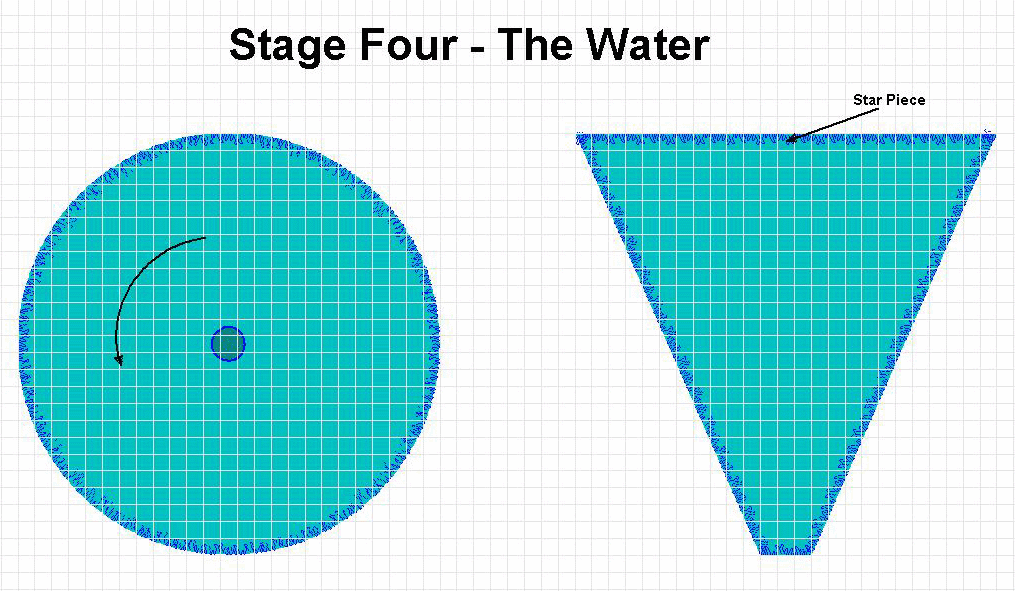 |
This stage takes place on a bubble in the Elemental Plane of Water. Like stage three, this bubble is considered a demi-plane in its own right separate but contained within the Plane of Water. The bubble is in the form of a giant vortex that floats through the infinite sea of the plane.
The planar bubble shares all of the traits of the Elemental Plane of Water from which it has been pinched.
The Elemental Plane of Water has the following traits (modified for the bubble where appropriate):
There is a dim diffuse glow throughout the plane. As such, normal vision and darkvision are both limited to 60 ft.
Creatures with fly speeds can fly at half their normal rates and with maneuverability reduced by one step.
The water within the bubble is freshwater.
All other underwater rules and circumstances apply, though underwater pressure is negligible.
The Vortex:
The entire bubble is comprised of a single massive vortex. As viewed from above, this vortex spins in a counter-clockwise direction with a strong force and spirals down to the bottom. The vortex is 125 ft wide at its top and 15 ft wide at its tip. The whole is 125 ft deep as well.
The walls of the bubble are composed of some hard, glass-like substance that is unbreakable. Spike of glass ripple out of this wall so that the whole bubble looks like the shell of a sea urchin turned inside out so that the spikes face inward. The spikes vary from 10 ft in length to 2 ft in length and cover every square inch of the vortex walls. Water passes into the vortex from the outside, entering through the top wall, which allows only water to pass through. Water spirals down to the tip of the vortex and exist the bubble through the wall at the bottom, which only allows water to pass out of it.
Hanging from the top wall of the bubble, in the precise centre of the vortex, is a star piece, suspended by a silver chain. The piece barely moves in the calm, slower moving portion of the vortex at its center.
When the PCs first enter this stage, they will be in for a shock. As they pass through the misty patch on the northern platform of the Plane of Fire, a voice will whisper in their heads, telling them simply to "hold your breath". The PC has the merest fraction of a second to to do before arrive into the vortex.
Immediately, the world will be chaos for the PC, as he is instantly swept by the great current. The PC will be taken around by the current and slammed against the glass spikes on the walls, in addition to being dragged down towards the bottom of the vortex. In the first round, the DM should almost certainly rule that each PC is completely disoriented and taken by surprise and can take no actions. Thereafter, the PCs may act normally.
The speed of the vortex is so fast that most of the motion involved in the spiral is horizontally oriented. As such, PCs caught in the current sink 10 ft and make a half circuit of the vortex in a single round.
Each round, a PC may attempt a DC 15 Swim check to avoid being swept away by the current. Such a check basically keeps the PC relatively in place and free from damage for that round.
A second Swim check in the round will allow a PC to ascend or descend in the vortex and/or to move to a new position relative to their horizontal orientation within the spiral. For each full 5 points by which the check result exceeds 10, the PC may ascend the vortex by 10 ft or descend by an additional 10 ft (remember they descend 10 ft naturally). They may also move 10 ft towards the center of the vortex for each full 5 points by which the check result exceeds 10.
Finally, if the second check result was at least DC 15, then the PC can end the round positioned anywhere on that horizontal plane that is no closer to the center of the vortex than the above check allows. This represents the PC's ability to allow himself to be swept along the counterclockwise current and pushed outwards towards the rim of the vortex until he gets to the spot he desires and then using his Swim skill to keep station.
A PC that fails the first Swim check is swept away. He is immediately flung to the outer 5 ft rim of the vortex and dashed into and along the glass spikes. He takes 1D6 bludgeoning damage from the current and then is subject to 1D10 attacks from the glass spikes at a +10 melee attack bonus. Each attack from the spikes does 1D6 points of piercing damage. He then descends 10 ft down the vortex.
When the bottom of the vortex is reached, a PC is no longer swept away, but instead is now pinned by the current to the bottom, requiring a single DC 15 Swim check to ascend 10 ft.
The speed of the current in the center of the top 10 ft of the vortex is much less than elsewhere. Once a PC is in the top 10 ft of the vortex and within 15 ft of the center, the Swim DC drops to 10 to avoid being swept away and he can make progress for ever 5 full points by which the check result exceeds 5.
Once a PC reaches the square with the star piece, the water is calm enough that a DC 5 Swim check is needed to maintain control and there is no need for a second Swim check. The star piece can be grabbed.
Negotiating the Vortex:
When the PCs first step into the vortex, all will be chaos for the first round. The PCs will be swept away by the current and suffer the consequences as if they had missed the first Swim check. The PCs will arrive in this stage 10 ft below the top of the bubble and sink 10 ft by the end of the first round. Then the DM should let the PCs regain their wits and figure out what's happening.
Visibility on the Plane of Water is 60 ft, which is just enough to barely allow the PCs to have a chance to see the star piece hanging from the chain. Assume the Spot DC is 10 to see the piece. The normal distance penalties are doubled due to the swirling water (should be -10 at the end of the first round). If a given PC is being swept by the current in a given round, then that PC will have a -5 penalty to his Spot check due to distraction. If a PC is specifically looking for the star piece, allow a +2 circumstance bonus to the check. If a PC states he is specifically looking for the star piece at the top center of the vortex, allow a total +4 circumstance bonus to the check.
Fly speed can aid the PCs within the vortex. If descending or moving with the current counterclockwise, then the fly speed (halved for the Plane of Water) is simply added to the PC's progress from the current. A DC 10 Swim check is still needed to avoid being swept away. If the PC wishes to ascend or move clockwise against the current, then the DM should essentially grant a +1 circumstance bonus to Swim checks for each full 20 ft of fly speed (that is base fly speed before halving for the Plane of Water).
If freedom of movement is cast, the PC is still subject to the force of the vortex. The spell allows unhindered movement in water, but does not negate gravity or the force of water. As such, the DM should grant a PC under the effects of such a spell a +2 circumstance bonus to his Swim checks. This bonus can stack with the circumstance bonuses gained for having a fly speed. Additionally, flying creatures do not have their fly speeds halved if under the effect of this spell and their circumstance bonus for flying is doubled.
The bottom of the vortex contains the skeletons of several previous victims of this level. It is difficult to estimate the number of victims, as the bones are in various states of calcification, but the number is at least a dozen. If these remains are searched, allow a DC 20 Search check to turn up one of the following each round. Assume that once an item is found, it cannot be found again.
When the star piece is grasped, a strange glow will appear at the bottom of the vortex, coming from the bottom glass wall itself.
The vortex itself is treated as violent motion, requiring a DC 15 + spell level Concentration check in order to cast a spell. Similarly, being underwater, any attempt to cast a spell with verbal components is doomed to failure unless the caster can breathe underwater. Even spell trigger items such as wands require that a word be spoken, and so can be dangerous or impossible to use underwater.
Leaving Stage Four:
If the star piece is brought within 5 ft of the bottom wall, it will turn into a mauve mist. Passing through this mist leads to stage five.
Remaining in Stage Four:
It is difficult for the PCs to rest in stage four. Even if breathing underwater for extended periods of time can be managed, it would be difficult to rest in the midst of a vortex.
Experience:
The PCs should receive XP for this stage as if they had overcome a CR 9 encounter.
STAGE FIVE - ALL SUBJECTIVE:
Refer to the Stage Five map below.
 |
This stage takes place inside a cube, with each side of the cube measuring 100 ft by 100 ft. Gravity inside this cube is objective directional, with "down" being whichever plane of the cube is nearest to the subject. This means that PCs who wander near the junction between two or more faces of the cube could easily step from one face to another. It also means that flying creatures could experience some disorientation if they fly from one gravity orientation to another.
The center of the cube is an area where the various directional gravities intersect, forming a cube of no gravity. This no gravity cube is 40 ft by 40 ft by 40 ft and set in the exact center of the cube. Within this no gravity area floats a group of large polyhedrons, lazily drifting in the no gravity cube and occasionally lightly bumping against each other. None of these polyhedrons will leave the no gravity area one their own, bouncing off of the edges of the no gravity region. Only the actions of the PCs can force one of the solids out of the no gravity area.
The cube itself seems to be made of a steel-like metal. It is nominally cool to the touch and fairly smooth, though not slick by any means. There is air in the cube, though it is not apparent how air is circulated nor where it comes from.
In the center of each face of the cube is a 5 ft square indentation, being some 1 ft deep. Each indentation contains, on its bottom, markings (see The Markings below).
When the PCs arrive, they will appear in the center of the "bottom" face of the cube (per the map above). They will instantly notice the polyhedrons floating directly over their heads, possibly expecting them to fall on their heads before realizing that they float in place and do not fall. There will be no initial indication of the objective directional nature of gravity in the cube until the PCs observe the effects of such during their interaction with the environment. The cube is silent, except for the clacking and clanking of the polyhedrons as they bounce into one another.
The Polyhedrons:
There are a total of 15 polyhedrons floating in the no gravity area of the cube. These are divided into three colours (red, yellow, and blue) and within each colour, further divided into a 4-sided, 6-sided, 8-sided, 12-sided, and 20-sided polyhedron. The DM is encouraged, if possible, to use polyhedral dice of the appropriate colour to represent the floating shapes. Each polyhedron is approximately 5 ft square and is made of a strange material that, when listening carefully to the sound of their impacts, seems to be some weird combination of metal and stone.
The Markings:
For identification purposes for the DM, assume that the faces of the cube are numbered in the same pattern as a D6. The PCs will arrive on face #1. Therefore, the face directly above them would be face #6.
The indentation in the center of each face contains markings set in its bottom. Each set of markings is of a certain colour, and has been engraved into the metal bottom of the indentation and then coloured with some sort of crystal or gem inlay.
The markings are as follows:
|
|
 |
|
|
 |
|
|
 |
|
|
 |
|
|
 |
|
|
 |
If a polyhedron is placed into an indentation, the bottom of the indentation emits a beam of light. This beam seems to flow through the polyhedron (turning the polyhedron translucent) and emerges from the indentation the same colour as the polyhedron. This beam extends into the center of the cube, to the exact center of the no gravity region, where the beam ends abruptly.
If polyhedrons are placed in indentations on opposite faces of the cube, then where each beam of coloured light meets in the center of the cube, they merge and form a colour made up of the two primary colours of the beams. In other words, if a red polyhedron is placed in the indentation of face #1 and a blue polyhedron is placed in the indentation of face #6, then where the beams meet in the center of the cube they merge and form a purple globe of light.
Note: This colour merging will only be apparent when the first two polyhedrons are placed. Placing additional polyhedrons after the first may distort the colour merging as appropriate. For example, if a red polyhedron and a blue one are placed, their beams will intersect in the middle to form a purple globe. If, next, a yellow and blue polyhedron are placed in another set of opposite indentations, their beams will merge into the purple globe and form a sort of sickly greenish purple globe. When all three sets of beams are set, then the globe in the merged center will turn clear.
These markings are a code that tells the clever which polyhedrons are to be placed within each indentation. The colour of the markings show what colour in the center of the cube is to be formed by the polyhedrons placed within. Thus, if the coloured markings on faces #1 and #6 are purple, the code instructs the user to place a red polyhedron in one of the indentations and a blue one in the other.
The number of markings tells how many sides the regular polygon has that makes up the proper polyhedron. For example, the 12-sided polyhedron is formed of 5-sided pentagons. Thus, 5 marks instruct the user to place a 12-sided polyhedron into that indentation.
In the case of 4-sided, 8-sided, and 20-sided polyhedrons, all three are formed of triangles. Therefore, the markings that are made up of three marks also are of different sizes. Since the 20-sided polyhedron is made up smaller triangles, the 8-sided polyhedron made of medium sized triangles, and the 4-sided polyhedron made of larger triangles, the smaller three marks indicate a 20-sided polyhedron, the mid-sized three marks indicate an 8-sided polyhedron, and the larger three marks indicate a 4-sided polyhedron.
If the proper polyhedrons of the proper colours (and for the record, several different colour combinations can provide the right solution) are placed in the proper indentations, then in the space where the six beams meet will appear a star piece, floating in the no gravity. The star piece will appear only when all six proper beams are shining, and when it doesn't appear, it cannot be interacted with in any fashion whatsoever.
Manipulating the Polyhedrons:
The polyhedrons, despite being almost 5 ft in diameter, are rather light. Too light to be natural in fact. Knocking on them will show no sign of them being hollow, and the polyhedrons themselves are immune to magical or physical manipulation. Nevertheless, they weigh perhaps 120 lbs even when taken from the no gravity area. The polyhedrons radiate faint evocation magic.
It should be little or no problem for the PCs to get a hold of any polyhedrons they might want. Flying or levitating is an obvious means of doing so. Another means would be, once the directional nature of gravity here is discovered, to essentially float up the exact gravitational border between three faces of the cube. There are thin lines of what is essentially no gravity emanating from the corners of the cube where the gravitational forces from the three sides mesh precisely. Ascending this "line" requires what is basically an act of balance, and therefore a DC 15 Balance check is required to successfully ascend or descend one of these gravitational lines. Failure means the subject leans too far in one direction and falls towards that face, taking appropriate falling damage. The DM can determine which face and how far the subject was when his balance failed randomly.
Finally, the polyhedrons can be retrieved by roping them or simply shooting them with missile weapons or thrown objects, both of which, on a successful hit and enough force (assume anyone with a Str bonus of +0 or greater can manage it), are sufficient to push a polyhedron out of the no gravity area whereupon it will fall to the nearest cube face with a resounding SLAM!
Consequences:
There are no consequences for putting a single polyhedron into any indentation.
In fact, there are no consequences for putting any polyhedrons in the indentations until two are put into opposite facing indentations. Then the coloured beams will activate and, if the wrong polyhedrons were placed, consequences occur.
Initially, the consequence for placing the wrong polyhedrons in opposite facing indentations will be "blading", which is as follow (all occurring in the initiative step of the person who activated the incorrect beams of light):
Round #1 = A random face of the cube that is not already "blading" will suddenly sprout 6 inch long razor sharp shards of steel. Anyone standing on that cube face when this happens will suffer 3D8 damage (DC 15 Ref save for half damage).
Round #2 = These shards will detach from the cube face, turn horizontal, and hover for a full round.
Round #3 = The shards will begin to move, whirring and spinning and buzzing around that cube face faster and faster. During this round, anyone coming within 5 ft of the cube face must make a DC 15 Ref save each round or suffer 6D6 damage from the flying shards. A successful save indicates half damage.
Round #4 and thereafter = The shards are now a blur as they rip around the face of the cube. Anyone coming within 5 ft of the cube must make a DC 20 Ref save each round or suffer 12D6 damage from the shards. A successful save indicates half damage.
Damage from the shards are considered slashing damage and appropriate DR will apply.
This means that after six incorrect attempts, every face of the cube will be a mass of whirling shards. Note that attempting to place a polyhedron into an indentation in a face that has whirling shards requires the subject placing the polyhedron to be subjected to the shards. There is no easy way to throw or drop the polyhedron into position, as the shards will knock it away or cut any rope or most any other item. Nevertheless, if the PCs can figure a way to maneuver a polyhedron into position safely, the DM should allow them. Telekinesis, for example, is a possibility. The polyhedrons are too heavy for unseen servant.
If all six faces of the cube are "blading", then any further incorrect beams will cause the ultimate consequence. The cube will slowly begin to close in on itself. This is in no way a good thing. It is, in fact, a very bad thing, as not only will the walls be closing, but each wall is full of deadly razor sharp shards! The walls will close at a rate of 5 ft per round. This means that after 5 rounds, only the no gravity space will be safe (remember, the shards occupy the 5 ft squares above the face of the cube).After 9 rounds, the single 5 ft square left in the middle of the cube will be filled with shards. On the 10th round, the cube smashes together, killing anything corporeal that was not already slain by the shards. All objects will be crushed (including the polyhedrons). End of story. Should the walls begin to close, DMs should remember that the polyhedrons themselves take up a 5 ft space each. That means that after round 7 of the walls closing, there will be room for 12 medium or small creatures to crowd amidst the polyhedrons, and even then, only one will be safe from the shards. On the next round, the shards close in completely, and the polyhedrons and any victims become crushed together.
Note: This is indeed a death trap if the PCs don't take their time and figure out the puzzle and continually do the wrong thing. However, even a reasonably impetuous group of PCs should be able to figure out the puzzle before the worst happens. Even if all six faces are "blading", the PCs should be able to fly or balance their way to safety inside the no gravity zone.
Once the cubes collapses, it then slowly expands. When it reaches back to its full size, the "blading" stops as the shards merge with the cube faces. The polyhedrons reappear floating in the no gravity area, and all returns to as it began. Any PCs that survived this debacle (for example, by turning incorporeal), can try it again.
Leaving Stage Five:
If the star piece is grasped by a creature, all creatures in the cube are instantly transported to stage six.
Remaining in Stage Five:
It is actually not difficult to rest in this stage, assuming the walls are not closing in. Even if various faces are "blading", the PCs should be able to use the directional gravity to rest on the "walls" or "ceiling" or, at worst, in the no gravity area. However, they must obviously rest before they grasp the star piece. Otherwise...too late!
Experience:
The PCs should receive XP for this stage as if they had overcome a CR 7 encounter.
STAGE SIX - THE AIR:
This stage takes place on a bubble in the Elemental Plane of Air. Like stage three, this bubble is considered a demi-plane in its own right separate but contained within the Plane of Air. The bubble is made up of air and simply floats or drifts within the greater air of the plane.
The planar bubble shares all of the traits of the Elemental Plane of Air from which it has been pinched.
The Elemental Plane of Air has the following traits (modified for the bubble where appropriate):
There is no map for this stage, as it is a featureless, air-filled bubble in the shape of a sphere some 1000 ft in diameter. There is only a slight zephyr of a breeze here. The walls of the bubble, which are entirely invisible and transparent and as unyielding as a wall of force, are permeable enough to allow air to flow into and out of the bubble. The bubble can be walked upon, especially once the PCs realize that they can set their own gravity.
Outside of the bubble is merely more air, vast and featureless.
As each PC is transported to this stage, a sibilant voice will whisper to him in Common "What goes down may come up".
The PCs will appear in the exact center of this bubble. Since the walls are invisible, it is likely to appear to them that they have appeared somewhere high off of the ground in mid air. Initially, each PC that appears here will have "down" as set towards his feet. A PC will fall 150 ft in his first round. In subsequent rounds he will fall 300 ft. Thus, a given PC has until the end of his 3rd round to take some sort of action before he hits the wall of the bubble and sustains 20D6 falling damage.
If a PC realizes that this is a Elemental Plane of Air and has ranks in Knowledge (planes), allow a DC 10 check to determine if he knows that he can control his own gravity here and thereby stop his fall.
In order to stop one's fall, one has to slow one's movement by changing the designated down direction. It takes a Wis check (DC 16) to set a new direction of gravity as a free action. This check can be made once per round. Any creature failing this Wis check receives a +6 bonus on any successive subsequent rounds until he succeeds.
The Game:
A star piece is present in the bubble. It is, in fact, held by an aerial servant bound by Hagistre to perform this task. The servant is commanded to tease intruders with the star piece but to keep it away from them for as long as possible. The star piece does not turn invisible even while the aerial servant holds it.
To the PCs, it will appear as if the star piece is floating wildly through the air, bobbing and weaving and zipping away from them at a high rate of speed. Until they figure out that the piece is actually being held by a creature, they may simply assume that the star piece is animated somehow. As such, the PCs are tasked with trying to capture the piece, by trying to catch up to it or trying to somehow slow it down so that they can get close enough to grasp it.
The aerial servant is not allowed to attack the intruders in any way, except that it may use its wind blast ability. Unless the PCs know that the servant is holding the piece, they may think these wind blasts are simply a feature of this plane, or are being generated by the animated star piece itself!
The aerial servant may only attack if the PCs actually attack it with lethal damage. Then all bets are off and the servant will attack to the best of its ability. Until then, the PCs can try to grab the piece by making a successful grapple against the servant. While not actually grappling the servant, it represents grabbing the star piece and wresting it from the servant's grasp. Such an attempt does not provoke an attack of opportunity (since the servant is not attacking) and may only be attempted while the servant is not hostile.
Should the grapple attempt succeed, then the PC will now have the star piece in his hand.
Should the aerial servant be slain, then the PCs can simply pick up the now floating star piece.
|
* Aerial Servant: CR 11; Medium elemental (air, extraplanar); HD 16D8+64; hp 136; Init +9; Spd 60 ft, fly 60 ft (perfect); Space 5 ft; Reach 5 ft; AC 19 (touch 15, flat-footed 14); Atk +19 melee (2D8+6 [x2], slams); SA constrict 2D8+6; improved grab, wind blast; SQ DR 10/magic, darkvision 60 ft, elemental traits, link with caster, natural invisibility; AL N; SV Fort +9, Ref +15, Will +7; Str 23, Dex 21, Con 18, Int 4, Wis 10, Cha 11. Height 6 ft. Skills and Feats: Listen +6, Move Silently +8, Search +1, Spot +6, Survival +4; Alertness, Combat Reflexes, Improved Initiative, Iron Will, Power Attack, Weapon Focus (slam). Special Attacks: Constrict (Ex): An aerial servant deals 2D8+6 points of damage with a successful grapple check. Improved Grab (Ex): To use this ability, an aerial servant must hit an opponent of up to one size larger with a slam attack. It can then attempt to start a grapple as a free action without provoking an attack of opportunity. If it wins the grapple check, the aerial servant can constrict. Wind Blast (Su): Once every 1D4 rounds, as a standard action, an aerial servant can release a blast of wind in an 80 ft line. A creature struck takes 4D8 points of damage and those up to the aerial servant's size or smaller are knocked down and back 2D10 ft. An affected creature can attempt a DC 22 Ref save to reduce the damage by half and avoid being knocked down and back. Special Qualities: Link with Caster (Ex): When summoned, an aerial servant creates a mental link between itself and the caster who summoned it. Should the aerial servant fail the mission it has been assigned, it returns to the caster and attacks him. The aerial servant can find the caster as long as they are on the same plane of existence. If the caster leaves the plane, the link is temporarily broken. Once the caster returns or the aerial servant enters the plane the caster is on, the link is immediately reestablished and the aerial servant moves at full speed toward the caster's current location. Only when the aerial servant or caster is destroyed is the link permanently broken. Natural Invisibility (Su): This ability is constant, allowing an aerial servant to remain invisible even when attacking. This ability is inherent and not subject to the invisibility purge spell. This ability does not function when an aerial servant is on the Astral Plane or Ethereal Plane, but instead grants the creature concealment (20 % miss chance). Possessions: star piece. Languages: Auran, Common (understand only). |
Leaving Stage Six:
If the star piece is grasped by a creature, all creatures in the cube are instantly transported to stage seven.
Remaining in Stage Six:
The PCs could rest here, however, the aerial servant will eventually grow bored and attack the PCs after an hour or so. In addition, every 10 minutes after the PCs arrive in this bubble there is a 10% chance that 1D3 invisible stalkers arrive and attack the PCs.
Experience:
The PCs should receive XP for this stage as if they had overcome a CR 7 encounter if they do not end up fighting the aerial servant.
STAGE SEVEN - THE EARTH:
Refer to the Stage Seven map below.
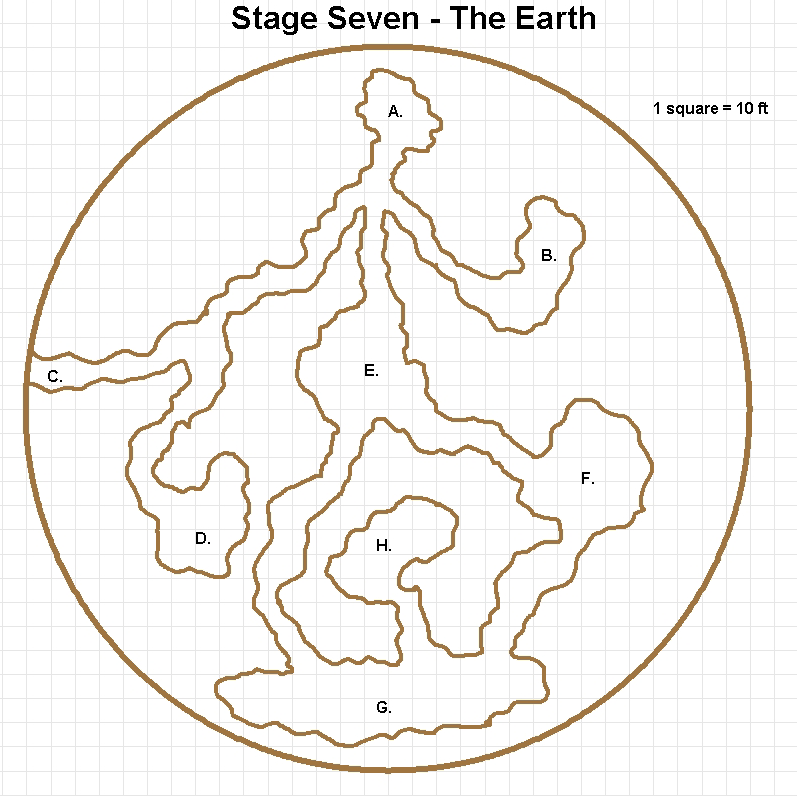 |
This stage takes place on a bubble in the Elemental Plane of Earth. Like stage three, this bubble is considered a demi-plane in its own right separate but contained within the Plane of Earth. The bubble is made up of earth and simply sits within the greater earth of the plane.
The planar bubble shares all of the traits of the Elemental Plane of Earth from which it has been pinched.
The Elemental Plane of Earth has the following traits (modified for the bubble where appropriate):
The Caves:
This demi-plane was simply carved out of the rock and tunnels of the Elemental Plane of Earth that surrounds it. The walls of the bubble are earth, but impenetrable to exit. Creatures native to the Elemental Plane of Earth can enter the bubble and leave the bubble at will however.The rock inside the bubble is normal in all ways and may be dealt with like normal rock.
Unless otherwise stated, all portions of these caves are dark. All are tunneled out of solid rock, and each place is as high as it is wide. The tunnels rise and fall in elevation, and such elevation changes are not noted on the map because they are not significant enough to be relevant.
Six earth elementite swarms dwell in these caves. They are the creatures' natural home and they attack all intruders (non-natives) vociferously. The locations of these swarms are noted below. However, these swarms are not static, and will tend to converge on intruders, especially if noisy or flashy fights break out. They will use their earth glide ability to catch up to prey, and are somewhat adept at using pack tactics to surround foes. As such, while not intelligent, they do possess an animal cunning.
|
* Earth Elementite Swarms (6): CR 4; Tiny elemental (earth, extraplanar, swarm); HD 7D8+7+9; hp 48; Initiative +3; Spd 20 ft; Space 10 ft; Reach 10 ft; AC 16 (touch 11, flat-footed 16); Atk swarm (2D6); SA distraction; SQ darkvision 60 ft, earthglide, elemental traits, swarm traits; AL N; SV Fort +2, Ref +8, Will +2; Str 15, Dex 8, Con 12, Int 2, Wis 11, Cha 11. Diameter 5 in. Skills and Feats: Hide +11, Listen +5, Spot +5; Toughness (x3). Special Attacks: Distraction (Ex): Any living creature vulnerable to a swarm's damage that begins its turn with an earth elementite swarm in its square must succeed on a DC 14 Fort save or be nauseated for 1 round. Special Qualities: Earth Glide (Ex): Earth elementite swarms can glide though stone, dirt, or almost any other sort of earth except metal, as easily as a fish swims through water. The swarm's burrowing leaves behind no tunnel or hole, nor does it create any ripple or other signs of its presence. A move earth spell cast on an area containing a burrowing earth elementite swarm flings the swam back 30 ft and stuns the swarm for 1 round unless it succeeds on a DC 15 Fort save. |
A. Entry Cave:
The PCs will appear in this cave from stage six. The cave is otherwise empty.
B. Glowing Cave:
This cave contains greenish crystals that glow softly, like a candle. They will glow for several days after being chipped away from the surrounding rock, so they can be used as light sources.
An elementite swarm lairs in this cave.
C. Blocked Tunnel:
This passage ends in a slightly curved flat wall of stone. This is actually the wall of the planar bubble.
D. Dripping Cave:
An elemental pocket from the Elemental Plane of Water sits just above this cave. As such, several drops of water constantly plunk down into the cave, forming puddles on the ground.
An elementite swarm dwells in this cave.
E. Central Cave:
This otherwise unremarkable cave holds two elementite swarms.
F. Metal Cave:
This cave touches a metal seam. The metal is silver, and traces of it lines the walls, floor and ceiling.
Two elementite swarms dwell in this cave.
G. Gem Cave:
The walls of this cave are studded with beautiful crystalline growths of all sorts. Among these growths are uncut gem deposits, consisting of two gem seams. A total of 3D10 gems could be harvested from this seam, though the residents of this cave are consuming them.
A cluster of xorn is here feeding on the gems. They are not native to these caves, and are unconcerned with the elementite swarms, which they regard as natural vermin of the area. There is an elder xorn, two average xorns, and four minor xorns here.
The xorns are not interested in attacking the PCs. They very likely note any precious metals or gems on the PCs, but given the abundance of food here, they are satisfied for the moment. The xorn will initially be distrustful of the PCs, as they recognize them for outlanders and are afraid that the PCs will try to steal their gems. When the PCs first appear, the xorn will be inside the walls of the cave if they have heard the sounds of combat with the elementite swarms. The elder xorn will have a single eye on the cavern surface to watch the PCs to see if they will steal the gems. If so, the elder xorn and one average xorn will emerge and claim the gems, warning the PCs not to touch their find. If the PCs are polite or at least not hostile, the xorn will let them pass through the cavern as they wish. They will not let them rest in this place or in area H.
If the PCs manage to sneak up on the xorn, then they will all be present here relaxing and feeding. In this case, once the xorn become aware of the PCs, they will react as above, though likely with a round of startled hostility.
If the PCs sneak up on the xorn and bide their time listening, and if they can understand Terran, they will eventually, after a few minutes, hear the xorn mention the strange little purple metal shard they found and wondering if they should eat it and otherwise puzzling over it.
Assuming the PCs make peaceful contact with the xorn, they can start a dialogue. The xorn don't know much, other than that there are elementite swarms in the caves and that the cave beyond (area H) is "pretty much empty".
The xorn are entirely unaware that they have stumbled into Hagistre's stage, and they don't care much, though one may go to test whether they can leave the planar bubble. Once satisfied that they can, they will be unconcerned.
If the PCs mention the star pieces, a DC 25 Sense Motive check can reveal a possible startled look amongst the xorn. If actually asked if they have seen it, the elder xorn will try to Bluff that he has not. If pressed, the PCs may have to bargain for it using Diplomacy, bribes, and/or threats. It is up to the DMs to adjudicate, but remember that the xorn are greedy.
|
* Elder Xorn: CR 8; Large outsider (extraplanar, earth); HD 15D8+63; hp 130; Init +0; Spd 20 ft, burrow 20 ft; Space 10 ft; Reach 10 ft; AC 25 (touch 9, flat-footed 25); Atk +21 melee (4D8+7, bite) and +19 melee (1D6+3 [x3], claws); SQ all-around vision, earth glide, DR 5/bludgeoning, darkvision 60 ft, immunity to cold and fire, resistance to electricity 10, tremorsense 60 ft; AL N; SV Fort +13, Ref +9, Will +9; Str 25, Dex 10, Con 19, Int 10, Wis 11, Cha 10. Height 8 ft. Skills and Feats: Hide +14, Intimidate +18, Knowledge (dungeoneering) +18, Listen +18, Move Silently +18, Search +22, Spot +22, Survival+18 (+20 following tracks or underground); Awesome Blow, Cleave, Great Cleave, Improved Bull Rush, Multiattack, Power Attack, Toughness. Special Qualities: All-Around Vision (Ex): A xorn’s symmetrically placed eyes allow it to look in any direction, providing a +4 racial bonus on Spot and Search checks. A xorn can't be flanked. Earth Glide (Ex): A xorn can glide through stone, dirt, or almost any other sort of earth except metal as easily as a fish swims through water. Its burrowing leaves behind no tunnel or hole, nor does it create any ripple or other signs of its presence. A move earth spell cast on an area containing a burrowing xorn flings the xorn back 30 feet, stunning the creature for 1 round unless it succeeds on a DC 15 Fortitude save. Possessions: star piece. Languages: Terran, Common. |
|
* Average Xorn (4): CR 6; Medium outsider (extraplanar, earth); HD 7D8+17; hp 48; Init +0; Spd 20 ft, burrow 20 ft; Space 5 ft; Reach 5 ft; AC 24 (touch 10, flat-footed 24); Atk +10 melee (4D6+3, bite) and +8 melee (1D4+1 [x3], claws); SQ all-around vision, earth glide, DR 5/bludgeoning, darkvision 60 ft, immunity to cold and fire, resistance to electricity 10, tremorsense 60 ft; AL N; SV Fort +7, Ref +5, Will +5; Str 17, Dex 10, Con 15, Int 10, Wis 11, Cha 10. Height 5 ft. Skills and Feats: Hide +10, Intimidate +10, Knowledge (dungeoneering) +10, Listen +10, Move Silently +10, Search +10, Spot +10, Survival+10 (+12 following tracks or underground); Cleave, Multiattack, Power Attack, Toughness Special Qualities: All-Around Vision (Ex): A xorn’s symmetrically placed eyes allow it to look in any direction, providing a +4 racial bonus on Spot and Search checks. A xorn can't be flanked. Earth Glide (Ex): A xorn can glide through stone, dirt, or almost any other sort of earth except metal as easily as a fish swims through water. Its burrowing leaves behind no tunnel or hole, nor does it create any ripple or other signs of its presence. A move earth spell cast on an area containing a burrowing xorn flings the xorn back 30 feet, stunning the creature for 1 round unless it succeeds on a DC 15 Fortitude save. Languages: Terran, Common. |
|
* Minor Xorn: CR 3; Small outsider (extraplanar, earth); HD 3D8+9; hp 22; Init +0; Spd 20 ft, burrow 20 ft; Space 5 ft; Reach 5 ft; AC 23 (touch 11, flat-footed 23); Atk +6 melee (2D8+2, bite) and +4 melee (1D3+1 [x3], claws); SQ all-around vision, earth glide, DR 5/bludgeoning, darkvision 60 ft, immunity to cold and fire, resistance to electricity 10, tremorsense 60 ft; AL N; SV Fort +5, Ref +3, Will +3; Str 15, Dex 10, Con 15, Int 10, Wis 11, Cha 10. Height 3 ft. Skills and Feats: Hide +10, Intimidate +3, Knowledge (dungeoneering) +6, Listen +6, Move Silently +3, Search +6, Spot +8, Survival +6 (+8 following tracks or underground); Multiattack, Toughness. Special Qualities: All-Around Vision (Ex): A xorn’s symmetrically placed eyes allow it to look in any direction, providing a +4 racial bonus on Spot and Search checks. A xorn can't be flanked. Earth Glide (Ex): A xorn can glide through stone, dirt, or almost any other sort of earth except metal as easily as a fish swims through water. Its burrowing leaves behind no tunnel or hole, nor does it create any ripple or other signs of its presence. A move earth spell cast on an area containing a burrowing xorn flings the xorn back 30 feet, stunning the creature for 1 round unless it succeeds on a DC 15 Fortitude save. Languages: Terran, Common. |
If combat does occur, the xorn will flee if it appears that they will all be slaughtered by the PCs. If somehow cornered, they will surrender.
If the xorn do flee, the star piece will not come with them. Its magic will replace it on the pedestal in area H once the xorn carrying it crosses the wall of the planar bubble.
H. Cavern of the Mist:
In the center of this cavern is a stone pedestal some 4 ft high, which top contains an indentation where the star piece rested. The pedestal is located where the "h" is shown on the map.
If the star piece is brought to within 5 ft of the northeast wall of the place, a 10 ft wide archway of mauve mist will appear.
The xorns in area G came in this place and found the star piece and took it back into area G. They do not know its purpose nor its ability to call forth the archway of mist.
Leaving Stage Seven:
If the star piece is brought to within 5 ft of the northeast wall in area H, the archway of mist will appear. PCs stepping into the archway appear in stage eight.
Remaining in Stage Seven:
The PCs could rest here. However, the various nexus of seams and elemental pockets of the place is attractive to elementite swarms, which are themselves ubiquitous to the area (that's why Hagistre chose to place his bubble here). As such, there is a 15% chance per hour that 1D3 new earth elementite swarms arrive and attack the PCs. The xorns will not allow the PCs to rest in their cave, even after friendly parley has been established.
STAGE EIGHT - TO THE MOON:
Refer to the Stage Eight map below.
 |
The PCs have been transported to the face of Therra's moon, Luna!
The PCs will arrive at this stage stepping out of structure B, facing northeast. They will be immediately struck by the sky, which is of a deep velvet black. The stars are strange. Some constellations are recognizable, but other are not, and all appear in different positions and much brighter than usual. It would take a DC 35 Knowledge (arcana) or Knowledge (planes) or a DC 15 Profession (astrologer) check to realize from this alone that the PCs are now on the face of Luna. But a glance to the horizon on the other side of the structure they emerged from would easily provide them an easy reference, as they will be looking down on Therra itself. The PCs will be able to see the planet Therra in all of its round glory. They will be looking down upon its equator, and it just so happens that the moon is over the night sky between Jerranq to the north and Sazhansiir to the south. The sight should be captivating and awe-inspiring to the PCs. Even so, it would take a DC 10 Knowledge (geography) check to realize that what the PCs are viewing is, in fact Therra and that the continent to the north is Jerranq. Obviously, the PCs will have absolutely no idea what the land mass to the south is.
The PCs are in a magical dome of force that is barely visible as a flickering mauve energy hemisphere some 125 ft in diameter and half as high. It is a correct presumption that the dome continues below ground in equal measure, forming a sphere.
Within the dome is breathable air. Although the PCs have no way of knowing it, there is no such air outside of the dome. The dome is unbreakable and smooth and cannot be passed or traversed in any way whatsoever..
The gravity is Light Gravity, resulting in creatures suffering a -2 circumstance penalty to attack rolls, and Balance, Ride, Swim, and Tumble checks. All items weigh half as much. Weapon range increments are doubled, and all creatures gain a +2 circumstance bonus to Climb and Jump checks. Falling creatures suffer 1D4 points of damage per 10 ft fallen. Native creatures do not suffer any of these penalties or gain any of these bonuses.
The surface of the moon is generally a white powdery chalk. However, there are plenty of structures scattered over its face, including within the dome.
Light comes from the sun, which can be seen peeking over the horizon of Therra.
Structures:
A. Rockfalls:
These are piles of white and grey boulders fallen into large mounds or piles. Each is roughly 8 ft to 12 ft tall and can be climb with only a bit of difficulty (DC 10). The individual rocks comprising these piles are suitable for throwing by Medium creature.
B. Entry Stalagmite:
This tall rocky outcropping thrust up some 20 ft above the lunar surface. Its base is surrounded by small pebbles and a mound of dirt, as if the stone were thrust up through the surface from below. The stalagmite is where the misty arch from stage seven enters this stage, along the structure's northeast face.
C. Conical Boulder:
This conical white boulder reaches 10 ft into the air.
D. Flat Boulder:
This boulder is about 8 ft tall and narrows to a flat top about 3 ft wide.
E. The Monolith:
This upthrust spire of grey rock is some 35 ft tall.
F. The Twin Towers:
This closely set pair of spires stick up like black basalt fangs of rock some 15 ft into the air.
G. Round Rock:
This round boulder is some 15 ft high.
H. Crater:
This crater was clearly the result of some ancient impact. It is 40 ft deep and its dark bottom is hidden in sharp shadows. About halfway between structure C and the crater is a skeleton of a humanoid face down in the chalky surface. Because the bones match the colour of the surface and the bones are partially buried, a DC 20 Spot check is required to notice it. A search of the skeleton will turn up the rotting remnants of a cloak and a spell component pouch. In addition, the remnants of a belt pouch contains a set of 7 star pieces. These are the pieces from the first seven stages of the course, and none can be used to act as the eighth piece. A close examination of the runes on the pieces shows that they match pieces 1 through 7 already in the possession of the PCs.
Within this crater dwells a mooncalf. This horrific beast is native to the moon. It was trapped by Hagistre in this force prison, where it guards the final star piece. The beast needs no food or water (nor even air), being native to the moon, but it resents being imprisoned here and hates all Therrans with a dark, malevolent anger.
The mooncalf will likely be instantly aware of the PCs' intrusion into its prison, given its excellent Listen bonus. It will remain deep inside its crater, activating the following spell-like abilities:
Round #1 = protection from energy (fire) on self (absorbing 108 points of fire damage.
Round #2 = resist energy (electricity) on self (providing resistance to electricity 20).
Round #3 = greater magic fang on self (providing +1 bonus to all natural attacks).
Round #4 = call lightning.
The moon calf will then remain in the crater for up to another 5 rounds, waiting for a PC to appear over the lip of the crater, whereupon it will release its call lightning and then attack with its tentacle rakes in order to grapple a PC and drag it down to its death in the crater. The creature is a genius level intelligence and extremely clever, and as such it will not simply throw its life away against the PCs. If it seems feasible, it will be content to fly up high towards the top of the dome and rain lightning down on the PCs until such time as its spell ends (at about 85 rounds later, the PCs better finish it before then!).
The PCs will very likely notice the ioun stone whirling around the creature's head.
|
* Mooncalf: CR 10; Large magical beast; HD 15D10+108; hp 190; Init +7; Spd 40 ft, fly 150 ft (poor); Space 10 ft; Reach 10 ft (30 ft with tentacle rake); AC 25 (touch 12, flat-footed 22); Atk +19 melee (2D6+5 [crit 19/x2] [x2], tentacle rakes) and +14 melee (1D6+2 [x6], tentacle arms); SA bite (2D8+7, improved grab, spell-like abilities, tentacles; SQ blindsight 100 ft, darkvision 100 ft, DR 10/magic, keen senses, telepathy 100 ft; AL NE; SV Fort +16, Ref +14, Will +12; Str 20, Dex 16, Con 24, Int 21, Wis 21, Cha 11. Diameter 8 ft. Skills and Feats: Concentration +25, Hide +17, Knowledge (arcana) +23, Knowledge (history) +23, Listen +25, Spot +25; Alertness, Blind-Fight, Combat Expertise, Improved Critical (tentacle rake), Improved Initiative, Improved Trip, Iron Will, Lightning Reflexes, Toughness. Special Attacks: Bite (Ex): With each successful grapple check, a mooncalf automatically hits a grabbed opponent with its bite attack, dealing 2D8+6 points of slashing damage. Improved Grab (Ex): If a mooncalf hits an opponent that is its own size or smaller with a tentacle rake attack, it deals normal damage and attempts to start a grapple as a free action without provoking an attack of opportunity. If it gets a hold, it automatically hits with its bite attack on the same round. Thereafter, the mooncalf has the option to conduct the grapple normally, or simple use its tentacle to hold the opponent (-20 penalty on grapple check, but the mooncalf is not considered grappled). In either case, each successful grapple check it makes during successive rounds automatically deals tentacle rake and bite damage. Spell-Like Abilities: 1/day - call lightning (DC 13), control weather, control winds (DC 15), dominate animal (DC 13), greater magic fang, protection from energy, quench (DC 16), resist elements. Caster level 9th. Tentacles (Ex): An opponent can attack a mooncalf's tentacles as if they were weapons. A mooncalf's tentacles have 20 hit points. If the mooncalf is currently grappling a target with that tentacle, it usually uses another limb to make its attack of opportunity against the sunder attempt. Severing a mooncalf's tentacles deal damage to the creature equal to half the limb's hit points. A moon calf regrows severed limbs in 1D10+10 days. Special Qualities: Blindsight (Ex): A mooncalf can ascertain its surroundings by nonvisual means (mostly hearing and scent, but also by noticing vibration and other environmental clues). This ability enables it to discern objects and creatures within 100 ft. The mooncalf usually does not need to make Spot or Listen checks to notice creatures within range of its blindsight. Keen Senses (Ex): A mooncalf sees four times as well as a human in low-light conditions and twice as well in normal light. Possession: pale blue rhomboid ioun stone, star piece. |
The mooncalf is uninterested in conversing, and will not do so unless forced (in which case it will use its telepathy). The mage Hagistre implanted the star piece in the creature's gizzard, and as such, the creature has absolutely no idea that it has the star piece, nor what a star piece is. If somehow explained what one is, it will refer the PCs to the seven star pieces in the skeleton's possession near his crater.
Once the eighth star piece is grasped and brought to within 5 ft of the bottom of the crater, the crater bottom will turn into a mauve mist.
Leaving Stage Eight:
If the PCs enter the mist at the bottom of the crater, they will appear before Hagistre's Door (see below).
Remaining in Stage Eight:
The PCs could rest here. As the course is technically finished once the mooncalf is destroyed and its gizzard searched, there is no reason for Hagistre to care if the PCs wish to take their time and rest.
Part Two - Meeting Hagistre:
Hagistre's Door:
When the PCs step through the mist at the bottom of the crater on Luna, they will hear a voice whisper to them "Well done! You have earned your audience. I look forward to either making your acquaintance, or consigning you to the 600th plane of oblivion!"
The PCs will find themselves in a 40 ft square unadorned room. Like the course stages, this room is a warded extradimensional space. In the center of one wall is a set of massive adamantine double doors with an eight pointed star shape carved into the seam of the two doors. If the eight star pieces are placed together, they merge into a single eight-pointed star. If the star is placed into the door indentation, it clicks and settles in. The doors open and the PCs can enter Hagistre's audience chamber.
Hagistre's Audience:
Hagistre's chamber is a space too big to be in his tower. In fact, it seems to go on forever, a 10 ft high pillared stone hall that proceeds out of sight in all directions except behind the PCs, where the doors have now closed.
Seated on a throne some 50 ft away from the PCs is Hagistre the mage, an elderly bearded man in rune-embroidered robes that are smudged with dirt. The man's beard and hair is unkempt, and his eyes wide and darting. His impression is instantly one of a sort of mad genius. Hagistre's form crackles with various defensive spells, and there are several wands tucked into his belt and a staff in his hand. He is staring directly at the PCs, and after a moment while the PCs take all of this in, he says "Well...you have braved much and come all this way. Have you come to try your hand at my treasures and lore? Have you been hired to supplant me? I am ready for it if you are!"
Assuming the PCs do not wish to fight an epic level mage, and are respectful in their presentation, then they can relay their needs to Hagistre. The mage reacts favourably to mention of Curinax, and asks for news of the town, though a DC 20 Sense Motive check will reveal he is just being polite and really doesn't care. He has the air of someone who is busy and eager to get back to his work.
The details of the parley with Hagistre are left to the next two Therran scenarios, "The Ruins of Evil" and "The Corrupted". Hagistre's statistics are also presented in those scenarios, so if the PCs actually do wish to confront the mage, the DM can see them to their dooms using the stats from those scenarios.
Experience Points:
In addition to normal experience (which in Therra is half of that recommended in the DMG), each party member should be rewarded as follows:
There are no specific story bonuses for this scenario.