
Return to the Therran Scenario Page
Summary:
The PCs follow a clue hidden in a spellbook to a wondrous treasure hidden high in the central mountains of Onlor. But even after regaining and recovering this treasure, their work has only just begun.
Assumptions:
The PCs are in the town of Leaf Port in the land of Relum on the Isle of Onlor.
Location:
Leaf Port, Onlor
Historical Date:
N.S. 30, Month of Sowing (summer)
DM's Introduction:
Note: This is the third scenario in the Creation Cyst Campaign, an epic campaign taking place in the World of Therra. The scenario assumes certain backgrounds and allegiences by the PCs at the start of the scenario. DMs adopting this scenario for their own campaigns or using their own PCs must modify the motivations of the PCs and NPCs to fit the circumstances. Some guidance to accomplish this is presented below.
This is a long scenario, designed to take several sessions to play. There are more than a few side adventures included here, and DMs interested in finishing the main scenario in a more timely manner can certainly weed out any extraneous encounters.
This scenario begins with dreams experienced by one of the PCs named Vivane. Vivane is a human girl who was married to an eccentric and some say insane gnome named Herekwood. Vivane herself had a troubled history even before she met Herekwood. Her father was a hunstman who, along with other hunters, took umbrage at a local nobleman's son as the youth and his friends would enter the wilds with a large entourage and engage in blood sport with the local animals. Her father and his friends began to sabotage these "hunts" and when the nobleman's son learned of this he was angry and hired a tough named Gorehound to find out who was behind it. Gorehound learned of Vivan's father as the leader of the saboteurs, and so Gorehound and the nobleman's son and friends burned Vivane's house and slew her family. Only the fact that she was not at the house saved her life, though she returned in time to witness the foul deed.
Seeking revenge, Vivane stole into the camp of the nobleman's son and released the caged animals there. The animals then struck down and killed all within the camp, as the men were in a drunken stupor celebrating their great sport with her family. Vivane watched the animals do their deed and when the beasts had fled into the wilderness, she stole in and took back her father's hunting knife and the signet ring of the nobleman's son.
For a while thereafter Vivane wandered Onlor, eventually spending time with an old hermit priest of Firlott who recognized her affinity with animals and the wild and trained her in the worship of the god of the hunt. Eventually the hermit passed on, having ordained her as a priestess, and Vivane took to wandering again, finally meeting up with a crazy gnome wizard named Herekwood who dwelt by himself in a cavern near the mountain village of Pordem. The crazy gnome took an instant liking to the somewhat addled Vivane, and the two fell fast in love and eventually declared themselves to be married. In token of her troth, she passed onto the gnome the signet ring she had taken from the nobleman's son.
Alas, this proved to be Herekwood's downfall, for though they dwelt for a time in peace, eventually Herekwood's wizardry caused him to seek for material components in Pordem. There someone who was a friend of the nobleman whose son Vivane had killed recognized the signet ring on Herekwood's hand. This person reported the sighting to the nobleman, and while Herekwood was on the path from Pordem to the lowlands of Algol, he was accosted and arrested. The nobleman, whose estate was near the town of Kondul in Wenestria, took Herekwood in chains back to Kondul, where the gnome was tried and, given his addled state unable to defend himself, convicted of murder and executed.
In the meantime, Vivane began to miss her husband and could not figure out why he had not returned, so she went looking for him. Her wanderings eventually took her to Leaf Port, where she resides now in the care of Father Joshua the Mordant Priest and Velicleas the elf paladin.
When she left Herekwood's cave, she took with her the gnome's spellbook, for during their time together the gome had taught her the ways of wizardry, and the girl had a knack for divination magic. Unbeknownst to Vivane, the spellbook also contains a secret page. This page, placed there by the gnome long ago using a scroll, contains a rough map and clues to a treasure secreted in the Onlor Mountains. It is likely that the gnome forgot about the page when his dementia set in, but for whatever reason, he never pursued the treasure, nor did he ever mention it to Vivane.
The treasure is a large crystal known as the Tears of Onlora. This crystal is formed of a strange bit of underground runoff from the sacred Mere of Onlor in the center of the Onlor Mountains. The Mere contains a great deal of the power of the slumbering goddess Onlora, left behind to protect her Isle. Its waters are known to heal the pure of heart and scourge those of evil bent.
In almost every known case, water taken away from the mere loses its potency. However, this runoff, by some means of earthen power or perhaps faerzress, has retained something of its potency, and where it has filtered through the earth and emerged into a particular cavern it has slowly crystalized over a period of centuries into what is now a 5 ft diameter hemispherical blossom of glowing white crystal that hangs from the cavern ceiling.
The existence of this crystal is not widely known. It was discovered by a group of gnomes who dwelt in the area many years before the mountains became more wild with the arrival of evil humnoids both pre and post War of the Gem. These gnomes sought to keep knowledge of the crystal secret, as they wished to make use of its healing properties without interference from others, including the Church of Onlora. Why the goddess herself never made it known to her worshippers is not known.
That situation has changed now. The gnomes of the region are long gone, and recently a tribe of goblins inhabited the caves that these gnomes once lived in. The gnomes, as they abandoned the area, collapsed the entrances to the room of the crystal, but now the goblins, as is their wont, have mined into the cavern. Here they have discovered the crystal and although its touched burned them, their adept has determined its potency and its nature. The goblins now conduct rituals designed to defile and, more wickedly, corrupt the crystal to evil uses. More perfidiously still, these profane rituals have a chance of infecting not only the crystal, but of making its way up the path of runoff and into the Mere itself. While it is doubtful that this group of goblins is powerful enough to directly threaten the power of the Mere, their discovery of a "back door" into the Mere and their growing knowledge of the crystal could conceivably allow a more evil and powerful entity to begin to corrupt the Mere in earnest. Furthermore, the goblins have been using the crystal to harmonize with other crystals found in these caves, causing these other crystals to become vessels for a desecrate effect (or even worse depending upon how much time goes by - see the "Price of Delay and Failure" section at the end of the scenario).
This even the slumbering Onlora could not allow, and the rituals of the goblins have distrubed her dreams. In turn, she has sent her dream-worries out to her priests, urging them with omens and divinations that something is wrong and that a growing evil menaces Onlor. But the dreams of the gods are complex and diffciult for mortals to fathom. Thus far, the clergy of Onlora have not determined the import of their uneasy omens. However, Onlora has also reached out the person in the best position to help her, the one in possession of the secret page. And so, Herekwood's spirit has been called forth to come to Vivane in dream form (or perhaps it is Vivane herself, with her proclivity for divination, who is picking up Onlora's urgings and merely translating them into a dream visit by her beloved) to provide clues to her to set her and her companions on a quest to rescue the Tears of Onlora from evil.
Alternate Backgrounds:
This scenario is essentially a treasure hunt. As such, it should not be difficult for the DM to change the background to suit his own setting or circumstances. The PCs could certainly find the book in various ways, including as part of a previous treasure, or even noticing it in a book store. Once they have the book, the DM can either introduce the dreams that come to Vivane with a little modification, or he can simply have them learn about the existence of the secret page in some other fashion. In fact, the verse Herekwood recites in the dream could even be scrawled on the inside front cover of the book! And, of course, the book does not have to be a spellbook.
In a real pinch, the book could be in the possession of a patron who hires the PCs to obtain the treasure. This patron may have already determined the word needed to dispel the secret page and he simply presents the PCs with the map and doggerel on the hidden page. In the case of a patron, in order to preserve the role playing elements of the scenario (particularly at the end), the patron should not be a member of or affiliated with the religion of Onlora.
Part One - The Dreaming
Vivane will have a dream one night, as she sleeps in the Mordant Chapel at Leaf Port.
|
You are in a forest, perhaps in Onlor perhaps not. You may have been running, barefoot, as you seem to be out of breath, but now you have stopped. You are nude, wearing only your father's hunting knife on a belt around your waist and carrying your spellbook in your hand. You are standing at the rim of the treeline, staring at a small glade of grass that ruffles slowly amidst summer zephyrs. As you look at the glade, a mound of dirt suddenly appears at its center, as if a gopher or some mole had begu to push its way up from below. The mound quivers and jumps occasionally, as if whatever it is were still excavating up. Suddeny, a small humanoid hand reaches up out of the mound, lifting straight into the air with its arm descending into the mound. The hand is empty, but in the moment it pauses, outstretched, you can see that its finger bears a ring of some sort. You step closer, and you note the hand is smaller than a human's, and the ring is the signet ring you took from the nobleman's son and gave to Herekwood, your husband. Before you can wonder at this, Herekwood's head pops out of the earth, and then his other hand. He pushes himself with his hands entirely out of the earth, leaving behind only a bit of slightly distrubed grass and earth in his wake. Standing before you, your husband is dressed in his travelling outfit and has grass and clods of dirt in his beard, hair, and eyebrows. He wears a jaunty felt cap upon his head. Herekwood coughs some dirt out of his mouth, and spits some grass from his lips as well. Then, as if noticing you for the first time, he smiles and bows to you. "Well well if it isn't my Little Mole", he says in Gnome, "I have missed you terribly." A strange look of sadness crosses his eyes, but it quickly passes. "I have something important to tell you Little Mole, and not much time." You try to ask him some questions, including where he is now and why he hasn't come home, but he waves you off and begins to speak in Common. "There is a great treasure that I found. You must find it now. It is important. You have with you the hidden key. But even keys need keys. Keys within keys within keys. The first key I have bequeathed to you. The first is the third, though the third is not what it seems. The key to the key I have also bequeathed to you. You are the key and my love gave it to you. You must make haste, as even the greatest treasures can tarnish. And remember that a coin is just a thing, but it can be spent wisely or for ill, used for good or for evil things. There is a vileness about this treasure, and that cannot stand." He turns to walk away, but then, as if with a great effort, he looks back at you and says in Gnome, "I miss you my Little Mole." And with that you awaken. |
The dream is a bit mysterious to be sure, and there is no guarantee that the PCs are going to figure out the dream, but the elements are all there.
The first key is obviously the secret page itself. "The first key I have bequeathed to you" refers to Herekwood's spellbook, which was in some ways bequeathed to Vivane, though more properly he abandoned it and she simply took it with her. "The first is the third" refers to the first key being the third page of the book. "though the third is not what it seems" refers directly to the secret page.
"The key to the key I have also bequeathed you" refers to the special word needed to pierce the secret page. In this case it is the nickname Herekwood gave to Vivane, Little Mole in Gnome language, which happens to be a single word. "You are the key and my love gave it to you" refers to this fact directly, in that Herekwood gave Vivane the nickname as a token of his love for her.
Nevertheless, it is quite possible that the PCs will not figure the puzzle out from this one clue. In this case, Herekwood will make more dream visits to Vivane.
Dream #2 will occur perhaps a week after the first dream (sooner if the PCs are getting restless and want to go off to do something else).
|
You find yourself standing on a windswept mountain peak. A sea of clouds below you obscures the lands beneath, so you have no idea where you might be. The peak is the only feature above the clouds, and there are only small wisps of snow on the ground as the sun shines brightly overhead. The air is brisk with chill and you are glad to be wrapped in furs. As you puzzle your circumstances, a small portion of the clouds several hundred yards below you breaks off and seems to slowly ascend the slope of the mountain towards you. As this small puff of whiteness comes towards you it also slowly seems to be resolving into some form or shape. You watch this phenomenon curously for a minute or two, and then notice that the cloud has either dissolved away exposing, or has transformed into a small hooded figure. That figure's hood is provided by a cloak that is tattered and stained red with what may be long-dried blood. The figure stops about 20 feet below you and looks up at you, revealing a humanoid skull leering at you from within the cloak. Its hands are also bony, and it raises one hand to point directly at you. Though you have no way to rationally know it, you are certain that this revenant before you is your husband, Herekwood. In a voice that rasps like the lid of a sarcophaggus, the apparition speaks in Gnome to you. "Little Mole, why have you forsaken me? Can you not see that my time here grieves and pains me beyond all endurance? You must seek the treasure that I once found. It is being put to evil and must be stopped. What was hidden and pure is now found and tainted. You have the key to the treasure. It is a bit of wisdom amongst all my wisdom. The first key is the third leaf. But to safeguard it the key has its own key. You are the key to the key. Find the first and name the second. My love for you will shine through. Make you haste my Little Mole." And with that you awaken. |
Dream #3 will occur perhaps a week (sooner if the DM desires) after dream #2.
|
You are standing before a mountain tarn. The tarn is wide...too wide to have its far end visible in the early morning mist and overcast grey clouds. The tarn's waters are absolutely calm and still, and not even the slightest wave laps at your toes as they sit right at the edge of the lake. There is a sense of complete calm and peace about you here, and you only notice after a moment that there is no wind and no cry of beast or fowl in the air. All is silent, as if expectant. Suddenly, ripples appear on the water some 50 feet out from your location. These ripples form concentric rings that spread out from a central point. The entire series of ripples begins to move towards you, as if whatever is beneath the surface and casuing the ripples is approaching you from below. Images of sea monsters and horrible sea devils assail your fears, but you are transfixed and unable to waver from your fate. The ripples come ever closer, until at about 10 feet away a horrific, emaciated humanoid head of small size breaks the surface. As the figure con tinues to advance, it also continues to emerge from the water, and soon much of its body is visible. To say the figure is horrific is an understatement. Clearly a small humanoid at one time, perhaps even a gnome, the figure is unclad. However, its entire body is blue and green and bloated with pustules that ooze a yellowish-white substance. Maggots and worms dig in and out of its skin, which is torn and shredded in places exposing cracked yellow bones beneath. The thing's eyes are rotted away into shrivelled, collapsed orbs of a greyish colour, and the top of its head has been eaten or bashed away, revealing a red and black section of rotting brain that also has maggots writhing in its matter. The thing stops within reach of you, and you have to quell an urge to vomit, though the thing emits no odour. It attempts to speak, but its tongue is a tiny bark-like mass of wasted tissue, and its lips are gone, and so all it can do is emit a pained moan. The thing seems to gaze at you for a small moment. Then it reaches into the water at its feet and pulls out a tome that looks like it has seen better days, rotted and cracked as its leather-bound cover is. The figure hands the tome to you, and you take the emaciated codex in your trembling hands. The figure then turns and walks back into the lake, until the water is once again glass smooth. Once the figure has departed, you run your hand over the waterlogged cover. Then you slowly and carefully open the book. The pages inside are ruined from its immersion, and all you can see is watery parchment and smears of sepia that have run across it. Nevertheless, you turn the first page. The second page is just as ruined. You turn to the third page, and as you do so a blinding white light emerges from the book and everything goes white and then black. And with that you awaken. |
Dream #3 is the last real dream. If the PCs have not gotten the hints by then, then it is up to the DM to decide if he wants to continue the adventure by essentially handing the PCs the clue or if he wants to have them miss the adventure (with possible consequences left to the DM as regards the Mere of Onlor). In a final pinch, the DM can have a last brief dream wherein Herekwood tells his beloved to show his book to the famous mage of Trade Town.
DMs should refer to the "Price of Delay and Failure" section at the end of this scenario to determine the consequences of not finding the secret page and heading off to the Mountains of Onlor as quickly as possible. In this way, PCs are rewarded for puzzling out the first dream, and penalized for having to rely on subsequent dreams, but still can complete the scenario even if they have to have all three dreams presented to them.
If Vivane or the chosen PC does not choose to share her dreams with the other PCs and seems inclined to take no action, then the DM can have other PCs have troubling dreams that they cannot much remember except that Vivane (or the chosen PC) seems to have been a central figure in them.
The Secret Page:
The secret page is covered to appear to be some commentary and extraneous formulae relating to the spell on the page before it. Nevertheless, a DC 15 Knowledge (arcana) check or a DC 10 Spellcraft check can determine that the writing on that page is basically useless or nonsensical commentary or addendae to the spell formula on the previous page. Once this is noticed, a close scrutiny of the page will show it to be a secret page spell on a DC 23 Spellcraft check. The secret page spell is cast at 13th level.
In any event, once the secret page is exposed, the following will be seen (note that there are two versions, one to give to the players if no one can read Gnome and the other if they can):
|
The Gnome doggerel reads: In the crotch of the teats
of the All-Mother And within the mole's mouth |
The verse, which is a bit of bad poetry in Common, is even worse in Gnome, a testament to Herekwood's lack of prowess with verse. The gnome chose to write the clues in order to preserve the location of the cavern in question in case he forgot its location (due to his growing dementia) or simply in case he died and wanted the location available to another gnome. It is also, of course, in the very nature of gnomes to communicate in the form of riddles and puzzles.
"In the crotch of the teats of the All-Mother" refers to a specific location in the Mountain of Onlor. This location resides in a valley between two large peaks known in the area as the "Bossom of Onlora". The phrase "teats of the All-Mother" is a rather crude Gnome translation of the more genteel "Bossom of Onlora". A DC 25 Knowledge (religion) check can determine that "All-Mother" is the Gnome phrase for the goddess Onlora, a term of honour despite the fact that Onlora is not the patroness of the gnomes and did not give birth to that race. It is more a term of her status as adopted mother, since the gnomes came to her Isle many years ago. Grant a +10 circumstance bonus to this check if the PC is a gnome, and a +5 circumstance bonus if the PC is native to Onlor or has resided on the Isle for many years. These bonuses are stackable (as is the case with most circumstance bonuses).
Once it is determined that All-Mother refers to Onlora, then a DC 35 Knowledge (geography) check will determine the general location of the twin peaks. Apply a +10 circumstance bonus if the PC is native to Onlor or has resided on the Isle for many years. Apply a further +5 circumstance bonus if the PC dwells or has dwelt in the Mountains of Onlor and a +5 circumstance bonus if the PC is a worshipper of Onlora.
Of course, a Gather Information check is also possible to locate this information. In this case, simply find out the Knowledge check DC of the person desired and then subtract that from 30 to arrive at the Gather Information DC.
For example, assume the PCs have figured out that All-Mother refers to Onlora. They then ask if anyone has heard of a place called the Teats of Onlora. They make a Gather Information check and come up with a result of 19. Such a roll will turn up a person with a DC 11 check to have that knowledge in question. A failure on this check that is close can at least turn up that the phrase probably refers to a pair of mountain peaks.
"Seek ye Jeztarth's Bane" refers to the Maug Kurtulmak, patron of kobolds and mortal enemy of Jeztarth, the god of gnomes. When looking northeast along the valley one can see a large rock formation that vaguely resembles the angular reptilian head of a kobold complete with two small horns at the top and a crown of reddish-orange triangular boulders that make the figure look as if wearing a crown. This structure has been known as Jeztarth's Bane to the local gnomes for centuries, and has even been the object of worship by some local kobold tribes.
Almost no one in the Leaf Port region will have heard of Jeztarth's Bane, as it is too small a feature to be known so far away. Assume a chance for a DC 40 Knowledge (geography) or Knowledge (local - Mountains of Onlor) to determine the location of the rock formation, and provide a +5 circumstance bonus if the PC dwells or dwelt in the Mountains of Onlor for a length of time and a further +5 circumstance bonus if the PC wandered throughout the mountains (i.e. a ranger or druid or hunter, etc.).
"For in Kurtulmak's Shadow" refers to the shadow cast by the rock formation's "snout".
"Shall be shown the way" tells that the shadow will point the direction of their destination.
"At the hour of Urdlen's grief" refers to Urdlen, an ancient anti-hero of gnome myths, said to have been an evil son of Flupnir and who preferred the form of an albino mole of immense size. A DC 20 Knowledge (religion) check can determine this, with a +10 circumstance bonus if the PC is a gnome. Urdlen's grief specifically refers to high noon, the brightest time of day and the hour Urdlen would naturally, being a creature of the underground and darkness, despise the most. Given that Onlor is in the northern hemisphere of Therra, and that there is no seasonal tilt of Therra's axis, this means that in all cases such a shadow would point north by northwest.
"And within the mole's mouth" refers to a large cave mouth set in a large rock of pale white rock. Urdlen, the mole, was an albino and thus pale white. This cave mouth is due north by northwest from Jeztarth's Bane, its exact location pinpointed by the map accompanying the poem. The map uses a location exactly in the path of the shadow of Kurtulmak's snout at noontime as its starting point.
Below is the map accompanying the poem.
|
The remainder of the poem refers to the crystalized essence of the Mere of Onlor, present within the bowels of this cave.
The entire poem does not need to be figured out by the PCs all at once in order to commence the journey. In fact, all that needs to be known initially is the general location of the "teats of the All-Mother". Astute players should be able to figure out that teats likely refers to hills or moutains (such as the Grand Tetons in the United States). That narrows the search in Onlor to the central highlands, and from there the DM can make certain that eventually the PCs run across some old codger or other character who knows how to locate the Bossom of Onlora. Once there in that valley, the rest of the clues should become apparent, and means for help are given in the scenario.
Part Two - The Journey
The journey can begin as soon as the PCs at least figure out they must travel to the Mountains of Onlor. Should any of the PCs have committments in Leaf Port (e.g. a priest of a local temple), then the DM should see fit to allow for arrangements to be made. For example, a priest could turn over leadership of worship services to a veteran lay members of his church while he is gone. Certainly, most religions would ultimately want to see the potential evil mentioned in the poem righted, if the treasure itself is not lure enough. Even moreso, any sort of auguries or divinations done by a priest of most deities will portend the deity's favour in undertaking this quest.
The actual route of the journey is up to the PCs. Especially if they don't know precisely where the Bossom of Onlora is. The nearest, best place to head for is Trade Post, which also happens to be the nearest and last settlement of any size before reaching the Bossom of Onlora. DMs should refer to the maps of Onlor presented on the Therran website.
The Bossom of Onlora lies approximately 72 miles north by northwest of Trade Post, its peaks reaching an elevation of 7,000 ft. The best way to proceed, and the one assumed in this adventure and likely to be advised by anyone with whom the PCs inquire, would be to travel the coast road west from Leaf Port until reaching Jaynith. From there, the road north would be travelled through Bar Hole to Neshton, and then up the Onlor High Pass to Trade Post. This is the fastest, safest, and most logical route.
Taking the Mountain Route:
However, sometimes PCs are not logical. The most linearly direct route would be to follow the Relarth River directly from Leaf Port to Trade Post. This is possible, but the river itself will be of no help, as it is impossible to travel upstream due to the gorges and canyons in its upper reaches that allow for little or no room on the side to have a mule or ox pull a raft or barge upstream. As such, PCs would have to follow the river at the top of the canyons and gorges, going through very rough mountainous terrain that will turn what might have seemed a shorter route into a long delay. Furthermore, such a journey is over wilderness, exposing the PCs to wild animals and other dangers, though Onlor is still a relatively sedate and peaceful land except for the mountains proper. Should the PCs elect this route, the DM should be sure to accurately portray the rough going.
First, mountainous terrain that is trackless cuts overland movement by 1/2. Thus, a group of PCs travelling at speed 30 ft will 12 miles per day. A group travelling at 20 ft will cover 8 miles per day. Furthermore, the many obstacles such as scree, chasms, dead ends, and steep slopes will mean that on any day's travel where a DC 15 Survival check is not made, the PCs will lose another 1/4th of their already adjusted daily pace. Thus, a group of PCs travelling at speed 30 ft that fails its Survival check will traverse 9 miles in a day, while a group travelling at 20 ft will traverse 6 miles per day.
Mules can be used as pack animals and will not slow the PCs down. However, taking horses on this route is a bad idea. Doing so will slow the PCs by another 1 mile per day, and unless a DC 15 Ride or Handle Animal check is made each day, allow 10% chance that a horse will suffer a mishap and take 1D6 damage. Furthermore, D100 should be rerolled again and each consecutive time an 01-10 is rolled add +1D6 to the mishap damage. Keep rolling until a 01-10 is not rolled. Thus, there will be a 10% chance for the horse to suffer 1D6, a 1% chance to suffer 2D6 and a 1 in 1000 chance to suffer 3D6. Other mounts unsuitable for mountain terrain can also be subject to such mishaps.
As far as encounters, it is left up to the DM to provide some encounters to adequately represent the situation. Some ideas include:
1. An encounter with a black bear mother and her cubs (EL 2). It is early summer and such cubs are emerging from their dens for the first time, and the mothers are very protective. Perhaps the PCs find a place to camp, only to have the mother and cubs returning to their cave den and stumble into the camp. In any event, the mother will likely be aggressive until her cubs can run away.
| BLACK BEAR CR
2 N Medium animal Init +1; Senses low-light vision, scent; Listen +4, Spot +4 AC 13, touch 11, flat-footed 12 hp 19 (3 HD) Fort +5, Ref +4, Will +2 Spd 40 ft (8 squares); Run Melee 2 claws +6 (1D4+4) and bite +1 (1D6+2) Space 5 ft; Reach 5 ft Base Atk +2; Grp +6 Abilities Str 19, Dex 13, Con 15, Int 2, Wis 12, Cha 6 Feats Endurance, Run Skills Climb +4, Listen +4, Spot +4, Swim +8 |
2. An encounter with a pack of wolves (EL 4). Wolves are a constant menace in the mountains, especially if the PCs have a mule or other beast of burden. A pack of 4 wolves will menace the PCs, very likely at night, trying to kill and take away their pack animal or to grab packs with trail rations. These wolves will likely not attack the PCs directly, but will defend themselves savagely if threatened. In general, two of the wolves will go into the PCs' camp while the other two circle around out of firelight and reinforce if trouble arises.
|
WOLVES (4) CR 1 *Wolves have a +4 racial bonus on Survival checks when tracking by scent. |
Further encounters can be designed so as to properly reflect the rugged nature of the route chosen.
The Normal Route:
The normal route will take the PCs, as indicated above, along the roads of Wenestria and into the Onlor High Pass to Trade Post. The below outlines the journey, with some suggested encounters to liven up the journey. DMs are, of course, free to add more encounters or to subtract the ones given below as deemed appropriate.
Leaf Port to Tendarrow (99 miles; 4 days at spd 30 ft, 6 days at spd 20 ft):
The terrain here is mild and flat, and the road is well-kept, though nothing like the raised and paved Imperial roads of Antoria. These are mostly wide dirt roads, slightly raised and with drainage ditches dug along the sides. Potholes are frequent, especially the farther one gets from a settlement.
Many steads are present along the way, and every 20 miles or so there is an inn along the roadside that offers a common room, stables, good food and drink, and comfortable beds.
Travelers of all sorts ply the roadway, including merchants, farmers, pilgrims, and the like. Halflings and elves sprinkle the numbers of humans who travel the way.
As the PCs approach Tendarrow, they will begin to see farmsteads and a preponderence of grazing sheep. Also visible will be bee hives and honeycombs set on wooden stands.
Tendarrow:
The westernmost village of Relum, Tendarrow is well known for its bowyers and fletchers. While better bows may be made by elves deep in their forests for their own personal use, arrows made here by humans who claim to be elf-taught are undoubtedly the best in Onlor. Bows can be custom made here to accommodate any pull and enchanted arrows can sometimes be purchased here as well. Trade in bows and arrows has also attracted makers of crossbows, and these can be found in the village. The bows are made of a special yew taken from the outskirts of the Relum Forests, and the strings are made from the sinews of specially bred (some say enchanted) sheep that graze around Arrow Lake. In addition, the glallum, a waterfowl that is only found at this lake, is believed to have the best feathers in the world for fletching arrows. Even elves from Relum often come to buy the glallum feathers for their own arrows.
Of course, the population of this unwalled village, about 350 humans, engages in more than just arrow craft. Arrow Lake is fished and well stocked, and honey mead is brewed from great honeycombs of bees raised in fields nearby. At least a few giant bees have been seen from time to time, and folk sometimes search without luck to find their giant beehives, since giant bee honey and royal jelly is reputed to have all sorts of special properties. Agriculture is also performed south of the village down to the seacoast.
The folk here worship Pindar mostly, but Dhalis is also revered.
Encounter:
An archery contest is taking place in Tendarrow. These contests are not infrequent in the spring and summer, as they allow the various bowyers and fletchers to tout their wares and sponser potential entrants.
In this case, there are 20 participants and room for up to 4 more. Only bows are allowed, and no magic is permitted. The PCs can join the contest (up to 4 of them) for the entry fee of 5 sp each. They must also provide their own bows.
In a pinch, the PCs can try to convince someone to sponsor them. In that case, a sponsor is likely to only sponsor a single PC, and that PC will have to first make a DC 15 Gather Information check to find a sponsor, and then a DC 15 Diplomacy check to convince him. This Diplomacy check can be affected by a +2 circumstance bonus should the PC offer to display his archery prowess and hit an AC 13 target from 100 ft away (AC 13 represents a target of Diminutive size with a 0 Dex). If the PC makes a DC 20 Diplomacy check and manages to hit two such targets in a row, the sponsor will offer to let him use a masterwork longbow and even let him keep it should he win the contest.
The contest takes place in about 4 hours after the PCs arrive (or at noon the next morning if they arrive in the afternoon or night). The fields before the village are set up with targets, grandstands, booths, and other signs of a coming festival. Several archers are practicing, including at least two elves and a halfling with a shortbow. Talking with the contestants practicing will likely yield some aloofness or hostility on their part, as they don't want the last 4 slots filled (more competition). However, the halfling, named Baroos, will be friendly if offered a few pints at the local pub.
The contest prize is a quiver of masterwork arrows (20) and a single +1 arrow. The contest is basically a series of rounds. In each round, the participants shoot 6 arrows, and the ones that make the most hits advance. At the end of each round, the targets are moved back 50 ft. They begin the contest 50 ft away.
Round 1 = 24 participants (or
20 if the PCs do not join) at 50 ft
Round 2 = 12 participants at 100 ft
Round 3 = 8 participants at 150 ft
Round 4 = 4 participants at 200 ft
Round 5 = 2 participants at 250 ft
In the case of ties to advance to the next round, the tied individuals engage in a single shot shoot-off, with winners advancing and losers eliminated (and the losers then continuing to vie in shoot-offs for remaining spots) until all remaining slots for the next round are filled. If after each shhot-off there are too many winners, then those winners of that shoot-off have another shoot-off until the exact amount of advancers is attained.
Example:
In round 1, no one has 6 hits. 3 have 5 hits, 6 have 4 hits, 8 have 3 hits and 3 have 2 hits. The people with 2 hits are eliminated. The people with 4 and 5 hits advance to the next round. That leaves the 8 folks with 3 hits to fill 3 remaining slots.
The 8 folks have a shoot-off. In the shoot-off, 6 of them have hits. The 2 that missed are gone. The remaining 6 now have another shoot-off. 4 of them hit. The 2 that missed are gone. The remaining 4 now have a shoot-off. 2 hit and 2 miss. The 2 that hit advance. The two that miss now have a shoot-off for the last remaining slot. They keep shooting until one hits and the other misses in a given shoot-off.
If a PC wins, he will be given his prize by the mayor of Tendarrow (the arrows). All of the arrows have glallum feathers as their fletching and were made by the master fletcher Edvarel the Eld. The winner will be feted at the nearest pub with many a drink and many a wench giving a kiss on the cheek (assuming the winner is a male, otherwise with bemused glances by male bar patrons).
The DM should assume a fairly generic set of participants representing a cross section of the populace of the region. So mostly humans, with a few elves and half elves and some halflings. Of the 20 participants, the DM can assume the following:
1 elf with longbow and a ranged
attack bonus of +6
2 humans with longbows and ranged attack bonuses of +5
3 humans and one halfling with shortbows and ranged attack bonuses
of +5
4 humans, 1 elf, and a halfling with shortbows and ranged attack
bonuses of +4
4 humans with shortbows and ranged attack bonuses of +3
3 humans and a young halfling with shortbows and ranged attack
bonuses of +2
DMs may want to save time by rolling the shots of the other participants ahead of time.
Tendarrow to Trade Town (50 miles; 2 days at spd 30 ft, 3 days at spd 20 ft):
The journey follows the road through the Arrow Woods and along the shore of Arrow Lake before reaching Trade Town on the banks of the Estenearth River.
The woods are light and sun-dappled and full of birds and squirrels. An occasional bee whizzes by, and on at least several occasions a rather large single buzz will be heard in the distance.
Travelers of all sorts ply the roadway, including merchants, farmers, pilgrims, and the like. Halflings and elves sprinkle the numbers of humans who travel the way.
Trade Town:
The westernmost town of Relum, Trade Town was built by the elves to trade with the human lands to the west. This was more essential in older times when the frontier of Wenestria was far to the west of its current borders and thus the town's location was a necessity. These days, although less strategically important, the town still serves as the point of trade between the two kingdoms.
Beautifully carved wooden palisade posts, most of them in leafy motifs, wall the town. About 2,800 folks live here, the majority of them humans, but about 200 halflings and approximately 150 elves also dwell here.
The townsfolk grow crops along the Enstenearth River valley and take trade down from Hunthold by river raft. Crops grown include strawberries, grapes, and delicious purple olives often called, vulgarly, as Onlora's teats (the halflings do not prefer this name...they call them Onloramfara, which does translate to Onlora's teats, but the halflings insist the connotation is much more respectful in their language).
The town contains temples to Indolle, Erinhoru, Onlora, and Dhalis.
The famous grey elven mage Quarwanthil dwells in Trade Town, finding it reclusive enough to suit his desire to study unmolested but near enough to things so that he can procure materials necessary for his studies.
It is known that Quarwanthil is a specialist in dimensional magics, and this is backed up by constant rumours placing him in various parts of Therra at very close times. Some say that he is often gone travelling the dimensions more often than people think, but that a simulacrum of himself is left behind in his stead. No one really knows his age, since it is believed time passes at different speeds on some planes, but tales of the elves place him in stories at least 4,000 years ago.
On occasion, Quarwanthil will take apprentices and teach them his dimensional magics.
Encounter (EL 3):
As the PCs travel along the road through the Arrow Woods just west of Tendarrow, they hear one of the large buzzing sounds they have heard before. Suddenly, out of the woods dash two human male youths, glancing behind them feverishly and urging each other to keep running towards the lake.
Behind the youths comes 3 giant bees, apparently angry at the boys and trying to sting them.
| FOOLISH YOUTHS
(2) CR 1/2 Male human Commoner 1 N Medium humanoid (human) Init +1; Senses Listen +2, Spot +2 Languages Common AC 11, touch 11, flat-footed 10 hp 4 (1 HD) Fort +1, Ref +1, Will +0 Spd 30 ft (6 squares) Melee club +0 (1D6) Ranged club +1 (1D6) Space 5 ft; Reach 5 ft Base Atk +0; Grp +0 Combat Gear club Abilities Str 10, Dex 12, Con 12, Int 10, Wis 10, Cha 10 Feats Alertness, Skill Focus (profession [farmer]) Skills Climb +2, Handle Animal +3, Jump +1, Listen +2, Profession (farmer) +5, Spot +2, Swim +2 Possessions combat gear, wooden holy symbol to Dhalis |
|
ANGRY GIANT BEES (3) CR 1 * Giant bees have a +4 racial bonus on Survival checks to orient themselves. |
While the bees fly faster than the youths can run, the forest and the bee's maneuverability class has allowed the boys to survive...so far. But the boys are tiring and the bees are gaining, and one slip and its trouble.
The boys, age 13 and 15, are brothers of a local farmer and are named Rom and Thom. They were out exploring when they saw some bushes and flowers rustling. Pretending it was orcs and they were heroes they tossed stones at the bushes, and out came the bees.
The bees are angry, and will attack the boys, eventually catching up with them and stinging them before they can make their way to the lake. There is enough venom amongst the 3 bees to slay one or both boys if they fail their saving throws.
The PCs can act however they choose. The bees will not bother the PCs unless they attack them, in which case the PCs can successfully distract the bees from the boys (byt having the insects attack the PCs instead!). The vermin will attack to the death.
If the boys are saved, they will thank the PCs and then head back to their farms. They have nothing to offer as a reward other than their thanks.
Encounter:
If the PCs wish to speak with Quarwanthil they may. He is not a grumpy recluse as are many powerful mages, though he does not suffer fools very well. Quarwanthil will be willing to offer his services or those of his apprentice to the PCs for simple spell casting, identification of potions or magic items, etc. All at standard prices. He can also determine, by looking at Herekwood's spellbook, that a secret page exists and can enlighten the PCs on how to get rid of such a spell. He can cast a dispel magic on the page, comparing his caster level (14th) versus Herekwood's (13th). Obviously, it is unlikely that the PCs have the wealth to pay for the spell casting, but Quarwanthil will accept spells from Herekwood's spellbook in exchange.
Trade Town to Bosch (54 miles; 2.25 days at spd 30 ft, 3.5 days at spd 20 ft):
The road crosses the Estenearth River, spanning it by way of a well-built stone bridge built by dwarves as evidenced by the smiling dwarven faces that adorn the side railings. Thereafter, it is a straight road inland to Bosch. Travellers are quite common, and a few more halfling faces are seen amongst these. Occasional patrols of Wenestrian soldiers, mounted on riding horses and lightly armed and armoured, are also to be seen, though these are not common by any means.
Bosch:
Almost as large as a small town, Bosch is home to 1,500 citizens. Bosch has made its name from its rich coral reefs that provide abundant exotic sea harvests, including fishing, shellfish, oysters, clams, even pearls. The populace here worships Hotor, although agriculture does take place along the Deep River. Bosch has small docks, suitable only for personal fishing craft. Hauls are taken to Trade Town or Arvoria for sale or transport.
Interestingly, the village is unwalled on its landward sides but has a wooden palisade facing the sea. This because once, about 200 years ago, a band of sahuagin attacked and managed to carry off many villagers before they were chased away. There is still a posted bounty of 100gp for every sahuagin head brought in, but since that last raid, no one has ever seen another devil of the deep again.
Encounter:
The PCs will encounter a snake salesman, a human male middle-aged who has set up a stall in the marketplace and is hawking freshwater vipers for sale. He announces all sorts of possible uses for them, including poisons for hunting and exterminating vermin, as food (but clean out the poison first!), and even possibly for training as exotic companions or guardians. many chidlren crowd around the wicker cages and peer inside, and the man often has to shoo the children away if they threaten to get too close or try to poke a finger into the cage.
The man has at least six tiny vipers for sale and a single small viper for sale. These are freshwater snakes culled from the Deep River, and such snakes need to have access to, at least, a water bowl at home or be well watered on the road (i.e. kept in a damp cloth while travelling and in a bowl of water when camped). They eat bugs and small vermin of all kinds, and can be trained in the normal fashion using Handle Animal skill. However, a failure to train by 5 or more results in an attack by the snake, which will attack for 1D6 rounds. Treat these snakes as normal snakes from the Monster Manual in all respects.
Tiny vipers cost 100 gp (but the seller can be bargained down to as low as 50 gp). Small vipers cost 300 gp (but the sellet can be bargained down to as low as 200 gp).
Encounter:
If any of the PCs managed to keep a sahuagin head from their encounter with the sea-devils from previous scenarios, they can not only sell them here for the bounty of 100gp each, but they will become instant celebrities and invited to join townsfolk for drinks and revelry in the local taverns.
Encounter:
This town has a thriving pearl market, including all sorts of pearl jewelry. One pearl merchant even has a magic pearl for sale or trade, a pearl of power (level 0) that he will describe as a pearl with a strange innate glow that one can see best at twilight. He has no idea what it does, but will ask 500 gp for it, as it was given to him by a mysterious traveller who passed through years ago and was told it had value to any dabblers of magic.
Bosch to Jaynith (120 miles; 5 days at spd 30 ft, 7.5 days at spd 20 ft):
This long stetch of coastal road is quite scenic, passing by small fisherman's huts and racks of drying fish and seal pelts. Occasional shrines to Hotor dot the coastal side of the roadway, most with a few interesting shells placed into the offering bowls. Travellers are common along the road, and of all sorts including merchants, pilgrims, and people simply going to visit kin or make purchases from a certain town or village. Wenestrian light patrols are infrequently encountered here, but at least one patrol per day is likely to be seen, in groups of half a dozen or so.
Jaynith:
Located in a shallow baylet within the Blue Bay, this small fishing village is home to 250 fishermen and their families and spouses. The port here is non-existent, as fishing boats are generally just hauled up onto the sand or docked a ways out in the bay.
The village is unwalled and the fisherfolk are primarily Mordanti, although a single priest tends a small shrine to Hotor.
Encounter:
Assuming the PCs have a priest amongst them who is obviously a cleric, then as they enter the rather poor village of Jaynith, they will have a group of men and women rush up to the PCs and straight to the cleric, literally grabbing him by the collar and proclaiming praise to Mordant and all of the gods that he has come. The villagers will almost hysterically urge/push/drag the cleric towards the local chapel to Mordantism, where the local Mordant priest Cathog can be seen lying on the ground, a hatchet near his hand and a large tree fallen to the ground next to him. The fallen priest is bloody and it is clear the tree fell on him and was rolled off by the villagers. The priest is clearly bleeding internally and will likely die soon if not healed.
In game terms, the cleric is at -7 hp when the PCs arrive. If there is a delay by the PCs initially, balking at the villagers, then the priest could be even more negative in hp and possibly even dead. If the cleric dies, the villagers will be most distressed and a few will mutter imprecations at the PCs for not reacting quickly enough. If the PCs do save the cleric, he and the villagers will be most grateful, taking the precisely convenient arrival by the PCs as a sign of divine providence. Even without a spell, a simple Heal check will suffice. A few villagers have obviously been trying to use Heal checks on the cleric, but they have failed. As a reward for saving him, the cleric (NG, Commoner 1/Cleric 1) will provide the PCs with a feather token, anchor.
If the PCs wonder aloud why the local Hotor priest did not come to aid Cathog, the villagers will point out that he is currently at sea with the fishermen, blessing the catch.
Jaynith to Bar Hole (72 miles; 3 days at spd 30 ft, 4.5 days at spd 20 ft):
Turning north from the main coastal road, the path heads north from Jaynith towards the foothills, which roll away in the distance to the mountains, purple in the distant haze. About halfway along this leg of the journey, a road splits off from this path to the east towards Shunt Meadow. The roads are still well travelled and friendly, though the frequency of halfling travellers continues to increase.
Bar Hole:
Bar Hole is a small, primarily halfling, settlement located at the junction of the road from Trade Post and the road from Quaend and the road from Jaynith. In addition, the village is astride the Orjiliarth, and this makes the place fairly well travelled.
Some 500 halflings live here, of mixed breeding, with no more than 25 humans calling the unwalled village their home. Interestingly, most of the humans have elected to dwell in larger versions of halfling holes, out of respect for the halfling population and traditions here.
Bar Hole is so called because the village is situated as a base of protection against raiders who might venture out of the High Forest or the hills and mountains to the north. Although the village is unwalled, the halflings here are well trained as a light militia and at least two human rangers are very friendly to the halflings and often use Bar Hole as a base when they sortie into the wilds looking for evil to roust.
Onlora is the main object of worship here. The humans worship Mordantism.
Encounter:
At the point where the road branches off towards Shunt Meadow is a well-known inn called the Leaping Lamia. The sign outside shows a comical-looking half donkey half woman jumping over a candle.
The Leaping Lamia is a large building of wood with stone foundation and a thatched roof. It is two stories tall and sports outhouses and a fairly large stable area as well. The place is usually lively, day or night, with song and shouts and talking emerging to the roadway to lure passersby.
The inn is run by Jando Bartlebi, a middle-aged halfling, and his wife Ginda Bartelbi. Their two sons and three daughters help with the inn, as do the spouses of one of the sons and one of the daughters. The inn is frequented by both halflings and humans, most travelers and merchants but also comprising local farmsteaders who work the land between Teln, Jaynith, Bar Hole, and Shunt Meadow.
A few dwarves and occasional gnomes from the mountains and elves from Relum are also seen here, though less commonly so. That said, the inn is known for its Red Dog ale, named after Jando's long-dead canine companion, and the ale is a secret mixture of locally grown hops and barley and other ingredients shipped down by caravan once per season from the mountains by a dwarven merchant.
Assuming the PCs drop into the inn or elect to spend the night there (and there is no reason for them not to do so especially if they have been staying at the many inns all along the route so far), they will soon see a crusty old halfling smoking a clay pipe and sporting a beard in the dwarven fashion (i.e. long enough to drag on the ground but tucked into his belt) enter the taproom and sit himself in a corner. Once ensconced, a crowd will slowly gather around him and this crowd can be observed to be peppering the old halfling with requests for tales and news of far-off lands. Patrons will buy him rounds of drinks to whet his whistle, and even children ask for what seem to be well-known tales. One even requests he tell the tale of the Heroes of the Gem (to which the grown-ups groan "Oh Gods! Not again!).
After having drunk a few drinks, and smiling and nodding to folks, the halfling will lean his chair back against the wall, prop up his feet on the table, and relight his pipe. After puffing contemplatively for a moment and looking around the room (and his eyes pausing for a moment on the PCs) he will smile and begin to tell his tale, How the Snakes Lost their Legs.
|
Aeons ago when the world was newly made and all things were freshened by the residue of magic of creation, there was a being of puissance known as Gorgos. Gorgos was a being of cold and calculating precision. He watched at the heels of his master Ymik, the All-Father of beasts. And to Gorgos was the snake the most perfect of animals. Indeed, snakes were cold of blood and emotionless, taking their prey silently and without remorse. Were such animals evil? No...for animals are simply as they were made, and are below or above such considerations. But snakes had legs...six of them in fact...and they scampered along on them as well as any basilisk does in our time. And Gorgos loved the snakes, and dwelt amongst them and loved them, though they did not, of course, return his affection. For that was their nature and the very thing that attracted Gorgos to them. He reveled in his unrequited attention of them. But lo! Gorgos looked about him and saw that the gods had granted to others of their creation the spark of sentience...of intelligence. And this Gorgos coveted for the snakes he loved, and with a purpose he began to plumb the depths of lore in order to imbue such a spark within the snakes. Such lore was not easily revealed or taken, for it is in the province of the divine, and after many failed attempts to conjure such lore of his own, Gorgos instead contrived to steal such lore...some say with the inadvertant aid of Flupnir himself. In any event, and at great risk did Gorgos conjure the lore of intelligence, and melded its arcane matrix with the unique essence of the serpents. And so did Gorgos give a favoured few of his snake friends an awakening of sentience. These first few only did he gift, for he wished to see how this lore took to them, and he had only managed to conjure a bit of lore at first. The snakes took well to their newfound reasoning, for they were inured to shock and awe and surprise. Instead, they began to contemplate their existence and the existence of the world around them, and their minds began to race, even beyond the confines of their own bodies. It happened then that Gorgos was called away, and as he left his lair, another being entered. This being was called Kiss, for he was borne of Mustilgior, goddess of love, and Mergurr, the lord of death. And his domain was of things seductive and dangerous. And Kiss had been spying upon Gorgos, for he found out that Gorgos was trying to imbue his pets with sentience, and Kiss wanted to steal the secret for himself, perhaps to breed some manner of servant to elevate his stature amongst the divine. And so he crept into Gorgos' demesne and spoke to the serpents within, and so great was his ability that he even managed to seduce and sway the emotionless snakes. Away they crept with Kiss, heading to a land far away from Gorgos, to escape his wrath when he returned. When Gorgos returned he found his sanctum violated and his serpents missing, and he was at first worried that they had wandered off. He called upon his powers to divine their whereabouts and circumstances and despite the attempts by Kiss to conceal themselves, Gorgos was the creator of the serpents' minds and he was inextricably tied to them. Thus did he learn what had happened, and his anger knew no bounds. His shout rent his hall in twain, and the beating of his fists pounded his hands into fingerless stumps. The stamping of his feet rent the ground, and broke the bones of his ankles, twisting him into a staggering cripple. And his grief was so great that his mind clove and he was lost to madness. But in the final wave of lucidity left to Gorgos, he gathered up the remainder of his power and hurled it as a curse against Kiss and against all of snake-kind. The curse was of such might that it was unavoidable, and even over the vast distance that already separated the fleeing Kiss and the traitorous serpents it struck. Upon Kiss was his seductive and fair-seeming nature torn and rent as if by great claws, until Kiss was naught but a worm-ridden being of stench and decay who shambled in constant pain and in torment of what he once was. And as for the snakes, all of snake-kind, for daring to flee Gorgos he took from them their legs, so that they could never flee again with any sort of pride or bearing, but would have to slither upon the earth on their bellies, in a position of humility for all eternity. Every snake, whether intelligent or not, had his arms and legs meld into his body, and it was said that the collective falling of their forms to the ground was like unto an earthquake felt throughout the land. And it is said that in his last second of lucidity, Gorgos smiled and began to laugh, and that laugh carried him on his eternal journey into madness. And so it is that even today, snakes crawl on their bellies, recalling their shame as treachers and deceivers and ingrates. |
Should the PCs wish to come over and hear the tale they can. They can also hear the tale from where they are sitting, for it appears that while the halfling speaks, the entire room goes quiet, and even the serving wenches tip toe around the room and avoid clanking mugs or bottles.
After the tale, the halfling is offered more drinks and given applause and even given a few silver pieces. But no one asks hi for any further tales. Apparently, one per day is all that is forthcoming.
The PCs may chat with the halfling, whose name is simply Arthruin, which in Halfling means The Teller. His nature is rather a mystery in these parts, as no one really knows when he arrived in the area nor from where he came. Most are not, even now, certain where he dwells, though it must be nearby since he comes to the inn periodically, and it is a rare week that does not include such a visit.
Arthruin will certainly chat with the PCs, but he will make it clear that he is done telling tales or giving out information until his next visit. That said, unless the PCs wish to discuss the quality of the ale or local gossip or admire the buxomness of the serving wenches, there will not be much to say to Arhtruin (and vice versa). He will certainly listen attentively to anything the PCs have to say, and nod and scratch his beard at the appropriate times. But that's about it.
If the PCs explain their quest, he will mention that he has visited the Holy Mere of Onlor several times (even if the PCs don't even mention the Mere as a facet of their quest).
Arthruin will not discuss how he comes by his tales or knowledge. He will not discuss his background or his current circumstances. He won't really discuss himself at all. Successful Sense Motive checks (DC 10) will determine that it is not so much from a desire to hide something, but rather that he just doesn't consider his own details interesting or worth telling.
If Arthruin (NG, Expert 6) is followed when he departs from tne inn at midnight, he will be seen heading southeast towards Shunt Meadow. If followed he will slowly amble towards Shunt Meadow throughout the next couple of days, sleeping in a bedroll he carries under a pack on his back, a walking stick in his hand, whistling occasionally but neither eating nor keeping a fire. About 15 miles to the northwest of Shunt Meadow he will walk between two man-sized boulder and disappear.
Arhtruin emanates no magic and is, in fact, a normal halfling. However, he has taken up residence in the Realm of Faerie and comes to Onlor to visit and "remain grounded" as he likes to call it. The place between the two boulders is nothing special. In fact, Arthruin merely needs to reach a certain proximity to the weak areas between Onlor and Faerie that reside near Shunt Meadow. Once there, he intones a magic phrase taught to him by his fey benefactors and POOF he is back in the Realm.
Should the PCs harm Arhtruin in any way, the DM should have them punished severely by fairly powerful fey.
Encounter:
As the PCs approach within 5 miles of Bar Hole they will meet a pair of halfling outriders who patrol the region around Bar Hole. These outriders (LG, Ranger 5/Halfling Outrider 2) are mounted on fierce looking riding dogs in studded leather barding. The halflings bear lances and heavy wooden shields and have shortbows on their shoulders and shortswords in their belts. They wear leather armour and have yellow feathers flowing from their leather caps. The outriders will approach the PCs calmly and unaggressively and will greet the PCs, warning them that there have been sighting of kobolds in the area and to be wary of mischief from the creatures. With that, they will salute the PCs and continue their patrol.
Some bit of time later (perhaps a half hour or so), the PCs will notice a kobold sneaking up towards them through the tall grass alongside the road. This kobold has a spear on its back and a sling in its hand and is about 30 ft from the PCs. As the PCs watch, the kobold silently whirls the sling and lets fly, and a rock flies over the PCs' heads before landing in the grass on the far side of the road. The kobold crouches down again and begins to load for another shot.
The kobold is an illusion, cast as a silent image spell from a wand that was purloined by a halfling adolescent from Bar Hole and his friend (both NG, Commoner 2). This halfling had befriended a gnome who travels the Onlor High Pass down to Arvoria and the gnome has taken to teaching the halfling a bit about using magical devices. When the gnome last passed through, the halfling "borrowed" his wand, not realizing that such things have limited charges, and intends to have some fun with it before returning it to the gnome when the gnome returns heading back to the mountains in a few weeks.
The two giggling halflings are hidden between some boulders on a small dell overlooking this stretch of road, some 100 ft away from the PCs and the kobold is between the PCs and the halflings. The halflings will do whatever they can to get a rise out of the PCs, including having the kobold make obscene gestures, mock the PCs, or whatever. No matter what the PCs seem to do, the kobold always seems to be unharmed. The kobold, for its part, never seems to be able to hit the PCs.
Of course, the kobold makes no sounds, nor does its actions, and the DM should allow each PC a passive DC 15 Listen check to note that the kobold seems very stealthy. A DC 20 Listen check after the kobold makes its first sling shot will also allow the PCs to note that the sling and bullet made no sound. Furthermore, should the kobold be struck (its AC is 10 plus 1 for size and +2 for the Dex of the halfling controlling it for a total DC of 13), the halfling will try to have the kobold react (e.g. if a PC shoots an arrow at the kobold and it hits, the arrow will go right through the kobold, leaving a hole that closes up). Nevertheless, that kind of action allows a Will save (DC 11) to note the illusion.
Treat the tall grass along the side of the road as light undergrowth (2 spaces to move, concealment, +2 to DC of Tumble and Move Silently checks).
The halflings are hidden with a Hide check of +9, so assume they took 10 and have a roll of 19. They will giggle somewhat, granting PCs a Listen check of DC 10 to notice the chortling. Of course, both of these checks are modified by distance.
If the jig is up with the kobold, the halflings will attempt to sneak away after a last obscene gesture from the kobold. If the halflings are themselves spotted they will run for it, but will attack anyone or put themselves at further risk unless they feel they are in danger of their lives. Instead, they will try to get the PCs to let them go and describe their prank as harmless. If intimidated successfully and asked how they managed the illusion, they will show the wand, and claim it is theirs. If pressed, or if the PCs intend to take the wand, they will recant and explain that the wand belongs to a powerful illusionist who will be very angry if someone stole the wand that they only borrowed from him and intended to return. The halflings will evince surprise and skepticism if told that wands have charges. They thought you simply wave them, concentrate, say the proper words, and things happen without limit.
The halflings will also beg the PCs to let them leave with an apology. They fear being hauled into Bar Hole and reported to their fathers, who will tan their hides, make them fess up to the gnome when he returns, and make their lives generally miserable fot he next six months.
How the PCs handle the situation is, of course, up to them. The wand is a wand of silent image (CL 1, 16 charges). The halfling adolescent has a 14 Cha and a +3 bonus to his Use Magic Device skill (meaning that using the wand is somewhat difficult for him, as it is a DC 20 use of the skill). The wand had 26 charges when it was stolen. The halfling adolescents have been making kobolds appear in the area for a week now.
Bar Hole to Neshton (63 miles; 3.5 days at spd 30 ft, 5 days at spd 20 ft):
Shortly after leaving Bar Hole,
the road joins the Orjiliarth River and follows it into the foothills
of the Mountains of Onlor. The road becomes steeper and now tends
to wind its way up the slopes of the hills, and so travel speed
is reduced to 75% per day (as per the Dungeon Master's Guide).
River traffic can still be seen at first, as the river is still
navigable in the less steep southern portion of the foothills,
and most of the traffic is halfling wicker rafts and canoes.
Along the roadway the PCs will note that while less travelled than the coastal roads, the way is still widely used. Fewer casual travellers are to be seen, and a higher proportion of those plying the roadway are merchants and travelling in small groups or caravans. Additionally, more of the travellers are dwarves and gnomes. Wenestrian patrols are a bit more frequent as well, and slightly better armed.
Neshton:
High up in the hills between Relum and the High Forest, Neshton was originally a fort designed to protect the Onlor High Pass running from Lochnirr to Wenestria. Dwarves built the trade road as gratitude to the halflings who let them convert Marrowmelt and the other dragons in ancient times, and they also built the fortress of Neshton, which is surrounded on 3 sides by sheer drops of over 300 feet. Its walls are thick and well crafted and some 35 ft high and pierced with battlements and towers. Needless to say, even accounting for the odd smatterings of evil dwelling within the Mountains of Onlor, the place is a bit of overkill, but no one was willing to tell the dwarves this.
Around the fortress has grown a small village, mostly catering to the trade coming down the High Pass and to some lumberjacks, hunters, trappers, and miners. Gnomish clans and a few dwarves nearby use the town to trade and interact with humans. The population of Neshton includes a garrison of 50 Wenestrian soldiers, about 150 human villagers, a few gnomes and dwarves, and no more than 25 halflings. Aghorrit is worshipped here, along with Firlott.
Encounter:
A few somewhat rare items can be found in the fortress bazaar. The fortress bazaar is set within the actual walls of the fortress of Neshton, as opposed to the bazaar and marketplace that is situated in the village surrounding the fortress proper. While the outer bazaar has the types of goods one would expect to find in a village marketplace, the fortress bazaar has items from the dwarves and gnomes and human merchants selling more exotic wares.
For sale in the fortress bazaar, in addition to all sorts of normal weapons and armour, are the following potential items of interest:
A suit of dragonhide breastplate made of black dragon scales (500 gp)
A quiver of cold iron arrows (2 gp)
A cold iron short sword (20 gp)
Alchemist's Mineral Acid (up to 6 vials for 20 gp per vial)
10 each of acid bullets, flame bullets, and priest's bullets (109 gp each for acid bullets, 20 gp each for the others)
1 flask of instant rope (25 gp)
2 vials of nature's draught (50 gp per vial)
10 doses of suregrip (20 gp per dose)
2 flasks of verminbane (20 gp per flask)
Neshton to Trade Post (117 miles; 6 days at spd 30 ft, 9 days at spd 20 ft):
The roadway out of Neshton's northern gate is officially the start of the Onlor High Pass. This road is dwarf-built and as such is paved, well-drained, and is treated as a highway for purposes of overland movement rates. The first 27 miles of the road continues in the hills marching up towards the mountains proper, and trees are now almost solely pines and other confiers, the deciduous trees having been left behind between Bar Hole and Neshton.
The Orjiliarth is still followed for most of the way to Trade Post, though more and more often the road veers away from the river to traverse a difficult incline or wind its way up a ridge. Where the river can be seen it is fast flowing and full of rapids and there is no longer any sort of traffic upon it.
Travellers are still common on the road, though less so than before, and now almost solely caravans and groups of merchants (mostly human, but with occasional dwarves and gnomes) and some have obvious guards. Mounted patrols ride out of Neshton to patrol the road all the way up to Trade Post, and these patrols are well armed and more frequent than in the lowlands. Travellers are also less friendly (which is to say, normally friendly by Jerranqi standards but not the effusiveness common to Onlorans) and a bit more wary.
Inns along the way are now well fortified, made of stone and with high stone walls and guards set on wooden towers within.
PCs choosing to "rough" it past Neshton should be subject to potential encounters with wildlife.
When the PCs finally cross into the elevation contour on the Onlor Isle map that represent 6,000 ft, they may begin to suffer the effects of altitude. They must, as per the Dungeon Master's Guide, make a Fort save every hour (DC 15, +1 per previous check) or become fatigued. This fatigue remains as long as the PCs are within the elevation contour shared by Trade Post.
Trade Post:
Trade Post is unique in that it is claimed by neither Lochnirr nor Wenestria, but is sort of a joint venture between the two. The village is therefore unaligned and owes allegiance to a Lord Mayor elected by its inhabitants once every ten years.
Unlike Neshton, Trade Post was built long after the Trade Road had been constructed, as traders found they needed a place of rest and refuge after their ascent into the mountains.
Located near the head of the Relarth River in lands punctuated by deep gorges, the village is walled by thick stone and wooden walls. The 250 human inhabitants are a doughty lot, and the village also serves as a place where the various mountain men can trade their furs and raw gems. Dwarves and gnomes also show up here to trade with caravans passing through.
The folk here worship Lothar and Indolle.
Encounter (EL 3):
As the PCs wend their way through the mountains they will notice suddenly a giant eagle streaking uncertainly over their heads. The eagle is clearly in distress, as several arrows protrude from bloody wounds in its body and through its right wing. The eagle crashes into a ledge near the road and above the PCs. There, as a small aura of feathers descends, it squawks weakly once and then grows mostly silent, with a barely audible wheezing sound coming from it.
The giant eagle was attacked by a party of orcs and killed a few before being driven off. It fled as best it could, but the orc arrows had black adder venom coated on them and the eagle failed its secondary save. Its reduced CON lowered its hit points low enough to bring it to -1 hit points and it crashed into the ledge upon which it now resides and is bleeding out.
The ledge is 30 ft above the road, and its base is some 20 ft off of the road. A spd 30 ft PC climbs at 7.5 ft per round, for a total of 4 rounds to climb and 1 round to get to the base of the cliff. The eagle is bleeding at 1 hit point per round (though the DM can check for stabilization as normal). The cliff is a DC 15 Climb check. The top of the cliff is another 30 ft above the ledge and there is no easy way to find an accessible route to the top.
About halfway up the cliff is a small cave opening that is crusted over with a thin wall of mud. Any climb up the cliff will dislodge pieces of this crust, exposing a part of the opening. It is likely the climber will not even notice this (DC 15 Spot check), but 4 rounds after this happens, six small monstrous centipedes will emerge from the hole and begin to scale the cliff, seeking to devour the eagle and anything else on the ledge or the cliff. They will not roam down off of the cliff or ledge onto the road.
| SMALL MONSTROUS
CENTIPEDES (6) CR 1/4 N Small vermin Init +2; Senses darkvision 60 ft; Listen +0, Spot +4 AC 14, touch 13, flat-footed 12 hp 2 (1/2 HD) Fort +2, Ref +2, Will +0 Spd 30 ft (6 squares), climb 30 ft Melee Bite +3 (1D4-3 plus poison) Space 5 ft; Reach 5 ft Base Atk +0; Grp -7 Abilities Str 5, Dex 15, Con 10, Int -, Wis 10, Cha 2 SQ vermin traits Skills Climb +10, Hide +14, Spot +4 Poison (Ex) Injury, Fort DC 10, initial and secondary damage 1D2 Dex. The save DC is Con-based. |
At the top of the climb, the ledge is some 10 ft wide and 25 ft long. The eagle is crumpled on the ledge, either breathing shallowly or dead depending upon foregoing events.
Also on the ledge, crawling on the eagle, is a single small monstrous centipede.
| SMALL MONSTROUS
CENTIPEDE CR 1/4 N Small vermin Init +2; Senses darkvision 60 ft; Listen +0, Spot +4 AC 14, touch 13, flat-footed 12 hp 2 (1/2 HD) Fort +2, Ref +2, Will +0 Spd 30 ft (6 squares), climb 30 ft Melee Bite +3 (1D4-3 plus poison) Space 5 ft; Reach 5 ft Base Atk +0; Grp -7 Abilities Str 5, Dex 15, Con 10, Int -, Wis 10, Cha 2 SQ vermin traits Skills Climb +10, Hide +14, Spot +4 Poison (Ex) Injury, Fort DC 10, initial and secondary damage 1D2 Dex. The save DC is Con-based. |
If the eagle is saved and nursed back to health or cured enough to become conscious, it will thank the PCs in Common and introduce itself as Quwalhirn. It will mention how it came to be injured if questioned by the PCs and will offer its thanks, but will say it has nothing of value to humans (or humanoids) and will fly away once it is able.
| QUWALHIRN CR
3 Male giant eagle NG Large magical beast Init +3; Senses low-light vision; Listen +6, Spot +15 Languages Auran, Common AC 15, touch 12, flat-footed 12 hp 26 (4 HD) Fort +5, Ref +7, Will +3; evasion Spd 10 ft (2 squares), fly 80 ft (16 squares) (average) Melee 2 claws +7 (1D6+4) and bite +2 (1D8+2) Space 10 ft; Reach 5 ft Base Atk +4; Grp +12 Atk Options Flyby Attack Abilities Str 18, Dex 17, Con 12, Int 10, Wis 14, Cha 10 Feats Alertness, Flyby Attack Skills Knowledge (nature) +2, Listen +6, Sense Motive +4, Spot +15, Survival +3 |
Nevertheless, if the PCs did save
the eagle they may see it again (see below).
Part Three - The Caves
Journey to the Bossom of Onlora:
Once the PCs arrive in Trade Post, it will be very easy for them to determine their goal. Asking around about anything remotely resembling the teats of Onlora or the bossom of Onlora will get, aside from some crude jokes, the PCs a precise location on a DC 10 Gather Information check (with a +5 circumstance bonus if the PC specifically says he will ask gnomes).
The Bossom of Onlora is a pair of prominent peaks that lie 72 miles north by northwest of Trade Post. The area is well known as a hive of goblin and orc activity, and was at one time a dwelling area for gnomes before they were driven out by humanoids who invaded Onlor at various times during the War of the Gem. These invaders, well organized and well-trained, gathered up the native humanoids and increased their training and strength to such an extent that the gnomes had to abandon their outermost clan posts.
The peaks are easy to locate from Trade Post, and directions are easy to get within the village. However, there are no specific rivers to follow all the way from Trade Post to the peaks, so the PCs will need to make an hourly DC 8 survival check to avoid becoming lost. Refer to the rules in the Dungeon Master's Guide for more details on becoming lost and regaining your bearings.
Once past Trade Post, travel is considered through trackless mountains. First, mountainous terrain that is trackless cuts overland movement by 1/2. Thus, a group of PCs travelling at speed 30 ft will 12 miles per day. A group travelling at 20 ft will cover 8 miles per day. Furthermore, the many obstacles such as scree, chasms, dead ends, and steep slopes will mean that on any day's travel where a DC 15 Survival check is not made, the PCs will lose another 1/4th of their already adjusted daily pace. Thus, a group of PCs travelling at speed 30 ft that fails its Survival check will traverse 9 miles in a day, while a group travelling at 20 ft will traverse 6 miles per day.
Mules can be used as pack animals and will not slow the PCs down. However, taking horses on this route is a bad idea. Doing so will slow the PCs by another 1 mile per day, and unless a DC 15 Ride or Handle Animal check is made each day, allow 10% chance that a horse will suffer a mishap and take 1D6 damage. Furthermore, D100 should be rerolled again and each consecutive time an 01-10 is rolled add +1D6 to the mishap damage. Keep rolling until a 01-10 is not rolled. Thus, there will be a 10% chance for the horse to suffer 1D6, a 1% chance to suffer 2D6 and a 1 in 1000 chance to suffer 3D6. Other mounts unsuitable for mountain terrain can also be subject to such mishaps.
Allow a 10% chance per 6 hours that an encounter will occur. If such an encounter is indicated, the DM should roll again to see if a second encounter occurrs in that period. The DM should keep rolling until an encounter is not indicated for that period. Multiple encounters for a period can be combined into a single encounter or spaced randomly as the DM desires. Encounters during night (the final two 6 hour periods) should be determined randomly by a D4, with a 1 equalling dinnertime when the PCs are encamped but all awake (assume for 3 hours or so), and 2-4 equalling each of three watches of 3 hours long.
Roll 2D6 and consult the following table.
|
|
|
|
|
|
Kobold (01-75) or Orc (76-00) | Special |
|
|
Goblin | Orc |
|
|
Wolf | Goblin |
|
|
Vermin | Wolf |
|
|
Human | Vermin |
|
|
Animal | Animal |
|
|
Eagle | Bats |
|
|
Bear | Kobold |
|
|
Gnome | Human |
|
|
Dwarf | Dwarf |
|
|
Climbdog | Gnome |
Animal (EL varies):
This represents an encounter with a generally unhostile native animal. These include mountain goats, rams, bighorn sheep, deer, owls, normal snakes, hawks, lizards, etc. Generally, such encounters will be ignored by the PCs unless they need to speak with animals or have some other need for food or pelts. Some encounters might present a danger to small familiars.
Bats (EL varies):
Encounters will be with bat swarms (01-85) or night hunter deep bats (86-00).
Bat Swarm (EL 2):
Encounter will be with a swarm of bats. These will usually attack livestock or pack animals, but are not above attacking other warm blooded creatures sometimes. Of course, this encounter represents blood sucking or biting bats. Insect eating and fruit bats are not a part of this encounter.
|
BAT SWARM CR 2 Wounding (Ex) Any living creature damaged by a bat swarm continues to bleed, losing 1 hp per round thereafter. Multiple wounds do not result in cumulative bleeding loss. The bleeding can be stopped by a DC 10 Heal check or the application of a cure spell or some other healing magic. Blindsense (Ex) A bat swarm notices and locates creatures within 20 ft. Opponents still have total concealment against the bat swarm (but swarm attacks ignore concealment). * A bat swarm has a +4 racial bonus on Listen and Spot checks. These bonuses are lost if its blindsense is negated. |
Night Hunter Deep Bat (EL 1-5):
Encounters will be with 1D6 night hunters, a species of bat found in the lower and upper reaches of the mountains. These are aggressive hunters, with a malign intellect that allows them to discern the strengths and weaknesses of their prey and plan accordingly.
| NIGHT HUNTER
CR 1 Monster of Faerun page 18 NE Medium magical beast Init +3; Senses darkvision 60 ft, low-light vision; Listen +2, Spot +2 Aura frightful presence AC 14, touch 13, flat-footed 11 hp 13 (2 HD) Fort +4, Ref +6, Will +0 Spd 10 ft (2 squares), fly 50 ft (10 squares) (perfect) Melee tail stab +2 (1D6) and bite +0 (1D6) and 2 claws +0 (1D4) Space 5 ft; Reach 5 ft Base Atk +2; Grp +2 Abilities Str 10, Dex 16, Con 13, Int 11, Wis 11, Cha 10 Feats Multiattack Skills Hide +6, Listen +2, Move Silently +6, Spot +2 Frightful Presence (Ex) Night hunters emit eerie screams in combat that unnerve weak opponents. Creatures with less than 2 HD who are within 30 ft of a screaming night hunter must make a DC 11 Will save or be shaken for 5D6 rounds. The save DC is Constitution-based. |
Bear (EL varies):
Encounter is with black bears (01-85) or brown bears (86-00).
Black Bear (EL 2-4):
Encounter will be with 1D2 black bears (possibly with 1D3 cubs 50% of the time). Bears with cubs will be very aggressive and protective. Otherwise, black bears are usually fairly shy.
| BLACK BEAR CR
2 N Medium animal Init +1; Senses low-light vision, scent; Listen +4, Spot +4 AC 13, touch 11, flat-footed 12 hp 19 (3 HD) Fort +5, Ref +4, Will +2 Spd 40 ft (8 squares); Run Melee 2 claws +6 (1D4+4) and bite +1 (1D6+2) Space 5 ft; Reach 5 ft Base Atk +2; Grp +6 Abilities Str 19, Dex 13, Con 15, Int 2, Wis 12, Cha 6 Feats Endurance, Run Skills Climb +4, Listen +4, Spot +4, Swim +8 |
Brown Bear (EL 4):
Encounter will be with a single grizzly bear, usually quite aggressive.
| BROWN BEAR CR
4 N Large animal Init +1; Senses low-light vision, scent, Track; Listen +4, Spot +7 AC 15, touch 10, flat-footed 14 hp 51 (6 HD) Fort +9, Ref +6, Will +3 Spd 40 ft (8 squares); Run Melee 2 claws +11 (1D8+8) and bite +6 (2D6+4) Space 10 ft; Reach 5 ft Base Atk +4; Grp +16 Atk Options improved grab Abilities Str 27, Dex 13, Con 19, Int 2, Wis 12, Cha 6 Feats Endurance, Run, Track Skills Listen +4, Spot +7, Swim +12 Improved Grab (Ex) To use this ability, a brown bear must hit with a claw attack. It can then attempt to start a grapple as a free action without provoking an attack of opportunity. |
Climbdog (EL 1-2):
These dogs are native to the mountains of Onlor and are often domesticated by halflings living in the foothills. Still, wild packs of these canines still dwell in the mountains. The wild canines are territorial, and will bark and growl at anything approaching their cliff face. Nevertheless, they will not harm creatures except for birds, which they capture for food.
Encounters will be with 1D20 climb dogs, and a pack will dwell in shallow caves usually midway up a cliff face or some other inaccessible feature. If more than 5 are encountered, there will always be a lair nearby, usually requiring Climb checks and involving some danger to reach. Within will be 1D6 pups that can be sold for 30 gp each or trained. However, the adults will defend their pups to the death.
| CLIMBDOG CR
1 Arms and Equipment Guide page 76 N Small animal Init +2; Senses low-light vision, scent; Listen +6, Spot +6 AC 17, touch 13, flat-footed 15 hp 13 (2 HD) Fort +5, Ref +5, Will +31 Spd 40 ft (8 squares), Climb 40 ft (8 squares) Melee bite +4 (1D6+3) Space 5 ft; Reach 5 ft Base Atk +1; Grp -1 Abilities Str 15, Dex 15, Con 15, Int 2, Wis 12, Cha 6 Skills Climb +19, Hide +6, Listen +6, Spot +6 |
Dwarf:
It is assumed that the PCs will not come into conflict with dwarf bands encountered. As such, no statistics have been provided. If statistics are needed, the DM should use the statistics presented in the Monster Manual.
Encounters will generally be with a team of 1D3+1 dwarves (Warrior 1) travelling through the mountains on clan business. These are usually prospectors searching for ore or potential mines or other materials. Occasionally a squad of 1D10+10 dwarves (Warrior 1) will be encountered, lead by a leader (Fighter 4) and 2 sergeants (Fighter 3). Non-warrior dwarves will not generally be encountered in these wilds except in the company of warriors.
Dwarves will generally be friendly to humans and other goodly humanoids, and wary of or hostile to orcs, goblins, and especially kobolds. Nevertheless, they are also somewhat brusque and apt to keep to themselves unless pressed by gregarious PCs.
Eagle (EL Varies):
Encounters will be with eagles (01-90) or giant eagles (91-00):
Eagle (EL 1):
Encounter will be with 1D2 eagles. Such eagles will generally be spotted far off and will not bother the PCs unless there are small familiars to attack who are not within arm's reach of the PCs.
| EAGLE CR 1/2 N Small animal Init +2; Senses low-light vision; Listen +4, Spot +16 AC 14, touch 13, flat-footed 12 hp 5 (1 HD) Fort +3, Ref +4, Will +2 Spd 10 ft (2 squares), fly 80 ft (16 squares) (average) Melee 2 talons +3 (1D4) and bite -2 (1D4) Space 5 ft; Reach 5 ft Base Atk +0; Grp -4 Abilities Str 10, Dex 15, Con 12, Int 2, Wis 14, Cha 6 Feats Alertness, Weapon Finesse Skills Listen +4, Spot +16 |
Giant Eagle (EL 3-5):
Encounter will be with 1D2 giant eagles. These majestic beasts will generally leave peaceful travellers alone, but love to hunt evil humanoids (along with rodents and even larger prey). If the PCs have already saved Quwalhirn (see above), then word will have already spread after a day or so and the eagles will be friendly to the PCs and greet them, though they will not be inclined to do them any great favours.
| GIANT EAGLE
CR 3 NG Large magical beast Init +3; Senses low-light vision; Listen +6, Spot +15 Languages Auran, Common AC 15, touch 12, flat-footed 12 hp 26 (4 HD) Fort +5, Ref +7, Will +3; evasion Spd 10 ft (2 squares), fly 80 ft (16 squares) (average) Melee 2 claws +7 (1D6+4) and bite +2 (1D8+2) Space 10 ft; Reach 5 ft Base Atk +4; Grp +12 Atk Options Flyby Attack Abilities Str 18, Dex 17, Con 12, Int 10, Wis 14, Cha 10 Feats Alertness, Flyby Attack Skills Knowledge (nature) +2, Listen +6, Sense Motive +4, Spot +15, Survival +3 |
Gnome:
It is assumed that the PCs will not come into conflict with gnome bands encountered. As such, no statistics have been provided. If statistics are needed, the DM should use the statistics presented in the Monster Manual.
Encounters will generally be with a company of 1D3+1 gnomes (Warrior 1) travelling through the mountains on clan business. These are usually prospectors searching for ore or potential mines or other materials. Occasionally a squad of 1D10+10 gnomes (Warrior 1) will be encountered, lead by a leader (Fighter 4) and 2 lieutenants (Fighter 3). Non-warrior gnomes will not generally be encountered in these wilds except in the company of warriors.
Gnomes will generally be friendly to humans and other goodly humanoids, and wary of or hostile to orcs, goblins, and especially kobolds.
Goblin (EL 1-5):
Encounter will be with a band of 1D6+3 goblins. In addition, allow a 20% chance that a single worg is with the group, in which case one of the goblins will be mounted atop the beast.
Goblins are the most numerous of the evil humanoids in the region, and as they are not light sensitive they are better able to hunt and fight during the day. Nevertheless, they will not tend to attack large, well-armed humanoids unless they outnumber them. Of course, if they have a worg with them they tend to be far more aggressive.
Groups out during the day are likely hunting. Groups at night are patrolling their territory.
| GOBLIN CR 1/3 Male goblin Warrior 1 NE Small humanoid (goblinoid) Init +1; Senses darkvision 60 ft; Listen +2, Spot +2 Languages Goblin AC 15, touch 12, flat-footed 14 hp 5 (1 HD) Fort +3, Ref +3, Will -1 Spd 30 ft (6 squares) Melee morningstar +2 (1D6) Melee lance +2 (1D6) Ranged javelin +3 (1D4) Space 5 ft; Reach 5 ft Base Atk +1; Grp -3 Combat Gear morningstar, javelins (3) [mounted goblin has a lance] Abilities Str 11, Dex 13, Con 12, Int 10, Wis 9, Cha 6 Feats Alertness Skills Hide +5, Listen +2, Move Silently +5, Ride +4, Spot +2 Possesssions combat gear plus leather armour, light wooden shield |
|
WORG CR 2 * A worg has a +4 racial bonus on Survival checks when tracking by scent. |
Human:
It is assumed that the PCs will not come into conflict with humans encountered. As such, no statistics have been provided. If statistics are needed, the DM should use the statistics presented in the Monster Manual.
Encounters will generally be with human mountain men or prospectors. The former will be encountered singly or in pairs and are usually Rangers. The latter will usually be in groups of 2D4 and will have several mules with them. These are doughty men who are usually Experts and Warriors. Unlike most other lands, even the mountains of Onlor do not harbour large numbers of human bandits. Any such bandits would generally be hiding out, as the pickings are slim off of the roadway.
Humans will generally be suspicious of strangers and stand-offish, as is the way of folks in the deep mountains. Nevertheless, they will often help other humans in distress, especially if endangered by evil humanoids.
Kobold (EL 1-4):
Encounter will be with a band of 1D6+3 kobolds. Additionally, allow a 20% chance of a single dire weasel accompanying the group.
Kobolds are naturally skittish, and the ones in this region are no exception, especially out of their lair and even more so during daylight. Most kobolds encountered will be hunting parties look ing for food (rats, birds, etc.) or collecting raw materials (wood, flint, etc.). Others will be scouts, who patrol the region to look for danger (or opportunity).
Most kobold bands will flee determined assault by a group of well armed and armoured PCs. If the kobolds become aware of the PCs, they will likely lay low and observe the PCs to determine what they are about and if they pose a danger to their tribe. Only in the case of an opportunity to capture, slay, or steal from a PC will the kobolds attempt to take any action or place themselves in harm's way.
| KOBOLD CR 1/4 Male kobold Warrior 1 LE Small humanoid (reptilian) Init +1; Senses darkvision 60 ft; Listen +2, Spot +2 Languages Draconic AC 15, touch 12, flat-footed 14 hp 4 (1 HD) Vulnerable light sensitivity Fort +2, Ref +1, Will -1 Spd 30 ft (6 squares) Melee spear +1 (1D6-1) Ranged sling +3 (1D3-1) Space 5 ft; Reach 5 ft Base Atk +1; Grp -4 Combat Gear spear, sling, bullets (10) Abilities Str 9, Dex 13, Con 10, Int 10, Wis 9, Cha 8 Feats Alertness Skills Craft (trapmaking) +2, Hide +6, Listen +2, Move Silently +2, Profession (miner) +2, Search +2, Spot +2 Possesssions combat gear plus leather armour |
|
DIRE WEASEL CR 2 Blood Drain (Ex) A dire weasel drains blood for 1D4 points of Con damage each round it remains attached. |
Orc (EL 2-4):
Encounter will be with a gang of 2D3+2 orcs. Orcs are relatively rare in these mountains, having come in dribs and drabs as refugees from various naval battles during the many wars with the Deceiver. A larger number also invaded Onlor during the War of the Gem, and though the invasion was put to rout with the help of the Heroes of the Gem, some few orcs survived and took up refuge in the mountains. They now lord it over the more numerous goblin and kobold tribes, though their smaller number force them to exert control only when they are able to concentrate power.
Orcs encountered here will be a band of hunters looking for food and plunder. They are not above taking slaves, and unlike kobolds, are more likley to attack groups of humanoids they outnumber or meet in equal numbers. Orcs are less likely to attack during the daylight, but are conversely far more likely to conduct a sudden charge into a campsite at night.
| ORC CR 1/2 Male orc Warrior 1 CE Medium humanoid (orc) Init +0; Senses darkvision 60 ft; Listen +1, Spot +1 Languages Orc AC 15, touch 10, flat-footed 15 hp 5 (1 HD) Vulnerable light sensitivity Fort +3, Ref +0, Will -2 Spd 30 ft (6 squares) Melee battle axe +4 (1D8+3) Ranged javelin +1 (1D6+1) Space 5 ft; Reach 5 ft Base Atk +1; Grp +4 Combat Gear battle axe, javelins (3) Abilities Str 17, Dex 11, Con 12, Int 8, Wis 7, Cha 6 Feats Alertness Skills Listen +1, Spot +1 Possesssions combat gear plus studded leather armour, heavy wooden shield |
Special (EL varies):
This can be any encounter the DM desires. Appropriate such encounters range from ghouls to oozes to small dragons. DMs should just keep in mind that Onlor is generally a peaceful land and does not harbour much int he way fantastic creatures of great evil as compared to other lands in Therra.
Vermin (EL varies):
Encounters with vermin will be as follows:
Tiny Monstrous Centipede (EL 1-2):
Encounter will be with a swarm of 1D8+8 tiny centipedes. These creatures are fairly aggressive.
|
TINY MONSTROUS CENTIPEDE CR
1/8 Monstrous centipedes can use either their Strength or Dexterity modifier for Climb checks, whichever is higher. |
Small Monstrous Centipede (EL 1-3):
Encounter will be with a swarm of 2D6 small centipedes. These creatures are fairly aggressive.
|
SMALL MONSTROUS CENTIPEDE
CR 1/4 Monstrous centipedes can use either their Strength or Dexterity modifier for Climb checks, whichever is higher. |
Medium Monstrous Centipede (EL 1-3):
Encounter will be with 1D4+1 medium centipedes. These creatures are fairly aggressive.
|
MEDIUM MONSTROUS CENTIPEDE
CR 1/2 Monstrous centipedes can use either their Strength or Dexterity modifier for Climb checks, whichever is higher. |
Large Monstrous Centipede (EL 2-5):
Encounter will be with 1D4+1 large centipedes. These creatures are fairly aggressive.
|
LARGE MONSTROUS CENTIPEDE
CR 1/2 Monstrous centipedes can use either their Strength or Dexterity modifier for Climb checks, whichever is higher. |
Tiny Monstrous Scorpion (EL 2-4):
Encounter will be with a swarm of 1D8+8 tiny scorpions. These creatures are somewhat aggressive.
|
TINY MONSTROUS SCORPION CR
1/4 Improved Grab (Ex) To use this ability, a monstrous scorpion must hit with a claw attack. A monstrous scorpion can use either its Strength modifier or Dexterity modifier for grapple checks, whichever is better. Poison (Ex) A monstrous scorpion has a poisonous sting. The saving throw is a DC 12 Fort save. Initial and secondary damage are 1 Con. The save DC is Constitution-based. |
Small Monstrous Scorpion (EL 1-5):
Encounter will be with 2D6 small scorpions. These creatures are somewhat aggressive.
|
SMALL MONSTROUS SCORPION CR
1/2 Improved Grab (Ex) To use this ability, a monstrous scorpion must hit with a claw attack. A monstrous scorpion can use either its Strength modifier or Dexterity modifier for grapple checks, whichever is better. Poison (Ex) A monstrous scorpion has a poisonous sting. The saving throw is a DC 12 Fort save. Initial and secondary damage are 1D2 Con. The save DC is Constitution-based. |
Medium Monstrous Scorpion (EL 2-5):
Encounter will be with 1D4+1 medium scorpions. These creatures are somewhat aggressive.
|
MEDIUM MONSTROUS SCORPION
CR 1 Improved Grab (Ex) To use this ability, a monstrous scorpion must hit with a claw attack. A monstrous scorpion can use either its Strength modifier or Dexterity modifier for grapple checks, whichever is better. Poison (Ex) A monstrous scorpion has a poisonous sting. The saving throw is a DC 13 Fort save. Initial and secondary damage are 1D3 Con. The save DC is Constitution-based. |
Wolf (EL 1-5):
Encounter will be with 1D6 wolves. These wolves prowl the region, and do not often attack alert and awake groups of humanoids. That said, they are opportunistic and may take a quick grab at pack animals or small animal companions and familiars. They are also apt to attack lone travellers or travellers they outnumber, especially during winter when food is scarce.
At night, they are a bit more aggressive, counting on darkness to allow them to perhaps sneak into a camp and make off with a pack animal or some food. A lone wolf is more likely to be a scavenger than a hunter.
It is also possible for a pack to follow a group of humanoids for a time hoping for one of the humanoids to fall lame or to perhaps kill an animal while hunting so that the wolves can then grab a meal.
|
WOLF CR 1 * Wolves have a +4 racial bonus on Survival checks when tracking by scent. |
The Valley:
Nestled between the two peaks that form the Bossom of Onlora is a valley that travels from the southwest to the northeast. The valley is some mile long, and nearly a quarter of a mile wide, with a stream running through its center. The walls of the valley are not too steep, rising up in a curve until they reach the beginnings of the Bossom of Onlora. When looking along the valley in daylight, a DC 20 Spot check will note a strange shaped rock formation to the northeast just past a narrow pass at that end of the vale. When halfway through the valley the Spot DC drops to 10. And when 3/4ths of the way along the valley the rock formation will be clearly visible. The formation bears an uncanny resemblence to a kobold head.
The valley is covered with pine trees and tall, tough tufts of grass interspersed between many large boulders. During the daytime, as the PCs crest the rise into the valley, they will see birds flying from tree to tree and during the night they will hear crickets and other normal night sounds emanating from the vale.
The valley is, because of its relative shelter during the winter months and because of its ready source of water, a popular place for game of all sorts. This, in turn, makes it a good hunting ground for natural predators and some of the evil humanoids who are interspersed throughout the region.
Currently, a rather fierce brown bear lairs in a cave at the southern end of the valley, near to where the PCs will enter. The bear's cave is clearly visible from the valley entrance and the local goblins have carved on a stone at the valley entrance, in Common the following in crude letters:
FEERSE SPEERITS GARD OWR TREESUR CAVE. DO NOT ENTER OWR CAVE OR YOU WILL DIE!
In addition, the goblins of the area have rigged an ambush along the far end of the valley. Both of these potential encounters are described below.
The Bear Cave (EL 4):
The cave opening is a rough square
some 6 ft in diameter. If the area around the cave is examined
for tracks or spoor, a DC 16 Track check will turn up bear footprints.
A simple DC 10 Search check (taking about 10 minutes) will turn
up droppings that a DC 15 Knowledge (nature) check will identify
as bear droppings and a DC 20 Knowledge (nature) check will identify
as brown bear droppings.
| Within the entrance is a single natural chamber formed by the spaces between massive rocks. The chamber is roughly 8 feet in diamater and strewn with bones. |
| BROWN BEAR CR
4 N Large animal Init +1; Senses low-light vision, scent, Track; Listen +4, Spot +7 AC 15, touch 10, flat-footed 14 hp 51 (6 HD) Fort +9, Ref +6, Will +3 Spd 40 ft (8 squares); Run Melee 2 claws +11 (1D8+8) and bite +6 (2D6+4) Space 10 ft; Reach 5 ft Base Atk +4; Grp +16 Atk Options improved grab Abilities Str 27, Dex 13, Con 19, Int 2, Wis 12, Cha 6 Feats Endurance, Run, Track Skills Listen +4, Spot +7, Swim +12 Improved Grab (Ex) To use this ability, a brown bear must hit with a claw attack. It can then attempt to start a grapple as a free action without provoking an attack of opportunity. |
The bones on the floor include goblin bones, tattered goblin equipment, gnawed deer bones and broken antlers, and even fish bones.
The Giant Eagle:
Should the PCs have saved the giant eagle outside of Trade Post, then he will return the favour by aiding the PCs during the next two encounters. At an opportune moment Quwalhirn will swoop down to help rout the goblins. He will then accompany the PCs across the river and to within sight of the goblin cave entrance. He will not go into the cave and will not linger there, as he has to retujrn to his home to guard against orc incursions.
| QUWALHIRN CR
3 Male giant eagle NG Large magical beast Init +3; Senses low-light vision; Listen +6, Spot +15 Languages Auran, Common AC 15, touch 12, flat-footed 12 hp 26 (4 HD) Fort +5, Ref +7, Will +3; evasion Spd 10 ft (2 squares), fly 80 ft (16 squares) (average) Melee 2 claws +7 (1D6+4) and bite +2 (1D8+2) Space 10 ft; Reach 5 ft Base Atk +4; Grp +12 Atk Options Flyby Attack Abilities Str 18, Dex 17, Con 12, Int 10, Wis 14, Cha 10 Feats Alertness, Flyby Attack Skills Knowledge (nature) +2, Listen +6, Sense Motive +4, Spot +15, Survival +3 |
The Tumble Down (EL 5):
At the far northwest end of the valley, the sides narrow and grow steeper until they form a narrow pass through the last arms of the two peaks surrounding it. A dry streambed runs along the pass floor. Atop this narrow pass, a group of goblins keeps watch, for the region beyond is considered goblin territory claimed by the Cangutcha tribe. These goblins keep a watch on the valley approach to the pass and have a group of large rounded boulders they keep nearby. Should intruders enter the pass, the goblins roll the boulders down amongst their victims when they reach the center of the pass.
The walls of the pass are quite steep. Only the bottom 10 ft section are considered to be anything less than steep slopes. The row of squares shown on the map as the streambed is perfectly flat. The row shown as a gradual slope provides a +1 attack bonus in melee when fighting from upslope, but has no other effect. The rows shown as steep slopes have the following effect:
Characters moving uphill (to an adjacent square of higher elevation) must spend 2 squares of movement to enter each square of steep slope. Characters running or charging downhill (moving to an adjacent square of lower elevation) must succeed on a DC 10 Balance check upon entering the first steep slope square. Mounted characters make a DC 10 Ride check instead. Characters who fail this check stumble and must end their movement 1d2×5 feet later. Characters who fail by 5 or more fall prone in the square where they end their movement. A steep slope increases the DC of Tumble checks by 2.
The rows shown as climbing slopes require DC 0 Climb checks to navigate. The rows shown as walls require DC 10 Climb checks to navigate.
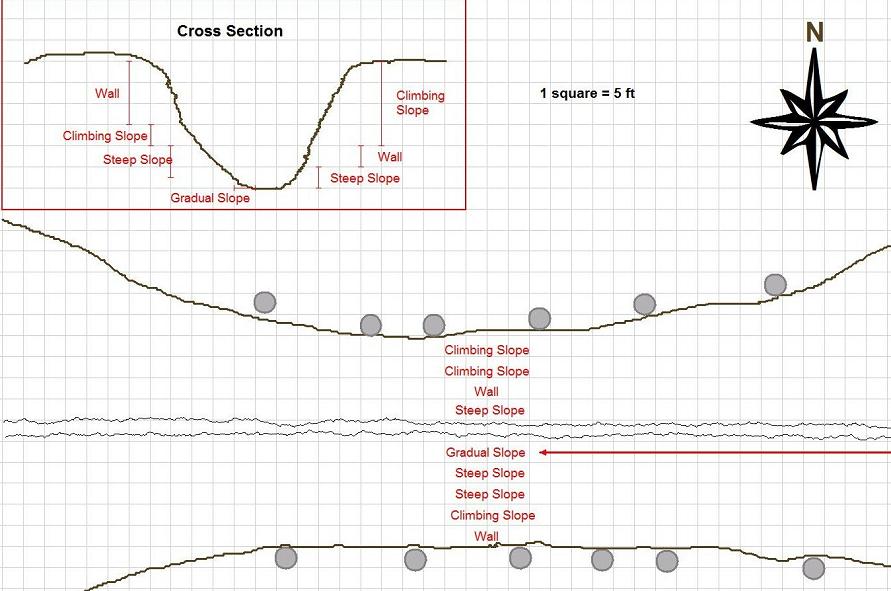 |
There are a total of 12 goblins atop the sides of the pass, six to each side. They each stand behind a 5 ft diameter round boulder with a wooden lever set behind each to allow a single goblin to quickly tip the boulder over the side. Each goblin is hidden behind its boulder, watching the pass (assume a Hide check of 15).
| GOBLINS (12)
CR 1/3 Male goblin Warrior 1 NE Small humanoid (goblinoid) Init +1; Senses darkvision 60 ft; Listen +2, Spot +2 Languages Goblin AC 15, touch 12, flat-footed 14 hp 5 (1 HD) Fort +3, Ref +3, Will -1 Spd 30 ft (6 squares) Melee morningstar +2 (1D6) Ranged javelin +3 (1D4) Space 5 ft; Reach 5 ft Base Atk +1; Grp -3 Combat Gear morningstar, javelins (3) Abilities Str 11, Dex 13, Con 12, Int 10, Wis 9, Cha 6 Feats Alertness Skills Hide +5, Listen +2, Move Silently +5, Ride +4, Spot +2 Possesssions combat gear plus leather armour, light wooden shield |
When the PCs are about halfway through the pass, the middle two goblins on each side will release their boulders. The remaining goblins will ready an action to release their boulders when a target reaches a spot directly across from them.
When a boulder is released, the goblin will target the row of squares on the map directly vertical from its starting space. However, a D3 is rolled for the boulder. A 1 means the boulder will end up 1 square to the left, a 2 means the boulder will roll straight, and a 3 means the boulder will end up 1 square to the right. A boulder will travel at a speed of 50 ft per round in the initiative of the goblin that released it. Boulders rolling down slopes move at double speed and those moving uphill move at half speed. In each subsequent round after release a boulder will lose 10 ft of rolling speed and head back down the slope in the other direction, until it comes to rest at the bottom of the pass. Each round the trajectory of the boulder should be rechecked by rolling a D3 as above.
If a DM wants to be a bit more realistic, then a boulder, when it begins to ascend back down the slope, should head down the slope at an angle that is the mirror image of the angle it ascended the slope. This sounds complicated but it actually rather simple. If a boulder headed straight up the slope, then it will head back down the slope straight (as adjusted by the D3 die roll). If a boulder headed up a slope offset 1 square to the right, then it will head back down the slope offset another square in the same direction (subject to adjustment from the D3 die roll). Boulders that ricochet off of other boulders should have their trajecories adjudicated by the DM, but in general should head down slope with a D3 modifier to add some variability.
The D3 variability reflects the aim of the goblins, the rough surface of the terrain, and the roughness of the boulders.
If a boulder passes through a square with a creature, the creature must make a Reflex save or suffer damage from the boulder. The save DC and damage depend on the current speed of the boulder:
Speed 50 ft = Ref save DC 15, 2D6 damage
Speed 40 ft = Ref save DC 12, 1D8 damage
Speed 30 ft = Ref save DC 9, 1D6 damage
Speed 20 ft = Ref save DC 6, 1D4 damage
Speed 10 ft = Ref save DC 3, 1D3 damage
If someone is hit they must then make another Ref save equal to the damage taken or fall prone.
If two boulders occupy the same square, both will deflect in a random direction.
After the boulders have been released and are causing havoc below, the goblins will then throw their javelins. Once their javelins are expended, they will keep tabs on their victims and parallel them through the pass and then seek to finish them off outside of the pass. Should the PCs retreat back into the valley, the goblins will follow them into the valley to attack. They wish to press their advantage while the PCs are damaged and harried. If sorely pressed, the goblins will flee towards their clan lair, which is directly west of the pass and is not in the area shown on the gnome's map. PCs following the goblins to their clan lair will be confronted by an entire goblin clan of 100 male warriors, a dozen worgs, and led by a 6th level warrior, a 4th level adept, 5 3rd level warrior sergeants, and 100 non-combatant females and young.
If the PCs linger in the area for several hours after these goblins flee to their clan lair, then a war party of 12 goblins mounted on 12 worgs will come searching for the PCs, a very powerful force from which the PCs are well advised to flee. At night, the goblins will attempt to track the PCs by scent, so the PCs should begin to hear fearful howls ranging all about them. If they choose to camp, they would be well advised to not have a fire and to find a well-concealed campsite. A Survival check set against a Track check should suffice. DMs should give the PCs warning before a group of a dozen worgs comes upon them. Perhaps the worgs have split up and only a couple find the PCs immediately. There would be a fight and the howls would alert other worgs, possibly necessitating a harrowing nighttime flight from their jaws.
Beyond the Valley:
The large rock formation, which is some 50 ft tall, vaguely resembles the angular reptilian head of a kobold complete with two small horns at the top and a crown of reddish-orange triangular boulders that make the figure look as if wearing a crown. During daylight hours, the snout of this formation casts a sharp shadow thrusting out to the north of the formation. This shadow moves almost like a sundial as the sun moves across the sky, and at high noon it points north by northwest.
Following the snout's shadow for 2 miles, the PCs will come to two large ridges between which, on the ground, is the calcified, massive fossil of some large ancient creature. The type of creature is unidentifiable, but a single bony claw seems to point to the north, where a huge, leafless oak tree stands in the distance across a small river. The river is flowing to the west and is not too rapid, meaning a DC 10 Swim check is required to navigate it. The current is flowing at a speed of 10 ft per round. The river can also be surmounted by travelling onto the hill to the east and bypassing its source, a hillside waterfall. This detour will consume 2 hours of travel time.
The tree is massive, its trunk being some 30 ft in diameter and its topmost branches splaying over 150 ft into the air. It is the manifestation of an ancient corruption that haunts this area. The source of the corruption is unknown, though it predates Onlora's movement of the Isle to its present location. Certainly, some ancient evil or profanity took place here and the ancient fossil in the ground may be related to it. From the edge of the riverbank, a DC 10 Spot check (already adjusted for distance) will reveal that hanging from the tree are bodies. A DC 15 Spot check will reveal that these bodies are skeletons of various creatures, and a DC 20 Spot check will reveal that the skeletons are not hung fromt he tree branches, but are rather growing out of the branches like fruits hanging from a normal tree.
This tree absorbs the souls of any sentient being (any being with an Int score) that perishes within 300 ft of it. The being may not be resurrected or revived from the dead in any way while its soul is absorbed. Within 2D20 days of absorption, the soul appears as one of these skeletal fruits. The fruit remains hanging from the tree for a variable length of time. There is no rhyme or reason to the length, which might be a few weeks or as long as a century. When one of these fruits is "ripe" the skeleton drops to the ground, animates, and wanders off to attack anything it can find. In all ways it is treated as an undead skeleton, however it is not under the control of any entity (though it can be brought under control by any normal means) and is programmed to simply attack and kill living creatures.
If any part of the tree is attacked or struck or damaged, 1D3 random skeletons (DM should determine appropriate skeleton type) will drop off and attack. This happens every time the tree is struck. The tree is a supernatural entity, far beyond the ability of the PCs to harm in any significant fashion. There are at least a hundred skeletons on the tree, and so there are plenty to drop off and attack the PCs should the tree be damaged repeatedly. Nevertheless, no blade or spell will do more than scratch or slightly scorch the bark of the tree. Small twigs and branches can be snapped off, but these have no potency once removed from the tree. The tree's roots are effectively deeper than the topsoil, having riven and grapsed onto the deep granite of the mountain itself. As such, the plant cannot be uprooted. The tree does radiate strong evil and faint necromancy magic.
If the PCs return to Trade Post to ask about the tree, a DC 10 Gather Information will turn up vague stories of some sort of tree that drops evil like fruit. A DC 20 Gather Information check will turn up someone who actually knows of the tree's precise location. Such a person will have little to add to what the PCs will have likely gleaned on their own.
Skeletons Attack (EL 5):
As the PCs approach the river's edge, having just passed the fossil, they will be attacked by skeletons recently spawned from the tree. The attack will not occur simultaneously. First, the dire badger will burrow up from below itno the PCs' midst. As the sounds of combat ensue, the wolf skeleton will arrive 2 rounds later. 2 rounds after that the goblin skeletons will arrive, and finally, a round after that will come the bear skeleton. These will come from different (random) directions, and will usually first be seen topping a ridge 2D4x10 ft from the PCs.
| GOBLIN SKELETONS
(2) CR 1/3 NE Small undead Init +6; Senses darkvision 60 ft; Listen +0, Spot +0 AC 14, touch 13, flat-footed 12 hp 7 (1 HD); DR 5/bludgeoning Immune cold Fort +0, Ref +2, Will +2 Spd 30 ft (6 squares) Melee 2 claws +0 (1D3) Space 5 ft; Reach 5 ft Base Atk +0; Grp -4 Abilities Str 11, Dex 15, Con -, Int -, Wis 10, Cha 1 SQ undead traits Feats Improved Initiative |
| WOLF SKELETON
CR 1 NE Medium undead Init +7; Senses darkvision 60 ft; Listen +0, Spot +0 AC 15, touch 13, flat-footed 12 hp 13 (2 HD); DR 5/bludgeoning Immune cold Fort +0, Ref +3, Will +3 Spd 50 ft (10 squares) Melee bite +2 (1D6+1) Space 5 ft; Reach 5 ft Base Atk +1; Grp +2 Abilities Str 13, Dex 17, Con -, Int -, Wis 10, Cha 1 SQ undead traits Feats Improved Initiative |
| DIRE BADGER
SKELETON CR 1 NE Medium undead Init +8; Senses darkvision 60 ft; Listen +0, Spot +0 AC 16, touch 14, flat-footed 12 hp 20 (3 HD); DR 5/bludgeoning Immune cold Fort +1, Ref +5, Will +3 Spd 30 ft (6 squares), burrow 10 ft (12 squares) Melee 2 claws +3 (1D4+2) and bite -2 (1D6+1) Space 5 ft; Reach 5 ft Base Atk +1; Grp +3 Abilities Str 14, Dex 19, Con -, Int -, Wis 10, Cha 1 SQ undead traits Feats Improved Initiative |
| BROWN BEAR SKELETON
CR 3 N Large animal Init +6; Senses darkvision 60 ft; Listen +0, Spot +0 AC 13, touch 11, flat-footed 11 hp 39 (6 HD); DR 5/bludgeoning Immune cold Fort +2, Ref +6, Will +3 Spd 40 ft (8 squares) Melee 2 claws +10 (1D8+8) and bite +5 (2D6+4) Space 10 ft; Reach 5 ft Base Atk +3; Grp +15 Abilities Str 27, Dex 15, Con -, Int -, Wis 10, Cha 1 Feats Improved Initiative |
Once the PCs cross the river they can follow it downstream to the cave indicated on the gnome's map. Of course, they do not technically need to cross the stream, but then they will confront a similar stream later in their journey, this one descending from another hill to meet the river.
The journey from the tree to the cave is a total of 5 miles, and the PCs will be subject to random encounters as indicated previously in this scenario.
Occasionally, the PCs will come across goblin totems and markers. These are usually wooden staves with skulls set on them and runes of warning in Goblin. On other occasions such runes are scratched into boulders or drawn in blood on planks of wood or even gouged into tree trunks.
The Goblin Caves:
Finally, the PCs will arrive at
their destination.
| The river ends at the base of a tall, chalk white cliff. Where the watercourse pierces the cliff base is a round, maw-like cave opening. The craggy stones hanging from the top of the opening gives the appearance of teeth waiting to close on anyone entering the opening. The cave entrance is some 10 ft in diameter. |
 |
Unless stated, all ceilings are 5 ft tall, meaning all PCs over 5 ft tall fight with a -1 penalty to their attack rolls. All walls are hewn stone walls (per 3 ft, break DC 50, hardness 8, 540 hp, Climb DC 25). All floors are hewn stone floors (a DC 10 Balance check is required to run or charge across such a floor, failure means the character can still act, but can’t run or charge in this round). There is no light unless indicated, as goblins and worgs both have darkvision.
The sound of the waterfall at area 10 dominates much of the sound within the caves. The roaring water can be heard easily once the saves are entered and grows louder as area 10 is approached. Within 30 ft of it, people will have to yell to be heard. Any Listen checks to sounds that have to cross the main cavern (areas 9-13) have a -3 penalty due to the sound of the falls. At the DM's option, sounds crossing very near the falls could cause a higher penalty.
The goblins have been performing profane rituals on the crystal in area 14. In addition, by attuning other crystals mined from the caves to their rituals, they have managed to create a desecrate effect (or possibly worse - see the "Price of Delay and Failure" section at the end of this scenario). Wherever such desecration crystals are indicated, they are large chunks of crystal that tend to pulse and glow with a sickly hue of blue, yellow, green, and sometimes purple. Assume there are 1D12 such crystals in each location, weighing 1D3 lbs each. Such crystals radiate faint evocation magic and faint evil and are permanent desecrate effects as if cast by a 20th level caster. Such effect radiates out from the crystals in a 20 ft radius. This effect can be dispelled or countered as per the normal rules. Such crystals retain their potency for several months and then must be brought close to the source crystal (in area 14) for several hours to be recharged. These crystals can be fairly easily destroyed (hardness 8, hp 8).
The glow from desecration crystals is equal to half torchlight (10 ft radius clear sight and 20 ft radius shadowy sight).
The map also shows other rocks and boulders. These are generally 4 ft to 6 ft tall and are treated either as slender pillars (+2 cover bonus to AC and +1 cover bonus to Ref saves) or wide pillars (taking up the whole space).
1. Deadfall Chasm
| The passageway is cut by a deep chasm that descends into the lightless depths. The rift is approximately 10 ft wide at its nearest, and widens significantly to the west, while it narrows to the northeast as it follows a thin stone shelf that runs along its southern edge. |
2. Stone Slab Bridges and Shaman
Cave (EL 5)
| Spanning the chasm here is a solid stone slab approximately 15 ft long and 5 ft wide. The slab seems to have been set across the chasm and does not appear to be secured in any way, though undoubtedly the slab itself is heavy enough to be somewhat stable. |
| Beyond the chasm is a 10 ft tall cave supported by several stone columns to the rear. A pile of furs sits along the western wall, while a crude altar of glowing bluish crystals is near the north wall. A carving in the wall of a demonic goblin with unfurled bat wings and brandishing a two-handed axe hovers above the altar stones. Along the east wall and on the floor before it are a variety of leaves, grasses, powders, bowls filled with coloured liquids, and other crude tools and materials suggesting some sort of magical uses. Several wicked-looking flint and crystal knives stained with red hang from spikes driven into the east wall. |
The various items along the east wall can, with a DC 10 Knowledge (arcana) check, hint at potion-making and with a DC 20 check also suggest some sort of profane ritual usage.
The pile of furs serves as a bed and are mostly wolf and worg pelts.
Creatures: This is the lair of the goblin shaman. He worships Maglubiyet, a Maug patron of goblinoids.
| GOBLIN SHAMAN
CR 5 Male goblin Expert 1/Adept 5 NE Small humanoid (goblinoid) Init +1; Senses darkvision 60 ft; Listen +5 (+7 when familiar in reach), Spot +2 (+4 when familiar within reach) Languages Goblin, Common, Infernal, Worg AC 16, touch 12, flat-footed 15 hp 27 (6 HD) Fort +2, Ref +4, Will +8 Spd 30 ft (6 squares) Melee mwk morningstar +4 (1D6) Ranged javelin +4 (1D4) Space 5 ft; Reach 5 ft Base Atk +2; Grp -2 Combat Gear masterwork morningstar set with 5 turquoises above the spikes (gems worth 15 gp each), javelins (3), divine scroll of see invisibility (CL 3), divine scroll of obscuring mist (CL 1), divine scroll of delay poison (CL 3), potion of cure moderate wounds (CL 3), potion of cure light wounds (CL 1) Adept Spells Prepared (CL 5, melee touch +3, ranged touch +4): 2nd - bewildering visions (DC 14), scorching ray 1st - bless, burning hands, lesser orb of cold 0 - cure minor wounds, detect magic, ghost sound (DC 12) Abilities Str 11, Dex 13, Con 12, Int 16, Wis 14, Cha 12 SQ familiar (alertness, deliver touch spells, empathic link, share spells) Feats Brew Potion, Craft Wondrous Item, Scribe Scroll Skills Concentration +7, Craft (alchemy) +9, Craft (trapmaking) +10, Handle Animal +5, Heal +4, Hide +5, Knowledge (arcana) +10, Listen +5 (+7 when familiar in reach), Move Silently +5, Ride +4, Spellcraft +10, Spot +2 (+4 when familiar within reach), Use Magic Device +10 Possesssions combat gear plus studded leather armour, light wooden shield, bone unholy symbol to Maglubiyet, gold nose ring shaped like a ring of bones worth 75 gp, iron key to the gate in area 16. |
|
BAT FAMILIAR CR n/a * A bat has a +4 racial bonus on Spot and Listen checks. These bonuses are lost if its blindsense is negated. |
While not a particularly powerful adept, this shaman has studied and learned magical lore well enough to have recognized the potential of the crystal formation in area 14 for its corruptive uses and have managed, after several years of experimentation, to both corrupt the crystal and to use its corruption to breed other desecrated crystals. Currently, the shaman is attempting to heighten the power of the profane rituals in order to breed unhallowed crystals. But although he is close to such knowledge, he has not quite reached his breakthrough (though this could change if the PCs do not hasten to the caves).
3. Natural Stairs
All three of these stairways have been hewn from the ground by gnomish artisans but are made to appear natural. A DC 20 Knowledge (architecture and engineering) check will determine on inspection that the stairs are not natural, but cunningly wrought to appear so. The steps are conveniently sized for Small creatures, which is also a hint at their origin.
There is little difference between the three stairways, other than the fact that 3a and 3b were both collapsed by the gnomes who abandoned these caves and re-excavated by the goblins who rediscovered the place. As such, a DC 20 Knowledge (architecture and engineering) will reveal, on close inspection, that these passages are very old, but also were recently excavated, as if buried and excavated. The stairs at 3a and 3b ascend 20 ft in elevation.
Stairway 3c follows the waterfall at area 10 down to the river at area 6c. The stairs here are wider and show no sign of having been buried by the gnomes. However, the spray from the falls makes this area slippery and damp, increasing the DC of Balance and Tumble checks by 5. This slipperiness begins where the map shows the stairway shaded grey and continues to the bottom.
The stairway at 3c continues for about 30 ft past the southern end of the map, following the river, befor coming to a dead end as the river slips under a rock wall and out of view. The ceiling above the stairway at 3c begins at 20 ft above the stairway and remains fairly level even as the stairway descends, so that it is 60 ft above the bottom of the stairway. Then the ceiling suddenly descends at the southern end of the passageway to form a dead end.
Two large crystals sit at the bottom of the stairway at 3c. These crystals are similar to the many others strewn about the caves, but these are cast-offs from early, failed rituals. As such, they seem to barely pulse with a sort of colourless shudder, and they radiate only a dim aura of magic and evil.
4. Quarters
These are various living quarters for the denizens of the caves. Each is described in detail below. All such caves are 7 ft to 8 ft tall. All of these caves have desecration crystals strewn about them, as shown on the maps.
4a. Kennel (EL 4)
| Pulsating green crystals dot the floor of this place, with a few larger blue crystals interspersed amongst them. Bones of various sorts and sizes litter the floor, most of these cracked and chewed. |
Hanging from the north side of the two stone pillars at the entrance to this cave are a set of leather saddles and bit and bridle for riding the worgs. These hang from an iron spike driven into the pillar.
Creatures: Two worgs lair here, set as guardians of the entrance and used occasionally as shock cavalry and fast scouts by the goblins of these caves. They also bring in food for the goblins. Three worgs lair here, but at all times one is out hunting or scouting the land. The worgs will attack any intruders, raising a howl and ruckus as they do so, alerting the complex.
|
WORGS (2) CR 2 * A worg has a +4 racial bonus on Survival checks when tracking by scent. |
4b. Guard Post (EL 5)
As the PCs come into view of the
entrance passage in to this area, they note the following.
| A single large pulsating green crystal protrudes from the wall of a passageway that exits the river side. The crystal is vaguely shaped like a screaming face and the colour that it emits seems to exaggerate the horror in the face. |
| Green Crystal Trap CR 2; magic device; proximity trigger (detect good); automatic reset; spell effects (cause fear, 5th level adept, DC 14 Will partial) and (ghost sound, 5th level adept, DC 13 Will disbelief); Search DC 26; Disable Device DC 26. |
Past the passageway, which turns
sharply to the right, is a small cave. Note that there is a goblin
hiding in a niche where the passageway makes its righthand turn.
See below for details.
| Pulsating crystals of mauve, violet, and other shaes of purple are set into the walls, floor, and ceiling in the northern part of this cave. The rest of the cave contains four fur pallets, and a small crude wooden table and chairs sized for small creatures. A bloody cut of some sort of meat sits on the table on a crude wooden plate, with flies buzzing around it. |
Creatures: Four goblin rogues serve as elite guards of the place. At all times one goblin is on watch, hiding in the shadowy niche that is right at the "elbow" of the passageway leading from the river side to this cave. The niche is such that unless the PCs are carefully looking around the passageway (i.e. moving at half speed or slower), they will not even notice there is a niche there. The hiding goblin can be assumed to have taken 10 on his Hide roll to determine if and when he is spotted. Once spotted, he will leap out to try to attack a flat-footed PC. Otherwise, if the PCs pass him unnoticed, he will wait until they enter the cave proper and then attempt to sneak attack the last PC.
| GOBLIN GUARDS
(4) CR 1 Male goblin Rogue 1 NE Small humanoid (goblinoid) Init +2; Senses darkvision 60 ft; Listen +7, Spot +7 Languages Goblin AC 15, touch 13, flat-footed 13 hp 4 (1 HD) Fort +1, Ref +4, Will +1 Spd 30 ft (6 squares) Melee short sword +1 (1D4) Ranged light crossbow +3 (1D6) Space 5 ft; Reach 5 ft Base Atk +0; Grp -4 Atk Options sneak attack +1D6 Combat Gear short sword, light crossbow, crossbow bolts (20), tanglefoot bag Abilities Str 11, Dex 14, Con 12, Int 12, Wis 12, Cha 6 Feats Alertness Skills Escape Artist +6, Hide +10, Jump +4, Listen +7, Move Silently +10, Ride +6, Sleight of Hand +6, Spot +7, Swim +5, Tumble +6 Possesssions combat gear plus leather armour, belt pouch, 4D6 cp, 2D6 sp, 2D6 gp. |
4c. Goblin Quarters (EL 1)
| Pulsating green crystals are present in the cave. The rest of the cave contains four fur pallets, and a small crude wooden table and chairs sized for small creatures. |
Creatures: Four goblin warriors reside here.
| GOBLINS (4)
CR 1/3 Male goblin Warrior 1 NE Small humanoid (goblinoid) Init +1; Senses darkvision 60 ft; Listen +2, Spot +2 Languages Goblin AC 15, touch 12, flat-footed 14 hp 5 (1 HD) Fort +3, Ref +3, Will -1 Spd 30 ft (6 squares) Melee morningstar +2 (1D6) Ranged shortbow +3 (1D4) Space 5 ft; Reach 5 ft Base Atk +1; Grp -3 Combat Gear morningstar, shortbow, arrows (20) Abilities Str 11, Dex 13, Con 12, Int 10, Wis 9, Cha 6 Feats Alertness Skills Hide +5, Listen +2, Move Silently +5, Ride +4, Spot +2 Possesssions combat gear plus leather armour, light wooden shield, belt pouch, 2D6 cp, 1D6 sp, 1D3 gp. |
4d. Goblin Quarters (EL 1)
| Pulsating yellow and blue crystals are present in the cave. The rest of the cave contains four fur pallets, and a small crude wooden table and chairs sized for small creatures. |
Creatures: Four goblin warriors reside here.
| GOBLINS (4)
CR 1/3 Male goblin Warrior 1 NE Small humanoid (goblinoid) Init +1; Senses darkvision 60 ft; Listen +2, Spot +2 Languages Goblin AC 15, touch 12, flat-footed 14 hp 5 (1 HD) Fort +3, Ref +3, Will -1 Spd 30 ft (6 squares) Melee morningstar +2 (1D6) Ranged shortbow +3 (1D4) Space 5 ft; Reach 5 ft Base Atk +1; Grp -3 Combat Gear morningstar, shortbow, arrows (20) Abilities Str 11, Dex 13, Con 12, Int 10, Wis 9, Cha 6 Feats Alertness Skills Hide +5, Listen +2, Move Silently +5, Ride +4, Spot +2 Possesssions combat gear plus leather armour, light wooden shield, belt pouch, 2D6 cp, 1D6 sp, 1D3 gp. |
4e. Goblin Quarters (EL 1)
| Pulsating yellow crystals are present in the cave. The rest of the cave contains four fur pallets, and a small crude wooden table and chairs sized for small creatures. |
Creatures: Four goblin warriors reside here. They are trained as archers and have a special role in the defense of the caves (see below).
| GOBLINS (4)
CR 1/3 Male goblin Warrior 1 NE Small humanoid (goblinoid) Init +1; Senses darkvision 60 ft; Listen +0, Spot +0 Languages Goblin AC 15, touch 12, flat-footed 14 hp 5 (1 HD) Fort +3, Ref +3, Will -1 Spd 30 ft (6 squares) Melee morningstar +2 (1D6) Ranged shortbow +4 (1D4) Space 5 ft; Reach 5 ft Base Atk +1; Grp -3 Combat Gear morningstar, shortbow, arrows (20) Abilities Str 11, Dex 13, Con 12, Int 10, Wis 9, Cha 6 Feats Weapon Focus (shortbow) Skills Hide +5, Listen +0, Move Silently +5, Ride +4, Spot +0 Possesssions combat gear plus leather armour, light wooden shield, belt pouch, 2D6 cp, 1D6 sp, 1D3 gp. |
Tactics: Unlike the other goblins in 4c and 4d, the goblins here are under orders, in case of trouble, to alert the goblin king in area 7 and then to proceed to the balconies (area 8) in pairs and to use these positions to shoot their arrows at intruders.
5. Natural Stone Bridge
| A span of natural-looking stone arches over the river here, crossing from one passageway to another. The span is between 5 ft and 10 ft wide and is a full 2 ft thick at its thinnest point at the apex of its arch. The surface of the bridge rises slightly towards the center, but is otherwise flat and the footing appears to be stable. |
When the goblins first discovered this complex, this bridge had been hidden amidst a collapse of stones induced by the departing gnomes. This collapse had essentially formed a stone wall that filled up the entire area below the bridge and above it, and the stones above it were cunningly set so that their combined weight did not collapse the bridge. When the goblins discovered the place they expertly dismantled the collapse and kept the bridge intact.
The ceiling here is 10 ft above the bridge.
6. Underground Rivers
These caverns form a confluence of two small rivers that converge here after their journeys above ground. The river coming from the east is the one that, most likely, the PCs have followed to arrive at the caves, and the entrance at 6a is the Mole's Mouth as referred to in the poem on the secret page. These two rivers meet at area 9 before heading south over the falls at area 10 and continuing beyond these caves in a submerged underground course through the mountains.
The rivers are generally not too fast flowing. Currents move from the entrances (6a and 6b) to the confluence (area 9) and then over the falls (area 10) and to the southern exit (area 6c). The current is faster past the falls. Naviagting the rivers requires a DC 10 Swim check. The current is flowing at a speed of 10 ft per round above the falls. Below the falls a DC 15 Swim check is required and the current flows at a speed of 20 ft per round. Once the river at 6c passes the point 30 ft south of the map where the ceiling dips down to meet the water, it speed up to 30 ft per round and there are no air pockets for a distance of several miles.
The rivers here are between 10 ft and 15 ft deep. The water is cold and anyone immersed within may suffer from hypothermia for each 10 minutes of exposure (refer to Stormwrack page 11 for more details).
The entrance at area 6a is the one the PCs are most likely to use. The ceiling here is 10 ft high at the entrance and slopes upward to 20 ft just before reaching area 12.
The entrance at area 6b opens up onto a small vale that itself is surrounded by rugged terrain and tall rises. The ceiling at the entrance is 8 ft tall and quickly slopes upward to reach 30 ft at area 5.
In general, the level of the river is between 6 inches and 1 ft below the level of the cave floors adjacent to them.
7. Goblin King's Lair (EL 6)
|
This chamber is approximately 35 ft in diamater, and the ceiling vaults in a dome-like shape some 20 ft overhead. A number of openings pierce the walls at almost regular intervals, ten in total. In the center of the chamber is a circular pit some 10 ft in diameter. A green vapour roils from the pit and curls in lazy spirals up to the ceiling. A general green haze also permeates the air of the chamber. Sitting 5 ft above the pit, suspended from several thick iron chains attached to the center of the ceiling, is an iron throne. The throne is carved to resemble crude skeletal hands hat appear to be attempting to caress whomever occupies the seat. Several large crystals and gems are set into the chair. A variety of bones and and gibbets of rotting flesh lie scattered all over the floor, and certainly some humanoid skulls are easily recognizable amongst the carrion. |
The pit in the center of the chamber is 20 ft deep and within it are green desecration crystals that are intermixed with smoldering ashes, burning gobules of fat and bits of hair, and charred bones. Hot embers and coals lie below the mess, and these are what appear to be generating the green vapours. The vapours effectively serve to spread the emanations from the desecartion crystals throughout the chamber, so that even despite the fact that the crystals' area of effect is an emanation, the smoke carries the effect over the edge of the pit and into the entire chamber. Furthermore, the vapour provides a stench that is horrific in its charnal pungence so that it has the sam effects as a ghast's stench ability.
Anyone within the chamber must succeed on a DC 15 Fortitude save or be sickened for 1D6+4 minutes. A creature that successfully saves cannot be affected again by the same stench for 24 hours. A delay poison or neutralize poison spell removes the effect from a sickened creature. Creatures with immunity to poison are unaffected, and creatures resistant to poison receive their normal bonus on their saving throws.
The niches in the walls of this chamber often hold prisoners, captives awaiting feasting by the goblin king. Each niche has a dual pair of iron manacles set into the stone wall, the key to which is on the person of the goblin king. All prisoners are bound hands and feet and are gagged and blindfolded as well.
Starting from the northernmost niche and proceeding clockwise:
Niche 1 = A bedraggled dwarf male (LN, Expert 2) merchant who was kidnapped from his caravan's encampment one night several weeks ago.
Niche 2 = An orc warrior (NE, Warrior 1) who was ambushed and captured by goblins and a worg a week ago while he was relieving himself while on a warparty.
Niche 3 = empty.
Niche 4 = An old human male (Expert 3) prospector who was seeking rumours of an underground river with gold to be panned. He wandered right into these caves (via area 6b) a few days ago and was apprehended as he bent over to pan for gold. His favourite donkey Esmerelda was eaten by the goblins.
Nice 5 = empty.
Creatures: The primary denizen of this area is the goblin king, who can usually be found sitting on his throne basking in the evil vapours from the pit below. The goblin king is a gravetouched ghoul, having undergone a horrific and profane rite to give him everlasting life at the cost of a never-ending hunger for flesh (preferrably living). The goblin king is eager to fully tap the potential of the crystal in area 14 so as to extend his power to the other neighbouring goblin tribes and then, one day, unite them and begin to seriously threaten Trade Post and the gnome and dwarf settlements in the region.
The goblin king has no difficulty leaping from his throne to the edge of the pit should he need to leave. Normally he takes 10, allowing him to easily meet the DC 10 check. He also gains a +1 circumstance bonus for the throne being higher up than the edge of the pit. In a combat situation, he can either make the jump (with no chance of completely failing and only a 3 in 20 chance of having to roll a Ref save to grasp the edge of the pit) or he can take a standard action to swing the throne a bit and gain a further +2 circumstance bonus to the Jump check, netting him a 1 in 20 chance of needing to roll a Ref save.
Coming from edge to throne is much easier, since he can get a 20 ft running jump, so success is automatic and height is no problem since he has a vertical reach of 4 ft anyways.
Remember to adjust the goblin king's statistics when within the area of a desecrate spell.
|
GOBLIN GHOUL KING CR 5 Ghoul Fever (Su) Disease - bite, DC 14 Fort save, incubation period 1 day, damage 1D3 Con and 1D3 Dex. An afflicted humanoid who dies of ghoul fever rises as a ghoul at the next midnight. A humanoid who becomes a ghoul in this way retains none of the abilities it possessed in life. It is not under the control of any other ghouls, but it hungers for the flesh of the living and behaves like a normal ghoul in all respects. A humanoid of 4 HD or higher rises as a ghast, rather than a ghoul. Paralysis (Ex) Victims hit by a gravetouched ghoul's bite or claw attack must make a successful DC 14 Fort save or be paralyzed for 1D4+1 rounds. Elves have immunity to this paralysis. |
Tactics: The goblin king will not generally respond to alarms in the caves below, as he does not want intruders to be able to sneak into area 14. As that is his primary point of interest for these caves, he would much rather let his minions fight and die against intruders and then confront them, wounded and used up by battle. Nevertheless, should he hear intruders in or approaching area 14, he will then leap from his throne and attack the intruders, as he does not want the guardinal in that area freed or the crystal tampered with.
Treasure: The gems set into the iron throne are mostly colourful crystals and polished stones of no particular value. However, there are 3 pieces of moss agate (worth 25 gp each), 1 nice amethyst (worth 100 gp), and 2 small tourmalines (worth 50 gp each). A DC 10 Appraise check is required to successfully pick out each gem from the other worthless items.
8. Balconies
These are merely openings that look out over the main cavern area. Each is 20 ft above the river level, and in the case of the northernmost balcony is a stone shelf that juts out into the cavern. The goblin archers in area 4e will use these as firing platforms against intruders.
9. Confluence
| This area is where two rivers meet and swirl around before heading south. The cavern here is 40 ft high in the center, and then slopes down at various points. In the center of the confluence are two stone islands. The northernmost bears a tall stalagmite that has been carved into the shape of a crude humanoid figure wielding what looks to be a rather large and quite real great axe. Bones and coloured stones surround the carving, as if having been lain at the feet of the figure. |
At two points indicated on the cave map, one just east of area 12 and the other just off of area 13 as one approaches the falls (area 10) green desecration crystals have been dumped into the water. The green hue is not easily visible until one comes within 10 ft of the surface of the river.
Treasure: The great axe held by the carving is a real size Large masterwork great axe. Such a weapon was stolen from an ogre years ago and selling it for anywhere near its sales value (half market price) would require the PCs to find a size Large buyer.
10. Waterfall
| The water from above plummets straight down in a sheet of foam and spray here. The descent is a full 40 ft and rocks jutting up from the floor of the river below are clearly visible at the base of the falls, boding ill for anyone who is carried over the falls. |
11. West Bank (EL 1)
|
This shelf of stone juts out from the walls of the cavern and forms the western back of the underground river. At least half a dozen smallish fur pallets are set near the walls of the shelf, and in the middle of the area is set a crude smithy and work area, where an anvil and bellows sit next to an area for cutting and scraping hides and various tables set with woodcarving and stone carving tools. All sorts of implements and raw materials lie scattered around this area, showing signs of recent activity. Set near the eastern edge of the shelf is a large wooden plank 5 ft wide and 15 ft long. |
The wooden plank is used to cross the river onto the island where the statue to Magubiyet is set (see area 9). This plank can support the weight of one medium or 2 small creatures at a time. Anything more than that will crack the plank, possibly plummeting the victim into the river.
Creatures: Half a dozen non-combatant female goblins dwell here (NE, Commoner 1), along with two males who supervise (i.e. boss around) the females.
| GOBLIN SMITHS
(2) CR 1/3 Male goblin Expert 1 NE Small humanoid (goblinoid) Init +1; Senses darkvision 60 ft; Listen +2, Spot +2 Languages Goblin, Common AC 15, touch 12, flat-footed 14 hp 4 (1 HD) Fort +3, Ref +3, Will -1 Spd 30 ft (6 squares) Melee warhammer +3 (1D6+1) Ranged javelin +3 (1D4+1) Space 5 ft; Reach 5 ft Base Atk +1; Grp -2 Combat Gear war hammer, javelins (3) Abilities Str 12, Dex 13, Con 12, Int 12, Wis 9, Cha 6 Feats Martial Weapon Proficiency (warhammer) Skills Appraise +5, Craft (armourmaking) +5, Craft (masonry) +3, Craft (weaponmaking) +5, Handle Animal +2, Hide +5, Knowledge (architecture and engineering) +3, Listen +0, Move Silently +5, Ride +4, Spot +0 Possesssions combat gear plus studded leather armour, belt pouch, 2D6 cp, 1D6 sp, 1D3 gp. |
12. North Bank (EL 1)
| At the western end of this stone shelf is a cluster of boulders and stones set almost in a circle. Near this are several pulsating blue crystals that cast a strange wan light over the smallish menhirs. Fur pallets occupy the area within and around the stone circle, at least a dozen of these in fact. Scattered amongst the pallets are partially skinned and butchered animals of various sorts, as well as a pile of bones, slabs of meat, and piles of various roots and tubers. |
The ceiling is 20 ft overhead here.
Creatures: Half a dozen females (NE, Commoner 1) are here, along with a dozen goblin implings and babies. All of these are non-combatants, and the adults nurse the young and prepare food for the males. Two male goblins guard the area, keeping the females and children in line and pleasuring themselves as they like. Needless to say, this is considered choice duty.
| GOBLINS (2)
CR 1/3 Male goblin Warrior 1 NE Small humanoid (goblinoid) Init +1; Senses darkvision 60 ft; Listen +2, Spot +2 Languages Goblin AC 15, touch 12, flat-footed 14 hp 5 (1 HD) Fort +3, Ref +3, Will -1 Spd 30 ft (6 squares) Melee morningstar +2 (1D6) Ranged javelin +3 (1D4) Space 5 ft; Reach 5 ft Base Atk +1; Grp -3 Combat Gear morningstar, javelins (3) Abilities Str 11, Dex 13, Con 12, Int 10, Wis 9, Cha 6 Feats Alertness Skills Hide +5, Listen +2, Move Silently +5, Ride +4, Spot +2 Possesssions combat gear plus leather armour, light wooden shield, belt pouch, 2D6 cp, 1D6 sp, 1D3 gp. |
13. East Bank (EL 2)
|
This large area along the eastern bank of the river contains many stones and boulders and small stalagmites. A large fur pallet sits in the middle of the area, surrounded by bones and several broken barrels. Open crates and ripped up sacks also are present, and a few of these still show various edible contents inside, including dried fruits and potatoes. Two large logs rest standing against the east wall, both having been split in two lengthwise and both being about 3 ft wide and 20 ft long. |
The ceiling is 20 ft overhead here.
Creatures: A bugbear friend of the tribe lairs in this area, helping with tasks that require brute strength as well as providing additional defense.
| BUGBEAR CR 2 CE Medium humanoid (goblinoid) Init +1; Senses darkvision 60 ft; Listen +4, Spot +4 Languages Goblin, Common AC 17, touch 11, flat-footed 16 hp 16 (3 HD) Fort +2, Ref +4, Will +1 Spd 30 ft (6 squares) Melee mwk morningstar +5 (1D8+2) Ranged javelin +3 (1D6+2) Space 5 ft; Reach 5 ft Base Atk +2; Grp +4 Combat Gear masterwork morningstar, javelins (3) Abilities Str 15, Dex 12, Con 13, Int 10, Wis 10, Cha 9 Feats Alertness, Weapon Focus (morningstar) Skills Climb +3, Hide +4, Listen +4, Move Silently +6, Spot +4 Possesssions combat gear plus leather armour, light wooden shield, belt pouch, 5D6 cp, 3D6 sp, 3D6 gp. |
Tactics: The bugbear will be eager to prove its mettle in combat, and will likely place a log across to intercept intruders and then charge into combat. It is not accustomed to facing opponents that are not intimidated by its size and ferocity.
Treasure: Hidden under its pile of furs (DC 10 Search check) is a silver chalice with lapis lazuli gems worth 110 gp.
14. Chamber of the Crystal
As the PCs enter the passageway
into this cave (whether from area 7 or from area 3b), they will
notice the following.
| From somewhere to the southwest, an argent light glows into the passageway. The light seems at once unbearably bright and yet, despite its luminousity can be looked at directly. Occasionally the light sputters for an instant. |
When the PCs enter area 14, they
will note the following.
|
The cave you see before you contains a plethora of broken crystals and crystal pieces, some of which glow in a sickly panoply of colours. Directly south of the entrance, framed between two stone columns, a pure white crystal seems to have grown out of the cave ceiling 10 ft overhead and down part of the wall. The crystal is a 5 ft diameter hemisphere, though its face is faceted and uneven. The structure radiates the intense argent light that emanates into the hallway, and this light seems to swirl around the cave and almost fight with the colours emanating from the broken crystals on the ground. Below the crystal is chained a strange-looking creature that is about 5 ft tall and humanoid, its slim, muscular body covered in short dark red fur. Long, curved horns sprout from its head, and its legs end in hooves, though its hands appear human-like. The chains holding the creature to the wall are iron and bind its wrists and ankles to the wall, as well as its waist and chest. Glowing green runes cover these chains. A leather gag holds a stone in place in its mouth, so that it cannot speak, and a leather blindfold covers its eyes, so that it cannot see. The creature is scoured with cuts all over its body, some of these definitely in the shape of runes and other geometrical patterns. Runes of dried blood cover the walls surrounding the creature and the crystal. Set on the floor before the being is an ornate lapis lazuli and copper basin. Within the basin is an obsidian curved knife, a roll of vellum, and six small vials. |
Creatures: Trapped in chains is a cervidal guardinal. This being is vital to the continuing corruption of the crystal, as various horrific rites are being performed upon it by the goblin shaman (area 2). The guardinal was called to this plane by the goblin shaman using a scroll of lesser planar binding and his Use Magic Device skill. Although difficult, he finally managed to cast the spell from the scroll and summoned the guardinal. He then subdued it with the help of the goblin king who paralyzed it and the two of them then performed a ritual he had learned to fully bind the creature to this plane. The ritual is relatively costly in terms of gold pieces and XP and can only be performed on a helpless outsider called (not summoned) to the Material Plane.
|
CERVIDAL GUARDINAL CR 3 Horn Powers (Su) A cervidal can deliver any of several effects by a touch of its horns. The horns can negate any poison or disease (as the spells neutralize poison and remove disease) in the creature touched, dispel an illusion (as a targeted dispel magic spell, except that it affects only spells of the Illusion school and is automatically successful), or dismiss (as a dismissal spell) a summoned, conjured, or extraplanar creature. Each of these horn powers can be used at will as a standard action. Except as noted, all these abilities function as the corresponding spells at caster level 20. |
Developments: The cervidal is groggy and basically incoherant as long as its chains are in place. The chains radiate moderate Summoning and Necromancy and the ongoing ritual can be dispelled as if it were a CL 9 spell. The ritual can also be ended by severing or breaking the chains (hardness 10, 10 hp, break DC 26). If the ritual is broken, the cervidal will shake its head and regain its awareness. It will be a bit disoriented at first, but can then quickly explain what has happened, namely that it was summoned by an evil goblin shaman to this ohorrid place and then paralyzed by some undead goblin. A horrid rite was conducted on him that bound him to this plane, and then he was used in further profane rituals to corrupt the pure white crystal in the chamber.
The cervidal can explain the nature of the crystal. Because his own essence has been used to corrupt the crystal, he has learnt its nature. The crystal, he can say, is some sort of runoff from the Mere of Onlor that has in some way retained its potency...perhaps due to the presence of faerzress in the rock between here and the Mere. In any event, the potency of the Mere caused the runoff to crystalize when it reached the open air in this cave. Apparently, the goblins used their rituals and the cervidal's own blood and spirit to corrupt the crystal, causing it to form crystal offshoots that they then broke off and further corrupted to emanate evil magic instead of its own pure powers. The coloured crystals on the ground of this cave are examples of both failed attempts and successful attempts to harness this corruption.
The cervidal can also say that as his essence was used to corrupt the crystal, he felt his soul being drawn up into the very Mere itself. There he felt his soul begin to corrupt the water of the Mere. Of course, the potency of the Mere is too grand for a single being like himself to harm in any noticeable or permanent fashion, but there is a danger that if some more adept evil being were to discover what the goblins are doing here they might be able to harm the holy Mere.
As such, the cervidal will recommend that the pure crystal be removed from these caves and taken far away. It will, he will relate, take centuries if not millenaia for the seepage to form another crystal of that size, if it even ever happens again at all, and without the concentrated potency of the crystal, the seepage cannot be used as a conduit for evil rites nor can the Mere be corrupted.
If asked how to remove the crystal, the cervidal will simply suggest that it be hacked away from the wall.
Assuming it is freed, the cervidal will only have 24 hours to remain on the Material Plane before returning to the netherworld. It will gladly aid the PCs during its time here assuming they are of good alignment or good intention.
Treasure: The lapis lazuli and copper basin is worth 450 gp but carries a permanent dim taint of evil. The obsidian curved knife (treat as a dagger with half normal hardness and hit points) is worth 25 gp and also radiates a permanent dim aura of evil.
The roll of vellum contains the details of the rituals needed to bind an outsider and to siphon his essence. This ritual is written in Infernal and if the PCs wish to pursue thse arts it is up to the DM to come up with a suitable XP and gp cost. Performance of such rituals is a very evil act.
The six small vials are vials of unholy water, taken from the waters of these caves and profaned by the goblin shaman.
The crystal, known as the Tears of Onlora, when attached to the ceiling and its source has the following powers:
Consecrate permanently in a 20 ft radius
Remove curse (CL 16) on touch on a given being 1/day
Remove disease (CL 16) on touch on a given being 1/day
Neutralize poison (CL 16) on touch on a given being 1/day
Cure light wounds (CL 16) on touch on a given being 1/day
The crystal had more powers but these have been permanently removed by means of the rituals already performed upon it.
Should the crystal be detached from the cave ceiling (hardness 8, 16 hp, break DC 25), it will retain some of its potency. The powers of the crystal are retained by the chunk that is severed from the ceiling, and breaking the crystal into further pieces will merely destroy its powers (like any other magic item).
|
Tears of Onlora (detached) Body Slot: - This item is a 5 ft diameter hemisphere of radiant white crystal. Unlike most artifacts, the crystal is easily broken (hardness 8, 16 hp, break DC 25), and if broken is rendered non-magical. The crystal gives off a silver glow that is treated as a light spell in all respects. In addition, the crystal continually emanates a consecrate effect. Finally, the crystal has the following powers: Remove curse 1/day on touch Remove disease 1/day on touch Neutralize poison 1/day on touch Cure light wounds 3/day on touch If the crystal is set into an altar dedicated to Onlora, the effects of the consecrate are doubled (as per the spell). |
15. Cave of the Dead (EL 2)
|
This small cave, with a 7 ft tall ceiling, has three exits. The exits to the southeast and north are clear, but the one to the west is choked with rubble, as if it were excavated recently or had experienced a collapse. passage through the western exit is certainly possible, but would involve clambering over or amongst skull-sized rocks. To the north of the cave are several larger boulders and a natural column from floor to ceiling. |
Creatures: Lairing behind the boulders and column to the north are two zombie monstrous scorpions. These were created by the shaman using a divine scroll and are currently commanded to guard the ways into area 2 and area 16. They will attack any non-goblin that attempts to do so unless escorted by goblins. Otherwise, the scorpions are instructed by the shaman to obey only his or the goblin king's direct commands.
| MEDIUM MONSTROUS
SCORPION ZOMBIES (2) CR 1 N Medium undead Init -1; Senses darkvision 60 ft, tremorsense 60 ft; Listen +0, Spot +0 AC 15, touch 9, flat-footed 15 hp 29 (4 HD); DR 5/slashing Fort +1, Ref +0, Will +4 Spd 40 ft (8 squares) Melee slam +4 (1D6+2) Melee claw +4 (1D4+2) Melee sting +4 (1D4+2) Space 5 ft; Reach 5 ft Base Atk +2; Grp +4 Abilities Str 15, Dex 8, Con -, Int -, Wis 10, Cha 1 SQ single actions only, undead traits Feats Toughness Single Actions Only (Ex) Zombies have poor reflexes and can perform only a single move action or attack action each round. A zombie can move up to its speed and attack in the same round, but only if it attempts a charge. |
16. Gaol
|
This cavelet is blocked by iron bars extending from the floor to the ceiling 6 ft overhead. The cavelet's ceiling slants downward to the west, until it is only 4 ft high at the rear. A gate is set into the iron bars, and the gate bears a keyhole in its face. Beyond the bars, a sickly green glow emanates from crystals set into the far walls and floor of the place. |
The crystals in the gaol are desecration crystals.
The iron bars are set close together, enough to prevent even Small creatures from squeezing through. A Tiny creature could squeeze through on a DC 30 Escape Artist check. Smaller creatures can pass through without any problem.
The lock is a standard lock (Open Lock DC 25) and the key is on the shaman in area 2.
Creatures: Currently, a single kobold warrior (use standard statistics from the Monster Manual) and an aged and crippled orc (non-combatant) are being held here.
They are malnourished (treat as exhausted) and each has 1 hit point of damage inflicted upon them from beatings. These two will gladly cooperate with the PCs to aid their escape, though the crippled orc cannot move more ably than to crawl on the ground (5 ft per round, provokes attacks of opportunity). Once free, they will seekt o flee, though the orc won't really have anywhere to go and will ask to be slain quickly and fed to the crows.
Overall Defense and Reaction: These goblins are not stupid. They have survived their harsh environment and the ministrations of their undead king by being clever and canny. In the defense of their lair, they will be easily rallied and will work together using cooperation and tactics as appropriate. These goblins believe they are almost divinely protected by their king, who has represented his undead status as a sign of favour from Maglubiyet. Most of the goblins believe him undefeatable.
The goblins will not rush to fight PCs larger than they in melee combat. Instead, they will seek to have the bugbear and worgs engage in close combat while they shoot missiles or throw weapons, especially at spellcasters. If pressed, they will tend to flee and fire, and then flee again, hoping to use the terrain to their advantage. There are many places in the caves for flank attacks and for goblins to come in around the PCs.
Until the goblin king and shaman have been defeated, these goblins will not surrender or flee (the non-combatants will flee, but not the warriors). If both are defeated, then the goblins are likely to try to make a break for it unless their enemies seem to be on their last legs.
Sounds of battle will cause other goblins to rally to the point of conflict, and a general alarm will be raised. The goblin king will not usually seek to enter the fray, remaining in his chamber for news of the outcome or to await the hopefully weakened intruders. The shaman will respond to a combat, likely gathering goblins to him to cast bless and then using his see invisibility scroll before sniping at intruders from a safe location with his spells and otherwise rallying the troops. If pressed he will flee to the goblin king's chamber to do battle there.
Other goblins wil take advantageous firing positions, especially the trained goblin archers, who will command the balconies at area 8 and try to overlook the battle and fire at intruders who become visible in the main cavern area.
If the PCs assault the caves and then retreat, the goblins may rally and follow the PCs, using any surviving worgs to track the PCs. if so, they will scout ahead and determine if the PCs will be able to make it to a fortified location before nightfall. If not, they will wait until the PCs encamp, gathering their strength, and then attack the PCs in the dead of night.
Without the worgs, they will still send out scouts, but it is less likely they can track the PCs since a group of 6 Medium sized PCs has a Survival DC of 13 to track over firm ground, and without the Track feat a maximum DC of 10 is allowed.
If the shaman is still alive when the PCs retreat, he may send his familiar out to tail the retreating PCs and then divulge their resting place. The familiar will be very careful and discrete and will use its Hide skill, size, and distance to try to remain unseen.
As long as the king and shaman are alive, the goblins will hold the caves. They will send two of their number to a nearby goblin clan to replenish their losses. Such replenishment takes 2D4 days and will result in fresh goblin warriors and worgs in numbers to bring them up to the numbers they started with. Of course, neither the king nor the shaman will be replaced during the course of this scenario (assume it would take a year to replace either, and the new goblin king is unlikely to be undead...more likely a powerful goblin warrior or rogue).
Should the PCs manage to steal or extract the crystal, the goblins, if led by the king or shaman, will form a hunting troop and try to win back the item before the PCs reach Trade Post. The goblins will not come within half a day of the village, due to strong patrols.
These goblins will definitely take and keep prisoners, as they need sentient beings to sacrifice to Maglubiyet or to further profane the crystal. It is up to the DM to decide how long the goblins will keep prisons (who will be held in area 16) alive, but it should not be longer than a few weeks.
Returning to Trade Post: A return to Trade Post should involve further wandering encounter checks. If more than a day or two have passed, the DM, at his option, could have a few new skeletons waiting for the PCs should they pass near to the evil tree.
If the PCs show the crystal at Trade Post, there will not be a rousing interest in it. Of course, some will see that it is magical and the PCs may be able to find a buyer, but not at anything approaching the price it is worth. There are no Onlora clergy in Trade Post, and the average gnome will not know of the crystal's history.
Part Four - Dealing with It (EL 4)
The remainder of this scenario assumes that the PCs have managed to win the crystal (in a reasonable amount of time) and have removed it from the goblin caves and are now heading back to civilization. See "Price of Delay and Failure" below if they have not.
During the time that the PCs have been travelling to Trade Post and then dealing with the goblins, the Onlora clergy finally figured out the portents and omens and are now, themselves, rushing towards Trade Post to claim the crystal. Unfortunately, their portents have not told them, or they were not skillful enough to read into the portents, that the possessors of the crystal are liberators and not thieves.
A group of Onlorans has determined that a holy relic of Onlora, in the form of a hemisphere of crystal formed of the Mere of Onlor itself, has been "stolen" from its resting place by evil folk who seek to profane the crystal. This misinterpretation has resulted from a muddling of portents regarding the evil rituals of the goblins coupled with the liberation of the crystal by the PCs. In essence, the Onlorans have "mistranslated" liberation as theft and have assumed that the evil beings profaning the crystal are the same ones stealing it.
Whipped up into a bit of a righteous frenzy, this group will tend to strike first and realize their mistake afterwards. Further exacerbating the situation is the fact that the Onlora priestess, on the losing end of internecine political maneuverings within the church (yes, even benign halfling goddess churches have internal power struggles!), is eager to handle this matter herself (with a few trusted underlings) in order to make a name for herself and increase her noteriety within the clerical heirarchy.
Exactly where the PCs meet with the Onlorans is up to the DM. The PCs are presumably taking the crystal back to Leaf Port as part of their own treasure or to dispose of it there. In this case, the DM can have the Onlorans meet the PCs anywhere on the journey back home. It would make the most sense to have the Onlorans meet the PCs during their journey from Trade Post back to Neshton.
Unless the PCs have taken means to prevent it (i.e. putting it in a massive lead-lined box or magically shielding it), the Onlorans will pinpoint the crystal and its possessors by means of a locate object spell. She had, back at her temple in Bar Hole, a divination scroll which she used to determine who had the crystal. A vision showed her that a group of (whatever fits the general description of the PCs, including races, sex, and numbers) had the crystal and were fleeing south down the Onlor High Pass. The vision also showed her what the crystal looks like. She has since used her locate object spell twice per day to keep tabs on the crystal.
Now she has set up an ambush, and when the PCs head down the road toward Neshton she will use her locate object to confirm that these PCs are the ones from her vision and that they have the Tears of Onlora.
If the PCs do not have the crystal or if the crystal is protected from her locate object spell, then the priestess and her minions will confront the PCs on the road and question them, trying to determine where the crystal is located. Her questioning will initially be oblique, as she doesn't want to divulge the existence of the crystal to just anyone passing by. But of the PCs prove oblique and unconvincing (she will use her Sense Motive skill to the uttmost effect), then she will resort to more pointed questions, and even magical methods such as zone of truth.
If she is convinced the PCs do not have the crystal she will try to see if they know of its whereabouts. She will then go off to find the current owner. If somehow convinced that the PCs never had it in the first place and that they are not the ones in her vision, then she will continue north to Trade Post searching for the objects of her vision.
If the locate object does work, then the priestess will simply spring an ambush. The PCs may initially suspect that goblins are attacking them in retribution. The priestess and her minions will initially use sling bullets to attack the PCs, and then the dog riders will engage in more direct missile fire. After a round of this, the halfling warriors will attack, with the priestess exhorting them to "save the Tears of Onlora from the grip of evil!" in Halfling.
Eventually, the PCs will either defeat the halflings or, more likely, the nature of the misunderstanding will begin to become apparent. First, allow a passive DC 15 Spot check after the first round of melee combat to note the wooden holy symbols to Onlora around the necks of the warriors in melee. Second, cries of "Onlora!" will be heard from the warriors as they attack in melee. Third, at some point the priestess is likely to spontaneously cast a cure spell, illustrating with a DC 10 Knowledge (religion) check that she is not an evil cleric. Fourth, the halfling paladin will attempt to use his smite evil ability on the PCs. Finally, the priestess will likely have a protection from evil spell around her, which can be observed with a Spellcraft check.
The PCs should be able to convince the halflings to stop their assault. A rushed Diplomacy check is possible. Treat the halflings as hostile, but after a round of combat if the PCs do not do anything overtly evil during the battle (i.e. slay downed opponents, use evil spells, summon evil creatures) the PCs will gain a +5 circumstance bonus to their Diplomacy check. If the PCs then adopt a purely defensive stance (i.e. strike non-lethally, use total defense, use non-lethal methods and do not try to flee), they will gain a cumulative +5 additional circumstance bonus to their Diplomacy checks, until such time as the halflings' attitude is brought to indifferent. At this point, the paladin, if he is still alive, will be the first to doubt the evilness of the PCs, and he will attempt a detect evil as soon as possible. When his spell does not register any evil aura, the fighting will end and the paladin will suddenly turn and begin to question the priestess.
The eventual outcome of the encounter is dependent upon the actions of the PCs. The paladin will be the first to try to get to the bottom of the situation. The priestess will be the last to come around, her having the most to lose from this case of mistaken identity. If the paladin is dead, then the PCs may have a harder time dealing with the halflings. While fighting may stop, the halfing priestess will demand that the PCs turn over the crystal to her immediately. Any refusal will result in a non-rushed Diplomacy check against the priestess, who will now be unfriendly. If the check results in hostility, the halflings will resume the attack. If the check remains at unfriendly, then the priestess will continue to demand the PCs turn over the crystal. Any other result will need to be adjudicated by the DM.
Assuming the paladin is still alive, he will eventually see what has happened and be mortified. He will admonish the priestess for her jumping to conclusions and her failure to interpret the writ of her goddess. He wiull also apologize for his own rashness in following the dictates of the priestess without determining first the truth of the situation. The paladin will beg forgiveness of the PCs as the first step in his atonement process.
The discussion will then turn to the crystal. The Tears of Onlora is an artifact of the temple of Onlora, and should, by all rights, be turned over the the temple. Even the paladin will insist that this is the proper course. Of course, the PCs, being PCs, will likely want a reward. The DM should not inform the PCs that the Tears of Onlora is officially an "artifact", as that is likely to distort its value in their eyes. The item is an "artifact" only in the sense that it cannot be created by mortals...it is divinely created . Nevertheless, its powers are not overwhelming and it is easily destroyed.
As such, while it would be a very good act for the PCs to willingly turn over the crystal without bargaining for a reward, they can command a reasonable price. The temple of Onlora would be willing to pay the PCs an equivalent of up to 2,000 gp worth of suitable magic items of the kind that could be crafted by an Onloran priestess. This can be arms and armour or wands, potions, scrolls, or a combination thereof. All of which must be divine in nature. If the temple of Onlora has to bargain for the crystal, then it will view the PCs as mercenaries and no further goodwill will be had. If the PCs offer the crystal to the Onlorans without asking for payment, then the temple will eventually reward them with 1,000 gp worth of items (DM's choice) and the PCs will have the goodwill of the entire religion of Onlor (which can translate into free healing, information, etc.).
If the PCs refuse to turn over the crystal, then the temple of Onlora will ratchet up the pressure on them. The temple has a massive influence in Onlor, and can make life miserable for the PCs and put a lot of pressure on any town or institution in Onlor that harbours the PCs. Eventually the temple will show up in force and demand the PCs turn over the crystal as the rightful property of the temple. This force will have paladins of Onlora with them and these paladins will insist that the crystal belongs to the temple. The PCs do not own the crystal, they have merely liberated it from the goblins. As such, while they deserve a reward for their deeds, that reward is not the entire market value of the crystal.
The end result is that the DM should not let 2nd level PCs make an inappropriate amount of money from the crystal. How the PCs react to this situation should have a significant effect on their alignments.
| YONDALIA CR
5 Female halfling Cleric 5 (Onlora) Small humanoid (halfling) Init +2; Senses Listen +4, Spot +2 Languages Halfling, Common, Gnome AC 18, touch 13, flat-footed 16 hp 28 (5 HD) Fort +6, Ref +4, Will +7; +2 vs fear Spd 20 ft (4 squares) Melee mwk light mace +5 (1D4) Ranged sling +7 (1D3) Space 5 ft; Reach 5 ft Base Atk +3; Grp -1 Special Actions Divne Vigour, turn undead (4/day, +2 bonus) Combat Gear masterwork light mace, sling, bullets (10), cold iron bullets (5), silver bullets (5), divine scroll of remove paralysis (CL 3), divine scroll of dispel magic (CL 5), divine scroll of prayer (CL 5), potion of shield of faith +2 (CL 1) Cleric Spells Prepared (CL 5, melee touch +4, ranged touch +6): 3rd - locate object (2), magic vestment(d) 2nd - cat's grace(d), hold person (DC 14), silence (DC 14), zone of truth (DC 14) 1st - bless, blessed aim, guiding light, magic stone(d), protection from evil 0 - detect magic, guidance, light, purify food and drink, resistance Domains Halfling (1/day for 10 min. add Cha bonus to Climb, Hide, Jump, and Move Silently checks), Protection (grant +5 resistance bonus to next save for 1 hr 1/day on touch) Abilities Str 10, Dex 15, Con 12, Int 12, Wis 15, Cha 12 Skills Climb +2, Concentration +9, Heal +7, Jump +2, Knowledge (religion) +6, Listen +4, Move Silently +4, Sense Motive +3, Spellcraft +5 Feats Combat Casting, Divine Vigour Possessions combat gear plus chain shirt, light steel shield, scroll organizer, masterwork potion belt, silver holy symbol to Onlora, silver circlet with coral flowers (200gp), copper earrings studded with amethysts (15 gp each), belt pouch, spell component pouch, 16 cp, 34 sp, 150 gp, 13 pp |
| INDIGO CR 3 Male halfling Paladin 3 Small humanoid (halfling) Init +2; Senses Listen +4, Spot +2 Aura courage, good Languages Halfling, Common AC 19, touch 13, flat-footed 17 hp 28 (5 HD) Immune disease, fear Fort +8, Ref +7, Will +7; +2 vs fear Spd 20 ft (4 squares) Melee mwk longsword +6 (1D6+1) Melee lance +5 (1D6+1) Ranged javelin +6 (1D4+1) Space 5 ft; Reach 5 ft Base Atk +3; Grp +0 Atk Options Power Attack, smite evil (1/day, +3 attack, +3 damage) Special Actions lay on hands (9 hp) Combat Gear masterwork longsword, javelins (3), potion of cure light wounds (CL 1) Spell-Like Abilities (CL 3): At will - detect evil Abilities Str 12, Dex 14, Con 14, Int 11, Wis 14, Cha 16 Skills Climb +3, Diplomacy +5, Handle Animal +5, Jump +3, Listen +4, Move Silently +4, Ride +7, Sense Motive +7 Feats Mounted Combat, Power Attack Possessions combat gear plus chain shirt, heavy steel shield, silver holy symbol to Onlora, belt pouch, 60 cp, 24 sp, 13 gp, 5 pp |
|
RIDING DOG CR 1 * Riding dogs have a +4 racial bonus on Survival checks when tracking by scent. |
| HALFLING WARRIORS
OF ONLORA (4) CR 1 Male halfling Fighter 1 Small humanoid (halfling) Init +2; Senses Listen +4, Spot +2 Languages Halfling, Common AC 16, touch 13, flat-footed 14 hp 7 (1 HD) Fort +4, Ref +3, Will +2; +2 vs fear Spd 20 ft (4 squares) Melee shortsword +3 (1D4+1) Ranged sling +6 (1D3+1) Space 5 ft; Reach 5 ft Base Atk +1; Grp -2 Atk Options Special Actions Combat Gear shortsword, sling, bullets (10) Abilities Str 12, Dex 14, Con 12, Int 10, Wis 12, Cha 10 Skills Climb +3, Jump +3, Listen +4, Move Silently +4 Feats Combat Reflexes, Weapon Focus (sling) Possessions combat gear plus leather armour, light wooden shield, wooden holy symbol to Onlora, belt pouch, 6 cp, 15 sp, 3 gp |
Note: While the total EL of this encounter is 8, given that in most cases the fight will end with negotiations, the EL has been lowered to 4, and DMs should give XP accordingly.
Price of Delay and Failure
There are several cases where the PCs can delay their mission to recover the Tears of Onlora. Such delays can (and should) have an effect on the scenario and possibly even the campaign world.
Basically, the goblin shaman is close to a breakthrough in his rituals that will turn the desecration crystal creation process into an unhallowed crystal creation process. With such crystals, the power and capability of the goblins will increase substantially, and the DM should assume that after a week of delay on the part of the PCs, the unhallowed crystal process will have been discovered. At this time, one of the desecration cryatal sites will instead be an unhallowed crystal site. Unhallowed crystals radiate a permanent unhallow effect in a 40 ft radius as if cast by a 20th level caster. In addition, the shaman will tie a bless spell to seach such crystal. One unhallowed crystal will be created every week until all desecration crystals in the caves have been replaced. At that time it can be assumed that the shaman has run out of material components for the ritual and must take several months to replenish them.
If the PCs basically allow the entire situation to run its course (i.e. they are all slain or give up or what have you), then it is possible that these goblins will eventually unite all of the goblin tribes of the mountain. They will almost certainly have profaned the entire Tears of Onlora within a year's time, such that the crystal will develop a suite of evil powers comparable to those it currently has.
These united goblins would certainly have gained levels (the shaman and the goblin king) and the goblin king may have also acquired further vile templates from exposure to the now evil energies of the crystal. Disturbing occurrences will be noted on the Mere of Onlor, such as occasional ripples wavering its normally placid surface, and even an occasional failure of the waters of the Mere to heal good beings.
However, even united the goblins pose to real threat to the Mere as a whole. The goblins will trouble Trade Post immensely, and their success could one day attract the attention of some powerful being who possesses the knowledge to truly begin to erode the Mere's power. This would end up being a high level adventure, and it is left to the DM to design such a circumstance.
Afterwards:
Presumably, the PCs will head back to Leaf Port, likely by the suggested route presented in this scenario, but in reverse. It, of course, makes little sense for the PCs to have an entirely uneventful journey back to Leaf Port, and the DM is encouraged to come up with minor, often harmless but interesting encounters similar to those presented on the journey to Trade Post.
Experience Points:
In addition to normal experience (which in Therra is half of that recommended in the DMG), each party member should be rewarded as follows: