
Return to the Therra homepage.
Introduction:
This mini-campaign takes place in the western central portion of Jerranq, primarily in the Lost Kingdoms and the West Mountains. Even DMs uninterested in presenting this entire scenario can benefit from lifting parts of the writeup for transplant into other worlds. In addition, there is a great wealth of ideas for encounters in the Underdark here.
The campaign assumes that the party includes a dwarf from the Ironaxe Clan, a dwarven clan that came to resettle a dwarven stronghold abandoned during the wars with the Deceiver centuries ago. If the party does not include one, the DM must introduce such a dwarf as an NPC or adjust some of the campaign to accommodate a dwarfless party. An encounter introducing a dwarf NPC occurs later in the scenario. DMs may feel free to introduce the dwarven NPC presented in this scenario even if the party already includes a dwarf. The dwarven NPC adds a lot of motivation and colour to the scenario and more directly gets the party involved in trying to recover the lost high anvil of the dwarves from the evil drow.
The plot involves the PCs, who have found themselves stranded in a tower from which a one-way teleportation gate has led. Upon emerging from the tower and defeating the tower's resident, the party finds themselves in hostile territory a long long way from home. While the magical journey to this location took a split second, the way back must be on foot, a long hard slog.
This campaign involves the party's trek back to civilized lands. Along the way they learn something of the Deceiver's upcoming plans, have their first direct encounter with the drow, and possibly gain more experience and treasure in the process.
The mini-campaign is divided into episodes, each episode basically being a scenario. Each scenario is essentially a self-contained story, with some linking elements giving the whole a coherent plot.
This is a very dangerous scenario. The party is cut off from civilization and all of its creature comforts. Specifically, even in a campaign where DMs do not normally worry about rations and water and material components, such items should be kept strict measure of during this campaign, as such hardships are assumed when balancing the scenario.
NOTE: This mini campaign was designed to be integrated into the Secret of the Towers campaign (refer to that write up). In that scenario, the party passed through the one way teleportation gate from Tower #3 to Tower #5, and Tower #5 is the tower from which this mini campaign begins. If a DM does not have access to the Secret of the Towers campaign or is not using this scenario in a historical Therran campaign, then he must simply present the party with a strange magical gate that is a one way teleporter. It will lead to the top level of a strange tower with stairs descending to the ground level, where an open doorway leads outside.
A Note Regarding Drow:
Drow elves are at the heart of this scenario, and it is important that the DM know of and understand all of their abilities.
All drow, unless otherwise noted, wear special black cloaks and boots that function like Boots and Cloaks of Elvenkind, except they are only 75% likely to allow a drow to remain undetected in shadows or to gain surprise. Thus, assume all drow have a Hide in Shadows and a Move Silently of 75%. Such boots and cloaks do not cut easily and are resistant to fire damage. They gain a +6 save vs fire damage (the cloak and boots, not the drow wearing them).
All drow magical and non-magical weapons and armour are made of the special steel/adamantite alloy used by the drow, unless specifically stated otherwise in the text. The magical properties of such metal items diminish without exposure to the radiations of the drow purple fungi and lichen of their strongholds, and such items also rot and melt away with exposure to sunlight. Drow chainmail is in all ways treated as elven chainmail, which is lighter than regular chainmail, allows the casting of spells while wearing such armour, and inhibits thiefly skills to a lesser extent than regular chainmail.
Unless specified, all drow warriors are specialized in one handed weapon and shield fighting style, which allows them to attack with their bucklers and still use them for defense. They are also capable of utilizing the blind-fighting non weapon proficiency.
Finally, drow have a myriad of
inherent spell abilities, magic resistance, save at +2 versus
magic, and are surprised only 1 in 10.
EPISODE 1 - WHERE ARE WE?
Refer to the mini-campaign map for all references in this episode and for the following episodes.
The party will emerge from Tower #5 (see the Secret of the Towers campaign writeup for details) after having slain its resident, a hill giant and his pet giant lizard. It is likely the party has no mounts (as the entry to Tower #5 prohibits access by animals). A quick scan of the night skies or sun by a person with Navigation NWP or Astrology NWP or a look at the mountains to the south by a dwarf or someone with Mountaineering NWP will show that the party is on the northern end of the West Mountains range.
The Tower itself is nestled in a deep valley between 4 tall mountains. Even in summer, the tops of the mountains have a cap of snow. In the winter, the ground even around the Tower will be frosted with a light dusting.
A trek out of the valley to the north (about a half a day's journey) will lead to a ridge between two mountains that looks down upon a series of rolling foothills that eventually lead to the plains of the Lost Kingdoms. A trek out of the valley in any other direction simply encounters more mountains and valleys.
If the party does not know where they are, then they will likely have to wander. Let them do so, and utilize some of the encounters listed in this campaign, but eventually they will stumble across an ancient dwarf megalith, which has been defaced, and many of its runes unreadable, but which says in Dwarvish and an archaic form of Common (Late Imperial, to be precise):
You enter now the lands of Khaszukudz IV, scion of Malaktum and blessed and honoured of all dwarves in these West Mountains
This should be sufficient to at least inform the party that they are in the West Mountains and therefore should head south.
Assuming the party does know generally where they are, they must now decide what to do. If they elect to go north, into the Lost Kingdoms, then the DM should refer to the Lost Kingdoms description in the writeup of Jerranq and prepare other adventures. Alternatively, the DM should hint to the party that they will be heading into an area heavily patrolled by the Deceiver's minions, and that they would likely be captured and tortured. If the party insists upon going that way, then the DM can throw some rough patrols and encounters at the party in an attempt to turn them south.
Going east or west will simply take the party through these rugged mountains, and then deposit them in either Vilgum or the southern portion of the Lost Kingdoms, again to no benefit and probably detriment of the party.
Going south is generally the best way for the party to head, as, no matter where they might be in the West Mountains, only south takes them to the safe lands of Bleton or Near Coast or the semi-safe lands of Lower Vilg.
Travelling the Mountains:
Refer to the Overland Map below for this phase of the adventure. Each hex on the map is 50 miles. North is towards the top of the map.
| |
The West Mountains are a newer mountain range, and therefore still quite rugged and tall. The highest peaks tower to an elevation of 15,000-17,000 feet. Snow always caps the highest peaks year around. In the valleys and passes, there will be intermittent snow during fall and spring and light to heavy snow constantly during winter.
Travel generally amounts to the following per day:
|
|
|
|
|
|
|
|
|
|
|
|
|
|
|
|
|
|
|
|
|
|
|
|
|
|
|
|
|
|
|
|
|
|
|
|
|
|
|
|
|
|
|
|
|
|
|
|
|
|
|
|
|
|
The above assumes the party travels during the day and rests by night, and that it travels by foot. Wagons are an impossibility and horses will not gain any speed for the party. The above also assumes that the party moves at a rate of at least 9. Dwarves, however, used to mountains, will not slow down a party.
If the party has a guide proficient in Mountaineering, then for every day a NWP roll is made, rates can increase by 50%.
Although the following weather chart is given, it is recommended the DM roll for weather before the session to avoid slowing things down too much.
|
|
|
|
|
|
|
|
|
|
|
|
|
|
|
|
|
|
|
|
|
|
|
|
|
|
|
|
|
|
|
|
|
|
|
|
|
|
|
|
|
|
|
Weather will of course have other effects, such as visibility. See the Players Option: Combat and Tactics book for details.
In addition, the DM should track the weather with regard to clothing. It is quite possible that an ill prepared party will teleport to Tower #5 in the dead of winter without clothing. Luckily, this episode provides a means for the party to gain the provisions it needs. A party without furs in winter will start to suffer from the cold, eventually this could prove lethal.
Finally, the DM must track food consumption. Hunting is possible, but slows the party down by 50% (only 25% if a hunting NWP roll is made per day). Hunting also subjects the hunters to an extra wandering encounter roll to see if they meet something while out on the hunt.
Encounters:
The remainder of the first episode involves wandering encounters that the party meets while heading through the mountains to the south. These encounters will serve to introduce the party to the kind of encounters they can expect in this rugged, untamed, and now evil land, and will also provide the party with the means for gaining pack animals and clothing and provisions.
These encounters should be introduced in the order presented here. Allow a 5% chance of an encounter four times per day (3 at day and one at night +1 if hunting is done). Nevertheless, encounters marked with a * should always be encountered by the party regardless of the rolls.
Encounter #1
The party will be passing through a valley with particularly steep ascending faces dotted with rocky ledges when a small pack of whipstings will attack. These will use one of their tentacles to spring from their perches, whipping down on the party in order to feed.
6 whipstings (AC7; MV9; HD1+4; hp 10, 11, 8, 9, 11, 7; THAC0 19 (15 springing); #ATT 3; D 1-2 / 1 (x2); SA venom; XP 175 ea; src MC1)
Upon their rocky ledges (a moderately difficult climb of 15'-20') can be found 4 eggs. These eggs will not hatch properly, but can be eaten safely.
Encounter #2 *
Background:
The party will come into the domain of a haunt. This haunt is the ancient and very frustrated spirit of a soldier from the wars with the Deceiver during the time when these mountains were overrun. Captain of a reconnaissance force trying to determine if the evil armies would come through the mountain passes, he was charged to see himself and his men over the next ridge, infiltrate the enemy camp, and take a prisoner for interrogation.
Unfortunately, he elected to try to continue his mission even though his force had been discovered and was being hunted. His men urged him to withdraw the force, but he refused. When he and his men were ambushed, there was no hope of escape. The evil commander of the Deceiver's armies slew most of his men. The rest were captured and tortured to death before his very eyes. Finally, the evil commander tortured the captain and then left his body for dead.
But the captain's guilt at sacrificing his men to a horrible fate simply to inflate his own ego and glory twisted the man's soul, which now lingers to try and belatedly make up for amends.
Haunt (AC0; MV6; HD5; hp 34; THAC0 15; #ATT 1; D special; SA dexterity drain, possession; SD immunities; AL LN; XP 2,000; src MM)
This Haunt was captain Jannard Harliss when he lived, a Ranger. His squad consisted of 12 men.
Over the centuries, Jannard's Haunting and his guilt have warped his sensibilities, such that, when he does possess a body, he will think he is himself and that the year is 3801A.D. Any other party members he will view as members of his group, even if told otherwise by the party. In his dementia, he will insist that they complete their mission to capture a sentry from the army encamped over the next ridge and to bring him back to a waiting mage, who will interrogate him and implant a suggestion in the sentry.
Jannard will call the party by the names of his troop. The twelve troop members were:
1. Jannard - a ranger (the Haunt)
2. Brooklim - a warrior (male)
3. Clantsha - a priest of Aghorrit (male)
4. Mazzalk - a Dwarf warrior (male)
5. Jenimma - a thief scout (female)
6. Habron - a man at arms (male)
7. Neegile - a hired mountain guide (male)
8. Jenephron - a mage (male)
9. Gulomb of Brant - a soldier (male)
10. Briso - a soldier (male)
11. Piper - an archer specialist (male)
12. Clubber - a warrior (male)
He will urge them to continue their mission, pointing over a nearby ridge and explaining that an army of at least 50,000 humanoids is encamped beyond.
If presented with evidence to try to correct Jannard's dementia, he will simply brush them off, explain them away, or simply tell his men "to stop talking foolish". Nothing short of magic will convince Jannard he is wrong and that he is not in the year 3801 taking part in his mission. He has no recollection at this time of his real mission's failure. The last thing he remembers is running from the pursuing forces and splitting up to try to evade capture. He will be very thankful to see that his men made it out alive.
If Jannard is obstructed from performing his mission, he will conclude that his men are charmed and will fight them if necessary, using non-lethal combat if possible.
Scene:
The party will first come upon a goblin body, long decayed and possibly more than 50 years old, though well preserved (i.e. not entirely skeletal) in the cold of the mountains. Around the goblin are various sticks and pieces of rotting digging implements and rusty shovel blades made of crude stone.
A bit further on the party will come across the skeleton of a kobold half buried in a small rockslide. If the body is pulled out, some digging implements will come out with the bones.
The Haunt had possessed these two creatures some long time ago and was using them to build a trap in the hopes that he could then get bigger and better hosts to come along. The trap is now set and operative, and consists of a 40' pit filled 4' with water. The pit is covered with mud and sticks and is well concealed. Placed over the pit is a skeletal hand clutching a gem (actually a worthless shiny quartz) and 3 silver pieces. These are placed to glint in the sun during daylight hours. The pit is 10' diameter and any weight over 50 pounds will break the cover. Victims falling into the pit will suffer only D6 damage due to the water at the bottom.
Within the pit bottom lairs the Haunt. He will attack any who fall into the pit, seeking to possess them. Once the Haunt has possessed a victim, it will try to climb out of the well, calling for help from his troop members if anyone else is looking down the well.
Over Hill:
The Haunt is deluded but also happens to be partially correct. Over the ridge where the ancient evil army once camped is a band of humanoids. Of course, the haunt had no way of knowing this, and the humanoids are entirely unaware of the haunt, but coincidences do happen.
These humanoids are a group of ogres, with a goblin slave or two. These ogres are not an active part of the Deceiver's armies and are merely marauders who hunt the mountains for pelts and tokens and then travel to the southern Lost Kingdoms to sell them to dealers. They also occasionally sell those slaves that they don't eat or favour (favour by training them to fight for them and capture still more slaves).
The ogre slavers are led by Grumrog the Great, the Slavemaster of these ogres and a huge ferocious brute (AC2; MV9; HD7; hp 36; THAC0 13; #ATT1; D by weapon (+6 damage); SA +4 to hit; Weapons 2 handed sword, dagger, throwing spear; Armour thick scaly reptilian hide armour and a wooden/leather large shield; XP 1250, src MM)
Grumrog is accompanied by his henchwoman Granglia (AC4; MV9; HD6; hp 30; THAC0 15; #ATT1; D 2d6+3; SA +3 to hit; Armour thick rags and bits of wood; XP 650, src MM)
The rest of the slavers include 6 ogres (AC5; MV9; HD4+1; hp 19, 22, 17, 21, 25, 20; THAC0 17; #ATT1; D by weapon (+6 damage); SA +2 to hit; Weapons war club; XP 270 ea; src MM)
They have 5 goblins who are loyal enough to fight for them (AC8; MV6; HD1-1; hp 7, 6, 5, 5, 6, 4; THAC0 20; #ATT1; D by weapon; Weapons war club; XP 13 ea; src MM)
There are also other slaves bound for food or sale. These include:
3 female goblins, 1 male kobold, and a hobgoblin male child.
The ogres each have their own booty. This includes:
Grumrog: 100sp, 54gp, and an Ogrish talisman consisting of a dried bird with a rune-carved stick through its head. If the bird is tossed into the air, the stick points to the nearest source of fresh water (of course, you must read Ogrish to figure out which end of the stick is the pointing end...it is the one poking out of the front of the bird's head).
Granglia: 50sp, a silver bracer emblazoned with skulls being used as a thumb ring (worth 50gp), and a silver dagger stuck through her nose as ornamentation.
Other ogres: These louts have D20cp and D12 sp each.
The camp is set up around a hastily dug firepit in the low point of a bowl formed by the slopes of the surrounding mountains and foothills. These ogres do not leave sentries, but at least 2 of them and 2 goblins are always awake at any one time. Some carcasses from recent food kills (bear, deer, and other nameless things) lie strewn about, rotting and half cooked.
Aftermath:
Assuming the party cooperates with Jannard and they capture one humanoid and return him to the site of Jannard's haunting, then Jannard will give the humanoid over to the party member he thinks is Jenephron (the mage) and he will sit down. After a few moments, he will let out a cry, grab his hair, and start to sob, suddenly remembering what really did happen, the completion of his mission having released the floodgates of his memory. He will remember the tortured deaths of his men and realize that the party is not his troop. In anguish, he will relate to the party what happened to his men, and then beg for forgiveness, especially if a priest or paladin of Meredros or Aghorrit is present.
If such offers to ask forgiveness for him, Aghorrit or Meredros will show their forgiveness by causing any weapon he is holding to glow brightly and burst into flame. This will cause him great relief.
Whether or not he is forgiven, he will start to emerge from the body he inhabits and dissolve away, finally released from his years of guilt.
Encounter #3
Stumbling through particularly rocky terrain, the party will eventually come upon a rather strange sight. Along a rocky slope are a series of strange, twisted stone shapes. Many of these are simply spirals and pillars, but others bear an uncanny resemblance to humanoids, especially goblins, hobgoblins, and even humans. Others look to be animals, including a stone bird up in a tree, stone wolves, and even a stone bear rearing up on its hind legs.
Obviously, the party is going to be nervous, as they fear a cockatrice, gorgon, or basilisk roams the area, but actually this is all the work of a group of galeb duhr.
There are 2 galeb duhr lairing in the area, usually found down at the bottom of the slope where a river cuts across the rock face and falls down a waterfall nearby. The party will, upon entering the slope area, hear a strange, low-pitched humming that seems to come from the rocks themselves. This is the song of the galeb duhr, and is in fact a mating song in this case.
The galeb duhr at the riverside barely move, but the humming is loudest in that area. The galeb duhr will not really act against the party in any way unless any of the stone statues are harmed or the galeb duhr are bothered. If hard pressed they will simply pass into the ground and remain out of sight until the party passes by.
Galeb Duhr (AC-2; MV6; HD8,9; hp 39,45; THAC0 13, 11; #ATT2; D 2-16, 3-18; SA spell-like powers; SD spell-like powers; XP 8000 and 9000; src MM)
These galeb duhr have collected between them 100 gems worth a total of 10,000gp. However, they keep these gems in a small bubble of clear space about 10' down beneath the ground where they were singing. These is almost no way to locate these gems except by forcing a galeb duhr to retrieve them.
Encounter #4
One night while the party camps, a pack of evil worgs will attack, led by a huge worg as big as a dire wolf.
11 worgs (AC6; MV18; HD3+3; hp 19, 10, 22, 19, 22, 10, 10, 19, 18, 12, 18; THAC0 17; #ATT1; D 2-8; XP 120 ea; src MM)
1 dire wolf worg (AC6; MV18; HD4+4; hp 30; THAC0 15; #ATT1; D 2-8; XP 175; src MM)
These brutes will attack furiously, fleeing when half their number are down or if the dire wolf and a quarter of their number are down.
Upon fleeing, the wolves will return to their masters, and the next night the party will be attacked by any remaining wolves plus a pack of ghouls which has aligned itself with the wolves. The ghouls appreciate the wolves' ability to hunt down prey, and the wolves appreciate the ghouls' ability to paralyze food.
6 ghouls (AC6; MV9; HD2; hp 9, 12, 8, 12, 6, 15; THAC0 19; #ATT3; D 1-3 / 1-3 / 1-6; SA paralyzation; SD undead immunities; XP 175 ea; src MM)
These ghouls have no treasure, and if tracked back to their squalid cave lair the whole will be nauseatingly messy, full of bones and offal and carrion. Anyone poking around will likely catch a disease of some sort.
Encounter #5
The party will espy a wyvern flying overhead looking for prey. If they immediately hide the wyvern will pass by without incident. Otherwise, they will have to fight it.
Wyvern (AC3; MV6, fl24(E); HD7+7; hp 36; THAC0 13; #ATT2; D 2-16 / 1-6; SA poison; XP 1400; src MM)
Encounter #6
A group of griffons flies overhead. They will have seen the party before the party sees them. If the party has a horse or horse-kin, the griffons will attack their horses, pretty much ignoring the party unless heavily pressed. The party can release 2-3 horses or mules and the griffons will then be satisfied to attack and consume those released. If the party is devoid of horse-like prey, the griffons will merely circle once, give out a shrill cry, and continue on their way.
Griffons (3) (AC3; MV12, fl30(C); HD7; hp 37, 36, 36; THAC0 13; #ATT3; D 1-4 / 1-4 / 2-16; XP 650 ea; src MM)
Encounter #7*
Introduction:
The party will wander into a long and narrow pass, the only way through the mountains safely for about 50 miles in either direction. Through this strategic defile, the Deceiver's forces have built a small fortress. While the terrain is strategic, the terrain here is so barren that this defile is not regarded as the front lines, so what was once a massive fortress is now manned by a garrison of hobgoblins simply to keep watch for infiltrating forces from the Free Lands.
The Path:
The party, upon espying this structure, may elect to go around it. The DM should stress several things.
First, the way is almost impassable for many leagues. Tell the party that it would likely be a week delay to stumble around and find another way through this particularly harsh portion of the mountains. Any dwarf or person with Mountaineering NWP can tell that novices will likely die trying to cross the mountains to either side of the fortress. Nevertheless, if the party is adamant about bypassing this fortress, the DM should indulge them, but make sure further encounters are had for the extra week of travelling and rolls are made to check for severe mishaps if trying to traverse the mountain peaks. In other words, this way IS the easiest way past, so the DM should make any other alternative much more demanding and dangerous than the encounter with the fortress itself.
The Fortress:
Refer to the Fortress Map for details.
 |
This fortress is run by the Swollen Tongue tribe (Krinskar Klaffiz in their own tongue). This is one of the most powerful tribes in the region, which is why they were entrusted with the occupation and manning of this fortress. The tribe consists of roughly 300 males, 140 females, and about 140 young. These are mostly the married or widowed females and their children, who by hobgoblin custom are allowed to live in the fortress but not actually sleep with their husbands.
There is another portion of the tribe dwelling 2 miles to the north in a small cave system (which was their home before they were allotted this fortress). This holds another 200 unmarried females, and another 300 young who are old enough to be separated from their mothers but not old enough to fight or marry. Some 20 male hobgoblins guard the cave complex, which is not presented in this scenario, and usually from 30-60 males from the fortress are there on leave.
The fortress itself is composed of granite stones, quarried from ancient mines to the north. The rock is solid and hard and has weathered well, as any dwarf can attest.
Essentially, the fortress is a curtain wall thrown across the pass from cliff to cliff, with various buildings and towers buttressing the curtain. Battlements and malchiolations are visible, and the curtain wall itself is topped with sharp wide spikes of metal that serve as both a deterrent and as battlements. The spikes jut outward in one set and straight up in a second set. Atop the two towers flanking the gatehouse are stone spikes jutting outward and upward, and atop the highest spike of each tower has been carved a demonlike figure, crouched and watching southward (these are gargoyles...see below for details).
At most places the curtain walls are at least 25' tall and all are at least 15' thick, though portions of them are pierced by tunnels running through their length.
Jutting out from the cliff faces flanking the fortress are four barbicans, which provide flanking fire to any assaults upon the ends of the fortress.
At all times of day or night the fortress is patrolled. Things are not on a war alert here, as this area is rather free of mortal versus Deceiver conflict, but still the hobgoblins who command the fortress do whet their appetite for blood by occasionally disciplining nearby humanoid tribes. As with their kind, these hobgoblins are very efficient soldiers and obedient to their commander...as long as he maintains his strength and worthiness.
Guards can be seen walking up and down the length of the curtain wall. There is not point of the walls where only one guard has a line of sight. They are spaced so as to have two pairs of eyes capable of spotting every inch of the walls and tops of the buildings at every time. Specifically, there can be seen 4 guards atop the easternmost building, 4 atop the western most, 2 atop each of the four barbicans, 2 guards along the wall between the easternmost building and the barracks, 4 guards atop the barracks, 4 guards atop the gatehouse, 2 atop the wall tower west of the gatehouse, and 2 more along the wall between the west tower and the westernmost building. That is a total of 30 hobgoblins on the walls and roofs at all times.
Note: Almost all coins found in fortress are minted by the Lost Kingdoms and have demons and other evil insignia stamped upon them.
Finally, a small stream flows down the valley centre and pierces the fortress through an iron grating just under the western gatehouse guardtower (areas 7 and 8).
So What Do We Do?:
The party now must figure out how to cross over the fortress walls. Remember that the hobgoblins have infravision out to 60', and as described below, each hobgoblin has a horn to wind if trouble begins. Also, although the gargoyles do not have infravision, they are keen eyed and eared and, especially during the daytime, will be able to spot those who approach. However, note that the gargoyles generally look south, so there is only a 5% chance per minute that one will slowly turn its gaze northward (thereby revealing that they are alive).
There is little chance for the party to bluff its way through. No trade passes this way, and humans must have their passage checked by the High Commander of the fortress (see below for more details).
The best chance for the party is to storm a section of the fortress, preferably an outlying section. They could wait until someone passes out of the postern gate and then force their way in. They could also possibly find one of the two secret doors that lead from the basements to the north side of the fortress as an escape route (remember, the fortress was built to repel attacks from the south). The secret door into the barracks level is most apparent, as a drunkard hobgoblin has spilt a cask of wine, which has leaked out of the secret door and stained the nearby grass and dirt purple. Keen elvish eyes may notice this from 100 yards on a 3 in 6 chance, and will always find it if searching for secret doors up close. Humans have a 1 in 6 chance of spotting the discoloration from 100 yards away, and a 4 in 6 of spotting it is searching for secret doors up close.
Key to the Fortress:
1. Gateway
This is a long wide passageway with a stone floor covered with hard packed dirt. The passageway is guarded first on both ends by a huge portcullis, being made of thick wrought iron bars tempered with steel. Spikes protrude from the bars, making it hard to gain a purchase. The bars of each portcullis are raised and lowered by two winches, one located in each of the flanking guardrooms. Both winches must be employed simultaneously to open the gates, winching one will have no appreciable effect.
10' past the portculli are huge iron and oaken gates, barred by three metal bars that are slotted through the gates itself. The bars are operated by cranks, with a bar coming from each direction into and through the gates. Each crank mechanism is located in one of the guardrooms flanking the gates. The third bar is deployable from behind the gate into iron brackets by hand and is meant as a last resort method of securing the gates. Each gate has a small postern gate within it to allow passage of one being at a time. The postern gates are barred with 2 metal bars.
In general, the portcullis facing to the north is open, to allow hobgoblins to get some exercise and to procreate and hunt. They enter using the postern gates. The main gates are always barred unless specifically opened. The postern gates are always barred except at the moment someone is passing through.
Within the unlit area past the gates are tethered 6 giant pack lizards, used by the hobgoblins as a means of conveyance of supplies. The lizards are slow but reliable in the mountains and, being scavengers, can be fed easily on the march. Hanging near each lizard is a saddle, bags, tethers, a muzzle, and a special crop that makes a distinctive ker-crack sound when it strikes lizard hide. The lizards respond only to these whips.
Normally, this area is empty of guards, although occasionally a hobgoblin will pass through to one side of the fort or the other.
Over the open area are murder holes for shooting darts and quarrels and dropping caustic substances down upon invaders.
2. Guardroom
This room, pierced by arrow slits, is a guardroom, and 6 hobgoblins live here at all times, their pallets and personal effects being stored here. Usually, they work in shifts of 2, with one group of 2 on duty in area 2a, 2 more asleep, and 2 others off duty.
2a. This small area is where the two hobgoblins on duty are set. They generally peer through the arrow slits and grumble. Also within this room is a crank on the south wall which inserts a large metal bar into the gates nearby. Also here against the north wall is one of the two winches which operates the portcullis nearby.
A gong and hammer are here to sound a warning. Each gong in the fortress complex is designed to strike a different tone, allowing those who hear a gong to know exactly where the trouble is.
3. Guardroom
This room (and room 3a) is exactly as described in area 2.
4. Guardroom
This room (and room 4a) is exactly as described in area 2.
5. Guardroom
This room (and room 5a) is exactly as described in area 2.
6. Hallway
The doors at the ends of this hallway are all barrable from the inside. The portion of the hallway where steps ascend to the door is covered by murder holes in the ceiling.
7. Kitchen
A large chimney rises out of the north wall here. Although most hobgoblins like raw flesh, this kitchen is mostly in effect for the High Commander or other evil dignitaries when they arrive. As such, the larders are primarily empty, except for a deer carcass or two hung by the legs from iron meat hooks (and with flies buzzing around them). The place is generally a mess. A set of narrow stairs leads up to area 31.
8. Subchief's Chamber
This is the chamber of the subchief Hrdazgz, as mean a hobgoblin as can be found, as testified by the grisly trophies of his opponents, which hang from every inch of the walls of his room, heads, fingers, skins, scalps, et al. Many of these are hobgoblins, rivals who were never promoted.
The room itself is appointed in traditional hobgoblin spartan conditions, with a plain wooden bed, a table and chairs, and a chest. The chest is locked (Hrdazgz has the key) and contains 160cp, 42sp, 140gp, a silver chalice dented but imbedded with small rubies worth 270gp, and an amulet with a dwarf rune on it which, if worn by a dwarf imparts 5% magic resistance.
9. Priest's Chambers
This chamber holds the tribe's priest and his 2 assistants. These hobgoblins worship the Demonlord that patronizes hobgoblins (Maglubiyet). Within the chamber is a curtained area separated by furs and hides. Within that is a bed and a small shrine of stone, iron, and ivory. This is the Priest's quarters. Without are two pallets, a table, and chairs, where the assistants sleep.
The priest keeps his wealth in a hidden portion of the shrine. This wealth includes 4 pp, a piece of paper with his imp's True Name (Xyxxlaxxk) written in Hobgoblin characters, and a diamond set in the broken top of a small wand worth 150gp.
10. Chapel
Mass services are held outside, but for normal religious needs the chapel is used. Stairs lead up from here to the gatehouse east tower (area 32).
Within is a gruesome altar stained with blood. The altar is a stone slab upon which rests a horrible, leering bust of a hobgoblin with fire for eyes. The face of the altar is filled with scenes of hobgoblins defeating elves and dwarves. Nearby are various implements of worship, which to most good beings appear as implements of torture.
The priest's familiar can usually be found here. He is hated by the regular troops, as he likes to play semi-harmful pranks on them, and they resent the imp's special treatment and favour.
11. Hallway
This hallway emerges from a small curtain tunnel and traverses the barracks building before entering the main curtain tunnel (area 14). Steps lead up halfway down the hall which follows the slope of the hill and then leads to the barracks rooms.
12. South Barracks
This noisome area is dotted with bunks and pallets. There is also a set of wooden stairs here that leads up to a second sub level with a small opening in the centre which overlooks the main level. About 50 male hobgoblins normally lair here. Above, on the sublevel, are about 70 females and 70 child hobgoblins. Each female has her own bed, as do the older children. Following hobgoblin tradition, this barracks room is reserved for married hobgoblin males, although they sleep separately from their females in order to preserve the cohesiveness of the military unit. The sublevel above contains females, married or not. An iron ladder leads up to a trap door that gives access to the roof.
At any given time, only about 30 of the males, 50 of the females, and 50 of the young are here. The rest are off scouting, hunting, or on leave to procreate. Such hobgoblins often have nearby caves that they use for privacy.
13. North Barracks
Similar to area 12, this room is split into two sublevels. The top level contains about 70 females and young, the main level contains about 50 males. These male hobgoblins are all married.
At any given time, only about 30 of the males, 50 of the females, and 50 of the young are here. The rest are off scouting, hunting, or on leave to procreate. Such hobgoblins often have nearby caves that they use for privacy.
A spiral staircase leads down to the basement level.
14. Curtain Tunnel
This tunnel, cut into the top half of the curtain wall, leads from the barracks building to the easternmost guard building.
15. Guardroom
The curtain tunnel from area 14 emerges here from the fort proper. This is the easternmost guard tower, designed to hold one of the flanks of the fortress.
Within this room, along with a trap door leading to the cellar, is a door leading to the other guardroom, and a door leading into the cliff face. Of note is the fact that the east wall of this room is naturally cliff face and not worked brick and mortar. There is also a ladder leading to a 3' square door that gives access to the ramparts of the curtain wall.
Some 10 hobgoblins serve here, active in 5 man shifts. They are led by a sergeant and his two assistants, who also commands those in area 16. The room contains pallets for the 13 hobgoblins, a gong, a large table, chairs, and a small hearth.
16. Guardroom
This room serves 8 hobgoblins, who are under the command of the sergeant in area 15. There is an iron ladder here leading up to the roof, and there is room here for 12 hobgoblins, 4 of which are on the roof. The remaining 8 serve in shifts of 4.
17. Emergency Stores and Well Room
Carved into the side of the cliff, this small room serves as an emergency store room. Within are piled all sorts of crates and bags filled with unappetizing (to a hobgoblin) but preservable foodstuffs like tubers and nuts. Also here is a cistern, which catches rain water from the mountain above and catches some of the runoff here, the rest filtering down into the underworld. One can witness the water pouring into the room from the ceiling, along the east wall, and then watch a basin positioned to catch exactly half the stream, while the rest disappears into a hole in the floor. Writing in Hobgoblinish above the cistern and to the right says:
Do not block all the water or those who dwell below will get mad!
Exactly who dwells below is not explained and is left up to the DM if necessary to determine.
18. Southeast Barbican
The rough hewn passageway from area 17 ascends up a long flight of stairs to this barbican, set into the cliff face some 50' above the top of the easternmost guard tower roof. Here some 8 hobgoblins serve. They live here, as evidenced by their pallets and the like. 2 are always on the roof, while 2 more are awake inside. The other 4 are off duty.
19. Northeast Barbican
This barbican is similar to area 18.
20. Hallway
The doors at the ends of this hallway are all barrable from the inside. The portion of the hallway where steps ascend to the door is covered by murder holes in the ceiling.
21. Chief's Chamber
Even though he is the chief, Thulworg the Magnificent still lives in the austere hobgoblin tradition. His room is decorated with the tribal standards of other humanoids he has vanquished, although for lowly creatures like kobolds these are actually just dirty rags soaked in the blood of the vanquished chieftains.
His only conciliation to luxury is a huge cave bear fur bed, upon which he beds his paramours, 3 hobgoblins women of his choosing.
As with hobgoblin tradition, the chief's bodyguards all live in the same quarters. The chief's furnishings are actually on a sublevel of this room, accessed by wooden stairs. The bodyguards live on the ground floor with their pallets, a table, and some chairs, and a hearth which vents heat into the sub level as well.
Near the chief's bed on the sublevel above the main floor is a small spyhole looking into area 23. The chief uses this to keep tabs on his rival, the sub chief.
Hidden under the bed in a box is a special crystal ball. It is always attuned to the High Commander, a Maug who dwells in his fortress on the highest mountain in these mountains. The ball allows vocal as well as visual transmission, and the Maug is powerful enough to actually project his will through it. Anyone viewing the ball and looking into it will stare into the horrendous essence of the Maug. Unless he has protection, his mind will be read and the Maug will attempt to charm or plant a suggestion into the viewer. If this happens, the charm can be broken by smashing the crystal ball.
The chief's treasure is in a chest trapped with a crude poison needle whose venom the chief has let lapse. The chest is hidden behind a loose stone in the wall and is locked, the key being on the chief around his neck. Within is a large diamond-seeming skull of six inches in diameter (apparently worth 50,000gp to the untrained eye) which is actually a special quartz called Yag which is actually worth no more than 50gp for its workmanship alone. Also here are 375gp, 14pp, 27sp, 12ep, and an arrow of slaying elves, given to him by a magician who visited here some time ago.
22. Foundry
This is the fort's smithy, and is where the hobgoblin forger lives and works with 4 goblins slaves and an orcish dependent. The orc is essentially an apprentice and master of the goblin slaves, but owes deference to the hobgoblin forger.
A dirty but effective workshop is here, with the living quarters in a loft above. A large furnace is set into the north wall near the stairs that lead to area 31.
23. Subchief's Chamber
This is the chamber of Nonzumm Fartongue, subchief of the tribe and righthand man of the chief, and also his greatest rival. The chief wisely granted Nonzumm his own room so that he would not be able to bond with and plan a coup with his room mates. There is a peephole going from the sublevel above room 21 into this room. Nonzumm is unaware that this peephole exists.
The room contains a spartan bed, table, and chairs, and stuffed into the bed is a bag bound with a leather cord. Within the bag are 270sp, 140gp, and a potion of humanoid control in a stone flask with a wax stopper upon which is stamped the Hobgoblin rune for "Promotion".
24. Armoury
This contains the weapons of the fortress. It includes boxes and boxes of quarrels, ballistae javelins, swords, polearms, spears, armour pieces, et al ad infinitum. Mixed in with this menagerie, many of which were obviously not forged by the hobgoblins but looted, is an axe of hurling +1, which was a dwarven weapon of ancient lineage, but whose identifying runes have been obliterated by previous evil owners.
25. Wall Tower
Stairs from the gatehouse lead through a tiny bit of curtain tunnel and to a spiral staircase that ascends to the floor of this tower. Within this tower lair 12 hobgoblins. 2 are always on the roof. The remaining 10 serve as relief for the roof guard and/or watch in the tower in shifts of 4.
Also here is a sergeant and his 2 assistants.
The tower includes enough hard pallets to sleep the hobgoblins, a table, and some chairs. There is also a gong here, an iron ladder leading to a trap door to the roof, and another one leading to a 3' square door that gives access to the ramparts of the curtain wall. A trapdoor in the floor leads to the basement level.
The door into area 26 bars from this side.
26. Curtain Tunnel
This tunnel is located in the upper half of the curtain wall, and includes a narrow staircase up to the westernmost guard tower.
27. Guardroom
The curtain tunnel from area 26 emerges here from the fort proper. This is the westernmost guard tower, designed to hold one of the flanks of the fortress.
Within this room, along with a trap door leading to the cellar, is a door leading to the other guardroom, and a door leading into the cliff face. Of note is the fact that the east wall of this room is naturally cliff face and not worked brick and mortar.
Some 10 hobgoblins serve here, active in 5 man shifts. They are led by a sergeant and his two assistants, who also commands those in area 16. The room contains pallets for the 13 hobgoblins, a gong, a large table, chairs, and a small hearth.
28. Guardroom
This room serves 8 hobgoblins, who are under the command of the sergeant in area 27. There is an iron ladder here leading up to the roof, and there is room here for 12 hobgoblins, 4 of which are on the roof. The remaining 8 serve in shifts of 4.
29. Southwest Barbican
This barbican is similar to area 18.
30. Northwest Barbican
This barbican is similar to area 18.
31. Gatehouse Tower
Accessible via stairs from area 7 and area 22, this chamber holds 24 hobgoblins, plus a sergeant and his 2 assistants. There are pallets enough for 27 hobgoblins, a large table, and some chairs here and a large gong.
There are 4 hobgoblins on the roof, which is accessed via a trap door and an iron ladder. The remaining 20 relieve the 4 on the roof and sit in watches of 8 herein.
32. East Tower
Accessible via stairs from area 10, this tower holds 12 hobgoblin guards, six of which are on duty at any one time. Also here is a sergeant and his 2 assistants. There are pallets here for 15 hobgoblins, a large table, and some chairs.
33. West Tower
Accessible via stairs from area 24, this tower holds 12 hobgoblin guards, six of which are on duty at any one time. Also here is a sergeant and his 2 assistants. There are pallets here for 15 hobgoblins, a large table, and some chairs.
Other Areas:
Training/Parade Grounds:
The area on the north side of the fortress is churned up and muddy, being the training and parade grounds. Often a sergeant and his company will be here practicing their training and making all sorts of noises. Bits of broken weapons and armour litter the area.
Restrooms:
These hobgoblins simply throw their waste outside the nearest window and there are usually piles of the stuff around the base of the walls. The goblin slaves from the basement of the Wall Tower (see below) are sent thrice per day to gather the stuff and dump it in a stinking hole about a quarter mile from here.
Basements:
Some of the buildings have basements that conform in shape to the shape of the building, although the floors may slope up to match the contour of the ground beneath.
Buildings with basements are:
The Barracks Building (areas 12 and 13)
This basement is the largest and holds a huge larder and bunches of supplies (ropes, wood, stone, mortar, mining and masonry equipment, etc). The whole is very very cramped and also infested with vermin of various sorts. Also, the main well is here, fed by the water table. It is 10 diameter and 50' deep, with about 15' of water within. Along the northwest portion of the basement, where the wine is kept, is a secret door leading to the outside. None of the enlisted hobgoblins know of this door; it is an escape route for any higher ups who cannot afford to be captured.
Currently, an errant hobgoblin lush has snuck down here for a bit of wine and drank too much, spilling his cask as he fell asleep and causing wine to spill through the secret door and onto the grass outside. He has been collapsed now for about 8 hours and will be so for another 2 before hastily getting back to his post.
The Wall Tower (area 25)
The trapdoor from above leads to a ladder that descends into a smelly dungeon where 8 goblin slaves live in squalor. These goblins are sick and probably some are close to death. They are given the most menial jobs, including clearing the waste thrown out of the arrow slits by the hobgoblins. All of the goblin slaves have shackles around their feet and an iron collar stamped with Swollen Tongue runes of identity.
A secret door in this tower leads to the outside along the north wall. Only the chief knows of its existence, and he keeps it as an escape route should the need arise.
The Easternmost Guard Tower (areas 15 and 16)
The trapdoor from area 15 leads to a large sloping basement that holds foodstuffs and spare equipment.
The Westernmost Guard Tower (areas 27 and 28)
The trapdoor from area 27 leads to a large sloping basement that holds foodstuffs and spare equipment.
Also here are 4 carnivorous apes that the hobgoblins keep as pets. The sergeant here raised them from pups and they are very loyal to him. They can often be seen swinging around the walls and roofs when let out for exercise.
The Stream:
The stream passes under areas 7 and 8. It is small and babbling, not a danger to navigation. The whole is about 15' wide and no more than 3' deep. The stream, where it passes through the fortress, is warded by thick iron grates, each immovable (i.e. there is no mechanism to raise or lower the grates) and the spacing between the grates is about 5-6 inches at most. There is no chance to lift gates here, and bend bars is at -10% due to the thickness and slipperiness of the grates.
Roofs:
The hobgoblins deploy on the walls and roofs. Listed below is their deployment:
Area 15 and 16 (the Easternmost Tower)
4 hobgoblins are here, along with a light catapult and a heavy catapult.
Area 27 and 28 (the Westernmost Tower)
4 hobgoblins are here, along with a light catapult and a heavy catapult.
Area 12 and 13 (the Barracks)
4 hobgoblins are here with a light catapult and a heavy catapult.
Area 31 (the Main Gatehouse Rooftop)
4 hobgoblins are here with a light catapult and a heavy catapult.
Area 25 (the Wall Tower)
4 hobgoblins are here with a light catapult and a heavy catapult.
Areas 18, 19, 29, and 30 (the Barbicans)
2 hobgoblins are on each with a ballistae on a swivel mount.
Area 14 (East Curtain Wall)
2 hobgoblins patrol here at all times.
Areas 26 (West Curtain Wall)
2 hobgoblins patrol here at all times.
Areas 32 and 33 (the Gatehouse Towers)
A gargoyle perches on the spire atop each tower.
Walls:
Each and every section of the curtain wall has a trap door in its floor leading to iron rungs set into the interior passageway. Thus, access to the walls is gained by entering any of the curtain wall corridors, moving to the centre of the passageway, and locating and climbing up the rungs (usually set into the southern wall of the passageway). Even the short curtain passageway between the gatehouse east tower and the wall tower has such a trapdoor.
Fortress Defense:
These hobgoblins live for the fight and will not shirk. Even when off duty, they wear armour, as a symbol of pride. They only remove it while sleeping.
All of the hobgoblins are trained in engineering and can operate the various pieces of artillery on the roofs. Although disciplined, they are encouraged to show initiative in battle. This is what makes hobgoblins in general the best of humanoid soldiers. They are also trained in the use of their weapons, and will form up ranks and use their polearms to greatest effect if space and time permit.
When the alarm is sounded, companies of hobgoblins will start to converge towards the trouble, but at all times the roof and wall guards maintain their stations, and no more than half of the hobgoblins will leave their posts, the rest remaining in case the disturbance is a diversion.
Unless met with overwhelming force, the hobgoblins will not break, until their tribal standard falls, then they will become prone to breaking as all disciplined soldiers would.
Fortress Roster:
Hobgoblin Troops - these are the generic soldiers of the tribe (AC5; MV9; HD1+1; hp 6; THAC0 19; #ATT1; D by weapon type; Weapons broadsword, dagger, long bow, and spetum; Armour is scale armour and a medium shield; XP 35 ea; src MM). Each has D10sp. See below for a checkoff roster.
Sergeants (AC5; MV9; HD1+1; hp 9; THAC0 19; #ATT1; D by weapon type; Weapons morningstar, spear, dagger; Armour is ringmail and shield; XP35 ea; src MM). Each has D10gp.
Assistants (AC5; MV9; HD1+1; hp 8; THAC0 19; #ATT1; D by weapon type; Weapons longsword, whip, dagger; Armour is ringmail and shield; XP35 ea; src MM). Each has D20sp and D4gp.
Females (AC10; MV9; HD1; hp 5; THAC0 20; #ATT1; D 1-3; XP -)
Young (non combatant)
Subchief (AC3; MV9; HD3; hp 16; THAC0 17; #ATT1; D by weapon type (+2 for strength); Weapons bastard sword, dagger, spear; Armour chainmail and shield and dexterity; XP 65 ea; src MM)
Bodyguards (AC3; MV9; HD3; hp 14; THAC0 17; #ATT1; D by weapon type (+2 for strength); Weapons bastard sword, dagger, spear; Armour chainmail and shield and dexterity; XP 65 ea; src MM). Each has D20gp.
Chief (AC2; MV9; HD4; hp 22; THAC0 14; #ATT1; D by weapon type (+3 for strength); Weapons 2 handed sword, dagger, longbow; Armour splintmail and dexterity; XP 120; src MM). The chief has 3 silver arrows and a gem set into his 2 handed sword pommel that, when the Deceiver's name is invoked, gives the sword a +1 magical bonus for D6 turns once per week. The sword glows a sickly red when this happens and the blade is covered with malevolent runes and sigils.
Hobgoblin Priest (AC5; MV9; HD4 (+1 from the imp); hp 23 (28 from the imp); THAC0 17 (15 from the imp); #ATT1; D by weapon type (+1 for strength); Weapons longsword, heavy footman's mace; SA ambidextrous, spells; SD spells; Spells (as a 5th level cleric because of the imp) bless, cure light wounds, silence 15'r, protection from good, command, hold person, cause fear, bestow curse; XP 375; src MM). This priest has powder or agony, which when sprayed at someone causes wracking pain which forces a system shock to avoid collapsing on the ground for D4 turns. If the SS roll is made, then the victim suffers -4 dexterity, -2 to hit, and +1 AC for D4 turns. The priest has 2 handfuls of this greyish powder.
Imp (AC2; MV6, fl18(A); HD2+2; hp 15; THAC0 19; #ATT1; D 1-4; SA poison, spell-like abilities; SD immune to cold, fire, electricity, save as 7HD creature, hit by silver or magic weapons, regenerate 1 hp/mr; MR 25%; Abilities detect good, detect magic, invisibility, suggestion 1/day; XP 1400; src PMC)
Hobgoblin Priestly Assistants (AC5; MV9; HD1+1; hp 8; THAC0 19; #ATT1; D by weapon type; SA: spells; SD spells; Weapons longsword, whip, dagger; Armour is ringmail and shield; Spells bless; XP35 ea; src MM)
Carnivorous Apes (AC6; MV12 (9 in trees); HD5; hp 24, 14, 22, 27; THAC0 15; #ATT3; D 1-4 / 1-4 / 1-8; XP175 ea; src MM)
Goblin Slaves (AC10; MV6; HD1-1; hp 4; THAC0 20; #ATT1; D 1-4; XP 15 ea; src MM)
Orc Servant (AC10; MV9; HD1; hp 7; THAC0 19; #ATT1; D 1-6; XP 15; src MM)
Gargoyles (AC5; MV 9, fl15(C); HD4+4; hp 27, 18; THAC0 15; #ATT4; D 1-3 / 1-3 / 1-6 / 1-4; SD +1 or better weapon to hit; XP 420 ea; src MM)
Hobgoblin Trooper Checkoff Roster:
This roster will allow the DM to gauge the overall count of male hobgoblin troopers and to keep track of their locations. Simply put a tally mark in the appropriate box as each hobgoblin is killed or disabled:
231 normal male hobgoblin troopers total.
|
|
|
|
| 2 (Gatehouse Guardroom) | 6 hobgoblins | |
| 3 (Gatehouse Guardroom) | 6 hobgoblins | |
| 4 (Gatehouse Guardroom) | 6 hobgoblins | |
| 5 (Gatehouse Guardroom) | 6 hobgoblins | |
| 12 (South Barracks) | 30 hobgoblins | |
| 13 (North Barracks) | 30 hobgoblins | |
| 15 (West Guardroom) | 10 hobgoblins + 1 sergeant + 2 assistants | |
| 16 (West Guardroom) | 8 hobgoblins | |
| 18 (Southeast Barbican) | 6 hobgoblins | |
| 19 (Northeast Barbican) | 6 hobgoblins | |
| 22 (Foundry) | 1 hobgoblin + 4 goblin slaves + 1 orc dependent | |
| 25 (Wall Tower) | 10 hobgoblins + 1 sergeant + 2 assistants | |
| 27 (East Guardroom) | 10 hobgoblins + 1 sergeant + 2 assistants | |
| 28 (East Guardroom) | 8 hobgoblins | |
| 29 (Northeast Barbican) | 6 hobgoblins | |
| 30 (Northeast Barbican) | 6 hobgoblins | |
| 31 (Central Gatehouse Tower) | 20 hobgoblins + 1 sergeant + 2 assistants | |
| 32 (East Gatehouse Tower) | 12 hobgoblins + 1 sergeant + 2 assistants | |
| 33 (West Gatehouse Tower) | 12 hobgoblins + 1 sergeant + 2 assistants | |
| Roof Easternmost Guardtower (15 & 16) | 4 hobgoblins | |
| Roof Westernmost Guardtower (27 & 28) | 4 hobgoblins | |
| Roof Barracks (12 & 13) | 4 hobgoblins | |
| Roof Central Gatehouse (31) | 4 hobgoblins | |
| Roof Wall Tower (25) | 4 hobgoblins | |
| Roof Barbican (18) | 2 hobgoblins | |
| Roof Barbican (19) | 2 hobgoblins | |
| Roof Barbican (29) | 2 hobgoblins | |
| Roof Barbican (30) | 2 hobgoblins | |
| Wall East Curtain (14) | 2 hobgoblins | |
| Wall West Curtain | 2 hobgoblins |
Aftermath:
Whether the party alerted the Maug by looking at the crystal ball in area 21 or they simply alerted the hobgoblins who then reported to the Maug, or even if the party annihilated every single hobgoblin, then by the mere absence of reports from the fortress, the Maug will be alerted and will send his armies to converge on the party. The only way the party can avoid this fate is by somehow passing through the fort completely unnoticed.
If the party does not cause the Maug to be alerted, then the DM will have to have the party stumble across the next Episode, perhaps with a fearsome random wandering encounter chasing them. Or, he can assume that the orcs in Encounter #10 have alerted the Maug.
Otherwise, the party may continue its journey south, but Encounters marked with an @ will occur only if the Maug was alerted.
Encounter #8
The party will be startled when they round a corner and see a stone giant who was apparently looking elsewhere but notices the party with surprise as they come into view. He yells "HEY, YOUR JUST WHAT I HAVE BEEN HUNGERING FOR!". Actually, the stone giant meant to say "looking for" or "desiring" but his grasp of Common is imperfect. The stone giant will come forward quickly, but with no weapon raised. If the party attacks, the giant will attack back. Generate statistics for this and any other stone giants needed for this Episode.
If the party does not attack, the giant ask the party to help him and his fellows. If willing, he will lead them about 3 miles away, where two more stone giants, with clubs out, stand before a cave entrance too small to allow a giant to pass. One of the giants has a cave bear of tremendously fierce size and mien on a thick iron chain. The cave bear slathers and roars at the cave opening like a dog that has a fox at bay.
The stone giant will explain that a band of thieving kobolds have had the temerity to steal their prized possession, a stone tablet containing the wisdom of their clan, enscribed by the Elder Giant Werrock the Old. The tablet is priceless to the giants, and they are plenty eager to get it back. They saw the kobolds running away carrying the tablet (it took four of them just to carry it away) and chased them, smashing 4 of them, but the rest escaped into their tunnels. The giants knew that the kobolds probably had escape routes, and so one of them yelled into the cave entrance and they listened for the sound coming out nearby and have stationed their brethren at 3 other entrances. Now, they just need to get in and get their tablet before the kobolds manage to dig their way out of this situation.
The stone giants will ask the party to go in and roust out the kobolds, regaining their tablet for them. In exchange, the giants will offer the party a Kwelsish Stone.
Kwelsish Stone - a magic item manufactured by stone giant magicians. The manufacturing process is a closely guarded secret. The stone is about 6 inches in diameter and weighs 20 pounds. It has 2 properties. First, it acts as a lodestone in a beneficial way, sticking to ferrous based metals (not too hard, a strength of 8+ can easily detach the stone). Second, by touching the stone to rock and invoking the name of Kwelsish, the rocks infuses the surrounding stone in a 30' radius with stability, meaning such stone will not collapse nor move. This effect lasts for 1 day and is reversible only by a dispel magic working against 24th level magic. The second effect is invokable only once per month.
The stone giants will readily concede that the Stone is not a king's ransom, but then again, they point out, it is just a bunch of puny little kobolds, who are even small by human standards!
Unfortunately for the party, this band of kobolds is a vicious bunch, and the party is in for a bit of hell when they enter the lair.
Use the Bandits of Bunglewood scenario from Dungeon Magazine issue 51 (page 46) but drop the first part of the scenario. Instead, the Jekk brothers learned their trade in the Lost Kingdoms. They then moved into the mountains (fleeing angry merchants whom they robbed) and recently picked up their trade against these stone giants. Use the map from the scenario of the kobolds' caves, but the three entrances are fairly widely separated from one another. The party will enter through entrance C.
The kobolds might use their horn of fog within the caves to blind the party. The tablet is in area 8 with the rest of the treasure. There is, however, no magical footman's mace in here.
The spellbook mentioned in that scenario contains the following spells:
Charm Person (1st lvl)
Enlarge (1st lvl)
Detect Undead (1st lvl)
Mount (1st lvl)
Strength (2nd lvl)
Ice Knife (2nd lvl)
Pyrotechnics (2nd lvl)
Lance of Disruption (3rd lvl)
Monster Summoning I (3rd lvl)
Fireshield (4th lvl)
This book is heavy and large (about 1.5' by 1.5 feet and about 6 inches thick made of stiffened leather covers and vellum sheets). The whole weighs about 10 pounds.
If a DM does not have access to the Bandits of Bunglewood scenario, then simply design a small cave system with about 7-12 kobolds, but these kobolds are 1st to 5th level fighters and thieves per the Complete Humanoid Handbook. They have a fog of horn, the sacred tablets, and a giant weasel as a pet. Do not make the kobolds pushovers. They are wily and tough for their kind.
Encounter #9
The party comes across a cave bear ripping into a giant boring
beetle. Both combatants seem intent upon ripping each other to
shreds. If the party watches, the cave bear will win, with the
following statistics, and, in a battle rage, will spot the party
and charge them.
Wounded Cave Bear (AC6; MV12;
HD6+6; hp 41 (28 damage taken); THAC0 12; #ATT3; D 1-6 / 1-6 /
1-8; SA hug, fights after slain, (-2 to hit due to wounds); XP
300; src MM)
Encounter #10 @
The party will espy a group of 6 orcish scouts on a high hilltop. They see the party, one shoots an arrow that falls well short of the party, another winds a horn 3 times, and then they scatter, effectively hiding from the party after they move out of sight (the sighting occurs at a distance of about half a mile). The horn blast is answered by several others, some distant and others fairly close. The chase is on!!!
From this point on the orcish horns will continue to close in on the party. The DM should now create a growing sense of urgency, and the party slowly becomes aware that they are being hunted.
Encounter #11 @
An advance force of orcs finds the party. While they have orders to immediately report back to their commanders, these orcs are hungry for glory and will jump to the attack.
20 orcs (AC6; MV9; HD1; hp 7; THAC0 19; #ATT1; D by weapon type; Weapons battle axe and throwing spear; XP 15; src MM)
Leader (AC4; MV9; HD2; hp 11; THAC0 19; #ATT1; D by weapon type (+1 for strength); Weapons battle axe and medium crossbow; XP 35; src MM)
Encounter #12 @
This is the final encounter. The party can now see the armies arrayed against it. From the north comes at least 200 orcs mounted on worgs. To the south comes a larger group of goblins mounted upon wolves. With both armies come an array of hopping and flying things that look immensely evil and powerful and seem to drive the orcs and goblins before them. At the rear of each army is a figure in a black cloak mounted upon a nightmare.
These two converging armies will first be heard by the party as a series of horn blasts coming now from both directions. Then, atop a rise, the party will gain sight of the force coming from the north.
As the party perhaps veers off to the east or west, they realize that the hordes will be upon them in a matter of hours. Desperate, the Ironaxe Clan dwarf in the party will recognize the area as familiar and will eventually be able to remember that, nearby, is a rock formation that contains a secret door that will allow access to a passageway that eventually passes into the Ironaxe clan stronghold and eventually out past the pursuing armies.
If the party does not have such a dwarf, then the party will have to stumble upon the secret door. Perhaps have an elf lean against the rock to rest at the fateful moment and notice the secret door.
In any case, the race is on, as the faster of the chasing armies begins to arrive. Assume it is 10 minutes to the secret door area. Each minute (5 rounds), roll on the following table to see what arrives to attack the party. If a fight goes on for more than 20 rounds, then allow a 15% chance per round for another reinforcing roll on the chart, and so on every 20 rounds until the party is overwhelmed.
|
|
|
|
|
No encounter |
|
|
Goblin riders (D20 on wolves) |
|
|
Orc riders (D12 on worgs) |
|
|
A Bar-Igura Tanar'ri attacks! * |
|
|
An Osyluth Baatezu attacks! * |
|
|
A Rutterkin Tanar'ri attacks! * |
|
|
AYeth hound attacks! (At night only...otherwise no encounter) |
|
|
Roll two encounters on the above table! |
|
|
The Maug casts a wild surge at the party...roll on the Wild surge table in the Tome of Magic, with the party being the "targets" |
* may occur only once
When the party gets to the secret doors, they will be out of breath but can quickly get inside with the local dwarf's help and shut the doors behind them. The pursuit has been foiled!
Goblin Riders (AC6; MV6; HD1-1; hp 6; THAC0 20; #ATT1; D by weapon type; Weapons short bow, hand axe; XP 25 ea; src MM)
Goblin Wolves (AC7; MV18; HD3; hp 17; THAC0 18; #ATT1; D 2-5; SD +1 versus charm; XP 120 ea; src MM)
Orcish Riders (AC6; MV9; HD1; hp 7; THAC0 19; #ATT1; D by weapon type; Weapons javelins (2), battle axe; XP 20 ea; src MM)
Orcish Worgs (AC6; MV18; HD3+3; hp 22; THAC0 17; #ATT1; D 2-8; XP 120 ea; src MM)
Bar Igura (AC0; MV9, cl15; HD6+6; hp 37; THAC0 15; #ATT3; D 1-6 / 1-6 / 2-12; SA spring attack, spell-like powers; SD camouflage, spell-like powers; Powers darkness 15'r, infravision, change self (2/day), detect invisibility, dispel magic, entangle, fear (by touch), invisibility (2/day), plant growth, spectral force (2/day), and telekinesis; MR 30%; XP 8000; src PMC)
Osyluth (AC3; MV12; HD5; hp 19; THAC0 15; #ATT4; D 1-4 / 1-4 / 1-8 / 3-12; SA fear, poison; SD +1 weapons to hit; Powers advanced illusion, animate dead, charm person, infravision, know alignment, suggestions, fly, improved phantasmal force, invisibility, and wall of ice; MR 30%; XP 7000; src PMC)
Rutterkin (AC0; MV12; HD4; hp 17; THAC0 17; #ATT1 or 2; D by weapon type or 2-7 / 2-7; Weapons 3 armed blade, crescent polearm; Powers darkness 15'r, infravision, fear (by touch), fly, telekinesis (3/day); MR 10%; XP 2000; src PMC)
Yeth Hound (AC0; MV15, fl27(B); HD3+3; hp 12; THAC0 17; #ATT1; D 2-8; SA fear; SD silver or magic weapons to hit, resistant to damage; MR 10%; XP 975; src MM)
DM's NOTES - What if things go wrong?
Obviously, the rest of this scenario hinges upon two points:
1) That the party has information enabling them to find and/or open the secret dwarven portal, and
2) The party has alerted the Maug to their presence and so the armies of the last few encounters are pursuing the party, driving them underground.
Since both of these elements must be present to drive the party underground, it is highly recommended that the DM make them so.
If the party does not have an Ironaxe dwarf, or if their Ironaxe dwarf has been killed during the scenario, then another must be introduced. In this case, refer to encounter 11 1/2 below. In addition, the encounter can be introduced if the DM feels the party needs some aid getting through the rest of the scenario or just to have a neat NPC accompany the party.
If the party has not alerted the Maug to their presence (by bypassing the fortress), then the DM will have to assume that encounter 10 (the orcish scouts) are the ones who espy the party and report back to their chief, who uses his crystal ball to report to the Maug. The Maug, knowing that this party may be the one the Deceiver is searching for, will then gather his armies and attack as per the remainder of Episode #1.
Encounter 11 and 1/2
Note: If the party does not have a Dwarf with it who can guide them to the door, then this encounter should take place after the party has just passed the northern Dwarf door and has gone maybe 10-15 miles southeast of it. It should occur after Encounter #11 and before Encounter #12. If the party does have a dwarf, and the DM simply wants to introduce this encounter to provide the party with aid, then it will likely have to take place 10-15 miles northwest of the Dwarf door.
The party will hear an armed struggle taking place, punctuated by occasional coarse curses in Orcish and a battlecry in Dwarvish. Rounding a bend, they espy up on a slope about 100' away and perhaps 20' up a lone dwarven warrior battling six orcs. At least 12 orcs lie dead or dying around the dwarf, but it is clear the dwarf is starting to tire and is bleeding from at least half a dozen wounds.
Assuming the party steps in to finish off the orcs, the dwarf will be most grateful. After resting, sipping on some ale, and bandaging his wounds, he will gladly tell the party his tale (in somewhat stilted and accented Common):
My name is Glumz-kuldum and I am member of Ironaxe clan. Ironaxe clan is ancient dwarven clan that once made home in these mountains before the Deceiver come. Ironaxe is the greatest clan in these mountains and my ancestors mine great wealth and craft the most wondrous things, even some mithril! All of the other clans of the mountains pay us homage and tribute so that they receive our protection and our mining and crafting skills and so their young clansdwarves may train under us.
But then the Deceiver attacks, and his main armies surround these mountains, going west and east to attack lowlands. But a large army must still clear the mountains, and so they come, destroying first the smaller clans but then marching to Ironaxe stronghold. My people fight bravely and we send the women and children to try to escape, though that is dangerous because the evil armies already surround the mountains. We cannot bring our greatest treasures because they must travel light. The rest of the men who do not go to guard the women and children stay and fight, and they cause their names to ring with glory through the halls ere they fall. But the evil ones are numerous and we are cutoff from any aid, and so our warriors die a death of glory and we lose our beloved halls.
Many of the women and children are also captured and slain, but some make it through into the Bleton human lands. The warriors then join the humans to fight the evil ones and the women and children find new homes in Bleton land and Iligor land. After the war, the warriors come back and begin a new clan stronghold in Iligor land.
But we dwarves do not forget a wrong, and our grandfathers tell the tale of the glories of our ancient stronghold to our fathers and they to their sons and so down the vein of many dwarven lives.
And maybe 25 years ago, while I am serving as mercenary soldier for the great human Emperor in Antorium, these tales of past glory reach the ears of some young dwarves, and they decide that the Deceiver has grown quiet and sleepy all these years and that they must now go and retake ancient stronghold. They gather some other hotheads and try to raise the entire clan, but most are afraid of returning to such a dangerous place. The hotheads are stubborn as a good dwarf should be and they decide to go themselves and hope that once they prove that the stronghold can be retaken and the mines opened, other dwarves will follow.
So they leave, and they steal with them one of the clan's sacred anvils, for which to shape mithril you must have. They steal this even though the priests of Pindar do not wish them to and they reach the stronghold after many months of hard journey. They are maybe thrice hundred or so dwarves, almost all males and most warriors, except for a few craftsdwarves and priests.
Once at the stronghold, they kill or drive out many of the creatures that take up home there and they seal up many of the tunnels not made by dwarves leading deeper into the earth. Humanoid tribes hear of this and try to retake the place, but the dwarves are determined and brave and beat them off so that eventually no more humanoids try to attack.
Then the dwarves decide to reopen the great Dwarven Road that runs north and south through the mountains, in long ago times to make trade with humans and to move troops underground. They open the south road so more dwarves can come without passing through the mountains where the evil ones roam. They open the north road so that one day they may strike out at the evil ones deep into their territory and cleanse mountains altogether.
Alas! Tear my beard whisker by whisker! They work the place for 15 years. But then they reopen the mines and out of one of the deepest tunnels comes death...evil elves black of skin. These sneak into the stronghold and after a tremendous fight, kill the dwarves there. Only those who are not in stronghold because they are working on the roads are spared. These dwarves return to find their kin all dead and to see the bodies of these strange elves. They also see that many places of stronghold are collapsed by their kin to kill the elves. These dwarves take what they can, but soon the elves return and so the sacred anvil is lost..left behind in stronghold.
The dark elves pursue the dwarves and kill some of them before the dwarves make the south road and stumble out into the daylight where the dark elves do not follow. They are only seventeen of them now when they make their way to Iligor land and the rest of the Ironaxe clan. Two more die of wounds along the way so that only 15 of the dwarves ever return. These tell the tales to the clansfolk, who tear their beards and stamp and wail at the loss of their sacred anvil.
Five years ago I return from the wars and find that all of this has happened. I am outraged and try to get my fellows to come with me to punish these dark elves and avenge our kindeaths, but they are afraid and refuse. Even those who went before will not return with me. Only one dwarf, a young priest named Rathor, goes off to search for help to kill the dark elves, and he is gone now for 5 years. So I think and pray to Aghorrit and Weshta-Grum and decide that my course is to return to the stronghold in these mountains with a few of those who will go with me. We think we will at least go there and kill a few of these dark elves to bring back their heads and show our kin that they can be killed. Also, maybe we find where the anvil is kept and we steal it back and bring it back to the clan. This also will hearten our kin and maybe then they fight and avenge!
We question carefully a priest who survived the attack and he shows us a map of the main entrance and also the two road entrances. We go to the main entrance after 4 months hard travel and find it collapsed in the battle with the elves and completely unable to open it. So we must use the roads, but I forget exactly where the south road is, because that is far away from our ancient lands and I do not remember the mountains there. But I do remember the northern door where it is and so we try to go there. Then we are jumped by orcs and my kin die at my feet and I prepare to die drenched in blood of orcs but you folk come.
With that the Dwarf will look downcast and think for a moment. He will then ask the party how they come to be here. Assuming even a modicum of truth is told, Glumz-kuldum will think hard and then ask the party if they will strike a bargain with him. The party needs to make it through these mountains safely, and he needs to scout his ancient stronghold and retrieve his sacred anvil. He will agree to guide the party to the north door and along the road into the stronghold if they will help him regain the anvil. He will then lead them along the south road to wherever it emerges and the whole group will then carry the anvil back to his clan at Bleton/Iligor. For this, he is sure his clan will reward them richly and they will help him to unite the dwarves and to avenge themselves against the dark elves.
Note: If the dwarf is the party's means of gaining access to the dwarf door and the party is southeast of the door, then he will mention that he and his kin had been hearing orcish hunting horns behind them to the southeast for several days and those horns were drawing nearer and that the party would be better served by heading north towards the door and not south into the clutches of an orc army.
If the party agrees to this, then the rest of the episode can continue as planned. If not, then the dwarf at least asks to accompany the party for safety until they at least reach the northern door, whereupon he will then enter the door and seek his destiny. Encounter #12 is likely, at this point, to convince the party to follow him underground anyways.
Finally, if the party does not even want the dwarf's company, then he will tag along just out of sight, since he is heading towards the door in the same direction as the party. When encounter #12 happens, he will appear, fight for the party, and then urge them to the nearby door.
Note: If the Dwarf is encountered northwest of the Dwarf door, then the DM must explain why he was found by the party past the door he seeks. One good explanation would be that he only received a vague description from the priest back in Iligor and has been searching the area between two mountains for some distinctive rock formations that point to the door.
Glumz-kuldum - Dwarven Warrior Axe for Hire
Class: Warrior (Axe for Hire Kit)
Race: Mountain Dwarf
Sex: Male
Age: 140 years
Level: 5th
Strength: 18(23) (+1 to hit, +3
damage, open doors 12, bend bars 20%)
Dexterity: 15 (+1 to AC)
Constitution: 18 (+4 hp, +5 save vs poison and magic)
Intelligence: 10
Wisdom: 9
Charisma: 9
Move: 6
Hit Points: 58
AC: -1
Special Abilities:
+1 to hit orcs, goblins, hobgoblins,
and drow
-4 to be hit by ogres, trolls, ogre magi, giants, and titans
60' infravision
20% magic malfunction
Weapon Proficiencies:
Battle Axe (specialized +1 to
hit and +2 damage 3/2 attacks)
Weapon and Shield style (may shield attack without losing AC bonus)
Medium Shield (+3 bonus to AC instead of +1, defends against 3
attacks)
Iron Will (+1 save vs mind affecting spells, save vs death each
round to fight at negative hp) [wisdom -2]
Non-Weapon Proficiencies:
Endurance [constitution]
Local Dwarf History (Ironaxe clan) [charisma +2]
Local History (Iligor) [charisma]
Dwarf Runes [intelligence +2]
Weaponsmithing [intelligence -1]
Underground Navigation [intelligence]
Alertness [wisdom +1]
Survival, Mountains [intelligence +1]
Fire-Building [wisdom]
Detection Proficiencies (all gain +1 if touching the stonework):
Grade or Slope in Passage [wisdom
+4]
New Tunnel or Passage [wisdom +4)
Sliding or Shifting Walls or Rooms (wisdom +2)
Stonework Traps (wisdom +1)
Depth Underground (wisdom)
Equipment:
Battle axe
Dagger
Medium shield
Platemail
Cap and mail coif (AC3 on the head)
Backpack
Belt pouch
High soft boots
Cloak
Belt
Girdle
Large sack
2 weeks iron rations
Wineskin filled with ale
Wineskin filled with water
Flint and tinder
50' of silk rope
200gp
10pp
41sp
A chrysoberyl worth 50gp
Sleeping roll
Hatchet
Hammer
4 iron Spikes
4 torches and 2 flasks of lamp oil
Bandages
4 pieces of chalk
1 small silver mirror
1 stone holy symbol to Aghorrit and 1 to Weshta-Grum
1 grappling hook
Magic Items:
Potion of healing
A time bomb (see Tome of Magic for details)
EPISODE 2 - WE ARE UNDER
This episode picks up where Episode 1 leaves off. The party has just traversed most of the northern portion of the West Mountains, and, pursued by the Deceiver's armies, has taken refuge within a secret passageway built by the Ironaxe dwarven clan some decades ago.
In this episode, the party must journey through the underworld to the Ironaxe stronghold, where Episode 3 begins.
It is assumed that the party still has their Ironaxe clan Dwarven PC or NPC with them. If that person has perished or not made it this far, then many of the items that it is assumed the PCs would know should remain mysteries. What parts should be kept from a party with no Ironaxe Dwarf should be readily apparent to any prepared DM.
Background of the Ironaxe Clan:
The Ironaxe dwarven clan was, in ancient times, one of the strongest, richest, and most famous clans in the Western Mountains. The clan originated in the West Mountains long before many of the newer clans (also called Refugee Clans by those dwarves native to the West Mountains) which settled in these mountains after the sack of Grashtilim in 1030 A.D. The Ironaxes were named after their founder, Brogrim Ironaxe, the patron dwarven hero of the clan, the all father from whom every clansdwarf traces his lineage, and demigod who intervenes spiritually for his ancestors and pleads there case to Malaktum. In fact, Ironaxe himself claimed to be the great great great grandson of the great grandson of Malaktum himself, although other dwarves from other clans might dispute this claim.
In any case, the stronghold prospered until 3870 A.D. when the Third War of the Deceiver came to the Stronghold. As the main armies of the Deceiver struck east and west of the mountains, a strong force came down the centre of the peaks, through valleys the dwarves thought secret, and struck right at the heart of the dwarven communities. The Ironaxe Clan formed the hub of a network of dwarven cities and strongholds, and the Deceiver cleverly ignored the outlying fortresses and struck directly for the centre, realizing that if the centre should fall, the outlying peripheries would be indefensible anyways.
The Ironaxe dwarves fought bravely, but they were cutoff from outside aid, the flanking armies of the Deceiver having overrun the Mortals into Near Coast and Vilgum. Finally, the Ironaxe stronghold fell in a sea of dwarven and humanoid blood, and what dwarves survived, including many women and children, fled their strongholds and left for the Mortal Lands to the south.
For many centuries, history marched on, and even the long span of dwarves turned over and over. But dwarven memories are said to be the most long lived thing besides the Immortals, and though no dwarf now remains who was present at the loss of the Ironaxe stronghold, still tales were told of lost glories and ancient treasures, and these were passed from dwarfson to dwarfson, until about 25 years ago, when a group of young and headstrong dwarves, lulled into tales of weakness and inactivity on the part of the Deceiver, resolved to return to Ironaxe, defeat any malice remaining within their sacred halls, and return the place to its former glory, perhaps as the first bastion in the reclamation of all of the West Mountains from the Deceiver.
These young dwarves, led by Glamrung Ironhaft, hoped that by setting an example and proving it could be done, they would be able to convince more dwarves to return and claim their birthrights.
The dwarves who left numbered about 300, including 250 males and 50 females. Most were warriors, but a decent few were also craftsmen and a sprinkling of priests. A group of these dwarves were even fanatic enough to take with them the sacred anvil of their clan, which was needed to forge mithril gleaned from the mines. This was done without the knowledge of the clan priests and upset them greatly when they found it missing. However, the departing dwarves knew that no mithril would ever be found in Iligor, and so they determined that they needed the anvil more than did those staying behind.
Well armed and funded they left their lands in Iligor and 2 years later reached the stronghold. After some sharp fighting against various occupants who had moved in, and several repulsings of attempts by humanoids to retake the place and drive the dwarves out, the dwarves felt confident that they had secured their homeland. They set about repairing the place, fortifying its defenses, and sealing off tunnels that were of non-dwarven make.
They also sought to clear out a portion of the ancient dwarven underground roadway, used for trade and military transport, which ran the length of the West Mountains, from north to south, in its ancient glory days. This road they cleared both as a means of allowing more dwarves to return to the stronghold without having to traipse over the dangerous mountains, and as a means of one day striking deep within the Deceiver's territory. Thus, the roadway extends as marked on the mini-campaign map, northwest almost 40 miles to a secret entrance crafted by the Pindar craftsmen among them, and south 70 miles to the northern border of the Near Coast and another secret entrance.
Alas! For while these dwarves did experience some 15 years of peace, excepting the occasional raid, disaster befell them, for they had started up the mines again, and had delved into very ancient tunnels and had come across tunnels sculpted in a fashion that none had seen before. It was during a time of unwariness that the dark elves attacked, and they attacked silently and quickly and without mercy, as is the wont of their fell kind. The dwarves fought back valiantly, but in vain, and almost all were wiped out or captured, never to be seen again. Only a few escaped, and these were the lucky few who had been working on finishing the southern roadway clearance and had not been at the stronghold when attacked. These returned and found the destruction wrought both by the dark elves and by their own kin in the defense of the stronghold.
But the survivors could not tarry long, for even then the dark elves were returning, hunting for survivors. Tearing their beards, they gathered what little they could salvage and fled the place, leaving behind, among many things, the sacred anvil. Of the 300 returnees to the stronghold, only 15 returned bedraggled and dejected, to Mortal Lands.
The Doorway:
The party has, of course, entered through the secret doorway for the northern roadway. The doorway is expertly crafted and almost totally invisible from the outside, appearing as a rockface. The door opens from without by muttering a Dwarvish codeword while placing one's hands on a certain portion of the doorway.
From within, there is a large complex-looking set of metal latches that seem to merge directly into the stone or the walls. Properly turning these latches will open the doorway, but this will make a lot of noise and even opening it a crack will attract notice from things hunting nearby (and, from Episode 1, there are a lot of things hunting the party).
Practically, the only thing to do is to go on. If the party tries to wait out the marauding armies without, allow them to do so, but have the armies hunt around for a few days, always nearby, and then, the evil beings will locate the door and begin to smash it open. The party can get about a half day head start, for the doorway is magically protected and well crafted.
In any case, the armies will not follow the party too far into the underground. Instead, they will simply wait by the entrance, keeping a strong guard there for at least 2 weeks and possibly longer. Finally, they will simply block the doorway with tons of rocks and logs, effectively forcing the party to continue on. Fortunately for the party, the existence of the southern entrance in northern Near Coast is unknown to the Deceiver and his minions.
Near the doorway is carved into the rock the sigil and names of those craftsmen who designed the cunningly-wrought doors. If this sigil is twisted and "unscrewed" from the wall, a stone plug will pull out, about 1.5' in diameter and about 6 inches thick (it weighs about 300-400 pounds). Within is a niche filled with emergency provisions left by the Dwarves 25 years ago. Included are:
o A metal scroll tube sealed with wax holding a scroll of continual light (written by a 6th level priest). The wax has a glyph of warding that will affect any non-dwarf who opens the seal. The victim must save vs spells or be hit by a blast of heat for 6-24 damage.
o Dwarven iron rations (enough for 10 man weeks, they taste horrible but are nutritious and weigh only 2.5 pounds per man week)
o A bullseye lantern and 8 vials of lamp oil
o A pickaxe
o 2 battleaxes and 2 hand axes
o 10 heavy crossbow bolts
o 3 barrels of water sealed with wax (flat but OK to drink, enough for 10 man weeks if drunk normally, 20 man weeks if conserved)
o Flint and tinder set (3 of them)
o 100' of silk rope
o 2 whetstones
o 14 candles that will burn for about 2 hours each
o A hammer
o 12 iron spikes
o A scroll tube sealed with wax that contains a map of the mountains to the north of here. The location of the fortress is not noted, but major mountains and valleys are. Of course, all labels are in Dwarvish.
If an Ironaxe dwarf is with the party, he will know how to remove the sigil and that behind it lies these provisions. Allow an INT roll to remember the glyphs on the magical scroll, however.
Into the Darkness:
The main dwarven passageway is well constructed, although it shows signs of its deteriorated ancient glory. For example, at almost any point, if the walls are examined closely, ancient dwarven carvings can be seen. Here and there are bits of statues and grand columns, now merely rubble. Remnants of paving stones can be seen on the now detritus-strewn ground. Of course, stalactites and stalagmites have only just begun to form over the last 1200 years, and so the place is relatively clear except where cave-ins have occurred.
The main roadway is in general about 50' wide and as tall. Because of its dimensions, sounds tend to echo confusingly, and any speaking above a whisper is very loud-seeming indeed. In addition, normal torchlight cannot reach all they way across the passageway nor up to the ceiling, so the whole effect is as if travelling through a tube of darkness.
Water drips from the ceiling from time to time, and even the occasional stone on stone can be heard as small underground vermin dislodge loose rubble. At first these sounds are likely to give start, but eventually should become routine...perhaps a little too routine!
Refer to the Northern Roadway Underground Map for details. This Episode is essentially a series of encounters. Essentially, the party is confined to the main roadway. Side passages do exist, but these should usually be avoided. If the party insists on taking a side passageway, the DM should present the following hazards to encourage sticking to the main roadway:
1) Dangerous tunnels that may
collapse at any moment
2) Long tunnels that finally dead end
3) Tunnels that eventually dissolve into a maze of twisting tunnels
and tubes that threaten to get even a dwarf lost
4) Tunnels that abruptly go underwater for an unknown distance
or climb straight up or drop straight down
5) Tunnels that lead to some horrid monster of the deep
All of the above used liberally by the DM should encourage wandering parties to stick to the main roadway whenever possible.
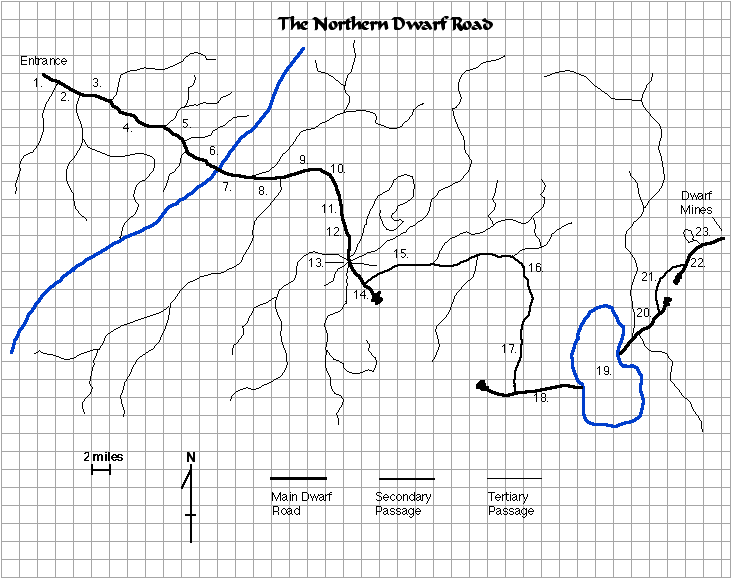 |
Travelling through the Underworld:
Assuming the party has infravision and/or light sources, travel is at a rate of about 6 miles per day. While this seems like a very slow pace, keep in mind several things. First, the air here tends to be stale to those not used to this, and therefore, surface dwellers will fatigue more quickly. In addition, given the very dangerous and strange environment, the party is likely to want to travel very carefully, watching for sinkholes, traps, and unpleasant monsters on the floors, sides, and ceilings. Also, the tunnel does bend and turn more than is shown on the large scale map, and this adds to the time to travel. If the party insists on making all due haste, then the movement rate can be doubled, but then allow all monsters a +1 chance to surprise and give the party a -1 to hit and for physical saving throws and NWP checks due to fatigue (except for dwarves and gnomes and other subterranean dwellers).
Food and water is not readily available underground, except where noted. Occasionally fungus and stagnant pools do occur, but the party is well-advised to avoid these. Should someone insist upon drinking or eating from these, allow a 5% chance of a nutritious effect, a 35% chance of bad water or food having no value, and a 60% chance of some harmful effect...with the higher the die roll, the worse the effect.
01-05 = good effect
06-40 = neutral effect
41-00 = bad effect
Throughout the tunnel are numerous side passages as mentioned above. Many of these show signs of being bricked up, but a few show signs of having been once bricked up and are now torn open again. Undoubtedly, a few of these side tunnels eventually lead to the surface.
Encounter #1
About two-thirds of a mile into the tunnel, the party rounds a corner and comes face to face with a cluster of shriekers growing in a long 100' deep patch across the passageway. There are at least 50 of the things, and the party rounding the corner will be within about 20' of the first half dozen or so, which will start a cacophonous wailing.
Within the mass of shriekers are 3 violet fungi. Anyone traversing the patch has a 65% chance of coming close to a violet fungus. Only check once, since the violet fungi tend to spread out, so no one will meet more than 1 unless they run willy-nilly through the patch. If the party presents a single file line, then only roll once for the entire party.
Shriekers (x50) (AC7; MV1; HD3; hp 14; THAC0 -; #ATT0; D -; SD noise; XP 120 ea; src MM)
Violet Fungi (x3) (AC7; MV1; HD3; hp 13; THACO 17; #ATT4; D -; SA rot; XP 175 ea; src MM)
Within 20 rounds after the first shriek, the noise will attract 3 groups of nearby denizens.
The first group attracted is also the most notable, a group of 5 hook horrors who live in a nearby chimney that leads straight up to a cave where the clan elder and 4 females dwell with a clutch of 4 eggs.
These hook horrors will not brave the violet fungi, but will instead lie in ambush in an area where 4 side passages meet at the main roadway. 1 hook horror waits in each passageway and the fifth crouches on a small ledge about 15' above the passageway, intending to leap on the party if they hug the righthand wall.
5 hook horrors (AC3; MV9; HD5; hp 25, 27, 24, 27, 20; THAC0 15; #ATT3; D 1-8 / 1-8 / 1-12; XP 175 ea; src MM)
The second group to take notice of the shriekers is a group of jermlaine. These little creatures are merely scouts for their tribe, and while 2 of their number run to report the strange intruders, the remaining 4 will stalk the party, remaining out of sight and leaving little bits of scented fungus behind as a trail. The main jermlaine encounter will be later in the scenario.
The third and final group to take notice is a solitary creature called a magebane. This reclusive creature will observe the fight between the hook horrors and the party, and if any mage spells are cast it will choose the mage as its chosen one and will shadow it until slain, with the usual magebane effects (see the Monstrous Companion for details).
Magebane (AC5[1]; MV6, fl12[A]; HD2+4; hp 15; THAC0 17; #ATT1; D D4+2 or 2D4; SD absorb spells; MR75%[100%]; XP 400; src MC)
This magebane will physically intervene to help its chosen one if it becomes involved in melee combat and the combat looks bad for the mage. This is likely to be the only time the party will be able to see and determine the existence of the magebane.
Encounter #2
Here the party will espy along the side of the tunnel a particularly fine dwarven statue, intact in the shape of a dwarven lord sitting on a throne of stone. The only desecration here is that the head lies fallen behind the throne. Between the head and the throne back can be seen the glint of something...perhaps crystalline.
Anyone reaching in to grab the crystals or moving aside the head (which is about 3 feet in diameter and would take 3 strong persons to roll away) will disturb a tunnel worm, which lairs in a hole below the head and which body is curled up under the stone throne. Also disturbed are its brood, effectively 8 giant centipedes.
Tunnel Worm (AC4; MV6; HD9+3; hp 35; THAC0 11; #ATT1; D 2-8; SA +2 to hit from lunge, chew through armour; XP 1400; src MM)
Giant Centipedes (x8) (AC9; MV15; HD1/2; hp 2; THAC0 20; #ATT1; D -; SA poison [+4 or paralyzed for 2d6 mr]; SD -1 to saves due to small size; XP 35 ea; src MM)
If the tunnel worm's body is removed, in its lair will be found stinking rotting bits of carrion and cracked egg shells. Some 12 more eggs lie unhatched.
Encounter #3
This is a largish natural cave, probably at one time a beautiful
grotto maintained by the first dwarves of Ironaxe. The whole is
dotted with stalactites and stalagmites, although a path through
the centre is less possessed of both. While adventurers are watching
the ceiling nervous for piercers, they will likely be surprised
when a grey ooze attacks from a nearby stalagmite.
Grey ooze (AC8; MV1; HD3+3; hp 12; THAC0 17; #ATT1; D 2-16; SA corrodes metal; SD immune to most spells; XP 270; src MM).
Encounter #4
The party will come upon what appears to be many eyes glowing evilly at them from the darkness. In actuality, this is a pack of fire beetles, likely to be prized by the party for their glands. The beetles are located randomly about the place on the floor, walls, and ceilings. Loud noises (like explosions) will scatter them, but otherwise, each will attack individually if molested.
Fire Beetles (x9) (AC4; MV 12; HD1+2; hp 9; THAC0 19; #ATT1; D 2-8; XP 35 ea; src MM)
Encounter #5
At the side of the passageway is a small pool about 15 feet in diameter which appears to have seeped from the nearby wall. The strange thing about the pool is that it is glowing with multicoloured hues that seem to writhe and ripple and in fact the entire surface seems to roil and quiver slightly.
This is a pool of wild magic, left over from an ancient wave of wild magic launched by the Maug Ulmigurr-tholasht during the fourth Deceiver war.
Every round, there is a 15% chance that a wild surge will emanate from the pool. This will result in a pulsating multicoloured light flashing outward from the pool for a very short duration. As the light bathes over the party, roll on the Wild Magic surge table from Tome of Magic.
If any random-type magic item is used within 40' of the pool, a surge will always occur. Similarly, if anyone drinks of the waters, a surge will occur for him personally.
If some of the water is taken, allow a 1% chance per turn for the first 100 turns that a surge will occur. After that the weird liquid becomes more quiescent. A mage studying this water for 20-INT years can start to research Wild Magic spells.
Encounter #6
The party reaches an underground river that flows from left to right. A stone bridge about 15' wide crosses the river at this point in a wide arch the ends 40' across on the other side. The bridge is decorated with dwarven bas reliefs, and looks intact, although some places are battered and bits of stone have cracked or broken off.
Lairing in a niche in the ceiling above the bridge, about 30' up, is a cave fisher. This beast has just arrived at its new home and has heretofore lived on giant bats and beetles and the like. However, it has strung a filament down from its niche onto and across the bridge at its apex. Anyone approaching within 10' has a 20% chance of spotting the filament. Anyone not seeing it will become caught in it 90% of the time. Once caught, the cave fisher will wheel the victim up at a rate of 15' per round.
If the filament is spotted or missed, the fisher will draw it up and try to shoot it at anyone on the bridge. Victims caught and pulled up will be killed and then eaten.
The niche in the ceiling is a small cavelet that run parallel to the river and is about 5' tall and about 10' deep and wide. Within are some dung and bat bones and beetle carapaces.
Cave Fisher (AC4; MV1; HD3; hp 14; THAC0 17 or 15; #ATT2; D 2-8 / 2-8; SA shoot filament as 6HD monster, adhesive traplines; XP 175; src MM)
The river itself is deep (about 25') with sheer sides and fast. Anyone dropping from more than 15' above the bridge in the cave fisher's line has a 15% chance of falling off of the bridge and into the river. A Tumbling proficiency can ensure that the bridge is automatically hit if the NWP roll is made. If someone falls in the river, the party has 1 round to save him before he is swept out of sight and down the river, probably gone forever, although the DM may want to say that the river eventually washes up onto a distant cavern shore and anyone making a Con roll survives the frequent submersions with one to three D6 worth of damage from battering. It is left up to the DM to create some separate encounters or adventures for such an unfortunate person.
Encounter #7
Soon after the river, the party will emerge into a large high cavern studded with stalactites and stalagmites. Within lair many bats, most of them normal sized but a few giant varieties also dwell here. The place is cluttered with bat guano, although the paved portion which represents the Dwarven road is less strewn than the rest of the cavern. At the first sign of light the bats in here will scatter, quite disturbed. Anyone not falling to the floor will take half the average AC of their body and head per round until they drop to the floor. Anyone holding a lantern or torch will drop it or have it struck out of their hands. After about 5-10 minutes, the bats will have fled the cavern and it will be safe to proceed.
Encounter #8
An archway is present in the passageway here, once quite grand and encarved with dwarvish bas reliefs and Dwarf Runes proclaiming the strength and willfulness of the Ironaxe Clan. Massive iron portals used to cross the passageway at this point, but all that remains are the corroded bits of hinges. Several smallish side passages emerge into the tunnelway here.
This is the hunting territory of a rust monster, which ate the iron gates about 10 years ago. It will smell the approach of anyone coming within 10' of the archway bearing ferrous metals and will emerge quickly from a side passageway to feast upon the stuff.
Rust Monster (AC2; MV18; HD5; hp 28; THAC0 15; #ATT2; D nil; SA rust; SD rust; XP 270; src MM)
Encounter #9
At this place in the passageway is the body of a xorn, apparently killed by something that squeezed it to death around the middle where its stomach might be. The xorn body is partially melded with the surrounding stone floor and wall, such that two of its legs and one arm is missing into the stone.
Encounter #10
About 200 yards from the xorn body is a drow dagger with a wavy blade and made of the usual drow adamantite alloy. It gives a +2 enchantment and will remain effective for about 10 more days underground before becoming a normal dagger. It will last for about 2 days above ground before rotting. The dagger will be spotted about 50% of the time in torchlight or lantern light but only about 5% of the time with infravision. When held it emits a strange purple ultraviolet-like glow.
Encounter #11:
The jermlaines that have been shadowing the party since the shriekers (encounter #1) will finally make their move. For about 200 yards before the main encounter, they will use a trip cord to trip the lead party members. At the same time about half a dozen of these little gremlins will emerge behind the party and cut weapon straps and armour straps which will then fall off between 1-12 rounds later.
Up ahead at the main encounter there is a sinkhole crossing about half of the passageway. There is certainly enough room to easily move around it, but the jermlaine have strung a tarp across the floor next to the sinkhole and covered it with dust and stones. When someone steps on the tarp the jermlaines release some rocks into the sinkhole, pulling the tarp along with it and pulling along anyone on the tarp who is not surprised (3 in 10 chance to be surprised) and makes a dexterity roll. Even if not caught, the victim will fall for 1 round. If pulled into the hole, the victim falls 15' to the bottom, into which the jermlaines have strung a net. The net will not catch a falling victim but will wrap around him as he falls, entangling him for 3d6 rounds or until two bend bars rolls are made to rip the net apart. If a sharp small weapon is in hand, allow a 10% chance per level that the weapon remained in hand, and the time to free oneself then drops to 2d6 rounds.
While the victim struggles below, the rest of the party will be subject to the rest of the jermlaine ambush. First, about 20 jermlaines will throw darts at the party from small cubby holes in the passageway, many of which ultimately lead to small passageways about 8" tall that honeycomb the walls of the main dwarf roadway. After launching a volley of darts, the jermlaine will continue to hit and run with their darts, never actually getting into melee combat with the party if possible.
Meanwhile, at the bottom of the sinkhole about 12 jermlaines will emerge from a hole at the pit bottom and begin to drag their netted victim into the 3' diameter hole. Once they do so, they will spend D6 rounds robbing him of anything they can drag through the net, pummeling their victim senseless with their saps if possible. Once senseless, they will strip their victim, shave him, and leave him at the bottom of the pit naked and bound by thick cords of woven fungus.
If friends jump down into the pit, the jermlaine will run away from their hole at pit bottom, not wanting to encounter the party directly. However, the 6 jermlaines in a 6" tall niche about 6' below the pit edge will begin to rain rocks and darts on people in the pit. In addition, these six have 3 special missiles:
1) a ball of spores which bursts on impact in a 5' radius and forces a save versus poison or fall asleep for D6 turns
2) a rat bladder filled with acid (does D6 damage and can damage equipment, no more than 1 or 2 small pieces though)
3) a bladder with a wick which is filled with methane and when lit by the jermlaine will explode on impact doing D6 damage in a 10' radius but causing only paper products and cloth products to save versus fire or be destroyed
These jermlaines can call upon 2d6 nearby giant rats if hard pressed. They will use these rats as shock troops to cover their retreat.
While malicious, these gremlins are not out to kill the party but to rob them and humiliate them. Anyone captured will turn up naked and shaved in a passageway soon after.
Jermlaine (x36) (AC7; MV15; HD1/2; hp 3; THAC0 20; #ATT1; D 1-2; SA sneakiness and ambush; XP 15; src MM)
Giant Rats (x24) (AC7; MV12 sw6; HD1/2; hp 3 ea; THAC0 20; #ATT1; D 1-3; SA disease; XP 15; src MM)
The jermlaines are not prone to returning any items they have stolen even in exchange for ransoming their own kind. Rather, they will laugh and titter to such proposals and remain hidden. The party had simply better count their losses and move on.
Encounter #12
Scrawled in purplish ink in strange flowing script along the wall of the passageway is written in a strange Elvish dialect (actually Drow Elvish):
Beware the Meenlocks
Encounter #13
In this area is the remains of a group of dwarves which managed to escape the initial onslaught of the drow and fled to this point, hoping to lose themselves in a side tunnel. Unfortunately for them they did not make it, surrounded on both sides by approaching drow forces. Some two dozen dwarves perished here, and the moldering remains of about 12 skeletons can be seen here. These dwarves have nothing of value on them, just broken weapons, sundered shields, and rotted and pierced armour. The remains of a flintlock pistol, apparently dissected by curious drow, lies scattered on the ground. Some of the skeletons have 3-4 small 2" holes in their skulls, as if large worms burrowed into them.
Under one of the skeletons, clutched in its hand, is a scrap of leather with Dwarf Runes written on it in blood. The runes, if translated, read:
Dwarf Gods from home All Gods far
This is a message from a dying dwarf providing a clue as to where he hid his valuables in order to keep them from the drow. There are three dwarf gods, and home means the Ironaxe Stronghold to the southeast. So the first part of the clue means the third passageway from the southeast. There are actually 6 small passageways emanating from this area within a distance of 200'. The second part of the clue means 32 (the number of gods not counting the Deceiver) feet down that passageway. There, buried behind some stones and rubble in a niche are the following:
o 2 potions of healing
o a potion of growth
o a priestly scroll with the spells Cure Moderate Wounds (2nd
lvl), Soften Earth and Stone (2nd lvl), and Remove Paralysis (3rd
lvl). All of these spells are enscribed at 6th level of effectiveness.
o a battle axe +1 enscribed with Dwarvish runes. This axe also
has the power to grow to a two handed axe upon utterance of a
command word and back to a battle axe upon utterance of another
command word. The word may only be uttered with effect by the
axe wielder.
Encounter #14
At this point in the roadway there has been a collapse. A dwarf who makes a successful Detection proficiency roll can determine that the collapse probably happened within the last decade or so. The collapse makes the roadway completely unpassable, so the party is going to have to take a side passage. The only nearby passageway is one about 100 yards back and to the left. If the party does not want to take that passageway, then the DM can simply substitute any passageway they elect to traverse as the one with the following encounters. Eventually, whatever passageway they choose will loop around and lead back to the main roadway.
At the entrance to the passageway nearest to the collapse is written in purplish Elvish runes the word SAFE.
The new tunnel is shorter (about 10' tall) and narrower (about 20'-30' wide) and more choked with debris and stalactites and stalagmites. Myriad smaller passages emanate off of this secondary passageway. Treat these tertiary passages like the side passages mentioned at the start of this episode.
Encounter #15
At this point in the passageway the party will encounter a meenlock. This foul, very evil creature haunts this passageway. It has made a meal of the occasional drow traveler and back at its lair are another two of its ilk which are currently converting a drow warrior into one of their own kind.
The single meenlock is basically a guard. It watches the passageway hidden from view between two closely-set stalagmites and will send telepathic emanations to any who approach the area, instilling a sense of dread so that they hurry on by and do not investigate the meenlock lair.
Nevertheless, anyone poking around the centre of the feeling of dread will feel it most strongly at a tertiary passageway. About 100' down the tertiary way is a small passageway some 3 and 1/2 feet in diameter which leads back about 15' to a small 6' tall and roughly 20' round chamber.
Should anyone enter the tertiary passageway, they will feel the warnings of death and dread heighten, almost hysterically.
If the party breaks into the lair, see the description below. The meenlock guarding the passageway will not follow but will instead track the party just as he would were the party to pass along without disturbing the lair.
Within the lair are two meenlocks who have a stone table upon which is set a drow elf halfway through the hideous process of transformation into a meenlock. The sight is gruesome to see, even happening to an evil being such as a drow, and the drow's mouth is sewn shut to prevent its screams, while its eyes are wide open in a gape that tells the pain it is undergoing. Cluttered around the chamber are bits of drow body parts, various wickedly shaped knives and cutting instruments sized for tiny hands, and a strange orange-green moss which coats the walls and ceiling. This is the meenlock moss, used in the conversion process.
At the top of the chamber is a small 2' diameter chimney that climbs some 350' to the surface of a valley cutting between two tall cliffsides. This small valley is shaded by thick trees and bushes. The meenlock use this exit to enter the surface world, especially at night.
Within the lair are the accouterments of the drow warrior, scattered about the place. There is a suit of even-sized drow chainmail +2, a drow dagger +1, and a drow short sword +2.
The drow is beyond interrogation or communication. The best it can do is mutter "kill me...kill me" over and over again in Drow Elvish.
The lone meenlock in the passageway, whether or not the party stops to attack the lair, will shadow the party as they move on down the passageway, harassing the apparent leader or the most Lawful Good appearing person (e.g. a Paladin of Meredros) in the party telepathically. When the party beds down for the "night", it will attack, seeking to paralyze the guards and then drag away the chosen victim back to the lair for transformation.
Meenlock (x3) (AC7; MV9; HD4; hp 12, 15, 12, 19; THAC0 17; #ATT2; D 1-4 / 1-4; SA fear, paralyzation; SD dimension door; XP 650; src MC2)
Encounter #16
This encounter is basically a ruse so that the party doesn't suspect
that every time the DM starts a description there is something
to fight or find. This is a large and wondrous cavern filled with
a luminescent fungus that paints the walls with mutlicoloured
striations. Fluted columns of strange minerals rise to the ceiling
some 60' overhead, and a waterfall cascades from a hole in the
wall about 50' up and falls to a pool a covering about a third
of the 200' by 200' cavern. Mushrooms and fungi grow everywhere
and bats dot the ceiling. However, as used to the glow of the
fungus as these bats are, they are unlikely to panic at the introduction
of the party's light sources. There is nothing of danger or value
in this beautiful cavern.
Encounter #17
Here is a smallish cavern about 40'-60' in diameter and about
25' high. A passageway has seemingly been cut or smashed through
the middle of the cave, but otherwise columns and stalagmites
and stalactites are everywhere.
Hiding behind a dense growth of stone columns to the south of the pathway is a suwyze. This creature serves as a watcher and spy for the drow, who feed it slaves and lizard meat. This creature is not evil, but merely exists to be taken care of by its masters as it ruminates its odd ponderings. As such, when a party passes through this cavern, the suwyze will note the passing, trying to remain hidden, and will then scurry down a tertiary passageway to warn its masters in a drow guardpost some 400' below the level of the Dwarf Road. Upon doing this, a chitine warparty will form and this warparty will wait at area 18 to set up an ambush. The suwyze will only attack if attacked first; it prefers simply to hide and warn.
Suwyze (AC4; MV12 cl12; HD4+4; hp 17; THAC0 15; #ATT8; D 1-6; SA spells, tendrils; SD never surprised; XP 975; src MC)
Encounter #18
The secondary passageway finally emerges back on the main Dwarf Road a few miles past the other side of the apparently massive cave-in. About a mile after the junction is the chitine ambush. These chitine are cast-offs from drow society, failed experiments who worship Lolth with loving devotion but despising and fearing the drow.
The ambush takes the form of masses of webs crossing the entire passageway, including the walls and ceiling, except for a small crawl space in the centre about 4' wide and 4' high. On the ceiling over the end of this tunnel through the webs is hung an immense net of webbing, held to the ceiling by lines managed by hidden chitine. Their plan is for the party to crawl through the webbing and, while crouched, to be ensnared by the net. The netted victim will then be dragged away and killed while the rest of the party is blocked by the webbing from coming through except via the cramped tunnel. A mass of chitine would wait around the tunnel entrance to attack anyone crawling through.
Of course, the webs are flammable, but the chitine have though of that too. While the webs are visible as they block the passageway, these webs also arc back along the ceiling for about 50' behind the wall of webs (that is, to the northwest or the way the party is coming from). This backwards arcing of webbing along the ceiling is camouflaged by rocks and dust stuck to the webbing, so that the whole thing looks like a part of the craggy ceiling. Between this webbing and the ceiling are heavy rocks, held up by the webbing. If the party fires the web wall, it will go up in flames fairly quickly, arcing up over the party. When the hidden webbing above the party burns, the rocks held up by the webbing will drop down amongst the party. Each person in the 50' length of tunnel covered by the overhead webbing will take damage equal to the average of their body and head AC (but treat negative AC as zero) from falling stones. As this rain of stone pummels the party, the chitines will attack.
The chitine use javelins and shortswords of hardened webbing. See the Monstrous Compendium Annual Volume One for more details. These creatures will attack until half their number are fallen.
Chitine (x12) (AC6; MV12 wb9; HD2; hp 12, 15, 12, 19; THAC0 19; #ATT3; D 1-6 (x3); SA web traps; XP 120 ea; src MC)
Encounter #19
Eventually the party will reach the beginning of an immense cavern which forms what appears to be a beach for an underground lake or sea of some sort. This shore is crescent shaped, about 100 yards thick at its centre and perhaps 3 miles wide from tip to tip. The lake (for fresh watered it is) is quite deep, at some places over 1000' deep, and quite wide, about 6-7 miles across and 12 miles wide.
There are a set of docks thrusting out from the shoreline on the northwest side of the lake. On the far opposite side of the lake is another such crescent shaped shore of about the same dimensions with another set of docks. The docks are made of steel plates connected with rivets and driven into the lakeside on steel pillars for support. There are some dents and signs of damage but they are relatively intact. Runes and sigils honouring Malaktum are enscribed into some of the plates.
On mooring posts at both docks are strange thick ropes made of fungus strands, these of drow make and clearly not dwarvish in design.
Standing about 200 yards north of the docks on the northwest side of the lake is a 9' tall gigantic stone dwarf covered in adamantine platemail. Its right hand is a huge hammer and its left hand is a massive pickaxe. This is a hammer golem, created by the ancient Ironaxe priests of Weshta-Grum from their sacred lore. This particular golem has orders to protect and guard a dwarven boat, which is hidden in a secret compartment in the wall of the cavern before which it stands. The golem is under instructions to only allow a dwarf to have access to the boat. Anyone else trying to open the secret portal will be attacked. The golem will also attack if it itself is attacked or if it sees a goblinoid creature. Otherwise, even if touched or lightly jostled it will not react. Upon the cavern wall that covers the boat compartment is the Dwarvish Rune for Crossing.
Hammer Golem (AC0; MV6 br6; HD14; hp 60; THAC0 7; #ATT2; D 2d10 / 2d12; SA pounding force; SD +1 weapon to hit, spell immunities; XP 13000; src MC)
If the party does not have a dwarf, then it has three choices:
1. It can attempt to attack the golem (which should prove costly to mid-level parties)
2. They can create a diversion. This would pretty much have to be of a goblinoid-type creature. If the Ggolem sees such a creature, it will chase and attack it, even to the exclusion of guarding the boat compartment. However, the party would have to somehow figure out that a goblin will distract such a creature. Perhaps they use divination spells or make a lucky guess.
3. Finally, as a surefire method, eventually, about 2D3 hours later, a drow party will come forward (ostensibly searching for the lost drow warrior captured by the meenlocks from Encounter #15 if you need to have a specific reason). These drow will sail from the opposite lakeshore and will be heard to toss in a body at about 1500 yards from the docks. These drow also have another corpse (of a duergar) with them to feed the lake dweller on the return trip. When the drow reach the 1500 yard point, the party will hear the distant echoes of the gibbering of the mouther, and then a soft splash as the body is thrown in. Even though this takes place almost 1 mile away, echoes carry well in this cavern.
The drow warparty is composed of four 2nd level warriors, a 3rd level warrior, and a leader who is a 4th level warrior and 4th level wizard. The latter two are females, while the 2nd level warriors are all male drow.
Drow Warriors (2nd lvl) (AC1; MV12; CL Wa; LV2; hp 18,17, 16, 16; THAC0 19; #ATT1; D by weapon; SA see below; SD see below; Weapons short sword+1, dagger+1; Armour chainmail+1, buckler+1, dexterity 15; MR 54%; XP 650; src MM)
Drow Warrior (3rd lvl) (AC-2; MV12; CL Wa; LV3; hp 20; THAC0 18; #ATT3/2; D by weapon; SA specialized in short sword (+1 to hit +2 damage), see below; SD see below; Weapons short sword+1, dagger+2, crossbow with darts [1-3] with poison [save -4 of unconscious 2d4 hrs]; Armour chainmail +2, buckler +2, 16 dexterity; MR 56%; XP 650; src MM)
Drow Leader (AC-2; MV12; CL Wa/Wi; LV4/4; hp 24; THAC0 17; #ATT3/2; D by weapon; SA see below; SD see below; Weapons short sword+2, dagger+2, crossbow with darts [1-3] with poison [save -4 or unconscious 2d4 hrs]; Armour chainmail +2, buckler +2, 16 dexterity; Spellpoints 30; Fixed Magic sleep, ray of fatigue, spider climb, phantasmal force, web, blur, 2 cantrips; Magic drow potion of healing, scroll of protection from earth elementals; MR 58%; XP 900; src MM) She wears a platinum holy symbol to Lolth in the shape of a spider with eight eyes and a drow female head.
All of these drow have the following abilities:
dancing lights, faerie fire, darkness, +2 to save vs magic, affected by bright lights
These drow sail in a boat made of a strange pumus-like black rock that seems to be lighter than water, yet tougher than wood. This boat is more of a raft, about 15' square with slightly upcurved edges. It has a keel for stability and is moved via a single long oar at its rear.
The dwarf boat within the compartment is made of a strange brownish metal without much lustre. Dwarves can recognize this metal as a special ore made from petrified wood and tin and enchanted to float upon water. The dwarf boat is a long rowboat with 4 oars and is large enough to accommodate up to 12 sitting persons.
At the very edge of the dock are Drow Elvish runes painted in purple letters. The words painted on the dock are:
Beware Feed
The lake is actually home to quite a few creatures, including blind cave fish etc. There are, however, a few more notable dwellers.
A few lemon fish dwell within the water, although they will not attack a boat. They will attack anyone in the water if they happen upon them.
Lemon Fish (up to 3) (AC6; MV sw24; HD6, 8, 7; hp 32, 35, 38; THAC0 15,13,13; #ATT2; D 2d4 / 4-6+poison, 2d6 / 8+poison, 2d6 / 7+poison; SA poison; SD stun cloud; MR 40%; XP 420, 975, 975; src MC2)
There is a 2% per round that someone in the water will be attacked by D3 of these creatures.
Of a more direct threat is a gibbering mouther, which has learned to wait in the middle of the lake for boats crossing. Unless it is fed a meal by the boaters each time the lake is crossed, it will attack. Whether the mouther is smart enough to actually honour such an arrangement, or whether the easy meal simply distracts it for long enough and then satiates it for a time is not known. It is true that devouring dead meat does not satisfy the mouther enough to allow it to grow, but it is enough to keep it alive.
Gibbering Mouther (AC1; MV3 sw6; HD4+3; hp 25; THAC0 17; #ATT6; D 1 (x6) + special; SA gibbering, spit, bite; SD ground control; XP 975; src MC)
If the mouther is not fed, it will attack any boat crossing, causing confusion and then blinding with its spit before attempting to bite and drag under its victims.
At the far end of the lake will be found the drow boat described under the drow warparty in item 3 in this encounter (assuming the party crosses the lake before the drow warparty does). This boat will be moored to dock by the strange fungus rope.
Encounter #20
Here is another collapse that completely blocks the Dwarf Road. In this case, however, the dwarves who refounded the Ironaxe stronghold chose to bypass the collapse, and a nice wide secondary passageway loops around the cave-in for about 5 miles. A Dwarf Rune for Safe Here is carved above the bypass way. Dwarven Runes for Danger Beyond is carved in the passageway floor right before the cave-in. The truth behind this cave-in is that a powerful demon called in by the Deceiver's forces during the ancient battle was trapped here by a Dwarf-caused cave-in. The bypass way is about 20' wide and 15' tall.
Encounter #21
Spiders friendly to the drow live here. Webs do not block the passageway here but are draped around the edges and across the ceiling. Within the area are 8 large and 14 hairy spiders, which will swarm any non-drow who pass by them. Firing the webs will damage D4 of each type of spider.
Large Spiders (x8) (AC8; MV6 wb15; HD1+1; hp 8, 4, 6, 5, 8, 5, 7, 8; THAC0 19; #ATT1; D 1; SA webs, poison; XP 175 ea; src MM)
Hairy Spiders (x14) (AC8; MV12 wb9; HD1-1; hp 4 ea; THAC0 20; #ATT1; D 1; SA poison; XP 65; src MM)
Stuck in the webbing is some treasure from a previous victim, likely an explorer from deeper in the Underworld. The treasure includes a pouch with 6 gems worth 150gp each, a flask of strange strong liquor (derro fungal brew), and a double bladed dagger (shaped like a large two-tined fork) with grooves that will hold poison twice as long as normal.
Encounter #22
At this point the passageway widens a bit, and along the left wall are the battered remains of an ancient dwarven siege weapon, in this case a strange bombard of iron on a wheeled cart of steel. Great mashing wheels and cleavers on pendulums emanated from the cart at one time, but many have broken off and are lying nearby. It is clear something large smashed the engine.
On and about the broken engine are 4 phantoms. These are dwarves who crewed the engine during the battle against the Deceiver. These dwarves were crushed when evil magics animated the stone wall next to them. Huge hands reached out from the walls next to the engine and crushed and absorbed the dwarves and then smashed the siege engine. These phantoms are continually reliving their death trauma. They are first seen manning the engine. All of a sudden there is a scream and the phantoms are grabbed up by invisible hands and squeezed into a pulp. This pulp runs to the floor in a pool of phlogiston and slowly (in about 5 rounds) reforms into the semblance of the dwarves. Once reformed, the phantoms remount the engine and begin the sequence all over again. As they reform, the phantoms wail and utter little diatribes like "Oh please great Weshta-Grum, free us from our everlasting death!" or "Curse the Deceiver for condemning us to eternal dying!"
The screams of the dwarvish phantoms are especially loud and terrifying at the moment they are first grabbed, and all hearing the screams for the first time must save vs death magic at a -2 penalty or become deaf for d10 hours. Deaf characters are -1 to hit and have a 25% chance of failing when trying to cast a spell with verbal components.
The drow pass by this area with wads of fungus stuck in their ears. Any sort of earplug or even covering one's ears with one's hands tightly will negate the deafening effect.
These phantoms can only be put to rest by a Remove Curse spell from a 12th level priest. They cannot be affected by the physical world in any other way.
Phantoms (x4) (AC nil; MV9; HD nil; hp -; THAC0 -; #ATT -; D -; SA deafness; XP nil; src MM)
Encounter #23
In a large niche off of the main Dwarf Road (the niche measures about 300' long by 100' wide by 50' tall) accessed via a large 10' diameter archway enscribed with Dwarf Runes of Honour and Death and Nobility are the various sarcophagi of ancient dwarven nobility. Many of the crypts have been battered open and looted, with skeletons splayed here and there mouldering on the cold stone floor. Some of the crypts have not been opened and remain sealed with glyph enscribed lead.
A total of 16 undead dwarves are here, guarding the crypts. These will phase in to attack anyone entering the crypt niche. If there is a dwarf among the group they seek to attack, they will ask in Dwarvish: Who comes to desecrate more of the tombs of the ancient Dwarven Kings? If the dwarf answers respectfully that they are not there to loot, then the undead dwarves will not attack and might even rasp answers to questions, although all they can tell is that the Deceiver's minions looted many of the tombs initially, but the drow lately looted a few before being driven out by these undead. They also know that a dwarf priest came and resanctified the area a short time ago (actually 25 years ago) and they honoured that priest by not attacking him.
Undead Dwarves (x16) (AC6; MV9; HD3+12; hp 28, 30, 20, 27, 37, 26, 28, 29, 29, 27, 28, 27, 28, 21, 27, 22; THAC0 17; #ATT1; D 3-12; SA phase door; SD +2 weapon to hit; MR 25%; XP 1400 ea; src MM)
The sealed dwarf tombs have treasure in them, possibly magic and jewels, but the lead seals are guarded by powerful glyphs of warding. It is assumed the party will not be interested in desecrating the tombs of the dwarf kings, but if they insist, the DM should provide treasure and the effects of the glyphs of wardings.
EPISODE 3 - WE ARE THERE
5 miles after the dwarven tombs (Encounter #23) the party will arrive at the mines of the Ironaxe stronghold. This episode is much more freeform than the previous episodes. It is up to the party to explore and find a way into the stronghold.
All references below refer to the Ironaxe Mines Map included with this scenario.
 |
KEY TO THE DWARF MINES
Unless stated otherwise, all passages in the mines are between 10' and 15' wide and 8'-10' high. They are generally devoid of stalagmites and stalactites and shored up by stone arches at approximately 100' intervals. These arches are unadorned and if somehow toppled will have a 50% chance to cause a collapse in D100 feet in either direction from the arch. Certain parts of the passages are denoted as newer construction. These have wooden arches supporting them rather than the more ancient intricate stonework.
Off Passageways:
Some passages on the map end in an arrow. This signifies that the passageway continues on down into the rest of the underworld. Parties travelling down one of these passages should have a clue that they are heading in the wrong direction as these passageways quickly begin to descend, and do so mercilessly. Also, the passages that contain the arrows are themselves clearly not of dwarven make. They are cruder and have no buttresses supporting them. Where they intersect the mine passageways, it is apparent that the wall of the mines was dug open by the creators of these descending passageways. Some of them show signs of recent attempts (about 10-15 years old) to brick them up, and indeed other places along the mine passageways are still bricked up and no doubt lead to other descending passageways.
The descending passageways off of area 11 definitely head towards the drow city below. The rest go off into random parts of the underdark. The DM will have to create scenarios and encounters should the party persist in travelling these ways.
Wandering Monsters:
Many of the creatures herein tend to wander from their lairs, in order to hunt.
The DM should check for a wandering encounter once per turn of stationary activity or per 10 squares (1000') of travel. Such encounters will not occur in a section of passage or cave that is already represented by a numbered encounter. A check results in a roll on the below table if d00 comes up with a roll of 01-10.
When rolling on the table below, the SOURCE column tells from which encounter area the wandering monster should be deducted. Those with no source number are not native to these mines or are too numerous to keep a tally of.
|
|
|
|
|
|
|
|
Giant Centipedes |
|
|
will attack |
|
|
Giant Rats |
|
|
will attack unless severely outnumbered or presented with fire |
|
|
Osquips |
|
|
will attack from burrowed holes |
|
|
Troglodytes |
|
|
will attack from ambush if possible |
|
|
Large Spiders |
|
|
will attack |
|
|
Otyugh |
|
|
will possibly attack |
|
|
Drow Warriors |
|
|
will attack and attempt to warn their fellows |
|
|
Fire Beetles |
|
|
will not attack |
|
|
Giant Toads |
|
|
will attack |
|
|
Umber Hulk |
|
|
will burst from the surrounding wall and attack |
|
|
Carrion Crawler |
|
|
will attack |
|
|
Giant Lizards |
|
|
will attack 50% or ignore the party 50% |
|
|
Hairy Spiders |
|
|
will attack |
|
|
Shriekers |
|
|
will sound off, requiring another wandering monster roll, allow a 5% chance for each shrieker that it is a violet fungus |
|
|
Jermlaines |
|
|
will likely practice mischief upon the party |
|
|
Stirges |
|
|
will attack |
|
|
Special |
|
|
DM's choice |
1. Entrance
A grand archway separates the Dwarf Road from the Dwarf Mines, and beyond the archway, which is decorated with bas reliefs of dwarves mining and slaying evil creatures, is a large cavern some 200' in diameter and about 45' tall. This cave was used as a staging area for caravans leaving or entering the stronghold, and remnants of massive iron portals still hang at the archway. The archway itself is about 30' wide and as high.
In the cavern are two small structures built out of the cave walls. These resemble small single story buildings, about 40' square, each with a battlemented roof. Crossletted arrow slits pierce these buildings and an iron door is in one face of each building. On the roof of these buildings are the remnants of some strange dwarven war machines, possibly fire projectors. Each iron door in unlocked and within is a single room with stone stairs leading to an iron trap door to the roof. In each room is a broken and rusted massive mechanism used at one time to open and shut and bar the great iron valves to the cavern.
Within the south building lair a group of osquips, which exit and enter through a small 2' high and 4' wide crack at the far base of the building. Within the building can be seen various osquip tunnels that are about 2' in diameter and wind back and under the building and into the cavern walls for several hundred yards. 10 of these adult osquips lair in the building proper and will attack any intruders. 4 adults and 6 younglings are hidden deep within their tunnels.
Osquip (x10) (AC7; MV12 br1/2; HD3+1; hp 12, 14, 9, 15, 10, 15, 15, 15, 13, 8; THAC0 16; #ATT1; D 2-12; XP 120; src MM)
In the other building, the top of the trap door is coated with deep mold. When the trap door is opened downward, the deep mold will be jarred and will release its spores, engulfing the opener.
Deep Mold (AC9; MV0; HD -; hp -; THAC0 -; #ATT1; D special; SA spores, strength loss; SD immunities; XP 35; src MC2)
The drow do not choose to watch this cavern as they feel it is too close to the outside passageways and they do not want to have to deal with random creatures blundering into them.
2. Troglodyte Guardpost
Here is the first actual encounter with the drow guardianship. In this case a group of troglodytes dwells in this part of the mines, these being the personal and ancient allies of the drow House Quinilver. As long as they keep this guardpost active and do not harass drow, they are allowed to reside here and occasionally given rewards.
This cavern is a juncture of three passageways. The place is roughly ovoid in shape and about 100' long by 70' wide with the long end running north to south. The whole is dotted with stalagmites and stalactites, not enough to stop travel through the cavern but enough to allow its occupants to have cover.
The occupants here are 16 troglodytes. These generally spend their time sleeping, chewing on meat, and wrestling and fighting with one another. These creatures generally make a racket that can be heard from a fair bit away if listened for. If the troglodytes hear the party approaching, they will quickly hide and use their chameleon-like abilities to ambush the party, tossing their javelins first before charging into the fray. These troglodytes are the bachelors of the clan, too rowdy and too much of a potential threat to the chief to allow them to live with the rest of the tribe all of the time. Because of their youth and relative inexperience, these bachelors are not tactically inclined but are less prone to retreat, seeking glory and human flesh.
Troglodytes (x15) (AC5; MV12; HD2; hp 9 ea; THAC0 19; #ATT1; D javelin 2-8 or stone battle axe 1-8; SA scent; SD chameleon; XP 120; src MM)
These are led by the biggest bachelor (AC5; MV12; HD3; hp 16; THAC0 17; #ATT1; D javelin 2-8 or stone battle axe 1-8; SA scent; SD chameleon; XP 175; src MM) This one has a tooth necklace with small gems pounded into the teeth. The gems are worth a total of 25gp.
The lair itself, away from the centre of the cavern, is strewn with discarded reptile skins used as bedding, odd javelins, and bits and pieces of rats and other small parts, evidence of past meals. If an attack does occur, there is a 5% chance per round that a troglodyte will finally remember its orders and flee to area 5 to warn the rest of the tribe.
3. Troglodyte Warren
In this small cavern about 50' round and 20' high is the troglodyte nursery. Here, some 50 females nurse and watch over about 28 younglings and 15 unhatched eggs, which are set into a small pool of water in the mud. A mass of discarded bones and trinkets competes with shed troglodyte skin beds for space around the floor of the cavern.
A male subchieftain and 3 large troglodyte warriors guard the nursery and brood.
Female Troglodytes (x50) (AC5; MV12; HD1+1; hp 6 ea; THAC0 19; #ATT3; D 1-2 / 1-2 / 2-5; SA scent; SD chameleon; XP 100; src MM)
Subchieftain (AC5; MV12; HD4; hp 20; THAC0 17; #ATT1; D javelin 2-8 or stone battle axe 1-8; SA scent; SD chameleon; XP 270; src MM) This subchieftain wears a copper bracer worth 10gp and has a ruby in place of his left eye worth 400gp.
Troglodyte Guards (x3) (AC5; MV12; HD3; hp 13,17,16; THAC0 17; #ATT1; D javelin 2-8 or stone battle axe 1-8; SA scent; SD chameleon; XP 175; src MM) Each has a copper bracer worth 10gp.
4. The Garbage Pit
The stench emanating from this cavern is discernible from about 200 yards away. It is a foul, disgusting waste-like smell and comes from a cavern that is about 40' wide by 60' long and 10' high, sunken about 6' from the level of the passageway. Within is a literal heap of refuse (dung, bones, offal, rotted plant material, et al). Within the refuse dwells an otyugh. This otyugh has made a pact with the troglodytes and the drow. In exchange for food, it agrees to attack intruders and to not attack the drow and their allies. The troglodytes every so often gather their dung and refuse and toss it in here. The drow have their slaves do the same from the stronghold above. Occasionally, this otyugh gets bored or impatient and emerges to hunt the mines.
A trail of dung scrapings can be noticed by a tracking roll in the passageway to this cavern. A close examination by an expert can determine that a three-legged creature of large disposition made these tracks.
The otyugh will attack any party members it encounters. When the party first enters this cavern area, it will thrust its eyestalk above the heap to observe the party. The creature will burrow under the surface like a shark and try to get close enough to attack its prey.
Otyugh (AC3; MV6; HD6; hp 20; THAC0 15; #ATT3; D 1-8 / 1-8 / 2-5; SA grab, disease; SD never surprised; XP 650; src MM)
5. Troglodyte Cavern
Here is the main troglodyte cavern. Refer to the Troglodyte Cavern Submap for reference to the key below.
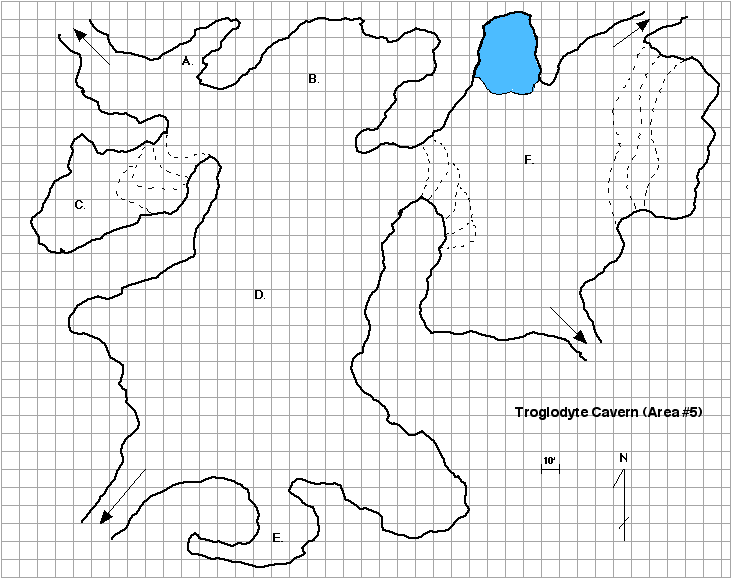 |
A. This is a smallish niche used as a guardpost by the troglodytes. Here are always 4 males armed with javelins. They will always let out a cry and hue as they leap to the attack.
Troglodytes (x4) (AC5; MV12; HD2; hp 9 ea; THAC0 19; #ATT1; D javelin 2-8 or stone battle axe 1-8; SA scent; SD chameleon; XP 120; src MM)
B. This is a dirty and squalid common area, home to the older males troglodytes. There are skin beds and bits of food and dung all over the place, which reeks substantially and mixes with the musky scent of troglodyte.
Some 12 troglodytes dwell in this area. They are low on the hierarchy and are usually abused by the stronger of their ilk.
Troglodytes (x12) (AC5; MV12; HD2; hp 7 ea; THAC0 19; #ATT3; D 1-2 / 1-2 / 2-5; SA scent; SD chameleon; XP 120; src MM)
C. This is the troglodyte temple, which is simply a crude stone pillar where crude representations of a humanoid type figure have been carved into the stone. The whole is primitive and wholly unartistic. Various grisly trophies have been laid around this statue, mostly skulls of various creatures, including giant rats, dwarves, and even troglodytes (possibly past chieftains long deposed). Atop this statue has been set a fine obsidian carving of a spider with rubies for eyes and a human head made of jet with opal eyes. The whole is heavy (about 100 pounds) and quite valuable (about 1500gp) and is a gift from the drow designed to draw reverence and respect of Lolth by the troglodytes.
D. This is the main common area and is as messy as area B. Within dwell roughly 20 troglodytes, all fearsome warriors who love a good fight.
Troglodytes (x20) (AC5; MV12; HD2; hp 9 ea; THAC0 19; #ATT1; D javelin 2-8 or stone battle axe 1-8; SA scent; SD chameleon; XP 120; src MM)
These are led by 2 stronger troglodytes (AC5; MV12; HD3; hp 14,16; THAC0 17; #ATT1; D javelin 2-8 or stone battle axe 1-8; SA scent; SD chameleon; XP 120; src MM)
E. This small side cave that juts off from the main cavern is the troglodyte "smithy". Here are several large flat rocks with gouges in them designed to allow steel to be bent and pounded into javelin heads without the use of fire. Several fist sized rocks are used as hammers, and strips of fungi are hardened and used to tie the heads to shafts of bone. Many skeletons, partially dismembered, are stored here for future use.
F. This is the grand cavern of the tribe. To the north in a niche is a pool of water which flows out of a crack about 10' up the wall. This pool is about 10' deep and provides water for the tribe.
To the east is a dais-like natural shelf upon which sits the chieftain and his court. On the cavern floor are the chieftain's harem of females and the chieftain's offspring (12 younglings).
Female Troglodytes (x6) (AC5; MV12; HD1+1; hp 6 ea; THAC0 19; #ATT3; D 1-2 / 1-2 / 2-5; SA scent; SD chameleon; XP 100; src MM)
The chieftain sits upon a stone pillar that is about 6' above the floor of the shelf top. The pillar is jagged and easily climbed and is about 10' in diameter. The chieftain sleeps up here.
On the shelf itself are the chieftain's guards, 6 large troglodytes who are the siblings of the chieftain and thus fairly loyal as far as troglodytes go.
Troglodyte Chieftain (AC5; MV12; HD6; hp 27; THAC0 15; #ATT1; D javelin 2-8 or stone battle axe 1-8; SA scent; SD chameleon, stone of good luck; XP 650; src MM) The chieftain wears silver bracers with drow designs on them (worth 150gp) and a bone diadem with a polished agate pounded into it. This agate is an ancient relic of the tribe and is a stone of good luck. While the troglodytes have no way of knowing the stone is magical, their legends say it brings the blessings of the troglodyte ancestors and therefore they believe (correctly) that the stone is a good luck charm.
Troglodyte Guards (x6) (AC5; MV12; HD3; hp 15,10,16,13,16,12; THAC0 19; #ATT1; D javelin 2-8 or stone battle axe 1-8; SA scent; SD chameleon; XP 175; src MM)
NOTE: If a guard from area 2 makes it here, or if a fight breaks out here in any case, there is a 10% chance per round of combat that the chieftain will remember to order a troglodyte to warn the drow at area 12.
6. Dwarven Secret Treasury
This is where the priests of Weshta-Grum hid their treasures during the ancient attack by the Deceiver. This passageway was once above the level of the lake (area 7) and accessed by a stone ledge that ran along the north wall of the lake cavern. The dwarves had set up a mechanism whereby the bridge would be collapsed and the passageway would sink 20' into the lake. The end of the treasure passageway would remain steady and so the passageway would turn from a level passageway to a slope that ascends from the lake to the treasure cavern.
The cavern itself is diamond shaped, about 100' long and half as wide. It is guarded by 6 living crystal statues who will attack anyone who is not a dwarf priest of Weshta-Grum.
Crystal Living Statues (x6) (AC4; MV9; HD3; hp 19, 12, 21, 17, 17, 23; THAC0 17; #ATT2; D 1d6 / 1d6; SD immunities; XP 120; src Mys)
The treasure here includes 1200 bars of gold worth 10gp each, 100 bars of silver worth 10sp each, and 60 bars of platinum worth 10pp each. Also, 4 bars of mithril are located here (each worth about 200gp).
Also here is a suit of dwarven chainmail +1, a mithril open helm +2, a warhammer +1, a stone box containing a periapt of proof against poison +1, a chest containing 20 blocks of incense of meditation, and a cloth enwrapping 3 candles of invocation dedicated to Lawful Good Weshta-Grum.
7. Mine Lake
The passageway from the northeast enters this huge cavern onto a stone shelf that sits about 5' above the surface of an immense underground lake, possibly a mining pit filled with water by the dwarves after it had been depleted. The lake is untold thousands of feet deep, effectively bottomless for all intents and purposes. There are no living things in this lake, as there are no outlets outside of the pit that it fills. There are two other exits from this cavern. One to the east is a passageway half submerged in water which slowly rises, emerging entirely from the water after about 300 yards. The other is sunken about 20' below the surface of the water and this leads to the secret dwarven treasury (area 6). Close examination of the ceiling of the cavern, some 40' above the surface of the water, reveals some sort of structural collapse many years ago along the northern wall of this cavern. This is a result of the sinking of the passageway to area 6. This collapsing is only visible in the ceiling area within 100' of the sunken passageway.
8. Lizard Chamber
While several subterranean lizards wander about these mines, this cavern is the lair of an albino female guarding her eggs. The cavern is only about 40' in diameter, and the lizard takes up much of that space, guarding her 3 eggs. She will attack anything that enters the cavern aggressively, as she has not eaten in order to guard her eggs. This lizard will fight at -1 to hit in the equivalent of sunlight.
Subterranean Lizard (AC5; MV12; HD6; hp 27; THAC0 15; #ATT1; D 2-12; SA clamp; XP 650; src MM)
9. Crawler Cave
The two main passages leading to this cave have purplish Elvish runes of Danger written on them about 400 yards from the cavern itself. This to warn of the occupants of the cavern, 2 mated carrion crawlers. About 200 yards from the cavern in each passageway are drow adamantine shackles, both for ankles and wrists. The drow often put slaves here to keep the crawlers fed and thus discourage them from roaming the mines causing trouble. As such, these crawlers only rarely leave their lair, but will attack anyone coming within 200 yards or so of their lair.
Carrion Crawlers (x2) (AC3/7; MV12; HD3+1; hp 14, 16; THAC0 17; #ATT1 or 8; D special or 1-2; SA paralysis; XP 420 ea; src MM)
The cavern itself is about 200 yards long and 50 yards wide, filled with columns and stalagmites and stalactites. The passageway to the north dead ends at a well that is still full of water.
10. Abandoned Cavern
This area was a relatively new area of the mines, restarted by the dwarves who came to the stronghold 25 years before, as evidenced by the wooden arches supporting the passageway. These dwarves had found an ancient boring device, looking like a huge wagon upon which rests a ballista-like apparatus whose front is a giant pointed grooved cone that apparently digs into the earth. The thing looks like it is ancient but has seen new repairs. A dwarf with engineering could possibly get the machine to work, but its only use is as a boring device. It will create a 10' passageway through stone to a depth of about 10' in about 2 hours. It requires 4 people to run and must be rejiggered every 12 hours of usage. The cone is of mithril and will cut through almost anything eventually.
11. Entrance to the Underdark
The two passageways to the north eventually lead down to the true Underdark, from whence the drow came. In fact, the drow first emerged from these passageways when they made their assault over two decades ago. The passages that end in arrows are those that eventually start to descend precipitously...certainly not heading up towards the surface or the dwarven stronghold. If the party decides to descend down these passages, the DM must prepare an Underdark campaign for them (or refer to the Therran Campaign writeup entitled "Quest of the Gem").
12. Drow Guardpost
This cavern serves as a drow watchpost for the entrance to the stronghold proper. This is not a choice assignment and is relegated to the lower level males, often as a sign of punishment or ill favour.
The west and south passages leading into this cavern are blocked by iron doors that seem to have been placed here recently. The doors were probably scrounged from some other area of the stronghold, as they do not quite fit the entryways with typical dwarvish precision. Each door has an eye slot at about 3' level, which can be opened or closed by sliding a metal slat from the inside of the cavern. If anyone knocks on the doors a drow warrior will open that slat and see who is there. Assuming it is a friendly, they will then open the door(s).
Each door is locked from the inside and has a keyhole so that those with the proper key may open them from the outside.
There are several ways the party can gain access past these doors.
1. Bring a troglodyte body or create an illusion of the troglodyte and have it stand before an eyeslot.
2. Pick the lock
3. Cast a knock spell
4. Bash down the door. The doors are not fitted very well and can break on a bend bars roll attempted once per round. If two people try to bash a door down, add half of the lower percentage to the higher percentage. If a third and final person helps, add a quarter of the third person's percentage to the total chance.
The cavern is roughly square shaped and about 100' per side. The ceiling arches about 30' overhead. While the cavern is devoid of stalagmites and stalactites, it is pocked with various holes and shafts. There are about 20 of these in all, each varying between 5' and 10' in diameter and between 10' and 20' in depth. Whether they were once wells or were used for some other ancient purpose by the dwarf miners, their origin is now obscure.
Six drow warriors are here. They are under orders for one of their kind to always flee back to the stronghold at the first sign of trouble. The warriors dislike their duty here and spend the time planning fantasy revolts against the drow priestess Quan'thal'illa and keeping and then torturing little pets like rats and bats that they find. One of the drow males has an aptitude for stone carving and has fashioned a rather large (6' by 6') chess board and various pieces out of stone. The drow sometimes play their version of chess on this board, with games lasting months at a stretch.
There are also 6 cots made of stone and soft fungus, a stone table, and 10 large stone urns filled with fresh water.
Male Drow Warriors (x6) (AC1; MV12; CL Wa; LV2; hp 18 ea; THAC0 19; #ATT1; D by weapon; SA see below; SD see below; Weapons short sword+1, dagger+1, hand crossbow (d3 damage); Armour chainmail+1, buckler+1, dexterity 15; MR 54%; XP 650; src MM) Each drow has 12pp on him, these coins bear the stamp of Lolth upon them.
13. Lava Pit
This cavern is at the end of a passageway that slopes down sharply. The cavern itself is bathed in a reddish, hellish glow and heat can be sensed emanating from the cavern from about 200 yards away. The cave is about 15' high and about 200 yards in diameter. The northern half of the cavern is dominated by a bubbling, frothing pool of lava. Anyone falling fully into the lava must save versus death magic or perish instantly. Otherwise, they sustain d100 points of damage. Falling part way in will inflict 2-20 damage.
Some of the nearby cavern floor, to a radius of about 100' from the edge of the pool, is dotted with pieces of glass, smooth but irregular. This is a sign that occasionally the pool spews a fountain of lava into the air. The ceiling of the cavern above the lava is scorched and ash-coated.
There is a 1% chance per minute that a fountain will occur. The lava begins to bubble and froth and then explodes in a shower of scalding lava. All within 100' of the lava pool edge will take 2d6 damage (save for half damage).
Remnants of forges and anvils dot the rest of the cavern, along with bits of smithing tools that shows that this was once used as a foundry by the dwarves. Now, within the pool of lava dwell 4 fire snakes. These snakes possibly travelled from the Plane of Fire to this place since a lava pool this size often opens occasional gates to that elemental plane. These snakes will only be roused if someone approaches to within 5' of the edge of the pool. This is hot enough to cause d3 damage per round to the victim, but in any case, the snakes will issue forth to attack.
Fire Snakes (x4) (AC6; MV4; HD2; hp 8, 9, 7, 13; THAC0 19; #ATT1; D 1-4; SA paralyzation; SD immune to fire; XP 120; src MM)
If these four snakes are fought and killed, there is a 5% chance that their mother, a salamander, will hear their cries and emerge from the deep depths of the lava pit in d6 rounds.
Salamander (AC5/3; MV9; HD7+7; hp 34; THAC0 13; #ATT2; D 2-12, 1-6 (weapon); SA Heat 1-6; SD immunities, immune to fire, vulnerable to cold, +1 or better to hit ; XP 2000; src MM)
This is a female salamander, with a woman's head and torso, and it will attempt to constrict a victim and then drag him into the lava pool.
14. Vaulted Cavern
This cavern is immense, being about 90' high, 250 yards long, and from 50 to 100 yards wide. The place is filled with fluted columns, stalagmites and stalactites, many of them in fluorescent colours that reflect the light into a dazzling but beautiful display.
Within this large cavern, a giant slug has taken up residence. It is relatively new to the area, having come here from the underdark where it was driven out by angry duergar. Seeking greener pastures, it stumbled to these mines and has been in this cavern for about 2 days now, mainly resting after its long journey. However, it is getting hungry and will likely be on the move again. For now it has satisfied itself chewing on the various fungi that grow throughout this vault. None of the fungi are extraordinary. The few shriekers here were already eaten by the slug. The cavern is also quite wet (which explains the fungus), as water from rains in the mountains above seeps through the earth and at several points drips from the ceiling and walls, collects in rivulets, and drain down various cracks in the floor to still deeper caverns.
The slug is about 35' long and is found facing east and can be easily surprised if approached from behind. It can also be avoided unless the party makes a lot of noise or vibrations.
Giant Slug (AC8; MV6; HD12; hp 57; THAC0 9; #ATT1; D 1-12; SA spit acid (4d8); SD immune to blunt attacks; XP 5000; src MM)
15. Collapsed Cavern
This once large cavern has an interesting history. The ancient dwarves tried to collapse the chamber when the Deceiver's forces entered these mines, but the engineering went wrong and the chamber did not collapse. Many years later the refounding dwarves tried to collapse the same cavern on top of the invading drow, but that also failed. Instead, the cavern hovered in a perpetual state of almost collapse. The troglodytes chose the cavern as a part of their lair, and the dwarves finally got their belated revenge, when the entire cavern collapsed atop the sleeping troglodytes. About 20 were killed, and the rest dug themselves out and abandoned the cavern.
Now, huge piles of rubble fill most of the cavern area, and persons travelling through the cavern must pick there way through the cavern carefully, although there is no danger of further collapse.
16. End of the Line
This long tunnel twists and turns almost haphazardly, although it actually was following the path of a vein of mithril. The tunnel dates to the refounding and has the telltale wooden arches to show its newness. A battle occurred here with the drow, and the tunnel shows signs of scorch marks and damaged buttressing. A few locations show signs of collapse. At the end of the tunnel are 2 large iron ore carts and 4 dwarf skeletons, in corroded platemail and with broken and rusted battle axes. One of the two ore carts is standing, the other has tipped over and spilt its contents. The standing ore cart still bears ore within it, about half full and weighing several tons. The wheels have rusted and burned shut, so the cart cannot be moved. However, one of the dwarves, as he fought, hastily hid his treasure within the standing cart, at the bottom of the ore. This treasure includes a pouch with 50pp and 47gp, a potion of treasure finding in a metal flask, and a potion of speed in a metal flask.
Beneath the ore that has fallen from the spilt cart is a slightly battered matchlock arquebus and a pouch with powder, wad, and shot enough for 6 firings. The weapon is in bad enough shape that it misfires 30% of the time instead of the normal 25%.
17. Cold Tunnel
In Dwarvish runes at the entrance to this passageway is the rune for Cold. If the party enters the tunnel, the temperature will be felt to drop, and by the time the fork in the passageway is reached, the temperature will be around 32 degrees Fahrenheit. The southwest passageway is where the coldness seems to be coming from.
At the end of the southwest passageway is a brown mold. This is a mid-sized patch that was actually cultivated by the dwarves from ancient times and used as a place to quench forged metals and to freeze liquids. The dwarves maintained the colony, which fed off of the heat that was given to it when it was used to cool things.
During its heyday the patch was quite large. Now it has shrunk, as the drow have no need of it and therefore there has been nothing to feed the patch for many years.
However, during the battle with the drow, some clever dwarves drove a drow mage/priestess into this chamber, where she was frozen to death by the mold. Since then, no one has been able to retrieve her body, which remains to this day remarkably well-preserved. On the warrior's body is a suit of drow chainmail long since turned non-magical, a drow short sword also non-magical, a drow buckler which is also disenchanted, a ring of invocation/evocation resistance (ToM), and, clutched in her left hand, a wand of poison (see below) made of obsidian and with a spider shaped tip with 23 charges. Anyone close enough to see the drow body is subject to damage from the mold.
Wand of Poison:
This item sends forth a beam of blackish/green which strikes one target to a range of 30 yards. The victim must save versus wands or be affected by poison. This poison does 2d6 damage if a save versus poison is made, otherwise, damage is 4d6. Onset time is 8 rounds, with half the damage taken after 4 rounds and the other half after 4 more rounds. This poison may be negated like any other poison, but healing proficiency has no effect, as the poison is spread into the blood system magically. Creatures unaffected by poison are immune to the effects of this wand. Each use uses 1 charge. This wand may not be recharged.
Brown Mold (AC9; MV0; HD -; hp -; THAC0 -; #ATT0; D -; SA freezing (4d8); SD absorb heat, immune to magic; XP 15; src MM)
18. Flying Spider Lair
Dwelling deep within this series of tunnels that still bear signs of dwarven mining activity from the refounding, with a pickaxe and small toppled ore cart here and there, is a giant flying spider. This spider often leaves its lair to hunt, but is currently held up here having just finished a meal of an osquip, which desiccated body lies at the first fork off of the main passageway between areas 7 and 24.
If intruders enter its lair, the spider will lurk in the dark, slowly creeping into pouncing range. The beast can leap up to 70 feet.
Giant Flying Spider (AC4; MV9 fl9[D]; HD3+3; hp 20; THAC0 17; #ATT1; D 1-8; SA type A poison [+2 save, 15 minute onset, 15 damage if save failed, 0 damage otherwise]; XP 650; src MM)
19. Giant Toads
A group of giant toads dwells in this passageway, attracted to the proximity of water in area 7, which they sometimes swim in and where they lay their eggs. The toads roam the mines hunting for food, although this has been hazardous of late, as the troglodytes have managed to kill and eat two of their number. These toads will attack anyone that they encounter.
Giant Toads (x4) (AC6; MV6 hop6; HD2+4; hp 14, 18, 8, 10; THAC0 17; #ATT1; D 2-8; SA leap (surprise -3); XP 120 ea; src MM)
20. Umber Hulk's Bane
About 25 yards from the end of this passageway, which is clearly a mining vein dating from the refounding, from the dwarven mining implements scattered around and the wooden arches supporting the passageway, a wall of stone has been thrown across the passageway but then clawed through. Just outside of this broken wall is the form of an umber hulk, arms thrown up as if warding off some danger. The hulking form is entirely petrified.
At the end of the passageway are strange holes in the stone walls. These holes are not bored or picked or dug but look as if the stone was liquefied and then cleared away from the holes and then allowed to harden.
This is actually exactly what happened: a band of pech (the same that are encountered later in this scenario) found a vein of mithril and gems here and came to mine these precious items. As they worked, an umber hulk sprang upon them. The pech created a wall of stone as they ran, but the hulk broke through, so they petrified the beast. They then, fearing something might have heard the noise of their fight, used stone shape to grab the nearest gems and bits of mithril, and then left.
21. Dwarven Massacre
These tunnels are relatively newer than most of the mining tunnels here, as any dwarf can tell, for these tunnels were dug by the refounding dwarves a few decades ago. Apparently, when the drow first attacked, the dwarves were busily working these tunnels, for a massacre has occurred here and signs of it are still evident. About 30 dwarven skeletons, some still in moldering armour, lie strewn about the tunnel. Bits of broken weapons and mining implements are here as well, including several overturned ore carts, the rocks within them still scattered about.
Signs of magical attack is still evident in some places along these tunnels, scorch marks made by thin bolts of lightning rather than the ashy bloom of a fireball, twisted stone, and stone fragments scattered like a jigsaw puzzle from frost damage.
A large colony of giant rats dwells in these tunnels. They have learned to not bother the troglodytes in area 5, although the latter still come here occasionally to hunt. The ends of the passageways here are pierced with smaller rat holes that lead to a bewildering array of winding rat tunnels. There is no treasure within, although pregnant females and young can be found. These rat tunnels are about 1.5 feet in diameter.
All told there are about 50 giant rats here, with about 1/3rd of them in the rat tunnels and the rest out in the dwarven passageways. They will aggressively defend their territory, but will not pursue intruders beyond the last fork before reaching area 5 unless their prey is severely wounded. These rats will flee from strongly presented fire. Certainly, the squeaking of the rats, and their many eyes glinting in the torchlight of the party will serve to warn the party away in any case.
Giant Rats (x50) (AC7; MV12 sw6; HD1/2; hp 2; THAC0 20; #ATT1; D 1-3; SA disease; XP 15 ea; src MM)
22. Spider Junction
At this junction in the passageways is a group of spiders, pets to the drow guards in area 12. The spiders dwell in a niche in the ceiling, which is covered in webs, although no webs are within the passageway itself. When someone passes under the niche who is not a drow, spider, or a troglodyte, the spiders attack by biting the anchor points on their niche webbing, dumping the whole mass down into the passageway. This mass will expand slightly, becoming 15' square. It has the same effect as a web spell and will automatically entrap surprised victims. Others may make a dexterity roll (and a tumbling roll in addition if they have that NWP) to avoid the trap.
In any case, after the web drops, the spiders will swarm out and attack.
Large Spiders (x10) (AC8; MV6 wb15; HD1+1; hp 5 ea; THAC0 19; #ATT1; D 1; SA poison [save +2 or take 15 damage, otherwise 0 damage, onset 15 minutes], webbing; XP 175; src MM)
Within the niche some 15' above are 18 baby spiders (treat as Hairy Spiders if necessary with 2 hp each).
23. Sink Shaft
At the end of this obvious mining tunnel is a roughly circular vertical shaft in the floor, some 20' in diameter. The rough hewn remnants of hand and footholds descend down one part of the shaft, but in many places these are worn or broken, so descent would require a climb roll at +20% to descend each 20' safely.
On the ceiling above the shaft are the remnants of some sort of elevator mechanism, in this case a large iron eyebolt screwed into the ceiling and a broken length of chain threaded through the eye of the bolt. The chain's length is no more than 25'.
The shaft itself descends almost 200' before coming out at a smallish cavern roughly 150' in diameter, where the dwarves of the refounding had reestablished their mines. Nothing is down here at the bottom of the shaft, but there are several veins of mithril hidden just within the surface of the walls.
24. Triple Passageway
This passageway eventually breaks into three smaller passages.
The southernmost ends in a fire beetle colony. Some 17 fire beetles are here, occasionally leaving their lair to search for scraps of food. The wall of this passageway are covered with lichen and the whole area is a bit damp. Paths have been scraped along the lichen in ribbons across the walls and ceiling, where the fire beetles have fed upon the lichen.
Fire Beetles (x17) (AC4; MV12; HD1+2; hp 6; THAC0 19; #ATT1; D 2-8; XP 35 ea; src MM)
The middle passageway contains a small colony of shriekers clustered at its far end.
Shriekers (x6) (AC7; MV1; HD3; hp 19; THAC0 -; #ATT0; D -; SD noise; XP 120 ea; src MM)
The northern passageway ends in a waterfall that comes from the ceiling, collects into a smallish pool, and then drains in cracks deeper into the underworld. The pool formed is about 30' in diameter and 5' deep at most. The water is cold and pure, filtered by minerals, and this pool is used for water by many of the mine inhabitants. A few bones strewn about the pool testify more to the occasional run-in amongst creatures residing in these tunnels rather than any danger in the water itself.
Each time the party enters this passageway (assuming they have been away for at least 15 minutes), the DM should roll for a wandering encounter, doubling the normal chances of an encounter.
25. Queen Spider
This 30' wide passageway is littered with thick webs. Passage is still possible down the tunnel, but involves careful stepping and winding around the columns of web. Giant rats and centipedes are caught in portions of the web, some of them still wriggling futiley.
At the end of the passageway lives the mother of all spiders in these mines. This is a huge whisper spider, favourite of the drow priestess who rule the stronghold above. Almost like a queen bee, this spider matron occasionally summons other male spiders from the nearby tunnels to her in order to mate. Her offspring are the many large spiders that haunt these mines.
Occasionally the drow come into her tunnel to give her an offering, usually a live slave bound and gagged, although occasionally the matron likes a little sport and the victim is left drugged but unbound.
As the party progresses deeper down the passageway, they will notice the webs taking on vague shapes, mostly like spiders in their webs. These are, on closer look, just constructs of webbing made by the matron. Further on her artistry becomes more apparent, as columns of webs form the shape of drow elves.
At the end of the passageway dwells the matron herself. If she senses the approach of intruders, she will flatten herself into an indentation in the floor, making the top of her body relatively flush with the level of the uneven passageway, looking like an area of shadow or a piece of black rock or scorched flooring. When she leaps on the party, it will be at -5 to their surprise roll. The matron, like other gargantuan spiders, is adept at remaining still and flattened, and is undetectable as a living creature when hidden in its indentation 80% of the time.
Gargantuan Spider Matron (AC4; MV9 wb12; HD8+8; hp 49; THAC0 11; #ATT1; D 2-12; SA surprise, webbing, poison [save -2 or coma for 2d4 turns]; XP 3000; src MM)
At the bottom of its indentation, actually some 4' deep, is the matron's treasure, gathered from victims and occasional tribute by the troglodytes and the drow. This includes:
200gp
15pp
178ep
200sp
16cp
a crushed scroll tube containing a scroll with the priest spells
(all cast at 8th level of ability):
Dispel Magic
Resist Fire
Spell Immunity
a crushed leather hip quiver with a tied to flap that contains
12 crossbow bolts, 3 of which are bolts +1.
26. Chained Temptress
At the end of this passageway is a strange sight. Assuming the party has made some noise or bears some light source, then the scene will be as follows. Where the tunnel ends is chained a beautiful woman with glowing golden eyes, blond hair that gives off an argent glow, and feathered wings of brightest white and blue streaks. Her features are slightly elvish, as if a half elf. She is chained by the hands to a set of two stone poles about 2 inches in diameter and a total of 10' tall. The shackles on her wrists are high enough that, arms upraised, her feet barely reach the floor. She wears a tattered robe of what was once a white silky-like material, now stained with blood and other stains. Cuts oozing with blood are scattered here and there around her body. On the floor around the figure and the stone poles is a magical circle of runes of inlaid gold.
This being is actually the succubus Galanaraxxusthimsul, an ancient and evil temptress who came into the dwarf mines during the refounding disguised as a dwarven female and managed to drain away two dwarven males before the ruling dwarven priest of the refounding tricked her and entrapped her here within the magic circle. Eventually, the dwarves intended to slay or banish the tanar'ri, but lacking a weapon capable of harming her, and not knowing the spells to banish her, this was the best they could do.
When the drow came, they decided not to free her, which enraged her to no end. Occasionally, they come and taunt her, or offer her a soul in exchange for information, but mostly they enjoy gloating at her imprisoned state. This has made the demoness very very angry at the drow, and she would love to wreak her revenge.
To this end, she will attempt to convince the party that she is an angel serving the forces of good whom the drow summoned accidentally and imprisoned. She will claim that they torment her and occasionally bleed her for her blood, which she supposes they use in some foul concoction. If asked exactly what type of angel she is, she will claim to be a movanic deva.
If freed, she will cooperate with the party in order to take her revenge on the drow. This makes her a very powerful ally. Her sole initial desire is to kill the drow priestess who leads these dark elves. Unfortunately, once that is done she will show her gratitude to the party by planning to capture and take at least one of them back to her demesne in the Astral Plane for an eternity of pleasure or pain.
If she is somehow approached without notice, then the observer will see tied to the stone poles a succubus in her true form.
If her disguise is found out, the succubus will first say that she has nothing against the party, and that in fact she would be grateful to the party for freeing her, and that she desires to revenge herself upon the drow priestess (whom she will claim imprisoned her). If the party agrees, the succubus will accompany them and then turn on the party after the drow priestess is killed. If her offer is refused, she will simply try to flee the party and take revenge on her own. In this case, it will be up to the DM to decide what happens. Most likely, forced to go by herself, she will be slain after killing a few drow warriors.
If the party elects to attack her, she will plane shift away after making an attack or two at the party. This succubus is a temptress, not a warrior. If the party tries to attack her while she is in the circle, the power of the circle will be broken. She will then still be shackled, but can etherealize out of the shackles and escape.
Of course, the party can simply leave her imprisoned if they so desire, but any form of attack against her from outside the circle will break the circle's power, as will anyone entering the circle.
Succubus Galanaraxxusthimsul (AC0; MV12 fl18[D]; HD6; hp 24; THAC0 15; #ATT2; D d3 / d3; SA energy drain, spell-like abilities; SD +2 weapons to hit, immune to fire, never surprised, tanar'ri immunities, spell-like abilities; MR 30%; Abilities telepathy, polymorph self, ethereal, charm person, clairaudience, ESP, plane shift, shapechange (to a humanoid form close in weight and height), suggestion, darkness 15'r, infravision; XP 11000; src PSMC1)
27. The Stone Hero
In this smallish cavern, some 35' in diameter and about 25' high, is what appears to be an extremely fine statue of a dwarf warrior, its hands upraised and clenched together as if about to strike with an axe. Close inspection will reveal that the dwarf is nude and has cuts and gashes carved into it as a part of the statue, as if struck by many wounds.
This is the petrified form of a dwarven hero who attempted to defend the stronghold in the battles with the Deceiver. The refounding dwarves were never able to reform him, and the drow are unable or unwilling to do the same.
There are a few chips missing from the statue, as if struck by blunt blows, but the whole is generally intact. Should the party somehow be able to turn the hero to flesh (perhaps at a later return visit when they are higher level), he will be very grateful. It is left to the DM to decide the hero's statistics and attitudes, but he should be at least a 12th level warrior. Of course, the petrified dwarf radiates strong alteration magic.
28. Entryway to the Stronghold
This passageway slopes upward and becomes more well hewn and the floor smoother. Finally, the passageway forms a set of stairs, about 20' wide, flanked by wide stone ramps each about 20' wide. Various bits of metal and grooves in the walls once served to raise and lower heavy burdens up and down the ramps. At the top of the ramps/stairs is a large archway, about 40' tall and 50' wide, decorated with dwarven bas reliefs. Huge hinges hint at what must have once been massive iron portals, but now the archway is open.
Refer to the Stronghold Map (lower level) for rest of the stronghold beyond.
INTERLUDE - SO WHAT IF WE NEED SOMEONE ELSE?
It is quite possible that a character will perish at sometime during this adventure. The problem then confronts the DM...how do I introduce a new PC in the middle of these caverns? Introducing a new PC before the party descends underground is relatively easy. The introduction of Glumz-kuldum is a good example of how to do it. Humans could be lost, escaped slaves, whatever.
But how to explain a new PC found wandering underground?
If the player rolls up a dwarf, then the answer is relatively easy. He is an escaped slave who survived the attack of the drow during the refounding, or is a survivor who was knocked unconscious and manage to escape, and has been living in these passages for 5 years trying to escape/rescue his fellows.
If a human is needed, then the DM or player will have to be exceptionally creative or the DM can rule that the human PC is a drow escaped slave. It is quite certain that the drow have human slaves. They either gather them in quick raids on the surface or buy them from inhuman intermediaries. Likely, the drow gathered a few slaves many centuries ago and bred them in their home city far beneath the earth.
A background could be as follows:
Thulnet is a youngish human male, about 15 years old. He is an escaped drow slave. Thulnet has always been a drow slave, and knows no other life. Where he was born and raised, deep underground in a drow city, all humans are slaves. His mother and father were slaves, and so were their parents, and so on as far as anyone can remember. When his mother died, his mistress, a well-to-do drow merchant of a middling family gave him to her eldest daughter as a coming of age gift. The young drow continued in her mother's footsteps and became a merchant. When rumours filtered down to the drow city that a group of drow had captured a dwarven stronghold and had possibly found mithril, the young drow merchantess decided to journey up to the stronghold to establish a trade relation and perhaps corner the new market.
Alas for the young drow, for her and her escort of six males were ambushed and attacked by the meenlocks from area #15 of the North Dwarven Road in Episode 2. All were killed or captured, except for the slave, who managed to roll away and hide in the darkness. The last the slave saw of his mistress was her struggling form as the meenlocks carried her off hissing to themselves sinisterly. Since then, the slave has wandered around hiding and wondering what to do. He had heard rumours told amongst slaves of a place of Sanctuary far above where slaves were free and the drow never went. Perhaps he could find that place.
Suddenly, the slave espies a group of humans, armoured and armed and walking free of drow slavers! Perhaps they know of Sanctuary.......
The DM can substitute any creature for the meenlocks, whatever makes sense at the location where the new PC is to be introduced. The DM should make sure the player understands that his human slave is completely ignorant of all surface things. He has no concept of sky and sun and rain. In fact a new kit could be created for thieves or warriors called Drow Slave Kit.
Assume the character gains bonus NWP in Blind Fighting, Speak Drow Elvish, Speak Drow Sign Language, Underground Survival, and Underground Navigation. The PC cannot speak any language but Drow Elvish and a slave patois made up of elvish and words from slave race languages. He has infravision to 30' due to ancestral exposure to drow radiation, but also fights at -1 to hit and -1 to saves in daylight conditions. He cannot take any initial NWP inappropriate to a drow slave. Weapon proficiencies are limited to club or knife. He begins with no money and only a loin cloth, a stone knife or club, a slave collar of drow metal, and a brand in his skin on the bottom of the foot.
EPISODE 4 - THE HEART OF DARKNESS
This is the main episode for the entire campaign. Everything else up to this point has merely been prelude to what is about to occur. Important information, great treasure, and untimely death await the party in this episode. It is recommended the DM prepare thoroughly for this portion of the scenario, as it is designed to test the mettle of players and DMs alike. The drow are a brilliant, organized, and powerful foe and the party will learn to fear them....greatly.
Refer to the Stronghold Maps for items detailed below.
The Drow
The drow that have taken over the stronghold area are members of two contentious and rival clans from the drow city of Yyered-Nulthil, a huge affair that lies deep deep underground.
When the drow learned of the fact that dwarves had reopened the mithril mines of the stronghold, they sought to acquire the mines as a means of expanding their power. The drow had heretofore been completely unaware of the location of the stronghold or even of its existence, but for a wandering Pindar craftsdwarf, who was attacked by a warparty of troglodytes early on during the refounding. This dwarf, chased by the cave dwelling reptiles, found himself herded deeper and deeper into the earth, and eventually he came upon a drow outpost. At first the drow thought the dwarf was a duergar, with whom they had warred for centuries, but once they saw he was different, they captured him alive. Under magical and physical torture, the dwarf was questioned, and this questioning is what brought the drow attention to the stronghold.
Two houses in the drow city had expertise enough in mining to possibly mine and refine mithril. Unfortunately, each house was, due to their shared specialty, a business and political rival of the other, and neither wished to send troops and miners enough to capture the stronghold, as this would leave their holdings in drow territory woefully underguarded and susceptible to hostile takeover by their rival house.
The drow queen of the city, however, eager to gain new holdings and eager to see what could be made of large supplies of mithril, ordered that both houses should send troops and miners to the stronghold in equal numbers, thereby maintaining the balance of power in the drow city as well. To make sure that some semblance of order was maintained, and to look after her own interests, the queen also sent a company of her elite guard. Over them all she sent the a representative of the only faction in the city respected by both houses enough to rule them, a high priestess of the temple of Lolth.
That is the situation presently within the stronghold. The two houses, the House Quinilver (Darkened Earth) and the House Vrielsevri (Blackened Eyes) are bitter rivals, and despite the presence of the queen's guard and the rulership of the Lolth priesthood, the two constantly bicker and plot and scheme to take over the entire stronghold.
Approximate population of the stronghold is about 475 drow, approximately 200 from each house and another 75 unaligned or part of the priesthood.
The Stronghold:
The Ironaxe Stronghold was essentially a city underground. It had, in its glory, a population of between 8,000 and 10,000 adult dwarves. The city was composed of two levels. The lower level contained most of the population of the city, the Malaktum Temple, the foundries and forges, the supply of freshwater (from a lake), and an underground fungus forest which served as a source of recreation and as an emergency food supply.
The upper level held the chambers of the dwarven king and his lords and ladies, the great amphitheatre where the dwarves would hold circuses, faires, and conclaves, the temples to Weshta-Grum, Neengrum, Pindar, and Aghorrit, the many shops and trading establishments of the dwarven guilds, and the grand marketplace.
In general, non-dwarves were only allowed on the upper levels.
Of course, the dwarves also had structures and dwellings outside of the underground city, where they kept and bred herd animals and grew the occasional crop (like malt and barley for beer and ale).
The stronghold has, of course, seen better days. Having seen now two conflicts (the Deceiver and then the drow), many portions of the stronghold are now collapsed and almost all of the rest shows extreme signs of aging, defacing, and ruin.
Over the years between its sacking and the refounding, the stronghold was essentially left to various scavengers and wandering monsters of the underdark who came to make their lairs here. The refounding was far too small to clear out the entire stronghold. It concentrated mainly on the upper levels first, and so, many lairs and creatures on the lower levels have been dwelling here far longer than the 5 years since the drow captured the place. In addition, the drow occupiers are even less organized than the refounding dwarves, and this has allowed monsters and other creatures free run in certain portions of the stronghold.
Note: Unless specified otherwise, all coinage found within the stronghold are of dwarven mint and are 90% ancient mint and 10% recent mint.
The Overview and Sub Maps:
Each area of the stronghold has an overview description, keyed to the alphabetical labels on the maps, and sub descriptions of certain areas of that overview area, keyed to the numerical labels on the map. Where appropriate, maps of the sub descriptions are included as submaps. The passages marked as "up" stand for "Underdark Passageways". They do not go up but rather head deeper down into the Underdark.
 |
LOWER LEVEL:
A. The Grand Cavern
This huge cavern was the main population centre of the city. Herein were the houses, taverns, gambling houses, marketplaces, shops, et al that serviced the resident dwarven commoners who dwelt within the city.
The cavern is free of stalagmites and stalactites and its vaulted ceiling is approximately 50' to 60' high.
All of the dwarven buildings were made of cunningly crafted mortared stones, often embellished with quartz crystals and intricate bas relief carvings. Most of the buildings are multi-storied, many up to four stories tall. Almost all of them have great stone chimneys that pop out of the roofs and into the roof of the cavern, presumably to vent out into the surface world above. How the dwarves kept these extremely long chimneys clear of debris is unknown, but was probably a very valuable profession.
In addition to the chimneys, the dwarves were fond of intricate devices for pumping water from their lake into each house and to pump waste from each house into sewer pits far beneath the city.
Now, most of the houses show damage, especially in the upper stories, and many of the round chimneys are smashed or punctured. The iron, steel, and copper piping extrudes from the floor, ceiling, and walls and are ubiquitous, although most of the piping is twisted, broken, or even melted in some places.
Dust is everywhere, except where creatures are particularly active, but signs of passage can be seen in the dust and debris along what were once the main thoroughfares.
Travel is slow here, as rubble chokes most of the alleys and streets. A single clearer pathway goes from A14 to the mines and from A11 to the mines.
Anyone poking through the debris in general is likely to find bits of tools and implements, broken weaponry, bits of bones (both from dwarves and from unidentifiable creatures), and even an occasional coin or two. The very obvious dwarven treasures were, of course, looted by the Deceiver's forces and then by the drow, but a few caches remain, as described below.
The shaded area of the section A represent areas where the entire roof and/or wall has collapsed, making the entire area impassable. Some of these collapsed areas reach all the way to the ceiling, while others are piles of stone and debris at least 30' tall where they meet the cavern walls, slowly tapering down to about 5'-10' at their farthest reaches.
Wandering Monsters
Roll once per 100 yard square travelled or for every 10 minutes spent out in the open stationary. If camped in a secluded spot, then only check once every 2 hours.
A check involves rolling D100. On a roll of 01-10, an encounter occurs. Refer to the table below. Where a location is given, that means that creatures encountered should be deducted from those locations. If no creatures are left at a location, then treat as no encounter.
|
|
|
|
|
|
|
|
Giant Rat |
|
|
10% osquip [D10] |
|
|
Giant Centipede |
|
|
of any size |
|
|
Quaggoth |
|
|
with jald and thonot also |
|
|
Stirge |
|
|
|
|
|
Bugbear |
|
|
15% subchief also |
|
|
Drow Elves |
|
|
a patrol of 2nd level warrior led by a level 3/3 warrior/wizard |
|
|
Rothe |
|
|
|
|
|
Giant Spider |
|
|
|
|
|
Snyad |
|
|
|
|
|
Shadow |
|
|
|
|
|
Sinister |
|
|
|
|
|
Grell |
|
|
|
|
|
Shrieker |
|
|
roll 3 encounter checks |
|
|
Bat |
|
|
|
|
|
Drider |
|
|
|
|
|
Troglodyte |
|
|
|
|
|
Tunnel Worm |
|
|
|
|
|
Large Spiders |
|
|
|
|
|
Slime, Mold, or Jelly |
|
|
DM to determine exact type |
|
|
Hydra |
|
|
|
|
|
Werebadger |
|
|
|
|
|
Flumph |
|
|
but see A12 for more information |
|
|
Special |
|
|
DM's choice |
A1. Quaggoth Lair
 |
Within caves dug into the fallen rubbles from a ceiling collapse lair a band of quaggoth. These quaggoth actually migrated here long before the drow, although they once lived in drow territory and served as mercenaries in their armies.
Some 50 years ago this band of quaggoth had exhausted its hunting areas deeper within the earth. Having heard from some of its wide-ranging hunters of a huge cavern towards the surface, the tribe moved here and kicked out the beasts previously making their lair here.
When the refounding dwarves came, there was some initial conflict, but the dwarves, realizing that the quaggoth were very aggressive but not evil, allowed them to have their lair and did not harass them any further.
Now, these quaggoth hunt the lower levels of these caves, occasionally using the passages from area B to return to the underdark. The quaggoth do not go into the mines, being enemies of the troglodytes.
Anyone entering the home territory of the quaggoth, which is defined by them as the entire area between A1 and A9, will likely be spotted by quaggoth lookouts, who will alert their fellows and form up for an attack. The quaggoth seek to capture humans and either sell them to the drow as slaves in exchange for gems and metal weapons, or they will tie up captives to eat them later.
The quaggoth are neighbors to the bugbears at area A2 and occasionally their rivalry breaks out into open skirmishing. However, the tribes are evenly matched enough that neither wants an out and out fight. Nevertheless, only the bravest or most foolish of bugbears will enter the quaggoth territory and vice versa without heavy escort.
1. Lookout Post
Thrust up forward of the entrance to the caves is a pillar of stone connected to a sloping mass of stone that leads back into the cave, almost like a thumbs-up sticking out of the cave. The top part of the thumb is at least 45' high and leads to a small passageway that descends to area 2 of the caves.
There is always a quaggoth sentry on guard at the top of the lookout post. Usually, this is a very keen eared individual. Any group not taking care to be silent (i.e. talking, singing, or walking at normal speed in heavy metallic armour) will be heard by the quaggoth lookout. On the other hand, anyone moving silently must contend with the quaggoth guard's hear noise ability of about 25%.
Although the quaggoth have infravision, it extends only to 90', so it is unlikely, unless the party is hugging the west side of the quaggoth territory, that they will be seen by the lookout.
If the party is spotted (or heard), the lookout will run down the crudely hacked stairs into area 2 and warn the jald there. He will then return to his lookout post while the rest of the males emerge to attack.
Quaggoth lookout (AC6; MV12; HD2+2; hp 11; THAC0 19; #ATT2 or 1; D 1-4 / 1-4 or by weapon; SA berserk rage; SD immune to poison; Weapons battle axe; XP 175; src MM)
2. Jald's Cave
This smallish cave is at the bottom of the stairs descending from the lookout post (area 1). Further, stairs at the opposite end descend to the floor of the common area (area 3). The cave is the home of the tribal jald or war leader. With him lives his chosen female and 2 younglings.
There are no furnishings per se here, although there are pallets made from the patchwork skins of a variety of creatures and stuffed with rothe fur.
Hanging upon the wall here are three heads, hung like trophies. One is of a dwarf whom Glumz or another Ironaxe dwarf will recognize as Thulikarun Greybeard, a miner. The second is of a large rothe, and the last is of a troglodyte.
Placed into the rothe head is the jald's treasure of 23cp, 10gp, 5pp, a large ruby worth 300gp, and an ancient scroll tube from the Deceiver's armies sealed with lead. Upon the lead seal are various runes and glyphs.
Anyone but the owning mage (long dead by now) who opens the seal will trigger the glyphs. A blinding flash of light will emanate from the seal and will spear directly into the head of the opener. The opener must then save vs spells or become insane until healed by a heal spell or a dispel magic successfully cast against a 10th level mage. This insanity will be manifest as a complete and utter fear of magic. Any display of magic or spell casting will cause the insane person to save vs. paralyzation or be affected as if by a fear spell cast by a 10th level mage. Of course, the victim will never possess or use a magic item or spell while so insane.
The scroll contains the following wizard spells all at 10th level of ability:
Wall of Gloom
Conjure Elemental
Vile Venom
Mummy Rot
Animate Dead
Ghoul Touch
The jald could never figure out what this thing was or even that it could be opened, so he simply kept it.
The jald is a crafty quaggoth and likes to split his forces and attack from several directions at once. He also knows of places near collapses where stones are loose and can be made to slide down upon the party. Due to racial hatreds and their history here, the quaggoths will concentrate their attacks on dwarves and elves (the latter because the drow have told evil stories of pale skinned elves).
Quaggoth Jald (AC5; MV12; HD3+3; hp 21; THAC0 17; #ATT2 or 1; D 1-4 / 1-4 or by weapon [+1 due to strength]; SA berserk rage; SD immune to poison; Weapons battle axe+1/+3 vs giants [carved with dwarvish runes proclaiming it to be Giant Cleaver]; Armour skins; XP 270; src MM)
The first quaggoth jald to settle here found the axe buried under the stones they excavated to clear out the back of their caves. The axe is now the quaggoth symbol of jaldhood.
Quaggoth Female (AC6; MV12; HD2+2; hp 15; THAC0 19; #ATT2; D 1-4 / 1-4; SA berserk rage; SD immune to poison; XP 175; src MM)
Quaggoth Older Youngling (AC6; MV12; HD1+1; hp 5; THAC0 19; #ATT2; D 1-4 / 1-4; SA berserk rage; SD immune to poison; XP 175; src MM)
The other youngling is a small cub too young to fight.
3. Common Area
This huge cavern is no more than 15' high but is quite wide and deep. Within is the common living area of the quaggoths. Here are various pallets made of the skins of other creatures, mainly rothe. Also are bones and skulls and skeletons from past meals, many arranged into neat piles or even lovingly replaced into their exact original configuration although the bones are clearly gnawed upon. Still others are laid out in obviously wrong combinations, such as a rothe skeleton with a dwarf skull for a head.
20 male quaggoths and 19 female quaggoths live here with 40 younglings, half of which are old enough to fight.
When a warparty is mounted, the females and younglings all remain here, along with the single lookout at area 1.
A close search of the entire cavern will reveal little of value, but odd bits of stone and pretty quartz crystals will be seen here and there along with bits of shaped flint, the remains of broken stone weapons. About half of the males have stone axes, while the rest have a variety of dwarven battle axes taken from the cave at various times.
When not out hunting, the males spend their time here wrestling, dancing tribal dances, telling stories to the younglings, mating, or repairing their weapons. Certainly anyone entering the caves past the lookout post will be able to hear the racket within.
Quaggoth Males (x19)(AC6; MV12; HD2+2; hp 11 ea; THAC0 19; #ATT2 or 1; D 1-4 / 1-4 or by weapon; SA berserk rage; SD immune to poison; Weapons battle axe [stone or steel]; XP 175 ea; src MM)
Quaggoth Females (x20) (AC6; MV12; HD2+2; hp 10 ea; THAC0 19; #ATT2; D 1-4 / 1-4; SA berserk rage; SD immune to poison; XP 175 ea; src MM)
Quaggoth Older Younglings (x10) (AC6; MV12; HD1+1; hp 5 ea; THAC0 19; #ATT2; D 1-4 / 1-4; SA berserk rage; SD immune to poison;; XP 175 ea; src MM)
The 10 younger younglings are cubs too small to fight.
4. Thonot's Cave
This small niche is the lair of the tribal thonot or shaman. Aloof from the remainder of his tribe and forbidden to take a mate, the thonot leads the tribe only during ritual ceremonies. He also travels along on warparties as support, but will usually hang back and avoid melee combat. It is also the thonot's duty to deal with outsiders, and this thonot speaks Duergar, Undercommon, and Drow.
The niche is draped with the skins and heads of the thonot's enemies. The thonot, as part of a tribal superstition, sleeps on a bed of bones, some of them rune carved.
The thonot possesses a strange staff. Although not magical, there is a stuffed brain mole mounted to the top of the staff. The thonot defeated the brain mole in psionic combat and he now believes that its body amplifies his own mental powers (which is, of course, completely false).
Quaggoth Thonot (AC6; MV12; HD2+2; hp 19; THAC0 19; #ATT2 or 1; D 1-4 / 1-4; SA berserk rage; SD immune to poison; Psi LVL 3; Psi Att/Def MT/MB; Psi Score 15; PSP 50; Psychokinesis Sciences telekinesis; Devotions control flames, molecular agitation; Psychometabolism Sciences shadow-form; Devotions cell adjustment, expansion, reduction; XP 1400; src MM)
A careful search of the thonot's bed of bones will uncover 17gp, 4pp, and a leather hand axe sheath studded with amethyst worth 75gp.
5. The Tunnels
These two tunnels are actually merely cracks between large masses of stone that have fallen together with space in between them.
Here the thonot (and the thonots before him) has painted in the blood of his enemies the pictorial story of his tribe. Careful study of the entire pictogram can show that the southern tunnel begins the account, as the bloody pictures are more faded. The pictures progress to about 30' up the northern tunnel.
The pictograms seem to show a migration upwards, then fighting against small people, then eating small people, then fights with various unidentifiable foes, then the birth of an important quaggoth, then the appearance of horned people (actually the pointy ears of the drow) and some sort of trading going on between the quaggoth and the horned people.
A2. Bugbear Lair
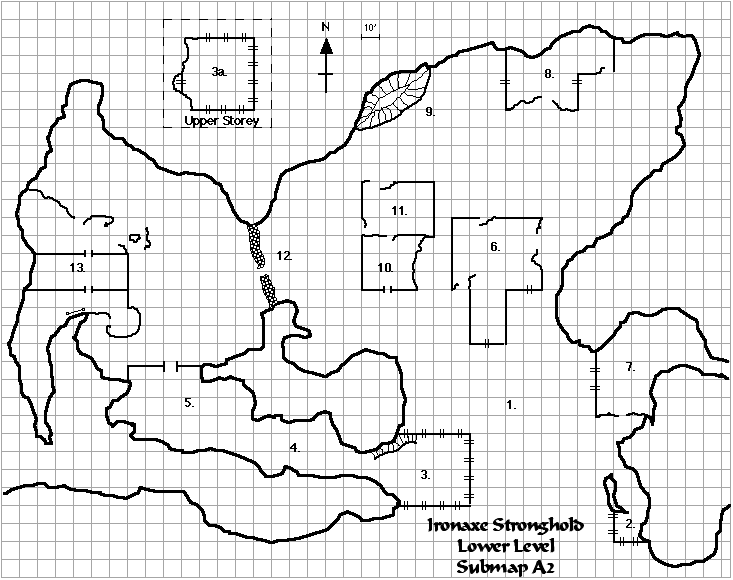 |
This combination cave complex and ruins is home to a large clan of bugbears. These bugbears originally moved into the area before the refounding and successfully defended their lair against the quaggoths (area A1) when the latter moved in about 50 years ago. The two tribes lived in an uneasy truce, hating each other but never strong enough to actually drive the other out.
When the dwarves came to refound the stronghold, they at first made war against both the quaggoth and the bugbears. However, when the dwarves decided that the quaggoth could remain, since they were not evil, they paid the quaggoths to help them attack and roust the bugbears. The bugbears fled their homes and were driven deeper underground, far deeper than they were used to, and many of the tribe fell victim to the deep underdark's unfamiliar perils.
When word came of the dwarves' demise, the remaining bugbears, now about half of their former number, returned and in a surprise raid drove the quaggoth out of their lair and reestablished their homes.
Now, these bugbears hunt the ruins of the stronghold and enter the tunnels of the underdark by way of those leading from areas A and C. They will not pass through quaggoth territory unless in a strong warband.
1. Common Area
This is a wide courtyard-like area that lies open to the rest of the cavern. The place is strewn with debris of various kinds, bones, metal implements broken and now discarded, bits of stone, mushrooms and small fungi, broken pipes, bits of hides and fur, and between areas 3 and 6 is a huge broken and battered piece of metal, wood, and stone that was once some sort of dwarven mechanism (a dwarf with the proper NWP can identify it as a pumping mechanism to move water through pipes at high pressure).
At any given time, there are 6 bugbears in the courtyard. Usually, d4 of these will be in the front part of the courtyard training with their weapons or munching on bits of flesh. The remainder will be females going about their business. Subtract the females from those found in area 8 and the males from those found in area 6.
2. Small Guardpost
This small corner of a building has a few unshuttered windows poking out from the mound of rubble which buries most of it. Within are 2 bugbears who stand watch here, although they can often be found sleeping (35%).
Bugbear Guards (x2) (AC5; MV9; HD3+1; hp 22, 14; THAC0 17; #ATT1; D by weapon [+2 to damage]; SA surprise; Weapons heavy mace; XP 120 ea; src MM) Each guard has D6gp and D10sp.
These guards are relieved every 4 hours.
3. Large Guardpost
This is most of a three storey building, two of which are intact and the third of which is mostly demolished. The remains of a chimney drops from the main cavern ceiling and stops where the third story roof would have been.
Many unshuttered windows pierce the building, but no doorway is to be found.
Within dwell 4 bugbears who guard the entryway into their lair. These brutes are usually watching in shifts of two. That is, two are seated on stones set near the windows, but far enough back to be difficult to spot from without, while the other two sleep or gamble.
Aside from the stone blocks used as seats, there are bits of ruined pipes sticking up from the floor and a bunch of stone detritus. The bugbears sleep on rotted rothe furs.
Bugbear Guards (x4) (AC5; MV9; HD3+1; hp 12, 8, 11, 15; THAC0 17; #ATT1; D by weapon [+2 to damage]; SA surprise; Weapons heavy mace; XP 120 ea; src MM) Each guard has D6gp and D10sp.
A set of stone steps, made of piled rocks held together with smaller stones and some sort of cement-like mortar leads up to the next storey.
3a. Upper Storey
The crude stone stairs lead up to the second level of this building. Unshuttered windows surround the place. There is no apparent way up to the ruins of the third storey.
While this level is devoid of bugbears and is not used by them, it is the home to a colony of bats. There are some 50 normal sized bats here, which use the windows to fly out of the building. The floor is steeped in guano. If someone enters this storey, the bats will startle and flap out into the cavern, alerting any bugbears in the courtyard that something is amiss.
4. Connecting Tunnel
This tunnel was dug into the collapsed
rubble by the bugbears to connect area 3 to area 5. It is also
used as a storage area, and here are 12 barrels of dwarven ale,
9 of which are sealed with wax, and the hung carcasses of about
a dozen rothe, some of which are overrun with maggots.
Hiding amongst the carcasses is a snyad. This is one who has ventured
away from his fellows in area A10 to find some fun and profit.
So far he has merely drunk some ale and taken a small number of
coins from a sleeping bugbear. When the snyad spies the party
it will sneak up and attempt to steal something. If pursued, it
will run right into the midst of the bugbears, hoping to either
force the party into a fight with the bugbears or to cause the
party to give up pursuit. The snyad will then return to his fellows
in area A10 with the item.
Snyad (AC-4; MV21; HD1-1; hp 6; THAC0 20; #ATT -; D -; SA stealing, surprise; SD +3 save vs non-area affecting spells; XP 65; src MM)
The snyad has a small bag made from some small creature's bladder that holds several bone pins and 4gp.
5. Leader's Quarters
Here is the lair of the war leader of the clan. The place is essentially a cavern dug out of the rubble with a facade of its original building to the north. Although the doorway is gone, a rothe fur hide covers the entryway.
The chamber is furnished crudely, in typical bugbear style, with hides of rothe fur covering blocks of stone being used as tables, chairs, and beds. The leader has appropriated various pieces of semi precious battered dwarven accouterments, such as a dented silver goblet decorated with crystalline motifs (10gp), a dagger ornamented with a large beryl worth 20gp, and a battered malfunctioned clock being used as a pounding implement.
The war leader lives here with his small harem of 2 females. The females care for 2 younglings about the size of kobolds.
Bugbear Warleader (AC4; MV9; HD4; hp 25; THAC0 17; #ATT1; D by weapon [+3 to damage]; SA surprise; Weapons two handed axe; Armour 15 dexterity; XP 175; src MM) He wears a ratty fur cape held by a large golden chain (worth 25gp) and has a silver hoop earring worth 3gp. Around his neck is a drow metal key on a thong that opens the shackles in area 7.
Females (x2) (AC10; MV9; HD1+1; hp 5, 9, 8, 7; THAC0 19; #ATT1; D 1-6; SA surprise; XP 65 ea; src MM)
Young Bugbears (x2) (AC10; MV9; HD1/2; hp 1,2; THAC0 20; #ATT1; D 1-4; SA surprise; XP 35 ea; src MM)
Hidden under a large stone (requires an 18 strength to move) is the warleader's treasure, consisting of 40cp, 200sp, 10gp, a dwarven open helm, and a large opal worth 1500gp.
6. Common Building
This ruined building was once probably several stories high, but is now only a single intact story. Within dwell the bulk of the males of the tribe, in this case some 12 bugbears, although at any time there is a 50% chance that D6 of them are off hunting or gathering water.
The building has several gaps exposed to the courtyard. Within the stink of bugbear is immense. A dozen pallets of rothe fur are strewn about, and crude decorations of skulls of various rats and bats and other small cave dwellers are set here and there.
Four jermlaines hang by the legs from the ceiling on ropes. These are undoubtedly to be consumed soon. If freed, the jermlaines will simply run away.
Bugbears (x12) (AC5; MV9; HD3+1; hp 15, 18, 9, 19, 14, 18, 21, 13, 14, 12, 16, 14; THAC0 17; #ATT1; D by weapon [+2 to damage]; SA surprise; Weapons heavy mace; XP 120 ea; src MM) Each bugbear has D6gp and D10sp. They also have crude jewelry of teeth and bones, but a few are studded with semi-precious gems worth approximately D20gp per bugbear.
7. Slave Pen
The remnants of a buried building have been cleared out and expanded into a cave-like chamber. Within are the current slaves/foodstocks of the bugbears. These include a troglodyte and the tribal stock of 12 goblins adults (mixed males and females which are periodically bred to resupply the clan) and 10 goblin whelps. The troglodyte is shackled to chains of drow metal hammered into the wall and opened by a key possessed by the chieftain. The goblins are allowed to run free, as they were born to slavery and fear the rest of the caverns more than their cruel masters, even though the babies and elderly are often eaten.
The place is sweaty and smelly and full of bits and scraps of food and waste remains. Beetles and cave rats scurry about the place.
Troglodyte Slave (AC5; MV12; HD2; hp 8; THAC0 19; #ATT3; D 1-2 / 1-2 / 2-5; SA chameleon, stench; XP 120; src MM)
Goblin Slaves, Male (x6) (AC10; MV6; HD1-1; hp 1, 5, 3, 6, 5, 1; THAC0 20; #ATT1; D 1-3; XP 15 ea; src MM)
8. Female Quarters
In this partially ruined building are the females and young of the tribe. Females are regarded as inferiors, suitable only for breeding and raising the young, and are often mistreated, abused, and even killed when young. Some 6 females lair here, with a half dozen young. They have rothe fur tatters as bedding and live in squalor, with no decoration.
Bugbear Females (x6) (AC10; MV9; HD1+1; hp 8, 4, 5, 6, 5, 9; THAC0 19; #ATT1; D 1-6; SA surprise; XP 65 ea; src MM)
Bugbear Younglings (x3) (AC10; MV9; HD1/2; hp 1, 3, 2; THAC0 20; #ATT1; D 1-4; SA surprise; XP 35 ea; src MM)
The other 3 younglings are too small to fight.
9. Water Supply
Here a crevice descends into the darkness below. The sound of rushing water can be heard below, and indeed, 100' below is a raging underground river. Anyone falling down the crevice is dead, as the river quickly tumbles down a 500' fall into the depths of the underdark.
Nearby is a long rope made of fur and fungus strands tied to a dwarven helm. This is used to gather water. It is a very inefficient method but the females do the work and so the males do not care. Nearby to the crevice are 4 ore carts filled with standing water drawn up from the crevice.
10. Chieftain's Guard
This is the front half of a building whose top stories are completely gutted, the stone blackened and melted as if charred by some great conflagration.
A thick rothe hide covers the open doorway. Within is less of a jumble than one would expect in such a ruined building, for this is the quarters of the chief's son, the heir apparent to the leadership of the tribe and currently the chieftain's hetman.
The walls are draped with the hides of various underground creatures, including the antennae from a giant slug, the hide of a rust monster, and the head of a derro, its tongue sticking out of its mouth.
A steel table only 2' tall is in the centre of the room and has thick furs on it, meaning this once dwarven table is now being used as a bed.
Another such table is propped up on stone blocks to serve as a bugbear-height table, and stone blocks form seats around it. On the table are a few cracked metal plates and dishes, an ivory drinking horn studded with tourmaline and silver clearly of dwarven make (and worth about 35gp), a small open cask filled with ale, and the remains of a goblin whelp, most of it eaten by the bugbear.
Within is the bugbear sub-chief and his 1 mate. They have no younglings yet.
Bugbear Sub Chief (AC5; MV9; HD4; hp 22; THAC0 17; #ATT1; D by weapon [+3 to damage]; SA surprise; Weapons two handed sword; XP 175; src MM) He carries a pouch with 14gp and 10pp and wears a bracer of gold and silver with entwined serpents upon it worth 150gp.
Bugbear Female (AC10; MV9; HD1+1; hp 6; THAC0 19; #ATT1; D 1-6; SA surprise; XP 65; src MM)
11. Chieftain's Lair
Here, in the second half of the charred building, lives the chieftain of the tribe. He is a huge fellow, crafty for a bugbear and well supplied by the drow, who appreciate their function as inadvertent guards for the upper levels.
The chieftain's lair is the height of bugbear decor, including several purplish tapestries of strange material and embroidered with bizarre geometrical designs which have been smeared over with crude figures painted in blood. A metal table is propped up on stone blocks, the table being of exquisite dwarven craftsmanship and its carvings including scenes of storms and waves of water. The whole is in decent shape, quite valuable (300gp as is, triple that if repaired) but also extremely heavy (perhaps 500 pounds).
Upon the table are set the remains of gruesome meals. Next to the table is a large barrel made from a hollowed out hard fungus. Within is drow fungi wine and a steel drinking horn crudely made and clearly of bugbearish design.
The chieftain's bed is a large stone block upon which has been piled rothe furs. Under the furs the chieftain keeps a gift from the drow, a magic dagger +1 not of drow make.
Bugbear Chieftain (AC3; MV9; HD4; hp 30; THAC0 17; #ATT1; D by weapon [+4 to damage]; SA surprise; Weapons mithril battle axe with a metal shaft; Armour furs, hides, ringmail pieces, and 15 dexterity; XP 175; src MM) The chieftain wears a necklace of jermlaine heads and various eyeballs and has the companion bracer to the one worn by the sub chief (see area 10) on his left arm.
Dwelling with the chieftain are his 3 mates who have a single youngling amongst them.
Bugbear Females (x3) (AC10; MV9; HD1+1; hp 7, 5, 4; THAC0 19; #ATT1; D 1-6; SA surprise; XP 65 ea; src MM)
Bugbear Youngling (AC10; MV9; HD1/2; hp 2; THAC0 20; #ATT1; D 1-4; SA surprise; XP 35; src MM)
Buried under loose stone (which covers much of the floor) in a corner of the room is the chieftain's treasure. This consists of 100gp, 20pp, 130sp, a broken top half of a small statue of a dwarf made of onyx and worth perhaps 50gp, a philtre of persuasiveness in a sealed stone flask given to him by the drow, and a metallic sealed flask containing 3 applications of oil of impact.
12. Stone Wall
This is a wall composed of heavy stone rubble piled up here by the bugbears to separate the shaman's area from the rest of the clan.
Dwelling in a burrow within the wall of rubble is the shaman's pet, a giant badger. The tribe used to raise such creatures many many years ago, but only a few survived their flight deeper underground and of these the last mated pair died a few years ago leaving only this last offspring.
The badger is smart and loyal to the shaman. It will not attack bugbears unless they are attacking the shaman, but will attack non-bugbears, although it is so used to the goblin slaves that usually it will only take a half hearted swipe at them.
Giant Badger (AC4; MV6, br3; HD3; hp 13; THAC0 17; #ATT3; D 1-3 / 1-3 / 1-6; XP 65; src MC2)
13. The Bugbear Temple
This edifice, now half buried in rubble, was once probably a grand structure, perhaps a fortress or jail or barracks or simply the abode of a wealthy dwarf. Whatever its origin, the two large double doors of iron are still intact and display scenes of dwarves laying siege to a castle. These doors are unlocked and the hinges are rusty and they squeak loudly.
Within is a small hallway and two side rooms. The northern side room is very exposed to the rest of the cavern, most of its walls crumbled to half height. This is the temple proper of the bugbears, and there is a stone block which bloodstains makes clear its current use as an altar. The altar is set next to the hallway wall, upon which a crude figure humanoid in shape has been drawn in blood. Two diamonds have been pounded into the wall right where the drawn figure's eyes would be (each diamond is worth 350gp). The figure represents Skiggaret, the bugbear god of fear. Various shamanic accoutrements are scattered around the north room, such things as dried fingers, scalps, bones and the like, many hanging from ropes.
The southern side room is the living area of the shaman. There is a ladder of iron bars tied together by ropes which leads up 8' to a hole torn in the roof. On the roof is nothing except a jumble of stone, probably from the building's now razed second story.
The shaman's living quarters are sparsely furnished with a rothe fur pallet and more of the shamanic accoutrements as described in the northern side room.
Bugbear Shaman (AC4; MV9; LV6; hp 23; THAC0 15; #ATT1; D by weapon [+2 to damage]; SA surprise, spells; SD spells, Weapons a mace made of bones and engraved with runes [see below]; Armour furs, hides, and 15 dexterity; Spell Points 55; Spells bless, cure light wounds, command, cause fear, hold person, cure moderate wounds, spiritual club, dispel magic, emotion control [1 free point remaining]; XP 175; src MM) The shaman wears a necklace of bones and silver strips worth 15gp.
The mace of bone does damage as a light mace +1 and is enchanted to be as hard as steel. Whenever it hits in combat, the victim must save versus spells at a minus equal to the damage done by the hit. Failure to save indicates that the bone has introduced fear into its victim. This fear manifests as a -1 to strength, dexterity, and to hit rolls (and morale level). Multiple hits have multiple effect. This item radiates magic of invocation and has a slight taint of evil as well.
The southern side room has a small passageway that goes south for a while before ending abruptly. Within the passageway a crude forge has been set up, the forge containing glowing red coals and a small fire whose job it is for the shaman to tend. The fire is fed on fur, flesh, and dung. Some dwarven smithing implements, crudely jerry-rigged to work in larger hands, lie scattered all over the place. Although not a craftsman, the shaman knows enough smithing to at least repair broken weapons.
A3. Courtyard of the Shadows
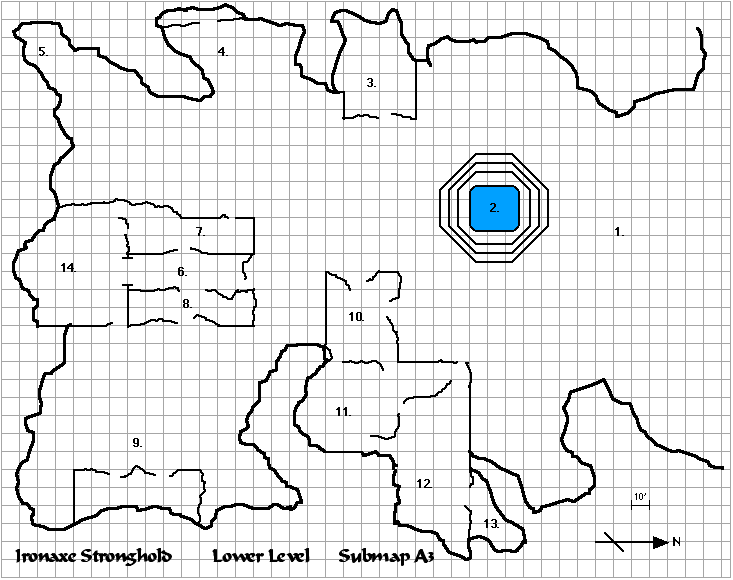 |
This area is where a counter attack by the refounding dwarves sought to rebuff the drow. Through heroic effort the dwarves managed to cut or sneak their way through the drow lines and attacked a small encampment of drow mages who were resting up and relearning their spells. As the dwarves attacked the mages and their small detachment of guards, one of the strongest mages was just casting a summon shadow spell in the hopes that the shadows would turn the tide and save the drow mages. The mage was struck down but managed to utter all but the final syllable of the spell. This caused a rift to open to the Negative Material Plane and shadows poured through, killing dwarves and drow alike. Eventually, the drow managed to slay most of the shadows that left the area, but there were too many to slay around the rift. The drow eventually managed to send in a raiding party to close the rift, but the mission was only a partial success as the hole could not be entirely closed by them.
Over time the shadows either returned to their home plane or wandered to other parts of the underdark. However, a band of them remains here, either having come recently through the rift, drawn by the prospect of draining life forces, or having been the result of draining from previous shadows.
While the drow could certainly come and destroy the shadows here with a major effort, they see no point now that the rift is pretty much closed to its present size. At least a few drow have attempted to brave the shadows in order to recover their treasure, and some of these now are shadows themselves.
The other inhabitants of the cavern stay well away from this area. The quaggoth survive through the magics of the thonot and the bugbears from their shaman. However, each band also seeks to placate the shadows by bringing captives to just outside this area. In any case, most of the shadows here are attracted to the rift and do not leave far from it.
The entire area radiates evil and light sources will be seen to dim perceptibly once the area is entered. A continual light spell will, however, have full effect.
1. The Entrance
It is at this point that the gloom and shadowiness of the lair first become apparent. However, the shadows themselves will not show themselves here, wanting to let the party deeper into their domain before striking. What can be noticed, however, is a cold zephyr of air wafting out from the shadow lair.
2. The Fountain
This is an only partially battered marble fountain, perhaps the centre of a public square at one time. The fountain is composed of 5 steps raised dais-like before dropping down to a pool of water approximately 4' deep. There is water in here, which suggests that pipes bringing the water from above must still be intact. The water is stagnant and impure, greenish in colour and with bits of dust and other things floating within it.
In the centre of the fountain is a bronze statue of a dwarf mounted on a pony striking down a goblinoid creature with a large hammer. The bronze is highly tarnished and in some places has corroded away, revealing that the statue is hollow.
Within the fountain dwells a water weird. The weird is allied with the shadows here and sort of serves as a guardian watchdog.
Water Weird (AC4; MV12; HD3+3; hp 9; THAC0 15; #ATT1; D drowning; XP 420; src MM)
The water weird will form up two rounds after the party enters area 1 but will patiently wait until one victim comes within 10' of the fountain, when it will strike.
While the party is occupied by the water weird, the shadows will emerge and begin to form up. See the Shadows Attack! Section for more details.
Within the water is some treasure from victims of the weird. These are almost all drow victims who only possessed piercing and slashing weapons and so were easily consumed. The water contains:
o the skeletons of 3-4 drow elves, the bones now overgrown with algae. Each skeleton wears now useless and rotted drow chainmail and a rotted drow buckler
o a drow fungus-based potion of extra healing in a stone flask sealed with wax
o a scroll tube of black metal engraved with spider motifs and sealed with wax containing a scroll of protection from poison
o a ring of fortitude (+4 dexterity vs spell resolution) made from platinum and jacinth
o 20pp, 55gp, and 37sp
3. Shadow Lair
This is a partially ruined building sticking out from the wall of rubble. The building is ornamented with battered and dulled reliefs of dwarves surrounded by piles of coins, so this may have been a bank or money changer, or even a mint at one time.
Now, the place is littered with rubble, which towards the west end is almost 5' high. 3 shadows normally dwell within here, awaiting prey.
Shadows (x3) (AC7; MV12; HD3+3; hp 19, 14, 11; THAC0 17; #ATT1; D 2-5+special; SA concealment, strength drain; SD +1 or better weapon to hit, immune to some spells; XP 420 ea; src MM)
4. Huge Doors
Two massive iron doors lie akilter here, exposing a small space beyond that separates the doors from the rubble collapse. The doors' hinges are buried within the rubble and the doors themselves, though massive, were somehow twisted and battered, probably during the first attack by the Deceiver.
Within this small space is the skeleton of a drow warrior, a crossbow bolt piercing the spine and imbedded into the rock. This bolt is a +3 crossbow bolt. The skeleton wears a corroded black metal helm and a normal suit of black metalled chainmail.
A single shadow usually waits above the body, and it will attack by leaping down from above on any who come close enough to pull out the crossbow bolt.
Shadow (AC7; MV12; HD3+3; hp 21; THAC0 17; #ATT1; D 2-5+special; SA concealment, strength drain; SD +1 or better weapon to hit, immune to some spells; XP 420; src MM)
5. Treasure Pit
As is common amongst shadows, the shadows here generally despise treasure, as it reminds them of their former lives and the earthly pleasures they can never regain.
This was probably a well during the time of the ancient dwarvish occupation, and a small 6' diameter shaft runs straight down about 80' before ending abruptly.
There is no water here now, but there is treasure here that the shadows have tossed down the shaft. Included with the treasure are shards of broken metal and glass from items that did not survive the long fall as well as the broken and splintered bones of bodies dumped here. The intact treasure includes:
o 610gp
o 47pp
o 190sp
o a dwarvish buckler +1 enscribed with the Ironaxe coat of arms
o a dwarvish sized suit of chainmail +1
o an amulet of a sickly green gem (known as a sickstone, found
in drow lands) mounted upon a black spider mount made of iron
which is an amulet vs undead (functioning at 5th level)
6. Hallway
This is the ruined hallway of what was once a large building. The roof of the two story building is intact but the intervening stone floor has collapsed, filling the ground within with 1' thick broken stone chunks, making movement difficult.
Some 2 shadows are usually lurking here, awaiting the commands of their master and basking in the cold zephyr that seems to blow from area 14 through the hallway and out the door towards area 1.
Shadows (x2) (AC7; MV12; HD3+3; hp 12, 19; THAC0 17; #ATT1; D 2-5+special; SA concealment, strength drain; SD +1 or better weapon to hit, immune to some spells; XP 420 ea; src MM)
7. Side Room
This long room was probably several chambers before the interior walls collapsed. Bits of metallic furniture poke up through the collapsed rubble here and there. Here was a terrific battle as the raiding dwarves snuck in through the opening in the western wall of this area and attacked the first drow mages.
Careful searching will reveal the skeletons of at least 3 dwarven warriors and 4 drow mages. All are dressed in tattered remains of clothes and armour, for there is soot on the walls and charred bits of bones and metal indicating that some sort of energy discharge took place here (this was from the lightning bolt wand once possessed by a drow mage and now possessed by the head shadow [see area 14]).
8. Side Room
Also full of collapse, this is the room where some of the dwarves came when attempting to flee from the shadows pouring out of the rift. Some of the dwarves never made it, and their lifeless husks are still preserved here, shriveled bone, white skin, and hollow eyes stare in a rictus of empty horror. With no essence from which to feed, these corpses cannot rot, as no microbes will come near them. These corpses were drained by the shadows and the dwarves' souls have long since formed as shadows which now haunt these ruins.
9. Large Courtyard
The rubble collapse and building remnants form a sort of courtyard here. To the east, the battered remains of a large three storey building can be seen, although there is no roof and no floors except for the ground level. This is the location of the dwarves' last stand against the shadows. Unable to flee quickly enough to make the exit, the dwarves were trapped here and slain. At least a dozen bodies are here. About half of them are shriveled husks as in area 8. Some however are clean skeletons.
Of these clean skeletons, at least one still has its hands around a dagger which is thrust into its ribcage, as if committing suicide. Another even more disturbing scene is a shriveled husk still clutching a battle axe, the battle axe dug into rubble on the ground. On one side of the dug in blade is the skeleton of a dwarf from the neck down, and on the other side the skull of a dwarf from the neck up. When the shadows were coming and the dwarves realized that normal weapons were useless and that those slain by the shadows would emerge as a shadow, they took to killing themselves. About half were able to do so, including the one who just finished beheading his comrade but could not kill himself before the shadows consumed his soul.
10. Outbuilding
Filled with a layer of rubble a couple of feet thick and no roof, this room is where 3 shadows can be found.
Shadows (x3) (AC7; MV12; HD3+3; hp 15, 16, 17; THAC0 17; #ATT1; D 2-5+special; SA concealment, strength drain; SD +1 or better weapon to hit, immune to some spells; XP 420 ea; src MM)
11. Large Room
This large chamber appears to have actually been much larger, judging from the partial vaults on the roof which is still relatively intact 40' above. Because of this, the floor is relatively clean of rubble and debris and the red and orange mosaic stones, possibly gemstones polished flat, are evident.
Bits of metallic piping and remnants of iron accoutrements (like candlesticks and eating utensils) lie scattered here and there.
A careful search of the room will reveal (upon a successful secret doors search roll) a large, ornately carved metallic chest buried under the rubble of the collapsed wall between area 11 and area 12. The chest will take 4 man hours to clear away, and the chest itself looks fairly valuable (it would be worth 250gp polished and fixed, half that otherwise). An examination of the carvings on the chest reveal scenes of life in what is presumably this stronghold. Of note is some sort of amphitheatre where dwarves battle one another, a courtyard that is actually this courtyard area depicted in its prime (the fountain is very recognizable), and a scene of the front of the Malaktum Temple on the steps of which is a large anvil which emits some sort of halo of light or energy (it's hard to tell in a metal carving).
The chest itself is locked (the key long gone) and the lock is both old and cunning, and so is difficult to pick (-15% to pick locks rolls).
Within are the following:
o 1750sp
o 390gp
o 100pp
o a mithril dagger in a metal sheath studded with emeralds (worth
250gp for the sheath itself)
o a silver music box with gold mechanisms and intricate baroque
designs engraved into its faces worth 700gp when polished up.
The key still winds and a beautiful dwarvish funeral song plays,
guaranteed to bring tears to the eyes of any dwarf who hears it,
and the song is delicate enough that even an elf can appreciate
its sensibilities. A bard or song mage would easily pay double
its value
12. Grand Hall
Another large chamber, this done up in marble flecked with what are probably real gold veins, iron mountings for tapestries still remain high up on some of the walls. To the south, a large ornate marble hearth leads up about 10' before becoming severed.
Mounted over the hearth mantle is a two handed sword in a metal sheath, but it is a purely ornamental sword that is blunt and will break on a 1 in 6 chance on any hit (blunt, it might do D4 damage if swung like a club). Dwarvish runes on the sword proclaim it as a gift from Yalgan of Jinscar to the famous dwarven smith Ebikuldum. Why a famous smith would accept such a cheap sword is a mystery.
3 shadows dwell in this room. One always stays up the hearth chimney, and will leap down and out at anyone touching the sword or the hearth. The other two generally lurk in the eastern edge of the room.
Shadows (x3) (AC7; MV12; HD3+3; hp 12, 19, 16; THAC0 17; #ATT1; D 2-5+special; SA concealment, strength drain; SD +1 or better weapon to hit, immune to some spells; XP 420 ea; src MM)
13. Small Cave
This area is probably a portion of a room whose walls are completely buried in rubble, which has now formed a sort of cave here.
Aside from many pieces of rubble, there is the skeleton of a dwarf still in chainmail, a dagger clutched in its left hand and thrust into its ribcage. Its right hand points with a skeletal finger at writing scratched into the rocky rubble with a dagger. The writing is in Dwarvish and reads:
Opened rift...evil.....must close
14. The Rift
Apparently some audience chamber for some important dwarf, the room is mostly buried by collapse. However, there are three items of interest here.
First is the body of a drow mage, kneeling on the floor with its arms upraised into a Y shape. The mage's body seems well preserved but is not a shriveled husk like some of the others found in the courtyard.
Second is a black sphere of utter darkness suspended in mid air between the palms of the drow mage.
Third is the huge shadow that is lord and master of this courtyard complex.
The drow mage is the one who was slain as the summon shadow spell was being cast. Close examination reveals a crossbow bolt embedded in the mage's left eye and another deeply into its throat and spine. The mage is not breathing and is, in fact, quite dead. However, the negative energy of the Negative Material Plane is using the mage's body to keep the conduit open and this energy coursing through the mage's body helps keep the mage frozen and intact, which thereby preserves the rift.
If the mage's body is removed, under its cloak will be found a book made of black plates of stone which has pages made of bone. This is the drow mage's spellbook and it contains the following spells:
Cantrip (1st)
Detect Magic (1st)
Read Magic (1st)
Sleep (1st)
Chill Touch (1st)
Spider Climb (1st)
Spectral Hand (2nd)
Detect Invisibility (2nd)
Web (2nd)
Lorloveim's Creeping Shadow (3rd)
Wraithform (3rd)
Dispel Magic (3rd)
Monster Summoning II (4th)
Summon Shadow (5th)
The rift is about 2' in diameter and is spherical in shape. A cold, unnaturally chilling zephyr blows straight out of the globe and out the doorway to the north into the hallway (area 6) and beyond.
Anyone directly touching the sphere must save vs magic or lose 2 energy levels (just as if a spectre had hit him). A save indicates only 1 level is lost. Anyone losing all of their levels is sucked into the rift and annihilated.
Anyone performing any sort of extra dimensional acts on the rift will suffer the same consequences as if the rift were a sphere of annihilation (e.g. if a rod of cancellation is touched to it).
The rift was much more powerful, but the drow managed to cast magics like dispel magic and negative plane protection to blunt the rift to its present state.
Any items thrown into the rift are gone. Any items touching the rift must save vs cold or become brittle and useless.
If a paladin approaches within 10' of the rift, his sphere of goodness reacts with the rift and there will be a bolt of black light that emerges from the rift and strikes the paladin for 3d6 damage before knocking him back out of the 10' radius.
Undead cannot be turned within 30' of the sphere, and any so turned are immediately freed once they come within 30', although they can then be turned again.
Any light spells or light sources are one quarter effectiveness within 40' of the rift, except that a continual light spell is at full strength (it overcomes the power of the rift).
The rift may be destroyed by simply destroying the body of the drow mage. However, this is not as easy as it sounds. The negative energy coursing through the drow mage has possessed it, and although the mage cannot move or it will disrupt the rift, neither can it be moved until the body is destroyed.
The drow body has 35hp and an AC of 0. It saves as a 15th level wizard and has 50% magic resistance. Any weapon striking the mage suffers negative feedback that does d6 damage to the wielder. In addition, a bolt of black energy can emerge from the body thrice per day. This bolt does 3d6 damage (half if a save vs magic is made) and has a range of 60'. Finally, each time a hit is scored on the drow mage, there is a 5% chance that a shadow will emerge from the rift and attack the next round (it is disoriented the first round of arrival....2 rounds if in the area of a continual light spell). If the rift is destroyed it is worth 6,000XP as a slain monster.
If the rift is destroyed, all shadows currently in the courtyard will howl and screech and flee off into the caverns. They can still be encountered as wandering monsters but will not haunt this courtyard except for the pack leader.
The pack leader is an exceptionally large shadow who managed to take possession of the drow mage's wand of lightning. This allowed the leader to dominate the shadows, who normally do not follow a leader. In this case they did so because of this shadow's unusual strength, the fact that the wand made him particularly dangerous, and the fact that they are all attracted to the rift, and he controlled access to the rift.
Shadow Leader (AC7; MV12; HD3+3; hp 27; THAC0 17; #ATT1; D 2-5+special; SA concealment, strength drain,wand; SD +1 or better weapon to hit, immune to some spells; XP 975; src MM) This shadow possesses a wand of lightning which it knows how to use (23 charges left)
Shadows Attack!
Normally, the shadows will be aware that the party is coming. Their standard method is to surround the party in the outer courtyard (around the fountain). In this respect, all shadows but the one in area 4, the one lurking in the hearth in area 12, and the leader in area 14 will emerge to surround and attack the party. That makes 10 shadows engaging in the courtyard. These shadows know of the weird and delight in forcing their prey onto the fountain steps where the weird can attack them from behind.
The shadows will generally form 6-7 blocking the way out of the courtyard area and 3-4 more between areas 10 and 3.
The leader will simply emerge to stand behind the last 3 shadows and will watch the combat, using his wand on any particularly pesky or powerful seeming individuals. The leader uses the wand very sparingly, because he knows it has limited charges and that the wand is the primary determinant of his dominant position.
If things go badly, the leader will flee to the rift room to take advantage of the powers of the rift and will then use his wand more expeditiously.
If the shadows are turned, they will also flee to the rift room and regroup there.
A4. The Hydra Cave
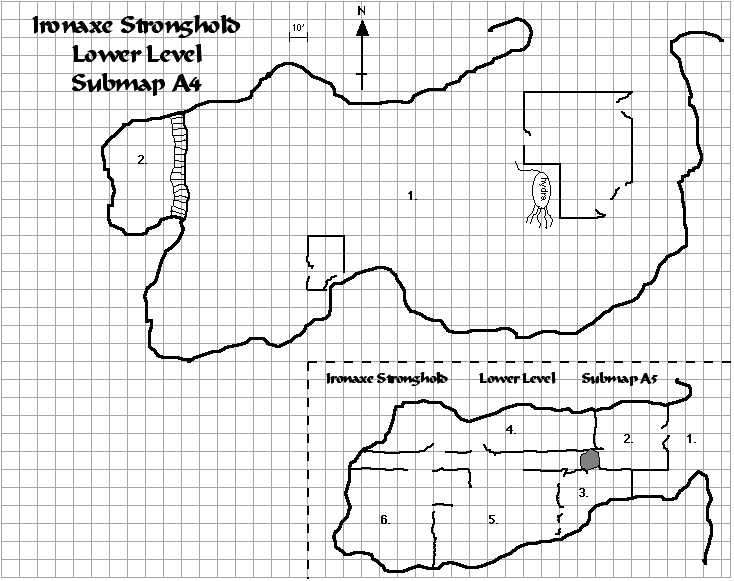 |
This is the current lair of a female hydra mother. The great beast came into the area only about a year ago, coming from the underdark into area B. After a time it wandered into area D where it was promptly driven by the drow into area C. There it could find no suitable shelter to give birth and eventually the beast made its way into area A and settled into this cave.
Fortunately for the other inhabitants of this large cavern, the hydra passed through the rothe herds in area B and so prefers to hunt in that area rather than go after the bugbears and quaggoth who are able to hurt it with their weapons and magic.
The bugbears and quaggoth, for their part, sometimes leave a rothe tied up to the entrance to these caves in the hopes that a satiated hydra will not come out and attack them. While they are correct in this thinking, the easy food is also encouraging the hydra to remain.
The hydra has already laid her eggs. She originally laid 4 eggs, but one was stolen by snyads (see area A10). The other 3 eggs are now gestating.
The mother hydra generally stays within the cave to guard her young, but occasionally emerges to hunt rothe or to get water from the stream at area C. Such occurrences are fairly rare, as the mother is loathe to leave her eggs unguarded.
1. The Main Cavern
Actually open to the main cavern proper, this large area is surrounded by 20' high walls of rubble. A couple of buildings remain relatively intact, though with no roofs, and it is impossible to tell how high the buildings originally were.
The mother hydra will be encountered here, usually resting in the corner of the first large building hidden from view as indicated on the submap. This makes her impossible to see from without the area.
If she hears the party approaching, she will remain silent, waiting until the party rounds either corner of the building, at which time she will let out a roar and attack.
The remainder of the area is strewn with loose rubble, bits of piping, metal oddments mostly crushed and twisted, piles of hydra dung and hydra scales, and the bones of many rothe and other underdark creatures which became meals of the hydra.
8 Headed Hydra (AC5; MV9; HD9; hp 8, 8, 8, 8, 8, 8, 8, 8; THAC0 12; #ATT8; D 1-8; XP 2000; src MM) This hydra was a 9 headed hydra but the stump of a head is all that remains of that ninth head, lost in some long ago scuffle or mishap.
If the mother sees her eggs threatened, she will go into a berserk rage, charging the threatener and doing +2 damage with +1 to hit.
The hydra will not retreat and saves versus fear affects and charm affects at a +2.
2. Egg Pit
Dug into the rubble is a pit, made by the hydra to house her eggs. Within, in a pile of hydra dung used to warm and cushion the eggs, are 3 hydra eggs. The pit is about 6' deep, and the eggs are in a mound of dung about 2' high. Each egg is about 2' in diameter and weighs 50-100 lbs. If transported they could be sold to an alchemist or mage or biologist for 1,000gp each. Outside of special care, the eggs will not hatch and the young within will die within 4 days. If packed in dung and not jostled, the young might (25% chance) hatch in D4 weeks.
A5. Double Trouble
This small area is where the rubble collapse fell around the central portion of a large stone building, leaving only a part of it exposed to the main cavern. The portion of the building left exposed is one storey tall. The roof is mostly intact.
A small band of dopplegangers lives here, having come from the mountains above quite some time ago by way of a cave many miles from here. The dopplegangers at first made their living from the various humanoid scum that dwelt here before the refounding, but pickings were slim and they were about to leave when the dwarves came. These provided much better sport and riches for the gangers, and so they remained, occasionally murdering a dwarf and taking his place, but always taking care to remain obscure. When the drow came, a few dopplegangers caught in dwarf form during the raid were slain by the drow, revealing their true forms. The drow, realizing the danger these dopplegangers posed, hunted the band for a while and whittled their numbers down quite a bit.
The surviving band members fled down to this cavern area and managed to hole up in this building, where the drow forgot about them.
The band has now made some progress mimicking the occasional troglodyte or bugbear or quaggoth, but they scored their real coup just a few months ago, when one of them managed to slay a drow warrior and take her place. The doppleganger impostor is detailed in the description of the Upper Levels later in this scenario, but now the band gains information and treasure from their fellow.
The dopplegangers that live here will be very pleased to know of the party and will definitely attempt to follow the party and infiltrate at least one of their members into the party. Any doppleganger that does so will stay in character as long as is possible, even leaving the underdark if necessary.
There are seven dopplegangers in this band, with one of them being the impostor and six remaining in this sub area.
1. Outside
The front facade of the building is visible from here. The exposed portion of the building gives no indication of its original function, but it is clear that this was not an area originally intended for access to and from the building. Placement of the rubble and holes in the walls have now made it function as the main entrance into the building.
Usually, 2 dopplegangers are here. One is often hidden about 200 yards to the northeast, in a ruined small building that watches a main boulevard that passes from area A to area C. The other sits in the niche to the southwest of the area 1 on the submap and awaits word from the advanced scout that something interesting is coming.
Dopplegangers (x2) (AC5; MV9; HD4; hp 19, 17; THAC0 17; #ATT1; D 1-12; SA shapechange, surprise; SD ESP, spell immunity, save as 10th lvl Warrior; XP 420 ea; src MM)
Both of these dopplegangers will usually be found in a form other than their true forms. The advance scout usually appears as a bugbear or troglodyte, while the guard in the niche often mimics a drow elf with a sort of strange blank, expressionless face.
Along the west wall of the niche is a secret door. This is of dwarven make and was fortuitously located by the dopplegangers, who now use it to move in and out of their lair unseen and relatively safe from intruders.
2. Trapped Room
Possibly part of a large grand hallway, the floor is filled with bits of rubble and detritus. This room is designed to deter and confound intruders. The place is dusty and made to look as if the entire building might be deserted.
Near the hole in the wall to the east, from which entrance is possible, are some key stones that support a few key pillars that hold up a pile of rocks and rubble. Tripwires are set throughout the room which, when tripped, will topple the pillars and the rocks above them. The effect to a non-dwarf would be that the roof is unsafe and prone to collapse.
A dwarf who detects traps or new construction will see that this is not, in fact, the case...that the roof is solid enough and that the pillars are rigged to fall.
There is a 40% chance per person passing through or searching this room that a tripwire will be tripped. There are 4 rigged pillars in the room. After each pillar topples, reduce the percentage chance of triggering by 10%.
If a pillar falls, it will fall in a random direction (roll a D8) and anyone caught by the 2' diameter 15' tall pillar must roll for surprise. If the victim is surprised, he gets no save roll. Those not surprised may roll a D20 against their dexterity to jump out of the way. Others may be caught by the pillar depending on their position; they roll as above.
Anyone hit by a pillar takes 3D10 damage. In addition, rubble placed atop the pillars will rain down in a 10' radius from the top of the pillar, causing D6+Armour Class damage to all within the radius.
The noise from the trap will certainly alert the dopplegangers in the area. The dopplegangers have ropes and pulleys to reset the pillar traps after they have been set off. It takes a good 2 hours of work to reset a single pillar trap.
Past the room is what looks to be a entryway further into the building. However, once the party makes it to that entrance they can see what looks like a passageway blocked off by a rubble collapse. In actuality, the dopplegangers have blocked off the passageway. The rubble can be cleared in about 4 man hours.
3. Entry Room
This is the first chamber of the doppleganger lair. Within much of the rubble has been cleared away. A single doppleganger is usually here sitting at a crude metal and stone table. This doppleganger favours the appearance of a dwarven female dressed in a priestess' robes (dedicated to Neengrum) with a large battle axe at her side. Upon the table is a small stone chest (unlocked) which holds 10pp, 47gp, and a pouch of 15 various small gems worth a total of 150gp.
Doppleganger (AC5; MV9; HD4; hp 10; THAC0 17; #ATT1; D 1-12 (or by battle axe); SA shapechange, surprise; SD ESP, spell immunity, save as 10th lvl Warrior; XP 420; src MM)
In a corner of the room is a bed made of dried fungus on a platform of stone.
4. Long Room
Partially filled by the rubble collapse, this long room is the lair of three dopplegangers, two of which guard the approaches to the lair in area 1.
The room has bits and pieces of mismatched dwarven furniture, including a long mess table and chairs of metal, and three metal beds with fungus for a mattress and actual cloth and rothe fur covers.
The single doppleganger to be found here prefers its natural form at the moment, but it is dwarf sized to be better able to use the furniture.
Doppleganger (AC5; MV9; HD4; hp 19; THAC0 17; #ATT1; D 1-12; SA shapechange, surprise; SD ESP, spell immunity, save as 10th lvl Warrior; XP 420; src MM)
Each doppleganger has its treasure hidden here. One is secreted in a bag within his bed, wrapped in a bundle of fungus bedding. It contains 43gp, a pearl wand with no special magical powers worth 170gp, a worthless hunk of shiny quartz, and a silver and hematite ring worth 35gp.
Another treasure is hidden behind a loose stone in the wall. Behind the stone is a small stone box holding 5pp and 26sp. Also in the small niche is a piece of amber with a preserved beholder eye within worth 150gp as a gem and perhaps more to a mage or alchemist, and a bar of mithril worth 200gp.
The last doppleganger's treasure is contained inside the rothe fur covering of his bed. It includes a non-magical drow metal shortsword (it was magical when he took it some months ago), 34gp, 10sp, and 4 small sapphires worth 250gp each.
To the far west of the room are the stores of the band. These include rothe fur, metal barrels holding water, a cask of dwarvish ale, dried mushrooms, and strips of meat preserved in salt.
5. Open Room
This room's walls are barely standing, and the room is open to the hallway running through this building. Within dwells another doppleganger. This one favours the shape of an ogre, a creature it remembers from its time lairing out of doors in the mountains above. The doppleganger has a crude bed made of stone and rothe furs and a stone table. Upon the table is a golden goblet studded with jacinth and onyx and worth 250gp even in its battered condition. If repaired it could fetch thrice that easily.
Doppleganger (AC5; MV9; HD4; hp 25; THAC0 17; #ATT1; D 1-12; SA shapechange, surprise; SD ESP, spell immunity, save as 10th lvl Warrior; XP 420; src MM)
Under its bed is the doppleganger's loot, consisting of a strange drow metal hand harp that makes strange and eerie sounds (worth much to a bard), a golden earring worth 10gp, 29sp, 16gp, 2pp, and a silver comb worth 15gp.
6. Leader's Chamber
This is the chamber of the leader of this tribe, an old doppleganger who is the brains behind this group, a very clever individual who sees great potential in the internecine rivalries of the drow. It is his master plan, after gaining information from his plant with the drow, to start a civil war amongst the drow by performing a few assassinations. When the civil war starts, he then intends to offer his services to the drow for a fee, all the while infiltrating further into the drow hierarchy until he replaces the drow high priestess and rules the entire stronghold.
The room is spartanly furnished, much to this doppleganger's chagrin, but nevertheless, he knows that the band must stay portable and able to move at a moment's notice.
As such, there is a fine metal and wood bed here, with an actual mattress of feathers and down and a sumptuous cover of cloth and cotton. This bed was salvaged from the ruins of this very building.
A fine but battered wooden table, dwarf sized as well, and several chairs are here as well, along with a piece of mirror, obviously a chunk from a larger mirror, hung upon the wall.
The doppleganger leader prefers his own form within his lair, and will be encountered in that state most of the time.
Doppleganger (AC5; MV9; HD4; hp 14; THAC0 17; #ATT1; D 1-12; SA shapechange, surprise; SD ESP, spell immunity, save as 10th lvl Warrior; XP 420; src MM)
Hidden behind what looks like a part of the rubble collapse to the west is the leader's treasure, contained within a small metal chest which is locked. There is no key, because the leader can simply create a key with his body and use it.
Within are 150gp, 34pp, the top half of an onyx statuette of an earth elemental (worth 45gp), and a steel gauntlet (dwarf-sized) for a right hand that imparts a +1 (or +10% for exceptional strength; treat 110% as a 19 strength) to strength for that hand only.
Doppleganger Notes:
Like most dopplegangers, these are motivated by greed for wealth and power. As such, a party that does not succumb to their wiles and approaching from a position of strength could actually ally these creatures if they promise wealth or the opportunity to infiltrate the drow organization. While not particularly trustworthy, these dopplegangers will not turn on the party as long as the cost of doing so seems greater than their other opportunities.
The DM is encouraged to use the dopplegangers' shape changing abilities to good effect should their lair be assaulted. Each will choose a shape most likely to confuse the party, including a damsel in distress, a dwarf priestess, etc. They will also try to get in close enough to wrestle a party member to the ground and change shape while they are rolling around to mimic the member they wrestle.
A6. Stirge Grotto
This large area is studded with the remnants of buildings, much as the entire cavern. However, in this wide grotto, formed by the collapse and the main cavern wall lairs a group of stirges.
This stirge pack has basically cleared out any large inhabitants of the area, and now they roam far and wide through the caverns seeking out food. More than a nuisance, the stirges initially came into this area about 2 years ago and have remained, finding the rothe herds particularly useful to prey upon.
The stirges initially attacked various of the inhabitants nearby, including the quaggoth and the bugbears, but they were driven off and have since learned to stay away from those areas. They also learned quickly to fear the hydra and the shadows.
Now, they generally fly in a flock into area B to hunt, or down the passageway to the underdark located to the east of the grotto.
That said, the stirges will surely attack fiercely anyone who penetrates their lair, swarming en masse on the intruders. The stirges have no treasure of course, as they do not drag their victims to their lair. Due to the confines and ultimately limited food resources of the area, these stirges, like most underground stirges, tend to attack one stirge per victim when out hunting, as they prefer to have their victims survive to feed from once again. However, in their lair area they will attack many stirges per victim if possible.
The stirges generally lair amid a cluster of buildings in the centre of the grotto area, hanging from the top of free standing walls or high stones. At least half of the stirges here will have fed recently and be in a stupor (-2 to surprise them).
The stirges tend to hang out in groups of 3 or 4, and other groups will respond to an attack within 2-3 rounds.
Stirges (x22) (AC8; MV3 fl18[C]; HD1+1; hp 6 ea; THAC0 17; #ATT1; D 1-3; SA blood drain [D4], attack as 4HD monster; XP 175 ea; src MM)
A7. Werebadger Lair
 |
This is the lair of a werebadger. He was once a dwarf, but on a journey to the stronghold during the refounding he was attacked by a werebadger in the form of a giant badger. The dwarf managed to flee before he was slain, but was infected and became a werebadger himself. At first he continued to pose as a dwarf and worked with the refounding, occasionally murdering one of his fellow dwarves when his bloodlust came over him. When the drow attacked he fled their magical weapons and used his special abilities to burrow to safety.
Since then, he has reemerged, scrounging for treasure and wealth and satiating his bloodlust whenever he needs to. The local inhabitants know of his existence, but not his true nature. They do know that a furry creature that cannot be killed sometimes comes and kills. Mostly it is rothe and other dumb beasts, but occasionally he will slay intelligent beings.
Werebadger (AC4; MV6 br3; HD5; hp 24; THAC0 15; #ATT3 or 1; D 1-6 / 1-6 / 1-4 or by weapon type; SA berserk frenzy, lycanthropy; SD silver or +1 or better weapon to hit; Weapons warhammer +1 Forger; XP 975; src MC1)
The warhammer is known as Forger and is covered in Dwarven runes of Heat and Crafts. It is a sacred weapon of the Malaktum priesthood. If Malaktum's name is said while wielding the hammer, its mithril head will glow red hot. This is useful for forging metal, but will also do an extra D4 heat damage on a hit and will also cause a save against heat (fire) against metal armour or shield. To determine if metal armour or a shield is hit, use the following:
If a hit is scored, then armour
is hit
If a miss misses by equal to or less than an armour's bonus, the
armour is hit
If a miss misses by more than an armour's bonus but less than
total of shield and armour bonus, then the shield is hit.
If the save is failed, a shield is ruined. Armour loses 1 AC per damage.
The werebadger knows how to activate Forger and will do so in battle. He wears a key to the chest in area 12 around his neck.
1. Ruined Tower
This is the remains, mostly a shell, of a dwarven guard tower that warded the passageway into area C. The tower was once perhaps 50' high, approaching to within perhaps 10' of the cavern ceiling. Now, half of the tower is standing up to about 30'. The rest is a collapse of stone. There is no way to ascend the three levels within the tower; presumably the stairway was contained within the half of the tower that collapsed.
The first floor of the tower is a jumble of rubble fallen from above. Ancient bits of bones can be seen among the rubble.
The second floor contains pieces of metal furniture whose wooden components have long since rotted away. Amongst the wreckage, buried partially under stones from the missing upper levels, is a dented metallic coffer, locked, which holds 119cp, 200gp, 15pp, and a lock lurker.
Lock Lurker (AC3; MV9; HD1+3; hp 8; THAC0 19; #ATT1; D 1[bite] or 1D4+5[sting]; SA paralyzing venom; SD partial etherealness; XP 175; src MC1)
This lock lurker looks like a copper piece, but will attack anyone who handles it. The lurker was placed into the coffer by a dwarf from the ancient stronghold as a ward against thieves, and being ethereal, the lurker was able to survive all these years by dwelling mostly on that plane.
On the third floor of the tower, which has no ceiling, are three partially buried dwarven skeletons, likely of warriors defending the tower when it collapsed. They wear corroded remains of platemail, but one also wears a platinum necklace studded with onyx and sard and a single polished purple stone at the breast.
This necklace is known as a necklace of earthfriends, and is a sign of favour from an earth temple (usually Neengrum). The wearer gains a +2 on saves versus earthen attacks. In addition, creatures tied to the Elemental Plane of Earth suffer a -2 to hit and a -1 per die of damage on attacks against the wearer.
2. Stone Wall
This is a stone wall, possibly much higher and perhaps part of a building at one time, but now a jagged wall about 4'-5' high. Draped atop the wall at several points are partial skeletons of various creatures, including rothe and large humanoids. Several skulls are set atop the walls amid these grisly decorations.
3. Out Building
This is a gutted building, with walls that only rise between 3' and 6' from the cavern floor. Rubble covers the interior. Often, the werebadger will rest here, as a sort of lookout post, and once he hears or sees someone approaching, he will retreat further into his lair.
The werebadger has dug two pits flanking this building, following what would probably be the natural path of penetration into his lair. Another pit has been dug directly in the centre of this outbuilding. To pass safely, the werebadger normally enters the outbuilding from the south, then exits out the west, just south of the western pit.
Each pit is roughly dug with the werebadger's sharp digging claws and scavenged tools, and is about 30' deep. The two passageway pits are covered with strips of fungus covered with dirt and small stones. The central pit is covered by the same strips of fungus and small stones and pieces of debris.
4. Western Building
Partially buried by rubble, this building serves as entry into the werebadger's tunnels. The southeastern entryway into the building is warded by the pit, but a small entrance to the north is safe.
Within the roof is missing and the interior is full of rubble. There is nothing of direct interest herein, but a passageway has been dug in the rubble collapse and leads into the werebadger's tunnels.
5. Entry Cave
The rubble passageway widens here into a small cave of sorts. Other than a few bugs and vermin there is nothing of interest immediately apparent in the cave. However, a few stones on the floor against the north wall have been hollowed out from the bottom so as to be much lighter than they appear. If these stones are moved aside a passageway about 6' wide and 6' tall descends into the ground and then east to the werebadger's mound (area 11-13).
6. Garden
This small cave is actually a well tended fungus garden. Bat guano has been piled on the floor here, and water drips down drop after drop from a destroyed pipe in the ceiling that apparently still feeds from the cavern lake (area D3).
Myriad fungi grow here. Anyone with fungus lore can identify many of them. The table below gives a description of each fungus type to be found here and the numbers of such fungi. The werebadger cultivates these to supplement his diet and to aid his survival and as a hobby of sorts. Bits of bones amid the guano shows what the werebadger uses to supplement the guano as fertilizer.
Redcapped mushrooms (35)
Small blackish puffballs (123)
Thin pale grey rhizomes (500)
White toadstools speckled with green flecks (16)
Five pointed star shaped growths of blue lichen (7)
Small ruddy brown mushrooms (250)
Jade green slime mold patches (12)
Redcapped mushrooms - these are hallucinogenic. Anyone eating even a small bit will suffer delirium and delusional visions for D6 hours. Distilled properly, they are a useful anesthetic and can be used in conjunction with the healing NWP for a +2 to the roll.
Small blackish puffballs - these are good food, perhaps even a delicacy on the surface world.
Thin pale grey rhizomes - blander than the blackish puffballs, but still good for food.
White toadstools speckled with green flecks - a deadly poison, anyone taking a nibble must save vs poison or be incapacitated for D6 hours. A full bite will cause a save or sustain 15 pts of damage (half if save is made). If distilled and concentrated, the poison is very deadly (save or die within 2 rounds, suffer 15 pts of damage if save is made).
Five pointed star shaped growths of blue lichen - extremely useful in healing, they help coagulation and fight infection and soothe pain. Each will allow a healing NWP to function at +2 to the roll.
Small ruddy brown mushrooms - normal edible mushrooms
Jade green slime mold patches - emit a slight bad smell. If dried into a ball, these can be tossed or slung. When they break, they emit a stench cloud in a 20' radius that acts in all ways like a stinking cloud spell.
7. Water Room
A pipe in the ceiling of this cave still transports water, which trickles out of a corroded hole in the piping and falls into this room. The trickle is really just that, but the werebadger has salvaged a few wooden barrels from the refounding dwarves and these are here either holding water or placed under the trickle in the process of filling up.
8. Outhouse
A passageway into the rubble emerges here, where the corner of a building sticks out of the rubble collapse. The werebadger uses this as an outhouse, and several deeps pits in the floor hold waste and refuse.
9. In Building
In better shape than the rest of the buildings in this area, this building still retains a roof, that being the divider between its first and second stories. The second storey is gone. Within the place is relatively free of rubble and there is a 6' diameter hole in the floor which leads to a passageway that heads underground from this area to area 13.
10. Wrecked Building
Little is left of this building...just the remains of a doorway to the north and some walls that taper down to the floor. The building has no roof and is empty and unremarkable except for a loaded heavy crossbow that the werebadger keeps hidden in a corner of this building ruin for emergencies.
The Mound:
Dominating the centre of this area is a mound of rubble and earth and stones, about 12' high at its apex and fairly steep, although jagged enough to be climbed. This is the werebadger's main lair.
11. Entry Chamber
Furnished with the best dwarven furniture he could salvage, this chamber includes a metal table, a hat rack and coathook, a fine silver mirror, and a divan whose long lost cushion has been replaced by rothe fur. This would all be quite homey except for the dwarf skulls, many still wearing their helms, hung along the walls.
12. Sleeping Chamber
In this largish chamber is a fine metal bed decked in rothe furs, a metal nightstand with a porcelain washbowl, a metal wardrobe that contains merely a few plain dwarven clothes, some with tears at the hems (when the werebadger transformed while wearing the clothes), and a locked metal chest (the key is on the werebadger).
The chest is warded by a poison needle coated with poison distilled from the fungus garden (area 6). The victim must save versus poison or die. A save means 15 points of damage. Onset time is 2 rounds. Within is the werebadger's treasure of 1000sp, 460gp, 59pp, a silver brush with ivory teeth and mother of pearl designs worth 420gp, 10 dried fungus stink bombs (see area 6 for details) in a tied leather pouch, and a scroll in a scroll tube of steel carved with Dwarvish runes which contains the priest spells of Strength of Stone, Iron Vigil, and Soften Earth and Stone enscribed at 5th level.
13. Store Room
This chamber is used to store items. Along with a barrel of water are some salted strips of meat, stacks of dwarven ration bars (enough to feed 50 dwarves for 10 days), rope made from fungus strands, a table holding metal implements useful in distilling fungus (i.e. mortars, pestles, flasks, firepots, flint and steel), and digging and crafting tools of various sorts.
A 6' diameter hole in the floor leads underground to area 9.
Badger Tactics:
The werebadger will use his knowledge of the area to ambush and attack intruders. He will certainly retrieve his stink bombs from area 12 if given the chance. If sorely threatened, he will probably go berserk, and it is unlikely that the werebadger can be taken prisoner.
However, if properly bribed and cajoled and threatened, the badger could be induced to act as a guide for the party. This is a bad idea, however, as he knows the area very well and will gladly lead the party into the hydra lair or the shadow area and then abandon the party.
A8. Trapdoors
This subarea is actually composed of various locations throughout area A. Each area 8 on the Overview Map represents an exit from the tunnels of a band of giant trap door spiders to the cavern floor. This band spends its time hunting unwary prey that wander by any of its outlets. Most of the longtime residents here (such as the bugbears and quaggoths) know of the exact location of these outlets, and so avoid them, except when a new one is occasionally built and takes one of them by surprise.
Essentially, straight tunnels dug into the earth below the cavern floor connect each of the area 8's on the Overview Map. These passages have occasional widenings where presumably prey is stored or eggs are laid.
Anyone entering the same 100 yard square as a number 8 on the map is subject to a potential attack. There is a 75% chance that a single spider is lurking at an outlet. If so, there is a 90% chance that anyone passing within 50 yards of the outlet will be attacked. If an attack is indicated, allow a 5% chance that it will comprise D3 giant spiders.
If a spider attacks, it will scramble out of its outlet and stalk the party, using rubble as cover. At the proper moment it will burst from under some rubble or over a wall and attack. The spider will seek to grab a single individual and drag him back into the tunnels. There, it will consume the hapless victim half the time, or will bind the prey in webbing and store it in a widening in the tunnels for eating D6 days later. Each spider has its own unique pattern of webbing, and its fellows will not touch prey wrapped by another of their kind.
If the spider is pursued into its lair, it will lead its pursuers to others of its kind before attacking.
Each outlet is basically an 8' diameter tube descending into the ground, covered by a generally flat stone hinged to the ground on one end by webbing. The stone functions as a trap door.
The tunnels are roughly 10' in diameter and somewhat smooth, though not worked. There are currently 8 such spiders here, and they know not to attack drow. One of the spiders is a female who remains in a widening guarding her brood, which is a huge 12' diameter ball of webbing holding eggs due to hatch in three weeks' time.
Giant Trap Door Spider (x8) (AC4; MV6 wb12; HD4+4; hp 18, 18, 10, 24, 23, 22,13, 25; THAC0 15; #ATT3 1; D 2-8; SA poison [save or D6 damage], leap 30', -3 to surprise rolls; XP 975; src MM)
Within their lair are bones from past victims, and even the occasional desiccated corpse, usually of a rothe, goblin or a troglodyte.
A9. Sinister Flutes
Anyone coming near this area will at first hear a strange sort of fluting sound, definitely tonal, but not quite a specific melody.
The source of the fluting is in the far northeast corner of the area, where the rubble collapse meets the cavern walls. Apparently, at one time, pipes and small vents led up to the surface. Over time, many of these pipes and vents became blocked, but others were only partially blocked. Now, when wind makes its way down the pipes and vents, a fluting sound is heard.
The refounding dwarves noted this phenomenon and made some attempt to clear the pipes and vents, but were unsuccessful, and the area became known as Klavilt-navarguld, meaning "The place of idiot flutes".
With the dwarves gone, the fluting eventually attracted a band of sinisters (large manta-ray like bats). Although generally appreciative of all music, these sinisters apparently find the curious quasi-random cadences of the fluting sounds here quite appealing, and they can usually be found clustered near the pipes, hovering almost motionless amid the cacophony.
Sinister (x6) (AC3; MV2 fl21[A]; HD4+4; hp 19, 24, 22, 23, 13, 24; THAC0 17; #ATT1; D 2-5; SA hold monster; SD energy field; MR 70%; AL LN; XP 2000 ea; src MM)
These sinisters will not bother anyone unless they are molested or the piping is stopped. If anyone actually plays good music, the sinisters will certainly follow the player for quite some time, enjoying the music.
The other creatures of the area long ago gave up trying to harm these creatures, as they usually float about 30' above the cavern floor and are immune to missiles. Their only real threat are the stirges, and a few hold monster spells cast by the sinisters quickly convinced the stirges to hunt for less elusive prey.
A10. Snyad Central
This area is unremarkable in appearance, being composed of buildings that have been well razed, and many show signs of scorch marks and melted granite.
The entire area is the domain of a large band of mites and snyads. These are the vermin of the cavern area and are generally regarded as pains-in-the-butts by the bugbears and quaggoth, who would love nothing more than to catch, torture, and eat these little buggers. They delight in harassing and stealing from the residents of the area, and that includes the drow who pass through the area. Of course, none of their victims are able to really clear out these gremlins, due to their small size and adeptness at escaping.
The gremlins' latest exploit has been the stealing of a hydra egg (from area A4). They have "hatched" a scheme to nurse and hatch the baby hydra, and use it to extend their power. Of course, this is a futile scheme, as the baby hydra is likely to die before hatching or will grow too big for the gremlins to handle, but currently the egg project is the obsession of the group of gremlins.
The group is made up of both snyads and mites, who have teamed together in this dangerous environment. The snyads and the mites have haunted the caverns since ancient times, even when the Ironaxe clan was in its glory, but banded together only after the Deceiver attacked many centuries ago. Pickings were lean and many of the groups had moved on when the refounding dwarves came. Since then, pickings have been good, and the group has prospered once again.
Mites (x24) (AC8; MV3; HD1-1; hp 4 ea; THAC0 20; #ATT1; D 1-3; XP 35 ea; src MM)
Mite King (AC8; MV3; HD1+1; hp 9; THAC0 20; #ATT1; D 1-4; XP 65; src MM)
Mite Females (x24) (AC8; MV3; HD1/2; hp 2 ea; THAC0 20; #ATT1; D 1-2; XP 15 ea; src MM)
Mite Young (x24) (non combatant)
Snyads (x7) (AC-4; MV21; HD1-1; hp 5 ea; THAC0 20; #ATT0; D nil; XP 65 ea; src MM)
The group's tunnels litter the entire area within 300 yards of the location marked as area A10 on the Overview Map. In addition, they have several long access tunnels. These emerge near area A2, A4, and C2. In between area A10 and the access tunnels are a literal honeycomb of small passageways, a maze of gigantic proportions that have been dug by countless gremlins over the centuries. Many of these are unused and now forgotten by the current group, and one that once led to area A3 has been blocked by stones by gremlins because it leads to a place of great evil now.
Any gremlins questioned about area A3 will shudder and act very frightened. If contact can be made, the mites can communicate that great evil and danger dwells there.
Occasionally, the tunnels are raided by giant rats, centipedes, and jermlaines, and then the group usually hides until the more powerful foes leave.
Currently, the hydra egg is set in a nest of sticks and metal filled with hydra dung.
The group possesses all sorts of "treasure", most of which are polished bits of metal, quartz stones, bones and skulls, and bits of fur. Certainly, the odd coins also are included in their treasure. The gremlins also have the following valuable treasure, scavenged or stolen over the years, located in the mite king's central chamber, where the females and younglings dwell as well:
· a dwarven made dagger+1
· a silver bracelet studded with diamonds worth 1100gp
· a feather token of a small stone hammer which, when touched
to a door, will act as a knock spell cast by a 12th level wizard
(one use)
· a sealed foil pouch (sealed with lead) that contains
1 use of dust of disappearance
· a large chunk of amber with a rot grub fossilized within
it worth 240gp
· a silver and bronze beer mug decorated with scenes of
barley and grain worth 50gp
The tunnels are in general about 3' in diameter, and man sized creatures suffer a -4 to hit and +4 AC penalty when in the tunnels. The tunnels are laced with sticky nets, tripwires, and small pits, mostly geared to thwart smaller foes, but still annoying and possibly damaging to man sized intruders. Pits range from 3'-10' deep.
The snyads are generally the long range scouts of the group, since they can run quickly, and they are often stationed at various peep holes looking for victims. Other times, they will go out on scouting expeditions. When they find something or someone of interest, they return and alert the mite king. He decides what should be done and dispatches mites and snyads to steal things or, on occasion, to capture a victim and bring him back to the king's chamber for harassment and sport and theft. Such kidnapped victims are returned in D4 days, usually naked and dazed to a place like the hydra lair (A4). Any humans passing through the general area will certainly be given the once over by the gremlins and theft attempts will be made. A kidnap is unlikely unless someone straggles away from the main group.
A11. The Broken Gate
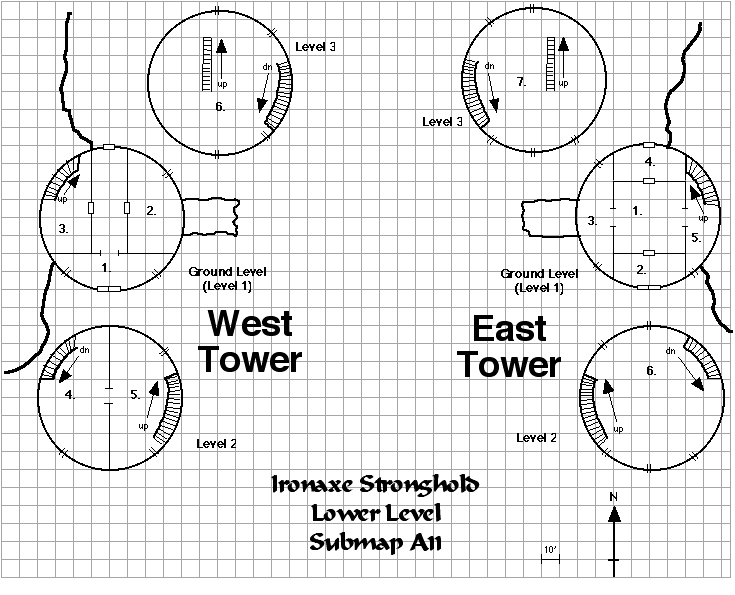 |
This was once a massive gate flanked by two tall towers that warded the divide between the park area (area B), and the living quarter (area A). During the battle with the Deceiver, the gates were torn asunder, but the towers remained relatively intact.
The towers are made entirely of iron and are 40' tall. The curtain wall between the towers is 25' tall and made of granite. There is a jagged 50 yard gap in the curtain wall where presumably the gates once were.
The way is commonly used by all of the cavern occupants to travel between areas A and B, but no group has ever had the desire or the ability to take control of the gateway and restrict travel.
The towers in general are intact, made entirely of iron with rivets showing. A few dents are here and there. The ceilings are 12' tall. Doors are of iron.
East Tower:
This is the lair of a pair of cloakers. These malign creatures have haunted this tower for some time. Since the motivations and life processes of cloakers are not known, it is impossible to tell what purpose the cloakers have in dwelling here nor why they chose this place. They certainly do not hunt outside of the tower, and although the quaggoth and bugbears believe the towers to be haunted, they pass through the sundered gateway unmolested by these beasts.
Anyone entering the east tower, however, is likely to fall victim to the cloakers.
The two cloakers are not a mated pair, and it is undeterminable why they choose to lair together. The first cloaker, encountered on the first level, is generally less vicious and more interested in scaring away intruders. The second cloaker, dwelling on the upper levels, is vicious and will seek to kill anyone entering its domain.
Cloaker (lower level) (AC3[1]; MV1 fl15[D]; HD6; hp 25; THAC0 15; #ATT2+special; D 1-6 / 1-6 / +special; SA engulf, moan; SD shadows; XP 1400; src MM)
Cloaker (upper level) (AC3[1]; MV1 fl15[D]; HD6; hp 37; THAC0 15; #ATT2+special; D 1-6 / 1-6 / +special; SA engulf, moan; SD shadows; XP 1400; src MM)
1. Square Room
This large squarish room is cluttered with broken metal bits of furniture, perhaps a large table, toppled weapon racks, etc. When the party first enters here, the cloaker, who lairs in room 3, will begin to manipulate shadows, causing faint stirrings just in the corner of the party's eyes, attempting to unnerve the party members.
2. Entry Room
The double doors to this chamber can be forced open on an open doors roll. Fallen rubble and broken furniture have wedged the door shut, and the hinges have corroded.
Within are dented shields, bits of chainmail, broken weapons, and the skeletons of dwarves and drow. The door into room 1 is slightly akilter and could be pulled off its hinges easily if required.
3. Cloak Room
The first cloaker dwells in this room, which was probably a store room as evidenced by the toppled metal barrels and broken metal crates. Anyone entering this room will be subject to the fear moaning of the cloaker, who hopes to scare intruders out of the tower. If attacked, the cloaker, which will move to right above the entryway, will engulf the lead party member and then use its moans to blunt the attacks of the rest of the party. The cloaker will attack a victim until unconscious, and will then toss the party out of the tower. If attacked a second time it will seek to kill intruders. If wounded to below 25% of its hit points, it will retreat, flapping up to the upper levels to take refuge with the cloaker on the upper levels.
4. Back Room
This room is relatively clear of debris, although the northern door shows signs of magical fire and melting from the inside. The door on the north and the south walls open easily, but with much squeaking.
5. Stairway
If the party ascends the stairway, the cloaker from room 3 will stealthily await the party's return by resting atop the bottom of the stairway. It will then wail and seek to fear the party out of the tower.
6. Second Level
This entire level of the tower is a single room, littered with a few metal parts of furniture whose wooden components have long since rotted away. There are signs of more recent occupation, as the skeletons of dwarves and drow are here, a couple of each, with weapons still in hand and studded leather and rotted drow chain on their bodies.
When the party enters here, the cloaker in room 7 will manipulate shadows here so that it appears as if 6 cloakers lair in this room, flapping towards the party. While the party is confused or frightened by this "attack", the real cloaker will descend from room 7 and attack.
Amid the bodies, on a drow elf skeleton, are two magic items. One is a black cloak that looks a lot like it could be a cloaker. It is actually a cloak of protection +1/+2 versus dwarves. The other is a platinum ring with a spider shaped jet that is a ring of protection +1.
7. Third Level
This is normally where the cloaker of the upper levels dwells. The room is relatively clear of debris and there are no bodies or skeletons here. Stairs lead up to a trap door to the battlemented roof upon which are the collapsed remains of a siege engine of some sort.
West Tower:
This tower, like the east tower, was attacked by the drow at the end of the refounding. Within was a small group of Pindar priests, who had fled to here from the mines, where they had been working on construction projects. These particular priests happen to have been the ones who actually stole the sacred anvil, and as such, when they realized that their perfidy had resulted in the anvil's loss, their spirits found no way to enter the realms of the dead. Now, the spirits of the priest, embittered and pitiful, haunt the tower. When the anvil is returned, their spirits will be put to rest.
1. Entryway
The double doors to this chamber are partially flung open, while the doorway to the north is missing its door entirely. From this room, crashing sounds can be heard coming from down the hallway to the north.
2. Quiet Room
This room contains the bodies of some dwarven defenders, many of the bones looking like they were dissolved in acid. The armour and weapons also show signs of corrosive damage.
3. Noisy Room
The crashing noises heard from room 1 come from here. The door is locked and made of sturdy iron, so it must be picked or open by magic.
Within, a poltergeist throws a perpetual temper tantrum. Pieces of weapons, armour, and metal furniture whirl around the room. If someone enters, axe blades and the like will shoot at the party, narrowly missing party members, and small pins of metal and blocks of stone will stick into and pummel the party, causing no damage but subjecting party members to the fear effects of a poltergeist. In addition, an insane laughter will be heard throughout the room.
Poltergeist (AC10; MV6; HD1/2; hp 4; THAC0 15; #ATT1; D nil; SA fear, attacks as 5HD monster; SD invisibility, silver or magic weapons to hit; XP 120; src MM)
This poltergeist is bonded to the tower and therefore is harder to turn (as a ghoul).
Anyone viewing invisible objects can see the true form of the poltergeist, that of a dwarven Pindar priest with a chain around its neck. At the end of the chain is a large anvil, which clearly bends the neck and head of the dwarf towards the ground.
4. Western Room
This room shows signs of battle, and the door between room 4 and 5 is on the floor, badly battered though made of thick iron. A moan can be heard coming from room 5.
5. Eastern Room
The moaning heard from room 4 can be determined to come from room 6. This room shows signs of battle as well, and a skeleton of a dwarf, encapsulated in crystal, is here.
6. A Heucuva Room
This room fills the entire level of the tower. Weapon racks and other parts of furniture lie everywhere. Trapped under a heavy weapon rack is a dwarven priest of Pindar. He reaches out towards the party and moans for help.
The dwarf is actually a heucuva. There are a total of 4 such foul beings in this room. These were the leaders of the Pindar priesthood that stole the anvil, and their spirits have been corrupted in death by their deeds in life.
The other three appear as dwarven skeletons scattered about the room.
When someone approaches the "trapped" dwarf, it will change into its true form and attack while the other undead arise and attack, surrounding the party. If the party suspects trouble and does not approach the dwarf, then it and the others will simply rise and attack.
Heucuva (x4) (AC3; MV9; HD2; hp 5, 9, 12, 8; THAC0 19; #ATT1; D 1-6; SA disease, polymorph; SD silver or +1 weapons to hit; XP 270 ea; src MM)
The dwarf priest heucuva actually attacks twice per round, once with its claw and another with a warhammer +1 in its right hand.
If a speak with dead is done over the bodies of the defeated heucuva, the party can find out that the anvil was held within the Malaktum Temple in area C1. The dead will also scream and beg for forgiveness for their misdeeds.
A12. The Floating Horror
In this area, amid ruined buildings, dwells a rogue grell, long separated from its hive and recently moved here to hunt in area B. It is certain that eventually the quaggoth will have to hunt and kill this fearsome beast, for it poses a great danger to them and is unlikely to agree to not attack them.
The grell took this area from its previous inhabitants, in this case a group of flumphs. Several of the dead creatures can now be found around the area.
When anyone enters this area, the grell will silently levitate amid the hanging remnants of the ceiling chimneys and maneuver for an attack, dropping down on the party and grabbing a victim, which it will pull up to the top of the cavern and consume.
Grell (AC5; MV fl12[D]; HD5; hp 19; THAC0 15; #ATT11; D 1-4[x10] / 1-6; SA paralyzation, levitation; XP 2000; src MM)
A13. Entry from the Underdark
Clearly not of natural or dwarven make, this area was tunneled into the dwarven stronghold sometime during its long abandonment after the Deceiver's attack.
There are growths of shriekers here, amid other fungi, and these serve to announce the presence of anyone coming or going to or from the underdark from this tunnel. In total, there are about 30 shriekers here. None of the other fungi have any uses nor are they harmful.
Shriekers (x30) (AC7; MV1; HD3; hp 11 ea; THAC0 -; #ATT-; D -; SD noise; XP 120 ea; src MM)
A14. Guarded Passageway
This passageway leads from area A to area C. The two towers at its western end are ruined half shells (see area A7 for a description of the northernmost western tower). The eastern towers, however, are the initial guardpost of the drow. These serve to ward away wandering creatures that seek to enter the drow areas of the stronghold, and against larger or more powerful creatures, they will serve to warn the rest of the drow of impending danger.
About halfway down the passageway, from west to east, a purplish glow becomes visible. This glow seems to radiate from the walls of the cavern and is caused by a strange fungus and lichen growth. This is a source of the radiations that provide comfort and potency to the drow and their weapons and armour. This glow envelopes all of areas C, D, E, B4, and the upper levels.
These drow serve under the mistress of the Malaktum Temple, and are servants of Lolth, having no loyalty to either of the two drow houses that dwell here.
Each of the two towers is slender and tall, about 40' in diameter and about the same height. There are battlements atop the tower, which shows that there is access to the roof. Close examination of the two intact towers shows that there are significant portions of them that are of newer construction, dating about 10 years ago. The old and the new construction are both of dwarven workmanship. Apparently, the towers were damaged by the Deceiver's forces and then repaired by the refounding dwarves.
Each tower is accessed through an iron door at its base that is barred from the inside. The towers are comprised of 4 levels, all of which are pierced with arrow slits crossletted for crossbow fire.
Four drow warriors serve in each tower. This is a relatively permanent duty, and as such, there are spartan living quarters on the third level of each tower for 4 drow warriors and a larger better furnished chamber on the top level for the tower sergeant. One drow of the complement is always away off duty.
Within the towers can be found a meagre supply store of fungus and rothe meat and some drow wine and water. Each drow also has personal possessions worth approximately 100gp per level in the form of statuettes, unholy symbols, and personal trinkets and gems. These are generally kept in locked chests of metal, with each drow having a key to his own small chest.
On the second level of each tower is a store room with spare darts, a small forge which provides heat and is used to repair weapons and armour, and a small metal shrine to Lolth, studded with opals and onyx and worth 1000gp.
Drow Male Warriors (3 per tower) (AC1; MV12; CL Wa; LV2; hp 15, 11; THAC0 19; #ATT1; D by weapon; SA see below; SD see below; Weapons short sword+1, dagger+1, hand crossbow [d3 damage]; Armour chainmail+1, buckler+1, dexterity 15; MR 54%; XP 650 ea; src MM)
Drow Female Warrior (1 per tower) (AC0; MV12; CL Wa; LV3; hp 22; THAC0 18; #ATT1; D by weapon; SA see below; SD see below; Weapons short sword+2, dagger+1, hand crossbow [d3 damage]; Armour chainmail+1, buckler+2, dexterity 15; MR 56%; XP 650; src MM)
All drow may cast the following once per day: dancing lights, faerie fire, and darkness.
All of the crossbow darts of these drow may be coated with a poison that requires a save at -4 for fall unconscious for 2D4 hours. To coat each dart takes a full round, and they generally do not keep their darts coated at all times.
The drow usually have two members keeping watch on each tower, one on the top of each watching down from the battlements, and another from the slits on the second storey of the tower. When the drow sight intruders (their infravision covers the entire pathway between the two towers), they will usually sortie 2 warriors from each tower to shoot darts at the intruder, render him unconscious, and then either slay him or take him prisoner. Prisoners are brought to the Malaktum Temple for questioning.
Bugbears and quaggoth are likely to be stopped and questioned unless they have a pass, and troglodytes are never allowed to pass unescorted.
Against what appears more than a lone wandering creature, the drow will sound a high pitched horn, alerting the garrison at the Malaktum Temple, and will then seek to harass raiders using the towers as a base of operations.
In the wall of the north tower, on the third level, near the bed of the sergeant, is a secret door in the iron wall of the tower that leads to a 5' high 5' wide tunnel that veers northeast and arrives at the Malaktum Temple. The drow are aware of this tunnel and will send troops through it to attempt to outflank raiders.
B. The Park Cavern
This cavern has similar dimensions to area A, but served an entirely different purpose. This cave was used as a source of emergency food supply and as an area of beauty and recreation by the dwarves. During the Ironaxe clan's occupation, the cavern was a beautiful blend of carefully tended crystalline growths, subtly patterned fluted columns, and gardens of various underground flora. Since that time, the place has become overgrown with the fungus and lichen and is now a literal underground forest. Herds of rothe move among the growths, chewing on small, low toadstools and using the taller growths as cover from predators. A wide variety of strange creatures now dwells in this cavern, but its very untamedness also makes it a popular hunting ground for many of the stronghold's inhabitants. The drow generally leave this area alone.
The floor of the cavern was always loose dirt, and the dwarves had rigged a complicated irrigation system via pipes in the walls and ceilings. Much of that has broken down, and in other areas, regulators in the pipes have malfunctioned, and so in some places water cascades down from the walls and ceilings in a perpetual rainstorm. The entire ground of the cavern is generally damp, and in some places quite muddy and strewn with puddles.
These waterfalls and the river that runs through the caverns provide many of the nearby inhabitants with their water supply.
Most of the encounters in this region are in the form of wandering encounters. However, there are a few permanent features.
Wandering Monsters
Roll once per 100 yard square travelled or for every 10 minutes spent out in the open stationary. If camped in a secluded spot, then only check once every 2 hours.
A check involves rolling D100. On a roll of 01-20, an encounter occurs. Refer to the table below. Where a location is given, that means that creatures encountered should be deducted from those locations. If no creatures are left at a location, then treat as no encounter.
|
|
|
|
|
|
|
|
Giant Rat |
|
|
10% osquip [D10] |
|
|
Giant Centipede |
|
|
of any size |
|
|
Quaggoth |
|
|
with jald and thonot also |
|
|
Stirge |
|
|
|
|
|
Bugbear |
|
|
15% subchief also |
|
|
Drow Elves |
(or 1 drider) |
|
01-50=a patrol of 2nd level warrior led by a level 3/3 warrior/wizard,51-00=drider |
|
|
Rothe |
|
|
|
|
|
Spiders |
|
|
01-50=large, 51-80=huge, 81-00=giant |
|
|
Snyad |
|
|
|
|
|
Shadow |
|
|
|
|
|
Sinister |
|
|
|
|
|
Grell |
|
|
|
|
|
Shrieker |
|
|
01-25=D4 violet fungi, roll 3 encounter checks |
|
|
Shambling Mound |
|
|
|
|
|
Carrion Crawler |
|
|
|
|
|
Fungus |
|
|
01-60=phycomid, 61-90=ascomid, 91-00=gas spore |
|
|
Umber Hulk |
|
|
|
|
|
Shadow Lurker |
|
|
|
|
|
Wall Walker |
|
|
|
|
|
Kalin |
|
|
|
|
|
Bi Nou |
|
|
01-75=Bi Nou, 76-99=Rockworm, 00=Rocklord |
|
|
Bat |
|
|
|
|
|
Troglodyte |
|
|
|
|
|
Slime, Mold, or Jelly |
|
|
DM to determine exact type |
|
|
Hydra |
|
|
|
|
|
Flumph |
|
|
|
|
|
Special |
|
|
DM's choice |
B1. The Lady of the Lake
This is a small lake atride the river that runs from the lake in area D3 west into the underdark. The river itself is about 25' to 30' wide and is slow moving. The lake is relatively placid, and is roughly hemispheroid, about 40' deep at its centre.
Small blind, pale cavefish swim in the lake, but a close look at them and a successful Animal Lore role will show that they act listless and strange. The fish are actually in an undead stupor...zombie fish of a sort.
The lake was once the home to a friendly speliad (a cave pool dwelling version of a nereid) who helped the dwarves tend the surrounding parkland. When her lake was perverted by the minions of the Deceiver, she was slain and then, to further torture her, she was raised as a wight. Since then, she has dwelt here. When the dwarves refounded the stronghold, they tried unsuccessfully to slay her.
Wight Speliad (AC5; MV12 sw12; HD4+3; hp 25; THAC0 15; #ATT1; D 1-4; SA energy drain; SD hit by silver or +1 or better weapons; XP 1400; src MM)
The wight appears as an emaciated, pale, twisted female with pustulating sores over her body. She is nude, except for a blood soaked white shawl that she wears around her neck and shoulders. The shawl, once magical, is now merely a reminder of her former life.
The wight is bound to the pool and cannot pass more than 100 yards from its edges. In general, the wight will slowly rise out of the lake if anyone comes to its edge. She will then snarl in a hollow voice and leap to the attack. If sorely wounded she will flee back into the lake, as this corrupted creature now covets its unlife.
Because of the occupant of the lake, most residents of the area avoid the lake and its vicinity. The river to the west of the lake is unwholesome and tainted for about a half a mile downstream and anyone drinking such water will lose 1 point from a random characteristic from a sort of quasi level drain (returns in 1 week) and will take 1 point of chill damage. Same for anyone swimming in the river to the west of the lake.
B2. Window to the Past
This area generates a pale blue glow from large patches of luminescent blue lichen. In the centre of the area many fungi display brilliant patterns that seem visible only in the blue light.
Amongst the fungus is a large orange flower which has a pool of nectar in its centre. The plant is about 50' in diameter.
This is a chronolily, and any non-evil person looking into the pool of nectar will see random images from the past, many having to do with this stronghold. Evil beings will see only a pool of black nectar.
There are several ways for someone to actually get the chronolily to display desired images of the past. These are detailed in the Monstrous Compendium Annual Two (MC2), but the most likely method is if someone sticks their hand in the pool and concentrates. See the annual for more details.
Chronolily (AC10; MV nil; HD3; hp 20; THAC0 -; #ATT 0; D -; SA gas cloud; SD gas cloud, know alignment; XP 65; src MC2)
B3. Shambling Death
This is the lair of the most fearsome creature to inhabit this cavern. A shambling mound lairs here, in a section of the cavern that slopes down slightly to form a sort of bog or morass. Several irrigation pipes cascade water directly into this area.
If not encountered elsewhere, the shambling mound will be found here. Unfortunately, it is usually hunched over when resting, appearing as a fungus-covered mound or large rock, one of many throughout the cavern. Only when the beast attacks from behind will its true horrific nature become known.
Shambling Mound (AC0; MV 6; HD8; hp 34; THAC0 13; #ATT2; D 2-16 / 2-16; SA suffocation, surprise; SD immunities; XP 6000; src MM)
While shambling mounds do not themselves value treasure, some victims of this beast have been dragged here for consumption. The drow elves have rumours of this brute and occasional sightings, and they are actually somewhat afraid of it and tend to stay out of the entire area B because of it.
Each turn spent searching the muck here has a 5% chance per person of turning up treasure, usually on the body of a drow or a dwarf. Once an item is found, it cannot be found again, except for monetary treasure (i.e. coins or gems), which can be found three times each. If treasure is found, roll a D10 on the chart below:
| Roll | Item(s) |
| 1 | dwarven sized platemail +1 |
| 2 | a potion of plant control |
| 3 | D10gp |
| 4 | D6pp |
| 5 | D20sp |
| 6 | a gem worth D100gp |
| 7 | a potion of water breathing |
| 8 | an anklet made of mercury and lead and inscribed with dwarven runes for movement and speed, it will increase the movement rate of a dwarf by 3 when worn |
| 9 | a girdle of strength (+1 to strength, or +10% for exceptional strength, if over 18/00, treat as a 19 strength) |
| 10 | a spider token, a small onyx spider with ruby eyes worth 600gp which will grow into a gargantuan spider that will serve the thrower for 6 turns before returning back into token form which then shatters |
B4. Northern Gateway
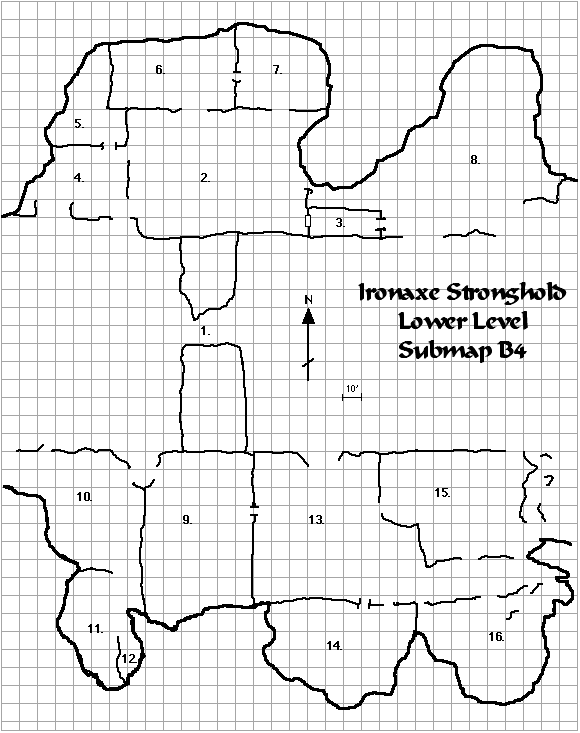 |
This set of two buildings, which dominated the passageway between area B and D, was very hard hit during the ancient battles with the Deceiver. Most of the buildings, which were probably two storeys tall, have collapsed completely, forming a set of outlying walls between 4'-8' tall which interior is entirely filled with rubble.
The only portion left standing is the central portion, near the gate proper, where the second storey has collapsed but pockets of the ground level remain more or less intact. The ancient gates have been torn off and are long gone, but most of the thick curtain wall that ran between the buildings is standing.
The drow have occupied this portion of the ruins as a guard point so that creatures from area B and the rest of the underdark do not threaten their living areas. These drow are members of the Lolth temple and are unaligned with the two drow houses that reside here.
As with area A14, the strange purple glow of the drow fungus begins here and extends throughout areas C, D, E, and the upper levels.
1. Curtain Walls
These massive walls are 30' thick and some 25' tall. There are the jagged remains of battlements atop the walls. There is a drow warrior at station on each side of the central gap. The guards are standing and watch out towards the rest of area B.
Drow Male Warriors (AC1; MV12; CL Wa; LV2; hp 15, 11; THAC0 19; #ATT1; D by weapon; SA see below; SD see below; Weapons short sword+1, dagger+1, hand crossbow [d3 damage]; Armour chainmail+1, buckler+1, dexterity 15; MR 54%; XP 650 ea; src MM)
All drow may cast the following once per day: dancing lights, faerie fire, and darkness.
All of the crossbow darts of these drow may be coated with a poison that requires a save at -4 for fall unconscious for 2D4 hours. To coat each dart takes a full round, and they generally do not keep their darts coated at all times.
Each drow has a silver horn (worth 50gp) which when blown produces an eerie high pitched keening. They will use the horns to alert the rest of their fellows within these buildings.
2. Main Hall
Once a large hall, perhaps even a messhall, this is now the main barracks for the garrison here. There are pallets made from soft fungus set upon various jerry-rigged beds, using metal pieces of furniture left from the dwarves. There is also a long metal table, chairs, and various personal utensils, including drinking glasses and plates, on the table.
There are a total of 10 beds here. 2 of the drow are up on the walls (see room 1 of this encounter), and another 4 are off duty and back in the living areas of the stronghold. The remaining 4 male drow warriors are here, sitting at the table, one playing a soft strange harp whose body is made of drow metal and whose strings are made of spider webs.
Drow Male Warriors (AC1; MV12; CL Wa; LV2; hp 15, 11, 12, 13; THAC0 19; #ATT1; D by weapon; SA see below; SD see below; Weapons short sword+1, dagger+1, hand crossbow [d3 damage]; Armour chainmail+1, buckler+1, dexterity 15; MR 54%; XP 650 ea; src MM)
All drow may cast the following once per day: dancing lights, faerie fire, and darkness.
Each drow here has D10pp and D20gp.
3. Small Room
This small room has a door that was put on by the refounding dwarves, who also used this place as a guardpost. The door is not locked and holds a small shrine to Lolth, this being in the form of a large block of stone upon which have been chiseled crude spiders and spider-like figures. A dead large spider has been placed atop the altar and two platinum pieces have been pressed into its body as eyes of a sort.
Crude as the altar is it has attained some potency. Apparently Lolth has looked upon this impromptu worship with some favour, and has imbued the dead spider's spirit with some power and placed it as a guardian spirit over the place.
Any non-drow touching the altar, or upon a call to Lolth by any of the drow here, the spider spirit will take 1 round to materialize and will then attack intruders.
The spider spirit is a translucent figure the same shape and size as a large spider. It may pass through walls at will.
Spider Spirit (AC6; MV fl24[A]; HD2; hp 16; THAC0 19; #ATT1; D see below; SA see below; SD +1 or better weapon to hit; XP 650; src nil)
The spirit attacks by biting. The bite ignores armour and shields of all kinds, but includes dexterity and magical protection. On a successful hit, a spiritual venom is injected. This venom requires a save versus magic. A successful save means no effect. A failed save means the victim's soul is disrupted. The victim may not cast any priest spells and is disoriented such that all of his characteristics decrease by 1. Further bites lower characteristics by a further 1. The effect of each bite lasts 5D4 rounds.
4. Outer Room
Exposed to the outside, this room is not used by the drow as it is in danger of collapse. Anyone moving through the rubble choked room has a 5% per person passing through of shifting rubble enough to cause the ceiling to collapse, forcing all within the room to save versus paralyzation (including reaction bonus) or suffer 3D6 damage. Those saving who are at the edge of the room take no damage. Those saving who are well within the room take half damage. Of course, the noise from such a collapse will alert the drow.
5. Inner Room
Although this room also appears near collapse, a dwarf or engineer can tell that the main rubble collapse has wedged the pieces of ceiling together so that no collapse is imminent. The room is rubble choked and clearly not used much by the drow. However, the room is used by their pets, in this case 10 large spiders that lair in webs strung between protruding blocks of stonework.
Large Spider (x10) (AC8; MV 6 wb15; HD1+1; hp 7, 4, 9, 2, 9, 4, 7, 3, 8, 8; THAC0 19; #ATT1; D 1; SA webs, poison; XP 175 ea; src MM)
6. Priestess' Room
This is the lair of the priestess second in command of this guard post. She is a sadistic elf who commonly treats the male guards under her as mere chattel for her sexual and sadistic pleasures. Nevertheless, she is fearsome enough to command their obedience, although were she to be severely wounded they would not seek to aid her and might even put a knife in her back.
The room is bedecked in fairly fine furniture, including scavenged dwarven tables, a ceramic wash basin, a metal bed stuffed with rothe furs, a wooden wardrobe carved with forest motifs, and a brass brazier that emits some heat and a strange, tangy smell. Tapestries of black and purple fabric are adorned with embroidered spiders and spider-like sigils and patterns. One has an extremely intricate web patters that hints at some sort of writing contained within the pattern.
Drow Female Priestess (AC-2; MV12; LV4; CL Pr; hp 25; s16[+1 damage], I11, w13, c11, d16, ch14; #ATT1; D by weapon; SA see below; SD see below; Weapons footman's mace+1, dagger+1; Armour chainmail+2, buckler+2; Spell Points 29; Fixed Magic command, battlefate, protection from good, cure light wounds, hold person, silence 15'r, 1 free orison; MR 58%; XP 975; src MM)
All drow priests may cast the following once per day: dancing lights, faerie fire, darkness, detect lie, clairvoyance, suggestion, and dispel magic.
The priestess has no magic other than her drow weapons and armour, but she does possess a platinum holy symbol to Lolth, a silver diadem decorated with spiders above the brow and a webbing of diamonds that hangs down over one eye worth a total of 4500gp.
The priestess' monetary treasure is hidden behind some of the collapsed rubble to the north, and the niche is guarded by a sharp metal spike coated with drow sleep poison. Anyone reaching into the niche will hit the spike and must save vs poison at -4 or fall unconscious for 2D4 hours.
Within the niche is a sack holding 100pp, 47sp, 25gp, 2 emeralds worth 250gp each, and 3 vials (with 4 doses per vial) of drow sleep poison.
7. Storeroom
This room holds the drow guardpost's supplies. Included here are a table being used as a butchering block, 3 rothe carcasses hanging from hooks, an improvised hearth which lets smoke out into the cavern proper, several barrels made of hollowed out fungus holding drow fungus wine, several similar barrels filled with water, various metal boxes filled with edible fungi (mostly dried), whetstones, 3 hand crossbows and 150 darts, 4 vials of sleep poison, 4 spare drow cloaks, and some weapon and armour repair tools.
8. Collapsed Room
This room is similar in most aspects to room 4 in that it is about ready to collapse. See room 4 for details.
9. Central Room
This is the main guardroom on this side of the passageway. Here are some beds of rothe fur and salvaged metal tables and chairs enough to house 6 drow. There are actually only 3 drow warriors here. The rest are back in the living areas off duty.
Drow Male Warriors (x3) (AC1; MV12; CL Wa; LV2; hp 14, 16, 11; THAC0 19; #ATT1; D by weapon; SA see below; SD see below; Weapons short sword+1, dagger+1, hand crossbow [d3 damage]; Armour chainmail+1, buckler+1, dexterity 15; MR 54%; XP 650 ea; src MM)
All drow may cast the following once per day: dancing lights, faerie fire, and darkness.
Each drow here has D10pp and D20gp.
10. Collapsed Room
This large room can be accessed from the general rubble and collapse to the west. The room itself is in some danger of collapse. Treat it as room 4 except that the chance of collapse is only 1% per person passing through.
Anyone entering from the rubble to the west will disturb a nest of giant centipedes, which will suddenly scramble out from under the rocks and debris, biting at the intruders.
Giant Centipede (x14) (AC9; MV 15; HD1/4; hp 2 ea; THAC0 20; #ATT1; D nil; SA poison; XP 35 ea; src MM)
11. Collapsed Room
Another room mostly obliterated by rubble collapse, the drow use this room as an outhouse. There are several holes dug into the ground and these are used as toilets. Apparently, the centipedes from room 10 do not venture here.
12. Tiny Room
How large this room might once have been is pure speculation, as now only a sliver remains outside of the rubble collapse. The squeeze into this room is a tight one, as the opening is only 3' wide. This would normally be a wonderful hiding place but for the shrieker that has decided to grow in this dark place which is also slightly damp due to a small trickle of water coming from broken piping in the walls.
Shrieker (AC7; MV 1; HD3; hp 16; THAC0 17; #ATT -; D -; SD noise; XP 120; src MM)
The drow are aware of this occupant and if they hear the shrieker go off they will investigate.
13. Bodyguard's Room
This is the lair of the bodyguard of the female commander of the guard post. The room is filthy and unadorned, except for the discarded husks of previous victims, mainly rothe, rats, and a goblin or two.
Drider (AC3; MV12; HD6+6; LV6; CL Pr; hp 37; #ATT1; D 1-4 or by weapon; SA poison, spells; SD see below; Weapons battle axe; Spell Points 55; Free Magic bless, curse, protection from good, cause fear, hold person, resist fire, enthrall, cause blindness, protection from good 10'r, 1 free orison; MR 15%; XP 5000; src MM)
All drow priests over 4th level may cast the following once per day: dancing lights, faerie fire, darkness, levitate, know alignment, detect magic, detect lie, clairvoyance, suggestion, and dispel magic.
Other than a silver collar with runes of ruby telling that this drider is the personal bodyguard of Commandress Vinixil (worth 1850gp), and a platinum unholy symbol to Lolth, the drider is unadorned.
14. Commander's Room
This partially collapsed room is the living chamber of the commander of this guardpost. The place is well appointed with the usual drow black tapestries, though these are embroidered with golden thread forming spiders in a web and would be quite valuable, although they are also quite thick and heavy. A bed is also here, certainly not of dwarven make, as it is carved from a sort of wooden substance (actually a hard fungus). The bed is canopied in spider silk and is a wonderful piece of art, with its spidery motifs carved throughout. The mattress is of a sort of down material of an unknown origin and is quite soft.
A mirror of dwarven make is here, about 3' wide by 5' tall and ornamented with mining carts and hammers around the edges.
Also here is a table and chairs. Upon the table is a metal plate, a bottle of dwarven ale, a golden chalice of dwarven make worth 200gp, and a large book made of shale covers and stretched vellum pages which is written in Elvish and is a manual on surface world military tactics (much of it is incorrect and it contains inaccuracies of exaggerated proportions).
Drow Female Warrior (AC-3; MV12; LV5; CL Wa; hp 44; s13, I14, w17, c14, d17, ch14; #ATT3/2; D by weapon; SA see below; SD see below; Weapons shortsword+2, dagger+1; Armour chainmail+2, buckler+2; Specialization specialized in shortsword [+1 to hit/+2 damage]; MR 60%; XP 2000; src MM)
All drow above level 4 may cast the following once per day: dancing lights, faerie fire, darkness, levitate, know alignment, and detect magic.
This drow warrior possesses a platinum badge of station, in this case a toadstool with amethysts worth 200gp. She wears a platinum armband stylized into the form of a web worth 270gp. She also carries a pouch with 4 doses of hand webbing, and a pouch holding a small key to her chest (see below).
Hand Webbing - each dose is thrown from the open hand. A web springs out in a cone 30' long, 5' wide at its origin and 30' wide at its end. All within are subject to the effects of a web spell (including saving throw). The webbing lasts as if cast by a 4th level wizard.
Hidden within the wardrobe, which contains changes of clothing and another set of drow cloaks and boots, is a small metal chest (locked, key on the Commander) which contains 170pp, 25gp, 140sp, and a large piece of amber which holds a dwarven heart within (worth 300gp to anyone who is not disgusted by the gem).
15. Collapsed Room
Although not in danger of collapse, since its roof collapsed long ago, this room is choked with rubble and difficult to pass through silently.
16. Collapsed Room
Another collapsed room. This one is in no danger of collapse, but is choked with rubble. Within are the goblin slaves of the commander. These are shackled to the walls. There are 4 goblins here and they would love nothing more than to escape. They have been in the living area and can describe the main passageways.
Goblins (x4) (AC10; MV 6; HD1-1; hp 2, 4, 3, 3; THAC0 19; #ATT 1; D 1-6; XP 15; src MM)
C. South Cavern
This is the southern of two caverns that are actively inhabited by the drow. The drow priesthood controls the Malaktum temple that is here, and the family Vrielsevri controls the rest of the cavern, including the bridge, the foundry ruins, and the guardpost to the north. It is here that the house is attempting to perfect the working of mithril, and they frequently send forays into the dwarf mines to look for more of the ore.
There is no wandering encounter table for this area. Assume the chances of an encounter are as per area B, but all such encounters will be with drow (25%) or drow slaves (75%). It is up to the DM to determine the exact nature of such encounters.
There are still ruins in the area, but it is much less choked with such than area A. This because these were not living areas for the ancient dwarves, but was a place where metals were forged and crafted.
The entire cavern radiates a strange purplish glow that allows some visibility out to several hundred yards for large objects. The glow radiates from veins of fungus and lichen that line the walls and ceiling of the cavern. This fungus is responsible for the radiations which power drow magics.
C1. Malaktum Temple
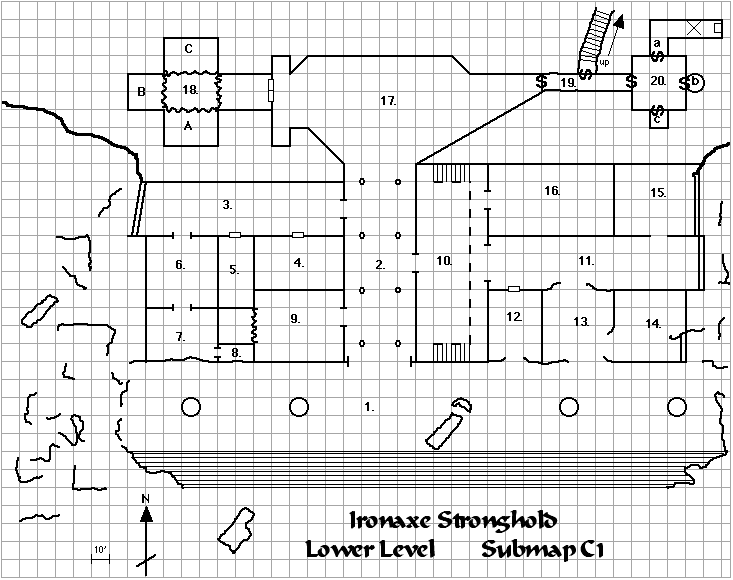 |
This was once a huge temple to Malaktum, which was ravaged during the Deceiver's invasion, reclaimed and reactivated during the refounding, and then occupied and defiled once again by the drow. The sacred anvil was housed here during the refounding, but as the drow attacked, the anvil was moved via secret passages to the upper level to its current hiding place. The drow here have not yet located this secret passageway.
The drow within the temple are all loyal to the Lolth priesthood, and this is their power base on the lower level. As such, the Malaktum temple has not really been converted to the worship of Lolth, although a shrine exists, but is more used as a barracks.
Refer to the Malaktum Temple map when using the key below.
1. Outer Temple
The temple is most ruined on its flanks, which were subject to the assaults of the Deceiver. Most of the flanks are collapses of rubble, with the roofs caved in and the walls jagged stubs of once grand edifices. The central portion of the temple is mostly intact. The building is shaped much like the Greek Parthenon, the outside being a series of long steps leading up to a platform with a triangular roof supported by thick ionic columns. Inside the platform is the actual temple building. The roof is some 30' overhead and decorated with faded mosaics of dwarven smiths, with many coloured stones missing.
This area is the outside portion. Thick 10' diameter columns, most of them pockmarked with dents and chips, are decorated like giant hammers, with their heads at both the bottom and top of the columns. The floor is of white marble with gold and silver striations running through it.
This area is deserted, as the drow spend most of their time inside. There is not really a guard here, since the drow rely on the guards in area B4 and A14 for early warning. However, smoke can be seen wafting from the hole in the outer wall from room 12 (the kitchen).
2. Hallway
This is a large hallway some 30' high and 40' wide. The walls are adorned with mostly faded frescoes showing dwarven smiths and dwarven warriors in battle against dragons and other foul creatures. Most of the frescoes look ancient and partially obliterated, but it is apparent that portions are new restorations of older designs.
Smallish pillars support the hallway's vaulted ceiling, these being shaped like stalagmites and stalactites grown together into columns. The floor here is of white marble with patterns of iron, steel, and copper running along the hallway in geometric configurations.
3. Side Hallway
This hallway ran further west than it does now. The refounding dwarves clearly bricked up the end of the hallway to provide a measure of protection and security for the new Malaktum temple. The hallway is less adorned than the main hallway (room 2), consisting just of granite flagstones and evenly spaced metal sconces in the shape of bellows.
4. Prison
The door to this room is thick iron and barred from the outside. A small hole has been bored at elf eye level. This room is used to hold prisoners of the garrison. The room is damp and strewn with rags of fur and pieces of fungus, and the whole has a damp, sweaty smell.
Shackles of drow metal hang from the wall, most having no more than 3' of chain. A metal bucket with water is also here.
Currently, the room's only occupant is a drow female. She is a thief who sought to rob a priestess and is now awaiting sacrificial execution at the next holy day (perhaps 1 month from the present).
The drow prisoner certainly wants to escape, and will gladly join her captors, although before too long she will attempt to rob the party and escape to her own destiny. She is currently shackled hand and foot, with the shackles being welded together.
Drow Female Thief (AC6; MV12; LV4; CL Ro; hp 20; s12, i10, w13, c10, d19, ch11; #ATT2; D by weapon; SA see below; SD see below; Weapons nil; Armour nil; Proficient in shortsword and dagger and double specialized in 2 weapon fighting style; Thief Skills pp50% ol45% ft20% ms40% hs45% dn45% cw80% rl10%; MR 58%; AL CN; XP 2000; src MM)
All drow may cast the following once per day: dancing lights, faerie fire, and darkness.
The thief's name is Asyhtril, and she is not a member of either house, but succeeded in posing as a merchant guard in a caravan bringing supplies from the drow city. She slipped away from the caravan and has plied her trade within the stronghold, planning on leaving with the next caravan. However, in raiding the temple here she was caught and imprisoned.
Asyhtril is new to the stronghold, and so does not have a lot of knowledge of its layout, although she can guide the party around the more commonly accessed areas of the upper level.
5. Store Room
This room is unlocked. Within are various mundane supplies used by the drow, most shipped from the drow city. The supplies include spider silk ropes (a total of 500' worth), fungus barrels, whetstones, raw drow metal ingots, fungus wine, et al.
6. Pet Sanctuary
This is the first room in a section of the temple devoted to spiders. Webs criss-cross this room from floor to ceiling, and anyone wishing to pass through will have to cut away many of the strands. Within the room dwell 20 large spiders, which will attack any non-drow they encounter.
Large Spiders (x20) (AC8; MV 6 wb15; HD1+1; hp 6 ea; THAC0 19; #ATT1; D 1; SA webs, poison; XP 175 ea; src MM)
7. Lair of the Guardians
This room is also draped with webbing, although to a much lesser extent than room 6. In this room lair 12 watch spiders, specifically trained by the drow as guards to the treasure in room 8. They will attack any non-drow, but one is trained to always go and alert the rest of the drow that intruders are present (kind of like Lassie going to get help). These hide not in the webs but in small dens amid the various bits of collapsed rubble that line the floor of the room.
Watch Spiders [Huge Spiders] (x12) (AC6; MV 18; HD2+2; hp 13, 13, 7, 13, 11, 9, 18, 8, 10, 6, 14, 9; THAC0 19; #ATT1; D 1-6; SA leap 30', surprise -6, poison [save at +1 or paralyzed for 2D4 turns]; XP 270 ea; src MM)
There are a few desiccated goblin
bodies in the room, evidence of slaves gone ill or too old to
serve their drow masters.
8. Treasury
This small room is the drow garrison treasury. The most fearsome guardians of the treasure are contained within this room. The guardians are two wraith spiders, which dwell here amid strange, glowing, shadowy webs that seem to have no corporeal reality, but which the wraith spiders seem to walk upon. The webs completely block access to the treasure beyond, and despite their shadowy appearance, anyone touching them will suffer cold damage and will likely be entrapped (see the Monstrous Compendium Annual Two for details).
Only the drow priestess of this garrison may command the spiders to remove their webs and access the treasure. Any others will be attacked.
Wraith Spider (x2) (AC5; MV 15 wb18; HD3+2; hp 14, 15; THAC0 17; #ATT1; D 1-4; SA webs, energy drain, poison; SD silver or +1 weapons to hit; XP 1400 ea; src MC2)
The treasure beyond includes treasure brought from the drow city and treasure captured from this very temple. It is quite substantial and includes:
· a metal chest (unlocked) which holds 600gp, 1000sp, 300cp, and 450ep
· a scroll of protection from ghouls and ghasts
· a ceremonial mace made of silver and gold carved in the shape of a dragon's head worth 750gp
· 6 holy books and hymnals of Malaktum
· a book of exalted deeds written in Dwarvish; this sacred book will require a full week of study to benefit, and any good priest will gain 1 point of wisdom and 1 level of experience (to the middle of the next level); however, the priest must make a wisdom roll to understand it, otherwise, the reading fails to have any effect. The book will not disappear when read, but will remain potent.
· a sacred Malaktumi hammer, a large mallet made of gold and mithril worth 2000gp, but not suitable as a weapon
· a stone of summoning earth elementals; this stone works only once before crumbling. Its user must bury the stone in earth and pronounce the name of Neengrum, which is enscribed in Dwarvish on the stone. D4 rounds later a 12HD earth elemental will sprout up from the ground where the stone was buried and will serve the utterer/burier for D6 turns before sinking back into the earth.
· a medallion of thought projection (the dwarves used this "cursed" item to interrogate prisoners)
· a stone mule, a figurine of a mule about 2" high that, if placed on the ground and a command word is spoken (the word is enscribed in Dwarvish runes on the base of the figurine and is the word for "burden"), will turn into a real mule for D6 days before reverting back to a stone figurine forever. The mule has maximum hit points and does not need to rest, eat, or drink.
9. Troop Quarters
Here are the living quarters for part of the garrison. There are 4 drow male warriors here, lorded over by a female sergeant. The males dwell in rothe fur pallets in the main room, along with a salvaged dwarven table and chairs and a few barrels of water and dwarvish ale.
There is a drow chess set made of bone and onyx on the table, and the drow usually spend their time playing their very complex version of chess or reading one of several drow books expounding myths and legends of Lolth's past and her future ascendancy.
Drow Male Warriors (x4) (AC1; MV12; CL Wa; LV2; hp 13, 10, 10, 17; THAC0 19; #ATT1; D by weapon; SA see below; SD see below; Weapons short sword+1, dagger+1, javelins [x3, D4 damage, 90 yards, +3 at short, +2 at medium, +1 at long range]; Armour chainmail+1, buckler+1, dexterity 15; MR 54%; XP 650 ea; src MM)
All drow may cast the following once per day: dancing lights, faerie fire, and darkness.
Each drow here has D10pp and D20gp.
In the rear of the room is a curtained off area, the curtain being black silk, behind which is the sergeant's quarters, which includes a metal bed with a feather mattress, the bed decorated with Malaktumi symbols, a table, and a weapon rack that is empty.
Drow Female Warrior (AC-2; MV12; LV3; CL Wa; hp 21; #ATT3/2; D by weapon; SA see below; SD see below; Weapons shortsword+2, dagger+1, hand crossbow [D4 with sleep poison, save at -4 of unconscious for 2D4 hours]; Armour chainmail+2, buckler+2, 16 dexterity; Specialization specialized in shortsword [+1 to hit/+2 damage]; MR 66%; XP 975; src MM)
All drow may cast the following once per day: dancing lights, faerie fire, and darkness.
The warrior possesses a scroll of protection from poison and a potion of dwarf control. She wears a badge of station, a platinum toadstool with an Elvish "S" rune etched in amethyst worth 275gp, and a silver ring with a small opal worth 200gp. She also has a key to her chest (see below).
A metal chest here (locked, key on the drow sergeant) holds 100gp, 37pp, various furs and pelts from the surface world (none particularly valuable to surface dwellers), and a piece of wood carved into the form of a deer, with full antlers, worth only about 5gp on the open market.
10. Common Room
This large room is the common area of the garrison. Here is a large long metal table, decorated with Malaktumi motifs. At the head is a largish chair again decorated with Malaktumi symbols, and many smaller chairs surround the table.
Stairs on each flank of the room ascend to a gallery that overlooks the room from the western portion of the chamber. The gallery is about 15' high and shows signs of having once had tabards hanging down from its edge.
Usually, some drow can be found here, dining or generally carrying on conversations or playing with purplish ivory playing cards of drow origin (the cards have pictures of various creatures of the underdark upon them, mind flayers, derro, abboleth, et al).
There will be D4 drow here. Remove any drow found here from the drow in room 16.
In addition, on the balcony, usually invisible, is the priestess' familiar, a quasit, who is ordered to spy upon the drow in order to warn the priestess of any impending rebellion. If trouble ensues, the quasit will telepathically warn its mistress (room 18) and then seek to attack spellcasters and the like from the rear.
Quasit (AC2; MV15; HD3; hp 17; #ATT3; D 1-2 / 1-2 / 1-4; SA dexterity draining venom, spell like powers; SD invisibility, spell like powers, hit by cold iron or magical weapons only, immune to cold, fire, and lightning, save as 7HD monster; MR 25%; XP 2000; src MM)
There will also generally be a couple of goblin slaves serving food and drink from the kitchen.
Goblins (x2) (AC10; MV6; HD1-1; hp 4,5; #ATT1; D 1-6; XP 15; src MM)
These goblins wear iron collars notifying drow of their ownership and thralldom.
11. Side Hallway
This hallway's floor is entirely of iron, with rivets at the edges, forming a sort of aisleway. Bas reliefs on the wall show the story of Malaktum's forging of the first sword, which Aghorrit used to fight the Gods' War. It also shows prophecies of this same sword being again used to slay evil.
The eastern end of the passageway abruptly cuts off in brickwork built by the refounding dwarves to protect the temple from incursions from the outside.
12. Kitchen
This room was probably not a kitchen in its original incarnation, but the refounding dwarves seem to have made it so and the drow have continued to use it as such. Counters here are filled with cooking tools, mostly of dwarvish make, and a hearth has been fashioned from metal and stones, which vents out of a hole in the wall to the south. The hearth looks as if it may have once been a smithy or forge in ancient times. Many barrels of water, captured dwarvish ale and beer, and fungus wine are located here.
A dwarf slave, the actual cook of this temple, prepares meals for the drow here. She is quite a good cook and the drow value her for her talents, so she bears only a few signs of recent mistreatments. The dwarf cook is chained by shackles to the wall, the shackle being long enough to allow her full reach of the kitchen but no farther. The shackle has been forged directly around her ankle, and her ankle bears the burn marks from the forging.
Dwarf Slave (AC10; MV6; HD1+1; hp 6; #ATT1; D 1-8 or by weapon type; SA see below; SD see below; MR see below; XP 270; src MM)
Her name is Crundulkum Enthilzum, and she is a bit numb from her subjugation and mistreatment, however, she will be quick to thank her rescuers and to fight for them. She has familiarity with axes but no proficiency. Any Ironaxe dwarves will recognize her.
As a former resident of this temple, she knows of the entire layout, though not of the drow contents, like the treasury in room 8. She is unaware of any of the rest of the drow stronghold, although she does know the general layout of the stronghold itself.
Of more import, she can tell the party that the sacred anvil used to be kept in the chapel (room 17), but that she saw a group of priests uproot the anvil from its pedestal in room 17 when the drow attacked, and they and the anvil disappeared, though they never passed down the main hallway (room 2). This should be an excellent clue that a secret passageway exists from which the anvil was taken away.
13. Open Room
This room is open to the outside of the temple, as most of its southern wall has collapsed. In addition, much of its northern wall has collapsed as well. The room is not choked with rubble, but it is underfoot enough to make sneaking around in the dark difficult.
A statuary at one time, remnants of bronze statues of dwarves and other mythical creatures lie scattered around, corroded and tarnished.
14. End Room
The southeastern portion of this room has been bricked up by the refounding dwarves in an effort to seal off the inhabitable parts of the temple from the outside.
There are 4 giant pack lizards here, used by the drow as slow transport. They are muzzled and tied to a large stone block that has fallen from the ceiling. Slow to panic and unaggressive, the party may use them as pack beasts, but they will travel at half speed until someone makes a successful Animal Handling NWP roll and learns where to prod them and how to steer them.
Giant Pack Lizards (x4) (AC5; MV 15 [6 when under control]; HD3+1; hp 17 ea; #ATT1; D 1-6; SA roll of 20 does double damage [2-12]; XP 160; src MM)
On the ground near the lizards are their saddle bags, now empty, and a sack filled with rotted carrion, which serves as their food. A stone trough holds stagnant water for the beasts.
15. Slave Quarters
This room's east wall was bricked up by the refounding dwarves as protection from the outside.
Now this chamber serves as quarters for the slaves of these drow. These are 8 goblins, two of which are generally serving food in room 10.
The rest dwell here in abject misery. They are not chained up, for they have nowhere to go and their forged collars of iron give their status as slaves.
They will not, however, fight for the drow, but intruders whom they see will likely cause a stir amongst them, with some whimpering and yelping. This is not likely to cause undue concern amongst the drow, as often these goblins fight amongst themselves, and in fact such fights are often encouraged by the drow who appreciate the sport they give.
Goblin (x6) (AC10; MV6; HD1-1; hp 3 ea; #ATT1; D 1-6; XP 15 ea; src MM)
16. Living Quarters
This is the living quarters of the remainder of the temple garrison. These are nominally under the direct command of the sergeant in room 9, and they will follow her immediate tactical commands. Remember to subtract from the drow in this room those found in room 10.
The furnishings of this room are spartan by drow standards, with rothe fur pallets set on metal dwarf bed frames, a table or two, and some personal effects. The drow here spend their time fashioning strange flutes made of metal and fungus, and they also have several giant centipedes in metal cages, and a little fighting pit set up in one corner of the room where they fight their centipedes for sport and money.
There are sleeping quarters for 6 drow warriors here.
Drow Male Warriors (x6) (AC1; MV12; CL Wa; LV2; hp 10, 12, 9, 16, 12, 18; THAC0 19; #ATT1; D by weapon; SA see below; SD see below; Weapons short sword+1, dagger+1, javelins [x3, D4 damage, 90 yards,+3 at short, +2 at medium, +1 at long range]; Armour chainmail+1, buckler+1, dexterity 15; MR 54%; XP 650 ea; src MM)
All drow may cast the following once per day: dancing lights, faerie fire, and darkness.
Each drow here has D10pp and D20gp.
17. Chapel
This is the main chapel of the Malaktum temple, and its shape is that of an anvil. The walls were once resplendent with gems and veins of precious metals, but these have been long since pried away, leaving the walls cracked and pockmarked. Many of these cracks show signs of recent plastering over, and newer frescoes and mosaics showing the refounding of the temple and the forging of mithril weapons on the sacred anvil. Over most of these frescoes black spiders with red eyes have been painted, and these are not crude representations, but evily beautiful, sinister spiders that have actually been integrated into the dwarvish scenes, so that it looks as if spiders are ambushing the refounding dwarves.
To the east, where the room narrows to a point, steps lead up to an altar that was once probably dedicated to Malaktum. The altar is a block of iron 3' square inlaid with gold and flecks of mithril. There was some sort of idol or statue atop it, but that has been smashed off, though two stubs of feet remain attached to the top of the altar. All around the altar, blood has been splashed and then smeared into arachnoid shapes. Atop the altar has been placed a huge jet spider, some 2' in diameter, with a small beautiful drow elf head fashioned of a strange greyish gem not recognizable even by dwarves. The spider's eight eyes are rubies, while the drow head's eyes are bright orange jacinths. The whole is hauntingly beautiful and appallingly evil looking and could fetch over 10000gp in properly jaded quarters. The thing is very heavy, however and radiates an aura of evil.
In the centre of the chapel is a marble pedestal which has an indentation that is shaped like the base of an anvil. It should be clear that the sacred anvil once rested here. Signs of various smithy tools and implements are here, and it is clear they were both functional and ceremonial, although everything has been broken and defiled.
To the west, great iron double doors are closed.
The secret door to the east will not open unless the proper procedure is performed. This procedure is described in room 18 below.
Comfortable in this temple to Lolth is the priestess' pet, a giant flying spider, which enjoys lounging behind the altar, out of sight, where the bones and carcasses of previous victims remain. When intruders enter, the spider will leap out from behind the altar and fly at the party.
Giant Flying Spider (AC4; MV9 fl9[D]; HD3+3; hp 21; #ATT1; D 1-8; SA leap 70', poison [save at +2 or suffer 15 pts of damage over 15 minutes]; XP 650; src MM)
18. Priest's Quarters
This set of chambers was originally the apartments of the priesthood of the temple. The dividing walls have been torn down to form a single large apartment for the drow ruler of this building, a warrior/priestess/mage of Lolth and the second in command to the High Priestess of Lolth herself on the upper level.
The apartment is shaped like a hammer, forming three chambers that radiate out from the central area. Each chamber is cutoff by a deep velvet curtain that is embroidered with platinum thread shaped into sigils of Lolth and the ruling houses of Yyered-Nulthil, the drow city. Each tapestry would fetch over 500gp to an interested buyer on the surface.
The first entryway to the apartment is adorned with strange torches in wall sconces. These torches burn with a purplish glow similar to the glow outside created by the fungus. A large black widow spider has been set into the marble of the floor in an intricate mosaic of a superior craftsmanship to rival even dwarven artisans.
The spider mosaic covers the entire floor and the hourglass symbol on its abdomen is actually a glyph of warding. Anyone but the priestess, her bodyguard, or anyone touching the priestess who touches the spider mosaic will set off the glyph. The glyph's name is Thruiltrerili, the drow name for black widow venom, and anyone setting it off must save vs magic or suffer poisoning. The victim who is poisoned must save vs poison or suffer D4 damage per round for D20 rounds. If a save is made, the victim suffers D2 damage per round for D10 rounds. Once discharged, the glyph is harmless.
Before the mosaic is a small gong and hammer, used to summon the priestess.
In the central area between all four curtains is the living area. Here is a plush divan made of exotic woods and satin cushions, a low metal table with a mirrored surface, several braziers exuding strange incense, and under all a red carpet with a large black spider dominating its centre.
Area A is the dining chamber of the priestess. Here is a small ornate oaken table and chairs, fine sets of dwarven china and eating and drinking utensils, and bottles of fungus wine and kegs of dwarvish ale and beer.
Area B is the bedchamber of the priestess. Here can be found an exotic bed made from pumice stone and bedecked in plush furs that certainly did not originate from a mangy rothe.
The bed's canopy is held up by the stuffed naked bodies of 4 dwarf males, arms upraised and holding the top of the canopy of spider's silk.
Also here is a table and silver wash basin (worth 25gp), a silver mirror and a silver comb studded with sapphires and diamonds worth 25gp and 550gp respectively, and a wardrobe of obvious dwarven craftsmanship made of fine mahogany which contains various priest vestments dedicated to Lolth and 2 sets of drow cloaks and boots and various normal drow apparel.
Under the bed is a loaded hand crossbow, clipped to the bottom of the bed, and a drow dagger +1 under the pillow.
At the foot of the bed is a small mangy fur pallet where her bodyguard sleeps.
A tapestry hangs on the wall above the bed, this showing a victory of the first evil elves over the good elves in the Forest of Blanthil. Behind it is a bas relief in Dwarvish which reads:
That which is hidden is where the ring of truth is forged. The keeper of the hidden must be called. But the end of life's journey is death, so the wise dwarf lives before his end.
These words refer to the secret passageway in room 17. That wall is cunningly designed and is a magical door, which fades into and out of existence rather than relying on any mechanical stonework. For that reason, it is absolutely undetectable, except as alteration magic.
The chapel is shaped like an anvil. Rings of mail and other rings are forged on the pointed end of the anvil, where the metal can be wrapped around the point. This tells where the secret door is located. Allow any dwarf half his intelligence roll, or anyone with blacksmithing a full intelligence roll to realize that rings are forged at the point of the anvil.
The keeper of the hidden is, of course, Neengrum, and the wall must be touched and Neengrum's name invoked. This will open the doorway for 2 rounds. Anyone caught in the doorway as the wall reforms will have to make a dexterity roll to jump back, otherwise, they will be integrated with the wall...dead.
The last line of the writing refers to the fact that the secret passageway ends in a series of deathtraps. The safe way is a normal secret door in the middle of the north wall of the secret passageway that leads upwards.
Area C is the priestess' workroom. Here are maps of the lower level of the stronghold, several stone plated books of vellum dealing with the religion of Lolth, drow magic, drow society, and drow military tactics.
Two pieces of vellum have interesting writing upon them in the Drow Elvish script:
Document #1:
Oh great and mighty priestess of ever watchful, ever mighty, and ever venomous Lolth, Queen of the world dark and light,
We of the merchant house of Noldrilni beseech you to send some of your brave women to look for our kinswoman, who has gone missing from our caravan along the great road. In respect of the worthlessness of our request in the face of your mighty responsibilities, we ask that you receive this slave and the coffer he bears as a humble token of our respect and as our desperate hope that our pleas will fall upon your beneficent notice.
May Lolth's venom run hot in your veins and freeze the blood of your enemies,
Nithrilum of the House of Noldrilni
Document #2:
My dearest webmate Qwathinlil,
Those who have come to lie to us are making their way here, and you must treat them with due respect. Give them safe passage and a spider's courtesy to my chambers. Then we shall see what their life's blood is made of.
Quan'thal'illa
Also here are the body parts of various underdark creatures, powdered gems, fungal concoctions, etc, all in small glass tubes and vials marked with the priestess' private code.
Various tables and workbenches are also here, and laboratory equipment such as mortars and pestles, scales, alembics, etc. A rack holds 12 vials of unholy water. A small hearth holds a drow metal cauldron inside which a latest concoction boils and bubbles.
Atop a pedestal is chained a large book of drow metal covers and vellum which is huge, at least 200 pages long. This is the priestess' wizard spellbook, and it is clasped shut by a metal lock (the key is on the priestess) upon which a poison needle has been set. Anyone opening the clasp (one must take off a metal gauntlet to do so) will be subject to a prick of the needle, prompting a save versus poison. A save means 10 points of damage in 5 minutes. A failure means 10 points of damage are taken in 5 minutes, and then another 10 points of damage taken in the next 5 minutes and another save. Each time a save is failed, another 10 points of damage in 5 minutes is sustained. Whenever a save is made the poison has stopped.
The first page of the spellbook contains a bound demon. Anyone opening the page without uttering the command word "Thaxathill'n" will release the demon, which will emerge from its picture on the page (the picture will disappear) and appear in the room, attacking all it encounters.
Tanar'ri Bulezu [Lesser] (AC-1[1]; MV9; HD7+3; hp 39; #ATT4; D 2-5 / 2-5 / 2-16 / 1-3; SA head butt [knockdown and stun], rage; SD +1 or better weapon to hit, tanar'ri immunities; Spell-like Abilities [at 7th level] cause fear, command, detect invisibility, shout[1/day], wall of fog, darkness 15'r, infravision; MR 25%; XP 9000; src PMC2)
The demon appears as a gaunt, skeletal minotaur with filthy and diseased flesh. Its has no fur but tufts of wiry bristles over its boil-ridden skin. Its feet are claws and it has a long, serpentine tail with a clump of iron hard spikes at the end. Its horns are ram-like and its mouth filled with razor sharp teeth. The creature is 8' tall.
The rest of the spellbook contains the following spells:
identify
read magic
wizard mark
knock
protection from good
protection from paralysis
color spray
gaze reflection
spider climb
find familiar
choke
wall of gloom
charm person
sleep
glitterdust
sepia snake sigil
monster summoning I
tongues
blink
dispel magic
web
lance of disruption
feign death
ray of enfeeblement
ESP
There are also the following magic potions here, in vials labeled
in the priestess' secret code:
· aroma of dreams
· oil of preservation
· potion of dwarf control
· elixir of madness
· a potion of delusional hill giant strength
· a philtre of persuasiveness
The drow warrior/wizard/priestess is a formidable, ruthless, and clever woman named Qwathinlil Aracthinilwini who is known to take male drow lovers who are then never seen again once she tires of them. The male drow here are absolutely terrified of her and will never flee from any foes as long as she is alive.
Qwathinlil Aracthinilwini Female Drow Warrior/Wizard/ Priestess (AC-4; MV12; LV 6/6/6; CL Wa/Wi/Pr; hp 30; s13, i17, w16, c10, d19, ch11; #ATT1; D by weapon type; SA see below; SD see below; Weapons shortsword +3, dagger+2, hand crossbow[D3 damage]; Armour chainmail +2, buckler +2, 19 dexterity; Spell Points wizard=61, priest=75; Fixed Magics wizard = sleep, charm person, color spray, web, glitterdust, ESP, blink, dispel magic, lance of disruption, 1 free cantrip, priest = bless, cure light wounds, cure light wounds, sanctuary, call upon faith, draw upon unholy might, withdraw, aid, hold person, dispel magic, animate dead, emotion control, 1 free orison; MR 62%; XP 8000; src MM)
In addition, Qwathinlil gains the following benefits from her familiar quasit (see room 10):
· +25% magic resistance
· regenerate 1 hp per round
· +1 level to each class (i.e. operates as a 7th level
fighter, wizard, mage and attacks 3/2 and all spells are as cast
by a 7th level caster and THAC0 is reduced by 1)
All drow priests of higher than 4th level receive the following spell-like powers castable once per day: dancing lights, faerie fire, darkness, levitate, know alignment, detect magic, detect lie, clairvoyance, suggestions, and dispel magic.
The priestess also possesses a few useful potions on her person. These include:
· 2 potions of healing
· a potion of polymorph self
· a potion of gaseous form
· a pouch containing 15 doses of dust of illusion
The priestess also possesses a wand of spider bites. This wand has 43 charges and operates exactly like a wand of magic missiles except that the tip of the wand is shaped like a spider in a web and the missiles are black spider shapes.
The Priestess has a guardian, a eunuch goblin whose eyes have been put out and sewn shut. The goblin is, through drugs and mind control spells, entirely devoted to his mistress and will fight fanatically to the death for her. Although blind, he attacks using acute hearing and smell and a highly developed blind-fighting NWP. Being a eunuch, he is stronger and larger than most goblins and he has been personally trained as a fighter by the priestess.
Rungrokk, Goblin Eunuch and Blind Bodyguard (AC5; MV6; LV4; CL Wa; hp 29; #ATT3/2+1; D by weapon type [+1 for strength]; SA specialized in bastard sword [+1 to hit/+2 damage]; Weapons bastard sword, hand axe; Armour drow chainmail; XP 270; src MM)
Rungrokk is -1 to hit due to his blindness. He fights with his bastard sword in one hand and his hand axe in the other. He has specialized in two weapon fighting style, so he is at -2 to hit with the hand axe.
Rungrokk wears a golden earring worth 15gp and a platinum nose chain worth 35gp.
19. Secret Passageway
Midway down this roughly hewn passageway is a secret door. The door leads to stairs that wind up to the Secret Tunnel of the upper level (see that map and key for details as to where the passageway ends up and see the Secret Tunnel section for details).
At the end of this passageway is another secret door, this one constructed specifically to allow easier detection (double the normal chances). A dwarf who makes half his shifting walls proficiency roll will realize that the door was constructed to be noticed.
The secret door to the Chapel can be reopened from this side by repeating the same ritual that got the party here in the first place.
20. Room of Death
The sole purpose of this room is to foil pursuers and the unpious.
At the end of the passageway of room 19, the secret door emerges into a 30' by 30' by 30' cube room of solid granite with no seems. In the centre of each wall is a secret door constructed to allow detection (double the chance of noticing it). A dwarf who makes half his shifting walls proficiency roll will realize that the door was constructed to be noticed.
The room itself is harmless, However, behind each secret door is a trap.
A. As a person turns down this hallway, they will see a doorway at the end of the hall. The door is made of iron. The door is a false doorway. When the section of the floor marked with an 'X' is stepped upon, a stone underfoot will shift slightly and the false door will fly open. From behind the door will shoot a gout of flame, which results from a mixture of napalm and oil lit by a weighted flint hitting steel and propelled by another weight that drops on a huge bellows. The whole is basically a classic flamethrower, and the flames will launch down the hallway, affecting everyone past the first turn. All involved must save vs breath weapon (with dex modifiers) or suffer 5D6 damage. Those that save take half damage. Those that fail a save must save for their items of course.
This trap will only function once and must then be reset. A secret panel in the wall opens to allow access behind the false door to the trap mechanisms to allow resetting. A lever in a secret niche just after the secret door to this hallway, along the right wall, will deactivate the trap.
B. The secret door here opens to a well 10' in diameter that has iron rungs descending 60' down to the bottom, where a passageway apparently heads off to the east. In actuality, the passageway goes east 1' and ends. When the rung halfway down is pressed, all of the rungs will retract into the wall, dropping all on the ladder down into the bottom of the well. In addition, the entire ceiling will drop, a 1' thick stone plug that is only slightly less wide than the entire well in diameter. The stone will do an additional 6D6 to whomever is beneath its massive weight.
In the lintel of the doorway into this shaft is a secret panel which can be exposed by removing a loose stone. This exposes a stout iron chain which can be pulled (it takes 80 strength points) to lift the massive stone back up into the ceiling. When the plug reaches its resting place in the ceiling, the rungs will pop back out into the shaft and the entire trap will be reset. Then the chain can be shoved back into the secret panel which can then be closed.
C. The secret door here opens into a 10' by 10' square room that is 20' high. At the far end of the room is a large iron wheel set into the wall, like a ship's steerage wheel.
The wheel is a rube, although it can turn. When more than 50 pounds are placed onto the floor, the entire floor will open up into a pit. Enterprising adventurers may wish to grasp the wheel, but when the floor opens, pins attaching the wheel to the wall will release, and the wheel will plummet into the pit as well.
Finally, a scything blade will cut across the pit a split second after it opens, cutting all ropes that are attached to a person falling into the pit.
The pit is 60' deep and empty at the bottom.
C2. The Foundry Ruins
These are the ruins of the once great foundries from whence the Ironaxe clan forged great weapons, armour, and machines of both steel and mithril. This was a large, sprawling single story complex, perhaps 30' to 40' high at its glory. Now, most of the building has been decimated, as the Deceiver's armies wanted to be certain that the dwarves' warmaking capabilities were crushed.
The refounding dwarves had just started to rebuild the southernmost area of the complex, which includes a huge furnace and kiln from which its large, 50 yard diameter tube thrusts up into the ceiling. The furnace is still active, for apparently, the dwarves had tapped into a source of great earthen fire (lava) to heat their furnace, and although covered up by the Deceiver, the refounding dwarves located and rechanneled the lava so that the great furnace roared to life once again.
The drow have kept the furnace active, for they realize that it takes great heat to work mithril. The entire affair is bristling with tubes and valves and iron wheels, mostly designed to control the flow and temperature of the heat and to channel the heat around to one, some, or all of the many furnaces and workplaces that feed off of the foundry's heat.
Unfortunately for the drow, they slew all of the dwarves capable of operating this furnace in their initial assault, and so now are still trying to figure out its operation. There are several dwarven slaves here as well, but they were not skilled in the operation of the furnace, and they now simply do whatever the drow order them to do.
A total of 10 drow work here. They lair in a portion of the ruins here that are more intact than the rest, each in a separate area separated by rothe hide curtains. They sleep on rothe fur pallets and fungus bedrolls and a few supplies are here as well, like barrels of water, boxes and bags of foodstuffs from the drow city, and other personal utensils.
This is not a post of honour, and the drow have pretty much relegated the chore of reactivating the furnace to some of the less experienced male warriors. All of the drow males here are of House Vrielsevri.
There are a total of 9 male drow led by a low grade female warrior/priestess.
Drow Male Warriors (x9) (AC1; MV12; CL Wa; LV2; hp 10, 12, 9, 16, 12, 18, 15, 11, 12; THAC0 19; #ATT1; D by weapon; SA see below; SD see below; Weapons short sword+1, dagger+1, javelins [x3, D4 damage, 90 yards,+3 at short, +2 at medium, +1 at long range]; Armour chainmail+1, buckler+1, dexterity 15; MR 54%; XP 650 ea; src MM)
All drow may cast the following once per day: dancing lights, faerie fire, and darkness.
Each drow here has D10pp and D20gp.
Drow Female Warrior/Priestess (AC0; MV12; CL Wa/Pr; LV3/3; hp 15; THAC0 18; #ATT1; D by weapon; SA see below; SD see below; Weapons footman's mace+1, dagger+1, hand crossbow [D3 with sleep poison, save at -2]; Armour chainmail+1, buckler+1, dexterity 15; Spell Points=19, cure light wounds, bless, sanctuary, hold person, free orison; MR 56%; XP 975; src MM)
All drow priests may cast the following once per day: dancing lights, faerie fire, darkness, detect lie, clairvoyance, suggestion, and dispel magic.
The priestess has a potion of spiders (lasts D4 turns, allows spider climbing and the ability to breathe a web spell as from a 6th level wizard 3 times during the potion duration), a silver ring studded with onyx worth 150gp, a key to the chest (below), and a pouch with 3 uses of dust of invisibility.
These drow also have a stockpile of mining tools, some ore carts, and a locked chest (key on the priestess) containing raw ingots of mithril worth over 2000gp unrefined, stored near the furnace.
C3. The Bridge
This is a large stone affair that crosses a subterranean river. The bridge is the only surviving route across the river, and as such is a very strategic point. The river, elsewhere, flows 10' below the level of the cavern floor and travels swiftly south. The water is deep, some 25' deep, 50' wide, and frigid. Anyone falling into the river will likely be swept away dead.
There are signs of other bridges across the river, but these were broken and never repaired. This particular remaining bridge shows signs of reworking by the refounding dwarves.
The bridge itself is arched, unsupported by pillars, but instead seemingly merged into the cavern floor at both ends, seamlessly. The span is 30' wide and 60' across. A detachment of drow guard the bridge, seeking to warn of intruders and to keep wandering beasts from ascending to the upper level.
The bridge assignment is a menial one, and males are assigned to it. There are 6 males drow warriors and a male commander guarding the bridge, all under the auspices of a female sergeant. These drow are members of House Vrielsevri, and wear stone badges of a black, lidless eye, the sigil of the House.
Drow Male Warriors (x6) (AC1; MV12; CL Wa; LV2; hp 16, 14, 17, 15, 13, 12; THAC0 19; #ATT1; D by weapon; SA see below; SD see below; Weapons short sword+1, dagger+1, javelins [x3, D4 damage, 90 yards,+3 at short, +2 at medium, +1 at long range]; Armour chainmail+1, buckler+1, dexterity 15; MR 54%; XP 650 ea; src MM)
All drow may cast the following once per day: dancing lights, faerie fire, and darkness.
Each drow here has D10pp and D20gp.
Drow Male Sergeant (AC1; MV12; CL Wa; LV3; hp 18; THAC0 18; #ATT3/2; D by weapon; SA see below; SD see below; Weapons short sword+1, dagger+1, hand crossbow [D3 and save vs poison at -2 or sleep]; Armour chainmail+1, buckler+1, dexterity 15; Specialization specialized in short sword; MR 56%; XP 650 ea; src MM)
All drow may cast the following once per day: dancing lights, faerie fire, and darkness.
The sergeant has 100gp and 20 pp, plus a platinum badge of office with a spider motif worth 50gp.
Drow Female Sergeant (AC-1; MV12; CL Wa; LV4; hp 25; THAC0 17; #ATT3/2; D by weapon; SA see below; SD see below; Weapons short sword+2, dagger+1, hand crossbow [D3 and save vs poison at -2 or sleep]; Armour chainmail+1, buckler+1, dexterity 17; Specialization specialized in short sword; MR 58%; XP 650 ea; src MM)
All drow may cast the following once per day: dancing lights, faerie fire, and darkness.
The sergeant has 110gp and 30 pp, plus a platinum badge of office with a spider motif worth 50gp.
C4. Broken Gateway
This was probably once a formidable barrier guarding the narrow passageway between caverns C and D. Now, it is merely the remnants of a thick curtain wall with a huge, 50 yard gap in its centre. The wall is now indefensible, although the drow could feasibly re-barricade the gap. Nevertheless, the drow have chosen to guard the gap here with a single guardian, but a formidable one.
The guardian here is a spiderstone golem. The golem long ago went wild and slew its drow wizard master. Since then, it follows the commands of the in the court of the drow high priestess, and its current orders are to guard the gateway and to watch for and slay intruders.
Spiderstone Golem (AC3; MV9; HD 11; hp 55; THAC0 9; #ATT4; D 1-12 [x4]; SA web spit; SD spell immunities, +1 or better weapon to hit, spider climb; MR 50%; XP 8000; src MC1)
C5. Drider Den
Here is the den of the driders of the drow community. These being outcasts, are relegated to this area, which is the remnants of a large dwarven building now mostly buried in collapsed rubble. The driders have dug caves into the fallen rubble, 1 cave per drider.
There are 4 driders here, along with 8 huge spiders that also dwell in the area. The spiders hang around the ruins of the dwarven building which fronts the entrance to the cave openings.
Huge Spiders (x8) (AC6; MV18; HD2+2; hp 7, 7, 10, 8, 11, 18, 14, 18; THAC0 19; #ATT1; D 1-6; SA poison save at +1 or take 15 damage over 15 minutes otherwise no damage, surprise at -6; XP 270 ea; src MM)
Drider Mage (AC3; MV12; HD6+6; CL Wi; LV 6; hp 35; #ATT1 (or 2 weapons); D 1-4 or by weapon; SA see below, poison save -2 or paralyzed D2 turns; Weapon bastard sword, hand axe, short bow; MR 15%; Spell Points=63, chromatic orb, charm person, sleep, shield, hypnotic pattern, Melf's acid arrow, detect invisibility, scare, protection from normal missiles, slow, 3 free cantrips; XP 3000; src MM)
All driders may cast the following once per day: dancing lights, faerie fire, darkness, levitate, know alignment, and detect magic.
Drider Mage (AC3; MV12; HD6+6; CL Wi; LV 8; hp 32; #ATT1; D 1-4 or by weapon; SA see below, poison save -2 or paralyzed D2 turns; Weapon two handed sword; MR 15%; Spell Points=101, protection from good, enlarge, shocking grasp, taunt, blur, web, displace self, summon swarm, invisibility, blink, monster summoning I, Maximilian's stony grasp, clairvoyance, Mordenkainen's force missiles; XP 3000; src MM)
All driders may cast the following once per day: dancing lights, faerie fire, darkness, levitate, know alignment, and detect magic.
Drider Priestess (AC3; MV12; HD6+6; CL Pr; LV 7; hp 27; #ATT1 (or 2 weapons); D 1-4 or by weapon; SA see below, poison save -2 or paralyzed D2 turns; Weapon drow footman's mace+1, footman's flail, hand crossbow [D3 damage]; MR 15%; Spell Points=82, curse, cause fear, cure light wounds, invisibility to undead, hold person, resist fire, withdraw, detect spirits, stone shape, prayer, adamantite mace, 3 free orisons; XP 5000; src MM)
All drider priests may cast the following once per day: dancing lights, faerie fire, darkness, levitate, know alignment, detect magic, detect lie, clairvoyance, suggestion, and dispel magic.
Drider Priestess (AC3; MV12; HD6+6; CL Pr; LV 6; hp 23; #ATT1 (or 2 weapons); D 1-4 or by weapon; SA see below, poison save -2 or paralyzed D2 turns; Weapon morningstar, sling; MR 15%; Spell Points=55, cure light wounds, cure light wounds, magical stone, dispel fatigue, cure moderate wounds, aid, hold person, random causality, miscast magic , 1 free orison; XP 5000; src MM)
All drider priests may cast the following once per day: dancing lights, faerie fire, darkness, levitate, know alignment, detect magic, detect lie, clairvoyance, suggestion, and dispel magic.
These driders have no magic items, since they are the outcasts of the drow, and thus must forfeit such things to the drow.
The drider caves and their contents are described below:
Cave 1:
This is the lair of the 6th level wizard drider. Her cave is a 10' tunnel that winds about 50 yards into the rubble and then emerges into a single large chamber, shaped roughly into a sphere that is approximately 100' in diameter. The entryway emerges into the sphere at its midpoint, so the floor sinks away some 50' at its bottom.
At the bottom of the chamber is a large stone being used as a table. Hanging from the ceiling is a large hammock of webbing, large enough for the drider to sleep in.
Hidden behind some loose rubble at the midpoint of the sphere opposite the entryway is the drider's treasure, in this case its spellbook, which is a stone slate covered book composed of rothe vellum pages. Within are the following spells:
chromatic orb
detect magic
read magic
cantrip
charm person
sleep
shield
erase
audibler glamer
protection from cantrips
hypnotic pattern
choke
blindness
Melf's acid arrow
detect invisibility
scare
protection from normal missiles
delude
dispel magic
slow
Also within the hidden place are about 40 small stone jars sealed with webbing. These hold material components for each of the spells in the wizard's spellbook (assume D6 uses of each).
Cave 2:
This is the cave of the 8th level wizard. Her tunnel is 15' wide and winds back only about 70' before reaching her chambers. However, her cave opening is 30' up the rubble pile, an almost sheer climb that would require climbing rolls to ascend.
Lurking within the tunnelway to her chambers is her own pet huge spider, which will attack all intruders (including drow).
Huge Spider (AC6; MV18; HD2+2; hp 11; THAC0 19; #ATT1; D 1-6; SA poison save at +1 or take 15 damage over 15 minutes otherwise no damage, surprise at -6; XP 270; src MM)
The drider's chambers are two. The first is a small irregularly shaped cave, roughly 900' square, whose walls have been smoothed by stone shape spells (from the drider priestess). Webbing hangs from the walls forming delicate tapestries, and the desiccated bodies of foes, including some male drow, are hung within the webs as decoration.
A salvaged dwarven metal table serves as a bed here; it is covered in webbing and the skins of rothe and other non-animals.
There is a 10' opening in the back of this chamber that leads immediately into another chamber, this one about 40' in diameter. Within is a crude lab, with stone urns and jars holding all sorts of spores, beast parts, humanoid parts, etc. Mortars and pestles and stone carving knives are here as well. Many of the jars also have material components for the spells in the drider's spellbook. Assume D6 uses of material components for each spell in the spellbook can be found here with a thorough search.
Hidden behind a heavy stone shelf (17 strength to move) is a small niche cut into the floor which holds the drider's spellbooks. Each grimoire is made of jet covers and the spells are etched into thin plates of drow metal. The whole is quite large and each weighs about 300 pounds. The spellbooks contains the following spells:
Spellbook #1 -
protection from good
identify (this spell needs a sick gem [a greenish gem found only
in drow lands] rather than a pearl to cast)
alarm
conjure spell component
unseen servant
enlarge
shocking grasp
Tenser's floating disk
taunt
blur
magic mouth
alter self
locate object
forget
web
displace self
summon swarm
invisibility
Spellbook #2 -
blink
monster summoning I
Maximilian's stony grasp
clairvoyance
nondetection
Mordenkainen's force missiles
shadow monsters
Cave 3:
The home of the 7th level priestess, the entryway splits into two passages after about 40'.
The left passageway progresses 30' to a 30' diameter chamber where a small chapel to Lolth is setup. This includes a large idol to Lolth made from an exquisitely crafted stone shape. The eyes of the female head and the spider head of the idol are made of the eyes of victims, somehow preserved so that they move and follow those in the chapel. Foul drow runes of worship to Lolth cover the idol.
The right passageway goes 50' to the priestess' chamber, a roundish place about 60' in diamater which bears a web hammock hanging from a wall and a few decorations made of bones and skulls strung from thin weblines hanging from the ceiling.
Cave 4:
This is the lair of the very young drider 6th level priestess. She was just turned into a drider after failing her test of Lolth, and is still quite bitter about it.
Her lair was just made for her and is not well appointed, even by sparse drider standards. A bed made of a flat stone slab is the only recognizable furnishing in the chamber, which is about 30' in diameter and accessed from a passageway 100' long and about 10' wide.
D. North Cavern
This is the northern of the two caverns used by the drow on the lower levels of the stronghold. The majority of this cavern is dominated by a huge underground lake, and this being the main source of water for the drow, is well guarded. Like cavern C, this place is much less choked with ruins and rubble as compared to cavern A.
House Quinilver controls this section of the stronghold, and continually seeks to discredit their rival house by shutting off the water supply, thereby stalling their rival's perfection of the forging of mithril. House Quinilver then claims that they should be given control of the foundry in order to better and more swiftly unlock the secrets of forging the dwarven metal.
The walls here, like cavern C, are covered in the purplish drow fungus that provides the mauve radiation of the drow homeland.
D1. Ancient Barracks
This is the leftmost of two large buildings, at one time two storeys tall, that are connected by a stone bridge that crosses the river flowing between them.
Both buildings were the main dwarven army barracks for the lower level. The dwarves rightly saw that their water supply was their greatest vulnerability, and so they chose to set their best guard next to the lake.
At one time, each building probably held a force of 500 dwarves each, plus their siege equiepment, smithies, leather workers, training areas, and arms and supplies for the entire dwarvish army (which was mostly comprised of dwarven militia).
The left building is now only 1 storey tall, the second storey having crumbled and, in some spaces, the stone of the upper level is simply missing, in a very regular square pattern. A successful spellcraft roll can determine that the upper level was subjected to more than a few disintegrate spells.
The lower level is also in poor shape in some areas, especially to the north, where the whole is a jumble of collapse. Most of the intact portions of the lower level are missing the interior partition walls, these were lost during the hellacious fighting that took place here. The only interior structures that remain are the very solid and very vital support pillars that support the roof.
Within the southwestern portion of the building is a detachment of drow guards. They are of the House Quinilver, as evidenced by their badges, which are of a black stalactite.
There are 14 drow warriors here, all male, led by a female commandress.
Drow Male Warriors (x14) (AC1; MV12; CL Wa; LV2; hp 19, 14, 10, 13, 18, 10, 7, 9, 13, 9, 10, 14, 15, 11; THAC0 19; #ATT1; D by weapon; SA see below; SD see below; Weapons short sword+1, dagger+1, javelins [x3, D4 damage, 90 yards,+3 at short, +2 at medium, +1 at long range]; Armour chainmail+1, buckler+1, dexterity 15; MR 54%; XP 650 ea; src MM)
All drow may cast the following once per day: dancing lights, faerie fire, and darkness.
Each drow here has D10pp and D20gp.
Drow Female Commandress (AC-2; MV12; CL Wa; LV5; hp 39; THAC0 16; #ATT3/2; D by weapon; SA see below; SD see below; Weapons short sword+2, dagger+2, hand crossbow {D3 damage, save vs poison at -2 or sleep]; Armour chainmail+2, buckler+2, dexterity 16; Specialization shortsword [+1 to hit, +2 damage]; MR 60%; XP 975; src MM)
All drow above 4th level may cast the following once per day: dancing lights, faerie fire, darkness, levitate, know alignment, and detect magic.
The commandress here has a platinum bracelet worth 150gp, silver barcers with spider motifs worth 150gp each, a spider brooch of drow metal studded with a large ruby worth 2000gp (without the drow metal), 50pp and 170gp.
The drow here lair on rothe fur pallets. They have salvaged dwarvish furniture which survived the holocaust, including tables, chairs, and even a bed or two. The commandress' chamber is simply a curtained off area set between four pillars. The curtains are of deep black and overlaid with spider webbing.
D2. Ancient Barracks
This building is similar to the building at D1, it being the twin of that building, both in original construction and in current state of disrepair. At one time the Aghorrit temple took up a good portion of the lower level of this building, but now nothing remains to hint of such a use.
Another large contingent of drow lairs here, under the commmander of this entire cavern. All wear the black stalactite badge of their house.
Drow Male Warriors (x14) (AC1; MV12; CL Wa; LV2; hp 7, 10, 14, 7, 15, 20, 14, 9, 16, 13, 16, 9, 6, 11; THAC0 19; #ATT1; D by weapon; SA see below; SD see below; Weapons short sword+1, dagger+1, javelins [x3, D4 damage, 90 yards,+3 at short, +2 at medium, +1 at long range]; Armour chainmail+1, buckler+1, dexterity 15; MR 54%; XP 650 ea; src MM)
All drow may cast the following once per day: dancing lights, faerie fire, and darkness.
Each drow here has D10pp and D20gp.
These are led by the high commander of this cavern, a ruthless and ambitious drow matron named Hal'lif'nuil Aw'wradi.
Drow Female Commander (AC-5; MV12; CL Wa/Wi; LV6/5; hp 27; s15, I13, w15, c11, d18, ch10; THAC0 15; #ATT1; D by weapon; SA see below; SD see below; Weapons short sword+2, dagger+1, hand crossbow {D3 damage, save vs poison at -2 or sleep]; Armour chainmail+3, buckler+2, dexterity 18, ring of protection +1; Spell Points=43, sleep, charm person, unseen servant, ray of enfeeblement, protection from poison, web, watery double, 3 free cantrips; MR 62%; XP 2000; src MM)
All drow above 4th level may cast the following once per day: dancing lights, faerie fire, darkness, levitate, know alignment, and detect magic.
The commander possesses a wand of viscous blobs with 34 charges in it. She also posses a ring of protection +1 made of platinum and topped with a sapphire that bears a milky white web pattern within it.
In addition, the commander wears a stalactite badge of platinum worth 50gp and has an onyx brooch shaped like a spider clasping her rothe-fur cape closed. Her pouch holds 45pp and 70gp.
Within the building, most of the troops sleep on stone slabs covered with rothe fur.
The commander has had a room rebuilt and an iron door placed at its opening. Within is a grand metal bed engraved with undergound stone formations. Plush rothe furs have been set up the bed as cushion. A stone divan has been fashioned, again utilizing rothe fur as cushioning. A metal table and chairs is also present, with iron plates and utensils set upon it along with a silver chalice engraved with spider webs.
This building also holds the supplies for both of the ancient barracks here. These include fungal foodstuffs, barrels of ale and bottle of fungus wine, and spider silk ropes, weapon care tools, etc.
The Bridge:
There are always 4 drow on the bridge overlooking the river and the cavern D area. They possess high pitched drow horns and will sound them upon sighting any intruders.
Drow Male Warriors (x4) (AC1; MV12; CL Wa; LV2; hp 16, 13, 16, 9; THAC0 19; #ATT1; D by weapon; SA see below; SD see below; Weapons short sword+1, dagger+1, javelins [x3, D4 damage, 90 yards,+3 at short, +2 at medium, +1 at long range]; Armour chainmail+1, buckler+1, dexterity 15; MR 54%; XP 650 ea; src MM)
All drow may cast the following once per day: dancing lights, faerie fire, and darkness.
Each drow here has D10pp and D20gp.
D3. The Lake
This is a huge undergound lake, almost half a mile in diameter. The water is mineral laden and dark, but is also healthy to drink. The lake itself is quite deep, being sheer sided, more like a grand well or cistern than a naturally formed lake. The whole is 100' deep. The water is slow moving and very very cold.
The lake is fed from cisterns and rivers on the surface, built by the dwarves, and dwarven pipes and channels send the water into the lake. For security reasons, the inlets into the lake are slightly below the surface, and a close look at the lake surface will show ripples and bubbles caused by these inlets, although characters may think that something lives within the lake.
There are two outlets from the lake. These are the rivers, one flowing through cavern B and into the underdark, and the other flowing under the barracks bridge (at D1 and D2) and then through a low tunnel to area C, under the bridge at C3, and then past the foundry (C2) and into the underdark.
There are indeed living things within the lake, most having come up the river through cavern B. When the dwarves were originally here, there were iron grates that blocked creatures from gaining access to the lake, but those have since corroded and gone into disrepair.
Many blind cave fish now live in the lake, and they can occasionally be seen to break the surface. There are no dangerous creatures within the lake.
A shelf of stone circles the lake, running about 10' above the surface. The shelf is about 40' wide and is only interrupted by the river to cavern B. There was once a metal bridge here, but it is now gone and a 30' gap remains.
D4. The Ramp
This is a massive stone ramp, some 75 yards wide, which ascends in about a 6% slope (18 degrees) up to the upper level of the stronghold. Along the way, the ramp curves back upon itself in a wide turn.
There are many protrusions sticking out of both walls of the ramp, and various grooves and channels in the floor thereof. These were used, with ropes and pulleys, to carry heavy burdens up and down the ramp.
E. Slave Cave
This large cave is the home to the drow slaves that are not currently being used by their masters. Slaves are segregated based upon racial type, and kept in large metal cages of drow metal. There is no drow purple radiation here, for the drow have no desire to have their slaves gain the powers of the drow.
The cages hold the following:
Cage 1:
This huge area holds the bulk of the goblin slaves. Many are given over to breeding, and there are 45 male goblins, 30 females, and some 20 goblin whelps. Stupid and cowed, these goblins have been bred to slavery for over a millenium, and as such they will not even attempt to escape.
Cage 2:
This smaller caged area holds dwarves captured from the refounding. These include 4 females and 15 males. None are above 1 HD, as those were considered too dangerous by the drow and were killed whenever captured. There are also 2 dwarven babes here. These dwarves will gladly fight the drow if rescued.
Cage 3:
This cage holds 10 human males, 15 human females, and 7 human young. These are descendants of victims kidnapped from the surface world centuries ago, and they are now changed by their exposure to the drow homeland. See the section on introducing new PCs to gain insight into the origin and outlook of these human slaves. These humans will escape if rescued, but most will flee and not attempt to fight. They will be especially afraid of any surface elves, whom they consider to be no different than the drow.
Cage 4:
This large cage actually holds the domesticated rothe herd of these drow. This is a very large cage area strewn with fungus, which the rothe eat. The current herd numbers some 600 rothe, including young. Human slaves tend the rothe.
The drow engage in breeding the slaves, although this has proven fruitless with the dwarves (the young dwarves are those born to females pregnant before the drow attacked). Each slave bears a slave collar of drow metal bearing the name of the owning house and the owning drow within the house. The collars are forged shut and must be broken to be removed.
The slave pens are guarded by a detachment of Lolth temple warriors. These are females, as the male drow are regarded as too lustful to avoid breeding with the slaves.
Drow Female Warriors (x12) (AC1; MV12; CL Wa; LV3; hp 25, 11, 21, 25, 19, 17, 16, 11, 18, 15, 18, 17; THAC0 18; #ATT1; D by weapon; SA see below; SD see below; Weapons short sword+1, dagger+1, hand crossbow {D3 damage, save vs poison at -2 or sleep]; Armour chainmail+1, buckler+1, dexterity 15; Specialization short sword [+1 to hit, +2 damage]; MR 56%; XP 650 ea; src MM)
All drow may cast the following once per day: dancing lights, faerie fire, and darkness.
Each drow here has D10pp and D20gp.
These females are under command of a minor Lolth priestess.
Drow Female Priestess (AC0; MV12; CL Pr; LV3; hp 18; THAC0 20; #ATT1; D by weapon; SA see below; SD see below; Weapons footman's mace+1, dagger+1, javelins [x3, D4 damage, 90 yards,+3 at short, +2 at medium, +1 at long range]; Armour chainmail+1, buckler+2, dexterity 15; Spell Points=15, cure light wounds, bless, hold person, 1 free orison; MR 56%; XP 975; src MM)
All drow priestesses may cast the following once per day: dancing lights, faerie fire, darkness, detect lie, clairvoyance, suggestion, and dispel magic.
The drow priestess has a platinum unholy symbol to Lolth worth 50gp, a silver anklet worth 20gp, and a net made of strange purplish spider webs which functions as a net of entrapment. She also has keys to the various cages.
These drow guards generally walk the cavern, keeping an eye on the slave cages. At least 4 gaurds and the priestess generally remain at the entryway to the cave, in a small tent made of rothe fur.
UPPER LEVEL:
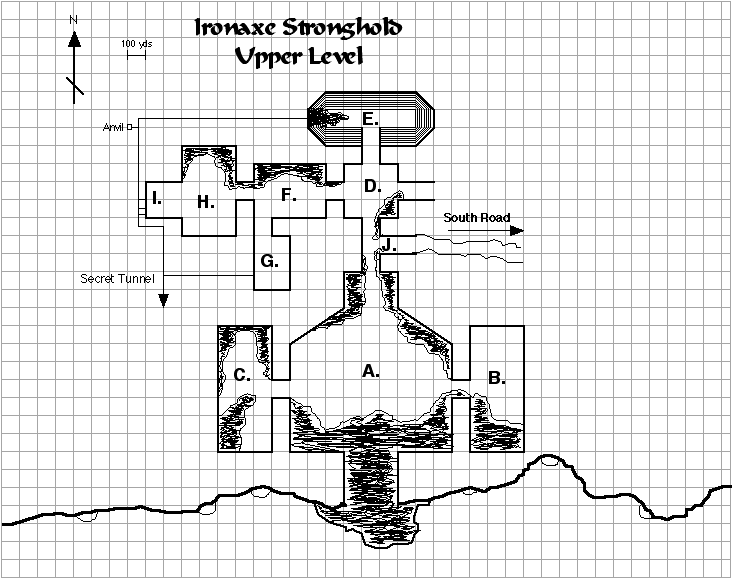 |
The upper level of the stronghold once served as the place where the more prestigious dwarven citizens resided. In addition, in general, non-dwarves were not allowed access to the lower level, and so large areas on the upper level were set aside for trade with other races, inns and taverns, etc. that catered to non-dwarvish visitors. Also, several areas were set aside for crafts that utilize outside resources, such as wood working. Because the upper level was open to visitors, many of the retail shops run by the dwarves were located on this level.
The general public could basically enter areas A, B, C, and D on this level. Non-dwarves could occasionally access area E (the amphitheatre), or the dwarven palace and temple areas, but only for special occasions or for distinguished guests.
Now, much of the upper level is ruined, although it is safe to say that, in general, the upper level is more sound than the lower level. This because both assaults on the stronghold originated on the lower levels, and by the time the attackers broke through to this level, the fighting was perhaps more desperate but also less intense.
The most damage to the upper level was done in area A around the entrance area to the stronghold from the surface. The dwarves themselves sought to block the entryway under tons of earth and stone, so that the Deceiver's minions could not attack from that quarter. The refounding dwarves chose not to reopen the front gate because they too feared an attack from that quarter.
Unless specified, all of the areas here are of worked stone. Basically, each area is a huge hall, hundreds of yards wide and apporixmately 60' high. The ceiling is supported by vaulted flying buttresses and an occasional massive support pillar, over 30' thick. Such pillars are usually decorated with bas reliefs of a dwarven nature, but these are sparsely located, with perhaps 1 such pillar in every four 100 yard map squares.
The outside of the stronghold, as approached from the surface, took the form of massive gates set into the side of the mountain. Small barbicans pierced the cliff side to either side of the gates for some distance, and a small gatehouse guarded the direct approach to the gates themselves. Most of the outside of the gate area is now collapsed under rubble. All of the barbicans are either destroyed, or have their passages back to the stronghold completely plugged up with hundreds of yards of stone and rubble.
Like the drow lower levels, the upper level is afflicted with the same weird malevolant mauve glow from drow fungus along the walls and ceilings.
A. Foreign Quarter
This large area was almost a small city in and of itself, used by the dwarves as the main place for non-dwarven visitors to stay, trade, and spend money. Portions of the area have collapsed during the various battles for the stronghold or during the ensuing centuries. Many buildings, most sized for human-sized visitors, blanket the area, but the layout is fairly orderly, forming alleys, side streets, and a single main boulevard, that runs from the now buried front gates north through the area and towards area D. In the centre of this area is a large plaza that was used in ancient times as a market square.
A portion of these buildings are still in ruins, mostly those near the collapses or around the edges of the area. The refounding dwarves first settled this area, and set about to rebuilding it, and the drow have chosen this as their main living area, and so they have also contributed to its rebuilding.
Now, several hundred buildings are intact and in use. The two drow houses have split the chamber, with each house having territory on either side of the central north-south boulevard. House Quinilver controls the western side of the area, and House Vrielsevri control the eastern side.
In total, some 300 drow live in this area, each family controlled by a matron, and each matron having living quarters appropriate to her station. Of course, living quarters can be updated by simply assassinating the previous occupant, but fortunately for the drow, internecine strife is done very subtly and often under certain unspoken protocols, so as to avoid decimating the small drow population.
The drow are fairly secure here in this area, as there is really no access to this section except through the various guard posts to the north, and so there are no patrols roaming what is essentially a small drow village, with shops, markets, crafts, etc. There are even inns that cater to the visitors who make their way here from the drow city Yyered-Nulthil. Pack lizards can be seen plying the streets, for the most common visitor to the stronghold are drow merchants bringing goods from Yyered-Nulthil and taking raw materials back to the deep city. The drow have reshaped many of the buildings in use, and now they bear dark black ornamentations and bas reliefs of evil, sinister, and most often arachnoid design.
Because it would be far too voluminous to detail every single building and drow in this area, and because it is unlikely that much of the scenario will take place here, no specific maps or statistics are given. Instead, the party will be subject to the wandering encounter chart below. Despite its nomenclature, however, most of these drow are at home and not wandering around. If met in the street they are probably on specific business going to or from somewhere. It will be up to the DM to devise exact encounter details should such be necessary.
Any humans or dwarves or surface elves walking the streets or caught skulking around this area will cause a cry and hue to be raised, and drow will quickly begin to converge to attack the intruders, while some others go to alert the house militias (see areas B and C for details).
The party can infiltrate the drow village by use of invisibility, illusion, ploymorph, and probably a few other methods as well. Most drow, if questioned, can tell the general layout of the upper levels, although not specific details of, for example, the High Priestess's Palace. Obviously, none of the drow know of the location of the anvil, and most do not even understand the word (drow work their metals on a different type of platform called an Quwrenli).
If the party has made its way here from the lower levels without determining that the anvil resides in the old Malaktum temple, they will be hard pressed to find it and will perhaps be better served by simply concentrating on escaping from this place alive.
Alternatively, the GM can allow very clever and subtle parties to dwell for a time in some out of the way nook or cranny within the drow village and perhaps stumble upon one of the Malaktum Temple drow guards who might mention the anvil. Or perhaps a dwarf slave of the drow can be contacted and questioned as to where the anvil was last taken before the drow were victorious.
Drow Village Wandering Monster Chart (D100) - check once per turn when moving around or in the open, once per 4 hours when stationary or in hiding. Encounter occurs on a 1 in 4. [DMs should keep in mind that these are merely significant encounters assuming the party is trying to avoid detection. If the party wishes to wander the streets (in disguise perhaps) they will meet many many drow constantly].
|
|
|
|
|
|
Giant Rats |
|
|
|
Large Spiders |
|
|
|
Huge Spiders |
|
|
|
Giant Spiders |
|
|
|
Drow Merchants |
|
|
|
Drow Warriors |
|
|
|
Driders |
|
|
|
Bugbear Slaves |
|
|
|
Troglodyte Slaves |
|
|
|
Drow Noble |
|
|
|
Drow Citizens |
|
|
|
Dwarf Slaves |
|
|
|
Drow Priestess (w/ retinue) |
|
|
|
Orcish Emissary |
|
|
|
Goblin Slaves |
|
|
|
Giant Centipedes |
|
|
|
Pack Lizards |
|
|
|
Doppleganger |
|
|
|
Special (DM's choice) |
|
Giant Rats - Scavengers from dwarven times which have prospered under the drow and their less tidy living habits. The rats have learned quickly not to mess with drow, but often attack drow slaves.
Large Spiders - These build webs all over the area and are regarded as pets by many of the drow citizens. In the eerie mauve glow of the drow village, their webs glisten like strange, deadly pearls. These creatures will attack most non-drow.
Huge Spiders - These creatures generally lair in holes in the collapses near the rubbled edges of the great cavern. However, a few will wander the streets in search of food. As usual, they leave drow and drow kin alone, but are not above taking a slave or two for supper.
Giant Spiders - These creatures possess a crude intelligence and are much more distinctive in their hunting preferences. They will certainly attack intruders or those not clearly under drow protection, and if hard pressed may rush off to alert the drow.
Drow Merchants - perhaps a small caravan returning from the trade routes with some laden pack lizards in tow, most merchants will have D4-1 slaves with them as pack bearers or bodyguards. Most merchants are male and are warriors of D2+1 levels. With +1 weapons and armour.
Drow Warriors - Warriors of one of the two houses, these are generally elite female house guards, patrolling the area or looking for trouble. Most of these are female warriors of D3+1 levels with +1 weapons and armour.
Driders - Usually on some temple business, these creatures will attack intruders on sight, but may not consider sounding an alarm.
Bugbear Slaves - relatively well treated, and used as levies by the drow, bugbears will generally be loyal to their mistresses unless soundly threatened or bribed.
Troglodyte Slaves - usually kept on the lower level because of their unpredictability and their smell, occasionally small troglodyte slave bands come to the upper level on some errand. These brutes are generally loyal to and fearful of their drow mistresses.
Drow Noble - an important or high level drow, often a mage and almost always female. Such a one will always have Drow Warriors (per that encounter) as a bodyguard and at least 2D6 slaves as an entourage. Most drow nobles are of levels 3-9. Most nobles will have arms and armour of at least +2 value.
Drow Citizens - ordinary drow, of either sex, usually of 2 hit dice and warriors or unclassed.
Dwarf Slaves - from the refounding. All are blinded and used brutally, fully shaven, and usually led by a goblin. These dwarves are 90% likely to be pitiful, broken specimens too afraid to fight or run, but a few (10%) may be persuaded to help the party. Almost any of the dwarven slaves can tell that the anvil was taken to the Malaktum Temple just prior to the drow attacking.
Drow Priestess - priestesses will be of levels 3-6 with a small retinue (D6) of bodyguards who are usually warrior/priestesses of level 2/2. Such priestesses are each 75% likely to have a giant spider as a pet.
Orcish Emissaries - guards for the emissary of the Deceiver, these orcs are visiting the drow for the first time and are a bit wary of everything, being quite worried that a rampaging spider will leap down upon them at any moment.
Goblin Slaves - used as household slaves by the drow, these goblins are unarmed but loyal and will flee at the sight of intruders, yelling and raising an alarm as they go.
Giant Centipedes - vermin who have taken advantage of the recent wars to re-inflitrate the upper levels. The drow spiders like to prey upon these for food.
Pack Lizards - either tied to a "hitching post" by drow merchants or a few rogue lizards strayed away from their masters, these are semi docile, but will be known to snap at non-drow who approach uncatiously. Treat as normal giant lizards in all respects.
Doppleganger - One very brave doppleganger has recently inflitrated the drow village and is so far enjoying its stay here, engaging in occasional petty theft and mischief. It will certainly take advantage of any opportunity for further riches that the party might present, but is not above pretending to be renegade drow and then turning in the party in the hopes of a reward from the drow. There is only one such dopplegangers in the complex, so the DM may make this result a no encounter if the circumstances require. This doppleganger is the seventh of the band in area A5.
Special - DM's choice. This could be a denizen or drow NPC from the lower levels, or even the Deceiver's daemon emissary out for a stroll.
B. House Vrielsevri
House Vrielsevri is a merchant clan from Yyered-Nulthil which has ventured here hoping to make its fame in the mithril market. This house is constantly feuding with its rival, House Quinilver for control of the mithril trade here. Such bickering is kept in check by the priesthood, but a silent war if assassination often erupts.
House Vrielsevri's area is similar in all respects to area A, except that the area is a bit more organized and defensive fortifications and walls are in the process of being built.
The House is comprised of:
The matron (wizard level 10)
Her husband (warrior level 7)
10 elite female house guards (warrior/wizards levels 5/5)
20 female house guards (warrior levels 2-4)
45 male soldiers (warriors levels 2-3)
2 house priestesses (priests levels 4 and 5)
40 house merchants (male and female warriors level 2)
20 bugbear slaves
15 goblin slaves/miners
5 dwarven slaves
The above is in addition to house members on trading missions or on the lower level. The matron is a mid ranking noble of the full house back in the drow city, and reports there regularly.
Use the encounter table for area A for this area as well, although all drow encountered are 75% likely to be of this house.
C. House Quinilver
Similar in appearance and fortification to area B (and using the same wandering encounter chart as area A), the House Quinilver is comprised as follows:
The matron (warrior/rogue levels
8/10)
Her husband (warrior level 5)
5 elite female house mages (wizards level 6)
5 elite female house guards (warriors level 6)
25 female house guards (warrior levels 2-4)
40 male soldiers (warriors levels 2-3)
30 house merchants (male and female warriors level 2)
25 bugbear slaves
30 goblin slaves/miners
10 dwarven slaves
The above is in addition to house members on trading missions or on the lower level. The matron is a mid ranking noble of the full house back in the drow city, and reports there regularly.
Use the encounter table for area A for this area as well, although all drow encountered are 75% likely to be of this House.
D. North Plaza
This area is a large square chamber with four huge exits. The eastern most quickly descends in a sloping spiral ramp down to the lower levels. A company of 6 male drow warriors (level 2) always guards the rampway and these have drow metal whistles that blow a high pitched shriek much like that of a shrieker.
The plaza itself was once probably a dwarven parade ground or assembly area, but a few large buildings still stand, these now used to billet slaves and the like. The encounter chart from area A can be used here, but such encounters are 50% likely to be with those loyal to the priesthood.
E. Colisseum
This immense amphitheatre was used by the dwarves for public ceremonies, honorifics, plays, singing, revelries, faires, and contests of skill and strength. Now the seats are battered and crumbling and the entire west section has caved in. Along the north portion of the central area, which is a mixture of gritty sand and bare stone, is a stone stairway which leads down into the under-portion of the colisseum.
The under-portion is a long chamber studded with wide, squat support pillars and with small cells and alcoves dotting the walls. Aside from the pillars, the entire chamber is of the same dimensions as the stadium above it.
Spider webs literally cover the massive chamber, for this is the breeding ground for the drow spiders, and hundreds of them lurk in this infested area. For each round spent in this area, roll D100. On a 01-20, roll again on the following chart:
|
|
|
|
|
|
Large Spiders |
|
|
|
Huge Spiders |
|
|
|
Giant Spiders |
|
|
|
Driders |
|
|
|
Drow Priestesses |
|
|
|
Hairy Spiders |
|
All creatures encountered here will attack non-drow and non-spiders on sight.
At the far west end of the under chamber is a locked portcullus which leads to a small cell. At the back of this cell is a secret door which leads to the Secret Tunnel (see the Secret Tunnel section).
It takes 25 rounds to walk straight (as straight as can be dodging webs and pillars and large groups of spiders) from the secret door to the stairway ascending to the stadium floor.
F. Hall of Kings
Once an immense hall used by the dwarves to honour their heroes, kings, and deities, the immens frescoues and carvings and statuaries and bas reliefs are now eroded, chipped, and battered into little more than undulating patterns in the stone walls and pillars. What looked to have once been temples or public buildings now house the priesthood of Lolth and her slaves. Driders also dwell here. The chart from area A can be used, but all drow encounters will be treated as Drow Priestesses or Warriors (50% of each).
The passage to area H from this chamber is barred by a newly constructed drow curtain wall pierced by an iron gate (see area H for more details).
G. Weshta-Grum Temple
In the past a shining example of dwarven architecture and design, this grand hall is full of once spectacular buildings that served as the temple complex for Weshta-grum and Neengrum. The place is almost entirely in ruins, since the refounding based its main area of operations from here, and the place was hardest hit during the ancient war with the Deceiver as well.
The drow have rebuilt the central Weshta-grum chapel complex, and upon a dome of bronze have defaced the refounder's depiction of Weshta-grum so that it appears the dwarven god is beiong consumed by a large black spider.
Within this building is the new temple of Lolth. At least 30 drow priestesses worship and live here:
Chief priestess of Lolth (priest
level 8)
Commandress of the priestly guard (warrior/priest levels 6/6)
6 temple wardens (warrior/priest levels 3/4)
6 female adepts (priest level 4-5)
10 female acolytes (priest level 2-3)
4 temple guards (priest/wizard levels 5/5)
These drow are fanatically loyal to Lolth, and as loyal as drow can ever be to their high priestess.
In a rubble strewn cellar in a partially collapsed building that was once a supper hall for the dwarven priesthood is a cunningly wrought secret door that leads to and from the Secret Tunnel (see the section for the Secret Tunnel).
H. Noble Quarter
Once the dwelling chamber for the mansions of the dwarven clan elite and nobility, this large chamber's north wall is in complete collapse. Gems and precious metal veins in the walls have been long ago stripped, and the walls are now pockmarked and rivuleted where these adornments once were.
The large dwarven houses show heavy signs of battle, and little has been done to repair them. Instead, a large curtain wall has been flung across the entry passage from area F, to protect the palace at area I, both from outside invasion and from internicine strife. The wall is over 18' high and 6' thick and is pierced by a single massive iron gate barred with a drow metal bar from the other side (area H). Catwalks atop the battlemented wall allow a half dozen drow female guards (warriors level 3-4) to man a watch.
The gate within is opened by a cunning winch and lever mechanism that lifts the bar and opens the gate silently and rather quickly.
A single "royal pathway" has been cleared through the rubble of this chamber, so that the drow high priestess can pass to and from her palace with ease. The off road areas are infested with vermin (giant rats, centipedes, and spiders of all sorts and sizes) and slaves routinely travel through the chamber to hunt for food (no spiders of course) or to be hunted in turn.
I. Palace
A grand edifice, showing signs of major battles, including melted stone and scoring from fireballs and lightning bolts as well as purposeful defacements of its once lustrous and ornamented surface, this entire area is taken up by the dwarven palace complex. Wide steps lead up 15' to a pillared portico pierced by crossletted arrow slits, windows, and wide iron double doors. Within is a literal labyrinth of rooms and halls, all showing signs of battle and of past ornamentation. Truly, in its day, this palace was a marvel to behold!
Now, the high priestess and her court dwell here:
High priestess of Lolth Quan'thal'illa
(priest level 10)
Her advisor (a tanar'ri)
12 queen's female elite guard (warrior/wizard level 7/7)
8 female priestly attendants (priest level 3-4)
20 queen's male soldiery (warrior level 4-5)
In addition, an embassy of the Deceiver is here:
Xxaxtathatha the arcanadaloth
(greater yugoloth)
3 mezzoloths (lesser yugoloth)
6 orcish bearers
6 ogrish warriors (warriors level 6)
The Secret Tunnel (see the Secret Tunnel section for more details) passes close to the palace at three points. These points are both observation points and allow egress into and out of the palace. One such point happens to be the chamber being used by the arcanaloth during its stay here. Another is the magaron of the palace, where the evil drow high priestess holds her court. The final is a simple storeroom.
For wandering encounters in the palace, use the area A chart, but all drow will be members of the palace staff and guard, and there will be no vermin in the more repaired areas of the palace (though spiders are not considered vermin by the drow). There are also plenty of slaves in the palace, but treat any troglodyte results as no encounter.
J. South Road
Blocked by rubble during the great war, the refounders opened a path through the rubble and reopened the south road. This is in fact the point where the refounding dwarves first broke through to their ancient home and runes on the wall here commemorate this fact, giving the date and the name of the first dwarf to set foot in their reclaimed clan holdings.
Normally, traffic along the south road is very light, as the drow merchants have no business to the south. However, the drow also consider this route safe from incursion from the free lands, and so only a light guard is maintained here:
4 male drow guards (warrior level
2)
1 male drow commander (warrior level 4)
6 bugbear militia
If a general alarm has been raised however, the guard here will be augmented by the following:
8 female drow warriors (warrior
level 3)
1 female drow mage (warrior/wizard level 5/5)
1 female drow priestess (warrior/priest level 3/3)
1 female drow commandress (warrior level 6)
4 giant trapdoor spiders
These forces will be watching the road south (the road initially heads east but then quickly turns south) at first, until they are told that the threat comes from within their demense, after which they will turn about and seek to prevent the party from escaping.
Since this encounter is the one most likely to occur on the upper level, statistics for the guards are presented below:
Drow Male Warriors (x4) (AC1; MV12; CL Wa; LV2; hp 15 ea.; THAC0 19; #ATT1; D by weapon; SA see below; SD see below; Weapons short sword+1, dagger+1, hand crossbow [d3 damage]; Armour chainmail+1, buckler+1, dexterity 15; MR 52%; XP 650 ea; src MM)
All drow may cast the following once per day: dancing lights, faerie fire, and darkness.
Each drow has D10pp and D20gp.
Drow Male Commander (AC1; MV12; CL Wa; LV4; hp 25; THAC0 18; #ATT3/2; D by weapon; SA see below; SD see below; Weapons short sword+1, dagger+1, hand crossbow [D3 and save vs poison at -2 or sleep]; Armour chainmail+1, buckler+1, dexterity 15; Specialization specialized in short sword; MR 58%; XP 750; src MM)
All drow may cast the following once per day: dancing lights, faerie fire, and darkness.
The commander has 100gp and 20 pp, plus a platinum badge of office with a spider motif worth 50gp.
Bugbears (x6) (AC5; MV 9; HD 3+1; hp 20 ea; THACO 17; #ATT1; D by weapon (+2 due to strength); SA surprise; Weapons Footmans Mace; Armour tanned hides, cuirboulli shields; XP 120; src MM)
Drow Female Warriors (x8) (AC1; MV12; CL Wa; LV3; hp 12, 12, 22, 16, 20, 22, 11, 25, 13, 17, 26, 17, 12, 22, 20, 18; THAC0 18; #ATT1; D by weapon; SA see below; SD see below; Weapons short sword+1, dagger+1, hand crossbow {D3 damage, save vs poison at -2 or sleep]; Armour chainmail+1, buckler+1, dexterity 15; Specialization short sword [+1 to hit, +2 damage]; MR 56%; XP 650 ea; src MM)
All drow may cast the following once per day: dancing lights, faerie fire, and darkness.
Each drow has D10pp and D20gp.
Drow Female Warrior/Wizard (AC-4; MV12; CL Wa/Wi; LV5/5; hp 25; THAC0 16; #ATT1; D by weapon; SA see below; SD see below; Weapons short sword+3, dagger+2, hand crossbow {D3 damage, save vs poison at -2 or sleep]; Armour chainmail+3, buckler+2, dexterity 17; Spell Points=46, protection from good, detect phase, jump, wall of fog, detect life, detect invisibility, improved phantasmal force, vampiric touch, 2 free cantrips; MR 60%; XP 2000; src MM)
All drow over 4th level may cast the following once per day: dancing lights, faerie fire, darkness, levitate, know alignment, and detect magic.
This drow wields a staff of fiends with 10 charges in it.
The drow has D10pp and D20gp.
Drow Female Warrior/Priestess (AC-1; MV12; CL Wa/Pr; LV3/3; hp 18; THAC0 18; #ATT1; D by weapon; SA see below; SD see below; Weapons short sword+2, dagger+1, hand crossbow {D3 damage, save vs poison at -2 or sleep]; Armour chainmail+1, buckler+2, dexterity 16; Spell Points=15, cure light wounds, curse, chill metal; MR 56%; XP 975; src MM)
All drow priests may cast the following once per day: dancing lights, faerie fire, darkness, detect lie, clairvoyance, suggestion, and dispel magic.
The drow has D10pp and D20gp.
Drow Female Commandress (AC-3; MV12; CL Wa; LV6; hp 44; THAC0 15; #ATT3/2; D by weapon; SA see below; SD see below; Weapons short sword+3, dagger+2, hand crossbow {D3 damage, save vs poison at -2 or sleep]; Armour chainmail+3, buckler+2, dexterity 16; Specialization short sword [+1 to hit, +2 damage]; MR 62%; XP 975; src MM)
All drow over 4th level may cast the following once per day: dancing lights, faerie fire, darkness, levitate, know alignment, and detect magic.
The drow has D10pp and D20gp.
Giant Trapdoor Spiders (x4) (AC4; MV 3wb12; HD 4+4; HP 24 ea; THACO 15; #ATT1; D 2D4; SA poison [save or take D6 additional poison damage; XP 975; src MM)
EPISODE 5 - THE ANVIL
The recovery of the sacred anvil of the dwarves is not necessary to complete the adventure. Indeed, the crux of the adventure is for the party to simply manage to stay alive and escape back into the Free Lands, and so the DM should not be too insistent on guiding the party to the anvil. However, especially if the dwarven NPC from Episode #1 encounter 11 and 1/2 is introduced, the party might be inclined to actually try to rescue the anvil.
Recovery of the sacred anvil of the dwarves is not a difficult task once the secret entrance at the rear of the Malaktum temple is found (see area C1 room 19 for more details). An observant party will have determined that the Malaktum Temple is the most likely place for the anvil to reside (he being the god of smiths) and with help and advice from Glumz and certain clues scattered here and there on the lower levels, the party should have been pointed in the right direction.
The secret chamber in the Malaktum temple leads to a long, winding set of stairs that ascends to the upper level to a Secret Tunnel, described below.
Secret Tunnel
Refer to the Upper Level map for the tunnel's general layout.
This secret tunnel was built in ancient times to keep an eye on the king and to store hidden treasures, and to provide an escape route should such a one be necessary. The tunnel starts in the Malaktum Temple on the lower level (area C1 room 19) and ascends a long set of stairs before coming level with the upper level. Here it heads north until it branches off in two directions, north and east.
The east branching leads to a cellar in a collapsed building in the Weshta-grum Temple area (area G).
The northern branch continues for another 250 yards before turning west and then north again as it passes just behind the dwarven palace (area I on the Upper Level map).
The Alcoves:
As it passes behind the palace, the tunnel sprouts 3 small alcoves, seperated from each other by 30-50 yards or so. Each alcove appears as a small 10' by 10' niche that dead ends. However, anyone touching the end of these niches will cause the wall there to turn transparent. The wall is still there, and as hard as stone, but one can see and hear through it. From the other side, even when transparent from the Secret Tunnel side, the wall appears as opaque stone.
In addition, if both hands are placed on the wall and the name "Neengrum" is uttered, the wall will actually disappear for 2 rounds, allowing access to and from the tunnel. This power works from the other side as well.
These alcoves are not secret doors as such and cannot be detected except by magic (a detect magic will reveal alteration magic) and wands of secret door location and the like.
The alcoves, from south to north, are as follows:
Alcove A - looks into a storeroom of drow supplies and is quite dark. The storeroom leads to a door that exits into a hallway within the dwarven palace. The drow supplies are all mundane….fungus fibre rope, drow wine, tools, etc.
Alcove B - looks into the Deceiver's emissary's room. The room is currently empty. Within can be found sumptuous but evilly decorated furniture and some chests with gifts for the drow. A servant and familiar are probably here as well (75%). The servant is an elderly ogre and the familiar is an imp. Also within the chamber will be instructions from the Maug in charge of these mountains on what the Deceiver is willing to offer in exchange for drow aid in the coming war.
Alcove C - looks upon the megaron of the dwarven palace. The megaron, redecorated to suit the drow high priestess, is resplendent in its evil décor. Within will be the drow high priestess on her evil throne, surrounded by her elite guard. Before her will be many drow nobles from the two houses and a ring of house guards, flanked by warrior/wizards on the gallery above.
The party can listen to the negotiations in the throne room. The emissary is asking that the drow provide the Deceiver with the locations of outlets from the underdark to various locations in the mortal lands and that the drow provide safe passage for the Deceiver's forces as well. In exchange, the Deceiver offers monetary rewards, slaves, and even the grant of certain lands after the war. If the party listens long enough they can glean most of the Deceiver's plans, including the fact that the Deceiver wishes to start his war in seven years (though once it becomes known his plans have been spied upon he will speed up his timetable by about 2 years).
While the party watches (and listens), assuming not a lot of time has passed between the party's initial assault on the drow on the lower levels and now, they will see a drow warrior burst into the throne room and alert all that a group of surface dwellers has attacked the lower levels. At this, the emissary will inform the drow priestess that he has heard of these attackers and that they are wanted by his master. The priestess will then order the entire stronghold on alert, order all passageways out of the stronghold blocked, and will ask that the drow armies be mobilized should this be a precursor to a full invasion (the guard in area J will be increased as detailed there).
If the party has somehow managed to arrive here entirely undetected by the drow, then there will be no alert. If the party assaulted the drow below and then rested for a long while, then the negotiations will still be taking place, but the party's assault will be mentioned by the arcanaloth as leverage to convince the drow to ally with the Deceiver. In no case will the drow high priestess agree to anything without consulting with her queen back in the drow city.
The Anvil:
After the third alcove, the Secret Tunnel continues north for another 500 yards before branching off, one branch heading west and the other continuing north. The branch north eventually leads to the secret door in the cell in area E of the upper level.
The westward branch continues to the room holding the sacred anvil of the Ironaxe Clan.
About 30' up the westward passageway is what looks like a platform for carrying things (like a stretcher, but made of metal instead of wood). The platform looks as if it broke apart and was discarded. Beyond it are scratch marks in the stone floor which lead to the anvil chamber. What happened here was that the dwarf priesthood was caryring the anvil on the platform when, in their haste, they dropped it and the platform broke. The dwarves then dragged the anvil to its chamber. A mend spell can fix the platform, so that it can again be used to carry the anvil.
Within the chamber, a 40' by 40' vaulted room, is the sacred anvil, set upon an unadorned stone pedestal. Also within is a dwarf revenant. This was a dwarven priest who died here from wounds received when battling the drow. The dwarf arose as a revenant to protect the anvil, but has since gone insane from its guilt at losing the anvil and fanatic in its protection of same. It now seeks to protect the anvil from everyone, including friendly dwarves.
Dwarf Revenant (AC 7 [tattered dwarven chainmail]; MV 6; HD 8; hp 43; THACO 13; #ATT1; D 2D8; SA strangulation, paralysis stare; SD undead immunities; XP 3,000; src MM)
Once the undead dwarf is destroyed, the anvil may be taken. The anvil is about the size of a normal blacksmith's anvil, and weighs about 175 pounds. This is the high anvil of the dwarves, a sacred relic of most large dwarven clans (see Encyclopedia Magica Volume 1 for exact details).
EPISODE 6 - THE FINAL CHASE
Whether with the anvil or without, it is likely that the party will have had to have combatted the South Road guard (area J - upper level) and thus the drow will now be alert and armed.
Once the party makes it to the South Road, they will soon hear the sounds of their drow pursuers, now in force, many mounted on giant spiders. Bugbears tramp silently ahead of them and troglodyts and goblins scour nooks and crannies. It should become apparent to the party that they have roused a hornet's nest.
As the party flees south along the road, which bears a close resemblance to the northern portion of the Dwarven Road, they will soon see the mauve glow of a large drow patrol coming north along the main road. It will quickly become apparent that the party must strike off into one of the side passages and make a run for it. Should the party instead try to proceed down the road, they will find the drow patrol ahead massive, with at least 24 bugbears and 2 dozen drow lead by capable mages and priestesses. To fight them head on would mean a quick end. Should the party try to head back north along the road towards the Ironaxe clan, they will meet the drow roused from that quarter, in a force twice as large as the patrol from the south. A kind DM can allow the party to see the southern patrol, realize their folly, and then have time to double back a ways and take a side passage before the northern patrol reaches them.
Assuming the party is wise and strikes off the road into a side passage, the chase will continue for a short while. The DM can ad lib several short sharp encounters and running battles, but eventually, the party will find themselves at a dead end tunnel, with no way out and the soft mauve glow of the drow coming cautiously down from the only avenue of escape!
At this point, that party may get ready for their final battle. As bugbears and spiders and driders come racing sdown the tunnel, the pech will arrive.
The Pech:
The pech come to these tunnels from the Elemental Plane of Earth on occasion to hunt for interesting gems and metals. They are entirely unconcerned about the Deceiver and Therran concerns, but over the years they have grown to hate the drow, who occasionally hunt their kind.
The pech have heard the great rousing of the drow and have come to investigate. They have seen the drow chasing the party, and on the time-honoured principle of "the enemy of my enemy is my friend", they have resolved to help.
As the party prepares to die, the petch will open a hole in the dead end behind the party with stone shape, drag the party quickly through, and then close the hole with stone shape and wall of stone. The party is likely to be startled by their rescue at first, as all they will feel are cold strong hands grab them from behind and pull them straight into the passage wall!
The pech motion the party to be silent, and then lead them through a confusing maze of passageways, often opening the wall of one with a stone shape and then sealing it behind them. Eventually, the pech, which number 6, will arrive into a large cavern with no discernible entrances or exits. Gems and delicate sculptures of crystals and quartz dot the cavern.
Within dwell some 16 pech. Their leader speaks only halting Dwarvish, enough to say that they are the pecha (they call themselves the pecha) and that they mine these caves. They can tell that the drow are evil and kill the pecha. He can also explain that the pecha see that the party is a drow enemy, and so is a pecha friend.
The party can tell their story and the pech will offer them rest and food, though the food is silicate in nature and inedible. The pech assure the party that they are safe here from the drow, at least for some time.
When the party is ready to leave, the pech leader will explain that they cannot take the normal way back because his people see that the drow are patrolling the entire way in strength. Instead he says that the party must go by the "secret path".
With that he calls forth a single pech and tells the party that this pech will guide them along the secret path. He then hands the pech a leather thong into which have been tied various gems of various colours, all along the length of the thong.
With that, the pech open up the wall of their cavern and the guide pech beckons the party to follow him.
The Secret Path:
The secret path is the Ethereal Plane. The pech's thong is a road map of sorts used by the pech to find the proper gates that allow entry to the proper place on Therra. The guiding pech basically starts at one end of the thong, looks for gates corresponding exactly to the colour of the gems on the thong, in order, and he will eventually arrive at his destination.
The pech guides the party quickly and furtively along some passages before stone shaping through a dead end and into a small chamber. Within the chamber is a gaping, misty, green coloured vortex. The pech glances once at his leather thong, once at the vortex, finally at the party, and then leaps into the maelstrom.
Assuming the party follows, they find themselves on the Ethereal Plane, with eddies and ripples of ether caressing them as they flow by. It will quickly become apparent that the party must swim through the ether, but it also becomes apparent that swimming in ether is less a physical process than a mental one. Eventually, with a minute of practice, the party should be able to propel themselves along the ether at a moderate rate.
The guiding pech will constantly pass by coloured vortexes and will continually refer to his thong, rejecting first one vortex and then another for quite some time. Eventually, he will come to a vortex that matches the second gem on his thong and will leap through it. This will continue for some time, until the pech is looking for the third to last gem/vortex (there are 12 gems in total on the thong…with the first and last matching the initial and terminal vortices on Therra). Eventually he will spot the vortex and begin to leap through…..
The pech will be caught in mid leap, his head and shoulders through the vortex but the bottom portion of his body, from the chest down, still on the side of the vortex with the party. The pech will be frozen in mid leap for about a second. Then his entire body will thrash violently around the circumference of the vortex for another second or two and then, dropping the leather thong at the party's feet, the rest of the pech will be pulled suddenly through the vortex…gone!
A huge ethereal carnivore has devoured the pech. When the party gets the nerve to peek through the vortex, they will see the distant shape of a huge wormlike creature speeding quickly away from the vortex (much faster than the party could ever travel ethereally). Bits and chunks of the pech still float listlessly on the other side of the vortex.
There is nothing now for the party to do but take the leather thong and proceed along the Secret Path.
By now the party should have figured out how to use the thong. Assuming they have not, if they cannot figure its use out after some consideration, then the DM will have to construct some extra-planar adventures, perhaps eventually meeting a being capable of returning them home.
However, if the party can figure out the thong's use, they can follow the path with no further incidents. The final vortex, matching the final gem, leads to a small cavern. Dwarves and gnomes can determine that they are under less ground now than they were in the original pech cavern (i.e. closer to the surface and likely on the edge of the mountain range).
When they arrive, 4 days of Therran time will have passed since they entered the Secret Path. To the party, the ethereal journey was timeless and time defying, but it certainly did not seem a journey of more than a few hours!
The Final Chase:
The pech Secret Path has saved the party hundreds of miles and much danger. The small cave they have emerged in is in a side passage just off the main drow road no more than 2 miles from the southern exit into the lands of the Near Coast and safety.
As the party creeps back onto the main road, they will still have to be careful however, for the drow have marched all the way to the southern exit, and having found no sign of the party's passing, has assumed they are holed up somewhere. The drow have, however, left a guard at the exit, and a large company is nearby searching the side passages.
The south exit consists of cunningly wrought adamantium doors, each 20' wide and barred from the inside. They operate from the outside just as the northern entrance did. A small drow contingent guards the way here:
Drow Male Warriors (x6) (AC1; MV12; CL Wa; LV2; hp 15 ea.; THAC0 19; #ATT1; D by weapon; SA see below; SD see below; Weapons short sword+1, dagger+1, hand crossbow [d3 damage]; Armour chainmail+1, buckler+1, dexterity 15; MR 52%; XP 650 ea; src MM)
All drow may cast the following once per day: dancing lights, faerie fire, and darkness.
Each drow has D10pp and D20gp.
Drow Female Warriors (x6) (AC1; MV12; CL Wa; LV3; hp 22 ea.; THAC0 18; #ATT1; D by weapon; SA see below; SD see below; Weapons short sword+1, dagger+1, hand crossbow {D3 damage, save vs poison at -2 or sleep]; Armour chainmail+1, buckler+1, dexterity 15; Specialization short sword [+1 to hit, +2 damage]; MR 56%; XP 650 ea; src MM)
All drow may cast the following once per day: dancing lights, faerie fire, and darkness.
Each drow has D10pp and D20gp.
Drow Female Commander (AC1; MV12; CL Wa; LV4; hp 25; THAC0 18; #ATT3/2; D by weapon; SA see below; SD see below; Weapons short sword+1, dagger+1, hand crossbow [D3 and save vs poison at -2 or sleep]; Armour chainmail+1, buckler+1, dexterity 15; Specialization specialized in short sword; MR 58%; XP 750; src MM)
All drow may cast the following once per day: dancing lights, faerie fire, and darkness.
She wears a jet spider diadem worth 250gp and carries 20pp on her person.
Huge Watch Spiders (x12) (AC6; MV 18; HD 2+2; hp 12 ea; THACO 19; #ATT 1; D D6; SA surprise, poison [onset D2 rounds, +1 save vs poison or paralyzed for 2D4 turns]; XP 270 ea; src MM)
Asssuming the party does not slay the drow in a single round, they will produce silvery metal whistles and blow, sounding a high pitched alarm hearable by every drow within 3-5 miles in the echoing and confined quarters of the underground. By the time the party defeats or drives off the drow, the mauve glow of the coming drow forces and the din of their slave militia will be seen and heard.
As the party flings open the bar and thrusts the adamantium doors soundlessly and effortlessly open, they will finally breathe the fresh air of the outside world, as the foothills of the Near Coast roll down to the plains below.
AFTERMATH
If the DM wants to end the pursuit and adventure here, then he should have the party emerge outside into full daylight. The drow will not pursue out into the surface in daytime, and so the party will be safe.
On the other hand, should it be a moonless night, then perhaps the drow will emerge and chase the party.
The final outcome is left to the DM.
It is likely that the dwarven king of the new Ironaxe Clan in Bleton will give the party tremendous rewards for helping regain the high anvil of the dwarves. They will certainly receive the patronage of that dwarven worthy if they so desire, and each party member should receive a magic item as well.
In the original Therran campaign, the following were given:
A bastard sword +2, +4 versus evil creatures of darkness with a curse that whomever owns it must tirelessly and ceaselessly combat the Deceiver (the dwarven king can warn the party about this curse before they accept the sword; the sword is the relic of an ancient human hero who helped the dwarves fight the Deceiver in ancient times; anyone accepting the sword and not fighting the Deceiver will have a dire curse of some sort befall them)
A longsword +1 which gives +1 to saves and AC when wielded. If the wielder is involved in a one-on-one duel with an intelligent creature (it must be a formal duel), then all bonuses are doubled (i.e. +2 sword with +2 to save and AC).
A shield +1
A mithril great helm (equivalent to AC0 for the head and weighs half as much as a normal great helm)
Several scrolls with priest spells on them
Several potions
An amulet of earthfriends (bestows a +1 to saves vs earth based attacks and -1 damage per die from same and marks the wearer as a friend of th earth gods; if someone other than the recipient wears it it crumbles to dust).
Assuming Glumz joined the party and survived, he will now try to convince his fellow dwarves that the drow are defeatable, and will attempt, over the next few years, to raise a dwarven army and attempt to retake the dwarven stronghold.
The party, having learned of the Deceiver's plans, will now have to disseminate their knowledge so that the free folk of Therra can react against the Deceiver's foul plans.
Thus Ends There and Back Again
Return to the Therra homepage.