Return to the Therran Scenario Page
Summary:
The PCs explore a magical gate leading to ruins of the Sharn Empire and a group of phaerimm.
Assumptions:
The PCs reside in Aladur.
Location:
Aladur
Historical Date:
708 A.C. Early Winter
DM's Introduction:
The catfolk are a race of wandering nomads who travel the Fellen Wastes, a land that was once the heart of the Sharn Empire before its fall at the hands of Kyuss and his armies, led by the evil phaerimm. While normally a fairly bucolic and primitive people, they do have some amongst their kind who are unique, the spirit walkers.
Catfolk Spirit Walkers:
The catfolk have a somewhat unique tradition of mystic explorers and scouts called spirit walkers. In their own tongue these are called hazrow-taminro (HAHZ-rouw TAH-min-roe). These are essentially members of the gatecrasher prestige class (Manual of the Planes page 26) who explore planar gates. While it might seem strange that the primitive and nomadic catfolk would have need of such a person, remember that the Fellen Wastes and the land of Charmindos were once part of the Sharn Empire, and the highly magical Sharn made extensive use of magical portals, both for transport across the Material Plane and for interplanar transport. As such, many gates still exist in these lands, some of them functioning and some of them malfunctioning. Most of them are long buried and forgotten with the ancient collapse of the Sharn Empire.
As such, these gates are difficult to find and perilous to use. There is no telling where a gate leads, and what is now there as compared to what was at the other end in ancient times. Furthermore, time, neglect, and the cataclysms that felled the Empire have caused many portals to malfunction, which can lead to disasterous consequences. The spirit walkers (so called because it is believed the gates transit the spirit world) evolved to find these gates and identify their function and to use them and explore where they lead.
Why would the bucolic catfolk concern themselves with such things? First, because occasionally wealth is brought back from such explorations, and wealth and useful enchanted items make the hard life of the catfolk easier.
Second, and probably more importantly, because catfolk have inherited from their feline progenitors that well-known trait of cats...curiousity. Spirit walkers are drive by the innate catfolk sense of curiousity. It is a natural extension of their proclivity as rogues and rangers and the presence of these hidden gates in their lands.
All this said, spirit walkers are very rare in catfolk society. Most catfolk temper their curiousity with the concerns of their day-to-day nomadic existence. It is only those rare individuals who, hearing stories told by the elders of ancient gates and strange lands or treasures beyond them, have a spark ignited within them, who are driven to become gatecrashers.
The catfolk have a long history of spirit walkers, and the tradition is handed down from experienced gatecrashers to those apprentices who show enough interest and capability and can convince an elder spirit walker to pass along the ways of the gatecrasher. This approach to the gatecrashers is different from the one in Therra, which is tied to Flupnir. Catfolk gatecrashers have the same abilities as standard gatecrashers, but the details of their traditions differ.
These spirit walkers often keep charts of the gates they find on vellum scrolls, and such charts and very treasured and secretive items, handed down from master to apprentice.
Spirit walkers also use a form of dimensional sextant (see Manual of the Planes page 22), but in the form of a specially enchanted green gem the size of a small fist which seems to contain eight glowing specks within. Etched on the surface of the gem is a tiny cat's head. These are typically crafted to only function for catfolk. Only the catfolk spirit walkers know the secret of creating such gems, and they guard this secret zealously.
The Current Situation:
A catfolk spirit walker named Taminro-hazroo ("Bold Walker" or "Loud Walker", although the latter would be an insult) is a very experienced spirit walker who has made a name for himself amongst the catfolk for his daring exploits in exploring gates, including some where there were known to be previous spirit walkers who entered and never returned.
Taminro-hazroo recenty discovered a new gate, never before appearing on any of his charts or charts he had seen, nor in any tales he had heard. Obviously, such a find is what spirit walkers live for, and although he knew going in alone would be dangerous, the greatest (or most foolish) spirit walkers are always loathe to share the glory and treasure with others.
And so, he entered the gate and found himself inside a ruined underground complex, clearly of ancient sharn make. He explored the dark and dusty ruins for a bit before he came to see a light ahead. Using his prodigious sneaking abilities, he crept up and witnessed three phaerimm engaged in some sort of ritual around a glowing gem. Unfortunately, as he watched the scene before him, rapt, one of the phaerimm noticed or detected him and as spells were unleashed he had to run for his life.
Taminro-hazroo first headed back to the gate he had entered, but either a fourth phaerimm (or one of the 3 having used magic to teleport) blocked his way. So he fled deeper into the tunnels. Just as he began to fear that he would eventually be cornered and slain (or worse) his dimensional sextant registered another magic portal nearby. With no other chance, Taminro-hazroo fled to the portal and, using his open portal ability, simply lept through, emerging at the other end of he magical gate...which just happens to be near the PCs' location.
Part One - The Cat Came Back
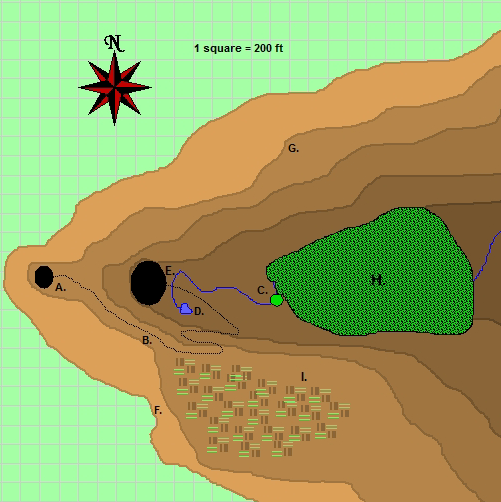
This scenario presumes the PCs are resident at the Eixtenitzi Stronghold (E on the map below). If the PCs are at another location in Aladur, then the DM should utilize a spot near the PCs. If the PCs are not in Aladur, then the DM can technically use whatever location is near the PCs.
|
|
Taminro-hazroo's gate is located in area A on the map above. This is currently the site of a ruined outpost of the sharn Tri-Claw Fortress (now called Eixtenitzi Fortress and repaired and inhabited by the PCs).
 |
Above is a map of area A.
The gate that Taminro-hazroo emerged from is located roughly in the center of the ruined tower to the west of the map, where a large stone block is indicated. The block bears the remains of intricate carvings and the gate in particular is an 8 ft by 8 ft area of the block's northern face that is a circle enclosed by carvings of three-clawed talons and triple eyes.
Taminro-hazroo will emerge from the gate, fur burned and scorched slightly in places by fire, lightning, and acid, and bruised by magic missile strikes. He will stagger out of the tower and pick his way through the rubble area to the east of the tower, moving with haste and not being particularly stealthy as he fears the phaerimm may have a way to come through the portal. When he emerges from the rubble area altogether, he should be easy to spot by sentries from Eixtenitzi for a brief moment before he notices the fortress ahead and quickly hides.
The DM should have a sentry atop Eixtenitzi see the spirit walker note the catfolk and hurry to report the sighting to the PCs. While the catfolk is hiding and figuring out where he is and what to do next and warily watching both the gate he left and the stronghold, he should be easy to find given the level and capabilities of the PCs. If, for whatever reason, there are no sentries to spot the catfolk or the PCs cannot find him, then eventually the spirit walker will decide to warily approach the stronghold and announce himself, to find out where he is and how he can return home and to warn of the danger that may emerge from the gate.
|
SPELLS: analyze portal (SC p10) - 1 min, 60 ft cone, conc up to 1 rd/lvl; determine the presence of magic portals and, with more time, learn other facts about them. |
Taminro-hazroo will eventually make cautious but peaceful contact with the PCs. If the PCs sided with or befriended the catfolk in the scenario Book of Revelations (Part 1) then the spirit walker will recongize the PCs and be immediately friendly and trusting. Conversely, if the PCs sided with the feral garguns in that scenario, then he will be much more wary and circumspect when dealing with the PCs.
Remember that Taminro-hazroo has no idea where he is. The gate could have lead anywhere! He does know he is on the Material Plane and likely in Sazhansiir (partly because he has no knowledge of any other continents on Therra).
Once peaceful contact is made, Taminro-hazroo will tell the PCs of his people (the catfolk) if they do not know of them. He will also speak of spirit walkers and, finally, tell his own tale...how he had discovered a gate and entered it and witnessed a ritual amongst three large beings that resembled floating cones of flesh with spindly arms that bore a rune carved staff. These creatures were performing some sort of ritual around a glowing gem. Somehow they noticed the spirit walker and cast many spells at him, of fire and acid and other magics, some from the staves and some by the creatures themselves. He will mention that, as he fled, one of the creatures must have teleported to block his way back to the gate, or there was a fourth such creature.
During his flight to the other gate, he was chased not only by these creatures, but by smaller bipedal creatures of stone and something he barely glimpsed...a corrupt presence of decay.
The Next Step:
The next step is up to the PCs. Technically, they can simply ignore the whole thing and let Taminro-hazroo be on his way back to the Fellen Wastes. However, the PCs are unlikely to be satisfied that strange creatures may be performing dark rituals and that a gate to such a lair is right next to thir stronghold!
The gate in the tower is not detectable by magic. Taminro-hazroo can relate this fact to the PCs. Most magic portals, especially those attuned to a key, do not show up as magic unless and until the key activates the gate, and then only for as long as the portal is active. Spells like analyze portal or the dimensional sextant can locate such inert gates.
It is Taminro-hazroo's opinion that the creatures do not know of the second gate, because they did not take steps to cut him off from it. The spirit walker had to use his own special powers to open the portal, as it was attuned to a key now likely long lost. As such, it is extremely unlikely that the creatures within could use the gate or know where it leads.
If the PCs express a willingness to return to the location and investigate, Taminro-hazroo will agree to reopen the portal in the tower, but only if he comes along and gets an equal share of any treasure found within.
The PCs are welcome to head right back in or to rest and prepare. Taminro-hazroo is injured somewhat (as shown on his statistics block above), but will heal himself with his wand.
Should the PCs elect to proceed immediately through the gate, they will have the advantage of having the phaerimm having used some of their spell slots. However, the PCs will only have what spells are available to them as well. If the PCs elect to wait and memorize spells or otherwise prepare, the phaerimm will have all of their spell slots back.
In any event, the DM should give a reasonable amount of time after which the phaerimm, their minions, and the gem will be gone, perhaps with signs left behind showing that they had conducted an arcane ritual in the gem chamber (see below), but with nothing of value left behind.
Identifying the Phaerimm:
If the PCs have taken part in the scenario entitled Days of Future Past, then they may recognize the description of the phaerimm as similar to the ghost commanding the undead in the Haunted Caves.
Indeed, if Taminro-hazroo is allowed to examine the rubble at the tower or see the walls of the Eixtenitzi stronghold he will note that many of the tri-claw carvings here resemble those he saw within the ruins he entered through the portals. That said, he knows nothing about the phaerimm or the sharn.
Part Two - Into the Breach!
The tower gate is a two-way keyed magic portal, which key has been long lost in the destruction of the Sharn Empire. The phaerimm within the sharn ruins to which the gates lead now suspect that the catfolk interloper may have escaped via another gate, although they cannot rule out the possibility of him simply using teleportation magic to have escaped.
The sharn ruins to which the gates lead are located in the northwestern portion of the Fellen Wastes, about 200 miles south of the mountains. They ruins are buried about 40-50 ft underground, and consist of collapsed giant stones, toppled pillars, and packed earth. Clearly, the phaerimm and their minions have gone about digging some of the tunnels in these ruins, but a lot of the space seems to be natural gaps between fallen rubble as well, perhaps widened by the phaerimm.
Unless otherwise stated below, all of the ruins are dark. Walls are all unworked stone (or in this case toppled and smashed worked stone) (hardness 8, 900 hp/5 ft, break DC 65, Climb DC 15). Floors are considered to be natural stone floors, and given the phaerimm ability to levitate, they have not bothered to have the floors smoothed.
|
Natural Stone Floors The floor of a natural cave is as uneven as the walls. Caves rarely have flat surfaces of any great size. Rather, their floors have many levels. Some adjacent floor surfaces might vary in elevation by only a foot, so that moving from one to the other is no more difficult than negotiating a stair step, but in other places the floor might suddenly drop off or rise up several feet or more, requiring Climb checks to get from one surface to the other. Unless a path has been worn and well marked in the floor of a natural cave, it takes 2 squares of movement to enter a square with a natural stone floor, and the DC of Balance and Tumble checks increases by 5. Running and charging are impossible, except along paths. |
Much of the fallen rubble and many of the pillars bear carvings that resemble those of Eixtenitzi stronghold. These are three-clawed motifs, sometimes with three eyes or mouths set within or upon the claws. All are sharn workings.
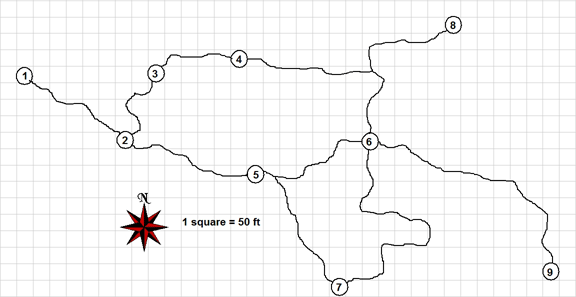 |
On the map above, all passageways represent twisting and winding narrow cracks or hastily dug ways between the larger pieces of rubble. They vary in width between 5 ft and 15 ft wide, with a rough distribution as follows:
5 ft wide = 33%
10 ft wide = 57%
15 ft wide = 10%
The DM can use these to randomly draw tunnels should an encounter occur therein. Ceilings are generally as wide as the passageway is tall (plus or minus 1d4 ft [or plus 1d4 ft in the case of a 5 ft wide passageway]). Elevation should be be crucial to this scenario, but the DM can assume the passages slope up and down randomly, but never going beyond the 40-50 ft below the surface range.
Current Preparations:
In the time since Taminro-hazroo escaped the ruins, the phaerimm have not been completely idle. They have instructed the maelephant to set alarm spells at the gate they know about (the one they entered) and the gate from which they suspect the catfolk may have exited. These alarm spells are set to mentally ping the maelephant if anyone triggers them. The phaerlocks have been instructed not to trip these spells.
All of the minions are on high alert. They had thought themselves safe from any interference, but the arrival of the catfolk put paid to that. The passageways are being patrolled and any sign of intrusion (e.g. alarm spells) will be met with an almost immediate response.
Wandering Encounters:
The DM should assume that for the next 24 hours after the catfolk incursion into the ruins, the phaerimm minions will be in a heightened state of alert. This means a patrol of 1d4+2 phaerlocks will be wandering the halls, with one of the planar binding creatures leading the group. The DM should feel free to have the PCs encounter this patrol, and if so, subtract any enemies defeated from the roster of creatures presented below.
Any encounter with suuch a group will involve the planar binding minion sending a single phaerlock to run to the phaerimm to warn them of another incursion. In the meantime, the rest of the patrol will attack the intruders. Should the phaerlock runner be defeated or hindered, then the planar binding minion itself will head to warn the phaerimm.
Area Descriptions:
Because the ruins are just that, ruins, there is no need for individual decriptive text for each area. Instead, rough dimensions are given for the area and any other information, along with details concerning guardians in the area.
1. Main Gate (EL 16)
This is the area where the main portal from the Fellen Wastes is located.
Along the western edge of this place, which is roughly 60 ft west to east and 40 ft north to south and about 20 ft tall, is a large archway comprised of carved squares with runes chiseled into their faces. The archway is filled with chipped white marble.
This is the portal. It is a two-way portal that is unkeyed. The other end of the portal is about 400 miles to the east by southeast, near the eastern end of the Wastes. This portal end was well hidden under rocks and earth, but the phaerimm, with the help of the bound xorn, managed to locate and excavate to the portal. It was this excavation that allowed Taminro-hazroo to discover the heretofore hidden portal entrance.
The portal radiates strong conjuration magic, and is activated merely by stepping into the archway, which becomes a swirling grey mist for 2 rounds before reforming into marble unless a creature is within the archway still.
Creatures: Before the catfolk appeared, this place was carelessly unguarded. Now, the phaerimm will have 6 phaerlocks stationed here, along with the daraka demon.
Developments: 5 minutes after the catfolk flees the ruins, the maelephant will have cast an alarm spell 10 ft east of the portal. The phaerlocks and demon are aware of the location of the spell and will not trigger it unless there is an alarm to be raised. The maelephant will renew the spell until such time as the phaerimm leave these ruins.
2. Skeletal Chamber
This widening in the passageway is 20 ft wide and about 40 ft long, with a 15 ft high ceiling.
A DC 30 Spot check or a DC 25 Search check will reveal a bone buried amid the rubble of the northern wall.
It will take 30 man-minutes to fully excavate the bones, and there is no danger of a collapse, although it will take a DC 20 Knowledge (architecture and engineering) or Craft (stonemasonry) check to confirm the absence of danger.
The skeleton is a sharn skeleton, some of the bones crushed by the impact of the collapse of these ruins. The bones appear many centuries old, if not millenia. If the PCs get it into their heads to resurrect the sharn, the DM will have to improvise the encounter. Perhaps the sharn befriends the PCs as long as they will fight against the phaerimm. Or perhaps the sharn, dislocated in time from its once glorious empire and its people, will flee or even go insane.
3. Wet Chamber
Trickles of water drip down the western wall of this area, which is only 15 ft in diameter but nearly 35 ft tall as its ceiling closes to a point between large fallen stone blocks. The water comes from the surface rains filtering through the watertable and there is no way to flood the ruins from this chamber.
4. Chamber of the Gem (EL 20)
Unlike the rest of these ruins,
this area is an actual chamber from the time of the Sharn Empire.
As such, descriptive text is presented below.
|
This area is an actual chamber, some 60 ft to each side, with walls, floor, and ceiling of smooth stone similar to the stone present as rubble throghout the rest of these ruins. The ceiling is 40 ft high and the walls bear battered and worn bas reliefs that seem to show three-headed and three-armed creatures flying through the air over great metropoli filled with soarinng structures. In the center of the place, circles have been carved into the floor, these worn and battered as well. The circle being at a diameter of 20 ft and are concentric every foot or so until they encircle a 10 ft diameter. Within this central area is a large and ornate tripod comprised of a strange black metal. The tripod is roughly 8 ft tall and atop it is set a fist-sized red faceted gem. The gem is glowing with a coral coloured aura that sheds light out to a 30 ft radius. Off to the north, where the flanks of the northern wall are still covered in rubble collapse, is inscribed into the floor a magic circle of some sort. This inscription is not worn at all. Near the diagram is a small iron chest. |
The figures carved into the wall reliefs are sharns, which the PCs may recognize if they met the sharn ghost in the scenario Days of Future Past.
The circles surrounding the tripod are an ancient sharn circle of warding, which guards the gem. The circles radiate overwhelming abjuration magic. The sharn warding circles are powerful epic magic in a 10 ft diameter globe. They cannot be dispelled or bypassed by any non-epic means except for performing the ritual.
The text of the ritual can be found in the iron chest (see Treasure below) and if the PCs can translate and understand the ritual, they can attempt to perform it themselves to gain the gem. The ritual is detailed below.
The wards prevent any and all non-epic access to the area within the innermost circle. No creatures, magic, or travel can enter this area, even extra-planar means. In short, the area is entirely off limits to all non-epic means. The wards and the area within also cannot be moved by non-epic means. Even were the entirety of the ruins excavated away, the ward, the 10 ft circle of stone floor, the tripod, and the gem would be floating in air in the exact position it is currently.
The tripod is made of a long-lost metal that can be treated as magically treated iron (hardness 20, break DC 35, 75 hp).
The gem is described in Treasure below.
Creatures: The 3 phaerimm who led this expedition are here. They came to these ruins specifically to find and gain the gem. They will, if not on alert, be found floating 5 ft up about 10 ft from the gem performing the ritual required to access the gem. The ritual currently involves the phaerimm waving their hands and chanting in their wind-like voices.
Developments: Assume the phaerimm were in day 2 of a 5 day ritual to break the sharn wards and take the gem. If they are not stopped by the end of the 3rd day after the catfolk incursion, then the DM should roll for the ritual success (see below) and see if the wards are lowered. If so, the gem will be taken and the phaerimm depart. The DM can assume that the elder phaerimm made its Intelligence check and fully understand the ritual. If the ritual rolls fail, then the phaerimm will restart and take another 1d4+1 days, and so on.
Traps: The chest is locked by means of an arcane lock spell (CL 7), cast by the elder phaerimm using his wand. Additionally, the chest is warded by a disintegrate trap that will attack anyone opening the chest or causing even a point of damage to the chest or otherwise breaching its integrity.
|
Disintegrate Trap CR 7; magic device; touch trigger (alarm); no reset; spell effect (disintegrate, 13th-level sorcerer, ranged touch atk +12, 26d6 damage, DC 19 Fortitude save for 5d6 damage); Search DC 31; Disable Device DC 31. |
Treasure: The gem is unlike any normal Therran gems, and anyone who has ranks in the Appraise skill or a Craft or Profession skill related to gems will be able to tell this instantly. The gem radiates overwhelming magic of the universal school.
Whatever function the ancient sharns hoped to use the gem for it long lost. The gem is useful, however, for powering epic magic. The gem can be treated as 400,000 gp and 16,000 xp for the purposes of crafting a magic item or creating an epic spell or casting an epic spell. The gem will also decrease the time required to craft the item by the amount of its gp value, but in no case more than half of the crafting time. However, the gem can only be used once on 1 item. Therefore, while it could in theory be used to craft a non-epic item, that might be an extreme waste of the gem.
A DC 30 Knowledge (arcana) check is required to determine that the gem has properties that could aid in the crafting of epic items or the creation or casting of epic spells. A DC 40 Knowledge (arcana) check is required to fully understand how to utilize the gem and precisely how much it benefits such activities.
Non-epic magic will not be able to discern the gem's properties.
Within the iron chest is a scroll made of an unknown coppery metal that is hammered thin and somehow made flexible enough to use like vellum. Strange runes cover the face of the scroll on one side and the entire work is quite voluminous.
The Ritual:
The ritual is written in the Sharn language, and so will be difficult to understand without magic. A DC 20 Knowledge (arcana) check is required, once the reader can understand the language, just to puzzle out that the whole is a ritual designed to negate specific epic wards. A DC 30 Knowledge (arcana) check will confirm that the ritual will negate the ward.
Studying the ritual will require a DC 18 Intelligence check and at least a week of complete immersion into the ritual. No other activities beyond eating, drinking, and sleeping for 8 hours may be conducted during this time. This studying time cannot be lengthened in total in order to shorten the daily time required. The ritual is so complex that any slacking off or break will cause the student to forget what he has learned and have to start over again. If the Intelligence check succeeds, then the student has learned the ritual enough to lead it in practice. If the check fails by 5 or more then the student knows he has not fully grasped the ritual and can spend another week to make another attempt, and so forth. If the check fails by less than 5, then the student believes he knows the ritual, but does not. In this case, he will have to make a DC 18 Wisdom check (less the amount by which he failed the Intelligence check) to realize he may not actually know all of the ritual as well as he thought.
The ritual requires 3 practitioners, including one who will lead the ritual. The ritual takes 1d4+1 days to complete, and during that time, the practitioners must devote 8 hours per day to the ritual. The rest of the time can be spent in whatever activity is required, but the ritual days must be consecutive or the ritual wll have to be started over again. The ritual involves mainly gesticulating and chanting and maintaining strong mental imagery prescribed by the text.
Successfully enacting the ritual requires a DC 30 Knowledge (arcana) check by the leader of the ritual. The two other practioners must succeed at a DC 25 check. If the check fails, then at the end of the ritual time, the wards will remain and the ritual must be restarted. If an enacting check fails by 5 or more, then the ritual fails catastrophically (as noted below). It may still be re-attempted.
If the ritual is improperly enacted (from a failed Intelligence and Wisdon check as set forth above), then the ritual will automatically catasrophically fail (as noted below) after the ritual time is completed.
Should the ritual catastrophically fail, guardians indentured by the ancient sharns will appear and attack all who took part in the ritual. A marut inevitable will attack the leader of the ritual and a kolyarut inevitable will attack the other two practitioners. Unless other beings interfere with these attacks, each inevitable will only go after its specific target. Should any others interfere, then the inevitables will still try to achieve their primary objectives, but will also take steps to defend from and neutralize those interfering. The inevitables will appear 1 round after the ritual has ended and each will remain until each completes its own objectivve or is destroyed. Thes inevitables are called and not summoned. When slain, they disappear.
Each time the ritual is catastrophically failed, the inevitables will reappear. Should the PCs, for whatever, reason, attempt to continually call inevitables by purposefully failing the ritual (e.g. to gain XP), then eventually swarms of inevitables will appear, with precise numbers being up to the DM, but enough to make the PCs not wish to keep up the activity.
If the ritual suceeds, then the wards will drop and the gem can be taken.
5. Collapsible Chamber (EL 13)
This area is 30 ft wide and 60 ft long with a relatively low ceiling only 10 ft overhead. Several large stones form pillars that keep up the collapsed ceiling.
There are 3 such pillars here, and each is roughly 5 ft in diameter and 10 ft tall. Each "pillar" has a hardness of 8 and 90 hp and a break DC of 35. However, it takes a Strength check of 25 to shove the pillar aside (as many as 2 Medium creatures can push the pillar, with the second making a check to aid the other).
Should a pillar be shoved aside, there is a 33% chance that the whole area will collapse. If 2 are knocked out the chance is 66% and if all three are knocked out the ceiling will collapse.
A collapsing ceiling will may delay before actually falling. This delay period will be punctuated with rumbling sounds, stone snapping, dirt falling, etc. The delay will be 1d4-1 rounds from the time the collapse is determined. A collapse will occur at the start of the next round, and any delay sounds and rumblings will also begin at the start of the next round. The collapse will bury the entire area, with a slide zone extending 10 ft beyond.
Should a collapse occur, use the rules presented in the Dungeon Masters Guide:
|
Cave-ins and collapsing tunnels are extremely dangerous. Not only do dungeon explorers face the danger of being crushed by tons of falling rock, even if they survive they may be buried beneath a pile of rubble or cut off from the only known exit. A cave-in buries anyone in the middle of the collapsing area, and then sliding debris damages anyone in the periphery of the collapse. A typical corridor subject to a cave-in might have a bury zone with a 15-foot radius and a 10-foot-radius slide zone extending beyond the bury zone. A weakened ceiling can be spotted with a DC 20 Knowledge (architecture and engineering) or DC 20 Craft (stonemasonry) check. Remember that Craft checks can be made untrained as Intelligence checks. A dwarf can make such a check if he simply passes within 10 feet of a weakened ceiling. A weakened ceiling may collapse when subjected to a major impact or concussion. A character can cause a cave-in by destroying half the pillars holding the ceiling up. Characters in the bury zone of a cave-in take 8d6 points of damage, or half that amount if they make a DC 15 Reflex save. They are subsequently buried. Characters in the slide zone take 3d6 points of damage, or no damage at all if they make a DC 15 Reflex save. Characters in the slide zone who fail their saves are buried. Characters take 1d6 points of nonlethal damage per minute while buried. If such a character falls unconscious, he must make a DC 15 Constitution check. If it fails, he takes 1d6 points of lethal damage each minute thereafter until freed or dead. Characters who aren’t buried can dig out their friends. In 1 minute, using only her hands, a character can clear rocks and debris equal to five times her heavy load limit. The amount of loose stone that fills a 5-foot-by-5-foot area weighs one ton (2,000 pounds). Armed with an appropriate tool, such as a pick, crowbar, or shovel, a digger can clear loose stone twice as quickly as by hand. You may allow a buried character to free himself with a DC 25 Strength check. |
Creatures: The maelephant is usually found here, alert for the sounding of its alarm spells.
6. Guard Area
This area is 12 ft tall and about 50 ft in diameter. It is used as a rest area for the phaerlocks and now, with the catfolk intrusion, as a guard post.
Creatures: 6 phaerlocks are here, alert for trouble and ready particularly for intruders (presumably more catfolks) to come from area 9. They are led by the vaporighu.
7. Crystal Chamber (EL 11)
Thousands of tiny shards of an amber coloured crystal litter the floor here. For all intents and purposes, the entire floor of this 30 ft diameter area (with a ceiling 15 ft tall) should be considered strewn with caltrops.
| Each time a creature moves into an area covered by caltrops (or spends a round fighting while standing in such an area), it might step on one. The caltrops make an attack roll (base attack bonus +0) against the creature. For this attack, the creature’s shield, armor, and deflection bonuses do not count. If the creature is wearing shoes or other footwear, it gets a +2 armor bonus to AC. If the caltrops succeed on the attack, the creature has stepped on one. The caltrop deals 1 point of damage, and the creature’s speed is reduced by one-half because its foot is wounded. This movement penalty lasts for 24 hours, or until the creature is successfully treated with a DC 15 Heal check, or until it receives at least 1 point of magical curing. A charging or running creature must immediately stop if it steps on a caltrop. Any creature moving at half speed or slower can pick its way through a bed of caltrops with no trouble. |
The crystals are remnants of some sharn structure and now have no value.
Creatures: The half-dragon xorn is usually found here, lazily munching on the crystals. His use was primarily to excavate the tunnels here to get to the gem chamber, and now he is on a sort of lazy guard duty.
At the first sign of trouble, however, the xorn will use his earth glide ability to travel directly to the phaerimm and warn them of intruders.
8. Accident Site
This area is about 20 ft in diameter and 20 ft tall. The floor is filled with newly formed rubble (double the movement penalties normally associated with natural stone floors.
A DC 10 Knowledge (architect and engineering) or Craft (stonemasonry) check will confirm that the ceiling of this chamber collapsed recently. A DC 20 check of those same skills will reveal that the new ceiling is quite stable.
Amidst the rubble are the bodies of 3 phaerlocks. They are no decomposed, revealing that their demise occurred fairly recently (within a few days before the catfolk intrusion).
9. Rear Gate (EL 16)
This small area is about 20 ft in diameter. Along the southeast wall is a large stone with a circular carving similar to that on the stone in the Eixtenitzi tower from which Taminro-hazroo emerged. This is a keyed gate, the key having been lost in the destruction of the Sharn Empire. The gate no longer detects as magic (unless it is activated), and without the key, it takes powerful magic or an accomplished gatecrasher (i.e. spirit walker) to utilize it. The other end of the gate, of course, emerges in the tower at Eixtenitzi stronghold.
The phaerimm are not certain that this portal is present. They suspect there may be one here, however, because the catfolk was last seen running down the passageway to this area. He could have teleported away, but then, the phaerimm reason, why didn't he simply do that immediately upon being discovered?
As such, 3 minutes after the catfolk incursion, an alarm spell will be placed in this chamber by the maelephant, and the spell covers the entirety of the 10 ft high area. The maelephant will renew the spell until such time as the phaerimm leave these ruins.
Creature Roster:
3 phaerimm are here, performing the arcane ritual necessary to remove the gem from its holding place without ruining its potency. What they intend to do with the gem is up to the DM, but should they escape with it, the DM might have the PCs deal with whatever consequences might arise.
The phaerimm have brought along some phaerlock minions, mostly for manual labour, as they did not expect to be disturbed. However, fearing the gem might have some sort of supernatural guardian attached to it, the elder phaerimm has also used its planar binding spell to call forth four minions from the outer planes. These minions include a vaporighu, a maelephant, a daraka demon, and a half-green dragon xorn.
|
FEATS: Energy Substitution (CA p79) - modify any spell with an energy descriptor to use the selected energy type. Rapid Metamagic (CM p46) - spontaneous spell modified by metamagic takes normal casting time. SPELLS: assay spell resistance (SC p17) - swift, personal, 1 rd/lvl; +10 on CL checks to overcome SR of specific creature in sight when cast. curse of the putrid husk (BoVD p89) - close, 1 creature, 1 rd + 1d10 min, sv Will neg, SR; if save failed target dazed and horrified for 1 rd and then falls unconscious for 1d10 min and cannot be roused normally. orb of acid (SC p150) - close, sv Fort part; ranged touch 1d6 acid/lvl (max 15d6), sicken for 1 rd if save failed. power word nauseate (RoDR p116) - close, 1 living creature with 150 hp or less, SR; creature nauseated for 1 rd if 101-150 hp, 1d4+1 rds if 51-100 hp, or 2d4+2 rds if 50 or less hp. recipricol gyre (SC p170) - med,1 creature or obj, sv Will 1/2 then Fort neg; subject takes 1d12 dmg per spell or spell-like ability affecting it (will 1/2), if Will sv failed then Fort sv or be dazed for 1d6 rds. sadism (BoVD p103) - personal, 1 rd/lvl; for every 10 hp dmg done by caster in a round, gains +1 luck bonus to attacks, saves, and skill checks for the next round. scintillating sphere (SC p181) - long, ft radius burst, sv Ref 1/2, SR; 1d6 electricity dmg/lvl (max 10d6). sting ray (SC p206) - close, 1 rd/lvl, sv Will part, SR; ranged touch to impose single move or standard action each round and -2 to AC and Concentration equal to spell's DC + spell level being cast to cast a spell, Will save negates all but AC penalty. MAGIC ITEMS: staff of conjuration - unseen servant (1), summon swarm (1), stinking cloud (1), minor creation (2), cloudkill (2), summon monster VI (3) staff of enchantment - sleep (1), hideous laghter (1), suggestion (1), crushing despair (2), mind fog (2), mass suggestion (3) |
|
FEATS: Energy Substitution (CA p79) - modify any spell with an energy descriptor to use the selected energy type. Rapid Metamagic (CM p46) - spontaneous spell modified by metamagic takes normal casting time. SPELLS: avasculate (SC p19) - close, ray, sv Fort part, SR; ranged touch reduces target to 1/2 current hp and stun for 1 rd, save negates the stun only. curse of the putrid husk (BoVD p89) - close, 1 creature, 1 rd + 1d10 min, sv Will neg, SR; if save failed target dazed and horrified for 1 rd and then falls unconscious for 1d10 min and cannot be roused normally. energy absorption (CM p103) - touch, 1 hr/lvl, SR; gain resist 10 vs all energy types (including sonic), as immed action absorb all of a single energy attack and heal 1/2 the dmg (this use discharges the spell). orb of acid (SC p150) - close, sv Fort part; ranged touch 1d6 acid/lvl (max 15d6), sicken for 1 rd if save failed. power word nauseate (RoDR p116) - close, 1 living creature with 150 hp or less, SR; creature nauseated for 1 rd if 101-150 hp, 1d4+1 rds if 51-100 hp, or 2d4+2 rds if 50 or less hp. ray deflection (SC p166) - personal, 1 min/lvl; al ranged touch attacks at caster are reflected harmlessly away. recipricol gyre (SC p170) - med,1 creature or obj, sv Will 1/2 then Fort neg; subject takes 1d12 dmg per spell or spell-like ability affecting it (will 1/2), if Will sv failed then Fort sv or be dazed for 1d6 rds. sadism (BoVD p103) - personal, 1 rd/lvl; for every 10 hp dmg done by caster in a round, gains +1 luck bonus to attacks, saves, and skill checks for the next round. scintillating sphere (SC p181) - long, ft radius burst, sv Ref 1/2, SR; 1d6 electricity dmg/lvl (max 10d6). sting ray (SC p206) - close, 1 rd/lvl, sv Will part, SR; ranged touch to impose single move or standard action each round and -2 to AC and Concentration equal to spell's DC + spell level being cast to cast a spell, Will save negates all but AC penalty. MAGIC ITEMS: staff of transmutation - expeditious retreat (1), alter self (1), blink (1), polymorph (2), baleful polymorph (2), disintegrate (3) |
|
|
|
FEATS: Boost Spell Resistance (BoVD p47) - +2 profane bonus to SR. |
|
|
|
|
Part Three - The Phaerimm Response
The phaerimm conducting the ritual to extract the gem in the ruins are crafty opponents who know the workings of magic and are cautious when faced with unknown or powerful enemies.
When the PCs arrive at the ruins, if less than a day has passed, the phaerimm will initially assume the catfolk returned or never left and has been found. They will continue with the ritual in the hope that their minions can handle or rout the intruder. Should word come back to them (or other evidence) that more of a threat than a single catfolk has arrived, then the phaerimm will begin to cast longterm defensive magic on themselves. Such defenses will include casting mage armour, shield, protection from good, and mirror image. The elder phaerimm will also cast ray deflection on itself and energy absorption on itself and its two phaerimm companions.
All 3 phaerimm will cast resist energy (fire) on themselves and if any reports reach them of the intruders using any other energy types, resist energy will be cast against those as well.
The phaerimm will not wish to throw their lives away for the gem. They have dimension door spell available to escape the ruins and the elder has greater teleport scrolls to return to their home deep in the Blasted Lands. Furthermore, the phaerimm know that it would take the intruders some time to free the gem from the wards, even if they could puzzle out the ritual, and so they are content to retreat, in a pinch, and wait a while while spying on the gem room using clairaudience/clairvoyance and wait for the PCs to leave the gem, then returning (with more evil minions called up using planar binding) to perform the ritual.
Experience Points:
In addition to normal experience (which in Therra is half of that recommended in the DMG), each party member should be rewarded as follows:
There are no special XP awards for this scenario.