Return to the Therran Scenario Page
Summary:
The PCs encounter an ancient sharn spirit and defeat a phaerim undead menace that the sharn was holding in abeyance.
Assumptions:
The PCs are friendly to and dwelling amongst the killoren of Aladur.
Location:
Aladur
Historical Date:
703 A.C. Winter
DM's Introduction:
Note: DMs should refer to The Killoren for information on the land of Aladur and various of its inhabitants and locations.
In ancient times in Sazhansiir, before the coming of Kyuss and his minions, the sharns ruled a mighty empire...the mightiest in all of Sazhansiir. The Sharn Empire was located in the southeast portion of the continent, where today the Blasted Lands lie.
When Kyuss arrived in Sazhansiir he and his minions made war upon the sharn, but the Progenitors and their servants were not yet numerous enough to defeat the sharn. Further, the sharn were immune to many of the strategems favoured by the Progenitors, including mind-affecting magic and infiltration via polymorph and similar spells. And so Kyuss created his own race of servants, using some of the life seed energy left over from the Progenitors, the phaerimms. These worm-like creatures were accomplished sorcerers with magic enough to counter the sharn, and they were bred to fight the sharn and destroy them.
Great battles were fought, whose records are mostly lost to time and the Creation Blast, but over the course of centuries, the sharn empire fell to Kyuss, and the remaining sharns were scattered to the hinterlands of their own empire and even into Charmindos. The phaerimms, too, suffered hideous casualties during their defeat of the sharn, and their power was broken in the wake of the rise of the Scaled Ones. The phaerimm who survived served in the Serpent Empire's heart near to Kyuss as his favoured. When the Creation Blast detonated, many of the remaining sharns who dwelt still in the fringes of their old empire were destroyed. Even moreso, the remnant of the phaerimms were decimated, so that both sharns and phaerimms became rare creatures almost unheard of outside of Charmindos (for the former) and the Blasted Lands (for the latter).
One of the last sharn outposts to fall was a fortress on the very fringes of their empire, in what is now Aladur. There the sharns had a great fortress they called "The Tri-Claw of Stone" in their strange language. While the greater campaigns of the great sharn-phaerimm conflicts raged in the heart of the Sharn Empire, a phaerimm force was sent to eliminate the fortress. This force marched upon The Tri-Claw of Stone and was commanded by a general of the phaerimm who was called "Wind of Blood", a particularly ruthless phaerimm of no small magical ability who was eager for success in order to rise to what it perceived was a more worthy status in the eyes of Kyuss.
The phaerimms assaulted the fortress, but were repelled time and time again, until they placed the structure under a siege. The sharns within at first held out hope that their fellows in the empire might prevail and come to their rescue, but as it became clear that the sharns were being defeated and that no rescue would be forthcoming, and as the siege began to take its toll, they concocted a desperate last-ditch gambit that would not save their lives but would at least afford them some measure of revenge. And so the sharns snuck out a small strike force to travel north to the cave being used as headquarters by the phaerimms. There they inflitrated and attacked Wind of Blood.
It was known by the sharns that Wind of Blood, being a very powerful magician, would likely have the means to survive death, even including a clone prepared in advance. As such, simply killing the general would not have the desired effect. Therefore, the sharns prepared a ritual that would trap Wind of Blood within its headquarters, never to emerge again. The trap involved a very exotic and ancient ritual of power to be enacted by the sharns at the moment of Wind of Blood's death. Its spirit would not depart, but would be held here on the Material Plane, bound by the ritual itself, which would be powered by the spirit of a mighty sharn sorcerer. As long as the sharn's spirit remained and the propylon emanation left undisturbed, Wind of Blood's spirit would also be bound.
The ritual was conducted in a secret chamber located in the bowels beneath The Tri-Claw Fortress, and as the strike team made the killing blow, the sharns enacted the final phrases of the ritual and Wind of Blood's spirit became trapped. The loss of their general did not thwart the phaerimms, and they eventually overran the fortress and cast it into ruins. And though they searched the place carefully, and with magic, they never located the hidden chamber where the sharn's spirit remained, for the propylon itself powered glyphs and enchantments that kept the place secret from magical prying. Furthermore, all attempts to break the bonds of the imprisonment of Wind of Blood also failed, so that after a time the phaerimms simply left the unfortunate general's spirit, which eventually became abandoned to the passage of time.
And so it remains to this day. Deep beneath the ruins that lie in the eastern portion of Aladur is the sharn spirit, as much a victim of the ritual as Wind of Blood. And hidden within its cave some distance ot the north of the ruins is the entrapped spirit of Wind of Blood.
The killoren do not go into the ruins, for the place is strange to them and clearly not "of the Land". And the killoren shun the cave, which they name as haunted, for though Wind of Blood is trapped, its spirit remained cohesive through sheer force of will, and is now a spectral mage. Wind of Blood has used its magic to create various undead creatures that haunt the cave and occasionally spill out into the lands surrounding the cave.
Recently, volcanic Irmondrin Peak, which overlooks the ruins to the east, had a particularly violent earthquake shake its western face. Some wisps of ash and steam and even a few trickles of lava emerged from the mountain, with the latter trickling down in small flows to the base of the mountain (and somewhat near to the ruins). One effect of this quake was that the hidden entrance to the sharn's ritual vault, once so cunningly concealed and make impervious to magical detection, has been thrown akilter and is now visible and capable of being found. This presents an opportunity to explorers of the ruins to penetrate the vault and discover its mysteries. Furthermore, the propylon tube used in the ritual has been thrown offline, resulting in a beam of purple propylon shooting up out of the vault, and into the air. While this beam is not very visible in the daytime, at night it is visible as a 120 ft high column of crackling purple energy from a good many miles away. Both the sundering of the entrance to the vault and the disruption of the proplyon tube has negated the enchantments that kept the place secret from scrying and divinations. It has also disrupted the binding ritual, such that the sharn spirit will eventually fade away, thereby freeing Wind of Blood.
The killoren have noted the recent quake of Irmondrin Peak, and now killoren hunters report seeing the strange purple light at night coming from the ruins...something that has never been reported before. They are worried that some great evil is now afoot in the ruins and will ask the PCs to investigate.
|
|
Part One - Reaching the Ruins
What the killoren refer to as the "Strange Ruins" are well known to most killoren, and it is, in fact, generally regarded as the second-most feared place in Aladur, the most feared being the "Haunted Cave". The killoren know nothing for certain of the ruins, except that reports by those killoren of centuries past who entered the ruins describe architecture and ornamentation that is clearly beyond the ken of the killoren. The killoren do not approach the place as a rule, simply due to its strangeness, and the killoren elders have warned that at some time in the distant past some sort of people or race dwelt there but are now gone and that the place may be accursed. Many killoren believe this race was destroyed by the land of Aladur itself long before the killoren arrived.
Attempts to find killoren who have entered the ruins recently will be impossible.
Questions about the ruins will inevitably turn up mention of the recent activity of Irmondrin Peak and the lava that streamed down towards the ruins. Such a large quake is unusual despite the ever-present rumblings of the mountain, and most killoren will see the quake as some sort of warning or irritation by the Land and the lava as a finger pointing accusingly towards the ruins.
Fewer killoren know of the purple beam of light in the ruins, but those who do can testify to the fact that such a light has never before been reported there.
The killoren elders will be quite concerned, and will request that the PCs travel to the ruins to see what is happening there. If the PCs require a reward for doing so, the DM can devise a suitable one that would be within the means of the killoren to provide.
Travelling to the ruins is quite easy, though no killoren guide will approach to within several miles of the place. It is up to the DM whether he wants to have any encounters along the way, and if so he can refer to the creature listing for Therra to derive likely inhabitants of the land or refer to the scenario The Beasts Within for details on potential fauna of the land.
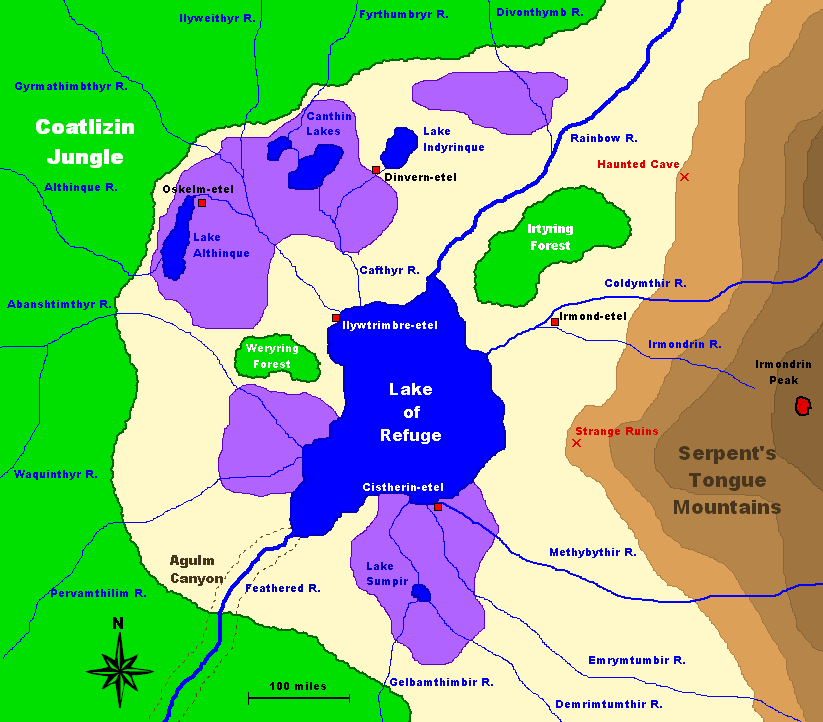
The Strange Ruins are about 260 miles from Ilywtrimbre-etel as the crow flies, or 350 miles on land journeying around the northern bank of the Lake of Refuge. Set on a spur of the mountain, the ruins are fairly easy to locate, and are visible from a fair distance to the west, as they are set on the portion of the spur that overlooks the plains between the mountain and the Lake of Refuge. From a distance, the ruins look like a jumble of stones set atop the spur, about 400 ft above the level of the plain, with a smaller set futher to the west and about 200 ft above the level of the plain..
The propylon beam emerges from the center of the main ruins in a ragged beam about 2 feet wide. This beam is not very visible during daylight, requiring a DC 0 Spot check to notice (modified by distance, of course). At night, however, the beam is apparent to all who look in the direction of the ruins.
In addition, the lava ooze on the pedestal in area 1 of the main ruins (see Part Three below) will also be visible at night as a ruddy flame.
Part Two - The Ruins Environs
Refer to the map below for a large-scale overview of the ruins area. Each elevation contour represents 100 ft of height. The marked locations are set forth below.
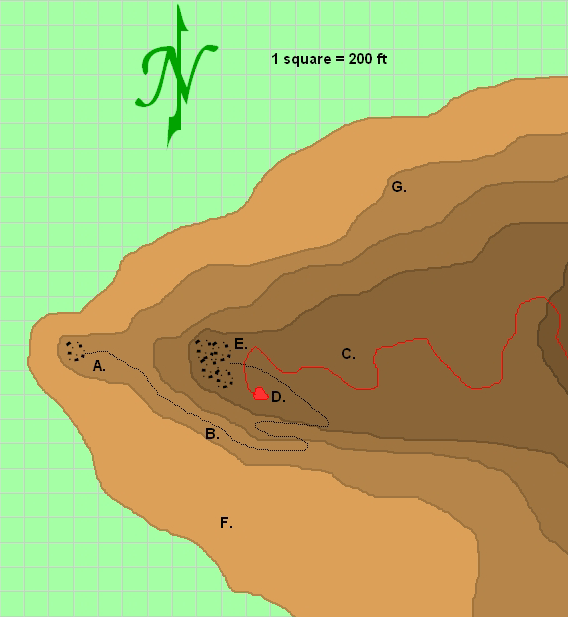 |
A. Watchtower (EL 13).
This is the ruins of a large watchtower and small keep that were set at the westernmost terminus of the spur to serve as a scouting post and initial strongpoint against attacks from the west, as well as a flanking position against assaults from the north and south. Unlike the main ruins, there is no propylon beam emanating from here and, in fact, no lights at all during darkness hours.
 |
The tower walls are 2 ft thick, which the other wall remnants to the east are 3 ft thick. The shaded stone blocks shown on the map are between 8 ft and 13 ft tall (1d6+7). All of the area within the tower or the confines of the wall remnants is considered to be light rubble (adds 2 to the DC of Balance and Tumble checks) while the dotted areas on the map indicated areas of dense rubble (2 squares of movement to enter a square with dense rubble, adds 5 to the DC of Balance and Tumble checks, and adds 2 to the DC of Move Silently checks).
The brown line shows the boundary of the slope downward, and DMs should consider the area west of the brown line to be a steep slope (characters moving uphill [to an adjacent square of higher elevation] must spend 2 squares of movement to enter each square of steep slope; characters running or charging downhill [moving to an adjacent square of lower elevation] must succeed on a DC 10 Balance check upon entering the first steep slope square; mounted characters make a DC 10 Ride check instead; characters who fail this check stumble and must end their movement 1d2×5 feet later; characters who fail by 5 or more fall prone in the square where they end their movement; a steep slope increases the DC of Tumble checks by 2).
The dotted line is a worn stone pathway that emerges from the
ruins towards the southeast (see area B below).
| The ruins clearly show the remains of a large tower, round but somewhat widening about 25 ft to 30 ft high before ending in a jumble of smashed stone. This tower apparently was the western bulwark of the keep, which walls are now only remnants between 5 ft and 10 ft tall that proceed in a very irregular ring east of the tower. Within the walled remnants are large blocks and piles of stones, overgrown with weeds and other plant life, including ivy, vines, and small bushes. |
Most of the remains are unadorned, but a few pieces, if a thorough search is done (taking at least a half an hour and requiring a DC 20 Search check) will show strange three-headed gargoyles with bulbuous heads and no wings shaped as a sort of fleur-de-lys, as well as ornamentation depicting three claws set in a triangle pattern.
Creatures: The phaerrims left guardians in these ruins to stop the sharns or other enemies from rebuilding the fortifications. Over the centuries, some of these guardians have perished, and in the main ruins all of them have been destroyed by the recent propylon leak, which has attracted and destroyed the guardians when they entered the beam. However, in this area, far enough removed from the propylon beam, 6 shredstorms lurk. The shredstorms are initially located at the positions shown on the map above (SS). They will react to any sights or sounds they hear, and are normally quiescent, meaning they appear as a pile of strange metal objects (spiked disks 4 inches in diameter). When roused they form into shrapnel clouds that attack intruders, defined as attacking any non-phaerimm they encounter within the confines of the ruins. The shredstorms will not leave the area depicted on the map, but will use their lightning bolts to attack hostile foes beyond the range of their normal attacks
|
Tactics: The shredstorms will activate when they see or hear a foe. In addition, the act of activating will, of itself, activate the other shredstorms if they hear or see the activation. A shredstorm that hears or sees another activate will not itself activate until the following round, as it takes a small bit of time for the shredstorm to process the fact that other shredstorms have been activated.
The shredstorms are dangerous purely as a swarm, but with their lightning bolt ability, they can be downright deadly. Fortunately for the PCs, they are not intelligent and will not purposefully group or combine their lightning bolts all at once and down the same general line, so as to cause a total of 60d6 of electricity damage, likely killing outright any PCs even if they make half of their saves (average of 157.5 hp of damage). In addition, the fact that the shredstorms will not usually all activate at once means the PCs should not have to face all of the lightning bolts at once.
The shredstorms will fire their lightning bolts only when the situation clearly warrants it. This includes dangerous enemies who are out of reach, or enemies who seem to be resistant or immune to their normal electrical attack. The shredstorms are programmed not to waste their lightning bolts because doing so degrades their electrical damage from their swarm attack. Each shredstorm will make its own independent judgment as to when to use its lightning bolt, and, for example, each shredstorm will have to personally experience a foe resisting its normal electricity attack before resorting to its lightning bolt. The constructs are not smart enough to notice that a different shredstorm's attack was resisted.
Developments: The shredstorms, if defeated, will collapse into an inert pile of adamantine disks.
Treasure: The shredstorm disks themselves are very valuable, and can be sold for 7500 gp for each shredstorm on the open market. The blades cannot be used as shuriken themselves, as they are not balanced for throwing, but could be used as improvised weapons (treat as adamantine punch daggers). If reforged (DC 25 Craft check), they could be used to make 7500 gp worth of adamantine items.
B. Pathway
This worn stone pathway seems to be made of a single long, chipped and cracked piece of marble...the same as described in area A above. The pathway is covered in many places by dirt and rocks and overgrown with weeds and bushes, but can still be followed up the hill towards the main ruins (area E).
C. Lava Flow
This small stream of lava is between 5 ft and 10 ft wide and between 4 ft and 2 ft deep (respectively). It is slow flowing and its edges have cooled off into black pumice stone. The flow proceeds down the mountain from the east towards the main ruins and then to the pool at area D.
Lava or magma deals 2d6 points of damage per round of exposure, except in the case of total immersion (such as when a character falls into the crater of an active volcano), which deals 20d6 points of damage per round.
Damage from magma continues for 1d3 rounds after exposure ceases, but this additional damage is only half of that dealt during actual contact (that is, 1d6 or 10d6 points per round).
An immunity or resistance to fire serves as an immunity to lava or magma. However, a creature immune to fire might still drown if completely immersed in lava.
D. Lava Pool (EL 7)
At this point the lava flow as gathered into a pool. The pools seeps underground through small fissures before eventually cooling and forming new stone formations. The pool is roughly 75 ft in diameter and will prove to be about 15 ft deep in its center and 5 ft deep at its edges.
Creatures: 2 thoqquass have emerged from the volcano as it erupted, the eruption opening a temporary gate to the Elemental Plane of Fire. The thoqquas have come down the lava stream and into the pool and are now somewhat irritated at being trapped on this plane and desirous of returning home. The naturally choleric creatures are now extremely upset and will attack anyone approaching to within 10 ft of the lava pool. The thoqquas generally stay beneath the surface of the pool, but one always has a portion of its head slightly above the pool in order to note intruders and to look for a possible reopening of the planar gate (they are too stupid to realize that the gate could only reopen in the heart of the volcano itself during another eruption)
|
Tactics: The thoqquas will tend to simply coil and spring, though they are not averse to grappling a foe and dragging it into the lava. If sorely pressed they will take cover in the lava and use that to their advantage.
Developments: Unless persistently harrassed, the thoqquas will not proceed more than about 100 ft from the laval pool, it being too cold for their liking and they simply want to be left alone in the pool. If harrassed, they will burrow from under the surface of the pool towards their foes and then attack from the beneath their opponents.
E. Main Ruins
See below for the description of the main ruins.
F. Scorpion Cave
This cave is home to a colossal brood mother scorpion and her various progeny. The main feature of this encounter is that every size monstrous scorpion is present in the cave, and as the PCs progress the scorpions keep getting larger and larger!
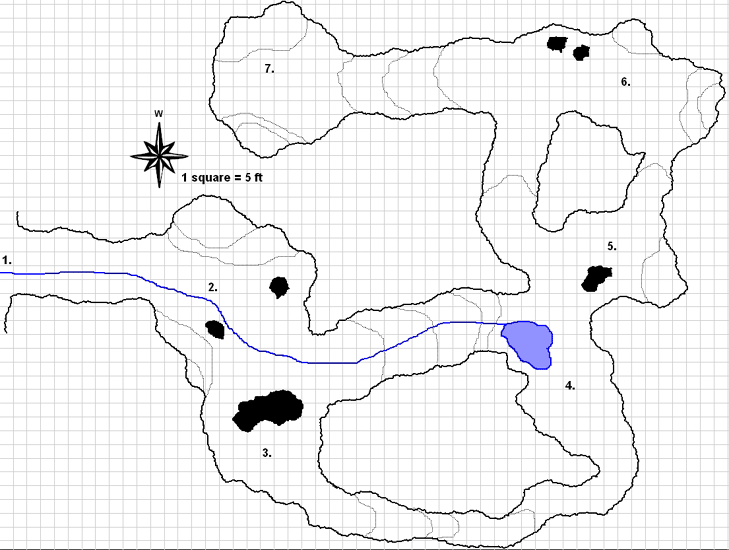 |
Unless otherwise stated, the interior of the cave consists of unworked stone walls (8 hardness, 900 hp, break DC 65 per 5 ft, Climb DC 15) and natural stone floors (it takes 2 squares of movement to enter a square with a natural stone floor, and the DC of Balance and Tumble checks increases by 5; running and charging are impossible). The entrance area outside of the cave proper is normal ground.
There are no natural light sources within the cave, and ceilings are 20 ft tall at the edges and 30 ft tall in the center in numbered cavern areas (2-7) and 20 ft tall in passageways.
The floor within 10 ft of the stream is slippery with water and mossy slime, increasing the DC of Balance and Tumble checks by 5 (this is cumulative with the increase due to the natural stone floor).
Stone shelves and elevation changes (marked by the dotted lines) are about 5 ft and require a Climb or Jump check to navigate (DC 15 Jump check).
The stream is a mere trickle, being about 1 ft wide and 6 inches deep. The pool at the end is about 4 ft deep and drains through tiny fissures at the bottom.
All of the caves are littered with the bones of prey, larger bones from larger prey in the caves with larger scorpions.
The scorpions within tend to rush toward their prey. In addition, once engaged, the scorpions will chase prey out of the cave and for quite a while before giving up and returning to their lair.
The whole premise of this encounter is for the PCs to begin fighting small scorpions and have ever larger ones emerge into the battle, until at last, surrounded by piles of dead scorpions, the dreaded colossal behemoth emerges!
DMs should keep in mind that creatures can fit into passages half their width by squeezing. Thus, all scorpions but the colossal one can use any passageway at least 10 ft wide, with the huge and gargantuan ones squeezing in such a corridor. The colossal scorpions can only utilize the 20 ft wide passageways, and she must squeeze to do so.
When scorpions attack en masse, they will tend to surround their foes, with any excess also surrounding their foes at range awaiting a chance to move in.
Furthermore, if a scorpion manages to grab its prey, it will tend to sting it once and, each round thereafter, there is a 50% chance it will sting and a 50% chance it will instead attempt to take its prey to its home cave to sting and consume it at its leisure.
1. Entrance (EL 9)
The entrance to the cave is an opening about 20 ft in diameter.
Creatures: Scurrying around the entrance in about a 30 ft radius outside the opening are many tiny scorpions. There are a total of 48 such creatures here, moving about haphazardly and without any particular purpose. A few can be seen fighting over scraps of prey (insects and rodents) and a few wander out of the area entirely while a few more emerge from the cave entrance.
|
Tactics: The scorpions will attack any potential prey within their sensory area, which generally means within 90 ft of the cave entrance. If even 1 scorpion senses prey and rushes to attack, the others will follow en masse. They are voracious and will fight to the death.
Developments: Within the actual passageway between areas 1 and 2 are another 32 tiny scorpions. These will react the same way as those above, except that they will only be roused to attack their prey when they enter the passageway.
2. Small Cave (EL 8)
This cavern is home to the small scorpions, many on the shelves and many more on the floor
Creatures 34 small scorpions dwell within this cave.
|
Tactics: The scorpions will attack any potential prey within their sensory area within the cave proper (or anywhere deeper in the cave). They will not tend to come out into the passageway leading to area 1 or the entrance as they are used to sounds from the outside and the scurrying vibrations of the tiny scorpions there. If even 1 scorpion senses prey and rushes to attack, the others will follow en masse. They are voracious and will fight to the death.
Developments: The small scorpions will emerge into the passageway leading to area 1 if their prey retreats in that direction or if extraordinary vibrations, sounds, or sights emanate from that directions (e.g. a fireball is cast into that passageway). In this case, up to half of the small scorpions will enter that area while the rest remain behind.
Sounds of combat within this area will likely bring half of the medium scorpions from area 3 to investigate. In addition half of the large scorpions in area 4 will come to investigate.
3. Medium Cave (CR 9)
This cavern is home to the medium scorpions.
Creatures 20 medium scorpions dwell within this cave.
|
Tactics: The scorpions will attack any potential prey within their sensory area. If even 1 scorpion senses prey and rushes to attack, the others will follow en masse. They are voracious and will fight to the death.
Developments: Half of the medium scorpions will emerge into area 2 if they hear the sounds of combat or of potential prey.
Sounds of combat within this area will likely bring half of the small scorpions from area 2 to investigate. In addition half of the large scorpions in area 4 will come to investigate.
4. Large Cave (EL 11)
This cavern is home to the large scorpions.
Creatures 16 large scorpions dwell within this cave.
|
Tactics: The scorpions will attack any potential prey within their sensory area. If even 1 scorpion senses prey and rushes to attack, the others will follow en masse. They are voracious and will fight to the death.
Developments: Half of the large scorpions will emerge into area 2, 3 or 5 if they hear the sounds of combat or of potential prey.
Sounds of combat within this area will likely bring half of the huge scorpions from area 5 to investigate and half of the large and small scorpions from areas 3 and 2 respectively to investigate. In addition, if half of these large scorpions leave the area to investigate areas 2 or 3, then half of the huge scorpions in area 5 will follow them a round later.
5. Huge Cave (EL 12)
This cavern is home to the huge scorpions.
Creatures 6 huge scorpions dwell within this cave.
|
Tactics: The scorpions will attack any potential prey within their sensory area. If even 1 scorpion senses prey and rushes to attack, the others will follow en masse. They are voracious and will fight to the death.
Developments: Half of the huge scorpions will emerge into area 4 or 6 if they hear the sounds of combat or of potential prey from that location.
Sounds of combat within this area will likely bring half of the gargantuan scorpions from area 6 to investigate and half of the large scorpions in area 4 to investigate. In addition, if half of the large scorpions leave their area to investigate areas 2-4, then half of the huge scorpions in this area will follow them a round later.
If half of these huge scorpions leave the area to investigate area 2-4, then half of the gargantuan scorpions in area 6 will follow them a round later.
6. Gargantuan Cave (EL 12)
This cavern is home to the gargantuan scorpions.
Creatures 2 gargantuan scorpions dwell within this cave.
|
Tactics: The scorpions will attack any potential prey within their sensory area. If even 1 scorpion senses prey and rushes to attack, the other will follow. They are voracious and will fight to the death.
Developments: Half of the gargantuan scorpions will emerge into area 5 or 7 if they hear the sounds of combat or of potential prey from that location.
Sounds of combat within this area will likely bring half of the huge scorpions from area 5 to investigate and the colossal scorpion in area 7 to investigate. In addition, if half of the huge scorpions leave their area to investigate areas 2-5, then half of the gargantuan scorpions in this area will follow them a round later.
If half of these gargantuan scorpions leave the area to investigate area 2-5, then the colossal in area 7 will follow them a round later.
7. Colossal Cave (EL 12)
This cavern is home to the colossal scorpion.
Creatures 1 colossal scorpion dwells within this cave.
|
Tactics: This scorpion will attack any potential prey within their sensory area. it is voracious and will fight to the death.
Developments: This scoprion will emerge into area 6 if it hears the sounds of combat or of potential prey from that location.
Sounds of combat within this area will likely bring half of the gargantuan scorpions from area 6 to investigate. In addition, if half of the gargantuan scorpions leave their area to investigate areas 2-5, then the colossal scorpion in this area will follow it a round later.
Treasure: Amongst the detritus and large bones in this cave can be found some treasure taken from killoren victims of the scorpion. A DC 25 Search check is required to find each item:
potion of animal logic [MoTW p29] in a wooden flask stopped with beeswax
a wilding clasp [MoF p167] set upon an amulet of natural armour +1
a leather pouch containing 4 druidic infusions [see MoTW p31]:
G. Earth Aerie (EL 13)
At this location is a vaulted cavern with a wide "front porch" consisting of a concave aerie about 40 ft in diameter.
 |
The front porch is atop a natural column of stone that descends a cliff face some 60 ft before reaching a steep slope. The stone column is unworked stone (Climb DC 15). The aerie itself (shown in the brown dashed line) dips about 5 ft into the top of the column at its center. The cave itself begins at the dotted line shown on the map and is comprised of a single large vault some 20 ft high. The cave consists of unworked stone walls (8 hardness, 900 hp, break DC 65 per 5 ft, Climb DC 15) and a natural stone floor (it takes 2 squares of movement to enter a square with a natural stone floor, and the DC of Balance and Tumble checks increases by 5; running and charging are impossible). There are no light sources in the cave.
Creatures: A mated pair of earth drakes dwells here, having entered the region from the mountains to the northeast about a decade ago. They seek to have a clutch of babies in the fall and raise their younglings here in peace. The recent earthquakes do not bother them at all, and in fact they enjoy the seismic activity.
One drake is usually sleeping inside the cave while the other is in the front porch, peering over the edge and keeping a languid eye on the surrounding countryside.
|
Tactics: If molested, these creatures will attack on the ground, for they prefer to use their earth mastery. If sorely pressed, they will retreat to their aerie, intending to use their tremor ability on anyone climbing up to or standing on the edge of the aerie.
Developments: These creatures are by no means evil and in fact generally want to be left to themselves. They also are not very bright, and tend to speak very slowly. However, they are also quick to take offense at anyone suggesting they are in any way dimwitted or stupid or that they do not understand things.
The drakes enjoy gems, and will even do services in exchange for gems (though not at the certain cost of their lives), but woe betide anyone who tricks them by giving them false gems or mistating their value, for when (and if) they find out their ire will be roused.
The drakes can give some information about the ruins, in exchange for gems (the desired value of which is listed after each bit of information):
1. The smaller ruins to the west are haunted by strange metal insects (250 gp)
2. There is a strange purple light emerging from the larger ruins to the east. This purple light was not there until the volcano started rumbling heavily a few months ago (175 gp)
3. One of the drakes heard a strange loud roar coming from the larger ruins one night recently, and occasionally since (150 gp)
4. The drakes have lived in this cave for over ten winters (50 gp)
In addition, should the PCs desire the drakes to help move the circle in area 2 of the main ruins (see Part Three below), they will do so with a payment of 500 gp in gems. It should be noted, however, that the drakes are not strong enough to move it by themselves without substantial aid like bull's strength and enlargment to Huge size. Should they try and fail, they will grudgingly agree, if pressed, to return half of the price they demanded.
If the drakes are friendly, then the prices above will be halved. If helpful, they will offer the information or service for free.
Treasure: Buried in the back of the cavern (Search DC 25) under about 2 feet of stones and earth, is a cache of treasure which includes:
3 large pieces of arandur [MoF p178] enough to forge 4 light weapons, 2 1-handed weapons, or 1 2-handed weapon or to forge 1 suit of armour
2 fire opals worth 1000 gp each
1 black sapphire worth 5000 gp
1 red tear worth 1000 gp
4 red spinels worth 125 gp each
8 garnets worth 50 gp each
Part Three - The Main Ruins
The main ruins are spread across a roughly 400 ft by 400 ft area set at the top of the spur of the mountain. The ruins contain a massive number of stone blocks, pieces of walls and structure foundations, and other debris amidst tall grasses, bushes, and ivy.
The stones appear to be of the same material as those in area A of the Ruins Environs (see bove). An examination of the stonework of these ruins will show them to be of unusual composition and workmanship. There are no seams or joints where individual stones might have been set or mortared together, and the stone itself is of a strange smooth marble-like texture that is black but has a weird sheen to it. The stones are the work of ancient sharns who created it using marble unique to portions of what is now the Blasted Lands or sunk beneath the waves near to that accursed area. This marble was then processed by long-lost means to form the stone that still stands in these ruins. A DC 20 Knowledge (architecture and engineering) check will determine that this stone has a hardness of 12 (making it stronger than iron). A DC 30 Knowledge (architecture and engineering) check will determine that the stone has been treated or altered in some way to make it stronger and more resilient, though the stone does not radiate magic.
Most of the remains are unadorned, but a few pieces, if a thorough search is done (taking at least a half an hour and requiring a DC 20 Search check) will show strange three-headed gargoyles with bulbuous heads and no wings shaped as a sort of fleur-de-lys, as well as ornamentation depicting three claws set in a triangle pattern.
Additionally, careful search of the grounds will turn up bits and pieces of metal items, most melted or charred or broken but some identifiable as rivets or possibly bits of armour or weaponry of strange design.
On a bit of reflection, it will become clear that these ruins were apparently part of a single massive structure, likely a castle citadel or fortress which walls spanned the entire perimeter of the ruins. The remains of these walls range from 5 ft tall to over 20 ft tall, and all are jagged and broken.
 |
The walls are 3 ft thick, represented by black lines. The unmarked square, round, and hexagonal structures shown on the map are between 8 ft and 13 ft tall (1d6+7) and in ruins, though intact enough to be marked on the map. These places have partially intact roofs.
All of the blank area within the ruins is considered to be light rubble (adds 2 to the DC of Balance and Tumble checks) while the dotted areas on the map indicated areas of dense rubble (2 squares of movement to enter a square with dense rubble, adds 5 to the DC of Balance and Tumble checks, and adds 2 to the DC of Move Silently checks).
The brown line shows the boundary of the slope downward, and DMs should consider the area west of the brown line to be a steep slope (characters moving uphill [to an adjacent square of higher elevation] must spend 2 squares of movement to enter each square of steep slope; characters running or charging downhill [moving to an adjacent square of lower elevation] must succeed on a DC 10 Balance check upon entering the first steep slope square; mounted characters make a DC 10 Ride check instead; characters who fail this check stumble and must end their movement 1d2×5 feet later; characters who fail by 5 or more fall prone in the square where they end their movement; a steep slope increases the DC of Tumble checks by 2).
The dotted line is a worn stone pathway that emerges from the ruins towards the east (refer to area B of the Ruins Environs above).
1. The False Flame (EL 11)
| At the end of a worn and partially obscured marble pathway sits a low stone pedestal, some 20 ft in diameter and only 5 ft tall. The pedestal appears to be some sort of brazier, as a mass of glowing coals rests upon it. |
The 180 degree area to the east of the pedestal, out to about 40 ft, is weakened ground that may collapse. Refer to Developments below for more details.
Creatures: 2 rather large lava oozes have come down with the lava flow from the volcano, seeking and consuming metallic items found in the ruins (including metal rivets, ornaments, and bits of ancient sharn weaponry). One ooze will be found "resting" on a stone pedestal so that it appears that the pedestal bears a glowing pile of coals upon it. The ooze will remain still until a victim comes within 20 ft, at which time it will move from the pedestal and attack.
A second large lava ooze is in the cellar (see below). It wandered into the cellar from the opening to the north by northeast.
|
Developments: A full 180 degree arc before the pedestal consists of weakened ground over an old cellar of the fortress, emanating about 40 ft from the pedestal. For each multiple of 50 lbs that steps on the area, allow a 10% chance of a collapse each round. If strenuous activity (running, jumping, charging, fighting) is performed in the area, then double the chances. When a collapse occurs, the entire area will collapse. Those within reach (5 ft for most Medium creatures) of the edge of the collapse may make a DC 15 Reflex save to dive away from the collapsing area. Otherwise, those in the collapse will fall 30 ft into the cellar, and must make a DC 15 Reflex save or suffer 3d6 damage and become buried in the collapse. If the save is made then they take half damage and are not buried.
The collapsed cellar will now be treated as being strewn with dense rubble (it costs 2 squares of movement to enter a square with dense rubble; dense rubble adds 5 to the DC of Balance and Tumble checks, and it adds 2 to the DC of Move Silently checks).
Those who are buried take 1d6 points of nonlethal damage per minute while buried. If such a character falls unconscious, he must make a DC 15 Constitution check. If it fails, he takes 1d6 points of lethal damage each minute thereafter until freed or dead.
Characters who aren’t buried can dig out their friends. In 1 minute, using only his hands, a character can clear rocks and debris equal to five times his heavy load limit. The amount of loose stone that fills a 5-foot-by-5-foot area weighs one ton (2,000 pounds). Armed with an appropriate tool, such as a pick, crowbar, or shovel, a digger can clear loose stone twice as quickly as by hand. You may allow a buried character to free himself with a DC 25 Strength check.
The chamber bears an open passageway in the wall right under the pedestal. This passageway is 10 ft wide and leads about 100 ft north by northeast before reaching a set of stairs that emerges above ground amidst a jumble of stones, well concealed from casual view.
The oozes will take no damage from the collapse (whether atop the collapse or in the cellar) and cannot be buried, both due to their form. When the collapse occurs, the ooze in the cellar will approach the collapse and begin to search the area for metal, while the ooze on the pedestal will make its way there as well. Any PCs (buried or not) who have any metal will be attacked by the oozes.
2. The Propylon Beam (EL 14)
| This tower is partially intact, some 25 ft tall and with its walls standing, though chipped, dented, and cracked. Gaping holes in the bottom of the walls allow entrance into the interior. A beam of crackling purple energy emerges from the eastern top of the structure and shoots more than a hundred feet skyward. |
Once inside, the PCs can observe
the following:
|
The interior of the tower is littered with debris and weeds. The roof of the place is half intact. The western half of the roof is cracked but covers the place, while the eastern half is exposed to the sky. On the ground in the center of the place is what appears to be a 15 ft wide circle of ground that has been shoved askew, like a lid jostled partially off of a container, exposing a 2 ft gap in the ground along its eastern edge. It seems clear that were this circle set in place, it would be hidden from view. Emerging from the gap in the eastern edge of the askew circle is a beam of crackling purple energy, which exits from the ground beneath the circle and travels upward at an angle to the east and strikes the eastern wall of the tower about halfway up before then following along the wall upward and through the hole in the roof and up into the air above the tower. |
The zeugalak that is bathing in the beam will be sitting on the tower wall where the beam strikes it, asleep but clinging to the vertical wall. The other will be resting on the underside of the western roof of the place, awake but upside down and clinging to the roof (by taking 10 in its Climb check...it is a DC 25 Climb check to climb on a ceiling with handholds).
Unless the PCs are looking at the ceiling, they will likely not notice the zeugalak there, as it is high up and in the shadows. However, once a PC does glance at the ceiling, he will likely notice the creature immediately, as it is not specifically hidden.
|
Tactics: The zeugalaks regard this tower as their territory and will not be inclined to share it with any creatures, even those intending to pass through. They will not, however, chase creatures that retreat from the tower and do not return to harrass them or invade their territory. The creatures will pursue those who continually invade their domain.
Developments: If the circle on the floor is examined, it will be seen to be a disk 15 ft in diameter and about 1 ft thick. The top of the disk is fashioned to look exactly like the ground of the ruins, complete with worn and cracked marble with little plants growing out of the fissures. The lower half of the circle, however, seems to be made up of a strange black metal and a layer of lead that seems to glisten with some sort of latent energy. The lead and the black metal do not radiate magic, however. The bottom of the circle (unseen unless the PCs look under the circle or lift it up) contains a very shiny, reflective argent surface upon which are inscribed geometric patterns and glyphs that are unreadable (even with magic spells like comprehend languages) but a DC 30 Knowledge (arcana) check will reveal that they seem to be connected to arcane magic somehow.
The circle weighs a good 88000 lbs (176 cubic feet at 500 lbs per cubic foot) and so will likely be very difficult to move (even given that a PC can drag 5 times its maximum load, it would take 26 PCs with a Strength of 18 to move the thing, and even then just barely. However, a couple of strong, large, quadrapeds could possibly move it. For example, a pair Huge Strength 29 quadrapeds could, if rigged up to pull it, drag 84000 lbs).
The gap can be squeezed past by Medium creatures with a DC 15 Escape Artist check.
Once past the circle, refer to Part Four below.
Part Four - The Propylon Chamber
The image below shows how the propylon chamber is currently (the map on the left), and how it was before the earthquake (the map on the right). Before the earthquake, the lid between the antechamber (B) and the ruined tower aboveground (A) was closed. The propylon beam emanating from the center of the floor of the chamber proper (C) would shoot straight up, through the mesh in the center of the floor/ceiling between B and C, and then reflect off of the underside of the lid and return back to its emanation point in area C, with some of the proplyon splashing off into area B to keep the aoa there content.
With the earthquake, the emanation from area C has gone akilter, shooting the beam in a slanted angle through the mesh and through the gap in the lid and onto the wall of the tower (A) where it strikes the wall and then emanates upwards into the sky.
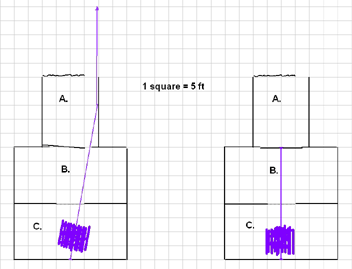 |
The walls of the chambers (B and C) are of the same black sheened marble as is found in the ruins, but lead glyphs and sigils cover all of the walls, floors, and ceilings (except for the underside of the lid, which has already been described). These glyphs are not magical, but a DC 30 Knowledge (arcana) check will reveal that they seem to have something to do with inhibiting scrying and divination magic.
The floor between area B and C is 2 ft thick.
A. Tower
The tower (A) has already been described above.
B. Antechamber (EL 15)
| The chamber beyond the disk is a round place, 40 ft in diameter and 20 ft tall. The place is featureless black marble which is everywhere covered in strange dull metal glyphs and sigils on the walls, floor, and ceiling. In the center of the floor of the place is a 10 ft wide circular opening that seems to lead to another space beneath this room, but the opening is blocked by a metallic mesh. Streaming through the mesh is a beam of crackling purple energy that emerges at an angle, proceeds up and out of the opening above, and strikes the wall of the tower outside. |
Creatures: The sharns left a guardian over the ritual chamber, a being they knew would be singularly effective against the phaerimms and which would also willingly serve for as long as needed. An aoa was summoned here long ago and convinced to guard the chamber below in exchange for being allowed to bask in the propylon emanations that once splashed down from the ceiling when the lid was closed. Now that the beam no longer splashes back into the chamber, the aoa is quite agitated, but still occasionally moves right up next to the beam and places a part of its body into it to enjoy the magical energies.
The aoa will attack any intruders that enter into this chamber, defined as anyone entering past the lid to this chamber. It will not leave the chamber or enter area C.
|
|
Tactics: The aoa is not very smart, but is quite clever (as evidenced by its its Wisdom score). As such, it will react to foes who elect to attack from a distance as best it can, including taking cover or using its reflective pulse to try to assist in stopping the attacks.
While its reflective pulse is devastating to magic items (likely destroying a magic item if directed at it), the aoa will not generally use its pulse to destroy PC magic items unless one or more are proving particularly troubling. Otherwise, it is far wiser for it to use the effect as an area dispel or to negate spells that are affecting it or its enemies. Nevertheless if, for example, it was being attacked by a wand of acid orb it might elect to use its reflective pulse to destroy the item. However, if simply being attacked by a +1 longsword, it is unlikely to waste one of its uses of its reflective pulse to negate what is essentially a few extra points of damage per round.
The aoa cannot be bargained with and will fight to the death. Incidentally, because it was called to the Material Plane before the awakening of the Slumbering Gods, if killed on this plane it is actually dead.
Developments: The mesh covering the hole that leads into area C is made of a strong black metal. The mesh is spaced 6 inches apart and is built into the floor, so that it must be broken or smashed through if it cannot be bypassed. It is magically treated metal (hardness 20, 120 hp, break DC 45, save bonus +7).
C. Propylon Chamber (EL 16)
|
The chamber beyond the mesh is a round place, 40 ft in diameter and 20 ft tall. The place is featureless black marble which is everywhere covered in strange dull metal glyphs and sigils on the walls, floor, and ceiling. In the center of the floor of the place is a metal tube 5 ft wide at its base and narrowing to 2 ft in diameter at its tip. The tube is 3 ft long and was likely once set to point straight up, but it appears that some sort of violent action has taken place here, for a large crack runs through the center of the chamber and the portion of the floor to the east of the crack is a few inches lower than the rest of the floor, causing the tube to tilt to the east. From out of the tip of the tube emanates a crackling beam of purple energy that exits through the eastern portion of the mesh in the ceiling. The beam widens shortly after leaving the tube into a 10 ft wide burst that is 10 ft long before narrowing back down to its normal size. |
Creatures: Within the propylon stream where it widens the ghost of Defender of the Tri-Claw Vanguard dwells, enmeshed in the propylon beam as part of the ritual that binds Wind of Blood in its cave. The sharn is the leader of the ritual that bound Wind of Blood and the commander of the Tri-Claw Fortress. As a ghost, it is always manifested due to its connection to the binding ritual, and may not unmanifest.
Until the PCs actually enter the chamber and come close to the widened portion of the beam, they will not generally see the ghost, as the beam itself provides concealment. Assume the ghost has a Hide bonus of +14 (this includes a +5 circumstance bonus from the beam) and so has a total Hide check of 25. If the ghost is spotted, the observer will note some sort of shape within the widened portion of the beam.
While enmeshed in the propylon beam, the ghost may not leave the beam (even magic will not cause it to leave). However, beyond this restriction, it may cast any spells it desires, whether on itself or outside of the beam. It may also reach out of the beam with its touch attacks, just so long as its body remains within. It can even use its hex portals as needed to aid in its attacks.
|
FEATS: Energy Substitution (acid) (CA p79) - modify any spell with energy descriptor to use chosen type instead SPELLS: earthbind (SC p76) - r med, 1 creature, 1 min/lvl, sv F neg, SR; fly spd = 0 ft and if airborne fall as feather fall energy vulnerability (PHB2 p112) - r medium, 1+ creatures in 10 ft r burst, 1 rd / lvl, sv W neg, SR; creatures up to 2x caster CL,+50% damage from specified energy type magical backlash (DoU p62) - r close, 1 creature, sv F half, SR; 2 damage per level of spell in effect on target no light (BoVD p100) - r close, 20 ft r spread; creates area of darkness for 1 min/lvl, but darkvision can see in it orb of force (SC p151) - r med; ranged touch = 1d6 damage / CL (max 10) power word pain (RDr p116) - r close, 1 living creature with 100 hp or less, SR; 1d6 damage per round, 50 hp or less 4d4 rds, 51-75 2d4 rds, 76-100 1d4 rds, max 1 rd / CL prismatic mist (PHB2 p121) - r med, 30 ft r spread, 1 min/lvl, sv see below; roll d8: 1 = 1d4 fire, 2 = 1d6 acid, 3 = 1d8 electricity, 4 = poison 1d4 Str damage (F neg), 5 = slowed 1 rd (W neg), 6 = lesser confusion 1 rd (W neg), 7 = dazed 1 rd (W neg), 8 = 2 effects (no more 8s) prismatic ray (SC p162) - r med, sv see below, SR; ranged touch, 6 HD or less struck blinded for 2d4 rds, 1 = 20 fire (R half), 2 = 40 acid (R half), 3 = 80 electricity (R half), 4 = poiosn (kills, F part take 1d6 Con dmg instead), 5 = turn to stone (F neg), 6 = insane (insanity spell, W neg), 7 = sent to another plane (W neg), 8 = 2 effects (no more 8s) ray deflection (SC p166) - personal, 1 min/lvl; reflects all ranged touch attacks and ray attacks scintillating sphere (SC p181) - r long, 20 ft r burst, sv R half, SR; 1d6 electricity / lvl (max 10) spell vulnerability (SC p200) - 1 rd cast, r close, 1 creature, 1 min/lvl, sv F neg; -1 to SR per CL (max 15) touch of years (CM p120) - touch, 1 day/lvl, sv F neg, SR; 3 drain Str, Dex, and Con, initial sv negates, otherwise save each day or additional drain, second casting on affected creature permanently blinds and deafens unless sv F made. Cannot be dispelled only remove curse with CL check |
Tactics: It must be remembered that the sharns have absolutely no experience with humans. The closest thing they would have encountered would be the goliaths. As such, the ghost will assume that any PCs entering the place are agents of the phaerimm and are seeking to free Wind of Blood.
Because of this, initially, the ghost will use its spells and other abilities to the uttmost to attack and drive away the PCs. It will not react to intruders until they enter this chamber or attempt to interact with it in any way whatsoever.
As it attacks, the ghost will excoriate the intruders in Sharn, a complex language comprised of three different voices interweaving a complicated series of clicking and buzzing sounds. Should the PCs be able to understand the ghost, they will hear it telling the intruders things like:
The Wind of Blood shall never roam free again!
I did not give my life and soul easily, and I will not sell it cheaply now!
As long as I remain the worm shall be contained! You cannot have him!
Should the PCs stop attacking and attempt to communicate with the ghost, it can be persuaded to halt its attacks. This will require that the PCs be able to speak its language, communicate with it telepathically, or make some very convincing hand gestures and pantomimes.
Developments: Should the PCs manage to slay the ghost, then Wind of Blood will be freed, and the DM can have it begin to appear as a growing menace to the surrounding killoren lands.
Should the PCs establish communication with the ghost, it will seem a bit disoriented and not quite aware of how much time has passed. Since the sharns used their own calendar and dating system, there is no effective way to pinpoint how long the sharn has been here. The Sharn Empire, it should be recalled, fell before the yuan-ti or nagas were first bred, so it knows nothing of them. It knows only of Kyuss, the Progenitors, and the phaerimms.
Of Kyuss, the ghost will hiss at the mention of its name and warn that his is a foul name that should not be uttered. Rather, he is referred to as the Wormlord.
The ghost will tell something of the history of its kind, mentioning the glory of their Empire, the arrival of Kyuss and his 18 servants, and the breeding of phaerimm armies. It will then tell of the attack on their Empire and of its own fate in the Tri-Claw Fortress.
Finally, the ghost will explain the current situation; that the recent quake has disturbed the propylon beam, and this, along with the movement of the plug at the top of the chambers, has dissolved the ritual's potency, such that even now it feels its essence fading away. The ghost believes that Wind of Blood's spirit probably remains trapped in the cave to the north to this day, and that when its ghostly essence fades into the great beyond, Wind of Blood will be freed. The sharn ghost does not have a clear picture as to how long it will take before it fades away, but it feels it will not be more than a couple of weeks at the most.
The sharn will express amazement at the prospect of there being a large set of nations of humans in the northwest of the continent. That area was completely wild and all forested when the sharns were around. It will ask after the presence of any sharns or phaerimms, of which the PCs have almost certainly heard nothing, and though lamenting the eradication of its kind, it will also rejoice that the phaerimms also seem to have met some sort of malefic fate.
The sharn will not ask the PCs to undertake to slay the spirit of Wind of Blood, but if the PCs offer to do it or ask what may be done in the stead of the dissolution of the binding, the sharn will tell them that it would be a good thing for Wind of Blood to be slain, for that creature would likely do great evil upon whatever lands and people remain in this present age.
If the PCs need, the sharn can describe the cave where Wind of Blood was imprisoned and give general directions and distance to the cave.
If questioned about propylon and its properties, the sharn ghost will simply say that it was the life essence of sharn magic, and that if no one knows of it in this age, then it is probably far too dangerous to experiment with and it would be better to be left alone. The sharn will inform the PCs that once its spirit fades, the beam will die out shortly thereafter.
No amount of replacing the lid to these chambers or straightening the tube will restore the binding. It is immeasurably broken.
If the PCs want to know more about Wind of Blood, the ghost will say it was a powerful phaerimm magician. The sharn can also describe phaerimms in general, including many of their innate abilities and capabilities. The sharn ghost believes that it is likely that Wind of Blood's body has long ago passed away and that what is trapped is its spirit. If questioned about the possibility of a clone spell still being active, the sharn will say that it is highly unlikely that, if the phaerimms are indeed gone from the land, that a clone still remains, for such things must be tended and preserved or they will rot away.
Note: The sharn's comments about there being no humans in Sazhansiir is one that is competely against Azotchtlan lore, which states that the Azotchtlans were given their lands by the gods, and then they were taken from it by the Scaled Ones to be used as slaves. The sharn's statement should be met by Azotchtlan PCs with either alarm or incredulity, and its truth could have severe consequences for the campaign and Azotchtlan society in the future.
About Propylon
Propylon is a form of magical energy somewhat related to incarnum in the sense that it taps into the latent energies of the multiverse. However, while incarnum is an active mystical force wielded by many users in Sazhansiir, propylon was discovered and harnessed by the sharns and its usage was lost along with the Sharn Empire. While sharns still survive in Sazhansiir to the present day, they are refugees and exiles who were unable to carry the deep lore of propylon with them. Propylon was tied to certain areas of Sazhansiir in the form of propylon wells, and these were decimated eventually by the creation blast. Currently, the only known proplyon active in Sazhansiir is the tube in the strange ruins of this scenario.
It is not necessary for the DM to know the properties or capabilities of propylon. It should be sufficient that it is an ancient, exotic, and powerful source of magic that has been lost and, arguably, may never be recovered. If the DM wishes, for some reason, to introduce this new source of magic, he can have propylon '"rediscoverable" and make up the rules governing its use accordingly. However, normally the DM would want to leave propylon as a device for this scenario only, to instill some of the strangeness and exoticness of the sharns without having to actually introduce a new magic source into the rules.
What needs be mentioned about propylon in the context of this scenario is this:
The propylon beam can be contained, redirected, or blocked by using material hard enough to stop it from breaking through. Proylon tends to flow upward unless redirected by means of special reflectors (an example being the underside of the lid to the propylon chamber) and this is why the propylon beam does not rebound off of the tower wall but rather flows straight up along it and into the sky.
The propylon beam in the chamber is an integral part of the chamber and the tube. While in theory the tube could be straightened or moved to redirect the beam, such a process would have to be done very carefully. Should the tube be broken or destroyed or removed from the floor of the chamber, the propylon beam will disappear forever. Even redirecting the beam and replacing the cover on the propylon chamber will not halt the dissolution of the binding ritual. That process is now inexorable.
Part Five - The Haunted Cave
The cave where Wind of Blood is trapped is almost 300 miles to the north by northeast of the ruins. The cave is well known by the killoren to be haunted by an evil presence. The killoren do not know what the presence is, but commune with nature spells have revealed that it exists and is responsible for the occasional undead creature that has been seen in the area. Killoren expeditions have entered the cave and report a small network of caverns, some inhabited by vile undead, but the expeditions that pressed deeply into the caves have never returned. The killoren now avoid the area.
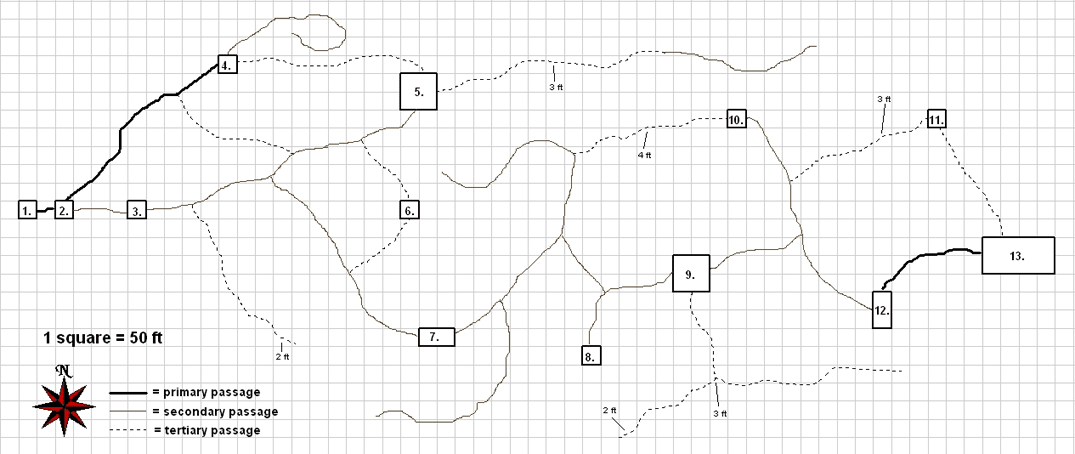 |
The map above shows an overview of the cave network comprising the Haunted Cave. Passages are divided into three types, primary, secondary, and tertiary.
Primary passages are between 21 - 30 ft wide (1d10 + 20) and generally as tall as they are wide.
Secondary passages are between 11 - 20 ft wide (1d10 + 10) and generally as tall as they are wide.
Tertiary passages are generally between 5 - 10 ft wide (1d6+4) and are generally as tall as they are wide. However, at certain points tertiary passages can shrink to "squeeze points" that are small or narrow enough to cause Escape Artist checks for Medium creatures and can block passage for larger creatures. These "squeeze points" are shown on the map as foot measurements (between 2 and 4 ft) that indicate the width or height (or both) of the passageway. Where a squeeze point is indicated, the DM should assume that the narrowness proceeds for 2d10 ft in either direction from the indicated point (this means such a section would be between 4 and 40 ft long).
Squeezing is covered more fully in the Player's Handbook (page 73), Dungeon Master's Guide II (page 55) and in The Underdark (page 110).
Unless otherwise stated, the interior of the cave consists of unworked stone walls (8 hardness, 900 hp, break DC 65 per 5 ft, Climb DC 15) and natural stone floors (it takes 2 squares of movement to enter a square with a natural stone floor, and the DC of Balance and Tumble checks increases by 5; running and charging are impossible). The passages are clearly natural and clogged with mineral formations including stalactites and stalagmites.
There are no natural light sources within the cave unless noted in the individual location descriptions.
On the individual location maps, dashed lines represent abrupt elevation changes of approximately 5 ft, forming large natural stone steps or shallow stone shelves. These steps generally descend in the direction of their curve. If such steps are of a different height it will be noted in the individual location descriptions.
Wandering Encounters:
Two groups of creatures wander these caves, searching for intruders and victims, or returning from or heading out to a raid of the surrounding lands.
The DM should check for an encounter with one of these groups every 5 minutes (50 rounds). An encounter will occur on a 1 in 10. If an encounter occurs, there is an equal chance it will be with either group. When a group takes casualties, they will not be replaced unless enough times passes for Wind of Blood to replace losses.
Each group will attack intruders, which means generally any living creatures, though if they can they will capture victims and bring them to their superiors (the ghast cleric in the case of the ghasts, or Wind of Blood in the case of the plague walkers). The necrosis carnexes will support the other undead by way of their unique abilities.
Group One (EL 10):
This group consists of 6 ghasts and a necrosis carnex. The ghasts are smart enought to send one of their number off to warn the ghast cleric in area 5 (or Wind of Blood if the latter is very close by).
|
|
Group Two (EL 10):
This group consists of 8 plague walkers and a necrosis carnex.
|
|
1. Entrance
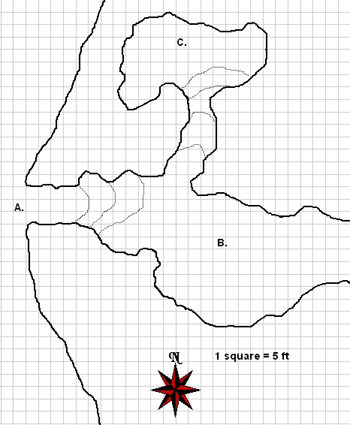 |
Area A
The entrance proper is at area A of the map.
|
A hard-scrabble slope of rocks, small boulders, and thorny scrub leads up to a wide cave mouth that sits in the the side of a cliff face. The face of the cliff is rough and uneven and extends up some 50 ft before continuing as a gradual slope up into the higher foothills. The entrance itself is 15 ft wide and just a little smaller in height, its north and south ends ending at a point about 5 ft above the level of the ground, so that the entrance as a whole has an uneasy resemblance to a grinning mouth. |
A DC 15 Track check will show signs of occasional traffic in the area, more frequent as one nears the entrance, though the nature of these tracks cannot be discerned.
A DC 15 Survival check will reveal that there are no bug or animal sounds to be heard near the cave entrance.
Area B
After descending a few stone steps,
the PCs will see area B.
| This cavern is some 15 ft tall and bedecked with stalactites, some of which come to within 5 ft of the floor. On the floor, bones punctuate the rocks, stalagmites, and other mineral detritus that cover the floor. |
Developments: Once they have been roused, any amount of light or noise made in this chamber will undoubtedly attract the creatures from area C (see below).
Area C (EL 10)
To the north of area B, a short
passageway descends natural stone steps into area C.
| This cavern has a 10 ft high ceiling and the walls are pockmarked with cracks and folds. In the center of the chamber are several small bones, possibly from rodents or similar animals, lying amongst the rocks. |
A DC 18 Listen check will reveal the strange sounds of muffled clicks coming from the walls of the passageway or cavern proper.
The swarms are not deep enough in the walls to avoid a detect undead spell, and use of such a spell could give warning of these creatures, although the wall between their hidey holes are just under a foot thick, so the person detecting would have to basically have a straight line of sight to the wall to detect a swarm behind it.
Beginning at the first natural stone step in the passageway from area B, there are 4 swarms inside the walls of the passageway. Another 8 swarms are spread evenly around the walls of the cavern proper.
When they emerge, the bone rats
will boil forth from the walls by the hundreds.
|
|
Tactics: The bone rats will attack until destroyed. They simply hunger to consume living flesh, somehow gaining sustenance or pleasure (or both) from the act, even though the chewed remains simply pass right through them. At least half of any remaining swarms will pursue prey beyond the confines of this area if necessary.
Develpments: The holes in the walls where these creatures dwell are unremarkable, and fit only for Tiny creatures to enter. They have nothing in them and there are thousands of these little holes and even small tunnels that run parallel to the walls of the passageway and cavern.
2. Carrion Cave (EL 4)
Note: The stench of decay will be apparent as the PCs approach to within 25 ft of the cavern, with those who have the scent abilioty noting the stench from about 50 ft away.
 |
|
This cavern is about 20 ft tall and is dominated by a large stone column that spans floor to ceiling in the center of the southern portion of the place. The column is roughly 12 ft in diameter and narrows at its center to about 8 ft in diameter before thickening at its crown and base. Gouged into the column over its entire length are uneven scratch marks that seem to form crude runes or vague pictographs. Set around the column, on the floor, are a variety of bones, including skulls that appear all too humanoid. Interspersed amongst these bones are pieces of decomposing flesh and organs. Set into the northern face of the column are iron shackles, a pair at about 6 ft and another at 1 ft. Set into these shackles is what is left of the decomposing body of a killoren female. The face is somewhat intact and set into a horrified rictus. The body cavity has been gouged out completely and ribs and gibbets of internal organs are visible. Shreds of clothing and a belt with a pouch set upon it remain on the figure. |
| The scratchings are too primitive to be any sort of actual language and discerning the subject of the drawings is difficult at best due to their abstractness and crudeness, but they seem to deal with unsettling subjects, as hints of disembowelements, profane rites, and horrific creatures emerge from many of the scratches. |
|
Rot Grubs CR 4 These diminutive vermin crawl off carrion and infest living hosts. They cause a fatal illness unless cured or killed. When first encountered, a DC 15 Spot check can be made to avoid them entirely. If this check is failed, the grubs have contacted the victim and penetrated the skin. Once this occurs, the victim may make a DC 15 Wisdom check. If successful, he notices strange burrowing below the surface of his skin. Each round thereafter, a DC 17 Fortitude save must be made. If failed, the victim sustains 2d6 points of Constitution damage. At Constitution 0, the victim dies. The grubs then look for a new host. During the first two rounds, the grubs can be killed by applying flame to or by cutting open the affected skin. The flame or cutting does 2d6 points of damage to the victim. If a DC 15 Heal check is successful, cutting damage can be reduced to 1d6. After the second round, only a remove disease spell can save the victim. |
Treasure: The pouch on the killoren's body contains a potion of cure moderate wounds (CL 5) and a potion of remove disease (CL 3).
3. Altar Chamber (EL 10)
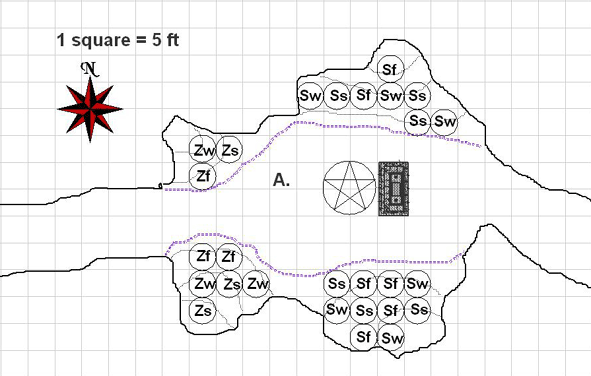
Note: This cave includes illusory wall spells that change the initial appearance of the layout of the room. DMs should read the description of the place and, assuming the PCs cannot initially discern the illusion, use the description provided below. The illusory walls are noted in purple on the map.
DMs should also note that a magic circle against good effect radiates 40 ft from the altar in the cavern, and so summoned creatures not of evil subtype cannot enter the cavern proper.
 |
|
The passage here widens to about 25 ft and the ceiling rises to 20 ft tall. Set in the center of this widening is a large black block of polished ebony, 10 ft long, 5 ft wide and about 3 ft tall. The structure is decorated with intricate carvings of writhing worms and distorted skulls. Set before the structure, a 10 ft diameter circle of metal has been inlaid into a flat part of the cavern floor. The circle forms a complicated diagram likely of magical purpose, and the metal that comprises the inlay seems to flow along the diagram as if it were liquid metal of some sort. |
The black obsidian structure is an unholy altar to Kyuss. It radiates strong evil (as well as magic from the spells cast thereupon - see below). The altar has an unhallow spell (CL 10) cast upon it by the ghast cleric (see area 5b) which generates a magic circle against good in a 40 ft radius (which essentially reaches right to the western entrance to the cavern where the illusory walls begin).
Also set upon the altar is a glyph of warding (see Traps below).
The circle before the altar is an inward-focused magic circle against evil (CL 10) spell bolstered by a special diagram, used by the ghast sorcerer to cast his lesser planar binding spells. The spell has no effect other than as a binding diagram and will not provide benefits to those within its confines. It currently contains a trapped bar-lgura demon (which is likely invisible - see Creatures below).
Creatures: A horde of zombies and skeletons wait patiently behind the illusory walls. Since these creatures are aware of the illusory nature of the magic walls, they appear translucent to them and the undead can observe happenings within the cave proper.
These creatures are programmed to attack any living creatures not in the company of a ghast, and will activate as soon as one of the illusory walls is pierced, touched, or dispelled in any way. They will also attack any such creatures that enter the magic diagram on the ground or that approach to within 5 ft of the altar. Finally, they will activate en masse if any of their number is attacked or damaged (even inadvertantly from an area effect spell). The undead are programmed NOT to cross the magical diagram.
All of the undead here have been animated by the ghast sorcerer and the ghast cleric, and there are a total of 80 HD of undead here. Skeletons are noted on the map with an "S" and zombies with a "Z". These creatures have been formed from captured animals that have wandered into the caves or were taken back here by the ghasts. There are three animal types present, denoted by the lower-case letter on the map. f = giant frog, w = wolf, and s = swindlespitter.
|
|
|
|
|
|
Additonally, there is a bar-lgura demon trapped inside the magical diagram. This demon was summoned by the ghoul sorcerer using lesser planar binding and the demon is currently being negotiated with (as per the spell, a Charisma check was already made and failed and a new one will be made some 12 hours after the PCs first enter the caves).
The bar-lgura is not a fan of being bound by the ghast sorcerer, but neither does it like any other living creatures. If it hears or sees the approach of the PCs (it will do this to the approach of anyone, even the ghasts), it will use its invisibility to become unseen. While so hidden, if it sees that those who approach are not ghasts but rather invaders, it will use its disguise self ability to appear as a thin, size Medium celestial creature with silvery-gold skin bedecked in flowing blue robes with celestial runes embroidered into the hem and a bejeweled greatsword on its back that radiates a crackling aura of light. He looks somewhat like a wingless deva.
The bar-lgura cannot attack, leave, or use any of its abilities that cross the diagram, until and unless the diagram is disturbed in any way. By using invisibility, the demon hopes that an intruder will simply walk into the circle or otherwise disrupt it and thereby free him. He uses the disguise self ability just in case his invisbility is seen or noticed, in which case he will emerge in his disguised form and try to convince the PCs that he is a trapped celestial who was imprisoned here by evil undead sorcerers and that he will gladly take up arms against the undead before returning to his own plane.
Should that fail, the bar-lgura will try to bargain for its release anyways, promising whatever it needs to in order to be set free, including vowing to slay those who entrapped it.
If a battle with the undead ensues here, any skeletons or zombies that are slain in a square adjacent to the diagram have a 50% chance of having some piece of the skeleton or corpse land on the diagram, eliminating the barrier and freeing the bar-igura (unless the undead's demise was something that would completely annihilate the body such as disintegrate).
Tactics: Once activated, the undead will swarm out and attack intruders. They will not leave the area of the unhallowed however, unless directly commanded by their masters. Each undead has been programmed to follow the commands of either the ghast cleric or the ghast sorcerer.
The bar-lgura, once freed by any means, will attack. If its foes are powerful, it will seek to perhaps remain invisible and/or teleport to a nearby safe place in order to attempt to summon another of its kind. Then, it will certainly attempt to use its abilities to abduct a PC and teleport away to finish him off at will. As the demon does not know the layout of the cave, it will not be able to teleport far, but it will do what it can. If necessary, it can use telekinesis to grapple a foe and bring it to him and then abduct him.
|
Traps: The altar has a glyph of warding cast by the ghoul cleric. While technically a trap, the glyph can be activated by a ghast as well, allowing the ghast cleric or sorcerer to use it to bolster undead. The glyph is programmed to activate whenever the altar is approached by a living creature within 10 ft.
| Glyph of Warding Trap CR 3; spell; spell trigger; no reset; spell effect (widened glyph of warding [desecrate], 10th-level cleric, desecrate effects); multiple targets (all targets within 40 ft.); Search DC 28; Disable Device DC 28 |
Developments: If time allows (i.e. the PCs retreat from the caves to rest), the ghoul sorcerer will come to this area and use the magic diagram, if it is still intact, to cast a lesser planar binding and attempt to bind various demons to its service. Such demons will include:
Another bar-igura (Fiendish Codex - Hordes of the Abyss page 29)
An ekolod (Fiendish Codex - Hordes of the Abyss page 38)
A juvenile nabassu (Fiendish Codex - Hordes of the Abyss page 48)
A rutterkin (Fiendish Codex - Hordes of the Abyss page 51)
Of these, the juvenile nabassu is preferred.
If the original bar-lgura is still trapped 12 hours after the PCs have entered the cave, and the ghast sorcerer is alive, he will come to this place and attempt to complete his binding of the demon. He will, if that fails, continue to attempt each day for as long as the spell allows. Once the demon is bound, it will serve as the ghoul sorcerer's bodyguard for 1 day/level.
See the section below entitled Continuing Tactics for more information.
4. Fungus Cave (EL 11)
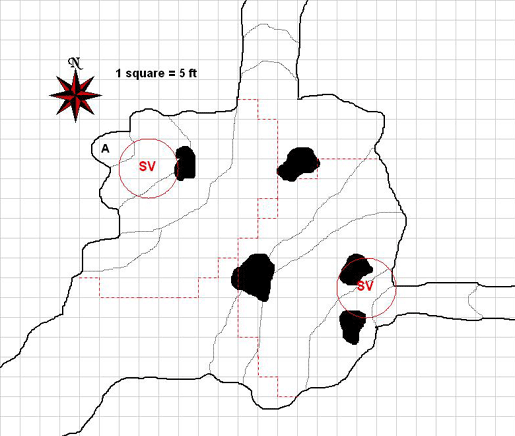
Note: The small passageway to the east is NOT generally visible from the other entrances to this chamber, as it is screened by several stone columns and is deep in shadows. The DM should intially draw the room for the players with the eastern passageway close off. Also, DMs should note the horrible reek of this place, as described below.
The EL for this encounter has been increased by 1 to reflect the effects of the stench of the cave.
 |
|
This cavern's ceiling vaults to 35 ft overhead, and natural stone shelves to each side form an aisleway down the middle that proceeds from a large passageway to the southwest to a slightly smaller one to the north. The center of the chamber is punctuated by stone columns encrusted with calcified mineral growths, with smaller columns thrusting up from the stone shelves to the sides. The floor of the chamber is strewn with a strange sort of multi-coloured mush, a swirling combination of peach colour along with rusty reds and dull browns. Amidst this mush are larger chunks not quite identifiable from a distance. The shelves along the flanks of the place are overgrown with a variety of fungi of all sorts of colours, shapes, and textures. Water drips in various places from the ceiling, flowing down the stone columns or dropping onto the plant growths on the shelves. Rivulets of water drop from the shelves and collect in small puddles amidst the muck in the center aisle before slowly wending its way out the passage to the north. |
The place absolutely reeks of decomposition and death. Living creatures within the cave must succeed on a DC 15 Fortitude save or be sickened for 1d6+4 minutes. A creature that successfully saves must reroll a save every round that he remains within the cave. If some covering is used to block the nose and mouth (like a rag or cloak) then the saves will be made every 3 rounds. If PCs hold their breath, they can avoid making a save. A delay poison or neutralize poison spell removes the effect from a sickened creature. Creatures with immunity to poison are unaffected, and creatures resistant to poison receive their normal bonus on their saving throws.
All of the fungus tastes quite foul to living creatures, though quite pleasant to undead. A living creature who partakes of this fungus must make a DC 15 Fortitude save or become nauseous for 1d4 hours. Those who save instead become sickened for 1d4 minutes.
The muck in the center aisleway is essentially liquified offal, skin, blood, and other organs that has been partially decomposed by the fungi and the wet environment, creating what is basically an offal soup. The chunks amongst this soup are larger pieces of organs that have yet to be fully decomposed. On close examination the chunks tend to wriggle or shake, these motions being caused by hundreds of maggots burrowing through the organs.
The shelves are so overgrown with fungus that they should be treated as light undergrowth (a space covered with light undergrowth costs 2 squares of movement to move into, and it provides concealment; undergrowth increases the DC of Tumble and Move Silently checks by 2 because the stems and caps get in the way). Examination of the shelves will reveal that the fungus on the shelves grow in a mud mixed with offal. The offal is slippery and movement on the shelves is also considered to be slippery (increase the DC of Balance and Tumble checks by 5).
Creatures: Two huge strangle vines grow here (marked "SV" on the map above). These creatures have, like the fungus, been tainted by the nature of their sustenance, and have become corrupted by evil. They are a sickly gray colour and the fronds bear markings that look strangely like screaming faces. The vines inhabit the deepest edges of the shelved areas, one to the northwest just before the area marked "A" on the map above, and the other before the small passageway to the east.
These creatures will attack anyone that comes within reach, and given their long reach, this includes the center aisle. The reach of the two plants is shown on the map above as dashed red lines.
|
Tactics: The strangle weeds will attack any living creatures they can sense. Their blindsight only goes out to a radius of 30 ft, but that is long enough to cover the entirety of their reach. These creatures will not retreat, and will not even attempt to chase prey, given their slow speed.
Developments: This room is infested with disease. Anyone who enters the room for even a single round (and takes a breath) will be exposed to cackle fever (inhaled, DC 16, 1 day, 1d6 Wis). Anyone who suffers a wound while in this cave (for any reason) that would expose blood to the environment will also be exposed to red ache (injury, DC 15, 1d3 days, 1d6 Str). Any Search checks conducted in this cave require an additional check for exposure to the above diseases as applicable.
Secret Doors: Not a secret door per se, but the eastern passageway is well hidden in shadows and behind various stone columns, such that it is not normally visible from either of the entrances to this cave. A DC 15 Spot check is required to notice the opening from any distance where line of sight is mostly blocked by one of the stone columns. The check DC should be increased by distance and by +5 if the sight being used is subject to shadows (e.g. darkvision is NOT subject to shadows).
Treasure: At the point marked "A" on the map above is a bone scroll tube buried amidst the muck (DC 30 Search check due to the fact that the tube looks like a normal bone at first glance). Within is a bark scroll of the following divine spells (scribed by a killoren druid): death ward (CL 9), panacea (CL 9), and radiance (CL 9).
5. Ghastly Cavern (EL 15)
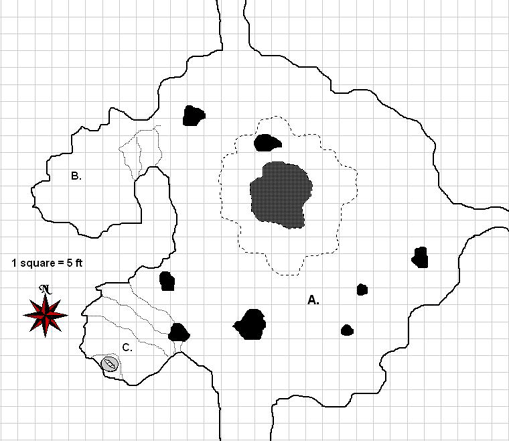 |
Area A
|
This massive cavern is lit by eerie green phosphorescent lichen which streaks the walls like the living veins of some horrid creature. The place is over 100 ft in diameter and the ceiling vaults to 50 ft overhead, supported by a variety of stout stone columns encrusted with calcified mineral formations. The floor is strewn with bones. In the center of the place, the rough cavern floor slopes steeply downward towards a massive sinkhole that descends out of sight. The hole is about 15 ft in diameter and a thin mist seems to emanate from within. Five passages emerge from the cavern, including two narrow ones to the north and east, a moderately sized one to the south, and two larger ones to the west. The southernmost exit along the west wall is flanked by two natural stone columns, forming a crude archway of sorts. The columns have some sort of crude figures and/or runes carved on them. The northernmost exit along the west wall contains a set of natural stone steps surmounted by a stone ramp that leads up with the steps. |
|
Steep Slope Characters gain a +1 bonus on melee attacks against foes downhill from them. Characters moving uphill (to an adjacent square of higher elevation) must spend 2 squares of movement to enter each square of steep slope. Characters running or charging downhill (moving to an adjacent square of lower elevation) must succeed on a DC 10 Balance check upon entering the first steep slope square. Mounted characters make a DC 10 Ride check instead. Characters who fail this check stumble and must end their movement 1d2×5 feet later. Characters who fail by 5 or more fall prone in the square where they end their movement. A steep slope increases the DC of Tumble checks by 2. |
Furthermore, any creature on the slope is treated as balancing for purposes of combat. The Balance DC is 10.
|
Being Attacked while Balancing You are considered flat-footed while balancing, since you can’t move to avoid a blow, and thus you lose your Dexterity bonus to AC (if any). If you have 5 or more ranks in Balance, you aren’t considered flat-footed while balancing. If you take damage while balancing, you must make another Balance check against the same DC to remain standing. |
Any creature that is knocked back or down, including being tripped or failing a balance check by 5 or more, while on the slope has a chance to tumble down the slope and into the sinkhole. The victim is entitled to a DC 15 Reflex save to grab onto a protrusion on the slope (with a +4 circumstance bonus if within reach of the stone column on the slope). Success indicates that the person has grabbed onto something and can clamber up to his feet as a move action. Failure means the person has fallen down the slope and has one last chance to grab onto the edge of the sinkhole. Grabbing onto the edge is a DC 20 Reflex save, and success indicates that the person has grabbed onto the edge and his feet are dangling over. A DC 15 Climb check is then required to pull himself up back onto the slop (and if this Climb check is failed by 5 or more the person goes tumbling into the sinkhole).
The sinkhole is a sheer drop (Climb DC 25) and is 130 ft deep. The bottom of the sinkhole is frigid and is coated in brown mold (the entire floor and up the walls for about 15 ft). Anyone contacting this area will be exposed the mold. Small cracks in the bottom of the sinkhole emit steam vapours from underground geothermic vents that is conducive to the mold's existence.
|
Brown Mold (CR 2) Brown mold feeds on warmth, drawing heat from anything around it. It normally comes in patches 5 feet in diameter, and the temperature is always cold in a 30-foot radius around it. Living creatures within 5 feet of it take 3d6 points of nonlethal cold damage. Fire brought within 5 feet of brown mold causes it to instantly double in size. Cold damage, such as from a cone of cold, instantly destroys it. |
Creatures: 16 ghasts dwell here, the foot troops of Wind of Blood. These ghasts are the corrupt remains of killoren who were captured by the minions of the phaerimm and created using its create undead spell. They spend their time spread out around the cavern gnawing on bones, squabbling with each other, or squatting in a stupor.
|
Tactics: These ghasts will attack any living creature not under the protection of the ghast cleric. They will seek to simply overwhelm foes with their stench and their paralysis, but will also follow the directions of the ghast cleric. If intruders are attacking in force, several of the ghasts will break off to flee (by different passages) to area 13 to warn Wind of Blood of dangerous intruders in the caves.
Developments: Any fracas in this area will certainly bring the ghast cleric from area B, subject to a delay to cast preparatory spells as indicated below.
Any PC captured will be sacrificed on the altar in area C.
Area B
| This side cavern is 20 ft tall and accessed via a set of natural stone shelves or a natural stone ramp that runs along the northern end of the shelves. The cave itself is littered with bones, most of them gnawed and chewed. An upthrust stone at the rear of the cave is covered in what appears to be flayed skin of greenish tint and seems to serve as a sort of chair or throne. |
Creatures: The ghast cleric dwells here, formerly a male killoren. He is bedecked in bone armour and wears a small skull on a leather thong around his neck from which an evil red glow emanates. The cleric serves Wind of Blood willingly, hoping one day, when the phaerimm is free, to rule and gain power over others. The cleric despises the ghast sorcerer, whom he regards as a rival, and the lilitu, whom he regards as a heretic, though their rivalry currently extends only to intrigues and currying of Wind of Blood's favour.
|
FEATS: Divine Vigour (CW p108) - spend 1 turn or rebuke as standard action for +10 ft speed and +2 temp hp per level for Cha in minutes. Profane Lifeleech (LM p29) - spend 2 rebuke attempts as standard action to drian 1d6 hp from living creatures in 30 ft radius and heal you a like amount of damage. SPELLS: boneblade (BoVD p86) - r touch, 1 bone, 10 min / lvl; change bones 6 inches or longer into longsword, short sword, or greatsword with +1 enhancement bonus per 5 lvls and deals +1d6 damage to living targets and +1d6 damager to good targets. Does not confer proficiency, though anyone can wield the weapon. flesh ripper (BoVD p96) - r cl, 1 living creature, SR; ranged touch deals 1d8 / lvl (max 10d8) and on crit does double damage and wound bleeds 1 hp / rd until magically healed. lesser shivering touch (FB p104) - r touch, creature touched, 1 rd / lvl, SR; touch attack causes 1d6 Dex damage for duration. mystic aegis (PHB2 p120) - immed, r pers; gain SR 12 + CL as an immediate action against spell cast at you nauseating breath (SC p146) - r 30 ft cone, sv F neg; targets nauseated for 1d6 rds. protection from positive energy (SC p163) - r touch, 10 min / lvl; creature subtracts 10 from the hp damage dealt by positive energy effects and adversely affect it. sacrificial skill (BoVD p103) - r pers, 1 min / lvl; caster gains +5 to Know (religion) checks for sacrifices to evil gods. triad spell (SC p224) - r pers; alter one prepared spell of 3rd lvl or lower to cast 2 additional times. wall of evil (SC p233) - r cl, straight wall 10 ft sq / lvl or sphere or hemisphere radius 5 ft / 2 lvl, 10 min / lvl, sv W (text), SR; creates immobile wall that good summoned creatures cannot pass through, other good creatures must make Will save to pass each time and if failed stop and take no other action that round, cannot be cast so that object or creature breaks its surface on casting wave of grief (SC p236) - r 30 ft cone, 1 rd / lvl, sv W neg, SR; -3 to attacks, saves, ability checks, and skill checks. |
Tactics: The cleric will attempt to cast some spells prior to entering combat, if he has the chance. These will include (in the following order):
Divine Vigour
shield of faith (+3 deflection bonus to AC)
divine favour (+3 luck bonus to attack and weapon damage
rolls)
freedom of movement
The cleric's tactics after casting these spells depends upon what he has heard happening while casting the spells. If he has heard the use of energy damage spells then he will cast resist energy of the apporpriate type. Otherwise, or thereafter, he will likely cast his wall of evil spell across the entrance between this area and the main cavern, followed by an insect plague just on the main cavern side of the wall, thereby using these two spells as a barrier behind which to cast long range spells such as a barrier (anyone who fails to pierce the wall of evil will be subject to an additional swarm attack from the insect plague on his next turn).
He is then likely to cast his triad spell on his flesh ripper and cast that horrific spell three times (although the insect plague will provide cover for the target). His feeblemind will be used against the most powerful arcane caster he can target.
Should his defenses be breached, the ghast cleric will retreat towards the back of his cavern and pull off the flayed skin covering on his throne. This will reveal the symbol of pain he has inscribed thereupon.
If in combat with a foe and he notes that his paralysis is failing to work (whether from magic or simply Fortitude saves), then he will cast boneblade and use that weapon instead.
Traps: A symbol of pain has been cast on the throne, under the flayed skins, triggered to affect any living creature that looks at the rune. Undead are immune to the symbol, as it requires a Fortitude save.
|
Symbol of Pain CR 5; spell; spell trigger; no reset; spell effect (symbol of pain, 10th-level cleric, -4 to attacks, skill, and ability checks, DC 18 Fort save neg); multiple targets (all targets within 60 ft.); Search DC 30; Disable Device DC 30. |
Developments: The cleric will fight to the death, as he will not accept a loss of status in the eyes of Wind of Blood. However, he will order a number of his minions to flee to warn the phaerimm if it appears that the foes are capable and determined.
Any PC captured will be sacrificed on the altar in area C.
Treasure: Underneath the throne (requiring a DC 20 Strength check to move) is small niche which contains a pouch made of killoren skin. Inside the pouch are 2000 gp worth of powdered diamond and opal (sufficient to cast symbol of pain twice).
Area C
Note: There is a glyph of warding trap on one of the
stone columns that flank this entrance. PCs entering this area
will likely be subject to the trap (see Traps below).
|
This side cavern is 25 ft tall and accessed via a set of natural stone steps, each only 2 ft high, which leads up to an area towards the rear of the place where a large stone statue rests on a small natural stone pedestal. The statue is 10 ft tall and depicts a humanoid figure in a hooded robe, with writhing worms where the face should be. The figure clutches a stone humanoid skull in its right hand and the limp body of a stone snake-like creature with three bulbuous heads in its left hand. Before the statue, on the stone pedestal, is a concave bowl-like depression. The shelf to either side of the statue is coated in rust red and deep green stains. A set of iron manacles hangs from the wall near the statue. |
The bowl-like depression before the statue is rimmed with unholy runes carved into the stone, for the place is a fount for preparing unholy water. It is currently empty.
The stains to either side of the statue are dried blood stains from ritual sacrifices (of animals and killorens) by the ghast cleric.
The statue and altar are the subject of an unhallow spell cast by the ghast cleric (CL 10). At one time there was a spell fixed to the site, but that has long since expired and the ghast cleric does not have the material components to renew the effect. Thus the spell currently provides its magic circle against good effect and its penalty to turning checks and bonus to rebuke undead.
The manacles are masterwork manacles, the key to which is in the possession of the ghast cleric in area B.
Traps: The ghast cleric has inscribed a glyph of warding on one of the runes on the northernmost flanking column. The glyph wards the entire entrance to this cave, including the small spaces between the columns and the wall. The glyph is set to activate if a sentient living creature (Int of 3 or more) passes through, unless it is being touched by the ghast cleric.
|
Glyph of Warding (Blast) CR 4; spell; spell trigger; no reset; spell effect (glyph of warding [blast], 10th-level cleric, 5d8 acid, DC 16 Reflex save half damage); multiple targets (all targets within 5 ft.); Search DC 28; Disable Device DC 28. |
Developments: If a PC has been captured by the ghasts anywhere in the caves (except for the sorcerer in area 6), then he will be brought here and manacled (if more than one is captured then the ghasts will have to make do and bind the victim in his own clothes). The ghast cleric will then perform a sacrifice as set forth on page 26 of the Book of Vile Darkness. The ghast cleric will certainly use his sacrificial skill spell to augment this, and will engage in as many of the elements on Table 2-1 as possible and as he feels time will allow. If he thinks the PCs have retreated to rest and regain spells, then he will certainly take time to torture the victim for a day and take an hour to conduct the ceremony in front of 10 or more ghast minions.
This means that if he can cast a desecrate spell as well, he can get a bonus of +11 (assuming the PC is good aligned and with 6-10 HD). With his +9 Knowledge (religion) modifier and +5 for the sacrificial skill spell his total modifier will be +25, meaning on a 10 he can summon a greater planar ally of rather fearsome demeanour to serve for a good number of hours. Other options include spells that aid those minions who witness the ceremony (the DM can modify some results, such as magic vestment and greater magic weapon to barkskin and greater magic fang so that they benefit the ghasts appropriately).
Secret Doors: A loose stone on the front of the pedestal beneath the statue (Search DC 25) opens into a rather large hole in the ground some 4 ft in diameter which appears to be filled with powdered silver. See Treasure below.
Treasure: Within the pedestal is a full 400 pounds of powdered silver, enough to cast 80 desecrate or curse water spells. The value of the silver is 2000 gp. A skin pouch atop the silver holds 1000 gp of powdered diamond (enough for 5 castings of glyph of warding).
6. Ghastly Exile (EL 15)
Note: This cave includes illusory wall spells that change the initial appearance of the layout of the room. DMs should read the description of the place and, assuming the PCs cannot initially discern the illusion, use the description provided below. The illusory walls are noted in purple on the map.
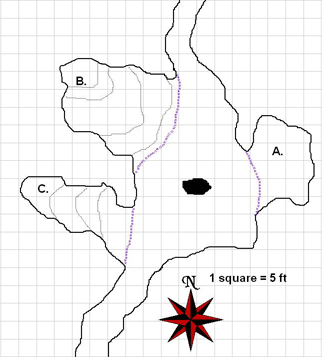 |
|
The floor of this cave is smooth, unlike the uneven and natural floors encountered elsewhere in these caves and passages. The ceiling is a mere 15 ft high, and a single column of crystal, twisted into an unmoving vortex, extends from floor to ceiling in the center of the place. Two somewhat narrow passages exit to the north and south. The walls of the cave are covered in rust coloured runes and strange geometric sigils, as well as what can only be described as possible formulae or calculations in a strange notation system. A wooden table and two chairs are set in the center of the cave, near the crystal column, and worn but once well-crafted rugs of green and russet cover much of the floor. Set upon the table are ceramic flagons and plates, colourfully painted. |
The floor of the place is treated as a hewn stone floor (a DC 10 Balance check is required to run or charge across such a floor; failure means the character can still act, but can’t run or charge in this round).
The table and chairs are those crafted by the killoren which have been ripped out of their living roots and set here as normal dead wood. In other words, PCs familiar with killoren furnishings will recognize the table and chairs as seeming to be of the killoren style of using living roots and wood and shaping them into useful shapes, but in this case it is as if a living table and chairs were ripped away from their living tree and set here. The ceramics are also painted with scenes of nature and are of killoren origin.
If a PC is a killoren or has spent a good deal of time in killoren settlements and makes a DC 20 Knowledge (local) or Profession (weaver) check then the rugs can be recognized as killoren make.
The notations on the walls are the names and characteristics of extra-planar creatures that the ghast sorcerer uses. They are not particularly complicated, and a DC 20 Knowledge (arcana) check will allow a guess as to their general nature, but the ghast sorcerer has come up with his own system of notation so that it operates as if it were a code of sorts and as such a comprehend languages spell will not decipher the text (nor will Decipher Script interpret it).
Creatures: This is the lair of the ghast sorcerer and his lilitu lover Abasashtha (ah-bah-SASH-tha). The lilitu was called by the ghast by use of an arcane scroll of greater planar binding many centuries ago, and the lilitu elected to remain on this plane, as she saw much potential and enjoyment in her assignment of infiltrating the killoren and causing mischief and woe and one day, should the phaerimm break free, helping to establish his dominance amongst the killoren. Because the ghasts cannot move around freely amongst the killoren, the lilitu has become the only source of information about the killoren.
Over time, the sorcerer and lilitu have become lovers. The ghast sorcerer uses the lilitu and her importance in infiltrating the killoren to elevate his status with Wind of Blood. However, the sorcerer's liaison with the lilitu has caused friction with the ghast cleric (see area 5), since the lilitu is a heretic and false cleric whom the ghast cleric decries as a blasphemer). Centuries ago this conflict came to blows and the sorcerer and lilitu moved out of the ghast cave and made their home here in what was an empty cavern. The ghast sorcerer no longer commands any real fealty from the ghasts of these caves, but he can still lord over them by dint of fear and threats of retribution.
The lilitu has been able to remain on this plane because she was able to hide and secure her physical body in the netherworld to such an extent that she has felt able to remain on Therra for centuries. Hers is a rare circumstance, abetted by the fact that the ghast who called her made a pact and allowed her to return to her plane and make arrangements for her safety before being called a second time. The lilitu arranged for her death on her home plane to be faked in a very clever manner, such that none of her former rivals or minions would think to look for her.
The lilitu has a charmed killoren in area 13 whom she has given as a present to Wind of Blood. She renews the spell-like ability every two weeks and when and if the victim dies she goes and kidnaps a new one. This victim also has been given lilitu's gift and she renews the gift every 24 hours. While the victim is, ostensibly a gift to Wind of Blood to curry favour, it is also a means for her to monitor what is happening in Wind of Blood's chamber, as the phaerimm is not aware that the lilitu has the ability communicate telepathically with and observe through the recipient of her gift.
The two can usually be found together, either lounging here in the main cavern, or copulating grotesquely in area B (assume 50% chance of either).
|
SPELLS: choke (TaB p86) - r cl, 1 creature up to size Large, 1 rd / lvl, Ref 1/2, SR; aberrations, animals, fey, giants, humanoids, magical beasts, monstrous humanoids, outsiders with necks can be affected, target takes 1d4 damage per round and Ref save each round, all attacks and checks while choked are at -2 (-4 if speaking involved), spellcasting requires Concentration check (DC 10 + spell lvl + 1/2 damage) and the -2 and -4 penalty applies to this as well. corrosive grasp (SC p53) - r touch; touch attack causes 1d8 acid damage; may use this attack 1 / lvl and may be used with unarmed strike or natural weapon or while dealing grapple damage. death armour (SC p60) - r pers, 1 rd / lvl; any creature striking you with body or handheld weapon takes 1d4 damage +1 per 2 CL (max +10). SR applies to this damage. Reach weapons do not endanger their wielders. negative energy ray (TaB p93) - r cl, sv W 1/2, SR; ranged touch deals 1d6 negative energy plus 1d6 per 2 lvls above 1st (max 5d6 total); ray heals undead. orb of force (SC p151) - r med; reanged touch attack deals 1d6 damage per lvl (max 10d6). spirit worm (SC p202) - r touch, living creature touched, 1 rd / lvl up to 5 rds, Fort neg, SR; targets takes 1 Con damage per round, victim saves each round to end spell. unnerving gaze (BoVD p108) - r cl, 1 creature, 1 rd / lvl, sv W neg, SR; -1 penalty on attacks. |
|
FEATS: Dark Speech (FCHotA p85) - 4 uses: dread - you take 1d4 Cha damage, all in 30 ft radius must make DC 22 Will save or: non-evil lvl 1-4 = shaken 1d10 rds and flee until out of sight evil lvl 1-4 = cower in fear 1d10 rds non-evil 5-10 = shaken 1d0 rds evil 5-10 = charmed as charm monster for 1d10 rds non-evil 11+ = filled with loathing for you but unaffected evil 11+ = you gain +2 competence bonus on attempts to change target's attitude in future power - you take 1d4 Cha damage, +1 CL to spell with verbal comp or evil magic item creation corruption - full-round to reduce hardness of object by 1/2 dark unity - you take 1d4 Con damage, give swarm with Int 2 or less one command as suggestion spell (CL 14) SPELLS: demoncall (FCHotA p92) - swift, r pers; +10 profane bonus on Knowledge (arcana or planes or religion) check in the same turn as spell is cast. demonflesh (FCHotA p92) - r pers, 1 min / lvl; +1 enchancement to natural armour per 5 CL (min +1, max +4). |
Tactics: In combat, the lilitu will attempt to remain near her lover, but as a ward to prevent him from begin engaged in melee, so that he can cast his spells unmolested.
It is quite possible that the ghast and demon will note the party's arrival and hide behind one of the illusory walls in order to havea few rounds to prepare for combat and to observe the PCs.
If possible, the lilitu will cast freedom of movement and demonflesh in preparation for combat and divine favour and righteous might just before attacking while the ghast will cast shield and then just before combat begins death armour and then haste.
The lilitu will NOT attempt to deceive the PCs as to her true nature. First, because it may blow her cover with the killoren if the PCs are aware of her capabilities. Second, because she assumes that PCs who have fought their way this far into these caves are smart enough to suspect any ruse she attempts.
If possible, the lilitu will run into area B if not there already in order to active the symbol of persuasion there.
The lilitu will use her many inflict spells primarily to heal the ghast sorcerer. That said, she feels no obligation ot lay down her life for her lover even though she is only risking her body's projection, and if things get really bad she will simply greater teleport away, likely to the phaerimm's chamber to warn Wind of Blood and then remain there to defend him and possibly earn his favour. Even there, she will not lay down her life. During her travels in killoren lands she has learned a great many locations throughout Aladur to which to greater teleport and make her escape. If she does, she will likely blend in with the populace and possibly become a recurring villian at some later date, to harry the PCs should they remain in these lands.
DMs should note that if the PCs have already made a name for themselves amongst the killoren, then it is likely the lilitu has heard of them. If so, she is not likely to underestimate the prowess and capabilities of the PCs.
A. Larder
|
This smallish nook behind the illusory wall is filled with vileness. Hanging from iron hooks mounted high on the walls are a variety of nude killoren bodies in various states of decay. A single raptoran, half-plucked, also hangs limply. Maggots writhe in various open cavities. Offal from who-knows-what lie stacked on wooden platters or heaped in wooden bowls, many of these carved with delicate images of beautiful scenes of nature. Half a dozen wooden barrels are pressed against the northern wall. |
B. Boudoir
|
Natural stone steps lead up to a small stone platform in this space behind the illusory wall. The steps are each about 1 foot high. At the top is a bed of wood, bone, and flayed skin; rather crudely fashioned. Leaning next to the bed is a quarterstaff. On the wide second step, along each side where it meets the wall, is a stone table carved from the side of the cave. On the southern table is a brass censor and several blocks of incense and some flint and steel. On the northern table is a small 2 ft tall statue of a squatting imp with a small hammer and chisel set nearby. In the center of the wide step is a large stone chest. |
The statue is simply a sculpture done by the lilitu. It is a new hobby of hers, and she is not very refined as a sculptor, but given her natural raw abilities, the work is passable.
The stone chest is unlocked and contains items used by the lilitu when she infiltrates the killoren. Included are several killoren outfits and accoutrements, including one that is similar to those worn by killoren druids (assuming the PCs have seen one before). Also here are several bottles of ink, some quill pens, and rolls of blank vellum. A rolled up scroll of vellum is bound by a leather cord. A skin pouch is also here (see Treasure below).
The scroll is a map of Aladur, but with notations made in Abyssal. These notations are keyed to further footnotes written all along the map margins and edges. The precise notations are not given in this scenario, but these notes refer to various killoren who have been met by the lilitu, names and notes of her alter-egos in those areas, lists of who she has charmed or suggested and who might be corruptable, and notes on leaders, defenses, et al. There is no indication whatsoever that any killoren is serving her willingly. At least three notes mention killoren she has slain for various reasons (e.g. beginning to suspect her identity, force of will too strong).
Traps: The lilitu has cast a symbol of persuasion on the wall over their bed. The symbol faces southeast, and is activated when any sapient (Int 3+) living nonoutsider reads it.
|
Symbol of Persuasion CR 7*; spell; spell trigger; no reset; spell effect (symbol of persuasion, 14th-level cleric, charm monster for 14 hours, DC 26 Will save neg); multiple targets (all targets within 60 ft.); Search DC 31; Disable Device DC 31. * This item is a spell-like ability of the lilitu and is therefore already included in her CR |
Treasure: The quarterstaff is a masterwork weapon, used by the lilitu when she sojourns as a killoren. The skin pouch inside the chest holds 1200 gp worth of powdered diamond (enough to cast 6 glyph of warding spells).
C. Treasury
| Natural stone steps lead down behind the illusory wall, ending in a dead end. At the bottom of the passage are three large stone chests. |
Traps: The lilitu has cast a symbol of persuasion on the wall behind the chests. The symbol faces east, and is activated when any sapient (Int 3+) living nonoutsider reads it.
|
Symbol of Persuasion CR 7*; spell; spell trigger; no reset; spell effect (symbol of persuasion, 14th-level cleric, charm monster for 14 hours, DC 26 Will save neg); multiple targets (all targets within 60 ft.); Search DC 31; Disable Device DC 31. * This item is a spell-like ability of the lilitu and is therefore already included in her CR |
Furthermore, each chest has a glyph of warding and a profane item spell cast upon it.
The profane item (Complete Champion page 126) is not technically a trap and cannot be searched for or disarmed. It will cause any animal, plant, good outsider or good shapechanger to discharge it causing 9d4 points of negative energy damage. If the toucher is an animal or plant it must save vs fear (Will DC 24) or flee in terror (or cower if unable to ) for 1d4 minutes. A successful save means the creature is shaken instead. If the toucher is a shapechanger, an image of its true form or most common natural form will be sumperimposed for 1d4 rounds, revealing its nature.
Chest #1:
|
Glyph of Warding (Blast) CR 4; spell; spell trigger; no reset; spell effect (glyph of warding [blast], 9th-level cleric, 4d8 electricity, DC 23 Reflex save half damage); multiple targets (all targets within 5 ft.); Search DC 28; Disable Device DC 28. |
Chest #2:
|
Glyph of Warding (Spell) CR 3; spell; spell trigger; no reset; spell effect (summon monster III, 9th-level cleric); Search DC 28; Disable Device DC 28. |
|
Chest #3:
|
Glyph of Warding (Spell) CR 4; spell; spell trigger; no reset; spell effect (unholy storm [Spell Compendium page 227], 9th-level cleric, 2d6 damage per round for 9 rounds [4d6 to good outsiders], -4 to Listen, Search, Spot, and ranged attacks, extinguish unprotected flames, 50% chance to extinguish protected flames); multiple targets (all within 20 ft radius cylinder); Search DC 28; Disable Device DC 28. |
Treasure: The chests are not locked.
Chest #1 contains 6 vials of unholy water, furs and pelts worth 500 gp, a divine scroll of longstrider (CL 2), a divine scroll of speak with plants (CL 4), a divine scroll of remove disease (CL 5), and 2500 gp worth of onyx (about 1 lb).
Chest #2 contains a bejewelled lyre made of bone and inlaid with ivory (masterwork instrument worth 1500 gp), a suit of masterwork leather armour, and a masterwork small wooden shield.
Chest #3 contains 600 gp and 500 sp of blank mint, a leather pouch with 5 pearls (worth 200 gp each), and a set of 10 tuning forks wrapped in cloth (these are components for plane shift and are set to the lilitu's home demiplane, this region of the Prime Material, and to 8 other planar locations of the DM's choice; at least one of them leads to a planar touchstone).
Developments: Should the PCs bypass this chamber and eventually reach Wind of Blood in area 13, the lilitu will likely become aware of this through the recipient of her lilitu's gift. In this case, she will alert the sorcerer and ask him to gather forces with the cleric in area 5 while she uses greater teleport to arrive in area 13 to assist Wind of Blood.
7. Bridge of Bones (EL 13)
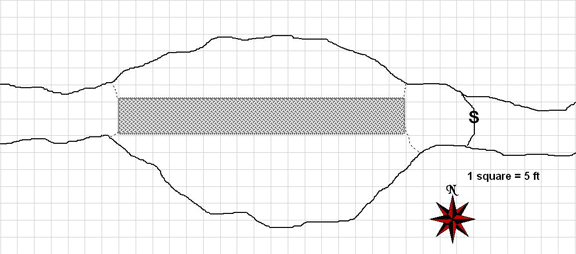 |
|
The passageway emerges into a long cavern, with a ceiling some 30 ft overhead. Stalactites hang from the ceiling. Beyond the passageway the floor quickly plummets into a sheer drop after a short ledge. A bridge made entirely of interwoven bones and skulls of all shapes and sizes, including 10 ft wide floor and 4 ft high railings, emerges from the landing and out over the drop below. The north and south walls of the place are adorned with exquisitely carved bas-reliefs showing a horde of strange floating triangular creatures with long thin arms and tentacles at the wide end assaulting a massive city of bizarre architecture with what looks like powerful magic spells, some recognizable as fireballs and lightning bolts. |
The bridge seems to be made entirely of bones, many of them quite large. A DC 15 Knowledge (architecture and engineering) check will determine that bones should not be able to support much weight, especially as they age and become brittle, and the bridge itself seems far to long to be structurally sound, as there are no supports and no arching to the bridge whatsoever.
The bones are interwoven somewhat loosely, so that gaps and holes are present in the bridge's floor and railings. None of these gaps is wide enough for a creature of size Small or larger to fall through, though creatures of Size Tiny or smaller would have to watch their step.
Despite appearances, the bridge is sturdy and structurally sound. It is, of course, magically created, and radiates faint necromancy and evil.
The floor at the bottom of the room is unremarkable and littered with stones, boulders, and other stone detritus. The walls of the place are sheer rock walls (DC 25 Climb check).
The bas-reliefs show the phaerimms attacking a sharn city during their war. These adornments were built into the wall during the phaerimm siege of the Tri-Claw Fortress and were fashioned using stone shaping magic (a DC 35 Knowledge [arcana] check can reveal this fact).
Creatures: The bridge's railings are comprised, in part, of a variety of undead skeletons who have been placed here to guard the way. These skeletons were created as a part of the bridge's manufacture by the ancient phaerimms and they are not counted as controlled by any of the current denizens of the caves.
The skeletons are of dusk giants slain by the phaerimm forces as they advanced upon the Sharn Empire. These skeletons will unravel themselves from the bone lacings of the railings when any living being not escorted by an undead crosses the center of the chamber (whether on the bridge or not). They will also activate if the bridge is attacked in any way. The unlacing of the skeletons will leave much of the railings of the bridge gone, though the floor remains intact. When the skeletons unlace, they will appear on the bridge if there is room to step onto it. Otherwise, they will have to take a 5 ft step onto the bridge or attack from the edge of the railings (treat as squeezing with -4 to attack and AC). Least dusk giant skeletons can only attack from the railings if it has access to two adjacent railing spaces. The lesser dusk giant skeletons will tend to appear towards the center of the bridge with the least dusk giant skeletons appearing on the bridge flanks.
|
|
Tactics: The skeletons will attack creatures flying over the bridge or somehow proceeding beneath the bridge on the stone floor below by throwing or dropping bones at them. The least dusk giant skeletons treat thrown bones as a thrown club, with a 10 ft range increment. The lesser dusk giant skeletons use larger bones or attached chunks of smaller bones and hurl them as they did rocks in their former lives.
The skeletons will pursue intruders anywhere in this chamber, and if, after 10 minutes have not been disturbed or seen an intruder, they will relace themselves into the bridge.
Secret Doors: There is a secret door built into the eastern wall of the small cavelet at the eastern end of the bridge of bones. The door is quite heavy and matches the cavern wall perfectly, requiring a DC 30 Search roll to locate. Even located, the door has a hidden key lock (Open Lock DC 30) that is opened by dint of a small bone hidden at the floor of the bridge of bones where it meets the eastern ledge. A DC 30 Search check of that end of the bridge will turn up the key, and if the PCs specifically search for a key (for example, having already found the secret door) in that area of the bridge, they will receive a +5 circumstance bonus to their Search check for the key.
This secret door was constructed by the phaerimms during their siege of the Tri-Claw Fortress.
8. Well Cave
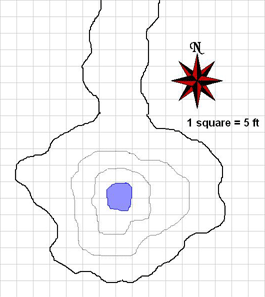 |
| The passageway ends in a cave about 60 ft in diameter with a low 10ft tall ceiling. The floor of the cavern descends several 5 ft steps to a pool about 8 ft in diameter. Water drips from the ceiling above the pool into it with a steady drip...drip....drip. |
The water is still potable, though high in mineral content.
The well itself is a fairly straight shaft that drops for about 80 ft.
Treasure: At the bottom of the well is the skeleton of a sharn. The bones are calcified and covered in mineral growths such that a DC 25 Spot check is needed to notice some sort of pattern in the lump of calcification. If closely examined, a DC 10 Search check will reveal that these are the remains of some creature. If the PCs have time to spend underwater (via magic and the like) or they haul the mass to the surface and examine it, they will be able to determine that the thing was the skeleton of a being very much like Defender of the Tri-Claw Vanguard.
This sharn was part of the raiding party that infiltrated these caves and eventually entrapped Wind of Blood. The sharn was mortally wounded during the raid and crawled here to either be rescued by his mates or die. When his comrades never returned, and he felt his life ebbing, he rolled over into the well and let the water take his life and hide his remains.
A Search of the sharn remains will turn up the following (Search DCs are given for each item...the DM should allow such a check to turn up all items with a DC of the check or lower). If the entire skeleton is simply pulverized bit by bit and the residue thoroughly searched (a process taking about 10 minutes), then all of the treasure will be found.
a strangely shaped metal +1 phaerimm bane frost hand axe (as an aberration bane weapon, but only against phaerimm) (DC 20)
a strangely shaped metal +1 phaerimm bane flame hand axe (as an aberration bane weapon, but only against phaerimm) (DC 20)
a ring of protection +2 (DC 25)
an armband of elusive action (DC 23) [MIC p72]
a gem of brightness (24 charges) (DC 30)
Developments: As the undead rarely use this chamber, the chance of wandering encounters here are half of normal; making this possibly a good place for the PCs to rest.
9. Place of Plague (EL 15)
Note: This cave includes moveable walls that change the initial appearance of the layout of the room. DMs should read the description of the place and, assuming the PCs cannot initially discern the constructed walls, use the description provided below. The constructed walls are noted with thin brown lines on the map below.
DMs should refer to the Tactics section below for very important notes on running this combat, in order to give the PCs a chance to survive.
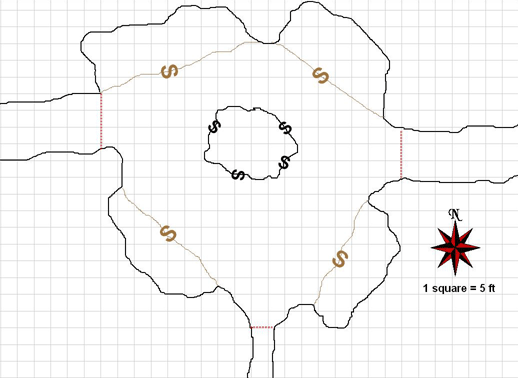 |
|
This large cave is about 100 ft in diameter and 15 ft tall. It is dominated by a massive stone column that is set with skulls of strange creatures mounted into small niches up and down its entire length. Three passages emerge from the cavern, two larger ones to the west and east and a narrow crack to the south. |
The thin brown lines on the map show where large sections of cave wall have been constructed to drop down into the floor when the trap is triggered, exposing four sections of cave containing plague walkers.
The secret doors noted on the central stone column are each 10 ft wide and made to look like part of the stone column. These will raise up into the ceiling when the trap is triggered.
The dashed double red lines represent stone walls that will come crashing down when the trap is triggered.
The brown stone walls and the red dashed stone walls are magically treated masonry stone walls 1 foot thick (break DC 55, hardness 10, 180 hp, save bonus +11). Magically treated walls gain a save against spells that would affect it, even if the spell doesn't normally allow a save (e.g. stone shape). Furthermore, all of these walls and "doors" are treated like portculli and are not affected by knock spells.
See Secret Doors and Traps below for more details.
Creatures: A literal horde of plague walkers resides behind the four brown secret walls on the map. These creatures will await their walls dropping and then rush out to attack intruders. There are 12 plague walkers behind each wall. In addition, there are 8 plaguewalkers inside the central column. These will also advance when the central columns doors raise up.
2 necrosis carnexes also are present in the chamber, hiding in the central column along with the plague walkers. These creatures will emerge and begin to run around healing plague walkers that are damaged.
|
|
Tactics: There is little subtlety here. The plague walkers will use their putrid burst ability as soon as they can (i.e. when they are reduced to 1/4th of their hit points or less). DMs should note the possibility of a massive chain reaction under certain conditions.
To mitigate this catastrophic possibility somewhat, the DM should divide the plaguewalkers into several groups and roll initiative separately for each group. This will allow PCs a chance to possibly flee or take some other protective action before most or all of the plague walkers explode. It is suggested the DM divide them up into 5 groups, one for each of the secret wall sections and one for the central column.
Furthermore, it is suggested that the DM specifically allow PCs to use their Knowledge (religion) skill to identify these creatures. A DC 23 Knowledge (religon) check will reveal their ability to explode and the fact that if they are killed outright they cannot explode. Even if the PCs do not ask to use a Knowledge check, the DM should allow them one and then point out what they can determine (refer to Monster Manual IV page 120 for the plague walker lore table).
While the plague walkers attack, the necrosis carnexes will attempt to remain out of combat, instead healing damaged plague walkers, beginning with the most damaged (even despite the fact that doing so may negate a very advantageous explosion).
Neither the plague walkers nor the necrosis carnexes are very bright (Int 4 and 3) and so they will not adopt any sort of coorindated tactics.
These creatures will pursue foes until they can no longer sense any. They will leave this cave to pursue foes.
Traps: The entire room is a trap. The trap is magically triggered when any living being not bearing an unholy symbol to Kyuss crosses the center of the cavern. Upon triggering, the four secret walls around the edge of the room drop into the floor, releasing the 48 plague walkers behind them. Four 10 ft wide and 15 ft tall secret doors in the central column rise up into the ceiling, releasing 8 more plague walkers and the 2 necrosis carnexes. Finally,. three stone walls drop across the three passages leading into and out of the cavern, as shown as double red dashed lines on the map.
All three of these actions happen simultaneously and immediately with a massive rumble and crash of stone.
Anyone standing in the squares adjacent to the red dashed lines when they drop must make a DC 15 Reflex save or suffer 4d6 damage and be trapped under the door (requiring a DC 30 Strength check to lift). Up to two Medium creatures can attempt to lift per square, with the strongest making the Strength check and the rest providing the standard bonus to the check if they succeed in aiding the lifting PC.
If the red dashed stone walls fully descend, they cannot be lifted, as locking mechanisms slip into place in the ceiling. However, if they crash down on someone or something and do not fully descend (to within 2 inches of the floor), then they will not lock in place and can be lifted open as long as the obstacle is still in place. If the obstacle is removed, then the wals will finished crashing down and lock. A DC 30 Strength check as described above can be made each round to hold the door up (presumable to free someone or to allow a hard item to be wedged under the door.
The trap is triggered by a detect undead spell, and as such any magical means that would thwart that spell will allow the trap to be bypassed.
None of the secret walls or doors are actually doors, per se, but rather gates/portculli and cannot be opened by knock spells.
The trap can be reset in two ways.
First, after 5 minutes (50 rounds), the doors will all revert to their untriggered state. This will be a slow rumbling affair taking a full round, and the descending walls will cause no damage unless a creature or object purposefully allows itself to be crushed or cannot move. In this case treat the same as the red dashed doors above except the damage is only 2d6 on the first round and 1d6 on the second round since the walls are closing slowly.
Second, a specific skull on a part of the central column that does not rise up into the ceiling is attached to its niche and can be pivoted to the right. This resets the trap as described above.
|
Plague Walker Trap CR 3; magic device and mechanical; proximity trigger (detect undead); manual reset (skull, DC 30 Search check to locate); various walls raise and drop as described above; Search DC 28; Disable Device DC 28. |
Secret Doors: The four walls marked in thin brown lines on the map are secret walls. They are described above, but if down and the trap is not triggered, they can be examined. A DC 20 Search check will reveal the gap in the floor that accepts the walls when they lower, providing a clue as to their nature. A DC 25 Search check till likewise reveal the seam between the secret wall and the cave wall on the sides, should the Search check be conducted in a square where the two meet.
Similarly, the secret doors in the central column can be discerned with a DC 25 Search check.
The red dashed stone walls cannot be detected by Search checks for secret doors. Instead, they are traps and can be Searched for as indicated in Traps above.
Developments: The mighty crash of the red dashed walls dropping to the ground will echo and reverberate throughout the caves, alerting all residents to the presence of intruders. Refer to the section entitled Continuing Tactics for further details.
10. Living Help
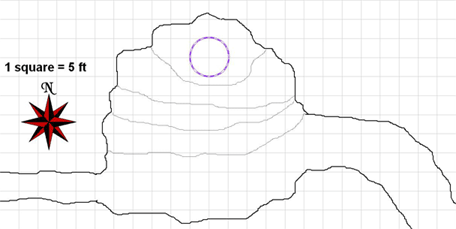 |
|
The passage continues on past a small cavelet that opens to the north. The passage to the east is larger than the one to the west. In the cavelet, which is 15 ft tall, natural stone steps lead up to a floating sphere of purple energy, about 10 ft in diameter and hovering about 2 ft off of the ground. Within this sphere some sort of shape appears to be moving. |
This particular living spell was brought along because of its usefulness against undead, but as the sharn attempted to escape after slaying and entrapping Wind of Blood, they were cut down. The phaerimm did not wish to slay the living spell, both because it was a threat to their undead legions and because they wanted a chance to study the creature and perhaps one day learn the lore to create their own. As such, the living spell was encapsulated in a permanent wall of force effect that was itself a product of phaerimm propylon magic.
The purple sphere operates in every way like a wall of force spell (CL 13) made permanent via a permanency spell, except that the sphere is translucent purple and is shaped into a sphere that hovers off of the ground (normally walls of force are invisible and can only be vertical flat planes of force).
Creatures: Within the sphere is an undeath to death living spell. The creature appears as an ooze-like form of shimmering silver liquid that constantly crackles and sparkles with small cerulean starbursts. However, while within the sphere, only its ooze-like shape will be visible, wriggling within its confines.
Living spells are very rare in Therra, but not entirely unheard of. A DC 35 Knowledge (arcana) or DC 40 Knowledge (dungeoneering) check will allow a PC to know about these creatures, but such a check will only be allowable after the creature is released from the sphere and can be observed properly.
|
Tactics: The living spell was programmed to obey its sharn masters (now long deceased) and to attack undead. It will attempt to perform the latter to the best of its ability until it is destroyed. The living spell will not attack non-undead in any way unless it is attacked first, in which case it will only strike foes who are currently assaulting it, ignoring any who retreat who are not undead and fleeing from non-undead foes it cannot reach.
Once released from its prison, and assuming the PCs are not undead or disguised to appear as undead, the living spell will begin to make its way randomly around the caves, seeking foes. It will not at all object to or act aggressively towards any PCs that follow it around or join it in its attacks against the undead.
Attempts to guide the living spell to follow the PCs are unlikely to work. It will not recognize even the most obvious attempts by the PCs to direct it, including pointing down a passageway and so forth. PCs can possibly guide it by blocking a passageway with spells such as wall of stone. Physically barring a passageway will invite a slam attack by the ooze or an engulf followed by disengagement on the other side of the blockers.
The DM should simply roll randomly when the living spell comes to a fork in the passageway. It is sentient enough to know what ground it has already covered, so it will not purposefully backtrack (unless necessary to continue the search) or go in circles.
Developments: When and if all of the undead in the caves are slain, the living spell will emerge from the caves and seek to wander the land to look for more foes. The PCs can, in theory, attempt to trap the living spell and might even find a way to somehow move it around and let it loose in future adventures against the undead. The particulars for this type of endeavour are left to the DM. Otherwise, the living spell will simply hang around a roughly 100 mile radius from the cave and patrol regularly, perhaps being spotted from time to time by killoren travellers and reported as essentially harmless if left alone.
11. The Forgotten
 |
| At this point in the passageway a collapse has occurred, with large and small stones forming a barrier across the passageway. |
The collapse is fairly complete, though it is apparent to even a casual observation that the passageway continues on past the front of the collapse (though how far cannot be ascertained).
A DC 20 Knowledge (achitecture and engineering) or Craft (stonemasonry) check will determine that the collapse is likely quite old, as the rocks have settled into very stable positions. A similar check of the surrounding wall and ceiling will reveal that there could be a chance of further collapse should the rocks be excavated, but if done properly and carefully this can be avoided. Remember that Craft checks can be made untrained.
If the rock collapse is approached from the west, the hand of the sharn elder eidolon can be seen on the floor of the passageway sticking out from under the collapse. The hand is perfectly still, at least while it is being observed. Assume a DC 10 Spot check is required to notice the hand (and if the collapse is closely examined in order to use a Knowledge check as described above, then the hand will always be noticed).
If the hand is touched in any way it will twitch and clench. It will then continue to do so as long as it is stimulated and for another 1d3 minutes thereafter before lapsing back into quiescence.
Clearing the rocks will likely require some tough work. In 1 minute, using only his hands, a character can clear rocks and debris equal to five times his heavy load limit. The amount of loose stone that fills a 5-foot-by-5-foot area weighs one ton (2,000 pounds). Armed with an appropriate tool, such as a pick, crowbar, or shovel, a digger can clear loose stone twice as quickly as by hand.
When clearing rock, for each 5 ft space cleared, require a DC 25 Knowledge (architecture and engineering) check to avoid a new collapse (note that Craft [stonemasonry] will NOT help for this check). If spells or other mundane items are available to help prevent this (e.g. wall of stone spells or wooden timbers) then add a circumstance bonus to the check equal to from +2 to +10 depending on the effectiveness of the measures being taken. In some cases, the DM can rule that there is no chance of collapse if the measures taken warrant it.
|
Collapses and Cave-ins If a collapse occurs, there will be a bury zone with a 15-foot radius and a 10-foot-radius slide zone extending beyond the bury zone. Of course, these radii will only extend into the passages. Characters in the bury zone of a cave-in take 8d6 points of damage, or half that amount if they make a DC 15 Reflex save. They are subsequently buried. Characters in the slide zone take 3d6 points of damage, or no damage at all if they make a DC 15 Reflex save. Characters in the slide zone who fail their saves are buried. Characters take 1d6 points of nonlethal damage per minute while buried. If such a character falls unconscious, he must make a DC 15 Constitution check. If it fails, he takes 1d6 points of lethal damage each minute thereafter until freed or dead. Characters who aren’t buried can dig out their friends. In 1 minute, using only her hands, a character can clear rocks and debris equal to five times her heavy load limit. The amount of loose stone that fills a 5-foot-by-5-foot area weighs one ton (2,000 pounds). Armed with an appropriate tool, such as a pick, crowbar, or shovel, a digger can clear loose stone twice as quickly as by hand. You may allow a buried character to free himself with a DC 25 Strength check. |
Creatures: At a point shown by the red circle on the map lies a trapped elder sharn eidolon. It was pinned in the collapse and cannot free itself. The pinning is severe enough that the eidolon cannot move its limbs enough to even make a Strength check to break free.
The eidolon appears like a sharn statue made out of a mauve coloured stone that is somewhat shiny, but its otherworldly geometry means that its body shimmers and wavers, almost as if it's not quite all there.
The DM should note the insanity aura, which will not work through the collapsed rock, but once the eidolon is exposed, the PCs will be subject to it if within range.
|
Tactics: The sharns are immune to the insanity aura of the eidolon, which made it ideal since the phaerimms were not immune to it.
Like the living spell (in area 10), the eidolon was programmed to obey its sharn masters (now long deceased) and to attack phaerimms and undead. It will attempt to perform the latter to the best of its ability until it is destroyed. The eidolon will not attack non-undead or non-phaerimms in any way unless it is attacked first, in which case it will only strike foes who are currently assaulting it, ignoring any who retreat who are not undead or not phaerimms and fleeing from non-undead or non-phaerimm foes it cannot reach.
Once released from its entrapment, and assuming the PCs are not undead or phaerimms or disguised to appear as either, the eidolon will begin to make its way randomly around the caves, seeking foes. It will not at all object to or act aggressively towards any PCs that follow it around or join it in its attacks against the undead or phaerimms.
Attempts to guide the eidolon to follow the PCs are unlikely to work. It will not recognize even the most obvious attempts by the PCs to direct it, including pointing down a passageway and so forth and while it understand the language of the sharns, it will not respond to non-sharns even if they speak to it in the sharn language. PCs can possibly guide it by blocking a passageway with spells such as wall of stone. Physically barring a passageway will invite an attack by the constract..
The DM should simply roll randomly when the eidolon comes to a fork in the passageway. It is sentient enough to know what ground it has already covered, so it will not purposefully backtrack (unless necessary to continue the search) or go in circles.
Developments: When and if all of the undead in the caves are slain, the eidolon will emerge from the caves and seek to wander the land to look for more foes. The PCs can, in theory, attempt to trap the eidolon and might even find a way to somehow move it around and let it loose in future adventures against the undead. The particulars for this type of endeavour are left to the DM. Otherwise, the eidolon will simply hang around a roughly 100 mile radius from the cave and patrol regularly, perhaps being spotted from time to time by killoren travellers and reported as essentially harmless if left alone.
12. The War Room (EL 10)
Note: PCs will be able to note a pale mauve glow emanating down the passageways from this area about 100 ft before they reach the cavern proper.
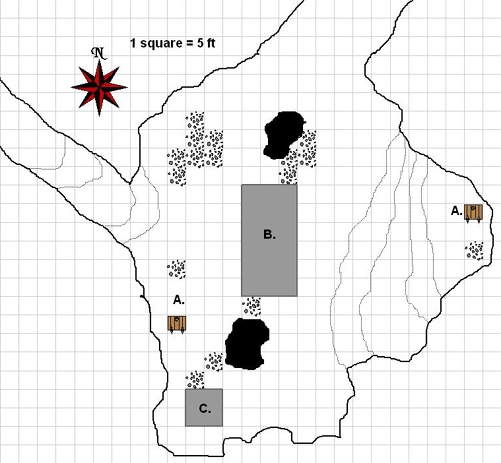 |
|
This large, tall cavern is illuminated in a light mauve glow emanating from large crystals suspended from iron chains that, themselves, dangle from a bewildering array of chains of various sizes that depend from and loop over an equally bewildering array of iron beams and bars that are set into the ceiling and criss-cross the cavern at heights varying from as low as 30 ft to as high as just beneath the 60 ft ceiling in the center of the place. Most of these beams and bars seem to be concentrated between two massive stone columns that flank an equally massive stone table or platform. The platform is 15 ft wide and 30 ft long and 4 ft tall. Its sides seem to be carved with reliefs showing strange floating triangular beings with thin arms and tentacled mouths flying or marching in what could be serried military ranks. Atop the platform are a variety of indentations in the top face of the stone. These indentations seem to be numerous, of differing shapes and sizes and depths, but all appear to be regular geometrical shapes. In the center of the top face of the platform is a massive indentation fully 5 ft in diameter and 2 ft deep that seems to be faceted as if once having held a massive, faceted gem or crystal. Lines carved into the platform top seem to connect the indentations to one another in a complicated network of patterns, and it appears that runes of some sort adorn the top as well. Chains from the ceiling and looped around the bars overhead dangle to within 10 ft of the top of the platform. To the south is a similar stone table about 10 ft square. Atop this are carved stone structures that are difficult to discern from a distance, but these structures rise about 1 ft up from the table top. To the east, natural stone steps about 5 ft in height lead up to a stone platform that contains large bits of stone rubble that may be carved, as if a statue or other decoration were sundered into pieces. Elsewhere about the chamber are various piles of stone rubble. Aside from the rubble, the floor is relatively smooth and has clearly been worked. |
The floor of the place is treated as a hewn stone floor (a DC 10 Balance check is required to run or charge across such a floor; failure means the character can still act, but can’t run or charge in this round). The rubble areas are treated as dense rubble (2 squares of movement to enter a square; adds 5 to the DC of Balance and Tumble checks, and adds 2 to the DC of Move Silently checks).
The large stone platform (location B) was used as a control center for the phaerimms. It was magical and the indentations bore a variety of propylon-based magical crystals that performed a variety of functions, mostly communications and observation of the distant siege. When the phaerimms abandoned this place, they took all of the crystals with them, so that this platform is now just inert stone. The two stone columns flanking the platofmr bear small iron eyelets and hooks in them on the sides facing the platform, which examination will suggest were used to hold chains in place. In fact, a complicated series of chains, some of which remain dangling even now, held various crystals that could be raised or lowered into place as desired. For example, the phaerimms may have had communications crystals attuned to various commanders, and so speak to one that commander's crystal would be lowered onto the platform and placed into the proper indentation.
A DC 35 Knowledge (arcana) check will determine that the runes and patterns on the top of the platform may have once involved some sort of divinatory magic, though the runes are unlike anything the observer will have ever seen before.
The smaller table (location C) is actually the phaerimm equivalent of a sand table. The structures that seem to have been magically raised from the stone of the table itself (or the table shaped or carved into the structures) are, on closer examination, a fortress of some sort, but with strange geometric and architectural shapings. If the PCs have closely examined the ornamentation in the ruins of the Tri-Claw Fortress, they may notice similar tiny ornamentations on the representation here. In fact, the representation is so good that immensely tiny details can be observed if the viewer looks closely enough. Such craftsmanship would likely make a dwarf blush in embarrassment. The representation of the Tri-Claw Fortress now has little relevance, since it is nothing but rubble.
The rubble on the eastern natural stone platform was indeed once a statue...a construct of the phaerimms that warded this place. When the sharn raiding party came through this area they defeated the guardian and then moved on. If, somehow, the pieces of the statue could be reconstructed, the result would look like a stone golem shaped like a squat irregular column with four tentacular arms (a bit like a roper).
The glowing crystals that illuminate the place are magical, and a faint dweomer or evocation persists. These crystals illuminate like a torch, and the light is permanent. The PCs can certainly take these crystals. They each weigh about 500 lbs and are about 3 ft tall and 1.5 ft in diameter. There are 7 of these spaced more or less evenly about the cavern, their chains dangling them to within 20 ft of the floor.
Creatures: 2 shredstorms are present in this cavern, albeit each trapped in a 5 ft square niche under a secret trap door (see Secret Doors below). When and if each door is opened, the shredstorm beneath will be released. The shredstroms will attack any non-phaerimms they detect, and they will pursue such creatures until destroyed, even leaving the caves to do so.
|
Secret Doors: Two secret trap doors are shown on the map at location A. These contain guardians of the place that once activated when intruders set off a pressure plate trap in the room. The sharn intruders detected and disabled the pressure plates, leaving the trap doors in place. When the phaerimms left, they decided to leave behind the doors and their contents simply as a jest to harrass some future non-phaerimm who might happen upon the cave. The doors require a DC 25 Search check to find. When opened, each releases a shredstorm (see Creatures above).
13. Prison of Wind of Blood (EL 16 [due to Wind of Blood's imprisonment])
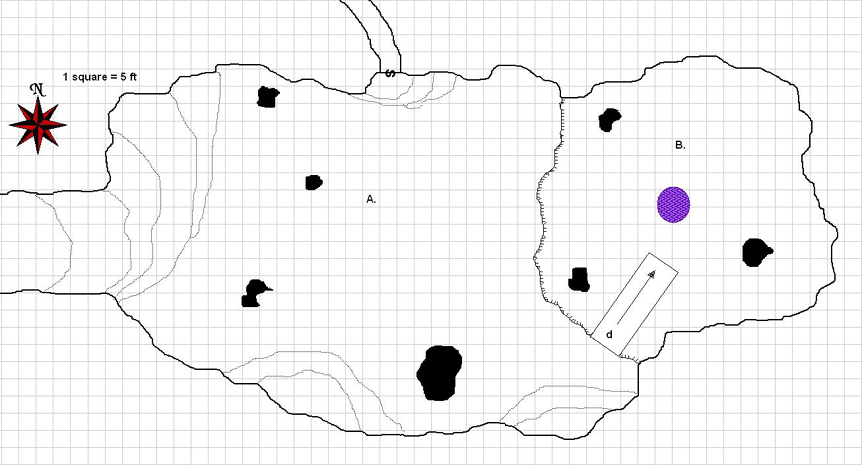 |
|
This massive cavern is illuminated by a crackling purple column of energy that runs from the floor of the eastern portion of the cavern, which floor is some 30 ft below the level of the western portion of the cavern, to its ceiling 90 ft overhead. The flickering energy causes the entire place to be illuminated in weird mauve shadows that dance and leap in time to the flickering. The ceiling of the cavern is adorned with stalactites, though fewer reach more than 20 ft down from the 60 ft ceiling over the western portion of the cavern. The floor is relatively clear, though at various places massive stone columns rise from floor to ceiling. Natural stone steps lead into the room from the west, and these are each a good 5 ft in height. Similar stone shelves run along the southern and northern walls. The far east of the cavern, as mentioned previously, is sunken compared to the west. A straight drop of 30 ft leads to the western floor, but a clearly worked stone ramp descends from the western portion of the cavern to the floor of the eastern portion. The column of purple energy is roughly in the center of the sunken portion of the cavern, and is about 10 ft in diameter. |
The purple column of energy is, of course, a propylon beam, with the same characteristics as the beam that holds the sharn ghost in the Tri Claw ruins (albeit this beam is larger on the whole than that one was). The illumination provided by the beam is the equivalent of a torch all throughout the cavern, though its flickering nature makes shadows in which to hide quite abundant (and so the vasuthant gains its +4 racial bonus to Hide checks..
A. Western Portion
This area was the barracks for the more important phaerimm officers during the siege. The place's floor was hewn and held much in the way of furnishings, though the latter were either taken with the phaerimms when they departed or has rotted away.
Creatures: A massive vasuthant dwells here, the personal guardian of Wind of Blood since ancient times. Even after all of these years the creature maintains its ties to the phaerimm general. It is usually resting atop the larger stone shelf to the south of the cavern, awaiting the commands of its master or conflict to occur. The vasuthant is not very intelligent, but it does crave life energy and it will move to engage any living creatures it notices who reach roughly the center of the cavern.
DMs should note the vasuthant's trap light aura. If the hiding vasuthant is spotted, the viewer will notice an area of shadow that does not seem to flicker in time with the propylon beam.
|
FEATS: Daunting Presence (LM p25) - Standard action to awe foe within 30 ft and in sight of you and have Int score. If Will sv failed (DC 39) is shaken for 10 minutes Improved Combat Reflexes (Epic p57) - You can make unlimited AoO in a round (but still not more than 1 vs a single opponent per action per round) Necrotic Reserve (LM p28) - Each day creature slakes hunger by draining ability score, gains a reserve. On days with reserve, when reduced to 0 hp or lower you are not destroyed but may take a single move or standard action. Standard action spends the reserve, as does taking any further damage. May only gain a reserve 1/day Positive Energy Resistance (LM p29) - Gain resistance 10 vs positive energy effects such as cure spells Spellcasting Harrier (Dracon p74) - Any spellcaster you threaten provokes an AoO if he casts defensively, with +4 bonus on attack roll Stand Still (EPsH p51) - AoO vs moving foe instead of doing damage stops foe unless Ref sv (DC 10 + damage) Vengeful Surge (FCToNH p85) - Whenever save vs spell, spell-like ability, or supernatural effect, gain +2 damage rolls vs creature that targeted you for 1 rd |
Tactics: The vasuthant is not a very subtle creature. It will advance and seek to crush the Strength out of its victims. It will try to prevent enemies from fleeing the cavern, and its initial intent will be to pursue intruders who flee. However, if Wind of Blood is able and wishes to order the vasuthant to desist, it will obey the phaerimm.
Secret Doors: The secret door to the north is carved to look like the cavern face from both sides. It requires a DC 25 Seach check to locate.
B. The Prison Proper
The sunken portion of the cave is reached via a stone ramp that descends at a 45 degree angle from the eastern portion above. This ramp should be treated as a steep slope.
The wall of the drop is a 30 ft vertical stone wall (DC 20 Climb check).
Piled next to the propylon beam is a pile of shiny black crystals.
Set against the rock wall to the west is a small pallet of ratty furs and a fur waterskin. Set along the north wall of the cavern are half a dozen clay pots. Half of these are filled with grave dirt and the other with brackish water (these are components for the create undead spell).
Creatures: Wind of Blood is here, trapped within the propylon beam. Also here is a charmed killoren, given as a gift to Wind of Blood by the lilitu from area 6.
Until the PCs actually enter the chamber and come close to the widened portion of the beam, they will not generally see the ghost, as the beam itself provides concealment. Assume the ghost has a Hide bonus of +14 (this includes a +5 circumstance bonus from the beam) and so has a total Hide check of 25. If the ghost is spotted, the observer will note some sort of shape within the widened portion of the beam.
While enmeshed in the propylon beam, the ghost may not leave the beam (even magic will not cause it to leave). However, beyond this restriction, it may cast any spells it desires, whether on itself or outside of the beam. It may also reach out of the beam with its touch attacks, just so long as its body remains within. It can even fly up or down the beam as it desires.
|
FEATS: Arcane Mastery (CA p73) - can take 10 on CL checks Contagious Paralysis (LM p25) - creature paralyzed confers paralysis on any creature touching it as if it had been also attacked, if touching creature saves then cannot be affected by your paralysis attack for 24 hrs Magic Disruption (CM p44) - as long as abjuration spell 3rd lvl or higher available, as immed action any character within 30 ft casting spell to make Concentration (DC 15 + lvl of highest abjuration spell lvl you have available to cast) or DC and CL reduced by 2; also you gain +1 CL for abjuration spells SPELLS: damning darkness (LoM p210) - r touch, object touched, 10 min / lvl, SR dmg only; darkness spell and good creatures take 2d6 per round, neutral take 1d6, dispel light spell of equal or lower level death armour (SC p60) - personal, 1rd / lvl, SR see below; creature striking with body or handheld non-reach weapon takes 1d4 +1/2 CL (max +10), SR applies to dmg death's call (CM p101) - 10 ft r burst on caster, sv F part, SR; all living creatures except caster take 1 dmg per CL (max 5) and fatigued (Fort sv neg fatigue), swarm takes 1d4 dmg / CL (max 5d4) and fatigued (Fort sv neg fatigue) but swarm does not take additional 50% dmg from area effect from this spell energy aegis (PHB2 p111) - immed, r cl, 1 creature, 1 rd; gains resistance 20 to one energy type fleshshiver (SC p 95) - r cl, 1 living creature, sv F part see text, SR; target with HD less or equal to caster stunned 1 rd (no sv), otherwise Fort sv, next round target Fort sv or take 1d6 / lvl and nauseated 1d4+2 rds incorporeal enhancement (SC p121) - 1 rd, r cl, 1 incorporeal undead / lvl, 24 hrs; gains +1 deflection to AC, +1d8 hp, +1 attack, +2 turn resist (improves by base amounts every 5 CL above 5th) negative energy ray (TaB p93) - r close, ray, sv W half, SR; ranged touch 1d6 negative energy dmg (+1d6 per 2 CL above 1, max 5d6), heals undead night's caress (SC p 147) - r touch, creature touched, sv F part see text, SR; 1d6 dmg/CL and 1d6+2 Con damage (Fort sv neg Con dmg only), undead takes no damage but Will sv or flee 1d4 rds +1/CL reciprocal gyre (SC p170) - r med, 1 creature or object, sv W half then F neg; subject takes 1d12 per spell or spell-like ability affecting it, if Will sv failed then Fort sv or be dazed for 1d6 rds slash tongue (BoVD p103) - r cl, 1 living creature, 1 rd, sv F neg, SR; 1 dmg and -1 on attack, sv, skills, ability checks sting ray (SC p206) - r cl, ray, 1rd / lvl, sv W part, SR; ranged touch, target only makes single move or standard action each round, Concentration to cast spells (DC of sting ray plus spell level being cast), -2 to AC, Will sv each round in target's turn to remove penalties except AC penalty which always remains summon undead IV (SC p215) - 1 rd, r cl, 1 rd / lvl; allip, ghast, wyvern zombie ITEMS: orb of mental renewal (MIC p167) - 3 ch / day, 1 = heal 4 pts Int, Wis, or Cha dmg or 2 to all three, 2 = heal 6 pts Int, Wis, or Cha dmg or 3 to all three, 3 = heal 8 pts Int, Wis, or Cha dmg or 4 to all three ring of lightning flashes (LoM p214) - 3/day 5d6 electricity to all within 5 ft (Ref DC 13 half), any creature in contact with wearer gets no save |
Tactics: Wind of Blood is effectively limited in its tactics because of its imprisonment within the beam. It is aware that foes can simply withdraw from engagement at any time and return at their leisure. It generally rests at the bottom of the propylon beam, and so the PCs might have to go all the way to the edge of the drop to see it (and vice versa). If the PCs enter the cavern in such a way that Wind of Blood has no idea intruders are about, then it will not take any actions until it sees that living beings have infiltrated its sanctum. However, there are a great many ways the PCs can betray their nature and allow Wind of Blood time to prepare.
The PCs might bring in obvious light sources whose illumination can be seen from the bottom of the propylon beam. Simply torchlight will not accomplish this until it is within 20 ft of the drop, but other light such as beams from lanterns or daylight spells will instantly alert Wind of Blood to an intrusion. None of the minions of the phaerimm in these caverns uses light sources.
Similarly, if the PCs make a lot of noise or speak out loud, that can easily alert Wind of Blood to the intrusion.
Likewise, if the vasuthant attacks, Wind of Blood will become aware of the attack once it begins.
Once alerted, Wind of Blood is likely to remain out of sight initially and cast some preparatory spells such as shield, mirror image, death armour, damning darkness, and protection from good. It will then likely summon allips using his summon undead IV spell, saving a few 4th level slots for enervation, and instruct the allips to attack the intruders.
Wind of Blood realizes that most of its spells are Close range or touch, and that it will suffer in a battle with intruders who stand off and right it. This means in general, unless it has other minions here defending it (such as the lilitu or ghasts), it will likely elect to remain hidden at the bottom of the propylon beam and let the vasuthant and allips wear down or destroy intruders. It will generally only attack if it sees intruders come to the lip of the drop. Even then, it will tend to wait until, hopefully, intruders come even closer down the ramp and, perhaps, to within touch range.
Wind of Blood's Close range spells can reach the top of the drop, even if the phaerimm is at the very bottom of the propylon beam. Should it need to engage in a long-ranged battle, it will make do with spectral hand (with vampiric touch spells), recipricol gyre, and feeblemind to engage enemies. Nevertheless, a stand-off battle should be a losing one for Wind of Blood, and it will seek to take cover at the bottom of the propylon beam in order to intice enemies to come at least to the lip of the drop, where its Close spells can come into play.
|
The charmed killoren generally rests on his pallet. The lilitu has charmed him into believing that Wind of Blood is a goodly being who has been trapped here amongst vile undead. When and if the killoren becomes aware of the PCs entering the cavern, he will alert the lilitu telepathically. She will then come to aid Wind of Blood, after asking the ghast sorcerer to rally the ghast cleric and his minions to also come to Wind of Blood's aid. Meanwhile, the charmed killoren will not enter a fray unless the lilitu is present, in which case he will attack whomever attacks her. However, the killoren will attempt to convince the PCs that a goodly being is entrapped within the propylon beam and that they should seek some way to free it. Should the PCs attack the phaerimm spirit, then the killoren will attempt to attack the PCs in order to get them to desist.
|
Developments: When it first begins to fight the PCs, Wind of Blood will use its telepathy to speak to the PCs, asking what manner of creature they are and why they have come into his caves. If the sharn are mentioned, Wind of Blood will shriek with rage and boast that the Sharn Empire was destroyed by the phaerimms many centuries ago. The phaerimm will not believe any "fantastic" tales such as the creation cyst blast or the eradication of the phaerimms.
Should Wind of Blood be destroyed, it will shriek its frustration in phaerimm and then dissipate.
If Wind of Blood is not slain, eventually the propylon beam will dissipate and the phaerimm spirit will be free to roam the land. The exact time frame for this to happen is left to the DM, but should be no sooner than a week after the sharn ghost is met, and no longer than 2 weeks after the sharn ghost is met.
When Wind of Blood is slain, for a moment the image of the sharn ghost will appear in this oropylon beam. The sharn ghost will thank the PCs for putting Wind of Blood to rest and will informally "bequeath" the lands of the sharn to the "new young races" that have arisen since the Sharn Empire was destroyed. With that the sharn ghost will also fade, and with it, both propylon beams (the one here and the one in the Tri-Claw ruins) will also wink out of existence.
If the killoren's enchantment is dispelled, he will instantly regret his weakness and agree to help the PCs, even going so far as to agree to accompany them to perhaps hunt down the lilitu at a later date if she escaped.
Treasure: The pile of black crystals are onyx, which Wind of Blood uses to prepare animated dead and to create undead. There is a total of 5000 gp worth of onyx here weighing a total of 2 lbs.
Continuing Tactics:
It is quite possible that the PCs will assault the caves and then need to retreat to rest and regain spells and the like. Of course, they have the "ticking clock" of the popylon beam dissipation to urge them onwards, but that will occur in a matter of a week or two. The undead in these caves will initially be quite disorganized, as befits both their Chaotic nature and the fact that no one has dared to disturb them for centuries. Once aroused, however, it is up to the DM to run the leaders of the undead (the ghast cleric, the ghast sorcerer, the lilitu, and Wind of Blood itself) in a manner that befits their Intelligence and Wisdom. Wind of Blood was a general of a phaerimm army, which makes it a tactician amongst genuises, and it will react accordingly to an assault that retreats out of the caves to regroup.
Of a certain, any undead created by animate dead spells that have perished will be renewed. This includes necrosis carnexes if their cold iron bands can be recovered. Wind of Blood does not have cold iron bands to replace any lost, though the lilitu could eventually secure them from the netherplanes if given enough time, but by then Wind of Blood would be free anyways.
Plague walkers cannot be easily renewed, as they require a large amount of unholy water (which the ghast cleric can produce from his fount) and two days of prayer and certain other restrictions.
As such, replacement via animate dead will tend to be animal skeletons and zombies that can be quickly gathered up from the nearby wilderness. A supply of onyx is available stacked next to Wind of Blood to cast the spell.
Create undead can be used to beef up Wind of Blood's defenses. A supply of onyx is available stacked next to Wind of Blood to cast the spell, and if a clay pot of grave dirt and one of brackish water is available the spell can be cast to create 1 ghast every hour. However, a dead body must be procured, something that will take lilitu a small amount of time to manage (she can greater teleport to a killoren settlement and play her wiles to isolate and then slay a killoren or two or three). Also, remember that create undead can only be cast at night.
Wind of Blood has not previously created as many ghasts as its onyx would allow because undead created by the create undead spell are not under its control, and it does not want to create enough ghasts that the creatures decide they can flourish on their own and abandon it. That said, Wind of Blood will work hard to replace lost ghasts.
The ghast cleric can also replace undead if any from area 3 have been slain and onyx is available.
The ghast sorcerer will attempt to finish binding the bar-lgura demon in area 3 or bind new demons as mentioned in the description of that area. He will bind as many as he believes he safely can (but no more than 4) and use these as a bodyguard and to patrol the caves.
Patrol of the caves will also be stepped up, such that a total of up to 6 groups of wandering creatures will be patrolling the caves (assuming there are enough undead to do so). DMs should add a 1 in 10 chance of a wandering encounter for every 2 additional groups patrolling. Additional groups will be comprised of 6 plague walkers or 6 ghasts per group. However, no more than one additional ghast group will ever be formed, and these will be taken from the ghasts in area 5 (unless new ones have been created). New plague walker groups will be formed from the plague walkers in area 9.
In summary, each time the PCs retreat, at the very least they should be presented with new skeletons and zombies enough to bring the undead controlled by the ghast cleric and Wind of Blood to their maximum levels. Additionally the ghast sorcerer will likely have a new demon bound to it.
Denoument
There are two possible loose ends in this scenario.
The first is Wind of Blood. If the PCs do not destroy the phaerimm spirit, it's imprisonment will fade away and the phaerimm will be free to roam the land. Precisely what it does with this newfound freedom is up to the DM. It is doubtful that Wind of Blood will return to Kyuss and the Blasted Lands, especially once it figures out that the phaerimm are essentially wiped out except for a few enclaves and rare individuals in Tyrmannion. In any event, Wind of Blood's imprisonment is a source of shame and failure for the phaerimm, and so it will not wish to return to service of Kyuss.
Nevertheless, Wind of Blood is thoroughly evil and convinced of its own superiority over the younger races (i.e. humans and killoren) and it is likely that the phaerimm will seek to establish a power base within Aladur (though not in the caves themselves if the PCs have already raided them). Instead it will establish a hidden lair on the outskirts of Aladur and begin to breed another undead army...this time possibly with more capability due to the fact that it can move and roam freely. Perhaps this army will eventually assault the killoren, and the PCs will need to aid the people of the land against this menace.
The second is the lilitu. It is very likely, barring a single round death or spells like dimensional anchor that she will be slain. More likely she will escape. If she does, the DM should definitely consider keeping her as a recurring villain in a campaign that takes place in and around Aladur. The lilitu is a wily foe, and not prone to sticking her neck out. Instead, she tends to work behind the scenes, using dupes and charmed persons as her puppets and minions. Of course, if the PCs have managed to garner her notes, then her current agents and victims are compromised, but she will be adept at forming new webs of intrigue.
Even if the PCs have defeated her and/or have taken her notes, they will likely need to go from place to place around Aladur and unravel her schemes. Some of her victims are mere dupes who did not realize they are working on behlf of a demoness. Perhaps they have been paid or seduced to gather strange or exotic components for her. Others have been charmed, and these may be actively hostile to the PCs should they seek to dissuade them from their endeavours on her behalf. Without proof, none are likely to believe the PCs as to the lilitu's true nature.
Whether or not the PCs have defeated Wind of Blood, if they have previously been given permission by the killoren to settle in or around Aladur, they are now free to establish a stronghold atop the Tri-Claw Fortress ruins.
Finally, if the PCs learned from the sharn ghost that the Azotchtla were not present in Sazhansiir during the time of the Sharn Empire, they might want to investigate further, as this goes against the orthodoxy of the Azotchtlan religions and mythology. The importance of this fact will come into play later in the Creation Cyst campaign.
Experience Points:
In addition to normal experience (which in Therra is half of that recommended in the DMG), each party member should be rewarded as follows: