
Return to the Therran Scenario Page
Summary:
The PCs deal with a spirit naga who is also searching for the lesser naga crown.
Assumptions:
The PCs are taking part or have taken part in the scenario entitled The Hidden Shrine of Tamoachan
Location:
Hissing Coast, near the Erinquiril Jungle
Historical Date:
702 A.C. Summer
A Note to DMs:
This scenario is an addendum to The Hidden Shrine of Tamoachan. In that scenario, the DM is given a device with which to make sure the PCs explore the ruins of the Shrine with some sense of urgency. This device is the fact that a nearby spirit naga has learned of the presence of a lesser naga crown in ancient Ibyansfiir. While, in that scenario the device was presented in general terms as a tool for DMs to goad the PCs (and players) onward, this add-on scenario actually fleshes out and expands on that device, turning it into a full-blown fullowup scenario.
DM's Introduction:
The history of the Hidden Shrine is detailed in The Hidden Shrine of Tamoachan and is not repeated here. Suffice to say that the spirit naga P'lssym'ssilwy was a minor noble in the Nagim that rules the western Erinquiril Jungle. His fiefdom was the nearest to the Azotchtlan Lands, which represents both a low standing as well as a potential for great opportunity. Such border holdings are indicative of a naga lord who is regarded as a potential up-and-comer by his peers, and is given a station near to the human lands to either show what he can accomplish or prove his ineffectiveness.
P'lssym'ssilwy has long heard tales of ancient Ibyansfiir and its lost lore from his favoured consort N'agassta, a dark naga sorceress who has long ago managed to eliminate all of her rivals, so that she now stands paramount in the eyes of P'lssym'ssilwy. It is her intention to "ride his tail" as high as he can go, and then to betray him and "jump tail" to another naga lord when the time is right.
N'agassta has for many years delved into the lore of Ibyansfiir, and when P'lssym'ssilwy was made lord of the naga fief in the Hissing River valley of the Erinquiril, she was intrigued, for the ancient city was said to be somewhere in the vale between the river valley and the spur of the King's Peaks (called by the Scaled Ones the Slave's Peaks). She began to delve further into lore, as well as having her master summon ancient demons who may have had some knowledge of those times or the times of the City of Tamoachan, which was said to have been built upon the ruins of that city, and she learned of the possession of a lesser naga crown by the last lord of Tamoachan, Tloques-popolocas, who was buried in a pyramidal shrine in his city after his death at the hands of the great Okoth himself.
It was only recently that her methods gave her an indication of a likley somewhat precise location of the site. Of course, this was not the first such indication, and all of the previous ones had turned up bust, and so N'agassta does not yet take this current indication with much hope or seriousness. Nevertheless, she has reported her finding to P'lssym'ssilwy and he has moved into an outpost near the edge of the jungle with N'agassta and some of his retainers and has agreed to send two lizardfolk to scout the site and see what they can find.
The two lizardfolk went to the site and scouted around and felt that the location was promising and may hold some sort of ruins. Looking around further, they discovered a hole in the ground that was a result of some collapsed masonry buried beneath the earth (area 39 of the Hidden Shrine). However, the scouts were merely sent to scout and report back, and so neither P'lssym'ssilwy nor N'agassta warned them of the curse of Okoth that encompasses the Shrine. The lizardfolk, however, were eager to earn the praise of their masters, and so they attempted to enter the hole, ignoring the strange faint blue glow that covered the hole, to make sure it was the Shrine they sought. They instantly ran afoul of Okoth's forbiddance and died.
When the two lizardfolk scouts did not return, the nagas were not particularly concerned, figuring that they ran afoul of some creature of the area. So after a week or so they ordered a new scouting party to search the area. This scouting party comprises the first encounter of this scenario.
|
|
Part One - The Scouting Party (EL 12 or varies)
The scouting party of lizardfolk notes the uncovering of the Shrine and the entrance of others into the Shrine. They report back to their masters.
The first part of this scenario is likely to take place entirely without the knowledge of the PCs. It is presented in case the PCs do something that might cause the scouting party to be encountered.
The scouting party will arrive on the same day that the PCs first enter the Shrine. They will not arrive at any predesignated time, but in order to serve the plot of this scenario, they will happen to arrive whenever the PCs are in the ruins.
This group will be approaching cautiously, as the first two lizardfolk scouts never returned and so they suspect that some dangerous creature or creatures dwell in the area.
Unlike the first two lizardfolk, this group has been warned of Okoth's curse.
Under normal circumstances, the scouting group will arrive at the site, note the hill under which the Shrine is buried, and upon ascending the hill or even climbing a nearby tree, they will note the newly dug hole that the PCs will have made into area 54 of the Shrine.
Upon noting this hole, two of the lizardfolk will immediately return with all due haste to the nagas to report their findings. The remaining lizardfolk will send two of their number to cautiously approach the dig site and examine it. They will do so, noting that the digging is fresh and leads to the Temple Ruins (area 54). They will peer down into the hole to note the blue glow covering the hole into the chamber below and will see the altar and notice the fact that no bodies are lying there as a result of Okoth's curse. They will then return with the rest of the lizardfolk back to the nagas with all due haste.
At this point, it will be clear to the lizardfolk (and the nagas when they return) that a group of creatures has managed not only to find and dig into the Shrine, but has likely pierced the curse of Okoth and is inside the Shrine. The nagas will find this information quite useful, as they heretofore had no idea how they would bypass Okoth's curse, should it prove to be real. Their intention will be to send back a reconaissance in force to find out who or what is exploring the Shrine and, if it seems manageable, to capture them and bring them to the nagas for interrogation and subjugation. The nagas will intend to charm or otherwise coerce the explorers into retrieving the lesser naga crown (and whatever else can be looted from the Shrine) for them and then enslaving them.
As described above, normally the PCs will not encounter the scouting party or even realize they have been at the Shrine. In theory should the PCs try to Track the area around their dig site they could note the recent passage of the lizardfolk.
The only way the PCs would actually encounter the scouting party would be if they keep someone on the surface as a watchman or guardian or what have you.
If this is the case, the lizardfolk will likely note the watchman if he is visible, send two of their number to report back to the nagas, and then if it is a lone watchman or someone they can easily overpower, they will attack to capture the watchman and take him back to the nagas (along with any valuable equipment or mounts the PCs may have left with the watchman).
If the watchmen are too numerous or the PCs are summoned to aid the watchmen, then the lizardfolk scouts will simply flee back into the jungle and attempt to get word to the nagas.
If the watchmen are hidden, then the lizardfolk will conduct their reconnaisance as described above and unless attacked they will eventually leave to report to the nagas.
The only other wrinkle in this first "encounter" is if the PCs somehow have concealed their entry into the Shrine. This could happen in a number of ways. For example, use of magic like passwall to enter the Shrine in the first place could result in no evidence left behind of the PCs' entrance into the Shrine. In this case, the scouting party will first scout the area, will find area 39 and the hole there and will note the bluish glow. They will then Track on the hill and hilltop, almost certainly noting the recent passing of the PCs and the sudden disappearance of their footprints. Digging at the site of the footprint disappearance will reveal the stones at the top of area 54 and the lizardfolk will break a hole into area 54, look inside, and then return to the nagas to report that they have found the Shrine and that there are recent footprints in the area not made by lizardfolk and the footprints end suddenly at the hilltop.
If, by chance, the PCs even take measures to hide their tracks (i.e. they fly to the hilltop or use other means), then the lizardfolk will simply note area 39, dig and break into and peer through the hole into area 54, and then report back to the nagas.
Only in this final case will the nagas have absolutely no suspicion that the Shrine has been entered. In this one case, the lizardfolk scounting party will send two of their number to report to the nagas and the rest will take up concealed positions. They will stay in their concealment watching the Shrine and awaiting instructions or reinforcements from the nagas. Should they observe the PCs emerge from the Shrine, or any other notable activity, they will return to report to the nagas.
Creatures: The initial scouting party is made up of 8 lizardfolk scouts, led by a scout leader.
|
|
Tactics: These lizardfolks are not much in the way of fighters, and so will only seek a fight if they have a tremendous advantage, otherwise fleeing to report back to their superiors.
Developments: If the leader is slain or captured, the PCs can find the map that he has on him. This map shows the location of the Shrine and the location of the naga outpost and is similar to other such maps found on later groups. See "The Map" below for more details.
Part Two - Reconnaisance in Force (EL 12 or varies)
The nagas send a group of lizardfolk and nagathas to capture the PCs as they emerge from the Shrine.
When the nagas receive word that someone has possibly breached the Shrine, they will form up a group to proceed to the Shrine site and await the emergence of the PCs. This group has been tasked with capturing the Shrine raiders and bringing them back for questioning and corecion.
In general this group will arrive on the third day. Once again, for convenience sake, the DM should assume they arrive when the PCs are in the Shrine. Even if somehow the PCs managed to stop every single member of the first scouting group from returning to the nagas, they will send this second force to find out what happened to the first force.
In all cases this second force will be bolstered by any members of the first scouting party that managed to return to the nagas or that remained behind at the Shrine to watch things.
The group will approach the Shrine cautiously, and if they know the entrance and exit point of the PCs they will assume positions around that, seeking to ambush the PCs when they emerge from the Shrine.
If possible, the group will make sure that the ambush will take place in such a manner that the PCs will not be easily able to retreat back into the Shrine. If that is not possible then they will do their best to keep the PCs from retreating back into the Shrine, moving quickly into position get between the PCs and the entrance. The nagathas will burrow underground in preparation of the ambush and emerge to strike from the ground.
Once again, if the PCs leave a guard outside the Shrine while they delve below, then this group will attempt to abduct the guard(s) and bind them. Any such captives will be taken immediately back to the nagas along with an escort of four lizardfolk warriors.
Unlike the first group, this force will not retreat from the PCs if attacked. They are here to fight and die in the service of their master.
Creatures: In addition to any remaining members of the first scouting group, this force consists of a dozen lizardfolk warriors led by a warleader and eight nagathas.
|
|
|
Tactics: The nagathas, assuming they are able to take up burrowed positions around the PC's entrance to and from the Shrine, will listen for the war leader to blow the hunting horn, signalling the ambush. They will then burst up from the ground, presumably with the PCs in their midst, and attack.
The lizardfolk will close, tossing javelins before turning to their scimitars. While this force has orders to capture the PCs, they will not attack nonlethally, instead seeking to bring the PCs to negative hit points and then making the attempt to heal the wounded, resorting to the potions of cure light wounds if necessary to keep their captive alive.
Developments: Any PCs captured will be taken back to the nagas.
If the leader is slain or captured, the PCs can find the map that he has on him. This map shows the location of the Shrine and the location of the naga outpost and is similar to other such maps found on later groups. See "The Map" below for more details.
Part Three - The Consort Arrives (EL 13)
Having had two forces repelled or fail to return, the dark naga consort now leads a potent force to deal with whatever has breached the Shrine or been wayalying the previous groups.
Unless all of the PCs have been captured already, the next force will appear on the fifth day. Once again, this force will arrive as the PCs are in the Shrine. However, by this time the PCs may decide to actually wait for the next assault by the Scaled Ones. In this case, the force will arrive in the vicinity, but will observe the Shrine area using magic as described below. The force is led by the dark naga consort and her plan is to, once again, attack the PCs as they emerge from the shrine. Unless the PCs can set up an ambush of their own and remain hidden from the consort and her forces, this force will simply wait and observe and the naga will use her scrying to attempt to locate the PCs.
If no sign of the PCs is had for a week (including no successful scrying), then she will assume that they have perished in the Shrine or fled and will return to the naga outpost with her force to report to the spirit naga. He, in turn, will cast a divination and if the PCs still linger in the area, then the consort and her force will return and attempt to once again ambush the PCs. In this case a pair of runners will be sent back to the spirit naga each week and a new divination cast to see if the PCs are still raiding the Shrine or whether they have found the lesser naga crown. If the naga ends up waiting for a month or more but still sees no sign of the PCs, then she will be recalled to the outpost and the spirit naga will have to arrange for some other plan or scheme to try to find the PCs. Such a scheme would be beyond the scope of this adventure.
Given that this force will only be dispatched when the previous force fails to return, the consort and her minions will be on very high alert. If they know that raiders have entered the Shrine, they will assume that the raiders somehow bested the previous force of lizardfolk and nagathas and so will be wary. If they do not know that raiders have entered the Shrine, then they will assume that some dangerous creature has taken up residence at or near the site and will be wary just the same.
Creatures: N'agassta will arrive with a retinue that includes 2 arrow demons called forth by P'lssym'ssilwy using his planar binding spell and a squad of 6 ophidian warriors, bolstered by 12 irregular lizardfolk fighters. She will time her arrival to take place at noon, hoping that is a good time to catch the raiders in the Shrine. Any survivors of the previous Parts will be present in this group as well.
|
|
|
|
Shield Specialization (PHB2 p82) - increase shield bonus to AC by 1. |
|
Tactics: N'agassta will initiate the approach to the Shrine by casting her fly, see invisibility, and invisibility spells to scout out the area. She will certainly have cast her mage armour spell, which is always running and recast as necessary, and her shield spell. Using these spells, she will have about 11 minutes to scout the area, while the rest of her forces remain hidden about 300 yards away from the Shrine hill.
If N'agassta notes the presence of intruders, and they do not notice her, she will certainly fly overhead and seek to determine their disposition and numbers. She is then likely to have an arrow demon sneak up under invisibility and keep a watch on the intruders, waiting for them to descend into the Shrine.
Once they do descend, she will move her forces into ambush position, taking out any guards and removing any valuable equipment or mounts left behind.
If the PCs linger outside of the Shrine for more than 24 hours, then N'agassta will arrange for an assault on their encampment. With her see invisibility spell up she will certainly note most magical encampments, including a rope trick which window is invisible and thus detectable by the spell.
If the nagas were previously aware of the breach into the Shrine and the general composition of the PCs, then N'agassta will retain her entire force here with her. However, if this intelligence has not been previously communicated to the nagas, then she will prudently dispatch two of her lizardfolk warriors back to the outpost to alert her master once she has some direct information as to the nature and numbers of the PCs. She will do this certainly before attacking the PCs.
If the PCs somehow detect and see N'agassta during her scouting flight, then she will beat a hasty retreat back to her forces and they will assault the PCs. If the PCs retreat into the Shrine, then she will either besiege the entrance and keep an eye for the PCs to leave by some other means, or she will pretend to back off and actually just hide a bit away from the Shrine and hope the attack the PCs as they leave the area.
In battle, when the ambush occurs, N'agassta will certainly have her mage armour and shield spells active. She also tends to prefer to fly above the combat, trusting in her high Armour Class to protect her from most missile attacks. She will then try to cast her cone of cold spell, otherwise using magic missile spells to keep enemy spellcasters at bay and her other attack spells (i.e. scorching ray, lightning bolt) to wreak havoc amongst her foes.
The arrow demons are specifically instructed to deal with enemy spellcasters, and they will do so to best effect, peppering them with arrows. They are instructed to act in unison, and to generally both target a single spellcaster with the intent to overwhelm the foe and take them out. They will use their dimension door ability to good effect in this case, keeping such spellcaster always within "reach" of their bows. While these tanar'ri have the ability to summon other demons, they will only do so in extremis, as they do not wish to be beholden to those who come to aid them. Nevertheless, they will do so, attempting dretches in preference to other arrow demons as a matter of pride.
The ophidians and lizardfolk are expendable grunts, the latter moreso, and will be used accordingly. They are trained to use the aid another action in combat if they have difficulty hitting their foes (due to their low attack bonuses), and will seek to flank opponents as well.
In all cases, the DM should be aware that the nagas wish to capture as many of the PCs as possible, unless they have the lesser naga crown on their person and somehow N'agassta knows this (e.g. they displayed it out in the open where she could see it or even attempt to use it against her). The force will still use lethal attacks (i.e. not resort to nonlethal combat), but will not slay downed opponents and will try to keep such downed foes out of area of affect damage-dealing spells.
Developments: N'agassta will not be captured if at all possible, nor does she consider herself expendable. If the fight goes poorly she will flee the scene, leaving the arrow demons to cover her retreat. The demons are expendable. Given her fly, invisiblity, and dimension door spells, it should not be too difficult for her to flee. She will always keep one of each of these three spells unused during a battle unless she is certain that expending those spell slots will ensure victory.
Treasure: N'agassta travels with her focus for her scrying spell, a 2 ft by 4 ft mirror of finely wrought and highly polished silver worth 1000 gp. When travelling, this mirror is carried by four lizardfolk or ophidians, and in combat the mirror is usually set back in a safe area or set down on the ground. She has another mirror back at the outpost.
Part Four - All Hell Breaks Loose (EL 17)
The spirit naga now brings forth much of his might to overwhelm the PCs.
If the PCs have driven off or defeated N'agassta's force, they have two more days before P'lssym'ssilwy arrives at the head of an army on day seven. By this time the PCs should have gotten the hint and have fully explored the Shrine. If they have foolishly ignored the obvious growing interest in the Shrine by the Scaled Ones, then they are likley to deserve what they get at this point.
This final encounter is not meant to be defeatable by the PCs the majority of the time. However, it is also not meant to be an automatic victory for the nagas.
First, assuming the PCs have still not been able to retrieve the lesser naga crown, then they can take solace in the fact that the naga and his forces cannot get to the crown either, so they do have the option of simply fleeing the Shrine and, perhaps, returning to the Azotchtlan Lands and raising a force of their own to return and fight the naga for possession of the Shrine. It should not be too difficult for a group of PCs who expects or knows that a force is coming to simply step outside the forbiddance and teleport away.
Second, while the encounter is extremely difficult, the PCs, with a bit of luck and excellent planning, could overcome the forces arrayed against them. It's not likely, but it is possible.
Creatures: P'lssym'ssilwy will arrive with a massive force that consists of the following:
P'lssym'ssilwy (spirit naga sorcerer
3/naga overlord 2) [CR 14]
12 advanced niferns
1 lizard king warleader (lizard king fighter 2/warchief 4)
4 arrow demons (called by P'lssym'ssilwy's planar binding
spell)
2 vrocks (called by P'lssym'ssilwy's planar binding spell)
24 lizardfolk warriors (lizardfolk barbarian 2) [CR 3]
18 ophidian warriors (ophidian fighter 2) [CR 4]
Any survivors from the previous forces will not be present, having been left behind to guard the outpost. This includes N'agassta, who will remain behind.
Statistics for this force are not presented here. They are presented piecemeal in Part Six below in the description of the naga outpost. This has been done because it is deemed quite unlikely that the PCs will have allowed things to progress to this point, and if it has, they are unlikely to want to face such a force and will flee instead.
Tactics: This force will cordon off the entire Shrine hill, with the naga hidden near whetever can be determined as the PCs' egress into the Shrine. The troops here are all warned by the naga to prevent teleport spells and the like, so the arrow demons and naga will concentrate on stopping spellcasters from casting spells to allow them to escape. The arrow demons will use their dimension door ability to transport to any sound of alarm anywhere along the cordon around the hill.
The naga will liberally use his dimensional anchor spell on spellcasters to prevent them from fleeing.
Part Five - The Journey
The PCs journey to the naga outpost.
The naga outpost is located in the verges of the Erinquiril Jungle, about a day of normal travel from the site of the Shrine. The outpost is normally a small fortress and watchpost used by the nagas to keep an eye on the humans to the west and as a base for forays into the Azotchtlan Lands, and is usually manned by a low-ranking dark naga and some bright naga cohorts. However, the outpost is now the focus of P'lssym'ssilwy's interest in the lesser naga crown and the Shrine ruins, and so its forces have been beefed up accordingly.
The Map:
The two dead lizardfolk at the Shrine, as well as the first two forces sent in this scenario, have in their possession a map drawn on human skin that shows the location of both the Shrine and the outpost. Two versions of the map are presented here, the first untranslated, with the labels in their original Slith. The other is the same map with the Slith translated.
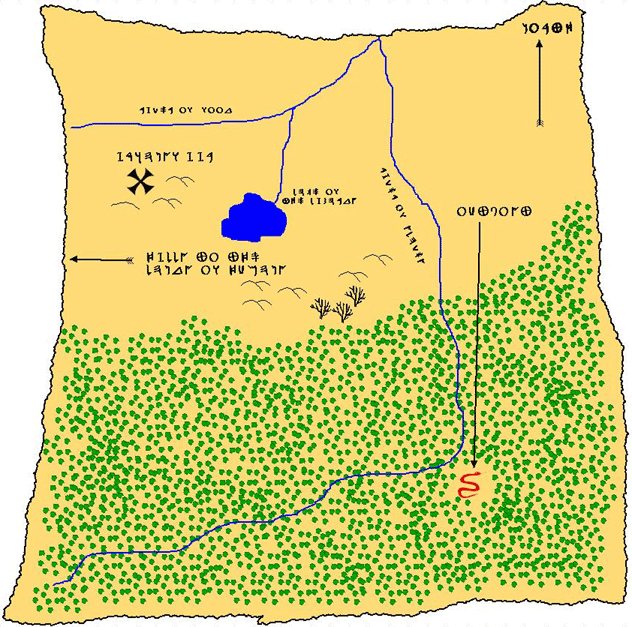 |
 |
Using this map, the PCs should be able to backtrack from the Shrine (at Ibyansfiir) to the outpost. The route the Scaled Ones use is to follow the River of Slaves from the outpost north until it emerges from the jungle. They then head west until the reach an area of burned out trees that leads to a valley between flanking sets of low hills. Following this valley they reach the Lake of the Lizards, and from there they can see a rise of hills to the northwest that leads to Ibyansfiir.
There is no scale on the map, but the entire journey is roughly 12 miles. Half of this journey is in trackless clear terrain and the other half is in jungle. The Scaled Ones know the ways and tracks through the jungle and so treat the jungle portion of the journey as tracked. Thus, it takes the Scaled Ones about a day to make the journey (at a speed fo 20 ft).
The Journey:
The PCs can take any route they desire from the Shrine to the Outpost, whether during their exploration of the Shrine, as an interruption, or right after they find the lesser naga crown, or more wisely, after they return the lesser naga crown to Pizotzin at the Xbalanque Temple and now return to raid the outpost.
In the latter case, they could, for example, try to find the River of Slaves up river and follow it east by northeast to the outpost. Of course, this way is much more arduous, as it is entirely in the jungle and subject to harder going and more dangerous encounters.
The most sensible way would be to simply reverse the journey made by the Scaled Ones by returning to the Shrine area, heading southeast to the Lake of the Lizards, and then either cutting across straight east to the River of Slaves and following that to the outpost, or cut across from the lake to the valley and the burnt area and then make their way east to the River of Slaves and then south to the outpost.
Attempting to cut across the jungle from the burnt trees directly to the outpost, without following the River of slaves, is a riskier proposition, due to the hcances of the PCs getting lost.
The check for getting lost in the jungle is a DC 15 Survival check. Therefore, as long as a PC's Survival bonus is +14, there would be no need to follow the river.
Remember that the PCs do not know the tracks and animal paths of the jungle, and so they treat it as trackless jungle unless they can make an appropriate Survival check (see trailblazing in Complete Adventurer).
DMs should keep in mind that in the clear and the jungle during summer, there is a 25% chance any given day that the weather conditions are Hot, requiring the PCs to take protective measures against heat (such as endure elements) or suffer the appropriate effects (refer to Sandstorm for furrther details).
The verges of the jungle should be treated as medium forest. DMs should assume that most of the terrain is of light undergrowth, though if the PCs manage to track the Scaled Ones or are using trailblazing from their Survival skill then they can be assumed to be following narrow footpaths and animal trails with areas of no undergrowth.
Wandering Encounters:
Due to the limited scope of this journey, the wandering encounter tables for this scenario are abbreviated and not meant to be representative of encounters over the larger area.
The chance of encounters is 15% in the clear and the jungle. This check is made every 6 hours, and if a check is indicated, further checks are made to see if multiple encounters occur during that period. Each time a consecutive check roll is made, another encounter occurs during the period. Such multiple encounters can be combined into a single encounter or spaced apart randomly or otherwise as the DM sees fit.
Nighttime encounter chances can increase or decrease depending on the type of camp that is set up:
PCs light an unshielded fire = +10%
PCs light a shielded fire = +5%
PCs make no effort to find a secluded or safe campsite or fail a DC 15 Survival check to find such a spot by 5 or more = +5%
PCs make a DC 15 Survival check to find a safe or secluded campsite = -5%
PCs make noise (singing, etc.) = +5%
Of course, PCs of the level appropriate for this scenario likely have magical means to encamp, including the various shelter-spells and the ever-useful rope trick.
The DM should not seek to foil any measures such as rope trick that the PCs have taken to ensure their safety. After all, that means they have forsaken other spells to memorize these magical means of encamping. In general, such means will involve no encounters during the night, but encounters may occur during the evening, as the PCs must still spend time outside washing, eating, cooking, praying, and practicing their skills. Unless PCs ensconced in concealed magical lodgings wish a running account of the various creatures that blunder past them in the night, the DM should simply not even roll for encounters during the night unless there is a chance that a creature encountered could somehow interact with the PCs.
Clear Encounters:
|
|
|
|
|
| 01 | Amphisbaena | 1 |
Serpent Kingdoms pg 62 |
| 02-03 | Ant, Giant * |
|
Monster Manual pg 284 |
| 04-08 | Baric | 1d8 | Tome of Horrors pg 28 |
| 09-10 | Bee, Giant |
|
Monster Manual pg 284 |
| 11-13 | Centipede, Monstrous * |
|
Monster Manual pg 286 |
| 14-15 | Dinosaur * | var | Various |
| 16-18 | Dire Bat | 1d8 | Monster Manual pg 62 |
| 19-21 | Dire Hawk | 1d2 | Races of the Wild pg 189 |
| 22 | Dire Maggot |
|
Libris Mortis pg 95 |
| 23-28 | Dire Rat | 1d20 | Monster Manual pg 64 |
| 29-30 | Dire Snake | 1 | Monster Manual II pg 74 |
| 31-32 | Dire Toad |
|
Monster Manual II pg 74 |
| 33-34 | Dire Weasel | 1d2 | Monster Manual pg 65 |
| 35-36 | Firefly, Monstrous |
|
Arms and Equipment Guide pg 90 |
| 37-39 | Fly, Giant | 1d12 | Tome of Horrors pg 202 |
| 40-42 | Frog, Monstrous * | var | Various |
| 43-44 | Gryph * |
|
Tome of Horrors pg 230 |
| 45-46 | Hyena | 1d20 | Monster Manual pg 274 |
| 47-48 | Legendary Snake |
|
Monster Manual II pg 136 |
| 49-50 | Lion |
|
Monster Manual pg 274 |
| 51-55 | Lizardfolk * |
|
Various |
| 56-58 | Lizard, Giant | 1d6 | Sazhansiir Gazetteer |
| 59 | Maggot, Monstrous | 1d12 | Underdark pg 88 |
| 60-61 | Marble Snake | 1d4 | Tome of Horrors pg 262 |
| 62-63 | Nifern | 1d12 | Serpent Kingdoms pg 79 |
| 64 | Scaled Stalker * |
|
Miniatures Handbook pg 68 |
| 65-66 | Snake, Dung | 1 | Serpent Kingdoms pg 83 |
| 67-68 | Snake, Reed | 1 | Serpent Kingdoms pg 84 |
| 69-72 | Snake, Viper * |
|
Monster Manual pg 280 |
| 73-75 | Spider, Hairy | 1d20 | Monsters of Faerun pg 79 |
| 76-79 | Swarm, Bat |
|
Monster Manual pg 237 |
| 80 | Swarm, Plague Ant | 1d8 | Fiend Folio pg 167 |
| 81-85 | Swarm, Rat |
|
Monster Manual pg 239 |
| 86-87 | Swarm, Viper |
|
Fiend Folio pg 172 |
| 88-89 | Swarm, Wasp |
|
Fiend Folio pg 172 |
| 90-91 | Termite, Giant * |
|
Sandstorm pg 197 |
| 92-93 | Tick, Monstrous |
|
Tome of Horrors pg 344 |
| 94-95 | Tiger | 1 | Monster Manual pg 281 |
| 96-97 | Witherweed |
|
Tome of Horrors pg 368 |
| 98-00 | Wolf |
|
Monster Manual pg 283 |
Jungle Encounters:
|
|
|
|
|
| 01 | Amphisbaena | 1 |
Serpent Kingdoms pg 62 |
| 02 | Ant, Giant * |
|
Monster Manual pg 284 |
| 03-04 | Ape | 1d6 | Monster Manual pg 268 |
| 05 | Archer Bush | 1d20 | Tome of Horrors pg 20 |
| 06-10 | Baric | 1d8 | Tome of Horrors pg 28 |
| 11 | Bee, Giant |
|
Monster Manual pg 284 |
| 12-13 | Beetle, Giant * | var | Various |
| 14-15 | Bonesnapper | 1 | Tome of Horrors pg 40 |
| 16-17 | Centipede, Monstrous * |
|
Monster Manual pg 286 |
| 18-19 | Cloaked Ape |
|
Monster Manual II pg 46 |
| 20-24 | Corallax |
|
Monster Manual II pg 50 |
| 25 | Dinosaur * | var | Various |
| 26-27 | Dire Ape | 1d8 | Monster Manual pg 62 |
| 28-29 | Dire Hawk | 1d2 | Races of the Wild pg 189 |
| 30 | Dire Maggot |
|
Libris Mortis pg 95 |
| 31-35 | Dire Rat | 1d20 | Monster Manual pg 64 |
| 36 | Dire Snake | 1 | Monster Manual II pg 74 |
| 37 | Dire Toad |
|
Monster Manual II pg 74 |
| 38 | Dwarf, Wild * | var | Monsters of Faerun pg 48 |
| 39-40 | Fly, Giant | 1d12 | Tome of Horrors pg 202 |
| 41 | Frog, Monstrous Poisonous | 2d10 | Tome of Horrors pg 206 |
| 42 | Girallon | 1d8 | Monster Manual pg 126 |
| 43 | Gryph * |
|
Tome of Horrors pg 230 |
| 44-45 | Kampfult | 1 | Tome of Horrors pg 246 |
| 46-47 | Land Lamprey |
|
Tome of Horrors pg 253 |
| 48 | Legendary Snake |
|
Monster Manual II pg 136 |
| 49-50 | Leopard |
|
Monster Manual pg 274 |
| 51-52 | Lizard, Giant | 1d6 | Sazhansiir Gazetteer |
| 53 | Maggot, Monstrous | 1d12 | Underdark pg 88 |
| 54 | Marble Snake | 1d4 | Tome of Horrors pg 262 |
| 55 | Nifern | 1d12 | Serpent Kingdoms pg 79 |
| 56-60 | Ophidian | 1d12 | Fiend Folio pg 133 |
| 61 | Sailsnake |
|
Monster Manual IV pg 124 |
| 62-63 | Snake, Constrictor | 1 | Monster Manual pg 279 |
| 64 | Snake Constrictor, Giant | 1 | Monster Manual pg 280 |
| 65 | Snake, Dung | 1 | Serpent Kingdoms pg 83 |
| 66-67 | Snake, Flying | 1d8 | Races of Faerun pg 177 |
| 68-72 | Snake, Viper * |
|
Monster Manual pg 280 |
| 73 | Snake, Winged Viper | 1 | Forgotten Realms Campaign Setting pg 309 |
| 74 | Spectral Panther |
|
Monsters of Faerun pg 79 |
| 75-76 | Spider, Hairy | 1d20 | Monsters of Faerun pg 79 |
| 77 | Spider, Subterranean, Sword | 1 | Monsters of Faerun pg 79 |
| 78 | Stymphalian Bird |
|
Tome of Horrors pg 336 |
| 79-83 | Swarm, Bat |
|
Monster Manual pg 237 |
| 84 | Swarm, Needletooth | 1d4 | Monster Manual III pg 109 |
| 85 | Swarm, Plague Ant | 1d8 | Fiend Folio pg 167 |
| 86-90 | Swarm, Rat |
|
Monster Manual pg 239 |
| 91-92 | Swarm, Spider | 1d12 | Monster Manual pg 240 |
| 93 | Swarm, Viper |
|
Fiend Folio pg 172 |
| 94-95 | Tick, Monstrous |
|
Tome of Horrors pg 344 |
| 96 | Tiger | 1 | Monster Manual pg 281 |
| 97-98 | Tri-Flower Frond | 1d10 | Tome of Horrors pg 347 |
| 99 | Vampire Rose | 1d4 | Tome of Horrors pg 360 |
| 00 | Witherweed |
|
Tome of Horrors pg 368 |
* = creature encounter divided into subtypes per the tables below
Ant, Giant:
These will be encountered as follows:
01-50 = 1d12 workers (plus 1 soldier
if 6 or more encountered)
51-85 = 1d4 soldiers
86-00 = 1dd+6 workers and 1d4+1 soldiers
Beetle, Giant:
These will be encountered as follows:
01-20 = 1d10 bombardier beetles
(Monster Manual pg 284)
21-70 = 1d10 boring beetles (Tome of Horrors pg 33)
71-85 = 1 deathwatch beetle (Tome of Horrors pg 33)
86-00 = 1d4 slicer beetles (Tome of Horrors pg 35)
Centipede, Monstrous:
These will be encountered as follows:
01-27 = 2d8 tiny centipedes
28-53 = 1d12 small centipedes
54-64 = 1d6 medium centipedes
65-75 = 1d6 large centipedes
76-86 = 1d6 huge centipedes
87-93 = 1 gargantuan centipede
94-00 = 1 colossal centipede
Dinosaur:
These will be encountered as follows:
CLEAR:
01-16 = 1d2 allosaurs (Monster
Manual II pg 70)
17-32 = 1d2 ankylosaurs (Monster Manual II pg 70)
33-48 = 1d12 pteranadons (Serpent Kingdoms pg 65)
49-58 = 1 seismosaurus (Monster Manual II pg 72)
59-68 = 1 spinosaurus (Monster Manual II pg 72)
69-84 = 1d8 triceratops (Monster Manual pg 61)
85-00 = 1d2 tyrannosaurus (Monster Manual pg 61)
JUNGLE:
01-10 = 1d2 allosaurs (Monster
Manual II pg 70)
11-20 = 1d2 ankylosaurs (Monster Manual II pg 70)
21-30 = 1d2 certosaurs (Serpent Kingdoms pg 64)
31-40 = 1d6 deinonychi (Monster Manual pg 60)
41-50 = 1d6 megaraptors (Monster Manual pg 60)
51-62 = 1d4 quetzalcoatli (Monster Manual II pg 72)
63-67 = 1 seismosaurus (Monster Manual II pg 72)
68-72 = 1 spinosaurus (Monster Manual II pg 72)
73-00 = 4d4 swindlespitters (Monster Manual III pg 41)
Dwarf, Wild:
These will be encountered as a hunting band of 4d6 hunters (Barbarian 1) led by a blood (Barbarian 4)
Frog, Monstrous:
These will be encountered as follows:
01-50 = 1d2 giant monstrous frogs
(Tome of Horrors pg 206)
51-75 = 1d2 giant dire monstrous frogs (Tome of Horrors pg
206)
76-00 = 2d8 poisonous monstrous frogs (Tome of Horrors pg 206)
Gryph:
These will be encountered as a flock or throng of 2d8 male gryphs plus 1 female per 3 males (round down, so the maximum encounter is 16 males and 5 females)
Lizardfolk:
These will be encountered as follows:
01-40 = 1d10 lizardfolk plus if
6+ encountered then lead by a barbarian level 1d4+2 (Monster
Manual pg 169)
41-70 = 1d6 blackscale lizardfolk plus if 4+ encountered then
lead by a barbarian level 1d4+2 (Monster Manual III pg 95)
71-00 = 1d8 poison dusk lizardfolk plus if 5+ encountered then
lead by a ranger level 1d4+2 (Monster Manual III pg 96)
Scaled Stalker:
These will be encountered as a gang of 1d8 and if 2 or more are encountered, they will be accompanied by 1d4-1 triceratops 35% of the time.
Snake, Viper:
These will be encountered as follows:
01-30 = 1 tiny viper
31-60 = 1 small viper
61-79 = 1 medium viper
80-97 = 1 large viper
98-00 = 1 huge viper
Termite, Giant:
These will be encountered as follows:
01-50 = 2d10 workers and if 13+
encountered then additionally 2 soldiers are with the termite
crew
51-90 = 1d8 soldiers
91-00 = mound with 1 queen plus 12d10 workers and 5d6 soldiers
Planned Encounters:
There are 3 planned encounters for first journey the PCs make to the outpost. These planned encounters highlight some of the rarer and more bizarre or dangerous denizens of the areas.
The first takes place only in the area of burnt trees marked on the map above.
The second two take place in the jungle.
The third can take place in the clear or the jungle and the DM can place it wherever seems most appropriate.
Note that these encounters can be presented in any order, not necessarily the order listed here.
Encounter #1 - A Flamed and Pleasant Land (EL 13)
This encounter takes place in the area of burnt and scorched jungle that is shown on the map above at the southern end of the valley that leads from the Lake of the Lizards to the jungle proper.
This area is the demesne of a clutch of flame snakes, which have burned down most of the vegetation in the area, a half mile wide circle of charred destruction.
As the PCs walk through the region, the destruction grows more and more intense, until, near the center, it is nothing but ashes and charred wood.
No matter where the PCs tread through the area, even if skirting the edge of it, they will encounter a clutch of flame snakes. There is believed to be an underground lair somewhere in the area that is home to a greater flame snake, but thankfully for the PCs, this terrifying creature is often quiescent and in hibernation. The lair is well-hidden, and it is up to the DM if the PCs are determined to find it whether they can or should.
The encounter will take place when the PCs step onto an area of ashy earth and rocks that is a weak point over an underground lair of the clutch. When the PCs tread over the area, they will cause a collapse, precipitating the PCs into the midst of the clutch.
Of course, if the PCs are travelling by flying or somehow not exerting pressure on the ground, then they will simply pass over this encounter to no effect.
When the collapse occurs, it will begin in the middle of the area, but will instantly spread to a radius of about 50 ft. All within will fall, except those on the very edge can, at the DM's option, make a DC 15 Reflex save to leap back to solid ground.
The fall will be a mere 20 ft deep, and the ash and dirst will cushion the blow, causing only 1d6 points of damage (half damage from the fall). For the round after the fall, nothing will happen as the dust clears and both the PCs and the flame snakes are stunned from the collapse. Thereafter, the snakes will attack.
No map is given of the clutch lair. It is a roughly circular chamber about 80 ft in diameter (so after the collapse, a 15 ft perimeter around the lair will still be covered by a dirt ceiling. This cover is precarious and will collapse if trod upon by heavy weight or if run across or jumped or fought upon).
The dirt and rubble from the collapse will now coat the floor of the chamber, causing it to be treated like shallow sand (see Sandstorm page 27) costing 2 squares of movement to move 1 square and adding 2 to the DC of Tumble checks. The snakes, due to their body configuration, are not hindered by the collapsed dirt in any manner.
There was an exit from the lair to the surface, in the form of a 5 ft diameter tunnel that exited to the west and gradually sloped upward. The collapse has not blocked this tunnel, and so the PCs will have no idea it is there without digging and the snakes will need some time to tunnel back through to it.
Creatures: The clutch consists of 12 minor flame snakes and 6 lesser flame snakes. While the PCs may assume that the minor snakes are hatchlings, this is anything but the case. The snakes will emerge from under the collapsed dirt and attack. Treat them as having total cover until they emerge. The DM should have the snakes roll for initiative individually or in groups of 3 for the minor flame snakes so that they cannot simply all emerge at once and use their burning hands ability at the same time. This separate initiative will simulate the confused emergence of the snakes from the collapse.
|
|
Tactics: The snakes will not really be able to coordinate a defense, since they have been taken completely by surprise. Instead, they will be angry and strike out at intruders, usually aiming at the nearest victim instead of using any sort of tactics like delaying and striking a single victim en masse with their ranged attacks.
Developments: Although the snakes can climb, the overhanging portion of the ceiling that remains effectively pens them into their lair. The snakes will be able to tunnel back to their exit passage once they have time to consider it, and it will take a good 10 rounds to clear away the collapse enough to use the tunnel. However, in extremis, the snakes can find and excavate the tunnel in half the time. Such fast excavation will only occur if the PCs flee the lair and begin to harrass the snakes from above. Otherwise, the PCs, once they escape from the lair, can likely flee the area before the flame snakes can excavate and emerge from the exit tunnel.
Treasure: Buried amidst the collapse is the treasure of the flame snakes. This will require a DC 20 Search check throughout the entire lair, as the treasure is scattered about. Should the PCs not take the time to search the entire lair, the DM can apportion the treasure appropriately.
Coins found herein are of mixed mint. Assume roughly 1/3rd are crude, blank coins with no markings (typically used by lizardfolk and other slave races), 1/3rd are of Azotchtlan or Okothian mint, and 1/3rd are of Scaled One minting showing a symbol of Kyuss on one side (a skull with worms writhing from it) and either a naga or yuan-ti on the other.
The treasure to be found consists of:
600 gp, 450 sp, 160 sp
3 fire opals worth 1000 gp each (and if used to craft a wand of a spell with the fire descriptor adds +1 to the save DC)
1 jasmal gem worth 1000 gp (and if used to craft a wand of a spell that grants an enhancement bonus to weapons or armour grants +1 caster level to the effect)
Encounter #2 - Slash and Go (EL 11):
This encounter will take place in the jungle.
A nest of mad slashers will attack the PCs. Given their lack of Hide or Move Silently ability, the PCs will likely see or at least hear their approach before they burst into view.
Creatures: Not very smart and quite chaotic, the slashers will simply rush the PCs and attack. There are 10 medium and 2 large slashers.
|
|
Tactics: The mad slashers don't use much in the way of tactics. They will attack in a frenzy of spiked claws and whirlwind attacks, using the latter whenever it seems tactically advantageous. They are instinctulally clever about their whirlwind attacks, and so will use those to the best possible ability.
DMs should note that a creature, when conducting a Whirlwind Attack, cannot use bonuses from any other feat. So the large mad slashers cannot Power Attack and Whirlwind Attack at the same time.
Development: Being mad, as well as slashers, these creatures rarely flee from battle. However, if both of the large slashers are defeated and half of the smaller ones are defeated as well, the remainder will flee from combat unless it appears they they are on the verge of victory (and a nice meal!).
If tracked back to their lair (a den dug into the earth of the jungle floor some half mile away), the PCs will find the den empty.
Encounter #3 - Plague from Above (EL 10):
This encounter is with a flight of marrashi. These are servants of the Scaled Ones, though they are not slaves by any means. This group is nominally tied to the naga outpost, in that they trade with the nagas and sometimes perform services for them in exchange for rewards.
Creatures: The flight consists of 6 marrashi led by an experienced flight leader. In the clear, the marrashi will likely be flying about 100 ft up and searching for prey. In this case, during daylight hours they try to fly out of the sun, imposing a -10 circumstance penalty on Spot checks to see them. If they cannot (e.g. it is high noon or there are clouds), then they will fly lower to the ground (50 ft up).
In the jungle, the marrashi will be perched in nearby trees and will attack from the air, below the jungle canopy, alighting on the trees to arrest their flight as the tactical situation warrants.
|
|
Tactics: The marrashi are not particularly intelligent, though they are no morons either. They will rely heavily on their ranged attacks and flight, and are loathe to close into melee combat. Each marrash will use its disease arrows until each foe has been struck by one. Their disease arrows are marked with orange-coloured fletching, so a given marrash will know if a foe has been struck by another marrash's disease arrow. The marrash will not fire further disease arrows at a foe already struck by one, as such arrows take some time and effort to craft and so the marrashi do not like to waste them.
Each marrash will attempt to shoot a taklif arrow at a PC. Like the disease arrows, each taklif arrow is quite distinctive in appearance, both for its black fletching and its ornate crafting and dripping black arrowhead. Even the PCs will note the distinction. As the taklif arrows are very expensive and difficult to craft, the marrashi will only shoot a PC with a taklif arrow once. If a foe has been hit by a taklif arrow, no other marrash will fire his taklif arrow at the same foe. In addition, the marrashi will never fire a taklif arrow if the shot is at all difficult. This would include a PC with concealment or in melee, unless such concealment is an inherent part of the battlefield an unavoidable (e.g. the battle takes place in light undergrowth). Furthermore, no marrash will fire his taklif arrow at a foe who has not already beens truck by an arrow previously. This precaution is to ferret out those foes who have a high AC or some magical immunity to missile weapons. The marrashi take every precaution not to waste their precious taklif arrows.
Developments: The marrashi are not fanatic and will not fight to the death. If the PCs start to get the better of them and their leader is defeated, they will flee, trusting their flight ability to outdistance most foes. If pursued by only a few foes, they are not averse to fleeing from the main body of their foes for a good distance and then turning en masse to engage their pursuers.
Even should their leader not fall, if more than half of the marrashi are defeated then the leader will evaluate the situation and decide whether to remain or flee, depending upon how close the PCs are to being defeated or routed.
Any prisoners taken by the marrashi will be subject to a taklif arrow (if not already struck by one) and if the foes resists the disease and transformation into a marrash, he will be then taken to the naga outpost and sold to the nagas.
Any marrashi captured will be willing to bargain for their lives. They know of the naga outpost and can even lead the PCs to it. Being lawful creatures, the marrashi will keep to their word, though only in the strictest of senses. They know a bit of the powers of N'agassta and P'lssym'ssilwy and can describe the exterior of the outpost as well as its surrounding environs to the PCs.
The PCs can use disease arrows if they so desire. Such arrows are the mark of serpent friends and would be viewed hostily in the Azotchtlan Lands. The taklif arrows are another matter entirely. They cannot be utilized by a non-marrash and function as a disease arrow when so wielded. None of these special arrows radiates magic or evil.
Part Six - The Outpost Environs
The PCs arrive at the outpost clearing and seek a way to enter the structure.
The outpost is located on a slight rise in the jungle, and trees have been fleed to make a small clearing. In this fashion, the outpost is visible from the air.
The outpost is surrounded by the habitations of lizardfolk and ophidians who are minions of the naga P'lssym'ssilwy. These minions are loyal to their master, though they are little more than slaves.
 |
The above map displays the environs surrounding the outpost.
The green is jungle, treated as medium forest with light undergrowth and patches of heavy undergrowth.
The large river is the River of Slaves, which flows from the southwest to the northeast. The river is approximately 20 ft wide and 10 ft deep at this point, and is only somewhat swiftly flowing (15 ft per round). The Swim check to navigate the river is DC 15.
The smaller stream that flows from the south into the River of Slaves is only about 5 ft wide and 5 ft deep and moves at 5 ft per round and its Swim DC is 10.
Both rivers are potable.
The central hill in the clearing is shown with contours representing a 25 ft increase in elevation. Therefore, the top of the hill is 100 ft above the floor of the jungle, though still below the level of the jungle canopy, as the trees reach a height of close to 150 ft in this area. The hillside from the west is gradual, and does not even count as a steep slope. The slope from the east and north are very steep and require a DC 10 Climb check to navigate. The slopes between these two extremes require a DC 0 Climb check to navigate.
Note: DM's should remember in all cases that the forces listed in Part Four are presented as being here at the outpost. If any of these creatures were encountered and defeated in Part Four, then the DM should remove them from the outpost. The description of the outpost below also assumes that the spirit naga is present. If this is not the case (e.g. he was slain in Part Four), then the DM should refer to the sections after the description of the outpost describing how the inhabitants of the outpost will react to PC intrusion.
1. Lizardfolk Encampment (EL
varies)
| At the crotch of a jungle stream and a larger river are clustered a group of eight large wood and mud huts. The huts are dome-shaped, like wigwams, and are about 25 ft in diameter and 15 ft tall. Crude decorations, cover the outside of the huts, including bits of fur nailed to the sides, bones and skulls tied together by leather thongs and hanging from the sides of the huts, and splashes of dyes and juices and possibly blood giving a weird prismatic cast to parts of the structures. From this angle, you can see a few of the openings into the huts, each being 4 ft wide and 6 ft tall and covered by a thick piece of hide. |
Each hut contains two levels, the top level of which is 8 ft above the mud and rush strewn floor of the place and accessed via a wooden ladder that sits against the thick tree trunk pole that supports the center of the hut. The huts contain no fire rings, as the lizardfolk tend to eat their neat raw. Each hut houses about 15-20 lizardfolk, and contains that number of ratty fur and reed pallets and a clutter of hanging carcasses, crude trophies and decorations, and other primitive lizardfolk tools and utensils.
In general the lizardfolk are in their huts during nighttime, as they do not possess darkvision (except for the lizard king). During the daytime, there will be many lizardfolk out and around the encampment and the surrounding jungle, though the children and females will stay within 200 ft of the huts. Under normal circumstances, 6 scouts are out hunting at any one time. The DM can assume they return to the encampment 1d6-1 days later (with a zero indicating they are present).
The lizard king is the chief of the lizardfolks, and rules them with an iron hand. The warleaders, shaman, and scout leader report to him.
Creatures: The total normal population of the encampment is as follows (this includes those encountered in Parts 1-4 above as well as the two found in area 39 of The Hidden Shrine of Tamoachan); with those not encountered in Parts 1-3 or the Shrine listed in brackets:
24 lizardfolk warriors (Warrior 3) [12 lizardfolk warriors present]
20 lizardfolk scouts (Scout 4) [4 lizardfolk scouts present, 6 more likely out on the hunt]
2 lizardfolk elite scouts (Scout 5, died in area 39 of the Hidden Shrine)
24 lizardfolk males (normal lizardfolk) [12 lizardfolk males present]
2 warleaders (Barbarian 5) [1 lizardfolk warleader present]
1 chieftain warleader (lizard king Fighter 2/Warchief 4) [1 chieftain warleader present]
1 scout leader (Barbarian 4/Ranger 3)
1 lizardfolk shaman (Adept 5) [1 present]
1 lizardfolk apprentice (Adept 2) [1 present]
24 lizardfolk barbarian warriors (Barbarian 2) [24 lizardfolk barbarian warriors present]
52 lizardfolk females (normal lizardfolk) [52 lizardfolk females present]
23 lizardfolk younglings (non-combatants, use kobold statistics if necessary) [23 lizardfolk younglings present]
As can be seen, if the spirit naga marches to the Shrine in Part Four, he takes most of his remaining lizardfolk strength with him.
|
|
|
|
|
Shield Specialization (PHB2 p82) - increase shield bonus to AC by 1. |
|
|
|
|
|
Tactics: The lizardfolk know that there are not supposed to be any humans in the area, and that humans are the enemy. The younglings have been raised on stories of the horrific things humans do to innocent lizardfolk...including torture, consumption of souls, cutting lizardfolk off from their ancestors, etc. As such, the younglings will flee and hide from humans, and have almost no chance of being convinced to speak with or aid a human. They will, in fact, scream out in Draconic upon seeing one.
If the lizardfolk are aroused they will attack intruders. If their leaders are present, any response will be somewhat organized. The females generally do not fight, but will stay to ward the younglings, taking to diving into the river and using their hold breath ability to remain safe while the males battle their enemies.
The adepts will stay with the warriors of the clan and aid them with their spells, though they are by no means eager to actually enter combat.
If attackers retreat, the lizardfolk will likely form up a troop to follow and hunt them down. They will leave at least half of their males and all of the females and young with the encampment, including both adepts. The lizard king will almost certainly remain in the encampment, aware that attackers might double back and attack the lizardfolk.
If all of the leaders are defeated and half of their males have fallen and no nagas are present to command them, the lizardfolk might break and flee into the jungle or rivers and give up their encampment and the outpost if sorely pressed. While loyal to their naga masters, they will not easily throw away their lives unless under firm command.
Developments: If fighting breaks out elsewhere in or near the outpost, the lizardfolk will respond. Half of their number will attempt to join the battle, led by the senior-most leader (usually the lizard king chieftain). The shamans and half of the males will remain at the camp with the females and young.
Any foes captured will not be killed but will be brought to the nagas in the outpost.
Treasure: Each hut has a total of 1d6 x10 gp, 2d6 x 10 sp, and 3d6 bits of primitive semi-precious gems or jewelry worth 10 gp each. It will take 5 minutes and a DC 20 Search check to find the treasure in each hut (or 1.5 hours to take 20).
2. Ophidian Pens (EL varies)
| This structure is a teepee of wooden logs, set into a cone shape, and covered with what appears to be hundreds of sloughed off snake or lizard skins patched with dried mud. Each teepee is 50 ft in diameter at the bottom and rises some 30 ft into the air at its point. |
Within, there is only a single chamber, and the ophidians sleep on pallets formed from their own old snake skins, leaves, and mud. A variety of primitive decorations fill the inside of the place, including skulls and flayed skins and hides of victims hanging from leather cords.
Because they have darkvision, the ophidians are usually out of their teepees at night, making them essentially the night guard for the outpost. During such hours, many of the females and young ones will be outside, though hear their teepee. During daylight hours, at least 3 warriors will be outside at all times keeping watch, while the rest will be inside sleeping or resting.
Creatures: Each structure houses 6 ophidian warriors, 6 normal ophidians, and 3 young. The young are non-combatant, and the normal ophidians (mostly females) generally stay behind in the huts to watch over the young and gather food and repair weapons and shields for the warriors. Subtract from this total any of the ophidians from Part Three that did not return to the outpost, removing 2 warriors from 3 random teepees. If the ophidians from Part Four did not return, subtract their numbers from the remainder of the ophidian warriors present.
|
Shield Specialization (PHB2 p82) - increase shield bonus to AC by 1. |
|
Tactics: The ophidians have an innate need to serve Scaled One masters, it having been bred into them by their creators. As such, they are extremely loyal and, unlike the lizardfolk, will never flee or abandon the nagas, even if the Scaled Ones are not present.
They know their role is to guard the outpost, and so they will attack any humans on sight.
Developments: If trouble breaks out near a teepee, the ophidians will leave two females in each teepee to ward the young, the rest joining in the attack. If the lizardfolk are attacked and the ophidians become aware of it, they will send all of their warriors to assist the lizardfolk, but the rest will remain at their posts, only attacking intruders who approach the outpost.
Any foes captured will not be killed but will be brought to the nagas in the outpost.
Treasure: The ophidians serve their masters entirely out of instinct, and so have very little treasure other than their weapons and shields, which they prize. However, each teepee will have a total of 1d6 x5 gp, 2d6 x 5 sp, and 2d6 bits of primitive semi-precious gems or jewelry worth 10 gp each. It will take 5 minutes and a DC 20 Search check to find the treasure in each teepee (or 1.5 hours to take 20).
3. The Long Stair (EL 7)
| At the western end of the central hill, a 10 ft wide set of stairs has been cut into the stone and earth of the hill. The stairs rise up along the gentle west slope of the hill and make thier way to a squat stone structure at the top of the hill. |
|
lesser orb of acid (SC p150) - r CL; 2d8 acid on ranged touch attack. |
Tactics: These bright nagas will respond to any sounds of trouble that seem to be more than a minor squabble amongst the lizardfolk or ophidians (both of whom tend to squabble quite a bit) by sending three of their number to investigate while a fourth ascends up the stairs to alert the bright naga leader in the outpost proper.
In combat, they will tend to hang back and let the slave races do the fighting, while they liberally use their mock spells over and over again against the enemy.
4. The Outpost
| Atop the hill, at the upper end of the long stairway, is a squarish, squat structure of stone some 15 ft tall and comprised of white marble shot over with green veins of jungle vines and ivy. Carvings of serpents and other serpentine creatures cover the marble facade. |
Part Seven - The Outpost
The PCs must gain entry into the outpost and battle the minions of the naga before confronting the spirit naga himself.
The outpost is superior masonry (though the outside is only a DC 15 Climb check due to the many carvings), and the floors are smooth stone floors. Exterior walls are 2 ft thick and interior walls are 1 ft thick. As is common for naga lairs, there are no doors. Instead, most openings are screened by strips of dyed cloth or linen that hang from the top of the doorway to the floor (called "curtains" on the map below). Such screens impose only a +2 modifier to the DC of Listen checks to hear sounds coming from the other side.
The roof of the outpost is flat and smooth and unadorned.
Unless otherwise stated, all areas of the outpost are unlit.
Unless otherwise stated, ceilings are 15 ft tall.
Naga Door:
Because nagas have no hands, they cannot easily manipulate normal doors. However, nagas often have need for the privacy or security that a door provides. To serve this need, naga doors have been invented.
Where a door in indicated, it is a special naga door, which is a circle roughly 8 ft in diameter comprised of a tough greyish-white quasi-living resin that is set on both sides with a metal plate about 2 ft wide and 3 ft tall. This plate is engraved with decorative designs (usually just patterns and shapes, but otherwise as mentioned in the description of the area) and the door is opened by applying pressure on the plate in the middle, which injects small spikes set in precise configurations from the plate into the resin and causes the resin to react by contracting, opening the doorway. The resin remains in a white ring around the doorway when contracts, and the metal plate generally moves to one side or the other with the resin. Contracted resin will remain open for 1 round before closing, but the inner edge of the resin is exposed and sensitive, such that, when closing, should it come into contact with anything it will immediately contract again for another round. Thus, there is no chance that a closing naga door can injure someone passing through.
A naga door can be locked if a lock is built into the metal plate. Such locks can either be manual keyed to an item. A manual lock involves simply pressing a stud on the end of the plate. The stud locks the spikes on the underside of the plate so that they do not extend when the plate is pressed. This keeps the door closed. A DC 30 Open Lock check is usually sufficient to unlock the stud and allow the spikes to insert into the door and open it.
The resin of a naga door is as tough as a strong wooden door (hardness 5, 20 hp, Break DC 25). However, there are no hinges, and the door is not wooden, so it is not affected by spells like warp wood. Although the resin of the door is a quasi-living entity, it is considered an object for all purposes and cannot be affected as a creature.
A knock spell and spells such as hold portal and arcane lock affect a naga door just like a normal door.
Naga doors that are closed impose a +5 modifier to Listen checks to hear sounds coming from the other side.
A naga door does not radiate magic nor does it detect as life. Unless otherwise mentioned, the DM can assume that the engravings described on one side of a naga door plate are the same as on the other side as well.
Ground Level:
 |
The DM should determine the location of P'lssym'ssilwy and N'agassta within the outpost, assuming one or both are alive and assuming that the alarm has not been raised. In this case, roll on the following table (once for each of them).
|
|
|
|
|
|
01-35 | 01-15 |
|
|
36-75 | 16-30 |
|
|
76-80 | 31-35 |
|
|
- | 36-85 |
|
|
81-00 | 86-00 |
1. Entrance (EL 10)
| The long set of steps from the bottom of the hill ends about 25 ft in front of the marble edifice. Facing the stairway and set into the western face of the edifice is a greyish-white circle of some material that does not seem, by sight, to be marble. The circle begins at ground level and is about 8 ft in diameter. Set into the middle of the circle is an ornate plate of metal, being about 2 ft wide and 3 ft tall and engraved with the likeness of serpents with heads on both ends of their bodies. Set above the circle is a massive engraving of a bronze serpent. The engraving of the serpent loops back and forth over the circle several times and ends with a fierce-looking head that looks out over the circle. |
Creatures: A massive bronze serpent guards the entrance into the outpost. This serpent was brought to the outpost by P'lssym'ssilwy and is his most prized treasure. The serpent will attack any non-Scaled One that touches or otherwise approaches within 10 ft of the doorway unless accompanied by a Scaled One or previously cleared by P'lssym'ssilwy or N'agassta.
The serpent sits in a sperpent-shaped niche carved into the marble facade of the outpost that allows half of its body to be inside the marble and half without. As such, the serpent appears initially as a massive bronze engraving set into the marble walls of the outpost. as the serpent normally does not move at all, this adds to the charade.
The lizardfolk, who were attached to the outpost even before the two nagas arrived, do not know that the bronze serpent is a construct; they think it merely a decoration brought by the nagas. The ophidians, who came in the spirit naga's retinue, know of the serpent. The bright nagas, though attached to the outpost prior to P'lssym'ssilwy's arrival, know of the serpent's true nature.
|
Tactics: When the creature attacks, it will emerge from its niche and drop down with a metallic THUNK before the doorway, attacking its foes. The creature will respond to orders only from P'lssym'ssilwy, and is instructed to protect him at all costs.
The creature will not leave outside of about 150 ft of the outpost without orders from the spirit naga and it has orders not to attack fallen foes, as the nagas prefer prisoners to dead bodies.
Developments: The bronze serpent will not react to foes or disturbances beyond 10 ft of the doorway unless directed by P'lssym'ssilwy.
2. Main Hall (EL 4 if activated)
|
This long hallway has a floor of polished green stone shot through with serpentine veins of gold. The walls are decorated with somewhat crude or stylized frescoes of lizardfolk fighting with Azotchtlans, and in one scene a winged lizardfolk is consuming head first a struggling human female. The curtains flanking the western doorway are green in colour while the one at the eastern end of the hallway is purple. |
Secret Doors: There are secret panels (Search DC 22) built into the portion of the hallway wall that adjoins areas 6 and 16 (the Murder Chambers). These panels are 1 ft wide by 2 ft tall by 1.5 inches thick and begin at a height of 4 ft from the ground. They can only be opened from the other side. Each panel also has in its center a tiny slit that can be opened.
Refer to areas 6 and 16 for more information regarding these panels.
Traps: The westernmost 5 ft of the hallway is trapped with a pit trap that opens when a lever in either area 6 or area 16 (the Murder Chambers) is pulled. The pit drops into area 4 of the Underground Level and is 30 ft deep in total (after a shaft of 15 ft it opens into the 15 ft tall cave in area 3). At the bottom of the drop is a bed of wicked iron spikes coated with poison.
| Spiked Pit Trap CR 4; mechanical; activation trigger (lever in area 6 or 16); manual reset (lever in area 6 or 16); DC 20 Reflex save avoids; 30 ft. deep (3d6, fall); pit spikes (Atk +10 melee, 1d4 spikes per target for 1d4+5 each plus poison [t'sous, injury, Fort DC 20, 4d4 damage/2d4 damage]); Search DC 20; Disable Device DC 20. |
Once the trap is sprung, the lizardfolk will raise the lever, resetting the trap and effectively blocking those in the pit from flying back up the pit or from anyone remaining in area 2 from jumping down into the pit or lowering a rope. The pit door is 2 inches thick and is hinged on the underside of the eastern edge of the pit..
3. North Hall
|
This hallway's west wall is painted black and set with bright mosaic stones depicting a massive snake encircling a mountain and its tail held in its own mouth. The mountain seems to be bleeding lavafrom various points, as if the great snake is squeezing the magma out of it as if it were lifeblood. The curtain to the east is brown in colour, while the curtains to the north and south are green. |
Developments: Any undue noise (such as speaking in Azotchtlan or Common or some other non-Scaled One language) will bring the bright naga in area 8 to investigate.
4. Master's Living Chambers
(EL 8 or varies)
|
This chamber contains a variety of cushions and pillows strewn about the floor, where a round, mauve carpet some 15 ft in diameter has been placed in the room's center. Several brass braziers stand along the walls, burning with a ruddy glow and emitting wisps of vapour into the air. Several stone shelves line the walls at a height of about 4 ft, and these contain human skulls, pottery containing fungi of various sorts, and various jars, bottles, and glass vials. A few blocks of incense are also apparent. High along the north wall is a green tapestry that hangs from metal hooks and rods near the ceiling. The tapestry appears to be rolled up, but in this state is cunningly forms the shape of a naga, with its head to the east overlooking a 8 ft diameter greyish-white circle set into the eastern wall. To the west is an opening screened by a tan curtain. |
The glow from the braziers casts the entire room in shadowy illumination.
Creatures: If P'lssym'ssilwy is here, he will be lounging on the pillows relaxing, or consuming a meal, or perhaps practicing an arcane casting or ritual. If N'agassta is here she will be doing the same.
A pet of P'lssym'ssilwy is always present here, a massive whipsnake that usually spends its time buried under the pillows in the northwest corner of the room unless its master is present (in which case it is usually nearby). The snake is always resting with one eye open and watching out from under its "pillow fort" and will attack any non-Scaled Ones not in the presence of the bright naga from area 8, or P'lssym'ssilwy or N'agassta, unless its potential victims are all as large or larger than itself, in which case it will remain hidden and attack only to defend itself.
|
Greater Multigrab (SK p146) - no penalty on grapple checks when grappling an opponent only with the part of the body used to make the attack. |
Tactics: The whipsnake will attack relentlessly any creatures smaller than itself, though if brought to 20% or less of its total hit points, the snake will flee into area 5 unless P'lssym'ssilwy is present, in which case it will fight to defend its master to the death.
Developments: The sounds of struggle in here, or even just the agitated hisses from the whipsnake will bring the occupants of area 5 here to investigate in a single round. Sounds of struggle in this chamber will also bring the bright naga leader in area 8 and P'lssym'ssilwy or N'agassta from area 7 if they make appropriate Listen checks.
Secret Doors: On the wall at 4 ft height just south of the naga door is a loose stone that is the bypass for the poison needle trap. Pressing on the stone will disable the trap for 10 rounds.
Traps: The plate in the naga door to the east is trapped with a poison needle. The bypass to the trap is a loose stone in the wall at 4 ft height to the south of the naga door. A very thin vein of resin runs from the plate to that portion of the wall, and if a Disable Device attempt beats the trap's DC by 10 or more, this vein will be noted and the bypass can be utilized. Otherwise, if the plate in the middle of the naga door is pressed, a poison needle will spring out from the center and pierce the opener. The trap resets automatically after 10 rounds, and a well of poison set into the plate has enough doses for 6 jabs before needing to be refilled.
| Poison Needle Trap CR 7; mechanical; touch trigger; automatic reset; hidden switch bypass (Search DC 25); Atk +20 melee (1 plus poison, needle); poison (black adder extract and ts'ous, DC 20 Fortitude save resists [poison only], 1d6 Con and 4d4 damage/1d6 Con and 2d4 damage); Search DC 25; Disable Device DC 25. |
Treasure: The various potted fungi are of no real value or effect, though some of them could serve as a basis for a hallucinogenic compound if someone with a high enough Craft (alchemy) skill could distill them in a lab.
While the incense is not valuable (and smells rather sickening to non-Scaled Ones), the various jars and bottles hold oils and unguents that are pleasant to nagas and help to keep their scales supple and shiny. Four such bottles contain bloodflower salve (see Serpent Kingdoms page 149), which P'lssym'ssilwy and N'agassta will have rubbed on their bodies by slaves should they have time and be expecting a battle.
5. Slave Chamber (EL 8)
|
This room is a somewhat jumbled mess of ratty fur pallets, gnawed bones, crude bones and wooden utensils, and crude wooden furnishings, including a wooden table, stools, and a crude wooden altar along the west wall bearing a clay figurine of a two-headed snake upon it. To the east is an opening screened by a tan curtain while to the south is a mauve curtain blocking an opening. |
Creatures: 6 male lizardfolk warriors and 4 female lizardfolk servants dwell here, spending there time copulating and otherwise resting when not called by their masters. At any given time, all of the warriors are likely to be here. Only two of the females will be here, the others being in area 14. The position of house slave is one both of honour and also danger, for the nagas can be harsh masters and somewhat capricious in their cruelty when angered. Nevertheless, the lizardfolk assigned here have what can be considered lavish living quarters compared to their fellows outside.
|
|
Tactics: The lizardfolk warriors are loyal to the nagas, mostly out of fear of them and of their own lizard king. They will attack intruders, raising a shriek of alarm if they see anything amiss. The female servants will tend to stay out of combat, unless threatened themselves.
If an alarm is raised elsewhere in the outpost, 1 lizardfolk warrior will enter the murder chamber in area 6. One other will attempt to make his way to the murder chamber in area 16. The final four will seek out P'lssym'ssilwy or the most senior naga (N'agassta or the bright naga leader in that order) to serve as bodyguards.
Developments: The warriors will definitely seek to investigate strange noises or the sounds of combat anywhere in the outpost, especially from the whispnake in area 4.
6. Murder Chamber
|
This narrow hallway is somewhat dusty from disuse. At the south end of the hallway, there is a 1 ft wide by 2 ft tall section of the wall that is indented into the wall, as if a stone block had been pushed in or as if the wall there were thinner than the rest of the wall. A large iron knob sits in the center of the bottom of this indentation while a small iron knob sits in the center of the middle of the indentation. Next to the indentation is an iron lever in the up position. Nearby sits a wooden barrel full of javelins and a stone shelf which holds several flasks and small pouch-like bags, and rune-carved stones in the shape of dodecahedrons. |
While only the spy slit is open, those in this area observing area 2 are considered to have total cover (line of effect for spells requires a 1 ft hole in an otherwise solid barrier). However, the spying can be noticed by a DC 30 Spot check or a DC 20 Search check.
While the panel is open, those in this area have improved cover in relation to area 2. This means they gain +8 to AC and +4 to Reflex saves and are considered to have the improved evasion against any attack requiring a Reflex save. However, those in area 6 can hurl javelins or toss alchemical items into area 2. However, to simulate the restricted arc of attack that those in area 6 would have, the DM should trace line of sight for ranged attacks from the REAR (i.e. northernmost) two corners of the square of the attacker rather than all four corners. This will restrict the line of sight to those squares somewhat in front of the panel.
Tactics: One lizardfolk warrior from area 5 will attempt to station himself here during an attack. He will remain here even if it is apparent that intruders have already breached area 2 and are further into the outpost, as his orders are to hinder intruders who seek to flee from or leave the outpost.
At first the lizardfolk warrior will only have the spy slit open. When he sees intruders, his first action will be to pull the lever, which activates the pit trap in area 2. Once victims fall, he will then raise the lever, resetting the pit trap. Thereafter, he will open the panel and resort to throwing the alchemical items on the shelf nearby, including, if no intruders are left in area 2 but some are down in the pit, tossing alchemist's fire down into the pit.
Once out of alchemical items, he will throw javelins into the hall.
Traps: The pit trap in area 2 is activated from this chamber by means of the iron lever. Pulling the lever down activates the pit and pulling it up resets the pit.
Treasure: The barrel contains 24 javelins. The shelf contains 4 each of alchemist's fire, tanglefoot bags, and thunderstones.
7. Master's Room (EL varies)
|
Two greyish-white 8 ft diameter circles are set into the walls of this chamber, one to the west and the other to the south. The room is dominated by a 10 ft square stone platform some 2 ft hight that is built into the northeastern corner. Set upon this platform are a variety of colourful cushions, pillows, and weavings that form a luxurious-looking nest of sorts. Several brass braziers are set about the place, against the walls, and these burn fitfully, casting a ruddy glow about the room. Wisps of vapour emerge from these braziers, hinting at incense or some other substace within them. Flanking the stone platform are two ornate bronze candelabras shaped like a multi-headed serpent slithering up a tree trunk. Each snake has four heads, and each head is upraised with its mouth wide open. Set into the center of each arrangement is a stick of wood coated with some substance that seems to be glowing with an ember-like bit of heat. The serpent heads hold not candles, but candle-shaped pieces of wood carved with runes. Set along the eastern and southern wall are stone shelves that are currently crammed with scrolls, stone tablets, and tomes of various sorts, all arranged haphazardly from the look of it. In the center of the chamber, atop of large square red rug embroidered with images of serpents devouring humans is a wooden table with large pillows set where chairs might be. Upon the table are ornate pottery bowls, plates with small bones set upon them, and several opened scrolls and tomes. In the southwest corner is a small iron cage containing about a dozen normal rats and a floor of straw and grass. Along the north wall is a wooden table holding a variety of vials, flasks, and other alchemical items. |
The bronze candelaberas hold soaked pieces of wood, not candles, and are used by the nagas to burn the various strange inhaled toxins called osssra favoured by the Scaled Ones.
Each candelabra holds four such pieces, and each piece has been soaked with a different osssra. The runes on the pieces signify in which osssra the wood has been soaked, and any creature able to read Slith will be able to read the name of the osssra (though they may not understand what that means). Refer to Serpent Kingdoms page 150 for details of the osssra. In general, they are activated by lighting the soaked wood (using the glowing stick of wood that is a punk with slow burning embers). Simply touching the punk to the soaked wood ignites it in a single standard action that provokes an attack of opportunity. These substances affect non-Scaled Ones as poisons and give benefits to Scaled Ones. Both of these effects are listed below. Remember that multiple smokes cannot be combined, so the nagas will only light one at a time.
Wood 1 = battasss (DC 15, 1d4
Wis/sleep 2+1d4 rounds; no Concentration checks needed, +5 Will
saves for 3d6 minutes)
Wood 2 = laerisss (DC 14, 2d4 acid damage/2d6 damage; +2 Ref saves
for 2d6 minutes)
Wood 3 = ruusstantar (DC 18, 2d4 damage/3d4 damage; +1d12 temporary
hp for 1d4 hours)
Wood 4 = hooloond (DC 16, 1d6 damage/unconscious 2d6 minutes;
1d4+2 points of healing every 3 minutes up to 12 times)
There are a total of 15 rats in the 5 ft square iron cage, which is held shut by a simple latch on the outside. The rats are food for the whipsnake in area 4.
The naga doors to the west and south can be locked from this side by pushing a stud on the center plate of each.
Creatures: There is a chance that one or both of P'lssym'ssilwy and N'agassta will be here. If so, they will be awake about 75% of the time and asleep 25% of the time (if one is asleep, it is 50% likely that if the other is here it is asleep as well).
Tactics: If circumstances allow, and either naga feels there will be a fight in this chamber, then they will light one of the osssra sticks in the chamber using a mage hand spell and one of the glowing punks. Their preference will be for hooloond smoke, since that heals them and can incapacitate their foes.
Secret Doors: The stone platform used as a bed has a portion of its face that can slide open if a stone on the wall nearby is pressed. This door and catch are both well-hidden (Search DC 30) and within is a 5 ft square by 2 ft deep lead-lined compartment holding treasure (see below).
Treasure: The osssra sticks in the candelabras (see above) are valuable.
In addition, the alchemical items on the table include enough equipment to stock a modest alchemical laboratory. Amongst the items that can be found on the table include the following. Those items marked with an * have a Slith rune that identifies its name (though not necessarily its function). In the case of items not labelled, the PCs will have to use magic or skills to attempt to identify them, and the DM should merely describe their general appearance:
6 flasks of alchemist's fire
4 vials of antitoxin
8 doses of ts'ous poison (Serpent Kingdoms page 150)*
6 vials of black adder venom*
4 vials of blue frog paste (Serpent Kingdoms page 150)*
8 thunderstones
4 tanglefoot bags
2 vials of battasss (Serpent Kingdoms page 150)*
2 vials of laerisss (Serpent Kingdoms page 150)*
2 vials of ruusstantar (Serpent Kingdoms page 150)*
2 vials of hooloond (Serpent Kingdoms page 150)*
4 vials of amasstartae (Serpent Kingdoms page 150)*
6 vials of silverthorn weed sap (component of amasstartae)*
box of saltwater fish scales (component of amasstartae, enough
for 6 doses)
12 fallen snow petals (component of battasss)
6 vials of palm oil (component of battasss)*
5 vials of constrictor blood (component of hooloond)
8 vials of tiny viper venom (component of hooloond, not readily
usable as an injury poison as the milky substance tends to slip
off of blades)
A covered iron pot of crushed snails (component of jalasss [Serpent
Kingdoms page 150]. enough for 3 doses)
4 vials of launteene sap (component of jalasss)*
covered bowl of crushed insects (component of laerisss, enough
for 6 doses)
Small wooden box of swamp roots (component of laerisss, enough
for 4 doses)
A roll of snake skins (12 such from tiny vipers, a component of
ruusstantar)
A box of crushed dragon bone (component of ruustantar, enough
for 8 doses)
The various scrolls and books are written in Slith for the most part, though there are some written in Azotchtlan and Olman and a few in Abyssal, Infernal, and even Draconic. It would take at least a half an hour to skim the items and draw a general conclusion about the theme of the words, but all seem to deal directly or peripherally with Tamoachan, Tloques-popolocas, Ibyansfiir, the naga crowns, and the like. If the players take the many hours required to thoroughly study these works, they will become aware of the various powers of the naga crowns and lesser naga crowns, as well as the full history of Tamoachan, Tloques-popolocas, and Ibyansfiir. Much of this information can be found in the scenario The Hidden Shrine of Tamoachan. The books also, if referenced or incorporated into a library, will provide a +2 circumstance bonus to Knowledge checks concerning to any subject that is related to Tamoachan, Tloques-popolocas, Ibyansfiir, or the naga crowns. There are a total of about 500 works which are worth 15000 gp and weigh a good 2500 lbs. Some are quite old and require careful handling.
The secret compartment in the bed platform contains the treasure of the bright naga leader and the two naga masters. Most of the coins are of Scaled One minting, though a minority are of Azotchtlan mint:
1600 cp
4500 sp
6420 gp
A variety of gems loosely scattered amongst the coins (approximately
200 gems worth a total of 10000 gp, assume most gems are worth
2d10 gp each and about 20 gems are worth 1d10x10 gp each)
Note: Should both P'lssym'ssilwy and N'agassta be slain, then the bright naga leader in area 8 will be dwelling here.
8. Bright Room (EL 7)
| This chamber contains a 10 ft square area of furs topped with worn and tattered bits of cloth in the northern niche of the place. The rest of the chamber consists of a low wooden table upon which sits a half eaten deer carcass and along the southern wall a stone table upon which sits a strange item made of metal balls joined together by metal strings and with metal tubes sitcking out of it at all sorts of angles. The item is roughly 1 ft wide and 1.5 ft tall. |
Creatures: The bright naga leader dwells here, once commander of this outpost and now third in command under P'lssym'ssilwy and N'agassta. Its eyes glow an evil red and it has two horns upon its head, both manifestations of its demonic parentage (it is the ancestor several generations removed of a bright naga and a marilith).
The bright naga is resentful of its loss of status due to the arrival of P'lssym'ssilwy and N'agassta, however he also realizes that his station here was solely at the whim of P'lssym'ssilwy, and therefore he will seek to protect his "meal ticket" to the best of his ability. He sees N'agassta primarily as a rival, not for the sexual attentions of P'lssym'ssilwy, but for his favour.
|
death's call (CM p101) - r 10 ft burst on caster, sv F part, SR; 1 pt sonic dmg/CL (max 5), and save or be fatigued; swarms take 1d4/CL Tail Rattle (SK p147) - free action, +2 Intimidate and save DC of Sonic effects |
Tactics: In combat the bright naga will tend to lead with his death's call ability to fatigue opponents, and then resort to his bite attack. Nevertheless, he is somewhat of a coward and will flee a tough combat, seeking aid from his minions or even his masters.
Development: The bright naga is still in ostensible command of the "troops" of the outpost, including the lizardfolk, bright nagas, and ophidians outside and the lizardfolk and bright nagas inside. If alerted to trouble outside of the outpost, he will rouse the forces inside and alert his masters to the danger before emerging to deal with the threat.
Note: Should both P'lssym'ssilwy and N'agassta be slain, then the bright naga leader will be dwelling in area 7 and the bright nagas from the Underground Level will be here instead.
9. South Hall
|
This hallway proceeds from a green curtain to the north past a dun coloured one to the east, and then shifts to the east before continuing southward. Upon the western wall of the place is a massive painted bas-relief of somewhat crude design showing giant human-headed snakes consuming humans and, in the center of the work, a massive human-headed snake coiled in mortal combat with a winged serpent. The eyes of the massive human-headed snake appear to be large golden-yellow gems. |
10. Staired Chamber
| This small chamber is devoid of furnishing and its only feature, aside from the dun-coloured curtain to the west, is the wide set of crude stone steps that descend into the ground to the south. |
11. Side Hall
|
A small green curtain covers an opening at the western end of this hallway, while two 8 ft diameter greyish-white circles are set into the eastern wall and the nearby northern wall. These circles each have an ornate metal plaque set into its center. The southern wall is dominated by a massive painted bas-relief of somewhat crude design showing a desert landscape up from which juts a tower-like spire of stone. A hood hovers above this tower and wriggling worms take up the space within the hood where a face should be. Streaming from the tower and into the desert sky are legions of strange objects that look like banners or pennons that end in a circular mouth currounded by four long clawed arms. |
The naga door along the north wall bears a plaque that is engraved with all sorts of geographic shapes and glyphs. A DC 25 Knowledge (arcana) check will reveal that some of these shapes and glyphs are related to summoning and abjurations related thereto. This door can be locked from THIS side by depressing a stud on the center plate. The door is currently locked.
The naga door along the east wall bears an unremarkable center plate.
12. Summoning Chamber (EL varies)
| This chamber's walls are painted black, lending an ominous air to the place. The floor of the chamber is dominated by a 10 ft diameter circle of silver which is surrounded by runes and sigils and complicated patterns of silver within its circumference. Four metal candle holders of serpentine shape, each 5 ft tall, each hold a red forked wax candle in its fanged upstretched mouth, the candle looking like a bloated forked tongue. The candles are unlit. Set before the circle is a plain stone altar, 6 ft long by 3 ft wide by 3 ft tall. The altar is stained with dried bloodstains. |
The silver circle inlaid into the floor of the chamber is a special diagram designed to augment an inwardly-focused magic circle against evil spell cast by P'lssym'ssilwy to bind fiends called from the netherworld.
The altar is used by P'lssym'ssilwy to sacrifice victims to whatever fiend he has called up as a part of the bargaining process of the planar binding spell.
Creatures: If P'lssym'ssilwy and/or N'agassta are here, they will be either conducting some summoning ritual, or preparing for same, or inspecting or repairing the magic circle, or, if a trapped creature is present as well, questioning or bargaining with the bound captive.
There is a chance that a creature will be bound into the circle here. Whether this is so depends upon whether P'lssym'ssilwy has used the circle to summon creatures that have been already encountered in Parts Three or Four of this scenario.
Specifically, P'lssym'ssilwy had summoned and was working his will on a dybbuk, intrigued by both its gift ability and its possession ability. If the PCs enter the outpost before noon on the fourth day (i.e. the day before Part Three is initiated), then they will find the dybbuk here and imprisoned. Otherwise, P'lssym'ssilwy will have dismissed the creature (through mutual agreement) and called forth the arrow demons that end up accompanying N'agassta. Of course, at some point thereafter P'lssym'ssilwy will possibly be busy calling forth the arrow demons and vrocks that appear in Part Four. If the PCs assault the outpost between Parts Three and Four, then the DM will have to adjudicate whether or not an arrow demon or vrock is present here waiting to be bound.
Finally, should Part Four occur but P'lssym'ssilwy survive and flee back to the outpost, he will certainly attempt to call forth more fiends to aid him. In this case, he will attempt to call two glabezrus, and the DM should make the proper checks and rolls to see if he is successful. Under these circumstances, it is possible a glabezru is present in the circle.
Should P'lssym'ssilwy be present but for whatever reason he is off of his guard with regard to the PCs (i.e. perhaps a long time has passed between Part Four and the incursion into the outpost, or perhaps the PCs made off with the lesser naga crown from the Shrine of Tamoachan some time ago), then the dybbuk will be present.
Any fiend in the circle will wish to be freed. It will likely attempt to make a deal with the PCs in exchange for its freedom, which deal it will break immediately, as the PCs are not the ones who cast the planar binding spell! Of course, the demon will not mention this, and will go so far as to claim that the strictures of the magic circle require it to honour its bargain in exchange for its freedom (a DC 21 Spellcraft check will reveal the truth of the matter to a PC). Such freedom would have to be managed by the PCs destroying the circle or using dispel magic or some other banishing-type magic. Should the demon be freed, it will likely attempt to attack the PCs, knowing that, should it die, it will return to its body in the netherworld.
Statistics for arrow demons are presented in Part Three above. Statistics for vrocks and glabezrus are presented in the Monster Manual. The statistics for the dybbuk are presented below, as this is the creature most likely to be found in this chamber.
|
Developments: The dybbuk will attempt to convince the PCs that it wants to escape to return to its home plane. It will offer to aid the PCs in any way possible against its captors, including offering to attack P'lssym'ssilwy. However, if freed it will attack the PCs, seeking to slay and possess them and then, remaining on the Material Plane thereby, travel to Azotchtlan Lands and wreak whatever havoc it can. Although it resents P'lssym'ssilwy for attempting to bind it, the demon is somewhat intrigued by the naga's evil inquiries and does not wish to attack someone powerful enough to rebind it in the future.
13. Library/Study
|
This chamber is lit by an oil lamp hanging from a chain in the center of the place. The room contains a greyish-white circle about 8 ft in diameter set into the north wall and the southern portion of the western wall. Each circle contains an engraved metal plate in its center. The rest of the place is full of stone shelves bedecked with tomes, books, stone tablets, grimoires, and other such treatises and records. In the northeast corner are stacked 16 large chests, in two columns of 8 that reach well towards the ceiling. In the center of the floor, set upon a square green rug, is a low wooden table surrounded by colourful cushions and pillows. A brass brazier sitting in the southeastern corner emits a ruddy glow and a sweet perfume. |
Unlike the records found in area 7, which deal specifically with the naga crowns and Tamoachan, Tloques-popolocas, and Ibyansfiir, these tomes are of a more general nature, hauled to this place by the nagas for general usage. There are easily 1000 tomes here, many of Scaled One make and written in Slith, others Azotchtlan, and still others written in Infernal or Abyssal or Draconic.
The naga doors to the west and north can be locked from this side by pushing a stud on the center plate of each.
Creatures: If N'agassta is here, she will be lounging at the table studying one or more tomes.
Treasure: It would take a good 10 minutes of simply reading the spines and titles and first pages of the books to get an idea of the general nature of the library. And this assumes fluency in the languages mentioned above. Actually studying the library in depth is a task for months of study. The library deals primarily with arcane matters, including arcane spellcasting, some magic item fabrication, and a great deal of extraplanar lore, including in depth studies of demons of all types. On the whole, this library should serve to stock a mage's laboratory and/or study and should provide a +2 circumstance bonus on Knowledge checks relating to the subjects of arcane magic, magic items, and demons.
The library weighs a total of about 5000 lbs and could be sold, in theory, for about 10000 gp, but given the Scaled One origin of many of the tomes, the PCs will have a very difficult time finding a buyer for at least half of the library in Azotchtlan lands.
One of the tomes, covered in a strange scaled hide and written in Infernal (the only one, in fact, in that language in the entire library), purports to be a treatise on the means to force demons to honour their oaths. In actuality, after the first few introductory pages, the leaves are filled with meaningless Infernal characters, making it appear as if the tome were a full 100 page text. Instead, the end cover of the book is actually lead-lined on the inside and conceals a folded piece of paper (Search DC 28).
This paper radiates faint conjuration magic and is inscribed with a drawing of an ornate tome within a circle of glyphs. Over the circle has been transcribed the following in Infernal:
Of your body for your mind
The paper is a magical key to access a tome of clear thought +1. If a sentient being's blood is freshly shed and spilled onto the drawing of the book on the paper, the paper will burst into flame and smoke and disappear, leaving behind the magical tome. Enough blood must be shed to cause 1 point of Constitution damage.
The nagas are entirely unaware of this concealed paper and have not really ever bothered to read this book, so they have not yet realized that the text is mostly gibberish (which might, in theory, arouse their suspicions). The PCs could discover the gibberish by carefully studying ever tome in the library collection, or when they attempt to sell the treatise, they might have the buyer return it to them angrily demanding his money back. From there, the PCs will have to wonder why a book of gibberish is present and, only then if they either carefullys earch the tome or rip into the back cover will they find the magical paper key.
14. Larder
|
This chamber is pierced by openings to the north and east. The former is screened by a plain beige curtain and the latter by a green curtain. Within is a well-stocked larder, containing all sorts of local fauna in various states of evisceration hanging from hooks or strings over bowls designed to catch the blood. Most of the fauna seems to be small mammals such as rats and lemures, but birds and frogs and even a few snakes are present as well. Nearby, wooden bins hold a variety of colourful jungle fruits, and stone shelves bear pottery, dishes, and the like. Wooden tables hold implements for chopping, slicing, and otherwise preparing foods. Several large clay urns stand in the northwestern corner. |
The fruits are a variety of jungle harvested items, and they are designed for a naga's palate, such that unless a DC 20 Knowledge (nature) check is made, there is a 15% chance per fruit tasted that the taster, unless a Scaled One, must make a DC 15 Fortitude save or be nauseated for 1d4 minutes and fatigued for 1d8 hours thereafter.
The clay urns hold water , including a few laced with mild narcotics and spices.
Creatures: At all times two female lizardfolk servants are here, preparing a meal for the nagas. These females will not fight unless cornered
|
15. Storage
|
This small room has openings to the north and south. The north opening is screened by a mauve curtain while to the south is a beige curtain. The room itself is filled with crates, sacks, and wooden tuns, all with sigils and markings painted on them that seem to denote Scaled One origins. Intermixed with these containers are loose items such as hemp ropes, hammers and tongs, masonry tools, leather and hide repair tools, etc. |
The only other note about this chamber is that the many stacked items can provide cover to any creature wishing to Hide in this place.
16. Murder Chamber
|
This narrow hallway is somewhat dusty from disuse. At the north end of the hallway, there is a 1 ft wide by 2 ft tall section of the wall that is indented into the wall, as if a stone block had been pushed in or as if the wall there were thinner than the rest of the wall. A large iron knob sits in the center of the bottom of this indentation while a small iron knob sits in the center of the middle of the indentation. Next to the indentation is an iron lever in the up position. Nearby sits a wooden barrel full of javelins and a stone shelf which holds several flasks and small pouch-like bags, and rune-carved stones in the shape of dodecahedrons. |
While only the spy slit is open, those in this area observing area 2 are considered to have total cover (line of effect for spells requires a 1 ft hole in an otherwise solid barrier). However, the spying can be noticed by a DC 30 Spot check or a DC 20 Search check.
While the panel is open, those in this area have improved cover in relation to area 2. This means they gain +8 to AC and +4 to Reflex saves and are considered to have the improved evasion against any attack requiring a Reflex save. However, those in area 6 can hurl javelins or toss alchemical items into area 2. However, to simulate the restricted arc of attack that those in area 6 would have, the DM should trace line of sight for ranged attacks from the REAR (i.e. northernmost) two corners of the square of the attacker rather than all four corners. This will restrict the line of sight to those squares somewhat in front of the panel.
Tactics: One lizardfolk warrior from area 5 will attempt to station himself here during an attack. He will remain here even if it is apparent that intruders have already breached area 2 and are further into the outpost, as his orders are to hinder intruders who seek to flee from or leave the outpost.
At first the lizardfolk warrior will only have the spy slit open. When he sees intruders, his first action will be to pull the lever, which activates the pit trap in area 2. Once victims fall, he will then raise the lever, resetting the pit trap. Thereafter, he will open the panel and resort to throwing the alchemical items on the shelf nearby, including, if no intruders are left in area 2 but some are down in the pit, tossing alchemist's fire down into the pit.
Once out of alchemical items, he will throw javelins into the hall.
Traps: The pit trap in area 2 is activated from this chamber by means of the iron lever. Pulling the lever down activates the pit and pulling it up resets the pit.
Treasure: The barrel contains 24 javelins. The shelf contains 4 each of alchemist's fire, tanglefoot bags, and thunderstones.
17. Audience Chamber
|
A wide opening in the western wall of this chamber is screened by a purple curtain. Within the chamber, two 8 ft diameter greyish-white circles are set into the north and south walls, each with a metal plate set into its center. Along the eastern wall, three stone steps lead up to a dais, upon which rests a curious ovoid tub of metal, almost like a low bathtub, though it appears to be made of silver and studded with gems and engraved to resemble various Scaled Ones (including lizardfolk and yuan-ti) bowing down and making obeisance to the interior of the tub. The tops of plush coloured cushions peek up over the rim of the "tub". Hanging on the wall behind the dais is a 2 ft by 4 ft mirror of finely wrought and highly polished silver. Two brass braziers flank the dais, each alight and emitting greenish-mauve vapours into the air. A purple carpet, embroidered with green and blue images of entwined serpents, flows from the dais, across the western steps, and halfway to the western entrance to the room. |
No other being is allowed to mount P'lssym'ssilwy's throne. Not even N'agassta, who, when she is present, is usually on one of the steps of the dais.
The naga doors to the north and south can be locked from this side by pushing a stud on the center plate of each.
Creatures: If P'lssym'ssilwy is here, he will be on his throne, meditating in an almost torpor scheming and working out his plans. If N'agassta is here, she will be on the steps of the dais, either awaiting P'lssym'ssilwy is discuss some matter or awaiting a slave or minion to report to her. If both are here, then it is likely they are awaiting or conducting an audience with a minion. The DM can choose to have a lizardfolk warrior here reporting on some matter.
Treasure: The throne weighs a good 300 lbs and is worth a total of 7500 gp, including 25 gems worth an average of 200 gp each. The mirror is worth 1,000 gp and is suitable as an arcane focus for the scrying spell.
Underground Level:
The underground level of the outpost is not extensive. It was meant to house the less desirable minions of the nagas, including niferns and nagathas. Much to their chagrin, the bright nagas have also been moved down here with the arrival of the two naga masters.
Unless otherwise stated, the walls of this level are of hewn stone and the floor is of hewn stone (DC 10 Balance check is required to run or charge across such a floor; failure means the character can still act, but can’t run or charge in this round). Ceilings are smooth and 15 ft overhead. There are normally no light sources present except as indicated in the text.
 |
1. Bright Barracks (EL 9)
|
This cavern is butressed by a stone column from floor to ceiling in the southern central part of the place. The column's north side contains crube paintings in reds and browns of human-headed snakes devouring animals and humanoids. In the southwest corner of the cave is a roughly 10 ft diameter hole in the stone floor. Eight nests of bones, twigs, and matted fur dot the floor, each being about 6 ft in diameter. |
The hole in the southwest leads down 10 ft to a passage that heads north (see area 4). There is a slope from the southeastern side of the hole that descends the 10 ft, allowing access to the bottom of the hole.
Creatures: 8 bright nagas are here. They share guard duty with the four nagas in area 3 of the Outpost Environs (see Part Six above) but otherwise spend most of their time down here in a bored torpor awaiting a call to action. At any given time, a couple are awake talking or copulating or chewing on some food brought down to them by the lizardfolk slaves from above.
|
lesser orb of acid (SC p150) - r CL; 2d8 acid on ranged touch attack. sunstroke (Sand p123) r CL; 1 living creature, SR, sv F part; 2d6 nonlethal dmg (no sv) and fatigued if sv failed (exhausted if fatigued already); dmg and fatigue only healable if heatstroke condition treated. |
Tactics: The nagas will open any attack with their spells, and then #7 and #8 will tend to remain out of combat and use their spells multiple times, while the rest close to melee combat. These creatures have been trained to combat spellcasters and will tend to attack such as a preference. If their foes seem to boast powerful spellcasters, then at least 1 bright naga with an appropriate mock spell (i.e. magic missile or lesser orb of acid) will remain behind and attempt to disrupt spellcasting.
Developments: Sounds of combat in this chamber will attract the nagathas in area 2, though the bright nagas squabble constantly, so such combat would have to be fairly involved or include sounds that would not be commensurate with a normal bright naga internecine squabble. Sounds of combat elsewhere on this level or on the upper level will bring these nagas to investigate.
2. Nagatha Den (EL varies)
|
This large cavern's ceiling is butressed by several stone columns to the south. Within the cave is a noisesome mess of gnawed bones, shed scales and serpent skins, dried blood, unidentifiable dung piles, buzzing flies, and close to a score of pallets of snakeskin and fur woven together. |
Anyone searching the cavern who is subject to being sickened (see above), will also contract filth fever (DC 12, 1d3 days, 1d3 Dex and 1d3 Con).
Creatures: 17 nagathas lair here, transformed into their present hideous forms by P'lssym'ssilwy. If Part Two has taken place and 8 nagathas have attacked the PCs, then any that were slain or otherwise did not return to the outpost should be subtracted from those present here.
Normally, though not clean creatures by any means, the nagathas do not live in such squalor here, but the normal complement of 8 has been doubled with the arrival of P'lssym'ssilwy, and the move of the bright nagas into the underground have both contributed to the overcrowding in this cavern.
16 of the nagathas here are of the normal variety. 1 is a favoured of P'lssym'ssilwy and has been trained as a fighter and now lords over the rest of the nagatha.
|
|
Close-Quarters Fighting (CW p97) - may make AoO vs grapple even if foe has ability denying AoOs against grapple attempts, damage done is added as grapple check bonus to resist grapple if grapple still occurs. Dash (CW p97) - +5 ft spd in light or no armour and light load. |
Tactics: The nagathas are not very smart, and rather straightforward in their tactics. especially since they cannot burrow thorugh the solid stone in these caverns. They will attempt to use their numbers to overwhelm foes, and have been trained by the nagas to attack spellcasters, though their limited intelligence will mean that such casters will have to be obvious and casting spells for them to discern them. They will not be able to guess simply from race, garb, or equipment who might be a spellcaster amongst their foes.
Developments: Sounds of combat in this chamber will attract the bright nagas in area 1, though the nagathas moan and screech in pain constantly, so such combat would have to be fairly involved or include sounds that would not be commensurate with normal sounds of nagatha agony. Sounds of combat elsewhere on this level or on the upper level will bring these nagathas to investigate.
3. Nifern Kennel (EL varies)
|
This cavern is full of bones and piles of dung, and flies buzz around the place. A dozen nests of twigs, bones, leaves, and dirst dot the main portion of the place, to the north and east. In the northwest corner of the cave is a roughly 10 ft diameter hole in the stone floor. To the southwest is an area of iron spikes set into the cavern floor and sticking straight up. Each spike is about 3 ft in length and over twenty such spikes cover a 5 ft by 10 ft area of the floor. South of the spikes is a single stone column upon which hang, from several iron hooks, a dozen strong iron chains that each end in a leather and iron collar suitable for a Medium creature. West of both the spikes and the column is an area that sports a flat wooden table large enough to accomodate a Medium creature upon it. Leather wrist and ankle straps are built into the table top, which is stained with rust coloured stains and various other stains of dubious origin. Around the legs of the table, inscribed into the cavern floor, is a circle of sigils and glyphs carved into the floor. Along the west wall near the table and various vials and bottles, along with a large tome with a black snakeskin cover. |
The 12 nests are for the niferns.
The spiked area is the bottom of the pit trap in area 2 of the level above, and that trap is detailed therein. From below, there is clearly a 5 ft by 10 ft shaft that goes up a bit into the ceiling before ending. If this ending is examined from a closer distance than the floor (or via darkvision), it will be seen to be an obvious trap door with no apparent handle. Hinges on this side indicate that the trap door open down from above.
The spikes are coated in a poison (t'sous - see area 2 of the level above for details) and a DC 10 Spot check will show that the tips are coated with a liquid.
The chains and collars are for the niferns, though they will only normally consent to being collared by a Scaled One.
The hole in the northwest leads down 10 ft to a passage that heads north (see area 4). There is a slope from the northeastern side of the hole that descends the 10 ft, allowing access to the bottom of the hole.
The table in the far end of the room is the ritual table used by P'lssym'ssilwy to transform humanoids into nagathas. Examination of the glyphs and sigils carved into the floor around the table show that they are covered in rust coloured stains, as if blood may have been poured into the runes and sigils.
The vials and bottles all contain ritual components of the transformation ritual. They contain various foul-smelling concoctions, none of which are magical and are rather combinations of herbs, roots, distillations of animal and creature parts, and some powdered minerals and gems.
A DC 20 Knowledge (arcana) check by someone examining the glyphs and sigils and/or the contents of the vials and bottles will allow them to surmise that some sort of transformative magic takes place here.
The tome is, indeed, in black snakeskin that is clearly from a giant serpent of some sort. Within are pages of bones plates with writing in Slith that details the ritual of nagatha transformation. Anyone who can read Slith and who studies the book will quickly determine its purpose. Closer scrutiny will reveal that this ritual is unique to spirit nagas and requires a spirit naga to enact it in order for the transformation to occur. Because of this requirement, the book is quote useless to any non-spirit naga, though possibly someone wishing to study a way to reverse the transformation might find its insights and information useful. Anyone reading the book will learn all of the information about nagathas as presented in the Monster Manual IV that are relevant to the World of Therra.
Creatures: There are normally 12 niferns housed here. If Part Four occured and the niferns travelled to the Shrine of Tamoachan, then any which did not survive and return to the outpost should be subtracted from the 12 listed here. Therefore, it is quite possible that this room could be empty!
The niferns are loyal to P'lssym'ssilwy and will not attack him or any Scaled Ones or anyone friendly to P'lssym'ssilwy who is in his presence. Anyone else is fair game. P'lssym'ssilwy must make a normal Handle Animal check to direct these creatures
|
Tactics: The niferns will act aggressively to any non-Scaled Ones they encounter, attacking en masse. They are trained to flank and surround opponents, such that, whenever possible, at least 3 niferns will attack a given foe.
DMs should keep in mind that the niferns are blind, and they rely on smell and hearing. Therefore, any PCs attempting to pose as Scaled Ones must duplicate their smell and sound rather than their appearance to fool these creatures.
Developments: The niferns are not corralled in this chamber, but are still trained not to leave it normally. As such, they will not react to sounds in other chambers in this level, including sounds of fighting. However, should they detect potential prey, they will have to qualms about chasing it around this level and even up the stairs and outside. In fact, they are fairly relentless hunters.
The niferns often make their strange noises, which are unsettling combinations of barks and hissing, and so some noises emerging from this chamber are not necessarily going to bring forth the nagathas from area 2 or the bright nagas from area 1. Similarly, the niferns often tussle with each other, whether in play or genuine conflict, so the sounds of niferns fighting will also not rouse suspicion. However, any noises from here that are not those niferns might make will bring investigation from the other inhabitants of this level.
4. Side Passage
This passageway is 10 ft below the floor of the Underground Level, and is 8 ft high. It is accessed by two holes in the floor of areas 1 and 3 and connects the two via a hewn stone passageway. The passageway is not normally used by the inhabitants of the Underground Level, but was constructed to allow flanking maneuvers in the Underground Level.
P'lssym'ssilwy
|
The creature before you is a large serpent of alternating black and red stripes, topped by a hideous human-like head with sharp fangs and piercing, slitted eyes. Rust red hair flass from the scalp of the head, which is bound by a black criclet resembling a septet of snakes, each devouring the tail of another. The serpent's eyes are tiny emeralds and the silver filigree sets off each snake's individual scales. Around its neck, the creature wears a silver and amethyst amulet shaped like writhing worms, and around the ghastly head of the creature whizzes a small deep red spheroid. |
|
circlet of seven serpents (SK p153) - charm monster 1/d, true strike 1/d, mage hand at will, open/close at will energy aegis (PHB2 p111) - immediate, r close, 1 person, 1 rd; gain 20 resistance to 1 energy type for 1 attack no light (BoVD p100) - r close, 20 ft r spread; creates area of darkness for 1 min/lvl, but darkvision can see in it ray of ice (SC p167) - r close, 1 target, sv R see, SR; ranged touch for 1d6 cold dmg per 2/lvls (max 5d6), and save or be frozen to spot (no Dex bonus to AC, -2 to attacks, DC 18 Str check or 15 damage to free) scintillating sphere (SC p181) - r long, 20 ft r burst, sv R half, SR; 1d6 electricity dmg (max 10d6) slash tongue (BoVD p103) - r close, 1 living creature w/ tongue, sv F neg, SR; 1 pt damage and -1 attack, saves, skills, and ability checks for 1 r venom bolt (SK p158) - 100 ft line, sv R half and F part, SR; 2d8 acid (R half), paralyzed 1d4+1 rds (F means slow for 1 rd), yuan-ti and creations and Snake Blood feat immune, other Scaled Ones immune to paralysis only |
Tactics: This spirit naga overlord is quite confident in his abilities, though he is smart enough to recognize when he is outmatched and has no problem fleeing the field and leaving his minions behind to cover his escape. He will always have an extended mage armour active (and this is reflected in the above statistics) and will attempt to augment that with a shield spell and a protection from good spell (raising his AC to 29 against good aligned foes). Mirror image, eagle's splendour, and entropic shield will be cast if time allows before the battle or as otherwise appropriate.
Beyond that, he will usually begin a battle casting an area dispel magic to take down the spells of foes. He is specifically looking to take down protection from evil spells so that he can then dominate enemy fighters and other types likely to have weak wills with his many abilities such as enslave, charming gaze, his circlet's charm monster ability, and his dominate person spell.
While he does not have an arsenal of damage-causing spells at his behest, P'lssym'ssilwy has enough such spells to mete out much pain. Web will be used early in a fight to break up enemy formations and tactics, and this will be followed by ray of ice or venom bolt against important targets or scintillating sphere against formations. The naga is especially canny enough to use his ray of ice first in order to tempt foes to cast resistances against cold spells before then using his other damage spells with different energy types.
P'lssym'ssilwy will try to preserve a few 3rd level slots for his energy aegis spell to be used. With regard to his summon monster V spell, he favours summoning achaierai for their black cloud ability or a fiendish giant crocodile as a bodyguard.
Overall Defense of the Outpost
P'lssym'ssilwy and N'agassta are crafty and capable leaders and will organize a vigourous defense of the outpost. Nevertheless, this outpost is merely that...an outpost, and while the chaff are expendable, including the lizardfolk, ophidians, and even the bright nagas, the dark and spirit nagas will be inclined to flee from a determined and capable foe who seems to be taking the day. Even then, however, they will only flee the field if there is no other chance to prevail, for in losing the outpost P'lssym'ssilwy would risk a great loss of prestige.
Much of the preparations of the defense depends upon the state of readiness of the outpost, and this depends on the circumstances of the PCs' arrival. If the PCs venture to the outpost before Part Three occurs, then the outpost will not be at any real state of alert. After all, the loss of the initial two scouts is meaningless, and even should the forces in Part One and/or Part Two encounter the PCs and fight them and flee back to the outpost, P'lssym'ssilwy and N'agassta will initially underestimate the PCs prowess. Only when N'agassta encounters the PCs and either does not return or she or members of her force return defeated will P'lssym'ssilwy realize that he is facing a worthy and dangerous foe.
If P'lssym'ssilwy ventures forth to the Shrine with his forces, in Part Four, then N'agassta (or the bright naga leader if the dark naga is unavailable) will organize the outpost defenses. Of course, the outpost will be severely depleted of troops, the majority of which will have accompanied P'lssym'ssilwy in Part Four. Nevertheless, those troops that remain will be on high alert, guards posted on approaches to the outpost, and the like.
N'agassta is unable to summon up fiendish support for the outpost. If P'lssym'ssilwy flees combat at the Shrine and returns to the outpost, he will attempt to planar bind a glabezru to aid in the defense. The DM should carefully run through the planar binding procedure to see if P'lssym'ssilwy is successful. He will continue to summon demons until he has a retinue of at least 2 glabezrus, 2 arrow demons, and 2 hezrous. He will then set the arrow demons outside on patrol but remaining within 100 ft of the outpost so that a telepathic alert can be sent to the nagas in an instant.
While on alert, if two or more leader nagas are present (including the bright naga leader), then one will be up and about at all times even while the other sleeps.
If time permits, lizardfolk scouts will even dig deadfalls and other simple traps in the jungle approaches to the outpost and even within the outpost environs itself.
Beyond the above, the DM should devise his own strategies, taking into account the intelligence and wisdom of the naga leaders and whether they are in a position to know how formidable the PCs might be.
Time Passages:
It is quite possible that the PCs will enter the Hidden Shrine, run afoul of one or more of the outpost sorties, gain access to the map to the outpost, gain the lesser naga crown, and then elect to hit the outpost at a later date. Should that later date be more than a week or two, then the DM should assume that the outpost is back on "relaxed" status.
Refer to Part Three for some insight as to how the nagas will try to keep tabs on the PCs. Once they feel that the PCs have gone, the outpost will return to normal activity.
Experience Points:
In addition to normal experience (which in Therra is half of that recommended in the DMG), each party member should be rewarded as follows: