
Return to the Therran Scenario Page
Summary:
The PCs must retrieve for the Xbalanque Temple in Xonochouco an ancient item from a long lost tomb.
Assumptions:
The PCs have taken part in the scenario entitled The Game of Life.
Location:
Hissing Coast, near the Erinquiril Jungle
Historical Date:
702 A.C. Oromoxcoinatl (summer)
A Note to DMs:
This scenario is based entirely on the published scenario entitled The Hidden Shrine of Tamoachan published by TSR in 1980. While the scenario has been updated to edition 3.5 of D&D, many other adjustments have been made to the treasure, creatures, and other details of the scenario in order to make the adventure work in the context of Sazhansiir as well as for a party of level 10 PCs. Nevertheless, the maps and the room descriptions are taken straight out of the published scenario with only a little adjustment. As such, players who have run through the scenario before are likely to have enough knowledge to ruin the adventure, and such players should sit out the adventure.
In addition, this adventure is not suitable for PCs who are native to the Azotchtlan Lands and would fall under the effects of Okoth's curse (see below). Such PCs will have to sit out this adventure, but the DM may contrive to allow them to play NPCs in the manner suggested under "Bringing Some Help" below.
DM's Introduction:
In the scenario entitled The Game of Life, the PCs accepted a favour from the Xbalanque temple, which sabotaged the opposing team in a game of Yaotzin so that the PCs had a better chance of winning the sacred ball game and be set free from their imprisonment by the Azotchtla. The price of this favour was that at some point in the future, the Xbalanque temple would require the PCs to retrieve an item from a very ancient tomb. Now the Xbalanque temple is calling on the PCs to fulfill their end of the bargain.
History of Tamoachan:
The city of Tamoachan (meaning The Home Sought After in Olman) was an ancient city, once called Ibyansfiir during the reign of Okoth, more than a millennia before the birth of Tlaloc. Here, several powerful nagas of the Nagim Y'rossi who were loyal to Okoth conducted deep research into arcane and other somewhat unsavory lore in an effort to bolster Okoth's power against what they feared would be eventual conflict with the other Progenitors.
When Okoth learned of the unsavoury lore being delved into in Ibyansfiir, he and his couatl and naga allies (including Nagim Y'rossi) assaulted the city and destroyed the cabal of nagas. Ibyansfiir was cast into ruins and remained that way for over five centuries, until a human named Tloques-popolocas (TLOW-kays Po-po-LOW-kaws), who was a lord of his race, journeyed to the ruins of Ibyansfiir and built a human city over the naga ruins. Tloques hoped to both establish a dominion for himself and to recover the lost lore of Ibyansfiir, for despite the effort of Okoth and his scaled minions to keep the nature and history of Ibyansfiir secret, Tloques learned of its existence and history from various evil outsiders with whom he consorted.
Although Okoth was uncomfortable with Tloques building a city atop the naga ruins, he acquiesced for several reasons. First, because were he to protest against the new city's location, he would be forced to reveal its secret. Second, because he hoped that by building a human city atop the ruins, they would be more hidden and all traces erased by the human settlement. Tloques was able to dissemble against Okoth and convince him of his ignorance of the true nature of Ibyansfiir, and so the city of Tamoachan was built.
Over the next 50 years Tamoachan grew and prospered, and Tloques plumbed the depths of ancient naga lore, delving into the elder serpent ruins and retrieving various items of power and texts and grimoires detailing the research conducted by the ancient nagas, including the rites and rituals to attain the powers of the dread necromancer class (see Heroes of Horror page 84). This lore naturally lead him to the secret worship of Camazotz, the God of Bats and undeath. Camazotz was a forbidden god, for he was associated with the undead and necromancy.
Many outsiders in the Okothian Kingdom were amazed at the sudden growth and wealth of Tamoachan, and it was whispered that this was only because of supernatural assistance. Nevertheless, the town grew into a city and its wealth and splendour began to dominate its nearby rivals and it was soon whispered that Tamoachan was the greatest jewel of the humans in the Kingdom and that Tloques and his city might one day rival Okoth himself. Tloques ruled the city with an iron hand, and it was known that to cross him was to court death...or worse.
Now Okoth was not a jealous ruler, but he began to hear the tales attributing Tamoachan's rise to supernatural forces and he worried that Tloques had, indeed duped him and delved into the forbidden naga lore. The sarrukh sent spies into Tamoachan to determine the truth, but Tloques found them out and none ever returned to report to their lord. In the meantime, as Tloques grew older and his mortality loomed larger and larger on his horizon, he became more and more paranoid and afraid of death and, spurred on by actual spies sent by Okoth, he began to see enemies behind every curtain. Tloques began his reign of terror by declaring his open allegience to Camazotz, and Tloques' open embrace of the god was taken as a direct challenge to Okoth's supremacy.
Tloques' reign of terror lasted a decade, and during this time it became apparent to all that their lord was unnaturally preserved and did not look or act like an old man in his nineties. During this time all manner of atrocities were committed by Tloques, who delighted in torturing those whom he believed were plotting against him and then having them return as more loyal servants in the form of hideously twisted undead.
Okoth was slow to act against Tloques, even when he openly declared the worship of Camazotz, for the sarrukh was too aware of the enslavement of humans by his kin and he did not wish to interfere in human affairs with a heavy hand. But when refugees from Tamoachan plead to him to put down Tloques, and when humans from other regions convinced Okoth that their desire to eliminate Tloques was not borne of any rivalry, but out of true concern for the people of Tamoachan, Okoth finally agreed to act.
The sarrukh gathered unto him a massive force, including the three Nagim and his feathered serpents along with a large contingent of human armies and marched to Tamoachan. There, proud and defiant Tloques saw the mighty force arrayed against him and knew that he could not prevail, for even with his loyal troops and ranks of undead minions, the forces of Okoth outnumbered his ten to one in numbers alone.
Okoth demanded Tloques' surrender, but the lord refused and, after praying at the great shrine of Tamoachan, instead challenged Okoth to single combat. Tloques believed that Camazotz had promised him he that he would give Tloques the strength to defeat the sarrukh, and thereby take claim to the entire Okothian Kingdom in exchange for raising the Bat God to the position of prime deity of the Realm. Instead, Camazotz' promise was the deceitful whispering of a evil outsider, one Tloques had bound and imprisoned decades before and who sought revenge.
Okoth agreed, after some thought, to Tloques' demand for single combat, for the sarrukh was loathe to join the siege. Even despite his great superiority in numbers, Okoth knew that such a siege would be costly to his own troops, and he feared for the humans of Tamoachan, whom he did not blame for their lord's actions. So the sarrukh agreed to the challenge, which was to take place the next morning.
As dawn broke the next day, Okoth came forth and readied to meet Tloques. But the evil lord would not emerge from his ramparts until Okoth agreed to a final condition. Tloques demanded that, should he fall, his loyal servants grant him his rightful resting place amongst the other lords of Tamoachan within the great shrine of the city and that his resting place be not destroyed or disturbed in any way by Okoth or his servants. Okoth agreed to this, and Tloques emerged through the city gates bedecked in jade armour. The two foes circled warily for a time, until the battle was joined.
The battle was an epic contest, for both combatants had considerable lore at their call. But despite the exotic spells and wicked prayers that were unleashed that day, the combat eventually devolved into a pure physical struggle between the two foes. And although Tloques' strength was augmented by his unnatural studies and evil pacts, still Okoth won the day and the sarrukh's spear finally plunged into the wicked heart of Tloques and the evil lord was slain.
As promised, Tloques' body was taken away and interred in the great shrine. And there his servants interred his body, enwrapped in bandages steeped in eldritch potions. But eternal glory would not be Tloques', for Okoth then decreed the city an anathema. The place was evacauated and the forces of Okoth razed the city to the ground, until only the shrine remained. Upon this was placed a great forbiddance and a curse was pronounced using all of Okoth's lore, that neither Scaled One nor any human of Sazhansiir nor any subject or servant of either might enter the shrine, lest he die. Tloques' tomb within the shrine was sealed in stone. The shrine was then buried beneath the earth and the land was salted so that none might ever settle there again.
And so Okoth and his armies and the people of Tamoachan left and the land reclaimed the place and as a millenium passed, Tamoachan and Tloques and the great duel became a tale of legend, and the location of Tamoachan was forgotten, as Okoth had intended.
What Okoth did not know was that Tloques had made the sarrukh promise to preserve the shrine and bury him within because the necromancer had prepared himself for life after death...in the form of undeath. Tloques knew his age was catching up with him, even despite his efforts to slow it down and stave off his appointed time, and he knew that only in undeath could he truly live forever. And so he prepared in his tomb the materials and rituals needed for his transformation into his new existence. When his servants brought him back to the shrine, they wrapped his body in bandages and intoned ancient rituals of necromancy to keep Tloques' spirit within the wrappings. Slowly, over a period of days, Tloques was transformed into a mummy.
But the evil lord's plan had gone awry, for although he was indeed reborn as an undead, he was trapped in his tomb. For Okoth had plugged his tomb with a great stone block, too heavy even for Tloques to move. The lord had at his disposal necromantic powers which would normally have allowed him to escape his confines magically, but Okoth's forbiddance had made this impossible. Likewise, no creatures could be summoned into the tomb to aid him. And so, Tloques languished, trapped by his own schemes into an existence of eternal solitude and isolation, where not even the ease of death could reach him.
The Xbalanque Quest:
The Temple of Xbalanque has long sought after the location of the Shrine of Tamoachan, for some of the rare lore that has survived from Tloques' time mention the evil lord's powerful magical crown, which he seemed to have fashioned or discovered about midway through his reign. The powers of the crown as rumoured in the ancient lore are prodigious enough, but their nature has suggested to certain members of the Twin Gods (Xbalanque and Hunahpu) that the crown may be one of the legendary naga crowns, said to have immense powers over serpentkind and Scaled Ones. How Tloques came by such a powerful artifact is not known, but the Temple of the Twin Gods in Xonochouco wants the crown badly.
The problem has been twofold. First, for century upon century no one knew of the location of Tamoachan. Only recently (while the PCs have been journeying the lands outside of Azotchtla) have the Temples located the shrine. This information was gleaned after years of research and expedition after expedition into sometimes dangerous locations to gather ancient lore that mentioned Tamoachan.
Second, the curse that Okoth pronounced over the Shrine is well known in Azotchlan legend, and the lore that the Temples have been gathering have convinced the priests that the curse is real and quite potent. As such, the priests had little hope to be able to penetrate the Shrine even if they did find its location. Nevertheless, they persisted and prayed and, lo and behold, their prayers were answered.
For the curse of Okoth forbid entry into the Shrine by Scaled Ones or humans of Sazhansiir or any of their minions or servants (including the Children of the Mishtai and the dusklings), and while other races exist in Sazhansiir exist who are neither, they are estranged enough from the humans of Azotchtla that the priests of the Twin Gods could not call upon them for aid nor trust them to carry out the quest and retrieve the item for the Twin Temples.
But the strangers who hail from the lands across the sea to the north are outside of the curse of Okoth, for it is clear to the priests from their research that Okoth's curse was specific in its direction at the humans of Sazhansiir! But the strangers are not of Sazhansiir, and thus they can bypass Okoth's curse.
Whether Okoth's oversight was accidental or on purpose is not known to the priests. Perhaps, they believe, Okoth knew that one day humans might come from some other land and that a time of need for the powers of the crown would arise. In any event, the Twin Temples now have the means to retrieve the naga crown.
When the strangers were captured and imprisoned for trial by the Sun Temple in Xicalanca, the Twin Temples saw a chance to secure the cooperation of the strangers. The Xbalanque Temple offered to aid the PCs in preparation for their sacred ball game in exchange for their promise to one day retrieve the item from the tomb. With the stranger's aid secured, the Temples now only had to finally pin down the location of the Shrine.
Note: Even if the PCs did not take part in The Game of Life or did not take the Xbalanque bargain during that scenario, the PCs can still be summoned by the Xbalanque Temple. In this case the DM should arrange for the Xbalanque Temple to hire the PCs to undertake this quest. Reward for the PCs can simply be the location of the Shrine and any and all loot they can take from it except for the crown. Or, if pressed, the Xbalanque Temple can offer the PCs payment, the amount and nature of which is left to the DM.
The Naga Crown:
The naga crown worn by Tloques is actually a lesser item crafted by the nagas of ancient Ibyansfiir, who sought to create a naga crown of their own to grant them power and to fight the other Progenitors. Although the head of each of the three Okothian Nagim possessed a full crown, the nagas of Ibyansfiir sought more for their own possession. They were only partially successful. By the most exotic and powerful lore they were able to fashion a single lesser naga crown. This item is a minor artifact.
|
Lesser Naga Crown: Crafted by the nagas of Ibyansfiir, this singular item duplicates some of the powers of a full naga crown. The crown appears as a crown of jade comprised of intertwined serpents that rise up into naga heads where the spikes of a crown would be. Each naga head has rubies for eyes and diamonds for teeth and the crown ripples with green energy that courses along the spines of the carved serpents. The crown reveals its powers to the wearer as soon as it is placed on the head, though not the command words required to activate some of its powers. Such command words cannot be easily divined by the use of spells such as identify, but must be painstakingly researched or their use observed in combat. The wearer can see invisibility at will. With the proper command words, he can create a repulsion or spell turning effect at will. For this crown, the command word for repulsion is Aychalkaln, and the command word for spell turning is Yuilchintchli. Neither word has a specific meaning, but are mystic phrases. Once per day, the wearer can dominate all Scaled Ones with Intelligence scores of 2 or below within a 150 ft radius for 1 hour with no save. This ability otherwise functions like the dominate monster spell. The wearer can issue telepathic commands to all controlled creatures in the area or to any single creature or group within range and line of sight. No Scaled One with an Intelligence of 2 or below can directly attack the wearer, even if attacked by the wearer or controlled by another naga crown. Scaled Ones already under the wearer's control cannot be affected by another charm or compulsion effect, even from another naga crown. A Scaled One with an Intelligence score of 3 or higher can attack the wearer, but it takes a -3 penalty on attack rolls. Strong enchantment; CL 15th; Weight 1 lb. |
Part One - Payback
The PCs are summoned by the Temple of Xbalanque to make good their end of their bargain. They are given the background of Tamoachan and the location of the Shrine and asked to retrieve the naga crown.
While the PCs are adventuring (whether within or outside of Azotchtlan Lands), they will receive a sending spell from Pizotzin Itzollin, High Priest of the House of Xbalanque in Xonochouco. The priest reminds the PCs of their oath to payback the Xbalanque Temple for their assistance in the sacred ball game and informs them that the time has come to make good on this.
If the PCs request more time, Pizotzin will agree to a few days at most. Otherwise, he will insist as much as he can that the PCs return to him. If the PCs are quite distant from Azotchtla, then the priest will arrange to meet the PCs at whatever Twin God Temple is closest to their path of return. If the Temple of the Sapphire Eidolon is on the return path, then the priest will meet the PCs there. Using greater teleport from Malinal Ollinxoco, High Priestess of the House of Hunahpu in Xonochouco and word of recall to return home, Pizotzin and Malinal will ferry the PCs from the distant temple to Xonochuoco in short order.
Once back at the House of Xbalanque in Xonochouco, Pizotzin will thank the PCs for coming and tell them that the time has come for them to retrieve an item from an ancient tomb.
Pizotzin will then ask the PCs if they have ever heard of Tamoachan. The PCs who hail from Jerranq will not have heard of it unless they have advanced their ranks in Knowledge (history) since arriving in the Azotchtlan Lands. If so, then a DC 20 Knowledge (history) check will reveal some basic knowledge of the city. Similarly, a native Azotchtlan PC will have heard the very basics of Tamoachan and Tloques, and any who make a DC 15 Knowledge (history) check will know much of what Pizotzin tells the PCs.
Pizotzin tells the PCs the following information about Tamoachan:
|
In ancient times when Okoth had come north and founded his kingdom, a thousand years or more before the birth of Tlaloc the Blessed there was the City of Tamoachan, which was inhabited by the freed slaves of Okoth who called themselves the Olman people. And it was a great and mighty city, the splendour of it beyond anything the humans of Okoth had done before, and it was the pinnacle of human achievement of that era. But Tamoachan was ruled by a lord named Tloques, who came to serve the evil Bat God Camazotz. And Tloques' evil grew with his power and with the influence of his city, until he believed he could rival Okoth himself. Finally, Okoth could no longer abide Tloques and his worship of the Bat God and the abominations the lord committed in his city and against his own people. And so, at the request of the other humans of the land, Okoth gathered unto himself a mightly army of serpents and humans and marched upon Tamoachan. When Tloques saw this, he knew he was undone and could not defeat Okoth's army, which outnumbered his by more than ten to one. And so Tloques prayed to Camazotz and on the advice of the Bat he challenged Okoth to a duel to decide the rulership of Tamoachan and the whole Kingdom. Okoth agreed to this challenge, not out of pride but because he did not desire to besiege the city and cause the deaths of his own loyal minions and the citizens of Tamoachan, whom Okoth did not blame for the atrocities of their lord. Before Tloques would come forth to do combat, he demanded terms from Okoth. He demanded that, should he fall in battle, he be interred within the great Shrine of Tamoachan, which was in the center of the city and was dedicated originally to all of the gods but later was devoted primarily to Camazotz. He also demanded that Okoth agree not to defile or desecrate or otherwise destroy the Shrine, but that it should serve as a lasting monument to Tloques' greatness. To this Okoth agreed, and the battle was joined. Magicks of the serpents dueled with the necromancy of the Bat God and, as well, the legends say that the two battled physically. Tloques' strength was augmented by the evil essence of Camazotz, but Okoth was a mighty warrior as well and in the end the evil lord was slain when Okoth plunged his spear through Tloques' vile heart. Tloques' servants bore him away to the Shrine and entombed him therein. But Okoth had other plans for Tloques' monument. For while the sarrukh honoured his pledge, he had Tamoachan evacuated and the entire city around the Shrine was razed to the ground. Then, he pronounced a great curse upon the Shrine, such that neither Scaled One nor any human of Sazhansiir nor any subject or servant of either might enter the shrine, lest he die. And Okoth had the Shrine buried, and the land salted so that none could settle there again and the location of the city and the Shrine were lost and the land overgrown until Tamoachan and Tloques became mere legends in the minds of the people, even in Tlaloc's time. And so, although Okoth kept his word, Tloques' desire to be memorialized after his death was thwarted. It is known that Tloques was puissant in lore and that he also gathered to him from the corners of Okoth's Kingdom all manner of treasures and rare items. Foremost amongst these was his crown, which is described as being of jade and shaped like intertwined nagas with rubies for eyes and diamonds for teeth. This crown was said to be of great power to those who know the proper words and phrases. There is no account of the crown leaving Tamoachan after the duel, and Tloques always wore the crown. We believe the crown was buried with Tloques in his tomb within the Shrine. We, the priests of the Twin Gods, desire this crown. For many years we have researched the location of Tamoachan, though we had no hope of bypassing Okoth's curse. But we prayed to Xbalanque and Hunaphu for a solution to the curse and continued to persevere in our quest to find the location. When you strangers arrived, we praised the Twin Gods, for here was an answer to Okoth's curse, for you are neither Scaled Ones or their minions or servants, and you are not a human of Sazhansiir or a subject or servant of them. You are strangers from a distant land andare your own masters and you were not cursed by Okoth. You could enter the Shrine and retrieve the crown. Though we still sought the location of the Shrine, we made the bargain with you during your imprisonment, for we hoped we would soon find the location, as years of research and expeditions for lore had put us close to it. And while you were gone of late, the precise location of the Shrine became known to us! So now we ask you to fulfill your bargain and journey to ancient Tamoachan and enter the Shrine and find Tloques' tomb and retrieve the crown. Return the crown to us. You may keep whatever else you find in the Shrine, though if you choose to descrate that which is sacred to the gods within, you risk their wrath. |
If the PCs inquire as to the nature of the crown, Pizotzin will say that the crown has certain properties that cannot be utilized without certain command phrases that they have yet to find. Therefore, the crown will be useful only after painstaking and lengthy research.
The PCs will be advised not to wear the crown, as they do not know if Tloques had any evil magicks or curses placed upon it.
Finally, the PCs will be advised not to decide to break the bargain and keep the crown for themselves, lest they incur the undying wrath of the Temples of the Twin Gods.
While there is no extreme haste to the mission, Pizotzin will not allow the PCs to tarry overmuch. If asked why, he will say that not only is he anxious to finally retrieve the crown after so many years, but he is worried that the location, now known, might reach others who will seek the crown, even the Scaled Ones.
Pizotzin will mention to the PCs that the Shrine is in the form of a pyramid, and that the entrance will be at the top of the pyramid, as is true of modern day temples in Azotchtla. In addition, he will remind the PCs that the Shrine was buried and that they will likely need to dig their way into the entrance. His temple and that of Hunaphu can provide digging tools if necessary.
With that, Malinal will offer to use her teleportation powers to transport the PCs to the Hunaphu Temple closest to Tamoachan, thereby shortening their journey considerably.
Once the PCs are prepared to leave, Malinal will use her greater teleport and word of recall spells to transport the PCs to the northernmost Hunahpu Temple in Xonochouco. There she will provide the PCs with a map to the site and advise them to use a sending spell to alert her of their success and she will meet them at the northernmost temple and return them to Pizotzin with the crown.
Bringing Some Help:
If the PCs are under-strength
(i.e. one or more players have Azotchtlan PCs who cannot take
part in this adventure), then the DM can allow the player to play,
for this scenario, some supernatural assistance provided by the
Xbalanque Temple. The temple will provide the PCs with a divine
scroll of lesser planar ally (CL 11) that is tied to a specific
ally of the Temple, a bralani eladrin named Inyraphnil (In-YIR-af-nil).
This being owes the Temple a debt of gratitude for deeds long
past, and he has never forgotten his obligation to the Xbalanque
Temple. The PCs will be instructed to read the scroll when they
locate the Shrine, for once cast the magic will call the bralani
to the Material Plane for 11 days before he returns to the netherworld.
The price for his service has already been bargained for and paid
in the scribing of the scroll (in this case the price was prepaid
in the form of the ancient favours), so the PCs merely have to
intone the spell to call the creature. It is likely that the PCs
will be of high enough level and Wisdom to cast the lesser
planar ally spell. If not, then there is a chance of failure
and mishap. However, given that unless the spell is activated
the writing does not disappear from the scroll, the PCs can keep
trying to cast the spell until it does work. If, for some reason,
none of the PCs has a high enough Wisdom to cast the spell (i.e.
a Wisdom of at least 14), then a potion of owl's wisdom
(CL 3) will be given to the PCs. If, for some strange reason,
even with the potion no PC has a high enough Wisdom to cast the
spell, then the DM will have to forego this type of aid.
| The being before you resembles a short, stocky elf, broad in the shoulders, but quick and nimble. Its hair is a bright silver-white, and its eyes are an ever-changing rainbow of hues. |
|
INYRAHPNIL CR 6 (ECL 11) A bralani remains in one form until it chooses to assume a new one. A change in form cannot be dispelled, nor does the bralani revert to any particular form when killed. A true seeing spell, however, reveals both forms simultaneously. Tongues (Su) Bralanis can speak with any creature that has a language, as though using a tongues spell (caster level 14th). This ability is always active. Whirlwind Blast (Su) When in whirlwind form, a bralani can attack with a scouring blast of wind, dealing 3d6 points of damage in a 20-foot line (Reflex DC 16 half). The save DC is Constitution-based. |
The Journey to the Shrine:
|
|
The journey to the Shrine can be as eventful or uneventful as the DM desires. The location of the Shrine on the edge of the Hissing Coast means the journey enters potentially dangerous territory. Nevertheless, it is also quite possible that just territory can be traversed without encountering anything more than normal local flora and fauna. As the focus of this scenario is the Shrine itself, no wilderness encounters have been presented herein.
Part Two - The Hidden Shrine of Tamoachan
The PCs enter the Shrine and attempt to find the tomb of Tloques and retrieve his crown.
The City Ruins:
The location shown on the map given to the PCs by Pizotzin shows an area situated on the banks of a tributary of the Hissing River, just north of the verges of the Erinquiril Jungle. Two solitary hills flank the location, and it is by these landmarks that the PCs know they have arrived at the proper location.
Nothing remains of the city ruins, as all traces have been long buried and overgrown throughout the centuries since its razing at the hands of Okoth's army. As the area is approached, however, it may be noted that long, straight slight "valleys" run through the landscape, following the larger avenues and streets of the city. Noticing this requires a DC 30 Spot check with a +2 circumstance bonus if the PC has at least 5 ranks of Knowledge (nature) or Knowledge (architecture and engineering). These bonuses are cumulative. It can also be noted, once these "valleys" are discerned, that all lead to a mound located in the center of the area.
If the area is searched, occasional signs of old lizardfolk encampments will be revealed. These will generally include bits of charcoal from campfire, small bones, and even the occasional lizardfolk scale. None of these bits is extremely fresh, though none are ancient either. Successful Track checks will reveal random lizardfolk tracks passing through the area. None are less than a week old and they seem to indicate that lizardfolk occasionally traverse the area and make camps herein.
In the center of the area is a mound of earth overgrown with grasses and small shrubs. The mound is 70 ft tall at its apex and about 175 ft in diameter at its base. A DC 20 Knowledge (nature) or Knowledge (architecture and engineering) will reveal that the mound is possibly not naturally formed.
Entering the Shrine:
The most certain way to reach the Shrine is to dig down from the top. Earth covers the roof of the entrance to the Shrine to a depth of about 5 ft. The soil is compact here and overgrown with flora and, as such, it will take a good 2 man hours of work in the hot summer sun to make a 5 ft diameter hole before the shovels strike stone. When stone is struck, it will be seen that the stones are loose and cracked with age. If the stones are stood upon, there is a percentage chance equal to the weight (in pounds) set upon them that the stones will give way and crumble, collapsing into area 54 of the Shrine (see below). Those on the stones when they collapse must make a DC 15 Reflex save to grab onto the sides or else fall 35 ft into area 54. The loose stones can also be smashed open with a little bit of force and safely collapsed, revealing the chamber below.
In addition, if the PCs thoroughly search the brushes and area surrounding the mound, they will find the 4 blue-faced monkeys lurking around an 8 ft diameter hole in the ground that leads down dirt embankments into area 39 of the Shrine (refer to that description in the Shrine text for further details). The monkeys will scatter at the arrival of the PCs.
In theory the PCs can enter the Shrine elsewhere by digging down and tunneling through the hard stone of the ceiling of the Shrine.
The Hidden Shrine:
Unless otherwise mentioned, there are no light sources within the Shrine. All walls are of superior masonry (per 1 ft of thickness, hardness 8, 90 hp, break DC 35, Climb DC 25). Floors are smooth stone floors. Doors are stone (4 inches thick, hardness 8, 60 hp, break DC 28) or beaten bronze (2 inches thick, hardness 9, 60 hp, break DC 28) and if no material is specified the DM should assume the door is stone. Rooms and corridors are 10 ft in height. Exceptions to all of the above exist and are mentioned in the text.
Room Descriptions:
Whenever possible, room descriptions have been made applicable to a variety of illumination sources carried by the PCs. Nevertheless, the DM should take care to adjust the boxed text descriptions in case the light sources or darkvision of the PCs cannot allow a full description of the area in question.
The Forbiddance:
Okoth (who was a 16th level cleric) cast an empowered forbiddance upon the Shrine before he had it buried. He cast this spell in order to ward entrance or exit from the Shrine. The spell is cast at caster level 16th and can only be dispelled by a 16th or greater level caster. The forbiddance covers the entire Shrine and follows the contours of the ceilings, walls, and floors of the outer perimeter of the Shrine. It prohibits all teleportation spells, all planar travelling, and all summoning spells both into and within the area of effect. This means PCs within the Shrine will not be able to summon creatures or use spells like dimension door or teleport. The forbiddance also causes damage to any creature that falls under the terms of Okoth's curse (this is a variant effect of the normal spell) as well as Tloques himself. Such creatures will suffer 18d6 points of damage (half if a DC 26 Will save is made). Creatures not subject to Okoth's curse may pass through the forbiddance without damage, though they will feel a strange tingling as they enter the Shrine.
No extradimensional spaces may be created within the Shrine. This means the PCs cannot camp out in the shrine using a rope trick spell. However, such spaces already in existence can be brought into the forbiddance. Thus, a bag of holding will function normally within the confines of the Shrine and its forbiddance.
The forbiddance appears as a faint bluish glow. However, as it essentially runs through the middle of the walls, floors, and ceilings of the perimeter of the Shrine, it will only be visible if such perimeter is breached. For example, if the PCs dig down through the top of the hill and breach into area 54, the bluish glow will appear to cover the hole leading down into area 54. Similarly, the glow will be visible covering the hole into area 39.
The Curse:
The curse Okoth laid upon the Shrine manifests as an invisible miasma that permeates the entire Shrine. The miasma is basically undetectable, except that a faint magic aura covers the entire Shrine and the air within. This aura is comprised of abjuration magic. The miasma cannot be dispelled, is not subject to a remove curse spell, and cannot be dispersed or blown away or otherwise negated by any means beyond epic level considerations. Spell resistance does not help against the curse. The curse causes 1d6 points of damage to those subject to the curse for every round spent in the Shrine. This damage is untyped, and is simultaneously a painful burning and a dull throbbing pressure. No damage reduction or any other means beyond epic level considerations can stop this damage. In addition, those subject to the curse must make a DC 26 Fortitude save every round or become nauseated. Once nauseated, such characters remain so despite any means to cure the effect for as long as they remain within the Shrine. The curse affects all sentient Scaled Ones (with an Intelligence score of 3 or greater) and their minions (including any creatures bound into their service as in, for example, the use of a planar binding spell) as well as all humans who are native to Sazhansiir. In addition, it affects all of the Children of the Mishtai and dusklings, as these are servants or subjects of the humans. Karsites are also affected. Only non-Scaled Ones from outside of Sazhansiir, non-sentient Scaled Ones, and the sentient races of Sazhansiir that are not subject to human rule are immune to the curse. This could include, for example, goliaths, raptorans, killoren, dakons, and other such races.
It is important to note, as described in the DM's Introduction, that Okoth's curse was pronounced "that neither Scaled One nor any human of Sazhansiir nor any subject or servant of either might enter the shrine, lest he die". The distinction here is "enter the shrine". Those creatures that were in the Shrine at the time of the curse are unaffected by it. Only those who enter are affected by the curse. Therefore, the many minions and subjects of Tloques trapped in the Shrine with their master do not take damage or suffer any ill effects from the curse, even should they somehow leave the Shrine and reenter it. Okoth excepted from his curse those within the Shrine in order to remain completely true to this promise to Tloques. Any breach of that promise could have voided the potency of the curse.
Despite its targeted nature, the curse was so potent that even those not targeted directly by Okoth's curse will eventually succumb to it. Any being of any nature whatsoever who enters the Shrine (again, excluding those who were there at the time of the curse's pronouncement) will certainly feel a faint throbbing in their temples when they first enter the Shrine and for as long as they remain. The curse will cause 1 point of damage every 10 minutes spent in the Shrine. This damage is untyped, and is simultaneously a painful burning and a dull throbbing pressure. No damage reduction or any other means beyond epic level considerations can stop this damage. This damage will be sufficient to stop PCs from camping inside the Shrine and regaining spells or otherwise getting a good night's sleep or rest. This means, in general, the PCs will have to retire to outside of the Shrine to camp, especially considering that no extra-dimensional spaces such as rope tricks can be opened within the Shrine.
Dried Potions:
At various places in the Shrine, dried potions can be found. These are magical potions that have, over the ages, dried up. They can be restored to potency by mixing them with water or wine. The latter restores them to full potency, while the former restores them to half potency (meaning duration and effect is halved, rounded up). While dried, such potions radiate dim auras of magic. If eaten in dried form, the ingested powder will have no beneficial effects and has a 1 in 8 chance of acting as a mild poison (ingested, Fortitude save DC 15, initial and secondary damage 1d3 Strength and 1d3 Dexterity). A DC 20 Craft (alchemy) check can allow a PC to determine the potential danger in consuming these dried potions as well as how to reconstitute them and the fact that wine will work better than water. Reconstitution of a potion takes about 1/10th of a pint of wine or water. A normal sized waterskin holds 2 quartz of liquid. 2 pints equals a quart, so a waterskin can hold enough liquid to reconstitute 40 potions.
Languages:
Although the Shrine predates the formation of the Azotchtlan Lands by many centuries, the humans of that era spoke an ancient dialect of the current language known as Olman and referred to themselves as the Olman. Olman is similar enough to Azotlan that any speaker or reader of the latter can understand the former, albeit with some difficulty. The reverse is also true. Nevertheless, some subtleties and mistranslations can be lost between the two languages, and so a PC can spend skill ranks to learn to speak Olman if desired.
Note:
DMs will note that the numbered text below seems to be in reverse order, starting with the deepest portions of the Shrine and ending with the top temple where the PCs will first enter the Shrine. This is because of the tournament nature of the original published scenario, whereby the PCs would have entered the Shrine at its bottom level after falling into that area from a collapse in the surface above.
The Lower Chambers:
Note: North is towards the top of this map. Each square is 5 ft.
 |
1. The Vault of Chicomoztoc
(Chee-ko-MOWZ-tawk: The Place of Seven Caves) (EL varies)
|
This place is a long narrow chamber, running east-west. In the center of the apartment is a domed shape on the floor. In the east wall is a black faced stone door and the west end of the room is blocked by fallen stone and rubble, apparently the result of a collapse. The two side walls appear to have several niches cut into them. The shape in the center of the chamber appears to be a small alcove, protected by a half-dome with the open end facing towards the door in the east wall. This alcove is set in a recessed, shallow, tiled well, 1 ft deep and 10 ft wide. The alcove itself is 4 ft high. The hollow seems to be some sort of display. |
If the PCs enter the chamber and
are able to get a better look at the side niches:
| There are three 5 ft wide niches on both the northern and southern walls, about 3 ft above the floor. Each niche contains a diorama depicting some aspect of tribal life. The 6 inch high figures in all of the displays appear to be made of stucco, realistically and brightly painted. The scenes portrayed represent fishing, farming, religion, warfare, the creation story, and the crafts. |
| The display appears to be a diorama depicting a hunting party of Olman warriors, in feathers and deerhide garments, in a mountainside scene. Some have successfully pulled down a stag with the aid of a dog, another group is cleaning a small mule deer and the last party has cornered a puma with their spears. A scout watches the puma hunt from an outcropping above. He holds a metal staff with a loop in its end. It looks like a shepherd's crook. |
The details of each alcove are as follows, assuming the PCs move near to each one to examine it relatively closely.
Alcove A:
| This alcove contains a river scene. Olman men, women, and children are busy gathering rushes, fishing with nets, and carving a dugout. |
Alcove B:
| This recess portrays natives farming. They are planting maize and harvesting wheat. There are several warriors standing guard and a priest in a bird costume is blessing the fields. |
Alcove C:
| This niche portrays a temple upon a tiered pyramid. Natives are bringing small offerings of gold and jade. Before the temple stands a priest handling a pet weasel or ferret. Around him stand three costumed warriors - one dressed as a winged serpent holds a spear; another is dressed as a lion with razor claws; the third represents a coyote holding a torch. There are also several stone statues of the gods. |
Alcove D:
| This niche holds a scene of tribal warfare. All the figures depict warriors carrying spears, clubs, handaxes, or daggers. The warriors of one side are painted black, while the other side is done in red. |
Alcove E:
| This display is that of the creation of the world. All of the statuettes are stylized and obviously non-human. A god, adorned in green quetzel feathers is mixing ashes with blood to form sculptures of a man and woman. Four towering figures painted red, black, blue, and white are standing about a fire committing suicide with their daggers. Two smaller figures are ringed by the four - the modest "Pimply One" (a spheroid creature with a central eye and eye stalks) is being consumed by the fire, while the braggart "Lord of Snails" (a slug-like creature) cowers in fear. |
| This hollow shows native men and women engaged in different crafts - weaving rugs and baskets, carving totems, making pots, grinding stones for weapons, and making clothes. |
Creatures: If any of figures are removed from their niche (including the central dome), all of the statues of warrior and priest humans and certain animals will appear on the floor before their respective niches and grow. Spirits of the ancestors of the Olmans will animate the creatures and they will attack. In most cases the animated statues will attack the PCs. However, in the case of the black and red warriors from niche D, the black warriors will first battle the red warriors and the survivors will turn on the PCs.
The statistics for these animated figures are given below. Although these beings are magical in nature, they are treated as humans and animals for all purposes. These creatures cannot leave the room without reverting to their statue forms. They can only animate in this room. If brought to negative hit points, these creatures and their equipment revert to their statuette forms, albeit broken and crumbled.
At the same time as the creatures animate, the door to the east will shut closed unless spiked open or held open by a DC 20 Strength check. See "Developments" below for further details regarding the door.
| ANIMATED WARRIORS
(20) CR 5 Male human Warrior 6 NE Medium humanoid (human) Init +2; Senses Listen +2, Spot +2 Languages Olman AC 17, touch 12, flat-footed 15; Dodge, Mobility hp 39 (6 HD) Fort +7, Ref +4, Will +4 Spd 30 ft (6 squares) Melee short spear +9/+4 (1d6+3) Space 5 ft; Reach 5 ft Base Atk +6; Grp +9 Combat Gear short spear Abilities Str 16, Dex 14, Con 15, Int 10, Wis 10, Cha 8 Feats Dodge, Iron Will, Mobility, Weapon Focus (short spear) Skills Climb +8, Intimidate +4, Jump +8, Listen +2, Spot +2, Tumble +4 Possessions Combat gear plus studded leather armour, heavy wooden shield |
| ANIMATED PRIESTS
(2) CR 5 Male human Cleric 5 (Oromoxco) LE Medium humanoid (human) Init +0; Senses Listen +3, Spot +3 Languages Olman, Celestial AC 13, touch 11, flat-footed 12 hp 28 (5 HD) Fort +5, Ref +1, Will +7 Spd 30 ft (6 squares) Melee heavy mace +4 (1d8+1) Space 5 ft; Reach 5 ft Base Atk +3; Grp +4 Special Actions turn undead (5/day, +2 synergy bonus) Combat Gear heavy mace Cleric Spells Prepared (CL 5, melee touch +4, ranged touch +3): 3rd - cure serious wounds, flame of faith, searing light(d) 2nd - desiccate (DC 15), heat metal (DC 15)(d), silence (DC 15), spiritual hammer 1st - bless, command (DC 14), cure light wounds, divine favour(d), nimbus of light 0 - cure minor wounds (2), detect magic, light, resistance Domains: Nobility (1/day inspire allies that hear you speak for 1 round, +2 morale bonus on saves, attacks, ability and skill checks and damage for 2 rounds), Sun (1/day greater turning) Abilities Str 13, Dex 10, Con 12, Int 12, Wis 16, Cha 14 SQ spontaneous inflict Feats Combat Casting, Divine Spell Power, Divine Vigour Skills Concentration +9, Diplomacy +8, Heal +8, Knowledge (religon) +6, Sense Motive +5, Spellcraft +6 Possessions Combat gear plus studded leather armour, heavy wooden shield, wooden holy symbol, spell component pouch |
|
ANIMATED WAR DOG CR 1 * Riding dogs have a +4 racial bonus on Survival checks when tracking by scent. |
|
ANIMATED PUMA CR 3 Pounce (Ex) If a puma charges a foe, it can make a full attack, including two rake attacks. Rake (Ex) Attack bonus +7 melee, damage 1d4+2. * In areas of tall grass or heavy undergrowth, the Hide bonus improves to +12. |
Tactics: The red and black warriors will instantly go after each other, shouting curses in Olman and brutally stabbing at one another. If these warriors are attacked directly by a PC, they will defend themselves individually, but always their priority will be to finish the fight against the other side.
The warriors attacking the PCs will do so fearlessly, though they will not use the most coordinate tactics. The dog is trained to aid another in battle, in both attack and defense and will do so if it seems it cannot effectively hit its foe.
The priests will tend to stay back and use their spells, until they run out. They will cast their beneficial spells on nearby warriors whenever possible.
Developments: If the eastern stone door is examined,
read the following:
| The door is smooth and appears to open into the room; there are hinges on this side and scratches on the floow. There is no visible lock or handle, although across the top of the door is a slight gap. Eight holes seem ot have been bored into the door; they are about 1 inch in diameter, but nothing can be seen in them. The door seems to be fairly thick. The lintel is arched and there is a keystone at the top. |
Secret Doors: The keystone over the door can be swung aside to reveal a keyhole. A DC 20 Search check of the lintel is required to locate the pivot point.
Treasure: The shepherd's crook in the center diorama is a key and may be separated from the figure holding it. The key opens the door to the east if inserted into the hidden keyhole. The crooks is ornately crafted to look like wood and can be sold for 2 gp.
Each of the statuettes that do not animate are worth 1d4+1 gp and weigh as many lbs.
The offerings in alcove C are worth 1d6 gp each and there are 4d6 such items.
2. The Hall of the Thrashing
Canes (CR 3)
| The sides of this corridor are carved to resemble walls of bamboo-like logs. The passage slopes down from a single door on its western lef, the lintel of which has been crafted to represent a stylized cavern entrance, to double doors of beaten bronze, worked to resemble a forest of seaweed. |
| Cane Trap CR 3; mechanical; location trigger (pressure plate on the southernmost shaded squares); repair reset; 2d6 bludgeoning damage (if travelling south down the hall) and stun for 1d4 rounds (DC 15 Fortitude save avoids) then the passageway is blocked (hardness 8, 120 hp, break DC 25); multiple targets (all in the 6 shaded squares on the map); Search DC 25; Disable Device DC 28. |
3. Roost of the Conch (EL 12)
| This room is constructed of large stone blocks, butressed in the corners. The walls are wet and slimy and mud covers most of the floor in a thin coating. In the center of the chamber there ists a large polished boulder amid a pile of smaller rounded rocks. The boulder is 8 ft tall and coloured brown with dark streaks and spots. Leaning against it is what appears to be a bamboo staff. To the left and right may be seen stone doors recessed in the wall. |
| Another stonework door may be discerned in the shadow of the boulder across the apartment. In the mud around the base of the boulder may be seen a small moving shape...a crayfish. |
Creatures: If the small crayfish is approached, it will advance waving its claws in an aggressive manner and speak in Olman:
Who is this? Who dares to enter the chamber of the guardian? You had better go or I will have to discharge my sacred duty! Be off with you before I lose my temper!
The boulder is in reality a huge shell inhabited by a massive hermit crab names Kalka-Kylla (KAWL-kah-KEE-yuh). The bamboo staff is one of its legs. It is presently asleep and will not awaken unless disturbed or roused by the small crayfish.
Both creatures are vermin that have been awakened by the will of Camazotz and the lore of Tloques. They are bound to the Shrine and are, thereby, effectively immortal in that they do not need to feed or drink and do not age. Normally it is not possible for vermin to be awakened, but the forbidden lore used by Tloques has allowed this to occur.
| TINY AWAKENED
CRAYFISH CR 1/10 N Diminutive magical beast (amphibious, augmented vermin) Init +1; Senses low-light vision; Listen +4, Spot +4 Languages Olman AC 17, touch 15, flat-footed 16 hp 10 (2 HD) Fort +3, Ref +4, Will +2 Spd 5 ft (1 squares), swim 10 ft (2 squares) Space 1 ft; Reach 0 ft Base Atk +1; Grp -16 Abilities Str 1, Dex 12, Con 11, Int 6, Wis 14, Cha 6 Feats Alertness Skills Hide +21, Listen +4, Spot +4, Swim +5 |
|
KALKA-KYLLA CR 10 Constrict (Ex) A monstrous crab deals damage equal to twice its normal claw damage plus its Strength bonus on a successful grapple check. Improved Grab (Ex) To use this ability, a monstrous crab must hit with a claw attack. It can then attempt to start a grapple as a free action without provoking attacks of opportunity. If it wins the grapple check, it establishes a hold and can constrict. Monstrous crabs have a +4 racial bonus on grapple checks. |
Tactics: In combat the crab is a wily opponent and it will attempt to grab a size Medium or smaller opponent with just its claw (at a -20 penalty to its grapple check) in order to be able to attack with its other claw and move around and defend itself. Only if it seems difficult to grapple opponents with one claw will it devote its full grapple check to its foes.
Developments: If the PCs retreat from the crayfish, it will not follow, but will take to marching back and forth in front of the boulder and will threaten the PCs if they approach again. If the PCs do not heed the warning, the crayfish will increase its threats. Should the crayfish be threatened or attacked, it will immediately call upon Kalka-Kylla.
The crab and crayfish can be reasoned with (although the crayfish is rather dim), if the PCs have not attacked either and can come to terms with them. Assuming the PCs have not attacked them, then they will be considered to start as unfriendly. If made indifferent, the crab will converse with the PCs. It will deny any knowledge of this place, stating that it was brought into these warrens when very young many many years ago. If asked for directions, it will first send the PCs to the rubble-filled staircase to the east, and then, if asked again, it will send the PCs to the west. If made friendly or better, the crab will admit it knows nothing of the rest of the Shrine and will not give any directions.
4. Mud-Filled Doorway
If the PCs approach the door from
the room to the south (area 3):
| This doorway is reached from the room by a short flight of steps down. The bottom of the stairwell is filled with silt which blocks the door. It appears that the door is meant to open into the room, for there are hinges on this side and a large grip to pull on. |
If the PCs approach the door from
the northern hallway (from area 13):
| A muddy stream trickles from beneath the south side of the door and flows down the hallway. |
5. Tomb Stone and Wet Lime
| The walls of this corridor are wet and slimy. The stucco covering has become saturated with water and is decomposing and sloughing off in spots on the southern wall, exposing the seams of one of the large stone blocks from which this structure was built. |
The entire face of the stone plug is covered with wet lime. Any creature whose flesh comes in contact with this lime will take 1 point of acid damage per round. The lime must be removed from the skin to stop the damage and may be wiped off or washed away. If a PC's hand is exposed to the lime's effects for 4 consecutive rounds, the person so damaged will suffer a -2 penalty to attack rolls and -1 to damage for 1d4 days or until a heal spell or similar spell is used. If cloth or soft leather is used to protect the flesh from contact with the wet lime, the lime will soak through in 1d3-1 rounds. Leather armour will not be soaked, but will take a point of acid damage each round it is exposed. The lime cannot be removed from the stone, as it is a part of the stone. Salt may be used to neutralize the lime effect for 1d3x10 rounds.
The block may be pushed inward by as many as 4 Medium sized creatures. It requires a DC 34 Strength check to move the block 5 ft in 3 rounds, and up to two Medium creatures can add their Strength checks together while up to two more can grant a +2 to one of the checks with DC 10 Strength checks of their own. The passageway behind the block is 6 ft tall and 3 ft wide for 10 ft before it opens up into a wider chamber that is 10 ft tall. Once the PCs reach the chamber, the block may be toppled forward with a final Strength check, or it may be shoved forward another two rounds to allow the PCs to squeeze around it.
In addition, of course, the block can be bypassed by means of various spells that affect stone (e.g. stone shape).
6. Rubble-Filled Staircase
This staircase goes up for only a few steps and then it seems that the rest is filled in with clay and stone rubble.
The PCs may attempt to dig this staircase out. Any digging, however, will result in further collapse, causing 1d4 points of bludgeoning damage to each digger. There is a 1 in 6 chance per every 3 rounds of digging that a digger will be buried by the rubble and suffer 3d4 points of bludgeoning damage (DC 15 Reflex save for half damage). A buried digger can extricate himself or be extricated by others in 4 rounds with a DC 20 Strength check. A PC who makes a DC 15 Knowledge (architecture and engineering) check can determine that the rubble is unstable and dangerous.
7. The Sepulcher of Tloques-Popolocas
(EL 15)
| Beyond the plug is a small foyer holding three sealed urns on both the left and right sides. Here, there are double doors of beaten bronze with glyphs worked into their faces. |
Here lies Tloques-popolocas Yohualli-Ehecatl [Yo-WAH-yee Ah-ha-KAHTL] master of the others, who is like the wind and the night!
The portal is locked and prevents easy access. They are barred from the inside and there is no keyhole. A doors may be opened with a knock spell or forced open with a DC 26 Strength check.
The seal on the urns is made of beeswax and may be broken so that the lids can be removed. Each of the 6 urns contains the equivalent of 20 flasks of fine oil, worth 60 gp an urn. A filled urn weighs 8 lbs.
Traps: The doors are trapped; forcing the doors open will cause 4 glass spheres to break inside cavities behind loose stones placed around the foyer, releasing a poison gas into the entire foyer.
| Poison Gas Trap CR 9; mechanical; location trigger; repair reset; gas; multiple targets (all targets in a 10-ft.-by-10-ft. room); never miss; onset delay (1 round); poison (burnt othur fumes, DC 18 Fortitude save resists, 1 Con drain/3d6 Con); Search DC 21; Disable Device DC 21. |
When the doors are opened:
|
Behind the doors is a 15 ft high chamber cut out of the rock with a veil of calcite and stalactites covering the walls. Buttresses rise from the corners, brown shot through with black, and great stone transoms support the high vaulting. Around the room stands a procession of warriors and priests, modelled in stucco with a pallour of death. Occupying most of the chamber is a colossal monument, resembling a giant's table, covered on all sides with intricate carvings and glyphs. Engraved on the floor directly in fron of the entrance is a seal bearing more glyphs. Opposite the entrance, a battleaxe is embedded in the wall, 6 ft above the floor. The monument, perhaps a ceremonial altar at one time, is constructed from several parts. A great stone slab, over 20 ft long by 10 ft wide, rests upon a 4 ft thick monolith of rock of similar dimentions, and this, in turn, is supported by 6 huge blocks of dolomite. Every component has been covered with intricate carvings and glyphs. The top of the slab depicts a struggle between a dark-skinned man and a mighty knotted serpent. Engraved above this illustration are the same glyphs as those found ont he door. Under these sigils are etched a series of 4 face-glyphs in a line. The face-glyphs are not used elsewhere on the block, except at the foot of the slab where there is a row of 11 of these symbols, all different in form. The battleaxe has a blade of obsidian and the haft is wound with snake skin wrappings. The axe casts an ominous shadow of what appears to be a withered arm. |
 |
The glyphs in the floor seal are also written in Olman and translate as:
Ah, defilers! Now you shall join me in my eternal resting!
The carved block is the resting place of Tloques-popolocas. The glyphs on the top of the slab give his name. The date he died, 10-38-6-7 (meaning the 7th day of the 6th month of the 38th year of the 10 century of Okoth's reign). The 11 face-glyphs at the foot of the block correspond to the numbers 0 to 10 in Olman, and if handled will be found to move down into the stone floor. The tomb is opened by pressing those of the 11 glyphs that correspond to the numbers of the date carved on the top, in order. When the last glyph is depressed, there will be a grating sound and the top slab will slide back a bit. If the wrong sequence of numbers is depressed, then after the fourth is pushed in, they will all pop up and reset. Whether the tomb lid slides open a bit or the numbers pop up and resent, Tloques will be awakened from his torpor (see below).
Once the top slab is opened a bit, the tomb lid may then be opened the rest of the way with a DC 15 Strength check. However, the tomb lid is imbued with a profane item spell. This spell will discharge if an animal or plant of any alignment or an outsider or shapechanger of good alignment touches the tomb lid (see Complete Champion for further details).
An unhallow spell is in effect in this chamber, cast upon the tomb by Tloques before he entered battle with Okoth. While there was a spell-effect tied to the unhallow, this has long since lapsed and Tloques has long run out of material components necessary to renew the spell effect. So now just the unhallow remains, providing Tloques with a +4 turn resistance and granting him a +4 to his rebuke attempts. It also radiates a 40 ft magic circle against good effect.
When the slab is opened, the PCs
can see inside. If the PCs can see invisible creatures then add
the description in red:
|
The block beneath the slab is hollow and inside are the withered remains of a human male enwrapped in strips of cloth and decked out in finery. It appears to have been a man of taller than average stature, obviously of great importance. Fitted on the skill is a mask of jade with cowrie shell eyes and obsidian pupils. The bones and cloth wrappings inside the hollow are stained a bright green. Beneath the mask in a skull-like jaw is a spherical white bead. Strands of hair still remain around the skull, threaded into black and red stone tubes. Laying above the mask on the head is a crown of jade formed of intertwined snakes with human heads studded with ruby eyes and diamond teeth. The crown pulses with a weird green sheen. To either side of the mask are green stone earplugs carved in several pieces to resemble budding flowers. About the corpse's neck is a pendant of green stone carved with the face of a humanlike bat. Scattered around the neck and through the ribcage and strips of cloth thereabout are many green beads shaped like spheres, cylinders, trilobed beads, floral buds, open flowers, pumpkins, melons, and a snake's head. Draped over the torso is a breastplate made of loops of tubular green stones interspersed with bone dividers. About the wrists are wide green bead bracelets. On the middle finger of each hand are green carved rings, one in the form of a man holding the moon and the other as a puma ready to strike. Pressed into the fingers of each hand is a bead, a green cube in the right hand and a spherical agate in the left hand. At the feet of the corpse lie two more beads, apparently of glazed clay, one fitted with flower-shaped plus in both ends, the other seemingly a pearl 1 inch in diameter. Laying at the hip of the corpse is a statue of a faceless man with large pointed ears. Lying at the feet of the corpse is a small figurine made of a strange red material. The figurine is in the shape of a 2 ft tall winged humanoid which is curled up into an almost fetal position, so that it is difficult to discern its features. |
|
TLOQUES-POPOLOCAS CR 15 Despair (Su) At the mere sight of a mummy, the viewer must succeed on a DC 19 Will save or be paralyzed with fear for 1d4 rounds. Whether or not the save is successful, that creature cannot be affected again by the same mummy’s despair ability for 24 hours. The save DC is Charisma-based. Fear Aura (Su) Beginning at 5th level, a dread necromancer radiates a 5 foot radius fear aura as a free action. Enemies in the area must succeed on a DC 20 Will save or become shaken. A creature who successfully saves cannot be affected by that dread necromancer's fear aura for 24 hours. The save DC is Charisma-based. Light Fortification (Ex) Starting at 10th level, a dread necromancer gains 25% resistance to critical hits; this is the equivalent of the light fortification armour special ability described on page 219 of the Dungeon Master's Guide. Note that normally undead are immune to critical hits, but in the case of some special ability, feat, or spell that allows undead to be subject to critical hits, this ability will have an effect. Negative Energy Burst (Su) Beginning at 3rd level, a dread necromancer gains the ability to emit a burst of negative energy from his body, harming living creatures within 5 feet of him. This burst deals 1d4 points of damage per class level. A successfull DC 20 Will save reduces the damage by half. Undead creatures within this burst including the dread necromancer, if applicable) are healed the same amount of hit points as the damage dealt to living creatures. A dread necromancer can use this ability 2/day at 8th level. The save DC is Charisma-based. Mummy Rot (Su) Supernatural disease - slam, Fortitude DC 19, incubation period 1 minute; damage 1d6 Con and 1d6 Cha. The save DC is Charisma-based. Unlike normal diseases, mummy rot continues until the victim reaches Constitution 0 (and dies) or is cured as described below. Mummy rot is a powerful curse, not a natural disease. A character attempting to cast any conjuration (healing) spell on a creature afflicted with mummy rot must succeed on a DC 20 caster level check, or the spell has no effect on the afflicted character. To eliminate mummy rot, the curse must first be broken with break enchantment or remove curse (requiring a DC 20 caster level check for either spell), after which a caster level check is no longer necessary to cast healing spells on the victim, and the mummy rot can be magically cured as any normal disease. An afflicted creature who dies of mummy rot shrivels away into ashes and dust that blow away into nothing at the first wind. Scabrous Touch (Su) Starting at 6th level, once per day a dread necromancer can use his charnel touch to inflict a disease on a creature he touches. This ability works like the contagion spell (see page 213 of the Player's Handbook), inflicting the disease of his choice immediately, with no incubation period, unless the target makes a successful DC 20 Fortitude save. The DC for subsequent saving throws to resist the effects of the disease depend on the disease inflicted; see page 292 of the Dungeon master's Guide for details. Activating this feature is a swift action. The effect lasts until the dread necromancer makes a successful charnel touch attack. The spectral hand spell enables a dread necromancer to deliver a scabrous touch attack from a distance. Undead Mastery (Ex) All undead creatures created by a dread necromancer who has reached 8th level or higher gain a +4 enhancement bonus to Strength and Dexterity and 2 additional hit points per Hit Die. In addition, when a dread necromancer uses the animate dead spell to create undead, he can control 4 + his Charisma bonus HD worth of undead creatures per class level (rather than the 4 HD per level normally granted by the spell). Similarly, when a dread necromancer casts the control undead spell, the spell targets up to (2 + his Charisma bonus) HD/level of undead creatures, rather than the 2 HD/level normally granted by the spell. * These spells are conjuration (summoning) spells and will not function inside the Shrine as long as the forbiddance is active. ** Despite the fact that normally a mummy does not have any blood, this spell will function because the spell description does not require the caster to be a living creature. However, the material component normally would prohibit an undead from casting this spell, but Tloques' Eschew Material feat allows him to do so. *** Tloques does not have the material components to cast this spell, despite his Eschew Materials feat. |
|
TLOQUES-POPOLOCAS' IMP FAMILIAR
CR n/a Poison (Ex) Injury, Fortitude DC 13, initial damage 1d4 Dex, secondary damage 2d4 Dex. The save DC is Constitution-based and includes a +2 racial bonus. |
Tactics: Tloques normally rests in a sort of torpor within his tomb. The centuries of imprisonment would otherwise be unbrearable, and he has managed to retain much of his intellect and sanity only by "sleeping" through most of the years. As such, he will only be awakened when his tomb slab slides back a bit after the proper numbers have been depressed or if the numbers reset after an incorrect sequence has been attempted. Once awakened, he will wait for his tomb to be opened.
If the tomb has been slid open slightly by pressing the proper number sequence, then he will use his divine feat and his Eschew Materials, Still Spell, and Silent Spell to cast preparatory magicks in the following priority:
1 - Divine Vigour
2 - false life (cast as a 4th level spell if using the
metamagic feats)
Because of the metamagics used, his spellcasting will not be visible to the naked eye or ear. He will wait up to 2 more rounds for the tomb to be opened before he grows impatient and casts vampiric touch (using no feats) and then attempts to thrust open the tomb lid himself.
If the tomb is opened for him, he will suddenly sit up when the tomb is opened and cast vampiric touch and strike at anyone within reach. He will then emerge from the tomb and attempt to attack the intruders.
If Tloques has been awakened by an improper number sequence, then he will undertake the following actions:
1 - Divine Vigour
2 - false life (with no metamagic feats)
3 - magic jar (attempting to possess a PC and then learn
what it can about the intruders before attacking the other PCs
and even, in a pinch, attempting to kill its body)
In combat, Tloques will use his spells to best ability, but given the nature of his spells and the fact that he cannot use many of them due to the forbiddance, he will tend to rely on his slam attack, unless it appears that he cannot affect or hit his foes, in which case he will resort to touch spells or, if necessary, his few ranged spells. He will use his lesser naga crown liberally as dictated by the circumstances, including the repulsion and spell turning effects.
Tloques' imp familiar will attempt to stay out of reach, hovering in a far corner of the place. It will only intervene or even make its presence known if it can aid Tloques in extremis.
Tloques' first goal is to slay intruders. If, and only if, intruders immediately claim they are there to set him free and are able to successfully bluff or convince him they wish to serve him will he spare them. Otherwise, he wishes to destroy even those who have set him free.
His second goal will be to explore the Shrine to make dominate those within and access whatever resources remain here.
Finally, his third goal will be to escape the Shrine and reenter the living world, with an eye to eventually establishing a new kingdom. Such event is beyond the scope of this scenario, but the DM could use it as the basis for an ongoing campaign.
Tloques will attack the PCs until they are slain or defeated. He is, even after all these years and his defeat by Okoth, arrogant and full of hatred. Only if he is about to be destroyed will he think about fleeing out of the passageway cleared by the PCs. His knowledge of the outside Shrine will be fairly extensive, since it was built to his specifications. Only those features and creatures that would have arrived after his internment will be unknown to him. As such, if fleeing, Tloques will attempt to use the Shrine around him in any way possible. However, the chances of Tloques escaping from a fight are slim, given his slow speed and lack of abilities that would allow him to escape.
If necessary (e.g. facing incorporeal opponents), Tloques can recover his +2 intelligent obsidian battleaxe from the wall in which it is embedded.
Developments: If Tloques is defeated, then the PCs can recover the lesser naga crown. If they have heard Tloques use either the repulsion or spell turning effects of the crown, then they will know the command word for that ability and can use them if wearing the crown.
If the PCs fight Tloques but somehow disengage and retreat while the mummy is still animated, then Tloques will attempt to punish the PCs by use of his nightmare spell, which he will cast every night on up to 3 PCs for at least a month, even if free. If he encounters the PCs and somehow remains trapped within this chamber (e.g. the PCs retreat and somehow reseal the plug at area 5), then the nightmare spells will continue every day on 4 PCs for the rest of their lives, until somehow Tloques is slain or freed. PCs who are arcane casters will be targetted first, otherwise he will use the spell on those PCs who hurt him or offended him the most.
Treasure: There is a large variety of treasure within the chamber (in addition to those items listed in Tloques' statistic block above). These are listed below.
1. The axe embedded into the wall is a +2 intelligent obsidian battleaxe (LE; Int 10, Wis 17, Cha 17; speech [and read languages], telepathy [wielder only]; 120 ft darkvision and hearing; bless allies 2/day, deathwatch continually active, cause fear (DC 14) at will; ego 14). Remember that in Therra Law and Chaos are much less significant than in a normal Dungeons and Dragon world, and as such the item will align itself with any evil creature. A creature that is neither good nor evil can wield the item, though it will constantly seek to convince him to do evil acts and may attempt to become dominant over the wielder should the latter attempt good acts. A good creature attempting to wield the battleaxe will gain a negative level as long as the axe is held.
This weapon was Tloques' weapon during his life, and when he was entombed, his axe was left here in his honour. The mummy Tloques will generally not use the axe, as his slam attack is more potent, unless faced with an opponent whom he cannot affect with his slam attack. Removing the axe requires a standard action and a DC 17 Strength check to remove it from the wall.
2. Tloques' mask is made of jade chips affixed to stucco and is worth 250 gp.
3. The hair ornaments are of obsidian and pipestone and worth 200 gp.
4. The earplugs are of jade and worth 75 gp each.
5. The various shaped beads are worth a total of 372 gp and there are 156 beads.
6. The spherical white bead in his jaw is polished onyx worth 175 gp and is the focus for his magic jar spell.
7. The jade pendant of Camazotz is worth 77 gp and may be acknowledged by agents of the bat god as a pass of sorts.
8. The jade and agate beads in his hands are worth 270 gp and 160 gp and were perhaps symbols of rank or magic elements.
9. The large pearl is actually constructed of two halves of mother-of-pearl fitted and glued together and is worth 32 gp.
10. The bead with two floral plugs contains the dried remains of a potion of invisibility (CL 3).
11. The statue of a faceless man also has a plug at the bottom and is well sealed. It holds 4 doses of a potion of neutralize poison (CL 5).
8. Courses of the Gods
| This apartment is wet and the walls are covered in a slimy, white buildup. There is about an inch and a half of water and mud blanketing the floor. Within the room are many overturned pedestals and pieces of broken statuary lie on the floor, partially buried in the mud. Only one pedestal in the northwest corner remains standing. On it sits a small, metallic, three-sided pyramid. Overhead in the shadow-draped ceiling are inlaid coloured tiles depicting a starry sky and forming strange patterns in the areas above the pedestals. Opposite the entrance to this room is another door. |
| The other door has a dark, wet mass clinging to the wall above it. |
| The mass appears to be green in colour. |
The mass over the doorway is a llarge colony of algae, though it closely resembles green slime. Fire will have little effect on it, because the algae is oozing wet. Attempts to dislodge the pseudo-green slime will result in it dropping (on the PCs if they are beneath it).
The walls of this room are heavily coated in lime. Any creature whose flesh comes in contact with this lime will take 1 point of acid damage per round. The lime must be removed from the skin to stop the damage and may be wiped off or washed away. If a PC's hand is exposed to the lime's effects for 4 consecutive rounds, the person so damaged will suffer a -2 penalty to attack rolls and -1 to damage for 1d4 days or until a heal spell or similar spell is used. If cloth or soft leather is used to protect the flesh from contact with the wet lime, the lime will soak through in 1d3-1 rounds. Leather armour will not be soaked, but will take a point of acid damage each round it is exposed. The lime cannot be removed from the stone, as it is a part of the stone. Salt may be used to neutralize the lime effect for 1d3x10 rounds.
9. Stone Statue
This passageway slopes down slightly
to the north, such that the northern end is 5 ft below the southern
end of the hallway.
| The walls and ceiling of this hallway seem to be coated with slime, and the floor of the passage is covered with a layer of mud. Through this muck a steady stream of water trickles north. The stucco on the walls is slaking off and there are silver slime tracks crisscrossing the walls and ceiling. |
Once the PCs can see the north-south
portion of the hallway:
| Along the east wall of the passage stands a 12 ft tall stone statue of a man outfitted in native finery and holding a narrow stone tray in his raised arms. His eyes appear to be black gemstones: the right one droops out of its socket, balancing on the sweating cheek. Behind the left shoulder can be seen the hilt of a weapon, most likely a klanth. The nose, forehead, and tray of the statue are chipped and scratched. |
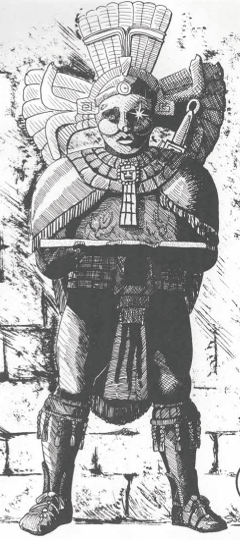 |
The eyes of the statue are polished obsidian worth 2 gp each. The klanth (longsword) is made of laminated wood inset with jagged teeth of obsidian. The weapon will come free easily, if any person pulls it up and out. However, to reach the klanth or the eye gems, a PC would have to climb up the statue and stand on the tray. If more than 100 lbs of weight or pressure are applied to the tray, the statue will overbalance and topple into the hall causing 4d6 damage to those caught under it (DC 15 reflex save to avoid). Once the statue has fallen, it will reveal a narrow passage hidden behind it, 4 ft above the floor.
Treasure: The weapon is a +1 aberration bane klanth (longsword).
10. Secret Passage
| Water beads collect upon the walls of this narrow passage and the flooring is cold and damp. A low ceiling, only 5 ft tall, further cramps this avenue and limits activity. |
11. The Court of Cemanahuac (Say-MAHN-ah-wok: Place Entirely Surrounded by Water) (EL 10)
As the PCs approach the doors
at either end of the chamber:
| The doors ahead are made of bronze and tinted blue with oxidation. |
Once inside area 11 proper:
| A short hall ending in steps down leads to the central chamber. This chamber is flooded with a brackish water. The pool covers the entire floor. A central hall, flanked by narrow aisles, is formed by two rows of massive square columns. The walls are coated with slime and there are vile glowing lines etched across them. From what can be seen of the chamber's walls, the stone appears to be crudely worked. Two corroded bronze braziers stand thigh deep in the brackish water. Towards the middle of the room two broken urns, apparently once about 4 ft tall, huddle in the water. In the darkness on the eastern wall appears to be a growth of some sort which gleams as vilely as the slime trails, burning with a greenish hue. |
Movement along the 2 ft deep section of water is at half speed. The fllor is slippery and PCs must make a DC 5 Balance check in order to move forward each round. Failure by 5 or more means the PC slips and falls.
The walls are heavily coated with lime. Any creature whose flesh comes in contact with this lime will take 1 point of acid damage per round. The lime must be removed from the skin to stop the damage and may be wiped off or washed away. If a PC's hand is exposed to the lime's effects for 4 consecutive rounds, the person so damaged will suffer a -2 penalty to attack rolls and -1 to damage for 1d4 days or until a heal spell or similar spell is used. If cloth or soft leather is used to protect the flesh from contact with the wet lime, the lime will soak through in 1d3-1 rounds. Leather armour will not be soaked, but will take a point of acid damage each round it is exposed. The lime cannot be removed from the stone, as it is a part of the stone. Salt may be used to neutralize the lime effect for 1d3x10 rounds.
The lime from the walls makes the water brackish and slightly acidic itself. Anyone standing or immersed in the water for 6 consecutive rounds will begin to take damage as above, except that all times above stated in rounds should be multiplied by 6.
Creatures: The phosphorescent glow on the eastern wall is actually Tecuziztecatl (TAY-koo-sez-tay-kah-tl: The Lord of Snails), a giant slug that can cling to walls or ceilings. The slug is intelligent. Normally it is not possible for vermin to be awakened, but the forbidden lore used by Tloques has allowed this to occur.
Tecuziztecatl is highly intelligent and quite the boaster. In ancient lore it was considered to be related to the moon, a fact of which it is quite proud.
|
TECUZIZTECATL CR 10 Malleable (Ex) A giant slug can squeeze its body through openings it normally could not pass through (up to Medium sized openings). Rubbery Hide (Ex) A giant slug's rubbery hide grants it immunity to critical hits. Spit Acid (Ex) Every 1d4 rounds, a giant slug can spit
acid at an opponent within 60 feet (no range increment). A successful
ranged touch attack is required to hit. If struck, a target takes
4d8 points of acid Vulnerability to Salt (Ex) A giant slug is highly susceptible to salt and takes 1d6 points of damage per round of salt it contacts. |
Tactics: During combat, the slug will detail, in Olman, what it has in store for the PCs and how hopeless their situation is. If it begins to lose the combat and is reduced to 1/4th hit points, the slug will either surrender and after bargaining agree to lead the PCs, or else it will flee and conceal itself in the moat.
Developments: If the PCs agree to be led, the slug will lead them to the moat and will stretch its body across the moat, making it appear to be solid ground. Those following the slug without taking precautions will plunge into the moat and must make the appropriate Swim check (see above). The slug will lead the PCs to the Tomb of Hurakan (area 12) and instruct them to open the door. Once the door is open, Tecuziztecatl will flee from the PCs and hide in the bottom of the moat.
If the PCs have found the amulet from area 11A, they can use it as a bargaining point with the giant slug, which will be only too happy to accept it in return for free passage to the Tomb of Hurakan (area 12). The slug will wear the amulet over one of its antenna.
11A. Alcoves (EL 2)
| Just inside the southern doorway to the left and right are two small alcoves. These small anterooms contain old fountains, cracked and crusted with a white chalky substance. The fountain on the east is drained and empty. There appears to be an amount of rubbish littering the floor. The fountain in the western alcove still holds some green scummy water, in which something moves. |
The anteroom to the west is empty but the fountain is fulled with algae and some bullfrogs are raising a brood of tadpoles in the water. Water beetles supply them with food. The water in this fountain comes from runoff from rain water that seeps through minute cracks in the Shrine structure.
Creatures: A swarm of rats dwells in the rubble of the eastern anteroom. These rats are quite hungry and will attack intruders en masse.
|
RAT SWARM CR 2 Distraction (Ex) Any living creature that begins its turn with a swarm in its square must succeed on a DC 12 Fortitude save or be nauseated for 1 round. The save DC is Constitution-based. |
Treasure: The eastern fountain has a small amulet lying beneath the caked lime at its bottom (DC 15 Search check). The amulet is made of brass and chrysoprase, wirth 65 gp, and belonged to the "Lord of Snails".
12. The Tomb of Hurakan (OOH-rah-kahn)
From passageway "a"
to the north:
| This passageway is slime-covered and a stream of water trickles away from the bronze door to the south. There is condensation on the walls, door, and ceiling, which drips to the ground. A quiet sound of dripping and splashing echoes in the corridor. This door is tightly sealed and appears to be warped outward or wedged shut. The door's hinges are mounted on this side. |
At each corner past which the PCs are washed, they can grab hold with a DC 15 Reflex save followed by a DC 15 Strength check to hold on. If a PC is washed all the way to the Courth of Cemanahuac (area 11), he will be swept into the moat and the initial Swim check will be at DC 15 due to the rushing water. Further checks in later rounds will be DC 10.
Any objects carried in the hands of PCs when the torrent is unleashed will be dropped unless a DC 15 Reflex save is made. Weapons and heavy objects will remain in the hall but lighter objects (like wands and scroll cases) will be swept into the moat of the court in area 11.
From passageway "b"
to the south and east:
| This hall is strewn with mud and flotsam. Water gathers in the center of the corridor and flows west to a closed door. The passage ends in a set of double doors on the north. The doors are heavy and bronze, each with a handle and keyhole. On the southern wall at the western end a stone block has shifted out of place. |
13. Child of Zotzilaha (Zohtz-ee-LAH-HAH) (EL 13)
Note: Zotzilaha is another name for Camazotz, bat-god of the underworld.
As the PCs approach the room's
doors from the outside:
| As you apprach the doors, a faint melodious voice can be heard singing. The voice seems female and sweet, but it is didficult to tell whether it is someone singing or the echoing of dripping water in a great cavern. |
| The room is lit by a strange soft light which illumines a section of sandy beach. Beyond the beach is a pool of phosphorescent water, fed by a stream from a southern corridor. On the far side of the pool is a set of doors. The apartment is floored with a while sand and broken rock and the walls are faceted with crystalized minerals. The light seems to flow from everywhere, the pool and walls glistening with a soft moonlight. |
Creatures: Bound to this chamber is a water element
succubus, which is interested in feeding on the energy of living
creatures, especially impressionable males. When first encountered,
the PCs will observe her as follows:
| Sitting on the beach in front of the crystalline pool is a beautiful nude woman. She is young and slim, with long golden hair and pale white skin. Her flesh seems to radiate a soft silvery light and her hair is a golden aureole. She is singing a strange melody in an unrecognizable language. After finishing her song, which ends a brief moment after you observe her, she slips into the water in a long arching dive. |
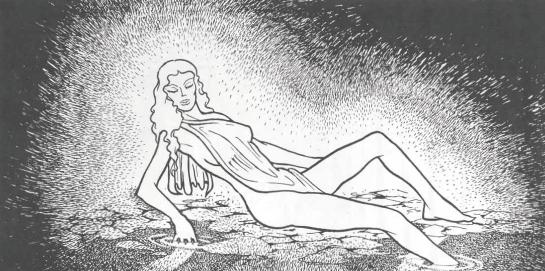 |
|
QUIHUEAKLAN (kee-WHEY-ah-klahn)
CR 12 Change Shape (Su) An succubus can assume the form of any Small or Medium humanoid. Control Water (Sp) Quihueaklan is intimately tied to her pool of water, and as such, can use her control water spell-like ability to control the waters of her pool in ways that the normal spell cannot match. She can make the waters heave in great waves, which will cause the water to be treated as rough water (DC 15 Swim check). Waves may be made to crash against the walls with such a roaring that those creatures who do not muffle their ears will be deafened for 3d8 rounds unless a DC 16 Fortitude check is made. Lastly, Quihueaklan may form watery shapes which may be no more than pleasant entertainment or may become a substantial defense. The latter takes the form of a watery serpent or fist which strikes with a 15 ft reach from anywhere in the pool with a +8 attack bonus and inflicts 1d4+6 points of bludgeoning damage when it hits. Quihueaklan can activate or deactivate the waves effect (and/or the deafening effect) as a move action. Once the waves are activated, they remain active without any sort of action on the part of the succubus. In addition, the watery serpent/fist can be formed or unformed as a move action and a target designated or changed as a move action. Once a target is designated, the serpent/fist will continue to attack that target until it is out of range. Energy Drain (Su) A succubus drains energy from a mortal it lures into some act of passion, or by simply planting a kiss on the victim. If the target is not willing to be kissed, the succubus must start a grapple, which provokes an attack of opportunity. The succubus’s kiss or embrace bestows one negative level. The kiss also has the effect of a suggestion spell, asking the victim to accept another kiss from the succubus. The victim must succeed on a DC 25 Will save to negate the effect of the suggestion. The DC is 25 for the Fortitude save to remove a negative level. These save DCs are Charisma-based. Summon Demon (Sp)* Once per day a succubus can attempt to summon 1 vrock with a 30% chance of success. This ability is the equivalent of a 3rd-level spell. Tongues (Su) A succubus has a permanent tongues ability (as the spell, caster level 12th). Succubi usually use verbal communication with mortals. * These abilities are not usable in the Shrine due to the presence of the forbiddance spell. ** While using her change shape ability, a succubus gains a +10 circumstance bonus on Disguise checks. |
| CHAC CR 7 Tome of Horrors 3.5 page 429 Advanced fiendish electric eel NE Huge magical beast (extraplanar) Init +3; Senses darkvision 60 ft, low-light vision, scent; Listen +6, Spot +6 Languages Abyssal AC 16, touch 11, flat-footed 13 hp 67 (9 HD); DR 5/magic Immune electricity Resist cold 10, fire 10; SR 14 Fort +9, Ref +9, Will +6 Spd swim 40 ft (8 squares) Melee bite +8 (2d6+6) Space 10 ft; Reach 5 ft Base Atk +6; Grp +18 Special Actions electricity Abilities Str 19, Dex 16, Con 16, Int 3, Wis 12, Cha 2 Feats Improved Natural Attack (bite), Iron Will, Weapon Finesse, Weapon Focus (bite) Skills Listen +6, Spot +6, Swim +17 Electricity (Ex) Once per hour, an electric eel can produce a jolt of electricity (about 800 volts at 1 ampere current) in a 10-foot radius centered on its body. Creatures within 5 feet take 3d8 points of electricity damage. Those further away than 5 feet but within 10 feet take 2d8 points of electricity damage. Affected creatures can make a DC 15 Fortitude save to reduce the damage by half. Electric eels are immune to their own electrical attacks and that of other electric eels. The save DC is Constitution-based. |
Tactics: When Quihueaklan enters her pool, she will change shape back into her natural form, which is that of a blue-green skinned succubus. She will then use her control water ability in preparation for combat.
Quihueaklan's primary interest is to seduce male victims and mate with them, preferrably in her pool of water, while they are drained of energy. To this end, she will use her suggestion and charm monster abilities to lure males into her pool and to kiss her. While she has a victim, she will use her ability to control the water of the pool to form a watery fist and will summon Chac in order to keep any allies of her victim from aiding him.
When summoning her pet Chac, the succubus will rise up out of the water in flight and call out Chac's name loudly. Then the waters will begin to heave and boil and the watery form of a man with an elephantine head, wearing an elaborate headdress and holding a trident will rise up out of the waters. The succubus is, of course, manipulating the water using her control water ability and Chac will rise near the surface and strike when the watery "god" levels its triedent at a foe.
Developments: Despite being thoroughly evil and hungering for life force, Quihueakaln will not fight to the death and will, if sorely pressed, offer to give up her hidden treasure if the PCs will allow her to live. She knows nothing of the Shrine outside of her room.
Treasure: At the deepest part of the pool is a grotto hidden behind a bed of kelp (Search DC 20). In this cave are 6 golden statues worth 85 gp each and a golden mask worth 170 gp. Also lying in the cache are two crystal scroll cases, worth 20 gp apiece, though water has destroyed the scrolls in them, jade bracers of armour +4, and a silver idol, value 17 gp, which is really a bottle holding (Search DC 20 to find the opening that can be unscrewed) a potion of remove curse (CL 5).
14. Flooded Hall
| Half of this corridor is flooded. The water is waist deep and cold. A set of stairs rise up out of the water on the eastern leg and the corridor ends in a set of bronze doors. |
15. The Great Hall
| This hallway is 20 ft wide and has piles of rubble and debris scattered along its length. The walls are covered with frescoes. The north wall depicts a nation of slaves questing for a new land; their trials of the journey include crossing treacherous mountains, eerie swamps, and raging rivers, and the guidance of the gods in their battles to keep their homeland free from invasions by the Scaled Ones. In the center of this wall is painted a pyramid with a temple atop it and the sun shining over the new land. The southern wall has scenes of a battle between red skinned natives and black skinned invaders. There are double bronze doors in the eastern end of this wall. Halfway down the hall is an archway carved with twining feather-winged serpents. Beyond it the corridor continues on into shadow. |
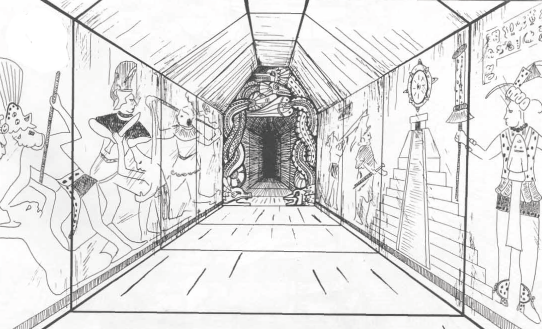 |
Actually, the end of the hall comes 5 ft west of the arch. The wall is a cleverly painted mural designed to give the illusion of depth and reality. If PCs attempt to go in this direction they will walk straight into the wall. To either side of the arch is a niche.
Traps: If a PC steps into either niche he will trip a pressure plate that releases a set of horizontal iron bars (hardness 10, 60 hp, break DC 25) closing off the archway and trappping the interloper.
Secret Doors: The painting of the sun conceals a secret door (Search DC 25) that is 8 ft above the level of the floor. The door may be opened by pressing on the sun. The door is 3 ft square. Opening this secret exit will also cause the bars (see Traps above) to retract and reset.
16. Secret Door
| This corridor ends in a bas relief of a spear and shield armed warrior. The shield rests on the floor and bears a peculiar pattenr, like a sundial, and Olman script. |
Secret Doors: Experimentation will show that the sundial marker, which leans to the right, will move. By pushing the indicator to the left, the shield will pivot and the exit will be open. From the south side, in the great hall, the secret door, which looks like the sun may be opened by pressing on the sun. The passage is 8 ft above the floor of the great hall. A DC 25 Search check will determine that the shield might be movable, but unless the sundial is manipulated, it will not open unless the wall is smashed through.
17. Hall of the Great Spirits
| This corridor is high and decorated with sculptures mounted on the walls. There are two corridors branching off from this main hall; a narrow one to the east, and another to the west. The statuary that adorns the walls consist of four sculpted heads of animals. Opposite the eastern passage is the stylized head of a coyote, while opposing the western hallway is the head of a grinning wolf, also stylized. Near the south edge of this hall is a head of a bull or ox mounted on the east wall. The last scultpure is at the north end of this corridor, on the west wall. Here is what appears to be the head of an eagle, with its beak open. Something shiny is located on the eagle's beak. The statuary is 6 ft above the floor and around 2.5-3 ft in size. |
 |
Traps: Wedged in the throat of the eagle's head is an intricately crafted, golden ring. To remove the ring a person must either reach into the mouth or attempt to push the ring out by another means. Disturbing the ring will cause the beak to snap shut. Whatever was inserted into the mouth will be pinned, and the hinge of the mechanism will jam. This hinge may be loosened with oil or the beak may be broken (hardness 8, 20 hp). Arms or hands caught in the beak will be bruised by blows to smash the beak, causing the victim to suffer a cumulative -1 penalty to attack rolls for each blow struck (whether it overcomes the hardness of the beak or not) to a maximum of -5. This penalty will last for 10 minutes per -1 of penalty, or until a heal spell or other similar curative magic (not simple cure spells) is used.
Treasure: The ring is a ring of the rock.
|
RING OF THE ROCK This ring is the size of a bracelet and is made of gold twisted and crumpled into a rock-like shape. The ring of the rock appears to have a value as a jewel of 1,250 gp when it is first crafted. When the ring is worn it gives the wearer the power of flesh to stone (DC 19) on touch. Each time this power is used, the value of the ring decreases by 200 gp as portions of the ring fade and turn into lead. If this power is used against stone creatures (including clay golems, stone giants, any creature of the [earth] subtype, or any creature with a statue spell cast on it), the power will fail and the wearer of the ring must save against the effect at a -2 penalty or turn to stone. After 3 such uses, the ring can no longer cast flesh to stone and instead gives the wearer the power to use stone shape on touch. Each use of this power decreases the value of the ring by 50 gp as the ring further fades and portions are replaced by lead. When the ring's value is reduced to 0 gp the ring becomes solid lead and worthless. Prerequisites: Forge Ring, flesh to stone, stone
shape. |
18. Hall of the Ancestors (EL
12)
| At the end of the corridor, deep in shadows, human figures appear to be floating in the air above the floor. |
 |
The figures floating in the air are actually withered corpses set upright on a ledge 2 ft above the floor on either wall of this passage like an ancient morgue.
Creatures: Once the lead PC reaches the midway point in this corridor, the 15 figures (which are actually banedeads) will attack. If they are attacked, or if their true nature is noted, or if a turn or rebuke attempt is made upon them, they will attack.
| BANEDEADS (15)
CR 4 Monsters of Faerun pages 16 and 54 Banedead Lurking Terror 1 LE Medium undead Init +4; Senses darkvision 60 ft; Listen +9, Spot +9 Languages Olman AC 16, touch 10, flat-footed 16 hp 46 (7 HD); DR 5/silver Fort +2, Ref +2, Will +8 Spd 30 ft (6 squares) Melee 2 claws +4 (1d4+1 plus 1 point of Dexterity damage) and bite +2 (1d6) Space 5 ft; Reach 5 ft Base Atk +3; Grp +4 Abilities Str 13, Dex 10, Con -, Int 10, Wis 12, Cha 15 SQ undead traits Feats Improved Initiative, Multiattack, Stealthy Skills Hide +10, Knowledge (religion) +3, Listen +9, Move Silently +10, Search +5, Spot +9 Dexterity Damage (Su) A banedead's claw, in addition to inflicting hit point damage, also deals 1 point of Dexterity damage on a successful hit. |
Tactics: The banedeads will fight with cunning and use teamwork whenever possible to flank opponents and the like. They will attack clerics in preference to other foes.
19. Silver Coffer (CR 1)
| At the end of the corridor is a small alcove holding a 3 ft tall stone pedestal on which rests a small silver coffer. This nook is reached by a step up and then a 15 ft walk to the hollow, the floor of which is raised 2 ft. |
 |
Traps: The floor of this nook is part of a trap. When more than 100 lbs of weight is placed on the raised floor of the alcove, it will sink and the trap will be closed in 1 round. This effect will not occur if the weight on the slab before the niche is greater than that in the alcove. As the floor sinks 2 ft, the 15 ft slab of the passage floor will begin to raise up like a drawbridge, sealing the room. Those in the alcove will notice the sinking, but by then it will be too late; those on the slab will roll down the sloping stone toward the alcove. The trapping slab is 1 ft thick.
| Entrapping Stone Slab Trap CR 1; mechanical; location trigger; repair reset; multiple targets (all targets in the alcove or on the slab); trapped in alcove (hardness 8, 90 hp, break DC 35), those on the slab may make a DC 15 Reflex save to leap clear as it rises; Search DC 22; Disable Device DC 22. |
Treasure: The box is unlocked, but is latched, so
the lid will not swing open unless the box is touched.
| Inside the silver coffer is a strange coppery figurine, narrow, with fins, somewhat fishlike. Written on the side of this figurine are strange runes. Etched near the slimmer end is a small arched square panel. |
The coffer is silver and weighs 15 lbs and is worth 100 gp due to its fine workmanship. The copper figurine is worth 50 gp and weighs 10 lbs. The floating statuette serves no real purpose and was merely a magical toy of the ancient Scaled Ones that was commendered by the minions of Tloques.
20. Spirit Guard of Ayocuan (AH-yo-kawn) (EL 13)
If the PCs approach from the south:
| A massive bronze door sits at the end of this hallway. |
| A bronze door sits at the end of this hallway. |
| This apartment is filled with rubble and broken, lifesize statuary. In ranks, half fallen, is an army of clay statues in what must have once been an impressive array. First there are spearmen, perhaps twenty of them, outfitted only in scraps of leather now. At their feet lay obsidian spearheads and bits of rotted wood shafts. Behind these are archers, in scattered formation. Few remain standing. Their arrows are nowhere to be found, but they hold laminated bows, dried and worm eaten. Further into the room are figures of men with war clubs and hand axes, wearing scraps of ochre-laquered leather, sandals, and caps. |
| Beyond all of the soldiers at the back of the chamber are a group of statues that must have been an honour guard. They are standing about a domed structure. These warriors wear feathered robes and headdresses and are armed with bitted bronze spears. Each of these figures wears a breastplate of threaded shells. The stuccoed dome has no apparent opening from your angle of view. |
| In an east wing of this room are three large, carved stone stelae and the remains of a sedan or litter with statues of attendants standing in harness. About a dozen clay women of court, bedecked in feathers and shell jewelry, stand in attendance. |
Behind the stelae is a bronze door barred shut with a pitted copper bar (unless the PCs have managed to open this door) so that it may not be opened from the outside.
The stuccoed dome is a carin. It is a weak construction and may be broken into fairly easily (hardness 6, 25 hp). Inside the cairn are six sets of bones each with a jade pectoral, and in the center of the floor is a bronze and chrysoprase lamp set into the stucco.
Creatures: Lifting the lamp in the cairn will open a hidden door in the floor, releasing Ayocuan from the compartment in which he has been trapped. The compartment is lead-lined and is so tight a fit for Ayocuan that he could not use his slam attack to smash out of it.
Ayoocuan was a favoured priest of Camazotz and the right hand of Tloques in life. When he died (prior to Tloques' duel with Okoth), Tloques conducted a ritual to transform him into an undead minion (a vilewight). However, the ritual went awry and Ayocuan became a slaughter wight, an undead so controlled by its own cravings that it cannot make a suitable minion for one such as Tloques. Rather than destroy the creature, however, he had it interred here, where it could not feed its inescpable craving. The wight is now literally mad with hunger and will ravenously attack living creatures to drain their life force.
Note: The effects of Ayocuan's amulet of desecration are not included in the below statistics. While operative, Ayocuan gains +1 on attack rolls, damage rolls, and saving throws. He does not gain hit points because he was not created in such an area. Turn attempts against him are made at a -3 penalty on the Charisma check to turn.
|
AYOCUAN CR 13 Create Spawn (Su) Any humanoid slain by a slaughter wight becomes a normal wight in 1d4 rounds. Spawn created by a slaughter wight are under its command and remain enslaved until their master's destruction. They have the statistics of normal wights (see Monster Manual page 255) and do not retain any of the abilities they had in life. Sometimes a newly created spawn becomes a slaughter wight instead of a mere wight though the wiles of the dark gods determine such instances (that is, the DM decides when this occurs). Energy Drain (Su) A living creature hit by a slaughter wight's slam attack gains one negative level. Removing the negative level requires a DC 29 Fortitude save. The save DC is Charisma-based. When a slaughter wight bestows a negative level on a victim, it gains 5 temporary hit points (10 on a critical hit). These temporary hit points last for up to 1 hour. Insescapable Craving (Ex) A slaughter wight has an inescapable craving (see the Undead Metabolism section in Chaper 1 of Libris Mortis) for life force, which it satisfies by using its energy drain attack. |
Treasure: Mixed throughout the broken clay and at the base of the statues are beads of coral and shells worth 1 cp each. There are a total of 4800 beads, each weighing 1/100th of a pound.
Inside the cairn are 6 jade bead pectorals, worth 43 gp each. The bronze and chrysoprase lamp set into the stucco of the cairn is worth 14 gp. In a dusty corner of the cairn (Search DC 10) is a silver and turquiose amulet of desecration.
|
AMULET OF DESECRATION This amulet is made of silver and turquoise and shaped like a bat with its wings enfolded around its body. The amulet of desecration emanates a continuous desecrate spell at all times. This effect cannot be supressed except by removing the amulet. While worn, the amulet glows a vile green. Prerequisites: Craft Wondrous Item, desecrate. |
21. Stone Block
| A large stone block obstructs the corridor here. It does not seem to have been a part of the original construction, for its composition is more sandy than those stones which make up the walls of these ruins. Furthermore, there are gaps to the sides and between the stone and the ceiling of an inch or more which indicate that it has not been set with the other stones. |
Alternatively, the block can be manhandled into the south or east corridors with a DC 40 Strength check (made in the same fashion as above). Each such check will move the block 5 ft. Of course, there are no consequences for failing this Strength check by 5 or more.
Of course, ingenious players might come up with other means to handle the block, such as braking it into place with some sort of sturdy wedging object. Alternatively, the block can simply be smashed apart (hardness 8, 1080 hp, break DC 65 [requires two such breaks to destroy]).
The block is basically 9 ft 10 inches square. This means that if it is heaved all the way up area 26 to the top, there will not be enough room for the PCs to continue north past area 26.
22. Chamber of the Nacehual (Nah-SAY-wahl: "The Achieved Ones") (EL 12)
All of the doors into this room
are made of heavy bronze.
|
All of the doors into this lozenge-shaped room are made of heavy bronze. There are entrances on the north, south, and east walls. In the middle of this long apartment are two stone divans, each with a human figure stretched out upon it. Between the divans is a low stone table holding a flask and two goblets made of crystal. There are two sideboards against the walls. The figures on the couches are a male and female human, each about middle aged and perfectly preserved. They are very still, dust covered, and apparently dead. Their bodies are covered with dry, crackling snakeskin. The female wears a silvery bracelet and holds what looks to be an ivory wand. The male has an amulet of bronze resting on his chest, inset with a red stone of considerable size. In the bottom of the crystal flask is a quantity of silvery dust. On the western wall are scribed colourful glyphs. |
Creatures: The two still figures are Cipactonal (SEE-pack-tone-ahl) the male and Oxomoco (Oaks-oh-MOE-koe) the female. They were a high captain and priestess of Camazotz (after Ayocuan had perished, see area 20) at the time of Tloques' death. Not wishing to live on without their master, and certain of his eventual resurrection, they elected to stay entombed in the shrine. However, they did not wish to be transformed into one of the undead, and so drank a potion of dreadful sleep, which put them in a form of temporal stasis. Their sleep can only be disturbed by the voice of Tloques (who does not know that these two are still alive and present in the Shrine) or if they are touched, attacked, or otherwise disturbed or if any of their possessions are touched or taken.
When awakened, they will stand and Oxomoco will say in Olman "You have broken our glorious sleep; for this you must repent." The two will then assume fighting stances. If they are not attacked, they will demand payment of 500 gp or one magic item of equal or greater value as forfeit. If the two are not paid or if the PCs attempt to harm them, they will attack. If they are paid, they will drink the last doses of the potion of dreadful sleep (see below) and resume their vigil. If questioned about the ruins, they know nothing to tell, save the message concerning the rain of fire, for their sleep has been long indeed and they were brought directly to this chamber after Tloques' death and immediately drank their potions. They are loyal to Tloques and, if their master has risen and they know this then they will attempt to join him and serve him again after these many years.
| CIPACTONAL CR
10 Male human Fighter 7/Divine Champion 3 Player's Guide to Faerun page 49 LE Medium humanoid (human) Init +3; Senses Listen +1, Spot +1 Languages Olman AC 16, touch 13, flat-footed 13 hp 75 (10 HD) Fort +10, Ref +6, Will +4; +1 vs divine spells or spell-like/supernatural abilities of outsiders Spd 30 ft (6 squares) Melee mwk double hammer +15/+10 (1d8+6/19-20) Melee mwk double hammer +13/+8 (1d8+5/19-20) and +13/+8 (1d8+3/19-20) Space 5 ft; Reach 5 ft Base Atk +10; Grp +13 Atk Options Power Attack Special Actions Awesome Smite (demolishing smite), Awesome Smite (overwhelming smite), Awesome Smite (seeking smite), Combat Reflexes, lay on hands (6 hp/day), smite infidel 1/day (+2 attack, +3 damage) Combat Gear masterwork double hammer (both ends), potion of cure serious wounds (CL 5), potion of shield of faith (CL 1) Abilities Str 17, Dex 17, Con 14, Int 10, Wis 12, Cha 13 Feats Awesome Smite, Combat Reflexes, Exotic Weapon Proficiency (double hammer), Improved Critical (double hammer), Improved Two-Weapon Fighting, Power Attack, Two-Weapon Fighting, Weapon Focus (double hammer), Weapon Specialization (double hammer) Skills Balance +10, Intimidate +10, Jump +10, Knowledge (religion) +2, Tumble +12 Possessions Combat gear plus masterwork studded leather armour, amulet of bronze and garnet (100 gp), masterwork potion belt |
| OXOMOCO CR 10 Female human Cleric (Camazotz) 10 LE Medium humanoid (human) Init +1; Senses Listen +7, Spot +9 Aura strong evil Languages Olman, Infernal AC 14, touch 11, flat-footed 13 hp 55 (10 HD) Fort +6, Ref +3, Will +8 Spd 30 ft (6 squares) Melee mwk heavy mace +9/+4 (1d8+1) Space 5 ft; Reach 5 ft Base Atk +7; Grp +8 Special Actions rebuke undead (5/day, +2 syngery bonus), Sudden Silent, Sudden Still Combat Gear masterwork obsidian heavy mace, potion of cure serious wounds (2) Cleric Spells Prepared (CL 10, melee touch +8, ranged touch +8): 5th - flame strike (DC 18), skull eyes (DC 18), slay living(d) (DC 18) 4th - armour of darkness(d), freedom of movement, revenance, sound lance (DC 17) 3rd - blacklight(d) (DC 16), cure serious wounds, dispel magic, divine retaliation, prayer 2nd - blindness/deafness(d) (DC 15), cure moderate wounds, elation, hold person (DC 15), investiture of the spined devil, resist energy 1st - bless, cure light wounds (2), impede (DC 14), obscuring mist(d), protection from good 0 - create water, cure minor wounds (2), detect magic, detect poison, read magic Domains: Darkness (Blind-Fight bonus feat), Death (death touch 1/day melee touch attack 10d6 against hp and if exceeded target dies [no save]), Undeath (Extra Turning bonus feat) Abilities Str 12, Dex 13, Con 13, Int 14, Wis 17, Cha 15 SQ spontaneous inflict Feats Blind-Fight, Combat Casting, Divine Vigour, Extra Turning, Steady Concentration, Sudden Silent, Sudden Still Skills Concentration +14, Heal +9, Knowledge (religion) +8, Listen +7, Spellcraft +10, Spot +9, Tumble +7 Possessions Combat gear plus masterwork studded leather armour, masterwork potion belt, obsidian unholy symbol to Camazotz, spell component pouch, ivory folded fan worth 62 gp (the "wand" described above), silver bracelet worth 230 gp |
Tactics: Oxomoco will cast her armour of darkness spell and Divine Vigour if possible while trying to stay out of melee. If necessary she will use her blacklight or obscuring mist spells to give her time to do this. Once that is done, she will use her ranged spells to support Cipactonal (such as hold person, impede, sound lance, flame strike or investiture of the spined devil). If forced into melee, she will cast her skull eyes spell and then use slay living and divine retaliation. Should Cipactonal fall, she will revive him with her revenance spell.
Cipactonal will use his Awesome Smite feat against the most formidable foe, then trusting in his martial prowess in an effort to keep foes away from Oxomoco.
Developments: If the two are awakened from their stupor a second time they will be extremely angry, as they have no more doses left of the potion. Instead, they will fight to the death and, if combat is broken off, they will begin to explore the shrine, possibly, at the option of the DM, finding and freeing Tloques from his prison. The two would then begin to serve Tloques once again.
Treasure: The powder in the flask contains the dried remnants of two doses of potion of dreadful sleep. If mixed with a liquid, the poweder will regain its potency.
|
POTION OF DREADFUL SLEEP This silvery liquid seems to swirl of its own accord and gazing into it seems to be as if staring into a bottomless void. This liquid places the drinker and his equipment into a temporal stasis. If the drinker thinks of a circumstance that can awaken him while he imbibes the potion, then he can set a single condition for waking. This circumstances can be a certain amount of time or an event that occurs within his sight or hearing. Otherwise, he will awaken if he is attacked, touched, jostled or his possessions are touched or taken. This potion can be administered involuntarily, but it has a unique look, taste, smell, and consistency such that it is very difficult to conceal in food or drink. It cannot be administered on a weapon. If imbibed involuntarily, the drinker gains a DC 20 Fortitude save to resist the effects. The duration of the stasis can be no longer than 5000 years. After such time the imbiber will automatically awaken. If a neutralize poison spell is cast upon a person in stasis, he will awaken instantly. Prerequisites: Craft Wondrous Item, temporal stasis
or miracle. |
23. Triangular Pillar
No matter from which direction
the PCs approach, they will see the below. If coming from the
north, they will see this only after having finished with area
24 and moved south towards area 23. If coming from the south,
they will see this when entering the hall from the west and looking
from the pile of rubble at the south end of the small north and
south hall between here and area 17.
| Ahead of you in the corridor, a faint flickering cold light becomes visible. The light is moving down the hallway away from you and sputters and wavers just out of your perception. |
The xeg-yi will quickly fly around the corner if spotted south of area 23 and the PCs will observe it slip through the pillar at area 23 and, as they get past that, see it fly up the hallway past area 24 and around the corner towards area 25.
The xeg-yi will quickly south past the wide end of the pillar at area 23 if observed from the north and will next be observed turning west down the hallway south of area 23 towards area 17 and will then lead the PCs to area 19.
|
XEG-YI CR 5 Negative Energy Lash (Su) A xeg-yi can make a ranged touch attack or hit with an incorporeal touch attack to infuse a target with negative energy. This deals an additional 2d8+5 points of damage to a living target but heals an undead creature by the same amount. A xeg-yi can control its negative energy enough to avoid healing an undead for (dealing only the base damage). This power can be used up to five times per day. Negative Energy Ray (Ex) A xeg-yi's negative energy ray has a range of 30 ft. Rebuke Undead (Su) A xeg-yi can flood a 60 ft radius area with negative energy, making undead creatures cower in fear. It rebukes undead as a 5th-level cleric, doing so up to five times per day. It cannot command undead. |
Tactics: If attacked the energon will attempt to flee, into the walls, floor, or ceiling if necessary. If somehow cornered, it will fight to the best of its ability.
Developments: Once the xeg-yi has lured the PCs into area 24 or 19, it will then return to area 23 and bide its time.
If area 23 is approached from
the south:
| Approaching from the south, you encounter a pit obstructing your path, and beyond this a triangular block or pillar fills the corridor's end. The triangular pillar's apex points towards the pit and the passage does not appear to continue on, though the light source that has been preceding you is not to be seen. |
| The pit is about 10 ft deep and contains several human skeletons. Scratches on the floor and ceiling scribe short arcs to either side of the pillar. |
The pillar may be pivoted to either the left or right with a DC 15 Strength check, which will open a narrow passage 1.5 ft wide. A Medium sized creature may just slip through (DC 15 Escape Artist check). A Large creature must make a DC 30 Escape Artist check to wriggle through. A small or smaller creature can pass with no problem, and a creature larger than Large has no chance to slip through.
If area 23 is approached from
the north:
| Walking down the corridor from the north, the hallway abruptly ends at a blank stone wall. |
24. Sandbox (EL 3)
There is nothing to distinguish
this stretch of hallway from the rest until the PCs walk halfway
down the passage.
| As you walk down this narrow passage you hear a click and then a crash as a copper-bound door comes roaring down in front of you, blocking the way. To the rear another door crashes down. |
| After a moment of silence, you hear the sound of stone slowly grating on stone. Rows of 8 slots open near the ceiling in both walls. Some dust trickles down from each. |
| All at once there comes a cracking and rushing sound and golden sand starts to pour rapidly through the holes. The floor is swiftly covered by the sand. A globe of cold light slips into the chamber through the southern door and moves to hover near the ceiling twinkling cheerfully. |
Up to two PCs can attack a single door. Once the sand begins to flow, the door, if lifted, will not close again completely as sand will flow beneath it and wedge it open.
As the sand fills the room, there are various effects on the PCs:
| Round |
|
| 1-3 | PCs must check each round to see if they slip. A DC 5 Balance check is required and if the check is failed, no action can be taken that round. If the check is failed by 5 or more the character skips and falls. In addition, each PC must make a DC 10 Fortitude save each round or choke on the dust in the air (treat as nauseated) until their next turn. Concentration checks are DC 10. |
| 4-5 | One PC must scoop sand away from a door in order for other PCs to attempt to lift it. PCs can still attack the doors without scooping away sand. All movement is halved in the hallway and all blows are at -1 attack and damage. Concentration checks are DC 10. |
| 6-7 | One PC must scoop sand away from a door in order for other PCs to lift or attack it. All blows are at -2 attack and damage. All PCs must make a DC 15 Reflex save or become trapped in the sand and unable to move or perform actions requiring movement such as somatic components. Once trapped, another DC 15 Reflex save must be made each turn to break free. Breaking free is a standard action. Concentration checks are DC 15 (DC 20 if entrapped). |
| 8-9 | One PC must scoop sand away from a door in order for other PCs to lift or attack it. All blows are at -3 attack and damage. PCs must save against being trapped as above, but once entrapped they may not free themselves. Concentration checks are DC 15 (DC 20 if entrapped). |
| 10 | All PCs are entrapped and can take no actions requiring physical movement. They must now hold their breaths to avoid drowning. Concentration checks are DC 20. |
Casting spells or performing other such actions requiring concentration will require a Concentration check as enumerated in the table above.
Saves for entrapment can be mitigated if the PCs take specific actions to prevent themselves from becoming stuck, such as distributing their weight evenly on the sand to prevent sinking.
Traps: The entire room is a trap as described above.
| Sand Trap CR 3; mechanical; location trigger; repair reset; multiple targets (all targets in 7.5 ft by 25 ft hallway); never miss, onset delay (6 rounds); sand; Search DC 17; Disable Device DC 23. |
25. The Nest of the Warriors
(EL 7)
| A bitter reek assails the senses as this door is opened. Inside, amid a pile of rubbish, offal, and bracken ghostly lanterns move about the floor. Closer observation resolves the lanterns into beetles. There seem to be around a dozen of these beetles in the room, each about 3 ft in length. They do not appear to take notice of you. From the largest pile of trash, where the majority of the beetles are, come glints of something shiny. |
These beetles will be basically non-aggressive unless their nest is threatened. Any sudden noise will bring a beetle or two to investigate. They will examine strange objects they encounter with their feelers and if it is edible they will bite it. Other beetles will cluster to the sound of their comrades fighting.
PCs may attempt to Move Silently across the room against the beetles' Listen check, and if a suitable diversion is created the PCs may gain a +5 circumstance bonus to their Move Silently checks.
| ADVANCED BLIND
FIRE BEETLES (13) CR 1 N Small vermin Init +0; Senses blindsense 60 ft (based on Listen checks); Listen +0, Spot +0 AC 16, touch 11, flat-footed 16 hp 12 (3 HD) Fort +3, Ref +1, Will +1 Spd 30 ft (6 squares) Melee bite +3 (2d4) Space 5 ft; Reach 5 ft Base Atk +2; Grp -2 Abilities Str 10, Dex 11, Con 11, Int -, Wis 10, Cha 7 Blindsense (Ex) These beetles use their hearing to "see". Silent creatures are effectively invisisble to them, and a silence spell is the equivalent of pitch black darkness. A blindness effect has no effect on these beetles, nor does any effect relating to sight. However, a deafness effect effectively blinds them. |
Treasure: The shiny objects in the nest are odd pieces of metal polished rocks, broken crystal, 3 turquoise worth 50 gp each, and a masterwork obsidian dagger. The latter two items require a DC 20 Search check through the rubbish.
The First Tier:
Note: North is towards the top of this map. Each square is 5 ft.
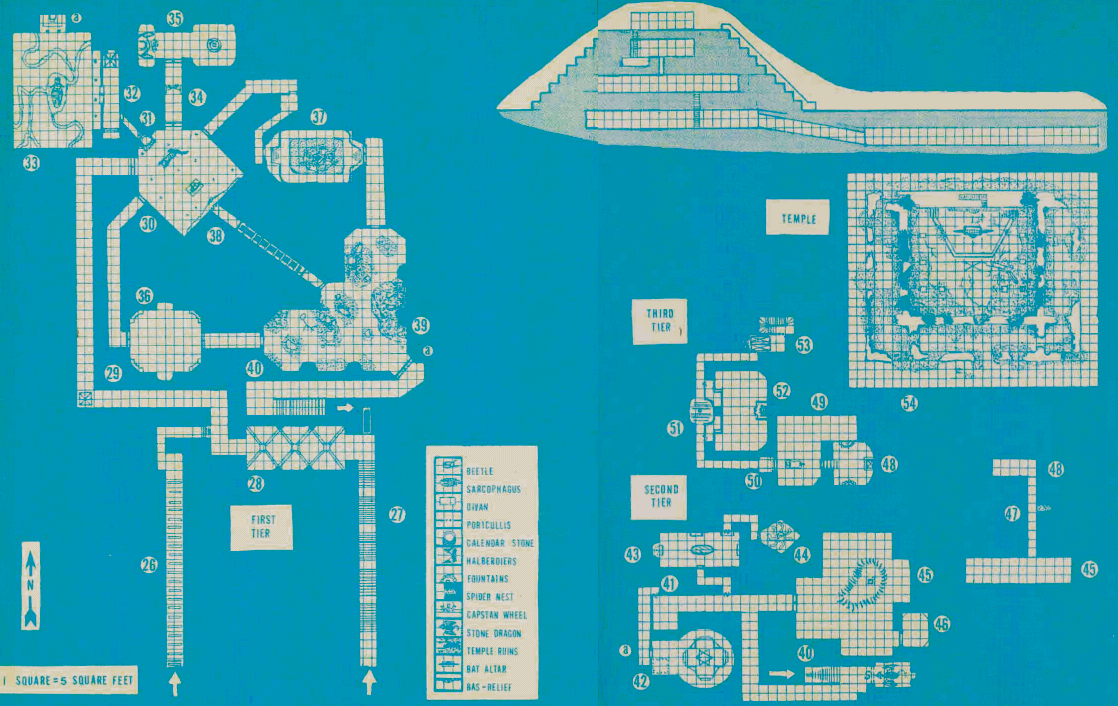 |
26. Ramp
Here is a ramp sloping down from the north to the south. Set in the floor at 2 ft intervals are stone cylinders that appear to be some sort of roller.
27. Stairs (EL 3)
Traps: In the middle of this flight of stairs is a pressure plate that releases a millstone concealed in the wall at the top of these steps, to send it rolling down the stairs. To dodge the millstone, a DC 15 Reflex save must be made. If a PC has been hugging the walls (announced before the trap is sprung), then he gains a +2 circumstance bonus on his Reflex save.
If the save is failed, victims will suffer 4d8 points of damage and any items held in their hands will be knocked away 50% of the time. Items knocked out of hand will bounce to the bottom of the stairs.
The millstone will crash into the doors of area 25, breaking them open. From that room will come 2d6 beetles looking for a fight.
| Millstone Trap CR 3; mechanical; location trigger; repair reset; 4d8 damage and 50% lose held items (DC 15 Reflex save avoids); multiple targets (all targets in the stairway); Search DC 20; Disable Device DC 24. |
28. The Arc of Nanahuatcin
(Nah-nah-WAH-tseen: The "Pimply One") (EL 11)
| Here is a spacious vaulted hallway, much weathered and cracked from the wages of time. The walls are charred and scored. About the floor are several stone statues of monkey-like creatures, chipped and tipped over. The remains of a few once living "monkeys", partially eaten, lie nearby, fungus covering their mouldering corpses. |
| It can be discerned that this was once a processional hall. Little remains to identify its past purpose except a carving of a silver sun with a single eye etched in the worn floor. |
 |
When the PCs can view the eastern
end of the vaulted hallway:
| Ahead, something spherical floats in the air at about chest height. The spheroid has a central eye and a number of tentacles growing out of its top; each growth bears a white sphere with a black pupil at its tip. |
|
LARGE FIENDISH BLACK HALF-DRAGON
ADVANCED SPECTATOR CR 11 Eye Rays (Su) Each of a spectator’s four small eyes can produce a magical ray once per round as a free action. During a single round, it can aim only one eye ray at targets in any one 90-degree arc (up, forward, backward, left, right, or down). Each ray has a range of 60 feet and a save DC of 19 (caster level 6th). The save DCs are Charisma-based. The four eye rays include: Fatigue: The target must make a Fortitude save or become fatigued. A fatigued creature that fails to save against this effect becomes exhausted. Inflict Moderate Wounds: This ray works like the spell, causing 2d8+6 points of damage (Will half). Hold Monster: The target must succeed on a Will save or be affected as though by the spell. Telepathy: A spectator can communicate telepathically with its target for the round. As a free action, a spectator can make a suggestion (as the spell; Will negates) to any creature it is currently telepathically speaking to. Flight (Ex) A spectator’s body is naturally buoyant. This buoyancy allows it to fly at a speed of 20 feet. This buoyancy also grants it a permanent feather fall effect (as the spell) with personal range. Planar Fast Healing (Ex) While on its home plane, a spectator has fast healing 3. Spell Turning (Su) A spectator’s central eye produces a 90-foot cone that reflects any spell cast upon it by a creature within the cone back upon its source. This functions just like spell turning (caster level 6th). Up to one spell can be reflected per round. * This ability will not function inside the Shrine as long as the forbiddance is operative. |
Note: Although technically spectators cannot be size Large due to HD advancement, this particular spectator was enlarged by Tloques as a result of his experiments and rituals.
Tactics: The spectator will aggressively defend its charge, preventing intruders from passing through this hall and into area 27. It will pursue foes down the stairway, although it knows about the millstone trap in the stairway and will wait for the PCs to trigger it before venturing into the hallway, instead using its ranged attacks to harrass PCs on the stairs.
Although thoroughly evil due to its dual natures, something of its spectator nature still reigns, and as long as the PCs do not enter the easternmost third of the hallway or threaten it, the spectator, quite bored and lonely these many years, will be glad to speak with the PCs. It doesn't have much to say, as it has not left this hallway in centuries, though it can be made to reveal that there are stairs to the east that head downward and that this is what it was called to guard. While the spectator would like to return home, it will not shirk its sworn duty.
Treasure: Near the eastern end of the hallway is a sack made of fish skin containing 7 silver pellets about the size of slign bullets worth about 10 sp each. These can be used as silver sling bullets, doing the same damage as a normal bullet with a -1 penalty to damage due to the softness of the silver.
29. The Tomb of Pelota
| Approaching a bend in the passage faint line drawings may be discerned on the walls depicting men playing a game with a ball and stone goals. Also illustrated is the death of some of the players by priestly knife. Where the corridor bends there is a captstone in the floor, filling the corner for 10 square feet. The stone is grey and dust covered. Above this capstone in the southern wall is a 1 ft diameter niche, 5 ft above the floor and hemispherical in shape. |
Opening the slab requires the application of leverage and a DC 25 Strength check. Up to two people can combine their checks, and if the lever(s) are long enough up to two more can add +2 to a check with a DC 10 Strength check. Beneath the stone covering is a 10 ft square and 5 ft deep pit filled with the skeletal remains of the losers of the game of pelota.
Atop the bones rests a glistening black ball, about a foot in diameter, and several figurings and a plaque of jade.
The ball was used in the game pelota and is made of rubber wound around a balsa core. The jade figurines represent flowers and the plaque depicts two men, with padding on their arms and hips, bouncing a ball between them. There are other jade figurines depicting bare-breasted women and a sun-god in a feathered robe.
Treasure: There are 7 jade figurines in all, each worth 10 gp. Buried beneath the skeletons (Search DC 15) is a chalice of beaten gold inset with 6 amethysts worth 120 gp and weighing 1.2 pounds.
A curse has been laid upon the items in this pit, and if any are removed, the bearer(s) of the item(s) will be cursed in 1d6+4 rounds. At that time a DC 20 Will save must be made or the victim will be blinded as if from a blindness/deafness spell (caster level 12th).
If the ball is touched:
| The ball is cool to the touch and made of some resilient black material. |
| As the ball is picked up, it suddenly jerks free and rebounds from the south wall into the hallway. |
The ball will take no damage from blows struck by it or other attacks against it, but will bounce off of the south wall of the hallway when struck by the PCs. The ball has an AC of 17 (including a touch and flat-footed AC of 17). Each time this happens it will cause the circular nook to glow orange briefly.
After the ball has bounced off the southern goal twice from blows struck by the PCs and the goal has lit up twice, the ball will break off the attack and the game will begin.
The purpose of this game is for the PCs to hit or kick the ball into the goal above the pit on the southern wall while preventing the ball from reaching its goal at the northern end of the hall. The south goal is the PCs' goal and the north goal, 140 ft down the corridor, is the ball's goal. When the game begins, both goals will be lit by orange rings of light around their lip. The ball will move first (it always has an initiative roll 1 more than the highest initiative amongst the PCs), and then the PCs may act in their initiative order to run up to the ball and strike it.
The ball moves in increments of 5 ft. It will move 2d4 increments each round (i.e. 10-40 ft per round). If the ball is ignored it will only move 1d4 increments and the distant sound of a drum dirge will be faintly heard. The ball may bounce off any PCs in the way, inflicting damage as above. The ball will bounce off of walls to stay out of the pit. The ball may bounce itself into its own goal 50% of the time if within the last 5 ft of the corridor. If it fails to do so it can try again in its next turn.
The PCs have a chance to hit the ball if they pursue it. a successful attack against AC 17 will send the ball south 15 ft per blow. If a PC tries to grab hold of th eball, it will strike him and free itself. When within 5 ft of the opened put a PC must check to see if he slips and falls into the pit (DC 10 Reflex save). Any PC who falls into the pit will not be able to strike a blow against the ball for 2 rounds. In order to known the ball into the PCs' goal, a PC must state he is attempting to do so, strike the ball to send it towards the goal, and then make an attack roll against AC 19 to hit the goal.
Once the ball is knocked into a goal, it will stick there and be impossible to remove without destroying the ball.
If the ball scores its own goal, 6 magic missiles will hit each PC (each doing 1d4+1 points of damage, caster level 12th).
If the PCs score a goal, there will be the sound of triumphant drums and then silence. The goal at the northern end of the corridor will continue to glow orange. If the PCs investigate, they will find that a cubicle has opened at the back of this goal.
Treasure: Within the cubicle is a fish skin pouch. The pouch contains 13 pink pearls worth 15 gp each, a topaz and shell necklace worth 47 gp, and a whistle made of an eagle's bone with feather decoration. This whistle is a whistle of the eagle.
|
WHISTLE OF THE EAGLE This whistle is made of an eagle's bone with feather decoration. This whistle will give the power of short bursts of flight at a speed of 60 ft (average) for as long as the whistle is blown. The whistle may be blown 3/day and the maximum length of each use is 3 rounds. Of course, blowing the whistle makes a loud shrill sound that can be heard from a distance. The whistle will operate even in an area that has been magically silenced. Prerequisites: Craft Wondrous Item, fly. |
30. Guardian Beast (EL 12)
Area 31 may also be visible when
the PCs enter this room, and if so its description should also
be given to the players by the DM.
|
This room is decorated in a cat motif. The entire southeastern wall is carved to resemble the snarling face of a hollow-eyed leopard. In the center of the room is a stuffed leopard, posed as if on the prowl. The left ear has been torn off in a jagged pattern. Also in the middle of the room stands a statue of a jaguar-headed man of dark complexion holding a spear. Placed about the room in varying poses are several stuffed domestic cats. These house cats are represented sitting, stalking, pouncing, and one is begging, pawing the air. One of these cats in the center of the room has been knocked over and chewed on; its stuffing is falling out. On the walls are several lion and leopard skins, jaguar heads, and a cat-o-nine-tails. In the northwest corner of this chamber a large calendar of stone is mounted on the wall over a stone table or altar. The statue of the cat-man is carved of stone and depicts a tall man with two extra sets of nipples. He seems to be wearing a leopard-faced mask and is clad only in a loin clout. Across the left side of his chest is a jagged scar and his chest is sunken and bony. The spear is stone hafted but bears a silvery spearhead. |
 |
All of the items hanging on the wall, skins, heads, and others are actually realistically painted stucco sculptures.
Creatures: The statue is a werejaguar (i.e. weretiger) with a permanent statue spell effect on him from a ritual performed by Tloques and his minions. To all observation, this werejaguar appears to be made of stone, but he can see, feel, and hear all that takes place about him. If the altar is molested or the room's contents abused the werejaguar will seize the first opportunity when the PCs' backs are turned to attack with surprise. He can become flesh as a swift action and will then transform into his tiger shape, dropping his spear. His first choice of targets will always be the weakest of the PCs. If the werejaguar is reduced to 4 or fewer hit points, or if he is killed, he will revert to his human form and his flesh will harden and become stone again.
The werejaguar's heart has been removed by magical surgery and is hidden in the head of the stuffed leopard (note the similar scars on the man and leopard). The werejaguar may take damage and even "die", but unless his heart is destroyed he will be reborn again whole in one day's time. He has been placed here to eternally guard the gateway (see below).
If the lycanthrope's heart is destroyed (AC 10, 2 hit points), the creature will instantly die and his flesh turn to dust. This figure should be treated as a stone creature for purposes of the ring of the rock (area 17).
|
WEREJAGUAR WARRIOR, HUMAN
FORM CR 12 Jaguar Empathy (Ex) Communicate with jaguars and dire jaguars, and +4 racial bonus on Charisma-based checks against jaguars and dire jaguars. |
|
WEREJAGUAR WARRIOR, JAGUAR
FORM CR 12 Curse of Lycanthropy (Su) Any humanoid or giant hit by a weretiger’s bite attack in animal or hybrid form must succeed on a DC 15 Fortitude save or contract lycanthropy. Improved Grab (Ex) To use this ability, a weretiger in tiger form must hit with a claw or bite attack. It can then attempt to start a grapple as a free action without provoking an attack of opportunity. If it wins the grapple check, it establishes a hold and can rake. Jaguar Empathy (Ex) Communicate with jaguars and dire jaguars, and +4 racial bonus on Charisma-based checks against jaguars and dire jaguars. Pounce (Ex) If a weretiger in tiger form charges an opponent, it can make a full attack, including two rake attacks. Rake (Ex) Attack bonus +17 melee, damage 1d8+4. *In areas of tall grass or heavy undergrowth, the Hide bonus improves to +12 in the jaguar form. |
|
WEREJAGUAR WARRIOR, HYBRID
FORM CR 12 Curse of Lycanthropy (Su) Any humanoid or giant hit by a weretiger’s bite attack in animal or hybrid form must succeed on a DC 15 Fortitude save or contract lycanthropy. Jaguar Empathy (Ex) Communicate with jaguars and dire jaguars, and +4 racial bonus on Charisma-based checks against jaguars and dire jaguars. |
Secret Doors: A secret door is concealed in the mouth of the wall carving (Search DC 25); the catch to open it is hidden in the hollow of the right eye (Search DC 25).
Treasure: In the belly of the stuffed leopard are 1050 gp of Olman mint.
31. Calendar Stone
| Here is an Olman calendar, a great wheel of stone carved from limestone. In the center of the calendar is a symbol of the sun surrounded with various sigils depicting seasons of the year. The stone is 10 ft across and is mounted 5 ft above the floor over a stone altar. On the altar rests a ceremonial dagger of flint and the jade statue of a cat. At the foot of the altar is a stuffed cat, posed as if begging or attempting to catch something in the air. |
 |
Secret Doors: The calendar stone covers a secret passage to a hidden tomb (Search DC 25). In order to open this massive door, the sun symbol must be struck two or more times. The calendar stone will then swing to one side on a huge set of hinges.
Treasure: The dagger on the table is a sacrificial knife, a +1 flint lycanthrope bane dagger (treat as a normal bane weapon but it only affects creatures with the lycanthrope template). The jade statue of a cat is worth 200 gp and weighs 4.5 lbs.
In the tail of the stuffed cat is a divine scroll of magic circle against felines (CL 5). This is a special ancient Olman spell that has since been lost from time. It cannot be prayed for by clerics, although one could research the spell as a domain spell in the Animal, or Beastmaster domains given enough time and ritual. The spell is a 3rd level cleric spell and operates exactly like a magic circle against evil spell except that it only functions against felines of any alignment. Felines, includes cats, lions, tigers, leopards, cheetahs, jaguars, and any other creature that appears to be feline or have feline origins, including humanoid-type cat creatures.
32. The Portal to Death (EL
2)
| Behind the calendar stone is a long, narrow, unused tunnel, cylindircal in shape. The passage is barely 4 ft in diameter and the walls are carved with a profusion of ancient and weird glyphs.The floor of the tunnel is slick with a molten, glassy glaze. The passage slants down and away from its concealed entrance. |
When the PCs reach the end of
the passage:
| The narrow passage opens out 2 ft above the floor of a corridor running north and south. Three sets of bronze double doors are visible which open off this hall, one at either end of the hallway and one at midpoint across the corridor. In from of this central set of doors the floor is sunk and glazed. This door is sealed with a one foot diameter golden seal. |
| The door to the north is barred and the figure of a gorilla holding a black, vitreous disk of obsidian is set in its face. The lintel of the door is carved to resemble entwined serpents. |
The arms attack as a single entity with a 5 ft reach, attempting a grapple and a pin check in the same attack. The trap's grapple check is +18 and if a grapple is successful another grapple check may be made immediately to pin the victim.
If a person is grappled but not pinned, then that victim operates under all of the normal grapple restrictions, remaining in that square until freed.
If a person is pinned, then he operates just as if pinned by an opponent except that the arms hold him so tightly and securely that he cannot attempt a grapple check to escape the pin. An Escape Artist check may be made, but at a -4 penalty if the victim is wearing a backpack. If the straps on such items are slit open the penalty can be alleviated, but this will render the items non-functional until repairs.
Those not caught in the trap may attempt to aid those caught within in their grapple checks or Escape Artist checks. Up to four individuals may do so, and a DC 10 check of the appropriate type is necessary in order to grant a +2 bonus to the victim's check. A person can only aid one individual at a time.
Those not caught may also attempt to manhandle the arms open. Each arm requires a DC 30 Strength check and up to two Medium creatures can make the attempt at a time, combining their Strength scores. Up to two other Medium creatures can attempt to assist the check(s) by making a DC 10 Strength check to add +2 to one of the checks. Each of the 3 arms must be pried open separately. Only two Medium creatures can make attempts each round, even if working on seperate arms and only two Medium creatures can attempt to assist even if assisting separate arm attempts.
One round after the arms are sprung, the cover to a 10 ft square pit will start to drop open. The pit is 40 ft deep and lined with spikes. The cover will have fully opened in 2 rounds, at which point the bands will swiftly spring away, releasing the victims to plummet into the pit. If a victim is only grappled and not pinned, then he can attempt a DC 20 Reflex save to grab onto the side and avoid the pit. Pinned victims have no such chance.
Those who fall into the pit will take 4d6 points of damage. The spikes are hard rubber wrapped around balsa wood, placed only for artistic effect.
| Pit Trap CR 2; mechanical; location trigger; manual reset; DC 20 Reflex save or grapple check may avoid (see above); grapple and 40 ft deep (4d6, fall); multiple targets (all targets grappled or pinned); Search DC 20; Disable Device DC 20. |
The doors to the south:
| The door to the south has a groove worn into the floor marking a path cut by the passage of countless feet of the past. Upon the bronze doors is a symbol of two circles joined (the symbol of infinity). |
The sign of infinity is the symbol of an entity of ancient Olman tradition (now long abandoned by the Azotchtla) known as the dual-god, the supreme god, the god of creation.
The door is wedged shut and opening it requires a DC 25 Strength check (up to two Medium creatures may combine their checks, and up to two more Medium creatures may each make a DC 10 Strength check to add +2 to one of the checks). When the door finally bashes open it will swing open suddenly, dumping the gatecrasher into a 5 ft deep cubicle. This area once acted as a one-way teleport into the great hall #15, through the painted mural of the continuing corridor, and it still radiates strong conjuration magic, but will not function as long as the forbiddance is active.
The doors in the middle:
| The glazed stone in front of the middle doors is melted to form the imprint of two monstrous taloned, four-toed claws. To either side on the lintel of the door are barely discernible scratches, and brown stains stipple the wall and floor. To open this door, it appears that the golden seal must be broken. A final warning, depicting a creature of flame and death, and ancient glyphs are scribed on the seal. |
Traps: When the doors are pushed open, five crossbows, set in the ceiling of the room, will automatically fire. Two are aimed towards each wing of the door and the last is aimed down the center. If a PCs is opening the door without specifically stating he is standing to one side or the other, then he will be subject to all 5 bolts. If two PCs are both present then each will be hit by 2 bolts and the last bolt will attack one of the two determined randomly. If a PC has taken precautions to be off to the side, then he will be subject to only two bolts and, at the DM's discretion, may have cover (+4 to AC).
| Crossbow Trap CR 6; mechanical; location trigger; manual reset; Atk +19 (x5) (1d8+1, crossbow bolt); multiple targets (in front of the door); poison (Huge scorpion venom, DC 18 Fortitude save resists, 1d6 Con/1d6 Con); Search DC 21; Disable Device DC 22. |
Treasure: The golden seal is worth 270 gp (even if broken).
33. Ancient Tamoachan: The Tomb of Tlacaelel (Tah-MOH-ah-chan "The Home Sought After"; Tlah-kah-AYL-ayl) (EL 10)
Note: There is ancient magic associated with this chamber that has kept much of the items in this chamber preserved over the ages. This is why many of the liquids and perishable items within are still fresh. This same magic is what keeps the air chill and the rivers molten hot. The magic is of an indeterminant origin and cannot be dispelled. A detect magic spell will detect magic throughout the chamber (strong abjuration and transmutation).
When the PCs first view the porch
and near portion of the chamber:
| Beyond the doors is a chamber containing a model of a city or nation fenced off from the entrance by a pillared porch. On the porch are clay statues of 20 guards holding obsidian-headed spears. The face of each statue is different as if they were modelled from different subjects. The walls are decorated with brightly coloured frescoes depicting a royal court all in cermonial garb and a king arrayed with his magnificent armies. A silver white glow emanates from deeper inside the chamber. |
Treasure: The pots and urns hold scented oils and perfumes. There are 20 containers worth 20 gp each and weighing about 10 lbs each.
When the PCs can see most of the
chamber beyond (the molten metal rivers give off a slight glow,
allowing the entire room to be seen in tochlight or the equivalent
once the PCs step out onto the porch):
| The chamber beyond the porch holds a tarnished copper raft crafted to resemble a dragon, bearing a copper coffin. The ratf is afloat on a sea of silver-white molten metal fed by several rivers which lace the floor of this room and wend their way across painted plains from beneath the room's walls. Upon that sea small copper barges and carracks embark on journeys up the rivers, put to port, and then sail back down to the gleaming sea. Stepped pyramid-temples rise skyward in mute paean to the gods of ancient Olman; a royal complex sprawls across verdant fields and the more modest courtyards and ringed marketplaces dot this miniature countryside. However, there is a mar on this spectacle, for several of the models have beem smashed and melted as if beneath monstrous feet. |
 |
There is a chill in the room like a brisk winter morning. The river, too, appears to be cool, but if any are foolish enough to place their hand or a burnable object into the silvery metal, they will quickly discover that it does burn. The fluid will cause 2d6 points of fire damage per round. If any of this fluid is carried out of this room in improperly sealed containers, it will evaporate in 10 rounds. Even if sealed, the liquid will cool off over time.
The ship and coffin floating on the liquid will be hot to the touch and cause 1d6 points of fire damage per round.
Anyone entering the room will trigger the wall of fire trap below.
Creatures: Within the coffin is the ghost of Tlacaelel. Tlacaelel was the consort of Tloques, and a powerful assassin in her own right. When Tloques was killed, she committed ritual suicide and linked her fate to Tloques' by enacting a pact with Camazotz that she should rise from the dead only when her lover returned. Tloques was unaware of Thacaelel's intention to do this, or he would have warned her of the consequences. The pact backfired somewhat when Tloques became an undead, for Tlacaelel linked her fate to his and so she did not die a true death but her restless spirit became a ghost. She had only just roused from death as a spirit when Okoth enacted his forbiddence, ths trapping her inside the Shrine. Her spirit now dwells in her coffin, awaiting the return of Tloques so that she can serve him once again.
Tlacaelel will be roused from her coffin when the wall of fire trap triggers (see below). She is permanently manifest on the Material Plance while in the Shrine, due to the effect of the forbiddance. She cannot leave the Shrine, for the forbiddence blocks the ethereal portion of her existence from passing through it. In a sense, the ghost is able to manifest inside the Shrine because she is partially manifested on the Material Plane and partially existent in that pocket of the Ethereal Plane that was included within the forbiddance when it was created. Only ethereal creatures that are manifest partially on the Material Plane can exist inside a forbiddance and they must have been manifest before the forbiddance was cast (a fully ethereal creature on the Ethereal Plane would never be encompassed within a forbiddance).
Her translucent form appears as a lithe and beautifully-figured Olman woman wearing bare-breasted and wearing a skirt and with long straight hair. Her face is covered by a ferret-faced, feathered mask. In her left hand is a long curved bone dagger.
|
TLACAELEL CR 10 Malevolence (Su) Once per round, an ethereal ghost can merge its body with a creature on the Material Plane. This ability is similar to a magic jar spell (caster level 10th or the ghost’s Hit Dice, whichever is higher), except that it does not require a receptacle. To use this ability, the ghost must be manifested and it must try move into the target’s space; moving into the target’s space to use the malevolence ability does not provoke attacks of opportunity. The target can resist the attack with a successful Will save (DC 19). A creature that successfully saves is immune to that same ghost’s malevolence for 24 hours, and the ghost cannot enter the target’s space. If the save fails, the ghost vanishes into the target’s body. Manifestations (Su) Every ghost has this ability. A ghost dwells on the Ethereal Plane and, as an ethereal creature, it cannot affect or be affected by anything in the material world. When a ghost manifests, it partly enters the Material Plane and becomes visible but incorporeal on the Material Plane. A manifested ghost can be harmed only by other incorporeal creatures, magic weapons, or spells, with a 50% chance to ignore any damage from a corporeal source. A manifested ghost can pass through solid objects at will, and its own attacks pass through armor. A manifested ghost always moves silently. A manifested ghost can strike with its touch attack or with a ghost touch weapon. A manifested ghost remains partially on the Ethereal Plane, where is it not incorporeal. A manifested ghost can be attacked by opponents on either the Material Plane or the Ethereal Plane. The ghost’s incorporeality helps protect it from foes on the Material Plane, but not from foes on the Ethereal Plane. When a spellcasting ghost is not manifested and is on the Ethereal Plane, its spells cannot affect targets on the Material Plane, but they work normally against ethereal targets. When a spellcasting ghost manifests, its spells continue to affect ethereal targets and can affect targets on the Material Plane normally unless the spells rely on touch. A manifested ghost’s touch spells don’t work on nonethereal targets. A ghost has two home planes, the Material Plane and the Ethereal Plane. It is not considered extraplanar when on either of these planes. Rejuvenation (Su) In most cases, it’s difficult to destroy a ghost through simple combat: The "destroyed" spirit will often restore itself in 2d4 days. Even the most powerful spells are usually only temporary solutions. A ghost that would otherwise be destroyed returns to its old haunts with a successful level check (1d20 + ghost’s HD) against DC 16. As a rule, the only way to get rid of a ghost for sure is to determine the reason for its existence and set right whatever prevents it from resting in peace. The exact means varies with each spirit and may require a good deal of research. * These skills are meaningless to an incorporeal creature, but are presented here in case the ghost possesses a physical being. The Strength-based skills are presented without any bonus or penalty. ** These skills decrease by 8 when the ghost possesses a physical being. |
Tactics: The ghost will attempt to use its malevolence ability to possess a victim who has passed beyond the wall of fire. Ideally, it will attack the lead PC who has triggered the wall while the rest of the PCs are on the other side and cannot see what is happening in the chamber. If Tlacaelel can do this, then she will do her best to pose as the PC and attempt to follow the PCs through the shrine, hoping that they can free Tloques. In fact, she will make sure that any group of PCs she accompanies eventually do find Tloques' tomb. While she did not know the location of his tomb in life (for she killed herself before he was interred), she has since found his tomb when exploring the Shrine incorporeally and seeks to free him. Her high Bluff and Disguise skills will aid her in impersonating a PC, though her limited languages and he lack of recent history could reveal her true nature.
If there is more than one PC inside the wall of fire, then she will still attempt to possess one of the PCs, but she will not be able to then pretend to be the PC, and instead will use the body she possesses to fight the other PCs, attempting to possess another if the first is slain or incapacitated.
If she does possess a creature, DMs will have to adjust some of her skills accordingly.
If her malevolence fails, then she will use her gaze and touch attacks to attack her intruders.
Developments: If Tlacaelel manages to reach Tloques' tomb, she will aid the PCs in figuring out how to open his tomb and will then aid Tloques in battle against the PCs.
Tlacaelel will not rejuvenate if Tloques is destroyed. Otherwise, she has a chance to rejuvenate as mentioned in her statistics block above.
When the PCs look inside the coffin:
| Within the coffin are human bones. Set about the interior are a stone box, 2 jade bracelets, and an alabaster statue of a skirted female. Cradled in the crook of the bones of the right arm is a baton of granite. Upon the skull is a ferret-faced, feathered mask. |
The baton of granite is a scroll case with a cleverly fashioned plug that is hard to discern (DC 20 Search check). Within the case is a piece of faded parchment. This scrap is a divine scroll of stoneskin (CL 11) written in astrological symbols of the Olman but discernible to a cleric.
The mask is a mask of lies.
Traps: The first PC to cross the porch and pass the pillars will activate a trap contained on the pillars. An amber wall of flame will spring up between the lead PC(s) and the rest of the PCs, spanning the entire north-south length of the porch. This is a wall of fire spell cast at 15th level. The flame will be hot on the side facing the entrance will inflict damage as per the spell and will last for 15 rounds.
| Wall of Fire Trap CR 5; magic device; proximity trigger (alarm); automatic reset; spell effect (wall of fire for 15 rounds, 15th level cleric [fire domain], 2d6+15 damage if passed through, other damage if nearby); Search DC 29; Disable Device DC 29. |
Secret Doors: Three of the pyramid-temples, fastened to the floor, conceal treasure hordes (Search DC 25). The top of each temple is hinged like a chest and the catch is released by pressing down on the altar-block (Search DC 27). Note that chest #1 is broken and will not open normally. It must be smashed open (hardness 8, 120 hp).
Treasure: Several royal granaries in the modelled city are stone bins holding aromatic woods and spices (cinnamon, nutmeg, vanilla, quince, cichona, sandalwood, and pepper. The total is worth 250 gp and weighs about 6 lbs (filling 8 model bins).
The pyramid-chests hold large heaps of coin necklaces (as well as other items detailed below); each necklace is made up of 360 gold coins pierced and threaded on metal thread.
Chest #1 - This chest is jammed shut and must be broken open (see above). It holds 10 coin necklaces, 6 pairs of jade earplugs woth 75 gp a set, an alabaster statuette worth 50 gp, and an agate ring valued at 25 gp.
Chest #2 - This chest is trapped with a symbol of limited insanity (precisely like a normal symbol of insanity, except that it lasts 1d6+6 days) scribed on the inside top of the pyramid lid. It will activate when the lid is opened. All within 60 ft of the symbol when triggered must make a DC 21 Will save or be rendered insane (as the insanity spell). Note that a panacea spell will cure this effect.
| Symbol of Limited Insanity Trap CR 8; magic device; spell trigger; no reset; spell effect (symbol of limited insanity, 13th level cleric, insanity for 1d6+6 days against all within 60 ft, DC 21 Will save negated); Search DC 32; Disable Device DC 32. |
This chest holds 9 coin necklaces, 8 bracelets of beads valued at 10 gp each, 4 small figurines of jade and coral worth 134 gp each, and 3 rings carved of jade and alabaster worth 120 gp each.
Chest #3 - Pressing the catch of this chest will spray a 5 ft long stream of an unknown fluid on all in front of the pyramid. The fluid is merely perfumed oil and has no effect. However, when the chest is opened, 1 ft long darts will fire from all sides sides of the temple, attacking anyone standing before them.
| Fusillade of Darts Trap CR 5; mechanical; location trigger; manual reset; Atk +18 ranged (1d6+1, dart); multiple targets (1d8 darts per target in a 10-ft.-by-10-ft. area); Search DC 19; Disable Device DC 25. |
This chest holds 11 coin necklaces, 15 bracelets of obsidian, bronze and shell worth 10 gp each, and two piles of gems (tourmalines, spinels, and topazes) a total of 60 gems worth 50 gp each, upon two silver platters worth 14 gp apiece.
33A. Guesa
| In an alcove to the north is a stone seat on which a shriveled figure huddles. About its feet are scattered various trinkets. Upon examination the figure will be discerned to be that of a preserved young adolescent male, whose heart has been cut out. |
Treasure: The items at the feet of the guesa include a minature gold llama worth 150 gp, a ring of polished pink granite worth 10 gp, a silver plaque bearing the face of the sun valued at 65 gp, and a silver handmaiden statue, dressed in feathers, worth 35 gp. This statue has been cursed and acts as a stone of good luck except that instead of granting a +1 luck bonus it inflicts a -1 penalty on saving throws, ability checks, and skill checks to anyone who possesses it. The curse can be lifted simply by setting aside the statuette. However, its effects are subtle and the bearer might not be aware of it until the player's die rolls indicate that something is amiss (e.g. the bearer misses an attack on a creature with a roll that would hit an AC that other PCs have hit at the same AC).
34. Guardians Bar the Way (EL
5)
| This passage leads west towards a set of double bronze doors bearing the engraved face of a jaguar. Both walls are carved to represent two lines of jaguar-headed warriors in profile, holding shiny smooth amber-headed polearms, facing the western doors. These figures are painted with lifelike colours, vivid reds, blacks, whites greens, and yellows. |
 |
These poleaxes will be armed with an electrical charge once they touch each other. The electrical charge will inflict 4d8 points of electricity damage each time one or both are touched. Furthermore, they will cause a form of paralyzation if grabbed or pushed, a muscle rigour, and the victim will not be able to let go unless a DC 20 Reflex save is made on first contact or, at the beginning of each turn thereafter a DC 20 Fortitude save is made.
If a person is paralyzed while grabbing a poleaxe, he will take 2d8 points of electricity damage at the beginning of this turn (before making his Fortitude save to break free).
If any person grabs a person paralyzed, they, too, will take damage and may be paralyzed. Damage will be one step down the damage die chart and the DC for the saves will decrease by 2. If that person is, in turn, paralyzed, then someone grabbing him will also take damage and be paralyzed. Each person in the chain will take one step down on the damage dice from the next person higher up the chain and the save DC will decrease by 2 from the next person higher up the chain.
Armour of any sort will not prevent the damage or paralysis. Metal armour is a good conductor and leather and other armour will still allow the electricity to pass through into the wearer.
|
|
|
|
| 1 | 4d8 | 2d8 |
| 2 | 3d8 | 1d10 |
| 3 | 2d8 | 1d8 |
| 4 | 1d10 | 1d6 |
| 5 | 1d8 | 1d4 |
| 6 | 1d6 | 1d3 |
| 7 | 1d4 | 1d2 |
| 8 | 1d2 | 1 |
|
|
|
|
|
|
|
|
There is just barely enough room to crawl under the crossed polaxes. A Small or smaller creature can clamber under with no problem. A Medium creature that is not long and thin (like a snake) will be able to do so as long as he makes a DC 10 Escape Artist check. A Large creature will have to make a DC 20 Escape Artist check (if long and thin then a DC 15 Escape Artist check). A Huge or large creature cannot pass through unscathed (unless it is an ooze or similar creature).
If a victim is paralyzed by the trap, he may be aided by another if the other can smack him or her aside with a slashing or bludgeoning weapon. This will take the form of a melee touch attack (against the victim's AC with a 0 Dexterity). For each point of damage done by the attack subtract 1 from an initial DC of 20. Then make a check. If the DC is made or beaten then the victim is knocked free. Of course, nonlethal attacks will work, though they may have to suffer a -4 attack penalty as applicable.
If a victim is struck with natural weapons, then the attacker must make a DC 15 Reflex save or take damage as if he were the next in the chain and if the save is failed by 5 or more he will be paralyzed as well.
If a victim is struck by a metal weapon (the majority of the weapon must be metal, so a longsword would be metal but an axe with a wooden handle or a spear would not), then the attacker must make a DC 15 Reflex save or take damage as if he were next in the chain.
Other possible ways to circumvent the trap are to use large amounts of water to short out the system (at least 4 gallons), or to separate the poleaxes in some way without touching them.
The poleaxes are held in place my a locking mechanism that requires a DC 20 Strength check to defeat. If the polaxes are pushed with a non-metal weapon (the majority of the weapon must not be metal, so a longsword would be metal but an axe with a wooden handle or a spear would not) then the pusher will take no damage. Otherwise, if a metal weapon is used, the pusher will take 4d8 points of electricity damage and is subject to a save to avoid being paralyzed as above.
If the polaxes are struck (as opposed to just being pushed), then the attacker needs to hit AC 9. For each point of damage done by the attack subtract 1 from an initial DC of 25. Then make a check. If the DC is made or beaten then the polaxes are pushed aside.
If a polaxe is struck with natural weapons, then the attacker will take 4d8 points of electricity damage.
If a victim is struck by a metal weapon (the majority of the weapon must be metal, so a longsword would be metal but an axe with a wooden handle or a spear would not), then the attacker will take 4d8 points of electricity damage (DC 15 Reflex save for half damage) .
The poleaxes are moved by the same mechanism under the floor of the corridor, such that if one is pushed back, the other one is pushed back simultaneously.
| Electricity Trap CR 5; mechanical and magical; location trigger; manual reset; electricity (4d8 electricity damage and possible paralyzation and continuing damage, see text for saving throws); multiple targets (possible chain of victims); Search DC 19; Disable Device DC 25. |
35. Xipe's Audience Chamber
(KSEE-pay) (EL 8)
| When the door is opened a rush of warm, fetid air greets you. The room is lit with a sanguine glow. On the wall opposite the door are tacked several obviously human skins. A cat-o-nine-tails hangs beside them. To the west the room widens to accommodate a statue that towers almost to the ceiling. The statue is a giant snake-like with a single clawed hand rising from its back and over its head and with a gaping mouth wide enough to swallow a horse whole, coiled atop a huge basin of redhot coals. The ring of coals surrounding the figure is over 10 ft wide. Before this statue is a pile of splintered bones, skulls with cracked pates, and broken weapons. Along the north wall just east of the doorway lies a large stone panther. To the east the walls are highly polished and partially enclose an intricately carved well. Beyond the well, mounted on the wall, is a blackened mirror with a richly ornamented frame. Above the well, in the 25 ft high ceiling, a 5 ft wide flue can be discerned in the red light of the room. |
The coals are magically hot, and have remained so for all of these years. If removed from the basin, they will cool off as normal over time.
The mirror is a normal mirror.
The well holds liquid light, a fluid light that clings like oil to a single surface and in the presence of other light will eventually spread to cover the entire surface. The well is 5 ft wide and 35 ft deep, though its depth will not be easily discernible because of the liquid light that fills it to within 15 ft of the top.
Anything tossed into this well will cause flaming lights to roar upwards and a voice (in Olman) will make an inquiring speech. The voice belongs to Xipe (see below), and he is asking who it is and what they want. Nothing more will happen other than the inquiring voice, for Xipe will not be bothered to leave his lair in the ceiling to investigate. If the PCs converse with the voice, it will basically have nothing useful to say and will try to get the PCs to leave. Xipe wants nothing to do with the PCs. He is here only to meditate and bask in the "wisdom of the light". He will not warn the PCs or comment about the liquid light in the well.
In the event that someone falls into the well, the liquid light will cling to the skin and will eventually spread to cover the eyes, nose, and mouth. If this happens, the victim will be blind and will have to hold his breath or begin to drown. Even if removed from the well, the light will still spread to cover the victim.
If a person merely touches the light or an object touches the light, the light will begin to spread from the point of contact up the object or creature, covering a Medium sized creature or object in 6 rounds, and Large creature of object in 12 rounds and a Small creature or object in 3 rounds (Tiny or less in 1 round). Creatures or objects larger than Large will not be completely covered and will be subject to suffocation only 25% of the time and blindness only 25% of the time (check for each) unless the mouth, nose, and/or eyes were at or near the point of contact. The liquid light can also spread from one creature or object to another touching it. Once the original object is covered, it can spread. A single contact of liquid light can spread to cover up to 8 points worth of objects or creatures. A Large is worth 8, a Medium worth 4, a Small worth 2, and a Tiny worth 1. If a creature is only partially covered, assume a chance for suffocation and/or blindness equal to the proportion of the creature's points covered. Treat a 2H weapon as one category larger and a light weapon as one category smaller.
For example, a Medium creature touches the liquid light with a Medium light weapon (e.g. a dagger). The light spreads across the weapon in 3 rounds. If the creature is still holding the weapon after 3 rounds, the light will spread to the creature and cover him in 6 rounds. If at the end of 6 rounds another Medium creature is touching the first creature, the light will spread to the second creature and cover 2/4ths or 50% of the second creature. Thus, the second creature will have a 50% of being blinded by the light covering its eyes and a 50% chance of it covering the nose and mouth and suffocating the creature.
The liquid light cannot be washed, wiped, or scraped off. Immersing the creature or object in water will cause the light to retreat from the immersed regions (which will not help someone suffocating unless they can breathe underwater). If an immersed object or creature is then removed from the water, the light will resume its spread.
The light can be pushed aside from the eyes or nose or mouth (only one at a time) by a full-round action on the part of another person (this must be done each round, as the liquid seeps back over the exposed orifice in1 round), but if the victim is completely covered and the light still has "spreading points to spend", then the object or person doing the clearing will be subject to the light.
Very small items like a rag or glove should not count for purposes of spreading and should just be assumed to take a negligible amount of time and use a negligible amount of "spreading points".
In the dark the liquid light will not spread and a darkness spell or its equivalent or greater will negate it and destroy it within the area of effect.
The hole in the ceiling is the entrance to Xipe's lair. It extends up 10 ft and then turns east in a 5 ft square passage. If the PCs should desire to climb through this hole, they will quickly discover that the walls are too sheer and smooth for climbing (without spider climb or similar ability to climb sheer surfaces). A grappling hook may be thrown up the shaft. This method will never fail to fasten the rope on something, for Xipe will grab it once it is tossed up and out of sight.
If a PC decides to climb a rope up to the lair, Xipe will start to reel the person in when he has climbed halfway. The PC may drop into the well of liquid light. or he may state he is attempting to swing to one side and then drop. In the latter case, the PC must make a DC 10 Strength check, followed by a DC 15 Reflex save to avoid falling into the well. The fall to the ground is 15 ft and the PC will take 2d6 damage (since there is extra distance fallen by swinging to one side or the other). If the PC does not let go of the rope he will be pulled into Xipe's lair in 1 round.
Xipe's lair is a simple 15 ft cube chamber at the end of a 10 ft long passage that comes east off of the flue. Note that because of its snake-like body, a ravid can maneuver through a 5 ft wide passageway at full speed, though it suffers the effects of squeezing for purposes of attacks and AC.
Creatures: The stone panther will animate if the PCs approach the statue (note the ravid's Enlarge Supernatural Ability feat which allows it to reach the panther; this will use up its feat's use for the day). It will not attack the PCs unless attacked or unless Xipe is attacked. Instead it will merely pad around the room before ominously laying down in front of the double doors to the south, warding the way out. From there it will watch the PCs somewhat languidly.
Xipe is a ravid, summoned to Tamoachan by Tloques himself. Tloques was seeking to use the creature's positive energy nature to perhaps one day make his undead immune to such effects or possibly as a means of better dominating or defeating undead who escaped his control. Xipe dwelled in this chamber during Tloques' reign, and the liquid light in the well keeps it nourished and satisfied and alive even now. Ravids in the presence of a constant source of positive energy (including the liquid light) are effectively immortal (though they can be killed). In all of these years the creature has only rarely ventured out of its lair, preferring instead to simply bask occasionally in the well and otherwise remain in a torpor in its lair.
If attacked in its lair, Xipe will defend himself. Xipe will regard anyone climbing up the shaft to be an enemy and will attack them when they reach its lair. The animated panther will attack the PCs down below while Xipe attacks the intruders in its lair.
Note that because of its snake-like body, a ravid can maneuver through a 5 ft wide passageway at full speed, though it suffers the effects of squeezing for purposes of attacks and AC.
|
XIPE CR 8 Flight (Su) A ravid can cease or resume flight as a free action. A ravid that loses this ability falls and can perform only a single action (either a move action or an attack action) each round. Positive Energy Lash (Su) A ravid can make a touch attack or hit with a claw or tail slap attack to infuse a target with positive energy. The energy produces an unpleasant tingle in living creatures, and against undead foes (even incorporeal ones) it deals 2d10 points of damage. * A ravid has the Multiattack feat even through it does not have the requisite three natural weapons. |
| STONE PANTHER
CR n/a N Large construct Init +0; Senses darkvision 60 ft, low-light vision; Listen -5, Spot -5 AC 14, touch 9, flat-footed 14 hp 52 (4 HD), hardness 8 Fort +1, Ref +1, Will -4 Spd 40 ft (8 squares) Melee slam +5 (1d8+4) Space 10 ft; Reach 5 ft Base Atk +3; Grp +10 Abilities Str 16, Dex 10, Con -, Int -, Wis 1, Cha 1 SQ construct traits Hardness (Ex) This animated object has a hardness of 8 |
| ANIMATED STATUE
OF XIPE CR n/a N Gargantuan construct Init -2; Senses darkvision 60 ft, low-light vision; Listen -5, Spot -5 AC 12, touch 4, flat-footed 12 hp 148 (16 HD), hardness 8 Fort +5, Ref +2, Will +0 Spd 30 ft (6 squares) Melee slam +15 (2d8+10) Space 20 ft; Reach 20 ft Base Atk +12; Grp +31 Abilities Str 24, Dex 6, Con -, Int -, Wis 1, Cha 1 SQ construct traits Hardness (Ex) This animated object has a hardness of 8 |
| ANIMATED HOT
COALS (20) CR n/a N Tiny construct Init +2; Senses darkvision 60 ft, low-light vision; Listen -5, Spot -5 AC 14, touch 14, flat-footed 12 hp 2 (1/2 HD), hardness 8 Fort +0, Ref +2, Will -5 Spd 40 ft (8 squares) Melee slam +1 (1d3-1 plus 1 point of fire) Space 2.5 ft; Reach 0 ft Base Atk +0; Grp -9 Abilities Str 8, Dex 14, Con -, Int -, Wis 1, Cha 1 SQ construct traits Hardness (Ex) This animated object has a hardness of 8 |
Tactics: If the battle is going badly and the panther is defeated, the ravid will fly down into the room and get to within 20 ft of the Gargantuan statue of itself, which will then animate, using it and the panther to provide defend it. If all else fails and the statue is defeated, it will then animate 20 of the larger hot coals in the basin and attempt to flee the PCs, leaving the Shrine if necessary.
Treasure: Xipe's treasure, which is in his lair, includes a wooden cylinder that holds a divine scroll of dispel magic (CL 8). Also therein are piles of rich jaguar furs. There are 8 such furs worth 75 gp each and weighing 10 lbs each. Two leather bags beneath the furs hold 1000 sp each of Olman mint.
Lastly, an ivory cube about 1 ft tall sits in the corner. The cube is intricately carved and is actually a trick box. First, two plugs on either side of the cube must be pushed in and then the center of the cube will slide out of a frame of the other four sides. This inner box opens like a chest and within it is a parchment packet holding 3 uses of dust of appearance. Also in the box is a silver and aquamarine necklace worth 1250 gp. The box itself is worth 284 gp.
36. Apartment of the Dust of
Ages
| The floor of this room is covered with a layer of fine grey dust or ash. Across the room, opposite the entrance, is another set of double doors. There are two alcoves to the left and right, but these appear to be empty. On small ledges in each corner of the room are pieces of what appear to be broken pottery. |
As the PCs enter the chamber (assuming
they are not flying) their feet will stir dustmotes into the air
and little eddies will swirl through these clouds:
| From the ash, a dusty phantom forms right in front of you, assuming the shape of a woman. Her face is forlorn and it almost seems that tears form runnels in the dust that molds her features. She throws up her hands in despair and rushes into the western alcove to disappear. Next, the phantasms of two mighty warriors form and move to block the door opposite. Their countenances are fierce. |
The room is empty; the pottery fragments once formed statues and urns in which the ash that now covers the floor was held.
37. Bed of Xilonen (KSEEL-own-ahn)
(EL 12)
| In the center of this room is a withered tree that looks like a leafless willow, rooted in a stepped depression. The bottom of this hollow is filled with brackish, oily water. Across the room, beyond the dead tree, is another door. Around the sides of the room is a 5 ft wide ledge encircling the tree. The walls of the room are beaded with condensation. |
 |
The water is only a few inches deep and the footing in the pool is quite slippery (DC 15 Balance check to make a melee attack or move at full speed and DC 10 Balance check to cast a spell with somatic components, fight defensively, or take a 5 ft step; Tumble checks are made at a -5 penalty).
Creatures: This "tree" is a sentient plant that hails from the more vile places of the netherworld. The plant is capable of normally surviving for many years without food, going into a sort of hibernation, and this particular specimen has a demonic heritage amongst its predecessors, giving it the fiendish template which has also helped it survive for all of these centuries alone in the dark.
The plant, named Xilonen by the followers of Tloques, was worshipped as a sort of proxy of the corn goddess.
Xilonen is now quite hungry, and will seek to capture prey and consume it.
|
XILONEN CR 12 Each affected opponent is allowed a DC 23 Fortitude save each round. If that save is successful, the thorns become brittle and fall off the creature's face. The thorns can also be pulled from a creature as a full-round action that deals 1d8 points of damage. Applying a vial of holy water to the thorns causes them to shrivel and die. The save DC is Constitution-based. If a creature is already infested with spore pod thorns, it is immune to the damage and effect of this attack. If a Medium or larger creature is killed by damage from a demonthorn mandrake's thorns, a fully grown demonthorn mandrake emerges from the corpse in 1d4 hours. Tangle Root (Ex) a demonthorn mandrake can extend its roots to a radius of 30 ft as a standard action. At the start of the demonthorn mandrake's turn, opponents in the area must make a DC 23 Reflex save or be entangled. A mandrak can't move when its roots are extended, but can retract the roots as a free action. The save DC is Constitution-based. When a mandrake's roots are extended, they scream with humanlike voices until retracted. |
Tactics: Xilonen will remain still until its prey comes to the edge of the pool, in which case it will suddenly extend its tangle root and then use its spore pod to weaken and damage its foes. It will then seek to grapple a foe and draw it near and slam it to death so that it can slowly consume its prey in peace.
While Xilonen can move fairly quickly for a plant creature of its size, it has no desire to leave the Shrine and this pool of water, whose slime was cultivated from its home plane. As the plant has no means to return home, it chooses to stay here, despite the isolation (or perhaps because of it).
Once Xilonen sees that food is present, it will follow its prey throughout the Shrine, and might even leave the Shrine in order to catch its prey. Anything it does catch it will drag back to this area to consume.
Treasure: Within Xilonen's gut are 12 pieces of blue jasper, cut and polished and valued at 50 gp each. There is also a light mace made of a bone handle with ab obsidian head studded with silvery metal. This is a +1 shocking burst mace.
38. Barred Pit (EL 16)
| The walls of this passage glow a morbid magenta which slowly diffuses limning the corridor with the ghastly hue. After 15 ft the floor drops away to a pit which fills the hallway ahead. The pit is 25 ft deep and spidery white plants grow across its bottom. Five feet beyond the lip of the pit is a bronze bar, set level with the floor and embedded in the walls to either side. Further out over the pit may be seen other bronze bars, set at 5 ft intervals, bridging the pit from left to right. On the floor by the edge of the pit is a pile of rotting wooden planks. |
The PCs can also hang from the bars by their hands and swing across. Each swing requires a DC 15 Strength check (modified by armour or weight as Dex-based skills) to reach the next bar. If the Strength check is failed by 5 or more the PC falls into the pit. If the check fails then the PC makes no progress and the DC to reach the next bar increases by 2 (and continues to increase by 2 for every failed attempt until the DC reaches 21). Using this method, a PC can make two attempts to cross to a new bar each round.
Creatures hanging from the bars suffer a -4 penalty to their Dexterity for purposes of calculating Armour Class.
Bars #1 and #6 are corroded through and will break 25% of the time each time significant weight is placed on them. If a bar breaks, the PC may make a DC 15 Reflex save to grab onto the next bar or the stub of the broken bar.
The rotting planks on both sides of the tunnel were once used to cross the bars safely. They are now so rotted that they will fall apart if picked up and are useless for crossing.
Creatures: A colony of 20 fiendish archer bushes are at the bottom of the pit, dwelling amongst a coating of fiendish moss and lichen that have no powers but are able to survive in this environment. The moss and lichen cover the floor of the pit and reach up the walls for about 20 ft. They will fire their thorns at any beings attempting to cross the pit. If a person crosses the pit by leaping from bar to bar, then the archer bushes cannot reach the person (their maximum range is 20 ft) and will not fire. However, if a person seeks to cross the bars by hanging from them, then the archer bushes can and will attack after the person reaches the third bar.
Hiding beneath the archer bushes and other plants is a monstrousity, a fiendish red sundew. This sundew will attack any living non-plant creatures that fall into the pit. The sundew will not be visible until it moves in response to any PC falling into the vegetation in the pit, at which point it will emerge and move towards the victim.
|
FIENDISH ARCHER BUSHES (20)
CR 2 Tremorsense (Ex) An archer bush can automatically sense the location of anything in contact with the ground within 60 feet. |
|
FIENDISH RED SUNDEW CR 15 Sticky Acid (Ex) A red sundew is coated with a thick, acidic goo. Any creature or object that makes physical contact with the creature is smeared with this sticky acid, which deals 1d6 points of acid damage per round until removed. Thus, any successful hit for or against the red sundew automatically deals acid damage to the opponent or the opponent's weapon, depending upon the point of contact. sticky acid remains on a creature or object for 1d4+1 rounds. It cannot be scraped off, but it can be washed off with a full-round action and at least 1 gallon of water. Woodsense (Ex) A red sundew can automatically sense the location of anything within 60 ft that is in contact with vegetation, even objects or creatures that are not in contact wth the same vegetation as itself. |
Tactics: While the archer bushes will simply shoot at prey, the sundew poses the greater threat, and a very deadly one should one or more PCs fall into the pit and become trapped there.
While the sundew has reach above the bars and, in theory, could attack PCs jumping across the bars, the plant's lack of sight or sound limits its perception to its woodsense. And since there will likely be no vegetation on the bars themselves, the sundew will not even sense the PCs, even if attacked, unless one falls into the pit and comes into contact with the plants therein (including the moss and lichen).
When the sundew attacks, it will use only one of its slams against a single opponent unless that opponent is too large for it to grab, in which case it will attack it with all four of its slam attacks. Otherwise, it will elect at all times to attack a smaller creature with a single slam and then attempt to grapple it at a -20 penalty so that it can keep its other tendrils free to attack any new prey that it can sense.
Also, remember that the sundew is squeezing in the pit.
39. Chamber of the Second Sun
(EL 10)
| This huge chamber is 30 ft tall with mighty buttressing and a vaulted ceiling. However, parts of the ceiling and walls have collapsed, and through a gaping hole in the north wall raw earth may be seen. Crushed beneath a fallen block in the center of the room are the remains of what appears to have once been humanoid. Elsewhere are the chewed and decayed corpses of some monkey-like creatures. Through an 8 ft diameter hole in the northern corner of the ceiling daylight and fresh air filter in. Above, through this gap can be seen 4 blue-faced monkey-like creatures. They scream their frustration down into the room, and as they do, dirt begins to slide down the banks and rocks in the walls shift slightly. |
If any creature of more than 50 lbs attempts to climb up or down the dirt embankment, a further collapse will occur around the embankment causing 3d4 points of damage to those attempting the climb (DC 15 Reflex save for half damage).
The remains crushed beneath the fallen block belonged to two lizardfolk. A DC 10 Knowledge (nature) check will reveal the nature of the bones. These lizardfolk did not die from the stone block, but were slain by the forbiddance and then fell heavily into the chamber, dislodging the stone block on top of them. The block may be moved with a DC 25 Strength check. Up to two creatures can combine their Strength checks, and up to two others can attempt to aid the others by making a DC 10 Strength check to provide a +2 bonus to one of the Strength checks. A DC 15 Heal check can determine that the lizardfolk corpses are no more than a week or so old.
The room itself is filled with light rubble (adds 2 to the DC of Balance and Tumble checks) over all of the floor except where dense rubble is shown on the map (2 squares of movement to enter a square with dense rubble; dense rubble adds 5 to the DC of Balance and Tumble checks, and it adds 2 to the DC of Move Silently checks).
Creatures: The monkeys are normal, harmless specimens who are shrieking at an amphisbaena that has taken over what the monkeys consider to be their lair. The amphisbaena is lying hidden beneath the rubble (assume a Hide check of 20) and it will attack the PCs as they move through the chamber. It may initially appear to the PCs that they are facing two Huge vipers until such time as the creature moves and exposes its true nature.
|
ADVANCED AMPHISBAENA CR 10 Poison (Ex) Bite, Fortitude DC 24, initial and secondary damage 1d8 Constitution. The save DC is Constitution-based. * An amphisbaena's Combat Reflexes feat allows it to use both of its heads for attacks of opportunity each round. |
Tactics: The amphisbaena will attack relentlessly, seeking to eat. However, if sorely pressed (brought down to less than 25% of its hit points) it will seek to escape up the hole most likely but possibly even through one of the doors deeper into the Shrine should the way out side be blocked.
Treasure: Beneath the stone block, once it is moved, will be found 80 gp of blank mint in a pouch of gut about the waist of one corpse. One of the beings once wore a brooch of bronze and green quartz in the shape of a lizard worth 23 gp. A silver and beryl-emerald ring is worn on a bony finger, worth 42 gp. There is a silvery dagger, actually made of a copper-nickel alloy, under the least mangled corpse, worth 8 gp as well as a bone scroll tube containing a human-skin map that shows the surrounding area and, written in Slith, the following with an arrow pointing to the Shrine's general location:
Ibyansfiir is here
The map also shows the location of some point in the nearby jungle. This is the naga lair from which they were sent. DMs wishing to expand this bit of intrigue should refer to the scenario add-on entitled And Serpent Makes Two.
Finally, a crystal sphere, cracked in the cave-in, has rolled into the shadow of some nearby rubble (Search DC 20). It is made of polished quartz 3 inches in diameter and is worth 45 gp.
39A
When the PCs approach this doorway from the hall to the south:
| Here are a set of double bronze doors in the north wall at the end of a corridor. Above them hangs a plaque inlaid with jade. The plaque depicts a human male in a crown shaped like serpents wielding a battle axe in battle. |
The Second Tier:
The map presented at the start of the description of the First Tier should be used.
40. Dragon Breath (EL 7)
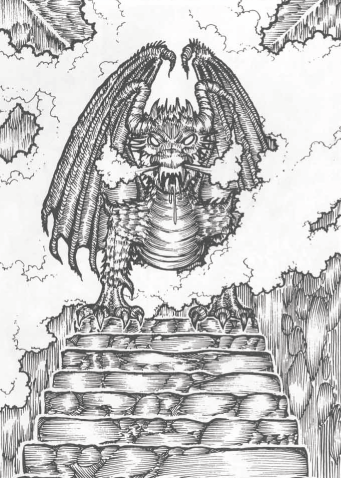 |
Traps: Walking up or down these stairs will trigger a trap. A stone statue of a dragon, hidden in a secret room (Search DC 25, though the door will not open until the trap is sprung) at the top of the stairs, will roll forward to the head of the steps when the PCs (or another object of 25 lbs or greater) reach the middle of the flight. Then the statue will just sit there. Proceeding further up or down the middle of the stairway will then trigger the dragon to open its mouth and breathe a line of scalding steam, 30 ft long. The steam causes 8d8 points of fire (heat) damage to all caught within it (DC 20 Reflex save for half). The steam will make the stairs slippery, forcing a DC 10 Balance check to move (failure by 5 or more results in a slip and fall). Thereafter, the statue will breathe every time one of the middle 5 steps are trod upon for a total of 4 times; after which it will retreat to its room and be inoperative for 24 hours (after which it can again activate and breathe 4 more times). The statue is connected to a hot water geyser in the bedrock.
| Dragon Steam Trap CR 7; mechanical; location trigger; automatic reset (4 times and then 24 hours to recharge); steam (8d8 fire damage, DC 20 Reflex save half); multiple targets (30 ft line); Search DC 22; Disable Device DC 25. |
41. Free Gold (EL 6)
Note that the two secret doors
in this area are not properly labelled on the map. The eastern
door should be labelled "A" and the western door should
be labelled "B".
| In the southern portion of western end of this corridor is a pile of yellow coins heaped on the floor. On top of the gold rests a jawless skull. In the right eye socket a normal-sized black spider has made its home. Several bones are piled with the coins, and the hilt of a broken klanth thrusts up from the mass. There appear to be about 200 coins in the pile. |
If disturbed (i.e. the gold is taken or the bones or hilt are moved), this 5-foot square of this mold bursts forth with a cloud of poisonous spores. All within 10 feet of the mold must make a DC 15 Fortitude save or take 1d6 points of Constitution damage. Another DC 15 Fortitude save is required 1 minute later—even by those who succeeded on the first save—to avoid taking 2d6 points of Constitution damage. Fire destroys yellow mold, and sunlight renders it dormant.
Treasure: 200 gp.
41A. Eastern Secret Door
In front of this secret door there is a dark stain on the floor.
This secret door (Search DC 25) swings on a horizontal pivot in the middle of the slab. By pushing either the top of bottom of the panel, the opposite end will swing outward. There will be enough space to crawl through into the secret passage beyond. Large creatures will have to squeeze through and Huge or larger creatures cannot fit through without a DC 30 Escape Artist check.
41B. Western Secret Door
The stone of this secret door is smoother than the durrounding wall as can be detect upon close examination (Search DC 15). This door opens by stepping forcibly upon a cobblestone that is slightly raised from the floor (Search DC 20). The door has two facing panels which pivot inward when the door is opened.
42. The Chapel of Kukulkan (KOO-kool-kahn: The lore-wise serpent)
See the text after 42A for a description of the room proper.
42A. Mirror of Imaginary Opposition
(EL 5)
| Beyond the secret door the passage turns to the left. At the end of this narrow hall hangs an ornate mirror and in the eastern wall is a door. The door seems to be very heavy and there are many glyphs carved upon it. In the center of this door is carved an eagle killing a serpent. Two stone warriors dressed in loin clouts and wearing puma masks form the doorposts. |
 |
The glyphs on the door tell a story in ancient Olman of a journey to find truth and light, of failing, and of imprisonment in the land of the dead.
Traps: The first person to see the mirror at the end of this corridor will activate the magic of the mirror. Only one person will be affected by the mirror in a given 24 hour period. The person will see the image of a feathered warrior looking out of the mirror at him, beckoning to him in a challenging and aggressive manner. The person must make a DC 20 Will save, failure meaning that he will believe he has been sucked into the mirror and is now in deadly combat with the feathered warrior. The DM should take care to isolate this player from the rest of the players. The PC will be fighting, in his mind, an opponent in a featureless 20 ft square room with a 10 ft high ceiling and only a mirror in it similar to the one in the hallway. The pane of the mirror is smoky and nothing can be seen through it. There are no windows or doors in the imaginary chamber, which is lit as if in torchlight though no source for the light can be discerned.
| IMAGINARY FEATHERED
WARRIOR CR n/a Male human Warrior 8 N Medium humanoid (human) Init +2; Senses Listen +6, Spot +6 AC 17, touch 12, flat-footed 15; Dodge hp 52 (8 HD) Fort +8, Ref +4, Will +5 Spd 30 ft (6 squares) Melee mwk heavy mace +13/+8 (1d8+3) Space 5 ft; Reach 5 ft Base Atk +8; Grp +11 Atk Options Power Attack Combat Gear masterwork heavy mace Abilities Str 17, Dex 14, Con 15, Int 10, Wis 12, Cha 11 Feats Dodge, Iron Will, Power Attack, Weapon Focus (heavy mace) Skills Intimidate +3, Listen +6, Spot +6, Tumble +7 Possesssions Combat gear plus studded leather armour, heavy wooden shield |
The battle takes place only in the mind of the person enchanted by the mirror. The person so enchanted can die in this combat. If the feathered warrior is defeated then the enchanted person will snap out of his enchantment and find himself back in the hallway.
To the rest of the PCs, it will appear that the enchanted person is just standing there staring into the mirror. The enchanted person will not move in any way, as if under the effects of a hold person spell. If the enchanted person is disturbed (attacked, grappled, violently shaken or jostled, slapped, yelled at), allow him a DC 20 Will save to break the enchantment. The mirror can also be smashed, and doing so will break the enchantment (hardness 12, 60 hp).
The mirror radiates a strong aura of illusion. It cannot be detached from the wall without damaging it.
| Imaginary Mirror of Opposition Trap CR 5; magical; visual trigger (reversed); automatc reset (24 hours); opposition (feathered warrior, DC 20 Will save to avoid); can be ended as described above; Search DC 29; Disable Device DC 29. |
42. The Room Proper (EL 13)
| Beyond the door is a wide foyer leading into a circular room. On the south wall of this hall is a jade death mask fixed at chest height. In the center of the chamber is a cross-shaped dais 5 ft high with a set of stairs leading up to it at each of the four ends. Between each arm of the dais is a low shelf on which stands various small offerings: silver bracelets, earrings, neck collars, anklets, pikes of coral beads, and silver and jade statuettes. The set of stairs facing the entrance are carved with the heads of many Olman deities. The steps to the north are bloodstained, while the stairs to the east are hidden in shadow. The southern staircase seems very unusual as it changes colours. Standing at the top of the northern steps is the statue of a warrior. In the center of the dais rises what appears to be transparent walls of crystal that enclose an oddly carved stela. |
 |
|
|
|
|
|
|
|
|
|
|
|
|
|
|
|
|
|
|
 |
|
|
 |
|
|
 |
|
If the PCs touch any of the treasures on the shelf, the bone naga (see Creatures below) will cast arcane lock on the door and speak to the PCs using his ventriloquism spell. Refer to Developments below for more details.
The crystal walls are explained below, and they reach all the way to the ceiling and form a six-sided star patterns, though this will not be readily apparent when the PCs first enter the chamber. In fact, the walls also proceed horizontally so that they form a floor and ceiling of the central chamber, so that attempting to tunnel through the ceiling or floor will not allow one to reach or leave the central chamber. Although the walls cannot be passed through by creatures or objects of any sort (living or not), spells and magic effects can pass out of the walls with impunity. Spells and magic effects cannot pass into the central chamber from outside of it. The walls only allow one-way magic.
Creatures: An invisible bone naga is imprisoned in this chamber, inside the crystal walls forming the central chamber around the stone stela. The naga is also hidden using its Hide check of 26 in addition to being invisible.
The naga was captured by Tloques and transformed into a bone naga by way of ancient naga lore dredged up by Tloques from the ruins of Ibyansfiir. The naga was used by Tloques as a resource of lore and naga wisdom and as an enslaved spellcaster, but Tloques never trusted the creature and so imprisoned him in this chamber.
After centuries of examination and experimentation, the naga now knows the means to free it from its imprisonment, if only it could find a group of unwitting fools to release it. It is bound by the restrictions of its imprisonment from directly instructing the PCs as to how to open its prison. Instead it has concocted the story of the poison and used its silent image spell to make the imprisoning crystal appear to be an antidote bottle.
Note: In Therra there are both bone nagas as creatures and bone nagas as templates. The former represent a specific ritual conducted upon a dark naga in a horrific ritual known only by other dark nagas. The latter represents a bone naga that may be created by any creature with a create undead spell. The bone naga below is of the former, creature kind.
|
ADVANCED BONE NAGA CR 13 Guarded Thoughts (Ex) Because of their ability to shield their thoughts, bone nagas are immune to any form of mind-reading. Poison (Ex) A bone naga delivers its poison via successful bite or sting attacks. The poison from its bite (Fortitude save 20) has the same initial and secondary damage (1d4 points of Strength damage). The poison from its sting (Fortitude save DC 20) is more virulent; its initial damage is 1d4 points of Constitution drain, and the secondary damage is 1d4 points of Constitution damage. Telepathy (Su) A bone naga can communicate telepathically with any creature witnin 250 ft that has a language. * A creature that can cast arcane spells takes a -4 penalty on its saving throw against this spell. |
|
AMULET OF WEAKNESS This amulet is made of silver studded with jet and is shaped like a skull. This amulet will cause any but the wearer in a 30 ft radius to feel weak and ineffective. Initially, and every 10 rounds that a being is within the area of effect of the amulet, they must make a DC 20 Fortitude save or suffer damage as indicated below. The amulet's power is stronger closer to the wearer and subjects will feel this increase in power as an increase in the waves of weakness and ineffectiveness. When activated, the amulet will last for 7 minutes and it functions 3/day From 21 - 30 ft from the wearer: 1 point of Strength, Dexterity, or Constitution damage (determined randomly). From 11 ft - 20 ft from the wearer: 2 points of Strength, Dexterity, or Constitution damage (1 point of damage to two of the three characteristics). From 0 ft -10 ft from the wearer: 1 point each of Strength, Dexterity, and Constitution damage. Prerequisites: Craft Wondrous Item, bestow curse,
poison. |
|
HEADBAND OF VILE INVISIBILITY This headband is made of black crystal. This headband functions exactly like a ring of invisibility, except that only an evil creature can use it. Prerequisites: Craft Wondrous Item, invisibility. |
Tactics: The naga will not attack except as mentioned in the text below. If its hidden and invisible form is seen by the PCs, then it will claim, using its Bluff skill, that it was a goodly naga imprisoned by the vile Tloques and transformed into the abomination it is today. Since no magic effects will pierce the crystal walls, the PCs will have no way to read its thoughts or determine its alignment.
If the naga must fight (e.g. if the PCs attack it once it is free), it will use its spells mercilessly. While the naga has a highly developed sense of honour and gratitude and will feel bound to reward the PCs if they free it, once its hostility is roused it is a fell foe and it will use its spells to best effect.
During the time that the PCs are dealing with the features of the room, the naga will certainly cast mage armour and shield on itself.
Developments: If the PCs touch any of the treasures on the shelf, the bone naga will cast arcane lock on the door and speak to the PCs in Olman using his ventriloquism spell. If the PCs cannot seem to understand Olman, then it will use its telepathy instead.
"Interlopers, you have trespassed on this my sacred chapel. For this affront, retribution has already begun, for you are now breathing a magic and toxic gas which will kill you shortly. However, perhaps your actions were not from malice or greed, but just idle curiousity. Therefore you will find the antitoxin upon the stone in the middle of the dais, if you can solve the puzzle to reach it. Let the brave lead the way, let the sly cross the portal, and the wise ward off evil. Choose your path most carefully."
If the PCs attempt to leave the room the naga will be indignant. It will cast its web spell across the doorway to further hinder the PCs' escape and will call them fools. If the PCs persist in attempting to escape, the naga will attack, first with a mass suggestion to try to convince the PCs to carry on, and if not with low level spells, for it wants the PCs to perform the task, not to kill them.
There is no poison gas in the room, but the effects of the amulet of weakness should convince the PCs that there is. As the PCs get closer to the stone they will seem to feel their time running out as they weaken. The DM should play up this aspect as much as possible, so that the PCs believe they are poisoned and running out of time.
To reach the "antitoxin", the PC in the room with the highest Base Attack Bonus must first choose which staircase to lead the PCs up (if two or more PCs have the highest BAB, then any of them can lead the way). If anyone but this PC first tries to climb a set of stairs, or if anybody, including the PC with the highest BAB, tries to climb across the shelves, they will take 4d4 points of damage and be knocked back. The PC with the highest BAB may choose one of the following set of stairs:
Northern Stairs: These stairs are bloodstained. This is the right choice and only the PC with the highest BAB may climb these stairs. However, as he reaches the top of these stairs the petrified warrior will become flesh and attack. Once this warrior is dispatched, the party may continue on and climb the northern stairs.
| PETRIFIFIED
FEATHERED WARRIOR CR 8 Male human Warrior 9 N Medium humanoid (human) Init +2; Senses Listen +6, Spot +7 AC 17, touch 12, flat-footed 15; Dodge hp 59 (9 HD) Fort +8, Ref +5, Will +6 Spd 30 ft (6 squares) Melee mwk heavy mace +14/+9 (1d8+3/19-20) Space 5 ft; Reach 5 ft Base Atk +9; Grp +12 Atk Options Power Attack Combat Gear masterwork heavy mace Abilities Str 17, Dex 14, Con 15, Int 10, Wis 12, Cha 11 Feats Dodge, Improved Critical (heavy mace), Iron Will, Power Attack, Weapon Focus (heavy mace) Skills Intimidate +3, Listen +6, Spot +7, Tumble +8 Possesssions Combat gear plus studded leather armour, heavy wooden shield |
Tactics: The warrior will attack only the lead PC who has ascended the stairs. It will not pursue the PC down the stairs, but once that PC descends the stairs the warrior will return to petrified form and, if the stairs are re-ascended, it will again become flesh and attack, completely healed and returned to its fully functional state.
Developments: If destroyed, the warrior and its equipment will shatter into petrified shards.
Western Stairs:
These stairs are carved with the heads of gods. If any person attempts to climb it the "heads" will start to babble and the PC will feel too weak to continue on and will sit down on the steps and not move. Only his or her companions may pull the person from the stairs.
Eastern Stairs:
This stairway is draped by shadows, and lights will not dispel these shadows. Any person who attempts to climb these stairs will slip and fall back down taking 1d3-1 points of damage (minimim 0). These stairs cannot be climbed.
Southern Stairs:
This stairway continually changes its colour. Any person attempting to climb these stairs will find themselves climbing and climbing and not getting anywhere. These stairs may be descending without difficulty.
Once the crystal walls are reached the naga will again speak to the PCs, still hidden from their sight:
"So you have passed the first test. Perhaps you are not the fools you first seemed. But it will take the best tool of your most clever person to open these crystal walls. Your time is running out."
The crystal walls are cold to the touch and impervious to all blows. A gap will melt open in these walls if the person with the highest Intelligence amongst the PCs in the room (if two or more have the same Intelligence, then any of them may do this) purposely touches his hand to the surface of the crystal wall. The walls have no discernible gaps in them otherwise. If the highest Intelligence PC uses this ability to melt an entrance into a point of the star and enters this triangular nook the wall will seal up behind him in 1 round and the PC will be trapped, for this nook cannot be opened from the inside. Should a PC be trapped, then the PC with the highest Intelligence amongst those not trapped will be able to melt the crystal walls.
The only way to reach the stela if for the highest Intelligence PC to melt the crystal wall with his hands at the intersection of two walls which leads straight to the center of the star. This gap will not close up and any of the PCs may enter it to reach the stela beyond.
If somehow all of the PCs become trapped in the six nooks of the crystal walls, then each will be subject to a slay living spell (DC 17, caster level 9th) and they will be expelled from the nooks and may start the melting process once again.
Once the PCs reach the stone they will feel very weak. On the stone in front of them is a potion bottle. The stone is carved with a weird sigil. One more time the naga will talk, its voice seeming to come from the stone:
"So you have reached my altar, but your time is mearly exhausted and the antidote is just beyond your reach. Trust your souls to your gods foolish mortals."
There is a wall of force (caster level 13th) about the top of the stone and it cannot be penetrated (unless the PCs have the means to breach such a spell). To reach the potion bottle, a divine caster must destroy the glyph upon the stone by pouring holy water on it, touching it with a holy symbol, or casting a bless, prayer, or some other spell of a similar nature upon the glyph (if the PCs do not have a divine caster amongst them then they cannot release the naga. It is not necessary to release the naga in order to finish the scenario, and so the DM should not feel bad if this particular task cannot be completed). Once this is done the wall of force will dissolve with a slight whoosh and the PCs may reach the potion.
The potion is actually just an illusion, covering a blue glowing crystal that is the focus for the naga's imprisonment. When the potion is taken, the PC will actually pick up the crystal, which wll shatter. The naga will then appear into view and hiss and his amulet of weakness will be deactivated. If the naga is not attacked, it will smile its skullish grin and thank the PCs for freeing it from its long imprisonment. If questioned as to how it became imprisoned, the bone naga will explain that the vile necromancer Tloques-popolocas lured him to the Shrine with promises of ancient lore of the lost city of Ibyansfiir, but instead he trapped the naga and transformed him into an undead abomination by way of vile rites he no doubt learned from Ibyansfiir. He was trapped in this room ever since, under control of Tloques and used as a casting slave and source of lore until Tloques died and he became free-willed.
If attacked it will call them ingrates and attack back. The naga has been imprisoned here for many centuries and does not know the ruins nor will it remain here after giving the PCs their rewards. Instead, it will simply slither away and eventually find the opening in area 39 or the opening made by the PCs in area 54.
The bone naga was once a very learned and powerful dark naga and it will pronounce three rituals upon the PCs as a reward (assuming the PCs have not attacked it). Should the PCs refuse the rewards, the naga will roll its eyes and take no offense.
Each ritual takes 10 minutes to perform, and the naga will only perform each ritual once. The naga will explain the ritual effects of the first two rituals to each recipient.
The divine caster that dissolved the wall of force will receive the Ritual of Harmony. This ritual will allow the caster to use detect evil and detect good each as a spell-like ability once per day at a caster level equal to their highest divine caster level. Once these abilities are used a total of 24 times the power will end.
The person who melted the crystal wall to get to the stela will receive the Ritual of the Past. This ritual will allow the recipient to take a mirror and concentrate on a specific person or item for 1 minute. The mirror will show something of its past for 3 rounds. The mirror may show details of the past out of order and events both recent or long ago, randomly. The viewer has no way of knowing when an event took place. This power is usable only once per week and the vision is usually somewhat cryptic. After 12 such uses the power will end.
The PC who defeated the petrified feathered warrior will receive what the naga will refer to as "For you the greatest gift of all." When the ritual is intoned, the PC will feel a chill and then a warmth across his or her back. Nothing else will happen initially, and the naga, if questioned, will merely grin and explain "as I said, I have given you the greatest possible gift. When it is needed you will know it." More than that he will not say. Unbeknownst to the PC, a death servant has just merged with his shadow. Invisible to all, it will travel with the PC until he is about to receive a fatal blow or means of certain death for which the PC has failed his saving throw. Then its black shadowy form will push the PC to safety and take the death stroke intended for its master. Once the death servant has done this it will dissipate in a cloud of black vapour.
Traps: The mask on the wall is the trigger to a trap. If the mask is moved, four sets of bars will drop, encaging those within a 10 ft square area in front of the mask. A person may escape from the cage by destroying the bars (hardness 10, 60 hp, DC 25 to lift, DC 28 to break).
| Cage Trap CR 1; mechanical; touch trigger; manual reset; Search DC 20; Disable Device DC 20. |
Treasure: The jade death mask is worth 250 gp. The items on the shelf are worth a total of 450 gp.
43. The Smoking Mirrors (Tezcatlipocas
- Tayz-KAHT-lee-po-kahs) (EL 11)
| An amber haze fills this room. The chamber is unoccupied, but there are strangely shaped and coloured mirrors hanging on the walls and a large basin stands in the middle of the floor. The mirror on the eastern wall is red and seems to be composed of fire and framed in bronze. On the northern wall are two mirrors: a striking black one of obsidian framed in lacquered wood, and a stark white mirror with a wrought iron frame. The last mirror hangs on the western wall in a stone frame and is blue in colour. The stone basin is about 10 ft long, 5 ft wide, and 3 ft tall. It is filled with a steaming golden liquid. The surface of this golden pool is unrippled. |
If the mirrors are approached and examined more closely, then the DM should read the following.
Eastern mirror:
| Light beams are broken by the mirror into myriad flames and ghostly shapes seem to flicker in its depths. |
| Reflections in this mirror ripple as if looking into a pool of water. |
| The black mirror has a distinctive earthy odour and the blackness of subterranean caverns, but it seems of crude construction and only reflects objects that are close to it. |
| The white mirror has a pungent odour of nutmeg and spice and its depths are gelid and smoky. |
|
|
The effects of the mirrors and pool are detailed below.
Red Mirror - If a PC looks into this mirror he will see a ghostly white form next to his reflection. This mirror will falsely predict the death of the person reflected and what will kill him. The ghostly image will take on the form of a monster or some trap which will strike and kill the person's reflection. The DM should choose what shape the image will take from possible monsters within these ruins, including the bat-god or whatever else he pleases. After the PC sees this vision the mirror will blur and only his normal reflection will remain. The mirror will only function once per person. If anyone touches the mirror he will take 1d3 points of fire damage from burns.
Black Mirror - When a person looks into this mirror his image will blur and then appear in ancient Olman garb as if reflecting a previous incarnation. The image will say in Olman "Command me and I shall answer." Actually this is the image of a long dead native superimposed on the viewer's reflection. Divine casters may use the command spell to cause the spirit to answer 3 yes-or-no questions (the command is "Answer!" in Olman). The spirit will only answer questions it understand, those spoken in Olman, and will nod or shake its head. The DM can determine if the spirit actually knows the answer to a given question. If it does not it will shrug its shoulders, which will count as one of the 3 questions. The spirit will only function once per person who casts a command spell. If anyone touches this mirror, a DC 15 Fortitude save must be made or all valuable metals and gems on his person will be turned into lead and glass respectively.
White Mirror - Reflections in this mirror will be blurred by what looks like a fine mist. Any person who steps before this mirror and looks into it must make a DC 20 Fortitude save or be stunned for 1 round. If the person saves, nothing will happen. If the person is stunned, the mirror will transform into a gray ooze of white colour which will attack the PCs (beginning with the PC who is stunned).
Creatures: The white mirror will transform into a fiendish psionic gray ooze which was bound into the form of a mirror by the builders of the Shrine. The ooze will begin combat psionically focused.
|
ADVANCED FIENDISH PHRENIC
GRAY OOZE CR 11 The ooze’s acidic touch deals 16 points of damage per round to wooden or metal objects, but the ooze must remain in contact with the object for 1 full round to deal this damage. Constrict (Ex) A gray ooze deals automatic slam and acid damage with a successful grapple check. The opponent’s clothing and armor take a -4 penalty on Reflex saves against the acid. Improved Grab (Ex) To use this ability, a gray ooze must hit with its slam attack. It can then attempt to start a grapple as a free action without provoking an attack of opportunity. If it wins the grapple check, it establishes a hold and can constrict. Transparent (Ex) A gray ooze is hard to identify, even under ideal conditions, and it takes a DC 15 Spot check to notice one. Creatures who fail to notice a gray ooze and walk into it are automatically hit with a melee attack for slam and acid damage. * All of the psi-like abilities reflect DCs and other variable with full augmentation (a total of 9 power points). |
Tactics: The ooze will use its psionic abilities prodigiously once its initial attacks have resolved, as it knows it cannot reach mobile enemies with its slow speed. Its first action will be to implant an aversion of the door to the south of this room in a target, hoping to use that to keep its prey in this room. It will then resort to psychic crush and mind thrusts against its foes, reverting to force screen and defensive precognition if its opponents close to melee combat.
Once the ooze has been set free from its mirror form it will not revert back, but remain a free-willed ooze to roam the Shrine at will.
Developments: Behind this mirror is a door which may be opened once the ooze is removed.
Blue Mirror - This mirror opens into a pool of water. The water is held back by a magical force wall. If any person touches the surface of the mirror, he must make a DC 18 Fortitude save or be drawn into the pool of water. Weapons may be used to break the force wall (hardness 12, 30 hp). If this "wall" is destroyed, the water in the pool and the trapped person will spill out into the room. The pool of water is held in a 10 ft cube room behind the mirror that leads nowhere.
Golden Pool - The fluid in this basin is magical as long as it remains in the basin. If it is removed it will just be coloured water. Anything stuck into the liquid will react with the fluid so that the second time the item or an item of the same material is stuck into the pool it will turn to gold. The item will remain gold for only 20 rounds.
44. Sun of Motion (EL 3)
| In the center of this diamond-shaped room is a dais on which a weirdly formed altar rests. The altar is made to resemble a many-armed and beaked octopoidal creature with a large purple-red stone set in its forehead. The walls of the room are decorated with paintings of the sun and moon in motion. Others are of many people standing about a temple making sacrifices of flesh and blood while the figure of a priest holds the bloody heart of his latest victim above his head. There is dust on the floor and altar. |
A DC 20 Strength check will allow the stuck PC to tear free, but he will take an additional 2d4+2 damage from tearing the skin away from the stone.
If the gem set into the forehead of the altar is destroyed (hardness 8, 15 hp) the altar will stop spinning and the stuck person will be released.
The gem is a cursed stone and if it comes in contact with the flesh of a creature then the creature must make a DC 20 Will save or it will grab the stone and begin to whirl around with such force that he will take 1d6 points of damage per round until he is dead or the stone is ripped away by another with a DC 20 Strength check. Tearing away the stone will cause 2d4+2 damage from tearing the stikn away. A cursed victim may not let go of the stone unless a remove curse is cast upon him. The gem radiates moderate transmutation magic.
| Spinning Altar Trap CR 3; magical; touch trigger; automatc reset; spin (2d6 damage); DC 20 Strength check to pull free for 2d4+2 points of damage; Search DC 20; Disable Device DC 25. |
45. Mictlan (MEEK-tlahn: "Land
of the Dead")
|
This room is decorated with a bizarre diorama depicting the land of the dead. Small, brightly painted clay statues have been placed about the room to represent the inhabitants of this realm and the unfortunate men and women they have under their care. In the center of the room, the floor rises to form a small "hill" with earthen palisades on its north face. A group of small men figures seem to be struggling to roll a boulder up the hill, while a devil drives them on. Above the hill in the ceiling is a glowing spot which illuminates the entire chamber with an eerie silver light. A pebble path leads from the door to the foot of the hill. Before the door in the western end of the room is a region which depicts burning sands. There, devils torture men who have been unfortunate enough to fall into their hands. On the south side of the path is a region, fenced off by a hedge of thorns, depicting a grassy plain where men frolic and hunt antelope and deer. South of the hill the floor opens into a model canyon down which flows a river of lava while flames etch the walls. East of the hill, in a side wing of the room, is a counterpart to this fiery canyon, an icy waste. To the north of the hill are putrid, bubbling marshes where figures of men strive to keep their heads above the surface. Out of this swamp a black, torpid river wends its way past the northern edge of the hill and flows west to pour over the lip of a steam-filled chasm in the northwest corner of the room. Within this dark chasm worms pursue the fleeing forms of naked men and women. In the south corner of this room on the eastern wall is a barred door. |
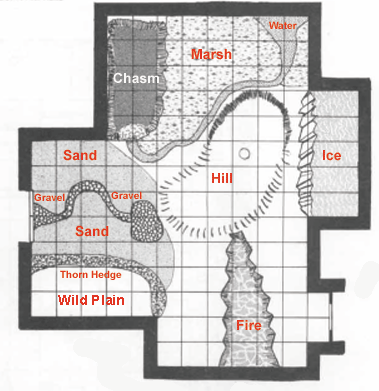 |
The light in the ceiling comes from the walls of a chute or chimney which glow in the dark. The chimney may be reached on the shoulder of another person, but in order to climb it the person must brace his back and legs against the opposite walls because there are no protuberances to hold onto (Climb DC 20).
Each reguon in this room has some magic associated with it that will affect anyone walking into the region. The gravel path and other clear areas are free of any special effects. If any PCs use detect magic, then they will detect magic coming from the regions. All magic is moderate evocation.
Hill - Anyone climbing to the top of this hill will be subject to the effects of a forcewave spell (caster level 7th) every round they are here, pushing them in a random direction off of the hill. The spell initiates a bull rush at +10.
Burning Sands - Any person who enters this region will receive a bad bloody nose. The hemorrhaging will cause 1 point of Constitution damage per round. The bleeding will stop 1 round after the person leaves this area.
Wild Plains - The thorn hedge surrounding this area is only 4 ft high. Anyone not able to fly or jump over the hedge will suffer 1d4 points of damage climbing over it.
Any person who enters this region must make a DC 15 Will save or he will have no desire to leave it. Companions outside of the area may try to talk their companion out, and if they are able to make a DC 15 Diplomacy, Intimidate, Bluff, or Performance check the victim will gain another DC 15 Will save to escape. For each 5 points over which the skill check exceeds 15, the victim receives a +1 bonus on his Will save. The skill check may be repeated every minute, but each time it is repeated the DC of the Will save increases by 1 until, eventually, the person will never want to leave and die of thirst or starvation unless these are provided for him.
Flames - Anyone entering this region will take 1 point of fire damage per round and suffer the effects of a heat metal spell (caster level 5th) if he is wearing metal armour or holding metal weapons.
Ice - Persons entering this region will take 1 point of cold damage per round and suffer the effects of a chill metal spell (caster level 5th) if he is wearing metal armour or holding metal weapons.
Marshes - Anyone who enters this area will feel a shortness of breath and after 1 round will fill water filling his lungs. On the second round in this area he will begin to drown.
Water - Anyone touching the water of the river or lake must make a DC 20 Will save or be overcome with magical forgetfulness. The person will forget who they are and what their purpose is. Spellcasters will forget 1 level of spells they have prepared or 1 level of spell slots per round they spend in this region, starting with their highest level. Psionic manifesters will not be affected. Once the area is left the person will remember who he is, but spells will remain lost as if they had been cast until they can be regained normally.
Pit of Worms - Any person entering this region must make a DC 18 Will save or become panicked for 3 rounds.
46. Tlazoteotl (Tlaz-OH-tay-ohtl:
mother goddess of the earth) (EL 8)
| Beyond the door is a small room. Opposite the door in the southeast corner is a small shelf on which rests a glazed flask. The floor of this room is covered with a lumpy pile of earthy material. In the northwest and northeast corner are two more shelves on which rest a small urn and a stone cylinder respectively. |
|
VOID OOZE CR 8 Energy Drain (Su) Living creatures hit by a void ooze's slam attack gain one negative level. a void ooze gains 5 temporary hit points for each negative level it bestows. The DC is 15 for the Fortitude save to remove a negative level. The save DC is Charisma-based with a +5 racial bonus. Engulf (Ex) As a standard action, a void ooze can move over opponents, affecting as many as it can cover. Opponents can make attacks of opportunity against the ooze, but if they do so, they are not entitled to a saving throw. Those who do not attempt attacks of opportunity must succeed on a DC 20 Reflex save or be engulfed; on a success, they are pushed back or aside (their choice) as the ooze moves forward. Engulfed creatures are subject to the ooze's negative energy damage and energy drain each round, and are considered to be grappled and trapped within its body. The save DC is Strength-based. Shadow Shield (Su) A void ooze is surrounded at all times by a mass of flitting black shadows (the equivalent of a darkness spell, but only covering the void ooze itself). This provides the void ooze with concealment. Split (Ex) If a void ooze's energy drain attack would increase its hit points to 200 or more, it instead splits into two void oozes, each with 1000 hit points, as a free action. The new ooze appears adjacent to its parent. If no space is available, it cannot spawn on this turn (but will do so as soon as space is available). |
Tactics: The ooze will simply attack, seeking to feed. It is ravenous with hunger and will not flee, fighting to the death.
Treasure: The flask in the room holds the dried powder of a potion of bull's strength (CL 3).
The urn holds the dried heart of a mighty yuan-ti. It radiates strong divination magic and if the entire heart is consumed by a single person, the eater will be able to understand and read the Slith language permanently, but will not be able to speak it (unless he already knows or later learns the Slith language).
The stone cylinder is a baton of the earth.
|
BATON OF THE EARTH This stone baton is carved with geometrical shapes. This +1 club increases its enhancement bonus by +2 when the wielder stands on stone or earth. If the wielder is standing on wood, in water, or in the air, the weapon loses all of its enhancement bonuses and causes its wielder 1 point of Constitution damage each time a blow is struck. When the wielder's Constitution damage is one less than its Constitution score, he is rendered unconscious until he recovers 1 point of Constitution damage. Prerequisites: Craft Magic Arms and Armour, heart
of the earth. |
47. Trapdoor (EL 8)
In the walls of this chute, 30 ft above the lower end, a 15 ft cube hollow has been cut into the eastern side of the chute. This hollow is camouflaged by a layer of silk with stucco fragments embedded into it.
The top of the chute is covered with a huge pewter basin that requires a DC 15 Strength check to move it.
Creatures: Within the hollow lurks a Huge zombie trapdoor spider. Note that this zombie is a fast zombie and is not restricted to single actions and may run normally. The spider will generally be able to sense anyone climbing up the chimney due to its tremorsense
|
BLOODTHIRSTY DISEASED FAST
ZOMBIE HUGE ADVANCED TRAPDOOR SPIDER CR 8 Disease (Ex) Any successful melee attack by a diseased zombie exposes the target to a disease (filth fever). Any creature making a successful unarmed or natural attack against a diseased zombie is similarly exposed (a character who grapples with a diseased zombie gets a -4 penalty on the save made to resist infection). |
Tactics: The spider will attack any intruders into the Shrine who attempt to negotiate the shaft. It was placed here as a guardian during Tloques' time and it has remained here ever since. If it senses anyone passing by the chute (whether by a Listen check or tremorsense) it will lash out and attempt to make a grapple check to grab the victim. If the grapple succeeds, it will pull the victim into its lair and attempt to bite the victim to death. If the grapple fails, then the spider will simply attempt to bite any foes it can reach.
The spider zombie cannot easily negotiate the shaft, due to its size. The shaft is treated as crawl-navigable (see Dungeon Master's Guide II page 55) and the spider has a speed of 5 ft and attacks at -4 and loses its Dex bonus to AC and attackers gain a +4 bonus to attack the spider zombie.
Despite the difficulties, the spider will come into the shaft to attack intruders. It will not normally leave the shaft, though if attacked from without it will retreat to its hollow.
The Third Tier:
The map presented at the start of the description of the First Tier should be used.
48. Hound of the Bat (CL 8)
| This room is small and plainly decorated. To the west stairs lead up out of the room and to either side of the stairs along the west wall are narrow dust covered ledges. In the north and south ends of the room are fountains made of bronze-inlaid marble. The southern one is cracked and only dry limey deposits remain. The northern fountain contains about 2 ft of brackish water, fed by a limey trickle from the ceiling. To the east a square pewter basin, about 5 ft wide, covers a stone wellhead. |
| In the northern fountain, a white, gauzy form of a crayfish lies on a bed of lime encrustations. |
The huge pewter basin requires a DC 15 Strength check to move it. Under it is a 5 ft diameter well that sinks into the floor (refer to areas 46 and 47 for more details).
Creatures: The water in the fountain is really a corrupted vardigg, summoned by the minions of Tloques and long since forgotten. It will attack if anyone probes the northern fountain or touches the "water" therein.
|
CORRUPTED ADVANCED VARDIGG
CR 8 Spell Disruption (Su) The very presence of an elemental grue interferes with spells that affect the grue's associated element. Any spellcaster within 40 ft of a grue who casts a spell with the same descriptor as the grue's element (water in the case of a vardigg) must succeed on a DC 22 caster level check or have the spell fail. Within the same area of any such spell currently in effect, a grue has a chance to dispel the effect as a free action, as if casting a targeted dispel magic (caster level 10th). Water Jet (Sp) As a standard action, a water grue can create a tremendously powerful 30 ft line of water. Any creature in the area of the line takes 2d6 points of damage (Reflex DC 21 negates). A creature failing the saving throw must succeed on a Strength check or a Balance check (DC 5 + damage dealt) or be knocked prone by the force of the blast. This is the equivalent of a 2nd level spell. |
Treasure: Covered by lime at the bottom of the northern fountain (Search DC 20) is a golden key and chain worth 20 gp. This key can unlock the portcullis blocking the exit at area 53.
The spell-object inside of the vardigg has the sleet storm spell inscribed on it.
49. Sacred Chitza-Atlan (SHEET-zah
ah-TLAN) (EL 13)
|
In the middle of this chamber is what appears to be the withered, preserved form of a centaur mounted on a slab of marble. The centaur's body appears to be that of a jaguar instead of being equine. Tinted green and decked out in lacquered leather, feathers, and copper wire jewelry, he faces the western entrance to this chamber. This centaur holds an 8 ft long bronze-hafted spear tipped with a broad, blue-grey, flame-shaped crystal spearhead. About the apartment are much jewelry and nicknacks, made of beaten copper, cut and polished obsidian, shells, quartz, and coral. There is also a lot of pottery with spidery cracks etching the glazing. Two pottery urns have been made to resemble wicker baskets. These urns seem to contain odd, smooth stones, each about 6 inches in diameter, of the river-bottom sort. Much of this treasure is scattered at the feet of the centaur, symbollically being trod under foot. |
The mumia has two functions: to prevent any but the dead or minions of Tloques from entering these ruins, and to keep those creatures in the ruins confined within. Thus, if any PC should attempt to exit this room by any door other than the one he or she entered, the mumia will attack. Attempting to exit is a nebulous term and will be based on the judgment of the mumia/DM. Certainly, apporaching to within reach of such a door will trigger an attack.
The mumia will also defend itself if attacked. A word or pass from Camazotz, the bat god, will gain free passage. The mumia will not leave the room, and if turned will flee to the northeast end of the chamber.
|
MUMIA TAURIC OLMAN-DIRE JAGUAR
CR 13 Pounce (Ex) If a leopard charges a foe, it can make a full attack, including two rake attacks. Rake (Ex) Attack bonus +23 melee, damage 1d4+4. Withering Touch (Su) A creature hit by one of a mumia’s natural attacks must attempt a Fortitude save (DC 14) or take 2 points of Constitution damage as the attacker absorbs moisture and energy from its target. This effect is in addition to any other effects of the creature’s natural attack. *In areas of tall grass or heavy undergrowth, the Hide bonus improves to +9. |
Tactics: The mumia is a very formidable warrior and it knows it. As it attacks, it will warn its adversaries in Olman that it is the guardian of the way and that they must turn back or suffer defeat at his hands. The mumia will not slay unconscious or otherwise disabled opponents, and if its foes announce that they wish to withdraw, it will let them, even allowing them to gather their wounded or dead. However, if these same persons then make a second assault on the mumia or attempt to pass into or out of the ruins, then the mumia will take no quarter and renounce his foes as dishonourable rabble not worthy of life.
Treasure: The "treasures" of this room are only worth a couple of silver apiece. If all 800 pieces of junk jewelry are taken the total value is 800 gp and the weight will be 10 lbs. The actual treasure is concealed in the bottom of the two wicker basket urns, beneath the stones. These are two crushed silver masks, each worth 25 gp, a gold serpent bracelet worth 42 gp, a broken marble statue of a monkey, 56 gp, and 3 silver hairpins set with jade worth 20 gp each.
50. Jade Wall (EL 4)
Here the way is blocked by a wall of green, polished stone.
Traps: The jade wall is a trap for those attempting to break into the ruins. If any tampering is done to the wall (except for a disable device check that does not fail by 5 or more) it will fall out to the west into the anteroom doing 4d8 points of damage to all those standing there (the wall is 10 ft tall and as wide as the anteroom). A DC 15 Reflex save will result in no damage as the person jumps away from the wall as it falls.
A person who is struck by the wall must make another DC 15 Reflex save, failure indicating that they are pinned beneath the stone. A DC 20 Strength check will be needed to lift the wall enough to allow pinned persons to scramble out.
Those coming from the room (area 49) will take no damage as the wall falls the other way.
| Jade Wall Trap CR 4; mechanical; touch trigger; repair reset; fall (4d8 damage, DC 15 Reflex save avoids); DC 15 Reflex save to avoid being pinned, DC 20 Strength check to escape pin; multiple targets (all within the anteroom); Search DC 20; Disable Device DC 20. |
51. Wind Tunnel
When the PCs first enter the hallways
to either side of this area:
| This passage is only 5 ft wide. It is dry and dusty and shows no sign of usage for several ages. Near the top of the corridor walls, about 3 ft from the ceiling, are stone lintels running the length of the passage. |
When the PCs reach within view
of area 51 proper:
| The corridor abuptly widens to a 15 ft square area with a corrugated floor. In the ceiling of this cubicle, 15 ft overhead, a bronze, circular trapdoor is set. The cover is latched shut from this side. In the our corners of this foyer are sets of metal rungs that lead up and across the arched ceiling to the trapdoor. The rungs are broken in several places and form rusty spikes. Across the widening the 5 ft wide corridor continues on. |
Traps: Opening the hatch will release a whirlwind, which will persist for as long as there are creatures in the alcove and for 20 rounds thereafter. After 20 rounds the wind will enter the 5 ft cube hollow above the trapdoor and the door will close shut, the trap reset.
While the whirlwind is in this chamber, any PC on the ceiling portion of the ladder will be knocked to the floor unless a DC 25 Climb check is made. This person will suffer 2d6 points of falling damage.
Everyone else in the chamber will be buffeted about and take 1d3-1 points of damage per round. In addition, each PC will be subject to an attack with an attack bonus of +10 and if the attack is successful that person will have been slashed by or impaled upon one of the rusty spikes, suffering 1d4+1 points of piercing or slashing damage (50% chance of either if it matters).
Those person being buffeted will spin in a circle around the chamber, unable to control his direction. A PC can attempt to grab a rung by making a DC 15 Reflex save and then a DC 15 Strength check. If successful, the DM should randomly determine where the rung is located and how high off of the ground he will be. Holding onto the rung then requires a DC 15 Strength check each round. Those holding onto a rung will not be buffeted. If a PC attempts to move from rung to rung during the wind, it will be a full-round action to move 5 ft and require a DC 15 Strength check to be able to move and, if so, a DC 15 Reflex save to safely grasp the next rungs. Failure of the Strength check will result in no movement that turn. Failure of the Reflex save will result in the PC losing his old and being buffeted around the alcove.
PCs can also attempt to grab hold of the one of the edges of the passageways out of the alcove. This will require the same DC 15 Reflex save in one round to catch themselves on the corner of the passageway and then, next round, after successfully maintaining a hold with a DC 17 Strength check, making a DC 15 Strength check to push himself into the corridor and out of the wind and the alcove.
Finally, PCs can note that the wind seems much less string near the floor if they specifically ask or if they are simply looking around and make a DC 20 Spot check. A buffeted person can try to make his way to the floor of the chamber with either a DC 20 Reflex save or a DC 20 Strength check. Or a person can simply attempt to climb down the rungs to the floor. Once at floor level, a PC can hug the floor and use the corrugation of the floor to pull themselves across the room at a rate of 5 ft per round.
The wind is strong enough to buffet any creature up to size Large. Especially dense creatures of size Large may also not be buffeted at the DM's discretion (such as stone or metal constructs). Creatures are size Huge or more will not be buffeted but must still make a DC 15 Strength check to move at half speed each round within the alcove.
While the wind it active, the bronze trapdoor cannot be shut.
| Whirlwind Trap CR 4; magical; touch trigger; automatic reset; buffeting (1d3-1 damage plus spikes, see text); multiple targets (all within the alcove); Search DC 29; Disable Device DC 29. |
52. The Hidden Room of the Nahual (NAH-wahl: "alter-ego") (EL 7)
Secret Doors: The secret doors to this room (Search DC 25) are opened by reaching up above each secret door and grabbing the lintel or molding on the wall, which runs the length of this corridor about 8 ft above the floor, and pulling down (Search DC 25 to find this bit of lintel). The secret door will then swing inward, but will close again in 2 rounds. These doors are counterweighted and may not be spiked open. A DC 30 Strength check will be needed to hold the door open, and up to two PCs can combine their Strength checks. Such a check would have to be made each round and if the check fails, the PCs attempting to hold the door open will have to scramble into the chamber as the door closes unless they make a DC 15 Reflex save. Failure means they end up inside the room and suffer 3d6 damage from the door crushing them.
From the inside the doors may be opened by pressing down on a stone projection to the right of the doors. This projection is easy to find (Search DC 10 or Spot DC 14).
The secret doors each lead to
a small hallway and a normal stone door. When a stone door is
opened:
| The walls of this room are painted a flat black, while the floor is inlaid with a colourful mosaic of strange gods cavorting and leaping around a sun. The chamber is otherwise empty, except for an alcove along the east wall masked by a curtain of shells and beads. |
| Behind the curtain is the chalky form of a statue seated upon a stone throne carved to depict feathers. The statue is wearing a feathered headdress, made to look like a leaping fish nibbling on a water lily, and a feathered robe. Laying across its lap in its open palms is a scepter of gold and silver with an eagle's head crafted in one end and the talons of a bird holding a blazing sun in the other. The most remarkable thing about the statue is its face. |
 |
The statue will duplicate the face of the first person who gazes upon it. The scepter is stuck to the palms of the statue and only the person with the same face as the statue can lift the scepter. Once the person picks up the scepter, he will have visions of great battles of the past and begin to sweat. After 2 rounds, if still holding the scepter, a transformation will sweep over the possessor of the scepter and he will become stone. Simultaneously, the statue will become flesh and blood.
Creatures: The statue is a nahual or alter-ego and is chaotic evil. Nahuals are created by evil priests for a variety of purposes using dark forbidden rituals.
The nahual will possess the memories of the petrified person and will try to convince the rest of the PCs that it is the petrified PC who has just merged with the spirit of one of its earlier incarnations. The nahual actually resides in the scepter and so the statue will not detect as magic or evil until the nahual is active.
|
NAHUAL CR 7 Given a chance, the nahual will attempt to lead companions of the alter-ego to their deaths with false information gained from "memories" of its former life. Removing the soul object from the hands of the stricken person will not return the alter-ego to life, nor will spells such as break enchantment or stone to flesh. The nahual must be slain and the soul object must be touched to the dead body of the nahual to restore the original victim and return the nahual to its stone form (albeit likely lying on the ground and crumbled to pieces). A protection from evil or similar spell will prevent a nahual from making the switch with the alter-ego, though once the switch is made such spells will not hinder the nahual in any way. The nahual is not possessing the victim, and so exorcism-type spells will not work to expel the nahual or restore the alter-ego. A nahual can choose a victim only once per day. Once it has chosen a victim, it cannot choose a new victim for 24 hours. Dropping Gaze (Su) As a standard action, the nahual can use a gaze attack to force a target within 30 ft to drop any items held in its hands. Unlike most gaze attacks, the nahual has to actively target a single creature. Creatures viewing the nahual do not have to make saves each round. A DC 17 Will save will negate this effect. The save is Charisma-base. Possessed Memories (Su) When a nahual forms, it gains the memories of its alter-ego. These memories do not provide the nahual with any of the victim's powers, spells, or skills (except for Knowledge skills), but do provide information that allow the nahual to know certain facts that might allow it to better pretend it is that person. The nahual gains any ranks in Knowledge skills that were possessed by its alter-ego (though it uses its own Intelligence bonus). A nahual gains a +10 bonus on disguise checks and bluff checks related to convincing someone he is in some way tied to his alter-ego. Soul Object (Su) While waiting for a chosen alter-ego, a nahual is incorporeal and housed inside its soul object, usually a gem or other valuable item of at least 500 gp value. This soul object radiates strong necromancy and evil and the object must be touching the stone body that will house the nahual's spirit when it is activated (usually a statue of some sort). While incorporeal and within its soul object, a nahual cannot be affected in any manner by physical attacks or magic. However, the soul object can be affected and if it is destroyed, the nahual is destroyed along with it. Most soul objects have a hardness of 8-10 and 15-25 hp. |
Developments: Given a chance, the nahual will attempt to lead the PCs to their deaths with false information gained from "memories" of its former life. Removing the scepter from the hands of the stricken person will not return the PC to life, nor will spells such as break enchantment or stone to flesh. The nahual must be slain and the scepter must be touched to the dead body of the nahual to restore the original victim and return the nahual to its stone form (albeit likely lying on the ground and crumbled to pieces).
Treasure: The scepter is worth 507 gp and radiate strong evil and necromantic magic until the nahual is slain and the original victim restored, at which time it becomes completely nonmagical.
53. The Valve (EL 1)
| Here is a foyer, 10 ft wide and 20 ft long. A narrow hall leads away from this foyer on the south and from the north a 5 ft wide staircase leads up. A wheel is set horizontally half into the wall at the western end. This wheel appears to be a crank, as evidence by the horizontal handles sticking out from its edge. Above the wheel, in the wall, is set a bronze lever in the down position. |
Conducting any action requiring physical action (including a move action) on the 1 ft ledge (including working the lever or the wheel, both of which are not easy to move) requires a DC 10 Balance check, and if the check is missed by 5 or more the person will fall into the pit. A DC 15 reflex save will allow the person to grab onto the ledge with his hands and then a DC 15 Climb check as a move action is needed to scramble back up, with a failure by 5 or more on the Climb check resulting in a fall into the pit.
When crossing this beam or standing upon it, a DC 15 Balance check is needed for any action taken (including a move action). If the check is failed by 5 or more the person will fall into the pit. A DC 15 reflex save will allow the person to grab onto the footbridge with his hands and then a DC 15 Climb check as a move action is needed to scramble back up, with a failure by 5 or more on the Climb check resulting in a fall into the pit.
The pit is 30 ft deep and will cause 3d6 points of falling damage to those who fall into it.
If the crank is released once the secret door is opened, it will wind back quickly shutting the door. To prevent this, the braking level may be pulled down. However, pulling the braking level down once it has been raised will cause a portcullis to fall along the north wall of the foyer, shutting the foyer off from the stairs.
The portcullis has a hardness of 10 and 60 hp and a break DC of 25 to lift or 28 to break.
If the walls are searched beside the portcullis (DC 15 Search check), a keyhole will be found to the left side. The key from area 48 will open the portcullis like a gate.
If the trapdoor in area 54 has been activated, the pit in this area will be open.
Traps: The pit trap mentioned above.
| Pit Trap CR 1; mechanical, touch trigger; manual reset; 30 ft. deep (3d6, fall); Search DC 20; Disable Device DC 20. |
Secret Doors: In the middle of the ceiling over the pit is a secret trapdoor that leads to the slide that, in turn, leads to the trapdoor in the floor of area 54. A DC 25 Search check would be needed to find the trapdoor in the ceiling, and it will not open from this side. The slide can be climebd with a DC 20 Climb check and goes up 20 ft to the trapdoor in the floor of area 54, which is visible from this side but cannot be opened from this side.
The Temple
The map presented at the start of the description of the First Tier should be used.
54. Temple Ruin
Items in red
in the descriptive text below assume that the PCs have dug or
otherwise tunneled their way into this chamber from above. Upon
looking through the hole into the chamber below, the PCs will
see what is described below. If some sort of magic or earth glide
was used so that a hole to the outside was not made, then omit
the red text.
| This was apparently a large temple of some sort. Once a major building, all that remains are the back wall and enough of the roof to shelter the altar. All else seems closed off by fallen debris. Several pillars have fallen and they litter the floor. Sunlight filters in through a hole in the roof, 35 ft overhead, which is a maze of chips and cracks. The back wall is covered by a bas relief of a large giant bat-thing, 9 ft tall, with a wingspan of 20 ft. In front of this wall is an altar stone, carved to represent a mass of squirming rats, weasels, and worms. In front of the altar is the head of a screaming bat. Arching above the altar from either side are a pair of metal bat wings, 8 ft long. The floor in front of the altar worn into hollows. |
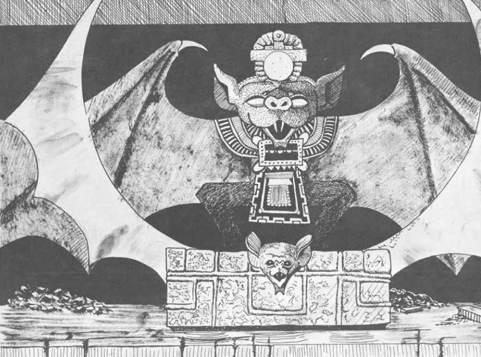 |
This entire chamber is considered to be covered in dense rubble (2 squares of movement to enter a square with dense rubble; adds 5 to the DC of Balance and Tumble checks, and it adds 2 to the DC of Move Silently checks).
The temple is closed by debris which provides no entrances or exits (other than the one the PCs used to get here). However, in the center of the south side there is an area of tented rubble that reaches up to the ceiling. It is shaky (which a DC 10 Knowledge [architecture and engineering] or Craft [stonemasonry] check will reveal) and may be collapsed to provide a portal to the outside above. Any sufficient pressure equal to a DC 15 Strength check will bring the tenting down along with a lot of loose earth and dirt. All PCs within 10 ft of the collapse will be hit by 1d4 stones which will cause 1d3-1 points of damage each unless a DC 15 Reflex save is made to avoid it. This rubble may also be collapsed by hurling a weighty object at it.
Climbing elsewhere on the debris will cause a collapse causing 1d4 points of damage and there is a 15% chance that the person climbing will be buried under heavier rubble taking 3d4 points of damage and being pinned until a DC 20 Strength check is made (up to four persons including the pinned person can aid on the Strength check). A DC 15 Reflex save avoids any of this damage.
Close inspection of the altar (Search DC 10) will reveal handholds in front of the base. The altar may be lifted and tipped over backwards with a DC 40 Strength check. Up to two persons may combine their Strength checks and up two more can make a DC 10 Strength check to add +2 to one of the checks. However, doing so will set off the wing blade trap (see Traps below). Beneath the altar is an 8 ft deep pit in which are many items of treasure and two human skeletons cut in half.
Secret Doors: The secret door to the tombs below is hidden behind the left wing of the giant bat thing carved upon the wall (Search DC 25). The way this door is opened is for the supplicant to place his or her arm into the mouth of the carving and press. A DC 25 Search check will reveal that there seems to be some sort of holes in the back of the mouth hollow that lead into the wall and that dried rust coloured stains blotch the inside of the mouth hollow and the top of the holes. In addition, it will be seen that the mouth has hidden stone seems that seem to allow it to shut.
If an arm is placed within the mouth,.it will clamp shut and the teeth will puncture the arm doing 1d2 points of damage. As the blood drains into a hidden reservoir the giant batwing will start to fold back from the wall. It takes 1d3+2 rounds and 1d2 points of damage per round for the secret door to open. However, the batwing will fold across the chest of the carving, crushing the supplicant with his arm in the mouth for another 1d6 points of damage on the last round of the opening. After this crushing, the supplicance can squeeze out of the space between the wing and the mouth with a full-round action.
Any person with a DC 15 Strength check may break free of the mouth, or the arm will be released when the reservoir is filled and the door opened. The trick is that it need not be blood to open the door, only fluid weight. Any liquid will do in sufficient amounts to open the secret door.
Once the wing has moved to reveal the secret door it will veil the lower half of the carving's face and the black stone eyes will start to glow. Anyone who looks at the eyes must make a DC 20 Will save or be paralyzed for 2d4 rounds or until the victim is brought into the area of effect of any spell with the light subtype.
Traps: Ten feet in front of the altar is a trapdoor. Any person that walks across it will trigger it only 10% of the time, for the mechanism is old and long idsuse has made it unreliable. The trapdoor opens into a slide which leads to the top of the pit at area 53. Anyone sliding down the slide will hit the trapdoor in the ceiling of area 53, which will open the instant the PCs hits it, dropping the PC into the 30 ft deep pit in area 53 which will also open.
| Slide Trap CR 1; mechanical, touch trigger; manual reset; 30 ft. deep (3d6, fall); Search DC 20; Disable Device DC 20. |
When the altar is lifted the metal wings will whip forward at about chest height. The leading edges are razor sharp and will cleave any person in their path. If the altar is tilted by persons in the kneeling position (taking a -4 to their Strength checks), then the wings will whistle by harmlessly overhead.
| Wing Blade Trap CR 4; mechanical, touch trigger; automatic reset; Atk +20 melee (2d4+8/×4, scythe); Search DC 21; Disable Device DC 18. |
Treasure: The treasure beneath the altar is valued at 2500 gp but is very bulky. There are 80 silver chased goblets (3 gp each), 20 gold-plated statuettes (10 gp each but likely to be valued at 100 gp each until a DC 15 Appraisal check is made to reveal that the gold is only plating), 50 repoussed silver chalices and servings (4 gp each), 150 pieces of trinket jewelry (averging 5 gp each), 200 mother-of-pearl "gemstones" (averaging 2 gp each), a jade placard bearing the image of Camazotz (54 gp), and a marble statue of a reclining figure known as Chacmool (a lazy good-for-nothing featured in many ancient tales) worth 78 gp. All of this treasure is very heavy to carry (approximately 100 lbs in total).
There are also 19160 sp of Olman mint here.
Time Passages:
This scenario is not meant to have a strict time limit. Nevertheless, the scenario can become too easy and rather tedious if the PCs are overly cautious and simply retire from the Shrine after every combat.
As such, the DM should feel free to institute some measures to subtly urge the PCs not to be too cavalier with regard to time taken. In general, the PCs should not have to spend more than 3 days exploring the Shrine. Anything more than that will likely allow the PCs to constantly regain spells and other abilities and dominate each encounter.
First, there is an indication in area 39 of the Shrine that the Scaled Ones may be onto the secret of the Shrine (ie.e the lizardfolk and their map). This is, in fact, true, as the Scaled Ones seek the location of the ancient city of Ibyansfiir as well as the rumoured lesser naga crown. The lizardfolk who died in area 39 were given the map by a spirit naga master and instructed to scout out the area and report back. They ended up foolishly trying to enter the Shrine, and ran afoul of the forbiddance, which they did not know about. The naga has lore to indicate that Okoth may have placed a curse on the Shrine that might be effective against Scaled Ones, but failed to transmit this information to his servants.
After a time, when the servants have been missing for too long, the naga is likely to send other minions to determine what has happened. The DM is left to make up the composition of these scouting parties, but suffice to say that they will observe the area for a time and eventually notice the digging into area 54, the lizardfolk bodies in area 39 (thus showing that the lizardfolk did not do the digging into area 54), and other signs that the PCs are present (inclduing recent human footprints) and have entered the Shrine. These scouting parties will report back to the naga, who will then mount an expedition to attack the PCs as they emerge from the ruins and seek to capture them and bring them back to the naga for questioning. This first attack should not be one that has a reasonable chance to succeed, but should put the PCs on notice that their activities have been discovered and that they had better get a move on!
If the PCs still do not take the hint and proceed with vigour, the DM should feel free to have more serious attacks by the forces of the naga until eventually the naga himself arrives with his most powerful servants and attempts to capture the PCs and force them, either by threat or by magic, to enter the Shrine and retrieve its treasures on his behalf. What happens to the PCs after this is up to the DM.
If the DM wishes, this spirit naga and its servants can be the subject of further adventures.
It is recommended that the DM institute the first signs of Scaled One activity on the third day after the PCs have entered the Shrine. Their entrance will have been noted on the first day that they enter the ruins. The scouts (likely lizardfolk) will have spent the rest of the first day and most of the second day returning and reporting to the spirit naga, who will send a group of lizardfolk and nagatha to investigate. This investigative group will arrive at the Shrine shortly after the PCs have entered the shrine on the 3rd day. The spirit naga will have informed these minions about the curse of Okoth on the structure and they will not enter it. Instead, they will wait, hidden, for the PCs the exit the Shrine, likely tired and out of spells, and then accost them, demanding their surrender and return to their master. Should the PCs refuse, they will attack with the intent of capturing one or more of the PCs to bring to their master. The PCs should find a human-skin parchment on the lead lizardfolk that shows a sketch of the lesser naga crown, to further give the PCs the idea that they'd better hurry, for others seek what they seek! The PCs can also find another human-skin parchment with a map showing the location of the Shrine and the location of the naga's lair about a day's journey from the Shrine.
Whether the first group of Scaled Ones never returns to the spirit naga or survivors return, the spirit naga will be incensed, and will send his most favoured servant and his consort, a dark naga, along with suitably bolstered forces of lizardfolk to acccost the PCs in the same manner as above. These will arrive on the fifth day after the PCs first entered the ruins.
Should that fail, the spirit naga himself will come with most of her minions on the seventh day.
Of course, if the PCs decide not to enter the ruins and await the Scaled Ones, then the DM will have to adjudicate accordingly.
DMs who actually wish to run these Scaled One encounters as a true subplot to the scenario should refer to the Scenario Add-On entitled And Serpent Makes Two, which details the spirit naga's forces and her lair as a full-blown add-on adventure to this one.
Denoument
The PCs, once they have the lesser naga crown can return to the Xbalanque Temple and they will have fulfilled their obligation. Pizotzin will be very glad to have won the crown, and he will promise the PCs that it will eventually be put to good use. He will explain, if asked, that the crown has powers over the Scaled Ones, and that when certain lost command words are found the crown's greater powers can be awakened and the item will be a powerful tool against the Scaled Ones.
Experience Points:
In addition to normal experience (which in Therra is half of that recommended in the DMG), each party member should be rewarded as follows: