Return to the Therran Scenario Page
Summary:
The PCs must investigate an ancient evil deep within a volcano.
Assumptions:
The PCs have saved the lava children in the scenario entitled "Smoudering Slumber".
Location:
Aladur
Historical Date:
706 A.C. Late summer or early autumn.
DM's Introduction:
This scenario assumes that the PCs have completed the scenario entitled "Days of Future Past" and are now in the process of building a stronghold on the site of the Tri-Claw Fortress ruins. It also assumes that the PCs have aided and saved the lava children fromt he scenario entitled "Smouldering Slumber". Such a background is not necessary to introduce this scenario, as the PCs can meet "He-Who-Walks-with-Embers" anywhere near the eastern portion of Aladur where the scenario takes place.
Lavawights are horrific and fearsome creatures native to Sazhansiir. The below is from "The Sazhansiir Gazetteer".
|
When the creation cyst blasted the heart of the empire of the scaled ones, the traumatic mass death of so many malign beings mixed with a vortex to the Elemental Plane of Fire opened by the conflagration and the negative energy that formed half of the creation cyst, giving rise to a horrific undead spirit known only as the Shape of Fire. This creature roamed the newly formed Blasted Lands for a short time, and in encountering and defeating certain powerful survivors of the blast, it created the lavawights. When Shape of Fire left the Material Plane, at least half a dozen lava wights it had created were left behind. These horrific creatures, finding even the heat of the Blasted Lands too cold, fled north and eventually immersed themselves into the depths of the fiery volcanoes of the central mountains and on Musteer Island. There are four major volcanoes in central Sazhansiir and one on Musteer. It is believed that in each of these, bathed in magma, lairs a lava wight. If there were more, as some reports indicate, they are either also in one of these volcanoes, have been slain, or are hidden somewhere on the continent. The lavawights rarely appear, content to reside in the depths of the volcanoes. When they do, they have appeared singly, and usually in the course of an eruption, which may waken them from some sort of undead slumber. When a lavawight emerges, the creatures living on the mountain nearby have little choice but to flee or hide and pray the creature does not find them. After an orgy of destruction lasting for days or even weeks, the wight inevitably returns to its lair. Such instances are rare…as rare as eruptions themselves. However, it does explain why many natives of the high mountains often sacrifice living creatures to the volcanoes. Presumably, they are appeasing the lava wight within. No tales speak of anyone ever slaying a lavawight. The mightiest goliath heroes are merely credited with delaying their progress so that other might escape. Usually such heroes then die a noble, valiant, and fiery death. |
One of these creatures resides deep within the bowels of Irmondrin Peak in eastern Aladur. Like most lavawights, the creature spends much of its time in a dreamless undead slumber, and this particular lavawight was so deep in slumber that there is no recorded accounts or recollection of its ever having awakened, even by the long-lived killoren.
Some time ago, a band of particularly evil apostate firenewts had sought to awaken the lavawight in order to destroy a clan of their own kind with whom they were fighting. These apostate firenewts vowed to destroy their kin who banished them from their clan holdings, and upon learning of the possible presence of the lavawight within Irmondrin Peak, they decided to awaken the creature by means of ancient firenewt rituals as well as the sacrifice of innocent lava children whom they found living at the rim of the volcano and whom they captured and began to sacrifice to the volcano.
The PCs met a fleeing lava child, "He-Who-Walks-with-Embers", who requested that the PCs return with him to the lava child lair and defeat the firenewts. They did so and defeated the apostate firenewts, returning the lair to the surviving lava children, who were grateful to the PCs for saving them.
Since that time, the lava children have been living peacefully and trying to rebuild their lives. However, although the apostate firenewts did not succeed in fully awakening the lava wight, they did complete enough of their ritual and sacrificed enough lava children to begin the process. In other words, the lava wight is stirring! In essence, the firenewt ritual was like the poking of a sleeping person with a stick. He was starting to rouse. Then the poking stopped and the person settled back down to sleep, but no longer the deep, undisturbed sleep of before...and the person is slowly waking up.
This manifestation of the lava wight's awakening is very subtle. Unlike the obvious manifestations that accompanied the firenewt ritual, whereby the volcano experienced a small eruption and some earthquakes, these manifestations are deep enough and gentle enough that only the laval children, who live in the volcano and are mystically attuned to the stone of the mountain and the fires of the magma, can sense them.
But sense them they do. And they realize that something was roused by the firenewts and is slowly...ever so slowly, starting to stir.
The lava children sent two of their number down the volcano shaft to investigate...but they never returned. Their numbers already depleted by the atrocities of the apostate firenewts, and being a race that is dreadfully slow to reproduce, the lava children cannot risk any further of their numbers. And so, they have sent "He-Who-Walks-with-Embers" down the mountainside to the PCs to once again appeal for their aid.
The lava wight still sleeps, but the recent activity of the volcano, coupled with the firenewt ritual, has weakened an already tenuous barrier between the volcano and the Elemental Plane of Fire that is present a good 100 ft below the leve of the lava. The rousing of the lava wight has attracted the attention of various creatures that have come through the weakened barrier. Unfortunately for them, the barrier is one-way (for now) and they cannot return to their home plane. That said, currently the creatures are falling under the malefic influence of the lava wight, and they are eager to remain and await the awakening of their new master. However, those creatures that are not intelligent or that are outside of the final resting chamber, are not aware of the precise nature of their erstwhile master. They only know that something "great and powerful" rests nearby and they await its rising up.
Lava Child Knowledge
The lava child priest who dwells in the lava child lair (see below) has some knowledge of the lavawight. He does not specifically know the nature of the creature, but lava child oral tradition holds that a great presence sleeps in the deeps of the volcano and that in ancient times beyond memory he has awakened when the world needs to be punished for its sins. Even the non-priest lava children can relate this information, having heard stories since their youngling days.
Part One - Reunion
Note: DM's should note the nondetection effect around the sanctum coinciding with the earth node. This effect shields the entire sanctum area from divination and remote viewing.
The PCs will encounter "He-Who-Walks-with-Embers" entering their camp or stronghold at the base of Irmondrin Peak. He will great them in a calm and friendly manner, for the lava children believe that whatever is awakening beneath them will take some time to rouse fully. "He-Who-Walks-with-Embers" will ask to speak with the PCs after greeting them cordially.
He Who Walks:
He-Who-Walks-with-Embers (shortened hereafter to "He-Who-Walks") was an important if somewhat estranged member of the tribe of lava children of Irmondrin Peak. While lava children are mostly reclusive, He-Who-Walks was taken to wandering and hunting for the tribe and often conducted trade with local tribes of raptorans and friendly firenewts. It was because of this proclivity that He-Who-Walks survived the initial onslaught of the firenewt apostates. He returned to find his home and people overrun and enslaved and attempted to infiltrate and rescue his people, but was caught and barely fled with his life.
|
SPELLS: blades of fire (SC p31) - swift, touch, 2 melee weapons (or natural weapons), 1 rd; melee weapons deal +1d8 fire dmg. |
|
He-Who-Walks will explain the situation, telling the PCs that the firenewts did not awaken whatever it was they were sacrificing to, but they roused it enough so that it has not entirely returned to its quiescent slumber, and the lava children fear it may eventually awaken fully. His people have no idea what it is that might lair down there, but they sent two of their kind to investigate and these never returned.
He will explain that the lava children are too decimated by recent events to be able to spare more of their people. And so they were hoping their friends and saviors, the PCs, would be willing to investigate for them. Surely, he will explain, whatever might lurk below would cause the PCs problems once it finished with the lava children. If necessay, he will also offer the PCs gems that the lava children have recently taken from the earth (see the Afterwords section below).
Assuming the PCs agree, He-Who-Walks will escort them up the mountainside and to the lava child lair.
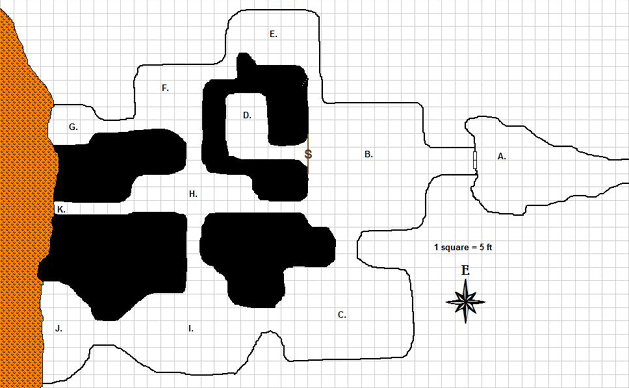
The lair has not been detailed in this scenario. DMs who desire such details are encouraged to refer to "Smouldering Slumber" for a full layout of the lair. A map of the lair has been included below for general overview purposes.
|
|
The lair is clearly worked, though the craftsmanship is a bit rough, not necessarily crude, but more likely with a desire to preserve the original lines and shapes of the stone. As such, corners tend to be rounded and walls not set at precise angles.
Walls are hewn stone, while the floor is treated as smooth stone. Ceilings are 10 ft tall unless otherwise noted.
Unless otherwise indicated, there are no natural light sources in the lair, as the lava children have darkvision.
The wall and secret door between area B and D are gone. These were constructed by the firenewts during their occupation and have been dismantled by the lava children.
Areas G, J, and K overlook the volcano shaft.
The PCs will be greeted by the lava children and their priest, Close-To-Blood.
|
FEATS: Divine Vigour (CW p108) - spend turn or rebuke undead to gain +10 ft to speed and +2 temp hp per character lvl for 1 min per Cha mod. |
Close-To-Blood will explain the situation to the PCs (largely mirroring what they have already been told), and will present them with a scroll he will say was left from the time of the firenewt occupation (note...if the PCs took this scroll during their first foray into this lair, then the scroll will not be presented). He will also explain to the PCs that firenewts were sacrificed at point K and their blood was dripped down the side of the shaft.
The vellum scroll is written in Abyssal and details a ritual for awakening "That-Which-Sleeps in the Heart of Flame and Earth". The ritual includes the sacrifice of non-evil sentient beings in prescribed ways and the intonation of unholy divine chants. A DC 30 Knowledge (arcana) or Knowledge (religion) check will determine that the ritual intends to awaken some extremely powerful and malefic presence slumbering within the volcano and that the ritual can be completed in a matter of a week or two depending upon the quality of the souls sacrificed to awaken the entity.
If requested, Close-To-Blood will agree to cast spells on behalf of the PCs. He will even agree to pray for specific spells as long as at least half of the spells of each spell level are retained for his personal use and reflect his normal spell choice (in other words, he will agree to prepare half of each allotment of spells for each level as the PCs request (rounded up). He will also agree to spontaneously heal any PCs who request it.
If asked about the lava children who perished, he will say that they were lowered down into the shaft on chains, but at a distance of about 150 ft were heard to be screaming and then the chains jerked violently as the pulleys were being worked to pull them back up. The jerking stopped and all that came up were two broken harnesses covered in lava child blood.
Lava Rules
Lava plays a major part in this scenario, and so the rules for lava are presented below.
|
Lava Effects Lava or magma deals 2d6 points of damage per round of exposure, except in the case of total immersion (such as when a character falls into the crater of an active volcano), which deals 20d6 points of damage per round. Damage from magma continues for 1d3 rounds after exposure ceases, but this additional damage is only half of that dealt during actual contact (that is, 1d6 or 10d6 points per round). An immunity or resistance to fire serves as an immunity to lava or magma. However, a creature immune to fire might still drown if completely immersed in lava. |
Additonally, even being near lava will cause damage, especially if above it. Coming within 10 ft of lava will cause 1 point of fire damage per round. Coming within 5 ft will cause 1d3 damage per round. Being above lava will double the damage for these distances and will cause 1 point of fire damage per round out to 20 ft.
Because of the immense amount of lava in the volcano shaft, multiply all distances by 10 to determine proximity damage (e.g. 2 points of damage per round when flying within 100 ft above the lava).
Swimming in lava is difficult, due to its syrupy sickness. Treat all Swim checks as having a -3 penalty. There is no visibility while submerged in lava. The lava is completely opaque.
Part Two - The Shaft (EL 15)
The shaft ascends and widens as it does, until it is a half a mile in diameter as it peaks. The shaft's south wall extends about 600 ft above the opening in this chamber and the north wall extends about 350 ft above. Below, the shaft continues downward about 400 ft before ending in a pool of churning, bubbling lava that is, itself, about 200 ft deep. Where the shaft reaches the firenewt opening it is 500 ft in diameter and remains so down to its bottom.
If the wall of the volcanic shaft directly beneath area K is examined, bright orange-red stains seem to spiral down along the wall face in an amazingly regular helix pattern.
The stains are lava child blood (where the firenewts slew the lava children and poured the blood down the side of the volcano shaft). If the PCs have seen a lava child injured in combat, or if He-Who-Walks or another lava child can see the stains, then they will be readily identifiable. The stains are not firenewt blood, which is a brighter orange hue. There is enough blood to suggest that multiple lava children were slain.
Initially it can be assumed that the blood eventually descends into the pool of lava. However, the bloodstains actually stop 350 ft down the wall of the shaft...as if the blood had been swallowed up by the wall itself!
It is a base DC 0 Spot check to follow the blood trail visually and notice it stopping short of the lava. This is modified by distance, with a -1 penalty for every 10 ft. Furthermore, the waves of heat emanating from the lava cause the air to waver and ripple, imposing a further -5 penalty. Thus, to someone looking out from this room down the shaft, it would require a DC 35 Spot check to notice the blood trail stopping. Of course, if a PC were to descend down the shaft closer to the stopping point, then the Spot check needed would decrease, but the heat quickly becomes unbearable upon descending any distance down into the shaft.
The best way to navigate the shaft would be for the PCs to grant themselves flight capability (or similar, such as with an air walk spell) and then combine with fire resistance to withstand the dreadful heat of the place. However, the firenewts have two long chains and stone harnesses made of stone shaped stone and volcanic glass (clearly strengthened by earth magic) that they rigged to lower the lava children into the shaft to investigate. The chains are mounted to two crude stone pulleys mounted at the end of area K against each wall. Each pulley has a crank and each chain is 450 ft long. The entire apparatus is crude and very heavy and cumbersome (and slow). Each harness can bear a single Medium creature and requires the efforts of up to four lava children per crank to maneuver.
Creatures: Lurking in the shaft, near the bottom, is a cinder swarm. It usually hovers around 20 ft above the level of the lava, and due to its surroundings, it gains a +8 circumstance bonus to its Hide check. Remember to account for the additional -5 penalty to Spot checks due to the heat waves. Additionally, a flock of 6 fire bats clings to the far side of the shaft about 150 ft above the lava pool.
Both creatures will move to attack any creatures not clearly of a fiery origin (meaning from the Elemental Plane of Fire or whose body is fiery in apperance...the lava children, even being of the fire subtype, are considered intruders) or in the service of the rousing power (even though they do not know what precisely this power is).
Usually, these creatures will spot intruders at a distance of about 140 ft. The cinder swarm will move to attack immediately. The fire bats will likely wait until intruders are about halfway down the shaft (i.e. about 200 ft above the lava). If the fire bats attack, they will make enough noise to alert the cinder swarm, which will then ascend to take part in the attack.
|
|
|
|
Tactics: Both creature types are intelligent enough to work together to combat foes. Their purpose for being here is to guard the approaches to the lava wight's resting place. Even if foes prove to be resistant to fire, a lava bat might be willing to test the limits of such protection by grappling and dragging a foe into the lava. Multiple lava bats can and will swarm a victim and seek to drag him into the lava.
None of these foes will retreat. They are fanatical in their service of the coming master and will fight to the death.
Development: Should these guardians be defeated and the PCs retreat and regroup, the DM should allow a 15% chance per day that a new group of guardians will emerge through the planar membrane and take their place. The DM can fashion a suitable (EL 14 or 15) encounter using more fire bats, cinder swarms, half-element gargoyles, etc. The only guidelines should be that the creature come from the Elemental Plane of Fire, not be too intelligent or sophisticated, and have the ability to fly.
The Sanctum Entrance:
The blood trail down the shaft ends at a seemingly unremarkable portion of the shaft wall. However, it this spot the wall is a crust of volcanic rock over the entrance to the sanctum. The entrance is roughly circular, about 10 ft in diamater, and is covered by a foot of unworked stone (hardness 8, 180 hp, break DC 35). There is really no way to detect the entrance by usual means. A Search check, including by elves passing nearby, will not turn up anything, and magic such as detect secret doors will not reveal the entrance, since it is not a door at all but rather a long ago sealed over passageway. That said, there are a variety of ways to investigate the spot and what might be behind it.
Spells that involve incorporeality (not gaseous form, since there are no small holes in the wall) would allow an incorporeal being to look into the wall and see the sanctum passageway beyond. Earth elementals or any creature with the earth glide ability, or spells like passwall would also allow the existence of the passagway to be determined. Stone tell will also reveal the passageway's existence.
Finally, a DC 30 Knowledge (architecture and engineering) check by someone who spends a good 10 minutes banging on the wall and listening for precise echoes and feeling the vibrations of the wall can determine that the wall there is only about a foot ot two thick as compared to the rest of the shaft.
Of course, the PCs can simply smash their way through the wall or use stone shape or other such spells to open the way.
The presence of the earth node within the sanctum can be detected when the PCs are within 30 ft of the entrance. At this time, each person is entitled to make a DC 20 Intelligence check to sense the presence of the node. The person will sense the source and direction of the earth node. If a person has the Node Spellcasting feat, then a DC 20 Spellcraft check is needed to detect the node.
The earth node also projects the power of the lavawight's hibernation crystal so that a nondetection effect covers all of the area encompassed by the earth node (which is the entire sanctum). This effect is at CL 22.
Part Three - The Sanctum
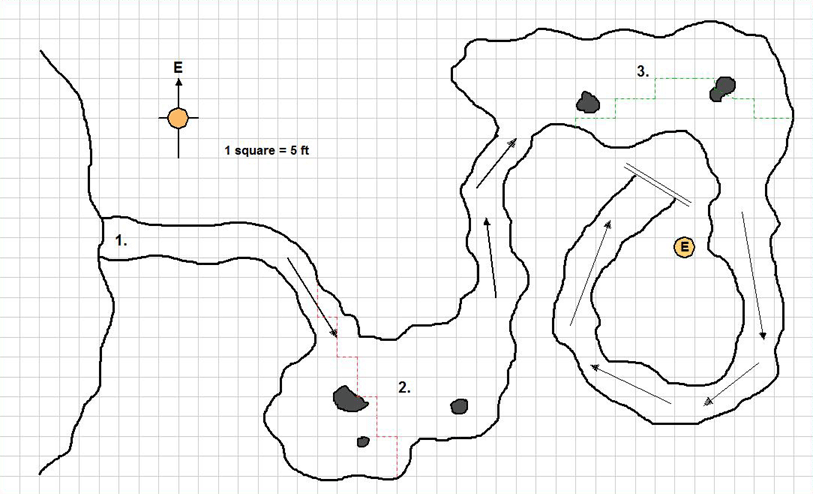
The sanctum of the lava wight is comprised of an upper and lower level. The upper level includes two chambers and a passageway that spirals down to the lower level, which is basically at the level of the lava.
Unless otherwise stated, all passages are roughly round, and as tall as they are wide. These are lava tubes, and the walls, floors, and ceilings are relatively smooth and comprised of black rock with flecks of obsidian and glass here and there. In passageways, the roundness of the floor causes Tumble and Balance checks to be increased by 2.
Caverns are naturally formed, but smooth due to the lava that formed them. As such, they are treated as hewn stone walls (Climb DC 25) and floors.
|
Hewn Stone Floor Rough and uneven, hewn floors are usually covered with loose stones, gravel, dirt, or other debris. A DC 10 Balance check is required to run or charge across such a floor. Failure means the character can still act, but can’t run or charge in this round. |
Unless otherwise stated, all locations are dark, unless lit by ambient light from magma.
Upper Level:
The circle marked with an "E" shows the location of a level 3 earth node, in lower level. The node is 50 ft below the level of the entrance.
 |
1. Entrance
| Beyond the shaft wall, a 10 ft diameter round passageway heads to the south. The walls are formed of black rock, with flecks of sparkling glass or obsidian embedded within. The passageway turns towards the west after about 40 ft, and as it turns the way descends. |
2. Crystal Cavern (EL varies)
The passage from area 1 descends
10 ft into this cavern.
| This cavern is 20 ft tall and punctuated with three large columns of black stone that reach from floor to ceiling. Each column is studded with flickering orange crystals that protrude from the stone. These crystals seem to bear a single small flame within, and together all of the crystals cast a flickering orange glow over the western portion of the place. |
The crystals are fire crystals, each imbued with a bit of elemental flame power (see Treasure below).
Creatures: Elementite swarms can form as detailed below. These swarms, however, can fly.
|
|
Treasure: There are easily over 120 crystals studding the three columns, and each crystal can be broken off with only a little effort. Doing so, however, will destroy the crystal, releasing the flame in a sharp burst that causes 1d6 points of fire damage in the 5 ft square in which the crystal was broken. If a crystal is broken within this chamber, the flame released will begin to swirl around the three columns. Each time a crystal is broken in this cave, the flame will join the others whirling around the columns, growing larger and larger each time.
For each crystal broken, there is a cumulative 5% chance that the flames will form into a fire elementite swarm. Once a swarm forms, the chance resets to 5%.
If a crystal is carefully removed in whole from the column (via stone shape or pried out with a DC 10 Dexterity check or Craft [stonemasonry] check, a failure means the crystal has been broken), it can be kept and used in a variety of ways:
1. The crystal will illuminate like a candle.
2. The crystals can be thrown or slung and will break on contact, requiring a ranged touch attack to hit its target.
3. The crystal can be used as a material component for any fire spell (including any spell that summons or calls a fire creature) and any such spell cast will be cast at +1 caster level for all purposes. Using the crystal in this manner destroys it utterly.
4. The crystal can be used (and consumed) as a component in the crafting of any wand that causes fire damage and will imbue the wand with an extra charge (so that the wand has 51 charges when created).
The crystals radiate dim magic (of no particular school) and while the two uses may be apparent, the other two require a week of research and experimentation along with a DC 20 Knowledge (arcana) check. However, just a simple examination of about a minute and a DC 25 Knowledge (arcana) check will allow the observer to determine that the crystals may have some possible use in spellcasting or magic item creation and that further research in an arcane lab might reveal these details.
3. Inferno Cavern (EL 15)
The passage from area 2 descends
15 ft into this cavern.
|
The entire ceiling of this cavern is covered in a layer of roiling smoke. The smoke hovers about 10 ft above the floor of the cave and boils around two large stone columns that reach from the floor and disappear into the smoke. The floor of the place is covered in ashes, in some places as deep as 6 inches worth collected in drifts around the stone columns and against the walls. Glowing cinders and ashes occasionally rain down from the smoke cloud and settle lazily to the floor. |
The third (innermost) layer of the earth node bisects this cavern at the location denoted by the dashed green line. All points to the west of that line are within the third layer (including the entirety of the spiral passageway down to the lower level).
Creatures: Six inferno spiders dwell here, perched inside the smoke layer atop their webs. They use their tremorsense to locate intruders, and as such remain completely concealed within the smoke (i.e. they have 100% visual concealment against others, and vice versa). When they sense intruders in their lair, the creatures will tend to wait until their prey is well into the cavern (between the two stone columns) before initiating their attack. At the moment of their attack, the lead spider will dip his head to the edge of the smoke and observe the intruders, to make sure they are enemies and not servants of the master.
|
FEATS: Dash (CW p97) - speed is 5 ft faster in light or no armour.
|
Tactics: The spiders will initiate their attacks with their flame web attacks, seeking to immobilize their prey. To do this, they will stick their heads and their spinnerets out of the smoke so that they can target their victims. This will still keep the bulk of the spiders' bodies inside the smoke and grant them concealment (20% miss chance) versus attacks against them.
Once victims have been immobilized, the spiders will use their Spring Attack ability to climb down a stone column or nearby wall and attack victims and then scurry back up.
While these spiders are not geniuses by any means, they are intelligent enough to exhibit cunning and to use basic tactics like flanking.
Developments: As with most of the denizens of the sanctum, these creatures will fight to the death.
The passage to the southwest slopes downward in a rough spiral for 25 ft before emerging into the lower level of the sanctum (see below).
Lower Level:
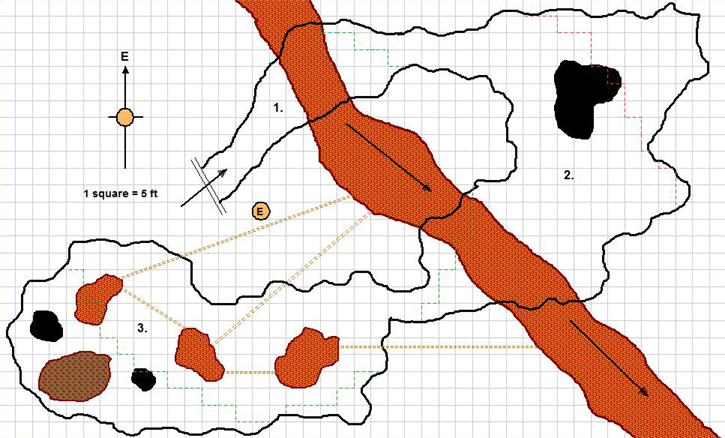
The map below shows a green dashed line and a red dashed line. These denote the boundaries of the layers emanating from the earth node at point "E" on the map. The green layer denotes the third (innermost) layer of the level 3 earth node, while the red denotes the second (middle) layer.
 |
1. Lava Grab (EL 15)
| The passageway widens here, and the ceiling rises to a height of 25 ft. A slow moving river of molten magma flows from a low hole in the wall to the east and travels across the cave before exiting through the western wall. The lava flow is about 15 ft wide, and the glow from it illuminates the entire cavern. |
Creatures: An elder magma elemental and four of its minions hide in the lava flow, completely submerged (the elder paraelemental is crouched). The magma elementals have the ability to see through magma and lava as if it were clear water, and this allows them to use the spot as an ambush point against intruders.
The elementals will wait until intruders attempt to cross the lava flow. At that time, they will attack (presumably from surprise) and attempt to grapple and pull their victims down into the lava. Should this prove unsuccessful or should other foes remain ungrasped, then non-grappling elementals will move to attack them.
|
|
|
|
Tactics: The magma elementals are all about getting their foes into the lava stream, where the massive heat damage, the depth of the stream, and their magma sight are all large advantages. The elementals will accomplish this by means of grappling and dragging victims into the lava, or by bull rushes or Awesome Blows.
Developments: DMs should note that the lava stream crosses into area 2 (below). As such, should the PCs manage to barricade or otherwise trap these elementals to prevent them from having access to the passageway, they are likely to simply swim to area 2 and await the PCs there.
2. Cave of Bones (EL 15)
|
This cavern's walls, floor, and ceiling are covered in thousands of charred and fossilized bones. These blackened and scorched bones are in a jumble, and layered over each other such that it is impossible to tell at a glance from what sort of creature they are derived. The ceiling of the cavern is 10 ft high, and its western end is crossed by a slow moving stream of lava that is between 15 ft and 20 ft wide and flows to the west. The stream emerges from a low hole in the eastern wall and exits through the same in the western wall. The lava illuminates the cavern in a ruddy glow. |
The lava stream is 10 ft deep and the sides are sheer.
Creatures: Eight cinderspawn dwell amongst the bones, hidden within the walls of the cavern.
Unlike normal cinderspawn, these creatures were borne of the ancient magicks and horrific rites perpetrated by the lava wight millenia ago. Those rituals twisted their pysches such that they are now quite insane and have become immune to all mind-affecting effects. They despise all creatures that are not from the elemental plane of fire or are not in the service of their lavawight master and seek to destroy them and feed on their warmth. While the cinderspawn know the exact nature of their master, they do not know its name or the name of its race. They simply call it the "Great Old One" in Ignan.
The cinderspawn will emerge from the walls with a cracking of bones and a cloud of charred ash when living creatures enter the cavern (at roughly the point where the "2" is located on the map). Two cinderspawn will emerge from the large stone column to the east, while two more will come from the north wall and the rest from the southern wall. The cinderspawn have the ability to sense warmth in a 60 ft radius, and so they will react to living PCs passing into the cave.
While hidden amongst the bones, the cinderspawn are presumed to be completely concealed. Nevertheless, anyone close enough to examine the walls with a Search check will notice a pair of glowing blue-white eyes glaring out from the bones and char on a DC 29 Search check.
|
|
Tactics: The cinderspawn will use their Spring Attack ability to harrass their foes, striking one after the other and attempting to fully drain one or two foes before moving onto the next.
Treasure: Buried within the bones and char of the walls are a total of six elemental gems, each reddish orange and containing a fire elemental. These gems were not manufactured, but were created as a side effect of the rituals that created the bones and the cinderspawns. The gems can be located using detect magic or each with a DC 25 Search check. With regard to searching for the gems, the DM should assume they are spread somewhat evenly around the cave's walls, and each one requires a separate Search check.
3. Lava Sanctum (EL 17)
| This cave is 25 ft tall and the southern portion is dominated by three large pools of bubbling magma, which illuminate the entire chamber. 10 ft high along the east and west walls flanking the first pool are volcanic stone statues of crouched humanoids. Further north, two stone columns flank a large mound of dark brown stone that is jagged like pumice. The mound is 10 ft tall at its apex and there are cracks in the stone from which amber light shines out in jagged sheets. The stone columns are deep black obsidian and are vaguely shaped like large humanoid figures contorted in rage or agony. |
Creatures: There are three varieties of creatures present in this chamber: 2 ember guards, an infernal conflagration ooze, and 12 half-elemental gargoyles.
Standing before the stone columns are two ember guards. These will attack any intruders who attack them or who pass the first lava pool.
|
|
The infernal conflagration ooze lurks atop the brown stone mound. There it will use its spell-like abilities at range before attacking foes of opportunity.
|
|
The gargoyles dwell in the lava pools and as statues along the walls surrounding the first pool (as described above). There are 2 gargoyles in each pool and 6 on the walls. Those hidden in the pools will react when they hear the sounds of combat in the cavern. The statue gargoyles will attack when they are spotted or when foes pass the first pool.
|
|
Tactics: The gargoyles are likely to be severely outclassed by the PCs, especially in terms of hitting them. As such, once it becomes apparent that melee attacks will be unsuccessful and if the PCs have fire resistance enough to confound produce flame and burning hands, then the gargoyles will resort to aiding combat on behalf of the ember guards or swarming a victim with grapple attacks and dragging them into a lava pool. If a victim shows an ability to use Combat Reflexes to thwart the grapple attemmts (since the gargoyles do not have Improved Grapple), then they will move onto another foe.
Developments: The brown stone mound with the light leaking out of it is the resting place of the lavawight. The brown stone is basically a pumice/solidified lava coating over the crystalline cuccoon that serves as the creature's "bed". The pumice covering is only about 2-3 inches thick and can be easily chipped away (hardness 6, 25 hp). Each piece chipped away will allow more amber light to shine through any holes or cracks, and it will be apparent once even 1 hp of damage is caused that a glowing crystal is present underneath the pumice covering.
The crystal radiates overwhelming transmutation magic (which can be detected even before the stone is chipped away). However, the crystal itself is enough to stop the PCs from actually detecting the lavawight itself. So detect evil or other such spells will not reveal any aura relating to the slumbering lavawight, even if the nondetection effect is pierced.
The crystal radiates a nondetection effect that coincides with the area of the earth node (CL 22). Any attempts to scry or cast divination into the area must overcome the caster level or the diviner will sense some effect blocking his attempt.
Once enough of the stone is chipped away (25 hp worth), the PCs will be able to gaze into the glowing crystal and see that it is roughly the size of the mound and likely is a rough sphere, in that an equal amount of the crystal is set into the floor. In the heart of the crystal is the lavawight...quiescent for now. The lavawight appears as a Medium humanoid skeleton sheathed in molton rock. It does not move or react in any way to observation.
Afterwords:
Dealing with the Lavawight
What the PCs do once they reveal the lavawight is up to them. A few options are presented below.
1. The Lava Children:
The PCs can (and should) reveal what they have learned to the lava children. A simple description of the lavawight should be enough to arouse the suspicions (and worst fears) of the priest, though he will want the PCs to clear he area of threats so that he can view the crystal personally. Even if the PCs can draw a picture or create an illusion depicting the lavawight, the priest will insist that he needs to go down and see and touch the crystal. This will provide an incentive for the PCs to actually fight the denizens of the sanctum and not simply sneak in and uncover the crystal and then teleport away. Until the priest can physically see and touch the crystal and view the lavawight in person, the lava children canno perform and attune their rituals to keep the lavawigh asleep.
2. Molesting the Crystal:
The PCs might try to molest the crystal. However, it is impervious to non epic-level means to harm it, and so the DM should just rule that it cannot be harmed by anything the PCs attempt to do to it. The lavawight inside is also impervious to physical harm or magic by means of the crystal.
The crysal is extremely heavy. It is about 25 ft by 15 ft and 20 ft tall (counting the portion embedded into the cavern floor) and weighs about 750,000 pounds (which is about the weight of a diamond of the same size). Assuming the PCs could somehow manage to move the thing (e.g. by stone shaping around the crystal, etc.) doing so would cause the lavawight to immediately awaken and burst out of the crystal. The DM should give the PCs warning of this fact by having the creature stir slightly if the crystal is even threatened with moving (e.g. a stone shape is cast and the ground beneath the crystal has begun to be formed). Such a stirring would cause the crystal to tremble and might even cause a hairline crack to appear with a resounding CRACK sound, releasing a sulfur and brimstone stench into the air.
Returning to the Sanctum
Like the shaft, the sanctum draws denizens to it. As such, the DM should allow a 15% chance per day that any groups of denizens defeated by the PCs will be replaced by a similar group of creatures or (more likely) by a new group of creatures. The exact nature and composition of such groups is entirely up to the DM, but suffice to say that they should be from the Elemental Plane of Fire and should be evil in alignment (or neutral at best). The idea here is to not allow the PCs to simply finish off the sanctum one encounter at a time.
The Lava Children
Once the lava child priest is able to see and touch the crystal, he will know what it is. He will ask the PCs to ascend with him back to the lava child lair before discussing the matter. There, very gravely, he will explain that the creature within is a lavawight and inform the PCs as to the nature and history of the lavawights. He will warn the PCs that this creature is far beyond the ability of normal mortals to contend with, but the priest also expresses optimism that the dragonewts were not able to fully rouse the creature and, now knowing what it is that they are dealing with, the lava children can enact rituals to keep the creature in slumber and to stop its influence from drawing fire creatures to the area. The priest seems convinced that the lavawight can be kept in slumber for centuries, if not longer.
The lava children will thank the PCs for their service and will give them gems of various sorts, all uncut, totalling 15,000 gp which can then be crafted and polished to double their raw value. Of course, a craftsman will charge the PCs half of the improvement value, so that unless the PCs can cut and polish the gems themselves, the total value to the PCs after paying the craftsman will be 22,500 gp.
Longterm Prospects
The lavawight may eventually break free of the rituals of the lava children, and such an encounter could be the basis of an epic level scenario.
Experience Points:
In addition to normal experience (which in Therra is half of that recommended in the DMG), each party member should be rewarded as follows:
There are no special experience awards for this scenario