

Return to the Therran Scenario Page
Summary:
The PCs continue to search for the lost arcana of Karsus
Assumptions:
The PCs include at least one wizard from Jerranq (or in a pinch a sorcerer).
Location:
The Hurlotzin Lands
Historical Date:
705 A.C. Spring
DM's Introduction:
This scenario and the one that precedes is and the one that follows it are intricately bound with the history of the enigmatic Karsus. A brief outline of that history is presented below. Note that much of this history is unknown to anyone in Sazhansiir. This text is taken directly from the entry on Karsites in the Sazhansiir Gazetteer.
|
Karsus is a legendary hero of the great wars between Okoth and Kyuss, and many obscure myths and legends surround him. In some ways, next to Tlaloc, he was the most famous human hero of Sazhansiir. What is not widely known is that Karsus was not born of Sazhansiir. Rather, he was a native of Jerranq and specifically the Antorian Empire who was transported to Sazhansiir by an epic spell cast by Okoth himself which went awry. Karsus was a wizard of no small power in Antorium, and his transportation to Sazhansiir involved not only Okoth's mishap, but a simultaneous mishap in a great magical experiment he and his apprentices were conducting. The result of these two freakish events forming a mystic nexus in the fabric of the multiverse was that Karsus was violently wrenched through the inner planes before being deposited, burnt, frozen, energy drained, bruised, and drowned onto the shore of the Kurlotzin Lands. Dazed and in dire physical and mental shape, Karsus was found by dusklings dwelling in that land and his strange demeanour, babbling speech, and potent abilities were noted and eventually reported to Okoth himself. who ordered the man to be brought to him and nursed by his best healers. Karsus barely recovered, and even so his body and mind were so decimated by the unnatural transference that he had no memory of his life before his arrival. Over the years, Karsus slowly regained some of his knowledge, but never fully, and the knowledge he did regain was murky and came to him like mystical visions or dreams, lending him the air of a prophet, which is, in fact, how he was regarded even by Okoth himself. Although he had lost his spellbook, Karsus knew the Spell Mastery feat and so was able to perform limited "miracles" that likely would have had him cast as a scaled one and killed for use of arcane magic, had not Okoth vouched for him. Instead, Okoth tasked Karsus with trying to find a way to tap into his latent powers and perhaps teach them to others. Karsus tried for years to manage this, but as he was somewhat fuzzy on the origin of his own spell ability, it was difficult for him to make any headway in essentially developing the discipline of wizardry for the Azotchtla. Instead, his magical experiments veered into the realm of suppressing and combating the arcane magic of the scaled ones, and his success sin this regard was likely aided by what must be described as a sub-conscious knowledge of the workings of arcane magic. When Okoth unleashed the creation cyst and died in the blast, Karsus was bereft of his primary benefactor and great friend, and his grief grew alongside his madness. After spending a short time railing against the folly of the new rulers of the Okothian Empire, and making a torrent of bizarre prophetic pronouncements, Karsus gathered his few Azotchtlan disciples to him and announced that he was going to find Kyuss in his "hole" in Tyrmannion and siphon the demigod's power through Karsus and to his followers, thereby granting them the ability to wield Kyuss' magic against himself. Amazingly, Karsus performed the powerful and dangerous ritual linking his followers to himself mystically and over great distances. Even more amazingly, with a small band of companions, the once-wizard managed to reach Tyrmannion and breach its formidable defenses. There, with most of his companions dead or worse, Karsus confronted Kyuss and managed to enact the trigger words of his epic ritual and touch the demigod, triggering the effect. Unfortunately for Karsus, Kyuss' being was so far steeped in corruption that the absorption of even a small part of his essence was too much for his mortal shell to contain. The ex-wizard was instantly slain…or at least his body was. Kyuss' corruptive essence and the power of the epic ritual interacted to shred Karsus' soul, so that he did not go on to the afterlife, but instead his soul lingered in shards somewhere in the multiverse. The largest of theseshards, now touched by and infused with some of the power of Kyuss, became aware as a vestige and is capable of being contacted by a binder. When Karsus touched Kyuss, the conduit to his followers received a jolt of Kyuss' power and corruption as well. Most of the followers died instantly, others slowly and in agonizing fashion, but a few had the fortitude or luck to survive, and the event changed them into what were the first Karsites. These first karsites were unaware of their powers, and were, in fact, devastated that the clerics amongst them now could not cast their divine spells. But over time they learned that some small benefit had been gleaned from Karsus' sacrifice, and that their newfound traits were so much an essence of their being that they could be passed on to their progeny. And so karsites have become a part of Azotchtlan society. They are rare, to say the least, as the karsite trait is elusive, and even if two Karsite parents breed the chances of producing a Karsite offspring is only slightly higher than with a mixed mating. In fact, the bloodline has been so diluted that in theory any two humans who mate have a tiny chance of producing a Karsite. Karsites are considered a blessing to the Azotchtla, as their powers are regarded as particularly suited to fighting against yuan-ti sorcery. As such, Azotchtlan parents often keep a close eye on their children for signs of being karsites, and despite no real tendency for Karsite births to run in a given family or to a given set of parents, sometimes the number of Karsite offspring in an Azotchtlan family line makes that family more prestigious and suitable for intermarriage. Units of karsites are famous in the ranks of the Azotchtlan armies, and many of the best-known war leaders and generals of the Azotchtlan armies are or were karsites. It is also believed that karsites were instrumental in developing the discipline of spellthievery. While certainly no karsite can become a spellthief, due to the inability to cast spells, it is thought that some of the first karsites sought to teach their powers to normal humans and, instead, developed the training for the first spellthieves. |
During his time in Sazhansiir, Karsus babbled incessantly about many obscure and seemingly unintelligible topics. From time to time he would mention three items that were precious to him that he had lost: his staff of power, his white robe of the archmagi, and his spellbook. However, his adled mind would not adequately describe these tokens to the dusklings (and later the Okothians) with whom he spoke, and given their general unfamiliarity with arcane magic (in the case of the dusklings and humans) and wizardry in particular (even Okoth himself was not familiar with this form of arcane magic), the nature of these lost tokens was never truly divined even by his contemporaries.
This was not aided by Karsus' increasing mental instability. While at first Karsus could vaguely elucidate the fact that the items he longed for were, in fact, items, over time his ramblings made this fact less and less clear, until he began to express the identity of the items as his lover and children and refer to them by proper names (the items were, in fact, named) and loving nicknames. The Okothians bgan to assume that he was longing for loved ones who had been slain or were somehow taken from him (or vice versa) and eventually Karsus forgot about them altogether and they were mentioned less and less frequently and then not at all.
And so it likely would have remained, for Karsus' ramblings, at first recorded with much enthusiasm and dedication by the Okothians, who thought him a prophet touched by the gods, were less and less heeded as they became less and less understood. However, Yayauhqui Farseer, doomsayer and prophet, has long been fascinated with Karsus and with his prophecies and pronouncements, and with his "offspring" the karsites. When Yayauhqui learned of the strange magic the PCs wielded, and saw the writings in their spellbooks, he became very intrigued, for such things brought back vague memories of mentioins in the earliest and rarest, but most lucid, pronouncements of Karsus.
He spent much time doing research and eventually came to a startling conclusion...that Karsus was not of Sazhansiir, but was from the far north...from the same lands that the PCs are from.
This revelation was included as an epilogue to the scenario entitled "First Strike". The text of the epilogue is presented below for DM reference.
|
Just before the PCs leave the city, Yayauhqui Farseer will arrive bearing a bundle wrapped in a cloth. He will call the PCs and Malinal and Pizotzin into a private chamber in the Hanahpu Temple and begin to speak: You will remember that the magical writing these people showed us last time we met sparked some memory in my mind's eye. I knew I had seen such writings before! And so I have spent the last months digging through ancient libraries and consulting with wise ones and I have only recently determined where I saw such writings...in some of the works set down by Karsus himself! Mind you, it was in the from of a single character here, or a word there, and often it would involve him writing about something and then lapsing into these characters and then resuming the text, as if these characters were intruding on his chain of thought. But that is not the most interesting thing I found, for the realization that these characters of Karsus were similar to the arcane writings of these strangers caused me to look further. Have you a statue or picture of Karsus handy? Malinal and Pizotzin will both shake their heads. Well, no matter. How is he described in all of the texts? Malinal will indicate that he is described and pictured as an elderly man with wild shocks of white hair and a scraggly white beard and wild, wide, mad eyes. Yes, but he is depicted as an Azotchtlan male yes? Pizotzin will nod, of course. Yayauhqui will then place his bundle on the ground and open it, revealing a stone tablet that is inscribed with cuneiform runes but is clearly worn with age. This is a contemporary account of Karsus. One of the few that has survived through the ages. It dates from after the Creation Blast and before Karsus perished. Of its authenticity I am assured by the rainbowed ones. Here is what this passage says... And he points to a piece of the text "...and Karsus was in a trance as he spoke. And he raised his hands high, his holy staff glowing with divine radiance, and he spake: 'Circles from now, when I am gone and with the gods, the People of the Book shall come! Into your midst they shall come! And you shall reject them at first, as I was rejected. But they shall prove themselves amongst you and they shall show you the way. What is profane shall become holy, and what is holy shall become profane. For they are the pale reavers, the destroyer of nations, the slayers of the sacred! And you shall know them because they shall have the colour of the pages they revere...like mine. They will have what I have lost.' Then the divine one collapsed and froth formed about his lips and he was taken away by his servants..." You see! I believe that Karsus may have been one of them. Perhaps from the same land to the North! I think over the ages he was depicted as one of us...not as a deliberate falsehood, but as a form of respect and reverence for one of Okoth's favourites. There is more I must investigate, but this is quite intriguing! Malinal and Pizotzin will agree. |
For well over a year since his previous meeting with the PCs (as described in the epilogue above), Yayauhqui returned to his karsites and pored through ancient lore kept by the most learned and powerful of that race. He also scoured those sources in Azotchtla to which he had access (which is considerable indeed). By way of his intensive study, now properly focused, he came to the conclusion that Karsus may have travelled to Sazhansiir with his three tokens, and that somehow he lost them AFTER he arrived in the Hurlotzin Lands. Yayauhqui felt that these tokens could be of extreme aid to the PCs in their continuing fight against the Scaled Ones. Moreso, if such items are, indeed, powerful, then it would do to keep them out of the hands of the Scaled Ones; for although the Scaled Ones practice sorcery and not wizardry, Yayauhqui does not know what they might be able to use or glean from the tokens. And so, he returned to the PCs to inform them what he knows about the tokens and to invite them to attempt to recover these items from wherever they might be and from whomever might have them.
In the scenario entitled "The Staff of Power",Yayauhqui (along with Malinal and Pizotzin) explained the situation to the PCs:
Yayauhqui: I have cast my line and caught a worm...yes a worm! That is fitting indeed after a fashion! My head hurts and my rump is pocked and there are needles of light piercing my eyes, but it was worth it...yes it was! You see, lovers and children AREN'T! They simply are not! Who would have guessed it? Not me! And definitely not you...even with your special ways. Sometimes when people babble, there are wheats and oats about. I know this and I am the furthest from a babbler! Hoo...hoo! Manatlan fill a bathtub if it isn't true! Tokens! Tokens tokens tokens. Yep...three. Those without had the way of it. And they are my friends. I have means that would boggle even the high priest of knowledge. Manatlan cheeks for him. Now it is for you! Yes...you can get lucky and find them. You can wield them and strike down the snakes! It will be a great day then! A great day indeed!
Malinal: The farseer speaks the truth, though I will admit that his words are clearer in their meaning after you have figured out what it is he is speaking of. Since Pizotzin and I have already done so, perhaps we can explain it to you in our own hopelessly plain fashion.
You will remember how excited the farseer became when you showed him your spellbooks and magical writings, and how he believed he had seen such writings before.
You will recall that we spoke then a bit about Karsus. It is he who created the karsites, with whom some of you spent some time during your first journey to Azotchtla. Karsus was a close friend and companion of Okoth himself and was regarded as a mystic and a prophet, for his ways were very strange and his speech often made no sense or spoke in obscure riddles. After Okoth died in the Creation Blast, Karsus decided to strike a blow directly at Kyuss in Tyrmannion. He claimed to have discovered the means to siphon off Kyuss' own fell powers and grant that power to his own followers, who would then be able to strike at the Wormlord using his own powers against him. And so, after berating Tlaloc and the new Okothian rulers and making a series of his most complicated and obscure prophecies, he and some companions travelled into the Blasted Lands, reached Tyrmannion, and somehow managed to breach Kyuss' own defenses. Karsus enacted his siphoning ritual, but alas the corruption that was Kyuss was too much even for him, and the prophet was slain instantly and his soul shattered into shards that roam the netherworlds to this day. The backlash amongst his followers, waiting in Okoth to receive Kyuss' power, killed most, but those who survived became the karsite race.
You will also remember that in our last meeting, after you had escaped the yuan-ti trap in the City of Feathered Ghosts, Yayauhqui had produced a stone tablet that described Karsus as one of you, from your land to the far north.
Well, Yayauhqui has done more research, now convinced that Karsus was one of you, from your lands to the north and that he was likely a wizard, given his strange powers and his references to arcane writings such as were in your spellbook. With this insight in mind, he has been able to re-examine many ancient and obscure pronouncements of Karsus', some of which were thought to be prophetic ramblings, and he has come upon what we think may be an extremely interesting revelation.
You see, it is well-documented in the lore pertaining to Karsus that he had been separated from his family. The lore tells us that he was greatly agrieved at the loss of his dear wife and two children. He often would lament their absence, though he would refer to them as "lost", and scholars were unclear as to whether his family was dead, or had been taken (perhaps by the Scaled Ones), or he had simply been separated from them. But the farseer has access to some of the earliest lore of Karsus, kept by the elders of the karsites themselves...knowledge that even the Knowledge Temple in the City of Ghostly Feathers would not have access to. And Yayauhqui has noted some inconsistencies in the manner to which Karsus referred to his loved ones in his earlier, slightly more lucid days.
I am a bit embarrassed to tell you the rest, for you will no doubt think the Azotchtla ignorant. But you must try to understand that language is a tricky thing, and even though we can pray to the gods to allow us to understand strange speech and read strange writings, you must, of course, recognize that a thing is in a strange tongue in the first place or you will not know enough to use such prayers. And when a person, such as Karsus, is prone to babble and use strange speech, there is even less cause to use such magic. Furthermore, the spelling of strange words by a raving man can be garbled such that comprehend languages spells will not work on them anyways.
So, it seems, has happened with us and Karsus.
The Azotlan word for "fork" is "tenetach". If I were to say to you in your tongue "I lost my tenetach", how would you know I was referring to an object and not a person? Could not my "Tenetach" be my beloved wife, slain by the yuan-ti? And this is especially so if I were highly distraught at the loss of my Tenetach.
I will say the names of Karsus' "wife" and "children" in your tongue. Here is one of the earliest passages:
DM Note: The words below that are in bold italics are said by Malinal precisely as phonetically set forth, with the accent on the capitalized syllable. Their resemblance to the English (i.e. Common Tongue) names of items should be apparent to the DM (and the players with a bit of thought).
And Karsus awoke in his bed screaming and in a sweat. When his attendants asked what ailed him, he grabbed one by the hair and pulled him close and spake:
"My precious is missing. Where has my poor stawf-UF-pooh-ore gone? I have such need of my stawf-UF-pooh-ore in these troubled times! And my creation, the progeny of my will, why has my poor spehl-BOOK been taken from me? Why, oh gods, have you done this to me! Bereft of my helpless spehl-BOOK am I also helpless. And my long-missed wit-ARK-meej-eye how I long to feel your enfolding embrace once more. I miss your touch. I miss how I felt so secure with you. I am bereft! I am alone!"
You can see that spehl-BOOK is mentioned. It is the same word we heard you refer to your tomes in your own tongue. And if spehl-BOOK is not a child, but an item of power, then what of the others? Can you divine the meaning of stawf-UF-pooh-ore and wit-ARK-meej-eye?"
Of course, stawf-UF-pooh-ore is actually a reference to a staff of power. Wit-ARK-meej-eye is a reference to a white robe of the archmage. These, along with this spellbook (spehl-BOOK) are the three items Karsus lost after his arrival in Sazhansiir.
Malinal then explained that the farseer also found a reference as to the precise spot that Karsus first arrived in Sazhansiir. She stated that although it is a long shot, for 7 centuries have passed since Karsus arrived, there was a chance that one or more of the items could be recovered if they are still in the area.
Yayauhqui:We know Karsus arrived in the Hurlotzin Lands, which, at the time, were populated by the Children of the Mishtai. Now it is a blasted and wild land, foreign to us. But the Hurlotzin Lands are large, as large as Xonochouco, and it would not do to simply wander that land aimlessly. I have come across an account given by Karsus in his earliest days to a feathered serpent of Okoth:
I awoke to the crashing of waves, which I thought were in my head. The sun blinded me, and so for a time all I could hear was the incessant crashing. But my eyes focused and the dazzling light receded and there I was, high upon a cliff with the great sea stretching before me. And as I looked down I saw an eye of earth whose pupil was the sea itself. And it stared at me in solemn judgment. And near the eye was a gaping maw of earth, which sought to swallow me should I not flee from the place. And a nameless fear welled up within me and I ran from the waves below and into a cleft in the earth where ran a river that soothed me. But I lost my way and could not return to the place I had awakened.
Malinal: This is not much to go on I fear, but it is the best we have. If you are willing to pursue this further, we can speak with a duskling elder we know. He may be able to shed some light on where you might search. But keep in mind this can all be for naught...and likely is. Over 700 years have passed. Who is to say the items are even in the Hurlotzin Lands? Perhaps the snakes took them away centuries ago and they now lie in some vault in the Blasted Lands? But if you are willing, we will take you to the duskling that you may speak with him.
The PCs then met with a duskling elder, whose ancestors guided them to a magic portal in the Irin Forest that allowed transport to the Hurlotzin Lands. From there they located the landmarks that Karsus spoke of and a cave wherein dwelt an insane rogue eidolon who had been in possession of the staff of power. The PCs learned that the staff had been stolen by a group of evil worshippers of the vestiges of Karsus and they made their way to the cleft in which they had their lair. After a tough fight, the PCs gained possession of the staff. They also found a map (or fragment thereof) in the lair of the duskling leader of the worshippers and documents that indicated that Karsus' white robe of the achmagi was likely in the possession of a dragon who dwelt in the lands to the north of the cleft.
Now armed with this knowledge, the PCs are endeavouring to obtain the second of Karsus' powerful tokens, the white robe of the archmagi.
The robe is in the horde of a powerful incarnum dragon. This presents the PCs with several options. They can fight the dragon and claim the robe and the rest of his horde, or they can negotiate with the dragon, in which case (if successful), he will send them to retrieve an item that he considers to be of suitable replacement value to the robe. Unfortunatelty, this item is more than it seems and is the key to free horrific entities that have been trapped for centuries.
Part One - To the Dragon's Lair
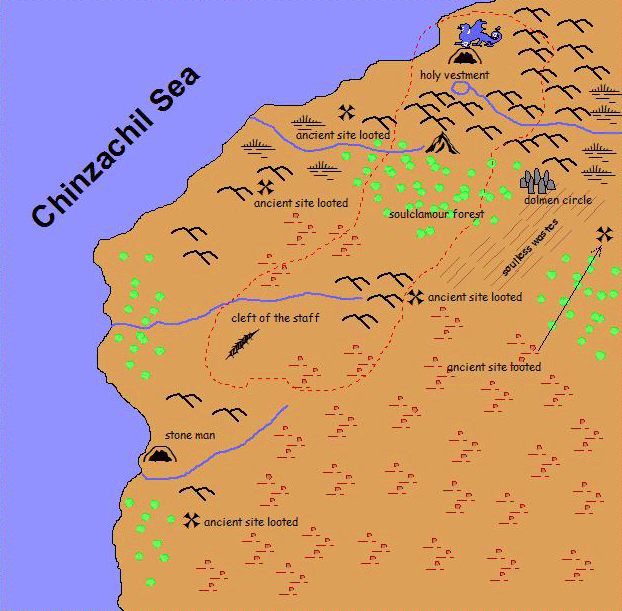
The PCs will have either a full map leading to the dragon's lair, or a fragment of it if area of effect fire spells were used in the chamber with the map. The illustration below gives the full map and an outlined area of the portion that will survive burning. The DM should give to the PCs whichever map (or piece of map) is applicable. Furthermore, the maps are presented in "Slith" and with the labels translated.
|
|
|
 |
 |
From the Player's Guide to Sazhansiir:
|
Ancient home of the rilkans, this land was invaded by the scaled ones and overrun, and much of its beauty decimated, as the angry serpents left no stone unturned and salted and poisoned its fields and lakes and streams. Over the centuries the land has recovered somewhat, but is now thought to be wild and untamed, though no doubt full of the ruins of the old civilization. In ancient times the Children of the Mishtai hunted and culled the terrifying malastors, massive creatures covered in plates of stone, but with the land now untamed, the malastors have likely bred in terrifying numbers. It is not known if the scaled ones dwell in this land in any significant numbers and it is not regarded as a part of the Scaled Lands. |
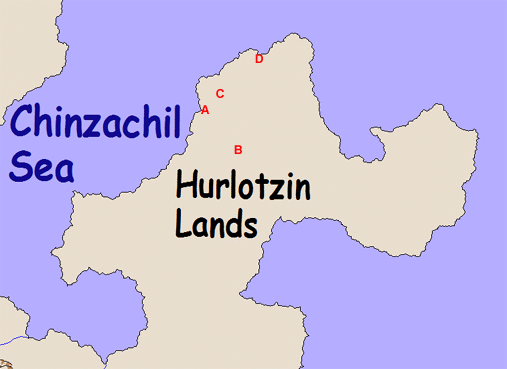 |
On overview map of the Hurlotzin Lands is presented above. 1 inch equals about 400 miles. Important locations to this and the following scenario are noted on the above map.
A = The site of Karsus' arrival
in Sazhansiir and the location of the sea cave
B = The incarnum temple and location of the magic portal back
to the Irin Forest (presented in "The
Staff of Power")
C = The site of the staff of power and the cleft of the
Karsus worshippers
D = The incarnum dragon's lair and site of the white robe of
the archmagi
Travelling in the Hurlotzin Lands:
The majority of the Hurlotzin Lands is flat, rolling plains, much of it still barren due to the ancient depredations of the Scaled Ones. Where it is not barren, vast areas of scrub grasses and wiry bushes predominate. It is only near the coasts that small woods and grasslands begin to appear.
There are no mountains in the region, though the central north-south axis of the land contains some hills and tall ridges.
While there are special terrain locations in the Hurlotzin Lands that correspond to the incarnum terrain types presented in Magic of Incarnum pages 203-207, they do not enter into this scenario. DMs should feel free to add them into the travel of the PCs if so desired, though such exotic spots are rare even in the Hurlotzin Lands. Some of these terrain types do make an appearance in the next scenario in this Tokens of Karsus adventure series.
For purposes of overland travel, the DM should treat the entirety of the land as trackless plains with the exception of those areas shown on the PCs' map (see above) as other terrain. Such terrain includes:
Soulclamour Forest = Forest
Other Forests = Forest
Souless Wastes = Plains
Hills = Hills
Marsh = Moor
The land is wild, but also sparsely populated by beasts. As such, wandering encounters are somewhat less frequent, but more dangerous, than many other places in Sazhansiir.
Wandering encounters are checked for each of four periods of the day, morning, afternoon, evening, and night. Assume the PCs travel during the first two periods and are encamped for the last two periods. There is a 5% chance of an encounter each period. If an encounter is indicated for a period, the DM should check again to see if a second encounter is indicated. If so, then a third check should be made and so forth until a check fails for that period. Multiple encounters in a given period can be spaced apart randomly (i.e. roll a d6 for hour in the period) or can be mixed together into a multiple encounter.
Nighttime encounter chances can increase or decrease depending on the type of camp that is set up:
PCs light an unshielded fire = +5%
PCs light a shielded fire = +2%
PCs make no effort to find a secluded or safe campsite or fail a DC 15 Survival check to find such a spot by 5 or more = +2%
PCs make a DC 15 Survival check to find a safe or secluded campsite = -2%
PCs make noise (singing, etc.) = +5%
Of course, PCs of the level appropriate for this scenario likely have magical means to encamp, including the various shelter-spells and the ever-useful rope trick.
The DM should not seek to foil any measures such as rope trick that the PCs have taken to ensure their safety. After all, that means they have forsaken other spells to memorize these magical means of encamping. In general, such means will involve no encounters during the night, but encounters may occur during the evening, as the PCs must still spend time outside washing, eating, cooking, praying, and practicing their skills. Unless PCs ensconced in concealed magical lodgings wish a running account of the various creatures that blunder past them in the night, the DM should simply not even roll for encounters during the night unless there is a chance that a creature encountered could somehow interact with the PCs.
If an encounter(s) is(are) indicated, refer to the table below.
Full statistics and the like are not presented in this scenario in order to save time and space. It is suggested that the DM preroll for wandering encounters and craft interesting situations to accommodate the encounters.
| d100 |
|
|
|
| 01-03 | Amphisbaena | 1 |
Serpent Kingdoms pg 62 |
| 04-06 | Ant, Giant * |
|
Monster Manual pg 284 |
| 07-14 | Baric | 1d8 | Tome of Horrors pg 28 |
| 15-17 | Centipede, Monstrous * |
|
Monster Manual pg 287 |
| 18-20 | Dinosaur * | var | Various |
| 21-25 | Dire Bat | 1d8 | Monster Manual pg 62 |
| 26-30 | Dire Hawk | 1d20 | Races of the Wild pg 189 |
| 31-33 | Dire Snake | 1 | Monster Manual II pg 74 |
| 34-36 | Dire Toad | 1d10 | Monster Manual II pg 74 |
| 37 | Fire Lizard |
|
Monster Manual II pg 194 |
| 38-41 | Fly, Giant | 1d12 | Tome of Horrors pg 202 |
| 42-44 | Frog, Monstrous * | var | Tome of Horrors pg 206 |
| 45-47 | Gryph | 2d8 | Tome of Horrors pg 230 |
| 48-52 | Hyena | 2d8 | Monster Manual pg 274 |
| 53-55 | Kamadan * | 1 | Tome of Horrors pg 245 |
| 56-58 | Lion | 1d10 | Monster Manual pg 274 |
| 59-63 | Lizard, Giant | 1 | Forgotten Realms Campaign Setting pg 308 |
| 64 | Malastor |
|
Monster Manual V pg 100 |
| 65-67 | Scaled Stalker * | 1d8 | Miniatures Handbook pg 68 |
| 68-72 | Snake, Viper * | var | Monster Manual pg 279 |
| 73-80 | Swarm, Bat |
|
Monster Manual pg 237 |
| 81-83 | Swarm, Plague Ant | 1d8 | Fiend Folio pg 167 |
| 84-88 | Termite, Giant * | var | Sandstorm pg 197 |
| 89-93 | Tick, Monstrous |
|
Tome of Horrors pg 344 |
| 94-96 | Witherweed | 1 | Tome of Horrors pg 368 |
| 97-00 | Wolf | 1d20 | Monster Manual pg 283 |
* = creature encounter divided into subtypes per the tables below or requiring additional explanation
Ant, Giant:
These will be encountered as follows:
01-75 = foraging group of 1d12
worker ants (with 1 soldier if over 5 encountered)
76-95 = war gang of 1d4 soldiers
96-00 = hive of 10d10 workers, 5d4 soldiers, and 1 queen
Centipede, Monstrous:
These will be encountered as follows:
01-30 = 2d8 tiny monstrous centipedes
31-55 = 1d12 small monstrous centipedes
56-75 = 1d6 medium monstrous centipedes
76-90 = 1d6 large monstrous centipedes
91-97 = 1d6 huge monstrous centipedes
98-99 = 1 gargantuan monstrous centipede
00 = 1 colossal monstrous centipede
Dinosaur:
These will be encountered as follows:
01-18 = 1d2 allosaurs (Monster
Manual II pg 70)
19-36 = 1d2 ankylosaurs (Monster Manual II pg 70)
37-46 = 1 seismosaurus (Monster Manual II pg 73)
47-54 = 1 spinosaurus (Monster Manual II pg 73)
55-70 = 1d8 stegosaurs (Serpent Kingdoms pg 66)
71-88 = 1d8 triceratops (Monster Manual pg 61)
89-00 = 1d2 tyrannosaurs (Monster Manual pg 61)
Frog, Monstrous:
These will be encountered as follows:
01-66 = 1d2 giant frogs
67-00 = 1d2 giant dire frogs
Kamadan:
These will be encountered as follows:
01-95 = 1 kamadan
96-00 = 1 poisonous kamadan
Scaled Stalker:
These will be encountered in a war party of 1d8 raiding north from Mazuiochitl and will consists of 1d6+1 scaled stalkers led by a war leader (Fighter 4). Additionally, 1d4-1 triceratops will be present, used as shock mounts. The war leader will always be mounted, with any other triceratops mounted by a single stalker (or unmounted if there are more trcieratops than stalkers).
Snake, Viper:
These will be encountered as follows:
01-30 = 1 tiny viper
31-60 = 1 small viper
61-79 = 1 medium viper
80-97 = 1 large viper
98-00 = 1 huge viper
Termite, Giant:
These will be encountered as follows:
01-75 = foraging crew of 5d4 workers
(with 2 soldiers if over 8 encountered)
76-95 = war squad of 1d8 soldiers
96-00 = hive of 12d10 workers, 5d6 soldiers, and 1 queen
Map Locations:
The following items are marked on the PCs' map leading to the dragon's lair.
Ancient Site Looted:
These are locations that the worshippers of the staff already located and plundered. They range from tombs to buried keeps and the ruins of blasted cities. The DM can assume that such areas have been thoroughly looted by the worshippers, and an extra encounter on the wandering monster table above should be checked for to represent the chance that new denizens have inhabited the sites. Unless the DM wishes to expand these sites into separate encounters or adventures, they are uneventful aside from the chance of a wandering encounter.
Cleft of the Staff:
This is the site of the cleft where the worshippers of the staff of power dwelt. It is most likely the starting point of the PCs for this adventure. Refer to the previous scenario ("The Staff of Power") for further details.
Dolmen Circle:
From page 203 of Magic of Incarnum
| Great slabs of stone rise from the earth as if summoned from the rock itself. The stones form a great ring, each pair of standing stones supporting another great horizontal slab above them. |
|
Whether dolmen circles were raised in prehistoric times or are more recent constructions, powerful magic almost certainly figured in their establishment. Some quality of the site heightens the power of incarnum, whether the pattern of the standing stones or an invisible crossing of lines of power marked by the circle, and calls to the lost like the voice of home. A dolmen circle is formed of about 30 large slabs of stone erected in a circle roughly 100 feet in diameter, with stones laid across the top of the slabs to form a continuous circle. The slabs are hewn stone (DC 25 Climb check) and stand about 20 feet high. Sometimes, smaller circles of stones stand within the larger circle. The whole area might be encompassed by a trench or a berm (see page 91 of the Dungeon Master’s Guide), forming an outer circle up to around 300 feet in diameter. Dolmen circles appear in areas of plains terrain. While within 300 feet of the center of
a dolmen circle, any creature with the incarnum subtype gains
a +1 morale bonus on attack rolls, weapon damage rolls, saving
throws, and skill checks. Unfortunately for those who try to
gain the benefits of a dolmen circle, these places act as beacons
for the lost. Any creature with the lost template that comes
within 1 mile of a dolmen circle must make a DC 23 Will save
or travel immediately to the circle and make its new lair within
sight of the stones. A lost creature that makes a successful
saving throw is immune to the lure of that dolmen circle for
24 hours. This is a mind-affecting enchantment (compulsion) effect
similar to the sympathy spell. |
An extra encounter check should be made when the PCs approach this place. If an encounter is indicated, allow a 50% chance that the encountered creature(s) have the lost template (if applicable).
Holy Vestment:
This is the dragon's lair (see Part Two below).
Soulclamour Forest:
From page 206 of Magic of Incarnum
| The trees in this forest grow close together, weaving their branches together to block any view of the sky. You have an almost constant sense that something is moving at the edge of your field of vision, but the forest seems still when you look directly at anything. Not so the sounds, however - the air is filled with a constant low murmur like voices, but no distinct words. |
| Some forests, for reasons that are unclear, draw incarnum to them and gain a sort of collective consciousness as a result. The mind of a soulclamour forest is barely sentient, but it reacts with strong emotion to the use of incarnum within its bounds. A soulclamour forest can be an isolated wood or part of a larger forest, and its area ranges widely in size. A typical soulclamour forest is 2d20 miles across. For most purposes, it is identical to dense forest. Any creature that attempts to reallocate essentia while in an area of soulclamor forest must make a DC 15 Concentration check to do so. Failure indicates that the character’s essentia remains allocated as it was previously. Something about the nature of a soulclamour forest draws powerful predators to its sheltering trees. Traveling through an area of soulclamour forest typically results in encounters with an average Encounter Level about two levels higher than normal for the surrounding forest or other adjacent terrain, and encounters are 2% more likely to occur each hour. |
For purposes of this area, the DM should add +2% to the chance of an encounter and, if one is indicated, should roll on the encounter table twice and take the encounter with the higher EL. This will require that the precise number of creatures encountered be determined. If two encounters are the same EL, then the DM should choose one randomly.
Soulless Wastes:
| If possible, this area is even more lifeless than the surrounding land. Nothing grows, no snakes or vermin scurry, and no wind blows. Something about the place weighs heavily as you travel through; even talking seems like too much effort. |
|
A soulless waste is an area where no incarnum can flow. It is said to result from a blighting disease or curse that ruins the land, preventing anything from growing and hedging out animal life. Some incarnates with a religious bent call these areas Corruption’s footprints, and speak of the places where the Kyuss’ feet touched the earth as he traveled to shatter the Hurlotzin Lands. Soulless wastes are usually 2d4 miles in diameter and are found in the middle - often the exact center - of more ordinary desert terrain. The terrain within a soulless waste is ordinary tundra, sandy desert, or rocky desert, the same as the terrain outside the wasted area. It is impossible to shape soulmelds within the bounds of a soulless waste. If a character attempts to unshape an existing soulmeld and shape a new one, he finds that he cannot shape the new one, and he must make a DC 15 Concentration check to keep the old soulmeld shaped. Far worse, it is impossible to invest essentia in any receptacle while within a soulless waste. Characters with an essentia pool do not lose that pool, and they can still lose essentia as a result of spells or special abilities (such as the touch of an incarnum wraith), but they cannot invest essentia in soulmelds, class features, feats, spells, or other receptacles. In a soulless waste, essentia invested
in any receptacle, even an incarnum feat, returns immediately
to the character’s essentia pool, remaining uninvested until
the character |
Stone Man:
This is the location of the sea cave that houses a rogue eidolon from whom the worshippers of the staff stole the staff of power. Refer to the previous scenario ("The Staff of Power") for further details.
Part Two - The Dragon's Lair
 |
The white robe of the archmagi is part of the treasure hoard of an old incarnum dragon named Amarigalozin. The dragon is one of the more powerful of his kind, having learned through study and exploration the lore of hidecarving.
The PCs have a couple of choices in dealing with Amarigalozin and obtaining the white robe of the archmagi. They can simply attack the dragon in his lair and take the robe by main force. This is not a completely insane idea, for although the dragon is a CR 20 encounter, as compared to other dragons an incarnum dragon is much less formidable, especially when dealing with non-incarnum using foes. Additionally, defeating the dragon will allow the PCs to obtain the rest of his horde.
The DM should not discourage the PCs from taking the direct route and attacking the dragon. It should result in a rather interesting and tough fight and if the PCs defeat Amarigalozin (and the water elemental in the lake), they deserve the spoils.
On the other hand, the dragon can also be parleyed with. In fact, it seems this dragon had an item of his horde stolen recently and he wants it returned. He will potentially be willing to trade with the PCs. If they find and return the stolen item, they can have the robe in exchange. In this way, the PCs can complete this portion of the adventure without having to face the dragon.
Both of these potential interactions are dealt with after the section that details the specifics of his lair.
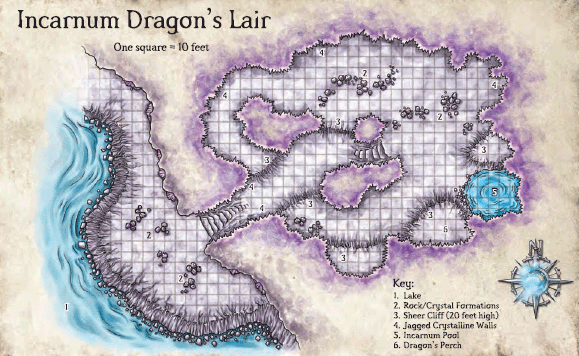
The Lair:
The dragon's lair consists of a cave in the side of a cliff that overlooks a lake amongst the hills of northern Hurlotzin.
Unless otherwise stated, all chambers and passages are as tall as they are wide, and all are unlit. The main cavern is approximately 70 ft - 80 ft tall.
The walls, floor, and ceiling of the cave are rather strange. They are all made of what is best described as amethyst crystal. The floors and ceilings are of hewn crystal, while the walls are of jagged crystalline shards.
Treat the floor of the place as hewn stone.
|
Hewn Stone Floor A DC 10 Balance check is required to run or charge across such a floor. Failure means the character can still act, but can’t run or charge in this round. |
The floor also has small shards of crystal and stone littered across it, allowing the dragon to hover and create a cloud of debris as per the Hover feat.
With regard to the walls, refer to area 4 below.
1. The Lake (EL 16)
| Nestled amongst a series of tall, steep hills, a river flows from the east and tumbles into a steep vale. At the bottom of the vale is a lake, some half a mile wide by a mile in length. The water of the lake appears to be pure coloured and the lake itself rather serene and placid. The southern, western, and eastern ends of the vale rise in steep slopes, but the northern end is a sheer cliff some 120 ft high. In the center of the northern rim of the vale is a cave opening that is perched on a shelf of stone some 40 ft above the level of the lake. A wide stone ramp, possibly natural in formation, descends along the northern cliff face from its top to the cave entrance. |
Creatures: While a few large fish dwell in the lake, the PCs really only need to be concerned with a huge water elemental that dwells near the cave entrance. The elemental is almost always residing about 30 ft below the surface of the water where the lake meets the bottom of the stone shelf.
This elder water elemental was summoned in ancient times during the battles between the Children of the Mishtai and the Scaled Ones, and during its time of service it became infused with incarnum to such an extent that it effectively acquired the lost template. Acquiring this template has bound the creature to the area, and it now haunts the lake, wallowing in its acquired misery and despair and seeing the dragon as a kindred spirit. While the elemental does not serve the dragon per se, it is an ally of it and will come to its aid if called. The elemental will not generally attack visitors to the cave without provocation, as the dragon has convinced it to withhold its attacks unless asked to do so by the dragon. Nevertheless, even with its somewhat low intelligence, the creature can use its own judgment to determine whether intruders are a threat to itself or its draconic friend.
For purposes of the elemental's range, assume the lake is its conjuring body of water, and so it can move up to 180 ft from the lake. This limit is in a straight line and ignores walls and other barriers, so the elemental can basically range to the entrance of main cavern that area 3 overlooks, and perhaps a little bit beyond that.
|
FEATS: Fast Healing (Drac p70) - gain fast healing 3 or existing fast healing improces by 3; effects stack. Rapidstrike (Drac p73) - make 1 extra attack with pair of natural weapons at -5 penalty. Thick-Skinned (SS p40) - existing DR improves by 2. |
Tactics: The elemental will almost always be fighting the PCs on solid ground, much to its chagrin. That said, while it will initially wade into combat and trust its damage reduction, massive hit points, and fast healing to protect it while it bludgeons foes to death using a good dose of Power Attack, if its foes prove to be tough, the elemental will instead snatch a victim and take it back into the lake to take care of it underwater.
Similarly, if wounded severely (brought down to 75 hit points or less) it will flee back into the lake and submerge while it uses its fast healing to rejuvenate itself. Once fully healed, it will resurface and resume its combat against its foes.
While the elemental is an outsider and can be banished back to its home plane, it is not a summoned creature and is not hedged out by a protection from evil spell or the like.
Also while the elemental is an ally of the dragon, it will not throw away its existence on the dragon's behalf. Because the elemental was called to the Material Plane long ago, its actual physical body resides on this plane and can be destroyed. As such, if the elemental fears that the PCs can and will likely slay it, it is inclined to settle at the bottom of the lake and wait for a long while until the PCs leave the area. However, this will require that the PCs show some ability to prevent the elemental from simply fast healing its hit points and engaging in hit-and-run tactics incessantly.
2. Rock/Crystal Formations
| At this location is a formation of rock embedded with silvery blue crystal, many of which radiate out from the rock formation like a halo of spikes. |
The formations are more than just decorations or natural structures. Some of them house the magic that fuels the lair wards set up by the dragon to guard his lair. These wards were fashioned by other dragons and creatures capable of casting the requisite spells whom the incarnum dragon coerced or bribed over the many years of its existence.
The magical formations are located in the clusters closest to the numbers 2 on map. They are part of larger groups of formations nearby, and thus do not necessarily stand out to normal inspection. In fact, there are some other formations shown on the map without a number 2 nearby and these look exactly the same as the magical formations.
Those with the trapfinding ability can Search for and Disable these wards. A successful Disable check suppresses the ward for 1d4 rounds. if the check succeeds by 10 or more the ward is suppressed for 1d4 minutes.
There are two such formations inside the cavern and two more on the shelf outside the entrance.
The northernmost formations located on the outside shelf power a hedge warding effect that affects the entire stone shelf outside the cavern (i.e. the entire area shown on the map above, including the portion of the ramp to the northwest). The warding effectively blocks any nonevil creatures summoned outside the area from entering the area, effectively blocking them from entering the cavern proper unless summoned from within.
|
Hedge Warding This ward provides an effect that duplicates an alarm spell (mental alarm) throughout the area warded. [Search DC 26, Disable DC 26] Faint abjuration; CL 1st; Craft Wondrous Item, alarm; Price 500 gp. |
The southernmost formations located on the outside shelf power an alert ward effect that affects the entire stone shelf outside the cavern (i.e. the entire area shown on the map above, including the portion of the ramp to the northwest). The alarm password is known only by Amarigalozin and translates from Draconic as "whispering/silent scale".
|
Alert Ward This ward provides an effect that duplicates a magic circle against good throughout the area warded. [Search DC 28, Disable DC 28] Faint abjuration; CL 5th; Craft Wondrous Item, magic circle against good; Price 7,500 gp. |
The northernmost formations located in the cavern proper power a cavern of the earthbound effect (Draconomicon page 84) that affects the entire cavern.
|
Cavern of the Earthbound No fly spell or similar magic will function within the lair. Characters who are flying when they enter the cavern float to the ground as if the spell's duration had expired. When they leave the cavern, any fly spells whose durations have not expired return to normal efficacy. Note that spells closely related to fly are affected by this power (e.g. overland flight), but magic that grants someone wings will not be negated, nor will spells such as air walk or wind walk. [Search DC 29, Disable DC 29] Moderate abjuration; CL 7th; Craft Wondrous Item, spell immunity; Price 14,000 gp. |
The southernmost formations located in the cavern proper power an inscription of privacy effect (Draconomicon page 85) that affects the entire cavern.
|
Inscriptions of Privacy When anyone tries to spy upon anyone in the cavern by means of clairaudience/clairvoyance or scrying or a crystal ball or any other magical scrying device, the crystals glow softly. If the scrying attempt originates from within the cavern, the person making the attempt begins glowing as well. Anyone scried upon can attempt an opposed caster level check (using the caster level of the inscriptions of privacy). If the target of the scrying attempt wins the opposed check, he immediately gets a mental image of the scrier, along with a sense of the direction and distance of the scrier, accurate to within one-tenth of the distance. [Search DC 29, Disable DC 29] Moderate divination; CL 7th; Craft Wondrous Item, detect scrying; Price 14,000 gp. |
3. Sheer Cliffs
These sheer cliffs are 20 ft high and quite smooth, requiring a DC 25 Climb check to negotiate.
4. Jagged Walls
| The walls of the place are comprised of jagged crystalline shards of what appears to be amethyst or some other purple gem. The shards are quite sharp looking and range from 3 inches to over 2 feet in length. |
While the crystals appear much like amethyst, they are not. A DC 15 Appraise check or Knowledge (dungeoneering) check will verify this. Instead, these are a crystalized form of incarnum. Any creature with the incarnum subtype who is within 20 ft of the walls, floor, or ceiling of the place will receive a +1 bonus to attack rolls, damage rolls, saving throws, and armour class. This is an untyped bonus and stacks with all other bonuses. The bonuses from the crystals are not included in any statistics presented below.
The walls radiate strong magic of no particular school, and are entitled to a saving throw against any magic directed against them with a +20 save bonus. The walls are not stone, and are not affected by magic that affects stone (i.e. rock to mud or stone shape).
5. Incarnum Pool
| This pool is comprised of standing water that is of a hue that is slightly too blue and too pure. |
The liquid within is infused with incarnate earth such that drinking a draught of the water provides the same benefit as activating an essentia jewel (Magic of Incarnum page 113), adding 1 to the drinker's essentia pool for 1 round. Drinking this water, like drinking a potion, is a standard action that provokes attacks of opportunity. The liquid loses its potency 1d4 hours after being removed from the area. A character can only benefit from the effect of a single draught in any given round.
Additionally, the pool serves as a pool of scrying lair ward.
|
Pool of Scrying This shallow pool forms a reflective surface in which the user can scry on others. This works like the standard scrying spell. Spellcasters can cast certain spells through the pool of scrying at creatures or things they are scrying upon, as per the scrying spell. If the water is ever entirely emptied from the pool, the item loses its magic. [Search DC 29, Disable DC 29] Faint divination; CL 5th; Craft Wondrous Item, scrying; Price 7,500 gp. |
Finally, the water of this pool is used as a key to open the dragon's hidden trove (see area 6 below).
6. Dragon's Perch
| Upon this large stone shelf rests a pile of treasure. |
Creatures: The incarnum dragon Amarigalozin usually rests here, sleeping upon his treasure unless awakened (usually by the alert ward at the entrance to the lair).
|
FEATS: Bonus Essentia (MoI p35) - You gain +1 essentia or +2 is capable of shaping soulmelds. Epic Essentia (MoI p213) - You gain 3 points of essentia. Open Soul Chakra (MoI p213) - You can bind a soulmeld or magic item to your soul chakra and you gain +2 insight bonus to damage against creatures of opposing alignment. Shockwave (Drac p73) - Strike solid surface with tail as full-round action to create shockwave for 125 ft; make bull rush attack against every creature in radius and those who fail their Str check are knocked prone; structures and unattended objects within the shockwave take 1d6 + Str bonus damage. Suppress Weakness (Drac p74) - Take only +25% damage to vulnerable energy type. Note that this does not help the dragon in question as it has no weakness to energy. SOULMELDS: crystal helm (MoI p63) - Normal: gain +2 resistance bonus on will saves vs charm and compulsion; Essentia: +1 deflection bonus to AC/essentia; Crown: melee attacks gain force descriptor. flame cincture (MoI p67) - Normal: gain fire resistance 10; Essentia: +5 fire resistance/essentia. lucky dice (MoI p77) - Normal: as swift action gain +1 insight bonus to one of att, dmg, save, skill, or ability checks until start of next turn, on roll of 7 on 2d6 bonus applies to all types of rolls; Essentia: +1 rd duration/essentia. necrocarnum shroud (MoI p80) - Normal: +1 profane bonus to att and dmg rolls for 1 rd when living creature takes damage adjacent to you or for 1/2 its HD if it dies; Essentia: range is 5 ft + 5 ft/essentia; Soul: standard action to melee touch bestowing 1d4 neg levels (Fort 1/2), for each neg lvl gain 1 essentia until end of next turn and 5 hp for 1 hr. MAGIC ITEMS: gemstone of moderate fortification (Drac p83) - negates sneak attack or critical damage 75% of the time; non true dragons can only imbed it with limited wish or the like. |
|
AMULET OF PROTECTION FROM GOOD This amulet is made of turquoise and amethyst crystal bound by a twisted cord of sinew. The amulet provides a continuous protection from good effect when worn. Prerequisites: Craft Wondrous Item, protection from good. |
Tactics: In combat, Amarigalozin will attempt to utilize his mobility, especially as long as his cavern of the earthbound ward is in effect. He will also use his Hover feat to hover within 20 ft of the cavern floor, kicking up a 60 ft radius cloud of debris. This cloud will allow the dragon to use his blindsense to target foes and cause spellcasters within to make a DC 23 Concentration check in order to cast spells.
Amarigalozin knows that his breath weapon is only really effective against incarnum users, the damage caused by it being only somewhat effective against powerful foes who do not wield essentia. As such, he will be much more likely to rely on his physical prowess, using his Power Attack to increase damage against foes he can strike fairly easily.
The dragon knows that spellcasters make the most dangerous foes, and he will always attempt to target them first. He will use his Shockwave feat to disrupt large groups of foes that are somehow able to attack him on the ground.
Developments: Amarigalozin's main weakness is that he has no ability to quickly heal himself. As such, when he takes damage equal to 75% of his hit points, he is likely to attempt to flee to a place where he can rest and recuperate, then seeking to hunt down his foes at a later time, perhaps when they are not aware of him. This means the DM can and should use him as a recurring villain, perhaps with an appropriate advance in hit dice or hidecarved dragon levels.
Secret Doors: In the furthest southeast portion of the perch is a slight niche in the wall. On the floor of this niche is a strange rune carved into the floor. The rune radiates faint conjuration magic, and a DC 30 Knowledge (arcana) check will reveal that the rune is an anchor point to summon some object. The check will be enough to be certain the summoned thing is an object and not a creature.
This rune is the focal point for the magical container (see below).
Treasure: Amarigalozin's treasure consists of two parts. The first is his obvious hoard, which he sleeps on in a great pile atop his perch. The second is a magical container that can only be opened by a precise means.
The hoard consists of the following, all in a 3 ft tall pile that the 20 ft by 20 ft section of the perch that surrounds the number "6" on the map:
The magical container is an extradimensional space that Amarigalozin had created to store the more valuable pieces of his treasure when he was away from his lair. With the theft of the key orb, he has taken to storing all of his more valuable treasures there all of the time, until he can be sure that the thieves have been dealt with.
The container is a variation of the secret chest spell, in that items are stored upon the Ethereal Plane and can be summoned or sent to the plane upon performance of the proper rituals.
The magic operates at CL 16 for purposes of dispel magic and the like. Up to 8 cubit feet of goods can be stored in this fashion,, and no creatures of any sort (living or otherwise) may be transported.
To summon the items, the silver dipper (see above) in the treasure hoard must be dipped into the water of the incarnum pool (area 5) and the liquid spilled onto the rune on the floor in the niche of the perch (see above). Doing so is a full-round action that provokes attacks of opportunity. At the beginning of the summoner's next turn, the items stored on the Ethereal Plane will appear atop the rune in the niche.
To send items to the Ethereal Plane, the items must be placed into the niche atop the rune and a drop of incarnum liquid placed on each item. Doing so is a full-round action that provokes attacks of opportunity. At the beginning of the summoner's next turn, the items will fade away to the Ethereal Plane.
Items held on the Ethereal Plane are not normally subject to theft, as they are contained in a magical vault on the plane. However, there is no guarantee that such a vault could not be located and broken into. As such, PCs attempting to use this container may want to take precautions such as wards or traps.
Within the magical container currently are held the following:
Dealing with the Dragon:
There are essentially two options for dealing with the dragon and recovering the robe. When first approaching the dragon's lair, the dragon will be resting atop his hoard in area 6. He is smarting from the loss of the orb key and is now even more paranoid than usual that thieves are out to steal him bare. As such, assuming he becomes aware of the PCs (likely with the wards in place and his draconic senses), he will assume they are thieves come to try to steal more of his treasure. The dragon will threaten the PCs and taunt them, calling then thieves and warning them that while they may have been successful the first time, when he was caught unaware, now he is alert and will slay them utterly should they attempt to steal from him again.
The dragon's rambling threats should make it clear to the PCs that the dragon has recently been the victim of a theft. In fact, the PCs might suspect that the robe itself may have been the thing stolen. As such, this is an opening for the PCs to try to parley with Amarigalozin. The dragon will not leave his perch to accost the PCs, unless the tactical situation absolutely demands it. He is wary of a trick to try to draw him away from his hoard while others sneak in and pilfer from him. Even though he has stashed his most valuable items in the magical container, like most dragons he is greedy and possessive of his entire hoard and does not wish to lose even a copper piece.
So unless the PCs come upon him unaware and immediately attack him, they can attempt to speak to the dragon and try to convince him they are not thieves.
Attacking the Dragon:
Should the PCs elect to simply fight the dragon, they can do so. The DM should keep in mind that the dragon is experienced, and has a very high Intelligence and a very good Wisdom as well. He will fight to the best of his abilities, but will be content to simply turn away foes, hoping that his formidableness has served to frighten his attackers away never to return. However, if the PCs mount subsequent raids, then he is not above attempting to chase after them, despite his loathing to abandon his treasure pile.
Of a certain, the dragon will call forth the water elemental at the first sign of actual combat. He will NOT summon the elemental before combat, as it is a trump card of sorts and he would want the elemental to attack the rear of his foes while they are engaged with him.
That said, the dragon is confident that his magical container can preserve his most precious treasures, at least for a short time against raiders, and most likely even if driven out of his cavern, thieves would content themselves to take his visible hoard and, finding nothing else, leave. Because of this, if the situation warrants him leaving his cave, whether to flee and recuperate or to fight outside in the open, he will do so.
Once the dragon has been slain, the PCs will have to try to figure out how to find the robe in the dragon's hidden container. There are a variety of ways to accomplish this. First, the silver dipper and the matching runes on the dipper and the niche floor should provide a clue. Second, a spell like speak with dead could attempt to compel the dragon to reveal his secret (though its Will save is high enough that using such a spell would not be easy). Finally, various spells like divination could provide a clue. To aid DMs with the latter, the following verse could be given from a divination spell that asks "where is the white robe of Karsus?":
While Karsus' vestige sails
the aster
his robe does ride the ether
how does one catch a vestment adrift on the planar seas?
better to ask
how does one catch the water in a river?
If, on the other hand, a more specific question is asked like "is the robe of Karsus here?", the answer might be:
The robe is here and not here
as a ghost is here and not here
The answer to the verse is that one uses a ladle or dipper. And the water reference is a clue to use the incarnum pool to do so.
Negotiating with the Dragon:
If the PCs wish to parley with the dragon, he will initially be unfriendly and will hurl threats and imprecations at the PCs until they depart or take some other action. As it is likely that the dragon becomes aware of the PCs before they can even come within sight of him, it is very possible that initial negotiations take place out of sight. In this case, the dragon will warn the intruders not to even dare to approach his cavern.
However, the PCs can attempt to convince the dragon that they do not mean to steal from him. Allow a +2 circumstance bonus if the PCs mention that they seek the robe.
If the dragon is made hostile, he will likely emerge to attack the PCs and call for the water elemental. If he remains unfriendly, he will continue to warn the PCs away and will attack if they persist in entering the cavern or camp outside his cavern.
If he is made indifferent, he will grudgingly allow a single PC to come before him to negotiate, but he will demand that such person come before him without weapons or armour...completely naked.
If made friendly, he will allow a single PC to come before him to negotiate, and will allow that PC to bear arms and armour.
If made helpful, he will allow all of the PCs to come before him.
Once negotiations begin in earnest, Amarigalozin will ask them why they have come, if not to steal from him. If the PCs tell him what they seek, he will ask them why they believe he has such a thing, and what they intend to do with it.
Remember that Amarigalozin has a massive Sense Motive skill, and any lie told to him that directly bears on the negotiations will offend his lawful sensibilities and immediately lower his attitude by 1 step (lies that do not bear directly upon the negotiations, such as the PCs' names, will cause him to call them on their lying and to warn them against trying to deceive him, but will not incur his wrath). The PCs can gain a subsequent chance to influence the dragon again, but this time at a -10 penalty.
At this point the PCs must make another check to influence his attitude. If his attitude is made helpful then he will offer the PCs a trade for the robe. If his attitude is friendly then he will refuse to part with the robe unless the PCs offer him other treasure worth 150% of the robe's market price or make the trade below plus 50% of the robe's market price in additional treasure. Any attitude below friendly will mean the PCs will have to obtain the robe by force or stealth.
At all times, speaking suitable words of flattery to the dragon will allow a +5 circumstance bonus on checks to influence him if the flattery seems somewhat applicable and sincere.
If the dragon is finally made helpful, he will propose his trade. Refer to Part Three for further details.
Part Three - The Duskling Expedition
The Dragon's Deal:
The dragon will propose to the PCs that they could replace the robe with an item that he considers to be of equal value. Some five days ago, Amarigalozin awoke to find a precious item from his hoard gone missing. Like all dragons, he is aware of every single coin and bauble that makes up his hoard, and so he instantly missed this item.
The item is a glowing blue orb made of smooth crystal and etched with a variety of complex geometric patterns. It is about 3 inches in diameter and weighs about 5 lbs.
Amarigalozin has no idea what the orb does, although it is clearly magical. He values the item both for sentimental reasons, for he won it from a demon in a hard fought duel more than two centuries ago and the demon clearly thought the item quite precious; and simply because it was a part of his hoard. Of course, he will not admit his ignorance of the orb and its powers and will simply warn the PCs that the orb contains dragon magic and should not be fiddled with by non-dragons. The white robe he simply found buried amidst some rubble in his youth when he was wont to scrabble around looking for treasure rather than taking it from other creatures. As such, the robe holds much less sentimental value to the dragon.
Amarigalozin managed to use his scrying pool to locate the thieves, thanks to a lock of hair he found near his perch, and after a protracted search he learned that the thief was a duskling, travelling amongst a small group of his own kind, and that they were heading east into a necrocarnum bog. While the dragon was tempted to go after them, he was worried about the rest of his hoard and could not bring himself to leave to recover it. His most recent scrying, a day ago, showed the thief entering an underground tomb or vault somewhere in the bog. The dragon can describe the entrance, but does not know precisely where in the bog it might be. He does know that the entrance is in the necrocarnum bog itself, and as that is an area of about 40 square miles in the heart of the marshes to the east, it should not be too difficult to find the thief and retrieve the orb.
Amarigalozin will request that the PCs retrieve his orb and, in return, he will offer them the robe. However, although the dragon is somewhat naive, he is not completely ignorant. He does not know what the robe is or what its powers are or its value, but if the PCs are not canny about this and he learns of its true value, he will bargain with the PCs for return of the orb and other treasures. As such, the PCs should ideally treat with the dragon from a position of some strength, and while indicating that they want the robe, not imparting too much of its true value to the dragon.
In any event, should a deal be made, Amarigalozin will assure the PCs that he is a dragon of his word and that any deal they strike will be honoured. While he is not in any specific hurry to have the orb retrieved, he does fear that the dusklings will eventually depart and that will make retrieving the orb much harder.
The Theft:
The group that stole the orb is led by a trio of dusklings along with a saurial and a duo of lizardfolk. The dusklings are Children of the Mishtai patriots who are seeking lore of the missing mishtai Klashkaln. They have learned of the location of what they believe to be a treasure vault from ancient times that may have belonged to Klashkaln personally and are hopeful that some item or clue therein will help them find their missing Progenitor. On their journey to this land from the Azotchtlan Lands they befriended a hornhead saurial whose small tribe also revered Klashkaln and was quite eager to aid the dusklings in their holy mission. The two lizardfolk were females recently outcast from their male-dominated tribe and were dwelling with the saurials and were willing to accompany the dusklings in exchange for a share of whatever treasures were found.
The dusklings were seeking a magical key to the "treasure vault". The key is a magical orb that is the only way to open the magically-warded vault door. By use of various divinatory magicks they learned of the location of the orb and sought to steal it from its possessor.
The group initially consisted of 4 other dusklings and two other lizardfolk, but two dusklings perished at various points during the years-long journey and the two lizardfolk and final two dusklings died as indicated below. When the remaining dusklings and their compatriots arrived near the dragon's lair, Kleshfinzon and Hevistaral managed to disable the wards at the entrance and the latter snuck into the cavern while the dragon slept. There, he crept up to the perch and managed to find and steal the orb and sneak away before the dragon woke up. The dusklings then initially headed west to throw the dragon off of their trail, and then turned east into the marshes to find the entrance to the vault.
Initially the dusklings were wary of the dragon's wrath and feared to see him flying overhead during their journey to the vault, but now that they have managed to reach it, they are confident that they have managed to steal the orb and got away clean. They are not aware that the dragon scried upon them (nor are they aware that it even has that ability).
Alas for the dusklings, for while the orb is what they think it is, the "treasure vault" is not. In fact, the vault is a prison for a vastly powerful outsider and its minions, and they are now headed to unlock the prison and release the entities.
The Marshes:
The marshes are a wide lowland in the northern portion of the land. The marshes are roughly 80 miles in diameter. The outer 40 miles should be considered moor land, while the central 40 mile radius should be considered swamp proper (refer to the Dungeonmaster's Guide page 88 for details). Assume that the PCs will run into quicksand patches 5% per mile travelled in the moor land and 15% in the swamp land. A DC 15 Survival check will allow the quicksand to be spotted and avoided.
Encounters for the marshes should use the normal encounter table for the Hurlotzin Lands (as set forth above). In addition, the following planned encounters can be run by the DM at any time during the journey to the necrocarnum bog.
Planned Encounter #1 - The
Lure (EL 11)
| Upon a hummock of mud and earth is a stand of mangrove-like trees surrounded by pools of stagnant swamp water. Lying on the ground amongst the roots of the trees lies a duskling. The duskling is dressed in studded leather armour and is on its back, and its right leg is missing above the knee. The tip of the amputated leg is coated with blood and the bone is showing through, and a puddle of blood stains the ground beneath the leg. Spurts of blood are pumping out of the stump but the blood is only coming out in a slight, wispy stream. The duskling is twitching slightly and seems to be mouthing a groan or moan of some sort. |
The boneleaf will hide amongst the mangroves and will create an illusion of a duskling lying on the ground with a mangled right leg that appears to have been cut off, with a pool of blood around the leg. The duskling is moaning softly and twitching in pain, and it appears as if his lifeblood is quickly flowing away.
When a PC approaches in reach of a tendril, the boneleaf will attack. The DM can assume the boneleaf has a Hide check of 45 (by taking 10) and only if a PC makes a DC 45 Spot check (modified for distance of course) can he then make a second DC 15 Spot check to note the boneleaf's true nature.
|
|
Tactics: The boneleaf is an ambush hunter and is incapable of fleeing with captured prey except by burrowing underground. The boneleaf will attempt to grab a victim, and then burrow down amongst the mangrove roots to squeeze the life out of its prey, using the ground as protection. If still pressed, it will attempt to retreat (with prey) into the nearby pools of swamp water, holding its breath and burrowing into the soft mud at the bottom of the pools.
In any event, the boneleaf will fight to the death. It is not easily capable of flight and given that each boneleaf is not actually an independent entity, the loss of a boneleaf is not catastrophic to the collective entity (-ies) as a whole.
Developments: Since the boneleaves are immune to mind-affecting effects, it is unlikely that the PCs will be able to tame it and question it. Nevertheless, should this somehow happen, the boneleaf was able to create an illusion of a duskling because others of its ilk recently observed the passage of the duskling party through the bogs a few days ago.
Planned Encounter #2 - Shock
the Monkey (EL 13)
| Scattered on the ground are at least a half a dozen corpses. These are evidently of some sort of monkey-like creature about the size of a large baboon. The corpses are all scorched and smouldering and smoke rises up from their blackened fur. |
Creatures: The monkeys were scorched by a colony of winged shocker lizards. These are in their breeding season and are quite aggressive and territorial, much to the detriment of the monkeys. As the PCs enter the area, unless they are completely invisible or remain more than 240 ft from the area, they will be attacked by the shocker lizards.
Note: While normally the winged template is not available to magical beasts, it has been applied to these lizards in order to give them the ability to fly.
The lizards are initially housed in a variety of trees in the area. The trees are, on close inspection, streaked with burn marks.
A close inspection of the trees or the bodies of the monkeys will allow a DC 25 Survival check or a DC 25 Heal check (respectively) to determine that the damage was caused by electricity and not fire.
When their territory is encroached upon, the colony will fly to the attack.
|
|
Tactics: While not particularly intelligent, the lizards do hunt as a pack, so that their lethal shock ability is used to fullest effect. However, the lizards will try not to group up in groups of more than 6, as they instinctively know that is the most effective their lethal shock attack can be.
As they are defending their nests, they will fight to the death.
Developments: If the trees surrounding the clearing are searched (at their tops, about 30 ft to 40 ft above the ground), the PCs will find 2 separate hollowed out portions of the trunk, the inside blackened with char, each with a clutch of 3 shocker lizard eggs. These eggs can be taken as treasure and sold or the lizards hatched and raised, but doing so is difficult as the eggs are not only quite fragile, but require precise applications of electricity to nurture them. Too little electricity and the embryos will die of malnourishment. Too much and they will cook to death. The precise details of the care needed and gestation time to hatch the creatures, as well as rearing them, are left to the DM. Refer to page 76 of the Arms and Equipment Guide for some basic details on the value and use of shocker lizards.
The Necrocarnum Bog:
In the heart of the marshes is a necrocarnum bog, the site of a particularly nasty battle between the Children of the Mishtai and the Scaled Ones in ancient times. The magicks hurled in the battle slew many on both sides, and sank the ground, forming it into marshlands in the centuries that followed. The waters of the marsh carried much of the bodies and necrotic miasma of the battlefield to the heart of the sunken land, forming the necrocarnum bog.
The bog is about 40 square miles, forming an oval about 6 miles from southeast to northwest and 9 miles from southwest to northeast.
From page 205 of Magic of Incarnum
| Fetid gray water pools between clumps of blackened reeds. Here and there, bones jut up from the muck, and the stench of the place is reminiscent of a charnel house. |
|
In a necrocarnum bog, incarnum has fused with the necromantic forces inherent at the site of a great massacre or costly battle, transforming the place into a swamp of death. A necrocarnum bog typically extends anywhere from a few hundred yards to several miles in diameter, depending on the size of the slaughter that occurred there and on the age of the bog (older ones are larger). It is similar to a swamp (see page 88 of the Dungeon Master’s Guide), but areas of shallow bog are even more common than usual, with correspondingly fewer areas of undergrowth. Undead of all sorts roam necrocarnum
bogs, especially creatures with ties to incarnum, such as incarnum
wraiths and necrocarnum zombies (both described in Chapter 7).
In fact, any corporeal creature with a skeletal system that dies
within a necrocarnum bog instantly reanimates as a |
All instances of quicksand in the necrocarnum bog are deadsand instead, and the chance of encountering deadsand is 20% per mile travelled:
| Deadsand: An insidious danger in a necrocarnum bog is the threat of deadsand. While functionally similar to quicksand, deadsand also has a negative energy effect that reduces the essentia pool of a living creature trapped within by 1d4 points each round. Creatures with no essentia pool (or an essentia pool reduced to 0) take 1d4 points of Constitution damage instead. To make matters worse, necrocarnum zombies lurk in deadsand, grappling creatures trapped in the bog. |
Finding the Entrance:
Finding the entrance is not too difficult, as the terrain in the necrocarnum bog is less filled with undergrowth and trees than the rest of the marshes. Nevertheless, there is enough of both to provide plenty of places to conceal the entrance. If the PCs are attempting to track the dusklings, the DC is a base of 8 (halfway between very soft ground and soft ground) with a -2 for 6 creatures being tracked and another -1 for a size Large creature. There is a +1 for each 24 hours having passed and a +4 for precipitation falling during that time. Thus, the total DC is at least 11 and so the trail should be quite easy to follow, even at full speed if the PCs have a skilled tracker.
Lacking that, and lacking the use of magic to locate it, the PCs can simply search the area.
From the air, the DM should have the PC with the best Spot bonus make a skill check. The base time to find the entrance is 6 hours. For every 5 points of the Spot check, the time to locate the entrance is reduced by 1 hour (to a minimum of 1 hour).
From the ground, the time to locate the entrance is a base of 24 hours, less 1 hour for every 2 points of a Spot check made by the PC with the best Spot check bonus.
Necrocarnum Encounters:
There will be no normal encounters in the necrocarnum bog. Normal creatures avoid the area, and a DC 15 Knowledge (nature) check will reveal that the normal sounds of swamp wildlife are absent.
Instead, two encounters are given, and should the PCs decide to camp within the necrocarnum bog or otherwise linger in the area, the DM should devise further suitable encounters.
Encounter #1 - Wisps of Misfortune (EL 12)
Creatures: A gang of incarnum wraiths will be encountered during the PCs' foray into the necrocarnum bogs. Such spirits arise when incarnum infuses into the souls of particularly restless spirits still hovering near their remains (even if long-since dissolved into nothingness).
This gang will rise straight up out of the ground and attack the PCs with horrifying screeches.
|
FEATS: Empowered Ability Damage (LM p26) - numeric effects of ability drain increased by 50%. Positive Energy Resistance (LM p29) - gain resistance 10 against positive energy. |
Tactics: There is not a lot of subtlety in the attack of these wraiths. They will seek to gang up on a few individuals in order to completely drain him before moving into the next. The wraiths will fight to the death.
Encounter #2 - Necrocarnum Swarm (EL 15)
Creatures: A particularly evil commander of the Scaled Ones armies died in a deep pool of swamp water in what is now the necrocarnum bog. Over the centuries, the necrotic effluvia gathered atop the sight of the commander's death and the combination of the lingering evil of the commander's spirit and the necrotic incarnum gave life to the earth at the bottom of the pool, forming a necromental.
This necromental was in essence a spirit of the swamp itself, and in its embodiment of this it also inculcated into its essence the miasmic air of the marshlands and many of the flying and stinging insects that are endemic to it. In doing so, it became a swarm-shifter as well.
Unlike most elementals, this one is native to the Material Plane.
The necromental encountered the party of dusklings heading to the vault entrance, and attacked them. Two dusklings and a lizardfolk died in the attack before the rest could escape. The dead ones, due to the influence of the necrocarnum bog, have emerged as necrocarnum zombies and they have inherited their slayer's ability to swarm-shift, due to its malign influence at the moment of their deaths and at the moment of their "rebirth".
The PCs will initially notice 2 dusklings and a lizardfolk, all in tattered and muddy clothing, milling about sort of aimlessly. A DC 20 Spot check will reveal that there are gaping wounds in the skin of the beings, though a DC 10 Knowledge (religion) check will determine that they are not staggering about like zombies.
The duskling and lizardfolk incarnum zombies will shamble around until they are attacked or a living creature approaches to within 30 ft, at which point the necromental will arise out of the earth in their midst and attack while the other smaller zombies swarm-shift into clouds of undead flies and harry the foes of the necromental.
Should the PCs attack the zombies from a distance, then they will swarm-shift and fly towards them, while the necromental will swarm-shift and use its earth glide ability to fly underground through the swamp mud to burst up as an elemental amongst the PCs if they fight from the ground or as a swarm if they are in the air.
|
FEATS: Air Heritage (PlaH p37) - fly speed +30 ft and +2 to Balance and Jump checks in light or no load. Epic Will (Epic p55) - gain +4 bonus on Will saves. |
|
FEATS: Air Heritage (PlaH p37) - fly speed +30 ft and +2 to Balance and Jump checks in light or no load. Epic Will (Epic p55) - gain +4 bonus on Will saves. |
|
|
|
|
|
|
|
|
Tactics: The smaller zombies are not likely to last very long against the PCs, but the necromental will use its swarm-shift ability to heal itself as necessary. Since the creature is capable of flying and earth gliding (or both!), it is very easy for it to withdraw from combat underground and swarm-shift over and over again (along with its fast healing ability) until it is fully healed and then resume the attack.
As such, it is probably easier for the PCs to hurt the necromental so that it must withdraw underground and then simply flee before it can reform and pick up the hunt. Actually defeating the necromental should be a fairly monumental task that would involve somehow incapacitating the necromental and then chopping it to bits.
The Vault Entrance:
|
A large hummock rises out of the foetid bog, studded with mangrove-like trees with twisted roots. Between the thickest clump of roots near the crest of the muddy hummock is an opening in the ground 8 ft wide and 12 ft tall, slanted at a 45 degree angle to sit flush with the hillside. The opening is surrounded by large, worked stones of grey overgrown with moss and lichen. The piles of dirt and mud and pieces of roots nearby attest to the fact that some excavation had to take place in order to clear the opening, and the partially dissolved body of a lizardfolk attests to the fact that this excavation was not unopposed. There are signs of a campsite made near the opening, including a doused fire ring and some lean-tos and bedrolls along with some discarded miner's picks. |
A DC 15 Heal check will reveal that the lizardfolk was dissolved by acid.
The Vault:
Unless otherwise stated, all floors and walls are flagstone and superior masonry respectively. There is no inherent lighting in the place, and all areas are somewhat damp, with drops of water dripping from the ceiling or coursing down the walls. Passageways are 10 ft tall, and chambers are 20 ft tall.
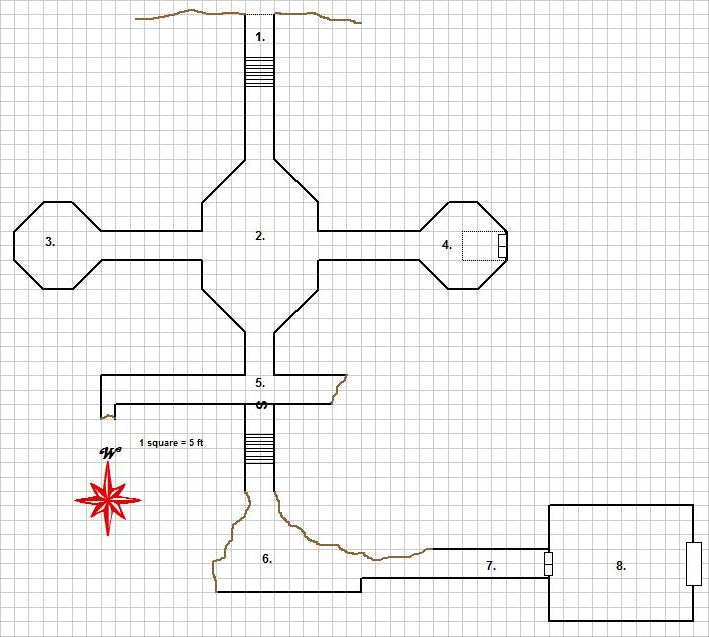 |
1. Entryway (EL 8)
|
Beyond the opening to the outside is a 10 ft wide passageway that descends down a set of steps. The floor is swatched in a thin layer of mud that makes swirls across the flagstone floor. The ceiling is cracked in many places, some as large as an inch or two wide and several feet long. The walls appear to have, at one time, held frescoes of some sort, but time and water have apparently decimated the plaster and paints so that only the barest hints of both attest to what may have once been a glorious design. |
A DC 15 Search check or Track check will reveal footprints in the mud on the floor and and passage of multiple individuals recently.
The steps lead down 10 ft before the passageway continues eastward.
Creatures: Lurking in the cracks in the ceiling is a massive dissolution ooze. It is this ooze that attacked and slew the lizardfolk found in the campsite outside. The dusklings managed to lure it away from the campsite after it slew the lizardfolk and then they entered the lair while the ooze eventually returned to the entrance and crawled back up into the cracks.
When the PCs enter this place, the ooze will drop down amongst them and attack.
|
|
Tactics: The dissolution ooze will only attack each PC once unless it finds one that wields incarnum, in which case it will continue to attack those PCs relentlessly. If it is brought to below 65 hit points it will attempt to retreat back into the cracks and will not emerge unless molested or until it is fully healed.
2. Large Chamber
|
This large chamber contains 10 ft wide flanking archways that lead north and south. The archways are carved to resemble serpents cloven by axes. To the east, a pair of tarnished and corroded double doors lie before a 10 ft wide opening. The walls of the place are decorated in worn and water-streaked bas-reliefs showing various humanoids, including dusklings, worshipping a large humanoid in robes with a turtle-like head. Swirls of mud enter the chamber from the hallway to the west and have created jagged streaks and swirling ovals on the floor. Near the north archway and the eastern opening are piles of dirt, mud, and stones that indicate recent excavation. |
3. Chamber of Shards
| This octagonal chamber is empty except for a mess of strange indigo crystal shards scattered about the floor. |
If the shards are examined, a DC 20 Spot check will find pieces that seem to have been part of a large humanoid statue or figure.
4. Trapped Chamber
| This octagonal chamber contains a pair of iron double doors on the north wall. The doors are flung open and behind them is a blank stone wall. On the floor before the doors is an open pit. |
5. Intersection
| This intersection contains a large secret door along the east wall that has been left ajar. |
Secret Doors: If the secret door to the east is closed, it requires a DC 25 Search check to locate.
6. Collapsed Chamber
| This place appears to be a massive chamber, some 30 ft tall, that is mostly filled with mud and stone. Only a portion of the chamber is currently accessible. What can be seen of the floor displays the remains of what may have been a spectacular mosaic. This is evidenced by the tiny square indentations on the floor, only a very few of which contain pieces of chipped and fractures polished stones. |
7. Partially Collapsed Hall
| A portion of this hallway has collapsed into mud, dirt, and stone. To the east, the hallway is intact and leads to a pair of polished steel double doors. The doors are engraved with the image of a humanoid with a turtle head bedecked in robes wielding mystical energies against hordes of fiendish-looking creatures. Slumped on the floor near the doors is a large metal figure. |
The figure is the body of a zelekhut inevitable, bound by the Children of the Mishtai as a guardian and defeated by the dusklings after a very difficult fight. Only the spells of the favoured soul Genimvarzin and the mighty hacks of H'hestis-al managed to lay the creature low. The zelekhut was bound to this plane by the ancient ritual, and so its body has remained even after death.
A DC 25 Knowledge (planes) check will identify the creature, and a DC 29 Spellcraft check will determine that the scorch marks were likely caused by a flame strike spell.
The double doors are spiked closed from the other side and requires a DC 28 Strength check to open, with a +1 cumulative bonus per previous attempt.
8. Chamber of the Plug
Note: The doors leading into
this area from area 7 have been spiked shut. See above.
|
This large chamber is devoid of the dampness that punctuates the rest of the complex. It has a 30 ft high ceiling that is studded with cerulean crystals shaped like various regular polyhedral solids set in complicated patterns and connected by silver traceries set into the ceiling. The walls contain intact bas-reliefs showing a majestic humanoid with a turtle head and a triangular crest above its forehead wielding immense magical energies against hordes of fiends. Dominating the north wall is a massive iron plug set into the wall. The plug is circular and over 15 ft in diameter and the bottom of it is set a foot above the floor. The plug stands out a full 3 inches from the wall, implying that it is quite thick as well. Carved into the face of the plug are massive silver runes set in a circle around a complicated pattern of geometric shapes that itself surrounds a hemispherical indentation roughly 3 inches in diameter. Standing in the center of the chamber is a stone pedestal about 5 ft in diameter and 3 ft tall. The top of the pedestal is a circular stone slab 3 ft in diameter that is tilted at a 30 degree angle facing the south. Two handprints have been carved or moulded into the face of the slab atop the pedestal. The interior of the handprints are coated in a blue crystal lining. |
This chamber is essentially the door to the prison. The plug is the seal to the prison and the pedestal is part of the mystic mechanism to open and close it. Both the pedestal and the plug radiate strong abjuration magic.
To open the plug requires a two-step process. First, essentia must be fed to the plug by means of the pedestal. A Medium humanoid incarnum user must invest essentia into the pedestal by placing both hands into the handprints. The pedestal essentially serves as a sort of soulmeld, and requires the ability to shape a soulmeld and counts as the use of one soulmeld for the day for each person involved in its shaping. A total of 6 essentia must be placed into the pedestal, and each person shaping it is limited by his normal essentia capacity, so that it might take multiple creatures to fully shape the soulmeld. The soulmeld must be fully shaped by any and all of the individuals doing so within a period of 6 minutes, and each person doing the shaping must spend 2 minutes with his hands on the pedestal, so no more than 3 individuals can take part in the shaping.
Once the pedestal soulmeld has been shaped, the hemispherical indentation in the plug will glow. If the key orb is brought to within 15 ft of the plug, it will also begin to glow in the same manner. If the glow will last for 10 rounds and then fade. If the glow fades, then the entire process, including shaping the pedestal, must be restarted (and likely only after 24 hours of rest unless new individuals capable of shaping a soulmeld can be found, as anyone who has shaped the soulmeld on the pedestal cannot try it again until they can unshape the soulmeld).
If the key orb is placed into the indentation on the plug while it is glowing, there will be a great rumbling and the iron plug will fade away over the course of a single round.
Creatures: The duskling party is in this chamber, resting after its fight with the guardians of the place and waiting to be able to reshape soulmelds so that they can work the pedestal.
If the PCs have made undue noise, then the duskling party will be ready for the PCs. They are not expecting to meet any friendlies during their expedition, and so will assume that any intruders heard approaching them are further guardians, robbers trying to get the treasure for themselevs, or simply hostile monsters that have stumbled into the now opened complex.
If the PCs manage to take the duskling party unaware, then they will be gathered around off to the side of the chamber in a huddle discussing what soulmelds to shape.
The DM can assume that the PCs arrive after the duskling party has healed its wounds and the priest and ranger have prepared their spells, but the incarnum users are capable of reshaping their soulmelds after an hour of meditation.
|
FEATS: Bonus Essentia (MoI p35) - You gain +1 essentia or +2 is capable of shaping soulmelds SOULMELDS: blink shirt (MoI p60) - Normal: gain dimension door at will for 10 ft as standard action; Essentia: +10 ft/essentia. wormtail belt (MoI p94) - Normal: gain +2 natural armour bonus; Essentia: +1 natural AC/essentia. |
|
|
|
FEATS: Bonus Essentia (MoI p35) - You gain +1 essentia or +2 is capable of shaping soulmelds SOULMELDS: blink shirt (MoI p60) - Normal: gain dimension door at will for 10 ft as standard action; Totem: use as a move action; Essentia: +10 ft/essentia. rage claws (MoI p83) - Normal: act normally from 0 to -9 hit points; Totem: gain 2 claw attacks for 1d6 + Str, no penalty when grappling, may still use hands, +1 att and dmg/essentia; Essentia: +3 extra neg hp/essentia. wormtail belt (MoI p94) - Normal: gain +2 natural armour bonus; Totem: gain sting attack as sole attack at normal attack bonus (+1/essentia) for 1d6 dmg plus poison (DC 12 + essentia) doing 1dr Str (no secondary); Essentia: +1 natural AC/essentia. MAGIC ITEMS: magic siphon (MIC p164) - 1/day targeted greater dispel magic (CL 11) to every adjacent creature. |
|
FEATS: Fey Heritage (CM p43) - +3 saves vs enchantments. Fey Legacy (CM p43) - confusion, dimension door, summon nature's ally V each 1/day CL = character level. Purify Spell (BoED p44) - metamagic +1 lvl, spell gains good descriptor, deals 1/2 dmg to neutral (1/4 with save) and none to good, evil outsiders increase spell dmg by one die type. SOULMELDS: blink shirt (MoI p60) - Normal: gain dimension door at will for 10 ft as standard action; Essentia: +10 ft/essentia. wormtail belt (MoI p94) - Normal: gain +2 natural armour bonus; Essentia: +1 natural AC/essentia. SPELLS: assay spell resistance (SC p17) - swift, r personal, 1 rd/lvl; gain +10 bonus to CL checks to overcome SR of a specific creature you can see. bewildering visions (CC p117) - r close, 1 living creature, 1 rd/lvl, sv W neg, SR; subject sickened and must save each rd or become nauseated. elation (BoED p98) - r allies in 80 ft radius of caster, SR; +2 morale bonus to Str and Dex and +5 ft to speed. mass conviction (SC p52) - r med, allies in 20 ft radius; as conviction. mass resist energy (SC p174) - r close, 1 creature/lvl no two more than 30 ft apart; as resist energy. righteous wrath of the faithful (SC p177) - r allies within 30 ft burst of you, 1 rd/lvl, SR; gain +1 melee attack, +3 morale bonus on melee att and dmg. summon holy symbol (CC p128) - 1 rd/lvl; summons small wooden holy symbol. wall of dispel magic (SC p233) - r close, straight wall 10 ft square/lvl, 1 min/lvl; unseen wall created doing targeted dispel magic at CL, can dispel summoned creatures, wall cannot be seen by see invisibility (only detect magic and true seeing). MAGIC ITEMS: cloak of the salamander (MIC p88) - 3/day immediate action lasts until beginning of next turn and causes any creature that hits you with natural or nonreach weapons 1d6+7 fire dmg per strike. gloves of incarnum theft (MIC p106) - melee touch attack against target transfers 1 essentia from target to wielder (Will DC 15 neg) which can be allocated immediately and lasts for 12 minutes before returning to owner, chakra bind to hands results in 2 essentia transferred and +2 to save DC. |
|
FEATS: Knock-Down (SaF p7) - whenever you deal 10+ dmg to foe in melee, make a free trip attempt against that foe. Mage Slayer (CA p81) - +1 bonus Will saves, spellcasters may not cast defensively, -4 CL to all your spells and spell-like abilities. Melee Weapon Mastery (PHB2 p81) - +2 att and dmg with selected weapon type. |
|
|
Tactics: The duskling party will assume anyone approaching them is likely to be hostile. If they can, the two rogues will put themselves to either side of the doorway leading into the chamber in order to gain sneak attacks. The saurial fighter will attempt to hold a position just within the doorway, and the lizardfolk will backup the saurial with the cleric further back casting spells in support.
Most of the tactics of the group are fairly straightforward, with the rogues combining to dual sneak attack whomever they can and the ranger's wolf attempting to trip whomever they attack first.
The saurial will, if possible, try to fight his way towards enemy spellcasters, to use his Mage Slayer feat, but will not risk himself unduly nor put himself out of position to defend his fellows to do so.
The lizardfolk will rage early in the combat, drinking a potion of barkskin if time allows.
Note that all of the dusklings have a blink shirt soulmeld shaped and can therefore teleport short distances at will as a standard action. They will use this ability (possibly with some essentia allocated to lengthen the distance), to harry spellcasters that seek to remain in the rear and cast spells.
The cleric is the main spellcaster of the group, and if time allows will cast whichever defensive spells seem useful, especially longterm ones such as freedom of movement and death ward. She is likely to cast wall of dispel magic at the very earliest opportunity, across the doorway (and along the wall as well) in order to cause any enemies passing into the room to lose their magic. Thereafter, she will try to use her buff spells on herself and her allies, starting with righteous wrath of the faithful, then mass conviction, and then mass resist energy or elation. After this she will begin to use offensive spells, including dimensional anchor on enemies who seem able to teleport. In a pinch, do not forget her spell-like abilities, as she can summon up a dire lion to aid in combat or a griffon or large elemental as appropriate.
If all else fails, the cleric can use her dimension door spell-like ability to attempt to flee the vault with three other Medium allies.
Developments: How this encounter with the dusklings develops depends upon how the PCs approach them. The dusklings ostensibly just want to open the magical door, get whatever great treasures are inside, and then leave. As such, their desires are not inherently incompatible with the PCs' goal.
If the PCs want to, they can simply attack the dusklings and take the orb key by main force. The dusklings will defend the orb ferociously, as they believe it is the key to a lot of important and powerful Children of the Mishtai treasure and artifacts. That said, if completely overwhelmed, they can be convinced to surrender.
However, since the dusklings are not evil and are not actually hurting anyone, good-aligned PCs especially should seek to establish a parley.
While the dusklings will assume anyone approaching them is a threat, if the PCs make their approach in a nonaggressive manner and exhort the fact that they simply want to talk, then the dusklings can be convinced warily to do so. Such a parley does not even require a Diplomacy check or the like, although such a check (or an Intimidation check) can be used to see how quickly and willingly they enter into negotiations with the PCs.
Even after the PCs begin to speak to the dusklings, the dusklings will assume the PCs are thieves come to take the treasure from them. If the theft of the orb from the dragon is mentioned, then the duskling will instead assume that the PCs are minions of or hirelings of the dragon come to take the orb and possibly slay them or bring them to the dragon for revenge. As such, the dusklings will be very wary of the PCs at all times, even after the PCs gain a measure of their trust.
In any event, if the PCs convince the dusklings that they mean them no harm and that they are simply interested in returning the orb to the dragon (and tell them why they wish to do that...although the PCs can be vague and simply say that they want to make a trade with the wyrm), then the dusklings will tell the PCs that they need the orb only for a short time, in order to penetrate the magical door. The dusklings will attempt to strike a bargain with the PCs. If they will stand down, the dusklings will use the orb to open the magical door, enter it, and once they emerge they will give the PCs the orb and both parties will be happy.
However, the dusklings will insist on certain things:
1. They must be allowed to take the orb with them into the chambers beyond the magical door. While the orb is a key to the magical door, it may also be required to unlock further barriers deeper inside the vault. As such, they will absolutely insist that the orb come with them. If the PCs worry that the dusklings will abscond with the orb while out of sight of the PCs, the dusklings will point out that the orb's only use and power is to open the way in this particular vault. As such, once the dusklings have what they came for, the orb is of absolutely no use to them and they would prefer that it be returned to the dragon so that the wyrm's wrath against them will be lessened and they don't have to worry about it coming after them one fine day many years from now.
2. The PCs cannot under any circumstances accompany the dusklings beyond the magical door. The dusklings are worried that the PCs are indeed after the vault treasure and that the PCs will "allow" the dusklings to locate the treasure and then attack them and steal it all for themselves. The dusklings will instead propose that the PCs wait in this chamber for 24 hours. If the dusklings have not returned by then, then the PCs can assume something horrible has happened and they can decide them whether to enter the magical doorway and recover the orb for themselves or not.
The above two points are absolutely not negotiable. The dusklings will not waver for the practical reasons already given, and the remainder of the scenario hinges upon the above two points being in effect. Nevertheless, brief allowance has been made should the PCs accompany the dusklings into the magical doorway, just in case they use magical persuasion or the like to compel the dusklings to comply.
The PCs are very likely, at some point, to ask the dusklings what they seek in the vault. The dusklings are very wary on this point, because they do not wish to divulge to the PCs the extent of the treasure that they believe is likely within the vault. As such, they will simply say that there are important historical relics and lore within that relate to the ancient glory days of the Children of the Mishtai. If pressed, they will admit there is probably some treasure and magic within as well, but they will attempt to downplay this point as much as possible, despite the fact that they all believe there is much wealth and power within, instead playing up the fact that the vault is rumoured to be Klashkaln's own store and that there could be clues to the mishtai's disappearance and possible means to return to Sazhansiir!
If the PCs will not agree to the above terms, then the DM will have to adjudicate the standoff. The PCs could, especially if nongood, decide to attack the duskling party, take the orb, use it to penetrate the magical door to steal the treasure for themselves, and then return the orb to the dragon. They could do this...but they will have to pay the price!
If the duskling encounter with the PCs used up even minimal resources (like spells), then the dusklings will insist on resting another 24 hours to regain spells and the like. They will ask that the PCs rest in a separate chamber unless their attitude was made friendly or helpful, in which case they will allow the PCs to encamp in area 8, though they will still be wary and post three watches of 2 persons each.
The Magical Door:
The door has already been described in area 8 above, as well the means to open it. The door or plug is actually a mystical seal that was used to imprison a trio of cornugon devils that had accompanied the Scaled One armies in their invasion of the Hurlotzin Lands.
No normal mortal means can damage the pedestal or the door. Both are protected by epic-level enchantments. A mage's disjunction spell could, in theory, open the door without doing the ritual or using the orb key using the same percentage chance as disjoining an artifact.
The prison beyond the door is an special piece of the Material Plane that has been warped in on itself and "pinched off" into its own separate reality. As such, it is treated for all purposes as if it were another plane. Furthermore, powerful ancient wards and forbiddances have been placed around the prison. All attempts to enter the doorway by any means other than conducting the proper ritual and using the orb key to open the plug and then walking through the doorway will fail. This includes attempts to scry or see within the chamber, as well as attempts to teleport or plane shift or go ethereal (even if the plug is opened). The chamber beyond the door is not physically located behind the northern wall of area 8. Therefore, attempting to dig or travel through the northern wall to penetrate into the chamber beyond the plug will reveal nothing but solid earth. Should the wall be dismantled around the plug, the plug would remain hovering in midair precisely where it is now!
No sound or magical effects can pierce the doorway. Spells like status or telepathic bond, even if they work across planes, cannot function between within and without.
Even more, the ancients wanted the Scaled Ones to have no knowledge of the location of the imprisoned fiends, and so set powerful epic-level anti-divination wards upon the prison. For the purposes of this scenario, any divination spells or abilities used to attempt to divine what is beyond the door, or whether it would be dangerous to enter the doorway, will come up with inconclusive results unless a secret DC 33 caster level check is made by the DM (this represents the wards cast at CL 22). So, a 13th level cleric attempting an augury spell concerning opening the plug would have a 5% chance of piercing the ward. Then, of course, the normal percentage chances for a correct reading would still have to be determined. This protection against divination occurs for all such spells, even if cast within the passages beyond the door. Thus, a locate object cast by the PCs even after stepping through the plug would require the appropriate caster level check. An ongoing divination spell (e.g. locate object) can still be cast, and will still run, but will give no results if it cannot overcome the caster level check. The check is made only once, at the intant of interaction, and if it fails that particular divinatory effect will not function inside the doorway for its entire duration. Similarly, if an already cast divination spell with a duration is brought into the area beyond the doorway, an immediate caster level check is required.
In short, for all intents and purposes, the orb key will have to be used to open the door.
There is no feasible way for the PCs or duskling party to close the prison once the plug is unsealed. Reactivating the prison would require ancient rituals and lore that is unavailable to either party.
Within the prison, teleport and other spells will not function, nor will any spell that requires access to another plane of existence, including summoning and calling spells. Creatures conjured or summoned will disappear upon entering the doorway, though called creatures can enter if called outside the doorway.
Beyond the Doorway (EL 18 or 19):
When the door fades away, what is revealed is a misty curtain of swirling cerulean vapours. These vapours obscure sight more than 25 ft north of the doorway. Therefore, those peering into the doorway will see 25 ft of corridor amongst the cerulean swirls.
Beyond the doorway is a 20 ft wide and 20 ft tall corridor of smooth cerulean stone that heads north for 120 ft before turning to the right for 100 ft and then resuming north for another 110 ft before ending in a 60 ft by 60 ft chamber 45 ft high. Within this last chamber are set 3 large niches, in the middle of the east, west, and north walls. Each niche is blocked by a cerulean haze. The floor is engraved with glowing blue sigils that radiate overwhelming abjuration magic. A DC 30 Knowledge (arcana) check will reveal that the runes are epic level runes of imprisonment.
Within each niche is imprisoned a cornugon. The horned devils were imprisoned by their own spiked chains, which are wrapped around them. The epic magic used to imprison them required that the vehicle of their imprisonment be an item intimately tied to the fiends.
If the plug is opened, the cornugons will be released. The cerulean haze will dissapate. Their spiked chains will slough to the ground at their feet. It will take them about a minute to become oriented, and then they will seek their freedom. They will emerge from their niches and attack anyone they encounter in the chamber. Once done, they will head for the exit and into area 8 of the Vault.
Presumably, the dusklings will enter the doorway and march into the imprisonment chamber. There they will be attacked by the cornugons. The dusklings are no match for a trio of such powerful devils, and the cornugons will defeat the dusklings in 1d6+5 rounds. Given that it will take about 10 rounds to get to the final chamber (the dusklings will be going cautiously), it means that the duskling party will be defeated in 1d6+15 rounds.
The DM can assume that one of the cornugons was slain in the fight with the duskling party. The dusklings concentrated their attacks on a single cornugon, and when they had rendered it unconscious via nonlethal damage (due to its regeneration ability), the priestess cast a purified searing light spell as a coup de grace and slew the devil. Therefore, in 1d6+20 rounds after the plug is removed the remaining 2 cornugons will emerge from the doorway and into area 8 of the Vault and presumbly, into the midst of the PCs!
Nevertheless, two members of the duskling party will survive the attack. Refer to Part Four below for more details.
The devils are not summoned. They were called by means of conjuration (calling) magic in ancient times and thus they are not warded by the various protection from alignment spells. They are, however, extraplanar and can be banished or dismissed with the proper spells. If they are slain or dismissed, their spiked chains will vanish to their home plane with the devils.
If the PCs accompany the dusklings into the prison, then the group as a whole will encounter all 3 horned devils and the DM should consider allowing the players to run the duskling party as well as their own PCs.
If the PCs managed to take the orb by coercion and enter the doorway by themselves, then they will encounter all 3 horned devils!
Creatures: Either 2 or 3 cornugons depending upon whether the PCs (with or without the dusklings) enter the prison or remain in area 8 of the Vault.
If the 2 cornugons emerge into area 8 of the Vault, the DM should make their apperance as dramatic and frightening as possible. The PCs will likely first notice a shape appear in the cerulean mists. The shape will quickly materialize as a size Large shape and moments thereafter the first cornugon will emerge, bloody spiked chain in one hand and the torn up half of one of the duskling's torso in the other. The fiend will absently toss aside the rent torso and come at the PCs laughing gleefully.
The sight of a single cornugon suddenly emerging is likely enough to worry the PCs. However, when a round later the second devil emerges, it will likely give the PCs (and players) coniptions!
|
|
Tactics: If they have time (i.e. they are not encountered just as they emerge from their prisons), the devils will have their magic circle against good and dispel good effects active. While it can be assumed that the two surviving devils took some minor wounds against the duskling party, their regeneration ability and the fact that the duskling party would have concentrated their attacks on one devil at a time means that they will emerge against the PCs fully intact.
The devils are quite angry at having been imprisoned for such a long period of time, and while they are eager to "enjoy" the fruits of their being on the Material Plane, they are aware that their bodies are safely stowed somewhere in the netherworld and so have no fear of being defeated here, as they will simply return to their bodies.
The devils will seek to wreak revenge on the PCs, slaying as many as they can or capturing them for information and future torment. Their first action, once they have their magic circle against good and dispel good active will be to summon devils. They will not summon another horned devil, as the chance is too low and they do not wish to be indebted to one of their own kind nor tip one of their own kind that they are on the Material Plane and their bodies lie helpless somewhere in the netherworld. As such, they will attempt to sommon barbed devils first and if one fails in that then bearded devils will be attempted by the other.
If sorely pressed, the cornugons will use their persistent image spells to act as if they have called forth another one or two cornugons from the prison.
If in danger of being slain, the devils will, individually, teleport out of the Vault (assuming they are not in the prison proper) and regenerate before re-entering the fray. If they feel this tactic will not work and they are in danger of being defeated anyways, they will teleport away entirely to a location in the Quazilchatl Jungle (coincidentally, the site of the last scenario in this trilogy!), to be encountered later by the PCs.
Developments: In theory, the PCs can avoid a fight with the devil by way of bargaining. While the devils are quite angry at being imprisoned, their ire is mostly directed at the Children of the Mishtai, who imprisoned them in the first place. Having just sated their initial blood lust against the duskling party, they could be willing to talk with the PCs. However, the PCs would either have to grovel at their feet and pledge immediate loyalty to the devils (an evil act), or they would have to display enough strength to negotiate as equals or at least a credible threat to the devils and then offer them something in return for their forbearance. Depending upon what is proposed, this could be a neutral or evil act by the PCs.
For example, the PCs could explain to the devils the existence of the incarnum dragon and offer them half of his horde if they help to slay the dragon.
The precise bargains and possible twisting of oaths by the devils is left to the DM. In most cases the PCs will not bargain with the devils, but will attack.
Part Four - Endings and Beginnings
Recovering the Orb:
If the PCs have recovered the orb key, most likely by entering the prison and picking it up from the corpses of the dusklings, then they can return to the dragon. Alternatively, if they have stolen the orb or taken it from the dusklings, then they can also return to the dragon.
The dragon will honour his agreement with the PCs, being Lawful, and will ask them to wait at the doorstep (the outside shelf) to his lair while he retrieves his hidden treasure, takes the robe, and returns the remainder back to its Ethereal hiding place. He will then emerge and parley the robe for the orb. Once the transfer is made, the dragon will thank the PCs and warn them that he is aware that they know the location of his lair, and that he had better not see them again lest he assume their greed has gotten the better of them and they have attempted to steal from him. Furthermore, he will warn the PCs not to divulge the location of his lair to others. As long as the PCs are not hostile, the dragon will let them leave in peace.
Moving On:
Having now recovered the white robe of the archmage, the PCs still seek Karsus' spellbook. There are several ways the PCs can follow the trail.
1. The Saurial and Lizardfolk
Should the duskling party enter the prison and face the cornugons without the PCs present, 2 of them will survive the mauling they received. H'hestis-al the saurial and Nessta the lizardfolk will both be disabled but stabilized at -3 and -5 hit points respectively. Both can be revived by the PCs as per the normal rules. Alternatively, if either or both survive attack by the PCs, then they can be coerced or persuaded to tell what they know.
The saurial H'hestis-al is devoted to the idea of finding and returning the lost mishtai Klashkaln to Sazhansiir. He believes such a deed will not only restore the ancient lands of the Mishtai, but is the key to defeating Kyuss. He undertook this journey with the dusklings when they travelled through his people's lands en route to the Hurlotzin Lands and found out what they were seeking.
The lizardfolk Nessta was an outcast of her tribe and was dwelling with the saurials and accompanied the expedition purely for mercenary reasons.
If revived from assault by the cornugons, the two will be grateful to the PCs. H'hestis-al will expect to have his equipment returned to him, and Nessta will desire both her own and her companion lizardfolk's equipment. Neither will make a claim on the duskling's items.
H'hestis-al does not know anything about the spellbook that the PCs seek. However, interestingly enough, Nessta does. Of course, she has no way of knowing that the PCs are seeking the spellbook, and so they will have to bring up the topic.
Should the PCs ask about the spellbook, Nessta will say that she may know something of it, and will relate the following tale:
|
This tale has been handed down from generation to generation amongst the people of my tribe. It is said to have happened during the great chief Ulrasst's reign, which was long gone even when my greatgrandsire was but a youth. One day there came to the tribe a great force of Scaled Ones, led by a powerful one borne on a palanquin by human slaves. The Great One assembled our tribe and demanded tribute and obeisance, so that even Ulrasst, a mighty warrior with three powerful adepts at his side had to grovel in the mud. The Great One then held up an object in his hand. He held it up high and the object was a book of some sort. He told the tribe that the lords of the Scaled Ones sought tomes such as this. The book was very large and likely very heavy, and the lizardfolk there marveled at the ease with which the Great One maneuvered the book. He flipped it open and showed all the strange runes, writings, and diagrams within. He then told the tribe that great power and wealth would rain upon any tribe that found another such book and informed him of it. But, said he, should any tribe find such a book and not inform him, then that tribe would die a thousand agonizing deaths and their seed would be wiped from the earth and their souls cut off from their ancestors. He then closed the book and as he departed he told the tribe to send word of such a tome to V'ssanaqua'ss. Our tribe has passed this tale from generation to generation, so that should such a thing be found or heard of word could be given to the Scaled Ones. But we never learned of any such tome. We never saw another like the one brought to the tribe that day long ago. |
At the mention of V'ssanaqua'ss (Viss-ah-NAH-kwass), H'hestis-al will shudder, for he knows of that place, said to be the stronghold of a very powerful coven of yuan-ti...one of the centers of Scaled One power in the northern Quazilchatl Jungle. He will recommend that the PCs stay far away from that place, as it is said that a great evil originated there and its taint lingers there still to this day, centuries after the evil itself was ended.
2. Divination
Divinatory spells can help the PCs find the spellbook. Should a divination spell be cast, for example, the following could be learned:
That which you know you seek
and that which you do not
Are both at the center of evil
beneath the boughs of the east
But despair not,
for even a lowly shepherd
in rags
with only his crook
safely tends his flock
"That which you seek" refers to the spellbook.
"and that which you do not" refers to the revelations to be learned at V'ssanaqua'ss.
"the boughs of the east" refers to the easternmost jungle, the Quazilchatl.
"the center of evil" refers to V'ssanaqua'ss.
The mention of "rags" and "crook" refer to the robes and staff and is a method addressed in item 3 below.
Armed with the above cryptic verse, the PCs can do some research in a properly stocked library or consult with the Knowledge Temple or other wise men and sages to eventually learn that about V'ssanaqua'ss.
3. Sympathetic Manifestations
There are two other ways to learn the location of the spellbook.
The first is if a PC ever binds a vestige of Karsus. If so, he will receive an instant sense of longing pulling him towards the northeast of Sazhansiir. Whenever Karsus is bound, the PC can effectively follow this longing all the way to V'ssanaqua'ss.
The second is that the three tokens of Karsus were so beloved by him that when his soul was shattered and scattered into the void, some bits found their way into the three items. As such, if a PC wears the robe and, at the same time, holds the staff, he will feel a pulling similar to that described above. By wearing both items, he can locate V'ssanaqua'ss.
No matter which of these two methods is used, the person subject to the influence will also immediately, and occasionally thereafter hear the word "V'ssanaqua'ss" whispered on the edge of his hearing and will hear it in his dreams as well. The word will haunt him. Furthermore, he will infrequently gain a vision of himself making his way through thick jungle and finally breaking clear of a tangle of vines and undergrowth and seeing before him a massive city full of Scaled Ones. This vision will also haunt his dreams.
Experience Points:
In addition to normal experience (which in Therra is half of that recommended in the DMG), each party member should be rewarded as follows: