
Return to the Therran Scenario Page
Summary:
The PCs travel to the Hurlotzin Lands to search for the lost arcana of Karsus
Assumptions:
The PCs include at least one wizard from Jerranq (or in a pinch a sorcerer).
Location:
Aladur or Xonochouco (Mestil-rez)
Historical Date:
705 A.C. Spring
DM's Introduction:
This scenario and the two that follow are intricately bound with the history of the enigmatic Karsus. A brief outline of that history is presented below. Note that much of this history is unknown to anyone in Sazhansiir. This text is taken directly from the entry on Karsites in the Sazhansiir Gazetteer.
|
Karsus is a legendary hero of the great wars between Okoth and Kyuss, and many obscure myths and legends surround him. In some ways, next to Tlaloc, he was the most famous human hero of Sazhansiir. What is not widely known is that Karsus was not born of Sazhansiir. Rather, he was a native of Jerranq and specifically the Antorian Empire who was transported to Sazhansiir by an epic spell cast by Okoth himself which went awry. Karsus was a wizard of no small power in Antorium, and his transportation to Sazhansiir involved not only Okoth's mishap, but a simultaneous mishap in a great magical experiment he and his apprentices were conducting. The result of these two freakish events forming a mystic nexus in the fabric of the multiverse was that Karsus was violently wrenched through the inner planes before being deposited, burnt, frozen, energy drained, bruised, and drowned onto the shore of the Kurlotzin Lands. Dazed and in dire physical and mental shape, Karsus was found by dusklings dwelling in that land and his strange demeanour, babbling speech, and potent abilities were noted and eventually reported to Okoth himself. who ordered the man to be brought to him and nursed by his best healers. Karsus barely recovered, and even so his body and mind were so decimated by the unnatural transference that he had no memory of his life before his arrival. Over the years, Karsus slowly regained some of his knowledge, but never fully, and the knowledge he did regain was murky and came to him like mystical visions or dreams, lending him the air of a prophet, which is, in fact, how he was regarded even by Okoth himself. Although he had lost his spellbook, Karsus knew the Spell Mastery feat and so was able to perform limited "miracles" that likely would have had him cast as a scaled one and killed for use of arcane magic, had not Okoth vouched for him. Instead, Okoth tasked Karsus with trying to find a way to tap into his latent powers and perhaps teach them to others. Karsus tried for years to manage this, but as he was somewhat fuzzy on the origin of his own spell ability, it was difficult for him to make any headway in essentially developing the discipline of wizardry for the Azotchtla. Instead, his magical experiments veered into the realm of suppressing and combating the arcane magic of the scaled ones, and his success sin this regard was likely aided by what must be described as a sub-conscious knowledge of the workings of arcane magic. When Okoth unleashed the creation cyst and died in the blast, Karsus was bereft of his primary benefactor and great friend, and his grief grew alongside his madness. After spending a short time railing against the folly of the new rulers of the Okothian Empire, and making a torrent of bizarre prophetic pronouncements, Karsus gathered his few Azotchtlan disciples to him and announced that he was going to find Kyuss in his "hole" in Tyrmannion and siphon the demigod's power through Karsus and to his followers, thereby granting them the ability to wield Kyuss' magic against himself. Amazingly, Karsus performed the powerful and dangerous ritual linking his followers to himself mystically and over great distances. Even more amazingly, with a small band of companions, the once-wizard managed to reach Tyrmannion and breach its formidable defenses. There, with most of his companions dead or worse, Karsus confronted Kyuss and managed to enact the trigger words of his epic ritual and touch the demigod, triggering the effect. Unfortunately for Karsus, Kyuss' being was so far steeped in corruption that the absorption of even a small part of his essence was too much for his mortal shell to contain. The ex-wizard was instantly slain…or at least his body was. Kyuss' corruptive essence and the power of the epic ritual interacted to shred Karsus' soul, so that he did not go on to the afterlife, but instead his soul lingered in shards somewhere in the multiverse. The largest of theseshards, now touched by and infused with some of the power of Kyuss, became aware as a vestige and is capable of being contacted by a binder. When Karsus touched Kyuss, the conduit to his followers received a jolt of Kyuss' power and corruption as well. Most of the followers died instantly, others slowly and in agonizing fashion, but a few had the fortitude or luck to survive, and the event changed them into what were the first Karsites. These first karsites were unaware of their powers, and were, in fact, devastated that the clerics amongst them now could not cast their divine spells. But over time they learned that some small benefit had been gleaned from Karsus' sacrifice, and that their newfound traits were so much an essence of their being that they could be passed on to their progeny. And so karsites have become a part of Azotchtlan society. They are rare, to say the least, as the karsite trait is elusive, and even if two Karsite parents breed the chances of producing a Karsite offspring is only slightly higher than with a mixed mating. In fact, the bloodline has been so diluted that in theory any two humans who mate have a tiny chance of producing a Karsite. Karsites are considered a blessing to the Azotchtla, as their powers are regarded as particularly suited to fighting against yuan-ti sorcery. As such, Azotchtlan parents often keep a close eye on their children for signs of being karsites, and despite no real tendency for Karsite births to run in a given family or to a given set of parents, sometimes the number of Karsite offspring in an Azotchtlan family line makes that family more prestigious and suitable for intermarriage. Units of karsites are famous in the ranks of the Azotchtlan armies, and many of the best-known war leaders and generals of the Azotchtlan armies are or were karsites. It is also believed that karsites were instrumental in developing the discipline of spellthievery. While certainly no karsite can become a spellthief, due to the inability to cast spells, it is thought that some of the first karsites sought to teach their powers to normal humans and, instead, developed the training for the first spellthieves. |
During his time in Sazhansiir, Karsus babbled incessantly about many obscure and seemingly unintelligible topics. From time to time he would mention three items that were precious to him that he had lost: his staff of power, his white robe of the archmagi, and his spellbook. However, his adled mind would not adequately describe these tokens to the dusklings (and later the Okothians) with whom he spoke, and given their general unfamiliarity with arcane magic (in the case of the dusklings and humans) and wizardry in particular (even Okoth himself was not familiar with this form of arcane magic), the nature of these lost tokens was never truly divined even by his contemporaries.
This was not aided by Karsus' increasing mental instability. While at first Karsus could vaguely elucidate the fact that the items he longed for were, in fact, items, over time his ramblings made this fact less and less clear, until he began to express the identity of the items as his lover and children and refer to them by proper names (the items were, in fact, named) and loving nicknames. The Okothians bgan to assume that he was longing for loved ones who had been slain or were somehow taken from him (or vice versa) and eventually Karsus forgot about them altogether and they were mentioned less and less frequently and then not at all.
And so it likely would have remained, for Karsus' ramblings, at first recorded with much enthusiasm and dedication by the Okothians, who thought him a prophet touched by the gods, were less and less heeded as they became less and less understood. However, Yayauhqui Farseer, doomsayer and prophet, has long been fascinated with Karsus and with his prophecies and pronouncements, and with his "offspring" the karsites. When Yayauhqui learned of the strange magic the PCs wielded, and saw the writings in their spellbooks, he became very intrigued, for such things brought back vague memories of mentioins in the earliest and rarest, but most lucid, pronouncements of Karsus.
He spent much time doing research and eventually came to a startling conclusion...that Karsus was not of Sazhansiir, but was from the far north...from the same lands that the PCs are from.
This revelation was included as an epilogue to the scenario entitled "First Strike". The text of the epilogue is presented below for DM reference.
|
Just before the PCs leave the city, Yayauhqui Farseer will arrive bearing a bundle wrapped in a cloth. He will call the PCs and Malinal and Pizotzin into a private chamber in the Hanahpu Temple and begin to speak: You will remember that the magical writing these people showed us last time we met sparked some memory in my mind's eye. I knew I had seen such writings before! And so I have spent the last months digging through ancient libraries and consulting with wise ones and I have only recently determined where I saw such writings...in some of the works set down by Karsus himself! Mind you, it was in the from of a single character here, or a word there, and often it would involve him writing about something and then lapsing into these characters and then resuming the text, as if these characters were intruding on his chain of thought. But that is not the most interesting thing I found, for the realization that these characters of Karsus were similar to the arcane writings of these strangers caused me to look further. Have you a statue or picture of Karsus handy? Malinal and Pizotzin will both shake their heads. Well, no matter. How is he described in all of the texts? Malinal will indicate that he is described and pictured as an elderly man with wild shocks of white hair and a scraggly white beard and wild, wide, mad eyes. Yes, but he is depicted as an Azotchtlan male yes? Pizotzin will nod, of course. Yayauhqui will then place his bundle on the ground and open it, revealing a stone tablet that is inscribed with cuneiform runes but is clearly worn with age. This is a contemporary account of Karsus. One of the few that has survived through the ages. It dates from after the Creation Blast and before Karsus perished. Of its authenticity I am assured by the rainbowed ones. Here is what this passage says... And he points to a piece of the text "...and Karsus was in a trance as he spoke. And he raised his hands high, his holy staff glowing with divine radiance, and he spake: 'Circles from now, when I am gone and with the gods, the People of the Book shall come! Into your midst they shall come! And you shall reject them at first, as I was rejected. But they shall prove themselves amongst you and they shall show you the way. What is profane shall become holy, and what is holy shall become profane. For they are the pale reavers, the destroyer of nations, the slayers of the sacred! And you shall know them because they shall have the colour of the pages they revere...like mine. They will have what I have lost.' Then the divine one collapsed and froth formed about his lips and he was taken away by his servants..." You see! I believe that Karsus may have been one of them. Perhaps from the same land to the North! I think over the ages he was depicted as one of us...not as a deliberate falsehood, but as a form of respect and reverence for one of Okoth's favourites. There is more I must investigate, but this is quite intriguing! Malinal and Pizotzin will agree. |
For well over a year since his last meeting with the PCs (as described in the epilogue above), Yayauhqui has returned to his karsites and pored through ancient lore kept by the most learned and powerful of that race. He has also scoured those sources in Azotchtla to which he had access (which is considerable indeed). By way of his intensive study, now properly focused, he has come to the conclusion that Karsus may have travelled to Sazhansiir with his three tokens, and that somehow he lost them AFTER he arrived in the Hurlotzin Lands. Yayauhqui feels that these tokens could be of extreme aid to the PCs in their continuing fight against the Scaled Ones. Moreso, if such items are, indeed, powerful, then it would do to keep them out of the hands of the Scaled Ones; for although the Scaled Ones practice sorcery and not wizardry, Yayauhqui does not know what they might be able to use or glean from the tokens. And so, he is ready to return to the PCs and inform them what he knows about the tokens and to invite them to attempt to recover these items from wherever they might be and from whomever might have them.
Part One - More Revelations
The PCs will likely be resting after their latest adventures. Perhaps they are in Aladur, having defeated Wind of Blood (see "Days of Future Past") and are beginning to prepare for their stronghold or are crafting magic items. No matter what, word will reach them from Malinal, the Hanaphu high priestess of Xonochouco, that she would like to meet with them. This word will come by way of a sending if at all possible. Otherwise it will arrive by means of a strange metal sparrow which will alight in the hands of (or on the ground near) a PC and speak its message before dissolving into thin air.
In either case, the message will be:
It is Malinal and wish to speak about a matter you might find very interesting. The farseer has returned. Please come to my Hanaphu temple.
The PCs can take as long as they like to reach her. If they refuse to come, suspecting, perhaps, a Scaled One trap, then Malinal, Pizotzin, and Yayauhqui will agree to come to the PCs.
No matter where the meeting takes place, the trio will insist on at least some measure of privacy from eavesdropping.
Yayauhqui will begin to speak excitedly, spittle occasionally flying from his mouth, his eyes a-bug and gesticulating wildly. A sample of his speech is below, but basically the PCs won't be able to get anything from him and it will take Malinal to explain the situation to the PCs.
Yayauhqui: I have cast my line and caught a worm...yes a worm! That is fitting indeed after a fashion! My head hurts and my rump is pocked and there are needles of light piercing my eyes, but it was worth it...yes it was! You see, lovers and children AREN'T! They simply are not! Who would have guessed it? Not me! And definitely not you...even with your special ways. Sometimes when people babble, there are wheats and oats about. I know this and I am the furthest from a babbler! Hoo...hoo! Manatlan fill a bathtub if it isn't true! Tokens! Tokens tokens tokens. Yep...three. Those without had the way of it. And they are my friends. I have means that would boggle even the high priest of knowledge. Manatlan cheeks for him. Now it is for you! Yes...you can get lucky and find them. You can wield them and strike down the snakes! It will be a great day then! A great day indeed!
As Yayauhqui continues, eventually Malinal will rest a calming hand on his shoulder, and explain to the farseer that perhaps she could help explain what he has found. Yayauhqui will shrug and remark that he already just told them, but Malinal will gently suggest that she repeat it in case they missed anything, and Yayauhqui will grudgingly acquiesce.
Malinal will then explain the following:
Malinal: The farseer speaks the truth, though I will admit that his words are clearer in their meaning after you have figured out what it is he is speaking of. Since Pizotzin and I have already done so, perhaps we can explain it to you in our own hopelessly plain fashion.
(Yayauhqui shrugs petulantly)
You will remember how excited the farseer became when you showed him your spellbooks and magical writings, and how he believed he had seen such writings before.
You will recall that we spoke then a bit about Karsus. It is he who created the karsites, with whom some of you spent some time during your first journey to Azotchtla. Karsus was a close friend and companion of Okoth himself and was regarded as a mystic and a prophet, for his ways were very strange and his speech often made no sense or spoke in obscure riddles. After Okoth died in the Creation Blast, Karsus decided to strike a blow directly at Kyuss in Tyrmannion. He claimed to have discovered the means to siphon off Kyuss' own fell powers and grant that power to his own followers, who would then be able to strike at the Wormlord using his own powers against him. And so, after berating Tlaloc and the new Okothian rulers and making a series of his most complicated and obscure prophecies, he and some companions travelled into the Blasted Lands, reached Tyrmannion, and somehow managed to breach Kyuss' own defenses. Karsus enacted his siphoning ritual, but alas the corruption that was Kyuss was too much even for him, and the prophet was slain instantly and his soul shattered into shards that roam the netherworlds to this day. The backlash amongst his followers, waiting in Okoth to receive Kyuss' power, killed most, but those who survived became the karsite race.
You will also remember that in our last meeting, after you had escaped the yuan-ti trap in the City of Feathered Ghosts, Yayauhqui had produced a stone tablet that described Karsus as one of you, from your land to the far north.
Well, Yayauhqui has done more research, now convinced that Karsus was one of you, from your lands to the north and that he was likely a wizard, given his strange powers and his references to arcane writings such as were in your spellbook. With this insight in mind, he has been able to re-examine many ancient and obscure pronouncements of Karsus', some of which were thought to be prophetic ramblings, and he has come upon what we think may be an extremely interesting revelation.
You see, it is well-documented in the lore pertaining to Karsus that he had been separated from his family. The lore tells us that he was greatly agrieved at the loss of his dear wife and two children. He often would lament their absence, though he would refer to them as "lost", and scholars were unclear as to whether his family was dead, or had been taken (perhaps by the Scaled Ones), or he had simply been separated from them. But the farseer has access to some of the earliest lore of Karsus, kept by the elders of the karsites themselves...knowledge that even the Knowledge Temple in the City of Ghostly Feathers would not have access to. And Yayauhqui has noted some inconsistencies in the manner to which Karsus referred to his loved ones in his earlier, slightly more lucid days.
I am a bit embarrassed to tell you the rest, for you will no doubt think the Azotchtla ignorant. But you must try to understand that language is a tricky thing, and even though we can pray to the gods to allow us to understand strange speech and read strange writings, you must, of course, recognize that a thing is in a strange tongue in the first place or you will not know enough to use such prayers. And when a person, such as Karsus, is prone to babble and use strange speech, there is even less cause to use such magic. Furthermore, the spelling of strange words by a raving man can be garbled such that comprehend languages spells will not work on them anyways.
So, it seems, has happened with us and Karsus.
The Azotlan word for "fork" is "tenetach". If I were to say to you in your tongue "I lost my tenetach", how would you know I was referring to an object and not a person? Could not my "Tenetach" be my beloved wife, slain by the yuan-ti? And this is especially so if I were highly distraught at the loss of my Tenetach.
Yayauhqui: You have equivocated enough priestess! If they think us imbeciles then no amount of blathering on your part will change their minds. Out with it!
Malinal: (sighs) I will say the names of Karsus' "wife" and "children" in your tongue. Here is one of the earliest passages:
DM Note: The words below that are in bold italics are said by Malinal precisely as phonetically set forth, with the accent on the capitalized syllable. Their resemblance to the English (i.e. Common Tongue) names of items should be apparent to the DM (and the players with a bit of thought).
And Karsus awoke in his bed screaming and in a sweat. When his attendants asked what ailed him, he grabbed one by the hair and pulled him close and spake:
"My precious is missing. Where has my poor stawf-UF-pooh-ore gone? I have such need of my stawf-UF-pooh-ore in these troubled times! And my creation, the progeny of my will, why has my poor spehl-BOOK been taken from me? Why, oh gods, have you done this to me! Bereft of my helpless spehl-BOOK am I also helpless. And my long-missed wit-ARK-meej-eye how I long to feel your enfolding embrace once more. I miss your touch. I miss how I felt so secure with you. I am bereft! I am alone!"
You can see that spehl-BOOK is mentioned. It is the same word we heard you refer to your tomes in your own tongue. And if spehl-BOOK is not a child, but an item of power, then what of the others? Can you divine the meaning of stawf-UF-pooh-ore and wit-ARK-meej-eye?"
Of course, stawf-UF-pooh-ore is actually a reference to a staff of power. Wit-ARK-meej-eye is a reference to a white robe of the archmage. These, along with this spellbook (spehl-BOOK) are the three items Karsus lost after his arrival in Sazhansiir.
Once the PCs identify the other two tokens (or even if they do not, the 3 Azotchtla suspect they are items of great power and value, just like the spellbook), Piztotzin will ask the PCs if these items are powerful and if they would be of use to the PCs in their ongoing war against the Scaled Ones. Given the powerful nature of these items, they surely would be of use to any arcane casters amongst the PCs. Assuming the PCs confirm this fact, the Azotchtla will inquire as to the nature of the other two items. Once this is explained, they will say that should such items still be in existence, it would be a boon not only for the PCs to have them to use, but also to keep them from being used by the Scaled Ones.
Malinal will then explain that the farseer also found a reference as to the precise spot that Karsus first arrived in Sazhansiir. She will state that although it is a long shot, for 7 centuries have passed since Karsus arrived, there is a chance that one or more of the items could be recovered if they are still in the area.
If, for some reason, the PCs downplay the significance of the items, then the Azotchtla will be disappointed, and will point out that it is probably not, then, worth the time and risk to try to recover them.
Assuming the PCs seem willing to engage in a search for the items, Yayauhqui will speak:
Yayauhqui:We know Karsus arrived in the Hurlotzin Lands, which, at the time, were populated by the Children of the Mishtai. Now it is a blasted and wild land, foreign to us. But the Hurlotzin Lands are large, as large as Xonochouco, and it would not do to simply wander that land aimlessly. I have come across an account given by Karsus in his earliest days to a feathered serpent of Okoth:
I awoke to the crashing of waves, which I thought were in my head. The sun blinded me, and so for a time all I could hear was the incessant crashing. But my eyes focused and the dazzling light receded and there I was, high upon a cliff with the great sea stretching before me. And as I looked down I saw an eye of earth whose pupil was the sea itself. And it stared at me in solemn judgment. And near the eye was a gaping maw of earth, which sought to swallow me should I not flee from the place. And a nameless fear welled up within me and I ran from the waves below and into a cleft in the earth where ran a river that soothed me. But I lost my way and could not return to the place I had awakened.
Malinal: This is not much to go on I fear, but it is the best we have. If you are willing to pursue this further, we can speak with a duskling elder we know. He may be able to shed some light on where you might search. But keep in mind this can all be for naught...and likely is. Over 700 years have passed. Who is to say the items are even in the Hurlotzin Lands? Perhaps the snakes took them away centuries ago and they now lie in some vault in the Blasted Lands? But if you are willing, we will take you to the duskling that you may speak with him.
DM Note: Should, by chance one of the PCs be a binder who can bind Karsus, they will find that the vestige of Karsus' soul is not capable of rational discourse and cannot in any way shed light on anything regarding this scenario.
Part Two - Getting There
The Duskling Elder:
The PCs can meet the duskling elder, who dwells in a small village of thatched round huts by the shore of the King's Bay in Xonochouco near the border with Huexotzinga. The elder, whose name translates from Duskling as "He whose eyes reflect the sea", is a wizened old duskling who wears the trinkets and gew gaws of a totemist shaman (he is a totemist/cleric). Incarnum soulmelds can be seen rippling around the chakra points of his body, and anyone with even a passing familiarity with incarnum magic can tell that he is a powerful totemist.
The duskling will greet the PCs and the 3 Azotchtlans and welcome them into his hut. There, he will hear the PCs and Azotchtla explain what they seek. He will then cast a divination spell by burning strange powders on a stone plate and reading the flashes and sparks therefrom. After his spell is cast, he will glance at the PCs with rheumy eyes and begin to speak in Duskling (which Malinal can translate):
I have spoken to the souls of our ancestors...those who came before and those who have yet to be. They, who have been to the ancient lands on earth say that such cliffs that watch over the sea predominate along the northwestern coast of the land, where it looks upon the Chinzachil Sea. But they have told me another thing as well, for they say that what you seek could be the first step in a mighty blow against the Wormlord and his minions. They have told me that a way was made between that land and this during the dark days when the Scaled Ones attacked us. That way has been secreted and lost to duskling knowledge, but the ancestors remember. They have given this knowledge to some from time to time whose need is great and whose task is goodly. They have judged yours so.
You do not need to take this way. If you have power about you there may be other ways to get to the land. But this is one way. The way is in the Irin Forest, in its northern section where the Irin River emerges from the King's Peaks and tumbles to the forest and the coast beyond. Follow the river into the forest and you will eventually find a guide. You will know it and it will know you. It will take you to the gate, a pillar of incarnum. Passing through will bring you to what was once a holy place in Hurlotzin. From there you can make your way northwest to the coast.
That is all the elder will have to say, though he will politely answer any questions the PCs might have as long as they are respectful. The PCs can abide in the village for a time, though eventually the elder will say that he contacted his ancestors and this privileged information was given to the PCs because they were going to perform the task at hand. The ancestors grow impatient and urge the PCs to attend to their task.
Other Ways:
The PCs are free to get to the Hurlotzin Lands however they wish. Walking is possible, but it would be an amazingly lengthy journey, full of peril. This is not the ideal means of arriving simply because such a long journey through such hostile lands should involve much adventure, lest the DM not fully represent to the PCs just how wild and dangerous most of Sazhansiir is. However, a DM accurately running such a trek would find it consumes many gaming sessions and likely gives the PCs enough XP that they grow too powerful for this scenario! In such a case, the DM can adjust the encounters presented in this scenario to challenge such a group of PCs accordingly.
The PCs could also travel along the coast. The Azotchtla are not very proficient boat makers, although the journey does not require the PCs to leave sight of land and so an Azotchtlan ship could make the journey. Malinal might even be persuaded to provide such a ship and a crew, in exchange for a cut of any treasure gained. Such a journey would still take quite some time and involve danger from lizard folk pirates to sea creatures. Nevertheless, this could be an interesting journey and one involving fewer game sessions and much fewer encounters, so the XP problem would be greatly lessened.
Additionally, the PCs are certainly high enough level to travel magically. Spells like teleport are possible, although the fact that the PCs are largely travelling through strange new lands will make this a very risky endeavour. Shadow walk is also a possibility, though the DM should check for Plane of Shadow encounters as per the Manual of the Planes. Combinations of spells like high level phantom steeds and wind at back can turn the overland journey into a much quicker trip with fewer encounters (as animals will shy away from phantom steeds, and the PCs will be moving swiftly enough to bypass many encounters).
The Incarnum Gate:
Nevertheless, the PCs may decide to take the duskling elder up on his offer and use the incarnum gate. The Irin Forest is, itself, some distance from Xonochouco (about 1600 miles to the south by southwest as the crow flies), and so, to a lesser extent, the PCs will have to arrange to get there anyways. However, this is mostly through civilized Azotchtlan Lands, and so encounters will be much fewer, roads plentiful, and Malinal will gladly agree to use her greater teleport spell to transport the PCs over a couple of days to a Hanaphu temple in the southern hills of Chichimenca. This temple is only 250 miles from the point where the Irin River enters the Irin Forest.
Encounter on the Plains (EL 14):
If the DM wishes, he can have an encounter occur as the PCs travel from the temple to the Irin River.
The PCs will come across a tableau. The local human hunters have been having a sort of feud with the tusk terrors that dwell in the area, after a group of the Azotchtla slew and took the tusks of a youngling tusk terror that was a progeny of a chief of the herd. Killings have gone back and forth, and in this case two of the hunters and one tusk terror lie dead on the field. A group of other tusk terrors lies in wait hidden, waiting to see if more hunters arrive. The location of a patch of weary grass makes this an even better ambush spot.
|
|
| Between two scrub-filled ridges is a field of grass. In the center of the field lie three figures. Two seem to be Azotchtlan humans, dressed in normal hunting garb. One lies in the center of the field, face up. The other lies to the east about 20 ft and is slumped face down over the body of a large boar easily the size of a full-grown man. None of the three figures seems to be moving, and the boar has at least half a dozen arrows protruding from its body. |
AH = Azotchtlan hunter bodies
DT = Deat tusk terror
TT = Tusk terror
Light green is weary grass (see Hazards below). Dark green is heavy undergrowth (in this case, large bushes and scrub).
|
Heavy Undergrowth Costs 4 squares of movement to move into, and it provides concealment with a 30% miss chance (instead of the usual 20%). It increases the DC of Tumble and Move Silently checks by 5. Heavy undergrowth is easy to hide in, granting a +5 circumstance bonus on Hide checks. Running and charging are impossible. |
Contours represent 10 ft of elevation. Thus the two hills flanking the tableau are 30 ft tall. These should be treated as steep slopes.
|
Steep Slope Characters moving uphill (to an adjacent square of higher elevation) must spend 2 squares of movement to enter each square of steep slope. Characters running or charging downhill (moving to an adjacent square of lower elevation) must succeed on a DC 10 Balance check upon entering the first steep slope square. Mounted characters make a DC 10 Ride check instead. Characters who fail this check stumble and must end their movement 1d2×5 feet later. Characters who fail by 5 or more fall prone in the square where they end their movement. A steep slope increases the DC of Tumble checks by 2. |
A DC 10 Spot check is required to see splotches of blood on both human bodies (this is modified by distance).
Creatures: A troop of 4 tusk terrors hides in the heavy undergrowth surrounding the field of grass. Several of them have arrows sticking out of their flanks and haunches. These beasts are hidden with their +14 Hide bonus with a +5 bonus due to the heavy undergrowth. As such, the DM can assume they are hidden with a Hide check of 30. The tusk terrors are essentially at war with humans, and are expecting more human hunters to come along and investigate the bodies. In so doing, the tusk terrors hope that the humans will wander into the weary grass (see Hazards below), whereupon they will leap from the undergrowth and attack.
|
Tactics: The tusk terrors will leap from their hiding places, using their prodigious Jump skill if necessary. They are intelligent enough to concentrate on spellcasters once these reveal themselves, and they will swarm such casters, tumbling through opponents seeking to keep them from the spellcasters.
While fighting, the tusk terrors will be bellowing at the PCs in Tusk Terror, harranguing them for slaying the favoured son of their herd chief. If the PCs can understand what the tusk terrors are saying and can make a hasty Diplomacy or Intimidate check (at -10, needing to sway the tusk terrors from hostile to unfriendly [a DC 20 check not counting the rushed penalty]) they can convince the tusk terrors to temporarily stand down, long enough to then make a non-rushed 1 minute check to try to convince them that the PCs are not in league with the hunters.
Like most of their kind, the tusk terrors will not fight to the death. Any brought to 25% or less of their total hit points will flee, and if 2 flee, the rest will as well.
Attitude:
hostile = the tusk terrors will resume their attacks
unfriendly = the tusk terrors will warn the PCs to leave immediately and not to warn any hunters that the ambush awaits them here
indifferent = the tusk terrors will grudgingly believe the PCs and tell them to leave
friendly = the tusk terrors will believe the PCs and will agree to consider ending their feud if the PCs advance the issue
helfpul = the tusk terrors will believe the PCs and will agree to try to parley with the hunters to end the feud. They will also agree to send 2 of their number to escort the PCs to their destination (i.e. to the gate to Hurlotzin Lands, but not beyond)
Hazards: The weary grass is a favourite of the tusk terrors, not only because of its use against prey and foes, but also because the tusk terrors are immune to its effects and chew the grass as a mild euphoric.
|
Weary Grass Weary grass looks like normal range grass but secretes a debilitating contact poison. When they can, tusk terrors stake their territories in areas where it grows, since it is low-lying and they can easily jump over it. A DC 30 Spot check allows a character to notice weary grass within an area of normal grass. A DC 20 Knowledge (nature) check allows it to be identified. Weary grass poison: Contact, Fortitude DC 17, fatigued/fatigued. |
Developments: If the PCs want, they can eventually locate nearby groups of hunters, including the group that slew the herd chief's progeny. The PCs can attempt to negotiate an armistice between the hunters and the tusk terrors, or they can even attack the hunters.
There are 1d6 groups nearby (within 10 miles). Each group will be comprised of 3d4 Azotchtlan hunters led by a hunt leader. The main group is within 10 miles and consists of 12 hunters, a hunt leader, and the overall leader named Weycatchimani.
|
|
|
Treasure: The main camp will contain tusks and furs worth a total of 1250 gp (and weighing well over 100 lbs).
Encounters in the Forest:
The Naga (EL 8):
The following encounter will take
place along the Irin River within the eaves of the forest, perhaps
12 miles into the forest.
| Ahead you see that ruins comprised of white marble stone peeks out from the forest here and there near the river on both sides. The marble is overgrown with vines, creepers, and undergrowth. On your side of the river, a large white circular platform of marble partially overhangs the river. Upon the platform is a large snakelike creature whose bright scaled splinter the light into a scintillating array of colours. Its humanlike head is crowned with feathers in several brilliant hues. The creature is swaying rhythmically while it stares intently at the opposite bank of the river. |
Creatures: The creature on the platform is an iridescent naga, a member of the nagim Y'rossi and friendly to the Azotchtla. Of course, it is quite possible that the PCs, whether Azotchtlan or not, may not realize this and could decide to attack the naga on sight. Should they do so, the naga will seem quite surprised and will defend itself vehemently. It is a rather proud and solitary being who assumes that all humans can tell her kind from the evil nagas and that therefore any attack cannot be a case of mistaken identity, but is instead quite intentional on the part of the "evil" humanoids.
Allow any PC with a DC 20 Knowledge (dungeoneering) to recognize this creature as a goodly naga. Impose a -10 penalty if the PC is not from Sazhansiir, except if the PC has spent enough time in Sazhansiir to study creature lore or become familiar with the history of the land, then the penalty will only be -5.
Out of habit, and because it does not cost her anything, Ty'rossi tends to naturally employ her hypnotic sway ability unless she is doing something that requires her concentration or movement. This essentially grants her a measure of protection from sneak attacks. As she is currently observing the far side of the river, she is swaying and any PCs who come within 30 ft of her will be subject to her hypnotic sway effect.
|
Tactics: The naga will at first defend herself to the best of her ability, likely using her fly spell to get out of immediate reach of attackers and then mirror image and shield. Thereafter, she will counter attack with her offensive spells such as lightning bolt and scorching ray.
She will not fight to the death, eventually attempting to fly away or even slither away using expeditious retreat to flee from strong and dangerous opponents.
Developments: Should the naga be slain, the PCs will have committed what is likely a mistake. Eventually, another of her kind or some other goodly denizen of the Irin Forest will find the body and divinatory magic will determine who committed the act. The DM should feel free to impose future hostility to the PCs from the denizens, and possibly an act of vengeance as well. If the PCs dispose of the body, then no such vengeance will take place. However, paladins and exalted PCs should eventually suffer divine consequences for their actions.
If the naga is attacked and escapes, then she will flee to Thurumbrigil, the totem giant (see The Gate below) and warn him of hostile intruders in the forest. Thurumbrigil will then react hostilely to the PCs as described in The Gate.
If peaceful communication is made with the naga, she will explain that she has gotten word of a group of briarvexes and believes they are currently on the other side of the river. She was in the process of deciding whether she should assault them or perhaps try to alert some of the local woodsmen that briarvexes are on the move and may be coming for them.
Ty'rossi does not know of the existence of any sort of gate or portal to the Hurlotzin Lands, but will mention that she does know a totem giant who dwells nearby who may know of such things. She will then offer to take the PCs to Thurumbrigil if they seem to be kindly folk and can change her attitude from indifferent to helpful (or unfriendly if a fight between her and the PCs broke out). If her attitude is merely friendly, she will offer to take the PCs to the totem giant if they go and slay the briarvexes and bring back all of their heads to her.
If the PCs ask about the briarvexes, she will say that they are an ancient race of the forest whose hearts have been poisoned with malice against the Azotchtla, for wrongs the briarvexes claim were done to them centuries ago. If the PCs offer to help her attack the briarvexes, she will accept their aid and accompany the PCs on their attack against the briarvexes. Assuming the briarvexes are slain, she will then be helpful to the PCs and lead them to the totem giant should the PCs desire it or mention their quest for a portal to the Hurlotzin Lands.
The Briarvexes (EL 16):
This encounter will only take place if the PCs parley with the naga in the encounter above, or if they scout across the river bank or make an inordinant amount of noise or flashes in their battle with the naga such that the briarvexes have a chance to notice the presence of humans in the area.
The briarvexes are ostensibly travelling north along the other side of the river to attack an Azotchtlan woodsmen's settlement about 10 miles to the northeast. Should the naga be slain and the PCs never encounter these, then the settlement will be wiped out.
The DM can assume that the briarvexes are stopped across the river from the naga, resting. The creatures are near the river bank, but not entirely at the edge; their camp is about 100 ft away from the bank. However, occasionally one comes to within 10 ft of the river. Given that this part of the Irin Forest is a medium forest, this is within sighting distance. As the briarvexes are moving at normal speed, they have an average Hide check of 17. At 150 ft away that comes to a modified check of 32. Therefore, the naga can spot them on a roll of 20 or by taking 20 on her Spot check. The naga is not particularly worried about them spotting her because they cannot easily cross the river and she can simply fly away.
Nevertheless, the briarvexes have not, as of the time when the PCs spot the naga, noticed her.
Creatures: The raiding party consists of 6 briarvexes led by a fell leader who is a druid. They will be milling around by the riverbank in an area of medium forest with extensive patches of light undergrowth and some patches of heavy undergrowth. No precise map is given of the area.
|
|
FEATS: Bane Magic (HoH p119) - spells that deal damage do +2d6 damage to humans. SPELLS: aura against flame (SC p18) - r pers, 1 rd/lvl; aura absorbs 10 fire per attack, snuff nonmagical flame if causes 10 dmg or less, as standard action touch magical flame and dispel as dispel magic, counterspell magic fire attack against you with readied action. daze animal (MoTW p86) - r cl, 1 Med or smaller animal less than 5 HD, 1 rd, sv W neg, SR; animal is dazed for 1 rd. healing sting (SC p110) - r touch, you and living creature, SR; deal 1d12 dmg +1/CL ((max +10) and heal equal hit points. junglerazer (SC p127) - 120 ft line, sv Ref 1/2, SR; 1d10 neg energy dmg / CL (max 10d10) to fey, vermin, plants, and animals. mass snake's swiftness (SC p193) - r med, allied creatures in 20 ft burst; make 1 additional attack. naturewatch (SC p146) - r 30 ft, cone, 10 min/lvl; deathwatch on plants and animals, variety of other mundane info about plants and animals. poison thorns (SC p159) - pers, 1 rd/lvl; you sprout poison thorns dealing +1d6 piercing dmg from unarmed strikes and such strikes are lethal dmg, any foe hitting you with natural or unarmed or grapple takes 5 piercing dmg, any creature taking dmg must make DC 17 Fort sv) or take 1d4 Str/1d4 Str poison, DR applies to this spell. thorn spray (PGF p115) - r cl, 1 creature/lvl, sv F part, SR; ranged attack vs each target, 1d6 dmg/lvl (max 20d6) allocated amongst targets, creature hit must save or be sickened MAGIC ITEMS: bracers of wind (MIC p82) - on activation -2 penalty to ranged attacks vs wearer and wearer gains +1 competence bonus on ranged attacks, can be activated for as long as desired. |
|
Tactics: The briarvexes hate humans, and unless the PCs are entirely in nonhuman form, they will attack. Even druids will not stop them from attacking, as their hatred of the humans is ingrained over many centuries and the fell leader is a particularly despicable specimen.
The briarvex attack will be fairly straightforward, with one or two maintaining entangle effects at strategic locations while the rest wade in and attack.
The fell leader will likely cast aura against flame first along with Sudden Extend and then bull's strength. It will then summon swarm before closing, augmenting its attacks with poison and healing sting. Against foes who stand off or spellcasters it cannot reach, it will use its thorn spray with Sudden Maximize and its bracers of wind will be active, giving it a bonus to hit. The fell leader is likely to allocate its entire thorn spray to a single dangerous caster. As long as its aura against flame is up, it will reserve its resist energy for other energy types that the PCs seem to wield. If the PCs wield fire against the fell leader and the aura against flame proves insufficient, then it will use resist energy to protect against fire, as the latter resists more points of fire damage than the former.
The fell leader will not use its wild shape, given its already formidable ability in melee. Instead, wild shape will be reserved for escaping, by changing into a flying form and then blending in with the local fauna.
The briarvexes will fight to the death as long as the fell leader remains. Should the fell leader fall, the remaining briarvexes will flee when half of their number have fallen. The fell leader will, itself, flee when brought to 25% of its hit points or less unless the battle seems to be going in its favour.
Developments: There is almost no chance for the PCs to parley with these creatures and even less to convince them not to attack the human woodsmen.
If the PCs merely watch the briarvexes, then after a couple of hours of rest they will form up and contine their march to the northeast.
The Guide:
Assuming the PCs have not been marked as hostile by the totem giant (see the encounter with the naga above for details), then about 5 miles after the encounter with the naga and/or briarvexes, the PCs will see a mote of energy floating across the ground. It resembles a small ball of light surrounded by wispy tendrils of energy.
Incarnum users will instantly recognize this as a soulspark.
If the PCs have been marked as hostile, then this soulspark will be encountered with the totem giant (see The Gate below).
Creatures: The soulspark is a greater one, created from the incarnum energies of the pillar (see The Gate below) and a companion to the totem giant Thurumbrigil. He has been sent to guide the PCs to the pillar, as the totem giant received word of their coming from the duskling elder and his ancestors.
|
Developments: The soulspark will bob up and down excitedly near the PCs and then whisk a small distance away towards the south by southeast. It will do this several times, as if trying to lead the PCs. Assuming the PCs realize what it happening, the soulspark will lead them to the totem giant (see The Gate below). If the PCs speak to the soulspark, they may be able to have it set up a "yes" or "no" signal routine (using brightness and dimness) and determine what the soulspark wants in that way.
If the PCs do not figure it out after about 10 minutes of this urging, the soulspark will give up in exasperation and head back slowly to the totem giant.
The Gate (EL 17):
The gate is a pillar of crystalized
incarnum that is one end of a magic portal that leads to a forgotten
temple in the Hurlotzin Lands. At night the glow can be seen from
a distance of about 150 ft from the clearing (though the glow
will not be visible from above the forest canopy.
|
The forest undergrowth melts away to present a clearing that is still shrouded from the sky by the overhanging boughs of massive trees. The clearing is some 60 ft in diameter and is almost entirely taken up by a white marble circle of stone, at the center of which is a 15 ft tall and 5 ft diameter crystal that pulses with cerulean and purple energy. Set at the edge of the stone circle are 6 stone plinths each about 5 ft in diameter and 10 ft tall. The plinths are carved to resemble very stylized beasts of various types and configurations, though it is clear the figures are not normal animals but fantastic creatures, some with wings and others with stinger-like tails or multiple heads. A campsite seems to be set up on the stone between the outer pillars and the central crystal. The camp is crude, and sized for a Large creature and includes a fur pallet, a cooking pot on a wooden tripod over a fire ring, and a large leather sack. |
Creatures: The guardian of the crystal is a totem giant named Thurumbrigil. His people always choose an exceptional one of their kind to take this post, which is served for life. In many ways, the post is more to guard against incursions of unwanted and dangerous creatures from the Hurtlotzin Lands than vice versa. Nevertheless, Thurumbrigil will not let anyone use the pillar without good reason or good references.
If the PCs have not made the totem giant hostile (which they would have done mainly by slaying or attacking the iridescent naga), then he will be expecting them and will allow them to use the portal. He will warn the PCs that the other side of the portal is in what is now a wild and untamed land and there is no telling what dwells there. If asked, the giant will say that he does not use the portal personally, but it is his duty to ward it from misuse on this end and to make sure nothing dangerous or evil comes through from the other. He will assure the PCs that they can use the other end of the portal to return.
If the giant is hostile to the PCs, then the greater soulspark will also be here, and it is possible the naga will as well (if she survived). They will attack the PCs, despite the PCs' reference from the dusking elder. If the PCs can do some fast talking and express contrition for their mistakes, then the giant may be convinced to listen to them (allow a hasty Diplomacy check at -10 to change his attitude from hostile to at least unfriendly).
|
FEATS: Bonus Essentia (MoI p35) - you gain 1 point of essentia; if you are capable of shaping soulmelds you gain 2 points. Cobalt Rage (MoI p37) - 1/day you can invest essentia into this feat. While raging you gain insight bonsu on melee dmg and Will saves equal to essentia. You gain 1 point of essentia. SOULMELDS: blink shirt (MoI p60) - Normal: 10 ft teleport as standard action, cannot take other action until next turn; Essentia: +10 ft/essentia; Totem: use teleport ability as a move action. frost helm (MoI p67) - Normal: exist in temps -50 to +90 F; Essentia: resist cold 5 times essentia; Crown: ray of cold 30 ft from forehead as standard action, ranged touch 1d6 cold dmg +1d6/essentia; Totem: standard action trill stuns 1 creature +1/essentia within 20 ft, sv W neg DC 19 or be stunned 1d4 rds, if attacked or shaken victim gains another save, once resisted or broken cannot be affected for 24 hrs, frost worms immune to this effect. great raptor mask (MoI p69) - Normal: +2 Spot; Essentia: +2 Spot/essentia; Totem: gain evasion. lammasu mantle (MoI p75) - Normal: +23 deflection to AC vs evil; Essentia: +1 resistance bonsu to save vs evil/essentia; Arms: bonuses apply to allies within 10 ft; Totem: breathe 15 ft cone of fire as standard action, 1d4 fire dmg +1d4 per essentia (sv Ref DC 19 for 1/2). phoenix belt (MoI p82) - Normal: exist in temps 40 to 140 F; Essentia: resist fire 5 times essentia; Totem: ring of fire as standard action, all adjacent take 1d6 fire/essentia (sv Ref DC 19 for 1/2). rage claws (MoI p84) - Normal: fight without penalty at 0 or negative hp until you die; Essentia: +3 hp until you die/essentia; Hands: +2 morale to attack, dmg, and Fort saves when below 0 hp; Totem: use claws as natural weapons 1d6 dmg + Str mod, attack with both claws in grapple with no penalty, can hold but not use items in hands when clawing, +1 attack and dmg with claws/essentia. totem avatar (MoI p90) - Normal: gain hp equal to ML; Essentia: gain natural AC bonus equal to essentia; Feet: treated a 4-legged for resisting bull rush, overrun, or trip and treated as one size larger to resist bull rush, grapple, overrun, or tip; Totem: morale bonus on dmg with natural weapons equal to essentia. |
|
BRACERS OF THE FOREST These bracers are made of wood and carved with the images of trees standing firm against a tempest. Bracers of the forest allow the wearer to cast barkskin 3/day. Prerequisites: Craft Wondrous Item, barkskin. |
Tactics: The totem giant will certainly activate his bracers of the forest before entering combat. Once in combat he will tend to rely on his strength and physical prowess, turning to his frost helm cold ray to attack targets that are at a distance or spellcasters.
He knows that his blink shirt has a very limited range and is therefore not too useful for combat or escape, but he will use it to teleport towards enemy spellcasters in order to threaten them.
The giant takes his sacred duty to guard the pillar seriously, and will give up his life in pursuit of it. As such, he will not retreat.
Developments: To use the incarnum gate, then the PCs have merely to step up to the central pillar and place both hands (or two appendages or one's body) upon it. The creature will be surrounded by a glow similar to the colour of the crystal and a round later will disappear, to reappear at the corresponding crystal in the Hurlotzin Lands.
The gate will transport a single creature at a time, plus up to its heavy load in objects carried. Unattended objects cannot be transported.
Part Three - The Incarnum Temple
This part of the scenario may not be needed if the PCs travelled to the Hurlotzin Lands by means other than the incarnum gate.
The Children of Mishtai did not worship the gods in a traditional sense. Rather, they worshipped the Mishtai as enlightened beings who translated the general will of the universe, including the divine presences. Therefore, incarnum temples were focused on enlightenment and oneness with the multiverse rather than veneration of a specific deity.
This particular temple, being the other end of the incarnum gate located in the Irin Forest, is located in the rough center of the Hurlotzin Lands (see the map in Part Four below).
The temple and its incarnum gate, being a nexus of power of incarnum magic, has managed to attract a few incarnum entities that dwell here and claim the temple. When the PCs arrive at this end of the gate, they will attract the attention of the some of the denizens.
The PCs will arrive at area A, which is a crystal pillar that matches the one in the Irin Forest precisely. The DM should remember that the PCs will arrive one at a time, round-by-round, and therefore the first few PCs may have a rough time of it against the temple denizens until their fellows arrive.
 |
A. The Incarnum Gate
The gate is a pillar of crystalized
incarnum that is one end of a magic portal that leads to a site
in the Iron Forest.
| This is a 15 ft tall and 5 ft diameter crystal that pulses with cerulean and purple energy. |
The gate will transport a single creature at a time, plus up to its heavy load in objects carried. Unattended objects cannot be transported.
B. Temple (EL 15)
The temple will be visible by
day from the sunlight streaming in from the many gaps in the roof.
At night, the glow from the pillar (area A) will suffuse the whole
place in a strange glow.
|
This structure is decrepit and clearly ancient. There are no walls at all, and it is clear the place was built to be open to the outside, although roofed. Eight massive stone pillars support the remains of what was once a grand roof of stone. Now, more than two-thirds of the roof is missing, with most of the remaining overhang concentrated around the standing pillars. Judging by the detritus littering the floor, much of the roof collapsed onto the ground. Each pillar is some 5 ft in diameter and carved to resemble strange humanoid beings in flowing robes with turtle-like heads. Forks of lightning and balls of energy are carved to swarm around these robed figures. Surrounding the pillared area is a broken stone railing with wide gaps to the north and south. These wide gaps may have been part of the original construction, as the rest of the gaps are quite small and seem to be from age or misuse. The railing is 5 ft tall and serves less as an actual barrier than a means of demarcation. The floor of the place is of cracked marble shot through with blue and purple veins, and chunks of rock litter the floor. Its edges are ragged and broken, as if the original floor of the place were much more expansive. Now, the floor sits some 10 ft above the ground outside, with no obvious stairs or easy way down. To the south, a large and mostly intact stairway ascends to a 30 ft wide archway carved into the side of a hill. The archway is quite grand, despite its dented and worn appearance, and the lintel is carved with representations of all sorts of strange and wondrous creatures. The roof was once a grand affair, triangular and quite thick from the sections that remain in place. |
The pillars are chipped and, in some places, look to have been slashed by cutting weapons. As such, the carving are difficult to make out. The robed figures on the pillars are the Mishtai. Each of the four Mishtai is represented on a pair of adjoining pillars. A DC 20 Knowledge (history) check by one versed in Sazhansiir history will identify these figures as Mishtai. A DC 30 Knowledge (history) check by such a person will allow each Mishtai to be identified. Allow an incarnum user or any Skarn, Rilkan, Azurin, or Duskling a +5 circumstance bonus to these checks.
Northwest pair = Inrenzeer
Northeast pair = Hurlotzin
Southeast pair = Harrasivin
Southwest pair = Klashkaln
The archway to the south leading into the hillside is carved with creatures that resemble strange hybrids of dinousars, dragons, and feathered creatures. They look like no creature alive today and no amount of Knowledge skill will determine their nature (these were flights of fancy by the temple architects). However, examination of the carvings (DC 0 Spot check) will reveal that they had a great many gems mounted into them, all now missing and evidenced by the concave mountings for them.
Creatures: The grounds of the temple is haunted by a gang of incarnum wraiths. These creatures are the lost souls of the temple clergy, now embittered at both the Scaled Ones for their assault of the place and the humans for the revolt that started it all, and even the incarnum races for abandoning them to their fate. As such, these wraiths will note the activation of the incarnum gate at area A and will attack those entering the temple grounds, shrieking their rage. When quiescent (and when first encountered) they wait within the pillars (1 per pillar).
These wraiths, due to the incarnum of the temple and their long habitation thereof, have gained the evolved undead template not once but twice.
|
FEATS: Empowered Ability Damage (LM p26) - effects of ability dmg multiplied by 1.5. |
Tactics: The wraiths will simply attack, using the floor or pillars as cover. They will not retreat (unless turned or rebuked) and unlike normal wraiths are not harmed by sunlight, so they will attack in daytime as well despite the condition of the roof. The wraiths will pursue foes at least as long as they are within sight of the temple, even leaving the temple precincts to do so.
Developments: The shrieks of the wraiths will bring the golem from area C. If, somehow, the wraiths are silenced before they can shriek (which is a free action for them), then the golem will not come.
C. Golem Chamber (EL 15)
This chamber is unlit.
If the soulfused construct
is here, include the text in red below.
|
The stone steps lead up into the hillside and to a 25 ft tall chamber which southern wall is a complete collapse. Massive stones, both carved and natural-seeming, form an impenetrable wall to the south along the entirety of this chamber, which may have been quite large at one time. The walls of the chamber bear faded carvings of humanoid creatures fleeing horrific fiendish-looking creatures across alien landscapes. In the center of what is left of the chamber is a large statue of terra cotta formed into the shape of a turtle-headed humanoid with a lizard-like tail poking out of a long flowing robe that covers the figure's hands. |
Creatures: A soulfused construct is here, formed from the concentration of incarnum inherent in the area which was tainted and twisted by the agonies inflicted upon the temple adherents by the Scaled Ones. Much of the incarnum energy infused into the golem were from the souls of temple warriors slain in battle, and as such the living construct has been imbued with 2 levels of Fighter. The construct is now quite insane, and seeks to guard the temple from all enemies, which unfortunately includes everyone (even dusklings and Children of the Mishtai).
|
Tactics: The construct will simply march out of its lair to confront intruders. It is unsubtle and fearless and will attack as long as intruders or it are within sight of the temple grounds, even leaving the temple precints to do so.
Secret Doors: The narrow passageway along the southern collapse to the east is not readily apparent to casual observation, due to shadows cast by the debris and the angle of the opening. The opening can be noted with a DC 10 Spot check or automatically if the area is searched up close. It will be clear that this narrow passage is formed by a wall to the north and the collapse to the south in close proximity. At its narrowest, just before it emerges into area D, the way is about 2 ft wide and may require squeezing and/or Escape Artist checks (refer to Dungeonmaster's Guide 2 page 55 for details). The passage is 25 ft tall.
Developments: If fighting occurs in the temple proper (areas A and B) and the construct hears or see it, it will march to the attack after a round to process the information.
D. Restricted Room
This room was completely closed
by the collapse of the southern portion of the temple, but over
time the collapse has settled such that a narrow passage has opened
to allow egress to and from area C. As such, this chamber was
not looted and contains a few enticing items.
|
This 25 ft tall chamber is clearly the uncollapsed remant of a larger chamber. Chunks of rubble litter the floor, and what appears to be half of an altar of stone emerges from the collapse and proceeds 5 ft to the north near the center of the place. The altar is made of dented and cracked blue stone with turquoise crystal veins and is shaped like an elongated egg set on a square stone pedestal. Draped over the altar is a suit of dusty armour which has bones sticking out of the sleeves, waist, and neck. Several mouldering bones surround the altar on the floor, along with shattered bits of what may have been pottery or vessels. |
Treasure: The armour is a suit of +1 greater soulbound serpent scale mail [MIC p14 and SK p148].
Under the shards of pottery and rubble near the altar (DC 20 Search check) is a dagger of blue crystal that glows and has sparks racing up and down the blade. This is a +1 shocking burst snakebiter dagger [GW p64].
This weapon is an ancient blade named Azkorii that was famous in its day, as it was created by a great duskling totemist who sacrificed his own spirit to power the blade's magic. The dagger was wielded by a rilkan soulborn named Yrnalli who was missing and presumed slain in the latter days of the sack of the Hurlotzin Lands. The blade is considered almost a minor artifact and any duskling or rilkan community would wish to have the dagger returned to them.
The Buried Temple
The PCs might wish to explore the rest of the temple, especially after gaining the valuable magic items from area D. However, the DM should stress that excavating the rest of the temple is a major undertaking, likely to attract all sorts of unwanted attention from the dangerous denizens in the area. Of course, the PCs could use magic to send searchers or to search the collapsed area themselves (e.g. summon earth elementals to use earth glide). If this occurs, the DM can either place more treasure to find or simply rule that the collapse and shifting over the centuries has ruined any and all valuable items.
Part Four - The Hurlotzin Lands
From the Player's Guide to Sazhansiir:
|
Ancient home of the rilkans, this land was invaded by the scaled ones and overrun, and much of its beauty decimated, as the angry serpents left no stone unturned and salted and poisoned its fields and lakes and streams. Over the centuries the land has recovered somewhat, but is now thought to be wild and untamed, though no doubt full of the ruins of the old civilization. In ancient times the Children of the Mishtai hunted and culled the terrifying malastors, massive creatures covered in plates of stone, but with the land now untamed, the malastors have likely bred in terrifying numbers. It is not known if the scaled ones dwell in this land in any significant numbers and it is not regarded as a part of the Scaled Lands. |
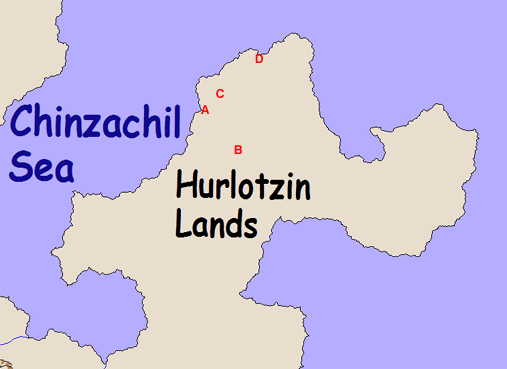 |
On overview map of the Hurlotzin Lands is presented above. 1 inch equals about 400 miles. Important locations to this and the following scenario are noted on the above map.
A = The site of Karsus' arrival
in Sazhansiir and the location of the sea cave
B = The incarnum temple (presented in part Three above)
C = The site of the staff of power
D = The incarnum dragon's lair and site of the white robe
of the archmagi (not used until the next scenario)
Travelling in the Hurlotzin Lands:
The majority of the Hurlotzin Lands is flat, rolling plains, much of it still barren due to the ancient depredations of the Scaled Ones. Where it is not barren, vast areas of scrub grasses and wiry bushes predominate. It is only near the coasts that small woods and grasslands begin to appear.
There are no mountains in the region, though the central north-south axis of the land contains some hills and tall ridges.
While there are special terrain locations in the Hurlotzin Lands that correspond to the incarnum terrain types presented in Magic of Incarnum pages 203-207, they do not enter into this scenario. DMs should feel free to add them into the travel of the PCs if so desired, though such exotic spots are rare even in the Hurlotzin Lands. Some of these terrain types do make an appearance in the next scenario in this Tokens of Karsus adventure series.
For purposes of overland travel, the DM should treat the entirety of the land as trackless plains.
The land is wild, but also sparsely populated by beasts. As such, wandering encounters are somewhat less frequent, but more dangerous, than many other places in Sazhansiir.
Wandering encounters are checked for each of four periods of the day, morning, afternoon, evening, and night. Assume the PCs travel during the first two periods and are encamped for the last two periods. There is a 5% chance of an encounter each period. If an encounter is indicated for a period, the DM should check again to see if a second encounter is indicated. If so, then a third check should be made and so forth until a check fails for that period. Multiple encounters in a given period can be spaced apart randomly (i.e. roll a d6 for hour in the period) or can be mixed together into a multiple encounter.
Nighttime encounter chances can increase or decrease depending on the type of camp that is set up:
PCs light an unshielded fire = +5%
PCs light a shielded fire = +2%
PCs make no effort to find a secluded or safe campsite or fail a DC 15 Survival check to find such a spot by 5 or more = +2%
PCs make a DC 15 Survival check to find a safe or secluded campsite = -2%
PCs make noise (singing, etc.) = +5%
Of course, PCs of the level appropriate for this scenario likely have magical means to encamp, including the various shelter-spells and the ever-useful rope trick.
The DM should not seek to foil any measures such as rope trick that the PCs have taken to ensure their safety. After all, that means they have forsaken other spells to memorize these magical means of encamping. In general, such means will involve no encounters during the night, but encounters may occur during the evening, as the PCs must still spend time outside washing, eating, cooking, praying, and practicing their skills. Unless PCs ensconced in concealed magical lodgings wish a running account of the various creatures that blunder past them in the night, the DM should simply not even roll for encounters during the night unless there is a chance that a creature encountered could somehow interact with the PCs.
If an encounter(s) is(are) indicated, refer to the table below.
Full statistics and the like are not presented in this scenario in order to save time and space. It is suggested that the DM preroll for wandering encounters and craft interesting situations to accommodate the encounters.
| d100 |
|
|
|
| 01-03 | Amphisbaena | 1 |
Serpent Kingdoms pg 62 |
| 04-06 | Ant, Giant * |
|
Monster Manual pg 284 |
| 07-14 | Baric | 1d8 | Tome of Horrors pg 28 |
| 15-17 | Centipede, Monstrous * |
|
Monster Manual pg 287 |
| 18-20 | Dinosaur * | var | Various |
| 21-25 | Dire Bat | 1d8 | Monster Manual pg 62 |
| 26-30 | Dire Hawk | 1d20 | Races of the Wild pg 189 |
| 31-33 | Dire Snake | 1 | Monster Manual II pg 74 |
| 34-36 | Dire Toad | 1d10 | Monster Manual II pg 74 |
| 37 | Fire Lizard |
|
Monster Manual II pg 194 |
| 38-41 | Fly, Giant | 1d12 | Tome of Horrors pg 202 |
| 42-44 | Frog, Monstrous * | var | Tome of Horrors pg 206 |
| 45-47 | Gryph | 2d8 | Tome of Horrors pg 230 |
| 48-52 | Hyena | 2d8 | Monster Manual pg 274 |
| 53-55 | Kamadan * | 1 | Tome of Horrors pg 245 |
| 56-58 | Lion | 1d10 | Monster Manual pg 274 |
| 59-63 | Lizard, Giant | 1 | Forgotten Realms Campaign Setting pg 308 |
| 64 | Malastor |
|
Monster Manual V pg 100 |
| 65-67 | Scaled Stalker * | 1d8 | Miniatures Handbook pg 68 |
| 68-72 | Snake, Viper * | var | Monster Manual pg 279 |
| 73-80 | Swarm, Bat |
|
Monster Manual pg 237 |
| 81-83 | Swarm, Plague Ant | 1d8 | Fiend Folio pg 167 |
| 84-88 | Termite, Giant * | var | Sandstorm pg 197 |
| 89-93 | Tick, Monstrous |
|
Tome of Horrors pg 344 |
| 94-96 | Witherweed | 1 | Tome of Horrors pg 368 |
| 97-00 | Wolf | 1d20 | Monster Manual pg 283 |
* = creature encounter divided into subtypes per the tables below or requiring additional explanation
Ant, Giant:
These will be encountered as follows:
01-75 = foraging group of 1d12
worker ants (with 1 soldier if over 5 encountered)
76-95 = war gang of 1d4 soldiers
96-00 = hive of 10d10 workers, 5d4 soldiers, and 1 queen
Centipede, Monstrous:
These will be encountered as follows:
01-30 = 2d8 tiny monstrous centipedes
31-55 = 1d12 small monstrous centipedes
56-75 = 1d6 medium monstrous centipedes
76-90 = 1d6 large monstrous centipedes
91-97 = 1d6 huge monstrous centipedes
98-99 = 1 gargantuan monstrous centipede
00 = 1 colossal monstrous centipede
Dinosaur:
These will be encountered as follows:
01-18 = 1d2 allosaurs (Monster
Manual II pg 70)
19-36 = 1d2 ankylosaurs (Monster Manual II pg 70)
37-46 = 1 seismosaurus (Monster Manual II pg 73)
47-54 = 1 spinosaurus (Monster Manual II pg 73)
55-70 = 1d8 stegosaurs (Serpent Kingdoms pg 66)
71-88 = 1d8 triceratops (Monster Manual pg 61)
89-00 = 1d2 tyrannosaurs (Monster Manual pg 61)
Frog, Monstrous:
These will be encountered as follows:
01-66 = 1d2 giant frogs
67-00 = 1d2 giant dire frogs
Kamadan:
These will be encountered as follows:
01-95 = 1 kamadan
96-00 = 1 poisonous kamadan
Scaled Stalker:
These will be encountered in a war party of 1d8 raiding north from Mazuiochitl and will consists of 1d6+1 scaled stalkers led by a war leader (Fighter 4). Additionally, 1d4-1 triceratops will be present, used as shock mounts. The war leader will always be mounted, with any other triceratops mounted by a single stalker (or unmounted if there are more trcieratops than stalkers).
Snake, Viper:
These will be encountered as follows:
01-30 = 1 tiny viper
31-60 = 1 small viper
61-79 = 1 medium viper
80-97 = 1 large viper
98-00 = 1 huge viper
Termite, Giant:
These will be encountered as follows:
01-75 = foraging crew of 5d4 workers
(with 2 soldiers if over 8 encountered)
76-95 = war squad of 1d8 soldiers
96-00 = hive of 12d10 workers, 5d6 soldiers, and 1 queen
Karsus' Arrival Point:
If the PCs met the duskling elder (and there is no reason they should not have), then they already know to search for the arrival site along the northwestern coast of the Hurlotzin Lands. This is still quite a long stretch of coastline to search, covering hundreds of miles of craggy cliff-lined shore. The account of Karsus also mentions a cleft in the earth from which flowed a river. That would narrow the coast down to those areas into which an inland river flows. However, this still leaves plenty of coastline and plenty of rivers to search.
The key, then, is the account by Karsus of "...an eye of earth who's pupil was the sea itself..." This refers to a natural stone arch of rock that just from the cliffside and arcs into the ocean. Looking through the stone arch to the sea beyond resembles looking into an eye with a sea blue pupil.
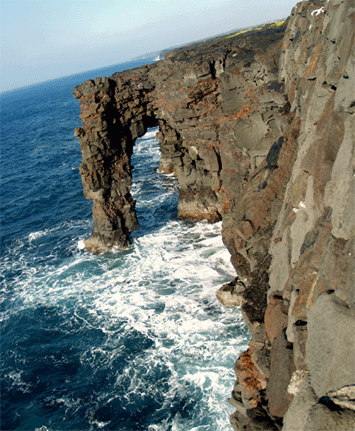 |
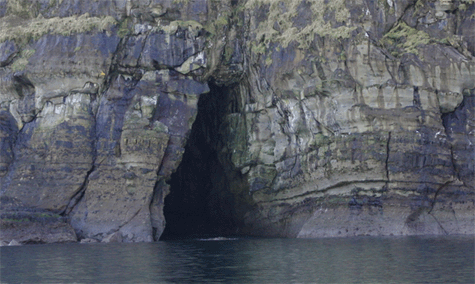
Additionally, "And near the eye was a gaping maw of earth..." refers to a large sea cave near the stone arch.
 |
There are a couple of other places with stone arches that would qualify as an "eye" as described by Karsus. Likewise, there are scores (if not hundreds) of sea caves of various sizes pockmarking the cliffs. However, only one place along the entire shoreline has both a natural stone arch thrust out into the sea and a large sea cave mouth in the cliff face. This is the area marked A on the overland map above.
The PCs can search for the site in a variety of ways. Flight offers the best means, and simply flying in daylight along the coastline will eventually turn up the many sea caves, the few arches, and the one location that has both. Travelling by foot along the cliffs will also eventually reveal the site, albeit more slowly.
There is nothing much to note at the site on the top of the cliff. The area looks natural and there is no sign of traffic or habitation of any sort.
The Sea Cave (EL 12):
The cliffs near the sea cave are between 125 ft and 150 ft high. The cave mouth itself is roughly triangular, about 70 ft tall at mid tide and half as wide (as shown in the picture above). The cliffs are relatively sheer, requiring a DC 15 Climb check.
Tides play an important part in accessibility to the cave. The waves are somewhat fierce as they crash into and around the sea cave. As such, the ocean should be treated as stormy water and requiring a DC 20 Swim check to navigate. A failed swim check might result in the swimmer being dashed against submerged rocks or against the cliff face for 1d4 x 1d6 points of bludgeoning damage.
The tides in the area of the sea cave occur twice daily (i.e. two high tides and two low tides). High tides average about 7.5 ft above sea level and low tides about 7.5 ft below sea level, resulting in a 15 ft differential between high and low tides. Tides ebb and flow on roughly a 6 hour increment, and the DM can assume that the first high tide crests in the first 6 hours of the day by rolling a d6.
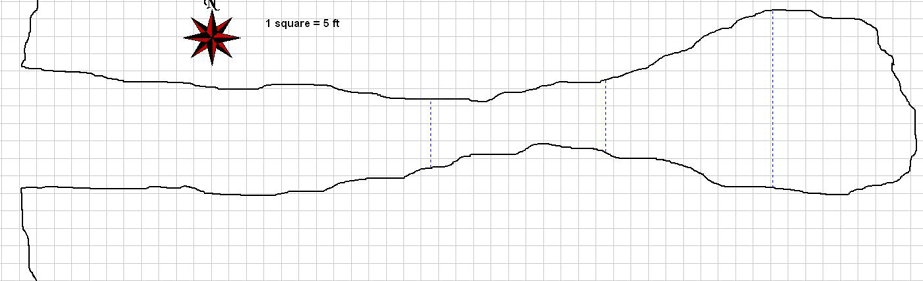
The sea cave map below shows the high, middle, and low tide marks. Additionally, at low tide the Swim check needed to swim inside the cave is a DC 10 check. At middle it is a DC 15 check. At high tide it is a DC 20 check. Failing the check may result in the swimmer being dashed against rocks or walls in the cave for 1d3 x 1d6 ponts of bludgeoning damage.
 |
 |
The cave interior is dark and very damp. Algae grow along the walls and ceiling, making the stones quite slippery to walk upon. The floor of the cave is treated as a natural stone floor (2 squares of movement to enter a square with a natural stone floor, and the DC of Balance and Tumble checks increases by 5; running and charging are impossible) and is severely slippery (+5 to Balance checks). Fighting on the floor requires a DC 15 Balance check.
Any portion of the floor that is sloped more than a 15 degree angle requires a DC 10 Climb check (normally DC 5 but with a +5 to the DC due to the slippery conditions).
A person wading in the water will find his movement halved and he must make the Balance checks as described above. Additionally, a Strength check must be made to avoid being knocked off one's feet by the force of the waves and tide rushing into the cave. At the beginning of the character's turn, he must make a Strength check equal to the Swim DC check for the appropriate tide level. Failure means the character must make a Balance check as if he were fighting on the floor.
The walls of the cave are unworked stone walls with a Climb check of DC 20 (due to the slipperiness).
The roaring of the waves echoes throughout the cave, making listening quite difficult. The DC of all Listen checks is increased by 5 at low tide, 10 at medium tide, and 15 at high tide (meaning to hear someone talking right next to you requires a DC 10 Listen check at medium tide) and for every 10 ft distance the DC increases by +2 at low tide, +3 at medium tide, and +4 at high tide.
When the PCs reach the portion of the cave towards the rear where the high tide does not reach, they will notice vivid red stains splotching the floor. The stains are strange in that they are coloured like newly spilled blood, but they are clearly dried and set into the stone floor (the stains are from the "weeping" of the rogue eidolon).
The rear wall of the cave contains a variety of crude drawings in the same vivid red colour as is on the floor of the cavern. Refer to The Drawings below for more details.
Creatures: A rogue eidolon is at the back of the sea cave. This strange creature is, like most of its kind, quite insane. When it escaped from its cult masters in ancient times, the eidolon eventually came to this sea cave, where it took refuge lest it be killed by the Children of the Mishtai. When Karsus arrived atop the cliffs above, he wandered away in a daze, but left his staff of power lying by the edge of the cliff, where it eventually rolled off and into the sea. The tide quickly drove the staff into the sea cave, where the eidolon found it and kept it.
The eidolon was not intelligent enough to use the staff or even to know of its power, but the item was beautiful to the insane creature and it came to covet it.
About 5 years ago, the staff was stolen by a cabal of evil incarnum worshippers who had come to these lands seeking lost relics of the Children of the Mishtai. The worshippers happened upon the cave while the eidolon was out roaming the nearby countryside, and the construct only saw the worshippers from a distance leaving the area with his precious staff. Distraught, the eidolon followed the worshippers to their lair, but could not figure out how to overpower them and reclaim his staff. Over the years the eidolon has gone to the worshippers' lair several times seeking to steal back the staff or somehow reacquire it, but so far such a task has thwarted its miniscule intellect and driven it further insane.
The DM should play the eidolon like a version of Gollum from The Lord of the Rings. It is obsessed with the staff, which it regarded as a personal gift from the "great ones in the skies above".
The eidolon is likely to be hostile to the PCs at first. His opinion of others has been tainted by the theft of the staff, and this is especially true of small humanoids like humans and dusklings, since they resemble the worshippers who took the staff in the first place.
As the eidolon attacks, it will cry out in Slith things like "you have already taken my great gift..I have nothing more to steal!" and so forth.
If the PCs can understand the eidolon and protest their innocence, they can convince it to cease attacking by changing its attitude from hostile to unfriendly with a rushed Diplomacy check (made at the usual -10 penalty). If the PCs mention a staff in Slith, then this check can be made with a +10 circumstance bonus. If the PCs indicate ignorance of the theft of the "great gift" but express a potential willingness to retrieve it, then they can receive a +15 circumstance bonus to the Diplomacy check. If, somehow, the PCs claim they will return the staff to the eidolon, then allow a rushed Bluff check (at -10) with a +20 circumstance bonus to influence its attitude.
|
Tactics: The eidolon will use its various abilities directly and with little subtlety. It will tend to use its Improved Sunder against any weapon that penetrates its damage reduction, and will use Improved Bull Rush to push foes back into the water if the water is near (most likely this would be at high tide).
The eidolon values its life, and if brought to 25 hp or less it will seek to retreat from the PCs to the deepest part of the sea cave and go fetal, whimpering to itself about the unfairness of life and how its great gift should be his. If the PCs continue to attack then it will leap back up in a fury and attack to the death using its Power Attack to the fullest extent (i.e. 13 points of Power Attack).
Developments: Being not very intelligent or wise, the eidolon can be easily beguiled or tricked into giving the location of the staff and vague details about the worshippers. Remember that the eidolon is insane and has the intelligence of a small child. He will call the worshippers the "bad sneak people" and refers to the staff as his "great gift".
Once parley begins, the PCs can make a full skill check to influence the eidolon's attitude, with the above circumstance modifiers still applicable. If made unfriendly, the eidolon will simply order the PCs out of its cave and become hostile if they refuse.
If made indifferent, the eidolon will explain that it lost its great gift, but will say no more. It will not describe the gift to the PCs.
If made friendly, the eidolon will describe its gift as a staff, describe the staff, tell where the worshippers can be found, and describe the worshippers to the best of its ability. In this case, the eidolon will naively assume that its new friends (the PCs) will bring the staff back to it.
If made helpful, the eidolon will offer to escort the PCs to the worship site and will enlist the PCs to help him retrieve his great gift. If the PCs desire for the eidolon not to accompany them, it should be a very simple matter to convince or trick it into staying in the cave.
Assuming the eidolon's attitude is sufficiently friendly, the PCs should eventually be able to piece together that the eidolon had a staff that was given to him by the "great ones in the skies above". The eidolon can describe the staff, and the runes carved up and down its length should be a good indication that this might be the staff of power. The eidolon can say it had the staff for many many seasons...beyond count.
The eidolon cannot really describe the worshippers in much detail, except to say they are small humanoids like the PCs (most likely) and that it knows where they dwell. If it is asked about numbers of worshippers, it will say that there are at least four hands worth.
If the eidolon is killed before the PCs can get the location of the worshippers from it, then they will have to find the location from the clues in the drawings on the cave wall. See Part Five below for more details on finding the worship site.
The Drawings:
Most of the drawings are of creatures native to the area. The DM can draw from the Wandering Encounter list in Part Four for the types of creatures that will be very crudely represented. However, several of the drawings seem to show a group humanoid stick figures and in these one of them seems to be carrying a spear or staff of some sort.
One of the most interesting of the drawings seems to show a group of humanoid stick figures (one of which carries a spear or staff) standing next to what looks like a cleft in the ground.
 |
A nearby drawing shows a similar scene, but the with figures inside the cleft.
 |
Part Five - The Worshippers of the Staff
Finding the Cleft:
The Hurlotzin Lands is a torn region, full of clefts and craters in the ground from the ancient destruction wrought by the Scaled Ones in their assault upon the Children of the Mishtai. As such, simply knowing that the place they seek is a cleft or rift in the ground will not narrow the choice down considerably. At least 4 such clefts are present within a 100 mile radius of the sea cave.
Of these four clefts, one contains the worshippers with the staff. Of the other three, one is the lair of a malastor. The other two are serving as the lairs of itinerant creatures and the DM should roll on the Wandering Encounter table in Part Four and assume that creature is lairing in that particular cleft.
If the PCs search clefts randomly, the DM can either roll randomly to see which they find first, or he can have them stumble upon the malastor lair first, and one or more of the others before reaching the worshipper site. One reason to do this is to force the PCs to pay a price (in the form of additional encounters with no treasure) for slaying the eidolon without extracting its information first.
If precise locations are needed, the cleft they seek is marked on the overland map. The malastor's lair can be 25 miles to the south by southeast of the sea cave. The other two clefts can be 55 miles east of the sea cave and 85 miles east by northeast of the sea cave.
The clefts vary somewhat in size and depth. Assume the malastor cleft is 250 ft long and 50 ft wide and 75 ft deep and the beast lairs in a large cave at the bottom. The scramble up and down the far ends of the cleft is along a talus of stones that involves a DC 10 Climb check (meaning the malastor can make it automatically). The malastor has very keen senses and will not take kindly to intrusion of its hibernation, pursuing the PCs well past the cleft, until pursuit seems fruitless. The malastor has no treasure.
The floor of the clefts is considered to be hewn stone (though the cleft is, in fact, quite natural, its floor is smooth enough to be considered the same as hewn stone). A DC 10 Balance check is required to run or charge across such a floor. Failure means the character can still act, but can’t run or charge in this round.
The walls of the clefts are unworked stone walls and require a DC 15 Climb check to scale.
The other two clefts can be somewhat smaller than the malastor cleft.
The Worshippers:
The worshippers are led by a duskling necrocarnate who came to the Hurlotzin Lands with his followers in an effort to find lost incarnum lore. He was served by various minions, including a coterie of lost whom he created by use of torture and incarnum rituals. The necrocarnate's intent was to unearth such lore and return to the Azotchtlan Lands and use his newfound power to increase his power amongst his ilk and unite the necrocarnates into a power in the lands.
However, when the worshippers found and stole the staff of power they attempted to divine its use and pour their essentia into the item, thinking it a relic of ancient Hurlotzin lands. Their efforts had no direct effect on the staff, but it did manage to awaken one of the shards of Karsus' shattered soul, which had lingered near the staff in a sort of metaphysical proximity. The worshippers made contact with the shard of Karsus and came to worship the staff as a vessel for the inchaote presence of Karsus. This worship eventually, over the course of several years, morphed into the binding of Karsus' vestige as well as the vestiges of other presences, so that now the worshippers are comprised of binder incarnum wielders. Furthermore, the binding of Karsus' vestige has allowed the necrocarnate to wield most of the staff's formidable powers!
The worshippers still venture forth to search for ancient power and lore. At any given time, half of their number are away from the cleft. The necrocarnate leader, who bears the staff of power is almost always at the cleft, and is presumed to be there for purposes of this scenario. Similarly, the two other leaders are usually present. They only leave the cleft when the worshippers have located a site and need the aid and abilities of the leaders.
The PCs will be very unlikely to be able to parley with the worshippers. They had thought their cleft secret and their activities hidden and they do not want others to know of their existence. Therefore, unless the PCs can very convincingly claim to know where immense treasure is located in the area, they will be met with utter hostility. The worshippers place great faith in the power of the staff, and their hubris in this regard will cause them to tend towards aggression. The leaders are extremely paranoid about their retention of the staff of power and even if parley is established, they will be very possessive of the staff and very suspicious of any questions about it or interest in it evinced by the PCs.
The Cleft of the Staff:
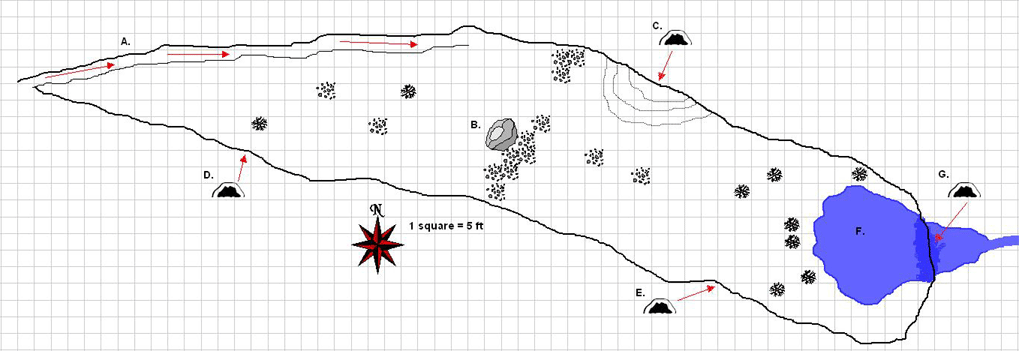 |
The cleft that currently forms the lair of the worshippers of the staff of power is a rent in the ground approximately 250 ft long and about 60 ft wide at its widest point. The cleft generally runs west to east, and its western end is a sharp point while its eastern end is blunt. The cleft is about 80 ft deep.
The floor of the cleft is considered to be hewn stone (though the cleft is, in fact, quite natural, its floor is smooth enough to be considered the same as hewn stone).
|
Hewn Stone Floor A DC 10 Balance check is required to run or charge across such a floor. Failure means the character can still act, but can’t run or charge in this round. |
Furthermore, the floor is considered to be filled with light rubble (representing stones and pebbles).
|
Light Rubble Adds 2 to the DC of Balance and Tumble checks. |
The walls of the cleft are unworked stone walls and require a DC 15 Climb check to scale.
Where stone rubble is indicated on the map, it represents patches of the cleft floor that are more uneven and stone strewn than the rest. Treat these squares as dense rubble.
|
Dense Rubble Costs 2 squares of movement to enter a square with dense rubble. It adds 5 to the DC of Balance and Tumble checks, and it adds 2 to the DC of Move Silently checks. |
Where a tree is indicated on the map, it represents a large, hardy scrub bush, about 5 ft in diameter and as tall. These bushes are thorny and bear only a few bits of foliage. Squares with the bushes should be treated as heavy undergrowth.
|
Heavy Undergrowth Costs 4 squares of movement to move into, and it provides concealment with a 30% miss chance (instead of the usual 20%). It increases the DC of Tumble and Move Silently checks by 5. Heavy undergrowth is easy to hide in, granting a +5 circumstance bonus on Hide checks. Running and charging are impossible. |
Furthermore, the bushes' thorns will cause any creature moving into, out of, or through the square to suffer 1d6 points of piercing and slashing damage from the thorns. A creature's armour bonus and natural armour bonus should be subtracted from the damage rolled.
Finally, the bushes are tall enough to provide cover to any ranged attacks or reach attacks made through their squares.
The noise from the falls at area F makes all Listen checks within 50 ft of it at a -5 penalty.
A. Ramp
| At the western edge of the cleft, a narrow stone ramp hugs the northern wall and descends at roughly a 30 degree angle down into the cleft. |
|
Steep Slope Characters moving uphill (to an adjacent square of higher elevation) must spend 2 squares of movement to enter each square of steep slope. Characters running or charging downhill (moving to an adjacent square of lower elevation) must succeed on a DC 10 Balance check upon entering the first steep slope square. Mounted characters make a DC 10 Ride check instead. Characters who fail this check stumble and must end their movement 1d2×5 feet later. Characters who fail by 5 or more fall prone in the square where they end their movement. A steep slope increases the DC of Tumble checks by 2. |
While most of the ramp is 5 ft wide, there is a 15 ft stretch about halfway along that is 3 ft wide. Medium and smaller creatures can still safely navigate this stretch, but the former only if they are moving at half speed. Otherwise, a DC 7 Balance check is required. For Large creatures, add 4 to the DC. If running or charging, add 5 to the DC. If the Balance check is failed, the character cannot move that round. If it is failed by 5 or more, the character falls and must make a DC 15 Reflex save to grab onto the side of the ramp and a DC 15 Climb check to pull oneself up in a subsequent turn as a move action.
B. Large Stone
| In the middle of the cleft floor is a large boulder, about 10 ft in diameter and a full 15 ft tall. The sides of the boulder are steep, but the top is relatively flat and small footholds and/or handholds have been carved into the side of the boulder, allowing someone to scramble up to the top of it. |
C. Cave
Note that if the kamadan skeleton
is here then there will also be a large pile of bones.
|
Along the north wall of the cleft, a bit east of the ramp, a trio of natural stone shelves rises up 15 ft to a cave entrance. The stone shelves bear boulders on them towards the middle of the shelves that seem to allow a creature to scramble up the steps and to the cave. The cave entrance is about 10 ft wide and 8 ft tall. |
D. Cave
Note that if the kamadan skeleton
is here then there will also be a large pile of bones.
| Along the south wall of the cleft, opposite the ramp, is a squat cave opening running along the floor of the cleft. This opening is about 5 ft tall and 15 ft wide. |
E. Cave
Note that if the kamadan skeleton
is here then there will also be a large pile of bones.
| In the eastern portion of the cleft, along its southern wall, a cave entrance looms. The entrance is 10 ft wide and 15 ft tall and various sigils and runes have been carved into an arch surrounding the opening. |
The runes and sigils pertain to binding of vestiges, and a DC 25 Knowledge (arcana) roll can determine this (allow binders and any character with a binding feat a +10 circumstance bonus to recognize this). A result 10 or more over what is required will identify the markings as pertaining to the vestige of Karsus.
F. Waters
Note that if the kamadan skeleton
is here then there will also be a large pile of bones.
| A stream flows into the eastern portion of the cleft, widening as it plunges in a fall over the cliff edge and into a frothy pool below. |
The pool has rather steep sides and a depth of 15 ft. Anyone falling or diving over the falls who makes a DC 15 Swim check can land safely in the pool if size Large or smaller. If the Swim check is failed, the person suffers 4d3 non-lethal damage unless the Swim check was failed by 5 or more, in which case the person suffer 4d6 lethal damage.
The noise from the falls makes all Listen checks within 50 ft of it at a -5 penalty.
Secret Doors: Behind the waterfall is a cave entrance. The stone floor of the cleft bends behind the waterfall and provides a 5 ft wide pathway to the other side. A DC 20 Spot check can determine that it is possible that the cleft floor indeed proceeds behind the waterfall, although only coming up and actually seeing it go behind the falls will confirm this fact.
Additionally, a DC 30 Spot check (during daytime or with darkvision) can determine that there is a dark splotch showing up behind the falls that might indicate a structure, still creature, or cave opening of some sort.
G. Hidden Cave
Note: This cave is hidden by the
waterfall (see area F above). DMs should only provide the description
below when the PCs come within sight of the cave entrance.
| The floor of the cleft winds behind the waterfall and forms a 5 ft wide pathway that is slick with water and algae. Along the eastern side of this pathway is the cleft wall, and a cave opening pierces the wall here. The opening is about 10 ft wide and as tall. |
The pathway is quite slick, requiring a DC 5 Balance check to negotiate unless moving at half speed. Running or charging requires a DC 15 Balance check. Anyone failing by 5 or more falls and might (50% chance) slip into the pool (and if this happens there will be no chance to grab onto the pathway as the falls will slam into the person and push them into the pool).
Creatures in the Cleft (EL 10)
Normally, the worshippers are ensconced in their respective caves. However, the cleric Ashbintclatl usually has his 4 animated kamadan skeletons at rest in the cleft. These are generally located as follows and appear as a pile of bones until they animate (as the PCs are likely not familiar with kamadans and their strange form they will not immediately identify the bone piles as a single creature). The DM should casually mention the pile of bones along with the description of the location where each is resting.
The kamadans are at:
1 resting just in front of cave
entrance C
1 resting along the northern wall near cave entrance D across
the stone shelves
1 resting just in front of cave entrance E
1 resting just to the northwest of the pool at area F (between
the bushes)
The kamadan skeletons are programmed to attack any creature larger than size Tiny that enters the cleft (which means coming to within 10 ft of the floor) that is not a member of the worshippers or escorted by same. They will not leave the cleft unless ordered by Ashbintclatl
Additionally, Mizfirzotin's necrocarnum zombie allosaurus patrols the cleft night and day. It wanders the length and breadth of the cleft floor looking for intruders. Unlike the skeletons and normal zombies, the allosaurus zombie retains its Intelligence and has been trained to recognize friends. The creature has been instructed to attack any intruders into the cleft, bellowing as loud as it can before doing so.
The allosaurus' roar is amazingly loud, and requires a base DC -20 Listen check to hear. If it does roar, the DM should calculate the chance that other denizens in their respective caves hear the roar and react accordingly.
|
|
|
Tactics: The allosaurus will pursue intruders out of the cleft if necessary. The creature is as cunning as any animal hunter of prey and will react much as a vicious trained attack dog. Mizfirzotin has had this zombie bound to his necrocarnum circlet for several years now, as it is not easy to find and slay an allosaurus.
Developments: If the sounds of combat are heard by the other denizens of the cleft, they will react as mentioned in the section entitled "Defending the Cleft" below.
Scouting the Cleft
It is possible the PCs will wish to observe the cleft for some time. Assuming they do so for at least several hours during the day, the DM can describe some of the mundane activities of the cleft, as denizens emerge and drink from the pool, return and leave the cleft on hunting or foraging expeditions, and the like. At least once per day Mizfirzotin calls a gathering and stands atop the boulder at area B while the rest of the denizens gather below and hear him make a speech, usually exhorting worship of the all-powerful staff, the spirit of Karsus, and plans to scout and explore other areas of the Hurlotzin Lands in search of more artifacts. During such a speech, the necrocarnate will certainly mention the incarnum dragon and the need to gather items of power to one day defeat him and claim his treasure, including the great robe of Karsus. He will also mention the group's eventual return to Azotchtla with their items of power to wreak revenge on those who have wronged them.
Remember that at most times half of the lesser denizens (lost and cultists) of the cleft are absent. Assume that a group will return on any given day 15% of the time, and any such group will consist of 3d4 denizens (assume half lost and half cultists). The exact time of day of the return can be determined randomly (they will even return at night, wanting to reach the safety of home as soon as possible). Of course, unless an alarm is raised similar groups will leave the cleft as well, so unless an alarm is raised, the DM should assume the numbers present remain constant. If precise numbers of absent denizens are needed, simply count the amounts present and assume an equal number are away from the cleft.
At night, groups returning to the cleft will douse their lights a mile or more before reaching the cleft, then negotiating by memory as they are under instructions to never bear lights to or within the cleft, so as not to attract any undue attention. The cleft itself is quite dark at night, and tends to be deserted except for the undead.
The Pet, in area D, does not usually emerge, except to hunt perhaps once a month. It spends most of its time sleeping in its lair.
Cavern Complexes
Each cavern complex is generally separate and distinct from the others, although some have tunnels linking them with other complexes in the cleft. Unless otherwise stated, all complexes are comprised of hewn stone floors and walls. Dashed lines represent stone steps between 1 ft and 2 ft high.
|
Hewn Stone Floor A DC 10 Balance check is required to run or charge across such a floor. Failure means the character can still act, but can’t run or charge in this round. |
|
Hewn Stone Wall Per 3 ft thickness: Break DC 50, hardness 8, 540 hp. Climb DC 25. |
All passages and chambers and areas C, E and G are lit every 20 ft by a crude pottery oil lamp with a wick and oil rendered from animal fat. These illuminate like torches and generally keep the place in enough illumination to provide no concealment. The lamps are set into small niches cut into the rock faces at a height of about 6 ft.
A small wisp of smoke emerges out of the entrance to complex E.
Area D is unlit.
Cavern Complex C:
This complex houses many of the karsus cultists, led by Ashbinclatl, along with a contingent of lost. Unless otherwise stated, all areas herein are 10 ft high. Due to the proximity of the areas of the complex to one another, combat in one area is likely to rouse the entire complex, which will come to the scene of any disturbances.
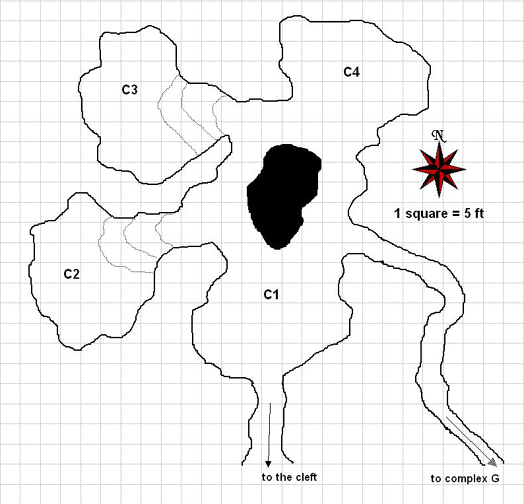 |
C1. Entry Cavern (EL 10)
|
This cavern contains a large wooden table and half a dozen crude chairs. Rudimentary wares and utensils rest on the table, fashioned from wood, bone, and gourds, as does a haunch of venison. In the southwest corner of the place is a fire pit carved into the wall. The pit contains an iron spit and its embers glow blood red. Carved into the northern stone wall where the cavern branches into two passages is a thin, tall niche beginning at 3 ft from the floor and rising 6 ft up. Set into this niche is a rune carved wooden staff. The rest of the walls are covered in runes that appear to be dried blood. |
The runes on the walls are rudimentary forms of arcane magical writing, gleaned from the vestige of Karsus. A DC 20 Knowledge (arcana) check will determine that these are arcane runes, though with many mistakes as if a child were copying runes from a spellbook rather than a learned person writing with knowledge. The runes seem random and make no sense in any sort of context. A read magic spell will glean the same information as if the Knowledge check were successful.
The staff set into the niche is a very good replica of the actual staff of power. However, it is merely an icon of veneration for these cultists and has no power and radiates no magic. Nevertheless, a DC 25 Knowledge (arcana) check or a read magic spell will reveal that the runes carved into the staff are quite accurate and indicate an item of arcane puissance. If the check is made by 10 or more, then the staff will be seen to be a very life-like replica of a staff of power. The staff can be taken from the niche, and it can be used as a normal quarterstaff. While it is, indeed, a good replica of the staff of power, the cultists and leaders of this place are so intimately familiar with the real staff that they will not be fooled by this replica.
Creatures: 4 Karsus cultists are usually found here, taking a meal or otherwise relaxing.
|
FEATS: Expel Vestige (ToM p73) - 1/day expel vestige as if summoning it again. If binding check succeeds, vestige is expelled and a new one can be summoned. Take -10 penalty to bind a new vestige and to bind the expelled vestige the next time you attempt to bind it. Improved Binding (ToM p74) - +2 EBL to determine which vestige you can bind. Rapid Pact Making (ToM p74) - 1/day bind vestige as full-round action. Skilled Pact Making (ToM p74) - +4 bonus on binding checks. VESTIGE POWERS: aura of sadness (ToM p31) - Adjacent creatures suffer -2 on attacks, saves and skills while adjacent. Suppress or activate as standard action. Mind-affecting ability. Focalor's breath (ToM p31) - As standard action exhale at target in 30 ft, Fort sv or be blinded for 1 rd. Usable 1/5 rds. heavy magic (ToM p37) - Save DC for every magic item effect you use increases by 2. Karsus' senses (ToM p37) - Sense magic auras as easily as others smell odors, concentrating for 1 rd detects auras as if 2nd round of detect magic spell within 30 ft; concentrating 2nd rd reveals location and strength; concentrating for 3rd rd reveals school of an aura. Cannot be used if blinded, otherwise penetrates as detect magic. If overwhelming aura sensed you are dazzled as long as within range. Karsus' touch (ToM p38) - Produce dispel magic effect with melee touch attack (check is at EBL) again each ongoing spell in effect on object or creature; may be used 3/day but only 1/5 rds. Karsus' Will (ToM p38) - You can use spell trigger items like wands and staves as if a wizard of your EBL. lightning strike (ToM p31) - 1/rd as standard actions call down bolt striking target within 60 ft for 3d6 dmg (Ref sv 1/2). This can be used indoors and underground. water breathing (ToM p32) - Breathe water and air. |
Tactics: These cultists will raise an alarm as soon as they notice intruders. The cultists are not great warriors, and they know this, so their main agenda will be to raise an alarm and to support leaders or the lost. The cultists will have the vestige of Karsus bound if they are not alert to danger. If so, then their first order of business will be to expel their vestige and try to bind Focalor using Rapid Pact Making.
Once Focalor is bound, then their primary attack is their lightning strike, and they will use it prodigiously. If their enemy seems to be resistant or immune to electricity, then any who failed to expel Karsus will use Karsus' touch to attempt to dispel any magical resistance to electricity and then resume their lightning strikes.
The cultists will also activate their aura of sadness ability when Focalor is bound, even though this affects the cultsists who are adjacent.
If attacked in melee, those who have bound Focalor will use Focalor's breath to attempt to blind their adversaries.
Once the cultists realize how tough their adversaries are, they will begin to mass their lightning strikes against a single target, especially any who have been shown to be susceptible to electricity.
C2. Cultist Barracks (EL 10)
|
Steps descend a few feet into this cavern, such that the ceiling in the lower part is 15 ft overhead. Within the cavern are a mish-mash of fur pallets, enough for more than a dozen persons. Strewn on the floor amongst the bedding are a variety of what appear to be personal effects, such as bone combs, partial pieces of studded leather armour, flint and tinder, bones and stone tools, and other such items. Three crude wooden barrels rest in an alcove-like portion of the cave along the north wall, and hanging from a hook above the closed barrels is a deer carcass with several stone knives jutting from its flesh. The walls are covered with crude charcoal drawings of a bearded man with feathery wings wielding a staff that seems to spray forth lightning bolts, balls of fire, or a cone of some sort of energy at vaguely demonic shapes. |
The barrels contain lamp oil rendered from animals. There are a total of 16 flasks worth in each barrel. The oil is used to light the various lamps set around the place.
Creatures: 4 cultists are present here, two of them sleeping and the other two having a good time together sharing a bed. If no alarm has been raised, these cultists are likely to be completely surprised by the PCs.
|
FEATS: Expel Vestige (ToM p73) - 1/day expel vestige as if summoning it again. If binding check succeeds, vestige is expelled and a new one can be summoned. Take -10 penalty to bind a new vestige and to bind the expelled vestige the next time you attempt to bind it. Improved Binding (ToM p74) - +2 EBL to determine which vestige you can bind. Rapid Pact Making (ToM p74) - 1/day bind vestige as full-round action. Skilled Pact Making (ToM p74) - +4 bonus on binding checks. VESTIGE POWERS: aura of sadness (ToM p31) - Adjacent creatures suffer -2 on attacks, saves and skills while adjacent. Suppress or activate as standard action. Mind-affecting ability. Focalor's breath (ToM p31) - As standard action exhale at target in 30 ft, Fort sv or be blinded for 1 rd. Usable 1/5 rds. heavy magic (ToM p37) - Save DC for every magic item effect you use increases by 2. Karsus' senses (ToM p37) - Sense magic auras as easily as others smell odors, concentrating for 1 rd detects auras as if 2nd round of detect magic spell within 30 ft; concentrating 2nd rd reveals location and strength; concentrating for 3rd rd reveals school of an aura. Cannot be used if blinded, otherwise penetrates as detect magic. If overwhelming aura sensed you are dazzled as long as within range. Karsus' touch (ToM p38) - Produce dispel magic effect with melee touch attack (check is at EBL) again each ongoing spell in effect on object or creature; may be used 3/day but only 1/5 rds. Karsus' Will (ToM p38) - You can use spell trigger items like wands and staves as if a wizard of your EBL. lightning strike (ToM p31) - 1/rd as standard actions call down bolt striking target within 60 ft for 3d6 dmg (Ref sv 1/2). This can be used indoors and underground. water breathing (ToM p32) - Breathe water and air. |
Tactics: If an alarm has been raised, the sleeping cultists will take 1 round to wake up from sleep, and then another to get out of their bedding and grab their weapons. The couple copulating will not need a round to wake up, and will grab their weapons in the first round and stand up.
The cultists will have the vestige of Karsus bound if they are not alert to danger. If so, then their first order of business will be to expel their vestige and try to bind Focalor using Rapid Pact Making.
Once Focalor is bound, then their primary attack is their lightning strike, and they will use it prodigiously. If their enemy seems to be resistant or immune to electricity, then any who failed to expel Karsus will use Karsus' touch to attempt to dispel any magical resistance to electricity and then resume their lightning strikes.
The cultists will also activate their aura of sadness ability when Focalor is bound, even though this affects the cultsists who are adjacent.
If attacked in melee, those who have bound Focalor will use Focalor's breath to attempt to blind their adversaries.
Once the cultists realize how tough their adversaries are, they will begin to mass their lightning strikes against a single target, especially any who have been shown to be susceptible to electricity.
C3. Ashbinclatl's Quarters
(EL 14)
|
Steps descend a few feet into this cavern, such that the ceiling in the lower part is 15 ft overhead. To the north of the cave is a pile of furs forming a large bed. The south part of the cave is dominated by a wooden block, set into the furthest portion of the southern wall, that is clearly being used as an altar as evidenced by its crude carvings of skulls, the rust coloured splotches on its top, and the bone knife and partially disemboweled small animals that are set upon it. A stone bowl on the floor next to the altar contains coals and ashes, and next to that is a leather pouch tied off with a string. In the center of the floor between the bedding and the altar is a strange and complicated diagram gouged into the stone floor. The diagram is about 8 ft in diameter. |
The altar is the subject of an unhallow spell (CL 11) and has an aid spell (CL 12) fixed to it. The unhallow and its effects basically cover the entire cavern, but do not reach outside of it.
The leather pouch contains a set of oracular dice made from bones. The dice have crude symbols carved upon them and while not magical they are crafted to add +2% to the chance of success for an augury, divination, or any other divination spell that uses a percentile roll to determine success. The dice must be used in conjunction with the normal foci and components for the spells.
A DC 15 Knowledge (religion) check will reveal that the altar is dedicated to a death god of some sort. A DC 25 Knowledge (religion) check will reveal that the bowl of coals and ashes, the eviscerated animals, and the dice are all tools used in divinations.
The carving on the floor is a binding diargram for vestige binding, and a DC 25 Knowledge (arcana) check will reveal this, with success by 10+ allowing identification of the vestige of Karsus as the entity being bound by the diagram.
Creatures: The cleric Ashbinclatl is often found
here, performing divinations or meditating at her altar. She also
often takes a lover from the cultists (male or female) and entertains
in her pile of bedding. Ashbinclatl is an extremely passionate
and emotional woman, prone to violent outbursts of rage when she
cannot get her way. That said, she is also quite scheming and
is jealous of Mizfirzotin's possession of the staff of power,
though she dare not challenge him as long as Vatenyrtzin supports
the duskling. While she technically worships Mergurr, Ashbinclatl
reveres the concept of death and unlife and her worship of the
god of death is a perversion of the normal Azotchtlan worship
of death.
| Before you is a rilkan woman in her early 50's, with long grey stringy hair and wrinkles that make her look older than she is. She wears armour of flayed leather studded with bones and is clad in a dusty grey cloak. An amulet around her neck is in the shape of a skull with runes carved across its face. Her heavy mace is a carved wooden handle topped by an obsidian head in the shape of a gaping skull with piercing red eyes. |
If the PCs enter this place late at night, allow a 25% chance that Ashbinclatl is asleep here. If so, she will be in her armour, with her shield and weapons within reach.
|
FEATS: Bind Vestige (ToM p72) - You may bind vestiges as a 1st level binder and gain a specific power from the bound vestige (see page 74). Divine Vigour (CW p107) - As standard action spend turn or rebuke for +10 ft base speed and +2 hp per lvl for Cha mod in minutes. Improved Bind Vestige (ToM p73) - You may bind a single vestige as a 5th level binder and gain a specific power from the bound vestige (see page 74). Incarnum Spellshaping (MoI p38) - You can cast spells with the incarnum descriptor. You gain 1 essentia. Practiced Binder (ToM p74) - Gain a second power (see page 74) when binding a vestige using the Bind Vestige or Improved Bind Vestige feats). SOULMELDS: enigma helm (MoI p66) - Normal: CL check to affect you with divinations (DC 11 + ML); Essentia: +1 enchancement bonus on Will saves/essentia; Crown: immunity to enchantment (charm) effects. impulse boots (MoI p71) - Normal: gain uncanny dodge; Essentia: +1 Ref/essentia. SPELLS: clutch of Orcus (SC p49) - r med, 1 humanoid, conc up to 1 rd/lvl, sv F neg, SR; force grips vital organ and crushes it causing 1d12 dmg/rd and paralyzing victim. Conc req to maintain each rd. Conscious victim gains Fort sv each rd. If victim dies, smoking organ appears in caster's hand. darkbolt (LoM p210) - r cl, 1 creature, sv F part, SR; ranged touch causes 1d8 dmg/2 CL (max 5d8). 1/2 dmg is cold 1/2 untyped. Target struck must sv or be stunned for 1 rd. divine retribution (CC p119) - r pers, 10 min/lvl or dischg, sv W part, SR; any creature that attacks you in any way suffers 1d6 dmg/lvl (half energy half divine) and 1d4 points of ability dmg, based on deity (Mergurr is cold and Charisma). Will save 1/2 dmg and neg ability dmg. Once retribution activates spell ends. dread blast (PGF p101) - r med, sv W 1/2 (see text); ranged touch neg energy ray causing 4d8 +1/lvl (max +20) and dazed for 1 rd. Save negates daze and 1/2 dmg. No effect on constructs or objects. Heals undead. guardian spirit (MoI p101) - r touch, creature, 1 hr/lvl or dischg, SR; recipient activates as immed action. Gains +2 insight bonus to AC, Ref sv, Dex checks, init, and Dex based skills. Lasts for 1 minute once activated. Essentia: +1 bonus/essentia. harrier (DotF p87) - r cl, 1 rd/lvl; creates incorporeal magical bird of prey to attack single target. See stat block below for details. incarnum weapon (MoI p102) - r med, 1 rd/lvl, sv W part; oversized flail or battleaxe of incarnum appears and attacks foes at distance like spiritual weapon, does 2d6 dmg plus living creature takes 1 Wis drain. Weapon crits on 20 (x2). Uses BAB + Wis mod (multiple atks allowed). Mv action to redirect and only 1 atk in a move round. Essentia: +1 atk, dmg and crit range per essentia. recitation (SC p170) - r 60 ft, all allies in 60 ft burst, SR; Allies gain +2 luck bonus to AC, attacks, and saves. +3 if worship same deity. soul boon (MoI p104) - r touch, 1 living creature, 1 min, SR; target gains 1 essentia/3 CL (max +5) for duration. valiant spirit (MoI p106) - r touch, creature, 1 hr/lvl or dischg, SR; recipient activates as immed action. Gains +2 morale bonus to attacks, dmg, Fort sv, Str checks, Str based skills. Lasts for 1 minute once activated. Essentia: +1 bonus/essentia. wall of incarnum (MoI p106) - r med, wall 5 ft sq/lvl, 1 min/lvl, sv W part; flat vertical plane of incarnum cannot be conjured into occupied space and must be anchored to surface. Non-ethereal creatures trying to pass through must make Will sv or be blocked. Deals 1d4 essentia dmg (or Wis dmg if no essentia) regardless of sv. Essentia: +1 dmg/essentia taken when blocked. wave of grief (SC p236) - r 30 ft, cone, 1 rd/lvl, sv W neg, SR; -3 to attacks, saves, ability and skill checks. wieldskill (PGF p118) - r touch, creature, 1 min/lvl, SR; +5 competence bonus to chosen skill and 1/2 rank and trained status if no ranks, or proficiency in a single weapon or armour type. VESTIGE POWERS: heavy magic (ToM p37) - Save DC for every magic item effect you use increases by 2. Karsus' senses (ToM p37) - Sense magic auras as easily as others smell odors, concentrating for 1 rd detects auras as if 2nd round of detect magic spell within 30 ft; concentrating 2nd rd reveals location and strength; concentrating for 3rd rd reveals school of an aura. Cannot be used if blinded, otherwise penetrates as detect magic. If overwhelming aura sensed you are dazzled as long as within range. MAGIC ITEMS: torturous (GW p64) - target is stunned for 1 rd on hit (DC 12 F sv neg). |
|
|
Tactics: Ashbinclatl first reaction at the sign of any sort of trouble or alert is to cast the spells guardian spirit and valiant spirit, since these last for 12 hours. She will then cast divine retribution, which lasts 2 hours. Both of these assume she has warning of trouble or is on alert.
She will almost always begin any actual hostilities by casting soul boon, which will grant her +4 essentia. This boost to essentia will allow her to better fuel her incarnum-based spells. After this she will use her Divine Vigour to boost her hit points. Her next actions will be dictated by whether she is supporting her worshippers in a fight or by herself. If the former, she will cast recitation as soon as possible, followed by bless. She will not cast prayer unless her recitation is dispelled or expires, as their bonuses do not stack. Her further actions depend upon the tactical situation. If the latter she will try to cast spells like shield of faith and resist energy.
She is partial to casting wall of incarnum to separate foes, especially spellcasters since spells cannot pass through it and spells like teleport that utilize the Astral Plane for travel cannot be used to pass through the wall. She will use blade barrier for personal protection, along with her harrier spell. If her foes summon a lot of creatures (or a few formidable ones), she will respond with her protection from good spell. She will also attempt to cast her incarnum weapon as soon as she is able after her preparatory spells so that the weapon can commence attacking while she works her other magic. She will tend to save her dread blast to heal undead (like her dire bat zombie).
Beyond that, she has a fairly potent arsenal of attack spells, and will use them to best effect. She does not prefer to engage in melee, despite her magical mace.
Developments: Ashbinclatl is a fanatic and a lover of death, and she will fight to the death against invaders. Her enmity for Mizfirzotin would only come into play as a byproduct of influencing her while under the effects of magic such as suggestion.
Traps: A greater glyph of warding has been cast upon the loose stone such that anyone but Ashbinclatl who moves or strikes it will activate the glyph. The glyph casts a summon monster VI spell to conjure up a chaos beast.
| Greater Glyph of Warding (spell) CR 7; spell; spell trigger; no reset; spell effect (greater glyph of warding [spell], 12th-level cleric, summon monster VI [chaos beast]); Search DC 31; Disable Device DC 31. |
|
Secret Doors: Hidden under the pile of furs used as bedding is a loose stone carved from the stone floor and then fit into place. A DC 20 Search check is required to find the loose stone, which can then be maneuvered away to expose a 2 ft cube niche. The niche has a greater glyph of warding cast upon it (see Traps above). Within is a large tied sack that contains 1,000 gp worth of onyx (for casting animate dead), a small skin pouch containing 1,200 gp worth of powdered diamond (for casting greater glyph of warding), 5,000 gp worth of herbs, oils, and incense suitable for casting an unhallow spell (these items are specicially not suitable for casting a hallow spell), 25 lbs of powdered silver worth 125 gp (for casting desecrate), and a pouch containing 5 diamonds worth 1,000 gp each.
C4. Chamber of the Lost (EL
12)
| This cavern's ceiling descends to 5 ft high at its farthest end. Within are two dozen fur pallets and a jumble of bones, piles of small debris, strange little piles of stones, twigs, and leaves, and crude, grotesque, and strangely unsettling chalk drawings and blood smears on the walls and ceiling. |
Creatures: A dozen lost warriors dwell here, another 12 being out of the cleft at any given time. The DM should assume that there are an equal number of each emotion-type of lost present (so 3 of each), as Mizfirzotin used a variety of techniques and experiments to create the lost.
|
FEATS: Cobalt Power (MoI p37) - Gain insight bonus equal to essentia on bull rush, overrun, sunder, and dmg when using Power Attack. Gain 1 essentia. |
Tactics: The lost are insanely loyal to both Mizfirzotin and Ashbinclatl, the former out of fear or other twisting of their emotion-type, and the latter out of respect. The lost are not very intelligent and are so dominated by their emotional twisting that subtle tactics are simply beyond their ken. They will attack to the death, overtaken by their twisting, and are canny enough to use javelins and their feats such as Power Attack and Cobalt Power as appropriate.
Developments: The lost will respond to the sounds of any disturbances of which they become aware, whether within this cave complex or without in the cleft proper.
Cavern Complex D:
This complex serves as the lair of The Pet, a loyal companion of Mizfirzotin.
Unless otherwise stated, all areas herein are 10 ft high, with the entrance being 5 ft high and ascending to 10 ft high as the entry passage reaches area D1.
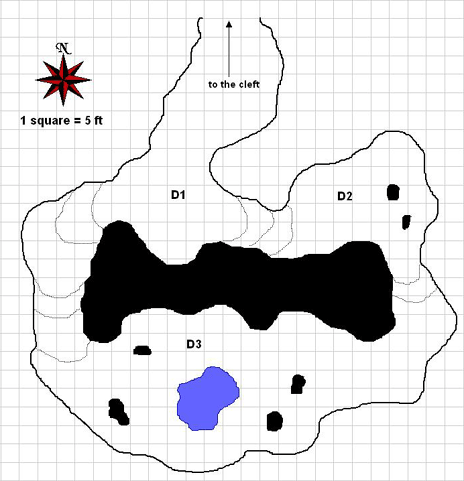 |
D1. Entry Cave
|
This cavern's walls are scored with gouges that criss cross the place at all heights. Amongst these gouges are strange carvings that are wavy lines gouged into the walls. These lines are splayed all over not only the walls, but the floor and ceiling as well. The floor is covered with small piles of bones. |
The bones are all of animals of various sizes, and all have been gnawed upon.
D2. Shed Skin
| In the center of this cavern is a pile of strange objects. It appears as if wax paper and oil cloth were clumped together with jet black roof tiles and bits of brown fur. |
Bits of skin and fur are also present on the two stone columns in the cave. The Pet uses these columns to scratch off its skin when molting time is at hand.
By examining the skin, the PCs can likely get some idea as to what they will face deeper in the caves. It will be clear that the creature that lairs within has four heads, is Large size, has two claws and is a quadruped. A DC 20 Knowledge (nature) check will reveal that it has a pair of wings (by observing the gaps in the back area of the skin.
D3. The Pet's Lair (EL 16)
| This cavern is bolstered by four thin stone columns that surround a small pool of water. Gnawed bones of all sorts lie here and there across the floor. |
Creatures: The Pet is a horrific hybrid of weasel and black dragon with four heads. This abomination was the result of a particularly potent wildsoul zone that was contained in the heart of a necrocarnum bog. This location had been the site of a particularly fierce battle between a black dragon ally of the Scaled Ones and the incarnum spirit of the black dragon merged with the bog and amplified by the wildsoul zone managed to infuse some of its native fauna with some bizarre mutations. One of these was a dire weasel, which was born as a four-headed freak and was found and nurtured by Mizfirzotin, so that it became loyal to him. Although the creature has the spellwarped template, it is probably more accurate to think of him as incarnumwarped, though the effects are the same.
The Pet grew in size and ferocity,
and is now intensely loyal to Mizfirzotin and will defend him
to the death. As befits his draconic heritage, the beast tends
to spend much of its time sleeping in its lair. It does not share
a dragon's affinity for treasure, however.
| The thing that stands before you is a horror. A massive, sleek weasel's body is studded with black reptilian scales and ends in a thin black tail. Ebon wings stretch from the middle of its back, like a huge bat, and from its front end four long, slim necks of tufted fur end in what can only be described as a weasel's head with two black horns and green eyes pierced by a vertical slit of a pupil. Surrounding the creature are strange blue vapours that dance and writhe along its length. The vapours are not thick enough to grant concealment to the thing, and sometimes seem to shoot right through its body, to emerge on the other side. |
|
|
Tactics: The Pet knows that he can only breathe its acid breath once per day, and so tends to save that for when it is absolutely necessary or will be most effective. Necessity would involve a situation where a ranged attack was the only way to reach a foe. Effectiveness would be a situation where the creature could position itself in such a way that its four heads could each breathe on a separate group of foes. This usually involves The Pet placing himself in the middle of his foes and breathing in all directions or, more likely, breathing from above if out of doors.
Beyond his breath weapon, The Pet likes to rely on his attach and blood drain abilities to quickly take down a foe, placing as many heads as possible on an enemy. DMs should remember that attaching is not the same as grappling, and an attached weasel is not grappling with its victim. Any heads not attached to a foe can continue to bite other foes or the victim being drained of blood.
Developments: The Pet will not surrender as long as Mizfirzotin is alive. In fact, unless he specifically sees his master fall, he will continue to fight to the death. If, and only if, the duskling is defeated will The Pet seek to flee back into the wilds of the Hurlotzin Lands, and even then only if severely wounded.
Cavern Complex E:
This complex houses a contingent of azurin soulborn, led by Vatenyrtzin. It also contains the binding hall, used by the cultists to bind a vestige of Karsus. Unless otherwise stated, all areas herein are 15 ft high. Due to the proximity of the areas of the complex to one another, combat in one area is likely to rouse the entire complex, which will come to the scene of any disturbances.
 |
E1. Watchpost (EL 9)
| This small side cave is only 10 ft tall and contains a small fire ring in the center surrounded by several small boulders usable as seats. A small fire burns in the ring. |
Creatures: 2 azurin soulborns pull guard duty here. They are not particularly alert and tend to be involved in discussions, dice games, or even a little on duty smooching (if male and female), as befits their chaotic nature.
|
FEATS: Bind Vestige (ToM p72) - You may bind vestiges as a 1st level binder and gain a specific power from the bound vestige (see page 74). Cerulean Will (MoI p35) - Gain insight bonus on Will saves equal to essentia. Gain 1 essentia. Improved Bind Vestige (ToM p73) - You may bind a single vestige as a 5th level binder and gain a specific power from the bound vestige (see page 74). Sapphire Smite (MoI p40) - Gain +1 smite per day equal to essentia and +1 smite dmg per essentia. Gain 1 essentia. Shield Specialization (PHB2 p82) - Gain +1 AC from shield bonus. Shield Ward (PHB2 p82) - You apply your shield bonus to touch AC and checks to resist bull rush, disarm, grapple, overrun, or trip attempts. SOULMELDS: crystal helm (MoI p63) - Normal: gain +2 resistance bonus on will saves vs charm and compulsion; Essentia: +1 deflection bonus to AC/essentia; Crown: melee attacks gain force descriptor. VESTIGE POWERS: Karsus' senses (ToM p37) - Sense magic auras as easily as others smell odors, concentrating for 1 rd detects auras as if 2nd round of detect magic spell within 30 ft; concentrating 2nd rd reveals location and strength; concentrating for 3rd rd reveals school of an aura. Cannot be used if blinded, otherwise penetrates as detect magic. If overwhelming aura sensed you are dazzled as long as within range.
|
Tactics: The guards will raise a cry and hue if they are attacked or see intruders. They will then attempt to delay entrance into the complex proper (fighting defensively if necessary) to allow Vatenyrtzin and the other soulborns time to rally.
Developements: Conflict here will almost certainly attract the soulspark in area E2.
E2. Storage (EL 7)
| This small side cave is only 10 ft tall and contains a number of sacks, barrels, and crude crates, along with planks of wood, logs, and various woodworking tools and iron nails. |
The tools serve as artisan tools for the Craft (carpentry) skill.
Creatures: A greater soulspark "dwells" here. The creature ran across a company of soulborn exploring the region a few months ago and was attracted to the like-aligned soulborns. Initially following them out of curiousity, it came to the cleft and was adopted by Vatenyrtzin and the soulborns as a sort of mascot. The soulspark, for unknown reasons, prefers to hover above the crates and barrels in this area.
In no way is the soulspark attached to the soulborn (unlike a soulspark created via soulmelds). It is a free-willed entity who chooses to remain here for now.
The soulspark is currently allied to the soulborns and will work to defend them. However, being chaotic evil, it holds no ultimate loyalty to the soulborns or their endeavours here, and is not above fleeing for good should things go badly. That said, at least initially, it will join in any combat against intruders.
|
|
Tactics: The soulspark will attempt to stay out of melee, using its soul blast at every opportunity. It is not smart enough to target spellcasters, but if Vatenyrtzin is present, he will direct the soulspark to ready an action to target spellcasters, or to blast such casters as appropriate.
If sorely wounded, the soulspark will flit away and put 4 essentia into its healing ability (and 4 into its defense) and heal up before rejoining the battle.
Developments: The soulspark will respond to any combat in the complex. It will not respond to battle outside of the complex unless Vatenyrtzin leaves the complex, whereby it will accompany the soulborn leader.
E3. Main Cavern (EL varies)
|
This massive cavern is 20 ft high at its edges, vaulting to 25 ft at its center. Several large stone columns support the ceiling, and these are carved with strange jagged shapes and patterns. In the center of the south wall, flanked by two stout stone columns, stands a large, crude stone statue of an old male human with a long, flowing beard and dressed in long robes. His arms are upraised and in his hands is an ornate staff of stone. Sparkling blue gems form the pupils of the figure, and a large red gem caps the stone staff. Hanging from the wall behind and above the statue is a red tapestry depicting a strange crystalline city with cerulean walls and jagged spires and tall towers. |
Creatures: At any given time, unless on alert or out in the cleft listening to a speech, 1d4 azurin soulborns will be here, usually worshipping before the statue or possibly sparring in the center of the cavern. These soulborns should be subtracted from those in area E6.
Treasure: The gems in the eyes of the statue are large sapphires worth 1600 gp each, while the red gem on the staff is a ruby worth 1200 gp.
E4. Binding Hall
| This cavern contains a large, complex diagram carved into the floor of the chamber. Bluish crystals are set into various vertices and ends of the diagram. |
A DC 25 Knowledge (arcana) check will reveal the nature of the diagram, with success by 10+ allowing identification of the vestige of Karsus as the entity being bound by the seal.
The seal is not a magic item, despite the fact that it performs a mildly special function by allowing a vestige to be summoned in half the normal time. In theory, the knowledge and rituals to make a similar permanent diagram for other vestiges could be researched and learned.
E5. Vatenyrtzin's Chamber (EL
14)
| This cave is adorned with a large fur pallet, along with a crude wooden table and several wooden chairs. A similarly constructed weapon rack and armour stand, are near the bedding. Against the walls are set a couple of brass braziers with coals in it. Next to the weapon rack is a wooden chest. |
Creatures: The soulborn Vatenyrtzin is a scheming
person, who owes no loyalty to anyone but himself. He serves Mizfirzotin
currently, but only as long as the duskling continues to accumulate
lore and show a potential for having his plans work. Unlike Ashbinclatl,
Vatenyrtzin is not jealous of Mizfirzotin's possession of the
staff of power. He sees it and the duskling as a useful
and necessary tool towards a rise to power once the group returns
to Azotchtla. Thereafter, he will likely, at some point, turn
on his fellows and make a grab for supreme power himself.
| Before you is a male human in his mid thirties, with dark brown-red hair tied into a topknot. His eyes are strange, with dark brown pupils surrounded by sky-blue eyeballs. He is dressed in chitin plate armour that ripples with flickers of energy and a stout wooden shield decorated with square glyphs and a turtle symbol. Cerulean wisps of energy congeal around his feet, head, and torso, occasionally shaping into a pair of boots, a helm, and a shirt. At his side hangs a crystal battleaxe with a strange greenish hue that drips viscous liquid that spatters and hisses upon the ground. |
|
FEATS: Bind Vestige (ToM p72) - You may bind vestiges as a 1st level binder and gain a specific power from the bound vestige (see page 74). Bonus Essentia (MoI p35) - You gain +1 essentia or +2 is capable of shaping soulmelds. Cerulean Will (MoI p35) - Gain insight bonus on Will saves equal to essentia. Gain 1 essentia. Improved Bind Vestige (ToM p73) - You may bind a single vestige as a 5th level binder and gain a specific power from the bound vestige (see page 74). Practiced Binder (ToM p74) - Gain a second power (see page 74) when binding a vestige using the Bind Vestige or Improved Bind Vestige feats). Sapphire Smite (MoI p40) - Gain +1 smite per day equal to essentia and +1 smite dmg per essentia. Gain 1 essentia. Shield Specialization (PHB2 p82) - Gain +1 AC from shield bonus. Shield Ward (PHB2 p82) - You apply your shield bonus to touch AC and checks to resist bull rush, disarm, grapple, overrun, or trip attempts. SOULMELDS: crystal helm (MoI p63) - Normal: gain +2 resistance bonus on will saves vs charm and compulsion; Essentia: +1 deflection bonus to AC/essentia; Crown: melee attacks gain force descriptor. impulse boots (MoI p71) - Normal: gain uncanny dodge; Essentia: +1 Ref/essentia; Feet: gain evasion. spellward shirt (MoI p88) - Normal: gain SR 5; Essentia: +4 SR/essentia. VESTIGE POWERS: heavy magic (ToM p37) - Save DC for every magic item effect you use increases by 2. Karsus' senses (ToM p37) - Sense magic auras as easily as others smell odors, concentrating for 1 rd detects auras as if 2nd round of detect magic spell within 30 ft; concentrating 2nd rd reveals location and strength; concentrating for 3rd rd reveals school of an aura. Cannot be used if blinded, otherwise penetrates as detect magic. If overwhelming aura sensed you are dazzled as long as within range. MAGIC ITEMS: acid burst (MIC p28) - +1d6 acid dmg and on critical hit does +2d10 acid dmg. retaliation (MIC p14) - When you take 10+ dmg from single melee attack, deals 1d6 dmg to attacker; if single melee attack drops your hp below 0 then attacker suffers 3d6 dmg. Dmg inflicted is treated as +2 magic weapon for DR. |
Tactics: Vatenyrtzin is not a subtle or flamboyant warrior. He tends to wade into combat and let his axe do the talking for him. He will use his smite ability with abandon, once he determines his foes are likely to be subject to it. That said, Vatenyrtzin is not willing to die for Mizfirzotin's endeavours. If sorely pressed (reduced to 25% of his maximum hit points and losing the battle), he will flee...generally to a location where he can get healing, but failing that, into the countryside, only to slink back if the worshippers win, with a convenient excuse as to where he was and how he single-handedly turned the tide of battle (elsewhere...of course!).
Developments: Vatenyrtzin will rally his soulborns into a coherent force before sallying from the complex to aid in the defense of the remainder of the cleft. While he is not particularly loyal and willing to lay down his own life, he demands absolute loyalty from his soulborns. His ability to gain such loyalty depends solely upon his ability to intimidate and retaliate.
Treasure: The chest is locked (Open Lock DC 30). Within it are 1600 gp, 4500 sp, 3200 cp, a jade idol shaped like an upright turtle worth 475 gp, a square inch of dirty cloth wrapped up inside a tied bit of oilcloth (Vatenyrtzin believes it is a piece of Karsus' own robe...he found it in a site the worshippers looted and his belief that it is Karsus' robe is entirely irrational and unfounded), a pouch containing a dozen pieces of cerulean coloured crystals that glow with a faint inner light (these radiate dim evocation magic but have no effect, merely being pieces of some ancient incarnum magic slowly fading away over the centuries), and a wand of remove disease (CL 5, 18 charges) in a thin black box of wood (Vatenyrtzin keeps the wand for emergencies, even thought he cannot use it himself, to give to Ashbinclatl to use).
E6. Soulborn Barracks (EL varies)
| This cavern contains eight fur pallets, along with a crude stone table and boulders set as chairs around it. The walls are decorated with flayed pelts of various sorts, including a few that are scaly and quite large. Set into the far end of the cave is a massive skull of some great beast, easily 3 ft tall and 5 ft long with sharp teeth still intact. Various candles are set on the skull at various places and burn to give the thing an eerie cast. |
Creatures: A total of 6 soulborns dwell in this chamber, less 1d4 present in area E3 instead. At any time 2 of the soulborns will be asleep and out of their full plate.
|
FEATS: Bind Vestige (ToM p72) - You may bind vestiges as a 1st level binder and gain a specific power from the bound vestige (see page 74). Cerulean Will (MoI p35) - Gain insight bonus on Will saves equal to essentia. Gain 1 essentia. Improved Bind Vestige (ToM p73) - You may bind a single vestige as a 5th level binder and gain a specific power from the bound vestige (see page 74). Sapphire Smite (MoI p40) - Gain +1 smite per day equal to essentia and +1 smite dmg per essentia. Gain 1 essentia. Shield Specialization (PHB2 p82) - Gain +1 AC from shield bonus. Shield Ward (PHB2 p82) - You apply your shield bonus to touch AC and checks to resist bull rush, disarm, grapple, overrun, or trip attempts. SOULMELDS: crystal helm (MoI p63) - Normal: gain +2 resistance bonus on will saves vs charm and compulsion; Essentia: +1 deflection bonus to AC/essentia; Crown: melee attacks gain force descriptor. VESTIGE POWERS: Karsus' senses (ToM p37) - Sense magic auras as easily as others smell odors, concentrating for 1 rd detects auras as if 2nd round of detect magic spell within 30 ft; concentrating 2nd rd reveals location and strength; concentrating for 3rd rd reveals school of an aura. Cannot be used if blinded, otherwise penetrates as detect magic. If overwhelming aura sensed you are dazzled as long as within range.
|
Tactics: The soulborns will attack any intruders they see, and will respond to any disturbances. In general, they will look to Vatenyrtzin to rally and lead them, but this is not a requirement.
Cavern Complex G:
This complex is the lair of Mizfirzotin, the leader of the worshippers and of the expedition into the Hurlotzin Lands. Unless otherwise stated, all areas herein are 15 ft high. Due to the proximity of the areas of the complex to one another, combat in one area is likely to rouse the entire complex, which will come to the scene of any disturbances.
 |
G1. Entrance
The details of the entrance are
described in the Cleft section above. DMs should keep in mind
the Balance checks necessary to navigate the ledge just outside
the entrance.
| The flickering shadows cast by oil lamps set into their cressets plays along paintings of dinosaurs, upright turtles in robes, and figures wielding a staff. Just inside the cave, on the floor, is a strange geometrical diagram carved into the stone. |
The diagram is the seal of Karsus, although it is not usable to actually summon and bind the vestige. A DC 25 Knowledge (arcana) check will reveal the nature of the diagram, with success by 10+ allowing identification of the vestige of Karsus as the entity being bound by the seal.
G2. Main Cavern (EL 9 or varies)
|
This cave contains a rather large wooden table in its center, surrounded by several wooden chairs as well as a few boulders usable as stools. A variety of parchments, tomes, and scrolls are set on the table, along with clay tablets and styluses, ink and quill pens, and a bowl of fine sand. Many skulls of various sorts and sizes hang from the walls of the place, with the glow of oil lamps set within the bones providing unsettling illumination. A stone shelf carved into the northeast wall holds a variety of crystal formations and coloured chunks of quartz, some of which seem to glow faintly with an inner illumination. To the southeast are four fur pallets. Four brass braziers line the walls, each with glowing embers within. |
The skulls range from large dinosaur skulls to small animal skulls, and a few medium humanoid skulls are present as well. The crystals are nonmagical.
If area of effect fire spells are used indiscriminately in this chamber, then many of the items on the table will be burned to ashes (see below for details).
Creatures: There is a 50% chance that Mizfirzotin is here (or 100% if not in area G5), sitting at the table working on his notes or studying texts or maps. Refer to area G5 for his statistics.
Additionally, there are always 4 lost in this chamber (one of each emotion type). At any given time, unless on alert, 2 of the lost are sleeping.
|
FEATS: Cobalt Power (MoI p37) - Gain insight bonus equal to essentia on bull rush, overrun, sunder, and dmg when using Power Attack. Gain 1 essentia. |
Tactics: The lost are, in their twisted way, loyal to Mizfirzotin and see themselves as the duskling's personal bodyguard.
Developments: A casual examination of the items on the table will reveal that they are notes and maps of various sorts all written in Azotlan, while the books seem to be accounts of ancient history.
A closer examination of about 10 minutes will reveal that the papers and tomes on the table included treatises on the Hurlotzin Lands during the time of the Children of the Mishtai, including a few copies of ancient maps of the lands (annotated in Slith). Mizfirzotin's personal notes are also present, as well as a detailed map of the Hurlotzin Lands now, with annotations made by the duskling in Slith.
A thorough study of the documents would take at least a day and require the ability to comprehend both Azotlan and Slith. It will become clear that Mizfirzotin was systematically searching for the locations of importance during the rule of the Children of the Mishtai. A few passages make it clear that Mizfirzotin bore some deep resentment against the Azotchtlan and intended to gather items of power from these lands and return one day to unite the Children of the Mishtai against the humans. However, as his notes progress, the staff of power is mentioned as having been taken from a "pathetic lump of stone" and the notes become more and more focused on the staff and Karsus and religious iconography and phrasings begin to creep into his writings, with the staff being referred to as the sacred vessel of the "great one" and Karsus being referred to as "the great one" or "the most holy one".
Finally, mention is made several times to a great dragon that dwells to the north. In the early notes, Mizfirzotin speculates that this dragon might be sitting on some powerful items from the old times that could be very useful to the duskling. In later notes, Mizfirzotin mentions that Karsus has told him of a holy relic that is companion to the sacred staff...the holy vestments. Divinations from Ashbinclatl revealed that it is likely the dragon has the relic, and Mizfirzotin makes mention of sending scouting parties to observe the dragon's lair but that the beast never seems to leave. The duskling seems to be deciding when and how best to attack the dragon, but his writings evidence more than a little trepidation at confronting the creature. He seems to have decided to first try to find more lost items of power that might aid in the coming battle against the dragon.
The dragon's lair is clearly noted on Mizfirzotin's own map of the lands. The details of this map (and the dragon's lair) are presented in the next adventure in the "Tokens of Karsus" series entitled The White Robe.
Should area of effect fire spells be used in this area, then most of the items on the table will be burned to ashes. All that will survive is a scrap of map that shows the Cleft, a site to the north with the symbol of a dragon on it and the note in Slith: holy vestments.
G3. Cultist Chamber (EL 10)
| This cavern contains 8 fur pallets, along with a crude small wooden table and boulders used as chairs set around it. The table contains the remnants of a meal and simple clay bowls and utensils. Strewn on the floor amongst the bedding are a variety of what appear to be personal effects, such as bone combs, partial pieces of studded leather armour, flint and tinder, bones and stone tools, and other such items. |
|
FEATS: Expel Vestige (ToM p73) - 1/day expel vestige as if summoning it again. If binding check succeeds, vestige is expelled and a new one can be summoned. Take -10 penalty to bind a new vestige and to bind the expelled vestige the next time you attempt to bind it. Improved Binding (ToM p74) - +2 EBL to determine which vestige you can bind. Rapid Pact Making (ToM p74) - 1/day bind vestige as full-round action. Skilled Pact Making (ToM p74) - +4 bonus on binding checks. VESTIGE POWERS: aura of sadness (ToM p31) - Adjacent creatures suffer -2 on attacks, saves and skills while adjacent. Suppress or activate as standard action. Mind-affecting ability. Focalor's breath (ToM p31) - As standard action exhale at target in 30 ft, Fort sv or be blinded for 1 rd. Usable 1/5 rds. heavy magic (ToM p37) - Save DC for every magic item effect you use increases by 2. Karsus' senses (ToM p37) - Sense magic auras as easily as others smell odors, concentrating for 1 rd detects auras as if 2nd round of detect magic spell within 30 ft; concentrating 2nd rd reveals location and strength; concentrating for 3rd rd reveals school of an aura. Cannot be used if blinded, otherwise penetrates as detect magic. If overwhelming aura sensed you are dazzled as long as within range. Karsus' touch (ToM p38) - Produce dispel magic effect with melee touch attack (check is at EBL) again each ongoing spell in effect on object or creature; may be used 3/day but only 1/5 rds. Karsus' Will (ToM p38) - You can use spell trigger items like wands and staves as if a wizard of your EBL. lightning strike (ToM p31) - 1/rd as standard actions call down bolt striking target within 60 ft for 3d6 dmg (Ref sv 1/2). This can be used indoors and underground. water breathing (ToM p32) - Breathe water and air. |
Tactics: If an alarm has been raised, the sleeping cultists will take 1 round to wake up from sleep, and then another to get out of their bedding and grab their weapons.
The cultists will have the vestige of Karsus bound if they are not alert to danger. If so, then their first order of business will be to expel their vestige and try to bind Focalor using Rapid Pact Making.
Once Focalor is bound, then their primary attack is their lightning strike, and they will use it prodigiously. If their enemy seems to be resistant or immune to electricity, then any who failed to expel Karsus will use Karsus' touch to attempt to dispel any magical resistance to electricity and then resume their lightning strikes.
The cultists will also activate their aura of sadness ability when Focalor is bound, even though this affects the cultsists who are adjacent.
If attacked in melee, those who have bound Focalor will use Focalor's breath to attempt to blind their adversaries.
Once the cultists realize how tough their adversaries are, they will begin to mass their lightning strikes against a single target, especially any who have been shown to be susceptible to electricity.
G4. Chamber of the Golem (EL 13)
Note: The description below
assumes the golem is present. If not, the place will be empty.
| This cave contains a statue of a towering humanoid made of smoky glass plates and shimmering metal bands. Shapes seem to writhe within the glass, shifting beneath the surface. The statue stands in the center of the place and faces the entrance. |
In reality, the golem will obey any skarn, rilkan, or duskling who can bind to the brow chakra. This means that, unwittingly, Mizfirzotin is telling the truth and the other leaders could not control the golem.
|
|
Tactics: The golem is instructed to attack anyone who attacks it. In such a case, it will not leave Complex G. Beyond that, it has no instructions and will appear to be an inert statue until instructed by Mizfirzotin.
Developments: Mizfirzotin will instruct the golem to animate if an alert is raised anywhere in the Cleft. The duskling regards the golem as his own personal bodyguard, and he will not send it into battle, but have it by his side for protection. Instruction must be verbal, and so the golem must be able to hear Mizfirzotin in order to be commanded.
G5. Duskling's Chamber (EL
17 or varies)
|
This chamber contains a large pile of bedding to the north. Near to this sits a large wooden chest below an armour stand, and beyond that a wooden table and two chairs. At various points along the walls of the cave have been carved niches that hold a variety of strange items, including crystals, skulls, polished stones, pieces of carved stone, and crumbling stone tablet fragments. In the center of the cave is a rectangular stone altar that has apparently been hewn out of the rock of the cave, as it forms naturally from the floor of the cavern. The altar is adorned with crudely carved images of skeletons tearing apart humanoids, and the top face of the altar is literally covered in rust coloured stains. Atop the altar rests a curved crystalline dagger with an ivory hilt. |
The strange items in the niches are all curiousities delved from ancient ruins in this land. None of these are particularly valuable or useful, the crystals being pieces of shattered weapons and armour.
The altar is the device upon which Mizfirzotin practices his harvest soul ability, and many souls have been bled on the stone block. Of course, the duskling doesn't need to use the altar or crystal dagger to use the ability, but he enjoys the formality.
(a) The Node Tablet
| Leaning against the western wall of this area is a massive tablet of dark grey stone. The tablet is clearly part of some larger construction, as evidenced by the jagged edges as if it had been ripped or chiseled away. The whole is 8 ft tall and 5 ft wide and nearly 6 inches thick and must weigh quite a bit. Inscribed onto the face of the tablet are a series of very complicated lines, circles, and other geometric patterns along with small figures that do not seem to be runes as much as symbols. |
The tablet is an ancient planar map, pointing to the location of the Bastion of Souls, a planar touchstone related to incarnum located on the Positive Energy Plane. Refer to Magic of Incarnum page 207 for details.
A DC 25 Knowledge (planes) check will determine that the inscriptions are some sort of planar map. A DC 30 Knowledge (planes) check will determine that the map points to a location on the Positive Energy Plane. A DC 35 Knowledge (planes) check can pinpoint the exact spot of the touchstone, allowing the PCs to pursue it should they desire.
(b) The Strange Pool
| This alcove contains a small pool of deep blue liquid. The rim of the pool is encrusted with small cerulean crystals and the liquid within seems to eddy and swirl of its own accord. |
The liquid radiates moderate magic of no particular school.
If the liquid is imbibed and the imbiber has an essentia pool, he will feel a very brief burst of incarnum throughout his body. If he has no soulmelds shaped, then nothing will happen beyong this.
If the imbiber has both an essentia pool and at least one soumeld shaped, he will feel a burst of incarnum course through his body for the next 10 rounds. During that time, he will be able to replace a single soulmeld he has shaped with a random soulmeld (determined as below). He will know the nature of the random soulmeld before he chooses to replace one of his own. This effect may only be used once every 24 hours.
If the imbiber has no essentia pool, he will feel an immediate clamour of a multitude of souls rushing through his body, mind, and soul. The clamour is quite disorienting, and the imbiber will be nauseated for 1 minute (no save). During this time, he must make a DC 10 Wisdom check to resist the rush of presences in his psyche Failure means he suffers 3d6 points of Wisdom damage. If the Wisdom check is passed, then the imbiber will have mentally sorted and ordered the clamour into a managable grouping after the minute has passed and he must then inculcate this grouping into his body, which will require a DC 12 Constitution check. If the Constitution check fails, then the incarnum grouping is expelled with no further benefit or penalty. If the Constitution check succeeds, then the imbiber will gain 1 point of essentia and the ability to shape a random soulmeld. This effect will last 28 days, and while under the effects of the pool any further draughts will have no effect. Once so imbibed, the liquid of the pool will never affect that person again in this fashion. Should such a person later acquire an essentia pool and soulmelds independently of the pool, then he can imbibe and partake of the other benefit of the pool described above.
To determine a random soulmeld, roll d100 and refer to the table of contents on page 3 of Magic of Incarnum. There are listed 89 soulmelds. On a roll of 01-89 refer to the corresponding soulmeld. On a roll of 90-00 reroll.
To assist in determing the soulmeld, every 10th listing is given below:
10 = behir gorget
20 = displacer mantle
30 = gorgon mask
40 = krenshar mask
50 = mantle of flame
60 = phase cloak
70 = silvertongue mask
80 = totem avatar
If the liquid is removed from the pool, it will become nonmagical immediately.
Creatures: Mizfirzotin will be here 50% of the time
(or always if not already encountered in area G2), and if so he
will be sleeping 25% of the time (with his armour set next on
the armour stand). He always keeps his staff of power with
him, usually cradled in his arms while sleeping. The staff is
chained to his wrist by means of a masterwork manacle that has
been pounded shut (i.e. it has no lock to pick) and attached to
a 2 ft long chain that ends in a tight iron band that has been
fit and pounded shut around the middle of the staff.
|
Before you is a 5 ft tall humanoid male with steel-gray skin, purple eyes, and dark grey hair. The figure's skin is wrinkled, as if of a great age, and there is a malignant spark of power contained in its gaze. The figure wields an ornate, rune-carved staff made of bone inlaid with gems and mithril bands. The staff is attached to a chain that runs to a manacle around the creature's right wrist and the staff itself emanates a menacing dark blue aura. The figure wears chitin full plate armour that bears glowing runes upon it and sends tendrils of power up its neck to form a wreath around his head. A cloak of thick fur imbedded with cerulean crystals is thrown across his shoulders. The figure is almost entirely covered by a haze of blue translucent energy that shifts and forms into vaguely recognizable shapes on his body. These include a circlet around his brow, a flowing robe, a shirt, a belt, boots, and a corona around his hands. |
|
FEATS: Bonus Essentia (MoI p35) - You gain +1 essentia or +2 is capable of shaping soulmelds Improved Binding (ToM p74) - EBL is +2 for purposes of what vestige you can bind. Improved Toughness (MM4 p203) - You gain +1 hp per HD. Necrocarnum Acolyte (MoI p39) - You can shape necrocarnum soulmelds regardless of your alignment and gain +1 profane bonus on save DCs of necrocarnum soulmelds. Soulsight (MoI p41) - 1/day invest essentia into feat, gain blindsense as move action 5 ft / essentia until start of next turn that can detect living and nonliving creatures. Gain +1 essentia. SOULMELDS: fellmist robe (MOI p66) - Normal: gain 10% miss chance from non-adjacent attackers, strong wind disperses the robe though it reforms 1 rd after wind stops; Essentia: +5% miss per essentia (max 50%). impulse boots (MoI p71) - Normal: gain uncanny dodge; Essentia: +1 Ref/essentia; Feet: gain evasion. necrocarnum circlet (MoI p78) - Normal: detect undead within 30 ft as blindsight ability; Essentia: +1 turn resistance/essentia to undead within 30 ft or +2/essentia for undead animated by you; Crown: animate necrocarnum zombie as full round action, zombie's essentia pool increased by essntia invested. necrocarnum touch (MoI p80) - Normal: +4 to Sleight of Hand checks and Bluff checks to feint; Essentia: melee touch attack for 1d8/essentia on living creatures (DC 13 + essentia sv Fort 1/2); Arms: ranged touch attack 30 ft for 1d8/essentia on living creatures (DC 13 + essentia sv Fort 1/2). necrocarnum weapon (MoI p81) - Normal: weapon gains evil alignment; Essentia: +1 profrane bonus on dmg and roll to cinfirm crits per essentia vs living creature; Hands: gain essentia for 10 rounds equal to essentia invested on critical hit. spellward shirt (MoI p88) - Normal: gain SR 5; Essentia: +4 SR/essentia. vitality belt (MoI p92) - Normal: +4 to Con checks and CON-based skill checks; Essentia: bonus to hp equal to meldshaper lvl per essentia; Waist: immune to Con damage and drain. VESTIGE POWERS: heavy magic (ToM p37) - Save DC for every magic item effect you use increases by 2. Karsus' senses (ToM p37) - Sense magic auras as easily as others smell odors, concentrating for 1 rd detects auras as if 2nd round of detect magic spell within 30 ft; concentrating 2nd rd reveals location and strength; concentrating for 3rd rd reveals school of an aura. Cannot be used if blinded, otherwise penetrates as detect magic. If overwhelming aura sensed you are dazzled as long as within range. Karsus' touch (ToM p38) - Produce dispel magic effect with melee touch attack (check is at EBL) again each ongoing spell in effect on object or creature; may be used 3/day but only 1/5 rds. Karsus' Will (ToM p38) - You can use spell trigger items like wands and staves as if a wizard of your EBL. MAGIC ITEMS: cloak of soulbound resistance, lesser (MoI p112) - +1 resistance bonus to saves with +1/essentia (max 2); Shoulders: resistance bonus increased by 1. crystal of mind cloaking, lesser (MIC p25) - +3 bonus to saves vs mind-affecting. essentia jewel (MoI p113) - adds 1 essentia for 1 round before crumbling. ring of soulbound protection, lesser (MoI p112) - provides +1 deflection bonus to AC with +1/essentia (max 2). soulvoid orb (MoI p114) - when thrown bursts in 10 ft radius with divest essentia effect [divest essentia returns target's essentia investment to zero, until he gets a turn to reinvest it]. |
Tactics: Mizfirzotin knows that in a fight his only real personal power comes from his staff. While it is true that he can invest 4 essentia into his necrocarnum touch to deliver a 4d8 ranged attack, that does not compare very favourably to comparable abilities for characters of his level. However, the duskling also realizes that the staff has a limited number of charges, and so he uses the staff mostly as a "threat-in-being", to keep and maintain order while husbanding its powers. It helps that arcane items such as the staff of power are almost unheard of amongst the Azotchtla and Children of the Mishtai, such that although Mizfirzotin is aware that his staff has limited charges, the others of his company are not so certain of this fact (though the other leaders certainly suspect this might be the case).
Of course, the duskling also has his necrocarnum zombie allosaurus and this incarnum golem to add to his list of loyal bodyguards.
When using the staff, in what appears to be a serious fight, Mizfirzotin will use a strategic lightning bolt or fireball, eschewing magic missile as not worth the charges and cone of cold as costing too many charges. However, he will turn to use of the cone of cold if the situation warrants it and its use could end the fight (as the cone does 15d6 damage). If facing potent spellcasters, he will certainly find a strategic spot and cast globe of invulnerability with the staff, then using that as a safe platform from which to use his soulmelds or the other powers of the staff. He will never waste charges on minor abilities like levitate or ray of enfeeblement unless these become vital to cast.
If really threatened, Mizfirzotin will use the wall of force spell to protect himself. However, this also stops him from attacking, so the duskling will use this usually to heal himself with his cure potions before dismissing the effect. Alternatively, if a minion like his golem is at his side, he will wait until a particularly eager foe engages him in melee, then activate the effect and trap his foe inside the wall of force effect with him and his minion(s).
Mizfirzotin is entirely bound up with the staff. He considers it his destiny to wield the staff, and almost a divine gift from the vestige of Karsus. As such, he will not surrender and if the staff is taken from him and he survives he will plot unendingly to regain it.
Developments: If an alarm is raised, Mizfirzotin's first action will be to gain the side of his golem and then to rally his troops and respond to the trouble. He trusts Ashbinclatl and Vatenyrtzin to take care of the actual battle tactics and strategies.
Traps: The chest is trapped with a summon monster VII trap that will activate if the chest is opened without using the key on the person of Mizfirzotin or if damage is done to the chest or it is breached in any fashion. The trap will summon a soul eater, which will attack the opener of the chest and any others that attack it for 13 rounds. Should the souleater manage to consume a soul while summoned, the consumption will end when the summon monster spell ends.
| Summon Monster VII CR 8; magic device; proximity trigger (alarm); no reset; spell effect (summon monster VII, 13th-level cleric), Search DC 32; Disable Device DC 32. |
|
|
Treasure: The chest is locked (Open Lock DC 30) and contains the following:
Defending the Cleft:
The precise defense of the Cleft must be left to the DM, as there are many different ways for a battle to develop. For example, a stealthy group of PCs could quietly infiltrate each cave complex and slay its inhabitants, essentially fighting each complex and defeating the force of worshippers in detail.
On the other hand, a group of PCs can simply come in "guns blazing" and fight the entire Cleft in one large battle.
The worshippers are not trained soldiers. They do not have military discipline nor are they drilled in group maneuvers and tactics. However, the 3 leaders are capable in battle, especially Ashbinclatl and Vatenyrtzin, and these two will take command of whatever forces are nearby and rally them and direct their tactics.
Initially, the Cleft is not on any sort of alert. They have been here for quite some time and while they recognize that a variety of dangerous creatures are native to this land, they are secure in their location, which is not easily visible from a distance on the flat plains surrounding it, and they trust in the kamadan skeletons and necrocarnum zombie allosaurus to keep away more determined enemies.
Therefore, it is likely that the PCs will initially attain surprise upon the inhabitants of the Cleft. The worshippers will enter battle as outlined in the individual location descriptions and use the tactics described therein.
If the PCs should retire after assaulting the Cleft, then the entire Cleft will be on alert for quite some time. At first their posture will be defensive, preparing for a second attack by the PCs. Guards and scouts will be posted at positions at the top of the Cleft, and any and all worshippers not initially present at the Cleft will be retained as they returned. In this way, some of the losses inflicted by the PCs can be replaced. However, once the absent worshippers have returned and are accounted for, no further reinforcements will be available.
Ashsbinclatl can and will prepare at least 1 planar ally spell in between assaults, if time allows, and use it to call forth some deadly horrors to defend the Cleft, a pair of steel devils wielding crystalline greatswords and wearing crystalline armour (Fiendish Codex - Tyrants of the Nine Hells page 137) who will be paid 12000 gp to serve for 12 days (this treasure will be given out of the gems in the chest in area G5).
Should the PCs assault once and flee, the worshippers are likely to assume that they have been driven off and are unlikely to return. Nevertheless, Ashbinclatl will cast a divination spell whenever possible to learn what she can about the PCs. This is likely to allow her to know that they seek the staff of power. Upon learning this and reporting to Mizfirzotin, the worshippers will take a more active roll in trying to find the PCs and attack them while they rest. Precisely how they do this is left to the DM. Should the PCs take precautions while encamped (e.g. rest inside of rope trick spells), then eventually the worshippers can still find them using divination magic such as divination or scrying or by using their Karsus' senses ability to eventually find the PCs' camp by sending out search parties.
Note, however, that there is nothing in particular keeping the worshippers at this location. If they are sorely and continually pressed, they are smart enough to flee the Cleft, leaving behind perhaps a small rearguard of lost to make it look like the place is still manned. If the PCs' ultimate strategem is to continually hit the Cleft and then retire to rest and regain spells, they may return on the third for forth time and find the place deserted...all of the treasure and the staff of power taken away. The DM will then have to improvise the rest of this scenario, perhaps allowing the PCs to catch the worshippers on the march in the open, or perhaps placing the worshippers in an interesting new location, possibly even one of the special incarnum-based terrain types mentioned in Magic of Incarnum.
One possible avenue of attack unique to the topography of the Cleft is that the PCs might choose to simply stand at the rim of the Cleft and rain spells and missile attacks on anything that moves at the Cleft bottom. This is not a bad tactic, especially against the initial undead guardians of the place. And the worshippers might initially emerge from their caves to try to battle such attackers, but given their lack of powerful ranged attacks, it is more likely that the worshippers will eventually fall back into their caves, realizing that they are in no particular hurry and the defensive terrain of the caves favours them in such circumstances, especially since most of the inhabited cave complexes are linked to one another. Furthermore, returning hunting parties can harrass the PCs from behind and try to make their way into the caves to reinforce them.
Faced with the worshippers holed up in the caves, the PCs can either enter and fight them, or they can take other measures like blocking up the cave entrances. How the worshippers react to this is up to the DM.
Experience Points:
In addition to normal experience (which in Therra is half of that recommended in the DMG), each party member should be rewarded as follows: