Return to the Therran Scenario Page
Summary:
The PCs search for the final piece of lost arcana of Karsus
Assumptions:
The PCs include at least one wizard from Jerranq (or in a pinch a sorcerer).
Location:
Aladur or Xonochouco (Mestil-rez)
Historical Date:
705 A.C. Spring or early Summer
DM's Introduction:
This scenario and the one that precedes is and the one that follows it are intricately bound with the history of the enigmatic Karsus. A brief outline of that history is presented below. Note that much of this history is unknown to anyone in Sazhansiir. This text is taken directly from the entry on Karsites in the Sazhansiir Gazetteer.
|
Karsus is a legendary hero of the great wars between Okoth and Kyuss, and many obscure myths and legends surround him. In some ways, next to Tlaloc, he was the most famous human hero of Sazhansiir. What is not widely known is that Karsus was not born of Sazhansiir. Rather, he was a native of Jerranq and specifically the Antorian Empire who was transported to Sazhansiir by an epic spell cast by Okoth himself which went awry. Karsus was a wizard of no small power in Antorium, and his transportation to Sazhansiir involved not only Okoth's mishap, but a simultaneous mishap in a great magical experiment he and his apprentices were conducting. The result of these two freakish events forming a mystic nexus in the fabric of the multiverse was that Karsus was violently wrenched through the inner planes before being deposited, burnt, frozen, energy drained, bruised, and drowned onto the shore of the Kurlotzin Lands. Dazed and in dire physical and mental shape, Karsus was found by dusklings dwelling in that land and his strange demeanour, babbling speech, and potent abilities were noted and eventually reported to Okoth himself. who ordered the man to be brought to him and nursed by his best healers. Karsus barely recovered, and even so his body and mind were so decimated by the unnatural transference that he had no memory of his life before his arrival. Over the years, Karsus slowly regained some of his knowledge, but never fully, and the knowledge he did regain was murky and came to him like mystical visions or dreams, lending him the air of a prophet, which is, in fact, how he was regarded even by Okoth himself. Although he had lost his spellbook, Karsus knew the Spell Mastery feat and so was able to perform limited "miracles" that likely would have had him cast as a scaled one and killed for use of arcane magic, had not Okoth vouched for him. Instead, Okoth tasked Karsus with trying to find a way to tap into his latent powers and perhaps teach them to others. Karsus tried for years to manage this, but as he was somewhat fuzzy on the origin of his own spell ability, it was difficult for him to make any headway in essentially developing the discipline of wizardry for the Azotchtla. Instead, his magical experiments veered into the realm of suppressing and combating the arcane magic of the scaled ones, and his success sin this regard was likely aided by what must be described as a sub-conscious knowledge of the workings of arcane magic. When Okoth unleashed the creation cyst and died in the blast, Karsus was bereft of his primary benefactor and great friend, and his grief grew alongside his madness. After spending a short time railing against the folly of the new rulers of the Okothian Empire, and making a torrent of bizarre prophetic pronouncements, Karsus gathered his few Azotchtlan disciples to him and announced that he was going to find Kyuss in his "hole" in Tyrmannion and siphon the demigod's power through Karsus and to his followers, thereby granting them the ability to wield Kyuss' magic against himself. Amazingly, Karsus performed the powerful and dangerous ritual linking his followers to himself mystically and over great distances. Even more amazingly, with a small band of companions, the once-wizard managed to reach Tyrmannion and breach its formidable defenses. There, with most of his companions dead or worse, Karsus confronted Kyuss and managed to enact the trigger words of his epic ritual and touch the demigod, triggering the effect. Unfortunately for Karsus, Kyuss' being was so far steeped in corruption that the absorption of even a small part of his essence was too much for his mortal shell to contain. The ex-wizard was instantly slain…or at least his body was. Kyuss' corruptive essence and the power of the epic ritual interacted to shred Karsus' soul, so that he did not go on to the afterlife, but instead his soul lingered in shards somewhere in the multiverse. The largest of theseshards, now touched by and infused with some of the power of Kyuss, became aware as a vestige and is capable of being contacted by a binder. When Karsus touched Kyuss, the conduit to his followers received a jolt of Kyuss' power and corruption as well. Most of the followers died instantly, others slowly and in agonizing fashion, but a few had the fortitude or luck to survive, and the event changed them into what were the first Karsites. These first karsites were unaware of their powers, and were, in fact, devastated that the clerics amongst them now could not cast their divine spells. But over time they learned that some small benefit had been gleaned from Karsus' sacrifice, and that their newfound traits were so much an essence of their being that they could be passed on to their progeny. And so karsites have become a part of Azotchtlan society. They are rare, to say the least, as the karsite trait is elusive, and even if two Karsite parents breed the chances of producing a Karsite offspring is only slightly higher than with a mixed mating. In fact, the bloodline has been so diluted that in theory any two humans who mate have a tiny chance of producing a Karsite. Karsites are considered a blessing to the Azotchtla, as their powers are regarded as particularly suited to fighting against yuan-ti sorcery. As such, Azotchtlan parents often keep a close eye on their children for signs of being karsites, and despite no real tendency for Karsite births to run in a given family or to a given set of parents, sometimes the number of Karsite offspring in an Azotchtlan family line makes that family more prestigious and suitable for intermarriage. Units of karsites are famous in the ranks of the Azotchtlan armies, and many of the best-known war leaders and generals of the Azotchtlan armies are or were karsites. It is also believed that karsites were instrumental in developing the discipline of spellthievery. While certainly no karsite can become a spellthief, due to the inability to cast spells, it is thought that some of the first karsites sought to teach their powers to normal humans and, instead, developed the training for the first spellthieves. |
During his time in Sazhansiir, Karsus babbled incessantly about many obscure and seemingly unintelligible topics. From time to time he would mention three items that were precious to him that he had lost: his staff of power, his white robe of the archmagi, and his spellbook. However, his adled mind would not adequately describe these tokens to the dusklings (and later the Okothians) with whom he spoke, and given their general unfamiliarity with arcane magic (in the case of the dusklings and humans) and wizardry in particular (even Okoth himself was not familiar with this form of arcane magic), the nature of these lost tokens was never truly divined even by his contemporaries.
This was not aided by Karsus' increasing mental instability. While at first Karsus could vaguely elucidate the fact that the items he longed for were, in fact, items, over time his ramblings made this fact less and less clear, until he began to express the identity of the items as his lover and children and refer to them by proper names (the items were, in fact, named) and loving nicknames. The Okothians bgan to assume that he was longing for loved ones who had been slain or were somehow taken from him (or vice versa) and eventually Karsus forgot about them altogether and they were mentioned less and less frequently and then not at all.
And so it likely would have remained, for Karsus' ramblings, at first recorded with much enthusiasm and dedication by the Okothians, who thought him a prophet touched by the gods, were less and less heeded as they became less and less understood. However, Yayauhqui Farseer, doomsayer and prophet, has long been fascinated with Karsus and with his prophecies and pronouncements, and with his "offspring" the karsites. When Yayauhqui learned of the strange magic the PCs wielded, and saw the writings in their spellbooks, he became very intrigued, for such things brought back vague memories of mentioins in the earliest and rarest, but most lucid, pronouncements of Karsus.
He spent much time doing research and eventually came to a startling conclusion...that Karsus was not of Sazhansiir, but was from the far north...from the same lands that the PCs are from.
This revelation was included as an epilogue to the scenario entitled "First Strike". The text of the epilogue is presented below for DM reference.
|
Just before the PCs leave the city, Yayauhqui Farseer will arrive bearing a bundle wrapped in a cloth. He will call the PCs and Malinal and Pizotzin into a private chamber in the Hanahpu Temple and begin to speak: You will remember that the magical writing these people showed us last time we met sparked some memory in my mind's eye. I knew I had seen such writings before! And so I have spent the last months digging through ancient libraries and consulting with wise ones and I have only recently determined where I saw such writings...in some of the works set down by Karsus himself! Mind you, it was in the from of a single character here, or a word there, and often it would involve him writing about something and then lapsing into these characters and then resuming the text, as if these characters were intruding on his chain of thought. But that is not the most interesting thing I found, for the realization that these characters of Karsus were similar to the arcane writings of these strangers caused me to look further. Have you a statue or picture of Karsus handy? Malinal and Pizotzin will both shake their heads. Well, no matter. How is he described in all of the texts? Malinal will indicate that he is described and pictured as an elderly man with wild shocks of white hair and a scraggly white beard and wild, wide, mad eyes. Yes, but he is depicted as an Azotchtlan male yes? Pizotzin will nod, of course. Yayauhqui will then place his bundle on the ground and open it, revealing a stone tablet that is inscribed with cuneiform runes but is clearly worn with age. This is a contemporary account of Karsus. One of the few that has survived through the ages. It dates from after the Creation Blast and before Karsus perished. Of its authenticity I am assured by the rainbowed ones. Here is what this passage says... And he points to a piece of the text "...and Karsus was in a trance as he spoke. And he raised his hands high, his holy staff glowing with divine radiance, and he spake: 'Circles from now, when I am gone and with the gods, the People of the Book shall come! Into your midst they shall come! And you shall reject them at first, as I was rejected. But they shall prove themselves amongst you and they shall show you the way. What is profane shall become holy, and what is holy shall become profane. For they are the pale reavers, the destroyer of nations, the slayers of the sacred! And you shall know them because they shall have the colour of the pages they revere...like mine. They will have what I have lost.' Then the divine one collapsed and froth formed about his lips and he was taken away by his servants..." You see! I believe that Karsus may have been one of them. Perhaps from the same land to the North! I think over the ages he was depicted as one of us...not as a deliberate falsehood, but as a form of respect and reverence for one of Okoth's favourites. There is more I must investigate, but this is quite intriguing! Malinal and Pizotzin will agree. |
For well over a year since his previous meeting with the PCs (as described in the epilogue above), Yayauhqui returned to his karsites and pored through ancient lore kept by the most learned and powerful of that race. He also scoured those sources in Azotchtla to which he had access (which is considerable indeed). By way of his intensive study, now properly focused, he came to the conclusion that Karsus may have travelled to Sazhansiir with his three tokens, and that somehow he lost them AFTER he arrived in the Hurlotzin Lands. Yayauhqui felt that these tokens could be of extreme aid to the PCs in their continuing fight against the Scaled Ones. Moreso, if such items are, indeed, powerful, then it would do to keep them out of the hands of the Scaled Ones; for although the Scaled Ones practice sorcery and not wizardry, Yayauhqui does not know what they might be able to use or glean from the tokens. And so, he returned to the PCs to inform them what he knows about the tokens and to invite them to attempt to recover these items from wherever they might be and from whomever might have them.
In the scenario entitled "The Staff of Power",Yayauhqui (along with Malinal and Pizotzin) explained the situation to the PCs:
Yayauhqui: I have cast my line and caught a worm...yes a worm! That is fitting indeed after a fashion! My head hurts and my rump is pocked and there are needles of light piercing my eyes, but it was worth it...yes it was! You see, lovers and children AREN'T! They simply are not! Who would have guessed it? Not me! And definitely not you...even with your special ways. Sometimes when people babble, there are wheats and oats about. I know this and I am the furthest from a babbler! Hoo...hoo! Manatlan fill a bathtub if it isn't true! Tokens! Tokens tokens tokens. Yep...three. Those without had the way of it. And they are my friends. I have means that would boggle even the high priest of knowledge. Manatlan cheeks for him. Now it is for you! Yes...you can get lucky and find them. You can wield them and strike down the snakes! It will be a great day then! A great day indeed!
Malinal: The farseer speaks the truth, though I will admit that his words are clearer in their meaning after you have figured out what it is he is speaking of. Since Pizotzin and I have already done so, perhaps we can explain it to you in our own hopelessly plain fashion.
You will remember how excited the farseer became when you showed him your spellbooks and magical writings, and how he believed he had seen such writings before.
You will recall that we spoke then a bit about Karsus. It is he who created the karsites, with whom some of you spent some time during your first journey to Azotchtla. Karsus was a close friend and companion of Okoth himself and was regarded as a mystic and a prophet, for his ways were very strange and his speech often made no sense or spoke in obscure riddles. After Okoth died in the Creation Blast, Karsus decided to strike a blow directly at Kyuss in Tyrmannion. He claimed to have discovered the means to siphon off Kyuss' own fell powers and grant that power to his own followers, who would then be able to strike at the Wormlord using his own powers against him. And so, after berating Tlaloc and the new Okothian rulers and making a series of his most complicated and obscure prophecies, he and some companions travelled into the Blasted Lands, reached Tyrmannion, and somehow managed to breach Kyuss' own defenses. Karsus enacted his siphoning ritual, but alas the corruption that was Kyuss was too much even for him, and the prophet was slain instantly and his soul shattered into shards that roam the netherworlds to this day. The backlash amongst his followers, waiting in Okoth to receive Kyuss' power, killed most, but those who survived became the karsite race.
You will also remember that in our last meeting, after you had escaped the yuan-ti trap in the City of Feathered Ghosts, Yayauhqui had produced a stone tablet that described Karsus as one of you, from your land to the far north.
Well, Yayauhqui has done more research, now convinced that Karsus was one of you, from your lands to the north and that he was likely a wizard, given his strange powers and his references to arcane writings such as were in your spellbook. With this insight in mind, he has been able to re-examine many ancient and obscure pronouncements of Karsus', some of which were thought to be prophetic ramblings, and he has come upon what we think may be an extremely interesting revelation.
You see, it is well-documented in the lore pertaining to Karsus that he had been separated from his family. The lore tells us that he was greatly agrieved at the loss of his dear wife and two children. He often would lament their absence, though he would refer to them as "lost", and scholars were unclear as to whether his family was dead, or had been taken (perhaps by the Scaled Ones), or he had simply been separated from them. But the farseer has access to some of the earliest lore of Karsus, kept by the elders of the karsites themselves...knowledge that even the Knowledge Temple in the City of Ghostly Feathers would not have access to. And Yayauhqui has noted some inconsistencies in the manner to which Karsus referred to his loved ones in his earlier, slightly more lucid days.
I am a bit embarrassed to tell you the rest, for you will no doubt think the Azotchtla ignorant. But you must try to understand that language is a tricky thing, and even though we can pray to the gods to allow us to understand strange speech and read strange writings, you must, of course, recognize that a thing is in a strange tongue in the first place or you will not know enough to use such prayers. And when a person, such as Karsus, is prone to babble and use strange speech, there is even less cause to use such magic. Furthermore, the spelling of strange words by a raving man can be garbled such that comprehend languages spells will not work on them anyways.
So, it seems, has happened with us and Karsus.
The Azotlan word for "fork" is "tenetach". If I were to say to you in your tongue "I lost my tenetach", how would you know I was referring to an object and not a person? Could not my "Tenetach" be my beloved wife, slain by the yuan-ti? And this is especially so if I were highly distraught at the loss of my Tenetach.
I will say the names of Karsus' "wife" and "children" in your tongue. Here is one of the earliest passages:
DM Note: The words below that are in bold italics are said by Malinal precisely as phonetically set forth, with the accent on the capitalized syllable. Their resemblance to the English (i.e. Common Tongue) names of items should be apparent to the DM (and the players with a bit of thought).
And Karsus awoke in his bed screaming and in a sweat. When his attendants asked what ailed him, he grabbed one by the hair and pulled him close and spake:
"My precious is missing. Where has my poor stawf-UF-pooh-ore gone? I have such need of my stawf-UF-pooh-ore in these troubled times! And my creation, the progeny of my will, why has my poor spehl-BOOK been taken from me? Why, oh gods, have you done this to me! Bereft of my helpless spehl-BOOK am I also helpless. And my long-missed wit-ARK-meej-eye how I long to feel your enfolding embrace once more. I miss your touch. I miss how I felt so secure with you. I am bereft! I am alone!"
You can see that spehl-BOOK is mentioned. It is the same word we heard you refer to your tomes in your own tongue. And if spehl-BOOK is not a child, but an item of power, then what of the others? Can you divine the meaning of stawf-UF-pooh-ore and wit-ARK-meej-eye?"
Of course, stawf-UF-pooh-ore is actually a reference to a staff of power. Wit-ARK-meej-eye is a reference to a white robe of the archmage. These, along with this spellbook (spehl-BOOK) are the three items Karsus lost after his arrival in Sazhansiir.
Malinal then explained that the farseer also found a reference as to the precise spot that Karsus first arrived in Sazhansiir. She stated that although it is a long shot, for 7 centuries have passed since Karsus arrived, there was a chance that one or more of the items could be recovered if they are still in the area.
Yayauhqui:We know Karsus arrived in the Hurlotzin Lands, which, at the time, were populated by the Children of the Mishtai. Now it is a blasted and wild land, foreign to us. But the Hurlotzin Lands are large, as large as Xonochouco, and it would not do to simply wander that land aimlessly. I have come across an account given by Karsus in his earliest days to a feathered serpent of Okoth:
I awoke to the crashing of waves, which I thought were in my head. The sun blinded me, and so for a time all I could hear was the incessant crashing. But my eyes focused and the dazzling light receded and there I was, high upon a cliff with the great sea stretching before me. And as I looked down I saw an eye of earth whose pupil was the sea itself. And it stared at me in solemn judgment. And near the eye was a gaping maw of earth, which sought to swallow me should I not flee from the place. And a nameless fear welled up within me and I ran from the waves below and into a cleft in the earth where ran a river that soothed me. But I lost my way and could not return to the place I had awakened.
Malinal: This is not much to go on I fear, but it is the best we have. If you are willing to pursue this further, we can speak with a duskling elder we know. He may be able to shed some light on where you might search. But keep in mind this can all be for naught...and likely is. Over 700 years have passed. Who is to say the items are even in the Hurlotzin Lands? Perhaps the snakes took them away centuries ago and they now lie in some vault in the Blasted Lands? But if you are willing, we will take you to the duskling that you may speak with him.
The PCs then met with a duskling elder, whose ancestors guided them to a magic portal in the Irin Forest that allowed transport to the Hurlotzin Lands. From there they located the landmarks that Karsus spoke of and a cave wherein dwelt an insane rogue eidolon who had been in possession of the staff of power. The PCs learned that the staff had been stolen by a group of evil worshippers of the vestiges of Karsus and they made their way to the cleft in which they had their lair. After a tough fight, the PCs gained possession of the staff. They also found a map (or fragment thereof) in the lair of the duskling leader of the worshippers and documents that indicated that Karsus' white robe of the achmagi was likely in the possession of a dragon who dwelt in the lands to the north of the cleft.
The PCs then travelled to the dragon's lair and bargained with him to recover an item stolen from his hoard in exchange for the robe. The PCs tracked the thieves, a group of dusklings, lizardfolk, and a saurial, to a vault in the heart of a necrocarnum bog. There, they learned that the item they had stolen fromt he dragon, a glowing blue orb, was the key to a mystical door that lie within the vault. The dusklings believed that lost lore of Klashkaln, their Mishtai patron, was contained within. A parley ensued and the PCs agreed to wait for the dusklings to open the vault and garner the lost lore. When they returned, they would hand the orb over to the PCs to return to the dragon.
Alas, the dusklings had not discovered a lost trove of Mishtai lore, but rather a prison for powerful ancient foes of the Children of the Mishtai. Three cornugons were trapped within and when the dusklings breached the vault door with the orb they undid the magic of the prison. The cornugons defeated the dusklings and their minions, although one of the devils was slain in the process, and the remaining two burst forth out of the vault door and attacked the PCs. The PCs managed to defeat the devils and, invetsigating the vault, found the torn remains of the dusklings. However, the saurial and one of the lizardfolk had survived, and the PCs rescued them and nursed them back to health. In doing so, they learned clues that lead them to believe that the final token, the spellbook of Karsus, may be held by the Scaled Ones in a place called V'ssanaqua'ss.
Part One - Putting the Pieces Together
Learning of V'ssanaqua'ss:
There are a variety of means that the PCs can use to determine where the spellbook is located. These were set forth in the previous scenario and are repeated here:
|
1. The Saurial and Lizardfolk Should the duskling party enter the prison and face the cornugons without the PCs present, 2 of them will survive the mauling they received. H'hestis-al the saurial and Nessta the lizardfolk will both be disabled but stabilized at -3 and -5 hit points respectively. Both can be revived by the PCs as per the normal rules. Alternatively, if either or both survive attack by the PCs, then they can be coerced or persuaded to tell what they know. The saurial H'hestis-al is devoted to the idea of finding and returning the lost mishtai Klashkaln to Sazhansiir. He believes such a deed will not only restore the ancient lands of the Mishtai, but is the key to defeating Kyuss. He undertook this journey with the dusklings when they travelled through his people's lands en route to the Hurlotzin Lands and found out what they were seeking. The lizardfolk Nessta was an outcast of her tribe and was dwelling with the saurials and accompanied the expedition purely for mercenary reasons. If revived from assault by the cornugons, the two will be grateful to the PCs. H'hestis-al will expect to have his equipment returned to him, and Nessta will desire both her own and her companion lizardfolk's equipment. Neither will make a claim on the duskling's items. H'hestis-al does not know anything about the spellbook that the PCs seek. However, interestingly enough, Nessta does. Of course, she has no way of knowing that the PCs are seeking the spellbook, and so they will have to bring up the topic. Should the PCs ask about the spellbook, Nessta will say that she may know something of it, and will relate the following tale: This tale has been handed down from generation to generation amongst the people of my tribe. It is said to have happened during the great chief Ulrasst's reign, which was long gone even when my greatgrandsire was but a youth. One day there came to the tribe a great force of Scaled Ones, led by a powerful one borne on a palanquin by human slaves. The Great One assembled our tribe and demanded tribute and obeisance, so that even Ulrasst, a mighty warrior with three powerful adepts at his side had to grovel in the mud. The Great One then held up an object in his hand. He held it up high and the object was a book of some sort. He told the tribe that the lords of the Scaled Ones sought tomes such as this. The book was very large and likely very heavy, and the lizardfolk there marveled at the ease with which the Great One maneuvered the book. He flipped it open and showed all the strange runes, writings, and diagrams within. He then told the tribe that great power and wealth would rain upon any tribe that found another such book and informed him of it. But, said he, should any tribe find such a book and not inform him, then that tribe would die a thousand agonizing deaths and their seed would be wiped from the earth and their souls cut off from their ancestors. He then closed the book and as he departed he told the tribe to send word of such a tome to V'ssanaqua'ss. Our tribe has passed this tale from generation to generation, so that should such a thing be found or heard of word could be given to the Scaled Ones. But we never learned of any such tome. We never saw another like the one brought to the tribe that day long ago. At the mention of V'ssanaqua'ss (Viss-ah-NAH-kwass), H'hestis-al will shudder, for he knows of that place, said to be the stronghold of a very powerful coven of yuan-ti...one of the centers of Scaled One power in the northern Quazilchatl Jungle. He will recommend that the PCs stay far away from that place, as it is said that a great evil originated there and its taint lingers there still to this day, centuries after the evil itself was ended. |
|
2. Divination Divinatory spells can help the PCs find the spellbook. Should a divination spell be cast, for example, the following could be learned: That which you know you seek "That which you seek" refers to the spellbook. "and that which you do not" refers to the revelations to be learned at V'ssanaqua'ss. "the boughs of the east" refers to the easternmost jungle, the Quazilchatl. "the center of evil" refers to V'ssanaqua'ss. The mention of "rags" and "crook" refer to the robes and staff and is a method addressed in item 3 below. Armed with the above cryptic verse, the PCs can do some research in a properly stocked library or consult with the Knowledge Temple or other wise men and sages to eventually learn about V'ssanaqua'ss. |
|
3. Sympathetic Manifestations There are two other ways to learn the location of the spellbook. The first is if a PC ever binds a vestige of Karsus. If so, he will receive an instant sense of longing pulling him towards the northeast of Sazhansiir. Whenever Karsus is bound, the PC can effectively follow this longing all the way to V'ssanaqua'ss. The second is that the three tokens of Karsus were so beloved by him that when his soul was shattered and scattered into the void, some bits found their way into the three items. As such, if a PC wears the robe and, at the same time, holds the staff, he will feel a pulling similar to that described above. By wearing both items, he can locate V'ssanaqua'ss. No matter which of these two methods is used, the person subject to the influence will also immediately, and occasionally thereafter hear the word "V'ssanaqua'ss" whispered on the edge of his hearing and will hear it in his dreams as well. The word will haunt him. Furthermore, he will infrequently gain a vision of himself making his way through thick jungle and finally breaking clear of a tangle of vines and undergrowth and seeing before him a massive city full of Scaled Ones. This vision will also haunt his dreams. |
While the PCs could go off half-cocked to V'ssanaqua'ss, especially if they just up and follow the longings imparted by method #3, it is assumed that they will be more prudent and do some research or ask for advice first.
The best way to gain advice about the place is to consult with any worthies the PCs have befriended during their time in Azotchtla. Yayauhqui, Malinal and Pizotzin are perfect examples of such persons, and it is likely that they will be consulted. This scenario assumes it is Malinal and Pizotzin who are consulted (Yayauhqui is away on his own business).
When the PCs mention V'ssanaqua'ss it will elicit a strong reaction. Those who hear its name will fidget or make a quick sign to ward evil and will glance around nervously. V'ssanaqua'ss, they will explain, is one of the most powerful strongholds of the Scaled Ones in the northern Quazilchatl Jungle. It is even rumoured that one of the progenitors has its home there. It is also rumoured that some great and ancient evil took place in V'ssanaqua'ss and that its taint lingers to this day. The PCs will be advised to stay well away from such a place.
Even if the PCs make clear their reasons for wishing to head to V'ssanaqua'ss, they will be told it cannot be done. V'ssanaqua'ss is a city of yuan-ti and a center of their power. It is not like conducting a lightning raid on a naga outpost or surviving a yuan-ti ambush in the sewers of the City of Ghostly Feathers. This is a place where the yuan-ti can call upon all of the resources of their foul race. Even the PCs, proven heroes and slayers of powerful devils could not hope to prevail against even a fraction of V'ssanaqua'ss by brute force.
Furthermore, subterfuge also would not work. The Scaled Ones, being masters of subterfuge themselves, are aware of and take great pains to ward against similar subterfuges in kind. Not only to keep out their enemies, such as the Azotchtla, but also because the Scaled Ones fight and scheme amongst themselves and jockey for favour with the Wormlord and so they must erect defenses against subterfuge and infiltration from their own kind. As such, it is doubtful that any sort of illusions or disguises would work against them. Even actual change of form such as polymorph would likely not fool them, for ebing shapechangers themselves they have the means to ward against it and to discern it with ease.
The PCs will have to be a bit persistent here in their desire to obtain the spellbook. If they explain the great need they have to obtain the book, and if they adequately display their resolve to tackle V'ssanaqua'ss one way or the other, then those with whom they consult will finally advise the PCs to give them some time to think upon it and to research the matter. They will inform the PCs that this research may take some time, perhaps even a matter of months.
The Means to an End:
Eventually, after a period of weeks or months as the DM sees fit (possibly with enough time to allow the PCs to craft some magic items or take care of other outstanding business), Pizotzin will inform the PCs that he has possibly found an answer to their quandry and will summon them to his Temple of Xbalanque in Xonochouco. There, along with Malinal, he will inform the PCs as to what he has found.
As I have said, there is no real way to sneak into V'ssanaqua'ss without being detected. They can see through all forms of illusions, disguises, and shapechanges. But, there is one way they cannot detect (here Pizotzin will pause and gather himself nervously). If you were to actually become Scaled Ones...then they could not detect such a thing. Then you could, perhaps, make your way into the city and find what you seek.
We know that the yuan-ti take humans and make them into serpentine abominations. There is, in fact, a foul brew that they feed to humans that turns them forever into Scaled Ones. It is called tragaash daur, and it is said to be exuded from the scales of a powerful type of serpent that is quite rare and only dwells deep in the heart of Scaled One territory. A drink of this brew is a deadly poison, one that kills many who taste it. But those who survive are subject to some form of mystical test contained within the brew. Passing the test transforms the victim into a tainted one. Failing the test transforms one into a broodguard, which is also known as a histaachi.
Tainted ones are the infiltrators of the yuan-ti world. They appear in all ways human except for a few defining characteristics, though their nature and outlook are changed significantly. Broodguards are less intelligent...essentially the failures of the test of the mystical brew. They are humanoid in appearance, but covered in scaly emaciated skin, horrid to gaze upon. If we could obtain some of this brew and you were to drink it and survive, you would be transformed into a Scaled One and would be able, in theory, to penetrate the defenses of V'ssanaqua'ss.
But there is a problem. Two problems actually, and these are beyond the difficulties in obtaining a sample of the brew. The first is that such a transformation is permanent. The second is that your mind as you know it would be gone. You would become a willing minion of the yuan-ti and in your heart would desire the destruction or enslavement of all humankind.
However, our research has given us a potential answer to these problems. You see, some research was done by the Temple of Healing many years ago to see if the transformation process could be reversed, for it is a great threat to us to have someone we know and trust be placed back amongst us changed. And while the healers could not, ultimately, devise a cure for the brew, they did note some characteristics that my temple became interested in, for it appeared that there could be a chance that, under some circumstances, the brew could be modified so that its effects were reversible. In other words, the healers had found that the brew as made by the yuan-ti is not reversible, but had they modified the brew slightly it could have been. Of course, the yuan-ti have no reason or desire to reverse the brew's effects, so they never bothered to look into this property.
The Temple of Secrets, however, pursued this. Having the means to change into a Scaled One and keep one's own mind and heart, and then to change back, would be a great tool for those of us who seek to infiltrate Scaled One strongholds. Unfortunately, the research was eventually halted for several reasons.
First, it was determined that transformation into a tainted one could be neither modified to allow the subject to keep its mind, nor reversed. Apparently, the change is so subtle yet all-encompassing that it absorbs completely into the subject's soul as well as body too thoroughly to allow modification. So that left transformation into a brutish broodguard.
This, in and of itself, could still be useful. However, there were obstacles to even this. First, there is no way to create the base brew here. Only the yuan-ti can create it. Because of this, supply would be limited and precarious at best. Additionally, the ingredients required to modify the brew so that it is able to function as desired are also very rare and very difficult and dangerous to obtain. Finally, even with the modified brew, there was a slight chance that the transformation would not reverse and a greater chance that some taint of the transformation would linger.
Because of these reasons, other than a few experiments using the doses of tragaash daur that were available at the time, the modified brew was never put to the test in the field.
That is the best I can offer you. I have the ancient lore here in my temple and we have the alchemists proficient enough to make the modified brew. But you have to decide if you are willing to undertake this. If so, I can give you list of what you will need, the first being the actual brew itself. I will not allow the lore to leave this temple, for it is lore that the yuan-ti are unaware of, as far as we know. This would work to your advantage, for it is unlikely they would ever think to even check for such a transformation amongst themselves. But should they become aware of it, then they could take measures to counter it, perhaps even modifying their brew so that it cannot be affected by this method any longer.
Once we have the ingredients, I will craft the brew and you can consume it. There is little risk of death, for we have access to prayers to quell poisons, even if you do not. And I believe I can guide you in the means to mystically fail the test of the brew so that you become a broodguard and not a tainted one. I daresay that this is actually fortuitous, for tainted ones are highly intelligent and therefore subject to interrogation and expected to know about all of the politics and local knowledge and customs of the yuan-ti in V'ssanaqua'ss. You would surely falter in one of these at some point and come under suspicion. But the brutish broodguards are much less intelligent, and so expected to know less and likely to be engaged in conversation less if at all.
Be warned, however, that you would be going into V'ssanaqua'ss naked. Broodguards do not use weapons or wear armour. They do not carry spellbooks or have animal companions. They have no magic. This would be a sore test for spellcasters and warriors accustomed to relying on their magic and arms. I do not blame you if you balk at this. It is dangerous beyond anything you have attempted in this land. But if you feel that the spellbook of Karsus is worth this risk, then I have the means at hand.
If the PCs are now scared off by Pizotzin's speech, then the scenario is effectively over. If the DM really wants to the PCs to take a crack at it (mainly to gain access to the revelations regarding the origins of the Azotchtla that are contained in V'ssanaqua'ss), then he can have the PCs receive dreams and visions and whisperings per method #3 above. These can include whisperings from the vestige of Karsus in these dreams and visions that they key to the salvation of the Azotchtla and the reason they were brought to this land are contained in V'ssanaqua'ss.
Part Two - The Brew's The Thing
In this part of the scenario, the PCs will need to raid a yuan-ti stronghold to gain doses of tragaash daur. Pizotzin will inform the PCs that the yuan-ti usually give the brew to their human slaves. The yuan-ti have two types of human slaves...house slaves and feral slaves. House slaves are kept within the yuan-ti strongholds and serve the yuan-ti. Feral slaves are allowed to roam outside the yuan-ti strongholds. These ferals are allowed to live their own lives and roam the lands in a primitive existence. The yuan-ti then hunt these slaves, either for sport, food, or to take into their strongholds to turn into house slaves or for experimentation. While the human slaves are mutes, the tainted ones and broodguards can speak, which means that either the brew itself restores their speaking ability or the yuan-ti perform some sort of ritual or craft to restore speaking.
Pizotzin can describe tragaash daur to the PCs, as the brew has a very distinctive look and smell.
Since the PCs encountered a large group of feral human slaves immediately upon their arrival in Sazhansiir (as well as a yuan-ti hunting party rounding them up), Pizotzin will advise them to return to that area and seek out the stronghold from whence the yuan-ti hunters came. Given the fact that the yuan-ti there have human slaves, it is likely that they have tragaash daur as well.
Below is the location of the spot the PCs arrived at when they landed in Sazhansiir. How the PCs get to the spot is not addressed in this scenario as high level PCs should have little trouble travelling there unmolested.
|
|
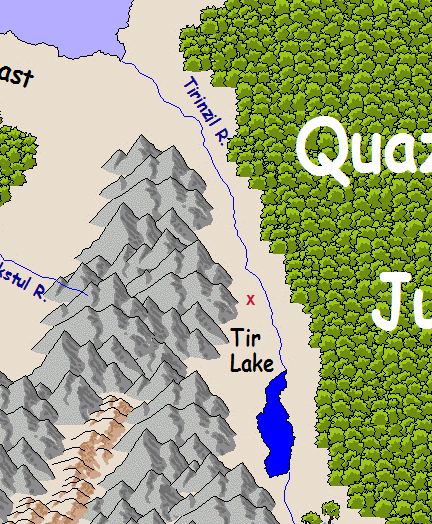
The scene here is much as it was when the PCs first arrived in Sazhansiir those years ago. The place is a wide vale between the high mountains of the Eastern Mallar's Peaks and the eaves of the outliers of the mighty Quazilchatl Jungle. The Tirinzil River cuts through the heart of the vale, flowing northward towards the ocean.
Meeting the Feral Humans:
It will not be too difficult for the PCs to spot a pack of feral humans. A DC 30 Spot check from the ground or a DC 20 Spot check from the air will allow the PCs to locate a group of feral humans in a matter of 1d12 hours. A DC 15 Search check on the ground will find evidence of recent human passage (in about the last 3 days or so), and a DC 15 Survival check using the Track feat will allow the trail to be followed for 1d8 hours to locate a pack of humans.
These humans are a ragged and seemingly primitive group and closely resemble Azotchtla, though with slightly paler features. They seem to be foraging for berries and tubers, and there are about 30 of these humans of various ages and both genders. They often gesture to one another, pointing out a find or motioning for another to keep away from some food, but they do not speak.
The PCs can react how they wish. They can either observe the humans and do nothing or they can step forth and attempt to parley with them.
These humans are feral slaves of the yuan-ti. Specifically, they are a breed of humans who have had their voiceboxes removed...a precaution by the yuan-ti so that their slaves cannot unite against them and to stop any potential spellcasting amongst them. The yuan-ti have learned from their past mistakes. These feral slaves are often released into the wild to breed and fend for themselves by the Scaled Ones. In this way they can increase their stock and improve it (since only the strongest survive in the wild), not have to pay to maintain the slaves, and they have the great sport of recapturing them when they need more stock.
If the PCs simply observe, they will not see much different from their initial observations. A few of the women have babes swaddled in rags. There are few children and few elderly. Most are young adults or just reaching middle age. Some show affection to mates of the opposite gender, holding their hand or picking bugs out of their hair. The majority of the group seems interested in getting food, much of which they eat on the spot, though they do seem to squirrel away some into small sacks made of rags. No words are ever spoken. At best soft grunts are emitted when they wish to punctuate their gestures.
If the PCs step out to interact with the humans, they will at first be extremely afraid. When the PCs first appear, unless they look a lot like the humans (i.e. unarmed and unarmoured and in rags), they will provoke a strong fear reaction from the humans. If the PCs are wearing metal armour, brandishing metal weapons, or have obvious magic effects upon them, then the humans will gape at them wide-eyed and point at the PCs and some will make a hissing sound while doing so. If the PCs to a man do not have metal armour visible and brandish no metal weapons but are still dressed in clothing and not looking like a feral human slave, then the humans will still be quite afraid, but will not hiss.
Some of the humans will run away. Mothers will hide their children. In fact, the whole group will be tensed and preparing to flee. The PCs, if they want to parley, will have to take immediate action. There are a variety of ways the PCs can stop the humans from fleeing.
1. The PCs can coerce them by a display of magic that stops them from fleeing. Spells like wall of fire for example will serve this function. Simply flashing magic will not, as they equate magic with yuan-ti and will simply regard the PCs as yuan-ti. Even using appopriate magic, while stopping any humans blocked by the effect from fleeing, will terrify them further as they will now be absolutely convinced that the PCs are simply diguised yuan-ti. In this case the trapped humans will be hostile, but can now be affected by a non-rushed Diplomacy or Perform check.
2. The PCS can attempt to ameliorate their fear by using Diplomacy or even Perform to change their attitude. The humans begin as unfriendly. The PCs will have to make a rushed Diplomacy or Perform check to at least keep them from fleeing outright. As long as the humans do not fall to hostile, they will tentatively remain. This will allow the PCs to perform a normal Diplomacy or Perform check to try to change their attitude to at least indifferent.
Keep in mind that without magic, the PCs have no way to really communicate directly with these humans. They know only a few words of Slith and have no language of their own. Because of this, even the tongues spell will not work with these humans. If their minds are read (e.g. with a detect thoughts spell), the reader will simply get an overwhelming sense of fear and wonder at the PCs and scattered images of snakes.
3. The PCs can use magic to calm or influence the reactions of the humans. A charm person spell can convince one of the humans of the PCs' friendship and his example will go a long way to calming down the others.
Note that if the humans are made hostile, they will not attack the PCs. Instead they will flee. Unfriendly means they will shy away from the humans but will not flee en masse. Indifferent means they will go about their business and ignore the PCs, though still keeping a wary eye on them. Friendly or helpful will mean they try to show the PCs where to find food and perhaps even share some with them. They will also marvel at the PCs' equipment, feeling their clothing and touching their metal items in absolute wonderment.
As long as the humans are friendly or helpful, it will also be possible for the PCs to attempt to communicate with the humans to try to get them to show where the yuan-ti dwell. This involves a DC 20 Charisma check, with a failure by 5 or more resulting in some wrong intent being communicated. Grant a PC a +2 synergy bonus to this check if he has 5 ranks in Sense Motive and another if he has 5 ranks in Bluff.
If the PCs communicate their intent well, the reaction of the humans will depend on their attitude towards the PCs. Indifferent will cause them to become scared and flee. Friendly will cause them to point in a certain direction, and then do their best to warn the PCs not to go that way...that great danger is that way. Helpful will cause a single human to agree to show the PCs. It will be clear this is an act of great courage on the part of the young human, and the others will try to dissaude him, causing an opposed Diplomacy check between the other humans and the PCs. Assume the other humans have a Diplomacy check of +0.
|
If the PCs somehow cannot make nice with the humans, then they will have to find the yuan-ti on their own. Tracking them is one way to do it, for their hunting parties, mounted on war lizards, often ply this area. Assume a DC 25 Survival check to track the yuan-ti. Divination spells of various sorts can also aid the PCs. As a last resort, the PCs can simply stake out the humans. If so, after 1d8 days of waiting, a yuan-ti war party will come from the east and engage in a hunt of the feral humans. If the PCs defeat the hunting party, the DM should be sure to remove the halfbloods and war lizards from those in areas 26 and 43 respectively of the yuan-ti stronghold.
|
|
This hunting party can be tracked with a DC 13 Survival check. In addition, the direction they came from should give the PCs at least some indication as to where to head. Spells like speak with dead can be helpful as well. Or, in a pinch, the PCs can allow one of the war lizards to go and it will meander its way back home!
Finding the Stronghold:
This yuan-ti stronghold is really just the demesne of a local yuan-ti lord who wrested this stronghold from a rival over a decade ago and assumed control of his minions and slaves. The lord now rules by strength of arms and magic, but is a minor player on the Scaled One stage. His is an outlier stronghold, warding the approach down the Tirinzil River valley, and his only real duty to his superiors deeper within the Quazinchatl Jungle is to send word of the approach of any sizable body of enemy troops.
The stronghold sits at the edge of the jungle proper, before it becomes too thick and concealing. As such, it is not a difficult place to find if one knows where to look. Unfortunately for the PCs, there happens to be some intriguing ruins nearby that they might think is the stronghold.
If the PCs have the brave feral human guide with them, he will be able to take them directly to the stronghold proper. The human will, in fact, avoid the ruins. Likewise, if they follow a war lizard home or gain directions via magical means (like speak with dead on a yuan-ti), they will reach the stronghold proper. Otherwise, if the PCs have simply been pointed in the right direction or followed the yuan-ti hunting party out of the east, then they are likely to first reach the ruins.
The yuan-ti stronghold is across the Tirinzil River, which at this time of year is swollen and fast flowing. The river is about 15 miles from the feral humans. Swimming requires a DC 15 Swim check and negotiating the 30 ft per round northerly current. A ford can be found with a DC 15 Survival check and 1d4 hours of searching, or can be found automatically if the yuan-ti are being successfully tracked (since they routinely use the ford). The river is generally about 150 yards across.
After the river it is another 20 miles or so to the beginning vestiges of the jungle. The stronghold and ruins reside about 5 miles inside the verges of the jungle. At this point the jungle is not a proper jungle as depicted on the continental map. It is merely a thickening of trees and sparse clumps of undergrowth.
The stronghold proper is located on a tree-covered hill that overlooks some ruins. Since the stronghold is concealed within the hilltop, the only landmark that will be visible if the PCs are not directed specifically to the stronghold is the ruins. The yuan-ti tracks, should the PCs be following them, skirt the ruins by about 100 yards and ascend the hill on the opposite side.
No encounters are provided for the journey to the stronghold/ruins. If the DM desires he can prepare an encounter or two to punctuate the journey, including the below optional encounter.
Optional Encounter - Terrible Lizards (EL 16):
Note: The DM can introduce this encounter if the PCs need some extra muscle to deal with the yuan-ti stronghold. Additionally, the encounter can be used as a means to introduce Noddunk as a cohort for the PCs.
The PCs will have crossed the Tirinzil River and begun to enter the sparse jungle, not more than 4-5 miles fromt he yuan-ti stronghold. Here they will begin to hear loud, ferocious roars sounding off in the jungle. While not very close at first, the roars will begin to get closer and closer, until, about 20 minutes after the first roar, one will sound nearby, along with the sound of wood splintering and a deep throaty cry in Azotlan:
Come and receive a message for your masters!
Creatures: The PCs will come upon a dakon armed with a maul fighting a fiendish tyrannosaurus. Neither is yet wounded, although a nearby sapling received the worst of a blow from the dakon's maul.
The dakon will begin to fight the tyrannosaurus, yelling epithets at it in Azotlan that should make it clear that he hates the Scaled Ones.
A round or two after they first see this tableau, no matter how the PCs react or fail to react, the rest of the pack of fiedish tyrannosaurs will arrive. This pack had been hunting the dakon, and they were attempting to surround him. While the first dinosaur was bellowing and making noise, he was also covering for the other 5 who were sneaking around to trap the dakon (and now the PCs). These 5 additional tyrannosaurs will emerge from the jungle in all directions, at an initial sighting range of 3d6x100 ft. They will attack Noddunk and the PCs indiscriminately, and will fight to the death.
|
Noddunk is not a typical dakon. The dakons are a race of relatively peaceful intelligent apes who prefer to be left out of the great conflict between humans and Scaled Ones. The dakons do trade with the Azotchtlans as well as the more peaceful lizardfolk tribes. Noddunk, however, was different. His tribe lived on the very eastern verges of the Erinquiril Jungle, and so were more susceptible to trouble from the yuan-ti. His tribe had always, as a result, been a bit more militant than most dakon tribes, and Noddunk was the most militant of his tribe, a fearsome warrior who, as an adolescent saw his friends killed by a raiding band of lizardfolk led by a renegade yuan-ti pureblood.
Noddunk vowed to fight the Scaled Ones, despite warnings from his tribal elders that his actions could have consequences for the tribe. Over the course of almost a decade, Noddunk made solitary war against the Scaled Ones, and his maul became something of a dire legend amongst the local serpentfolk. Recently, however, the predictions of the elders came true. A stronghold of nearby yuan-ti learned of the affiliation of Noddunk to his particular tribe, and they mounted a vicious raid on the tribe while Noddunk was away. Most were slain, but a few were taken by the yuan-ti for experimentation. Noddunk returned to his tribe's village to find it in ruins. He managed to find a few survivors, including a tribal elder who was able to use divination magic to reveal that Noddunk's mate was still alive and in the clutches of the yuan-ti.
Now he seeks the stronghold, which he believes to be in the nearby area. Unfortunately, his mission has been sidetracked by a pack of fiendish tyrannosaurs that have been tracking him and finally caught him.
|
FEATS: Power Lunge (SaF p8) - charge attack does double Str bonus but provokes AoO. Stand Still (Psionic p51) - make AoO to stop foe instead of damaging, foe struck must make Ref sv (DC 10 + damage roll) or immediately halt movement. MAGIC ITEMS: bracers of quick strike (MIC p81) - 1/day make an extra attack with weapon after full attack option. opposable (MoTW p28) - allows weapon to be wielded by a creature that does not have the proper hands to normally wield it. snakebiter (GW p64) - acts as a bane weapon against all yuan-ti. |
Developments: Assuming he survives and the PCs have aided him, Noddunk will explain his mission and, if the PCs explain that their mission also takes them to the nearby yuan-ti stronghold, Noddunk will ask to join forces with the PCs. He will expect no share of treasure (unless he is a cohort) but only wants to retrieve his mate and any other surviving tribesmembers.
The Ruins (EL 16):
Note: As the PCs approach the
ruins, they will note a spectral raven watching them from the
branches of a tree with a DC 20 Spot check. The raven is an observer
of the vitreous drinker that dwells in the ruins (see the statistics
block below for more details).
|
Before you are a series of ruins set amidst the burgeoning jungle in the shadow of an almost sheer cliff some 100 ft high. The cliff is ivy-covered, with vines running down from trees perched at the top. The ruins themselves are large white blocks of stone covered in creepers and vines, some obviously the scattered remains of massive structures and others partially ruined smaller buildings that are generally intact. A handful of large jungle trees is scattered about the ruins, along with patches of undergrowth, much of which has sprung up in and around the ruins. |
 |
Each elevation change on the map represents 20 ft. The 100 ft tall cliff face is normally a DC 15 Climb check, but the vines and creepers can be used to lower the DC by 5.
Green shaded areas represent light undergrowth.
|
Light Undergrowth A space covered with light undergrowth costs 2 squares of movement to move into, and it provides concealment. Undergrowth increases the DC of Tumble and Move Silently checks by 2 because the leaves and branches get in the way. |
Dark green circles represent massive trees (DC 15 Climb).
Walls (represented by black lines that do not generally come close to forming a closed shape) are jagged and battered and are 1d10+4 ft tall. Structures (represented by black lines that generally form a closed shape) are 1d12+5 ft tall and the roofs are long gone except for two.
The oval structure in the center of the ruins is covered by an intact domed roof that curves to a height of 10 ft above its 15 ft tall walls. The dome bears many cracks, but no significant holes.
The other is the structure to the north of the oval. This structure shows two stories intact, with the second story covering a 60 ft by 80 ft area above the main portion of the ground level (i.e. all but the 2 squares to the west). Each story appears to be 15 ft tall and is covered by a flat roof.
All walls and buildings bear carvings that must have once been of exquisite craftsmanship. These show scenes glorifying serpents and yuan-ti and the enslavement of humans, including the occasional gruesome depiction of humans being crushed or devoured by snakes and, in a couple of cases, being dissected by yuan-ti.
Creatures: An horrific vitreous drinker haunts these ruins. This creature was once a powerful yuan-ti sorcerer who entered into demonic pacts with a powerful oculus demon. When the war against Okoth broke out the sorcerer's stronghold was assaulted and overrun. The sorcerer was slain but his soul was taken by the demon to whom it was pledged. The demon turned the sorcerer into a vitreous drinker and sent him back to Sazhansiir to act as a spy. Eventually all contact with the demon ended, though whether from lack of interest or the death of the demon the drinker could not say. The drinker haunted his ruins for centuries until the yuan-ti built their stronghold into the nearby hillside. It was the drinker that aided the current yuan-ti lord in his takeover of the stronghold, and now the drinker and yuan-ti exist in a loose symbiosis.
The yuan-ti come to the drinker from time to time for information and advice. In return, the drinker gains scrolls and wands from the yuan-ti, as well as the ability to eye drink from select yuan-ti or even human slaves. He then gets to observe through his victim's eyes and gain knowledge of the surrounding area.
The drinker has 24 spectral ravens at his beck and call (see the spectral raven ability in his statistics block below). 16 of these are perched around the ruins as shown on the map as tiny red "S" marks. The other 8 ravens are scattered throughout the surrounding land, such that the PCs will likely have been observed by one as they approach the ruins, thereby alerting the drinker to the arrival of visitors.
The drinker itself is to be found in the building marked "vd". This building has two stories, as mentioned, with a stone stairway leading up to the second floor. No windows are present in this building, but it is littered with small cracks and holes, many of which are more than 1 inch wide and from behind which spells can be cast.
|
SPELLS: ray of sickness (SC p167) - r cl, ray, 1 rd/lvl, SR; ranged touch causes target to be sickened. |
Tactics: The drinker will almost certainly wish to slay the PCs, for it is intelligent and wise enough to recognize that they are enemies. However, it is not above trying to speak with them at first in order to determine what it is they seek. Of course, if the PCs have already been discussing their mission amongst themselves while exploring the ruins (searching for the yuan-ti) within hearing of a spectral raven, then the drinker may already feel he knows enough about the PCs to forego parley.
Normally, when he first detects intruders he will cast invisibility from his wand and then cast shield from a scroll. He will emerge from his building and then use his enlarged ventriloquism wand to speak to the PCs in Draconic from a building 80 ft away from his location. Using this wand, he will likely portray himself as a jungle landwyrm (named Yrmitherax), a who is ambivalent to the Scaled Ones and just wants to be left alone. He will then try to question the PCs to see who they are and what they want.
Once he is satisfied that he can learn nothing further from the PCs, he will use his scrolls to cast monster summoning V and monster summoning VI to summon an achaierai and a huge fiendish monstrous spider. He does not expect these creatures to defeat the PCs, but he uses them instead to probe the PCs' capabilities and to induce them to use some of their resources on the creatures. While the PCs are fighting the summoned creatures, the drinker will cast magic circle against good from his scroll and then, assuming the PCs show that they are a serious threat, he will cast antilife shell.
Once this has been done, he will use his ventriloquism (likely still running from before) to challenge the PCs from within the same building as before (in his jungle wyrm persona) or a new building if the first one has been breached. As the PCs approach the point of the ventriloquism, he will cast insect plague around the building so that the PCs will have to pass through the swarms of locusts to enter and to leave the building.
Once this deception has run its course, the drinker will proceed to the second floor of his starting building and, peering through one of the many tiny holes or cracks (which provides 100% cover effectively), will begin to target exposed PCs with longer ranged spells like disintegrate and feeblemind (on arcane casters).
As the PCs move towards his firing position, he will cast black tentacles on the area inside the building's first floor and his silence wand to create areas of silence on strategic spots on the 1st floor, and then use dimension door to escape to a new position elsewhere in the ruins to begin attacking the PCs from the rear, recasting his invisibility.
He will then begin to stalk the PCs, casting eyebite, since that spell can be used concurrently with others, and then using his shorter-ranged spells such as baleful polymorph and finger of death on casters and his wand of ray of sickness on everybody. If necessary, he will enter combat, using his quickened vampiric touch to augment his tongue lash. Circle of death will only be used against large numbers of summoned creatures that somehow manage to pierce his magic circle against good and antilife shell. The wand of silence will only be used when the tactical situation calls for it. The drinker is smart enough to realize that his silence spells do not have much of a chance to be cast directly onto spellcasters successfully and that he needs to be able to cast his own spells as well, and so will limit these to casting on useful areas.
If sorely pressed, he will use his harm scroll and his wand of inflict serious wounds to heal himself, including using his teleport scroll to escape combat in order to heal up. He is also not above escaping combat and letting the PCs' spells run out before returning to the fight (although he will have to weigh the benefit of the PCs' spells running out versus his own spells running out; however, the drinker has no 1 round/level defensive spells).
The drinker will not fight to the death if possible. Once he has used all but his last teleport scroll he will use the last one to escape a combat that has gone against him. This will usually mean that he has already used his dimension door and first teleport and has healed himself fully at least once using his wand of inflict serious wounds and harm spell. In this case, he will teleport to the yuan-ti stronghold and warn the yuan-ti there. He will then be encountered as indicated in the stronghold description.
It should be noted that the drinker's Use Magic Device skill is enough that it can use all of its scrolls and wands without any chance of failure.
Developments: The vitreous drinker knows the location of the yuan-ti stronghold and how to enter it. He also knows the lord of the place quite well, and has used his eye drinking ability and his arcane eye spell-like ability to fully scout the stronghold. Thus, if somehow compelled by them, the PCs can use the drinker to get valuable intelligence regarding the stronghold.
Otherwise, a thorough search of the upstairs portion of the building he was first encountered in will turn up a tome and a bone quill and red ink. The book contains voluminous notes of the vitreous drinker written in Slith, beginning with his sensing that his oculus demon master's control over him has ended. Perusing the tome for a good 1d4 hours will grant the PCs insight into the background and origins of the drinker, including details of the yuan-ti coup that installed the current lord and the knowledge that the yuan-ti lair is located at the top of the hill overlooking the ruins, as well as the fact that the drinker provides information to the yuan-ti in exchange for wands and scrolls.
Even a quick look through the tome will turn up a bold note in a margin of one page that reads:
Word for entry is "Kadzemossh"
This is the password to open the stone entry door into the stronghold. The word is the name of the previous lord of the stronghold and is a joke of sorts set by the current lord to remind the yuan-ti of the fate of their previous master and, therefore, the prowess of their new master.
Secret Doors: The white circle with a "t" in it in the northeast portion of the ruins is a secret trap door set in the lee of two ruined walls and covered by thick undergrowth (DC 30 Search check). This door is 10 ft in diameter and leads to a shaft that descends down via an iron ladder 25 ft before entering a 10 ft square passageway that heads north and slopes upward, eventually reaching area 17 of the yuan-ti stronghold.
Bypassing the Drinker:
It is quite possible that the PCs will bypass the vitreous drinker. However, while they may bypass the drinker and his lair in the ruins, they are unlikely to bypass his notice. The drinker has 8 spectral ravens that fly in a wide swath around his lair, looking for intruders or anything else interesting. It is very likely that the drinker will have noticed the PCs if they cross the river using the yuan-ti ford, as he has a spectral raven stationed well away from the ford but within sight of it (perhaps 100 yards away).
Furthermore, it is almost certain that a spectral raven will encounter the PCs or vice versa as they approach to within about a mile of the ruins/stronghold. Unless the PCs somehow manage to elude the watchful ravens (by being invisible or somehow approaching the place in disguise, for example), the drinker will be well aware of their approach and once he has spotted the PCs he will definitely be intrigued and have them followed discretely. This means that even should the PCs bypass the ruins, the drinker will see them approach the yuan-ti stronghold.
The drinker, while not a formal ally of the yuan-ti, favours them and certainly does not wish to see a band of humans (or other similar races) ransack the stronghold. As such, if he observes the PCs and notes them about to enter the stronghold (e.g. they are examining the illusion around the entrance to the stronghold), he will use his dimension door ability to appear in the yuan-ti stronghold (area 16) and then immediately set about warning the stronghold.
The Stronghold:
The yuan-ti stronghold is built into the side of the hill overlooking the ruins. The entryway is on the opposite hillside away from the ruins, about 40 ft from the top of the hill. Fresh tracks lead to and from the area (Search or Survival DC 13), including large ones and spoor left by war lizards.
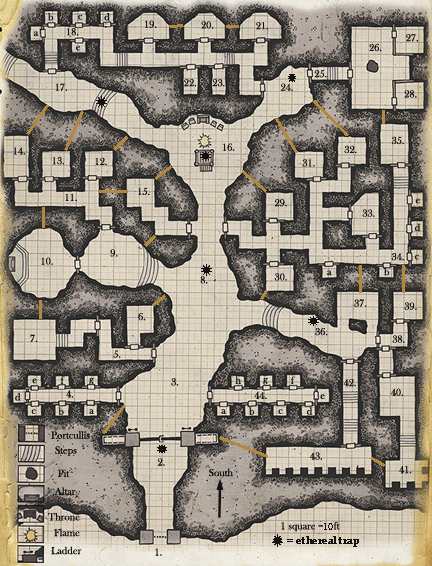 |
Unless otherwise stated, all locations within the stronghold are lit by flickering oil lamps set into cressets in the walls every 20 ft or so.
Passages are 10 ft tall and chambers are 20 ft tall. Walls are of masonry with the few interior walls being 1 ft thick (per 1 ft, hardness 8, 90 hp, break DC 35, Climb DC 20) and floors are flagstone. Doors (unless otherwise noted) are 7 ft wide (enough to accommodate Large creatures) and are strong wooden doors (hardness 5, 20 hp, stuck DC 25, locked DC 25).
Those portions of the stronghold that are natural cave walls (which should be apparent from the map) are hewn stone (per 3 ft, 8 hardness, 540 hp, break DC 50, Climb DC 25).
Golden lines on the map represent the general path of narrow tubes that travel from one location to another. Each location has 3 such tubes, and each tube is 2 inches in diameter. These tubes are used by the yuan-ti as emergency escape and flanking routes using their alternate form ability to transform into tiny vipers. Only size Tiny creatures that are long and narrow like a snake can traverse these tubes. Creatures larger than Tiny cannot use these tubes (unless they have special abilities that let them do so, such as certain oozes), and creatures smaller than Tiny can use them even if not long and narrow like a snake. However, given that a transformation into snake form causes most or all of a given yuan-ti's equipment to fall to the ground, they will tend to eschew these tubes unless absolutely necessary.
As explained in detail at the end of the description of this stronghold, there is a chance that the yuan-ti have been alerted to the arrival of the PCs beforehand. This is most likely to occur if the PCs attack the vitreous drinker in the ruins below and the undead manages to teleport to the stronghold. He will arrive in area 2 and immediately demand audience with the lord in area 16. The masters will put the place on alert within about 1d10+10 rounds, after which room descriptions and inhabitants will change as described in the red italicized text in each area description. The vitreous drinker will be at the lord's side for the remainder of the conflict.
Similarly, if the PCs somehow alert the yuan-ti and then retreat, the DM can use these alerted setups as guides to the heightened defenses of the stronghold.
When not on alert, certain personages in the stronghold have chances to be at various locations. Refer to the Location Chart at the end of the stronghold description for more details.
Ethereal Traps
The yuan-ti are a highly magical race, and they are aware of most dangerous magic, such as spells like ethereal jaunt and swift etherealness (Player's Handbook II page 113). And given that assassination is an acceptable means of advancement in yuan-ti society, and that rival strongholds often infiltrate, raid, attack, or steal from other strongholds, means that most yuan-ti strongholds are well-prepared for such tactics.
In the case of this stronghold, several traps have been set up to thwart infiltration from the Ethereal Plane. These traps are mentioned in the various area descriptions of the stronghold below, but the details are presented here.
Each trap is an ethereal chamber spell trap (Spell Compendium page 84) coupled with an audible greater alarm spell. The traps are activated visually using a true seeing spell and keyed to attack any creature on the Ethereal Plane that comes within sight of the trap. The traps are not bypassable by the inhabitants of this stronghold, and they know not to turn ethereal anywhere within the confines of the stronghold. This is a restriction they are willing to accept in order to better keep out ethereal attackers.
Remember that spells cast by an ethereal creature do not normally affect the Material Plane, so an ethereal intruder who has cast silence on himself or an object he carriers will not silence the greater alarm.
The visual component of the trap allows sighting of ethereal creatures within 120 ft (with line of sight) at a +30 Spot check. However, the range of the ethereal chamber spell is only 55 ft.
The trap resets each round, so that the ringing will continue and, should the victim escape he will be subject to further ethereal chamber spells until he leaves the radius or sight of the trap.
| Ethereal Chamber Trap CR 3; magic device; visual trigger (true seeing); automatic reset; spell effects (ethereal chamber and greater alarm, 12th-level sorcerer, entrapment, DC 17 Reflex save negates); Search DC 27; Disable Device DC 27. |
Combat Note
Remember that many of the yuan-ti have spell resistance, and therefore even some helpful spells cast by other yuan-ti may be resisted. The DM should either check SR or have the recipient yuan-ti lower their resistance if it is safe and prudent to do so. Lowering SR is a standard action, and lowered SR automatically resumes at the start of the creature's next turn (unless another standard action is used to keep it down).
1. Entryway
This entryway is disguised by a permanent image (CL 12, DC 18) that makes it appear as a normal part of the hillside. As such, a detect secret doors spell will not detect the entrance, though a detect magic spell will work (as will any other spell that detects magical auras).
If the PCs have been tracking the yuan-ti, then the tracks lead right up to and into the hillside at this point.
The illusion covers the true entrance to the stronghold, which is comprised of two white marble stone pillars 10 ft square that are carved with images of serpents coiling around naked humans and devouring their heads - a male human on the eastern pillar and a female human on the western pillar. Between the pillars, which reach 20 ft to the ceiling, is an iron portcullis that is closed (hardness 10, 60 hp, lift DC 25).
The portcullis is openable (in the manner described below) by uttering the password, which is:
Kadzemossh
The word is the name of the previous lord of the stronghold and is a joke of sorts set by the current lord to remind the yuan-ti of the fate of their previous master and, therefore, the prowess of their new master. If the word is uttered by someone touching one of the white pillars, the portcullis gate will slide up for 5 rounds before closing again. To someone observing from the outside who has not disbelieved the illusion, it will appear as if a person has simply walked right into and through the hillside.
Remember that a knock spell will not open a portcullis. The bars are spaced closely enough that it would take a Diminutive or smaller creature to slip through the bars.
2. Main Gate (EL 5)
DMs should note the alarm
spell that has been cast on the gate here and extends in a 20
ft radius from the center of the gate. Additonally, an ethereal
chamber trap has been set upon the gate.
|
Two 10 ft square white marble columns hug the walls to each side of a massive iron gate, the columns and the gate stretching up to the ceiling 20 ft overhead. Each column is decorated with carvings of humans morphing into snake creatures and bowing down to a cloaked figure wielding a massive spiked mace. The gates are engraved with figures of snake-bodied humans wielding scimitars and fighting winged serpents, chopping the latter into pieces while gore sprays from the wounds. Sharp spikes top the gate, stretching up 5 ft to scrape the ceiling. |
Every day, one of the two coiled cabalists (areas 30 and 31) casts an audible alarm spell (CL 12) at the center of the main gate about 5 ft off of the floor. This spell covers the entire entryway, up to the ceiling. A daily password is set and propogated to the stronghold by the cabalist, though the slaves are not informed of the password.
Each of the two white columns do not quite reach the ceiling, stopping about 6 ft from the ceiling. A permanent image spell (CL 12, DC 18) extends the columns all the way to the ceiling, and where the image meets the wall has been carved a small niche 10 ft wide and 20 ft deep that contains a several quivers of arrows hung on pegs (a total of 240 arrows), and several small boxes packed with cloth and holding 6 vials of sssartisss poison and 6 vials of ts'ous poison (each labelled with its name [but not the fact that they are poisons] in Slith).
On the other side of the gate, an iron ladder ascends each column from the ground to the point where the illusion begins.
Creatures: A single yuan-ti pureblood sits atop each column, hidden by the permanent image and watching the corridor leading from area 1 to area 2 (providing them with 100% concealment). Each is alert to danger, and tasked with warding the approach to the stronghold and sounding the alert if there is trouble. Along with each yuan-ti is a small gong and hammer which can be used to sound an alarm as a standard action. They will do so unless the alarm spells in this area have already gone off.
If an alert has been sounded beforehand, then there will be 2 purebloods atop each column. Each can shoot out of the illusion at intruders. The additional purebloods will come from the barracks in area 26.
|
POISONS: Sssartisss (SK p150) - injury DC 20, paralysis 2d6 min/unconscious 1d4 hours. Ts'ous (SK p150) - injury DC 20, 4d4 damage/2d4 damage. |
Tactics: Each pureblood has dipped 2 arrows in sssartisss and 2 arrows in ts'ous. These are laying on the top of the marble column at their feet, ready to load and fire. Once these are used, the yuan-ti will have to take a standard action to coat further arrows, and risk the 5% chance of being poisoned.
If they see intruders, the yuan-ti will sound their gongs. They will then begin to snipe at intruders with poisoned arrows, then continuing with normal arrows complimented by a charm person. If it appears that the intruders have pierced the illusion providing them with concealment, then they will cast a darkness spell to gain back some measure of concealment.
These yuan-ti will not leave their perches, believing it better to fight intruders attempting to climb up the ladders one at a time than joining a melee below.
If their gongs are somehow disabled (e.g. with a silence spell), one yuan-ti will climb down his ladder and head south to alert his superiors while the other remains to snipe.
Development: If the yuan-ti guards are somehow convinced or fooled into allowing the PCs to pass, one will climb down and unbar the gates, pulling them open to allow passage, before closing and rebarring the gates and climbing back up to his post.
Traps: An ethereal chamber trap has been set upon the main gate, at its center on one of the carvings.
3. Northern Main Hall (EL 5)
| This wide hallway of natural hewn cave walls towers 30 ft overhead. |
Because human slaves often come and go through this hallway, and the snake is not intelligent enough to discern one human from another, it will generally not bother to attack humanoid PCs. However, animals and other such creatures will certainly gain its attentions. Additionally, the snake will become aroused if the warning gongs at area 2 are sounded or if a general commotion is made. In this case, the snake will take 1 round to wake up fully and then it will attack any creatures that are being attacked by yuan-ti.
|
4. Slave Quarters East
The door leading into this area from area 3 can be barred from the outside (i.e. area 3), but is currently unlocked. If an alert has been raised beforehand, then this door will be locked.
This hallway is slightly noisome and serves as one of the slave quarters for the house slaves of the stronghold.
Each cell holds a human slave, a human mute between 14 and 40 years of age, with an even mixture of males and females. Each slave is bear chested and wears a simple loin cloth and leather sandals and both chest and back are branded with an intricate symbol of a serpent coiled around a scimitar with flames wreathing its head.
The DM can assume that each slave is a commoner (N Commoner 2). No statistics are given. The slaves are fully inculcated into fear of, submission of, and servitude to the yuan-ti, and it would not occur to them to rebel against their masters, or even to flee unbidden. Nevertheless, a proper Bluff, Diplomacy, Intimidate, or even Perform check could convince these wretches come out of their cells and follow the directions of the PCs. The slaves understand Slith. Initially, the slaves are unfriendly to the PCs. If made indifferent, they will evidence a glimmer of curiousity about the PCs, but will still not flee the place. If made friendly, they can be convinced to leave and return to their feral tribes. If made helpful, they could be convinced to accompany the PCs, but will not fight and are liable to bolt at the first encounter with a yuan-ti. The slaves are familiar with most of the common areas of the stronghold.
There are 7 slaves dwelling here in total, each dwelling in the cells marked a-g. The doors to the cells can be barred from without, though they are currently unlocked. Each cell is a 10 ft square place with a straw pallet and a bucket for waste and a gourd of water. At any time, assume a 50% chance that each cell is occupied. The rest are wandering the stronghold performing their duties. The DM can account for these slaves if they are encountered as wandering encounters, otherwise he can place them anywhere within the stronghold as desired.
If an alert has been raised beforehand, then all of the cells will be occupied and the doors to each cell locked.
5. Trapped Hallway (EL 4)
This hallway is unremarkable. However, it is trapped, which will activate when the door from area 3 is opened.
Traps: If the door from area 3 is not opened by twisting the handle clockwise (as opposed to simply pulling it open), then when the door is opened a heavy crossbow mounted at waist level on the wall opposite the door will fire a poisoned bolt at the opener.
| Poisoned Bolt Trap CR 4; mechanical; location trigger; manual reset; Atk +14 ranged (1d10 plus poison, bolt); poison (t'sous poison, DC 20 Fortitude save resists, 4d4 damage/2d4 damage); Search DC 20; Disable Device DC 16. |
6. Grafter's Lair (EL 10)
|
This chamber is clearly a living quarters, with a 5 ft diameter round concave depression carved into the floor that is filled with furs and coloured pillows and clearly serves as bedding. Near this is another similar depression about 4 ft deep that is empty and which has the top foot of its interior covered with small knobs, protrusions, and bumps. A stone table and pair of chairs are in the room, along with a stone dresser with a large brass mirror mounted upon it. Along one wall is a wooden wardrobe of plain but functional design, next to which stands a steel weapon rack and armour stand. Several brass braziers are set at various points along the walls, these filled with the glowing embers of hot coals. Hanging from the walls are various silken tapestries of garish colours and a few with designs vaguely resembling serpents or tentacles. |
The dresser contains various outfits in the style of yuan-ti fashion, as well as a scale grooming kit and other similar personal effects, including vials of oils used for the grafter's bathing.
The wardrobe contains several cloaks, all coloured to be useful in jungle camouflage (though none grant any sort of actual Hide bonus) as well as a suit of masterwork leather armour.
The empty depression is a bath, in which, when filled with warm water and sensuous oils, the grafter luxuriates. The knobs along the rim are useful for scraping off dead or partially dislodged scales. If the grafter is present and bathing then the depression will be filled with oiled water.
Creatures: The yuan-ti grafter can often (50%) be found here, eating or sleeping (in which case his armour and weapons will be on their respective stands and equipment will be stowed in the wardrobe or dresser as appropriate) or otherwise taking his ease (possibly even bathing!). If he is not here, the grafter will be found in area 7.
The grafter is a cruel creature, with a special hatred of humans, whom he enjoys corrupting. He considers yuan-ti superior to humans and humanoids in every way, to the point that he will tend to underestimate their capabilities at first, though he is clever enough to change his thinking when presented with unpleasant evidence to the contrary.
|
FEATS: Graft Yuan-ti Flesh (SK p146) - You can create yuan-ti grafts and apply them to others or yourself. Spit Venom (SK p147) - With standard action you can spit venom 30 ft as ranged touch, acts as contact poison. GRAFTS: scaly skin (SK p154) - +3 natural armour bonus to AC. |
Tactics: Like most rogues, the grafter prefers to strike from the shadows or flanks and not engage foes directly. To this end, if encountered alone he will, after realizing the PCs pose a real threat and are not the pushovers he figures most humanoids to be, flee to find some other yuan-ti to fight with him, so that he can utilize his sneak attack ability to best effect.
Trap: The chest atop the wardrobe (see Treasure below) bears contact poison spread on it in certain strategic locations (see Trap above), such that anyone not aware of the danger will have a 75% chance of becoming exposed to the poison when handling or opening the chest. Each time someone is so exposed, some of the poison is wiped off, so that the chance decreases by 15%.
|
Stone Chest Smeared with Contact Poison CR 9; mechanical; touch trigger (attached); manual reset; poison (black lotus extract, DC 20 Fortitude save resists, 3d6 Con/3d6 Con); Search DC 18; Disable Device DC 26. |
Treasure: Set atop the wardrobe is a stone chest with a permanent invisibility (CL 10) cast upon it. The chest is not locked, but bears contact poison spread on it in certain strategic locations (see Trap above).
Within the chest are 1400 cp, 1300 sp, 500 gp, and a human skull inlaid with silver and gold filagree forming lines between studded gems (rubies, amethysts, and jade) worth 2,000 gp.
If the skull is examined with an eye towards whether the placement of the gems or lines of precious metal have any meaning, then a DC 20 Heal check will indicate that the gems represent nerve bundles or pressure points on the human skull and the lines represent major veins and arteries.
7. Torture Chamber (EL 1)
|
This place is clearly a torture chamber, as evidenced by a branding iron sitting in a cauldron of hot coals, a jaw breaker, a bloodstained wooden table complete with leather straps for ankles and wrists, and racks of flensing knives, scalpels, and needles of various sizes and shapes. The walls are decorated with hangings consisting of the flayed skins of humans, snakes, and combinations of the two. Human heads hang from chains along some of the walls, their eyes out and mouths agape. Along the north wall are wooden shelves upon which are set a variety of tomes, manuals, and rolled up scrolls. Along the south wall are jars with snakes or snake parts floating in liquid, as well as small bins and boxes. In the northeast corner is a life-sized wooden dummy of a human form. The dummy is covered in drawn lines, symbols and notations. Strapped to the table is what can only be described as a nude male human in his twenties with a serpentine tail emerging from his backside and a right arm that ends in a quivering snake head instead of a hand. |
The branding iron bears a brand that consists of an intricate symbol of a serpent coiled around a scimitar with flames wreathing its head.
The jaw breaker and various knives and needles are all useful in torture (see Book of Vile Darkness page 37).
The dummy bears markings that show features of the anatomy of the human body. A DC 25 Heal check will reveal that these features would be useful for grafting foreign parts onto the human body. The notations are in Slith and confirm this, as they clearly are intended to aid in the implementation of yuan-ti grafts on humans.
The manuals, tomes, and scrolls on the shelves to the north are all Slith-language treatises and charts and aids on grafting. Of note is the fact that not all of these deal with yuan-ti grafts upon humans. Many deal with such grafts being implemented upon yuan-ti.
The jars and bins and boxes along the south wall contain preserved snake parts of various sorts useful for eventual grafting.
Creatures: Strapped to the table is the latest victim of the grafter, a feral human who has been the subject of some grafts. The human is quite insane and will struggle to get free of the table (fruitlessly, as he is tightly bound). Additionally, the Grafter from area 6 will be here if not present in area 6.
|
GRAFTS: added tail (SK p154) - gain natural swim speed at half normal speed and +8 to Swim checks, +4 to Balance checks, constrict smaller creatures for 1d4 + 1.5 Str bonus on grapple check. serpent arm (SK p154) - bite attack with arm dealing 1d4 dmg plus poison. |
Tactics: If freed, the human will attack until slain. He cannot be reasoned with any any way, although if somehow his insanity is removed (via magic) he will calm down, note his own condition, and attempt to kill himself or to be killed.
8. Southern Main Hall
| This wide hallway of natural hewn cave walls towers 30 ft overhead. |
If an alert has been raised, then the laerisss smoke will be present in a 30 ft radius and will be continually renewed.
Laerisss smoke (Serpent Kingdoms page 154) is beneficial to Scaled Ones but harmful to others. It smells like burnt olives. To Scaled Ones, exposure provides a +2 bonus on Reflex saves for 3d6 minutes although the same creature cannot benefit again for 1d4 hours. To other creatures, it is an inhaled DC 14 poison, initial 2d4 acid damage, secondary 2d6 damage.
Traps: An ethereal chamber trap has been set upon the ceiling of this cave, precisely where the number "8" is located on the map.
9. Temple Antechamber (EL 10)
|
Five stone steps lead up to this cave, whose walls are carved to represent serpents wriggling amongst the natural protrusions of the cave walls. Each snake head is hollow and holds a flickering oil lamp that makes the gaze of the stone serpents appear diabolic. The door to the east is of black stone, highly polished, and its edge bears intricate carvings of entwined snakes. |
|
FEATS: Improved Toughness (MM4 p203) - gain 1 hp per HD. Vexing Flanker (PHB2 p85) - Gain +4 to attack when flanking. |
Tactics: The broodguards are not particularly intelligent, but they have had training and will take advantage of their Vexing Flanker feat to try to surround opponents. They will also grapple or aid their fellows (providing a +2 bonus to attack rolls). Their warped minds know no other thing but their duty to their masters, and they will gladly spent their lives in the defense of the temple.
10. Serpent Temple (EL 11 [+1 due to unhallow effect])
|
The eastern end of the cave is dominated by a dais comprised of 3 jet black steps that lead up to an altar of polished green stone in the shape of a two-headed snake with its mouths flanking a human skull. The cave wall behind the altar bears a green and black tapestry of a skull with green worms writhing in and out of the eye and nose sockets. Atop the altar rests and black metal bowl studded with jade and turquoise. Next to it rests a curved knife of polished green stone in the shape of entwined snakes. Two metal stands flank the altar, each bearing a piece of wood set where a candle might normally be held. The floor of the place is littered with rust coloured runes and sigils, and the walls contain carvings of snakes with jaws agape as if emerging from the stone walls. |
The altar bears an unhallow spell (CL 11) to which has been affixed a dispel magic effect that will be activated against any creatures opposed to Kyuss (this will be an area dispel).
Creatures: The priest Grivanssrex (area 12) and the high priestess Assintyriss (area 14) have commanded undead with their rebuke undead abilities and those undead have been placed here to guard the temple. Assintyriss commands a Large sanginous drinker, while Grivanssrex commands a powerful shadow. The creatures are intelligent enough to act upon their own volition, subject to their masters' desires. As such, they will guard the temple and attack any obvious intruders.
Furthermore, there is a chance that either Grivanssrex or Assintyriss (or both) will be here conducting obesiance if the stronghold is not on alert. Refer to areas 12 and 14 for more details.
|
|
|
|
Tactics: The sanguineous drinker will begin any combat casting his greater invisibility spell and then commence attacking, using blood spray liberally.
The shadow will begin any combat casting haste on itself and the sanguineous drinker, then barraging the area with confusion before beginning to emerge from the walls to touch foes.
Neither undead will retreat unless commanded by their masters.
Treasure: The sacrificial knife is made of jade and worth 500 gp, though it would be difficult to find a buyer due to its serpentine design. The sacrificial bowl is worth 1500 gp.
Developments: The two yuan-ti clerics know profane sacrificial rituals that they can perform at the altar. These operate per The Book of Vile Darkness page 26. If an alert is raised or circumstances allow, the priests can each take a slave from one of the slave cells and sacrifice them for a reward. A quick ritual will involve a simple 1 minute invocation and a full round coup de grace on the altar. This will grant a +7 bonus on the Knowledge (religion) check. If the clerics have time to take a full hour for each sacrifice, then the bonus will increase to +8. On the average, Assintyriss will gain a result of 35 for a quick ritual and Grivanssrex will gain a result of 32. They will generally use these results to call evil outsiders who will serve for 2 hours. A result of 25 will allow a lesser planar ally result, a result of 30 will allow a planar ally result, and a result of 35 will allow a greater planar allay result.
If the yuan-ti are on alert, then the clerics will be here along with two slaves from area 44 (or 4 if none from area 44 or from the surrounding countryside if they have time to gather feral humans), ready to perform the sacrifice.
Allies called will be as follows:
A greater planar ally will call forth a marilith. The marilith warrior is a unique individual with whom the clerics have a sacrificial relationship. Should she be defeated, a normal marilith will be called thereafter.
|
FEATS: Boost Spell Resistance (BoVD p47) - +2 profane bonus to SR. Twin Sword Style (PGF p46) - When fighting with 2 blades you designate as a free action on your turn one melee foe and gain +2 shield bonus against that foe (stacks with shield bonus from buckle or animated shield or shield spell), bonbus lost if flat-footed or lose Dex bonus to AC.
|
|
|
A planar ally will call forth an advanced nerizo demon.
|
|
A lesser planar ally will call a rutterkin warrior.
|
WEAPONS: Snap-tong (FCHoA p51) - x2 crit, piercing, if hits opponent at least 1 size smaller can start grapple as free action with no AoO, does 1d10 + Str bonus for each round hold is maintained. Tri-blade (FCHoA p51) - x2 crit, slashing, 20 ft increment.
|
11. Unholy Hallway (EL 11)
Creatures: This hallway is lined with yuan-ti zombies, under the control of the two clerics (areas 12 and 14) and created by their animate dead spells. These zombies will attack any non-Scaled Ones who are not branded with slave brands.
|
|
12. Priestly Chamber (EL 10)
|
This chamber is clearly a living quarters, with a 5 ft diameter round concave depression carved into the floor that is filled with furs and coloured pillows and clearly serves as bedding. Near this is another similar depression about 4 ft deep that is empty and which has the top foot of its interior covered with small knobs, protrusions, and bumps. A stone table and pair of chairs are in the room, along with a stone dresser with a large brass mirror mounted upon it. Along one wall is a wooden wardrobe of plain but functional design, next to which stands a steel weapon rack and armour stand. Atop the table is a carved wooden shrine shaped like a serpent coiling lovingly with a horde of wriggling worms. Several brass braziers are set at various points along the walls, these filled with the glowing embers of hot coals. Hanging from the walls are various silken tapestries of garish colours and a few with designs vaguely resembling serpents or tentacles. Across the ceiling has been painted a scene of a towering pinnacle of stone rising from a desert wasteland. |
The dresser contains various outfits in the style of yuan-ti fashion, as well as a scale grooming kit and other similar personal effects, including vials of oils used for the cleric's bathing. The bottom drawer of the dresser contains a false bottom that is trapped (see Traps and Treasure below).
The wardrobe contains various robes and vestments, many with embroideries depicting serpents, worms, or runes of adoration to Kyuss in Slith.
The empty depression is a bath, in which, when filled with warm water and sensuous oils, the cleric luxuriates. The knobs along the rim are useful for scraping off dead or partially dislodged scales. If the cleric is present and bathing then the depression will be filled with oiled water.
The shrine radiates faint evil and and strong necromancy. It has stored up the devotional energies of the cleric over time such that if it is activated by the cleric's touch and a brief cry to Kyuss in Slith (a standard action that provokes attacks of opportunity), a pulse of negative energy will be released, equivalent to a mass inflict moderate wounds (CL 12, DC 19). Once the pulse is released, it will take a good year or more of intense meditation to refill the energies required.
Creatures: Grivanssrex the priest will usually be found in this chamber (90% of the time). If not found here, he will be in the temple conducting obeisance to Kyuss. If he is present, he will be meditating at his shrine, bathing, eating, or sleeping (in which case his armour and weapons will be on their respective stands and equipment will be stowed in the wardrobe or dresser as appropriate).
Grivanssrex is a crafty serpent, devoted to Kyuss and somewhat enamoured of the high priestess. He despises Hasstinfil, whom he considers uneducated and uncivilized and often attempts to flaunt his more official status as a priest of Kyuss as a means of superiority over the favoured soul.
If an alert has been raised, then the cleric will be in the temple (area 10) as described therein.
|
FEATS: Divine Vigour (CW p108) - As standard action for 1 turn or rebuke +10 ft land spd, +2 temp hp/lvl for 1 min/Cha mod. Practiced Spellcaster (CA p82) - +4 to CL but never more than total HD. Tomb-Tainted Soul (LM p31) - You are healed by negative energy and harmed by positive energy. SPELLS: darkbolt (LoM p210) - r cl, 1 creature, sv F part, SR; ranged touch deals 1d8/2 CL (max 5d8), half cold dmg and half untyped, Fort sv or stun for 1 rd. elation (BoED p98) - r 80 ft, allies, 1 rd/lvl, SR; gain +2 morale to Str and Dex, spd +5 ft. mass conviction (SC p52) - r med, allies in 20 ft r, 10 min/lvl, SR; +2 morale bonus on saves, +1/6 CL (max +5 at CL 18). nightshield (SC p148) - r pers, 1 min/lvl (D); gain +1 resistance bonus on saves (+2 at CL 6, +3 at CL 9) and negate magic missile attacks. no light (BoVD p100) - r cl, 20 ft r, 1 min/lvl; negates normal light sources but not darkvision. recitation (SC p170) - r 60 ft r, 1 rd/lvl, SR; allies gain +2 luck bonus to AC, attack, and saves (+3 if worship same deity). spittle spray (GW p58) - r pers, 1 rd/lvl; spit your poison bite attack for close range touch attack. touch of the blackened soul (DrM p73) - swift, r pers, 3 rds; spells gain evil descriptor, spell 3rd level or lower do +50% vs good, sorcerer can sacrifice 5th-9th lvl slot increasing spell lvl limit to slot minus 1. venom bolt (SK p158) - r 100 ft line, sv R 1/2 F part, SR; line does 2d8 acid dmg (sv Ref 1/2), also make Fort sv or paralyzed for 1d4+1 rd (save = slowed for 1 rd), yuan-ti and their creations immune to spell, Scaled Ones immune to paralysis effect. venomfire (SK p158) - r touch, 1 hr/lvl, SR; subject's venom does 1d6 acid dmg per CL with each use. GRAFTS: scaly skin (SK p154) - +3 natural armour bonus to AC. |
Tactics: Grivanssrex' favourite tactic is to cast venomfire, and then spittle spray, followed by touch of the blackened soul. This will allow him to spit his caustic poison as a ranged touch attack and if the Fort save is failed, the victim will suffer 12d6 acid damage +50% damage. This damage (63 points on average, coupled with Con damage from the venom, could prove quite lethal). If it seems his victims are immune to poison or capable of saving against it, then he will use his darkbolt spell (at +50% damage) instead.
Remember that with his Tomb-Tainted Soul feat, he is cured by inflict spells and so the power of the shrine in this chamber will heal him while likely wounding the PCs.
Traps: The false drawer is warded by a glyph of warding spell that is set to activate if the false drawer is opened by anyone other than Grivanssrex.
| Glyph of Warding CR 4; spell; spell trigger; no reset; spell effect (glyph of warding [blast], 10th-level cleric, 5d8 sonic, DC 18 Reflex save half damage); multiple targets (all targets within 5 ft.); Search DC 28; Disable Device DC 28. |
Treasure: A false bottom in the lowest drawer in the dresser (Search DC 25) is warded by a trap (see Traps above). Inside is the cleric's treasure:
13. Favoured Chamber (EL 10)
|
This chamber is clearly a living quarters, with a 5 ft diameter round concave depression carved into the floor that is filled with furs and coloured pillows and clearly serves as bedding. Near this is another similar depression about 4 ft deep that is empty and which has the top foot of its interior covered with small knobs, protrusions, and bumps. A stone table and pair of chairs are in the room, along with a stone dresser with a large brass mirror mounted upon it. Along one wall is a wooden wardrobe of plain but functional design, next to which stands a steel weapon rack and armour stand. Next to the armour stand is an iron chest with a padlock upon it. Several brass braziers are set at various points along the walls, these filled with the glowing embers of hot coals. Hanging from the walls are various silken tapestries of garish colours and a few with designs vaguely resembling serpents or tentacles. Several large skulls are also attached to the wall. |
The dresser contains various outfits in the style of yuan-ti fashion, as well as a scale grooming kit and other similar personal effects, including vials of oils used for the favoured soul's bathing.
The wardrobe contains various robes and vestments, many with embroideries depicting serpents, worms, or runes of adoration to Kyuss in Slith.
The empty depression is a bath, in which, when filled with warm water and sensuous oils, the favoured soul luxuriates. The knobs along the rim are useful for scraping off dead or partially dislodged scales. If the favoured soul is present and bathing then the depression will be filled with oiled water.
The skulls are dragon skulls, which a DC 25 Knowledge (arcana) check will reveal. If the check is exceeded by 10 or more, then the precise type and age of dragon can be determined. Set in the eye sockets of each skull is a gem as indicated below, and dwelling within skull #2 is a serpent (see Creatures below):
Skull #1 = a juvenile fang dragon
(a pair of jets worth 120 gp each)
Skull #2 = a juvenile emerald dragon (a pair of emeralds worth
1,300 gp each)
Skull #3 = a juvenile topaz dragon (a pair of golden yellow topazes
worth 650 gp each)
Creatures: Hasstinfil will usually (90%) be found in this chamber unless an alert has been raised, otherwise she will be found in area 16. If she is present, she will be bathing, eating, or sleeping (in which case her armour and weapons will be on their respective stands and equipment will be stowed in the wardrobe or dresser as appropriate).
If an alert has been raised, she will be assigned to the side of Niss'Hassfir to provide healing and spells to the lord of the stronghold.
This serpent is a rival of the cleric Grivanssrex, and the two hate each other and vie for the favour of the high priestess. Nevertheless, the favoured soul tends to accept Grivanssrex' superior attitude for the time being, biding her time and hoping that the priest continues to underestimate her...until the time to strike is at hand.
Nevertheless, Hasstinfil is devoted to the high priestess, to whom she looks up, and will serve alongside Grivanssrex as long as the high priestess is in charge of things.
|
FEATS: Energy Substitution (CA p79) - Modify any spell with energy descriptor to become acid, cold, electricity, or fire as chosen when feat is selected. Practiced Spellcaster (CA p82) - +4 to CL but never more than total HD. SPELLS: energy aegis (PHB2 p111) - immediate, r cl, 1 creature, 1 rd, SR; gain resistance 20 against next specified energy type attack. lesser spell immunity (SC p199) - r touch, 10 min/lvl, SR; protects 1 creature from a single 1st or 2nd lvl spell, has unbeatable SR against the chosen spell or spell-like ability, can only have one lesser spell immunity or spell immunity active at one time. nightshield (SC p148) - r pers, 1 min/lvl (D); gain +1 resistance bonus on saves (+2 at CL 6, +3 at CL 9) and negate magic missile attacks. no light (BoVD p100) - r cl, 20 ft r, 1 min/lvl; negates normal light sources but not darkvision. preserve organ (BoVD p101) - 10 min, r touch, 1 organ, SR; preserves single severed organ from living creature. slash tongue (BoVD p103) - r cl, 1 living creature w tongue, 1 rd, sv F neg, SR; subject takes 1 point of dmage and -1 to attacks, saves, skills, and ability checks on the next round. touch of the blackened soul (DrM p73) - swift, r pers, 3 rds or until ended; spells gain evil descriptor, spell 3rd level or lower do +50% vs good, sorcerer can sacrifice 5th-9th lvl slot increasing spell lvl limit to slot minus 1. venom bolt (SK p158) - r 100 ft line, sv R 1/2 F part, SR; line does 2d8 acid dmg (sv Ref 1/2), also make Fort sv or paralyzed for 1d4+1 rd (save = slowed for 1 rd), yuan-ti and their creations immune to spell, Scaled Ones immune to paralysis effect. venomfire (SK p158) - r touch, 1 hr/lvl, SR; subject's venom does 1d6 acid dmg per CL with each use. MAGIC ITEMS: mithralmist shirt (MIC p20) - +1 mithral shirt can fill space with fog 7/day for 1 min, fog grants concealment to wearer only but does not leave your space. GRAFTS: scaly skin (SK p154) - +3 natural armour bonus to AC. |
Skull #2 serves as a lair for a pet of Hasstinfil, a boomslang tiny viper. The snake likes to climb the wall and curl up inside the skull to rest and look out the eye hole. Should the skull be disturbed or the gems pried out by anyone other than Hasstinfil, the snake will strike as long as it or its skull is threatened, after which it will attempt to scurry away and hide somewhere else.
|
Tactics: Hasstinfil's favourite tactic is to cast venomfire followed by touch of the blackened soul. This will allow her to bite her foes and if the Fort save is failed, the victim will suffer 12d6 acid damage +50% damage. This damage (63 points on average, coupled with Con damage from the venom, could prove quite lethal). If it seems her victims are immune to poison or capable of saving against it, then she will use her venombolt spell along with Energy Substitution should her foes prove immune to acid.
In a pinch, Hasstinfil will use his energy aegis spell while adjacent to the iron chest and strike it with her weapon lightly enough not to breach the container but hard enough to activate the trap. While his energy aegis spell should protect her from most or all of the damage, her foes may not be so lucky. Hasstinfil can activate this trap every round.
Traps: The chest is trapped by a scintillating sphere trap, which is activated if the chest is struck (for at least 1 point of damage) or the padlock is struck or picked. The trap will activate each round this happens.
| Scintillating Sphere Trap CR 6; magic device; touch trigger; automatic reset; spell effect (scintillating sphere, 10th-level sorcerer, 10d6 electricity, DC 14 Reflex save half damage); Search DC 28; Disable Device DC 28. |
Treasure: The chest is locked by a complex lock (Open Lock DC 35). Within is the favoured soul's treasure:
|
SERPENT TONGUE FESTISH This festish is made of rune painted snake skin rolled up around a tiny viper skull in which jaw is clenched a tiny carnelian. This item will allow its holder to use speak with animals 3/day. However, the holder can only speak with serpents. Prerequisites: Craft Wondrous Item, speak with animals. |
14. High Priest's Chamber (EL
14)
|
This chamber is clearly a living quarters, with a 5 ft diameter round concave depression carved into the floor that is filled with furs and coloured pillows and clearly serves as bedding. Near this is another similar depression about 4 ft deep that is empty and which has the top foot of its interior covered with small knobs, protrusions, and bumps. Standing over the bed is a large stone statue of a naked human male with a constrictor snake coiling around his neck. Stone shelves hold various scrolls, tomes, and tablets. A stone table and pair of chairs are in the room, along with a stone dresser with a large brass mirror mounted upon it and an ornate wooden box set atop it. Along one wall is a wooden wardrobe of plain but functional design, next to which stands a steel weapon rack and armour stand. Several brass braziers are set at various points along the walls, these filled with the glowing embers of hot coals. Hanging from the walls are various silken tapestries of garish colours and a few with designs vaguely resembling serpents or tentacles. |
The dresser contains various outfits in the style of yuan-ti fashion, as well as a scale grooming kit and other similar personal effects, including vials of oils used for the high priestess' bathing.
The wardrobe contains various robes and vestments, many with embroideries depicting serpents, worms, or runes of adoration to Kyuss in Slith.
The empty depression is a bath, in which, when filled with warm water and sensuous oils, the high priestess luxuriates. The knobs along the rim are useful for scraping off dead or partially dislodged scales. If the high priestess is present and bathing then the depression will be filled with oiled water.
The treatises on the stone shelves are all religious tracts, containing the laws and words of Kyuss and pronouncements from long-dead yuan-ti priests and even the words of the progenitors. There are a total of 50 works weighing 250 lbs and granting a person with access to them a +5 circumstance bonus on Knowledge checks relating to Scaled One religion or history. These tomes would sell for about 5,000 gp in Azotchtla.
The ornate box sitting atop the dresser is carved with images of skulls wreathed in flame. It is unlocked and within are various small pieces of wood, each tied with a coloured thread around it. Each piece of wood has been soaked in osssra oil, and the coloured thread identifies the type. In all there are 16 pieces of wood as follows:
Green thread (2) = duthlah'hass
(allows dreamsleeping)
Blue thread (4) = battasss (no Concentration checks required and
+5 to Will saves)
Red thread (3) = jalasss (immunity to enchantments)
Orange thread (3) = amasstarte (no beneficial effect in smoke
form)
Yellow thread (2) = ektharisss (levitate)
Purple thread (2) = ulathlasss (half damage from cold or fire)
These pieces of wood can be tossed into one of the braziers in the room to activate their effects. Refer to Serpent Kingdoms page 149 for details.
Creatures: Assintyriss the high priestess will usually be found in this chamber (75% of the time). If not found here, she will be in the temple conducting obeisance to Kyuss (15%) or attending the stronghold lord in area 16 (10%). If she is present, she will be bathing, eating, or sleeping (in which case her armour and weapons will be on their respective stands and equipment will be stowed in the wardrobe or dresser as appropriate).
The statue standing astride her bed area contains a surprise, mainly intended for any yuan-ti would-be assassins or rivals, but just as useful against the PCs. A serpentflesh golem stands plastered beneath the stone coating of the statue.
Assintyriss is aware of the rivalry between her two servants, and she is adept at playing them off against each other in order to keep her own position more secure. While she has on occasion taken Grivanssrex to her bed, she bears no feelings for the priest.
If an alert has been raised, then the high priestess will be in the temple (area 10) as described therein.
|
FEATS: Divine Vigour (CW p108) - As standard action for 1 turn or rebuke +10 ft land spd, +2 temp hp/lvl for 1 min/Cha mod. Practiced Spellcaster (CA p82) - +4 to CL but never more than total HD. Tomb-Tainted Soul (LM p31) - You are healed by negative energy and harmed by positive energy. SPELLS: crawling darkness (SC p55) - 1 rd, r pers, you, 1 min/lvl (D); tentacles surround you providing concealment and hiding features, +4 competence bonus on grapple, Climb, and Escape Artist, tentacles strike at adjacent attacker at BAB + Wis mod for 1d12 dmg. darkbolt (LoM p210) - r cl, 1 creature, sv F part, SR; ranged touch deals 1d8/2 CL (max 5d8), half cold dmg and half untyped, Fort sv or stun for 1 rd. elation (BoED p98) - r 80 ft, allies, 1 rd/lvl, SR; gain +2 morale to Str and Dex, spd +5 ft. mass conviction (SC p52) - r med, allies in 20 ft r, 10 min/lvl, SR; +2 morale bonus on saves, +1/6 CL (max +5 at CL 18). nightshield (SC p148) - r pers, 1 min/lvl (D); gain +1 resistance bonus on saves (+2 at CL 6, +3 at CL 9) and negate magic missile attacks. no light (BoVD p100) - r cl, 20 ft r, 1 min/lvl; negates normal light sources but not darkvision. recitation (SC p170) - r 60 ft r, 1 rd/lvl, SR; allies gain +2 luck bonus to AC, attack, and saves (+3 if worship same deity). righteous wrath of the faithful (SC p177) - r 30 ft r, allies, 1 rd/lvl, SR; +1 attack per round with full attack, +3 moral bonus melee att and dmg. slashing darkness (SC p191) - r med, ray, SR; ranged touch deals 1d8 negative energy dmg/2 CL (max 5d8) or heals undead for same. spittle spray (GW p58) - r pers, 1 rd/lvl; spit your poison bite attack for close range touch attack. touch of the blackened soul (DrM p73) - swift, r pers, 3 rds or until ended; spells gain evil descriptor, spell 3rd level or lower do +50% vs good, sorcerer can sacrifice 5th-9th lvl slot increasing spell lvl limit to slot minus 1. venom bolt (SK p158) - r 100 ft line, sv R 1/2 F part, SR; line does 2d8 acid dmg (sv Ref 1/2), also make Fort sv or paralyzed for 1d4+1 rd (save = slowed for 1 rd), yuan-ti and their creations immune to spell, Scaled Ones immune to paralysis effect. venomfire (SK p158) - r touch, 1 hr/lvl, SR; subject's venom does 1d6 acid dmg per CL with each use. whirl of fangs (SK p158) - r cl, wall or plane 20 ft long/lvl or ringed wall up to 5 ft/2 lvl both 20 ft high, 1 min/lvl (D), sv R 1/2, SR; immobile curtain of force fangs at any angle, 12d4 dmg to any passing through (sv Ref 1/2), if barrier evoked where creatures are can avoid wall to either side with Ref sv for no dmg, creature inside wall takes 12d4 dmg (sv Ref 1/2) on its turn each rd, caster can move through or remain within for no dmg. GRAFTS: scaly skin (SK p154) - +3 natural armour bonus to AC. |
The statue conceals a serpentflesh golem under a thin coating of stone. Since the golem need not eat, sleep, or even move its presence has easily gone unnoticed. The main purpose of the golem has been as a secret surprise the high priestess can spring upon rivals or assassins. Only she knows of the golem's presence, as she had the "statue" shipped to her when she first arrived.
The golem peers through tiny pinholes set into the eyes of the statue and hears through tiny earholes in same. It requires a close examination of the statue and a DC 30 Search check to notice the tiny holes.
The golem is programmed to obey the commands of the high priestess. She did not create the golem, but she had it created for her and then slew the creator, so that only she controls the construct now. Additionally, the golem is programmed to attack anyone who attacks the high priestess as well as anyone but the high priestess who opens the secret panel (see below).
When it activates, the golem will burst forth from the statue as a free action, sending harmless shards of plaster and stone flying throughout the room and likely gaining surprise.
|
|
AMULET OF DISCHARGE This amulet is comprised of a copper chain holding a piece of amber clasped in a coppery serpent's coils. Small arcs of electricity play within the amber's heart. When this item is worn, it will continuously attack its wearer with a shocking grasp spell. The item is sometimes used as a means of torture by the yuan-ti, but more often is placed upon serpentflesh golems to grant them temporary hit points and an effective counter against fire and cold attacks. The amulet would also function for flesh golems and certain other creature that benefit from elecrtrical attacks (e.g. shambling mounds). Note that the temporary hit points granted to a serpentflesh golem do not stack, so continually wearing this amulet would not grant a golem infinite hit points. However, it would allow the golem to effectively regenerate its lost temporary hit points every round (or heal itself every round as applicable). Prerequisites: Craft Wondrous Item, shocking grasp. |
Tactics: Assintyriss will use her touch of the blackened soul along with her venomfire and spittle spray to spit her poison and potentially cause 15d6 +50% points of acid damage (an average of 79 points of damage). Her Tomb-Tainted Soul feat allows her to heal herself with her spontaneous inflict spells.
If she has time, she will toss a battasss stick into a brazier in order to fill her chamber with battasss smoke. She will tend to save her harm spell for use as healing upon herself.
Developments: While it might seem logical for the high priestess to, if the stronghold is put on alert, use her incense of meditation to Maximize her spells, the incense is rather precious to her (as she intends to use it one day on a rival or perhaps even the lord of this stronghold) and since the effects last only for 24 hours, she is loathe to use it in a situation where she is waiting for someone else to attack. Therefore, unless there is a strong case to be made that the priestess is confident the PCs will strike within the next 24 hours, she will not use her incense.
Secret Doors: Behind a tapestry along the southern wall is a lead-lined secret panel, about 3 ft square and 3 ft off of the floor. Finding the panel requires a DC 30 Search check. The panel is trapped (see Traps below). Because the panel is lead-lined, its contents cannot be detected by many divination spells.
Traps: The secret panel bears a disintegrate trap. Anyone who opens the panel or smashes through it without going through the proper sequence will be attacked by the trap. The trap resets automatically whenever the panel is closed.
The trap can be bypassed by touching the tip of the tapestry behind which the panel lies. This tip contains a small chip of stone sewn to the back side which can be inserted into a tiny slot near the panel. Doing so will bypass the trap for 1 minute or until the panel is closed, whichever is longer. Locating the tiny slot near the panel requires a DC 35 Search check. Locating the tiny chip on the back tip of the tapestry requires that the tapestry specifically be searched and a DC 30 Search check. If the trap itself is discovered, then the slot will be located automatically and that can be used to Disable Device.
| Disintegrate Trap CR 7; magic device; touch trigger (alarm); automatic reset; bypass procedure (see above); spell effect (disintegrate, 12th-level sorcerer, ranged touch attack +8, 24d6 damage, DC 19 Fortitude save for 5d6 damage); Search DC 31; Disable Device DC 31. |
Treasure: The niche behind the secret panel (see Secret Doors above) is a 3 ft cube. Inside is stored the following:
15. Summoning Chamber
The door to this chamber is noteworthy:
| This door is made of iron and engraved with runes and sigils that are inlaid with silver. |
Aside from this magical effect,
the door is a normal iron door (hardness 10, 60 hp, break DC 28
[38 vs good outsiders]).
| The hallway beyond the iron door contains frescoes of what appear to be angelic beings committing the most unspeakable acts, against humans and against other celestials. |
| Greater Glyph of Warding Trap CR 7; spell; spell trigger; no reset; spell effect (empowered enervation, 15th-level cleric, ranged touch attack +17, 1d4 +50% negative levels); Search DC 31; Disable Device DC 31. |
| The chamber is painted black, and covered in silvery sigils and glyphs. The floor contains a magic circle carved into it and inset with silver that is red with blood stains. |
Creatures: Currently, the Overhood has called forth an astral deva (named Ava'astra) whom he has entrapped and is wearing down into service. He often sends these creatures to attack rivals in the coiled cabal in other strongholds.
If the stronghold is on alert, then the Overhood will be making attempts to finish his binding of this creature, and it will be set to serve as bodyguard for the stronghold lord for 15 days. Once this is done, he will attempt to bind another to serve as his own personal bodyguard for 15 days. Every 15 days, the Overhood will recycle these bodyguards for as long as the alert is up. This means that the DM will have to keep track of the bindings to see whether an angel is attending the stronghold lord, attending the Overhood, and/or is stuck in the circle in this chamber awaiting binding.
The DM should assume that the Overhood makes his binding attempt at noon on each day. Therefore, it may be that the PCs would have up to 24 hours before another attempt can be made. For purposes of this scenario, it should be assumed that the Overhood's continuing attempts to bind the deva do not commence until the PCs first enter the stronghold. For example, if the PCs first enter the stronghold at 1 PM, then it is assumed that the Overhood attempted to bind the deva an hour before and failed. If the PCs first enter the stronghold at 11 AM, then the Overhood is free to try at any time after noon.
|
Tactics: An angel who has been bound to commit evil acts or even to serve evil creatures will not be happy about it. Nevertheless, it will be bound by the magic of the Overhood's planar binding spell and will have to attack to the best of its abilities. While it does so, the angel will tearfully apologize to the PCs and urge them to flee so that it does not have to harm them.
Developments: If an angel bound into the circle is freed by the PCs, it will gladly agree to accompany them through the stronghold, wreaking vengeance upon the yuan-ti here. The angel can tell the PCs of the Overhood and the fact that he often binds celestials and has them do horrible things. Other than this, the angel knows the general layout of the stronghold common areas, as well as the location of the Overhood's chamber (area 32) but not much else of the stronghold.
16. Lord's Cavern (EL 15 or 16)
DMs should note the ethereal
chamber trap in this area.
|
This large cavern is 30 ft high and dominated by a wooden platform 10 ft square and 10 ft high which is accessed by a set of wooden steps along its north side. South of the platform is a 5 ft diameter fire pit from which a ruddy glow emanates fitfully. Along the southern cave wall are set five chairs. The middle chair is clearly the dominant seat, being a size Large throne of teak wood carved with wooden serpents with ruby tongues and ivory skulls with emerald eyes. The four seats to each side are also teak, but much less ornate, bearing sinouous carvings. |
The firepit is 30 ft deep and the glow from it is not visible from the north of this chamber due to the screening effect of the wooden platform. At the bottom of the pit is a swirling mass of flames. The pit is a conduit to the Elemental Plane of Fire. The firepit radiates strong conjuration magic, and the flames cannot be extinguished. The flames are hot, but while they cause pain they do not burn. As such, anyone falling into the pit or crossing the flames (which reach to the ceiling) will suffer 4d6 points of nonlethal fire damage per round.
Any being who enters the flames at the bottom of the pit will be transported into the lair of an efreeti lord, where he will be captured and possibly slain or kept prisoner or enslaved (the details are left to the DM). The yuan-ti have an agreement with an efreeti lord that anytime a being is sent into the firepit, the efreeti own that being but must provide, in exchange, aid in the form of an efreet to serve the yuan-ti for 1 hour. Up to 1d3 sacrifices can be made in a single day before the efreet get tired of being bothered and do not respond any further.
This agreement is not a magically binding one. In time of an attack, any of the yuan-ti hierarchy who is present will likely shove one of the human slaves into the pit. A round later an efreeti will emerge and react according to the situation at hand. This leaves room for the DM to introduce the efreeti or not as best fits the situation. If the PCs are easily handling the stronghold defenses, then the efreeti could emerge and joyfully join the fray against the PCs. On the other hand, it could decide it wants no part of the combat and simply leave, possibly tossing the sacrifice back up the firepit! It is possible, even, that the PCs could bribe or convince the efreeti to return to its home or to even switch sides (this latter would take a lot of convincing).
Should a PC be near the firepit the yuan-ti will certainly attempt to shove him into the pit. Should this happen, allow the PC a DC 15 Reflex save (or DC 20 if caught by surprise) to grab onto the edge of the pit. Otherwise, he will find himself hurled into the midst of a large number of efreet on the Elemental Plane of Fire and what results is entirely up to the DM. In a pinch, the entire party could, conceivably, leap down the pit and deal with the efreet en masse. The results of this are beyond the scope of this adventure.
For purposes of magic effects, any efreet that emerge from the firepit have been subject to a conjuration (calling) effect.
It should be noted that it is the efreet that cast the various permanent image spells in the stronghold.
|
The efreet will not grant wishes to either the yuan-ti or the PCs, even under pain of death on the Material Plane (which will merely send their bodies back to the Elemental Plane of Fire.
Creatures: Two feral humans are always stationed at the narrow space between the southern edge of the platform and the firepit. These are from area 18. They are passive and, although they are not aware of it, are present not only to attend to the yuan-ti court when it is in audience here, but also as potential sacrifices to the fire pit.
The stronghold lord Niss'hassfir will be here 55% of the time if the stronghold is not on alert. The high priestess (area 14) will be here 15% of the time. The commander (area 27) will be here 15% of the time. The Overhood (area 32) will be here 15% of the time.
If the stronghold is on alert, Niss'hassfir will always be here, accompanied by the vitreous drinker if it escaped here, as well as the commander and a half dozen each of pureblood and halfblood warriors from area 26.
Niss'hassfir is a fearsome creature, powerful and devious and adept at playing factions against one another so that all need or suffer him to be on top. He has cast a permanent see invisibility upon himself using scrolls.
|
FEATS: Practiced Spellcaster (CA p82) - +4 to CL but never more than total HD. SPELLS: instant diversion (RoDR p113) - swift, r pers, 1 rd; 1 illusory double +1/4 CL (max 5 doubles) appear and move away in a manner of choosing at your speed including minor sounds, can only be made to move, withdraw, or run, attack destroys a double (AC = 10 + size + Dex), react normally to area spells. lesser orb of electricity (SC p151) - r cl, one orb; ranged touch causes 1d8 electricity dmg (+1d8/2 CL beyond 1st to max of 5d8). magical backlash (DoU p62) - r cl, 1 creature, sv F 1/2, SR; each spell on target deals 2 dmg/lvl of spell to target. slashing dispel (PHB2 p125) - r med, 1 creature or 20 ft r; as dispel magic but any spell effect removed from a creature causes 2 pts of dmg per level of the dispelled effect(s). wraithstrike (SC p243) - swift, r pers, 1 rd; melee attacks resolved as touch attacks. MAGIC ITEMS: amulet of tears (MIC p70) - swift, 3 charges/day, 1 = 12 temp hp, 2 = 18 temp hp, 3 = 24 temp hp, lasts for 10 min and do not stack with any other temp hp. GRAFTS: scaly skin (SK p154) - +3 natural armour bonus to AC. |
Tactics: Niss'hassfir relies primarily on his fearsome combat ability, but augments these with his magic. At the first sign of trouble, he will channel his vampiric touch spell into his scimitar, then casting mirror image and protection from good and activating his amulet of tears before entering into combat. On the first round of combat he will cast haste if no other spellcaster is around who can cast that spell. If the combat appears intense he will imbibe his blur potion. If he encounters a foe he cannot easily strike, he will not be shy about using multiple wraithstrike spells to hit his foes, and if he encounters a foe who is rife with magical buffs, he will cast a magical backlash at him in order to soften him up. Against magic wielding foes he will also cast multiple protection from energy spells from his wand.
If things get dicey, he will use instant diversion to escape, heal with potions, and possibly attack from range with his ranged spells.
Developments: In no case will Niss'hassfir surrender or flee the stronghold. His entire career has hinged on gaining the stronghold from its previous lord and he will die before surrendering it. Moreso, he knows that his entire reputation has been based upon his ability to overcome his foes, and losing at the hands of the PCs would be a fate worse than death as far as he is concerned. That said, he is certainly not above retreating from combat temporarily in order to regroup.
Traps: An ethereal chamber trap has been built into the wooden platform.
Treasure: Each of the small chairs is worth 1,200 gp if a buyer could be found for them. The larger chair is worth a total of 15,000 gp to the right buyer. If the gems are pried off, then the emerald and ruby chips can be sold for a total of 7,500 gp.
17. Rear Exitway (EL 5)
This passageway descends south down through the inside of the cliff face before emerging at a secret trap door in the ruins to the south of the stronghold. Refer to the The Ruins description above for further details.
Every day, one of the two coiled cabalists (areas 30 and 31) casts an audible alarm spell (CL 12) at the bottom of the southeasternmost set of stairs shown on the stronghold map about 5 ft off of the floor. This spell covers the entire passageway, up to the ceiling, and reaches almost but not quite to the door to area 18. A daily password is set and propogated to the stronghold by the cabalist, though the slaves are not informed of the password.
Just to the west of the door to area 18 is a small gong and hammer mounted upon a wooden stand.
Creatures: 2 yuan-ti pureblood guards are always stationed here, watching for intruders coming up the passageway from the ruins below. At the first sign of trouble, one will sound the gong as a standard action unless the alarm spell has already been tripped. They will be just north or northwest of the door to area 18, near the gong and outside of the alarm spells.
If an alert has been sounded beforehand, then there will be 2 additional purebloods stationed here. The additional purebloods will come from the barracks in area 26.
|
|
Tactics: If the guards hear movement coming up the passageway, they will hide and wait until the travellers come into view or the alarm spells sound, at which time they will know that intruders are present. Since yuan-ti have darkvision, any light source coming up the hallway will instantly alert them to intruders. In this case, they will sound the gong immediately.
Traps: An ethereal chamber trap has been set into the set of stairs shown on the map closest to area 16.
18. Cells
The door leading into this area from area 17 can be barred from the inside (i.e. area 18), and is currently locked.
This hallway serves as the slave quarters for the personal slaves of the stronghold lord.
There are 5 cell doors in this hallway, each locked (Open Lock DC 30) with the key on the person of the stronghold lord (see area 16).
Each cell holds a human slave, a human mute between 14 and 40 years of age, with an even mixture of males and females. Each slave is bear chested and wears a simple loin cloth and leather sandals and both chest and back are branded with an intricate symbol of a serpent coiled around a scimitar with flames wreathing its head.
The DM can assume that each slave is a commoner (N Commoner 2). No statistics are given. The slaves are fully inculcated into fear of, submission of, and servitude to the yuan-ti, and it would not occur to them to rebel against their masters, or even to flee unbidden. Nevertheless, a proper Bluff, Diplomacy, Intimidate, or even Perform check could convince these wretches come out of their cells and follow the directions of the PCs. The slaves understand Slith. Initially, the slaves are unfriendly to the PCs. If made indifferent, they will evidence a glimmer of curiousity about the PCs, but will still not flee the place. If made friendly, they can be convinced to leave and return to their feral tribes. If made helpful, they could be convinced to accompany the PCs, but will not fight and are liable to bolt at the first encounter with a yuan-ti. The slaves are familiar with most of the common areas of the stronghold as well as with areas 19-23.
There are 5 slaves dwelling here in total, each dwelling in the cells marked a-e. Each cell is a 10 ft square place with a straw pallet and a bucket for waste and a gourd of water. At any time, 2 slaves are usually in area 16. The rest are in their cells unless the stronghold leader is in areas 19-23, in which case 1d2 slaves will be attending him.
19. Lord's Quarters
The door to this chamber is locked
(Open Lock DC 30). The key is on the person of the stronghold
leader (area 16).
|
This chamber is resplendent in luxury, with fine tapestries hanging from the walls, a massive red carpet on the floor, and sumptuous furnishings all suitable for a size Large creature and all relatively low to the ground. The furnishings include a low, wide wooden table, two soft green couches set low to the ground, a fine teak cabinet, several potted plants, and four ornate iron braziers shaped like serpent skulls set about the place. Set upon the table is a strange gaming board with stone pieces of various colours that resemble wriggling serpents or worms. The tapestries mostly depict serpent themes, though a couple show scenes of humans being vivisected or whipped and flayed mercilessly, and one particularly well done one shows what can only be the City of Ghostly Feathers in flaming ruins. The carpet displays jungle scenes upon it, with representations of jungle birds, monkeys, and snakes. |
The cabinet contains a variety of decanters, goblets, ewers, and cups, ranging in material from crystal to bronze to ceramic to wood. Some of the pieces are semi-valuable, with the exact value left to the DM's discretion.
Also within the cabinet are 4 crystal bottles of serpent wine. This is a mixture of wine and low doses of snake venom, which heightens the effects of the alcohol for Scaled Ones. A non-Scaled One who drinks a full glass of the wine must make a DC 15 Fortitude save or become nauseated for 2 minutes and sickened for another 2 hours thereafter. This is treated as a poison effect (and so creatures immune to poison would be unaffected by the poison portion of the drink).
Also in the cabinet are a variety of drugs (refer to Book of Vile Darkness page 41) used by the stronghold leader on himself, his paramours, or even his slaves. These include:
Finally, the cabinet holds 4 pieces of wood soaked in battasss oil (see Serpent Kingdoms page 150), which the stronghold leader will sometimes burn in a brazier to promote concentration.
The game board is a strategy game popular amongst the yuan-ti called ss'garth'sath (meaning "crooked squares and wriggling stones").
Creatures: The stronghold leader will be found here, if the stronghold is not on alert, 15% of the time. Should he be here, 1d2 slaves will be in attendance as well.
Dwelling amongst the various potted plants around the room are a variety of tiny vipers. These are tame pets of the stronghold leader and accustomed to both yuan-ti and humans. They will not attack a yaun-ti unless abused; yuan-ti can even pick them up and pet them. They will attack humans that try to touch them, but otherwise will not attack. All of these vipers are coloured to be camouflaged in plant-like settings.
|
|
Treasure: The stones used to make up the pieces of the ss'garth'sath pieces, as well as the ivory, onyx, and teak of the gameboard make the set as a whole worth 850 gp, although it would be very difficult to find a buyer outside of the yuan-ti.
20. Lord's Bedchamber
Note: DMs should take heed of the anticipate teleportation trap in this chamber (see Traps below).
The door to this chamber is locked
(Open Lock DC 30). The key is on the person of the stronghold
leader (area 16).
|
This chamber is dominated by a large, 10 ft diameter round concave depression carved into the floor that is filled with furs and coloured pillows and clearly serves as bedding. Two large brass braziers shaped like writhing worms flank the bedding. Hung on the south wall is a large orange tapestry depicting a yuan-ti army massacring a human army in a river valley. A human with a heavily feathered headress is shown being impaled by a spear. Set before the bedding is a low table upon which is a small wooden box, a golden goblet studded with jade and a large crystal decanter filled with what appears to be wine. Set against the north wall, to either side of the doorway, are a wooden wardrobe carved with scenes of lush jungle and a weapon rack and armour stand. Hanging from the ceiling in the eastern and western portion of the place are two iron cages dangling from iron chains. The cages are large enough to hold a Medium-sized creature, and within each is what appears to be a human skeleton. A large lock is evident on each cage's door. |
The wardrobe contains a variety of size Large garments and accountrements for the stronghold lord. Some of these are of fine materials and would be valuable to a yuan-ti (treat as noble garments if a value is necessary).
The wooden box on the table contains 4 pieces of wood soaked in hooloond oil (Serpent Kingdoms page 151). The decanter holds serpent wine. This is a mixture of wine and low doses of snake venom, which heightens the effects of the alcohol for Scaled Ones. A non-Scaled One who drinks a full glass of the wine must make a DC 15 Fortitude save or become nauseated for 2 minutes and sickened for another 2 hours thereafter. This is treated as a poison effect (and so creatures immune to poison would be unaffected by the poison portion of the drink).
The tapestry depicts a battle against Tlaloc, which a DC 30 Knowledge (history) check will reveal. The DC is so high because the iconography used to depict the human hero is of Scaled One origin.
Creatures: The stronghold leader will be found here, if the stronghold is not on alert, 15% of the time. If he is here, there is a 50% chance he is asleep, in which case his armour and weapons will be on the rack and stand respectively, with other equipment in the wardrobe or set near the bedding as appropriate.
Traps: The stronghold leader has had a trap set into the wall behind the tapestry, in the form of a crystal and jade hourglass set into the wall. This is an anticipate teleport trap that covers the entire chamber. The trap is connected to an alarm trap that also activates. Essentially, anyone teleporting into the chamber will have their arrival delayed by 1 round and, simultaneously, a mental ping will be heard by the stronghold leader.
| Anticipate Teleportation and Alarm Trap CR 4; magic device; proximity trigger (alarm); automatic reset; spell effect (anticipate teleportation and alarm, 6th-level sorcerer); Search DC 29; Disable Device DC 29. |
Treasure: The tapestry is finely crafted and worth 1,200 gp if a buyer could be found. The goblet is worth 780 gp.
21. Lord's Vivarium
A DC 10 Listen check (passive) will allow the PCs to hear the chirping of the many birds within.
The door to this chamber is locked
(Open Lock DC 30). The key is on the person of the stronghold
leader (area 16).
|
A thin metal mesh screen from floor to ceiling runs north to south to either side of the doorway, forming a 10 ft wide aisleway. To either side of the mesh, the chamber is a riot of potted plants and thin wooden beams criss-crossing the room high above or protruding from the walls. At the far south end of the aisleway are boxes and bags. The western area behind the mesh is full of snakes of all sorts. None appears to be larger than size Small, but there are easily a couple score or more of the serpents writhing around the branches of the plants and the wooden sticks and beams. Molted snake skins dot the floor, and a wooden water trough has been attached to the wall. The eastern area behind the mesh is full of tropical birds of an amazing variety of shapes, sizes, and bursts of colours. Many feathers and bird droppings lie on the floor and a wooden water trough has been attached to the wall. |
Note: There are enough plants here that an entangle spell will function in this chamber.
Creatures: The stronghold leader will be found here, if the stronghold is not on alert, 5% of the time. Should he be here, 1d2 slaves will be in attendance as well.
The snakes and the birds are used to contact with yuan-ti and humans and will not attack or bother either or be agitated by the presence of either as long as nothing is done to excite or scare them. The snakes include constrictors and vipers, some of which can be dangerous, but no statistics are included.
22. Lord's Bath
The door to this chamber is locked
(Open Lock DC 30). The key is on the person of the stronghold
leader (area 16).
|
This small chamber is dominated by a depression carved into the floor in the northern half of the place. This depression is about 8 ft deep and is empty. The top foot of its interior is covered with small knobs, protrusions, and bumps. South of the depression are wooden shelves along the walls which hold various bottles, as well as an assortment of brushes and metal implements. Several large green towels hang on hooks, along with a very large and flowing orange and purple silken robe. A large metal bucket sits near one wall. Two iron braziers are set along the north wall behind the depression. |
The bottles on the shelves hold unguents, perfumes, and bath and scale oils. The implements include various picks designed to scrape clean scales, including under and between the folds.
The bucket is used to bring water to the bath, and the braziers are lit and used to heat the water before depositing it into the tub.
Creatures: The stronghold leader will be found here, if the stronghold is not on alert, 5% of the time. Should he be here, he will be bathing and the bath will be full of steamy water. Steam will fill the room, providing concealment. 1d2 slaves will be in attendance as well.
23. Lord's Study
The door to this chamber is locked
(Open Lock DC 30). The key is on the person of the stronghold
leader (area 16).
| This small chamber is full of wooden shelves from floor to a height of 10 ft that are full of books, tomes, scrolls, tablets, and the like. A single table and pillow, sized for a Large creature, sits in the center of the crowded chamber, while a chain suspended from the center of the ceiling drops 10 ft and ends in a 1 ft diameter metal ball from which flames flicker, casting light about the place. |
The books are all in Slith, and range a variety of topics, including various magical recipes, histories of various yuan-ti houses and lords, extraplanar knowledge, including a treatise or two on binding celestial creatures, and various manuals on techniques to merge martial and arcane pursuits (e.g. the Spellsword class, the Eldritch Knight class, et al).
Creatures: The stronghold leader will be found here, if the stronghold is not on alert, 5% of the time. If here, he will be at the table studying some tome or the other.
Treasure: The collection of literature numbers about 2,000 works weighing a total of 6,000 lbs and worth 15,000 gp. Even Azotchtlans would be interested in perusing the knowledge contained within these tomes (not so much for personal use, but to better understand their enemies).
24. Side Cavern (EL 5)
| This cave bears carvings in its walls that show sinuous serpents writhing about. The carved serpents are of various colours, and it becomes apparent that natural veins of coloured ore were used to form the shapes. |
Creatures: Another pet of the yuan-ti dwells here, a large whipsnake. This snake is normally somnolent, curled up in a coil in the very center of the hallway and allowing normal traffic to wander around it.
Because human slaves often come and go through this cave, and the snake is not intelligent enough to discern one human from another, it will generally not bother to attack humanoid PCs. However, animals and other such creatures will certainly gain its attentions. Additionally, the snake will become aroused if the warning gong at area 17 is sounded or if a general commotion is made. In this case, the snake will take 1 round to wake up fully and then it will attack any creatures that are being attacked by yuan-ti.
|
|
Traps: An ethereal chamber trap has been set into the middle of the floor of this chamber, precisely where the number "24" is indicated on the map.
25. Barracks Hall
| This hallway bears mosaics along its walls showing armies of yuan-ti marching in formation, some riding various dinosaurs, and some manning fearsome-looking siege weapons. Several iron chains hang from various points in the ceiling, each being about 5 ft in length. |
| Greater Glyph of Warding Trap CR 7; spell; spell trigger; no reset; spell effect (greater glyph of warding [spell], 15th-level cleric, summon monster VI); Search DC 31; Disable Device DC 31. |
The spell will summon up a chain devil, who will then use the various chains hanging from the ceiling of the hallway and/or the stairway beneath the trap door to attack intruders.
|
|
Secret Doors: In the floor in the middle of the hallway is a secret trap door, 5 ft square and 1 ft thick (Search DC 25) that is openable from the hallway via a mosaic stone on the wall nearby (Search DC 30). If the stone is depressed, the trap door will raise open, exposing a set of steps leading down to the north. Four 5 ft long iron chains are set into the floor of the stairs just below the trap door.
Enscribed on the underside of the trap door is a glyph of warding (see Traps above). This glyph is underneath 1 ft of stone and therefore will not be discernible by detect magic spells cast from above.
The steps descend for 15 ft vertically before entering a 5 ft wide by 8 ft tall passageway that heads straight south before ending in a set of steps that leads up 15 ft to another secret trap door in the floor of area 43.
This passageway is used by the soldiers in the main barracks (area 26) to get to their mounts and to flank intruders.
On the inside of the passageway just beneath the trap door into the hallway is a hidden switch (Search DC 25) that opens the trap door from below.
Once opened, the trap door must be manually closed to re-engage the lock.
26. Main Barracks (EL 14)
|
This large chamber bears a large, roughly 10 ft diameter hole in the middle of the floor. Set over the hole is a wooden frame holding a rope and a bucket, along with a winch. The rest of the place is given over to the living quarters for some three dozen yuan-ti. To the north of the hole are over a score of small mounds of furs, arranged like individual nests suitable for a Medium creature. To the south of the hole are about a dozen depressions carved into the floor, each filled with a fur lining and perhaps a cushion or two. West of the hole are several wooden tables set low to the ground and surrounded by furs. Upon the tables are various utensils and services, all of plain make. Also here are several wood and metal cages, stacked upon one another, that hold various live rodents, including rabbits, large rats, and even a couple of dire rats. Along the walls are a number of weapon racks and armour stands, enough to accommodate the equipment of close to two score warriors. Trophies of various sorts are mounted on the walls. These include various jungle beasts, including dinosaur heads and even a few yuan-ti skulls and broken weapons. The room also contains the personal effects of many individuals, including small tools and utensils, dice and other small games, and various keepsakes and trinkets. |
Creatures: At any time when there is not an alert, 30 yuan-ti will be here. Half of each type will be sleeping and out of their armour, with the other half armed and armoured and taking their ease here.
If an alert has been sounded, then some of the yuan-ti here will be elsewhere in the stronghold as indicated. All yuan-ti will be armed and awake (unless enough time passes, whereby the warriors will sleep in shifts of thirds instead of halves). Others here will be stationed around the stronghold as desired by the yuan-ti leaders.
|
|
|
Tactics: If a fight should break out in the barracks, the yuan-ti will attempt to push or throw foes into the well. In any event, these warriors are all well-drilled and used to fighting alongside one another, and so will coordinate their attacks and concentrate appropriately on spellcasters, including readying missile attacks to disrupt spellcasting.
If sorely pressed, these warriors will retreat to rally around a yuan-ti leader, or flee if no leaders are present. In the presence of a leader, however, they will fight savagely and to the death unless or until they are ordered to retreat.
Treasure: Amongst the bedding are a variety of small treasures of the warriors. Assume a DC 20 Search check will turn up some item, and for each 2 by which the DC has been exceeded, another item of treasure on the list below will be found (up to a maximum of 6 at DC 30):
1. 3d100 cp, 4d100 sp, 4d100 gp
2. 2d12 gems of various sorts worth 1d100 gp each
3. A semi-precious piece of jewelry worth 1d6x100 gp
4. An arcane scroll with a spell of level 1d3 (refer to the scroll table in the Dungeon Master's Guide).
5. A potion of a level 1 spell (refer to the scroll table in the Dungeon Master's Guide).
6. A vial of large viper venom
27. Commander's Chamber
The door to this chamber is locked
(Open Lock DC 30). The key is on the person of the commander (area
27).
|
This chamber is clearly a living quarters, with a 5 ft diameter round concave depression carved into the floor that is filled with furs and coloured pillows and clearly serves as bedding. Near this is another similar depression about 4 ft deep that is empty and which has the top foot of its interior covered with small knobs, protrusions, and bumps. A stone table and pair of chairs are in the room, along with a stone dresser with a large brass mirror mounted upon it. Along one wall is a wooden wardrobe of plain but functional design, next to which stands a steel weapon rack and armour stand. Several brass braziers are set at various points along the walls, these filled with the glowing embers of hot coals. Hanging from the walls are a variety of flayed skins of what appears to be yuan-ti, mostly purebloods and halfbloods. Beside each skin is a small wooden plaque with writing on it. |
The dresser contains various outfits in the style of yuan-ti fashion, as well as a scale grooming kit and other similar personal effects, including vials of oils used for the commander's bathing.
The wardrobe contains various cloaks and riding outfits.
The empty depression is a bath, in which, when filled with warm water and sensuous oils, the high priestess luxuriates. The knobs along the rim are useful for scraping off dead or partially dislodged scales. If the high priestess is present and bathing then the depression will be filled with oiled water.
The flayed skins are of various yuan-ti under the command of Yss'rathi who irked her enough to merit death and flaying (or vice versa). This was usually for insubordination or incompetance, although rumours amongst the warriors state that a few were for those who rejected her sexual advances. The wooden plaque mounted next to each skin states, in Slith, the name of the offender and his offense (e.g. led his scouting party into an allosaur breeding ground, or caused one of her number to fall into a hunter's deadfall, or fell asleep on sentry duty, or did not respond quickly enough to my command). None of these skins is in good enough condition from which to fashion any items.
Creatures: Yss'rathi the commanderwill usually be found in this chamber (85% of the time). If not found here, she will be attending the stronghold lord in area 16 (15%). If she is present, she will be bathing, eating, or sleeping (in which case her armour and weapons will be on their respective stands and equipment will be stowed in the wardrobe or dresser as appropriate).
Yss'rathi is an extremely sadistic and mean commander, who rules her soldiery by threat and intimidation. She is also adept at toadying to her equals and superiors, although those who know of her and her methods would discount any sort of genuine respect on her part towards them. Nevertheless, she is a competent commander and tactician and her brutal ways do wring out the very best performance from her warriors.
|
MAGIC ITEMS: resounding (MIC p42) - when foe struck, all allies within 30 ft (including you) gain +1 morale to attack and fear saves for 1 rd. GRAFTS: scaly skin (SK p154) - +3 natural armour bonus to AC.
|
Tactics: Yss'rathi is well-trained in fighting against users of magic, and will coordinate her actions and the actions of her troops accordingly. She knows that her warriors are not an easily replacable resource, and she mistrusts new recruits whom she fears may be assassins from rival clans, and so she will go to efforts to conserve her forces until they are best utilized. This may include hanging back and waiting out enemies with short-term spells running.
The commander herself is not afraid to fight, and often leads from the front. She will use her auras to best effect and will attack and direct her soldiers to attack spellcasters in top priority.
Developments: Fierce and loyal to her station, Yss'rathi will not back down or retreat even in hopeless situations, preferring to die on her feet and live on her knees. This does not mean she won't order a tactical withdrawal if the situations calls for it, but fear is not in her vocabulary and she looks forward to a glorious death in battle against humans.
Traps: The chest inside the secret door (see Secret Doors and Treasure below) is trapped. A specially prepared piece of amber has been placed behind the lock of the chest and within has been trapped a spirit of electricity. While magic was used to trap the spirit within the amber, once trapped there is no further magic in operation, so that the trap will not show up to a detect magic spell.
The trap is activated if the lock is successfully picked or if the commander's copper key is used to open the lock without employing it in the proper way. To bypass the trap, the copper key must be inserted fully into the lock, then pulled back slightly, and then turned counterclockwise. Otherwise, the trap will engage if the key is turned (either way).
The trap releases the electricity spirit (which is a quasi-elemental being of almost no consciousness) in a burst of discharge that will be directed up the key and to whomever is handling it. Wearing gloves will not protect against this attack.
| Elecrticity Spirit Trap CR 6; mechanical; touch trigger; no reset; 8d6 electricity damage, DC 24 Reflex save half damage (-4 penalty if wearing metal armour); Search DC 28; Disable Device DC 28. |
Secret Doors: A secret stone panel in the bottom of the bath (Search DC 28) opens up to a 2 ft square niche inside which is a locked iron chest (Open Lock DC 30, key on commander).
Treasure: Inside the chest (which is trapped, see Traps above) are 2,400 cp, 1,600 sp, 1,350 gp, a small pouch containing a black opal worth 1,100 gp and a beljuril worth 3,200 gp.
28. Forge (EL 8)
|
This chamber is a smithy, as evidenced by the stone kiln and snakeskin bellows in the southwest corner, the ornate iron anvil with its horn carved to resemble a snake's head. A large metal bin holds coals and firewood, while a large wooden bucket contains quenching water and a nearby stone box holds sand. On the walls hang racks holding various smithing implements, including iron tongs, hammers, metal rods and bars, steel and iron ingots, and similar items. A wooden table to the northwest contains a variety of tools for leatherworking, including shears, scrapers, needles, awls, etc. In the southeast corner of the place is a pile of furs used as bedding, set inside a metal frame. |
The equipment here qualifies as masterwork artisan tools for the three Craft skills known by the inphidian blacksmith (see below).
Creatures: An inphidian blacksmith dwells here, a favoured servant of the yuan-ti and responsible for crafting and repairing the weapons and armour and other implements of the serpentfolk. Despite its inferior status, the inphidian is loyal to these yuan-ti, finding itself in a position where it is well-fed, safe, and able to practice a craft it enjoys.
|
FEATS: Metallurgy (RoF p166) - Gain +3 to craft (armoursmithing, blacksmithing, or weaponsmithing) checks.
|
29. Cabalist's Chamber (EL
10)
|
This chamber is clearly a living quarters, with a 5 ft diameter round concave depression carved into the floor that is filled with furs and coloured pillows and clearly serves as bedding. Near this is another similar depression about 4 ft deep that is empty and which has the top foot of its interior covered with small knobs, protrusions, and bumps. A stone table and pair of chairs are in the room, along with a stone dresser with a large brass mirror mounted upon it. On the dresser rests a small iron chest. Along one wall is a wooden wardrobe of plain but functional design, next to which stands a steel weapon rack. In the middle of the chamber is a brass tripod upon which has been mounted a tube shaped like an over large scroll tube. Several brass braziers are set at various points along the walls, these filled with the glowing embers of hot coals. Hanging from the walls are various silken tapestries of garish colours and a few with designs vaguely resembling serpents and various sigils and runes. |
The tripod and tube is a telescope, used by the cabalist to observe the night sky.
The dresser contains various outfits in the style of yuan-ti fashion, as well as a scale grooming kit and other similar personal effects, including vials of oils used for the cabalist's bathing.
The wardrobe contains various robes and vestments, many with embroideries depicting serpents, worms, or arcane runes.
The empty depression is a bath, in which, when filled with warm water and sensuous oils, the cabalist luxuriates. The knobs along the rim are useful for scraping off dead or partially dislodged scales. If the cabalist is present and bathing then the depression will be filled with oiled water.
Creatures: A coiled cabalist dwells here. If she is asleep (assume a 33% chance if the stronghold is not on alert), then her weapons will be on the rack and her other equipment in the wardrobe or dresser as appropriate. This cabalist's area of interest includes astrology and the study of the night sky.
|
FEATS: Practiced Spellcaster (CA p82) - +4 to CL but never more than total HD. SPELLS: blast of force (SC p31) - r med, ray, sv F part, SR; ranged touch deals 1d6 force dmg/2 CL (max 5d6), hit also knocks prone unless Fort save made (size and stability mods apply as if bull rush). handfang (SK p156) - r pers, 1 rd/lvl; touch attack does 1d8 dmg, if score critical with attack, grapple as free action without AoO and if hold established mouth does 1d6 dmg per round until hold broken or spell ends. magical backlash (DoU p62) - r cl, 1 creature, sv F 1/2, SR; each spell on target deals 2 dmg/lvl of spell to target. orb of force (SC p151) - r med; ranged touch causes 1d6 force dmg/CL (max 10d6). ray of sickness (SC p167) - r cl, ray, 1 rd/lvl, SR; ranged touch causes target to be sickened. sound lance (SC p196) - r med, 1 creature or object, sv F 1/2, SR; 1d8 sound dmg/CL (max 10d8), cannot penetrate silence spell. |
Tactics: This cabalist will mirror image and shield at the first sign of trouble and then use her spells to engage the enemy at range. If fighting with her fellow, she will adopt the role of counterspeller, readying an action to use her Improved Counterspell feat or dispel magic to try to negate enemy magic.
Treasure: The iron chest on the dresser is locked (Open Lock DC 30) and contains 600 cp, 450 sp, and 900 gp, as well as a small pouch containing 6 pearls worth 100 gp each.
30. Cabalists' Chamber (EL
10)
|
This chamber is clearly a living quarters, with a 5 ft diameter round concave depression carved into the floor that is filled with furs and coloured pillows and clearly serves as bedding. Near this is another similar depression about 4 ft deep that is empty and which has the top foot of its interior covered with small knobs, protrusions, and bumps. A stone table and pair of chairs are in the room, along with a stone dresser with a large brass mirror mounted upon it. Set upon the table is what appears to be a single ivory six-sided die, but with two of its faces peeled back revealing its hollow interior. Several sheafs of parchment and a bone stylus and inkpot sit nearby. Along one wall is a wooden wardrobe of plain but functional design, next to which stands a steel weapon rack. Several brass braziers are set at various points along the walls, these filled with the glowing embers of hot coals. Hanging from the walls are various silken tapestries of garish colours and a few with designs vaguely resembling serpents and various sigils and runes. |
The papers seem to contain drawings, diagrams, and notes in Slith that study and a DC 25 Knowledge (arcana) check will reveal as an attempt to reverse engineer a cube of force. In fact, the dismantled ivory die is an inert and broken cube of force that the cabalist purchased (it had been irreparably damaged when he bought it) in order to dissect its inner workings and one day learn enough to create his own. A DC 30 Knowledge (arcana) check by someone studying the die will reveal the object to be a dismantled cube of force. There is no way the item can be refashioned from the sample here, and it will provide no discount to the creation of a new cube of force, but it could be used by a PC to reverse engineer and thereby learn the recipe and method to create another copy.
The dresser contains various outfits in the style of yuan-ti fashion, as well as a scale grooming kit and other similar personal effects, including vials of oils used for the cabalist's bathing.
The wardrobe contains various robes and vestments, many with embroideries depicting serpents, worms, or arcane runes.
The empty depression is a bath, in which, when filled with warm water and sensuous oils, the cabalist luxuriates. The knobs along the rim are useful for scraping off dead or partially dislodged scales. If the cabalist is present and bathing then the depression will be filled with oiled water.
Creatures: A coiled cabalist dwells here. If he is asleep (assume a 33% chance if the stronghold is not on alert), then his weapons will be on the rack and his other equipment in the wardrobe or dresser as appropriate. This cabalist's area of interest includes force magic and force effects.
|
FEATS: Fell Drain (LM p27) - Any living creature damaged by spell suffers negative level as well for 1 hr/CL, uses slot +2 lvls. Practiced Spellcaster (CA p82) - +4 to CL but never more than total HD. Rapid Metamagic (CM p46) - spell takes normal casting time when applying metamagic feat to spontaneous spellcasting. SPELLS: force missiles (SC p98) - r med, 4 creatures no more than 30 ft apart, SR; 1 missile/4 CL unerringly strike doing 2d6 dmg then exploding for 1/2 dmg to adjacent creatures. handfang (SK p156) - r pers, 1 rd/lvl; touch attack does 1d8 dmg, if score critical with attack, grapple as free action without AoO and if hold established mouth does 1d6 dmg per round until hold broken or spell ends. magical backlash (DoU p62) - r cl, 1 creature, sv F 1/2, SR; each spell on target deals 2 dmg/lvl of spell to target. mass snake's switfness (SC p193) - r med, allies in 20 ft r, SR; subjects immediately make one melee or ranged attack. power word pain (RoDR p116) - r cl, 1 living creature with 100 hp or less, SR; 1d6 dmg per round to target (max 1d6/CL), 50 hp or less = 4d4 rds, 51-75 hp = 2d4 rds, 76-100 hp = 1d4 rds. ray of sickness (SC p167) - r cl, ray, 1 rd/lvl, SR; ranged touch causes target to be sickened. |
Tactics: This cabalist will mirror image and shield at the first sign of trouble and then use his spells to engage the enemy at range. He is especially fond of using his magic missile spell with Fell Drain and spread out the 5 missiles so that they strike 5 different targets, each suffering a negative level.
31. Cabalists' Chamber (EL
10)
|
This chamber is clearly a living quarters, with a 5 ft diameter round concave depression carved into the floor that is filled with furs and coloured pillows and clearly serves as bedding. Near this is another similar depression about 4 ft deep that is empty and which has the top foot of its interior covered with small knobs, protrusions, and bumps. A stone table and pair of chairs are in the room, along with a stone dresser with a large brass mirror mounted upon it. Along one wall is a wooden wardrobe of plain but functional design, next to which stands a steel weapon rack. On the dresser is a small iron chest. Several brass braziers are set at various points along the walls, these filled with the glowing embers of hot coals. Hanging from the walls are various silken tapestries of garish colours and a few with designs vaguely resembling serpents and various sigils and runes. |
The dresser contains various outfits in the style of yuan-ti fashion, as well as a scale grooming kit and other similar personal effects, including vials of oils used for the cabalist's bathing.
The wardrobe contains various robes and vestments, many with embroideries depicting serpents, worms, or arcane runes.
The empty depression is a bath, in which, when filled with warm water and sensuous oils, the cabalist luxuriates. The knobs along the rim are useful for scraping off dead or partially dislodged scales. If the cabalist is present and bathing then the depression will be filled with oiled water.
Creatures: A coiled cabalist dwells here. If he is asleep (assume a 33% chance if the stronghold is not on alert), then his weapons will be on the rack and his other equipment in the wardrobe or dresser as appropriate. This cabalist's area of interest includes evocation magic.
|
FEATS: Piercing Evocation (CM p46) - Evocation spell that deals energy dmg can have 10 points be untyped dmg instead. Practiced Spellcaster (CA p82) - +4 to CL but never more than total HD. SPELLS: firestride exhalation (DrM p67) - r 30 ft, cone, sv R 1/2, SR; breathe cone of fire for 8d6 dmg, may teleport to anywhere within the cone. handfang (SK p156) - r pers, 1 rd/lvl; touch attack does 1d8 dmg, if score critical with attack, grapple as free action without AoO and if hold established mouth does 1d6 dmg per round until hold broken or spell ends. rainbow beam (SC p165) - r cl, ray, SR; ranged touch causes dazzle for 1 rd and 1d12 dmg/3 CL (max 5d12) of random dmg type: 1 = fire, 2 = acid, 3 = electricity, 4 = poison, 5 = cold, 6 = sonic, 7 = force, 8 = roll twice (1/2 dmg each) ignoring 8's resonating bolt (SC p174) - r 60 ft, line, sv R 1/2, SR; 1d4 sonic dmg/CL (max 10d4) and full dmg to objects, if barrier destroyed bolt continues to its range. seeking ray (PHB2 p124) - r md, ray, SR; deals 4d6 electricity dmg on ranged touch (ignores concealment and cover and firing into melee), if ray deals dmg gain +4 attack with rays for 1 rd/CL. |
Tactics: This cabalist will mirror image and shield at the first sign of trouble and then use his spells to engage the enemy at range. He specializes in evocation spells, and will use his Piercing Evocation ability all the time, unless a target is known to be vulnerable to a particular energy type. Given his and the other cabalist's ability to use Silent Spell, he will use his silence spell liberally.
Treasure: The iron chest on the dresser is locked (Open Lock DC 30) and contains 400 cp, 700 sp, and 1,200 gp.
32. Overhood's Chamber (EL
14)
|
This chamber is clearly a living quarters, with a 5 ft diameter round concave depression carved into the floor that is filled with furs and coloured pillows and clearly serves as bedding. Near this is another similar depression about 4 ft deep that is empty and which has the top foot of its interior covered with small knobs, protrusions, and bumps. A stone table and pair of chairs are in the room, along with a stone dresser with a large brass mirror mounted upon it. Along one wall is a wooden wardrobe of plain but functional design, next to which stands a steel weapon rack. Many metal shelves line the walls, these holdings tomes and scrolls of various sorts. Several brass braziers are set at various points along the walls, these filled with the glowing embers of hot coals. Hanging from the walls are various silken tapestries of garish colours and a few with designs vaguely resembling serpents and various sigils and runes. |
The dresser contains various outfits in the style of yuan-ti fashion, as well as a scale grooming kit and other similar personal effects, including vials of oils used for the Overhood's bathing.
The wardrobe contains various robes and vestments, many with embroideries depicting serpents, worms, or arcane runes, along with a locked steel chest (Open Lock DC 35), the key to which is on the person of the Overhood.
Most of the books and scrolls are mundane treatises on a variety of subjects, including arcane matters, history, geography, etc. All are written in Slith and deal with subjects from a yuan-ti perspective. Several books, however, are written in Abyssal and deal with the art of binding celestials and bending them to perform evil acts. Some of these contain specific references to specific celestials by name. Others of the scrolls are magical (see Treasure below).
The empty depression is a bath, in which, when filled with warm water and sensuous oils, the Overhood luxuriates. The knobs along the rim are useful for scraping off dead or partially dislodged scales. If the Overhood is present and bathing then the depression will be filled with oiled water.
Creatures: The Overhood dwells here. She is to be found in this chamber 55% of the time. She will be found in the Lord's Chamber (area 16) 15% of the time, the Alchemical Chamber (area 33) 20% of the time, or the Transformation Chamber (area 35) 10% of the time.
If she is asleep (assume a 33% chance if the stronghold is not on alert), then her weapons will be on the rack and her other equipment in the wardrobe or dresser as appropriate.
The Overhood is a relentless creature, caring little for yuan-ti politics or power struggles and more for her experimentation in transformation. Nevertheless, she joined and rose through the Coild Cabalist organization as a means to keep the yuan-ti clergy from interfering with her work. The Overhood is one of the few higher-ups of the previous stronghold lord who was allowed to survive Niss'hassfir's coup. That is a testament to her ability to stay out of stronghold politics as well as her usefulness and power.
|
FEATS: Energy Substitution (CA p79) - Modify any spell with energy descriptor to become acid, cold, electricity, or fire as chosen when feat is selected. Practiced Spellcaster (CA p82) - +4 to CL but never more than total HD. SPELLS: blast of force (SC p31) - r med, ray, sv F part, SR; ranged touch deals 1d6 force dmg/2 CL (max 5d6), hit also knocks prone unless Fort save made (size and stability mods apply as if bull rush). chain of eyes (SC p45) - r touch, living creature, 1 hr/lvl, sv W neg, SR; use another creature's vision, transfer vision to any other creature touched by current creature, transfer to your own vision or back as free action during your turn, each vision transfer allows save and SR and if successful the spell ends. dimension step (PHB2 p110) - r cl, 1 willing creature/3 CL no two more than 30 ft apart, SR; allows allies to teleport distance equal to base land speed. handfang (SK p156) - r pers, 1 rd/lvl; touch attack does 1d8 dmg, if score critical with attack, grapple as free action without AoO and if hold established mouth does 1d6 dmg per round until hold broken or spell ends. magical backlash (DoU p62) - r cl, 1 creature, sv F 1/2, SR; each spell on target deals 2 dmg/lvl of spell to target. no light (BoVD p100) - r cl, 20 ft r, 1 min/lvl; negates normal light sources but not darkvision. orb of sound (SC p151) - r cl, 1 orb, sv F part; ranged touch deals 1d4 sonic/CL (max 15d4), save or deafened for 1 rd. ray of ice (SC p167) - r cl, ray, sv see text, SR; ranged touch does 1d6 cold dmg/2 CL (max 5d6) and Ref sv or be frozen to ground (no Dex bonus to AC, -2 to attack), frozen creatures can free itself with DC 18 Str check or 15 dmg to ice. ray of sickness (SC p167) - r cl, ray, 1 rd/lvl, R; ranged touch causes target to be sickened. recipricol gyre (SC p170) - r med, 1 creature or object, sv W 1/2 then F neg see text; subject takes 1d12 dmg per spell or spell-like ability affecting it, if Will sv failed then Fort sv or dazed 1d6 rds, only spells specifically targeted on subject count. silent portal (SC p190) - r cl, 1 portal, 1 min/lvl (D), sv W neg, SR; negates sound of opening and closing single portal, intelligent or magical portals gain save and SR. sound lance (SC p196) - r med, 1 creature or object, sv F 1/2, SR; 1d8 sound dmg/CL (max 10d8), cannot penetrate silence spell. |
Tactics: The Overhood emphasizes mobility in her spells, and will use dimension jump and teleport in combat to help her minions flank opponents or to retreat from trouble. As such, she will always keep a single teleport available in reserve. Given the fact that her only 6th level spell is planar binding, which is not very useful in combat, she will use her 6th level spell slots to cast her more useful combat spells, saving at least 1 to cast a Silent teleport to escape the stronghold altogether in a pinch.
Beyond that, she favours her sound lance and orb of sound spells, as few opponents have resistance to that energy type. If they do, she will use her Energy Substitution feat to attempt to bypass it.
Against foes with a lot of spells protecting them she will cast recipricol gyre.
Developments: The Overhood's interests and ambitions transcend this stronghold, and as such she is not above fleeing combat if things turn against gthe yuan-ti, using her teleport to take her and her fellow cabalists far from the stronghold to one of several safe "bolt-holes" she has set up within 500 miles of the stronghold.
If the stronghold is put on alert and she has time, the Overhood will use her planar binding spell to call forth minions to aid the stronghold defense. Details of this are presented in area 15.
Treasure: Some of the scrolls on the various shelves around the chamber are magical, used by the Overhood to maintain traps in area 33 and the like and to replenish some of the other spells cast around the stronghold. These include:
4 arcane scrolls of arcane
lock (CL 15)
3 arcane scrolls of fire trap (CL 15)
2 arcane scrolls of permanency (CL 12)
1 arcane scroll of greater alarm (CL 12)
4 arcane scrolls of alarm (CL 12)
The locked steel chest in the wardrobe contains the Overhood's wealth consisting of 1,700 cp, 1,400 sp, and 1,650 gp.
33. Alchemical Chamber
The doors to this chamber are iron doors (hardness 10, 60 hp, break DC 28) and are locked, the key being on the person of the Overhood. Furthermore, each door has an arcane lock spell cast upon it by the Overhood (using scrolls) at CL 15. Finally, each door has a fire trap spell cast upon it by the Overhood (again using scrolls), each spell having been subject to Energy Substitution (cold).
| Energy Substituted Fire Trap CR 5; spell; spell trigger; no reset; spell effect (Energy Substitution [cold] fire trap, 15th-level sorcerer, 1d4+15 cold, DC 13 Reflex save half damage); Search DC 29; Disable Device DC 29. |
The chamber has 2 greater alarm spells (Spell Compendium page 8) that have been made permanent via the permanency spell (both at CL 10) cast in the southwest corner of the chamber, such that the radius encompasses the room proper and the small hallways leading therefrom. The first greater alarm is mental and keyed to the Overhood (area 32), while the second is audible.
All of the stronghold's residents
(including slaves) know not to enter the two short hallways leading
to this chamber, though the slaves do not know why this prohibition
is in place.
|
This chamber is clearly an alchemical laboratory, as evidenced by the wooden worktables that dominate the edges of the place and the many wooden shelves that cover the walls. The former are full of alchemical apparatuses while the latter contain a bewildering assortment of bowls, bags, jars, bottles, vials, flasks, pouches, and other similar containers, along with scrolls and books. Hung on the south wall at chest height is a large slate board that has various chalk notations and formulae. |
The tomes and scrolls contain a variety of alchemical recipes and treatises. Access to these can allow a +2 circumstance bonus to Knowledge checks dealing with the themes prevalent in the tomes. These include a great many poisons, antitoxins, and osssra smoke, as well as any other alchemical items that the DM feels may be appropriate to include in these references.
The various containers (of which there are several hundred) contain a huge variety of herbs, animal parts, ground minerals, strange liquids, crushed gems, etc. It is beyond the scope of this scenario to catalogue these, but the DM can use his discretion here. Of a certain, the base ingredients to fabricate the various osssra oil are well represented here.
The chalkboard contains formulae and notations in Slith, all pertaining to alchemy. A DC 20 Craft (alchemy) check can discern that these drawings are, indeed, related to general alchemy crafting. If the observer can read Slith, he gains a +10 circumstance bonus to the check.
The chalkboard serves another purpose. Inside is a sheet of lead that runs the length and height of the 5 ft wide by 3 ft tall chalkboard. This layer of lead serves to mask the secret panel that the chalkboard covers from spells like detect secret doors. If the chalkboard is lifted or otherwise manipulated, allow a DC 12 Intelligence or Wisdom check (whichever has the greatest bonus) for the handler to notice that the board seems a bit heavier than it should.
Creatures: The Overhood (area 32) will be here 20% of the time, working on a new alchemical batch.
Secret Doors: The secret panel behind the chalkboard can be found with a DC 30 Search check. The panel is trapped with a scything blade trap (see Traps) below. Beyond the stone panel is a cache 3 ft tall by 5 ft wide by 2 ft deep. The entire cache is lead lined.
Traps: The secret panel is trapped with a scything blade trap that will activate if a small piece of the stone wall is not moved (DC 30 Search check). The blade will slice across the panel and outward so as to strike at anyone within 5 ft of the opening. The blade will keep attacking each round until the switch is deployed.
| Scything Blade Trap CR 4; mechanical; touch trigger; automatic reset; hidden bypass switch (Search DC 30); Atk +20 melee (2d4+8/×4); Search DC 21; Disable Device DC 18. |
Treasure: At various places around the lab are racks of vials with labels on them in Slith. These labels give the names of the substances within, but do not explain what they are or whether they might be dangerous. The total inventory of finished alchemical products include:
Inside the secret panel is a metal rack bolted to the floor of the cache. The rack holds 12 flasks of liquid. These are doses of tragaash daur. Also here are the following items:
34. Experimental Cells
These cells hold subjects for experimentation by the Overhood, who seeks to discover new and better ways to transform creatures into yuan-ti servants. Her current line of experimentation is to try to breed broodguards from races other than humanoids, and the occupants of the cells reflect this.
Each cell is warded by a thick iron door locked with a padlock (Open Lock DC 35), with the key on the Overhood's person (see area 32). A small barred window (about 1 ft square) is set at eye level to peer into each cell and a securely latched panel about 1.5 ft square is set at waist level to introduce food and/or water. Within each cell is damp straw scattered on the floor, along with several metal pots used to hold food, water, and waste.
Creatures: The specific inhabitant of each cell is noted below.
Cell A = This cell contains large bones along its floor, as if some creature died and rotted within and its bones simply remained where the corpse lay. The exact nature of whatever creature it was is not clear, but shows signs of being a serpent and humanoid hybrid of some kind, although many of the bones are clearly twisted and deformed.
The creature that resided here was a completely failed experiment that was too dangerous to feed or even remove. The creature was simply allowed to languish and die. Once the creature died, its very nature was so twisted and unstable that its body quickly rotted away. The creature was so outside of nature that it is wholly gone and cannot be raised or resurrected in any way and cannot even be the subject of a speak with dead spell!
Cell B = This cell is empty.
Cell C = This cell contains the horribly warped remains of a dakon. This dakon is Noddunk's mate (see "The Terrible Lizards" optional encounter above) and is a grotesque collection of dakon and serpent, with horribly mottled skin, a face that is half comprised of scaly, worm-like protuberances, a leg that is more serpentine than dakon, and other failed manifestations. The dakon is in horrible pain and can barely move at all, each action causing her to hiss/gasp in agony. Her breathing is raspy and shallow and if she is communicated with, all she will ask is to be put out of her misery and that word of her horrible fate not be given to her mate Noddunk.
Should Noddunk be with the PCs when his mate is found, he will at first be horrified and then beside himself with sadness. He will tell his mate that all will be well and that he will find a way to reverse her condition. The mate will try to convince Noddunk that she is in great pain and would be better off dead.
At this point, it will be up to the PCs how to proceed. Noddunk will be unfriendly to the idea of euthanizing his mate, but if made friendly to the idea, he will reluctantly agree but will ask a PC to do the deed after a tearful goodbye. If made helpful to the idea, then Noddunk will dispatch his mate himself. If neutral to the idea, Noddunk will simply weep and hold his mate, not knowing what to do. If unfriendly, he will refuse to have her killed and try to take her out of the stronghold. If stopped or hindered by the PCs, he will resist them, but will try not to cause them harm. If made hostile, he will immediately and vehemently reject any notion of euthanasia and will quickly attack any PCs that try to stop him from taking her out of the stronghold.
Should the mate be killed, Noddunk will then roar in anger and vow revenge on the yuan-ti of this stronghold. For the remainder of the day he should be treated as if in a barbarian rage (and he will be fatigued for the next 24 hours thereafter as his grief catches up to him).
Cell D = This cell contains a dakon zombie that was transformed into its state by a draught given to it by the Overhood. The transformation was accidental but interesting to the Overhood, and she intends to study this effect more closely at a later time. The zombie is entirely uncontrolled and will attack yuan-ti just as readily as anyone else.
The zombie is generally quiescent when its cell door is closed. Days of mindless pounding finally convinced it that such activity was fruitless. So now it sits hunched on the floor with its head down until the cell door is opened. As such, especially given that it is in shadow and that it did not die a violent death, so its body is relatively intact, it is very likely to appear as if an unresponsive dakon is within.
Should the door be opened, the zombie will spring into action and attack.
|
|
Cell E = Two feral humans are held here, awaiting transformation into broodguards. They are in all respects the same as those in area 4.
35. Transformation Chamber
|
This room is dominated by three large apparatuses. Each is comprised of what appears to be a half-open iron cage, with the open half facing the interior of the chamber. Two are sized for medium creatures and one for large creatures. Within each half cage is a vertical wooden board set with leather straps that can be tightened by means of metal buckles. In the center of the upper portion of each board are metal bars and braces that must be used to steady a subject's head. In the portion of the place not dominated by these apparatuses is a wooden table with several tomes and a stylus upon it, along with a set of keys hanging from an iron peg. |
Each half cage is actually two half cages set up flush against each other, one on a rail that goes around the open end of the cage. Each cage can be closed by simply pivoting the portion of the half cage that is set on the rail so that it swings around and completes the cage, which can then be latched into place.
The tomes are notebooks detailing the results of experiments by the Overhood to transforms monstrous humanoids and other creature types into broodguards. They are written in Slith and would require DC 30 Craft (alchemy) and Knowledge (arcana) checks to understand after hours of study. A quick perusal of about 5 minutes and a DC 15 check of the above skills will turn up the general gist of the experimentation, including notes on Noddunk's mate and other failed experiments.
Creatures: The Overhood (area 32) will be here 10% of the time, making notes in her workbook or perhaps administering a draught of tragaash duur to one of the feral humans from area 34e.
36. Stables Approach
| This hallway's floor contains marks as if countless clawed feet have gouged their way along the passageway. |
Traps: An ethereal chamber trap has been placed into the southern wall of this area, adjacent to the location of the number "36" on the map.
37. Brood Chamber (EL 10)
|
This steamy chamber contains a shallow pool of water running along the entire south of the place. The pool is 10 ft wide and within are 6 large leathery eggs, each about a foot in diameter. Each egg is set atop a round pillow or sponge that holds it upright in the water, which must be only a few inches deep. Several braziers are in this chamber, and they are each glowing furiously. Next to one is a pile of coals and wood and several flasks. |
This is the place where yuan-ti eggs are incubated and hatched. The place is kept humid by the water and braziers in order to aid the incubation process. This batch of eggs is the first of the new regime. The entire brood of the old regime was destroyed by the stronghold lord Niss'hassfir, who did not want the progeny of those whom he opposed or slew to grow up in his midst. Instead, all juvenile yuan-ti and eggs were destroyed and a stop was put on all breeding until the stronghold lord felt that he had a firm grip on the stronghold and that it was functioning to his satisfaction. About 6 months ago he deemed it proper to proceed, and so this first batch of newcomers is present, waiting to hatch in about 2-3 months. All of the eggs in this batch are of purebloods.
The flasks (there are 10 of them) contain oil for the braziers (treat as lamp oil).
Creatures: A half dozen broodguards stand here, guarding the brood chamber from all potential defilers. At any time, 3 will be asleep unless on alert. They will obey any yuan-ti who command them. One of the broodguards is always stoking the braziers, pumping air into them with a small bellows or putting in fuel stacked nearby brought by the human slaves. Another is always putting water into one of the braziers with an iron dipper, causing steam to pervade the chamber. If the dipper is not used for a full minute, the steam will dissipate.
|
FEATS: Improved Toughness (MM4 p203) - gain 1 hp per HD. Vexing Flanker (PHB2 p85) - Gain +4 to attack when flanking. |
Tactics: The broodguards are not particularly intelligent, but they have had training and will take advantage of their Vexing Flanker feat to try to surround opponents. They will also grapple or aid their fellows (providing a +2 bonus to attack rolls). Their warped minds know no other thing but their duty to their masters, and they will gladly spent their lives in the defense of the temple.
38. Storeway
| This small hallway is empty. |
The net is 10 ft wide and 20 ft long and covers the entire northeastern leg of the hallway.
| Net Trap CR 1; mechanical; touch trigger; manual reset; spell effect (Energy Substitution (cold) fire trap, 15th-level sorcerer, 1d4+15 cold, DC 13 Reflex save half damage); Search DC 29; Disable Device DC 29. |
39. Storage Chamber
| This room, clearly a storage chamber, is full of crates, bags, barrels, and a plethora of other items stacked atop each other. |
40. Stable Master's Chamber
(EL 7)
|
This chamber is clearly a living quarters, with a 5 ft diameter round concave depression carved into the floor that is filled with furs and coloured pillows and clearly serves as bedding. Near this is another similar depression about 4 ft deep that is empty and which has the top foot of its interior covered with small knobs, protrusions, and bumps. A stone table and pair of chairs are in the room, along with a stone dresser with a large brass mirror mounted upon it. Along one wall is a wooden wardrobe of plain but functional design, next to which stands a steel weapon rack. The walls are bare. |
On the table are various mundane items, including a metal serving set.
The dresser contains various outfits in the style of yuan-ti fashion, as well as a scale grooming kit and other similar personal effects, including vials of oils used for bathing. Also here is some treasure (see below).
The wardrobe contains various robes and vestments, many with embroideries depicting lizards bearing yuan-ti in battle.
The empty depression is a bath, in which, when filled with warm water and sensuous oils, the cabalist luxuriates. The knobs along the rim are useful for scraping off dead or partially dislodged scales. If the stable master is present and bathing then the depression will be filled with oiled water.
Creatures: The stable master is almost always here when not grooming or caring for his charges. He is a pureblood and his station is not very exalted within the stronghold. Basically, he is simply a pureblood who has shown a proclivity for handling lizard mounts. While the stable master could summon an animal companion, he does not at this time as he cares too much for his lizards to bother with another animal.
|
|
Tactics: The stable master is not a mighty warrior and he knows it. During trouble, he will tend to remain in the stables area to defend his mounts and to see they are ready for action.
Developments: If an alert is raised, the stable master will head to area 41 and begin to saddle up and get the mounts ready for combat. Once these are finished, he will head to area 43 to do the same.
Treasure: Stashed in the drawers of the dresser are loose coins totalling 340 cp, 277 sp, and 430 gp.
41. Stables (EL 8)
|
This chamber is a stable, as evidenced by the five stone stalls containing dried grass, a wooden water trough, and a wooden feeding platform. In the southeast corner are suits of leather barding, saddles, bits and bridles, saddlebags, and nets. |
Creatures: Five war lizards are here, mounts for the yuan-ti halfbloods. The lizards are trained for battle but will not attack humans or be disturbed by them as they are used to the smell of feral humans caring for them. The statistics below reflect the lizards fully decked out for battle. Without their barding, the AC should be lowered by 2.
|
Developments: If an alert is raised, the stable master from area 40 will head here and begin to saddle up and get the mounts ready for combat. Once these are finished, he will head to area 43 to do the same.
42. Lizard Hall
| This hallway is decorated with the flayed skins of humans set along both walls. The skins have paintings upon them that display various yuan-ti riding giant lizards and casting nets at feral humans, bundling them up, and carrying them in nets. |
43. Main Stables (EL 9)
|
This chamber is a stable, as evidenced by the eight stone stalls containing dried grass, a wooden water trough, and a wooden feeding platform. In the southeast corner are suits of leather barding, saddles, bits and bridles, saddlebags, and nets. |
Creatures: Eight war lizards are here, mounts for the yuan-ti halfbloods. The lizards are trained for battle but will not attack humans or be disturbed by them as they are used to the smell of feral humans caring for them. The statistics below reflect the lizards fully decked out for battle. Without their barding, the AC should be lowered by 2.
|
Developments: If an alert is raised, the stable master from area 40 will head to area 41 and begin to saddle up and get the mounts ready for combat. Once these are finished, he will head here to do the same.
Secret Doors: In the floor about 10 ft east of the door into this chamber is a secret trap door set into the floor. The door is 5 ft square and 1 ft thick (Search DC 25) and is locked from this side. Below the trap door is a set of steps leading down to the south. The steps descend for 15 ft vertically before entering a 5 ft wide by 8 ft tall passageway that heads straight north before ending in a set of steps that leads up 15 ft to another secret trap door in the floor of area 25.
This passageway is used by the soldiers in the main barracks (area 26) to get to their mounts and to flank intruders.
On the inside of the passageway just beneath the trap door into the hallway is a hidden switch (Search DC 25) that opens the trap door from below.
Once opened, the trap door must be manually closed to re-engage the lock.
44. Slave Quarters West
The door leading into this area from area 3 can be barred from the outside (i.e. area 3), but is currently unlocked. If an alert has been raised beforehand, then this door will be locked.
This hallway is slightly noisome and serves as one of the slave quarters for the house slaves of the stronghold.
Each cell holds a human slave, a human mute between 14 and 40 years of age, with an even mixture of males and females. Each slave is bear chested and wears a simple loin cloth and leather sandals and both chest and back are branded with an intricate symbol of a serpent coiled around a scimitar with flames wreathing its head.
The DM can assume that each slave is a commoner (N Commoner 2). No statistics are given. The slaves are fully inculcated into fear of, submission of, and servitude to the yuan-ti, and it would not occur to them to rebel against their masters, or even to flee unbidden. Nevertheless, a proper Bluff, Diplomacy, Intimidate, or even Perform check could convince these wretches come out of their cells and follow the directions of the PCs. The slaves understand Slith. Initially, the slaves are unfriendly to the PCs. If made indifferent, they will evidence a glimmer of curiousity about the PCs, but will still not flee the place. If made friendly, they can be convinced to leave and return to their feral tribes. If made helpful, they could be convinced to accompany the PCs, but will not fight and are liable to bolt at the first encounter with a yuan-ti. The slaves are familiar with most of the common areas of the stronghold.
There are 7 slaves dwelling here in total, each dwelling in the cells marked a-g. The doors to the cells can be barred from without, though they are currently unlocked. Each cell is a 10 ft square place with a straw pallet and a bucket for waste and a gourd of water. At any time, assume a 50% chance that each cell is occupied. The rest are wandering the stronghold performing their duties. The DM can account for these slaves if they are encountered as wandering encounters, otherwise he can place them anywhere within the stronghold as desired.
If an alert has been raised beforehand, then all of the cells will be occupied and the doors to each cell locked.
Location Chart:
Some important personages of the stronghold can be found in varying locations when the stronghold is not on alert. This chart summarizes these location and chances, so that the DM can, if he chooses, predetermine their location at the time the PCs first enter the stronghold.
|
|
|
|
|
|
|
|
|
|
|
|
|
|
|
|
|
|
| Grafter |
|
|
||||||||||||||
| Grivanssrex the Priest |
|
|
||||||||||||||
| Hasstinfil the Favoured Soul | 01-90 |
|
||||||||||||||
| Assintyriss the High Priestess |
|
|
|
|||||||||||||
| Lord Niss'hassfir |
|
|
|
86-90 | 91-95 | 96-00 | ||||||||||
| Commander |
|
|
||||||||||||||
| Overhood |
|
|
71-90 | 91-00 |
Defending the Stronghold:
The tactics and general defense of the stronghold are dealt with in the individual tactics sections of the stronghold descriptions. Furthermore, alert status actions have also been set forth. The purpose of this section is to explain some of the more general, broad strategies to be employed.
First, the DM should remember that the yuan-ti are intelligent, clever, and due to the assassinations and in-fighting amongst their ilk, very learned in magical tactics and spell-fighting techniques. In fact, a perusal of the spell selections of the sorcerers in the stronghold will reveal that they generally eschew area of effect damage spells in exchange for spells that focus damage on a single individual or dispel or counter magic cast by others. Spells like magical backlash and reciprocal gyre as well as prodigious use of sound lance emphasize this point. Their magic is intended to remove rivals, not to damage the very property they wish to claim nor to harm bystanders or even valuable human slaves.
The yuan-ti are very magic savvy and are aware of almost any common spell available. The cabalists and abomination are aware of most arcane spells of any kind. As such, tactics like invisibility are unlikely to surprise or confound them.
Second, the stronghold is organized, under the iron hand of the stronghold leader who, owing to the circumstances of his own rise to power, is always keen to thwart assassination attempts against his own rulership. As such, an initial attack by the PCs is likely to be regarded as an assault by rival yuan-ti. Nevertheless, tactics that would be effective against enemy yuan-ti will be effective against the PCs.
Third, due to the capabilities of PCs of the level suitable for this scenario, specific strategic advice cannot be given. Instead, the DM should have the yuan-ti respond logically and cleverly to any overt assault by the PCs. Should the PCs resolve to engage in a frontal assault, they will find the yuan-ti responding en masse, with the leaders taking time to cast defensive spells and even consummables once it is apparent the assault is a serious one. Similarly, once the place is alerted to invaders, all forces will rally and respond with expediency.
Remember that the small snake holes between some areas (marked by the golden lines on the map) require that yuan-ti use their alternate form ability. The problem with this is that no equipment can be taken with the new form; it all drops to the ground. As such, the yuan-ti will only use these boltholes in extremis. They are not really suitable for standard flanking maneuvers.
The yuan-ti leaders will, during battle exclaim surprise that humans are wearing metal armour and/or casting arcane magic (assuming the PCs do this). Such discussions, as well as shouts during battle, will generally be in Slith.
It is possible the PCs will need to retire in a set piece battle to regroup, heal, and memorize spells. The yuan-ti will evaluate their situation and react intelligently. If they can, they will try to send a party to track and locate the PCs' resting place in order to prepare a surprise attack during the night.
Of course, they will also engage in actions set forth in the scenario previously, such as working on converting the bound astral deva in area 15 to their control and possibly sacrificing slaves in order to summon up fiendish aid in the temple (area 10). Guards will be posted and more aggressive shifts maintained, with fewer soldiers resting in area 26.
Fleeing the Stronghold:
If the PCs manage to win an assault on the stronghold, the yuan-ti will not necessarily fight to the death. This is particularly true if the PCs are human and wear metal armour, use metal weapons, or wield arcane magic. These will mark the PCs as either yuan-ti in disguise (which doesn't make a lot of sense) or a very dangerous anomaly that needs to be reported to the yuan-ti hierarchy. This is particularly true of arcane magic wielding. While humans wearing metal armour or wielding metal weapons is a matter of concern to the Scaled Ones, humans practicing arcane magic is a matter of extraordinary and almost catastrophic proportions. As such, the yuan-ti, after their initial shock, will realize that they have to have someone survive to report this development to the Progenitors.
The most likely candidate is the Overhood, who has multiple uses of teleport. Should he be unable to do so, one or more cabalists are next most likely to attempt to flee the place in order to make a report (and save their own skins!).
Should the abomination fall (he will not flee the place under any circumstances), then unless the battle is going well for the yuan-ti, they will start to break. If possible, they will head down the passageway at area 17 and escape through the trap door in the vitreous drinker's ruins.
Capturing PCs:
There is almost no way PCs will be slain out of hand. After all, here are very potent humans invading a yuan-ti stronghold. That does not happen lightly and the yuan-ti will want to know why. Furthermore, if the PCs have wielded arcane magic, then you can definitely bet that PCs will be kept for questioning.
At the very least, after questioning, the yuan-ti will then want to experiment on the PCs with grafts and other hideous procedures. As such, any PCs captured will likely be incarcerated in one of the cells in the place and eventually (after several days) be tortured in area 7 until the yuan-ti learn whatever they think they need to know.
Captured PCs will have little chance to escape themselves. The yuan-ti know about magic and unless no PCs at all have shown any spell ability (even divine magic), they will be bound, gagged, and drugged so that they cannot even activate a spell-like ability or a Silent and Still spell. Instead, it will be up to any surviving PCs to rescue those who were captured. Should all of the PCs be captured, then the DM can devise an escape scenario...possibly while the prisoners are being transported to a Progenitor's demesne.
Part Three - Avian Blues
The next item needed for the modified brew is a rare substance produced by the raptorans called t'rakk (pronounced too-RACH [with a guttural 'ch' sound as is found in Hebrew]). Pizotzin can tell the PCs the following about t'rakk:
T'rakk is a blend of rare herbs, treated raptoran feathers, essence of air elementals, and raptoran egg parts. However, these ingredients are not what gives it its potency. The word t'rakk is a derivitive of a Raptoran word that means ultimate sharing. T'rakk is used in a communal Raptoran ceremony wherein each member of the aerie consumes the t'rakk and stores it in a special gizzard each has in his throat. While in this gizzard, the raptoran imbues the substance with some of his inherent essence and power. The substance is then regurgitated and passed to another in the aerie. With each passing, the power and potency of the t'rakk grows, and its danger increases. Swallowing the substance is dangerous on its won, but when charged with power it can kill instantly, especially if it has been passed through many raptorans. Taking the t'rakk later in the ceremony is a sign of prowess amongst the raptorans.
When the substance has passed through the entire clan and is fully charged, the head wind shaman of the aerie stores it in his gizzard and slowly eats small portions of the t'rakk. In so consuming, the shaman is overcome with visions in a dream state. These vision, purportedly, provide prophetic insights, allow communing with the spirits of the air and elder air elementals, and mystically guide and bind the aerie.
Pizotzin needs at least a full vial of fully charged t'rakk. Four such would be better still. The t'rakk should be well-charged, having passed through at least a dozen raptorans including an accomplished shaman. When so charged, the substance should be like blue coloured mud with blue-green discharges of energy flickering through it.
The Xbalanque priest will explain that the raptorans are a reclusive people and are not likely to want to share their sacred substance. However, he is confident the PCs can think of some way to convince them to give them the t'rakk. Of course, the PCs can always force the raptorans to do so. Pizotzin will broach this course as an option for the PCs should they be unable to bargain for the substance, pointing out that they could be saving many thousands of Azotlan lives at the cost of perhaps a few raptoran lives.
Finding the Raptorans:
It is likely that the PCs have already made contact with raptorans during the course of their adventures. If so, the DM can have these raptorans belong to the Rifinti aerie. Or, the DM can relocate the aerie to wherever these friendly raptorans hail from. If the PCs have no real contact with raptorans on their own, Pizotzin will recommend the PCs travel to the goliath trade town of Thella-lu (at the head of the Bokstul River in the eatern Mallar's Peaks) and inquire about some of the more outgoing, friendly raptoran aeries. There, they can learn about an aerie known as the Rifinti, which has its lair in the cliffs of the northern Serpent's Tongue Mountains. The Rifinti are known to be respecte traders who travel far and wide and deal well with outsiders...moreso than perhaps some other aeries situated a bit closer to Thella-lu.
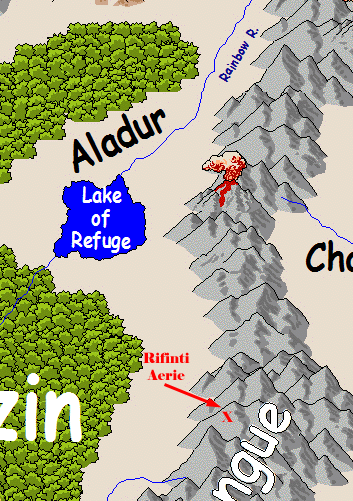 |
The Rifinti aerie is relative high up in the mountains, at an elevation of about 8,000 ft. This qualifies as a low peak area and will subject nonacclimated PCs to potential fatigue (per the Dungeon Master's Guide):
| Low
Peak or High Pass (5,000 to 15,000 feet) Ascending to the highest slopes of low mountains, or most normal travel through high mountains, falls into this category. All nonacclimated creatures labor to breathe in the thin air at this altitude. Characters must succeed on a Fortitude save each hour (DC 15, +1 per previous check) or be fatigued. The fatigue ends when the character descends to an altitude with more air. Acclimated characters do not have to attempt the Fortitude save. |
The aerie is set into a tall cliff face that rises from an elevation of about 6,500 ft to about 8,500 ft, just under the peak of the mountain. This broad almost vertical face of the mountain faces westward and commands a fine view of the vale between the mountains and the Coatlizin Jungle. A large mountain lake sits at the base of the cliff face, and waterfalls emerge from the face at various points and plummet into the lake.
The aerie is difficult to get to by foot, but not impossible, since younger raptorans cannot fly and need to be able to access the aerie. A small, winding footpath ascend the south side of the peak near to the cliff face, eventually reaching the top of the peak where the forge, several kilns, and crafting huts are located. A secret door built into the mountainside at the level of the Lower Level (Search DC 25) leads to a 10 ft wide hewn passageway that travels north for about 400 ft before reaching a locked stone door that leads into the aerie proper (see below).
The Rifinti Aerie:
The Rifinti aerie is not detailed fully in this scenario. Instead, most of the salient details can be found on pages 82-90 of Races of the Wild, including full statistics for the leaders of the aerie. The statistics can be used as presented, except that any wizard, bard, or sorcerer levels should be converted to adept levels (and remember that NPC classes like the adept count for CR purposes as the NPC level minus 1, so in this case, if a raptoran with Sorcerer 2 is substituting adept levels, he would be an Adept 3). Of course, some of the circumstances described for the aerie are not applicable to Sazhansiir (for example, no elves have moved in nearby).
Since it is unlikely that the PCs, presumably being of good alignment, will resort to coercion and violence to obtain t'rakk, these statistics should not be readily needed.
The population of the aerie is as indicated in Races of the Wild, 41 adults and 20 children and elderly noncombatants.
The layout of the aerie is as shown in Races of the Wild, which maps have been reproduced below. There are two adjustments, however. The first is that the cliff faces west instead of south, so "north" on the maps is really east. Also, there is a hewn 10 ft wide passageway that runs north to meet up with the aerie proper at the Landing Hall on the Lower Level, emerging right at the southeast corner just south of the southernmost Workshop. This passageway leads southward to a secret door in the mountainside and then to a footpath that winds down the south face of the mountainside and up to the peak. The passageway meets the Landing Hall in a stone door that can be (and usually is) barred from the inside. There is always a sentry posted to the door who lets raptorans in. Being such a close-knit community, any sentry will know any fellow aerie members personally.
 |
DMs should keep in mind that there is a large meeting cave and temple about 250 ft above the Upper Level, which is only accessible by fliers (or those with very good climbing ability). Furthermore, a forge, ovens/kilns, and crafting huts are located at the top of the peak. Details on both of these areas are given in Races of the Wild.
Dealing with the Rifinti:
The raptorans speak Tuilvilanuue and Auran. The sunspeaker also speaks Gol-kaa.
Unless they have reason to act otherwise, the Rifinti will be sociable to the PCs, though initially cautious unless they have previously met or heard of them. Initial contact is likely with a guard or sentry, some of whom are usually on the peak at night and in the shadows of the various perches and entrances during the daytime. Strangers will be challenged and questioned, and eventually the Sunspeaker Elissto Nisian will arrive to parley. Assuming good relations are established, the PCs will be brought to the Great Hall, where the important persons of the aerie will be present. Here, the flock chief Jenlisa Iltinger will treat with the PCs, making them welcome and offering them food and drink, likely assuming that the PCs are on a trade mission and have brought goods to sell or barter.
However, once the subject of t'rakk is broached, the mood will change somewhat. No hostility will be evident, but glances will be exchanged amongst the raptorans present and curious clucking sounds will be made in the back of their throats. Eventually, Delembril Vintagil, the supply chief, will step forward and tell the PCs that there is no t'rakk to be had. She will then somewhat angrily turn and leave the chamber.
After an awkward silence, the flock chief will explain what has happened.
If the PCs are not familiar with t'rakk, the flock chief will first explain the information provided by Pizotzin previously. Then she will say that at the last sharing ceremony, a young aerie member named Quasilik Vintagil, who had already shared the t'rakk, suddenly grabbed the sacred blend as it was in the hands of Henesku Finlist, the medicine chief (aka high shaman) who was about to consume the fully shared t'rakk and soar upon the "air of dreams". Quasilik took the t'rakk and swallowed it all. He did not place it in his gizzard, but he swallowed it into his gullet, exclaiming that now he would soar to greater heights than any had before him.
The aerie was shocked at this horrific breach of ceremony, but was even more astounded when Quasilik did not immediately fall in wracking pain and die a quick death, which would be expected of one not blessed by the aerie and trained in consuming the sharing. Instead, the power of the t'rakk seemed to infuse throughout his body and he grew larger and began to transform his appearance. He fled the ceremony cave and the stunned aerie will a bit too slow to recover and chase him...he had gone, but not before taking the entire store of t'rakk with him.
T'rakk is not easily made. The sharing happens only once every year, and the blessed t'rakk must be sanctified when the moons and stars are perfectly aligned. Jantril Sestriin, the Star Chief, will interject that this will not happen again for around 12 years.
It was counseled, at first, that the aerie should raise a war party and track down Quasilik and bring him back to justice, but it was decided that this was risky, since Quasilik might decide to consume the rest of the t'rakk in desperation, even though it has not been shared and has no potency. Additionally, it was assumed, and even hoped, that the large dosage of shared t'rakk would eventually incapacitate or kill him, allowing the rest to be recovered without risk to the aerie. Unfortunately, this has not happened. There is no doubt that Quasilik is still alive, since his shrieks and laughter have been heard coming from Daerdil's Eye, a cavern in a nearby mountain, as recently as 3 days ago. As the time for the next sharing is drawing near (it will occur within the next month or so), the aerie was considering finally entering the cave and confronting Quasilik.
However, the winds have now brought the PCs to the aerie, and the more mystically minded amongst the leadership believe that the PCs have been brought by the gods to aid them in their predicament. The Rifinti are a small aerie, and the loss of even one or two of their members can have a significant impact on their fortunes. Instead, since the PCs have come seeking shared t'rakk, the flock chief will offer them a bargain. If they can enter Daerdil's Eye and take the t'rakk from Quasilik, the aerie will agree to give them half of whatever they recover, and fully share it as well. As far as Quasilik, the flock chief would like the PCs to try to determine why he did what he did, but that is secondary to recovery of the t'rakk. If Quasilik can be spared, so be it, but if not there will be no tears shed for him, as his crime would likely result in his exile from the aerie anyways.
Should the shared family names of Quasilik and the supply chief, Delembril, be noted, it will be acknowledged that Delembril is the mother of Quasilik and is very likely embarrassed and angered by her son's actions.
Quasilik's Situation:
Quasilik's motives are not entirely random. Quasilik is not entirely raptoran either. He was born of the union of his mother, Delembril, and a fiend. Delembril had begun to engage in mystic research and meditations that took her down a path that darkened with the passing years and eventually led to worship of fiends. In an effort to bring more power to herself and to appease her master, she mated with a fiend and bore twins. The more fiend-like offspring was carried into the netherworld by her fiendish paramour. The more raptoran offspring, Quasilik, remained with his mother and was brought up with the aerie.
Delembril hoped to keep her son's nature a secret for a long time to come. Her plan was to raise him into full adulthood, a high position within the aerie, and to hone his powers so that one day he and she should take over the aerie, depose the flock chief, and set up a new, fiend-worshipping dynasty. Unfortunately, Quasilik's fiendish nature caused him to become more and more unhinged. When he took part in this latest sharing, the taste of power within the t'rakk ignited his fiendish taste for souls (for the essence imbued into the t'rakk is akin to both incarnum and soul-stuff). All rational thought left him and, catching even his mother by surprise, he consumed the t'rakk. The shared substance should have killed him outright, but for his fiendish heritage. Instead, the t'rakk has bonded with his unique bloodline and a synergy of power has been created. It has awakened the latent fiendish properties of his bloodline and turned him into something else entirely.
Revelling in the initial rush of power, Quasilik stole the rest of the aerie's t'rakk and fled to Daedril's Eye where he has spent the last 17 months (remember, there are 18 months in the Azotlan calendar) both honing his control over his newfound t'rakk powers and reconnecting with his father, who has sensed the events and change that have overtaken his progeny and is intrigued. During this time, the t'rakk has also apparently connected Quasilik with his twin brother and allowed the twin to imbue some of his own essence across the planes and into Quasilik, functioning effectively like a form of possession.
Meanwhile, Delembril is simply beside herself with worry that, somehow, her son's rash actions will expose her deeds. She has given up entirely on her plan and her son and wants him killed quickly and with as few questions as possible, though she is wise enough not to press for that, but to instead play the angry mother.
Daerdil's Eye:
Accessing the Eye is not too difficult for a high level group of PCs. The eye is on a neighbouring peak from the Rifinti aerie, about 6 miles to the northeast as the crows fly. The eye is not imminently accessible by foot, and would require scaling parts of the mountain peak in which it is situated.
If the PCs must scale the peak, assume that 6 Climb checks (3 of DC 10, 2 of DC 15, and 1 of DC 20) are required, with each check taking 10 minutes and failure by 5 or more necessitating a DC 15 Reflex save to catch oneself with a DC 15 Climb check needed to pull oneself back up (and a failure by 5 or more of that resulting in a fall). Assume a fall is for 2d6x10 ft.
The Eye itself is a large opening, some 40 ft wide and 20 ft tall. Walls are of unworked stone (DC 15 Climb check, break DC 65, 8 hardness, 900 hp per 5 ft) and floors are of hewn stone (DC 10 Balance check is required to run or charge across such a floor; failure means the character can still act, but can’t run or charge in this round). The opening is about 600 ft below the peak.
Unless otherwise stated, cavern ceilings are around 15 ft tall and passageways around 10 ft tall.
Unless otherwise indicated, there is no lighting within the caves.
 |
A. Entrance
|
Within the Eye is a small, somewhat exposed cave with two passages heading in to the north. There are chalk white bones scattered amongst the stones here. |
If a PC wants to listen here, he can make a Listen check to hear Quasilik praying to the statue of his father in area D. Quasilik is about 300 ft away from the middle of this cave, so a DC 30 check will be required to hear him talking and a DC 40 check to actually make out what he is saying.
As the PCs progress further into the caves, the DM should note the Listen check and determine how close the PCs would have to come to hear Quasilik. He should then alert the PCs when they come to that distance away.
B. Isolated Cave (EL 6)
This cave is isolated from the rest of the Eye by means of a rock fall that has blocked access to it. The rock fall is recent (as a DC 15 Knowledge [architecture and engineering] or DC 15 Knowledge [dungeoneering] check can determine) and it leaves a hole between the top of the rock fall and the ceiling of the passageway that is about 1.5 ft in diameter.
The cave itself is 25 ft tall and a large crack at the top some 5 ft tall and 15 ft wide allows the occupants to enter and leave the place. The floor is littered with large chunks of guano.
Creatures: Within this cave dwell 4 dire bats. These creatures have roosted here for many years, and normally used the blocked passageway to enter and leave the cave. However, when Quasilik blocked off the passageway in order to keep the bats from bothering him, they fortunately had an alternate means of egress. They cannot fly out of the crack, but they can fly up to it and then crawl outside before taking flight.
The dire bats are surly, as befits dire animals, and are not happy at having their lair disturbed. If a bright light is shined into the cave, they will become quite agitated, screeching loudly enough to alert Quasilik that something is amiss.
|
Developments: For purposes of spells like speak with animals and abilities such as wild empathy, assume the dire bats are unfriendly to the PCs. If the PCs have shined a bright light into their lair and thereby provoked them, assume they are hostile.
While these dire bats in no way pose a real threat to the PCs, if they are disturbed they will serve as a sort of default alarm system for Quasilik. Additionally, the bats could be charmed or recruited by certain PCs to aid them in the coming battle or even to give them some information as to what dwells deeper in the cavern.
C. Main Gallery (EL 12)
| This large cavern is up to 20 ft high in some places and various large mineral formations reach from floor to ceiling. |
Currently present, and meandering around the place, are 6 manes and 4 ekolids. The manes are on the cavern floor, while the ekolids are generally on the walls and climbing on the mineral structures.
A chasme can usually be found hidden and perched high up the middle large mineral formation in the cavern (about 20 ft northeast of the letter "C" on the map). This creature will not summon another chasme, as it is not fully comfortable with its current circumstances. Instead, it will summon rutterkins.
DMs should note that these creatures have been called and not summoned. Any ekolid grubs that hatch will smply dissolve back to their home plane 1 round after it emerges from its host.
|
|
|
Tactics: The manes are relatively mindless and will simply swarm non-demons, as is their wont.
The ekolids are not mindless, and have given up trying to implant their grubs into hosts, since the grubs dissipate away after hatching. They will, however, use their implanting ability as a weapon in combat. The ekolids currently are willing to follow the orders of the chasme.
The chasme is not happy about being called here inexplicably, but Quasilik has shown his power and has promised the chasme great opportunities for torture and misery-causing should he serve the ex-raptoran. For now, the chasme is willing to bide his time and see what happens.
In combat, the chasme will cast protection from good on Quasilik at the first opportunity, then ordering the ekolids and manes around as best he can, while staying out of combat himself if at all possible. He will certainly attempt to drone against foes, and if his opponents appear tough he will not hesitate to use his unholy aura.
If rutterkins are summoned by the chasme, he will cast fly and protection from good on them if useful.
D. Shrine to the Father (EL
19)
| This side cavern is dominated by a stone column to the northeast that has been crudely carved into a demonic shape. The precise type of fiend is unknowable, owing the to crude carving, but clearly it is a horrific, snouted humanoid with bat-like wings and some sort of aura surrounding it. |
Creatures: Quasilik can usually be found kneeling before the stone column praying to his father and beseeching him, in Abyssal, to recognize his heritage. If the PCs listen in they can hear phrases like:
My father, please acknowledge your son's power...for I have taken it from the feathered people and I prepare the way for your power on this plane.
Am I not now the equal to my brother, father? Have I not shown my worthiness. Take me into your service that I might know true power.
Father, guide me in my next step. When shall I strike against the feathered people?
I have used the power to cast off the feathered trappings of my mortal parent, father. I have become like unto you and my brother. Please show me a sign of your approval.
Quasilik appears as a massive raptoran, with large batlike wings, strange scaly patches on his body amongst disordered rows of feathers, weird horns and protrusions sprouting everywhere, and a strange blue-green energy crackling up and down his body (this latter the remnants of power from consuming the t'rakk).
|
FEATS: Claws of the Beast (FCHoA p84) - natural attacks gain +1 dmg/2 abyssal heritor feats, -2 to Sleight of Hand checks. Demonic Skin (FCHoA p85) - you gain +1 natural AC per abyssal heritor feat, suffer -2 to Escape Artist checks. Fiendish Heritage (CM p43) - +4 saves vs poison, +1 saves vs spells and effects by good creatures. SPELLS: hunter's mercy (SC p117) - r pers, 1 rd; first hit with bow in next round is critical. kuo-toa skin (SW p118) - r touch, 1 hr/lvl; target gains +8 to Escape Artist checks and cannot be snared by webs. |
Tactics: Quasilik is drunk with power from the t'rakk, but he is not stupid either, the possession by his brother giving him extra insight into the world around him. However, he is obsessed with proving himself to his father and his brotherly rival, and so will not back down from any fight. He will fight to the death.
In combat, Quasilik will use his unholy aura right away and then follow on with a blasphemy to test his foes' power and to affect as many as possible. His horrid wilting he will save until the tactical situation calls for it, though since it will not target alllies he doesn't have to worry about casting it while his demons are mixed up with the PCs.
If he has time before combat starts, he will quaff one of his barkskin potions. He will also cast kuo-toa skin on himself, and if so he will be far more likely to emerge from the protection of the unhallow effect and the freedom of movement fixed to it. Otherwise, he is likely to try to goad foes into approaching within the unhallow.
Developments: When Quasilik is defeated (if he is killed or brought to negative hit points), he will likely howl in rage and say in Abyssal: My brother, you have proven to be the worthy son...I have failed! before undergoing his death release. Then the PCs will face his brother!
When the brother comes forth, during his round of doing nothing, he will respond to his brother's death cry in Abyssal: Indeed I have dear brother. And now I shall prove to father who shall inherit his place by killing those who killed you!
|
Tactics: The brother will seek to prove his worth to his father and will attack the PCs unceasingly, especially since he cannot be slain permanently on this plane.
Having observes the PCs through his brother's eyes during the initial combat, he will be aware of the PCs' tactics and capabilities and react accordingly.
Because he is trying to prove himself to his father, he will only use his summon tanar'ri ability to call in 2d4 babaus. Calling in hezrous or glabezru would put him in the debt of such formidable creatures and would likely diminish his victory in his father's eyes.
He will attempt to use his sneak attack ability when possible, probably with the help of any babaus he manages to summon.
Treasure: If the sundered body of Quasilik is examined, a bluish paste will be seen leaking from his throat. This is the t'rakk....which he has stored in his gizzard. The PCs can retrieve the entire store of unshared t'rakk stolen by Quasilik from his gizzard (it amounts to approximately 6 full vials).
E. The Tomb of Daerdil
| This cavern is dominated by a large pillar of crystal-studded white stone that rises from floor to ceiling in a vague spiral. A crude statue of a raptoran sitting on a stone is set before the northeast face of the pillar. The raptoran depicted by the statue has its right hand upraised and holding a wand, sceptre, or some sort of stick or implement, while its left hand seems to be clenched into a fist grasping something. |
When Daerdil became old and enfeebled and he saw his death coming, he announced to his fellow raptorans that his time had come and that he wished to be left as he would be found, at rest in his cave.
And so, Daerdil sat down on a stone, leaned back against the pillar, and died peacefully. Over the years, his body was covered in calcification and mummified to some extent, so that his corpse now appears like a crude statue.
In Daerdil's right hand is a set of augury bones. These are suitable for casting the augury spell.
In the oracle's left hand is clenched an ivory sphere about 3 inches in diameter and clearly hollow if it is hefted and its weight noted. The sphere has no visible seam or means of opening it, but if it is cracked open, within will be found a roll of parchment.
The parchment contains writing in Tuilvilanuue and it reads:
You who seek the book of power, know that the story told on stone can be as powerful as that told on paper.
This is a prophetic writing of Daerdil...his last pronouncement in fact, and it was made specifically for the PCs and refers to their quest for Karsus' spellbook.
At the DM's option, when the PCs enter this cavern and are about to leave, if they have not uncovered the sphere, they will hear a crack come from the figure and will see a web of cracks in the calcification around the sphere. This is Daerdil's best effort to attempt to attract the attention of the PCs.
Return to Rifinti:
PCs returning to Rifinti will possibly have put together the evidence of Quasilik's condition and his references to his father and brother to figure out that Delembril Vintagil mated with a fiend. Delembril will be tentative upon the PCs' return, and will ask after the fate of her son.
Should the PCs accuse her, she will initially deny any such involvement. If pressed and threatened with truth-telling magic, she will break down and claim that she was ravished by a fiendish entity and was too ashamed to tell anyone and feared that should the aerie find out, they would kill her beloved child.
This is a lie. Delembril mated willingly with Quasilik's father, and she is now a clerical demon worshipper.
Creatures: Delembril's adjusted statistics are presented below (these supercede her statistics from Races of the Wild page 86). When the PCs first arrive, Delembril will take a few rounds to cast some defensive spells as noted below.
|
FEATS: Evil Brand (FCHoa p85) - +2 to Diplomacy and Intimidate checks against evil creatures. Thrall to Demon (FCHoA p87) - 1/day when performing evil gain +1 luck bonus to any one att, save, ability, skill, or level check. SPELLS: clutch of Orcus (SC p49) - r med, 1 humanoid, conc. up to 1 rd/lvl, sv F neg, SR; victim paralyzed and takes 1d12 dmg /rd, new Fort sv each rd to end spell. demonflesh (FCHoA p92) - r pers, 1 min/lvl; +1 enhancment bonus to natural AC/5 CL (min +1, max +4). greater resistance (SC p174) - as resistance but +3 bonus and lasts for 24 hrs. nauseating breath (SC p146) - r 30 ft, cone, sv F neg; save or be nauseated for 1d6 rds. sound lance (SC p196) - r med, 1 creature or object, sv F 1/2, SR; 1d8 sound dmg/CL (max 10d8), cannot penetrate silence spell. swift etherealness (PHB2 p113) - swift, r cl, willing creature, 1 rd, SR; subject becomes ethereal until end of its next turn, if ends in solid object or occupied space shunted to nearest open space and takes 1d6 dmg/5 ft. |
She has rebuked two raptoran wraiths. She has also conducted eldritch rituals on them to evolve them. These always follow her around, remaining inside of stone or the ground but just below 1 ft from the surface in the case of stone and just below 3 ft from the surface in the case of dirt. Because of this, they cannot be detected by most spells (such as detect evil or detect undead). Since the cleric gives her undead mental commands, the fact that they are underground and cannot physically hear her is not an impediment. She will call upon these wraiths to aid her in combat (this requires a standard action).
|
|
Tactics: If she has warning of the PCs' return, she will cast owl's wisdom, shield of faith, and freedom of movement on herself in preparation. If the PCs meet her and detect these spells active on her and question her as to why she has them cast, she will say that she worried that the PCs had brought back her son and that he might be dangerous or attempt an escape once returned to the aerie.
Delembril will not, once she has been confronted, want to stick around and fight. To that end, she is likely to spend the first round of combat mentally commanding her wraiths to emerge, with wraith #1 casting haste immediately (including Delembril in its effect) and then the cleric casting swift etherealness to flee at hasted speed through the walls or floor to escape.
If somehow she is stopped, she will use her spells to the uttmost to delay or confound her attackers so that she can escape. Escape is her top priority. If she cannot, then she will be determined to take down as many of her foes before she falls. She will not surrender.
Developments: If Delembril should escape the aerie, she can become a nemesis for the PCs, whom she will blame for at least the tail end of her misfortune.
If Delembril is slain, her head will suddenly animate and speak (or if she no longer has any head, a disembodied voice will speak) in whatever language the PCs mainly speak. This is the father of Quasilik, Ghyrrun'ilkk, and he will utter the following:
So...you have slain both of my progeny and my paramour, mortals? Know that you have earned the ire of one who will see you begging for mercy for years as you are flayed alive. Sleep lightly. Tread warily. And best enjoy what small sliver of life you have left...for I am coming one day to claim my weregeld.
Getting the T'rakk:
In any event, whether Delembril is confronted or not, the PCs will be allowed to keep half of the t'rakk. Since this comes to 3 vials, and Pizotzin indicated 4 vials would be ideal, the PCs can bargain with the raptorans for the extra vial. However, this will require a DC 15 Diplomacy check, with a -5 penalty if Delembril was confronted and escaped (for they will be worried she will try to steal some of the remaining t'rakk) and a -10 penalty if Delembril is present and unconfronted and so can argue against giving the PCs any further t'rakk.
No matter what, the PCs, having successfully recovered the t'rakk, will at least be entitled to half of it and the raptorans will share it amongst the aerie in order to provide the PCs with charged t'rakk.
Should the PCs try to hold out on the raptorans, they possibly can (although the raptorans know how much was stolen). However, the uncharged t'rakk is useless to the PCs for the purposes of this scenario.
Additionally, the Rifinti aerie will now be friendly with the PCs, who will be invited to stay as long as they like and to return whenever they desire. Should the PCs have a stronghold, the Rifinti will visit them from time to time and even trade there.
Part Four - To Bee or not to Bee
The last exotic item Pizotzin needs to complete the modified histaachi brew is some royal jelly from an exotic race of bee-people called the abeil. Pizotzin knows little about these folk, other than the fact that they dwell in Charmindos and are supposedly very territorial and protective of their lairs. They are highly distrustful of strangers, but it is not known what their relationship is to the Scaled Ones, if any such relation exists at all.
However, some samples of royal jelly have been brought back to Azotchtlan Lands over the centuries, and it has proven to have some amazing alchemical properties if properly utilized.
Pizotzin will need at least 4 flasks of royal jelly, and 8 flasks would be preferred.
Finding the Abeil:
This will not be easy, as almost nothing is known of the bee people beyond what Pizotzin has mentioned. However, if a PC wishes to do some extensive research at the Knowledge or Travel temples, he can make a DC 40 Knowledge (geography) check to learn that the abeil have extensive sonic powers. These will be in the form of scattered and unreliable antecdotes from the few Azotchtlan explorers who have visited the land (or from those who claim to have spoken with them) or from stories supposedly garnered from the goliaths who heard them from the feral garguns. Each Knowledge (geography) check will take 1d3 weeks and cost roughly 1d20 gp in bribes and donations. Each time the check is made, allow a +10 bonus to the check, but this bonus will never exceed +20. Nothing regarding the location of these creatures will be known.
Beyond this, the PCs are best served by simply travelling to Charmindos. Any adventures or encounters along the way are not detailed in this scenario.
Charmindos:
Once in Charmindos, the PCs will find a land that consists of rolling plains and sparse forests. The climate is temperate in the summer and cold in the winter, unlike most of the rest of Sazhansiir, for the climate-influence of Kyuss never overcame this remote land.
A few encounters designed to give the PCs the flavour of the land are presented below. None should unduly challenge the PCs.
Encounter #1 - Spore (EL 14)
The PCs will be attacked at twilight or night by a sporebat.
Creature: This specimen is a tough, large creature looking for prey.
|
|
Tactics: The sporebat will rely on its silence and camouflage to enervate foes from the distance. It will only close with foes who seem to be severely weakened by its ray or who appear immune to it. In this case, it will make prodigious use of Power Attack and Improved Flyby Attack to harry its prey.
The sporebat will attempt to flee if reduced to 25% of hits total hit points or less. However, if pursued it will use its enervation ray to defend itself and convince pursuers to give up the chase.
If the sporebat can, it will grab a helpless foe and fly away with it to feed. As hunger is its only motivation, once it has a meal, it will leave the rest of the PCs alone unless attacked. This means the PCs could give up a mount or even a summoned creature to distract the sporebat.
Developments: The sporebat has no lair and no treasure.
Encounter #2 - Ambush (EL 13)
A pack of ambush drakes, led by a fearsome pack leader, has set up its usual ambush. In this case, a downed branta has been left in the middle of a clearing. The ambush drakes wait hidden amongst the large boulders and bushes and grass nearby, intending to pounce on anything that comes to investigate the kill, and then eating the branta as well once their day of ambushing is over.
Creatures: The pack consists of 11 ambush drakes led by a larger pack leader. They drakes are arrayed in a rough circle around the branta body, about 75 ft in diameter. The clearing itself is about 40 ft in diameter. The pack leader is about 50 ft further back from the ambush circle, hidden amongst some larger boulder to conceal its bulk. Because of this arrangement, all of the normal ambush drakes are within 30 ft of two others, allowing the entire circle to be in telepathic contact with each other.
|
|
|
|
Tactics: These ambush drakes are certainly not expecting prey like the PCs, but neither do they have much experience dealing with humans and other races of which the PCs are likely comprised. As such, they will welcome the opportunity to attack.
As experienced ambushers, the drakes keep their eyes to the sky as well as the ground. Given their telepathic communication, they can effectively have multiple eyes on both. If they see the PCs, they will certainly allow them to come and investigate the branta body. Should that not prove to entice the PCs, then at the first moment that it appears that the PCs will not come into the ambush circle, the drakes will spring up as one and give chase. They are not very speedy flyers, and will rely on an initial barrage of slow breath weapons to nab prey.
The pack will never flee as long as the pack leader is fighting. The leader will flee when reduced to 25% of less hit points or if 2/3rds of his pack are down, unless it appears he is about to win the fight. The pack is interested only in food and does not keep prisoners.
Developments: If the pack flees, they will not flee to their den, but rather into some nearby dense woods. If that fails to stop pursuit, they will turn and fight as one.
The Battle Royale:
This encounter takes place during the daytime and serves to bring the PCs onto the course to gain abeil royal jelly. A group of catfolk are in the midst of a fight against a group of feral garguns. The PCs will come upon the battle in full swing. It is, of course, up the PCs whom to side with or whether to attempt to broker a peace or to simply sit the battle out and treat with whomever is victorious.
Creatures: The battle is taking place between a pride of 15 catfolk and a band of 12 feral garguns. 3 catfolk are sprawled on the ground in pools of blood, and likewise 2 feral garguns. Whether any of these five defeated beings is still alive is not readily apparent to normal means of observation. The garguns came upon the catfolk suddenly and took them by surprise, crashing into their midst after having espied them from a distance and hiding. Normally, the catfolk prefer to combat with their bows, but the sudden ferocity of the attack has left them reeling and in close quarters.
Catfolk:
This is a catfolk hunting pride of 10 rangers, 4 rogues, and a leader who is a multiclassed individual. The rangers and leader all have eagles as animal companions, but they are used only as scouts and are kept well away from the combat.
|
SPELLS: hunter's mercy (SC p117) - r pers, 1 rd, first hit with bow in next round is critical hit.
|
|
|
|
|
Feral Garguns:
This is a raiding group of feral gargun barbarians, led by a truly fearsome specimen.
|
FEATS: Extend Rage (CW p97) - Extends rage or frenzy by 5 rounds for each use.
|
|
FEATS: Extend Rage (CW p97) - Extends rage or frenzy by 5 rounds for each use.
|
Tactics: The garguns will basically press their advantage in close in combat, always shifting position to keep the catfolk from sneak attacking them. All of them are in the midst of barbarian rage and have 6 rounds left before their rage ends. Most will be using 4 points of Power Attack, which, when supplemented by their rage ability, gives them a very good chance to strike the catfolk.
The catfolk are torn between flight and staying to rescue their fallen comrades. As the battle is still in doubt, they will at least fight for a few more rounds, although direct melee combat is against their inherent nature. Several catfolk rangers will attempt to get away from the combat in order to ply their bows, but the garguns will inevitably attack such catfolk, even disengaging from melee to do so.
Developments: The PCs have choices to make here, and these choices will affect the outcome and subsequent consequences of the battle.
First, however, the PCs may wish to attend to fallen combatants. Of the 3 catfolk who began the encounter fallen, one is dead, one is at -8 hp and bleeding, and the last is at -3 hp and bleeding. Of the 2 garguns who are fallen, one is at -7 hp and bleeding and the other is stabilized at -6 hp.
The PCs can choose to aid one of the two sides in combat. Very likely, such PC aid will easily tip the combat in either party's favour. Should the PCs use overwhelming force, the side they are fighting against will flee the field in fairly short order, once it is clear they don't stand a chance against the PCs. If the PCs choose to pursue and hunt down fleeing combatants, they can do so, although their brutality will be noted by both sides (although the garguns may not disapprove if the PCs are hunting down fleeing catfolk). The side for whom the PCs fought will now be friendly to the PCs.
The PCs could also stay out of the fight altogether. In this case, assuming they do stick around to determine the outcome, the DM can just roll d100 and the higher the roll the more signifcant a victory for the feral garguns, while the lower the roll the more significant the victory for the catfolk. In the below table, "lost" means negative hp or dead. Assume a 50% chance a lost person is dead outright; otherwise roll a d10 and that number is the creature's negative hp amount (with a "0" result equalling zero and not 10). Remember that the table below does not account for non-incapacitating wounds. So even though in a marginal catfolk victory the catfolk might lose more members than the garguns, the surviving garguns could be all horribly wounded while the catfolk not fallen are in much better shape.
|
|
|
|
|
|
Catfolk | Decisive victory. The catfolk manage to maneuver the enraged garguns into flanking positions where their sneak attack take a toll. They also fight defensively and use up the gargun's rage duration effectively. The catfolk lose 1d4 members and the garguns are mostly lost, with 1d4 of them driven off. |
|
|
Catfolk | Tactical victory. The catfolk manage to sneak attack many of the garguns and a well-placed entagle manages to divide the garguns sufficiently that the day is carried. The catfolk lose 1d6 members and the garguns lose 2d4 of their number, the rest having been driven off. |
|
|
Catfolk | Marginal victory. The catfolk prevail after a brutal fight. They lose 2d4 members and the garguns lose 2d6 members and are driven off. |
|
|
Garguns | Marginal victory. The garguns prevail after a brutal fight. They lose 2d4 members and the catfolk lose 2d6 members and are driven off. |
|
|
Garguns | Tactical victory. The garguns land some massive Power Attack criticals. The garguns lose 1d6 members and the catfolk lose 2d4 of their number, the rest having been driven off. |
|
|
Garguns | Decisive victory. The garguns manage to slay the catfolk before they can get into flanking positions and are able to keep the archers pressed in melee. The garguns lose 1d4 members and the catfolk are mostly lost, with 1d4 of them driven off. |
On the other hand, the PCs may choose to intervene to stop the fighting altogether. This will not be easy. A feud has been simmering between this nomadic clan of catfolk and this tribe of garguns, and this battle represents its evolution into full-scale skirmishing. No amount of pleading or diplomacy is likely to quell the fighting, even despite a PC having a very high Diplomacy check. The two sides simply aren't interested in listening in the first place, and until they listen, they cannot be persuaded by words. Nevertheless, allow the PCs to attempt such checks, futiley propounding peace and reasonableness as catfolk and garguns hack away at each other. Bluff and perform checks are also unlikely to even be noticed. Magic of various types can be used to force a PC to be heard (such as enthrall or mass suggestion), but these have various limitations that make them unlikely to be effective.
Intimidate, however, can work. To have a chance, something very loud, flashy, or frightening must gain the attention of the entire battlefield. This can include a massive spell effect, a loud shout, an illusion of a dragon appearing, or whatever. This will allow a rushed Intimidate check against all of the combatants at no penalty (however, the garguns' powerful build trait allows them to be treated as a size Large creature and that affects Intimidate checks, and if they are in the midst of raging then the DM should assess an additional -4 penalty to the Intimidate check). Assume that all combatants are unfriendly to the PCs initially. If the PCs have caused harm to one side or the other, than that side will be hostile. To stop the fighting, both sides must be made indifferent. That will stop the fighting for precisely 1 minute assuming that a PC immediately begins a Diplomacy, Bluff, Intimidate, or Perform check as appropriate; the combatants will listen and watch the PCs and hear what they have to say. If a PC does not immediately begin to try to reason with the combatants, then the fighting will resume in 1d3 rounds.
Although the combatants can be made indifferent via an Intimidate check, that indifference is with reference to the proposition to listen to the PCs. It is not actually reflective of the combatant's attitude to the PCs themselves.
Both sides will initially be hostile to the idea of halting hostilities. In order to convince them to stop fighting altogether, a check must be made against each side. Each side must be made at least indifferent. If a result is less than indifferent, then that side will resume combat immediately. If combat is resumed, there will be no way to halt it short of physically or magically ending the fight or having one side flee the encounter.
If the combat is halted altogether, the level of the check doing so will determine what likely happens thereafter.
Indifferent = that side will grudgingly halt the fight, but only for the moment. They will insist on leaving the scene and will vow to resume hostilities at a later time ("this isn't over by a long shot!"). If both sides are indifferent, then both will seek to leave, proclaiming challenges for a later time. The PCs can elect to accompany one or the other group, but there will be no way to resolve the underlying feud at this time. If the PCs accompany one side, they will be shunned by the other side. There is no way the PCs can befriend both sides.
Friendly = A friendly side will remain in the area and will calm down a bit. If both sides are made friendly, both will remain in the area and end hostilities. The PCs can then speak with them and learn about the feud and try to mediate somewhat. However, the tension is still very great and any missteps by the PCs will result in one side leaving in a huff or, at worst, resumed hostilities. The PCs can elect to accompany one or the other group, but there will be no way to resolve the underlying feud at this time. If the PCs accompany one side, they will still be welcomed by the other side at a later time, once the other side has calmed down some more.
Helpful = A helpful side will welcome the PCs' intervention. If both sides are made helpful, the PCs will have calmed both sides down quite a bit and can actually start a dialogue about the feud in the hope of settling it somewhat. The PCs will be invited to both side's encampments with open arms.
The Garguns:
The feral garguns dwell in a tribal camp located about 7 miles to the northeast of the battle site. Their camp is a collection of mud-covered tepee-like shelters made of bones, wood, and animal hides. There are approximately two dozen large structures, each holding a family unit of 1d6 adult feral garguns and 1d3 children (the mortality rate amongst gargun children is high). The entire camp numbers 84 adults and 48 children. There are no pets or livestock in the camp, though the garguns keep a fire in each tent. The elder and more powerful garguns have their tents in the center of the camp.
The PCs, assuming they are now friendly to the garguns will be taken to the central area where a large firepit is surrounded by the largest tents (this pit will be lit with a bonfire at night). There they will meet the tribal chieftain and witchdoctor (an adept known as a Spirit Guide). If the PCs aided the garguns in their battle with the catfolk, they will be thanked and offered each a necklace of ivory teeth carved with Gol-kaa runes that name them as friends of the Kunatlaa tribe.
If the PCs ask about the abeil, the garguns will explain that they are a strange bee people who keep to themselves but attack all intruders mercilessly. The garguns know where a nearby hive of the abeil is located and can direct the PCs to it, but the garguns will certainly be perplexed as to why the PCs are interested in the abeil and they will ask questions. If the PCs indicate that they intend to interact with the abeil in any way, the garguns will warn them that the bee people never speak to outsiders. They never warn them away. They simply attack without mercy anyone who enters their territory until such persons are dead or leave. Bee people encountered outside abeil territory never attack unless bothered or unless approached closely.
The garguns will ask the PCs why they seek the bee people, but will not press the issue if the PCs seem reticent to explain their goals.
The garguns will agree to tell the PCs where they can find the nearest abeil hive (and the only one they know of). They will also warn the PCs of the abeils' sonic powers.
The garguns will invite the PCs to a feast in their honour that evening. The feast, held around the great central bonfire, will be comprised of all sorts of rough, hearty fare, including wild boars, kine, and even some smaller dinosaurs. All vegetables are clearly picked from the wild, and no processed foods are evident (such as bread). During the feast, the garguns will engage in displays of strength for the honoured guests, including wrestling matches and lifting contests.
Eventually, as the feast progresses, a drinking contest will be announced. The PCs will be invited (but not required) to participate.
The Drinking Contest:
Garguns will roll out six large barrels and bring a variety of drinking gourds. The barrels are unmarked, except with a single Gol-kaa rune painted on each. The rune names the drink held within. Each barrel holds a special gargun drink, made from fermented plants, animal parts, and things best left entirely unsaid. It is considered a sign of virility and prowess for a gargun to be able to down these drinks. Each gourd full of drink contains 20 large swallows or gulps.
For the contest, lots are cast to determine which drink is used. The drink choice is always random. The two contestants then must engage in a contest to try to finish the drink. Generally, a victory occurs if one participant finishes all 20 swallows and the other does not. If both finish, it is an honour, but there is no winner. If neither finishes, then while the contestant who has taken more swallows can berate the other, no glory accrues to either.
Each contestant can only participate in a single drinking contest at a given feast. No magic may be used or active during the contest. Contestants must strip down to loin cloths and tribal adepts will have detect magic active to check for any cheating.
Usually, some token of value is put up as a prize by each contestant. This can be anything from an animal pelt wrth a few gp to a prized magic weapon. Only if there is a winner in the contest is the prize claimed. In the case of a draw, both contestants keep their prizes.
1. Guddoom
| This liquid is pale yellow in colour and has the viscousity of syrup. Chunky bits of things float in the mixture, although it is impossible to tell what they are made of. |
Effect: Each swallow of guddoom requires a Fort save or the imbiber will suffer 2d6 points of nonlethal damage. A successful save results in half damage. The Fort save DC begins at 10 with the first swallow and increases by 2 for each swallow thereafter. If the imbiber takes more nonlethal damage than his current hit points, he falls into a swoon until he has regained consciousness (by healing his nonlethal damage).
Contest: A victory is if a drinker finishes all 20 swallows and his opponent does not. Anything else is a draw, although bragging rights go to anyone who finishes the drink.
2. Head Chunker
| This liquid has the look and consistency of thin ale, but there are strange red and green veins of liquid running along the surface, and red and green specks float within and swirl about strangely even if the container is held perfectly still. |
Effect: This drink goes directly to the imbiber's head. Each swallow hits like a sledgehammer and makes the ears pop with a loud rushing sound like waves crashing on the breakers (of course, only the imbiber can hear this!). Each swallow causes 1d6 points of nonlethal damage (no save) and a Fort save must be made or the imbiber suffers 1d3 points of Int damage. The Fort save DC begins at 10 and increases by 1 for each swallow. If the imbiber's Int reaches 0, there is a massive popping sound inside his head that is audible even to those nearby. Blood runs from the imbiber's nose and ears and all nonlethal damage from this drink is converted to lethal damage. Should the imbiber survive, he will have suffered 1 point of Int drain when his Int is restored (i.e. his last point of Int damage will not heal normally).
Contest: A victory is if a drinker finishes all 20 swallows and his opponent does not. Anything else is a draw, although bragging rights go to anyone who finishes the drink.
3. The Boss
| This liquid is deep lilac in colour and quite watery. Crushed herbs and leaves float within, and where these particles collide a tiny blue spark is generated. |
Effect: This drink makes the imbiber susceptible to suggestions. For each swallow, the imbiber suffers 1d6 points of nonlethal damage. Additionally, each swallow imposes a cumulative -1 penalty to Will saves and to any Wisdom-based skill checks. Furthermore, imbibers become highly vulnerable to verbal (or even visual) suggestions. If such suggestions are given to the imbiber, he must make a DC 10 Will save or follow the suggestion. Embarrassing or dangerous suggestions will allow a bonus to the save between +1 to +5 depending upon the degree. Obviously hostile or suicidal suggestions will not be followed, but inherently dangerous ones that could easily lead to death might be if made somewhat plausible. If multiple people are urging the same action, then a penalty to the save of -1 to -3 could be assessed. Conflicting suggestions could either have the imbiber follow whichever save was failed my the largest amount, or could simply have him running around in circles bemused.
A suggestion may be given every round, but each time the same general suggestion is made and rejected, the imbiber gets a +1 bonus to the suggestion.
The suggestive nature of the drink lasts for 1 minute per swallow, but the duration is cumulative, meaning 2 swallows lasts for 3 minutes and so on. All 20 swallows will mean the imbiber is susceptible for 210 minutes (3.5 hours).
Typically, when this drink is imbibed, those nearby shout for the drinker to do all sorts of embarrassing things. Prestige is maintained not only if the drinker can stay conscious for many swallows, but also if he can retain his dignity as well!
Contest: A victory is if a drinker finishes all 20 swallows and his opponent does not. Anything else is a draw, although bragging rights go to anyone who finishes the drink. The embarrasing suggestions have no direct bearing on the contest, but make it a whole lot of fun!
4. Cheevedar
| This liquid bubbles and froths of its own accord and is olive green in colour. It is served in a wooden mug coated in hard wax. |
Cheevedar is actually an acid as well as an intoxicant. Each swallow causes the imbiber 1/4 point of acid damage as well as 1 point of nonlethal damage. The pain associated with imbibing the drink is excruciating, such that the drinker has to make a Con check or a Will check in order to down another swallow. Only one check can be made each round s a swift action.
The check to take a swallow is a DC 1 check but a penalty to the check is assessed. The penalty starts at -1 for the second swallow and increases by -1 for each previous swallow. Thus, after 10 swallows, it is a -10 penalty to take the 11th swallow. More than 1 swallow can be taken in a round, but the DC penalty is then cumulative for all of the swallows taken (e.g. if swallows #5-8 are gulped in one shot, the DC to take any future swallows are at an extra -18 above and beyond the normal penalty [penalties of -4, -5, -6, and -7 total -22 less the -4 normally taken from these 4 swallows individually]). This makes it foolhardy to swallow multiple doses at the beginning of the contest and completely impossible to do so at the middle or end.
The acid from the drink continues to burn the esophagus, stomach, and intestines of the imbiber. Each round, the damage taken from the previous round is repeated. This will lead to cumulative damage after the first swallow. For example, after the 1st swallow the drinker will take 1/4 points of damage per round. After the second he will suffer 1/2 points of damage per round. After the 12th swallow he will suffer 3 points of damage per round.
Nonlethal damage is not ongoing and represents the effect of the alcohol in the drink.
Contest: A victory is if a drinker finishes all 20 swallows and his opponent does not. Anything else is a draw, although bragging rights go to anyone who finishes the drink.
5. Belly Buster
| The drink in this mug is a multicoloured sludge of almost every hue of which one can conceive. Bits of unidentifiable chunks float and swirl amidst the colourful riot. |
Unlike the smell, this drink tastes horrible. Just rank...beyond description. Every part of the digestive tract rebels at the presence of this concoction.
Drinking a swallow of this liquid in any 24 hour period after the first swallow has been imbibed requires a Will save. The DC of the Will save is equal to the number of swallows previously imbibed in the last 24 hours. Failure means the imbiber cannot work up the will to take another hit of the drink. But even if the will is mustered, the imbiber must keep the drink in his stomach and avoid spewing it all over the ground. This requires a Fortitude save. The DC of the Fortitude save is 5 plus the number of swallows previously imbibed.
20 rounds after the first swallow of this drink is taken in any 24 hour period, the imbiber must make a Fortitude save with a DC equal to the number of swallows taken. Failure means the imbiber is nauseated for 1 hour per swallow, while success means the imbiber is merely sickened for the same period of time.
The alcoholic content of this drink is very mild and drinking a full mug will result in only the slightest tipsiness (and no in game effect).
Contest: A victory is if a drinker finishes all 20 swallows without vomiting and his opponent does not. Anything else is a draw, although bragging rights go to anyone who finishes the drink.
6. Babbler
| The liquid in this mug is deep purple and somewhat thick...like a very thick ale. |
Babbler affects the ability of the drinker to speak, control his larynx, and to carry a tune. Sometimes those under the effect of the drink babble nonsense, and other times they utter words or phrases that have nothing to do with the topic at hand.
In addition to its alcoholic effect of 1d3 nonlethal damage every time a Fortitude save is failed (DC 5 +1 for each previous swallow), the drink imposes a -1 penalty to Charisma checks and Charisma-based skill checks for any such checks involving the spoken, chanted, or sung word. This also results in a spell failure chance that requires the caster of any spell with a verbal component to have to make a Concentration check (with a -1 penalty per swallow) to cast the spell. This effect lasts for 1 hour per swallow.
Contest: The contest for this drink does not actually involve finishing the drink. Instead, it usually involves singing a song (in Gol-kaa) with some fairly involved lyrics and melodies while continuing to drink the drink. After each swallow, while the other person is drinking, the non-drinker sings his song. They then switch off. However, until the full drink is consumed, the singing is merely for the amusement of the gathered onlookers to watch the drinkers' singing ability deteriorate over time.
Once the full mug has been imbibed, each drinker must then sing a song. Assume each song takes 4 Perform (singing) checks to complete. Total the 4 checks and compare the totals. The singer with the higher total wins the contest.
Drinking and the PCs:
The PCs will be invited to drink, and participating will go a long way in getting the garguns to trust and respect the PCs. If at least one PC does not participate, then the garguns will not agree to have members of the tribe accompany the PCs to the abeil hive. This will not be explicitly stated, but if asked whether garguns would be willing to guide or accompany the PCs, they will refuse and if pressed say the reason is that the PCs have not proven themselves by taking part in the contest.
Win or lose, just participating and trying to win will earn the respect of the garguns.
In general, the first contest will have no wager involved. The garguns just want to test the PCs' mettle. Thereafter, they will challenge other PCs with wagers. These can be as worthless or valuable as you like as a DM. Most valuable wagers will be in the form of pelts, gemstones, primitive jewerly, potions, and even possibly some basic magic items. The precise wagers are left to the DM, but the PCs must put up objects of corresponding value to the garguns.
As far as contestants, assume initially a barbarian will challenge a PC (use the statistics presented previously in the battle against the catfolk). Other similar barbarians may wager slightly valuable items. If the PCs seem to be handily winning, then a raid leader (as present in the battle against the catfolk) will step up and offer a better item and challenge any remaining PCs.
The Real Contest:
Assuming at least one PC takes part in the drinking contest and have maintained good relations with the garguns, the chieftain will eventually offer some of his tribe to accompany the PCs in their assault on the hive. It should be clear to the PCs that the garguns are not the sneaking, subtle type, and their offer of aid would be mostly useful in a frontal assault on the hive. The chieftain will offer up to one of his tribesmen to assist the PCs for each PC in the group (i.e. one gargun for each PC...this will allow each player to run a gargun). This will basically be a gesture of friendship, although the garguns are hoping to gain some sort of useful information about the bee people and to see if they are worth raiding in the future. Garguns who accompany the PCs won't demand a share of any treasure looted from the abeil, but they might be inclined to grab weapons from or loot foes they personally defeated (or helped to defeat). However, if pressed, they will acquiesce to PC demands to relinquish all abeil treasure. The garguns will be equivalent to the barbarians presented in the section describing the battle with the catfolk.
Once the offer is made and accepted, the garguns will explain that the PCs have to earn the right to command garguns. This right is not simply ordained by the gargun hierarchy. Instead, any PC who wants to lead garguns into battle must defeat a gargun commander in single combat. This combat is not to the death, but only until one participant yields or has fallen. Nevertheless, lethal damage is being done and death can result.
At least one PC must earn this right, or no garguns will accompany the PCs at all. Assuming a PC does, then the garguns will only take direction from that PC. If other PCs win the right to command, then the garguns will also follow their directions in combat. Of course, the garguns are not mindless and still have their own sole discretion as to what to do or not do in combat, but they will at least give an ear and some respect to one who has earned the right to command/
There are two types of combats in this regard. One is called "Of the Flesh", and allows for no use of magic whatsoever. The other is called "Of the Spirits" and allows for limited magic. Of the Spirits allows for any spells to be cast on the participant by the participant or his allies before the combat begins. No magic items are allowed and no magic may be cast once the fight starts.
The PCs will be allowed to choose their participant. In order for the garguns to accompany the PCs, at least one must prevail in combat. The garguns will only obey the commands of a PC who has won in this combat of arms. Multiple PCs can take part in contests (each one fighting his own one-on-one duel), and those that prevail all earn the right to command garguns.
For the gargun duelists, use the raid leader statistics as provided in the section describing the battle with the catfolk.
The PCs may also choose whether the duel is to be Of the Flesh or Of the Spirit. If the latter, the PCs can cast whatever spells they want on the PC participant. The gargun participant will have the following spells cast on him by the tribal adepts:
mirror image (CL 6)
resiste energy (fire) (CL 6)
protection from (good or evil) (CL 6) whichever
kind is applicable to the detect evil and detect good
spells the adepts will have cast on the PCs during the feast.
see invisibility (CL 6)
bull's strength, bear's endurance, cats grace (CL 4)
aid (CL 6)
For purposes if this scenario, assume there are enough adepts in the tribe to cast these spells on all participants.
There is nothing saying that if more than one PC wants to undergo the rite to command garguns that they cannot spread the duels over several days (so as to regain spells).
The duel will take place in the "Fighting Place", a dug pit in the ground some 20 ft in diameter and 10 ft deep. Duelists are told that no fighter may leave the pit or rise up higher than its top (meaning one's head or feet cannot voluntarily leave the pit). The PCs can effectively try over and over again to win the duel, although at some point and with enough failures the garguns will simply declare the PCs to weak and unfit to lead real warriors.
The Catfolk:
The catfolk dwell about 5 miles southeast of the battle site, in an encampment of hemispherical hide huts each about 10 ft in diameter and 8 ft tall. There are a total 35 tents, each holding a family unit of 1d4 adults and 1d3 children for a total population of 88 adults and 70 children. As is traditional, the tents are arranged in a spiral pattern, with the tents in the center belonging to the most important members of the clan, such as the Hallowed Hunter (most experienced ranger), the Most Silent Scout (most experienced rogue), the Spirit Speaker (most experienced cleric), and the Walker of Paths (most experienced spirit shaman).
The catfolk will invite the PCs to the central tent, where they will meet with the elders in a haze of incense and burning leaves. There they will be made welcome, thanked for any aid they gave the catfolk in the battle, and then inquire as to why the PCs are here in this far distant land. Should the PCs mention the abeil, the catfolk will look amazed and ask why they seek the bee people. Whatever reason is given, the catfolk will warn the PCs that the bee people are very protective of their territory and attack all who enter there without any sort of hesitation or parley.
The catfolk will offer to tell the PCs where the nearest abeil hive is (and the only one they know of). However, they will warn the PCs against a frontal assault, as the abeil people are very organized and dwell in a strange cave made of wax. The bee people have strange powers, including the ability to use sound as a deadly weapon.
However, the catfolk do know of a secret way into the hive. A revered scout from many years ago discovered a hidden way deep into the lair. The scout died within the lair, but his body was found outside the lair and retrieved and his spirit spoken to. And so was the hidden way divulged.
The Dreamquest:
The catfolk are willing to send a scout who knows the way to and along the hidden way into the abeil hive if the PCs will first do a favour for them.
The Great Cat Spirit has always been enemy to a spirit known as Mulkeekeeki (mull-KEE-kee-kie), who is a lord of the things that crawl and scuttle and buzz. For as long as time is remembered the two spirits have contested against each other. But every time, the Great Cat Spirit has gotten the better of Mulkeekeeki and put him in his place. Mulkeekeeki always seeks to take his petty revenge on the catfolk, since he cannot strike the Great Cat Spirit directly. Usually this is in the form of an infestation of fleas. These fleas from time to time run rampant over the clan, until the proper rituals can be performed to banish these tiny children of Mulkeekeeki; and then the fleas depart defeated for a long time before Mulkeekeeki gets the will and wile to send them again.
However, this last time the flea infestation was greater than normal, and a couple of catfolk who were bit came down with plague. It was clear to the clan elders that Mulkeekeeki had imbued some of the fleas with contagion spirits and bad magic. When the clan sent its members on dreamquest, as they usually do, to defeat Mulkeekeeki and drive away the fleas, they were for the first time rebuffed. Mulkeekeeki had grown powerful and was ready for them and had erected spiritual defenses that were perfectly created to drive away the feline dreamquesters. And while the clan was able to finally rid themselves of most of the fleas, still they are plagued even now and they worry that an even greater infestation will occur and plague could come with it.
The catfolk ask that the PCs undergo a dreamquest to Mulkeekeeki's mountain and there defeat the evil spirit. The catfolk all embody as cats, and the mystic defenses are keyed to defeat felines specifically. However, the PCs will embody as some other beasts (hopefully) and be able to contest with Mulkeekeeki.
If questioned about the dreamquest, the catfolk will explain that the quest involves a journey to the spirit world, where one embodies the totem of his people.
If the PCs are willing to undertake this dreamquest, they are escorted to another tent, this one full of primitive ritual gew gaws and trinkets. Here, several catfolk strip the PCs bare and being to paint symbols in black ink all over their bodies. This ritual takes over an hour to perform, and as it is performed, incense is burned and the PCs are given drinks of strange liquids from gourds. The PCs' minds begin to wander and reel of their own accord, and occasionally it feels as if one's spirit or soul is attempted to leap out of one's body...not an altogether pleasant experience.
Finally, as the last bits of symbols are finished, a strange herb is tossed onto the fire and the vapour becomes thicker and more cloying. The catfolk in the tent begin a rhythmic chant and the Walker of Paths informs the PCs that they are about to enter their totem animals. In the form of these creatures, they must make their way into Mulkeekeeki's mountain and defeat the spirit. Mulkeekeeki usually appears as a large black spider with a blue mark like that of dragonfly wings on his abdomen.
Totems:
The PCs will suddenly find themselves embodied in the form of an animal. There are five animals available, and the PCs should each randomly receive a different animal. If there are more PCs (and cohorts) than there are animals, then additional animals can be assigned randomly. If there are fewer PCs than animals, then the DM should determine which animal is not used randomly. In all cases, however, the owl and the monkey should be given to PCs. The dream quest will be much harder to complete without these two animals.
The animals are a hawk, a lizard, a monkey, an owl, and a weasel. There is no particular rhyme or reason as to which animal is received by which PC...it has more to do with ancestral spirit connections and other undefinable metaphysical reasons than a simple correlation of animal abilities to PC abilities or personality.
The animals are normal specimens taken straight out of the Monster Manual. However, the infusion of the PCs' spirits into the embodied spirit animals bring with it some changes. First, each animal has maximum hit points for its type. Second, each PC brings a bit of his own spirit with him into the animal form. This means the animals' Intelligence, Wisdom, and Charisma are those of the PCs instead of the normal animal (even if the PCs' score is lower). Obviously, these changes in abilities affect the statistics of the animal.
Furthermore, each PC bring his most recent hit die to the animal form. Take the hit die type of the PC's most recent character level and he adds the highest number on that die to the animal's hit points. These bonus hit points are not an actual new Hit Die for the creature, and so the Constitution bonus is not added a second time nor does the animal gain any abilities normally associated with adding a new Hit Die. Instead, these are just bonus hit points.
No other abilities will carry over from a PC into animal form. No class abilities or spellcasting or power manifestation will be allowed. Only ranks in Intelligence, Charisma, or Wisdom-based skills will carry over to the animal form (Spot and Listen skills will not carry over).
Finally, each animal has a special spirit ability. This is a supernatural ability that is usable at the minimum caster level necessary to cast the spell. The number tells the number of times during the dreamquest that each ability can be used.
Hawk = haste 1/quest
Lizard = obscuring mist 3/quest
Monkey = stone shape 1/quest
Owl = cure light wounds 3/quest
Weasel = ray of enfeeblement 3/quest
Furthermore, all of the animals can speak to each other during this dreamquest. Vermin cannot speak, except for Mulkeekeeki, who has a permanent speak with animals ability.
The PCs will be aware of all of their abilites upon embodying as an animal.
The dreamquest land is timeless. This means there is no need to eat or drink, although air is required to breathe. Natural healing does not function, although creatures brought to below 0 hp will bleed. Should a PC-animal die in the dreamquest, he will return to his body and will not be able to re-enter that quest. The PC whose animal died will suffer 1d4 points of Charisma damage and must succeed on a DC 15 Will save or lose one of those Charisma points permanently (this is not a drain but an inherent penalty that can only be offset by an inherent bonus).
The Mountain:
The mountain is a spiritual location and has no place in the material world. The PCs will appear in their animal forms in a light forested area that looks out over a short valley to a small mountain of stone, perhaps 2,000 ft tall. An archway stands at the base of the mountain, in the form of a beetle's mouth and mandibles. The archway is 10 ft wide by 10 ft tall. Before the archway waits a tortoise. The tortoise is a large one for its species, perhaps 5 ft long and 3 ft high at the apex of its shell. Its head and face are wrinkled and gnarly with age.
As the PCs approach, the tortoise will greet them and ask them why they have come to the mountain. Whatever the PCs' answer, the tortoise will warn them that danger is inside. However, if the PCs can guess the answer to a riddle, he will grant them a bit of the protective power of his shield.
There is nothing forcing the PCs to engage the tortoise in his riddle. They can simply pass by and forego the potential reward. But since there is also no downside to attempting it, the PCs might as well try.
The tortoise ponders for a moment, clears his throat momentously, and utters the following question:
I have seas without water, forests without wood, deserts without sand, and houses without bricks. What am I?
The answer is: a map.
Should the PCs give the correct answer, the tortoise will break off a bit of its shell into pieces (one per PC) and instruct the PCs to each eat a piece. Doing so will grant the PC DR 2/- for the duration of the dreamquest.
In any event, the tortoise will warn the PCs that once they enter the mountain, they cannot leave lest their quest end.
The interior of the mountain consist of passages and rooms. These are not mapped out. The passages should be irrelevant, since they contain no encounters, but unless otherwise stated, all passages are dimly lit by patches of glowing fungus and lichen (enough to see by clearly using low-light vision). Floors are hewn stone, as are the walls (Climb DC 25) and ceiling.
|
Hewn Stone Floors Rough and uneven, hewn floors are usually covered with loose stones, gravel, dirt, or other debris. A DC 10 Balance check is required to run or charge across such a floor. Failure means the character can still act, but can’t run or charge in this round. |
Should it become important to determine how much travel time is necessary between encounters, assume 1d6+6 rounds at a speed of 30 ft.
The First Chamber:
As the PCs enter the archway they will be in a 10 ft wide by 10 ft tall passageway that proceeds into the heart of the base of the mountain. The passageway ends in a roughly spherical chamber some 30 ft in diameter. The chamber is not stone, but rather of packed dirt. Several sets of bones lie in the center of the place.
Creatures: As the PCs enter the chamber and ponder where to go from here, a giant worker ant will burst out from the dirt and attack the PCs. The ant will attack until it is defeated.
|
|
Developments: There are no obvious exits from the chamber beyond the one from which the PCs entered, but it will be noted that ant left behind a tunnel from which it burrowed into the chamber. Examination of the tunnel reveals that it is 2 ft in diameter and rises and spirals up the interior of the mountain.
Treasure: The animal bones in the center of the chamber can be used by the monkey PC as a weapon (treat as a club). If a bone is picked up hastily and without care, then the bone will be treated as an improvised weapon (roll 1d6 for size: 1-4 = Tiny, 5-6 = Small). Since an improvised weapon cannot be intended for a given size category, there is no penalty for size, except that a Tiny creature can only use a Small weapon two-handed.
If care is taken to pick out and test various bones (taking 1d6+6 rounds), then a properly balanced bone of Tiny or Small size (searcher's choice) can be found. This will be treated as a club that is not an improvised weapon.
A tiny club will do 1d3 damage and a Small one will do 1d4 damage. The monkey cannot throw a club in combat. If a club is used, the monkey can also bite in the same round, but in that case the club is treated as a secondary attack (at -5 to the attack roll).
The Second Chamber:
The ant tunnel eventually emerges into a small stone passageway 5 ft wide by 5 ft tall. The passageway ascends in a twisting path until it comes to a slight widening in the passage. Lying in the widening is the crumpled form of some Medium sized furry creature. A DC 20 Spot check is required to determine that the form is breathing.
Creatures: This is Laoxe (lay-OAK-zay) the wolf spirit. While he is normally hostile to cat spirits and can easily slay them, he is not so hostile to the PCs, even if they announce that they are doing the work of the catfolk. Laoxe is only pretending to be asleep, hoping to catch cat spirits unawares. Since he does not smell the scent of cat spirit amongst the PCs, he is content to lie there and let the PCs pass unmolested. However, as the PCs begin to pass by him and enter the passageway, or if they speak to him, he will tell them that they are heading the wrong way...that if they continue on their present course they will meet with failure and death shortly.
However, Laoxe will say that he knows a way to mitigate the danger, but he wonders why he should bother aiding creatures such as the PCs.
The PCs can attempt to convince Laoxe to advise them. Doing so requires a DC 30 Diplomacy check to change his attitude from indifferent to helpful. However, a DC 15 check will change him to friendly and at least he will warn the PCs of the nature of the threat (i.e. the diger lairing within the water) but not about the means to injure it.
When Laoxe rouses to speak with the PCs, he will stand up on his four legs, and in doing so will wince ever so slightly. He is trying to hide his infirmity, so allow him a Bluff check against the PCs' Sense Motive checks. If any PC succeeds on a Sense Motive check, then that PC will have noticed the wolf wince when he stood up. A DC 20 Spot check will note a patch on the inside of his left rear thigh that is devoid of fur and wounded as if burned by acid. In fact, Laoxe suffered this wound from the diger and since wounds do not heal naturally here, he has been left to suffer as stoically as he can manage.
Should the PCs offer to heal the wound (most likely by having an owl use cure light wounds), then Laoxe will be overjoyed and such an act will provide a +30 to the check. This means it is overwhelmingly likely that Laoxe will now be helpful to the PCs.
Laoxe will tell the PCs that up ahead is a place in the passageway where water collects into a shallow pool that crosses the entire way. Within this pool lairs an ooze like creature whose touch causes horrible pain. However, Laoxe knows of a small hole hidden in a bend in the ceiling that leads to a passage that crosses the main passageway at a point right above the creature's pool. The rocks there are loose and if some way could be found to dislodge the rocks they would tumble onto the creature and likely kill it or at least wound it severely.
Should Laoxe be attacked by the PCs, he will defend himself. Laoxe has suffered 3 hp of damage from the diger wound on his thigh.
|
|
Third Chamber:
This is not a chamber but rather an encounter. At this point in the 5 ft wide by 5 ft tall passageway is a shallow pool of water not more than a foot deep and about 10 ft long. Shining within the water is a reddish gem that reflects the phosphorescent light from the fungi. The pool is deep enough to cause Tiny or smaller creature to have to swim across it, while Small creatures move through it at half speed. Medium or larger creatures are unaffected.
Creaures: A diger dwells here...possibly the most fearsome creature in the mountain. The diger is transparent in water and it requires a DC 15 Spot check to notice the creature while it is motionless in the water. The gem is actually its eye, which the creature uses to lure victims to their deaths. A DC 16 Spot check is required to realize that the gem is not a gem after all but something organic.
While the diger is a slow mover, it can swim very rapidly in the pool and can fly at a decent speed as well.
|
|
Developments: If the PCs have gotten advice from the wolf and taken the hidden passageway, which is 2 ft in diameter, they will come across a portion of the passageway that is blocked by a stone collapse. It is clear that the collapse here has jammed into a hole in the floor, and that if the jam could be dislodged somehow a rather large collapse would occur...not enough to fully block off the passageway below, but enough to seriously harm whatever might be underneath.
Unjamming the collapse is beyond the physical ability of all of the PC animals. It requires a total of 80 Strength to dislodge a boulder and precipitate the collapse. However, a monkey PC could use his stone shape ability to widen the hole in the floor enough to cause the boulders to fall down.
In any case, the collapse will cause 8d6 damage to the diger, which should be enough to slay it outright and, if not, will surely be enough to wound it to near death.
Even if the PCs do not discover the hidden passageway, there is a chance they can notice the boulders jammed into a hole in the ceiling while they are in the diger area (and presumably fighting it). This will require PC attention to the ceiling specifically and then a DC 20 Spot check. Once so noted, a stone shape could be used to collapse the ceiling onto the creature. The DM should allow the PCs a single passive Spot check to notice the ceiling at the start of any fight with the diger, but this will require a DC 20 Spot check with a -5 penalty due to distraction.
The difference in collapsing from below is that PCs might be caught in the collapse. The collapse covers the entire pool area (10 ft long, 5 ft wide) and anyone within must make a DC 15 Reflex save or take 8d6 damage. If the save is made the damage is halved. Additionally, if the first Reflex save is missed, or if a subsequent save is failed, the victim is buried in the collapse if size Small or smaller and will suffer 1d6 points of nonlethal damage per minute while buried. If a buried victim falls unconscious, he must make a DC 15 Constitution check. If that fails, he takes 1d6 points of lethal damage each minute thereafter until freed or dead.
A buried character can be freed as follows:
Characters who aren’t buried can dig out their friends. In 1 minute, using only her hands, a character can clear rocks and debris equal to five times her heavy load limit. The amount of loose stone that fills a 5-foot-by-5-foot area weighs one ton (2,000 pounds). Small animals will be buried under 2,000 pounds of stone. Tiny ones will be buried under 500 pounds of stone. A buried character to free himself with a DC 25 Strength check. Alternatively, use of a stone shape spell will free Small creature or up to four Tiny creatures buried in the same 5 ft space.
If the stones are collapsed on the diger from the hidden passageway, it gets no save to avoid the 8d6 damage as it will have been caught completely by surprise. On the other hand, if the PCs collapse the stones on a diger who is in combat or alerted, it gains a Reflex save as above (although with its -3 Reflex bonus it will likely fail).
Fourth Chamber:
The passageway spirals further up the mountain interior, finally emerging into a large chamber some 40 ft in diameter and 15 ft tall. The chamber is thick with stalagmites and stalactites, many of which have joined together to form fluted columns. Across the chamber, a passageway exits. Walls (not the floor) are natural (DC 15 Climb).
Amongst the formations sprout mushrooms of various colours, ranging from pale white to black with red spots.
Creatures: 3 monstrous fleas dwell here, hanging from the ceiling hiding amongst the salactites. The statistics for these fleas is based off of the monstrous tick as presented on page 344 of the Tome of Horrors 3.5, but with the addition of a prodigious jump ability.
These creatures are assumed to have hidden themselves with a +12 Hide check. Unless the PCs state they are specifically watching or scanning the ceiling here, their Spot check to find the fleas will be at a -5 penalty.
The fleas will attack any warm-blooded creatures who approach about halfway into the chamber. They are instinctively able to delay or ready actions due to their spiritual nature.
|
|
Developments: The mushrooms in the chamber have some powers, although they do not radiate magic. The only way to determine their powers is through trial and error. However, a DC 15 Survival check by a creature with the scent ability who sniffs at the mushroom, or a successful DC 25 Knowledge (dungeoneering) or DC 20 Knowledge (nature) check will allow a person to determine which mushrooms are poisonous (marked with an asterisk).
There are 12 types of mushrooms, and a single bite of any will result in full effects.
Pale white toadstools * = Fort DC 15 or suffer sickness for the remainder of the dreamquest.
Light brown mushrooms = no special abilities; edible.
Thin brown stalks with small yellowish caps = skin, fur, or feathers acquire purple splotches for the rest of the dreamquest; -4 to Hide checks.
White stalks with bulbous red caps * = Poison, Fort DC 15, 1d6 Dex initial and secondary.
Light grey cap with purple stripe around the rim = +1 to Fort saves for the remainder of the dreamquest.
Pinkish red toadstool = no special abilities; edible
Dark grey mushroom * = Poison, Fort DC 13, 1d6 Con initial and secondary.
White stalk with a wide brown cap = cure 1d3 hit points of damage (this effect will only work once per dreamquest per creature; otherwise treat as no special ability).
Blue stalk and cap with yellow lines radiating from the center of the cap = bull's strength (CL 3) on eater.
Dark black mushroom = grants blindsight 30 ft for the remainder of the dreamquest.
Deep purple toadstool = +1 inherent bonus to a random statistic (once per dream quest, this carries over to the PC even after the dreamquest!).
Back mushrooom with red spots * = Poison, Fort DC 11, 1d3 Str initial and secondary.
Fifth Chamber:
The passageway winds up in a fairly tight spiral before ending in a conical chamber around 20 ft in diameter and rising to a point 20 ft high at its apex.
Webs cover the chamber, obscuring the chamber above 10 ft high. Dangling from the webbing are the cuccooned bodies of various animals, including cats and other small animals. In the center of the chamber is a large shape some 5 ft in diameter with a multitude of legs sprouting from it. A DC 20 active Spot check will reveal that something is strange about the spidery shape...it seems unmoving, some of the legs are splayed in odd positions, and there are what appear to be rocks inside the thing's abdomen.
Creatures: Mulkeekeeki awaits prey above the entrance to his chamber. The shape in the center of the room is actually a recently shed skin of the spider-thing, which he has filled with rocks so that anyone entering the place will assume it is him. Mulkeekeeki will wait until his prey has entered the chamber and presumably approached the shape, at which time he will lower a sheet of webs across the entrance to the place and then move to attack his prey.
Mulkeekeeki is an intelligent and malevolent spider spirit. While technically a vermin in the dreamquest, he has an Intelligence score and is not immune to mind-affecting effects. He can spin and even shoot webs, but his webs are quite weak and are not strong enough to support him. He appears as a large black spider with a blue mark like that of dragonfly wings on his abdomen.
While Mulkeekeeki has many of the statistics of a Medium monstrous spider, there are differences which the DM should note.
|
|
Tactics: Mulkeekeeki will generally attempt to engage enemies in melee combat, relying on his superior size and poison to defeat animal opponents. Webs will be used to ensnare opponents who seek to escape his grasp, or if he is being overwhelmed by opponents. His acid splash ability will only be used against flying opponents who seek to stay out of reach.
Developments: If the PCs defeat Mulkeekeeki, by bringing him to 0 hp, he will scream in anguish and vow revenge before disappearing in a puff of foul greasy black smoke. The PCs will suddenly feel the world reeling around them and will awaken back in the catfolk tent.
Success:
If the PCs have succeeded in the dreamquest, then the catfolk will be overjoyed and will thank the PCs profusely. They will promise to sing songs of their deeds, and will agree to send a catfolk rogue to guide the PCs to the secret way into the abeil hive. This catfolk will guide the PCs to the entrance to the tunnel (see below) but will not enter. He will also provide the PCs with a portal key in the form of a thumb-sized piece of amber with a rune-covered bee inside. This catfolk guide will return to the catfolk camp as soon as possible after leading the PCs to the tunnel entrance.
Additionally, the PCs will find that their mystic defeat of Mulkeekeeki has granted them a +1 bonus to saves against poison.
Failure:
If the PCs have failed, the catfolk will thank them for trying and bemoan the infestations to come. Nevertheless, they will not be hostile to the PCs, but will not offer to show them the secret way in. The PCs can then decide to seek aid from the garguns if they think of it and the garguns have been made friendly or helpful.
Finding the Abeil on their Own:
It should be noted that the PCs might not befriend either the garguns or the catfolk. In this case, the PCs will have to locate the hive on their own. This can be as difficult or as easy as the PCs like, and the DM can even make any attempts an outright failure...forcing the PCs to revert back to the catfolk or garguns to gain the information.
The Abeil Lair:
The abeil lair in a hive set amongst a cluster of hills about 50 miles distant from both camps. The exact location of the hive and the compass direction from the camps is left to the DM to decide. The hive is discernible by the appearance of 3 hexagonal wax chimneys that thrust up from the hillside. Each chimney is approximately 30 ft wide and 20 ft tall.
The hive is a well-established one, consisting of 100 vassals, 30 soldiers, and 1 mature queen along with 4 queen's guards and 5 juveniles (which have the same statistics as vassals). At any time, approximately 20 vassals and 5 soldiers are out of the hive patrolling the region or performing tasks for the hive. Remember that the hive mind means these patrolling abeil (who are all within 25 miles of the hive) are in contact with the queen.
The abeil define their territory as the limit of their hive mind ability, which is a 25 mile radius around their hive. However, they consider half that radius to be defendable territory, which means while they will often forage and patrol up to 25 miles from the hive, they will only vigourously drive off intelligent intruders and dangerous creatures from a 12.5 mile radius.
Finally, the DM should note that the central portion of the hive is located in a special demiplane that the ancient hive queens have created. As such, those entities within (and the royal jelly) are not located on the Material Plane and magic that tries to locate them must be able to function across planes. Similarly, a spell like lay of the land will not pinpoint the hive because enough of its members are within the demiplane such that the remainder is not hamlet sized (81 or more members).
Since all abeil tend to be similar within their castes, statistics are presented here and apply to the entire hive:
|
|
|
|
|
FEATS: Brew Hive Potion (special) - as Brew Potion, but enchants hive honey in small wax containers; an abeil can store one potion in its mouth and still function normally; activating a hive potion stored in an abeil's mouth is a swift action. Sudden Silent Spell (CA p83) - Cast spells without verbal components without special preparation 1/day. SPELLS: blast of sand (Sand p112) - r 30 ft cone, sv R 1/2; deals 1d6 dmg/CL (max 10d6), does not divide dmg by 4 when applying to objects. bombardment (SC p37) - r lg, cylinder 15 ft r by 40 ft high, sv R 1/2; creatures in area suffer 1d8 dmg per CL (max 20d8) and buried under 5 ft of rubble if bottom of cylinder is on solid ground, save 1/2s dmg and avoids burial, buried can free with DC 20 Str check (full-round) or dug free by others in 1 man-minute of work, buried cannot move and cannot cast spells with somatic components or with material components not in hand, area touching solid surface is covered in 5 ft of dense rubble. contingent energy resistance (SC p52) - 1 min, r pers, 1 hr/lvl; gain resistance 10 vs first energy type dmg dealt to you for duration. earthbind (SC p76) - r med, 1 creature, 1 min/lvl, sv F neg, SR; hinder ability to fly, fly spd is 0 ft and subject falls as if feather fall, does not affect jumping or levitation or air walk. energy vortex (SC p81) - r 20 ft burst centered on you, sv R 1/2, SR; choose acid or cold or electricity or fire, deals 1d8 +1/CL dmg (max +20), if caster willing to take dmg then deals twice as much (caster does not get Ref sv). ice flowers (SC p119) - r log, 20 ft burst, sv R 1/2; cast at non desert and non solid stone ground, turns surface into dense rubble, shards cause 1d6 dmg/CL (max 15d6) 1/2 dmg is cold dmg. lesser vigour (SC p229) - r touch, living creature, 10 rds + 1rd/lvl (max 15 rds), SR; gain fast healing 1. mass flesh to salt (Sand p116) - r med, 1 creature + 1/4 CL (max +5) no two of which more than 30 ft apart, sv F part, SR; 1d6 dmg/2 CL (max 10d6), if target takes more than 1/2 current hp, make Fort sv or turn to crystal (not gear), stone to flesh reverses effect. menacing tentacles (PHB2 p113) - r pers, 1 rd/lvl; 2 tentacles srpout from shoulders with 10 ft reach, as free avtion each round each may attack 1 opponent in reach, use BAB and Str bonus and do 1d8+Str mod bludgeoning dmg, can make 1 AoO each per round, grant +4 bonus to Climb checks. moon bolt (SC p143) - r lg, 1 living or undead or 2 such no more than 15 ft apart, sc F 1/2 (living) or W neg (undead), SR; living takes 1d4 Str dmg/3 CL (max 5d4), undead falls helpless for 1d4 rds and then -2 to attack and Will sv for next minute. moonweb (PGF p106) - r touch, 10 ft high barrier in 5 ft diameter circle or 10 ft long line, 10 min/lvl, SR; barrier is transparent and passable from inside, creature can move through it from inside, outside is opaque and impassable and prevents melee attacks from the outside, against ranged attacks and area of effect attacks provides+8 AC, +4 Ref sv, and improved evasion. owl's insight (SC p152) - r touch, 1 creature, 1 hr, SR; gain insight bonus to WIs equal to 1/2 CL. quill blast (SC p164) - r 20 ft, 20 ft spread centered on caster, sv R 1/2, SR; hit by 1 or more quills base don size: Tiny or smaller = 4, Small = 6, Mediaum =8, Large = 10, Huge or larger = 12, each quiall does 1d6 dmg and lodges imposing a noncumulative -1 to attacks, saves, and checks, Small or larger creatures thatsave take 1/2 dmg while Tiny or smaller that save take no dmg, all quills can be removed safely as standard action with DC 20 Heal check or 1d6 dmg. vortex of teeth (SC p232) - r med, hollow cylinder 40 ft r, 20 ft high with 5 ft r safe zone at center, 1 rd/lvl, SR; creatures in area take 3d8 dmg per round at beginning of caster's turn. wall of smoke (SC p235) - r cl, straight wall up to 1 10 ft square/lvl, rd/lvl, sv F part; creatures gain concealment from those on other side, passing through requires Frt sv or be nauseated for 1 rd, wind 11+ mph destroys it in 1 rd, does not work underwater. wall of vermin (CS p104) - r cl, up to 4 5 ft squares, conc +1 rd/lvl, sv F part, SR; wall of bugs provides 20% miss chance on attacks passing through, may not be conjured on a creature, any living creature passing through takes 2d6 dmg and must save or be nauseated for 1 rd, immune to weapon dmg but affected by area spells, has 20 hp and fails any save, wind of 50 mph or more breaks it up for 1 rd. |
|
|
The hive is located within a mound of boulders, granite, and earth roughly 500 ft in diameter and about 50 ft tall at its apex. Thrust out of the mound are 3 wax chimneys, each hexagonal in shape and 30 ft wide and 20 ft tall. The chimneys are set in a sort of "L" pattern, suggesting that a fourth chimney might form a square pattern were it present.
In actuality, there was a fourth chimney, but it was destroyed in an earthquake and collapse years ago. The pieces of the fourth chimney is now mostly buried amongst the fractured rock and is only visible from the air.
The chimneys are made of hardened wax. This is produced by the abeil and it almost as hard as stone (hardness 7). Each of the intact chimneys leads down into the rock mound. The collapsed chimney is only navigable through tiny, inch-wide cracks that would be accessible by certain oozes or gaseous or extremely small creatures.
The interior of the hive is formed entirely of tunnels and chambers hewn out of the rock of the mound and then lined with wax. The wax walls are all 1 ft thick (hardness 7, 75 hp). The wax walls are immune to any effects that affect stone walls. There is no lighting within the hive, as the abeil all possess darkvision.
A rough map of the hive is included below.
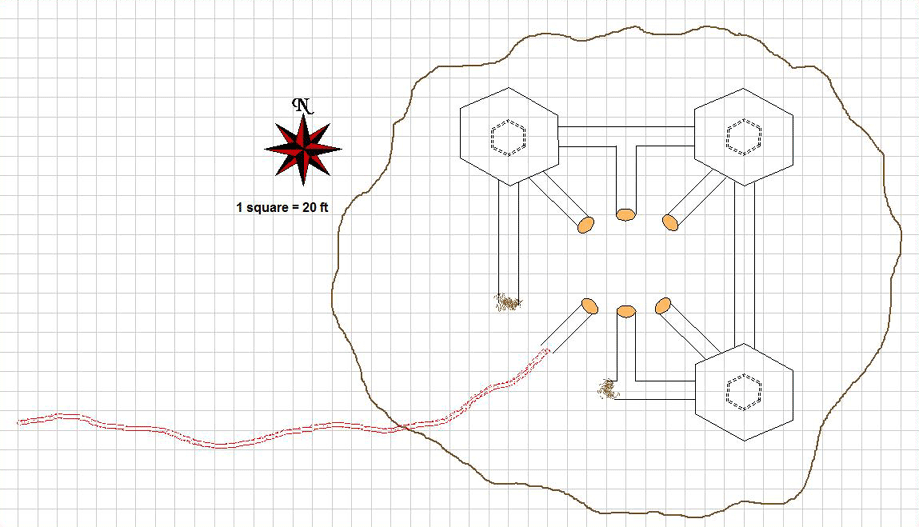 |
On the map above, the rocky mound is shown in brown. The three chimneys are represented by dashed hexagons. The main chambers inside the mound are shown as large hexagons, and the main passageways by double lines.
The collapsed portion of the passageways leading to the fourth, collapsed chimney are shown by brown smudges.
The six golden dots represent planar portals to the demihive.
The double red line represents a fissure that was caused by the earthquake and begins almost 400 ft to the west of the mound and enters the hive, emerging into a passageway that leads to a planar portal. This fissure is dealt with below.
The main hexagonal chambers are each 100 ft wide and as tall. They are shaped like hexagonal cylinders, with the top and bottom formed of six triangles that taper to a point on the floor and end in the chimney on the ceiling. The vertical portion of the cylinder is 70 ft tall, and the apex of the floor and ceiling are 15 ft above and below that respectively.
The walls of the main chambers are covered in hexagonal cells, each approximately 5 ft wide and 8 ft deep. There are literally hundreds of them coating the walls. About half of the cells are open and empty. The rest are sealed with wax and contain abeil honey or a variety of other items foraged by the hive, mainly water, herbs, leaves, flowers, and other foodstuffs.
The main passageways are each 20 ft wide and hexagonal. They emerge from the main chambers midway up their vertical length and proceed level to their destinations as shown.
Aside from the main chambers and the main passageways, there are a bewildering number of side passages, each 10 ft wide, and smaller hexagonal chambers. These are not shown on the map, but the DM can simply assume there are at least one or two radiating in any direction (including up, down, or diagonal) from the main passageways in a given 20 ft space. These smaller passageways connect with smaller hexagonal chambers, usually around 15-20 ft in diameter, and most of those have at least 3 exits in total. There are no dead ends within the hive except for the end of the two main passages that collapsed.
The smaller chambers serve various functions for the hive, including a smithy for fashioning the wax weaponry of the hive, sleeping chambers (with sleeping areas formed of hexagonal cells), storage chambers, etc. All of the chambers are spartan, and none contain any recognizable furniture. In fact, the purpose of most of these chambers will be unknown to the PCs, although, for example, the presence of unfinished wax weapons may give a notion as to the function of a smithy chamber. Should the DM need more specific descriptions of these smaller chambers, he should feel free to improvise. None of these will have much of value, although abeil honey and wax weapons might be worth something as curiousities.
Most of the southwest quadrant of the hive collapsed. Almost all of the tunnels are filled with rock and earth and excavation would be almost impossible in any shorrt amount of time. Any PCs travelling into the collapsed area by magical means will find little of value unless they come upon the entrance to the demihive accessible from the fissure (see below).
Creatures: There are a total of 60 vassals and 15 soldiers in the hive proper. These are not in any set locations, but the DM can assume that at any time in each main chamber there are 2d10 vassals and 1d3 soldiers. Any not in the 3 main chambers will be in smaller chambers asleep or performing other business. This means that the entire hive is always abuzz with activity (pun intended!), and the DM should stress that attempting to sneak into the main hive will be very difficult due to the constant presense of vassals scurrying back and forth along the main passageways and the side passages. Furthermore, soldiers patrol the entire hive, usually solo since they have the ability to instantly communicate with the rest of the hive via the queen. Groups will retreat, hoping to lure invaders into ambushes, etc.
Should the hive be assaulted, the soldiers will form up into fighting groups and proceed to the source of the invasion. Using their hive mind capabilities, they will be able to instantly form a cogent plan of attack which can be adjusted partially or completely on the fly. The abeil vassals will initially stay out of the fighting, but if pressed the soldiers will command them into action, usually to provide flanks and to aid in combat (providing bonuses to hit or to soldier AC). Vassals are entirely expendable, as they are easy to breed in numbers to repopulate the hive fairly quickly (in a matter of a few years). If it appears that the weight of a few more soldiers might swing the battle in abeil favour, the queen might be persuaded to send up to 5 more soldiers from the demihive, but in general those soldiers will remain in the demihive to guard the queen, in case the attack is a diversion.
The abeil play for keeps. They are not interested in taking prisoners. The soldiers will use their stormwing en masse to slay their opponents as quickly as possible. They will only use their drone ability on those who prove resistant to sonic damage. If confronted by silence spells, the soldiers will attempt to grab or disarm the object of the spell and remove it from the hive.
The soldiers can hover (note that the vassals cannot!) and will utilize the three dimensional nature of the hive to their advantage against opponents who cannot fly or whose maneuverability it limited.
Developments:
The abeil will generally pursue opponents who flee the hive, unless they suspect that they are being drawn away on purpose. The abeil are not an emotional race, and they will only pursue fleeing opponents if it is logical to do so. In most cases, this will be if the opponents were clearly being beaten and enough soldiers remain to both pursue the enemy and secure the hive. Otherwise, the abeil will allow their opponents to retreat, but only once. If the same foes return a second time, then the abeil will be far more likely to pursue, since it will be clear to them that their foes will simply return again and again. In no case will the abeil pursue beyond the 25 mile patrol radius, and usually they won't even pass the 12.5 mile attack radius.
Remember that 20 vassals and 5 soldiers are out of the hive on patrol or work detail, and they will eventually return (they are often out for more than a day, sheltering for the night), although not likely during the course of a single assault. However, should the PCs flee the hive, then those out of the hive will return and can effectively replace losses. While under threat of assault (and certainly for several weeks after a major assault), no work parties or patrols will be sent out.
The Portals:
The six main passageways leading
to the demihive end in magical portals. These function as planar
portals and allow transport/access to the demihive.
| The portal is 10 ft wide and 15 ft tall and appears as a golden wax arch from which amber coloured crystals radiate like a sunburst. Within the arch, a grey mist swirls and eddies slightly. |
In all ways, these function as normal planar magic portals, and are subject to spells and abilities that affect such objects. These particular portals are two-way and keyed. In this section, the five fully functioning portals will be dealt with. The sixth portal, part of the collapsed area of the hive and accessed via the fissure, has been altered and is detailed later.
Each portal will normally only function for an abeil. However, each soldier also carries a key to the portal, which allows him to bring in prisoners or other creatures should the queen command it (which she rarely does). This is in the form of a small, thumb-sized amber crystal with a runed-carved been inside of it. In essence, it is similar, but smaller, to those crystals surrounding the portals. To use the key, it must be touched to one of the crystals on the portal. In doing so, the crystals will glow for a round and allow passage to the demihive.
Starting from the northern portal and proceding clockwise, these emerge into the demihive chambers as follows:
M1, M2, M3, M4, M5, M6.
M5 is the demihive chamber to which the secret gate (see below) leads.
For more information on magical and planar portals, refer to the Stronghold Builder's Guidebook page 49.
 |
The Demihive:
All major abeil hives contain what is known as a demihive. This is a hive within the hive whereby the royal chamber is pinched off from the Material Plane and placed in its own demiplane. This ritual is done to protect the queen and her vassals, and reflects the ultimate xenophobic and isolationist tendencies of the species. This effect is similar to that of a genesis spell, and is "cast" as an 8th level druid spell. The ritual takes a week to perform and requires a specially designed hive chamber, royal jelly, and the sacrifice of at least 10 HD of abeils and the participation of another 25 HD of abeils. Each queen is capable of performing the ritual only once in her life. Knowledge of this ritual is usually passed from queen to juveniles, though the abeil keep records of the rituals just in case In theory, even should these records be destroyed, a lone queen could rediscover the ritual by tapping into her hive memory. The demiplane immediately grows to encompass the demihive area and never grows any larger.
Because the demihive is contained on its own plane, spells like teleport will not function to allow access within from without (or vice versa). Spells that can function across other planes can work (such as sending). However, a unique characteristic of the demihive is that it acts as a transmitter (see chamber L6 below) for the presence of the abeil queen for the hive mind ability. In other words, as long as the queen is present in the demihive and the transmitter is intact, any abeil within 25 miles of the demihive entrances will be able to utilize the hive mind ability. This despite the fact that the queen is technically on another plane. For purposes of clarity, the entrances to the demihive must be within the confines of the abeil hive and must be within 500 ft of each other.
The demihive plane has all of the normal characteristics of the Material Plane with regard to gravity, time, magic, and alignment. However, since the demihive is pinched off from the Material Plane, it has no connection whatsoever to the Astral or Ethereal Planes. This means spells that rely on transit to or through those planes will not function within the demihive. Spells such as ethereal jaunt, dimension door, or benign transposition will not function within the demihive. Summoning spells will function normally.
There is nothing beyond the demihive on this demiplane. Should a being tunnel through the 10 ft thick wax walls or attempt to otherwise proceed outside the boundaries of the demihive, he will find an impervious grey mist that cannot be penetrated by any means.
|
|
|
 |
 |
On the map of the demihive above, each square is 10 ft. This means that the demihive takes up more "space" than the center of the main hive. The demihive is comprised of the same hard wax as the main hive. Unlike the main hive, however, these walls emanate a soft amber light that illuminates the entire place in shadowy illumination. This grants all within concealment if using normal vision. This light comes from the eldritch properties of the demihive, and although it is not a magic effect per se and cannot be dispelled, any darkness related spell will overcome the illumination as if it were nonmagical.
The massive main chamber of the demihive is shaped like a hexagonal solid. The ceiling and floor of the chamber are slanted triangles that meet at a point in the center of the ceiling and floor respectively. Thus, the center of the demihive, both vertically and horizontally, are perfect hexagons. However, since a platonic solid cannot be formed from hexagons, the floors and ceilings are comprised of triangles instead.
Radiating out from the main chamber are large hexagonal passageways that connect to smaller chambers that are shaped similarly to the main chamber. There is a passageway set into the center of every flat surface of the main chamber. This means there are 6 such passageways radiating out laterally from the middle of the main chamber (along its "equator"). Additionally, there are 6 passageways radiating out of the six triangles that form the floor of the main chamber and 6 more passageways radiaing out odf the six triangles that form the ceiling. In total, there are 18 such passageways.
For reference purposes, as shown on the maps above, each ring of passageways is numbered clockwise from 1 to 6. Likewise, as shown, the tiers of passages are labelled Lower, Middle, and Upper. Combining both of these labels allows each chamber to be identified by using a letter (U = upper, M = middle, L = lower) and a number. For example, Chamber M3 is the southeastern chamber radiating from the middle of the main chamber. Chamber U 1 is the northeastern chamber radiating fromt he ceiling of the main chamber.
Within the demihive, along with the queen, are 4 queen's guards, 10 soldiers, 5 juveniles, and 20 vassals. The DM should keep track of these when determining the occupants of each demihive chamber, so that extra inhabitants are not present and missing inhabitants can be assigned. The queen is always accompanied by her retinue, which consists of the 4 queen's guard, 1d4 juveniles, and 1d4 vassals. In all cases, the DM should place the queen and her retinue first (according to the descriptions below) and then allocate the remaining abeils to the demihive as indicated below.
Main Chamber:
This large chamber is riddled with hexagonal cells, each approximately 5 ft wide and 8 ft deep. There are literally hundreds of them coating the walls. About half of the cells are open and empty. The rest are sealed with wax. About half of the sealed cells contain abeil honey or a variety of other items foraged by the hive, mainly water, herbs, leaves, flowers, and other foodstuffs. The other half contain developing abeil larvae, including vassals and soldiers.
Creatures: At all times 1d10 vassals and 1d6 soldiers are present in the main chamber.
L1:
This chamber serves as a sleeping chamber for demihive vassals. There are hexagonal sleeping cells here for 10 vassals.
Creatures: Usually, 1d6 vassals will be resting here.
L2:
This chamber serves as an abeil library. Various wax sheets are set into hexagonal cells likes books into a cubby hole. Each wax sheet contains abeil writings, which appear as absolutely flat and featureless wax sheets until an abeil hums a particular buzzing sound with the sheet in hand. Then the vibrations of the buzzing cause various bumps to appear in the sheet, and these are read with antennae almost like braille writing. Without divinatory magic or instruction from an abeil, there is almost no way for the PCs to figure out what these featureless sheets of wax are for. The writings concern all sorts of abeil concerns, from a history of the hive including lineages of past queens, to details of the various abeil rituals (including the creation of a demihive and manufacturing of royal jelly), to abeil crafting lore (i.e. wax weaponry, hive walls, etc.). The value of these treatises is left to the DM to decide.
L3:
This chamber serves as a sleeping chamber for demihive vassals. There are hexagonal sleeping cells here for 10 vassals.
Creatures: Usually, 1d6 vassals will be resting here.
L4:
This chamber serves as a storage room and contains various items that might be needed by the vassals. Most of these are wax tools and other small implements, stored in hexagonal cells.
L5:
This chamber serves as a sleeping chamber for demihive vassals. There are hexagonal sleeping cells here for 10 vassals.
Creatures: Usually, 1d6 vassals will be resting here.
L6:
This chamber is dominated by a glowing ball of viscous liquid that seems to float in the center of the chamber. The liquid appears honey-like, and it jiggles and roils in place. The sphere is about 10 ft in diameter and emits a bright amber radiance that bathes the entire chamber in full illumination equivalent to a daylight spell. The ball radiates strong divination magic.
This is the transmitter for the hive mind. It allows the queen's hivemind ability to extend beyond the planar barrier of the demihive and to within 25 miles of the center of the main hive. Without this transmitter, the fact that the demihive is on a different plane than the main hive would negate the hive mind ability of the abeil hive.
The transmitter is elastic to the touch, but cannot be easily pierced like, in theory, a floating ball of honey could. It is immune to piercing and bludgeoning attacks and cannot be dislodged from its place. However, slashing attacks and energy attacks (except for sonic) do damage as normal to objects. The transmitter has a hardness of 3 and 250 hit points. It has fast healing 5, and sonic damage heals it an amount equal to the sonic damage done (don't count hardness). If it is destroyed, it will emit a bright flash of light and the liquid will splash to the floor of the chamber. Every abeil within the hive, the demihive, and 25 miles from the center of the hive will know that the transmitter has been destroyed, as it unleashes a final "death rattle".
Other than using certain spells or interrogating an abeil, there is little chance the PCs will be able to figure out the purpose of the transmitter.
M1:
This is an entry chamber from the main hive into the demihive. Present in the center of the chamber is an archway that looks precisely like the magical portals leading from the main hive. The archway operates exactly like the portals described previously, and is connected to one of the magical portals as indicated in that section above.
Creatures: There is a 25% chance of a soldier being present here.
M2:
This is an entry chamber from the main hive into the demihive. Present in the center of the chamber is an archway that looks precisely like the magical portals leading from the main hive. The archway operates exactly like the portals described previously, and is connected to one of the magical portals as indicated in that section above.
Creatures: There is a 25% chance of a soldier being present here.
M3:
This is an entry chamber from the main hive into the demihive. Present in the center of the chamber is an archway that looks precisely like the magical portals leading from the main hive. The archway operates exactly like the portals described previously, and is connected to one of the magical portals as indicated in that section above.
Creatures: There is a 25% chance of a soldier being present here.
M4:
This is an entry chamber from the main hive into the demihive. Present in the center of the chamber is an archway that looks precisely like the magical portals leading from the main hive. The archway operates exactly like the portals described previously, and is connected to one of the magical portals as indicated in that section above.
Creatures: There is a 25% chance of a soldier being present here.
M5:
This is an entry chamber from the main hive into the demihive. Present in the center of the chamber is an archway that looks precisely like the magical portals leading from the main hive. The archway operates exactly like the portals described previously, and is connected to the secret gate (see below). This chamber is musty and dusty and shows little signs of use.
If the planar gate is observed for a time, the mist within seems to occasionally ripple and jiggle and even warp out of focus for a moment from time to time. This is a result of the malfunction of the gate (see below). This gate does not allow transport out of the demihive (unless the PCs came through this portal in the first place, see "Getting Out" below).
M6:
This is an entry chamber from the main hive into the demihive. Present in the center of the chamber is an archway that looks precisely like the magical portals leading from the main hive. The archway operates exactly like the portals described previously, and is connected to one of the magical portals as indicated in that section above.
Creatures: There is a 25% chance of a soldier being present here.
U1:
This chamber's walls are decorated with what appear to be wax sculptures of various abeils, including obvious vassals, soldiers, and queens. Depending from the center of the ceiling is a massive wax sculpture of a queen that glows with an inner golden light.
This is the worship chamber for the abeil. More precisely, it is the worship chamber for the abeil queen. The abeil do not venerate the gods, but they do practice a form of ancestor worship, tapping into the souls and minds of their ancestors by means of their hive memory. This room serves as a sort of focus for those ancestral memories.
Despite its glowing, the massive carving does not radiate magic. The glowing comes from the spirit residing within.
Creatures: There is a 15% chance that the abeil queen, if not found elsewhere, will be in this chamber, along with her retinue.
Additionally, the spirit of the founding queen of the hive, along with pieces of the spirits of those queens who came afterwards, have congealed into a sort of mentor spirit that resides within the massive sculpture on the ceiling. Mostly used for advice and communing, the spirit can also be called forth as a guardian, either at the command of the queen or if non-abeil enter this chamber. The spirit is treated as a ghost of an abeil soldier for statistics purposes, despite the fact that it actually appears as a Large queen and that it is not based at all on the Ethereal Plane (in fact no such creature could exist in the demihive, which is cut off from the Ethereal Plane). The ghost is always treated as manifested.
|
|
U2:
This is a living quarter for the demihive soldiers. There are 10 hexagonal cells along the walls sized to accommodate a Large creature, and wax weapon racks suitable for holding Large ranseurs and bows.
Creatures: At any given time, 1d3 soldiers will be here resting.
U3:
This chamber's walls are covered in thousands of strange small bumps set into intricate patterns (akin to braille). Amongst these are etched intricate geometric patterns that gouge deeply into the wax.
This is a ritual chamber for the abeil queen, where she performs the various rites of the hive, including those that keep the demihive active and support the transmitter (area L6).
A DC 35 Knowledge (arcana) check will reveal that the patterns seem to be part of some sorts of divine rituals, but the precise nature is unknowable unless the bumps (abeil writing) can be translated.
Creatures: The queen and her retinue, if not found elsewhere, will be found here 5% of the time.
U4:
This chamber contains hexagonal sleeping cells for 8 medium creatures. The juveniles dwell here when not attending the queen.
Creatures: A number of juveniles will be found here equal to 5 minus 1d4 (i.e. 5 minus the number attending the queen).
U5:
This chamber serves as the living quarters and audience chamber of the queen. It contains a single large hexagonal cell emerging horizontally from the midpoint of the wall. The cell walls are artfully carved into flowing shapes reminiscent of flowers and bees. The bottom of the cell is coated in a sort of goopy honey-like substance that is cohesive enough to remain in place (almost like wet clay). This substance serves as a sort of comfortable cushion for the queen, and the cell serves as both her throne and her bed. it also serves as her birthing couch, where she gives birth to the larvae that eventually become mature abeils.
Creatures: The queen and her retinue, if not found elsewhere, will be found here 65% of the time.
Treasure: Hidden in the back of her throne cell is a green gem the size of a small fist which seems to contain eight glowing specks within. Etched on the surface of the gem is a tiny cat's head. This is the catfolk version of a dimensional sextant (see Manual of the Planes page 22) that belonged to the scout who found the secret tunnel. It only functions for catfolk, and the abeil queen who ruled the hive when the scout was slain kept this item because she could not figure out what it did. The item has since been passed from queen to queen.
The catfolk elders will know what the item is and will be very grateful for its return. They will be willing to offer services and whatever goods they might have in kind for its return, up to half the market price, but if it is given to them for less than this or for free, their goodwill will be earned instead. DMs should note that the catfolk do not have much wealth in coins available and many of their magic items are too useful to them to be traded for an exotic item like this. Nevertheless, furs, gems, potions, wands, and scrolls (the magic items of druidic or clerical nature) are certainly available.
U6:
This chamber serves as the alchemical laboratory and the royal jelly manufactory for the hive. The place is covered in various sized cells, most of them open and most of those containing a variety of alchemical substances. Devices made of wax and of strange design are set atop many of the sealed cells (which are empty and act as tables), and a DC 20 Craft (alchemy) check will reveal that they are alchemical instruments, though of strange design. Amongst these items are 3 long hard wax spigots with a hollow inner spike of about 8 inches in length. Although the PCs have little way of knowing, these spigots allow the queen to tap the hidden cells holding the royal jelly (see below).
It is here that the queen brews her hive potions, which she distributes to herself and the hive soldiers as needed.
Also here is stored the royal jelly. This substance is brewed by the queen from a substance manufactured by her own body from the purest nectar and honey and then distilled in this laboratory through processes only known to her.
Creatures: The queen and her retinue will be present here, if not reviously encountered elsewhere, 15% of the time. She will be crafting various potions or other alchemical items.
Finally, a guardian creature wards this room and the royal jelly, which is expensive and time consuming to prepare and of which a single queen makes only a limited amount during her lifetime. This creature is essentially an embodied bee spirit known as a hive guard. Despite it having an Intelligence score, its devotion to the hive is so strong that no mind-affecting effects will affect it (even beneficial ones).
|
FEATS: Enlarge Breath (Drac p70) - increases length of breath by 50% (rounded down to nearest 5 ft) but +1 round to recovery time.
|
Secret Doors: There are three small cells are hidden high up on the ceiling of the place, each one separate from the other and spaced around the ceiling. The cells are set flush with the ceiling wall and have been sealed by the same wax as the walls themselves, only somewhat thinner and slightly softer. As such, it would take a DC 20 Search check to locate each hidden cell. The seal to each cell can be broken through with a single good swipe from a piercing or slashing weapon or torn apart in a few rounds by hand.
Treasure: The royal jelly is stored in the 3 hidden cells on the ceiling (see Secret Doors above). There is a total of 18 flasks of the stuff, with 6 flasks worth in each cell. The substance appears as a glowing amber jelly with flecks of sparkling mauve and maroon suspended within. The DM should keep in mind that the cells are pointing straight down from the ceiling, and so simply ripping open the wax seals will cause the jelly to tumble out and splash over the ground. Should this happen, assume half of the jelly can be gathered up relatively quickly (in about 2d6 rounds), but the next quarter or so will take several minutes to scrape off of the various places it spattered and a full quarter will be simply lost after the long fall and spattering.
Entering the Demihive:
Normally, entry into the demihive is done by way of abeil planar gates built into each of the middle chambers (M1-6). These gates connect with passages in the abeil hive proper (located on the Material Plane). The abeil enter and leave the demihive by way of these planar gates. Refer to the section above detailing these portals. However, the gate leading into chamber M5 is now unused since the portion of the main hive that allowed acess to it was collapsed during a strong earthquake many years ago. Unbeknownst to the abeils, the way to that gate was opened by a catfolk explorer, and now can be accessed by means of the secret tunnel (see below). Other than the gates, there is no other normal way to enter the demihive. In theory, a gate spell could allow access.
The Secret Tunnel:
This tunnel is actually a fissure in the ground created by a powerful earthquake that rocked this region many years ago. The earthquake collapsed a portion of the abeil hive and buried one of the gates to the demihive. It also created a long fissure in the ground, most of it entirely underground but uncovered in places. This fissure lead into the hive mound and up towards the hive, but never made it all the way to the demihive gate.
Some time many years later, a catfolk explorer and spirit walker (Rogue 8/Gatecrasher 3) was following his dimensional sextant (see Manual of the Planes page 22, although the catfolk use a magical gem that serves the same function) tracking down the location of the nearest planar portal when he was lead to the abeil hive. At the time, the catfolk had no knowledge that abeil hives contained an extradimensional component (and for the most part they still don't know this fact!), and so the spirit walker was intrigued. He used his stealth skills to brave approaching the abeil hive, and although he did not dare enter the hive proper, his close examination of his sextant revealed multiple planar gates, one of which seemed to be located in an area that had collapsed.
Seeking an opportunity, the spirit walker investigated the area around the hive collapse and discovered the fissure that lead underground into the mound and up towards the gate. He then spent the next few months clearing away rubble and excavating (with the help of some earth elementals he could summon using scrolls and his Use Magic Device skill) until he reached the portal chamber which was, as he had hoped, disused and unguarded. While excavating, he found the remains of several abeils who had been caught in the collapse, including that of two soldiers each with a portal key in his possession. The scout hid one of the keys in a secret compartment in his clothing.
The spirit walker examined the portal and realized that it was malfunctioning (using his analyze portal ability). At that time, the bonds between the gate's ends were weakening but not as sundered as they are presently. As such, the portal still led directly to the demihive chamber M5 about 95% of the time. The gatecrasher viewed the other side of the portal, saw an empty and disused hive chamber, and assumed he had discovered a gate to an abandoned abeil hive one some other plane. Eager to loot the hive for treasure and to explore the place, he passed into the portal and found himself inside an active abeil demihive, where he was slain in short order. His dimensional sextent and one of the portal keys he had were taken by the abeils (who never found the hidden portal key) and his body was taken from the hive and deposited outside the hive's patrol area. There his corpse was eventually located and recovered by the catfolk, who used speak with dead from the tribe's cleric to learn what had happened and to find the hidden portal key.
The tunnel is shown on the main hive map (above) as a red double line. The western end of the fissure leads above ground, and appears as a crack in the ground about 12 ft tall and 5 ft wide that leads down. The crack proceeds down at a fairly steep angle (45 degrees, but the way is rocky enough to forego Climb checks) for about 30 ft before evening out to the tunnel proper heading east.
The tunnel is not even by any means. It is a naturally occurring fissure caused by an earthquake and is structured accordingly. The walls are, for the most part, comprised of massive boulders that tumbled down from the surface above, chunks of rocks created in the quake, and natural walls with many small cracks and fissures. As such, the floor and walls should be treated as unworked stone walls (DC 15 Climb) and natural stone floors.
|
Natural Stone Floor The floor of a natural cave is as uneven as the walls. Caves rarely have flat surfaces of any great size. Rather, their floors have many levels. Some adjacent floor surfaces might vary in elevation by only a foot, so that moving from one to the other is no more difficult than negotiating a stair step, but in other places the floor might suddenly drop off or rise up several feet or more, requiring Climb checks to get from one surface to the other. Unless a path has been worn and well marked in the floor of a natural cave, it takes 2 squares of movement to enter a square with a natural stone floor, and the DC of Balance and Tumble checks increases by 5. Running and charging are impossible, except along paths. |
The ceiling varies. Most of the time it is comprised of natural stone or, more often, of boulders and chunks of rock that collpased and wedged together. From time to time, the ceiling is open to the air. Usually, this is a small crack exposed to the outside, often no more than a few inches wide and a few feet long. Certainly, no crack exists to allow Small or larger creatures to pass through except for the entrance at the far west of the tunnel. Tiny creatures might rarely find a crack to allow entrance (and that might require an Escape Artist check of some sort to squeeze through). These exposed cracks end where the hive mound begins, as the mound rises up too far above the tunnel to allow exposed cracks.
Width and height of the tunnel varies, as would be expected. Width is generally between 5 ft and 10 ft wide (1d6+4 ft) and height is between 5 ft and 12 ft tall (1d8+4 ft).
Anyone who examines the tunnel who succeeds on a DC 15 Knowledge (architecture and engineering) check will be able to tell that the tunnel, while relatively stable, might be subject to collapse if some sort of major trauma is inflicted upon it.
The tunnel has only one occupant. Refer to the encounter below.
Encounter - The Fog (EL 13 + 8)
Some time after the earthquake and the catfolk scout, a fogwarden took up residence within the tunnel. The fogwarden found the tunnel a nice place to hide and make its lair, and the presence of the abeils kept other intruders and potential foes away. The creature does not hunt the abeils and takes great pains to keep hidden from them. It only hunts far away from the hive and emerges only at night, and usually when there is a fog or mist about.
The fogwarden dwells in a portion of the tunnel that is 10 ft wide and 12 ft tall. it is located right at the point that the tunnel begins to proceed under the hive mound. The walls are comprised of falled stones from the mound above, and as such there are many small spaces between the stones that the fogwarden can use to pass through.
The fogwarden has a group of 5 dire toads it recently caught taking refuge in the western end of the tunnel, seeking to make it their lair. It slew and animated their bodies and brought them to this spot to server as guards.
|
FEATS: Sudden Silent (CA p83) - 1/day cast spell as if you used Silent Spell feat without adjusting level of the spell. SPELLS: dispelling touch (PHB2 p110) - r touch, 1 creature, object, or spell effect; CL check (max +10) vs highest CL spell effect and if that fails then check weaker spells until one effect is dispelled. karmic backlash (CM p109) - swift, 20 ft emanation on caster, 1 rd/lvl, sv W part, SR; any creature in range that damages you must save or be exhausted for 2 rounds, save means creature immune until start of your next turn. power word deafen (RoDR p115) - r cl, 1 living creature 100 hp or less, SR; deafen 51-100 hp = 1d4+1 rds, 26-50 hp = 1d4+1 min, 25- hp = permanent. power word pain (RoDR p116) - r cl, 1 living creature with 110 hp or less, SR; deals 1d6 dmg each round up to 1 rd/CL and up to 76-100 hp = 1d4 rds, 51-75 hp = 2d4 rds, 50 - hp = 4d4 rds. undying vigour of the dragonlords (DrM p74) - 1 full rd, pers; heal 5d6 damage and optionally sacrifice 1 spell slot to heal +1d6 per spell slot level.
|
|
|
Tactics: When the PCs arrive at this part of the tunnel, the toads will be hiding amongst the rubble and crevices of the walls. However, given their lack of Hide skill, it shouldn't be too difficult for the PCs to spot them in ambush. The toads will attack any creature that is not the fogwarden.
The fogwarden waits within the rocks to one side, within 20 ft of all of the toads. It will seek to attack any intruders, first allowing them to engage the toads and then attacking using its lightning bolt or its spells. If it has warning, it will cast its defensive spells, including mage armour, shield, blur, and protection from good.
When the time is right (i.e. when enough of its enemies are in range), the fogwarden will use its shout (see Developments below).
The fogwarden cares nothing for its toad zombies and will gladly let them deanimate by moving more than 20 ft away if need be. In a pinch, the fogwarden will use its dimension door to escape combat and flee. Other than a convenient lair, there is nothing here that the fogwarden needs to defend, and so it is more than willing to flee from a tough fight.
DMs should take careful note of the fogwarden's spell use. Its gaseous form causes him to have to use Silent Spell and Still Spell to cast spells and this will bump up the spell levels on every spell it casts. The only exception is its 5th level spell. To cast this spell the fogwarden must use its Sudden Silent feat, and so it can only cast its 5th level spell once per day. The rest of its 5th level slots will be used to cast shout, dimension door, or dispel magic.
The fogwarden will tend to leave one 5th level slot open for dispel magic and another for dimension door, reserving the final one for shout if the opportunity presents itself or undying vigour of the dragonlords if it looks like healing itself will allow it to prevail.
Developments: Since the fogwarden has nothing and wants nothing other than to feed on fear, it is unlikely to parley with the PCs.
The shout spell may cause a collapse in the tunnel if it does more than 16 points of damage (ignore hardness). Allow a 25% chance of a collapse if 16 damage is done with a +2% for each point of damage above 16. Collapse will occur in the area of the spell wigth a slide zone 10 ft outside of it.
|
Cave-Ins And Collapses (Cr 8) Cave-ins and collapsing tunnels are extremely dangerous. Not only do dungeon explorers face the danger of being crushed by tons of falling rock, even if they survive they may be buried beneath a pile of rubble or cut off from the only known exit. A cave-in buries anyone in the middle of the collapsing area, and then sliding debris damages anyone in the periphery of the collapse. A typical corridor subject to a cave-in might have a bury zone with a 15-foot radius and a 10-foot-radius slide zone extending beyond the bury zone. A weakened ceiling can be spotted with a DC 20 Knowledge (architecture and engineering) or DC 20 Craft (stonemasonry) check. Remember that Craft checks can be made untrained as Intelligence checks. A dwarf can make such a check if he simply passes within 10 feet of a weakened ceiling. A weakened ceiling may collapse when subjected to a major impact or concussion. A character can cause a cave-in by destroying half the pillars holding the ceiling up. Characters in the bury zone of a cave-in take 8d6 points of damage, or half that amount if they make a DC 15 Reflex save. They are subsequently buried. Characters in the slide zone take 3d6 points of damage, or no damage at all if they make a DC 15 Reflex save. Characters in the slide zone who fail their saves are buried. Characters take 1d6 points of nonlethal damage per minute while buried. If such a character falls unconscious, he must make a DC 15 Constitution check. If it fails, he takes 1d6 points of lethal damage each minute thereafter until freed or dead. Characters who aren’t buried can dig out their friends. In 1 minute, using only her hands, a character can clear rocks and debris equal to five times her heavy load limit. The amount of loose stone that fills a 5-foot-by-5-foot area weighs one ton (2,000 pounds). Armed with an appropriate tool, such as a pick, crowbar, or shovel, a digger can clear loose stone twice as quickly as by hand. You may allow a buried character to free himself with a DC 25 Strength check. |
The DM should allow other sonic attacks to have a similar chance to cause a collapse. At the DM's option, other energy types could do so as well, although they would have to account for the stone hardness and even then the DM is well within his rights to rule that certain energy types have no chance of causing a collapse (e.g. cold or acid).
The Secret Gate:
A little ways after it proceeds past the fogwarden, the tunnel begins to ascend. Towards the end, it ascends (sometime somewhat steeply, but with ample foot and handholds to forego a Climb check) until it reaches the level of the main hive. There the tunnel ends and becomes a wax hive passageway that is dusty and musty from disuse. That passageway ends in a planar gate.
The planar gate is as described previously (see above).
If the gate is observed for a time, the mist within seems to occasionally ripple and jiggle and even warp out of focus for a moment from time to time. This is a result of the malfunction of the gate. A DC 25 Knowledge (planes) AND Knoweldge (arcana) check will reveal that this rippling may indicate some sort of malfunction.
The gate has, indeed, malfunctioned. In essence, the two ends of the gate have been sundered by the earthquake and this sundering has increased over time such that the gate now leads THROUGH another plane before ending up in the demihive. Normally, the two ends of a planar gate are coterminous, meaning that there is no "space" between them. However, the malfunction has effectively ripped apart the tow ends and this space has been filled up by the substance of a demiplane. It should be noted that this demiplane was not created by the rift. Rather, the rift has manifested on or through this plane.
The net result is that once the PCs pass through the portal, they will not arrive at the demihive. Instead, they will be in transit to the other end of the gate on the interloping demiplane! Because of this effect, the PCs cannot return through the portal, simply because they have not yet officially passed through it...so they cannot return from what they have not yet passed through.
While on the demiplane, which is inhabited by demodands (see below), the PCs will constantly feel a pull or tug on both their physical bodies and their souls. This is the magic of the portal attempting to still transit them from one end of the sundered portal to the other end. The pull is resistable, but it is also tangible and will effectively allow the PCs to follow it to the other end of the portal. A DC 30 Knowledge (planes) or Knowledge (arcana) check will allow the PC to realize the cause of this effect.
Additionally, because the PCs are locked in transit, they cannot leave the plane by any other means. Even plane shift or dismissal or similar spells will not function. Interestingly, however, spells that use the Astral Plane as a mere transit vehicle can still be used (such as teleport), ostensibly because the PCs are locked in "transit" mode and these spells utilize that same mode.
In essence, though, the PCs are trapped on the demodand plane until they can reach the other end of the portal and pass through it to the demihive.
The Demodand Plane:
The demodand plane is a demiplane connected to the Astral Plane. As such, it has no connection to the Ethereal Plane and no spells utilizing that plane may be used here.
The landscape is comprised of stony plains punctuated by pools of burbling tar and boiling mud. The sky is lit by a diffuse reddish light in a cloudless sky that is the equivalent to deep twilight (targets beyond 30 ft gain concealment against normal vision).
Its planar traits are as follows:
The planar portal emerges into the plane near a cluster of massive boulders (between 15 ft and 25 ft tall) that block off three sides surrounding the gate.
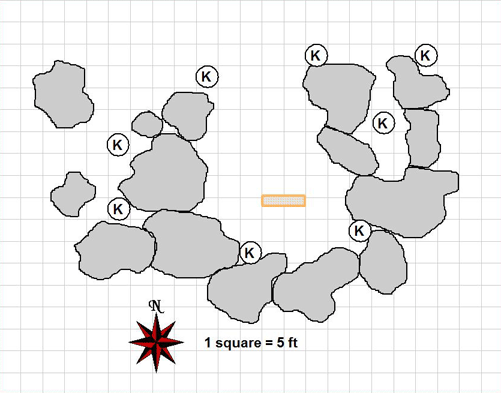 |
The kelubar demodand Th'kkrahk is aware of the presence of the planar gate. He has stationed a pack of farastu demodands with orders to watch the gate and to attack anyone that comes through. These orders have been given by the kelubar to test those coming through the gate. Those that are weak will be destroyed by the farastus and are therefore unsuitable for his needs. Those that can defeat the farastus are strong enough for the kelubar's needs and, coincidentally, will have used resources fighting off the farastus and will be less of a threat to him.
The round after the PCs emerge from the gate, they will be attacked.
Creatures: A pack of farastu demodands watches the gate. They are always invisible, and are initially positioned as shown on the map above. The first round the PCs arrive through the gate, they demodands will be surprised. However, unless the PCs can sense their presence, the tables may be turned and the PCs surprised when the demodands attack.
|
|
Tactics: The farastus will attack en masse and without any sort of subtle tactics. They will all rage at the start of the combat; they can use their spell-like abilities while under the rage effect.
The assault will begin with a fear attack by one of the ones that cannot reach melee on the first round. Those able will then leap to the attack, one staying behind to cast fog cloud over the PCs after the others have moved in and made their initial attacks. Ray of enfeeblement will be used against strong melee types.
The demodands will summon their fellows if possible. Basically, 1d3 demodands per round will attempt to summon more demodands.
Developments: The farastus are under orders to attack vehemently, but to end the combat once it is clear they cannot prevail against their foes. The precise timing for this determination is left to the DM, but at least half of them will have to have fallen and the rest be down to less than 50% of their hit points.
Once this happens, the farastus will back off and attempt to parley using their tongues ability. One will take the role of spokesman and tell the PCs that they have proven their strength and ability and that their master has told them to bring to see him anyone who comes through the portal who is able to defeat them.
Fearing dire punishments should they fail to convince the PCs to accompany them, the farastus will grovel and beg the PCs and, failing that, will resume their assault trying to grapple and drag the PCs bodily to their master.
Should the PCs ask, the pull from the planar transit is urging them in the same direction as the way the farastus want to take them.
The Kelubar:
The master of the farastus is a kelubar demodand named Kelubar Th'kkrahk. He is a rival to a nearby shator demodand named Anduuvohk and seeks to assassinate his rival so that he can expand his power. When the planar gate sundered, one end of it appeared in Th'kkrahk's throneroom. Initially, the gate only appeared briefly and then disappeared for a long time before returning. But the intervals of disappearance shrank until, eventually, the gate was alwpresent. He investigated the gate and, determining it's nature, sought the other end of the rift, which he found and concealed amongst some boulders. He then built his throne around his end of the gate and set a watch upon the gate amongst the boulders.
For a long time, Kelubar Th'kkrahk worried about what might come through the gate. He knew whatever did would be drawn in transit to the gate in his throneroom. While he hoped the farastus he stationed at the boulder gate would take care of interlopers, his thoughts often turned to the question of what to do if travellers defeated his minions and came seeking his end of the gate.
Finally, it occurred to him that he might be able to use such powerful travellers are tools to do his bidding. As his rivarly and hatred of Shator Anduuvohk grew, he decided that he would use these interlopers to attack and hopefully slay his rival. Then he could send the on their way and rule over this portion of the plane.
About 15 miles to the "northwest" of the planar gate at the boulders is the stronghold of Kelubar Th'kkrahk. The stronghold is set atop a stone plateau about 500 ft in diameter and 75 ft high. A single 10 ft wide path spirals up the side to the top. On the top is a village of two dozen large dried mud huts dominated by a large square building of stone bricks surmounted by a massive dried mud dome.
Creatures: The village is populated by farastu demodands. There are a total of 50 of them dwelling in the village (not counting the soldiers in the stronghold). Lording over the stronghold is Kelubar Th'kkrahk. The farastus generally are invisible when outside of their huts, and so unless the PCs can see invisible creatures, they may not realize the village is fully populated. The farastus manage to avoid bumping into one another when invisible by way of releasing a tarry musk that other farastus can smell (as can any creature with the scent ability). This musk release is entirely voluntary and can be started and stopped as a free action.
The villager farastus will attack any intruders, as their ethos is that the strong dominate the weak. However, displays of strength and prowess can serve the cow or intimidate the creatures and send them fleeing. Treat the farastus as initially hostile to the PCs unless they are escorted by the farastus from the portal by the boulders. In that case, the PCs will attract intense curiousity but no hostility.
|
|
 |
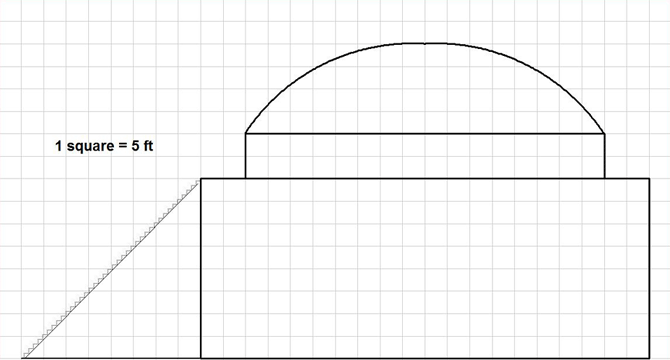 |
The stronghold proper is a large building some 100 ft square and 40 ft tall and the dome is approximately 80 ft in diameter and 30 ft tall, with a large staircase leading into the top domed chamber. The building is made of sun dried bricks of clay and bone slivers and the exterior walls of the lower square portion is 2 ft thick while the 10 ft high walled portion of the upper dome chamber is 1 ft thick (hardness 7, 75 hp per 1 ft thickness, climb DC 20). The upper dome itself is made of dried mud and is 1 ft thick (hardness 6, 60 hp, climb DC 20 [not including the adjustment for vertical overhang).
The lower building contains a variety of crude chambers housing the barracks of the place, the living quarters of the kelubar and his senechal, storage chambers, crude smithies and armories and tanning stations for the farastu soldiers' weaponry and armour, and other nundane chambers. The demodands are an insular enough society that they do not engage in trade and therefore do not value or keep treasure beyond what magic items they possess on their persons, and so a thorough search of the lower building will turn up nothing of much use.
Access to the lower building interior is entirely by way of the secret trap door in the upper chamber (see below).
The double doors that lead to the upper chamber are 10 ft tall and made of a dark iron-like metal (hardness 10, 60 hp, Break DC 28) and can be barred from the inside.
The upper chamber holds the throne
of Kelubar Th'kkrahk.
|
This domed chamber is comprised of a 10 ft high circular wall of bricks surmounted by a large dome made of dried and glazed clay. The dome rises another 20 ft above the walls, and is supported by 8 stone columns that reach all the way from the floor to the dome itself. Set between the pillars is a large throne of carved white and grey stone. From the 10 ft wide chair back, amber coloured crystal spikes emanate in a sort of suburst halo out of the chair stone. |
Treat the pillars as slender pillars.
|
Slender Pillars A creature standing in the same square as a slender pillar gains a +2 cover bonus to Armor Class and a +1 cover bonus on Reflex saves (these bonuses don’t stack with cover bonuses from other sources). The presence of a slender pillar does not otherwise affect a creature’s fighting space, because it’s assumed that the creature is using the pillar to its advantage when it can. A typical slender pillar has AC 4, hardness 8, and 250 hit points |
Creatures: Kelubar Th'kkrahk will be here when the PCs arrive. He spends most of his time brooding on his throne and planning his next move against his rivals. At his side standing next to the throne will be his senechal (who is a normal farastu with above average Intelligence and Wisdom, and is a spy for the Kelubar's rival!).
|
|
|
|
There are always four soldiers guarding the doors into the upper chamber, stationed just outside the chamber and flanking the doorway. Additionally, there are another 12 soldiers inside the chamber, six along each wall behind the pillars.
Another 4 soldiers are always in the lower building, off duty. These will emerge into the chamber a few rounds after any combat begins unless the combat is very quiet or very quick.
|
|
Secret Doors: A secret trap door has been built into the floor behind the throne (Search DC 20). The door is heavy, and requires a DC 15 Strength check to open from below and a DC 20 Strength check from above (by way of several loose bricks that can be pulled away and the gaps used as handholds). Additional creatures can roll to aid opening the door if they can get to it (DC 10 Strength check to provde a+2 bonus).
The trap door leads to stairs that descend to the floor of the lower building.
Developments: If the PCs are assaulting the village, the kelubar and soldiers will aid in the attack, although they will not abandon the stronghold building to do so. Should the PCs enter the stronghold during a battle, the kelubar will fight until it seems that defeat is certain, at which point Th'kkrahk will attempt to parley. At this point, he will try to determine what the PCs want and, if they simply wish to pass through to the portal, he will gladly offer to rip down his throne back and let them pass.
If the PCs, on the other hand, approach Kelubar Th'kkrahk in a friendly manner (e.g. they have been escorted by the farastu from the fight at the boulder portal), he will inquire as to why the PCs have arrived in this place and what they seek. If they mention a desire to pass through the throne gate, the kelubar will agree to allow them to use the gate if they will do a favour for him. Th'kkrahk will explain that allowing them access will require him to carefully dismantle his very throne...a thing he will not do lightly.
If the PCs balk at performing a service for Kelubar Th'kkrahk and start to threaten him, he will inform them that should they attempt to assault him or his throne, he will smash the gate and trap the PCs here and deny them use of the gate.
This is not an idle threat. The crystalline portion of the gate is somewhat fragile (hardness 8, 25 hit points) and if it is smashed, the gate will not function (see below).
The Proposal:
Kelubar Th'kkrahk's proposal for the PCs is simple. If the PCs agree to hear it, he will dismiss his soldiers, half of which will descend just below the trap door and the rest of which will stand right outside the front doors to the dome. The seneschal will remain.
Kelubar Th'kkrahk will tell the PCs that he has a rival named Shator Anduuvohk who dwells in a fortress a bit away from this place. These two have been rivals for some time, but neither has been able to overcome the other, for each spies upon the other and is prepared for attack from the other. But, with the arrival of the PCs, the kelubar sees a chance to strike at his rival.
Th'kkrahk will inquire of the PCs if they have the magical means to travel a decent distance. By decent, he means basically Long range. If the PCs have access to dimension door, or teleport or similar magicks, then the answer would be yes. In this case, Th'kkrahk will explain that he has a plan to have the PCs catch Anduuvohk by surprise and slay him. If they do so, and bring back the shator's head, he will allow the PCs to pass through the throne gate.
Should the PCs not have such magic available, then the DM can choose to either have the kelubar rebuff them and force a fight, or the kelubar could turn over to the PCs enough dimenson door scrolls (arcane, CL 7) to transport the PCs to and from a location.
Kelubar Th'kkrahk wants the PCs to travel to within transport distance of Shator Anduuvohk's tower, accompanied by a pair of farastu guides. Once within range, the farastus will use their clairvoyance/clairaudience ability to spy on the topmost chamber of the fortress tower, where the shator's throneroom is located. Upon seeing that the shator is present, the PCs are to teleport into the throneroom and catch the shator by surprise. They should slay him quickly, before his army can be mustered, and then teleport away with his head. This they should bring back to Kelubar Th'kkrahk as proof of the success of their deed. In return, Kelubar Th'kkrahk will strip away the back of his throne and allow the PCs to pass through.
If the PCs express concern that a being as powerful as Shator Anduuvohk might detect the farastu's scrying and be alerted, Kelubar Th'kkrahk will scoff and inform the PCs that, given the fact that every single farastu can use that power at will, both sides routinely scry the other, and so the shator will simply assume this is another routine attempt.
If the PCs worry that the shator might be scrying them right now and know of the scheme, Kelubar Th'kkrahk will assure them that his senechal is constantly using his detect magic ability and would know if there were a magical scrying sensor nearby.
However, Kelubar Th'kkrahk does know that the shator possibly has spies within the adjacent village. As such, the kelubar will propose that he feign anger at the PCs and throw them out of his palace, railing at them not to ever show their faces in his demesne lest he slay them all utterly. This will likely throw off any notion that the PCs are working for him.
The Doublecross:
While Kelubar Th'kkrahk is sincere, his scheme is likely to backfire. The seneschal is now working for Shator Anduuvohk and so the kelubar's entire scheme has been exposed from the start! The moment the PCs agree to perform the service, the seneschal will begin to arrange to warn the shator. Of course, he will nnot do so in any way that will arouse suspicion. But when he has a moment, he will remove himself to a private location and use his silver raven (in bug form) to send a message to the shator.
The shator, now warned that the PCs are coming, will set a trap. However, although this trap is designed to ensnare the PCs, the victim of the trap is none other than Kelubar Th'kkrahk himself.
The Shator's Fortress:
The shator's fortress is about 50 miles from the kelubar's plateau. The PCs can travel there however they like, but remember that 2 farastus will be accompanying them. The farastus will warn the PCs not to attempt any scrying of their own, because the shator is a known sorcerer and may have magic that will identify a scryer. If the shator sees farastus scrying, he will think nothing of it. But if he sees the PCs scrying, he will be put on alert.
The journey to the shator's fortress should be uneventful. Other than demodands, very little else dwells on this plane, and the demodands tend to keep to their strongholds.
Once the two escorting farastus have scried the tower and the PCs have entered it, they will return to the kelubar. They do not wish to be around in case the PCs fail.
The shator's fortress is an imposing tower of black stone that is rough and jagged, as if made of some sort of hardened pumice stone.
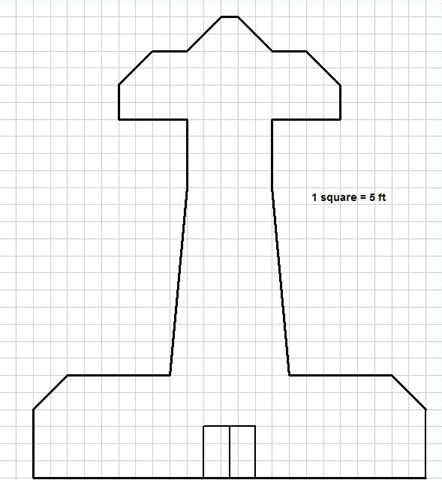 |
The interior of the tower is not detailed in this scenario, except for the throneroom, as it is assumed that the PCs will teleport into the throneroom and then, either agree to the shator's doublecross or fight and slay him and then teleport away to return to the kelubar with his head.
However, for purposes of urgency during the battle or other circumstances where it becomes necessary, the DM should assume that there are a full 75 farastu soldiers (use the statistics presented for the kelubar's soldiers above) present here.
The Set Up:
The shator will be keeping watch in his spy chamber (see below). He will be constantly under the effects of his invisibility spell. When the shator senses his throneroom is being scried (and he will automatically because of his see invisibility ability), he will know that the assault is coming. After about 6 minutes from the point of the scrying attempt commencing, he will use his major image spell to form an illusion of himself entering the throneroom from the double doors and sitting on his chair, placing his spear beside him. As the farastu scries, his illusion will include a farastu minion entering the throneroom, kneeling and speaking to the shator who angrily dismisses him away with the swipe, and then begins to brood on the throne, alone in his throneroom.
This illusion will be kept up for quite some time since the duration is concentration + 3 rounds. If necessary, he will let his invisibility spell lapse in order to keep up the illusion. Of course, if hours and hours pass then he will simply have the illusion stand up and leave the throneroom and wait for the next scrying attempt before having his illusion reenter the throneroom.
In the meantime, the farastu guards will be ready to attack if the PCs refuse the shator's offer, and the many farastus in the fortress will be on alert and at least half of them in the stairway ready to ascend at a moment's notice.
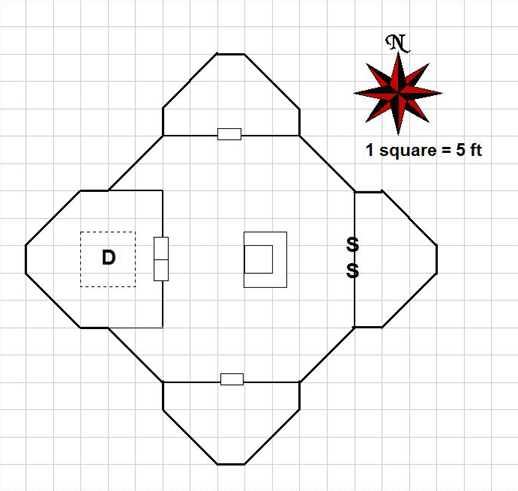 |
The throneroom proper is the central
portion of this top level of the fortress tower (see the map above).
|
This irregularly shaped chamber is dimly lit by stone braziers set into the walls at regular intervals. The place is 20 ft tall and dominated by a large throne crafted from some sort of grey stone shot through with purple veins. Skulls of some sort of medium-sized fiendish creature have been mounted into the throne at various places. The walls of the chamber are decorated with bas reliefs of hordes of slender, wingless fiends ripping apart other similar appearing beings. The doors to the west are iron double doors engraved with a large clawed fist. The doors to the north and south are plain iron doors. |
The northern and southern chambers are guard rooms where farastu soldiers normally await their master's commands.
The eastern room is a secret room with tiny 1 inch diameter spy holes cut into the secret doors (see below). These allow a creature in the room to observe and cast spells into the throne room.
The western chamber contains a 10 ft wide opening in the floor that leads to the massive spiral staircase that winds down the neck of the tower and into the lower fortress proper.
Creatures: 4 farastu soldiers are stationed in each of the guard rooms. Another two are stationed in the western chamber flanking the double doors. All are invisible at all times.
|
|
Additionally, Shator Anduuvohk will be present in the spychamber assuming he is aware that the PCs are coming for him (otherwise, if for some reason he is unaware, then he will be seated on his throne). He will generally be invisible and generating his illusion on the throne (see above).
|
SPELLS: lesser orb of acid (SC p150) - r cl; ranged touch deals 1d8 acid dmg + 1d8/2 CL beyond 1st (max 5d8 at 9th lvl). no light (BoVD p100) - r cl, 20 ft spread, 1 min/lvl; normal light sources cannot illuminate the area.
|
Tactics: Assuming the shator is conducting his ruse, the farastus will be under orders not to intervene unless Anduuvohk gives the command to do so.
If the ruse in underway, see Developments below. If the ruse is not underway for some reason or if the PCs reject the shator's counterproposal, then he will fight to slay the PCs utterly. His first action will likely be to cast resist energy against electricity. Since he is immune to three other energy types, this will likely protect him from the majority of energy attacks. If his enemies show a propensity to use sonic attacks, then he will also cast resist energy against sonic attacks. Mirror image, shield, and protection from good will also be cast while the PCs engage his farastu minions. Haste will be a high priority if his minions are attacking foes en masse and if the shator feels that he can delay casting his defensive spells in order to boost his speed and that of his minions.
Any fighting that breaks out in the throneroom will likey attract the attention of the many farastus housed in the fortress below. They will respond to defend their master en masse.
Since the shator has no spells or abilities that would allow him to escape a bad situation, he is likely to fight to the death, unless he can parley and cut a good deal with his victorious foes. The shator is a proud being, however, and would rather die than resort to slavery or humiliation.
Developments: If the ruse is up, then it is likely that the PCs will dimension door or otherwise teleport into the throneroom an launch a surprise assault on the illusory shator. The shator will let the PCs make their surprise round attacks, having the illusion react accordingly. He wants the PCs to use up some of their resources on the illusion before presenting himself to them.
Once the surprise is over or the illusion is discovered, the shator will use his tongues ability to ask the PCs if they are assassins. He will then attempt to parley with them (still hidden by invisibility and the spy holes). He will explain that he was aware of their coming, for he has a spy well placed in the kelubar's palace. He will then say that the PCs will find he and his army of minions alerted and ready to attack them. However, he has a counterproposal for the PCs.
The shator will inquire as to what reward the kelubar offered them. If the PCs tell the truth, Anduuvohk will laugh and offer the PCs the same reward for aiding him. If the PCs attempt to "sweeten" the kelubar's deal, have the PCs check Bluff against the shator's Sense Motive. If the check succeeds, the shator may agree to kick in a few magic items from his possessions (at the DM's discretion).
If the PCs refuse to listen to the offer or, having heard it, refuse to abide by it, the shator and his minions will attack. The shator knows that the PCs arrived via magical transport, and so will use his dimensional anchor accordingly.
If the PCs agree to listen to the offer, the shator will emerge from his hiding place after having cast shield, resist energy (electricity), protection from good, and eagle's splendour. He will sit on his throne and dismiss all of his minions (if any have emerged into the throneroom). He will then explain his counter offer.
The Counter Offer:
Shator Anduuvohk's counter offer is this. He will allow the PCs to return to Kelubar Th'kkrahk with his head. However, his head will still be attached to his body. The shator proposes that the PCs return to Kelubar Th'kkrahk with a massive metal platter upon which are the piled heads of 50 farastus, topped by the head of the shator. The shator's body will be cleverly hidden under the farastu heads. The PCs will present the platter at the kelubar's feet. As he begins to gloat, the shator will emerge from the pile and attack the kelubar directly. It will be the PCs' job to keep the kelubar's soldiers away from the fight. The PCs are not to interfere in the combat between the kelubar and the shator in any way, as he wishes his victory to be unquestioned, so that he can more easily rule the ex-kelubar's subjects.
If the PCs are worried about the shator's ability to pull off this disguise, he will order his soldiers to round up farastu heads from the nearby villages and return to him. 1d3 hours later they will return with the platter and the heads and the shator will display his Disguise ability.
Should the PCs agree, then they will need to determine some way to carry the platter and the heads and the shator. The shator weighs about 700 lbs and altogether the entire platter will weight no less than 1200 lbs. The PCs should be able to manage by means of calling or summoning spells or abilities such as wild shape. Remember that the PCs don't need to carry the shator all the way back to the plateau. The shator can proceed invisibly with the PCs until within sight of the plateau and then the disguise can be set up.
The shator will insist that six farastu soldiers accompany him on the journey to within sight of the plateau. These will also be invisible the entire time and will not accompany the PCs onto the kelubar's plateau.
It's a Wrap:
This portion of the scenario is likely to be resolved in one of several ways:
1. The PCs simply attack the kelubar initially, defeat him, dismantle the throne, and pass through the gate to the demihive.
2. The PCs attack the shator and slay him and bring his head back to the kelubar, who dismantles his throne and lets the PCs pass through the gate to the demihive.
3. The PCs attack the shator and fail to slay him or they meet the shator, refuse the doublecross, and, in either case, return to the kelubar and slay him, dismantle the throne, and pass through the gate to the demihive.
4. The PCs agree to the shator's plan, he slays the kelubar, and then the shator dismantles the throne and allows the PCs to pass through the gate to the demihive.
Most of the above are self-explanatory. However, if the PCs have brought the shator in disguise to to kelubar, then the scene must be played out. The PCs' arrival on the plateau bearing the shator's head and many farastu heads will be the talk of the plateau. Farastu villagers will line the way and follow the PCs to the palace. There, the PCs will be received by a joyous kelubar, who will cluck and chuckle and wring his hands greedily as he orders the PCs to place the heads before his throne.
The kelubar's soldiers will all be present.
A round after the PCs place the heads at the kelubar's feet, the shator will burst up from the pile and place his claws around Kelubar Th'kkrahk's throat and their battle will begin. The farastu soldiers will leap to the attack, but they will tend to concentrate their efforts on the PCs initially (this because they do not want to choose sides in the battle between the kelubar and shator in case the other one wins, but if the kelubar wins they need to look like they were helping).
The DM could, in theory, enact the battle between the two demodand masters while the PCs fight the farastus. However, given the number of farastus and their ability to summon others, the PCs are likely to have a big enough battle on their hands without having to wait while the DM adjudicates the demodand master battle. Instead, the DM is encouraged to assume the shator will win if the two are left to fight and roll 2d10 to determie how many rounds of combat it will take for the shator to be victorious. Then, the DM is free to simply describe the fight without having to roll dice and interrupt the PC combat.
The farastu villagers will not intervene at all. They will simply await the victory of their old master or the ascension of their new one...it is all the same to them.
The seneschal, notably, will not attack anyone. He will seek to stay in the throneroom in order to see who wins, but will avoid all combat, only defending himself if attacked.
Once the shator wins the combat, he will proclaim his victory in a loud, booming voice, and order the farastu soldiers to stand down and bow to their new masters, which they will do enthusiactically. The shator will congratulate the PCs and offer to enact their reward immediately or let them rest and recuperate in the lower building first. If the latter, then while the PCs rest, the seneschal will speak to the PCs and warn them that the shator is in a good mood for now, but that will not last and they should depart as soon as they can and never return.
In any event, unless the PCs do something stupid, the shator will honour his bargain. He will dismantle the throne back and expose the portal, allowing the PCs to enter (even without the portal key) and travel to the demihive.
Uh Oh...It Broke!:
One of the threats the kelubar can enact to keep the PCs in line is to destroy the gate to the demihive. Should this happen, the the transit of the PCs is interrupted. They will be immediately and violently wrenched out of the the demodand plane and back to the entrance to the portal at the end of the fissure. However, the portal will now be inert, its interior no longer filled with grey mist. The PCs will now have to enter the hive by means of the normal portals...a much more combat intensive proposition.
Getting the Goods:
Whether the PCs choose a frontal assault ala the feral garguns or a stealth approach ala the catfolk, their ultimate goal is to infiltrate into the demihive and recover the royal jelly. How they do this is left to the PCs to decide. The DM should not take any great pains to make a massive combat happen in the hive. Let things flow how they flow and let the PCs' ingenuity make things easy if need be. The PCs have already, by definition, had to struggle just to get to the hive. So, for example, if the PCs ally with the catfolk, complete the dreamquest, defeat the fogwarden in the hidden fissure, deal with the demodands, and come up with some foolproof plan to sneak into the demihive and nab the royal jelly without a fight...then let them. They have already earned it.
On the other hand, the DM should not just allow the demihive to be a complete hand wave. The queen is a fearsome opponent, and the abeil soldiers can be a threat, especially en masse. Should the PCs be detected then the full weight of the demihive (and hive) will descend upon them. Nevertheless, it should be possible for creative PCs who have not put the hive on alert to be able to sneak in, scout out the hive, find the royal jelly, and get out without any combat whatsoever.
Getting Out:
The PCs can leave the demihive by means of the planar portals. If they leave via the five normal portals, they will have to contend with the main hive and either fight ot sneak out (assuming they have not defeated all of the abeil in the main hive in the first place).
On the other hand, the PCs may wish to try to return through the malfunctioning portal. To all inspection, the portal appears as before, including the fact that its grey mist interior roils unsettlingly (unlike the other portals). If the PCs entered the demihive by means of one of the five fully functioning portals, then the malfunctioning portal will not work for them. They can touch a portal key to the portal, but nothing will happen. And if they attempt to step through, they will feel pass through the archway and be present in the demihive chamber.
The only way to use the malfunctioning portal is if the PCs have already travelled through it to the demihive. This travel will have attuned the PCs to the portal and allow them to return by using a portal key. The PCs will not pass into or through the demodand plane. Instead, they will return directly to the portal at the end of the hidden fissure. Note that, should the PCs desire to attempt to return to the demihive using the fissure portal again, they will again travel to the demodand plane and it is up to the DM how they are received by the kelubar, shator, or whomever else is still around.
DMs should also note that only creatures that entered the demihive via the fissure portal can return to it from the demihive malfunctioning portal. This means creatures called or summoned into the demihive cannot use the portal. It also means that the abeil cannot chase the PCs though that portal, should they use it to escape the hive. However, see below.
Ongoing Defense and Retribution:
The ongoing reaction of the abeils to the PCs depends largely on the circumstances, and so is only dealt here in general. If the PCs have stolen royal jelly but not slain the queen or lots of abeils, then the abeils will simply heighten their hive patrols and patrols of their territory, and may more aggressively attack those between 12.5 and 25 miles from the hive for a time. But beyond that they will not pursue the thieves and eventually the hive will settle back down to its age old patterns
Should the queen be slain or a great many abeils slain, then the hive may be roused and send out war parties even beyond the 25 mile limit. These war parties will attack any sentient creatures they find, including catfolk and gargun encampments. If the queen is alive, she will use her spells to try to determine who the PCs are and where they are located and she may send war parties to attack them if they are realtively nearby (within 200 miles). The size of the warparty will depend upon how many abeils survive. No more than half (including those brought back from patrol) will be sent (and only soldiers will be sent).
It should be noted that the queen has access to spells like scrying, greater scrying, scry location, find the path, circle dance, lay of the land, and commune with nature ti help her track down the locate the PCs.
If the PCs use the hidden portal more than once, the abeils may catch on. They know that there was once a sixth portal in the area of the hive that collapsed in the earthquake. They assumed it was destroyed since they cannot use the portal in area M5 of the demihive. However, if the PCs are observed entering or exiting area M5, then the abeils may realize what is going on. In this case, they may send warriors out of the hive and into the fissure to ambush the intruders as they enter or leave the fissure portal.
Returning the Jelly:
Once the PCs return the jelly to Pizotzin, he will be overjoyed and assure them that he has all of the ingredients needed to brew the modified histaachi draught. Pizotzin does not really know about the other properties of royal jelly (see below), so it will be up to the PCs to question if the substance has any other effects and take the initiative in determining this.
The Other Portals:
If the PCs return the dimensional sextant to the catfolk and inquire about it, the catfolk will tell them about Spirit Walkers (see below). In any event, if the catfolk are friendly to the PCs and the PCs know about the Spirit Walkers and the ancient portals scattered around the land, they can inquire of the catfolk of these portals. If the catfolk are willing to help the PCs, they can call for a Spirit Walker to guide the PCs to some of these portals. These portals could be the subject of many adventures for the PCs, since they could lead anywhere, including to hidden sharn treasure vaults, other planes, etc. One or more could even lead to a place where the sharn still live!
Of import, however, will be that some of these portals have decorative motifs that match the same motifs found at the Tri-Claw Fortress (see the scenario "Days of Future Past"). This connection will allow the PCs to realize that this area was a part of the great Sharn Empire and these portals were constructed by the sharn.
Royal Jelly:
In addition to its use by the abeils to breed new queens, and its use by Pizotzin to help create the modified histaachi brew, royal jelly has potency relating to strength and endurance.
If eaten raw, each flask of jelly acts as a bull's strength and bear's endurance potion (CL 6).
However, royal jelly can also be refined in an alchemical laboratory. This requires at least a week of dedicated work and a DC 30 Craft (alchemy) check. Magic that aids skill checks will only be useful if they can last 8 hours a day for 7 days. If the check fails, a flask of the jelly is destroyed and becomes entirely useless. If the check succeeds, a flask of refined royal jelly is made. The process is intense enough that a given alchemist in a given laboratory can only produce 1 flask at a time.
If a person with Knowledge (nature) or Profession (beekeeper) makes a DC 25 or DC 15 check respectively, he can assist the alchemist and provide a +2 synergy bonus to the check. If the alchemist has those skills, then he can assist the process himself. Only one such assistance can be provided.
Refined royal jelly has more permanent properties.
The first time a person imbibes a flask of refined royal jelly, he must make a DC 20 Fortitude save. If the save is failed, the imbiber is sickened for 24 hours, but there are no further effects.
If the save is successful, the imbiber absorbs the potency of the refined jelly into his system permanently. Roll 1d100 on the following table:
01-40 = +1 inherent bonus to Strength (and +1d3 inches height
and an additional weight roll based upon the added height).
41-70 = +1 inherent bonus to Constitution (and additional weight
gained as if 1 inch had been added to height).
71-80 = +1 inherent bonus to Strength and Constitution (and +1d4
inches height and an additional weight roll based upon the added
height).
81-87 = +2 inherent bonus to Strength (and +2d3 inches height
and an additional weight roll based upon the added height).
88-94 = +2 inherent bonus to Constitution (and additional weight
gained as if 2 inches has been added to height).
95-99 = +2 inherent bonus to Strength and Constitution (and +2d4
inches height and an additional weight roll based upon the added
height).
00 = increase 1 size category
A person can only benefit from refined royal jelly in this fashion the first time he imbibes it. Anytime thereafter, imbibing it requires the same Fortitude save, but the effect is only as if raw royal jelly had been imbibed (i.e. as a bull's strength and bear's endurance potion).
Catfolk Spirit Walkers:
The catfolk have a somewhat unique tradition of mystic explorers and scouts called spirit walkers. These are essentially members of the gatecrasher prestige class (Manual of the Planes page 26) who explore planar gates. While it might seem strange that the primitive and nomadic catfolk would have need of such a person, remember that the Fellen Wastes and the land of Charmindos were once part of the Sharn Empire, and the highly magical Sharn made extensive use of magical portals, both for transport across the Material Plane and for interplanar transport. As such, many gates still exist in these lands, some of them functioning and some of them malfunctioning. Most of them are long buried and forgotten with the ancient collapse of the Sharn Empire.
As such, these gates are difficult to find and perilous to use. There is no telling where a gate leads, and what is now there as compared to what was at the other end in ancient times. Furthermore, time, neglect, and the cataclysms that felled the Empire have caused many portals to malfunction, which can lead to disasterous consequences. The spirit walkers (so called because it is believed the gates transit the spirit world) evolved to find these gates and identify their function and to use them and explore where they lead.
Why would the bucolic catfolk concern themselves with such things? First, because occasionally wealth is brought back from such explorations, and wealth and useful enchanted items make the hard life of the catfolk easier.
Second, and probably more importantly, because catfolk have inherited from their feline progenitors that well-known trait of cats...curiousity. Spirit walkers are drive by the innate catfolk sense of curiousity. It is a natural extension of their proclivity as rogues and rangers and the presence of these hidden gates in their lands.
All this said, spirit walkers are very rare in catfolk society. Most catfolk temper their curiousity with the concerns of their day-to-day nomadic existence. It is only those rare individuals who, hearing stories told by the elders of ancient gates and strange lands or treasures beyond them, have a spark ignited within them, who are driven to become gatecrashers.
The catfolk have a long history of spirit walkers, and the tradition is handed down from experienced gatecrashers to those apprentices who show enough interest and capability and can convince an elder spirit walker to pass along the ways of the gatecrasher. This approach to the gatecrashers is different from the one in Therra, which is tied to Flupnir. Catfolk gatecrashers have the same abilities as standard gatecrashers, but the details of their traditions differ.
Denoument:
Pizotzin will inform the PCs that it will take him some time to brew and perfect the histaachi draughts. As such, he advises the PCs to rest and do whatever they need to do or want to do. It may be months or even years before the draught is ready. He will contact the PCs when the time has come.
How long that takes is up to the DM. When the draught is ready, the DM can begin Part Two of this scenario.
Experience Points:
In addition to normal experience (which in Therra is half of that recommended in the DMG), each party member should be rewarded as follows: