Return to the Therran Scenario Page
Summary:
The PCs search for the final piece of lost arcana of Karsus
Assumptions:
The PCs include at least one wizard from Jerranq (or in a pinch a sorcerer).
Location:
Aladur or Xonochouco (Mestil-rez)
Historical Date:
708 A.C. Early Winter
DM's Introduction:
This scenario and the one that precedes it and the one that follows it are intricately bound with the history of the enigmatic Karsus. A brief outline of that history is presented below. Note that much of this history is unknown to anyone in Sazhansiir. This text is taken directly from the entry on Karsites in the Sazhansiir Gazetteer.
|
Karsus is a legendary hero of the great wars between Okoth and Kyuss, and many obscure myths and legends surround him. In some ways, next to Tlaloc, he was the most famous human hero of Sazhansiir. What is not widely known is that Karsus was not born of Sazhansiir. Rather, he was a native of Jerranq and specifically the Antorian Empire who was transported to Sazhansiir by an epic spell cast by Okoth himself which went awry. Karsus was a wizard of no small power in Antorium, and his transportation to Sazhansiir involved not only Okoth's mishap, but a simultaneous mishap in a great magical experiment he and his apprentices were conducting. The result of these two freakish events forming a mystic nexus in the fabric of the multiverse was that Karsus was violently wrenched through the inner planes before being deposited, burnt, frozen, energy drained, bruised, and drowned onto the shore of the Hurlotzin Lands. Dazed and in dire physical and mental shape, Karsus was found by dusklings dwelling in that land and his strange demeanour, babbling speech, and potent abilities were noted and eventually reported to Okoth himself, who ordered the man to be brought to him and nursed by his best healers. Karsus barely recovered, and even so his body and mind were so decimated by the unnatural transference that he had no memory of his life before his arrival. Over the years, Karsus slowly regained some of his knowledge, but never fully, and the knowledge he did regain was murky and came to him like mystical visions or dreams, lending him the air of a prophet, which is, in fact, how he was regarded even by Okoth himself. Although he had lost his spellbook, Karsus knew the Spell Mastery feat and so was able to perform limited "miracles" that likely would have had him cast as a scaled one and killed for use of arcane magic, had not Okoth vouched for him. Instead, Okoth tasked Karsus with trying to find a way to tap into his latent powers and perhaps teach them to others. Karsus tried for years to manage this, but as he was somewhat fuzzy on the origin of his own spell ability, it was difficult for him to make any headway in essentially developing the discipline of wizardry for the Azotchtla. Instead, his magical experiments veered into the realm of suppressing and combating the arcane magic of the scaled ones, and his success in this regard was likely aided by what must be described as a sub-conscious knowledge of the workings of arcane magic. When Okoth unleashed the creation cyst and died in the blast, Karsus was bereft of his primary benefactor and great friend, and his grief grew alongside his madness. After spending a short time railing against the folly of the new rulers of the Okothian Empire, and making a torrent of bizarre prophetic pronouncements, Karsus gathered his few Azotchtlan disciples to him and announced that he was going to find Kyuss in his "hole" in Tyrmannion and siphon the demigod's power through Karsus to Karsus' followers, thereby granting them the ability to wield Kyuss' magic against the Wormlord. Amazingly, Karsus performed the powerful and dangerous ritual linking his followers to himself mystically and over great distances. Even more amazingly, with a small band of companions, the once-wizard managed to reach Tyrmannion and breach its formidable defenses. There, with most of his companions dead or worse, Karsus confronted Kyuss and managed to enact the final words of his epic ritual and touch the demigod, triggering the effect. Unfortunately for Karsus, Kyuss' being was so far steeped in corruption that the absorption of even a small part of his essence was too much for his mortal shell to contain. The ex-wizard was instantly slain…or at least his body was. Kyuss' corruptive essence and the power of the epic ritual interacted to shred Karsus' soul, so that he did not go on to the afterlife, but instead his soul lingered in shards somewhere in the multiverse. The largest of these shards, now touched by and infused with some of the power of Kyuss, became aware as a vestige and is capable of being contacted by a binder. When Karsus touched Kyuss, the conduit to his followers received a jolt of Kyuss' power and corruption as well. Most of the followers died instantly, others slowly and in agonizing fashion, but a few had the fortitude or luck to survive, and the event changed them into what were the first karsites. These first karsites were unaware of their powers, and were, in fact, devastated that the clerics amongst them now could not cast their divine spells. But over time they learned that some small benefit had been gleaned from Karsus' sacrifice, and that their newfound traits were so much an essence of their being that they could be passed on to their progeny. And so karsites have become a part of Azotchtlan society. They are rare, to say the least, as the karsite trait is elusive, and even if two karsite parents breed the chances of producing a karsite offspring is only slightly higher than with a mixed mating. In fact, the bloodline has been so diluted that in theory any two humans who mate have a tiny chance of producing a karsite. Karsites are considered a blessing to the Azotchtla, as their powers are regarded as particularly suited to fighting against yuan-ti sorcery. As such, Azotchtlan parents often keep a close eye on their children for signs of being karsites, and despite no real tendency for karsite births to run in a given family or to a given set of parents, sometimes the number of karsite offspring in an Azotchtlan family line makes that family more prestigious and suitable for intermarriage. Units of karsites are famous in the ranks of the Azotchtlan armies, and many of the best-known war leaders and generals of the Azotchtlan armies are or were karsites. It is also believed that karsites were instrumental in developing the discipline of spellthievery. While certainly no karsite can become a spellthief, due to the inability to cast spells, it is thought that some of the first karsites sought to teach their powers to normal humans and, instead, developed the training for the first spellthieves. |
During his time in Sazhansiir, Karsus babbled incessantly about many obscure and seemingly unintelligible topics. From time to time he would mention three items that were precious to him that he had lost: his staff of power, his white robe of the archmagi, and his spellbook. However, his adled mind would not adequately describe these tokens to the dusklings (and later the Okothians) with whom he spoke, and given their general unfamiliarity with arcane magic (in the case of the dusklings and humans) and wizardry in particular (even Okoth himself was not familiar with this form of arcane magic), the nature of these lost tokens was never truly divined even by his contemporaries.
This was not aided by Karsus' increasing mental instability. While at first Karsus could vaguely elucidate the fact that the items he longed for were, in fact, items, over time his ramblings made this fact less and less clear, until he began to express the identity of the items as his lover and children and refer to them by proper names (the items were, in fact, named) and loving nicknames. The Okothians bgan to assume that he was longing for loved ones who had been slain or were somehow taken from him (or vice versa) and eventually Karsus forgot about them altogether and they were mentioned less and less frequently and then not at all.
And so it likely would have remained, for Karsus' ramblings, at first recorded with much enthusiasm and dedication by the Okothians, who thought him a prophet touched by the gods, were less and less heeded as they became less and less understood. However, Yayauhqui Farseer, doomsayer and prophet, has long been fascinated with Karsus and with his prophecies and pronouncements, and with his "offspring" the karsites. When Yayauhqui learned of the strange magic the PCs wielded, and saw the writings in their spellbooks, he became very intrigued, for such things brought back vague memories of mentioins in the earliest and rarest, but most lucid, pronouncements of Karsus.
He spent much time doing research and eventually came to a startling conclusion...that Karsus was not of Sazhansiir, but was from the far north...from the same lands that the PCs are from.
This revelation was included as an epilogue to the scenario entitled "First Strike". The text of the epilogue is presented below for DM reference.
|
Just before the PCs leave the city, Yayauhqui Farseer will arrive bearing a bundle wrapped in a cloth. He will call the PCs and Malinal and Pizotzin into a private chamber in the Hanahpu Temple and begin to speak: You will remember that the magical writing these people showed us last time we met sparked some memory in my mind's eye. I knew I had seen such writings before! And so I have spent the last months digging through ancient libraries and consulting with wise ones and I have only recently determined where I saw such writings...in some of the works set down by Karsus himself! Mind you, it was in the from of a single character here, or a word there, and often it would involve him writing about something and then lapsing into these characters and then resuming the text, as if these characters were intruding on his chain of thought. But that is not the most interesting thing I found, for the realization that these characters of Karsus were similar to the arcane writings of these strangers caused me to look further. Have you a statue or picture of Karsus handy? Malinal and Pizotzin will both shake their heads. Well, no matter. How is he described in all of the texts? Malinal will indicate that he is described and pictured as an elderly man with wild shocks of white hair and a scraggly white beard and wild, wide, mad eyes. Yes, but he is depicted as an Azotchtlan male yes? Pizotzin will nod, of course. Yayauhqui will then place his bundle on the ground and open it, revealing a stone tablet that is inscribed with cuneiform runes but is clearly worn with age. This is a contemporary account of Karsus. One of the few that has survived through the ages. It dates from after the Creation Blast and before Karsus perished. Of its authenticity I am assured by the rainbowed ones. Here is what this passage says... And he points to a piece of the text "...and Karsus was in a trance as he spoke. And he raised his hands high, his holy staff glowing with divine radiance, and he spake: 'Circles from now, when I am gone and with the gods, the People of the Book shall come! Into your midst they shall come! And you shall reject them at first, as I was rejected. But they shall prove themselves amongst you and they shall show you the way. What is profane shall become holy, and what is holy shall become profane. For they are the pale reavers, the destroyer of nations, the slayers of the sacred! And you shall know them because they shall have the colour of the pages they revere...like mine. They will have what I have lost.' Then the divine one collapsed and froth formed about his lips and he was taken away by his servants..." You see! I believe that Karsus may have been one of them. Perhaps from the same land to the north! I think over the ages he was depicted as one of us...not as a deliberate falsehood, but as a form of respect and reverence for one of Okoth's favourites. There is more I must investigate, but this is quite intriguing! Malinal and Pizotzin will agree. |
For well over a year since his previous meeting with the PCs (as described in the epilogue above), Yayauhqui returned to his karsites and pored through ancient lore kept by the most learned and powerful of that race. He also scoured those sources in Azotchtla to which he had access (which is considerable indeed). By way of his intensive study, now properly focused, he came to the conclusion that Karsus may have travelled to Sazhansiir with his three tokens, and that somehow he lost them AFTER he arrived in the Hurlotzin Lands. Yayauhqui felt that these tokens could be of extreme aid to the PCs in their continuing fight against the scaled ones. Moreso, if such items are, indeed, powerful, then it would do to keep them out of the hands of the scaled ones; for although the scaled ones practice sorcery and not wizardry, Yayauhqui does not know what they might be able to use or glean from the tokens. And so, he returned to the PCs to inform them what he knows about the tokens and to invite them to attempt to recover these items from wherever they might be and from whomever might have them.
In the scenario entitled "The Staff of Power",Yayauhqui (along with Malinal and Pizotzin) explained the situation to the PCs:
Yayauhqui: I have cast my line and caught a worm...yes a worm! That is fitting indeed after a fashion! My head hurts and my rump is pocked and there are needles of light piercing my eyes, but it was worth it...yes it was! You see, lovers and children AREN'T! They simply are not! Who would have guessed it? Not me! And definitely not you...even with your special ways. Sometimes when people babble, there are wheats and oats about. I know this and I am the furthest from a babbler! Hoo...hoo! Manatlan fill a bathtub if it isn't true! Tokens! Tokens tokens tokens. Yep...three. Those without had the way of it. And they are my friends. I have means that would boggle even the high priest of knowledge. Manatlan cheeks for him. Now it is for you! Yes...you can get lucky and find them. You can wield them and strike down the snakes! It will be a great day then! A great day indeed!
Malinal: The farseer speaks the truth, though I will admit that his words are clearer in their meaning after you have figured out what it is he is speaking of. Since Pizotzin and I have already done so, perhaps we can explain it to you in our own hopelessly plain fashion.
You will remember how excited the farseer became when you showed him your spellbooks and magical writings, and how he believed he had seen such writings before.
You will recall that we spoke then a bit about Karsus. It is he who created the karsites, with whom some of you spent time during your first journey to Azotchtla. Karsus was a close friend and companion of Okoth himself and was regarded as a mystic and a prophet, for his ways were very strange and his speech often made no sense or spoke in obscure riddles. After Okoth died in the Creation Blast, Karsus decided to strike a blow directly at Kyuss in Tyrmannion. He claimed to have discovered the means to siphon off Kyuss' fell powers and grant that power to his own followers, who would then be able to strike at the Wormlord using his own powers against him. And so, after berating Tlaloc and the new Okothian rulers and making a series of his most complicated and obscure prophecies, he and some companions travelled into the Blasted Lands, reached Tyrmannion, and somehow managed to breach Kyuss' own defenses. Karsus enacted his siphoning ritual, but alas the corruption that was Kyuss was too much even for him, and the prophet was slain instantly and his soul shattered into shards that roam the netherworlds to this day. The backlash amongst his followers, waiting in Okoth to receive Kyuss' power, killed most, but those who survived became the karsite race.
You will also remember that in our last meeting, after you had escaped the yuan-ti trap in the City of Feathered Ghosts, Yayauhqui had produced a stone tablet that described Karsus as one of you, from your land to the far north.
Well, Yayauhqui has done more research, now convinced that Karsus was one of you, from your lands to the north and that he was likely a wizard, given his strange powers and his references to arcane writings such as were in your spellbook. With this insight in mind, he has been able to re-examine many ancient and obscure pronouncements of Karsus', some of which were thought to be prophetic ramblings, and he has come upon what we think may be an extremely interesting revelation.
You see, it is well-documented in the lore pertaining to Karsus that he had been separated from his family. The lore tells us that he was greatly agrieved at the loss of his dear wife and two children. He often would lament their absence, though he would refer to them as "lost", and scholars were unclear as to whether his family was dead, or had been taken (perhaps by the scaled ones), or he had simply been separated from them. But the farseer has access to some of the earliest lore of Karsus, kept by the elders of the karsites themselves...knowledge that even the Knowledge Temple in the City of Ghostly Feathers would not have access to. And Yayauhqui has noted some inconsistencies in the manner to which Karsus referred to his loved ones in his earlier, slightly more lucid days.
I am a bit embarrassed to tell you the rest, for you will no doubt think the Azotchtla ignorant. But you must try to understand that language is a tricky thing, and even though we can pray to the gods to allow us to understand strange speech and read strange writings, you must, of course, recognize that a thing is in a strange tongue in the first place or you will not know enough to use such prayers. And when a person, such as Karsus, is prone to babble and use strange speech, there is even less cause to use such magic. Furthermore, the spelling of strange words by a raving man can be garbled such that comprehend languages spells will not work on them anyways.
So, it seems, has happened with us and Karsus.
The Azotlan word for "fork" is "tenetach". If I were to say to you in your tongue "I lost my tenetach", how would you know I was referring to an object and not a person? Could not my "Tenetach" be my beloved wife, slain by the yuan-ti? And this is especially so if I were highly distraught at the loss of my Tenetach.
I will say the names of Karsus' "wife" and "children" in your tongue. Here is one of the earliest passages:
DM Note: The words below that are in bold italics are said by Malinal precisely as phonetically set forth, with the accent on the capitalized syllable. Their resemblance to the English (i.e. Common Tongue) names of items should be apparent to the DM (and the players with a bit of thought).
And Karsus awoke in his bed screaming and in a sweat. When his attendants asked what ailed him, he grabbed one by the hair and pulled him close and spake:
"My precious is missing. Where has my poor stawf-UF-pooh-ore gone? I have such need of my stawf-UF-pooh-ore in these troubled times! And my creation, the progeny of my will, why has my poor spehl-BOOK been taken from me? Why, oh gods, have you done this to me! Bereft of my helpless spehl-BOOK am I also helpless. And my long-missed wit-ARK-meej-eye how I long to feel your enfolding embrace once more. I miss your touch. I miss how I felt so secure with you. I am bereft! I am alone!"
You can see that spehl-BOOK is mentioned. It is the same word we heard you refer to your tomes in your own tongue. And if spehl-BOOK is not a child, but an item of power, then what of the others? Can you divine the meaning of stawf-UF-pooh-ore and wit-ARK-meej-eye?"
Of course, stawf-UF-pooh-ore is actually a reference to a staff of power. Wit-ARK-meej-eye is a reference to a white robe of the archmage. These, along with this spellbook (spehl-BOOK) are the three items Karsus lost after his arrival in Sazhansiir.
Malinal then explained that the farseer also found a reference as to the precise spot that Karsus first arrived in Sazhansiir. She stated that although it is a long shot, for 7 centuries have passed since Karsus arrived, there was a chance that one or more of the items could be recovered if they are still in the area.
Yayauhqui:We know Karsus arrived in the Hurlotzin Lands, which, at the time, were populated by the Children of the Mishtai. Now it is a blasted and wild land, foreign to us. But the Hurlotzin Lands are large, as large as Xonochouco, and it would not do to simply wander that land aimlessly. I have come across an account given by Karsus in his earliest days to a feathered serpent of Okoth:
I awoke to the crashing of waves, which I thought were in my head. The sun blinded me, and so for a time all I could hear was the incessant crashing. But my eyes focused and the dazzling light receded and there I was, high upon a cliff with the great sea stretching before me. And as I looked down I saw an eye of earth whose pupil was the sea itself. And it stared at me in solemn judgment. And near the eye was a gaping maw of earth, which sought to swallow me should I not flee from the place. And a nameless fear welled up within me and I ran from the waves below and into a cleft in the earth where ran a river that soothed me. But I lost my way and could not return to the place I had awakened.
Malinal: This is not much to go on I fear, but it is the best we have. If you are willing to pursue this further, we can speak with a duskling elder we know. He may be able to shed some light on where you might search. But keep in mind this can all be for naught...and likely is. Over 700 years have passed. Who is to say the items are even in the Hurlotzin Lands? Perhaps the snakes took them away centuries ago and they now lie in some vault in the Blasted Lands? But if you are willing, we will take you to the duskling that you may speak with him.
The PCs then met with a duskling elder, whose ancestors guided them to a magic portal in the Irin Forest that allowed transport to the Hurlotzin Lands. From there they located the landmarks that Karsus spoke of and a cave wherein dwelt an insane rogue eidolon who had been in possession of the staff of power. The PCs learned that the staff had been stolen by a group of evil worshippers of the vestiges of Karsus and they made their way to the cleft in which they had their lair. After a tough fight, the PCs gained possession of the staff. They also found a map (or fragment thereof) in the lair of the duskling leader of the worshippers and documents that indicated that Karsus' white robe of the achmagi was likely in the possession of a dragon who dwelt in the lands to the north of the cleft.
The PCs then travelled to the dragon's lair and bargained with him to recover an item stolen from his hoard in exchange for the robe. The PCs tracked the thieves, a group of dusklings, lizardfolk, and a saurial, to a vault in the heart of a necrocarnum bog. There, they learned that the item they had stolen from the dragon, a glowing blue orb, was the key to a mystical door that lay within the vault. The dusklings believed that lost lore of Klashkaln, their Mishtai patron, was contained within. A parley ensued and the PCs agreed to wait for the dusklings to open the vault and garner the lost lore. When they returned, they would hand the orb over to the PCs to return to the dragon.
Alas, the dusklings had not discovered a lost trove of Mishtai lore, but rather a prison for powerful ancient foes of the Children of the Mishtai. Three cornugons were trapped within and when the dusklings breached the vault door with the orb they undid the magic of the prison. The cornugons defeated the dusklings and their minions, although one of the devils was slain in the process, and the remaining two burst forth out of the vault door and attacked the PCs. The PCs managed to defeat the devils and, investigating the vault, found the torn remains of the dusklings. However, the saurial and one of the lizardfolk had survived, and the PCs rescued them and nursed them back to health. In doing so, they learned clues that lead them to believe that the final token, the spellbook of Karsus, may be held by the Scaled Ones in a place called V'ssanaqua'ss.
This final token, the spellbook, is likely the most important. While a staff of power and a robe of the archmage are indeed powerful items, the spellbook could be used as political leverage to convince the Azotchtlan people to accept the teachings of wizardry and learn to weild arcane magic! This possibility is dealt with more completely in the next scenario entitled "Flowers in the Battle".
Determined to enter the yuan-ti city, in the scenario entitled "The Book of Revelations, Part One", Pizotzin advised the PCs of a possible means to thwart the many magical wards and means of detection that would likely guard the location of the book. He innformed the PCs that he discovered lore that made it possible for the brew that the yuan-ti create to turn humans into histaachi (or broodguards) to be modified so that the imbibers retain their minds and the transformation could be reversed. Armed with this knowledge, the PCs travelled to gather the rare ingredients needed to make the modified histaachi brew, including stealing some vials of normal brew from a yuan-ti stronghold, and obtaining rare ingredients from the raptorans and abeils.
Now, Pizotzin has finished the modified brew, and it is time for the PCs to enter V'ssanaqua'ss.
Part One - The Brew's the Thing
Learning of V'ssanaqua'ss:
There are a variety of means that the PCs can use to determine where the spellbook is located. These were set forth in the previous scenario and are repeated here:
|
1. The Saurial and Lizardfolk Should the duskling party enter the prison and face the cornugons without the PCs present, 2 of them will survive the mauling they received. H'hestis-al the saurial and Nessta the lizardfolk will both be disabled but stabilized at -3 and -5 hit points respectively. Both can be revived by the PCs as per the normal rules. Alternatively, if either or both survive attack by the PCs, then they can be coerced or persuaded to tell what they know. The saurial H'hestis-al is devoted to the idea of finding and returning the lost mishtai Klashkaln to Sazhansiir. He believes such a deed will not only restore the ancient lands of the Mishtai, but is the key to defeating Kyuss. He undertook this journey with the dusklings when they travelled through his people's lands en route to the Hurlotzin Lands and found out what they were seeking. The lizardfolk Nessta was an outcast of her tribe and was dwelling with the saurials and accompanied the expedition purely for mercenary reasons. If revived from assault by the cornugons, the two will be grateful to the PCs. H'hestis-al will expect to have his equipment returned to him, and Nessta will desire both her own and her companion lizardfolk's equipment. Neither will make a claim on the duskling's items. H'hestis-al does not know anything about the spellbook that the PCs seek. However, interestingly enough, Nessta does. Of course, she has no way of knowing that the PCs are seeking the spellbook, and so they will have to bring up the topic. Should the PCs ask about the spellbook, Nessta will say that she may know something of it, and will relate the following tale: This tale has been handed down from generation to generation amongst the people of my tribe. It is said to have happened during the great chief Ulrasst's reign, which was long gone even when my greatgrandsire was but a youth. One day there came to the tribe a great force of scaled ones, led by a powerful one borne on a palanquin by human slaves. The Great One assembled our tribe and demanded tribute and obeisance, so that even Ulrasst, a mighty warrior with three powerful adepts at his side had to grovel in the mud. The Great One then held up an object in his hand. He held it up high and the object was a book of some sort. He told the tribe that the lords of the scaled ones sought tomes such as this. The book was very large and likely very heavy, and the lizardfolk there marveled at the ease with which the Great One maneuvered the book. He flipped it open and showed all the strange runes, writings, and diagrams within. He then told the tribe that great power and wealth would rain upon any tribe that found another such book and informed him of it. But, said he, should any tribe find such a book and not inform him, then that tribe would die a thousand agonizing deaths and their seed would be wiped from the earth and their souls cut off from their ancestors. He then closed the book and as he departed he told the tribe to send word of such a tome to V'ssanaqua'ss. Our tribe has passed this tale from generation to generation, so that should such a thing be found or heard of word could be given to the scaled ones. But we never learned of any such tome. We never saw another like the one brought to the tribe that day long ago. At the mention of V'ssanaqua'ss (Viss-ah-NAH-kwass), H'hestis-al will shudder, for he knows of that place, said to be the stronghold of a very powerful coven of yuan-ti...one of the centers of scaled one power in the northern Quazilchatl Jungle. He will recommend that the PCs stay far away from that place, as it is said that a great evil originated there and its taint lingers there still to this day, centuries after the evil itself was ended. |
|
2. Divination Divinatory spells can help the PCs find the spellbook. Should a divination spell be cast, for example, the following could be learned: That which you know you seek "That which you seek" refers to the spellbook. "and that which you do not" refers to the revelations to be learned at V'ssanaqua'ss. "the boughs of the east" refers to the easternmost jungle, the Quazilchatl. "the center of evil" refers to V'ssanaqua'ss. The mention of "rags" and "crook" refer to the robes and staff and is a method addressed in item 3 below. Armed with the above cryptic verse, the PCs can do some research in a properly stocked library or consult with the Knowledge Temple or other wise men and sages to eventually learn about V'ssanaqua'ss. |
|
3. Sympathetic Manifestations There are two other ways to learn the location of the spellbook. The first is if a PC ever binds a vestige of Karsus. If so, he will receive an instant sense of longing pulling him towards the northeast of Sazhansiir. Whenever Karsus is bound, the PC can effectively follow this longing all the way to V'ssanaqua'ss. The second is that the three tokens of Karsus were so beloved by him that when his soul was shattered and scattered into the void, some bits found their way into the three items. As such, if a PC wears the robe and, at the same time, holds the staff, he will feel a pulling similar to that described above. By wearing both items, he can locate V'ssanaqua'ss. No matter which of these two methods is used, the person subject to the influence will also immediately, and occasionally thereafter hear the word "V'ssanaqua'ss" whispered on the edge of his hearing and will hear it in his dreams as well. The word will haunt him. Furthermore, he will infrequently gain a vision of himself making his way through thick jungle and finally breaking clear of a tangle of vines and undergrowth and seeing before him a massive city full of scaled ones. This vision will also haunt his dreams. |
The PCs consulted with various worthies they had befriended during their time in Azotchtla, including Malinal and Pizotzin (Yayauhqui is away on his own business).
When the PCs mentioned V'ssanaqua'ss it elicited a strong reaction. Those who heard its name fidgeted or made a quick sign to ward evil and glanced around nervously. V'ssanaqua'ss, they explained, is one of the most powerful strongholds of the scaled ones in the northern Quazilchatl Jungle. It is even rumoured that one of the progenitors has its home there. It is also rumoured that some great and ancient evil took place in V'ssanaqua'ss and that its taint lingers to this day. The PCs will be advised to stay well away from such a place.
V'ssanaqua'ss is a city of yuan-ti and a center of their power. It is not like conducting a lightning raid on a naga outpost or surviving a yuan-ti ambush in the sewers of the City of Ghostly Feathers. This is a place where the yuan-ti can call upon all of the resources of their foul race. Even the PCs, proven heroes and slayers of powerful devils could not hope to prevail against even a fraction of V'ssanaqua'ss by brute force.
Furthermore, subterfuge also would not work. The scaled ones, being masters of subterfuge themselves, are aware of and take great pains to ward against similar subterfuges in kind. Not only to keep out their enemies, such as the Azotchtla, but also because the scaled ones fight and scheme amongst themselves and jockey for favour with the Wormlord and so they must erect defenses against subterfuge and infiltration from their own kind. As such, it is doubtful that any sort of illusions or disguises would work against them. Even actual change of form such as polymorph would likely not fool them, for being shapechangers themselves they have the means to ward against it and to discern it with ease.
The PCs were persistent in their desire to obtain the spellbook and those with whom they consulted finally advised the PCs to give them some time to think upon it and to research the matter. They informed the PCs that this research may take some time, perhaps even a matter of months.
Of course, as mentioned in the Introduction, the solution arrived at was to modify the histaachi brew (the brew is called tragaash daur in Slith). Even after the PCs have gathered all of the rare ingredients, it will likely takes months or even several years for Pizotzin to refine the brew so that it is as reversible as possible. Once he has done this, he will contact the PCs and inform them that the brew is ready. If the PCs desire to wait a bit, that is fine, but Pizotzin has no idea how long the modified brew will abide the modifications, and he would recommend a delay of no more than a few months once it is ready to be imbibed.
The Brew:
The details of the modified histaachi brew are set forth here, for easy reference. First, the normal brew will be described, and then the modification will be addressed. Note, for example, that the modified brew works on any humanoid with at least half-human parentage.
The Normal Brew:
A human who drinks the mixture, willingly or not, must make a DC 16 Fortitude saving throw. Success means an immediate lapse into a coma, followed by death 1 hour later. Failure leaves the imbiber sickened and requires an immediate DC 15 Constitution check. Success on this check begins a painful and permanent change into a tainted one during the next 1d6 days. Failure means a groggy, torpid transformation into a broodguard over a period of 1d6+6 days.
Humans can be rescued from either transformation by magical means during the transformation period. Casting neutralize poison, dispel magic, remove curse, and heal on the victim (in that order) reverses the transformation in half a day, but the rescued human permanently loses 1 point of Intelligent in the process. Alternatively, a properly worded wish, limited wish, or miracle spell can undo the change instantly with no loss of Intelligence. Once the transformation is complete, there is no known way to restore a tainted one or broodguard to its former human state.
Only humans can be successfully transformed with this mixture. Any other humanoid that drinks it must make the same DC 16 Fortitude saving throw, but success leaves tthe imbiber sickened for 1d4 rounds, and failure results in a coma, followed by death in 1d4+1 rounds. The brew has no effect on non-humanoids, other than tasting horrible.
Note: In Therra, broodguards lose all spellcasting, spell-like abilities, supernatural abilities, and psionic ability, whether stemming from race or class.
The Modified Brew:
A humanoid who drinks the mixture, willingly or not, must make a DC 16 Fortitude saving throw. Success means an immediate lapse into a coma, followed by death 1 hour later. Failure leaves the imbiber sickened and requires an immediate DC 15 Constitution check. Success on this check begins a painful and permanent change into a tainted one during the next 1d6 days. Failure means a groggy, torpid transformation into a modified broodguard over a period of 1d6+6 days.
The Xbalanque Temple has mystic means to ensure the Constitution check is failed.
A modified broodguard retains its previous identity and memories as detailed in the section below describing the modified broodguard template.
Humanoids can be rescued from either transformation by magical means during the transformation period. Casting neutralize poison, dispel magic, remove curse, and heal on the victim (in that order) reverses the transformation in half a day, but the rescued human permanently loses 1 point of Intelligent in the process. Alternatively, a properly worded wish, limited wish, or miracle spell can undo the change instantly with no loss of Intelligence.
The modified brew can be reversed even after the transformation by use of a poultice prepared by Pizotzin and the Temple of Xbalanque. The poultice only has an effect on a person who has been transformed by the modified brew, and such an imbiber will fall comatose for 1d4 days, while his body and mind slowly revert back to normal. The imbiber must make a DC 16 Fortitude save. Success means that after the reverse transformation, the person will be completely back to normal. Failure means something has gone awry with the reverse transformation. The reversal poultice will only work on a modified broodguard, not a tainted one. Should an imbiber transform into a tainted one, he becomes one body and soul and loses his former identity.
Should the reverse Fortitude save fail, then further DC 16 Fortitude saves must be made in the order indicated below with the listed effects, until such time that a Fortitude save succeeds, at which point no further effects are suffered.
|
|
|
|
|
Reversal is not completely successful. Imbiber gains a slight physical taint of a broodguard such a a strange shape in one of his pupils or a slight lisp or perhaps a couple of scales on his body. |
|
|
Imbiber permanently loses 1 point of Intelligence. |
|
|
Imbiber retains patches of scales all over his body. Permanently loses 1 point of Charisma. |
|
|
Imbiber gains immunity to hold and charm spells and effects and permanently loses 1 point of Intelligence. |
|
|
Imbiber immune to all forms of snake venom and permanently loses 1 point of Charisma. |
|
|
Imbiber may rage 1/day as a broodguard but loses 1 point of Intelligence permanently. |
|
|
Imbiber gains claw attacks as a broodguard but loses 1 point of Charisma permanently. |
|
|
Imbiber is forever a modified broodguard, though he keeps his identity and can advance in classes on a go-forward basis. The imbiber's alignment will change to his true alignment (from chaotic evil) over the course of 1d3 weeks. |
Only humanoids with at least half-human parentage can be successfully transformed with this mixture. Any other humanoid that drinks it must make the same DC 16 Fortitude saving throw, but success leaves the imbiber sickened for 1d4 rounds, and failure results in a coma, followed by death in 1d4+1 rounds. The brew has no effect on non-humanoids, other than tasting horrible.
The Transformation:
A modified broodguard gains a template as follows. They also gain the ability to speak Slith and Draconic for as long as they ae transformed.
Type: Creature's type changes to humanoid (reptilian),
Hit Dice: As base creature.
Speed: As base creature.
AC: As base creature. Modified broodguards do not wear armour.
Attacks and Damage: As base creature. Modified broodguards have sharp claws and vicious bites they can use in melee. They use the base attack values they had as the base creature, but their claws deal 1d4 points of damage and their bite deals 1d4 points of damage.
Special Attacks: Modified broodguards retain all the special attacks of the base creature (including all spellcasting and psionic abilities). They also gain a rage ability:
Rage (Ex): Once per day, a modified broodguard can enter into a berserk state similar to a barbarian's rage. In this state, the modified broodguard gains +4 to Strength, +4 to Constitution, and a +2 morale bonus on Will saves, but its takes a -2 penalty to Armour Class.
Special Qualities:
Yuan-ti Blood: For all special abilities and effects, modified broodguards are considered yuan-ti. For example, they can use special yuan-ti weapons or magic items with racially specific yuan-ti powers as if they were yuan-ti.
Poison Immunity (Ex): Modified broodguards are immune to all forms of snake venom, including their own poison.
Mental Resistance (Ex): Modified broodguards are immune to hold and charm spells and effects.
Saves: As the base creature.
Abilities: Modified broodguards gain +2 to Dexterity and +2 to Constitution, but lose -4 to Intelligence and Charisma.
Skills: As the base creature.
Feats: Modified broodguards gain Alertness as a bonus feat due to their heightened senses.
Challenge Rating: Same as the base creature.
Alignment: While the personality of the base creature remains, the modified broodguard's physical body emanates chaotic evil alignment and, as such, to any magical means the modified broodguard will be treated as chaotic evil. While the physical shell radiates chaos and evil, the personality housed within retains its former alignment and, as such, does not violate any class restrictions. However, to physical objects like magic items, the modified broodguard's alignment is chaotic evil.
Other: Modified broodguards that had spellcasting ability as a base creature retain such ability as a modified broodguard. However, as broodguards normally wear no clothing and have no spellbooks or component pouches and broodguard clerics are cut off from their deities, no broodguard normally has spellcasting ability at all. Any spellcasting by a modified broodguard would immediately arouse intense scrutiny and suspicion from any yuan-ti, broodguards, or other creatures dwelling with them.
Part Two - Getting There
Pizotzin will tell the PCs that it would be best if they took the modified brew at the Xbalanque Temple, so that the priests could guide their wills to become broodguards and not tainted ones. If the PCs refuse, then they will have to take the risk of turning into a tainted one with no loyalty to the PCs and possibly compromising the mission. Other than Pizotzin and two of his most trusted priests, and Malinal and Yayauhqui (although the old man is not present), no one else knows of the PCs' mission. Pizotzin will advise the PCs not to inform their followers or subjects of their mission. Instead, just tell them that they will be away for a long time on a mission (months or possibly years). If the PCs have a powerful friendly NPC they really trust (for example, a retired former PC), then they can let him know what is happening.
PIzotzin will advise the PCs that the best way to proceed would probably be to teleport or otherwise travel as broodguards with whatever equipment they might desire to take with them to some point close, but not too close to V'ssanaqua'ss...perhaps no more than a day away but no closer than several hours. They should then hide their equipment and seek to approach the city, possibly joining up with other broodguards as soon as they can or manufacturing a reason to be alone outside the city.
Once the PCs have the book, they will have to figure out how to get it out of the city and back to their hiding place, where presumably they will have the means to travel back to the Xbalanque Temple. Pizotzin will offer to give the reversing poultice to the PCs so that they can reverse the transformation before returning to Azotchtlan Lands, but will warn them that the poultice will place the subject into a comatose state for several days.
He will advise the PCs to carefully consider how, once transformed, they will gain access to the city and not cause suspicion. If the DM wishes to guide the PCs somewhat at this point, he can have Pizotzin point out the main issues set forth below and even come up with some of the suggested plans if the PCs seem stuck.
Pizotzin will hand the PCs a scroll containing some basic information regarding the yuan-ti and especially broodguards. The DM should hand the players the handout entitled "Information Regarding the Yuan-Ti and Their Servants". He will say that the scroll has only very general information, but this might allow the PCs to then ask of him more specific questions that he can research to the best of his ability.
|
The following is information gathered from various sources and compiled by the Xbalanque Temple of Xonochouco. It is not a complete treatise, but is designed to provide an overview. History: As far as can be determined, the yuan-ti were bred by the Progenitors, likely the sarrukh, from human slave stock. The humans were, of course, ancient Azotchtlans, taken from their homeland of Azotchtla and enslaved en masse by the Wormlord. It is believed that the human nature within the yuan-ti is at conflict with the serpent nature, and this instablity is what allows or causes the many mutations and variations seen amongst the yuan-ti. Yuan-ti were the most numerous of the Favoured of the Wormlord, and therefore in total the most powerful. During the time of war when Okoth and Tlaloc battled the Scaled Ones, the yuan-ti made up the largest portion of the elite soldiery of the scaled one armies. Of course, the bulk of these armies were manned by inferior bred races including lizardfolk and other similar slave races. When the Creation Blast detonated, the majority of the yuan-ti homeland was decimated in what is now the Blasted Lands. Great metropoli supposedly holding hundreds of thousands of the creatures were annihilated, and certainly a majority of the yuan-ti alive at the time were destroyed. The remaining yuan-ti fled with the rest of the scaled one armies. They were unable to return to their lost empire in the southeast, and instead took to the jungles, which provided them with concealment and cloaked their activities. The surviving yuan-ti laired in underground settlements hidden deep within the jungles, and there they regained some measure of their strength and numbers. Over time, as the Okothian Empire dissolved and the Azotchtlans began to quarrel internally, the yuan-ti began to expand their holdings, building outposts and fortresses on the verge of the jungles. Nevertheless, the yuan-ti still had to fear the remaining Creation Cysts, and so they always gathered in relatively small numbers and in hidden places. Castes: The yuan-ti society is stratified by breed of yuan-ti. Rarely can a member of one of the lesser castes aspire to a station that is equivalent or greater than that of a higher breed. Instead, the members of each breed tend to associate with each other and strive against each other for supremacy amongst that breed. At the very top of the yuan-ti hierarchy are the addasska or anathemas, Progenitors and original servants of the Wormlord. There are only 3 such beings left in the world, for they do no breed and 2 of their number were slain (one in the Creation Blast and one in the war against the mishtai). Little is known of these entities, except that they are horrible to behold and possessed of immense magical and physical prowess. They appear as giant human armed serpents with six snake-like heads. Next are the abominations. These creatures are the nobles of yuan-ti society, and while other breeds can rise to great positions of responsibility in yuan-ti society, roles of absolute rule are almost always held by an abomination. Abominations are large serpents with humanoid arms. They are often priests of the Wormlord and sometimes powerful sorcerers as well. Below the abominations are the halfbloods. These are man sized and have varying appearances, from a human body with a serpent head to a human body and head with snakes for arms, to any number of mixtures between snake and human form. But all such halfbloods sport signifcant mixed human and snake features. The halfbloods are the upper eschelon of the common yuan-ti. They often hold positions of responsibility on behalf of abominations, for example as commanders of troops, or masters of households. Almost all yuan-ti hunting or raiding parties are led by a halfblood. The lowest rung of the non-slave ranks of yuan-ti are the purebloods. These appear almost entirely human, although always with some slight serpentine characteristic, whether this be a forked tongue, pointed teeth, or scaly patches on the skin. The purebloods serve primarily as the peasantry of the society. They form the bulk of hunting or slaving parties, raiding parties, and war groups. Within yuan-ti strongholds they also hold positions of craftsmen when slaves and servant races do not or cannot perform such functions. Purebloods are also able to infliltrate human societies due to the subtlety of their snake features. However, such infiltration is rarely longterm or in intimate proximity to humans without the benefit of magic, as even their subtle serpentine features can give them away. Additionally, three other mutations of yuan-ti are known: Little is known of the holy guardians. They are a yuan-ti caste bred to guard holy places. They appear as sinuous snakes with humanoid arms. They are smaller than abominations, their upper body being man sized, and their scales tend to be reddish. This breed is completely loyal to yuan-ti priests and are outside of the usual internecine struggles of the yuan-ti. Mageslayers are a misnomer, despite their names. They are more properly thought of as mage (slayers) or slayers who are mages. While they are bred and trained to combat enemy spellcasters, and sometimes are believed to be used as shock troops in yuan-ti internecine strife, they are known to be effective spellcasters themselves and are bred to fairly prodigious innate magical abilities as well. They appear as slightly larger halfbloods with human arms and a serpent tail. Their tongues are forked and eyes have vertical slits. Ignans are one of the more successful experimental mutations performed by the yuan-ti. Usually the yuan-ti experiment on lesser races, but there are believed to have been some rarer experiments on other yuan-ti, and in this case on abominations. The ignans are thought to be a fusing of abomination and salamander, for they command the powers of fire. They are as large as abominations, resembling a giant serpent with a humanoid upper body. Horns crown their heads and their tails split into two sharp hooks. A haze of heat surrounds them. The ignans are used as shock soldiers and for special missions by powerful abominations. Finally, there are two types of yuan-ti that are created from humans. These are known as the histaachi. These are not quite considered to be slave races, but they are viewed as servitors due to their formerly human status. Most histaachi are claimed by a house. Tainted ones are not marked, for to do so would compromise their infiltration ability, but broodguards (see below) are often branded with a metal ring through one earlobe. This ring often contains coloured semi-precious stones or Slith runes identifying the current house to which the broodguard is attached. Tainted Ones are created from humans who are given the histaachi brew. They appear exactly as they did prior to their transformation. However, they are become yuan-ti and their loyalty and personality are completely converted to yuan-ti. Tainted ones are often used to infiltrate human societies, and they are a constant danger in the Azotchtlan Lands. In yuan-ti lands, tainted ones who are not undergoing training for an infiltration raid often serve as taskmasters of human slaves, broodmasters over the broodguards (see below), or even as favoured servants of yuan-ti lords. Many of the finest crafters in yuan-ti society are tainted ones. Broodguards are the lowest caste of yuan-ti. They are humans who have failed even at fully assimilating the histaachi brew. Mishapen and brutish, broodguards have almost no specific memory of their previous lives. They are used for a variety of purposes, often watching over yuan-ti hatcheries or nurseries. Others serve as first line guards of yuan-ti strongholds and fodder troops during raids or battles, and still others as menial servants for tasks that do not require much in the way of judgment. The more intelligent of this unintelligent breed are sometimes given the position of master over human slaves or of other slave races such as lizardfolk. Society: Yuan-ti society is generally chaotic and brutal. While caste distinctions are almost always honoured, internecine strife within castes is rampant. Assassination is an acceptable and typical means of promotion, and yuan-ti train from an early age in the art of dueling. Yuan-ti magicians specialize in magic designed to prevail in one-to-one combat and against rival spellcasters. This is not to say that yuan-ti sorcerers cannot muster battlefield magic such as fireballs and lightning bolts, but given the rare nature of open warfare, most opt for magic that is more precise. This is especially true as a rival yuan-ti is usually desirous to obtain his foe's property, possessions, slaves, and minions, and as such is reticent to damage or destroy these in combat with a rival. While the yuan-ti castes roil with intrigue and maneuvering, the society as a whole is largely stable, mainly as a result of the caste system, which is reinforced by actual racial differences between the castes. It is thought that caste divisions ensure that yuan-ti internecine strife is limited and rarely crosses caste boundaries. Given the fact that yuan-ti society is chaotic within each caste, it is surprising but true that as a whole yuan-ti society is highly organized and in times of crisis yuan-ti strongholds can muster and master very quickly. While assassination and treachery are rampant during peacetime, there are almost no references to yuan-ti betrayals while engaged against outside (usually Azotchtlan) forces. Within a given large yuan-ti settlement, the yuan-ti are organized into households, its members related by blood or mating. Elders of a household who have managed to survive are allowed to formally retire. Retirement results in a removal of the elder from all station and the politics of the yuan-ti society. It also removes them from any threat of assassination, and it is against custom for any yuan-ti with any vendetta to enact these against a retiree. Instead, such retirees are revered and often called upon for advice or adjudication of disputes. V'ssanaqua'ss: Little is known of this place, believed to be the only aboveground city of the scaled ones. Likely, before the Creation Blast, many such cities dotted the lands, and presumably most of these great metropoli were set in the Scaled Empire, now the Blasted Lands. But after the Creation Blast, the yuan-ti moved into small enclaves underground. Only V'ssanaqua'ss remained, defiant and open. Why this small city was chosen to remain aboveground and intact is not known. Certainly the city is small enough that it is in no danger to be the target of a Creation Cyst. Estimates put the population at anywhere from 7,500 to 15,000 beings, of which less than half are probably yuan-ti. The rest should be servitors or slaves. It is known that ancient tales passed down from Okothian times name V'ssanaqua'ss as a cursed city or an especially evil location. The tales are extremely vague, and the purported causes of this reputation vary wildly, from rulership of the place by various foul demonic entities, to a curse placed on the city by one of the mishtai. Whatever the truth, the city is whispered of only in hushed breaths by common Azotchtlans. |
Pizotzin will also tell them of the capabilities and characteristics of the modified transformation. For example, he will let the PCs know that their alignment to the outside world will be chaotic evil, while within they will still maintain their own ethos. To all casual and magical inspection, the PCs will be broodguards. Even spells such as discern bloodline will be fooled. The PCs' own identity, though preserved, will be so well integrated within their new body that even attempts to scry on the PCs will fail, since after the transformation the PCs do not, themselves, exist anymore. However, Pizotzin will warn, magic that reads minds, such as detect thoughts or certain psionic powers, can and will divulge the identity of the PCs. Therefore, it is important that the PCs do nothing that will attract undue attention. The disguised transformation will absolutely hold up to casual investigation. But should suspicions be aroused, means such as mind reading and truth compelling magic will quickly rip away the facade. Because of this, Pizotzin advises the PCs to proceed very carefully. He will remind them that there is no urgency in this endeavour. It might well take a year or more of the PCs posing as broodguards before they have enough information and confidence to make their move.
In fact, Pizotzin will advise the PCs that the total knowledge the Azotchtlans have of yuan-ti daily life and the broodguards is extremely small, since the Azotchtlans are not much concerned with the former and the latter do not pose any sort of infiltration threat and are merely battlefield fodder when faced as foes. Because of this, Pizotzin will recommend the PCs spend their first block of time in the city merely learning the day-to-day ropes and layout and keep a very low profile. Blending in will likely be difficult enough.
Pizotzin will also remind the PCs that use of magic of any sort is probably not worth the risk. No yuan-ti would ever teach a broodguard magic of any kind, and they don't even give them weapons or armour. The yuan-ti, being prodigious sorcerers, may have spells up at any or all times that let them see arcane auras or magical effects. Even spells like detect magic can be made permanent. Attempts to divine or scry within the city can lead to psychic poisons, which the yuan-ti are known to employ, and again can cause the yuan-ti to investigate the source of the scrying. Many yuan-ti are highly intelligence and perceptive, and some may have the means to see invisible objects active all the time. Detect scrying is likely also not an uncommon spell in their community. While using the PCs' prodigious magical abilities and magic items may seem to make a tough quest easier, it is more likely to lead to the yuan-ti investigating and hunting the PCs. Even should the PCs be able to escape, the fact is that one of the biggest advantages the PCs have is that the yuan-ti believe that it is impossible for a histaachi brew to be modified as has been done. They do not know to look for enemies disguised as broodguards. But should the PCs blow their cover, it is almost a certainty, by use of magics including divinations, that they will determine what happened, and then they will take measures to counter such activity. In short, if the PCs blow this chance, they will likely never recover the book and any future use of the modified brew to infiltrate the yuan-ti will be lost forever.
Therefore, Pizotzin will urge the PCs to use intelligence, subtlety, patience, and cleverness to succeed where main force and magic may not.
Once the PCs have transformed back, with the spellbook, the PCs should report back to the Xbalanque Temple and they can figure out their next moves.
Getting into the City:
The first task of the PCs once they arrive in the vicinty of the city is how to get in. The DM should allow the PCs some leeway in coming up with a scheme to do so, as long as the plan makes sense.
The main issue confronting the PCs, once they have transformed using the modified brew, is how to attach themselves to a house and be accepted into the city. There are several fairly easy ways to do so. The PCs would do well to remember that while, to humans all broodguards look the same, to a yuan-ti this is less the case and definitely to other broodguards this is not the case. A plan that is overly simplistic, such as killing some broodguards and taking their place by putting on their earring brands, will run into major trouble because the other broodguards will not recognize them. There are ways around this, however, as detailed in some of the poossible entry schemes as noted below.
1. Pose as Owned Broodguards:
The PCs could pose as the broodguards of a visiting yuan-ti. This has the advantage of explaining their newness to the city and why no other broodguards recognize them. However, the problem exists that they will have difficulty claiming to belong to a master who is not around. They also need to get their hands on that master's earring brands.
The best way to do this is to travel (preferrably ahead of time) to some yuan-ti location distant from the city, or search for and find a wandering group of yuan-ti with broodguards, and slay the yuan-ti and broodguards and then take the earring brands from them. The PCs can then take the bodies of the yuan-ti and perhaps some of the broodguards and put them in a location where they can lead curious yuan-ti who want to verify their claims or they can simply dispose of the bodies entirely. The PCs would then need to concoct a story explaining how their masters died and they escaped. Given the dangers of the jungles in which the yuan-ti dwell, this would not be unheard of at all.
If the PCs place the bodies for inspection, then they need to make sure the wounds jibe with their stories. Yuan-ti from the city have nothing to be suspicious about, but any obvious inconsistencies could eventually have a yuan-ti priest use speak with dead to learn the truth. Of course, if the PCs' story matches the PCs' attack in the first place, then even that will cause no problems.
However, if the story is that humans were involved in the attack, then the yuan-ti will be somewhat cautious. They will escort the PC broodguards under guard to a temple in the city where magic (arcane and divine) will be used to make sure the PCs are not disguised humans. Of course, that is the purpose of the modified brew, and these detection methods will turn up nothing. The priests will not use any sort of truth-telling magic on the PC broodguards, as once they are satisfied the PCs are indeed broodguards, there will be no reason to doubt the story.
In any event, once the PCs are cleared by their story, they will be taken to a holding pen and their earrings removed and placed up for auction as indicated below.
2. Pose as Masterless Broodguards:
In this case, the PCs would wear no earring brands. They might even cut off their right earlobe or rip their ears as if the brand had been violently pulled out (which, lacking metal working tools, is the only way to get rid of it). From time to time broodguards do go rogue. Some live out miserable and often short lives as ferals in the jungle, but most have a need to serve under a yuan-ti master and inevitably come seeking yuan-ti, usually in a location distant from their former masters. Broodguards who do abandon a master do so usually because the master is exceptionally cruel, or because they have done something wrong and fear punishment or death.
If the PCs are caught without earring brands in the vicinity of the city, or in the city, they will be immediately questioned. Those questioning are likely to believe almost any story the PCs tell that is plausible.
If the PCs are encountered outside the city, then likely whatever yuan-ti finds them will wish to claim them as his own. After all, there are new slaves to gain for no cost!
If the PCs are encountered trying to enter the city, then they will be turned over to the temple authorities who will likely punish them and then sell them at auction as indicated below.
Masterless broodguards will be punished. It is essential for the yuan-ti to emphasize to broodguards the price for abandoning their masters. Nevertheless, such punishment, though harsh, will not result in death or injury, as the new yuan-ti master or the authorities will wish to gain viable slaves or an auction price out of the situation.
Punishment:
Punishment will consist of a public whipping of the masterless broodguards. Public notice of the punishment will be posted around the city, announcing the day and time. The PC broodguards will be confined in a holding cell of either their new master or the temple authorities for a period of 5 days. Thereafter, they will be brought to a public courtyard where yuan-ti and lizardfolk and other denizens of the city have gathered. While many yuan-ti are present, most are the lower castes, purebloods and halfbloods. One or two abominations are present. The PC broodguards will be chained to stone steles with their backs to the crowd and a large lizardfolk will come out bearing a thick chain studded with small spikes. The lizardfolk will grin wickedly as it whips the chain around in the air.
The whipping will begin, and either the new master or the temple authority (a halfblood priestess) will announce to the gathered that these broodguards were found masterless outside of town and that if any yuan-ti has a legtimate and verifiable claim on these as property to step forth now. This call will be given out several times during the whipping as yuan-ti come and go from the punishment area. While extremely painful, the whipping should not kill the PCs. Instead, it will inflict roughly 50% of their hit points. At no time will any yuan-ti step forth the claim the PC broodguards. As such, the whipping will end after 10 minutes or so and the crowd will begin to disperse. If the PCs were found and claimed by a new master, he will take the PCs to his household. If the PCs were caught entering the city, then the temple authorities will take them back to the holding cell and, after 1d6 days, be put up for auction.
The Auction:
The auction will occur if the PCs chose to wear the earring brands of a foreign house or if the PCs chose to pose as masterless broodguards. 1d6 days after punishment or holding by the temple, the PCs will be brought at midnight to the same square that the punishment took place and there will be a stone platform upon which they will be brought in chains, before a gathering of yuan-ti, including purebloods, halfbloods, and a few abominations. None of the purebloods will bid, and the abominations will not as well. The halfbloods do all of the bidding, and after a short display wherein the PC broodguards are turned around and their teeth displayed to the audience, the bidding will begin. The entire process will take no more than 5 minutes, and eventually a halfblood will make the winning bid. She will pay some coins to the temple authority and then bring the PCs before the abomination she serves. The latter will nod and stick his forked tongue out in approval before turning to leave with his pureblood bodyguard.
The halfblood will nod to the temple authorities, who will hand a key to the chains to her. The halfblood will then, with a small entourage of purebloods, lead the PCs away to their new master's home.
A Sample Yuan-ti Travelling Party:
This hunting party can be used by the DM to allow the PCs to enact posing as owned broodguards (see above). This party might be a hunting group looking to take feral human slaves, or could be a group seeking to trade with or simply travel to another location.
Creatures: The travelling party consist of 12 pureblood guards, 12 broodguard baggage carriers, and 2 halfblood leaders. The broodguards wear earring brands of copper shaped like entwined serpent tongues and each bears a rune in Slith. The rune and the tongues identify the brand as belonging to House Ress'assif (which means House of the Sharp Tongues in Slith), a small house from a hidden enclave in the southern portion of the Quazilchatl Jungle. Of interest is the fact that House Ress'assif is a psionic house.
|
|
|
POWERS: aversion - r cl, 1 creature, 1 hr/lvl, W neg, PR; subject will avoid an area, word, or action biofeedback - r pers, 1 min/lvl; DR 2/- body adjustment - 1 rd, r pers; heal 1d12 dmg; augment: +1d12 dmg for +2 pp concealing amphora - r pers, 1 min/lvl; 20% miss chance darkness - as the spell defensive precognition - r pers, 1 min/lvl; +1 insight bonbus to AC; augment: +1 AC for +3 pp or swift action for +6 pp detect hostile intent - 30 ft r, 10 min/lvl; detect active aggression, Sense Motive as free action, cannot be surprised or flat-footed entangling ectoplasm - r cl, 1 Med or smaller creature, 5 rds; ranged touch to entangle expansion - r pers, 1 min/lvl; increase 1 size category (+2 Str, -2 Dex, -1 att and AC), weapons and items increase as well metaphysical weapon - r touch, weapon, 1 min/lvl, PR; +1 enhancement bonus to weapon prevenom weapon - touch, weapon touched, as long as weappn gripped or discharge; next melee attack w weapon deals 1 Con dmg (Fort neg); augment: +2 Con dmg for +6 pp psionic charm - r cl, 1 humanoid, 1 hr/lvl, W neg, PR; as charm person psionic daze - r cl, 1 humanoid 4 HD or less, 1 rd, W neg, PR; as daze thicken skin - r pers, 10 min/lvl; +1 enchancement to natural AC vigour - r pers, 1 min/lvl; +5 temp hp; augment: +5 hp for +1 pp |
|
POWERS: aversion - r cl, 1 creature, 1 hr/lvl, W neg, PR; subject will avoid an area, word, or action biofeedback - r pers, 1 min/lvl; DR 2/- body adjustment - 1 rd, r pers; heal 1d12 dmg; augment: +1d12 for +2 pp body purification - 1 rd, r pers; restore 2 points of ability dmg chameleon - r pers, 10 min/lvl; +10 to Hide concealing amphora - r pers, 1 min/lvl; 20% miss chance crystal shard - r cl, ray; ranged touch for 1d6 piercing dmg; augment: +1d6 for +1 pp deeper darkness - as the spell defensive precognition - r pers, 1 min/lvl; +1 insight bonbus to AC; augment: +1 AC for +3 pp or swift action for +6 pp detect hostile intent - 30 ft r, 10 min/lvl; detect active aggression, Sense Motive as free action, cannot be surprised or flat-footed detect psionics - 6 ft cone, conc up to 1 min/lvl; detect psionic auras detect remote viewing - 40 ft r, 24 hrs; detect any attempt to scry in the area, chance to view scryer dispel psionics - as dispel magic; augment: +2 to CL check for +1 pp (max +20) ego whip - r med, 1 creature, W 1/2, PR; 1d4 Cha dmg, dazed 1 rd if save failed; augment: +1d4 and +2 DC for +4 pp energy ray - r cl, ray, PR; choose energy type except acid, ranged touch for 1d6 dmg, cold = +1 dmg/die, elect = +3 attack roll if wearing metal armour and +2 ML checks, fire = +1 dmg/die, sonic = -1 dmg/die and ignore hardness; augment: +1d6 dmg for +1 pp energy retort - r pers and cl, you and creature attacking you, 1 min/lvl, R 1/2, PR; choose energy type (except acid), ranged touch for 4d6 energy dmg to first foe in sight and range who damages you, cold = +1 dmg/die and F sv, elect = +2 DC and +2 ML check, fire = +1 dmg/die, sonic = -1 dmg/die and ignore hardness; augment: +1 min for +1 pp energy stun - r cl, 5 ft r burst, R 1/2 and W neg, PR; choose energy except acid, 1d6 dmg and W sv or stun for 1 rd, cold = +1 dmg/die and F sv, elect = +2 DC and +2 ML check, fire = +1 dmg/die, sonic = -1 dmg/die and ignore hardness; augment: +1d6 and +1 DC for +1 pp entangling ectoplasm - r cl, 1 Med or smaller creature, 5 rds; ranged touch to entangle exhalation of the black dragon - r cl, ray, PR; ranged touch does 3d6 acid dmg expansion - r pers, 1 min/lvl; increase 1 size category (+2 Str, -2 Dex, -1 att and AC), weapons and items increase as well inflict pain - r cl, 1 creature, 1 rd/lvl, W part, PR; -4 penalty an att, skill, ability checks (-2 if save made); augment: +1 DC annd +1 target within 15 ft for +2 pp intellect fortress - immed, 20 ft r, 1 rd, PR; you and allies take 1/2 dmg from all effects subject to SR or PR; augment: +1 rd for +1 pp mental barrier - immed, r pers 1 rd; +4 def bonus to AC; augment: +1 AC for +4 pp, +1 rd for +1 pp metaphysical weapon - r touch, weapon, 1 min/lvl, PR; +1 enhancement bonus to weapon mind thrust - r cl, 1 creature, W neg, PR; 1d10 dmg prevenom weapon - touch, weapon touched, as long as weapon gripped or discharge; next melee attack w weapon deals 1 Con dmg (Fort neg); augment: +2 Con dmg for +6 pp psionic charm - r cl, 1 humanoid, 1 hr/lvl, W neg, PR; as charm person psionic daze - r cl, 1 humanoid 4 HD or less, 1 rd, W neg, PR; as daze psionic dimension door - as dimension door psionic freedom of movement - r pers; as freedom of movement psionic grease - as grease psionic suggestion - r cl, 1 creature, 1 hr/lvl or until complete, W neg, PR; as suggestion specified energy adaption - r pers, 10 min/lvl; choose energy type, resist 10 points (20 at ML 9, 30 at M 13), illuminnate 60 ft r when absorb energy; augment: immed for +4 pp thicken skin - r pers, 10 min/lvl; +1 enchancement to natural AC vigour - r pers, 1 min/lvl; +5 temp hp; augment: +5 hp for +1 pp |
Part Three - The City of V'ssanaqua'ss
V'ssanaqua'ss (vah-ssan-NAH-kwass) is one of the few cities of the yuan-ti left in Sazhansiir. It is by no means close to rivalling the great metropoli of the ancient empire, but it is unique not only in its size, but the fact that it is aboveground and not hidden. Although this might make the city a tempting target for the Azotchtlans, the scaled ones are convinced that even V'ssanaqua'ss is too small to waste a Creation Cyst upon. It is telling, however, that no Progenitor ever visits the city, for to each Progenitor's inflated ego, its presence might be enough to provoke a Creation Blast. Of course, in reality this is ludicrous. The Azotchtlans would never use up one of their two Creation Cysts in order to destroy a city with a population of around 10,000 (most of which are not even yuan-ti) even with the presence of a Progenitor. Nevertheless, by tradition, no Progenitor ever comes to V'ssanaqua'ss. Of course, the Azotchtla do not know of this tradition.
The existence of the city as an anomaly when compared to all other current yuanti settlements has to do with its unique history. V'ssanaqua'ss was the very city from which the Progenitors, with the divine aid of Kyuss, created the epic magic vortex that spanned the ocean and allowed them to capture and bring to Sazhansiir the first humans, islanders from the Hyenosht Archipelago near Onlor. It was in V'ssanaqua'ss that the first humans were enslaved by the Progenitors, and in the House of Birth in the very center of the city is the location where the first yuan-ti was created by the Progenitors. Because of this, V'ssanaqua'ss holds a sacred place in yuan-ti tradition, and so it was left standing. Because the Azotchtlans do not know the true history of their origins, they are ignorant of the circumstances surrounding the yuan-ti veneration of the city. Instead, the Azotchtlan memory of their first enslavement has been lost to the mists of time and V'ssanaqua'ss only remains as a source of undefined dread to the Azotchtlans...a place of great evil where some sort of curse fell upon the place in the distant past.
| V'ssanaqua'ss (Small City): Magical; AL CE; 20,000 gp limit; Assets 2,000,000 gp; Population 10,000; Mixed (yuan-ti 30%, lizardfolk 25%, ophidians 15%, other slave races 10%, human slaves 20%) |
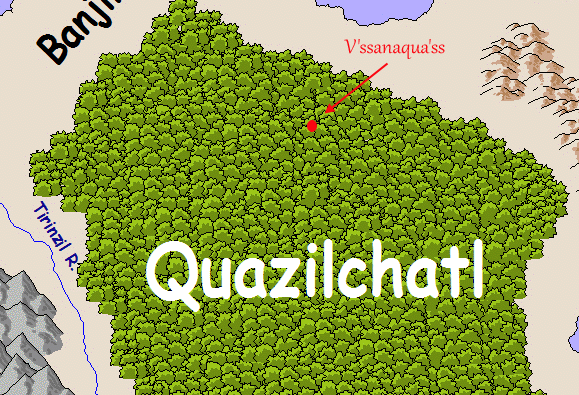
V'ssanaqua'ss is set deep within the Quazilchatl Jungle, in the northern portion of that vast and tangled region.
|
|
The city itself is built upon a small lake into which flows four rivers. The lake is drained by some unknown means, possibly the result of yuan-ti engineering.
 |
Surrounding the city is a massive circular wall of granite. The wall is 20 ft thick at its base and 10 ft thick at its top and reaches 60 ft high. Its top is battlemented and the wall is pierced by 20 towers, each 50 ft in diameter and 90 ft tall. The tops of the towers are shaped like snake heads looking outward from the city. Each tower is manned by soldiers with allegiences to the various houses of the city, but while on tower duty they are ostensibly under the command of the temple. FLanking each tower are stairways that allow access to the walls.
Where each of the four rivers crosses the wall, there is a tower, and the river runs through a wide gate cut into the tower. A massive iron portcullus blocks river access. These can be raised or lowered from the respective tower.
Alongside each of the rivers outside of the city runs a cobbled roadway (as shown on the map with a red dotted line). These veer away from the rivers as the city walls are approached and head to a massive land gate that pierces a wall tower. Each gate is a double door of iron, 30 ft wide (15 ft per door) and as tall. The gates are opened or closed and barred from the tower.
The city itself is divided into four quarters. Each quarter is bounded by two of the rivers that flow into the central lake. Various bridges cross the river from one quarter to each adjacent quarter. Some of these are meagre wooden spans, while others are magnificantly carved structures of stone or marble.
Red squares show the location of the travelling stations (see below).
Each quarter is described briefly below:
The Garden Quarter:
This quarter is dominated by many areas of parkland consisting of well-manicured meadows and flat grass punctuated by trees, bright, pungent jungle flowers, and tastefully placed boulders and carved rock benches. Small fountains of water burble pleasantly here and there, fed and drained by magic, and creeks and rivulets flow from these fountains to eventually join with the rivers that flank the quarter. Quaint wooden bridges span these rivulets, although they are easily stepped across.
These parklands are places for the yuan-ti nobility to relax and sun themselves, as well as a place to run their pets (almost like a dog run). As such, a great many snakes of all sorts can be found slithering through the parklands, some of these being natural snakes and others being yuan-ti changed into serpent form. Many exotic jungle birds are also present in the parklands, some of these familiars and spies of their yuan-ti masters, and others simply birds that have taken residence in the parklands. Phynxkin and niferns are also commonly found stalking through the Garden Quarter.
Yuan-ti nobles often meet other nobles in these relaxing settings in order to conduct business or meet in a neutral location. These almost always travel with a small retinue of bodyguards and slaves.
One section of the Garden Quarter is given over to a cemetary, reserved only for the nobility of the city. Grand marble cenotaphs vie with ornate mausoleums and burial vaults, many with carvings displaying the deeds of the yuan-ti or noble family interred within.
The grand temple to Kyuss is also located in the Garden Quarter, near the lakeshore to the northeast. It is a towering structure of marble that rises several hundred feet into the air with a crown of eight giant serpents looking outward from the top.
The Garden Quarter is ostensibly under the rule of the temple, and its soldiers patrol the quarter while its slaves maintain its grounds.
The Slithering Quarter:
This quarter is a jumble of ramshackle stone structures punctuated by areas of jungle wood lean-tos. These are the homes of the purebloods, as well as those servant races that are not indentured as slaves. These include lizardfolk of various stripes and tribes, along with a great number of ophidians and a few sivs.
Many of the structures in the Slithering Quarter minic those found in human cities. Here one may find taverns, inns for visitors to spend the night, shops and smithies, stables for lizard mounts, barracks, and many homes for individual families or common rooms for groups of creatures. Ramshackle public baths are also present here and there.
The Slithering Quarter is run by various gangs of purebloods, many of whom serve various noble houses but, when off duty and in their own quarter, shed their house loyalties and form their own allegiences that vie for control of the quarter, extorting money from tradesmen, running drug and gambling dens, or arranging gladiatorial contests amongst the lesser races.
Each section of the quarter is patrolled by its own gang.
The Quarter of Fangs:
This is a residential quarter for the most part, occupied by clean stone homes of modest size, surrounding city squares that sport well-kept shops and vendor stalls. The Quarter of Fangs is home to many of the halfbloods of the city, along with purebloods who have risen in station beyond the squalor of the Slithering Quarter. Many slaves are also present here, including feral human slaves.
Unlike the Slithering Quarter, house allegiences matter more here, and most of the halfblood residences are organized and arranged by noble house. This is not to say there are no halfbloods not tied to any house, for in fact there is a significant minority that are independent (truly or nominally) of house allegiences. These are usually craftsmen and merchants whose occupations tend to benefit from a lack of strict allegience.
While halfbloods tend to run the houses here, the streets are often crowded with purebloods and slave races on business for their halfblood masters.
Several inns and taverns are also here, suitable for lodging by well-to-do visitors. Modest but clean public baths are also to be found throughout the quarter.
The Masters' Quarter:
This quarter is the true seat of power in the city. Here, the noble houses of V'ssanaqua'ss have their great manors, walled compounds with iron gates that enclose small gardens and parks that house a large marble manor house and several barracks and other buildings.
There are 8 houses in V'ssanaqua'ss, long established by tradition and not subject to much jockeying by outside houses. That said, the alliances and shifting fortunes of the 8 houses are the stuff of city gossip and legend. All of the houses are run by a single abomination, with siblings, spouses, and offspring abominations serving the house master. Each house also keeps halfblood favoured minions, pureblood bodyguards, ophidian and lizardfolk soldiers, and slaves (including feral humans and broodguards). Many of the minions are housed in underground complexes beneath the manor grounds.
As a rough rule, assume the average house has 12-16 abominations, 20-36 halfbloods, 60-90 purebloods, and between 100-300 ophidians and/or lizardfolks. This only includes those members on the house grounds. A great many others dwell in the city proper but owe allegience to a specific house.
Below is a listing of the 8 houses of V'ssanaqua'ss, along with their current relative ranking, their allies and enemies, and a brief description of the house. In parentheses at the end of each description is their emblem.
House V'n'rossi - rank 1, allies: Qua'nass'va, enemies: Lirossi, Inglissas, Yr'ssor'ssi; House V'n'rossi has risen to prominence in the city within the last 10 years, mostly as a result of the favour shown to its leader by one of the Progenitors, who gifted her with several powerful magic items and the service, it is rumoured, of several powerful demons. The house is known for its powerful sorcerers, who specialize in conjuration and abjuration magics. (A serpent with a body shaped like a lightning bolt)
House Ss'ath'fiss - rank 4, allies: Yr'ssor'ssi, enemies: Inglissass; House Ss'ath'fiss has been firmly stuck in the middle ranks of the house hierarchy for well over two centuries. The house is known for its mercantile activities, and is one of the few houses that deigns to trade directly rather than contract out to independents. This has made House Ss'ath'fiss quite wealthy, and the house has been very careful to hide its wealth, as it is not strong enough to defeat or ward off the more powerful houses. Clearly, the house is a patient one, and no doubt its accumulating wealth will one day be put to good use, to advance the house into the upper ranks of V'ssanaqua'ss. (A two-headed snake with its tail coiled into a circle)
House Lirossi - rank 2, allies: Inglissass, Yr'ssor'ssi, enemies: V'n'rossi, Qua'nass'va; House Lirossi is the newest house in the city, although it is still ancient by most standards. The house was, itself, banished from a stronghold to the south, and it infiltrated a house in V'ssanaqua'ss and by assassination and treachery took it over from within. The name of that old house is no longer remembered in the city. Lirossi specializes in assasination, spying, infiltration, and poisons, and its members often hire out to nearby strongholds for "wetwork". (Two fangs dripping venom)
House Ir'sti'ssfafil - rank 8, allies: Qua'nass'va, enemies: none; House Ir'sti'ssfafil once held more prominence in the hierarchy, but about 80 years ago it suffered an unknown attack involving extraplanar beings that slew many of its nobles. For a time, the house was run by capable halfbloods with a few young and less capable abominations fronting for them. Over time, however, those abominations gained in power and usurped their halfblood puppeteers. The new masters of the house are attempting to slowly rebuild, while trying to stay out of inter-house politics. They have forged an alliance in the last year with House Qua'nass'va, feeling that a pact with the 7th house would not threaten any of the other houses, but Qua'nass'va could provide an indirect pipeline to V'n'rossi. (An S-shaped serpent with daggers for fangs)
House Yr'ssor'ssi - rank 5, allies: Lirossi, Inglissass, Ss'ath'fiss, enemies: V'n'rossi; House Yr'ssor'ssi is one of two houses recruited by House Lirossi to form a troika against House V'n'rossi. The house is known for its prowess in raising and breeding snakes, and its more exotic specimens are exported to yuan-ti and naga strongholds all over the Scaled Lands. Nevertheless, there are rumours that, sometimes, snakes from Yr'ssor'ssi are spies or familiars for the house, and as such these snakes are rarely acquired by other houses in V'ssanaqua'ss. (A serpent's head with a single eye in the center of its head)
House Ssez'rinsir - rank 3, allies: none, enemies: none; House Ssez'rinsir is currently enjoying its position as 3rd ranked house in V'ssanaqua'ss. While Houses V'n'rossi and Lirossi vie for first rank, Ssaz'rinsir bides its time, currying favours from both factions but continuing to play coy, and waiting for one of the two leading houses to make its move. In the ensuing conflict, House Ssez'rinsir hopes to move ahead of the vanquished house into the 2nd rank or, if both houses are decimated, into the leading position. The members of House Ssez'rinsir specialize in martial combat, and the ranking members of the house are often fighter/sorcerers or members of prestige classes that combin the two arts. The house also keeps several squadrons of talented siv monks. (A coiled snake holding a scimitar in its tail)
House Inglissass - rank 6, allies: Lirossi, Yr'ssor'ssi, enemies: V'n'rossi, Qua'nass'va; House Inglissass, like House Yr'ssor'ssi, was recruited by House Lirossi to oppose House V'n'rossi. It is also busy fending off threats from House Qua'nass'va. The house specializes in slaving, hunting, and dinosaur wrangling, and its members are known for their scouting ability and prowess as lizard and dinosaur riders as well as expert archers. (A snake wrapped around a lizard)
House Qua'nass'va - rank 7, allies: V'n'rossi, Ir'sti'ssfafil, enemies: Lirossi, Inglissas; House Qua'nass'va has long feuded with House Inglissass in an effort to raise its standing, but so far to no avail. The only reason it has not turned to crush House Inglissass is that it has hitched its star to House V'n'rossi and must expend its efforts to support the first house against Lirossi. While its warriors are not as impressive as House Ssez'rinsir, it fields formidable soldiers and these augment House V'n'rossi's sorcerers. (Crossed scimitars with snakehead hilts)
The Dome of the Tail:
Rising out of the central lake is a massive marble column that soars 200 ft above the water level and ends in a magnificent golden dome. Four impressive marble bridges arch across the lake and lead to the Dome.
The Dome of the Tail is the center of the city...its physical and spiritual heart. The Dome is the exact site of the first epic magic used to reach across the seas to the lands to the north to abduct the first human slaves. The Dome now serves as a museum of sorts, to commemorate the abduction and to house various items considered precious or memorable to the Scaled Ones. None of the items within are inherently valuable (or so the yuan-ti believe), beyond their symbolic or historical value, but the Dome is a site of pilgrimage for many yuan-ti scattered across the Scaled Lands, and it would be an embarrassment for an elderly yuan-ti to admit that he had never made the pilgrimage to the Dome of the Tail once in his lifetime.
A Word About Wards:
V'ssanaqua'ss is well guarded by wards of all sorts, some ancient and crafted by epic casters and others newer and continually maintained. As the only open city of the Scaled Ones in all of Sazhansiir, the yuan-ti realize that V'ssanaqua'ss is open to attack by the humans or their other enemies. As such, the place is well-guarded not only physically, but magically.
There is no practical reason to go into the many mystic defenses encompassing the city. These defenses are one of the main reasons, however, that the PCs have had to undergo the histaachi transformation, and as such the DM should take great pains to counter almost any magical move the PCs make to short cut the scenario...not to purposefully thwart their tactics, but to reflect properly the level of defenses present.
Every gate into the city has wards to detect alignment, bloodline, and shapechangers and more esoteric means of weeding out humans or non-scaled ones who would try to infiltrate the city. Even feral human slaves have certain permanent mystic markings and mystical physical brands that separate them from non-slave humans.
When the PCs first enter the city through one of the gates, they should feel these divinations and defenses probing them body and soul, and with the almost certain knowledge that had they not actually be transformed into broodguards, they would have been caught and possibly slain by the wards.
It is also safe to assume that the entire city is warded against extradimensional transportation into, out of, and within its precincts. Creatures can be summoned into the city, but otherwise all such travel is suppressed except at a few very well guarded "travelling stations". These stations are holes in the epic magic dimensional lock effect that covers the entire city in a cylinder that reaches 1,000 ft into the air and as deep into the ground.
Wards protecting against aerial access and underground access are also plentiful, as befits an ancient race well-versed in magic and infiltration and comprised of genius leaders.
Important buildings, including manor houses, the temple, the Dome of the Tail, and other such places are also highly warded, not only against non-scaled ones, but also against yuan-ti rivals. Even the broodguards of a house would find themselves fried to the crips if they tried to enter their master's manor house unbidden.
A Word About Use of Magic:
While the modified histaachi brew allows the PCs to use magic, it would be almost suicide for them to do so. Most histaachi come from feral human stock, and those humans have absolutely no ability to use magic of any kind. Even those transformed from captured Azotchtlans have all spellcasting or manifesting or invoking abilities removed as a result of the transformation into a broodguard.
While broodguards are dim and brutish, they live in a world of spellcasters, both divine and arcane, and have even witnessed psionic powers. They will, even with no Spellcraft ranks, recognize the use of magic, and since the use of any magic (whether innate or a device) is absolutely foreign to broodguards, any such usage will elicit immediately distress, suspicion, and reporting to superiors.
Furthermore, a great many yuan-ti are sorcerers and it is not unusual for such beings to have arcane sight and/or detect magic cast upon themselves with permanency. Many have the ability to see invisible beings, objects, or magical effects. Seeing a broodguard with any magic cast upon him is an immediate grounds for immense suspicion (same with any human slaves).
The PCs have already been cautioned by Pizotzin not to use any magic within the city until they have the book. If the PCs insist upon using it anyways, then they will have to face the consequences. It is, in theory possible for them to use magic in a very limited fashion. An instant spell cast very locally and out of sight of any witnesses might not cause any undue problems (e.g. a cure light wounds spell). But very few areas of the city are truly unoccupied, as a Tiny viper could be lurking anywhere, and any such creature could be a familiar and would recognize the oddity of a broodguard casting a spell. That said, a Silent and Still spell with instantaneous effect and no material components or foci might just be castable if the effects were subtle. Nevertheless, this scenario is supposed to be about stripping the high level PCs of their magic items and special powers and forcing them to rely on cleverness annd resourcefulness, and the DM should take steps to limit severely the PCs' use of magic.
Broodguards wear no clothing and use no weapons. Therefore, there is no easy way for the PCs to carry magic items, spellbooks, material components of any kind, etc.
A Word About Uh Oh!:
The PCs have inserted themselves into a city full of enemies. And although they are high level and capable, so are the yuan-ti...and there is a full city of them. It should be impossible for the PCs to simply crash into the Dome of the Tail, snatch the book, and leave. Even the quickly roused might of the city should be sufficient to send the PCs to their doom rather expediently.
This means that should the PCs screw up and reveal their identities (for example, they cast a spell and it is noticed), they will need to flee the city immediately. At this point, the DM should make it clear (by in game events) that any chance to recover the book is finished and it is now all about getting out safely. It is up to the DM how difficult he wants to make this, but he should feel free to throw overwhelming odds at the PCs and keep ratcheting it up rather quickly so that the PCs' only thought is to flee.
If the PCs, in the face of being discovered, insist upon staying to fight the whole city or try to make a run for the spellbook, then the DM should simply throw powerful demons, golems, and 7th, 8th, and even 9th level spells at them until they are defeated or flee.
Part Four - Serving the Scales
The house that will have purchased the PCs is none other than House Ir'stissfafil, the 8th ranked house in the city. They have purchased this latest batch of broodguards in order to initially help excavate the ruined portions of their manor house that collapsed during the attack 80 years ago.
Below is a brief overview of the house. No statistics or numbers of creatures are presented, as it is not intended for the transformed PCs to fight here (except as indicated in the episodes presented below).
Like all manor houses in the city, there are all sorts of wards and magic defenses active on the compound, especially warding the manor house proper. None of these is detailed because the PCs should not be setting any of these wards off assuming they don't use any magic and don't proceed to any place they do not belong.
 |
A. Walls, Towers, and Gate
The walls protecting the manor house are made of smooth white stone, about 3 ft thick (hardness 9, 360 hp, Climb DC 27, break DC 60) and 15 ft high. There are no battlements on the walls, and they are clearly not meant to fight atop, although the thickness makes it possible.
At intervals the walls are pierced by a square stone tower. These are 25 ft tall and 10 ft square and end in battlements shaped like coiled snakes. Each tower holds, at all times, 2 ophidian guards, each with a warning horn.
In the middle of the south wall is an iron portcullis (hardness 10, 60 hp, break DC 25) 20 ft wide and 15 ft tall, surmounted by two round towers 10 ft in diameter and 30 ft tall. These towers are shaped like twining serpents with mouths open to the heavens. They are pierced with arrow slits at varying intervals. A crank within each tower opens and closes the portcullis, and it requires both cranks to be turned simultaneously to open or close it. Each gate tower holds a compliment of 6 ophidians led by a yuan-ti pureblood commander.
B. Grounds and Golems
The grounds of the manor are of short, clipped grass. A gravel path progresses from the southern gates to the manor house proper, while another crosses from the outbuilding to the east to a wooden bridge that crosses the rivulet to the west.
Flanking the pathway to the manor house and to the outbuilding are neatly manicured hedges 7 ft tall and 5 ft wide.
Small jungle trees dot the grounds, each being a normal tree about 20 ft tall.
Flanking the pathway just inside the gate are two stone golems shaped like yuan-ti abominations. They are commanded by the leaders of the house and are also programmed to defend the grounds and attack intruders. However, being mindless golems, such acts would need to be fairly overt to activate their programs.
C. Outbuilding
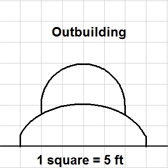 |
This building is fashioned in traditiona yuan-ti style, with graceful round edges instead of corners. The whole resembles half of an egg set lengthwise, about 10 ft tall and topped by a smaller half-egg another 10 ft tall. Glass windows pierce the whole structure, a few having small iron balconies attached, and double doors of iron meet the gravel path to the west.
This large outbuilding is home to the favoured purebloods of the house.
D. Barracks
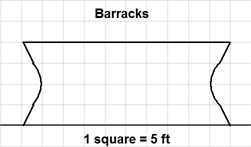 |
This large building is 20 ft tall and shaped vaguely like a concave ovoid with a flat top. It is pierced with thin, tall windows that are much like arrow slits, but covered with thick glass panes.
This structure houses the house barracks, home to the ophidian and lizardfolk warriors and their pureblood captains. A single halfblood marshal commander lairs in luxurious quarters near the top of the place.
E. Lake and Rivulet
This small lake is fed from freshwater springs below. It is approximately 20 ft deep at its center and spills out into a small rivulet about 2 ft deep and 2 ft wide that flows north through the compound walls at an iron grate (treat as an iron portcullis for break purposes) before merging with the larger river heading towards the city's central lake.
The wooden bridge that crosses the rivulet to the north of the lake is a simple, somewhat decorative wooden bridge of dark teak wood carved with serpentine shapes coiled around struggling humans.
F. Stables
This large stone building is 15 ft tall and rectangular. Many iron double doors pierce its eastern face, barred from without. Inside are the house mounts, including giant lizards of various varieties as well as dinosaurs, including domesticated cave dinosaurs.
G. Manor House
This huge structure of white marble is shaped like a massive coiled snake whose coils form the 30 ft high mound of the first two stories of the manor house. The snake then winds up a thinner central tower that rises gracefully for another 20 ft before it blossoms out into a 30 ft diameter disc 10 ft high that the snake's upper body winds around, its head resting peacefully atop the disc.
Glass windows pierce the manor house at a great many points, and more than a few doors emerge onto walk-on iron or teak balconies. Various live snakes of all sizes lounge in the nooks and crannies of the manor house, some even hanging from the disc 50-60 ft above ground level.
Massive bronze valves allow egress to the manor house from the south, and pureblood guards are always stationed before the door.
Lairing atop the disc is an aerie of pteranadons, flying guards and mounts for the house.
H. Underground Entrances
These 10 ft square openings lead to wide stone stairways descending into the underground portions of the house.
I. Statues
These four large statues portray the four founding abominations of the house. Rumour suggests that they can animate in some fashion in defense of the house.
Underground
The underground below the house grounds is fairly extensive, as is the wont of the house manors. They contain store rooms, slave quarters for the humans, and brood chambers, as well as quarters for the broodguards.
Episode Zero - Settling In
The PCs will be taken to the manor house of House Ir'stissfafil. Here they will pass through the house gates and be led along the house grounds and to a set of stone stairs descending into the darkness. The stairs wind down about 30 ft before opening into various crafting chambers. One of these appears to be some sort of smithy, where a burly lizardfolk smith is heating up small bits of metal.
The PCs are commanded, one by one, to approach the anvil, whereupon the lizardfolk, grinning evilly, leans the PC's head on an anvil and pounds an iron awl through each ear. Before the pain can subside, and as blood spills over the anvil, a red hot ear band in the shape of the house emblem is put through each earhole and pounded shut. The PC's head is then quenched in a bucket of water and the next PC is brought forth, until all are so marked.
Once all the PCs are marked, they will be led to a large room full of broodguards, where they will be locked in for the night. The door is closed after some bundles of food and troughs of water are slid into the chamber by feral human slaves, along with a ratty pallet for each PC.
 |
There are a total of 18 broodguards in the chamber (not counting the PCs). This is one of four dens of broodguards serving the house. Each is commanded by its own pureblood, and each squad quarters in a separate chamber underground. Each den is named after its commander, so the one to which the PCs is assigned is called the Hassnistra Den.
The chamber is smelly and rank. The broodguards sleep on rotten and vermin infested palettes comprised of fur and human skin stuffed with leaves and grass.
Most of the broodguards (B#s on the map above) are ordinary specimens, recently converted from feral human stock and only rudimentarily trained in combat.
|
|
However, 4 of the broodguards are of greater capability than the rest of their ilk. These "leaders" of the den are presented below.
|
FEATS: Blooded (PGF p35) - +2 to initiative and Spot, cannot be shaken Extend Rage (CW p92) +5 rounds to rage
|
Venssiss is the current ruler of the broodguard den. He was a leader of the feral human tribe to which he belonged for several years before having been captured by the yuan-ti. Recognizing his prowess in battle, he was matched against fearsome opponents in the gladiatorial arena and survived. Eventually, he was given the histaachi brew and was tranformed into a broodguard. The yuan-ti had actually hoped he would transform into a tainted one, but they respected his abilities enough not to slay him out of hand in their disappointment...that and the fact that House Ir'stissfafil needs every hand they can get in their efforts to rebuild.
Venssiss is dominating and cruel, and though he is smart enough not to kill any of his fellow broodguards, for fear of his masters' retaliation, he is adept at causing pain and beating into insensibility those broodguards who challenge his lordship of the den.
He recognizes Imshassa's potential threat to his position, but with her alliance with Gassness, he dare not move directly against her until he can figure out a way to turn or slay the imbecile and isolate Imshassa.
|
|
Imshassa was a female human slave before she was fed the histaachi brew, and although the transformation to a histaachi results in a genderless being, she still fancies herself a female and often tries to take advantage of this with the other broodguards. A bit more intelligent and clever than her companions, she was also adept as a human slave at stealing from her masters and slipping away unseen. So much so that her frustrated owner finally sold her to House Ir'stissfafil, where she was fed the brew, ostensibly to become a tainted one rogue. Alas, she failed the test and ended up a broodguard. However, she has retained her rogue abilities and although she tries not to use them in battle, to have her foes underestimate her, Venssis knows of her abilities and is wary of her.
For her part, she hates Vessniss and is biding her time to one day slay him and assume leadership of the den. She has formed an alliance with Gassness to protect herself from him.
|
|
Gassness was born a slave and likely injured as a babe, for he was never too bright to begin with. His infirmities made him more and more useless as a human slave, and so House Ir'stissfafil gave him the histaachi brew and transformed him into a broodguard, whose strength would be augmented and whose duties more fitting to a mentally-challenged being.
Because of his low intellect, Gassness responded to Imshassa's advances readily, and he is now loyal to her as a pet to a master. Together, the two might be able to take down Venssiss, but Imshassa does not trust Gassness' ability to follow a plan or keep a secret, and so for now she keeps her pet "tame".
|
|
The Wretched One is so named because he was the result of experiments done by some previous master. These experiments infused him with the feral template and included a grafted tail and poisonous bite. The Wretched One appears as a more muscular broodguard with bulging, bloodshot eyes and drool constantly dripping from his mouth, this bubbling poisonously as it hits the ground.
Owing to his feral template, The Wretched One is prone to violent outbursts when not closely supervised by a yuan-ti of pureblood or higher caste. As such, when present in the den quarters, he is always chained to the wall and the broodguards know not to get near him. Even when supervised by a yuan-ti master, the other broodguards keep their distance.
The Den Room:
The den room is 40 ft long and 25 ft wide with a 10 ft tall ceiling. The walls are of hewn stone and the door is a strong wooden door (hardess 5, hp 20, break DC 25) that is barred from without.
There are slow-burning torches lit around the top of the place, which stinks of sweat and waste, even though no leavings are present.
Along the western wall, at its midpoint, about 6 ft up is a circular hole 1/5 ft in diameter. The hole is blocked by strong iron bars (hardness 10, 60 hp, break DC 28) that criss-cross the opening, leaving gaps about 3 inches square. The hole leads up to the manor grounds and provides fresh air to the den room. As such, it is the most desirable place in the den room, not only for the fresh air but because rats and insects often wander through the hole from the outside, and those nearest to it have the first chance to grab and consume such prey.
This has caused the vent hole to become the focal point for a pecking order in the den room. Those closest to the vent hole have the most status. Those furthest away do not.
As shown on the den room map above, each broodguard has his sleeping place, where his pallet is placed and where he spends most of his resting time in the chamber.
Those squares marked "B#" contain one of the 14 normal broodguards. While all of these have the same statistics and capabilities, some are closer to the vent hole than others and so have done things to earn and keep their places. The number designation after the "B" shows their current ranking amongst the normal broodguards. Where 2 squares are equidistant from the hole, priority is determined by furthest from the Wretched One, nearest to a wall or walls, and fewest diagonals from the hole to the square.
The other squares are as follows:
1. This is the location of the chains for The Wretched One. He is kept shackled here while resting and cannot move his hands too far from the walls. Nevertheless, he can still strain and reach adjacent squares, and so no other broodguards rest near him.
2. This is the square right under the vent hole and the most prized territory in the den room. It is currently held by Venssiss and he will beat senseless anyone who dares to enter his square. Of note, the square to the north of this is empty. Venssiss claims this square as his own, even though he does not use it, for it allows him to reach his square without having to pass directly by both Gassness and Imshassa.
3. This square is the property of Imshassa, and it is the second most desirable square in the den room (alongside the one north of location 2, which Venssiss keeps for himself). While Venssiss would like to claim this square as well, he simply does not feel it is worth it to potentially provoke Imshassa and Gassness at the same time.
4. This square is the property of Gassness, and as Imshassa has told him he must protect it from all others but her, he does so like a ferocious dog. Any attempt to enter or pass through the square will result in an immediate rage-filled assault by Gassness until and unless Imshassa can calm him down.
Life in the Den:
Life in the den consists of 16 hours of work and 8 hours of rest and sleep. The four dens each take a separate block of hours on duty, and the Hassnistra Den works from four hours before highsun (noon) until high moon (midnight).
At 7 AM the broodguard is roused by food and water being shoved through the opened doorway. Buckets for waste are also passed around.
At 8 AM the pureblood Hassnistra arrives along with four lizardfolk servants to give the den its duty assignments. Waste buckets are retrieved by human slaves.
From 8 AM to midnight, the den performs its duties.
At midnight the broodguards return to the den chamber, where food and water are left in the chamber for the night meal as the doors are barred shut.
Work will initially consist of guarding one of the brood nests of the purebloods. This is a smallish cavern surrounding a pool of water located in an underground level below that of the den chamber. The duty is largely ceremonial, for unless there is a raid upon a house, no one threatens the large, leathery eggs that are set into shallow concave depressions in the cavern floor, each one surrounded by runes of blessing.
The duty is uneventful, and rather boring, although the broodguards seem happy to have easy and relaxing duty.
Meals are another matter. The food consists of slabs of meat and chunks of offal tied into cloth bundles. In theory there is enough food at each of the two daily meals to feed all of the broodguards. In practice, the more powerful broodguards take the best pieces of food and more than their fair share, so that those lowest on the pecking order receive scraps and gristle. Fights over food are common and usually these result in changes in the sleeping locations. When the food and water are tossed in, Venssiss gathers it all and then takes his pick before leaving it for others, who then take their share in pecking order. A cruel joke is sometimes played where the food and water is left within or almost within reach of The Wretched One. This is, in fact, commonly played on new recruits (like the PCs). The Wretched One has some food and water slid to him by the slaves and no one deigns to take his food.
The broodguards understand that they are the property of their yuan-ti masters, who will be wroth if a broodguard starves to death. So all broodguards get at least enough food to survive and work.
Similarly, fights amongst the broodguards usually involve nonlethal combat and grappling with the occasional lethal attack thrown in. Every broodguard knows that if he kills another broodguard or injures him so badly that he cannot work, that the victor will be punished severely. Because of this, fights tend to take place during the nighttime meal, so that the loser has enough time to recover and rest and be fit to work the next morning.
|
|
Hassnistra is a devoted house follower who does his rather lowly duty (being a den commander is a fairly low-level job) with the thought that loyal service will eventually be rewarded. He is a no-nonsense type of yuan-ti who won't go out of his way to make his underlings miserable, but also has no qualms about punishing any who do not obey him precisely and immediately.
|
|
Experience Points:
The PCs can gain experience points for successfully performing or navigating each of the episodes below. These experience points are not the same as the normal ones gained by the PCs. These special experience points are applicable only to their time of transformation into broodguards and they reflect the PCs' ability to become more accustomed to their new forms and more capable of fighting within them.
Assume each transformed PC begins with 0 XP (effectively a 1st level "broodguard"). During the course of their adventures while transformed, should a PC lose experience points or lose a level, they will lose them off of both their normal XP total and their broodguard XP total.
Unlike normal XP awards, broodguard XP is awarded to each PC based upon how well each performs. The XP is not divided up between the PCs, as all broodguard XP awards are effectively story bonuses. No XP is gained from directly defeating enemies or bypassing hazards.
A PC does not have to perform a deed by himself to gain the XP. For example, if the PCs gain XP for slaying an undead, then as long as a PC had a proper part in the fight against that undead and contributed to its demise, he gains the full XP award.
As a broodguard levels, it may gain a level of rogue or barbarian. This includes a gain of hit dice, class abilities, BAB, saves, and all other features of advancement except no new feats will be gained (except for bonus feats or feats granted as class features) and no ability score increases will be gained. For purposes based on Hit Dice, use the broodguard level or the PC level, whichever is greater (this will almost certainly be the PC level).
Episode One - The First Day
When the PCs are shoved into the den chamber at midnight of their first day in service to House Ir'stissfafil, food bundles and water troughs will be shoved in after them by human slaves. The door will be closed and the bar will be put in place. The 18 other broodguards will examine the PCs warily, but only Venssiss will stand up and begin to move towards the PCs.
If the PCs make any move towards the food or water, a shocked hissing will erupt amongst the broodguards and Venssiss will immediately leap up and take a swipe at any of the PCs doing so. If the PCs resist, Imshassa and Gassness will also heave to against the PCs and eventually the entire den will rise against them. They do so because of the pecking order. None of the current broodguards wants to give up his place in the pecking order to the PCs. If the PCs back off, then they will have naturally placed themselves at the bottom of the pecking order. If they fight, they will notice the other broodguards using nonlethal combat, though in a rage, a few lethal strikes might accidentally happen.
Anyone the PCs defeat in combat will move them up the pecking order ladder. However, although Venssiss and Imshassa were the first two to join the fray, they will also back out once the rest of the broodguards attack, not wanting to jeopardize their status in a free-for-all melee.
If the PCs attack lethally, the broodguards will defend themselves, but also call out in Slith to the PCs that murder is not allowed. If a broodguard is killed, the remaining broodguards will back off defensively and shout out in Slith that there are murderers in the den chamber. This will bring Hassnistra and half a dozen purebloods (treat these as normal specimens with no class levels) with a dozen lizardfolk warriors (again with no class levels) in tow to break up the disturbance.
The PC murderer(s) will be punished (see Punishment below).
If the PCs defeat one or more random broodguards by beating them senseless, then the DM can randomly determine the pecking order occupied by each.
No matter, unless the PCs have managed to move to the top of the order, something that would effectively require them to beat all of the broodguards in one fight, Venssiss (or whatever broodguard is at the top) will motion for the broodguard just ahead of the PCs in feeding order to toss their food to the ground adjacent to The Wretched One. Of course, The Wretched One will attack any PC who moves to get the food. Unlike the rest, he attacks lethally, but given his chains the PCs should be able to get away from him with only some minor damage.
Once any fighting between the PCs and the other broodguards over food or sleeping location is settled, the PCs can feel free to attempt to speak to the broodguards and learn some of the ropes. The broodguards are a brutish bunch and not inclined to parley or trust one another, but the PCs might be able to wheedle some information about the pecking order, et al.
Neither Venssiss or Ishassa will deign to speak to the newcomers, unless they took over the top position, and attempts to parley with them will be met with hisses and then fighting.
The next morning, after the morning food and water ritual, the den commander will arrive and explain the day's assignment. He will unlock The Wretched One's shackles and command him to stand. While he watches, the lizardfolk will enter and place a leather leash around The Wretched One's neck. As the den leaves the chamber, human slaves will be seen entering to replace the torches, take the waste buckets, sweep the place, and take the food and water remains.
Hassnistra and the lizardfolk servants will lead the den to the assignment location, with The Wretched One led by two of the lizardfolk. Once at the assignment, the den commander and the four lizardfolk will remain with the den, overseeing the task at hand and keeping an eye on The Wretched One.
The first day assignment is similar to the usual assignment for this den, watching over the brood chambers beneath the manor house. The assignment is boring but easy, though the broodguards are expected to remain awake and alert, even while Hassnistra sometimes dozes (though his lizardfolk remain wary). The broodguards occasionally speak to one another during this easy duty, and this gives the PCs more chances to try to glean any information they can from their fellows. Unfortunately, the broodguards lead an isolated existence and may not have much to impart. However, the other den members may take this opportunity to question the PCs about where they came from and how they arrived at the city.
About halfway through the day's work, human slaves will bring water for the den to sip. Den members will sometimes take a grab at rodents or other non-serpent and non-bird vermin they can quickly snatch to make a midday snack.
Once the day's assignment is finished, the den is marched back to the den chamber and after food and water is slid in, the door is barred and the night begins.
XP Awards: +100 XP for each spot in the pecking order a PC advances beyond the starting level of all of the PCs.
Moving Up:
If the PCs avoid a general melee when first arriving, they may wish to challenge other broodguards for sleeping space and food priority during their stay here. The precise happenings are up to the DM. In general, the broodguard being displaced directly in the pecking order will challenge the PC. It is possible that others may also join, not wanting to be pushed down the line either. On the other hand, it is possible a PC will beat up a broodguard and then a lower broodguard will challenge him. In general, it is unacceptable for a challenge to be made against a loser until he has recovered from his beating. However, it is acceptable for more than one broodguard to join in a fray initially, but one cannot join in after it begins. A broodguard can also withdraw from a fray, but unless it is a general melee (like described above), withdrawing is the same as losing. Most often, such combats are one-on-one affairs.
Intimidation:
The PCs can possibly move up the pecking order by use of Intimidation. This requires the PCs to make a successful Intimidation check, with the DC modified by 20 minus the pecking order place (e.g. the 5th place broodguard will gain a +15 on his Intimidate check). This makes it very difficult to intimidate one's way entirely up the hierarchy, but such tactics are often effective amongst the lower order broodguards.
Punishment:
Punishment of broodguards usually involves savage whipping followed by isolation and starvation for a week or so. The beating will bring the offender down to 19 hp less 1d20. This can mean the victim is brought to negative hit points and therefore it is possible for a beating victim to die. However, that is not the intent of punishment and so such occurrences are rare. Even if brought to negative hit points, the yuan-ti administering punishment (Hassnistra usually) will attempt to use a Heal check to stabilize the punished. After that, the victim will be allowed to rest for 1 night to recover hit points. Thereafter, starvation will cause 2d6 Con damage. This damage will accrue slowly over the week, such that hit points of damage from the whipping will recover faster than hit points lost from Con damage. There is a 5% chance that each Con damage taken is actually a Con drain.
Episode Two - Welcome to the Jungle
Perhaps two weeks or so after the PCs have arrived, when the morning door is opened, Hassnistra will inform the den that he has managed to secure for them a slaving assignment. The den will be visibly excited about this, since they will be able to get out of the city and run free for a bit and chase down feral humans.
Hassnistra will lead the den onto the house grounds. There, yuan-ti purebloods and halfbloods mounted on giant lizards and small dinosaurs lead a troop of lizardfolk and ophidians. The latter have large nets in their hands. When the broodguards arrive, the entire troop will head towards the south, across the river bridge into the Garden Quarter, and then south out of the city gate. Once again, the PCs will feel the various gate wards probing them but nothing amiss will occur.
Once outside, the yuan-ti will confer and then Hassnistra will explain the proceedings to the den. The broodguards are to serve as beaters. Once feral humans are located, the den will circle around the humans and then run forward, driving the humans into the waiting nets of the yuan-ti and their servants. No humans are to be slain or maimed, but if a broodguard can capture or disable one, then he is to do so. A broodguard who directly captures any humans will be given extra food and a dose of pleasure vapour.
The troop will then head into the jungle. It will be clear that several of the purebloods are rangers who from time to time dismount and track their quarry. About 5 hours into the trip, the rangers will announce that they have found human sign.
The tracking will continue until sundown, when the troop will camp for the night. While the yuan-ti can see in the dark, the dinosaurs and lizards cannot, nor can the broodguards or lizardfolk, and having the latter carry torches would simply alert the humans ahead of time.
The broodguards are put on watches for a third of the night each watch, and the PCs will not be all on the same watch.
The next morning, the troop will continue, and about 1 or 2 hours after noon, the rangers will motion for a halt and, slipping off of their mounts, sneak into the jungle. A few minutes later they will return, stating that a herd of humans is up ahead in a foraging group about 100 yards ahead. Hassnistra will order his den to follow him, and his lizardfolk will put a gag on The Wretched One. The den will then circle in a wide arc around the humans. Once in position, Hassnistra will order his troop to sneak up, with two of the lizardfolk remaining behind to keep hold of The Wretched One (who, apparently, is not able to avoid potentially killing humans).
When the entire group is in position, Hassnistra will sound his hunting horn and the skirmish line of broodguards will charge forward, hissing and growling.
There are approximately 24 humans in the herd. Of these, 18 are adults and 6 are children. Half are male and half female.
Upon hearing the horn, the herd will react.
4 adult females will grab up 4 very young children and then run away from the broodguards (towards the yuan-ti).
2 older children will run to the side (one each direction) away from both the yuan-ti and the broodguards.
5 adult females and 5 adult males will run away from the broodguards (towards the yuan-ti).
2 adult males will flee to the side away from both the yuan-ti and the broodguards.
2 adult males will charge the broodguards.
Any humans that run towards the yuan-ti will be herded by the mounted yuan-ti and captured by them in the nets.
The PCs and other broodguards can elect to chase any fleeing humans, fight the humans charging them, or continue herding the humans towards the yuan-ti. The latter is not necessary since the fleeing humans will already run headlong into the yuan-ti, so this option is both the safest and the least likely to impress the commander or the other broodguards.
Catching one of the children will bring some minor glory to the broodguard who does it, and will impress the masters, but will not impress the other broodguards.
Subduing the adults that are fleeing to the side will impress both the masters and the broodguards.
Subduing the human males who charge the broodguards will impress everyone a lot.
Catching the children involves making opposed Dexterity checks, assuming the PCs move at 30 ft and the children at 20 ft. Normally this would mean the children would be caught, but the thick jungle brush and overhanging branches allow the smaller children to duck through places the broodguards have to crash through. Keep track of Dexterity checks. When a broodguard has 3 more checks than a child, he can make an attack (including a grapple check). When a child has 3 more checks than a broodguard, then the child is ahead enough to be out of sight. The broodguard can then make a single Spot or Listen check to try to locate the child. Listen checks will be made at a net -3 due to jungle noises offset by Move Silently penalties from the terrain.
An attack costs a broodguard 1 Dexterity check.
After 21 Dexterity checks, the broodguard will hear the den commander's horn and a yell summoning all broodguards back to the group.
Each of the 2 running children has a Dex of 13 (+1 bonus), an AC of 12 (+1 for Dex, +1 for size), a BAB of +0, a Str of 6 (-2 bonus), a Hide modifier of +6, and a Move Silently modifier of +2.
The running males will flee until grappled successfully or surrounded, in which case they will give up running and fight. Their statistics are presented below.
The 2 charging males will fight until subdued. They intend to sell themselves to allow their mates and offspring to escape.
|
|
|
|
If any of the PCs subdue a human, they will gain their food and a dose of pleasure vapour (a bit of incense euphoric to scaled ones but poisonous to most other creatures). If a PC subdued one of the fleeing males, he will be able to move up to 3 places up amongst the normal broodguards in the pecking order without a fight. If a PC subdued one of the charging males, he will be able to move up to 6 places up up amongst the normal broodguards in the pecking order without a fight. Of course, the PCs will have to realize this or make the attempt through food or sleeping location. No one will voluntarily offer his place.
The incense will effectively put a PC into a stupor for the rest of the night, but since it was given as a favour by the master, no one will bother or take advantage of that PC during his drug haze.
XP Awards: For each human subdued, +100 XP. For a fleeing male, +200 XP (for a total of 300 XP). For a charging male, +500 XP (for a total of 600 XP). These are in addition to the XP for movement up the pecking order (see Episode One).
Episode Three - Sweet Release
Another month or so should go by with not much happening. The den will resume its normal duties guarding the brood chambers beneath the manor house. Then, one morning, Hassnistra will arrive for the morning duty and inform the broodguards that he has some special duty for them.
With that he will file them out and instead of heading to the brood chamber or upstairs into the city, he will lead the den down several different flights of steps until they emerge into a chamber whose entire southern end has collapsed.
Hassnistra will tell the den that the house is gaining more slaves and servants and that it is time to excavate the old chambers that were collapsed many years ago. Human slaves will arrive with digging tools and large wooden bins, and Hassnistra will instruct the broodguards to take up pickaxes and begin digging. Dirt and rubble will be cleared away by the humans. The broodguard will notice two other purebloods, neither armed or armoured as soldiers, examining the chamber and tapping at the walls with small metal hammers.
The two new purebloods are architects and engineers loyal to the house and hired by them to supervise the excavation. It is they who have determined that it is safe to dig in this area. As the broodguards pick their way deeper into the collapse, periodically one or both of these two purebloods will come forward, order a halt to the digging, tap their little hammers, jot notes on parchment with a stylus, and then order the work to continue.
|
|
The work is taxing but mindless. After about an hour or so of digging, however, one of the broodguards will stop and hiss, pointing at a bone he has unearthed. The two purebloods and Hassnistra will come forward and examine the bone and then proclaim to the broodguards not to worry...that some yuan-ti died in the collapse and more yuan-ti bones like these are likely to be excavated. All such bones should be removed as intact as possible and stacked in a pile for eventual interment or burning.
Over the course of the next two days more bones will be found, a couple by the PCs, and these will obviously be yuan-ti bones, at least from the size and from the shape of the couple of partial skulls found. Additionally, scraps of yuan-ti weapons and armour will also be found, none of it in usable condition.
However, at about noon of the third day, the PCs will come across a skeleton that appears different from the yuan-ti bones that had been recovered before. The skeleton is of a medium sized humanoid with a ram's head and massive, curling dark horns sprouting from the top of the head. The lower body ends in hooves. Clutched in one hand is a rusty and twisted battleaxe.
This is the body of an artaaglith, a minor demon that took part in the assault on House Ir'sti'ssfafil 80 years ago. As demons swelled up from below, the yuan-ti under attack eventually collapsed the underground chambers on top of their foes and their own troops in an effort to block off one avenue of assault on the manor grounds. A DC 30 Knowledge (planes) check will reveal the nature of the creature.
It will be up to the PCs what to do with the demon skeleton. They could ignore it and continue digging, or they could report the finding to Hassnistra. In the latter case, Hassnistra and the two architect purebloods will examine the skull, confer for a time, and then order the digging to continue, with an order to the broodguards to call out should they find any other non-yuan-ti remains.
As the digging continues, a few of the bones of yuan-ti found will bear the signs of charring and acid damage.
Should any of the PCs question Hassnistra as to what happened here, he will snap at them to keep quiet and not dwell on things that do not concern them.
It will be early in the fourth day in excavation that it happens.
The broodguards will be digging through the collapse when all of a sudden, simultaneously down the digging line, the pickaxes will break through to open air. A horrible stench will waft out, and within a second or two much of the collapse will spill to the ground, possibly trapping one or more broodguards (see below). Out will pour several artaagliths along with the undead they have animated.
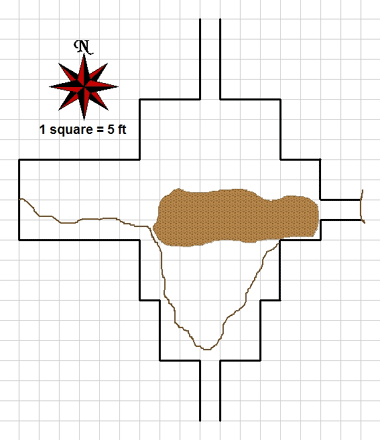 |
The chamber is 15 ft tall. The broodguards and yuan-ti are in the northern portion of the chamber. Hassnistra is standing in the far northwest corner of the room, conferring with the two architects. The four lizardfolk servants are standing near a water barrel in the far northeast corner of the place, along with wooden crates used to haul out rubble.
The rest of the broodguards are spaced across the center of the room in a rough line running west to east. The PCs are in the western portion of this line.
The brown shaded area shows the area subject to the collapse. Because this was not a cave-in of the ceiling but rather a collapse of a free standing wall of rubble, the effects are muted as compared to the normal rules. The shaded area is all considered to be a slide zone as well as an area of dense rubble.
|
Wall Collapse Characters in the slide zone take 3d6 points of damage, or no damage at all if they make a DC 15 Reflex save. Characters in the slide zone who fail their saves are buried. Characters take 1d6 points of nonlethal damage per minute while buried. If such a character falls unconscious, he must make a DC 15 Constitution check. If it fails, he takes 1d6 points of lethal damage each minute thereafter until freed or dead. Characters who aren’t buried can dig out their friends. In 1 minute, using only her hands, a character can clear rocks and debris equal to five times her heavy load limit. The amount of loose stone that fills a 5-foot-by-5-foot area weighs one ton (2,000 pounds). Armed with an appropriate tool, such as a pick, crowbar, or shovel, a digger can clear loose stone twice as quickly as by hand. You may allow a buried character to free himself with a DC 25 Strength check. |
|
Dense Rubble The ground is covered with debris of all sizes. It costs 2 squares of movement to enter a square with dense rubble. Dense rubble adds 5 to the DC of Balance and Tumble checks, and it adds 2 to the DC of Move Silently checks. |
Twelve broodguards were caught in the slide zone. These include Venssiss, who is in the middle of the slide zone, and The Wretched One, who is at the far eastern end of the zone. Assume another 7 broodguards are also buried. Each will have taken 3d6 damage and be buried. Buried creatures are still slightly exposed. They are immobilized and prone and have improved cover (+8 to AC, +4 to Ref saves and improved evasion). Imshassa and Gassness were both just outside of the slide zone to the west (somewhat near the PCs).
Creatures: 4 artaaglith demons previously trapped by the collapse, along with their animated dead, will emerge from the area south of the slide zone. These demons are still under their 80 year old compulsion to attack House Ir'sti'ssfafil, and will do so until slain. When the slide occurs, the demons will spend a round rousing themselves. The PCs will then hear them yell in Abyssal "Now we have been freed my brothers...let us fulfill our commands and slay them all!"
|
|
|
|
Tactics: The demons do not have any sort of subtle tactics. They are compelled to cause as much damage as possible. They will lead their assault by casting stinking cloud spells throughout the chamber within and to the north of the breach. They will then send their skeletons into the clouds (which do not affect them) to attack enemies.
The next round, the demons will all cast descrate spells to cover as much of the chamber as possible.
After this, for the final 4 rounds while the clouds are active, they will cast, in the following order:
shield of faith
protection from good
divine favour
resistance
Thereafter, as the stinking clouds dissipate, one will cast bless while the others attack.
Should any enemies fall, they will be animated by a demon (do not forget that undead animated within a desecrate gain additional hit points).
The demons (and therefore the skeletons) are compelled to attack until slain.
Developments: The PCs can use this encounter in several ways to their potential advantage. First, since Venssiss is trapped, the PCs could elect to either rescue him or not help him and let him die. Even more, assuming a stinking cloud covers the location where Venssiss is trapped, it would not be too difficult to grab a scimitar (perhaps from a fallen skeleton) and slay the broodguard while out of sight of the rest.
It should be noted that Imshassa will not lift a finger to aid Venssiss, and Gassness will stay by her side to defend her.
Hassnistra will leap forward to slay the demons and skeletons, while he tells the architects to run and get help. However, there is little chance that help will arrive in a short time as this chamber is well undeground and removed from the house barracks. The lizardfolk are not warriors and will tend to hang back, only defending themselves if necessary.
The broodguards will attack. None will seek to extricate their buried fellows until ordered to by Hassnistra after the battle. The broodguards do not fight as a unit, and should the PCs fight intelligently and in a coordinated fashion, a DC 15 Sense Motive check will reveal Hassnistra's surprise at his observation of this coordination during combat from broodguards.
The battle will last for, at most, 20 rounds before reinforcements arrive and the demons are quickly dispatched.
Should the PCs acquit themselves well, they may find it easier to jump up in the pecking order later on. Displaying prowess in killing skeletons or the demons will tend to cause nonleader broodguards to back down from a threatened fight and surrender their spot in the pecking order (at the DM's discretion, allow an Intimidate bonus of +1 to +5).
Once the battle is over, assuming Hassnistra has survived, he will order any buried broodguards to be extracted from the slide. A few minutes later the architects will return along with a squadron of pureblood soldiers led by a halfblood. At least 1 halfblood sorcerer and a halfblood cleric are also present. These latter will consult with Hassnistra and the halfblood leader in whispered conversations, likely in the hearing of a PC who can make a DC 25 Listen check to overhear the conversation. The discussion will be about the assault on the house 80 years ago and how the collapsing of the underground chambers likely trapped some of the demons within, given the citywide wards against teleportation. The wizard and cleric will then walk around the chamber casting various detection spells before shrugging and telling Hassnistra and the halfblood leader that they do not detect anymore such creatures, but that the stone rubble would likely block such attempts anyways.
The halfblood leader will then tell Hassnistra that it appears such excavations are too dangerous for the likes of broodguards, and that they will have some human slaves come and dig under the watchful eye of house soldiers and mages.
The den will be gathered up and returned to the den chamber.
XP Awards: For each undead slain +100 XP. For each demon slain +300 XP.
Episode Four - Sacred Oubliette
A couple of weeks after the events of Episode 3 (above), Hassnistra will enter the den chamber one morning and announce that the den will be returning to the excavations. He will explain that while the humans were able to dig out many of the chambers undeground, they encountered many of the old magical wards set by House Ir'stissfafil, and these wards were set to activate against any unscaled ones. The house elders believe that scaled ones wearing the house emblem will not activate the wards and be safe.
The den is led back down to the underground excavations, and it is apparent that the humans made a great deal of progress. In fact, several stairways descend well down below the chamber of the demon attack (from Episode 3).
Finally, the group stops at a large pillared chamber whose floor is pierced with 10 ft diameter shafts sinking into the depths. There are six such shafts, while the wall beyond displays a bas relief of a yuan-ti with six snake heads wielding dual flaming scimitars. The ground beneath this being in the relief is comprised of a carpet of small snakes or, perhaps, wriggling worms.
Waiting for the den in the chamber are various yuan-tis, including several pureblood soldiers and at least three halfbloods, one of which wears robes decorated with arcane runes, and another that wears a vestment fashioned from what may be human skin dyed various colours and embroidered with snake symbols. The third wears chainmail and carries a falchion across his back.
Hassnistra will greet the halfbloods with a bow and tell them that his den is ready to begin.
The halfbloods will step forward to examine the broodguards somewhat contemptuously, before the sorcerous one announces that the six shafts in the chamber's floor are some sort of passageways that need to be explored. She will inform the broodguards that the humans who entered this chamber were beset by holy glyphs and other wardings (and she will point to a corner of the chamber where a charred human body lies in a blackened heap).
The shafts, which might be oubliettes, are heavily warded, but an augury cast by the priest indicated that loyal scaled members of the house should be able to pass with no problem.
Therefore, the den will explore the shafts, two at a time. One halfblood will lead each expedition, and Hassnistra will remain topside along with some of the den to keep watch and guard the way back.
The halfbloods will begin to divide the den up into two groups, while Hassnistra and the halfblood warrior keep some back with him. The yuan-ti priest will quickly motion for 2 of the PCs to join him, and it won't be too difficult for the rest of the PCs to maneuver to accompany him. For convenience sake, assume that all the PCs form one group with the priest, and a like number of broodguards form another group with the sorceress. Any remaining broodguards will remain behind. The lizardfolk accompanying Hassnistra will produce two thick hemp ropes, some 150 ft long, and spike each to the top of a shaft with four stout iron spikes. The shafts to be explored initially will be those farthest from each other. After tugging on them to make sure they are set, the halfblood group leaders will cast a light spell on a leather headband and give it to the first broodguard to descend. Another light spell will be cast upon the last broodguard.
The priest will choose one of the two shafts and order the lead broodguard to descend. The PCs can choose which of them will descend first with one of the light headbands. The chosen one will be ordered to descend on the rope and to call out if there is any sign of trouble. If the bottom is reached, the PC should wave his headband in a wide circle. If the rope runs out without reaching the bottom, then the PC should climb back up.
The shaft is 75 ft deep and the walls are fairly smooth (Climb DC 25). With the aid of the rope, the Climb DC is 5. That means, unless a PC is at a penalty to his Climb check, there is no danger of falling.
The walls of the shaft are covered with smoothed over runes carved into the walls. Some of these glimmer strangely in the light spell, as if some latent power is still manifest within them. But nothing untoward will happen to the PCs, who should be able to reach the bottom fairly easily.
The bottom of the chamber has no visible exits. Assuming the PC waves his headband in a circle, then the priest will order each PC to descend, one after the other, confident that the thick rope can bear the weight of all of the PCs. When the last PC has reached the end of the yuan-ti's darkvision (60 ft down), the priest will descend on the rope.
Once at the bottom, the priest will search around while ordering the broodguards to stay alert for trouble. It will be crowded there, but the priest will order the PCs to move out of his way as he looks around. After about 5 minutes of tapping on the walls and flicking his tongue against the stones, the priest will stand up suddenly, looking pleased with himself. He will press a part of the wall, which will move inward and, with a grinding of stone on stone, a secret door will open, revealing a 5 ft wide, 10 ft tall passageway beyond.
The priest will order the PCs to move forward, half in front of him and half behind, with the PCs with the light headbands leading and bringing up the rear of the group respectively.
The passageway continues due west for about 50 ft before ending. However, the floor is deceptively unstable at a point about halfway down the passage. When the priest, in his heavy armour, steps on the center of the weak point, it will suddenly collapse in a cloud of dust, dropping the priest into the darkness below.
There is almost no chance for the PCs to sense the weakness in the floor beforehand. This is especially true because the priest will impatiently order the PCs to get a move on should they try to stop and detect traps or weakness in the stone. There is nothing visible in the stone to evidence its weakened state.
Allow the PCs just in front of and behind the priest a chance (albeit slim) to save the priest before he falls. This will require the players to immediately announce they make the attempt. Then, they must roll for initiative and beat an initiative roll of 18 (at a +0 modifier in case of a tie) for the falling priest. Should one of the two PCs beat the roll, he can attempt to grab the priest. Because of the dust kicked up from the collapsing stone, the PC's grab attempt has a 40% miss chance (ala improved concealment). To grab the priest, the PC must make a melee touch attack against AC 12 with a -5 penalty due to surprise. If the priest has been grabbed, the PC must make a Strength check to hold the priest up. This check is equal to the Strength required to accommodate the priest and his equipment as a heavy load. The priest and his items weigh a total of 185 lbs, and so requires a DC 15 Strength check, with a -5 penalty due to the awkward position the PC will have to use to keep from falling in. If both PCs grab the priest, then one can be the primary grabber and the other can aid with a +2 bonus to the check if he makes a DC 10 Strength check.
If the priest is successfully grabbed and held up, then he can be dragged out of the danger area, which is comprised of a single 5 ft square. If the Strength check fails, then the grabber must make a DC 15 Reflex save or be dragged down with the priest. If a PC aided the grabber, then he must also make a Reflex save (with a +2 circumstance bonus) or be dragged down as well.
In any event, the collapse opens up into a cavern with a pool of water at the bottom. The pool is 25 ft below the collapsed square and is, itself, 20 ft deep with steeply sloping sides. The walls, floor, and ceiling are studded with thousands of small deep black crystals.
The Cave:
The cave has a very interesting history. In ancient times the cave was a powerful earth node and the crystals studding the walls glowed with massive earth power. When Kyuss and his servants created the epic tunnel across the ocean to the Heynosht Archipelago to abduct the human tribesfolk there, the earth power of this node was siphoned by Kyuss to power the tunnel's creation.
Such a corrupting siphoning of power not only destroyed the earth node, but tranformed the cavern into a dead magic zone.
|
Dead Magic Zone A dead magic zone functions in most respects as an antimagic field spell. Divination spells cannot detect subjects that are within dead magic zones. Finally, it isn't possible to use a teleportation effect to move into or out of a dead magic zone. Spellcasters and creatures with spell-like or supernatural abilities immediately notice when they enter a zzone of dead magic. Spellcasters feel uneasy and uncomfortable in dead magic zones. Any spellcaster can use a detect magic spell to delineate the extent of any dead magic within the spell's range. Naturally, a spellcaster must be outside the affected area in order to employ this tactic. A dead magic area cannot temporarily be returned to normal function. A wish or miracle spell permanently repairs all dead magic zones in a 30 ft radius area (or a 30 ft radius portion of a larger dead magic zone). |
It should be noted that the dead magic zone will in no way compromise the PCs' histaachi transformation since that is an instantaneous permanent effect.
It was the formation of this dead magic zone that prompted the attack 80 years ago on House Ir'stissfafil. One of the rival houses learned about the dead magic zone in the ancient, sealed cavern and wanted it for its own use, for dead magic zones can be quite useful as a magical prison, protection from divination, or as a means to remove (temporarily) magical curses. The attack, while it decimated House Ir'stissfafil, failed to dislodge them from their holdings above the cavern.
The cave is as shown on the map below. The dead magic zone encompasses the entire cavern, including the pool.
 |
The dotted lines are the oubliette shaft and the hallway (with the collapsed area crosshatched).
The walls and floor of this cave are natural unworked stone (per 5 ft thickness, hardness 8, 900 hp, break DC 65, Climb DC 15).
|
Natural Stone Floors The floor of a natural cave is as uneven as the walls. Caves rarely have flat surfaces of any great size. Rather, their floors have many levels. Some adjacent floor surfaces might vary in elevation by only a foot, so that moving from one to the other is no more difficult than negotiating a stair step, but in other places the floor might suddenly drop off or rise up several feet or more, requiring Climb checks to get from one surface to the other. Unless a path has been worn and well marked in the floor of a natural cave, it takes 2 squares of movement to enter a square with a natural stone floor, and the DC of Balance and Tumble checks increases by 5. Running and charging are impossible, except along paths. |
The priest will splash into the pool and immediately begin to drown (assume he fails his initial Swim check by more than 5). While normally the priest could assume the form of a small or tiny viper and swim out of his armour, the dead magic zone prevents this.
At this point, the PCs will have to decide what to do. They can certainly let the priest drown, and if they choose to do this, refer to Developments below.
Or, the PCs could attempt to rescue the priest. Since the PCs are unarmoured, they will have a much better chance to negotiate the pool.
Remember that while a light spell will not function within the dead magic zone, light from the spell that is generated outside the zone can illuminate the area within.
|
Creatures: The cavern is not entirely empty. A group of eight giant cockroaches dwell here, two in the southern area, two to the far west, another pair to the southeast, and the last pair to the northeast. These are usually on the walls, feeding on lichen and molds.
|
Tactics: These vermin will head towards the pool. However, they will not enter the water, instead awaiting the victim to swim up out of the pool and into their midst. If they sense other prey on the dry ground, they will move to attack.
Developments: The PCs can undertake a variety of actions..
Priest is saved before falling:
If the priest is saved before he falls, he will lean his head into the hole, note the dead magic zone (and the cockroaches) and immediately order two broodguards to request Hassnistra and the halfblood soldier come to see. They will come and investigate and the PCs will be sent down by rope to take care of the cockroaches. Once done, the halfbloods will descend and the place will be searched. Several black crystals will be pried out and taken for later examination. The soldier halfblood will strip off his armour and dive into the water. After a bit of time, he will emerge with the ancient tokens (see Treasure below).
If the priest falls, then the PCs have a variety of choices.
PCs allow the priest to drown:
They could simply wait and let the priest drown. This will almost certainly happen if the PCs do not intervene. Assume the priest can hold his breath for 13 rounds before having to make drowning checks (this is lower than normal because the priest was unable to get a good breath before submersion due to the surprise of the fall).
Once the priest is dead, the PCs are free to go back and get help or descend and try to recover his body. In either case, while normally a broodguard would not be expected to be brave enough to leap in and rescue the priest, they would be expected to have immediately gone for help. As such, the PCs will be punished (see Punishment above). In any case, the token (see Treasure below) will be found by the PCs or by the halfblood soldier after he slays the cockroaches and dives into the pool.
PCs yell for help:
The PCs could also run and alert the others. In this case, they could yell from the collapse, or return to the oubliette and yell. Climbing up the rope will probably take too long unless the PC wants to accelerate his climbing rate, thereby risking a nasty fall. For convenience sake, use Hassnistra's Listen check to determine if the PCs are heard. Hearing yelling is a DC -5 Listen check. This is modified by distance (+1 per 10 ft). Additionally, if the PCs yell from the hallway, then there is an additional +5 for the stone walls in the way. From the bottom of the shaft there is no penalty except for distance. If Hassnistra makes his Listen check but not by 10 or more, he can hear the yelling but not what is being said. He will take a round to move to the edge of the shaft and then listen for another round. If he cannot make out what is being said, he will yell for those below to come closer or, if they are already at the bottom of the shaft, he will descend.
Once Hassnistra determines the yelling is in distress, he will descend the shaft at normal climb speed, along with the halfblood soldier. The lizardfolk will be told to go find the sorcerer and have her and her troop of broodguards return to the top. The broodguards at the top will remain to guard above.
Once the halfbloods arrive, they will call for a rope to be dropped and then secure a rope down into the cave, In the meantime, the halfblood soldier will remove his armour (with help from another) and dive into the cave, to fight the cockroaches and rescue the priest. Hassnistra will follow. None of the broodguards will be ordered to enter the cavern, but the PCs can elect to follow anyways.
PCs enter the cavern:
The PCs can also immediately attempt to rescue the priest. This is, undoubtedly, the best course. If they can save the priest, he will be grateful (see Aftermath below). Of course, the PCs can both enter the cavern and send someone back to yell for help.
Priest is rescued:
If the priest is rescued, he will, after recovering, mention that he felt and saw some sort of strange objects at the bottom of the pool. The halfblood soldier will remove his armour (if it is still on) and dive into the pool and recover the objects (see Treasure below).
In every case, the tokens should be found, either by the PCs or by the halfblood soldier.
No statistics are provided for the halfblood soldier and sorcerer. Assume they are around the same level as the priest and the DM should feel comfortable to simply assume either being can handle the cockroaches if forewarned and prepared, especially with pureblood soldiers to aid them.
Treasure: While the black crystals are interesting, they have no actual value. However, at the very bottom of the lake are strange twisted metal rods engraved with runes. While one would expect submerged metal to have become oxidized or calcified in the pool, the metal is clean and strong.
These rods (there are 3 in all, each about 2 ft long and 1/3rd inch in diameter) radiate no magic but the runes indicate powerful epic conjuration magic (DC 35 Knowledge [arcana] to recognize the runes). These rods are tokens of the great magic ritual used to create the ancient epic tunnel. The rods helped siphon the earth node here and direct it into the creation of the tunnel.
Aftermath: Once the ancient tokens have been recovered and all of the groups are in the chamber at the top of the oubliettes, the sorceress will examine one of the rods and exclaim excitedly that these are remnants of a great, epic conjuration magic. She believes they may be tokens from the great slave tunnel of ancient times and she suggests that these should be given over to the priests for study and verification and eventual display in the in the Dome of the Tail with the other ancient relics of the city.
The other halfbloods will agree and the rods will be given over to the priest (if he survived, otherwise another priest will be sent for and met aboveground).
If the PCs had any significant hand in rescuing the priest (i.e. they immediately lept into the cave to rescue him, or they accompanied the halfbloods and participated in the rescue), the priest will look favourably upon the PCs. He will thank them for their bravery and say that such initiative is a rare thing amongst the histaachi. He will then speak in whispers to Hassnistra while motioning and glancing at the PCs. While the PCs may worry that the priest suspects their true identity, he is actually expressing his interest in purchasing the PCs from House Ir'stissfafil.
If the priest perished, then the PC may be punished (see Punishment above) if they stood around and let him die. Otherwise, if the PCs at least called for help or made an effort, but the priest still perished, then they will continue to Episode Five.
XP Awards: If the priest is stopped from falling, +150 XP. If the priest is rescued by the PCs, +1,000 XP. If a PC fights the cockroaches and/or aids in the priest's rescue with the help of the yuan-ti, +200 XP.
Episode Five - Unstable
Note: This episode will only be run if the priest in Episode 4 perished or the PCs took no hand in rescuing him.
Canny players who took part in Episode Four should now realize that the Dome of the Tail is the likely place for the location of Karsus' Spellbook. Additionally, it should be apparent that the priesthood controls the Dome. As such, the PCs should now be looking for a way to ingratiate themseves to a priest.
The opportunity will not come about for some time after Episode 4. Several boring months will drone by, punctuated only by the usual pecking order fights in the broodguard den (the DM can have some of the PCs challenged by lesser broodguards during this time).
Eventually, however, the PCs will be ordered to help guard the house stables, as rumours of a giant constrictor with a penchant for domesticated lizards have been circulating. Hassnistra will explain to the PCs (who are the only ones tasked with this assignment) that if the serpent is sighted or attacks, the PCs are to send one of their number to inform the the nearest tower where an ophidian will blow its horn in a special signal devised to indicate a sighting at the stables to alert the guards. The rest of the broodguards should take steps to delay, distract, or thwart the serpent, but they are to keep away from it as much as possible, for fear of harming a sacred serpent and for fear of losing broodguards to the beast.
In any event, the serpent rumours are merely a pretext to get the PCs into the stables. The real purpose of this episode is to allow clever PCs to devise the means of saving a priest and thereby hoping to gain his favour.
The stables hold up to 10 stalls. Each is of iron and covered in straw, twigs, and dirt. Currently, 6 of the stables hold domesticated giant lizards. 1 holds a domesticated cave triceratops. The final one holds an ankylosaurus cave dinosaur. The latter was just recently captured and is quite wild. It constantly snorts and bucks against its stall, bashing its clubbed tail against the wall. Clearly, were it to get out, it would be a threat.
As the PCs guard the stables, they will note human slaves entering from time to time to feed the mounts, water them, clear out waste, and groom them. The humans do not enter the ankylosaurus' stall, however, but merely toss food and shove a water trough into the stable quickly.
The PCs will also note that every day at around noon, a yuan-ti priest comes to the stables to inspect one of the lizards and personally groom the creature. It is clear the priest loves his mount as he talks to it and dotes over it. The priest's statistics can be the same as the priest in Episode Four.
The PCs guard the stables during daylight hours, and another group from another den does so at night.
It would not be difficult for the PCs to rig the ankylosaur's stable door to burst open when the priest arrives. The DM should allow the PCs to come up with the idea on their own, likely after they note the priest come out to the stables regularly at noon for several days. Precisely how the PCs rig the door is up to them, but any clever method should be rewarded. The stable is not locked...merely latched. The screws could be pried loose or the latch simply flicked open while the human slaves are distracted.
When the ankylosaurus emerges, it will be ready for a fight. The humans will all scatter, and hide throughout the stable. The priest will stay to protect his mount, drawing his scimitar and standing boldly outside of his mount's stable. Assuming the PCs get out of the way, the ankylosaurus will attack the priest. At that point, the PCs can boldly attack the ankylosaurus and save the priest, thereby earning his gratitude.
Creatures: The cave ankylosaurus is a typical specimen, with no mutations.
|
Tactics: The ankylosaurus is basically pissed off about being captured and wants to take it out on everyone and everything. There is no coordination to its attacks; it will lash out at anyone that mosts annoys it. In this way, the PCs and priest can spread the damage it causes around and hopefully avoid fatalities.
Developments: Fortunately for the priest and the PCs, the commotion of battle will cause the ophidians in the nearby tower to assume the giant snake is attacking and blow his horn. Pureblood soldiers will emerge from the barracks (area D) and arrive in 8 rounds. Once the soldiers arrive, they will manage to back the beast up and into its stable (assuming it has not been slain by the PCs and priest before then).
Aftermath: If the priest is slain, then the PCs have managed to blow it a second time. Refer to Episode Six for a final attempt to get the PCs into the Dome of the Tail.
If the PCs had any significant hand in helping the priest, he will look favourably upon the PCs. He will thank them for their bravery and say that such initiative is a rare thing amongst the histaachi. He will then speak in whispers to Hassnistra when he arrives, while motioning and glancing at the PCs. While the PCs may worry that the priest suspects their true identity, he is actually expressing his interest in purchasing the PCs from House Ir'stissfafil.
It is, of course, possible that the PCs do not realize the potential to put the priest in danger and then manufacture his rescue. If they do not, then after a week of stable guard duty, the snake having not materialized, the PCs will be led back to the den chamber and resume their normal egg guarding duties.
XP Awards: The PCs manage to gain the priest's favour, +450 XP. The PCs do not slay the ankylosaurus, +50 XP.
Episode Six - The Grand Game
Note: This episode will only be run if the priest in Episode 5 perished or the PCs took no hand in rescuing him.
The PCs have now managed to botch two chances to get in good with the priests. It is now time for the DM to force the issue. However, the PCs will gain no XP for doing so.
The yuan-ti play a chess-like game involving an oval board divided into hexes and various playing pieces. The game is called issnark, which means "devious capture" in Slith.
The master of House Ir'stissfafil considers himself a master of issnark, and he has managed to stake a bet with one of the more powerful priests of the temple to a game. This has attracted much interest from the issnark fans of the city, and as such the game is to be something of a spectacle.
Near the temple, in the lee of the Dome of the Tail, has been set up a life-sized issnark board. The abomination master of House Ir'stissfafil and the master priest of the temple are using real life playing pieces...in this case broodguards, ophidians, and lizardfolk. No humans are allowed to sully the playing field!
The PCs will form a part of House Ir'stissfafil's pieces. There are many hexes to an issnark board, and so most of the den is used, along with 6 lizardfolk and 8 ophidians. Each player sits on a padded cushion on his side of the field, and this is set on a platform so that each player can get a good view of the field. Purebloods dressed in blue robes act as movers and direct each piece to move as desired by each player. Fortunately for the PCs, there is no actual combat fought. When a piece is captured, the creature playing that piece is simply moved to stand near the opposing player's seat.
Of course, quite a crowd has gathered to watch the abomination house master take on the halfblood priest. As the game progresses, there will be cheering and hissing moans from the crowd and clearly bets are being wagered as play continues.
It will become immediately clear to the PCs that they represent the "pawns" of the game...expendable in an effort to gain position on the more valuable lizardfolk and ophidian pieces. As such, one by one, all of the PCs will end up standing athwart the priest's seat. Of course, other beings representing the priests pieces captured by the abomination master will be standing athwart his seat. Finally, ophidians and lizardfolks will begin to be captured. After a four hour match, which apparently from the crowd reaction has been a masterfully played game by both sides, the priest will signal his defeat and a pureblood will move from the priest's side to the abomination's side and hand the master a pouch. The abomination, quite happy, will have his seat packed up and order the captured pieces to accompany him home.
The priest will likewise pack up, muttering to himself about some final bad moves he made in the game, and order his captured pieces (including the PCs) to accompany him to their new home in the temple.
The PCs will now have successfully moved into the service of the temple.
Part Five - The Holy of Holies
By one of the final three episodes, the PCs will now be owned by the yuan-ti temple.
In the case of Episodes 4 or 5, a day or two after the events warranting purchase, when Hassnistra arrives at the den for the next morning's assignment, he will order the PCs to remain behind. This may spook the PCs, especially if they were already made suspicious by the furtive conversations between the priest and Hassnistra previously. Nevertheless, a few minutes later the priest they aided will arrive and order the PCs to follow him. Hassnistra will inform the PCs that they have been purchased by the temple because of their exemplary actions in aiding the priest. The priest will then march them out of House Ir'stissfafil (and possibly right past the rest of the den, who will glare enviously at the PCs) and towards the grand temple in the Garden Quarter.
If the PCs arrive in the temple's service via Episodes 4 or 5, then the priest whom they aided will have purchased them directly and be in charge of them. If the PCs managed to come to the temple by way of Episode 6, then the master priest will present the PCs to a subordinate priest as a gift of favour.
No matter how, the PCs are now in the service of Mass'issk, a low level priest. The first order of business will be to have their earbands removed and replaced with silver snake bands of the temple that are inscribed with the personal runes of Mass'issk.
|
Mass'issk has never had slaves or broodguards assigned to him before. As such, he is a bit tentative with them. In no way will this mean he will brook any insubordination, but it does mean he will be a little less quick to punish, as opposed to reprimanding.
Nevertheless, the first order of business will be to house the PCs. As a junior priest, Mass'issk dwells in a small stone apartment amongst the outbuildings of the Temple proper. Many junior priests and other temple functionaries dwell here, within a stone's throw of the Temple.
The PCs will have quarters all to themselves. This consists of a plain square stone basement in the priest's apartment. The basement is 30 ft square and 10 ft deep and accessed via an iron ladder that leads to a strong wooden trap door. The door is barred from above when the PCs are quartered in the basement.
Within the basement is a small grated drain, a water trough, some waste buckets, and some crude eating bowls. A fur and human skin pallet is provided for each PC. Small candles and oil lamps provide flickering illumination in the chamber.
Life with the Priest
The priest has no brood to guard, so the PCs will instead tend to assist him in his duties and daily life. In general, this means a lot of time spent in the basement. However, the priest also makes several forays into the city each week in order to shop and purchase personal items and to procure items for the temple and priestly superiors. In this case, the PCs will have a chance to accompany the priest through the Quarter of Fangs and the Slithering Quarter. The PCs will note that Mass'issk seems to be proud of his new servants and many yuan-ti who know him will comment on his new status.
The PCs can tentatively question Mass'issk about certain things. Being new and proud of his servants, he might be amenable to deigning to have a brief converation with them, especially if the conversation is framed in such a way that Mass'issk is the teacher and the PCs the students. However, the questioning must be very basic and light. For example, a conversation might be:
Q: "Master, as you may know we are new to this great city. We have nothing like it in the far south. What is that grand domed tower in the center?"
A: "That is the Dome of the Tail."
Q: "What purpose does it serve Master?"
A: "It houses the many trophies and relics of our glorious past, all praise to Kyuss!"
Such a conversation can be had by changing Mass'issk's attitude from indifferent to friendly, althought Perform and Intimidate will not work, only Diplomacy will serve this purpose.
However pressing the conversation such as asking if any books are held within the Dome, will arouse suspicion at once!
Priest Episode A - Mother Stands for Comfort
After a week and a half with the priest, he will summon the PCs with a special task. He will tell them that he needs to perform a ceremony at the Temple and cannot be tardy. Nevertheless, he is expecting a visitor to arrive in town and needs the PCs to meet her and bring her to him. He will tell the PCs that his visitor is very important to him, being his dame (mother) and that the PCs must treat her with the uttmost deference and respect. She will be arriving by magical means, and the PCs must proceed to a "travelling station" and await her arrival, then escort her to the main courtyard before the Temple doors, where he will meet her once his ceremony is complete.
If the PCs ask about the travel station, he will explain, with a Diplomacy check that makes him friendly from indifferent, that the city is warded against all forms of magical travel, except at certain places where such travel can be made under heavy guard.
The PCs will be sent off at once, with information regarding his mother's appearance and name "Sass'iska", although the PCs should refer to her as "your most sinuous mistress."
Sass'iska's statistics are not provided. She is a halfblood sorceress (CE, sorcerer 10) and a noble in a yuan-ti den to the south. Mass'issk is an estranged progeny, effectively exiled due to yuan-ti politics but now his mother has need for eyes and ears in the city, and so she has come to somewhat mend fences and to hook her son into spying for her. While Mass'issk can be reasoned with, his mother is the epitome of a yuan-ti harridan who respects no one who is not clearly her better. As such, the PCs need to grovel and scrape for her and better only speak to her when spoken to. Any questioning of her will result in an initial scolding and then painful magical reprisals. Even death is possible if her patience wears thin, though she does not wish to antagonize her son at this time.
The PCs will arrive at the station, which is in the Garden Quarter about 200 ft south by southwest of the Temple. The station appears to be a domed stone structure set atop a 20 ft tall stone platform accessed by four sets of wide stairs. The stone of the structure is decorated with elaborate carvings and ornate Slith runes of power. Two pureblood soldiers flank each of the four entrances into the structure, while a guard of 4 ophidians patrols the bottom of each stair. Thus, there are a total of 8 purebloods and 16 ophidians guarding the outside of the structure.
The PCs will be accosted by an ophidian and questioned. Assuming they tell their master's name and mission, they will be allowed to wait at the foot of the stairs. Under no circumstances will they be allowed into the structure.
After a wait of about an hour and a half, Sass'iska will emerge from the structure. She is dressed in flowing maroon robes and carries a serpent-headed staff covered in magical runes. She will stand at the top of the stairs and announce her arrival in Slith. Once the PCs make themselves known to her, she will ask to be escorted to her son. It will be up to the PCs to placate her into waiting for him in the courtyard, which she will not be pleased about. Nevertheless, if they are properly grovelling and respectful she will not harm them, as she wants to be in her son's good graces. She will be initially offended at being made to wait in the courtyard, and will demand that one of the PCs enter the temple doors and find her son. However, the temple guards will not allow a broodguard to enter the holy structure. Eventually, she will simply sit down on a bench in a huff and await Mass'issk's arrival.
Mass'issk will emerge from the temple a half an hour later, a bit flustered to see his mother sitting there obviously impatient. He will greet her respectfully and somewhat fearfully and apologize for making her wait. He will then order the PCs to escort them both to his apartment. When they arrive, he will order the PCs to the basement while he makes his mother as comfortable as possible. The two will then speak well into the night.
Priest Episode B - The Walking Tour
The next morning, Mass'issk will enter the basement and rouse the PCs. He will announce that his mother wishes to take a tour of the city and they are to accompany them. He will feed the PCs breakfast and an hour later they will be summoned upstairs to begin the tour.
The tour will range over the entire city, as Sass'iska wants to gain some insight into the city and its politics, and a walking tour is the best way to do that. The pair will traverse the whole of the city, with Mass'issk pointing out the various sites to his mother, all of which could prove useful for the PCs.
First the group will tour the Garden Quarter, including the temple grounds and the cemetary.
Then the group will walk the Masters' Quarter, with Mass'issk pointing out the various manner houses and naming the houses and giving his mother some background on them. The PCs can learn all of the information on the houses presented previously, including their current ranks, symbols, and allegiences and feuds. The PCs will pass another travel station, that looks and is guarded precisely like the one near the temple, but this one is located in the Masters' Quarter in the middle of the area in a public square.
Next the tour will traverse the Slithering Quarter. Here the PCs will be ordered to clear the road of human slaves from time to time, while Sass'iska will do some shopping and have the PCs carry her purchased items.
Then the tour will take in the Quarter of Fangs, although there is little to interest here to see.
No travel stations will be observed in the last two quarters, although of a certain the entirety of each quarter will not have been seen.
Finally, Mass'issk will take his mother across one of the central bridges and into the Dome of the Tail. As Mass'issk approaches the entrance to the structure, he will touch his unholy symbol and intone a small ritual that involves the casting of a inflict minor wounds orison. As the PCs pass through the entrance, they will feel many magical wards probing them. Nevertheless, the PCs will be able to follow and enter the structure. The DM should refer to Priest Episode C for details on the Dome of the Tail. Suffice to say that the PCs will tour the entire structure, with Mass'issk pointing out to his mother all of the various relics there. In the center of the place is a special atrium set aside for items related to the enslavement of the humans. This will be the last place visited on the tour of the Dome, and Mass'issk will announce to his mother before they enter the area that they are about to see something very special, the prize room of the Dome of the Tail. And with that they and the PCs will enter the central chamber and get their first look at Karsus' Spellbook.
It is assumed the PCs will not make a grab for the tome right then and there. If they do, the DM can run it accordingly. The Dome is quite frequented during the daytime, and so a snatch and grab would result in a lot of yuan-ti heat coming down on the PCs very quickly. The purpose of this tour is more to allow the PCs to scope out the chamber and see what they need to grab and where it is located and to formulate a plan.
After the visit to the Dome of the Tail, Mass'issk and his mother and the PCs will return home.
The PCs will be kept in the basement for the next two days, as Mass'issk and Sass'iska cloister in his apartment and discuss what she wants from him. Finally, the PCs will be sent to escort Sass'iska back to the nearby travel station. Mass'issk will accompany them and bid his mother farewell. As she disappears into the travel station, Mass'issk will lead the PCs back to his apartments.
Taking Matters into their Own Hands
Little will happen for the next week, other than a few shopping outings. With their goal now in sight, the PCs may try to take matters into their own hands. If they have a plan, they are welcome to execute it. If the plan seems reasonable, the DM should allow it to succeed, although not without chances of difficulties and unforeseen circumstances arising. Refer to Priest Episode C below for more information.
Priest Episode C - The Tail End
About a week after Mass'issk's mother returns home, Mass'issk will open the basement door and proudly announce to his broodguards that he has, thanks to his mother, been promoted to one of the wardens of the Dome of the Tail. It will be his duty to check on the wards of the Dome, catalogue new items, and to maintain the records of the place. The PCs will now accompany Mass'issk into the Dome of the Tail, where he works 4 days out of every 16 day week (the Scaled Ones observe 22 weeks of 16 days each along with a 13 day sacred period during the depths of winter called the Sleeptime).
Mass'issk does not work in the central atrium. He works in a small office in the lower basements of the place, and the PCs will be expected to accompany him, moving crates and bags full of uncatalogued items, sorting things, and performing other mundane tasks. Occasionally, he will ask one or more of the PCs to go into a nearby room in the lower offices to fetch something.
In general, Mass'issk's work hours are late at night, when the yuan-ti are less active and often asleep. The Dome is always open and there are visitors at all hours, but much less so in the hours between midnight and sunrise.
It will now be up to the PCs to enact a scheme to steal the Book and escape. The stealing portion is covered here, while the escape is dealt with in Part Six below. For all intents and purposes, Episode C will continue ad infinitum for years until the PCs figure out a plan or the DM decides to make something else happen. Presumably after several months the PCs will realize that this is as good as it gets...they have managed to find themselves inside the Dome of the Tail at a fairly uncrowded hour of the day. If not now...when?
The Dome of the Tail:
 |
 |
Rising out of the central lake, built upon a column of natural stone, is a massive marble structure that soars 200 ft above the water level and ends in a magnificent golden dome. Four impressive marble bridges arch across the lake and lead to the Dome.
At each compass point, a massive bronze valve 20 ft in diameter allows entry into the Dome. These valves are always open, day and night, to allow yuan-ti to come and go from the Dome.
The valves are warded by many powerful wards, preventing anyone from entering the Dome without intoning a ritual over an unholy symbol to Kyuss while casting an inflict minor wounds spell on the symbol. This ritual will open the wards to the priest undertaking the ritual as well as up to 12 companions mentally included by the priest. Anyone attempting to thwart the wards without performing the ritual will be subject to the wards (see below).
Creatures: At all times a single yuan-ti halfblood priest (Cleric 4 - use the statistics for Mass'issk, except each also has a wand of inflict minor wounds [CL 1, 5d10 charges]) is on duty at each entryway into the Dome. These priests are present less to guard the place than to provide inflict minor wounds spells and intone the ritual over their unholy symbols needed to allow access to the Dome.
Within the Dome, on the ground level, is an outer circular walkway 30 ft wide that runs around the entire perimeter of the place. To the northwest, a stone ramp leads down into the basement. To the southeast, a stone ramp ascends to the upper levels.
All of the dome is lit by oil lamps, including the basement and the upper levels. Even though the yuan-ti can see in the dark, they require light in order to see colours.
The upper levels, of which there are 3 upper levels each 30 ft tall, all contain a variety of museum-like exhibits containing various items of historical or cultural significance to the yuan-ti. These include, in many cases, the bones or preserved remains of enemies, with a plaque identifying the remains and describing where and how the foe was defeated. Amongst these are the remainss of several couatls along with many human war heroes.
Nothing in the exhibits of the upper levels of the museum is magical or actually valuable beyond its historical significance. There is no easy way to tell if the remains are truly those of the fallen foes.
The basement contains the storerooms and offices of the Dome. Many of the exhibits on the upper levels are rotated in order to maintain interest in the place, as well as to preserve and clean them. The yuan-ti Kyuss priesthood maintains the museum, and several cleric curators keep offices down there.
The heart of the place is the central atrium on the ground level. This circular room is 100 ft in diameter and the ceiling is 80 ft tall. It is lit by large glowing crystals that depend from the ceiling on long, delicate silver chains.
The atrium is dominated by a massive circular mural that runs around the entire outer wall of the atrium. This mural seems to depict a chronological history, beginning with a group of reptilian creatures, some turtle-like, others naga-like, others humanoid lizard-like, and others depicted like hydra-headed yuan-ti performing a ritual upon a stone platform in the middle of a jungle lake. It is clear that the natural stone platform and lake coincide with the location of the Dome of the Tail. Behind these reptilian figures, a shadowy dark figure cowled in a cloak looms menacingly. Hints of writhing worms seem to have been painted within the folds of the cloak's hood.
From the stone platform, a mystical vortex emanates and is shown stretching across vast jungles, reaching a coastline, crossing a wide ocean, and then reaching a small island where olive skinned humans dwell. The reptilian creatures appear out of the mouth of the vortex and grab humans from the island, throwing them into the vortex.
Another section of the mural shows humans on altars being sacrificed and their spirits being devoured by serpents. These serpents then transform into yuan-ti, who then are seen placing other humans in shackles and whipping them.
A caption under the mural, written in Slith reads:
On this very spot, in the 9th scale of the 7th tongue of the 15th coil, the great Wormlord and Master Kyuss did create the great serpent's tail, which was flung across the great northern sea. And the great ones, passing through the tail, found and took the first humans and brought them back to the Land. From the most worthy of the humans were the yuan-ti born. The rest were committed to work for the greater glory of Kyuss.
Within the atrium are a variety of exhibits relating specifically to the enslavement of humans, the creation of the yuan-ti, and the vortex itself. These include the twisted metal rods found in the lake under House Ir'sti'ssfafil.
In the very center of the atrium is a stone pedestal upon which rests a massive tome. A plaque in Slith reads:
A tome of the human Karsus
Note: The revelations in the mural in thos room should be absolutely shocking to Azotchtlans, who have always believed that they were native to Sazhansiir and that the scaled ones and Kyuss were invaders who came and destroyed the land the gods had granted them and enslaved them. This mural makes it clear that, at least according to the yuan-ti, the Azotchtlans were actually Heynosht islanders who were abducted from far to the north and brought to Sazhansiir. Azotchtlan PCs should be shocked at what the mrual contains.
Creatures: There will be 1d20 yuan-ti in the Dome during daylight hours and half that amount at night. Assume of these, roughly 1/4th will be in the central atrium, 1/4th in the basement (these will be yuan-ti priests) and the remainder will be in the upper levels. These yuan-ti will be comprised roughly as follows:
All of those in the basement will be halfblood priests (Cleric 4, use the statistics of Mass'isska).
Of those in the rest of the Dome, assume half are priests (Cleric 4, use the statistics of Mass'isska) and half are visitors (assume normal halfbloods).
Additionally, bound within the central crystal hanging from the central atrium ceiling is a maralith demon. She watches over the atrium and can release her binding at any time, appearing anywhere within the atrium that she desires. The marilith will certainly appear if any overtly suspicious activity occurs within sight (and remember, she has true seeing and see invisibility always active). If the klaxon sounds (see below) she will also appear. It takes the marilith one full round to manifest. This means that once the PCs alert her to their intentions, the DM should call for a roll for initiative, and on the marilith's first action the DM should describe her six-armed serpentine form forming.
|
Traps: There are potent wards over all of the Dome, including the basement.
First, a wall of greater dispel magic (CL 20) effect covers all of the perimeter of the Dome. Anyone passing INTO the Dome without intoning the ritual will be subject to this effect.
Second (and occuring right after the first), a modified empowered forbiddance (CL 20, 18d6 damage, DC 24) is cast over the whole place. This spell does not prevent summoning spells, and interplanar travel is irrelevant anyways due to the city-wide wards, but it does activate against anyone attempting to ENTER the Dome from without who does not intone the proper ritual (already described). Furthernore, breaching this forbiddance will activate loud magical alarms (klaxons), alerting all within the city to the breach.
Passing OUT from the Dome is much less restrictive, since the yuan-ti assume that anyone within has already properly passed the wards and is entitled to leave. However, every exhibit in the Dome has been attuned to the wards (and radiates a dim abjuration magic) and, as such, unless a special magical gem is used to unattune the item (this gem is held by one of the high priests of the Kyuss temple and is likely beyond the scope of the PCs to acquire), any attuned object attempting to be passed through the wards will cause them to activate (whether the ritual is intoned or not). Anyone attempting to toss or otherwise magically move an exhibit out of the Dome will be subject to the wards whether or not he actually crosses the threshold or leaves the Dome. Additionally, the klaxon will sound.
Third, if the klaxon is sounded (and this klaxon emanates from the entire Dome and so cannot be silenced unless the entire Dome can be covered), a coven of 6 vrocks will be released from their magical binding in the golden dome at the top of the structure.
|
Treasure: The tome on the central pedestal is the spellbook of Karsus, as detailed here. The spellbook has had a tracer enchantment attuned to it (which activates the wards). There is no actual enchantment on the book (and therefore, nothing to dispel), but the effects of the attunement mean a dim dweomer of abjuration can be detected on the tome.
Part Six - Leaving Las Snakes
The PCs, once they decide to grab the book, should probably cast whatever spells or use whatever powers they have available to them. Despite the lack of material components and foci, many spells require neither, some require very mundane material components that the PCs may have been able to surreptitiously gather as broodguards, and psionics are, of course, always available. They can do these preperatory castings in a room in the basement and if it does not take too long they should not be interrupted or arouse suspicion.
Once the PCs grab the book, they need to escape the Dome. The yuan-ti within the Dome will likely react to stop them and the marilith presents a massive obstacle. The ritual the priests use to allow people in or out of the Dome can only be properly enacted by a priest of Kyuss, and so even if the PCs nab an unholy symbol, cast an inflict spell, and go through the motions of the ritual it will not aid them. So they will simply have to brave the wards heading OUT, and likely in a hurry before the marilith fully manifests. This also means that the PCs need to grab the book QUICKLY. Any suspicious activity done in sight of the marilith will cause her to manifest immediately to question the PCs, and she is very intelligent and wise.
Once outside, the klaxons are likely sounding the the entire city is starting to rouse, though not immediately. The vrocks will be the next obstacle. They will need a round to be released and survey the area, but they are specifically looking for thieves leaving the Dome and they will pounce on such creatures Any broodguards running away will arouse suspicion, as will any brooguards with obvious magic effects on them.
As far as the rest of the city rousing, that is left to the DM. The idea here is to have the PCs flee as fast as possible while chaos and danger erupts around them. The DM should feel free to take dramatic license, including, towards the end, having powerful spells bursting near the PCs or even hitting them. The PCs should be in direct fear of their lives and running as if all of the hounds of hell were on their heels!
The PCs have several ways to leave the city.
The Air Wards:
As mentioned before, the city has wards to protect against flying incursions crossing over the walls. This ward is in the form of a great dome of magic that has a diameter equal to the city walls and progresses in a great sphere above the walls and into the ground.
This ward has a true seeing component to it, such that it will allow normal animals to pass through it (and thus, normal jungle birds can fly into and out of the city), but non-animals and polymorphed creatures, including wild shaped druids, are affected by the ward, even if their type changes to animal. Objects, including air and wind, can pass through the ward, but constructs cannot.
Any creature affected by the ward is immediately blocked as if by a wall of force spell. This spell is of epic magic and cannot be dispelled. Magic that affects a wall of force spell can affect this ward, but only in its area of affect (or a 20 ft radius if none is specified in the description) and only for a single round. Furthermore, such magic requires a special caster check in order to succeed.
The DC to affect the ward is equal to 35. The caster check to compare to this is 1d20 plus caster level plus the level of the spell being cast (Heighten Spell can be useful here). Alternatively, if the caster is under the effect of an arcane sight spell or greater arcane sight spell and can observe the magical weave of the warding, he can substitute a Spellcraft check in place of the special caster check.
The PCs could therefore attempt to escape over or under the walls. If they can pierce the wards, they will be free and once outside the city walls can dimension door or teleport away.
The City Gates:
The PCs can also try to force their way through the city gates. The problem is that once the klaxon sounds, all of the city gates are immediately closed. It takes the gate guards a round to hear the klaxon and then 1d6 rounds to close the gates. Furthermore, as many of the city barracks are located near the gates, growing contingents of yuan-ti will be encountered.
The map below shows one of the wall towers.
Walls are 1 ft thick superior masonry (break DC 35, hardness 8, 90 hp, Climb DC 25).
Small circles on the walls are arrow slits, shaped like a vertical snake that splits into two heads that stretch left and right (almost like a cross with no upper portion).
Dashed squares represent trapdoors in the floor (marked d for down) or ceiling (marked u for up). An iron ladder ascends up to the trapdoors in the ceiling. Each trapdoor is made of strong wood and has no latch or lock.
All levels are lit with oil lanterns.
 |
Ground Level:
This level is 20 ft tall. For the towers that do not have a water gate or land gate, this level is round and complete and not pierced by a gate as shown. Instead, its walls and arrrow slits mirror Level 2. A strong wooden door (hardness 5, 20 hp, break DC 25 if barred) leads into these ground levels from the side interior to the city. This door can be barred by a stout iron bar fromt he inside.
For towers that have a water gate or a land gate, the Ground Level is as shown below. Such gates are iron portculli (hardness 10, 60 hp, breack DC 28) and there is a separate gate at each end of the level. Both gates are operated by the same winch (see Level 2). Normally the land gates are open 24 hours per day while the water gates are always closed.
Between the gates are two large pairs of double doors of strong wood (hardness 5, 20 hp, break DC 25 if barred), each leading to a side of the tower. These doors can be barred from the inside. Each of the doors has an arrow slit built into it.
While there are many wards on the gates, these are not set to counter scaled ones, so the PCs, still transformed into broodguards, will not be subject to them and therefore they are not detailed here.
Creatures: Garrisons present here depend on the type of tower as set forth below:
Non-Gate Tower: 4 pureblood soldiers will be present on the Ground Level inside.
Water Gate Tower: 4 pureblood soldiers will be outside each water gate, two in front of each gate (one to each side of the waterway). Note that the soldiers on the outside of the water gate have no easy way to get inside the tower from their stations.
In addition 4 purebloods man the interior of the tower flanking the gate, 2 to each side.
Land Gate: 6 pureblood soldiers will be outside each land gate, standing guard. The outer gate will also have a single halfblood commander at watch as well.
In addition 6 purebloods man the interior of the tower flanking the gate, 3 to each side.
Level 2:
This level is 10 ft tall.
For gate towers, this is the winch room, and a massive winch sits in the center of the place, with iron chains to lift up or lower both gates. Optionally, a switch can be thrown so that only one or the other of the two gates is raised or lowered. Locking mechanisms are in place to hold each gate in whatever position is desired.
It takes 1d3 rounds to close a gate once the winch is manned and 3d6 rounds to open one.
For all towers, this level also serves as a storeroom that holds food, water, equipments, arrows, weapons, armour, etc. Enough to help withstand a siege.
Creatures: Garrisons present here depend on the type of tower as set forth below:
Non-Gate Tower: 2 pureblood soldiers.
Water Gate Tower: 4 pureblood soldiers and 1 halfblood commander.
Land Gate: 6 pureblood soldiers and 1 halfblood commander.
Level 3:
This level is 10 ft tall.
This is a barracks.
Creatures: Garrisons present here depend on the type of tower as set forth below:
Non-Gate Tower: 2 pureblood soldiers.
Water Gate Tower: 6 pureblood soldiers.
Land Gate: 10 pureblood soldiers.
Level 4:
This level is 10 ft tall.
This is a practice chamber, with an archery range, sand filled fighting pit, and sparring dummies.
Level 5:
This level is 10 ft tall.
This is the living quarters for the commanders.
Creatures: Garrisons present here depend on the type of tower as set forth below:
Non-Gate Tower: 1 halfblood commander.
Water Gate Tower: 2 halfblood commanders.
Land Gate: 3 halfblood commanders.
Level 6:
This level is 10 ft tall.
Instead of arrow slits, there are two strong wooden double doors (hardness 5, 20 hp, break DC 25 if barred) on each side of the tower, which lead to the top of the walls. These doors can be barred from the inside.
Stone vats of acid are here, each covered by a stone lid. Also here are backpacks in the shape of a stone cylinder with leather straps. These are used to haul acid up to Level 8.
Level 7:
This level is 10 ft tall.
The place is taken up by four large stone baths fed from small gutters that collect rainwater from Level 8.
Shelves hold oils and unguents to maintain scales.
Level 8:
This level is open to the air. The walls are 10 ft high. This level is shaped like a massive snake head looking out over the walls facing away from the city. The snake's mouth is open and great stone fangs can be seen.
Several stone vats are here, with stone lids. They hold potent acid that burns flesh, leather, and wood but not stone or metal. The acid vats have metal poles attached to them so that they can be moved and tipped by 2 yuan-ti. During a siege, the yuan-ti here will tip over acid vats at the dashed line where the snake's mouth opens, pouring acid down to the outside base of the tower and presumably deluging besiegers.
Creatures: Garrisons present here depend on the type of tower as set forth below:
Non-Gate Tower: 4 pureblood soldiers and 1 halfblood commander.
Water Gate Tower: 6 pureblood soldiers and 1 halfblood commander.
Land Gate: 8 pureblood soldiers and 1 halfblood commander.
|
|
|
|
The Travelling Stations:
As mentioned previously, the entire city is subject to a ward against teleportation into or out of it by means of an epic dimensional lock effect. However, there are travelling stations set throughout the city that allow such travel to take place. Extradimensional travel may take place from a statiomn to a location outside the city, from a location outside the cuity to a station, or from station to station.
Needless to say, the PCs, fleeing with the Book, may find gaining access to a station and using magic to escape the city is probably the easiest bet.
There are travelling stations in every quarter of the city except for the Slithering Quarter. The other quarters have two stations each. The exact location of these is noted on the city map.
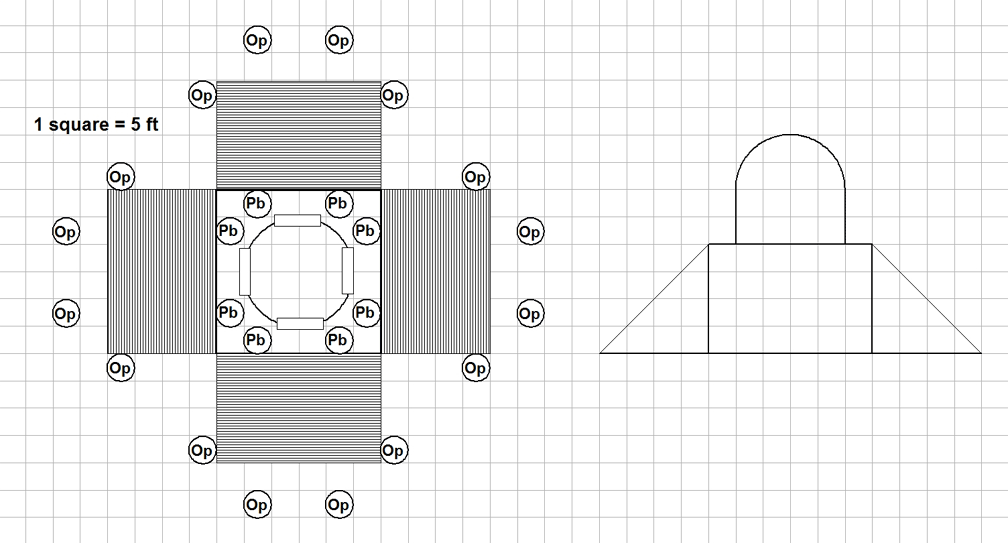 |
The station appears to be a domed stone structure set atop a 20 ft tall stone platform accessed by four sets of wide stairs. The stone of the structure is decorated with elaborate carvings and ornate Slith runes of power. The doors leading into the structure are bronze, and usually open (hardness 8, 54 hp, break DC 26). They can be barred from the outside.
The dimensional lock effect is only negated within the domed structure.
Creatures: 2 pureblood soldiers flank each of the four entrances into the structure, while a guard of 4 ophidians patrols the bottom of each stair. Thus, there are a total of 8 purebloods and 16 ophidians guarding the outside of the structure.
|
|
|
|
Denoument
Once clear of the city, the PCs should be able to return home. Parties of yuan-ti will scour the jungle near the city, so the PCs should take some precautions. Nevertheless, as long as they are not careless or foolish, the danger should be over.
It is up to the PCs where and when they want to take the brew antidote. They should be careful, though, about showing up in places in the form of broodguards!
If the PCs are able to bring the Book of Karsus back to Azotchtlan Lands, they will have pulled off a major coup. Not only will they have access to the spells contained therein (many of which are unique or very rare in Therra), but they will be able to leverage the Book into political advantage should they choose to pursue the effort to teach Azotchtlans wizardry (this is the subject of the next scenario, entitled "Flowers in the Battle".
The reaction of the yuan-ti to the theft of the book is dealt with in "Flowers in the Battle". If the DM is not running that scenario, then it is up to him to decide how the yuan-ti react once (and if) they find out that the PCs were responsible for the theft.
Experience Points:
In addition to normal experience (which in Therra is half of that recommended in the DMG), each party member should be rewarded as follows: