
Return to the Therran Scenario Page
Summary:
The PCs explore some of the areas shown on heir map of the Hurlotzin Lands
Assumptions:
The PCs have completed the scenario entitled "The White Robe" and have the intact map from the dusklings in the scenario entitled "The Staff of Power".
Location:
The Hurlotzin Lands
Historical Date:
705 A.C. Spring
DM's Introduction:
In the scenario "The White Robe", the PCs managed to secure a white robe of the archmage from the incarnum dragon Amarigalozin. Now, still armed with the map of the region they obtained from the dusklings in the cleft, the PCs are eager to explore some of the locations on the map in greater detail.
This scenario expands on the locations on the map. There is absolutely no reason that the DM should feel he needs to utilize this add-on in order to properly run the Tokens of Karsus scenario trilogy. If the DM prefers, the PCs can explore the locations and essentially come up with nothing but possible random encounters. Brief descriptions of the locations are set forth in "The White Robe" and reproduced here.
This scenario assumes the PCs are interested in exploring the locations marked "ancient sites looted" and the "dolmen circle", and it expands upon some of those areas.
Part One - The Map and the Land
Below is the map that the PCs are using to explore the region. There are 5 "ancient site looted" locations and a dolmen circle.
|
|
Information on the region in general is presented hereinbelow:
From the Player's Guide to Sazhansiir:
|
Ancient home of the rilkans, this land was invaded by the scaled ones and overrun, and much of its beauty decimated, as the angry serpents left no stone unturned and salted and poisoned its fields and lakes and streams. Over the centuries the land has recovered somewhat, but is now thought to be wild and untamed, though no doubt full of the ruins of the old civilization. In ancient times the Children of the Mishtai hunted and culled the terrifying malastors, massive creatures covered in plates of stone, but with the land now untamed, the malastors have likely bred in terrifying numbers. It is not known if the scaled ones dwell in this land in any significant numbers and it is not regarded as a part of the Scaled Lands. |
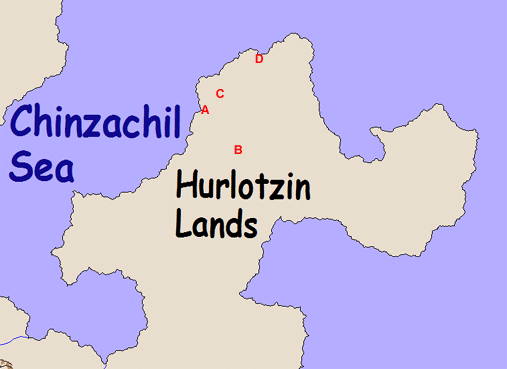 |
On overview map of the Hurlotzin Lands is presented above. 1 inch equals about 400 miles. Important locations to this and the following scenario are noted on the above map.
A = The site of Karsus' arrival
in Sazhansiir and the location of the sea cave
B = The incarnum temple and location of the magic portal back
to the Irin Forest (presented in "The
Staff of Power")
C = The site of the staff of power and the cleft of the
Karsus worshippers
D = The incarnum dragon's lair and site of the white robe of
the archmagi (presented in "The
White Robe")
Travelling in the Hurlotzin Lands:
The majority of the Hurlotzin Lands is flat, rolling plains, much of it still barren due to the ancient depredations of the Scaled Ones. Where it is not barren, vast areas of scrub grasses and wiry bushes predominate. It is only near the coasts that small woods and grasslands begin to appear.
There are no mountains in the region, though the central north-south axis of the land contains some hills and tall ridges.
While there are special terrain locations in the Hurlotzin Lands that correspond to the incarnum terrain types presented in Magic of Incarnum pages 203-207, they do not enter into this scenario. DMs should feel free to add them into the travel of the PCs if so desired, though such exotic spots are rare even in the Hurlotzin Lands. Some of these terrain types do make an appearance in the next scenario in this Tokens of Karsus adventure series.
For purposes of overland travel, the DM should treat the entirety of the land as trackless plains with the exception of those areas shown on the PCs' map (see above) as other terrain. Such terrain includes:
Soulclamour Forest = Forest
Other Forests = Forest
Souless Wastes = Plains
Hills = Hills
Marsh = Moor
The land is wild, but also sparsely populated by beasts. As such, wandering encounters are somewhat less frequent, but more dangerous, than many other places in Sazhansiir.
Wandering encounters are checked for each of four periods of the day, morning, afternoon, evening, and night. Assume the PCs travel during the first two periods and are encamped for the last two periods. There is a 5% chance of an encounter each period. If an encounter is indicated for a period, the DM should check again to see if a second encounter is indicated. If so, then a third check should be made and so forth until a check fails for that period. Multiple encounters in a given period can be spaced apart randomly (i.e. roll a d6 for hour in the period) or can be mixed together into a multiple encounter.
Nighttime encounter chances can increase or decrease depending on the type of camp that is set up:
PCs light an unshielded fire = +5%
PCs light a shielded fire = +2%
PCs make no effort to find a secluded or safe campsite or fail a DC 15 Survival check to find such a spot by 5 or more = +2%
PCs make a DC 15 Survival check to find a safe or secluded campsite = -2%
PCs make noise (singing, etc.) = +5%
Of course, PCs of the level appropriate for this scenario likely have magical means to encamp, including the various shelter-spells and the ever-useful rope trick.
The DM should not seek to foil any measures such as rope trick that the PCs have taken to ensure their safety. After all, that means they have forsaken other spells to memorize these magical means of encamping. In general, such means will involve no encounters during the night, but encounters may occur during the evening, as the PCs must still spend time outside washing, eating, cooking, praying, and practicing their skills. Unless PCs ensconced in concealed magical lodgings wish a running account of the various creatures that blunder past them in the night, the DM should simply not even roll for encounters during the night unless there is a chance that a creature encountered could somehow interact with the PCs.
If an encounter(s) is(are) indicated, refer to the table below.
Full statistics and the like are not presented in this scenario in order to save time and space. It is suggested that the DM preroll for wandering encounters and craft interesting situations to accommodate the encounters.
| d100 |
|
|
|
| 01-03 | Amphisbaena | 1 |
Serpent Kingdoms pg 62 |
| 04-06 | Ant, Giant * |
|
Monster Manual pg 284 |
| 07-14 | Baric | 1d8 | Tome of Horrors pg 28 |
| 15-17 | Centipede, Monstrous * |
|
Monster Manual pg 287 |
| 18-20 | Dinosaur * | var | Various |
| 21-25 | Dire Bat | 1d8 | Monster Manual pg 62 |
| 26-30 | Dire Hawk | 1d20 | Races of the Wild pg 189 |
| 31-33 | Dire Snake | 1 | Monster Manual II pg 74 |
| 34-36 | Dire Toad | 1d10 | Monster Manual II pg 74 |
| 37 | Fire Lizard |
|
Monster Manual II pg 194 |
| 38-41 | Fly, Giant | 1d12 | Tome of Horrors pg 202 |
| 42-44 | Frog, Monstrous * | var | Tome of Horrors pg 206 |
| 45-47 | Gryph | 2d8 | Tome of Horrors pg 230 |
| 48-52 | Hyena | 2d8 | Monster Manual pg 274 |
| 53-55 | Kamadan * | 1 | Tome of Horrors pg 245 |
| 56-58 | Lion | 1d10 | Monster Manual pg 274 |
| 59-63 | Lizard, Giant | 1 | Forgotten Realms Campaign Setting pg 308 |
| 64 | Malastor |
|
Monster Manual V pg 100 |
| 65-67 | Scaled Stalker * | 1d8 | Miniatures Handbook pg 68 |
| 68-72 | Snake, Viper * | var | Monster Manual pg 279 |
| 73-80 | Swarm, Bat |
|
Monster Manual pg 237 |
| 81-83 | Swarm, Plague Ant | 1d8 | Fiend Folio pg 167 |
| 84-88 | Termite, Giant * | var | Sandstorm pg 197 |
| 89-93 | Tick, Monstrous |
|
Tome of Horrors pg 344 |
| 94-96 | Witherweed | 1 | Tome of Horrors pg 368 |
| 97-00 | Wolf | 1d20 | Monster Manual pg 283 |
* = creature encounter divided into subtypes per the tables below or requiring additional explanation
Ant, Giant:
These will be encountered as follows:
01-75 = foraging group of 1d12
worker ants (with 1 soldier if over 5 encountered)
76-95 = war gang of 1d4 soldiers
96-00 = hive of 10d10 workers, 5d4 soldiers, and 1 queen
Centipede, Monstrous:
These will be encountered as follows:
01-30 = 2d8 tiny monstrous centipedes
31-55 = 1d12 small monstrous centipedes
56-75 = 1d6 medium monstrous centipedes
76-90 = 1d6 large monstrous centipedes
91-97 = 1d6 huge monstrous centipedes
98-99 = 1 gargantuan monstrous centipede
00 = 1 colossal monstrous centipede
Dinosaur:
These will be encountered as follows:
01-18 = 1d2 allosaurs (Monster
Manual II pg 70)
19-36 = 1d2 ankylosaurs (Monster Manual II pg 70)
37-46 = 1 seismosaurus (Monster Manual II pg 73)
47-54 = 1 spinosaurus (Monster Manual II pg 73)
55-70 = 1d8 stegosaurs (Serpent Kingdoms pg 66)
71-88 = 1d8 triceratops (Monster Manual pg 61)
89-00 = 1d2 tyrannosaurs (Monster Manual pg 61)
Frog, Monstrous:
These will be encountered as follows:
01-66 = 1d2 giant frogs
67-00 = 1d2 giant dire frogs
Kamadan:
These will be encountered as follows:
01-95 = 1 kamadan
96-00 = 1 poisonous kamadan
Scaled Stalker:
These will be encountered in a war party of 1d8 raiding north from Mazuiochitl and will consists of 1d6+1 scaled stalkers led by a war leader (Fighter 4). Additionally, 1d4-1 triceratops will be present, used as shock mounts. The war leader will always be mounted, with any other triceratops mounted by a single stalker (or unmounted if there are more trcieratops than stalkers).
Snake, Viper:
These will be encountered as follows:
01-30 = 1 tiny viper
31-60 = 1 small viper
61-79 = 1 medium viper
80-97 = 1 large viper
98-00 = 1 huge viper
Termite, Giant:
These will be encountered as follows:
01-75 = foraging crew of 5d4 workers
(with 2 soldiers if over 8 encountered)
76-95 = war squad of 1d8 soldiers
96-00 = hive of 12d10 workers, 5d6 soldiers, and 1 queen
Map Locations:
The following items are marked on the PCs' map leading to the dragon's lair.
Ancient Site Looted:
These are locations that the worshippers of the staff already located and plundered. They range from tombs to buried keeps and the ruins of blasted cities. These are described in more detail in Parts Three - Six below.
Cleft of the Staff:
This is the site of the cleft where the worshippers of the staff of power dwelt. Refer to the first scenario ("The Staff of Power") for further details.
Dolmen Circle:
This is described in more detail in Part Two below.
Holy Vestment:
This is the dragon's lair. Refer to the previous scenario ("The White Robe") for further details.
Soulclamour Forest:
From page 206 of Magic of Incarnum
| The trees in this forest grow close together, weaving their branches together to block any view of the sky. You have an almost constant sense that something is moving at the edge of your field of vision, but the forest seems still when you look directly at anything. Not so the sounds, however - the air is filled with a constant low murmur like voices, but no distinct words. |
| Some forests, for reasons that are unclear, draw incarnum to them and gain a sort of collective consciousness as a result. The mind of a soulclamour forest is barely sentient, but it reacts with strong emotion to the use of incarnum within its bounds. A soulclamour forest can be an isolated wood or part of a larger forest, and its area ranges widely in size. A typical soulclamour forest is 2d20 miles across. For most purposes, it is identical to dense forest. Any creature that attempts to reallocate essentia while in an area of soulclamor forest must make a DC 15 Concentration check to do so. Failure indicates that the character’s essentia remains allocated as it was previously. Something about the nature of a soulclamour forest draws powerful predators to its sheltering trees. Traveling through an area of soulclamour forest typically results in encounters with an average Encounter Level about two levels higher than normal for the surrounding forest or other adjacent terrain, and encounters are 2% more likely to occur each hour. |
For purposes of this area, the DM should add +2% to the chance of an encounter and, if one is indicated, should roll on the encounter table twice and take the encounter with the higher EL. This will require that the precise number of creatures encountered be determined. If two encounters are the same EL, then the DM should choose one randomly.
Soulless Wastes:
| If possible, this area is even more lifeless than the surrounding land. Nothing grows, no snakes or vermin scurry, and no wind blows. Something about the place weighs heavily as you travel through; even talking seems like too much effort. |
|
A soulless waste is an area where no incarnum can flow. It is said to result from a blighting disease or curse that ruins the land, preventing anything from growing and hedging out animal life. Some incarnates with a religious bent call these areas Corruption’s footprints, and speak of the places where the Kyuss’ feet touched the earth as he traveled to shatter the Hurlotzin Lands. Soulless wastes are usually 2d4 miles in diameter and are found in the middle - often the exact center - of more ordinary desert terrain. The terrain within a soulless waste is ordinary tundra, sandy desert, or rocky desert, the same as the terrain outside the wasted area. It is impossible to shape soulmelds within the bounds of a soulless waste. If a character attempts to unshape an existing soulmeld and shape a new one, he finds that he cannot shape the new one, and he must make a DC 15 Concentration check to keep the old soulmeld shaped. Far worse, it is impossible to invest essentia in any receptacle while within a soulless waste. Characters with an essentia pool do not lose that pool, and they can still lose essentia as a result of spells or special abilities (such as the touch of an incarnum wraith), but they cannot invest essentia in soulmelds, class features, feats, spells, or other receptacles. In a soulless waste, essentia invested
in any receptacle, even an incarnum feat, returns immediately
to the character’s essentia pool, remaining uninvested until
the character |
Stone Man:
This is the location of the sea cave that houses a rogue eidolon from whom the worshippers of the staff stole the staff of power. Refer to the first scenario ("The Staff of Power") for further details.
Part Two - The Dolmen Circle (EL 20)
From page 203 of Magic of Incarnum
| Great slabs of stone rise from the earth as if summoned from the rock itself. The stones form a great ring, each pair of standing stones supporting another great horizontal slab above them. |
|
Whether dolmen circles were raised in prehistoric times or are more recent constructions, powerful magic almost certainly figured in their establishment. Some quality of the site heightens the power of incarnum, whether the pattern of the standing stones or an invisible crossing of lines of power marked by the circle, and calls to the lost like the voice of home. A dolmen circle is formed of about 30 large slabs of stone erected in a circle roughly 100 feet in diameter, with stones laid across the top of the slabs to form a continuous circle. The slabs are hewn stone (DC 25 Climb check) and stand about 20 feet high. Sometimes, smaller circles of stones stand within the larger circle. The whole area might be encompassed by a trench or a berm (see page 91 of the Dungeon Master’s Guide), forming an outer circle up to around 300 feet in diameter. Dolmen circles appear in areas of plains terrain. While within 300 feet of the center of
a dolmen circle, any creature with the incarnum subtype gains
a +1 morale bonus on attack rolls, weapon damage rolls, saving
throws, and skill checks. Unfortunately for those who try to
gain the benefits of a dolmen circle, these places act as beacons
for the lost. Any creature with the lost template that comes
within 1 mile of a dolmen circle must make a DC 23 Will save
or travel immediately to the circle and make its new lair within
sight of the stones. A lost creature that makes a successful
saving throw is immune to the lure of that dolmen circle for
24 hours. This is a mind-affecting enchantment (compulsion) effect
similar to the sympathy spell. |
This particular dolmen circle contains 5 large stone slabs to the northeast between the trench and the outer berm that are actually stone sarcophaggi. Their nature is apparant even from a short distance, as even though they are unadorned, they are lying askew as if having been tossed from a short distance. Some of the heavy sarcophaggi are partly buried into the ground from their impact, and 2 of them have their lids akilter, with a third completely off and lying on the ground next to it, cracked in two pieces.
The central mound has five indentations in the ground surrounding the stone plinth at its center. These indentations are each the size of one sarcophaggus and about 4 ft deep, so that had a sarcophaggus been placed into each, only the peaked lid would have been visible above the ground.
 |
Creatures: A pod of 3 windghosts was loitering in the area off the coast of the Hurlotzin Lands when the partiarch of the brood was slain by a combination of infirmity, old age, and a freak storm. The storm scattered the pod, and the matriarch, now miserable for the loss of her mate and her missing adult child, succumbed to the babble of the soulclamour forest and was infused with incarnum. The incarnum merged with her emotional state and turned her into a lost.
Now wandering further afield, the windghost has just in the last few days wandered to within a mile of the dolmen circle and was ensnared by it. She has now spent these days hovering low over the central mound, the bottom of her body just touching the top of the stone plinth atop the mound, wailing in misery.
The adult child windghost eventually tracked down his mother and tried to approach her to console her. The martiarch, lost in the depths of her despair, attacked the child and drove it away.
The adult child now hovers nearby, trying somehow to convince his mother to cast off her horrific state and leave this place. But so far, every time he approaches, the matriarch attacks.
The adult child is now desperate, and the PCs will hear its plaintive wailing as they approach within about a mile from the circle. If the PCs move to investigate the source of the sounds, they will find the adult child hovers about 60 ft off of the ground and is about half a mile from the circle (determine direction randomly).
|
|
The adult child will be amenable to communication with the PCs. He has not ever seen or spoken with human beings, never having travelled to the western portion of Sazhansiir, but will warily speak with any who can communicate with it. The windghost is initially indifferent to the PCs, but if made friendly it will explain its predicament and ask if the PCs know of any way to remove this curse of misery and despair from his mother. If made helpful the windghost will agree to accompany the PCs, but when he comes to within 90 ft of her (which he will try to do) he will engage in a windsong with the matriarch (in an attempt to communicate with her and snap her out of her condition). Alas, all this will do is potentially hurt the PCs through its effects. Even if helpful, the child will not attack the mother and will not allow the PCs to harm her. If they do, he will turn on them and help to defend his mother.
The mother has been infused with the lost template. Jagged shards of blue crystal emerge from her body and crackles of cerulean energy pass from shard to shard. She will attack any creature that approaches to within 300 ft of the center of the dolmen circle, or any creature that attacks her from a greater distance.
|
FEATS: Area Attack (SS p30) - as standard action use large object to make attack in half circle of radius equal to reach, causing 1d8+1.5 Str bonus dmg, suffer -2 to AC and Ref sv until start of next action. Blowhard (SS p31) - standard action use breath in cone of 5 ft per Con bonus to generate strong wind. Gape of the Serpent (SK p146) - can swallow creature up to your own size, but swallowing a creature larger than normal requires an extra grapple check to swallow, gullet can hold one creature of larger than normal size.
|
Tactics: The matriarch is almost always singing her song of misery. Should the adult child engage her in windsong, she will weave the windsong into her song of misery, so that both effects are taking place. As windsong is a supernatural ability, the matriarch will have to lower her antimagic field during this time. This will present the PCs with a brief window of opportunity during which to affect the matriarch with magic. If attacked, she will discontinue her windsong while continuing her song of misery (which is an extraordinary ability and therefore can be used within an antimagic field) to sing while utilizing her antimagic field and other spell-like abilities to best effect. She will not tend to pursue attackers beyond the 300 ft radius of influence of the dolmen circle unless she is attacked from beyond, in which case she will pursue as tactics and prudence dictates. Despite the loss of Intelligence from her conversion into a lost, she still retains the lucidity of an average human being along with a good dose of Wisdom.
Developments: Freeing the matriarch from her condition is not easy. The steps are outlined below, but the PCs will not be privy to these steps. They will have to figure them out forthemselves (some are intuitive), or use divination magic, or they can conduct research, although the latter will involve quite a bit of time and effort and the proper tools and people to consult.
Steps to free the matriarch (which must be done in this order):
The matriarch will, of course, resist any attempts to free her while under the throes of her misery. However, if step 3 is started, then she will calm and begin to listen to the windsong and start to sing her song of misery. At first her misery will threaten to disrupt the song, but the successful Perform check will mean that the windsong has held strong and absorbed the matriarch's harmony into the windsong. This will calm her as her misery is temporarily assuaged into the depths of the song.
In this calmed state, the PCs can then speak with her and plead with her. The adult child will continue to sing his windsong, so that he cannot speak during this time or help with the Diplomacy check.
If the Diplomacy check fails, then the process will be disrupted and the matriarch will begin to attack (if possible) or to flee back to the dolmen circle. The process can be attempted over and over again, but the DC for the Diplomacy check increases by 2 each time and this penalty does not go away, so that eventually after enough failures it is possible the PCs will have no chance to currently free the matriarch.
If the process works, then the matriarch will scream in a horrific wail and begin to thrash around (at the DM's option he can roll a slam attack against all creatures within reach) for 1d10 rounds. As this thrashing occurs, the PCs will be able to see thin wisps of blue cords of energy leaving her body and the crystalline shards embedded in her form shatter and dissolve into thin air. When the thrashing finishes, the matriarch will be at 0 hit points, but free of the lost template. At this point, no statistics should be needed for the matriarch, but if needed the DM should reverse the lost template from the statistics provided above.
The matriarch will be somewhat insensible until her fast healing has fully healed her, wracked with anguish at her loss and what she had become, but it will be plain to see that this time her grief is cleansing and wholesome rather than unhealthy and conducive to becoming lost.
The adult child will be overjoyed and thank the PCs effusively. When the matriarch has recovered, she will also thank the PCs and inform them that although their kind do not keep valuables, should they put a song into the air similar to the one used to rouse her from her misery at a time of great need, she and her child will endeavour to respond to the summons and aid in whatever way they can. She will warn, however, that it could take a long time for them to hear the song and reach them.
Treasure: The sarcophaggi contain the remains of ancient Children of the Mishtai who were buried in this circle. The remains are quite ravaged by time and the recent flinging of the sarcophaggi by the distraught matriarch, so that only powdery bones and fragments of rags remain. The sarcophaggi contain (from north to south):
#1 (lid still on and sealed with lead) = Unidentifiable remains and a gold necklace upon which are mounted five deep blue spinels (3000 gp)
#2 (lid akilter) = Unidentifiable remains and no treasure
#3 (lid off and broken in two) =Remains missing and sarcophaggus empty
#4 (lid akilter) = Unidentifiable remains and a necklace of 4 silver plates, each bearing the image of a turtle-headed humanoid each with eyes of a different gem (blue sapphire, star ruby, fire opal, and purple corundum) (5500 gp). A DC 25 Knowledge (history) check will allow these figures to be identified as the mishtai, and a DC 30 Knowledge (history) check will allow each mishtai to be specifically identified (in order of the gems listed: Inrenzeer, Hurlotzin, Harrasivin, and Klashkaln).
#5 (lid still on a sealed with lead) = Possibly the remains of two children, as evidenced by the fragments of mouldering skulls within. Also here is a lesser strand of prayer beads.
Part Three - Ancient Site A
This site is a circular vertical shaft about 20 ft in diameter that descends 100 ft into the ground. The shaft is clearly worked, with blue and grey bricks mortared into the walls. The entrance to the shaft on the surface is concealed by a series of logs set across it and large boulders, dirt, and leaves and branches set atop it, so that a DC 20 Spot check is required to notice it.
At the bottom of the shaft are two 10 ft wide passages, one heading west and the other east. The western passage shows signs of having been excavated, as stone chips litter the entrance and there are jagged stone shards still depending from the archway.
Both passageways travel for roughly 80 ft and have four chambers of various sizes coming off of them. The chambers are dusty and empty, although one off of the western passageway contains an opened secret trap door that leads to a 10 ft cube empty niche.
One of the eastern chamber contains the rotting husks of 2 huge monstrous spiders and the remains of several animals that appear to have had the insides sucked out of them.
The walls of the chambers contain faded frescoes that are unidentifiable with age.
There is nothing left of value at this site, it having been looted by the dwellers of the cleft.
Part Four - Ancient Site B (EL 15)
Between two hills lies a stone structure shaped like a tube stretched north to south some 100 ft between the two hills. The tube is 40 ft in diameter and accessed is via a jagged roughly 20 ft diameter hole in the center of the south wall of the tube.
Within, the floor is flat and runs the entire 100 ft length of the structure and is 20 ft wide. Stone steps climb from the opening down 5 ft to the floor level.
The interior of the tube is littered with stones of various sizes. Given that, despite a number of cracks and the one jagged hole, the structure is relatively intact, the presence of so many stones indicates that a variety of interior structures or stone furnishings must have been obliterated.
Creatures: A pack of kamadans dwells here, led by a particularly tough brute that was warped from birth by some lingering magic in the structure that was released upon its mother when she smashed a crystalline structure within the stone tube. This kamadan, infused with the powers of both earth and fire, grew into adulthood and slew the pack leader, and has ruled the roost ever since. There are also 4 newborn cubs huddled in a den fashioned from bones and furs in one corner of the place. These cubs are not yet weaned and are size Tiny and non-combatant.
|
|
|
|
Tactics: The pack leader is fearless, full of himself from his templates and given how he acquired leadership of the pack, he knows that any sign of weakness would mean his death anyways. He will always lead an attack, and will use his spell-like abilities to best effect. When using his magic stone ability, he will fling nearby stones with his snake heads. He will only cast stoneskin when and if he is attacked by magic weapons that manage to pierce his damage reduction.
In general, the kamadans will try to keep any battle against tough opponents inside the structure, where the closer quarters can work to their advantage. With the curved walls of the place, they can run up the walls to a height of about 20 ft and then leap at foes trying to hover near the middle of the ceiling (their four legs and Balance skill allow them to do this much more easily than can the average PC).
Should the PCs attempt to trap or block the kamadans within the structure and attack from without, the pack leader will use his spell-like abilities to create another exit and flank the PCs. Conversely, he will attempt to use his wall of stone ability to trap PCs within the structure.
If the PCs appear weak, the kamadans will emerge from their lair to pursue, although four kamadans will remain behind to guard the young.
Because of the presence of young, these kamadans will never flee their lair and will attack to the death.
Developments: The cubs cannot easily be trained, as their relatively high intelligence and fierce disposition make them unruly. Nevertheless, it is possible with long years and proper handling that they could be trained into guards. Serving as mounts is a much dicier prospect, as the kamadans will tend to resent such use, but proper doses of fear and intimidation can make even this happen, though their alignments will then convert to neutral evil as they begin to hate all other life.
Treasure: The structure that the pack leader's mother broke that released its powers into the unborn pack leader is still to be found, and wth a remnant of its power remaining. The structure is buried under what is now the den for the cubs. The pack leader used his stone shape ability to cover a 5 ft cube niche in the floor with 2 ft of stone. To locate the structure, the PCs will have to demolish and clear away the cub den or thoroughly search it (DC 30 Search check) to notice that the stone stone ground below the den is somewhat smooth and rippled, as if butter had been spread with a giant knife and then turned to stone. A DC 20 Knowledge (architecture and engineering) check or a DC 30 Knowledge (dungeoneering) check or a DC 24 Spellcraft check can identify the stone work as likely from a stone shape spell.
Within the hidden niche is the remnants of what looks like the base of a blue crystalline bush. A single thick stem is embedded into the stone floor and quickly begins to branch as it rises. The whole rises only 2.5 ft before the branches are snapped off in jagged ends. The structure looks somewhat delicate.
The structure detects as strong transformation magic (although with the stone shaped covering on a detect magic spell cannot pierce the stone to detect the structure...it must be exposed first). If the detect magic is held long enough to pinpoint the location, the magic seems to be concentrated into the bottom or base of the structure.
Close examination will reveal that the branches of the structure are hollow. The entire thing is, in fact, a series of branching hollow tubes of blue crystal. In the bottom of the structure, in its stem and in the first few larger branchings, is a reddish liquid that looks purple when viewed through the blue crystal. The liquid is the magic. This liquid is an ancient elixir of the Children of the Mishtai and unique to this site. The lore of its creation is lost.
There are 3 doses (full swallows) of the liquid. The liquid will only function upon living creatures of a type normally subject to criticals (i.e. no elementals, oozes, or plants). If the liquid is tested (i.e. a tiny dab is tasted), the liquid will taste like dirt at first, but then a massive dose of spice will wash through, requiring a DC 15 Constitution check or the taster will be nauseated for 2d4 rounds. Any reasonable person will be able to conclude that imbibing a full dose of the liquid might be somewhat risky.
If a whole dose is swallowed, the imiber will be awash with fire throughout his body. He will spend 10d10 rounds in agony, unable to do anything but writhe in pain. At the end of this time, he must make a DC 20 Fortitude save. Failure means he has not survived the dose and will die from system shock. This is not a poison or disease or curse. If the save is successful, the imbiber will, in breaking through the veil of pain wracking his body, become aware that there are two natures in the liquid that are confronting him, each clamouring to enter his being and transform him. For the next 1d10 rounds, the victim will have to struggle to sort through the dual nature of the liquid. This requires a DC 20 Will save. Success means that the imbiber has been able to sort through the dual nature of the draught and he can now choose whether to be affected by one, both, or none of the templates offered by the liquid. If the Will save is unsuccessful, then the imbiber's will has been overwhelmed by the liquid and one or more of the templates forces itself on the imbiber (roll d100: 01-40 = half-earth elemental, 41-80 = fire element, 81-00 = both).
The liquid contains both the half-earth elemental template and the fire element template (see Manual of the Planes pages 188 and 193 respectively). If a PC accepts a template or if one is forced upon him, he will suffer a level adjustment equal to one-half the normal level adjustment for these templates (i.e. LA of +1 for the half-earth element template and LA of +2 for the fire element template). These level adjustments occur immediately and affect the amount of XP the PC will need to advance to his next level. If both templates are chosen, the half-earth template will be acquired first, and then the fire element template (for purposes of determining the creature type the imbiber ends up as).
As this liquid is rather dangerous and career-altering, the PCs are well-advised to attempt to research what it does first. Doing so without magic will require a DC 35 Craft (alchemy) check in a fully stocked laboratory (there is no chance to do it in the field without an alchemist's lab), with each check taking 1d4 weeks. An alchemist can take 20 on this check.
Part Five - Ancient Site C
This site is a jumble of stones, including a foundation that suggests a keep or fortress of some sort. Nothing stands more than a foot and a half tall, and even that is somewhat rare, as the whole is overgrown by grasses, scrub, and thorny bushes.
At several spots, stone stairs lead down into chambers that include collapsed cellars and, in one case, the remains of a dungeon, as evidenced by two barred chambers that are blocked by collapse.
At least some of these underground chambers show signs of relatively recent excavation (i.e. within the last decade). However, other than normal animal spoor, there is no sign of recent habitation and nothing of value.
Part Six - Ancient Site D (EL 18)
This site is a massive jumble of huge blocks of stone, scattered in a wide region over bare earth, about a quarter of a mile in diameter. Several rather large piles of such stones form rough mounds throughout the area, and there are a total of six such mounds, each about 100 ft in diameter and 40 ft high.
All but one of the mounds are nothing more than rock piles. The rock is certainly worked, and remnants of carvings and shapes and forms can be seen on some of the pieces. However, the piles run all the way through the mound, so that there is little space for air within and nothing large enough for a Medium creature to proceed unhindered into the center of the pile or to dwell within.
One of the mounds is actually hollowed out. This hollowing is by no means the work of an artisan, but rather the earth beneath the fallen stones has been burrowed out and some of the stones overhead have been removed, so that there is a roughly spherical space beneath the "dome" of fallen stones. This space is about 60 ft in diameter, and set within is a massive pile of what can best be described as rotting carcases and vegetation. The pile is easily 12 ft tall at its center (tapering down to the ends) and 30 ft in diameter. Hordes of flies buzz around the pile, which, even at a glance, seems to consist of hundreds of animal carcases of all sorts. The stench emanating from the pile is overwhleming, requiring a DC 20 Fortitude save to avoid becoming sickened, and if the save is failed by 5 or more the subject is nauseated instead. This condition lasts for as long as the subject is within the mound and for 1d10 minutes thereafter.
The swarming flies and other bugs are in a thick enough cloud that the entire interior of the mound is treated as granting concealment (i.e. a 20% miss chance). Any massive energy effect that covers a good part of the interior can dissipate the insects and negate the concealment (e.g. fireball or acid cloud).
Buried amongst the pile are half a dozen large eggs, each about 3 ft in diameter. These are malastor eggs, due to hatch in about 2 months. The eggs are not visible from without, and so would require the PCs excavating into the pile or using magic to determine the presence of the eggs. Rooting through the pile using hands or hand tools (like shovels) will expose those who do so to the shakes (DC 13, 1 day, 1d8 Dex).
The malastors are immune to the effects of the refuse pile.
Creatures: A mated pair of malastors has its clutch in the pile of rotting corpses. This pair guards its nest jealously. One malastor is found about 50 ft below the ground, to one side of the refuse pile. The other is found burrowing 50 ft beneath the ground in a roughly circular pattern at a radius of about 150 ft outside the mound.
The malastors rely on their remarkable tremorsense range to identify threats to their nest. Any contact with the mound, even from the outside, will transmit vibrations to the earth and thereby alert the malastors.
While the malastors are not intelligent, they are extremely canny (as evidence by their very high Wisdom scores). They will use their burrow ability to attack foes from surprise, by ambush, emerging from below to strike their prey.
|
|
Tactics: The malastor that patrols outside of the mound will aggressively attack any intruders of size Small or larger that approach within 150 ft of the mound. The creature, upon sensing such creatures within 1200 ft, will burrow towards the creatures, so that it will be 50 ft directly beneath them when they reach 150 ft distance from the mound. It will then shoot upward, breaching the earth in a single round and likely gaining a round of surprise.
The burrowing from these creatures can be noticed by any creatures with tremorsense, and by a Listen check. The Listen DC is a base of 5, modified by distance (+1 per 10 ft) and the fact that there is a lot of earth between the PCs and the malastor (+20 DC per 50 ft of earth or fraction thereof). Thus, for the PCs to hear the rumbling in the earth from the malastor approaching directly beneath them at a depth of 50 ft is a DC 30 Listen check.
The malastor that is underneath the inside of the mound will not leave to help the outside malastor. Instead, it will remain where it is to guard the eggs should the other malastor fall or should enemies get by it and reach the egg chamber. Then, the inner malastor will breach the earth to one side of the refuse pile and attack. If the inner malastor attacks, then should the outer malastor be able, it will hasten to the egg chamber to assist in a direct defense of the eggs.
Both malastors will fight to the death in order to save their eggs. If their foes retreat, at least one malastor will always remain behind with the eggs to guard them. If a second malastor is able, it will chase foes for a distance of about 300 ft (and then use its avalanche wave to harrass them for another 400 ft). From there it will wait a time to see if its foes return before resuming its outer patrol at a distance of 150 ft.
Treasure: Malastor eggs are not worth as much as might be expected because malastors are not trainable. Their low Intelligence coupled with their high Wisdom, their chaotic evil nature, their general irrascibility, and their need to hibernate make them useless as steeds or even guardian creatures. Nevertheless, the eggs could be of use to alchemists or crafters of magical items. Should such a buyer or buyers be found, the eggs could be sold for 1500 gp each if sold intact and within 20 months. Thereafter, as the unhatched malastors die and begin to rot the price should reduce by 100 gp per month until the shells alone could fetch 300 gp each.
Part Seven - Ancient Site E
This site is a remains of a tall tower set on a wooded promontory that overlooks a wide swath of land, even as far as the ocean some 40 miles to the west.
The tower is now half of a tower, a jagged shard of curved stone that thrusts up perhaps 60 ft into the air, its once 40 ft diameter base now just an overgrown platform of stone covered in dirt and grass surmounted by a semi-circle of stone that rises and diminshes until at its full 60 ft height it is a mere spike of stone pointing skyward.
A DC 20 Search check of the floor will reveal that several bricks are loose and not firmly set into their mortared joints. These bricks can be removed, exposing a 5 ft square passageway reveal stairs heading down.
The stairs progress for about 40 ft, spiralling downward before ending in the center of a large chamber 50 ft square and 20 ft high. The chamber's walls look as if they once held ornate carvings, but most of these have been smashed or otherwise defaced, including several indentations that suggest that gems may have been inset into the carvings at one point.
A smashed stone structure of some sort lies in one corner of the room, perhaps the remains of a sarcophaggus or altar, although little enough remains intact to tell. In the opposite corner are three large stone chests, opened and empty. One of the chests bears a round pattern of ashes discolouring its face, as if an explosion of some sort went off.
There is nothing of value or interest remaining at this site.
Experience Points:
In addition to normal experience (which in Therra is half of that recommended in the DMG), each party member should be rewarded as follows: